StudioORD Observational Studies
Baggage, Ticketing, Security
Context
Digital ethnography revealed that passengers experienced issues at key points of their journeys:
Baggage, ticketing, and security. These issues ranged from personal interactions with airport
and airline personnel, to completion of actual processes. A better understanding of these issues
can arise through disguised naturalistic observations.
Objectives
The primary objective of this study is to gain insight into the context of interactions between
passengers and personnel for specific processes in Terminal 2 of O’Hare International Airport
(ORD):
 Baggage
 Ticketing
 Security
Study Design
A disguised naturalistic observation study will be used to gather insights into the context of
baggage, ticketing, and security processes at ORD.
 Team of 2 researchers: 1 with a UX background, 1 with an architecture background.
 A(x4) framework to assist with noting observations.
o Atmosphere- the specific locations within ORD where users interact.
o Actors- the users of ORD.
o Artifacts- items involved in the interactions between users of ORD.
o Activities- the actual interactions between users of ORD.
Setting & Subjects
This study will take place at ORD’s Terminal 2 by focusing UX observational efforts on certain
locations:
 Upper level
o Ticket counter
o Security checkpoint + TSA Precheck
 Lower level
o Baggage claim
The primary subjects of the study include passengers and the various airport and airline
personnel they interact with during baggage, ticketing, and security processes. Subjects of
lesser interest include any visitors, transportation professionals, and federal, state, or city
employees not affiliated with ORD or any airline.
Data Analysis
Keeping in line with the A(x4) framework, data will be organized into “snapshots” around each of
the 4 A’s. These snapshots will illustrate the current state of user experience in Terminal 2 for
the examined processes. Snapshot content can feed into “blue sky” visualizations for the future
of these experiences. Visualizations should align at a high level with the vision for the future
OGT, while offering solutions for the issues revealed during the digital ethnography and
observations. Finally, the visualizations can be used to create scenarios for the future of the
user experience at ORD, which can then be discussed in future research activities with users of
ORD.

Field Observation Study- Sample Study Outline

  • 1.
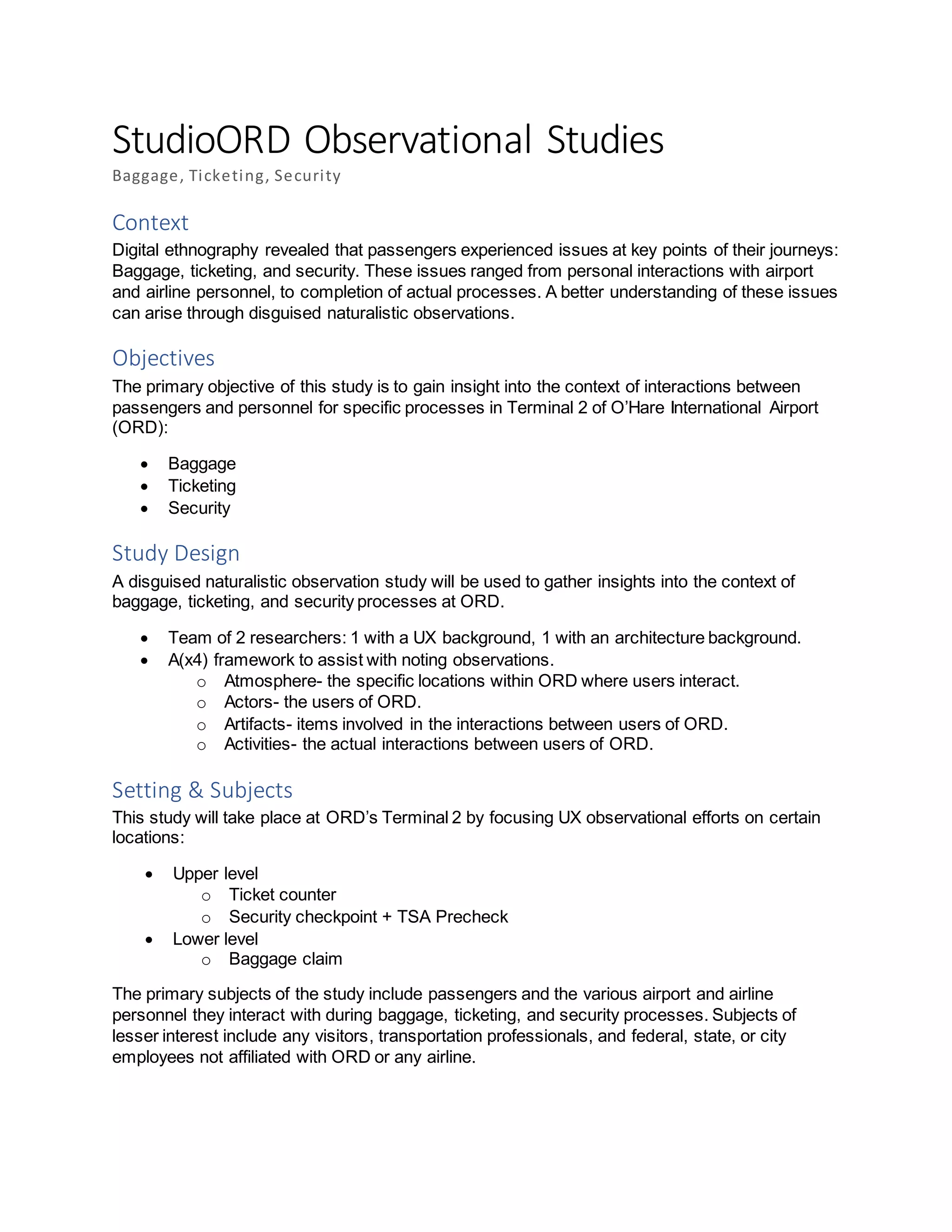
    StudioORD Observational Studies Baggage,Ticketing, Security Context Digital ethnography revealed that passengers experienced issues at key points of their journeys: Baggage, ticketing, and security. These issues ranged from personal interactions with airport and airline personnel, to completion of actual processes. A better understanding of these issues can arise through disguised naturalistic observations. Objectives The primary objective of this study is to gain insight into the context of interactions between passengers and personnel for specific processes in Terminal 2 of O’Hare International Airport (ORD):  Baggage  Ticketing  Security Study Design A disguised naturalistic observation study will be used to gather insights into the context of baggage, ticketing, and security processes at ORD.  Team of 2 researchers: 1 with a UX background, 1 with an architecture background.  A(x4) framework to assist with noting observations. o Atmosphere- the specific locations within ORD where users interact. o Actors- the users of ORD. o Artifacts- items involved in the interactions between users of ORD. o Activities- the actual interactions between users of ORD. Setting & Subjects This study will take place at ORD’s Terminal 2 by focusing UX observational efforts on certain locations:  Upper level o Ticket counter o Security checkpoint + TSA Precheck  Lower level o Baggage claim The primary subjects of the study include passengers and the various airport and airline personnel they interact with during baggage, ticketing, and security processes. Subjects of lesser interest include any visitors, transportation professionals, and federal, state, or city employees not affiliated with ORD or any airline.
  • 2.
    Data Analysis Keeping inline with the A(x4) framework, data will be organized into “snapshots” around each of the 4 A’s. These snapshots will illustrate the current state of user experience in Terminal 2 for the examined processes. Snapshot content can feed into “blue sky” visualizations for the future of these experiences. Visualizations should align at a high level with the vision for the future OGT, while offering solutions for the issues revealed during the digital ethnography and observations. Finally, the visualizations can be used to create scenarios for the future of the user experience at ORD, which can then be discussed in future research activities with users of ORD.