 
Also known as: 
FFeelliixx 
MMeennddeellssssoohhnn
 
SSyynnooppssiiss
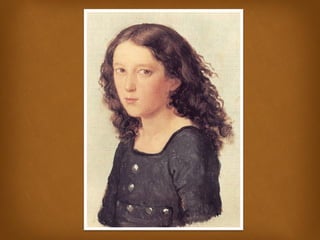
 Felix Mendelssohn was born 
on February 3, 1809, in 
Hamburg, Germany. At age 
9, he made his public debut 
in Berlin. In 1819, he joined 
the Singakademie music 
academy and began 
composing non-stop.
At Singakademie, he also became 
a conductor, but continued to 
compose prolifically. Mendelssohn 
founded the Leipzig Conservatory 
of Music in 1843. He died on 
November 4, 1847, in Leipzig.
 
CChhiillddhhoooodd
 Pianist, composer and conductor Felix 
Mendelssohn was born Jakob Ludwig 
Felix Mendelssohn-Bartholdy in 
Hamburg, Germany, on February 3, 
1809. His parents were Jewish, but 
converted to Christianity before he, his 
brother and two sisters were born.
When Mendelssohn was 2 years old, he 
moved to Berlin with his parents and 
siblings. In Berlin, the young 
Mendelssohn began taking piano lessons 
with Ludwig Berger. Mendelssohn also 
studied composition under In 1816, he 
broadened his lessons, studying under 
pianist Marie Bigot during an extended 
stay in Paris, France. 
.
Mendelssohn was quick to 
establish himself as a musical 
prodigy. During his childhood, he 
composed five operas and 11 
symphonies. At just 9 years old, 
he made his public debut in 
Berlin.
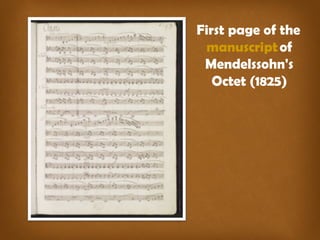
First page of the 
manuscript of 
Mendelssohn's 
Octet (1825)
 
Early work
In 1820 alone, he wrote a violin 
sonata, two piano sonatas, multiple 
songs, a cantata, a brief opera and a 
male quartet. In 1826, Mendelssohn 
produced one of his best known 
works, Overture to a Midsummer 
Night's Dream. He presented his only 
opera, The Marriage of the 
Camacho, the following year in 
Berlin.


At Singakademie, Mendelssohn 
also became a conductor. In 1829, 
he conducted a performance of 
Bach's St. Matthew Passion. The 
performance's success led to 
other great opportunities, 
including a chance to conduct 
the London Philharmonic Society 
that same year.
Mendelssohn continued to compose 
prolifically while working as a 
conductor. He wrote 
the Reformation Symphony in 1830, 
and followed that accomplishment 
with a three-year European tour. 
During that time, he published his 
first book of songs, entitled Songs 
without Words (1832).
Italian Symphony (1833), 
another of Mendelssohn's best 
known works, was also born 
of this period. In 1835, 
Mendelssohn was granted an 
illustrious role: conductor of 
the Gewandhaus Orchestra in 
Leipzig.
 Liepzig
 In 1835 Mendelssohn was 
appointed as conductor of the 
Leipzig Gewandhaus 
Orchestra. 
 Despite efforts of the King of 
Prussia to lure him to Berlin, 
Mendelssohn stayed to help 
develop the music in Leipzig.
 He performed the works of 
Schubert soon after a friend 
discovered them. (Schubert’s 
Ninth Symphony)
 
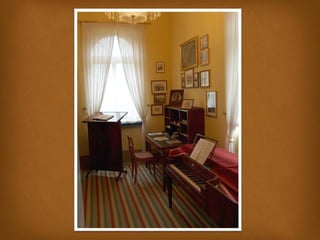
The Leipzig 
Conservatory
 In 1843, Mendelssohn founded 
the major music school the 
Leipzig Conservatory. 
 He persuaded Ignaz Moscheles 
and Robert Schumann to join 
him, as well as other prominent 
musicians to join as staff 
members.
PPeerrssoonnaall 
LLiiffee
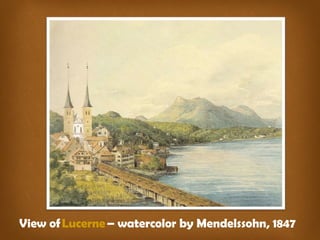
 Mendelssohn was an accomplished 
artist, which included drawing, 
watercolos, and oil painting. 
 Even though he has been 
perceived as a happy man who 
was placid in temperament, he 
was prone to fits of temper which 
eventually led to collapse.
 He married Cécile 
Jeanrenaud, the daughter 
of a French Protestant 
clergyman, and had five 
children with her.
View of Lucerne – watercolor by Mendelssohn, 1847
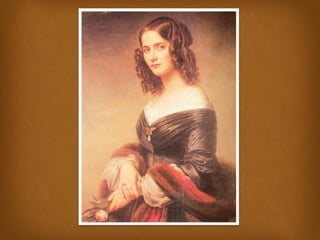
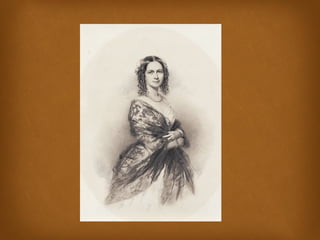
Jenny Lind 
whom he met in October 184 
Mendelssohn met and worked 
with Lind many times, and 
started an opera, Lorelei, for her, 
based on the legend of the Lorelei 
Rhine maidens; the opera was 
unfinished at his death.
 
LLaatteerr WWoorrkk
 The same year that he married, 
Mendelssohn composed his Piano 
Concerto No. 2 in D Minor. From 
1838 to 1844, he toiled away on 
his Violin Concerto in E Minor. Prior 
to the piece's completion, 
Mendelssohn founded the Leipzig 
Conservatory of Music and became 
its director.
In so doing, he put Leipzig on 
the map as the musical center 
of Germany. After 
finishing Violin Concerto in E 
Minor, Mendelssohn conducted 
a string of concerts for the 
Philharmonic. In 1846 he 
presented his newly 
written Elijah at the 
Birmingham Festival.
 
Final Years
 In May 1847, Mendelssohn's 
sister, Fanny, who was a 
lifelong inspiration to him, died 
suddenly. Her death left him so 
devastated that he soon lost his 
own zest for life. His health, 
already compromised by his 
strenuous career, began to 
deteriorate rapidly.
Six months later, on November 
4, 1847, Felix Mendelssohn died 
of a ruptured blood vessel in 
Leipzig, Germany. He had 
recently returned from a brief 
visit to Switzerland, where he'd 
completed composition of 
his String Quartet in F Minor.
Although he was only 38 when 
he died, Mendelssohn 
managed to distinguish 
himself as one of the first 
significant Romantic 
composers of the 1800s.
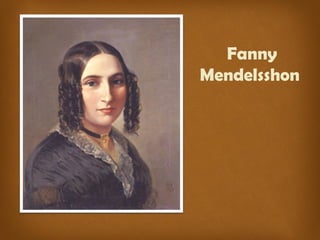
Fanny 
Mendelsshon
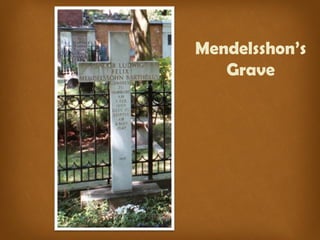
Mendelsshon’s 
Grave
FFIINN..
THANK YOU 
FOR 
LISTENING

Felixmendelssohn 140614033846-phpapp01 (2)

  • 2.
     Also knownas: FFeelliixx MMeennddeellssssoohhnn
  • 5.
  • 6.
     Felix Mendelssohnwas born on February 3, 1809, in Hamburg, Germany. At age 9, he made his public debut in Berlin. In 1819, he joined the Singakademie music academy and began composing non-stop.
  • 7.
    At Singakademie, healso became a conductor, but continued to compose prolifically. Mendelssohn founded the Leipzig Conservatory of Music in 1843. He died on November 4, 1847, in Leipzig.
  • 8.
  • 10.
     Pianist, composerand conductor Felix Mendelssohn was born Jakob Ludwig Felix Mendelssohn-Bartholdy in Hamburg, Germany, on February 3, 1809. His parents were Jewish, but converted to Christianity before he, his brother and two sisters were born.
  • 11.
    When Mendelssohn was2 years old, he moved to Berlin with his parents and siblings. In Berlin, the young Mendelssohn began taking piano lessons with Ludwig Berger. Mendelssohn also studied composition under In 1816, he broadened his lessons, studying under pianist Marie Bigot during an extended stay in Paris, France. .
  • 12.
    Mendelssohn was quickto establish himself as a musical prodigy. During his childhood, he composed five operas and 11 symphonies. At just 9 years old, he made his public debut in Berlin.
  • 13.
    First page ofthe manuscript of Mendelssohn's Octet (1825)
  • 14.
  • 15.
    In 1820 alone,he wrote a violin sonata, two piano sonatas, multiple songs, a cantata, a brief opera and a male quartet. In 1826, Mendelssohn produced one of his best known works, Overture to a Midsummer Night's Dream. He presented his only opera, The Marriage of the Camacho, the following year in Berlin.
  • 16.
  • 17.
  • 18.
    At Singakademie, Mendelssohn also became a conductor. In 1829, he conducted a performance of Bach's St. Matthew Passion. The performance's success led to other great opportunities, including a chance to conduct the London Philharmonic Society that same year.
  • 19.
    Mendelssohn continued tocompose prolifically while working as a conductor. He wrote the Reformation Symphony in 1830, and followed that accomplishment with a three-year European tour. During that time, he published his first book of songs, entitled Songs without Words (1832).
  • 20.
    Italian Symphony (1833), another of Mendelssohn's best known works, was also born of this period. In 1835, Mendelssohn was granted an illustrious role: conductor of the Gewandhaus Orchestra in Leipzig.
  • 21.
  • 22.
     In 1835Mendelssohn was appointed as conductor of the Leipzig Gewandhaus Orchestra.  Despite efforts of the King of Prussia to lure him to Berlin, Mendelssohn stayed to help develop the music in Leipzig.
  • 23.
     He performedthe works of Schubert soon after a friend discovered them. (Schubert’s Ninth Symphony)
  • 24.
     The Leipzig Conservatory
  • 26.
     In 1843,Mendelssohn founded the major music school the Leipzig Conservatory.  He persuaded Ignaz Moscheles and Robert Schumann to join him, as well as other prominent musicians to join as staff members.

  • 27.
  • 28.
     Mendelssohn wasan accomplished artist, which included drawing, watercolos, and oil painting.  Even though he has been perceived as a happy man who was placid in temperament, he was prone to fits of temper which eventually led to collapse.
  • 29.
     He marriedCécile Jeanrenaud, the daughter of a French Protestant clergyman, and had five children with her.
  • 30.
    View of Lucerne– watercolor by Mendelssohn, 1847
  • 32.
    Jenny Lind whomhe met in October 184 Mendelssohn met and worked with Lind many times, and started an opera, Lorelei, for her, based on the legend of the Lorelei Rhine maidens; the opera was unfinished at his death.
  • 34.
  • 35.
     The sameyear that he married, Mendelssohn composed his Piano Concerto No. 2 in D Minor. From 1838 to 1844, he toiled away on his Violin Concerto in E Minor. Prior to the piece's completion, Mendelssohn founded the Leipzig Conservatory of Music and became its director.
  • 36.
    In so doing,he put Leipzig on the map as the musical center of Germany. After finishing Violin Concerto in E Minor, Mendelssohn conducted a string of concerts for the Philharmonic. In 1846 he presented his newly written Elijah at the Birmingham Festival.
  • 37.
  • 38.
     In May1847, Mendelssohn's sister, Fanny, who was a lifelong inspiration to him, died suddenly. Her death left him so devastated that he soon lost his own zest for life. His health, already compromised by his strenuous career, began to deteriorate rapidly.
  • 39.
    Six months later,on November 4, 1847, Felix Mendelssohn died of a ruptured blood vessel in Leipzig, Germany. He had recently returned from a brief visit to Switzerland, where he'd completed composition of his String Quartet in F Minor.
  • 40.
    Although he wasonly 38 when he died, Mendelssohn managed to distinguish himself as one of the first significant Romantic composers of the 1800s.
  • 41.
  • 42.
  • 43.
  • 44.
    THANK YOU FOR LISTENING