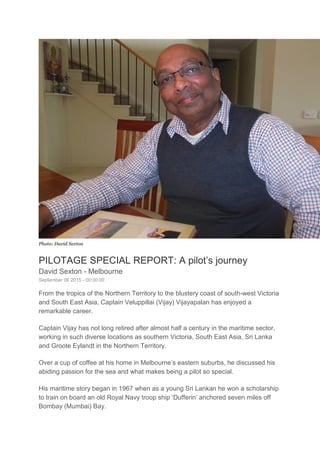
Photo: David Sexton
PILOTAGE SPECIAL REPORT: A pilot’s journey
David Sexton - Melbourne
September 06 2015 - 00:00:00
From the tropics of the Northern Territory to the blustery coast of south-west Victoria
and South East Asia, Captain Veluppillai (Vijay) Vijayapalan has enjoyed a
remarkable career.
Captain Vijay has not long retired after almost half a century in the maritime sector,
working in such diverse locations as southern Victoria, South East Asia, Sri Lanka
and Groote Eylandt in the Northern Territory.
Over a cup of coffee at his home in Melbourne’s eastern suburbs, he discussed his
abiding passion for the sea and what makes being a pilot so special.
His maritime story began in 1967 when as a young Sri Lankan he won a scholarship
to train on board an old Royal Navy troop ship ‘Dufferin’ anchored seven miles off
Bombay (Mumbai) Bay.
‘Dufferin’ provided two years of on board pre-sea training for prospective mariners,
with 150 cadets on board and 75 new ones recruited annually.
Cadets lived on board during their training period, undergoing both academic and
vocational training, their days starting at 5am and finishing at 9pm but “I personally
believe that the Dufferin training that gave me the foundation to become a good
mariner and then a pilot”.
He gained his Master Mariner qualification, while working with the British shipping
company ‘Blue Funnel Lines’, ultimately becoming a full-fledged pilot in 1981 after a
short spell in command of ships in international voyages.
Early days of piloting were spent working in Sri Lanka as well as Singapore, later
training as a pilot in the Port of Colombo, handling all ship classes including the
passenger ships.
He also worked as a regional harbour master/pilot in four other Sri Lankan ports, with
the novel experience of piloting ships in one regional port (Galle) without tugs, purely
using the influence of the winds and ship anchors.
“In Singapore you were handling different type ships with varying tonnages and
working with tides…. So I had across the board knowledge and experience before I
came to Australia.”
Maritime marriage
It was on a visit to Colombo in 1973 that he met his future wife Manoranjini (Mano).
They married in 1977 and later sailed together for two and half years in good, bad
and the ugly ships.
“This gave her the opportunity to learn about me in particular, then, life as a seafarer
on board in the capacity as a marine officer and then as master in command.”
Australia relocation
Captain Vijay had a rewarding job at the port of Colombo, Sri Lanka, but in 1983 the
deteriorating political situation in that country with the vicious civil war forced the
couple and their young family to flee for Australia.
It was a difficult time and he and his young family arrived in Australia with almost
nothing.
It was fortunate that pilotage skills were in high demand in Australia.
Relocating his young family to the BHP (now BHP Billiton) dry bulk operation at
Groote Eylandt, off the Northern Territory coast, he was employed as port
superintendent, a job that involved pilotage, ship handling, and port/stockpile
management. This position also involved chartering, loading of ships, shipping
agency including documentation for vessel’s visit and cargo loaded.
Groote might seem remote, but it was a surprisingly good place for his young family
who enjoyed the tropical bungalow lifestyle.
As a pilot, the challenge was guiding bulkers (typically Panamax) in and out of port,
overcoming big tides and strong tidal streams only with the aid of two small single
screw harbour tugs of fourteen and ten tonnes bollard pull.
“We were exporting (mainly) manganese and the crews would be everything from
Filipino to Greek to Chinese, Japanese, Italian, Korean Egyptian and Iranian.
“Also we had the coastal trade so there were BHP ships as well.”
A southern relocation
Their children’s schooling forced a move, the family relocating to Portland, that
picturesque but blustery port on the south-west coast of Victoria.
“My children were growing up so I had to think in terms of (their education).
“Port of Portland offered me a job as assistant harbour master in 1987, then was
promoted to harbour master and marine manager.”
Working in a port off the Southern Ocean was “a very different ball game”.
“It’s a man-made port, open to the Southern Ocean, with heavy swells.”
Portland comes with its own challenges.
“The biggest challenge was confinement or limited sea-room to manoeuvre.
“The port was designed in the early 1950s for ships up 10-15,000dwt.
“When I went there we were handling ships up to about 45-50,000dwt, with time we
were able to increase the tonnage to over 100,000 dwt and in fact the biggest bulk
carrier I handled there was 116,000dwt.
“So the margin of error becomes smaller.”
A key early task was to improve towage facilities, with the two tugs of 1200 and 1600
horsepower respectively being inadequate for the task.
“We eventually got two Omni directional twin screw tugs with 40-tonne bollard pull
that helped us to increase the tonnage without compromising safety.”
In the 23 years he was based at Portland, the port expanded from purely grain and
livestock to one that also handled woodchip, wood products, mineral sands and
smelter products.
“The process was to improve our trade without affecting port safety.”
Another challenge was the change from state to private ownership in the mid-1990s,
with Portland an important example of infrastructure privatisation used by the Liberal
Government of Jeff Kennett.
Pilotage culture
“The greatest thing to be a pilot is your attitude and aptitude towards work and the
people you are working with.
“In a day you may be working with people from many different nations – your first
ship could be Chinese, the second could be Norwegian, a third could be Australian
and the fourth could be Korean.
“Also ships may vary in size from 5000dwt to 120,000dwt.
“You must gain the confidence of the ship’s crew and master.”
He notes the importance of a positive relationship with the ship’s master.
“If a master is reluctant to come within the port area, you must not hesitate to go out
as far as you have to in order to receive the ship.
“By doing so, you are putting the master at ease and at the same time not risking the
ship because you know the waters better.
“At the same time you are giving good customer service, and at the end of the day it
is they (the ships) who are bringing you your bread.”
Cultural challenges
Cultural sensitivity and awareness is a crucial part of effective piloting and Captain
Vijay says it is an important aspect of having good people skills.
“For example with the Japanese, there is a ritual you go through and if you go on-
board a Chinese ship there is another ritual you must go through.
“You don’t shake hands with the chief officer before you shake hands with the
captain for example, so there is a lot of protocol.
“You have to understand the majority of the crew you come across, their main
language is not English so often they are thinking in their own language and quickly
translating into English.”
“In the process they may make errors of grammar and pronunciation and tense, so
you must be able to understand that and when you give a message or instruction,
you must keep it as simple as possible.”
A pilot must be patient.
“If you feel that they have not understood, there is nothing wrong with repeating the
message.
“Make them feel comfortable and not to be embarrassed or reluctant to ask
questions.”
He talks of putting the crew at ease with body language that is warm and confident.
“When you walk on board with a smiling face and you shake hands, and it is a warm
handshake, I believe that you are on the right wicket; that’s the most important thing.
“By doing so you are putting the master and crew at ease.”
Training others
A passion of Captain Vijay’s is training and imparting the tremendous skills of piloting
onto others.
“Another subject I found pleasing and satisfying during my tenure was, ‘training and
mentoring of pilots, where imparting your knowledge and skills in ship-handling
becomes valuable and rewarding.
“I was fortunate enough to train pilots in Colombo, Groote Eylandt and Portland.
“The active pilots at Port of Portland at present are trained by me and they do keep
in touch with me even today to discuss matters relating to ship handling and piloting.”
Pressure on pilots
Whether commercial, climatic or just physical strain, pilots face pilots face
tremendous pressures.
Sometimes they face legal scrutiny when split-second decisions go awry.
“If and when something goes wrong, straight away they say ‘you shouldn’t have
done that’ and that is when they have an inquiry,” he says.
“But the people (the learned) who conduct these inquiries have several months to go
through a case and then conclude ‘you did not take this or that factor into account’.
“They fail to realise that as a pilot you may have two or three seconds to make a
decision in critical situations.”
At other times, pilots may have to put aside commercial pressures for safety
reasons, something he had to do many times off Portland when facing incoming
storms and an angry Southern Ocean.
“You might go out and the weather looks reasonable, but then when on board you
see a front coming and you have to slow down the ship or even turn around.
“One simply can’t bring in a ship unless you are absolutely sure.
“Even though there maybe commercial pressures when you are in charge of a ship,
you must train yourself to put that aside.”
Industry changes
Ships have changed much in the shape and size during the past 30 years and so
has the technology on board.
Technology, Captain Vijay believes, has been the biggest change to piloting during
his time at sea - whether with new computers, radar systems and satellite navigation
has led to fewer crew are required to operate a ship.
At the same time the novelty of seafaring died all over the world with fewer people
going out to sea, forcing owners to build ships to work efficiently with fewer
personnel on board.
“The moment that happened, new technology was brought in, ships were getting
bigger and there were less and less people on board.
“But in my experience as a pilot, there’s only so much that electronic machinery can
do.
“You require a certain number of people on the bridge to navigate a ship into a
harbour safely, just as when you bring in a ship you need a certain number of people
to tie it safely.
“At one stage in Portland I was planning on bringing my own staff on board the ship
in order to secure it safely. This was always an unsatisfactory feeling.
“I mean with mooring ropes becoming larger with the increase in tonnage, how does
one handle them with small crews if they fall in the water?”
Pilotage as a career
Captain Vijay has loved his time as a pilot, but says it is not for everyone and even
some skilled mariners may find it an awkward fit.
“You got to have, in my opinion, a different attitude and aptitude and you have to be
courageous – both mentally and physically.
“As a pilot, 90% of the time you are working in critical situations and not everybody
can work through that kind of pressure.
“You also must be open minded enough to learn and learn quickly.”
A stable home life is crucial.
“Your personal life has to be disciplined and not everybody can do that.
“That means drinking (alcohol), eating, exercise and sleeping and a harmonious
family environment.
“Because when you go on board, you must be absolutely alert, crystal clear to
absorb whatever you have to before you take charge on board, and then take action
to ensure you conduct the piloting operation safely.
“If you have family issues behind your back, you won’t be able to concentrate
properly.
“Of course if you are physically unfit, you simply can’t climb up or climb down the
pilot ladders safely.”
Pilotage shifts also can be long.
“At some ports the piloting operation can last eight and a half or nine hours from sea
to berth and that takes a lot from a person.”
Need for rest
A final and crucial quality is the ability to sleep any time of the day as may be
required.
“The biggest issue people have, I believe, is the ability to ‘cat nap’ at any time of the
day because piloting can occur at any time of the day or night.
“So you must be able to adapt yourself to take sufficient rest whenever you can
regardless of whether it is day or night.
“I can go to bed at any time of the day and in 10 minutes I’ll be fast asleep.”
After a long and at times demanding career, Captain Vijay is no doubt entitled to
some rest.
He plans enjoying retirement by gardening, listening to classical music, and
spending time with his children and grandchildren (none of whom have the
inclination to work at sea).

feature article

  • 1.
    Photo: David Sexton PILOTAGESPECIAL REPORT: A pilot’s journey David Sexton - Melbourne September 06 2015 - 00:00:00 From the tropics of the Northern Territory to the blustery coast of south-west Victoria and South East Asia, Captain Veluppillai (Vijay) Vijayapalan has enjoyed a remarkable career. Captain Vijay has not long retired after almost half a century in the maritime sector, working in such diverse locations as southern Victoria, South East Asia, Sri Lanka and Groote Eylandt in the Northern Territory. Over a cup of coffee at his home in Melbourne’s eastern suburbs, he discussed his abiding passion for the sea and what makes being a pilot so special. His maritime story began in 1967 when as a young Sri Lankan he won a scholarship to train on board an old Royal Navy troop ship ‘Dufferin’ anchored seven miles off Bombay (Mumbai) Bay.
  • 2.
    ‘Dufferin’ provided twoyears of on board pre-sea training for prospective mariners, with 150 cadets on board and 75 new ones recruited annually. Cadets lived on board during their training period, undergoing both academic and vocational training, their days starting at 5am and finishing at 9pm but “I personally believe that the Dufferin training that gave me the foundation to become a good mariner and then a pilot”. He gained his Master Mariner qualification, while working with the British shipping company ‘Blue Funnel Lines’, ultimately becoming a full-fledged pilot in 1981 after a short spell in command of ships in international voyages. Early days of piloting were spent working in Sri Lanka as well as Singapore, later training as a pilot in the Port of Colombo, handling all ship classes including the passenger ships. He also worked as a regional harbour master/pilot in four other Sri Lankan ports, with the novel experience of piloting ships in one regional port (Galle) without tugs, purely using the influence of the winds and ship anchors. “In Singapore you were handling different type ships with varying tonnages and working with tides…. So I had across the board knowledge and experience before I came to Australia.” Maritime marriage It was on a visit to Colombo in 1973 that he met his future wife Manoranjini (Mano). They married in 1977 and later sailed together for two and half years in good, bad and the ugly ships. “This gave her the opportunity to learn about me in particular, then, life as a seafarer on board in the capacity as a marine officer and then as master in command.” Australia relocation Captain Vijay had a rewarding job at the port of Colombo, Sri Lanka, but in 1983 the deteriorating political situation in that country with the vicious civil war forced the couple and their young family to flee for Australia. It was a difficult time and he and his young family arrived in Australia with almost nothing. It was fortunate that pilotage skills were in high demand in Australia.
  • 3.
    Relocating his youngfamily to the BHP (now BHP Billiton) dry bulk operation at Groote Eylandt, off the Northern Territory coast, he was employed as port superintendent, a job that involved pilotage, ship handling, and port/stockpile management. This position also involved chartering, loading of ships, shipping agency including documentation for vessel’s visit and cargo loaded. Groote might seem remote, but it was a surprisingly good place for his young family who enjoyed the tropical bungalow lifestyle. As a pilot, the challenge was guiding bulkers (typically Panamax) in and out of port, overcoming big tides and strong tidal streams only with the aid of two small single screw harbour tugs of fourteen and ten tonnes bollard pull. “We were exporting (mainly) manganese and the crews would be everything from Filipino to Greek to Chinese, Japanese, Italian, Korean Egyptian and Iranian. “Also we had the coastal trade so there were BHP ships as well.” A southern relocation Their children’s schooling forced a move, the family relocating to Portland, that picturesque but blustery port on the south-west coast of Victoria. “My children were growing up so I had to think in terms of (their education). “Port of Portland offered me a job as assistant harbour master in 1987, then was promoted to harbour master and marine manager.” Working in a port off the Southern Ocean was “a very different ball game”. “It’s a man-made port, open to the Southern Ocean, with heavy swells.” Portland comes with its own challenges. “The biggest challenge was confinement or limited sea-room to manoeuvre. “The port was designed in the early 1950s for ships up 10-15,000dwt. “When I went there we were handling ships up to about 45-50,000dwt, with time we were able to increase the tonnage to over 100,000 dwt and in fact the biggest bulk carrier I handled there was 116,000dwt. “So the margin of error becomes smaller.”
  • 4.
    A key earlytask was to improve towage facilities, with the two tugs of 1200 and 1600 horsepower respectively being inadequate for the task. “We eventually got two Omni directional twin screw tugs with 40-tonne bollard pull that helped us to increase the tonnage without compromising safety.” In the 23 years he was based at Portland, the port expanded from purely grain and livestock to one that also handled woodchip, wood products, mineral sands and smelter products. “The process was to improve our trade without affecting port safety.” Another challenge was the change from state to private ownership in the mid-1990s, with Portland an important example of infrastructure privatisation used by the Liberal Government of Jeff Kennett. Pilotage culture “The greatest thing to be a pilot is your attitude and aptitude towards work and the people you are working with. “In a day you may be working with people from many different nations – your first ship could be Chinese, the second could be Norwegian, a third could be Australian and the fourth could be Korean. “Also ships may vary in size from 5000dwt to 120,000dwt. “You must gain the confidence of the ship’s crew and master.” He notes the importance of a positive relationship with the ship’s master. “If a master is reluctant to come within the port area, you must not hesitate to go out as far as you have to in order to receive the ship. “By doing so, you are putting the master at ease and at the same time not risking the ship because you know the waters better. “At the same time you are giving good customer service, and at the end of the day it is they (the ships) who are bringing you your bread.” Cultural challenges
  • 5.
    Cultural sensitivity andawareness is a crucial part of effective piloting and Captain Vijay says it is an important aspect of having good people skills. “For example with the Japanese, there is a ritual you go through and if you go on- board a Chinese ship there is another ritual you must go through. “You don’t shake hands with the chief officer before you shake hands with the captain for example, so there is a lot of protocol. “You have to understand the majority of the crew you come across, their main language is not English so often they are thinking in their own language and quickly translating into English.” “In the process they may make errors of grammar and pronunciation and tense, so you must be able to understand that and when you give a message or instruction, you must keep it as simple as possible.” A pilot must be patient. “If you feel that they have not understood, there is nothing wrong with repeating the message. “Make them feel comfortable and not to be embarrassed or reluctant to ask questions.” He talks of putting the crew at ease with body language that is warm and confident. “When you walk on board with a smiling face and you shake hands, and it is a warm handshake, I believe that you are on the right wicket; that’s the most important thing. “By doing so you are putting the master and crew at ease.” Training others A passion of Captain Vijay’s is training and imparting the tremendous skills of piloting onto others. “Another subject I found pleasing and satisfying during my tenure was, ‘training and mentoring of pilots, where imparting your knowledge and skills in ship-handling becomes valuable and rewarding. “I was fortunate enough to train pilots in Colombo, Groote Eylandt and Portland.
  • 6.
    “The active pilotsat Port of Portland at present are trained by me and they do keep in touch with me even today to discuss matters relating to ship handling and piloting.” Pressure on pilots Whether commercial, climatic or just physical strain, pilots face pilots face tremendous pressures. Sometimes they face legal scrutiny when split-second decisions go awry. “If and when something goes wrong, straight away they say ‘you shouldn’t have done that’ and that is when they have an inquiry,” he says. “But the people (the learned) who conduct these inquiries have several months to go through a case and then conclude ‘you did not take this or that factor into account’. “They fail to realise that as a pilot you may have two or three seconds to make a decision in critical situations.” At other times, pilots may have to put aside commercial pressures for safety reasons, something he had to do many times off Portland when facing incoming storms and an angry Southern Ocean. “You might go out and the weather looks reasonable, but then when on board you see a front coming and you have to slow down the ship or even turn around. “One simply can’t bring in a ship unless you are absolutely sure. “Even though there maybe commercial pressures when you are in charge of a ship, you must train yourself to put that aside.” Industry changes Ships have changed much in the shape and size during the past 30 years and so has the technology on board. Technology, Captain Vijay believes, has been the biggest change to piloting during his time at sea - whether with new computers, radar systems and satellite navigation has led to fewer crew are required to operate a ship. At the same time the novelty of seafaring died all over the world with fewer people going out to sea, forcing owners to build ships to work efficiently with fewer personnel on board.
  • 7.
    “The moment thathappened, new technology was brought in, ships were getting bigger and there were less and less people on board. “But in my experience as a pilot, there’s only so much that electronic machinery can do. “You require a certain number of people on the bridge to navigate a ship into a harbour safely, just as when you bring in a ship you need a certain number of people to tie it safely. “At one stage in Portland I was planning on bringing my own staff on board the ship in order to secure it safely. This was always an unsatisfactory feeling. “I mean with mooring ropes becoming larger with the increase in tonnage, how does one handle them with small crews if they fall in the water?” Pilotage as a career Captain Vijay has loved his time as a pilot, but says it is not for everyone and even some skilled mariners may find it an awkward fit. “You got to have, in my opinion, a different attitude and aptitude and you have to be courageous – both mentally and physically. “As a pilot, 90% of the time you are working in critical situations and not everybody can work through that kind of pressure. “You also must be open minded enough to learn and learn quickly.” A stable home life is crucial. “Your personal life has to be disciplined and not everybody can do that. “That means drinking (alcohol), eating, exercise and sleeping and a harmonious family environment. “Because when you go on board, you must be absolutely alert, crystal clear to absorb whatever you have to before you take charge on board, and then take action to ensure you conduct the piloting operation safely. “If you have family issues behind your back, you won’t be able to concentrate properly.
  • 8.
    “Of course ifyou are physically unfit, you simply can’t climb up or climb down the pilot ladders safely.” Pilotage shifts also can be long. “At some ports the piloting operation can last eight and a half or nine hours from sea to berth and that takes a lot from a person.” Need for rest A final and crucial quality is the ability to sleep any time of the day as may be required. “The biggest issue people have, I believe, is the ability to ‘cat nap’ at any time of the day because piloting can occur at any time of the day or night. “So you must be able to adapt yourself to take sufficient rest whenever you can regardless of whether it is day or night. “I can go to bed at any time of the day and in 10 minutes I’ll be fast asleep.” After a long and at times demanding career, Captain Vijay is no doubt entitled to some rest. He plans enjoying retirement by gardening, listening to classical music, and spending time with his children and grandchildren (none of whom have the inclination to work at sea).