FEA/CFD for Biomedical
Engineering
Week 1 Part 3: The
FEA/CFD Process Part 2
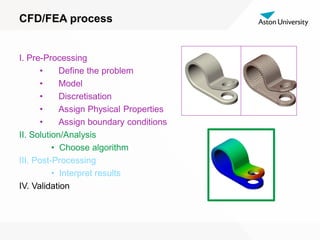
CFD/FEA process
I. Pre-Processing
• Define the problem
• Model
• Discretisation
• Assign Physical Properties
• Assign boundary conditions
II. Solution/Analysis
• Choose algorithm
III. Post-Processing
• Interpret results
IV. Validation
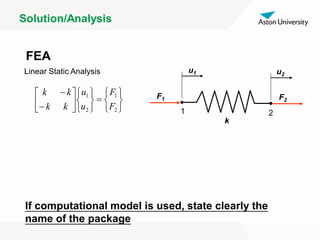
Solution/Analysis
1 2
k
u1 u2
F1 F2






=












−
−
2
1
2
1
F
F
u
u
k
k
k
k
FEA
Linear Static Analysis
If computational model is used, state clearly the
name of the package
Solution/Analysis
Solidworks Simulation
Solidworks Flow Simulation
Dedicated packages:
• ANSYS
• COMSOL
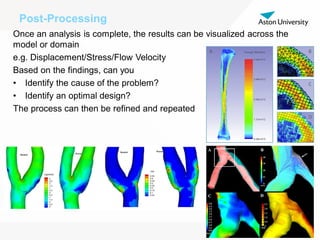
Post-Processing
Once an analysis is complete, the results can be visualized across the
model or domain
e.g. Displacement/Stress/Flow Velocity
Based on the findings, can you
• Identify the cause of the problem?
• Identify an optimal design?
The process can then be refined and repeated
Validation
FEA/CFD Results are an approximation at best and are dependant on
the underlying assumptions
(rubbish in = rubbish out)
• Validation should always be conducted
• Simulation is a tool for informed design
Validation – Experimental - 3D printing
Validation - Experimental Analysis
0
1
2
3
4
5
6
7
8
9
10
0 50 100 150 200 250 300 350 400 450 500
Cycles (thousands)
Permanent
deformation
(mm) 0
0.5
1
1.5
2
2.5
3
3.5
4
Dorsiflexion
angle
(degree)
Permanent
deformation
Approximated
dorsiflexion degree
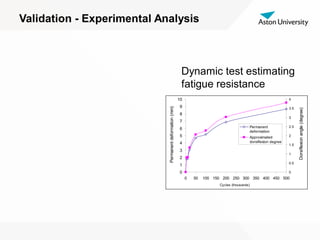
Dynamic test estimating
fatigue resistance
Validation - Experimental Analysis
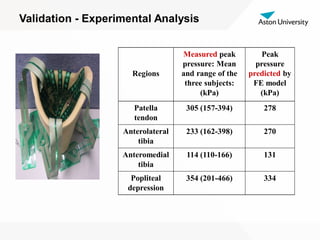
Regions
Measured peak
pressure: Mean
and range of the
three subjects:
(kPa)
Peak
pressure
predicted by
FE model
(kPa)
Patella
tendon
305 (157-394) 278
Anterolateral
tibia
233 (162-398) 270
Anteromedial
tibia
114 (110-166) 131
Popliteal
depression
354 (201-466) 334
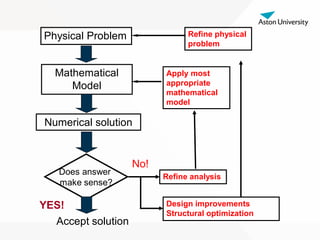
Physical Problem
Mathematical
Model
Numerical solution
Does answer
make sense?
Refine analysis
Accept solution
YES!
No!
Apply most
appropriate
mathematical
model
Design improvements
Structural optimization
Refine physical
problem
Most Common Fractures
3rd
Jabran A et al. Parametric Design Optimisation of Proximal Humerus Plates Based on Finite
Element Method. Annals of Biomedical Engineering. 2018
Proximal Humerus Fractures
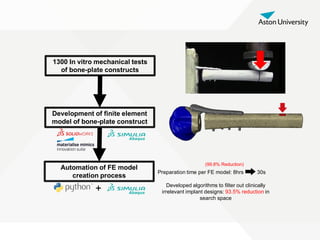
Preparation time per FE model: 8hrs 30s
Automation of FE model
creation process
+
(99.8% Reduction)
Developed algorithms to filter out clinically
irrelevant implant designs: 93.5% reduction in
search space
Development of finite element
model of bone-plate construct
1300 In vitro mechanical tests
of bone-plate constructs

FEA and CFD process part 2(2).pdf

  • 1.
    FEA/CFD for Biomedical Engineering Week1 Part 3: The FEA/CFD Process Part 2
  • 2.
    CFD/FEA process I. Pre-Processing •Define the problem • Model • Discretisation • Assign Physical Properties • Assign boundary conditions II. Solution/Analysis • Choose algorithm III. Post-Processing • Interpret results IV. Validation
  • 3.
    Solution/Analysis 1 2 k u1 u2 F1F2       =             − − 2 1 2 1 F F u u k k k k FEA Linear Static Analysis If computational model is used, state clearly the name of the package
  • 4.
    Solution/Analysis Solidworks Simulation Solidworks FlowSimulation Dedicated packages: • ANSYS • COMSOL
  • 5.
    Post-Processing Once an analysisis complete, the results can be visualized across the model or domain e.g. Displacement/Stress/Flow Velocity Based on the findings, can you • Identify the cause of the problem? • Identify an optimal design? The process can then be refined and repeated
  • 6.
    Validation FEA/CFD Results arean approximation at best and are dependant on the underlying assumptions (rubbish in = rubbish out) • Validation should always be conducted • Simulation is a tool for informed design
  • 7.
  • 8.
    Validation - ExperimentalAnalysis 0 1 2 3 4 5 6 7 8 9 10 0 50 100 150 200 250 300 350 400 450 500 Cycles (thousands) Permanent deformation (mm) 0 0.5 1 1.5 2 2.5 3 3.5 4 Dorsiflexion angle (degree) Permanent deformation Approximated dorsiflexion degree Dynamic test estimating fatigue resistance
  • 9.
    Validation - ExperimentalAnalysis Regions Measured peak pressure: Mean and range of the three subjects: (kPa) Peak pressure predicted by FE model (kPa) Patella tendon 305 (157-394) 278 Anterolateral tibia 233 (162-398) 270 Anteromedial tibia 114 (110-166) 131 Popliteal depression 354 (201-466) 334
  • 10.
    Physical Problem Mathematical Model Numerical solution Doesanswer make sense? Refine analysis Accept solution YES! No! Apply most appropriate mathematical model Design improvements Structural optimization Refine physical problem
  • 11.
    Most Common Fractures 3rd JabranA et al. Parametric Design Optimisation of Proximal Humerus Plates Based on Finite Element Method. Annals of Biomedical Engineering. 2018 Proximal Humerus Fractures
  • 12.
    Preparation time perFE model: 8hrs 30s Automation of FE model creation process + (99.8% Reduction) Developed algorithms to filter out clinically irrelevant implant designs: 93.5% reduction in search space Development of finite element model of bone-plate construct 1300 In vitro mechanical tests of bone-plate constructs