1 of 11 © Boardworks Ltd 2007
2 of 11 © Boardworks Ltd 2007
What is electrolysis?
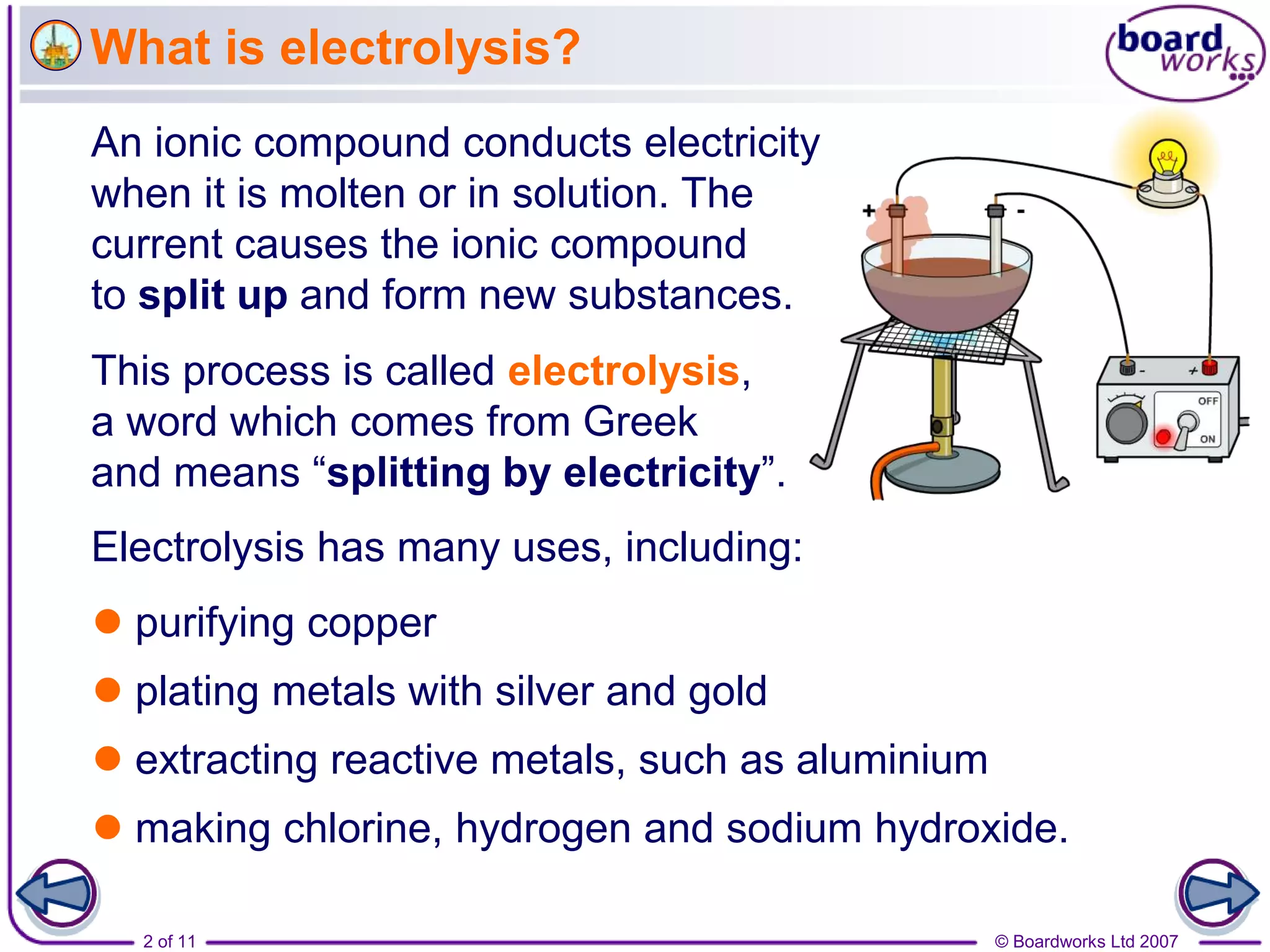
An ionic compound conducts electricity
when it is molten or in solution. The
current causes the ionic compound
to split up and form new substances.
Electrolysis has many uses, including:
 purifying copper
 plating metals with silver and gold
 extracting reactive metals, such as aluminium
 making chlorine, hydrogen and sodium hydroxide.
This process is called electrolysis,
a word which comes from Greek
and means “splitting by electricity”.
3 of 11 © Boardworks Ltd 2007
heat
What happens during electrolysis?
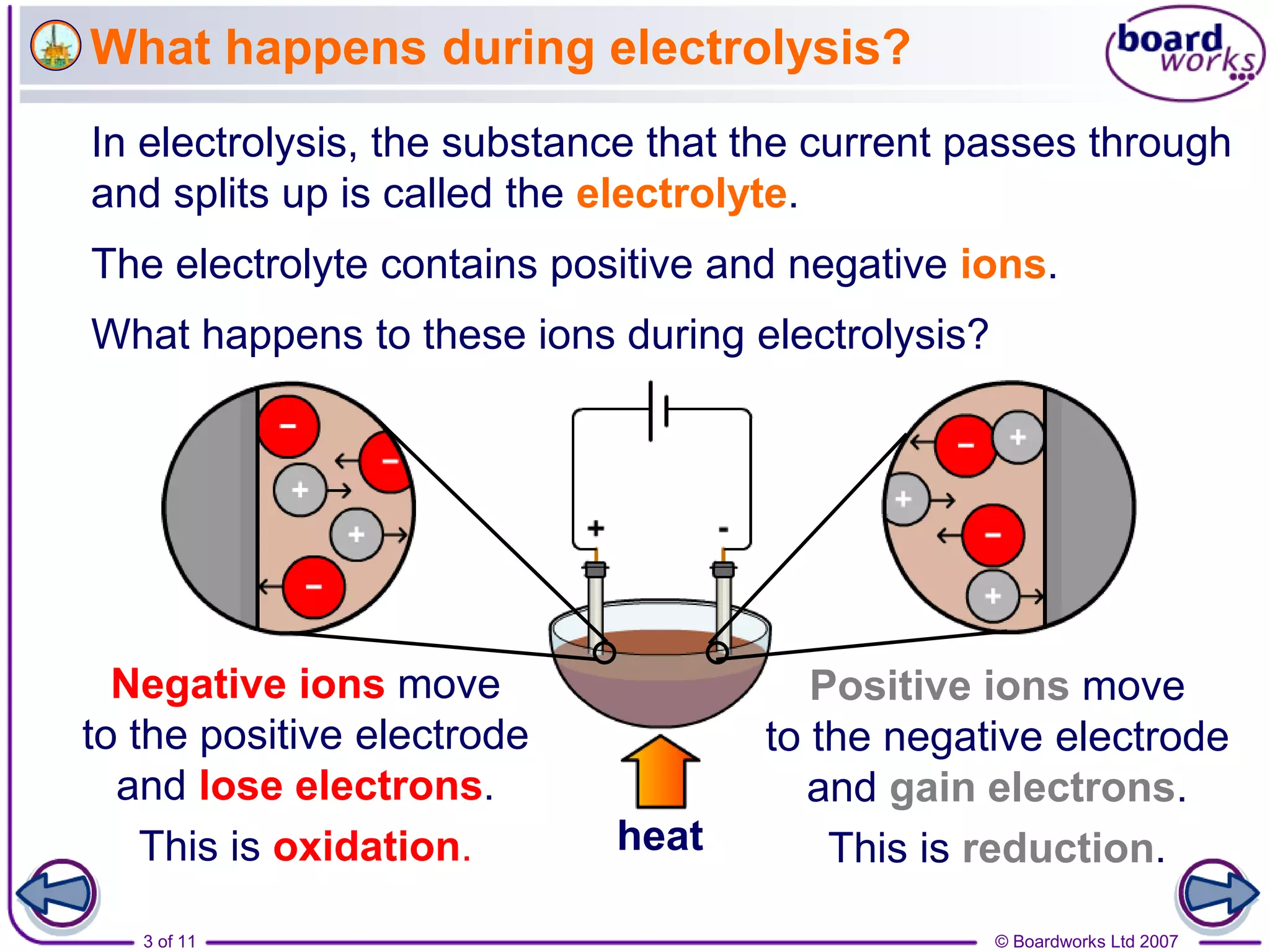
In electrolysis, the substance that the current passes through
and splits up is called the electrolyte.
Positive ions move
to the negative electrode
and gain electrons.
This is reduction.
Negative ions move
to the positive electrode
and lose electrons.
This is oxidation.
The electrolyte contains positive and negative ions.
What happens to these ions during electrolysis?
4 of 11 © Boardworks Ltd 2007
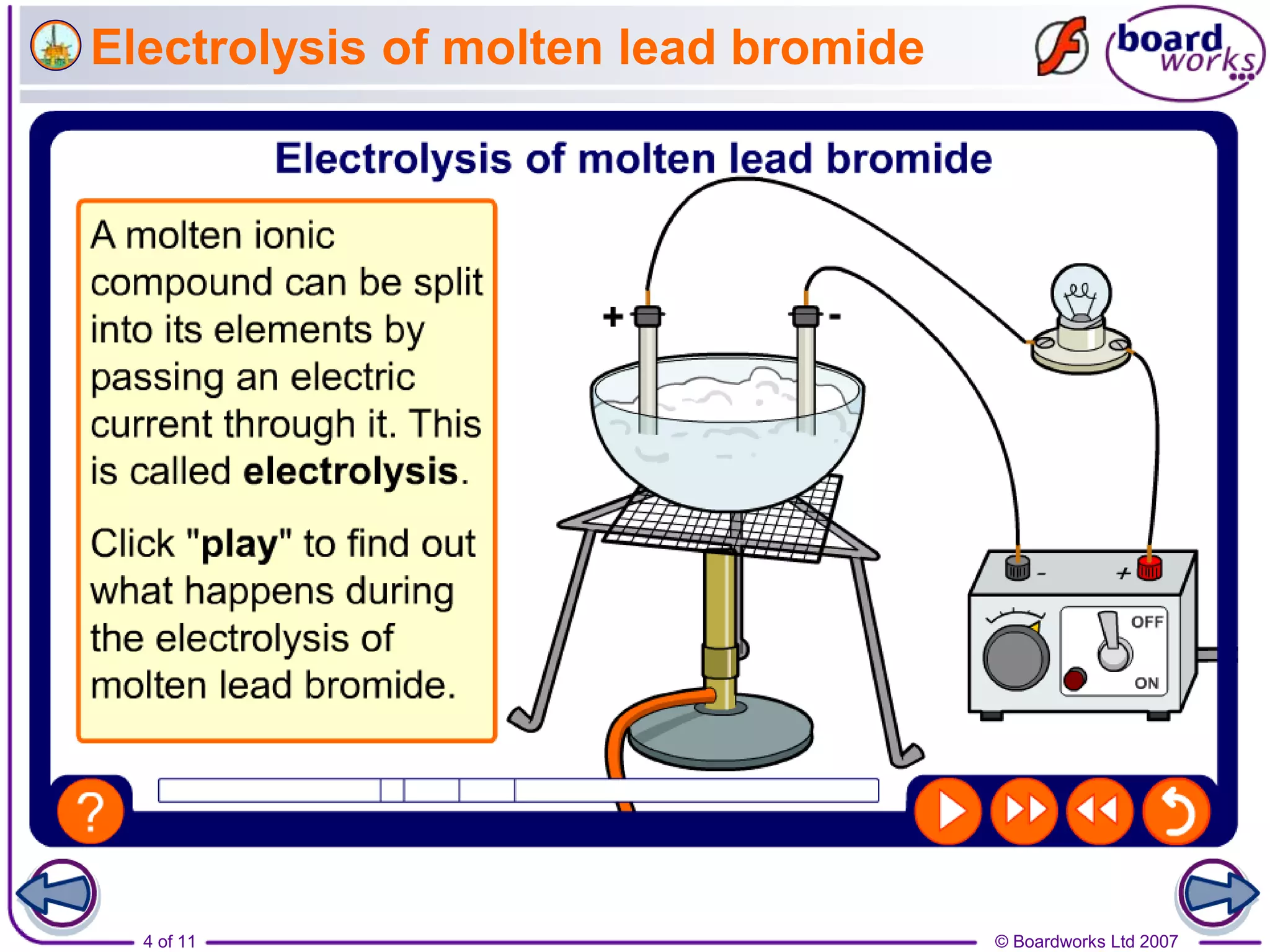
Electrolysis of molten lead bromide
5 of 11 © Boardworks Ltd 2007
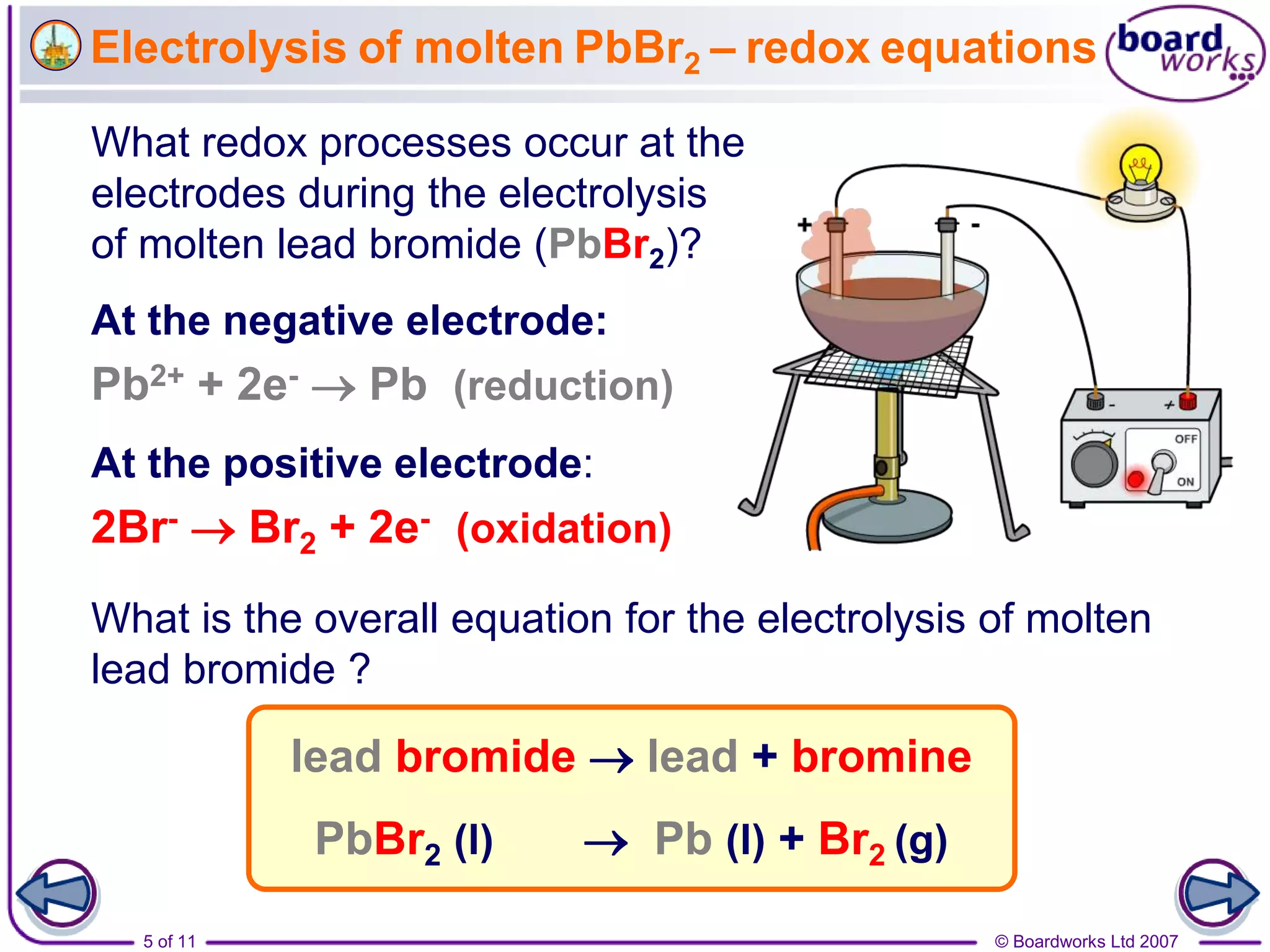
What redox processes occur at the
electrodes during the electrolysis
of molten lead bromide (PbBr2)?
Electrolysis of molten PbBr2 – redox equations
What is the overall equation for the electrolysis of molten
lead bromide ?
At the negative electrode:
Pb2+ + 2e-  Pb (reduction)
lead bromide  lead + bromine
PbBr2 (l)  Pb (l) + Br2 (g)
At the positive electrode:
2Br-  Br2 + 2e- (oxidation)
6 of 11 © Boardworks Ltd 2007
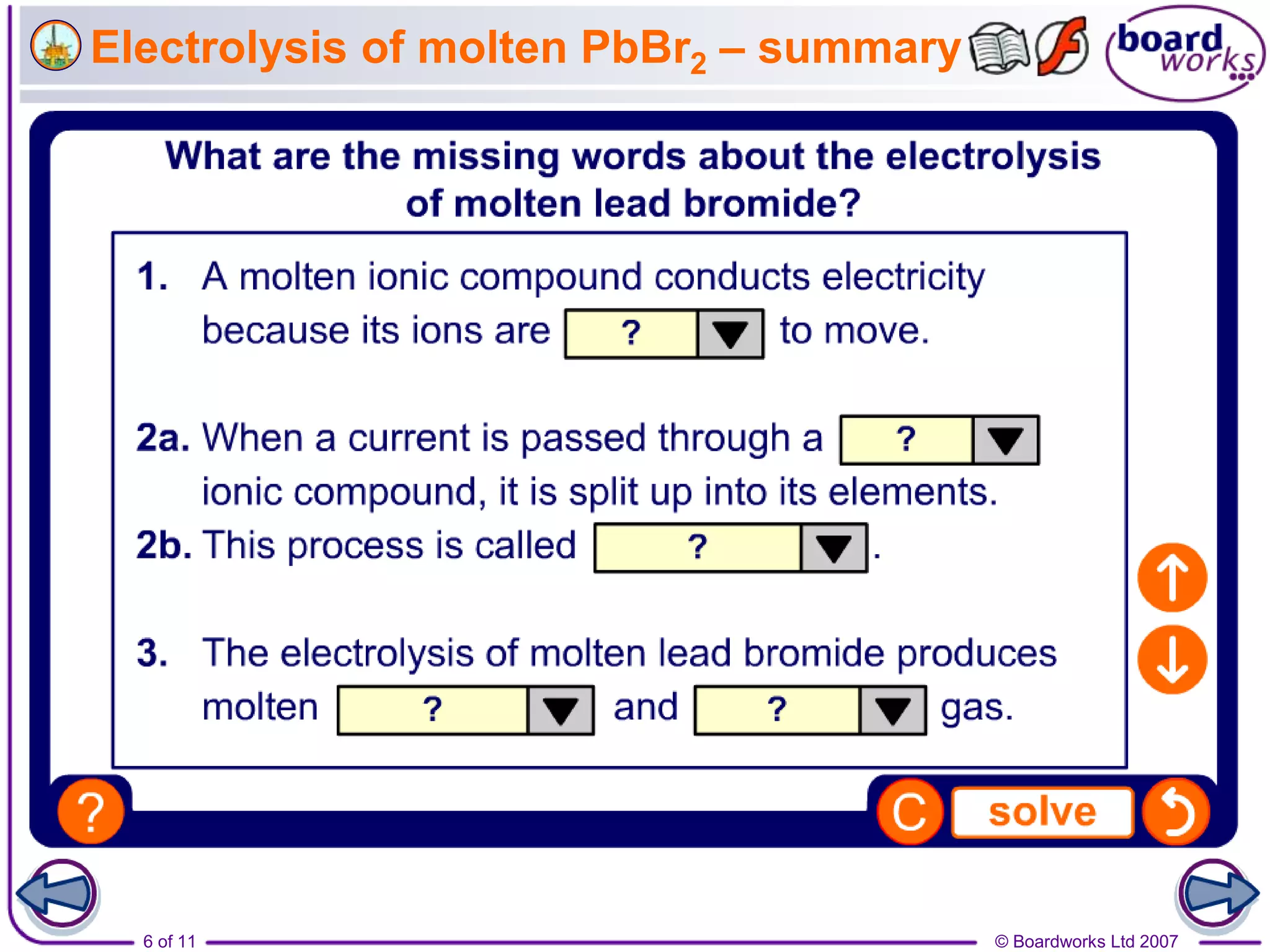
Electrolysis of molten PbBr2 – summary
7 of 11 © Boardworks Ltd 2007
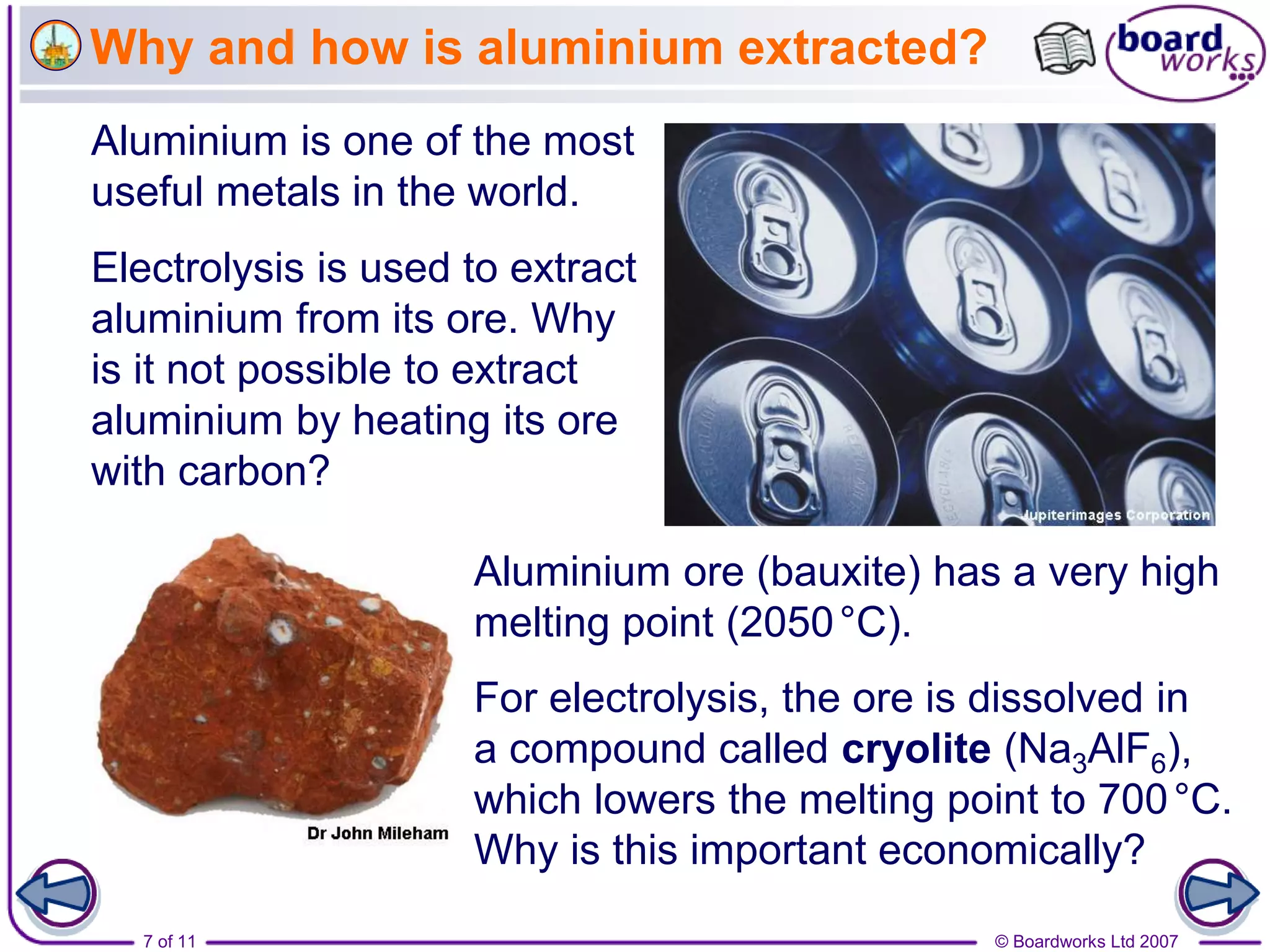
Why and how is aluminium extracted?
Aluminium is one of the most
useful metals in the world.
Aluminium ore (bauxite) has a very high
melting point (2050°C).
Electrolysis is used to extract
aluminium from its ore. Why
is it not possible to extract
aluminium by heating its ore
with carbon?
For electrolysis, the ore is dissolved in
a compound called cryolite (Na3AlF6),
which lowers the melting point to 700°C.
Why is this important economically?
8 of 11 © Boardworks Ltd 2007
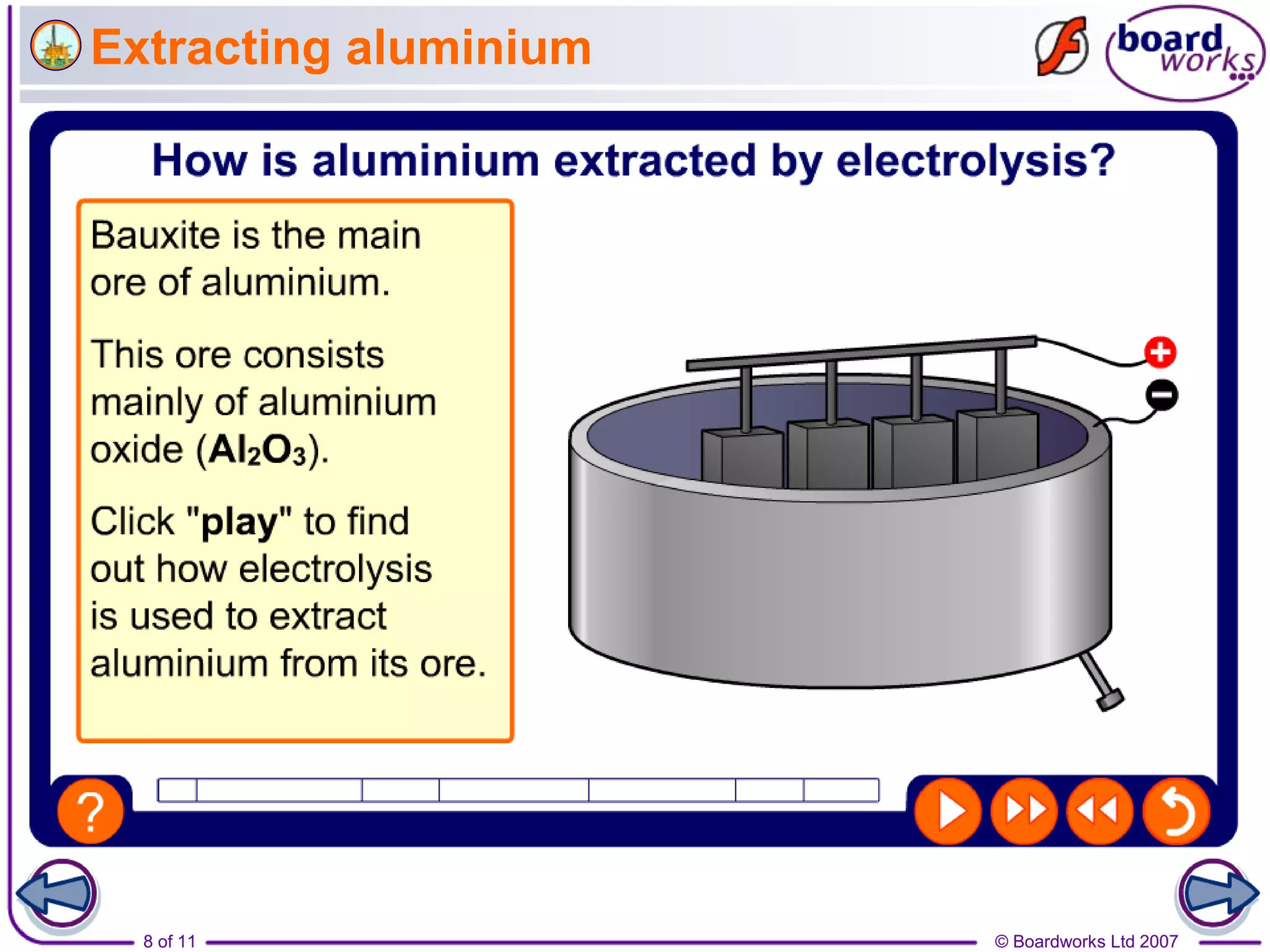
Extracting aluminium
9 of 11 © Boardworks Ltd 2007
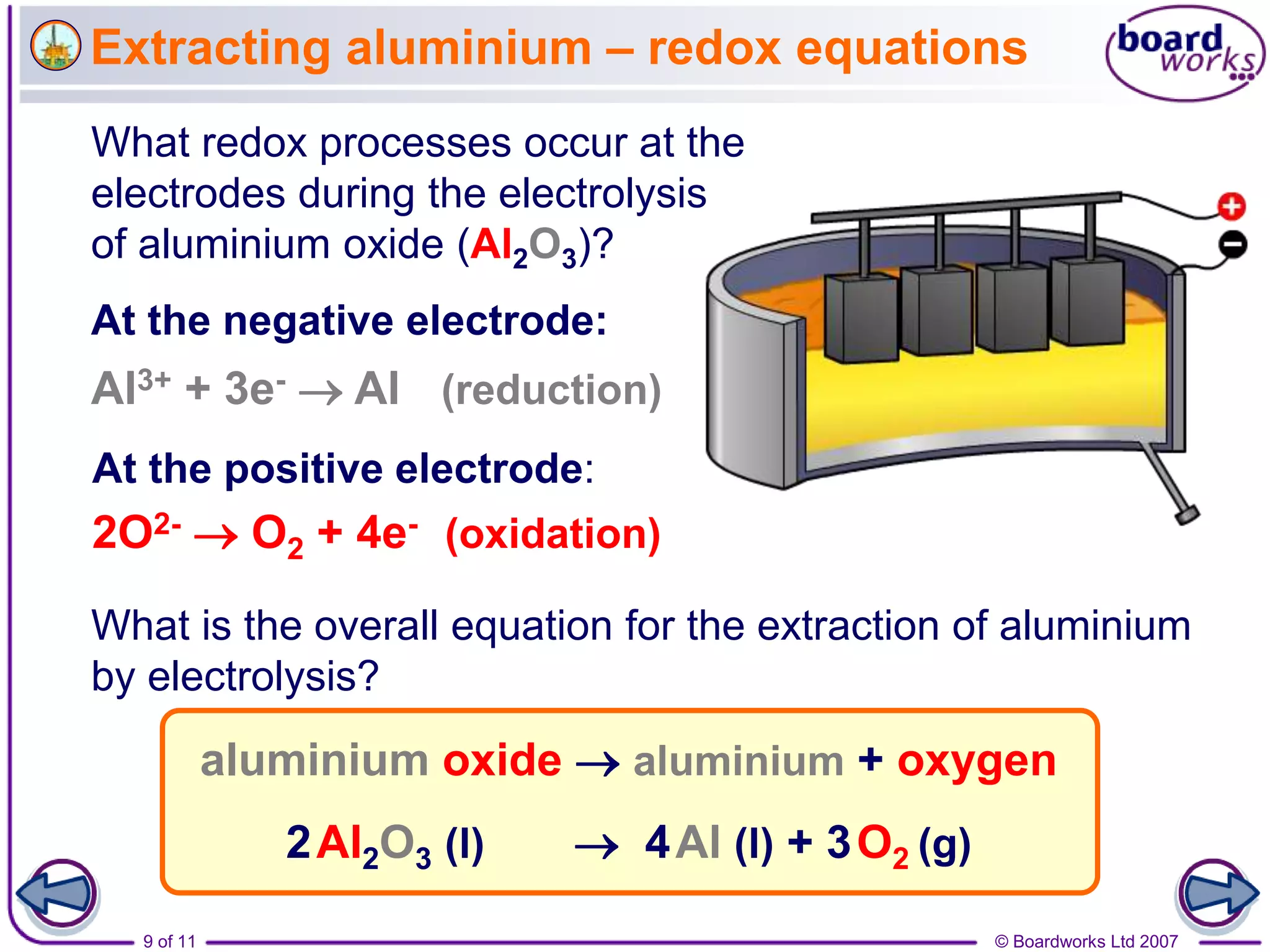
What redox processes occur at the
electrodes during the electrolysis
of aluminium oxide (Al2O3)?
Extracting aluminium – redox equations
What is the overall equation for the extraction of aluminium
by electrolysis?
At the negative electrode:
Al3+ + 3e-  Al (reduction)
aluminium oxide  aluminium + oxygen
2Al2O3 (l)  4Al (l) + 3O2 (g)
At the positive electrode:
2O2-  O2 + 4e- (oxidation)
10 of 11 © Boardworks Ltd 2007
Extracting aluminium – summary
11 of 11 © Boardworks Ltd 2007
What are the products of electrolysis?

fdocuments.in_what-is-electrolysis.ppt

  • 1.
    1 of 11© Boardworks Ltd 2007
  • 2.
    2 of 11© Boardworks Ltd 2007 What is electrolysis? An ionic compound conducts electricity when it is molten or in solution. The current causes the ionic compound to split up and form new substances. Electrolysis has many uses, including:  purifying copper  plating metals with silver and gold  extracting reactive metals, such as aluminium  making chlorine, hydrogen and sodium hydroxide. This process is called electrolysis, a word which comes from Greek and means “splitting by electricity”.
  • 3.
    3 of 11© Boardworks Ltd 2007 heat What happens during electrolysis? In electrolysis, the substance that the current passes through and splits up is called the electrolyte. Positive ions move to the negative electrode and gain electrons. This is reduction. Negative ions move to the positive electrode and lose electrons. This is oxidation. The electrolyte contains positive and negative ions. What happens to these ions during electrolysis?
  • 4.
    4 of 11© Boardworks Ltd 2007 Electrolysis of molten lead bromide
  • 5.
    5 of 11© Boardworks Ltd 2007 What redox processes occur at the electrodes during the electrolysis of molten lead bromide (PbBr2)? Electrolysis of molten PbBr2 – redox equations What is the overall equation for the electrolysis of molten lead bromide ? At the negative electrode: Pb2+ + 2e-  Pb (reduction) lead bromide  lead + bromine PbBr2 (l)  Pb (l) + Br2 (g) At the positive electrode: 2Br-  Br2 + 2e- (oxidation)
  • 6.
    6 of 11© Boardworks Ltd 2007 Electrolysis of molten PbBr2 – summary
  • 7.
    7 of 11© Boardworks Ltd 2007 Why and how is aluminium extracted? Aluminium is one of the most useful metals in the world. Aluminium ore (bauxite) has a very high melting point (2050°C). Electrolysis is used to extract aluminium from its ore. Why is it not possible to extract aluminium by heating its ore with carbon? For electrolysis, the ore is dissolved in a compound called cryolite (Na3AlF6), which lowers the melting point to 700°C. Why is this important economically?
  • 8.
    8 of 11© Boardworks Ltd 2007 Extracting aluminium
  • 9.
    9 of 11© Boardworks Ltd 2007 What redox processes occur at the electrodes during the electrolysis of aluminium oxide (Al2O3)? Extracting aluminium – redox equations What is the overall equation for the extraction of aluminium by electrolysis? At the negative electrode: Al3+ + 3e-  Al (reduction) aluminium oxide  aluminium + oxygen 2Al2O3 (l)  4Al (l) + 3O2 (g) At the positive electrode: 2O2-  O2 + 4e- (oxidation)
  • 10.
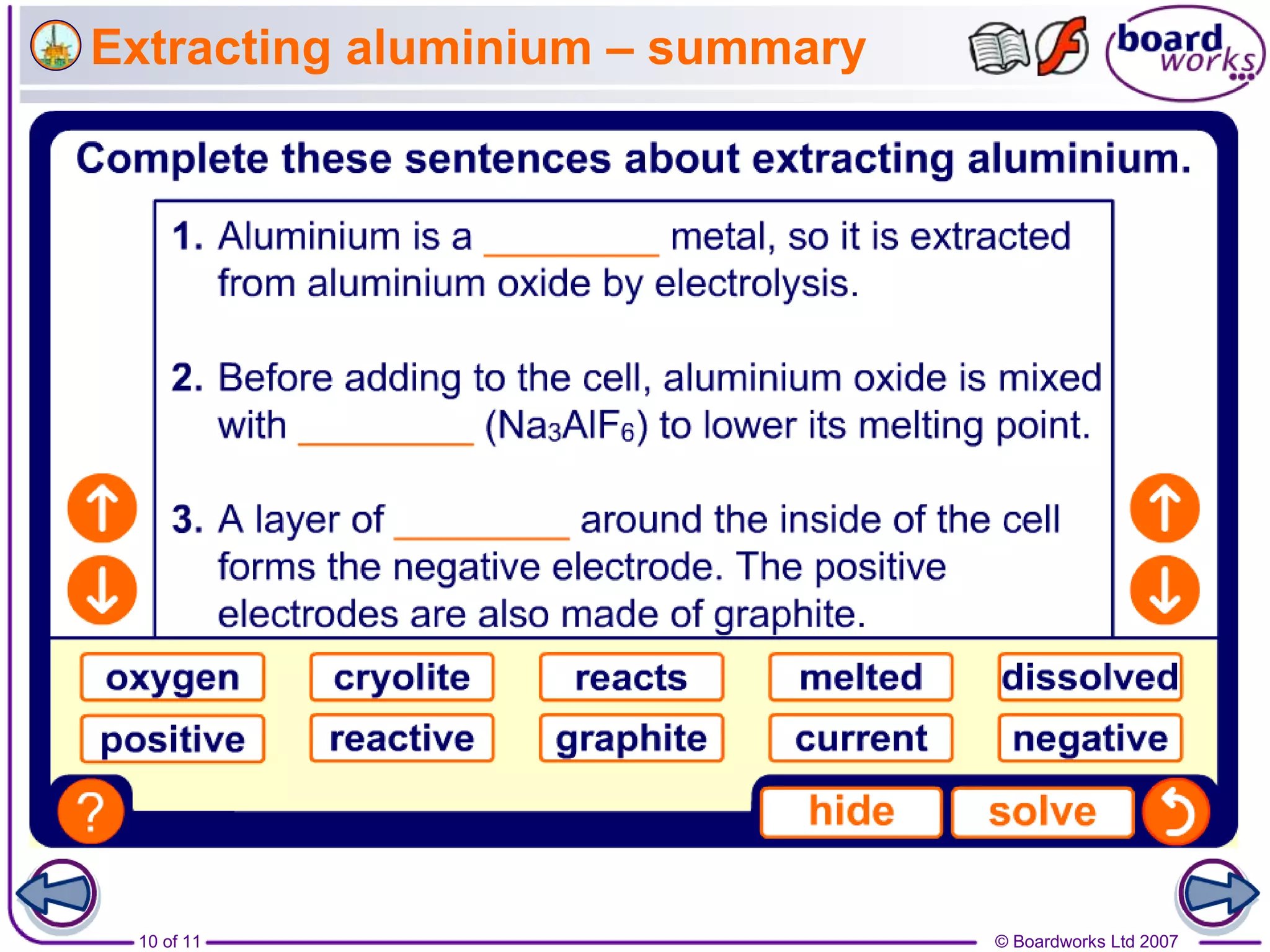
    10 of 11© Boardworks Ltd 2007 Extracting aluminium – summary
  • 11.
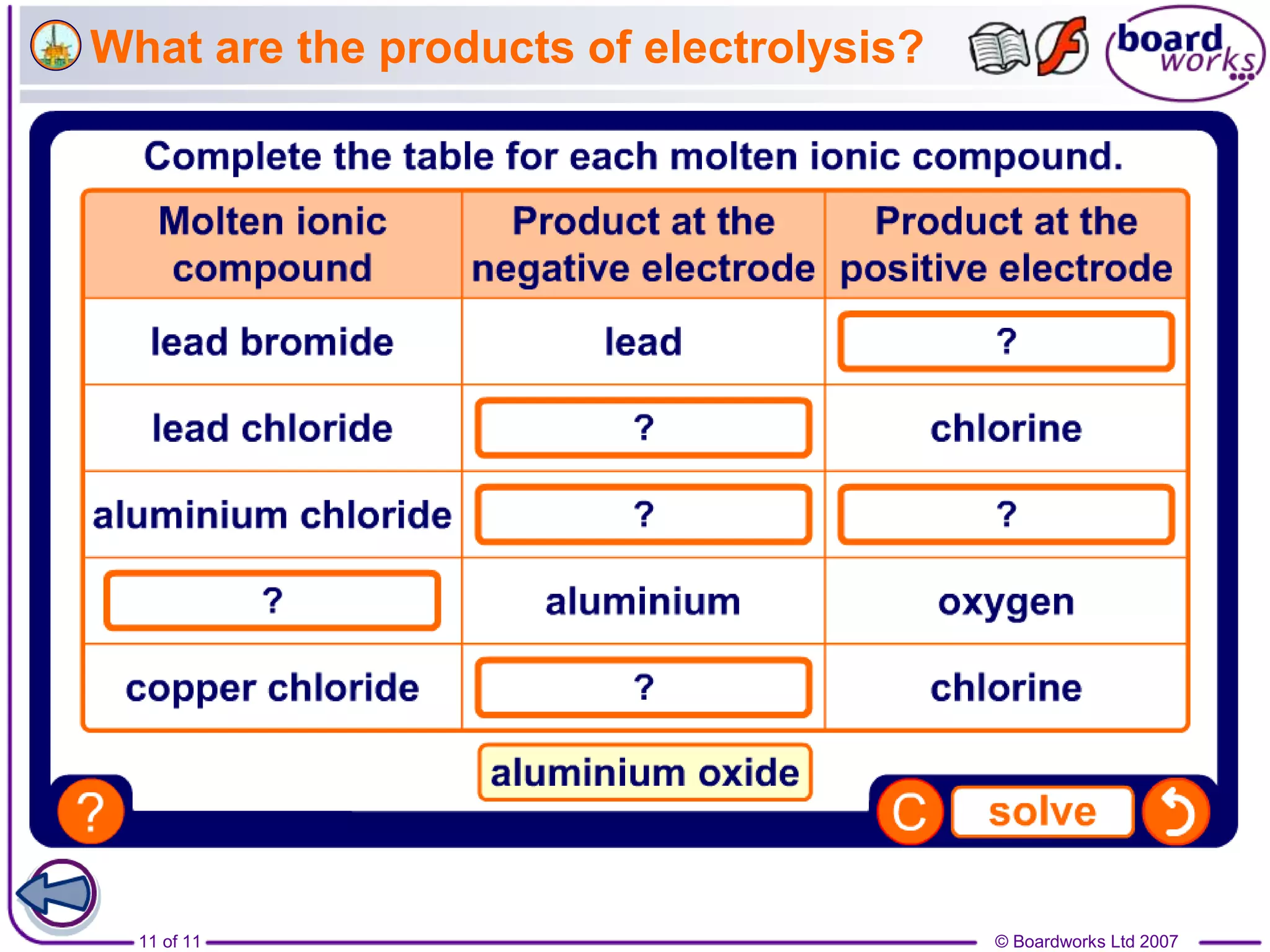
    11 of 11© Boardworks Ltd 2007 What are the products of electrolysis?

Editor's Notes

  • #2 Boardworks GCSE Additional Science: Chemistry Electrochemistry
  • #3 Boardworks GCSE Additional Science: Chemistry Electrochemistry
  • #4 Boardworks GCSE Additional Science: Chemistry Electrochemistry
  • #5 Boardworks GCSE Additional Science: Chemistry Electrochemistry
  • #6 Boardworks GCSE Additional Science: Chemistry Electrochemistry
  • #7 Boardworks GCSE Additional Science: Chemistry Electrochemistry
  • #8 Boardworks GCSE Additional Science: Chemistry Electrochemistry
  • #9 Boardworks GCSE Additional Science: Chemistry Electrochemistry
  • #10 Boardworks GCSE Additional Science: Chemistry Electrochemistry
  • #11 Boardworks GCSE Additional Science: Chemistry Electrochemistry
  • #12 Boardworks GCSE Additional Science: Chemistry Electrochemistry