ELECTROCHEMISTRYElectrolysis of molten compounds30/06/2010
At the end of the lesson, you should able to:describe electrolysis,describe electrolytic cell,identify cations and anions in a molten compound,describe evidence for the existence of ions held in a lattice in solid state but move freely in molten state,describe electrolysis of a molten compound,write half-equations for the discharge of ions at anode and cathode,predict products of the electrolysis of molten compounds.Learning outcomes
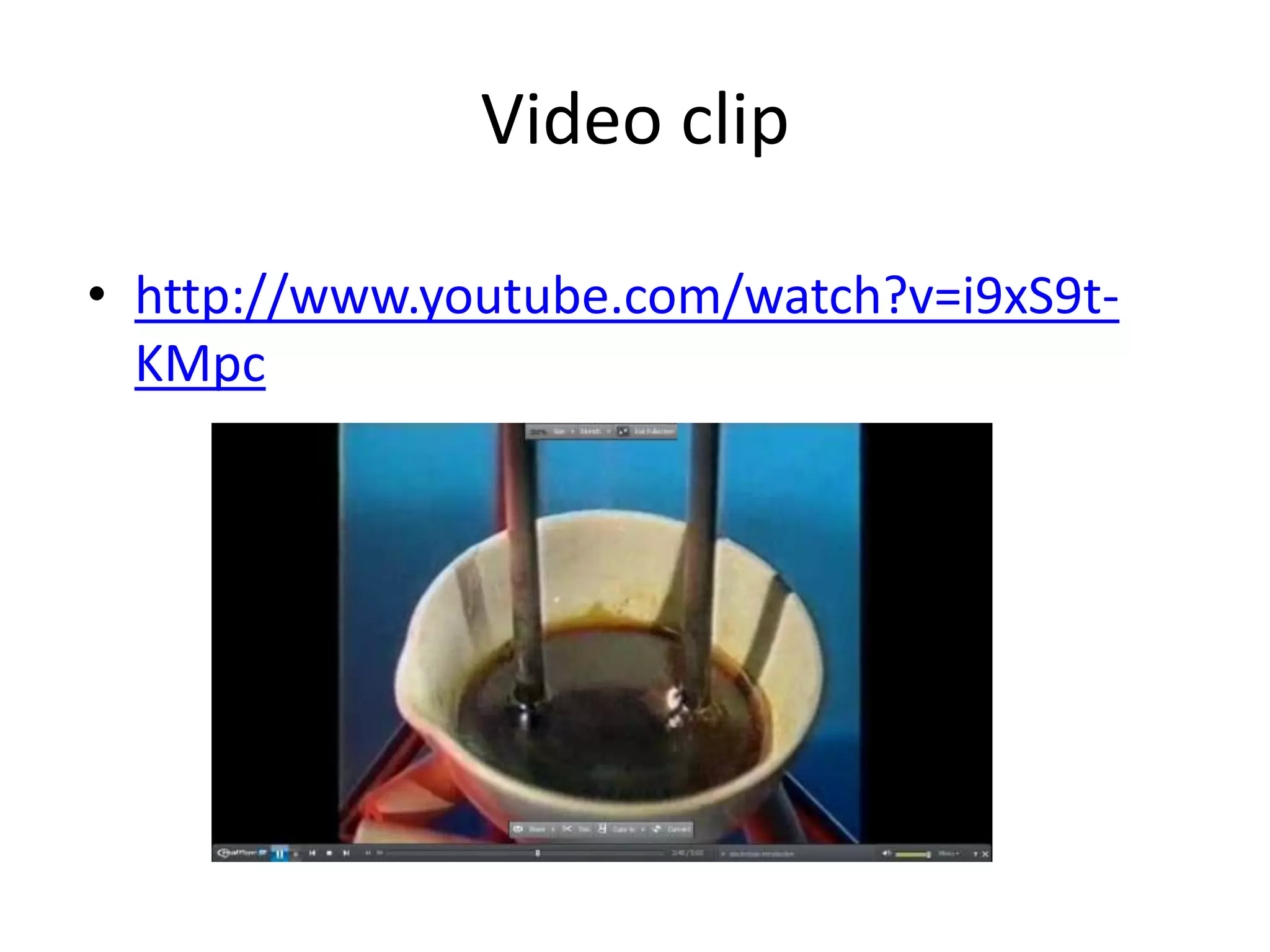
Video cliphttp://www.youtube.com/watch?v=i9xS9t-KMpc
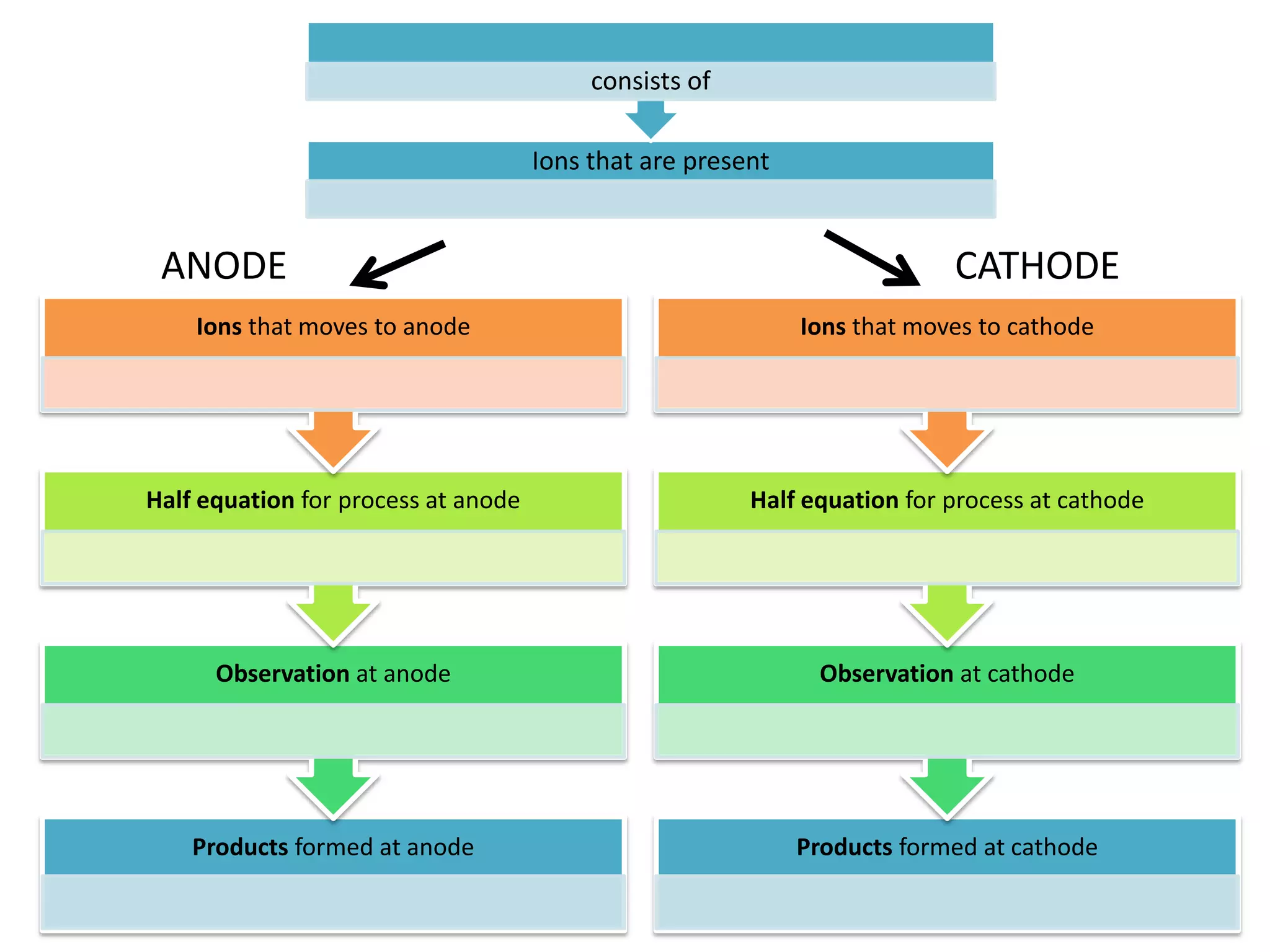
Electrolysis of a molten compoundDescribe + diagramANODECATHODE
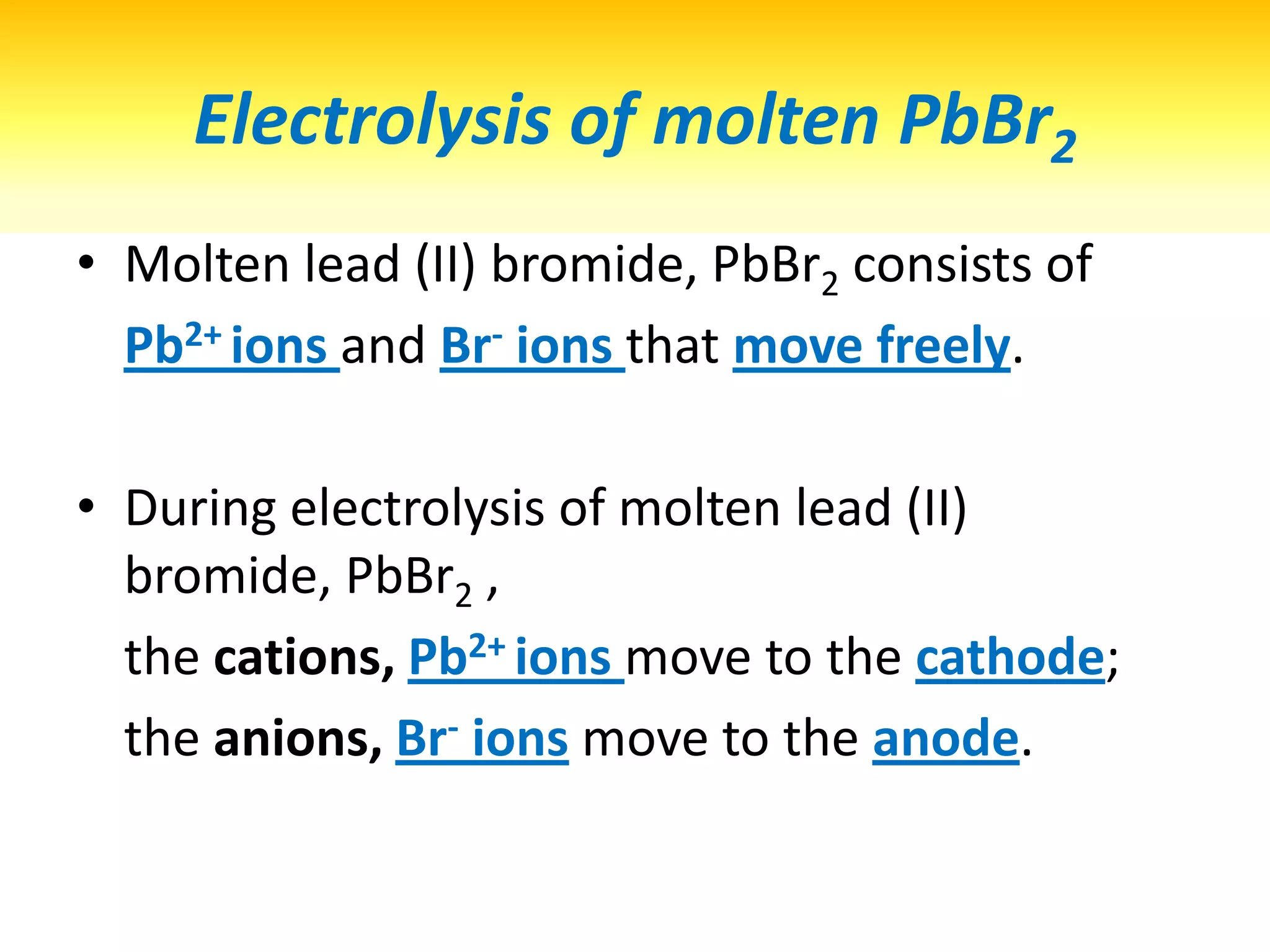
Electrolysis of molten PbBr2Molten lead (II) bromide, PbBr2 consists of Pb2+ ions and Br- ions that move freely.During electrolysis of molten lead (II) bromide, PbBr2 ,	the cations, Pb2+ ions move to the cathode;	the anions, Br-ionsmove to theanode.
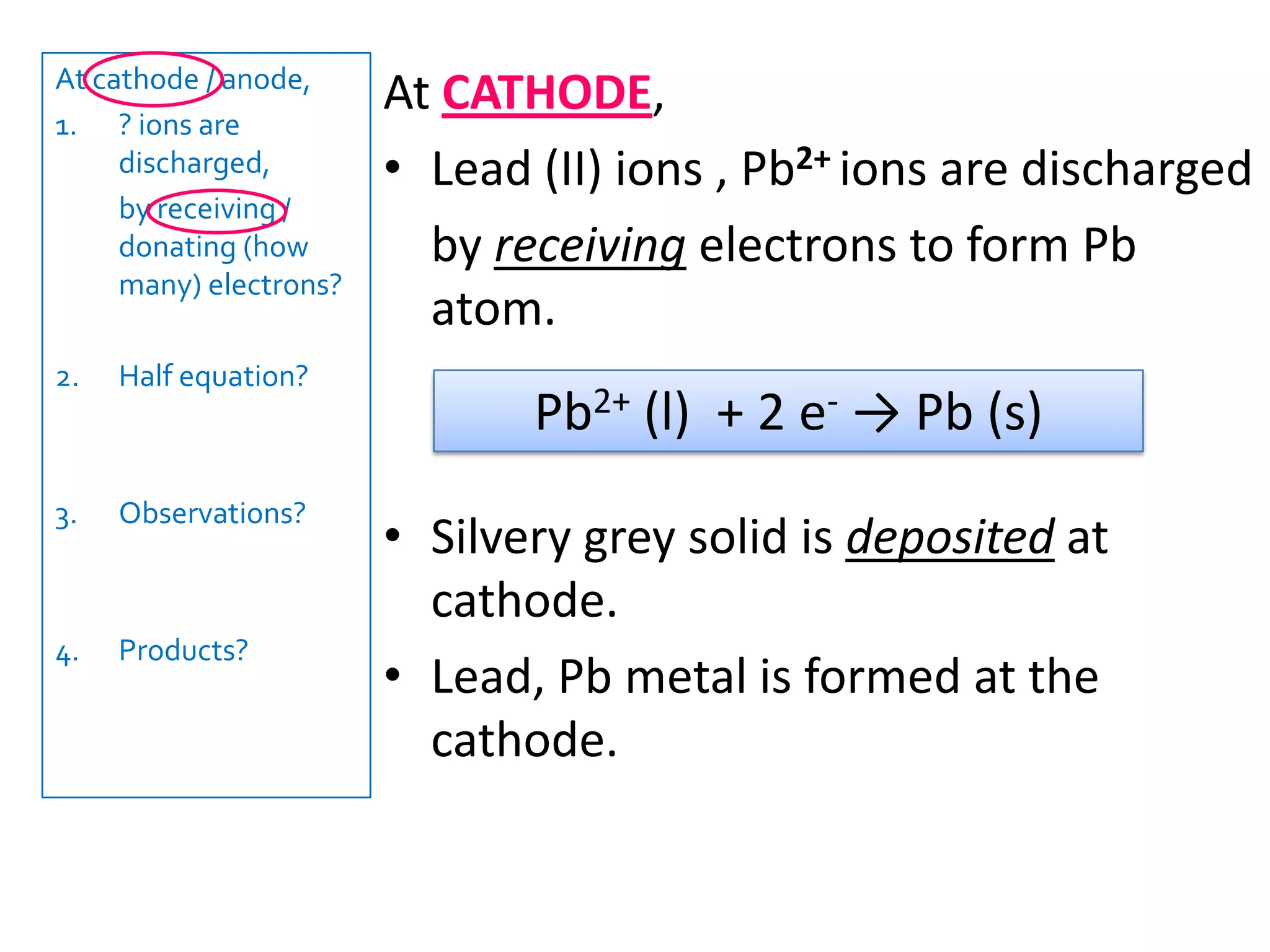
At CATHODE, Lead (II) ions , Pb2+ ions are discharged 	by receiving electrons to form Pb atom.Silvery grey solid is deposited at cathode.Lead, Pb metal is formed at the cathode.At cathode / anode,? ions are discharged,   	by receiving / donating (how many) electrons?Half equation?Observations?Products?Pb2+ (l)  + 2 e- -> Pb (s)
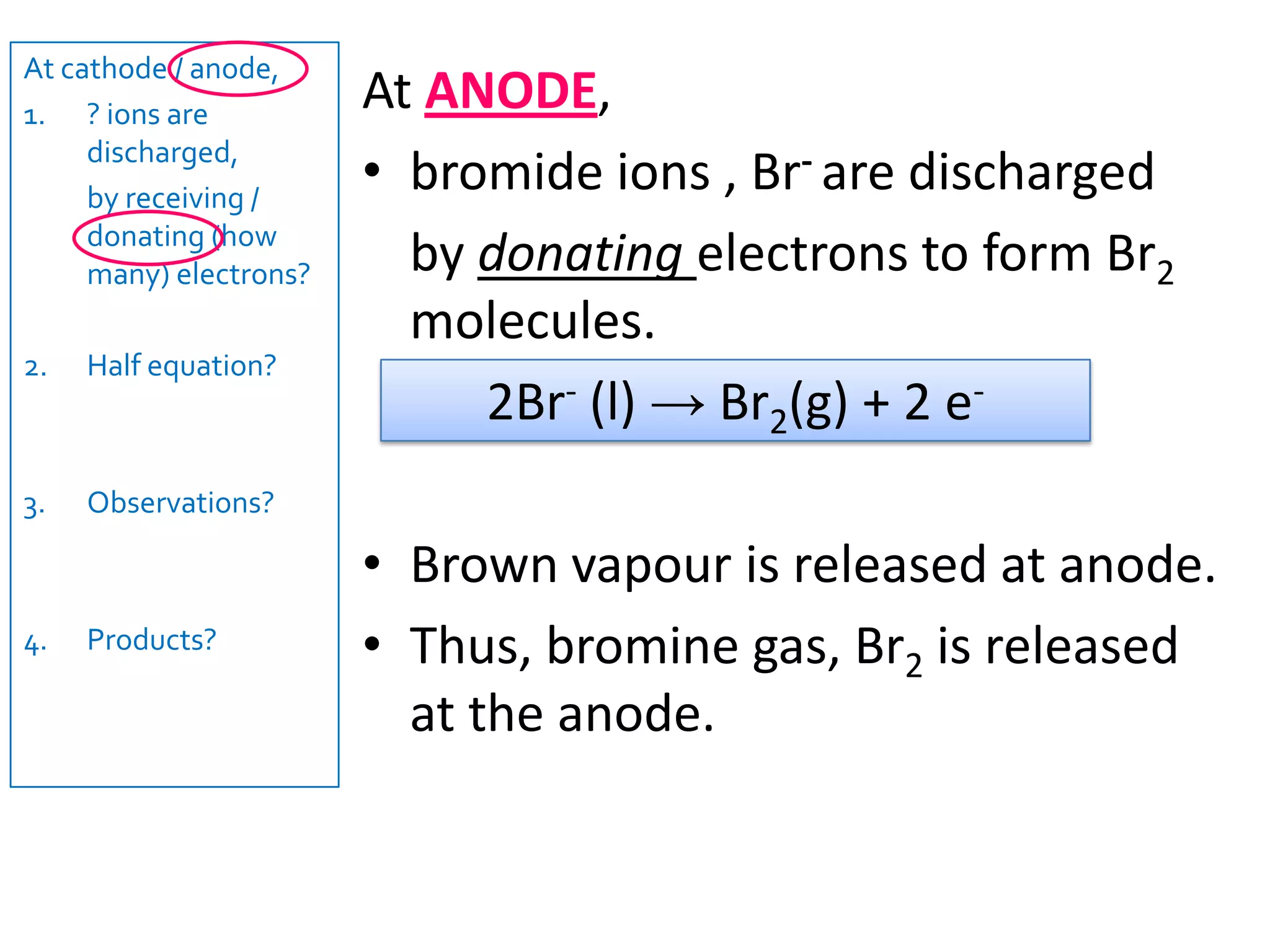
At cathode / anode,? ions are discharged,   	by receiving / donating (how many) electrons?Half equation?Observations?Products?At ANODE, bromide ions , Br- are discharged	by donating electrons to form Br2 molecules.Brown vapour is released at anode.Thus, bromine gas, Br2 is released at the anode.2Br- (l) -> Br2(g) + 2 e-
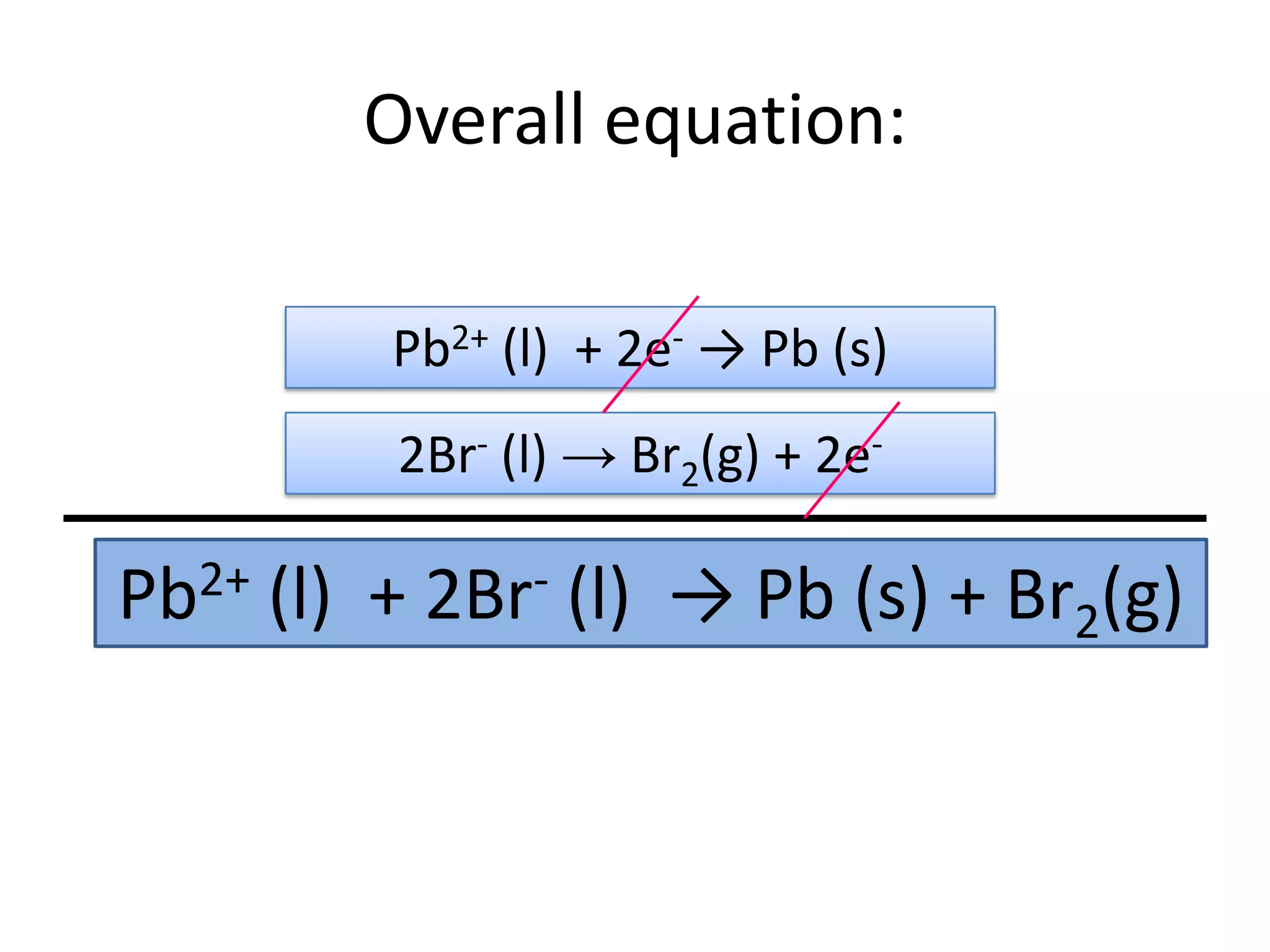
Overall equation:Pb2+ (l)  + 2e- -> Pb (s)2Br- (l) -> Br2(g) + 2e-Pb2+ (l)  + 2Br- (l)  -> Pb (s) + Br2(g)
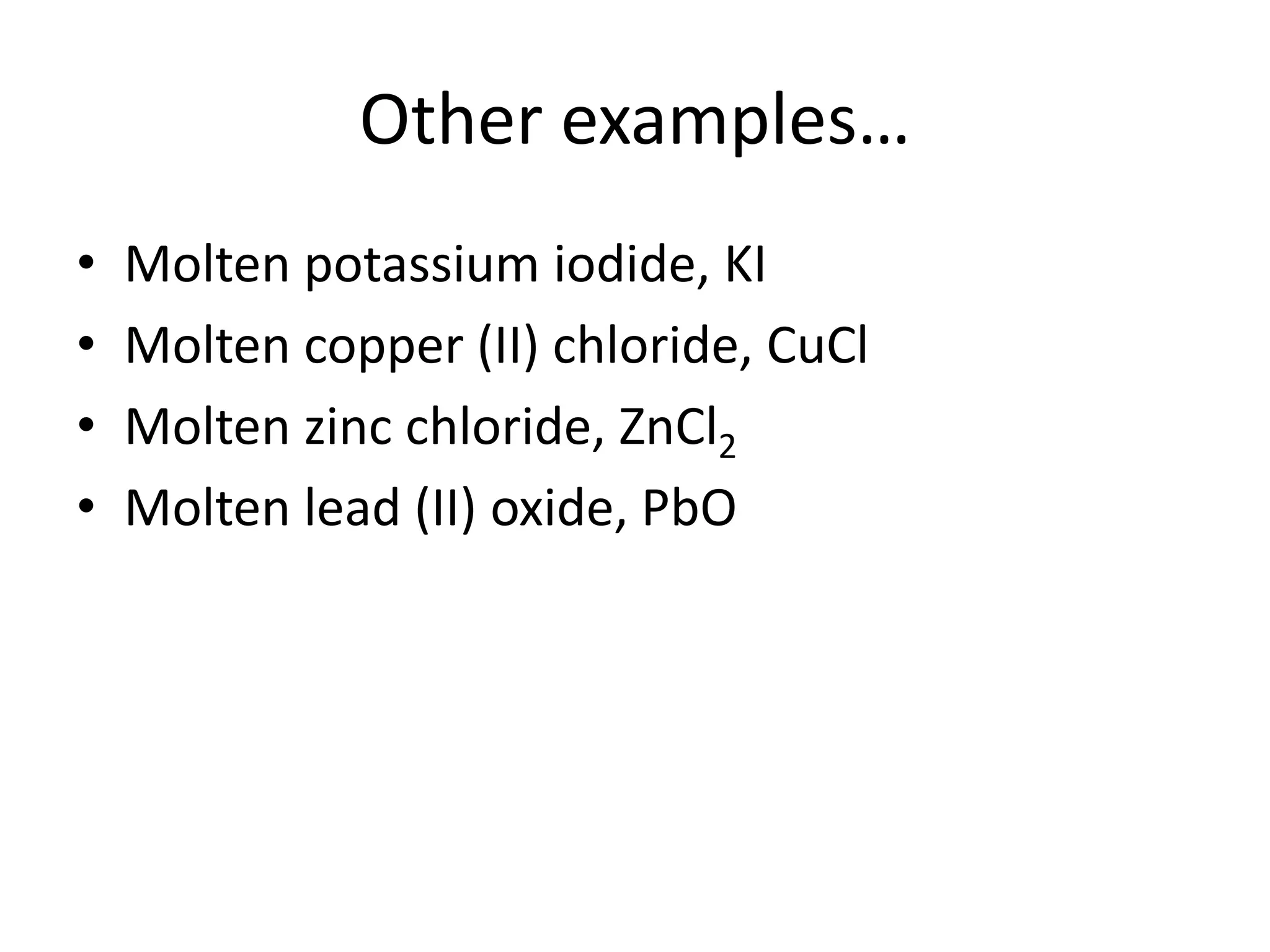
Other examples…Molten potassium iodide, KIMolten copper (II) chloride, CuClMolten zinc chloride, ZnCl2Molten lead (II) oxide, PbO
Electrolysis part 2:  molten compound

Electrolysis part 2: molten compound

  • 1.
  • 2.
    At the endof the lesson, you should able to:describe electrolysis,describe electrolytic cell,identify cations and anions in a molten compound,describe evidence for the existence of ions held in a lattice in solid state but move freely in molten state,describe electrolysis of a molten compound,write half-equations for the discharge of ions at anode and cathode,predict products of the electrolysis of molten compounds.Learning outcomes
  • 3.
  • 4.
    Electrolysis of amolten compoundDescribe + diagramANODECATHODE
  • 5.
    Electrolysis of moltenPbBr2Molten lead (II) bromide, PbBr2 consists of Pb2+ ions and Br- ions that move freely.During electrolysis of molten lead (II) bromide, PbBr2 , the cations, Pb2+ ions move to the cathode; the anions, Br-ionsmove to theanode.
  • 6.
    At CATHODE, Lead(II) ions , Pb2+ ions are discharged by receiving electrons to form Pb atom.Silvery grey solid is deposited at cathode.Lead, Pb metal is formed at the cathode.At cathode / anode,? ions are discharged, by receiving / donating (how many) electrons?Half equation?Observations?Products?Pb2+ (l) + 2 e- -> Pb (s)
  • 7.
    At cathode /anode,? ions are discharged, by receiving / donating (how many) electrons?Half equation?Observations?Products?At ANODE, bromide ions , Br- are discharged by donating electrons to form Br2 molecules.Brown vapour is released at anode.Thus, bromine gas, Br2 is released at the anode.2Br- (l) -> Br2(g) + 2 e-
  • 8.
    Overall equation:Pb2+ (l) + 2e- -> Pb (s)2Br- (l) -> Br2(g) + 2e-Pb2+ (l) + 2Br- (l) -> Pb (s) + Br2(g)
  • 9.
    Other examples…Molten potassiumiodide, KIMolten copper (II) chloride, CuClMolten zinc chloride, ZnCl2Molten lead (II) oxide, PbO