5.ELECTROCHEMISTRY
5 .1 Electrolysis
5.2 Electrolysis of molten ionic compound
5.3 Electrolysis of aqueous ionic compound
5.4 Electroplating
5.5 Hydrogen fuel cell
WHAT IS ELECTROLYSIS?
Electrolysis is the decomposition of ionic compounds using electricity.
Ionic compounds contain metals combined with non-metals. Examples
include
● sodium chloride (NaCl) – a combination of the metal sodium with the non-metal
chlorine
● copper sulfate (CuSO4) – a combination of the metal copper with the non-metals sulfur
and oxygen.
Ionic compounds are made up of positive and negative ions. As solids,
ionic compounds cannot conduct electricity because the ions cannot
move around. However, when ionic compounds are melted or dissolved,the ions are free
to move and conduct electricity. These liquids or solutions are called electrolytes because
they are able to conduct electricity.
EXPLANATION
If two electrodes connected to a supply of electricity are
put into the electrolyte, the negative ions are attracted
to the positive electrode and the positive ions are
attracted to the negative electrode .
This happens because opposite charges attract each other.
When the ions reach the electrodes they are discharged.
This means that they gain or lose electrons so that they
lose their charge and become neutral. Positive ions gain
electrons. Negative ions lose electrons.
The negative ions are discharged by losing electrons
at the positive electrode. These electrons move around
the circuit through the wires to the negative electrode.
The positive ions are discharged by gaining electrons
at the negative electrode.
KEY TERMS Electrolysis Decomposition of compounds
using electricity.
Electrolyte A liquid that conducts electricity.
Discharge Gain or lose electrons to
become electrically neutral.
Anode An electrode where oxidation
takes place (oxidation is the loss of
electrons) – in electrolysis it is the
positive electrode.
Cathode An electrode where
reduction takes place (reduction is the
gain of electrons) – in electrolysis it is
the negative electrode.
ELECTROLYSIS OF MOLTEN IONIC COMPOUND
Binary ionic compounds are ones made from one metal
combined with
one non-metal. Examples include lead bromide (PbBr2)
,sodium chloride (NaCl) and aluminium oxide (Al2O3) . The
electrolysis of these compounds when molten produces
the metal and
non-metal.
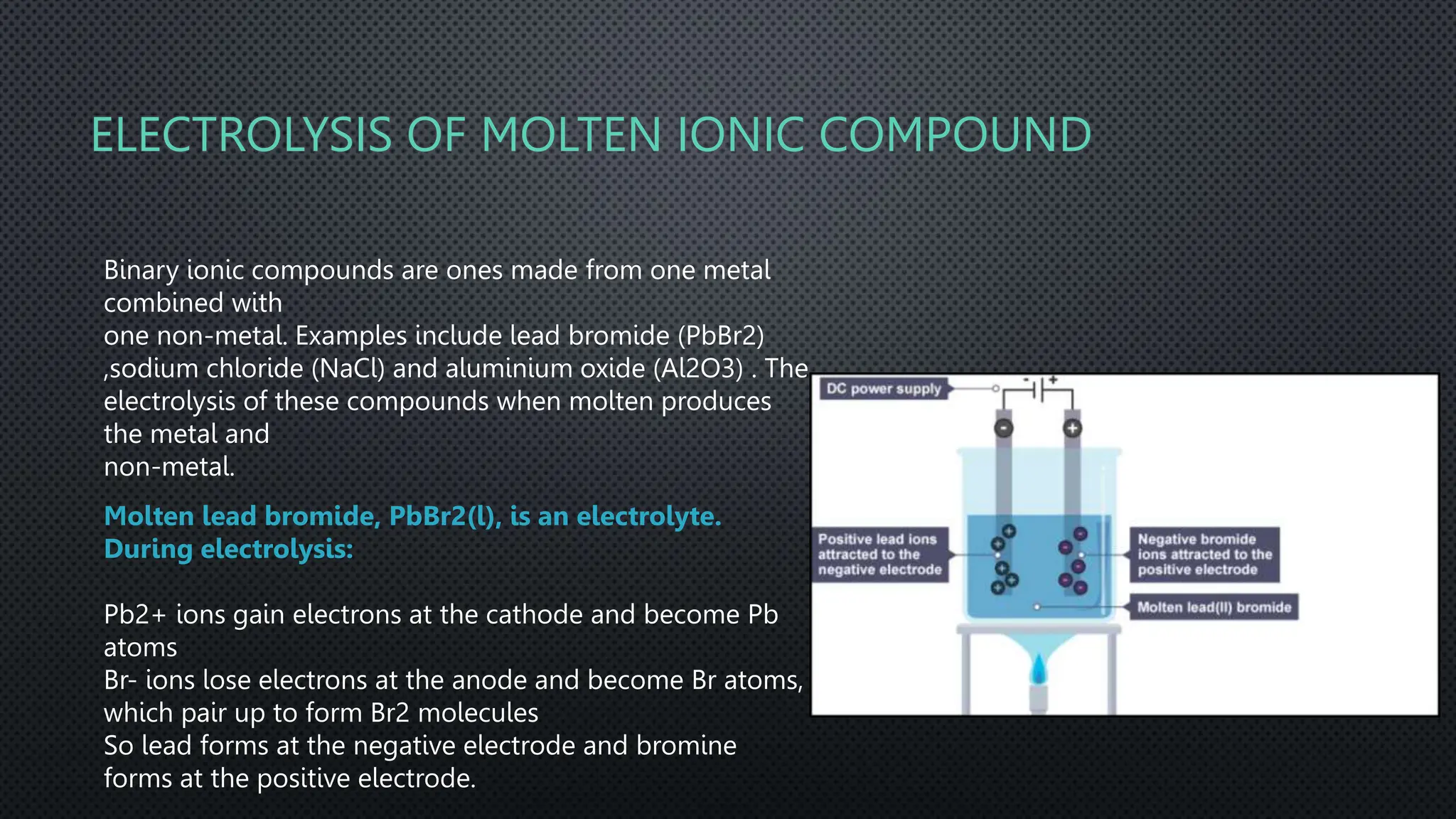
Molten lead bromide, PbBr2(l), is an electrolyte.
During electrolysis:
Pb2+ ions gain electrons at the cathode and become Pb
atoms
Br- ions lose electrons at the anode and become Br atoms,
which pair up to form Br2 molecules
So lead forms at the negative electrode and bromine
forms at the positive electrode.
ELECTROLYSIS OF MOLTEN SODIUM CHLORIDE
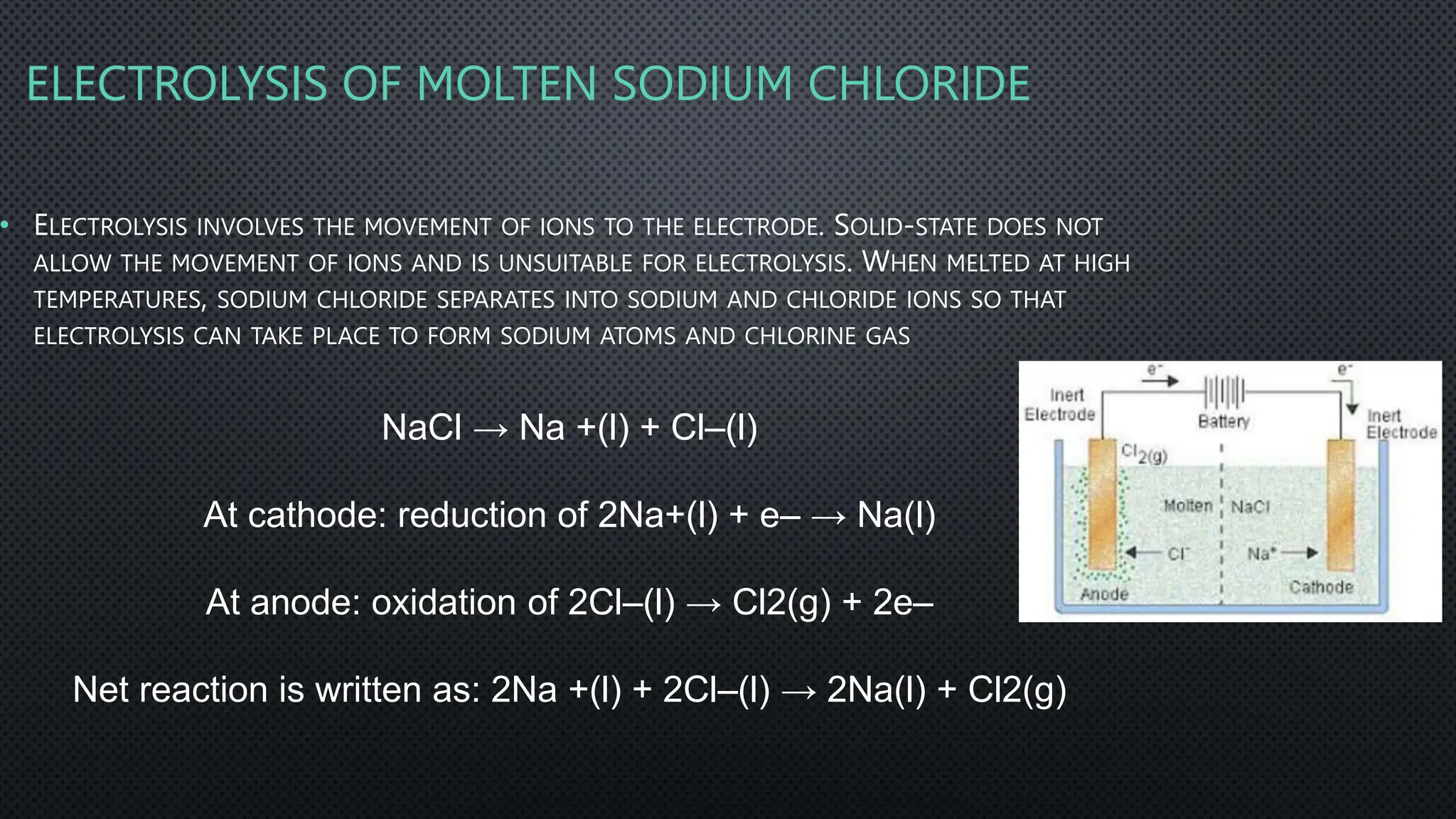
• ELECTROLYSIS INVOLVES THE MOVEMENT OF IONS TO THE ELECTRODE. SOLID-STATE DOES NOT
ALLOW THE MOVEMENT OF IONS AND IS UNSUITABLE FOR ELECTROLYSIS. WHEN MELTED AT HIGH
TEMPERATURES, SODIUM CHLORIDE SEPARATES INTO SODIUM AND CHLORIDE IONS SO THAT
ELECTROLYSIS CAN TAKE PLACE TO FORM SODIUM ATOMS AND CHLORINE GAS
NaCl → Na +(l) + Cl–(l)
At cathode: reduction of 2Na+(l) + e– → Na(l)
At anode: oxidation of 2Cl–(l) → Cl2(g) + 2e–
Net reaction is written as: 2Na +(l) + 2Cl–(l) → 2Na(l) + Cl2(g)
ELECTOLYSIS OF ALUMINIUM OXIDE
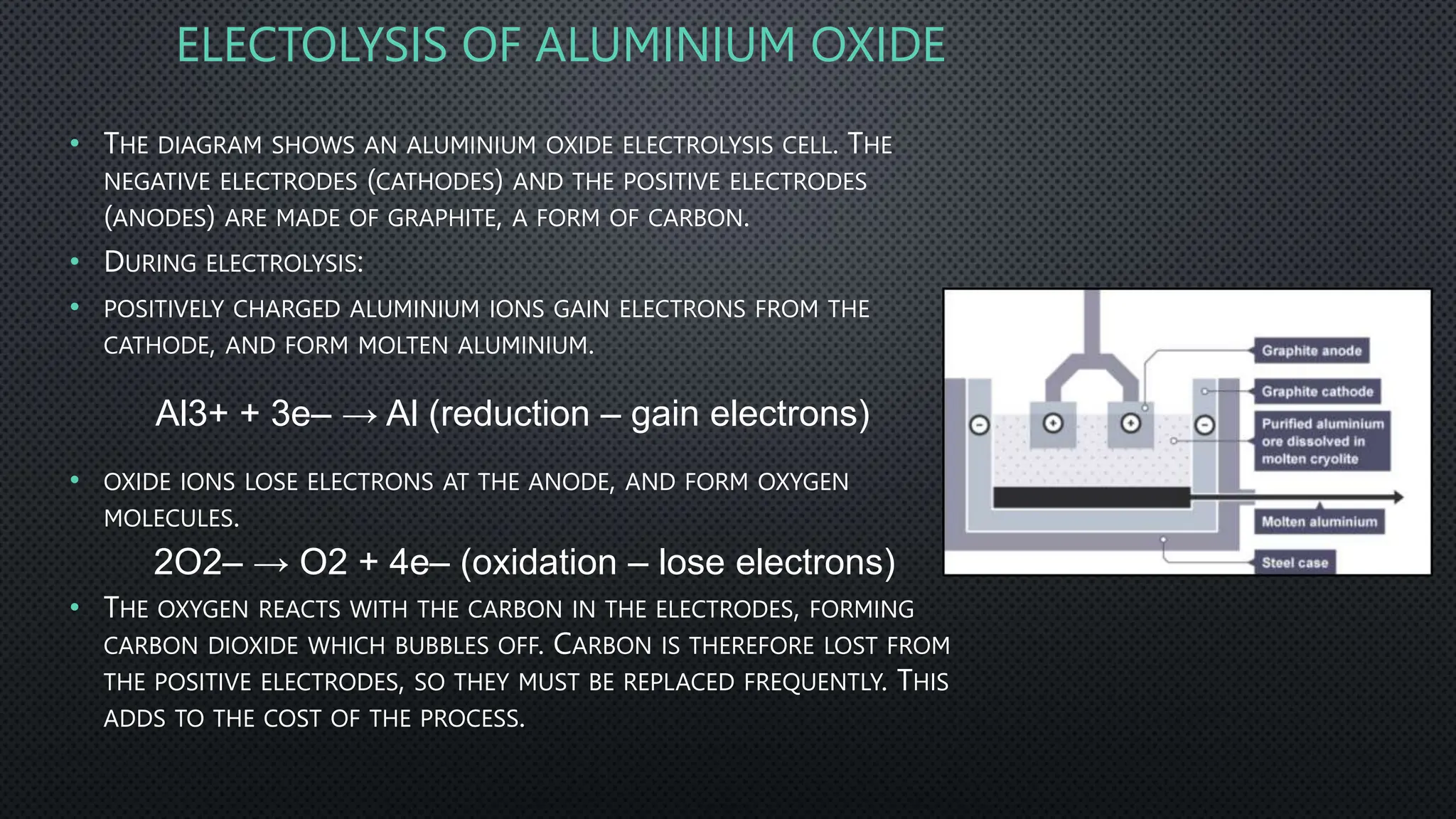
• THE DIAGRAM SHOWS AN ALUMINIUM OXIDE ELECTROLYSIS CELL. THE
NEGATIVE ELECTRODES (CATHODES) AND THE POSITIVE ELECTRODES
(ANODES) ARE MADE OF GRAPHITE, A FORM OF CARBON.
• DURING ELECTROLYSIS:
• POSITIVELY CHARGED ALUMINIUM IONS GAIN ELECTRONS FROM THE
CATHODE, AND FORM MOLTEN ALUMINIUM.
• OXIDE IONS LOSE ELECTRONS AT THE ANODE, AND FORM OXYGEN
MOLECULES.
• THE OXYGEN REACTS WITH THE CARBON IN THE ELECTRODES, FORMING
CARBON DIOXIDE WHICH BUBBLES OFF. CARBON IS THEREFORE LOST FROM
THE POSITIVE ELECTRODES, SO THEY MUST BE REPLACED FREQUENTLY. THIS
ADDS TO THE COST OF THE PROCESS.
Al3+ + 3e– → Al (reduction – gain electrons)
2O2– → O2 + 4e– (oxidation – lose electrons)
ELECTROLYSIS OF AQUEOUS IONIC COMPOUND
When an ionic compound is dissolved in water, the products of
electrolysis are often different to those when the compound is molten.
In water, a small fraction of the molecules break down into hydrogen
ions (H+) and hydroxide ions (OH−). These ions can be discharged
instead of the ions in the ionic compound. More water molecules can
break down if these ions are used up.
At each electrode there are two ions that could discharge, one from the
ionic compound and one from the water. The one that is easier to discharge
is the one that is discharged.Also the Inert electrodes are
electrodes that will allow the electrolysis to take place but do not react
themselves. Graphite electrodes are the most common inert electrodes used.
ELECTROLYSIS OF AQUEOUS IONIC COMPOUND
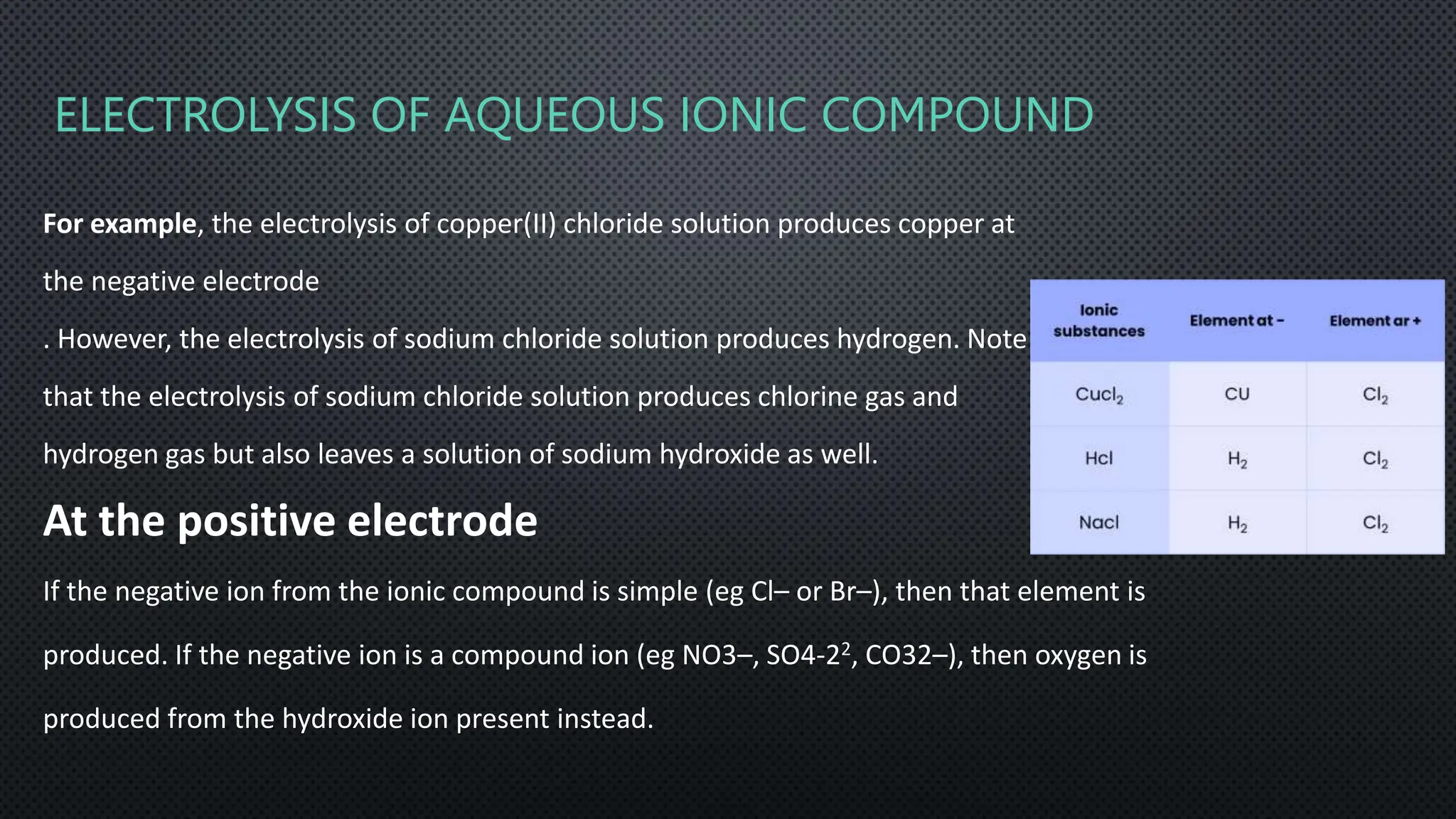
For example, the electrolysis of copper(II) chloride solution produces copper at
the negative electrode
. However, the electrolysis of sodium chloride solution produces hydrogen. Note
that the electrolysis of sodium chloride solution produces chlorine gas and
hydrogen gas but also leaves a solution of sodium hydroxide as well.
At the positive electrode
If the negative ion from the ionic compound is simple (eg Cl– or Br–), then that element is
produced. If the negative ion is a compound ion (eg NO3–, SO4-22, CO32–), then oxygen is
produced from the hydroxide ion present instead.
ELECTROLYSIS OF AQUEOUS IONIC COMPOUND
At the negative electrode
Metal ions and hydrogen ions are positively charged. Whether you get the
metal or hydrogen during electrolysis depends on the position of the metal
in the
reactivity serier
the metal will be produced if it is less reactive than hydrogen
hydrogen will be produced if the metal is more reactive than hydrogen
The relative reactivity of selected elements from most to least: potassium,
sodium, calcium, magnesium, aluminium, carbon, zinc, iron, tin, lead,
hydrogen, copper, silver, gold, platinum.
ELECTROLYSIS OF AQUEOUS NACL
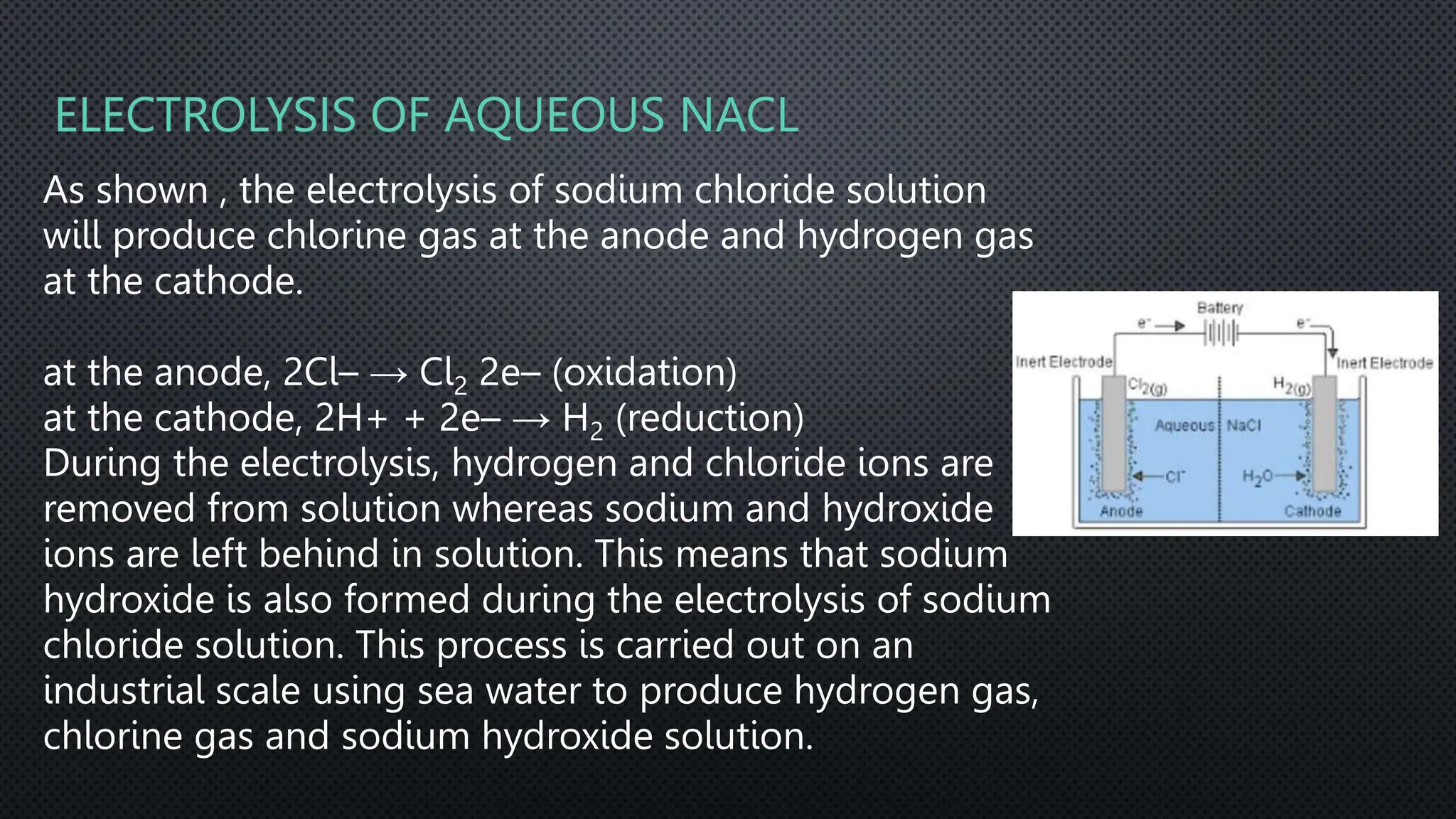
As shown , the electrolysis of sodium chloride solution
will produce chlorine gas at the anode and hydrogen gas
at the cathode.
at the anode, 2Cl– → Cl2 2e– (oxidation)
at the cathode, 2H+ + 2e– → H2 (reduction)
During the electrolysis, hydrogen and chloride ions are
removed from solution whereas sodium and hydroxide
ions are left behind in solution. This means that sodium
hydroxide is also formed during the electrolysis of sodium
chloride solution. This process is carried out on an
industrial scale using sea water to produce hydrogen gas,
chlorine gas and sodium hydroxide solution.
Electrolysis is used to electroplate objects (coat them with a thin layer of metal). This is useful for coating a cheaper metal with
a more expensive one, such as copper or silver.
The negative electrode should be the object to be electroplated.
The positive electrode should be the metal that you want to coat the object with.
The electrolyte should be a solution of the coating metal, such as its metal nitrate or sulfate.
Here are two examples.
Electroplating with silver
The object to be plated, such as a metal spoon, is connected to the negative terminal of the power supply. A piece of silver is
connected to the positive terminal. The electrolyte is silver nitrate solution.
Electroplating with copper
The object to be plated, such as a metal pan, is connected to the negative terminal of the power supply. A piece of copper is
connected to the positive terminal. The electrolyte is copper(II) sulfate solution.
Purifying copper by electrolysis [Higher tier only]
Copper is purified by electrolysis. Electricity is passed through solutions containing copper compounds, such as copper(II)
sulfate. The anode (positive electrode) is made from impure copper and the cathode (negative electrode) is made from pure
copper.
Pure copper forms on the cathode.
ELECTROPLATING
HYDROGEN FUEL CELL
A fuel is a substance which releases energy when burned
Hydrogen is used as a fuel in rocket engines and in fuel cells to power some cars
A fuel cell is an electrochemical cell in which a fuel donates electrons at one
electrode and oxygen gains electrons at the other electrode
H2 → 2H+ + 2e–
O2 + 4e– → 2O2–
The hydrogen-oxygen fuel cell produces electricity by combining
both elements, releasing energy and water
The overall equation for the reaction within a hydrogen fuel cell is:
hydrogen + oxygen → water
The diagram shows the setup of a hydrogen fuel cell
The air entering provides the oxygen
The fuel entering is hydrogen
The only chemical product made is water
HYDROGEN FUEL CELL
Advantages
• They do not produce any pollution: the only product is water whereas petrol engines
produce carbon dioxide, and oxides of nitrogen
• They release more energy per kilogram than either petrol or diesel
• No power is lost in transmission as there are no moving parts, unlike an internal
combustion engine
• Quieter so less noise pollution compared to a petrol engine
Disadvantages
• Materials used in producing fuel cells are expensive
• Hydrogen is more difficult and expensive to store compared to petrol as it is very
flammable and easily explodes when under pressure
• Fuel cells are affected by low temperatures, becoming less efficient
• There are only a small number of hydrogen filling stations across the country
• Hydrogen is often obtained by methods that involve the combustion of fossil fuels,
therefore releasing carbon dioxide and other pollutants into the atmosphere
THANK
YOU
CHEMISTRY WITH ANUM

chemistry GCSE chapter 5 Electrochemistry.pptx

  • 2.
    5.ELECTROCHEMISTRY 5 .1 Electrolysis 5.2Electrolysis of molten ionic compound 5.3 Electrolysis of aqueous ionic compound 5.4 Electroplating 5.5 Hydrogen fuel cell
  • 3.
    WHAT IS ELECTROLYSIS? Electrolysisis the decomposition of ionic compounds using electricity. Ionic compounds contain metals combined with non-metals. Examples include ● sodium chloride (NaCl) – a combination of the metal sodium with the non-metal chlorine ● copper sulfate (CuSO4) – a combination of the metal copper with the non-metals sulfur and oxygen. Ionic compounds are made up of positive and negative ions. As solids, ionic compounds cannot conduct electricity because the ions cannot move around. However, when ionic compounds are melted or dissolved,the ions are free to move and conduct electricity. These liquids or solutions are called electrolytes because they are able to conduct electricity.
  • 4.
    EXPLANATION If two electrodesconnected to a supply of electricity are put into the electrolyte, the negative ions are attracted to the positive electrode and the positive ions are attracted to the negative electrode . This happens because opposite charges attract each other. When the ions reach the electrodes they are discharged. This means that they gain or lose electrons so that they lose their charge and become neutral. Positive ions gain electrons. Negative ions lose electrons. The negative ions are discharged by losing electrons at the positive electrode. These electrons move around the circuit through the wires to the negative electrode. The positive ions are discharged by gaining electrons at the negative electrode.
  • 5.
    KEY TERMS ElectrolysisDecomposition of compounds using electricity. Electrolyte A liquid that conducts electricity. Discharge Gain or lose electrons to become electrically neutral. Anode An electrode where oxidation takes place (oxidation is the loss of electrons) – in electrolysis it is the positive electrode. Cathode An electrode where reduction takes place (reduction is the gain of electrons) – in electrolysis it is the negative electrode.
  • 6.
    ELECTROLYSIS OF MOLTENIONIC COMPOUND Binary ionic compounds are ones made from one metal combined with one non-metal. Examples include lead bromide (PbBr2) ,sodium chloride (NaCl) and aluminium oxide (Al2O3) . The electrolysis of these compounds when molten produces the metal and non-metal. Molten lead bromide, PbBr2(l), is an electrolyte. During electrolysis: Pb2+ ions gain electrons at the cathode and become Pb atoms Br- ions lose electrons at the anode and become Br atoms, which pair up to form Br2 molecules So lead forms at the negative electrode and bromine forms at the positive electrode.
  • 7.
    ELECTROLYSIS OF MOLTENSODIUM CHLORIDE • ELECTROLYSIS INVOLVES THE MOVEMENT OF IONS TO THE ELECTRODE. SOLID-STATE DOES NOT ALLOW THE MOVEMENT OF IONS AND IS UNSUITABLE FOR ELECTROLYSIS. WHEN MELTED AT HIGH TEMPERATURES, SODIUM CHLORIDE SEPARATES INTO SODIUM AND CHLORIDE IONS SO THAT ELECTROLYSIS CAN TAKE PLACE TO FORM SODIUM ATOMS AND CHLORINE GAS NaCl → Na +(l) + Cl–(l) At cathode: reduction of 2Na+(l) + e– → Na(l) At anode: oxidation of 2Cl–(l) → Cl2(g) + 2e– Net reaction is written as: 2Na +(l) + 2Cl–(l) → 2Na(l) + Cl2(g)
  • 8.
    ELECTOLYSIS OF ALUMINIUMOXIDE • THE DIAGRAM SHOWS AN ALUMINIUM OXIDE ELECTROLYSIS CELL. THE NEGATIVE ELECTRODES (CATHODES) AND THE POSITIVE ELECTRODES (ANODES) ARE MADE OF GRAPHITE, A FORM OF CARBON. • DURING ELECTROLYSIS: • POSITIVELY CHARGED ALUMINIUM IONS GAIN ELECTRONS FROM THE CATHODE, AND FORM MOLTEN ALUMINIUM. • OXIDE IONS LOSE ELECTRONS AT THE ANODE, AND FORM OXYGEN MOLECULES. • THE OXYGEN REACTS WITH THE CARBON IN THE ELECTRODES, FORMING CARBON DIOXIDE WHICH BUBBLES OFF. CARBON IS THEREFORE LOST FROM THE POSITIVE ELECTRODES, SO THEY MUST BE REPLACED FREQUENTLY. THIS ADDS TO THE COST OF THE PROCESS. Al3+ + 3e– → Al (reduction – gain electrons) 2O2– → O2 + 4e– (oxidation – lose electrons)
  • 9.
    ELECTROLYSIS OF AQUEOUSIONIC COMPOUND When an ionic compound is dissolved in water, the products of electrolysis are often different to those when the compound is molten. In water, a small fraction of the molecules break down into hydrogen ions (H+) and hydroxide ions (OH−). These ions can be discharged instead of the ions in the ionic compound. More water molecules can break down if these ions are used up. At each electrode there are two ions that could discharge, one from the ionic compound and one from the water. The one that is easier to discharge is the one that is discharged.Also the Inert electrodes are electrodes that will allow the electrolysis to take place but do not react themselves. Graphite electrodes are the most common inert electrodes used.
  • 10.
    ELECTROLYSIS OF AQUEOUSIONIC COMPOUND For example, the electrolysis of copper(II) chloride solution produces copper at the negative electrode . However, the electrolysis of sodium chloride solution produces hydrogen. Note that the electrolysis of sodium chloride solution produces chlorine gas and hydrogen gas but also leaves a solution of sodium hydroxide as well. At the positive electrode If the negative ion from the ionic compound is simple (eg Cl– or Br–), then that element is produced. If the negative ion is a compound ion (eg NO3–, SO4-22, CO32–), then oxygen is produced from the hydroxide ion present instead.
  • 11.
    ELECTROLYSIS OF AQUEOUSIONIC COMPOUND At the negative electrode Metal ions and hydrogen ions are positively charged. Whether you get the metal or hydrogen during electrolysis depends on the position of the metal in the reactivity serier the metal will be produced if it is less reactive than hydrogen hydrogen will be produced if the metal is more reactive than hydrogen The relative reactivity of selected elements from most to least: potassium, sodium, calcium, magnesium, aluminium, carbon, zinc, iron, tin, lead, hydrogen, copper, silver, gold, platinum.
  • 12.
    ELECTROLYSIS OF AQUEOUSNACL As shown , the electrolysis of sodium chloride solution will produce chlorine gas at the anode and hydrogen gas at the cathode. at the anode, 2Cl– → Cl2 2e– (oxidation) at the cathode, 2H+ + 2e– → H2 (reduction) During the electrolysis, hydrogen and chloride ions are removed from solution whereas sodium and hydroxide ions are left behind in solution. This means that sodium hydroxide is also formed during the electrolysis of sodium chloride solution. This process is carried out on an industrial scale using sea water to produce hydrogen gas, chlorine gas and sodium hydroxide solution.
  • 13.
    Electrolysis is usedto electroplate objects (coat them with a thin layer of metal). This is useful for coating a cheaper metal with a more expensive one, such as copper or silver. The negative electrode should be the object to be electroplated. The positive electrode should be the metal that you want to coat the object with. The electrolyte should be a solution of the coating metal, such as its metal nitrate or sulfate. Here are two examples. Electroplating with silver The object to be plated, such as a metal spoon, is connected to the negative terminal of the power supply. A piece of silver is connected to the positive terminal. The electrolyte is silver nitrate solution. Electroplating with copper The object to be plated, such as a metal pan, is connected to the negative terminal of the power supply. A piece of copper is connected to the positive terminal. The electrolyte is copper(II) sulfate solution. Purifying copper by electrolysis [Higher tier only] Copper is purified by electrolysis. Electricity is passed through solutions containing copper compounds, such as copper(II) sulfate. The anode (positive electrode) is made from impure copper and the cathode (negative electrode) is made from pure copper. Pure copper forms on the cathode. ELECTROPLATING
  • 14.
    HYDROGEN FUEL CELL Afuel is a substance which releases energy when burned Hydrogen is used as a fuel in rocket engines and in fuel cells to power some cars A fuel cell is an electrochemical cell in which a fuel donates electrons at one electrode and oxygen gains electrons at the other electrode H2 → 2H+ + 2e– O2 + 4e– → 2O2– The hydrogen-oxygen fuel cell produces electricity by combining both elements, releasing energy and water The overall equation for the reaction within a hydrogen fuel cell is: hydrogen + oxygen → water The diagram shows the setup of a hydrogen fuel cell The air entering provides the oxygen The fuel entering is hydrogen The only chemical product made is water
  • 15.
    HYDROGEN FUEL CELL Advantages •They do not produce any pollution: the only product is water whereas petrol engines produce carbon dioxide, and oxides of nitrogen • They release more energy per kilogram than either petrol or diesel • No power is lost in transmission as there are no moving parts, unlike an internal combustion engine • Quieter so less noise pollution compared to a petrol engine Disadvantages • Materials used in producing fuel cells are expensive • Hydrogen is more difficult and expensive to store compared to petrol as it is very flammable and easily explodes when under pressure • Fuel cells are affected by low temperatures, becoming less efficient • There are only a small number of hydrogen filling stations across the country • Hydrogen is often obtained by methods that involve the combustion of fossil fuels, therefore releasing carbon dioxide and other pollutants into the atmosphere
  • 16.