The shape of jobs to come

Possible New Careers Emerging from Advances in
     Science and Technology (2010 – 2030)


                  Final Report
                 January 2010


                  Rohit Talwar
                 Tim Hancock
             Fast Future Research


                  www.fastfuture.com
                Tel +44 (0)20 8830 0766
               Email rohit@fastfuture.com
The shape of jobs to come


       Executive Summary


    1. Introduction

    2. The World in 2030

    3. The Science and Technology Horizon

    4. The shape of jobs to come

    5. Global Survey Findings

    6. The shape of jobs to come – Key Implications

    7. Conclusions and Recommendations


Appendices
1      The World in 2030 Background Data
2      The Science and Technology Horizon – Key Trends
3      The Science and Technology Timeline 2010 - 2030
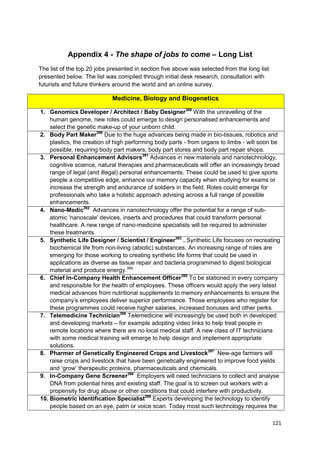
4      The shape of jobs to come – Long List
5      Geographic Breakdown of Survey Respondents


Contributors
Sources and References
Report Authors


                                                         2
The shape of jobs to come

                                 Executive Summary

Purpose of the Study
The purpose of this report is to highlight examples of the kinds of jobs, careers and
professions that could result from advances in science and technology in the period from
2010 to 2030. The report was commissioned as part of the Science: [So what? So
everything] campaign which aims to promote public interest in science and engineering and
highlight their importance to the UK‘s future. Science: [So what? So everything] is funded by
the Department for Business Innovation and Skills and supported by a wide range of
individuals and organisations.

To help identify and understand the jobs of the future, the study has undertaken a short
science and technology ‗horizon scanning‘ exercise. The aim was to identify a sample of key
science and technology trends and developments that could occur over the next twenty
years and create a timeline highlighting when such developments may come to maturity.

An Era of Opportunity
The study highlights that we are entering a new era for science and technology. The
combination of rising public understanding of and trust in science, the benefits being felt
across all aspects of our lives and the rapid pace of advances being made across a number
of new disciplines are helping to raise prominence in the public domain. For the longer term,
the centrality of science and technology in helping to tackle the most pressing planetary
challenges from poverty to clean water, environment to human health, climate change to
energy supply and housing to transport are ensuring that science and technology are at the
heart of the sustainable development debate.

New Markets New Jobs
Commercially, it is clear that science and technology can spur innovation, transform existing
industries, create new business models and give birth to entire new sectors – underpinning
the economic importance to developed and developing economies alike. The scale of
potential impact has led to a massive increase in science funding from the public and private
sector globally. This increased funding is fuelling the growth of opportunities to work in
existing disciplines, in emerging sectors and in the jobs of the future which will result from
developments on the horizon.

New Issues New Debates
The scope of this study was focused on presenting a representative spectrum of future
science and technology developments and highlighting the kinds of jobs that could emerge
as a result. We recognise that many of these developments could be considered
contentious. Naturally, serious consideration will be required of the broader societal
implications of these developments. Lively public debate must take place around important
areas of potential concern such as nano-technology, human enhancement and Genetically
Modified (GM) foods. The report has not attempted to prejudge or deliver verdicts on such
key issues - however the possible future jobs identified in this report do illustrate some
aspects of the potential impact of science on our lives.

                                                                                             3
The shape of jobs to come - Survey Findings
A process of consultation was used to identify an initial long list of future jobs from which
twenty were selected and profiled. These profiles formed the basis of an online survey. The
survey focused on assessing the popularity, job impact, environmental impact, educational
benefits, developing country benefits, financial rewards and attractiveness of the twenty jobs.
The survey attracted 486 responses from 58 countries on 6 continents – including 104 from
the UK – representing 21% of the total sample. The highlights of the survey are that:
     ‗Old Age Wellness Manager / Consultant‘ was considered the most popular career
    choice both globally (41%) and amongst UK respondents (34%). This was the role
    expected to create the most jobs – being selected by 48% of global respondents and
    49% from the UK
    ‗Quarantine Enforcer‘ was considered the least popular career choice both globally
    (50%) and in the UK (48%)
    ‗Climate Change Reversal Specialist‘ is expected to deliver the greatest environmental
    benefits both globally (71%) and by UK respondents (70%)
    The role expected to deliver the greatest benefit to human health and wellbeing was also
    ‗Old Age Wellness Manager / Consultant‘ – gaining the support of 69% globally and 73%
    in the UK
    ‗Pharmer of Genetically Engineered Crops and Livestock‘ was considered the role most
    likely to deliver benefits to developing economies by global respondents (54%) and those
    from the UK (61%)
    ‗Alternative Vehicle Developers‘ were expected to make the greatest contribution to
    driving commercial innovation and economic growth – gaining support from 52% globally
    and 51% of UK respondents
    The role considered likely to be the best paid globally was ‗Nano-Medic‘ (45%), whilst in
    the UK the preferred option was ‗Virtual Lawyer‘ (59%)
    ‗Space Pilots, Architects and Tour Guides‘ were considered the most aspirational roles
    amongst respondent globally (48%) and in the UK (43%)
    When asked to select the role that would have the most impact on their domestic
    economy, the most popular choice both globally (37%) and in the UK (41%) was
    ‗Pharmer of Genetically Engineered Crops and Livestock‘.

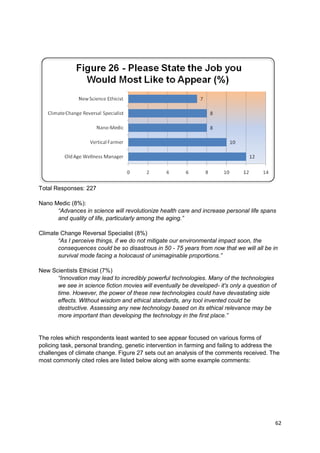
The top five roles that respondents would most like to see materialise were:
   ‗Old Age Wellness Manager / Consultant‘
   ‗Vertical Farmer‘
   ‗Nano-Medic‘
   ‗Climate Change Reversal Specialist‘
   ‗New Scientists Ethicist‘

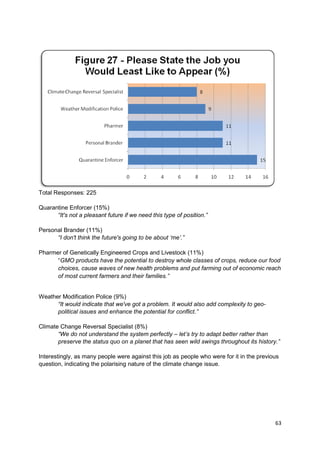
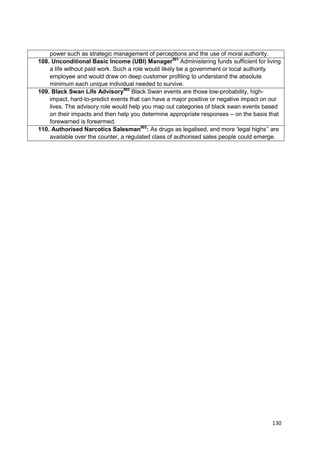
The five roles that respondents would least like to see materialise were:
   ‗Quarantine Enforcer‘
   ‗Personal Brander‘
   ‗Pharmer of Genetically Engineered Crops and Livestock‘
   ‗Weather Modification Police‘
   ‗Climate Change Reversal Specialist‘.


                                                                                             4
The response to the global survey suggests these roles can individually and in various
combinations make a significant contribution to tackling the care challenges of an ageing
society, feeding a growing population and maintaining and enhancing our health. They are
also seen as essential to giving us greener mobility solutions and reducing the impact of
dangerous climate change. Finally they are expected to help us survive and thrive in the
cyberworld, whether through legal protection, counselling or management of our virtual data
and ‘personal brand image‘. As a result, the survey suggests that many of these roles will be
popular, well-rewarded and aspirational.

Assessing the Implications
A number of prominent futurists were invited to comment on the implications of these new
roles for governments, businesses and society. The futurists emphasised the need to
encourage a mindset shift and facilitate the change in all our thinking and in our education
systems in particular to bring about such new roles. Equally important was recognition of the
critical role of commercial viability in determining which areas of science and which careers
will progress. Finally, specific fields which were expected drive significant job creation were
the shift to a low carbon economy, artificial intelligence, augmented reality, social media,
personalisation and the opening up of space as a commercial opportunity.

Conclusions
We hope that this report acts as a useful stimulus for raising public interest in and discussion
of the key role science and technology will play in shaping the world around us and in
creating new jobs and career opportunities over the next twenty years. Target audiences for
this material include students of all ages, parents, teachers and those who might want to
retrain for a new career. The aim is to encourage children and young people in particular to
research forthcoming science and technology developments, imagine the kinds of jobs they
will create and explore how these developments could help tackle a number of the ‗grand
challenges‘ facing our planet.


                                                                                               5
1. Introduction and Objectives
The purpose of this report is to highlight examples of the kinds of jobs, careers and
professions that could result from advances in science and technology in the period from
2010 to 2030. The report was commissioned as part of the Science: [So what? So
everything] campaign which aims to promote public interest in science and engineering and
highlight their importance to our future. The specific objectives were to:
   Conduct a brief ‗horizon scan‘ to identify a sample of key advances in science and
   technology that are anticipated in the period from 2010 to 2030
   Develop a timeline indicating the timeframes in which these developments might come to
   maturity
    Identify a long list of ‗jobs of the future‘ - highlighting ‗Jobs that don‘t yet Exist‘ and
   current jobs that could become more prominent over the next two decades as a result of
   these advances
   Develop more detailed profiles of a representative sample of twenty jobs – highlighting
   what a ‗day in the life‘ of these professions might involve
   Invite a global audience of future thinkers to assess the value, impact and attractiveness
   of these twenty roles using an online survey.


1.1 Report Structure
The report is presented in seven main sections and five appendices:
Section 1 – Introduction and Objectives - Here we outline the rationale for the report and
explain the methodology adopted.
Section 2 – The World in 2030 - Explores ten major patterns of change that will shape our
world over the coming two decades, identifies some of the resulting opportunities and
implications for science and technology and introduces a non-exhaustive list of 110 future
jobs that could emerge as a result.
Section 3 – The Science and Technology Horizon - Provides a short introduction to the key
areas of science and technology development that were examined to help identify ‗The
shape of jobs to come‘.
Section 4 – The shape of jobs to come - Explains how the list of 110 jobs was compiled and
presents the profiles of a ‗day in the life‘ of a representative sample of twenty jobs that
highlight the range and nature of the opportunities that are emerging.
Section 5 – Global Survey Findings - Presents the findings of a global survey that was run to
assess future thinkers‘ views on the impact and implications of the sample of twenty jobs.
Section 6 – The shape of jobs to come – Key Implications – Presents the views of a range of
futurists from around the world on the implications of these developments and job
opportunities and how best to prepare for the resulting changes we face in the coming
decades.
Section 7 - Conclusions - Draws some brief conclusions from the study.


                                                                                              6
Appendix 1 - The World in 2030 Background Data - Provides short descriptions of the key
underlying trends and developments for the ten patterns of change presented in section 2.
Appendix 2 – The Science and Technology Horizon- Key Trends - Presents a short overview
of a representative selection of key trends in each of the areas of science and technology
that were examined for this report.
Appendix 3 – The Science and Technology Timeline 2010 – 2030 - Sets out a development
timeline, showing the earliest point at which these fields of endeavour might reach maturity.
Appendix 4 – The shape of jobs to come – Long List - Presents short summaries of the 110
future jobs that were identified as part of this study.
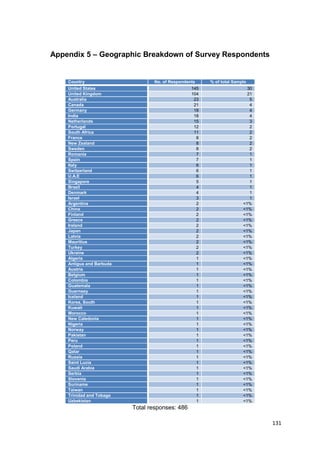
Appendix 5 – Survey Respondents - Identifies the full list of countries that took part and the
number of respondents by country.


1.2 Science and Technology for a World in Transition
To some, the tail end of an economic downturn might seem like an odd time to be taking an
imaginative look forward at The shape of jobs to come as a result of science and technology
advances over the next two decades. However, an alternative view is that now is the perfect
time to focus on the positive opportunities and developments that could lead us into
recovery, create new professions and help shape a powerful vision of what can be achieved
through investment in science and technology excellence in the coming decades.
As nations across the globe emerge from the economic crises, there is a growing focus on
choosing the right levers to pull in order to restore confidence, restart economic growth and
steer the planet on a path towards sustainable development. As a result, there has been a
clear emphasis on the role of science and technology in shaping and sustaining the
recovery. For example new monitoring systems and complexity management tools are seen
as critical to establishing better regulatory control of the banking system.
Beyond fixing the causes of the current crisis, perhaps an even more important role is that
envisaged for science and technology in facilitating growth by providing a stream of
advances and innovations across every sector. These developments will lead to the
transformation of many industries such as car manufacture and spawn new sectors such as
nano-chemistry, quantum computing and integrative fields such as the much vaunted NBIC
convergence (nanotechnology-biotechnology-information technology-cognitive science).
Perhaps most critical of all is the role science and technology is expected to play in solving
the challenges facing an increasingly interconnected and co-dependent world. Governments
globally are increasingly challenged by the issues of feeding a growing planet, educating our
children, providing new housing solutions, delivering alternative clean energy sources,
solving our need for efficient transport, ensuring our security and tackling dangerous climate
change. Science and technology are seen as central to providing effective, affordable and
sustainable solutions to all of these challenges and more.
The good news is that governments are not simply stacking these challenges up at the
laboratory door and walking away with hope as their only strategy for how to address them!
Across the world, science and technology has been a major recipient of funding in
government economic stimulus packages. Examples included 900M Euros (£831M) in
Germany, 731M Euros (£675M) in France and 685M Euros (£632M) in Norway. A significant
proportion of China‘s 10Tn Yuan (£0.9Tn, 1Tn Euros, US$1.5Tn) stimulus package was also

                                                                                                 7
channelled into science and technology investment.1 ‗Green‘ technologies and solutions
have also received significant support – particularly from East Asian governments. Notable
examples include South Korea, which is apparently allocating 81% of its recovery funds to
green initiatives and China, which is setting aside 34% for eco-projects.2 At the same time,
Japan has targeted a doubling of the number of green sector jobs to 2.8 million over the
period from 2008 to 2020.3
Governments, corporations and investors alike are recognising that science and technology
innovation can drive growth, create new jobs and facilitate wealth creation. The investments
being made are creating well funded facilities in research centres and laboratories around
the world. Furthermore, technology itself is facilitating collaboration between scientists
across the globe on an unprecedented scale. We are also entering an era where science
and technology will assume far greater prominence in our lives and will play a more central
role in everything we do. As a result, society‘s expectations will be raised as to how
effectively and how quickly science and technology can meet our ever expanding needs and
desires and tackle persistent problems for humanity and the environment.
The combination of global need, funding and societal expectations makes this a tremendous
time to be considering a career in one of the many existing science and technology
disciplines that exist today and those new professions that will emerge in the coming
decades. This horizon scanning report seeks to provide initial insights into some of the
domains of science and technology that will open up to those that want to go into the field.
Equally importantly, the report tries to bring to life what these new roles might involve.


1.3. Study Methodology
The project was conducted between mid-August and early October 2009. The first phase
involved horizon scanning to identify potentially key science and technology trends and
developments for the next two decades. The aim was to draw on a wide range of
authoritative sources citing well referenced examples of science and technology
developments on the horizon. As such, extensive use was made of the UK Government
Horizon Scanning Centre (HSC)4 outputs – most notably the Delta and Sigma horizon scans
of emerging trends and developments. Other key sources used extensively included MIT‘s
Technology Review5, the BT Technology Timeline6 and TechCast7 – an acknowledged
resource pooling expert knowledge on science and technology forecasts.
This scan resulted in the list of trends and the timeline presented in appendices 2 and 3. In
addition, an initial long list of 110 future jobs was identified and profiled in brief. A short list of
ten jobs were then selected and shared for review with colleagues in the Association of
Professional Futurists. The list was also presented to Fast Future‘s own global network. This
comprises over 20,000 people from a variety of professions and sectors who have an
interest in the trends and factors shaping our future. Both groups were asked to provide their
comments on the list of ten jobs and identify additional jobs that might be created in future as
a result of advances in science and technology.
The long list of future jobs was refined and expanded with the feedback received. A list of
twenty jobs were then selected as being representative of the breadth, scope and impact of
the jobs that would be created or become more prominent in the future. An online survey
was then run from August 12th-21st 2009. The survey attracted 486 responses from 58
countries on 6 continents. Of these 65% were male and 35% female.


                                                                                                     8
Survey respondents were asked to evaluate the attractiveness and impact in a variety of
fields from human health to the environment. Survey participants were also asked to provide
their views on what a day in the life of these roles might involve and to suggest additional
roles they could see emerging in the coming two decades. The invitation to take part in the
survey was distributed to Fast Future‘s global network and promoted via various social
networks and to the mailing lists of a number of fellow futurists.


                                                                                           9
2. The World in 2030
To help set the context for this review of emerging science and technology developments, it
is important to look at the range of trends, forces, developments and ideas that could shape
our world in the period to 2030. In this section we identify ten major patterns of change which
will have an important bearing on everything from governance systems to the food we eat.
We explore the opportunities and implications for science and technology resulting from
these patterns of change and introduce the jobs that could emerge as a result.

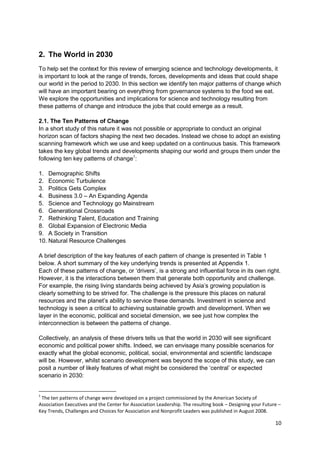
2.1. The Ten Patterns of Change
In a short study of this nature it was not possible or appropriate to conduct an original
horizon scan of factors shaping the next two decades. Instead we chose to adopt an existing
scanning framework which we use and keep updated on a continuous basis. This framework
takes the key global trends and developments shaping our world and groups them under the
following ten key patterns of change1:

1. Demographic Shifts
2. Economic Turbulence
3. Politics Gets Complex
4. Business 3.0 – An Expanding Agenda
5. Science and Technology go Mainstream
6. Generational Crossroads
7. Rethinking Talent, Education and Training
8. Global Expansion of Electronic Media
9. A Society in Transition
10. Natural Resource Challenges

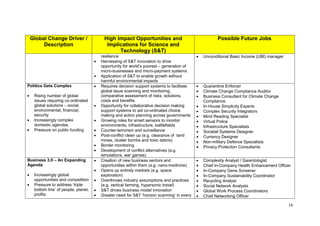
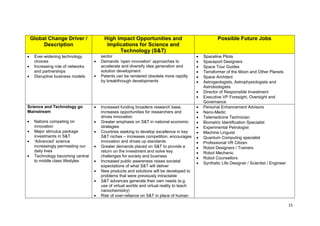
A brief description of the key features of each pattern of change is presented in Table 1
below. A short summary of the key underlying trends is presented at Appendix 1.
Each of these patterns of change, or ‗drivers‘, is a strong and influential force in its own right.
However, it is the interactions between them that generate both opportunity and challenge.
For example, the rising living standards being achieved by Asia‘s growing population is
clearly something to be strived for. The challenge is the pressure this places on natural
resources and the planet‘s ability to service these demands. Investment in science and
technology is seen a critical to achieving sustainable growth and development. When we
layer in the economic, political and societal dimension, we see just how complex the
interconnection is between the patterns of change.

Collectively, an analysis of these drivers tells us that the world in 2030 will see significant
economic and political power shifts. Indeed, we can envisage many possible scenarios for
exactly what the global economic, political, social, environmental and scientific landscape
will be. However, whilst scenario development was beyond the scope of this study, we can
posit a number of likely features of what might be considered the ‗central‘ or expected
scenario in 2030:


1
 The ten patterns of change were developed on a project commissioned by the American Society of
Association Executives and the Center for Association Leadership. The resulting book – Designing your Future –
Key Trends, Challenges and Choices for Association and Nonprofit Leaders was published in August 2008.

                                                                                                           10
Economic
   Further economic turbulence and potential downturns between 2010 – 2020, followed by
   a more stable period to 2030 as excessive risks have been removed from the financial
   markets and most economies have repaired their finances
   Sustainable growth is still the dominant driver for most economies
   China could be the biggest global economy and India the fourth largest
   Public sector debt has been a major issue until at least 2020 for developed economies in
   particular
   Globalisation and interconnectivity between companies and value chains will continue to
   increase
   Major new industry sectors emerge as a result of advances in science and technology

Political
    No major new multi-nation global conflicts
    National geographic boundaries of the current G20 economies are largely similar to
    today
    Global institutions such as the UN, IMF and World Bank still carry influence – although
    other strong institutions now exist on a regional basis n Asia, Africa the Middle East and
    Latin America
    Security, environment and sustainability challenges remain prominent concerns

Socio-Demographic
   A global population of 8.3 billion, with 723 million in Europe and 68 million in the UK8
   Global social challenges remain around poverty, hunger, health and education

Environmental
   Alternative (non-nuclear) energy sources will be common in vehicles, homes and
   businesses – supplying 20-40% of all demand in most developed economies
   Demand for food and energy are expected to jump 50% compared with 2009 levels 9
   Fresh water demand could rise 30% on 2009 levels10
   Without adaptation to the impacts of climate change, Southern Africa could see declines
   in production of 15% for wheat and 27% for maize11

Science and Technology
   Advances in flight technology have shortened travel times
   Scientific progress and new technological advances continue to accelerate (e.g.
   biotechnology, nanotechnology, next generation computers).
   Advances in experiential technologies will lead to widespread use of developments such
   as virtual worlds, holograms, 3D projection, 3D television, virtual reality and interactive
   surfaces.

The implication of these projected developments and trends is that the demands on science
and technology are only like to increase over the period. For those working in these fields,
the expectation should be for more public scrutiny of their work, greater accountability and a
constant need to demonstrate the economic and social benefits of the particular field of
science and technology being pursued.


                                                                                              11
2.2. Identifying the Opportunities – Implications for Science and Technology
For each of these patterns of change, there are a range of opportunities which can be
addressed through science and technology advances and a number of resulting implications
for scientists, technologists and society as a whole. Some examples of these key
opportunities and implications are highlighted in the second column of Table 1 below.
Column three sets out an attempt to map the long list of 110 future jobs from Appendix 4 to
the ten patterns of change, and the resulting opportunities and implications. A source
reference and explanation is provided for all of these roles in Appendix 4. Clearly each job
could be mapped against more than one of the opportunity and implication clusters.


                                                                                          12
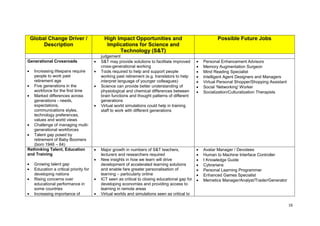
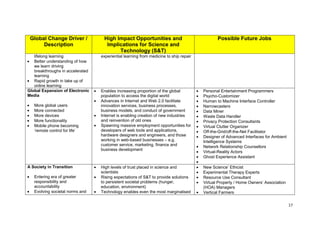
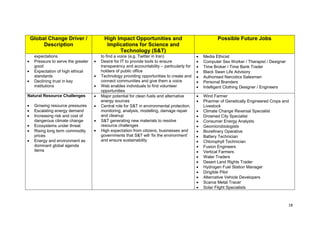
Table 1 – Global Change Drivers Mapped to Science and Technology opportunities and Implications and Possible Future Jobs

 Global Change Driver /             High Impact Opportunities and                              Possible Future Jobs
      Description                    Implications for Science and
                                          Technology (S&T)
Demographic Shifts                 Addressing basic needs of a growing planet –         Genomics Developer / Architect / Baby
                                   e.g. feeding, health, housing, education, energy,    Designer
   Global population growth        water, sanitation and transport                      Body Part Maker
   Increasing life expectancy      Serving specific needs of an ageing population –     Pharmer of Genetically Engineered Crops and
   Increasing urbanization         health monitoring, joint and organ replacement,      Livestock
   Ageing societies                wellness and mobility                                Old Age Wellness Manager/Consultant
   More ethnically diverse         Potential to extend human lifespans and support      Specialists
   populations                     people working past retirement (e.g. nutritional     Personal Body Weight / Obesity Consultant
                                   supplements, prosthetic replacements, memory         Longevity Providers
                                   enhancement)                                         Cryonics Technicians
                                   Understanding of human genome opening up             Insect-Based Food Developers, Chefs,
                                   potential for targeted cures and personalised        Nutritionists
                                   medicine                                             Population Status Manager
                                                                                        Monorail Designer
                                                                                        Socialization/Culturalization Therapists
                                                                                        End-of-Life Planner
Economic Turbulence                Higher S&T funding to stimulate economic             Bioinformationists
                                   growth                                               Genetic Hacker
   Legacy of economic downturn     Funding for and creation of new S&T based            Weather Modification Police
   – decade of turbulence          industries and businesses                            Knowledge Broker
   Closer integration of global    Facilitate country transformation through S&T        Virtual Police
   economy                         (e.g. Singapore, Ireland, UAE)                       Holographer
   New economic powers             Major investment required in infrastructure –        Teleportation Specialists
   emerging                        transport, power, water, sanitation, distribution.   Water Traders
   Redistribution of wealth        Requires S&T innovation to reduce construction       Desert Land Rights Trader
   around the planet               and operating costs, accelerate implementation,      Currency Designer
                                   improve lifetime performance and increase

                                                                                                                                  13
Global Change Driver /               High Impact Opportunities and                            Possible Future Jobs
      Description                      Implications for Science and
                                            Technology (S&T)
                                     resilience                                         Unconditional Basic Income (UBI) manager
                                     Harnessing of S&T innovation to drive
                                     opportunity for world‘s poorest – generation of
                                     micro-businesses and micro-payment systems
                                     Application of S&T to enable growth without
                                     harmful environmental impacts
Politics Gets Complex                Requires decision support systems to facilitate    Quarantine Enforcer
                                     global issue scanning and monitoring,              Climate Change Compliance Auditor
   Rising number of global           comparative assessment of risks, solutions,        Business Consultant for Climate Change
   issues requiring co-ordinated     costs and benefits                                 Compliance
   global solutions – social,        Opportunity for collaborative decision making      In-House Simplicity Experts
   environmental, financial,         support systems to aid co-ordinated choice         Complex Security Integrators
   security                          making and action planning across governments      Mind Reading Specialist
   Increasingly complex              Growing roles for smart sensors to monitor         Virtual Police
   domestic agendas                  environments, infrastructure, battlefields         Infrastructure Specialists
   Pressure on public funding        Counter-terrorism and surveillance                 Societal Systems Designer
                                     Post-conflict clean up (e.g. clearance of land     Currency Designer
                                     mines, cluster bombs and toxic debris)             Non-military Defence Specialists
                                     Border monitoring                                  Privacy Protection Consultants
                                     Development of conflict alternatives (e.g.
                                     simulations, war games)
Business 3.0 – An Expanding          Creation of new business sectors and               Complexity Analyst / Gaiantologist
Agenda                               opportunities within them (e.g. nano-medicine)     Chief In-Company Health Enhancement Officer
                                     Opens up entirely markets (e.g. space              In-Company Gene Screener
   Increasingly global               exploration)                                       In-Company Sustainability Coordinator
   opportunities and competition     Overthrows industry assumptions and practices      Recycling Analyst
   Pressure to address ‗triple       (e.g. vertical farming, hypersonic travel)         Social Network Analysts
   bottom line‘ of people, planet,   S&T drives business model innovation               Global Work Process Coordinators
   profits                           Greater need for S&T ‗horizon scanning‘ in every   Chief Networking Officer

                                                                                                                                   14
Global Change Driver /           High Impact Opportunities and                              Possible Future Jobs
      Description                  Implications for Science and
                                        Technology (S&T)
   Ever-widening technology      sector                                               Spaceline Pilots
   choices                       Demands ‗open innovation‘ approaches to              Spaceport Designers
   Increasing role of networks   accelerate and diversify idea generation and         Space Tour Guides
   and partnerships              solution development                                 Terraformer of the Moon and Other Planets
   Disruptive business models    Patents can be rendered obsolete more rapidly        Space Architect
                                 by breakthrough developments                         Astrogeologists, Astrophysiologists and
                                                                                      Astrobiologists
                                                                                      Director of Responsible Investment
                                                                                      Executive VP Foresight, Oversight and
                                                                                      Governance
Science and Technology go        Increased funding broadens research base,            Personal Enhancement Advisors
Mainstream                       increases opportunities for researchers and          Nano-Medic
                                 drives innovation                                    Telemedicine Technician
   Nations competing on          Greater emphasis on S&T in national economic         Biometric Identification Specialist
   innovation                    strategies                                           Experimental Petrologist
   Major stimulus package        Countries seeking to develop excellence in key       Machine Linguist
   investments in S&T            S&T niches – increases competition, encourages       Quantum Computing specialist
   ‗Advanced‘ science            innovation and drives up standards                   Professional VR Citizen
   increasingly permeating our   Greater demands placed on S&T to provide a           Robot Designers / Trainers
   daily lives                   return on the investment and solve key               Robot Mechanic
   Technology becoming central   challenges for society and business                  Robot Counsellors
   to middle class lifestyles    Increased public awareness raises societal           Synthetic Life Designer / Scientist / Engineer
                                 expectations of what S&T will deliver
                                 New products and solutions will be developed to
                                 problems that were previously intractable
                                 S&T advances generate their own needs (e.g.
                                 use of virtual worlds and virtual reality to teach
                                 nanochemistry)
                                 Risk of over-reliance on S&T in place of human

                                                                                                                                       15
Global Change Driver /                 High Impact Opportunities and                               Possible Future Jobs
      Description                        Implications for Science and
                                              Technology (S&T)
                                       judgement
Generational Crossroads                S&T may provide solutions to facilitate improved      Personal Enhancement Advisors
                                       cross-generational working                            Memory Augmentation Surgeon
   Increasing lifespans require        Tools required to help and support people             Mind Reading Specialist
   people to work past                 working past retirement (e.g. translators to help     Intelligent Agent Designers and Managers
   retirement age                      interpret language of younger colleagues)             Virtual Personal Shopper/Shopping Assistant
   Five generations in the             Science can provide better understanding of           Social 'Networking' Worker
   workforce for the first time        physiological and chemical differences between        Socialization/Culturalization Therapists
   Marked differences across           brain functions and thought patterns of different
   generations - needs,                generations
   expectations,                       Virtual world simulations could help in training
   communications styles,              staff to work with different generations
   technology preferences,
   values and world views
   Challenge of managing multi-
   generational workforces
   Talent gap posed by
   retirement of Baby Boomers
   (born 1946 – 64)
Rethinking Talent, Education           Major growth in numbers of S&T teachers,              Avatar Manager / Devotees
and Training                           lecturers and researchers required                    Human to Machine Interface Controller
                                       New insights in how we learn will drive               I Knowledge Guide
   Growing talent gap                  development of accelerated learning solutions         Cybrarians
   Education a critical priority for   and enable fare greater personalisation of            Personal Learning Programmer
   developing nations                  learning – particularly online                        Enhanced Games Specialist
   Rising concerns over                ICT seen as critical to closing educational gap for   Memetics Manager/Analyst/Trader/Generator
   educational performance in          developing economies and providing access to
   some countries                      learning in remote areas
   Increasing importance of            Virtual worlds and simulations seen as critical to

                                                                                                                                           16
Global Change Driver /            High Impact Opportunities and                              Possible Future Jobs
      Description                   Implications for Science and
                                         Technology (S&T)
   lifelong learning              experiential learning from medicine to ship repair
   Better understanding of how
   we learn driving
   breakthroughs in accelerated
   learning
   Rapid growth in take up of
   online learning
Global Expansion of Electronic    Enables increasing proportion of the global          Personal Entertainment Programmers
Media                             population to access the digital world               Psycho-Customizer
                                  Advances in Internet and Web 2.0 facilitate          Human to Machine Interface Controller
   More global users              innovation services, business processes,             Narrowcasters
   More connected                 business models, and conduct of government           Data Miner
   More devices                   Internet is enabling creation of new industries      Waste Data Handler
   More functionality             and reinvention of old ones                          Privacy Protection Consultants
   Mobile phone becoming          Spawning massive employment opportunities for        Virtual Clutter Organizer
   ‗remote control for life‘      developers of web tools and applications,            Off-the-Grid/off-the-Net Facilitator
                                  hardware designers and engineers, and those          Designer of Advanced Interfaces for Ambient
                                  working in web-based businesses – e.g.               Intelligence Systems
                                  customer service, marketing, finance and             Network Relationship Counsellors
                                  business development
                                                                                       Virtual-Reality Actors
                                                                                       Ghost Experience Assistant

A Society in Transition           High levels of trust placed in science and           New Science‘ Ethicist
                                  scientists                                           Experimental Therapy Experts
   Entering era of greater        Rising expectations of S&T to provide solutions      Resource Use Consultant
   responsibility and             to persistent societal problems (hunger,             Virtual Property / Home Owners‘ Association
   accountability                 education, environment)                              (HOA) Managers
   Evolving societal norms and    Technology enables even the most marginalised        Vertical Farmers


                                                                                                                                     17
Global Change Driver /             High Impact Opportunities and                              Possible Future Jobs
      Description                    Implications for Science and
                                          Technology (S&T)
   expectations                    to find a voice (e.g. Twitter in Iran)               Media Ethicist
   Pressure to serve the greater   Desire for IT to provide tools to ensure             Computer Sex Worker / Therapist / Designer
   good                            transparency and accountability – particularly for   Time Broker / Time Bank Trader
   Expectation of high ethical     holders of public office                             Black Swan Life Advisory
   standards                       Technology providing opportunities to create and     Authorised Narcotics Salesman
   Declining trust in key          connect communities and give them a voice            Personal Branders
   institutions                    Web enables individuals to find volunteer            Intelligent Clothing Designer / Engineers
                                   opportunities
Natural Resource Challenges        Major potential for clean fuels and alternative      Wind Farmer
                                   energy sources                                       Pharmer of Genetically Engineered Crops and
   Growing resource pressures      Central role for S&T in environmental protection,    Livestock
   Escalating energy demand        monitoring, analysis, modelling, damage repair       Climate Change Reversal Specialist
   Increasing risk and cost of     and cleanup                                          Drowned City Specialist
   dangerous climate change        S&T generating new materials to resolve              Consumer Energy Analysts
   Ecosystems under threat         resource challenges                                  Geomicrobiologists
   Rising long term commodity      High expectation from citizens, businesses and       Biorefinery Operative
   prices                          governments that S&T will ‗fix the environment‘      Battery Technician
   Energy and environment as       and ensure sustainability                            Chlorophyll Technician
   dominant global agenda                                                               Fusion Engineers
   items                                                                                Vertical Farmers
                                                                                        Water Traders
                                                                                        Desert Land Rights Trader
                                                                                        Hydrogen Fuel Station Manager
                                                                                        Dirigible Pilot
                                                                                        Alternative Vehicle Developers
                                                                                        Scarce Metal Tracer
                                                                                        Solar Flight Specialists


                                                                                                                                     18
3. The Science and Technology Horizon
3.1. Scope of Science and Technology Horizon Scanning
The horizon scanning undertaken for this study focused on identifying examples of key
trends and of the kinds of developments taking place across a number of dimensions of the
science and technology spectrum. In addition key contextual trends were scanned to get a
sense of key changes happening in the world in which these advances are taking place.
The horizon scanned trends and developments are presented in Appendix 1. Clearly there
are a wide range of domains that could have been covered. Given the short duration of the
study we chose to focus on the following areas - trends related to science policy, medicine,
biology and biogenetics, energy, the environment, nanotechnology, manufacturing,
information and communications technology, internet and the virtual world, artificial
intelligence, robotics, transportation, space, demographics, culture and leisure and politics,
economic and commerce.

The material used is drawn from a wide range of authoritative sources which in turn cite well
referenced examples of science and technology developments on the horizon. As such,
extensive use was made of the UK Government Horizon Scanning Centre (HSC) outputs –
most notably the Delta and Sigma horizon scans of emerging trends and developments.
Other key sources used extensively included MIT‘s Technology Review, the BT Technology
Timeline and TechCast – an acknowledged resource pooling expert knowledge on science
and technology forecasts. Where possible we have tried to republish and remain true to the
source definition of the trend or development – except where we feel further clarification,
paraphrasing or expansion is required.

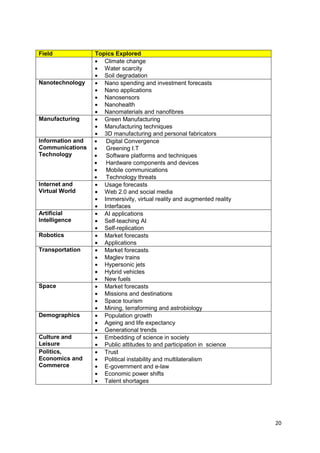
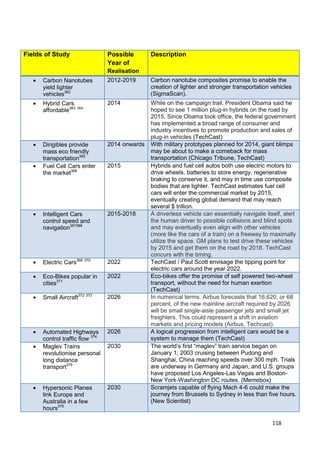
Summarised in Table 2 below are the fields of endeavour we focused on and the range of
topics considered in the scanning.


Table 2 – Key Fields Addressed through Horizon Scanning
Field                 Topics Explored
Science Policy,          Growing prominence and diffusion of science
Strategy and             Globalisation of science funding and standards
Funding                  Convergence on a ‗Theory of Everything‘
Medicine, Biology        Personalised medicine and human enhancement
and Biogenetics          NBIC convergence
                         Synthetic biology, biological machines, systems biology and
                         synthetic chemistry
                         Gene therapy and stem cells
                         Biomechatronics, neuroprosthetics and bionics
                         Electronic health management
                         Virtual reality education
                         Health risks
Energy                   Demand, supply and investment forecasts
                         Alternative energy sources
                         Smart Grids and decentralised energy systems
                         New Battery technologies
Environment              Consumption and urbanisation trends
                         Food demand and GM food

                                                                                             19
Field             Topics Explored
                     Climate change
                     Water scarcity
                     Soil degradation
Nanotechnology       Nano spending and investment forecasts
                     Nano applications
                     Nanosensors
                     Nanohealth
                     Nanomaterials and nanofibres
Manufacturing        Green Manufacturing
                     Manufacturing techniques
                     3D manufacturing and personal fabricators
Information and       Digital Convergence
Communications        Greening I.T
Technology            Software platforms and techniques
                      Hardware components and devices
                      Mobile communications
                      Technology threats
Internet and         Usage forecasts
Virtual World        Web 2.0 and social media
                     Immersivity, virtual reality and augmented reality
                     Interfaces
Artificial           AI applications
Intelligence         Self-teaching AI
                     Self-replication
Robotics             Market forecasts
                     Applications
Transportation       Market forecasts
                     Maglev trains
                     Hypersonic jets
                     Hybrid vehicles
                     New fuels
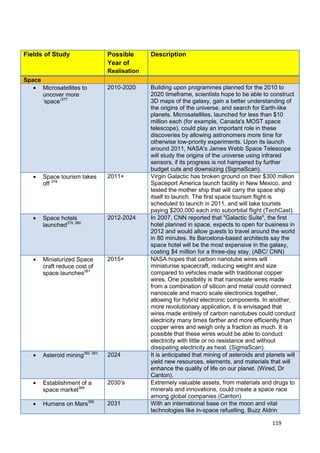
Space                Market forecasts
                     Missions and destinations
                     Space tourism
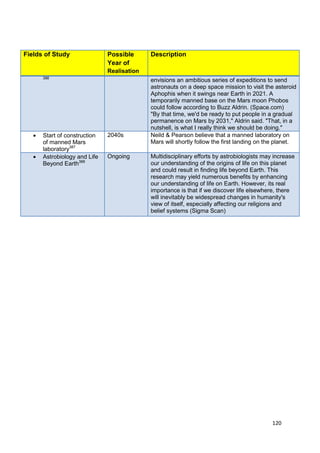
                     Mining, terraforming and astrobiology
Demographics         Population growth
                     Ageing and life expectancy
                     Generational trends
Culture and          Embedding of science in society
Leisure              Public attitudes to and participation in science
Politics,            Trust
Economics and        Political instability and multilateralism
Commerce             E-government and e-law
                     Economic power shifts
                     Talent shortages


                                                                          20
4. The shape of jobs to come
As explained in section 1.3. above, desk research was carried out to identify an initial long
list of future jobs and current jobs that might grow in prominence. These were reviewed with
members of the Association of Professional Futurists and Fast Future‘s global network. As a
result, the long list was extended and number of job profiles refined. A representative list of
twenty jobs was then agreed with the client. These were selected on the basis of being
representative of the breadth, scope and impact of the jobs that would be created or become
more prominent in the future.
An online survey was then run to evaluate the attractiveness and value of these jobs (see
section 5 for survey findings). Participants also provided input that was used to help develop
the ‗day in the life‘ summary for each of the jobs presented below. For each job, the
following information is presented:
     A short description
     An assessment as to when it might possibly emerge and be ‗accepted‘ as a recognised
     profession (e.g. have its own association or section within an existing body), and
     A day in the life of that professional.
 For each job we have also provided a reference indicating where the original title was
sourced from or the individual who proposed it.
The twenty jobs were selected to cover a range of activities from pure science driven roles
such a ‗nano-medic‘ through to those which help us deal with the impact of technology on
our lives such as a ‗virtual clutter organiser‘. The roles also cover a range of discipliners from
healthcare to farming, personal services to environment protection and policing to education.
The twenty jobs are listed below and described on the following pages.


1. Body Part Maker                                  10. Quarantine Enforcer
2. Nano-Medic                                       11. Weather Modification Police
3. Pharmer of Genetically Engineered                12. Virtual Lawyer
     Crops and Livestock                            13. Avatar Manager / Devotees -
4.   Old Age Wellness Manager /                         Virtual Teachers
     Consultant Specialists                         14. Alternative Vehicle Developers
5.   Memory Augmentation Surgeon                    15. Narrowcasters
6.   ‗New Science‘ Ethicist                         16. Waste Data Handler
7.   Space Pilots, Architects and Tour              17. Virtual Clutter Organizer
     Guides                                         18. Time Broker / Time Bank Trader
8.   Vertical Farmers                               19. Social 'Networking' Worker
9.   Climate Change Reversal                        20. Personal Branders
     Specialist


                                                                                               21
1.     Body Part Maker12
Due to the huge advances being made in bio-tissues, robotics and plastics, the creation of
high performing body parts - from organs to limbs - will soon be possible, requiring body part
makers, body part stores and body part repair shops.


Possible Emergence as a Profession: 2020


A Day in the Life
A day would typically start with scanning the most critical or urgent new requests for repairs
and complete body parts, and checking on component deliveries to help schedule the day‘s
work plan. Requests would be reviewed to determine whether entire limbs or organs were
required or just component subsystems (e.g. a new kneecap) and where multiple copies
were required e.g. for athletes and soldiers returning to combat. A visit to the incubator
would follow to check on the progress of body parts currently being ‗grown‘ and to perform
staged quality control tests of all existing growth culture batches. Starting new growth
batches would be the next priority.
The body part maker works with computer aided design, including online DNA modelling and
biomechanical simulations, DNA encoding and DNA modification. A core skill is the selection
and combination of biological materials to grow organ parts on "scaffolding", which is also
modelled by the body part maker, based on computer-generated templates. While a typical
organ such as a liver or kidney might be grown, other parts such as an arm would involve
the complex integration of a nano-engineered skeleton, high performance robotic joints,
fibre-optic nerves, artificially grown skin, synthetic flesh and muscles.
Much of the day would be spent working at the laboratory bench designing and assembling
body parts and testing their performance under various conditions as specified by the owner.
Throughout the day the body part maker would be engaged in video conferences with
surgeons around the world to discuss their requirements, provide advice on appropriate
body part design and review the results of past body part replacement surgeries. Dedicated
time would also be set aside to review the latest information on new techniques and
research provided by the body part maker‘s professional association.


                                                                                             22
2.     Nano-Medic13
Advances in nanotechnology offer the potential for a range of sub-atomic 'nanoscale'
devices, inserts and procedures that could transform personal healthcare. A new range of
nano-medicine specialists will be required to administer these treatments.


Possible Emergence as a Profession: 2025


A Day in the Life
Applications for nanomedicine range from body part replacement through to tissue repair
and gene therapy. A typical day for a skilled nanomedic might include patient consultation,
time in surgery, ward rounds, review of past surgeries, complex modelling to devise
appropriate nano-solutions, work in the laboratory to grow and engineer suitable
nanomaterials, teaching and continuous professional development. A Nano-medic would
typically work as part of team on rotating shifts, and be on call. Training is extensive and
involves study of the human physiology, traditional medicine, the science underpinning
nanotechnology, and the effects of nano materials in humans.
Because of the range of emerging applications of nano techniques and technologies, Nano-
medics would need a deep understanding of the biological, chemical, electrical, magnetic,
mechanical and optical properties of nanomaterials and of the human body. This would need
to be coupled with a deep understanding of information processing and cognitive
mechanisms in the human body. This multi-disciplinary expertise will be critical to
engineering nano-medical solutions that perform as well or better than the organs or body
parts being repaired.
Typically, a Nano-medic might be part of an expert team in one of a handful of specialist
nanomedicine centres around the country. Individual team members might specialise in
particular areas such as nano materials and tissues, cancer diagnostics and treatment, drug
delivery or computational modelling of nano-medical interventions. Patient conferences on
nanomedical interventions might typically involve specialists joining in via video link from a
range of remote locations.


                                                                                               23
3.    Pharmer of Genetically Engineered Crops and Livestock14
Pharmers are the next generation of farmers who will raise crops and livestock that have
been genetically engineered to improve food yields and ‗grow‘ therapeutic proteins,
pharmaceuticals and chemicals.


Possible Emergence as a Profession: 2015


A Day in the Life
The day begins with supervising the changeover of the security teams from the night shift,
scrutinising the CCTV monitoring systems and the automated event and monitoring logs,
which record the status of each crop or group of livestock. Each crop or animal would then
be evaluated for progress against the relevant supply contract and treatments would be
adjusted accordingly. Data is fed back automatically on each "crop" or animal to the food
processor, abattoir, distributor, pharmaceutical company or chemical firm who will be the
next step in the value chain.
Sophisticated computer models that draw information on temperature, atmospheric
conditions and plant health from an array of biosensors will be used to determine harvesting
of crops. This morning, we see that the GM "cancer cure" sunflowers have made good
progress and our models suggest they are on track for harvest and processing tomorrow -
quality and quarantine processes need to be implemented today in preparation.
Pharmers may come from a variety of backgrounds including chemical sciences,
pharmaceuticals, medicine, and even traditional farmers who have retrained in the relevant
scientific disciplines.


                                                                                             24
4.     Old Age Wellness Manager / Consultant Specialists15
Drawing on a range of medical, pharmaceutical, prosthetic, psychiatric, and natural fitness
solutions to help manage the various health and personal needs of the aging population.


Emergence as a Profession: 2010


A Day in the Life
The wellness manager will bridge the clients‘ needs for medical care, housing, transport,
training, skills development and social care, as well as managing quality of life and providing
financial advice. In order to stay up to date, our wellness specialist dedicates up to 20% of
their time to researching and learning about all the latest developments that could benefit
their practice. These could encompass new pensions legislation, exercise and diet regimes,
medical advances and new psychotherapeutic interventions. A typical day might start with
video and telephone conversations with clients who are on a retainer and who require
regular coaching, guidance and motivation.
The core of our specialist‘s time is spent consulting with, advising and treating existing and
prospective clients. Although some clients are happy for all services to be provided via video
link and other virtual mechanisms, the bulk place a value on human contact and hence
prefer face-to-face consultations. Our consultant makes a number of home visits but also
likes to see patients in their consulting rooms where more specialist diagnostics and
treatments can be performed. Groups of self-employed wellness specialists may share
treatment rooms. They may also have shared administrative support to perform a range of
tasks for clients ranging from ordering the weekly groceries through to liaising with medical
services and performing personal banking. Wellness management networks may spring up
where each consultant has a particular specialty such as medical care, exercise, coaching
and financial advice.
The nature of the work means that hours could be long, with home visits being performed at
the start and end of the day for clients who are still working. The consultant‘s personal
background and qualifications will determine the range of services they can perform. Hence
those who are not medically trained may need to work in partnership with medical specialists
to provide the full range of services required by clients. Others may have qualified through
new models of medical training that enable them to perform certain medical tasks and
interventions such as drug prescribing. While some clients may pay for themselves, others
may receive the service as part of their retirement package or as part of the support provided
to enable them to carry on working past normal retirement age.


                                                                                              25
5.     Memory Augmentation Surgeon16
This is a new category of surgeons whose role is to add extra memory to people who want to
increase their memory capacity. A key service would be helping those who have literally
been overloaded with information in the course of their life and simply can no longer take on
any more data - thus leading to sensory shutdown.


Possible Emergence as a Profession: 2030


A Day in the Life
A memory surgeon would be able to work as much or as little as they wanted. Whilst most
would work privately, some would be employed by public health services to help those in the
greatest need who cannot afford treatment themselves. Leading companies will increasingly
hire such surgeons to enhance the capabilities of their top performers, and raise the
standards of the entire workforce.
A typical day would involve consultation with prospective patients – including review of an
extensive battery of cognitive, psychological, neurological and emotional tests. These will
help determine if a patient is suitable for treatment and the appropriate interventions to
make. Each intervention would be designed using sophisticated computer modelling tools
and would need to be peer reviewed by two other memory augmentation surgeons and
submitted for approval by the Neurological Augmentation Authority before treatment can be
performed. Typical patients could be in surgery for many hours given the complex nature of
the procedures involved.
Considerable time will be spent communicating with data information filter specialists,
security experts, and consultants on issues such as the design of virus protection and
personal human firewalls. Surgeons would be expected to undertake continuous
professional development, stay abreast of the latest thinking and practice in their field and
have their performance reviewed and qualifications renewed regularly. Surgeons will have to
be part of a professional association and pay a significant annual contribution to association
research and marketing budgets. The association will play a key role in financing original
research, promoting the profession, trying to address the ethical outcry and influencing the
debate around memory enhancement. The leading surgeons will command six figures or
more for a single surgery and will be popular figures in the media. Memory augmentation
surgeons will have the highest insurance premiums of any medical practitioner – with an
occupational hazard being the risk of being sued for memory loss.


                                                                                            26
6.     ‘New Science' Ethicist17
 As scientific advances accelerate in new and emerging fields such as cloning, proteomics
and nanotechnology, a new breed of ethicist may be required. These science ethicists will
need to understand a range of underlying scientific fields and help society make consistent
choices about what developments to allow. Much of science will not be a question of can we,
but should we.


Possible Emergence as a Profession: 2015


A Day in the Life
Science ethicists may come from a range of fields including the new sciences, ethics,
philosophy, religious studies, sociology and journalism. The field will be quite widely spread
– ranging from essayists to those who focus more on classroom teaching or helping
governments, scientists and corporations make tough choices about the bounds of
acceptable practice in each discipline.
Much of the ethicist‘s work will involve extensive study of the underlying disciplines and the
arguments for and against development in each field. Regular physical and virtual meetings
will take place with leading scientific practitioners, government legislators, corporate
representatives and lawyers. Ethicists may also visit the R&D centres where the research is
taking place to form first hand opinions on the advances under discussion.
Participation in live and virtual lectures, workshops and public debates will be common.
Some ethicists may be funded by government and / or corporations. Their role will be to take
the ethical debate into schools and universities to help students understand the issues. For
students and society as whole, a responsibility for ethicists will be to equip citizens with the
decision making tools to enable them to evaluate the ethical challenges posed by scientific
advances in a rational and consistent manner. Some ethicists may have academic tenure. A
more controversial possibility is the idea of contract ethicists who hire themselves out to
science companies to help them anticipate ethical challenges and frame their offerings in the
most ethically acceptable light.


                                                                                             27
7.     Space Pilots, Architects and Tour Guides18
 With Virgin Galactic and others pioneering space tourism, space trained pilots and tour
guides will be needed alongside architectural designers to enable the habitation of space
and the planets. Current architectural projects at the Sasakawa International Center for
Space Architecture (SICSA) at the University of Houston include a greenhouse on Mars,
lunar outposts and space exploration vehicles19.


Possible Emergence as a Profession: 2015


A Day in the Life
Initial developments in space tourism will involve two to three hour sub-orbital flights. This
will gradually develop into longer trips – possibly extending to flights lasting several days or
weeks for a visit to an orbiting space station or a distant planet. On the day of each flight,
pilots will undergo rigorous health and psychological checks to ensure they are fit to travel.
The next stage will be an exhaustive visual and automated programme of technical and
security checks with the engineering team. The passenger manifold will be discussed in
detail with the entire in-flight crew to understand exactly who is on board. Space flight is
likely to remain the domain of the very wealthy for some time to come – everyone will believe
himself or herself to be a VIP!
The flight itself will be handled largely by autopilot for most of the journey but the pilot and
co-pilot will need to be fully in command throughout the trip. Flight rosters will typically
involve extensive rest periods during and after each trip. Even days off will include regular
physical and mental strength exercises to ensure the pilot is able to deal with the stresses of
frequent space travel.
 SICSA currently offers the only Masters of Science in Space Architecture. SICSA explains
that Space Architects, like their earthbound counterparts, must address ―the total built
environment, not just its component elements and systems.‖ Hence designing solutions for
space involves ―a broad understanding of the issues and requirements that impact overall
planning and design success. Important considerations include: influences of unique
conditions of the space environment upon construction processes and material options;
physiological, psychological, and sociological impacts of isolation and stress; and human
factors design issues associated with human adaptation and performance in weightless and
partial-gravity habitats.‖20 A space architect‘s customers could include governments, private
developers, manufacturers and, in time, firms such as banks, hotel groups and retailers.
Space tour guides will draw on cosmology, astronomy, space science, geography, history
and geology to help passengers get the most out of their journey. While the factual side of
the tour is important, space guides also need to be excellent storytellers and imaginers to
help inspire their charges and encourage them to experience the true awe of space travel.
Regular tour guides will need to undergo a similar level of physical and mental preparation
and testing as pilots before each trip.


                                                                                              28
8.     Vertical Farmers21
 There is growing interest in the concept of city based vertical farms, with hydroponically fed
food being grown under artificial growth-enhancing lighting in multi-storey buildings. These
offer the potential to dramatically increase farm yield and reduce environmental degradation.
The managers of such entities will require expertise in a range of scientific disciplines,
engineering and commerce.


Possible Emergence as a Profession: 2015


A Day in the Life
Many models can be envisaged for how such farms could be run. One would involve a
professional farm manager supported by a mix of human and robotic farm hands and
specialist scientists. Another model envisages such farms being part of new community
developments with the local residents donating time as farm labour in return for a regular
supply of fresh produce and a share of the commercial returns from the farm.
A typical day would typically start with monitoring plant health, atmospheric conditions and
crop growth. A number of routine daily tasks would be performed including tending the
plants, planting, harvesting, irrigating the various plants, waste recycling and maintaining the
ventilation equipment and other machinery. Each day, time would be dedicated to working
on new developments in special areas of the farm given over to experimentation on new
crops and growing techniques.
A key element of the farm manager‘s responsibility will be maximizing the commercial
returns on the crops planted. Whilst some farms may be owned by or tied to particular
retailers, produce wholesalers or food processors, others may operate on an independent
basis. Much of the commercial effort will be invested in identifying customers to pre-book
capacity or to selling crops on the open market once produced. Once proven, successful
farms with a record of achieving high yields may be able to auction their capacity to the
highest bidder.


                                                                                              29
9.     Climate Change Reversal Specialist22
As the threats and impacts of climate change increase, a new breed of engineer-scientists
are required to help reduce or reverse the effects of climate change on particular locations.
They need to apply multi-disciplinary solutions ranging from filling the oceans with iron filings
to erecting giant umbrellas that deflect the sun's rays.


Possible Emergence as a Profession: 2015


A Day in the Life
The three most frequent models for engaging a reversal specialist will be firstly as part of a
planned long-term strategy on the part of a location to intervene before an anticipated
climatic disaster occurs. The second and possibly more common approach will be for
specialists to be brought in when a climatic crisis is considered imminent or has started to
occur. The third approach will be for our specialists to be brought in ‗after the event‘ to try to
help locations that have been devastated by climate change.
The strategies adopted will depend on the stage at which the reversal specialist is bought in.
These will typically involve changes in carbon-based energy and transport infrastructure, and
fine-tuning of existing alternative energy systems. In the physical environment, interventions
could include protecting and rebuilding destroyed or damaged ecosystems such as tropical
rainforests and ocean beds. A critical aim will be to ensure that the local people benefit from
the changes being made.
A typical intervention might start with detailed data gathering and assessment on the current
situation. In parallel, in-depth discussions would be held with the local citizenry and civic
leadership to understand their vision and aspirations for their location. The next stage might
involve solution conferences with a range of experts and local citizens to identify and
evaluate reversal options. These would typically be modelled and costed and an assessment
of the long-term impact and benefits drawn up. A strategy and set of recommendations
would then be offered up and the preferred solutions would then be integrated into an
implementation plan. Such plans will hinge on the funding and time available to see them
through. Where there is time available, a number of experiments may be run to see which
option best meets the needs for a sustainable solution – e.g. for ecosystem protection.


                                                                                                30
10.   Quarantine Enforcer23
 If a deadly virus starts spreading rapidly, few countries, and few people, will be prepared.
Doctors and nurses could be in short supply to prevent or treat the problem. Hence,
quarantines could be imposed to keep people in or out of particular locations. Moreover, as
mortality rates rise and neighbourhoods are shut down, someone will have to guard the
gates.


Possible Emergence as a Profession: 2030


A Day in the Life
The position may be seasonal or full time depending on the nature of the problem, possibly
switching from the southern to northern hemisphere as the seasons change. Having to deal
with possibly infected people trying to get through the gate and deciding whether to use
lethal force to protect everyone that is healthy is stressful. This suggests enforcers will work
in frequent short shifts, possibly with robotic help.
A key requirement for enforcers will be a strong immune system and the ability to stand up to
intense psychological pressures - a common scenario will be family members pleading to be
allowed through the gate to see their quarantined loved ones. Hence an enforcer‘s daily
routine may include taking a range of vaccines and supplements, a rigorous physical
exercise routine, psychological training and testing and personal coaching to help them ‗let
go‘ of any issues that could prevent them performing in a consistent and resilient manner.
A typical guard duty for an enforcer might include operating a checkpoint, reviewing the
papers of those seeking to pass through, making instant decisions on right of access and
rejecting people in a diplomatic manner. The ability to diffuse a tense situation will be critical
as will clear judgement on when to use force and on what level of force is appropriate.


                                                                                                31
11.   Weather Modification Police2425
 The act of stealing clouds to create rain is already happening in some parts of the world,
and is altering weather patterns thousands of miles away. Weather modification police will
need to monitor and control who is allowed to undertake weather modification activities e.g.
shooting rockets containing silver iodine into the air as a way to stimulate rainfall from
passing clouds.


Possible Emergence as a Profession: 2020


A Day in the Life
The day never finishes – there is merely a night and day shift. Within a modification policing
team, a range of specialist roles will exist ranging from climate scientists to surveillance and
counter-terrorism specialists. A typical day might start with reviewing surveillance footage of
suspect activity and analysing real time data collected from unmanned aerial vehicles and
ground based sensors. The goal is to track possible unauthorised weather modification
attempts. Where concerns exist, field teams would then investigate the case further and visit
the suspected illegal modifiers
The Weather Modification Police may also perform the role of vetting applicants and granting
licences to those with legitimate reasons for wanting to intervene in natural weather patterns.
Where modification licences have been granted, routine inspections might be performed to
ensure that the owners are operating within legally acceptable bounds. As with drug
enforcement, a key role of weather police will be to break up supply chains. Hence duties
would include covert surveillance and interventions to track down contraband shipments of
silver iodine and other weather modifying agents. Where criminal activity is detected, routine
policing tasks of preparing and prosecuting a case would kick in.
Scientists play a key role in this policing function. A common activity would be analysing rain
and soil samples to identify the presence of possible modification agents. Where suspect
shipments are intercepted, the contents will need to be analysed to determine its possible
use in modification activity. A strong cross-border liaison will be required to share
intelligence and pass on new case examples of illegal weather modification technologies and
approaches being adopted. A key part of intelligence gathering will be horizon scanning for
possible new technologies, processes and bio / nano / chemical agents that could be used in
weather modification activity.


                                                                                              32
12.   Virtual Lawyer26
 As more and more of our daily life goes online, specialists will be required to resolve legal
disputes that could involve citizens resident in different legal jurisdictions.


Emergence as a Profession: 2010


A Day in the Life
The internet is a major facilitator of innovation in both the legal and illegal realms. Hence a
significant part of a virtual lawyer‘s time will be spent monitoring new legal developments
and precedents that apply to the virtual world. Much of the legal territory remains the same
e.g. disputes, contractual failures, ownership issues, intellectual property theft, sabotage,
copyright infringements and trademarks. However, the complexity comes from the global
nature of the web and the different legal jurisdictions that could be involved.
Some of the most interesting challenges will arise from dealing with international web-based
criminal acts. For example, consider a British passenger on a flight from Paris to Singapore
on an Australian airline. The passenger uses the onboard web-access to commit a hacking
or phishing attack on victims in Luxembourg whilst flying over Bulgaria. Under whose legal
jurisdiction should the crime be prosecuted?
Virtual lawyers will make extensive use of technology – for example setting up bots and
spiders to develop a reverse audit trail of suspect transactions and scanning the web for
possible clues or experts that could help in the prosecution of a case. A key role will be to
advise customers on how to set up online activities – particularly e-commerce transactions –
in a manner that is legally sound across a range of jurisdictions. The goal is to prevent
possible future prosecutions in areas such as online gaming and content download.


                                                                                                  33
13.   Avatar Manager / Devotees - Virtual Teachers27
 Avatars could be used to support or even replace teachers in the elementary classroom,
i.e., computer personas that serve as personal interactive guides. The Devotee is the human
that makes sure that the Avatar and the student are properly matched and engaged28.


Possible Emergence as a Profession: 2015


A Day in the Life29
An Avatar Manager will typically have an educational background and extensive training in
programming the online learning environments their students will be working with.
Daily tasks for a manager of these online learning experiences could include:
1. Welcoming and interviewing new learners to build rapport and gain insight into their
learning needs and interests
2. Using a guided protocol to translate the interview data to determine the appropriate
combination of virtual classes / modules
3. Prompting the learner to develop his or her own avatar as he or she becomes more
familiar with the virtual teacher avatar
4. Monitoring students (virtually) who are in different learning stages and making behind-the-
scenes adjustments to the software
5. Providing feedback to learners on their progress and obtaining feedback on their virtual
learning experience
6. Using feedback to extract new rules and recommendations for the avatar teaching
software and process - perhaps contributing to self-analyzing/self-learning modules that
make the intelligent agent in the software learn and reprogram itself
7. Meeting (virtually) with other managers to coach each other and develop a collaborative
community among people in this role
8. Spending time each day being a virtual learner and test subject for future software
iterations and breakthroughs in the field
9. As manager of the human side of learning, monitor and foster mutually positive emotional
experiences, offer mediation services between learners and teaching avatars, initiate
termination of ineffective relationships and manage the transition/goodbyes and
introductions as learners advance to new avatars or leave the program.


                                                                                              34
14.   Alternative Vehicle Developers30
Designers and builders of the next generations of vehicle transport using alternative
materials and fuels. Could the dream of truly eco-friendly transport and cars that travel
underwater or fly become a reality within the next two decades?


Emergence as a Profession: 2010


A Day in the Life
While a lot of alternative vehicle development will take place within existing car
manufacturers, even more is likely to happen in start-ups that come from outside the
industry. Some will be offshoots of battery and other fuel cell technology developers – others
will be pure start-ups operating on a very low budget. Key for this new breed of vehicle
developers will be innovation and a wide range of partnerships from financiers through to
component suppliers and distribution channels.
A typical day for an alternative vehicle developer could include design and prototyping of
vehicles and vehicle subsystems and wide horizon scanning for techniques and processes
being developed elsewhere. Communication with others in the industry – possibly embedded
in a corporate entity - is critical and places an emphasis on the personal skills needed to
make open source innovation and partnerships work.
A significant part of a developer‘s time will be spent running tests to prove the performance,
safety, reliability and environmental characteristics of the vehicle and its subsystems and
submitting these for approval by the appropriate authorities. To bring such fledgling projects
to market requires significant development funding, manufacturing partners and distribution
channels. Hence a lot of the developer‘s time will also be spent presenting their ideas to
these potential partners and selling themselves as the best option.


                                                                                            35
15.   Narrowcasters31
 As the broadcasting media become increasingly personalized, roles will emerge for
specialists working with content providers and advertisers to create content tailored to
individual needs. While mass-market customisation solutions may be automated, premium
rate narrow casting could be performed by humans.


Emergence as a Profession: 2010


A Day in the Life
Narrowcasting programmers will be judged on how well they understand the needs of their
audience(s) and how effectively they then tailor programming content to address those
preferences. In the media world, feedback is rapid – customer either consume your media,
stop part way through or don‘t consume it all. If they do consume it once, the acid test is
whether they return. Hence narrowcasters will spend significant amounts of their time
evaluating this usage information, engaging in dialogue with customers and monitoring the
social media on which customers discuss what content they are consuming.
The content offered will vary from channel to channel, but increasingly the narrowcaster‘s
role will be to integrate original content with that sourced from a variety of third party media.
The challenge is to present it in a manner that suits the end-consumer‘s personal
preferences. Hence a lot of personalisation tools are offered to help customers further
customise that which has already been tailored for them.
Making extensive use of artificial intelligence tools, web crawlers and customised alerts,
narrowcasters will programme personalised content. This will then be grouped and
presented according to different perspectives like emotional tone, originality and reliability.
Customer personality tests will increase the relevance and specificity of search information
given to data mining facilities. This will help ensure a stronger fit between the information
collected and the user‘s interests. The narrowcaster will also provide a summary at the end
of every day of the content delivered that day.


                                                                                                36
16.   Waste Data Handler32
Specialists providing a secure data disposal service for governments, corporations and
those who do not want to be tracked, electronically or otherwise.


Emergence as a Profession: 2010


A Day in the Life
Waste Data Handlers will operate at two levels. For the mass market they will develop a
range of applications run on the basis of ‗Software as a Service‘ (SaaS). Clients will either
log in to request a sweep of their data or have automatically programmed sweeps performed
on a regular basis. Customers may ask for routine sweeps to remove cookies, audit trails of
e-banking and records of electronic transactions. Others may have more complex
requirements that could border on the illegal – for example removing all traces of suspect
email conversations in the face of a criminal trial. Hence both legal and illegal data handling
services will emerge.
For those that can afford it, a more personalised service will be offered. For electronically
stored data, the handler would log on to each of his client‘s devices and search for and
purge pre-agreed categories of data to be removed and data labelled ‗to be disposed of‘. A
more personalised service still would be for the handler to perform more regular sweeps,
sampling the data held and providing advice on purging and the implications of retaining it.
The ultimate in personal service will offer personal visits to a client‘s home to review all of
their records whether on paper or electronic media and to perform both physical and virtual
purges. The nature of the job will require handlers to be trained in the latest electronic data
management techniques, software encryption, legal issues and customer service. Those
offering a personal service may need police security checks and a form of personal
accreditation. Data handlers will require high levels of insurance cover to protect claims
arising for erroneous destruction of client data. The interesting legal issue here is that if the
handler or handling software are good at their job, the client will have no proof that the data
existed in the first place!


                                                                                                37
17.   Virtual Clutter Organiser33
Specialists will help us organise our electronic lives. Clutter management would include
effective handling of email, ensuring orderly storage of data, management of electronic ID‘s
and rationalizing the applications we use.


Possible Emergence as a Profession: 2015


A Day in the Life
A Virtual Clutter Organiser will typically be an expert in data management, security and
networking and operate in three different ways – offering a downloadable solution to reside
on your electronic devices, providing an online Software as a Service (SaaS) solution and
delivering a totally personalised service managing your data for you.
The personalised service would be offered to those who simply have no time or lack the
technical proficiency to use such downloads or online services. The Organiser will either visit
you or access your devices remotely. They scan everything, work through your emails,
documents and online registrations and create a data management framework to hold your
electronic information. They would install routines that guide the user to ensure data is
stored properly as it is created and encourage deletion of redundant data.
In the local model, the Organiser‘s software tools are downloaded into your computer from
the web. The programs would review and arrange your data based on key word
identification. The software would advise the user on any risks and encourage the deletion of
redundant and duplicate data as it is being saved. The programs would also have the
capacity to learn and would gradually build up a profile of the computer owner, develop
additional categorisations as appropriate and identify where software upgrades are required
to deal with new situations. Suggested refinements to the program are fed back to the
manufacturer in real time, who modifies the software and updates the remote installations.
The online version would be run on request or on a scheduled basis – performing similar
tasks to the downloadable version. In both cases the software would also offer a data
management framework to guide the user through every activity – e.g. automatically offering
to set up folders to handle correspondence with any new contacts and providing a central
repository to capture all electronic ID‘s as they are created.


                                                                                            38
18.   Time Broker / Time Bank Trader34
Alternative currencies will evolve their own markets – for example time banking already
exists. Time Banks are community exchanges that enable individuals to earn time credits for
performing services for the community and spend those credits on buying services from
other community members.


Emergence as a Profession: 2010


A Day in the Life
Most members of a time banking community will simply seek to earn time credit for
performing services e.g. washing someone‘s car. They will then spend the credits earned on
purchasing services from other time bank members – e.g. having someone paint your home.
Others may seek to become Time Brokers and profit by running a time banking exchange
and providing the matching service between providers and users of services. So for
example, a buyer may pay ten time credits for someone to walk their dog, the dog walker in
turn receives nine time credits, with the time bank broker taking one credit as profit. Their
accumulated profits can then be used to purchase services within the community.
The time broker‘s day would be spent arranging transactions, suggesting a value to put on
new services, vetting potential new members of the time exchange and resolving disputes
between buyers and sellers. The community element of time banks will require a strong
focus on encouraging dialogue between members and profiling case examples of the kinds
of time exchanges taking place.
A time bank trader may operate within a time banking community, buying and selling time
credits – possibly for hard currency. A notional exchange rate would be established so, for
example, a time credit could be brought for one pound and sold for 95 pence. Buyers might
be willing to purchase time credits for hard currency if they think that services can be
purchased more cheaply that way. If the going rate to have your lawn mowed is ten pounds
and the service is on offer for eight time credits, it would be worth your while buying credits
from a time broker. The time broker will make their profits on the differences between the
buying and selling price for time credits.


                                                                                              39
19.   Social 'Networking' Worker35
Social workers for those in some way traumatised or marginalised by social networking.


Possible Emergence as a Profession: 2015


A Day in the Life
These social workers for the digital world will combine social work and counselling skills with
a deep understanding of the dynamics of social networks and the best practice strategies for
surviving in a connected world. A typical day might start with an hour attending to their own
social networks. There then follows a visit to a corporate client for one to one sessions with
staff who feel they are being bullied within the internal social networks or not performing
effectively in the external communities of which they are a part. A session might follow with
the client chief executive to help them determine why the company is portrayed so
negatively across the social networks despite an active commitment by the firm to engage
and share in the virtual world.
On returning to the office, a series of face to face and virtual consultations follow with clients
experiencing a range of social networking problems. A common issue is stress created by
trying to keep up with discussions and communications received across a range of
networking platforms. Issues of virtual bullying are common as are clients who feel
pressurised to participate in the virtual world even though they don‘t want to share their
personal thoughts and actions.
Our social worker has adopted key strategies for dealing with the challenges of the 24/7
society. Although the phone doesn‘t ring for incoming messages whilst a consultation is
underway, images are projected of incoming callers on the rear wall of the office behind the
client with a footnote explaining whether the message is urgent or routine. Between
consultations, the social worker handles urgent calls. A couple of hours are then devoted to
their own social networking, participating in virtual forums and catching up on the latest
research. A couple of times a week they attend physical evening networking events as these
still prove to be a vital source of generating new business.


                                                                                                40
20.   Personal Branders36
 An extension of the role played by stylists, publicists and executive coaches –advising on
how to create a personal ‗brand‘ using social and other media. What personality are you
projecting via your Blog, Twitter, etc? What personal values do you want to build into your
image - and is your virtual image consistent with your physical world persona and your
goals?


Emergence as a Profession: 2010


A Day in the Life
A day typically starts with a review of the press and social media to see how clients have
been portrayed in the previous 24 hours. Extensive use is made of alerts, web crawlers and
bots that are constantly scanning every form of media for any mention of our clients and their
‗competition‘. A screen on the office wall flags up alerts as each new report comes in. A staff
member – usually an intern - is dedicated to scanning these alerts in case any immediate
action is required. Each client has a dedicated web space where every mention, image or
video of them is logged for their review. All client communications with the outside world can
be captured instantly, including instant recording of all verbal conversations.
There then follows a series of video and face to face to consultations with potential clients.
The aim is to understand their personal branding goals – often this involves a level of life
coaching to help them determine what they want to achieve before working out how to brand
them. For premium clients, a service is offered to actually be their online presence –
managing contributions to other networks, posting updates and responses to their own multi-
media blogs. Regular meetings are held with media to ‗sell‘ the latest story on our clients
and to try and create interesting angles through which to profile them.
Client meetings take place to present ideas, discuss the success of branding activity to date,
plan future actions and determine how to respond to both positive and negative brand
coverage. For many clients with ‗legacy‘ the issue is how best to redress past
misdemeanours and negative coverage. Common issues include how to remove
embarrassing and damaging past postings to websites, blogs and other forums and how to
prevent stories from the past rearing up again. Advice could include the right places to be
seen, people to be with and how to get invited to the right events. Evenings are often taken
up with visits to social events to see how our clients are performing and to help avoid any
personal indiscretions.


                                                                                              41
5. Global Survey Findings
An online survey was used to test opinions from around the globe to the twenty job profiles.
The survey was run from August 12th – 21st. The invitation to participate was distributed to
Fast Future‘s global network. The survey was also promoted extensively by Penny Power
founder of the Ecademy Network, Joyce Gioia‘s Herman Trend Alert, the Foresight Network,
and the networks of a number of futurists including Adam Gordon, Marcel Bullinga, Ann
Feeney, Tom Hoffman, Michael McAllum, Steven Millett and Verne Wheelwright. In addition,
it was promoted via the LinkedIn and Xing social networks. The survey attracted 486
responses from 58 countries on 6 continents - including 104 from the UK. Of the total
respondents, 65% were male and 35% female.

The Survey focused on assessing the popularity, job impact, environmental impact,
educational benefits, developing country benefits, financial rewards and attractiveness of the
twenty jobs. The results are presented and discussed below.

5.1 Participant Demographics
Figure 1 below shows that the two largest groups of respondent came from the USA (30%)
and the UK (21%). A full listing of the respondent countries and level of response by country
is presented in Appendix 5.


Total respondents: 486


                                                                                            42
Figure 2 below shows that the largest proportion of respondents came from Europe (44%)
followed by North America (31%).


Total Respondents: 481

The largest group of respondents were in the 51-60 age group (32%) followed by those aged
41-50 (28%). (Figure 3)


 Total Respondents: 475

Respondents came from a wide range of industry sectors (Figure 4), with the largest groups
coming from the consulting / professional services (22%) and education sectors (10%).


                                                                                         43
Total Respondents: 477

Consulting (24%) and Executive Management (10%) were the most common job
responsibility among respondents (Figure 5).


Total Respondents: 476


                                                                           44
5.2 Popularity as a Career Choice
Participants were asked to select the three jobs that would be the most popular career
choices (Figure 6). Despite the preponderance of high technology roles, the most popular
was the ‗high touch‘ Old Age Wellness Manager / Consultant (41%). Females (46%)
favoured this option over males (39%). Perhaps unsurprisingly, this option was favoured by
those continents facing the most imminent challenges from an ageing population – led by
North America (54%), Australasia (39%) and Europe (37%). In contrast, the proportion
choosing this option were far lower for regions with a younger population profile – namely
Africa / Middle East (26%), Asia (30%) and South America (31). Over time, we would expect
the popularity of these roles to rise in these regions as the twin effects of increasing life
expectancy and more elderly people impact their economies. Across the age groups, it got
the lowest score from those aged 21-30 (24%), compared to at least 38% for older age
groups, with the 51-60 age group scoring it highest (49%).


Total Respondents: 484

Amongst the highest responding professional groups, the Old Age Wellness Manager role
was most popular with Futures Researchers (60%), Consultants/Professional Services
(49%) and those involved in Education (42%). The high score amongst the futures
community comes as no surprise given the importance they have placed on the
demographic time bomb and rising life expectancy.

The next most popular choice ‗Social Networking Worker‘ (29%) is also a potentially high
touch‘ job, albeit created in response to high tech developments. Somewhat surprisingly, this
proved more popular with males (30%) than females (25%). Geographically, the role was
more supported by those in Australasia (40%), South America (39%) and Asia (32%) than by
respondents from North America (30%) and Europe (26%). The role was also ranked more
highly by those aged over 40. This possibly reflects lower levels of comfort for some over-
40‘s in dealing with the rate of development in social media and the fundamental changes

                                                                                           45
they are bringing about in how we work, interact and share information. Interestingly, there
was little meaningful deviation from the global popularity ranking in the ratings allocated by
different professions.

Figure 7 below shows that despite facing some of the most pressing demographic
challenges anywhere in the world, Europe (37%) and the UK (34%) both registered lower
popularity figures for ‗Old Age Wellness Manager‘ than the global figure (41%). However, it
still remained the most popular choice. For both Europe and the UK, the next most popular
choices differed from the global ranking. For the UK, ‗Climate Change Reversal Specialist‘
(32%) came second while ‗Nano-Medic‘ (29%) proved to be Europe‘s second choice.

For Europeans, the next most popular choices were ‗Climate Change Reversal Specialist‘
(25%), ‗Social Networking Worker‘ (25%) and Spaceline Pilot / Space Architect / Space Tour
Guide (24%). For the UK, the rankings were broadly similar although ‗Alternative Vehicle
Developers‘ (23%) was the fifth most popular job choice – possibly reflecting the UK‘s
growing concerns over climate change and the resulting rise of interest in green vehicles.

                  Figure 7 – Most Popular Career Choices – Europe and
                                           UK


Total Respondents: Europe 210 , UK 104

Respondents were then asked to select what they considered would be the three least
popular career choices (Figure 8). The least popular roles were those that involved some
form of policing function. The most disliked role was that of ‗Quarantine Enforcer‘ (50%) –
proving particularly unpopular with females (58%) compared to their male counterparts


                                                                                                 46
(46%). The potentially dangerous and possibly morally dubious nature of the job was a
commonly cited reason for the low ranking. Asia (38%) registered the lowest unpopularity
vote for this job whilst two thirds of respondents from Australasia (66%) gave it their lowest
rating. From an industry perspective, the role was least popular with Non-Profits (74%) and
those in Government/Military (67%), whilst the lowest scores among the larger sector
response groups came from Computing (33%).


Total Respondents: 482


The role of ‗Weather Modification Police‘ was most unpopular with North American
respondents (39%) compared to just 16% of Asians. Whilst there was little difference when
viewed from a gender perspective, there is a distinct pyramidal reaction when viewed from
an age perspective. The role is significantly more unpopular with the 51-60 (36%) and 61-70
(37%) age groups. The figures for those aged 31-40 (30%) and 41-50 (29%) are broadly in
line with the overall score while relatively low scores were registered by those aged 21-30
(15%) and 70+ (20%). Again the role is most unpopular with Non-Profits (74%). The role of
‗Waste Data Handler‘ is almost equally unappealing to both genders and significantly more
unpopular with those under 30 (34%) than those aged 61-70 (19%).

The main differences for Europe and the UK against the global picture (Figure 9) are firstly
that Europe ranks ‗Waste Data Handler‘ as a slightly more unpopular role than ‗Weaher
Modification Police‘. Secondly, both the UK and Europe have replaced ‗New Science
Ethicist‘ with ‗Virtual Clutter Organiser in the top five most unpopular roles.


                                                                                               47
Total Respondents: Europe 209 , UK 104


5.3 Impact on Job Creation
Respondents were asked to select the three jobs that they thought would create the most
new jobs (Figure 10). Given the growing awareness of rising life expectancy, an ageing
population and the relative wealth of the ‗baby boom‘ generation (born 1946-64) it was
perhaps natural that the ‗Old Age Wellness Manager‘ is seen as having the most job
creating potential (48%). There was no real difference between the male and female rating
of this role. Interestingly, 40% of most age cohorts scored this role as the highest job
creating role, except the 70+ age group (33%) – who possibly didn‘t see themselves as
buyers of such services. The three continents facing the most immediate ageing challenges
also ranked this role as the leading job creator, namely Australasia (55%), North America
(51%) and Europe (48%). In the other three regions 35% or more ranked it as the most
significant job creator on the list.

82% of those in Healthcare and 71% of Futurists compared to 48% overall, see ‗Old Age
Wellness Manager‘ as a major job creator –the highest responses amongst the larger
respondent groups. An interesting outlier was Government/Military respondents where only
8% saw this as a major job creator.

The next most popular choice - ‗Social Networking Worker‘ (26%) was ranked significantly
higher by males (29%) than females (21%). The role was seen as a more important job
creator by those aged 21-50 than those aged 51 or over. This is possibly an indication of
how extensively networking is impacting the lives of the younger respondents, and the
challenges faced by the 41-50 age group in particular to learn the new behaviours required
to be effective in the social networking environment. In contrast, there was a sense from the


                                                                                           48
comments that those over 50 felt slightly less pressure from social networking or had yet to
embrace it fully and understand the degree of impact it could have. The role received a
much higher proportion of the vote from respondents in South America (54%) and Asia
(35%), and while three of the other regions were close to the global average, Australasia
(16%) was significantly lower. There were few outliers to the overall score amongst industry
and functional groups. The one exception was Advertising and PR where only 42% cited it
as a leading job creator.


Total Respondents: 477

The third most popular role – ‗Alternative Vehicle Developer‘ (23%) received a significantly
higher proportion of female votes (28%) than from males (20%). Given the current state of
the US auto industry it came as no surprise that the North American vote (29%) was above
the global average. The youth of Africa‘s car industry and the relatively small size of the
market to date, coupled with low fuel prices in the Middle East perhaps explain why the
Africa / Middle East region registered a considerably lower than average vote of just 14%.

Given that both Europe and the UK respondents believed that ‗Old Age Wellness Manager‘
would prove the most popular career choice, it is no surprise to see both groups citing it as
number one for job creation. While ‗Social Networking Worker‘ was also the second most
popular job creator for European respondents, it ranked only fifth for the UK. For the UK
‗Vertical Farmers‘ and ‗Alternative Vehicle Developers‘ were voted as slightly more popular
job creators. Interestingly both European and UK respondents placed ‗Vertical Farmers‘ third
– although it only ranked sixth globally. ‗Climate Change Reversal Specialist‘, despite its
relatively exclusive sounding title, was thought of as a major job creator by the UK who, at
23, were above the global score of 19% and the European score of 17%.


                                                                                           49
Total Respondents: Europe 209 , UK 104


5.4 Environmental Impact
Participants were asked to select the three jobs which would have the greatest
environmental benefit (Figure 12). ‗Climate Change Reversal Specialist‘ (71%) was the most
popular choice globally – proving more popular with females (74%) than males (70%). All
age groups voted above 70% except the 31-40 cohort (59%). It was ranked even higher by
those aged 51-60 (75%) and 61-70 (74%). South America (77%), North America (75%) Asia
(75%) and Australasia (74%) all scored above the global vote, while Europe (68%) and
Africa / Middle East (65%) came in below it.

The next most popular choice was ‗Vertical Farmers‘ (52%) – which proved particularly
popular with females (65%) compared to males (45%). There is a major difference in
regional perspectives for this role. Africa / Middle East (70%) and North America (64%) saw
it as bringing major environmental benefits compared to Asia (22%) and South America
(39%).Among the age groups, the role was considered most environmentally beneficial by
the 51-60 cohort (59%) compared to the 61-70 and 70+ groups (36%).

The role ranked as the third most environmentally beneficial globally was ‗Alternative Vehicle
Developers‘ (48%). Again a considerably higher proportion of females (54%) ranked it of
importance than males (44%). Regionally, Asia (36%) gave it the lowest positive ranking
while North America (55%) and Australasia (52%) came in highest. The 61-70 cohort (55%)
were the age group ranking it highest with those aged 41-50 ( 38%) coming in lowest. While
most professions ranked the top five in very similar proportions in the global scoring, 83% of
those in ‗Non-Profits,‘ ranked ‗Vertical Farmers‘ as providing the highest environmental
benefits compared to just 29% in the ‗Media‘.


                                                                                           50
Total Respondents: 478

Europe and the UK (Figure 13) have similar rankings and scorings to the global picture. The
one noticeable difference is that both place ‗Pharmer‘ higher, with 37% of UK respondents
ranking it in their top three for environmental benefits compared to 28% globally. While
‗Weather Modification Police‘ still ranks in the top five, Europe scored below the global rating
at 26% , while the UK seems even more sceptical, with just 17% thinking it would confer
environmental benefits.


Total Respondents: Europe 209 , UK 103


                                                                                              51
5.5 Impact on Human Health and Wellbeing
Next, participants were asked to select the three jobs that would have the greatest impact on
human health and wellbeing. Those deemed to bring major benefits in terms of human
health and wellbeing (Figure 14) were ‗Old Age Wellness Manager‘ ranking first at 69%,
‗Nano-medic‘ follows with 67% and ‗Body Part Maker‘ ranks third with 50%.

71% of females and 68% of males chose ‗Old Age Wellness Manager‘ amongst their top
three. The role scored highest with those aged 61-70 (84%) and the over 70‘s (86%).
Geographically, the major outliers were Australasia (78%) and Asia (49%). ‗Nano-Medic‘
was chosen by 70% of men and 62% of women. There were no major variations from the
global ranking by age group.

The value of the ‗Body-Part Maker‘ role in delivering health benefits was supported by 54%
of males, compared to only 42% of women. From an age group perspective, only the 51-60
cohort (57%) and the 41-50 age group (43%) differed markedly from the global ranking.
When these results are viewed by continent, the main variations from the global score were
that 66% of Australasians voted for the role compared to just 41% of Asians.


Total Respondents: 477

Given the relatively close ranking of ‗Old Age Wellness Manager‘ (69%), and ‗Nano-Medic‘
(67%), there are some interesting differences when comparing the two from a sectoral
perspective. For example, those in Advertising / Market Research / Marketing / PR showed a
strong preference for ‗Old Age Wellness Manager‘ (76%) over ‗Nano-Medic‘ (61%). Others
showing similar rankings were ‗Education,‘ with a 78/69% split, ‗Futurists‘ (78/65) and ‗Non-
Profits‘ (63/42). Those ranking the ‗Nano-Medic‘ position higher included ‗Computer
Hardware / Software‘ (79/ 58), ‗Government / Military‘ (73/46) and ‗Media‘ (63 /38). Amongst
the largest respondent group – ‗Consultants‘ - there is very little difference, with 71%
choosing ‗Old Age Wellness Manager‘ and 70% opting for ‗Nano-Medic.‘


                                                                                          52
While the European and UK respondent rankings (Figure 15) largely mirror the global
scores, the one main difference is that the UK ranked ‗Climate Change Reversal Specialist‘
higher then ‗Pharmer‘.


Total Respondents: Europe 209, UK 103

5.6 Impact on Developing Economies
Given the relative importance of farming to developing economies (Figure 16), it is perhaps
unsurprising to see ‗Pharmer of Genetically Engineered Crops and Livestock‘ and ‗Vertical
Farmers‘ top of the list with 54% and 52% respectively. Given a growing scientific consensus
that the impacts of climate change are also set to disproportionally impact the poor, it is also
understandable to see ‗Climate Change Reversal Specialist‘ (40%) as the third choice.

By gender, ‗Pharmers‘ was more popular with males (58%) than females (49%).The biggest
support among the age groups came from the 70+ cohort (64%), while only 48% of 31-40
year olds cited it as amongst their top three jobs for delivering benefits to developing
economies. From a regional perspective, ‗Pharmers‘ was most popular with respondents
from Africa / Middle East (63%), Australasia (61%), Europe (56%) and North America (53%).
Although the most popular choice alongside ‗Vertical Farmers‘ for Asians, it gained support
from only 42% of respondents from the region.

 ‗Vertical Farmer‘ was more favoured as benefiting developing economies by females (55%)
than males (50%) and by the three older cohorts, scoring highest with those aged 70+ (64%)
and lowest with the 21-30 age group (40%). Regionally, among respondents from what
might be considered ‗developing regions‘, the role of ‗Vertical Farmer‘ was chosen by 62% of
South Americans, 59% from Africa / Middle East and 42% from Asia. The high attraction for
the Middle East may be accounted for by their having little arable land and a harsh climate.

                                                                                             53
The role was also ranked as providing the greatest benefits for developing economies by
56% of respondents from North America, 55% of Australasians and 48% of Europeans.


Total Respondents: 471

 ‗Climate Change Reversal Specialist‘ was ranked similarly across genders. Within the age
bands, the role got the highest support from the 51-60 cohort (48%) and the lowest from the
over 70‘s (29%). The role was largely seen as more important by respondents from
developed economy regions, led by Australasia (55%), Europe (44%) and North America
(33%). In contrast only 28% in Asia and 23% in South America ranked it highly. Africa /
Middle East is the outlier at 46%.

When analysing the responses by profession, most opt for the same ranking of the top two
roles globally. The only groups to favour ‗Vertical Farmer‘ over ‗Pharmers‘ were the
‗Futurists‘ (74/61) and the ‗Non-Profits‘ (63/37). This may reflect these two groups‘
professional interest in studying these areas and their understanding of the long term
benefits and risks associated with each role.

There are differences between the European and UK positions on which roles will confer the
greatest benefits to developing countries. Both agree with the primary choice of ‗Pharmer,‘
and both are above the global vote, with Europe at 56% and the UK at 61%. On ‗Climate
Change Reversal Specialist‘, the UK (52%) registered a significantly higher share of the vote
than Europe or the global score. Interestingly, globally ‗Avatar Manager‘ was thought to
confer benefits to developing countries – receiving the support of 17% of global respondents.
Neither Europe nor the UK ranked it amongst their top five – with Europeans opting for
Nano-Medic‘ and UK respondents selecting ‗Body Part Maker‘ in its place.


                                                                                           54
Total Respondents: Europe 207 , UK 102

5.7 Impact on Commercial Innovation and Economic Growth
Transport, health and food supply were considered important domains when selecting jobs
with greatest potential commercial and economic impact. The three highest ranked roles
were ‗Alternative Vehicle Developers‘ (52%), ‗Nano-Medics‘ (35%) and ‗Pharmers‘ (30%).


Total Respondents: 474


                                                                                      55
Favoured by 57% of females against 50% of males, ‗Alternative Vehicle Developer‘ was
most popular with the three older age groups – ranking highest with the 51-60 cohort (59%),
and got least support from those aged 31-40 (41%). From a regional perspective, the role
gained the highest support from South America (77%), Australasia (65%) and Africa / Middle
East (57%). Europe (51%) and North America (50%) mirrored the global vote, whilst it got
the least support from Asia (43%).

Most regions‘ voted for the commercial and economic impact of ‗Nano-Medic‘ at similar
levels to the global score except Africa / Middle East (22%). The role received higher support
from males (37%) than females 30%. It also ranked highest with the over 70‘s (43%) and
gained least support from 21-30 cohort (18%) – possibly the group in the best health and
seeing the least economic value for such a role at this point in their lives.

 ‗Pharmers‘ got the most votes as an economic and innovation catalyst from Africa / Middle
East (48%) and Australasia (36%), perhaps reflecting the challenging agricultural conditions
currently prevalent in parts of these regions. The role of ‗Pharmer‘ was more popular with
males (33%) than females (26%). While most age groups rated the role close to the global
scoring, the major outlier was the 70+ age cohort (14%).

Amongst the professions, two groups voted against the general trend. Among those in
‗Healthcare ‗55% selected ‗Nano-Medic‘ compared to 36% opting for ‗Alterative Vehicle
Developers‘ - possibly not a surprise. Similarly those in ‗Computer Hardware / Software /
Internet‘ voted 46% to 33% in favour of Nano-Medic‘.


Total Respondents: Europe 206, UK 102


                                                                                            56
Both the UK and Europe selected the same top three jobs as those ranked highest at the
global level. Interestingly both Europe and the UK opted for ‗Climate Change Reversal
Specialist‘ and ‗Space Pilots, Architects and Tour Guides‘ among their top five – replacing
‗Vertical Farmer‘ and ‗Body Part Maker‘ which came fourth and fifth in the global rankings.

5.8 Financial Rewards
Globally the three roles considered likely to be the best paid (Figure 20) were ‗Nano Medics‘
(45%), ‗Memory Augmentation Surgeon‘ (415%) and ‗Virtual Lawyers‘ (41%.) While most
age groups mirrored these rankings, ‗Virtual Lawyer‘ was the most popular choice for the 41-
50 age group (43%) and the over 70‘s (64%). While the genders voted roughly evenly for
‗Virtual Lawyer‘, the male: female split was 49% to 41% for ‗Nano-Medic‘ and 39% to 45%
for ‗Memory Augmentation Surgeon‘.

From a regional perspective, the roles considered the best paid were:
   Nano Medic – South America (58%)
   Memory Augmentation Surgeon - Africa / Middle East (50%), North America (50%) and
   Australasia (44%)
   Virtual Lawyer – Europe (48%)
   Space Pilots, Architects and Tour Guides – Asia (43%).

Among the professions, those favouring ‗Nano-Medic‘ included ‗Futurists‘ (70%), ‗Financial
Services‘ (58%), ‗Media‘ (56%) and ‗Education‘ (53%).


Total Respondents: 472

Those most frequently citing ‗Memory Augmentation Surgeon‘ as the highest paid role
included ‗Non-Profit‘ (58%) and ‗Consulting‘ (45%). ‗Virtual Lawyer‘ was favoured by those in

                                                                                              57
‗Advertising / Market Research / Marketing / PR‘ (50%) and was joint most popular for those
in ‗Education‘ (53%).

The relatively narrow overall gap between the top four jobs on expected income is further
indicated by the popularity of ‗Space Pilots, Architects and Tour Guides‘. Despite it polling
fourth overall, those in ‗Computer Hardware / Software / Internet‘ rank this job first at 50%
and it also ranks highly for those within ‗Financial Services‘ (54%).

While the same jobs are considered to be the best paid by respondents in Europe and the
UK as in the global rankings, there are marked differences in the ordering. For Europe and
the UK, Virtual Lawyer is considered the most likely to be the best paid. ‗Memory
Augmentation Surgeon‘ falls to fourth in the European ranking and third for the UK.


Total Respondents: Europe 206, UK 102

5.9 Aspirational Status
When asked to pick which would be the three most aspirational jobs (Figure 22), globally
participants selected ‗Space Pilot‘ (48%), ‗Nano-Medic‘ (37%) and ‗New Science Ethicist‘
(30%). The only significant gender difference in scoring was for ‗Nano-Medic‘ which was
selected by 40% of males compared to 31% of females. For the four groups between 21
and 60, ‗Space Pilots, Architects and Tour Guides‘ was considered the most aspirational,
while for those in the 61-70 cohort it was ranked joint top with ‗New Science‘ Ethicist‘. For
the 70+ age group the thrills of space were ranked second behind ‗Nano-Medic‘.

Regionally, the only significant variation was Australasia which put ‗Nano-Medic‘ in first place
and ranked ‗New Science‘ Ethicist‘ fifth. The latter role also received similarly low rankings
from Africa (6th) and Asia (7th). The only two professional groups not ranking ‗Space Pilots,

                                                                                                58
Architects and Tour Guides‘ as the most aspirational were ‗Consultants‘ and ‗Financial
Services‘ who both opted for ‗Nano-Medic‘.


Total Respondents: 460

Again while the top aspirational jobs for Europe and the UK are the same as those chosen
globally, there are variations. Both European and the UK gave slightly lower scores than
those achieved globally for ‗Space Pilots, Architects and Tour Guides‘ and ‗Nano-Medic‘. A
higher proportion of respondents in the UK also selected ‗Memory Augmentation Surgeon‘
and ‗Climate Change Reversal Specialist‘ than in the European and global rankings.


Total Respondents: Europe 203, UK 102


                                                                                         59
5.10 Impact on Domestic Economies
Participants were asked to select the three roles that would have the most impact on their
domestic economy (Figure 24). The roles which gained the most support globally were
‗Pharmer of Genetically Engineered Crops and Livestock‘ (37%), ‗Old Age Wellness
Manager / Consultant Specialists‘ (35%) and Alternative Vehicle Developers (35%).
Of most interest here are the regional perspectives. What can be seen is the importance of
the ‗Pharmer‘ role for every region. ‗The ‗Vertical Farming‘ role also ranked highly for all
markets except North America. The more developed markets of Europe and North America
also place a high importance on Old Age Wellness Manager / Consultant‘ role:

   Respondents from Africa / Middle East selected ‗Pharmer of Genetically Engineered
   Crops and Livestock‘, ‗Vertical Farmers‘ and ‗Alternative Vehicle Developers‘.
   For Asia, ‗Pharmer of Genetically Engineered Crops and Livestock‘, ‗Vertical Farmers‘
   and ‗Climate Change Reversal Specialist‘ were ranked in joint first place.
   For Australasia, ‗Climate Change Reversal Specialist‘ ranked first followed by ‗Pharmer
   of Genetically Engineered Crops and Livestock‘ and ‗Vertical Farmers‘ in equal second
   place.
   Europe selected Pharmer of Genetically Engineered Crops and Livestock‘ and ‗Old Age
   Wellness Manager / Consultant‘ in first place followed by ‗Vertical Farmers‘ in third place
   For North America, three roles were considered equally important - ‗Pharmer of
   Genetically Engineered Crops and Livestock‘, ‗Old Age Wellness Manager / Consultant‘
   and ‗Alternative Vehicle Developers‘
   South American respondents selected ‗Vertical Farmers‘ followed by ‗Pharmer of
   Genetically Engineered Crops and Livestock‘ and ‗Alternative Vehicle Developers‘.


Total Respondents: 460

For the UK (Figure 25), the roles considered most important were ‗Pharmer of Genetically
Engineered Crops and Livestock‘, ‗Alternative Vehicle Developers‘ and ‗Vertical Farmers‘.

                                                                                            60
T
otal Respondents: Europe 204, UK 102

5.11 Most and Least Hoped For Roles
Finally, participants were asked free text questions to identify the jobs they would most and
least like to see materialise and why. Those pertaining to personal and environmental health
were considered the most desirable. Figure 24 sets out an analysis of the comments. The
five most desirable roles are listed below along with some example comments:

Old Age Wellness Manager (12%)
      ―Providing support for aging people will reduce demands on the programs that put
      the highest costs on society - economically and psychologically. Promoting better
      mental health and responsibility for oneself will provide purpose for aging people
      when they usually are at a stage where they feel they have no purpose. This is a win-
      win.‖

       “Taking the time to maintain themselves will keep them busy, be self-rewarding, and
       minimise the burden on social programs, families, and government budgets.”

Vertical Farmer (10%)
        ―We expand our ability to grow more food in areas that will bring it closer to the
        people who consume it (by reducing transportation). Expanded capacity reduces
        delivery costs. It should also make food less expensive and more readily available
        (as well as having positive environmental results, such as reduced agro-pollution i.e.
        run-off).”

                                                                                            61
Total Responses: 227

Nano Medic (8%):
      “Advances in science will revolutionize health care and increase personal life spans
      and quality of life, particularly among the aging.”

Climate Change Reversal Specialist (8%)
       “As I perceive things, if we do not mitigate our environmental impact soon, the
       consequences could be so disastrous in 50 - 75 years from now that we will all be in
       survival mode facing a holocaust of unimaginable proportions.”

New Scientists Ethicist (7%)
      “Innovation may lead to incredibly powerful technologies. Many of the technologies
      we see in science fiction movies will eventually be developed- it's only a question of
      time. However, the power of these new technologies could have devastating side
      effects. Without wisdom and ethical standards, any tool invented could be
      destructive. Assessing any new technology based on its ethical relevance may be
      more important than developing the technology in the first place.”


The roles which respondents least wanted to see appear focused on various forms of
policing task, personal branding, genetic intervention in farming and failing to address the
challenges of climate change. Figure 27 sets out an analysis of the comments received. The
most commonly cited roles are listed below along with some example comments:


                                                                                           62
Total Responses: 225

Quarantine Enforcer (15%)
      “It's not a pleasant future if we need this type of position.”

Personal Brander (11%)
      “I don't think the future's going to be about „me‟.”

Pharmer of Genetically Engineered Crops and Livestock (11%)
      ―GMO products have the potential to destroy whole classes of crops, reduce our food
      choices, cause waves of new health problems and put farming out of economic reach
      of most current farmers and their families.”


Weather Modification Police (9%)
      “It would indicate that we've got a problem. It would also add complexity to geo-
      political issues and enhance the potential for conflict.”

Climate Change Reversal Specialist (8%)
       “We do not understand the system perfectly – let‟s try to adapt better rather than
       preserve the status quo on a planet that has seen wild swings throughout its history.”

Interestingly, as many people were against this job as people who were for it in the previous
question, indicating the polarising nature of the climate change issue.


                                                                                           63
6. The shape of jobs to come – Key Implications

6.1 Expert Opinions
The survey responses highlight the scale of impact and opportunity presented by the twenty
jobs profiled in this report. So what are the implications of the underlying advances in
science and technology and the jobs they could create? It is not too dramatic to suggest they
will affect every aspect of our lives from the state of the economy to governance systems,
from human health to the nature of work and from tackling human development challenges
to protecting the environment. To help provide a broad perspective on the implications, we
invited a number of respected futurists from around the world to provide their perspective on
the following dimensions of The shape of jobs to come:
     New Era - New Careers - New Challenges – Personal futures specialist Verne
     Wheelwright overviews the broad scope of impacts and the implications for education
     Commercial Reality Check – International foresight consultant and educator Adam
     Gordon highlights the critical role of commercial viability in determining which areas of
     science and which careers will progress
     Critical Domains – Technology futures expert Ian Pearson suggests critical domains
     which could provide the greatest commercial and employment opportunities
     Automation and Personalisation –Future strategy and innovation specialist Stephen
     Millett explores the implications arising from continued automation and the increasing
     desire for individually customised services
     Solutions for a Low Carbon Economy – Global futures authority Michael McAllum
     argues the critical importance of the specialist roles that will help us transition to a post-
     carbon economy
     New Roles in Social Media – Social network founder and strategist Penny Power
     highlights opportunities that could emerge once corporations fully embrace social media
     Jobs in Space – Educational futures specialist Tom Hoffman explores the wealth of
     opportunities that could arise from space exploration and colonisation of other planets
     Adapting to Change – Influential Dutch futurist and trendwatcher Marcel Bullinga
     highlights the need for a mindset shift to help us prepare for a new era of opportunities
     Implications for Education – Respected futures researcher Ann Feeney examines the
     implications for how educational systems will need to adapt to prepare us for these roles.

6.2 New Era - New Careers - New Challenges
In 1981, when the IBM personal computer was introduced, the general public started
encountering and using computers for the first time. From that introduction, it was only a few
years before hard drives, Internet, email, spam, notebooks, and other technologies of the
personal computer era arrived. Along with those technologies came new job titles like
webmaster, content manager, hacker, spammer and specialized designers of personal
software including firewalls, spyware, antivirus, spam filters and many others.

Today we see new industries nearly ready to explode into the public‘s view in much the
same manner. The needs of industry and medicine to work at the sub-atomic level are
bringing nano-materials, nano-machines and nano-medicines. The fields of genetics and
protein synthesis are already here and will introduce additional careers and job titles. Space

                                                                                                64
tourism appears on the verge of launching another group of careers. Finally, the aging of the
population and the Boomer generation in particular will create a demand for care and
services that have yet to be recognized.

This is just the beginning of a new decade of changing technology, changing careers and
new job descriptions and titles. The basic research and proofs of concept have already been
done in most of the fields on this list, and commercialization is already underway in several
fields. Which of these jobs will actually materialize and when? That is part of the commercial
process, and is dependent on markets for each of the end products.

As each of these new fields becomes commercially viable, there will be demand for training
from people who want to work in the new industries as well as from the industries
themselves. Courses and technical training will be developed at technical schools and
community colleges. Universities will introduce classes and departments to train specialists
and professionals to meet the needs of the new industries and will eventually grant higher
degrees in the new fields. Our children or grandchildren may be the students who graduate
from one of those schools to enter these exciting new industries. Welcome to the world of
fast moving change!
Verne Wheelwright
Futurist - Personal Futures Network USA

6.3 Commercial Reality Check
One of the benefits of thinking about science and technology foresight in terms of jobs is that
doing so encourages a reality check, forcing the question: will someone get paid to do this, if
so, by whom and why (how will it be profitable to the job giver?) In other words, the question
goes beyond whether one can imagine a job that will need doing or a job that someone
might like to do it – that‘s just mental bubble gum. It forces us to focus instead on the more
interesting and taxing issue of whether the need will justify enough paying customers such
that the job will exist at all. Of course, science and technology progress will make new
products and services possible partly by reducing the price point of providing them. For
example, here are three jobs I think would be needed and economically justifiable:
1. Organ Agent: a person who sources and negotiates real or artificial organs on behalf of
     those in who want them.
2. Automated Systems Trouble-shooter: a person who oversees automated systems (e.g.
     smart highways) and intervenes and corrects as necessary.
3. End-of-Life Planner: a person who helps people plan and manage their own death -
     combating the fact that medicine/technology will be able to keep most people technically
     alive pretty much forever.
Adam Gordon
Foresight Consultant and Educator - The Future Studio UK

6.4 Critical Domains
So which are the domains of science and technology that could have the most commercial
impact and lead to significant numbers of new jobs and careers? The trends and resulting
future jobs which I think will be most important are those associated with augmented reality,
developments from NBIC, energy technology, human longevity and health, robotics and new

                                                                                            65
interfaces. An area we should not underestimate is the huge potential impact of Artificial
Intelligence (AI) - especially the ability of computers to design their own offspring. New roles
will also emerge around the application of AI in the arts.

Specialist roles will also emerge developing advanced solutions for the consumer space
such as digital jewellery, active skin, active make-up and displays in clothing. As take up
increases, so a second wave of opportunities will emerge to address the consequences of
people using all this virtual world technology in the real world, i.e. what developments will
augmented reality facilitate when people start to harness it regularly?
Ian Pearson
Futurist – Futurizon UK

6.5 Automation and Personalisation - Anticipating Employment Patterns to 2030
Arguably the single most important long-term trend in employment patterns has been the
automation of labor. As manufacturing shifted the burden of labour from handcraft to
industrial production, so automation is progressively replacing the functions of industrial
workers. This shift is occurring primarily among unskilled workers, but it is also impacting
highly skilled workers as well as managers.

Automation will likely continue as the most important driver of employment patterns in the
developed world over the next two decades. As technologies become more sophisticated,
more routine and labour-intensive jobs will be automated. This trend is already spreading
from manufacturing to the service sector. An important implication is that all employees, in
both the manufacturing and services sectors, will be expected to increase their productivity
and increasingly add more value to their work. The key to adding value will be
personalisation for individual customers and clients when automation cannot be fully
achieved at acceptable prices or to customer satisfaction. Therefore, the emerging pattern
in employment favors customizing services. For example:
    Personal wellness coaches who guide individuals or small groups of people toward
    better health and disease prevention through exercise, nutrition, and health monitoring.
    This service area will extend to personal health care providers, such as paramedics,
    nurses, and nurse-practitioners. There will likely be a new category of professionally
    trained wellness and health care providers with several years of medical training beyond
    college but short of the full rigor of becoming physicians.
    Financial and legal service providers will attend to the personalised needs of financial
    health. There will be a growing number of professionally trained financial planners,
    insurance and investment agents, accounting and tax preparers, and bankers. Because
    legal concerns can be so personal, the legal profession will continue to expand to meet
    growing demands for individualized legal services. There will likely be a growth in
    paralegal and quasi-professional legal services similar to the pattern in wellness and
    health care providers.
    Educators will provide more individualised learning services for all segments of the
    population, from the very young to the elderly. Digital technologies have introduced a
    new wave of virtual education opportunities around the world. This trend could lead to
    mass production of information, but education will remain bigger than just the
    accumulation of information. Even through Web-based courses, students seek the

                                                                                                66
personal attention of instructors. A new pattern that is just emerging now is the hybrid of
   traditional classroom and complementary online learning experiences.
Stephen M. Millett
Futurist - Futuring Associates USA

6.6 Solutions for a Low Carbon Economy
As the far reaching effects of the nano-bio-info-cognitive convergence play out, they make
almost anything we can imagine possible. They will create ―work opportunities‖ - for I doubt
there will be jobs as we understand them – that have yet to be thought of. However,
fascinating as that might be, what I hope are the most interesting new jobs will be created by
cities and organizations determined to move, within the next two decades, to a post carbon,
low footprint economy. Some of these jobs will be characterised by their ability to radically
shift the “resources –to –value” equation, through technology or business model shift. Still
others will emerge, as we finally reform the quaint and mostly ineffective institutions that
deliver health, education and other instruments of public good, and that for so many reasons
seem stuck halfway through the 20th century. These are the jobs of excitement and
opportunity. If for any reason we fail to create them, in a timely manner, then a new set of
rather gruesome jobs will be required, as we struggle to survive on a planet where the
systems for life support have gone past crisis point.
Michael McAllum.
Futures Architect - Global Foresight Network Australia.

6.7 New Roles in Social Media and the Implications for Employment
Social Media is available to the public for free, yet requires enormous investment from risk
takers, the investors, the pioneers and the entrepreneurs. How can innovative jobs and
careers be created within an industry when the consumer of the services wants it all for free?
We have seen Social Media evolve from E-Business in the 90‘s to Social Networks in the
2000‘s. As we look to 2010 and the decade ahead, we will see a new world evolve. A social
world is emerging that will transform the idea of the internet being a channel for selling and
marketing into a place where business happens through conversation and contribution.

Creation of new roles and growth in employment in this sector will occur when the large
organisations realise that they must invest in the management of data and the aggregation
of conversations in real-time. Conversation based knowledge sharing, and connecting
people to the source of the solution they seek in real-time will become a resource that large
organisations will need to own internally. We will see the emergence of the ‗Conversation
Manager‘ who aggregates and records all the conversations being had in real-time around
the service they provide. Their prime task will be matching the external need to the person
within their company who can solve it.

The greatest problem for organisations will be the management of data. ‗Blog Managers‘ will
manage the online brand by sharing thoughts and ideas. ‗Video Managers‘ will produce and
distribute content. ‗Photo Image Managers‘ will record and distribute images that will ‗share‘
the company‘s day to day experiences. ‗Online Event Managers‘ will become the norm,
creating webinars and real-time community based discussions. The ability to control, select
and manipulate the information that companies want to share will be lost in this open,

                                                                                            67
random and transparent world. The critical factor will be ‗knowing‘ what is being said and
managing the conversation in real-time to maximise the gain and minimise the risk of this
new connected global world

In this new world, I believe that the employment market will increasingly become a supplier
based one. A globally connected world will require low cost business models and the ability
to source skills globally. People will have to create their own brands as 'suppliers' rather than
employees. Home Working will explode. This requires a shift in attitudes and a change in the
way we teach our children as they move through further education. Being self-employed is a
very different skill set to being employed.
Penny Power
Co-Founder of The Ecademy Network UK

6.8 Jobs in Space
The ―20 Jobs that don‘t yet Exist,‖ as compiled by Fast Future, all seem plausible and
important, given the study‘s 10-20 year horizon. When reviewed through the specific and
longer-term lens of space and planetary exploration, as currently driven by a growing
number of international private and governmental initiatives, many of these innovative jobs
suddenly seem essential and even mundane. In a future outer space or foreign planet
environment, could one imagine not having access to Body Part Makers, Nano-Medics,
Vertical Farmers, Space Pilots, Quarantine Enforcers, and a host of virtual advocates and
facilitators, and the like? Some dystopian environmental scenarios suggest that humans will
need to locate off-planet en masse sooner rather than later, simply for survival. Those that
remain on Mother Earth would be engaged as Climate Change Reversal Specialists,
Weather Modification Police and associated professions. In all of these locations,
organisations and governments will rely heavily on New Science Ethicists for guidance.

Plausible space / planetary scenarios suggest that in practice we will see modifications to
and multiple variations of some of the proffered jobs which will introduce a host of new
professions. If humans engage in long-distance space travel, for example, ―time‖ and
―aging‖ (as we know them) go haywire, completely redesigning ―Time Banking‖ and ―Old Age
Wellness‖ as described here. And, as humans begin to reside off-planet permanently, we‘ll
see the emergence of the ―Neo-Renaissance Wo/Man.‖ These early explorers and settlers
in very isolated and unpredictable locations will be competent in a number of disparate but
essential disciplines such as farming, medicine, mechanics, astrophysics, and psychology,
and able to practice these on a low-tech scale when required. This means that some of the
best templates—and warnings--for these new professions will be found, not in emerging
trends, but rather in the exploration accounts of past centuries.
Tom Hoffmann
Principal and Chief Consultant - FastForeward USA

6.9 Adapting to Change
On a shining Sunday 20 years from now, your child, now grown up, takes you to a museum.
They ask ―how it was back then?‖ Ah, sweet old times… And then you suddenly realize that
was your time, and you lived in a museum back then -- without realizing it. With a glimpse of


                                                                                              68
sadness, you recall all those old jobs with names so alien to your child and so familiar to
you. Carpenter, painter, bookkeeper.

Hey, what do we see there in the showcase? A ―future jobs listing‖, on a piece of printed
paper, gone a bit yellow, and you think, ―Hey, they got it quite right.‖ All those new jobs
reflected a major change in some area: the greening of the economy, the increased need for
senior healthcare, the abolition of oil cars. Technology changed every profession.
Bookkeeper, painter and carpenter - they all got intelligent production and communication
tools. It destroyed most work patterns, eliminated some jobs completely, and made the
economy hypercompetitive.

The museum tour has ended. Your child taps your arm and says: ―Well done Mum! You had
the mental flexibility to move along and embrace the challenges.‖
Marcel Bullinga
Futurist – Futurecheck Holland

6.10 Implications for Education
In some ways, identifying titles for jobs of the future is a straightforward process for a futurist.
Identify various needs and desires that will extend into the future, such as water shortages,
and add either the promising leading-edge technology that could solve the problem (e.g.
certified grey-water redistribution plumber) or the leadership, management, or advisory roles
required if the problem encompasses more than a physical solution (e.g. water rights
negotiations advisor). However, a number of factors necessitate that our formal educational
systems must emphasize adaptable learning skills, including unlearning and relearning e.g.
    The proliferation of technology and ensuing specialization
    The rate of new scientific and technological discoveries
    Complexity of a globalized and interdependent world, and
    Information systems that create an overload of information and contradictory findings.

A medical student, for example, may find herself needing to learn, then relearn, and unlearn
her previous understandings of biology throughout her studies and throughout her career.
Even in the most quantifiable sciences, this can be difficult from a psychological point of
view, and even more so in the more qualitative fields, where personal judgment or ethics are
even more deeply involved. So clearly, as we look forward to the new job titles and skills, we
must be even more ready to develop the skills and attitudes that have been vital since the
concept of learning itself began to apply, approximately 200,000 years ago.
Ann Feeney
Futures Research - USA


                                                                                                 69
7. Conclusions

7.1 A New Era for Science and Technology
This short study has identified that we are entering an exciting new era for science and
technology. This era is being driven by ten factors that have combined to raise the
prominence, attention, respect and funding being given to science and technology:

1. A greater understanding of - and reliance on - the role and impact of science and
    technology in our daily lives
2. Rising public trust in science and scientists
3. Exciting advances in fields as diverse as nanotechnology, genetics, synthetic chemistry,
    cognitive sciences, energy technologies, electronics, information technology and artificial
    intelligence that have opened up possibilities previously only considered the realm of
    science fiction
4. Rapid developments in multiple disciplines have delivered major benefits across fields as
    diverse as education, healthcare, the internet, manufacturing, construction,
    environmental protection and travel
5. The prominence of innovation led businesses among the world‘s largest and most
    respected companies (e.g. Apple, GE, Google, GSK, Microsoft)
6. Greater understanding of the role science and technology can play in driving industry
    innovation, creating new business models and spawning entire new industries
7. A recognition of the macro-economic importance of science based industries
8. Rising awareness and expectation of the contribution science and technology can play in
    tackling persistent challenges in areas such as poverty reduction, food supply, water and
    sanitation, education, housing, urbanization, health, infrastructure development and
    maintenance, transportation, biodiversity loss, climate change and environmental
    degradation
9. Continual improvements in the quality, breadth and depth of science and technology
    education and research on offer at a growing number of institutions around the world
10. A major commitment from developing economies to pursue sustainable economic
    development through investment in scientific and technological innovation.

7.2 New Career Opportunities in Science and Technology
With growing impact, visibility, trust and funding also comes a major growth in career
opportunities. These will arise both in existing disciplines and in new ones that will emerge
as a result of the many advances taking place and the new fields being created. This study
has outlined 110 such roles and profiled twenty of these future jobs in more detail. The aim
was to facilitate thinking about what such roles might entail and the impact they can have.

The response to our global survey suggests these roles can individually and in various
combinations make a significant contribution to tackling the care challenges of an ageing
society, feeding a growing population and maintaining and enhancing our health. They are
also seen as essential to giving us greener mobility solutions and reducing the impact of
dangerous climate change. Finally they are expected to help us survive and thrive in the
cyberworld, whether through legal protection, counselling or management of our virtual data

                                                                                            70
and image. As a result the survey suggests that many of these roles will be popular, well-
rewarded and aspirational.


7.3 Raising Interest – Stimulating Debate
We hope that this report acts as a useful stimulus for raising public interest in and discussion
of the key role science and technology will play in shaping the world around us and in
creating new jobs and career opportunities over the next twenty years. Target audiences for
this material include students of all ages, parents, teachers and those who might want to
retrain for a new career. The aim is to encourage children and young people in particular to
research forthcoming science and technology developments, imagine the kinds of jobs they
will create and explore how these developments could help tackle a number of the ‗grand
challenges‘ facing our planet.‖


                                                                                             71
Appendices


             72
Appendix 1 - The World in 2030 Background Data


1. Demographic Shifts

The two critical demographic stories for the first half of 21st century will be population growth
and ageing, and both will present challenges. The UN predicts the global population will
reach 9.1 billion by 205037. Based on these projections, population growth in Asia to 2050
could outstrip the populations of Europe and North America combined. Indeed, large chunks
of Europe as well as Japan and a number of other countries will actually see their population
decline amidst the global boom38. The UN also projects that up to two million people will
migrate from poor to rich countries every year until 2050 with around 1.6 million coming to
Europe39.
The ageing of the global population will bring with it tremendous financial liabilities for
governments, business and families as well as providing a stern test for pension and
healthcare systems. The IMF estimates the impact could be ten times that of the current
financial crisis40. Between 2005 and 2050, the working-age population of emerging
economies is expected to increase by 1.7 billion41, compared with a decline of 9 million in the
developed economies. Allied to the regional variation is a general pattern of aging; the U
projects that there will be almost 2 billion (22% of the overall global population) people over
60 by 2050, whereas this cohort currently accounts for only 10% of the global population42.
In addition, life expectancy continues to rise across the world – in the developed economies
estimates are being revised upwards by up to five months every year. Indeed some
actuaries now suggest there is a 90% chance that those currently aged under fifty could live
to one hundred years of age.


2. Economic Turbulence
Even without the current economic downturn, economic power was already shifting around
the planet. As a result, organizations must rethink assumptions about the balance of global
opportunities and risks. The rise of the G20 in relative importance to the G7/8 indicates the
growing economic influence of developing economies. Indeed, rising government and
personal indebtedness within developed western economies threaten to limit their economic
potential with much talk of a lost decade and rich country debt rising above 100% of
GDP43. At the same time, internal power struggles are evident as governments increase their
share of the economic pie in many developed free market economies.
China and India contributed 58% of all global growth in 2007 and it is estimated that BRIC
economies could be delivering 40% of all global growth by 201844. Current forecasts from
the OECD (Chinese Economic Performance in the Long Run, 2008) suggest that China‘s
GDP could overtake that of the U.S. as early as 201545.


                                                                                              73
3. Politics Gets Complex
The political agenda has become increasingly crowded and complex as increasingly diverse
issues, interest groups and challenges compete for governments‘ attention. The global
financial crisis has led to even further complexity inside nations, between nations, and
between developing and developed countries.
The G20 economic consensus offers more hope for collaborative approaches to handling
future crises. At the same time, the internet and social media are changing the nature of
political dialogue and citizen activism. Complexity increasingly manifests itself as risk - 35
countries were on the highest risk ‗alert‘ status in the 2008 Fund for Peace failed states
index – a four year high, with 127 countries in 2008 at Alert or Warning status compared to
76 in 200546. An increasing number of individual countries are now considered at higher risk
of political instability including Greece and Malaysia – placing greater emphasis on
importance of rigorous country due diligence for market expansion plans. While finance
remains a key global topic, other concerns over health, education, security and environment
will arise. Against this backdrop, there is a rising public apathy - according to a 2009 GfK
poll, only 14% of Europeans trust politicians47.


4. Business 3.0 - An Expanding Agenda

Long held assumptions about how to compete and recipes for success are being overturned.
The rapid rise of emerging countries has created a wealth of opportunities for business but
also a more complex set of challenges. Enhanced global competition, ever widening
technological options, a quickening pace of innovation, and the pressure to create new
business models have generated a great deal of market turbulence. The rise of the internet
has opened up new possibilities for communications, collaboration and customer
engagement and given rise to a wave of new business models. Across industry sectors there
is rising adoption of open innovation and open sourcing for new product and process
development.
Expectations concerning Corporate Social Responsibility (CSR) and work-life balance
amongst employees are also increasing with a growing focus on ethical sourcing. According
to Richard Edelman, chief executive of Edelman PR, ―Business leaders need to think
differently about what it means to be a public company. No longer can their sole objective be
to maximise profits.‖ He argues that a new strategy of ―public engagement‖ is needed to
restore the public‘s trust in business. Indeed Edelman‘s 2009 Trust Barometer found that
77% of Americans and 62% globally trust corporations less than they did a year ago48. In
contrast, trust in business was rising in China and Brazil.
Against this backdrop, the business landscape is evolving rapidly. Increased levels of
women owned business, social ventures and entrepreneurship generally are accompanied
by CSR concepts being embedded within organisations and becoming critical to recruitment
and retention. In a survey of 7200 privately held businesses in 36 countries (Grant Thornton,
2008) 65 percent of the respondents cited that recruitment and retention of staff was the
most important factor for doing CSR. Saving the planet came fifth49.


                                                                                            74
5. Science and Technology Go Mainstream
Nations and businesses alike are now recognizing and seeking to compete on the
‗innovation advantage‘ that comes from leadership and investment in science and
technology. Several national recovery packages feature heavy R&D spending - in Germany
EUR 965m, France EUR 731M and large portions of China's 10Tn Yuan are dedicated to
R&D50 51. Technology is increasingly embedded at the heart of business and is becoming a
critical part of everyday life for the young middle classes around the globe. Technology is
also offering an ever-increasing array of options for connectivity and personalisation of both
products and services.
The Public awareness of the importance of science is also rising, as recognition grows of its
contribution in fields as diverse as health, new materials, and environmental protection. The
increase in public awareness accompanies a rapidly evolving personal ‗technological
ecosystem‘ that will see the consolidation of multiple electronic gadgets such as the phone,
camera and PDA into one mobile device. There is also an increasing blurring of the
boundaries between virtual and real worlds – for example using internet connected cameras
to provide digital overlays of information on physical real world objects. Indeed, 55% of
internet experts in the US believe that by 2020 many lives will be touched by the use of
augmented reality or be spent interacting in artificial spaces52.


6. Generational Crossroads
There is an increasing prospect of intergenerational conflict as values and expectations
differ. Each major group - Aging Baby Boomers (born 1946-1964), Generation X (born 1964-
1980), the ‗Millennial‘ Generation (born 1980-1994) and emerging Generation Z (1994 -
Present) - brings widely differing attitudes to working practices, communications
preferences, the use of technology and work-life balance. The challenge for employers will
be to create an environment where each group can feel valued and be effective. Indeed, a
Randstad USA survey found that 51% of baby boomers and 66% of the generation that
preceded them reported having little to no interaction with colleagues from Generation Y53.
The European Commission's April 2009 Ageing Report warns the economic downturn 'could
make the challenges created by ageing more acute, and lead to intergenerational conflict‘54.
With house prices lower and thus individuals‘ net worth reduced, retirement is becoming less
of an option for some baby boomers, further increasing generational tension associated with
the workplace.
For the UK, the April 15th 2009 release by the Office for National Statistics55 (ONS) of
its annual report on the latest social trends, highlighted the following:
1. There is a growing reluctance of Britain's twenty- and thirty-somethings to fly the parental
   nest - almost a third of men and a fifth of women aged between 20 and 34 live at home
   with their parents.
2. Since 2001, the number of young adults continuing to live in the family home increased
   by 300,000. The ONS said one reason for young people delaying setting up a home of
   their own was rising participation in higher education. Another was lack of affordable
   housing. Graduates carrying a burden of student debt found it harder to pay the rising
   costs of renting or buying property.

                                                                                             75
3. The latest available figures were for the second quarter of 2008. They showed 29% of
   men aged 20-34 and 18% of women of the same age lived with their parents. This
   compared with 27% of men and 15% of women in 2001.
"A narrowing of the generation gap has led to changing relationships between parents and
children, which can make it easier for adult children to remain in the parental home.‖


7. Rethinking Talent, Education and Training
The constantly evolving nature of the business environment, the work undertaken and the
technologies we use are driving the demand to update our existing skills and learn new
ones. Rising life expectancy also implies that our working lives will increase and add further
impetus to the need for lifelong learning.
The so-called ‗demographic time-bomb‘, describing the pending retirement wave of aging
workers, is creating an impending skills crisis for employers - a 31% worldwide talent
shortage was identified in a 2009 Manpower study56. The talent shortage appeared to be
least problematic in India (12%), the United Kingdom (12%), Ireland (14 %), China (15%)
and the Netherlands (15%). At the same time, the constantly evolving nature of the business
environment, the work undertaken and the technologies used are driving the demand to
update our existing skills and learn new ones. To this end, both schools and higher
education institutes are embracing virtual learning. Rising life expectancy also implies that
our working lives will increase and add further impetus to the need for lifelong learning.
Other education issues revolve around employer concerns over graduate literacy, numeracy,
employability and cost of remedial education. A 2008 UK CBI found 23% of employers felt
graduates struggled with literacy, and 20% complained about poor numeracy. A quarter said
they were unhappy with graduates' employability skills. Employers also perceive a growing
demand for graduate-level skills - more than three quarters (78%) said there would be
increased demand for high-level leadership and management, and two-thirds (66%) said
they needed graduates with technical skills57.
18 different uses of virtual worlds in UK higher and further education have been identified.
Medical sciences, mathematics and art and design feature prominently. Simulations, the
visualisation of complex structures and safety role are also stated as the most popular
specific uses of this technology58.
By 2019, nearly half of all public high school courses (in the U.S) will be taught online,
according to Clayton Christensen, a Harvard Business School professor, and Michael
Horn59. Nationwide in the U.S, 700,000 kids attended virtual schools as of January 200860.


8. Global Expansion of Electronic Media

The internet is increasingly becoming a core tool for business and the individual in
developed economies, with the developing world catching up fast. Global internet usage
grew 265.6% from 2000 to 200761. China has overtaken the US in terms of number of
internet users and estimates put the total global web population at 1.6 billion and rising62.
Social web tools such as blogs, wikis, social networks, virtual worlds and portable computing


                                                                                               76
devices are becoming mainstream – evolving into essential tools for marketing,
communications and customer engagement. At the same time a major rise in both media
spending and user-generated content is anticipated. On the downside, increases in cyber
crime and cyber war are also forecast.
Sectors such as mobile internet have significant growth potential - Nokia forecasts the total
number of mobile subscribers will rise from 4 billion in 2009 to 5 billion by 2015 and expects
extraordinary growth in mobile data traffic - rising 300-fold from 2009 to 201563. Active users
of social media (MySpace, Facebook, YouTube, LinkedIn, Flickr) are expected to rise from
around 700 million at the start of 2009 to over 1 billion by 2012, representing 75% of all
broadband users64. By the end of 2008, ecommerce sales to British buyers totalled £40
billion ($82 billion), according to the price comparison site uSwitch.com65. Online shoppers
in the UK are expected to spend £162 billion ($336 billion) per year on products via the
internet by 2020.66
Figures from Personalize Media67 below give a sense of the true scale of the growth of social
media:
•   20 hours of video are uploaded every minute onto YouTube (source YouTube
    blog August 09)
•   Facebook claims it is adding 600,000 new members per day, and 700 million photos and
    4 million videos per month (source Inside Facebook February 09)
•   Twitter has added 18 million new users in the last year, with 4 million ‗tweets‘ sent daily
    (source TechCrunch April 09)
•   900,000 blogs posts are put up every day (source Technorati State of the Blogosphere
    2008)
•   YouTube claims 1billion videos are watched every day (Source SMH 2009)
•   In Second Life, US$250,000 worth of ‗virtual goods‘ are traded daily (source Linden Lab
    release Sep 09)
•   1250 text messages are sent per second
•   An estimated US$5.5 billion is spent annually on virtual goods (source Viximo Aug 09)
•   Facebook gift purchases have reached US$70 million annually (source Viximo Aug 09)
•   Flickr has 73 million visitors a month who upload 700 million photos (source Yahoo Mar
    09)
•   There were 92.5 million mobile social network subscribers at the end of 2008. This is
    forecast to rise to between 641.6-873.1 million by the end of 2013 (source Informa PDF)
•   Over 2.3 trillion SMS messages were sent across major markets worldwide in 2008
    (source Everysingleoneofus sms statistics).


9. A Society in Transition
Many countries are experiencing an increasingly diverse, multi-generational and multi-ethnic
society with changing family structures and evolving views concerning values and standards
of behaviour. Higher ethical standards and a sense of the greater good are two of these
evolving trends. Increasing expectations are concurrent with a decline in trust of key
institutions. Edelman‘s 2009 study found trust down from 2008 for most types of news outlet
and organisational spokesperson. Corporate or product advertising is least trusted – down

                                                                                             77
from 20% to 13% in 2009. In the US, trust in information from a company‘s top leader is at a
six-year low at 17%. Outside experts at 59% remain the most trusted purveyors of
information about a company. Only 29% and 27% view information as credible when coming
from a CEO or government official respectively, declining from 36% and 32% in 200868.
Greater corporate social responsibility (CSR), more transparency, and higher standards in
public life are being demanded. These are being driven by growing public awareness of the
scale of social challenges, environmental pressures, changing consumer values and a rise in
‗ethical consumption‘. These will rise in prominence through the communications
accelerator effect provided by social media and more widespread adoption of reporting and
accountability standards. At the same time, volunteer rates are beginning to decline at a time
when budget cuts for many public services mean the need has never been higher.
The UK has 26 million volunteers69. People aged 18-24 are the most likely to be volunteers.
36% of people cite learning career skills as being their main motivation for volunteering
followed by 27% who volunteer to make a difference. 1.2 million full-time workers would be
needed to replace the UK's total formal volunteers70.


10. Natural Resource Challenges
For the last two decades, there have been many voices warning about unsustainable natural
resource demands and the resulting pressures on the natural environment. Forecasts
suggest these voices will increase. Over the next decade radical action is expected on a
number of fronts. Achieving emissions targets could cost over $11Tn by 2030 whilst energy
demand is forecast by the IEA to increase over 50% by 203071. University College London
says climate change poses the biggest 21st century threat to human health72, while MIT's
comprehensive May 2009 study suggests the threats posed by climate change could be
twice as severe as previously projected73.
The IEA says $45Tn investment is required for an energy revolution over the next 50 years
to prevent energy shortages and greenhouse gas emissions from stunting growth74.
From a business perspective, being more transparent and issuing CSR reports no longer
helps you to stand out – it is expected. Rising eco-literacy amongst consumers, increasingly
ethical consumption and the highlighting of ‗green‘ practices are some of the trends pushing
CSR up the business agenda.


                                                                                           78
Appendix 2 - The Science and Technology Horizon- Key Trends
The trends presented in this appendix are drawn from a wide range of authoritative sources
citing well referenced examples of science and technology developments on the horizon. As
such, extensive use was made of the UK Government Horizon Scanning Centre (HSC)
outputs – most notably the Delta and Sigma horizon scans of emerging trends and
developments. Other key sources used extensively included MIT‘s Technology Review, the
BT Technology Timeline and TechCast – an acknowledged resource pooling expert
knowledge on science and technology forecasts.
Where possible we have tried to remain true to the source definition of the trend or
development – except where we feel further clarification or expansion is required.


Science Policy, Strategy and Funding

   R&D Takes Centre Stage: Germany is investing EUR900M by 2010 to fund R&D
   projects commissioned by medium-sized business and EUR65M to expand and develop
   research infrastructure. Norway is set to increase its Research and Innovation Fund
   capital by EUR685M and create over 200 new research positions each with EUR90,000
   funding. France is committing EUR731M in 2009-10 to refurbish universities and
   research institutions. China's 10Tn Yuan 2009-11stimulus package includes major
   investments in science and technology, including "key research projects related to
   enlarging the domestic market.‖ (University World News)75.
   Global Diffusion of Science76: Over the next 50 years, the long US dominance of a
   wide range of fields in science and technology is likely to end as the global scientific
   playing field becomes flatter and more diverse (Sigma Scan)
   Global Standards for Global Science77: Standards provide the language in which
   innovation is written. Until recently, the assumption has been that USA and Europe
   would dominate standards discussions. However, with the growth of Asian economies,
   the scale of their markets and the huge investments being made in science technology,
   their power and influence in standards discussions will change, as will the technologies
   they allow into their markets. (Sigma Scan)
   Growth of Chinese Science and Technology78 PhD production in China increased
   fiftyfold between 1986 and 1999, from less than 200 to more than 7,000 degrees granted
   annually. By some estimates, China now graduates more engineers than the rest of the
   world combined. Peking already appears as a top institution in the THE/QS World
   University Rankings, at 50 in 2008, and there are six Chinese and four Hong Kong
   universities in the top 200 (Sigma Scan).
   Brazil: A Potential Scientific Leader79 Brazil could emerge as one of the world's
   leading scientific powers by 2025, if it pursues a policy of intelligent investment and
   maximises the benefits of international collaboration (Sigma Scan).
   Convergence on a Theory of Everything80: Experimental physicists are seeking a
   single underlying theory that describes all the fundamental workings of the universe,
   from subatomic particles ruled by quantum mechanics to the gravitational forces

                                                                                         79
explained by Einstein's general theory of relativity. Our universe is made up of building
   blocks much smaller than atoms. These particles, such as electrons, leptons, and
   quarks, are governed by three forces: electromagnetism and strong and weak nuclear
   forces. A fourth force – gravity - remains harder to explain and integrate.

   The goal is a Grand Unified Theory, a 'theory of everything' that ties together all of these
   phenomena in a single equation or expression that explains the nature and behaviour of
   all matter. Building such a theory, Einstein suggested, would be like 'reading the mind of
   God'. This theory of everything could illuminate some of the biggest mysteries at the
   heart of physics, from the origins of space and time to the secrets of black holes and the
   cause of the universe's accelerating expansion (Sigma Scan).

Medicine, Biology and Biogenetics

   NBIC-convergence: NBIC-convergence is the ongoing unification
   of nanotechnology, biotechnology, information technologies and cognitive science
   evident in applications such as the nanovaccine. The developments in these fields no
   longer merely complement each other, indeed the fields are gradually merging into one
   (Fontela and de Castro81)
   Risk of Major Global Health Pandemic: With aviation linking an ever shrinking and
   crowded world, the risk of pandemics is rising. On July 14th 2009 the British government
   warned that the number of swine flu cases could eventually affect one in two people in
   the UK82 More potent infections are more probably a matter of when and not if.
   (Department of Health)
   Synthetic Biology: Synthetic biology involves designing and building biological
   components to perform functions such as producing drugs or fuels. Synthetic biologists
   are envisioning creating bacteria with artificial chromosomes to enable them to harvest
   sunlight into fuel, clean up industrial water and work as bio-surveillance agents to track a
   range of activities. It is predicted that synthetic biology will aid in creating new life forms
   in biology, but will also be applied in electronics and nano-biotechnology83 (Foundation
   for Biotechnology Awareness and Education).
   Growth of Biomedical and Genetic Enhancement84. University of California Los
   Angeles Professor Gregory Stock argues that ―The Race for Biomedical and Genetic
   Enhancement will-in the Twenty-First Century-be what the Space Race was in the
   Previous Century. Humanity is ready to pursue biomedical and genetic enhancement,
   and the money is already being invested,‖ but, he says, "We‘ll also fret about these
   things-because we‘re human, and it‘s what we do."
   New Converging Markets (food, pharmaceuticals, drugs, cosmetics)85: The
   boundaries between market segments are increasingly blurring and will continue to
   dissolve. Food infused with medicine is one such area if application. The total Europe
   and US market for heart health food and drinks is predicted to be $7.4bn (€5.6bn) in
   2010. The comparable figures for heart health pharmaceuticals are $105bn (€80.8bn)
   respectively (Nutra-Ingredients).
   Biological Machines: A giant flower beetle flies about, veering up and down, left and
   right. However, the insect isn't a pest, and it isn't steering its own path. An implanted


                                                                                                80
receiver, microcontroller, microbattery, and six carefully placed electrodes allow an
engineer to control the bug wirelessly. By remotely delivering jolts of electricity to its
brain and wing muscles, the engineer can make the cyborg beetle take off, turn, or stop
midflight.86 (DNA India)
Lab on a Chip / Rapid Bioassays: Global markets for better means of testing personal
and public health and monitoring the environment are emerging rapidly. Novel biochips
to detect and analyze genes and proteins are enabling very fast tests for diseases and
pathogens. The specificity and sophistication of these advanced bioassays has
increased to the extent that some lab-on-a-chip systems can even perform as small-
scale laboratories using miniaturized devices. These types of bioassays could identify or
eliminate threats to public health, significantly improve patient outcomes, and accurately
detect pathogens in the environment and the food supply (Rand Corp.)87.
Systems Biology: Observers of the life science enterprise agree that, while genomics
has present priority, proteomics represents the wave of the future. ―Some groups are
beginning to look at shotgun sequencing approaches to microbial ecosystems. Then
their attention moves naturally and quickly from genes to proteins,‖ says Donald
Kennedy, editor-in-chief of Science-Mag and president, emeritus of Stanford University.
―We‘ll see a convergence between what we learned from genomic analysis and what we
know about the networks that link gene products — the proteins that genes produce —
through signalling functions within the cell.88‖(Science-Mag)
Haptics Technology: Haptic technology interfaces via touch by
applying forces, vibrations, and/or motions to the user (effectively mechanical
stimulation). Computerized image analysis is used to extract information from images. It
can be used in medical applications to determine the size of organs or to build 3-D
models of organs before surgery. For example, a PhD candidate at Uppsala University,
Sweden, has developed new technology to make it easier to diagnose and plan the
treatment of cancer. He used haptics technology to develop new interactive methods
‗where the mouse and keyboard are replaced by a pen-like three-dimensional mouse
that enables the user to feel the virtual organs89.‘ (Uppsala University, Sweden)
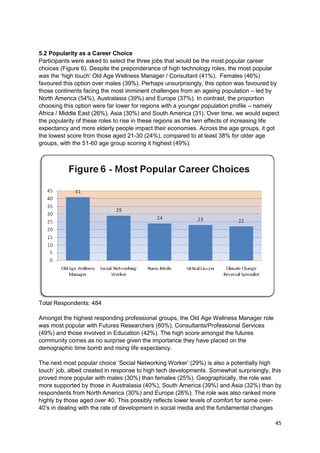
Neuroprosthetics: Researchers at the University of California, Berkeley, have
demonstrated how rhesus monkeys with electrodes implanted in their brains used their
thoughts to control a computer cursor. Once the animals had mastered the task, they
could repeat it proficiently day after day. The new study, which should apply to humans,
provides hope that physically disabled people may one day be able to operate advanced
prosthetics in a natural, effortless way. (The IEEE)90
Biomechatronics91 is the merging of man with machine -- like the cyborg of science
fiction. It is an interdisciplinary field encompassing biology, neurosciences, mechanics,
electronics and robotics. Biomechatronic scientists attempt to make devices that interact
with human muscle, skeleton, and nervous systems with the goals of assisting or
enhancing human motor control that can be lost or impaired by trauma, disease or birth
defects. (HowStuffWorks)
Bionics Renaissance: Similar to biomechatronics, bionics seeks to provide virtually any
human body part with a replacement (artificial alternative) that works just as well, if not
better than the original. Bionics could lead to a market in self-improvement with the
desire to be stronger, faster or have better eyesight.92 (Economist Intelligence Unit)

                                                                                         81
Gene Therapy: Human genetic enhancement, achieved by inserting genes into one‘s
cells, is still not approved by the U.S Food and Drug Administration. Only one
controversial product exists in the market (Gendicine, approved only in China) since
2004. Hence gene therapy is very much in its experimental stages. The global market for
gene therapy is already projected to reach $484 million by 2015 (BlissTree)93.
Growth and Further Development of Bioinformatics94: It is predicted that the field of
bioinformatics, that is the application of IT to molecular biology, will continue to grow in
importance over the next two decades, as biological data becomes increasingly
abundant and more complex biological processes are being investigated. Developing a
suitably trained cohort of research scientists and staff versed in the use of bioinformatics
tools is crucial for future development in all branches of the life-sciences and biomedical
applications. In particular the need for data integration will continue across all sectors
employing bioinformatics areas, including industry and healthcare. (Sigma Scan)
Synthetic Chemical Cells – A New Way for the Invention, Discovery, Synthesis and
Production of Molecules and Materials95: As opposed to synthetic biology
strategies, where scientists use the naturally available molecular building blocks (DNA,
RNA, proteins, lipids) to try to find new applications, synthetic chemical strategies involve
synthesising and assembling chemical cells. The scope of synthetic chemical cells is
much greater than what we can do with natural materials. All of the knowledge and
concepts of chemistry are relevant to this area and not just reactions and processes in
life-supporting biologically-based laboratory conditions that need to be very tightly
controlled and therefore severely limiting on potential outcomes we can expect.96
(Foundation for Biotechnology Awareness and Education)
Growth of Evolutionary Psychology97 Evolutionary psychology (the contention that
many aspects of our behaviour and emotions are evolutionary adaptations) may merge
with cognitive neuroscience to produce a new understanding of how the mind and brain
evolved and thus offer a platform for deeper understanding of human behaviour (Sigma
Scan).
Stem Cell Organs On-Demand: Now that any cells can be used to develop stem cells,
we will see organs created to prolong life and health. This will lead to an avalanche of
new solutions for medicine that will drive life extension.98 (Global Futurist)
Biomarkers as Predictive Tools: A Biomarker is a biological molecule found in blood,
other body fluids, or tissues that is a sign of a normal or abnormal process, or of a
condition or disease. A biomarker may be used to see how well the body responds to a
treatment for a disease or condition. Also called molecular marker and signature
molecule99. Hence they can indicate potential future biological changes. Changes in the
chemistry of cerebrospinal fluid have been identified as early signs of Alzheimer's
disease. If and when treatments are available for Alzheimer's, diagnosing the disease
early may help prevent it from developing.100 (Bio-Medicine.org).
iHealth: New wearable devices and information applications will empower consumers
with real-time information customised to monitor and track the health status of
individuals, measuring risks and downloading customised personal health info.101Global
Futurist).


                                                                                          82
Personalized Medicine: BioNanomatrix, a start-up, is pursuing what many believe to
  be the key to personalised medicine: sequencing technology so fast and cheap that an
  entire human genome can be read in eight hours for $100 or less. With the aid of such a
  powerful tool, medical treatment could be tailored to a patient's distinct genetic profile.
  (DNA India)102.
  Virtual-Reality Medical Simulations: Many believe virtual reality will become the
  dominant mode of medical training (Global Futurist).103.
  Cyber-health Care The role of the internet in healthcare is increasing rapidly and
  developing into its own field. It is customised for us as individuals and designed to
  monitor, diagnose, educate, and intervene regardless of location or time.104 (Global
  Futurist).
  Curing Diseases Before they have even Evolved: Michael Goldblatt, who once led the
  biodefence programme for the Pentagon's research arm, DARPA, and now
  heads Functional Genetics is working on an entirely new class of antiviral drugs that he
  claims should do something seemingly impossible: work against a wide range of existing
  viruses and also be effective against viruses that have not even evolved yet. What's
  more, it is claimed that should be extremely difficult for any virus to become resistant to
  these drugs.105 (New Scientist)
  Bioviolence will become a greater threat as the technology becomes more
  accessible. Emerging scientific disciplines (notably genomics, nanotechnology, and other
  microsciences) could pave the way for a bio attack. Bacteria and viruses could be altered
  to increase their lethality or to evade antibiotic treatment. Another long-term risk comes
  from nanopollution fallout from warfare. Nanoparticles could potentially cause new
  diseases with unusual and difficult-to-treat symptoms, and they will inflict damage far
  beyond the traditional battlefield, even affecting future generations (World Future
  Society).106


Energy

  Growing Energy Demand and Search for Alternatives: The US Energy Information
  Administration (2008) predicts global energy demand could rise 50-55% by 2030. The
  International Energy Agency says $45Tn investment is required for an energy revolution
  over the next 50 years to prevent energy shortages and greenhouse gas emissions from
  stunting growth. The EU and China have set targets of 20% and 15% of energy from
  renewables by 2020. The US is to increase federal spending on renewables tenfold to
  $150Bn over 10 years107.(EIA, IEA, Credit Suisse)
  Rising Investment Requirements: The International Energy Agency in its annual
  report, of November 2008, states that to limit the increase in temperatures to 3 degrees
  Celsius by 2030 would require a huge increase of low-carbon energy - nuclear,
  hydropower, biomass, renewables, and underground carbon storage. That scenario
  would require a $4.1 trillion investment, or 0.2 percent of the world's annual GDP108.
  (IEA)


                                                                                           83
Mainstreaming of Alternative Energy: Different studies converge on 2023 +/- 5 years
as the serious beginning of this transition period, when 30% of all global energy is most
likely to be derived from alternative sources109. (TechCast)
Access to Electricity will Reach 83% of the World by 2030: Electrification has
expanded around the world, from 40% connected in 1970 to 73% in 2000, and may
reach 83% of the world‘s people by 2030. Electricity is fundamental to raising living
standards and access to the world‘s products and services. Impoverished areas such as
sub-Saharan Africa still have low rates of electrification; for instance, Uganda is just
3.7% electrified110 (World Future Society).
Peak Oil: Fatih Birol, chief economist of the International Energy Agency says (August
3rd 2009) that ―peak oil‖ is a lot closer than most governments realize. Crunch time, when
the maximum rate of global petroleum extraction is reached and then passed, is now set
for 2020111 (IEA, cited in The Independent)
Risk of Energy Shortages across the Developed World112: In the UK, many power
stations are due to close over the coming decade. UK government estimates that, of a
total of around 75GW in generating capacity, 20GW will disappear by 2015 (the
Economist).
Decentralised Energy Systems: A decentralised energy (DE) system has two key
characteristics. Firstly, buildings (from terraced houses to industrial units) double up as
power stations because they have within them one or more energy generating
technologies such as solar panels, wind turbines or cogeneration units. Local impact is
important, whilst cumulative impact could be enormous. Secondly, local energy networks
proliferate, distributing heat and power. These networks will be supplemented by
community scale plants generating close to the point of demand. For example heat from
cogeneration plants would be captured and distributed for nearby use. This radically
improves efficiency and so reduces overall demand, increasing security of supply and
cutting emissions.113 (Greenpeace)
Development of the Smart Grid: The Federal Energy Regulatory Commission (FERC)
has taken a major step to accelerate the development of a smart electric transmission
system that could improve the efficiency and operation of the grid. The Smart Grid Policy
Statement (July 16th 2009) sets priorities for work on development of standards crucial to
a reliable and smart grid. Smart grid advancements will apply digital technologies to the
grid, enabling two-way communications and real-time co-ordination of information from
both generating plants and demand-side resources. This will improve the efficiency of
the bulk-power system and ultimately achieve long-term savings for consumers. It will
also help promote wider use of demand response and other activities that will enable
consumers to control their electricity costs.114 (Telematics Update)
Increasing Role for Liquefied Natural Gas115 If construction of LNG transportation
infrastructure accelerates along with demand, natural gas could, within the next 50
years, join oil as the second essential energy commodity. Natural gas (methane) is by far
the cleanest-burning fossil fuel. Given its global abundance and cleaner emissions, it has
become the power generation source of choice for industrialised nations. (Sigma Scan)
Energy Producing Kites: Saul Griffith, an MIT graduate has founded Makany power.
They specialize in clean energy and have invented a wing shaped kite that harnesses


                                                                                         84
high altitude air at 3168 feet. It can produce enough electricity for 100,000 homes116
  (National Geographic Adventure).
  Liquid Battery: Donald Sadoway has conceived of a novel battery that could allow cities
  to run on solar power at night. Without a good way to store electricity on a large scale,
  solar power is ineffective at night. One promising storage option is a new kind of battery
  made with all-liquid active materials. Prototypes suggest that these liquid batteries will
  cost less than a third as much as today's best batteries and could last significantly
  longer.117 (MIT Technology Review)
  Printable Batteries: Researchers have announced a paper-thin battery that can be
  produced cost-effectively on large scale. Scientists from the Fraunhofer Research
  Institution for Electronic Nano Systems (ENAS) in Chemnitz, Germany, together with
  colleagues from TU Chemnitz and Menippos GmbH say the batteries are printed using a
  silk-screen printing method similar to that used for t-shirts and signs. It weighs less than
  one gram on the scales. It is less than one millimetre thick and can therefore be
  integrated into bank cards, for example. It contains no mercury and is in this respect
  environmentally friendly. Its voltage is 1.5 V. By placing several batteries in a row,
  voltages of 3 V, 4.5 V and 6 V can also be achieved (ZDNet118).


Environment

  Rising Risk of Climate Change: A University College London report (05/09) says
  climate change poses the biggest 21st century threat to human health with huge death
  tolls from disease, food and water shortages and poor sanitation likely. MIT predicts a
  median probability of surface warming of 5.2 degrees Celsius by 2100 – suggesting a
  problem twice as severe as previously projected. Moreover, to achieve IPCC emission
  targets, will cost $542Bn US per year, every year until 2030, estimates the World Energy
  Outlook. The EU estimates it at $224 Bn per year119. (Guardian, Times, American
  Meteorological Society‘s Journal of Climate)
  Rising Food Demand: Global food production, already under strain from the credit
  crunch, must double by 2050 to head off mass hunger, Jacques Diouf, the head of the
  UN's Food and Agriculture Organisation, said in January 2009. The food crisis pushed
  another 40 million people into hunger in 2008. That brought the global number of
  undernourished people to 973 million in 2008 out of a total population of around 6.5
  billion.120 (UN Food and Agriculture Organisation)
  Water Scarcity: By 2025, the number of people living with extreme water scarcity will
  rise to a quarter of the world‘s population. 121 (CSR News)
  Soil Degradation: Land degradation adversely affects the ecological integrity and
  productivity of about 2 billon ha, or 23 percent of landscapes under human use. Up to 40
  percent of the world‘s agricultural land is seriously degraded.122 (Global Environment
  Facility)
  Consumption Under Scrutiny: $1M of consumer food spend has an approximate 1,500
  hectare eco-footprint. It is estimated that the richest half-billion people -7% of global
  population - are responsible for 50% of global CO2 emissions whereas the poorest 50%
  are responsible for just 7%.123 (World Business Council for Sustainable Development)


                                                                                            85
Changing Consumption Patterns: 60% of the Earth's ecosystems have been degraded
  in the past 50 years and natural resource consumption is expected to rise to 170% of the
  Earth's bio-capacity by 2040.124(World Business Council for Sustainable Development)
  Urbanization will hit 60% by 2030: As more of the world‘s population moves to the
  cities, rapid development to accommodate them could make existing environmental and
  socioeconomic problems worse. Epidemics could be more common due to crowded
  dwelling units and poor sanitation. Global warming may accelerate due to higher carbon
  dioxide output and loss of carbon-absorbing plants.125 (World Future Society magazine)
  GM Food: The debate around GM food is likely to continue. The world will have another
  three billion mouths to feed within the next five decades. Development of crops like
  Golden Rice, which would add Vitamin A to rice to counter the deficiency which causes
  blindness in around half a million children every year126 ( the Independent).

  The Rise of Green Chemistry Practices127 We can expect progress in the development
  of new ways of preparing useful chemical feed stocks from biomass (SigmaScan).
  Climate Modification: ‗Cloud ships,‘ are favoured among a series of schemes aimed at
  altering the climate that have evaluated by The Royal Society. The project, which is
  being worked on by rival US and UK scientists, would see 1,900 wind-powered ships ply
  the oceans sucking up seawater and spraying minuscule droplets of it out through tall
  funnels to create large white clouds.128 (Daily Telegraph)
  Understanding Micro climates: Today, 50% of the world‘s population is living on about
  one percent of Earth‘s surface. Can this extreme concentration lead to other effects on
  our climate and weather? In ‗Satellites and the city,‘ NASA says that it can help to
  provide an answer. ―Our research suggests that, using satellite data and enhanced
  models, we will be able to answer several critical questions about how urbanization may
  impact climate change 10, 25 or even 100 years from now.‖ (Goddard Space Flight
  Center129).


Nanotechnology

  Increasing Spending and Investment: A technical market research report (May 2008),
  reveals that the global market for nanotechnology was worth $11.6 billion in 2007. This is
  expected to increase to $27.0 billion by the end of 2013, a compound annual growth rate
  (CAGR) of $16.3%130 (Nanotechnology: A Realistic Market Assessment).
  Rising Impact on Manufacturing: By 2014, $2.6 trillion in manufactured goods are
  forecast to incorporate nanotechnology--or about 15 percent of total global output131 (Lux
  Research).
  Emerging Applications: Many of the novel applications such as new sensors, better
  photovoltaic cells, lighter and strong materials for defence, aerospace and automotives
  are already in use, and applications such as anti-corrosion coating, tougher and harder
  cutting tools, and medical implants and chips with 1 nm features may be developed in
  another 5-15 years. Nanostructured materials for nanoelectronic components, ultra fast
  processors, nanorobots for body parts are still in a state of infancy132. (A to Z
  Nanotechnology).


                                                                                         86
Growth of Nano-medicine: Scientists at the University of California are using
nanotechnology and microbiology to build "cargo ships" 50 nanometres wide that flow
through the bloodstream. Plans are underway to "zip-code" the ships so they will seek
out specific types of cancer. Analysts estimate cancer patients will approach normal life
spans by 2023133 (TechCast).
Rise of Nanobiotechnology: Nanobiotechnology often studies existing elements of
living organisms and nature to fabricate new nano-devices. Generally,
nanobiotechnology refers to the use of nanotechnology to further the goals of
biotechnology134 (Foundation for Biotechnology Awareness and Education).
Emergence of Nanovaccines: Scientists have already created nanovaccines which are
in reality specialised nanoemulsions made up of tiny soybean oil droplets suspended in
water and studded with bits of pathogenic organisms. These special nanovaccines can
be ingested by swabbing into the nose to ease the penetration of the drug through the
skin pores and down the shaft. Nanoemulsion vaccines have proved to be effective
against a wide variety of microorganisms. The technology is borrowed from the cosmetic
industry where nanoemulsions have been incorporated into skin creams. Since these
vaccines are administered through the nose they produce immunity not only in the blood
stream but also in the mucosal lining making them relevant for a wide variety of
diseases.135 (International Journal of Nanotechnology).
Nanotech Solar Cells: Nanoporous oxide films such as TiO2 are being used to enhance
photo voltaic cell technology. Nanoparticles are perfect to absorb solar energy and they
can be used in very thin layers on conventional metals to absorb incident solar energy.
New solar cells are based on nanoparticles of semi conductors, nanofilms and
nanotubes by embedding them in a charge transfer medium. Films formed by sintering of
nanometric particles of TiO2 (diameter 10-20 nm) combine high surface area,
transparency, excellent stability and good electrical conductivity and are ideal for
photovoltaic applications. Non-porous oxide films are highly promising material for
photovoltaic applications. Nanotechnology opens the opportunity to produce cheaper
solar cells (A to Z Nanotechnology)136.
Nano-Sensors: Nanotechnology offers unlimited opportunities to produce new
generation pressure, chemical, magneto resistive and anti-collision automobile
sensors.137(A to Z Nanotechnology)
Nanopiezoelectronic Mini Sensors138: Nanoscale sensors are highly sensitive, very
frugal with power, and, of course, tiny. They could be useful in detecting molecular signs
of disease in the blood, minute amounts of poisonous gases in the air, and trace
contaminants in food. However, the batteries and integrated circuits necessary to drive
these devices make them difficult to fully miniaturise. The goal of Zhong Lin Wang, a
materials scientist at Georgia Tech, is to bring power to the nano world with minuscule
generators that take advantage of piezoelectricity. If he succeeds, biological and
chemical nano sensors will be able to power themselves (MIT Technology Review)
Microelectromechanical Systems (MEMS) is the technology of the very small, and
merges at the nano-scale into nanoelectromechanical systems (NEMS)
and nanotechnology. MEMS technology can be implemented using a number of different
materials and manufacturing techniques notes (Nanocomputers and Swarm
Intelligence)139.


                                                                                       87
Membranes, Filters, and Catalysts for Water Purification: Ensuring affordable access
   to clean water is a major global challenge. Technologies for purifying water are an
   important emerging area of S&T. Four applications are being developed:
       o desalination: removing salt from sea water
       o disinfection: removing microorganisms
       o decontamination: removing toxic compounds
       o quality assurance: detecting potentially harmful matter.
   Novel nanomaterials can enhance current purification systems and may make them
   much more cost-effective. Examples include nanocomposite and biomimetic
   membranes, filters made of fibrous media, filters with nanoscale porosity, nanoscale
   catalysts, and DNA-nanoparticle composites. The principal challenge will be to scale up
   materials from labs to commercial applications. (Rand Corp)140.
   Ultra Light Materials: Nanotechnology is viewed as a key technology for the
   development of ultra light materials that would result in energy, fuel and materials
   savings and development of specialised high performance materials with complete
   control over structure and properties at a subatomic level not hitherto known to scientists
   and engineers. With the future development of nanocatalyst, diesel oxidant using
   nanoscale layers of Pt, Pd, the major environmental killers, smog, pollution and toxic
   pesticide, would be eliminated and humans will be able to breathe in healthy air.
   Improvement in nanofilters would enable bacteria less than 30 nm to be filtered and
   achieve water purity of 99.999997. (A to Z Nanotechnology)141.
   Corrosion and Corrosion Prevention142.: Nano Zirconia powder has been used to coat
   engine components by plasma spray with success. Nanocoatings create a lotus effect
   and properties, which keeps corrosion away. (A to Z Nanotechnology)
   Nanofibres: In China and the UK, nanocarbon fibres have been produced. The
   production of nanofibres offers the potential of using the woven reinforcement as body
   armour. The future soldier‘s uniform would incorporate soft woven ultra strong fabric with
   capabilities to become rigid when a soldier breaks his legs and would protect him against
   pollution, poisoning and enemy hazards.143 (A to Z Nanotechnology).
   Self Cleaning Clothes: Australian researchers have used nanotechnology to develop
   ‘self-cleaning‘ wool and silk fabrics. The researchers ‗prepared wool fabrics with and
   without a nanoparticle coating composed of anatase titanium dioxide, a substance that is
   known to destroy stains, dirt, and harmful microorganisms upon exposure to sunlight.‘ In
   one of their experiments, they poured red wine upon pristine and nanotechnology-coated
   wool. After 20 hours, their coated fabric ‘showed almost no signs of the red stain,
   whereas the untreated fabric remained deeply stained.‘ The researchers think these
   fabrics could become available in a near future.144 (American Chemical Society)


Manufacturing

   Green Manufacturing: Both multinational corporations and consumers worldwide are
   increasingly embracing green manufacturing. In many developed economies, for
   example, governments have established national green chemistry awards for industry.
   Four approaches are commonly employed in green manufacturing:


                                                                                           88
Green chemistry: adoption of environmentally benign chemical processes and
     products
     Green engineering: selecting feasible processes and products that minimize pollution
     and risks to health and the environment
     Inherently safe process design: applying smaller quantities of hazardous material,
     less hazardous material, and alternative reaction routes or process conditions
     Good manufacturing practices (GMPs): adopting methods, facilities, and controls to
     make high quality reproducible products that meet appropriate regulations and
     standards145. (Rand)
Rapid Manufacturing: Chris Anderson in ‗The Long Tail,‘ argues that all mass markets
will become a very large collection of very small niche markets in the future. The internet
has already enabled customers to personalise their purchase when it comes to books
videos or music. The result is that there is not only demand for hit products but that a
large number of items that sell only a few copies each can produce high turnover.
Search engines and e-files have rendered this ‗long tail‘ of low demand products easy to
find and cheap to produce and store in the book and music industry. Now, rapid
manufacturing is providing the tools to customise physical goods as well, in addition to
several efficiency gains it promises to bring.146 (Martijn Laar).
Niche Manufacturing: Although nearly 5 million manufacturing jobs have been lost in
the US over the past three decades, at the same time the higher-paying, high-skill
manufacturing sector has grown 37 percent. (CBS News). 147
3D Printing: In the past few years, the cost of 3D printers has been falling steadily. In
essence 3D printers are machines able to print three dimensional objects by bonding
particles of material (typically resin) together layer by layer until a full object is formed.
For small objects the printers can be desktop devices. In 2007 it was estimated that 3D
Printers were as comparatively cheap as laser printers had been in 1985. In recent years
these machines have been a useful rapid prototyping technology, but with Moore‘s law,
scientists are now envisaging a much wider use – with factories, ships and even armies
in the battlefield producing components on demand. In the consumer space it could lead
to a massive expansion of individuals designing and producing their own goods.148
(Predictive Domaining).
Personal Fabricators: The prospect of a machine with the ability to manufacture
anything has long been considered an unrealisable concept from Star Trek. However
advances in 3D printing, rapid manufacturing and nanotechnology are making the
concept more viable. MIT physicist Neil Gershenfeld believes it's not too early to think
about this possibility of such a machine, known as a personal fabricator.149
(API.Ning.com)
Mechatronics: Mechatronic products and processes are increasingly pervasive across a
broad range of industries. Mechatronics is the synergistic combination of precision
mechanical engineering, electronic control and systems thinking in the design of
products and manufacturing processes (Journal of International Federation of Automatic
Control150).
Organic Electronics: Organic electronics deals with conductive polymers, plastics,
or small carbon molecules. Use of organic solar cells could cut the cost of solar power by
making use of inexpensive organic polymers rather than the expensive crystalline silicon
used in most solar cells. The polymers can be processed using low-cost equipment such

                                                                                           89
as ink-jet printers or coating equipment employed to make photographic film, which
   reduces both capital and manufacturing costs compared with conventional solar-cell
   manufacturing151 (MIT Technology Review)
   Manufacturing with Programmable Materials152: Nanoscale physical materials that
   can be automatically assembled into useful configurations by computer instructions could
   usher in a new era in manufacturing, including the production of replacement body parts
   and implants. (Sigma Scan)
   High Performance Computing (HPC) One way in which manufacturers can innovate is
   by using high performance computing (HPC) technology to simulate real-world scenarios
   and products, saving materials and labour costs. An HPC cluster contains a group of
   connected computers that simultaneously work on a job, delivering results more quickly
   and cost effectively than a standalone system (Microsoft)153.
   New Quantum Materials and Devices154: Quantum devices will revolutionise sensor
   technology long before quantum computers become available. As well as improved law
   enforcement, this could mean more efficient energy generation and use, better-regulated
   manufacturing processes, and better pollution detection (Sigma Scan)


Information and Communications Technology

   Digital Convergence: Convergence of computing and communications is opening up
   whole new possibilities and markets. Converged devices such as the iPhone, converged
   applications and converged networks are already with us and have led to new
   opportunities. Converged content may be the next area for development.155 (IBM).
   Exponential Growth in Data Storage156. The challenge for information management is
   controlling the rising flood of data that surrounds us. Between 1999 and 2002 the volume
   of stored information in the world doubled. In 2008, a new attempt to measure the
   quantity of information began, but this will be complicated by the spread of different sorts
   of information - words, pictures and video are less easy to measure than numbers.
   (Sigma Scan).
   Evolving Technological Ecosystem: Handheld devices expected to become the
   control centre of a rapidly expanding personal ecosystem - where projection / pullout
   screens and keyboards could accelerate laptop replacement. Key enablers include
   augmented reality, intuitive interfaces, semantic computing and the increasing
   embedding of intelligence in a range of devices – often known as ambient intelligence or
   IP Everywhere. At the heart of the ecosystem will be a user capable of pulling data and
   software components from multiple sources to create their own ‗mashups‘. By 2010,
   Gartner estimate that mashups will create 80% of all new enterprise applications.157
   (Gartner)
   Increasing Mobile Phone Take Up: The I n t e r n a t i o n a l T e l e c o m m u n i c a t i o n
   U n i o n (ITU) reports an estimated 4.1 billion mobile subscriptions globally by the end of
   2008, compared with about 1 billion in 2002. While there are far more than 4 billion
   handsets around the world, the figure refers to the number of in-use numbers, or
   connections. Nokia forecasts 5 billion will be connected by 2015 Nokia also forecasts
   extraordinary growth in mobile data traffic – rising 300-fold by 2015. "By 2020 I don't
   think it will be so easy to distinguish between a mobile phone and a laptop," Steve


                                                                                                90
Jones, Association of Internet Researchers said. ―These will blend into a general 'mobile
computing' category of device‖158 (Metemanda, Mediapost).
Emerging Markets Embrace the Mobile: With the world's population currently
estimated at 6.8 billion roughly three out of five people are using mobile phones."The
strongest growth in mobile phone usage now comes from emerging and developing
countries," said Bitkom's Friedrich Jousssen, who also heads mobile phone provider
Vodafone's German operations. In India alone, mobile phone usage is expected to grow
by 32% in 2009, to 457 million people. In Brazil, a 14-per-cent increase is anticipated,
while China's usage is predicted to rise 12%, to 684 million people (Earth Times)159.
Growth of Open Source: Open source software offers access to source code (in
application design, development and distribution). Recent survey data (April 2009)
compiled by Forrester Consulting on behalf of information systems specialist Bull
suggests that we are at the front end of a long cycle of open-source infrastructure and
application adoption. Despite Gartner finding that 85 percent of enterprises have already
adopted open source and Forrester Research's consulting arm finding that 45 percent of
all companies that are using open-source software use it for mission-critical applications,
the adoption appears to be somewhat thin, leaving a great deal of room for even more
adoption, especially in open-source applications160. IDC believes (July 2009) that the
worldwide revenue from open source software will grow at a 22.4% compound annual
growth rate (CAGR) to reach $8.1 billion by 2013161 (Intel)
Software as a Service: SaaS is a method of deployment where a provider licenses an
application on demand to an end user – typically via the Internet. IDC (Jan 2009) expects
SaaS growth to exceed 40% in 2009162. In a 2007 report, Gartner predicted a $19.3
Billion SaaS Market by 2011 – this figure is set to be raised further (IDC, cited by
peoplescube)
Greening IT: Simon Mingay, an analyst at Gartner suggests that in the longer term, IT
companies need to start thinking about renewable energy sources. Some are taking
steps towards this - Google has installed solar panels on the roof of its headquarters in
Mountain View, California, with the aim of generating 30% of its energy needs. In the UK,
BT plans to spend £250m on building wind farms around the country163. The US
Environmental Protection Agency says data centres account for 1.5% of national
electricity consumption, but this will double to 3% by 2011 (Financial Times).
Increasing Server Energy Efficiency164: Researchers at the University of Michigan
have announced a plan to save up to 75 percent of the energy that power-hungry
computer data centres consume by putting idle servers to sleep when they‘re not in use.
Thomas Wenisch, assistant professor in the department of Electrical Engineering and
Computer Science, and his team analysed data centre workloads and power
consumption and used mathematical modelling to develop their approach. It will
include PowerNap, an energy conservation method that eliminates almost all the power
used by idle servers, and a more efficient power supplying technique. (ZDNet)
Increasingly Personalized and Mobile Advertising. Personalised advertising,
delivered largely on totally customized mobile computing & communication devices,
could turn the $ 1 Trillion USD advertising and marketing services economy upside
down. Behavioural targeting and user-controlled advertising will become much-discussed
issues. The trade off that 'I give you attention & personal data and you give me value e.g.
content' will be even more pronounced on the Net. Gerd Leonhard forecasts mobile

                                                                                        91
advertising could possible boost the global value of advertising-content more than 100%
by 2015. (MediaFuturist165).
Collective Intelligence: Jeff Jonas, an IBM Distinguished Engineer, is chief scientist of
its Entity Analytic Solutions Software Group. He described collective intelligence as lots
of piles of data, much gleaned from a ubiquity of sensors that have to be stitched
together and put in context. ―In 2050, collective intelligence is your personal digital agent,
locating and telling you what you need,‖ he said. Jonas gave the following example of
this advanced collective intelligence. ―There is a pile of data about the current status of
an individual. There are also piles about the current migratory status of birds and the
weather. The three piles are correlated, resulting in the individual being told to ‗jump to
the right‘ to avoid being hit by a descending pile of bird excrement‖. (CNet166).
Ambient Intelligence167: Effectively, ambient intelligence is about creating electronic
environments that are sensitive and responsive to the presence of people. This implies
embedding intelligence and an IP address in everything from the paint on our walls to the
windows and curtains and the furniture we sit on. There are already diverse applications
using ambient technology on the market, but one crucial sticking point is that few of them
are fully integrated into wireless communication systems. European researchers have
been addressing this outstanding issue.
―The idea is to integrate sensor networks into wireless communication systems and to
‗capture‘ the user‘s environment, perhaps using a mobile phone as a gateway, and then
transmit this context to a service platform to deliver a personalised service and act on
situations,‖ says Laurent Herault, project coordinator of a research scheme developing
new ways of capturing ambient intelligence in post-3G mobile communication systems
through wireless sensor networks. The context captured can be an environmental one,
such as location, but also the subject‘s emotional context – what is known as the
―physiological state‖. (Science Daily)
Reality Mining168: Personal reality mining infers human relationships and behaviour by
applying data-mining algorithms to information collected by cell- phone sensors that can
measure location, physical activity, and more. Models generated by analysing data from
both individuals and groups could enable automated security settings, smart personal
assistants, and monitoring of personal and community health. Mobile phones are now
sophisticated enough to collect and analyse data on personal behaviour, and
researchers are developing techniques that allow them to effectively sort through such
information. (MIT Technology Review)

Collective Blanket Licenses169 One of the biggest issues for content owners is how to
control and monetise the distribution of their content over the web. One view is that
blanket licences which legalise and unlock legitimate access to basic content services
via any digital network will emerge. Media futurist Gerd Leonhard suggests they are
likely to take over as the primary means of content consumption around the world.
(Media Futurist).
Practical Quantum Computing: ―A quantum computer is a device for computation that
makes direct use of quantum mechanical phenomena, such as superposition and
entanglement, to perform operations on data. The basic principle behind quantum
computation is that quantum properties can be used to represent data and perform
operations on these data.”170 Breakthroughs in quantum computing should provide useful

                                                                                           92
applications in encryption and data mining that could move into the mainstream
   marketplace within a few years. Financial traders might be able to better predict the
   future outcome of financial markets by using quantum tools. 171 (Global Futurist)
   Quantum Cryptography: In ‗traditional cryptography‘ the data itself is encrypted using
   complicated mathematical functions. In ‗quantum encrypted communications‘, a key is
   sent by beaming a string of photons, representing a code, from the source to the target.
   If it gets to the other end and matches what the target expects, then the data gets
   unencrypted. The Guardian notes that if anyone tries to intercept or break it, thanks to
   the laws of quantum physics, the mere act of observing the stream of photons changes it
   - and so it fails.172 (Guardian).
   DNA Computing173: Scientists at IBM are experimenting with using DNA molecules as a
   way to create tiny circuits that could form the basis of smaller, more powerful computer
   chips. The company is researching ways in which DNA can arrange itself into patterns
   on the surface of a chip, and then act as a kind of scaffolding on to which millions of tiny
   carbon nanotubes and nanoparticles are deposited. That network of nanotubes and
   nanoparticles could act as the wires and transistors on future computer chips. If it works
   as planned, it could lead to a new way of fabricating features on the surface of chips that
   allows semiconductors to be made even smaller, faster and more power-efficient than
   they are today. (PC World)
   Room Temperature Ferromagnets: New Materials for Data Storage in Next
   Generation Computing174: Spintronics, or spin based electronics, are a new generation
   of devices that rely upon the spin of an electron to facilitate transfer of information, rather
   than the traditional electron charge that is used in conventional electronics. (Sigma
   Scan)
   Cyberwar175: Jeff Green, senior vice president of McAfee Avert Labs, says
   "Cybercrime is now a global issue. It has evolved significantly and is no longer just a
   threat to industry and individuals but increasingly to national security." He predicted that
   future attacks will be even more sophisticated. "Attacks have progressed from initial
   curiosity probes to well-funded and well-organized operations for political, military,
   economic and technical espionage." (McAfee)
   E-Bombs176: The International Institute for Counter-Terrorism says electromagnetic
   pulse weapons capable of frying the electronics in civil airliners can be built using
   information and components available on the net. All it would take to bring a plane down
   would be a single but highly energetic microwave radio pulse blasted from a device
   inside a plane, or on the ground and trained at an aircraft coming in to land. Yael Shahar,
   director of the International Institute for Counter-Terrorism in Herzliya, Israel, and her
   colleagues have analysed electromagnetic weapons in development or used by military
   forces worldwide, and have discovered that there is low-cost equipment available online
   that can act in similar ways. ―These will become more of a threat as the electromagnetic
   weapons technology matures,‖ she says. (NationalTerror Alert)


Internet and Virtual World

   Falling Cost of Web Access177: Media Futurist Gerd Leonhard predicts that very cheap
   or free wireless broadband operating at fairly high speeds of at least 2MB / sec will be

                                                                                               93
available in most places, particularly in the booming new economies of Asia, India,
Russia and South-America, and a bit later, in Africa. He predicts that implementation will
be funded by the likes of Google and by the future 'telemedia conglomerates‘,
governments, cities and states, and suggest that wireless broadband will probably reach
3-4 out of 5 people on the globe by 2015-2018. He expects user-generated & derived
content (UGDC) virtual co-production, mobile editing and instant network sharing to
explode by a factor of 1000, making control of distribution a very distant concept of the
past. He suggests UGC or UGDC could make up to 50% of global content consumption
by 2015. In this model, consumers will be (co)-creators, marketers, sellers and buyers,
and range from totally passive to totally active. (Media Futurist)
I.P Growth178: Forecasts suggest that by 2012, the internet could be 75 times its size in
2000 with over 400 times the traffic due to the rise of online video. It is estimated that
$130bn of investment is needed improve the network worldwide to avoid reaching the
physical limits of capacity of the internet by 2010. (Silicon Republic)
The Semantic Web: The Semantic Web is the concept of extension of the World Wide
Web to enable people to share content beyond the boundaries of applications and
websites.179 In essence it uses language that computers understand, to give information
a clearly defined meaning. The goal is to improve the usability and capability of the web
such that humans and machines can access the content they need with ease. A variety
of working groups are establishing common standards for the semantic web. These are
agreeing, for example, ‗rule interchange formats‘ that will allow systems using a variety
of rule languages and rule-based technologies to interoperate with each other and with
other Semantic Web technologies.180 (Business Portal)
Social Media Explosion There were 691M unique social network visitors in November
2008. In August 2009 Facebook was ranked as the fourth most popular global website
with 340M unique monthly users.181 Forrester predicts social media spending will rise
from $716M in 2008 to at least $3.1Bn 2009182 (Mashable, Tech Crunch)
Web 2.0: The concept of Web 2.0 ―is commonly associated with web development and
web design that facilitates interactive information sharing, interoperability, user-centered
design[1] and collaboration on the World Wide Web. Examples of Web 2.0 include web-
based communities, hosted services, web applications, social-networking sites, video-
sharing sites, wikis, blogs, mashups and folksonomies. A Web 2.0 site allows its users to
interact with other users or to change website content, in contrast to non-interactive
websites where users are limited to the passive viewing of information that is provided to
them.‖183 Forrester estimate that companies will spend $4.6 billion on Web2.0 related
technologies by 2013.184 (Forrester)
Rise in Virtual Learning: Michael B. Horn author of Disrupting Class predicts that by
2019, nearly half of all public high school courses will be taught online. Nationwide in the
US 700,000 kids attended virtual schools as of January 2008. There are18 different uses
of virtual worlds identified in UK higher and further education - medical sciences,
mathematics and art & design feature prominently185. In the UK, 63% of secondary
schools and 22% of primary schools are using virtual learning platforms186 (Eduserve,
Insight School, BBC)
Virtual Worlds Lessens Importance of Geography187: In the autumn of 2008,
the IBM Academy of Technology held two major events in Second Life. With an initial
investment of roughly $80,000, IBM estimates that they saved over $250,000 in travel

                                                                                          94
and venue costs and more than $150,000 in additional productivity gains as since
   participants were already at their computers and could go back to work immediately. This
   yielded a total saving of $320,000 when compared to the potential expense if the event
   had been held in the physical world. (Virtual Worlds News)
   Rise of the Immersive Web188: The next generation of the web could be shaped by
   immersive technology that delivers sensation, experience and emotion in rich online
   worlds, building upon early virtual worlds such as Second Life. (Global Futurist)
   Augmented Reality Expansion189: Augmented reality involves using visors, mobile
   phones and heads up devices to overlay digital information onto physical world objects
   e.g. buildings. This could give them what futurist Ian Pearson calls a ‗dual architecture‘.
   55% of Internet experts surveyed by Pew believe that by 2020 many lives will be touched
   by the use of augmented reality or spent interacting in artificial spaces. 'SixthSense' is a
   wearable gestural interface prototype that augments the physical world around us with
   digital information and lets us use natural hand gestures to interact with that information.
   (Canwest News Service)
   Intelligent Software Assistant190: Search is the gateway to the web for most people; it
   has become second nature to distil a task into a set of keywords that will lead to the
   required tools and information. However, Adam Cheyer, cofounder of start-up Siri,
   envisions a new way for people to interact with services available online: a "do engine"
   rather than a search engine. Siri is working on an ‘interactive aide‘ or virtual personal-
   assistant software tool, which would help users complete tasks rather than just collect
   information. Siri traces its origins to a military-funded artificial-intelligence project called
   CALO (cognitive assistant that learns and organises). (DNA India)
   Interactive Data Eyeglasses191: A team of scientists at the Fraunhofer Institute for
   Photonic Microsystems IPMS in Dresden, Germany, is working on a device that
   incorporates eye tracking to influence the content presented to the viewer. Without
   having to use any other devices to enter instructions, the wearer can display new
   content, scroll through a menu or shift picture elements simply by moving her eyes or
   fixing on certain points in the image. (ZDNet)
   Touchable Holographs192: A ‗touchable holograph‘ display has been developed at the
   University of Tokyo. It adds tactile feedback to 3D images hovering in space in front of a
   concave mirror using an ultrasound device positioned below the LCD and mirror.
   (ZDNet)


Artificial Intelligence (AI)

   Application of AI to Global Trade and Logistics193: The application of artificial
   intelligence to commerce is likely to make trade and logistics more efficient. Trading
   systems such as stock markets already use AI to take buy and sell decisions. In coming
   years they could also be used to allocate aircraft, ships and vehicles more effectively.
   Today's airline scheduling systems leave empty seats equivalent to several 747s flying
   the Atlantic with no passengers every day. AI systems that take on scheduling could
   reduce this waste without a significant reduction in passenger choice. (Sigma Scan)


                                                                                                 95
AI in UK Policing194: Looking at how AI techniques can boost digital forensics, the UK
government-funded Cyber Security Knowledge Transfer Network (KTN) will examine the
potential use of AI in web counter-terrorism surveillance, fighting internet fraud, masking
identities online and data mining. Nigel Jones, director of the KTN, said: "In today's age
of distributed networks and with moves towards cloud computing, there is a lot more
information out there that might be useful in terms of evidence."There is a problem in
handling that mass of data, in storing it, routing it, tracing it and in finding patterns.‖
(ZDNet)
Self-teaching AI195: Stanford computer scientists have developed an artificial
intelligence system that enables robotic helicopters to teach themselves to fly difficult
stunts by watching other helicopters perform the same manoeuvres. (Robotics Trends)
Intelligent Interface196: Advances in speech recognition, artificial intelligence (AI), and
computer power suggest the old computer interface (keyboard, mouse, etc.) may yield to
an ―intelligent interface‖ in which we simply converse with smart computers. The
possibilities are vast. Humans could rely on ―intelligent agents‖ or ―virtual assistants‖ to
serve as secretaries, tutors, salespeople, and almost all other routine work roles.
(TechCast)
Self-Replication197: Self-replicating and even self building AI systems are already in the
offing. DARPA, the US military bureau plans to initiate a programme called Self-
Explanation Learning Framework (SELF), which they explain thus: DARPA seeks to
construct systems that can participate in their own construction. The system might know
the requirements for various tasks in its repertoire, and it may try to perform those tasks
to verify functionality. (The Register)


                                                                                            96
Robotics

   The Robots Have Landed198: The World Robotics Report estimates the world robot
   population at 4.5 million, with 3.5 million domestic robots and 1 million industrial robots.
   (TechCast)
   Robotics Taking off as a Global Industry199: NextGen Research forecasts worldwide
   demand for all-purpose service robots will reach $15 billion by 2015, or roughly 5 million
   robots per year. (CNET News 5/27/09)
   Healthcare Robots200: One area particularly ripe for robotics is healthcare, according to
   Arjan Rensma of the Dutch innovation agency TNO, which he says could be worth
   anywhere from €40 billion upwards depending on which study you read. The Japanese
   are leading by example with the launch this year of a five-year ―life-support‖ robotics
   project – with funding of €12 billion in the first year alone – aimed at helping carers in
   their daily tasks. Rensma says the Japanese will also launch a robotics programme
   aimed at helping the elderly at home, worth €4 billion in the first year. (Rathenau Instituut
   in Science Daily)


Transportation

   The End of the Car? 201: Futurist Thomas Frey suggests that the car‘s says as ‗King of
   the Road‘ may soon be over. He argues that more powerful wireless communication that
   reduces demand for travel, flying delivery drones to replace trucks, and policies to
   restrict the number of vehicles owned in each household are among the developments
   that could thwart the automobile‘s historic dominance on the environment and culture. If
   current trends were to continue, the world would have to make way for a total of 3 billion
   vehicles on the road by 2025. (World Future Society)
   Hybrid and Electric Cars Gaining Traction: While on the campaign trail, President
   Obama said he hoped to see 1 million plug-in hybrids on the road by 2015. Since Obama
   took office, the federal government has implemented a broad range of consumer and
   industry incentives to promote production and sales of plug-in vehicles202. Many203
   envisage the tipping point for electric cars around the year 2022. (TechCast)
   Fuel Cells Nearing Commercial Maturity204: Hybrids and fuel cell autos both use
   electric motors to drive the wheels, batteries to store energy, regenerative braking to
   conserve it, and may in time use composite bodies that are lighter. TechCast estimates
   fuel cell cars will enter the commercial market by 2015, eventually creating global
   demand that may reach several $ trillion.
   Carbon Nanotubes and Lighter Vehicles205: Carbon nanotube composites promise to
   enable the creation of lighter and stronger transportation vehicles. (Sigma Scan)
   Dirigibles206: With military prototypes planned for 2014, giant blimps may be about to
   make a comeback for mass transportation suggest Julian Barnes of the Chicago Tribune
   and TechCast.

                                                                                              97
Maglev Trains207: The world‘s first ―maglev‖ train service began on January 1, 2003
  cruising between Pudong and Shanghai, China reaching speeds over 300 mph. Trials
  are currently underway in Germany and Japan. US groups have proposed Los Angeles-
  Las Vegas and Boston-New York-Washington DC routes. (TechCast, Memebox)
  Hypersonic Scram Jets: 208 Hypersonic jets are defined as highly supersonic, with
  Mach 5 being the generally excepted defining speed. Highly supersonic designs
  like Reaction Engines Skylon claim to be capable of reaching Mach 5.5 within the
  atmosphere, before activating a rocket engine and entering orbit. The jet would later re-
  enter the atmosphere and land back on the runway it took off from. There is also a very
  long distance supersonic/hypersonic transport version of Skylon, the A2, being evaluated
  by the European Union as part of the LAPCAT project, which would travel at Mach 5 and
  would be capable of travelling from Brussels to Sydney in 4.6 hours. (Reaction Engines)
  Increasing use of Unmanned Aerial Vehicles in Non-Combat Situations209: Border
  patrols, rescue teams and various security concerns are starting to use of UAVs in their
  respective environments. (KVOA)


Space

  Emergence of a Global Space Market210: It is anticipated that many innovations will be
  developed by space enterprises that will accelerate the establishment of a global
  space market. (Global Futurist)
  Renewed Interest in Moon/Mars Missions211: With an international base on the moon
  and vital technologies like in-space refuelling, Buzz Aldrin envisions an ambitious series
  of expeditions to send astronauts on a deep space mission to visit the asteroid Aphophis
  when it swings near Earth in 2021. A temporarily manned base on the Mars moon
  Phobos could follow according to Aldrin. "By that time, we'd be ready to put people in a
  gradual permanence on Mars by 2031," Aldrin said. "That, in a nutshell, is what I really
  think we should be doing." (Space.com)
  21ST Century Space Race212: Extremely valuable assets, from materials and drugs to
  minerals and innovations, could create a space race among global companies. (Global
  Futurist)
  Space Tourism213: Virgin Galactic has broken ground on their $300 million Spaceport
  America launch facility in New Mexico, and tested the mother ship that will carry the
  space ship itself to launch. The first space tourism flight is scheduled to launch in 2011,
  and will take tourists paying $200,000 each into suborbital flight. (TechCast)
  Space Hotels214: There is growing interest in the concept of developing orbital hotels. In
  2007, CNN reported that "Galactic Suite", the first hotel planned in space, expects to
  open for business in 2012 and would allow guests to travel around the world in 80
  minutes. Its Barcelona-based architects say the space hotel will be the most expensive
  in the galaxy, costing $4 million for a three-day stay. (CNN)
  Miniature Spacecraft215: It is predicted that miniaturised cost-effective spacecraft could
  explore the stars long before humans are capable of venturing out into deep space.
  (Global Futurist)


                                                                                           98
Space Mining216: It is predicted that mining of asteroids and planets could yield new
  resources, elements, and materials that will enhance the quality of life on our planet.
  (Global Futurist)
  Terraforming217: Space experts anticipate that humans will learn to leave their home
  planet of Earth, terraform faraway planets, and colonize space. (Global Futurist)
  Astrobiology and Life Beyond Earth218: Multidisciplinary efforts by astrobiologists may
  increase our understanding of the origins of life on this planet and could result in finding
  life beyond Earth. This research may yield numerous benefits by enhancing our
  understanding of life on Earth. However, its real importance is that if we discover life
  elsewhere, there will inevitably be widespread changes in humanity's view of itself,
  especially affecting our religions and belief systems. (Sigma Scan)


Demographics

  Population Booming: The UN estimates (11/03/09) that the global population will rise
  from 6.8Bn in 2009 to 9.1Bn by 2050. The organisation also predicts global fertility will
  fall from 2.5 children per woman, to just over two in 2050. The population of developing
  countries is projected to rise from 5.6Bn in 2009 to 7.9 Bn in 2050, while more developed
  regions change minimally, from 1.23Bn to 1.28Bn. Net migration from poor to rich
  countries is forecast at 2.4 million annually from 2009 to 2050219 (UN)

  Key UN Population Forecasts to 2030 (Million) Medium Variant Scenario220

               Year           UK                Europe             World
               2005          60 261             729 421          6 512 276
               2010          61 899             732 759          6 908 688
               2015          63 528             734 000          7 302 186
               2020          65 090             732 952          7 674 833
               2025          66 601             729 264          8 011 533
               2030          67 956             723 373          8 308 895


  Aging Global Population221: Globally, the population over 65 is projected to rise from
  5% in 1950 and 7% in 2000 to 16% in 2050. The proportion of the developed world's
  population over 60 is expected to rise from 22% to 33% between 2009 and 2050, and
  the developing world‗s to grow from 9% to 20% over the period. Eurostat predict that
  deaths in Europe will overtake births by 2015. Globally, the number of older people
  should exceed the number of children by 2047 – this happened in the developed world in
  1998. (UN)
  Rising Life Expectancy222: Biogerontologists like Aubrey de Grey of Cambridge believe
  that extreme life extension is possible, more than doubling current average life spans
  within a decade or so. Caloric restriction and drugs like resveratrol are proposed as
  emerging mediums through which life extension could occur; other more radical methods
  are also being researched. (BBC)
  Changing Racial Mix223: Eurostat reported the EU's total population was up by 2.39M
  (0.48%) in 2007, reaching 497.5M inhabitants - 80% of the growth came from a 16.4%

                                                                                            99
rise in new migrants to 1.9M. The Pew Research Center estimate that, based on current
   trends between 2020 and 2025, the foreign-born population will account for 15% of the
   American population by 2025 and 19% by 2050. In the UK, Leicester is expected to be
   the first location where whites will fall below 50% of the population by 2020, followed by
   Birmingham in 2024, and Slough and Luton soon afterwards. (Barrow Cadbury Trust,
   Eurostat)
   Boomers Delaying Retirement224: In a US AARP survey of workers aged over 45
   (09/08), 20% had stopped pension contributions, 34% contemplated putting off
   retirement and 27% had trouble paying rent or mortgages. The Center for Economic and
   Policy Research (02/09) says the US housing collapse has left the majority of those
   around retirement-age almost completely reliant on entitlements. The net worth of
   median US households aged 45 to 54 has dropped more than 45% since 2004, to just
   over $80,000. (Wall Street Journal)
   The Rise of Generation Z225 This a generation for whom expectations are set by the
   immediacy of the digital world. A Habbo survey (05/09) found Generation Z (born 1994 –
   Present) to be altruistic, with a strong sense of values, concerned about the
   environment, social justice and humanitarianism, less interested in fame and fortune
   than Generation Y (1981-1990) and favouring technology platforms they can mould.
   (MCN)
   Increasing Prospect of Generational Conflict226: 51% of baby boomers (born1946-
   1964) and 66% of the generation that preceded them reported having little to no
   interaction with colleagues from Generation Y (l1981-1990) Generation Y is considered
   the most self-indulgent, Generation X (1964-1980) the most innovative, Boomers are the
   most productive, and those over 63 are the most admired. The EU warns that the
   economic downturn "could make the challenges creating by ageing more acute‖ and lead
   to intergenerational conflict. The EU ratio of workers aged 15-64 to those over 65 is
   forecast to fall from 4:1 to 2:1 by 2060. (Randstad, Harris Interactive, EU Commission)


Culture and Leisure

   Technology an Increasing Part of Daily Lives227: Baby boomers (1946-1964) are
   adopting technology at nearly 20 times the rate of younger generations notes Accenture,
   and although this largely represents growth from a much lower base, it does indicate the
   upward spread of technology through generations. (Accenture)
   Declining Credibility of all Sources of Information228: Edelman‘s 2009 Trust
   Barometer shows trust is down in most types of news outlet and spokesperson from
   2008. Corporate or product advertising is least trusted – down from 20% in 2008 to 13%
   in 2009. In the US, trust in information from a company‘s top leader is at a six-year low at
   17%. Outside experts at 59% remain the most trusted purveyors of information about a
   company. Only 29% and 27% view information as credible when coming from a CEO or
   government official respectively, declining from 36% and 32% in 2008. (Edelman)
   Junk Science? The Importance of Public Trust in Science229: The monopoly that
   science has over the 'truth' may face significant challenges from cultural relativism,
   postmodernism and declining trust in authority figures. The growing influence of
   spirituality in the public sphere may also be a factor in undermining conventional views of

                                                                                           100
the value of scientific research. People may become increasingly unwilling to leave
   decisions about science to professionals or even legislators; declining public trust in
   science has the potential for significant impact on public policy. (Sigma Scan)
   Broadening Amateur Participation in Science230: We are seeing more and more
   opportunities for amateur participation in research, ranging from donating resources,
   through becoming involved in observation, to collaborative research between
   professionals and amateurs. The involvement of members of the public and interest
   groups in research takes us towards new sorts of 'citizen science'. (Sigma Scan)
   The Advent of Molecular Archaeology231: The advent of archaeology at the molecular
   level thanks to advances in genetics, chemistry, and physics is expected to lead to a new
   level of precision in archaeological research and enable better understanding of past
   events and cultures. (Delta Scan)


Politics, Economics and Commerce

   Increasing Need for Multilateralism232: With Globalisation, nations are more involved
   and interdependent, many issues are more complex, requiring multilateral solutions, but
   consensus is harder to achieve. The consensus at the recent G20 summits offers hope
   for the future. Consensus enabled the G20 to allocate the IMF $250Bn in Special
   Drawing Rights and triple its lending capacity to $750Bn. The Managing Global
   Insecurity project says in order to tackle key global challenges, the UN needs a legally
   binding climate change agreement, a counter-terrorism commissioner, and a 50,000
   peacekeeping force. (FT, IMF, Harvard Crimson)
   A Shortage of Trust233: Edelman‘s 20-country 2009 Trust Barometer shows a 3:1
   margin which says government should intervene to regulate industry or nationalise
   companies to restore public trust. Political trust is declining fast globally – only 14% in
   Europe trust politicians. (Edelman)
   Increasing Levels of Political Instability234: 35 countries are on the highest risk ‗alert‘
   status in the 2008 Fund for Peace failed states index – a four year high, with 127
   countries in 2008 at Alert or Warning status compared to 76 in 2005. A new status of
   ‗Very high risk‘ is proposed on Aon‘s Political Risk Map to cover Afghanistan, Congo
   DRC, Iran, Iraq, North Korea, Somalia and Zimbabwe. Eighteen countries were
   downgraded to higher risk level – including Greece, Malaysia and Thailand. The Vision
   of Humanity project reports that levels of peace drop during recessions, whilst a more
   peaceful word could add $4.8 trillion to the global economy. (Vision of Humanity)
   Rise in E-Government235: Across the globe countries are pursuing e-government
   projects in order to provide better services to citizens, improve internal communications
   and cut costs. In Thailand the Information and Communications Technology
   Ministry announced plans in April 2009 to launch an E-Government Road Map, as a
   framework for e-government developments from 2010 to 2014. According to the Thai
   press, the roadmap consists of four stages: Connected Government (c-Government),
   Mobile and Multi-Channel Government (m-Government), Ubiquitous Government (u-
   Government) and Transformed Government (t-Government) The first stage - c-
   Government - that will begin this year - aims to establish collaboration among all
   government agencies in the provision of public e-services. The second stage - m-

                                                                                           101
Government - is scheduled for 2010 and 2011 – a period in which the e-government
concept will be expanded and made accessible via mobile devices. The u-Government
stage, scheduled to start in 2012, aims at providing government e-services to the public
around the clock, through various channels that include websites, mobile devices and
future technology. The final stage aims for a complete transformation of government
services to an electronic basis, providing e-services 24 hours a day, seven days a week,
via a variety of channels, along with interchanged e-services among government
agencies. (World Bank)
There may not be World Law in the Foreseeable Future, but the World’s Legal
Systems will be Networked236: The Global Legal Information Network (GLIN), a
database of local and national laws for more than 50 participating countries, will grow to
include more than 100 counties by 2010. The database could lay the groundwork for a
more universal understanding of the diversity of laws between nations and could create
new opportunities for peace and international partnership. (World Future Society)
Rising Western Indebtedness237: The rich G20 countries' debt is projected to grow
from 83.3% of Gross Domestic Product (GDP) in 2008 to almost 100% in 2010. Japan's
debt burden could be 225% of GDP in 2010 whilst developing G20 economies debt is
expected to rise from 35.7% to 37.8% by 2010. The US Congressional Budget Office
estimates the cumulative deficit from 2010 to 2019 will total $9.3Tn, and public debt
would rise to 82% of GDP by 2019. The average personal debt in the US amounted to
more than 130% of after-tax income in 2008. (Economist)
Economic Power Decentralises238: A number of factors suggest that economic power
is shifting from developed to emerging economies. 2009 saw the first joint communiqué
by BRIC economies at the G20 summit. The US share of global output fell from 31% to
27% between 2000 and 2008. This fall is demonstrated partially through the number of
US / UK banks in the top 20 by market capitalisation falling from 17 to 4 between 2003
and 2009. China and India accounted for 58% of the growth in global output in 2007 and
the BRICs are forecast to deliver 40% of all global output growth in the 2009-2018
period. (FT, UN, Washington Post, Hispanic Business)
More Accurate Modelling of Complex Economic Systems239: Advances in simulation
tools and behavioural analysis may facilitate innovation in economic research methods.
(Sigma Scan)
A Greener Recovery? 240: 81% of South Korea‘s recovery package is earmarked for
green initiatives, as is 34% in China, but nothing in India. The UN projects the global
market for ―green‖ products and services will double to $2.74 billion by 2020. Japan, for
example, aims to double green sector jobs to 2.8M between 2008 and 2020. However,
VC investment in clean technology was down 48% to $1Bn in Q1 2009. (Economist)
Increasing Economic Power of Women241: Over 80% of consumer purchasing
decisions internationally were influenced by women in 2007. 84% of female wealth in
the UK came from earnings & business ownership in 2007. 40% of UK wives who work
full time earned more than their husbands in 2007. In 2006 it was forecast that 53% of
the UK‘s millionaires will be women by 2020. (Womenomics)
Professional Knowledge will Become Obsolete Almost as Quickly as it’s
Acquired242: An individual‘s professional knowledge is becoming outdated at a much
faster rate than ever before. Most professions will require continuous instruction and


                                                                                        102
retraining. Rapid changes in the job market and work-related technologies will
necessitate job education for almost every worker. At any given moment, a substantial
portion of the labour force will be in job retraining programs. (World Future Society)
Growing Talent Shortage243 : 31% of employers worldwide have difficulty filling
positions due to lack of available talent in their markets. Those facing the most difficulty
were in Romania (73%), Japan (63%) and Hong Kong (61%). More than 50% of
employers in five of the eight countries in Asia Pacific reported difficulty in finding
suitable talent. The least problematic were India (12 %), the UK (12%) and Ireland
(14%). Countries need over 3.5Bn people by 2010 to fill knowledge worker positions –
rising to over 4Bn by 2020 – a shortage of 32M-39M is predicted. The US will have the
biggest shortfall—needing up to 14M. The shortage of talent is particularly acute at the
management level. (Manpower, Business Week)
IT Could Become Major Force in UK Economy244: An E-Skills report estimates that,
depending upon levels of technological uptake amongst businesses and consumers in
general, the converged IT/ telecoms industry could generate an additional £35 billion for
the UK economy over the decade to 2018. The sector already contributes £51.7Bn to the
economy – representing around 5% of both jobs and employment. (E-Skills)


                                                                                        103
Appendix 3 - The Science and Technology Timeline 2010 – 2030

     Wherever possible, we have adopted the timescale forecasts provided by the sources from
     which the data was taken. Where there are conflicting views, we have used our judgement to
     select the most appropriate date. In many cases the developments are at such an early
     stage that a date range rather than a precise year is offered.

Fields of Study                Possible       Description
                               Year of
                               Realisation
Science Policy, Strategy
and Funding
      Growth of Chinese        2010+          PhD production in China increased fiftyfold between
      Science and                             1986 and 1999, from less than 200 to more than 7,000
      Technology245                           degrees granted annually. By some estimates, China
                                              now graduates more engineers than the rest of the
                                              world combined. Peking already appears as a top
                                              institution in the THE/QS World University Rankings, at
                                              50 in 2008, and there are six Chinese and four Hong
                                              Kong universities in the top 200 (SigmaScan)
      Global standards for     2012-2019      Developing economies will play an increasing role in
      global science246                       the establishment of global science and technology
                                              standards. (SigmaScan)
      Increasing public role   2013+          The monopoly that science has over the 'truth' may
      in science decision                     face significant challenges from cultural relativism,
      making247                               postmodernism and declining trust in authority figures.
                                              The growing influence of spirituality in the public sphere
                                              may also be a factor in undermining conventional views
                                              of the value of scientific research. People may become
                                              increasingly unwilling to leave decisions about science
                                              to professionals or even legislators; declining public
                                              trust in science has the potential for significant impact
                                              on public policy. (SigmaScan)
      Broadening Amateur       2014+          We are seeing more and more opportunities for
      Participation in                        amateur participation in research, ranging from
      Science248                              donating resources, through becoming involved in
                                              observation, to collaborative research between
                                              professionals and amateurs. The involvement of
                                              members of the public and interest groups in research
                                              takes us towards new sorts of 'citizen
                                              science.' (SigmaScan).
      Global diffusion of      2015+          Over the next 50 years, the long US dominance of a
      science249                              wide range of fields in science and technology is likely
                                              to end as the global scientific playing field becomes
                                              flatter and more diverse (SigmaScan).
      More Accurate            2015-2020      Advances in simulation tools and behavioural analysis
      Modelling of Complex                    may facilitate innovation in economic research methods
      Economic Systems250                     (SigmaScan)


                                                                                              104
Fields of Study               Possible      Description
                              Year of
                              Realisation
      Brazil: A Potential     2025          Brazil could emerge as one of the world's leading
      Scientific Leader251                  scientific powers by 2025, if it pursues a policy of
                                            intelligent investment and maximises the benefits of
                                            international collaboration (SigmaScan).
      Convergence on a        2020-2030     The goal is a Grand Unified Theory, a 'theory of
      Theory of                             everything' that offers a single equation or expression
      Everything252                         that explains the nature and behaviour of all matter.
                                            Building such a theory, Einstein suggested, would be
                                            like 'reading the mind of God'. This theory of everything
                                            could illuminate some of the biggest mysteries at the
                                            heart of physics, from the origins of space and time to
                                            the secrets of black holes to the cause of the universe's
                                            accelerating expansion (SigmaScan)
Medicine, Biology and
Biogenetics
      NBIC convergence to     Ongoing       NBIC-convergence is the ongoing unification
      revolutionize life253                 of nanotechnology, biotechnology, information
                                            technologies and cognitive science. The fields are
                                            gradually merging into one (Fontela and de Castro)
      Synthetic biology       2009+         The global market for synthetic biology generated
      market grows at                       $233.8 million in 2008. This is expected to increase to
      59.8% annually254                     $2.4 billion in 2013, for a compound annual growth rate
                                            (CAGR) of 59.8% (BCC Research)
      Biomechatronics         2010+         Biomechatronic scientists attempt to make devices that
      leads to cyborg                       interact with human muscle, skeleton, and nervous
      creations255                          systems with the goals of assisting or enhancing
                                            human motor control that can be lost or impaired by
                                            trauma, disease or birth defects (HowStuffWorks)

      Context sensitive       2011-2015     Neild & Pearson believe context specific drugs and
      cyber-drugs appear256                 personalised medicine will start to appear in the next
                                            five years
      Growing Market for      2012-15       In the future, enhancement through lifestyle drugs may
      'Lifestyle' Drugs257                  well become the norm, thanks in part to a wealth of
                                            drugs currently being developed to counter Alzheimer's
                                            Disease and other problems connected with age and
                                            cognitive function. We may be able to manage our lives
                                            with delicate precision, controlling our mental acuity,
                                            emotions and sensations. Sleep researchers predict we
                                            will be able to sleep and wake on demand, thanks to
                                            subtle drugs that concentrate a refreshing night's sleep
                                            into a few hours or allow us to skip bed with no ill
                                            effects even in the long term. Cognitive drugs
                                            (cogniceuticals) are likely to improve not just memory
                                            and the ability to learn - but also our decision-making
                                            abilities. They may help the ageing population remain
                                            flexible of mind and able to absorb new facts and ideas.
                                            Emoticeuticals (triggered to act, for example, by

                                                                                           105
Fields of Study                 Possible      Description
                                Year of
                                Realisation
                                              changing hormone levels in the body) may mediate our
                                              responses not just in our private lives but also in
                                              challenging work situations, such as those that demand
                                              high motivation (Sigma Scan)
      Application of            2012-2019     Evolutionary psychology (the contention that many
      Evolutionary                            aspects of our behaviour and emotions are evolutionary
      Psychology in medical                   adaptations) may merge with cognitive neuroscience to
      practice 258                            produce a new understanding of how the mind and
                                              brain evolved and thus a platform for deeper
                                              understanding of human behaviour (Sigma Scan)
      Practical application     2012-2022     As opposed to synthetic biology strategies, where
      of Synthetic Chemical                   scientists use the naturally available molecular building
      Cells in the invention,                 blocks (DNA, RNA, proteins, and lipids) to try to find
      discovery, synthesis                    new applications, synthetic chemical strategies involve
      and production of                       synthesising and assembling chemical cells. The scope
      molecules                               of synthetic chemical cells is much greater than what
      and materials259                        we can do with natural materials. (PACE Report)
      DNA sequencing            2013-2015     Pacific Biosciences plans to develop a chip that can
      takes 30 minutes260                     record the entire DNA sequence in 30 minutes with
                                              99.99% accuracy at a cost of less than $1000
                                              (TechCast)
      Genetic basis of 90%      2015-2020     Neild & Pearson estimated in 2005 that we are around
      of all diseases                         a decade away from genetically mapping most
      identified261                           diseases we know of.
      Telemedicine begins       2015+         Telemedicine refers to medical information being
      to radically reduce                     transferred through the net or digitally. Progressive
      costs262                                hospitals are embracing various forms of telemedicine.
                                              TechCast thinks these advances could enter the
                                              mainstream about 2015 to save hundreds of billions of
                                              dollars, greatly improve health care, and provide more
                                              convenient service.
      Gene Therapy market       2015          The global market for gene therapy is projected to
      approaches $500m 263                    reach $484 million by 2015 (BlissTree)
      Personal Medicine to      2015-2025     Now that the human genome is being analyzed
      revolutionize care and                  carefully, researchers are moving toward genetic tests
      save the industry                       to determine differences and thereby permit precise
      billions264                             medical treatments that are more effective and produce
                                              fewer side effects. TechCast estimates these advances
                                              could enter the mainstream saving hundreds of billions
                                              of dollars and greatly improving health care.
      Growth and Further        2015+         The field of bioinformatics will continue to grow in
      Development of                          importance over the next two decades, as biological
      Bioinformatics265                       data becomes increasingly abundant and more
                                              complex biological processes are being investigated.
                                              Developing a suitably trained cohort of research
                                              scientists and staff versed in the use of bioinformatics
                                              tools is crucial for future development in all branches of
                                              the life-sciences and biomedical applications. In

                                                                                              106
Fields of Study                Possible      Description
                               Year of
                               Realisation
                                             particular the need for data integration will continue
                                             across all sectors employing bioinformatics areas,
                                             including industry and healthcare (Sigma Scan)
      Synthetic life           2018-2025     Created by scientists in a lab, synthetic life is the
      created266                             design of cell chromosomes (often via bacteria) that
                                             could be used to perform functions such as digesting
                                             bacterial material to produce fuel. (TechCast)
      Systems biology          2018+         Systems biology seeks to understand the complex
      begins to solve                        interactions between biological systems and hence
      common diseases267                     provides insights into the causes and possible cures for
                                             a range of diseases. (Institute for Systems Biology)
      iHealth allows           2019          New wearable devices and information applications will
      checkups 24/7268                       empower consumers with real-time information
                                             customised to monitor and track the health status of
                                             individuals, measuring risks and downloading
                                             customized personal health information (Canton)
      Body monitoring gives    2019+         Biomedicine, smart sensors, and wireless
      24/7 real time info269                 communication are coming together to create the ability
                                             to monitor the body 24×7. Predicted market size of
                                             about $510 billion (TechCast)
      The Advent of            2020-2030     The advent of archaeology at the molecular level
      Molecular                              thanks to advances in genetics, chemistry, and physics
      Archaeology270                         is expected to lead to a new level of precision in
                                             archaeological research and enable better
                                             understanding of past events and cultures (SigmaScan)
      New flora and fauna      2020s         Neild & Pearson believe developments in genetic
      engineered271                          engineering will lead to new forms of animal and plant
                                             life by the 2020‘s
      Nanotech to defeat       2023 +/- 8    Scientists at the University of California are using
      cancer272                years         nanotechnology and microbiology to build "cargo
                                             ships" 50 nanometres wide that flow through the
                                             bloodstream. Plans are underway to "zip-code" the
                                             ships so they will seek out specific types of cancer.
                                             TechCast estimates cancer patients will approach
                                             normal life spans by 2023
      Reverse engineering      2030+         Futurist Ray Kurzweil argues that "we can have
      of the brain273                        confidence of reverse-engineering the brain in twenty
                                             years or so. The reason that brain reverse engineering
                                             has not contributed much to artificial intelligence is that
                                             up until recently we didn‘t have the right tools. If I gave
                                             you a computer and a few magnetic sensors and asked
                                             you to reverse-engineer it, you might figure out that
                                             there‘s a magnetic device spinning when a file is saved,
                                             but you‘d never get at the instruction set. Once you
                                             reverse-engineer the computer fully, however, you can
                                             express its principles of operation in just a few dozen
                                             pages.‘‘ (Kurzweil)
      The first ever GM        2030+         The aim is to use GM techniques to engineer a disease

                                                                                              107
Fields of Study               Possible      Description
                              Year of
                              Realisation
              274
      humans                                resistant designer human. (InOurFuture.com)
      Life expectancy         2039          Those with access to advanced technologies can
      reaches 120275                        expect a healthy life beyond 120 years (Institute for
                                            Alternative Futures)
      Bioengineered organs    2039          Bioengineering is used to create replacement organs
      on demand 276                         whereby directed combinations of humeral agents
                                            stimulate the body to rebuild damaged hearts and
                                            brains (Institute for Alternative Futures)
Energy
      Mobile energy source    2012-2015     A serious increase in mobile device power (and
      revolution277                         therefore, its use) will be achieved by employing next-
                                            generation technologies such as fuel cells that could
                                            provide for up to 500x the usage time that we have
                                            today. This could become a reality in 3-5 years and will
                                            revolutionize how we use - and how much we rely on -
                                            our mobile devices, especially in countries where there
                                            the fixed-line power infrastructure is much less
                                            developed or non-existent (Gerd Leonard).
      Development of the      2015-2025     Smart grid advancements will apply digital technologies
      smart grid278 279                     to the grid, enabling two-way communications and real-
                                            time co-ordination of information from both generating
                                            plants and demand-side resources. This will improve
                                            the efficiency of the bulk-power system and ultimately
                                            achieve long-term savings for consumers. It will also
                                            help promote wider use of demand response and other
                                            activities that will enable consumers to control their
                                            electricity costs (Economist)
      Dark Matter and Dark    2015-2025     Physicists speculate that dark matter (hypothetical
      Energy understood280                  invisible matter impacting physics) and dark energy
                                            (hypothetical energy that could explain expansion of
                                            universe) are somehow related to gravity itself. New
                                            work will continue to be done in this area, and new
                                            observations are likely to advance human
                                            understanding of this conundrum (SigmaScan).
      The Rise of Green       2015+         Green Chemistry offers the potential for development of
      Chemistry                             new ways of preparing useful chemical feed stocks
      Practices281                          from biomass (SigmaScan).
      Controlled nuclear      2019-2035     The US. Lawrence Livermore National Lab has created
      fusion harnessed for                  the most powerful laser ever built, and expects to use
      power generation282                   192 of these to ignite a fusion explosion of 3 million
                                            degrees Celsius in 2-3 years. Researchers estimate we
                                            could see a commercial fusion reactor operating in
                                            about one decade. (TechCast)
      Point of ‗Peak Oil‘     2020          Fatih Birol, chief economist of the International Energy
      extraction reached283                 Agency says (August 3rd 2009) that ―peak oil‖ is a lot
                                            closer than most governments realise. Crunch time, he
                                            said, is now set for 2020. (Independent)
      30% of all global       2023 +/- 5    TechCast has completed different studies that

                                                                                           108
Fields of Study                 Possible      Description
                                Year of
                                Realisation
      energy derived from       years         converge on 2023 +/- 5 years as the serious beginning
      alternative sources.284                 of this transition period, when 30% of all global energy
                                              is most likely to be derived from alternative sources.
      Increasing Role for       2030-2050     If construction of LNG transportation infrastructure
      Liquefied Natural                       accelerates along with demand, natural gas could,
      Gas285                                  within the next 50 years, join oil as the second essential
                                              energy commodity. Natural gas (methane) is by far the
                                              cleanest-burning fossil fuel. Given its global abundance
                                              and cleaner emissions, it has become the power
                                              generation source of choice for industrialised nations
                                              (SigmaScan).
      Hydrogen Economy          2033          TechCast forecasts that a hydrogen economy is
      established286                          possible in the long term, with potential use of
                                              hydrogen as a means of storing, carrying, and
                                              delivering energy. (TechCast)

      Wave energy               2040s         In 2008, it was stated that the UK is the global leader in
      providing up to 20%                     marine energy, with both the government policies and
                                              natural resources to derive 20 percent of its energy
      of UK requirements287                   needs from wave and tidal power, according to a new
      288
         .                                    study from industry analysts Frost & Sullivan. It could
                                              take five to six years (from 2008) for full
                                              commercialisation of marine energy, according to
                                              research analyst Gouri Nambudripad. TechCast
                                              envisage this trend strengthening through the 2040‘s.
                                              (TechCast)
Environment
      Rise of Green             2010- 2015    Rising investment, coupled with public as well as
      Business289                             market demand could lead to a new era of Green
                                              Business (TechCast)
      Vertical Farming          2015+         Vertical farming, in hydroponic skyscrapers, could allow
      leads food                              food to be grown locally and sustainably (Time
      revolution290                           Magazine)
      Planetary climate         2015-2035     "Cloud ships" are favoured among a series of schemes
      control becomes                         aimed at altering the climate that have been considered
      possible291                             by The Royal Society. The project, which is being
                                              worked on by rival US and UK scientists, would see
                                              1,900 wind-powered ships ply the oceans sucking up
                                              seawater and spraying minuscule droplets of it out
                                              through tall funnels to create large white clouds. (Daily
                                              Telegraph)
      Precision Farming         2016          ―Precision farming or precision agriculture is an
      widely adopted 292                      agricultural concept relying on the existence of in-field
                                              variability. It requires the use of technologies such as
                                              global positioning (GPS), sensors, satellites or aerial
                                              images, and information management tools (GIS) to
                                              assess and understand variations. Collected
                                              information may be used to more precisely evaluate

                                                                                              109
Fields of Study               Possible      Description
                              Year of
                              Realisation
                                            optimum sowing density, estimate fertilizers and other
                                            inputs needs, and to more accurately predict crop
                                            yields. It seeks to avoid applying inflexible practices to
                                            a crop, regardless of local soil/climate conditions, and
                                            may help to better assess local situations of disease or
                                            lodging.‖293 (TechCast)
      Sustainable             2020          Aquaculture is the farming of aquatic organisms such
      Aquaculture models                    as fish, shellfish and even plants. (TechCast)
      developed294
      Recycling Society295    2021          The goal is to render refuse collection redundant and
                                            more to a model where 100% of household waste is
                                            recycled. In a bid to cut down on the amount of waste
                                            going to landfill and to reduce carbon emissions,
                                            people and organisations may have to sift through all
                                            their rubbish for any items that can be recycled.
                                            (TechCast).
      30% of world's arable   2020s         Land degradation adversely affects the ecological
      land becomes saline.                  integrity and productivity of about 2 billon ha, or 23
      296 297                               percent of landscapes under human use. Up to 40
                                            percent of the world‘s agricultural land is seriously
                                            degraded. TechCast envisages increasing salinity by
                                            the 2020‘s.
      Organic Farming         2023          Organic farming techniques are expected to be
      considered                            increasingly adopted by mainstream farmers due to a
      mainstream                            combination of customer pressure and regulatory
      practice298                           controls on chemical fertilisers. (TechCast)
      GM Food widely          2023          The GM debate rumbles on, but the expectation is that
      available299                          the needs of the planet‘s population will drive the
                                            increased adoption of GM – particularly in developing
                                            countries. (TechCast)
      Nano-Desalinisation     2024          Nanofiltration lowers the cost enough for desalinization
      options help avert                    to be a mass viable option outside of the Gulf
      water crisis300                       (TechCast).
      Quantum Chemistry       2026-2055     Recent developments in quantum mechanical
      for Pollution                         computer codes have significantly improved our ability
                  301                       to model chemical reactions in the aqueous phase. As
      Abatement                             a result, the possible effects of introducing a catalyst
                                            into a reaction can now be predicted accurately, to a
                                            degree of precision that complements experimental
                                            measurement. A significant benefit of this approach is
                                            the ability to map out complex interacting chemical
                                            pathways, to determine whether there is coupling
                                            between different steps, which may result in
                                            uncontrolled acceleration /deceleration of a particular
                                            step. (SigmaScan).
Nanotechnology
      Smart Sensors reach     2015          Smart sensors will increasingly be nanoscale "sensors


                                                                                             110
Fields of Study               Possible      Description
                              Year of
                              Realisation
      commercial                            and instrument packages that are microprocessor
      maturity302                           driven and include features such as communication
                                            capability and on-board diagnostics that provide
                                            information to a monitoring system and/or operator to
                                            increase operational efficiency and reduce
                                            maintenance costs."303 (Control Engineering)
      Designed Materials      2018          Within a decade it is expected that advances in
      enter the market 304                  nanotechnology will enable designers to specify the
                                            precise properties they want in a particular nonmaterial.
      Nanotechnology to       2020+         The ―nanosphere‖ consists of objects measured in one
      disrupt many                          billionth of a meter, and is now undergoing a revolution
      industries305                         as research increasingly yields control over this tiny
                                            world. Beyond simply being smaller, objects behave
                                            differently at the nano level, introducing bold new
                                            possibilities. Nanotechnology is used in 30% of
                                            commercial products (TechCast)
      Micro Machines in       2021          Micro Machines are nanoscale devices engineered to
      widespread use306                     perform particular task such as subcutaneous
                                            operations on humans, or repairs of deep well
                                            pipelines.
      Nanofood eliminates     2040+         Futurist Ray Kurzweil predicts that by 2050, the
      food supply/ security                 common use of nanoproduced food, which has the
      concerns307                           correct nutritional composition and the same taste and
                                            texture of organically produced food, would mean that
                                            the availability of food is no longer affected by limited
                                            resources, bad crop weather, or spoilage. (Kurzweil)
Manufacturing
      Millimetric radar       2009          We are now able to study the flight of small insects,
      detects miniature                     and hence potentially design new generations of small
      objects at high                       UAV‘s (Horizon Scanning Centre)
      resolution308.
      ‗Ethical‘ food          2015          Thanks to genetic engineering, pigs can now be 'grown'
      genetically                           in factory farms with certain key components missing -
      produced309                           like the animal's brain. A new 'ethical meat' industry has
                                            sprung up, and this industry claims to be offering a
                                            'suffering free' approach to meat
                                            consumption. (InOurFuture.com)
      Emergence of Smart      2015+         The key to these future smart materials is our growing
      Materials: clothes to                 understanding of the world at the molecular level and
      deliver vitamins310                   our ability to manipulate it at that level. Understanding
                                            how molecules cross membranes could allow us to
                                            design materials that can function as delivery platforms
                                            (a T-shirt that delivers vitamins through the skin over an
                                            8-hour period) or filters (a biofilter that protects a water
                                            or air supply from bacteria). Eventually, it is possible
                                            that we could develop smart materials that are able to
                                            sense our DNA and respond to our genotype for both
                                            diagnostic and drug delivery purposes. Smart materials

                                                                                              111
Fields of Study                Possible      Description
                               Year of
                               Realisation
                                             for use in the body, such as oxygen-absorbing
                                             materials for damaged lungs, or artificial retinas, are a
                                             high-value application that could lead the way to other
                                             uses of the technology (SigmaScan).
      Mass Customisation       2016          Flexible manufacturing techniques are expected to
      available for high                     evolve such that the cost of producing ultra-low volume
      street products 311                    production runs will continue to fall. This will enable
                                             small scale production facilities to be located on a
                                             retailer‘s premises.
      Manufacturing with       2020-2030     Nanoscale physical materials that can be automatically
      Programmable                           assembled into useful configurations by computer
      Materials312                           instructions could usher in a new era in manufacturing,
                                             including the production of replacement body parts and
                                             implants (SigmaScan).
      Modular Homes take       2021          The modular home concept will evolve such that
      increasing share of                    developers and individuals will be able to specify
      new build market313                    precise designs and material properties to meet the
                                             particular performance characteristics they desire for
                                             their homes. Mass customisation approaches will be
                                             adopted to ensure such units can be produced at very
                                             low cost.
      Personal fabricators     2025          The prospect of a machine with the ability to
      allow manufacturing                    manufacture anything has long been considered pure
      anywhere, anytime314                   science fiction. However, MIT physicist Neil
                                             Gershenfeld believes it's not too early to think about
                                             this possibility of such a machine, known as a personal
                                             fabricator (API)
      New Quantum              2040+         Quantum devices will revolutionise sensor technology
      Materials and                          long before quantum computers become available. As
      Devices315                             well as improved law enforcement, this could mean
                                             more efficient energy generation and use, better-
                                             regulated manufacturing processes, and better
                                             pollution detection (SigmaScan)
Information and
Communications
Technology
      Digital convergence of   2010          TechCast thinks adoption of convergence devices
      electronic devices316                  should grow rapidly to reach mainstream use by about
                                             2010 and produce global demand in the $ trillions.
      Entertainment goes       2010-2011     A Forrester analyst said, "Once customers try online
      online317                              entertainment, they never go back." TechCast
                                             estimates 30% adoption levels in a year or two.
      Intelligent Interfaces   2012+/- 2     Advances in speech recognition, artificial intelligence
      lead to seamless         years         (AI), and computer power suggest the old computer
      computer-human                         interface (keyboard, mouse, etc.) may yield to an
      interaction318                         ―intelligent interface‖ in which we simply converse with
                                             smart computers. The possibilities are vast. Humans


                                                                                             112
Fields of Study                 Possible      Description
                                Year of
                                Realisation
                                              could rely on ―intelligent agents‖ or ―virtual assistants‖
                                              to serve as secretaries, tutors, salespeople, and almost
                                              all other routine work roles (TechCast)
      Smart Phones              2012          In 2008 Smart Phone sales exceeded those of laptops.
      established as                          By 2012 Smart Phone sales could reach over 700
      dominant computing                      million units, accounting for 65% of all handset sales.
      device319                               This will represent a market worth nearly $200 billion
                                              (Gartner)
      Web content grows         2012          By 2012 the internet could be 75 times its size in 2000
      75 fold 320                             with over 400 times the traffic due to the rise of online
                                              video (Silicon Republic)
      New approaches to         2012-2020     Between 1999 and 2002, the volume of stored
      measure and control                     information in the world doubled. In 2008, a new
      the growth of internet                  attempt to measure the quantity of information began,
      data 321                                but this will be complicated by the spread of different
                                              sorts of information - words, picture and video are less
                                              easy to measure than numbers (SigmaScan).
      Rapid rise in E-tailing   2014-2020     The web currently accounts for approximately 10% of
      322
                                              the total UK retail sales, and this is set to rise to 40%
                                              by the year 2020 (uSwitch, TechCast)
      Mobile phones as a        2015          The promise is that of completely targeted and
      key advertising                         personalised advertising, delivered largely on totally
      medium 323                              customised mobile computing & communication
                                              devices. This could boost the global value of
                                              advertising-content by more than 100% by 2015 (Media
                                              Futurist)
      Cloud Computing hits      2015          Cloud computing refers to the trend towards delivering
      critical mass324 325                    hosted services over the Internet in a manner
                                              transparent to the end user. The vision is that all of the
                                              applications we use will be hosted in the ‗cloud‘ and we
                                              need have no knowledge of the infrastructure that
                                              supports us. Globally by 2015 cloud computing could
                                              represent a $45 billion market (TMC Net)
      Widespread adoption       2015          Grid computing is the application of the resources of
      of Grid Computing326                    many computers in a network to a single problem at the
                                              same time - usually to a scientific, technical or business
                                              problem that requires a great number of computer
                                              processing cycles or access to large amounts of
                                              data.327 A well-known example of grid computing in the
                                              public domain is the ongoing SETI (Search for
                                              Extraterrestrial Intelligence) project. By 2015 it may
                                              become a widely adopted approach to dealing with
                                              computationally intensive requirements.(Techcast)
      Video Conferencing        2015          While video conferencing has been available for many
      becomes                                 years, the market has received a big boost from
      mainstream328                           telepresencing systems. These make use of ultra-high
                                              definition video to give the impression of being in the
                                              room with the person at the other end of the line.

                                                                                              113
Fields of Study               Possible      Description
                              Year of
                              Realisation
                                            Markets for telepresence video conferencing equipment
                                            were estimated to be worth $764.8 million in 2008 and
                                            are anticipated to reach $4.7 billion by 2015, growing in
                                            response to demand for this more effective and efficient
                                            mode of communication. It is also expected to receive a
                                            boost as organisations seek to cut travel costs but
                                            maintain high quality interaction. (Winter Green
                                            Research, Techcast).
      Advanced sensing        2015-2020     Sensors will be developed for detection, controlling,
      improves surveillance                 monitoring and tracking dangerous materials (Horizon
      329                                   Scanning Centre).
      Terahertz               2015-2020     Terahertz, CCTV and other remote sensing
      technologies improve                  technologies will evolve for the detection of explosives,
      public safety330.                     weapons and drugs (Horizon Scanning Centre).
      Real time modelling     2015-2020     Secure software applications will combine pattern
      software enables                      recognition, analysis of emergent behaviour, risk
      quicker security                      identification, stability modelling, threat identification
      response times331.                    and management (Horizon Scanning Centre).
      Wireless computing      2015-2020     Emergence of the MANET– a collection of mobile
      the norm332                           computing devices co-operating to form a dynamic
                                            network with no fixed infrastructure. In MANETs,
                                            devices can access the Internet even where there is
                                            no direct wireless connection between the device
                                            and the Internet access point (Horizon Scanning
                                            Centre).
      SWARM technology        2015-2020     Swarm Intelligence (SI) is the property of a system
      solves complex                        whereby the collective behaviours of
      problems333                           (unsophisticated) agents interacting locally with their
                                            environment cause coherent functional global
                                            patterns to emerge. SI provides a basis with which it
                                            is possible to explore collective (or distributed)
                                            problem solving without centralised control or the
                                            provision of a global model (Horizon Scanning
                                            Centre).
      Optical Computers in    2017          By applying some of the advantages of visible and/or
      widespread use334                     Infrared networks at the device and component scale, a
                                            computer might someday be developed that can
                                            perform operations 10 or more times faster than a
                                            conventional electronic computer by transmitting
                                            photons or light particles instead of electrons.
                                            (Techcast).
      Smart Systems           2018          Ubiquitous Internet nodes connect all the appliances,
      predominate in                        vehicles, etc. within a business, home or community.
      houses, businesses,                   (socialtechnologies.com).
      public spaces335

      Teleworking             2019          Mobile and remote working technologies have become

                                                                                             114
Fields of Study                Possible      Description
                               Year of
                               Realisation
                         336
      considered routine                     reliable and widespread enough to allow most jobs to
                                             be completed away from the office, signalling potential
                                             shifts in the built form and social organisation of cities
                                             (TechCast).
      Surveillance Society     Early 2020s   Ubiquitous, unseen nanodevices could provide
      becomes possible337                    seamless communication and surveillance among all
                                             people everywhere. Humans could have nanoimplants,
                                             facilitating interaction in an omnipresent network.
                                             Everyone could have a unique Internet Protocol (IP)
                                             address. Since nano storage capacity is almost
                                             limitless, all conversation and activity could be recorded
                                             and recoverable. (World Future Society)
      Quantum Computing        2022          Quantum mechanics offers a possible successor to
      stores data on                         silicon in which information is stored and managed
      atoms338                               using atomic particles. The strange behaviour of matter
                                             at the quantum level makes this computational
                                             technique complex. For instance, two or more atoms
                                             can become ―entangled‖ so that a change in one
                                             instantaneously produces a like change in the other
                                             regardless of distance, offering the possibility of
                                             instantaneous ―teleportation‖ of information. Because of
                                             the Heisenberg uncertainty principle, individual
                                             electrons can also coexist in two places
                                             simultaneously, and this feature of ―superimposition‖
                                             allows a single electron to carry two bits of information
                                             – or two ―cubits.‖ (TechCast).
      Room temperature         2040+         Spintronics, or spin based electronics, are a new
      ferromagnets: new                      generation of devices that rely upon the spin of an
      materials for data                     electron to facilitate transfer of information, rather than
      storage in next                        the traditional electron charge that is used in
      generation                             conventional electronics (SigmaScan)
      computing339
      Relative decline of IT   2040          The transformative role of information technology could
      transformatory                         diminish between 2010 and 2040
      potential340                           (socialtechnologies.com).
      The Singularity: The     2045          The Singularity refers to the idea that accelerating
      worlds‘ first ultra                    technology will lead to superhuman machine
      intelligent machine341                 intelligence that will soon exceed human
                                             intelligence342. (Kurzweil)
Internet and Virtual World
       The Intelligent web     2013 +/- 2    Trends show the Web is evolving into an intelligent
       enters mainstream       years         system that understands spoken inquiries, gathers
       use343                                relevant information, and forms meaningful, focused
                                             answers. More intelligent search engines are
                                             appearing, and intelligent agents being developed by
                                             DARPA and others are able to infer context as they link
                                             users and information. The Intelligent Web is forecast
                                             to enter mainstream use (30% adoption) about 2013 +/-


                                                                                              115
Fields of Study                Possible      Description
                               Year of
                               Realisation
                                             2 years, and to produce a $680 billion market in the US
                                             (TechCast).
      E-Government             2013          In Thailand, for instance, the Thai business daily, The
      becomes the norm344                    Nation, talks about how the Information and
      345
                                             Communications Technology Ministry announced plans
                                             in April 2009 to launch an E-Government Road Map, as
                                             a framework for e-government developments from
                                             2010 to 2014. According to the Thai press, the
                                             roadmap consists of four stages: Connected
                                             Government (c-Government), Mobile and Multi-
                                             Channel Government (m-Government), Ubiquitous
                                             Government (u-Government) and Transformed
                                             Government (t-Government).
      Broadband coverage       2014-2017     Very cheap or free wireless broadband - at fairly high
      expands - the Net                      speeds, i.e. at least 2MB / sec - will be available in
      reaches 60-80% of                      most places, particularly in the booming new
      the planet346                          economies of Asia, India, Russia and South-America,
                                             and then in Africa. Funded by the likes of Google and
                                             by the future 'telemedia' conglomerates, governments,
                                             cities and states, wireless broadband could reach 3-4
                                             out of 5 people on the globe within 5-8 years (Media
                                             Futurist)
      The End of               2015+         Pervasive computing technologies like flexible displays,
      Cyberspace347                          smart dust, sensors, and wireless offer an alternative to
                                             immersion. The experience of using devices designed
                                             to be socially unobtrusive, to require little of a user's
                                             attention, and to operate anywhere will change the
                                             experience of being online. Users capable of accessing
                                             the Internet anywhere will discover "real space"
                                             information-- information about the places that they are,
                                             accessed in that space-- that complements "real time"
                                             information. Rather than requiring users to focus
                                             exclusively on either the digital or physical, new
                                             devices will allow users to attend to both
                                             simultaneously (SigmaScan)
      Virtual education part   2016-2020     Michael B. Horn author of Disrupting Class predicts that
      of every student‘s                     by 2019, nearly half of all public high school courses
      curriculum348 349                      will be taught online. Nationwide in the US 700,000 kids
                                             attended virtual schools as of January 2008.
      Augmented Reality        2019          Augmented reality is a direct or indirect view of a
      part of daily lives350                 physical real-world environment whose elements are
                                             merged with computer images to ‗augment‘ the
                                             experience. (Kuzweil).
      Virtual Reality a main   2019          Three-dimensional virtual reality displays, embedded in
      form of                                glasses and contact lenses, as well as auditory
      communication351                       "lenses," are used routinely as primary interfaces
                                             for communication with other persons, computers, the
                                             Web, and virtual reality. (Kurzweil)


                                                                                            116
Fields of Study                   Possible       Description
                                  Year of
                                  Realisation
       Embedded ‗invisible‘       2019           By 2019, computers are largely invisible and embedded
       IT 352                                    everywhere-in walls, tables, chairs, desks, clothing,
                                                 jewellery, and bodies. (Kurzweil)
       Intelligent brain-         2019           TechCast forecasts that intelligent brain-computer
       computer interface353                     interfaces enabling people to communicate mentally
                                                 with distant objects and people are likely to arrive
                                                 commercially in about a decade (TechCast).
       The Semantic web           2020 onwards   The Semantic Web is the extension of the World Wide
       expands the internet‘s                    Web that enables people to share content beyond the
       capabilities354                           boundaries of applications and websites (Semantic
                                                 NLP Blog)
        Virtual Reality lessens   2030           Virtual reality will allow any type of interaction with
        importance of                            anyone, regardless of physical proximity (Ray Kurzweil)
        geography355
Artificial Intelligence
        AI replaces numerous      2013-2017      Neild & Pearson believe AI will start being noticed as a
        human jobs356                            source of redundancy in the middle of the coming
                                                 decade, possibly leading to a Neo-Luddite movement.
       Application of AI to       2020-2030      The application of artificial intelligence to commerce is
       Global Trade and                          likely to make trade and logistics more efficient. We
       Logistics357                              already accept that trading systems such as stock
                                                 markets use Artificial Intelligence to take buy and sell
                                                 decisions. In the coming years they could also be used
                                                 to allocate aircraft, ships and vehicles more effectively.
                                                 Today's airline scheduling systems leave empty seats
                                                 equivalent to several 747s flying the Atlantic with no
                                                 passengers every day. AI systems that take on
                                                 scheduling could reduce this waste without a significant
                                                 reduction in passenger choice (SigmaScan).
       AI completing routine      2023           TechCast forecasts AI will increasingly automate the
       mental tasks358                           routine mental work now occupying so much human
                                                 time. Think of it as ―AI that is good enough to replace
                                                 people,‖ what some call ―weak AI.‖ TechCast estimates
                                                 good AI will replace routine mental tasks about 2023
                                                 (TechCast).
Robotics
      Service robots              2015           NextGen Research forecasts worldwide demand for all-
      permeate work and                          purpose service robots will reach $15 billion by 2015, or
      play359                                    roughly 5 million robots per year
      Human knowledge             2016-2020      Machines with the inherent capability of learning are
      exceeded by machine                        reckoned to be lurking in the not too distant future.
      knowledge360                               Given man‘s reliance on machines for data storage, an
                                                 additional learning capability would give the machine a
                                                 superior knowledge base (Neild & Pearson)
       Smart Robots361            2024           The vision is that future generations will have the
                                                 capacity to learn, make complex decisions, and even
                                                 reprogram themselves.
Transportation

                                                                                                 117
Fields of Study                  Possible       Description
                                 Year of
                                 Realisation
      Carbon Nanotubes           2012-2019      Carbon nanotube composites promise to enable the
      yield lighter                             creation of lighter and stronger transportation vehicles
      vehicles362                               (SigmaScan).
      Hybrid Cars                2014           While on the campaign trail, President Obama said he
      affordable363 364                         hoped to see 1 million plug-in hybrids on the road by
                                                2015. Since Obama took office, the federal government
                                                has implemented a broad range of consumer and
                                                industry incentives to promote production and sales of
                                                plug-in vehicles (TechCast)
      Dirigibles provide         2014 onwards   With military prototypes planned for 2014, giant blimps
      mass eco friendly                         may be about to make a comeback for mass
      transportation365                         transportation (Chicago Tribune, TechCast)
      Fuel Cell Cars enter       2015           Hybrids and fuel cell autos both use electric motors to
      the market366                             drive wheels, batteries to store energy, regenerative
                                                braking to conserve it, and may in time use composite
                                                bodies that are lighter. TechCast estimates fuel cell
                                                cars will enter the commercial market by 2015,
                                                eventually creating global demand that may reach
                                                several $ trillion.
      Intelligent Cars           2015-2018      A driverless vehicle can essentially navigate itself, alert
      control speed and                         the human driver to possible collisions and blind spots
      navigation367368                          and may eventually even align with other vehicles
                                                (more like the cars of a train) on a freeway to maximally
                                                utilize the space. GM plans to test drive these vehicles
                                                by 2015 and get them on the road by 2018. TechCast
                                                concurs with the timing.
      Electric Cars369 370       2022           TechCast / Paul Scott envisage the tipping point for
                                                electric cars around the year 2022.
      Eco-Bikes popular in       2022           Eco-bikes offer the promise of self powered two-wheel
      cities371                                 transport, without the need for human exertion
                                                (TechCast)
      Small Aircraft372 373      2026           In numerical terms, Airbus forecasts that 16,620, or 68
                                                percent, of the new mainline aircraft required by 2026
                                                will be small single-aisle passenger jets and small jet
                                                freighters. This could represent a shift in aviation
                                                markets and pricing models (Airbus, Techcast).
      Automated Highways         2026           A logical progression from intelligent cars would be a
      control traffic flow 374                  system to manage them (TechCast)
      Maglev Trains              2030           The world‘s first ―maglev‖ train service began on
      revolutionise personal                    January 1, 2003 cruising between Pudong and
      long distance                             Shanghai, China reaching speeds over 300 mph. Trials
      transport375                              are underway in Germany and Japan, and U.S. groups
                                                have proposed Los Angeles-Las Vegas and Boston-
                                                New York-Washington DC routes. (Memebox)
      Hypersonic Planes          2030           Scramjets capable of flying Mach 4-6 could make the
      link Europe and                           journey from Brussels to Sydney in less than five hours.
      Australia in a few                        (New Scientist)
      hours376

                                                                                                 118
Fields of Study                  Possible      Description
                                 Year of
                                 Realisation
Space
        Microsatellites to       2010-2020     Building upon programmes planned for the 2010 to
        uncover more                           2020 timeframe, scientists hope to be able to construct
        ‗space‘377                             3D maps of the galaxy, gain a better understanding of
                                               the origins of the universe, and search for Earth-like
                                               planets. Microsatellites, launched for less than $10
                                               million each (for example, Canada's MOST space
                                               telescope), could play an important role in these
                                               discoveries by allowing astronomers more time for
                                               otherwise low-priority experiments. Upon its launch
                                               around 2011, NASA's James Webb Space Telescope
                                               will study the origins of the universe using infrared
                                               sensors, if its progress is not hampered by further
                                               budget cuts and downsizing (SigmaScan).
        Space tourism takes      2011+         Virgin Galactic has broken ground on their $300 million
        off 378                                Spaceport America launch facility in New Mexico, and
                                               tested the mother ship that will carry the space ship
                                               itself to launch. The first space tourism flight is
                                               scheduled to launch in 2011, and will take tourists
                                               paying $200,000 each into suborbital flight (TechCast).
        Space hotels             2012-2024     In 2007, CNN reported that "Galactic Suite", the first
        launched379 380                        hotel planned in space, expects to open for business in
                                               2012 and would allow guests to travel around the world
                                               in 80 minutes. Its Barcelona-based architects say the
                                               space hotel will be the most expensive in the galaxy,
                                               costing $4 million for a three-day stay. (ABC/ CNN)
        Miniaturized Space       2015+         NASA hopes that carbon nanotube wires will
        craft reduce cost of                   miniaturise spacecraft, reducing weight and size
        space launches381                      compared to vehicles made with traditional copper
                                               wires. One possibility is that nanoscale wires made
                                               from a combination of silicon and metal could connect
                                               nanoscale and macro scale electronics together,
                                               allowing for hybrid electronic components. In another,
                                               more revolutionary application, it is envisaged that
                                               wires made entirely of carbon nanotubes could conduct
                                               electricity many times farther and more efficiently than
                                               copper wires and weigh only a fraction as much. It is
                                               possible that these wires would be able to conduct
                                               electricity with little or no resistance and without
                                               dissipating electricity as heat. (SigmaScan).
        Asteroid mining382 383   2024          It is anticipated that mining of asteroids and planets will
                                               yield new resources, elements, and materials that will
                                               enhance the quality of life on our planet. (Wired, Dr
                                               Canton).
        Establishment of a       2030‘s        Extremely valuable assets, from materials and drugs to
        space market384                        minerals and innovations, could create a space race
                                               among global companies (Canton)
        Humans on Mars385        2031          With an international base on the moon and vital
                                               technologies like in-space refuelling, Buzz Aldrin

                                                                                                119
Fields of Study               Possible      Description
                              Year of
                              Realisation
      386
                                            envisions an ambitious series of expeditions to send
                                            astronauts on a deep space mission to visit the asteroid
                                            Aphophis when it swings near Earth in 2021. A
                                            temporarily manned base on the Mars moon Phobos
                                            could follow according to Buzz Aldrin. (Space.com)
                                            "By that time, we'd be ready to put people in a gradual
                                            permanence on Mars by 2031," Aldrin said. "That, in a
                                            nutshell, is what I really think we should be doing."
      Start of construction   2040s         Neild & Pearson believe that a manned laboratory on
      of manned Mars                        Mars will shortly follow the first landing on the planet.
      laboratory387
      Astrobiology and Life   Ongoing       Multidisciplinary efforts by astrobiologists may increase
      Beyond Earth388                       our understanding of the origins of life on this planet
                                            and could result in finding life beyond Earth. This
                                            research may yield numerous benefits by enhancing
                                            our understanding of life on Earth. However, its real
                                            importance is that if we discover life elsewhere, there
                                            will inevitably be widespread changes in humanity's
                                            view of itself, especially affecting our religions and
                                            belief systems (Sigma Scan)


                                                                                            120
Appendix 4 - The shape of jobs to come – Long List
The list of the top 20 jobs presented in section five above was selected from the long list
presented below. The list was compiled through initial desk research, consultation with
futurists and future thinkers around the world and an online survey.

                             Medicine, Biology and Biogenetics

1. Genomics Developer / Architect / Baby Designer389 With the unravelling of the
    human genome, new roles could emerge to design personalised enhancements and
    select the genetic make-up of your unborn child.
2. Body Part Maker390 Due to the huge advances being made in bio-tissues, robotics and
    plastics, the creation of high performing body parts - from organs to limbs - will soon be
    possible, requiring body part makers, body part stores and body part repair shops.
3. Personal Enhancement Advisors391 Advances in new materials and nanotechnology,
    cognitive science, natural therapies and pharmaceuticals will offer an increasingly broad
    range of legal (and illegal) personal enhancements. These could be used to give sports
    people a competitive edge, enhance our memory capacity when studying for exams or
    increase the strength and endurance of soldiers in the field. Roles could emerge for
    professionals who take a holistic approach advising across a full range of possible
    enhancements.
4. Nano-Medic392 Advances in nanotechnology offer the potential for a range of sub-
    atomic 'nanoscale' devices, inserts and procedures that could transform personal
    healthcare. A new range of nano-medicine specialists will be required to administer
    these treatments.
5. Synthetic Life Designer / Scientist / Engineer393 . Synthetic Life focuses on recreating
    biochemical life from non-living (abiotic) substances. An increasing range of roles are
    emerging for those working to creating synthetic life forms that could be used in
    applications as diverse as tissue repair and bacteria programmed to digest biological
    material and produce energy.394
6. Chief In-Company Health Enhancement Officer395 To be stationed in every company
    and responsible for the health of employees. These officers would apply the very latest
    medical advances from nutritional supplements to memory enhancements to ensure the
    company‘s employees deliver superior performance. Those employees who register for
    these programmes could receive higher salaries, increased bonuses and other perks.
7. Telemedicine Technician396 Telemedicine will increasingly be used both in developed
    and developing markets – for example adopting video links to help treat people in
    remote locations where there are no local medical staff. A new class of IT technicians
    with some medical training will emerge to help design and implement appropriate
    solutions.
8. Pharmer of Genetically Engineered Crops and Livestock397 New-age farmers will
    raise crops and livestock that have been genetically engineered to improve food yields
    and ‗grow‘ therapeutic proteins, pharmaceuticals and chemicals.
9. In-Company Gene Screener398 Employers will need technicians to collect and analyse
    DNA from potential hires and existing staff. The goal is to screen out workers with a
    propensity for drug abuse or other conditions that could interfere with productivity.
10. Biometric Identification Specialist399 Experts developing the technology to identify
    people based on an eye, palm or voice scan. Today most such technology requires the

                                                                                              121
individual to present themselves to be scanned for verification. The experts‘ challenge is
    to develop next generation solutions that scan us without interrupting us as we pass
    through airports, buildings and other areas requiring biometric identification.
11. Bioinformationists400 Scientists who work with the rising volumes of genetic
    information to help analyse the data and draw out key patterns and insights that could
    help in treatment of medical conditions and diseases.
12. Geomicrobiologists401. Specialists combining geology, microbiology and the
    environmental sciences to study how microorganisms can help in applications as
    diverse as medicine, cleaning up environmental damage, and breaking down waste.
13. Experimental Therapy Experts402 The explosion of new natural and synthetic therapies
    will create demand for specialists working holistically to select the right mix of therapies
    for each person.
14. Old Age Wellness Manager / Consultant Specialists403 404 Drawing on a range of
    medical, pharmaceutical, prosthetic, psychiatric, and natural fitness solutions to help
    manage the various health and personal needs of the aging population.
15. Personal Body Weight / Obesity Consultant 405 As weight and obesity threatens to
    severely hinder future GDP, consultants may be appointed by the state, insurance
    companies, employers and individuals to design personalised solutions.
16. Memory Augmentation Surgeon406 - A new category of surgeons whose role is to add
    extra memory to people who want to increase their memory capacity. A key service
    would be helping those who have literally been overloaded with information in the
    course of their life and simply can no longer take on any more data - thus leading to
    sensory shutdown.
17. ‘New Science’ Ethicist407 As scientific advances accelerate in new and emerging fields
    such as cloning, proteomics and nanotechnology, a new breed of ethicist may be
    required. These science ethicists will need to understand a range of underlying scientific
    fields and help society make consistent choices about what developments to allow.
    Much of science will not be a question of ‗can we?‘ but ‗should we?‘
18. Genetic Hacker408 These will be people that hack human, animal and plant DNA to
    create viruses. Some Genetic Hackers will do useful work and will be admired in the
    same way that we admire software engineers. They may create viruses that enhance
    crops, protect humans from particular illnesses and prevent the spread of disease from
    animals to humans. Others will be feared and loathed because their objectives are
    considered unsavoury or illegal.
19. Longevity Providers409 Consultants, who after seeing your genome, provide advice on
    the best ways to prolong your life, and then implement the changes.
20. Cryonics Technicians410 For the temporary freezing of those wishing to be
    cryogenically frozen to wait for scientific breakthroughs or new technologies to solve
    their condition. Others may be frozen before embarking on lengthy space travel.
21. End-of-Life Planner: a person who helps people plan and manage their own death -
    combating the fact that medicine/technology will be able to keep most people technically
    alive pretty much forever.
                                                 Energy

22. Biorefinery Operative411 A Biorefinery is a portable bio-generator developed for
    military applications that can turn food, paper, plastic, and other waste into electricity.
    Not only will this help troops stay mobile, but it will also increase their security by
    eliminating telltale information in a unit‘s waste. Operatives will need sufficient scientific

                                                                                                122
expertise to understand how the system works and the limits of its capabilities.

23. Wind Farmer412 These are the people who design and manage the turbines and farms
    that bring us wind energy. They take into account land areas and air speeds in order to
    determine turbine sizes, the pitch of the blades and the optimal farm layout.
24. Battery Technician413 To help address rising demand, technologies for storage of
    energy will be essential, particularly energy generated from unpredictable renewable
    resources. This will drive an increase in the use of battery technology ranging from both
    large scale industrial devices to small scale home systems driven by solar roof
    technology for example. These batteries will be increasingly complex devices with their
    own control systems and will require skilled technicians to configure, deliver, install, fine-
    tune, maintain, refurbish and replace them.
25. Insect-Based Food Developers, Chefs, Nutritionists 414 As we advance our
    understanding of the health enhancing properties of different insects, specialist roles will
    emerge using insects to create new foods and dishes.
26. Chlorophyll Technician415 Specialists applying a range of engineering, genetic and
    biological tools to enable plants to absorb more carbon.
27. Fusion Engineers416 The next generation of nuclear power solutions could potentially
    require a new set of skills compared to modern day nuclear engineers.
                                             Environment

28. Resource Use Consultant 417As environmental awareness rises, roles could emerge
    for advisors who help individual citizens grade the impact of every action and purchase
    and manage down the ecological footprint of our lifestyles.
29. Vertical Farmers418 There is growing interest in the concept of city based vertical
    farms, with hydroponically fed food being grown under artificial growth-enhancing
    lighting in multi-storey buildings. These offer the potential to dramatically increase farm
    yield and reduce environmental degradation. The managers of such entities will require
    expertise in a range of scientific disciplines, engineering and commerce.
30. Climate Change Reversal Specialist419 As the threats and impacts of climate change
    increase, a new breed of engineer-scientists are required to help reduce or reverse the
    effects of climate change on particular locations. They need to apply multi-disciplinary
    solutions ranging from filling the oceans with iron filings to erecting giant umbrellas that
    deflect the sun's rays.
31. Drowned City Specialist420 If climate change happens a lot more quickly than
    expected, new roles will emerge for experts who can help recover drowned cities or
    prepare for the consequences of submersion. Whole economic infrastructures will need
    to be to be transferred, belongings will need to be rescued, and houses must be moved
    to higher ground.
32. Quarantine Enforcer421 If a deadly virus starts spreading rapidly, few countries, and
    few people, will be prepared. Doctors and nurses could be in short supply to prevent or
    treat the problem. Hence, quarantines could be imposed to keep people in or out of
    particular locations. Moreover, as mortality rates rise, and neighbourhoods are shut
    down, someone will have to guard the gates.
33. Experimental Petrologist422 Rocks, which come to Earth via meteorite, can show
    petrologists the age of the material and the type of atmospheric gas the stone was
    exposed to. They can also be subject to experiment to determine where human life
    could be sustained. Studies thus far have shown potential for future human life on Mars.

                                                                                              123
34. In-Company Sustainability Coordinator423 Specialists applying a range of scientific
    and social disciplines to ensure a company has a culture and operating practices that
    ensure environmental sustainability.
35. Weather Modification Police424 The act of stealing clouds to create rain is already
    happening in some parts of the world, and is altering weather patterns thousands of
    miles away. Weather modification police will need to monitor and control who is allowed
    to undertake weather modification activities e.g. shooting rockets containing silver iodine
    into the air as a way to stimulate rainfall from passing clouds.
36. Consumer Energy Analysts425 As better energy consumption monitoring tools become
    prevalent and energy grids are rolled out, analysts studying consumer energy use in real
    time will be needed alongside the services drawing on these measurements.
37. Water Traders426 Water is possibly the key natural resource of the 21st century and will
    attract traders and developers in the same way as oil has done.
38. Desert Land Rights Trader427 Hitherto empty wastes are now huge potential solar
    energy repositories. Countries will increasingly sell the exploitation rights and a trading
    infrastructure could naturally emerge.
39. Climate Change Compliance Auditor428 A role focused on checking if businesses and
    individual citizens are adapting well or not to increasingly stringent compliance
    requirements. The role will involve providing best practice advice as well as imposing
    sanctions on those who fail to meet key targets.
40. Business Consultant for Climate Change Compliance429 The adaption to climate
    change may be more important than stopping it. Hence there will massive growth in
    consultants that can advise firms of all sizes on how best to do it.
41. Recycling Analyst430 As environmental pressures grow, the number of firms employing
    recycling specialists will rise.
                       Information and Communications Technology

42. Complexity Analyst / Gaiantologist431 The world can increasingly be seen as a
    network of complex, interconnected systems. Roles will emerge for complexity
    specialists to study, analyse and attempt to control the behaviour of these systems.
43. Personal Entertainment Programmers432 Designers of in-person or electronic
    activities that will meet the need for individualised services.
44. Psycho-Customizer433 Future generations of mobile phones could offer a range of
    applications to help monitor and manage stress levels and counsel us on key decisions.
    A new set of roles will emerge for those who design and programme in a range of
    psychological support features. Tomorrow's retail assistant could perform behavioural
    assessments to help customise our devices to match our personality type.
45. Human to Machine Interface Controller 434 Advocates of the ‗Singularity‘ believe that
    one day humans will be able to connect directly to computers and the internet in order to
    exchange information. While the monitoring role could be automated, roles will be
    required to determine what can be transferred and to check the integrity of the
    downloads, take action if one fails the integrity checks and protect the other people
    connected to the network.
46. Narrowcasters435 As the broadcasting media become increasingly personalized, roles
    will emerge for specialists working with content providers and advertisers to create
    content tailored to individual needs. While mass-market customisation solutions may be
    automated, premium rate narrow casting could be performed by humans.
47. Data Miner436 As the volume of electronically held information increases, specialist roles

                                                                                           124
are emerging for forensic data specialists who can sift and sort data using a variety of
    tools to extract key information, insights and patterns of interest.
48. Waste Data Handler437 Specialists providing a secure data disposal service for
    governments, corporations and those who do not want to be tracked, electronically or
    otherwise.
49. Social Network Analysts438 Specialists who monitor both the external and internal
    networks to help the company maximise the benefits while minimising risks. Company
    analysts would determine how their brand is being portrayed, maximise their presence in
    the most relevant and popular networks and monitor the exchange of information by
    employees to ensure confidentiality is maintained. 439
50. In-House Simplicity Experts440 As internal systems and processes grow ever-more
    complex in businesses and government organisations, roles will emerge for those who
    can analyse and challenge complexity – encouraging the streamlining, simplification and
    elimination of rules, systems and processes.
51. Global Work Process Coordinators441 Using databases, modelling and real-time
    interactive systems to coordinate work across employees who are distributed across the
    globe.
52. Privacy Protection Consultants442 Because monitoring of individuals will be
    ubiquitous, Privacy Protection Consultants will help individuals decide on a number of
    social and technological decisions to maintain degrees of privacy.
53. Complex Security Integrators443 Creators of ‗systems of systems‘ to monitor and
    manage complex cyber threats.
54. Chief Networking Officer444 As businesses become more global and increasingly tap
    into a range of electronic networks, senior roles are emerging to oversee the
    commercial, technical, legal and security implications of integration into an ever
    expending universe of networks. Another version of the role would be to maximise the
    firm‘s presence in and use of key physical and social networks.
55. Virtual Clutter Organizer445 Specialists will help us organise our electronic lives.
    Clutter management would include effective handling of email, ensuring orderly storage
    of data, management of electronic ID‘s and rationalising the applications we use.
56. Machine Linguist 446As machines begin to create their own languages for
    communicating between each other, we might want to be able to eavesdrop a little.
57. Off-the-Grid/off-the-Net Facilitator447 for those who want to disappear, either as a
    lifestyle or to avoid legal proceedings
58. Mind Reading Specialist 448 As the technologies for brain scanning improve and we
    developer deeper insights into the cognitive, biological and chemical basis of our
    behaviours, roles could emerge to help ‗read‘ our minds. Customers could include
    individuals, law enforcement agencies, would-be employers, prospective spouses and
    parents.
59. Quantum Computing Specialist 449 Quantum computing is already creating roles for
    systems scientists, designers and engineers. Over time new opportunities will emerge
    for programmers, quantum network analysts and maintenance technicians.
60. Media Ethicist450 As media becomes increasingly politically polarised an independent
    fact check organisation publishing daily reports on misinformation cases might be
    required. Equally, as more of the information we consume is delivered via the web, roles
    may emerge to help develop and promulgate appropriate media ethics for the digital
    age.


                                                                                        125
61. Designer of Advanced Interfaces for Ambient Intelligence systems451 Augmented
    Reality will use a variety of devices from visors to contact lenses to overlay additional
    layers of virtual information and imagery on the physical objects around us. Roles are
    emerging for headset designers, application designers and programmers.
62. I Knowledge Guide452 As the sheer volume of information available to us turns into an
    avalanche, we may increasingly seek out Knowledge Guides to ‗curate‘ our journeys in
    cyberspace. These guides would build a deep understanding of our needs and interests
    and then configure a range of personalised tools, alerts, bots and web crawlers to collect
    and present the information we want in an easily accessible and digestible format.
63. Knowledge Broker453 The knowledge market may need a trading system of its own in
    the future. Brokers could emerge who help clients source the knowledge they desire and
    place a value on the knowledge others have to sell.
                                   Internet and Virtual World

64. Professional VR Citizen454 Professionals who inhabit virtual worlds on our behalf –
    representing our persona virtually while we carry on our physical existence.
65. Virtual Lawyer455 As more and more of our daily life goes online, specialists will be
    required to resolve legal disputes that could involve citizens resident in different legal
    jurisdictions.
66. Virtual Property / Home Owners’ Association (HOA) Managers456 Home security and
    home servers are moving online to survey, control and manage the home environment.
    As these tools and environmental controls and devices become linked online, much of
    the property manager‘s duties and roles will be more efficiently managed via the
    internet.
67. Intelligent Agent Designers and Managers457 Specialists who customise our online
    business, leisure and shopping avatars to reflect our interests, preferences, wish lists,
    budgets and measurements.
68. Avatar Manager / Devotees458 Avatars could be used to support or even replace
    teachers in the elementary classroom, i.e., computer personas that serve as personal
    interactive guides. The Devotee is the human that makes sure that the Avatar and the
    student are properly matched and engaged459.
69. Network Relationship Counsellors460 As electronic networks develop the capacity to
    learn and self-organise, situations could emerge where some may refuse to talk with
    others. Specialists may be required who combine software networking skills with
    psychoanalytical expertise to resolve conflicts.
70. Computer Sex Worker / Therapist / Designer461 Specialists working in the virtual
    domain who cater for those who want an active sex life that resembles but may not
    include human contact.
71. Virtual Police462 The virtual world could become anarchic if there is no set of common
    behavioural standards, laws and citizen protections. The role of policing the virtual world
    is expected to be a major growth area as more of our lives and transaction move into the
    virtual realm.
72. Virtual Personal Shopper/Shopping Assistant463 An avatar designed to help you
    shop – advising on choices, showing you how you might look in particular clothes and
    even making purchases on your behalf.
73. Cybrarians464 Experts categorizing the mass of information on the internet for you,
    making search more intuitive along the lines of the semantic web.


                                                                                           126
74. Holographer465 Movies aren't a Saturday night staple anymore. A plethora of cheap
    entertainment options, including the Internet, DVDs and videogames, keep viewers in
    their living rooms. Holography could change this. Consumers won't be able to afford,
    operate or maintain the equipment at home, encouraging them back into cinemas for
    three-dimensional movies. Roles will emerge across the cinematic value chain for
    people to make, edit, and project holographic films.
75. Virtual-Reality Actors466 Pay-per-view will become pay-per-play, allowing these actors
    to interact with you in cyberspace dramas.
                                              Robotics

76. Robot Designers / Trainers467 Specialists who design and build customised robots and
    teach them to perform roles in business and the home.
77. Robot Mechanic468 The robots currently available for sale mostly clean carpets, filter
    pools or mow lawns. Eventually, these machines will drop in price, and middle-class
    families worldwide will be able to buy robotic personal assistants--or companions.
    Sony‘s Aibo, a robotic dog, was one of the first mass market offerings – retailing for
    about $2,000. Although the market wasn‘t ready and the product was withdrawn in 2006,
    the concept was proven. The attraction is that these pets don‘t need a vet--but they
    might need the occasional tune-up.
78. Robot Counsellors469 As robots develop the capacity to learn, they could acquire their
    own neuroses or pick up those of their owners / programmers. A new role combining
    robotic technician and psychotherapy skills could emerge.
                                          Transportation

79. Hydrogen Fuel Station Manager470 A Ford Motor Company study found that Hydrogen
    could be cost-competitive with gasoline if refuelling stations were mass-produced. The
    hydrogen would be produced on-site, so managers would need an entirely different set
    of skills than those required in today's gas stations.
80. Dirigible Pilot471 Dirigibles (blimps) could revolutionise life in the developing world,
    according to futurist Joel Barker472. They're relatively cheap to operate, don't require
    expensive infrastructure like runways and can stop in midair to drop off passengers or
    deliver goods.
81. Alternative Vehicle Developers 473 Designers and builders of the next generations of
    vehicle transport using alternative materials and fuels. Could the dream of truly eco-
    friendly transport and cars that travel underwater or fly become a reality within the next
    two decades?
82. Teleportation Specialists474 Teleportation is often seen as the holy grail of transport –
    moving people from one point to another almost instantaneously. Should it become a
    reality, a whole new industry sector will emerge creating opportunities for teleport
    designers, operators and mechanics.
83. Solar Flight Specialists475 Solar flight offers the potential to fly for years on end, with
    only the sun as power once airborne. Opportunities could emerge for solar plane
    designers, engineers, technicians and pilots.
84. Infrastructure Specialists476 Massive investment in sustainable infrastructure creation
    is required to help the developing world transition to higher standards of living. At the
    same time the developed world needs to transition to more sustainable infrastructure
    models. A new breed of multi-disciplinary experts is emerging to help design tomorrow‘s
    sustainable infrastructure solutions and facilitate the transition to non-carbon based

                                                                                            127
transport fuels.

85. Monorail Designer477 Monorail is increasingly seen as a more sustainable transport
    solution for densely populated cities. Opportunities will increase for designers who can
    create environmentally sound, mechanically efficient rapid monorail transport solutions
    for the rising urban population of the planet.
                                               Space

86. Spaceline Pilots478 With Virgin Galactic and others pioneering space tourism, space
    trained pilots will be needed. Would-be pilots can expect to undergo rigorous mental and
    physical examinations to ensure they are up to the psychological and physical rigours of
    space travel.
87. Spaceport Designers479 Space tourism will need its own Spaceports providing ‗launch‘
    facilities far different to that of an airport. For example, passengers may need to undergo
    24 hours or more of acclimatisation training, psychological assessment and physical
    checkups before embarking on even the shortest sub-orbital flight.
88. Space Tour Guides480 A new role could emerge for specialists in astronomy who can
    guide us in exploring the cosmos whilst on vacation.
89. Space Architect481 Designers of physical solutions to enable the habitation of space
    and other planets. Current projects at SICSA (University of Houston) include a
    greenhouse on Mars, lunar outposts and space exploration vehicles.482
90. Terraformer of the Moon and Other Planets483 This role involves making a planet
    hospitable enough for colonisation / mining operations. Such roles will require expertise
    in atmospherics, geology, petrology, engineering, agriculture, environmental sciences
    and physiology.
91. Astrogeologists, Astrophysiologists and Astrobiologists484 A range of space-
    oriented physical and natural scientists will be required to fully explore, understand, and
    profit from the exploration of space.
                                          Demographics

92. Population Status Manager485 A potentially controversial role - applying a range of
    incentives, educational measures and possibly medical interventions to reduce
    population growth.
                                       Culture and Leisure

93. Personal Learning Programmer.486 A learning programmer would create ideal,
    personalized sequences of learning experiences from media libraries suited to the goals,
    interests, mind and mood of a learner. Tools that a learning programmer might use
    could include various kinds of brain imaging, psychological testing, DNA testing,
    neurochemical sensors, neurochemical supplements, knowledge of learner types and a
    vast indexed library of evidence based experience modules (media).
94. Societal Systems Designer487 Roles will emerge that combine complex systems theory
    will ethnographic, cultural, economic, political, environmental and educational insights to
    help design societies capable of surviving and thriving in the 21st century.
95. Social 'Networking' Worker488 Social workers for those in some way traumatized or
    marginalized by social networking.
96. Intelligent Clothing Designer / Engineer489 An increasing range of roles will emerge in
    the development of clothing with built in technologies that enable the clothing to adjust


                                                                                           128
its properties to different weather and lighting conditions. A more commercial market will
     also emerge for fashion clothing that includes a range displays, changes colour
     according to the wearer‘s mood and can even change its form for different social
     settings.
 97. Ghost Experience Assistant490 A service for the super rich, who, limited by time, are
     unable to do everything expected of them, and so outsource experience gathering to
     third parties. These third parties will match the physical and psychological profile of the
     customer and so are more likely to capture the essence of the experience in a customer
     friendly way. They would write up or in some way or other relay the experience such that
     the customer could vividly pretend that he/she himself had experienced it. At some
     point, memory download could enable the ghost to transfer the entire experience to the
     customer.
 98. Personal Branders491 An extension of the role played by stylists, publicists and
     executive coaches –advising on how to create a personal ‗brand‘ using social and other
     media. What personality are you projecting via your Blog, Twitter, etc? What personal
     values do you want to build into your image - and is your virtual image consistent with
     your physical world persona and your goals?
 99. Socialization/Culturalisation Therapists492 Specialists trained to help us loosen the
     hold that socialisation has on people so they are able to live freer and happier lives.
100. Enhanced Games Specialist493 Developers of alternate specialist sports for people
     with body modifications or memory enhancements. Roles could include everything from
     coach to commentator and designer.
101. Memetics Manager/Analyst/Trader/Generator494 A meme is a set of ideas, cultural
     beliefs, customs or practices that can be transferred from one mind to another using
     speech, visual gestures or movements. A set of roles could emerge around creating,
     managing and analysing cultural information transfer based on the concept of
     the meme.
                              Politics, Economics and Commerce

102. Director of Responsible Investment495 An oversight role ensuring that a firm‘s
    investments are scientifically, socially and environmentally responsible and ethical.
103. Executive VP Foresight, Oversight and Governance496 Roles are emerging to
    ensure organisations are adopting a continuing long term, integral and systemic view of
    the whole operation and its context.
104. Currency Designer497 Someone who customises a currency system specific to a
    group's needs. Features that would need to be considered are the rules of exchange,
    who is involved and in control of the data, who has access to the currency, who controls
    the money supply e.g. who decides when more money should be ‗printed‘, and the
    technology infrastructure that enables access to the currency for example mobile
    phones and open source platforms.
105. Time Broker / Time Bank Trader498 Alternative currencies will evolve their own
    markets – for example time banking already exists. Time Banks are community
    exchanges that enable individuals to earn time credits for performing services for the
    community and spend those credits on buying services from other community members.
106. Scarce Metal Tracer499 With the advancement of technology comes also the need for
    more globally scarce industrial metals. A trading infrastructure and trading roles are
    springing up around these markets.
107. Non-military Defence Specialists500 Experts in wielding non-military instruments of

                                                                                            129
power such as strategic management of perceptions and the use of moral authority.
108. Unconditional Basic Income (UBI) Manager501 Administering funds sufficient for living
    a life without paid work. Such a role would likely be a government or local authority
    employee and would draw on deep customer profiling to understand the absolute
    minimum each unique individual needed to survive.
109. Black Swan Life Advisory502 Black Swan events are those low-probability, high-
    impact, hard-to-predict events that can have a major positive or negative impact on our
    lives. The advisory role would help you map out categories of black swan events based
    on their impacts and then help you determine appropriate responses – on the basis that
    forewarned is forearmed.
110. Authorised Narcotics Salesman503: As drugs as legalised, and more ‗legal highs‘‘ are
    available over the counter, a regulated class of authorised sales people could emerge.


                                                                                       130
Appendix 5 – Geographic Breakdown of Survey Respondents


    Country                      No. of Respondents    % of total Sample
    United States                                145                    30
    United Kingdom                               104                    21
    Australia                                     23                     5
    Canada                                        21                     4
    Germany                                       18                     4
    India                                         18                     4
    Netherlands                                   15                     3
    Portugal                                      12                     2
    South Africa                                  11                     2
    France                                         8                     2
    New Zealand                                    8                     2
    Sweden                                         8                     2
    Romania                                        7                     1
    Spain                                          7                     1
    Italy                                          6                     1
    Switzerland                                    6                     1
    U.A.E                                          6                     1
    Singapore                                      5                     1
    Brazil                                         4                     1
    Denmark                                        4                     1
    Israel                                         3                     1
    Argentina                                      2                  <1%
    China                                          2                  <1%
    Finland                                        2                  <1%
    Greece                                         2                  <1%
    Ireland                                        2                  <1%
    Japan                                          2                  <1%
    Latvia                                         2                  <1%
    Mauritius                                      2                  <1%
    Turkey                                         2                  <1%
    Ukraine                                        2                  <1%
    Algeria                                        1                  <1%
    Antigua and Barbuda                            1                  <1%
    Austria                                        1                  <1%
    Belgium                                        1                  <1%
    Colombia                                       1                  <1%
    Guatemala                                      1                  <1%
    Guernsey                                       1                  <1%
    Iceland                                        1                  <1%
    Korea, South                                   1                  <1%
    Kuwait                                         1                  <1%
    Morocco                                        1                  <1%
    New Caledonia                                  1                  <1%
    Nigeria                                        1                  <1%
    Norway                                         1                  <1%
    Pakistan                                       1                  <1%
    Peru                                           1                  <1%
    Poland                                         1                  <1%
    Qatar                                          1                  <1%
    Russia                                         1                  <1%
    Saint Lucia                                    1                  <1%
    Saudi Arabia                                   1                  <1%
    Serbia                                         1                  <1%
    Slovenia                                       1                  <1%
    Suriname                                       1                  <1%
    Taiwan                                         1                  <1%
    Trinidad and Tobago                            1                  <1%
    Uzbekistan                                     1                  <1%
                          Total responses: 486

                                                                             131
Contributors
Fast Future would like to thank the following for their very helpful contributions of job titles
and resources and for assisting with the distribution of the survey:

Stephen Aguilar-Millan - Director of Research - European Futures Observatory, UK

Barbara M. Bok - USA

John Bridges - Director - IPPM Ltd. - Interim Management & Management Consultancy, UK

Marcel Bullinga- Futurist – Futurecheck, Holland

Steve Cook - Director - CBS Group, UK

Marvin Corea - CEO - LotsOfBiz.com, Panama

Natalie Dian - The Vision Center (Visionscentret Framtidsbygget), Sweden

Ann Feeney - Futures Researcher, USA

Joyce L. Gioia - President/CEO - The Herman Group, USA

Adam Gordon - Foresight Consultant and Educator - The Future Studio, UK

Tom Hoffmann - Principal and Chief Consultant – FastForeward, USA

Michael Jackson - Chairman – Shaping Tomorrow, UK

Jennifer Jarratt - Futurist - Leading Futurists, UK

Christopher B Jones - Futurist - Gaia Somatics, USA

David Keene - Vice President – SAP, USA

Catherine R. Lincoln
Senior Manager, International/Humanitarian - American Academy of Otolaryngology, USA

David Keene - USA

Maxim Khodonin - Director - Khodonin and Romanchenko, Russia

Alan MacKelworth - Director – Amac UK

Michael McAllum- Managing Partner - Global Foresight Network, Australia

Ade McCormack - Blogger, Advisor, FT columnist, Author and Speaker, UK

Jenny McGregor – Consultant - Ignite Consulting, UK

Susan McGregor
International Marketing Manager - Coex Convention & Exhibition Center, Korea

Professor Ian Miles - Manchester Institute of Innovation Research, UK

                                                                                                   132
Stephen M. Millett - Futurist - Futuring Associates, USA

Ruben Nelson - Executive Director - Foresight Canada

Amy Oberg - Futures Researcher - USA

Henry Park - 3gcGroup, USA

Ian Pearson - Futurist – Futurizon, UK

Penny Power - Co-Founder - The Ecademy Network, UK

Kay E. Strong - Futures Faculty – University of Houston, USA

Jabir Walji - Strategic Innovator - Systematic Innovation, UK

Lloyd Walker - Futurist – Precurve, USA

Patricia Wheatley Burt
Principal Consultant and Trainer - Trafalgar - The People Business Ltd., UK

Verne Wheelwright - Futurist - Personal Futures Network, USA


                                                                              133
Report Authors

This report was prepared by Rohit Talwar and Tim Hancock of Fast Future Research.

Fast Future is a research and consulting firm that specialises in helping clients understand
and respond to the trends, ideas and developments shaping the medium to long term future.

Rohit Talwar is a global futurist and the CEO and founder of Fast Future. Rohit was the lead
author on this report.

Tim Hancock is a principal researcher with Fast Future. Tim was the lead researcher and co-
author on this report.


                                                                                         134
Sources and References

1
    http://www.universityworldnews.com/article.php?story=20090320094558110
2

http://www.economist.com/research/articlesBySubject/displaystory.cfm?subjectid=7933596&story_id=
13432051
3
  http://mdn.mainichi.jp/mdnnews/news/20090421p2a00m0na018000c.html
4
  http://www.foresight.gov.uk/Horizon%20Scanning%20Centre/index.asp
5
  http://www.technologyreview.com/
6
  http://www.btplc.com/Innovation/News/timeline/TechnologyTimeline.pdf
7
  http://www.techcast.org/
8
  UN Population Division Medium variant http://esa.un.org/unpp/p2k0data.asp
9
  Professor John Beddington - March 2009
http://www.thirdeyeconcept.com/news/index.php?page=389
10
   Professor John Beddington - March 2009
http://www.thirdeyeconcept.com/news/index.php?page=389
11
   http://www.grida.no/publications/rr/food-crisis/page/3567.aspx
12
   Wyatt Andrews, http://www.cbsnews.com/stories/2008/02/06/eveningnews/main3799803.shtml
13
   'Leona's Blog' (suggested by Kay E. Strong Futures Faculty University of Houston)
http://systems.tinuum.net/?p=211#comments
14
   Julie Raw - What Will Be the 10 Hottest Jobs?
http://www.time.com/time/magazine/article/0,9171,997028-1,00.html
15
   Inspired by Jennifer Jarratt http://leadingfuturists.biz/
16
   Suggested by Ade McCormack www.auridian.com
17
   Inspired by Amy Oberg, SBC Global
18
   Joyce L Gioia '21st Century Career Planning' published by WFS in 'The Futurist'
Magazine www.wfs.org
19
   http://www.sicsa.uh.edu/
20
   http://www.sicsa.uh.edu/index.php?option=com_frontpage&Itemid=1
21
   Inspired by MSNBC http://www.msnbc.msn.com/id/21154137/
22
   Fast Future staff. Inspired by articles such as
http://www.biomassmagazine.com/article.jsp?article_id=3091
23
   Hannah Clarke, Forbes Magazine http://www.forbes.com/2006/05/20/jobs-future-
work_cx_hc_06work_0523jobs.html
24
   Inspired by Susan McGregor, International Marketing Manager, Coex
25
   Jessica Renee Napier http://www.convergemag.com/workforce/Careers-of-the-Future.html
26
   Synthesized from http://systems.tinuum.net/?p=211 and
http://money.cnn.com/galleries/2007/biz2/0704/gallery.jobs_new_careers.biz2//5.html
27
   WFS's Special Report--Winter 2007--Forecasts for the Next 25 Years and Suggested by Susan
McGregor Coex Convention & Exhibition Center Seoul
28
   Suggested by Susan McGregor Coex Convention & Exhibition Center Seoul
29
   Detailed description provided by a participant in the online survey
30
   Jessica Renee Napier http://www.convergemag.com/workforce/Careers-of-the-Future.html
31
   Time Magazine article, cited in http://www.jobsletter.org.nz/jbl12511.htm
32
   Fast Future staff.
33
   Suggested by Catherine R. Lincoln, CAE, MA American Academy of Otolaryngology--Head and
Neck Surgery
34
   'Leona's Blog' (suggested by Kay E. Strong) http://systems.tinuum.net/?p=211#comments
35
   Suggested by Ade McCormack www.auridian.com
36
   Suggested by Jenny McGregor, Ignite Consulting www.ignite.co.uk
37
   U.N http://www.un.org/apps/news/story.asp?NewsID=30159&Cr=family+planning&Cr1=
38
   U.N http://www.un.org/apps/news/story.asp?NewsID=30159&Cr=family+planning&Cr1=


                                                                                            135
39
   http://www.un.org/esa/population/unpop.htm
40
   The Economist, cited in http://international-financial-
affairs.suite101.com/article.cfm/government_deficits_growing_rapidly
41
   BusinessWeek
http://www.businessweek.com/managing/content/sep2008/ca20080919_403840.htm
42
   U.N http://www.un.org/News/Press/docs/2009/pop970.doc.htm
43
   IMF cited by the Economist
http://www.economist.com/research/articlesBySubject/displaystory.cfm?subjectid=7933596&story_id=
13253151
44
   Ernst & Young, cited by IBEF http://www.ibef.org/artdisplay.aspx?tdy=1&cat_id=60&art_id=21193
45
   OECD http://www.oecd.org/document/11/0,3343,en_2649_33731_40277515_1_1_1_1,00.html
46
   Aon http://aon.mediaroom.com/index.php?s=43&item=1451
47
   GfK http://www.gfk.com/imperia/md/content/significant/press/pd_trust_index_august_08_efin.pdf
48
   Edelman
http://www.edelman.com/trust/2009/docs/Trust_Barometer_Executive_Summary_FINAL.pdf
49
   Grant Thornton
http://www.grantthornton.com/staticfiles/GTCom/files/services/International/IBR%202008%20-
%20CSR%20report.pdf
50
   University World News http://www.universityworldnews.com/article.php?story=20090320094558110
51
   HSBC Report, cited by the Economist
http://www.economist.com/research/articlesBySubject/displaystory.cfm?subjectid=7933596&story_id=
13432051
52
   Pew Survey, cited in
http://www.canada.com/Technology/Mobile+phone+main+tool+2020+survey/1078449/story.html
53
   Randstad
http://www.computerworld.com/action/article.do?command=viewArticleBasic&articleId=336575
54
   EU Observer http://euobserver.com/9/28033
55
   A Guardian article on the April 15th 2009 release by the Office for National Statistics
http://www.guardian.co.uk/society/2009/apr/15/twentysomethings-staying-at-home-social-trends
56
   ManPower, cited by Zawya
www.zawya.com/printstory.cfm?storyid=ZAWYA20090408035942&l=035900090408
57
   CBI Report, cited by the Times
http://www.timeshighereducation.co.uk/story.asp?storyCode=403506&sectioncode=26
58
   The Spring 2009 Snapshot of Virtual World Use in UK Higher and Further Education, by Eduserv.
Retrieved at http://www.scribd.com/doc/12459921/The-Spring-2009-Snapshot-of-Virtual-World-Use-
in-UK-Higher-and-Further-Education
59
   By Cynthia Boyd, reporting in the Minnesota Post
http://www.minnpost.com/stories/2008/06/02/2047/the_rise_of_virtual_schools_divides_education_wo
rld
60
   Insight School Wisconsin http://www.insightwi.net/press_detail.aspx?id=17
61
   Internet World Stats http://www.ovrdrv.com/stats/2008/02/internet-usage-growth.asp
62
   Economist http://www.economist.com/daily/news/displaystory.cfm?story_id=13007996&fsrc=nwl
63
   Estimates provided by Nokia World Map Team
64
   Strategy Analytics http://software.tekrati.com/research/9775/
65
   Uswitch, cited at LinkingMatters.com http://www.linkingmatters.com/uk-ecommerce-to-total-336bn-
by-2020
66
   Uswitch, cited at LinkingMatters.com http://www.linkingmatters.com/uk-ecommerce-to-total-336bn-
by-2020
67                                  th
   Personalize Media, October 19 2009 http://www.personalizemedia.com/garys-social-media-count/
68
   Edelman
http://www.edelman.com/trust/2009/docs/Trust_Barometer_Executive_Summary_FINAL.pdf
69
   Guardian http://www.guardian.co.uk/society/2008/sep/10/voluntarysector.volunteering
70
   Alix Partners http://www.alixpartners.com/en/portals/3/images/New%20Normal%20Survey.pdf
71
   IEA http://www.iea.org/textbase/press/pressdetail.asp?PRESS_REL_ID=239
72
   http://www.timesonline.co.uk/tol/news/uk/health/article6283681.ece


                                                                                              136
73
     http://en.cop15.dk/news/view+news?newsid=1341
74
   EIA http://www.eia.doe.gov/oiaf/ieo/highlights.html
75
   Michael Gallagher http://www.universityworldnews.com/article.php?story=20090320094558110
76
   Sigma Scan http://www.sigmascan.org/Live/Issue/ViewIssue.aspx?IssueId=542&SearchMode=1
77
   Sigma Scan http://www.sigmascan.org/Live/Issue/ViewIssue.aspx?IssueId=419&SearchMode=1
78
   Sigma Scan http://www.sigmascan.org/Live/Issue/ViewIssue.aspx?IssueId=456&SearchMode=1
79
   Sigma Scanhttp://www.sigmascan.org/Live/Issue/ViewIssue.aspx?IssueId=539&SearchMode=1
80
   Sigma Scan http://www.sigmascan.org/Live/Issue/ViewIssue.aspx?IssueId=549&SearchMode=1
81
   Emilio Fontela and Juan A. de Castro
http://forera.jrc.ec.europa.eu/documents/papers/Structural%20Analysis%20of%20NBIC%20Converge
nce%20E%20Fontela%20&%20J%20De%20Castro%20Final%20ver.pdf
82
   Department of Health cited at http://www.publicservice.co.uk/news_story.asp?id=10093
83
   Dr. Shantu Shantharam of the FBAE http://fbae.org/2009/FBAE/website/our-position_synthetic-
biology.html
84
   Gregory Stock quoted in "Thinking Globally, Acting Locally, Living Personally," Nov-Dec 2007, p. 57
(WFS article) http://online.printmailcom.com/drupal/index.php?q=node/68
85
   Nutra-Ingredients http://www.nutraingredients.com/Industry/Nutra-pharma-to-converge-for-
functional-foods-says-analyst
86
   DNA India http://www.dnaindia.com/scitech/report_2009-2010-top-tech-trends_1243736
87
   RAND Corporation http://www.rand.org/pubs/technical_reports/2009/RAND_TR649.pdf
88
   Peter Gwynne and Gary Heebner http://www.sciencemag.org/products/lsrppt0802.dtl#Peering
89
   Sources: Uppsala University, Sweden, February 2008
http://www.primidi.com/Feeling_organs_via_a_display_screen
90
   Written by Erico Guizzo, IEEE http://www.spectrum.ieee.org/robotics/medical-robots/monkeys-
control-computer-with-thought
91
   How Stuff Works http://www.howstuffworks.com/biomechatronics.htm/printable
92
   Economist Intelligence Unit http://www.getinsidehealth.com/Articles/The-Economist/Bionics/
93
   Grace Ibay of Blisstree http://www.blisstree.com/geneticsandhealth/gene-therapy-484-million-world-
market-by-2015/
94
   Sigma Scan http://www.sigmascan.org/Live/Issue/ViewIssue.aspx?IssueId=430&SearchMode=1
95
   PACE Report http://www.istpace.org/Web_Final_Report/the_pace_report/index.html
96
   FBAE http://fbae.org/2009/FBAE/website/our-position_synthetic-biology.html
97
   Sigma Scan http://www.sigmascan.org/Live/Issue/ViewIssue.aspx?IssueId=410&SearchMode=1
98
   Dr James Canton http://www.globalfuturist.com/global-futurist-blog/81-global-futureist-blog/164--
top-ten-extreme-technology-trends-for-2008.html
99
   http://www.cancer.gov/dictionary/?CdrID=45618
100
   Dr. Niklas Mattsson, from the Institute of Neuroscience and Physiology, Clinical Neurochemistry
Laboratory at Sahlgrenska University Hospital in Molndal, Sweden. Cited in http://www.bio-
medicine.org/medicine-news-1/Biomarkers-May-Predict-Alzheimers--52316-1/
101
    Dr James Canton http://www.globalfuturist.com/global-futurist-blog/81-global-futureist-blog/164--
top-ten-extreme-technology-trends-for-2008.html
102
    DNA India http://www.dnaindia.com/scitech/report_2009-2010-top-tech-trends_1243736
103
    Dr James Canton http://www.globalfuturist.com/about-igf/top-ten-trends/top-ten-health-care-
trends-for-the-21st-century.html
104
    Dr James Canton http://www.globalfuturist.com/about-igf/top-ten-trends/top-ten-health-care-
trends-for-the-21st-century.html
105
    New Scientist http://www.newscientist.com/article/mg20327200.100-how-to-cure-diseases-before-
they-have-even-evolved.html?page=1
106
    Barry Kellman, "Bioviolence: A Growing Threat," May-June 2008, p. 25 et seq.; Antonietta M. Gatti
and Stefano Montanari, "Nanopollution: The Invisible Fog of Future Wars," May-June 2008, p. 32
(WFS article) http://online.printmailcom.com/drupal/index.php?q=node/68
107
    EIA http://www.eia.doe.gov/oiaf/ieo/highlights.html
IEA, cited in http://middleeast.about.com/od/oilenergy/Africa / Middle East081113a.htm


                                                                                                  137
Credit Suisse http://emagazine.credit-
suisse.com/app/article/index.cfm?fuseaction=OpenArticle&aoid=252999&lang=EN
108
    The International Energy Agency, cited in http://news.cnet.com/8301-11128_3-10094825-54.html
109
    William Halal http://www.techcast.org/BreakthroughAnalysis.aspx?ID=27
110
    Andy Hines, "Global Trends in Culture, Infrastructure, and Values," Sep-Oct 2008, p. 20
http://online.printmailcom.com/drupal/index.php?q=node/68
111
    Dr Fatih Birol, the chief economist at the International Energy Agency, cited by T The Independent
http://www.independent.co.uk/news/science/warning-oil-supplies-are-running-out-fast-1766585.html
112
    Economist
http://www.economist.com/world/britain/displayStory.cfm?story_id=14177328&source=hptextfeature
113
    Greenpeace http://www.greenpeace.org.uk/MultimediaFiles/Live/FullReport/7148.pdf
114
    Federal Energy Regulatory Commission, cited at Telematics Update
http://social.telematicsupdate.com/content/ferc-adopts-policy-accelerate-smart-grid-development
115
    Sigma Scan http://www.sigmascan.org/Live/Issue/ViewIssue.aspx?IssueId=538&SearchMode=1
116
    National Geographic Adventure, Aug-Sep 2009, page 18 (author Andrea Minarcek)
117
    MIT Technology Review
http://www.technologyreview.com/read_article.aspx?ch=specialsections&sc=tr10&id=22116
118
    ZDNet http://blogs.zdnet.com/emergingtech/?p=1648
119
    Professor Anthony Costello, cited in The Times
http://www.timesonline.co.uk/tol/news/uk/health/article6283681.ece
American Meteorological Society‘s Journal of Climate
http://en.cop15.dk/news/view+news?newsid=1341
National Snow and Ice Data Centre , cited in The Guardian
http://www.guardian.co.uk/environment/2009/apr/06/arctic-sea-ice-warning
120
    UN's Food and Agriculture Organisation
http://www.google.com/hostednews/afp/article/ALeqM5gTDl6xThSI-2wq9K21oVbUNOyRMw
121
    CSR News http://csr-news.net/main/2008/08/04/megatrends-and-the-future-of-corporate-social-
responsibility/
122
    Global Environment Facility http://www.gefweb.org/uploadedFiles/Publications/LandDegradtion-
FS-June2009.pdf
123
    World Business Council for Sustainable Development
http://www.wbcsd.org/plugins/DocSearch/details.asp?type=DocDet&ObjectId=MzI5MDI
The International Energy Agency cited in Cnet http://news.cnet.com/8301-11128_3-10094825-54.html
World Business Council for Sustainable Development
http://www.wbcsd.org/DocRoot/I9Xwhv7X5V8cDIHbHC3G/WBCSD_Sustainable_Consumption_web.
pdf
 Fred Pearce, on peopleand planet.net http://www.peopleandplanet.net/doc.php?id=3547
The Globalist, citing various sources http://www.theglobalist.com/justthefacts/sample.htm
124
    World Business Council for Sustainable Development
http://www.wbcsd.org/plugins/DocSearch/details.asp?type=DocDet&ObjectId=MzI5MDI
125
    Marvin J. Cetron and Owen Davies, "Trends Shaping Tomorrow‘s World, Part One," Mar-Apr 2008,
p. 52 http://online.printmailcom.com/drupal/index.php?q=node/68
126
    The Independent http://www.independent.co.uk/opinion/leading-articles/leading-article-
geneticallymodified-food-for-thought-1770288.html
127
    Sigma Scan http://www.sigmascan.org/Live/Issue/ViewIssue.aspx?IssueId=457&SearchMode=1
128
     The Royal Society, cited by The Times, reported in The Telegraph
http://www.telegraph.co.uk/earth/environment/globalwarming/5987229/Cloud-ship-scheme-to-deflect-
the-suns-rays-is-favourite-to-cut-global-warming.html
129
    Sources: NASA/Goddard Space Flight Center news release, via EurekAlert!, July 21, 2005
http://www.primidi.com/category/environment
130
    ‗Nanotechnology: A Realistic Market Assessment‘, report
http://www.electronics.ca/presscenter/articles/825/1/Global-Market-for-Nanotechnology-Slated-for-
High-Growth-through-2013/Page1.html
131
    Science Daily http://www.sciencedaily.com/releases/2008/04/080424102505.htm
132
    AtoZ Nanotechnology http://www.azonano.com/Details.asp?ArticleID=1718

                                                                                                  138
133
     William Halal http://techcast.org/Commentary.aspx?ID=156
134
     M.N. Venkatesh, FBAE http://fbae.org/2009/FBAE/website/our-position-nanobiotechnology.html
135
     International Journal of Nanotechnology
http://www.ispub.com/journal/the_internet_journal_of_nanotechnology/volume_2_number_2_63/articl
e/nanomedicine_promise_of_the_future_in_disease_management.html
136
     AtoZ Nanotechnology http://www.azonano.com/Details.asp?ArticleID=1718
137
     AtoZ Nanotechnology http://www.azonano.com/Details.asp?ArticleID=1718
138
     MIT Review -
http://technologyreview.coverleaf.com/technologyreviewalt/20090304alt/?pg=52#pg52
139
      Jean-Baptiste Waldner (2008). Nanocomputers and Swarm Intelligence. pp. p205. Link to book:
http://www.iste.co.uk/index.php?p=a&ACTION=View&id=194
140
     RAND Corp. http://www.rand.org/pubs/technical_reports/2009/RAND_TR649.pdf
141
     AtoZ Nanotechnology http://www.azonano.com/Details.asp?ArticleID=1718
142
     AtoZ Nanotechnology http://www.azonano.com/Details.asp?ArticleID=1718
143
     AtoZ Nanotechnology http://www.azonano.com/Details.asp?ArticleID=1718
144
     Sources: American Chemical Society, February 6, 2008; Roger Highfield, The Telegraph, UK,
February 11, 2008 http://www.primidi.com/Nanotechnology-based_self-cleaning_fabrics
145
     RAND Corporation http://www.rand.org/pubs/technical_reports/2009/RAND_TR649.pdf
146
     Martijn Laar http://www.rm-
platform.com/index2.php?option=com_docman&task=doc_view&gid=559&Itemid=1
147
     Reported by Cynthia Bowers, CBS News
http://www.cbsnews.com/blogs/2008/03/11/couricandco/entry3927122.shtml
148
     Predictive Domaining http://www.predictivedomaining.com/2009/01/19/3d-printing-for-the-
consumer-the-next-big-thing/
149
     Neil Gershenfeld
http://api.ning.com/files/aEWiXfq*IOtqWClNVmrxAMXTQNCyqskrU7TAB4FpyBt6lDQNiB1RHr622txmi
C7PN*xl1kjuP1PY4OUzG8SOKABubEUAaRE-/3DModelJewelry
150
     A Journal of IFAC, the International Federation of Automatic Control
http://www.elsevier.com/wps/find/journaldescription.cws_home/933/description#description
151
     MIT Technology Reviewhttp://www.technologyreview.com/energy/21574/page1/
152
     Sigma Scan http://www.sigmascan.org/Live/Issue/ViewIssue.aspx?IssueId=431&SearchMode=1
153
     David Graff, U.S. industry solutions director, Microsoft Corp. http://www.manufacturing.net/Articles-
High-Performance-Computing-012009.aspx
154
     Sigma Scan http://www.sigmascan.org/Live/Issue/ViewIssue.aspx?IssueId=439&SearchMode=1
155
     IBM http://www-03.ibm.com/industries/telecom/us/detail/landing/U141099G68571O21.html
156
     Sigma Scan http://www.sigmascan.org/Live/Issue/ViewIssue.aspx?IssueId=297&SearchMode=1
157
     Gartner http://www.gartner.com/it/page.jsp?id=681107
158
     U.N report, cited by metamanda http://www.metamanda.com/blog/archives/2009/03/cell-phone-
use-at-60-worldwide.html
Pew Internet & American Life Project cited at
http://www.mediapost.com/publications/?fa=Articles.showArticle&art_aid=96642
159
     Earth Times http://www.earthtimes.org/articles/show/280310,mobile-phone-subscriptions-nudge-4-
billion-globally.html
160
   Forrester Consulting, cited by Cnet http://news.cnet.com/8301-13505_3-10211462-16.html
161
     IDC cited by Intel http://software.intel.com/en-us/blogs/2009/08/04/idc-reports-an-increase-in-open-
source-growth/
162
     IDC, cited by peoplescube http://blog.peoplecube.com/2009/02/idc-predicts-strong-growth-in-saas-
for-2009.html
163
     Simon Mingay http://us.ft.com/ftgateway/superpage.ft?news_id=fto041720081001009317&page=1
164
     ZDNet http://blogs.zdnet.com/emergingtech/?p=1306
165
     Gerd Leonhard http://www.mediafuturist.com/2009/04/8-key-innovations-we-will-see-during-the-
next-5-years.html
166
     IBM, cited by Cnet http://news.cnet.com/8301-13953_3-9933345-80.html
167
   Science Daily http://www.sciencedaily.com/releases/2008/01/080112080851.htm


                                                                                                      139
168
    Sandy Pentland
http://www.technologyreview.com/read_article.aspx?ch=specialsections&sc=emerging08&id=20247
169
    Gerd Leonhard http://www.mediafuturist.com/2009/04/8-key-innovations-we-will-see-during-the-
next-5-years.html
170
    http://en.wikipedia.org/wiki/Quantum_computer referencing ―Quantum Computing with Molecules"
in Scientific American by Neil Gershenfeld and Isaac L. Chuang
http://www.media.mit.edu/physics/publications/papers/98.06.sciam/0698gershenfeld.html
171
    Dr James Canton http://www.globalfuturist.com/global-futurist-blog/81-global-futureist-blog/164--
top-ten-extreme-technology-trends-for-2008.html
172
    Guardian http://www.guardian.co.uk/technology/blog/2009/may/01/quantum-cryptography
173
    IBM, cited by PC World
http://www.pcworld.com/article/170288/ibm_scientists_build_computer_chips_from_dna.html
174
    Sigma Scan http://www.sigmascan.org/Live/Issue/ViewIssue.aspx?IssueId=434&SearchMode=1
175
    McAfee http://www.mcafee.com/us/research/criminology_report/default.html
176
    National Terror Alert http://www.nationalterroralert.com/updates/2009/04/09/e-bombs-new-emp-
weapon-worries-counter-terrorism-experts/
177
    Gerd Leonhard http://www.mediafuturist.com/2009/04/8-key-innovations-we-will-see-during-the-
next-5-years.html
178
    Silicon http://networks.silicon.com/webwatch/0,39024667,39193696,00.htm
Silicon Republic http://www.siliconrepublic.com/news/article/11665/comms/telecoms-industry-sees-
opportunity-in-tough-times
179
    http://semanticweb.org/wiki/Main_Page
180
    Business Portal
http://www.businessportal24.com/en/New_Rule_Interchange_Format_W3C_386064.html
181
    http://www.techcrunch.com/2009/08/04/facebook-is-now-the-fourth-largest-site-in-the-world/
182
    Comscore.com cited at http://www.techcrunch.com/2008/12/31/top-social-media-sites-of-2008-
facebook-still-rising/
Mashable http://mashable.com/2009/04/08/facebook-from-100-to-200-million-users-in-8-months/
IABUK http://www.iabuk.net/en/1/b2bfirmstoincreasesocialmediaspend270409.mxs
183
    http://en.wikipedia.org/wiki/Web_2.0 citing http://www.techpluto.com/web-20-services/
184
    Forrester http://techland.blogs.fortune.cnn.com/2008/04/page/2/
185
    The Spring 2009 Snapshot of Virtual World Use in UK Higher and Further Education, by Eduserve
http://www.scribd.com/doc/12459921/The-Spring-2009-Snapshot-of-Virtual-World-Use-in-UK-Higher-
and-Further-Education
Minn Post
http://www.minnpost.com/stories/2008/06/02/2047/the_rise_of_virtual_schools_divides_education_wo
rld
Insight School Wisconsin http://www.insightwi.net/press_detail.aspx?id=17
186
    BBC http://news.bbc.co.uk/2/hi/uk_news/education/7824736.stm
187
    IBM, CITED AT Virtual World News http://www.virtualworldsnews.com/2009/02/ibm-saves-320000-
with-second-life-meeting.html
188
    Dr James Canton http://www.globalfuturist.com/global-futurist-blog/81-global-futureist-blog/164--
top-ten-extreme-technology-trends-for-2008.html
189
    Canwest News Service
http://www.canada.com/Technology/Mobile+phone+main+tool+2020+survey/1078449/story.html
190
    DNA India http://www.dnaindia.com/scitech/report_2009-2010-top-tech-trends_1243736
191
    ZDNet http://blogs.zdnet.com/emergingtech/?p=1580
192
    ZDNET http://blogs.zdnet.com/emergingtech/
193
    Sigma Scan http://www.sigmascan.org/Live/Issue/ViewIssue.aspx?IssueId=487&SearchMode=1
194
    In an article by Nick Heath, http://news.zdnet.co.uk/security/0,1000000189,39541531,00.htm
195
    Reported by Robotics Trends Staff
http://www.roboticstrends.com/academics_research/article/helicopters_teach_themselves_to_perform
_aerial_maneuvers
196
    William Halal http://www.techcast.org/BreakthroughAnalysis.aspx?ID=57
197
    The Register http://www.theregister.co.uk/2009/06/02/darpa_self_industry_day/

                                                                                                 140
198
    William Halal and Ann Wang http://www.techcast.org/BreakthroughAnalysis.aspx?ID=38
199
    William Halal and Ann Wang http://www.techcast.org/BreakthroughAnalysis.aspx?ID=38
200
    Science Daily http://www.sciencedaily.com/releases/2009/08/090807091200.htm
201
    Thomas J. Frey, "Disrupting the Automobile‘s Future," Sep-Oct 2008, p. 39 et seq. (WFS
Magazine) http://online.printmailcom.com/drupal/index.php?q=node/68
202
    Hybrid Cars http://www.hybridcars.com/news/plug-hybrid-fever-spreads-despite-cost-25906.html
203
    Paul Scott http://wwwatts.net/sources/r/revenge-electric-car/
204
    William Halal and Ken Harris http://www.techcast.org/BreakthroughAnalysis.aspx?ID=82
205
    Sigma Scan http://www.sigmascan.org/Live/Issue/ViewIssue.aspx?IssueId=484&SearchMode=1
206
    Julian E Barnes http://archives.chicagotribune.com/2009/mar/13/nation/chi-spy-blimp_frimar13
207
    Dick Pelletier http://memebox.com/futureblogger/show/586-cars-drive-themselves-trains-go-4-000-
mph-in-future
208
    Reaction Engines Limited http://www.reactionengines.co.uk/lapcat_veh.html
209
    KVOA, Tucson News http://www.kvoa.com/Global/story.asp?S=4860789&nav=menu216_2
210
    James Canton www.globalfuturist.com/...trends/top-ten-space-trends-for-the-21st-century.html
211
    Buzz Aldrin http://www.space.com/news/090717-apollo11-40th-buzz-aldrin.html
212
    James Canton www.globalfuturist.com/...trends/top-ten-space-trends-for-the-21st-century.html
213
    William Halal http://techcast.org/Commentary.aspx?ID=172
214
    CNN http://www.cnn.com/2007/TECH/08/14/space.hotel.reut/index.html
215
    James Canton www.globalfuturist.com/...trends/top-ten-space-trends-for-the-21st-century.html
216
    James Canton www.globalfuturist.com/...trends/top-ten-space-trends-for-the-21st-century.html
217
    James Canton www.globalfuturist.com/...trends/top-ten-space-trends-for-the-21st-century.html
218
    Sigma Scan http://www.sigmascan.org/Live/Issue/ViewIssue.aspx?IssueId=460&SearchMode=1
219
    U.N http://www.un.org/apps/news/story.asp?NewsID=30159&Cr=family+planning&Cr1=
220
    UN http://esa.un.org/unpp/p2k0data.asp
221
    U.N http://www.un.org/News/Press/docs/2009/pop970.doc.htm
The Wisdom Years Documentary http://wisdom.unu.edu/en/ageing-societies/
U.N Population Statistics http://www.un.org/esa/population/publications/WPA2007/ES-English.pdf
222
    BBC http://news.bbc.co.uk/2/hi/uk_news/4003063.stm
223
    Eurostat http://euobserver.com/9/26799
The Pew Research Center, cited by MigrationExpert http://www.migrationexpert.com/us/Visa/us-
immigration-news/2008/Dec/1/150/1_in_7_people_in_US_born_overseas_by_2020
Barrow Cadbury http://www.bctrust.org.uk/news/detail.php?nid=23
224
    AARP Survey Cited in the Wall Street Journal
http://online.wsj.com/article/SB122333045141409159.html
Center for Economic and Policy Research http://www.cepr.net/index.php/publications/reports/the-
wealth-of-the-baby-boom-cohorts-after-the-collapse-of-the-housing-bubble
225
    MCN http://www.mcn.com.au/New/NewsArticle.aspx?IdDataSource=216
226
   Randstad USA, cited at
http://www.computerworld.com/action/article.do?command=viewArticleBasic&articleId=336575
Harris Interactive http://www.harrisinteractive.com/news/allnewsbydate.asp?NewsID=1328
European Commission http://euobserver.com/9/28033
227
    Source: Accenture – accessed through
http://steverubel.typepad.com/.a/6a00d8341c5e1c53ef01156f3bb651970b-pi
228
   Edelman Trust Barometer 2009
http://www.edelman.com/trust/2009/docs/Trust_Barometer_Executive_Summary_FINAL.pdf
229
    Sigma Scan http://www.sigmascan.org/Live/Issue/ViewIssue.aspx?IssueId=496&SearchMode=1
230
    Sigma Scan http://www.sigmascan.org/Live/Issue/ViewIssue.aspx?IssueId=407&SearchMode=1
231
    Delta Scan - retrieved from http://humanitieslab.stanford.edu/2/184
232
    The Harvard Crimson http://www.thecrimson.com/article.aspx?ref=527447
IMF http://www.imf.org/external/np/speeches/2009/042309.htm
Gideon Rachman , FT http://us.ft.com/ftgateway/superpage.ft?news_id=fto120820081424026754
233
    Edelman, cited by Reuters http://www.reuters.com/article/pressRelease/idUS60682+27-Jan-
2009+BW20090127


                                                                                                141
Edelman Trust Barometer 2009
http://www.edelman.com/trust/2009/docs/Trust_Barometer_Executive_Summary_FINAL.pdf
234
    Aon Political Risk Map http://aon.mediaroom.com/index.php?s=43&item=1451
Global Peace Index by Vision for Humanity http://www.visionofhumanity.org/gpi/news/134/3rd-annual-
global-peace-index-points-to-economic-crisis-as-main-cause-of-decline-in-peacefulness/
235
    World Bank http://blogs.worldbank.org/governance/e-government-moving-beyond-services
236
    Joseph N. Pelton, "Toward a Global Rule of Law: A Practical Step Toward World Peace," Nov-Dec
2007, p. 25 (WFS Magazine) http://online.printmailcom.com/drupal/index.php?q=node/68
237
   Economist
http://www.economist.com/research/articlesBySubject/displaystory.cfm?subjectid=7933596&story_id=
13253151
Dave Manuel http://www.davemanuel.com/2009/04/01/172-trillion-dollars-in-total-us-national-debt-by-
2019-under-president-obamas-budget-plan/
Economist, citing Congressional Budget Office
http://www.economist.com/world/unitedstates/displaystory.cfm?story_id=13376042
238
    Hispanic Business
http://www.hispanicbusiness.com/news/2009/4/2/g20_marks_shift_in_global_economic.htm
Armed Forces Journal http://www.armedforcesjournal.com/2009/03/3922551
F.T http://www.ft.com/cms/s/0/ea450788-1573-11de-b9a9-0000779fd2ac.html
Washington Post http://www.washingtonpost.com/wp-
dyn/content/article/2009/04/01/AR2009040102094.html?sid=ST2009040104364
U.N
http://www.unpan.org/Regions/AsiaPacific/PublicAdministrationNews/tabid/115/mctl/ArticleView/Modu
leID/1467/articleId/18877/Default.aspx
IBEF http://www.ibef.org/artdisplay.aspx?tdy=1&cat_id=60&art_id=21193
239
    Sigma Scan http://www.sigmascan.org/Live/Issue/ViewIssue.aspx?IssueId=489&SearchMode=1
240
    Economist, citing HSBC
http://www.economist.com/research/articlesBySubject/displaystory.cfm?subjectid=7933596&story_id=
13432051
U.N, cited by thaindianhttp://www.thaindian.com/newsportal/world-news/green-economy-projected-to-
double-by-2020-un_10099620.html
Mainichi Daily News http://mdn.mainichi.jp/mdnnews/news/20090421p2a00m0na018000c.html
New York times blog citing Cleantech Group
http://greeninc.blogs.nytimes.com/2009/04/01/cleantech-venture-funding-plunges/
241
   Various surveys cited by Collette Dunkley, CEO & Founder of XandY Communications
http://www.women-omics.com/624-0-women-as-an-economic-opportunity.html
242
    Marvin J. Cetron and Owen Davies, "Trends Shaping Tomorrow‘s World, Part Two," May-June
2008, p 41 (WFS) http://online.printmailcom.com/drupal/index.php?q=node/68
243
    Manpower Talent Shortage Survey, cited in Zawya
www.zawya.com/printstory.cfm?storyid=ZAWYA20090408035942&l=035900090408
Mark Foster, writing in BusinessWeek
http://www.businessweek.com/managing/content/sep2008/ca20080919_403840.htm
244
   E-Skills UK, cited in ComputerWeekly
http://www.computerweekly.com/Articles/2008/01/30/229171/it-and-telecoms-could-boost-uk-
economy-by-35bn.htm
245
    Sigma Scan http://www.sigmascan.org/Live/Issue/ViewIssue.aspx?IssueId=456&SearchMode=1
246
    Sigma Scan http://www.sigmascan.org/Live/Issue/ViewIssue.aspx?IssueId=419&SearchMode=1
247
    Sigma Scan http://www.sigmascan.org/Live/Issue/ViewIssue.aspx?IssueId=496&SearchMode=1
248
    Sigma Scan http://www.sigmascan.org/Live/Issue/ViewIssue.aspx?IssueId=407&SearchMode=1
249
    Sigma Scan http://www.sigmascan.org/Live/Issue/ViewIssue.aspx?IssueId=542&SearchMode=1
250
    Sigma Scan http://www.sigmascan.org/Live/Issue/ViewIssue.aspx?IssueId=489&SearchMode=1
251
    Sigma Scanhttp://www.sigmascan.org/Live/Issue/ViewIssue.aspx?IssueId=539&SearchMode=1
252
    Sigma Scan http://www.sigmascan.org/Live/Issue/ViewIssue.aspx?IssueId=549&SearchMode=1


                                                                                               142
253
     Emilio Fontela and Juan A. de Castro
http://forera.jrc.ec.europa.eu/documents/papers/Structural%20Analysis%20of%20NBIC%20Converge
nce%20E%20Fontela%20&%20J%20De%20Castro%20Final%20ver.pdf
254
    Analyst: John Bergin, BCC Researchhttp://www.bccresearch.com/report/BIO066A.html
255
    Biomechatronics - http://www.howstuffworks.com/biomechatronics.htm/printable
256
    Ian Neild & Ian Pearson http://www.btplc.com/Innovation/News/timeline/TechnologyTimeline.pdf
257
    Sigma Scan http://www.sigmascan.org/Live/Issue/ViewIssue.aspx?IssueId=511&SearchMode=1
258
    Sigma Scan http://www.sigmascan.org/Live/Issue/ViewIssue.aspx?IssueId=410&SearchMode=1
259
    PACE Report http://www.istpace.org/Web_Final_Report/the_pace_report/index.html , FBAE
http://fbae.org/2009/FBAE/website/our-position_synthetic-biology.html
260
    William Halal http://techcast.org/Commentary.aspx?ID=163
261
    Ian Neild & Ian Pearson http://www.btplc.com/Innovation/News/timeline/TechnologyTimeline.pdf
262
    William Halal http://www.techcast.org/BreakthroughAnalysis.aspx?ID=52
263
    BlissTree.com http://www.blisstree.com/geneticsandhealth/gene-therapy-484-million-world-market-
by-2015/
264
    Techcast http://www.techcast.org/BreakthroughAnalysis.aspx?ID=51
265
    Sigma Scan http://www.sigmascan.org/Live/Issue/ViewIssue.aspx?IssueId=430&SearchMode=1
266
    William Halal et al http://www.techcast.org/Forecasts.aspx
267
    Institute for Systems Biology
http://www.systemsbiology.org/Intro_to_ISB_and_Systems_Biology/Systems_Biology_--
_the_21st_Century_Science
268
    Dr James Canton http://www.globalfuturist.com/global-futurist-blog/81-global-futureist-blog/164--
top-ten-extreme-technology-trends-for-2008.html
269
    William Halal http://techcast.org/Commentary.aspx?ID=175
270
    Sigma Scan http://www.sigmascan.org/Live/Issue/ViewIssue.aspx?IssueId=521&SearchMode=1
271
     Ian Neild & Ian Pearson http://www.btplc.com/Innovation/News/timeline/TechnologyTimeline.pdf
272
    William Halal http://techcast.org/Commentary.aspx?ID=156
273
    Ray Kurzweil http://www.asimovs.com/_issue_0506/thoughtexperiments.shtml
274
    Guest Contributor http://www.inourfuture.com/Event.aspx?EventID=40
275
    Institute for Alternative Futures http://www.altfutures.com/amedd2039/
276
    Institute for Alternative Futures http://www.altfutures.com/amedd2039/
277
    Gerd Leonard http://www.mediafuturist.com/2009/04/8-key-innovations-we-will-see-during-the-
next-5-years.html
278
    Michael Carlson, until recently a senior executive at Xcel Energy, cited by The Economist
http://www.economist.com/sciencetechnology/tq/displaystory.cfm?STORY_ID=13725843
279
    FERC chairman Jon Wellinghoff http://social.telematicsupdate.com/content/ferc-adopts-policy-
accelerate-smart-grid-development
280
    Sigma Scan http://www.sigmascan.org/Live/Issue/ViewIssue.aspx?IssueId=556&SearchMode=1
281
    Sigma Scan http://www.sigmascan.org/Live/Issue/ViewIssue.aspx?IssueId=457&SearchMode=1
282
    William Halal http://techcast.org/Commentary.aspx?ID=169
283
    Fatih Birol, chief economist at IEA http://www.independent.co.uk/news/science/warning-oil-
supplies-are-running-out-fast-1766585.html
284
    William Halal http://www.techcast.org/BreakthroughAnalysis.aspx?ID=27
285
    Sigma Scan http://www.sigmascan.org/Live/Issue/ViewIssue.aspx?IssueId=538&SearchMode=1
286
    William Halal et al http://www.techcast.org/Forecasts.aspx
287
    William Halal et al http://www.techcast.org/TrategicAnalysis2.aspx?FieldID=23
288
    Analyst Gouri Nambudripad of Frost and Sullivan http://cleantech.com/news/3879/uk-holds-half-
europes-wave-energy-potential
289
    Techcast http://www.techcast.org/Forecasts.aspx
290
    Bryan Walsh http://www.time.com/time/magazine/article/0,9171,1865974,00.html
291
    The Royal Society, cited in the
Telegraph.http://www.telegraph.co.uk/earth/environment/globalwarming/5987229/Cloud-ship-scheme-
to-deflect-the-suns-rays-is-favourite-to-cut-global-warming.html
292
    William Halal et al http://www.techcast.org/Forecasts.aspx
293
    http://en.wikipedia.org/wiki/Precision_agriculture

                                                                                                 143
294
    William Halal et al http://www.techcast.org/Forecasts.aspx
295
    William Halal http://www.techcast.org/Forecasts.aspx
296
    William Halal et al http://www.techcast.org/TrategicAnalysis2.aspx?FieldID=23
297
    Global Environment Facilityhttp://www.gefweb.org/uploadedFiles/Publications/LandDegradtion-FS-
June2009.pdf
298
    William Halal et al http://www.techcast.org/Forecasts.aspx
299
    William Halal et al http://www.techcast.org/Forecasts.aspx
300
    William Halal et al http://www.techcast.org/Forecasts.aspx
301
    Sigma Scan http://www.sigmascan.org/Live/Issue/ViewIssue.aspx?IssueId=451&SearchMode=1
302
    William Halal et al http://www.techcast.org/Forecasts.aspx
303
    http://www.controleng.com/article/278268-What_is_a_smart_sensor_.php
304
    William Halal et al http://www.techcast.org/Forecasts.aspx
305
    William Halal http://www.techcast.org/BreakthroughAnalysis.aspx?ID=37
306
    William Halal et al http://www.techcast.org/Forecasts.aspx
307
    Ray Kurzweil http://www.kurzweilai.net/meme/frame.html?main=/articles/art0274.html
308
    Horizon Scanning Centre
http://www.foresight.gov.uk/Horizon%20Scanning%20Centre/S_T_clusters__securitydoc.pdf
309
    Anita Marbik http://www.inourfuture.com/Event.aspx?EventID=28
310
    Sigma Scan http://www.sigmascan.org/Live/Issue/ViewIssue.aspx?IssueId=463&SearchMode=1
311
    William Halal et al http://www.techcast.org/Forecasts.aspx
312
    Sigma Scan http://www.sigmascan.org/Live/Issue/ViewIssue.aspx?IssueId=431&SearchMode=1
313
    William Halal et al http://www.techcast.org/Forecasts.aspx
314
    Neil Gershenfeld
http://api.ning.com/files/aEWiXfq*IOtqWClNVmrxAMXTQNCyqskrU7TAB4FpyBt6lDQNiB1RHr622txmi
C7PN*xl1kjuP1PY4OUzG8SOKABubEUAaRE-/3DModelJewelry
315
    Sigma Scan http://www.sigmascan.org/Live/Issue/ViewIssue.aspx?IssueId=439&SearchMode=1
316
    William Halal http://techcast.org/BreakthroughAnalysis.aspx?ID=91
317
    William Halal http://www.techcast.org/BreakthroughAnalysis.aspx?ID=61
318
    William Halal http://www.techcast.org/BreakthroughAnalysis.aspx?ID=57
319
    Information Week
http://www.informationweek.com/news/mobility/smart_phones/showArticle.jhtml?articleID=210201275
Techcast http://www.techcast.org/Forecasts.aspx
320
    Silicon.cm http://networks.silicon.com/webwatch/0,39024667,39193696,00.htm
Silicon Republic http://www.siliconrepublic.com/news/article/11665/comms/telecoms-industry-sees-
opportunity-in-tough-times
321
    Sigma Scan http://www.sigmascan.org/Live/Issue/ViewIssue.aspx?IssueId=297&SearchMode=1
322
    William Halal et al http://www.techcast.org/Forecasts.aspx, uSwitch cited in
http://www.globalsign.co.uk/resources/consumer-guide-safe-online-shopping.pdf
323
    Gerd Leonard http://www.mediafuturist.com/2009/04/8-key-innovations-we-will-see-during-the-
next-5-years.html
324
    William Halal et al http://www.techcast.org/Forecasts.aspx
325
    TMC Net http://caas.tmcnet.com/topics/caas-saas/articles/60700-report-cloud-computing-
generate-455-billion-revenue-2015.htm
326
    William Halal et al http://www.techcast.org/Forecasts.aspx
327
    http://en.wikipedia.org/wiki/Grid_computing
328
    Techcast http://www.techcast.org/Forecasts.aspx WinterGreen Research http://www.the-
infoshop.com/report/wg82869-world-telepre.html
329
    Horizon Scanning Centre
http://www.foresight.gov.uk/Horizon%20Scanning%20Centre/S_T_clusters__securitydoc.pdf
330
    Horizon Scanning Centre
http://www.foresight.gov.uk/Horizon%20Scanning%20Centre/S_T_clusters__securitydoc.pdf
331
    Horizon Scanning Centre
http://www.foresight.gov.uk/Horizon%20Scanning%20Centre/S_T_clusters__securitydoc.pdf


                                                                                              144
332
    Horizon Scanning Centre
http://217.33.105.254/Horizon%20Scanning%20Centre/S_T_clusters__network_interactionsdoc_v01_
12_06.pdf
333
    Horizon Scanning Centre
http://217.33.105.254/Horizon%20Scanning%20Centre/S_T_clusters__network_interactionsdoc_v01_
12_06.pdf
334
    Techcast http://www.techcast.org/Forecasts.aspx
335
    Peter von Stackelberg
http://www.socialtechnologies.com/FileView.aspx?filename=Timeline_final2008_online.pdf
336
    William Halal http://www.techcast.org/Forecasts.aspx
337
    Gene Stephens, "Cybercrime in the Year 2025," July-Aug 2008, p. 34
http://online.printmailcom.com/drupal/index.php?q=node/68
338
    William Halal http://www.techcast.org/BreakthroughAnalysis.aspx?ID=68
339
    Sigma Scan http://www.sigmascan.org/Live/Issue/ViewIssue.aspx?IssueId=434&SearchMode=1
340
    Peter von Stackelberg
http://www.socialtechnologies.com/FileView.aspx?filename=TimelineArticlePrePrint.pdf
341
    Ray Kurzweil http://news.bbc.co.uk/2/hi/programmes/from_our_own_correspondent/888059.stm
342
    Ray Kurzweil http://www.kurzweilai.net/meme/frame.html?m=1
343
    William Halal http://techcast.org/Commentary.aspx?ID=175
344
    William Halal http://www.techcast.org/Forecasts.aspx
345
    Cited by Tanya Gupta, World Bank http://blogs.worldbank.org/governance/e-government-moving-
beyond-services
346
    Gerd Leonard http://www.mediafuturist.com/2009/04/8-key-innovations-we-will-see-during-the-
next-5-years.html
347
    Sigma Scan http://www.sigmascan.org/Live/Issue/ViewIssue.aspx?IssueId=560&SearchMode=1
348
    William Halal http://www.techcast.org/TrategicAnalysis2.aspx?FieldID=23
349
    Cited by Cynthia Boyd at
http://www.minnpost.com/stories/2008/06/02/2047/the_rise_of_virtual_schools_divides_education_wo
rld
Insight School of Wisconsin http://www.insightwi.net/press_detail.aspx?id=17
350
    Ray Kurzweil http://www.kurzweilai.net/meme/frame.html?main=/articles/art0274.html
351
    Ray Kurzweil http://www.kurzweilai.net/meme/frame.html?main=/articles/art0274.html
352
    Ray Kurzweil http://www.kurzweilai.net/meme/frame.html?main=/articles/art0274.html
353
    Techcast http://www.techcast.org/Forecasts.aspx
354
    Semantic NLP Blog http://blog.cognition.com/?p=70
355
    Ray Kurzweil http://www.kurzweilai.net/articles/art0063.html?printable=1
356
     Ian Neild & Ian Pearson http://www.btplc.com/Innovation/News/timeline/TechnologyTimeline.pdf
357
    Sigma Scan http://www.sigmascan.org/Live/Issue/ViewIssue.aspx?IssueId=487&SearchMode=1
358
    William Halal http://www.techcast.org/BreakthroughAnalysis.aspx?ID=92
359
    William Halal and Ann Wang http://www.techcast.org/BreakthroughAnalysis.aspx?ID=38
360
     Ian Neild & Ian Pearson http://www.btplc.com/Innovation/News/timeline/TechnologyTimeline.pdf
361
    William Halal et al http://www.techcast.org/Forecasts.aspx
362
    Sigma Scan http://www.sigmascan.org/Live/Issue/ViewIssue.aspx?IssueId=484&SearchMode=1
363
    William Halal http://www.techcast.org/Forecasts.aspx
364
    Edited by Bradley Berman at http://www.hybridcars.com/news/plug-hybrid-fever-spreads-despite-
cost-25906.html
365
    Julian E Barnes http://archives.chicagotribune.com/2009/mar/13/nation/chi-spy-blimp_frimar13
366
    William Halal and Ken Harris http://www.techcast.org/BreakthroughAnalysis.aspx?ID=82
367
    William Halal http://www.techcast.org/Forecasts.aspx
368
    Cited by Chris Pearson at http://roadtalk.wordpress.com/2008/01/17/driverless-cars-by-2015-gm/
369
    William Halal and Ken Harris http://www.techcast.org/BreakthroughAnalysis.aspx?ID=82
370
    Paul Scott http://wwwatts.net/sources/r/revenge-electric-car/
371
    Techcast http://www.techcast.org/Forecasts.aspx
372
    Techcast http://www.techcast.org/Forecasts.aspx


                                                                                              145
373
    Airbus, cited in Aviation.com http://www.aviation.com/business/080207-airbus-global-market-
forecast.html
374
    William Halal et al http://www.techcast.org/Forecasts.aspx
375
    Dick Pelletier http://memebox.com/futureblogger/show/586-cars-drive-themselves-trains-go-4-000-
mph-in-future
376
    Greg Klerkx http://www.newscientist.com/article/mg20327181.300-scramjets-promise-space-travel-
for-all.html?full=true
377
    Sigma Scan http://www.sigmascan.org/Live/Issue/ViewIssue.aspx?IssueId=552&SearchMode=1
378
    William Halal http://techcast.org/Commentary.aspx?ID=172
379
    Ned Potter, writing about Bigelow Aerospace
http://abcnews.go.com/Technology/Space/Story?id=7929129&page=1
380
    Xavier Claramunt, company director of ‗Galactic
Suite.‘http://www.cnn.com/2007/TECH/08/14/space.hotel.reut/index.html
381
    Sigma Scan http://www.sigmascan.org/Live/Issue/ViewIssue.aspx?IssueId=544&SearchMode=1
382
    Peter Diamandis http://www.wired.com/science/space/news/2004/11/65729
383
    James Canton www.globalfuturist.com/...trends/top-ten-space-trends-for-the-21st-century.html
384
    James Canton www.globalfuturist.com/...trends/top-ten-space-trends-for-the-21st-century.html
385
    William Halal et al http://www.techcast.org/Forecasts.aspx
386
    Buzz Aldrin http://www.space.com/news/090717-apollo11-40th-buzz-aldrin.html
387
    Ian Neild & Ian Pearson http://www.btplc.com/Innovation/News/timeline/TechnologyTimeline.pdf
388
    Sigma Scan http://www.sigmascan.org/Live/Issue/ViewIssue.aspx?IssueId=460&SearchMode=1
389
    'Leona's Blog' (suggested by Kay E. Strong Futures Faculty University of Houston)
http://systems.tinuum.net/?p=211#comments
390
    Wyatt Andrews, http://www.cbsnews.com/stories/2008/02/06/eveningnews/main3799803.shtml
391
    Inspired by TIME Magazine article, cited at http://www.jobsletter.org.nz/jbl12511.htm
392
    'Leona's Blog' (suggested by Kay E. Strong Futures Faculty University of Houston)
http://systems.tinuum.net/?p=211#comments
393
    Fast Future suggestion
394
    http://news.bbc.co.uk/1/hi/sci/tech/8210739.stm
395
    Inspired by http://healthnex.typepad.com/web_log/2009/06/ibm-chief-health-officer-janet-
marchibroda-on-smarter-healthcare.html
396
    Inspired by Susan McGregor, International Marketing Manager, Coex
397
    TIME Magazine article, cited at http://www.jobsletter.org.nz/jbl12511.htm
398
    Hannah Clarke, Forbes http://www.forbes.com/2006/05/20/jobs-future-
work_cx_hc_06work_0523jobs.html
399
    Jessica Renee Napier http//www.convergemag.com/workforce/Careers-of-the-Future.html
400
    Faith Popcorn's Dictionary of the Future. Book Link: http://www.amazon.com/Dictionary-Future-
Words-Trends-Define/dp/0786866578
401
    Faith Popcorn's Dictionary of the Future. Book Link: http://www.amazon.com/Dictionary-Future-
Words-Trends-Define/dp/0786866578
402
    Fast Future Survey Respondent
403
    Inspired by Jennifer Jarratt http://leadingfuturists.biz/
404
    John Bridges Director IPPM Ltd. - Interim Management & Management Consultancy
405
    John Bridges, Director IPPM Ltd. - Interim Management & Management Consultancy
406
    Ade McCormack, Blogger, Advisor, FT columnist, Author and Speaker
407
    Inspired by Amy Oberg, SBC Global
408
    Fast Future Survey Respondent
409
    Inspired by John Bridges, Director IPPM Ltd. - Interim Management & Management Consultancy
410
    Gary Marx (An overview of Sixteen trends, Educational Research Service, 2006, pp 68-69) Book
Link http://www.ers.org/CATALOG/description.phtml?II=WS-0630
411
    WFS http://www.wfs.org/forecasts.htm
412
    Jessica Renee Napierhttp//www.convergemag.com/workforce/Careers-of-the-Future.html
413
    Suggested by David Keene , SAP
414
    Inspired by http://commodityecology.blogspot.com/2007/06/12-insect-based-food.html


                                                                                               146
415
    Natalie Dian, The Vision Center (Visionscentret Framtidsbygget) Alingsås, Sweden. Book Link
http://www.framtidsbygget.se/E/articles/index.htm
416
    Gary Marx (An overview of Sixteen trends, Educational Research Service, 2006, pp 68-69) Book
Link http://www.ers.org/CATALOG/description.phtml?II=WS-0630
417
    Fast Future Staff
418
    Inspired by MSNBC http://www.msnbc.msn.com/id/21154137/
419
    Fast Future Staff
420
    Hannah Clarke, Forbes
http://www.forbes.com/2006/05/20/cx_hc_06work_new_jobs_slide_3.html?thisSpeed=17500
421
    Hannah Clarke, Forbes
http://www.forbes.com/2006/05/20/cx_hc_06work_new_jobs_slide_3.html?thisSpeed=17500
422
    Jessica Renee Napierhttp//www.convergemag.com/workforce/Careers-of-the-Future.html
423
    Jessica Renee Napierhttp//www.convergemag.com/workforce/Careers-of-the-Future.html
424
    Jessica Renee Napierhttp//www.convergemag.com/workforce/Careers-of-the-Future.html
425
    Henry Park, 3GC Group
426
    WFS http://www.wfs.org/forecasts.htm
427
    ‗Peter‘ via Ecademy http://www.ecademy.com/node.php?id=133367#c648088
428
    Inspired by http://www.enn.com/top_stories/article/37753
429
    Inspired by http://www.enn.com/top_stories/article/37753
430
    Natalie Dian, The Vision Center (Visionscentret Framtidsbygget) Alingsås, Sweden. Book Link
http://www.framtidsbygget.se/E/articles/index.htm
431
    'Leona's Blog' (suggested by Kay E. Strong Futures Faculty University of Houston)
http://systems.tinuum.net/?p=211#comments
432
    Joyce L Gioia '21st Century Career Planning' published by WFS in 'The Futurist'
Magazine www.wfs.org
433
    Inspired by Joyce L Gioia '21st Century Career Planning' published by WFS in 'The Futurist'
Magazine www.wfs.org
434
    Michael Annisimov http://www.acceleratingfuture.com/michael/blog/2008/05/special-report-on-the-
singularity-by-ieee-spectrum/
435
    Time Magazine article, cited in http://www.jobsletter.org.nz/jbl12511.htm
436
    Jessica Renee Napierhttp//www.convergemag.com/workforce/Careers-of-the-Future.html
437
    Fast Future Staff.
438
    Suggested by Tom Hoffmann, APF
439
    Faith Popcorn's Dictionary of the Future. Book Link http://www.amazon.com/Dictionary-Future-
Words-Trends-Define/dp/0786866578
440
    Faith Popcorn's Dictionary of the Future. Book Link http://www.amazon.com/Dictionary-Future-
Words-Trends-Define/dp/0786866578
441
    WFS's Special Report--Winter 2007--Forecasts for the Next 25 Years http://www.wfs.org/next25/
442
    Tom Hoffmann, inspired by The Futurist , Nov-Dec 2007
443
    Suggested by Maxim Khodonin - Khodonin and Romanchenko
444
    Suggested by Tom Hoffmann, APF
445
    Suggested by Catherine R. Lincoln, CAE, MA American Academy of Otolaryngology--Head and
Neck Surgery
446
    'Leona's Blog' (suggested by Kay E. Strong Futures Faculty University of Houston)
http://systems.tinuum.net/?p=211#comments
447
    Fast Future staff.
448
    Inspired by Natalie Dian, The Vision Center (Visionscentret Framtidsbygget) Alingsås, Sweden
449
    New Scientist http://www.newscientist.com/article/mg20327262.500-quantum-computers-are-
coming--just-dont-ask-when.html?DCMP=OTC-rss&nsref=online-news
450
    Fast Future Staff
451
    William Halal Techcast. www.techcast.org
452
    Natalie Dian, The Vision Center (Visionscentret Framtidsbygget) Alingsås, Sweden. Book Link
http://www.framtidsbygget.se/E/articles/index.htm
453
    Natalie Dian, The Vision Center (Visionscentret Framtidsbygget) Alingsås, Sweden. Book Link
http://www.framtidsbygget.se/E/articles/index.htm

                                                                                                147
454
    'Leona's Blog' (suggested by Kay E. Strong Futures Faculty University of Houston)
http://systems.tinuum.net/?p=211#comments
455
    Synthesized from http://systems.tinuum.net/?p=211 and
http://money.cnn.com/galleries/2007/biz2/0704/gallery.jobs_new_careers.biz2//5.html
456
    Henry Park, 3GC Group
457
    Suggested by Jennifer Jarratt www.leadingfuturists.biz
458
    WFS's Special Report--Winter 2007--Forecasts for the Next 25 Years and Suggested by Susan
McGregor Coex Convention & Exhibition Center Seoul
459
    Suggested by Susan McGregor Coex Convention & Exhibition Center Seoul
460
    Suggested by Stephen Aguilar-Millan Director of Research European Futures Observatory
461
    Fast Future Survey Respondent
462
   Inspired by http://torrentfreak.com/proposed-treaty-turns-internet-into-a-virtual-police-state-080524/
463
    Inspired by http://www.istylista.com/
464
    Gary Marx (An overview of Sixteen trends, Educational Research Service, 2006, pp 68-69) Book
Link http://www.ers.org/CATALOG/description.phtml?II=WS-0630
465
    Hannah Clarke http://www.forbes.com/2006/05/20/jobs-future-work_cx_hc_06work_0523jobs.html
466
    Time Magazine article, cited in http://www.jobsletter.org.nz/jbl12511.htm
467
    Suggested by Jennifer Jarratt www.leadingfuturists.biz
468
    Hannah Clarke, http://www.forbes.com/2006/05/20/jobs-future-work_cx_hc_06work_0523jobs.html
469
    Suggested by Stephen Aguilar-Millan Director of Research European Futures Observatory
470
    Hannah Clark,http//www.forbes.com/2006/05/20/jobs-future-work_cx_hc_06work_0523jobs.html
471
    Hannah Clark,http//www.forbes.com/2006/05/20/jobs-future-work_cx_hc_06work_0523jobs.html
472
    Joel Barker, Futurist http://www.joelbarker.com/
473
    Jessica Renee Napier http//www.convergemag.com/workforce/Careers-of-the-Future.html
474
    Suggested by Marvin Corea LotsOfBiz.com and Jessica Renee Napier
http//www.convergemag.com/workforce/Careers-of-the-Future.html
475
    Patricia Wheatley Burt (FCIPD), Principal Consultant and Trainer
476
    Inspired by The Vision Center (Visionscentret Framtidsbygget) Alingsås, Sweden. Book Link
http://www.framtidsbygget.se/E/articles/index.htm
477
    Natalie Dian, The Vision Center (Visionscentret Framtidsbygget) Alingsås, Sweden. Book Link
http://www.framtidsbygget.se/E/articles/index.htm
478
    Joyce L Gioia '21st Century Career Planning' published by WFS in 'The Futurist'
Magazine www.wfs.org
479
    Inspired by Joyce L Gioia '21st Century Career Planning' published by WFS in 'The Futurist'
Magazine www.wfs.org
480
    Joyce L Gioia '21st Century Career Planning' published by WFS in 'The Futurist'
Magazine www.wfs.org
481
    Jessica Renee Napier http//www.convergemag.com/workforce/Careers-of-the-Future.html
482
    http://www.sicsa.uh.edu/
483
    'Leona's Blog' (suggested by Kay E. Strong Futures Faculty University of Houston)
http://systems.tinuum.net/?p=211#comments
484
    Gary Marx (An overview of Sixteen trends, Educational Research Service, 2006, pp 68-69) Book
Link http://www.ers.org/CATALOG/description.phtml?II=WS-0630
485
    Suggested by Steve Cook CBS Group
486
    Suggested by Lloyd Walker Precurve
487
    Suggested by Ruben Nelson Executive Director Foresight Canada
488
   Suggested by Ade McCormack www.auridian.com
489
    Ian Pearson Futurizon/ Fast Future
490
    Suggested by Ade McCormack www.auridian.com
491
    Proposed by Jenny McGregor Ignite Consulting www.ignite.co.uk
492
    Fast Future Survey Respondent / Jennifer Jarratt, Leading Futurist
493
    Fast Future Survey Respondent
494
    Inspired by http://www.turtletrader.com/meme.pdf
495
    Fast Future Staff
496
    Suggested by Ruben Nelson Executive Director Foresight Canada

                                                                                                     148
497
    Suggested by Barbara M Bok contributor to Journal of Futures Studies. Link
http://www.jfs.tku.edu.tw/sarticles.html
498
    'Leona's Blog' (suggested by Kay E. Strong Futures Faculty University of Houston)
http://systems.tinuum.net/?p=211#comments
499
    Suggested by Barbara M Bok, contributor to Journal of Futures Studies. Link
http://www.jfs.tku.edu.tw/sarticles.html
500
    Tom Hoffmann, inspired by The Futurist , Nov-Dec 2007
501
    Fast Future Survey Respondent
502
    Fast Future Survey Respondent
503
    Fast Future Staff.


                                                                                        149

Fast future shapeofjobstocome_fullreport1

  • 1.
    The shape ofjobs to come Possible New Careers Emerging from Advances in Science and Technology (2010 – 2030) Final Report January 2010 Rohit Talwar Tim Hancock Fast Future Research www.fastfuture.com Tel +44 (0)20 8830 0766 Email rohit@fastfuture.com
  • 2.
    The shape ofjobs to come Executive Summary 1. Introduction 2. The World in 2030 3. The Science and Technology Horizon 4. The shape of jobs to come 5. Global Survey Findings 6. The shape of jobs to come – Key Implications 7. Conclusions and Recommendations Appendices 1 The World in 2030 Background Data 2 The Science and Technology Horizon – Key Trends 3 The Science and Technology Timeline 2010 - 2030 4 The shape of jobs to come – Long List 5 Geographic Breakdown of Survey Respondents Contributors Sources and References Report Authors 2
  • 3.
    The shape ofjobs to come Executive Summary Purpose of the Study The purpose of this report is to highlight examples of the kinds of jobs, careers and professions that could result from advances in science and technology in the period from 2010 to 2030. The report was commissioned as part of the Science: [So what? So everything] campaign which aims to promote public interest in science and engineering and highlight their importance to the UK‘s future. Science: [So what? So everything] is funded by the Department for Business Innovation and Skills and supported by a wide range of individuals and organisations. To help identify and understand the jobs of the future, the study has undertaken a short science and technology ‗horizon scanning‘ exercise. The aim was to identify a sample of key science and technology trends and developments that could occur over the next twenty years and create a timeline highlighting when such developments may come to maturity. An Era of Opportunity The study highlights that we are entering a new era for science and technology. The combination of rising public understanding of and trust in science, the benefits being felt across all aspects of our lives and the rapid pace of advances being made across a number of new disciplines are helping to raise prominence in the public domain. For the longer term, the centrality of science and technology in helping to tackle the most pressing planetary challenges from poverty to clean water, environment to human health, climate change to energy supply and housing to transport are ensuring that science and technology are at the heart of the sustainable development debate. New Markets New Jobs Commercially, it is clear that science and technology can spur innovation, transform existing industries, create new business models and give birth to entire new sectors – underpinning the economic importance to developed and developing economies alike. The scale of potential impact has led to a massive increase in science funding from the public and private sector globally. This increased funding is fuelling the growth of opportunities to work in existing disciplines, in emerging sectors and in the jobs of the future which will result from developments on the horizon. New Issues New Debates The scope of this study was focused on presenting a representative spectrum of future science and technology developments and highlighting the kinds of jobs that could emerge as a result. We recognise that many of these developments could be considered contentious. Naturally, serious consideration will be required of the broader societal implications of these developments. Lively public debate must take place around important areas of potential concern such as nano-technology, human enhancement and Genetically Modified (GM) foods. The report has not attempted to prejudge or deliver verdicts on such key issues - however the possible future jobs identified in this report do illustrate some aspects of the potential impact of science on our lives. 3
  • 4.
    The shape ofjobs to come - Survey Findings A process of consultation was used to identify an initial long list of future jobs from which twenty were selected and profiled. These profiles formed the basis of an online survey. The survey focused on assessing the popularity, job impact, environmental impact, educational benefits, developing country benefits, financial rewards and attractiveness of the twenty jobs. The survey attracted 486 responses from 58 countries on 6 continents – including 104 from the UK – representing 21% of the total sample. The highlights of the survey are that: ‗Old Age Wellness Manager / Consultant‘ was considered the most popular career choice both globally (41%) and amongst UK respondents (34%). This was the role expected to create the most jobs – being selected by 48% of global respondents and 49% from the UK ‗Quarantine Enforcer‘ was considered the least popular career choice both globally (50%) and in the UK (48%) ‗Climate Change Reversal Specialist‘ is expected to deliver the greatest environmental benefits both globally (71%) and by UK respondents (70%) The role expected to deliver the greatest benefit to human health and wellbeing was also ‗Old Age Wellness Manager / Consultant‘ – gaining the support of 69% globally and 73% in the UK ‗Pharmer of Genetically Engineered Crops and Livestock‘ was considered the role most likely to deliver benefits to developing economies by global respondents (54%) and those from the UK (61%) ‗Alternative Vehicle Developers‘ were expected to make the greatest contribution to driving commercial innovation and economic growth – gaining support from 52% globally and 51% of UK respondents The role considered likely to be the best paid globally was ‗Nano-Medic‘ (45%), whilst in the UK the preferred option was ‗Virtual Lawyer‘ (59%) ‗Space Pilots, Architects and Tour Guides‘ were considered the most aspirational roles amongst respondent globally (48%) and in the UK (43%) When asked to select the role that would have the most impact on their domestic economy, the most popular choice both globally (37%) and in the UK (41%) was ‗Pharmer of Genetically Engineered Crops and Livestock‘. The top five roles that respondents would most like to see materialise were: ‗Old Age Wellness Manager / Consultant‘ ‗Vertical Farmer‘ ‗Nano-Medic‘ ‗Climate Change Reversal Specialist‘ ‗New Scientists Ethicist‘ The five roles that respondents would least like to see materialise were: ‗Quarantine Enforcer‘ ‗Personal Brander‘ ‗Pharmer of Genetically Engineered Crops and Livestock‘ ‗Weather Modification Police‘ ‗Climate Change Reversal Specialist‘. 4
  • 5.
    The response tothe global survey suggests these roles can individually and in various combinations make a significant contribution to tackling the care challenges of an ageing society, feeding a growing population and maintaining and enhancing our health. They are also seen as essential to giving us greener mobility solutions and reducing the impact of dangerous climate change. Finally they are expected to help us survive and thrive in the cyberworld, whether through legal protection, counselling or management of our virtual data and ‘personal brand image‘. As a result, the survey suggests that many of these roles will be popular, well-rewarded and aspirational. Assessing the Implications A number of prominent futurists were invited to comment on the implications of these new roles for governments, businesses and society. The futurists emphasised the need to encourage a mindset shift and facilitate the change in all our thinking and in our education systems in particular to bring about such new roles. Equally important was recognition of the critical role of commercial viability in determining which areas of science and which careers will progress. Finally, specific fields which were expected drive significant job creation were the shift to a low carbon economy, artificial intelligence, augmented reality, social media, personalisation and the opening up of space as a commercial opportunity. Conclusions We hope that this report acts as a useful stimulus for raising public interest in and discussion of the key role science and technology will play in shaping the world around us and in creating new jobs and career opportunities over the next twenty years. Target audiences for this material include students of all ages, parents, teachers and those who might want to retrain for a new career. The aim is to encourage children and young people in particular to research forthcoming science and technology developments, imagine the kinds of jobs they will create and explore how these developments could help tackle a number of the ‗grand challenges‘ facing our planet. 5
  • 6.
    1. Introduction andObjectives The purpose of this report is to highlight examples of the kinds of jobs, careers and professions that could result from advances in science and technology in the period from 2010 to 2030. The report was commissioned as part of the Science: [So what? So everything] campaign which aims to promote public interest in science and engineering and highlight their importance to our future. The specific objectives were to: Conduct a brief ‗horizon scan‘ to identify a sample of key advances in science and technology that are anticipated in the period from 2010 to 2030 Develop a timeline indicating the timeframes in which these developments might come to maturity Identify a long list of ‗jobs of the future‘ - highlighting ‗Jobs that don‘t yet Exist‘ and current jobs that could become more prominent over the next two decades as a result of these advances Develop more detailed profiles of a representative sample of twenty jobs – highlighting what a ‗day in the life‘ of these professions might involve Invite a global audience of future thinkers to assess the value, impact and attractiveness of these twenty roles using an online survey. 1.1 Report Structure The report is presented in seven main sections and five appendices: Section 1 – Introduction and Objectives - Here we outline the rationale for the report and explain the methodology adopted. Section 2 – The World in 2030 - Explores ten major patterns of change that will shape our world over the coming two decades, identifies some of the resulting opportunities and implications for science and technology and introduces a non-exhaustive list of 110 future jobs that could emerge as a result. Section 3 – The Science and Technology Horizon - Provides a short introduction to the key areas of science and technology development that were examined to help identify ‗The shape of jobs to come‘. Section 4 – The shape of jobs to come - Explains how the list of 110 jobs was compiled and presents the profiles of a ‗day in the life‘ of a representative sample of twenty jobs that highlight the range and nature of the opportunities that are emerging. Section 5 – Global Survey Findings - Presents the findings of a global survey that was run to assess future thinkers‘ views on the impact and implications of the sample of twenty jobs. Section 6 – The shape of jobs to come – Key Implications – Presents the views of a range of futurists from around the world on the implications of these developments and job opportunities and how best to prepare for the resulting changes we face in the coming decades. Section 7 - Conclusions - Draws some brief conclusions from the study. 6
  • 7.
    Appendix 1 -The World in 2030 Background Data - Provides short descriptions of the key underlying trends and developments for the ten patterns of change presented in section 2. Appendix 2 – The Science and Technology Horizon- Key Trends - Presents a short overview of a representative selection of key trends in each of the areas of science and technology that were examined for this report. Appendix 3 – The Science and Technology Timeline 2010 – 2030 - Sets out a development timeline, showing the earliest point at which these fields of endeavour might reach maturity. Appendix 4 – The shape of jobs to come – Long List - Presents short summaries of the 110 future jobs that were identified as part of this study. Appendix 5 – Survey Respondents - Identifies the full list of countries that took part and the number of respondents by country. 1.2 Science and Technology for a World in Transition To some, the tail end of an economic downturn might seem like an odd time to be taking an imaginative look forward at The shape of jobs to come as a result of science and technology advances over the next two decades. However, an alternative view is that now is the perfect time to focus on the positive opportunities and developments that could lead us into recovery, create new professions and help shape a powerful vision of what can be achieved through investment in science and technology excellence in the coming decades. As nations across the globe emerge from the economic crises, there is a growing focus on choosing the right levers to pull in order to restore confidence, restart economic growth and steer the planet on a path towards sustainable development. As a result, there has been a clear emphasis on the role of science and technology in shaping and sustaining the recovery. For example new monitoring systems and complexity management tools are seen as critical to establishing better regulatory control of the banking system. Beyond fixing the causes of the current crisis, perhaps an even more important role is that envisaged for science and technology in facilitating growth by providing a stream of advances and innovations across every sector. These developments will lead to the transformation of many industries such as car manufacture and spawn new sectors such as nano-chemistry, quantum computing and integrative fields such as the much vaunted NBIC convergence (nanotechnology-biotechnology-information technology-cognitive science). Perhaps most critical of all is the role science and technology is expected to play in solving the challenges facing an increasingly interconnected and co-dependent world. Governments globally are increasingly challenged by the issues of feeding a growing planet, educating our children, providing new housing solutions, delivering alternative clean energy sources, solving our need for efficient transport, ensuring our security and tackling dangerous climate change. Science and technology are seen as central to providing effective, affordable and sustainable solutions to all of these challenges and more. The good news is that governments are not simply stacking these challenges up at the laboratory door and walking away with hope as their only strategy for how to address them! Across the world, science and technology has been a major recipient of funding in government economic stimulus packages. Examples included 900M Euros (£831M) in Germany, 731M Euros (£675M) in France and 685M Euros (£632M) in Norway. A significant proportion of China‘s 10Tn Yuan (£0.9Tn, 1Tn Euros, US$1.5Tn) stimulus package was also 7
  • 8.
    channelled into scienceand technology investment.1 ‗Green‘ technologies and solutions have also received significant support – particularly from East Asian governments. Notable examples include South Korea, which is apparently allocating 81% of its recovery funds to green initiatives and China, which is setting aside 34% for eco-projects.2 At the same time, Japan has targeted a doubling of the number of green sector jobs to 2.8 million over the period from 2008 to 2020.3 Governments, corporations and investors alike are recognising that science and technology innovation can drive growth, create new jobs and facilitate wealth creation. The investments being made are creating well funded facilities in research centres and laboratories around the world. Furthermore, technology itself is facilitating collaboration between scientists across the globe on an unprecedented scale. We are also entering an era where science and technology will assume far greater prominence in our lives and will play a more central role in everything we do. As a result, society‘s expectations will be raised as to how effectively and how quickly science and technology can meet our ever expanding needs and desires and tackle persistent problems for humanity and the environment. The combination of global need, funding and societal expectations makes this a tremendous time to be considering a career in one of the many existing science and technology disciplines that exist today and those new professions that will emerge in the coming decades. This horizon scanning report seeks to provide initial insights into some of the domains of science and technology that will open up to those that want to go into the field. Equally importantly, the report tries to bring to life what these new roles might involve. 1.3. Study Methodology The project was conducted between mid-August and early October 2009. The first phase involved horizon scanning to identify potentially key science and technology trends and developments for the next two decades. The aim was to draw on a wide range of authoritative sources citing well referenced examples of science and technology developments on the horizon. As such, extensive use was made of the UK Government Horizon Scanning Centre (HSC)4 outputs – most notably the Delta and Sigma horizon scans of emerging trends and developments. Other key sources used extensively included MIT‘s Technology Review5, the BT Technology Timeline6 and TechCast7 – an acknowledged resource pooling expert knowledge on science and technology forecasts. This scan resulted in the list of trends and the timeline presented in appendices 2 and 3. In addition, an initial long list of 110 future jobs was identified and profiled in brief. A short list of ten jobs were then selected and shared for review with colleagues in the Association of Professional Futurists. The list was also presented to Fast Future‘s own global network. This comprises over 20,000 people from a variety of professions and sectors who have an interest in the trends and factors shaping our future. Both groups were asked to provide their comments on the list of ten jobs and identify additional jobs that might be created in future as a result of advances in science and technology. The long list of future jobs was refined and expanded with the feedback received. A list of twenty jobs were then selected as being representative of the breadth, scope and impact of the jobs that would be created or become more prominent in the future. An online survey was then run from August 12th-21st 2009. The survey attracted 486 responses from 58 countries on 6 continents. Of these 65% were male and 35% female. 8
  • 9.
    Survey respondents wereasked to evaluate the attractiveness and impact in a variety of fields from human health to the environment. Survey participants were also asked to provide their views on what a day in the life of these roles might involve and to suggest additional roles they could see emerging in the coming two decades. The invitation to take part in the survey was distributed to Fast Future‘s global network and promoted via various social networks and to the mailing lists of a number of fellow futurists. 9
  • 10.
    2. The Worldin 2030 To help set the context for this review of emerging science and technology developments, it is important to look at the range of trends, forces, developments and ideas that could shape our world in the period to 2030. In this section we identify ten major patterns of change which will have an important bearing on everything from governance systems to the food we eat. We explore the opportunities and implications for science and technology resulting from these patterns of change and introduce the jobs that could emerge as a result. 2.1. The Ten Patterns of Change In a short study of this nature it was not possible or appropriate to conduct an original horizon scan of factors shaping the next two decades. Instead we chose to adopt an existing scanning framework which we use and keep updated on a continuous basis. This framework takes the key global trends and developments shaping our world and groups them under the following ten key patterns of change1: 1. Demographic Shifts 2. Economic Turbulence 3. Politics Gets Complex 4. Business 3.0 – An Expanding Agenda 5. Science and Technology go Mainstream 6. Generational Crossroads 7. Rethinking Talent, Education and Training 8. Global Expansion of Electronic Media 9. A Society in Transition 10. Natural Resource Challenges A brief description of the key features of each pattern of change is presented in Table 1 below. A short summary of the key underlying trends is presented at Appendix 1. Each of these patterns of change, or ‗drivers‘, is a strong and influential force in its own right. However, it is the interactions between them that generate both opportunity and challenge. For example, the rising living standards being achieved by Asia‘s growing population is clearly something to be strived for. The challenge is the pressure this places on natural resources and the planet‘s ability to service these demands. Investment in science and technology is seen a critical to achieving sustainable growth and development. When we layer in the economic, political and societal dimension, we see just how complex the interconnection is between the patterns of change. Collectively, an analysis of these drivers tells us that the world in 2030 will see significant economic and political power shifts. Indeed, we can envisage many possible scenarios for exactly what the global economic, political, social, environmental and scientific landscape will be. However, whilst scenario development was beyond the scope of this study, we can posit a number of likely features of what might be considered the ‗central‘ or expected scenario in 2030: 1 The ten patterns of change were developed on a project commissioned by the American Society of Association Executives and the Center for Association Leadership. The resulting book – Designing your Future – Key Trends, Challenges and Choices for Association and Nonprofit Leaders was published in August 2008. 10
  • 11.
    Economic Further economic turbulence and potential downturns between 2010 – 2020, followed by a more stable period to 2030 as excessive risks have been removed from the financial markets and most economies have repaired their finances Sustainable growth is still the dominant driver for most economies China could be the biggest global economy and India the fourth largest Public sector debt has been a major issue until at least 2020 for developed economies in particular Globalisation and interconnectivity between companies and value chains will continue to increase Major new industry sectors emerge as a result of advances in science and technology Political No major new multi-nation global conflicts National geographic boundaries of the current G20 economies are largely similar to today Global institutions such as the UN, IMF and World Bank still carry influence – although other strong institutions now exist on a regional basis n Asia, Africa the Middle East and Latin America Security, environment and sustainability challenges remain prominent concerns Socio-Demographic A global population of 8.3 billion, with 723 million in Europe and 68 million in the UK8 Global social challenges remain around poverty, hunger, health and education Environmental Alternative (non-nuclear) energy sources will be common in vehicles, homes and businesses – supplying 20-40% of all demand in most developed economies Demand for food and energy are expected to jump 50% compared with 2009 levels 9 Fresh water demand could rise 30% on 2009 levels10 Without adaptation to the impacts of climate change, Southern Africa could see declines in production of 15% for wheat and 27% for maize11 Science and Technology Advances in flight technology have shortened travel times Scientific progress and new technological advances continue to accelerate (e.g. biotechnology, nanotechnology, next generation computers). Advances in experiential technologies will lead to widespread use of developments such as virtual worlds, holograms, 3D projection, 3D television, virtual reality and interactive surfaces. The implication of these projected developments and trends is that the demands on science and technology are only like to increase over the period. For those working in these fields, the expectation should be for more public scrutiny of their work, greater accountability and a constant need to demonstrate the economic and social benefits of the particular field of science and technology being pursued. 11
  • 12.
    2.2. Identifying theOpportunities – Implications for Science and Technology For each of these patterns of change, there are a range of opportunities which can be addressed through science and technology advances and a number of resulting implications for scientists, technologists and society as a whole. Some examples of these key opportunities and implications are highlighted in the second column of Table 1 below. Column three sets out an attempt to map the long list of 110 future jobs from Appendix 4 to the ten patterns of change, and the resulting opportunities and implications. A source reference and explanation is provided for all of these roles in Appendix 4. Clearly each job could be mapped against more than one of the opportunity and implication clusters. 12
  • 13.
    Table 1 –Global Change Drivers Mapped to Science and Technology opportunities and Implications and Possible Future Jobs Global Change Driver / High Impact Opportunities and Possible Future Jobs Description Implications for Science and Technology (S&T) Demographic Shifts Addressing basic needs of a growing planet – Genomics Developer / Architect / Baby e.g. feeding, health, housing, education, energy, Designer Global population growth water, sanitation and transport Body Part Maker Increasing life expectancy Serving specific needs of an ageing population – Pharmer of Genetically Engineered Crops and Increasing urbanization health monitoring, joint and organ replacement, Livestock Ageing societies wellness and mobility Old Age Wellness Manager/Consultant More ethnically diverse Potential to extend human lifespans and support Specialists populations people working past retirement (e.g. nutritional Personal Body Weight / Obesity Consultant supplements, prosthetic replacements, memory Longevity Providers enhancement) Cryonics Technicians Understanding of human genome opening up Insect-Based Food Developers, Chefs, potential for targeted cures and personalised Nutritionists medicine Population Status Manager Monorail Designer Socialization/Culturalization Therapists End-of-Life Planner Economic Turbulence Higher S&T funding to stimulate economic Bioinformationists growth Genetic Hacker Legacy of economic downturn Funding for and creation of new S&T based Weather Modification Police – decade of turbulence industries and businesses Knowledge Broker Closer integration of global Facilitate country transformation through S&T Virtual Police economy (e.g. Singapore, Ireland, UAE) Holographer New economic powers Major investment required in infrastructure – Teleportation Specialists emerging transport, power, water, sanitation, distribution. Water Traders Redistribution of wealth Requires S&T innovation to reduce construction Desert Land Rights Trader around the planet and operating costs, accelerate implementation, Currency Designer improve lifetime performance and increase 13
  • 14.
    Global Change Driver/ High Impact Opportunities and Possible Future Jobs Description Implications for Science and Technology (S&T) resilience Unconditional Basic Income (UBI) manager Harnessing of S&T innovation to drive opportunity for world‘s poorest – generation of micro-businesses and micro-payment systems Application of S&T to enable growth without harmful environmental impacts Politics Gets Complex Requires decision support systems to facilitate Quarantine Enforcer global issue scanning and monitoring, Climate Change Compliance Auditor Rising number of global comparative assessment of risks, solutions, Business Consultant for Climate Change issues requiring co-ordinated costs and benefits Compliance global solutions – social, Opportunity for collaborative decision making In-House Simplicity Experts environmental, financial, support systems to aid co-ordinated choice Complex Security Integrators security making and action planning across governments Mind Reading Specialist Increasingly complex Growing roles for smart sensors to monitor Virtual Police domestic agendas environments, infrastructure, battlefields Infrastructure Specialists Pressure on public funding Counter-terrorism and surveillance Societal Systems Designer Post-conflict clean up (e.g. clearance of land Currency Designer mines, cluster bombs and toxic debris) Non-military Defence Specialists Border monitoring Privacy Protection Consultants Development of conflict alternatives (e.g. simulations, war games) Business 3.0 – An Expanding Creation of new business sectors and Complexity Analyst / Gaiantologist Agenda opportunities within them (e.g. nano-medicine) Chief In-Company Health Enhancement Officer Opens up entirely markets (e.g. space In-Company Gene Screener Increasingly global exploration) In-Company Sustainability Coordinator opportunities and competition Overthrows industry assumptions and practices Recycling Analyst Pressure to address ‗triple (e.g. vertical farming, hypersonic travel) Social Network Analysts bottom line‘ of people, planet, S&T drives business model innovation Global Work Process Coordinators profits Greater need for S&T ‗horizon scanning‘ in every Chief Networking Officer 14
  • 15.
    Global Change Driver/ High Impact Opportunities and Possible Future Jobs Description Implications for Science and Technology (S&T) Ever-widening technology sector Spaceline Pilots choices Demands ‗open innovation‘ approaches to Spaceport Designers Increasing role of networks accelerate and diversify idea generation and Space Tour Guides and partnerships solution development Terraformer of the Moon and Other Planets Disruptive business models Patents can be rendered obsolete more rapidly Space Architect by breakthrough developments Astrogeologists, Astrophysiologists and Astrobiologists Director of Responsible Investment Executive VP Foresight, Oversight and Governance Science and Technology go Increased funding broadens research base, Personal Enhancement Advisors Mainstream increases opportunities for researchers and Nano-Medic drives innovation Telemedicine Technician Nations competing on Greater emphasis on S&T in national economic Biometric Identification Specialist innovation strategies Experimental Petrologist Major stimulus package Countries seeking to develop excellence in key Machine Linguist investments in S&T S&T niches – increases competition, encourages Quantum Computing specialist ‗Advanced‘ science innovation and drives up standards Professional VR Citizen increasingly permeating our Greater demands placed on S&T to provide a Robot Designers / Trainers daily lives return on the investment and solve key Robot Mechanic Technology becoming central challenges for society and business Robot Counsellors to middle class lifestyles Increased public awareness raises societal Synthetic Life Designer / Scientist / Engineer expectations of what S&T will deliver New products and solutions will be developed to problems that were previously intractable S&T advances generate their own needs (e.g. use of virtual worlds and virtual reality to teach nanochemistry) Risk of over-reliance on S&T in place of human 15
  • 16.
    Global Change Driver/ High Impact Opportunities and Possible Future Jobs Description Implications for Science and Technology (S&T) judgement Generational Crossroads S&T may provide solutions to facilitate improved Personal Enhancement Advisors cross-generational working Memory Augmentation Surgeon Increasing lifespans require Tools required to help and support people Mind Reading Specialist people to work past working past retirement (e.g. translators to help Intelligent Agent Designers and Managers retirement age interpret language of younger colleagues) Virtual Personal Shopper/Shopping Assistant Five generations in the Science can provide better understanding of Social 'Networking' Worker workforce for the first time physiological and chemical differences between Socialization/Culturalization Therapists Marked differences across brain functions and thought patterns of different generations - needs, generations expectations, Virtual world simulations could help in training communications styles, staff to work with different generations technology preferences, values and world views Challenge of managing multi- generational workforces Talent gap posed by retirement of Baby Boomers (born 1946 – 64) Rethinking Talent, Education Major growth in numbers of S&T teachers, Avatar Manager / Devotees and Training lecturers and researchers required Human to Machine Interface Controller New insights in how we learn will drive I Knowledge Guide Growing talent gap development of accelerated learning solutions Cybrarians Education a critical priority for and enable fare greater personalisation of Personal Learning Programmer developing nations learning – particularly online Enhanced Games Specialist Rising concerns over ICT seen as critical to closing educational gap for Memetics Manager/Analyst/Trader/Generator educational performance in developing economies and providing access to some countries learning in remote areas Increasing importance of Virtual worlds and simulations seen as critical to 16
  • 17.
    Global Change Driver/ High Impact Opportunities and Possible Future Jobs Description Implications for Science and Technology (S&T) lifelong learning experiential learning from medicine to ship repair Better understanding of how we learn driving breakthroughs in accelerated learning Rapid growth in take up of online learning Global Expansion of Electronic Enables increasing proportion of the global Personal Entertainment Programmers Media population to access the digital world Psycho-Customizer Advances in Internet and Web 2.0 facilitate Human to Machine Interface Controller More global users innovation services, business processes, Narrowcasters More connected business models, and conduct of government Data Miner More devices Internet is enabling creation of new industries Waste Data Handler More functionality and reinvention of old ones Privacy Protection Consultants Mobile phone becoming Spawning massive employment opportunities for Virtual Clutter Organizer ‗remote control for life‘ developers of web tools and applications, Off-the-Grid/off-the-Net Facilitator hardware designers and engineers, and those Designer of Advanced Interfaces for Ambient working in web-based businesses – e.g. Intelligence Systems customer service, marketing, finance and Network Relationship Counsellors business development Virtual-Reality Actors Ghost Experience Assistant A Society in Transition High levels of trust placed in science and New Science‘ Ethicist scientists Experimental Therapy Experts Entering era of greater Rising expectations of S&T to provide solutions Resource Use Consultant responsibility and to persistent societal problems (hunger, Virtual Property / Home Owners‘ Association accountability education, environment) (HOA) Managers Evolving societal norms and Technology enables even the most marginalised Vertical Farmers 17
  • 18.
    Global Change Driver/ High Impact Opportunities and Possible Future Jobs Description Implications for Science and Technology (S&T) expectations to find a voice (e.g. Twitter in Iran) Media Ethicist Pressure to serve the greater Desire for IT to provide tools to ensure Computer Sex Worker / Therapist / Designer good transparency and accountability – particularly for Time Broker / Time Bank Trader Expectation of high ethical holders of public office Black Swan Life Advisory standards Technology providing opportunities to create and Authorised Narcotics Salesman Declining trust in key connect communities and give them a voice Personal Branders institutions Web enables individuals to find volunteer Intelligent Clothing Designer / Engineers opportunities Natural Resource Challenges Major potential for clean fuels and alternative Wind Farmer energy sources Pharmer of Genetically Engineered Crops and Growing resource pressures Central role for S&T in environmental protection, Livestock Escalating energy demand monitoring, analysis, modelling, damage repair Climate Change Reversal Specialist Increasing risk and cost of and cleanup Drowned City Specialist dangerous climate change S&T generating new materials to resolve Consumer Energy Analysts Ecosystems under threat resource challenges Geomicrobiologists Rising long term commodity High expectation from citizens, businesses and Biorefinery Operative prices governments that S&T will ‗fix the environment‘ Battery Technician Energy and environment as and ensure sustainability Chlorophyll Technician dominant global agenda Fusion Engineers items Vertical Farmers Water Traders Desert Land Rights Trader Hydrogen Fuel Station Manager Dirigible Pilot Alternative Vehicle Developers Scarce Metal Tracer Solar Flight Specialists 18
  • 19.
    3. The Scienceand Technology Horizon 3.1. Scope of Science and Technology Horizon Scanning The horizon scanning undertaken for this study focused on identifying examples of key trends and of the kinds of developments taking place across a number of dimensions of the science and technology spectrum. In addition key contextual trends were scanned to get a sense of key changes happening in the world in which these advances are taking place. The horizon scanned trends and developments are presented in Appendix 1. Clearly there are a wide range of domains that could have been covered. Given the short duration of the study we chose to focus on the following areas - trends related to science policy, medicine, biology and biogenetics, energy, the environment, nanotechnology, manufacturing, information and communications technology, internet and the virtual world, artificial intelligence, robotics, transportation, space, demographics, culture and leisure and politics, economic and commerce. The material used is drawn from a wide range of authoritative sources which in turn cite well referenced examples of science and technology developments on the horizon. As such, extensive use was made of the UK Government Horizon Scanning Centre (HSC) outputs – most notably the Delta and Sigma horizon scans of emerging trends and developments. Other key sources used extensively included MIT‘s Technology Review, the BT Technology Timeline and TechCast – an acknowledged resource pooling expert knowledge on science and technology forecasts. Where possible we have tried to republish and remain true to the source definition of the trend or development – except where we feel further clarification, paraphrasing or expansion is required. Summarised in Table 2 below are the fields of endeavour we focused on and the range of topics considered in the scanning. Table 2 – Key Fields Addressed through Horizon Scanning Field Topics Explored Science Policy, Growing prominence and diffusion of science Strategy and Globalisation of science funding and standards Funding Convergence on a ‗Theory of Everything‘ Medicine, Biology Personalised medicine and human enhancement and Biogenetics NBIC convergence Synthetic biology, biological machines, systems biology and synthetic chemistry Gene therapy and stem cells Biomechatronics, neuroprosthetics and bionics Electronic health management Virtual reality education Health risks Energy Demand, supply and investment forecasts Alternative energy sources Smart Grids and decentralised energy systems New Battery technologies Environment Consumption and urbanisation trends Food demand and GM food 19
  • 20.
    Field Topics Explored Climate change Water scarcity Soil degradation Nanotechnology Nano spending and investment forecasts Nano applications Nanosensors Nanohealth Nanomaterials and nanofibres Manufacturing Green Manufacturing Manufacturing techniques 3D manufacturing and personal fabricators Information and Digital Convergence Communications Greening I.T Technology Software platforms and techniques Hardware components and devices Mobile communications Technology threats Internet and Usage forecasts Virtual World Web 2.0 and social media Immersivity, virtual reality and augmented reality Interfaces Artificial AI applications Intelligence Self-teaching AI Self-replication Robotics Market forecasts Applications Transportation Market forecasts Maglev trains Hypersonic jets Hybrid vehicles New fuels Space Market forecasts Missions and destinations Space tourism Mining, terraforming and astrobiology Demographics Population growth Ageing and life expectancy Generational trends Culture and Embedding of science in society Leisure Public attitudes to and participation in science Politics, Trust Economics and Political instability and multilateralism Commerce E-government and e-law Economic power shifts Talent shortages 20
  • 21.
    4. The shapeof jobs to come As explained in section 1.3. above, desk research was carried out to identify an initial long list of future jobs and current jobs that might grow in prominence. These were reviewed with members of the Association of Professional Futurists and Fast Future‘s global network. As a result, the long list was extended and number of job profiles refined. A representative list of twenty jobs was then agreed with the client. These were selected on the basis of being representative of the breadth, scope and impact of the jobs that would be created or become more prominent in the future. An online survey was then run to evaluate the attractiveness and value of these jobs (see section 5 for survey findings). Participants also provided input that was used to help develop the ‗day in the life‘ summary for each of the jobs presented below. For each job, the following information is presented: A short description An assessment as to when it might possibly emerge and be ‗accepted‘ as a recognised profession (e.g. have its own association or section within an existing body), and A day in the life of that professional. For each job we have also provided a reference indicating where the original title was sourced from or the individual who proposed it. The twenty jobs were selected to cover a range of activities from pure science driven roles such a ‗nano-medic‘ through to those which help us deal with the impact of technology on our lives such as a ‗virtual clutter organiser‘. The roles also cover a range of discipliners from healthcare to farming, personal services to environment protection and policing to education. The twenty jobs are listed below and described on the following pages. 1. Body Part Maker 10. Quarantine Enforcer 2. Nano-Medic 11. Weather Modification Police 3. Pharmer of Genetically Engineered 12. Virtual Lawyer Crops and Livestock 13. Avatar Manager / Devotees - 4. Old Age Wellness Manager / Virtual Teachers Consultant Specialists 14. Alternative Vehicle Developers 5. Memory Augmentation Surgeon 15. Narrowcasters 6. ‗New Science‘ Ethicist 16. Waste Data Handler 7. Space Pilots, Architects and Tour 17. Virtual Clutter Organizer Guides 18. Time Broker / Time Bank Trader 8. Vertical Farmers 19. Social 'Networking' Worker 9. Climate Change Reversal 20. Personal Branders Specialist 21
  • 22.
    1. Body Part Maker12 Due to the huge advances being made in bio-tissues, robotics and plastics, the creation of high performing body parts - from organs to limbs - will soon be possible, requiring body part makers, body part stores and body part repair shops. Possible Emergence as a Profession: 2020 A Day in the Life A day would typically start with scanning the most critical or urgent new requests for repairs and complete body parts, and checking on component deliveries to help schedule the day‘s work plan. Requests would be reviewed to determine whether entire limbs or organs were required or just component subsystems (e.g. a new kneecap) and where multiple copies were required e.g. for athletes and soldiers returning to combat. A visit to the incubator would follow to check on the progress of body parts currently being ‗grown‘ and to perform staged quality control tests of all existing growth culture batches. Starting new growth batches would be the next priority. The body part maker works with computer aided design, including online DNA modelling and biomechanical simulations, DNA encoding and DNA modification. A core skill is the selection and combination of biological materials to grow organ parts on "scaffolding", which is also modelled by the body part maker, based on computer-generated templates. While a typical organ such as a liver or kidney might be grown, other parts such as an arm would involve the complex integration of a nano-engineered skeleton, high performance robotic joints, fibre-optic nerves, artificially grown skin, synthetic flesh and muscles. Much of the day would be spent working at the laboratory bench designing and assembling body parts and testing their performance under various conditions as specified by the owner. Throughout the day the body part maker would be engaged in video conferences with surgeons around the world to discuss their requirements, provide advice on appropriate body part design and review the results of past body part replacement surgeries. Dedicated time would also be set aside to review the latest information on new techniques and research provided by the body part maker‘s professional association. 22
  • 23.
    2. Nano-Medic13 Advances in nanotechnology offer the potential for a range of sub-atomic 'nanoscale' devices, inserts and procedures that could transform personal healthcare. A new range of nano-medicine specialists will be required to administer these treatments. Possible Emergence as a Profession: 2025 A Day in the Life Applications for nanomedicine range from body part replacement through to tissue repair and gene therapy. A typical day for a skilled nanomedic might include patient consultation, time in surgery, ward rounds, review of past surgeries, complex modelling to devise appropriate nano-solutions, work in the laboratory to grow and engineer suitable nanomaterials, teaching and continuous professional development. A Nano-medic would typically work as part of team on rotating shifts, and be on call. Training is extensive and involves study of the human physiology, traditional medicine, the science underpinning nanotechnology, and the effects of nano materials in humans. Because of the range of emerging applications of nano techniques and technologies, Nano- medics would need a deep understanding of the biological, chemical, electrical, magnetic, mechanical and optical properties of nanomaterials and of the human body. This would need to be coupled with a deep understanding of information processing and cognitive mechanisms in the human body. This multi-disciplinary expertise will be critical to engineering nano-medical solutions that perform as well or better than the organs or body parts being repaired. Typically, a Nano-medic might be part of an expert team in one of a handful of specialist nanomedicine centres around the country. Individual team members might specialise in particular areas such as nano materials and tissues, cancer diagnostics and treatment, drug delivery or computational modelling of nano-medical interventions. Patient conferences on nanomedical interventions might typically involve specialists joining in via video link from a range of remote locations. 23
  • 24.
    3. Pharmer of Genetically Engineered Crops and Livestock14 Pharmers are the next generation of farmers who will raise crops and livestock that have been genetically engineered to improve food yields and ‗grow‘ therapeutic proteins, pharmaceuticals and chemicals. Possible Emergence as a Profession: 2015 A Day in the Life The day begins with supervising the changeover of the security teams from the night shift, scrutinising the CCTV monitoring systems and the automated event and monitoring logs, which record the status of each crop or group of livestock. Each crop or animal would then be evaluated for progress against the relevant supply contract and treatments would be adjusted accordingly. Data is fed back automatically on each "crop" or animal to the food processor, abattoir, distributor, pharmaceutical company or chemical firm who will be the next step in the value chain. Sophisticated computer models that draw information on temperature, atmospheric conditions and plant health from an array of biosensors will be used to determine harvesting of crops. This morning, we see that the GM "cancer cure" sunflowers have made good progress and our models suggest they are on track for harvest and processing tomorrow - quality and quarantine processes need to be implemented today in preparation. Pharmers may come from a variety of backgrounds including chemical sciences, pharmaceuticals, medicine, and even traditional farmers who have retrained in the relevant scientific disciplines. 24
  • 25.
    4. Old Age Wellness Manager / Consultant Specialists15 Drawing on a range of medical, pharmaceutical, prosthetic, psychiatric, and natural fitness solutions to help manage the various health and personal needs of the aging population. Emergence as a Profession: 2010 A Day in the Life The wellness manager will bridge the clients‘ needs for medical care, housing, transport, training, skills development and social care, as well as managing quality of life and providing financial advice. In order to stay up to date, our wellness specialist dedicates up to 20% of their time to researching and learning about all the latest developments that could benefit their practice. These could encompass new pensions legislation, exercise and diet regimes, medical advances and new psychotherapeutic interventions. A typical day might start with video and telephone conversations with clients who are on a retainer and who require regular coaching, guidance and motivation. The core of our specialist‘s time is spent consulting with, advising and treating existing and prospective clients. Although some clients are happy for all services to be provided via video link and other virtual mechanisms, the bulk place a value on human contact and hence prefer face-to-face consultations. Our consultant makes a number of home visits but also likes to see patients in their consulting rooms where more specialist diagnostics and treatments can be performed. Groups of self-employed wellness specialists may share treatment rooms. They may also have shared administrative support to perform a range of tasks for clients ranging from ordering the weekly groceries through to liaising with medical services and performing personal banking. Wellness management networks may spring up where each consultant has a particular specialty such as medical care, exercise, coaching and financial advice. The nature of the work means that hours could be long, with home visits being performed at the start and end of the day for clients who are still working. The consultant‘s personal background and qualifications will determine the range of services they can perform. Hence those who are not medically trained may need to work in partnership with medical specialists to provide the full range of services required by clients. Others may have qualified through new models of medical training that enable them to perform certain medical tasks and interventions such as drug prescribing. While some clients may pay for themselves, others may receive the service as part of their retirement package or as part of the support provided to enable them to carry on working past normal retirement age. 25
  • 26.
    5. Memory Augmentation Surgeon16 This is a new category of surgeons whose role is to add extra memory to people who want to increase their memory capacity. A key service would be helping those who have literally been overloaded with information in the course of their life and simply can no longer take on any more data - thus leading to sensory shutdown. Possible Emergence as a Profession: 2030 A Day in the Life A memory surgeon would be able to work as much or as little as they wanted. Whilst most would work privately, some would be employed by public health services to help those in the greatest need who cannot afford treatment themselves. Leading companies will increasingly hire such surgeons to enhance the capabilities of their top performers, and raise the standards of the entire workforce. A typical day would involve consultation with prospective patients – including review of an extensive battery of cognitive, psychological, neurological and emotional tests. These will help determine if a patient is suitable for treatment and the appropriate interventions to make. Each intervention would be designed using sophisticated computer modelling tools and would need to be peer reviewed by two other memory augmentation surgeons and submitted for approval by the Neurological Augmentation Authority before treatment can be performed. Typical patients could be in surgery for many hours given the complex nature of the procedures involved. Considerable time will be spent communicating with data information filter specialists, security experts, and consultants on issues such as the design of virus protection and personal human firewalls. Surgeons would be expected to undertake continuous professional development, stay abreast of the latest thinking and practice in their field and have their performance reviewed and qualifications renewed regularly. Surgeons will have to be part of a professional association and pay a significant annual contribution to association research and marketing budgets. The association will play a key role in financing original research, promoting the profession, trying to address the ethical outcry and influencing the debate around memory enhancement. The leading surgeons will command six figures or more for a single surgery and will be popular figures in the media. Memory augmentation surgeons will have the highest insurance premiums of any medical practitioner – with an occupational hazard being the risk of being sued for memory loss. 26
  • 27.
    6. ‘New Science' Ethicist17 As scientific advances accelerate in new and emerging fields such as cloning, proteomics and nanotechnology, a new breed of ethicist may be required. These science ethicists will need to understand a range of underlying scientific fields and help society make consistent choices about what developments to allow. Much of science will not be a question of can we, but should we. Possible Emergence as a Profession: 2015 A Day in the Life Science ethicists may come from a range of fields including the new sciences, ethics, philosophy, religious studies, sociology and journalism. The field will be quite widely spread – ranging from essayists to those who focus more on classroom teaching or helping governments, scientists and corporations make tough choices about the bounds of acceptable practice in each discipline. Much of the ethicist‘s work will involve extensive study of the underlying disciplines and the arguments for and against development in each field. Regular physical and virtual meetings will take place with leading scientific practitioners, government legislators, corporate representatives and lawyers. Ethicists may also visit the R&D centres where the research is taking place to form first hand opinions on the advances under discussion. Participation in live and virtual lectures, workshops and public debates will be common. Some ethicists may be funded by government and / or corporations. Their role will be to take the ethical debate into schools and universities to help students understand the issues. For students and society as whole, a responsibility for ethicists will be to equip citizens with the decision making tools to enable them to evaluate the ethical challenges posed by scientific advances in a rational and consistent manner. Some ethicists may have academic tenure. A more controversial possibility is the idea of contract ethicists who hire themselves out to science companies to help them anticipate ethical challenges and frame their offerings in the most ethically acceptable light. 27
  • 28.
    7. Space Pilots, Architects and Tour Guides18 With Virgin Galactic and others pioneering space tourism, space trained pilots and tour guides will be needed alongside architectural designers to enable the habitation of space and the planets. Current architectural projects at the Sasakawa International Center for Space Architecture (SICSA) at the University of Houston include a greenhouse on Mars, lunar outposts and space exploration vehicles19. Possible Emergence as a Profession: 2015 A Day in the Life Initial developments in space tourism will involve two to three hour sub-orbital flights. This will gradually develop into longer trips – possibly extending to flights lasting several days or weeks for a visit to an orbiting space station or a distant planet. On the day of each flight, pilots will undergo rigorous health and psychological checks to ensure they are fit to travel. The next stage will be an exhaustive visual and automated programme of technical and security checks with the engineering team. The passenger manifold will be discussed in detail with the entire in-flight crew to understand exactly who is on board. Space flight is likely to remain the domain of the very wealthy for some time to come – everyone will believe himself or herself to be a VIP! The flight itself will be handled largely by autopilot for most of the journey but the pilot and co-pilot will need to be fully in command throughout the trip. Flight rosters will typically involve extensive rest periods during and after each trip. Even days off will include regular physical and mental strength exercises to ensure the pilot is able to deal with the stresses of frequent space travel. SICSA currently offers the only Masters of Science in Space Architecture. SICSA explains that Space Architects, like their earthbound counterparts, must address ―the total built environment, not just its component elements and systems.‖ Hence designing solutions for space involves ―a broad understanding of the issues and requirements that impact overall planning and design success. Important considerations include: influences of unique conditions of the space environment upon construction processes and material options; physiological, psychological, and sociological impacts of isolation and stress; and human factors design issues associated with human adaptation and performance in weightless and partial-gravity habitats.‖20 A space architect‘s customers could include governments, private developers, manufacturers and, in time, firms such as banks, hotel groups and retailers. Space tour guides will draw on cosmology, astronomy, space science, geography, history and geology to help passengers get the most out of their journey. While the factual side of the tour is important, space guides also need to be excellent storytellers and imaginers to help inspire their charges and encourage them to experience the true awe of space travel. Regular tour guides will need to undergo a similar level of physical and mental preparation and testing as pilots before each trip. 28
  • 29.
    8. Vertical Farmers21 There is growing interest in the concept of city based vertical farms, with hydroponically fed food being grown under artificial growth-enhancing lighting in multi-storey buildings. These offer the potential to dramatically increase farm yield and reduce environmental degradation. The managers of such entities will require expertise in a range of scientific disciplines, engineering and commerce. Possible Emergence as a Profession: 2015 A Day in the Life Many models can be envisaged for how such farms could be run. One would involve a professional farm manager supported by a mix of human and robotic farm hands and specialist scientists. Another model envisages such farms being part of new community developments with the local residents donating time as farm labour in return for a regular supply of fresh produce and a share of the commercial returns from the farm. A typical day would typically start with monitoring plant health, atmospheric conditions and crop growth. A number of routine daily tasks would be performed including tending the plants, planting, harvesting, irrigating the various plants, waste recycling and maintaining the ventilation equipment and other machinery. Each day, time would be dedicated to working on new developments in special areas of the farm given over to experimentation on new crops and growing techniques. A key element of the farm manager‘s responsibility will be maximizing the commercial returns on the crops planted. Whilst some farms may be owned by or tied to particular retailers, produce wholesalers or food processors, others may operate on an independent basis. Much of the commercial effort will be invested in identifying customers to pre-book capacity or to selling crops on the open market once produced. Once proven, successful farms with a record of achieving high yields may be able to auction their capacity to the highest bidder. 29
  • 30.
    9. Climate Change Reversal Specialist22 As the threats and impacts of climate change increase, a new breed of engineer-scientists are required to help reduce or reverse the effects of climate change on particular locations. They need to apply multi-disciplinary solutions ranging from filling the oceans with iron filings to erecting giant umbrellas that deflect the sun's rays. Possible Emergence as a Profession: 2015 A Day in the Life The three most frequent models for engaging a reversal specialist will be firstly as part of a planned long-term strategy on the part of a location to intervene before an anticipated climatic disaster occurs. The second and possibly more common approach will be for specialists to be brought in when a climatic crisis is considered imminent or has started to occur. The third approach will be for our specialists to be brought in ‗after the event‘ to try to help locations that have been devastated by climate change. The strategies adopted will depend on the stage at which the reversal specialist is bought in. These will typically involve changes in carbon-based energy and transport infrastructure, and fine-tuning of existing alternative energy systems. In the physical environment, interventions could include protecting and rebuilding destroyed or damaged ecosystems such as tropical rainforests and ocean beds. A critical aim will be to ensure that the local people benefit from the changes being made. A typical intervention might start with detailed data gathering and assessment on the current situation. In parallel, in-depth discussions would be held with the local citizenry and civic leadership to understand their vision and aspirations for their location. The next stage might involve solution conferences with a range of experts and local citizens to identify and evaluate reversal options. These would typically be modelled and costed and an assessment of the long-term impact and benefits drawn up. A strategy and set of recommendations would then be offered up and the preferred solutions would then be integrated into an implementation plan. Such plans will hinge on the funding and time available to see them through. Where there is time available, a number of experiments may be run to see which option best meets the needs for a sustainable solution – e.g. for ecosystem protection. 30
  • 31.
    10. Quarantine Enforcer23 If a deadly virus starts spreading rapidly, few countries, and few people, will be prepared. Doctors and nurses could be in short supply to prevent or treat the problem. Hence, quarantines could be imposed to keep people in or out of particular locations. Moreover, as mortality rates rise and neighbourhoods are shut down, someone will have to guard the gates. Possible Emergence as a Profession: 2030 A Day in the Life The position may be seasonal or full time depending on the nature of the problem, possibly switching from the southern to northern hemisphere as the seasons change. Having to deal with possibly infected people trying to get through the gate and deciding whether to use lethal force to protect everyone that is healthy is stressful. This suggests enforcers will work in frequent short shifts, possibly with robotic help. A key requirement for enforcers will be a strong immune system and the ability to stand up to intense psychological pressures - a common scenario will be family members pleading to be allowed through the gate to see their quarantined loved ones. Hence an enforcer‘s daily routine may include taking a range of vaccines and supplements, a rigorous physical exercise routine, psychological training and testing and personal coaching to help them ‗let go‘ of any issues that could prevent them performing in a consistent and resilient manner. A typical guard duty for an enforcer might include operating a checkpoint, reviewing the papers of those seeking to pass through, making instant decisions on right of access and rejecting people in a diplomatic manner. The ability to diffuse a tense situation will be critical as will clear judgement on when to use force and on what level of force is appropriate. 31
  • 32.
    11. Weather Modification Police2425 The act of stealing clouds to create rain is already happening in some parts of the world, and is altering weather patterns thousands of miles away. Weather modification police will need to monitor and control who is allowed to undertake weather modification activities e.g. shooting rockets containing silver iodine into the air as a way to stimulate rainfall from passing clouds. Possible Emergence as a Profession: 2020 A Day in the Life The day never finishes – there is merely a night and day shift. Within a modification policing team, a range of specialist roles will exist ranging from climate scientists to surveillance and counter-terrorism specialists. A typical day might start with reviewing surveillance footage of suspect activity and analysing real time data collected from unmanned aerial vehicles and ground based sensors. The goal is to track possible unauthorised weather modification attempts. Where concerns exist, field teams would then investigate the case further and visit the suspected illegal modifiers The Weather Modification Police may also perform the role of vetting applicants and granting licences to those with legitimate reasons for wanting to intervene in natural weather patterns. Where modification licences have been granted, routine inspections might be performed to ensure that the owners are operating within legally acceptable bounds. As with drug enforcement, a key role of weather police will be to break up supply chains. Hence duties would include covert surveillance and interventions to track down contraband shipments of silver iodine and other weather modifying agents. Where criminal activity is detected, routine policing tasks of preparing and prosecuting a case would kick in. Scientists play a key role in this policing function. A common activity would be analysing rain and soil samples to identify the presence of possible modification agents. Where suspect shipments are intercepted, the contents will need to be analysed to determine its possible use in modification activity. A strong cross-border liaison will be required to share intelligence and pass on new case examples of illegal weather modification technologies and approaches being adopted. A key part of intelligence gathering will be horizon scanning for possible new technologies, processes and bio / nano / chemical agents that could be used in weather modification activity. 32
  • 33.
    12. Virtual Lawyer26 As more and more of our daily life goes online, specialists will be required to resolve legal disputes that could involve citizens resident in different legal jurisdictions. Emergence as a Profession: 2010 A Day in the Life The internet is a major facilitator of innovation in both the legal and illegal realms. Hence a significant part of a virtual lawyer‘s time will be spent monitoring new legal developments and precedents that apply to the virtual world. Much of the legal territory remains the same e.g. disputes, contractual failures, ownership issues, intellectual property theft, sabotage, copyright infringements and trademarks. However, the complexity comes from the global nature of the web and the different legal jurisdictions that could be involved. Some of the most interesting challenges will arise from dealing with international web-based criminal acts. For example, consider a British passenger on a flight from Paris to Singapore on an Australian airline. The passenger uses the onboard web-access to commit a hacking or phishing attack on victims in Luxembourg whilst flying over Bulgaria. Under whose legal jurisdiction should the crime be prosecuted? Virtual lawyers will make extensive use of technology – for example setting up bots and spiders to develop a reverse audit trail of suspect transactions and scanning the web for possible clues or experts that could help in the prosecution of a case. A key role will be to advise customers on how to set up online activities – particularly e-commerce transactions – in a manner that is legally sound across a range of jurisdictions. The goal is to prevent possible future prosecutions in areas such as online gaming and content download. 33
  • 34.
    13. Avatar Manager / Devotees - Virtual Teachers27 Avatars could be used to support or even replace teachers in the elementary classroom, i.e., computer personas that serve as personal interactive guides. The Devotee is the human that makes sure that the Avatar and the student are properly matched and engaged28. Possible Emergence as a Profession: 2015 A Day in the Life29 An Avatar Manager will typically have an educational background and extensive training in programming the online learning environments their students will be working with. Daily tasks for a manager of these online learning experiences could include: 1. Welcoming and interviewing new learners to build rapport and gain insight into their learning needs and interests 2. Using a guided protocol to translate the interview data to determine the appropriate combination of virtual classes / modules 3. Prompting the learner to develop his or her own avatar as he or she becomes more familiar with the virtual teacher avatar 4. Monitoring students (virtually) who are in different learning stages and making behind-the- scenes adjustments to the software 5. Providing feedback to learners on their progress and obtaining feedback on their virtual learning experience 6. Using feedback to extract new rules and recommendations for the avatar teaching software and process - perhaps contributing to self-analyzing/self-learning modules that make the intelligent agent in the software learn and reprogram itself 7. Meeting (virtually) with other managers to coach each other and develop a collaborative community among people in this role 8. Spending time each day being a virtual learner and test subject for future software iterations and breakthroughs in the field 9. As manager of the human side of learning, monitor and foster mutually positive emotional experiences, offer mediation services between learners and teaching avatars, initiate termination of ineffective relationships and manage the transition/goodbyes and introductions as learners advance to new avatars or leave the program. 34
  • 35.
    14. Alternative Vehicle Developers30 Designers and builders of the next generations of vehicle transport using alternative materials and fuels. Could the dream of truly eco-friendly transport and cars that travel underwater or fly become a reality within the next two decades? Emergence as a Profession: 2010 A Day in the Life While a lot of alternative vehicle development will take place within existing car manufacturers, even more is likely to happen in start-ups that come from outside the industry. Some will be offshoots of battery and other fuel cell technology developers – others will be pure start-ups operating on a very low budget. Key for this new breed of vehicle developers will be innovation and a wide range of partnerships from financiers through to component suppliers and distribution channels. A typical day for an alternative vehicle developer could include design and prototyping of vehicles and vehicle subsystems and wide horizon scanning for techniques and processes being developed elsewhere. Communication with others in the industry – possibly embedded in a corporate entity - is critical and places an emphasis on the personal skills needed to make open source innovation and partnerships work. A significant part of a developer‘s time will be spent running tests to prove the performance, safety, reliability and environmental characteristics of the vehicle and its subsystems and submitting these for approval by the appropriate authorities. To bring such fledgling projects to market requires significant development funding, manufacturing partners and distribution channels. Hence a lot of the developer‘s time will also be spent presenting their ideas to these potential partners and selling themselves as the best option. 35
  • 36.
    15. Narrowcasters31 As the broadcasting media become increasingly personalized, roles will emerge for specialists working with content providers and advertisers to create content tailored to individual needs. While mass-market customisation solutions may be automated, premium rate narrow casting could be performed by humans. Emergence as a Profession: 2010 A Day in the Life Narrowcasting programmers will be judged on how well they understand the needs of their audience(s) and how effectively they then tailor programming content to address those preferences. In the media world, feedback is rapid – customer either consume your media, stop part way through or don‘t consume it all. If they do consume it once, the acid test is whether they return. Hence narrowcasters will spend significant amounts of their time evaluating this usage information, engaging in dialogue with customers and monitoring the social media on which customers discuss what content they are consuming. The content offered will vary from channel to channel, but increasingly the narrowcaster‘s role will be to integrate original content with that sourced from a variety of third party media. The challenge is to present it in a manner that suits the end-consumer‘s personal preferences. Hence a lot of personalisation tools are offered to help customers further customise that which has already been tailored for them. Making extensive use of artificial intelligence tools, web crawlers and customised alerts, narrowcasters will programme personalised content. This will then be grouped and presented according to different perspectives like emotional tone, originality and reliability. Customer personality tests will increase the relevance and specificity of search information given to data mining facilities. This will help ensure a stronger fit between the information collected and the user‘s interests. The narrowcaster will also provide a summary at the end of every day of the content delivered that day. 36
  • 37.
    16. Waste Data Handler32 Specialists providing a secure data disposal service for governments, corporations and those who do not want to be tracked, electronically or otherwise. Emergence as a Profession: 2010 A Day in the Life Waste Data Handlers will operate at two levels. For the mass market they will develop a range of applications run on the basis of ‗Software as a Service‘ (SaaS). Clients will either log in to request a sweep of their data or have automatically programmed sweeps performed on a regular basis. Customers may ask for routine sweeps to remove cookies, audit trails of e-banking and records of electronic transactions. Others may have more complex requirements that could border on the illegal – for example removing all traces of suspect email conversations in the face of a criminal trial. Hence both legal and illegal data handling services will emerge. For those that can afford it, a more personalised service will be offered. For electronically stored data, the handler would log on to each of his client‘s devices and search for and purge pre-agreed categories of data to be removed and data labelled ‗to be disposed of‘. A more personalised service still would be for the handler to perform more regular sweeps, sampling the data held and providing advice on purging and the implications of retaining it. The ultimate in personal service will offer personal visits to a client‘s home to review all of their records whether on paper or electronic media and to perform both physical and virtual purges. The nature of the job will require handlers to be trained in the latest electronic data management techniques, software encryption, legal issues and customer service. Those offering a personal service may need police security checks and a form of personal accreditation. Data handlers will require high levels of insurance cover to protect claims arising for erroneous destruction of client data. The interesting legal issue here is that if the handler or handling software are good at their job, the client will have no proof that the data existed in the first place! 37
  • 38.
    17. Virtual Clutter Organiser33 Specialists will help us organise our electronic lives. Clutter management would include effective handling of email, ensuring orderly storage of data, management of electronic ID‘s and rationalizing the applications we use. Possible Emergence as a Profession: 2015 A Day in the Life A Virtual Clutter Organiser will typically be an expert in data management, security and networking and operate in three different ways – offering a downloadable solution to reside on your electronic devices, providing an online Software as a Service (SaaS) solution and delivering a totally personalised service managing your data for you. The personalised service would be offered to those who simply have no time or lack the technical proficiency to use such downloads or online services. The Organiser will either visit you or access your devices remotely. They scan everything, work through your emails, documents and online registrations and create a data management framework to hold your electronic information. They would install routines that guide the user to ensure data is stored properly as it is created and encourage deletion of redundant data. In the local model, the Organiser‘s software tools are downloaded into your computer from the web. The programs would review and arrange your data based on key word identification. The software would advise the user on any risks and encourage the deletion of redundant and duplicate data as it is being saved. The programs would also have the capacity to learn and would gradually build up a profile of the computer owner, develop additional categorisations as appropriate and identify where software upgrades are required to deal with new situations. Suggested refinements to the program are fed back to the manufacturer in real time, who modifies the software and updates the remote installations. The online version would be run on request or on a scheduled basis – performing similar tasks to the downloadable version. In both cases the software would also offer a data management framework to guide the user through every activity – e.g. automatically offering to set up folders to handle correspondence with any new contacts and providing a central repository to capture all electronic ID‘s as they are created. 38
  • 39.
    18. Time Broker / Time Bank Trader34 Alternative currencies will evolve their own markets – for example time banking already exists. Time Banks are community exchanges that enable individuals to earn time credits for performing services for the community and spend those credits on buying services from other community members. Emergence as a Profession: 2010 A Day in the Life Most members of a time banking community will simply seek to earn time credit for performing services e.g. washing someone‘s car. They will then spend the credits earned on purchasing services from other time bank members – e.g. having someone paint your home. Others may seek to become Time Brokers and profit by running a time banking exchange and providing the matching service between providers and users of services. So for example, a buyer may pay ten time credits for someone to walk their dog, the dog walker in turn receives nine time credits, with the time bank broker taking one credit as profit. Their accumulated profits can then be used to purchase services within the community. The time broker‘s day would be spent arranging transactions, suggesting a value to put on new services, vetting potential new members of the time exchange and resolving disputes between buyers and sellers. The community element of time banks will require a strong focus on encouraging dialogue between members and profiling case examples of the kinds of time exchanges taking place. A time bank trader may operate within a time banking community, buying and selling time credits – possibly for hard currency. A notional exchange rate would be established so, for example, a time credit could be brought for one pound and sold for 95 pence. Buyers might be willing to purchase time credits for hard currency if they think that services can be purchased more cheaply that way. If the going rate to have your lawn mowed is ten pounds and the service is on offer for eight time credits, it would be worth your while buying credits from a time broker. The time broker will make their profits on the differences between the buying and selling price for time credits. 39
  • 40.
    19. Social 'Networking' Worker35 Social workers for those in some way traumatised or marginalised by social networking. Possible Emergence as a Profession: 2015 A Day in the Life These social workers for the digital world will combine social work and counselling skills with a deep understanding of the dynamics of social networks and the best practice strategies for surviving in a connected world. A typical day might start with an hour attending to their own social networks. There then follows a visit to a corporate client for one to one sessions with staff who feel they are being bullied within the internal social networks or not performing effectively in the external communities of which they are a part. A session might follow with the client chief executive to help them determine why the company is portrayed so negatively across the social networks despite an active commitment by the firm to engage and share in the virtual world. On returning to the office, a series of face to face and virtual consultations follow with clients experiencing a range of social networking problems. A common issue is stress created by trying to keep up with discussions and communications received across a range of networking platforms. Issues of virtual bullying are common as are clients who feel pressurised to participate in the virtual world even though they don‘t want to share their personal thoughts and actions. Our social worker has adopted key strategies for dealing with the challenges of the 24/7 society. Although the phone doesn‘t ring for incoming messages whilst a consultation is underway, images are projected of incoming callers on the rear wall of the office behind the client with a footnote explaining whether the message is urgent or routine. Between consultations, the social worker handles urgent calls. A couple of hours are then devoted to their own social networking, participating in virtual forums and catching up on the latest research. A couple of times a week they attend physical evening networking events as these still prove to be a vital source of generating new business. 40
  • 41.
    20. Personal Branders36 An extension of the role played by stylists, publicists and executive coaches –advising on how to create a personal ‗brand‘ using social and other media. What personality are you projecting via your Blog, Twitter, etc? What personal values do you want to build into your image - and is your virtual image consistent with your physical world persona and your goals? Emergence as a Profession: 2010 A Day in the Life A day typically starts with a review of the press and social media to see how clients have been portrayed in the previous 24 hours. Extensive use is made of alerts, web crawlers and bots that are constantly scanning every form of media for any mention of our clients and their ‗competition‘. A screen on the office wall flags up alerts as each new report comes in. A staff member – usually an intern - is dedicated to scanning these alerts in case any immediate action is required. Each client has a dedicated web space where every mention, image or video of them is logged for their review. All client communications with the outside world can be captured instantly, including instant recording of all verbal conversations. There then follows a series of video and face to face to consultations with potential clients. The aim is to understand their personal branding goals – often this involves a level of life coaching to help them determine what they want to achieve before working out how to brand them. For premium clients, a service is offered to actually be their online presence – managing contributions to other networks, posting updates and responses to their own multi- media blogs. Regular meetings are held with media to ‗sell‘ the latest story on our clients and to try and create interesting angles through which to profile them. Client meetings take place to present ideas, discuss the success of branding activity to date, plan future actions and determine how to respond to both positive and negative brand coverage. For many clients with ‗legacy‘ the issue is how best to redress past misdemeanours and negative coverage. Common issues include how to remove embarrassing and damaging past postings to websites, blogs and other forums and how to prevent stories from the past rearing up again. Advice could include the right places to be seen, people to be with and how to get invited to the right events. Evenings are often taken up with visits to social events to see how our clients are performing and to help avoid any personal indiscretions. 41
  • 42.
    5. Global SurveyFindings An online survey was used to test opinions from around the globe to the twenty job profiles. The survey was run from August 12th – 21st. The invitation to participate was distributed to Fast Future‘s global network. The survey was also promoted extensively by Penny Power founder of the Ecademy Network, Joyce Gioia‘s Herman Trend Alert, the Foresight Network, and the networks of a number of futurists including Adam Gordon, Marcel Bullinga, Ann Feeney, Tom Hoffman, Michael McAllum, Steven Millett and Verne Wheelwright. In addition, it was promoted via the LinkedIn and Xing social networks. The survey attracted 486 responses from 58 countries on 6 continents - including 104 from the UK. Of the total respondents, 65% were male and 35% female. The Survey focused on assessing the popularity, job impact, environmental impact, educational benefits, developing country benefits, financial rewards and attractiveness of the twenty jobs. The results are presented and discussed below. 5.1 Participant Demographics Figure 1 below shows that the two largest groups of respondent came from the USA (30%) and the UK (21%). A full listing of the respondent countries and level of response by country is presented in Appendix 5. Total respondents: 486 42
  • 43.
    Figure 2 belowshows that the largest proportion of respondents came from Europe (44%) followed by North America (31%). Total Respondents: 481 The largest group of respondents were in the 51-60 age group (32%) followed by those aged 41-50 (28%). (Figure 3) Total Respondents: 475 Respondents came from a wide range of industry sectors (Figure 4), with the largest groups coming from the consulting / professional services (22%) and education sectors (10%). 43
  • 44.
    Total Respondents: 477 Consulting(24%) and Executive Management (10%) were the most common job responsibility among respondents (Figure 5). Total Respondents: 476 44
  • 45.
    5.2 Popularity asa Career Choice Participants were asked to select the three jobs that would be the most popular career choices (Figure 6). Despite the preponderance of high technology roles, the most popular was the ‗high touch‘ Old Age Wellness Manager / Consultant (41%). Females (46%) favoured this option over males (39%). Perhaps unsurprisingly, this option was favoured by those continents facing the most imminent challenges from an ageing population – led by North America (54%), Australasia (39%) and Europe (37%). In contrast, the proportion choosing this option were far lower for regions with a younger population profile – namely Africa / Middle East (26%), Asia (30%) and South America (31). Over time, we would expect the popularity of these roles to rise in these regions as the twin effects of increasing life expectancy and more elderly people impact their economies. Across the age groups, it got the lowest score from those aged 21-30 (24%), compared to at least 38% for older age groups, with the 51-60 age group scoring it highest (49%). Total Respondents: 484 Amongst the highest responding professional groups, the Old Age Wellness Manager role was most popular with Futures Researchers (60%), Consultants/Professional Services (49%) and those involved in Education (42%). The high score amongst the futures community comes as no surprise given the importance they have placed on the demographic time bomb and rising life expectancy. The next most popular choice ‗Social Networking Worker‘ (29%) is also a potentially high touch‘ job, albeit created in response to high tech developments. Somewhat surprisingly, this proved more popular with males (30%) than females (25%). Geographically, the role was more supported by those in Australasia (40%), South America (39%) and Asia (32%) than by respondents from North America (30%) and Europe (26%). The role was also ranked more highly by those aged over 40. This possibly reflects lower levels of comfort for some over- 40‘s in dealing with the rate of development in social media and the fundamental changes 45
  • 46.
    they are bringingabout in how we work, interact and share information. Interestingly, there was little meaningful deviation from the global popularity ranking in the ratings allocated by different professions. Figure 7 below shows that despite facing some of the most pressing demographic challenges anywhere in the world, Europe (37%) and the UK (34%) both registered lower popularity figures for ‗Old Age Wellness Manager‘ than the global figure (41%). However, it still remained the most popular choice. For both Europe and the UK, the next most popular choices differed from the global ranking. For the UK, ‗Climate Change Reversal Specialist‘ (32%) came second while ‗Nano-Medic‘ (29%) proved to be Europe‘s second choice. For Europeans, the next most popular choices were ‗Climate Change Reversal Specialist‘ (25%), ‗Social Networking Worker‘ (25%) and Spaceline Pilot / Space Architect / Space Tour Guide (24%). For the UK, the rankings were broadly similar although ‗Alternative Vehicle Developers‘ (23%) was the fifth most popular job choice – possibly reflecting the UK‘s growing concerns over climate change and the resulting rise of interest in green vehicles. Figure 7 – Most Popular Career Choices – Europe and UK Total Respondents: Europe 210 , UK 104 Respondents were then asked to select what they considered would be the three least popular career choices (Figure 8). The least popular roles were those that involved some form of policing function. The most disliked role was that of ‗Quarantine Enforcer‘ (50%) – proving particularly unpopular with females (58%) compared to their male counterparts 46
  • 47.
    (46%). The potentiallydangerous and possibly morally dubious nature of the job was a commonly cited reason for the low ranking. Asia (38%) registered the lowest unpopularity vote for this job whilst two thirds of respondents from Australasia (66%) gave it their lowest rating. From an industry perspective, the role was least popular with Non-Profits (74%) and those in Government/Military (67%), whilst the lowest scores among the larger sector response groups came from Computing (33%). Total Respondents: 482 The role of ‗Weather Modification Police‘ was most unpopular with North American respondents (39%) compared to just 16% of Asians. Whilst there was little difference when viewed from a gender perspective, there is a distinct pyramidal reaction when viewed from an age perspective. The role is significantly more unpopular with the 51-60 (36%) and 61-70 (37%) age groups. The figures for those aged 31-40 (30%) and 41-50 (29%) are broadly in line with the overall score while relatively low scores were registered by those aged 21-30 (15%) and 70+ (20%). Again the role is most unpopular with Non-Profits (74%). The role of ‗Waste Data Handler‘ is almost equally unappealing to both genders and significantly more unpopular with those under 30 (34%) than those aged 61-70 (19%). The main differences for Europe and the UK against the global picture (Figure 9) are firstly that Europe ranks ‗Waste Data Handler‘ as a slightly more unpopular role than ‗Weaher Modification Police‘. Secondly, both the UK and Europe have replaced ‗New Science Ethicist‘ with ‗Virtual Clutter Organiser in the top five most unpopular roles. 47
  • 48.
    Total Respondents: Europe209 , UK 104 5.3 Impact on Job Creation Respondents were asked to select the three jobs that they thought would create the most new jobs (Figure 10). Given the growing awareness of rising life expectancy, an ageing population and the relative wealth of the ‗baby boom‘ generation (born 1946-64) it was perhaps natural that the ‗Old Age Wellness Manager‘ is seen as having the most job creating potential (48%). There was no real difference between the male and female rating of this role. Interestingly, 40% of most age cohorts scored this role as the highest job creating role, except the 70+ age group (33%) – who possibly didn‘t see themselves as buyers of such services. The three continents facing the most immediate ageing challenges also ranked this role as the leading job creator, namely Australasia (55%), North America (51%) and Europe (48%). In the other three regions 35% or more ranked it as the most significant job creator on the list. 82% of those in Healthcare and 71% of Futurists compared to 48% overall, see ‗Old Age Wellness Manager‘ as a major job creator –the highest responses amongst the larger respondent groups. An interesting outlier was Government/Military respondents where only 8% saw this as a major job creator. The next most popular choice - ‗Social Networking Worker‘ (26%) was ranked significantly higher by males (29%) than females (21%). The role was seen as a more important job creator by those aged 21-50 than those aged 51 or over. This is possibly an indication of how extensively networking is impacting the lives of the younger respondents, and the challenges faced by the 41-50 age group in particular to learn the new behaviours required to be effective in the social networking environment. In contrast, there was a sense from the 48
  • 49.
    comments that thoseover 50 felt slightly less pressure from social networking or had yet to embrace it fully and understand the degree of impact it could have. The role received a much higher proportion of the vote from respondents in South America (54%) and Asia (35%), and while three of the other regions were close to the global average, Australasia (16%) was significantly lower. There were few outliers to the overall score amongst industry and functional groups. The one exception was Advertising and PR where only 42% cited it as a leading job creator. Total Respondents: 477 The third most popular role – ‗Alternative Vehicle Developer‘ (23%) received a significantly higher proportion of female votes (28%) than from males (20%). Given the current state of the US auto industry it came as no surprise that the North American vote (29%) was above the global average. The youth of Africa‘s car industry and the relatively small size of the market to date, coupled with low fuel prices in the Middle East perhaps explain why the Africa / Middle East region registered a considerably lower than average vote of just 14%. Given that both Europe and the UK respondents believed that ‗Old Age Wellness Manager‘ would prove the most popular career choice, it is no surprise to see both groups citing it as number one for job creation. While ‗Social Networking Worker‘ was also the second most popular job creator for European respondents, it ranked only fifth for the UK. For the UK ‗Vertical Farmers‘ and ‗Alternative Vehicle Developers‘ were voted as slightly more popular job creators. Interestingly both European and UK respondents placed ‗Vertical Farmers‘ third – although it only ranked sixth globally. ‗Climate Change Reversal Specialist‘, despite its relatively exclusive sounding title, was thought of as a major job creator by the UK who, at 23, were above the global score of 19% and the European score of 17%. 49
  • 50.
    Total Respondents: Europe209 , UK 104 5.4 Environmental Impact Participants were asked to select the three jobs which would have the greatest environmental benefit (Figure 12). ‗Climate Change Reversal Specialist‘ (71%) was the most popular choice globally – proving more popular with females (74%) than males (70%). All age groups voted above 70% except the 31-40 cohort (59%). It was ranked even higher by those aged 51-60 (75%) and 61-70 (74%). South America (77%), North America (75%) Asia (75%) and Australasia (74%) all scored above the global vote, while Europe (68%) and Africa / Middle East (65%) came in below it. The next most popular choice was ‗Vertical Farmers‘ (52%) – which proved particularly popular with females (65%) compared to males (45%). There is a major difference in regional perspectives for this role. Africa / Middle East (70%) and North America (64%) saw it as bringing major environmental benefits compared to Asia (22%) and South America (39%).Among the age groups, the role was considered most environmentally beneficial by the 51-60 cohort (59%) compared to the 61-70 and 70+ groups (36%). The role ranked as the third most environmentally beneficial globally was ‗Alternative Vehicle Developers‘ (48%). Again a considerably higher proportion of females (54%) ranked it of importance than males (44%). Regionally, Asia (36%) gave it the lowest positive ranking while North America (55%) and Australasia (52%) came in highest. The 61-70 cohort (55%) were the age group ranking it highest with those aged 41-50 ( 38%) coming in lowest. While most professions ranked the top five in very similar proportions in the global scoring, 83% of those in ‗Non-Profits,‘ ranked ‗Vertical Farmers‘ as providing the highest environmental benefits compared to just 29% in the ‗Media‘. 50
  • 51.
    Total Respondents: 478 Europeand the UK (Figure 13) have similar rankings and scorings to the global picture. The one noticeable difference is that both place ‗Pharmer‘ higher, with 37% of UK respondents ranking it in their top three for environmental benefits compared to 28% globally. While ‗Weather Modification Police‘ still ranks in the top five, Europe scored below the global rating at 26% , while the UK seems even more sceptical, with just 17% thinking it would confer environmental benefits. Total Respondents: Europe 209 , UK 103 51
  • 52.
    5.5 Impact onHuman Health and Wellbeing Next, participants were asked to select the three jobs that would have the greatest impact on human health and wellbeing. Those deemed to bring major benefits in terms of human health and wellbeing (Figure 14) were ‗Old Age Wellness Manager‘ ranking first at 69%, ‗Nano-medic‘ follows with 67% and ‗Body Part Maker‘ ranks third with 50%. 71% of females and 68% of males chose ‗Old Age Wellness Manager‘ amongst their top three. The role scored highest with those aged 61-70 (84%) and the over 70‘s (86%). Geographically, the major outliers were Australasia (78%) and Asia (49%). ‗Nano-Medic‘ was chosen by 70% of men and 62% of women. There were no major variations from the global ranking by age group. The value of the ‗Body-Part Maker‘ role in delivering health benefits was supported by 54% of males, compared to only 42% of women. From an age group perspective, only the 51-60 cohort (57%) and the 41-50 age group (43%) differed markedly from the global ranking. When these results are viewed by continent, the main variations from the global score were that 66% of Australasians voted for the role compared to just 41% of Asians. Total Respondents: 477 Given the relatively close ranking of ‗Old Age Wellness Manager‘ (69%), and ‗Nano-Medic‘ (67%), there are some interesting differences when comparing the two from a sectoral perspective. For example, those in Advertising / Market Research / Marketing / PR showed a strong preference for ‗Old Age Wellness Manager‘ (76%) over ‗Nano-Medic‘ (61%). Others showing similar rankings were ‗Education,‘ with a 78/69% split, ‗Futurists‘ (78/65) and ‗Non- Profits‘ (63/42). Those ranking the ‗Nano-Medic‘ position higher included ‗Computer Hardware / Software‘ (79/ 58), ‗Government / Military‘ (73/46) and ‗Media‘ (63 /38). Amongst the largest respondent group – ‗Consultants‘ - there is very little difference, with 71% choosing ‗Old Age Wellness Manager‘ and 70% opting for ‗Nano-Medic.‘ 52
  • 53.
    While the Europeanand UK respondent rankings (Figure 15) largely mirror the global scores, the one main difference is that the UK ranked ‗Climate Change Reversal Specialist‘ higher then ‗Pharmer‘. Total Respondents: Europe 209, UK 103 5.6 Impact on Developing Economies Given the relative importance of farming to developing economies (Figure 16), it is perhaps unsurprising to see ‗Pharmer of Genetically Engineered Crops and Livestock‘ and ‗Vertical Farmers‘ top of the list with 54% and 52% respectively. Given a growing scientific consensus that the impacts of climate change are also set to disproportionally impact the poor, it is also understandable to see ‗Climate Change Reversal Specialist‘ (40%) as the third choice. By gender, ‗Pharmers‘ was more popular with males (58%) than females (49%).The biggest support among the age groups came from the 70+ cohort (64%), while only 48% of 31-40 year olds cited it as amongst their top three jobs for delivering benefits to developing economies. From a regional perspective, ‗Pharmers‘ was most popular with respondents from Africa / Middle East (63%), Australasia (61%), Europe (56%) and North America (53%). Although the most popular choice alongside ‗Vertical Farmers‘ for Asians, it gained support from only 42% of respondents from the region. ‗Vertical Farmer‘ was more favoured as benefiting developing economies by females (55%) than males (50%) and by the three older cohorts, scoring highest with those aged 70+ (64%) and lowest with the 21-30 age group (40%). Regionally, among respondents from what might be considered ‗developing regions‘, the role of ‗Vertical Farmer‘ was chosen by 62% of South Americans, 59% from Africa / Middle East and 42% from Asia. The high attraction for the Middle East may be accounted for by their having little arable land and a harsh climate. 53
  • 54.
    The role wasalso ranked as providing the greatest benefits for developing economies by 56% of respondents from North America, 55% of Australasians and 48% of Europeans. Total Respondents: 471 ‗Climate Change Reversal Specialist‘ was ranked similarly across genders. Within the age bands, the role got the highest support from the 51-60 cohort (48%) and the lowest from the over 70‘s (29%). The role was largely seen as more important by respondents from developed economy regions, led by Australasia (55%), Europe (44%) and North America (33%). In contrast only 28% in Asia and 23% in South America ranked it highly. Africa / Middle East is the outlier at 46%. When analysing the responses by profession, most opt for the same ranking of the top two roles globally. The only groups to favour ‗Vertical Farmer‘ over ‗Pharmers‘ were the ‗Futurists‘ (74/61) and the ‗Non-Profits‘ (63/37). This may reflect these two groups‘ professional interest in studying these areas and their understanding of the long term benefits and risks associated with each role. There are differences between the European and UK positions on which roles will confer the greatest benefits to developing countries. Both agree with the primary choice of ‗Pharmer,‘ and both are above the global vote, with Europe at 56% and the UK at 61%. On ‗Climate Change Reversal Specialist‘, the UK (52%) registered a significantly higher share of the vote than Europe or the global score. Interestingly, globally ‗Avatar Manager‘ was thought to confer benefits to developing countries – receiving the support of 17% of global respondents. Neither Europe nor the UK ranked it amongst their top five – with Europeans opting for Nano-Medic‘ and UK respondents selecting ‗Body Part Maker‘ in its place. 54
  • 55.
    Total Respondents: Europe207 , UK 102 5.7 Impact on Commercial Innovation and Economic Growth Transport, health and food supply were considered important domains when selecting jobs with greatest potential commercial and economic impact. The three highest ranked roles were ‗Alternative Vehicle Developers‘ (52%), ‗Nano-Medics‘ (35%) and ‗Pharmers‘ (30%). Total Respondents: 474 55
  • 56.
    Favoured by 57%of females against 50% of males, ‗Alternative Vehicle Developer‘ was most popular with the three older age groups – ranking highest with the 51-60 cohort (59%), and got least support from those aged 31-40 (41%). From a regional perspective, the role gained the highest support from South America (77%), Australasia (65%) and Africa / Middle East (57%). Europe (51%) and North America (50%) mirrored the global vote, whilst it got the least support from Asia (43%). Most regions‘ voted for the commercial and economic impact of ‗Nano-Medic‘ at similar levels to the global score except Africa / Middle East (22%). The role received higher support from males (37%) than females 30%. It also ranked highest with the over 70‘s (43%) and gained least support from 21-30 cohort (18%) – possibly the group in the best health and seeing the least economic value for such a role at this point in their lives. ‗Pharmers‘ got the most votes as an economic and innovation catalyst from Africa / Middle East (48%) and Australasia (36%), perhaps reflecting the challenging agricultural conditions currently prevalent in parts of these regions. The role of ‗Pharmer‘ was more popular with males (33%) than females (26%). While most age groups rated the role close to the global scoring, the major outlier was the 70+ age cohort (14%). Amongst the professions, two groups voted against the general trend. Among those in ‗Healthcare ‗55% selected ‗Nano-Medic‘ compared to 36% opting for ‗Alterative Vehicle Developers‘ - possibly not a surprise. Similarly those in ‗Computer Hardware / Software / Internet‘ voted 46% to 33% in favour of Nano-Medic‘. Total Respondents: Europe 206, UK 102 56
  • 57.
    Both the UKand Europe selected the same top three jobs as those ranked highest at the global level. Interestingly both Europe and the UK opted for ‗Climate Change Reversal Specialist‘ and ‗Space Pilots, Architects and Tour Guides‘ among their top five – replacing ‗Vertical Farmer‘ and ‗Body Part Maker‘ which came fourth and fifth in the global rankings. 5.8 Financial Rewards Globally the three roles considered likely to be the best paid (Figure 20) were ‗Nano Medics‘ (45%), ‗Memory Augmentation Surgeon‘ (415%) and ‗Virtual Lawyers‘ (41%.) While most age groups mirrored these rankings, ‗Virtual Lawyer‘ was the most popular choice for the 41- 50 age group (43%) and the over 70‘s (64%). While the genders voted roughly evenly for ‗Virtual Lawyer‘, the male: female split was 49% to 41% for ‗Nano-Medic‘ and 39% to 45% for ‗Memory Augmentation Surgeon‘. From a regional perspective, the roles considered the best paid were: Nano Medic – South America (58%) Memory Augmentation Surgeon - Africa / Middle East (50%), North America (50%) and Australasia (44%) Virtual Lawyer – Europe (48%) Space Pilots, Architects and Tour Guides – Asia (43%). Among the professions, those favouring ‗Nano-Medic‘ included ‗Futurists‘ (70%), ‗Financial Services‘ (58%), ‗Media‘ (56%) and ‗Education‘ (53%). Total Respondents: 472 Those most frequently citing ‗Memory Augmentation Surgeon‘ as the highest paid role included ‗Non-Profit‘ (58%) and ‗Consulting‘ (45%). ‗Virtual Lawyer‘ was favoured by those in 57
  • 58.
    ‗Advertising / MarketResearch / Marketing / PR‘ (50%) and was joint most popular for those in ‗Education‘ (53%). The relatively narrow overall gap between the top four jobs on expected income is further indicated by the popularity of ‗Space Pilots, Architects and Tour Guides‘. Despite it polling fourth overall, those in ‗Computer Hardware / Software / Internet‘ rank this job first at 50% and it also ranks highly for those within ‗Financial Services‘ (54%). While the same jobs are considered to be the best paid by respondents in Europe and the UK as in the global rankings, there are marked differences in the ordering. For Europe and the UK, Virtual Lawyer is considered the most likely to be the best paid. ‗Memory Augmentation Surgeon‘ falls to fourth in the European ranking and third for the UK. Total Respondents: Europe 206, UK 102 5.9 Aspirational Status When asked to pick which would be the three most aspirational jobs (Figure 22), globally participants selected ‗Space Pilot‘ (48%), ‗Nano-Medic‘ (37%) and ‗New Science Ethicist‘ (30%). The only significant gender difference in scoring was for ‗Nano-Medic‘ which was selected by 40% of males compared to 31% of females. For the four groups between 21 and 60, ‗Space Pilots, Architects and Tour Guides‘ was considered the most aspirational, while for those in the 61-70 cohort it was ranked joint top with ‗New Science‘ Ethicist‘. For the 70+ age group the thrills of space were ranked second behind ‗Nano-Medic‘. Regionally, the only significant variation was Australasia which put ‗Nano-Medic‘ in first place and ranked ‗New Science‘ Ethicist‘ fifth. The latter role also received similarly low rankings from Africa (6th) and Asia (7th). The only two professional groups not ranking ‗Space Pilots, 58
  • 59.
    Architects and TourGuides‘ as the most aspirational were ‗Consultants‘ and ‗Financial Services‘ who both opted for ‗Nano-Medic‘. Total Respondents: 460 Again while the top aspirational jobs for Europe and the UK are the same as those chosen globally, there are variations. Both European and the UK gave slightly lower scores than those achieved globally for ‗Space Pilots, Architects and Tour Guides‘ and ‗Nano-Medic‘. A higher proportion of respondents in the UK also selected ‗Memory Augmentation Surgeon‘ and ‗Climate Change Reversal Specialist‘ than in the European and global rankings. Total Respondents: Europe 203, UK 102 59
  • 60.
    5.10 Impact onDomestic Economies Participants were asked to select the three roles that would have the most impact on their domestic economy (Figure 24). The roles which gained the most support globally were ‗Pharmer of Genetically Engineered Crops and Livestock‘ (37%), ‗Old Age Wellness Manager / Consultant Specialists‘ (35%) and Alternative Vehicle Developers (35%). Of most interest here are the regional perspectives. What can be seen is the importance of the ‗Pharmer‘ role for every region. ‗The ‗Vertical Farming‘ role also ranked highly for all markets except North America. The more developed markets of Europe and North America also place a high importance on Old Age Wellness Manager / Consultant‘ role: Respondents from Africa / Middle East selected ‗Pharmer of Genetically Engineered Crops and Livestock‘, ‗Vertical Farmers‘ and ‗Alternative Vehicle Developers‘. For Asia, ‗Pharmer of Genetically Engineered Crops and Livestock‘, ‗Vertical Farmers‘ and ‗Climate Change Reversal Specialist‘ were ranked in joint first place. For Australasia, ‗Climate Change Reversal Specialist‘ ranked first followed by ‗Pharmer of Genetically Engineered Crops and Livestock‘ and ‗Vertical Farmers‘ in equal second place. Europe selected Pharmer of Genetically Engineered Crops and Livestock‘ and ‗Old Age Wellness Manager / Consultant‘ in first place followed by ‗Vertical Farmers‘ in third place For North America, three roles were considered equally important - ‗Pharmer of Genetically Engineered Crops and Livestock‘, ‗Old Age Wellness Manager / Consultant‘ and ‗Alternative Vehicle Developers‘ South American respondents selected ‗Vertical Farmers‘ followed by ‗Pharmer of Genetically Engineered Crops and Livestock‘ and ‗Alternative Vehicle Developers‘. Total Respondents: 460 For the UK (Figure 25), the roles considered most important were ‗Pharmer of Genetically Engineered Crops and Livestock‘, ‗Alternative Vehicle Developers‘ and ‗Vertical Farmers‘. 60
  • 61.
    T otal Respondents: Europe204, UK 102 5.11 Most and Least Hoped For Roles Finally, participants were asked free text questions to identify the jobs they would most and least like to see materialise and why. Those pertaining to personal and environmental health were considered the most desirable. Figure 24 sets out an analysis of the comments. The five most desirable roles are listed below along with some example comments: Old Age Wellness Manager (12%) ―Providing support for aging people will reduce demands on the programs that put the highest costs on society - economically and psychologically. Promoting better mental health and responsibility for oneself will provide purpose for aging people when they usually are at a stage where they feel they have no purpose. This is a win- win.‖ “Taking the time to maintain themselves will keep them busy, be self-rewarding, and minimise the burden on social programs, families, and government budgets.” Vertical Farmer (10%) ―We expand our ability to grow more food in areas that will bring it closer to the people who consume it (by reducing transportation). Expanded capacity reduces delivery costs. It should also make food less expensive and more readily available (as well as having positive environmental results, such as reduced agro-pollution i.e. run-off).” 61
  • 62.
    Total Responses: 227 NanoMedic (8%): “Advances in science will revolutionize health care and increase personal life spans and quality of life, particularly among the aging.” Climate Change Reversal Specialist (8%) “As I perceive things, if we do not mitigate our environmental impact soon, the consequences could be so disastrous in 50 - 75 years from now that we will all be in survival mode facing a holocaust of unimaginable proportions.” New Scientists Ethicist (7%) “Innovation may lead to incredibly powerful technologies. Many of the technologies we see in science fiction movies will eventually be developed- it's only a question of time. However, the power of these new technologies could have devastating side effects. Without wisdom and ethical standards, any tool invented could be destructive. Assessing any new technology based on its ethical relevance may be more important than developing the technology in the first place.” The roles which respondents least wanted to see appear focused on various forms of policing task, personal branding, genetic intervention in farming and failing to address the challenges of climate change. Figure 27 sets out an analysis of the comments received. The most commonly cited roles are listed below along with some example comments: 62
  • 63.
    Total Responses: 225 QuarantineEnforcer (15%) “It's not a pleasant future if we need this type of position.” Personal Brander (11%) “I don't think the future's going to be about „me‟.” Pharmer of Genetically Engineered Crops and Livestock (11%) ―GMO products have the potential to destroy whole classes of crops, reduce our food choices, cause waves of new health problems and put farming out of economic reach of most current farmers and their families.” Weather Modification Police (9%) “It would indicate that we've got a problem. It would also add complexity to geo- political issues and enhance the potential for conflict.” Climate Change Reversal Specialist (8%) “We do not understand the system perfectly – let‟s try to adapt better rather than preserve the status quo on a planet that has seen wild swings throughout its history.” Interestingly, as many people were against this job as people who were for it in the previous question, indicating the polarising nature of the climate change issue. 63
  • 64.
    6. The shapeof jobs to come – Key Implications 6.1 Expert Opinions The survey responses highlight the scale of impact and opportunity presented by the twenty jobs profiled in this report. So what are the implications of the underlying advances in science and technology and the jobs they could create? It is not too dramatic to suggest they will affect every aspect of our lives from the state of the economy to governance systems, from human health to the nature of work and from tackling human development challenges to protecting the environment. To help provide a broad perspective on the implications, we invited a number of respected futurists from around the world to provide their perspective on the following dimensions of The shape of jobs to come: New Era - New Careers - New Challenges – Personal futures specialist Verne Wheelwright overviews the broad scope of impacts and the implications for education Commercial Reality Check – International foresight consultant and educator Adam Gordon highlights the critical role of commercial viability in determining which areas of science and which careers will progress Critical Domains – Technology futures expert Ian Pearson suggests critical domains which could provide the greatest commercial and employment opportunities Automation and Personalisation –Future strategy and innovation specialist Stephen Millett explores the implications arising from continued automation and the increasing desire for individually customised services Solutions for a Low Carbon Economy – Global futures authority Michael McAllum argues the critical importance of the specialist roles that will help us transition to a post- carbon economy New Roles in Social Media – Social network founder and strategist Penny Power highlights opportunities that could emerge once corporations fully embrace social media Jobs in Space – Educational futures specialist Tom Hoffman explores the wealth of opportunities that could arise from space exploration and colonisation of other planets Adapting to Change – Influential Dutch futurist and trendwatcher Marcel Bullinga highlights the need for a mindset shift to help us prepare for a new era of opportunities Implications for Education – Respected futures researcher Ann Feeney examines the implications for how educational systems will need to adapt to prepare us for these roles. 6.2 New Era - New Careers - New Challenges In 1981, when the IBM personal computer was introduced, the general public started encountering and using computers for the first time. From that introduction, it was only a few years before hard drives, Internet, email, spam, notebooks, and other technologies of the personal computer era arrived. Along with those technologies came new job titles like webmaster, content manager, hacker, spammer and specialized designers of personal software including firewalls, spyware, antivirus, spam filters and many others. Today we see new industries nearly ready to explode into the public‘s view in much the same manner. The needs of industry and medicine to work at the sub-atomic level are bringing nano-materials, nano-machines and nano-medicines. The fields of genetics and protein synthesis are already here and will introduce additional careers and job titles. Space 64
  • 65.
    tourism appears onthe verge of launching another group of careers. Finally, the aging of the population and the Boomer generation in particular will create a demand for care and services that have yet to be recognized. This is just the beginning of a new decade of changing technology, changing careers and new job descriptions and titles. The basic research and proofs of concept have already been done in most of the fields on this list, and commercialization is already underway in several fields. Which of these jobs will actually materialize and when? That is part of the commercial process, and is dependent on markets for each of the end products. As each of these new fields becomes commercially viable, there will be demand for training from people who want to work in the new industries as well as from the industries themselves. Courses and technical training will be developed at technical schools and community colleges. Universities will introduce classes and departments to train specialists and professionals to meet the needs of the new industries and will eventually grant higher degrees in the new fields. Our children or grandchildren may be the students who graduate from one of those schools to enter these exciting new industries. Welcome to the world of fast moving change! Verne Wheelwright Futurist - Personal Futures Network USA 6.3 Commercial Reality Check One of the benefits of thinking about science and technology foresight in terms of jobs is that doing so encourages a reality check, forcing the question: will someone get paid to do this, if so, by whom and why (how will it be profitable to the job giver?) In other words, the question goes beyond whether one can imagine a job that will need doing or a job that someone might like to do it – that‘s just mental bubble gum. It forces us to focus instead on the more interesting and taxing issue of whether the need will justify enough paying customers such that the job will exist at all. Of course, science and technology progress will make new products and services possible partly by reducing the price point of providing them. For example, here are three jobs I think would be needed and economically justifiable: 1. Organ Agent: a person who sources and negotiates real or artificial organs on behalf of those in who want them. 2. Automated Systems Trouble-shooter: a person who oversees automated systems (e.g. smart highways) and intervenes and corrects as necessary. 3. End-of-Life Planner: a person who helps people plan and manage their own death - combating the fact that medicine/technology will be able to keep most people technically alive pretty much forever. Adam Gordon Foresight Consultant and Educator - The Future Studio UK 6.4 Critical Domains So which are the domains of science and technology that could have the most commercial impact and lead to significant numbers of new jobs and careers? The trends and resulting future jobs which I think will be most important are those associated with augmented reality, developments from NBIC, energy technology, human longevity and health, robotics and new 65
  • 66.
    interfaces. An areawe should not underestimate is the huge potential impact of Artificial Intelligence (AI) - especially the ability of computers to design their own offspring. New roles will also emerge around the application of AI in the arts. Specialist roles will also emerge developing advanced solutions for the consumer space such as digital jewellery, active skin, active make-up and displays in clothing. As take up increases, so a second wave of opportunities will emerge to address the consequences of people using all this virtual world technology in the real world, i.e. what developments will augmented reality facilitate when people start to harness it regularly? Ian Pearson Futurist – Futurizon UK 6.5 Automation and Personalisation - Anticipating Employment Patterns to 2030 Arguably the single most important long-term trend in employment patterns has been the automation of labor. As manufacturing shifted the burden of labour from handcraft to industrial production, so automation is progressively replacing the functions of industrial workers. This shift is occurring primarily among unskilled workers, but it is also impacting highly skilled workers as well as managers. Automation will likely continue as the most important driver of employment patterns in the developed world over the next two decades. As technologies become more sophisticated, more routine and labour-intensive jobs will be automated. This trend is already spreading from manufacturing to the service sector. An important implication is that all employees, in both the manufacturing and services sectors, will be expected to increase their productivity and increasingly add more value to their work. The key to adding value will be personalisation for individual customers and clients when automation cannot be fully achieved at acceptable prices or to customer satisfaction. Therefore, the emerging pattern in employment favors customizing services. For example: Personal wellness coaches who guide individuals or small groups of people toward better health and disease prevention through exercise, nutrition, and health monitoring. This service area will extend to personal health care providers, such as paramedics, nurses, and nurse-practitioners. There will likely be a new category of professionally trained wellness and health care providers with several years of medical training beyond college but short of the full rigor of becoming physicians. Financial and legal service providers will attend to the personalised needs of financial health. There will be a growing number of professionally trained financial planners, insurance and investment agents, accounting and tax preparers, and bankers. Because legal concerns can be so personal, the legal profession will continue to expand to meet growing demands for individualized legal services. There will likely be a growth in paralegal and quasi-professional legal services similar to the pattern in wellness and health care providers. Educators will provide more individualised learning services for all segments of the population, from the very young to the elderly. Digital technologies have introduced a new wave of virtual education opportunities around the world. This trend could lead to mass production of information, but education will remain bigger than just the accumulation of information. Even through Web-based courses, students seek the 66
  • 67.
    personal attention ofinstructors. A new pattern that is just emerging now is the hybrid of traditional classroom and complementary online learning experiences. Stephen M. Millett Futurist - Futuring Associates USA 6.6 Solutions for a Low Carbon Economy As the far reaching effects of the nano-bio-info-cognitive convergence play out, they make almost anything we can imagine possible. They will create ―work opportunities‖ - for I doubt there will be jobs as we understand them – that have yet to be thought of. However, fascinating as that might be, what I hope are the most interesting new jobs will be created by cities and organizations determined to move, within the next two decades, to a post carbon, low footprint economy. Some of these jobs will be characterised by their ability to radically shift the “resources –to –value” equation, through technology or business model shift. Still others will emerge, as we finally reform the quaint and mostly ineffective institutions that deliver health, education and other instruments of public good, and that for so many reasons seem stuck halfway through the 20th century. These are the jobs of excitement and opportunity. If for any reason we fail to create them, in a timely manner, then a new set of rather gruesome jobs will be required, as we struggle to survive on a planet where the systems for life support have gone past crisis point. Michael McAllum. Futures Architect - Global Foresight Network Australia. 6.7 New Roles in Social Media and the Implications for Employment Social Media is available to the public for free, yet requires enormous investment from risk takers, the investors, the pioneers and the entrepreneurs. How can innovative jobs and careers be created within an industry when the consumer of the services wants it all for free? We have seen Social Media evolve from E-Business in the 90‘s to Social Networks in the 2000‘s. As we look to 2010 and the decade ahead, we will see a new world evolve. A social world is emerging that will transform the idea of the internet being a channel for selling and marketing into a place where business happens through conversation and contribution. Creation of new roles and growth in employment in this sector will occur when the large organisations realise that they must invest in the management of data and the aggregation of conversations in real-time. Conversation based knowledge sharing, and connecting people to the source of the solution they seek in real-time will become a resource that large organisations will need to own internally. We will see the emergence of the ‗Conversation Manager‘ who aggregates and records all the conversations being had in real-time around the service they provide. Their prime task will be matching the external need to the person within their company who can solve it. The greatest problem for organisations will be the management of data. ‗Blog Managers‘ will manage the online brand by sharing thoughts and ideas. ‗Video Managers‘ will produce and distribute content. ‗Photo Image Managers‘ will record and distribute images that will ‗share‘ the company‘s day to day experiences. ‗Online Event Managers‘ will become the norm, creating webinars and real-time community based discussions. The ability to control, select and manipulate the information that companies want to share will be lost in this open, 67
  • 68.
    random and transparentworld. The critical factor will be ‗knowing‘ what is being said and managing the conversation in real-time to maximise the gain and minimise the risk of this new connected global world In this new world, I believe that the employment market will increasingly become a supplier based one. A globally connected world will require low cost business models and the ability to source skills globally. People will have to create their own brands as 'suppliers' rather than employees. Home Working will explode. This requires a shift in attitudes and a change in the way we teach our children as they move through further education. Being self-employed is a very different skill set to being employed. Penny Power Co-Founder of The Ecademy Network UK 6.8 Jobs in Space The ―20 Jobs that don‘t yet Exist,‖ as compiled by Fast Future, all seem plausible and important, given the study‘s 10-20 year horizon. When reviewed through the specific and longer-term lens of space and planetary exploration, as currently driven by a growing number of international private and governmental initiatives, many of these innovative jobs suddenly seem essential and even mundane. In a future outer space or foreign planet environment, could one imagine not having access to Body Part Makers, Nano-Medics, Vertical Farmers, Space Pilots, Quarantine Enforcers, and a host of virtual advocates and facilitators, and the like? Some dystopian environmental scenarios suggest that humans will need to locate off-planet en masse sooner rather than later, simply for survival. Those that remain on Mother Earth would be engaged as Climate Change Reversal Specialists, Weather Modification Police and associated professions. In all of these locations, organisations and governments will rely heavily on New Science Ethicists for guidance. Plausible space / planetary scenarios suggest that in practice we will see modifications to and multiple variations of some of the proffered jobs which will introduce a host of new professions. If humans engage in long-distance space travel, for example, ―time‖ and ―aging‖ (as we know them) go haywire, completely redesigning ―Time Banking‖ and ―Old Age Wellness‖ as described here. And, as humans begin to reside off-planet permanently, we‘ll see the emergence of the ―Neo-Renaissance Wo/Man.‖ These early explorers and settlers in very isolated and unpredictable locations will be competent in a number of disparate but essential disciplines such as farming, medicine, mechanics, astrophysics, and psychology, and able to practice these on a low-tech scale when required. This means that some of the best templates—and warnings--for these new professions will be found, not in emerging trends, but rather in the exploration accounts of past centuries. Tom Hoffmann Principal and Chief Consultant - FastForeward USA 6.9 Adapting to Change On a shining Sunday 20 years from now, your child, now grown up, takes you to a museum. They ask ―how it was back then?‖ Ah, sweet old times… And then you suddenly realize that was your time, and you lived in a museum back then -- without realizing it. With a glimpse of 68
  • 69.
    sadness, you recallall those old jobs with names so alien to your child and so familiar to you. Carpenter, painter, bookkeeper. Hey, what do we see there in the showcase? A ―future jobs listing‖, on a piece of printed paper, gone a bit yellow, and you think, ―Hey, they got it quite right.‖ All those new jobs reflected a major change in some area: the greening of the economy, the increased need for senior healthcare, the abolition of oil cars. Technology changed every profession. Bookkeeper, painter and carpenter - they all got intelligent production and communication tools. It destroyed most work patterns, eliminated some jobs completely, and made the economy hypercompetitive. The museum tour has ended. Your child taps your arm and says: ―Well done Mum! You had the mental flexibility to move along and embrace the challenges.‖ Marcel Bullinga Futurist – Futurecheck Holland 6.10 Implications for Education In some ways, identifying titles for jobs of the future is a straightforward process for a futurist. Identify various needs and desires that will extend into the future, such as water shortages, and add either the promising leading-edge technology that could solve the problem (e.g. certified grey-water redistribution plumber) or the leadership, management, or advisory roles required if the problem encompasses more than a physical solution (e.g. water rights negotiations advisor). However, a number of factors necessitate that our formal educational systems must emphasize adaptable learning skills, including unlearning and relearning e.g. The proliferation of technology and ensuing specialization The rate of new scientific and technological discoveries Complexity of a globalized and interdependent world, and Information systems that create an overload of information and contradictory findings. A medical student, for example, may find herself needing to learn, then relearn, and unlearn her previous understandings of biology throughout her studies and throughout her career. Even in the most quantifiable sciences, this can be difficult from a psychological point of view, and even more so in the more qualitative fields, where personal judgment or ethics are even more deeply involved. So clearly, as we look forward to the new job titles and skills, we must be even more ready to develop the skills and attitudes that have been vital since the concept of learning itself began to apply, approximately 200,000 years ago. Ann Feeney Futures Research - USA 69
  • 70.
    7. Conclusions 7.1 ANew Era for Science and Technology This short study has identified that we are entering an exciting new era for science and technology. This era is being driven by ten factors that have combined to raise the prominence, attention, respect and funding being given to science and technology: 1. A greater understanding of - and reliance on - the role and impact of science and technology in our daily lives 2. Rising public trust in science and scientists 3. Exciting advances in fields as diverse as nanotechnology, genetics, synthetic chemistry, cognitive sciences, energy technologies, electronics, information technology and artificial intelligence that have opened up possibilities previously only considered the realm of science fiction 4. Rapid developments in multiple disciplines have delivered major benefits across fields as diverse as education, healthcare, the internet, manufacturing, construction, environmental protection and travel 5. The prominence of innovation led businesses among the world‘s largest and most respected companies (e.g. Apple, GE, Google, GSK, Microsoft) 6. Greater understanding of the role science and technology can play in driving industry innovation, creating new business models and spawning entire new industries 7. A recognition of the macro-economic importance of science based industries 8. Rising awareness and expectation of the contribution science and technology can play in tackling persistent challenges in areas such as poverty reduction, food supply, water and sanitation, education, housing, urbanization, health, infrastructure development and maintenance, transportation, biodiversity loss, climate change and environmental degradation 9. Continual improvements in the quality, breadth and depth of science and technology education and research on offer at a growing number of institutions around the world 10. A major commitment from developing economies to pursue sustainable economic development through investment in scientific and technological innovation. 7.2 New Career Opportunities in Science and Technology With growing impact, visibility, trust and funding also comes a major growth in career opportunities. These will arise both in existing disciplines and in new ones that will emerge as a result of the many advances taking place and the new fields being created. This study has outlined 110 such roles and profiled twenty of these future jobs in more detail. The aim was to facilitate thinking about what such roles might entail and the impact they can have. The response to our global survey suggests these roles can individually and in various combinations make a significant contribution to tackling the care challenges of an ageing society, feeding a growing population and maintaining and enhancing our health. They are also seen as essential to giving us greener mobility solutions and reducing the impact of dangerous climate change. Finally they are expected to help us survive and thrive in the cyberworld, whether through legal protection, counselling or management of our virtual data 70
  • 71.
    and image. Asa result the survey suggests that many of these roles will be popular, well- rewarded and aspirational. 7.3 Raising Interest – Stimulating Debate We hope that this report acts as a useful stimulus for raising public interest in and discussion of the key role science and technology will play in shaping the world around us and in creating new jobs and career opportunities over the next twenty years. Target audiences for this material include students of all ages, parents, teachers and those who might want to retrain for a new career. The aim is to encourage children and young people in particular to research forthcoming science and technology developments, imagine the kinds of jobs they will create and explore how these developments could help tackle a number of the ‗grand challenges‘ facing our planet.‖ 71
  • 72.
  • 73.
    Appendix 1 -The World in 2030 Background Data 1. Demographic Shifts The two critical demographic stories for the first half of 21st century will be population growth and ageing, and both will present challenges. The UN predicts the global population will reach 9.1 billion by 205037. Based on these projections, population growth in Asia to 2050 could outstrip the populations of Europe and North America combined. Indeed, large chunks of Europe as well as Japan and a number of other countries will actually see their population decline amidst the global boom38. The UN also projects that up to two million people will migrate from poor to rich countries every year until 2050 with around 1.6 million coming to Europe39. The ageing of the global population will bring with it tremendous financial liabilities for governments, business and families as well as providing a stern test for pension and healthcare systems. The IMF estimates the impact could be ten times that of the current financial crisis40. Between 2005 and 2050, the working-age population of emerging economies is expected to increase by 1.7 billion41, compared with a decline of 9 million in the developed economies. Allied to the regional variation is a general pattern of aging; the U projects that there will be almost 2 billion (22% of the overall global population) people over 60 by 2050, whereas this cohort currently accounts for only 10% of the global population42. In addition, life expectancy continues to rise across the world – in the developed economies estimates are being revised upwards by up to five months every year. Indeed some actuaries now suggest there is a 90% chance that those currently aged under fifty could live to one hundred years of age. 2. Economic Turbulence Even without the current economic downturn, economic power was already shifting around the planet. As a result, organizations must rethink assumptions about the balance of global opportunities and risks. The rise of the G20 in relative importance to the G7/8 indicates the growing economic influence of developing economies. Indeed, rising government and personal indebtedness within developed western economies threaten to limit their economic potential with much talk of a lost decade and rich country debt rising above 100% of GDP43. At the same time, internal power struggles are evident as governments increase their share of the economic pie in many developed free market economies. China and India contributed 58% of all global growth in 2007 and it is estimated that BRIC economies could be delivering 40% of all global growth by 201844. Current forecasts from the OECD (Chinese Economic Performance in the Long Run, 2008) suggest that China‘s GDP could overtake that of the U.S. as early as 201545. 73
  • 74.
    3. Politics GetsComplex The political agenda has become increasingly crowded and complex as increasingly diverse issues, interest groups and challenges compete for governments‘ attention. The global financial crisis has led to even further complexity inside nations, between nations, and between developing and developed countries. The G20 economic consensus offers more hope for collaborative approaches to handling future crises. At the same time, the internet and social media are changing the nature of political dialogue and citizen activism. Complexity increasingly manifests itself as risk - 35 countries were on the highest risk ‗alert‘ status in the 2008 Fund for Peace failed states index – a four year high, with 127 countries in 2008 at Alert or Warning status compared to 76 in 200546. An increasing number of individual countries are now considered at higher risk of political instability including Greece and Malaysia – placing greater emphasis on importance of rigorous country due diligence for market expansion plans. While finance remains a key global topic, other concerns over health, education, security and environment will arise. Against this backdrop, there is a rising public apathy - according to a 2009 GfK poll, only 14% of Europeans trust politicians47. 4. Business 3.0 - An Expanding Agenda Long held assumptions about how to compete and recipes for success are being overturned. The rapid rise of emerging countries has created a wealth of opportunities for business but also a more complex set of challenges. Enhanced global competition, ever widening technological options, a quickening pace of innovation, and the pressure to create new business models have generated a great deal of market turbulence. The rise of the internet has opened up new possibilities for communications, collaboration and customer engagement and given rise to a wave of new business models. Across industry sectors there is rising adoption of open innovation and open sourcing for new product and process development. Expectations concerning Corporate Social Responsibility (CSR) and work-life balance amongst employees are also increasing with a growing focus on ethical sourcing. According to Richard Edelman, chief executive of Edelman PR, ―Business leaders need to think differently about what it means to be a public company. No longer can their sole objective be to maximise profits.‖ He argues that a new strategy of ―public engagement‖ is needed to restore the public‘s trust in business. Indeed Edelman‘s 2009 Trust Barometer found that 77% of Americans and 62% globally trust corporations less than they did a year ago48. In contrast, trust in business was rising in China and Brazil. Against this backdrop, the business landscape is evolving rapidly. Increased levels of women owned business, social ventures and entrepreneurship generally are accompanied by CSR concepts being embedded within organisations and becoming critical to recruitment and retention. In a survey of 7200 privately held businesses in 36 countries (Grant Thornton, 2008) 65 percent of the respondents cited that recruitment and retention of staff was the most important factor for doing CSR. Saving the planet came fifth49. 74
  • 75.
    5. Science andTechnology Go Mainstream Nations and businesses alike are now recognizing and seeking to compete on the ‗innovation advantage‘ that comes from leadership and investment in science and technology. Several national recovery packages feature heavy R&D spending - in Germany EUR 965m, France EUR 731M and large portions of China's 10Tn Yuan are dedicated to R&D50 51. Technology is increasingly embedded at the heart of business and is becoming a critical part of everyday life for the young middle classes around the globe. Technology is also offering an ever-increasing array of options for connectivity and personalisation of both products and services. The Public awareness of the importance of science is also rising, as recognition grows of its contribution in fields as diverse as health, new materials, and environmental protection. The increase in public awareness accompanies a rapidly evolving personal ‗technological ecosystem‘ that will see the consolidation of multiple electronic gadgets such as the phone, camera and PDA into one mobile device. There is also an increasing blurring of the boundaries between virtual and real worlds – for example using internet connected cameras to provide digital overlays of information on physical real world objects. Indeed, 55% of internet experts in the US believe that by 2020 many lives will be touched by the use of augmented reality or be spent interacting in artificial spaces52. 6. Generational Crossroads There is an increasing prospect of intergenerational conflict as values and expectations differ. Each major group - Aging Baby Boomers (born 1946-1964), Generation X (born 1964- 1980), the ‗Millennial‘ Generation (born 1980-1994) and emerging Generation Z (1994 - Present) - brings widely differing attitudes to working practices, communications preferences, the use of technology and work-life balance. The challenge for employers will be to create an environment where each group can feel valued and be effective. Indeed, a Randstad USA survey found that 51% of baby boomers and 66% of the generation that preceded them reported having little to no interaction with colleagues from Generation Y53. The European Commission's April 2009 Ageing Report warns the economic downturn 'could make the challenges created by ageing more acute, and lead to intergenerational conflict‘54. With house prices lower and thus individuals‘ net worth reduced, retirement is becoming less of an option for some baby boomers, further increasing generational tension associated with the workplace. For the UK, the April 15th 2009 release by the Office for National Statistics55 (ONS) of its annual report on the latest social trends, highlighted the following: 1. There is a growing reluctance of Britain's twenty- and thirty-somethings to fly the parental nest - almost a third of men and a fifth of women aged between 20 and 34 live at home with their parents. 2. Since 2001, the number of young adults continuing to live in the family home increased by 300,000. The ONS said one reason for young people delaying setting up a home of their own was rising participation in higher education. Another was lack of affordable housing. Graduates carrying a burden of student debt found it harder to pay the rising costs of renting or buying property. 75
  • 76.
    3. The latestavailable figures were for the second quarter of 2008. They showed 29% of men aged 20-34 and 18% of women of the same age lived with their parents. This compared with 27% of men and 15% of women in 2001. "A narrowing of the generation gap has led to changing relationships between parents and children, which can make it easier for adult children to remain in the parental home.‖ 7. Rethinking Talent, Education and Training The constantly evolving nature of the business environment, the work undertaken and the technologies we use are driving the demand to update our existing skills and learn new ones. Rising life expectancy also implies that our working lives will increase and add further impetus to the need for lifelong learning. The so-called ‗demographic time-bomb‘, describing the pending retirement wave of aging workers, is creating an impending skills crisis for employers - a 31% worldwide talent shortage was identified in a 2009 Manpower study56. The talent shortage appeared to be least problematic in India (12%), the United Kingdom (12%), Ireland (14 %), China (15%) and the Netherlands (15%). At the same time, the constantly evolving nature of the business environment, the work undertaken and the technologies used are driving the demand to update our existing skills and learn new ones. To this end, both schools and higher education institutes are embracing virtual learning. Rising life expectancy also implies that our working lives will increase and add further impetus to the need for lifelong learning. Other education issues revolve around employer concerns over graduate literacy, numeracy, employability and cost of remedial education. A 2008 UK CBI found 23% of employers felt graduates struggled with literacy, and 20% complained about poor numeracy. A quarter said they were unhappy with graduates' employability skills. Employers also perceive a growing demand for graduate-level skills - more than three quarters (78%) said there would be increased demand for high-level leadership and management, and two-thirds (66%) said they needed graduates with technical skills57. 18 different uses of virtual worlds in UK higher and further education have been identified. Medical sciences, mathematics and art and design feature prominently. Simulations, the visualisation of complex structures and safety role are also stated as the most popular specific uses of this technology58. By 2019, nearly half of all public high school courses (in the U.S) will be taught online, according to Clayton Christensen, a Harvard Business School professor, and Michael Horn59. Nationwide in the U.S, 700,000 kids attended virtual schools as of January 200860. 8. Global Expansion of Electronic Media The internet is increasingly becoming a core tool for business and the individual in developed economies, with the developing world catching up fast. Global internet usage grew 265.6% from 2000 to 200761. China has overtaken the US in terms of number of internet users and estimates put the total global web population at 1.6 billion and rising62. Social web tools such as blogs, wikis, social networks, virtual worlds and portable computing 76
  • 77.
    devices are becomingmainstream – evolving into essential tools for marketing, communications and customer engagement. At the same time a major rise in both media spending and user-generated content is anticipated. On the downside, increases in cyber crime and cyber war are also forecast. Sectors such as mobile internet have significant growth potential - Nokia forecasts the total number of mobile subscribers will rise from 4 billion in 2009 to 5 billion by 2015 and expects extraordinary growth in mobile data traffic - rising 300-fold from 2009 to 201563. Active users of social media (MySpace, Facebook, YouTube, LinkedIn, Flickr) are expected to rise from around 700 million at the start of 2009 to over 1 billion by 2012, representing 75% of all broadband users64. By the end of 2008, ecommerce sales to British buyers totalled £40 billion ($82 billion), according to the price comparison site uSwitch.com65. Online shoppers in the UK are expected to spend £162 billion ($336 billion) per year on products via the internet by 2020.66 Figures from Personalize Media67 below give a sense of the true scale of the growth of social media: • 20 hours of video are uploaded every minute onto YouTube (source YouTube blog August 09) • Facebook claims it is adding 600,000 new members per day, and 700 million photos and 4 million videos per month (source Inside Facebook February 09) • Twitter has added 18 million new users in the last year, with 4 million ‗tweets‘ sent daily (source TechCrunch April 09) • 900,000 blogs posts are put up every day (source Technorati State of the Blogosphere 2008) • YouTube claims 1billion videos are watched every day (Source SMH 2009) • In Second Life, US$250,000 worth of ‗virtual goods‘ are traded daily (source Linden Lab release Sep 09) • 1250 text messages are sent per second • An estimated US$5.5 billion is spent annually on virtual goods (source Viximo Aug 09) • Facebook gift purchases have reached US$70 million annually (source Viximo Aug 09) • Flickr has 73 million visitors a month who upload 700 million photos (source Yahoo Mar 09) • There were 92.5 million mobile social network subscribers at the end of 2008. This is forecast to rise to between 641.6-873.1 million by the end of 2013 (source Informa PDF) • Over 2.3 trillion SMS messages were sent across major markets worldwide in 2008 (source Everysingleoneofus sms statistics). 9. A Society in Transition Many countries are experiencing an increasingly diverse, multi-generational and multi-ethnic society with changing family structures and evolving views concerning values and standards of behaviour. Higher ethical standards and a sense of the greater good are two of these evolving trends. Increasing expectations are concurrent with a decline in trust of key institutions. Edelman‘s 2009 study found trust down from 2008 for most types of news outlet and organisational spokesperson. Corporate or product advertising is least trusted – down 77
  • 78.
    from 20% to13% in 2009. In the US, trust in information from a company‘s top leader is at a six-year low at 17%. Outside experts at 59% remain the most trusted purveyors of information about a company. Only 29% and 27% view information as credible when coming from a CEO or government official respectively, declining from 36% and 32% in 200868. Greater corporate social responsibility (CSR), more transparency, and higher standards in public life are being demanded. These are being driven by growing public awareness of the scale of social challenges, environmental pressures, changing consumer values and a rise in ‗ethical consumption‘. These will rise in prominence through the communications accelerator effect provided by social media and more widespread adoption of reporting and accountability standards. At the same time, volunteer rates are beginning to decline at a time when budget cuts for many public services mean the need has never been higher. The UK has 26 million volunteers69. People aged 18-24 are the most likely to be volunteers. 36% of people cite learning career skills as being their main motivation for volunteering followed by 27% who volunteer to make a difference. 1.2 million full-time workers would be needed to replace the UK's total formal volunteers70. 10. Natural Resource Challenges For the last two decades, there have been many voices warning about unsustainable natural resource demands and the resulting pressures on the natural environment. Forecasts suggest these voices will increase. Over the next decade radical action is expected on a number of fronts. Achieving emissions targets could cost over $11Tn by 2030 whilst energy demand is forecast by the IEA to increase over 50% by 203071. University College London says climate change poses the biggest 21st century threat to human health72, while MIT's comprehensive May 2009 study suggests the threats posed by climate change could be twice as severe as previously projected73. The IEA says $45Tn investment is required for an energy revolution over the next 50 years to prevent energy shortages and greenhouse gas emissions from stunting growth74. From a business perspective, being more transparent and issuing CSR reports no longer helps you to stand out – it is expected. Rising eco-literacy amongst consumers, increasingly ethical consumption and the highlighting of ‗green‘ practices are some of the trends pushing CSR up the business agenda. 78
  • 79.
    Appendix 2 -The Science and Technology Horizon- Key Trends The trends presented in this appendix are drawn from a wide range of authoritative sources citing well referenced examples of science and technology developments on the horizon. As such, extensive use was made of the UK Government Horizon Scanning Centre (HSC) outputs – most notably the Delta and Sigma horizon scans of emerging trends and developments. Other key sources used extensively included MIT‘s Technology Review, the BT Technology Timeline and TechCast – an acknowledged resource pooling expert knowledge on science and technology forecasts. Where possible we have tried to remain true to the source definition of the trend or development – except where we feel further clarification or expansion is required. Science Policy, Strategy and Funding R&D Takes Centre Stage: Germany is investing EUR900M by 2010 to fund R&D projects commissioned by medium-sized business and EUR65M to expand and develop research infrastructure. Norway is set to increase its Research and Innovation Fund capital by EUR685M and create over 200 new research positions each with EUR90,000 funding. France is committing EUR731M in 2009-10 to refurbish universities and research institutions. China's 10Tn Yuan 2009-11stimulus package includes major investments in science and technology, including "key research projects related to enlarging the domestic market.‖ (University World News)75. Global Diffusion of Science76: Over the next 50 years, the long US dominance of a wide range of fields in science and technology is likely to end as the global scientific playing field becomes flatter and more diverse (Sigma Scan) Global Standards for Global Science77: Standards provide the language in which innovation is written. Until recently, the assumption has been that USA and Europe would dominate standards discussions. However, with the growth of Asian economies, the scale of their markets and the huge investments being made in science technology, their power and influence in standards discussions will change, as will the technologies they allow into their markets. (Sigma Scan) Growth of Chinese Science and Technology78 PhD production in China increased fiftyfold between 1986 and 1999, from less than 200 to more than 7,000 degrees granted annually. By some estimates, China now graduates more engineers than the rest of the world combined. Peking already appears as a top institution in the THE/QS World University Rankings, at 50 in 2008, and there are six Chinese and four Hong Kong universities in the top 200 (Sigma Scan). Brazil: A Potential Scientific Leader79 Brazil could emerge as one of the world's leading scientific powers by 2025, if it pursues a policy of intelligent investment and maximises the benefits of international collaboration (Sigma Scan). Convergence on a Theory of Everything80: Experimental physicists are seeking a single underlying theory that describes all the fundamental workings of the universe, from subatomic particles ruled by quantum mechanics to the gravitational forces 79
  • 80.
    explained by Einstein'sgeneral theory of relativity. Our universe is made up of building blocks much smaller than atoms. These particles, such as electrons, leptons, and quarks, are governed by three forces: electromagnetism and strong and weak nuclear forces. A fourth force – gravity - remains harder to explain and integrate. The goal is a Grand Unified Theory, a 'theory of everything' that ties together all of these phenomena in a single equation or expression that explains the nature and behaviour of all matter. Building such a theory, Einstein suggested, would be like 'reading the mind of God'. This theory of everything could illuminate some of the biggest mysteries at the heart of physics, from the origins of space and time to the secrets of black holes and the cause of the universe's accelerating expansion (Sigma Scan). Medicine, Biology and Biogenetics NBIC-convergence: NBIC-convergence is the ongoing unification of nanotechnology, biotechnology, information technologies and cognitive science evident in applications such as the nanovaccine. The developments in these fields no longer merely complement each other, indeed the fields are gradually merging into one (Fontela and de Castro81) Risk of Major Global Health Pandemic: With aviation linking an ever shrinking and crowded world, the risk of pandemics is rising. On July 14th 2009 the British government warned that the number of swine flu cases could eventually affect one in two people in the UK82 More potent infections are more probably a matter of when and not if. (Department of Health) Synthetic Biology: Synthetic biology involves designing and building biological components to perform functions such as producing drugs or fuels. Synthetic biologists are envisioning creating bacteria with artificial chromosomes to enable them to harvest sunlight into fuel, clean up industrial water and work as bio-surveillance agents to track a range of activities. It is predicted that synthetic biology will aid in creating new life forms in biology, but will also be applied in electronics and nano-biotechnology83 (Foundation for Biotechnology Awareness and Education). Growth of Biomedical and Genetic Enhancement84. University of California Los Angeles Professor Gregory Stock argues that ―The Race for Biomedical and Genetic Enhancement will-in the Twenty-First Century-be what the Space Race was in the Previous Century. Humanity is ready to pursue biomedical and genetic enhancement, and the money is already being invested,‖ but, he says, "We‘ll also fret about these things-because we‘re human, and it‘s what we do." New Converging Markets (food, pharmaceuticals, drugs, cosmetics)85: The boundaries between market segments are increasingly blurring and will continue to dissolve. Food infused with medicine is one such area if application. The total Europe and US market for heart health food and drinks is predicted to be $7.4bn (€5.6bn) in 2010. The comparable figures for heart health pharmaceuticals are $105bn (€80.8bn) respectively (Nutra-Ingredients). Biological Machines: A giant flower beetle flies about, veering up and down, left and right. However, the insect isn't a pest, and it isn't steering its own path. An implanted 80
  • 81.
    receiver, microcontroller, microbattery,and six carefully placed electrodes allow an engineer to control the bug wirelessly. By remotely delivering jolts of electricity to its brain and wing muscles, the engineer can make the cyborg beetle take off, turn, or stop midflight.86 (DNA India) Lab on a Chip / Rapid Bioassays: Global markets for better means of testing personal and public health and monitoring the environment are emerging rapidly. Novel biochips to detect and analyze genes and proteins are enabling very fast tests for diseases and pathogens. The specificity and sophistication of these advanced bioassays has increased to the extent that some lab-on-a-chip systems can even perform as small- scale laboratories using miniaturized devices. These types of bioassays could identify or eliminate threats to public health, significantly improve patient outcomes, and accurately detect pathogens in the environment and the food supply (Rand Corp.)87. Systems Biology: Observers of the life science enterprise agree that, while genomics has present priority, proteomics represents the wave of the future. ―Some groups are beginning to look at shotgun sequencing approaches to microbial ecosystems. Then their attention moves naturally and quickly from genes to proteins,‖ says Donald Kennedy, editor-in-chief of Science-Mag and president, emeritus of Stanford University. ―We‘ll see a convergence between what we learned from genomic analysis and what we know about the networks that link gene products — the proteins that genes produce — through signalling functions within the cell.88‖(Science-Mag) Haptics Technology: Haptic technology interfaces via touch by applying forces, vibrations, and/or motions to the user (effectively mechanical stimulation). Computerized image analysis is used to extract information from images. It can be used in medical applications to determine the size of organs or to build 3-D models of organs before surgery. For example, a PhD candidate at Uppsala University, Sweden, has developed new technology to make it easier to diagnose and plan the treatment of cancer. He used haptics technology to develop new interactive methods ‗where the mouse and keyboard are replaced by a pen-like three-dimensional mouse that enables the user to feel the virtual organs89.‘ (Uppsala University, Sweden) Neuroprosthetics: Researchers at the University of California, Berkeley, have demonstrated how rhesus monkeys with electrodes implanted in their brains used their thoughts to control a computer cursor. Once the animals had mastered the task, they could repeat it proficiently day after day. The new study, which should apply to humans, provides hope that physically disabled people may one day be able to operate advanced prosthetics in a natural, effortless way. (The IEEE)90 Biomechatronics91 is the merging of man with machine -- like the cyborg of science fiction. It is an interdisciplinary field encompassing biology, neurosciences, mechanics, electronics and robotics. Biomechatronic scientists attempt to make devices that interact with human muscle, skeleton, and nervous systems with the goals of assisting or enhancing human motor control that can be lost or impaired by trauma, disease or birth defects. (HowStuffWorks) Bionics Renaissance: Similar to biomechatronics, bionics seeks to provide virtually any human body part with a replacement (artificial alternative) that works just as well, if not better than the original. Bionics could lead to a market in self-improvement with the desire to be stronger, faster or have better eyesight.92 (Economist Intelligence Unit) 81
  • 82.
    Gene Therapy: Humangenetic enhancement, achieved by inserting genes into one‘s cells, is still not approved by the U.S Food and Drug Administration. Only one controversial product exists in the market (Gendicine, approved only in China) since 2004. Hence gene therapy is very much in its experimental stages. The global market for gene therapy is already projected to reach $484 million by 2015 (BlissTree)93. Growth and Further Development of Bioinformatics94: It is predicted that the field of bioinformatics, that is the application of IT to molecular biology, will continue to grow in importance over the next two decades, as biological data becomes increasingly abundant and more complex biological processes are being investigated. Developing a suitably trained cohort of research scientists and staff versed in the use of bioinformatics tools is crucial for future development in all branches of the life-sciences and biomedical applications. In particular the need for data integration will continue across all sectors employing bioinformatics areas, including industry and healthcare. (Sigma Scan) Synthetic Chemical Cells – A New Way for the Invention, Discovery, Synthesis and Production of Molecules and Materials95: As opposed to synthetic biology strategies, where scientists use the naturally available molecular building blocks (DNA, RNA, proteins, lipids) to try to find new applications, synthetic chemical strategies involve synthesising and assembling chemical cells. The scope of synthetic chemical cells is much greater than what we can do with natural materials. All of the knowledge and concepts of chemistry are relevant to this area and not just reactions and processes in life-supporting biologically-based laboratory conditions that need to be very tightly controlled and therefore severely limiting on potential outcomes we can expect.96 (Foundation for Biotechnology Awareness and Education) Growth of Evolutionary Psychology97 Evolutionary psychology (the contention that many aspects of our behaviour and emotions are evolutionary adaptations) may merge with cognitive neuroscience to produce a new understanding of how the mind and brain evolved and thus offer a platform for deeper understanding of human behaviour (Sigma Scan). Stem Cell Organs On-Demand: Now that any cells can be used to develop stem cells, we will see organs created to prolong life and health. This will lead to an avalanche of new solutions for medicine that will drive life extension.98 (Global Futurist) Biomarkers as Predictive Tools: A Biomarker is a biological molecule found in blood, other body fluids, or tissues that is a sign of a normal or abnormal process, or of a condition or disease. A biomarker may be used to see how well the body responds to a treatment for a disease or condition. Also called molecular marker and signature molecule99. Hence they can indicate potential future biological changes. Changes in the chemistry of cerebrospinal fluid have been identified as early signs of Alzheimer's disease. If and when treatments are available for Alzheimer's, diagnosing the disease early may help prevent it from developing.100 (Bio-Medicine.org). iHealth: New wearable devices and information applications will empower consumers with real-time information customised to monitor and track the health status of individuals, measuring risks and downloading customised personal health info.101Global Futurist). 82
  • 83.
    Personalized Medicine: BioNanomatrix,a start-up, is pursuing what many believe to be the key to personalised medicine: sequencing technology so fast and cheap that an entire human genome can be read in eight hours for $100 or less. With the aid of such a powerful tool, medical treatment could be tailored to a patient's distinct genetic profile. (DNA India)102. Virtual-Reality Medical Simulations: Many believe virtual reality will become the dominant mode of medical training (Global Futurist).103. Cyber-health Care The role of the internet in healthcare is increasing rapidly and developing into its own field. It is customised for us as individuals and designed to monitor, diagnose, educate, and intervene regardless of location or time.104 (Global Futurist). Curing Diseases Before they have even Evolved: Michael Goldblatt, who once led the biodefence programme for the Pentagon's research arm, DARPA, and now heads Functional Genetics is working on an entirely new class of antiviral drugs that he claims should do something seemingly impossible: work against a wide range of existing viruses and also be effective against viruses that have not even evolved yet. What's more, it is claimed that should be extremely difficult for any virus to become resistant to these drugs.105 (New Scientist) Bioviolence will become a greater threat as the technology becomes more accessible. Emerging scientific disciplines (notably genomics, nanotechnology, and other microsciences) could pave the way for a bio attack. Bacteria and viruses could be altered to increase their lethality or to evade antibiotic treatment. Another long-term risk comes from nanopollution fallout from warfare. Nanoparticles could potentially cause new diseases with unusual and difficult-to-treat symptoms, and they will inflict damage far beyond the traditional battlefield, even affecting future generations (World Future Society).106 Energy Growing Energy Demand and Search for Alternatives: The US Energy Information Administration (2008) predicts global energy demand could rise 50-55% by 2030. The International Energy Agency says $45Tn investment is required for an energy revolution over the next 50 years to prevent energy shortages and greenhouse gas emissions from stunting growth. The EU and China have set targets of 20% and 15% of energy from renewables by 2020. The US is to increase federal spending on renewables tenfold to $150Bn over 10 years107.(EIA, IEA, Credit Suisse) Rising Investment Requirements: The International Energy Agency in its annual report, of November 2008, states that to limit the increase in temperatures to 3 degrees Celsius by 2030 would require a huge increase of low-carbon energy - nuclear, hydropower, biomass, renewables, and underground carbon storage. That scenario would require a $4.1 trillion investment, or 0.2 percent of the world's annual GDP108. (IEA) 83
  • 84.
    Mainstreaming of AlternativeEnergy: Different studies converge on 2023 +/- 5 years as the serious beginning of this transition period, when 30% of all global energy is most likely to be derived from alternative sources109. (TechCast) Access to Electricity will Reach 83% of the World by 2030: Electrification has expanded around the world, from 40% connected in 1970 to 73% in 2000, and may reach 83% of the world‘s people by 2030. Electricity is fundamental to raising living standards and access to the world‘s products and services. Impoverished areas such as sub-Saharan Africa still have low rates of electrification; for instance, Uganda is just 3.7% electrified110 (World Future Society). Peak Oil: Fatih Birol, chief economist of the International Energy Agency says (August 3rd 2009) that ―peak oil‖ is a lot closer than most governments realize. Crunch time, when the maximum rate of global petroleum extraction is reached and then passed, is now set for 2020111 (IEA, cited in The Independent) Risk of Energy Shortages across the Developed World112: In the UK, many power stations are due to close over the coming decade. UK government estimates that, of a total of around 75GW in generating capacity, 20GW will disappear by 2015 (the Economist). Decentralised Energy Systems: A decentralised energy (DE) system has two key characteristics. Firstly, buildings (from terraced houses to industrial units) double up as power stations because they have within them one or more energy generating technologies such as solar panels, wind turbines or cogeneration units. Local impact is important, whilst cumulative impact could be enormous. Secondly, local energy networks proliferate, distributing heat and power. These networks will be supplemented by community scale plants generating close to the point of demand. For example heat from cogeneration plants would be captured and distributed for nearby use. This radically improves efficiency and so reduces overall demand, increasing security of supply and cutting emissions.113 (Greenpeace) Development of the Smart Grid: The Federal Energy Regulatory Commission (FERC) has taken a major step to accelerate the development of a smart electric transmission system that could improve the efficiency and operation of the grid. The Smart Grid Policy Statement (July 16th 2009) sets priorities for work on development of standards crucial to a reliable and smart grid. Smart grid advancements will apply digital technologies to the grid, enabling two-way communications and real-time co-ordination of information from both generating plants and demand-side resources. This will improve the efficiency of the bulk-power system and ultimately achieve long-term savings for consumers. It will also help promote wider use of demand response and other activities that will enable consumers to control their electricity costs.114 (Telematics Update) Increasing Role for Liquefied Natural Gas115 If construction of LNG transportation infrastructure accelerates along with demand, natural gas could, within the next 50 years, join oil as the second essential energy commodity. Natural gas (methane) is by far the cleanest-burning fossil fuel. Given its global abundance and cleaner emissions, it has become the power generation source of choice for industrialised nations. (Sigma Scan) Energy Producing Kites: Saul Griffith, an MIT graduate has founded Makany power. They specialize in clean energy and have invented a wing shaped kite that harnesses 84
  • 85.
    high altitude airat 3168 feet. It can produce enough electricity for 100,000 homes116 (National Geographic Adventure). Liquid Battery: Donald Sadoway has conceived of a novel battery that could allow cities to run on solar power at night. Without a good way to store electricity on a large scale, solar power is ineffective at night. One promising storage option is a new kind of battery made with all-liquid active materials. Prototypes suggest that these liquid batteries will cost less than a third as much as today's best batteries and could last significantly longer.117 (MIT Technology Review) Printable Batteries: Researchers have announced a paper-thin battery that can be produced cost-effectively on large scale. Scientists from the Fraunhofer Research Institution for Electronic Nano Systems (ENAS) in Chemnitz, Germany, together with colleagues from TU Chemnitz and Menippos GmbH say the batteries are printed using a silk-screen printing method similar to that used for t-shirts and signs. It weighs less than one gram on the scales. It is less than one millimetre thick and can therefore be integrated into bank cards, for example. It contains no mercury and is in this respect environmentally friendly. Its voltage is 1.5 V. By placing several batteries in a row, voltages of 3 V, 4.5 V and 6 V can also be achieved (ZDNet118). Environment Rising Risk of Climate Change: A University College London report (05/09) says climate change poses the biggest 21st century threat to human health with huge death tolls from disease, food and water shortages and poor sanitation likely. MIT predicts a median probability of surface warming of 5.2 degrees Celsius by 2100 – suggesting a problem twice as severe as previously projected. Moreover, to achieve IPCC emission targets, will cost $542Bn US per year, every year until 2030, estimates the World Energy Outlook. The EU estimates it at $224 Bn per year119. (Guardian, Times, American Meteorological Society‘s Journal of Climate) Rising Food Demand: Global food production, already under strain from the credit crunch, must double by 2050 to head off mass hunger, Jacques Diouf, the head of the UN's Food and Agriculture Organisation, said in January 2009. The food crisis pushed another 40 million people into hunger in 2008. That brought the global number of undernourished people to 973 million in 2008 out of a total population of around 6.5 billion.120 (UN Food and Agriculture Organisation) Water Scarcity: By 2025, the number of people living with extreme water scarcity will rise to a quarter of the world‘s population. 121 (CSR News) Soil Degradation: Land degradation adversely affects the ecological integrity and productivity of about 2 billon ha, or 23 percent of landscapes under human use. Up to 40 percent of the world‘s agricultural land is seriously degraded.122 (Global Environment Facility) Consumption Under Scrutiny: $1M of consumer food spend has an approximate 1,500 hectare eco-footprint. It is estimated that the richest half-billion people -7% of global population - are responsible for 50% of global CO2 emissions whereas the poorest 50% are responsible for just 7%.123 (World Business Council for Sustainable Development) 85
  • 86.
    Changing Consumption Patterns:60% of the Earth's ecosystems have been degraded in the past 50 years and natural resource consumption is expected to rise to 170% of the Earth's bio-capacity by 2040.124(World Business Council for Sustainable Development) Urbanization will hit 60% by 2030: As more of the world‘s population moves to the cities, rapid development to accommodate them could make existing environmental and socioeconomic problems worse. Epidemics could be more common due to crowded dwelling units and poor sanitation. Global warming may accelerate due to higher carbon dioxide output and loss of carbon-absorbing plants.125 (World Future Society magazine) GM Food: The debate around GM food is likely to continue. The world will have another three billion mouths to feed within the next five decades. Development of crops like Golden Rice, which would add Vitamin A to rice to counter the deficiency which causes blindness in around half a million children every year126 ( the Independent). The Rise of Green Chemistry Practices127 We can expect progress in the development of new ways of preparing useful chemical feed stocks from biomass (SigmaScan). Climate Modification: ‗Cloud ships,‘ are favoured among a series of schemes aimed at altering the climate that have evaluated by The Royal Society. The project, which is being worked on by rival US and UK scientists, would see 1,900 wind-powered ships ply the oceans sucking up seawater and spraying minuscule droplets of it out through tall funnels to create large white clouds.128 (Daily Telegraph) Understanding Micro climates: Today, 50% of the world‘s population is living on about one percent of Earth‘s surface. Can this extreme concentration lead to other effects on our climate and weather? In ‗Satellites and the city,‘ NASA says that it can help to provide an answer. ―Our research suggests that, using satellite data and enhanced models, we will be able to answer several critical questions about how urbanization may impact climate change 10, 25 or even 100 years from now.‖ (Goddard Space Flight Center129). Nanotechnology Increasing Spending and Investment: A technical market research report (May 2008), reveals that the global market for nanotechnology was worth $11.6 billion in 2007. This is expected to increase to $27.0 billion by the end of 2013, a compound annual growth rate (CAGR) of $16.3%130 (Nanotechnology: A Realistic Market Assessment). Rising Impact on Manufacturing: By 2014, $2.6 trillion in manufactured goods are forecast to incorporate nanotechnology--or about 15 percent of total global output131 (Lux Research). Emerging Applications: Many of the novel applications such as new sensors, better photovoltaic cells, lighter and strong materials for defence, aerospace and automotives are already in use, and applications such as anti-corrosion coating, tougher and harder cutting tools, and medical implants and chips with 1 nm features may be developed in another 5-15 years. Nanostructured materials for nanoelectronic components, ultra fast processors, nanorobots for body parts are still in a state of infancy132. (A to Z Nanotechnology). 86
  • 87.
    Growth of Nano-medicine:Scientists at the University of California are using nanotechnology and microbiology to build "cargo ships" 50 nanometres wide that flow through the bloodstream. Plans are underway to "zip-code" the ships so they will seek out specific types of cancer. Analysts estimate cancer patients will approach normal life spans by 2023133 (TechCast). Rise of Nanobiotechnology: Nanobiotechnology often studies existing elements of living organisms and nature to fabricate new nano-devices. Generally, nanobiotechnology refers to the use of nanotechnology to further the goals of biotechnology134 (Foundation for Biotechnology Awareness and Education). Emergence of Nanovaccines: Scientists have already created nanovaccines which are in reality specialised nanoemulsions made up of tiny soybean oil droplets suspended in water and studded with bits of pathogenic organisms. These special nanovaccines can be ingested by swabbing into the nose to ease the penetration of the drug through the skin pores and down the shaft. Nanoemulsion vaccines have proved to be effective against a wide variety of microorganisms. The technology is borrowed from the cosmetic industry where nanoemulsions have been incorporated into skin creams. Since these vaccines are administered through the nose they produce immunity not only in the blood stream but also in the mucosal lining making them relevant for a wide variety of diseases.135 (International Journal of Nanotechnology). Nanotech Solar Cells: Nanoporous oxide films such as TiO2 are being used to enhance photo voltaic cell technology. Nanoparticles are perfect to absorb solar energy and they can be used in very thin layers on conventional metals to absorb incident solar energy. New solar cells are based on nanoparticles of semi conductors, nanofilms and nanotubes by embedding them in a charge transfer medium. Films formed by sintering of nanometric particles of TiO2 (diameter 10-20 nm) combine high surface area, transparency, excellent stability and good electrical conductivity and are ideal for photovoltaic applications. Non-porous oxide films are highly promising material for photovoltaic applications. Nanotechnology opens the opportunity to produce cheaper solar cells (A to Z Nanotechnology)136. Nano-Sensors: Nanotechnology offers unlimited opportunities to produce new generation pressure, chemical, magneto resistive and anti-collision automobile sensors.137(A to Z Nanotechnology) Nanopiezoelectronic Mini Sensors138: Nanoscale sensors are highly sensitive, very frugal with power, and, of course, tiny. They could be useful in detecting molecular signs of disease in the blood, minute amounts of poisonous gases in the air, and trace contaminants in food. However, the batteries and integrated circuits necessary to drive these devices make them difficult to fully miniaturise. The goal of Zhong Lin Wang, a materials scientist at Georgia Tech, is to bring power to the nano world with minuscule generators that take advantage of piezoelectricity. If he succeeds, biological and chemical nano sensors will be able to power themselves (MIT Technology Review) Microelectromechanical Systems (MEMS) is the technology of the very small, and merges at the nano-scale into nanoelectromechanical systems (NEMS) and nanotechnology. MEMS technology can be implemented using a number of different materials and manufacturing techniques notes (Nanocomputers and Swarm Intelligence)139. 87
  • 88.
    Membranes, Filters, andCatalysts for Water Purification: Ensuring affordable access to clean water is a major global challenge. Technologies for purifying water are an important emerging area of S&T. Four applications are being developed: o desalination: removing salt from sea water o disinfection: removing microorganisms o decontamination: removing toxic compounds o quality assurance: detecting potentially harmful matter. Novel nanomaterials can enhance current purification systems and may make them much more cost-effective. Examples include nanocomposite and biomimetic membranes, filters made of fibrous media, filters with nanoscale porosity, nanoscale catalysts, and DNA-nanoparticle composites. The principal challenge will be to scale up materials from labs to commercial applications. (Rand Corp)140. Ultra Light Materials: Nanotechnology is viewed as a key technology for the development of ultra light materials that would result in energy, fuel and materials savings and development of specialised high performance materials with complete control over structure and properties at a subatomic level not hitherto known to scientists and engineers. With the future development of nanocatalyst, diesel oxidant using nanoscale layers of Pt, Pd, the major environmental killers, smog, pollution and toxic pesticide, would be eliminated and humans will be able to breathe in healthy air. Improvement in nanofilters would enable bacteria less than 30 nm to be filtered and achieve water purity of 99.999997. (A to Z Nanotechnology)141. Corrosion and Corrosion Prevention142.: Nano Zirconia powder has been used to coat engine components by plasma spray with success. Nanocoatings create a lotus effect and properties, which keeps corrosion away. (A to Z Nanotechnology) Nanofibres: In China and the UK, nanocarbon fibres have been produced. The production of nanofibres offers the potential of using the woven reinforcement as body armour. The future soldier‘s uniform would incorporate soft woven ultra strong fabric with capabilities to become rigid when a soldier breaks his legs and would protect him against pollution, poisoning and enemy hazards.143 (A to Z Nanotechnology). Self Cleaning Clothes: Australian researchers have used nanotechnology to develop ‘self-cleaning‘ wool and silk fabrics. The researchers ‗prepared wool fabrics with and without a nanoparticle coating composed of anatase titanium dioxide, a substance that is known to destroy stains, dirt, and harmful microorganisms upon exposure to sunlight.‘ In one of their experiments, they poured red wine upon pristine and nanotechnology-coated wool. After 20 hours, their coated fabric ‘showed almost no signs of the red stain, whereas the untreated fabric remained deeply stained.‘ The researchers think these fabrics could become available in a near future.144 (American Chemical Society) Manufacturing Green Manufacturing: Both multinational corporations and consumers worldwide are increasingly embracing green manufacturing. In many developed economies, for example, governments have established national green chemistry awards for industry. Four approaches are commonly employed in green manufacturing: 88
  • 89.
    Green chemistry: adoptionof environmentally benign chemical processes and products Green engineering: selecting feasible processes and products that minimize pollution and risks to health and the environment Inherently safe process design: applying smaller quantities of hazardous material, less hazardous material, and alternative reaction routes or process conditions Good manufacturing practices (GMPs): adopting methods, facilities, and controls to make high quality reproducible products that meet appropriate regulations and standards145. (Rand) Rapid Manufacturing: Chris Anderson in ‗The Long Tail,‘ argues that all mass markets will become a very large collection of very small niche markets in the future. The internet has already enabled customers to personalise their purchase when it comes to books videos or music. The result is that there is not only demand for hit products but that a large number of items that sell only a few copies each can produce high turnover. Search engines and e-files have rendered this ‗long tail‘ of low demand products easy to find and cheap to produce and store in the book and music industry. Now, rapid manufacturing is providing the tools to customise physical goods as well, in addition to several efficiency gains it promises to bring.146 (Martijn Laar). Niche Manufacturing: Although nearly 5 million manufacturing jobs have been lost in the US over the past three decades, at the same time the higher-paying, high-skill manufacturing sector has grown 37 percent. (CBS News). 147 3D Printing: In the past few years, the cost of 3D printers has been falling steadily. In essence 3D printers are machines able to print three dimensional objects by bonding particles of material (typically resin) together layer by layer until a full object is formed. For small objects the printers can be desktop devices. In 2007 it was estimated that 3D Printers were as comparatively cheap as laser printers had been in 1985. In recent years these machines have been a useful rapid prototyping technology, but with Moore‘s law, scientists are now envisaging a much wider use – with factories, ships and even armies in the battlefield producing components on demand. In the consumer space it could lead to a massive expansion of individuals designing and producing their own goods.148 (Predictive Domaining). Personal Fabricators: The prospect of a machine with the ability to manufacture anything has long been considered an unrealisable concept from Star Trek. However advances in 3D printing, rapid manufacturing and nanotechnology are making the concept more viable. MIT physicist Neil Gershenfeld believes it's not too early to think about this possibility of such a machine, known as a personal fabricator.149 (API.Ning.com) Mechatronics: Mechatronic products and processes are increasingly pervasive across a broad range of industries. Mechatronics is the synergistic combination of precision mechanical engineering, electronic control and systems thinking in the design of products and manufacturing processes (Journal of International Federation of Automatic Control150). Organic Electronics: Organic electronics deals with conductive polymers, plastics, or small carbon molecules. Use of organic solar cells could cut the cost of solar power by making use of inexpensive organic polymers rather than the expensive crystalline silicon used in most solar cells. The polymers can be processed using low-cost equipment such 89
  • 90.
    as ink-jet printersor coating equipment employed to make photographic film, which reduces both capital and manufacturing costs compared with conventional solar-cell manufacturing151 (MIT Technology Review) Manufacturing with Programmable Materials152: Nanoscale physical materials that can be automatically assembled into useful configurations by computer instructions could usher in a new era in manufacturing, including the production of replacement body parts and implants. (Sigma Scan) High Performance Computing (HPC) One way in which manufacturers can innovate is by using high performance computing (HPC) technology to simulate real-world scenarios and products, saving materials and labour costs. An HPC cluster contains a group of connected computers that simultaneously work on a job, delivering results more quickly and cost effectively than a standalone system (Microsoft)153. New Quantum Materials and Devices154: Quantum devices will revolutionise sensor technology long before quantum computers become available. As well as improved law enforcement, this could mean more efficient energy generation and use, better-regulated manufacturing processes, and better pollution detection (Sigma Scan) Information and Communications Technology Digital Convergence: Convergence of computing and communications is opening up whole new possibilities and markets. Converged devices such as the iPhone, converged applications and converged networks are already with us and have led to new opportunities. Converged content may be the next area for development.155 (IBM). Exponential Growth in Data Storage156. The challenge for information management is controlling the rising flood of data that surrounds us. Between 1999 and 2002 the volume of stored information in the world doubled. In 2008, a new attempt to measure the quantity of information began, but this will be complicated by the spread of different sorts of information - words, pictures and video are less easy to measure than numbers. (Sigma Scan). Evolving Technological Ecosystem: Handheld devices expected to become the control centre of a rapidly expanding personal ecosystem - where projection / pullout screens and keyboards could accelerate laptop replacement. Key enablers include augmented reality, intuitive interfaces, semantic computing and the increasing embedding of intelligence in a range of devices – often known as ambient intelligence or IP Everywhere. At the heart of the ecosystem will be a user capable of pulling data and software components from multiple sources to create their own ‗mashups‘. By 2010, Gartner estimate that mashups will create 80% of all new enterprise applications.157 (Gartner) Increasing Mobile Phone Take Up: The I n t e r n a t i o n a l T e l e c o m m u n i c a t i o n U n i o n (ITU) reports an estimated 4.1 billion mobile subscriptions globally by the end of 2008, compared with about 1 billion in 2002. While there are far more than 4 billion handsets around the world, the figure refers to the number of in-use numbers, or connections. Nokia forecasts 5 billion will be connected by 2015 Nokia also forecasts extraordinary growth in mobile data traffic – rising 300-fold by 2015. "By 2020 I don't think it will be so easy to distinguish between a mobile phone and a laptop," Steve 90
  • 91.
    Jones, Association ofInternet Researchers said. ―These will blend into a general 'mobile computing' category of device‖158 (Metemanda, Mediapost). Emerging Markets Embrace the Mobile: With the world's population currently estimated at 6.8 billion roughly three out of five people are using mobile phones."The strongest growth in mobile phone usage now comes from emerging and developing countries," said Bitkom's Friedrich Jousssen, who also heads mobile phone provider Vodafone's German operations. In India alone, mobile phone usage is expected to grow by 32% in 2009, to 457 million people. In Brazil, a 14-per-cent increase is anticipated, while China's usage is predicted to rise 12%, to 684 million people (Earth Times)159. Growth of Open Source: Open source software offers access to source code (in application design, development and distribution). Recent survey data (April 2009) compiled by Forrester Consulting on behalf of information systems specialist Bull suggests that we are at the front end of a long cycle of open-source infrastructure and application adoption. Despite Gartner finding that 85 percent of enterprises have already adopted open source and Forrester Research's consulting arm finding that 45 percent of all companies that are using open-source software use it for mission-critical applications, the adoption appears to be somewhat thin, leaving a great deal of room for even more adoption, especially in open-source applications160. IDC believes (July 2009) that the worldwide revenue from open source software will grow at a 22.4% compound annual growth rate (CAGR) to reach $8.1 billion by 2013161 (Intel) Software as a Service: SaaS is a method of deployment where a provider licenses an application on demand to an end user – typically via the Internet. IDC (Jan 2009) expects SaaS growth to exceed 40% in 2009162. In a 2007 report, Gartner predicted a $19.3 Billion SaaS Market by 2011 – this figure is set to be raised further (IDC, cited by peoplescube) Greening IT: Simon Mingay, an analyst at Gartner suggests that in the longer term, IT companies need to start thinking about renewable energy sources. Some are taking steps towards this - Google has installed solar panels on the roof of its headquarters in Mountain View, California, with the aim of generating 30% of its energy needs. In the UK, BT plans to spend £250m on building wind farms around the country163. The US Environmental Protection Agency says data centres account for 1.5% of national electricity consumption, but this will double to 3% by 2011 (Financial Times). Increasing Server Energy Efficiency164: Researchers at the University of Michigan have announced a plan to save up to 75 percent of the energy that power-hungry computer data centres consume by putting idle servers to sleep when they‘re not in use. Thomas Wenisch, assistant professor in the department of Electrical Engineering and Computer Science, and his team analysed data centre workloads and power consumption and used mathematical modelling to develop their approach. It will include PowerNap, an energy conservation method that eliminates almost all the power used by idle servers, and a more efficient power supplying technique. (ZDNet) Increasingly Personalized and Mobile Advertising. Personalised advertising, delivered largely on totally customized mobile computing & communication devices, could turn the $ 1 Trillion USD advertising and marketing services economy upside down. Behavioural targeting and user-controlled advertising will become much-discussed issues. The trade off that 'I give you attention & personal data and you give me value e.g. content' will be even more pronounced on the Net. Gerd Leonhard forecasts mobile 91
  • 92.
    advertising could possibleboost the global value of advertising-content more than 100% by 2015. (MediaFuturist165). Collective Intelligence: Jeff Jonas, an IBM Distinguished Engineer, is chief scientist of its Entity Analytic Solutions Software Group. He described collective intelligence as lots of piles of data, much gleaned from a ubiquity of sensors that have to be stitched together and put in context. ―In 2050, collective intelligence is your personal digital agent, locating and telling you what you need,‖ he said. Jonas gave the following example of this advanced collective intelligence. ―There is a pile of data about the current status of an individual. There are also piles about the current migratory status of birds and the weather. The three piles are correlated, resulting in the individual being told to ‗jump to the right‘ to avoid being hit by a descending pile of bird excrement‖. (CNet166). Ambient Intelligence167: Effectively, ambient intelligence is about creating electronic environments that are sensitive and responsive to the presence of people. This implies embedding intelligence and an IP address in everything from the paint on our walls to the windows and curtains and the furniture we sit on. There are already diverse applications using ambient technology on the market, but one crucial sticking point is that few of them are fully integrated into wireless communication systems. European researchers have been addressing this outstanding issue. ―The idea is to integrate sensor networks into wireless communication systems and to ‗capture‘ the user‘s environment, perhaps using a mobile phone as a gateway, and then transmit this context to a service platform to deliver a personalised service and act on situations,‖ says Laurent Herault, project coordinator of a research scheme developing new ways of capturing ambient intelligence in post-3G mobile communication systems through wireless sensor networks. The context captured can be an environmental one, such as location, but also the subject‘s emotional context – what is known as the ―physiological state‖. (Science Daily) Reality Mining168: Personal reality mining infers human relationships and behaviour by applying data-mining algorithms to information collected by cell- phone sensors that can measure location, physical activity, and more. Models generated by analysing data from both individuals and groups could enable automated security settings, smart personal assistants, and monitoring of personal and community health. Mobile phones are now sophisticated enough to collect and analyse data on personal behaviour, and researchers are developing techniques that allow them to effectively sort through such information. (MIT Technology Review) Collective Blanket Licenses169 One of the biggest issues for content owners is how to control and monetise the distribution of their content over the web. One view is that blanket licences which legalise and unlock legitimate access to basic content services via any digital network will emerge. Media futurist Gerd Leonhard suggests they are likely to take over as the primary means of content consumption around the world. (Media Futurist). Practical Quantum Computing: ―A quantum computer is a device for computation that makes direct use of quantum mechanical phenomena, such as superposition and entanglement, to perform operations on data. The basic principle behind quantum computation is that quantum properties can be used to represent data and perform operations on these data.”170 Breakthroughs in quantum computing should provide useful 92
  • 93.
    applications in encryptionand data mining that could move into the mainstream marketplace within a few years. Financial traders might be able to better predict the future outcome of financial markets by using quantum tools. 171 (Global Futurist) Quantum Cryptography: In ‗traditional cryptography‘ the data itself is encrypted using complicated mathematical functions. In ‗quantum encrypted communications‘, a key is sent by beaming a string of photons, representing a code, from the source to the target. If it gets to the other end and matches what the target expects, then the data gets unencrypted. The Guardian notes that if anyone tries to intercept or break it, thanks to the laws of quantum physics, the mere act of observing the stream of photons changes it - and so it fails.172 (Guardian). DNA Computing173: Scientists at IBM are experimenting with using DNA molecules as a way to create tiny circuits that could form the basis of smaller, more powerful computer chips. The company is researching ways in which DNA can arrange itself into patterns on the surface of a chip, and then act as a kind of scaffolding on to which millions of tiny carbon nanotubes and nanoparticles are deposited. That network of nanotubes and nanoparticles could act as the wires and transistors on future computer chips. If it works as planned, it could lead to a new way of fabricating features on the surface of chips that allows semiconductors to be made even smaller, faster and more power-efficient than they are today. (PC World) Room Temperature Ferromagnets: New Materials for Data Storage in Next Generation Computing174: Spintronics, or spin based electronics, are a new generation of devices that rely upon the spin of an electron to facilitate transfer of information, rather than the traditional electron charge that is used in conventional electronics. (Sigma Scan) Cyberwar175: Jeff Green, senior vice president of McAfee Avert Labs, says "Cybercrime is now a global issue. It has evolved significantly and is no longer just a threat to industry and individuals but increasingly to national security." He predicted that future attacks will be even more sophisticated. "Attacks have progressed from initial curiosity probes to well-funded and well-organized operations for political, military, economic and technical espionage." (McAfee) E-Bombs176: The International Institute for Counter-Terrorism says electromagnetic pulse weapons capable of frying the electronics in civil airliners can be built using information and components available on the net. All it would take to bring a plane down would be a single but highly energetic microwave radio pulse blasted from a device inside a plane, or on the ground and trained at an aircraft coming in to land. Yael Shahar, director of the International Institute for Counter-Terrorism in Herzliya, Israel, and her colleagues have analysed electromagnetic weapons in development or used by military forces worldwide, and have discovered that there is low-cost equipment available online that can act in similar ways. ―These will become more of a threat as the electromagnetic weapons technology matures,‖ she says. (NationalTerror Alert) Internet and Virtual World Falling Cost of Web Access177: Media Futurist Gerd Leonhard predicts that very cheap or free wireless broadband operating at fairly high speeds of at least 2MB / sec will be 93
  • 94.
    available in mostplaces, particularly in the booming new economies of Asia, India, Russia and South-America, and a bit later, in Africa. He predicts that implementation will be funded by the likes of Google and by the future 'telemedia conglomerates‘, governments, cities and states, and suggest that wireless broadband will probably reach 3-4 out of 5 people on the globe by 2015-2018. He expects user-generated & derived content (UGDC) virtual co-production, mobile editing and instant network sharing to explode by a factor of 1000, making control of distribution a very distant concept of the past. He suggests UGC or UGDC could make up to 50% of global content consumption by 2015. In this model, consumers will be (co)-creators, marketers, sellers and buyers, and range from totally passive to totally active. (Media Futurist) I.P Growth178: Forecasts suggest that by 2012, the internet could be 75 times its size in 2000 with over 400 times the traffic due to the rise of online video. It is estimated that $130bn of investment is needed improve the network worldwide to avoid reaching the physical limits of capacity of the internet by 2010. (Silicon Republic) The Semantic Web: The Semantic Web is the concept of extension of the World Wide Web to enable people to share content beyond the boundaries of applications and websites.179 In essence it uses language that computers understand, to give information a clearly defined meaning. The goal is to improve the usability and capability of the web such that humans and machines can access the content they need with ease. A variety of working groups are establishing common standards for the semantic web. These are agreeing, for example, ‗rule interchange formats‘ that will allow systems using a variety of rule languages and rule-based technologies to interoperate with each other and with other Semantic Web technologies.180 (Business Portal) Social Media Explosion There were 691M unique social network visitors in November 2008. In August 2009 Facebook was ranked as the fourth most popular global website with 340M unique monthly users.181 Forrester predicts social media spending will rise from $716M in 2008 to at least $3.1Bn 2009182 (Mashable, Tech Crunch) Web 2.0: The concept of Web 2.0 ―is commonly associated with web development and web design that facilitates interactive information sharing, interoperability, user-centered design[1] and collaboration on the World Wide Web. Examples of Web 2.0 include web- based communities, hosted services, web applications, social-networking sites, video- sharing sites, wikis, blogs, mashups and folksonomies. A Web 2.0 site allows its users to interact with other users or to change website content, in contrast to non-interactive websites where users are limited to the passive viewing of information that is provided to them.‖183 Forrester estimate that companies will spend $4.6 billion on Web2.0 related technologies by 2013.184 (Forrester) Rise in Virtual Learning: Michael B. Horn author of Disrupting Class predicts that by 2019, nearly half of all public high school courses will be taught online. Nationwide in the US 700,000 kids attended virtual schools as of January 2008. There are18 different uses of virtual worlds identified in UK higher and further education - medical sciences, mathematics and art & design feature prominently185. In the UK, 63% of secondary schools and 22% of primary schools are using virtual learning platforms186 (Eduserve, Insight School, BBC) Virtual Worlds Lessens Importance of Geography187: In the autumn of 2008, the IBM Academy of Technology held two major events in Second Life. With an initial investment of roughly $80,000, IBM estimates that they saved over $250,000 in travel 94
  • 95.
    and venue costsand more than $150,000 in additional productivity gains as since participants were already at their computers and could go back to work immediately. This yielded a total saving of $320,000 when compared to the potential expense if the event had been held in the physical world. (Virtual Worlds News) Rise of the Immersive Web188: The next generation of the web could be shaped by immersive technology that delivers sensation, experience and emotion in rich online worlds, building upon early virtual worlds such as Second Life. (Global Futurist) Augmented Reality Expansion189: Augmented reality involves using visors, mobile phones and heads up devices to overlay digital information onto physical world objects e.g. buildings. This could give them what futurist Ian Pearson calls a ‗dual architecture‘. 55% of Internet experts surveyed by Pew believe that by 2020 many lives will be touched by the use of augmented reality or spent interacting in artificial spaces. 'SixthSense' is a wearable gestural interface prototype that augments the physical world around us with digital information and lets us use natural hand gestures to interact with that information. (Canwest News Service) Intelligent Software Assistant190: Search is the gateway to the web for most people; it has become second nature to distil a task into a set of keywords that will lead to the required tools and information. However, Adam Cheyer, cofounder of start-up Siri, envisions a new way for people to interact with services available online: a "do engine" rather than a search engine. Siri is working on an ‘interactive aide‘ or virtual personal- assistant software tool, which would help users complete tasks rather than just collect information. Siri traces its origins to a military-funded artificial-intelligence project called CALO (cognitive assistant that learns and organises). (DNA India) Interactive Data Eyeglasses191: A team of scientists at the Fraunhofer Institute for Photonic Microsystems IPMS in Dresden, Germany, is working on a device that incorporates eye tracking to influence the content presented to the viewer. Without having to use any other devices to enter instructions, the wearer can display new content, scroll through a menu or shift picture elements simply by moving her eyes or fixing on certain points in the image. (ZDNet) Touchable Holographs192: A ‗touchable holograph‘ display has been developed at the University of Tokyo. It adds tactile feedback to 3D images hovering in space in front of a concave mirror using an ultrasound device positioned below the LCD and mirror. (ZDNet) Artificial Intelligence (AI) Application of AI to Global Trade and Logistics193: The application of artificial intelligence to commerce is likely to make trade and logistics more efficient. Trading systems such as stock markets already use AI to take buy and sell decisions. In coming years they could also be used to allocate aircraft, ships and vehicles more effectively. Today's airline scheduling systems leave empty seats equivalent to several 747s flying the Atlantic with no passengers every day. AI systems that take on scheduling could reduce this waste without a significant reduction in passenger choice. (Sigma Scan) 95
  • 96.
    AI in UKPolicing194: Looking at how AI techniques can boost digital forensics, the UK government-funded Cyber Security Knowledge Transfer Network (KTN) will examine the potential use of AI in web counter-terrorism surveillance, fighting internet fraud, masking identities online and data mining. Nigel Jones, director of the KTN, said: "In today's age of distributed networks and with moves towards cloud computing, there is a lot more information out there that might be useful in terms of evidence."There is a problem in handling that mass of data, in storing it, routing it, tracing it and in finding patterns.‖ (ZDNet) Self-teaching AI195: Stanford computer scientists have developed an artificial intelligence system that enables robotic helicopters to teach themselves to fly difficult stunts by watching other helicopters perform the same manoeuvres. (Robotics Trends) Intelligent Interface196: Advances in speech recognition, artificial intelligence (AI), and computer power suggest the old computer interface (keyboard, mouse, etc.) may yield to an ―intelligent interface‖ in which we simply converse with smart computers. The possibilities are vast. Humans could rely on ―intelligent agents‖ or ―virtual assistants‖ to serve as secretaries, tutors, salespeople, and almost all other routine work roles. (TechCast) Self-Replication197: Self-replicating and even self building AI systems are already in the offing. DARPA, the US military bureau plans to initiate a programme called Self- Explanation Learning Framework (SELF), which they explain thus: DARPA seeks to construct systems that can participate in their own construction. The system might know the requirements for various tasks in its repertoire, and it may try to perform those tasks to verify functionality. (The Register) 96
  • 97.
    Robotics The Robots Have Landed198: The World Robotics Report estimates the world robot population at 4.5 million, with 3.5 million domestic robots and 1 million industrial robots. (TechCast) Robotics Taking off as a Global Industry199: NextGen Research forecasts worldwide demand for all-purpose service robots will reach $15 billion by 2015, or roughly 5 million robots per year. (CNET News 5/27/09) Healthcare Robots200: One area particularly ripe for robotics is healthcare, according to Arjan Rensma of the Dutch innovation agency TNO, which he says could be worth anywhere from €40 billion upwards depending on which study you read. The Japanese are leading by example with the launch this year of a five-year ―life-support‖ robotics project – with funding of €12 billion in the first year alone – aimed at helping carers in their daily tasks. Rensma says the Japanese will also launch a robotics programme aimed at helping the elderly at home, worth €4 billion in the first year. (Rathenau Instituut in Science Daily) Transportation The End of the Car? 201: Futurist Thomas Frey suggests that the car‘s says as ‗King of the Road‘ may soon be over. He argues that more powerful wireless communication that reduces demand for travel, flying delivery drones to replace trucks, and policies to restrict the number of vehicles owned in each household are among the developments that could thwart the automobile‘s historic dominance on the environment and culture. If current trends were to continue, the world would have to make way for a total of 3 billion vehicles on the road by 2025. (World Future Society) Hybrid and Electric Cars Gaining Traction: While on the campaign trail, President Obama said he hoped to see 1 million plug-in hybrids on the road by 2015. Since Obama took office, the federal government has implemented a broad range of consumer and industry incentives to promote production and sales of plug-in vehicles202. Many203 envisage the tipping point for electric cars around the year 2022. (TechCast) Fuel Cells Nearing Commercial Maturity204: Hybrids and fuel cell autos both use electric motors to drive the wheels, batteries to store energy, regenerative braking to conserve it, and may in time use composite bodies that are lighter. TechCast estimates fuel cell cars will enter the commercial market by 2015, eventually creating global demand that may reach several $ trillion. Carbon Nanotubes and Lighter Vehicles205: Carbon nanotube composites promise to enable the creation of lighter and stronger transportation vehicles. (Sigma Scan) Dirigibles206: With military prototypes planned for 2014, giant blimps may be about to make a comeback for mass transportation suggest Julian Barnes of the Chicago Tribune and TechCast. 97
  • 98.
    Maglev Trains207: Theworld‘s first ―maglev‖ train service began on January 1, 2003 cruising between Pudong and Shanghai, China reaching speeds over 300 mph. Trials are currently underway in Germany and Japan. US groups have proposed Los Angeles- Las Vegas and Boston-New York-Washington DC routes. (TechCast, Memebox) Hypersonic Scram Jets: 208 Hypersonic jets are defined as highly supersonic, with Mach 5 being the generally excepted defining speed. Highly supersonic designs like Reaction Engines Skylon claim to be capable of reaching Mach 5.5 within the atmosphere, before activating a rocket engine and entering orbit. The jet would later re- enter the atmosphere and land back on the runway it took off from. There is also a very long distance supersonic/hypersonic transport version of Skylon, the A2, being evaluated by the European Union as part of the LAPCAT project, which would travel at Mach 5 and would be capable of travelling from Brussels to Sydney in 4.6 hours. (Reaction Engines) Increasing use of Unmanned Aerial Vehicles in Non-Combat Situations209: Border patrols, rescue teams and various security concerns are starting to use of UAVs in their respective environments. (KVOA) Space Emergence of a Global Space Market210: It is anticipated that many innovations will be developed by space enterprises that will accelerate the establishment of a global space market. (Global Futurist) Renewed Interest in Moon/Mars Missions211: With an international base on the moon and vital technologies like in-space refuelling, Buzz Aldrin envisions an ambitious series of expeditions to send astronauts on a deep space mission to visit the asteroid Aphophis when it swings near Earth in 2021. A temporarily manned base on the Mars moon Phobos could follow according to Aldrin. "By that time, we'd be ready to put people in a gradual permanence on Mars by 2031," Aldrin said. "That, in a nutshell, is what I really think we should be doing." (Space.com) 21ST Century Space Race212: Extremely valuable assets, from materials and drugs to minerals and innovations, could create a space race among global companies. (Global Futurist) Space Tourism213: Virgin Galactic has broken ground on their $300 million Spaceport America launch facility in New Mexico, and tested the mother ship that will carry the space ship itself to launch. The first space tourism flight is scheduled to launch in 2011, and will take tourists paying $200,000 each into suborbital flight. (TechCast) Space Hotels214: There is growing interest in the concept of developing orbital hotels. In 2007, CNN reported that "Galactic Suite", the first hotel planned in space, expects to open for business in 2012 and would allow guests to travel around the world in 80 minutes. Its Barcelona-based architects say the space hotel will be the most expensive in the galaxy, costing $4 million for a three-day stay. (CNN) Miniature Spacecraft215: It is predicted that miniaturised cost-effective spacecraft could explore the stars long before humans are capable of venturing out into deep space. (Global Futurist) 98
  • 99.
    Space Mining216: Itis predicted that mining of asteroids and planets could yield new resources, elements, and materials that will enhance the quality of life on our planet. (Global Futurist) Terraforming217: Space experts anticipate that humans will learn to leave their home planet of Earth, terraform faraway planets, and colonize space. (Global Futurist) Astrobiology and Life Beyond Earth218: Multidisciplinary efforts by astrobiologists may increase our understanding of the origins of life on this planet and could result in finding life beyond Earth. This research may yield numerous benefits by enhancing our understanding of life on Earth. However, its real importance is that if we discover life elsewhere, there will inevitably be widespread changes in humanity's view of itself, especially affecting our religions and belief systems. (Sigma Scan) Demographics Population Booming: The UN estimates (11/03/09) that the global population will rise from 6.8Bn in 2009 to 9.1Bn by 2050. The organisation also predicts global fertility will fall from 2.5 children per woman, to just over two in 2050. The population of developing countries is projected to rise from 5.6Bn in 2009 to 7.9 Bn in 2050, while more developed regions change minimally, from 1.23Bn to 1.28Bn. Net migration from poor to rich countries is forecast at 2.4 million annually from 2009 to 2050219 (UN) Key UN Population Forecasts to 2030 (Million) Medium Variant Scenario220 Year UK Europe World 2005 60 261 729 421 6 512 276 2010 61 899 732 759 6 908 688 2015 63 528 734 000 7 302 186 2020 65 090 732 952 7 674 833 2025 66 601 729 264 8 011 533 2030 67 956 723 373 8 308 895 Aging Global Population221: Globally, the population over 65 is projected to rise from 5% in 1950 and 7% in 2000 to 16% in 2050. The proportion of the developed world's population over 60 is expected to rise from 22% to 33% between 2009 and 2050, and the developing world‗s to grow from 9% to 20% over the period. Eurostat predict that deaths in Europe will overtake births by 2015. Globally, the number of older people should exceed the number of children by 2047 – this happened in the developed world in 1998. (UN) Rising Life Expectancy222: Biogerontologists like Aubrey de Grey of Cambridge believe that extreme life extension is possible, more than doubling current average life spans within a decade or so. Caloric restriction and drugs like resveratrol are proposed as emerging mediums through which life extension could occur; other more radical methods are also being researched. (BBC) Changing Racial Mix223: Eurostat reported the EU's total population was up by 2.39M (0.48%) in 2007, reaching 497.5M inhabitants - 80% of the growth came from a 16.4% 99
  • 100.
    rise in newmigrants to 1.9M. The Pew Research Center estimate that, based on current trends between 2020 and 2025, the foreign-born population will account for 15% of the American population by 2025 and 19% by 2050. In the UK, Leicester is expected to be the first location where whites will fall below 50% of the population by 2020, followed by Birmingham in 2024, and Slough and Luton soon afterwards. (Barrow Cadbury Trust, Eurostat) Boomers Delaying Retirement224: In a US AARP survey of workers aged over 45 (09/08), 20% had stopped pension contributions, 34% contemplated putting off retirement and 27% had trouble paying rent or mortgages. The Center for Economic and Policy Research (02/09) says the US housing collapse has left the majority of those around retirement-age almost completely reliant on entitlements. The net worth of median US households aged 45 to 54 has dropped more than 45% since 2004, to just over $80,000. (Wall Street Journal) The Rise of Generation Z225 This a generation for whom expectations are set by the immediacy of the digital world. A Habbo survey (05/09) found Generation Z (born 1994 – Present) to be altruistic, with a strong sense of values, concerned about the environment, social justice and humanitarianism, less interested in fame and fortune than Generation Y (1981-1990) and favouring technology platforms they can mould. (MCN) Increasing Prospect of Generational Conflict226: 51% of baby boomers (born1946- 1964) and 66% of the generation that preceded them reported having little to no interaction with colleagues from Generation Y (l1981-1990) Generation Y is considered the most self-indulgent, Generation X (1964-1980) the most innovative, Boomers are the most productive, and those over 63 are the most admired. The EU warns that the economic downturn "could make the challenges creating by ageing more acute‖ and lead to intergenerational conflict. The EU ratio of workers aged 15-64 to those over 65 is forecast to fall from 4:1 to 2:1 by 2060. (Randstad, Harris Interactive, EU Commission) Culture and Leisure Technology an Increasing Part of Daily Lives227: Baby boomers (1946-1964) are adopting technology at nearly 20 times the rate of younger generations notes Accenture, and although this largely represents growth from a much lower base, it does indicate the upward spread of technology through generations. (Accenture) Declining Credibility of all Sources of Information228: Edelman‘s 2009 Trust Barometer shows trust is down in most types of news outlet and spokesperson from 2008. Corporate or product advertising is least trusted – down from 20% in 2008 to 13% in 2009. In the US, trust in information from a company‘s top leader is at a six-year low at 17%. Outside experts at 59% remain the most trusted purveyors of information about a company. Only 29% and 27% view information as credible when coming from a CEO or government official respectively, declining from 36% and 32% in 2008. (Edelman) Junk Science? The Importance of Public Trust in Science229: The monopoly that science has over the 'truth' may face significant challenges from cultural relativism, postmodernism and declining trust in authority figures. The growing influence of spirituality in the public sphere may also be a factor in undermining conventional views of 100
  • 101.
    the value ofscientific research. People may become increasingly unwilling to leave decisions about science to professionals or even legislators; declining public trust in science has the potential for significant impact on public policy. (Sigma Scan) Broadening Amateur Participation in Science230: We are seeing more and more opportunities for amateur participation in research, ranging from donating resources, through becoming involved in observation, to collaborative research between professionals and amateurs. The involvement of members of the public and interest groups in research takes us towards new sorts of 'citizen science'. (Sigma Scan) The Advent of Molecular Archaeology231: The advent of archaeology at the molecular level thanks to advances in genetics, chemistry, and physics is expected to lead to a new level of precision in archaeological research and enable better understanding of past events and cultures. (Delta Scan) Politics, Economics and Commerce Increasing Need for Multilateralism232: With Globalisation, nations are more involved and interdependent, many issues are more complex, requiring multilateral solutions, but consensus is harder to achieve. The consensus at the recent G20 summits offers hope for the future. Consensus enabled the G20 to allocate the IMF $250Bn in Special Drawing Rights and triple its lending capacity to $750Bn. The Managing Global Insecurity project says in order to tackle key global challenges, the UN needs a legally binding climate change agreement, a counter-terrorism commissioner, and a 50,000 peacekeeping force. (FT, IMF, Harvard Crimson) A Shortage of Trust233: Edelman‘s 20-country 2009 Trust Barometer shows a 3:1 margin which says government should intervene to regulate industry or nationalise companies to restore public trust. Political trust is declining fast globally – only 14% in Europe trust politicians. (Edelman) Increasing Levels of Political Instability234: 35 countries are on the highest risk ‗alert‘ status in the 2008 Fund for Peace failed states index – a four year high, with 127 countries in 2008 at Alert or Warning status compared to 76 in 2005. A new status of ‗Very high risk‘ is proposed on Aon‘s Political Risk Map to cover Afghanistan, Congo DRC, Iran, Iraq, North Korea, Somalia and Zimbabwe. Eighteen countries were downgraded to higher risk level – including Greece, Malaysia and Thailand. The Vision of Humanity project reports that levels of peace drop during recessions, whilst a more peaceful word could add $4.8 trillion to the global economy. (Vision of Humanity) Rise in E-Government235: Across the globe countries are pursuing e-government projects in order to provide better services to citizens, improve internal communications and cut costs. In Thailand the Information and Communications Technology Ministry announced plans in April 2009 to launch an E-Government Road Map, as a framework for e-government developments from 2010 to 2014. According to the Thai press, the roadmap consists of four stages: Connected Government (c-Government), Mobile and Multi-Channel Government (m-Government), Ubiquitous Government (u- Government) and Transformed Government (t-Government) The first stage - c- Government - that will begin this year - aims to establish collaboration among all government agencies in the provision of public e-services. The second stage - m- 101
  • 102.
    Government - isscheduled for 2010 and 2011 – a period in which the e-government concept will be expanded and made accessible via mobile devices. The u-Government stage, scheduled to start in 2012, aims at providing government e-services to the public around the clock, through various channels that include websites, mobile devices and future technology. The final stage aims for a complete transformation of government services to an electronic basis, providing e-services 24 hours a day, seven days a week, via a variety of channels, along with interchanged e-services among government agencies. (World Bank) There may not be World Law in the Foreseeable Future, but the World’s Legal Systems will be Networked236: The Global Legal Information Network (GLIN), a database of local and national laws for more than 50 participating countries, will grow to include more than 100 counties by 2010. The database could lay the groundwork for a more universal understanding of the diversity of laws between nations and could create new opportunities for peace and international partnership. (World Future Society) Rising Western Indebtedness237: The rich G20 countries' debt is projected to grow from 83.3% of Gross Domestic Product (GDP) in 2008 to almost 100% in 2010. Japan's debt burden could be 225% of GDP in 2010 whilst developing G20 economies debt is expected to rise from 35.7% to 37.8% by 2010. The US Congressional Budget Office estimates the cumulative deficit from 2010 to 2019 will total $9.3Tn, and public debt would rise to 82% of GDP by 2019. The average personal debt in the US amounted to more than 130% of after-tax income in 2008. (Economist) Economic Power Decentralises238: A number of factors suggest that economic power is shifting from developed to emerging economies. 2009 saw the first joint communiqué by BRIC economies at the G20 summit. The US share of global output fell from 31% to 27% between 2000 and 2008. This fall is demonstrated partially through the number of US / UK banks in the top 20 by market capitalisation falling from 17 to 4 between 2003 and 2009. China and India accounted for 58% of the growth in global output in 2007 and the BRICs are forecast to deliver 40% of all global output growth in the 2009-2018 period. (FT, UN, Washington Post, Hispanic Business) More Accurate Modelling of Complex Economic Systems239: Advances in simulation tools and behavioural analysis may facilitate innovation in economic research methods. (Sigma Scan) A Greener Recovery? 240: 81% of South Korea‘s recovery package is earmarked for green initiatives, as is 34% in China, but nothing in India. The UN projects the global market for ―green‖ products and services will double to $2.74 billion by 2020. Japan, for example, aims to double green sector jobs to 2.8M between 2008 and 2020. However, VC investment in clean technology was down 48% to $1Bn in Q1 2009. (Economist) Increasing Economic Power of Women241: Over 80% of consumer purchasing decisions internationally were influenced by women in 2007. 84% of female wealth in the UK came from earnings & business ownership in 2007. 40% of UK wives who work full time earned more than their husbands in 2007. In 2006 it was forecast that 53% of the UK‘s millionaires will be women by 2020. (Womenomics) Professional Knowledge will Become Obsolete Almost as Quickly as it’s Acquired242: An individual‘s professional knowledge is becoming outdated at a much faster rate than ever before. Most professions will require continuous instruction and 102
  • 103.
    retraining. Rapid changesin the job market and work-related technologies will necessitate job education for almost every worker. At any given moment, a substantial portion of the labour force will be in job retraining programs. (World Future Society) Growing Talent Shortage243 : 31% of employers worldwide have difficulty filling positions due to lack of available talent in their markets. Those facing the most difficulty were in Romania (73%), Japan (63%) and Hong Kong (61%). More than 50% of employers in five of the eight countries in Asia Pacific reported difficulty in finding suitable talent. The least problematic were India (12 %), the UK (12%) and Ireland (14%). Countries need over 3.5Bn people by 2010 to fill knowledge worker positions – rising to over 4Bn by 2020 – a shortage of 32M-39M is predicted. The US will have the biggest shortfall—needing up to 14M. The shortage of talent is particularly acute at the management level. (Manpower, Business Week) IT Could Become Major Force in UK Economy244: An E-Skills report estimates that, depending upon levels of technological uptake amongst businesses and consumers in general, the converged IT/ telecoms industry could generate an additional £35 billion for the UK economy over the decade to 2018. The sector already contributes £51.7Bn to the economy – representing around 5% of both jobs and employment. (E-Skills) 103
  • 104.
    Appendix 3 -The Science and Technology Timeline 2010 – 2030 Wherever possible, we have adopted the timescale forecasts provided by the sources from which the data was taken. Where there are conflicting views, we have used our judgement to select the most appropriate date. In many cases the developments are at such an early stage that a date range rather than a precise year is offered. Fields of Study Possible Description Year of Realisation Science Policy, Strategy and Funding Growth of Chinese 2010+ PhD production in China increased fiftyfold between Science and 1986 and 1999, from less than 200 to more than 7,000 Technology245 degrees granted annually. By some estimates, China now graduates more engineers than the rest of the world combined. Peking already appears as a top institution in the THE/QS World University Rankings, at 50 in 2008, and there are six Chinese and four Hong Kong universities in the top 200 (SigmaScan) Global standards for 2012-2019 Developing economies will play an increasing role in global science246 the establishment of global science and technology standards. (SigmaScan) Increasing public role 2013+ The monopoly that science has over the 'truth' may in science decision face significant challenges from cultural relativism, making247 postmodernism and declining trust in authority figures. The growing influence of spirituality in the public sphere may also be a factor in undermining conventional views of the value of scientific research. People may become increasingly unwilling to leave decisions about science to professionals or even legislators; declining public trust in science has the potential for significant impact on public policy. (SigmaScan) Broadening Amateur 2014+ We are seeing more and more opportunities for Participation in amateur participation in research, ranging from Science248 donating resources, through becoming involved in observation, to collaborative research between professionals and amateurs. The involvement of members of the public and interest groups in research takes us towards new sorts of 'citizen science.' (SigmaScan). Global diffusion of 2015+ Over the next 50 years, the long US dominance of a science249 wide range of fields in science and technology is likely to end as the global scientific playing field becomes flatter and more diverse (SigmaScan). More Accurate 2015-2020 Advances in simulation tools and behavioural analysis Modelling of Complex may facilitate innovation in economic research methods Economic Systems250 (SigmaScan) 104
  • 105.
    Fields of Study Possible Description Year of Realisation Brazil: A Potential 2025 Brazil could emerge as one of the world's leading Scientific Leader251 scientific powers by 2025, if it pursues a policy of intelligent investment and maximises the benefits of international collaboration (SigmaScan). Convergence on a 2020-2030 The goal is a Grand Unified Theory, a 'theory of Theory of everything' that offers a single equation or expression Everything252 that explains the nature and behaviour of all matter. Building such a theory, Einstein suggested, would be like 'reading the mind of God'. This theory of everything could illuminate some of the biggest mysteries at the heart of physics, from the origins of space and time to the secrets of black holes to the cause of the universe's accelerating expansion (SigmaScan) Medicine, Biology and Biogenetics NBIC convergence to Ongoing NBIC-convergence is the ongoing unification revolutionize life253 of nanotechnology, biotechnology, information technologies and cognitive science. The fields are gradually merging into one (Fontela and de Castro) Synthetic biology 2009+ The global market for synthetic biology generated market grows at $233.8 million in 2008. This is expected to increase to 59.8% annually254 $2.4 billion in 2013, for a compound annual growth rate (CAGR) of 59.8% (BCC Research) Biomechatronics 2010+ Biomechatronic scientists attempt to make devices that leads to cyborg interact with human muscle, skeleton, and nervous creations255 systems with the goals of assisting or enhancing human motor control that can be lost or impaired by trauma, disease or birth defects (HowStuffWorks) Context sensitive 2011-2015 Neild & Pearson believe context specific drugs and cyber-drugs appear256 personalised medicine will start to appear in the next five years Growing Market for 2012-15 In the future, enhancement through lifestyle drugs may 'Lifestyle' Drugs257 well become the norm, thanks in part to a wealth of drugs currently being developed to counter Alzheimer's Disease and other problems connected with age and cognitive function. We may be able to manage our lives with delicate precision, controlling our mental acuity, emotions and sensations. Sleep researchers predict we will be able to sleep and wake on demand, thanks to subtle drugs that concentrate a refreshing night's sleep into a few hours or allow us to skip bed with no ill effects even in the long term. Cognitive drugs (cogniceuticals) are likely to improve not just memory and the ability to learn - but also our decision-making abilities. They may help the ageing population remain flexible of mind and able to absorb new facts and ideas. Emoticeuticals (triggered to act, for example, by 105
  • 106.
    Fields of Study Possible Description Year of Realisation changing hormone levels in the body) may mediate our responses not just in our private lives but also in challenging work situations, such as those that demand high motivation (Sigma Scan) Application of 2012-2019 Evolutionary psychology (the contention that many Evolutionary aspects of our behaviour and emotions are evolutionary Psychology in medical adaptations) may merge with cognitive neuroscience to practice 258 produce a new understanding of how the mind and brain evolved and thus a platform for deeper understanding of human behaviour (Sigma Scan) Practical application 2012-2022 As opposed to synthetic biology strategies, where of Synthetic Chemical scientists use the naturally available molecular building Cells in the invention, blocks (DNA, RNA, proteins, and lipids) to try to find discovery, synthesis new applications, synthetic chemical strategies involve and production of synthesising and assembling chemical cells. The scope molecules of synthetic chemical cells is much greater than what and materials259 we can do with natural materials. (PACE Report) DNA sequencing 2013-2015 Pacific Biosciences plans to develop a chip that can takes 30 minutes260 record the entire DNA sequence in 30 minutes with 99.99% accuracy at a cost of less than $1000 (TechCast) Genetic basis of 90% 2015-2020 Neild & Pearson estimated in 2005 that we are around of all diseases a decade away from genetically mapping most identified261 diseases we know of. Telemedicine begins 2015+ Telemedicine refers to medical information being to radically reduce transferred through the net or digitally. Progressive costs262 hospitals are embracing various forms of telemedicine. TechCast thinks these advances could enter the mainstream about 2015 to save hundreds of billions of dollars, greatly improve health care, and provide more convenient service. Gene Therapy market 2015 The global market for gene therapy is projected to approaches $500m 263 reach $484 million by 2015 (BlissTree) Personal Medicine to 2015-2025 Now that the human genome is being analyzed revolutionize care and carefully, researchers are moving toward genetic tests save the industry to determine differences and thereby permit precise billions264 medical treatments that are more effective and produce fewer side effects. TechCast estimates these advances could enter the mainstream saving hundreds of billions of dollars and greatly improving health care. Growth and Further 2015+ The field of bioinformatics will continue to grow in Development of importance over the next two decades, as biological Bioinformatics265 data becomes increasingly abundant and more complex biological processes are being investigated. Developing a suitably trained cohort of research scientists and staff versed in the use of bioinformatics tools is crucial for future development in all branches of the life-sciences and biomedical applications. In 106
  • 107.
    Fields of Study Possible Description Year of Realisation particular the need for data integration will continue across all sectors employing bioinformatics areas, including industry and healthcare (Sigma Scan) Synthetic life 2018-2025 Created by scientists in a lab, synthetic life is the created266 design of cell chromosomes (often via bacteria) that could be used to perform functions such as digesting bacterial material to produce fuel. (TechCast) Systems biology 2018+ Systems biology seeks to understand the complex begins to solve interactions between biological systems and hence common diseases267 provides insights into the causes and possible cures for a range of diseases. (Institute for Systems Biology) iHealth allows 2019 New wearable devices and information applications will checkups 24/7268 empower consumers with real-time information customised to monitor and track the health status of individuals, measuring risks and downloading customized personal health information (Canton) Body monitoring gives 2019+ Biomedicine, smart sensors, and wireless 24/7 real time info269 communication are coming together to create the ability to monitor the body 24×7. Predicted market size of about $510 billion (TechCast) The Advent of 2020-2030 The advent of archaeology at the molecular level Molecular thanks to advances in genetics, chemistry, and physics Archaeology270 is expected to lead to a new level of precision in archaeological research and enable better understanding of past events and cultures (SigmaScan) New flora and fauna 2020s Neild & Pearson believe developments in genetic engineered271 engineering will lead to new forms of animal and plant life by the 2020‘s Nanotech to defeat 2023 +/- 8 Scientists at the University of California are using cancer272 years nanotechnology and microbiology to build "cargo ships" 50 nanometres wide that flow through the bloodstream. Plans are underway to "zip-code" the ships so they will seek out specific types of cancer. TechCast estimates cancer patients will approach normal life spans by 2023 Reverse engineering 2030+ Futurist Ray Kurzweil argues that "we can have of the brain273 confidence of reverse-engineering the brain in twenty years or so. The reason that brain reverse engineering has not contributed much to artificial intelligence is that up until recently we didn‘t have the right tools. If I gave you a computer and a few magnetic sensors and asked you to reverse-engineer it, you might figure out that there‘s a magnetic device spinning when a file is saved, but you‘d never get at the instruction set. Once you reverse-engineer the computer fully, however, you can express its principles of operation in just a few dozen pages.‘‘ (Kurzweil) The first ever GM 2030+ The aim is to use GM techniques to engineer a disease 107
  • 108.
    Fields of Study Possible Description Year of Realisation 274 humans resistant designer human. (InOurFuture.com) Life expectancy 2039 Those with access to advanced technologies can reaches 120275 expect a healthy life beyond 120 years (Institute for Alternative Futures) Bioengineered organs 2039 Bioengineering is used to create replacement organs on demand 276 whereby directed combinations of humeral agents stimulate the body to rebuild damaged hearts and brains (Institute for Alternative Futures) Energy Mobile energy source 2012-2015 A serious increase in mobile device power (and revolution277 therefore, its use) will be achieved by employing next- generation technologies such as fuel cells that could provide for up to 500x the usage time that we have today. This could become a reality in 3-5 years and will revolutionize how we use - and how much we rely on - our mobile devices, especially in countries where there the fixed-line power infrastructure is much less developed or non-existent (Gerd Leonard). Development of the 2015-2025 Smart grid advancements will apply digital technologies smart grid278 279 to the grid, enabling two-way communications and real- time co-ordination of information from both generating plants and demand-side resources. This will improve the efficiency of the bulk-power system and ultimately achieve long-term savings for consumers. It will also help promote wider use of demand response and other activities that will enable consumers to control their electricity costs (Economist) Dark Matter and Dark 2015-2025 Physicists speculate that dark matter (hypothetical Energy understood280 invisible matter impacting physics) and dark energy (hypothetical energy that could explain expansion of universe) are somehow related to gravity itself. New work will continue to be done in this area, and new observations are likely to advance human understanding of this conundrum (SigmaScan). The Rise of Green 2015+ Green Chemistry offers the potential for development of Chemistry new ways of preparing useful chemical feed stocks Practices281 from biomass (SigmaScan). Controlled nuclear 2019-2035 The US. Lawrence Livermore National Lab has created fusion harnessed for the most powerful laser ever built, and expects to use power generation282 192 of these to ignite a fusion explosion of 3 million degrees Celsius in 2-3 years. Researchers estimate we could see a commercial fusion reactor operating in about one decade. (TechCast) Point of ‗Peak Oil‘ 2020 Fatih Birol, chief economist of the International Energy extraction reached283 Agency says (August 3rd 2009) that ―peak oil‖ is a lot closer than most governments realise. Crunch time, he said, is now set for 2020. (Independent) 30% of all global 2023 +/- 5 TechCast has completed different studies that 108
  • 109.
    Fields of Study Possible Description Year of Realisation energy derived from years converge on 2023 +/- 5 years as the serious beginning alternative sources.284 of this transition period, when 30% of all global energy is most likely to be derived from alternative sources. Increasing Role for 2030-2050 If construction of LNG transportation infrastructure Liquefied Natural accelerates along with demand, natural gas could, Gas285 within the next 50 years, join oil as the second essential energy commodity. Natural gas (methane) is by far the cleanest-burning fossil fuel. Given its global abundance and cleaner emissions, it has become the power generation source of choice for industrialised nations (SigmaScan). Hydrogen Economy 2033 TechCast forecasts that a hydrogen economy is established286 possible in the long term, with potential use of hydrogen as a means of storing, carrying, and delivering energy. (TechCast) Wave energy 2040s In 2008, it was stated that the UK is the global leader in providing up to 20% marine energy, with both the government policies and natural resources to derive 20 percent of its energy of UK requirements287 needs from wave and tidal power, according to a new 288 . study from industry analysts Frost & Sullivan. It could take five to six years (from 2008) for full commercialisation of marine energy, according to research analyst Gouri Nambudripad. TechCast envisage this trend strengthening through the 2040‘s. (TechCast) Environment Rise of Green 2010- 2015 Rising investment, coupled with public as well as Business289 market demand could lead to a new era of Green Business (TechCast) Vertical Farming 2015+ Vertical farming, in hydroponic skyscrapers, could allow leads food food to be grown locally and sustainably (Time revolution290 Magazine) Planetary climate 2015-2035 "Cloud ships" are favoured among a series of schemes control becomes aimed at altering the climate that have been considered possible291 by The Royal Society. The project, which is being worked on by rival US and UK scientists, would see 1,900 wind-powered ships ply the oceans sucking up seawater and spraying minuscule droplets of it out through tall funnels to create large white clouds. (Daily Telegraph) Precision Farming 2016 ―Precision farming or precision agriculture is an widely adopted 292 agricultural concept relying on the existence of in-field variability. It requires the use of technologies such as global positioning (GPS), sensors, satellites or aerial images, and information management tools (GIS) to assess and understand variations. Collected information may be used to more precisely evaluate 109
  • 110.
    Fields of Study Possible Description Year of Realisation optimum sowing density, estimate fertilizers and other inputs needs, and to more accurately predict crop yields. It seeks to avoid applying inflexible practices to a crop, regardless of local soil/climate conditions, and may help to better assess local situations of disease or lodging.‖293 (TechCast) Sustainable 2020 Aquaculture is the farming of aquatic organisms such Aquaculture models as fish, shellfish and even plants. (TechCast) developed294 Recycling Society295 2021 The goal is to render refuse collection redundant and more to a model where 100% of household waste is recycled. In a bid to cut down on the amount of waste going to landfill and to reduce carbon emissions, people and organisations may have to sift through all their rubbish for any items that can be recycled. (TechCast). 30% of world's arable 2020s Land degradation adversely affects the ecological land becomes saline. integrity and productivity of about 2 billon ha, or 23 296 297 percent of landscapes under human use. Up to 40 percent of the world‘s agricultural land is seriously degraded. TechCast envisages increasing salinity by the 2020‘s. Organic Farming 2023 Organic farming techniques are expected to be considered increasingly adopted by mainstream farmers due to a mainstream combination of customer pressure and regulatory practice298 controls on chemical fertilisers. (TechCast) GM Food widely 2023 The GM debate rumbles on, but the expectation is that available299 the needs of the planet‘s population will drive the increased adoption of GM – particularly in developing countries. (TechCast) Nano-Desalinisation 2024 Nanofiltration lowers the cost enough for desalinization options help avert to be a mass viable option outside of the Gulf water crisis300 (TechCast). Quantum Chemistry 2026-2055 Recent developments in quantum mechanical for Pollution computer codes have significantly improved our ability 301 to model chemical reactions in the aqueous phase. As Abatement a result, the possible effects of introducing a catalyst into a reaction can now be predicted accurately, to a degree of precision that complements experimental measurement. A significant benefit of this approach is the ability to map out complex interacting chemical pathways, to determine whether there is coupling between different steps, which may result in uncontrolled acceleration /deceleration of a particular step. (SigmaScan). Nanotechnology Smart Sensors reach 2015 Smart sensors will increasingly be nanoscale "sensors 110
  • 111.
    Fields of Study Possible Description Year of Realisation commercial and instrument packages that are microprocessor maturity302 driven and include features such as communication capability and on-board diagnostics that provide information to a monitoring system and/or operator to increase operational efficiency and reduce maintenance costs."303 (Control Engineering) Designed Materials 2018 Within a decade it is expected that advances in enter the market 304 nanotechnology will enable designers to specify the precise properties they want in a particular nonmaterial. Nanotechnology to 2020+ The ―nanosphere‖ consists of objects measured in one disrupt many billionth of a meter, and is now undergoing a revolution industries305 as research increasingly yields control over this tiny world. Beyond simply being smaller, objects behave differently at the nano level, introducing bold new possibilities. Nanotechnology is used in 30% of commercial products (TechCast) Micro Machines in 2021 Micro Machines are nanoscale devices engineered to widespread use306 perform particular task such as subcutaneous operations on humans, or repairs of deep well pipelines. Nanofood eliminates 2040+ Futurist Ray Kurzweil predicts that by 2050, the food supply/ security common use of nanoproduced food, which has the concerns307 correct nutritional composition and the same taste and texture of organically produced food, would mean that the availability of food is no longer affected by limited resources, bad crop weather, or spoilage. (Kurzweil) Manufacturing Millimetric radar 2009 We are now able to study the flight of small insects, detects miniature and hence potentially design new generations of small objects at high UAV‘s (Horizon Scanning Centre) resolution308. ‗Ethical‘ food 2015 Thanks to genetic engineering, pigs can now be 'grown' genetically in factory farms with certain key components missing - produced309 like the animal's brain. A new 'ethical meat' industry has sprung up, and this industry claims to be offering a 'suffering free' approach to meat consumption. (InOurFuture.com) Emergence of Smart 2015+ The key to these future smart materials is our growing Materials: clothes to understanding of the world at the molecular level and deliver vitamins310 our ability to manipulate it at that level. Understanding how molecules cross membranes could allow us to design materials that can function as delivery platforms (a T-shirt that delivers vitamins through the skin over an 8-hour period) or filters (a biofilter that protects a water or air supply from bacteria). Eventually, it is possible that we could develop smart materials that are able to sense our DNA and respond to our genotype for both diagnostic and drug delivery purposes. Smart materials 111
  • 112.
    Fields of Study Possible Description Year of Realisation for use in the body, such as oxygen-absorbing materials for damaged lungs, or artificial retinas, are a high-value application that could lead the way to other uses of the technology (SigmaScan). Mass Customisation 2016 Flexible manufacturing techniques are expected to available for high evolve such that the cost of producing ultra-low volume street products 311 production runs will continue to fall. This will enable small scale production facilities to be located on a retailer‘s premises. Manufacturing with 2020-2030 Nanoscale physical materials that can be automatically Programmable assembled into useful configurations by computer Materials312 instructions could usher in a new era in manufacturing, including the production of replacement body parts and implants (SigmaScan). Modular Homes take 2021 The modular home concept will evolve such that increasing share of developers and individuals will be able to specify new build market313 precise designs and material properties to meet the particular performance characteristics they desire for their homes. Mass customisation approaches will be adopted to ensure such units can be produced at very low cost. Personal fabricators 2025 The prospect of a machine with the ability to allow manufacturing manufacture anything has long been considered pure anywhere, anytime314 science fiction. However, MIT physicist Neil Gershenfeld believes it's not too early to think about this possibility of such a machine, known as a personal fabricator (API) New Quantum 2040+ Quantum devices will revolutionise sensor technology Materials and long before quantum computers become available. As Devices315 well as improved law enforcement, this could mean more efficient energy generation and use, better- regulated manufacturing processes, and better pollution detection (SigmaScan) Information and Communications Technology Digital convergence of 2010 TechCast thinks adoption of convergence devices electronic devices316 should grow rapidly to reach mainstream use by about 2010 and produce global demand in the $ trillions. Entertainment goes 2010-2011 A Forrester analyst said, "Once customers try online online317 entertainment, they never go back." TechCast estimates 30% adoption levels in a year or two. Intelligent Interfaces 2012+/- 2 Advances in speech recognition, artificial intelligence lead to seamless years (AI), and computer power suggest the old computer computer-human interface (keyboard, mouse, etc.) may yield to an interaction318 ―intelligent interface‖ in which we simply converse with smart computers. The possibilities are vast. Humans 112
  • 113.
    Fields of Study Possible Description Year of Realisation could rely on ―intelligent agents‖ or ―virtual assistants‖ to serve as secretaries, tutors, salespeople, and almost all other routine work roles (TechCast) Smart Phones 2012 In 2008 Smart Phone sales exceeded those of laptops. established as By 2012 Smart Phone sales could reach over 700 dominant computing million units, accounting for 65% of all handset sales. device319 This will represent a market worth nearly $200 billion (Gartner) Web content grows 2012 By 2012 the internet could be 75 times its size in 2000 75 fold 320 with over 400 times the traffic due to the rise of online video (Silicon Republic) New approaches to 2012-2020 Between 1999 and 2002, the volume of stored measure and control information in the world doubled. In 2008, a new the growth of internet attempt to measure the quantity of information began, data 321 but this will be complicated by the spread of different sorts of information - words, picture and video are less easy to measure than numbers (SigmaScan). Rapid rise in E-tailing 2014-2020 The web currently accounts for approximately 10% of 322 the total UK retail sales, and this is set to rise to 40% by the year 2020 (uSwitch, TechCast) Mobile phones as a 2015 The promise is that of completely targeted and key advertising personalised advertising, delivered largely on totally medium 323 customised mobile computing & communication devices. This could boost the global value of advertising-content by more than 100% by 2015 (Media Futurist) Cloud Computing hits 2015 Cloud computing refers to the trend towards delivering critical mass324 325 hosted services over the Internet in a manner transparent to the end user. The vision is that all of the applications we use will be hosted in the ‗cloud‘ and we need have no knowledge of the infrastructure that supports us. Globally by 2015 cloud computing could represent a $45 billion market (TMC Net) Widespread adoption 2015 Grid computing is the application of the resources of of Grid Computing326 many computers in a network to a single problem at the same time - usually to a scientific, technical or business problem that requires a great number of computer processing cycles or access to large amounts of data.327 A well-known example of grid computing in the public domain is the ongoing SETI (Search for Extraterrestrial Intelligence) project. By 2015 it may become a widely adopted approach to dealing with computationally intensive requirements.(Techcast) Video Conferencing 2015 While video conferencing has been available for many becomes years, the market has received a big boost from mainstream328 telepresencing systems. These make use of ultra-high definition video to give the impression of being in the room with the person at the other end of the line. 113
  • 114.
    Fields of Study Possible Description Year of Realisation Markets for telepresence video conferencing equipment were estimated to be worth $764.8 million in 2008 and are anticipated to reach $4.7 billion by 2015, growing in response to demand for this more effective and efficient mode of communication. It is also expected to receive a boost as organisations seek to cut travel costs but maintain high quality interaction. (Winter Green Research, Techcast). Advanced sensing 2015-2020 Sensors will be developed for detection, controlling, improves surveillance monitoring and tracking dangerous materials (Horizon 329 Scanning Centre). Terahertz 2015-2020 Terahertz, CCTV and other remote sensing technologies improve technologies will evolve for the detection of explosives, public safety330. weapons and drugs (Horizon Scanning Centre). Real time modelling 2015-2020 Secure software applications will combine pattern software enables recognition, analysis of emergent behaviour, risk quicker security identification, stability modelling, threat identification response times331. and management (Horizon Scanning Centre). Wireless computing 2015-2020 Emergence of the MANET– a collection of mobile the norm332 computing devices co-operating to form a dynamic network with no fixed infrastructure. In MANETs, devices can access the Internet even where there is no direct wireless connection between the device and the Internet access point (Horizon Scanning Centre). SWARM technology 2015-2020 Swarm Intelligence (SI) is the property of a system solves complex whereby the collective behaviours of problems333 (unsophisticated) agents interacting locally with their environment cause coherent functional global patterns to emerge. SI provides a basis with which it is possible to explore collective (or distributed) problem solving without centralised control or the provision of a global model (Horizon Scanning Centre). Optical Computers in 2017 By applying some of the advantages of visible and/or widespread use334 Infrared networks at the device and component scale, a computer might someday be developed that can perform operations 10 or more times faster than a conventional electronic computer by transmitting photons or light particles instead of electrons. (Techcast). Smart Systems 2018 Ubiquitous Internet nodes connect all the appliances, predominate in vehicles, etc. within a business, home or community. houses, businesses, (socialtechnologies.com). public spaces335 Teleworking 2019 Mobile and remote working technologies have become 114
  • 115.
    Fields of Study Possible Description Year of Realisation 336 considered routine reliable and widespread enough to allow most jobs to be completed away from the office, signalling potential shifts in the built form and social organisation of cities (TechCast). Surveillance Society Early 2020s Ubiquitous, unseen nanodevices could provide becomes possible337 seamless communication and surveillance among all people everywhere. Humans could have nanoimplants, facilitating interaction in an omnipresent network. Everyone could have a unique Internet Protocol (IP) address. Since nano storage capacity is almost limitless, all conversation and activity could be recorded and recoverable. (World Future Society) Quantum Computing 2022 Quantum mechanics offers a possible successor to stores data on silicon in which information is stored and managed atoms338 using atomic particles. The strange behaviour of matter at the quantum level makes this computational technique complex. For instance, two or more atoms can become ―entangled‖ so that a change in one instantaneously produces a like change in the other regardless of distance, offering the possibility of instantaneous ―teleportation‖ of information. Because of the Heisenberg uncertainty principle, individual electrons can also coexist in two places simultaneously, and this feature of ―superimposition‖ allows a single electron to carry two bits of information – or two ―cubits.‖ (TechCast). Room temperature 2040+ Spintronics, or spin based electronics, are a new ferromagnets: new generation of devices that rely upon the spin of an materials for data electron to facilitate transfer of information, rather than storage in next the traditional electron charge that is used in generation conventional electronics (SigmaScan) computing339 Relative decline of IT 2040 The transformative role of information technology could transformatory diminish between 2010 and 2040 potential340 (socialtechnologies.com). The Singularity: The 2045 The Singularity refers to the idea that accelerating worlds‘ first ultra technology will lead to superhuman machine intelligent machine341 intelligence that will soon exceed human intelligence342. (Kurzweil) Internet and Virtual World The Intelligent web 2013 +/- 2 Trends show the Web is evolving into an intelligent enters mainstream years system that understands spoken inquiries, gathers use343 relevant information, and forms meaningful, focused answers. More intelligent search engines are appearing, and intelligent agents being developed by DARPA and others are able to infer context as they link users and information. The Intelligent Web is forecast to enter mainstream use (30% adoption) about 2013 +/- 115
  • 116.
    Fields of Study Possible Description Year of Realisation 2 years, and to produce a $680 billion market in the US (TechCast). E-Government 2013 In Thailand, for instance, the Thai business daily, The becomes the norm344 Nation, talks about how the Information and 345 Communications Technology Ministry announced plans in April 2009 to launch an E-Government Road Map, as a framework for e-government developments from 2010 to 2014. According to the Thai press, the roadmap consists of four stages: Connected Government (c-Government), Mobile and Multi- Channel Government (m-Government), Ubiquitous Government (u-Government) and Transformed Government (t-Government). Broadband coverage 2014-2017 Very cheap or free wireless broadband - at fairly high expands - the Net speeds, i.e. at least 2MB / sec - will be available in reaches 60-80% of most places, particularly in the booming new the planet346 economies of Asia, India, Russia and South-America, and then in Africa. Funded by the likes of Google and by the future 'telemedia' conglomerates, governments, cities and states, wireless broadband could reach 3-4 out of 5 people on the globe within 5-8 years (Media Futurist) The End of 2015+ Pervasive computing technologies like flexible displays, Cyberspace347 smart dust, sensors, and wireless offer an alternative to immersion. The experience of using devices designed to be socially unobtrusive, to require little of a user's attention, and to operate anywhere will change the experience of being online. Users capable of accessing the Internet anywhere will discover "real space" information-- information about the places that they are, accessed in that space-- that complements "real time" information. Rather than requiring users to focus exclusively on either the digital or physical, new devices will allow users to attend to both simultaneously (SigmaScan) Virtual education part 2016-2020 Michael B. Horn author of Disrupting Class predicts that of every student‘s by 2019, nearly half of all public high school courses curriculum348 349 will be taught online. Nationwide in the US 700,000 kids attended virtual schools as of January 2008. Augmented Reality 2019 Augmented reality is a direct or indirect view of a part of daily lives350 physical real-world environment whose elements are merged with computer images to ‗augment‘ the experience. (Kuzweil). Virtual Reality a main 2019 Three-dimensional virtual reality displays, embedded in form of glasses and contact lenses, as well as auditory communication351 "lenses," are used routinely as primary interfaces for communication with other persons, computers, the Web, and virtual reality. (Kurzweil) 116
  • 117.
    Fields of Study Possible Description Year of Realisation Embedded ‗invisible‘ 2019 By 2019, computers are largely invisible and embedded IT 352 everywhere-in walls, tables, chairs, desks, clothing, jewellery, and bodies. (Kurzweil) Intelligent brain- 2019 TechCast forecasts that intelligent brain-computer computer interface353 interfaces enabling people to communicate mentally with distant objects and people are likely to arrive commercially in about a decade (TechCast). The Semantic web 2020 onwards The Semantic Web is the extension of the World Wide expands the internet‘s Web that enables people to share content beyond the capabilities354 boundaries of applications and websites (Semantic NLP Blog) Virtual Reality lessens 2030 Virtual reality will allow any type of interaction with importance of anyone, regardless of physical proximity (Ray Kurzweil) geography355 Artificial Intelligence AI replaces numerous 2013-2017 Neild & Pearson believe AI will start being noticed as a human jobs356 source of redundancy in the middle of the coming decade, possibly leading to a Neo-Luddite movement. Application of AI to 2020-2030 The application of artificial intelligence to commerce is Global Trade and likely to make trade and logistics more efficient. We Logistics357 already accept that trading systems such as stock markets use Artificial Intelligence to take buy and sell decisions. In the coming years they could also be used to allocate aircraft, ships and vehicles more effectively. Today's airline scheduling systems leave empty seats equivalent to several 747s flying the Atlantic with no passengers every day. AI systems that take on scheduling could reduce this waste without a significant reduction in passenger choice (SigmaScan). AI completing routine 2023 TechCast forecasts AI will increasingly automate the mental tasks358 routine mental work now occupying so much human time. Think of it as ―AI that is good enough to replace people,‖ what some call ―weak AI.‖ TechCast estimates good AI will replace routine mental tasks about 2023 (TechCast). Robotics Service robots 2015 NextGen Research forecasts worldwide demand for all- permeate work and purpose service robots will reach $15 billion by 2015, or play359 roughly 5 million robots per year Human knowledge 2016-2020 Machines with the inherent capability of learning are exceeded by machine reckoned to be lurking in the not too distant future. knowledge360 Given man‘s reliance on machines for data storage, an additional learning capability would give the machine a superior knowledge base (Neild & Pearson) Smart Robots361 2024 The vision is that future generations will have the capacity to learn, make complex decisions, and even reprogram themselves. Transportation 117
  • 118.
    Fields of Study Possible Description Year of Realisation Carbon Nanotubes 2012-2019 Carbon nanotube composites promise to enable the yield lighter creation of lighter and stronger transportation vehicles vehicles362 (SigmaScan). Hybrid Cars 2014 While on the campaign trail, President Obama said he affordable363 364 hoped to see 1 million plug-in hybrids on the road by 2015. Since Obama took office, the federal government has implemented a broad range of consumer and industry incentives to promote production and sales of plug-in vehicles (TechCast) Dirigibles provide 2014 onwards With military prototypes planned for 2014, giant blimps mass eco friendly may be about to make a comeback for mass transportation365 transportation (Chicago Tribune, TechCast) Fuel Cell Cars enter 2015 Hybrids and fuel cell autos both use electric motors to the market366 drive wheels, batteries to store energy, regenerative braking to conserve it, and may in time use composite bodies that are lighter. TechCast estimates fuel cell cars will enter the commercial market by 2015, eventually creating global demand that may reach several $ trillion. Intelligent Cars 2015-2018 A driverless vehicle can essentially navigate itself, alert control speed and the human driver to possible collisions and blind spots navigation367368 and may eventually even align with other vehicles (more like the cars of a train) on a freeway to maximally utilize the space. GM plans to test drive these vehicles by 2015 and get them on the road by 2018. TechCast concurs with the timing. Electric Cars369 370 2022 TechCast / Paul Scott envisage the tipping point for electric cars around the year 2022. Eco-Bikes popular in 2022 Eco-bikes offer the promise of self powered two-wheel cities371 transport, without the need for human exertion (TechCast) Small Aircraft372 373 2026 In numerical terms, Airbus forecasts that 16,620, or 68 percent, of the new mainline aircraft required by 2026 will be small single-aisle passenger jets and small jet freighters. This could represent a shift in aviation markets and pricing models (Airbus, Techcast). Automated Highways 2026 A logical progression from intelligent cars would be a control traffic flow 374 system to manage them (TechCast) Maglev Trains 2030 The world‘s first ―maglev‖ train service began on revolutionise personal January 1, 2003 cruising between Pudong and long distance Shanghai, China reaching speeds over 300 mph. Trials transport375 are underway in Germany and Japan, and U.S. groups have proposed Los Angeles-Las Vegas and Boston- New York-Washington DC routes. (Memebox) Hypersonic Planes 2030 Scramjets capable of flying Mach 4-6 could make the link Europe and journey from Brussels to Sydney in less than five hours. Australia in a few (New Scientist) hours376 118
  • 119.
    Fields of Study Possible Description Year of Realisation Space Microsatellites to 2010-2020 Building upon programmes planned for the 2010 to uncover more 2020 timeframe, scientists hope to be able to construct ‗space‘377 3D maps of the galaxy, gain a better understanding of the origins of the universe, and search for Earth-like planets. Microsatellites, launched for less than $10 million each (for example, Canada's MOST space telescope), could play an important role in these discoveries by allowing astronomers more time for otherwise low-priority experiments. Upon its launch around 2011, NASA's James Webb Space Telescope will study the origins of the universe using infrared sensors, if its progress is not hampered by further budget cuts and downsizing (SigmaScan). Space tourism takes 2011+ Virgin Galactic has broken ground on their $300 million off 378 Spaceport America launch facility in New Mexico, and tested the mother ship that will carry the space ship itself to launch. The first space tourism flight is scheduled to launch in 2011, and will take tourists paying $200,000 each into suborbital flight (TechCast). Space hotels 2012-2024 In 2007, CNN reported that "Galactic Suite", the first launched379 380 hotel planned in space, expects to open for business in 2012 and would allow guests to travel around the world in 80 minutes. Its Barcelona-based architects say the space hotel will be the most expensive in the galaxy, costing $4 million for a three-day stay. (ABC/ CNN) Miniaturized Space 2015+ NASA hopes that carbon nanotube wires will craft reduce cost of miniaturise spacecraft, reducing weight and size space launches381 compared to vehicles made with traditional copper wires. One possibility is that nanoscale wires made from a combination of silicon and metal could connect nanoscale and macro scale electronics together, allowing for hybrid electronic components. In another, more revolutionary application, it is envisaged that wires made entirely of carbon nanotubes could conduct electricity many times farther and more efficiently than copper wires and weigh only a fraction as much. It is possible that these wires would be able to conduct electricity with little or no resistance and without dissipating electricity as heat. (SigmaScan). Asteroid mining382 383 2024 It is anticipated that mining of asteroids and planets will yield new resources, elements, and materials that will enhance the quality of life on our planet. (Wired, Dr Canton). Establishment of a 2030‘s Extremely valuable assets, from materials and drugs to space market384 minerals and innovations, could create a space race among global companies (Canton) Humans on Mars385 2031 With an international base on the moon and vital technologies like in-space refuelling, Buzz Aldrin 119
  • 120.
    Fields of Study Possible Description Year of Realisation 386 envisions an ambitious series of expeditions to send astronauts on a deep space mission to visit the asteroid Aphophis when it swings near Earth in 2021. A temporarily manned base on the Mars moon Phobos could follow according to Buzz Aldrin. (Space.com) "By that time, we'd be ready to put people in a gradual permanence on Mars by 2031," Aldrin said. "That, in a nutshell, is what I really think we should be doing." Start of construction 2040s Neild & Pearson believe that a manned laboratory on of manned Mars Mars will shortly follow the first landing on the planet. laboratory387 Astrobiology and Life Ongoing Multidisciplinary efforts by astrobiologists may increase Beyond Earth388 our understanding of the origins of life on this planet and could result in finding life beyond Earth. This research may yield numerous benefits by enhancing our understanding of life on Earth. However, its real importance is that if we discover life elsewhere, there will inevitably be widespread changes in humanity's view of itself, especially affecting our religions and belief systems (Sigma Scan) 120
  • 121.
    Appendix 4 -The shape of jobs to come – Long List The list of the top 20 jobs presented in section five above was selected from the long list presented below. The list was compiled through initial desk research, consultation with futurists and future thinkers around the world and an online survey. Medicine, Biology and Biogenetics 1. Genomics Developer / Architect / Baby Designer389 With the unravelling of the human genome, new roles could emerge to design personalised enhancements and select the genetic make-up of your unborn child. 2. Body Part Maker390 Due to the huge advances being made in bio-tissues, robotics and plastics, the creation of high performing body parts - from organs to limbs - will soon be possible, requiring body part makers, body part stores and body part repair shops. 3. Personal Enhancement Advisors391 Advances in new materials and nanotechnology, cognitive science, natural therapies and pharmaceuticals will offer an increasingly broad range of legal (and illegal) personal enhancements. These could be used to give sports people a competitive edge, enhance our memory capacity when studying for exams or increase the strength and endurance of soldiers in the field. Roles could emerge for professionals who take a holistic approach advising across a full range of possible enhancements. 4. Nano-Medic392 Advances in nanotechnology offer the potential for a range of sub- atomic 'nanoscale' devices, inserts and procedures that could transform personal healthcare. A new range of nano-medicine specialists will be required to administer these treatments. 5. Synthetic Life Designer / Scientist / Engineer393 . Synthetic Life focuses on recreating biochemical life from non-living (abiotic) substances. An increasing range of roles are emerging for those working to creating synthetic life forms that could be used in applications as diverse as tissue repair and bacteria programmed to digest biological material and produce energy.394 6. Chief In-Company Health Enhancement Officer395 To be stationed in every company and responsible for the health of employees. These officers would apply the very latest medical advances from nutritional supplements to memory enhancements to ensure the company‘s employees deliver superior performance. Those employees who register for these programmes could receive higher salaries, increased bonuses and other perks. 7. Telemedicine Technician396 Telemedicine will increasingly be used both in developed and developing markets – for example adopting video links to help treat people in remote locations where there are no local medical staff. A new class of IT technicians with some medical training will emerge to help design and implement appropriate solutions. 8. Pharmer of Genetically Engineered Crops and Livestock397 New-age farmers will raise crops and livestock that have been genetically engineered to improve food yields and ‗grow‘ therapeutic proteins, pharmaceuticals and chemicals. 9. In-Company Gene Screener398 Employers will need technicians to collect and analyse DNA from potential hires and existing staff. The goal is to screen out workers with a propensity for drug abuse or other conditions that could interfere with productivity. 10. Biometric Identification Specialist399 Experts developing the technology to identify people based on an eye, palm or voice scan. Today most such technology requires the 121
  • 122.
    individual to presentthemselves to be scanned for verification. The experts‘ challenge is to develop next generation solutions that scan us without interrupting us as we pass through airports, buildings and other areas requiring biometric identification. 11. Bioinformationists400 Scientists who work with the rising volumes of genetic information to help analyse the data and draw out key patterns and insights that could help in treatment of medical conditions and diseases. 12. Geomicrobiologists401. Specialists combining geology, microbiology and the environmental sciences to study how microorganisms can help in applications as diverse as medicine, cleaning up environmental damage, and breaking down waste. 13. Experimental Therapy Experts402 The explosion of new natural and synthetic therapies will create demand for specialists working holistically to select the right mix of therapies for each person. 14. Old Age Wellness Manager / Consultant Specialists403 404 Drawing on a range of medical, pharmaceutical, prosthetic, psychiatric, and natural fitness solutions to help manage the various health and personal needs of the aging population. 15. Personal Body Weight / Obesity Consultant 405 As weight and obesity threatens to severely hinder future GDP, consultants may be appointed by the state, insurance companies, employers and individuals to design personalised solutions. 16. Memory Augmentation Surgeon406 - A new category of surgeons whose role is to add extra memory to people who want to increase their memory capacity. A key service would be helping those who have literally been overloaded with information in the course of their life and simply can no longer take on any more data - thus leading to sensory shutdown. 17. ‘New Science’ Ethicist407 As scientific advances accelerate in new and emerging fields such as cloning, proteomics and nanotechnology, a new breed of ethicist may be required. These science ethicists will need to understand a range of underlying scientific fields and help society make consistent choices about what developments to allow. Much of science will not be a question of ‗can we?‘ but ‗should we?‘ 18. Genetic Hacker408 These will be people that hack human, animal and plant DNA to create viruses. Some Genetic Hackers will do useful work and will be admired in the same way that we admire software engineers. They may create viruses that enhance crops, protect humans from particular illnesses and prevent the spread of disease from animals to humans. Others will be feared and loathed because their objectives are considered unsavoury or illegal. 19. Longevity Providers409 Consultants, who after seeing your genome, provide advice on the best ways to prolong your life, and then implement the changes. 20. Cryonics Technicians410 For the temporary freezing of those wishing to be cryogenically frozen to wait for scientific breakthroughs or new technologies to solve their condition. Others may be frozen before embarking on lengthy space travel. 21. End-of-Life Planner: a person who helps people plan and manage their own death - combating the fact that medicine/technology will be able to keep most people technically alive pretty much forever. Energy 22. Biorefinery Operative411 A Biorefinery is a portable bio-generator developed for military applications that can turn food, paper, plastic, and other waste into electricity. Not only will this help troops stay mobile, but it will also increase their security by eliminating telltale information in a unit‘s waste. Operatives will need sufficient scientific 122
  • 123.
    expertise to understandhow the system works and the limits of its capabilities. 23. Wind Farmer412 These are the people who design and manage the turbines and farms that bring us wind energy. They take into account land areas and air speeds in order to determine turbine sizes, the pitch of the blades and the optimal farm layout. 24. Battery Technician413 To help address rising demand, technologies for storage of energy will be essential, particularly energy generated from unpredictable renewable resources. This will drive an increase in the use of battery technology ranging from both large scale industrial devices to small scale home systems driven by solar roof technology for example. These batteries will be increasingly complex devices with their own control systems and will require skilled technicians to configure, deliver, install, fine- tune, maintain, refurbish and replace them. 25. Insect-Based Food Developers, Chefs, Nutritionists 414 As we advance our understanding of the health enhancing properties of different insects, specialist roles will emerge using insects to create new foods and dishes. 26. Chlorophyll Technician415 Specialists applying a range of engineering, genetic and biological tools to enable plants to absorb more carbon. 27. Fusion Engineers416 The next generation of nuclear power solutions could potentially require a new set of skills compared to modern day nuclear engineers. Environment 28. Resource Use Consultant 417As environmental awareness rises, roles could emerge for advisors who help individual citizens grade the impact of every action and purchase and manage down the ecological footprint of our lifestyles. 29. Vertical Farmers418 There is growing interest in the concept of city based vertical farms, with hydroponically fed food being grown under artificial growth-enhancing lighting in multi-storey buildings. These offer the potential to dramatically increase farm yield and reduce environmental degradation. The managers of such entities will require expertise in a range of scientific disciplines, engineering and commerce. 30. Climate Change Reversal Specialist419 As the threats and impacts of climate change increase, a new breed of engineer-scientists are required to help reduce or reverse the effects of climate change on particular locations. They need to apply multi-disciplinary solutions ranging from filling the oceans with iron filings to erecting giant umbrellas that deflect the sun's rays. 31. Drowned City Specialist420 If climate change happens a lot more quickly than expected, new roles will emerge for experts who can help recover drowned cities or prepare for the consequences of submersion. Whole economic infrastructures will need to be to be transferred, belongings will need to be rescued, and houses must be moved to higher ground. 32. Quarantine Enforcer421 If a deadly virus starts spreading rapidly, few countries, and few people, will be prepared. Doctors and nurses could be in short supply to prevent or treat the problem. Hence, quarantines could be imposed to keep people in or out of particular locations. Moreover, as mortality rates rise, and neighbourhoods are shut down, someone will have to guard the gates. 33. Experimental Petrologist422 Rocks, which come to Earth via meteorite, can show petrologists the age of the material and the type of atmospheric gas the stone was exposed to. They can also be subject to experiment to determine where human life could be sustained. Studies thus far have shown potential for future human life on Mars. 123
  • 124.
    34. In-Company SustainabilityCoordinator423 Specialists applying a range of scientific and social disciplines to ensure a company has a culture and operating practices that ensure environmental sustainability. 35. Weather Modification Police424 The act of stealing clouds to create rain is already happening in some parts of the world, and is altering weather patterns thousands of miles away. Weather modification police will need to monitor and control who is allowed to undertake weather modification activities e.g. shooting rockets containing silver iodine into the air as a way to stimulate rainfall from passing clouds. 36. Consumer Energy Analysts425 As better energy consumption monitoring tools become prevalent and energy grids are rolled out, analysts studying consumer energy use in real time will be needed alongside the services drawing on these measurements. 37. Water Traders426 Water is possibly the key natural resource of the 21st century and will attract traders and developers in the same way as oil has done. 38. Desert Land Rights Trader427 Hitherto empty wastes are now huge potential solar energy repositories. Countries will increasingly sell the exploitation rights and a trading infrastructure could naturally emerge. 39. Climate Change Compliance Auditor428 A role focused on checking if businesses and individual citizens are adapting well or not to increasingly stringent compliance requirements. The role will involve providing best practice advice as well as imposing sanctions on those who fail to meet key targets. 40. Business Consultant for Climate Change Compliance429 The adaption to climate change may be more important than stopping it. Hence there will massive growth in consultants that can advise firms of all sizes on how best to do it. 41. Recycling Analyst430 As environmental pressures grow, the number of firms employing recycling specialists will rise. Information and Communications Technology 42. Complexity Analyst / Gaiantologist431 The world can increasingly be seen as a network of complex, interconnected systems. Roles will emerge for complexity specialists to study, analyse and attempt to control the behaviour of these systems. 43. Personal Entertainment Programmers432 Designers of in-person or electronic activities that will meet the need for individualised services. 44. Psycho-Customizer433 Future generations of mobile phones could offer a range of applications to help monitor and manage stress levels and counsel us on key decisions. A new set of roles will emerge for those who design and programme in a range of psychological support features. Tomorrow's retail assistant could perform behavioural assessments to help customise our devices to match our personality type. 45. Human to Machine Interface Controller 434 Advocates of the ‗Singularity‘ believe that one day humans will be able to connect directly to computers and the internet in order to exchange information. While the monitoring role could be automated, roles will be required to determine what can be transferred and to check the integrity of the downloads, take action if one fails the integrity checks and protect the other people connected to the network. 46. Narrowcasters435 As the broadcasting media become increasingly personalized, roles will emerge for specialists working with content providers and advertisers to create content tailored to individual needs. While mass-market customisation solutions may be automated, premium rate narrow casting could be performed by humans. 47. Data Miner436 As the volume of electronically held information increases, specialist roles 124
  • 125.
    are emerging forforensic data specialists who can sift and sort data using a variety of tools to extract key information, insights and patterns of interest. 48. Waste Data Handler437 Specialists providing a secure data disposal service for governments, corporations and those who do not want to be tracked, electronically or otherwise. 49. Social Network Analysts438 Specialists who monitor both the external and internal networks to help the company maximise the benefits while minimising risks. Company analysts would determine how their brand is being portrayed, maximise their presence in the most relevant and popular networks and monitor the exchange of information by employees to ensure confidentiality is maintained. 439 50. In-House Simplicity Experts440 As internal systems and processes grow ever-more complex in businesses and government organisations, roles will emerge for those who can analyse and challenge complexity – encouraging the streamlining, simplification and elimination of rules, systems and processes. 51. Global Work Process Coordinators441 Using databases, modelling and real-time interactive systems to coordinate work across employees who are distributed across the globe. 52. Privacy Protection Consultants442 Because monitoring of individuals will be ubiquitous, Privacy Protection Consultants will help individuals decide on a number of social and technological decisions to maintain degrees of privacy. 53. Complex Security Integrators443 Creators of ‗systems of systems‘ to monitor and manage complex cyber threats. 54. Chief Networking Officer444 As businesses become more global and increasingly tap into a range of electronic networks, senior roles are emerging to oversee the commercial, technical, legal and security implications of integration into an ever expending universe of networks. Another version of the role would be to maximise the firm‘s presence in and use of key physical and social networks. 55. Virtual Clutter Organizer445 Specialists will help us organise our electronic lives. Clutter management would include effective handling of email, ensuring orderly storage of data, management of electronic ID‘s and rationalising the applications we use. 56. Machine Linguist 446As machines begin to create their own languages for communicating between each other, we might want to be able to eavesdrop a little. 57. Off-the-Grid/off-the-Net Facilitator447 for those who want to disappear, either as a lifestyle or to avoid legal proceedings 58. Mind Reading Specialist 448 As the technologies for brain scanning improve and we developer deeper insights into the cognitive, biological and chemical basis of our behaviours, roles could emerge to help ‗read‘ our minds. Customers could include individuals, law enforcement agencies, would-be employers, prospective spouses and parents. 59. Quantum Computing Specialist 449 Quantum computing is already creating roles for systems scientists, designers and engineers. Over time new opportunities will emerge for programmers, quantum network analysts and maintenance technicians. 60. Media Ethicist450 As media becomes increasingly politically polarised an independent fact check organisation publishing daily reports on misinformation cases might be required. Equally, as more of the information we consume is delivered via the web, roles may emerge to help develop and promulgate appropriate media ethics for the digital age. 125
  • 126.
    61. Designer ofAdvanced Interfaces for Ambient Intelligence systems451 Augmented Reality will use a variety of devices from visors to contact lenses to overlay additional layers of virtual information and imagery on the physical objects around us. Roles are emerging for headset designers, application designers and programmers. 62. I Knowledge Guide452 As the sheer volume of information available to us turns into an avalanche, we may increasingly seek out Knowledge Guides to ‗curate‘ our journeys in cyberspace. These guides would build a deep understanding of our needs and interests and then configure a range of personalised tools, alerts, bots and web crawlers to collect and present the information we want in an easily accessible and digestible format. 63. Knowledge Broker453 The knowledge market may need a trading system of its own in the future. Brokers could emerge who help clients source the knowledge they desire and place a value on the knowledge others have to sell. Internet and Virtual World 64. Professional VR Citizen454 Professionals who inhabit virtual worlds on our behalf – representing our persona virtually while we carry on our physical existence. 65. Virtual Lawyer455 As more and more of our daily life goes online, specialists will be required to resolve legal disputes that could involve citizens resident in different legal jurisdictions. 66. Virtual Property / Home Owners’ Association (HOA) Managers456 Home security and home servers are moving online to survey, control and manage the home environment. As these tools and environmental controls and devices become linked online, much of the property manager‘s duties and roles will be more efficiently managed via the internet. 67. Intelligent Agent Designers and Managers457 Specialists who customise our online business, leisure and shopping avatars to reflect our interests, preferences, wish lists, budgets and measurements. 68. Avatar Manager / Devotees458 Avatars could be used to support or even replace teachers in the elementary classroom, i.e., computer personas that serve as personal interactive guides. The Devotee is the human that makes sure that the Avatar and the student are properly matched and engaged459. 69. Network Relationship Counsellors460 As electronic networks develop the capacity to learn and self-organise, situations could emerge where some may refuse to talk with others. Specialists may be required who combine software networking skills with psychoanalytical expertise to resolve conflicts. 70. Computer Sex Worker / Therapist / Designer461 Specialists working in the virtual domain who cater for those who want an active sex life that resembles but may not include human contact. 71. Virtual Police462 The virtual world could become anarchic if there is no set of common behavioural standards, laws and citizen protections. The role of policing the virtual world is expected to be a major growth area as more of our lives and transaction move into the virtual realm. 72. Virtual Personal Shopper/Shopping Assistant463 An avatar designed to help you shop – advising on choices, showing you how you might look in particular clothes and even making purchases on your behalf. 73. Cybrarians464 Experts categorizing the mass of information on the internet for you, making search more intuitive along the lines of the semantic web. 126
  • 127.
    74. Holographer465 Moviesaren't a Saturday night staple anymore. A plethora of cheap entertainment options, including the Internet, DVDs and videogames, keep viewers in their living rooms. Holography could change this. Consumers won't be able to afford, operate or maintain the equipment at home, encouraging them back into cinemas for three-dimensional movies. Roles will emerge across the cinematic value chain for people to make, edit, and project holographic films. 75. Virtual-Reality Actors466 Pay-per-view will become pay-per-play, allowing these actors to interact with you in cyberspace dramas. Robotics 76. Robot Designers / Trainers467 Specialists who design and build customised robots and teach them to perform roles in business and the home. 77. Robot Mechanic468 The robots currently available for sale mostly clean carpets, filter pools or mow lawns. Eventually, these machines will drop in price, and middle-class families worldwide will be able to buy robotic personal assistants--or companions. Sony‘s Aibo, a robotic dog, was one of the first mass market offerings – retailing for about $2,000. Although the market wasn‘t ready and the product was withdrawn in 2006, the concept was proven. The attraction is that these pets don‘t need a vet--but they might need the occasional tune-up. 78. Robot Counsellors469 As robots develop the capacity to learn, they could acquire their own neuroses or pick up those of their owners / programmers. A new role combining robotic technician and psychotherapy skills could emerge. Transportation 79. Hydrogen Fuel Station Manager470 A Ford Motor Company study found that Hydrogen could be cost-competitive with gasoline if refuelling stations were mass-produced. The hydrogen would be produced on-site, so managers would need an entirely different set of skills than those required in today's gas stations. 80. Dirigible Pilot471 Dirigibles (blimps) could revolutionise life in the developing world, according to futurist Joel Barker472. They're relatively cheap to operate, don't require expensive infrastructure like runways and can stop in midair to drop off passengers or deliver goods. 81. Alternative Vehicle Developers 473 Designers and builders of the next generations of vehicle transport using alternative materials and fuels. Could the dream of truly eco- friendly transport and cars that travel underwater or fly become a reality within the next two decades? 82. Teleportation Specialists474 Teleportation is often seen as the holy grail of transport – moving people from one point to another almost instantaneously. Should it become a reality, a whole new industry sector will emerge creating opportunities for teleport designers, operators and mechanics. 83. Solar Flight Specialists475 Solar flight offers the potential to fly for years on end, with only the sun as power once airborne. Opportunities could emerge for solar plane designers, engineers, technicians and pilots. 84. Infrastructure Specialists476 Massive investment in sustainable infrastructure creation is required to help the developing world transition to higher standards of living. At the same time the developed world needs to transition to more sustainable infrastructure models. A new breed of multi-disciplinary experts is emerging to help design tomorrow‘s sustainable infrastructure solutions and facilitate the transition to non-carbon based 127
  • 128.
    transport fuels. 85. MonorailDesigner477 Monorail is increasingly seen as a more sustainable transport solution for densely populated cities. Opportunities will increase for designers who can create environmentally sound, mechanically efficient rapid monorail transport solutions for the rising urban population of the planet. Space 86. Spaceline Pilots478 With Virgin Galactic and others pioneering space tourism, space trained pilots will be needed. Would-be pilots can expect to undergo rigorous mental and physical examinations to ensure they are up to the psychological and physical rigours of space travel. 87. Spaceport Designers479 Space tourism will need its own Spaceports providing ‗launch‘ facilities far different to that of an airport. For example, passengers may need to undergo 24 hours or more of acclimatisation training, psychological assessment and physical checkups before embarking on even the shortest sub-orbital flight. 88. Space Tour Guides480 A new role could emerge for specialists in astronomy who can guide us in exploring the cosmos whilst on vacation. 89. Space Architect481 Designers of physical solutions to enable the habitation of space and other planets. Current projects at SICSA (University of Houston) include a greenhouse on Mars, lunar outposts and space exploration vehicles.482 90. Terraformer of the Moon and Other Planets483 This role involves making a planet hospitable enough for colonisation / mining operations. Such roles will require expertise in atmospherics, geology, petrology, engineering, agriculture, environmental sciences and physiology. 91. Astrogeologists, Astrophysiologists and Astrobiologists484 A range of space- oriented physical and natural scientists will be required to fully explore, understand, and profit from the exploration of space. Demographics 92. Population Status Manager485 A potentially controversial role - applying a range of incentives, educational measures and possibly medical interventions to reduce population growth. Culture and Leisure 93. Personal Learning Programmer.486 A learning programmer would create ideal, personalized sequences of learning experiences from media libraries suited to the goals, interests, mind and mood of a learner. Tools that a learning programmer might use could include various kinds of brain imaging, psychological testing, DNA testing, neurochemical sensors, neurochemical supplements, knowledge of learner types and a vast indexed library of evidence based experience modules (media). 94. Societal Systems Designer487 Roles will emerge that combine complex systems theory will ethnographic, cultural, economic, political, environmental and educational insights to help design societies capable of surviving and thriving in the 21st century. 95. Social 'Networking' Worker488 Social workers for those in some way traumatized or marginalized by social networking. 96. Intelligent Clothing Designer / Engineer489 An increasing range of roles will emerge in the development of clothing with built in technologies that enable the clothing to adjust 128
  • 129.
    its properties todifferent weather and lighting conditions. A more commercial market will also emerge for fashion clothing that includes a range displays, changes colour according to the wearer‘s mood and can even change its form for different social settings. 97. Ghost Experience Assistant490 A service for the super rich, who, limited by time, are unable to do everything expected of them, and so outsource experience gathering to third parties. These third parties will match the physical and psychological profile of the customer and so are more likely to capture the essence of the experience in a customer friendly way. They would write up or in some way or other relay the experience such that the customer could vividly pretend that he/she himself had experienced it. At some point, memory download could enable the ghost to transfer the entire experience to the customer. 98. Personal Branders491 An extension of the role played by stylists, publicists and executive coaches –advising on how to create a personal ‗brand‘ using social and other media. What personality are you projecting via your Blog, Twitter, etc? What personal values do you want to build into your image - and is your virtual image consistent with your physical world persona and your goals? 99. Socialization/Culturalisation Therapists492 Specialists trained to help us loosen the hold that socialisation has on people so they are able to live freer and happier lives. 100. Enhanced Games Specialist493 Developers of alternate specialist sports for people with body modifications or memory enhancements. Roles could include everything from coach to commentator and designer. 101. Memetics Manager/Analyst/Trader/Generator494 A meme is a set of ideas, cultural beliefs, customs or practices that can be transferred from one mind to another using speech, visual gestures or movements. A set of roles could emerge around creating, managing and analysing cultural information transfer based on the concept of the meme. Politics, Economics and Commerce 102. Director of Responsible Investment495 An oversight role ensuring that a firm‘s investments are scientifically, socially and environmentally responsible and ethical. 103. Executive VP Foresight, Oversight and Governance496 Roles are emerging to ensure organisations are adopting a continuing long term, integral and systemic view of the whole operation and its context. 104. Currency Designer497 Someone who customises a currency system specific to a group's needs. Features that would need to be considered are the rules of exchange, who is involved and in control of the data, who has access to the currency, who controls the money supply e.g. who decides when more money should be ‗printed‘, and the technology infrastructure that enables access to the currency for example mobile phones and open source platforms. 105. Time Broker / Time Bank Trader498 Alternative currencies will evolve their own markets – for example time banking already exists. Time Banks are community exchanges that enable individuals to earn time credits for performing services for the community and spend those credits on buying services from other community members. 106. Scarce Metal Tracer499 With the advancement of technology comes also the need for more globally scarce industrial metals. A trading infrastructure and trading roles are springing up around these markets. 107. Non-military Defence Specialists500 Experts in wielding non-military instruments of 129
  • 130.
    power such asstrategic management of perceptions and the use of moral authority. 108. Unconditional Basic Income (UBI) Manager501 Administering funds sufficient for living a life without paid work. Such a role would likely be a government or local authority employee and would draw on deep customer profiling to understand the absolute minimum each unique individual needed to survive. 109. Black Swan Life Advisory502 Black Swan events are those low-probability, high- impact, hard-to-predict events that can have a major positive or negative impact on our lives. The advisory role would help you map out categories of black swan events based on their impacts and then help you determine appropriate responses – on the basis that forewarned is forearmed. 110. Authorised Narcotics Salesman503: As drugs as legalised, and more ‗legal highs‘‘ are available over the counter, a regulated class of authorised sales people could emerge. 130
  • 131.
    Appendix 5 –Geographic Breakdown of Survey Respondents Country No. of Respondents % of total Sample United States 145 30 United Kingdom 104 21 Australia 23 5 Canada 21 4 Germany 18 4 India 18 4 Netherlands 15 3 Portugal 12 2 South Africa 11 2 France 8 2 New Zealand 8 2 Sweden 8 2 Romania 7 1 Spain 7 1 Italy 6 1 Switzerland 6 1 U.A.E 6 1 Singapore 5 1 Brazil 4 1 Denmark 4 1 Israel 3 1 Argentina 2 <1% China 2 <1% Finland 2 <1% Greece 2 <1% Ireland 2 <1% Japan 2 <1% Latvia 2 <1% Mauritius 2 <1% Turkey 2 <1% Ukraine 2 <1% Algeria 1 <1% Antigua and Barbuda 1 <1% Austria 1 <1% Belgium 1 <1% Colombia 1 <1% Guatemala 1 <1% Guernsey 1 <1% Iceland 1 <1% Korea, South 1 <1% Kuwait 1 <1% Morocco 1 <1% New Caledonia 1 <1% Nigeria 1 <1% Norway 1 <1% Pakistan 1 <1% Peru 1 <1% Poland 1 <1% Qatar 1 <1% Russia 1 <1% Saint Lucia 1 <1% Saudi Arabia 1 <1% Serbia 1 <1% Slovenia 1 <1% Suriname 1 <1% Taiwan 1 <1% Trinidad and Tobago 1 <1% Uzbekistan 1 <1% Total responses: 486 131
  • 132.
    Contributors Fast Future wouldlike to thank the following for their very helpful contributions of job titles and resources and for assisting with the distribution of the survey: Stephen Aguilar-Millan - Director of Research - European Futures Observatory, UK Barbara M. Bok - USA John Bridges - Director - IPPM Ltd. - Interim Management & Management Consultancy, UK Marcel Bullinga- Futurist – Futurecheck, Holland Steve Cook - Director - CBS Group, UK Marvin Corea - CEO - LotsOfBiz.com, Panama Natalie Dian - The Vision Center (Visionscentret Framtidsbygget), Sweden Ann Feeney - Futures Researcher, USA Joyce L. Gioia - President/CEO - The Herman Group, USA Adam Gordon - Foresight Consultant and Educator - The Future Studio, UK Tom Hoffmann - Principal and Chief Consultant – FastForeward, USA Michael Jackson - Chairman – Shaping Tomorrow, UK Jennifer Jarratt - Futurist - Leading Futurists, UK Christopher B Jones - Futurist - Gaia Somatics, USA David Keene - Vice President – SAP, USA Catherine R. Lincoln Senior Manager, International/Humanitarian - American Academy of Otolaryngology, USA David Keene - USA Maxim Khodonin - Director - Khodonin and Romanchenko, Russia Alan MacKelworth - Director – Amac UK Michael McAllum- Managing Partner - Global Foresight Network, Australia Ade McCormack - Blogger, Advisor, FT columnist, Author and Speaker, UK Jenny McGregor – Consultant - Ignite Consulting, UK Susan McGregor International Marketing Manager - Coex Convention & Exhibition Center, Korea Professor Ian Miles - Manchester Institute of Innovation Research, UK 132
  • 133.
    Stephen M. Millett- Futurist - Futuring Associates, USA Ruben Nelson - Executive Director - Foresight Canada Amy Oberg - Futures Researcher - USA Henry Park - 3gcGroup, USA Ian Pearson - Futurist – Futurizon, UK Penny Power - Co-Founder - The Ecademy Network, UK Kay E. Strong - Futures Faculty – University of Houston, USA Jabir Walji - Strategic Innovator - Systematic Innovation, UK Lloyd Walker - Futurist – Precurve, USA Patricia Wheatley Burt Principal Consultant and Trainer - Trafalgar - The People Business Ltd., UK Verne Wheelwright - Futurist - Personal Futures Network, USA 133
  • 134.
    Report Authors This reportwas prepared by Rohit Talwar and Tim Hancock of Fast Future Research. Fast Future is a research and consulting firm that specialises in helping clients understand and respond to the trends, ideas and developments shaping the medium to long term future. Rohit Talwar is a global futurist and the CEO and founder of Fast Future. Rohit was the lead author on this report. Tim Hancock is a principal researcher with Fast Future. Tim was the lead researcher and co- author on this report. 134
  • 135.
    Sources and References 1 http://www.universityworldnews.com/article.php?story=20090320094558110 2 http://www.economist.com/research/articlesBySubject/displaystory.cfm?subjectid=7933596&story_id= 13432051 3 http://mdn.mainichi.jp/mdnnews/news/20090421p2a00m0na018000c.html 4 http://www.foresight.gov.uk/Horizon%20Scanning%20Centre/index.asp 5 http://www.technologyreview.com/ 6 http://www.btplc.com/Innovation/News/timeline/TechnologyTimeline.pdf 7 http://www.techcast.org/ 8 UN Population Division Medium variant http://esa.un.org/unpp/p2k0data.asp 9 Professor John Beddington - March 2009 http://www.thirdeyeconcept.com/news/index.php?page=389 10 Professor John Beddington - March 2009 http://www.thirdeyeconcept.com/news/index.php?page=389 11 http://www.grida.no/publications/rr/food-crisis/page/3567.aspx 12 Wyatt Andrews, http://www.cbsnews.com/stories/2008/02/06/eveningnews/main3799803.shtml 13 'Leona's Blog' (suggested by Kay E. Strong Futures Faculty University of Houston) http://systems.tinuum.net/?p=211#comments 14 Julie Raw - What Will Be the 10 Hottest Jobs? http://www.time.com/time/magazine/article/0,9171,997028-1,00.html 15 Inspired by Jennifer Jarratt http://leadingfuturists.biz/ 16 Suggested by Ade McCormack www.auridian.com 17 Inspired by Amy Oberg, SBC Global 18 Joyce L Gioia '21st Century Career Planning' published by WFS in 'The Futurist' Magazine www.wfs.org 19 http://www.sicsa.uh.edu/ 20 http://www.sicsa.uh.edu/index.php?option=com_frontpage&Itemid=1 21 Inspired by MSNBC http://www.msnbc.msn.com/id/21154137/ 22 Fast Future staff. Inspired by articles such as http://www.biomassmagazine.com/article.jsp?article_id=3091 23 Hannah Clarke, Forbes Magazine http://www.forbes.com/2006/05/20/jobs-future- work_cx_hc_06work_0523jobs.html 24 Inspired by Susan McGregor, International Marketing Manager, Coex 25 Jessica Renee Napier http://www.convergemag.com/workforce/Careers-of-the-Future.html 26 Synthesized from http://systems.tinuum.net/?p=211 and http://money.cnn.com/galleries/2007/biz2/0704/gallery.jobs_new_careers.biz2//5.html 27 WFS's Special Report--Winter 2007--Forecasts for the Next 25 Years and Suggested by Susan McGregor Coex Convention & Exhibition Center Seoul 28 Suggested by Susan McGregor Coex Convention & Exhibition Center Seoul 29 Detailed description provided by a participant in the online survey 30 Jessica Renee Napier http://www.convergemag.com/workforce/Careers-of-the-Future.html 31 Time Magazine article, cited in http://www.jobsletter.org.nz/jbl12511.htm 32 Fast Future staff. 33 Suggested by Catherine R. Lincoln, CAE, MA American Academy of Otolaryngology--Head and Neck Surgery 34 'Leona's Blog' (suggested by Kay E. Strong) http://systems.tinuum.net/?p=211#comments 35 Suggested by Ade McCormack www.auridian.com 36 Suggested by Jenny McGregor, Ignite Consulting www.ignite.co.uk 37 U.N http://www.un.org/apps/news/story.asp?NewsID=30159&Cr=family+planning&Cr1= 38 U.N http://www.un.org/apps/news/story.asp?NewsID=30159&Cr=family+planning&Cr1= 135
  • 136.
    39 http://www.un.org/esa/population/unpop.htm 40 The Economist, cited in http://international-financial- affairs.suite101.com/article.cfm/government_deficits_growing_rapidly 41 BusinessWeek http://www.businessweek.com/managing/content/sep2008/ca20080919_403840.htm 42 U.N http://www.un.org/News/Press/docs/2009/pop970.doc.htm 43 IMF cited by the Economist http://www.economist.com/research/articlesBySubject/displaystory.cfm?subjectid=7933596&story_id= 13253151 44 Ernst & Young, cited by IBEF http://www.ibef.org/artdisplay.aspx?tdy=1&cat_id=60&art_id=21193 45 OECD http://www.oecd.org/document/11/0,3343,en_2649_33731_40277515_1_1_1_1,00.html 46 Aon http://aon.mediaroom.com/index.php?s=43&item=1451 47 GfK http://www.gfk.com/imperia/md/content/significant/press/pd_trust_index_august_08_efin.pdf 48 Edelman http://www.edelman.com/trust/2009/docs/Trust_Barometer_Executive_Summary_FINAL.pdf 49 Grant Thornton http://www.grantthornton.com/staticfiles/GTCom/files/services/International/IBR%202008%20- %20CSR%20report.pdf 50 University World News http://www.universityworldnews.com/article.php?story=20090320094558110 51 HSBC Report, cited by the Economist http://www.economist.com/research/articlesBySubject/displaystory.cfm?subjectid=7933596&story_id= 13432051 52 Pew Survey, cited in http://www.canada.com/Technology/Mobile+phone+main+tool+2020+survey/1078449/story.html 53 Randstad http://www.computerworld.com/action/article.do?command=viewArticleBasic&articleId=336575 54 EU Observer http://euobserver.com/9/28033 55 A Guardian article on the April 15th 2009 release by the Office for National Statistics http://www.guardian.co.uk/society/2009/apr/15/twentysomethings-staying-at-home-social-trends 56 ManPower, cited by Zawya www.zawya.com/printstory.cfm?storyid=ZAWYA20090408035942&l=035900090408 57 CBI Report, cited by the Times http://www.timeshighereducation.co.uk/story.asp?storyCode=403506&sectioncode=26 58 The Spring 2009 Snapshot of Virtual World Use in UK Higher and Further Education, by Eduserv. Retrieved at http://www.scribd.com/doc/12459921/The-Spring-2009-Snapshot-of-Virtual-World-Use- in-UK-Higher-and-Further-Education 59 By Cynthia Boyd, reporting in the Minnesota Post http://www.minnpost.com/stories/2008/06/02/2047/the_rise_of_virtual_schools_divides_education_wo rld 60 Insight School Wisconsin http://www.insightwi.net/press_detail.aspx?id=17 61 Internet World Stats http://www.ovrdrv.com/stats/2008/02/internet-usage-growth.asp 62 Economist http://www.economist.com/daily/news/displaystory.cfm?story_id=13007996&fsrc=nwl 63 Estimates provided by Nokia World Map Team 64 Strategy Analytics http://software.tekrati.com/research/9775/ 65 Uswitch, cited at LinkingMatters.com http://www.linkingmatters.com/uk-ecommerce-to-total-336bn- by-2020 66 Uswitch, cited at LinkingMatters.com http://www.linkingmatters.com/uk-ecommerce-to-total-336bn- by-2020 67 th Personalize Media, October 19 2009 http://www.personalizemedia.com/garys-social-media-count/ 68 Edelman http://www.edelman.com/trust/2009/docs/Trust_Barometer_Executive_Summary_FINAL.pdf 69 Guardian http://www.guardian.co.uk/society/2008/sep/10/voluntarysector.volunteering 70 Alix Partners http://www.alixpartners.com/en/portals/3/images/New%20Normal%20Survey.pdf 71 IEA http://www.iea.org/textbase/press/pressdetail.asp?PRESS_REL_ID=239 72 http://www.timesonline.co.uk/tol/news/uk/health/article6283681.ece 136
  • 137.
    73 http://en.cop15.dk/news/view+news?newsid=1341 74 EIA http://www.eia.doe.gov/oiaf/ieo/highlights.html 75 Michael Gallagher http://www.universityworldnews.com/article.php?story=20090320094558110 76 Sigma Scan http://www.sigmascan.org/Live/Issue/ViewIssue.aspx?IssueId=542&SearchMode=1 77 Sigma Scan http://www.sigmascan.org/Live/Issue/ViewIssue.aspx?IssueId=419&SearchMode=1 78 Sigma Scan http://www.sigmascan.org/Live/Issue/ViewIssue.aspx?IssueId=456&SearchMode=1 79 Sigma Scanhttp://www.sigmascan.org/Live/Issue/ViewIssue.aspx?IssueId=539&SearchMode=1 80 Sigma Scan http://www.sigmascan.org/Live/Issue/ViewIssue.aspx?IssueId=549&SearchMode=1 81 Emilio Fontela and Juan A. de Castro http://forera.jrc.ec.europa.eu/documents/papers/Structural%20Analysis%20of%20NBIC%20Converge nce%20E%20Fontela%20&%20J%20De%20Castro%20Final%20ver.pdf 82 Department of Health cited at http://www.publicservice.co.uk/news_story.asp?id=10093 83 Dr. Shantu Shantharam of the FBAE http://fbae.org/2009/FBAE/website/our-position_synthetic- biology.html 84 Gregory Stock quoted in "Thinking Globally, Acting Locally, Living Personally," Nov-Dec 2007, p. 57 (WFS article) http://online.printmailcom.com/drupal/index.php?q=node/68 85 Nutra-Ingredients http://www.nutraingredients.com/Industry/Nutra-pharma-to-converge-for- functional-foods-says-analyst 86 DNA India http://www.dnaindia.com/scitech/report_2009-2010-top-tech-trends_1243736 87 RAND Corporation http://www.rand.org/pubs/technical_reports/2009/RAND_TR649.pdf 88 Peter Gwynne and Gary Heebner http://www.sciencemag.org/products/lsrppt0802.dtl#Peering 89 Sources: Uppsala University, Sweden, February 2008 http://www.primidi.com/Feeling_organs_via_a_display_screen 90 Written by Erico Guizzo, IEEE http://www.spectrum.ieee.org/robotics/medical-robots/monkeys- control-computer-with-thought 91 How Stuff Works http://www.howstuffworks.com/biomechatronics.htm/printable 92 Economist Intelligence Unit http://www.getinsidehealth.com/Articles/The-Economist/Bionics/ 93 Grace Ibay of Blisstree http://www.blisstree.com/geneticsandhealth/gene-therapy-484-million-world- market-by-2015/ 94 Sigma Scan http://www.sigmascan.org/Live/Issue/ViewIssue.aspx?IssueId=430&SearchMode=1 95 PACE Report http://www.istpace.org/Web_Final_Report/the_pace_report/index.html 96 FBAE http://fbae.org/2009/FBAE/website/our-position_synthetic-biology.html 97 Sigma Scan http://www.sigmascan.org/Live/Issue/ViewIssue.aspx?IssueId=410&SearchMode=1 98 Dr James Canton http://www.globalfuturist.com/global-futurist-blog/81-global-futureist-blog/164-- top-ten-extreme-technology-trends-for-2008.html 99 http://www.cancer.gov/dictionary/?CdrID=45618 100 Dr. Niklas Mattsson, from the Institute of Neuroscience and Physiology, Clinical Neurochemistry Laboratory at Sahlgrenska University Hospital in Molndal, Sweden. Cited in http://www.bio- medicine.org/medicine-news-1/Biomarkers-May-Predict-Alzheimers--52316-1/ 101 Dr James Canton http://www.globalfuturist.com/global-futurist-blog/81-global-futureist-blog/164-- top-ten-extreme-technology-trends-for-2008.html 102 DNA India http://www.dnaindia.com/scitech/report_2009-2010-top-tech-trends_1243736 103 Dr James Canton http://www.globalfuturist.com/about-igf/top-ten-trends/top-ten-health-care- trends-for-the-21st-century.html 104 Dr James Canton http://www.globalfuturist.com/about-igf/top-ten-trends/top-ten-health-care- trends-for-the-21st-century.html 105 New Scientist http://www.newscientist.com/article/mg20327200.100-how-to-cure-diseases-before- they-have-even-evolved.html?page=1 106 Barry Kellman, "Bioviolence: A Growing Threat," May-June 2008, p. 25 et seq.; Antonietta M. Gatti and Stefano Montanari, "Nanopollution: The Invisible Fog of Future Wars," May-June 2008, p. 32 (WFS article) http://online.printmailcom.com/drupal/index.php?q=node/68 107 EIA http://www.eia.doe.gov/oiaf/ieo/highlights.html IEA, cited in http://middleeast.about.com/od/oilenergy/Africa / Middle East081113a.htm 137
  • 138.
    Credit Suisse http://emagazine.credit- suisse.com/app/article/index.cfm?fuseaction=OpenArticle&aoid=252999&lang=EN 108 The International Energy Agency, cited in http://news.cnet.com/8301-11128_3-10094825-54.html 109 William Halal http://www.techcast.org/BreakthroughAnalysis.aspx?ID=27 110 Andy Hines, "Global Trends in Culture, Infrastructure, and Values," Sep-Oct 2008, p. 20 http://online.printmailcom.com/drupal/index.php?q=node/68 111 Dr Fatih Birol, the chief economist at the International Energy Agency, cited by T The Independent http://www.independent.co.uk/news/science/warning-oil-supplies-are-running-out-fast-1766585.html 112 Economist http://www.economist.com/world/britain/displayStory.cfm?story_id=14177328&source=hptextfeature 113 Greenpeace http://www.greenpeace.org.uk/MultimediaFiles/Live/FullReport/7148.pdf 114 Federal Energy Regulatory Commission, cited at Telematics Update http://social.telematicsupdate.com/content/ferc-adopts-policy-accelerate-smart-grid-development 115 Sigma Scan http://www.sigmascan.org/Live/Issue/ViewIssue.aspx?IssueId=538&SearchMode=1 116 National Geographic Adventure, Aug-Sep 2009, page 18 (author Andrea Minarcek) 117 MIT Technology Review http://www.technologyreview.com/read_article.aspx?ch=specialsections&sc=tr10&id=22116 118 ZDNet http://blogs.zdnet.com/emergingtech/?p=1648 119 Professor Anthony Costello, cited in The Times http://www.timesonline.co.uk/tol/news/uk/health/article6283681.ece American Meteorological Society‘s Journal of Climate http://en.cop15.dk/news/view+news?newsid=1341 National Snow and Ice Data Centre , cited in The Guardian http://www.guardian.co.uk/environment/2009/apr/06/arctic-sea-ice-warning 120 UN's Food and Agriculture Organisation http://www.google.com/hostednews/afp/article/ALeqM5gTDl6xThSI-2wq9K21oVbUNOyRMw 121 CSR News http://csr-news.net/main/2008/08/04/megatrends-and-the-future-of-corporate-social- responsibility/ 122 Global Environment Facility http://www.gefweb.org/uploadedFiles/Publications/LandDegradtion- FS-June2009.pdf 123 World Business Council for Sustainable Development http://www.wbcsd.org/plugins/DocSearch/details.asp?type=DocDet&ObjectId=MzI5MDI The International Energy Agency cited in Cnet http://news.cnet.com/8301-11128_3-10094825-54.html World Business Council for Sustainable Development http://www.wbcsd.org/DocRoot/I9Xwhv7X5V8cDIHbHC3G/WBCSD_Sustainable_Consumption_web. pdf Fred Pearce, on peopleand planet.net http://www.peopleandplanet.net/doc.php?id=3547 The Globalist, citing various sources http://www.theglobalist.com/justthefacts/sample.htm 124 World Business Council for Sustainable Development http://www.wbcsd.org/plugins/DocSearch/details.asp?type=DocDet&ObjectId=MzI5MDI 125 Marvin J. Cetron and Owen Davies, "Trends Shaping Tomorrow‘s World, Part One," Mar-Apr 2008, p. 52 http://online.printmailcom.com/drupal/index.php?q=node/68 126 The Independent http://www.independent.co.uk/opinion/leading-articles/leading-article- geneticallymodified-food-for-thought-1770288.html 127 Sigma Scan http://www.sigmascan.org/Live/Issue/ViewIssue.aspx?IssueId=457&SearchMode=1 128 The Royal Society, cited by The Times, reported in The Telegraph http://www.telegraph.co.uk/earth/environment/globalwarming/5987229/Cloud-ship-scheme-to-deflect- the-suns-rays-is-favourite-to-cut-global-warming.html 129 Sources: NASA/Goddard Space Flight Center news release, via EurekAlert!, July 21, 2005 http://www.primidi.com/category/environment 130 ‗Nanotechnology: A Realistic Market Assessment‘, report http://www.electronics.ca/presscenter/articles/825/1/Global-Market-for-Nanotechnology-Slated-for- High-Growth-through-2013/Page1.html 131 Science Daily http://www.sciencedaily.com/releases/2008/04/080424102505.htm 132 AtoZ Nanotechnology http://www.azonano.com/Details.asp?ArticleID=1718 138
  • 139.
    133 William Halal http://techcast.org/Commentary.aspx?ID=156 134 M.N. Venkatesh, FBAE http://fbae.org/2009/FBAE/website/our-position-nanobiotechnology.html 135 International Journal of Nanotechnology http://www.ispub.com/journal/the_internet_journal_of_nanotechnology/volume_2_number_2_63/articl e/nanomedicine_promise_of_the_future_in_disease_management.html 136 AtoZ Nanotechnology http://www.azonano.com/Details.asp?ArticleID=1718 137 AtoZ Nanotechnology http://www.azonano.com/Details.asp?ArticleID=1718 138 MIT Review - http://technologyreview.coverleaf.com/technologyreviewalt/20090304alt/?pg=52#pg52 139 Jean-Baptiste Waldner (2008). Nanocomputers and Swarm Intelligence. pp. p205. Link to book: http://www.iste.co.uk/index.php?p=a&ACTION=View&id=194 140 RAND Corp. http://www.rand.org/pubs/technical_reports/2009/RAND_TR649.pdf 141 AtoZ Nanotechnology http://www.azonano.com/Details.asp?ArticleID=1718 142 AtoZ Nanotechnology http://www.azonano.com/Details.asp?ArticleID=1718 143 AtoZ Nanotechnology http://www.azonano.com/Details.asp?ArticleID=1718 144 Sources: American Chemical Society, February 6, 2008; Roger Highfield, The Telegraph, UK, February 11, 2008 http://www.primidi.com/Nanotechnology-based_self-cleaning_fabrics 145 RAND Corporation http://www.rand.org/pubs/technical_reports/2009/RAND_TR649.pdf 146 Martijn Laar http://www.rm- platform.com/index2.php?option=com_docman&task=doc_view&gid=559&Itemid=1 147 Reported by Cynthia Bowers, CBS News http://www.cbsnews.com/blogs/2008/03/11/couricandco/entry3927122.shtml 148 Predictive Domaining http://www.predictivedomaining.com/2009/01/19/3d-printing-for-the- consumer-the-next-big-thing/ 149 Neil Gershenfeld http://api.ning.com/files/aEWiXfq*IOtqWClNVmrxAMXTQNCyqskrU7TAB4FpyBt6lDQNiB1RHr622txmi C7PN*xl1kjuP1PY4OUzG8SOKABubEUAaRE-/3DModelJewelry 150 A Journal of IFAC, the International Federation of Automatic Control http://www.elsevier.com/wps/find/journaldescription.cws_home/933/description#description 151 MIT Technology Reviewhttp://www.technologyreview.com/energy/21574/page1/ 152 Sigma Scan http://www.sigmascan.org/Live/Issue/ViewIssue.aspx?IssueId=431&SearchMode=1 153 David Graff, U.S. industry solutions director, Microsoft Corp. http://www.manufacturing.net/Articles- High-Performance-Computing-012009.aspx 154 Sigma Scan http://www.sigmascan.org/Live/Issue/ViewIssue.aspx?IssueId=439&SearchMode=1 155 IBM http://www-03.ibm.com/industries/telecom/us/detail/landing/U141099G68571O21.html 156 Sigma Scan http://www.sigmascan.org/Live/Issue/ViewIssue.aspx?IssueId=297&SearchMode=1 157 Gartner http://www.gartner.com/it/page.jsp?id=681107 158 U.N report, cited by metamanda http://www.metamanda.com/blog/archives/2009/03/cell-phone- use-at-60-worldwide.html Pew Internet & American Life Project cited at http://www.mediapost.com/publications/?fa=Articles.showArticle&art_aid=96642 159 Earth Times http://www.earthtimes.org/articles/show/280310,mobile-phone-subscriptions-nudge-4- billion-globally.html 160 Forrester Consulting, cited by Cnet http://news.cnet.com/8301-13505_3-10211462-16.html 161 IDC cited by Intel http://software.intel.com/en-us/blogs/2009/08/04/idc-reports-an-increase-in-open- source-growth/ 162 IDC, cited by peoplescube http://blog.peoplecube.com/2009/02/idc-predicts-strong-growth-in-saas- for-2009.html 163 Simon Mingay http://us.ft.com/ftgateway/superpage.ft?news_id=fto041720081001009317&page=1 164 ZDNet http://blogs.zdnet.com/emergingtech/?p=1306 165 Gerd Leonhard http://www.mediafuturist.com/2009/04/8-key-innovations-we-will-see-during-the- next-5-years.html 166 IBM, cited by Cnet http://news.cnet.com/8301-13953_3-9933345-80.html 167 Science Daily http://www.sciencedaily.com/releases/2008/01/080112080851.htm 139
  • 140.
    168 Sandy Pentland http://www.technologyreview.com/read_article.aspx?ch=specialsections&sc=emerging08&id=20247 169 Gerd Leonhard http://www.mediafuturist.com/2009/04/8-key-innovations-we-will-see-during-the- next-5-years.html 170 http://en.wikipedia.org/wiki/Quantum_computer referencing ―Quantum Computing with Molecules" in Scientific American by Neil Gershenfeld and Isaac L. Chuang http://www.media.mit.edu/physics/publications/papers/98.06.sciam/0698gershenfeld.html 171 Dr James Canton http://www.globalfuturist.com/global-futurist-blog/81-global-futureist-blog/164-- top-ten-extreme-technology-trends-for-2008.html 172 Guardian http://www.guardian.co.uk/technology/blog/2009/may/01/quantum-cryptography 173 IBM, cited by PC World http://www.pcworld.com/article/170288/ibm_scientists_build_computer_chips_from_dna.html 174 Sigma Scan http://www.sigmascan.org/Live/Issue/ViewIssue.aspx?IssueId=434&SearchMode=1 175 McAfee http://www.mcafee.com/us/research/criminology_report/default.html 176 National Terror Alert http://www.nationalterroralert.com/updates/2009/04/09/e-bombs-new-emp- weapon-worries-counter-terrorism-experts/ 177 Gerd Leonhard http://www.mediafuturist.com/2009/04/8-key-innovations-we-will-see-during-the- next-5-years.html 178 Silicon http://networks.silicon.com/webwatch/0,39024667,39193696,00.htm Silicon Republic http://www.siliconrepublic.com/news/article/11665/comms/telecoms-industry-sees- opportunity-in-tough-times 179 http://semanticweb.org/wiki/Main_Page 180 Business Portal http://www.businessportal24.com/en/New_Rule_Interchange_Format_W3C_386064.html 181 http://www.techcrunch.com/2009/08/04/facebook-is-now-the-fourth-largest-site-in-the-world/ 182 Comscore.com cited at http://www.techcrunch.com/2008/12/31/top-social-media-sites-of-2008- facebook-still-rising/ Mashable http://mashable.com/2009/04/08/facebook-from-100-to-200-million-users-in-8-months/ IABUK http://www.iabuk.net/en/1/b2bfirmstoincreasesocialmediaspend270409.mxs 183 http://en.wikipedia.org/wiki/Web_2.0 citing http://www.techpluto.com/web-20-services/ 184 Forrester http://techland.blogs.fortune.cnn.com/2008/04/page/2/ 185 The Spring 2009 Snapshot of Virtual World Use in UK Higher and Further Education, by Eduserve http://www.scribd.com/doc/12459921/The-Spring-2009-Snapshot-of-Virtual-World-Use-in-UK-Higher- and-Further-Education Minn Post http://www.minnpost.com/stories/2008/06/02/2047/the_rise_of_virtual_schools_divides_education_wo rld Insight School Wisconsin http://www.insightwi.net/press_detail.aspx?id=17 186 BBC http://news.bbc.co.uk/2/hi/uk_news/education/7824736.stm 187 IBM, CITED AT Virtual World News http://www.virtualworldsnews.com/2009/02/ibm-saves-320000- with-second-life-meeting.html 188 Dr James Canton http://www.globalfuturist.com/global-futurist-blog/81-global-futureist-blog/164-- top-ten-extreme-technology-trends-for-2008.html 189 Canwest News Service http://www.canada.com/Technology/Mobile+phone+main+tool+2020+survey/1078449/story.html 190 DNA India http://www.dnaindia.com/scitech/report_2009-2010-top-tech-trends_1243736 191 ZDNet http://blogs.zdnet.com/emergingtech/?p=1580 192 ZDNET http://blogs.zdnet.com/emergingtech/ 193 Sigma Scan http://www.sigmascan.org/Live/Issue/ViewIssue.aspx?IssueId=487&SearchMode=1 194 In an article by Nick Heath, http://news.zdnet.co.uk/security/0,1000000189,39541531,00.htm 195 Reported by Robotics Trends Staff http://www.roboticstrends.com/academics_research/article/helicopters_teach_themselves_to_perform _aerial_maneuvers 196 William Halal http://www.techcast.org/BreakthroughAnalysis.aspx?ID=57 197 The Register http://www.theregister.co.uk/2009/06/02/darpa_self_industry_day/ 140
  • 141.
    198 William Halal and Ann Wang http://www.techcast.org/BreakthroughAnalysis.aspx?ID=38 199 William Halal and Ann Wang http://www.techcast.org/BreakthroughAnalysis.aspx?ID=38 200 Science Daily http://www.sciencedaily.com/releases/2009/08/090807091200.htm 201 Thomas J. Frey, "Disrupting the Automobile‘s Future," Sep-Oct 2008, p. 39 et seq. (WFS Magazine) http://online.printmailcom.com/drupal/index.php?q=node/68 202 Hybrid Cars http://www.hybridcars.com/news/plug-hybrid-fever-spreads-despite-cost-25906.html 203 Paul Scott http://wwwatts.net/sources/r/revenge-electric-car/ 204 William Halal and Ken Harris http://www.techcast.org/BreakthroughAnalysis.aspx?ID=82 205 Sigma Scan http://www.sigmascan.org/Live/Issue/ViewIssue.aspx?IssueId=484&SearchMode=1 206 Julian E Barnes http://archives.chicagotribune.com/2009/mar/13/nation/chi-spy-blimp_frimar13 207 Dick Pelletier http://memebox.com/futureblogger/show/586-cars-drive-themselves-trains-go-4-000- mph-in-future 208 Reaction Engines Limited http://www.reactionengines.co.uk/lapcat_veh.html 209 KVOA, Tucson News http://www.kvoa.com/Global/story.asp?S=4860789&nav=menu216_2 210 James Canton www.globalfuturist.com/...trends/top-ten-space-trends-for-the-21st-century.html 211 Buzz Aldrin http://www.space.com/news/090717-apollo11-40th-buzz-aldrin.html 212 James Canton www.globalfuturist.com/...trends/top-ten-space-trends-for-the-21st-century.html 213 William Halal http://techcast.org/Commentary.aspx?ID=172 214 CNN http://www.cnn.com/2007/TECH/08/14/space.hotel.reut/index.html 215 James Canton www.globalfuturist.com/...trends/top-ten-space-trends-for-the-21st-century.html 216 James Canton www.globalfuturist.com/...trends/top-ten-space-trends-for-the-21st-century.html 217 James Canton www.globalfuturist.com/...trends/top-ten-space-trends-for-the-21st-century.html 218 Sigma Scan http://www.sigmascan.org/Live/Issue/ViewIssue.aspx?IssueId=460&SearchMode=1 219 U.N http://www.un.org/apps/news/story.asp?NewsID=30159&Cr=family+planning&Cr1= 220 UN http://esa.un.org/unpp/p2k0data.asp 221 U.N http://www.un.org/News/Press/docs/2009/pop970.doc.htm The Wisdom Years Documentary http://wisdom.unu.edu/en/ageing-societies/ U.N Population Statistics http://www.un.org/esa/population/publications/WPA2007/ES-English.pdf 222 BBC http://news.bbc.co.uk/2/hi/uk_news/4003063.stm 223 Eurostat http://euobserver.com/9/26799 The Pew Research Center, cited by MigrationExpert http://www.migrationexpert.com/us/Visa/us- immigration-news/2008/Dec/1/150/1_in_7_people_in_US_born_overseas_by_2020 Barrow Cadbury http://www.bctrust.org.uk/news/detail.php?nid=23 224 AARP Survey Cited in the Wall Street Journal http://online.wsj.com/article/SB122333045141409159.html Center for Economic and Policy Research http://www.cepr.net/index.php/publications/reports/the- wealth-of-the-baby-boom-cohorts-after-the-collapse-of-the-housing-bubble 225 MCN http://www.mcn.com.au/New/NewsArticle.aspx?IdDataSource=216 226 Randstad USA, cited at http://www.computerworld.com/action/article.do?command=viewArticleBasic&articleId=336575 Harris Interactive http://www.harrisinteractive.com/news/allnewsbydate.asp?NewsID=1328 European Commission http://euobserver.com/9/28033 227 Source: Accenture – accessed through http://steverubel.typepad.com/.a/6a00d8341c5e1c53ef01156f3bb651970b-pi 228 Edelman Trust Barometer 2009 http://www.edelman.com/trust/2009/docs/Trust_Barometer_Executive_Summary_FINAL.pdf 229 Sigma Scan http://www.sigmascan.org/Live/Issue/ViewIssue.aspx?IssueId=496&SearchMode=1 230 Sigma Scan http://www.sigmascan.org/Live/Issue/ViewIssue.aspx?IssueId=407&SearchMode=1 231 Delta Scan - retrieved from http://humanitieslab.stanford.edu/2/184 232 The Harvard Crimson http://www.thecrimson.com/article.aspx?ref=527447 IMF http://www.imf.org/external/np/speeches/2009/042309.htm Gideon Rachman , FT http://us.ft.com/ftgateway/superpage.ft?news_id=fto120820081424026754 233 Edelman, cited by Reuters http://www.reuters.com/article/pressRelease/idUS60682+27-Jan- 2009+BW20090127 141
  • 142.
    Edelman Trust Barometer2009 http://www.edelman.com/trust/2009/docs/Trust_Barometer_Executive_Summary_FINAL.pdf 234 Aon Political Risk Map http://aon.mediaroom.com/index.php?s=43&item=1451 Global Peace Index by Vision for Humanity http://www.visionofhumanity.org/gpi/news/134/3rd-annual- global-peace-index-points-to-economic-crisis-as-main-cause-of-decline-in-peacefulness/ 235 World Bank http://blogs.worldbank.org/governance/e-government-moving-beyond-services 236 Joseph N. Pelton, "Toward a Global Rule of Law: A Practical Step Toward World Peace," Nov-Dec 2007, p. 25 (WFS Magazine) http://online.printmailcom.com/drupal/index.php?q=node/68 237 Economist http://www.economist.com/research/articlesBySubject/displaystory.cfm?subjectid=7933596&story_id= 13253151 Dave Manuel http://www.davemanuel.com/2009/04/01/172-trillion-dollars-in-total-us-national-debt-by- 2019-under-president-obamas-budget-plan/ Economist, citing Congressional Budget Office http://www.economist.com/world/unitedstates/displaystory.cfm?story_id=13376042 238 Hispanic Business http://www.hispanicbusiness.com/news/2009/4/2/g20_marks_shift_in_global_economic.htm Armed Forces Journal http://www.armedforcesjournal.com/2009/03/3922551 F.T http://www.ft.com/cms/s/0/ea450788-1573-11de-b9a9-0000779fd2ac.html Washington Post http://www.washingtonpost.com/wp- dyn/content/article/2009/04/01/AR2009040102094.html?sid=ST2009040104364 U.N http://www.unpan.org/Regions/AsiaPacific/PublicAdministrationNews/tabid/115/mctl/ArticleView/Modu leID/1467/articleId/18877/Default.aspx IBEF http://www.ibef.org/artdisplay.aspx?tdy=1&cat_id=60&art_id=21193 239 Sigma Scan http://www.sigmascan.org/Live/Issue/ViewIssue.aspx?IssueId=489&SearchMode=1 240 Economist, citing HSBC http://www.economist.com/research/articlesBySubject/displaystory.cfm?subjectid=7933596&story_id= 13432051 U.N, cited by thaindianhttp://www.thaindian.com/newsportal/world-news/green-economy-projected-to- double-by-2020-un_10099620.html Mainichi Daily News http://mdn.mainichi.jp/mdnnews/news/20090421p2a00m0na018000c.html New York times blog citing Cleantech Group http://greeninc.blogs.nytimes.com/2009/04/01/cleantech-venture-funding-plunges/ 241 Various surveys cited by Collette Dunkley, CEO & Founder of XandY Communications http://www.women-omics.com/624-0-women-as-an-economic-opportunity.html 242 Marvin J. Cetron and Owen Davies, "Trends Shaping Tomorrow‘s World, Part Two," May-June 2008, p 41 (WFS) http://online.printmailcom.com/drupal/index.php?q=node/68 243 Manpower Talent Shortage Survey, cited in Zawya www.zawya.com/printstory.cfm?storyid=ZAWYA20090408035942&l=035900090408 Mark Foster, writing in BusinessWeek http://www.businessweek.com/managing/content/sep2008/ca20080919_403840.htm 244 E-Skills UK, cited in ComputerWeekly http://www.computerweekly.com/Articles/2008/01/30/229171/it-and-telecoms-could-boost-uk- economy-by-35bn.htm 245 Sigma Scan http://www.sigmascan.org/Live/Issue/ViewIssue.aspx?IssueId=456&SearchMode=1 246 Sigma Scan http://www.sigmascan.org/Live/Issue/ViewIssue.aspx?IssueId=419&SearchMode=1 247 Sigma Scan http://www.sigmascan.org/Live/Issue/ViewIssue.aspx?IssueId=496&SearchMode=1 248 Sigma Scan http://www.sigmascan.org/Live/Issue/ViewIssue.aspx?IssueId=407&SearchMode=1 249 Sigma Scan http://www.sigmascan.org/Live/Issue/ViewIssue.aspx?IssueId=542&SearchMode=1 250 Sigma Scan http://www.sigmascan.org/Live/Issue/ViewIssue.aspx?IssueId=489&SearchMode=1 251 Sigma Scanhttp://www.sigmascan.org/Live/Issue/ViewIssue.aspx?IssueId=539&SearchMode=1 252 Sigma Scan http://www.sigmascan.org/Live/Issue/ViewIssue.aspx?IssueId=549&SearchMode=1 142
  • 143.
    253 Emilio Fontela and Juan A. de Castro http://forera.jrc.ec.europa.eu/documents/papers/Structural%20Analysis%20of%20NBIC%20Converge nce%20E%20Fontela%20&%20J%20De%20Castro%20Final%20ver.pdf 254 Analyst: John Bergin, BCC Researchhttp://www.bccresearch.com/report/BIO066A.html 255 Biomechatronics - http://www.howstuffworks.com/biomechatronics.htm/printable 256 Ian Neild & Ian Pearson http://www.btplc.com/Innovation/News/timeline/TechnologyTimeline.pdf 257 Sigma Scan http://www.sigmascan.org/Live/Issue/ViewIssue.aspx?IssueId=511&SearchMode=1 258 Sigma Scan http://www.sigmascan.org/Live/Issue/ViewIssue.aspx?IssueId=410&SearchMode=1 259 PACE Report http://www.istpace.org/Web_Final_Report/the_pace_report/index.html , FBAE http://fbae.org/2009/FBAE/website/our-position_synthetic-biology.html 260 William Halal http://techcast.org/Commentary.aspx?ID=163 261 Ian Neild & Ian Pearson http://www.btplc.com/Innovation/News/timeline/TechnologyTimeline.pdf 262 William Halal http://www.techcast.org/BreakthroughAnalysis.aspx?ID=52 263 BlissTree.com http://www.blisstree.com/geneticsandhealth/gene-therapy-484-million-world-market- by-2015/ 264 Techcast http://www.techcast.org/BreakthroughAnalysis.aspx?ID=51 265 Sigma Scan http://www.sigmascan.org/Live/Issue/ViewIssue.aspx?IssueId=430&SearchMode=1 266 William Halal et al http://www.techcast.org/Forecasts.aspx 267 Institute for Systems Biology http://www.systemsbiology.org/Intro_to_ISB_and_Systems_Biology/Systems_Biology_-- _the_21st_Century_Science 268 Dr James Canton http://www.globalfuturist.com/global-futurist-blog/81-global-futureist-blog/164-- top-ten-extreme-technology-trends-for-2008.html 269 William Halal http://techcast.org/Commentary.aspx?ID=175 270 Sigma Scan http://www.sigmascan.org/Live/Issue/ViewIssue.aspx?IssueId=521&SearchMode=1 271 Ian Neild & Ian Pearson http://www.btplc.com/Innovation/News/timeline/TechnologyTimeline.pdf 272 William Halal http://techcast.org/Commentary.aspx?ID=156 273 Ray Kurzweil http://www.asimovs.com/_issue_0506/thoughtexperiments.shtml 274 Guest Contributor http://www.inourfuture.com/Event.aspx?EventID=40 275 Institute for Alternative Futures http://www.altfutures.com/amedd2039/ 276 Institute for Alternative Futures http://www.altfutures.com/amedd2039/ 277 Gerd Leonard http://www.mediafuturist.com/2009/04/8-key-innovations-we-will-see-during-the- next-5-years.html 278 Michael Carlson, until recently a senior executive at Xcel Energy, cited by The Economist http://www.economist.com/sciencetechnology/tq/displaystory.cfm?STORY_ID=13725843 279 FERC chairman Jon Wellinghoff http://social.telematicsupdate.com/content/ferc-adopts-policy- accelerate-smart-grid-development 280 Sigma Scan http://www.sigmascan.org/Live/Issue/ViewIssue.aspx?IssueId=556&SearchMode=1 281 Sigma Scan http://www.sigmascan.org/Live/Issue/ViewIssue.aspx?IssueId=457&SearchMode=1 282 William Halal http://techcast.org/Commentary.aspx?ID=169 283 Fatih Birol, chief economist at IEA http://www.independent.co.uk/news/science/warning-oil- supplies-are-running-out-fast-1766585.html 284 William Halal http://www.techcast.org/BreakthroughAnalysis.aspx?ID=27 285 Sigma Scan http://www.sigmascan.org/Live/Issue/ViewIssue.aspx?IssueId=538&SearchMode=1 286 William Halal et al http://www.techcast.org/Forecasts.aspx 287 William Halal et al http://www.techcast.org/TrategicAnalysis2.aspx?FieldID=23 288 Analyst Gouri Nambudripad of Frost and Sullivan http://cleantech.com/news/3879/uk-holds-half- europes-wave-energy-potential 289 Techcast http://www.techcast.org/Forecasts.aspx 290 Bryan Walsh http://www.time.com/time/magazine/article/0,9171,1865974,00.html 291 The Royal Society, cited in the Telegraph.http://www.telegraph.co.uk/earth/environment/globalwarming/5987229/Cloud-ship-scheme- to-deflect-the-suns-rays-is-favourite-to-cut-global-warming.html 292 William Halal et al http://www.techcast.org/Forecasts.aspx 293 http://en.wikipedia.org/wiki/Precision_agriculture 143
  • 144.
    294 William Halal et al http://www.techcast.org/Forecasts.aspx 295 William Halal http://www.techcast.org/Forecasts.aspx 296 William Halal et al http://www.techcast.org/TrategicAnalysis2.aspx?FieldID=23 297 Global Environment Facilityhttp://www.gefweb.org/uploadedFiles/Publications/LandDegradtion-FS- June2009.pdf 298 William Halal et al http://www.techcast.org/Forecasts.aspx 299 William Halal et al http://www.techcast.org/Forecasts.aspx 300 William Halal et al http://www.techcast.org/Forecasts.aspx 301 Sigma Scan http://www.sigmascan.org/Live/Issue/ViewIssue.aspx?IssueId=451&SearchMode=1 302 William Halal et al http://www.techcast.org/Forecasts.aspx 303 http://www.controleng.com/article/278268-What_is_a_smart_sensor_.php 304 William Halal et al http://www.techcast.org/Forecasts.aspx 305 William Halal http://www.techcast.org/BreakthroughAnalysis.aspx?ID=37 306 William Halal et al http://www.techcast.org/Forecasts.aspx 307 Ray Kurzweil http://www.kurzweilai.net/meme/frame.html?main=/articles/art0274.html 308 Horizon Scanning Centre http://www.foresight.gov.uk/Horizon%20Scanning%20Centre/S_T_clusters__securitydoc.pdf 309 Anita Marbik http://www.inourfuture.com/Event.aspx?EventID=28 310 Sigma Scan http://www.sigmascan.org/Live/Issue/ViewIssue.aspx?IssueId=463&SearchMode=1 311 William Halal et al http://www.techcast.org/Forecasts.aspx 312 Sigma Scan http://www.sigmascan.org/Live/Issue/ViewIssue.aspx?IssueId=431&SearchMode=1 313 William Halal et al http://www.techcast.org/Forecasts.aspx 314 Neil Gershenfeld http://api.ning.com/files/aEWiXfq*IOtqWClNVmrxAMXTQNCyqskrU7TAB4FpyBt6lDQNiB1RHr622txmi C7PN*xl1kjuP1PY4OUzG8SOKABubEUAaRE-/3DModelJewelry 315 Sigma Scan http://www.sigmascan.org/Live/Issue/ViewIssue.aspx?IssueId=439&SearchMode=1 316 William Halal http://techcast.org/BreakthroughAnalysis.aspx?ID=91 317 William Halal http://www.techcast.org/BreakthroughAnalysis.aspx?ID=61 318 William Halal http://www.techcast.org/BreakthroughAnalysis.aspx?ID=57 319 Information Week http://www.informationweek.com/news/mobility/smart_phones/showArticle.jhtml?articleID=210201275 Techcast http://www.techcast.org/Forecasts.aspx 320 Silicon.cm http://networks.silicon.com/webwatch/0,39024667,39193696,00.htm Silicon Republic http://www.siliconrepublic.com/news/article/11665/comms/telecoms-industry-sees- opportunity-in-tough-times 321 Sigma Scan http://www.sigmascan.org/Live/Issue/ViewIssue.aspx?IssueId=297&SearchMode=1 322 William Halal et al http://www.techcast.org/Forecasts.aspx, uSwitch cited in http://www.globalsign.co.uk/resources/consumer-guide-safe-online-shopping.pdf 323 Gerd Leonard http://www.mediafuturist.com/2009/04/8-key-innovations-we-will-see-during-the- next-5-years.html 324 William Halal et al http://www.techcast.org/Forecasts.aspx 325 TMC Net http://caas.tmcnet.com/topics/caas-saas/articles/60700-report-cloud-computing- generate-455-billion-revenue-2015.htm 326 William Halal et al http://www.techcast.org/Forecasts.aspx 327 http://en.wikipedia.org/wiki/Grid_computing 328 Techcast http://www.techcast.org/Forecasts.aspx WinterGreen Research http://www.the- infoshop.com/report/wg82869-world-telepre.html 329 Horizon Scanning Centre http://www.foresight.gov.uk/Horizon%20Scanning%20Centre/S_T_clusters__securitydoc.pdf 330 Horizon Scanning Centre http://www.foresight.gov.uk/Horizon%20Scanning%20Centre/S_T_clusters__securitydoc.pdf 331 Horizon Scanning Centre http://www.foresight.gov.uk/Horizon%20Scanning%20Centre/S_T_clusters__securitydoc.pdf 144
  • 145.
    332 Horizon Scanning Centre http://217.33.105.254/Horizon%20Scanning%20Centre/S_T_clusters__network_interactionsdoc_v01_ 12_06.pdf 333 Horizon Scanning Centre http://217.33.105.254/Horizon%20Scanning%20Centre/S_T_clusters__network_interactionsdoc_v01_ 12_06.pdf 334 Techcast http://www.techcast.org/Forecasts.aspx 335 Peter von Stackelberg http://www.socialtechnologies.com/FileView.aspx?filename=Timeline_final2008_online.pdf 336 William Halal http://www.techcast.org/Forecasts.aspx 337 Gene Stephens, "Cybercrime in the Year 2025," July-Aug 2008, p. 34 http://online.printmailcom.com/drupal/index.php?q=node/68 338 William Halal http://www.techcast.org/BreakthroughAnalysis.aspx?ID=68 339 Sigma Scan http://www.sigmascan.org/Live/Issue/ViewIssue.aspx?IssueId=434&SearchMode=1 340 Peter von Stackelberg http://www.socialtechnologies.com/FileView.aspx?filename=TimelineArticlePrePrint.pdf 341 Ray Kurzweil http://news.bbc.co.uk/2/hi/programmes/from_our_own_correspondent/888059.stm 342 Ray Kurzweil http://www.kurzweilai.net/meme/frame.html?m=1 343 William Halal http://techcast.org/Commentary.aspx?ID=175 344 William Halal http://www.techcast.org/Forecasts.aspx 345 Cited by Tanya Gupta, World Bank http://blogs.worldbank.org/governance/e-government-moving- beyond-services 346 Gerd Leonard http://www.mediafuturist.com/2009/04/8-key-innovations-we-will-see-during-the- next-5-years.html 347 Sigma Scan http://www.sigmascan.org/Live/Issue/ViewIssue.aspx?IssueId=560&SearchMode=1 348 William Halal http://www.techcast.org/TrategicAnalysis2.aspx?FieldID=23 349 Cited by Cynthia Boyd at http://www.minnpost.com/stories/2008/06/02/2047/the_rise_of_virtual_schools_divides_education_wo rld Insight School of Wisconsin http://www.insightwi.net/press_detail.aspx?id=17 350 Ray Kurzweil http://www.kurzweilai.net/meme/frame.html?main=/articles/art0274.html 351 Ray Kurzweil http://www.kurzweilai.net/meme/frame.html?main=/articles/art0274.html 352 Ray Kurzweil http://www.kurzweilai.net/meme/frame.html?main=/articles/art0274.html 353 Techcast http://www.techcast.org/Forecasts.aspx 354 Semantic NLP Blog http://blog.cognition.com/?p=70 355 Ray Kurzweil http://www.kurzweilai.net/articles/art0063.html?printable=1 356 Ian Neild & Ian Pearson http://www.btplc.com/Innovation/News/timeline/TechnologyTimeline.pdf 357 Sigma Scan http://www.sigmascan.org/Live/Issue/ViewIssue.aspx?IssueId=487&SearchMode=1 358 William Halal http://www.techcast.org/BreakthroughAnalysis.aspx?ID=92 359 William Halal and Ann Wang http://www.techcast.org/BreakthroughAnalysis.aspx?ID=38 360 Ian Neild & Ian Pearson http://www.btplc.com/Innovation/News/timeline/TechnologyTimeline.pdf 361 William Halal et al http://www.techcast.org/Forecasts.aspx 362 Sigma Scan http://www.sigmascan.org/Live/Issue/ViewIssue.aspx?IssueId=484&SearchMode=1 363 William Halal http://www.techcast.org/Forecasts.aspx 364 Edited by Bradley Berman at http://www.hybridcars.com/news/plug-hybrid-fever-spreads-despite- cost-25906.html 365 Julian E Barnes http://archives.chicagotribune.com/2009/mar/13/nation/chi-spy-blimp_frimar13 366 William Halal and Ken Harris http://www.techcast.org/BreakthroughAnalysis.aspx?ID=82 367 William Halal http://www.techcast.org/Forecasts.aspx 368 Cited by Chris Pearson at http://roadtalk.wordpress.com/2008/01/17/driverless-cars-by-2015-gm/ 369 William Halal and Ken Harris http://www.techcast.org/BreakthroughAnalysis.aspx?ID=82 370 Paul Scott http://wwwatts.net/sources/r/revenge-electric-car/ 371 Techcast http://www.techcast.org/Forecasts.aspx 372 Techcast http://www.techcast.org/Forecasts.aspx 145
  • 146.
    373 Airbus, cited in Aviation.com http://www.aviation.com/business/080207-airbus-global-market- forecast.html 374 William Halal et al http://www.techcast.org/Forecasts.aspx 375 Dick Pelletier http://memebox.com/futureblogger/show/586-cars-drive-themselves-trains-go-4-000- mph-in-future 376 Greg Klerkx http://www.newscientist.com/article/mg20327181.300-scramjets-promise-space-travel- for-all.html?full=true 377 Sigma Scan http://www.sigmascan.org/Live/Issue/ViewIssue.aspx?IssueId=552&SearchMode=1 378 William Halal http://techcast.org/Commentary.aspx?ID=172 379 Ned Potter, writing about Bigelow Aerospace http://abcnews.go.com/Technology/Space/Story?id=7929129&page=1 380 Xavier Claramunt, company director of ‗Galactic Suite.‘http://www.cnn.com/2007/TECH/08/14/space.hotel.reut/index.html 381 Sigma Scan http://www.sigmascan.org/Live/Issue/ViewIssue.aspx?IssueId=544&SearchMode=1 382 Peter Diamandis http://www.wired.com/science/space/news/2004/11/65729 383 James Canton www.globalfuturist.com/...trends/top-ten-space-trends-for-the-21st-century.html 384 James Canton www.globalfuturist.com/...trends/top-ten-space-trends-for-the-21st-century.html 385 William Halal et al http://www.techcast.org/Forecasts.aspx 386 Buzz Aldrin http://www.space.com/news/090717-apollo11-40th-buzz-aldrin.html 387 Ian Neild & Ian Pearson http://www.btplc.com/Innovation/News/timeline/TechnologyTimeline.pdf 388 Sigma Scan http://www.sigmascan.org/Live/Issue/ViewIssue.aspx?IssueId=460&SearchMode=1 389 'Leona's Blog' (suggested by Kay E. Strong Futures Faculty University of Houston) http://systems.tinuum.net/?p=211#comments 390 Wyatt Andrews, http://www.cbsnews.com/stories/2008/02/06/eveningnews/main3799803.shtml 391 Inspired by TIME Magazine article, cited at http://www.jobsletter.org.nz/jbl12511.htm 392 'Leona's Blog' (suggested by Kay E. Strong Futures Faculty University of Houston) http://systems.tinuum.net/?p=211#comments 393 Fast Future suggestion 394 http://news.bbc.co.uk/1/hi/sci/tech/8210739.stm 395 Inspired by http://healthnex.typepad.com/web_log/2009/06/ibm-chief-health-officer-janet- marchibroda-on-smarter-healthcare.html 396 Inspired by Susan McGregor, International Marketing Manager, Coex 397 TIME Magazine article, cited at http://www.jobsletter.org.nz/jbl12511.htm 398 Hannah Clarke, Forbes http://www.forbes.com/2006/05/20/jobs-future- work_cx_hc_06work_0523jobs.html 399 Jessica Renee Napier http//www.convergemag.com/workforce/Careers-of-the-Future.html 400 Faith Popcorn's Dictionary of the Future. Book Link: http://www.amazon.com/Dictionary-Future- Words-Trends-Define/dp/0786866578 401 Faith Popcorn's Dictionary of the Future. Book Link: http://www.amazon.com/Dictionary-Future- Words-Trends-Define/dp/0786866578 402 Fast Future Survey Respondent 403 Inspired by Jennifer Jarratt http://leadingfuturists.biz/ 404 John Bridges Director IPPM Ltd. - Interim Management & Management Consultancy 405 John Bridges, Director IPPM Ltd. - Interim Management & Management Consultancy 406 Ade McCormack, Blogger, Advisor, FT columnist, Author and Speaker 407 Inspired by Amy Oberg, SBC Global 408 Fast Future Survey Respondent 409 Inspired by John Bridges, Director IPPM Ltd. - Interim Management & Management Consultancy 410 Gary Marx (An overview of Sixteen trends, Educational Research Service, 2006, pp 68-69) Book Link http://www.ers.org/CATALOG/description.phtml?II=WS-0630 411 WFS http://www.wfs.org/forecasts.htm 412 Jessica Renee Napierhttp//www.convergemag.com/workforce/Careers-of-the-Future.html 413 Suggested by David Keene , SAP 414 Inspired by http://commodityecology.blogspot.com/2007/06/12-insect-based-food.html 146
  • 147.
    415 Natalie Dian, The Vision Center (Visionscentret Framtidsbygget) Alingsås, Sweden. Book Link http://www.framtidsbygget.se/E/articles/index.htm 416 Gary Marx (An overview of Sixteen trends, Educational Research Service, 2006, pp 68-69) Book Link http://www.ers.org/CATALOG/description.phtml?II=WS-0630 417 Fast Future Staff 418 Inspired by MSNBC http://www.msnbc.msn.com/id/21154137/ 419 Fast Future Staff 420 Hannah Clarke, Forbes http://www.forbes.com/2006/05/20/cx_hc_06work_new_jobs_slide_3.html?thisSpeed=17500 421 Hannah Clarke, Forbes http://www.forbes.com/2006/05/20/cx_hc_06work_new_jobs_slide_3.html?thisSpeed=17500 422 Jessica Renee Napierhttp//www.convergemag.com/workforce/Careers-of-the-Future.html 423 Jessica Renee Napierhttp//www.convergemag.com/workforce/Careers-of-the-Future.html 424 Jessica Renee Napierhttp//www.convergemag.com/workforce/Careers-of-the-Future.html 425 Henry Park, 3GC Group 426 WFS http://www.wfs.org/forecasts.htm 427 ‗Peter‘ via Ecademy http://www.ecademy.com/node.php?id=133367#c648088 428 Inspired by http://www.enn.com/top_stories/article/37753 429 Inspired by http://www.enn.com/top_stories/article/37753 430 Natalie Dian, The Vision Center (Visionscentret Framtidsbygget) Alingsås, Sweden. Book Link http://www.framtidsbygget.se/E/articles/index.htm 431 'Leona's Blog' (suggested by Kay E. Strong Futures Faculty University of Houston) http://systems.tinuum.net/?p=211#comments 432 Joyce L Gioia '21st Century Career Planning' published by WFS in 'The Futurist' Magazine www.wfs.org 433 Inspired by Joyce L Gioia '21st Century Career Planning' published by WFS in 'The Futurist' Magazine www.wfs.org 434 Michael Annisimov http://www.acceleratingfuture.com/michael/blog/2008/05/special-report-on-the- singularity-by-ieee-spectrum/ 435 Time Magazine article, cited in http://www.jobsletter.org.nz/jbl12511.htm 436 Jessica Renee Napierhttp//www.convergemag.com/workforce/Careers-of-the-Future.html 437 Fast Future Staff. 438 Suggested by Tom Hoffmann, APF 439 Faith Popcorn's Dictionary of the Future. Book Link http://www.amazon.com/Dictionary-Future- Words-Trends-Define/dp/0786866578 440 Faith Popcorn's Dictionary of the Future. Book Link http://www.amazon.com/Dictionary-Future- Words-Trends-Define/dp/0786866578 441 WFS's Special Report--Winter 2007--Forecasts for the Next 25 Years http://www.wfs.org/next25/ 442 Tom Hoffmann, inspired by The Futurist , Nov-Dec 2007 443 Suggested by Maxim Khodonin - Khodonin and Romanchenko 444 Suggested by Tom Hoffmann, APF 445 Suggested by Catherine R. Lincoln, CAE, MA American Academy of Otolaryngology--Head and Neck Surgery 446 'Leona's Blog' (suggested by Kay E. Strong Futures Faculty University of Houston) http://systems.tinuum.net/?p=211#comments 447 Fast Future staff. 448 Inspired by Natalie Dian, The Vision Center (Visionscentret Framtidsbygget) Alingsås, Sweden 449 New Scientist http://www.newscientist.com/article/mg20327262.500-quantum-computers-are- coming--just-dont-ask-when.html?DCMP=OTC-rss&nsref=online-news 450 Fast Future Staff 451 William Halal Techcast. www.techcast.org 452 Natalie Dian, The Vision Center (Visionscentret Framtidsbygget) Alingsås, Sweden. Book Link http://www.framtidsbygget.se/E/articles/index.htm 453 Natalie Dian, The Vision Center (Visionscentret Framtidsbygget) Alingsås, Sweden. Book Link http://www.framtidsbygget.se/E/articles/index.htm 147
  • 148.
    454 'Leona's Blog' (suggested by Kay E. Strong Futures Faculty University of Houston) http://systems.tinuum.net/?p=211#comments 455 Synthesized from http://systems.tinuum.net/?p=211 and http://money.cnn.com/galleries/2007/biz2/0704/gallery.jobs_new_careers.biz2//5.html 456 Henry Park, 3GC Group 457 Suggested by Jennifer Jarratt www.leadingfuturists.biz 458 WFS's Special Report--Winter 2007--Forecasts for the Next 25 Years and Suggested by Susan McGregor Coex Convention & Exhibition Center Seoul 459 Suggested by Susan McGregor Coex Convention & Exhibition Center Seoul 460 Suggested by Stephen Aguilar-Millan Director of Research European Futures Observatory 461 Fast Future Survey Respondent 462 Inspired by http://torrentfreak.com/proposed-treaty-turns-internet-into-a-virtual-police-state-080524/ 463 Inspired by http://www.istylista.com/ 464 Gary Marx (An overview of Sixteen trends, Educational Research Service, 2006, pp 68-69) Book Link http://www.ers.org/CATALOG/description.phtml?II=WS-0630 465 Hannah Clarke http://www.forbes.com/2006/05/20/jobs-future-work_cx_hc_06work_0523jobs.html 466 Time Magazine article, cited in http://www.jobsletter.org.nz/jbl12511.htm 467 Suggested by Jennifer Jarratt www.leadingfuturists.biz 468 Hannah Clarke, http://www.forbes.com/2006/05/20/jobs-future-work_cx_hc_06work_0523jobs.html 469 Suggested by Stephen Aguilar-Millan Director of Research European Futures Observatory 470 Hannah Clark,http//www.forbes.com/2006/05/20/jobs-future-work_cx_hc_06work_0523jobs.html 471 Hannah Clark,http//www.forbes.com/2006/05/20/jobs-future-work_cx_hc_06work_0523jobs.html 472 Joel Barker, Futurist http://www.joelbarker.com/ 473 Jessica Renee Napier http//www.convergemag.com/workforce/Careers-of-the-Future.html 474 Suggested by Marvin Corea LotsOfBiz.com and Jessica Renee Napier http//www.convergemag.com/workforce/Careers-of-the-Future.html 475 Patricia Wheatley Burt (FCIPD), Principal Consultant and Trainer 476 Inspired by The Vision Center (Visionscentret Framtidsbygget) Alingsås, Sweden. Book Link http://www.framtidsbygget.se/E/articles/index.htm 477 Natalie Dian, The Vision Center (Visionscentret Framtidsbygget) Alingsås, Sweden. Book Link http://www.framtidsbygget.se/E/articles/index.htm 478 Joyce L Gioia '21st Century Career Planning' published by WFS in 'The Futurist' Magazine www.wfs.org 479 Inspired by Joyce L Gioia '21st Century Career Planning' published by WFS in 'The Futurist' Magazine www.wfs.org 480 Joyce L Gioia '21st Century Career Planning' published by WFS in 'The Futurist' Magazine www.wfs.org 481 Jessica Renee Napier http//www.convergemag.com/workforce/Careers-of-the-Future.html 482 http://www.sicsa.uh.edu/ 483 'Leona's Blog' (suggested by Kay E. Strong Futures Faculty University of Houston) http://systems.tinuum.net/?p=211#comments 484 Gary Marx (An overview of Sixteen trends, Educational Research Service, 2006, pp 68-69) Book Link http://www.ers.org/CATALOG/description.phtml?II=WS-0630 485 Suggested by Steve Cook CBS Group 486 Suggested by Lloyd Walker Precurve 487 Suggested by Ruben Nelson Executive Director Foresight Canada 488 Suggested by Ade McCormack www.auridian.com 489 Ian Pearson Futurizon/ Fast Future 490 Suggested by Ade McCormack www.auridian.com 491 Proposed by Jenny McGregor Ignite Consulting www.ignite.co.uk 492 Fast Future Survey Respondent / Jennifer Jarratt, Leading Futurist 493 Fast Future Survey Respondent 494 Inspired by http://www.turtletrader.com/meme.pdf 495 Fast Future Staff 496 Suggested by Ruben Nelson Executive Director Foresight Canada 148
  • 149.
    497 Suggested by Barbara M Bok contributor to Journal of Futures Studies. Link http://www.jfs.tku.edu.tw/sarticles.html 498 'Leona's Blog' (suggested by Kay E. Strong Futures Faculty University of Houston) http://systems.tinuum.net/?p=211#comments 499 Suggested by Barbara M Bok, contributor to Journal of Futures Studies. Link http://www.jfs.tku.edu.tw/sarticles.html 500 Tom Hoffmann, inspired by The Futurist , Nov-Dec 2007 501 Fast Future Survey Respondent 502 Fast Future Survey Respondent 503 Fast Future Staff. 149