Fantom


Programming language for JVM, CLR, and JS


                                  2012, Kamil Toman
             http://fantomery.org/katox/fantom-en.pdf
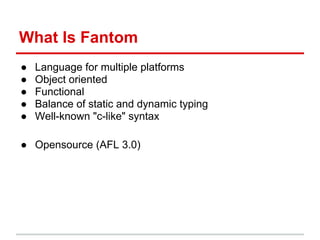
What Is Fantom
●   Language for multiple platforms
●   Object oriented
●   Functional
●   Balance of static and dynamic typing
●   Well-known "c-like" syntax

● Opensource (AFL 3.0)
Productivity
●   Literals
●   Type inference
●   Functions
●   Closures
●   Mixins
●   Integration (FFI)
●   DSL support
Literals
● Lists
  [,]
  [ 10, 20, 30 ]
  [ "a", "b", [ "c", "d" ], "e" ]
● Maps
  [:]
  [ "x" : 10.0d, "y" : 3.14f ]
  [ 10 : "x", 20 : [ "p", "q", "r" ] ]
● Types (introspection)
  sys::Str#, Str#
● Slots (introspection)
  Str#plus, Int#plusDecimal, Uuid#fromStr
Literals (2)
● Uri
    `http://fantom.org`
    `http://myserver.com/edit?n=Ron&s=Smith`
    `/home/fantom/checkitout.fan`
● Duration
    1ns, 1ms, 1sec, 1min, 1hr, 1day
●   Range
    [ 10..20, 30..<40, -3..-1 ]
Type Inference
● u := Uuid()
    // u.typeof -> sys::Uuid
●   s := "some string"
    // s.typeof -> sys::Str
●   list := [10, 20, 30]
    // list.typeof -> sys::Int[]
    listObj := ["a", 1]
    // listObj.typeof -> sys::Obj[]
● map := ["x" : 10, "y" : 3]
    // map.typeof -> [sys::Str : sys::Int]
●   mapNum := ["x" : 10.0d, "y" : 3.14f]
    // mapNum.typeof -> [sys::Str : sys::Num]
Functions and Closures
● Functions - signature |A a, B b, ..., H h -> R|
    double := |Int a -> Int| { 2 * a }
    v := |->| {}
● Methods - just functions wrappers
    |Int a, Int b ->Int| plus := Int#plus.func
●   Closures - expressions that return functions
    Str prefix := ""
    print := |Obj o -> Str| { prefix + o.toStr }
●   Bind - bind parameters of existing functions
    op := |Method m, Int a, Int b| { m.callOn(a, [b]) }
    mul := opFunc.bind([Int#mult])             // |Int, Int->Int|
    plus2 := opFunc.bind([Int#plus, 2]) // |Int -> Int|
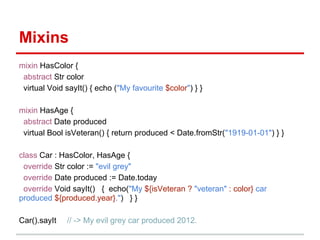
Mixins
mixin HasColor {
 abstract Str color
 virtual Void sayIt() { echo ("My favourite $color") } }

mixin HasAge {
 abstract Date produced
 virtual Bool isVeteran() { return produced < Date.fromStr("1919-01-01") } }

class Car : HasColor, HasAge {
 override Str color := "evil grey"
 override Date produced := Date.today
 override Void sayIt() { echo("My ${isVeteran ? "veteran" : color} car
produced ${produced.year}.") } }

Car().sayIt   // -> My evil grey car produced 2012.
Java FFI
● Java
  ○ package => Fantom pod
  ○ class => Fantom class
  ○ interface => Fantom mixin
  ○ field => Fantom field
  ○ method => Fantom method
   using [java] javax.swing
   using [java] java.util::Map$Entry as Entry
   f := JFrame(...)

● There are some limitations of Fantom FFI. What's not
   supported
   ○ overloaded methods, primitive multidimensional
      arrays, > 1 level deep inheritance from java classes
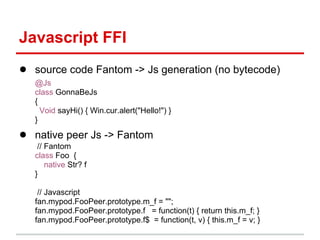
Javascript FFI
● source code Fantom -> Js generation (no bytecode)
   @Js
   class GonnaBeJs
   {
     Void sayHi() { Win.cur.alert("Hello!") }
   }

● native peer Js -> Fantom
    // Fantom
   class Foo {
       native Str? f
   }

    // Javascript
   fan.mypod.FooPeer.prototype.m_f = "";
   fan.mypod.FooPeer.prototype.f = function(t) { return this.m_f; }
   fan.mypod.FooPeer.prototype.f$ = function(t, v) { this.m_f = v; }
DSL Support
● Ability to integrate custom language or AST
    modifications of Fantom code
●   Syntax - DslType <|...|>
    echo(Str<|A towel, it says, is about the most massively useful thing an
    interstellar hitchhiker can have.|>)

    Regex<|^[a-z0-9._%+-]+@[a-z0-9.-]+.[a-z]{2,4}$|>

    @Select
    User getUser(Int id){
      one(sql<|
       select u.userid, u.name
       from User u,Company c
       where u.id = #{id} and u.companid = c.id and c.isdeleted = 0
      |>)
    }
Practical Shortcuts
● Dynamic typing
    obj->foo // obj.trap("foo", [,])
●   Implicit upcast
    Derived derived := base
●   Optional return for simple expressions
    files.sort |a, b| { a.modified <=> b.modified }
●   isnot keyword
    alwaysFalse := "a" isnot Str
●   Optional parenthesis for functions of arity 0
    yes := "yes".capitalize
Practical Shortcuts (2)
● Optional function calls
    tel := contact?.phone?.mobile
●   Elvis operator
    x ?: def                 // x == null ? def : x
●   it-blocks
    `file.txt`.toFile.eachLine { echo (it) }
    // `file.txt`.toFile().eachLine(|line| { echo (line) })
●   literals for data
    Date.today - 1day // yesterday
●   string interpolation
    res.headers["Authorization"]="Basic " + "$user:$pass".
    toBuf.toBase64
Declarative Style
win := Window
  {
    size = Size(300,200)
    Label {
       text = "Hello world"
       halign=Halign.center },
  }.open

createTable("user") {
   createColumn("user_id", integer) { autoIncrement; primaryKey }
   createColumn("login", varchar(64)) { notNull; unique }
   createColumn("pwd", varchar(48)) { comment("Password hash"); notNull }
   createColumn("role_id", integer) { notNull }
   index("idx_login", ["login"])
   foreignKey("fk_role", ["role_id"], references("role", ["role_id"]))
}
Declarative Style (2)
class Person {
  Str? name
  Str[]? emails
}
phoneBook := [
   Person
   {
     name = "Fantom"; emails = [ "fantom@opera.org", "fantom@gmail.com" ]
   },
   Person
   {
     name = "Nobody"; emails = [ "nobody@nowhere.org", "noob@gmail.com" ]
   }
]
Functional Style
["ox", "cat", "deer", "whale"].map { it.size } // -> [2, 3, 4, 5]
[2,3,4].all { it > 1 }           // -> true
[2,3,4].any { it == 4 }          // -> true

["hello", 25, 3.14d, Time.now].findType(Num#) // -> [25, 3.14]
[1, 1, 2, 3, 2, 1, 1].findAll |i| { i.isEven } // -> [2, 2]

[1, 1, 2, 3, 2, 1, 1].reduce([:]) |[Int:Int]r, Int v->[Int:Int]| { return r[v]=r.get(v,0)+1 }
// -> [1:4, 2:2, 3:1]

phoneBook.findAll | Person p -> Bool | { p.name == "Fantom" }
            .map | Person p -> Str[] | { p.emails }
            .flatten
            .exclude | Str email -> Bool | { s.endsWith("gmail.com") }
            .each { echo (it) }
// -> fantom@opera.org
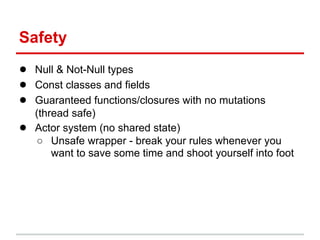
Safety
● Null & Not-Null types
● Const classes and fields
● Guaranteed functions/closures with no mutations
    (thread safe)
●   Actor system (no shared state)
    ○ Unsafe wrapper - break your rules whenever you
        want to save some time and shoot yourself into foot
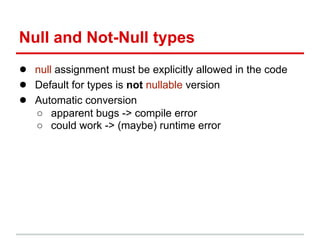
Null and Not-Null types
● null assignment must be explicitly allowed in the code
● Default for types is not nullable version
● Automatic conversion
   ○ apparent bugs -> compile error
   ○ could work -> (maybe) runtime error
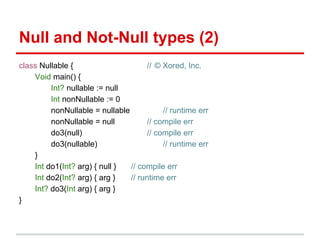
Null and Not-Null types (2)
class Nullable {                      // © Xored, Inc.
    Void main() {
         Int? nullable := null
         Int nonNullable := 0
         nonNullable = nullable            // runtime err
         nonNullable = null           // compile err
         do3(null)                    // compile err
         do3(nullable)                     // runtime err
    }
    Int do1(Int? arg) { null }  // compile err
    Int do2(Int? arg) { arg }   // runtime err
    Int? do3(Int arg) { arg }
}
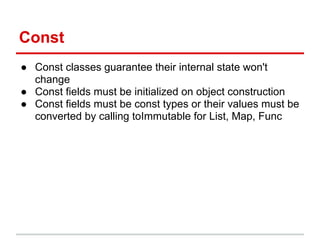
Const
● Const classes guarantee their internal state won't
  change
● Const fields must be initialized on object construction
● Const fields must be const types or their values must be
  converted by calling toImmutable for List, Map, Func
Const
class NonConst {                     // © Xored, Inc.
    const Int constField
    Int nonConstField
    Void mutate() {
         constField = 4              // compile err
         nonConstField = 4           // ok
    }
}
class Const {
    new make(Int i, Str[] list) {
         // implicit call of list.toImmutable
         this.list = list
    }
    const Str[] list
}
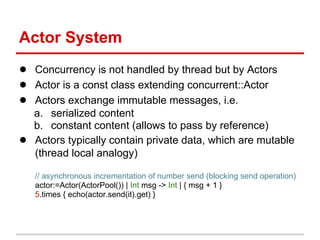
Actor System
● Concurrency is not handled by thread but by Actors
● Actor is a const class extending concurrent::Actor
● Actors exchange immutable messages, i.e.
    a. serialized content
    b. constant content (allows to pass by reference)
●   Actors typically contain private data, which are mutable
    (thread local analogy)

    // asynchronous incrementation of number send (blocking send operation)
    actor:=Actor(ActorPool()) | Int msg -> Int | { msg + 1 }
    5.times { echo(actor.send(it).get) }
Tooling and Build System
● Out-of-the-box build system using Fantom
  ○ handles standard setup with no additional code
  ○ easy to understand (simple implementation)
  ○ module dependencies and version checking
● Bundled simple testing framework fant
  ○ fits into default build structure
  ○ pretty standard lifecycle (junit like)
  ○ works also for javascript targeted code
using build
class Build : BuildPod {
 new make() {
   podName = "mongo"; summary = "Interface to MongoDB (http://www.mongodb.com)"
   depends = ["sys 1.0", "inet 1.0", "concurrent 1.0"]
   srcDirs = [`test/`, `fan/`, `fan/gridfs/`, `fan/bson/`]
   docSrc = true } }
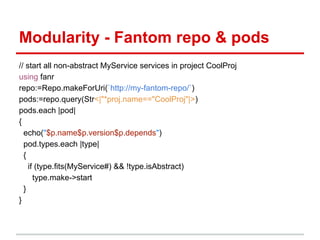
Modularity - Fantom repo & pods
// start all non-abstract MyService services in project CoolProj
using fanr
repo:=Repo.makeForUri(`http://my-fantom-repo/`)
pods:=repo.query(Str<|"*proj.name=="CoolProj"|>)
pods.each |pod|
{
  echo("$p.name$p.version$p.depends")
  pod.types.each |type|
  {
    if (type.fits(MyService#) && !type.isAbstract)
      type.make->start
  }
}
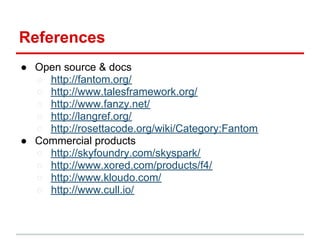
References
● Open source & docs
  ○ http://fantom.org/
  ○ http://www.talesframework.org/
  ○ http://www.fanzy.net/
  ○ http://langref.org/
  ○ http://rosettacode.org/wiki/Category:Fantom
● Commercial products
  ○ http://skyfoundry.com/skyspark/
  ○ http://www.xored.com/products/f4/
  ○ http://www.kloudo.com/
  ○ http://www.cull.io/

Fantom - Programming Language for JVM, CLR, and Javascript

  • 1.
    Fantom Programming language forJVM, CLR, and JS 2012, Kamil Toman http://fantomery.org/katox/fantom-en.pdf
  • 2.
    What Is Fantom ● Language for multiple platforms ● Object oriented ● Functional ● Balance of static and dynamic typing ● Well-known "c-like" syntax ● Opensource (AFL 3.0)
  • 3.
    Productivity ● Literals ● Type inference ● Functions ● Closures ● Mixins ● Integration (FFI) ● DSL support
  • 4.
    Literals ● Lists [,] [ 10, 20, 30 ] [ "a", "b", [ "c", "d" ], "e" ] ● Maps [:] [ "x" : 10.0d, "y" : 3.14f ] [ 10 : "x", 20 : [ "p", "q", "r" ] ] ● Types (introspection) sys::Str#, Str# ● Slots (introspection) Str#plus, Int#plusDecimal, Uuid#fromStr
  • 5.
    Literals (2) ● Uri `http://fantom.org` `http://myserver.com/edit?n=Ron&s=Smith` `/home/fantom/checkitout.fan` ● Duration 1ns, 1ms, 1sec, 1min, 1hr, 1day ● Range [ 10..20, 30..<40, -3..-1 ]
  • 6.
    Type Inference ● u:= Uuid() // u.typeof -> sys::Uuid ● s := "some string" // s.typeof -> sys::Str ● list := [10, 20, 30] // list.typeof -> sys::Int[] listObj := ["a", 1] // listObj.typeof -> sys::Obj[] ● map := ["x" : 10, "y" : 3] // map.typeof -> [sys::Str : sys::Int] ● mapNum := ["x" : 10.0d, "y" : 3.14f] // mapNum.typeof -> [sys::Str : sys::Num]
  • 7.
    Functions and Closures ●Functions - signature |A a, B b, ..., H h -> R| double := |Int a -> Int| { 2 * a } v := |->| {} ● Methods - just functions wrappers |Int a, Int b ->Int| plus := Int#plus.func ● Closures - expressions that return functions Str prefix := "" print := |Obj o -> Str| { prefix + o.toStr } ● Bind - bind parameters of existing functions op := |Method m, Int a, Int b| { m.callOn(a, [b]) } mul := opFunc.bind([Int#mult]) // |Int, Int->Int| plus2 := opFunc.bind([Int#plus, 2]) // |Int -> Int|
  • 8.
    Mixins mixin HasColor { abstract Str color virtual Void sayIt() { echo ("My favourite $color") } } mixin HasAge { abstract Date produced virtual Bool isVeteran() { return produced < Date.fromStr("1919-01-01") } } class Car : HasColor, HasAge { override Str color := "evil grey" override Date produced := Date.today override Void sayIt() { echo("My ${isVeteran ? "veteran" : color} car produced ${produced.year}.") } } Car().sayIt // -> My evil grey car produced 2012.
  • 9.
    Java FFI ● Java ○ package => Fantom pod ○ class => Fantom class ○ interface => Fantom mixin ○ field => Fantom field ○ method => Fantom method using [java] javax.swing using [java] java.util::Map$Entry as Entry f := JFrame(...) ● There are some limitations of Fantom FFI. What's not supported ○ overloaded methods, primitive multidimensional arrays, > 1 level deep inheritance from java classes
  • 10.
    Javascript FFI ● sourcecode Fantom -> Js generation (no bytecode) @Js class GonnaBeJs { Void sayHi() { Win.cur.alert("Hello!") } } ● native peer Js -> Fantom // Fantom class Foo { native Str? f } // Javascript fan.mypod.FooPeer.prototype.m_f = ""; fan.mypod.FooPeer.prototype.f = function(t) { return this.m_f; } fan.mypod.FooPeer.prototype.f$ = function(t, v) { this.m_f = v; }
  • 11.
    DSL Support ● Abilityto integrate custom language or AST modifications of Fantom code ● Syntax - DslType <|...|> echo(Str<|A towel, it says, is about the most massively useful thing an interstellar hitchhiker can have.|>) Regex<|^[a-z0-9._%+-]+@[a-z0-9.-]+.[a-z]{2,4}$|> @Select User getUser(Int id){ one(sql<| select u.userid, u.name from User u,Company c where u.id = #{id} and u.companid = c.id and c.isdeleted = 0 |>) }
  • 12.
    Practical Shortcuts ● Dynamictyping obj->foo // obj.trap("foo", [,]) ● Implicit upcast Derived derived := base ● Optional return for simple expressions files.sort |a, b| { a.modified <=> b.modified } ● isnot keyword alwaysFalse := "a" isnot Str ● Optional parenthesis for functions of arity 0 yes := "yes".capitalize
  • 13.
    Practical Shortcuts (2) ●Optional function calls tel := contact?.phone?.mobile ● Elvis operator x ?: def // x == null ? def : x ● it-blocks `file.txt`.toFile.eachLine { echo (it) } // `file.txt`.toFile().eachLine(|line| { echo (line) }) ● literals for data Date.today - 1day // yesterday ● string interpolation res.headers["Authorization"]="Basic " + "$user:$pass". toBuf.toBase64
  • 14.
    Declarative Style win :=Window { size = Size(300,200) Label { text = "Hello world" halign=Halign.center }, }.open createTable("user") { createColumn("user_id", integer) { autoIncrement; primaryKey } createColumn("login", varchar(64)) { notNull; unique } createColumn("pwd", varchar(48)) { comment("Password hash"); notNull } createColumn("role_id", integer) { notNull } index("idx_login", ["login"]) foreignKey("fk_role", ["role_id"], references("role", ["role_id"])) }
  • 15.
    Declarative Style (2) classPerson { Str? name Str[]? emails } phoneBook := [ Person { name = "Fantom"; emails = [ "fantom@opera.org", "fantom@gmail.com" ] }, Person { name = "Nobody"; emails = [ "nobody@nowhere.org", "noob@gmail.com" ] } ]
  • 16.
    Functional Style ["ox", "cat","deer", "whale"].map { it.size } // -> [2, 3, 4, 5] [2,3,4].all { it > 1 } // -> true [2,3,4].any { it == 4 } // -> true ["hello", 25, 3.14d, Time.now].findType(Num#) // -> [25, 3.14] [1, 1, 2, 3, 2, 1, 1].findAll |i| { i.isEven } // -> [2, 2] [1, 1, 2, 3, 2, 1, 1].reduce([:]) |[Int:Int]r, Int v->[Int:Int]| { return r[v]=r.get(v,0)+1 } // -> [1:4, 2:2, 3:1] phoneBook.findAll | Person p -> Bool | { p.name == "Fantom" } .map | Person p -> Str[] | { p.emails } .flatten .exclude | Str email -> Bool | { s.endsWith("gmail.com") } .each { echo (it) } // -> fantom@opera.org
  • 17.
    Safety ● Null &Not-Null types ● Const classes and fields ● Guaranteed functions/closures with no mutations (thread safe) ● Actor system (no shared state) ○ Unsafe wrapper - break your rules whenever you want to save some time and shoot yourself into foot
  • 18.
    Null and Not-Nulltypes ● null assignment must be explicitly allowed in the code ● Default for types is not nullable version ● Automatic conversion ○ apparent bugs -> compile error ○ could work -> (maybe) runtime error
  • 19.
    Null and Not-Nulltypes (2) class Nullable { // © Xored, Inc. Void main() { Int? nullable := null Int nonNullable := 0 nonNullable = nullable // runtime err nonNullable = null // compile err do3(null) // compile err do3(nullable) // runtime err } Int do1(Int? arg) { null } // compile err Int do2(Int? arg) { arg } // runtime err Int? do3(Int arg) { arg } }
  • 20.
    Const ● Const classesguarantee their internal state won't change ● Const fields must be initialized on object construction ● Const fields must be const types or their values must be converted by calling toImmutable for List, Map, Func
  • 21.
    Const class NonConst { // © Xored, Inc. const Int constField Int nonConstField Void mutate() { constField = 4 // compile err nonConstField = 4 // ok } } class Const { new make(Int i, Str[] list) { // implicit call of list.toImmutable this.list = list } const Str[] list }
  • 22.
    Actor System ● Concurrencyis not handled by thread but by Actors ● Actor is a const class extending concurrent::Actor ● Actors exchange immutable messages, i.e. a. serialized content b. constant content (allows to pass by reference) ● Actors typically contain private data, which are mutable (thread local analogy) // asynchronous incrementation of number send (blocking send operation) actor:=Actor(ActorPool()) | Int msg -> Int | { msg + 1 } 5.times { echo(actor.send(it).get) }
  • 23.
    Tooling and BuildSystem ● Out-of-the-box build system using Fantom ○ handles standard setup with no additional code ○ easy to understand (simple implementation) ○ module dependencies and version checking ● Bundled simple testing framework fant ○ fits into default build structure ○ pretty standard lifecycle (junit like) ○ works also for javascript targeted code using build class Build : BuildPod { new make() { podName = "mongo"; summary = "Interface to MongoDB (http://www.mongodb.com)" depends = ["sys 1.0", "inet 1.0", "concurrent 1.0"] srcDirs = [`test/`, `fan/`, `fan/gridfs/`, `fan/bson/`] docSrc = true } }
  • 24.
    Modularity - Fantomrepo & pods // start all non-abstract MyService services in project CoolProj using fanr repo:=Repo.makeForUri(`http://my-fantom-repo/`) pods:=repo.query(Str<|"*proj.name=="CoolProj"|>) pods.each |pod| { echo("$p.name$p.version$p.depends") pod.types.each |type| { if (type.fits(MyService#) && !type.isAbstract) type.make->start } }
  • 25.
    References ● Open source& docs ○ http://fantom.org/ ○ http://www.talesframework.org/ ○ http://www.fanzy.net/ ○ http://langref.org/ ○ http://rosettacode.org/wiki/Category:Fantom ● Commercial products ○ http://skyfoundry.com/skyspark/ ○ http://www.xored.com/products/f4/ ○ http://www.kloudo.com/ ○ http://www.cull.io/