--- Native Child and Family Services of Toronto


Group Members:

          Qian Chen, Simeng Yang, Shanshan Su, (Sumuduni) Rasika Gamage, Yanjiao Deng
Agenda

Introduction………………………………………………………… Qian

Circumstances……………………………………………………… Simeng

Available Support………………………………................... Shanshan

Supporting Process……………………………................... Rasika

Community Outreach/follow-up………………………… Yanjiao

Conclusion………………………………………………............. Yanjiao
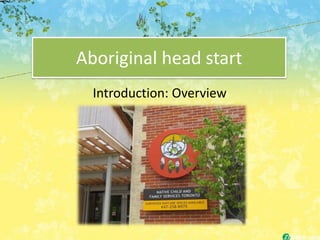
Aboriginal head start
  Introduction: Overview
ABORIGINAL ONTARIO
               EARLY YEARS CENTRE
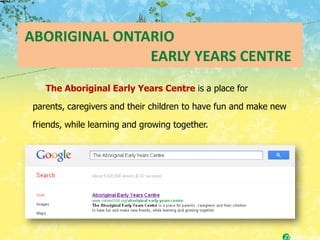
   The Aboriginal Early Years Centre is a place for

parents, caregivers and their children to have fun and make new

friends, while learning and growing together.
ABORIGINAL WOMEN AND CHILDREN'S
              APARTMENTS - AWCA
 "Zhigidminaan Nda-niijaansag" - Anishnawbe for "Growing together with our
   children"

 AWCA is a sister building to Ndawemo My’iingan (Native Women’s Transitional
   House)

 AWCA will work with Ndawemo My’iingan to further support single led families to
   move toward permanent housing and prepare for routine tenancy obligations.


  For more information about AWCA, call 416.969.8510 or speak with your NCFST
Locations
•    Kiiwednong

•    2784 Keele Street, Toronto ON M3M 2G4 MAP

•    Telephone: 416.630.3423 · Fax: 416.630.9581

•    Shaawnong

•    935 Dundas Street East, First Nations Public School, Toronto ON M4M 1R4 MAP

•    Telephone: 416.469.8417 · Fax: 416. 393.0552

•    Waabanong

•    20 Waldock Street, Eastview Public School, Toronto ON M1E 2E5 MAP

•    Telephone: 416.283.7082 · Fax: 416.283.2118

•    Epnigishmok

•    611 St. Clair Avenue West, St. Michael’s Church, Toronto ON M6C 1A3 MAP

•    Telephone: 416.656.3773 · Fax: 416.653.7984


    For more information about Aboriginal Head Start programs, call the Centre in your area or 416.969.8510.
Circumstances
What are some of the circumstances leading up
to families choosing to access support through
this agency?
The significance of Native Child
  Family Services of Toronto
It is a fact that there are great number of native
children are affected by these issue such as
poverty,   addictions,    family    violence   and
homelessness in our city. Families become
recognizing that their whole family or one family
member need support or help, so the importance
of this child protection agency is obvious.
The child and Family services act
         recognized that…
“Indian and Native people should be titled to
provide, wherever possible, their own child and
family services, and all the services to Indian and
Native children and families should be provided in a
manner that recognizes their culture, heritage and
traditions and the concept of the extended family.”

                          http://www.nativechild.org/our-history
The History about Native Child
       Family Services
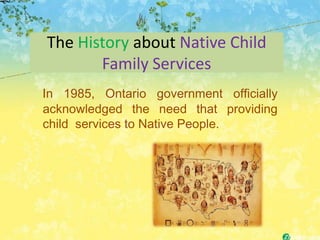
In 1985, Ontario government officially
acknowledged the need that providing
child services to Native People.
History (con’t)


From    1985    to   1988,   the   developmental   phase   took
place, including extensive consultation within the Native and
non-Native communities, the setting of laws, statement mission
and the objectives of services.
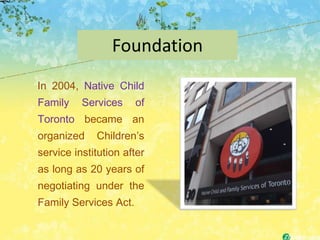
Foundation
In 2004, Native Child
Family    Services     of
Toronto became an
organized    Children’s
service institution after
as long as 20 years of
negotiating under the
Family Services Act.
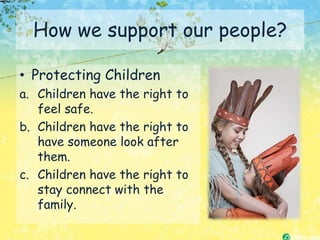
How we support our people?

• Protecting Children
a. Children have the right to
   feel safe.
b. Children have the right to
   have someone look after
   them.
c. Children have the right to
   stay connect with the
   family.
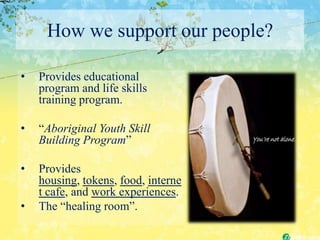
How we support our people?

•   Provides educational
    program and life skills
    training program.

•   “Aboriginal Youth Skill
    Building Program”

•   Provides
    housing, tokens, food, interne
    t cafe, and work experiences.
•   The “healing room”.
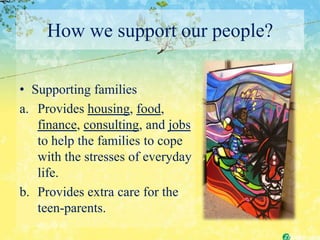
How we support our people?

• Supporting families
a. Provides housing, food,
   finance, consulting, and jobs
   to help the families to cope
   with the stresses of everyday
   life.
b. Provides extra care for the
   teen-parents.
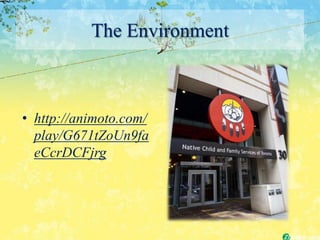
The Environment


• http://animoto.com/
  play/G671tZoUn9fa
  eCcrDCFjrg
Supporting Process
What is the process through which support to
families is eventually tapered off and how is
that decided?
Eligibility and Registration

• Services mainly to Aboriginal people, including First
  Nations, Inuit and Métis
• Children in need of protection under the Child and
  Family Services Act
• Registration is required before getting services
• People can apply via phone or by drop in to the office
Residency Program Exit Criteria

• Three main residency programs
• Exit policies vary with the program
• Different exit criterions to ensure that beneficiaries
  leave the program.
Three main Residency programs

• Women Transitional House:
  – For single women (16 to 24 years) and children
    (newborn to 6 years)
  – Up to 18 months while making the transition into
    independent living and stable housing

• Men Transitional House:
  – For native youth aged 16 to 24 who are homeless or
    under-housed.
  – Can stay for up to 18 months.
Three main Residency programs cont.

• Aboriginal women and children apartments
  – For mothers of ages 16 to 30 years with children up to 16 years
  – Units are self contained and families are placed according to
    family size.
  – Residents may occupy a unit up to 18 months with their
    child(ren).
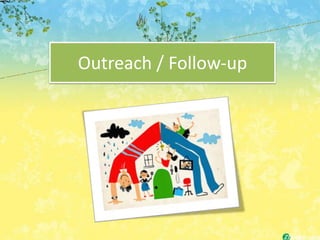
Outreach / Follow-up
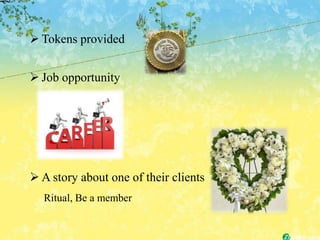
 Tokens provided


 Job opportunity


 A story about one of their clients
  Ritual, Be a member
COMMUNITY PARTNERS
   Aboriginal Legal Services of Toronto
   Anishnawbe Health Toronto
   Association of Native Child and Family Agencies of Ontario
   First Nations Child and Family Caring Society of Canada
   Miziwe Biik
   Mothercraft
    Native Learning Centre
   Ontario Association of Children's Aid Societies
   Toronto Council Fire
   Toronto District School Board
                                                 http://www.nativechild.org
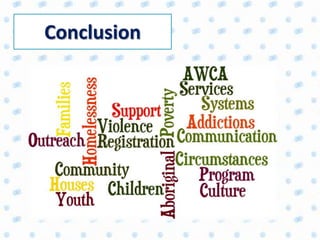
Conclusion
Family(final5)

Family(final5)

  • 1.
    --- Native Childand Family Services of Toronto Group Members: Qian Chen, Simeng Yang, Shanshan Su, (Sumuduni) Rasika Gamage, Yanjiao Deng
  • 2.
    Agenda Introduction………………………………………………………… Qian Circumstances……………………………………………………… Simeng AvailableSupport………………………………................... Shanshan Supporting Process……………………………................... Rasika Community Outreach/follow-up………………………… Yanjiao Conclusion………………………………………………............. Yanjiao
  • 3.
    Aboriginal head start Introduction: Overview
  • 4.
    ABORIGINAL ONTARIO EARLY YEARS CENTRE The Aboriginal Early Years Centre is a place for parents, caregivers and their children to have fun and make new friends, while learning and growing together.
  • 5.
    ABORIGINAL WOMEN ANDCHILDREN'S APARTMENTS - AWCA  "Zhigidminaan Nda-niijaansag" - Anishnawbe for "Growing together with our children"  AWCA is a sister building to Ndawemo My’iingan (Native Women’s Transitional House)  AWCA will work with Ndawemo My’iingan to further support single led families to move toward permanent housing and prepare for routine tenancy obligations. For more information about AWCA, call 416.969.8510 or speak with your NCFST
  • 6.
    Locations • Kiiwednong • 2784 Keele Street, Toronto ON M3M 2G4 MAP • Telephone: 416.630.3423 · Fax: 416.630.9581 • Shaawnong • 935 Dundas Street East, First Nations Public School, Toronto ON M4M 1R4 MAP • Telephone: 416.469.8417 · Fax: 416. 393.0552 • Waabanong • 20 Waldock Street, Eastview Public School, Toronto ON M1E 2E5 MAP • Telephone: 416.283.7082 · Fax: 416.283.2118 • Epnigishmok • 611 St. Clair Avenue West, St. Michael’s Church, Toronto ON M6C 1A3 MAP • Telephone: 416.656.3773 · Fax: 416.653.7984 For more information about Aboriginal Head Start programs, call the Centre in your area or 416.969.8510.
  • 7.
    Circumstances What are someof the circumstances leading up to families choosing to access support through this agency?
  • 8.
    The significance ofNative Child Family Services of Toronto It is a fact that there are great number of native children are affected by these issue such as poverty, addictions, family violence and homelessness in our city. Families become recognizing that their whole family or one family member need support or help, so the importance of this child protection agency is obvious.
  • 9.
    The child andFamily services act recognized that… “Indian and Native people should be titled to provide, wherever possible, their own child and family services, and all the services to Indian and Native children and families should be provided in a manner that recognizes their culture, heritage and traditions and the concept of the extended family.” http://www.nativechild.org/our-history
  • 10.
    The History aboutNative Child Family Services In 1985, Ontario government officially acknowledged the need that providing child services to Native People.
  • 11.
    History (con’t) From 1985 to 1988, the developmental phase took place, including extensive consultation within the Native and non-Native communities, the setting of laws, statement mission and the objectives of services.
  • 12.
    Foundation In 2004, NativeChild Family Services of Toronto became an organized Children’s service institution after as long as 20 years of negotiating under the Family Services Act.
  • 13.
    How we supportour people? • Protecting Children a. Children have the right to feel safe. b. Children have the right to have someone look after them. c. Children have the right to stay connect with the family.
  • 14.
    How we supportour people? • Provides educational program and life skills training program. • “Aboriginal Youth Skill Building Program” • Provides housing, tokens, food, interne t cafe, and work experiences. • The “healing room”.
  • 15.
    How we supportour people? • Supporting families a. Provides housing, food, finance, consulting, and jobs to help the families to cope with the stresses of everyday life. b. Provides extra care for the teen-parents.
  • 16.
    The Environment • http://animoto.com/ play/G671tZoUn9fa eCcrDCFjrg
  • 17.
    Supporting Process What isthe process through which support to families is eventually tapered off and how is that decided?
  • 18.
    Eligibility and Registration •Services mainly to Aboriginal people, including First Nations, Inuit and Métis • Children in need of protection under the Child and Family Services Act • Registration is required before getting services • People can apply via phone or by drop in to the office
  • 19.
    Residency Program ExitCriteria • Three main residency programs • Exit policies vary with the program • Different exit criterions to ensure that beneficiaries leave the program.
  • 20.
    Three main Residencyprograms • Women Transitional House: – For single women (16 to 24 years) and children (newborn to 6 years) – Up to 18 months while making the transition into independent living and stable housing • Men Transitional House: – For native youth aged 16 to 24 who are homeless or under-housed. – Can stay for up to 18 months.
  • 21.
    Three main Residencyprograms cont. • Aboriginal women and children apartments – For mothers of ages 16 to 30 years with children up to 16 years – Units are self contained and families are placed according to family size. – Residents may occupy a unit up to 18 months with their child(ren).
  • 22.
  • 23.
     Tokens provided Job opportunity  A story about one of their clients Ritual, Be a member
  • 24.
    COMMUNITY PARTNERS  Aboriginal Legal Services of Toronto  Anishnawbe Health Toronto  Association of Native Child and Family Agencies of Ontario  First Nations Child and Family Caring Society of Canada  Miziwe Biik  Mothercraft  Native Learning Centre  Ontario Association of Children's Aid Societies  Toronto Council Fire  Toronto District School Board http://www.nativechild.org
  • 25.