PRESENTED BY:
MANIMOZHI.I
NARESH KUMAR.A
 In the current scenario, the data on the web is growing exponentially.
 Social Media is generating a large amount of data such as reviews, comments and
customer's opinions on a daily basis.
 This huge amount of user generated data is worthless unless some mining operations are
applied to it.
 As there are a large number of fake reviews, opinion mining technique should
incorporate the Spam Detection to produce genuine opinions.
 Nowadays, there are a number of people using social media reviews to order anything
through online.
 Online spam detection is an exhausting and a herculean problem as there are many faux
or fake reviews that have been created by organizations or by the people themselves for
various purposes.
 They write fake reviews to mislead readers or automated detection system by promoting
or demoting targeted product services to promote them or to degrade their reputations.
 In General, e-commerce provides facility for customers to write reviews related with its service. The
existence of these reviews can be used as a source of information.
 Before purchasing anything, it is a normal human tendency to do a survey on that product. Based on
reviews, customers can compare different brands and can finalize a product of their interest.
 These online reviews can change the opinion of a customer about the product. If these reviews are
true, then this can help the users to select proper product that satisfies their requirements.
 The honesty value and measure of a fake review will be measured by utilizing the data mining
techniques.
 An algorithm could be used to track customer reviews, through mining topics and sentiment
orientation.
EXISTING SYSTEM
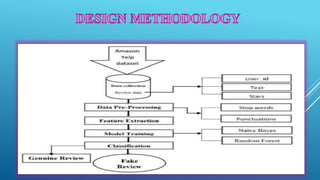
 Research was already made which aims to detect fake reviews for a product by using the text and rating
property from a review.
 The proposed system (ICF++) will measure the honesty value of a review, the trustiness value of the
reviewers and the reliability value of a product.
 The honesty value of a review will be measured by utilizing the text mining and opinion mining
techniques.
 The result from the experiment shows that the proposed system has a better accuracy compared with the
result from iterative computation framework (ICF) method.
 The Apriori algorithm was proposed by Agarwal and Srikant in 1994.
 Apriori uses a "bottom up" approach, where frequent subsets are extended one item at a time using a step
known as candidate generation.
 But according to the researches made on this topic, Candidate generation and support counting was found
to be expensive.
PROPOSED WORK
The system proposed will include some methods like
Understanding deviation of ratings: -
 The ratings or reviews which are showing a trend of
continuous growth but suddenly shows negativity is
simply displaying a deviation from the normal
ratings.
 The posted reviews will undergo the process of
sentiment analysis, Ip address track, and its deviation
from overall review analyzed. If any miscalculation is
found in the reviews that will be analyzed and
detected.
Sentiment analysis of the product review:
It is necessary for the system to understand whether the
review is positive or negative, which further helps to
understand the deviation from either the positivity or the
negativity in the reviews. The analysis will help us to
understand the overall aspect of the products so that few
spam reviews doesn't affect the overall statistics of
products
Determining and classifying a review
into fake or truthful one is an important
and challenging problem. As part of
future work, we can incorporate review
spammer detection into the review
detection and vice versa. Exploring
ways to learn behavior patterns related
to spamming so as to improve the
accuracy of the current regression
model. So as to evaluate our proposed
methods, that conducts user evaluation
on an Amazon dataset containing
reviews of different manufactured
products.
CONCLUSIO
N
The fake product review monitoring system
helps the people to get genuine reviews about
the product. People can spend money on
valuable products. This system helps the user
to find out correct review of the product. It can
help the users to select the proper product that
satisfies their requirements. Based on reviews,
customers can compare different brands and
can finalize a product of their interest.
FUTURE
SCOPE
REFERENCES
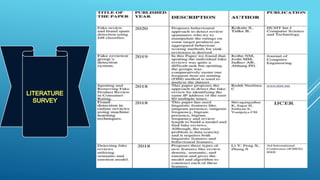
• Gyandeep Dowari, Dibya jyoti Bora, "Fake Product Review Monitoring and Removal using
Opinion Mining, IEEE conference publication,2020.
• Eka Dyar Wahyuni, Arif Djunaidy. "Fake Review Detection from a Product Review Using
Modified Method of Iterative Computation Framework", MATEC Web of conferences, 2016.
• Abishek Pund, Ramkete Sanchit, Shinde Shailesh, "Fake product review monitoring &
removal and sentiment analysis of genuine reviews", International Journal of Engineering
and Management Research (IJEMR), 2019, Volume 9: Issue Rajashree S. Jadhav, Prof.
Deipali V. Gore, "A New Approach for Identifying Manipulated Online Reviews using Decision
Tree". (IJCSIT) International Journal of Computer Science and Information Technologies,
Vol. 5 (2), pp 1447- 1450, 2014
• Long Sheng Chen, Jui-Yu Lin, "A study on Review Manipulation Classification using
Decision Tree", Kuala Lumpur, Malaysia, pp 3-5, IEEE conference publication, 2013.
• Ivan Tetovo, "A Joint Model of Text and Aspect Ratings for Sentiment Summarization "Ivan
Department of Computer Science University of Illinois at Urbana, 2011
• N. Jindal and B. Liu, "Opinion spam and analysis," International Conference on Web
Search and Data Mining. 2008, pp. 219-230.
FAKE PRODUCT PAPER PRESENTATION.pptx

FAKE PRODUCT PAPER PRESENTATION.pptx

  • 1.
  • 2.
     In thecurrent scenario, the data on the web is growing exponentially.  Social Media is generating a large amount of data such as reviews, comments and customer's opinions on a daily basis.  This huge amount of user generated data is worthless unless some mining operations are applied to it.  As there are a large number of fake reviews, opinion mining technique should incorporate the Spam Detection to produce genuine opinions.  Nowadays, there are a number of people using social media reviews to order anything through online.  Online spam detection is an exhausting and a herculean problem as there are many faux or fake reviews that have been created by organizations or by the people themselves for various purposes.  They write fake reviews to mislead readers or automated detection system by promoting or demoting targeted product services to promote them or to degrade their reputations.
  • 3.
     In General,e-commerce provides facility for customers to write reviews related with its service. The existence of these reviews can be used as a source of information.  Before purchasing anything, it is a normal human tendency to do a survey on that product. Based on reviews, customers can compare different brands and can finalize a product of their interest.  These online reviews can change the opinion of a customer about the product. If these reviews are true, then this can help the users to select proper product that satisfies their requirements.  The honesty value and measure of a fake review will be measured by utilizing the data mining techniques.  An algorithm could be used to track customer reviews, through mining topics and sentiment orientation.
  • 5.
    EXISTING SYSTEM  Researchwas already made which aims to detect fake reviews for a product by using the text and rating property from a review.  The proposed system (ICF++) will measure the honesty value of a review, the trustiness value of the reviewers and the reliability value of a product.  The honesty value of a review will be measured by utilizing the text mining and opinion mining techniques.  The result from the experiment shows that the proposed system has a better accuracy compared with the result from iterative computation framework (ICF) method.  The Apriori algorithm was proposed by Agarwal and Srikant in 1994.  Apriori uses a "bottom up" approach, where frequent subsets are extended one item at a time using a step known as candidate generation.  But according to the researches made on this topic, Candidate generation and support counting was found to be expensive.
  • 6.
    PROPOSED WORK The systemproposed will include some methods like Understanding deviation of ratings: -  The ratings or reviews which are showing a trend of continuous growth but suddenly shows negativity is simply displaying a deviation from the normal ratings.  The posted reviews will undergo the process of sentiment analysis, Ip address track, and its deviation from overall review analyzed. If any miscalculation is found in the reviews that will be analyzed and detected. Sentiment analysis of the product review: It is necessary for the system to understand whether the review is positive or negative, which further helps to understand the deviation from either the positivity or the negativity in the reviews. The analysis will help us to understand the overall aspect of the products so that few spam reviews doesn't affect the overall statistics of products
  • 8.
    Determining and classifyinga review into fake or truthful one is an important and challenging problem. As part of future work, we can incorporate review spammer detection into the review detection and vice versa. Exploring ways to learn behavior patterns related to spamming so as to improve the accuracy of the current regression model. So as to evaluate our proposed methods, that conducts user evaluation on an Amazon dataset containing reviews of different manufactured products. CONCLUSIO N
  • 9.
    The fake productreview monitoring system helps the people to get genuine reviews about the product. People can spend money on valuable products. This system helps the user to find out correct review of the product. It can help the users to select the proper product that satisfies their requirements. Based on reviews, customers can compare different brands and can finalize a product of their interest. FUTURE SCOPE
  • 10.
    REFERENCES • Gyandeep Dowari,Dibya jyoti Bora, "Fake Product Review Monitoring and Removal using Opinion Mining, IEEE conference publication,2020. • Eka Dyar Wahyuni, Arif Djunaidy. "Fake Review Detection from a Product Review Using Modified Method of Iterative Computation Framework", MATEC Web of conferences, 2016. • Abishek Pund, Ramkete Sanchit, Shinde Shailesh, "Fake product review monitoring & removal and sentiment analysis of genuine reviews", International Journal of Engineering and Management Research (IJEMR), 2019, Volume 9: Issue Rajashree S. Jadhav, Prof. Deipali V. Gore, "A New Approach for Identifying Manipulated Online Reviews using Decision Tree". (IJCSIT) International Journal of Computer Science and Information Technologies, Vol. 5 (2), pp 1447- 1450, 2014 • Long Sheng Chen, Jui-Yu Lin, "A study on Review Manipulation Classification using Decision Tree", Kuala Lumpur, Malaysia, pp 3-5, IEEE conference publication, 2013. • Ivan Tetovo, "A Joint Model of Text and Aspect Ratings for Sentiment Summarization "Ivan Department of Computer Science University of Illinois at Urbana, 2011 • N. Jindal and B. Liu, "Opinion spam and analysis," International Conference on Web Search and Data Mining. 2008, pp. 219-230.