Slide 1 — Title Slide
Fake News Detection Using Machine Learning & NLP
Presented By:
Rupak Kumar
Nikki Chauhan
Slide 2 — Introduction
Fake news spreads rapidly across social media platforms.
It influences public opinion, elections, and society.
Manual detection is slow and inefficient.
AI, Machine Learning and NLP can automatically detect misleading information.
Slide 3 — What is Fake News?
Fake news is false, misleading, or manipulated information presented as real news.
Created intentionally to:
Influence people
Earn clicks (clickbait)
Spread propaganda or hate
Often uses sensational headlines and emotional wording.
Slide 4 — Problem Statement
Huge volume of online content makes manual verification impossible.
Fake information spreads faster than real news.
Increasing cases of:
Political misinformation
Health-related fake news
Social & communal rumors
Need an automated ML-based system to classify fake vs real news.
Slide 5 — Objectives
Build a Machine Learning model to classify news as Fake or Real.
Use NLP techniques for text preprocessing and feature extraction.
Improve accuracy using different ML algorithms.
Create a pipeline for real-time news prediction.
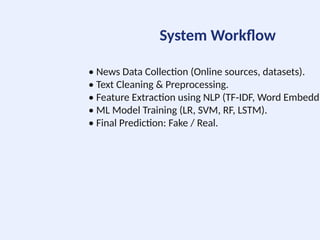
Slide 6 — System Workflow
1. Data Collection
News articles, datasets from Kaggle, FakeNewsNet etc.
2. Preprocessing
Tokenization
Stopword removal
Stemming / Lemmatization
3. Feature Extraction
TF-IDF
Word2Vec / BERT embeddings
4. Model Training
Logistic Regression, SVM, Random Forest, LSTM
5. Output
Prediction: Fake or Real
Slide 7 — NLP Techniques Used
Tokenization: Breaking sentences into words.
Stopword Removal: Removing common words like ‘the’, ‘is’, etc.
Stemming/Lemmatization: Reducing words to base form.
TF-IDF: Converts text into numeric vectors.
Word Embeddings: Word2Vec, GloVe, BERT for context understanding.
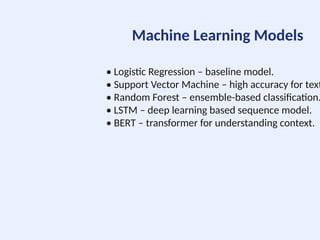
Slide 8 — Machine Learning Models
Logistic Regression: Simple, effective classifier for text.
Support Vector Machine (SVM): Best performance for high-dimensional text.
Random Forest: Handles noisy and non-linear data.
LSTM (Deep Learning): Captures sequence patterns.
BERT (Transformer-based): Most advanced model with contextual understanding.
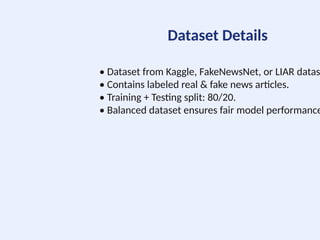
Slide 9 — Dataset Details
Used datasets from Kaggle / FakeNewsNet / LIAR Dataset.
Contains thousands of labeled Real & Fake news articles.
Split into:
80% Training
20% Testing
Contains fields like:
Title
Text
Source
Label (Fake/Real)
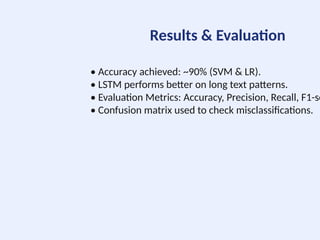
Slide 10 — Results & Evaluation
Accuracy:
Logistic Regression → 85–88%
SVM → 90%
Random Forest → 84%
LSTM/Bi-LSTM → 91%
Evaluation metrics:
Precision
Recall
F1-Score
Confusion Matrix
SVM + TF-IDF gives strong performance.
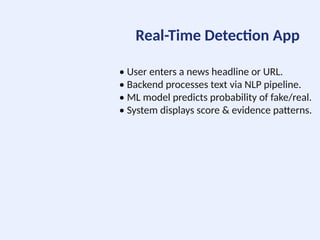
Slide 11 — Real-Time Detection
User enters a headline or full article.
Backend preprocesses text using NLP pipeline.
ML model predicts probability of Fake/Real.
Output includes:
Fake Score (%)
Highlighted suspicious words
Reliability index
Slide 12 — Challenges
Ambiguous language and sarcasm.
Biased dat