ScienceDirect
Available online at www.sciencedirect.com
Procedia Computer Science 233 (2024) 763–771
1877-0509 © 2024 The Authors. Published by Elsevier B.V.
This is an open access article under the CC BY-NC-ND license (https://creativecommons.org/licenses/by-nc-nd/4.0)
Peer-review under responsibility of the scientific committee of the 5th International Conference on Innovative Data
Communication Technologies and Application
10.1016/j.procs.2024.03.265
© 2024 The Authors. Published by Elsevier B.V.
This is an open access article under the CC BY-NC-ND license (https://creativecommons.org/licenses/by-nc-nd/4.0)
Peer-review under responsibility of the scientific committee of the 5th International Conference on Innovative Data Communication
Technologies and Application
Available online at www.sciencedirect.com
^ĐŝĞŶĐĞŝƌĞĐƚ
Procedia Computer Science 00 (2023) 000–000
www.elsevier.com/locate/procedia
1877-0509 © 2024 The Authors. Published by ELSEVIER B.V.
This is an open access article under the CC BY-NC-ND license (https://creativecommons.org/licenses/by-nc-nd/4.0)
Peer-review under responsibility of the scientific committee of the 5th International Conference on Innovative Data Communication
Technologies and Application
5th International Conference on Innovative Data Communication Technologies and Application (ICIDCA 2024)
Fake News Detection using Python and Machine Learning
Jumana Jouhar, Anju Pratap*, Neharin Tijo, Meenakshi Mony
Saintgits College of Engineering(Autonomous), Kottukulam Hills Pathamuttam P.O, Kerala, Kottayam, 686532, India
anju.pratap@saintgits.org
Abstract
In an era dominated by digital information, the unchecked proliferation of false information poses a critical threat. This has
motivated to study for techniques which can tackle issues related to it, and hence the study uses machine learning algorithms to
detect fake news. By systematically exploring and evaluating various machine learning models, the research enhances decision-
making, fortifies information integrity and addresses the adverse impacts of misinformation on a broader scale. Going beyond
mere algorithmic efficacy, the study introduces a multifaceted approach by using evaluation metrics like precision and accuracy.
This strategic analysis identifies the optimal machine learning algorithm for classifying articles as real or fake news. The contents
covered by the study include literature review, dataset selection, data preprocessing and cleaning, vectorization, model and metric
selection, model training, optimization and evaluation. The study extends its impact beyond technical proficiency, actively
contributing to bolstering trust across media, democratic processes, and ensuring content authenticity. This inclusive approach
benefits a wide array of stakeholders including news organizations, social media platforms and government entities. Through
rigorous evaluation, the study significantly enhances information credibility, providing a countermeasure against the growing
threat of misinformation.
© 2024 The Authors. Published by ELSEVIER B.V.
This is an open access article under the CC BY-NC-ND license (https://creativecommons.org/licenses/by-nc-nd/4.0)
Peer-review under responsibility of the scientific committee of the 5th International Conference on Innovative Data
Communication Technologies and Application
Keywords: Applied machine learning; Detection of Fake News
1. Introduction
To prevent relentless dissemination of fake news in the digital era, advanced techniques have to be developed or
764 Jumana Jouhar et al. / Procedia Computer Science 233 (2024) 763–771
2 Jumana Jouhar / Procedia Computer Science 00 (2019) 000–000
existing techniques have to be improved. Current techniques in fake news detection include ML, DL. NLP and
metadata analysis. Each technique has its own strengths and limitations and calls for a more comprehensive and
adaptive approach. For instance, NLP struggles with nuanced context and adversarial attacks. Similarly, machine
learning has some limitations such as the dependency on standard and representativeness of data to be trained and
potential bias in training data which is why this study is being done. The study hopes to find the best ML model to
differentiate a news document as Fake or Not. Furthermore, the dynamic nature of machine learning models allows
for continuous learning and adjustment, making them well-suited to counter the diverse and evolving strategies used
to spread misinformation. This study advocates for the exploration of machine learning algorithms as powerful tools
to address these challenges, aims to propel the field forward and fill any gaps in the current landscape of fake news
detection.
2. Related Works
A thorough literature review was conducted to obtain a proper understanding of applied ML models in the area of
news of type hate/fake news.. Prior research has explored various techniques, revealing their strengths and
limitations. Notably, Sharma et al. [1] made a system which uses applied ML and NLP to detect fake news , utilizing
classifiers like Passive Aggressive Classifier, Random Forest and Logical Regression. Khanam et al. [2] employed
XGBoost, while Pandey et al. [3] achieved high accuracy and F1-scores using classifiers like Decision Tree and
Logistic Regression. To provide a comprehensive overview, Table 1 was crafted to summarize related works on fake
news detection. It condenses information on research papers, authors, classifiers employed, model performance
metrics, issue dates, and references. Noteworthy classifiers include Decision Tree, Random Forest, PAC (Passive
Aggressive Classifier), XGBOOST, Naïve Bayes, SVM , Logistic Regression and KNN , each applied in various
studies. Evaluation of ML models using various metics like F1-score, precision, and accuracy were crucial for
evaluation. Table 1 allows for easy comparison of different classifiers across multiple research papers, shedding
light on variations in their success rates in detecting fake news but limitations include the absence of recall and,
unavailability of F1-score and precision in some studies. Direct comparative analysis and discussion of the strengths
and weaknesses of each classifier could offer additional insights for researchers and practitioners. Moreover,
understanding the specific dataset or problem domain for which these classifiers were applied is crucial for
interpreting their performance. Addressing these limitations would contribute to a more thorough and actionable
understanding on how to deal with fake news. The study strategically narrowed down the selection to six classifiers:
logistic regression , gradient boosting ,random forest , passive aggressive classifier decision tree and XGBoost. This
decision was informed by a thorough consideration of the classifiers' performance in previous research, as well as
the specific strengths and limitations revealed in Table 1. The aim is to build upon the insights gained from existing
literature, contributing to a more nuanced understanding of how effective these classifiers are in detecting fake
news. Ensemble classifier methods can improve accuracy [6]. Comparing machine learning algorithms and selecting
the best and then implementing them using python libraries, is the conventional method of implementation [7] [9]
[14]. These ML models can be implemented after extracting features manually, and engineered features are sent to
the model for prediction. Fake news were detected automatically in social media through many features are present,
where a deep learning analyzer was used for the detection [8]. Novel approaches like BERT based in ML are also
existing with each method having its own advantages and disadvantages [10] [11]. To overcome outdated labeled
samples for training, authors proposed a reinforcement method for fake news detection based on weakly supervised
classification technique [12] [15].
Table 1. Related works
Author(s) Classifiers Accuracy Precision F1 Score Issue Date Reference
Sharma U., Saran S., Shankar M.
P.
Naïve
Bayes
0.60 0.59 0.72 2020 [1]
Random
Forest
0.59 0.62 0.67
Logistic
Regression
0.65 0.69 0.75
Jumana Jouhar et al. / Procedia Computer Science 233 (2024) 763–771 765
Jumana Jouhar/ Procedia Computer Science 00 (2019) 000–000 3
3. Exploratory Data Analysis
Choosing the right dataset is an important step in constructing an effective classifier to detect news which are
fake, as the data quality directly impacts model performance. The ISOT fake news dataset [4][5] which is a widely
recognized and reputable source, consists of articles from various domains such as media, democratic processes,
content authenticity, news organizations, media platforms, and government agencies. This dataset includes two
distinct categories: fake and real news, with parameters like title, text, type, and publication date. Exploratory Data
Analysis (EDA) assumes a central role in uncovering crucial insights about the dataset. It involves the analysis and
summarization of data to identify relevant elements such as patterns, relationships and anomalies. This process aids
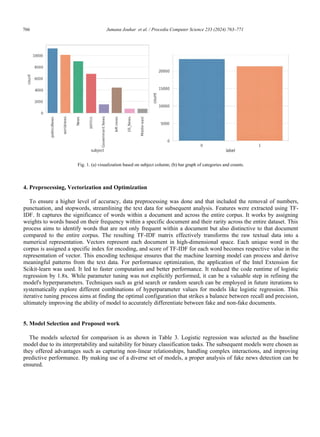
in revealing missing values, outliers, correlations, distributions, and potential features. Visualizations, such as bar
graphs help to examine subject distribution, identify key topics, and explore potential features differentiating
between fake and true articles. Furthermore, data imbalance should be avoided to ensure a fair and unbiased training
dataset. The ISOT Fake News Dataset was selected for its diverse topics and a well-balanced composition of articles
from reputable and unreliable sources. It provides dimensions like type, text, publication date and title. As shown in
Figure 1, the bar graphs give a comprehensive overview of the distribution of articles across various categories and
subcategories, enabling an in-depth analysis of the topics covered in both real and fake news. It was existing in the
literature about the distribution of articles across different categories and subcategories, providing valuable insights
into the dataset's composition. The table categorizes articles into Real News and Fake News, with further
subcategories such as World News, Politics News, and others. Information on the number of articles per
category, denoted as Articles Size, adds a quantitative dimension to the analysis.
PAC 0.9273 0.93 0.9257
Alwasel B.N., Khanam Z,
Sirafi, M Rashid H.
XGBOOST 0.75 - - 2020 [2]
SVM 0.73 - -
Random
Forest
0.73 - -
Prabhakaran S., Pandey S., N.
V. S. Reddy, Acharya D.
SVM 0.8933 - - 2021 [3]
Decision
Tree
0.7333 - -
Naïve
Bayes
0.8689 - -
Logistic
Regression
0.9046 - -
KNN 0.8998 - -
766 Jumana Jouhar et al. / Procedia Computer Science 233 (2024) 763–771
4 Jumana Jouhar / Procedia Computer Science 00 (2019) 000–000
Fig. 1. (a) visualization based on subject column; (b) bar graph of categories and counts.
4. Preprocessing, Vectorization and Optimization
To ensure a higher level of accuracy, data preprocessing was done and that included the removal of numbers,
punctuation, and stopwords, streamlining the text data for subsequent analysis. Features were extracted using TF-
IDF. It captures the significance of words within a document and across the entire corpus. It works by assigning
weights to words based on their frequency within a specific document and their rarity across the entire dataset. This
process aims to identify words that are not only frequent within a document but also distinctive to that document
compared to the entire corpus. The resulting TF-IDF matrix effectively transforms the raw textual data into a
numerical representation. Vectors represent each document in high-dimensional space. Each unique word in the
corpus is assigned a specific index for encoding, and score of TF-IDF for each word becomes respective value in the
representation of vector. This encoding technique ensures that the machine learning model can process and derive
meaningful patterns from the text data. For performance optimization, the application of the Intel Extension for
Scikit-learn was used. It led to faster computation and better performance. It reduced the code runtime of logistic
regression by 1.8x. While parameter tuning was not explicitly performed, it can be a valuable step in refining the
model's hyperparameters. Techniques such as grid search or random search can be employed in future iterations to
systematically explore different combinations of hyperparameter values for models like logistic regression. This
iterative tuning process aims at finding the optimal configuration that strikes a balance between recall and precision,
ultimately improving the ability of model to accurately differentiate between fake and non-fake documents.
5. Model Selection and Proposed work
The models selected for comparison is as shown in Table 3. Logistic regression was selected as the baseline
model due to its interpretability and suitability for binary classification tasks. The subsequent models were chosen as
they offered advantages such as capturing non-linear relationships, handling complex interactions, and improving
predictive performance. By making use of a diverse set of models, a proper analysis of fake news detection can be
ensured.
Jumana Jouhar et al. / Procedia Computer Science 233 (2024) 763–771 767
Jumana Jouhar/ Procedia Computer Science 00 (2019) 000–000 5
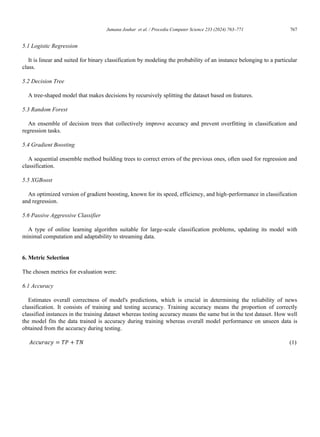
5.1 Logistic Regression
It is linear and suited for binary classification by modeling the probability of an instance belonging to a particular
class.
5.2 Decision Tree
A tree-shaped model that makes decisions by recursively splitting the dataset based on features.
5.3 Random Forest
An ensemble of decision trees that collectively improve accuracy and prevent overfitting in classification and
regression tasks.
5.4 Gradient Boosting
A sequential ensemble method building trees to correct errors of the previous ones, often used for regression and
classification.
5.5 XGBoost
An optimized version of gradient boosting, known for its speed, efficiency, and high-performance in classification
and regression.
5.6 Passive Aggressive Classifier
A type of online learning algorithm suitable for large-scale classification problems, updating its model with
minimal computation and adaptability to streaming data.
6. Metric Selection
The chosen metrics for evaluation were:
6.1 Accuracy
Estimates overall correctness of model's predictions, which is crucial in determining the reliability of news
classification. It consists of training and testing accuracy. Training accuracy means the proportion of correctly
classified instances in the training dataset whereas testing accuracy means the same but in the test dataset. How well
the model fits the data trained is accuracy during training whereas overall model performance on unseen data is
obtained from the accuracy during testing.
𝐴𝐴𝐴𝐴𝐴𝐴𝐴𝐴𝐴𝐴𝐴𝐴𝐴𝐴𝐴𝐴 = 𝑇𝑇𝑇𝑇 + 𝑇𝑇𝑇𝑇 (1)
768 Jumana Jouhar et al. / Procedia Computer Science 233 (2024) 763–771
6 Jumana Jouhar / Procedia Computer Science 00 (2019) 000–000
6.2 Precision
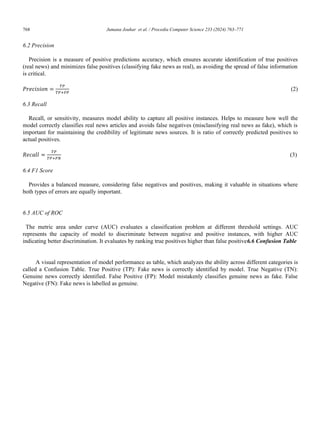
Precision is a measure of positive predictions accuracy, which ensures accurate identification of true positives
(real news) and minimizes false positives (classifying fake news as real), as avoiding the spread of false information
is critical.
𝑃𝑃𝑃𝑃𝑃𝑃𝑃𝑃𝑃𝑃𝑃𝑃𝑃𝑃𝑃𝑃𝑃𝑃 =
𝑇𝑇𝑇𝑇
𝑇𝑇𝑇𝑇+𝐹𝐹𝐹𝐹
(2)
6.3 Recall
Recall, or sensitivity, measures model ability to capture all positive instances. Helps to measure how well the
model correctly classifies real news articles and avoids false negatives (misclassifying real news as fake), which is
important for maintaining the credibility of legitimate news sources. It is ratio of correctly predicted positives to
actual positives.
𝑅𝑅𝑅𝑅𝑅𝑅𝑅𝑅𝑅𝑅𝑅𝑅 =
𝑇𝑇𝑇𝑇
𝑇𝑇𝑇𝑇+𝐹𝐹𝐹𝐹
(3)
6.4 F1 Score
Provides a balanced measure, considering false negatives and positives, making it valuable in situations where
both types of errors are equally important.
6.5 AUC of ROC
The metric area under curve (AUC) evaluates a classification problem at different threshold settings. AUC
represents the capacity of model to discriminate between negative and positive instances, with higher AUC
indicating better discrimination. It evaluates by ranking true positives higher than false positive6.6 Confusion Table
A visual representation of model performance as table, which analyzes the ability across different categories is
called a Confusion Table. True Positive (TP): Fake news is correctly identified by model. True Negative (TN):
Genuine news correctly identified. False Positive (FP): Model mistakenly classifies genuine news as fake. False
Negative (FN): Fake news is labelled as genuine.
Jumana Jouhar et al. / Procedia Computer Science 233 (2024) 763–771 769
Jumana Jouhar/ Procedia Computer Science 00 (2019) 000–000 7
7. Model Evaluation and Result Analysis
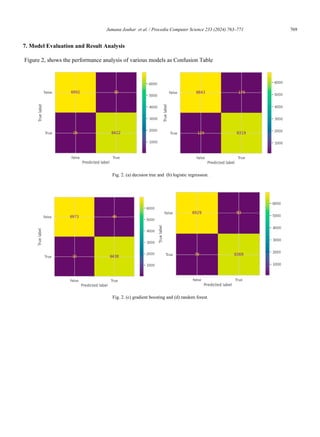
Figure 2, shows the performance analysis of various models as Confusion Table
Fig. 2. (a) decision tree and (b) logistic regression.
Fig. 2. (c) gradient boosting and (d) random forest.
770 Jumana Jouhar et al. / Procedia Computer Science 233 (2024) 763–771
8 Jumana Jouhar / Procedia Computer Science 00 (2019) 000–000
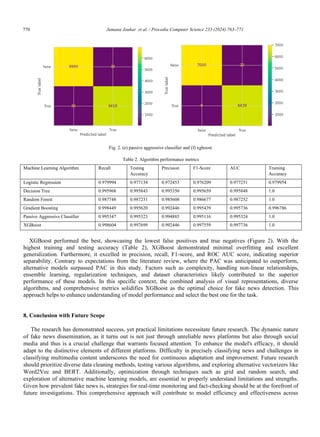
Fig. 2. (e) passive aggressive classifier and (f) xgboost.
Table 2. Algorithm performance metrics
Machine Learning Algorithm Recall Testing
Accuracy
Precision F1-Score AUC Training
Accuracy
Logistic Regression 0.979994 0.977134 0.972453 0.976209 0.977251 0.979954
Decision Tree 0.995968 0.995843 0.995350 0.995659 0.995848 1.0
Random Forest 0.987748 0.987231 0.985608 0.986677 0.987252 1.0
Gradient Boosting 0.998449 0.995620 0.992446 0.995439 0.995736 0.996786
Passive Aggressive Classifier 0.995347 0.995323 0.994885 0.995116 0.995324 1.0
XGBoost 0.998604 0.997699 0.992446 0.997559 0.997736 1.0
XGBoost performed the best, showcasing the lowest false positives and true negatives (Figure 2). With the
highest training and testing accuracy (Table 2), XGBoost demonstrated minimal overfitting and excellent
generalization. Furthermore, it excelled in precision, recall, F1-score, and ROC AUC score, indicating superior
separability. Contrary to expectations from the literature review, where the PAC was anticipated to outperform,
alternative models surpassed PAC in this study. Factors such as complexity, handling non-linear relationships,
ensemble learning, regularization techniques, and dataset characteristics likely contributed to the superior
performance of these models. In this specific context, the combined analysis of visual representations, diverse
algorithms, and comprehensive metrics solidifies XGBoost as the optimal choice for fake news detection. This
approach helps to enhance understanding of model performance and select the best one for the task.
8. Conclusion with Future Scope
The research has demonstrated success, yet practical limitations necessitate future research. The dynamic nature
of fake news dissemination, as it turns out is not just through unreliable news platforms but also through social
media and thus is a crucial challenge that warrants focused attention. To enhance the model's efficacy, it should
adapt to the distinctive elements of different platforms. Difficulty in precisely classifying news and challenges in
classifying multimedia content underscores the need for continuous adaptation and improvement. Future research
should prioritize diverse data cleaning methods, testing various algorithms, and exploring alternative vectorizers like
Word2Vec and BERT. Additionally, optimization through techniques such as grid and random search, and
exploration of alternative machine learning models, are essential to properly understand limitations and strengths.
Given how prevalent fake news is, strategies for real-time monitoring and fact-checking should be at the forefront of
future investigations. This comprehensive approach will contribute to model efficiency and effectiveness across
Jumana Jouhar et al. / Procedia Computer Science 233 (2024) 763–771 771
Jumana Jouhar/ Procedia Computer Science 00 (2019) 000–000 9
diverse applications. By addressing these challenges and leveraging emerging opportunities, the field can advance
the capabilities of fake news detection models for real-world impact.
Acknowledgements
The authors would like to thank Saintgits College of Engineering and Intel for providing the opportunity to do the
study as part of Intel® Unnati Summer Industrial training 2023.
References
[1] Uma Sharma, Sidarth Saran, Shankar M. Patil. Fake News Detection using Machine Learning Algorithms. International Journal of
Engineering Research  Technology (IJERT) ISSN: 2278-0181 Published by, www.ijert.org NTASU - 2020 Conference Proceedings.
Special Issue - 2021.
[2] Z Khanam, B N Alwasel, H Sirafi and M Rashid. Fake News Detection Using Machine Learning Approaches. Journal of Physics: Conference
Series, 1099(1), 012040.
[3] Shalini Pandey, Sankeerthi Prabhakaran, N V Subba Reddy and Dinesh Acharya. Fake News Detection from Online media using Machine
learning Classifiers. Journal of Physics: Conference Series, 2161(1), 012027.
[4] Ahmed H, Traore I, Saad S(2018).” Detecting opinion spams and fake news using text classification”, Journal of Security and Privacy, 1(1).
[5] Ahmed H, Traore I, Saad S. (2017) “Detection of Online Fake News Using N-Gram Analysis and Machine Learning Techniques. In: Traore I.,
Woungang I., Awad A. (eds) Intelligent, Secure, and Dependable Systems in Distributed and Cloud Environments. ISDDC 2017. Lecture
Notes in Computer Science, vol 10618. Springer, Cham (pp. 127- 138).
[6] Ahmad I, Yousaf M, Yousaf S and Ahmad MO(2020) “ Fake news detection using machine learning ensemble methods”. Complexity.1-1.
[7]. Khanam Z, Alwasel BN, Sirafi H and Rashid M (2021). Fake news detection using machine learning approaches. InIOP conference series:
materials science and engineering ,1099(1). pp. 012040.
[8]. Sahoo SR, Gupta BB (2021).Multiple features based approach for automatic fake news detection on social networks using deep learning.
Applied Soft Computing.100:106983.
[9]. Reis JC, Correia A, Murai F, Veloso A and Benevenuto F(2019). Explainable machine learning for fake news detection. InProceedings of
the 10th ACM conference on web science. pp. 17-26.
[10]. Kumar S, Asthana R, Upadhyay S, Upreti N. and Akbar M (2020). Fake news detection using deep learning models: A novel approach.
Transactions on Emerging Telecommunications Technologies.31(2):e3767.
[11]. Kaliyar RK, Goswami A, Narang P (2021). FakeBERT: Fake news detection in social media with a BERT-based deep learning approach.
Multimedia tools and applications.80(8):11765-88.
[12]. Wang Y, Yang W, Ma F, Xu J, Zhong B, Deng Q, Gao J (2020).Weak supervision for fake news detection via reinforcement learning.
InProceedings of the AAAI conference on artificial intelligence 34(1), pp. 516-523.
[13] Ibrishimova MD, Li KF(2019). A machine learning approach to fake news detection using knowledge verification and natural language
processing. InAdvances in Intelligent Networking and Collaborative Systems. pp. 223-234.
[14]. Khan JY, Khondaker MT, Afroz S, Uddin G and Iqbal A (2021).A benchmark study of machine learning models for online fake news
detection. Machine Learning with Applications.4:100032.
[15]. Nasir JA, Khan OS and Varlamis I (2021).Fake news detection: A hybrid CNN-RNN based deep learning approach. International Journal
of Information Management Data Insights.1(1):100007.