Factual Research.
Bronte Parsons
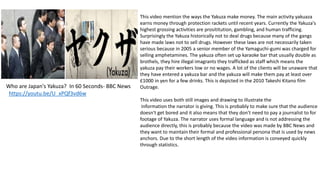
Who are Japan's Yakuza? In 60 Seconds- BBC News
https://youtu.be/U_xPQf3vd6w
This video mention the ways the Yakuza make money. The main activity yakuaza
earns money through protection rackets until recent years. Currently the Yakuza's
highest grossing activities are prosititution, gambling, and human trafficing.
Surprisingly the Yakuza historically not to deal drugs because many of the gangs
have made laws not to sell drugs. However these laws are not necessarily taken
serious because in 2005 a senior member of the Yamaguchi-gumi was charged for
selling amphetamines. The yakuza often set up karaoke bar that usually double as
brothels, they hire illegal imagrants they trafficked as staff which means the
yakuza pay their workers low or no wages. A lot of the clients will be unaware that
they have entered a yakuza bar and the yakuza will make them pay at least over
£1000 in yen for a few drinks. This is depicted in the 2010 Takeshi Kitano film
Outrage.
This video uses both still images and drawing to illustrate the
information the narrator is giving. This is probably to make sure that the audience
doesn't get bored and it also means that they don't need to pay a journalist to for
footage of Yakuza. The narrator uses formal language and is not addressing the
audience directly, this is probably because the video was made by BBC News and
they want to maintain their formal and professional persona that is used by news
anchors. Due to the short length of the video information is conveyed quickly
through statistics.
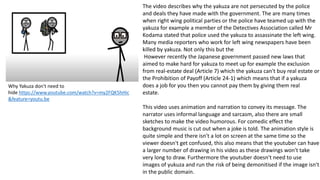
Why Yakuza don't need to
hide https://www.youtube.com/watch?v=my2FQK5hHic
&feature=youtu.be
The video describes why the yakuza are not persecuted by the police
and deals they have made with the government. The are many times
when right wing political parties or the police have teamed up with the
yakuza for example a member of the Detectives Association called Mr
Kodama stated that police used the yakuza to assassinate the left wing.
Many media reporters who work for left wing newspapers have been
killed by yakuza. Not only this but the
However recently the Japanese government passed new laws that
aimed to make hard for yakuza to meet up for example the exclusion
from real-estate deal (Article 7) which the yakuza can't buy real estate or
the Prohibition of Payoff (Article 24-1) which means that if a yakuza
does a job for you then you cannot pay them by giving them real
estate.
This video uses animation and narration to convey its message. The
narrator uses informal language and sarcasm, also there are small
sketches to make the video humorous. For comedic effect the
background music is cut out when a joke is told. The animation style is
quite simple and there isn't a lot on screen at the same time so the
viewer doesn't get confused, this also means that the youtuber can have
a larger number of drawing in his video as these drawings won't take
very long to draw. Furthermore the youtuber doesn't need to use
images of yukuza and run the risk of being demonitised if the image isn't
in the public domain.
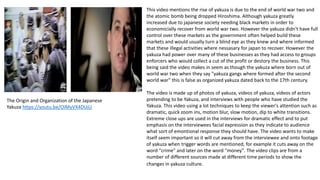
The Origin and Organization of the Japanese
Yakuza https://youtu.be/OiMyVX4DUjU
This video mentions the rise of yakuza is due to the end of world war two and
the atomic bomb being dropped Hiroshima. Although yakuza greatly
increased due to japanese society needing black markets in order to
economicially recover from world war two. However the yakuza didn't have full
control over these markets as the government often helped build these
markets and would usually turn a blind eye as they knew and where informed
that these illegal activities where nessasary for japan to recover. However the
yakuza had power over many of these businesses as they had access to groups
enforcers who would collect a cut of the profit or destory the business. This
being said the video makes in seem as though the yakuza where born out of
world war two when they say "yakuza gangs where formed after the second
world war" this is false as organized yakuza dated back to the 17th century.
The video is made up of photos of yakuza, videos of yakuza, videos of actors
pretending to be Yakuza, and interviews with people who have studied the
Yakuza. This video using a lot techniques to keep the viewer's attention such as
dramatic, quick zoom ins, motion blur, slow motion, dip to white transitions.
Extreme close ups are used in the interviews for dramatic effect and to put
emphasis on the interviewees facial expression as they indicate to audience
what sort of emontional response they should have. The video wants to make
itself seem important so it will cut away from the interviewee and onto footage
of yakuza when trigger words are mentioned, for example it cuts away on the
word "crime" and later on the word "money". The video clips are from a
number of different sources made at different time periods to show the
changes in yakuza culture.
Context, style, techniques, content.
Link it back to your project. Why are you looking at this?
What are you learning from it? How will it affect your project?
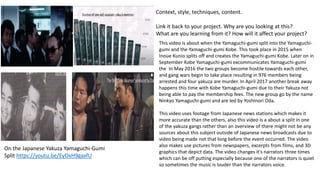
On the Japanese Yakuza Yamaguchi-Gumi
Split https://youtu.be/EyOxH9gaxfU
This video is about when the Yamaguchi-gumi split into the Yamaguchi-
gumi and the Yamaguchi-gumi Kobe. This took place in 2015 when
Inoue Kunio splits off and creates the Yamaguchi-gumi Kobe. Later on in
September Kobe Yamaguchi-gumi excommunicates Yamaguchi-gumi
the In May 2016 the two groups become hostile towards each other,
and gang wars begin to take place resulting in 976 members being
arrested and four yakuza are murder. In April 2017 another break away
happens this time with Kobe Yamaguchi-gumi due to their Yakuza not
being able to pay the membership fees. The new group go by the name
Ninkyo Yamaguchi-gumi and are led by Yoshinori Oda.
This video uses footage from Japanese news stations which makes it
more accurate than the others, also this video is a about a split in one
of the yakuza gangs rather than an overview of there might not be any
sources about this subject outside of Japanese news broadcasts due to
video being made not that long before the event occurred. The video
also makes use pictures from newspapers, excerpts from films, and 3D
graphics that depict data. The video changes it's narrators three times
which can be off putting especially because one of the narrators is quiet
so sometimes the music is louder than the narrators voice.
Bibliography:
BBC News (2015) who are Japan's Yakuza? In 60 seconds- BBC News https://youtu.be/U_xPQf3vd6w
Tapakapa (2017) Why Yakuza Don't Need to Hide https://youtu.be/my2FQK5hHic
American Heroes Channel (2016) The Origin and Organization of the Japanese Yakuza https://youtu.be/OiMyVX4DUjU
Secret Wars (2017) On the Japanese Yakuza Yamaguchi-Gumi Split https://youtu.be/EyOxH9gaxfU
Research summary:
• Most of these videos use a variety of media formats such as Images, Video, Animation. I will do the same.
• The third video uses techniques to keep the audience's attention such as extreme close ups and dip to white transitions. I
will use similar techniques to grab the viewers' attention. My video will have a fast editing style and will cut between different
medias quickly.
• I similar to the second video I will also try insert some Japanese news broadcasts because it adds a sense of authenticity.
• Like the fourth video I will use movie clips to reinforce my depictions of yakuza because they are exciting. I may also base
some of my animation from scenes in yakuza films.
• I will also use a lot of trigger words such as "crime" and "money"
Content Research
• The Yakuza was formed in the early 17th century. In the beginning there was two different type of Yakuza. There was the
Tekiya who were peddlers who mainly sold goods at festivals. The Tekiya then grouped up and set up protection rackets
and had turf wars.
• In 1735 the Shogun needed to de-escalate the turf wars so the government appointed the gangs bosses known as
Oyabuns which means "foster parent". These Oyabuns enabled the gangs to communicate with each other easier.
• The other group that founded early Yakuza were called Bakuto meaning gamblers. Bakuto would often hang out at
roadsides and con travelers with rigged card games. This practice eventually led to loan sharking and this led
to the Bakuto branch out into a variety of different crimes. It was the Bakuto that started the tradition of full body
tattoos.
• The largest yakuza gang, the Yamaguchi-gumi was founded in 1915 by Yamaguchi Harukichi but only became popular
after WW2 and was made much more successful under the leadership of Taoka Kazuo.
• In 2006-2007 there is a gang war between the Yamaguchi-gumi and the Sumiyoshi-kai because Yamaguchi-gumi wanted
complete control of the the Tokyo area. In February a senior member of the Kobayashika (a Sumiyoshi-kai
affiliate) was killed by the Kokusui-Kai(a Yamaguchi-gumi affiliate). The two groups went to war backed by Yamaguchi-
gumi and Sumiyoshi-kai. Not long after the leader of Kokusui-kai killed himself, this may have
been ordered by the Yamaguchi-gumi as a peace agreement.
• The Yakuza reached their peak in 1960s with 184,000 members but by the 21st century their numbers had decreased
to 80,000. There are hundreds of gangs but they are by about twenty larger gangs Also there are not of new members
joining as a study in 2006 showed at 51% of Yakuza are over the age of 50.
• There is currently an increase in non-affliated gangs as the Yakuza are less of a threat to these gangs as they have lost
members and they are not above the law anymore. Also many people cannot afford of the Yakuza's membership fee so
it doesn't sense financially to join the Yakuza. Yakuza that members that are not able to pay the fee will often stage their
own kidnapping and send a ransom note to their own gang. These non-affiliate gangs go by the name of Hangure. Due
to the rise of hangure gangs during Japan's covid lockdown these gangs currently make most of their money selling
medical supplies.
Bibliography
• UKEssays. (November 2018). Yakuza A Changing Institution History Essay. Retrieved from
https://www.ukessays.com/essays/history/yakuza-a-changing-institution-history-essay.php?vref=1
• https://www.thoughtco.com/the-yakuza-organized-crime-195571
• https://www.britannica.com/topic/yakuza
• https://www.occrp.org/en/coronavirus/japanese-gangs-vie-for-power-amid-pandemic
• http://factsanddetails.com/japan/cat22/sub147/item1787.html

Factual research pro forma

  • 1.
  • 2.
    Who are Japan'sYakuza? In 60 Seconds- BBC News https://youtu.be/U_xPQf3vd6w This video mention the ways the Yakuza make money. The main activity yakuaza earns money through protection rackets until recent years. Currently the Yakuza's highest grossing activities are prosititution, gambling, and human trafficing. Surprisingly the Yakuza historically not to deal drugs because many of the gangs have made laws not to sell drugs. However these laws are not necessarily taken serious because in 2005 a senior member of the Yamaguchi-gumi was charged for selling amphetamines. The yakuza often set up karaoke bar that usually double as brothels, they hire illegal imagrants they trafficked as staff which means the yakuza pay their workers low or no wages. A lot of the clients will be unaware that they have entered a yakuza bar and the yakuza will make them pay at least over £1000 in yen for a few drinks. This is depicted in the 2010 Takeshi Kitano film Outrage. This video uses both still images and drawing to illustrate the information the narrator is giving. This is probably to make sure that the audience doesn't get bored and it also means that they don't need to pay a journalist to for footage of Yakuza. The narrator uses formal language and is not addressing the audience directly, this is probably because the video was made by BBC News and they want to maintain their formal and professional persona that is used by news anchors. Due to the short length of the video information is conveyed quickly through statistics.
  • 3.
    Why Yakuza don'tneed to hide https://www.youtube.com/watch?v=my2FQK5hHic &feature=youtu.be The video describes why the yakuza are not persecuted by the police and deals they have made with the government. The are many times when right wing political parties or the police have teamed up with the yakuza for example a member of the Detectives Association called Mr Kodama stated that police used the yakuza to assassinate the left wing. Many media reporters who work for left wing newspapers have been killed by yakuza. Not only this but the However recently the Japanese government passed new laws that aimed to make hard for yakuza to meet up for example the exclusion from real-estate deal (Article 7) which the yakuza can't buy real estate or the Prohibition of Payoff (Article 24-1) which means that if a yakuza does a job for you then you cannot pay them by giving them real estate. This video uses animation and narration to convey its message. The narrator uses informal language and sarcasm, also there are small sketches to make the video humorous. For comedic effect the background music is cut out when a joke is told. The animation style is quite simple and there isn't a lot on screen at the same time so the viewer doesn't get confused, this also means that the youtuber can have a larger number of drawing in his video as these drawings won't take very long to draw. Furthermore the youtuber doesn't need to use images of yukuza and run the risk of being demonitised if the image isn't in the public domain.
  • 4.
    The Origin andOrganization of the Japanese Yakuza https://youtu.be/OiMyVX4DUjU This video mentions the rise of yakuza is due to the end of world war two and the atomic bomb being dropped Hiroshima. Although yakuza greatly increased due to japanese society needing black markets in order to economicially recover from world war two. However the yakuza didn't have full control over these markets as the government often helped build these markets and would usually turn a blind eye as they knew and where informed that these illegal activities where nessasary for japan to recover. However the yakuza had power over many of these businesses as they had access to groups enforcers who would collect a cut of the profit or destory the business. This being said the video makes in seem as though the yakuza where born out of world war two when they say "yakuza gangs where formed after the second world war" this is false as organized yakuza dated back to the 17th century. The video is made up of photos of yakuza, videos of yakuza, videos of actors pretending to be Yakuza, and interviews with people who have studied the Yakuza. This video using a lot techniques to keep the viewer's attention such as dramatic, quick zoom ins, motion blur, slow motion, dip to white transitions. Extreme close ups are used in the interviews for dramatic effect and to put emphasis on the interviewees facial expression as they indicate to audience what sort of emontional response they should have. The video wants to make itself seem important so it will cut away from the interviewee and onto footage of yakuza when trigger words are mentioned, for example it cuts away on the word "crime" and later on the word "money". The video clips are from a number of different sources made at different time periods to show the changes in yakuza culture.
  • 5.
    Context, style, techniques,content. Link it back to your project. Why are you looking at this? What are you learning from it? How will it affect your project? On the Japanese Yakuza Yamaguchi-Gumi Split https://youtu.be/EyOxH9gaxfU This video is about when the Yamaguchi-gumi split into the Yamaguchi- gumi and the Yamaguchi-gumi Kobe. This took place in 2015 when Inoue Kunio splits off and creates the Yamaguchi-gumi Kobe. Later on in September Kobe Yamaguchi-gumi excommunicates Yamaguchi-gumi the In May 2016 the two groups become hostile towards each other, and gang wars begin to take place resulting in 976 members being arrested and four yakuza are murder. In April 2017 another break away happens this time with Kobe Yamaguchi-gumi due to their Yakuza not being able to pay the membership fees. The new group go by the name Ninkyo Yamaguchi-gumi and are led by Yoshinori Oda. This video uses footage from Japanese news stations which makes it more accurate than the others, also this video is a about a split in one of the yakuza gangs rather than an overview of there might not be any sources about this subject outside of Japanese news broadcasts due to video being made not that long before the event occurred. The video also makes use pictures from newspapers, excerpts from films, and 3D graphics that depict data. The video changes it's narrators three times which can be off putting especially because one of the narrators is quiet so sometimes the music is louder than the narrators voice.
  • 6.
    Bibliography: BBC News (2015)who are Japan's Yakuza? In 60 seconds- BBC News https://youtu.be/U_xPQf3vd6w Tapakapa (2017) Why Yakuza Don't Need to Hide https://youtu.be/my2FQK5hHic American Heroes Channel (2016) The Origin and Organization of the Japanese Yakuza https://youtu.be/OiMyVX4DUjU Secret Wars (2017) On the Japanese Yakuza Yamaguchi-Gumi Split https://youtu.be/EyOxH9gaxfU
  • 7.
    Research summary: • Mostof these videos use a variety of media formats such as Images, Video, Animation. I will do the same. • The third video uses techniques to keep the audience's attention such as extreme close ups and dip to white transitions. I will use similar techniques to grab the viewers' attention. My video will have a fast editing style and will cut between different medias quickly. • I similar to the second video I will also try insert some Japanese news broadcasts because it adds a sense of authenticity. • Like the fourth video I will use movie clips to reinforce my depictions of yakuza because they are exciting. I may also base some of my animation from scenes in yakuza films. • I will also use a lot of trigger words such as "crime" and "money"
  • 8.
    Content Research • TheYakuza was formed in the early 17th century. In the beginning there was two different type of Yakuza. There was the Tekiya who were peddlers who mainly sold goods at festivals. The Tekiya then grouped up and set up protection rackets and had turf wars. • In 1735 the Shogun needed to de-escalate the turf wars so the government appointed the gangs bosses known as Oyabuns which means "foster parent". These Oyabuns enabled the gangs to communicate with each other easier. • The other group that founded early Yakuza were called Bakuto meaning gamblers. Bakuto would often hang out at roadsides and con travelers with rigged card games. This practice eventually led to loan sharking and this led to the Bakuto branch out into a variety of different crimes. It was the Bakuto that started the tradition of full body tattoos. • The largest yakuza gang, the Yamaguchi-gumi was founded in 1915 by Yamaguchi Harukichi but only became popular after WW2 and was made much more successful under the leadership of Taoka Kazuo. • In 2006-2007 there is a gang war between the Yamaguchi-gumi and the Sumiyoshi-kai because Yamaguchi-gumi wanted complete control of the the Tokyo area. In February a senior member of the Kobayashika (a Sumiyoshi-kai affiliate) was killed by the Kokusui-Kai(a Yamaguchi-gumi affiliate). The two groups went to war backed by Yamaguchi- gumi and Sumiyoshi-kai. Not long after the leader of Kokusui-kai killed himself, this may have been ordered by the Yamaguchi-gumi as a peace agreement. • The Yakuza reached their peak in 1960s with 184,000 members but by the 21st century their numbers had decreased to 80,000. There are hundreds of gangs but they are by about twenty larger gangs Also there are not of new members joining as a study in 2006 showed at 51% of Yakuza are over the age of 50. • There is currently an increase in non-affliated gangs as the Yakuza are less of a threat to these gangs as they have lost members and they are not above the law anymore. Also many people cannot afford of the Yakuza's membership fee so it doesn't sense financially to join the Yakuza. Yakuza that members that are not able to pay the fee will often stage their own kidnapping and send a ransom note to their own gang. These non-affiliate gangs go by the name of Hangure. Due to the rise of hangure gangs during Japan's covid lockdown these gangs currently make most of their money selling medical supplies.
  • 9.
    Bibliography • UKEssays. (November2018). Yakuza A Changing Institution History Essay. Retrieved from https://www.ukessays.com/essays/history/yakuza-a-changing-institution-history-essay.php?vref=1 • https://www.thoughtco.com/the-yakuza-organized-crime-195571 • https://www.britannica.com/topic/yakuza • https://www.occrp.org/en/coronavirus/japanese-gangs-vie-for-power-amid-pandemic • http://factsanddetails.com/japan/cat22/sub147/item1787.html

Editor's Notes

  • #3 Context affects what is produced, how it is produced and who can produce it. Technology is part of the context. Early fanzines were hand made because there was no InDesign or Photoshop. Web-series simply didn’t existing because the web didn’t exist. People who don’t have access to jobs in mainstream media, to become journalists or editors, might produce work independently of that system. People who don’t see themselves or their interests being represented in main stream media, might produce something that represents them or their social group. The political situation will influence what someone decides to make. The cultural situation will influence what people make. Every media text is a product of its environment, just like people. Style: The way in which something is said, done, expressed, or performed. The combination of distinctive features of literary or artistic expression, execution, or performance  characterizing a particular person, group, school, or era. For example, a podcast could be two people talking, it could be interviews and a voice over, it could just be a recording of a teaching session… how it is done, is the style. Techniques: How are these things being made? What methods are being used? Find out and also use your own experience. For example, is a fanzine being hand written or word processed? How do people making a web series set up their shooting spaces? The more you can find out about technique, the more you can get ideas for your own work. Content: The material, including text and images, that constitutes a publication or document. What is actually in this product? Break it down. Is it interviews, monologues, reviews, instructions… Identify the different types of content in the items you research, to help your own ideas.
  • #4 Context affects what is produced, how it is produced and who can produce it. Technology is part of the context. Early fanzines were hand made because there was no InDesign or Photoshop. Web-series simply didn’t existing because the web didn’t exist. People who don’t have access to jobs in mainstream media, to become journalists or editors, might produce work independently of that system. People who don’t see themselves or their interests being represented in main stream media, might produce something that represents them or their social group. The political situation will influence what someone decides to make. The cultural situation will influence what people make. Every media text is a product of its environment, just like people. Style: The way in which something is said, done, expressed, or performed. The combination of distinctive features of literary or artistic expression, execution, or performance  characterizing a particular person, group, school, or era. For example, a podcast could be two people talking, it could be interviews and a voice over, it could just be a recording of a teaching session… how it is done, is the style. Techniques: How are these things being made? What methods are being used? Find out and also use your own experience. For example, is a fanzine being hand written or word processed? How do people making a web series set up their shooting spaces? The more you can find out about technique, the more you can get ideas for your own work. Content: The material, including text and images, that constitutes a publication or document. What is actually in this product? Break it down. Is it interviews, monologues, reviews, instructions… Identify the different types of content in the items you research, to help your own ideas.
  • #5 Context affects what is produced, how it is produced and who can produce it. Technology is part of the context. Early fanzines were hand made because there was no InDesign or Photoshop. Web-series simply didn’t existing because the web didn’t exist. People who don’t have access to jobs in mainstream media, to become journalists or editors, might produce work independently of that system. People who don’t see themselves or their interests being represented in main stream media, might produce something that represents them or their social group. The political situation will influence what someone decides to make. The cultural situation will influence what people make. Every media text is a product of its environment, just like people. Style: The way in which something is said, done, expressed, or performed. The combination of distinctive features of literary or artistic expression, execution, or performance  characterizing a particular person, group, school, or era. For example, a podcast could be two people talking, it could be interviews and a voice over, it could just be a recording of a teaching session… how it is done, is the style. Techniques: How are these things being made? What methods are being used? Find out and also use your own experience. For example, is a fanzine being hand written or word processed? How do people making a web series set up their shooting spaces? The more you can find out about technique, the more you can get ideas for your own work. Content: The material, including text and images, that constitutes a publication or document. What is actually in this product? Break it down. Is it interviews, monologues, reviews, instructions… Identify the different types of content in the items you research, to help your own ideas.
  • #6 Context affects what is produced, how it is produced and who can produce it. Technology is part of the context. Early fanzines were hand made because there was no InDesign or Photoshop. Web-series simply didn’t existing because the web didn’t exist. People who don’t have access to jobs in mainstream media, to become journalists or editors, might produce work independently of that system. People who don’t see themselves or their interests being represented in main stream media, might produce something that represents them or their social group. The political situation will influence what someone decides to make. The cultural situation will influence what people make. Every media text is a product of its environment, just like people. Style: The way in which something is said, done, expressed, or performed. The combination of distinctive features of literary or artistic expression, execution, or performance  characterizing a particular person, group, school, or era. For example, a podcast could be two people talking, it could be interviews and a voice over, it could just be a recording of a teaching session… how it is done, is the style. Techniques: How are these things being made? What methods are being used? Find out and also use your own experience. For example, is a fanzine being hand written or word processed? How do people making a web series set up their shooting spaces? The more you can find out about technique, the more you can get ideas for your own work. Content: The material, including text and images, that constitutes a publication or document. What is actually in this product? Break it down. Is it interviews, monologues, reviews, instructions… Identify the different types of content in the items you research, to help your own ideas.
  • #7 Harvard Referenced and in alphabetical order.
  • #8 Write down a summary of the key things you have learned in this research, that will help you with your project. Short sentences and bullet points are acceptable.