Facts on the
DAO Token ICO
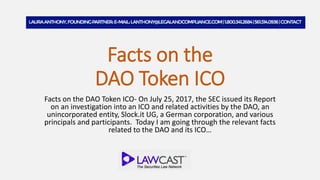
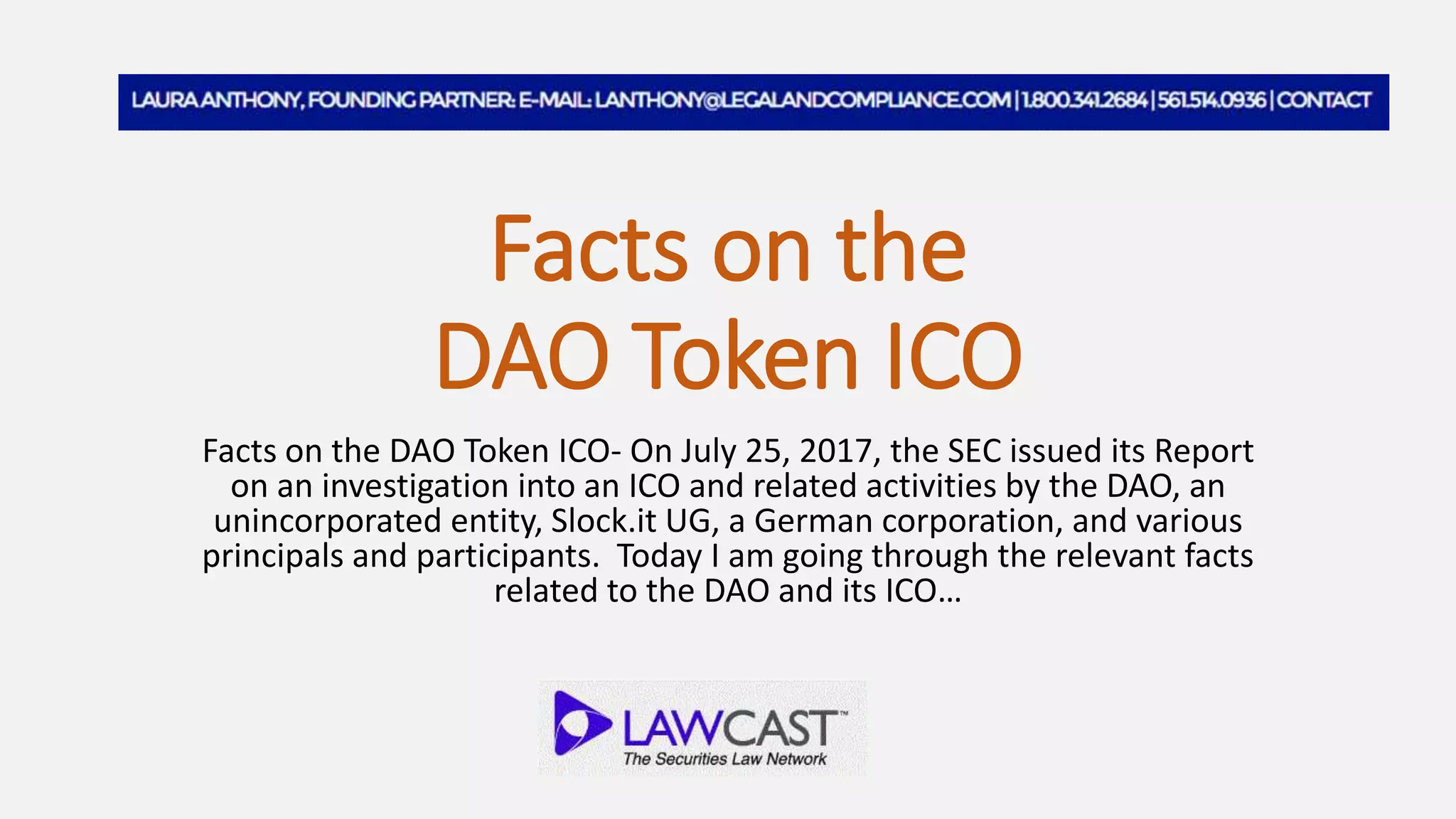
Facts on the DAO Token ICO- On July 25, 2017, the SEC issued its Report
on an investigation into an ICO and related activities by the DAO, an
unincorporated entity, Slock.it UG, a German corporation, and various
principals and participants. Today I am going through the relevant facts
related to the DAO and its ICO…
Facts on the DAO Token ICO
• Facts on the DAO Token ICO- On July 25, 2017, the SEC issued its
Report on an investigation into an ICO and related activities by the
DAO, an unincorporated entity, Slock.it UG, a German corporation,
and various principals and participants. Today I am going through the
relevant facts related to the DAO and its ICO.
Facts on the DAO Token ICO
• In a one-month period from April 30, through May 28, 2016, the DAO offered and
sold 1.15 billion DAO Tokens in exchange for 12 million Ether (“ETH”) valued at
approximately $150 million USD. ETH is a virtual currency. The Financial Action
Task Force defines a “virtual currency” as:
• a digital representation of value that can be digitally traded and functions as: (1) a
medium of exchange; and/or (2) a unit of account; and/or (3) a store of value, but
does not have legal tender status (i.e., when tendered to a creditor, is a valid and
legal offer of payment) in any jurisdiction. It is not issued or guaranteed by any
jurisdiction, and fulfils the above functions only by agreement within the
community of users of the virtual currency. Virtual currency is distinguished from
fiat currency (a.k.a. “real currency,” “real money,” or “national currency”), which
is the coin and paper money of a country that is designated as its legal tender;
circulates; and is customarily used and accepted as a medium of exchange in the
issuing country. It is distinct from e-money, which is a digital representation of fiat
currency used to electronically transfer value denominated in fiat currency.
Facts on the DAO Token ICO
• The DAO itself was created by the founders of Slock.it as a type of
alternative corporation with all corporate functions and governance
automated using blockchain and smart contracts. The DAO was the
“first generation” of its kind. Participants sent in ETH in exchange for
DAO Tokens. DAO Token holders could vote on projects to be used
with the DAO assets (ETH, which could be exchanged for fiat currency
and other physical or digital assets) and participate in rewards such as
profit distributions and dividends. The entire DAO was intended to be
autonomous such that project proposals were in the form of smart
contracts and voting administered by computer code. The DAO code
was launched on the Ethereum blockchain.
Facts on the DAO Token ICO
• The DAO promoted itself through a website which described its
purpose (“[T]o blaze a new path in business for the betterment of its
members, existing simultaneously nowhere and everywhere and
operating solely with the steadfast iron will of unstoppable code”),
how it operated, its source code, and a link to buy the DAO Tokens.
The DAO was also promoted through media attention and numerous
social media channels.
Facts on the DAO Token ICO
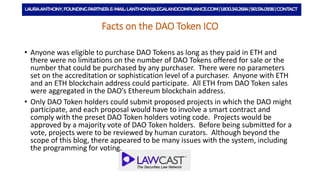
• Anyone was eligible to purchase DAO Tokens as long as they paid in ETH and
there were no limitations on the number of DAO Tokens offered for sale or the
number that could be purchased by any purchaser. There were no parameters
set on the accreditation or sophistication level of a purchaser. Anyone with ETH
and an ETH blockchain address could participate. All ETH from DAO Token sales
were aggregated in the DAO’s Ethereum blockchain address.
• Only DAO Token holders could submit proposed projects in which the DAO might
participate, and each proposal would have to involve a smart contract and
comply with the preset DAO Token holders voting code. Projects would be
approved by a majority vote of DAO Token holders. Before being submitted for a
vote, projects were to be reviewed by human curators. Although beyond the
scope of this blog, there appeared to be many issues with the system, including
the programming for voting.
Facts on the DAO Token ICO
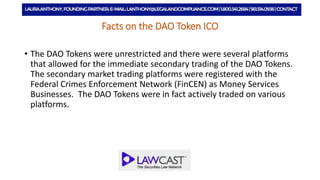
• The DAO Tokens were unrestricted and there were several platforms
that allowed for the immediate secondary trading of the DAO Tokens.
The secondary market trading platforms were registered with the
Federal Crimes Enforcement Network (FinCEN) as Money Services
Businesses. The DAO Tokens were in fact actively traded on various
platforms.
Facts on the DAO Token ICO

Facts on the DAO Token ICO

  • 1.
    Facts on the DAOToken ICO Facts on the DAO Token ICO- On July 25, 2017, the SEC issued its Report on an investigation into an ICO and related activities by the DAO, an unincorporated entity, Slock.it UG, a German corporation, and various principals and participants. Today I am going through the relevant facts related to the DAO and its ICO…
  • 2.
    Facts on theDAO Token ICO • Facts on the DAO Token ICO- On July 25, 2017, the SEC issued its Report on an investigation into an ICO and related activities by the DAO, an unincorporated entity, Slock.it UG, a German corporation, and various principals and participants. Today I am going through the relevant facts related to the DAO and its ICO.
  • 3.
    Facts on theDAO Token ICO • In a one-month period from April 30, through May 28, 2016, the DAO offered and sold 1.15 billion DAO Tokens in exchange for 12 million Ether (“ETH”) valued at approximately $150 million USD. ETH is a virtual currency. The Financial Action Task Force defines a “virtual currency” as: • a digital representation of value that can be digitally traded and functions as: (1) a medium of exchange; and/or (2) a unit of account; and/or (3) a store of value, but does not have legal tender status (i.e., when tendered to a creditor, is a valid and legal offer of payment) in any jurisdiction. It is not issued or guaranteed by any jurisdiction, and fulfils the above functions only by agreement within the community of users of the virtual currency. Virtual currency is distinguished from fiat currency (a.k.a. “real currency,” “real money,” or “national currency”), which is the coin and paper money of a country that is designated as its legal tender; circulates; and is customarily used and accepted as a medium of exchange in the issuing country. It is distinct from e-money, which is a digital representation of fiat currency used to electronically transfer value denominated in fiat currency.
  • 4.
    Facts on theDAO Token ICO • The DAO itself was created by the founders of Slock.it as a type of alternative corporation with all corporate functions and governance automated using blockchain and smart contracts. The DAO was the “first generation” of its kind. Participants sent in ETH in exchange for DAO Tokens. DAO Token holders could vote on projects to be used with the DAO assets (ETH, which could be exchanged for fiat currency and other physical or digital assets) and participate in rewards such as profit distributions and dividends. The entire DAO was intended to be autonomous such that project proposals were in the form of smart contracts and voting administered by computer code. The DAO code was launched on the Ethereum blockchain.
  • 5.
    Facts on theDAO Token ICO • The DAO promoted itself through a website which described its purpose (“[T]o blaze a new path in business for the betterment of its members, existing simultaneously nowhere and everywhere and operating solely with the steadfast iron will of unstoppable code”), how it operated, its source code, and a link to buy the DAO Tokens. The DAO was also promoted through media attention and numerous social media channels.
  • 6.
    Facts on theDAO Token ICO • Anyone was eligible to purchase DAO Tokens as long as they paid in ETH and there were no limitations on the number of DAO Tokens offered for sale or the number that could be purchased by any purchaser. There were no parameters set on the accreditation or sophistication level of a purchaser. Anyone with ETH and an ETH blockchain address could participate. All ETH from DAO Token sales were aggregated in the DAO’s Ethereum blockchain address. • Only DAO Token holders could submit proposed projects in which the DAO might participate, and each proposal would have to involve a smart contract and comply with the preset DAO Token holders voting code. Projects would be approved by a majority vote of DAO Token holders. Before being submitted for a vote, projects were to be reviewed by human curators. Although beyond the scope of this blog, there appeared to be many issues with the system, including the programming for voting.
  • 7.
    Facts on theDAO Token ICO • The DAO Tokens were unrestricted and there were several platforms that allowed for the immediate secondary trading of the DAO Tokens. The secondary market trading platforms were registered with the Federal Crimes Enforcement Network (FinCEN) as Money Services Businesses. The DAO Tokens were in fact actively traded on various platforms.
  • 8.
    Facts on theDAO Token ICO