Mini Project on
Submitted By:
MOHAMMED MUQEETH (161021733027)
SYED MUSHARAF AFZAL (161021733052)
MOHAMMED ABDUL RAOOF (161021733306)
Face Recognition Attendance
systems
Under the Guidance of:
MS.DR.FARHEEN SULTANA
Asst.Professor
CSE Department
FACE CHECK-IN
Abstract
• The "Face Check-In" is an innovative web application designed to streamline the
attendance process by harnessing the power of face recognition technology. This system
leverages classification algorithms and Python libraries, such as face_recognition and
OpenCV-python, to accurately identify individuals and record their attendance in a hassle-
free manner.
• The core of the system is built upon the face_recognition library, enabling the application
to detect and recognize faces with exceptional accuracy. Combined with the
functionalities of OpenCV-python, which offers prebuilt functions for image processing,
the system efficiently processes incoming visual data, ensuring the seamless
identification of candidates.
• The web app is developed using the Streamlit library, providing a user-friendly interface
that facilitates easy access and management of attendance data. Upon login, candidates'
faces are captured and cross-referenced against a pre-registered database, associating
each individual with their name, roll number, date, and time of check-in.
Introduction/objective
​
• Our objective today is to introduce you to a cutting-
edge solution: face recognition attendance systems.​
​
• We will explain how they work, highlight their benefits,
discuss data storage and implementation.​
• and emphasize the importance of using this technology
for modern businesses and organizations.​
​
• ​
• ​
Face Check-In is an attendance management system that uses facial recognition
algorithms to capture and analyze the unique facial features of individuals.
 The system maintains a database of pre-registered faces and compares them
with the face captured in real-time to identify and authenticate individuals.
And stores them in a CSV file.​
​
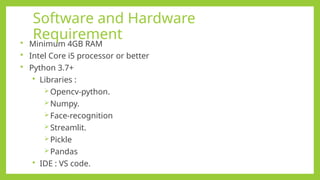
Software and Hardware
Requirement
 Minimum 4GB RAM
 Intel Core i5 processor or better
 Python 3.7+
 Libraries :
Opencv-python.
Numpy.
Face-recognition
Streamlit.
Pickle
Pandas
 IDE : VS code.
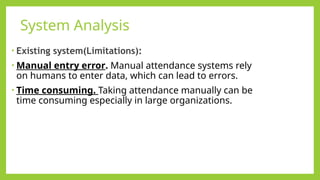
System Analysis
• Existing system(Limitations):​
• Manual entry error. Manual attendance systems rely
on humans to enter data, which can lead to errors.​
​
• Time consuming. Taking attendance manually can be
time consuming especially in large organizations.
​
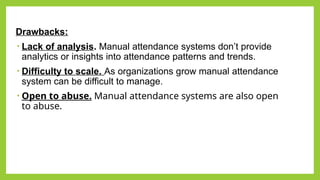
Drawbacks:​
• Lack of analysis. Manual attendance systems don’t provide
analytics or insights into attendance patterns and trends.
• Difficulty to scale. As organizations grow manual attendance
system can be difficult to manage.​
• Open to abuse. Manual attendance systems are also open
to abuse.
​
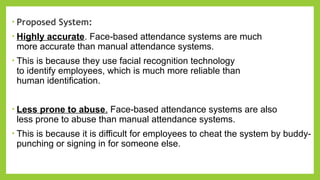
• Proposed System: ​
• Highly accurate. Face-based attendance systems are much
more accurate than manual attendance systems.​
• This is because they use facial recognition technology
to identify employees, which is much more reliable than
human identification.​
​
• Less prone to abuse. Face-based attendance systems are also
less prone to abuse than manual attendance systems. ​
• This is because it is difficult for employees to cheat the system by buddy-
punching or signing in for someone else.​
• Efficient and easy to use. Face-based attendance systems
are very efficient and easy to use.​
• Employees simply need to scan their faces in order to clock in
and out, which can save them a lot of time.​
​
• Scalable. Face-based attendance systems are very scalable, which
means that they can be easily used by large organizations.​
• This is because they do not require any manual data entry,
which can save a lot of time and resources.​
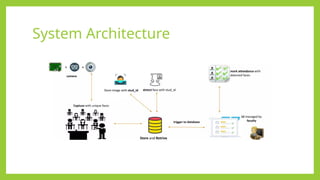
System Architecture
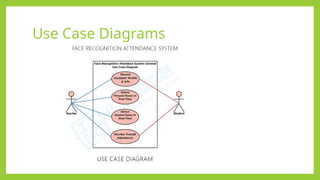
Use Case Diagrams
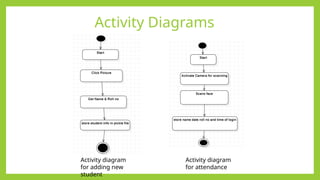
Activity Diagrams
Activity diagram
for attendance
Activity diagram
for adding new
student
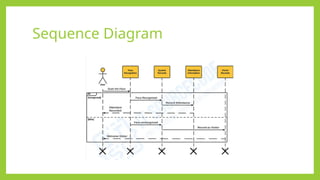
Sequence Diagram
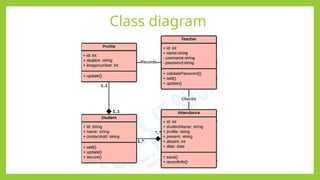
Class diagram
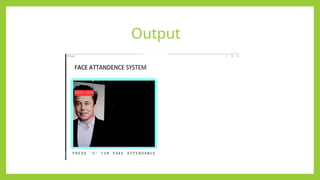
Output
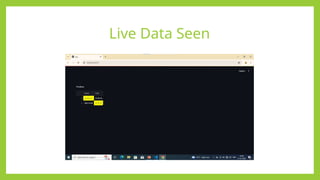
Live Data Seen
Attendance Saved
Applications
• Can be used in offices, colleges or any organizations to
ease the attendance process.
• Used for security system and anamoly detection in cctv
cameras
Reference Bibliography References ​
• https://github.com/ageitgey/face_recognition
• https://www.youtube.com/watch?v=BYCKvM8eZGA&t=2782s
• https://www.researchgate.net/publication/
341876647_Face_Recognition_based_Attendance_Management_
System
• https://ieeexplore.ieee.org/document/9215441
• https://www.ijert.org/research/face-recognition-based-attendance-
system-IJERTV9IS060615.pdf

Face attendance Recognition System using Machine Learning

  • 1.
    Mini Project on SubmittedBy: MOHAMMED MUQEETH (161021733027) SYED MUSHARAF AFZAL (161021733052) MOHAMMED ABDUL RAOOF (161021733306) Face Recognition Attendance systems Under the Guidance of: MS.DR.FARHEEN SULTANA Asst.Professor CSE Department
  • 2.
  • 3.
    Abstract • The "FaceCheck-In" is an innovative web application designed to streamline the attendance process by harnessing the power of face recognition technology. This system leverages classification algorithms and Python libraries, such as face_recognition and OpenCV-python, to accurately identify individuals and record their attendance in a hassle- free manner. • The core of the system is built upon the face_recognition library, enabling the application to detect and recognize faces with exceptional accuracy. Combined with the functionalities of OpenCV-python, which offers prebuilt functions for image processing, the system efficiently processes incoming visual data, ensuring the seamless identification of candidates. • The web app is developed using the Streamlit library, providing a user-friendly interface that facilitates easy access and management of attendance data. Upon login, candidates' faces are captured and cross-referenced against a pre-registered database, associating each individual with their name, roll number, date, and time of check-in.
  • 4.
    Introduction/objective ​ • Our objectivetoday is to introduce you to a cutting- edge solution: face recognition attendance systems.​ ​ • We will explain how they work, highlight their benefits, discuss data storage and implementation.​ • and emphasize the importance of using this technology for modern businesses and organizations.​ ​ • ​ • ​
  • 5.
    Face Check-In isan attendance management system that uses facial recognition algorithms to capture and analyze the unique facial features of individuals.  The system maintains a database of pre-registered faces and compares them with the face captured in real-time to identify and authenticate individuals. And stores them in a CSV file.​ ​
  • 6.
    Software and Hardware Requirement Minimum 4GB RAM  Intel Core i5 processor or better  Python 3.7+  Libraries : Opencv-python. Numpy. Face-recognition Streamlit. Pickle Pandas  IDE : VS code.
  • 7.
    System Analysis • Existingsystem(Limitations):​ • Manual entry error. Manual attendance systems rely on humans to enter data, which can lead to errors.​ ​ • Time consuming. Taking attendance manually can be time consuming especially in large organizations. ​
  • 8.
    Drawbacks:​ • Lack ofanalysis. Manual attendance systems don’t provide analytics or insights into attendance patterns and trends. • Difficulty to scale. As organizations grow manual attendance system can be difficult to manage.​ • Open to abuse. Manual attendance systems are also open to abuse. ​
  • 9.
    • Proposed System:​ • Highly accurate. Face-based attendance systems are much more accurate than manual attendance systems.​ • This is because they use facial recognition technology to identify employees, which is much more reliable than human identification.​ ​ • Less prone to abuse. Face-based attendance systems are also less prone to abuse than manual attendance systems. ​ • This is because it is difficult for employees to cheat the system by buddy- punching or signing in for someone else.​
  • 10.
    • Efficient andeasy to use. Face-based attendance systems are very efficient and easy to use.​ • Employees simply need to scan their faces in order to clock in and out, which can save them a lot of time.​ ​ • Scalable. Face-based attendance systems are very scalable, which means that they can be easily used by large organizations.​ • This is because they do not require any manual data entry, which can save a lot of time and resources.​
  • 11.
  • 12.
  • 13.
    Activity Diagrams Activity diagram forattendance Activity diagram for adding new student
  • 14.
  • 15.
  • 16.
  • 17.
  • 18.
  • 19.
    Applications • Can beused in offices, colleges or any organizations to ease the attendance process. • Used for security system and anamoly detection in cctv cameras
  • 20.
    Reference Bibliography References​ • https://github.com/ageitgey/face_recognition • https://www.youtube.com/watch?v=BYCKvM8eZGA&t=2782s • https://www.researchgate.net/publication/ 341876647_Face_Recognition_based_Attendance_Management_ System • https://ieeexplore.ieee.org/document/9215441 • https://www.ijert.org/research/face-recognition-based-attendance- system-IJERTV9IS060615.pdf