DIS Architecture + Design Fall 2014 
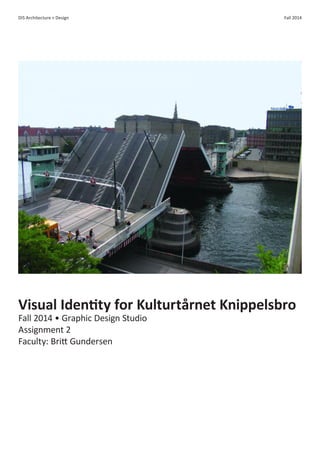
Visual Identity for Kulturtårnet Knippelsbro 
Fall 2014 • Graphic Design Studio 
Assignment 2 
Faculty: Britt Gundersen
DIS Architecture + Design Fall 2014 
2 
Introduction • Assignment 
Background 
Copenhagen Harbour 
Over the last 10 years the Copenhagen Harbour’s popularity has increased greatly, 
encouraging the creation of new activities architetcture. In the middle of the 
Copenhagen Harbour is a hint from the past: a symbol of the industrial port city with 
a look that matches the stock exchange and the other towers’ verdigris patina. 
History 
Knippelsbro is a bascule bridge across the Inner Harbour of Copenhagen, Denmark, 
connecting the Zealand-side Slotsholmen to Christianshavn. It is one of only two 
bridges to carry motor vehicles across the harbour in central Copenhagen- the other 
being Langebro. The Knippelsbro bridge, the fifth on the site, is 115 metres long 
and was inaugurated in 1937. The bridge is a national icon and is also on the Danish 
200kr. 
Today, only one of the functionalist style towers are used to control the bridge. The 
other tower is rarely open, but in 2013 the association Kulturtårnet Knippelsbro (The 
Culture Tower) turned the tower into a cultural experiment. Kulturtårnet Knippelsbro 
is working to promote cultural projects and life on the Copenhagen harbour, such as 
art exhibitions and food festivals. 
Kulturtårnet does not have a visual identity. 
Behind the Kulturtårnet Knippelsbro is Lars Erik Schmidt, Rasmus Krone Andersen 
and Malthe Bjørn Merrild. 
Assignment 
You will define the visual identity of Kulturtårnet Knippelsbro. 
Through the project you will use the ‘double diamond’ design process model: 
Phase 1: Discover 
Through research, a concept will be established, which will inform your choices in 
defining and developing the visual identity. 
What is Kulturtårnet Knippelsbro? Who is Kulturtårnet Knippelsbro targeting? 
Student, locals, tourists- is one group more important than another? What story 
should the Kulturtårnet Knippelsbro tell about itself - and does it need to be 
differentiated according to targetgroups? How could this be reflected in a visual 
identity and in the name? Does the farm need a logomark? Is a typeface better? A 
colour? Patterns? What should the place relate to? 
Those are only a few of the questions you could ask in order to clarify your concept 
and inform your design. 
The following should be included in the discovering studies and included in your 
presentation: 
• Analysis and research of Kulturtårnet Knippelsbro. 
• Studies of market/competitors and client 
• Studies of the function and aim of Kulturtårnet Knippelsbro 
• A Brainstorm
DIS Architecture + Design Fall 2014 
3 
Assignment • Presentation • Evaluation 
Phase 2: Define 
The defining stage is a filter where review, selection and discarding takes place. 
This is where findings from the discovering stage are refined as ideas, concepts and 
solutions. 
The following should be included in the defining studies and included in your 
presentation: 
• Inspiration / references 
• Exploration of visual ideas and concepts. Quick sketches. 
• Condensation of the concept and aim: A short description in writing (max 40 
words). 
PRESENTATION PHASE 1 + 2: 
You will individually present your findings and work from phases 1+2 during studio 
on September 9(and during the final presentation on September 25/26). Your 
findings should be pinned up on your boards by the beginning of class. 
Phase 3: Develop 
During the development stage of the visual identity, you will work on designing and 
testing your defined concept. At the end of the this stage you will decide on a final 
design. 
The following should be included in the developing studies: 
• Sketches of ideas and designs 
• A final design 
Phase 4: Deliver 
The delivering stage is where the design is implemented on relevant media and 
platforms. At the end of this stage you will present your design. 
Final Presentation 
The final presentation must at least consist of: 
• Your phase 1+2 presentation. 
• Sketches showing process (from phase 3) 
• Design of the logo/main identity component. Large and small scale. Positive and 
negative versions. 
• Choice of primary and secondary typeface 
• Choice of colours and/or graphic elements. 
• Identity implemented and visualised on: 
– stationary 
– a 4 page brochure 
– web landing page 
– a sign on the building/entrance. 
The format of the presentation materials is A3 sheets. Each page should be 
understandable on its own, and the layout should be organized so your project 
is self-explanatory. Also, each page should have your name, date and assignment 
number and title. 
Plot Information 
Evaluation 
40% Daily work in studio (process) 
60% Final presentation (project) 
Evaluation criteria are outlined in detail in the grading rubrics, which are in the 
course syllabus. Any plots submitted after the deadline, or failure to complete pre-sentation 
material on-time, will be downgraded.
DIS Architecture + Design Fall 2014 
4 
Schedule 
Day Date Time Topic 
Tu Sept 2 13:15 - 17:00 Studio with Faculty 
Introduction to assignment. 
Visit to Kulturtårnet. Guided by Lars Erik 
Fr Sept 5 13:15 - 17:00 Studio with Faculty 
Discuss initial research, questions and prep 
Tu Sept 9 13:15 - 17:00 Course Course Week Studio with Faculty 
Introduction to phase 2 
Sept 11-13 Short Study Tour to Western Denmark 
Tu Sept 16 13:15 - 17:00 Studio with Faculty 
Phase 1 + 2 presentations and personal feedback 
15:00 - 16:00 Class Rep Meeting 1(3) 
Location: V7 basement classroom 
We Sept 17 13:15 - 17:00 Intro to Long Study Tour 
Locations: Tour Z - V7.41 
Tour V - V10.A11 
Tour Y - V7 Basement Classroom 
Tour W - V10.D11 
Fr Sept 19 13:15 - 17:00 Studio with Faculty 
Tu Sept 23 13:15 - 17:00 Studio with Faculty 
We Sept 24 09:00 Assignment 2 Plot Submission Deadline 
To AD_Documents 
22:00 Assignment 2 Final Pin-up Deadline 
Th Sept 25 09:00 - 16:30 Final Presentations of Assignment 2 
Location: TBA 
Fr Sept 26 09:00 - 16:30 Final Presentations of Assignment 2 
Location: TBA

Fa14 asn2 final

  • 1.
    DIS Architecture +Design Fall 2014 Visual Identity for Kulturtårnet Knippelsbro Fall 2014 • Graphic Design Studio Assignment 2 Faculty: Britt Gundersen
  • 2.
    DIS Architecture +Design Fall 2014 2 Introduction • Assignment Background Copenhagen Harbour Over the last 10 years the Copenhagen Harbour’s popularity has increased greatly, encouraging the creation of new activities architetcture. In the middle of the Copenhagen Harbour is a hint from the past: a symbol of the industrial port city with a look that matches the stock exchange and the other towers’ verdigris patina. History Knippelsbro is a bascule bridge across the Inner Harbour of Copenhagen, Denmark, connecting the Zealand-side Slotsholmen to Christianshavn. It is one of only two bridges to carry motor vehicles across the harbour in central Copenhagen- the other being Langebro. The Knippelsbro bridge, the fifth on the site, is 115 metres long and was inaugurated in 1937. The bridge is a national icon and is also on the Danish 200kr. Today, only one of the functionalist style towers are used to control the bridge. The other tower is rarely open, but in 2013 the association Kulturtårnet Knippelsbro (The Culture Tower) turned the tower into a cultural experiment. Kulturtårnet Knippelsbro is working to promote cultural projects and life on the Copenhagen harbour, such as art exhibitions and food festivals. Kulturtårnet does not have a visual identity. Behind the Kulturtårnet Knippelsbro is Lars Erik Schmidt, Rasmus Krone Andersen and Malthe Bjørn Merrild. Assignment You will define the visual identity of Kulturtårnet Knippelsbro. Through the project you will use the ‘double diamond’ design process model: Phase 1: Discover Through research, a concept will be established, which will inform your choices in defining and developing the visual identity. What is Kulturtårnet Knippelsbro? Who is Kulturtårnet Knippelsbro targeting? Student, locals, tourists- is one group more important than another? What story should the Kulturtårnet Knippelsbro tell about itself - and does it need to be differentiated according to targetgroups? How could this be reflected in a visual identity and in the name? Does the farm need a logomark? Is a typeface better? A colour? Patterns? What should the place relate to? Those are only a few of the questions you could ask in order to clarify your concept and inform your design. The following should be included in the discovering studies and included in your presentation: • Analysis and research of Kulturtårnet Knippelsbro. • Studies of market/competitors and client • Studies of the function and aim of Kulturtårnet Knippelsbro • A Brainstorm
  • 3.
    DIS Architecture +Design Fall 2014 3 Assignment • Presentation • Evaluation Phase 2: Define The defining stage is a filter where review, selection and discarding takes place. This is where findings from the discovering stage are refined as ideas, concepts and solutions. The following should be included in the defining studies and included in your presentation: • Inspiration / references • Exploration of visual ideas and concepts. Quick sketches. • Condensation of the concept and aim: A short description in writing (max 40 words). PRESENTATION PHASE 1 + 2: You will individually present your findings and work from phases 1+2 during studio on September 9(and during the final presentation on September 25/26). Your findings should be pinned up on your boards by the beginning of class. Phase 3: Develop During the development stage of the visual identity, you will work on designing and testing your defined concept. At the end of the this stage you will decide on a final design. The following should be included in the developing studies: • Sketches of ideas and designs • A final design Phase 4: Deliver The delivering stage is where the design is implemented on relevant media and platforms. At the end of this stage you will present your design. Final Presentation The final presentation must at least consist of: • Your phase 1+2 presentation. • Sketches showing process (from phase 3) • Design of the logo/main identity component. Large and small scale. Positive and negative versions. • Choice of primary and secondary typeface • Choice of colours and/or graphic elements. • Identity implemented and visualised on: – stationary – a 4 page brochure – web landing page – a sign on the building/entrance. The format of the presentation materials is A3 sheets. Each page should be understandable on its own, and the layout should be organized so your project is self-explanatory. Also, each page should have your name, date and assignment number and title. Plot Information Evaluation 40% Daily work in studio (process) 60% Final presentation (project) Evaluation criteria are outlined in detail in the grading rubrics, which are in the course syllabus. Any plots submitted after the deadline, or failure to complete pre-sentation material on-time, will be downgraded.
  • 4.
    DIS Architecture +Design Fall 2014 4 Schedule Day Date Time Topic Tu Sept 2 13:15 - 17:00 Studio with Faculty Introduction to assignment. Visit to Kulturtårnet. Guided by Lars Erik Fr Sept 5 13:15 - 17:00 Studio with Faculty Discuss initial research, questions and prep Tu Sept 9 13:15 - 17:00 Course Course Week Studio with Faculty Introduction to phase 2 Sept 11-13 Short Study Tour to Western Denmark Tu Sept 16 13:15 - 17:00 Studio with Faculty Phase 1 + 2 presentations and personal feedback 15:00 - 16:00 Class Rep Meeting 1(3) Location: V7 basement classroom We Sept 17 13:15 - 17:00 Intro to Long Study Tour Locations: Tour Z - V7.41 Tour V - V10.A11 Tour Y - V7 Basement Classroom Tour W - V10.D11 Fr Sept 19 13:15 - 17:00 Studio with Faculty Tu Sept 23 13:15 - 17:00 Studio with Faculty We Sept 24 09:00 Assignment 2 Plot Submission Deadline To AD_Documents 22:00 Assignment 2 Final Pin-up Deadline Th Sept 25 09:00 - 16:30 Final Presentations of Assignment 2 Location: TBA Fr Sept 26 09:00 - 16:30 Final Presentations of Assignment 2 Location: TBA