EYE
VISUAL SYSTEM
GENERAL TERMS
OPTHOMOLOGY
OPTHOMOLOGIST
OPTOMETRIST
ANATOMY& PHYSIOLOGY OF THE EYE
PATHOLOGY/DISEASES
MEDICAL TERMINOLOGIES& ABBREVIATIONS
ICD AND CPT CODES
SYNOPSIS
EYE
• Eye is one of the most important sense organs which enables us to see the
world.
• The study of structure, disease and refractive errors associated with the
eyes is known as opthalmology.
• A physician who specializes in the area of study is known as an
ophthalmologist.
• A licensed medical professional who specialize in the examination of the
eyes and diagnosis ,correction of refractive errors through the use of
corrective lense is optometrist
EYE
ANATOMY OF EYE
• The External Structure of an Eye
• The parts of the eye that are visible externally include the following:-
• Sclera: It is a white visible portion. It is made up of dense connective tissue and protects the
inner parts.
• Conjunctiva: It lines the sclera and is made up of stratified squamous epithelium. It keeps
our eyes moist and clear and provides lubrication by secreting mucus and tears.
• Cornea: It is the transparent, anterior or front part of our eye, which covers the pupil and
the iris. The main function is to refract the light along with the lens.
• Iris: It is the pigmented, coloured portion of the eye, visible externally. The main function of
the iris is to control the diameter of the pupil according to the light source.
• Pupil: It is the small aperture located in the centre of the Iris. It allows light to enter and
focus on the retina.
ANATOMY OF EYE
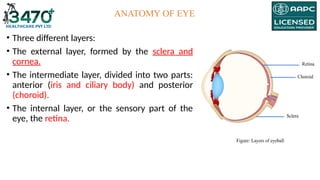
• Three different layers:
• The external layer, formed by the sclera and
cornea.
• The intermediate layer, divided into two parts:
anterior (iris and ciliary body) and posterior
(choroid).
• The internal layer, or the sensory part of the
eye, the retina.
INTERNAL COMPONENTS OF AN EYE
The Internal Structure of an Eye
• Lens: It is a transparent, biconvex, lens of an eye. The lens is attached to the
ciliary body by ligaments. The lens along with the cornea refracts light so that it
focuses on the retina.
• Retina: It is the innermost layer of the eye. It is light sensitive and acts as a film
of a camera.
• Optic nerve: It is located at the posterior portion of the eyes. The optic nerves
carry all the nerve impulses from the retina to the human brain for perception.
• Aqueous Humour: It is a watery fluid present between the cornea and the
lens. It nourishes the eye and keeps it inflated.
• Vitreous Humour: it is a transparent, jelly-like substance present between the
lens and the retina. It contains water (99%), collage, proteins, etc.
What are the types of refractive errors?
There are 4 common types of refractive errors:
• Nearsightedness (myopia) makes far-away objects look blurry
• Farsightedness (hyperopia) makes nearby objects look blurry
• Astigmatism can make far-away and nearby objects look blurry or distorted
• Presbyopia makes it hard for middle-aged and older adults to see things up
close
TYPES OF REFRACTIVE ERRORS
1. Myopia
2. Hyperopia
3. Astigmatism
REFRACTIVE ERRORS
PATHOLOGY
• Glaucoma is a common eye condition where the optic nerve, which connects the eye to the brain,
becomes damaged.
• It's usually caused by fluid building up in the front part of the eye, which increases pressure inside
the eye.
• A cataract is a cloudy area in the lens of your eye (the clear part of the eye that helps to focus light)
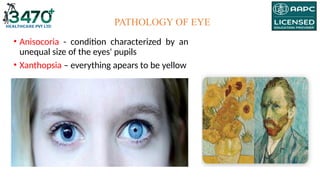
• Anisocoria - condition characterized by an
unequal size of the eyes' pupils
• Xanthopsia – everything apears to be yellow
PATHOLOGY OF EYE
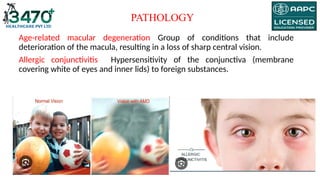
Age-related macular degeneration Group of conditions that include
deterioration of the macula, resulting in a loss of sharp central vision.
Allergic conjunctivitis Hypersensitivity of the conjunctiva (membrane
covering white of eyes and inner lids) to foreign substances.
PATHOLOGY
Pathology
• Abrasion, corneal abrasion. Injury. Scraped area of corneal surface; accompanied by
loss of superficial tissue (epithelium).
• Diabetic retinopathy Spectrum of retinal changes accompanying long-standing
diabetes mellitus.
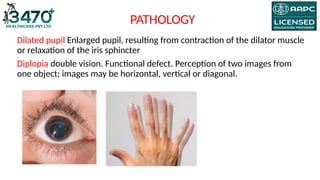
Dilated pupil Enlarged pupil, resulting from contraction of the dilator muscle
or relaxation of the iris sphincter
Diplopia double vision. Functional defect. Perception of two images from
one object; images may be horizontal, vertical or diagonal.
PATHOLOGY
• .
• Diopter (D) (di-AHP-tur). Unit of measure. Unit to designate the refractive power of a
lens, or the degree of light convergence or divergence.
• LASIK (LAY-sik). Surgical procedure. Acronym: Laser in Situ Keratomileusis, also Laser
Assisted Intrastromal Keratoplasty.
• Ocular hypertension – excessively high intra ocular pressure
• Pink eye – contagious conjunctivitis
• Retinitis – inflammation of the retina
• Strabismus – unable to focus on a particular point
• Trachoma – infectious disease caused by the organism chlamydia trachomatis
PATHOLOGY
dIA
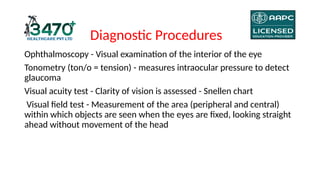
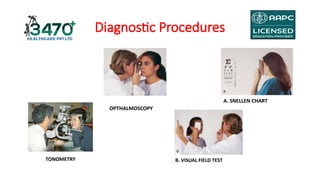
Ophthalmoscopy - Visual examination of the interior of the eye
Tonometry (ton/o = tension) - measures intraocular pressure to detect
glaucoma
Visual acuity test - Clarity of vision is assessed - Snellen chart
Visual field test - Measurement of the area (peripheral and central)
within which objects are seen when the eyes are fixed, looking straight
ahead without movement of the head
Diagnostic Procedures
• AMD-Age-related Macular Degeneration
• HEENT-Head Eyes Ears Nose Throat
• LASIK-Laser Insitu Keratomileusis
• OD-Right Eye
• OS-Left Eye
• OU-Both Eyes
• VA-Visual Acuity
• VF-Visual Field
• L&A- Light and Accomodation
• EOM-Extraoccular Movement
ABBREVIATIONS
ICD CODES
• H53.009 -Unspecified amblyopia, unspecified eye
• H16.013 -Central corneal ulcer, bilateral
• H53.2 –Diplopia
• H40 – Glaucoma
• H18.609 - Keratoconus, unspecified, unspecified eye
CPT PROCEDURE CODES
• 67700-blepharotomy drainage of abcess
• 65710-keratoplasty anterior lamellar
Eye_visual system [all about eye].......

Eye_visual system [all about eye].......

  • 1.
  • 2.
    GENERAL TERMS OPTHOMOLOGY OPTHOMOLOGIST OPTOMETRIST ANATOMY& PHYSIOLOGYOF THE EYE PATHOLOGY/DISEASES MEDICAL TERMINOLOGIES& ABBREVIATIONS ICD AND CPT CODES SYNOPSIS
  • 3.
    EYE • Eye isone of the most important sense organs which enables us to see the world. • The study of structure, disease and refractive errors associated with the eyes is known as opthalmology. • A physician who specializes in the area of study is known as an ophthalmologist. • A licensed medical professional who specialize in the examination of the eyes and diagnosis ,correction of refractive errors through the use of corrective lense is optometrist
  • 4.
  • 5.
    ANATOMY OF EYE •The External Structure of an Eye • The parts of the eye that are visible externally include the following:- • Sclera: It is a white visible portion. It is made up of dense connective tissue and protects the inner parts. • Conjunctiva: It lines the sclera and is made up of stratified squamous epithelium. It keeps our eyes moist and clear and provides lubrication by secreting mucus and tears. • Cornea: It is the transparent, anterior or front part of our eye, which covers the pupil and the iris. The main function is to refract the light along with the lens. • Iris: It is the pigmented, coloured portion of the eye, visible externally. The main function of the iris is to control the diameter of the pupil according to the light source. • Pupil: It is the small aperture located in the centre of the Iris. It allows light to enter and focus on the retina.
  • 6.
    ANATOMY OF EYE •Three different layers: • The external layer, formed by the sclera and cornea. • The intermediate layer, divided into two parts: anterior (iris and ciliary body) and posterior (choroid). • The internal layer, or the sensory part of the eye, the retina.
  • 7.
    INTERNAL COMPONENTS OFAN EYE The Internal Structure of an Eye • Lens: It is a transparent, biconvex, lens of an eye. The lens is attached to the ciliary body by ligaments. The lens along with the cornea refracts light so that it focuses on the retina. • Retina: It is the innermost layer of the eye. It is light sensitive and acts as a film of a camera. • Optic nerve: It is located at the posterior portion of the eyes. The optic nerves carry all the nerve impulses from the retina to the human brain for perception. • Aqueous Humour: It is a watery fluid present between the cornea and the lens. It nourishes the eye and keeps it inflated. • Vitreous Humour: it is a transparent, jelly-like substance present between the lens and the retina. It contains water (99%), collage, proteins, etc.
  • 9.
    What are thetypes of refractive errors? There are 4 common types of refractive errors: • Nearsightedness (myopia) makes far-away objects look blurry • Farsightedness (hyperopia) makes nearby objects look blurry • Astigmatism can make far-away and nearby objects look blurry or distorted • Presbyopia makes it hard for middle-aged and older adults to see things up close TYPES OF REFRACTIVE ERRORS
  • 10.
    1. Myopia 2. Hyperopia 3.Astigmatism REFRACTIVE ERRORS
  • 11.
    PATHOLOGY • Glaucoma isa common eye condition where the optic nerve, which connects the eye to the brain, becomes damaged. • It's usually caused by fluid building up in the front part of the eye, which increases pressure inside the eye. • A cataract is a cloudy area in the lens of your eye (the clear part of the eye that helps to focus light)
  • 12.
    • Anisocoria -condition characterized by an unequal size of the eyes' pupils • Xanthopsia – everything apears to be yellow PATHOLOGY OF EYE
  • 13.
    Age-related macular degenerationGroup of conditions that include deterioration of the macula, resulting in a loss of sharp central vision. Allergic conjunctivitis Hypersensitivity of the conjunctiva (membrane covering white of eyes and inner lids) to foreign substances. PATHOLOGY
  • 14.
    Pathology • Abrasion, cornealabrasion. Injury. Scraped area of corneal surface; accompanied by loss of superficial tissue (epithelium). • Diabetic retinopathy Spectrum of retinal changes accompanying long-standing diabetes mellitus.
  • 15.
    Dilated pupil Enlargedpupil, resulting from contraction of the dilator muscle or relaxation of the iris sphincter Diplopia double vision. Functional defect. Perception of two images from one object; images may be horizontal, vertical or diagonal. PATHOLOGY
  • 16.
    • . • Diopter(D) (di-AHP-tur). Unit of measure. Unit to designate the refractive power of a lens, or the degree of light convergence or divergence. • LASIK (LAY-sik). Surgical procedure. Acronym: Laser in Situ Keratomileusis, also Laser Assisted Intrastromal Keratoplasty. • Ocular hypertension – excessively high intra ocular pressure • Pink eye – contagious conjunctivitis • Retinitis – inflammation of the retina • Strabismus – unable to focus on a particular point • Trachoma – infectious disease caused by the organism chlamydia trachomatis PATHOLOGY
  • 17.
    dIA Ophthalmoscopy - Visualexamination of the interior of the eye Tonometry (ton/o = tension) - measures intraocular pressure to detect glaucoma Visual acuity test - Clarity of vision is assessed - Snellen chart Visual field test - Measurement of the area (peripheral and central) within which objects are seen when the eyes are fixed, looking straight ahead without movement of the head Diagnostic Procedures
  • 18.
  • 19.
    • AMD-Age-related MacularDegeneration • HEENT-Head Eyes Ears Nose Throat • LASIK-Laser Insitu Keratomileusis • OD-Right Eye • OS-Left Eye • OU-Both Eyes • VA-Visual Acuity • VF-Visual Field • L&A- Light and Accomodation • EOM-Extraoccular Movement ABBREVIATIONS
  • 20.
    ICD CODES • H53.009-Unspecified amblyopia, unspecified eye • H16.013 -Central corneal ulcer, bilateral • H53.2 –Diplopia • H40 – Glaucoma • H18.609 - Keratoconus, unspecified, unspecified eye CPT PROCEDURE CODES • 67700-blepharotomy drainage of abcess • 65710-keratoplasty anterior lamellar