By Brad Wilson, June 24, 2025. !
Both Slide Shows: https://drive.google.com/drive/folders/1_AYKC9ICqz7vb5jfAQNmVjCQ3jVZbinN?usp=share_link
Supplement to: ‘RepublicansWant to Reduce Farm Subsidies’
34 Additional Slides, (Crops,): PLC Subsidies in the House Reconciliation Bill
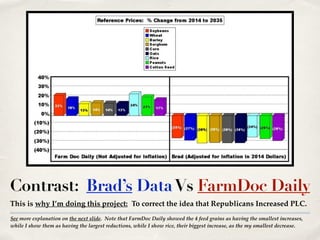
See more explanation on the next slide. Note that FarmDoc Daily showed the 4 feed grains as having the smallest increases,
while I show them as having the largest reductions, while I show rice, their biggest increase, as the my smallest decrease.
Contrast: Brad’s DataVs FarmDoc Daily
This is why I’m doing this project: To correct the idea that Republicans Increased PLC.
Brad’s DataVs FarmDoc Daily
✤ Reference Prices were started in 2014, (2014 Farm Bill,) and were not adjusted for inflation, even when they
were continued after 2017, (2018 Farm Bill).!
✤ So the corn Reference Price was $3.70 in 2014 and stayed the same every year through 2024. But we know
that $3.70 in 2014 is not the same value as $3.70 after 10 years of inflation, including the higher inflation
during the pandemic and, especially for farmers, Ukrainian war.!
✤ Reference Prices were “increased“ in the Republican House Reconciliation Bill proposal, with no adjustment
for inflation for 2025-2030, and with increases of half of 1% every year, 2031-2035. !
✤ On that basis, FarmDoc Daily has “Table 1” showing increases from the “existing” levels to the “proposed”
levels for 2025-2030 and then to each subsequent year of a 1/2 of 1% increase, 2031-2035. They give a
percentage “Increase Proposed by 2035, as on the previous chart on slide 2 here. For FarmDoc Daily, the
“existing” level, (i.e. $3.70 for corn,) can mean $3.70 in 2024, but also $3.70 in 2014.!
✤ What I have done is to adjust the numbers for inflation in 2014 dollars, to show what Congress has done to
PLC Reference Price, (subsidy trigger,) levels compared to the first year of the program.!
✤ Source: Schnitkey, G., N. Paulson, C. Zulauf and J. Coppess. "Spending Impacts of PLC and ARC-CO in House
Agriculture Reconciliation Bill." farmdoc daily (15):93, Department of Agricultural and Consumer Economics,
University of Illinois at Urbana-Champaign, May 20, 2025, https://farmdocdaily.illinois.edu/2025/05/spending-
impacts-of-plc-and-arc-co-in-house-agriculture-reconciliation-bill.html.!
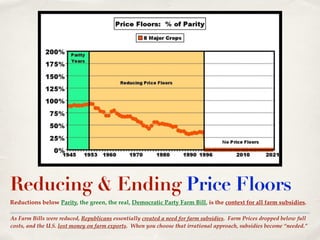
As Farm Bills were reduced, Republicans essentially created a need for farm subsidies. Farm Prices dropped below full
costs, and the U.S. lost money on farm exports. When you choose that irrational approach, subsidies become “needed.”
Reducing & Ending Price Floors
Reductions below Parity, the green, the real, Democratic Party Farm Bill, is the context for all farm subsidies.
Date
4 parts to the Original Democratic Farm Bills
Democrats gave farmers Price Floors, not subsidies, plus Price Ceilings.
Previous Part 1 Slide Show:
PLC Reference Prices in the House (Republican) Proposal
✤ The previous Part 1 Slide Show had these 5 parts!
✤ Part 1: PLC Reference Prices in the 2014 & 2018 Farm Bills.!
✤ Part 2: PLC Reference Prices in the 2025 House Reconciliation Proposal.!
✤ Part 3: A Brief History of Republican Subsidy Proposals.!
✤ Part 4: Proposals for Reform!
✤ Sources for More Information: !
✤ In this Extra slide show, I add more slides, for more crops, to Part 2.
More Introduction
✤ PLC Reference Prices in the 2014 & 2018 Farm Bills & 2025 House Proposal.
✤ Reference Prices, (subsidy triggers,) and formulas for implementation were set
for various crops in the 2014 Farm Bill and were continued at the
“same” (nominal) levels in the 2018 Farm Bill.!
✤ Not Adjusted for Inflation, PLC Reference Prices were increased for 2025 in the
House Reconciliation proposal for the Farm Bill.!
✤ Adjusted for inflation, those higher 2025 Reference Price Levels were,
nevertheless, lower than the original levels for 2014, but started out in 2025 at a
higher level than 2024 under the previous farm bills.!
✤ As in the 2014 & 2018 Farm Bills, the higher 2025 Reference Price Levels were
NOT adjusted for inflation for the years 2025-2030.!
✤ They were then raised by half of a percent per year for 2031-2035, which was only
1/4 of CBO’s projected rate of inflation, which was at 2%, for those same years..
To Repeat:
PLC Reference Prices are SubsidyTriggers
✤ The 2014 & 2018 Farm Bills offered several kinds of farm subsidies.!
✤ Of 2 main subsidies, Agricultural Risk Coverage (ARC) was the subsidy most
widely chosen.!
✤ Price Loss Coverage was the better option, and was later widely chosen, after ARC
failed, especially in 2017 and 2018.!
✤ Crop REVENUE Insurance Subsidies, similar to ARC, were also important.!
✤ PLC “Reference Prices” are subsidy triggers.!
✤ Farmers get a subsidy when prices fall below reference price levels, (given in $/
bushel, $/hundredweight, or $/pound.!
✤ The amount farmers get is based upon mathematical formulas and various kinds of
data. See a simple explanation farther below
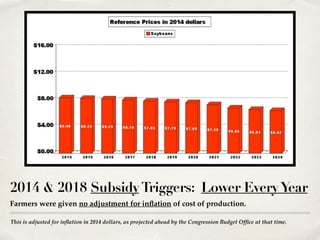
This is adjusted for inflation in 2014 dollars, as projected ahead by the Congression Budget Office at that time.
2014 & 2018 SubsidyTriggers: Lower EveryYear
Farmers were given no adjustment for inflation of cost of production.
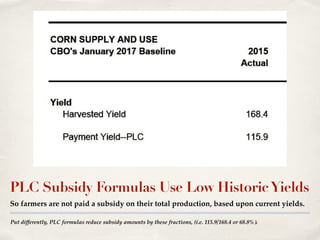
Put differently, PLC formulas reduce subsidy amounts by these fractions, (i.e. 115.9/168.4 or 68.8%).
PLC Subsidy Formulas Use Low HistoricYields
So farmers are not paid a subsidy on their total production, based upon current yields.
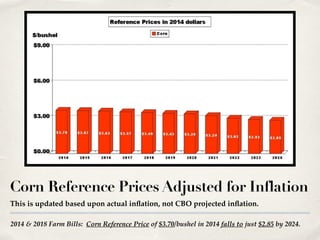
2014 & 2018 Farm Bills: Corn Reference Price of $3.70/bushel in 2014 falls to just $2.85 by 2024.
Corn Reference Prices Adjusted for Inflation
This is updated based upon actual inflation, not CBO projected inflation.
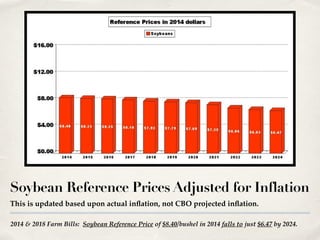
2014 & 2018 Farm Bills: Soybean Reference Price of $8.40/bushel in 2014 falls to just $6.47 by 2024.
Soybean Reference Prices Adjusted for Inflation
This is updated based upon actual inflation, not CBO projected inflation.
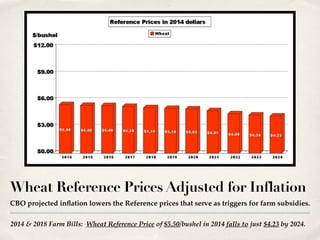
2014 & 2018 Farm Bills: Wheat Reference Price of $5.50/bushel in 2014 falls to just $4.23 by 2024.
Wheat Reference Prices Adjusted for Inflation
CBO projected inflation lowers the Reference prices that serve as triggers for farm subsidies.
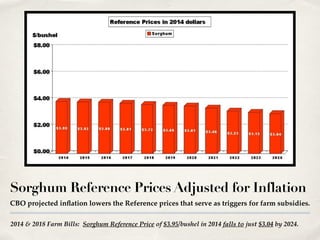
2014 & 2018 Farm Bills: Sorghum Reference Price of $3.95/bushel in 2014 falls to just $3.04 by 2024.
Sorghum Reference Prices Adjusted for Inflation
CBO projected inflation lowers the Reference prices that serve as triggers for farm subsidies.
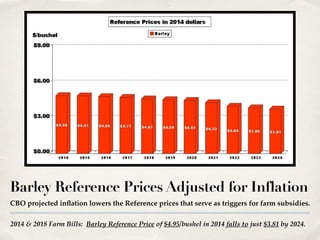
2014 & 2018 Farm Bills: Barley Reference Price of $4.95/bushel in 2014 falls to just $3.81 by 2024.
Barley Reference Prices Adjusted for Inflation
CBO projected inflation lowers the Reference prices that serve as triggers for farm subsidies.
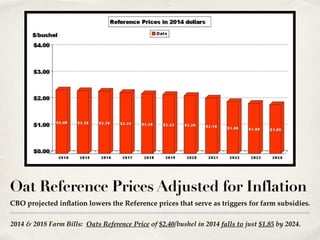
2014 & 2018 Farm Bills: Oats Reference Price of $2.40/bushel in 2014 falls to just $1.85 by 2024.
Oat Reference Prices Adjusted for Inflation
CBO projected inflation lowers the Reference prices that serve as triggers for farm subsidies.
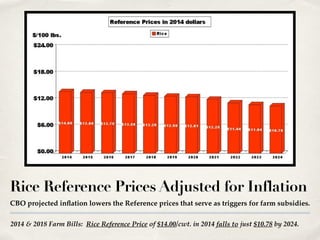
2014 & 2018 Farm Bills: Rice Reference Price of $14.00/cwt. in 2014 falls to just $10.78 by 2024.
Rice Reference Prices Adjusted for Inflation
CBO projected inflation lowers the Reference prices that serve as triggers for farm subsidies.
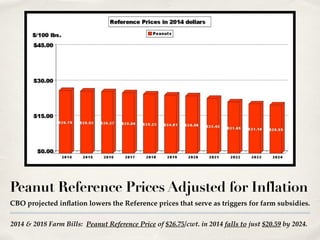
2014 & 2018 Farm Bills: Peanut Reference Price of $26.75/cwt. in 2014 falls to just $20.59 by 2024.
Peanut Reference Prices Adjusted for Inflation
CBO projected inflation lowers the Reference prices that serve as triggers for farm subsidies.
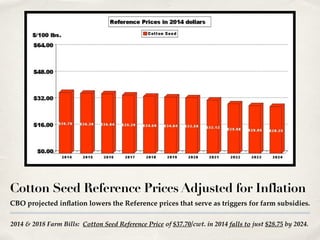
2014 & 2018 Farm Bills: Cotton Seed Reference Price of $37.70/cwt. in 2014 falls to just $28.75 by 2024.
Cotton Seed Reference Prices Adjusted for Inflation
CBO projected inflation lowers the Reference prices that serve as triggers for farm subsidies.
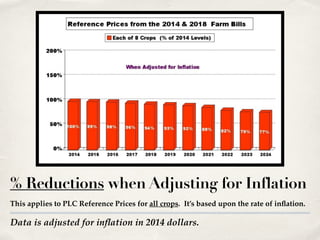
Data is adjusted for inflation in 2014 dollars.
% Reductions when Adjusting for Inflation
This applies to PLC Reference Prices for all crops. It’s based upon the rate of inflation.
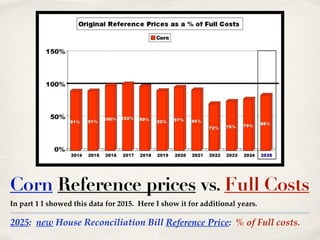
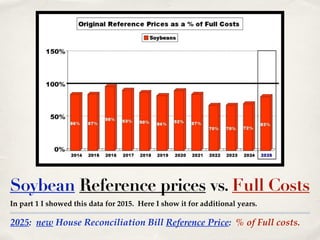
2025: new House Reconciliation Bill Reference Price: % of Full costs.
Corn Reference prices vs. Full Costs
In part 1 I showed this data for 2015. Here I show it for additional years.
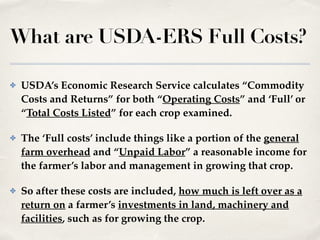
What are USDA-ERS Full Costs?
✤ USDA’s Economic Research Service calculates “Commodity
Costs and Returns” for both “Operating Costs” and ‘Full’ or
“Total Costs Listed” for each crop examined.!
✤ The ‘Full costs’ include things like a portion of the general
farm overhead and “Unpaid Labor” a reasonable income for
the farmer’s labor and management in growing that crop.!
✤ So after these costs are included, how much is left over as a
return on a farmer’s investments in land, machinery and
facilities, such as for growing the crop.
2025: new House Reconciliation Bill Reference Price: % of Full costs.
Soybean Reference prices vs. Full Costs
In part 1 I showed this data for 2015. Here I show it for additional years.
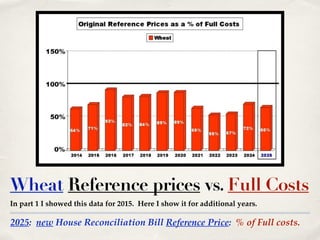
2025: new House Reconciliation Bill Reference Price: % of Full costs.
Wheat Reference prices vs. Full Costs
In part 1 I showed this data for 2015. Here I show it for additional years.
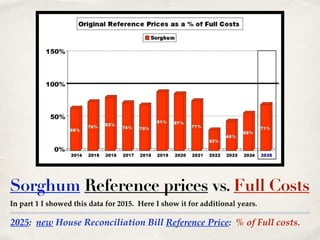
2025: new House Reconciliation Bill Reference Price: % of Full costs.
Sorghum Reference prices vs. Full Costs
In part 1 I showed this data for 2015. Here I show it for additional years.
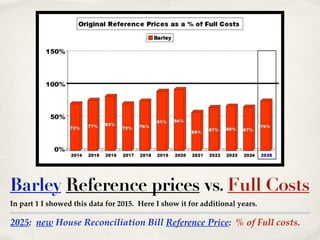
2025: new House Reconciliation Bill Reference Price: % of Full costs.
Barley Reference prices vs. Full Costs
In part 1 I showed this data for 2015. Here I show it for additional years.
2025: new House Reconciliation Bill Reference Price: % of Full costs.
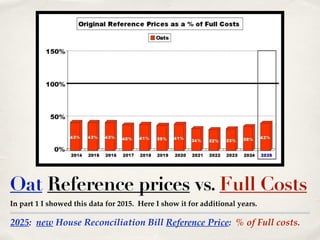
Oat Reference prices vs. Full Costs
In part 1 I showed this data for 2015. Here I show it for additional years.
2025: new House Reconciliation Bill Reference Price: % of Full costs.
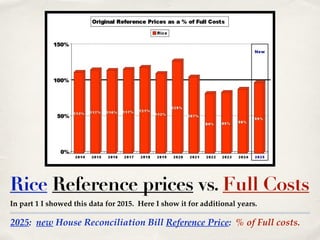
Rice Reference prices vs. Full Costs
In part 1 I showed this data for 2015. Here I show it for additional years.
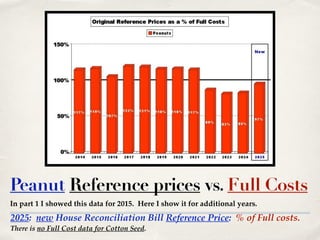
2025: new House Reconciliation Bill Reference Price: % of Full costs.!
There is no Full Cost data for Cotton Seed.
Peanut Reference prices vs. Full Costs
In part 1 I showed this data for 2015. Here I show it for additional years.
The New House Proposal
✤PLC Reference Prices in the
2025 House Reconciliation
Proposal.
Here, as in Part 1, I examine this question in it’s larger context.
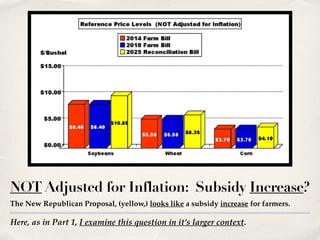
NOT Adjusted for Inflation: Subsidy Increase?
The New Republican Proposal, (yellow,) looks like a subsidy increase for farmers.
Here, as in Part 1, I examine this question in it’s larger context.
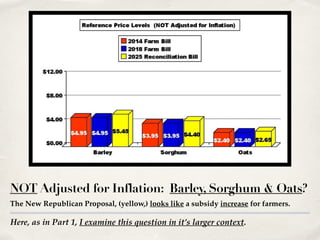
NOT Adjusted for Inflation: Barley, Sorghum & Oats?
The New Republican Proposal, (yellow,) looks like a subsidy increase for farmers.
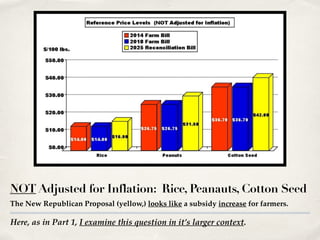
Here, as in Part 1, I examine this question in it’s larger context.
NOT Adjusted for Inflation: Rice, Peanauts, Cotton Seed
The New Republican Proposal (yellow,) looks like a subsidy increase for farmers.
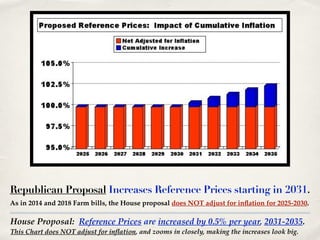
House Proposal: Reference Prices are increased by 0.5% per year, 2031-2035.!
This Chart does NOT adjust for inflation, and zooms in closely, making the increases look big.
Republican Proposal Increases Reference Prices starting in 2031.
As in 2014 and 2018 Farm bills, the House proposal does NOT adjust for inflation for 2025-2030.
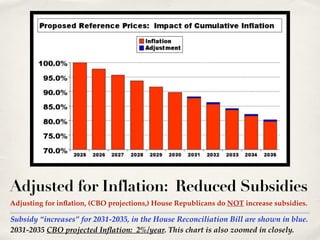
Subsidy “increases” for 2031-2035, in the House Reconciliation Bill are shown in blue.!
2031-2035 CBO projected Inflation: 2%/year. This chart is also zoomed in closely.
Adjusted for Inflation: Reduced Subsidies
Adjusting for inflation, (CBO projections,) House Republicans do NOT increase subsidies.
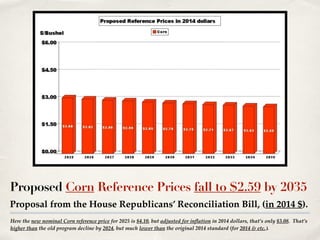
Here the new nominal Corn reference price for 2025 is $4.10, but adjusted for inflation in 2014 dollars, that’s only $3.08. That’s
higher than the old program decline by 2024, but much lower than the original 2014 standard (for 2014 & etc.).
Proposed Corn Reference Prices fall to $2.59 by 2035
Proposal from the House Republicans’ Reconciliation Bill, (in 2014 $).
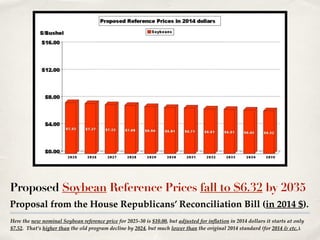
Here the new nominal Soybean reference price for 2025-30 is $10.00, but adjusted for inflation in 2014 dollars it starts at only
$7.52. That’s higher than the old program decline by 2024, but much lower than the original 2014 standard (for 2014 & etc.).
Proposed Soybean Reference Prices fall to $6.32 by 2035
Proposal from the House Republicans’ Reconciliation Bill (in 2014 $).
Here the new nominal Wheat reference price for 2025-30 is $6.35, but adjusted for inflation in 2014 dollars, it starts at only
$4.77. That’s higher than the old program decline by 2024, but much lower than the original 2014 standard (for 2014 & etc.).
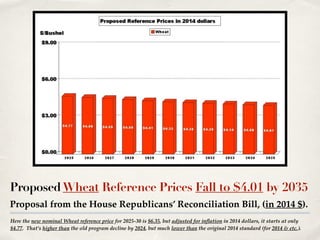
ProposedWheat Reference Prices Fall to $4.01 by 2035
Proposal from the House Republicans’ Reconciliation Bill, (in 2014 $).
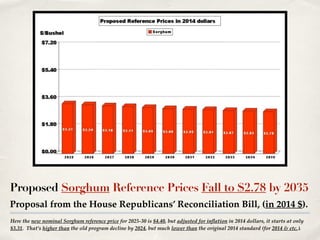
Here the new nominal Sorghum reference price for 2025-30 is $4.40, but adjusted for inflation in 2014 dollars, it starts at only
$3.31. That’s higher than the old program decline by 2024, but much lower than the original 2014 standard (for 2014 & etc.).
Proposed Sorghum Reference Prices Fall to $2.78 by 2035
Proposal from the House Republicans’ Reconciliation Bill, (in 2014 $).
Here the new nominal Barley reference price for 2025-30 is $6.35, but adjusted for inflation in 2014 dollars, it starts at only
$4.77. That’s higher than the old program decline by 2024, but much lower than the original 2014 standard (for 2014 & etc.).
Proposed Barley Reference Prices Fall to $3.45 by 2035
Proposal from the House Republicans’ Reconciliation Bill, (in 2014 $).
Here the new nominal Oat reference price for 2025-30 is $2.65, but adjusted for inflation in 2014 dollars, it starts at only $1.99.
That’s higher than the old program decline by 2024, but much lower than the original 2014 standard (for 2014 & etc.).
Proposed Oat Reference Prices Fall to $1.68 by 2035
Proposal from the House Republicans’ Reconciliation Bill, (in 2014 $).
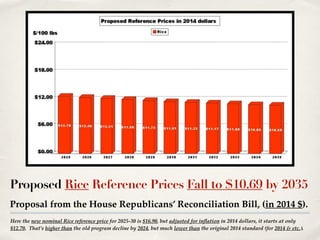
Here the new nominal Rice reference price for 2025-30 is $16.90, but adjusted for inflation in 2014 dollars, it starts at only
$12.70. That’s higher than the old program decline by 2024, but much lower than the original 2014 standard (for 2014 & etc.).
Proposed Rice Reference Prices Fall to $10.69 by 2035
Proposal from the House Republicans’ Reconciliation Bill, (in 2014 $).
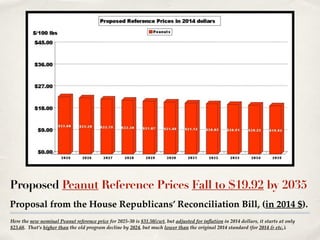
Here the new nominal Peanut reference price for 2025-30 is $31.50/cwt, but adjusted for inflation in 2014 dollars, it starts at only
$23.68. That’s higher than the old program decline by 2024, but much lower than the original 2014 standard (for 2014 & etc.).
Proposed Peanut Reference Prices Fall to $19.92 by 2035
Proposal from the House Republicans’ Reconciliation Bill, (in 2014 $).
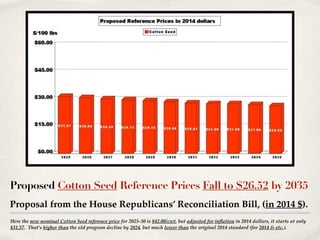
Here the new nominal Cotton Seed reference price for 2025-30 is $42.00/cwt, but adjusted for inflation in 2014 dollars, it starts at only
$31.57. That’s higher than the old program decline by 2024, but much lower than the original 2014 standard (for 2014 & etc.).
Proposed Cotton Seed Reference Prices Fall to $26.52 by 2035
Proposal from the House Republicans’ Reconciliation Bill, (in 2014 $).
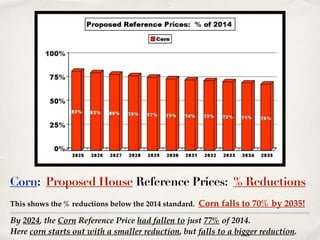
By 2024, the Corn Reference Price had fallen to just 77% of 2014. !
Here corn starts out with a smaller reduction, but falls to a bigger reduction.
Corn: Proposed House Reference Prices: % Reductions
This shows the % reductions below the 2014 standard. Corn falls to 70% by 2035!
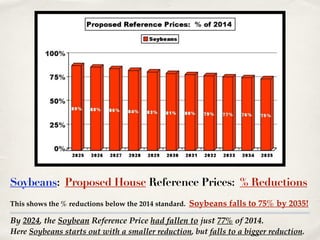
By 2024, the Soybean Reference Price had fallen to just 77% of 2014. !
Here Soybeans starts out with a smaller reduction, but falls to a bigger reduction.
Soybeans: Proposed House Reference Prices: % Reductions
This shows the % reductions below the 2014 standard. Soybeans falls to 75% by 2035!
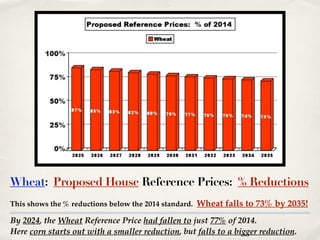
By 2024, the Wheat Reference Price had fallen to just 77% of 2014. !
Here corn starts out with a smaller reduction, but falls to a bigger reduction.
Wheat: Proposed House Reference Prices: % Reductions
This shows the % reductions below the 2014 standard. Wheat falls to 73% by 2035!
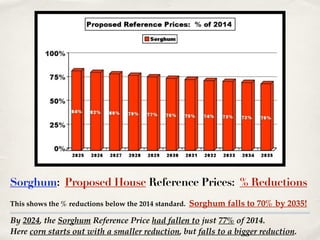
By 2024, the Sorghum Reference Price had fallen to just 77% of 2014. !
Here corn starts out with a smaller reduction, but falls to a bigger reduction.
Sorghum: Proposed House Reference Prices: % Reductions
This shows the % reductions below the 2014 standard. Sorghum falls to 70% by 2035!
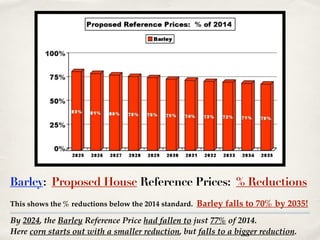
By 2024, the Barley Reference Price had fallen to just 77% of 2014. !
Here corn starts out with a smaller reduction, but falls to a bigger reduction.
Barley: Proposed House Reference Prices: % Reductions
This shows the % reductions below the 2014 standard. Barley falls to 70% by 2035!
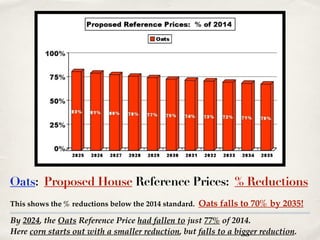
By 2024, the Oats Reference Price had fallen to just 77% of 2014. !
Here corn starts out with a smaller reduction, but falls to a bigger reduction.
Oats: Proposed House Reference Prices: % Reductions
This shows the % reductions below the 2014 standard. Oats falls to 70% by 2035!
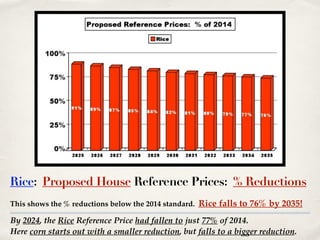
By 2024, the Rice Reference Price had fallen to just 77% of 2014. !
Here corn starts out with a smaller reduction, but falls to a bigger reduction.
Rice: Proposed House Reference Prices: % Reductions
This shows the % reductions below the 2014 standard. Rice falls to 76% by 2035!
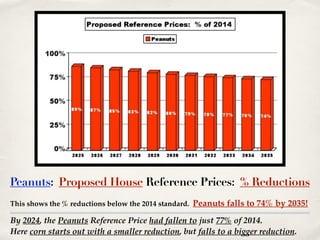
By 2024, the Peanuts Reference Price had fallen to just 77% of 2014. !
Here corn starts out with a smaller reduction, but falls to a bigger reduction.
Peanuts: Proposed House Reference Prices: % Reductions
This shows the % reductions below the 2014 standard. Peanuts falls to 74% by 2035!
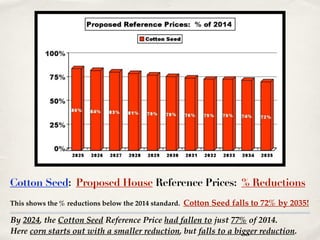
By 2024, the Cotton Seed Reference Price had fallen to just 77% of 2014. !
Here corn starts out with a smaller reduction, but falls to a bigger reduction.
Cotton Seed: Proposed House Reference Prices: % Reductions
This shows the % reductions below the 2014 standard. Cotton Seed falls to 72% by 2035!
✤ The Republican House Proposal
is not as bad as the Republican
Project 2025 proposal.!
✤ The Republican Project 2025 calls
for ending farm subsidies and
related programs, including:!
✤ PLC subsidies.!
✤ ARC subsidies.!
✤ Reducing Crop Revenue
Insurance Subsidies.!
✤ Ending the Sugar Program.!
✤ Ending Market Agreements
for Fruits and Vegetables.!
✤ But subsidies for insurance
companies are not to be cut.
✤ Sources.!
✤ Video: “Project 2025 on USDA Farm
Programs,” https://www.youtube.com/watch?
v=KxBMIuZnhBM&list=PLA1E706EFA90D176
7&index=4. !
✤ Slides: https://www.slideshare.net/slideshow/
project-2025-on-agriculture-worsening-
disastrous-conservative-farm-policies-pdf/
270781312.!
✤ https://www.dailykos.com/users/iowa%20farm
%20activist.!
✤ No Ads: https://drive.google.com/drive/
folders/1UbX-
dQxKJla0sUUvwVqrKnBevBP0kYeB?
usp=share_link
More Information in My Part 1 Slide Show:
“RepublicansWant to Reduce Farm Subsidies.”
✤ See a brief history of Republican Farm Bill
reductions and subsidy proposals in Part 1.!
✤ See Proposals for Reform in Part 1.!
✤ See important references for further insights and
information in Part 1.!
✤ See both slide shows here: https://drive.google.com/drive/
folders/1_AYKC9ICqz7vb5jfAQNmVjCQ3jVZbinN?usp=share_link.

Extra: Republicans Reduce Farm Subsidies.pdf

  • 1.
    By Brad Wilson,June 24, 2025. ! Both Slide Shows: https://drive.google.com/drive/folders/1_AYKC9ICqz7vb5jfAQNmVjCQ3jVZbinN?usp=share_link Supplement to: ‘RepublicansWant to Reduce Farm Subsidies’ 34 Additional Slides, (Crops,): PLC Subsidies in the House Reconciliation Bill
  • 2.
    See more explanationon the next slide. Note that FarmDoc Daily showed the 4 feed grains as having the smallest increases, while I show them as having the largest reductions, while I show rice, their biggest increase, as the my smallest decrease. Contrast: Brad’s DataVs FarmDoc Daily This is why I’m doing this project: To correct the idea that Republicans Increased PLC.
  • 3.
    Brad’s DataVs FarmDocDaily ✤ Reference Prices were started in 2014, (2014 Farm Bill,) and were not adjusted for inflation, even when they were continued after 2017, (2018 Farm Bill).! ✤ So the corn Reference Price was $3.70 in 2014 and stayed the same every year through 2024. But we know that $3.70 in 2014 is not the same value as $3.70 after 10 years of inflation, including the higher inflation during the pandemic and, especially for farmers, Ukrainian war.! ✤ Reference Prices were “increased“ in the Republican House Reconciliation Bill proposal, with no adjustment for inflation for 2025-2030, and with increases of half of 1% every year, 2031-2035. ! ✤ On that basis, FarmDoc Daily has “Table 1” showing increases from the “existing” levels to the “proposed” levels for 2025-2030 and then to each subsequent year of a 1/2 of 1% increase, 2031-2035. They give a percentage “Increase Proposed by 2035, as on the previous chart on slide 2 here. For FarmDoc Daily, the “existing” level, (i.e. $3.70 for corn,) can mean $3.70 in 2024, but also $3.70 in 2014.! ✤ What I have done is to adjust the numbers for inflation in 2014 dollars, to show what Congress has done to PLC Reference Price, (subsidy trigger,) levels compared to the first year of the program.! ✤ Source: Schnitkey, G., N. Paulson, C. Zulauf and J. Coppess. "Spending Impacts of PLC and ARC-CO in House Agriculture Reconciliation Bill." farmdoc daily (15):93, Department of Agricultural and Consumer Economics, University of Illinois at Urbana-Champaign, May 20, 2025, https://farmdocdaily.illinois.edu/2025/05/spending- impacts-of-plc-and-arc-co-in-house-agriculture-reconciliation-bill.html.!
  • 4.
    As Farm Billswere reduced, Republicans essentially created a need for farm subsidies. Farm Prices dropped below full costs, and the U.S. lost money on farm exports. When you choose that irrational approach, subsidies become “needed.” Reducing & Ending Price Floors Reductions below Parity, the green, the real, Democratic Party Farm Bill, is the context for all farm subsidies.
  • 5.
    Date 4 parts tothe Original Democratic Farm Bills Democrats gave farmers Price Floors, not subsidies, plus Price Ceilings.
  • 6.
    Previous Part 1Slide Show: PLC Reference Prices in the House (Republican) Proposal ✤ The previous Part 1 Slide Show had these 5 parts! ✤ Part 1: PLC Reference Prices in the 2014 & 2018 Farm Bills.! ✤ Part 2: PLC Reference Prices in the 2025 House Reconciliation Proposal.! ✤ Part 3: A Brief History of Republican Subsidy Proposals.! ✤ Part 4: Proposals for Reform! ✤ Sources for More Information: ! ✤ In this Extra slide show, I add more slides, for more crops, to Part 2.
  • 7.
    More Introduction ✤ PLCReference Prices in the 2014 & 2018 Farm Bills & 2025 House Proposal. ✤ Reference Prices, (subsidy triggers,) and formulas for implementation were set for various crops in the 2014 Farm Bill and were continued at the “same” (nominal) levels in the 2018 Farm Bill.! ✤ Not Adjusted for Inflation, PLC Reference Prices were increased for 2025 in the House Reconciliation proposal for the Farm Bill.! ✤ Adjusted for inflation, those higher 2025 Reference Price Levels were, nevertheless, lower than the original levels for 2014, but started out in 2025 at a higher level than 2024 under the previous farm bills.! ✤ As in the 2014 & 2018 Farm Bills, the higher 2025 Reference Price Levels were NOT adjusted for inflation for the years 2025-2030.! ✤ They were then raised by half of a percent per year for 2031-2035, which was only 1/4 of CBO’s projected rate of inflation, which was at 2%, for those same years..
  • 8.
    To Repeat: PLC ReferencePrices are SubsidyTriggers ✤ The 2014 & 2018 Farm Bills offered several kinds of farm subsidies.! ✤ Of 2 main subsidies, Agricultural Risk Coverage (ARC) was the subsidy most widely chosen.! ✤ Price Loss Coverage was the better option, and was later widely chosen, after ARC failed, especially in 2017 and 2018.! ✤ Crop REVENUE Insurance Subsidies, similar to ARC, were also important.! ✤ PLC “Reference Prices” are subsidy triggers.! ✤ Farmers get a subsidy when prices fall below reference price levels, (given in $/ bushel, $/hundredweight, or $/pound.! ✤ The amount farmers get is based upon mathematical formulas and various kinds of data. See a simple explanation farther below
  • 9.
    This is adjustedfor inflation in 2014 dollars, as projected ahead by the Congression Budget Office at that time. 2014 & 2018 SubsidyTriggers: Lower EveryYear Farmers were given no adjustment for inflation of cost of production.
  • 10.
    Put differently, PLCformulas reduce subsidy amounts by these fractions, (i.e. 115.9/168.4 or 68.8%). PLC Subsidy Formulas Use Low HistoricYields So farmers are not paid a subsidy on their total production, based upon current yields.
  • 11.
    2014 & 2018Farm Bills: Corn Reference Price of $3.70/bushel in 2014 falls to just $2.85 by 2024. Corn Reference Prices Adjusted for Inflation This is updated based upon actual inflation, not CBO projected inflation.
  • 12.
    2014 & 2018Farm Bills: Soybean Reference Price of $8.40/bushel in 2014 falls to just $6.47 by 2024. Soybean Reference Prices Adjusted for Inflation This is updated based upon actual inflation, not CBO projected inflation.
  • 13.
    2014 & 2018Farm Bills: Wheat Reference Price of $5.50/bushel in 2014 falls to just $4.23 by 2024. Wheat Reference Prices Adjusted for Inflation CBO projected inflation lowers the Reference prices that serve as triggers for farm subsidies.
  • 14.
    2014 & 2018Farm Bills: Sorghum Reference Price of $3.95/bushel in 2014 falls to just $3.04 by 2024. Sorghum Reference Prices Adjusted for Inflation CBO projected inflation lowers the Reference prices that serve as triggers for farm subsidies.
  • 15.
    2014 & 2018Farm Bills: Barley Reference Price of $4.95/bushel in 2014 falls to just $3.81 by 2024. Barley Reference Prices Adjusted for Inflation CBO projected inflation lowers the Reference prices that serve as triggers for farm subsidies.
  • 16.
    2014 & 2018Farm Bills: Oats Reference Price of $2.40/bushel in 2014 falls to just $1.85 by 2024. Oat Reference Prices Adjusted for Inflation CBO projected inflation lowers the Reference prices that serve as triggers for farm subsidies.
  • 17.
    2014 & 2018Farm Bills: Rice Reference Price of $14.00/cwt. in 2014 falls to just $10.78 by 2024. Rice Reference Prices Adjusted for Inflation CBO projected inflation lowers the Reference prices that serve as triggers for farm subsidies.
  • 18.
    2014 & 2018Farm Bills: Peanut Reference Price of $26.75/cwt. in 2014 falls to just $20.59 by 2024. Peanut Reference Prices Adjusted for Inflation CBO projected inflation lowers the Reference prices that serve as triggers for farm subsidies.
  • 19.
    2014 & 2018Farm Bills: Cotton Seed Reference Price of $37.70/cwt. in 2014 falls to just $28.75 by 2024. Cotton Seed Reference Prices Adjusted for Inflation CBO projected inflation lowers the Reference prices that serve as triggers for farm subsidies.
  • 20.
    Data is adjustedfor inflation in 2014 dollars. % Reductions when Adjusting for Inflation This applies to PLC Reference Prices for all crops. It’s based upon the rate of inflation.
  • 21.
    2025: new HouseReconciliation Bill Reference Price: % of Full costs. Corn Reference prices vs. Full Costs In part 1 I showed this data for 2015. Here I show it for additional years.
  • 22.
    What are USDA-ERSFull Costs? ✤ USDA’s Economic Research Service calculates “Commodity Costs and Returns” for both “Operating Costs” and ‘Full’ or “Total Costs Listed” for each crop examined.! ✤ The ‘Full costs’ include things like a portion of the general farm overhead and “Unpaid Labor” a reasonable income for the farmer’s labor and management in growing that crop.! ✤ So after these costs are included, how much is left over as a return on a farmer’s investments in land, machinery and facilities, such as for growing the crop.
  • 23.
    2025: new HouseReconciliation Bill Reference Price: % of Full costs. Soybean Reference prices vs. Full Costs In part 1 I showed this data for 2015. Here I show it for additional years.
  • 24.
    2025: new HouseReconciliation Bill Reference Price: % of Full costs. Wheat Reference prices vs. Full Costs In part 1 I showed this data for 2015. Here I show it for additional years.
  • 25.
    2025: new HouseReconciliation Bill Reference Price: % of Full costs. Sorghum Reference prices vs. Full Costs In part 1 I showed this data for 2015. Here I show it for additional years.
  • 26.
    2025: new HouseReconciliation Bill Reference Price: % of Full costs. Barley Reference prices vs. Full Costs In part 1 I showed this data for 2015. Here I show it for additional years.
  • 27.
    2025: new HouseReconciliation Bill Reference Price: % of Full costs. Oat Reference prices vs. Full Costs In part 1 I showed this data for 2015. Here I show it for additional years.
  • 28.
    2025: new HouseReconciliation Bill Reference Price: % of Full costs. Rice Reference prices vs. Full Costs In part 1 I showed this data for 2015. Here I show it for additional years.
  • 29.
    2025: new HouseReconciliation Bill Reference Price: % of Full costs.! There is no Full Cost data for Cotton Seed. Peanut Reference prices vs. Full Costs In part 1 I showed this data for 2015. Here I show it for additional years.
  • 30.
    The New HouseProposal ✤PLC Reference Prices in the 2025 House Reconciliation Proposal.
  • 31.
    Here, as inPart 1, I examine this question in it’s larger context. NOT Adjusted for Inflation: Subsidy Increase? The New Republican Proposal, (yellow,) looks like a subsidy increase for farmers.
  • 32.
    Here, as inPart 1, I examine this question in it’s larger context. NOT Adjusted for Inflation: Barley, Sorghum & Oats? The New Republican Proposal, (yellow,) looks like a subsidy increase for farmers.
  • 33.
    Here, as inPart 1, I examine this question in it’s larger context. NOT Adjusted for Inflation: Rice, Peanauts, Cotton Seed The New Republican Proposal (yellow,) looks like a subsidy increase for farmers.
  • 34.
    House Proposal: ReferencePrices are increased by 0.5% per year, 2031-2035.! This Chart does NOT adjust for inflation, and zooms in closely, making the increases look big. Republican Proposal Increases Reference Prices starting in 2031. As in 2014 and 2018 Farm bills, the House proposal does NOT adjust for inflation for 2025-2030.
  • 35.
    Subsidy “increases” for2031-2035, in the House Reconciliation Bill are shown in blue.! 2031-2035 CBO projected Inflation: 2%/year. This chart is also zoomed in closely. Adjusted for Inflation: Reduced Subsidies Adjusting for inflation, (CBO projections,) House Republicans do NOT increase subsidies.
  • 36.
    Here the newnominal Corn reference price for 2025 is $4.10, but adjusted for inflation in 2014 dollars, that’s only $3.08. That’s higher than the old program decline by 2024, but much lower than the original 2014 standard (for 2014 & etc.). Proposed Corn Reference Prices fall to $2.59 by 2035 Proposal from the House Republicans’ Reconciliation Bill, (in 2014 $).
  • 37.
    Here the newnominal Soybean reference price for 2025-30 is $10.00, but adjusted for inflation in 2014 dollars it starts at only $7.52. That’s higher than the old program decline by 2024, but much lower than the original 2014 standard (for 2014 & etc.). Proposed Soybean Reference Prices fall to $6.32 by 2035 Proposal from the House Republicans’ Reconciliation Bill (in 2014 $).
  • 38.
    Here the newnominal Wheat reference price for 2025-30 is $6.35, but adjusted for inflation in 2014 dollars, it starts at only $4.77. That’s higher than the old program decline by 2024, but much lower than the original 2014 standard (for 2014 & etc.). ProposedWheat Reference Prices Fall to $4.01 by 2035 Proposal from the House Republicans’ Reconciliation Bill, (in 2014 $).
  • 39.
    Here the newnominal Sorghum reference price for 2025-30 is $4.40, but adjusted for inflation in 2014 dollars, it starts at only $3.31. That’s higher than the old program decline by 2024, but much lower than the original 2014 standard (for 2014 & etc.). Proposed Sorghum Reference Prices Fall to $2.78 by 2035 Proposal from the House Republicans’ Reconciliation Bill, (in 2014 $).
  • 40.
    Here the newnominal Barley reference price for 2025-30 is $6.35, but adjusted for inflation in 2014 dollars, it starts at only $4.77. That’s higher than the old program decline by 2024, but much lower than the original 2014 standard (for 2014 & etc.). Proposed Barley Reference Prices Fall to $3.45 by 2035 Proposal from the House Republicans’ Reconciliation Bill, (in 2014 $).
  • 41.
    Here the newnominal Oat reference price for 2025-30 is $2.65, but adjusted for inflation in 2014 dollars, it starts at only $1.99. That’s higher than the old program decline by 2024, but much lower than the original 2014 standard (for 2014 & etc.). Proposed Oat Reference Prices Fall to $1.68 by 2035 Proposal from the House Republicans’ Reconciliation Bill, (in 2014 $).
  • 42.
    Here the newnominal Rice reference price for 2025-30 is $16.90, but adjusted for inflation in 2014 dollars, it starts at only $12.70. That’s higher than the old program decline by 2024, but much lower than the original 2014 standard (for 2014 & etc.). Proposed Rice Reference Prices Fall to $10.69 by 2035 Proposal from the House Republicans’ Reconciliation Bill, (in 2014 $).
  • 43.
    Here the newnominal Peanut reference price for 2025-30 is $31.50/cwt, but adjusted for inflation in 2014 dollars, it starts at only $23.68. That’s higher than the old program decline by 2024, but much lower than the original 2014 standard (for 2014 & etc.). Proposed Peanut Reference Prices Fall to $19.92 by 2035 Proposal from the House Republicans’ Reconciliation Bill, (in 2014 $).
  • 44.
    Here the newnominal Cotton Seed reference price for 2025-30 is $42.00/cwt, but adjusted for inflation in 2014 dollars, it starts at only $31.57. That’s higher than the old program decline by 2024, but much lower than the original 2014 standard (for 2014 & etc.). Proposed Cotton Seed Reference Prices Fall to $26.52 by 2035 Proposal from the House Republicans’ Reconciliation Bill, (in 2014 $).
  • 45.
    By 2024, theCorn Reference Price had fallen to just 77% of 2014. ! Here corn starts out with a smaller reduction, but falls to a bigger reduction. Corn: Proposed House Reference Prices: % Reductions This shows the % reductions below the 2014 standard. Corn falls to 70% by 2035!
  • 46.
    By 2024, theSoybean Reference Price had fallen to just 77% of 2014. ! Here Soybeans starts out with a smaller reduction, but falls to a bigger reduction. Soybeans: Proposed House Reference Prices: % Reductions This shows the % reductions below the 2014 standard. Soybeans falls to 75% by 2035!
  • 47.
    By 2024, theWheat Reference Price had fallen to just 77% of 2014. ! Here corn starts out with a smaller reduction, but falls to a bigger reduction. Wheat: Proposed House Reference Prices: % Reductions This shows the % reductions below the 2014 standard. Wheat falls to 73% by 2035!
  • 48.
    By 2024, theSorghum Reference Price had fallen to just 77% of 2014. ! Here corn starts out with a smaller reduction, but falls to a bigger reduction. Sorghum: Proposed House Reference Prices: % Reductions This shows the % reductions below the 2014 standard. Sorghum falls to 70% by 2035!
  • 49.
    By 2024, theBarley Reference Price had fallen to just 77% of 2014. ! Here corn starts out with a smaller reduction, but falls to a bigger reduction. Barley: Proposed House Reference Prices: % Reductions This shows the % reductions below the 2014 standard. Barley falls to 70% by 2035!
  • 50.
    By 2024, theOats Reference Price had fallen to just 77% of 2014. ! Here corn starts out with a smaller reduction, but falls to a bigger reduction. Oats: Proposed House Reference Prices: % Reductions This shows the % reductions below the 2014 standard. Oats falls to 70% by 2035!
  • 51.
    By 2024, theRice Reference Price had fallen to just 77% of 2014. ! Here corn starts out with a smaller reduction, but falls to a bigger reduction. Rice: Proposed House Reference Prices: % Reductions This shows the % reductions below the 2014 standard. Rice falls to 76% by 2035!
  • 52.
    By 2024, thePeanuts Reference Price had fallen to just 77% of 2014. ! Here corn starts out with a smaller reduction, but falls to a bigger reduction. Peanuts: Proposed House Reference Prices: % Reductions This shows the % reductions below the 2014 standard. Peanuts falls to 74% by 2035!
  • 53.
    By 2024, theCotton Seed Reference Price had fallen to just 77% of 2014. ! Here corn starts out with a smaller reduction, but falls to a bigger reduction. Cotton Seed: Proposed House Reference Prices: % Reductions This shows the % reductions below the 2014 standard. Cotton Seed falls to 72% by 2035!
  • 54.
    ✤ The RepublicanHouse Proposal is not as bad as the Republican Project 2025 proposal.! ✤ The Republican Project 2025 calls for ending farm subsidies and related programs, including:! ✤ PLC subsidies.! ✤ ARC subsidies.! ✤ Reducing Crop Revenue Insurance Subsidies.! ✤ Ending the Sugar Program.! ✤ Ending Market Agreements for Fruits and Vegetables.! ✤ But subsidies for insurance companies are not to be cut. ✤ Sources.! ✤ Video: “Project 2025 on USDA Farm Programs,” https://www.youtube.com/watch? v=KxBMIuZnhBM&list=PLA1E706EFA90D176 7&index=4. ! ✤ Slides: https://www.slideshare.net/slideshow/ project-2025-on-agriculture-worsening- disastrous-conservative-farm-policies-pdf/ 270781312.! ✤ https://www.dailykos.com/users/iowa%20farm %20activist.! ✤ No Ads: https://drive.google.com/drive/ folders/1UbX- dQxKJla0sUUvwVqrKnBevBP0kYeB? usp=share_link
  • 55.
    More Information inMy Part 1 Slide Show: “RepublicansWant to Reduce Farm Subsidies.” ✤ See a brief history of Republican Farm Bill reductions and subsidy proposals in Part 1.! ✤ See Proposals for Reform in Part 1.! ✤ See important references for further insights and information in Part 1.! ✤ See both slide shows here: https://drive.google.com/drive/ folders/1_AYKC9ICqz7vb5jfAQNmVjCQ3jVZbinN?usp=share_link.