@cataldomusto
cataldo.musto@uniba.it
Exploiting Distributional Semantics Models
for Natural Language Context-aware
Justifications for Recommender Systems
CATALDO MUSTO, GIUSEPPE SPILLO, PASQUALE LOPS, MARCO DE GEMMIS, GIOVANNI SEMERARO
UNIVERSITÀ DEGLI STUDI DI BARI ‘ALDO MORO’ – ITALY
SWAP RESEARCH GROUP – HTTP://WWW.DI.UNIBA.IT/~SWAP
IntRS 2020 – Joint Workshop on
Interfaces and Human Decision-Making
for Recommender Systems
jointly held with ACM RecSys 2020
Online - Worldwide– September 26, 2020
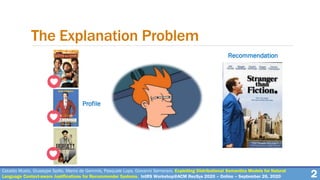
The Explanation Problem
Recommendation
2Cataldo Musto, Giuseppe Spillo, Marco de Gemmis, Pasquale Lops, Giovanni Semeraro. Exploiting Distributional Semantics Models for Natural
Language Context-aware Justifications for Recommender Systems. IntRS Workshop@ACM RecSys 2020 – Online – September 26, 2020
Profile
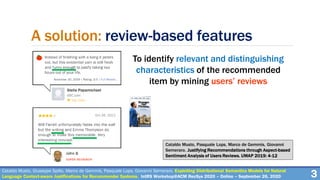
A solution: review-based features
To identify relevant and distinguishing
characteristics of the recommended
item by mining users’ reviews
3Cataldo Musto, Giuseppe Spillo, Marco de Gemmis, Pasquale Lops, Giovanni Semeraro. Exploiting Distributional Semantics Models for Natural
Language Context-aware Justifications for Recommender Systems. IntRS Workshop@ACM RecSys 2020 – Online – September 26, 2020
Cataldo Musto, Pasquale Lops, Marco de Gemmis, Giovanni
Semeraro. Justifying Recommendations through Aspect-based
Sentiment Analysis of Users Reviews. UMAP 2019: 4-12
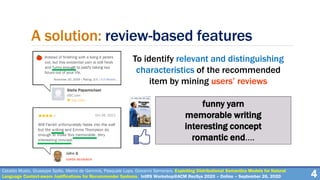
A solution: review-based features
To identify relevant and distinguishing
characteristics of the recommended
item by mining users’ reviews
4Cataldo Musto, Giuseppe Spillo, Marco de Gemmis, Pasquale Lops, Giovanni Semeraro. Exploiting Distributional Semantics Models for Natural
Language Context-aware Justifications for Recommender Systems. IntRS Workshop@ACM RecSys 2020 – Online – September 26, 2020
funny yarn
memorable writing
interesting concept
romantic end….
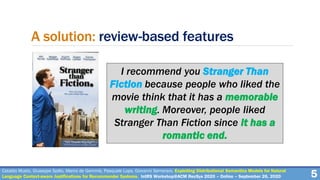
A solution: review-based features
I recommend you Stranger Than
Fiction because people who liked the
movie think that it has a memorable
writing. Moreover, people liked
Stranger Than Fiction since it has a
romantic end.
5Cataldo Musto, Giuseppe Spillo, Marco de Gemmis, Pasquale Lops, Giovanni Semeraro. Exploiting Distributional Semantics Models for Natural
Language Context-aware Justifications for Recommender Systems. IntRS Workshop@ACM RecSys 2020 – Online – September 26, 2020
Context plays a key role for
decision-making tasks
• Contextual factors (mood, company) do
influence the selection of the most
suitable item to be recommended;
6
…What about the context?
Cataldo Musto, Giuseppe Spillo, Marco de Gemmis, Pasquale Lops, Giovanni Semeraro. Exploiting Distributional Semantics Models for Natural
Language Context-aware Justifications for Recommender Systems. IntRS Workshop@ACM RecSys 2020 – Online – September 26, 2020
SHALL AN EXPLANATION BE
INFLUENCED BY THE CONTEXT OF
CONSUMPTION?
A Methodology to
Generate Context-aware
Post-Hoc Natural Language
Justifications Exploiting
Distributional Semantics
Models
7
Contribution
Cataldo Musto, Giuseppe Spillo, Marco de Gemmis, Pasquale Lops, Giovanni Semeraro. Exploiting Distributional Semantics Models for Natural
Language Context-aware Justifications for Recommender Systems. IntRS Workshop@ACM RecSys 2020 – Online – September 26, 2020
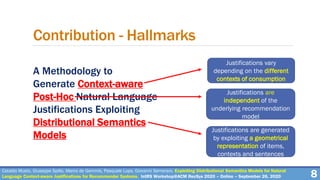
A Methodology to
Generate Context-aware
Post-Hoc Natural Language
Justifications Exploiting
Distributional Semantics
Models
8
Contribution - Hallmarks
Cataldo Musto, Giuseppe Spillo, Marco de Gemmis, Pasquale Lops, Giovanni Semeraro. Exploiting Distributional Semantics Models for Natural
Language Context-aware Justifications for Recommender Systems. IntRS Workshop@ACM RecSys 2020 – Online – September 26, 2020
Justifications vary
depending on the different
contexts of consumption
Justifications are
independent of the
underlying recommendation
model
Justifications are generated
by exploiting a geometrical
representation of items,
contexts and sentences
9
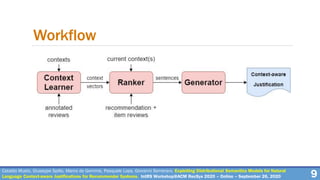
Workflow
Cataldo Musto, Giuseppe Spillo, Marco de Gemmis, Pasquale Lops, Giovanni Semeraro. Exploiting Distributional Semantics Models for Natural
Language Context-aware Justifications for Recommender Systems. IntRS Workshop@ACM RecSys 2020 – Online – September 26, 2020
10
Workflow
Cataldo Musto, Giuseppe Spillo, Marco de Gemmis, Pasquale Lops, Giovanni Semeraro. Exploiting Distributional Semantics Models for Natural
Language Context-aware Justifications for Recommender Systems. IntRS Workshop@ACM RecSys 2020 – Online – September 26, 2020
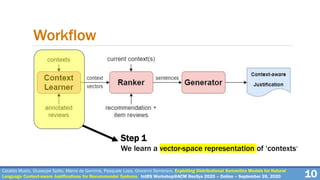
Step 1
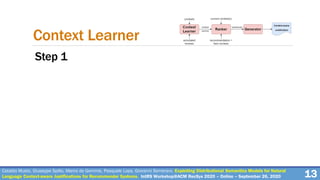
We learn a vector-space representation of ‘contexts’
11
Workflow
Cataldo Musto, Giuseppe Spillo, Marco de Gemmis, Pasquale Lops, Giovanni Semeraro. Exploiting Distributional Semantics Models for Natural
Language Context-aware Justifications for Recommender Systems. IntRS Workshop@ACM RecSys 2020 – Online – September 26, 2020
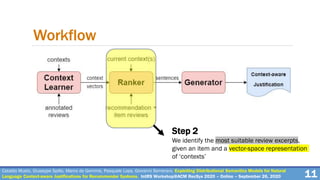
Step 2
We identify the most suitable review excerpts,
given an item and a vector-space representation
of ‘contexts’
12
Workflow
Cataldo Musto, Giuseppe Spillo, Marco de Gemmis, Pasquale Lops, Giovanni Semeraro. Exploiting Distributional Semantics Models for Natural
Language Context-aware Justifications for Recommender Systems. IntRS Workshop@ACM RecSys 2020 – Online – September 26, 2020
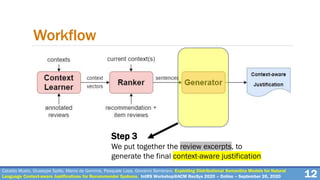
Step 3
We put together the review excerpts, to
generate the final context-aware justification
13
Context Learner
Cataldo Musto, Giuseppe Spillo, Marco de Gemmis, Pasquale Lops, Giovanni Semeraro. Exploiting Distributional Semantics Models for Natural
Language Context-aware Justifications for Recommender Systems. IntRS Workshop@ACM RecSys 2020 – Online – September 26, 2020
Step 1
Cataldo Musto, Giuseppe Spillo, Marco de Gemmis, Pasquale Lops, Giovanni Semeraro. Exploiting Distributional Semantics Models for Natural
Language Context-aware Justifications for Recommender Systems. IntRS Workshop@ACM RecSys 2020 – Online – September 26, 2020
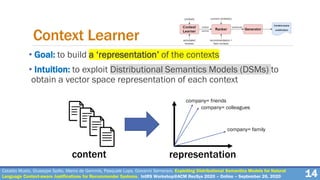
• Goal: to build a ‘representation’ of the contexts
• Intuition: to exploit Distributional Semantics Models (DSMs) to
obtain a vector space representation of each context
14
Context Learner
content representation
company= friends
company= colleagues
company= family
Cataldo Musto, Giuseppe Spillo, Marco de Gemmis, Pasquale Lops, Giovanni Semeraro. Exploiting Distributional Semantics Models for Natural
Language Context-aware Justifications for Recommender Systems. IntRS Workshop@ACM RecSys 2020 – Online – September 26, 2020 15
Distributional Semantics Models
Ludwig Wittgenstein
(Austrian philosopher)
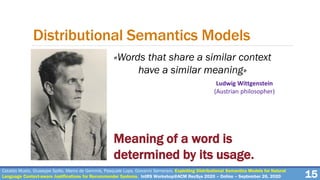
Meaning of a word is
determined by its usage.
«Words that share a similar context
have a similar meaning»
Cataldo Musto, Giuseppe Spillo, Marco de Gemmis, Pasquale Lops, Giovanni Semeraro. Exploiting Distributional Semantics Models for Natural
Language Context-aware Justifications for Recommender Systems. IntRS Workshop@ACM RecSys 2020 – Online – September 26, 2020 16
Distributional Semantics Models
Ludwig Wittgenstein
(Austrian philosopher)
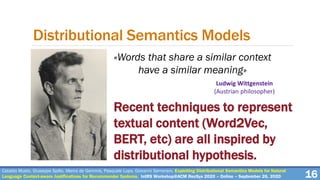
Recent techniques to represent
textual content (Word2Vec,
BERT, etc) are all inspired by
distributional hypothesis.
«Words that share a similar context
have a similar meaning»
Cataldo Musto, Giuseppe Spillo, Marco de Gemmis, Pasquale Lops, Giovanni Semeraro. Exploiting Distributional Semantics Models for Natural
Language Context-aware Justifications for Recommender Systems. IntRS Workshop@ACM RecSys 2020 – Online – September 26, 2020
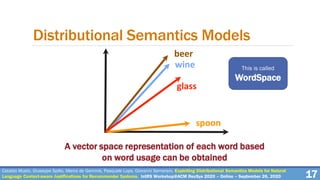
Distributional Semantics Models
A vector space representation of each word based
on word usage can be obtained
17
beer
wine
glass
spoon
This is called
WordSpace
Cataldo Musto, Giuseppe Spillo, Marco de Gemmis, Pasquale Lops, Giovanni Semeraro. Exploiting Distributional Semantics Models for Natural
Language Context-aware Justifications for Recommender Systems. IntRS Workshop@ACM RecSys 2020 – Online – September 26, 2020
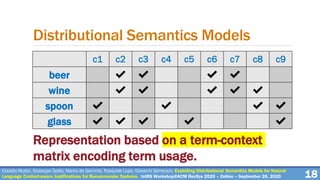
Distributional Semantics Models
c1 c2 c3 c4 c5 c6 c7 c8 c9
beer ✔ ✔ ✔ ✔
wine ✔ ✔ ✔ ✔ ✔
spoon ✔ ✔ ✔ ✔
glass ✔ ✔ ✔ ✔ ✔
Representation based on a term-context
matrix encoding term usage.
18
Cataldo Musto, Giuseppe Spillo, Marco de Gemmis, Pasquale Lops, Giovanni Semeraro. Exploiting Distributional Semantics Models for Natural
Language Context-aware Justifications for Recommender Systems. IntRS Workshop@ACM RecSys 2020 – Online – September 26, 2020
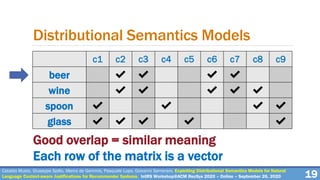
Distributional Semantics Models
Good overlap = similar meaning
Each row of the matrix is a vector
19
c1 c2 c3 c4 c5 c6 c7 c8 c9
beer ✔ ✔ ✔ ✔
wine ✔ ✔ ✔ ✔ ✔
spoon ✔ ✔ ✔ ✔
glass ✔ ✔ ✔ ✔ ✔
Cataldo Musto, Giuseppe Spillo, Marco de Gemmis, Pasquale Lops, Giovanni Semeraro. Exploiting Distributional Semantics Models for Natural
Language Context-aware Justifications for Recommender Systems. IntRS Workshop@ACM RecSys 2020 – Online – September 26, 2020
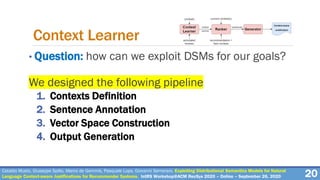
• Question: how can we exploit DSMs for our goals?
We designed the following pipeline
1. Contexts Definition
2. Sentence Annotation
3. Vector Space Construction
4. Output Generation
20
Context Learner
Cataldo Musto, Giuseppe Spillo, Marco de Gemmis, Pasquale Lops, Giovanni Semeraro. Exploiting Distributional Semantics Models for Natural
Language Context-aware Justifications for Recommender Systems. IntRS Workshop@ACM RecSys 2020 – Online – September 26, 2020
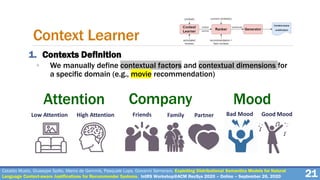
1. Contexts Definition
◦ We manually define contextual factors and contextual dimensions for
a specific domain (e.g., movie recommendation)
21
Context Learner
Attention Company Mood
High AttentionLow Attention Family PartnerFriends Bad Mood Good Mood
Cataldo Musto, Giuseppe Spillo, Marco de Gemmis, Pasquale Lops, Giovanni Semeraro. Exploiting Distributional Semantics Models for Natural
Language Context-aware Justifications for Recommender Systems. IntRS Workshop@ACM RecSys 2020 – Online – September 26, 2020
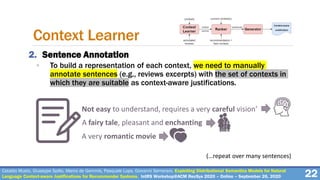
2. Sentence Annotation
◦ To build a representation of each context, we need to manually
annotate sentences (e.g., reviews excerpts) with the set of contexts in
which they are suitable as context-aware justifications.
22
Context Learner
Not easy to understand, requires a very careful vision’
A fairy tale, pleasant and enchanting
A very romantic movie
(…repeat over many sentences)
Cataldo Musto, Giuseppe Spillo, Marco de Gemmis, Pasquale Lops, Giovanni Semeraro. Exploiting Distributional Semantics Models for Natural
Language Context-aware Justifications for Recommender Systems. IntRS Workshop@ACM RecSys 2020 – Online – September 26, 2020
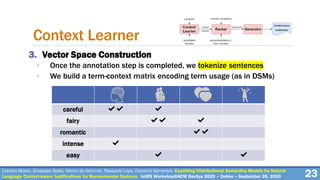
3. Vector Space Construction
◦ Once the annotation step is completed, we tokenize sentences
◦ We build a term-context matrix encoding term usage (as in DSMs)
23
Context Learner
careful ✔✔ ✔
fairy ✔✔ ✔
romantic ✔✔
intense ✔
easy ✔ ✔
Cataldo Musto, Giuseppe Spillo, Marco de Gemmis, Pasquale Lops, Giovanni Semeraro. Exploiting Distributional Semantics Models for Natural
Language Context-aware Justifications for Recommender Systems. IntRS Workshop@ACM RecSys 2020 – Online – September 26, 2020
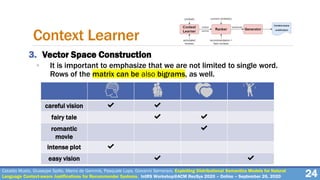
3. Vector Space Construction
◦ It is important to emphasize that we are not limited to single word.
Rows of the matrix can be also bigrams, as well.
24
Context Learner
careful vision ✔ ✔
fairy tale ✔ ✔
romantic
movie
✔
intense plot ✔
easy vision ✔ ✔
Cataldo Musto, Giuseppe Spillo, Marco de Gemmis, Pasquale Lops, Giovanni Semeraro. Exploiting Distributional Semantics Models for Natural
Language Context-aware Justifications for Recommender Systems. IntRS Workshop@ACM RecSys 2020 – Online – September 26, 2020
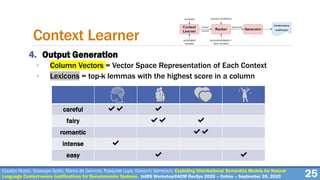
4. Output Generation
◦ Column Vectors = Vector Space Representation of Each Context
◦ Lexicons = top-k lemmas with the highest score in a column
25
Context Learner
careful ✔✔ ✔
fairy ✔✔ ✔
romantic ✔✔
intense ✔
easy ✔ ✔
Cataldo Musto, Giuseppe Spillo, Marco de Gemmis, Pasquale Lops, Giovanni Semeraro. Exploiting Distributional Semantics Models for Natural
Language Context-aware Justifications for Recommender Systems. IntRS Workshop@ACM RecSys 2020 – Online – September 26, 2020
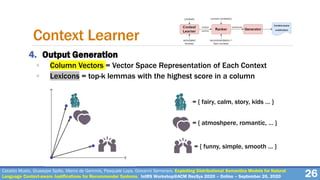
4. Output Generation
◦ Column Vectors = Vector Space Representation of Each Context
◦ Lexicons = top-k lemmas with the highest score in a column
26
Context Learner
= { fairy, calm, story, kids … }
= { atmoshpere, romantic, … }
= { funny, simple, smooth … }
27
Ranker
Cataldo Musto, Giuseppe Spillo, Marco de Gemmis, Pasquale Lops, Giovanni Semeraro. Exploiting Distributional Semantics Models for Natural
Language Context-aware Justifications for Recommender Systems. IntRS Workshop@ACM RecSys 2020 – Online – September 26, 2020
Step 2
Cataldo Musto, Giuseppe Spillo, Marco de Gemmis, Pasquale Lops, Giovanni Semeraro. Exploiting Distributional Semantics Models for Natural
Language Context-aware Justifications for Recommender Systems. IntRS Workshop@ACM RecSys 2020 – Online – September 26, 2020
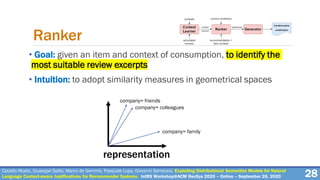
• Goal: given an item and context of consumption, to identify the
most suitable review excerpts
• Intuition: to adopt similarity measures in geometrical spaces
28
Ranker
representation
company= friends
company= colleagues
company= family
Cataldo Musto, Giuseppe Spillo, Marco de Gemmis, Pasquale Lops, Giovanni Semeraro. Exploiting Distributional Semantics Models for Natural
Language Context-aware Justifications for Recommender Systems. IntRS Workshop@ACM RecSys 2020 – Online – September 26, 2020 29
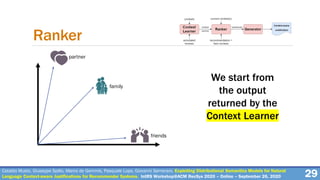
Ranker
friends
family
partner
We start from
the output
returned by the
Context Learner
Cataldo Musto, Giuseppe Spillo, Marco de Gemmis, Pasquale Lops, Giovanni Semeraro. Exploiting Distributional Semantics Models for Natural
Language Context-aware Justifications for Recommender Systems. IntRS Workshop@ACM RecSys 2020 – Online – September 26, 2020 30
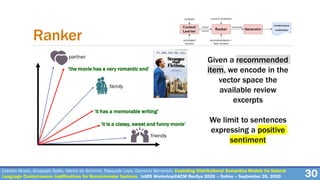
Ranker
Given a recommended
item, we encode in the
vector space the
available review
excerpts
We limit to sentences
expressing a positive
sentiment
friends
family
partner
‘it is a classy, sweet and funny movie’
‘it has a memorable writing’
‘the movie has a very romantic end’
Cataldo Musto, Giuseppe Spillo, Marco de Gemmis, Pasquale Lops, Giovanni Semeraro. Exploiting Distributional Semantics Models for Natural
Language Context-aware Justifications for Recommender Systems. IntRS Workshop@ACM RecSys 2020 – Online – September 26, 2020 31
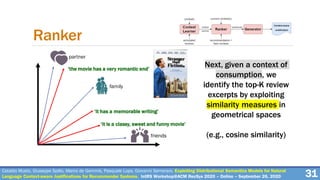
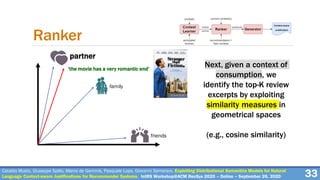
Ranker
Next, given a context of
consumption, we
identify the top-K review
excerpts by exploiting
similarity measures in
geometrical spaces
(e.g., cosine similarity)friends
family
partner
‘it is a classy, sweet and funny movie’
‘it has a memorable writing’
‘the movie has a very romantic end’
Cataldo Musto, Giuseppe Spillo, Marco de Gemmis, Pasquale Lops, Giovanni Semeraro. Exploiting Distributional Semantics Models for Natural
Language Context-aware Justifications for Recommender Systems. IntRS Workshop@ACM RecSys 2020 – Online – September 26, 2020 32
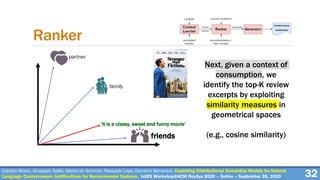
Ranker
Next, given a context of
consumption, we
identify the top-K review
excerpts by exploiting
similarity measures in
geometrical spaces
(e.g., cosine similarity)friends
family
partner
‘it is a classy, sweet and funny movie’
Cataldo Musto, Giuseppe Spillo, Marco de Gemmis, Pasquale Lops, Giovanni Semeraro. Exploiting Distributional Semantics Models for Natural
Language Context-aware Justifications for Recommender Systems. IntRS Workshop@ACM RecSys 2020 – Online – September 26, 2020 33
Ranker
Next, given a context of
consumption, we
identify the top-K review
excerpts by exploiting
similarity measures in
geometrical spaces
(e.g., cosine similarity)friends
family
partner
‘the movie has a very romantic end’
34
Generator
Cataldo Musto, Giuseppe Spillo, Marco de Gemmis, Pasquale Lops, Giovanni Semeraro. Exploiting Distributional Semantics Models for Natural
Language Context-aware Justifications for Recommender Systems. IntRS Workshop@ACM RecSys 2020 – Online – September 26, 2020
Step 3
Cataldo Musto, Giuseppe Spillo, Marco de Gemmis, Pasquale Lops, Giovanni Semeraro. Exploiting Distributional Semantics Models for Natural
Language Context-aware Justifications for Recommender Systems. IntRS Workshop@ACM RecSys 2020 – Online – September 26, 2020
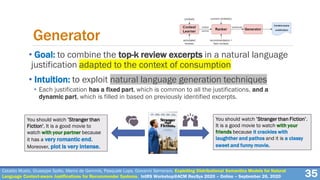
• Goal: to combine the top-k review excerpts in a natural language
justification adapted to the context of consumption
• Intuition: to exploit natural language generation techniques
• Each justification has a fixed part, which is common to all the justifications, and a
dynamic part, which is filled in based on previously identified excerpts.
35
Generator
You should watch ’Stranger than
Fiction’. It is a good movie to
watch with your partner because
it has a very romantic end.
Moreover, plot is very intense.
You should watch ’Stranger than Fiction’.
It is a good movie to watch with your
friends because it crackles with
laughther and pathos and it is a classy
sweet and funny movie.
Cataldo Musto, Giuseppe Spillo, Marco de Gemmis, Pasquale Lops, Giovanni Semeraro. Exploiting Distributional Semantics Models for Natural
Language Context-aware Justifications for Recommender Systems. IntRS Workshop@ACM RecSys 2020 – Online – September 26, 2020 36
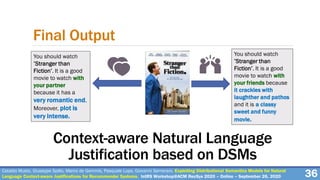
Final Output
You should watch
’Stranger than
Fiction’. It is a good
movie to watch with
your partner
because it has a
very romantic end.
Moreover, plot is
very intense.
You should watch
’Stranger than
Fiction’. It is a good
movie to watch with
your friends because
it crackles with
laughther and pathos
and it is a classy
sweet and funny
movie.
Context-aware Natural Language
Justification based on DSMs
Experimental Evaluation
Research Question 1 (RQ1)
How effective are the justifications generated through the pipeline, on varying of different
combinations of the parameters?
Research Question 2 (RQ2)
How does our justifications perform with respect to non-contextual justifications and contextual
justifications based on a fixed lexicon?
Experimental Design
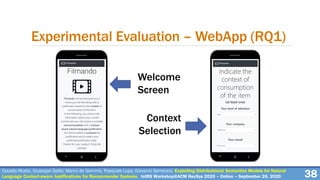
User Study with a Web Application
273 subjects - Movie Domain. 300 movies. ~150k reviews.
Metrics: Transparency, Engagement, Persuasion, Trust, Effectiveness [^]
Parameters: Lexicon (Unigram, Bigrams and Unigram+Bigrams)
Between-subjects for Research Question 1, Within-subjects for Research Question 2
[^] Tintarev, N., & Masthoff, J. Designing and
evaluating explanations for recommender
systems. In Recommender systems
handbook. pp. 479-510. Springer, Boston,
MA. 2011
37Cataldo Musto, Giuseppe Spillo, Marco de Gemmis, Pasquale Lops, Giovanni Semeraro. Exploiting Distributional Semantics Models for Natural
Language Context-aware Justifications for Recommender Systems. IntRS Workshop@ACM RecSys 2020 – Online – September 26, 2020
Experimental Evaluation – WebApp (RQ1)
38Cataldo Musto, Giuseppe Spillo, Marco de Gemmis, Pasquale Lops, Giovanni Semeraro. Exploiting Distributional Semantics Models for Natural
Language Context-aware Justifications for Recommender Systems. IntRS Workshop@ACM RecSys 2020 – Online – September 26, 2020
Welcome
Screen
Context
Selection
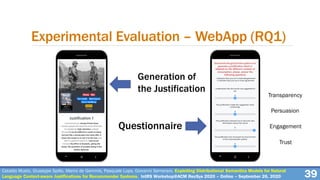
Experimental Evaluation – WebApp (RQ1)
39Cataldo Musto, Giuseppe Spillo, Marco de Gemmis, Pasquale Lops, Giovanni Semeraro. Exploiting Distributional Semantics Models for Natural
Language Context-aware Justifications for Recommender Systems. IntRS Workshop@ACM RecSys 2020 – Online – September 26, 2020
Generation of
the Justification
Questionnaire
Transparency
Persuasion
Engagement
Trust
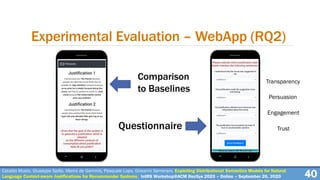
Experimental Evaluation – WebApp (RQ2)
40Cataldo Musto, Giuseppe Spillo, Marco de Gemmis, Pasquale Lops, Giovanni Semeraro. Exploiting Distributional Semantics Models for Natural
Language Context-aware Justifications for Recommender Systems. IntRS Workshop@ACM RecSys 2020 – Online – September 26, 2020
Comparison
to Baselines
Questionnaire
Transparency
Persuasion
Engagement
Trust
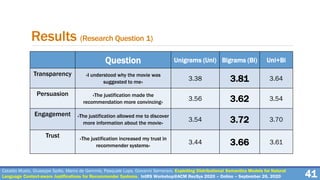
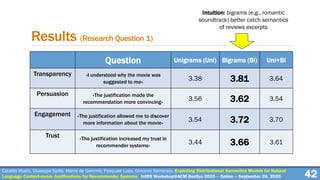
Results (Research Question 1)
41
Question Unigrams (Uni) Bigrams (Bi) Uni+Bi
Transparency «I understood why the movie was
suggested to me»
3.38 3.81 3.64
Persuasion «The justification made the
recommendation more convincing»
3.56 3.62 3.54
Engagement «The justification allowed me to discover
more information about the movie»
3.54 3.72 3.70
Trust «The justification increased my trust in
recommender systems»
3.44 3.66 3.61
Cataldo Musto, Giuseppe Spillo, Marco de Gemmis, Pasquale Lops, Giovanni Semeraro. Exploiting Distributional Semantics Models for Natural
Language Context-aware Justifications for Recommender Systems. IntRS Workshop@ACM RecSys 2020 – Online – September 26, 2020
Results (Research Question 1)
42
Question Unigrams (Uni) Bigrams (Bi) Uni+Bi
Transparency «I understood why the movie was
suggested to me»
3.38 3.81 3.64
Persuasion «The justification made the
recommendation more convincing»
3.56 3.62 3.54
Engagement «The justification allowed me to discover
more information about the movie»
3.54 3.72 3.70
Trust «The justification increased my trust in
recommender systems»
3.44 3.66 3.61
Intuition: bigrams (e.g., romantic
soundtrack) better catch semantics
of reviews excerpts
Cataldo Musto, Giuseppe Spillo, Marco de Gemmis, Pasquale Lops, Giovanni Semeraro. Exploiting Distributional Semantics Models for Natural
Language Context-aware Justifications for Recommender Systems. IntRS Workshop@ACM RecSys 2020 – Online – September 26, 2020
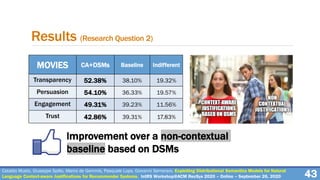
Results (Research Question 2)
MOVIES CA+DSMs Baseline Indifferent
Transparency 52.38% 38.10% 19.32%
Persuasion 54.10% 36.33% 19.57%
Engagement 49.31% 39.23% 11.56%
Trust 42.86% 39.31% 17.83%
43Cataldo Musto, Giuseppe Spillo, Marco de Gemmis, Pasquale Lops, Giovanni Semeraro. Exploiting Distributional Semantics Models for Natural
Language Context-aware Justifications for Recommender Systems. IntRS Workshop@ACM RecSys 2020 – Online – September 26, 2020
Improvement over a non-contextual
baseline based on DSMs
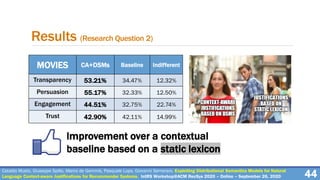
Results (Research Question 2)
MOVIES CA+DSMs Baseline Indifferent
Transparency 53.21% 34.47% 12.32%
Persuasion 55.17% 32.33% 12.50%
Engagement 44.51% 32.75% 22.74%
Trust 42.90% 42.11% 14.99%
44Cataldo Musto, Giuseppe Spillo, Marco de Gemmis, Pasquale Lops, Giovanni Semeraro. Exploiting Distributional Semantics Models for Natural
Language Context-aware Justifications for Recommender Systems. IntRS Workshop@ACM RecSys 2020 – Online – September 26, 2020
Improvement over a contextual
baseline based on a static lexicon
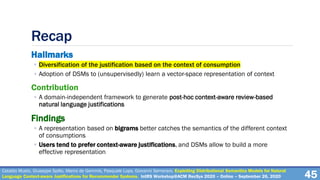
Recap
Hallmarks
◦ Diversification of the justification based on the context of consumption
◦ Adoption of DSMs to (unsupervisedly) learn a vector-space representation of context
Contribution
◦ A domain-independent framework to generate post-hoc context-aware review-based
natural language justifications
Findings
◦ A representation based on bigrams better catches the semantics of the different context
of consumptions
◦ Users tend to prefer context-aware justifications, and DSMs allow to build a more
effective representation
45
Cataldo Musto, Giuseppe Spillo, Marco de Gemmis, Pasquale Lops, Giovanni Semeraro. Exploiting Distributional Semantics Models for Natural
Language Context-aware Justifications for Recommender Systems. IntRS Workshop@ACM RecSys 2020 – Online – September 26, 2020
Future Work
Generation of personalized
justifications
◦ We aim to encode user preferences into
the generation process
Evaluation of the post-hoc nature
◦ To assess whether the model is solid
enough to ‘explain’ also more complex
and opaque deep learning models
Generation of hybrid justifications
◦ Combining structured features and
review-based features
46
Cataldo Musto, Giuseppe Spillo, Marco de Gemmis, Pasquale Lops, Giovanni Semeraro. Exploiting Distributional Semantics Models for Natural
Language Context-aware Justifications for Recommender Systems. IntRS Workshop@ACM RecSys 2020 – Online – September 26, 2020
RecSys
2021
Thank you! cataldo.musto@uniba.it
@cataldomusto
Contacts
47

Exploiting Distributional Semantics Models for Natural Language Context-aware Justifications for Recommender Systems

  • 1.
    @cataldomusto cataldo.musto@uniba.it Exploiting Distributional SemanticsModels for Natural Language Context-aware Justifications for Recommender Systems CATALDO MUSTO, GIUSEPPE SPILLO, PASQUALE LOPS, MARCO DE GEMMIS, GIOVANNI SEMERARO UNIVERSITÀ DEGLI STUDI DI BARI ‘ALDO MORO’ – ITALY SWAP RESEARCH GROUP – HTTP://WWW.DI.UNIBA.IT/~SWAP IntRS 2020 – Joint Workshop on Interfaces and Human Decision-Making for Recommender Systems jointly held with ACM RecSys 2020 Online - Worldwide– September 26, 2020
  • 2.
    The Explanation Problem Recommendation 2CataldoMusto, Giuseppe Spillo, Marco de Gemmis, Pasquale Lops, Giovanni Semeraro. Exploiting Distributional Semantics Models for Natural Language Context-aware Justifications for Recommender Systems. IntRS Workshop@ACM RecSys 2020 – Online – September 26, 2020 Profile
  • 3.
    A solution: review-basedfeatures To identify relevant and distinguishing characteristics of the recommended item by mining users’ reviews 3Cataldo Musto, Giuseppe Spillo, Marco de Gemmis, Pasquale Lops, Giovanni Semeraro. Exploiting Distributional Semantics Models for Natural Language Context-aware Justifications for Recommender Systems. IntRS Workshop@ACM RecSys 2020 – Online – September 26, 2020 Cataldo Musto, Pasquale Lops, Marco de Gemmis, Giovanni Semeraro. Justifying Recommendations through Aspect-based Sentiment Analysis of Users Reviews. UMAP 2019: 4-12
  • 4.
    A solution: review-basedfeatures To identify relevant and distinguishing characteristics of the recommended item by mining users’ reviews 4Cataldo Musto, Giuseppe Spillo, Marco de Gemmis, Pasquale Lops, Giovanni Semeraro. Exploiting Distributional Semantics Models for Natural Language Context-aware Justifications for Recommender Systems. IntRS Workshop@ACM RecSys 2020 – Online – September 26, 2020 funny yarn memorable writing interesting concept romantic end….
  • 5.
    A solution: review-basedfeatures I recommend you Stranger Than Fiction because people who liked the movie think that it has a memorable writing. Moreover, people liked Stranger Than Fiction since it has a romantic end. 5Cataldo Musto, Giuseppe Spillo, Marco de Gemmis, Pasquale Lops, Giovanni Semeraro. Exploiting Distributional Semantics Models for Natural Language Context-aware Justifications for Recommender Systems. IntRS Workshop@ACM RecSys 2020 – Online – September 26, 2020
  • 6.
    Context plays akey role for decision-making tasks • Contextual factors (mood, company) do influence the selection of the most suitable item to be recommended; 6 …What about the context? Cataldo Musto, Giuseppe Spillo, Marco de Gemmis, Pasquale Lops, Giovanni Semeraro. Exploiting Distributional Semantics Models for Natural Language Context-aware Justifications for Recommender Systems. IntRS Workshop@ACM RecSys 2020 – Online – September 26, 2020 SHALL AN EXPLANATION BE INFLUENCED BY THE CONTEXT OF CONSUMPTION?
  • 7.
    A Methodology to GenerateContext-aware Post-Hoc Natural Language Justifications Exploiting Distributional Semantics Models 7 Contribution Cataldo Musto, Giuseppe Spillo, Marco de Gemmis, Pasquale Lops, Giovanni Semeraro. Exploiting Distributional Semantics Models for Natural Language Context-aware Justifications for Recommender Systems. IntRS Workshop@ACM RecSys 2020 – Online – September 26, 2020
  • 8.
    A Methodology to GenerateContext-aware Post-Hoc Natural Language Justifications Exploiting Distributional Semantics Models 8 Contribution - Hallmarks Cataldo Musto, Giuseppe Spillo, Marco de Gemmis, Pasquale Lops, Giovanni Semeraro. Exploiting Distributional Semantics Models for Natural Language Context-aware Justifications for Recommender Systems. IntRS Workshop@ACM RecSys 2020 – Online – September 26, 2020 Justifications vary depending on the different contexts of consumption Justifications are independent of the underlying recommendation model Justifications are generated by exploiting a geometrical representation of items, contexts and sentences
  • 9.
    9 Workflow Cataldo Musto, GiuseppeSpillo, Marco de Gemmis, Pasquale Lops, Giovanni Semeraro. Exploiting Distributional Semantics Models for Natural Language Context-aware Justifications for Recommender Systems. IntRS Workshop@ACM RecSys 2020 – Online – September 26, 2020
  • 10.
    10 Workflow Cataldo Musto, GiuseppeSpillo, Marco de Gemmis, Pasquale Lops, Giovanni Semeraro. Exploiting Distributional Semantics Models for Natural Language Context-aware Justifications for Recommender Systems. IntRS Workshop@ACM RecSys 2020 – Online – September 26, 2020 Step 1 We learn a vector-space representation of ‘contexts’
  • 11.
    11 Workflow Cataldo Musto, GiuseppeSpillo, Marco de Gemmis, Pasquale Lops, Giovanni Semeraro. Exploiting Distributional Semantics Models for Natural Language Context-aware Justifications for Recommender Systems. IntRS Workshop@ACM RecSys 2020 – Online – September 26, 2020 Step 2 We identify the most suitable review excerpts, given an item and a vector-space representation of ‘contexts’
  • 12.
    12 Workflow Cataldo Musto, GiuseppeSpillo, Marco de Gemmis, Pasquale Lops, Giovanni Semeraro. Exploiting Distributional Semantics Models for Natural Language Context-aware Justifications for Recommender Systems. IntRS Workshop@ACM RecSys 2020 – Online – September 26, 2020 Step 3 We put together the review excerpts, to generate the final context-aware justification
  • 13.
    13 Context Learner Cataldo Musto,Giuseppe Spillo, Marco de Gemmis, Pasquale Lops, Giovanni Semeraro. Exploiting Distributional Semantics Models for Natural Language Context-aware Justifications for Recommender Systems. IntRS Workshop@ACM RecSys 2020 – Online – September 26, 2020 Step 1
  • 14.
    Cataldo Musto, GiuseppeSpillo, Marco de Gemmis, Pasquale Lops, Giovanni Semeraro. Exploiting Distributional Semantics Models for Natural Language Context-aware Justifications for Recommender Systems. IntRS Workshop@ACM RecSys 2020 – Online – September 26, 2020 • Goal: to build a ‘representation’ of the contexts • Intuition: to exploit Distributional Semantics Models (DSMs) to obtain a vector space representation of each context 14 Context Learner content representation company= friends company= colleagues company= family
  • 15.
    Cataldo Musto, GiuseppeSpillo, Marco de Gemmis, Pasquale Lops, Giovanni Semeraro. Exploiting Distributional Semantics Models for Natural Language Context-aware Justifications for Recommender Systems. IntRS Workshop@ACM RecSys 2020 – Online – September 26, 2020 15 Distributional Semantics Models Ludwig Wittgenstein (Austrian philosopher) Meaning of a word is determined by its usage. «Words that share a similar context have a similar meaning»
  • 16.
    Cataldo Musto, GiuseppeSpillo, Marco de Gemmis, Pasquale Lops, Giovanni Semeraro. Exploiting Distributional Semantics Models for Natural Language Context-aware Justifications for Recommender Systems. IntRS Workshop@ACM RecSys 2020 – Online – September 26, 2020 16 Distributional Semantics Models Ludwig Wittgenstein (Austrian philosopher) Recent techniques to represent textual content (Word2Vec, BERT, etc) are all inspired by distributional hypothesis. «Words that share a similar context have a similar meaning»
  • 17.
    Cataldo Musto, GiuseppeSpillo, Marco de Gemmis, Pasquale Lops, Giovanni Semeraro. Exploiting Distributional Semantics Models for Natural Language Context-aware Justifications for Recommender Systems. IntRS Workshop@ACM RecSys 2020 – Online – September 26, 2020 Distributional Semantics Models A vector space representation of each word based on word usage can be obtained 17 beer wine glass spoon This is called WordSpace
  • 18.
    Cataldo Musto, GiuseppeSpillo, Marco de Gemmis, Pasquale Lops, Giovanni Semeraro. Exploiting Distributional Semantics Models for Natural Language Context-aware Justifications for Recommender Systems. IntRS Workshop@ACM RecSys 2020 – Online – September 26, 2020 Distributional Semantics Models c1 c2 c3 c4 c5 c6 c7 c8 c9 beer ✔ ✔ ✔ ✔ wine ✔ ✔ ✔ ✔ ✔ spoon ✔ ✔ ✔ ✔ glass ✔ ✔ ✔ ✔ ✔ Representation based on a term-context matrix encoding term usage. 18
  • 19.
    Cataldo Musto, GiuseppeSpillo, Marco de Gemmis, Pasquale Lops, Giovanni Semeraro. Exploiting Distributional Semantics Models for Natural Language Context-aware Justifications for Recommender Systems. IntRS Workshop@ACM RecSys 2020 – Online – September 26, 2020 Distributional Semantics Models Good overlap = similar meaning Each row of the matrix is a vector 19 c1 c2 c3 c4 c5 c6 c7 c8 c9 beer ✔ ✔ ✔ ✔ wine ✔ ✔ ✔ ✔ ✔ spoon ✔ ✔ ✔ ✔ glass ✔ ✔ ✔ ✔ ✔
  • 20.
    Cataldo Musto, GiuseppeSpillo, Marco de Gemmis, Pasquale Lops, Giovanni Semeraro. Exploiting Distributional Semantics Models for Natural Language Context-aware Justifications for Recommender Systems. IntRS Workshop@ACM RecSys 2020 – Online – September 26, 2020 • Question: how can we exploit DSMs for our goals? We designed the following pipeline 1. Contexts Definition 2. Sentence Annotation 3. Vector Space Construction 4. Output Generation 20 Context Learner
  • 21.
    Cataldo Musto, GiuseppeSpillo, Marco de Gemmis, Pasquale Lops, Giovanni Semeraro. Exploiting Distributional Semantics Models for Natural Language Context-aware Justifications for Recommender Systems. IntRS Workshop@ACM RecSys 2020 – Online – September 26, 2020 1. Contexts Definition ◦ We manually define contextual factors and contextual dimensions for a specific domain (e.g., movie recommendation) 21 Context Learner Attention Company Mood High AttentionLow Attention Family PartnerFriends Bad Mood Good Mood
  • 22.
    Cataldo Musto, GiuseppeSpillo, Marco de Gemmis, Pasquale Lops, Giovanni Semeraro. Exploiting Distributional Semantics Models for Natural Language Context-aware Justifications for Recommender Systems. IntRS Workshop@ACM RecSys 2020 – Online – September 26, 2020 2. Sentence Annotation ◦ To build a representation of each context, we need to manually annotate sentences (e.g., reviews excerpts) with the set of contexts in which they are suitable as context-aware justifications. 22 Context Learner Not easy to understand, requires a very careful vision’ A fairy tale, pleasant and enchanting A very romantic movie (…repeat over many sentences)
  • 23.
    Cataldo Musto, GiuseppeSpillo, Marco de Gemmis, Pasquale Lops, Giovanni Semeraro. Exploiting Distributional Semantics Models for Natural Language Context-aware Justifications for Recommender Systems. IntRS Workshop@ACM RecSys 2020 – Online – September 26, 2020 3. Vector Space Construction ◦ Once the annotation step is completed, we tokenize sentences ◦ We build a term-context matrix encoding term usage (as in DSMs) 23 Context Learner careful ✔✔ ✔ fairy ✔✔ ✔ romantic ✔✔ intense ✔ easy ✔ ✔
  • 24.
    Cataldo Musto, GiuseppeSpillo, Marco de Gemmis, Pasquale Lops, Giovanni Semeraro. Exploiting Distributional Semantics Models for Natural Language Context-aware Justifications for Recommender Systems. IntRS Workshop@ACM RecSys 2020 – Online – September 26, 2020 3. Vector Space Construction ◦ It is important to emphasize that we are not limited to single word. Rows of the matrix can be also bigrams, as well. 24 Context Learner careful vision ✔ ✔ fairy tale ✔ ✔ romantic movie ✔ intense plot ✔ easy vision ✔ ✔
  • 25.
    Cataldo Musto, GiuseppeSpillo, Marco de Gemmis, Pasquale Lops, Giovanni Semeraro. Exploiting Distributional Semantics Models for Natural Language Context-aware Justifications for Recommender Systems. IntRS Workshop@ACM RecSys 2020 – Online – September 26, 2020 4. Output Generation ◦ Column Vectors = Vector Space Representation of Each Context ◦ Lexicons = top-k lemmas with the highest score in a column 25 Context Learner careful ✔✔ ✔ fairy ✔✔ ✔ romantic ✔✔ intense ✔ easy ✔ ✔
  • 26.
    Cataldo Musto, GiuseppeSpillo, Marco de Gemmis, Pasquale Lops, Giovanni Semeraro. Exploiting Distributional Semantics Models for Natural Language Context-aware Justifications for Recommender Systems. IntRS Workshop@ACM RecSys 2020 – Online – September 26, 2020 4. Output Generation ◦ Column Vectors = Vector Space Representation of Each Context ◦ Lexicons = top-k lemmas with the highest score in a column 26 Context Learner = { fairy, calm, story, kids … } = { atmoshpere, romantic, … } = { funny, simple, smooth … }
  • 27.
    27 Ranker Cataldo Musto, GiuseppeSpillo, Marco de Gemmis, Pasquale Lops, Giovanni Semeraro. Exploiting Distributional Semantics Models for Natural Language Context-aware Justifications for Recommender Systems. IntRS Workshop@ACM RecSys 2020 – Online – September 26, 2020 Step 2
  • 28.
    Cataldo Musto, GiuseppeSpillo, Marco de Gemmis, Pasquale Lops, Giovanni Semeraro. Exploiting Distributional Semantics Models for Natural Language Context-aware Justifications for Recommender Systems. IntRS Workshop@ACM RecSys 2020 – Online – September 26, 2020 • Goal: given an item and context of consumption, to identify the most suitable review excerpts • Intuition: to adopt similarity measures in geometrical spaces 28 Ranker representation company= friends company= colleagues company= family
  • 29.
    Cataldo Musto, GiuseppeSpillo, Marco de Gemmis, Pasquale Lops, Giovanni Semeraro. Exploiting Distributional Semantics Models for Natural Language Context-aware Justifications for Recommender Systems. IntRS Workshop@ACM RecSys 2020 – Online – September 26, 2020 29 Ranker friends family partner We start from the output returned by the Context Learner
  • 30.
    Cataldo Musto, GiuseppeSpillo, Marco de Gemmis, Pasquale Lops, Giovanni Semeraro. Exploiting Distributional Semantics Models for Natural Language Context-aware Justifications for Recommender Systems. IntRS Workshop@ACM RecSys 2020 – Online – September 26, 2020 30 Ranker Given a recommended item, we encode in the vector space the available review excerpts We limit to sentences expressing a positive sentiment friends family partner ‘it is a classy, sweet and funny movie’ ‘it has a memorable writing’ ‘the movie has a very romantic end’
  • 31.
    Cataldo Musto, GiuseppeSpillo, Marco de Gemmis, Pasquale Lops, Giovanni Semeraro. Exploiting Distributional Semantics Models for Natural Language Context-aware Justifications for Recommender Systems. IntRS Workshop@ACM RecSys 2020 – Online – September 26, 2020 31 Ranker Next, given a context of consumption, we identify the top-K review excerpts by exploiting similarity measures in geometrical spaces (e.g., cosine similarity)friends family partner ‘it is a classy, sweet and funny movie’ ‘it has a memorable writing’ ‘the movie has a very romantic end’
  • 32.
    Cataldo Musto, GiuseppeSpillo, Marco de Gemmis, Pasquale Lops, Giovanni Semeraro. Exploiting Distributional Semantics Models for Natural Language Context-aware Justifications for Recommender Systems. IntRS Workshop@ACM RecSys 2020 – Online – September 26, 2020 32 Ranker Next, given a context of consumption, we identify the top-K review excerpts by exploiting similarity measures in geometrical spaces (e.g., cosine similarity)friends family partner ‘it is a classy, sweet and funny movie’
  • 33.
    Cataldo Musto, GiuseppeSpillo, Marco de Gemmis, Pasquale Lops, Giovanni Semeraro. Exploiting Distributional Semantics Models for Natural Language Context-aware Justifications for Recommender Systems. IntRS Workshop@ACM RecSys 2020 – Online – September 26, 2020 33 Ranker Next, given a context of consumption, we identify the top-K review excerpts by exploiting similarity measures in geometrical spaces (e.g., cosine similarity)friends family partner ‘the movie has a very romantic end’
  • 34.
    34 Generator Cataldo Musto, GiuseppeSpillo, Marco de Gemmis, Pasquale Lops, Giovanni Semeraro. Exploiting Distributional Semantics Models for Natural Language Context-aware Justifications for Recommender Systems. IntRS Workshop@ACM RecSys 2020 – Online – September 26, 2020 Step 3
  • 35.
    Cataldo Musto, GiuseppeSpillo, Marco de Gemmis, Pasquale Lops, Giovanni Semeraro. Exploiting Distributional Semantics Models for Natural Language Context-aware Justifications for Recommender Systems. IntRS Workshop@ACM RecSys 2020 – Online – September 26, 2020 • Goal: to combine the top-k review excerpts in a natural language justification adapted to the context of consumption • Intuition: to exploit natural language generation techniques • Each justification has a fixed part, which is common to all the justifications, and a dynamic part, which is filled in based on previously identified excerpts. 35 Generator You should watch ’Stranger than Fiction’. It is a good movie to watch with your partner because it has a very romantic end. Moreover, plot is very intense. You should watch ’Stranger than Fiction’. It is a good movie to watch with your friends because it crackles with laughther and pathos and it is a classy sweet and funny movie.
  • 36.
    Cataldo Musto, GiuseppeSpillo, Marco de Gemmis, Pasquale Lops, Giovanni Semeraro. Exploiting Distributional Semantics Models for Natural Language Context-aware Justifications for Recommender Systems. IntRS Workshop@ACM RecSys 2020 – Online – September 26, 2020 36 Final Output You should watch ’Stranger than Fiction’. It is a good movie to watch with your partner because it has a very romantic end. Moreover, plot is very intense. You should watch ’Stranger than Fiction’. It is a good movie to watch with your friends because it crackles with laughther and pathos and it is a classy sweet and funny movie. Context-aware Natural Language Justification based on DSMs
  • 37.
    Experimental Evaluation Research Question1 (RQ1) How effective are the justifications generated through the pipeline, on varying of different combinations of the parameters? Research Question 2 (RQ2) How does our justifications perform with respect to non-contextual justifications and contextual justifications based on a fixed lexicon? Experimental Design User Study with a Web Application 273 subjects - Movie Domain. 300 movies. ~150k reviews. Metrics: Transparency, Engagement, Persuasion, Trust, Effectiveness [^] Parameters: Lexicon (Unigram, Bigrams and Unigram+Bigrams) Between-subjects for Research Question 1, Within-subjects for Research Question 2 [^] Tintarev, N., & Masthoff, J. Designing and evaluating explanations for recommender systems. In Recommender systems handbook. pp. 479-510. Springer, Boston, MA. 2011 37Cataldo Musto, Giuseppe Spillo, Marco de Gemmis, Pasquale Lops, Giovanni Semeraro. Exploiting Distributional Semantics Models for Natural Language Context-aware Justifications for Recommender Systems. IntRS Workshop@ACM RecSys 2020 – Online – September 26, 2020
  • 38.
    Experimental Evaluation –WebApp (RQ1) 38Cataldo Musto, Giuseppe Spillo, Marco de Gemmis, Pasquale Lops, Giovanni Semeraro. Exploiting Distributional Semantics Models for Natural Language Context-aware Justifications for Recommender Systems. IntRS Workshop@ACM RecSys 2020 – Online – September 26, 2020 Welcome Screen Context Selection
  • 39.
    Experimental Evaluation –WebApp (RQ1) 39Cataldo Musto, Giuseppe Spillo, Marco de Gemmis, Pasquale Lops, Giovanni Semeraro. Exploiting Distributional Semantics Models for Natural Language Context-aware Justifications for Recommender Systems. IntRS Workshop@ACM RecSys 2020 – Online – September 26, 2020 Generation of the Justification Questionnaire Transparency Persuasion Engagement Trust
  • 40.
    Experimental Evaluation –WebApp (RQ2) 40Cataldo Musto, Giuseppe Spillo, Marco de Gemmis, Pasquale Lops, Giovanni Semeraro. Exploiting Distributional Semantics Models for Natural Language Context-aware Justifications for Recommender Systems. IntRS Workshop@ACM RecSys 2020 – Online – September 26, 2020 Comparison to Baselines Questionnaire Transparency Persuasion Engagement Trust
  • 41.
    Results (Research Question1) 41 Question Unigrams (Uni) Bigrams (Bi) Uni+Bi Transparency «I understood why the movie was suggested to me» 3.38 3.81 3.64 Persuasion «The justification made the recommendation more convincing» 3.56 3.62 3.54 Engagement «The justification allowed me to discover more information about the movie» 3.54 3.72 3.70 Trust «The justification increased my trust in recommender systems» 3.44 3.66 3.61 Cataldo Musto, Giuseppe Spillo, Marco de Gemmis, Pasquale Lops, Giovanni Semeraro. Exploiting Distributional Semantics Models for Natural Language Context-aware Justifications for Recommender Systems. IntRS Workshop@ACM RecSys 2020 – Online – September 26, 2020
  • 42.
    Results (Research Question1) 42 Question Unigrams (Uni) Bigrams (Bi) Uni+Bi Transparency «I understood why the movie was suggested to me» 3.38 3.81 3.64 Persuasion «The justification made the recommendation more convincing» 3.56 3.62 3.54 Engagement «The justification allowed me to discover more information about the movie» 3.54 3.72 3.70 Trust «The justification increased my trust in recommender systems» 3.44 3.66 3.61 Intuition: bigrams (e.g., romantic soundtrack) better catch semantics of reviews excerpts Cataldo Musto, Giuseppe Spillo, Marco de Gemmis, Pasquale Lops, Giovanni Semeraro. Exploiting Distributional Semantics Models for Natural Language Context-aware Justifications for Recommender Systems. IntRS Workshop@ACM RecSys 2020 – Online – September 26, 2020
  • 43.
    Results (Research Question2) MOVIES CA+DSMs Baseline Indifferent Transparency 52.38% 38.10% 19.32% Persuasion 54.10% 36.33% 19.57% Engagement 49.31% 39.23% 11.56% Trust 42.86% 39.31% 17.83% 43Cataldo Musto, Giuseppe Spillo, Marco de Gemmis, Pasquale Lops, Giovanni Semeraro. Exploiting Distributional Semantics Models for Natural Language Context-aware Justifications for Recommender Systems. IntRS Workshop@ACM RecSys 2020 – Online – September 26, 2020 Improvement over a non-contextual baseline based on DSMs
  • 44.
    Results (Research Question2) MOVIES CA+DSMs Baseline Indifferent Transparency 53.21% 34.47% 12.32% Persuasion 55.17% 32.33% 12.50% Engagement 44.51% 32.75% 22.74% Trust 42.90% 42.11% 14.99% 44Cataldo Musto, Giuseppe Spillo, Marco de Gemmis, Pasquale Lops, Giovanni Semeraro. Exploiting Distributional Semantics Models for Natural Language Context-aware Justifications for Recommender Systems. IntRS Workshop@ACM RecSys 2020 – Online – September 26, 2020 Improvement over a contextual baseline based on a static lexicon
  • 45.
    Recap Hallmarks ◦ Diversification ofthe justification based on the context of consumption ◦ Adoption of DSMs to (unsupervisedly) learn a vector-space representation of context Contribution ◦ A domain-independent framework to generate post-hoc context-aware review-based natural language justifications Findings ◦ A representation based on bigrams better catches the semantics of the different context of consumptions ◦ Users tend to prefer context-aware justifications, and DSMs allow to build a more effective representation 45 Cataldo Musto, Giuseppe Spillo, Marco de Gemmis, Pasquale Lops, Giovanni Semeraro. Exploiting Distributional Semantics Models for Natural Language Context-aware Justifications for Recommender Systems. IntRS Workshop@ACM RecSys 2020 – Online – September 26, 2020
  • 46.
    Future Work Generation ofpersonalized justifications ◦ We aim to encode user preferences into the generation process Evaluation of the post-hoc nature ◦ To assess whether the model is solid enough to ‘explain’ also more complex and opaque deep learning models Generation of hybrid justifications ◦ Combining structured features and review-based features 46 Cataldo Musto, Giuseppe Spillo, Marco de Gemmis, Pasquale Lops, Giovanni Semeraro. Exploiting Distributional Semantics Models for Natural Language Context-aware Justifications for Recommender Systems. IntRS Workshop@ACM RecSys 2020 – Online – September 26, 2020 RecSys 2021
  • 47.