Experiencing MIS 5th Edition Kroenke Test Bank
download pdf
https://testbankfan.com/product/experiencing-mis-5th-edition-kroenke-
test-bank/
Visit testbankfan.com to explore and download the complete
collection of test banks or solution manuals!
Here are some recommended products for you. Click the link to
download, or explore more at testbankfan.com
Experiencing MIS 5th Edition Kroenke Solutions Manual
https://testbankfan.com/product/experiencing-mis-5th-edition-kroenke-
solutions-manual/
Experiencing MIS 4th Edition Kroenke Test Bank
https://testbankfan.com/product/experiencing-mis-4th-edition-kroenke-
test-bank/
Experiencing MIS 6th Edition Kroenke Test Bank
https://testbankfan.com/product/experiencing-mis-6th-edition-kroenke-
test-bank/
Exercise Physiology Theory and Application to Fitness and
Performance 10th Edition Powers Test Bank
https://testbankfan.com/product/exercise-physiology-theory-and-
application-to-fitness-and-performance-10th-edition-powers-test-bank/
Human Development A Life Span View 3rd Edition Ateah Test
Bank
https://testbankfan.com/product/human-development-a-life-span-
view-3rd-edition-ateah-test-bank/
Practice of Research in Social Work 4th Edition Engle Test
Bank
https://testbankfan.com/product/practice-of-research-in-social-
work-4th-edition-engle-test-bank/
Essential University Physics 3rd Edition Richard Wolfson
Test Bank
https://testbankfan.com/product/essential-university-physics-3rd-
edition-richard-wolfson-test-bank/
MGMT 9th Edition Williams Test Bank
https://testbankfan.com/product/mgmt-9th-edition-williams-test-bank/
Art Past Art Present 6th Edition Wilkins Test Bank
https://testbankfan.com/product/art-past-art-present-6th-edition-
wilkins-test-bank/
Concepts of Database Management 8th Edition Pratt Test
Bank
https://testbankfan.com/product/concepts-of-database-management-8th-
edition-pratt-test-bank/
1
Copyright © 2015 Pearson Education, Inc.
Experiencing MIS, 5e (Kroenke)
Chapter 8: Social Media Information Systems
Multiple Choice
1) ________ is the use of information technology to support the sharing of content among
networks of users.
A) Electronic data interchange
B) Data warehousing
C) Cloud computing
D) Social media
Answer: D
Difficulty: Easy
AACSB: Information Technology
Chapter LO: 1
Course LO: Discuss the role of information systems in supporting business processes
2) Which of the following statements is a characteristic of user communities?
A) Social Media (SM) user communities are mostly based on geographic and familial ties.
B) Most users of SM belong to several different user communities.
C) In community-SM site relationships, the relationships in second-tier communities are
disassociated from first-tier users.
D) A viral hook is an inducement to constrain communications between user communities.
Answer: B
Difficulty: Moderate
AACSB: Information Technology
Chapter LO: 1
Course LO: Discuss the role of information systems in supporting business processes
3) SM communities differ from regular communities because ________.
A) they are based on mutual interests of users
B) they are based only on organizational boundaries
C) most people belong to a single community
D) the total number of its users is determined by the sum of the sizes of all its communities
Answer: A
Difficulty: Moderate
AACSB: Information Technology
Chapter LO: 1
Course LO: Discuss the role of information systems in supporting business processes
2
Copyright © 2015 Pearson Education, Inc.
4) Which of the following statements is true about viral hooks?
A) It is used to restrain information leaks from an organization.
B) It is used to enhance an organization's privacy on its SM sites.
C) It is designed to root out users who post junk content on an organization's SM site.
D) It is an inducement to pass communication along the tiers of a community.
Answer: D
Difficulty: Moderate
AACSB: Information Technology
Chapter LO: 1
Course LO: Discuss the role of information systems in supporting business processes
5) Social media ________ are companies and other organizations that choose to support a
presence on one or more SM sites.
A) outlets
B) sponsors
C) application providers
D) dashboards
Answer: B
Difficulty: Easy
AACSB: Information Technology
Chapter LO: 1
Course LO: Discuss the role of information systems in supporting business processes
6) Social media ________ are the companies that operate the SM sites.
A) outlets
B) sponsors
C) application providers
D) newsrooms
Answer: C
Difficulty: Easy
AACSB: Information Technology
Chapter LO: 1
Course LO: Discuss the role of information systems in supporting business processes
7) Social media ________ create the features and functions of the site, and they compete with
one another for the attention of user communities and SM sponsors.
A) application providers
B) collaborators
C) dashboards
D) outlets
Answer: A
Difficulty: Easy
AACSB: Information Technology
Chapter LO: 1
Course LO: Discuss the role of information systems in supporting business processes
3
Copyright © 2015 Pearson Education, Inc.
8) ________ is data and responses to data that are contributed by users and SM sponsors.
A) Connection data
B) Capital data
C) Content data
D) Custom data
Answer: C
Difficulty: Easy
AACSB: Information Technology
Chapter LO: 1
Course LO: Discuss the role of information systems in supporting business processes
9) ________ is data about relationships.
A) Connection data
B) Capital data
C) Content data
D) Communication data
Answer: A
Difficulty: Easy
AACSB: Information Technology
Chapter LO: 1
Course LO: Discuss the role of information systems in supporting business processes
10) With respect to the five components of social media information systems (SMIS), which of
the following statements is true of user communities?
A) They process SM sites using elastic, cloud-based servers.
B) They develop and operate their own custom social networking application software to read
and submit data.
C) They need to be trained on both SMIS user procedures as well as on their organization's social
networking policy.
D) Their procedures are informal, evolving, and socially oriented.
Answer: D
Difficulty: Moderate
AACSB: Information Technology
Chapter LO: 1
Course LO: Discuss the role of information systems in supporting business processes
11) With respect to the five components of social media information systems (SMIS), which of
the following statements is true of application providers?
A) They usually process SM sites using desktops, laptops, and smartphones.
B) They store and retrieve SM data on behalf of sponsors and user communities.
C) They employ browsers and native mobile applications to store and retrieve connection data.
D) Their procedures are informal, evolving, and socially oriented.
Answer: B
Difficulty: Moderate
AACSB: Information Technology
Chapter LO: 1
Course LO: Discuss the role of information systems in supporting business processes
4
Copyright © 2015 Pearson Education, Inc.
12) Which of the following statements is a feature of social media application providers?
A) They do not support custom software for long durations as it is expensive.
B) They generally charge users a license fee to use their applications.
C) They use elastic, cloud-based servers to process SM sites.
D) They sponsor content on SM sites.
Answer: C
Difficulty: Moderate
AACSB: Information Technology
Chapter LO: 1
Course LO: Discuss the role of information systems in supporting business processes
13) With respect to the five components of social media information systems (SMIS), which of
the following statements is true of SM sponsors?
A) They process SM sites using elastic, cloud-based servers.
B) They develop and operate their own custom, proprietary, social networking application
software.
C) They need to be trained on both SMIS user procedures as well as on the organization's social
networking policy.
D) Their procedures are informal, evolving, and socially oriented.
Answer: C
Difficulty: Moderate
AACSB: Information Technology
Chapter LO: 1
Course LO: Discuss the role of information systems in supporting business processes
14) Which of the following statements is true of defenders of belief?
A) They seek conformity and want to convince others of the wisdom of their opinions.
B) Their communities do not facilitate activities like sales and marketing.
C) They are effective for activities that involve innovation and problem solving.
D) When confronted with contrary evidence, they change their opinion.
Answer: A
Difficulty: Moderate
AACSB: Information Technology
Chapter LO: 2
Course LO: Discuss the role of information systems in supporting business processes
15) Which of the following statements is true of seekers of truth?
A) They share a common belief and seek conformity.
B) They do not change their opinion when confronted with a contrary opinion.
C) They are effective for activities like sales and marketing.
D) They generally do not form bonds with an organization.
Answer: D
Difficulty: Moderate
AACSB: Information Technology
Chapter LO: 2
Course LO: Discuss the role of information systems in supporting business processes
5
Copyright © 2015 Pearson Education, Inc.
16) Which of the following statements is true of social CRM?
A) The relationships between organizations and customers are unchanging.
B) Each customer crafts his or her own relationship with the company.
C) Sales managers can control what the customer is reading about a company and its products.
D) Customers who are likely to make the highest purchases are likely to receive the most
attention.
Answer: B
Difficulty: Moderate
AACSB: Information Technology
Chapter LO: 2
Course LO: Discuss the role of information systems in supporting business processes
17) ________ is the dynamic social media process of employing users to participate in product
design or product redesign.
A) Social capitalization
B) Flexible product development
C) Crowdsourcing
D) Collaborative product development
Answer: C
Difficulty: Easy
AACSB: Information Technology
Chapter LO: 2
Course LO: Discuss the role of information systems in supporting business processes
18) ________ is the application of social media to facilitate the cooperative work of people
inside organizations.
A) Enterprise relationship management
B) Enterprise resource planning
C) Enterprise 2.0
D) Enterprise application integration
Answer: C
Difficulty: Easy
AACSB: Information Technology
Chapter LO: 2
Course LO: Discuss the role of information systems in supporting business processes
19) A ________ is a content structure that has emerged from the processing of many user tags.
A) metalanguage
B) chrome
C) folksonomy
D) bookmark
Answer: C
Difficulty: Easy
AACSB: Information Technology
Chapter LO: 2
Course LO: Discuss the role of information systems in supporting business processes
6
Copyright © 2015 Pearson Education, Inc.
20) According to McAfee's Enterprise 2.0 model, creating enterprise content via blogs, wikis,
discussion groups, and presentations is part of ________.
A) signaling
B) authoring
C) tagging
D) searching
Answer: B
Difficulty: Easy
AACSB: Information Technology
Chapter LO: 2
Course LO: Discuss the role of information systems in supporting business processes
21) According to McAfee, Enterprise 2.0 workers want applications that enable them to rate
tagged content and to use the tags to predict content that will be of interest to them. Which of the
following characteristics of Enterprise 2.0 does this refer to?
A) search
B) links
C) signals
D) extensions
Answer: D
Difficulty: Easy
AACSB: Information Technology
Chapter LO: 2
Course LO: Discuss the role of information systems in supporting business processes
22) In McAfee's Enterprise 2.0 model, pushing enterprise content to users based on subscriptions
and alerts is called ________.
A) signaling
B) authoring
C) tagging
D) searching
Answer: A
Difficulty: Easy
AACSB: Information Technology
Chapter LO: 2
Course LO: Discuss the role of information systems in supporting business processes
7
Copyright © 2015 Pearson Education, Inc.
23) Which of the following statements is true of using social media to advance organizational
strategy?
A) The unpredictability of dynamic processes like social media is encouraged in supply chains.
B) Solving supply chain problems via social media reinforces an organization's sense of privacy.
C) Users who have no financial incentive are willing to provide reviews to the buyer community.
D) Organizations whose business strategy involves selling to developer networks are the last to
adopt SM-based customer support.
Answer: C
Difficulty: Moderate
AACSB: Information Technology
Chapter LO: 2
Course LO: Discuss the role of information systems in supporting business processes
24) Being linked to a network of highly regarded contacts is a form of ________.
A) social credential
B) personal reinforcement
C) mobility
D) nepotism
Answer: A
Difficulty: Easy
AACSB: Information Technology
Chapter LO: 3
Course LO: Discuss the role of information systems in supporting business processes
25) Which of the following statements is true of social capital?
A) Social capital is the investment in human knowledge and skills for future profit.
B) The value of social capital is determined by the number of relationships in a social network.
C) Social capital can be gained by limiting the number of friends.
D) Being linked into social networks undermines a professional's image and position in an
organization.
Answer: B
Difficulty: Moderate
AACSB: Information Technology
Chapter LO: 3
Course LO: Discuss the role of information systems in supporting business processes
8
Copyright © 2015 Pearson Education, Inc.
26) Which of the following statements is true of social capital?
A) When a user creates content for an organization, the strength of the relationship increases.
B) Social capital does not depreciate.
C) Using relationships in social networks to influence decision makers decreases the value of
social capital.
D) The strength of a relationship between two entities is determined by the number of
relationships of each entity.
Answer: A
Difficulty: Moderate
AACSB: Information Technology
Chapter LO: 3
Course LO: Discuss the role of information systems in supporting business processes
27) A ________ is a statement that delineates employees' rights and responsibilities.
A) statement of purpose
B) bill of labor
C) social media policy
D) corporate datasheet
Answer: C
Difficulty: Easy
AACSB: Information Technology
Chapter LO: 4
Course LO: Discuss the role of information systems in supporting business processes
28) Which of the following statements is true of social networking problems?
A) Responses to problematic content are best reserved for instances where it has caused the
organization to do something positive.
B) Inappropriate contributions that contain obscene or otherwise inappropriate content should be
ignored indefinitely.
C) The product development team should not receive the criticisms posted on a social
networking site.
D) If the problematic content represents reasonable criticism of the organization's products, the
best response is to delete it.
Answer: A
Difficulty: Moderate
AACSB: Information Technology
Chapter LO: 4
Course LO: Discuss the role of information systems in supporting business processes
9
Copyright © 2015 Pearson Education, Inc.
29) Which of the following statements is true of responding to social networking problems?
A) Deleting legitimate negative comments indicates that the site contains genuine user content.
B) Criticism of products on an SM site cannot be used for product development.
C) Responses to problematic content on the organization's SM site should be defensive.
D) Patronizing responses to comments from content contributors can generate a strong backlash.
Answer: D
Difficulty: Moderate
AACSB: Information Technology
Chapter LO: 4
Course LO: Discuss the role of information systems in supporting business processes
30) In the context of management, ________ means loss of control of employees.
A) transcendence
B) divergence
C) emergence
D) dependence
Answer: C
Difficulty: Easy
AACSB: Information Technology
Chapter LO: 5
Course LO: Discuss the role of information systems in supporting business processes
True or False
1) Social media is the use of information technology to support the sharing of content among
networks of users.
Answer: TRUE
Difficulty: Easy
AACSB: Information Technology
Chapter LO: 1
Course LO: Discuss the role of information systems in supporting business processes
2) Social media enables people to form hives, which refer to groups of people related by a
common interest.
Answer: TRUE
Difficulty: Easy
AACSB: Information Technology
Chapter LO: 1
Course LO: Discuss the role of information systems in supporting business processes
3) A social media information system is an information system that supports the sharing of
content among networks of users.
Answer: TRUE
Difficulty: Easy
AACSB: Information Technology
Chapter LO: 1
Course LO: Discuss the role of information systems in supporting business processes
10
Copyright © 2015 Pearson Education, Inc.
4) Social media outlets are companies and other organizations that choose to support a presence
on one or more SM sites.
Answer: FALSE
Difficulty: Easy
AACSB: Information Technology
Chapter LO: 1
Course LO: Discuss the role of information systems in supporting business processes
5) Social media sponsors are the companies that operate the SM sites.
Answer: FALSE
Difficulty: Easy
AACSB: Information Technology
Chapter LO: 1
Course LO: Discuss the role of information systems in supporting business processes
6) Google is an example of a social media application provider.
Answer: TRUE
Difficulty: Easy
AACSB: Information Technology
Chapter LO: 1
Course LO: Discuss the role of information systems in supporting business processes
7) Social media application providers create the features and functions of the site, and they
compete with one another for the attention of user communities and SM sponsors.
Answer: TRUE
Difficulty: Moderate
AACSB: Information Technology
Chapter LO: 1
Course LO: Discuss the role of information systems in supporting business processes
8) A social media sponsor cannot develop its own provider.
Answer: FALSE
Difficulty: Easy
AACSB: Information Technology
Chapter LO: 1
Course LO: Discuss the role of information systems in supporting business processes
9) Both community users and employees of SM sponsors process SM sites using elastic, cloud-
based servers.
Answer: FALSE
Difficulty: Easy
AACSB: Information Technology
Chapter LO: 1
Course LO: Discuss the role of information systems in supporting business processes
11
Copyright © 2015 Pearson Education, Inc.
10) SM sponsors employ browsers and native mobile applications to read and submit data.
Answer: FALSE
Difficulty: Easy
AACSB: Information Technology
Chapter LO: 1
Course LO: Discuss the role of information systems in supporting business processes
11) SM application providers develop and operate their own custom, proprietary, social
networking application software.
Answer: TRUE
Difficulty: Easy
AACSB: Information Technology
Chapter LO: 1
Course LO: Discuss the role of information systems in supporting business processes
12) Content data is data about relationships.
Answer: FALSE
Difficulty: Easy
AACSB: Information Technology
Chapter LO: 1
Course LO: Discuss the role of information systems in supporting business processes
13) Connection data differentiates social media information systems (SMIS) from Web site
applications.
Answer: TRUE
Difficulty: Easy
AACSB: Information Technology
Chapter LO: 1
Course LO: Discuss the role of information systems in supporting business processes
14) Both Web sites and social networking sites present user and responder content, but only
social networking applications store and process connection data.
Answer: TRUE
Difficulty: Moderate
AACSB: Information Technology
Chapter LO: 1
Course LO: Discuss the role of information systems in supporting business processes
15) SM application providers store and retrieve SM data on behalf of sponsors and user
communities.
Answer: TRUE
Difficulty: Easy
AACSB: Information Technology
Chapter LO: 1
Course LO: Discuss the role of information systems in supporting business processes
12
Copyright © 2015 Pearson Education, Inc.
16) For SM sponsors, social networking procedures are informal, evolving, and socially oriented.
Answer: FALSE
Difficulty: Easy
AACSB: Information Technology
Chapter LO: 1
Course LO: Discuss the role of information systems in supporting business processes
17) SM sponsors do not require training on social media information systems (SMIS) user
procedures to contribute to their organization's SM site.
Answer: FALSE
Difficulty: Easy
AACSB: Information Technology
Chapter LO: 1
Course LO: Discuss the role of information systems in supporting business processes
18) Employees who contribute to and manage social networking sites will generate direct labor
costs.
Answer: TRUE
Difficulty: Easy
AACSB: Information Technology
Chapter LO: 1
Course LO: Discuss the role of information systems in supporting business processes
19) When confronted with contrary evidence, defenders of belief change their opinion.
Answer: FALSE
Difficulty: Easy
AACSB: Information Technology
Chapter LO: 2
Course LO: Discuss the role of information systems in supporting business processes
20) Defenders-of-belief communities facilitate activities like sales and marketing.
Answer: TRUE
Difficulty: Easy
AACSB: Information Technology
Chapter LO: 2
Course LO: Discuss the role of information systems in supporting business processes
21) Defenders-of-belief communities are well-suited for activities that involve innovation or
problem solving.
Answer: FALSE
Difficulty: Easy
AACSB: Information Technology
Chapter LO: 2
Course LO: Discuss the role of information systems in supporting business processes
13
Copyright © 2015 Pearson Education, Inc.
22) Seekers of the truth share a common desire to learn something, solve a problem, or make
something happen.
Answer: TRUE
Difficulty: Easy
AACSB: Information Technology
Chapter LO: 2
Course LO: Discuss the role of information systems in supporting business processes
23) In social CRM, relationships between organizations and customers are fixed.
Answer: FALSE
Difficulty: Easy
AACSB: Information Technology
Chapter LO: 2
Course LO: Discuss the role of information systems in supporting business processes
24) In social CRM, since the relationships between organizations and customers emerge from
joint activity, customers have as much control as companies.
Answer: TRUE
Difficulty: Easy
AACSB: Information Technology
Chapter LO: 2
Course LO: Discuss the role of information systems in supporting business processes
25) Seekers-of-the-truth communities are not likely to provide solutions to complex supply chain
problems.
Answer: FALSE
Difficulty: Easy
AACSB: Information Technology
Chapter LO: 2
Course LO: Discuss the role of information systems in supporting business processes
26) Crowdsourcing is the dynamic social media process of employing users to participate in
product design or product redesign.
Answer: TRUE
Difficulty: Easy
AACSB: Information Technology
Chapter LO: 2
Course LO: Discuss the role of information systems in supporting business processes
27) The application of social media to facilitate the cooperative work of people inside
organizations is called enterprise resource planning.
Answer: FALSE
Difficulty: Easy
AACSB: Information Technology
Chapter LO: 2
Course LO: Discuss the role of information systems in supporting business processes
14
Copyright © 2015 Pearson Education, Inc.
28) According to McAfee, Enterprise 2.0 workers prefer to navigate content structures rather
than searching for content.
Answer: FALSE
Difficulty: Easy
AACSB: Information Technology
Chapter LO: 2
Course LO: Discuss the role of information systems in supporting business processes
29) According to McAfee's Enterprise 2.0 model, creating enterprise content via blogs, wikis,
discussion groups, and presentations is part of authoring.
Answer: TRUE
Difficulty: Easy
AACSB: Information Technology
Chapter LO: 2
Course LO: Discuss the role of information systems in supporting business processes
30) Enterprise 2.0 content is tagged differently from the content on the Web.
Answer: FALSE
Difficulty: Easy
AACSB: Information Technology
Chapter LO: 2
Course LO: Discuss the role of information systems in supporting business processes
31) A folksonomy is content structure that has emerged from processing many user tags.
Answer: TRUE
Difficulty: Easy
AACSB: Information Technology
Chapter LO: 2
Course LO: Discuss the role of information systems in supporting business processes
32) According to McAfee's Enterprise 2.0 model, the process in which workers want applications
to enable them to rate tagged content and to use the tags to predict content that will be of interest
to them is called extensions.
Answer: TRUE
Difficulty: Easy
AACSB: Information Technology
Chapter LO: 2
Course LO: Discuss the role of information systems in supporting business processes
33) According to McAfee's Enterprise 2.0 model, pushing enterprise content to users based on
subscriptions and alerts is part of tagging.
Answer: FALSE
Difficulty: Easy
AACSB: Information Technology
Chapter LO: 2
Course LO: Discuss the role of information systems in supporting business processes
15
Copyright © 2015 Pearson Education, Inc.
34) Since the benefits of Enterprise 2.0 result from emergence, there is no way to control for
either effectiveness or efficiency.
Answer: TRUE
Difficulty: Easy
AACSB: Information Technology
Chapter LO: 2
Course LO: Discuss the role of information systems in supporting business processes
35) Capital is defined as the investment of resources for future profit.
Answer: TRUE
Difficulty: Easy
AACSB: Information Technology
Chapter LO: 3
Course LO: Discuss the role of information systems in supporting business processes
36) Social capital is the investment in human knowledge and skills for future profit.
Answer: FALSE
Difficulty: Easy
AACSB: Information Technology
Chapter LO: 3
Course LO: Discuss the role of information systems in supporting business processes
37) Being linked to a network of highly regarded contacts is a form of social credential.
Answer: TRUE
Difficulty: Easy
AACSB: Information Technology
Chapter LO: 3
Course LO: Discuss the role of information systems in supporting business processes
38) The value of social capital is determined by the number of relationships in a social network,
by the strength of those relationships, and by the resources controlled by those related.
Answer: TRUE
Difficulty: Moderate
AACSB: Information Technology
Chapter LO: 3
Course LO: Discuss the role of information systems in supporting business processes
39) Social capital can be gained by limiting the number of friends.
Answer: FALSE
Difficulty: Easy
AACSB: Information Technology
Chapter LO: 3
Course LO: Discuss the role of information systems in supporting business processes
16
Copyright © 2015 Pearson Education, Inc.
40) To an organization, the strength of a relationship is the likelihood that the entity in the
relationship will do something that benefits the organization.
Answer: TRUE
Difficulty: Easy
AACSB: Information Technology
Chapter LO: 3
Course LO: Discuss the role of information systems in supporting business processes
41) A social media policy is a statement that delineates employees' rights and responsibilities.
Answer: TRUE
Difficulty: Easy
AACSB: Information Technology
Chapter LO: 4
Course LO: Discuss the role of information systems in supporting business processes
42) If a reasoned, nondefensive response generates continued and unreasonable user-generated
content from that same source, it is best for the organization to delete it.
Answer: FALSE
Difficulty: Moderate
AACSB: Information Technology
Chapter LO: 4
Course LO: Discuss the role of information systems in supporting business processes
43) In the context of Customer Relationship Management (CRM), social media means that the
vendor loses control of the customer relationship.
Answer: TRUE
Difficulty: Easy
AACSB: Information Technology
Chapter LO: 5
Course LO: Discuss the role of information systems in supporting business processes
44) In the context of management, transcendence means loss of control of employees.
Answer: FALSE
Difficulty: Easy
AACSB: Information Technology
Chapter LO: 5
Course LO: Discuss the role of information systems in supporting business processes
17
Copyright © 2015 Pearson Education, Inc.
Essay
1) What is social media?
Answer: Social media (SM) is the use of information technology to support the sharing of
content among networks of users. Social media enables people to form communities, tribes, or
hives, all of which are synonyms that refer to a group of people related by a common interest. A
social media information system (SMIS) is an information system that supports the sharing of
content among networks of users.
Difficulty: Easy
AACSB: Information Technology
Chapter LO: 1
Course LO: Discuss the role of information systems in supporting business processes
2) What are social media sponsors?
Answer: Social media sponsors are companies and other organizations that choose to support a
presence on one or more SM sites. For example, when Microsoft places icons on its promotional
pages, it is making a commitment to invest considerable employee time and other costs to
support social media. It needs to develop procedures and staff and train people to support that
site.
Difficulty: Easy
AACSB: Information Technology
Chapter LO: 1
Course LO: Discuss the role of information systems in supporting business processes
3) What are social media application providers?
Answer: Social media application providers are the companies that operate the SM sites.
Facebook, Twitter, LinkedIn, and Google are all SM application providers. These providers
create the features and functions of the site, and they compete with one another for the attention
of user communities and SM sponsors.
Difficulty: Easy
AACSB: Information Technology
Chapter LO: 1
Course LO: Discuss the role of information systems in supporting business processes
4) Explain the hardware component of social media information systems (SMIS) with respect to
each of the three organizational roles.
Answer: Both community users and employees of SM sponsors process SM sites using
desktops, laptops, smartphones, iPads, HTML 5 devices, and, indeed, any intelligent
communications device. In most cases, SM application providers host the SM presence using
elastic servers in the cloud.
Difficulty: Easy
AACSB: Information Technology
Chapter LO: 1
Course LO: Discuss the role of information systems in supporting business processes
18
Copyright © 2015 Pearson Education, Inc.
5) Explain the software component of social media information systems (SMIS) with respect to
each of the three organizational roles.
Answer: Users employ browsers and native mobile applications, such as iOS, Android, or Win 8
applications, to read and submit data and to add and remove connections to communities and
other users. SM sponsors contribute to the site via browsers or using specialized sponsor
applications provided by the SM application provider. In some cases, like, say, Facebook
applications, SM sponsors create their own applications and interface those applications with the
SM site.
SM application providers develop and operate their own custom, proprietary, social networking
application software. Supporting such custom software is expensive over the long term, but SM
application vendors must do so because the features and functions of their applications are
fundamental to their competitive strategy.
Difficulty: Moderate
AACSB: Information Technology
Chapter LO: 1
Course LO: Discuss the role of information systems in supporting business processes
6) Explain the data component of social media information systems (SMIS).
Answer: SM data falls into two categories: content and connection. Content data is data and
responses to data that are contributed by users and SM sponsors. Connection data is data about
relationships. Connection data differentiates SMIS from Web site applications. Both Web sites
and social networking sites present user and responder content, but only social networking
applications store and process connection data.
SM application providers store and retrieve SM data on behalf of sponsors and user
communities.
Difficulty: Easy
AACSB: Information Technology
Chapter LO: 1
Course LO: Discuss the role of information systems in supporting business processes
7) Explain the procedure component of social media information systems (SMIS) with respect to
the user and sponsor organizational roles.
Answer: For social networking users, procedures are informal, evolving, and socially oriented.
You do what your friends do. Such informality makes using SMIS easy; it also means that
unintended consequences are common. The most troubling examples concern user privacy.
For SM sponsors, social networking procedures cannot be so informal. Before initiating a social
networking presence, organizations must develop procedures for creating content, managing user
responses, removing obsolete or objectionable content, and extracting value from content.
Difficulty: Easy
AACSB: Information Technology
Chapter LO: 1
Course LO: Discuss the role of information systems in supporting business processes
19
Copyright © 2015 Pearson Education, Inc.
8) Explain the people component of social media information systems (SMIS) with respect to the
user and sponsor organizational roles.
Answer: Users of social media do what they want to do depending on their goals and their
personalities. They behave in certain ways and observe the consequences.
SM sponsors, however, cannot be casual. Anyone who contributes to an organization's SM site
or who uses his or her position in a company to speak for an organization needs to be trained on
both SMIS user procedures as well as on the organization's social networking policy.
Difficulty: Moderate
AACSB: Information Technology
Chapter LO: 1
Course LO: Discuss the role of information systems in supporting business processes
9) What are defenders-of-belief communities?
Answer: Defenders of belief share a common belief and form their hive around that belief. They
seek conformity and want to convince others of the wisdom of their belief. When confronted
with contrary evidence, they do not change their opinion, but become more firmly convinced in
their belief. Defenders-of-belief communities facilitate activities like sales and marketing. They
are not effective for activities that involve innovation or problem solving. Such groups can form
strong bonds and allegiance to an organization.
Difficulty: Moderate
AACSB: Information Technology
Chapter LO: 2
Course LO: Discuss the role of information systems in supporting business processes
10) What are seekers-of-the-truth communities?
Answer: Seekers of the truth share a common desire to learn something, solve a problem, or
make something happen. They share a common problem, but not a common solution to that
problem. Not surprisingly, such tribes are incredible problem solvers and excel at innovation.
They can be useful in customer service activity; as long as they don't conclude that the best way
to solve a product problem is to use another company's product, something they might do
because such groups seldom form a strong bond to an organization. The only organizational
bond seekers of the truth are likely to form occurs when the organization demonstrates behavior
that indicates that it, too, is committed to solving the community's shared problem.
Difficulty: Moderate
AACSB: Information Technology
Chapter LO: 2
Course LO: Discuss the role of information systems in supporting business processes
20
Copyright © 2015 Pearson Education, Inc.
11) What is social CRM?
Answer: Social CRM is a dynamic, SM-based CRM process. The relationships between
organizations and customers emerge in a dynamic process as both parties create and process
content. In addition to the traditional forms of promotion, employees in the organization create
wikis, blogs, discussion lists, frequently asked questions, sites for user reviews and commentary,
and other dynamic content. Customers search this content, contribute reviews and commentary,
ask more questions, create user groups, and so forth. With social CRM, each customer crafts his
or her own relationship with the company.
Difficulty: Easy
AACSB: Information Technology
Chapter LO: 2
Course LO: Discuss the role of information systems in supporting business processes
12) What is the difference between traditional CRM and social CRM?
Answer: In social CRM, because relationships emerge from joint activity, customers have as
much control as companies. This characteristic is an anathema to traditional sales managers who
want control over what the customer is reading, seeing, and hearing about the company and its
products. Further, traditional CRM is centered on lifetime value; customers who are likely to
generate the most business get the most attention and have the most impact on the organization.
But, with social CRM, the customer who spends 10 cents but who is an effective reviewer,
commentator, or blogger can have more influence than the quiet customer who purchases $10
million a year. Such imbalance is incomprehensible to traditional sales managers.
Difficulty: Moderate
AACSB: Information Technology
Chapter LO: 2
Course LO: Discuss the role of information systems in supporting business processes
13) What are the six characteristics of Enterprise 2.0?
Answer: Andrew McAfee defined six characteristics of Enterprise 2.0, which he refers to by the
acronym SLATES. Workers want to be able to search for content inside the organization just as
they do on the Web. Most workers find that searching is more effective than navigating content
structures such as lists and tables of contents. Workers want to access organizational content by
link, just as they do on the Web. They also want to author organizational content using blogs,
wikis, discussion groups, published presentations, and so on. Enterprise 2.0 content is tagged,
just like content on the Web, and tags are organized into structures. Additionally, Enterprise 2.0
workers want applications to enable them to rate tagged content and to use the tags to predict
content that will be of interest to them, a process McAfee refers to as extensions. Finally,
Enterprise 2.0 workers want relevant content pushed to them; they want to be signaled when
something of interest to them happens in organizational content.
Difficulty: Moderate
AACSB: Information Technology
Chapter LO: 2
Course LO: Discuss the role of information systems in supporting business processes
21
Copyright © 2015 Pearson Education, Inc.
14) What is a folksonomy?
Answer: Enterprise 2.0 content is tagged, just like content on the Web, and tags are organized
into structures. These structures organize tags as a taxonomy does, but, unlike taxonomies, they
are not preplanned; they emerge. A folksonomy is content structure that has emerged from the
processing of many user tags.
Difficulty: Easy
AACSB: Information Technology
Chapter LO: 2
Course LO: Discuss the role of information systems in supporting business processes
15) How does social capital add value?
Answer: Relationships in social networks can provide information about opportunities,
alternatives, problems, and other factors important to business professionals. They also provide
an opportunity to influence decision makers at one's employer or in other organizations who are
critical for success. Such influence cuts across formal organizational structures, such as reporting
relationships. Third, being linked to a network of highly regarded contacts is a form of social
credential. Finally, being linked into social networks reinforces a professional's image and
position in an organization or industry.
Difficulty: Easy
AACSB: Information Technology
Chapter LO: 3
Course LO: Discuss the role of information systems in supporting business processes
16) Explain the major sources of user-generated content problems.
Answer: When a business participates in a social network or opens its site to a user-generated
content (UGC), it opens itself to misguided people who post junk unrelated to the site's purpose.
Crackpots may also use the network or UGC site as a way of expressing passionately held views
about unrelated topics, such as UFOs, government cover-ups, fantastic conspiracy theories, and
so forth. Because of the possibility of such content, SM sponsors should regularly monitor the
site and remove objectionable material immediately.
Unfavorable reviews are another risk. Research indicates that customers are sophisticated enough
to know that few, if any, products are perfect. Most customers want to know the disadvantages of
a product before purchasing it so they can determine if those disadvantages are important for
their application. Mutinous movements are an extension of bad reviews.
Difficulty: Moderate
AACSB: Information Technology
Chapter LO: 4
Course LO: Discuss the role of information systems in supporting business processes
22
Copyright © 2015 Pearson Education, Inc.
17) How do you respond to social networking problems?
Answer: The first task in managing social networking risk is to know the sources of potential
problems and to monitor sites for problematic content. Once such content is found, however,
organizations must have a plan for creating the organization's response. Three possibilities are:
1. Leave it
2. Respond to it
3. Delete it
If the problematic content represents reasonable criticism of the organization's products or
services, the best response may be to leave it where it is. Such criticism indicates that the site is
not just a shill for the organization, but contains legitimate user content.
A second alternative is to respond to the problematic content. However, this alternative is
dangerous. If the response could be construed in any way as patronizing or insulting to the
content contributor, the response can enrage the community and generate a strong backlash. In
most cases, responses are best reserved for when the problematic content has caused the
organization to do something positive as a result. If a reasoned, nondefensive response generates
continued and unreasonable UGC from that same source, it is best for the organization to do
nothing.
Deleting content should be reserved for contributions that are inappropriate because they are
contributed by crackpots, because they have nothing to do with the site, or because they contain
obscene or otherwise inappropriate content. However, deleting legitimate negative comments can
result in a strong user backlash.
Difficulty: Moderate
AACSB: Information Technology
Chapter LO: 4
Course LO: Discuss the role of information systems in supporting business processes
Exploring the Variety of Random
Documents with Different Content
The Project Gutenberg eBook of The
Architectural Review and American Builders'
Journal, Aug. 1869
This ebook is for the use of anyone anywhere in the United States
and most other parts of the world at no cost and with almost no
restrictions whatsoever. You may copy it, give it away or re-use it
under the terms of the Project Gutenberg License included with this
ebook or online at www.gutenberg.org. If you are not located in the
United States, you will have to check the laws of the country where
you are located before using this eBook.
Title: The Architectural Review and American Builders' Journal, Aug.
1869
Author: Various
Editor: Samuel Sloan
Release date: December 22, 2019 [eBook #60997]
Most recently updated: October 17, 2024
Language: English
Credits: Produced by Paul Marshall and the Online Distributed
Proofreading Team at http://www.pgdp.net (This file was
produced from images generously made available by The
Internet Archive)
*** START OF THE PROJECT GUTENBERG EBOOK THE
ARCHITECTURAL REVIEW AND AMERICAN BUILDERS' JOURNAL,
AUG. 1869 ***
THE
ARCHITECTURAL REVIEW
AND
AMERICAN
BUILDERS’ JOURNAL.
Vol. II.—Entered according to Act of Congress, in the year 1869, by
Samuel Sloan, in the Clerk’s Office of the District Court of the United
States, in and for the Eastern District of Pennsylvania.
MONTHLY REVIEW.
THE LONDON BUILDER AND OURSELVES.
In a tolerantly critical notice of the Review recently published in
the Builder, we find an effort to substantiate a charge formerly made
by it, and replied to by us, on the subject of “trickery” in the
construction of the exteriors of American buildings. The Builder
reiterates the charge and points to Grace Church, New York, in proof
of the truth of it. That marble edifice, he avers, has a wooden spire,
crocketted, etc., painted in imitation of the material of which the
body of the church is constructed. Alas, we must acknowledge the
wood. And we will make a clean breast of it, and still farther
acknowledge that at the time that Grace Church was built, our land
of wooden nutmegs, and other notions, had not an architectural idea
beyond the wooden spire, and that our city and country churches,
that aspired at all, were forced to do so in the national material of
the day. That said sundry spires of wood were of necessity, painted,
is most true; and furthermore, white-lead being a great favorite with
the people generally, [when our manners, customs, and tastes were
more immaculate than in these degenerate days of many colors,]
that pigment was the ruling fashion. That the color of the marble, of
which Grace Church’s body is constructed, should be similar to that
with which said ecclesiastical edifice’s spire was coated, is
unfortunate; but, that the resemblance goes to prove any attempt at
a cheat, we most strenuously deny. Grace Church is of a by-gone
taste,—an architectural era which we now look back to in order to
see, by contrast, how far we have advanced in architectural
construction. Trinity Church, New York, was the first great effort at a
stone spire which our Architects ventured to rear. And although
hundreds have followed its lead, none in this soaring republic have
gone so near to heaven as that yet. But the thing once effected is
sure to be improved upon.
We are not at all abashed then, to own to the wooden spire
painted to imitate stone, which crowns the steeple of old Grace
Church, New York. And the less annoyance should it give our most
sensitive feelings, when we reflect that the dome of the great St.
Paul’s, London, is no less a delusion and a cheat, it being of wood,
coated with lead and painted on the outside, having a false dome on
the inside, considerably smaller than the external diameter would
naturally lead the confiding observer to expect. The body of St.
Paul’s is of stone. Why, according to the requirements of the Builder,
is not the dome, like that of the Pantheon at Rome, likewise of
stone?
Do we suppose, for an instant, that Sir Christopher Wren was
guilty of a deliberate cheat in so constructing it? Certainly not. He
used the material which he considered best suited to his purpose
and his means. And so we should, in charity, suppose did the
Architect of Grace Church, New York.
The Builder, like too many of our English cousins, who do us the
honor of a visit, falls into error in supposing that wood is generally
used for ornamentation of exteriors. In none of our larger cities is
this the case. And when that critical and usually correct authority
says, “Even the Fifth avenue itself is a sham as to much of its
seeming stone-work,” it displays a melancholy absence of its uniform
discernment, judgment, and sense.
The only other constructive material to be found on the fronts of
the Fifth Avenue, New York, besides marble, brown stone, or
pressed (Philadelphia) brick, is in the gutter, which is either of zinc or
galvanized iron, and forms the upper portion of the cornice.
Porches and Hall-door frontisces, of every style, are of marble or
stone, and never of wood. Pediments and all trimmings around
windows are invariably of stone. In fact we are not a little surprised
at the apparent want of information on this subject by so well
posted an observer as the Builder is acknowledged to be. Some
twenty years ago the taunt might lie most truthfully applied to our
efforts at architectural construction, but to-day the “trick” of painted
and sanded wood would be hissed down by our citizens who claim to
live in residences the majority of which are greatly superior to
residences of the same class in London, as far at least as material is
concerned. No, no—criticism to be useful must be just; and to be
just must be founded strictly on truth unbiassed by prejudice.
We do not desire in these remarks to throw the slightest doubt
on the good intentions of the London Builder in its monitorial check,
but our wish is to correct the erroneous information which it has
received, and which has led to the mistake under which it evidently
labors.
We as utterly despise any falsehood in construction as our
honestly outspoken contemporary, and will at every opportunity
disclose and denounce its adoption in this country in all cases where
there is any pretension to architectural design. For a new country
like this, it is at least creditable that, even in a small class of
dwellings, the architect is, as a general thing, called on to design
and frequently to superintend—every thing is not left to the builder
as in London. Yet there is and always will be in this as in all other
countries a large class of private buildings outside the pale of
legitimate taste; creations ungoverned and ungovernable by rule.
But such should never be taken as examples of the existing state of
the constructive art of the day; they should rather prove the
unfortunate exceptions to the fact of its position. Even these it will
be our duty to watch over and try to set right; for we are ardent
believers in the influential power of information, and look with
assurance to the education of our people generally on this subject of
judgment and taste in building as the infallible means of turning to
good account the remarkable progress in that constructive art of the
American nation, which the observant London Builder notices with
the generous well-wishing of a kindly professional brother.
THE MANSARD MADNESS.
Of all the intellectual qualifications which man is gifted with,
there is not one as sensitive as that which enables him to discern
between what is intrinsically good, and what is bad or indifferent to
his eye. Yet are there none of all man’s mental attributes so
frequently and so grossly outraged as is this to which we now allude,
called Taste.
Custom has much to say in the question of arbitrary rule which
taste so imperatively claims. Persistence in any thing will, of
necessity, make itself felt and recognized, no matter how odious at
first may be the object put before the public eye, and ultimately that
object becomes what is commonly called “fashionable.” This
apparent unity of the public on one object is variable and will soon
change to another, which in its turn will seem to reign by unanimous
consent and so on ad infinitum.
In Architecture this fickle goddess, Fashion, seems to reign as
imperatively and as coquettishly as in any or all the affairs of this
world of humanity. That which was at first esteemed grotesque and
ridiculous, becomes in time tolerable and at last admirable. But the
apathy which sameness begets cannot long be borne by the novelty
worshippers, and accordingly new forms and shapes remodel the
idea of the day, until it ceases to bear a vestige of its first
appearance and becomes quite another thing.
Of all the prominent features of architecture that which has been
least changeable until late years is the “roof.” The outline of that
covering has been limited to a very few ideas, some of which
resolved themselves into arbitrary rules of government from which
the hardiest adventurer was loath to attempt escape.
Deviating from the very general style of roof which on the section
presents a triangle, sometimes of one pitch, sometimes of another,
but almost universally of a fourth of the span, the truncated form
was to be found, but so exceedingly sombre was this peculiar roof
that it never obtained to any great extent, and indeed it presented
on the exterior a very serious obstacle to its adoption by architects
in the difficulty of blending it with any design in which spirit, life, or
elegance, was a requisite.
There are occasionally to be found in Europe, and even in
America, examples of these truncated roofs, but it is very
questionable whether there are to be met with any admirers of their
effect.
The principle on which they are constructed has, however, a very
great advantage in the acquirement of head-room in the attics,
giving an actual story or story and half to the height, without
increasing the elevation of the walls. The architects of the middle
ages took a hint from this evident advantage, and used the
truncated roof on their largest constructions. Its form is that of a
pyramid with the upper portion cut off (trunco, to cut off, being its
derivation.)
Mansart, or as he is more commonly called Mansard, an erratic but
ingenious French architect, in the seventeenth century invented the
curb roof, so decided an improvement on the truncated that it
became known by his name. This roof adorning the palatial edifices
of France soon assumed so much decorative beauty in its curb
moulding and base cornice, as well as in the dormers and eyelets
with which it was so judiciously pierced, that it became a source of
artistic fascination in those days in France; and as Germany was
indebted to French architects for her most prominent designs, the
Mansard roof found its way there, and into some other parts of
Europe.
But, much as English architects admired, as a whole, any or all of
those superb erections of the Gallic Capital, it was a century and a
half before it occurred to them to imitate them even in this most
desirable roof.
Our architects having increased with the demand for finer houses
and more showy public buildings, and having parted company with
their Greek and Roman idols to which their predecessors had been
so long and so faithfully wedded, and acknowledging the necessity
for novelty, ardently embraced the newly arising fashion and the
Mansard roof arose at every corner in all its glory. At first the
compositions which were adorned with this crowning were pleasing
to the general view, if not altogether amenable to the strict rules of
critical taste. But in due time (and alas that time too surely and
severely came) the pseudo French style with its perverted Mansard
roof palled upon the public taste for the eccentricities its capricious
foster-fathers in their innate stultishness compelled it to display.
Some put a Mansard roof upon an Italian building, some on a
Norman, and many, oh, how many, on a Romanesque! Some put it
on one story erections and made it higher than the walls that held it,
in the same proportion that a high crowned hat would hold to a
dwarf. Some stuck on towers at the corners of their edifices and
terminated them with Mansard domes! Some had them inclined to
one angle, some to another; some curved them inward, some
outward, whilst others went the straight ticket.
The dormers too came in for a large share of the thickening
fancies and assumed every style or no style at all. The chimney
shafts were not neglected. Photos of the Thuilleries were freely
bought up, and bits and scraps of D’Lorme were hooked in, to make
up an original idea worthy of these smoky towers. “Every dog will
have his day,” is a fine old sensible remark of some long-headed
lover of the canine species, and applies alike to animals, men, and
things. That it particularly applies to that much abused thing called
the Mansard roof is certain, as the very name is now more
appropriately the absurd roof.
Fashion begins to look coldly upon her recent favorite, which in
truth “has been made to play such fantastic tricks before high
Heaven, as make the angles weep;” and it is doomed.
A few years hence, and we will all look back in amused wonder
at the creations of to-day, crowned with the tortured conception of
Mansard.
HYDRAULIC CEMENT.
The rapid hardening under water of the cement which from that
property derives its name of “Hydraulic Cement,” has been, and
indeed is still, a subject of discussion as to the true theory of such
action. We find in the June number of the Chemical News a
paragraph which must prove very interesting to manufacturers as
well as to all who use and take an interest in that most useful of
building materials to which the Architect and the Engineer are so
deeply indebted.
“In order to test the truth of the different hypotheses made
concerning this subject, A. Schulatschenko, seeing the impossibility
of separating, from a mixture of silicates, each special combination
thereof, repeated Fuch’s experiment, by separating the silica from
100 parts of pure soluble silicate of potassa, and, after mixing it with
fifty parts of lime, and placing the mass under water, when it
hardened rapidly. A similar mixture was submitted to a very high
temperature, and in this case, also, a cement was made. As a third
experiment, a similar mixture was heated till it was fused; after
having been cooled and pulverized, the fused mass did not harden
any more under water. Hence it follows that hardening does take
place in cement made by the wet as well as dry process, and that
the so-called over-burned cement is inactive, in consequence of its
particles having suffered a physical change.”
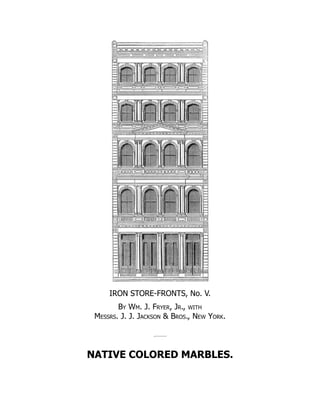
IRON STORE-FRONTS, No. V.
By Wm. J. Fryer, Jr., with
Messrs. J. J. Jackson & Bros., New York.
NATIVE COLORED MARBLES.
In the preceding number we have spoken in general terms of this
beautiful acquisition to our art materials, and indeed we feel that we
cannot esteem this new American discovery too highly; for even in
Europe such stone is extremely scarce at the present day, and it is
fortunate that the location in which the quarries exist is open to the
Old World to freely supply the wants of its artists, as well as our
own. The beautiful Lake Champlain affords excellent commercial
facilities, the Chambly Canal and Sorel River improvements opening
a free navigation both with the great chain of lakes, and the Atlantic
Ocean. The Champlain Canal connecting it with the Erie Canal and
Hudson River, giving it uninterrupted communication with New York
State and its Empire City, from the latter end of March to the middle
of December.
The quarry is situated in a great lode projecting up in the bosom
or bay of Lake Champlain, forming an island of several acres
outcropping on each shore, and giving evidence that the deposit
extends and really forms, at this point, the bed of the lake, its supply
being thought to be inexhaustible.
The marble occurs in beds and strata varying in thickness from
one to six feet, and will split across the bed or grain; blocks of any
required size being readily obtained. Its closeness of texture and
hardness render it susceptible of a very high polish, and it will resist
in a remarkable degree all atmospheric changes. It is hard to deface
with acids or scratches, and this one fact should attach to it much
additional value. Its variegation in color, as shown by the specimens
taken from its outcroppings, give promise of a much richer
development as the bed of the quarry is approached; and must
equal in beauty and durability the highly prized oriental marble of
ancient and modern times.
The facilities, already alluded to, of its transportation to all the
markets for such material in the country and to the seaboard,
whence it can be shipped to any part of the world, must tend to
bring it into general use here and elsewhere, that colored marbles
are required for building and ornamental purposes.
We are much indebted to a gentleman of Philadelphia, whose
taste and liberal enterprise have so opportunely brought to our
knowledge this most remarkable deposit of one of Nature’s most
beautiful hidden treasures, which must, at no distant day, add vastly
and more cheaply to the art material of our country.
The palace in course of construction at Ismalia, for the reception
of the Empress Eugenie during her stay in Egypt, will be 180 feet
wide and 120 deep. The estimate cost is 700,000fr. According to the
contract it is to be finished by the 1st of October, for every day’s
delay the architect will be subject to a fine of 300fr per day, and if
finished before he will receive a bonus of 300fr per day. The building
will be square; in the centre there is to be a dome covered with
Persian blinds. On the ground floor there will be the ball, reception,
and refreshment rooms. An idea can be formed of the importance of
this structure and of the work necessary to complete it within the
required time, as it will contain no less than 17,400 cubic feet of
masonry.
To Remove Writing Ink—To remove writing ink from paper, without
scratching—apply with a camel’s hair brush pencil a solution of two
drachms of muriate of tin in four drachms of water; after the writing
has disappeared, pass the paper through the water and dry.
DESCRIPTIONS.
IRON STORE FRONTS, No. 5.
By W. J. Fryer, Jr., New York.
The elevation, shown in the accompanying page illustration,
shows an iron front of five stories, having a pedimented centre
frontispiece of three stories in alto relievo.
The style, though not in strict accordance with rule, is showy,
without being objectionably so, and goes far to prove the capabilities
of iron as a desirable material in commercial Architecture, where
strength, display, and economy may be very well combined.
Such an elevation as this, now under consideration, could not be
executed in cut stone, so as to produce the same appearance,
without incurring a much greater expense, and in the event of a
continuous block of such fronts, the balance of economy would be
wonderfully in favor of the iron, for the moulds could be duplicated
and triplicated with ease, whilst the same composition executed to a
like extent in stone would not be a cent cheaper in proportion. Every
capital and every truss, and every fillet, should be cut in stone
independently of each other, no matter how many were called for.
It may be very well to say that stone is the proper material,
according to the long-accepted notion of art judgment, and that iron
has to be painted to give it even the semblance of that material,
being, therefore, but a base imitation at best. All very true. But,
nevertheless, iron, even as a painted substitute, possesses
advantages over the original material of which it is a copy, rendering
it a very acceptable medium in the constructive line, and one which
will be sought after by a large class of the community who desire to
have this cheap yet practical material, even though it be not that
which it represents. As a representative it is in most respects the
peer of stone though not it identically.
SUBURBAN RESIDENCE IN THE FRENCH
STYLE.
BY CARL PFEIFFER, ESQ., ARCHITECT, N. Y.
This design is of one of those homes of moderate luxury wherein
the prosperous man of business may enjoy in reason the fruits of his
energetic toil. There is nothing about it to indicate presumptuous
display, but rather the contented elegance of a mind at ease,
surrounded with unostentatious comfort.
Fig. 1.
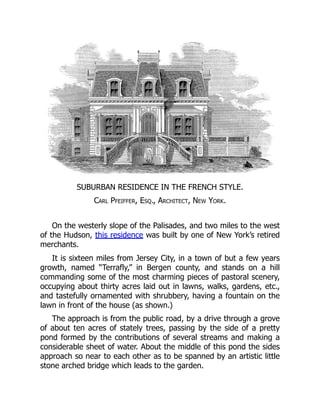
SUBURBAN RESIDENCE IN THE FRENCH STYLE.
Carl Pfeiffer, Esq., Architect, New York.
On the westerly slope of the Palisades, and two miles to the west
of the Hudson, this residence was built by one of New York’s retired
merchants.
It is sixteen miles from Jersey City, in a town of but a few years
growth, named “Terrafly,” in Bergen county, and stands on a hill
commanding some of the most charming pieces of pastoral scenery,
occupying about thirty acres laid out in lawns, walks, gardens, etc.,
and tastefully ornamented with shrubbery, having a fountain on the
lawn in front of the house (as shown.)
The approach is from the public road, by a drive through a grove
of about ten acres of stately trees, passing by the side of a pretty
pond formed by the contributions of several streams and making a
considerable sheet of water. About the middle of this pond the sides
approach so near to each other as to be spanned by an artistic little
stone arched bridge which leads to the garden.
From the house one looks on a lovely panorama of inland
scenery. The Palisades towards the east, the Ramapo mountains to
the northwest; and looking in a southerly direction the numerous
suburban villages and elegant villas near New York may be seen.
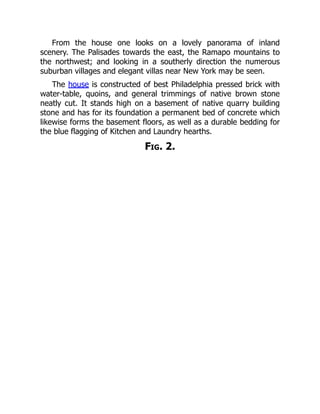
The house is constructed of best Philadelphia pressed brick with
water-table, quoins, and general trimmings of native brown stone
neatly cut. It stands high on a basement of native quarry building
stone and has for its foundation a permanent bed of concrete which
likewise forms the basement floors, as well as a durable bedding for
the blue flagging of Kitchen and Laundry hearths.
Fig. 2.
The arrangement of plan is admirably calculated to conduce to
the comfort of the family. It is as follows:
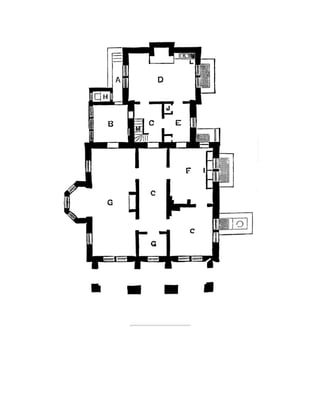
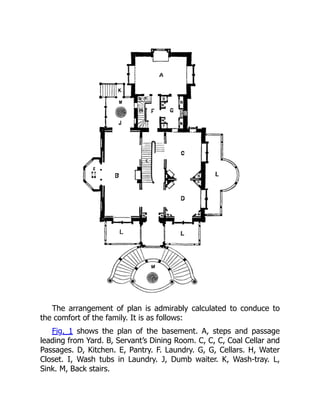
Fig. 1 shows the plan of the basement. A, steps and passage
leading from Yard. B, Servant’s Dining Room. C, C, C, Coal Cellar and
Passages. D, Kitchen. E, Pantry. F. Laundry. G, G, Cellars. H, Water
Closet. I, Wash tubs in Laundry. J, Dumb waiter. K, Wash-tray. L,
Sink. M, Back stairs.
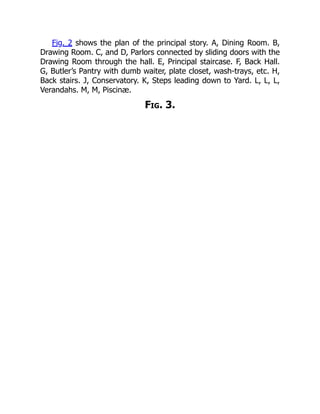
Fig. 2 shows the plan of the principal story. A, Dining Room. B,
Drawing Room. C, and D, Parlors connected by sliding doors with the
Drawing Room through the hall. E, Principal staircase. F, Back Hall.
G, Butler’s Pantry with dumb waiter, plate closet, wash-trays, etc. H,
Back stairs. J, Conservatory. K, Steps leading down to Yard. L, L, L,
Verandahs. M, M, Piscinæ.
Fig. 3.
Welcome to our website – the perfect destination for book lovers and
knowledge seekers. We believe that every book holds a new world,
offering opportunities for learning, discovery, and personal growth.
That’s why we are dedicated to bringing you a diverse collection of
books, ranging from classic literature and specialized publications to
self-development guides and children's books.
More than just a book-buying platform, we strive to be a bridge
connecting you with timeless cultural and intellectual values. With an
elegant, user-friendly interface and a smart search system, you can
quickly find the books that best suit your interests. Additionally,
our special promotions and home delivery services help you save time
and fully enjoy the joy of reading.
Join us on a journey of knowledge exploration, passion nurturing, and
personal growth every day!
testbankfan.com

Experiencing MIS 5th Edition Kroenke Test Bank

  • 1.
    Experiencing MIS 5thEdition Kroenke Test Bank download pdf https://testbankfan.com/product/experiencing-mis-5th-edition-kroenke- test-bank/ Visit testbankfan.com to explore and download the complete collection of test banks or solution manuals!
  • 2.
    Here are somerecommended products for you. Click the link to download, or explore more at testbankfan.com Experiencing MIS 5th Edition Kroenke Solutions Manual https://testbankfan.com/product/experiencing-mis-5th-edition-kroenke- solutions-manual/ Experiencing MIS 4th Edition Kroenke Test Bank https://testbankfan.com/product/experiencing-mis-4th-edition-kroenke- test-bank/ Experiencing MIS 6th Edition Kroenke Test Bank https://testbankfan.com/product/experiencing-mis-6th-edition-kroenke- test-bank/ Exercise Physiology Theory and Application to Fitness and Performance 10th Edition Powers Test Bank https://testbankfan.com/product/exercise-physiology-theory-and- application-to-fitness-and-performance-10th-edition-powers-test-bank/
  • 3.
    Human Development ALife Span View 3rd Edition Ateah Test Bank https://testbankfan.com/product/human-development-a-life-span- view-3rd-edition-ateah-test-bank/ Practice of Research in Social Work 4th Edition Engle Test Bank https://testbankfan.com/product/practice-of-research-in-social- work-4th-edition-engle-test-bank/ Essential University Physics 3rd Edition Richard Wolfson Test Bank https://testbankfan.com/product/essential-university-physics-3rd- edition-richard-wolfson-test-bank/ MGMT 9th Edition Williams Test Bank https://testbankfan.com/product/mgmt-9th-edition-williams-test-bank/ Art Past Art Present 6th Edition Wilkins Test Bank https://testbankfan.com/product/art-past-art-present-6th-edition- wilkins-test-bank/
  • 4.
    Concepts of DatabaseManagement 8th Edition Pratt Test Bank https://testbankfan.com/product/concepts-of-database-management-8th- edition-pratt-test-bank/
  • 5.
    1 Copyright © 2015Pearson Education, Inc. Experiencing MIS, 5e (Kroenke) Chapter 8: Social Media Information Systems Multiple Choice 1) ________ is the use of information technology to support the sharing of content among networks of users. A) Electronic data interchange B) Data warehousing C) Cloud computing D) Social media Answer: D Difficulty: Easy AACSB: Information Technology Chapter LO: 1 Course LO: Discuss the role of information systems in supporting business processes 2) Which of the following statements is a characteristic of user communities? A) Social Media (SM) user communities are mostly based on geographic and familial ties. B) Most users of SM belong to several different user communities. C) In community-SM site relationships, the relationships in second-tier communities are disassociated from first-tier users. D) A viral hook is an inducement to constrain communications between user communities. Answer: B Difficulty: Moderate AACSB: Information Technology Chapter LO: 1 Course LO: Discuss the role of information systems in supporting business processes 3) SM communities differ from regular communities because ________. A) they are based on mutual interests of users B) they are based only on organizational boundaries C) most people belong to a single community D) the total number of its users is determined by the sum of the sizes of all its communities Answer: A Difficulty: Moderate AACSB: Information Technology Chapter LO: 1 Course LO: Discuss the role of information systems in supporting business processes
  • 6.
    2 Copyright © 2015Pearson Education, Inc. 4) Which of the following statements is true about viral hooks? A) It is used to restrain information leaks from an organization. B) It is used to enhance an organization's privacy on its SM sites. C) It is designed to root out users who post junk content on an organization's SM site. D) It is an inducement to pass communication along the tiers of a community. Answer: D Difficulty: Moderate AACSB: Information Technology Chapter LO: 1 Course LO: Discuss the role of information systems in supporting business processes 5) Social media ________ are companies and other organizations that choose to support a presence on one or more SM sites. A) outlets B) sponsors C) application providers D) dashboards Answer: B Difficulty: Easy AACSB: Information Technology Chapter LO: 1 Course LO: Discuss the role of information systems in supporting business processes 6) Social media ________ are the companies that operate the SM sites. A) outlets B) sponsors C) application providers D) newsrooms Answer: C Difficulty: Easy AACSB: Information Technology Chapter LO: 1 Course LO: Discuss the role of information systems in supporting business processes 7) Social media ________ create the features and functions of the site, and they compete with one another for the attention of user communities and SM sponsors. A) application providers B) collaborators C) dashboards D) outlets Answer: A Difficulty: Easy AACSB: Information Technology Chapter LO: 1 Course LO: Discuss the role of information systems in supporting business processes
  • 7.
    3 Copyright © 2015Pearson Education, Inc. 8) ________ is data and responses to data that are contributed by users and SM sponsors. A) Connection data B) Capital data C) Content data D) Custom data Answer: C Difficulty: Easy AACSB: Information Technology Chapter LO: 1 Course LO: Discuss the role of information systems in supporting business processes 9) ________ is data about relationships. A) Connection data B) Capital data C) Content data D) Communication data Answer: A Difficulty: Easy AACSB: Information Technology Chapter LO: 1 Course LO: Discuss the role of information systems in supporting business processes 10) With respect to the five components of social media information systems (SMIS), which of the following statements is true of user communities? A) They process SM sites using elastic, cloud-based servers. B) They develop and operate their own custom social networking application software to read and submit data. C) They need to be trained on both SMIS user procedures as well as on their organization's social networking policy. D) Their procedures are informal, evolving, and socially oriented. Answer: D Difficulty: Moderate AACSB: Information Technology Chapter LO: 1 Course LO: Discuss the role of information systems in supporting business processes 11) With respect to the five components of social media information systems (SMIS), which of the following statements is true of application providers? A) They usually process SM sites using desktops, laptops, and smartphones. B) They store and retrieve SM data on behalf of sponsors and user communities. C) They employ browsers and native mobile applications to store and retrieve connection data. D) Their procedures are informal, evolving, and socially oriented. Answer: B Difficulty: Moderate AACSB: Information Technology Chapter LO: 1 Course LO: Discuss the role of information systems in supporting business processes
  • 8.
    4 Copyright © 2015Pearson Education, Inc. 12) Which of the following statements is a feature of social media application providers? A) They do not support custom software for long durations as it is expensive. B) They generally charge users a license fee to use their applications. C) They use elastic, cloud-based servers to process SM sites. D) They sponsor content on SM sites. Answer: C Difficulty: Moderate AACSB: Information Technology Chapter LO: 1 Course LO: Discuss the role of information systems in supporting business processes 13) With respect to the five components of social media information systems (SMIS), which of the following statements is true of SM sponsors? A) They process SM sites using elastic, cloud-based servers. B) They develop and operate their own custom, proprietary, social networking application software. C) They need to be trained on both SMIS user procedures as well as on the organization's social networking policy. D) Their procedures are informal, evolving, and socially oriented. Answer: C Difficulty: Moderate AACSB: Information Technology Chapter LO: 1 Course LO: Discuss the role of information systems in supporting business processes 14) Which of the following statements is true of defenders of belief? A) They seek conformity and want to convince others of the wisdom of their opinions. B) Their communities do not facilitate activities like sales and marketing. C) They are effective for activities that involve innovation and problem solving. D) When confronted with contrary evidence, they change their opinion. Answer: A Difficulty: Moderate AACSB: Information Technology Chapter LO: 2 Course LO: Discuss the role of information systems in supporting business processes 15) Which of the following statements is true of seekers of truth? A) They share a common belief and seek conformity. B) They do not change their opinion when confronted with a contrary opinion. C) They are effective for activities like sales and marketing. D) They generally do not form bonds with an organization. Answer: D Difficulty: Moderate AACSB: Information Technology Chapter LO: 2 Course LO: Discuss the role of information systems in supporting business processes
  • 9.
    5 Copyright © 2015Pearson Education, Inc. 16) Which of the following statements is true of social CRM? A) The relationships between organizations and customers are unchanging. B) Each customer crafts his or her own relationship with the company. C) Sales managers can control what the customer is reading about a company and its products. D) Customers who are likely to make the highest purchases are likely to receive the most attention. Answer: B Difficulty: Moderate AACSB: Information Technology Chapter LO: 2 Course LO: Discuss the role of information systems in supporting business processes 17) ________ is the dynamic social media process of employing users to participate in product design or product redesign. A) Social capitalization B) Flexible product development C) Crowdsourcing D) Collaborative product development Answer: C Difficulty: Easy AACSB: Information Technology Chapter LO: 2 Course LO: Discuss the role of information systems in supporting business processes 18) ________ is the application of social media to facilitate the cooperative work of people inside organizations. A) Enterprise relationship management B) Enterprise resource planning C) Enterprise 2.0 D) Enterprise application integration Answer: C Difficulty: Easy AACSB: Information Technology Chapter LO: 2 Course LO: Discuss the role of information systems in supporting business processes 19) A ________ is a content structure that has emerged from the processing of many user tags. A) metalanguage B) chrome C) folksonomy D) bookmark Answer: C Difficulty: Easy AACSB: Information Technology Chapter LO: 2 Course LO: Discuss the role of information systems in supporting business processes
  • 10.
    6 Copyright © 2015Pearson Education, Inc. 20) According to McAfee's Enterprise 2.0 model, creating enterprise content via blogs, wikis, discussion groups, and presentations is part of ________. A) signaling B) authoring C) tagging D) searching Answer: B Difficulty: Easy AACSB: Information Technology Chapter LO: 2 Course LO: Discuss the role of information systems in supporting business processes 21) According to McAfee, Enterprise 2.0 workers want applications that enable them to rate tagged content and to use the tags to predict content that will be of interest to them. Which of the following characteristics of Enterprise 2.0 does this refer to? A) search B) links C) signals D) extensions Answer: D Difficulty: Easy AACSB: Information Technology Chapter LO: 2 Course LO: Discuss the role of information systems in supporting business processes 22) In McAfee's Enterprise 2.0 model, pushing enterprise content to users based on subscriptions and alerts is called ________. A) signaling B) authoring C) tagging D) searching Answer: A Difficulty: Easy AACSB: Information Technology Chapter LO: 2 Course LO: Discuss the role of information systems in supporting business processes
  • 11.
    7 Copyright © 2015Pearson Education, Inc. 23) Which of the following statements is true of using social media to advance organizational strategy? A) The unpredictability of dynamic processes like social media is encouraged in supply chains. B) Solving supply chain problems via social media reinforces an organization's sense of privacy. C) Users who have no financial incentive are willing to provide reviews to the buyer community. D) Organizations whose business strategy involves selling to developer networks are the last to adopt SM-based customer support. Answer: C Difficulty: Moderate AACSB: Information Technology Chapter LO: 2 Course LO: Discuss the role of information systems in supporting business processes 24) Being linked to a network of highly regarded contacts is a form of ________. A) social credential B) personal reinforcement C) mobility D) nepotism Answer: A Difficulty: Easy AACSB: Information Technology Chapter LO: 3 Course LO: Discuss the role of information systems in supporting business processes 25) Which of the following statements is true of social capital? A) Social capital is the investment in human knowledge and skills for future profit. B) The value of social capital is determined by the number of relationships in a social network. C) Social capital can be gained by limiting the number of friends. D) Being linked into social networks undermines a professional's image and position in an organization. Answer: B Difficulty: Moderate AACSB: Information Technology Chapter LO: 3 Course LO: Discuss the role of information systems in supporting business processes
  • 12.
    8 Copyright © 2015Pearson Education, Inc. 26) Which of the following statements is true of social capital? A) When a user creates content for an organization, the strength of the relationship increases. B) Social capital does not depreciate. C) Using relationships in social networks to influence decision makers decreases the value of social capital. D) The strength of a relationship between two entities is determined by the number of relationships of each entity. Answer: A Difficulty: Moderate AACSB: Information Technology Chapter LO: 3 Course LO: Discuss the role of information systems in supporting business processes 27) A ________ is a statement that delineates employees' rights and responsibilities. A) statement of purpose B) bill of labor C) social media policy D) corporate datasheet Answer: C Difficulty: Easy AACSB: Information Technology Chapter LO: 4 Course LO: Discuss the role of information systems in supporting business processes 28) Which of the following statements is true of social networking problems? A) Responses to problematic content are best reserved for instances where it has caused the organization to do something positive. B) Inappropriate contributions that contain obscene or otherwise inappropriate content should be ignored indefinitely. C) The product development team should not receive the criticisms posted on a social networking site. D) If the problematic content represents reasonable criticism of the organization's products, the best response is to delete it. Answer: A Difficulty: Moderate AACSB: Information Technology Chapter LO: 4 Course LO: Discuss the role of information systems in supporting business processes
  • 13.
    9 Copyright © 2015Pearson Education, Inc. 29) Which of the following statements is true of responding to social networking problems? A) Deleting legitimate negative comments indicates that the site contains genuine user content. B) Criticism of products on an SM site cannot be used for product development. C) Responses to problematic content on the organization's SM site should be defensive. D) Patronizing responses to comments from content contributors can generate a strong backlash. Answer: D Difficulty: Moderate AACSB: Information Technology Chapter LO: 4 Course LO: Discuss the role of information systems in supporting business processes 30) In the context of management, ________ means loss of control of employees. A) transcendence B) divergence C) emergence D) dependence Answer: C Difficulty: Easy AACSB: Information Technology Chapter LO: 5 Course LO: Discuss the role of information systems in supporting business processes True or False 1) Social media is the use of information technology to support the sharing of content among networks of users. Answer: TRUE Difficulty: Easy AACSB: Information Technology Chapter LO: 1 Course LO: Discuss the role of information systems in supporting business processes 2) Social media enables people to form hives, which refer to groups of people related by a common interest. Answer: TRUE Difficulty: Easy AACSB: Information Technology Chapter LO: 1 Course LO: Discuss the role of information systems in supporting business processes 3) A social media information system is an information system that supports the sharing of content among networks of users. Answer: TRUE Difficulty: Easy AACSB: Information Technology Chapter LO: 1 Course LO: Discuss the role of information systems in supporting business processes
  • 14.
    10 Copyright © 2015Pearson Education, Inc. 4) Social media outlets are companies and other organizations that choose to support a presence on one or more SM sites. Answer: FALSE Difficulty: Easy AACSB: Information Technology Chapter LO: 1 Course LO: Discuss the role of information systems in supporting business processes 5) Social media sponsors are the companies that operate the SM sites. Answer: FALSE Difficulty: Easy AACSB: Information Technology Chapter LO: 1 Course LO: Discuss the role of information systems in supporting business processes 6) Google is an example of a social media application provider. Answer: TRUE Difficulty: Easy AACSB: Information Technology Chapter LO: 1 Course LO: Discuss the role of information systems in supporting business processes 7) Social media application providers create the features and functions of the site, and they compete with one another for the attention of user communities and SM sponsors. Answer: TRUE Difficulty: Moderate AACSB: Information Technology Chapter LO: 1 Course LO: Discuss the role of information systems in supporting business processes 8) A social media sponsor cannot develop its own provider. Answer: FALSE Difficulty: Easy AACSB: Information Technology Chapter LO: 1 Course LO: Discuss the role of information systems in supporting business processes 9) Both community users and employees of SM sponsors process SM sites using elastic, cloud- based servers. Answer: FALSE Difficulty: Easy AACSB: Information Technology Chapter LO: 1 Course LO: Discuss the role of information systems in supporting business processes
  • 15.
    11 Copyright © 2015Pearson Education, Inc. 10) SM sponsors employ browsers and native mobile applications to read and submit data. Answer: FALSE Difficulty: Easy AACSB: Information Technology Chapter LO: 1 Course LO: Discuss the role of information systems in supporting business processes 11) SM application providers develop and operate their own custom, proprietary, social networking application software. Answer: TRUE Difficulty: Easy AACSB: Information Technology Chapter LO: 1 Course LO: Discuss the role of information systems in supporting business processes 12) Content data is data about relationships. Answer: FALSE Difficulty: Easy AACSB: Information Technology Chapter LO: 1 Course LO: Discuss the role of information systems in supporting business processes 13) Connection data differentiates social media information systems (SMIS) from Web site applications. Answer: TRUE Difficulty: Easy AACSB: Information Technology Chapter LO: 1 Course LO: Discuss the role of information systems in supporting business processes 14) Both Web sites and social networking sites present user and responder content, but only social networking applications store and process connection data. Answer: TRUE Difficulty: Moderate AACSB: Information Technology Chapter LO: 1 Course LO: Discuss the role of information systems in supporting business processes 15) SM application providers store and retrieve SM data on behalf of sponsors and user communities. Answer: TRUE Difficulty: Easy AACSB: Information Technology Chapter LO: 1 Course LO: Discuss the role of information systems in supporting business processes
  • 16.
    12 Copyright © 2015Pearson Education, Inc. 16) For SM sponsors, social networking procedures are informal, evolving, and socially oriented. Answer: FALSE Difficulty: Easy AACSB: Information Technology Chapter LO: 1 Course LO: Discuss the role of information systems in supporting business processes 17) SM sponsors do not require training on social media information systems (SMIS) user procedures to contribute to their organization's SM site. Answer: FALSE Difficulty: Easy AACSB: Information Technology Chapter LO: 1 Course LO: Discuss the role of information systems in supporting business processes 18) Employees who contribute to and manage social networking sites will generate direct labor costs. Answer: TRUE Difficulty: Easy AACSB: Information Technology Chapter LO: 1 Course LO: Discuss the role of information systems in supporting business processes 19) When confronted with contrary evidence, defenders of belief change their opinion. Answer: FALSE Difficulty: Easy AACSB: Information Technology Chapter LO: 2 Course LO: Discuss the role of information systems in supporting business processes 20) Defenders-of-belief communities facilitate activities like sales and marketing. Answer: TRUE Difficulty: Easy AACSB: Information Technology Chapter LO: 2 Course LO: Discuss the role of information systems in supporting business processes 21) Defenders-of-belief communities are well-suited for activities that involve innovation or problem solving. Answer: FALSE Difficulty: Easy AACSB: Information Technology Chapter LO: 2 Course LO: Discuss the role of information systems in supporting business processes
  • 17.
    13 Copyright © 2015Pearson Education, Inc. 22) Seekers of the truth share a common desire to learn something, solve a problem, or make something happen. Answer: TRUE Difficulty: Easy AACSB: Information Technology Chapter LO: 2 Course LO: Discuss the role of information systems in supporting business processes 23) In social CRM, relationships between organizations and customers are fixed. Answer: FALSE Difficulty: Easy AACSB: Information Technology Chapter LO: 2 Course LO: Discuss the role of information systems in supporting business processes 24) In social CRM, since the relationships between organizations and customers emerge from joint activity, customers have as much control as companies. Answer: TRUE Difficulty: Easy AACSB: Information Technology Chapter LO: 2 Course LO: Discuss the role of information systems in supporting business processes 25) Seekers-of-the-truth communities are not likely to provide solutions to complex supply chain problems. Answer: FALSE Difficulty: Easy AACSB: Information Technology Chapter LO: 2 Course LO: Discuss the role of information systems in supporting business processes 26) Crowdsourcing is the dynamic social media process of employing users to participate in product design or product redesign. Answer: TRUE Difficulty: Easy AACSB: Information Technology Chapter LO: 2 Course LO: Discuss the role of information systems in supporting business processes 27) The application of social media to facilitate the cooperative work of people inside organizations is called enterprise resource planning. Answer: FALSE Difficulty: Easy AACSB: Information Technology Chapter LO: 2 Course LO: Discuss the role of information systems in supporting business processes
  • 18.
    14 Copyright © 2015Pearson Education, Inc. 28) According to McAfee, Enterprise 2.0 workers prefer to navigate content structures rather than searching for content. Answer: FALSE Difficulty: Easy AACSB: Information Technology Chapter LO: 2 Course LO: Discuss the role of information systems in supporting business processes 29) According to McAfee's Enterprise 2.0 model, creating enterprise content via blogs, wikis, discussion groups, and presentations is part of authoring. Answer: TRUE Difficulty: Easy AACSB: Information Technology Chapter LO: 2 Course LO: Discuss the role of information systems in supporting business processes 30) Enterprise 2.0 content is tagged differently from the content on the Web. Answer: FALSE Difficulty: Easy AACSB: Information Technology Chapter LO: 2 Course LO: Discuss the role of information systems in supporting business processes 31) A folksonomy is content structure that has emerged from processing many user tags. Answer: TRUE Difficulty: Easy AACSB: Information Technology Chapter LO: 2 Course LO: Discuss the role of information systems in supporting business processes 32) According to McAfee's Enterprise 2.0 model, the process in which workers want applications to enable them to rate tagged content and to use the tags to predict content that will be of interest to them is called extensions. Answer: TRUE Difficulty: Easy AACSB: Information Technology Chapter LO: 2 Course LO: Discuss the role of information systems in supporting business processes 33) According to McAfee's Enterprise 2.0 model, pushing enterprise content to users based on subscriptions and alerts is part of tagging. Answer: FALSE Difficulty: Easy AACSB: Information Technology Chapter LO: 2 Course LO: Discuss the role of information systems in supporting business processes
  • 19.
    15 Copyright © 2015Pearson Education, Inc. 34) Since the benefits of Enterprise 2.0 result from emergence, there is no way to control for either effectiveness or efficiency. Answer: TRUE Difficulty: Easy AACSB: Information Technology Chapter LO: 2 Course LO: Discuss the role of information systems in supporting business processes 35) Capital is defined as the investment of resources for future profit. Answer: TRUE Difficulty: Easy AACSB: Information Technology Chapter LO: 3 Course LO: Discuss the role of information systems in supporting business processes 36) Social capital is the investment in human knowledge and skills for future profit. Answer: FALSE Difficulty: Easy AACSB: Information Technology Chapter LO: 3 Course LO: Discuss the role of information systems in supporting business processes 37) Being linked to a network of highly regarded contacts is a form of social credential. Answer: TRUE Difficulty: Easy AACSB: Information Technology Chapter LO: 3 Course LO: Discuss the role of information systems in supporting business processes 38) The value of social capital is determined by the number of relationships in a social network, by the strength of those relationships, and by the resources controlled by those related. Answer: TRUE Difficulty: Moderate AACSB: Information Technology Chapter LO: 3 Course LO: Discuss the role of information systems in supporting business processes 39) Social capital can be gained by limiting the number of friends. Answer: FALSE Difficulty: Easy AACSB: Information Technology Chapter LO: 3 Course LO: Discuss the role of information systems in supporting business processes
  • 20.
    16 Copyright © 2015Pearson Education, Inc. 40) To an organization, the strength of a relationship is the likelihood that the entity in the relationship will do something that benefits the organization. Answer: TRUE Difficulty: Easy AACSB: Information Technology Chapter LO: 3 Course LO: Discuss the role of information systems in supporting business processes 41) A social media policy is a statement that delineates employees' rights and responsibilities. Answer: TRUE Difficulty: Easy AACSB: Information Technology Chapter LO: 4 Course LO: Discuss the role of information systems in supporting business processes 42) If a reasoned, nondefensive response generates continued and unreasonable user-generated content from that same source, it is best for the organization to delete it. Answer: FALSE Difficulty: Moderate AACSB: Information Technology Chapter LO: 4 Course LO: Discuss the role of information systems in supporting business processes 43) In the context of Customer Relationship Management (CRM), social media means that the vendor loses control of the customer relationship. Answer: TRUE Difficulty: Easy AACSB: Information Technology Chapter LO: 5 Course LO: Discuss the role of information systems in supporting business processes 44) In the context of management, transcendence means loss of control of employees. Answer: FALSE Difficulty: Easy AACSB: Information Technology Chapter LO: 5 Course LO: Discuss the role of information systems in supporting business processes
  • 21.
    17 Copyright © 2015Pearson Education, Inc. Essay 1) What is social media? Answer: Social media (SM) is the use of information technology to support the sharing of content among networks of users. Social media enables people to form communities, tribes, or hives, all of which are synonyms that refer to a group of people related by a common interest. A social media information system (SMIS) is an information system that supports the sharing of content among networks of users. Difficulty: Easy AACSB: Information Technology Chapter LO: 1 Course LO: Discuss the role of information systems in supporting business processes 2) What are social media sponsors? Answer: Social media sponsors are companies and other organizations that choose to support a presence on one or more SM sites. For example, when Microsoft places icons on its promotional pages, it is making a commitment to invest considerable employee time and other costs to support social media. It needs to develop procedures and staff and train people to support that site. Difficulty: Easy AACSB: Information Technology Chapter LO: 1 Course LO: Discuss the role of information systems in supporting business processes 3) What are social media application providers? Answer: Social media application providers are the companies that operate the SM sites. Facebook, Twitter, LinkedIn, and Google are all SM application providers. These providers create the features and functions of the site, and they compete with one another for the attention of user communities and SM sponsors. Difficulty: Easy AACSB: Information Technology Chapter LO: 1 Course LO: Discuss the role of information systems in supporting business processes 4) Explain the hardware component of social media information systems (SMIS) with respect to each of the three organizational roles. Answer: Both community users and employees of SM sponsors process SM sites using desktops, laptops, smartphones, iPads, HTML 5 devices, and, indeed, any intelligent communications device. In most cases, SM application providers host the SM presence using elastic servers in the cloud. Difficulty: Easy AACSB: Information Technology Chapter LO: 1 Course LO: Discuss the role of information systems in supporting business processes
  • 22.
    18 Copyright © 2015Pearson Education, Inc. 5) Explain the software component of social media information systems (SMIS) with respect to each of the three organizational roles. Answer: Users employ browsers and native mobile applications, such as iOS, Android, or Win 8 applications, to read and submit data and to add and remove connections to communities and other users. SM sponsors contribute to the site via browsers or using specialized sponsor applications provided by the SM application provider. In some cases, like, say, Facebook applications, SM sponsors create their own applications and interface those applications with the SM site. SM application providers develop and operate their own custom, proprietary, social networking application software. Supporting such custom software is expensive over the long term, but SM application vendors must do so because the features and functions of their applications are fundamental to their competitive strategy. Difficulty: Moderate AACSB: Information Technology Chapter LO: 1 Course LO: Discuss the role of information systems in supporting business processes 6) Explain the data component of social media information systems (SMIS). Answer: SM data falls into two categories: content and connection. Content data is data and responses to data that are contributed by users and SM sponsors. Connection data is data about relationships. Connection data differentiates SMIS from Web site applications. Both Web sites and social networking sites present user and responder content, but only social networking applications store and process connection data. SM application providers store and retrieve SM data on behalf of sponsors and user communities. Difficulty: Easy AACSB: Information Technology Chapter LO: 1 Course LO: Discuss the role of information systems in supporting business processes 7) Explain the procedure component of social media information systems (SMIS) with respect to the user and sponsor organizational roles. Answer: For social networking users, procedures are informal, evolving, and socially oriented. You do what your friends do. Such informality makes using SMIS easy; it also means that unintended consequences are common. The most troubling examples concern user privacy. For SM sponsors, social networking procedures cannot be so informal. Before initiating a social networking presence, organizations must develop procedures for creating content, managing user responses, removing obsolete or objectionable content, and extracting value from content. Difficulty: Easy AACSB: Information Technology Chapter LO: 1 Course LO: Discuss the role of information systems in supporting business processes
  • 23.
    19 Copyright © 2015Pearson Education, Inc. 8) Explain the people component of social media information systems (SMIS) with respect to the user and sponsor organizational roles. Answer: Users of social media do what they want to do depending on their goals and their personalities. They behave in certain ways and observe the consequences. SM sponsors, however, cannot be casual. Anyone who contributes to an organization's SM site or who uses his or her position in a company to speak for an organization needs to be trained on both SMIS user procedures as well as on the organization's social networking policy. Difficulty: Moderate AACSB: Information Technology Chapter LO: 1 Course LO: Discuss the role of information systems in supporting business processes 9) What are defenders-of-belief communities? Answer: Defenders of belief share a common belief and form their hive around that belief. They seek conformity and want to convince others of the wisdom of their belief. When confronted with contrary evidence, they do not change their opinion, but become more firmly convinced in their belief. Defenders-of-belief communities facilitate activities like sales and marketing. They are not effective for activities that involve innovation or problem solving. Such groups can form strong bonds and allegiance to an organization. Difficulty: Moderate AACSB: Information Technology Chapter LO: 2 Course LO: Discuss the role of information systems in supporting business processes 10) What are seekers-of-the-truth communities? Answer: Seekers of the truth share a common desire to learn something, solve a problem, or make something happen. They share a common problem, but not a common solution to that problem. Not surprisingly, such tribes are incredible problem solvers and excel at innovation. They can be useful in customer service activity; as long as they don't conclude that the best way to solve a product problem is to use another company's product, something they might do because such groups seldom form a strong bond to an organization. The only organizational bond seekers of the truth are likely to form occurs when the organization demonstrates behavior that indicates that it, too, is committed to solving the community's shared problem. Difficulty: Moderate AACSB: Information Technology Chapter LO: 2 Course LO: Discuss the role of information systems in supporting business processes
  • 24.
    20 Copyright © 2015Pearson Education, Inc. 11) What is social CRM? Answer: Social CRM is a dynamic, SM-based CRM process. The relationships between organizations and customers emerge in a dynamic process as both parties create and process content. In addition to the traditional forms of promotion, employees in the organization create wikis, blogs, discussion lists, frequently asked questions, sites for user reviews and commentary, and other dynamic content. Customers search this content, contribute reviews and commentary, ask more questions, create user groups, and so forth. With social CRM, each customer crafts his or her own relationship with the company. Difficulty: Easy AACSB: Information Technology Chapter LO: 2 Course LO: Discuss the role of information systems in supporting business processes 12) What is the difference between traditional CRM and social CRM? Answer: In social CRM, because relationships emerge from joint activity, customers have as much control as companies. This characteristic is an anathema to traditional sales managers who want control over what the customer is reading, seeing, and hearing about the company and its products. Further, traditional CRM is centered on lifetime value; customers who are likely to generate the most business get the most attention and have the most impact on the organization. But, with social CRM, the customer who spends 10 cents but who is an effective reviewer, commentator, or blogger can have more influence than the quiet customer who purchases $10 million a year. Such imbalance is incomprehensible to traditional sales managers. Difficulty: Moderate AACSB: Information Technology Chapter LO: 2 Course LO: Discuss the role of information systems in supporting business processes 13) What are the six characteristics of Enterprise 2.0? Answer: Andrew McAfee defined six characteristics of Enterprise 2.0, which he refers to by the acronym SLATES. Workers want to be able to search for content inside the organization just as they do on the Web. Most workers find that searching is more effective than navigating content structures such as lists and tables of contents. Workers want to access organizational content by link, just as they do on the Web. They also want to author organizational content using blogs, wikis, discussion groups, published presentations, and so on. Enterprise 2.0 content is tagged, just like content on the Web, and tags are organized into structures. Additionally, Enterprise 2.0 workers want applications to enable them to rate tagged content and to use the tags to predict content that will be of interest to them, a process McAfee refers to as extensions. Finally, Enterprise 2.0 workers want relevant content pushed to them; they want to be signaled when something of interest to them happens in organizational content. Difficulty: Moderate AACSB: Information Technology Chapter LO: 2 Course LO: Discuss the role of information systems in supporting business processes
  • 25.
    21 Copyright © 2015Pearson Education, Inc. 14) What is a folksonomy? Answer: Enterprise 2.0 content is tagged, just like content on the Web, and tags are organized into structures. These structures organize tags as a taxonomy does, but, unlike taxonomies, they are not preplanned; they emerge. A folksonomy is content structure that has emerged from the processing of many user tags. Difficulty: Easy AACSB: Information Technology Chapter LO: 2 Course LO: Discuss the role of information systems in supporting business processes 15) How does social capital add value? Answer: Relationships in social networks can provide information about opportunities, alternatives, problems, and other factors important to business professionals. They also provide an opportunity to influence decision makers at one's employer or in other organizations who are critical for success. Such influence cuts across formal organizational structures, such as reporting relationships. Third, being linked to a network of highly regarded contacts is a form of social credential. Finally, being linked into social networks reinforces a professional's image and position in an organization or industry. Difficulty: Easy AACSB: Information Technology Chapter LO: 3 Course LO: Discuss the role of information systems in supporting business processes 16) Explain the major sources of user-generated content problems. Answer: When a business participates in a social network or opens its site to a user-generated content (UGC), it opens itself to misguided people who post junk unrelated to the site's purpose. Crackpots may also use the network or UGC site as a way of expressing passionately held views about unrelated topics, such as UFOs, government cover-ups, fantastic conspiracy theories, and so forth. Because of the possibility of such content, SM sponsors should regularly monitor the site and remove objectionable material immediately. Unfavorable reviews are another risk. Research indicates that customers are sophisticated enough to know that few, if any, products are perfect. Most customers want to know the disadvantages of a product before purchasing it so they can determine if those disadvantages are important for their application. Mutinous movements are an extension of bad reviews. Difficulty: Moderate AACSB: Information Technology Chapter LO: 4 Course LO: Discuss the role of information systems in supporting business processes
  • 26.
    22 Copyright © 2015Pearson Education, Inc. 17) How do you respond to social networking problems? Answer: The first task in managing social networking risk is to know the sources of potential problems and to monitor sites for problematic content. Once such content is found, however, organizations must have a plan for creating the organization's response. Three possibilities are: 1. Leave it 2. Respond to it 3. Delete it If the problematic content represents reasonable criticism of the organization's products or services, the best response may be to leave it where it is. Such criticism indicates that the site is not just a shill for the organization, but contains legitimate user content. A second alternative is to respond to the problematic content. However, this alternative is dangerous. If the response could be construed in any way as patronizing or insulting to the content contributor, the response can enrage the community and generate a strong backlash. In most cases, responses are best reserved for when the problematic content has caused the organization to do something positive as a result. If a reasoned, nondefensive response generates continued and unreasonable UGC from that same source, it is best for the organization to do nothing. Deleting content should be reserved for contributions that are inappropriate because they are contributed by crackpots, because they have nothing to do with the site, or because they contain obscene or otherwise inappropriate content. However, deleting legitimate negative comments can result in a strong user backlash. Difficulty: Moderate AACSB: Information Technology Chapter LO: 4 Course LO: Discuss the role of information systems in supporting business processes
  • 27.
    Exploring the Varietyof Random Documents with Different Content
  • 31.
    The Project GutenbergeBook of The Architectural Review and American Builders' Journal, Aug. 1869
  • 32.
    This ebook isfor the use of anyone anywhere in the United States and most other parts of the world at no cost and with almost no restrictions whatsoever. You may copy it, give it away or re-use it under the terms of the Project Gutenberg License included with this ebook or online at www.gutenberg.org. If you are not located in the United States, you will have to check the laws of the country where you are located before using this eBook. Title: The Architectural Review and American Builders' Journal, Aug. 1869 Author: Various Editor: Samuel Sloan Release date: December 22, 2019 [eBook #60997] Most recently updated: October 17, 2024 Language: English Credits: Produced by Paul Marshall and the Online Distributed Proofreading Team at http://www.pgdp.net (This file was produced from images generously made available by The Internet Archive) *** START OF THE PROJECT GUTENBERG EBOOK THE ARCHITECTURAL REVIEW AND AMERICAN BUILDERS' JOURNAL, AUG. 1869 ***
  • 34.
    THE ARCHITECTURAL REVIEW AND AMERICAN BUILDERS’ JOURNAL. Vol.II.—Entered according to Act of Congress, in the year 1869, by Samuel Sloan, in the Clerk’s Office of the District Court of the United States, in and for the Eastern District of Pennsylvania.
  • 35.
    MONTHLY REVIEW. THE LONDONBUILDER AND OURSELVES. In a tolerantly critical notice of the Review recently published in the Builder, we find an effort to substantiate a charge formerly made by it, and replied to by us, on the subject of “trickery” in the construction of the exteriors of American buildings. The Builder reiterates the charge and points to Grace Church, New York, in proof of the truth of it. That marble edifice, he avers, has a wooden spire, crocketted, etc., painted in imitation of the material of which the body of the church is constructed. Alas, we must acknowledge the wood. And we will make a clean breast of it, and still farther acknowledge that at the time that Grace Church was built, our land of wooden nutmegs, and other notions, had not an architectural idea beyond the wooden spire, and that our city and country churches, that aspired at all, were forced to do so in the national material of the day. That said sundry spires of wood were of necessity, painted, is most true; and furthermore, white-lead being a great favorite with the people generally, [when our manners, customs, and tastes were more immaculate than in these degenerate days of many colors,] that pigment was the ruling fashion. That the color of the marble, of which Grace Church’s body is constructed, should be similar to that with which said ecclesiastical edifice’s spire was coated, is unfortunate; but, that the resemblance goes to prove any attempt at a cheat, we most strenuously deny. Grace Church is of a by-gone taste,—an architectural era which we now look back to in order to see, by contrast, how far we have advanced in architectural construction. Trinity Church, New York, was the first great effort at a stone spire which our Architects ventured to rear. And although hundreds have followed its lead, none in this soaring republic have
  • 36.
    gone so nearto heaven as that yet. But the thing once effected is sure to be improved upon. We are not at all abashed then, to own to the wooden spire painted to imitate stone, which crowns the steeple of old Grace Church, New York. And the less annoyance should it give our most sensitive feelings, when we reflect that the dome of the great St. Paul’s, London, is no less a delusion and a cheat, it being of wood, coated with lead and painted on the outside, having a false dome on the inside, considerably smaller than the external diameter would naturally lead the confiding observer to expect. The body of St. Paul’s is of stone. Why, according to the requirements of the Builder, is not the dome, like that of the Pantheon at Rome, likewise of stone? Do we suppose, for an instant, that Sir Christopher Wren was guilty of a deliberate cheat in so constructing it? Certainly not. He used the material which he considered best suited to his purpose and his means. And so we should, in charity, suppose did the Architect of Grace Church, New York. The Builder, like too many of our English cousins, who do us the honor of a visit, falls into error in supposing that wood is generally used for ornamentation of exteriors. In none of our larger cities is this the case. And when that critical and usually correct authority says, “Even the Fifth avenue itself is a sham as to much of its seeming stone-work,” it displays a melancholy absence of its uniform discernment, judgment, and sense. The only other constructive material to be found on the fronts of the Fifth Avenue, New York, besides marble, brown stone, or pressed (Philadelphia) brick, is in the gutter, which is either of zinc or galvanized iron, and forms the upper portion of the cornice. Porches and Hall-door frontisces, of every style, are of marble or stone, and never of wood. Pediments and all trimmings around windows are invariably of stone. In fact we are not a little surprised at the apparent want of information on this subject by so well
  • 37.
    posted an observeras the Builder is acknowledged to be. Some twenty years ago the taunt might lie most truthfully applied to our efforts at architectural construction, but to-day the “trick” of painted and sanded wood would be hissed down by our citizens who claim to live in residences the majority of which are greatly superior to residences of the same class in London, as far at least as material is concerned. No, no—criticism to be useful must be just; and to be just must be founded strictly on truth unbiassed by prejudice. We do not desire in these remarks to throw the slightest doubt on the good intentions of the London Builder in its monitorial check, but our wish is to correct the erroneous information which it has received, and which has led to the mistake under which it evidently labors. We as utterly despise any falsehood in construction as our honestly outspoken contemporary, and will at every opportunity disclose and denounce its adoption in this country in all cases where there is any pretension to architectural design. For a new country like this, it is at least creditable that, even in a small class of dwellings, the architect is, as a general thing, called on to design and frequently to superintend—every thing is not left to the builder as in London. Yet there is and always will be in this as in all other countries a large class of private buildings outside the pale of legitimate taste; creations ungoverned and ungovernable by rule. But such should never be taken as examples of the existing state of the constructive art of the day; they should rather prove the unfortunate exceptions to the fact of its position. Even these it will be our duty to watch over and try to set right; for we are ardent believers in the influential power of information, and look with assurance to the education of our people generally on this subject of judgment and taste in building as the infallible means of turning to good account the remarkable progress in that constructive art of the American nation, which the observant London Builder notices with the generous well-wishing of a kindly professional brother.
  • 38.
    THE MANSARD MADNESS. Ofall the intellectual qualifications which man is gifted with, there is not one as sensitive as that which enables him to discern between what is intrinsically good, and what is bad or indifferent to his eye. Yet are there none of all man’s mental attributes so frequently and so grossly outraged as is this to which we now allude, called Taste. Custom has much to say in the question of arbitrary rule which taste so imperatively claims. Persistence in any thing will, of necessity, make itself felt and recognized, no matter how odious at first may be the object put before the public eye, and ultimately that object becomes what is commonly called “fashionable.” This apparent unity of the public on one object is variable and will soon change to another, which in its turn will seem to reign by unanimous consent and so on ad infinitum. In Architecture this fickle goddess, Fashion, seems to reign as imperatively and as coquettishly as in any or all the affairs of this world of humanity. That which was at first esteemed grotesque and ridiculous, becomes in time tolerable and at last admirable. But the apathy which sameness begets cannot long be borne by the novelty worshippers, and accordingly new forms and shapes remodel the idea of the day, until it ceases to bear a vestige of its first appearance and becomes quite another thing. Of all the prominent features of architecture that which has been least changeable until late years is the “roof.” The outline of that covering has been limited to a very few ideas, some of which resolved themselves into arbitrary rules of government from which the hardiest adventurer was loath to attempt escape. Deviating from the very general style of roof which on the section presents a triangle, sometimes of one pitch, sometimes of another, but almost universally of a fourth of the span, the truncated form was to be found, but so exceedingly sombre was this peculiar roof
  • 39.
    that it neverobtained to any great extent, and indeed it presented on the exterior a very serious obstacle to its adoption by architects in the difficulty of blending it with any design in which spirit, life, or elegance, was a requisite. There are occasionally to be found in Europe, and even in America, examples of these truncated roofs, but it is very questionable whether there are to be met with any admirers of their effect. The principle on which they are constructed has, however, a very great advantage in the acquirement of head-room in the attics, giving an actual story or story and half to the height, without increasing the elevation of the walls. The architects of the middle ages took a hint from this evident advantage, and used the truncated roof on their largest constructions. Its form is that of a pyramid with the upper portion cut off (trunco, to cut off, being its derivation.) Mansart, or as he is more commonly called Mansard, an erratic but ingenious French architect, in the seventeenth century invented the curb roof, so decided an improvement on the truncated that it became known by his name. This roof adorning the palatial edifices of France soon assumed so much decorative beauty in its curb moulding and base cornice, as well as in the dormers and eyelets with which it was so judiciously pierced, that it became a source of artistic fascination in those days in France; and as Germany was indebted to French architects for her most prominent designs, the Mansard roof found its way there, and into some other parts of Europe. But, much as English architects admired, as a whole, any or all of those superb erections of the Gallic Capital, it was a century and a half before it occurred to them to imitate them even in this most desirable roof. Our architects having increased with the demand for finer houses and more showy public buildings, and having parted company with
  • 40.
    their Greek andRoman idols to which their predecessors had been so long and so faithfully wedded, and acknowledging the necessity for novelty, ardently embraced the newly arising fashion and the Mansard roof arose at every corner in all its glory. At first the compositions which were adorned with this crowning were pleasing to the general view, if not altogether amenable to the strict rules of critical taste. But in due time (and alas that time too surely and severely came) the pseudo French style with its perverted Mansard roof palled upon the public taste for the eccentricities its capricious foster-fathers in their innate stultishness compelled it to display. Some put a Mansard roof upon an Italian building, some on a Norman, and many, oh, how many, on a Romanesque! Some put it on one story erections and made it higher than the walls that held it, in the same proportion that a high crowned hat would hold to a dwarf. Some stuck on towers at the corners of their edifices and terminated them with Mansard domes! Some had them inclined to one angle, some to another; some curved them inward, some outward, whilst others went the straight ticket. The dormers too came in for a large share of the thickening fancies and assumed every style or no style at all. The chimney shafts were not neglected. Photos of the Thuilleries were freely bought up, and bits and scraps of D’Lorme were hooked in, to make up an original idea worthy of these smoky towers. “Every dog will have his day,” is a fine old sensible remark of some long-headed lover of the canine species, and applies alike to animals, men, and things. That it particularly applies to that much abused thing called the Mansard roof is certain, as the very name is now more appropriately the absurd roof. Fashion begins to look coldly upon her recent favorite, which in truth “has been made to play such fantastic tricks before high Heaven, as make the angles weep;” and it is doomed. A few years hence, and we will all look back in amused wonder at the creations of to-day, crowned with the tortured conception of Mansard.
  • 41.
    HYDRAULIC CEMENT. The rapidhardening under water of the cement which from that property derives its name of “Hydraulic Cement,” has been, and indeed is still, a subject of discussion as to the true theory of such action. We find in the June number of the Chemical News a paragraph which must prove very interesting to manufacturers as well as to all who use and take an interest in that most useful of building materials to which the Architect and the Engineer are so deeply indebted. “In order to test the truth of the different hypotheses made concerning this subject, A. Schulatschenko, seeing the impossibility of separating, from a mixture of silicates, each special combination thereof, repeated Fuch’s experiment, by separating the silica from 100 parts of pure soluble silicate of potassa, and, after mixing it with fifty parts of lime, and placing the mass under water, when it hardened rapidly. A similar mixture was submitted to a very high temperature, and in this case, also, a cement was made. As a third experiment, a similar mixture was heated till it was fused; after having been cooled and pulverized, the fused mass did not harden any more under water. Hence it follows that hardening does take place in cement made by the wet as well as dry process, and that the so-called over-burned cement is inactive, in consequence of its particles having suffered a physical change.”
  • 42.
    IRON STORE-FRONTS, No.V. By Wm. J. Fryer, Jr., with Messrs. J. J. Jackson & Bros., New York. NATIVE COLORED MARBLES.
  • 43.
    In the precedingnumber we have spoken in general terms of this beautiful acquisition to our art materials, and indeed we feel that we cannot esteem this new American discovery too highly; for even in Europe such stone is extremely scarce at the present day, and it is fortunate that the location in which the quarries exist is open to the Old World to freely supply the wants of its artists, as well as our own. The beautiful Lake Champlain affords excellent commercial facilities, the Chambly Canal and Sorel River improvements opening a free navigation both with the great chain of lakes, and the Atlantic Ocean. The Champlain Canal connecting it with the Erie Canal and Hudson River, giving it uninterrupted communication with New York State and its Empire City, from the latter end of March to the middle of December. The quarry is situated in a great lode projecting up in the bosom or bay of Lake Champlain, forming an island of several acres outcropping on each shore, and giving evidence that the deposit extends and really forms, at this point, the bed of the lake, its supply being thought to be inexhaustible. The marble occurs in beds and strata varying in thickness from one to six feet, and will split across the bed or grain; blocks of any required size being readily obtained. Its closeness of texture and hardness render it susceptible of a very high polish, and it will resist in a remarkable degree all atmospheric changes. It is hard to deface with acids or scratches, and this one fact should attach to it much additional value. Its variegation in color, as shown by the specimens taken from its outcroppings, give promise of a much richer development as the bed of the quarry is approached; and must equal in beauty and durability the highly prized oriental marble of ancient and modern times. The facilities, already alluded to, of its transportation to all the markets for such material in the country and to the seaboard, whence it can be shipped to any part of the world, must tend to bring it into general use here and elsewhere, that colored marbles are required for building and ornamental purposes.
  • 44.
    We are muchindebted to a gentleman of Philadelphia, whose taste and liberal enterprise have so opportunely brought to our knowledge this most remarkable deposit of one of Nature’s most beautiful hidden treasures, which must, at no distant day, add vastly and more cheaply to the art material of our country. The palace in course of construction at Ismalia, for the reception of the Empress Eugenie during her stay in Egypt, will be 180 feet wide and 120 deep. The estimate cost is 700,000fr. According to the contract it is to be finished by the 1st of October, for every day’s delay the architect will be subject to a fine of 300fr per day, and if finished before he will receive a bonus of 300fr per day. The building will be square; in the centre there is to be a dome covered with Persian blinds. On the ground floor there will be the ball, reception, and refreshment rooms. An idea can be formed of the importance of this structure and of the work necessary to complete it within the required time, as it will contain no less than 17,400 cubic feet of masonry. To Remove Writing Ink—To remove writing ink from paper, without scratching—apply with a camel’s hair brush pencil a solution of two drachms of muriate of tin in four drachms of water; after the writing has disappeared, pass the paper through the water and dry.
  • 45.
    DESCRIPTIONS. IRON STORE FRONTS,No. 5. By W. J. Fryer, Jr., New York. The elevation, shown in the accompanying page illustration, shows an iron front of five stories, having a pedimented centre frontispiece of three stories in alto relievo. The style, though not in strict accordance with rule, is showy, without being objectionably so, and goes far to prove the capabilities of iron as a desirable material in commercial Architecture, where strength, display, and economy may be very well combined. Such an elevation as this, now under consideration, could not be executed in cut stone, so as to produce the same appearance, without incurring a much greater expense, and in the event of a continuous block of such fronts, the balance of economy would be wonderfully in favor of the iron, for the moulds could be duplicated and triplicated with ease, whilst the same composition executed to a like extent in stone would not be a cent cheaper in proportion. Every capital and every truss, and every fillet, should be cut in stone independently of each other, no matter how many were called for. It may be very well to say that stone is the proper material, according to the long-accepted notion of art judgment, and that iron has to be painted to give it even the semblance of that material, being, therefore, but a base imitation at best. All very true. But, nevertheless, iron, even as a painted substitute, possesses advantages over the original material of which it is a copy, rendering it a very acceptable medium in the constructive line, and one which will be sought after by a large class of the community who desire to have this cheap yet practical material, even though it be not that
  • 46.
    which it represents.As a representative it is in most respects the peer of stone though not it identically. SUBURBAN RESIDENCE IN THE FRENCH STYLE. BY CARL PFEIFFER, ESQ., ARCHITECT, N. Y. This design is of one of those homes of moderate luxury wherein the prosperous man of business may enjoy in reason the fruits of his energetic toil. There is nothing about it to indicate presumptuous display, but rather the contented elegance of a mind at ease, surrounded with unostentatious comfort. Fig. 1.
  • 48.
    SUBURBAN RESIDENCE INTHE FRENCH STYLE. Carl Pfeiffer, Esq., Architect, New York. On the westerly slope of the Palisades, and two miles to the west of the Hudson, this residence was built by one of New York’s retired merchants. It is sixteen miles from Jersey City, in a town of but a few years growth, named “Terrafly,” in Bergen county, and stands on a hill commanding some of the most charming pieces of pastoral scenery, occupying about thirty acres laid out in lawns, walks, gardens, etc., and tastefully ornamented with shrubbery, having a fountain on the lawn in front of the house (as shown.) The approach is from the public road, by a drive through a grove of about ten acres of stately trees, passing by the side of a pretty pond formed by the contributions of several streams and making a considerable sheet of water. About the middle of this pond the sides approach so near to each other as to be spanned by an artistic little stone arched bridge which leads to the garden.
  • 49.
    From the houseone looks on a lovely panorama of inland scenery. The Palisades towards the east, the Ramapo mountains to the northwest; and looking in a southerly direction the numerous suburban villages and elegant villas near New York may be seen. The house is constructed of best Philadelphia pressed brick with water-table, quoins, and general trimmings of native brown stone neatly cut. It stands high on a basement of native quarry building stone and has for its foundation a permanent bed of concrete which likewise forms the basement floors, as well as a durable bedding for the blue flagging of Kitchen and Laundry hearths. Fig. 2.
  • 50.
    The arrangement ofplan is admirably calculated to conduce to the comfort of the family. It is as follows: Fig. 1 shows the plan of the basement. A, steps and passage leading from Yard. B, Servant’s Dining Room. C, C, C, Coal Cellar and Passages. D, Kitchen. E, Pantry. F. Laundry. G, G, Cellars. H, Water Closet. I, Wash tubs in Laundry. J, Dumb waiter. K, Wash-tray. L, Sink. M, Back stairs.
  • 51.
    Fig. 2 showsthe plan of the principal story. A, Dining Room. B, Drawing Room. C, and D, Parlors connected by sliding doors with the Drawing Room through the hall. E, Principal staircase. F, Back Hall. G, Butler’s Pantry with dumb waiter, plate closet, wash-trays, etc. H, Back stairs. J, Conservatory. K, Steps leading down to Yard. L, L, L, Verandahs. M, M, Piscinæ. Fig. 3.
  • 52.
    Welcome to ourwebsite – the perfect destination for book lovers and knowledge seekers. We believe that every book holds a new world, offering opportunities for learning, discovery, and personal growth. That’s why we are dedicated to bringing you a diverse collection of books, ranging from classic literature and specialized publications to self-development guides and children's books. More than just a book-buying platform, we strive to be a bridge connecting you with timeless cultural and intellectual values. With an elegant, user-friendly interface and a smart search system, you can quickly find the books that best suit your interests. Additionally, our special promotions and home delivery services help you save time and fully enjoy the joy of reading. Join us on a journey of knowledge exploration, passion nurturing, and personal growth every day! testbankfan.com