Experiences with High-Definition
Video Conferencing


Colin Perkins, Alvaro Saurin
University of Glasgow, Department of Computing Science


Ladan Gharai, Tom Lehman
University of Southern California, Information Sciences Institute
Talk Outline

                                         • Scaling multimedia conferencing
                                         • The UltraGrid system
                                            – Hardware requirements
                                            – Software architecture
                                         • Experimental performance
                                         • Challenges in congestion control
                                         • Conclusions
Copyright © 2006 University of Glasgow
All rights reserved.
Scaling Multimedia Conferencing

                                         • Given advances in system power, network bandwidth and video
                                           cameras, why are video conferencing environments so limited?


                                              Why are we stuck with low quality                   288
                                              images…?

                                                                                        352
Copyright © 2006 University of Glasgow
All rights reserved.
Copyright © 2006 University of Glasgow
All rights reserved.


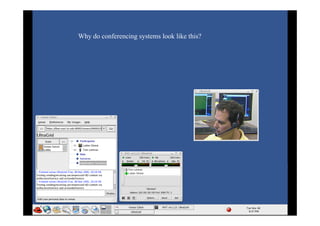
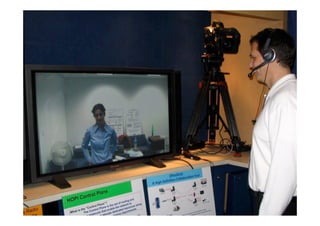
                                         Why do conferencing systems look like this?
Copyright © 2006 University of Glasgow
All rights reserved.


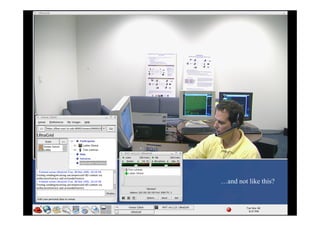
                           …and not like this?
Research Objectives

                                         • To explore the problems inherent in delivering high definition
                                           interactive multimedia over IP:
                                            – Related to the protocols
                                            – Related to the network
                                            – Related to the end-system


                                         • To push the limits of:
                                            – Image resolution, frame rate and quality
                                            – Network and end system capacity


                                         • To demonstrate the ability of best effort IP networks to support
                                           high quality, high rate, media with effective congestion control
Copyright © 2006 University of Glasgow
All rights reserved.
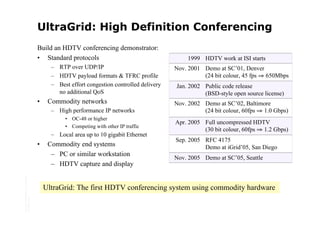
UltraGrid: High Definition Conferencing
                                         Build an HDTV conferencing demonstrator:
                                         • Standard protocols                                      1999 HDTV work at ISI starts
                                               – RTP over UDP/IP                              Nov. 2001 Demo at SC’01, Denver
                                               – HDTV payload formats & TFRC profile                    (24 bit colour, 45 fps ⇒ 650Mbps
                                               – Best effort congestion controlled delivery   Jan. 2002 Public code release
                                                 no additional QoS                                      (BSD-style open source license)
                                         •    Commodity networks                              Nov. 2002 Demo at SC’02, Baltimore
                                               – High performance IP networks                           (24 bit colour, 60fps ⇒ 1.0 Gbps)
                                                    • OC-48 or higher
                                                                                              Apr. 2005 Full uncompressed HDTV
                                                    • Competing with other IP traffic
                                                                                                        (30 bit colour, 60fps ⇒ 1.2 Gbps)
                                               – Local area up to 10 gigabit Ethernet
                                                                                              Sep. 2005 RFC 4175
                                         •    Commodity end systems                                     Demo at iGrid’05, San Diego
                                               – PC or similar workstation
                                                                                              Nov. 2005 Demo at SC’05, Seattle
                                               – HDTV capture and display
Copyright © 2006 University of Glasgow


                                             UltraGrid: The first HDTV conferencing system using commodity hardware
All rights reserved.
Media Formats and Equipment
                                         •   Capture and transmit a range of video formats:
                                              – Standard definition video:
                                                  • IEEE 1394 + DV camera
                                              – High definition video:
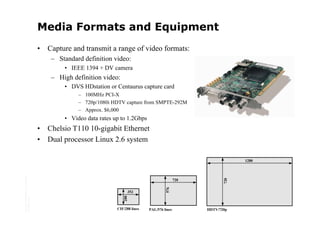
                                                  • DVS HDstation or Centaurus capture card
                                                       – 100MHz PCI-X
                                                       – 720p/1080i HDTV capture from SMPTE-292M
                                                       – Approx. $6,000
                                                  • Video data rates up to 1.2Gbps
                                         •   Chelsio T110 10-gigabit Ethernet
                                         •   Dual processor Linux 2.6 system

                                                                                                                         1280
Copyright © 2006 University of Glasgow


                                                                                                      720


                                                                                                                   720
                                                                                               576


                                                                            352
All rights reserved.


                                                                         288


                                                                      CIF/288 lines   PAL/576 lines         HDTV/720p
Media Formats and Equipment

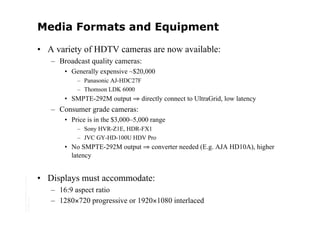
                                         • A variety of HDTV cameras are now available:
                                            – Broadcast quality cameras:
                                                • Generally expensive ~$20,000
                                                    – Panasonic AJ-HDC27F
                                                    – Thomson LDK 6000
                                                • SMPTE-292M output ⇒ directly connect to UltraGrid, low latency
                                            – Consumer grade cameras:
                                                • Price is in the $3,000–5,000 range
                                                    – Sony HVR-Z1E, HDR-FX1
                                                    – JVC GY-HD-100U HDV Pro
                                                • No SMPTE-292M output ⇒ converter needed (E.g. AJA HD10A), higher
                                                  latency


                                         • Displays must accommodate:
Copyright © 2006 University of Glasgow


                                            – 16:9 aspect ratio
All rights reserved.


                                            – 1280×720 progressive or 1920×1080 interlaced
Software Architecture
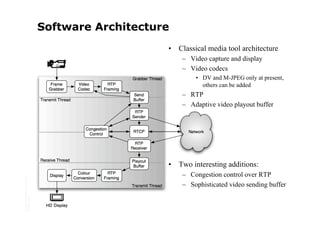
                                                             •   Classical media tool architecture
                                                                  – Video capture and display
                                                                  – Video codecs
                                                                      • DV and M-JPEG only at present,
                                                                        others can be added
                                                                  – RTP
                                                                  – Adaptive video playout buffer


                                                             •   Two interesting additions:
                                                                  – Congestion control over RTP
Copyright © 2006 University of Glasgow


                                                                  – Sophisticated video sending buffer
All rights reserved.
Experimental Performance
                                                           AJ-HDC27F
                                                                                  Seattle, WA
                                                                                  SC 2005
                                                                  UG sender

                                                                                                10 G
                                                                                                    bs Et
                                                                                                         hern
                                                                         UG                                  et
                                                                       receiver                                                                       LDK 6000
                                                                                                                    Chicago

                                                                                                                              Arlington, VA
                                                                                        Los Angeles                                           UG sender
                                                                                                                              ISI-East
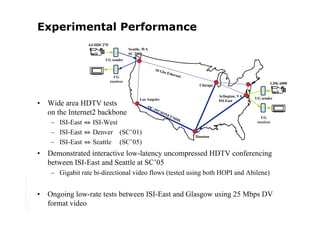
                                         •   Wide area HDTV tests                           OC
                                                                                              -19
                                             on the Internet2 backbone                           2S
                                                                                                   ON
                                                                                                     ET
                                                                                                       /SD                                       UG
                                                                                                          H
                                              – ISI-East ⇔ ISI-West                                                                            receiver

                                              – ISI-East ⇔ Denver (SC’01)
                                                                                                                  Houston
                                              – ISI-East ⇔ Seattle (SC’05)
                                         •   Demonstrated interactive low-latency uncompressed HDTV conferencing
                                             between ISI-East and Seattle at SC’05
                                              – Gigabit rate bi-directional video flows (tested using both HOPI and Abilene)
Copyright © 2006 University of Glasgow


                                         •   Ongoing low-rate tests between ISI-East and Glasgow using 25 Mbps DV
All rights reserved.


                                             format video
Copyright © 2006 University of Glasgow
All rights reserved.
Experimental Performance

                                         • Environment:
                                            – Seattle ⇔ ISI-East over Abilene; 14-18 November 2005
                                            – Best effort IP service, non-QoS enabled, shared with production traffic
                                            – 8,800 byte packets; 10 gigabit Ethernet w/jumbo frames; OC-192 WAN


                                         • Packet loss:
                                            – Overwhelming majority of RTCP reports showed no packet loss
                                            – Occasional transient loss (≤0.04%) observed due to cross traffic
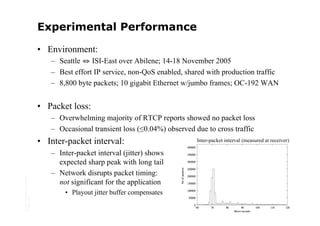
                                         • Inter-packet interval:                          Inter-packet interval (measured at receiver)

                                            – Inter-packet interval (jitter) shows
                                              expected sharp peak with long tail
                                            – Network disrupts packet timing:
Copyright © 2006 University of Glasgow


                                              not significant for the application
                                                • Playout jitter buffer compensates
All rights reserved.
Deployment Issues

                                         • Good performance on Internet2 – usable today
                                            – Observe occasional loss due to transient congestion
                                                • HDTV flows not TCP-Friendly, cause transient disruption during loss periods
                                            – Cannot support large numbers of uncompressed HDTV flows
                                                • But active user community exists in well provisioned regions of the network
                                                  (UltraGrid nodes in US, Canada, Korea, Spain, Czech Republic...)


                                         • Two approaches to wider deployment
                                            – Optical network provisioning and/or quality of service
                                                • E.g. Internet2 hybrid optical packet network (HOPI) also used for some tests
                                                • Possible, solves problem, but expensive and hard to deploy widely
                                                • Necessary for guaranteed-use deployments
                                            – Congestion control
Copyright © 2006 University of Glasgow


                                                • Adaptive video transmission rate to match network capacity
                                                • Preferred end-to-end approach for incremental, on demand, deployment
All rights reserved.


                                                • Necessary for safety, even if QoS provisioned network available
Congestion Control for Interactive Video

                                         • TCP not suitable for interactive video
                                            – Abrupt variations in sending rate
                                            – Couples congestion control and reliability
                                            – Too slow
                                         • Obvious alternative: TCP-Friendly rate control (TFRC)
                                            – Well specified, widely studied rate-based congestion control
                                            – Aims to provide relatively smooth variations in sending rate
                                            – Doesn’t couple congestion response and reliability

                                            – Two implementation choices:                   • DCCP implementations not mature
                                                • Use DCCP with CCID 3                      • Deployment challenges due to firewalls
                                                                                            • Not feasible to use at this time
                                                • Use RTP profile for TFRC
Copyright © 2006 University of Glasgow


                                                            • Can be deployed in end systems only (running over UDP)
All rights reserved.


                                                            • Easy to develop, deploy, debug and experiment with code
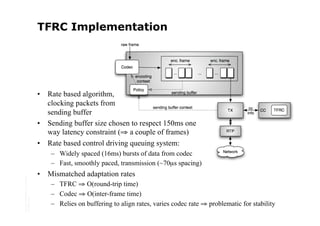
TFRC Implementation


                                         •   Rate based algorithm,
                                             clocking packets from
                                             sending buffer
                                         •   Sending buffer size chosen to respect 150ms one
                                             way latency constraint (⇒ a couple of frames)
                                         •   Rate based control driving queuing system:
                                              – Widely spaced (16ms) bursts of data from codec
                                              – Fast, smoothly paced, transmission (~70µs spacing)
                                         •   Mismatched adaptation rates
Copyright © 2006 University of Glasgow


                                              – TFRC ⇒ O(round-trip time)
                                              – Codec ⇒ O(inter-frame time)
All rights reserved.


                                              – Relies on buffering to align rates, varies codec rate ⇒ problematic for stability
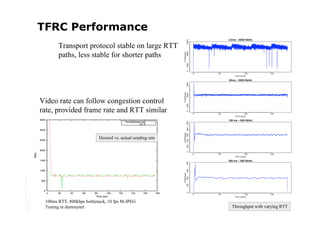
TFRC Performance
                                                Transport protocol stable on large RTT
                                                paths, less stable for shorter paths


                                         Video rate can follow congestion control
                                         rate, provided frame rate and RTT similar


                                                                    Desired vs. actual sending rate
Copyright © 2006 University of Glasgow
All rights reserved.


                                          100ms RTT, 800kbps bottleneck, 10 fps M-JPEG
                                          Testing in dummynet                                         Throughput with varying RTT
Implications and Conclusions

                                         • Well engineered IP networks can support very high performance
                                           interactive multimedia applications
                                            – The current Internet2 best effort IP service provides real-time performance
                                              suitable for gigabit rate interactive video when shared with other traffic
                                            – Transient congestion causes occasional transient packet loss, but recall that
                                              we added a gigabit rate real-time video flow to an existing network without
                                              re-engineering that network to support it


                                         • Initial congestion control experiments raise more questions than
                                           they answer
                                            – Possible to implement, but more sophisticated codecs needed
                                            – Difficult to match codec and network rates, causes bursty behaviour
Copyright © 2006 University of Glasgow


                                                • Impact on perceptual quality due to implied quality variation unclear
                                                • Likely easier as video quality, frame-rate, and network bandwidth increase
All rights reserved.
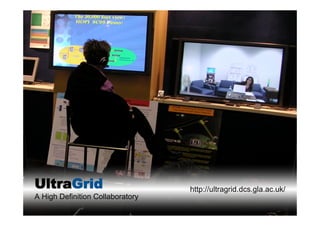
UltraGrid
Copyright © 2006 University of Glasgow


                                                                           http://ultragrid.dcs.gla.ac.uk/
                                         A High Definition Collaboratory
All rights reserved.

Experiences with High-Definition Video Conferencing

  • 1.
    Experiences with High-Definition VideoConferencing Colin Perkins, Alvaro Saurin University of Glasgow, Department of Computing Science Ladan Gharai, Tom Lehman University of Southern California, Information Sciences Institute
  • 2.
    Talk Outline • Scaling multimedia conferencing • The UltraGrid system – Hardware requirements – Software architecture • Experimental performance • Challenges in congestion control • Conclusions Copyright © 2006 University of Glasgow All rights reserved.
  • 3.
    Scaling Multimedia Conferencing • Given advances in system power, network bandwidth and video cameras, why are video conferencing environments so limited? Why are we stuck with low quality 288 images…? 352 Copyright © 2006 University of Glasgow All rights reserved.
  • 4.
    Copyright © 2006University of Glasgow All rights reserved. Why do conferencing systems look like this?
  • 5.
    Copyright © 2006University of Glasgow All rights reserved. …and not like this?
  • 6.
    Research Objectives • To explore the problems inherent in delivering high definition interactive multimedia over IP: – Related to the protocols – Related to the network – Related to the end-system • To push the limits of: – Image resolution, frame rate and quality – Network and end system capacity • To demonstrate the ability of best effort IP networks to support high quality, high rate, media with effective congestion control Copyright © 2006 University of Glasgow All rights reserved.
  • 7.
    UltraGrid: High DefinitionConferencing Build an HDTV conferencing demonstrator: • Standard protocols 1999 HDTV work at ISI starts – RTP over UDP/IP Nov. 2001 Demo at SC’01, Denver – HDTV payload formats & TFRC profile (24 bit colour, 45 fps ⇒ 650Mbps – Best effort congestion controlled delivery Jan. 2002 Public code release no additional QoS (BSD-style open source license) • Commodity networks Nov. 2002 Demo at SC’02, Baltimore – High performance IP networks (24 bit colour, 60fps ⇒ 1.0 Gbps) • OC-48 or higher Apr. 2005 Full uncompressed HDTV • Competing with other IP traffic (30 bit colour, 60fps ⇒ 1.2 Gbps) – Local area up to 10 gigabit Ethernet Sep. 2005 RFC 4175 • Commodity end systems Demo at iGrid’05, San Diego – PC or similar workstation Nov. 2005 Demo at SC’05, Seattle – HDTV capture and display Copyright © 2006 University of Glasgow UltraGrid: The first HDTV conferencing system using commodity hardware All rights reserved.
  • 8.
    Media Formats andEquipment • Capture and transmit a range of video formats: – Standard definition video: • IEEE 1394 + DV camera – High definition video: • DVS HDstation or Centaurus capture card – 100MHz PCI-X – 720p/1080i HDTV capture from SMPTE-292M – Approx. $6,000 • Video data rates up to 1.2Gbps • Chelsio T110 10-gigabit Ethernet • Dual processor Linux 2.6 system 1280 Copyright © 2006 University of Glasgow 720 720 576 352 All rights reserved. 288 CIF/288 lines PAL/576 lines HDTV/720p
  • 9.
    Media Formats andEquipment • A variety of HDTV cameras are now available: – Broadcast quality cameras: • Generally expensive ~$20,000 – Panasonic AJ-HDC27F – Thomson LDK 6000 • SMPTE-292M output ⇒ directly connect to UltraGrid, low latency – Consumer grade cameras: • Price is in the $3,000–5,000 range – Sony HVR-Z1E, HDR-FX1 – JVC GY-HD-100U HDV Pro • No SMPTE-292M output ⇒ converter needed (E.g. AJA HD10A), higher latency • Displays must accommodate: Copyright © 2006 University of Glasgow – 16:9 aspect ratio All rights reserved. – 1280×720 progressive or 1920×1080 interlaced
  • 10.
    Software Architecture • Classical media tool architecture – Video capture and display – Video codecs • DV and M-JPEG only at present, others can be added – RTP – Adaptive video playout buffer • Two interesting additions: – Congestion control over RTP Copyright © 2006 University of Glasgow – Sophisticated video sending buffer All rights reserved.
  • 11.
    Experimental Performance AJ-HDC27F Seattle, WA SC 2005 UG sender 10 G bs Et hern UG et receiver LDK 6000 Chicago Arlington, VA Los Angeles UG sender ISI-East • Wide area HDTV tests OC -19 on the Internet2 backbone 2S ON ET /SD UG H – ISI-East ⇔ ISI-West receiver – ISI-East ⇔ Denver (SC’01) Houston – ISI-East ⇔ Seattle (SC’05) • Demonstrated interactive low-latency uncompressed HDTV conferencing between ISI-East and Seattle at SC’05 – Gigabit rate bi-directional video flows (tested using both HOPI and Abilene) Copyright © 2006 University of Glasgow • Ongoing low-rate tests between ISI-East and Glasgow using 25 Mbps DV All rights reserved. format video
  • 12.
    Copyright © 2006University of Glasgow All rights reserved.
  • 13.
    Experimental Performance • Environment: – Seattle ⇔ ISI-East over Abilene; 14-18 November 2005 – Best effort IP service, non-QoS enabled, shared with production traffic – 8,800 byte packets; 10 gigabit Ethernet w/jumbo frames; OC-192 WAN • Packet loss: – Overwhelming majority of RTCP reports showed no packet loss – Occasional transient loss (≤0.04%) observed due to cross traffic • Inter-packet interval: Inter-packet interval (measured at receiver) – Inter-packet interval (jitter) shows expected sharp peak with long tail – Network disrupts packet timing: Copyright © 2006 University of Glasgow not significant for the application • Playout jitter buffer compensates All rights reserved.
  • 14.
    Deployment Issues • Good performance on Internet2 – usable today – Observe occasional loss due to transient congestion • HDTV flows not TCP-Friendly, cause transient disruption during loss periods – Cannot support large numbers of uncompressed HDTV flows • But active user community exists in well provisioned regions of the network (UltraGrid nodes in US, Canada, Korea, Spain, Czech Republic...) • Two approaches to wider deployment – Optical network provisioning and/or quality of service • E.g. Internet2 hybrid optical packet network (HOPI) also used for some tests • Possible, solves problem, but expensive and hard to deploy widely • Necessary for guaranteed-use deployments – Congestion control Copyright © 2006 University of Glasgow • Adaptive video transmission rate to match network capacity • Preferred end-to-end approach for incremental, on demand, deployment All rights reserved. • Necessary for safety, even if QoS provisioned network available
  • 15.
    Congestion Control forInteractive Video • TCP not suitable for interactive video – Abrupt variations in sending rate – Couples congestion control and reliability – Too slow • Obvious alternative: TCP-Friendly rate control (TFRC) – Well specified, widely studied rate-based congestion control – Aims to provide relatively smooth variations in sending rate – Doesn’t couple congestion response and reliability – Two implementation choices: • DCCP implementations not mature • Use DCCP with CCID 3 • Deployment challenges due to firewalls • Not feasible to use at this time • Use RTP profile for TFRC Copyright © 2006 University of Glasgow • Can be deployed in end systems only (running over UDP) All rights reserved. • Easy to develop, deploy, debug and experiment with code
  • 16.
    TFRC Implementation • Rate based algorithm, clocking packets from sending buffer • Sending buffer size chosen to respect 150ms one way latency constraint (⇒ a couple of frames) • Rate based control driving queuing system: – Widely spaced (16ms) bursts of data from codec – Fast, smoothly paced, transmission (~70µs spacing) • Mismatched adaptation rates Copyright © 2006 University of Glasgow – TFRC ⇒ O(round-trip time) – Codec ⇒ O(inter-frame time) All rights reserved. – Relies on buffering to align rates, varies codec rate ⇒ problematic for stability
  • 17.
    TFRC Performance Transport protocol stable on large RTT paths, less stable for shorter paths Video rate can follow congestion control rate, provided frame rate and RTT similar Desired vs. actual sending rate Copyright © 2006 University of Glasgow All rights reserved. 100ms RTT, 800kbps bottleneck, 10 fps M-JPEG Testing in dummynet Throughput with varying RTT
  • 18.
    Implications and Conclusions • Well engineered IP networks can support very high performance interactive multimedia applications – The current Internet2 best effort IP service provides real-time performance suitable for gigabit rate interactive video when shared with other traffic – Transient congestion causes occasional transient packet loss, but recall that we added a gigabit rate real-time video flow to an existing network without re-engineering that network to support it • Initial congestion control experiments raise more questions than they answer – Possible to implement, but more sophisticated codecs needed – Difficult to match codec and network rates, causes bursty behaviour Copyright © 2006 University of Glasgow • Impact on perceptual quality due to implied quality variation unclear • Likely easier as video quality, frame-rate, and network bandwidth increase All rights reserved.
  • 19.
    UltraGrid Copyright © 2006University of Glasgow http://ultragrid.dcs.gla.ac.uk/ A High Definition Collaboratory All rights reserved.