Expanding Time for Learning Both Inside
and Outside the Classroom:
A Review of the Evidence Base
By
Zakia Redd, Christopher Boccanfuso, Karen Walker,
Daniel Princiotta, Dylan Knewstub, and Kristin Moore
August 2012
Commissioned by The Wallace Foundation
2
Table of Contents
Acknowledgements............................................................................................................. 4
Chapter 1: Introduction....................................................................................................... 5
Background..................................................................................................................... 5
The Status of Education in the United States.............................................................. 5
The Return on Investments in Education.................................................................... 6
Overview of This Report ............................................................................................ 6
Funding and Policy Context........................................................................................ 7
Methodology............................................................................................................... 9
Types of Extended Learning Time Models .................................................................... 9
What Are Extended Learning Time (ELT) Programs?............................................... 9
Similarities and Differences Among Extended Learning Time Models................... 10
Chapter 2: Expanding Learning Opportunities in School................................................. 13
Background................................................................................................................... 13
Historical Context..................................................................................................... 13
Considerations About the State of the Research Literature on Extended School Day
and Extended School-Year Initiatives ...................................................................... 15
Part 1: Findings From Extended School-Day (ESD) Program Models........................ 17
Background and Summary........................................................................................ 17
Key Findings for Elementary and Secondary School ESD Program Models....... 18
Full Day Kindergarten (FDK) Programs .............................................................. 25
Key Findings for FDK Programs.......................................................................... 26
Magnitude of Findings for ESD Program Models................................................ 30
Findings from Implementation Research on ESD Program Models .................... 30
Future Research Needs ......................................................................................... 31
Part II: Findings from Extended School-Year (ESY) Program Models ....................... 33
Background and Summary........................................................................................ 33
Key Findings for ESY Program Models............................................................... 34
3
Findings from ESY Implementation Research ..................................................... 39
Magnitude of Findings.......................................................................................... 41
Future Research Needs ......................................................................................... 41
Chapter 3: Expanding Learning Opportunities Outside of School ................................... 43
Background and Summary............................................................................................ 43
Use of Time Outside of Regular School Hours ........................................................ 43
Study Selection Criteria ............................................................................................ 44
Considerations About the State of the Research Literature on ELO Programs........ 45
Programs That Work, That Do Not Work, or That Are “Promising”....................... 46
Key Findings for ELO Programs .............................................................................. 48
Findings from Implementation Research on ELO Program Models ........................ 62
Future Research Needs ............................................................................................. 63
Chapter 4: Conclusion....................................................................................................... 64
Summary of Key Findings............................................................................................ 64
Implications for Funders, Policymakers, Practitioners, and Educators ........................ 66
Evaluation References ...................................................................................................... 67
Additional References....................................................................................................... 77
List of Figures
Figure 1: Types of Extended Learning Time Programs.................................................... 10
Figure 2. ELT Typology ................................................................................................... 12
List of Tables
Table 1. Selected Characteristics of Extended Learning Time Programs ......................... 11
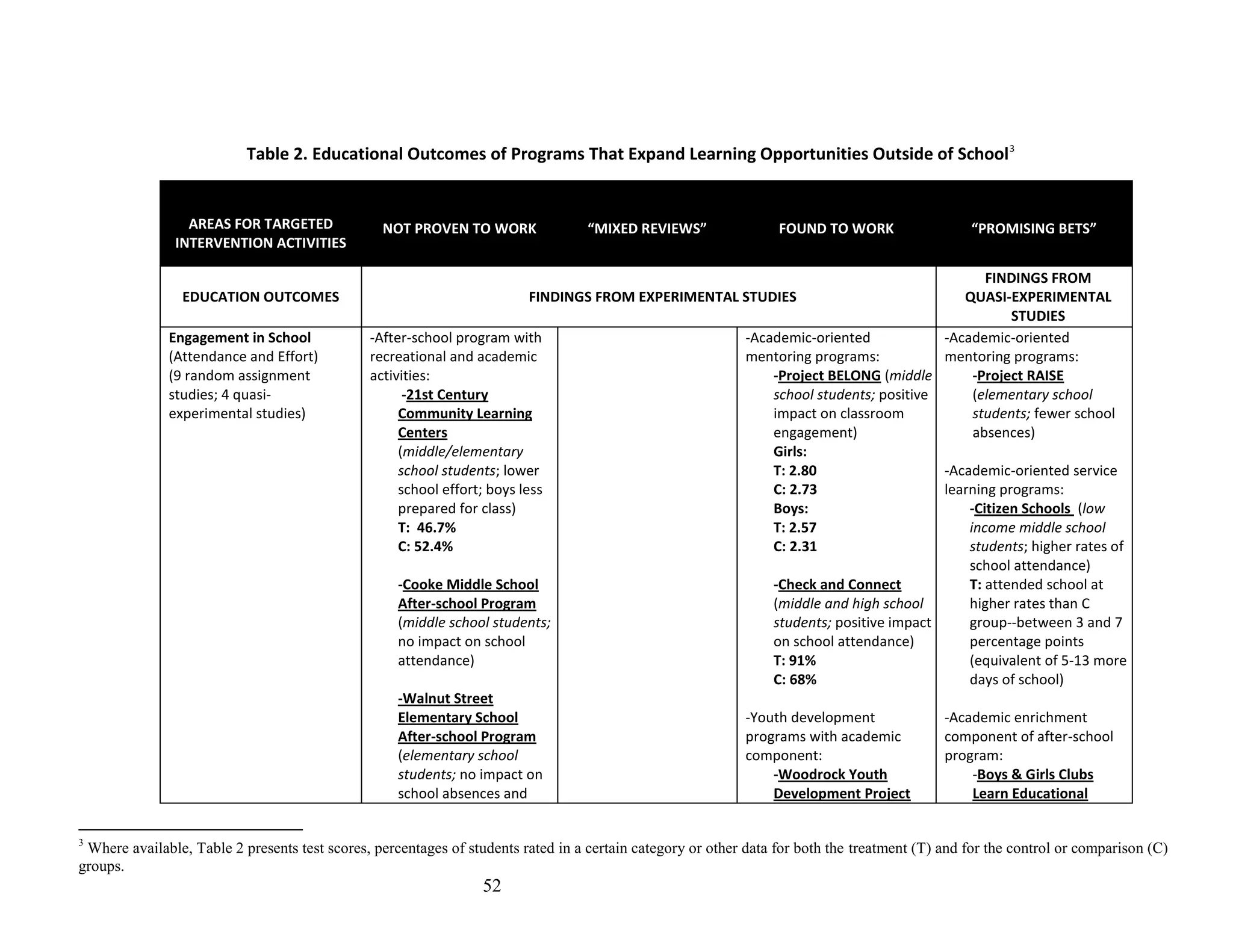
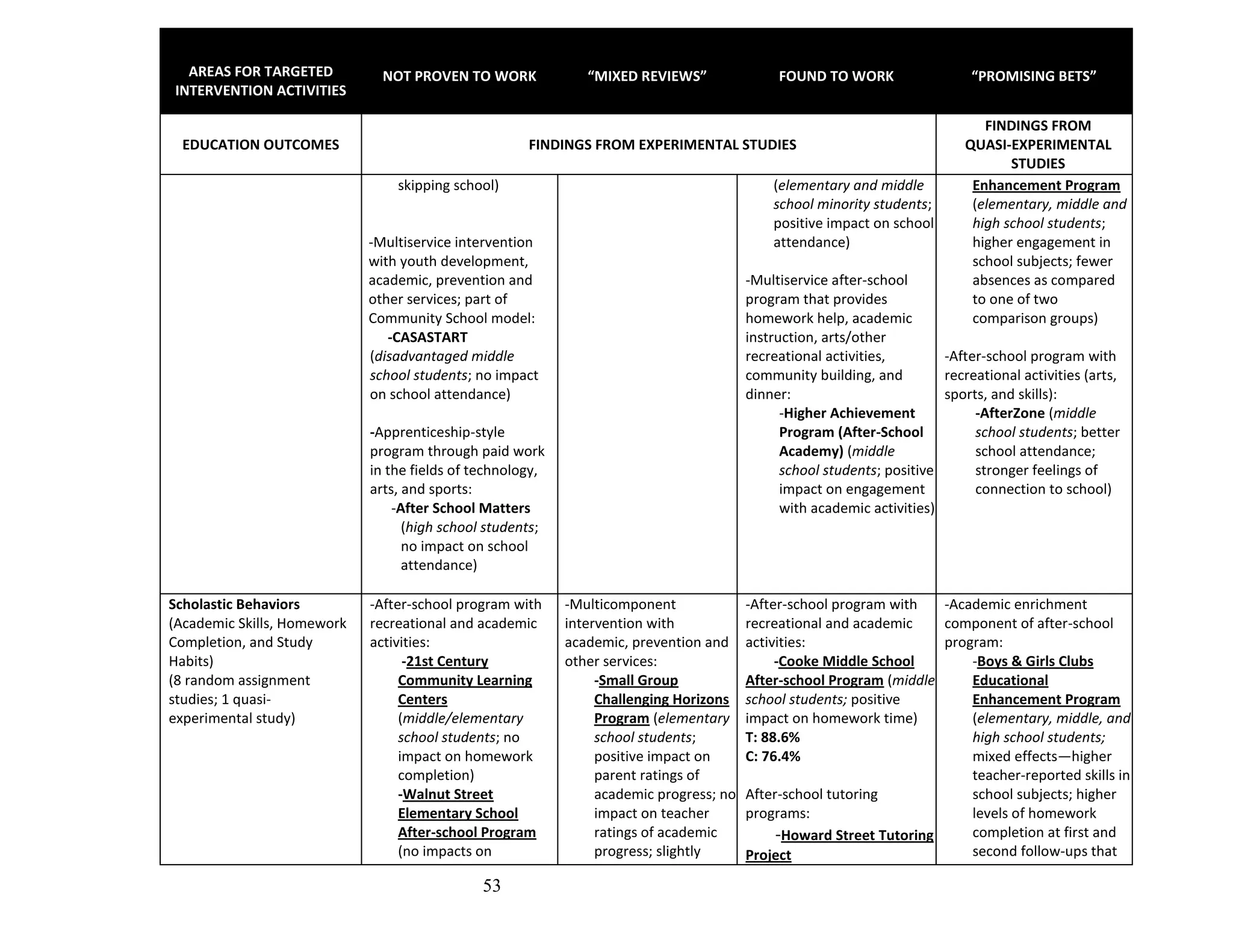
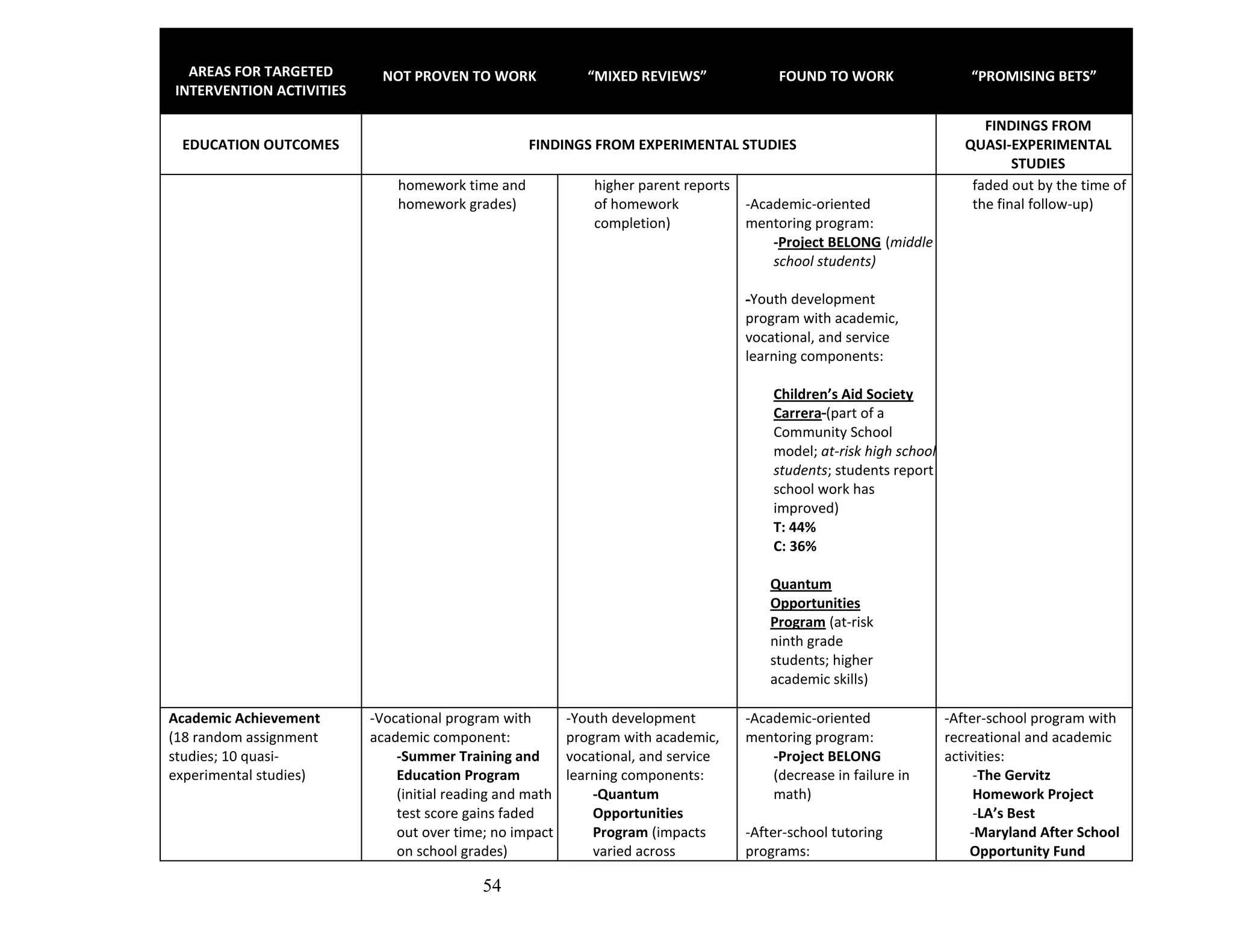
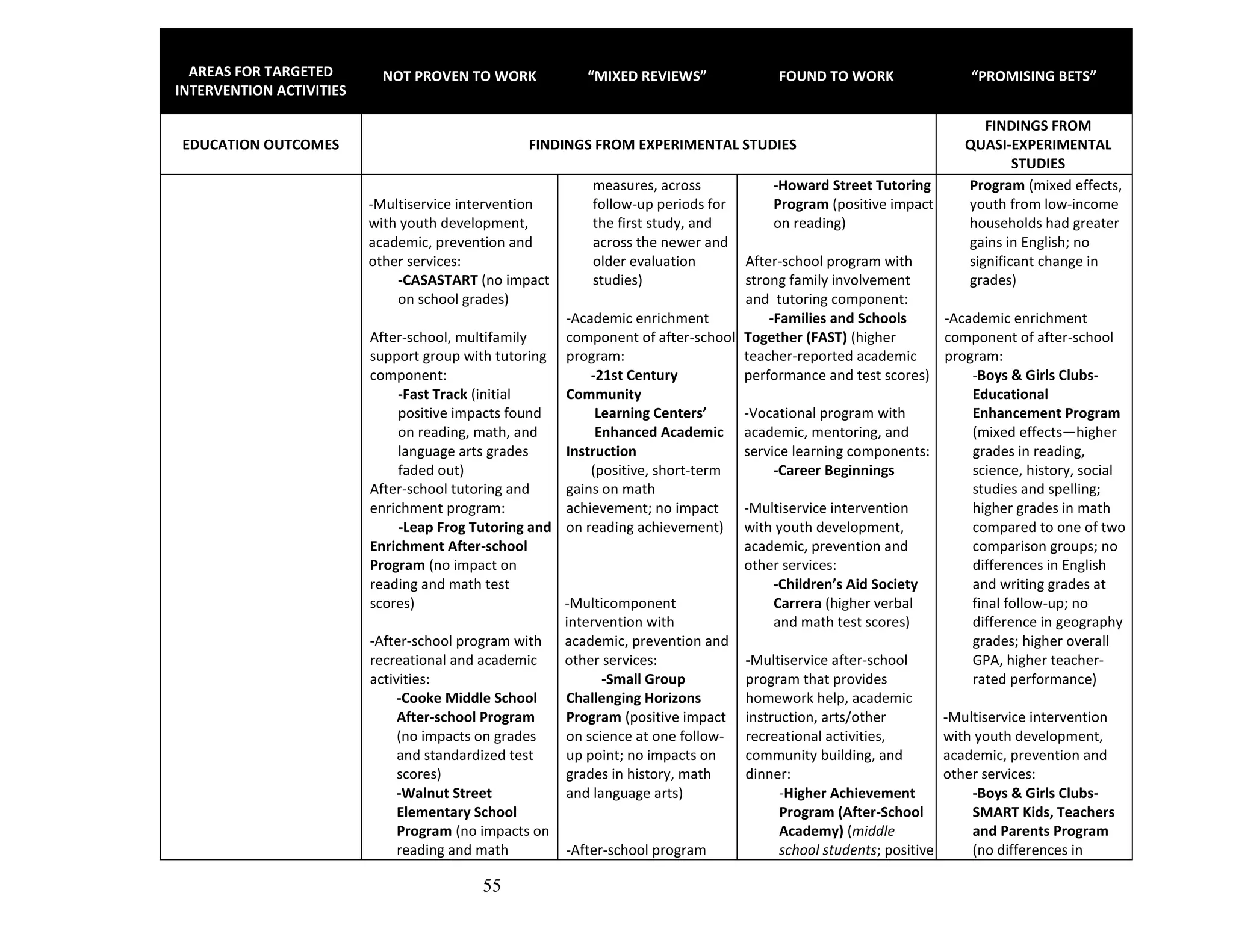
Table 2. Educational Outcomes of Programs That Expand Learning Opportunities
Outside of School.............................................................................................................. 52
Appendices
4
Acknowledgements
Numerous people helped to develop this report. We recognize the diligent work of the
Child Trends’ research assistants and analysts who conducted literature searches and
provided technical assistance: Kelly Bell, Chloe Booth, Ali Carter, Katie Hamilton, Jordan
Kahn, Tae Kang, Megan Kuhfeld, Elizabeth Lawner, Kassim Mbwana, and Karima Scott.
We also thank Elizabeth Reisner of Policy Studies Associates and Jennifer Davis of the
National Center on Time and Learning for sharing their recommendations for studies to
include in this review.
In addition, we thank Carol Emig and Laura Lippman of Child Trends for their careful
reading of this report and their helpful suggestions. We also thank our external
reviewer, Duncan Chaplin, senior researcher at Mathematica Policy Research, for his
thoughtful critique and extensive comments, and Harriet Scarupa, for her skillful editing.
Finally, we express our gratitude to The Wallace Foundation for commissioning and
funding the research on which this report is based. In particular, we thank Edward Pauly
and Ann Stone for their ongoing guidance, substantive feedback, and support. We also
thank Nancy Devine, Christine DeVita, Lucas Held, Richard Laine, Pamela Mendels, and
Dara Rose for their insights, recommendations, and review.
5
Chapter 1: Introduction
Background
The Status of Education in the United States
The educational achievement and attainment of young people in the United States has been a long-
standing issue of concern. While analyses of long-term trend data from the National Assessment of
Educational Progress (NAEP)i
show that students in the United States have made gains in reading and
mathematics over the past few decades, a sizeable proportion of students in this country fail to
demonstrate mastery of basic reading and writing skills, lack knowledge about U.S. history or
geography, and perform at below-basic levels in mathematics and the sciences.ii
Moreover, despite the gains in educational achievement made by most U.S. students over the past two
decades, educational gaps in proficiency in reading and other subjects persist across income and racial
groups. In addition to the achievement gap,iii
widespread differences persist in the levels of
educational attainment across racial/ethnic and income groups.iv
These differences are highlighted in
a recent report that presents national, state, and local data on graduation rates for males in the United
States. The report found that the overall graduation rate for black male students attending public
schools in the 2007-2008 school year was 47 percent, compared with 78 percent for their white male
counterparts.v
Another report presents results of a similar analysis of high school graduation rates in
cities. That report provides evidence of an urban-suburban “geographic” gap, with an 18 percentage-
point difference found between the on-time high school graduation rates of public school students in
urban districts in comparison to public school students in suburban districts.vi
The same report cited an
analysis of graduation rates by racial and ethnic background for public school students in the 2004-
2005 school year, which found that Native American, Black, and Hispanic public school students had
four-year graduation rates ranging from 50 to 58 percent, with students from each group graduating at
rates well below the national average of 71 percent.
Educators and others have identified multiple reasons for such gaps in student achievement and
attainment. Some have pointed to the historically uneven access that young people from different
backgrounds have to quality schools. Others point to different levels of resources available to children
at home and through quality programs that can promote student learning outside of school and in the
home.
6
The Return on Investments in Education
One of the more obvious reasons that education matters is the well-documented link between a
person’s educational status and his or her economic well-being. According to the U.S. Department of
Education’s Condition of Education 2010 report, higher levels of educational attainment are
consistently found to be related to higher earnings. For instance, the report notes that the median
earnings for young adults ages 25-35 with a bachelor’s degree who were employed full time was
$46,000; by comparison, the median earnings for young adults employed full time was $30,000 for
those with a high school diploma or an equivalency degree, and $23,500 for those without a high
school diploma or an equivalency degree.vii
Furthermore, numerous studies have found that the benefits of education extend beyond the
improved economic well-being for individuals and into other areas. Research conducted by economists
and other scholars documents the high public and private costs of high school dropout as well as the
societal and private economic and noneconomic benefits of attaining higher levels of education.viii
For
instance, studies have shown that greater educational attainment is related to reduced involvement in
crime and the criminal justice system, improved health outcomes, and higher rates of civic
participation.ix
Overview of This Report
This report synthesizes what is known about the effectiveness of school and program interventions
that aim to address deficiencies and inequities in academic achievement and educational attainment
by expanding learning opportunities for students both inside and outside of school.
In Chapter 1, we introduce and frame the topic by providing background on the educational system in
the United States and the need for improving the system to better support optimal achievement and
attainment outcomes. The introduction also outlines the current policy context, describes the
methodology for conducting the literature review, and provides information on the different types of
out-of-school time programs.
In Chapter 2, we examine the available literature on models in which districts or schools either expand
the length of the day that young people must be in school or expand the number of days in the school
year. This chapter is divided into two sections: the first looks at the evidence on extended school-day
(ESD) program models; the second focuses on findings from extended school-year (ESY) program
models. Because this review aims to cover the effects of extended learning time programs serving
students in grades K-12, both sections include information on kindergarten programs. Most of the
studies of ESD and ESY models focus solely on academic achievement outcomes, so that will be the
7
focus of this review.
In Chapter 3, we summarize the effects of social intervention programs that expand learning
opportunities outside of the school day by providing at least one academic component as a part of
their regular program offerings. In many cases, these programs are designed to complement learning
that happens in school. We refer to these programs as expanded learning opportunities or ELO
programs. Because ELO programs take place in community and school settings during nonschool
hours, these programs are also commonly referred to as out-of-school time (OST) programs. Because
random assignment evaluations were available on ELO programs, but not for ESD and ESY program
models, Chapter 3 is structured differently than Chapter 2 and focuses on “what works” based on
findings from these rigorous evaluations. In addition, the ELO evaluations tended to include
information on a wider range of educational outcomes beyond academic achievement; therefore, our
review of the research literature on ELO programs in Chapter 3 includes a broader review of
educational outcomes, such as information on student engagement and educational attainment.
In Chapter 4, we offer a set of conclusions and recommendations based on what we learned from our
investigations.
Funding and Policy Context
President Obama has voiced support for expanded learning as a means to help promote achievement and
“even the playing field” between the United States and other nations. U.S. Secretary of Education Arne
Duncan has been a particularly strong advocate for this approach. He has been quoted as saying, “I think
the school day is too short, the school week is too short and the school year is too short…You look at all the
creative schools that are getting dramatically better results. The common denominator of all of them is
they're spending more time…” (April 15, 2009). In his previous position as chief executive officer of the
Chicago Public Schools, Duncan promoted the growth of the city’s community school models and other
school-based and out-of-school time (OST) models that support learning beyond the typical school day and
into the after-school hours, weekends, or summer months.
Beyond expressing support for extended learning time, the new federal efforts to improve education have
elevated the importance of innovations that test and evaluate various education reforms, including those
that increase learning time. Below is a short summary of a few funded education programs and policies
that seek to expand learning opportunities by increasing the time available for students to learn.
 Through the American Recovery and Reinvestment Act of 2009 (ARRA), the Race to the Topx
competition emphasized the federal government’s interest in creating opportunities to increase
8
learning time. For instance, Priority 6 of the award notice invited potential grantees to engage
community partners to expand learning opportunities offered by schools, to engage families to
support student learning, and to implement “new structures and formats for the school day or year
that result in increased learning time.” Each of the 10 phase II winners of the Race to the Top
competition responded with a combination of proposed innovations and reforms to expand
learning time, with seven of the 10 proposing to implement extended learning day models; seven
proposing expanded year models; six proposing summer programs; seven proposing after-school
programs; and two proposing full-day kindergarten.
 In the background materials for applicants to the Investing in Innovation (i3) Fundxi
and the Promise
Neighborhoods,xii
efforts to expand learning time implemented through school-based and out-of-
school time models are noted as one of several reform strategies eligible for funding.
 The new ARRA programs use a broad definition of extended learning that includes models that
extend the school day, extend the school year, or that support learning beyond the regular
school day, such as through community school programs, before- and after-school programs,
weekend programs, and summer learning programs.
 The federal government has shown increased support for programs designed to expand learning
opportunities outside of school and to provide supports for working parents. This commitment is
most clearly illustrated through an examination of the rapid growth in funding for after-school and
summer programs through the 21st Century Community Learning Center (21st CCLC) program.
Since its inception in 1996, the program has expanded from an allocated budget of less than $1
million to an allocated budget of more than $1 billion. Through the Elementary and Secondary
Education Act (ESEA), as amended by No Child Left Behind, states may choose to request waivers to
permit 21st CCLC program funds to be used to support extended learning time during the school
day as well as before school, after school, or during the summer.xiii
 The Supplemental Educational Services (SES) program provides free academic remediation help
through tutoring and other activities. SES programs generally provide extra time for learning
outside of the regular school day for disadvantaged students from Title 1 schools that serve
predominantly low-income students.
 In September 2011, Duncan invited states to apply to receive waivers to specific requirements of
the No Child Left Behind Act of 2001 in exchange for rigorous and comprehensive state education
plans. Through this process, states may request the flexibility to allow districts to use 21st CCLC
funds for extended school day or year initiatives. Similarly, districts may also use Title I funds
previously set aside for SES tutoring or professional development for extended learning initiatives,
such as after-school or summer learning.
9
Methodology
We conducted an extensive literature search to identify studies for this report. While we used a
variety of methods to search for studies, the vast majority of the studies included in this report were
identified through searches of online databases, academic search engines, and bibliographies of
literature reviews, and meta-analyses on relevant topics. We also identified a few sources based on
recommendations from key informants who were interviewed for additional information about studies
or programs profiled in reports.
Studies that met the following criteria were included in the report:
 evaluations of school-based or community-based programs that involve expanding learning
time through an extended school day or an extended school year;
 evaluations using random assignment, quasi-experimental, or nonexperimental designs; and
 evaluations that used statistical tests to examine whether the program was effective in
increasing academic achievement or educational attainment outcomes, among others.
Throughout the report, findings are described as positive or favorable, which are both considered to be
desirable; negative or unfavorable, which are both considered to be undesirable; or nonsignificant,
meaning they made no difference or had no impact.
Information on effect sizes (which can be interpreted to help uncover the practical relevance of any
significant effects found) is not included in most of the evaluations included in this report. However, to
a limited extent, we do discuss available information on the magnitude of effects.
For more details on the literature search strategies, inclusion criteria, key terminology and effect sizes,
please see Appendix A.
Types of Extended Learning Time Models
This section provides an overview of three types of extended learning time (ELT) models, describing
their differences, similarities, and any overlaps in their approach for expanding learning opportunities
for students both inside and outside of the school day.
What Are Extended Learning Time (ELT) Programs?
This report reviews the effects of three different types of models for expanding learning time for
children in grades K-12. These models are defined and described in Figure 1 below.
10
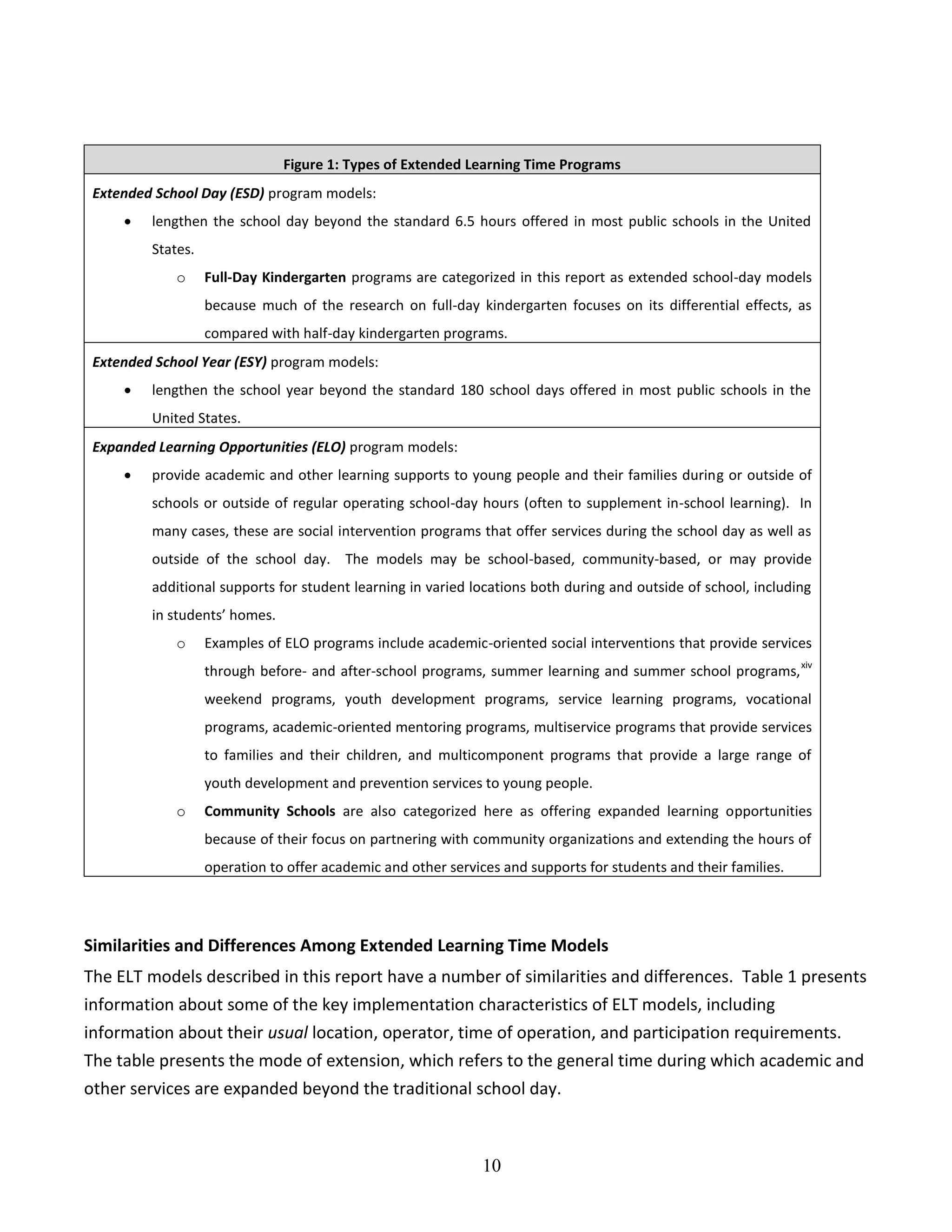
Figure 1: Types of Expanded Learnng Time Programs
Figure 1: Types of Extended Learning Time Programs
Extended School Day (ESD) program models:
 lengthen the school day beyond the standard 6.5 hours offered in most public schools in the United
States.
o Full-Day Kindergarten programs are categorized in this report as extended school-day models
because much of the research on full-day kindergarten focuses on its differential effects, as
compared with half-day kindergarten programs.
Extended School Year (ESY) program models:
 lengthen the school year beyond the standard 180 school days offered in most public schools in the
United States.
Expanded Learning Opportunities (ELO) program models:
 provide academic and other learning supports to young people and their families during or outside of
schools or outside of regular operating school-day hours (often to supplement in-school learning). In
many cases, these are social intervention programs that offer services during the school day as well as
outside of the school day. The models may be school-based, community-based, or may provide
additional supports for student learning in varied locations both during and outside of school, including
in students’ homes.
o Examples of ELO programs include academic-oriented social interventions that provide services
through before- and after-school programs, summer learning and summer school programs,
xiv
weekend programs, youth development programs, service learning programs, vocational
programs, academic-oriented mentoring programs, multiservice programs that provide services
to families and their children, and multicomponent programs that provide a large range of
youth development and prevention services to young people.
o Community Schools are also categorized here as offering expanded learning opportunities
because of their focus on partnering with community organizations and extending the hours of
operation to offer academic and other services and supports for students and their families.
Similarities and Differences Among Extended Learning Time Models
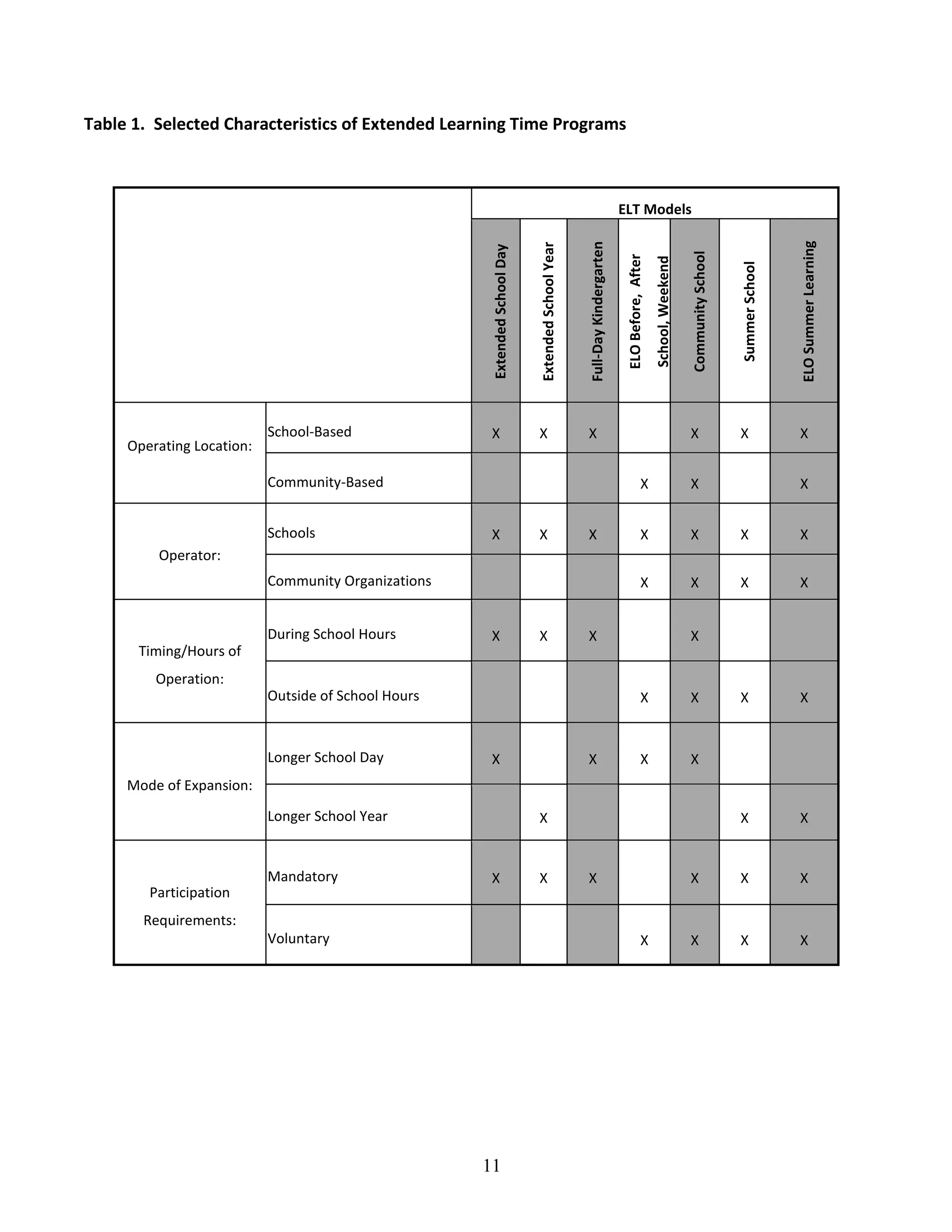
The ELT models described in this report have a number of similarities and differences. Table 1 presents
information about some of the key implementation characteristics of ELT models, including
information about their usual location, operator, time of operation, and participation requirements.
The table presents the mode of extension, which refers to the general time during which academic and
other services are expanded beyond the traditional school day.
11
Table 1. Selected Characteristics of Extended Learning Time Programs
T1. Selected Characteristics of Expanded Learning Ti
ELT Models
Extended
School
Day
Extended
School
Year
Full-Day
Kindergarten
ELO
Before,
After
School,
Weekend
Community
School
Summer
School
ELO
Summer
Learning
Operating Location:
School-Based X X X X X X
Community-Based X X X
Operator:
Schools X X X X X X X
Community Organizations X X X X
Timing/Hours of
Operation:
During School Hours X X X X
Outside of School Hours X X X X
Mode of Expansion:
Longer School Day X X X X
Longer School Year X X X
Participation
Requirements:
Mandatory X X X X X X
Voluntary X X X X
12
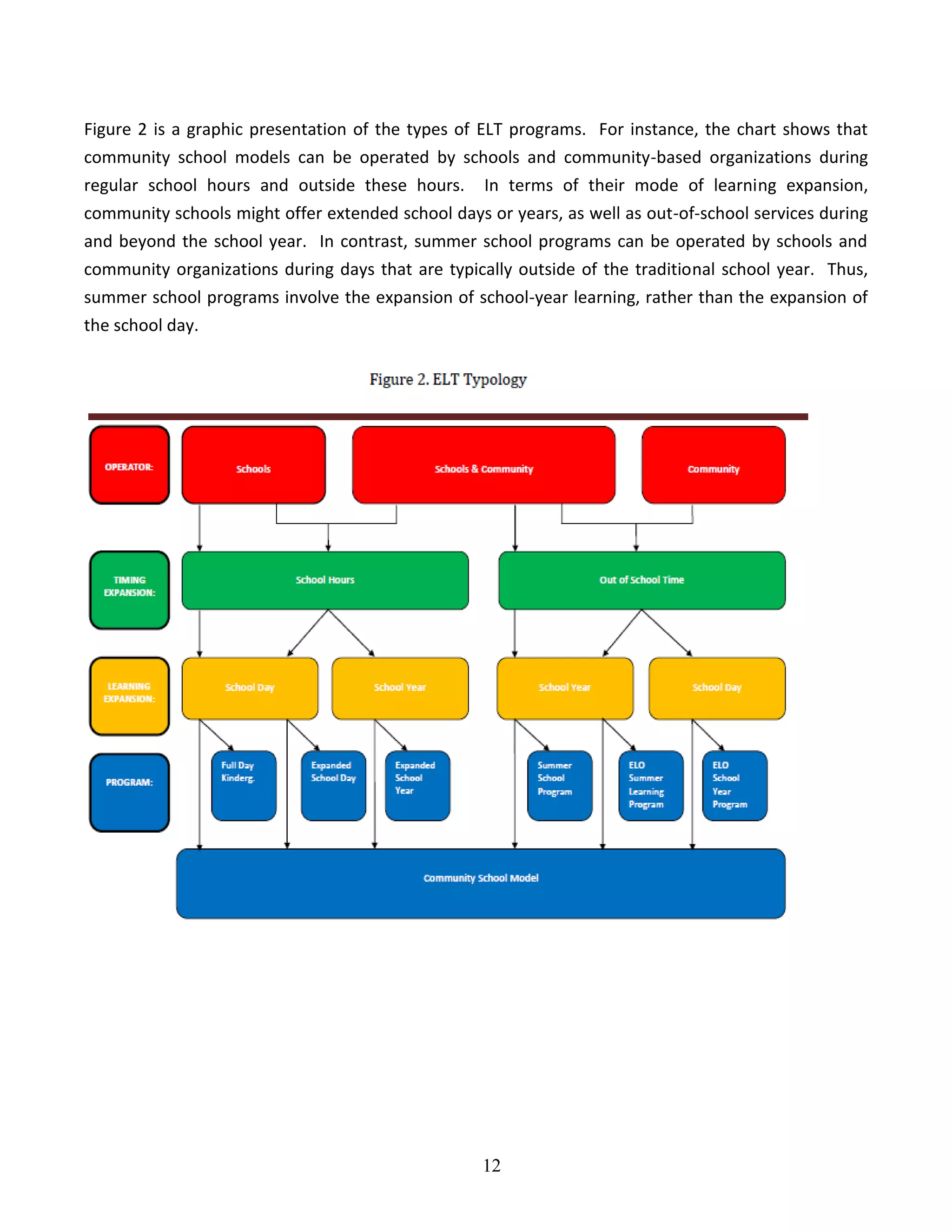
Figure 2 is a graphic presentation of the types of ELT programs. For instance, the chart shows that
community school models can be operated by schools and community-based organizations during
regular school hours and outside these hours. In terms of their mode of learning expansion,
community schools might offer extended school days or years, as well as out-of-school services during
and beyond the school year. In contrast, summer school programs can be operated by schools and
community organizations during days that are typically outside of the traditional school year. Thus,
summer school programs involve the expansion of school-year learning, rather than the expansion of
the school day.
Figure 2. ELT Typology
13
Chapter 2: Expanding Learning Opportunities in School
Background
Increasing the number of hours that children attend school every year has become an increasingly
popular suggestion to remedy poor school performance and widespread education gaps between
lower- and higher- income students and across different racial and ethnic groups. Two ways in which
this goal can be achieved are through extending the school day and through lengthening the school
year.
Extended school day (ESD) programs incorporate additional instructional time into the traditional 6.5-
hour school day that is the norm for most schools in the United States. In most cases extending the
school day entails the expansion of instructional time across classes, or the addition of classes or
programs that supplement an existing course in a core academic area, such as intensive tutoring or
small-group study sessions for math or English/language arts. In some cases, the extra time is used to
expand offerings outside the regular curriculum, such as arts and sports activities that many schools
have elected to cut in order to provide additional instructional time to improve student test scores.
Extended school year (ESY) programs typically operate on a longer academic school-year calendar than
the traditional 180-day schedule offered by most schools in the United States. However, states and
districts vary in their policies affecting public schools, including requirements about the minimum
length of the school year or mandated start-dates or end-dates for public school districts. Therefore,
while schools in the United States are open for an average of 180 days a year, this number actually
varies somewhat across states and districts, which have experimented with different school reforms
over the past several decades, including reform efforts involving the expansion of the school day or
year.
Historical Context
The idea of improving academic outcomes through extended learning time programs is not new.
Several reports have brought this idea to the forefront.
John B. Carroll’s Model of School Learning, first presented in 1963, is arguably the most influential
publication within the time-and-learning literature. His model presents five core variables of student
learning:
 Aptitude
 Opportunity to learn
14
 Perseverance
 Quality of Instruction
 Ability to understand instruction
The basic premise of Carroll’s model is that school learning is dependent on the amount of time that a
teacher has to teach in relationship to the amount of time a learner takes to absorb and process the
information. In the years following the publication of Carroll’s Model of School Learning, a wide range
of studies have been conducted examining the relationship between time and learning and testing the
relative importance of each of these variables, particularly those related to time, for student learning.
Federally funded reports in the 1980s (A Nation at Risk) and the 1990s (Prisoners of Time) brought
widespread scrutiny to the length of the school day and school year in the United States. These
reports describe the length of the school day and year as outdated, given its basis in an agrarian work
schedule that is no longer applicable to most workers in the nation. The reports also suggest that the
U.S. system is inadequate by providing descriptive data comparing the greater amount of instructional
time offered in comparable nations, such as Japan, whose students are outperforming those in United
States on tests of academic mastery (Denning, 1983; National Education Commission on Time and
Learning, 1994). At the same time, experts taking a closer look at the data find that there is not a
perfect correlation between the average instructional time offered in a nation and the average
national performance on international assessments such as the Organization for Economic Cooperation
and Development (OECD) Programme for International Student Assessment (PISA) (Baker, Fabrega,
Galindo, & Mishook, 2004). For instance, U.S students achieve higher PISA scores than students in a
few nations that offer more instructional time (Silva, 2007).
Over the last 15 years, efforts to extend the school day and year have taken root, particularly in high-
poverty, high-minority schools. The Center for American Progress reported that more than 300
initiatives to expand learning time were launched between 1991 and 2007 in high-poverty schools. The
Education Commission of the States found that between 2000 and 2008, more than 50 programs to
lengthen the school day were supported through state funding (Gewertz, 2008; Patall, Cooper, & Allen,
2010). To help keep track of this trend, the National Center on Time and Learning operates an
expanded-time database with information on hundreds of schools that run on an extended school day
or school-year schedule (Farbman, 2009). At the same time, one must acknowledge that while Chicago
Public Schools and other school districts have worked to increase school hours in recent years, some
school districts have opted to cut school hours in response to budget cuts that resulted from the recent
recession (Farbman, 2011).
15
As the number of ESD programs has grown, they have become increasingly diverse. ESD programs
encompass targeted interventions for low-performing students and schoolwide expansions of the
school day that include extra hours of core classes or intensive tutoring. Estimates from the federal
Schools and Staffing Survey, sponsored by the National Center for Education Statistics, indicate that, in
the 2007-08 school year, more than 52 percent of noncharter public schools and more than 60 percent
of charter schools provided some sort of extended day program to students, up from 47 and 52
percent, respectively, four years earlier.
Given current policy and the funding context, as well as the widespread implementation of ESD and
ESY programs, it is important to determine whether there is a solid body of research supporting efforts
to expand learning time offered during the regular school day, or whether the implementation of ESD
and ESY programs has outpaced research on their impact. The following sections present information
on the available experimental, quasi-experimental, and nonexperimental studies examining the impact
of ESD and ESY programs on academic achievement outcomes, the sole outcome of focus for most of
the studies included in our review.
Considerations About the State of the Research Literature on Extended School Day and Extended
School-Year Initiatives
Despite the growing popularity of ESD and ESY programs, little evidence exists that shows a direct link
between ESD and ESY programs and positive academic outcomes for K-12 students. There are several
reasons for this dearth of information. Few studies have used rigorous experimental or quasi-
experimental methods to examine whether a longer school day or year has a positive impact on
academic performance. Establishing whether extending the school day or year is the cause of improved
academic outcomes is challenging without an experimental evaluation design. Unfortunately, based on
the studies that we have been able to identify, most of the evidence base for ESD and ESY programs is
derived from nonexperimental research. The majority of studies on this subject have relied on pre-test,
post-test analyses or evidence that can only identify a correlation between ESD and ESY programs and
academic outcomes. In other words, these studies cannot offer proof that these programs caused
certain outcomes.
The specific effects of extending the school day or year are also difficult to ascertain because of what
Hoxby and colleagues (2009) called the “packaging” of ESD and ESY with other school reform efforts.
Schools that serve a substantial percentage of academically and economically disadvantaged students
are more likely to adopt ESD and ESY programs as one component of a broader school improvement
plan. Because of this situation, most research findings supporting ESD programs, in particular, come
16
from evaluations of comprehensive school models. The vast majority of these evaluations do not
examine the specific impact of each component of a model, only the model’s overall impact.
Another limitation of the existing research on ESD and ESY programs concerns the outcome measures
used. Most of the studies that we examined focused solely on academic outcomes, particularly
standardized test scores. While performance on standardized tests is obviously a key outcome of
interest to stakeholders and is easy to compare across schools, other key outcomes that are related to
academic performance also warrant scrutiny. Examples of these outcomes include school attendance,
on-time promotion, scholastic behaviors, school discipline problems, and attitudes toward school.
Examining these outcomes would allow researchers to put findings on academic achievement in
context and explore the process through which ESD and ESY programs lead to improved academic
performance.
A final reason that the existing research on ESD and ESY programs leaves many questions unanswered
is that it often does not specify how the additional time is used. An extended school day may not
always translate into more instructional time or more time for students to spend engaged actively in
learning than in a traditional school day. As a result, it can be difficult to determine the effects of these
programs or to compare the results of an ESD or ESY program across schools.
17
Part 1: Findings From Extended School-Day (ESD) Program Models
Background and Summary
This section presents results of studies that examine the student
outcomes associated with attendance in schools that operate on
an extended school day (ESD) schedule, typically defined as
schools that operate longer than the traditional 6.5-hour school
day. In addition, findings from studies examining the effects of
longer- and shorter-day kindergarten programs on student
outcomes are included here. Studies that used random
assignment or quasi-experimental designs, as well as
nonexperimental, pre-post study designs, were eligible to be
included in this section. However, no random assignment studies
of ESD models were identified in our literature searches.
We now turn to our review of the evidence base on ESD programs,
which is based on 27 studies of ESD models (17 of which also
included an ESY component). This section of the report includes
findings from studies of 11 distinct models, including four charter
school models, two magnet school models, as well as a statewide,
districtwide school, and a few independent school models. In
addition, we report on results from seven nonexperimental studies
examining the effects of extending the school day using national or
statewide data from ESD charter schools, as well as studies
examining the relationship between the length of the school day
and academic outcomes using other national, state, or local
datasets. More details about the 27 ESD studies can be found in
Appendix Tables B1 and B2.
Below is a summary of our key findings on the effectiveness of ESD
program models:
 The majority of studies reviewed (20 out of 27 studies)
found mostly favorable relationships between ESD
programs and academic outcomes, while seven had mostly
nonsignificant findings. This includes seven out of 11
Box I. The Knowledge is Power Program (KIPP)
The Knowledge is Power Program (KIPP) is the
largest charter management organization (CMO) in
the nation, serving 99 charter schools. One of the
hallmarks of KIPP schools is an extended school
day that usually runs from 7:30 a.m. to 5:30 p.m.
KIPP schools use this extended time in many
different ways, but generally students in KIPP
schools receive more hours of math and
English/language arts instruction than do students
in traditional middle schools. KIPP schools usually
have extended school years as well, averaging
around 192 school days (Woodworth et al 2008,
Tuttle et al 2010).
KIPP schools have several distinctive features – a
strict code of behavior, a young, dedicated group of
teachers who are obligated to be available by phone
before and after school hours, and the “Five Pillar”
model. The five pillars include additional school
time, high expectations for students, a commitment
from the student and his/her parents to put in the
time and effort to succeed the power to lead
(principal autonomy), and a focus on results of
standardized tests and other objective measures
(Woodworth et al 2008).
Several recent studies have been conducted using
quasi-experimental methods and have found KIPP
to be associated with large improvements in
academic achievement outcomes for its students in
comparison to those of matched comparison
groups.
18
models and an additional five (out of seven) nonexperimental studies reporting mostly
favorable findings. (Please note that two of the ESD models discussed in this section, KIPP (10)
and Lighthouse (2) were the subject of multiple studies.)
 However, the available research is not clear about whether gains in test scores were a direct
result of the extended school day in school reform models that bundle this reform with others.
 ESD models appear to be most beneficial to students at increased risk of academic failure or
dropout.
 There was no evidence, based on this review, suggesting that the effect of ESD models varies
across grade levels.
 Findings from two correlational studies suggest that there may be diminishing returns to
extending the school day, with smaller student performance gains seen in schools as the day
becomes very long.
 Full-day kindergarten (FDK) programs were found to lead to gains in reading and math
knowledge during the kindergarten year. However, studies that looked at the effects of FDK
over time found that the positive achievement gains made by FDK participants rapidly
dissipated over time, with no study finding significant, positive impacts of FDK beyond first
grade.
 Academic outcomes for FDK schools were stronger for schools with high proportions of
minority students.
More details on each of these key findings are highlighted below.
Key Findings for Elementary and Secondary School ESD Program Models
 The majority of studies that have examined outcomes of ESD programs indicate that these
programs were positively related to improved student outcomes, but these studies focused
mostly of models that bundle an extended school day with other reforms.
Of the 20 studies identified that used quasi-experimental study designs to examine the effectiveness of
ESD programs, 16 reported at least one positive academic outcome in their most rigorous and relevant
analyses (Angrist et al., 2010; Atwater et al., 1991; Doran et al., 2002; Economic Policy Institute, 2005;
Gallagher & Ross, 2005; Hoxby et al., 2009; Mac Iver & Farley-Ripple, 2007; Mayesky, 1980; McDonald
et al., 2008; Farmer-Hinton et al., 2002; Teh, McCullough, & Gill, 2010; Tuttle et al., 2010; Musher et
al., 2005; Woodworth et al., 2008) and five reported mostly nonsignificant effects, including at least
one negative effect, in their most rigorous and relevant analyses (Checkoway et al., 2011; Gill et al.,
19
2005; Gleason et al., 2010; McDonald et al., 2008; Urdegar, 2009). All but two of these studies
(Checkoway et al., 2011; Urdegar, 2009) were evaluations of comprehensive school reform models that
incorporated an extended school day as one component among several, which makes it difficult to
attribute academic gains to ESD initiatives.
Among the 16 quasi-experimental studies that found at least one positive academic outcome in their
most rigorous and relevant analyses, 10 were evaluations of the Knowledge is Power Program (KIPP)
(Angrist et al., 2010; Doran et al., 2002; Economic Policy Institute, 2005; Gallagher & Ross, 2005;
McDonald et al 2008; Mac Iver & Farley-Ripple, 2007; Musher et al., 2005; Ross et al., 2007; Tuttle et
al., 2010; Woodworth et al., 2008). Of these 10 evaluations of KIPP, three were evaluations of the KIPP
DIAMOND Academy in Memphis, Tennessee (Gallagher & Ross, 2005; McDonald et al 2008; Ross et al.,
2007).
KIPP is the largest charter management organization (CMO) in the nation, serving 99 charter schools.
One of the hallmarks of KIPP schools is an extended school day that usually runs from 7:30 a.m. to 5:30
p.m. KIPP schools generally have extended school years as well, averaging around 192 school days
(Woodworth et al 2008, Tuttle et al 2010). For more information about the KIPP model and its
distinguishing features, please see Box 1.
Results from most of the well-implemented quasi-experimental evaluations of KIPP indicate that by the
end of their first year in KIPP, students made significantly greater gains in math scores than did similar
non-KIPP students. Five of the studies also reported significant gains in English/language arts (the
exceptions were Mac Iver & Farley-Ripple, 2007 and McDonald et al., 2008) among KIPP students. Two
of three studies that followed a cohort of KIPP students from fifth through eighth grades indicated that
the effects of KIPP were long-lasting (MacIver and Farley-Ripple 2007; McDonald et al 2008; Tuttle et al
2010).
Achievement First (AF) and Uncommon Schools are two additional charter management organizations
that incorporate ESD components into their school models. A quasi-experimental evaluation of three
AF and two Uncommon middle schools in New York City found that the schools had statistically
significant and substantively meaningful impacts on reading and mathematics test scores, which were
maintained over three years for the two schools that were open from the beginning of the study (Teh
et al., 2010).
Another quasi-experimental study of New York City charter schools by Hoxby and colleagues (2009)
examined the effect of charter schools on student achievement using charter school admission
20
lotteries to compare charter school students with students who did not gain admission to these
schools through these lotteries. In New York City charter schools, the average school day is eight hours
long—about 90 minutes longer than in traditional public schools (Hoxby et al., 2009).
Hoxby and colleagues (2009) found that charter schools had a positive impact on student achievement
in New York City from the 2000-01 to 2007-08 school years. For grades K-8, the average extra gain per
year spent in charter schools was 0.09 standard deviations in math and 0.06 standard deviations in
English. To present these findings in simpler terms, Hoxby and colleagues estimated the gaps in
achievement scores between students living in Harlem and students living in Scarsdale, an affluent
suburb. On average, a student who attended a charter school from kindergarten through eighth grade
would close about 86 percent of the gap in math and 66 percent of the gap in English.
Of course, charter schools in New York City do differ in the length of their school days. Hoxby and
colleagues (2009) investigated whether the number of hours in the school day was associated with
student achievement in math and English. The researchers found a positive association when
considering the length of school day by itself (p<.10), but this association was not confirmed in a
multivariate regression analysis that also included number of minutes of English per day and number of
hours in a school day, among other variables. Hoxby and colleagues concluded that a package
combining ESD and ESY components is associated with improved student achievement, but that their
data could not allow them to tease out the effects of a long school day from a long school year because
most charter schools in New York City that have one have the other as well.
Four quasi-experimental studies found minimal to no effects in their most rigorous and relevant
analyses (Checkoway et al., 2011; Gill et al., 2005; Gleason et al., 2010; Urdegar, 2009). One of these
studies was a recent and rigorous evaluation of impacts of charter schools from the U.S. Department of
Education’s Institute of Education Sciences. The study compared students in 36 charter schools across
the nation with students who were not selected in their schools’ admission lotteries. To do so, the
researchers used bivariate and multivariate analyses to examine whether specific aspects of charter
schools, such as operating on an extended school day schedule, were associated with student
outcomes. Their analyses showed that attending a school that had an extended school day was
positively correlated with academic performance, but not once other factors were taken into account
(Gleason et al., 2010).
21
The second quasi-experimental study finding minimal to no
effects in their most rigorous and relevant analyses looked at
23 Edison elementary schools across the nation—19 of which
were operating with an ESD program (Gill et al., 2005). This
study found no significant differences in the percentages of
students at Edison schools scoring at the proficient level or
above in math and reading tests and students in a group of
matched comparison schools during the first three years of
the implementation of the Edison model. By the fifth year,
however, a significantly higher percentage of students at the
Edison schools were scoring at a proficient level or above in
math. By that point, the contracts of many of the lower-
performing Edison schools had expired and were not
renewed. Furthermore, the study did not take into account
the fact that test scores may have been lower in year one for
Edison schools than would otherwise be the case. An
additional investigation of Edison conversion schools (schools
being taken over by Edison as opposed to new Edison
schools) in this study found a first-year decline across the full
range of conversion schools. The size of this decline was
about three-fifths as large as the relative gain in math found
from year one to year five. Because of this, there was no
statistically significant relative gain found between year zero
and year five for conversion schools in reading or math (Gill
et al., 2005).
An ongoing quasi-experimental study of the statewide
Massachusetts’ Expanded Learning Time Initiative, which
lengthened the school day in participating schools by 300
hours annually, found no statistically significant differences in
state assessment outcomes across years, grade levels, and
subjects (Checkoway et al., 2011). More specifically, the
study found no differences in outcomes on state student
achievement tests after one, two, or three years of
implementation for English language arts (grades 3, 4, and 7),
Box II. The Massachusetts Expanded Learning
Time (ELT) Initiative:
The Massachusetts Department of Elementary and
Secondary Education awarded 28 ELT grants over
a three-year period from 2006-07 to 2008-09 to
provide more instructional opportunities in core
subjects, integrate enrichment opportunities into
student learning, and provide educators with
increased opportunities to plan and participate in
professional development. These ELT grants
required schools to extend the school day by 30
percent above their district’s average in 2006-07.
This was changed to 25 percent above district
average in year two, and 300 hours above district
average in year three. These ELT grants did not
require any specific changes to school curriculum,
and schools that received these grants used them
to change their school day in multiple ways.
Abt Associates is conducting a rigorous, quasi-
experimental evaluation of the ELT initiative that
has received widespread attention. The researchers
have thus far found a number of nonsignificant and
negative findings (Boulay et al 2010; Checkoway,
2011). Implementation and outcomes evaluations
of the initiative highlight a number of early
implementation challenges faced by the schools.
The study also found that most comparison schools
were implementing at least some features
associated with the ELT model (Robertson et al.,
2009).
Future reports will help to provide
better information about the effectiveness of this
large-scale, statewide ELT initiative and how it was
implemented.
22
math (grades 4, 6, and 8), or science (grades 5 and 8). This study is important because it focused
specifically on the effect of adding an ESD/ESY component, rather than examining ESD/ESY as one of
several components of a charter school model.
A study of the Miami-Dade County Public School Improvement Zone is also important, as it allowed an
investigation of the added value of an ESD/ESY program (Urdegar, 2009) for students and teachers.
The overall evaluation found mixed effects of Zone schools on student academic outcomes, but the
most relevant part of the study was an analysis of standardized test scores indicating no statistically
significant difference between students in Zone schools and students in Reading First schools. The only
difference between Reading First and Zone schools was the extended day and year.
With respect to nonexperimental analyses and pre-post studies of ESD programs, most show positive
outcomes. Of the six nonexperimental studies included in this section of our review, five reported
positive correlations between ESD programs and academic achievement and one demonstrated mostly
nonsignificant or mixed findings about ESD programs and academic outcomes (Link & Mulligan, 1986).
 In evaluations of school reform models, the available research is not clear about whether
gains in test scores are a direct result of an extended school day.
As is noted above, the majority of our knowledge about the effect of ESD initiatives in elementary and
secondary school comes from evaluations of comprehensive school reform models that incorporate an
extended school day as one component among several, which makes attributing academic gains to ESD
difficult. However, these models’ other programs often differ substantially, and the consistency of
positive outcomes across all models suggest that having a longer school day is a key component of
these programs’ success. As Patall, Cooper, and Allen (2010) observed in their meta-analysis of
extended school day and extended school year programs, it is encouraging that the most rigorous
analyses of ESD programs often reported the most consistent and positive results with the largest
effect sizes. However, studies that explicitly examine the relationship between length of school day or
length of school year and academic achievement show mixed findings.
A recently released nonexperimental case study comparing nine high-performing public, pilot, and
charter schools in Boston provided suggestive evidence. This study examined student performance in
nearly all of Boston’s public, pilot, and charter schools to identify and examine the practices of the
schools that experienced large gains in test scores in the 2008-09 school year. The authors found that
most of the charter schools in the district had an extended school day (8.2 hours on average) and that
this additional time allowed for most charter schools to spend more than one hour a day on math and
23
English/language arts. The authors suggested that an extended school day was one key component of
high-performing charter schools (Therriault et al 2010). Similarly, a 1996 study by Adelman and
colleagues also examined a school in Boston that extended its school day by one hour. In this school,
student outcomes improved dramatically, with the proportion of students passing the state reading
examination rising from 77 percent to 90 percent over a three-year period (Adelman et al 1996).
As described above, in New York City charter schools, a package of ESD and ESY components was
associated with achievement gains (Hoxby et al., 2009). A greater number of minutes devoted to
English every day—an aspect of many ESD schools—was also associated with achievement gains.
 Findings from two studies suggest that the returns associated with lengthening the school
day increase and then begin to diminish at much longer hours of operation.
Further, a large-scale nonexperimental study conducted by Wheeler (1987) examined correlations
between ESD programs and reading, writing, and math test scores for sixth-grade students in 1,030
California schools. Wheeler found that a school’s average test scores in reading, writing and math were
higher in schools with longer school days. However, further analysis suggested that there was a
curvilinear relationship in which the longest and shortest school days were negatively related to
academic outcomes; in particular, test scores were lower in schools with the longest school days,
suggesting that simply adding more hours to the school day may result in limited academic benefits for
students (Wheeler 1987). Although not an analysis of a specific school reform model, this study
suggests that additional instructional time may bring diminishing returns at high levels.
A large-scale nonexperimental study by Link and Mulligan (1986) examined the correlation between
weekly hours of instruction in reading and math and test scores for students in grades 3-6 on the
Comprehensive Test of Basic Skills. The researchers used a dataset with more than 14,000 students
from the 1976-77 school year. In analyzing these data, the researchers found diminishing returns to
additional instructional time in math for white and Hispanic sixth- graders and in reading for Hispanic
sixth-graders after controlling for select student, family, home, and school characteristics. For
example, among Hispanic sixth-graders, math test scores increased an average of 2.41 points as weekly
hours of math instruction increased from four to five hours, compared with a 1.83-point increase as
instruction increased from five to six hours, and a 1.25- point increase as instruction increased from six
to seven hours.
Whereas these and other studies have found simple correlations between school-day length and
positive achievement outcomes, the need for experimental research on the specific impact of a longer
24
school day on academic outcomes remains.
 ESD programs appear to be most beneficial to students at
increased risk of failing academically or dropping out of
school.
Considering that disadvantaged students tend to have fewer
opportunities to learn or demonstrate academic skills outside of
school, it stands to reason that having an extended school day
would particularly benefit disadvantaged students (Cooper et al.,
1996; Burkham et al., 2004). Supporting this assumption, existing
research indicates that ESD programs are beneficial to students in
minority groups, students who have performed poorly on
standardized tests, and students who are eligible for a free- or
reduced-price lunch. However, we cannot conclude definitely that
ESD programs are more beneficial for disadvantaged students than
for their better-off peers because few studies have addressed this
issue. In fact, one of the few studies that examined the
relationship between school-level achievement, socioeconomic
status (SES), and hours of instruction, found mixed results
(Wheeler 1987). In this California study, among low-SES schools,
number of school hours over a five-day week was positively
associated with reading, writing, and math scores. No relationship was evident for middle-SES schools.
High-SES schools had positive associations in reading and writing, but the relationship for writing was
weaker than it was at low-SES schools. Regardless of whether ESD programs affect disadvantaged and
less disadvantaged students differently, to the extent that these programs benefit students
academically, targeting ESD programs in communities serving high concentrations of disadvantaged
students could be an effective means to narrow the achievement gap. Findings from the Link and
Mulligan (1986) study described above suggest that the school-day length may be associated with
different outcomes for students of different racial and ethnic backgrounds.
 This review found no available evidence suggesting that the impact of ESD models varies
across grade levels.
ESD programs have been implemented in grades K through 12, and research has supported the use of
ESD programs across grade levels. For example, Achievement First (AF) and Uncommon Schools have
Box III. Expanded Learning Time in New York City
Although little rigorous research has examined the
impact of ESD programs, an ongoing project
evaluating an ESD program supported by The After
School Corporation (TASC) may shed some light on
the impact of ESD initiatives. TASC has contracted
with Policy Studies Associates (PSA) and Abt
Associates to conduct an independent, quasi-
experimental and implementation evaluation of this
initiative.
TASC is managing a multiyear demonstration
project that began in the 2008-09 school year in 10
New York City middle schools that serve more than
2,300 students. In each of the ELT schools, learning
time has been extended to 6 p.m., independent of
any other school program.
25
been implemented in grades K through 12. AF was founded in 1998 in New Haven, Connecticut, and
has quickly grown to manage 17 schools with more than 4,500 K-12 students in four northeastern
cities. Uncommon Schools formally became a charter management organization (CMO) in 2005, and is
currently expanding from 16 to 33 schools, which will serve more than 12,000 students across the
country. Although the research supporting these two models is limited to the quasi-experimental study
described above, the schools following these models are well worth further scrutiny for a number of
reasons. Among these reasons are the rapid growth of both CMOs, test scores in that substantially
outpace their local non-charter public schools, and the designation of AF’s Amistad Academy by the
U.S. Department of Education as one of seven schools in the nation that are models for closing the
achievement gap (U.S. Department of Education 2007; Achievement First 2010; Teh et al 2010;
Uncommon Schools 2010).
Although AF and Uncommon Schools do not have an identical curriculum, both programs feature an
extended school day, which is used to provide tutoring and small group instruction to struggling
students, as well as an extended school year. AF uses two additional hours of school each day to
implement a 90- minute math class and two reading courses that support each school’s intense focus
on maximizing reading experiences for its students.
Full Day Kindergarten (FDK) Programs
While ESD models are becoming increasingly common across the elementary and secondary levels,
another rapidly expanding form of these models is full-day kindergarten (FDK), an initiative that
lengthens the school day from a half day to a full (usually) six-hour day for kindergarten students.
Supporters of FDK argue that a longer school day for kindergarten students improves students’ skill
base, eases the child care burden of working parents, and improves students’ social skills through
increased peer-to-peer or student-teacher interaction (Saam and Nowak, 2005; Lee et al., 2006; Zvoch
2009). Due to widespread support from school stakeholders and the impetus of the No Child Left
Behind Act to improve student achievement and narrow achievement gaps between advantaged and
disadvantaged groups, FDK is now sanctioned in all 50 states, and is mandatory in 10 states—Alabama,
Arkansas, Delaware, Georgia, Louisiana, Maryland, Mississippi, North Carolina, South Carolina, and
West Virginia. Ten other states, including Massachusetts, provide more funding for FDK than for half-
day kindergarten (HDK); and other states, such as New York, have bills in the legislative process that
mandate FDK (Kauerz, 2005; Early Education for All 2009).
A substantial amount of research compares the effects of FDK to those of HDK on student outcomes in
kindergarten and beyond, ranging from evaluations of specific programs to analyses based on
26
nationally representative datasets.
In this section, we review findings from a subset of the studies (eight) that examine achievement in
full-day kindergarten. To confirm that the findings we identified across studies were consistent, we
also review findings from more comprehensive syntheses of the literature on FDK, including a recently
published meta-analysis of 40 studies by Cooper, Allen, and Patall (2010).
Key Findings for FDK Programs
 FDK has a significant, positive effect on the acquisition of reading and math knowledge during
the kindergarten year.
We examined nine studies of FDK that used an experimental design, quasi-experimental design, or
regression models to examine the effects of FDK on measures of math and reading knowledge. Of
these, seven indicated that FDK has significant, positive effects on at least one measure of knowledge
gain by the end of the kindergarten year.
Recent research from Lee and colleagues (2004), Votruba-Drzal (Votruba-Drzal et al 2008), and Zvoch
(2009) provide some of the strongest evidence to date of the positive effect of FDK in closing
achievement gaps between advantaged and disadvantaged students over the kindergarten year. Zvoch
studied students from a large district in the southwestern United States, while both Lee and Votruba-
Drzal used data from the 1998-99 Early Child Longitudinal Survey-Kindergarten cohort (ECLS-K). Lee
(2004) and Votruba-Drzal (2008) and their colleagues found significant increases in both math and
literacy skills for FDK students relative to HDK students. Zvoch (2009) measured literacy development
in students from the start of kindergarten through first grade, finding that FDK students learned
phonics at a significantly faster rate than did HDK students with higher levels of economic advantages.
The study used the Dynamic Indicators of Basic Early Literacy Skills (DIBELS) to assess skills, such as
phonemic segment fluency (PSF), which is the ability segment and blend phonemes, a key predictor of
early literacy. The study found that, at kindergarten entry, students in the more disadvantaged FDK
group were almost three times as likely as were students in the HDK group to score a zero on the PSF
test. However, the FDK students gained in PSF at a faster rate during the school year, ending the
kindergarten year with knowledge of 5.4 more phonemes than their HDK peers.
A recently published meta-analysis of FDK by Cooper, Allen, and Patall (2010) indicates that the vast
majority of FDK research has come to the same conclusions as those advanced in the research of Lee,
27
Votruba-Drzal, and Zvoch. Most of the 40 reports the authors studied—which spanned the years from
1979 through 2009—found significant, positive effects for FDK on academic outcomes, such as early
literacy and numeracy skills, at the end of kindergarten. Results of the meta-analysis, showed that the
average FDK student outperformed 60 percent of HDK students in achievement tests by the end of
kindergarten. The effects of FDK were particularly large for students in urban settings, and for students
attending schools with the longest FDK programs. Moreover, Cooper and his colleagues (2010) noted
that the studies using stronger research designs seemed to produce more positive outcomes.
Specifically, studies that compared FDK and HDK students by matching students with similar
characteristics generally produced more strongly positive results than did less rigorous studies, further
supporting the idea that FDK significantly benefits students during the kindergarten year. In addition,
positive effects were found across data sources, whether the data came from a case study of schools
within a school district, or nationally representative data from a national survey such as the ECLS-K
(Cooper et al., 2010).
Although seven of the nine studies that we examined indicated that FDK was significantly, positively
related to at least one measure of reading or math gains in kindergarten, two other studies that we
examined reported largely nonsignificant or unfavorable results (Holmes et al 1990; Saam & Nowak
2005). The Holmes study represents the only random assignment study of FDK that we were able to
identify. This study examined students in 10 FDK and 10 HDK schools. Because the district was in the
process of converting all schools to FDK over a two-year period, this policy change allowed for a natural
experiment, in that an equal number of disadvantaged schools were randomly assigned to each group.
Although the study found positive, significant impacts on FDK students’ math comprehension scores,
compared with HDK students’ scores, differences in reading skills between the two groups were largely
nonsignificant, except for a significant, negative impact of FDK on reading comprehension. Saam and
Nowak found a negative relationship between FDK and language test scores and no significant
relationship between FDK and math scores. However, this study did not use models that were able to
control for student characteristics beyond gender (Saam & Nowak 2005).
 The positive achievement gains made by FDK participants rapidly dissipated over time,
with no study finding significant, positive impacts of FDK beyond first grade.
Although the first-year findings of FDK are encouraging, the results of longitudinal studies, including
the Zvoch and Votruba-Drzal studies cited above, indicate that the gains produced by FDK are short-
lived. Only one of the five longitudinal studies of FDK found any significant, positive effect of FDK by
the end of first grade. This study showed that the effect of FDK on math scores at the end of first
grade was significant, but less than half of the magnitude of the FDK effect found at the end of
28
kindergarten. The effects of FDK on math by grade 3 were significant and negative in this study
(Cannon et al 2006). Three of the remaining four studies found no significant effects of FDK on test
scores or growth trajectories in math and reading after kindergarten, while the remaining study found
no significant effect of FDK at the kindergarten level. It should also be noted that the quasi-
experimental studies examined did have methodological weaknesses—namely, FDK and HDK groups
that were not equivalent at the start of kindergarten; and, in the case of the Zvoch study, high attrition
experienced among FDK students, particularly those who were not Hispanic or poor.
Given the largely nonsignificant effects of FDK beyond the kindergarten year, researchers have
attempted to answer the question of why the effects of FDK dissipate so quickly. Although there are no
concrete answers to this question, research on growth trajectories in math and reading over multiple
years provide us with one possible contributor to the diminishing effects of FDK over time. In an
analysis that examined the effects of different time periods on academic growth, Zvoch found that,
while FDK students gained significantly more knowledge during the kindergarten year, they also
suffered from a significant loss of knowledge over the summer between kindergarten and first grade,
losing knowledge of 8.93 phonemes over the course of the summer. Meanwhile, HDK students
maintained much more of the knowledge that they gained in kindergarten during the following
summer, losing knowledge of only 2.8 phonemes. From this point, students experienced similar
growth trajectories from the fall to spring of first grade regardless of the type of kindergarten attended
(Zvoch 2009). This research suggests that summer learning loss—and, by extension, a lack of cognitive
stimulation outside of school—is one possible reason for the diminishing effects of FDK. The more
significant learning loss found among FDK students in this study may also reflect initial differences
among the groups who choose to enter FDK or HDK. For instance, it may be easier for parents with
more socioeconomic advantages to enroll their child in a program that ends or starts in the middle of
the day because both parents might not need to work or to work full time to pay the family bills.
Indeed, studies have also linked family and child factors to the learning trajectories of FDK students.
Poor students are also more likely than students who are not poor to be enrolled in FDK, and studies
using ECLS-K data have indicated that FDK students tended to have lower test scores than did HDK
students at the start of kindergarten (Denton et al 2003; Lee et al 2004). Given the tendency of poor
students to have less cognitively stimulating home environments due to the many daily difficulties of
poverty, as well as the lower educational levels of their parents, it is not surprising that FDK students
tended to experience much more summer learning loss than did HDK students. Votruba-Drzal and
colleagues also found that around half of the post-kindergarten advantage in reading for HDK students
and one-quarter of the post-kindergarten advantage in math for HDK students was a result of student
and family variables (Votruba-Drzal et al 2008).
29
In addition to summer learning loss and family and child factors, a third possible explanation for the
fade-out of FDK benefits after kindergarten has to do with a lack of targeted interventions for students
beyond FDK. This situation may be particularly true for FDK students who enter school with particularly
low test scores, or are from an economically disadvantaged family. Teachers interviewed by
Wolgemuth and colleagues (2006) repeatedly pointed to differentiated instruction as one possible
cause of the fade-out of FDK effects after kindergarten. With additional time in kindergarten, FDK
teachers are able to focus on students’ specific academic needs through additional one-on-one
instruction, and have far more time to move through the kindergarten curriculum. In first grade and
beyond, these advantages of time no longer exist (Wolgemuth et al 2006).
In a related possible explanation, Cooper and colleagues suggest that by FDK students “catching up” to
HDK students, FDK students may have been eligible for fewer services in the early elementary grades
that would better sustain the growth achieved during kindergarten over several years. Cooper, Allen,
and Patall also suggest that, given the disadvantages of FDK students, a nonsignificant difference in
growth trajectories between FDK and HDK students after kindergarten should be regarded as evidence
that the effects of FDK remain, as these students may otherwise have fallen further behind HDK
students (Cooper et al 2010).
Little concrete evidence exists to help determine which, if any, of these explanations may be
responsible for the diminishing effects of FDK. Future research that compares the content and quality
of FDK and HDK programs may be helpful, because these characteristics vary greatly across schools.
The specific educational practices and content students receive in kindergarten may affect knowledge
gains in kindergarten as well as the subsequent fade-out of FDK benefits. In addition, educational and
other services available after kindergarten need to be examined in greater detail. Finally, experimental
research is needed to ensure that differences between FDK and HDK are not explained by student and
family characteristics, since parents and families with different characteristics may voluntarily “select”
or choose which type of program best suits their needs.
 Academic outcomes were strong for FDK schools with high proportions of minority
students.
Both Lee and colleagues (2004) and Zvoch (2009) found that minority students in schools with full-day
kindergarten programs made notable academic progress. Lee found that gains in math were
particularly strong for students in schools with a 26-50-percent minority enrollment, while gains in
math for students in schools with more than a 50-percent minority enrollment were equivalent to
30
gains for students in schools with a less than 25-percent minority enrollment. This study also found
that gains in reading were similar regardless of the percentage of minority students in a student body
(with the exception of students from schools with a 51- 75-percent minority enrollment) (Lee et al
2004). Zvoch found that gains from the FDK group over the kindergarten year were enough to not only
erase the skill gap between the groups that existed at the start of kindergarten, but also large enough
to erase gaps between white and minority students (Zvoch 2009). However, another study of FDK that
we reviewed indicated that growth rates for non-Hispanic Black students were significantly less than
for other students (Cannon et al., 2006).
Magnitude of Findings for ESD Program Models
In Appendix Table B2, we present additional background information on the ESD evaluation studies
referenced in this section. In general, the studies providing information on effect sizes found that the
ESD program models generally produced medium effects in reading, language, and mathematics
achievement outcomes, though these effects ranged from small to, in fewer cases, large. Please see
appendix A for information on effect sizes and how to interpret them. In light of the research
suggesting that ESD models may be more effective for students who are at greater academic risk, it is
possible that these medium-size test score gains found in several of the studies could effectively help
to reduce academic gaps among students from different socioeconomic or racial and ethnic
backgrounds.
Findings from Implementation Research on ESD Program Models
In this section, we summarize findings from qualitative and quantitative research on ESD programs that
suggest lessons for implementation. Although these programs vary greatly in their length, quality, and
content, our review of the research literature suggests several lessons about effective and ineffective
practices for ESD programs.
 More time is good, to an extent.
Research that has examined the correlation between ESD and academic outcomes has found that
there seems to be a curvilinear relationship between the length of the school day and academic
achievement. After a certain period, the academic returns from spending more time in school diminish
relative to the length of the school day to the point where the relationship between school time and
achievement is negative in schools with either very short or very long days but is positive when days
are somewhat longer than the typical 6.5 hours (Wheeler 1987).
31
 ESD programs seem to work better for low-performing, disadvantaged students.
ESD programs have been implemented in low-performing schools and, in some cases, were targeted
specifically at low-performing, disadvantaged students. By and large, evaluations found that this type
of school schedule was significantly related to improved academic performance. In addition, studies
that examined ESD programs across schooling contexts found that the correlation of these programs
and test score improvement was greatest for students in poverty and students with low test scores at
the start of the study period (Wheeler 1987; Tuttle et al 2010).
 Quantity and use of time are important
Although little if any of the research included in our review contrasted an extended school day with
use of additional instructional time, the studies generally reported that having a longer school day
allowed for additional instructional time in core courses, particularly math and English/language arts. It
is likely, therefore, that this additional core course instructional time led to improved outcomes on
standardized tests.
 ESD programs may work better when they promote greater academic engagement
Studies of ESD programs that examined school climate consistently found that effective ESD programs
fostered more student-teacher interaction, and that students in these programs exhibited a strong
sense of academic engagement and high rates of attendance (Farmer-Hinton 2002; Gallagher & Ross
2005; Smith et al 2005; David et al 2006; Ross et al 2007; Woodworth et al 2008).
 Full-day kindergarten is good, but it is not enough
FDK programs seem to have clear benefits for students, but these benefits are seen primarily during
the kindergarten year. Research suggests that these programs need to be supplemented with
programs that help prevent summer learning loss between kindergarten and first grade to maintain
the academic gains made by kindergarten students as a result of the longer school day. Students from
low socioeconomic backgrounds are particularly at risk for summer learning loss. Findings also suggest
that schools and families may need to provide additional support for more disadvantaged students
throughout the early elementary years, regardless of whether they have “caught up” to more
advantaged students by the spring of the kindergarten year.
Future Research Needs
Overall, the body of research examining extended school-day models is far from conclusive. Although
ESD programs are becoming increasingly popular, particularly in charter schools, the implementation
of these programs has outpaced the research on their effectiveness. The research on ESD programs is
32
based on quasi-experimental and nonexperimental designs, and the possibility exists that factors other
than longer days contribute to favorable outcomes. The problem of “packaging” occurs in most existing
ESD studies, which tend to include studies examining ESD components within the context of a larger
school reform model. Also, many studies are cross-sectional, or take place over a single year, instead of
examining the effects of ESD models on a cohort of students over time. Further, many of these studies
do not use rigorous comparison-group design methods to try to minimize potential confounding
effects.
There are still more than enough areas to explore about extended school-day models and initiatives to
keep researchers busy for years. For example:
 More research is needed to confirm and better understand the circumstances through which
ESD programs are more effective for low-income, lower-performing, and ethnic minority
students. Many of the studies that suggest that these programs are more effective for these
subgroups base this finding on the positive outcomes found in evaluated programs solely
serving these populations; however, in some studies, outcomes for these groups were not
statistically compared with outcomes for students who were not in poverty or who
demonstrated higher academic performance in school.
 Researchers suggest many plausible reasons why positive gains for students attending schools
with full-day kindergarten programs seem to fade out over time; therefore, future research
efforts should focus on ways to better understand this pattern and identify ways to maintain
these positive gains over time.
 Future studies examining the effectiveness of ESD programs should not look solely at
standardized test scores, but should examine additional educational outcomes as well.
 Future research efforts should incorporate findings about implementation into study results,
including information on program quality, content, engagement, and time use.
33
Part II: Findings from Extended School-Year (ESY) Program Models
Background and Summary
This section presents results of studies that examine the student outcomes associated with attendance
in schools that operate on an extended school-year (ESY) schedule. Studies that used random
assignment or quasi-experimental designs and that used nonexperimental, pre-post study designs
were eligible to be included in this section. Similar to the evidence base for ESD models, the evidence
base for the effectiveness of extended school-year models is quite limited, with literature searches
yielding no random assignment studies of ESY programs. Furthermore, the existing body of quasi-
experimental and nonexperimental studies of ESY programs, in particular, suffers from major design
flaws, including lack of adequate matching of comparison and program group samples, use of
individual schools as a comparison group, and lack of information on long-term results due to the
short-term nature of many of the state or locally operated ESY demonstrations.
In this review, we included studies of extended school-year models that operate on a traditional
calendar with an extended break during the summer as well as extended year-round models with a
shorter than average summer break and more frequent breaks throughout the year, as long as the
school was open for an extended school-year calendar (usually defined as longer than 180 days). Over
the past few decades, states and districts have experimented with different school reform approaches,
including taking steps to expand the school year. Unlike the ESD literature, which is largely based on
evaluations of ESD charter schools, magnet schools and other schools that have the independence to
extend their scheduled time, most of the studies in this section are of extended school-year program
models that were implemented as a part of public school reform efforts instituted by states and
districts.
Overall, our search of the research literature uncovered 28 studies focusing on the relationship
between ESY program models and student outcomes, including 17 studies of efforts that jointly expand
the school day and the school year calendar, many of which were described in Part I of this chapter.
For more details on the studies of ESY program models that were included in this review, please see
Appendix Tables B1 and B3.
Below is a summary of our key findings on the effectiveness of ESY program models:
 Most of the studies (18 out of 28) showed that ESY programs generally had a positive effect on
students’ attendance, as well as their academic achievement as measured usually by test
34
scores.
 Because several of the studies focused on KIPP models, it is important to also consider the
general proportion of different ESY models (or independent study samples) that were found to
be effective. Our review found that nine out of 18 ESY quasi-experimentally evaluated models
were found to have mostly favorable achievement outcomes, while the other half resulted in
mostly nonsignificant or mixed outcomes. A few of the ESY models, including a couple of those
that also have ESD components, reported at least one negative finding as well. Most of the ESY
models categorized as mixed were found to be effective in improving some outcomes, but not
others. In addition, two of three nonexperimental studies of ESY models also had mostly
favorable findings.
 Our review also suggests that providing targeted instruction to lower-achieving ESY students
seems to be associated with mostly favorable outcomes.
 Two studies suggest that schools operating year-round ESY models may be more effective when
they make use of intercession time (interim break periods) to target students who most need
extra academic help.
 Two studies that examined whether kindergarteners would benefit from an extended school-
year schedule both found short-term effects that began to fade out after the summer—a
finding that mirrors the findings reported in the section of this report on full-day kindergarten.
More details about these key findings are below. Appendix Tables B1 and B3 presents details about
the ESY program model evaluations that were identified for this review, including their effect sizes and
treatment-comparison group differences. Program evaluations focusing on both ESD and ESY that are
included in Appendix Table B1 are not repeated in Appendix Table B2.
Key Findings for ESY Program Models
 Providing targeted instruction to lower-achieving students seems to be associated with more
strongly favorable outcomes.
Three studies with mostly favorable findings were of programs that targeted low-achieving students to
receive additional instruction inside and often outside of the regular school day and year. First,
Meehan, Cowley, Schumacher and Hauser (2003) conducted a study of the Extended School Services
(ESS) program that was established through the Kentucky Education Reform Act in 1990. Schools
statewide extended the school year, day, or week through this program, which was designed to use
the extra time to provide additional, individualized instructional support for students who were at risk
of academic failure. According to teacher and parent reports, students appeared to have a better
35
understanding of classroom materials and to be more likely to pass their classes as a result of the ESS
program. Parents and students also reported that students who received this extra instruction and
attention also demonstrated improved study skills and increased motivation to learn.
Second, Baenen, Lindblad, and Yaman (2002) conducted a study of the Accelerated Learning Program,
which provided up to 22 days of additional instruction to students in grades 3-8 during the school year
(and mostly outside of the regular school day) in the Wake County Public School System of North
Carolina (which is inclusive of Raleigh, N.C., as well as rural and suburban areas). Researchers
investigated whether rates of academic growth and level of academic performance after the
implementation of the extended learning program would be greater than they were prior to the
implementation of the extended learning program. Results suggested that the extended learning
program was associated with an increase in the number of students performing at grade level and a
reduction in the proportion of students who fell from grade level to below grade level on standardized
tests. Findings from the multiple evaluations of KIPP charter schools, a program that extended the
school day and school year, also supported this finding. However, it is important to note that there
may have been a number of other characteristics that could be responsible for the effectiveness of
KIPP and other models (McDonald et al., 2008).
Third, a longitudinal study by Eren and Millimet (2007) provides more evidence that ESY programs may
be more beneficial for low-achieving students. The researchers tracked outcomes using data from a
large, nationally representative sample of students beginning in the eighth grade. They found a
complex relationship between attendance at an extended-year school (defined as a school that
operated more than 180 days a year) and student outcomes. Specifically, they found that outcomes
seemed to vary based on students’ initial level of achievement, with positive associations found
between extended-year school attendance and test scores of low-achieving students and negative
associations found for higher-achieving students.
 ESY programs varied as to whether they were more likely found to be associated with
improved math outcomes than with improved reading outcomes.
Three studies examined the effects of ESY programs on math and reading achievement and found
different relationships based on the subject and students’ age. First, Sims (2008) examined
achievement test scores of third-, fourth-, and eighth-grade public school students before and after the
institution of an earlier school start date in some Wisconsin school districts.1
While advancing the
1
The study examined the differences in test score results after a Wisconsin law was instituted that mandated school districts
to begin school after September 1.
36
school start date did not add more days to the school year, doing so increased the number of school
days preceding the administration of standardized tests. The study found clear associations between
the early start date (of 10 days on average) and higher math scores, but not in higher reading and
language scores, among fourth- grade students only. Among higher ability students, earlier school
start dates were associated with reading scores.
Next, the Detroit Public Schools’ Office of Research, Evaluation and Testing conducted a study of a
program that extended the length of the school year in 16 public elementary, middle, and high schools
in Detroit, Michigan, over a three-year period in the mid-1990s (Green, 1998). Through the ESY
program, 15 extra days were added at the end of the school year. The study found that, in comparison
to 14 comparison schools with traditional school-year schedules, extended-year elementary and
middle schools experienced greater school-level gains in reading, science, and math test scores;
extended-year high schools experienced greater gains (and no loss) in mathematics. At the high school
level, no differences were found for reading and science scores. In general, gains appeared to be
stronger for younger students than for older students, and for reading scores than for scores in other
subjects.
Finally, in a nonpublished paper for a dissertation, Autrey (2007) examined the relationship between
attendance in an extended school-year program and reading and math outcomes for at-risk second-
and third-grade students in a school district in northeast Louisiana. Only students with low grades (of a
C average or below) and those who received special education services qualified for the targeted
program that extended a single school year for four weeks. The study found that students who
participated in the program experienced greater improvements in math and reading scores, compared
with similar students who were eligible to participate in the extended school-year intervention, but did
not. In addition, gains in reading scores were found for students in grades 1-3, while gains in math
scores were limited to first- and second-graders.
 However, of two studies focusing on the effects of ESY models on communications arts and
science or mathematics achievement, both studies found improvements in communications
arts achievement, but only one found improvements in science or math achievement.
In our literature search, we found two dissertation papers that examined the effects of ESY models in
Missouri on student achievement in communication arts and in science. Meier (2009) studied three
different school-year calendars in relation to student achievement outcomes. The three types were a
37
traditional school-year calendar, a year-round calendar, and extended plus,2
a special version of an
extended school-year calendar that operated 25 days longer than the traditional school-year schedule.
These three school-year calendar models were implemented and studied in adjoining counties of St.
Louis and St. Charles in Missouri. Results of the study show that extended plus students seemed to
have an academic advantage over students in traditional schools in one subject, with increased test
scores in communication arts, but not in mathematics.
In the second paper, van der Graaf (2008) reported results of a study that used data to compare
achievement outcomes for third-grade students in an extended-year school with those of third-grade
students in a school operating on a conventional schedule. Both schools were Title I schools located in
the Ferguson-Florissant School District in St. Louis, Missouri, and were considered to be academically
weak. The results indicated that attendance in the extended school-year program was associated with
higher standardized test scores in communication arts and science.
 Results from two studies suggest that schools operating year-round ESY models may be more
effective when they make use of intercession time (interim break periods) to target the
students who most need extra help.
In the first study, Gandara and Fish (1994) examined the Orchard Plan Experiment in California, a
reform effort that included the extension of the school year from 180 days to approximately 223 days,
along with the reduction of class size, among other reforms. These reforms were made possible
through the implementation of a rotating schedule with five tracks of students, each attending school
on a year-round, schedule of 60 days in school followed by a 15-day break, with only four tracks of
students in school at any given time. These 15-day breaks are called intercession periods and were
used to provide targeted academic support to students who were not performing well academically.
Three elementary schools (located in a poor rural district, a middle-class suburban district, and a
working-class urban and suburban district) were included in the study. Only the small, low-income,
rural school experienced school-level gains in math scores over their comparison school. However, on
average, looking across all of the ESY schools, targeted students showed greater gains in reading scores
than did similar students at comparison schools. Targeted students in the small, low-income, rural
school district also showed higher math gains than did similar students attending comparison schools.
In the second study, Axelrad-Lentz (1996) focused on two extended school-year program models that
were tested in 14 districts in the state of Michigan, including districts that extended traditional school
2
The extended school-year calendar was referred to as extended plus due to its added reforms, such as specialized teacher
selection, additional professional development opportunities and research-based academic programs.
38
calendar schedules and those that extended year-round education schedules by adding more days to
the school year. The study suggested that extended school-year models seem to be associated with
higher levels of teacher-reported and parent-reported academic skills. Comparative analyses
suggested that participation in extended year-round education seems to be more effective in
improving school achievement outcomes than extended traditional calendar programs. Year-round
education was also found to be associated with improved retention of skills over the summer. The
study found that the extended year-round programs appeared to be more effective because of the
strategic use of intercession time to support students who were falling behind.
 Two studies that examined whether kindergarten students would benefit from attending a
school with an extended school year found that gains began to fade out or slow after the
summer. This finding mirrored the findings reported in the section on full-day kindergarten.
Literature searches enabled us to identify two school-operated models of an extended school year that
had limited or mixed findings. Frazier and Morrison (1998) conducted a study comparing academic
outcomes for kindergarten students attending an extended-year magnet school (210 days) with those
of a matched sample of kindergarten students from four magnet schools operating on a traditional
school-year schedule (180 days) in the same southeastern city. The extended school-year program,
initiated by an elementary school, added 15 days to the beginning of the school year and 15 days to
the end of the school year. Kindergarteners from the extended school-year program experienced
greater gains in math and reading scores and cognitive competence over the summer and between the
fall semesters of kindergarten and first grade. No differences were found between the two groups in
vocabulary scores. The improved outcomes for extended-year students appeared to be concentrated
heavily during the summer months when they were exposed to additional schooling; in contrast, both
groups made about seven months of progress during the traditional school year.
Also, in a nonpublished dissertation paper, Brown (1998) reported on results of a study of an ESY
program for kindergarteners that was implemented in a metropolitan school system in southeastern
Virginia in 1996. Achievement outcomes for kindergarten students who attended a program that
extended the school year each year over a five-year time-frame were compared to outcomes for those
who did not. The study found that while students in the extended school-year program made
academic gains over the course of the five-week program, these gains did not translate into lasting
improvements; the kindergarteners in the extended school-year program did not show larger gains
than the kindergarteners in the comparison group who did not receive the intervention.
39
Findings from ESY Implementation Research
Our review of the ESY literature base suggests that a number of specific lessons can be derived about
implementing ESY programs, including information on practices that may be—or not be—effective.
 Findings from multiple studies suggest that program implementation and quality are
important predictors of whether an ESY program will be effective. For example, two
programs experienced minimal or delayed school achievement effects because of early
implementation challenges.
In two programs with early implementation challenges that caused program quality to be uneven, it
took years to produce greater gains in student achievement than the gains shown for matched
comparison groups. Consider the case of The Miami Dade County Empowerment Zone, a statewide
pilot of an expanded learning time program that extended both the school day (by only one hour, four
days a week) and the school year (by 10 days, with an opt-out option for high school seniors on target
to graduate. The program operated in 39 schools from pre-K to grade 12. A quasi-experimental study
of the program resulted in mixed, and sometimes unfavorable, findings (Urdegar, 2009). It was one of
the rare studies of ESY models with unfavorable outcomes, and the unfavorable outcomes appeared to
be related to the ESY component of the model, rather than to the ESD component. A report on the
results of the study was accompanied by a multiyear implementation report that described numerous
challenges in the early implementation. These challenges included the lack of student buy-in resulting
in low attendance of older students during the extended-year component, the lack of teacher buy-in,
and the risk of teacher fatigue.
In a quasi-experimental study of Edison Schools, in which most, but not all, of the schools in the study
implemented an extended school day and an extended school year, few achievement outcomes were
initially found (Gill et al., 2005). However, more positive outcomes were found after a few years of
putting the new schedules into place. Study authors suggest that positive outcomes may have been
delayed due to early implementation challenges.
Findings from a third study, an evaluation of the Massachusetts ELT program, also suggests that
implementation challenges, such as varying implementation fidelity across sites and exposure to ELT
elements in comparison sites, may help to explain the largely nonsignificant findings of that study
(Robertson et al., 2009; Boulay, 2010; Checkoway, 2011).
 Students’ level of motivation and their engagement in learning may depend on different
factors, such as the need to get prepared for a high-stakes test.
40
Using a design similar to the one used by Sims, researchers examined whether the number of school
days preceding the administration of standardized tests was associated with improved test scores for
students in fourth through eighth grades (Pittman, Cox, and Burchinal, 1986). Data from two school
systems in western North Carolina were used to compare average test scores across school years that
varied in the number of days of school due to natural conditions. More specifically, achievement test
scores from a school year in which school was closed for approximately a month because of inclement
weather conditions were compared with test scores from previous and later school years. The
interrupted school-year schedule resulted in students having attended school between 10 and 20
fewer days than usual before the time when standardized tests were given. The results of multiple
cross-year comparisons, by grade, suggested that the increased number of school days were not
associated with improvements in test performance.
One hypothesis offered for why the shorter school year did not have a negative impact on student
academic performance was that 76 percent of the teachers reported that there was a higher level of
motivation among students once school resumed following the inclement weather. The researchers
also hypothesized that the remaining time may have been used more productively, resulting in more
active learning time.
In addition, qualitative and quantitative analyses of ESY program models offer the following
implementation lessons:
 Several studies note the higher costs associated with implementing ESY models, particularly
because of the higher costs of operating schools into the summer months. Some of these costs
are related to the higher utility bill rates and the need to compensate teachers adequately for
the additional teaching hours.
 Other challenges presented in implementing ESY models include mixed parent, teacher, and
student perceptions or buy-in. Some parents and students were happy with the extra learning
opportunities; some parents were happy with the provision of care while they were at work;
and some teachers liked the extra pay. Other parents and students wanted more free time for
themselves or their children; some were concerned about impacts on summer industry fields;
and some teachers were unhappy with longer school days or years).
 Other findings suggest that to prevent burnout, teachers need adequate training, coaching, and
support in implementing a year-round education model with multiple tracks of students coming
into their classrooms.
 The research also suggests that it is important for extended year-round models to make good
use of intercession breaks that occur within year-round models to target students who need
the most help, which seems to boost their academic performance.
41
 One overriding lesson that seems to emerge from the research is the importance of taking into
account the perceptions of teachers, students, and parents when implementing ESY program
models. In models implemented without buy-in of a significant portion of the teachers and
students, such as in Miami Dade and Massachusetts ELT, nonsignificant, and sometimes
unfavorable, outcomes seem to predominate. In some cases, it may be prudent to hire new
teachers who favor the longer-year schedule.
Magnitude of Findings
In Appendix Tables B1 and B3, we present additional background information on the ESY evaluation
studies referenced in this section. In general, we find fewer studies that provide information on effect
sizes. However, based on the available information, the studies suggest that these programs generally
produce small to medium effects in reading, language, and mathematics achievement outcomes.
Many of the ESY programs with larger effect sizes are actually the programs that include extended
learning time elements that involve expanding the school year as well as expanding the school day,
such as KIPP.
Future Research Needs
Our review of the ESY literature revealed a large number of geographic-specific evaluations of mostly
state- or district-level initiatives. Of the 16 studies that we found, none were conducted using
randomized experimental methods, and most employed quasi-experimental methods that ranged
greatly in study quality. Given the lack of rigorous randomized experimental evaluations of ESY models
and the relatively poor quality of the existing studies, it is difficult to make conclusive statements about
the effectiveness about these initiatives.
Therefore, we present the following options for strengthening the literature base.
 More rigorous research is needed, both in terms of the research methodology used and the
study quality. The quasi-experimental studies included in our review were uneven in quality
and random assignment studies that focus on ESY models seem to be nonexistent.
 More research is needed that is conducted by independent evaluators. Some of the studies
that we found were not included in this report because they did not appear to be conducted by
a qualified, independent evaluator. A number of the studies that were excluded also did not
fully describe the methodology used to produce the analyses.
42
 Future studies need to measure additional outcomes, such as student engagement and
attendance, and include information from multiple sources—not just test scores.
 More implementation studies should be funded to help people put the findings of this report
into context.
 More studies are needed to test whether certain subject-specific outcomes are more likely to
be affected by ESY programs.
 Also, more larger-scale studies are needed that are based on national data.
 More research is needed to promote understanding of subgroup effects, including whether
lower-performing students are more likely to benefit from ESY schedules.
 More studies on the benefits and operating challenges of extended year-round education may
provide insights for program implementation.
 Lastly, cost benefit analyses may produce useful information, given the debate about whether
the benefits that might be achieved for ESY are worth the added costs.
43
Chapter 3: Expanding Learning Opportunities Outside of School
Background and Summary
Through their recent and continuing support of expanded learning programs such as the 21st Century
Community Learning Centers and National 4-H programs, multiple federal agencies—including the U.S.
Departments of Education, Agriculture, Labor, and Health and Human Services—have increased
funding for out-of-school initiatives that are intended to help children better develop academic, social,
and civic skills. Some people have argued that the increased funding for ELO programs also represents
a response to the shift in educational reform toward accountability and high-stakes testing, as well as
to the need to support the young children of parents who left welfare to return to work after the
passage of the Personal Responsibility and Work Opportunity Act in 1996. Researchers, advocates, and
practitioners often highlight the fact that children spend about 80 percent of their waking hours
outside of school.
Use of Time Outside of Regular School Hours
Young people’s time use and activity participation have been linked consistently to a number of
positive academic outcomes. For instance, numerous studies have found that participation in
extracurricular activities is associated with increased achievement outcomes (Cooper et al., 1999;
Eccles, Barber and Stone, 2003; Fredricks and Eccles, 2005; Gerber, 1996; Stearns and Glennie, 2010),
reduced dropout (Mahoney and Cairns, 2007), and higher educational attainment (Gardner, Roth, and
Brooks-Gunn, 2008; Zaff, Moore, et al., 2003), even after factoring in differences in student
background.
It is important to note that while these studies use national and local datasets to examine these
relationships, they are correlational in design and do not indicate a cause-and-effect relationship.
However, the consistency of patterns across all these studies suggests that young people’s use of time
outside of school can have important implications for their educational and overall developmental
adjustment.
This section looks at the available evidence on effective and promising programs that expand learning
opportunities outside of the school day (or ELO programs). As is noted in the section above, many of
these programs may be considered out-of-school time (OST) programs, though some ELO programs
offer services both during and after the school day and both during the school year and in the summer.
44
Study Selection Criteria
Unlike the last chapter, which focused on findings from ESD and ESY program models, studies that did
not use a random assignment, experimental design, or a quasi-experimental, matched comparison
group design were excluded from this section. Below we provide our rationale for the more limited
selection criteria for our review on the evidence base for ELO programs:
 First, the literature base on the effects of ELO programs is stronger than that for the effects of
ESD and ESY programs, which is quite remarkable given the recognition of the limitations of the
existing studies on these programs, as noted above.
 Next, it is important to acknowledge differences in the level and type of selection issues that
are prevalent in research on schools in comparison to voluntary programs serving students
mainly outside of the school day.
o Selection issues for school studies are often related to selection into charter, private, or
magnet schools or into neighborhoods with high-performing public schools.
o However, because enrollment and attendance in ELO programs are voluntary, and
participation levels are variable, issues relating to how participants are selected into the
program and how they might differ from nonparticipants—especially when not
randomly assigned or carefully matched—merit further study.
o In conducting research on schools, it is important to use random assignment, a matched
comparison group, or national-, state-, district-, or school-level data as benchmarks that
provide context to the findings about outcomes, such as gains on student test scores. All
schools are at least somewhat effective in improving student learning over the course of
the school year. So it is critical to understand whether any changes in outcomes that
occur over the period when an intervention is implemented are greater than what
changes might be expected to occur during that same time-frame as a result of
students’ just being in school. Similarly, for ELO programs, it is also important to
understand different factors that may account for gains in achievement. Because many
ELO programs operate during the school year, when student achievement outcomes are
expected to be improving, use of a matched comparison group seems particularly
appropriate.
o In addition, it is regular practice for older students to self-select into ELO programs, for
younger students to be enrolled in programs at their parents’ choice, and for students of
all ages to be referred to a program by their teachers or school counselors. Therefore,
studies using random assignment methods or rigorous and well-implemented quasi-
experimental, matched comparison group designs that help to address potential
concerns about self-selection provide a higher level of evidence about program
effectiveness and are therefore prioritized for inclusion here.
45
 For practical reasons, we also limited the types of studies included in our review. For example,
if we reported the results of studies using pre-post designs, thousands of studies would be
eligible for inclusion in our review, and findings from these studies would each add little
incremental value over the next. For ESD and ESY program models, we identified much fewer
independent pre-post and nonexperimental outcome studies.
Considerations About the State of the Research Literature on ELO Programs
 We were able to identify several random assignment studies to include in our review of the
effects of ELO programs, in comparison to finding no random assignment studies of ESD and
ESY programs.
 The majority of ELO programs used nonexperimental designs. However, we were able to locate
a few that employed experimental or quasi-experimental study designs.
 We found that ELO programs used comparison groups as a sampling technique, which is a
critical step in testing differences. However, we note that match group designs were often not
used, which limits the ability to identify true differences between control and treatment group
members.
 Many studies gathered data from reliable sources, such as students, and appropriate forms of
measurement were often used, such as surveys. Though, we found that studies often relied
heavily on data collected from a single reporter (i.e., the student), rather than from multiple
reporters, such as teachers, parents, and other students. Similarly, one form of measurement
was often used, such as report cards, rather than multiple measures that include surveys,
observations, teacher evaluations, etc.
 Most of the studies were short in duration, so information on short-term outcomes is what is
primarily available currently.
 Geographic-specific programs are the most common ELO programs, and therefore are limited in
their ability to generalize findings across populations. However, one should recognize that
geographic-specific programs can be beneficial and have positive impacts for certain groups,
such as those from disadvantaged backgrounds.
 Although many studies of ELO programs are not published or peer-reviewed, a good number of
ELO studies do help to delineate what program types, strategies, and models are most
effective for students.
 While ELO studies often suffer from high attrition rates among study participants, investigators
continue to evaluate programs and produce findings that have helped expand the knowledge
base in the out-of-school time field.
46
Programs That Work, That Do Not Work, or That Are “Promising”
We turn now to our review of the evidence on ELO programs that support student learning beyond the
school day. A summary of the evidence on community school models, which could arguably be
categorized under ESD, ESY, or ELO programs, is available in Appendix C.
Table 2 presents findings for each of the 31 ELO programs included in this report across a variety of
educational outcomes, including scholastic behaviors and skills, academic achievement and
attainment, and psychological indicators of adjustment. This table presents information about
experimentally evaluated programs that were found to work, programs that had mixed reviews, and
programs that were not proven to work for each of these outcomes.
The table also presents information about programs that were evaluated using quasi-experimental
designs, for which it is not possible to determine a cause-and-effect relationships. To distinguish them
from the experimental evaluations, findings from quasi-experimental evaluations are not categorized
under the “What Works” heading, but are instead categorized under a heading of Promising Bets.
Programs that are considered as “promising” are those that have not been evaluated using more
rigorous methods, but that seem to show potential, based on the best available evidence.
The definitions for the categorical headings in Table 2 are offered below:
 Not Proven to Work. Evidence from experimentally evaluated programs that have
nonsignificant, marginally significant or otherwise extremely limited impacts on a particular
outcome area.
 Mixed Reviews. Evidence from experimentally evaluated programs that have impacts that vary
for a particular outcome area, that vary at different times, or that vary across key subgroups.
For example, a program that results in improved math test scores, but no differences in math
grades, would be categorized as having mixed reviews on math achievement. Likewise, a
program that results in significant improvements in reading test scores at post-test but has no
impact at a one-year follow-up would be rated as having mixed reviews. Finally, a program that
works for one subgroup of participants but not for another subgroup (on a particular outcome)
would also receive a mixed reviews rating.
 Found to Work. Evidence from experimentally evaluated programs that have positive,
significant impacts on a particular outcome. If multiple measures are used to assess a particular
47
outcome, the estimated impacts on all of these measures must indicate statistically significant
improvements.
 Promising Bets. Evidence from quasi-experimentally evaluated programs that are found to be
associated with positive, statistically significant improvements for a given outcome.
In the section below, we describe findings from 36 studies of 31 evaluated ELO programs, with an
intentional prioritization on the findings from well-implemented random assignment, experimental
studies, which provide a higher level of evidence than quasi-experimental studies. Our review
identified 22 experimentally evaluated programs and nine programs evaluated using quasi-
experimental, matched comparison group design methods. In addition to focusing on including
rigorously evaluated studies, we also aimed to include higher quality studies by focusing on topics such
as the analytic and matching techniques employed, sample size, and study dropout or attrition levels,
among other factors. All of the programs included in this review targeted at least one outcome in the
educational domain. However, in some cases, there are only a few studies that examined a specific
outcome. Therefore, the evidence base is quite limited for some outcomes. It is also possible that the
ELO programs reviewed here targeted and had effects on socioemotional outcomes or other areas of
child and adolescent well-being. However, this review focuses on the effect of these programs on
educational outcomes. For more details about the 34 studies covered in this review of ELO programs,
please see Appendix Table B4.
Below is a summary of the key findings on the effectiveness of ELO programs on educational outcomes:
 Academic achievement is the most consistently measured outcome across the studies. Very few
studies of evaluated programs examined most other outcomes, providing a thin evidence base
on which to make any conclusions.
 In our review, we found that impacts varied considerably across the programs, with mostly
favorable findings found for eight of the 22 experimentally evaluated programs and eight of the
quasi-experimentally evaluated programs; mostly nonsignificant findings for nine of the 22
experimentally evaluated programs and one of the quasi-experimentally evaluated programs;
and a mix of positive and nonsignificant findings for four of the programs.
 Still, our review showed that ELO programs have the potential to impact a range of educational
outcomes. For each outcome included in our review, we identified at least one ELO program
with a positive impact.
 ELO programs were varied in their effectiveness in affecting more scholastic indicators of
educational adjustment, such as school attendance, academic achievement, and high school
graduation.
48
 Among the set of ELO programs included in our review, more than half were effective in
improving scholastic behaviors, such as academic skills, homework completion, and study
habits.
 While some ELO programs were effective in improving academic achievement outcomes, many
programs did not consistently produce positive and lasting improvements in academic
achievement.
 Programs also varied in their effectiveness in improving educational attainment outcomes.
 In studies that examined subgroup effects, studies tended to find that effects were larger and
stronger for lower-income students, lower-performing students, and other more disadvantaged
subgroups.
More details on these key findings are highlighted below.
Key Findings for ELO Programs
School Engagement and Attendance
The ELO programs included in this review varied in their effectiveness in improving school
engagement and attendance. Among nine experimental studies that examined school engagement
and attendance among elementary and middle school students primarily, four programs were found to
have positive impacts on school engagement (Check & Connect, Higher Achievement, Project Belong,
and Woodrock), while five programs showed no difference between treatment and control groups in
school attendance and the level of effort in school (21st CCLC, After School Matters, Cooke Middle
School, Walnut Street Elementary, and CASASTART).
In addition, quasi-experimental evaluations of four programs reported positive findings on school
engagement (AfterZones, Boys & Girls Clubs-Educational Enhancement, Citizen Schools, and Project
RAISE).
Two of the experimentally evaluated programs that improved this outcome (Check & Connect and
Project Belong) and one of the promising programs (Project RAISE) were academic-oriented mentoring
programs.
Scholastic Behaviors (Academic Skills, Homework Completion, Study Habits)
Evaluations of ELO programs targeting and measuring scholastic behaviors found that more than half
of these programs were found to be effective in improving these behaviors. Of the eight
experimental studies that examined outcomes such as academic skills, homework completion, and
49
study habits, five programs were found to have a positive impact on outcomes, such as reported
academic skills and school work (Cooke Middle School, CAS Carrera, Howard Street Tutoring, Project
Belong, and Quantum Opportunities). Studies of three programs—including two after-school programs
and one youth development program (21st CCLC, Quantum Opportunities, and Walnut Street
Elementary)—found that the programs were not effective in improving homework outcomes. One
program (Small Group Challenging Horizons) was found to have outcomes that varied by raters, with
parents reporting more favorable outcomes than did teachers
A quasi-experimental study of an academic-oriented after-school program (Boys & Girls Clubs-
Educational Enhancement) found higher levels of homework completion at the first two follow-ups
that had faded out by the time of the final follow-up.
Academic Achievement:
While some ELO programs were able to improve academic achievement, programs were not
consistently effective in producing positive and lasting improvements on this outcome. Of the 18
experimentally evaluated programs that sought to improve students’ academic achievement, one-third
was found to produce mostly positive impacts (Project Belong, Howard Street Tutoring, Families and
Schools Together, Career Beginnings, CAS Carrera, and Higher Achievement). These programs targeted
students at different grade levels. Another four programs had mixed effects on academic achievement
outcomes, mostly due to programs having positive impacts on a few measures of achievement, but not
on others (21st CCLC, 21st CCLC-Enhanced Academic Instruction, Small Group Challenging Horizons,
and Quantum Opportunities). The remaining eight experimentally evaluated programs had no impacts
on academic achievement outcomes (After School Matters, CASASTART, Upward Bound, Summer
Training and Education Program [STEP], Fast Track, Leap Frog, Cooke, and Walnut Street Elementary).
Findings about an additional 10 programs that were evaluated using quasi-experimental designs
showed that the programs had mixed or limited effects on academic achievement, with positive
findings found for some measures, but not others (AfterZones, Gervitz Homework, LA’s BEST, Citizen
Schools, Sponsor a Scholar, Maryland Afterschool, Boys & Girls Clubs-Educational Enhancement, Boys
& Girls Clubs-SMART Kids, Supplemental Educational Services, Project RAISE). No consistent patterns
were found in favor of one subject over another or in favor of test scores over grades or other
achievement measures; however it seems that ELO studies were more likely to examine grades than
they were to examine test scores.
On-Time Grade Promotion
Involvement in expanded learning programs seemed to have a positive effect on another measure of
50
academic achievement— on-time grade promotion—as shown by the results of the one random study
(of CASASTART) and the one quasi-experimental study (of Citizen Schools) that examined this
outcome.
Educational Attainment:
Programs varied in their effectiveness in improving educational attainment outcomes.
High School Completion/Dropout
Outcomes for high school completion or dropout were mixed, with two of the six
experimentally evaluated programs that examined this measure showing positive impacts
(Career Beginnings and Check & Connect), one program reporting mixed findings across studies
(Quantum Opportunities), and three programs demonstrating no impact (CAS Carrera, STEP,
and Upward Bound).
Postsecondary Enrollment and Attainment
Of the four programs that targeted d postsecondary educational outcomes, three out of four
did not produce positive, sustained impacts on these outcomes that were consistent across
subgroups (STEP, Quantum Opportunities, and Upward Bound.) A study of Career Beginnings
found that the program had positive impacts on postsecondary outcomes, while a study of
Upward Bound found mixed results for the program on this measure, and studies of two other
programs (STEP and Quantum Opportunities) found that the programs had no impacts.
 In general, ELO programs tended to be more effective in improving predictors of academic
achievement and educational attainment outcomes, such as scholastic behaviors and
educational expectations, than in improving academic achievement and educational
outcomes.
Achievement Motivation/ Attitudes Toward School
Only three of the experimentally evaluated programs targeted outcomes such as achievement
motivation or attitudes toward school. Based on the few studies available, it appears that programs
vary in their effectiveness in improving these outcomes, with one program (Project Belong) found to
have a positive impact and two programs (Higher Achievement and Walnut Street Elementary) found
to have no impacts.
Four quasi-experimentally evaluated ELO programs also reported mostly favorable relationships
between program participation and achievement motivation and attitudes toward learning and school
51
(LA’s BEST, Boys & Girls Clubs-Educational Enhancement, Boys & Girls Clubs-SMART, and AfterZones).
Educational Expectations
Most of the ELO programs (three out of five) that targeted and examined educational expectations
produced positive impacts (CAS Carrera, Cooke, and Quantum Opportunities). On the other hand, two
programs (CASASTART and Walnut Street Elementary) had no impacts on the educational expectation
outcomes that they measured. In addition, two quasi-experimentally evaluated after-school programs
targeting low-income elementary school children (LA’s BEST, Gervitz Homework Project) reported
positive effects on educational expectations.
52
Table 2. Educational Outcomes of Programs That Expand Learning Opportunities Outside of School3
AREAS FOR TARGETED
INTERVENTION ACTIVITIES
NOT PROVEN TO WORK “MIXED REVIEWS” FOUND TO WORK “PROMISING BETS”
EDUCATION OUTCOMES FINDINGS FROM EXPERIMENTAL STUDIES
FINDINGS FROM
QUASI-EXPERIMENTAL
STUDIES
Engagement in School
(Attendance and Effort)
(9 random assignment
studies; 4 quasi-
experimental studies)
-After-school program with
recreational and academic
activities:
-21st Century
Community Learning
Centers
(middle/elementary
school students; lower
school effort; boys less
prepared for class)
T: 46.7%
C: 52.4%
-Cooke Middle School
After-school Program
(middle school students;
no impact on school
attendance)
-Walnut Street
Elementary School
After-school Program
(elementary school
students; no impact on
school absences and
-Academic-oriented
mentoring programs:
-Project BELONG (middle
school students; positive
impact on classroom
engagement)
Girls:
T: 2.80
C: 2.73
Boys:
T: 2.57
C: 2.31
-Check and Connect
(middle and high school
students; positive impact
on school attendance)
T: 91%
C: 68%
-Youth development
programs with academic
component:
-Woodrock Youth
Development Project
-Academic-oriented
mentoring programs:
-Project RAISE
(elementary school
students; fewer school
absences)
-Academic-oriented service
learning programs:
-Citizen Schools (low
income middle school
students; higher rates of
school attendance)
T: attended school at
higher rates than C
group--between 3 and 7
percentage points
(equivalent of 5-13 more
days of school)
-Academic enrichment
component of after-school
program:
-Boys & Girls Clubs
Learn Educational
3
Where available, Table 2 presents test scores, percentages of students rated in a certain category or other data for both the treatment (T) and for the control or comparison (C)
groups.
53
AREAS FOR TARGETED
INTERVENTION ACTIVITIES
NOT PROVEN TO WORK “MIXED REVIEWS” FOUND TO WORK “PROMISING BETS”
EDUCATION OUTCOMES FINDINGS FROM EXPERIMENTAL STUDIES
FINDINGS FROM
QUASI-EXPERIMENTAL
STUDIES
skipping school)
-Multiservice intervention
with youth development,
academic, prevention and
other services; part of
Community School model:
-CASASTART
(disadvantaged middle
school students; no impact
on school attendance)
-Apprenticeship-style
program through paid work
in the fields of technology,
arts, and sports:
-After School Matters
(high school students;
no impact on school
attendance)
(elementary and middle
school minority students;
positive impact on school
attendance)
-Multiservice after-school
program that provides
homework help, academic
instruction, arts/other
recreational activities,
community building, and
dinner:
-Higher Achievement
Program (After-School
Academy) (middle
school students; positive
impact on engagement
with academic activities)
Enhancement Program
(elementary, middle and
high school students;
higher engagement in
school subjects; fewer
absences as compared
to one of two
comparison groups)
-After-school program with
recreational activities (arts,
sports, and skills):
-AfterZone (middle
school students; better
school attendance;
stronger feelings of
connection to school)
Scholastic Behaviors
(Academic Skills, Homework
Completion, and Study
Habits)
(8 random assignment
studies; 1 quasi-
experimental study)
-After-school program with
recreational and academic
activities:
-21st Century
Community Learning
Centers
(middle/elementary
school students; no
impact on homework
completion)
-Walnut Street
Elementary School
After-school Program
(no impacts on
-Multicomponent
intervention with
academic, prevention and
other services:
-Small Group
Challenging Horizons
Program (elementary
school students;
positive impact on
parent ratings of
academic progress; no
impact on teacher
ratings of academic
progress; slightly
-After-school program with
recreational and academic
activities:
-Cooke Middle School
After-school Program (middle
school students; positive
impact on homework time)
T: 88.6%
C: 76.4%
After-school tutoring
programs:
-Howard Street Tutoring
Project
-Academic enrichment
component of after-school
program:
-Boys & Girls Clubs
Educational
Enhancement Program
(elementary, middle, and
high school students;
mixed effects—higher
teacher-reported skills in
school subjects; higher
levels of homework
completion at first and
second follow-ups that
54
AREAS FOR TARGETED
INTERVENTION ACTIVITIES
NOT PROVEN TO WORK “MIXED REVIEWS” FOUND TO WORK “PROMISING BETS”
EDUCATION OUTCOMES FINDINGS FROM EXPERIMENTAL STUDIES
FINDINGS FROM
QUASI-EXPERIMENTAL
STUDIES
homework time and
homework grades)
higher parent reports
of homework
completion)
-Academic-oriented
mentoring program:
-Project BELONG (middle
school students)
-Youth development
program with academic,
vocational, and service
learning components:
Children’s Aid Society
Carrera (part of a
Community School
model; at-risk high school
students; students report
school work has
improved)
T: 44%
C: 36%
Quantum
Opportunities
Program (at-risk
ninth grade
students; higher
academic skills)
faded out by the time of
the final follow-up)
Academic Achievement
(18 random assignment
studies; 10 quasi-
experimental studies)
-Vocational program with
academic component:
-Summer Training and
Education Program
(initial reading and math
test score gains faded
out over time; no impact
on school grades)
-Youth development
program with academic,
vocational, and service
learning components:
-Quantum
Opportunities
Program (impacts
varied across
-Academic-oriented
mentoring program:
-Project BELONG
(decrease in failure in
math)
-After-school tutoring
programs:
-After-school program with
recreational and academic
activities:
-The Gervitz
Homework Project
-LA’s Best
-Maryland After School
Opportunity Fund
55
AREAS FOR TARGETED
INTERVENTION ACTIVITIES
NOT PROVEN TO WORK “MIXED REVIEWS” FOUND TO WORK “PROMISING BETS”
EDUCATION OUTCOMES FINDINGS FROM EXPERIMENTAL STUDIES
FINDINGS FROM
QUASI-EXPERIMENTAL
STUDIES
-Multiservice intervention
with youth development,
academic, prevention and
other services:
-CASASTART (no impact
on school grades)
After-school, multifamily
support group with tutoring
component:
-Fast Track (initial
positive impacts found
on reading, math, and
language arts grades
faded out)
After-school tutoring and
enrichment program:
-Leap Frog Tutoring and
Enrichment After-school
Program (no impact on
reading and math test
scores)
-After-school program with
recreational and academic
activities:
-Cooke Middle School
After-school Program
(no impacts on grades
and standardized test
scores)
-Walnut Street
Elementary School
Program (no impacts on
reading and math
measures, across
follow-up periods for
the first study, and
across the newer and
older evaluation
studies)
-Academic enrichment
component of after-school
program:
-21st Century
Community
Learning Centers’
Enhanced Academic
Instruction
(positive, short-term
gains on math
achievement; no impact
on reading achievement)
-Multicomponent
intervention with
academic, prevention and
other services:
-Small Group
Challenging Horizons
Program (positive impact
on science at one follow-
up point; no impacts on
grades in history, math
and language arts)
-After-school program
-Howard Street Tutoring
Program (positive impact
on reading)
After-school program with
strong family involvement
and tutoring component:
-Families and Schools
Together (FAST) (higher
teacher-reported academic
performance and test scores)
-Vocational program with
academic, mentoring, and
service learning components:
-Career Beginnings
-Multiservice intervention
with youth development,
academic, prevention and
other services:
-Children’s Aid Society
Carrera (higher verbal
and math test scores)
-Multiservice after-school
program that provides
homework help, academic
instruction, arts/other
recreational activities,
community building, and
dinner:
-Higher Achievement
Program (After-School
Academy) (middle
school students; positive
Program (mixed effects,
youth from low-income
households had greater
gains in English; no
significant change in
grades)
-Academic enrichment
component of after-school
program:
-Boys & Girls Clubs-
Educational
Enhancement Program
(mixed effects—higher
grades in reading,
science, history, social
studies and spelling;
higher grades in math
compared to one of two
comparison groups; no
differences in English
and writing grades at
final follow-up; no
difference in geography
grades; higher overall
GPA, higher teacher-
rated performance)
-Multiservice intervention
with youth development,
academic, prevention and
other services:
-Boys & Girls Clubs-
SMART Kids, Teachers
and Parents Program
(no differences in
56
AREAS FOR TARGETED
INTERVENTION ACTIVITIES
NOT PROVEN TO WORK “MIXED REVIEWS” FOUND TO WORK “PROMISING BETS”
EDUCATION OUTCOMES FINDINGS FROM EXPERIMENTAL STUDIES
FINDINGS FROM
QUASI-EXPERIMENTAL
STUDIES
grades)
-College preparation
program with academic
supports:
-Upward Bound (no
impacts on high school
grades, Honors status)
-Apprenticeship-style
program through paid work
in the fields of technology,
arts, and sports:
-After School Matters
(high school students;
no impact on academic
performance)
with recreational and
academic activities:
-21st Century
Community Learning
Centers (no impact on
reading, math and a
wide number of other
achievement
outcomes measured;
positive impact on
social studies only;
negative impact on
achievement scores--
in some subjects)
impact on gains in
scores for reading and
problem solving on
standardized tests)
standardized math and
reading grades; positive
effects on spelling
grades in two sites)
-After-school tutoring
programs:
-Supplemental
Educational Services
(mixed effects—
improvements in math,
but not for reading ,
unless SES offered in
combination with school-
provided educational
assistance)
-Academic-oriented
mentoring programs:
-Sponsor-a-Scholar
-Project RAISE (mixed
effects—improved
English grades only)
-Academic-oriented service
learning programs:
-Citizen Schools (mixed
effects--higher rates
passing English and math
classes; increased test
scores in math and on
some English Language
performance indicators)
-After-school program with
57
AREAS FOR TARGETED
INTERVENTION ACTIVITIES
NOT PROVEN TO WORK “MIXED REVIEWS” FOUND TO WORK “PROMISING BETS”
EDUCATION OUTCOMES FINDINGS FROM EXPERIMENTAL STUDIES
FINDINGS FROM
QUASI-EXPERIMENTAL
STUDIES
recreational activities (arts,
sports, and skills):
-AfterZone (middle
school students; higher
math grades)
On-Time Grade Promotion/
Reduce Grade Retention
(1 random assignment study;
1 quasi-experimental study)
-Multiservice intervention
with youth development,
academic, prevention and
other services:
-CASASTART (positive
impact on being
promoted in school)
-Academic-oriented service
learning programs:
-Citizen Schools (mixed
effects—10th grade
subgroup more likely to
be on track to graduate;
no difference among
matched 11th and 12th
grade students)
High School Completion/
Reduce High School
Dropout
(6 random assignment
studies; 1 quasi-
experimental study)
-Vocational program with
academic component:
-Summer Training and
Education Program
-Multiservice intervention
with youth development,
academic, prevention, and
other services:
-Children’s Aid Society
Carrera (no difference in
graduation rates among
sample of students in
grades 9 and 10 at study
initiation)
-College preparation
program with academic
supports:
-Upward Bound (no
-Youth development
program with academic,
vocational, and service
learning components:
-Quantum
Opportunities
Program (outcomes
varied across newer
and older evaluation
studies)
-Vocational program with
academic, mentoring, and
service learning components:
-Career Beginnings
-Academic-oriented
mentoring program:
- Check and Connect
(positive impact on high
school dropout and high
school completion)
-Academic-oriented
mentoring programs:
-Sponsor-a-Scholar
(positive effect on
college attendance in
first two years after high
school)
58
AREAS FOR TARGETED
INTERVENTION ACTIVITIES
NOT PROVEN TO WORK “MIXED REVIEWS” FOUND TO WORK “PROMISING BETS”
EDUCATION OUTCOMES FINDINGS FROM EXPERIMENTAL STUDIES
FINDINGS FROM
QUASI-EXPERIMENTAL
STUDIES
main effects for full
sample on high school
graduation; no impact
found for total high
school credits, but small,
positive impact was
found on the number of
math credits earned)
Postsecondary Attendance
and Attainment
(4 random assignment
studies)
-Vocational programs with
academic component:
-Summer Training and
Education Program
-Youth development
program with academic,
vocational, and service
learning components:
-Quantum
Opportunities Program
-College preparation
program with academic
supports:
-Upward Bound (few
short-term main
effects for the full
sample, effects, but
positive impacts were
found for receipt of a
vocational
certification or
degree; positive
impacts were found
for students with low
initial educational
expectations; some
analyses suggest that
the program “may
have increased
enrollment at four-
year colleges and
universities” (Seftor et
al., 2009)
-Vocational program with
academic, mentoring and
service learning components:
-Career Beginnings
59
AREAS FOR TARGETED
INTERVENTION ACTIVITIES
NOT PROVEN TO WORK “MIXED REVIEWS” FOUND TO WORK “PROMISING BETS”
EDUCATION OUTCOMES FINDINGS FROM EXPERIMENTAL STUDIES
FINDINGS FROM
QUASI-EXPERIMENTAL
STUDIES
Achievement Motivation/
Attitudes Towards School
(3 random assignment
studies; 4 quasi-
experimental studies)
-After-school program with
recreational and academic
activities:
- Walnut Street
Elementary School After-
school Program
(elementary school
students; no impact on
academic focus and school
attachment)
-Multiservice after-school
program that provides
homework help, academic
instruction, arts/other
recreational activities,
community building, and
dinner:
-Higher Achievement
Program (After-School
Academy) (middle
school students; no
impact on academic
attitudes)
-Academic-oriented
mentoring program:
-Project BELONG (middle
school students; positive
impact on teacher-
ratings for students on
importance of school)
Pre-test
T:3.10
C:3.03
Post-test
T:3.25
C:2.66
-After-school program with
recreational and academic
activities:
- LA’s Best (low-income
elementary and middle
school students)
-Academic enrichment
component of after-school
program:
-Boys & Girls Clubs’
Project Learn Educational
Enhancement Program
(elementary, middle, and
high school students; higher
levels of self-reported
interest and enjoyment in
multiple subjects; higher
teacher-ratings of interest in
class material)
-Multiservice intervention
with youth development,
academic, prevention and
other services:
-Boys & Girls Clubs-
SMART Kids,
(elementary school
students; no differences
in classroom enthusiasm;
positive effects on child’s
feelings about school)
T: 4.44
C: 4.21
-After-school program with
60
AREAS FOR TARGETED
INTERVENTION ACTIVITIES
NOT PROVEN TO WORK “MIXED REVIEWS” FOUND TO WORK “PROMISING BETS”
EDUCATION OUTCOMES FINDINGS FROM EXPERIMENTAL STUDIES
FINDINGS FROM
QUASI-EXPERIMENTAL
STUDIES
recreational activities (arts,
sports, and skills):
-AfterZone (middle
school students; better
school attitudes)
Educational Expectations
(5 experimental studies; 2
quasi-experimental studies)
-Multiservice intervention
with youth development,
academic, prevention and
other services; part of
Community School model:
-CASASTART
(disadvantaged middle
school students; no
impact on educational
aspirations)
- Comprehensive after-
school programs with
academic components::
-Walnut Street
Elementary School After-
school Program (elementary
school students; no impact
on expectations to graduate
from college)
-Multiservice intervention
with youth development,
academic, prevention and
other services; part of
Community School model:
-Children’s Aid Society
Carrera (at-risk high
school students; positive
impact on educational
expectations, as
indicated by the number
of students that have
made a college visit)
T: 64%
C: 49%
-Vocational programs with
academic and service
learning components:
-Quantum Opportunities
Program
(at risk ninth grade
students; plus youth
development)
-After-school program with
recreational and academic
activities:
-Cooke Middle School
-After-school program with
recreational and academic
activities:
- LA’s Best(low-income
elementary and middle
school students)
- The Gervitz Homework
Project
61
AREAS FOR TARGETED
INTERVENTION ACTIVITIES
NOT PROVEN TO WORK “MIXED REVIEWS” FOUND TO WORK “PROMISING BETS”
EDUCATION OUTCOMES FINDINGS FROM EXPERIMENTAL STUDIES
FINDINGS FROM
QUASI-EXPERIMENTAL
STUDIES
After-school Program (middle
school students; increased
student educational
aspirations beyond high
school)
T: 94.4%
C: 84.6%
62
Findings from Implementation Research on ELO Program Models
Many of the ELO program evaluations included useful information and lessons on program
implementation. Based on implementation studies that were included as a part of many of the
outcome evaluations, as well as our own analysis of patterns seen in the data, we were able to
identify a number of effective and ineffective practices for ELO program implementation.
Participation:
 Several of the programs that were ineffective in improving most of the outcomes that
they examined suffered from low participation rates. This was especially true for some
of the after-school programs that provide primarily academic and recreational activities
(Cooke Middle School, Walnut Street Elementary, and 21st Century Community Learning
Centers). In fact, a study of one program (Walnut Street Elementary) found that only
half of the students assigned to the treatment group participated in the program. This
low level of involvement suggests that programs in which children participate
infrequently and for short durations of time are not likely to be beneficial.
Targeted outcomes:
 Several of the programs that target social outcomes, as well as academic outcomes,
seem to be effective (Check & Connect, CAS Carrera, and Woodrock Project). This
observation seems to be supported by a recent review of the effects of after-school
programs that target social outcomes (Durlak and Weissberg, 2008).
 At the same time, program reviews that have included programs with and without
strong academic components suggest that programs that target social outcomes, but
that also target and include an academic component, appear to be more effective
(Durlak and Weissberg, 2002; Redd et al., 2002; Ling and Moore, 2008). However,
because our literature search was limited to studies of more academic-oriented
programs, it is not possible for us to substantiate or challenge these conclusions.
Certain types of programs seem to be more effective in improving scholastic outcomes.
 Each of the academic-oriented mentoring programs that provide tutoring or other
individualized academic support for mentees seemed to be more effective in improving
outcomes that they targeted as opposed to those that are not directly targeted by the
program (Career Beginnings, Check & Connect, Project Belong, Project RAISE and
Sponsor-A-Scholar).
 What also seem to be effective are multiservice interventions that offer a variety of
services to participants and their families, including those that focus on youth
development, academic support, and preventive health (CAS Carrera, CASASTART, and
Families and Schools Together).
63
Implementation studies have identified a number of qualities that seem to be common across
more effective programs. Notably, these programs:
 Recruit and select qualified, committed staff and understand that high staff turnover
can lead to inconsistency in programming or can be harmful if students bond with staff
members who then disappear from their lives.
 Are intentional and focused, as evidenced, for example, by their use of manuals or a
curriculum.
 Provide individualized attention to students through tutoring or mentoring.
 Incorporate regular observations by senior staff persons to ensure that programs are
operating with quality and implemented with fidelity.
 Are highly targeted and provide age-appropriate programming.
 Provide a certain amount of structure and are clear about expectations of participants.
 Use culturally appropriate and culturally competent materials.
 Monitor performance
Future Research Needs
While literature searches identified more rigorous, high-quality evaluations of ELO programs
than was the case for ESD and ESY program models, the evidence base for ELO programs is still
quite limited. Below we summarize some of the key gaps in the field of ELO research.
 More rigorous research on ELO programs is needed. Although literature searches
produced 19 random assignment studies of ELO programs, our initial searches yielded
numerous studies that did not meet our criteria for inclusion in this report due to the
large number of existing ELO studies lacking in methodological rigor and overall quality.
 Larger-scale studies are needed. Many ELO program evaluations are based on a single
program location or site and have a small sample size. Larger-scale studies of multisite
programs that serve a diverse population across multiple geographic regions are
important because their findings will be more applicable to different populations. Also,
larger studies make it easier to test for subgroup differences.
 More implementation studies are needed. Because of the high level of variation across
programs in improving targeted educational outcomes, studies are needed to help
provide information on any implementation or contextual factors that might help to
explain these differences. Implementation studies are useful for helping practitioners
and funders understand better how the program operated, its implementation
challenges, and the pathways through which program outcomes were or were not
found.
64
Chapter 4: Conclusion
Summary of Key Findings
This section of our report highlights several key findings about program models that expand
learning for children through extended school days (ESD), extended school years (ESD), and
expanded learning opportunities during out-of-school time hours (ELO). Among the findings
derived from our review of the research literature are the following:
 The evidence suggests that extended learning time programs, including ESD,
ESY, and ELO programs, can be effective in improving educational outcomes for
students. The majority of the studies for ESD and ESY programs indicate that
participation in extended day schools or extended year schools is associated with
mostly favorable achievement outcomes. However, the evidence base for ESD
and ESY program models is limited in that these findings are based on quasi-
experimental studies that vary in their quality.
 For the ELO programs, a more rigorous set of studies, including several
experimental studies, were identified to examine their impact on academic
outcomes. Based on our review of these rigorously evaluated ELO programs,
we found that about one-third of the programs targeting academic
achievement and educational attainment outcomes were found to be effective
in improving these outcomes, while the remaining programs were not.
 Our review also identified a large number of ELO studies that examined
educational outcomes that are precursors to academic achievement and
attainment, such as educational expectations and school engagement, as well as
scholastic behaviors such as quality and completion of school work. With a few
exceptions, ELO programs were generally more effective than not in improving
precursors to achievement and attainment outcomes.
 Our review of ELO programs incorporated findings from a small set of well-
implemented quasi-experimental studies. These studies tended to find more
favorable effects on a wider range of educational outcomes than those
reported by the experimental studies.
 While the evidence base for ELO is stronger than that for ESD and ESY
programs, making it unadvisable to make comparisons between the two types of
models, more random assignment evaluations of ELO programs are needed in
order to better understand the potential impact of these programs on outcomes
such as achievement motivation, for which only a few studies examining these
outcomes were found. In general, because it is difficult to know if findings result
65
from “selection” effects associated with the characteristics of participants who
voluntarily choose to attend a certain school or participate in a certain program
or from the program itself, more well-implemented, randomized experimental
studies of all types of extended learning time (ELT) models are needed.
 Although the findings for ESD and ESY programs are promising, more research is
needed that focuses on the unique effect of the longer school day or longer
school year over and above other school features and reform efforts. A better
understanding of the circumstances under which extended learning time is
beneficial is critical, primarily because the findings in the literature indicate that
simply adding time is insufficient. A number of possibilities exist for why more
time is helpful. It could be that students need more time to engage actively in
academic activities, in which case, one would want to avoid additional learning
time that was primarily focused on teacher instruction. It could also be that
more time in the classroom provides greater opportunities for teachers and
students to interact, allowing teachers more opportunity to understand and
respond appropriately to a greater number of students in their classroom.
Understanding the pathways through which the additional time might be
useful will be helpful to educators and policymakers interested in
implementing these approaches.
 Findings from research on ESD, ESY, and ELO models suggest that ELT programs
may be more advantageous for low-income, low-performing, ethnic minority
or otherwise disadvantaged students. Results of this research, in turn, suggest
that these programs may hold promise to help narrow persisting achievement
gaps.
 Findings from implementation and outcome studies suggest that program
implementation and quality matter a great deal. Schools and programs that are
well-implemented, that attract strong participation levels, and that are of high
quality tend to have positive effects, whereas those that suffer from poor
implementation have no effects or even negative effects on children and youth.
Again, this finding holds across ELT model type.
 Very few of the studies included in our review provided information on effect
sizes. Of those studies that did include this information, effects for significant
findings ranged mostly from small to moderate, though some programs were
found to have larger effects suggesting that some programs can have meaningful
differences for children’s educational outcomes. Based on information about
percentage-point differences found over time or between ELT students and
comparison students, some models had effects that were medium in size.xv
66
Implications for Funders, Policymakers, Practitioners, and Educators
Based on our extensive review of the literature on extended learning time programs in relation
to academic outcomes, we offer the following set of recommendations based on findings from
implementation studies:
 Continue to support schools and programs that are serving all students well. Also
support efforts designed to lift the quality of schools and programs that serve
millions of children and teenagers.
 Findings from ELO and ESY studies suggest that positive outcomes will not be likely if
participation in programs is lagging. By supporting quality, it is likely that
participation will improve.
 Findings from the ESD, ESY, and ELO studies show that program implementation
challenges can limit a program’s effectiveness. Therefore, when supporting new
programs, providing professional development, training, and coaching support is
essential. In addition, senior school leaders should be encouraged to conduct regular
observations that will help them to identify deficiencies in programming and to
manage performance in real time.
 ELO and ESY studies suggest that targeted, individualized instructional support
seems helpful. Funding programs that offer this support makes sense.
 ELO studies also find that individualized programs such as academic-oriented
mentoring may work as well as skill-building programs and comprehensive out-of-
school time programs that offer multiple services. Supporting proven programs or
similar programs with these qualities may result in educational benefits for young
people.
 More rigorous and higher quality implementation and outcomes evaluations are
needed for all types of extended learning time models. Funding evaluations of these
programs—or supporting demonstration evaluations being funded through the Race
to the Top or other efforts—will help to build the evidence base for this approach
and make sure that future investments are wisely spent.
 When funding ESY and ESD programs, it is important:
o To have a clear plan for how the additional time will be used and to support
ongoing monitoring to help ensure that teachers are supported in
implementing new teaching strategies and that students are engaged; and
o To get buy-in from parents, students, and teachers. It may make sense to

hire teachers and staff who are motivated to work in an ESD or ESY program.
67
Evaluation References
Adelman, N. E., Haslem, M. B., Riley, R. W., Robinson, S. P., & Cartwright, R. W. (1996). Findings
and conclusions: Studies of education reform. The uses of time for teaching and learning.
Washington, DC: U.S. Government Printing Office.
Alexander, K. L., & Entwisle, D. R. (1996). Schools and children at risk. In A. Booth & J. F. Dunn
(Eds.), Family-school links: How do they affect educational outcomes (pp. 67-89).
Mahwah, NJ: Lawrence Erlbaum Associates.
Allen, J. P., Philliber, S., Herrling, S., & Kuperminc, G. P. (1997). Preventing teen pregnancy and
academic failure: Experimental evaluation of a developmentally based approach. Child
Development 68(4), 729-742.
Angrist, J. D., Dynarski, S. M., Kane, T. J., Pathak, P. A., & Walters, C. R. (2010). Who benefits
from KIPP? NBER working paper. (15740). Cambridge, MA: National Bureau of Economic
Research.
Atwater, J., & Morre, W. (1990-1991). Learning magnet elementary schools: Achievement and
enrollment EVAL of the Applied Learning. Kansas City, MO: Kansas City School District.
Autrey, M. G. (2007). The effect of an extended school year program in reading and math on at-
risk students. Dissertation. University of Louisiana. Monroe, LA. Retrieved from
http://search.ebscohost.com/login.aspx?direct=true&db=psyh&AN=2007-99210-
395&site=ehost-live.
Axelrad-Lentz, S. F. (1996). Michigan extended school year programs 1992-1995: An evaluation
of a state grant initiative. Bloomfield, MI: Greentree Research and Development.
Baker, S., Gersten, R., & Keating, T. (2000). When less may be more: A 2-Year longitudinal
evaluation of a volunteer tutoring program requiring minimal training. Reading Research
Quarterly, 35(4), 494-519.
Bauman, P. (1983). The four-day school week. Education Commission of the States, Denver, CO.
Bergin, D. A., Hudson, L. M., Chryst, C. F., & Resetar, M. (1992). An Afterschool Intervention
Program for Educationally Disadvantaged Young Children. The Urban Review, 24(3).
Black, R., Somemr, M., Doolittle, F., Unterman, R., & Grossman, J. B. (2008). The evaluation of
enhanced academic instructions in after school programs: Final report. Washington, DC:
National Center for Education Evaluation and Regional Assistance, Institute of Education
Sciences, U.S. Department of Education.
Blakely, C. H., Menon, R., & Jones, D. J. (1995). Project BELONG: Final report. College Station,
TX: Texas A&M University, Public Policy Research Institute.
Bodilly, S. J., & Beckett, M. K. (2004). Making out-of-school time matter: Evidence for an action
68
agenda. Santa Monica, CA: RAND Corporation.
Brooks, P. E., Mojica, C. M., & Land, R. E. (1995). Final evaluation report: Longitudinal study of
LA's BEST after school education and enrichment program 1992-94. Los Angeles, CA:
Center for the Study of Evaluation, University of California, Los Angeles, CA.
Brubacher, R. G., & Stiverson, C. L. (1982). Colorado's alternative school calendar program and
the four day week. Fort Collins, CO: Colorado State University.
Cannon, J. S., Jacknowitz, A., & Painter, G. (2006). Is full better than half?: Examining the
longitudinal effects of full-day kindergarten attendance. Journal of Policy Analysis and
Management, 25(2), 299-321.
Cave, G., & Quint, J. (1990). Career Beginnings impact evaluation: Findings from a program for
disadvantaged school students. New York, NY: Manpower Demonstration Research
Corporation.
Checkoway, A., Boulay, B., Gamse, B., Caven, M., Fox, L., Kliorys, K., Luck, R., et al. (2011).
Evaluation of the Expanded Learning Time Initiative, Year Four Integrated Report: 2009-
10, Annual Report: Volume I. Cambridge, MA: Abt Associates Inc. Retrieved from
http://www.abtassociates.com/reports/FINAL_MA_ELT_Report_Volume_I%20_2_16_11
.pdf.
Conduct Problems Prevention Research Group. (2002). Evaluation of the first 3 years of the Fast
Track prevention trial with children at high risk for adolescent conduct problems.
Journal of Abnormal Child Psychology, 30(1), 19-35.
Conduct Problems Prevention Research Group. (2004). The effects of the Fast Track program
and serious problem outcomes at the end of elementary school. Journal of Clinical Child
and Adolescent Psychology, 33(4), 650-661.
Cooper, H., Batts Allen, A., Patall, E. A., & Dent, A. L. (2010). Effects of full-day kindergarten on
academic achievement and social development. Review of Educational Research, 80(1),
34-70.
Cosden, M., Morrison, G., Albanese, A. L., & Macias, S. (2001). When homework is not home
work: After-school programs for homework assistance. Educational Psychologist, 36(3),
211-221.
Cosden, M., Morrison, G., Albanese, A. L., & Macias, S. (2001). Evaluation of the Gevirtz
Homework Project (GHP): Final report. Santa Barbara, CA: Gevirtz Research Center.
David, J. L., Woodworth, K. R., Grant, E., Guha, R., Lopez-Torkos, A., & Young, V. M. (2006). Bay
Area KIPP schools: A study of early implementation first year report 2004-5. Menlo Park,
CA: SRI International.
Dobbie, W., & Fryer, R. G. (2009). Are high-quality schools enough to close the achievement
gap?: Evidence from a bold social experiment in Harlem. Cambridge, MA: Harvard
69
University.
Doran, H. C., & Drury, D. W. (2002). Evaluating Success: KIPP educational program evaluation.
Alexandria, VA: New American Schools.
Dryfoos, J. G. (2000). Evaluation of Community Schools: Findings to date. Washington, DC:
Coalition for Community Schools.
Dynarkski, M., Moore, M., Mullens, J., Gleason, P., James-Burdumy, S., Rosenburg, L., et al.
(2003). When schools stay open late: The national evaluation of the 21st Century
Community Learning Centers program, first year findings. Report prepared for the U.S.
Department of Education. Princeton, NJ: Mathematica Policy Research, Inc.
Educational Policy Institute. (2005). Focus on results: An academic impact analysis of the
Knowledge is Power Program (KIPP). Virginia Beach, VA: Author.
Ellis, T. I. (1984). Extending the school year and day. ERIC Digest. Eugene, OR: Center for
Advanced Technology in Education.
Eren, O., & Millimet, D. L. (2007). Time to learn?: The organizational structure of schools and
student achievement. Empirical Economics, 32, 301-332.
Evans, W., & Bechtel, D. (1997). Extended school day/year programs: A research synthesis.
Philadelphia, PA: Spotlight on Student Success. Laboratory for Student Success.
Farmer-Hinton, R. L. (2002). When time matters: Examining the impact and distribution of extra
instructional time. Paper presented at the Annual Meeting of the National Association of
African American Studies, National Association of Hispanic and Latino Studies, National
Association of Native American Studies, and International Association of Asian Studies,
Houston, TX.
Fashola, O. S. (1998). Review of extended-day and after-school programs and their
effectiveness. Washington, DC: Center for Research on the Education of Students Placed
at Risk.
Frazier, J. A., & Morrison, F. J. (1998). The influence of extended-year schooling on growth of
achievement and perceived competence in early elementary school. Child Development,
69(2), 495-517.
Gallagher, B. M., & Ross, S. M. (2005). Analysis of year 2 (2003-2004) student achievement
outcomes for the Memphis KIPP DIAMOND Academy. Memphis, TN: Center for Research
in Educational Policy.
Gándara, P., & Fish, J. (1994). Year-round schooling as an avenue to major structural reform.
Educational Evaluation and Policy Analysis, 16(1), 67-85.
Gill, B. P., Hamilton, L. S., Lockwood, J. R., Marsh, J. A., Zimmer, R., Hill, D., et al. (2005).
Inspiration, perspiration, and time: Operations and achievement in Edison Schools.
Pittsburgh, PA: RAND Corporation.
70
Gold, E., Hartmann, T., & Lewis, K. (2005). Children and families first: An evaluation of the
Philadelphia Say Yes to Education program. Philadelphia, PA: Research for Action.
Gottfredson, D. (2007). A randomized trial of an enhanced after school program on problem
behavior outcomes: Overview. Paper presented at the American Society of Criminology.
http://search.ebscohost.com/login.aspx?direct=true&db=sih&AN=34676324&site=ehos
t-live.
Gottfredson, D. C., Soule, D. A., & Cross, A. (2004). A statewide evaluation of Maryland After
School Opportunity Fund Program: Final report. College Park, MD: Department of
Criminology and Criminal Justice, The University of Maryland, College Park.
Green, C. A. (1998). The extended school year program consolidated report: Achievement test
scores and survey findings. Detroit, MI: Detroit Public Schools Office of Research,
Evaluation, and Testing.
Hahn, A. (1994). Extending the time of learning. In D. J. Besharov (Ed.), America's disconnected
youth: Toward a preventive strategy (pp. 233-265). Washington, DC: Child Welfare
League of America Press.
Hahn, A., Leavitt, T., & Aaron, P. (1994). Evaluation of the Quantum Opportunities Program: Did
the program work? Waltham, MA: Heller Graduate School.
Harrell, A., Cavanaugh, S., & Sridharan, S. (1999). Evaluation of the Children at Risk Program:
Results 1 year after the end of the program. Research in brief. Washington, DC:
Department of Justice, Office of Programs, National Institute of Justice.
Hough, D., & Bryde, S. (1996). The effects of full-day kindergarten on student achievement and
affect. Paper presented at the Conference of the American Educational Research
Association, New York, NY.
Hoxby, C. M., Murarka, S., & Kang, J. (2009). How New York City’s charter schools affect
achievement, August 2009 report. Cambridge, MA: New York City Charter Schools
Evaluation Project.
Huang, D., Gribbons, B., Kim, K. S., Lee, C., & Baker, E. L. (2000). A decade of results: The impact
of the L.A.'s BEST after-school enrichment program on subsequent student achievement
and performance. Los Angeles, CA: UCLA Center for the Study of Evaluation.
ICF International. (2008). Communities in Schools national evaluation school-level report:
Technical report and appendices. Results from the national evaluation's quasi-
experimental study, national variation study, and typology study. Fairfax, VA: Author.
ICF International. (2010). Communities in Schools national evaluation: Five year executive
summary. Fairfax, VA: Author.
James-Burdumy, S., Dynarski, M., & Deke, J. (2007). When elementary schools stay open late:
Results from the National Evaluation of the 21st Century Community Learning Centers
71
program. Educational Evaluation and Policy Analysis, 29(4), 296-318.
Jones, J. L. (1980). The extended school program in Dade County. Phi Delta Kappan, 61(7), 490-
491.
Kennedy, R. L., & Witcher, A. E. (1998). Time and learning: Scheduling for success. Bloomington,
IN: Phi Delta Kappa International.
Kratochwill, T. R., McDonald, L., Levin, J. R., Young Bear-Tibbets, H., & Demaray, M. K. (2004).
Families and Schools Together: An experimental analysis of a parent-mediated multi
family group program for American Indian Children. Journal of School Psychology, 42,
359-383.
Langberga, J. M., Smitha, B. H., Boglea, K. E., Schmidta, J. D., Colea, W. R., & Pendera, C. A. S.
(2006). A Pilot Evaluation of Small Group Challenging Horizons Program (CHP). Journal of
Applied School Psychology, 23(1), 31 — 58.
Lauver, S. C. (2002). Assessing the benefits of an after-school program for urban youth: An
impact and process evaluation. Report prepared for Institute for Education Sciences,
U.S. Department of Education. Philadelphia, PA: Center for Educational Evaluation and
Technical Assistance.
Lee, V. E., Burkham, D. T., Ready, D. D., Honigman, J., & Meisels, S. J. (2006). Full-day versus
half-day kindergarten: In which program do children learn more? American Journal of
Education, 112, 163-208.
Link, C. R., & Mulligan, J. G. (1986). The merits of a longer school day. Economics of Education
Review, 5(4), 373-381.
LoSciuto, L., Freeman, M. A., Harrington, E., Altman, B., & Lanphear, A. (1997). An outcome
evaluation of the Woodrock Youth Development. Journal of Early Adolescence, 17(1),
51-66.
LoSciuto, L., Hilbert, S. M., Fox, M. M., Porcellini, L., & Lanphear, A. . (1999). A two-year
evaluation of the Woodrock Youth Development Project Journal of Early Adolescence,
19(4), 488-507.
Mac Iver, M. A., & Farley-Ripple, E. (2007). The Baltimore KIPP Ujima Village Academy.
Baltimore, MD: Center for Social Organization of Schools Johns Hopkins University.
Mayesky, M. E. (1980). Differences in academic growth as measured in an extended day
program in a public elementary school. Paper presented at the Annual Conference of the
American Association of School Administrators, Anaheim, CA.
Mayesky, M. E. (1980). Phillips Extended Day Magnet: A successful blend of day care and
academics. Educational Horizons, 58(4), 178-183.
Mazzarella, J. A. (1984). Longer day, longer year: Will they make a difference? Principal, 63(5),
14-20.
72
McComb, E. M., & Scott-Little, C. (2003). After-school programs: Evaluations and outcomes.
Greensboro, NC: SERVE.
McDonald, A. J., Ross, S. M., Abney, J., & Zoblotsky, T. (2008). Urban school reform: Year 4
outcomes for the Knowledge is Power Program in an urban middle school. Memphis, TN:
Center for Research in Educational Policy, University of Memphis.
McDonald, L., Moberg, D. P., Brown, R., Rodriguez-Espiricueta, I., Flores, N. I., Burke, M. P., et
al. (2006). After-School Multifamily Groups: A Randomized Controlled Trial Involving
Low-Income, Urban, Latino Children. Children & Schools, 28(1), 25-34.
McKay, D., Paek, J., Harrison, L., Qian, H., Zoblotsky, T., Ross, S. M., et al. (2008). Supplemental
Educational Services in the State of Virginia: 2006 – 2007. Memphis, TN: Center for
Research in Educational Policy, University of Memphis.
McKinney, A. D. (1995). The Effects of an After-School Tutorial and Enrichment Program on the
Academic Achievement and Self-Concept of Below Grade Level First and Second Grade
Students. Doctor of Philosophy, University of Mississippi, Oxford.
McMillen, B. J. (2001). A statewide evaluation of academic achievement in year-round schools.
Journal of Educational Research, 95(2), 67-74.
Meehan, M. L., Cowley, K. S., Schumacher, D., & Hauser, B. (2007). Evaluation of Kentucky’s
Extended School Services Program. AEL, Inc., Charlestown.
Meier, J. D., & Invernizzi, M. (2001). Book Buddies in the Bronx: Testing a Model for America
Reads. Journal of Education for Students Placed at Risk, 6(4), 319-333.
Meier, M. R. (2009). Exploring the Effects of School Calendars on Student Achievement. Doctor
of Education, Lindenwood University, St. Charles.
Moore, M. T., & Funkhouser, J. (1990, January). More time to learn: Extended time strategies
for Chapter 1 students. Washington, DC: Decision Resources Corporation.
Morris, D., Shaw, B., & Perney, J. (1990). Helping Low Readers in Grades 2 and 3: An After-
School Volunteer Tutoring Program. The Elementary School Journal, 19(2), 132-150.
Morrison, G. M., Storino, M. H., Robertson, L. M., Weissglass, T., & Dondero, A. (2000). The
protective function of after-school programming and parent education and support for
students at risk for substance abuse. Evaluation and Program Planning, 23, 365-371.
Musher, K. K., Musher, D. M., Graviss, E. A., & Strudler, R. M. (2005). Can an intense educational
experience improve performance on objective tests?: Results from one charter school.
The Educational Forum, 69(4), 352-366.
Myers, D., Olsen, R., Seftor, N., Young, J., & Tuttle, C. (2004). The impacts of Upward Bound:
Results from the third follow-up data collection. Washington, DC: Mathematica Policy
Research, Inc.
Myers, D., & Schrim, A. (1999). The impacts of Upward Bound: Final report for phase I of the
73
national evaluation. Washington, DC: Mathematica Policy Research, Inc.
Olsen, R., Seftor, N., Silva, T., Myers, D., Myers, D., DesRoches, D., et al. (2007). Upward Bound
Math Science: Program Description and Interim Impact Estimates. Report prepared for
the U.S. Department of Education, Office of Planning, Evaluation and Policy
Development. Washington, DC: Mathematica Policy Research, Inc.
Peabody, B., Horst, M., & O'Reilly, F. (2006-2007). Evaluation of the Expanded Learning Time
Initative: Year one report. Cambridge, MA: Abt Associates Inc.
Philliber, S., & Allen, J. P. (1992). Life options and community service: Teen outreach program.
In B. C. Miller, J. J. Card, L. Paikoff & J. L. Peterson (Eds.), Preventing Adolescent
Pregnancy: Model Programs and Evaluation (pp. 139-155). Newbury Park, CA: Sage
Publications.
Philliber, S., Kaye, J., & Herling, S. (2001). The national evaluation of the Children's Aid Society
Carrera-model program to prevent teen preganancy. New York, NY: Philliber Research
Associates.
Pierre, T. L. S., Mark, M. M., Kaltreider, D. L., & Campbell, B. (2001). Boys and Girls Clubs and
School Collaborations: A Longitudinal Study of a Multicomponent Substance Abuse
Prevention Program for High-Risk Elementary School Children. Journal of Community
Psychology, 29(2), 87-106.
Pittman, R., Cox, R., & Burchfiel, G. (1986). The Extended School Year: Implications for Student
Achievement. The Journal of Experimental Education, 54(4), 211-215.
Plucker, J. A., Brown, C. L., & Makel, M. C. (2008). Student achievement in a randomized control
trial of full-day and half-day kindergarten. Paper presented at the SREE Conference,
Crystal City, VA.
Prenovost, J. K. E. (2001). A first-year evaluation of after school learning programs in four urban
middle schools in the Santa Ana Unified school district. Dissertation. University of
California. Irvine, CA.
RAND Corporation. (2005). A decade of entrepreneurship in education: A look at Edison Schools'
improvement strategies and their effects on student achievement. Pittsburgh, PA:
Author.
Reinke, J. M. (1987). More with four: A look at the four day week in Oregon's small schools.
Paper presented at the Rural Education Symposium, Washington, DC.
Reisner, E. R., White, R. N., Russell, C. A., & Birmingham, J. (2002). Building Quality, Scale, and
Effectiveness in After-School Programs - Summary Report of the TASC Evaluation.
Washington, D.C.: Policy Studies Associates, Inc.
Richburg, R. W., & Edelen, R. W. (1981). An evaluation of the four-day school week in Colorado.
The final report. Fort Collins, CO: Office for Rural Education Colorado State University.
74
Ritter, G., Denny, G., Albin, G., Barnett, J., & Blankenship, V. (2006). The effectiveness of
volunteer tutoring programs: A systematic review. Campbell Systematic Reviews. Oslo,
Norway: The Campbell Collaboration.
Robertson, A., Luck, R., Checkoway, A., Bobronnikov, E., Levin, M., de la Cruz, R., et al. (2009).
Year 3 implementation report: 2008-2009: Implementation evaluation of the Expanded
Learning Time Initiative: Final report. Cambridge, MA: Abt Associates Inc.
Ross, S. M., McDonald, A. J., Alberg, M., & McSparrin-Gallagher, B. (2007). Achievement and
climate outcomes for the Knowledge is Power Program in an inner-city middle school.
Journal of Education for Students Placed at Risk, 12(2), 137-165.
Ross, S. M., McDonald, A. J., & Gallagher, B. M. (2004). Year 1 evaluation of the KIPP DIAMOND
Academy: Analysis of TCAP scores for matched program-control group students.
Memphis, TN: University of Memphis.
Saam, J., & Nowak, J. A. (2005). The effects of full-day versus half-day kindergarten on the
achievement of students with low/moderate income status. Journal of Research in
Childhood Education, 20(1), 27-35.
Schinke, S. P., Cole, K. C., & Poulin, S. R. (2000). Enhancing the Educational Achievement of At-
Risk Youth. Prevention Science, 1(1), 51-60.
Schirm, A., Stuart, E., & McKie, A. (2006). The Quantum Opportunity Program demonstration:
Final impacts. Washington, DC: Mathematica Policy Research, Inc.
Seftor, N. S., Mamun, A., & Schirm, A. (2009). The impacts of regular Upward Bound on
postsecondary outcomes 7-9 years after scheduled high school graduation. Washington,
DC: Mathematica Policy Research, Inc.
Shapiro, J. Z., Gaston, S. N., Hebert, J. C., & Guillot, D. J. (1986). The LSYOU Project evaluation.
Baton Rouge, LA: College of Education Administrative and Foundational Services,
Louisiana State University.
Sims, D. P. (2008). Strategic responses to school accountability measures: It's all in the timing.
Economics of Education Review, 27(1), 58-68.
Sinclair, M. F., & Lehr, C. A. (2001). Dakota County: Check & Connect early truancy prevention
programs: Program evaluation 2001 summary report. Minneapolis, MN: University of
Minnesota, Institute of Community Integration.
Slattery, C. A. (2003). The Impact of a Computer-based Training System on Strengthening
Phonemic Awareness and Increasing Reading Ability Level. Doctor of Education, Widener
University, Chester.
Smith, B., Roderick, M., & Degener, S. C. (2005). Extended learning time and student
accountability: Assessing outcomes and options for elementary and middle grades.
Educational Administration Quarterly, 41(2), 195-236.
75
The After-School Corporation.). ELT: Expanding and enriching learning time for all. New York:
Author.
Thompson, S., McDonald, A. J., & Sterbinsky, A. (2005). KIPP DIAMOND Academy: Year three
(2004-2005) evaluation report. Center for Research in Educational Policy, Memphis, TN.
Tuttle, C. C., Teh, B.-r., Nichols-Barrer, I., Gill, B. P., & Gleason, P. (2010). Student characteristics
and achievement in 22 KIPP middle schools. Washington, DC: Mathematica Policy
Research Inc.
Urdegar, S. M. (2009). School Improvement Zone final evaluation report. Miami, FL: Miami-Dade
County Public Schools.
Utah State Board of Education. (1989). Statewide evaluation of year-round and extended-day
schools. Salt Lake City, UT: Author.
van der Graaf, V. K. (2009). A five year comparison between an extended year school and a
conventional year school: Effects on academic achievement. Dissertation. Lindenwood
University, Saint Charles, MO. Retrieved from
http://search.ebscohost.com/login.aspx?direct=true&db=psyh&AN=2009-99191-
013&site=ehost-live
VanSciver, J. H. (1999). Extending the school year into the summer. Principal, 78(4), 63.
Vile, J. D., Arcaira, E., & Reisner, E. R. (2009). Progress toward high school graduation: Citizen
Schools' youth outcomes in Boston. Washington, DC: Policy Studies Associates.
Votruba-Drzal, E., Li-Grining, C. P., & Maldonado-Carreño, C. (2008). A developmental
perspective on full- versus part-day kindergarten and children's academic trajectories
through fifth grade. Child Development, 79(4), 957-978.
Walker, G., & Vilella-Velez, F. (1992). Anatomy of a demonstration: The Summer Training and
Education Program (STEP) from pilot through replication and post program impacts.
Philadelphia, PA: Public/Private Ventures.
Walker, K., & Arbreton, A. (2004). After-school pursuits: An examination of outcomes in the San
Francisco Beacon Initiative. Philadelphia, PA: Public/Private Ventures.
Weisman, S. A., Soule, D. A., Womer, S. C., & Gottfredson, D. (2001). Maryland After School
Community Grant Program: Report on the 1999-2000 school year evaluation of the
Phase I after school programs. College Park, MD: University of Maryland, College Park.
Weisman, S. A., Womer, S. C., Lu, S., Kahler, A., & Gottfredson, D. C. (2002). Maryland After
School Community Grant Program part I: Report on the 2000-2001 school year
evaluation of the Phase 2 after school programs. College, Park, MD: University of
Maryland, College Park.
Welsh, M., Russell, C., Williams, I., Reisner, E. R., & White, R. N. (2002). Promoting learning and
school attendance through after-school programs: Student-level changes in educational
76
performance across TASC's first three years. Washington, DC: Policy Studies Associates.
Whalen, S. P. (2007). Three Years into Chicago’s Community Schools Initiative (CSI) Progress,
Challenges, and Emerging Lessons. University of Illinois at Chicago, Chicago, IL.
Wheeler, P. (1987). The relationship between grade six test scores and the length of the school
day. Educational Research Quarterly, 11(3), 10-17.
White, R. N., Reisner, E. R., Welsh, M., & Russell, C. (2001). Patterns of student-level change
linked to TASC participation, based on TASC projects in year 2. Washington, DC: Policy
Studies Associates.
Wichita Public Schools. (1989). All day kindergarten: Evaluation update. Wichita, KS: Author.
Wolgemuth, J. R., Cobb, R. B., Winokur, M. A., Leech, N., & Ellerby, D. (2006). Comparing
longitudinal academic achievement of full-day and half-day kindergarten students.
Journal of Educational Research, 99(5), 260-269.
Woods, Y. M., & Reisner, E. R. (2009). Citizen Schools’ Contribution to Improved Learning in
Expanded Learning Time Schools. Research Brief. Washington, DC: Policy Studies
Associates.
Woodworth, K. R., David, J. L., Guha, R., Wang, H., & Lopez-Torkos, A. (2008). San Francisco Bay
Area KIPP Schools: A study of early implementation and achievement final report. Menlo
Park, CA: SRI International.
Yarbrough, R., & Gilman, D. A. (2006). From five days to four. Educational Leadership, 64(2), 80-
85.
Zief, S. G. (2005). A mixed methods study of impacts and processes of an after school program
for urban elementary youth. Unpublished Doctoral Dissertation, University of
Pennsylvania, Mathematica Policy Research, Philadelphia, PA.
Zief, S. G., Lauver, S. C., & Maynard, R. A. (2006). Impacts of after-school programs on student
outcomes. Campbell Systematic Reviews. Oslo, Norway: The Campbell Collaboration.
Zimmer, R., Christina, R., Hamilton, L. S., & Prine, D. W. (2006). Evaluation of two out-of-school
programs in Pittsburgh public schools. (WR-451-PPS). Pittsburgh, PA: RAND
Corporation.
Zvoch, K. (2009). A longitudinal examination of the academic year and summer learning rates of
full- and half-day kindergartners. Journal of Education for Students Placed at Risk, 14(4),
311-333.
77
Additional References
.
Abadzi, H. (2009). Instructional time loss in developing countries: Concepts, measurement, and
implications. The World Bank Research Observer, 24(2), 267-290.
Alabama State Department of Education. (1989, September). A handbook for extended-day
programs. Montgomery, AL: Auburn University.
Allen, J., & Philliber, S. (2001). Who benefits most from a broadly targeted prevention program?
Differential efficacy across populations in the Teen Outreach Program Journal of
Community Psychology 29(6), 637-655.
Anderson, J. N. (1983). An alternative to the four-day week. Small School Forum, 4(3), 19-21.
Aronson, J., Zimmerman, J., & Carlos, L. (1999). Improving student achievement by extending
school: Is it just a matter of time? Washington, DC: Office of Educational Research and
Improvement.
Baenen, N. R., Lindblad, M., & Yaman, K. (2002). Can extended learning opportunities improve
student achievement? E&R Report.
Baker, D., Fabrega, R., Galindo, C., & Mishook, J. (2004) Instructional time and national
achievement: Cross-national evidence. Prospects, 34(3), 311-334.
Baker, K., Pelavin, S., & Burnett, R. (1978). Comment on the effect of "Extended School Year
Operations". Education, 99(2), 221.
Barrow, L., & Rouse, C. (2005). Do returns to schooling differ by race and ethnicity? The
American Economic Review, 95(2), 83-87.
Bauman, P. (1983). The four-day school week. Issuegram 14. Denver, CO: Education Commission
of the States.
Beauchamp, E. R. (1992). Japanese and U.S. education compared. Fastback 338. Bloomington,
IN: Phi Delta Kappa Educational Foundation.
Berger, N. H., & et al. (1986). The flexible policy for the seventh period/extended school day in
Florida. Florida Journal of Educational Research, 28(1), 109-124.
Bireda, S. (2009). A look at community schools. Center for American Progress, Washington, DC.
Blank, M. J., Melaville, A., & Shah, B. (2003). Making the difference: Research and practice in
community schools. Washington, DC: Coalition for Community Schools.
Bonnacci, M. (2005). Year-round school calendar: Beneficial or bothersome? Retrieved July 15,
2010, from http://education.csm.edu/students/mbonacci/year-round.htm.
Borman, G. D., Dowling, N. M., Fairchild, R., & Libit, J. (2005). Halting the summer achievement
slide: A randomized evaluation of the Kindergarden Summer Camp. Baltimore, MD:
Johns Hopkins University Center for Summer Learning.
78
Boulay, B., Robertson, A., Maree, K., & Fox, L. (2010). Outcomes evaluation of the expanded
learning time initative: Final report. Cambridge, MA: Abt Associates Inc.
Brewster, C., & Railsback, J. (2002). Full Day Kindergarten: Exploring an Option for Extended
Learning. Portland, OR: Northwest Regional Educational Lab.
Brown, C. G. (2001). Extended Learning: What Are the States Doing? Principal, 80(3), 12-15.
Burkham, D. T., Ready, D. D., Lee, V. E., & LoGerfo, L. F. (2004). Social-class differences in
summer learning between kindergarten and first grade: Model specification and
estimation. Sociology of Education, 77, 1-31.
Caldwell, J. H., Huitt, W. G., & Graeber, A. O. (1982). Time Spent in Learning: Implications from
Research. The Elementary School Journal, 82(5), 471-480.
Card, D., & Lemieux, T. (2001). Can falling supply explain the rising return to college for younger
men? A cohort-based analysis. The Quarterly Journal of Economics, 116(2), 705-746.
Carroll, J. B. (1989). The Carroll Model: A 25-Year Retrospective and Prospective View.
Educational Researcher, 18(1), 26-31.
Chaplin, D. (2006). Impacts of a Summer Learning Program: A random assignment study of
Building Educated Leaders for Life (BELL). Washington, DC: The Urban Institute and
Mathematica Policy Research.
Chmelynski, C. (2006). Starting School in August. Education Digest: Essential Readings
Condensed for Quick Review, 71(8), 61-64.
Colorado State Department of Education. (1999, February). The Four-Day School Week. Revised.
Author, Denver, CO.
Cooper, H. (2003). Summer learning loss: The problem and some solutions. ERIC Document
Reproduction Service, ERIC Clearinghouse on Elementary and Early Childhood
Education.
Cooper, H., Nye, B., Charlton, K., Lindsay, J., & Greathouse, S. (1996). The effects of summer
vacation on achievement scores: A narrative and meta-analytic review. Review of
Educational Research, 66(3), 227-268.
Copenhaver, J. (2004). Primer on the Provision of Extended School Year Services: For Parents
and Educators. Mountain Plains Regional Resource Center.

Cuban, L. (2008). The Perennial Reform: Fixing School Time. Phi Delta Kappan, 90(4), 240-250.
Dannis, J., Colombo, M., & Sawilowsky, S. (1996). Lessons in School Reform: An Evaluation of a
University-operated Charter Middle School. Washington, DC: Office of Educational
Research and Improvement.
DeAngelis, K., & Rossi, R. (1997). Schools Serving Family Needs: Extended-Day Programs in
Public and Private Schools. Issue Brief. Washington, DC: National Center for Education

Statistics.
79
Denning, P. J. (1983). A nation at risk: The imperative for educational reform. Communications
of the ACM, 26(7), 467-478.
Denton, K., West, J., & Walston, J. (2003). NCES 2003-070 Reading - Young children's
achievement and classroom experiences: Findings from the condition of education 2003.
Washington, DC: U.S. Department of Education.
Department of Public Instruction, Support Services Area, Division of Support Programs, Dropout
Prevention Section. (1986). Extended school day program guide. Raleigh, NC: U.S.
Department of Education.
Dodd, C., & Wise, D. (2002). Extended-day programs: Time to learn. Leadership, 32(1), 24-25.
Dynarski, M., James-Burdumy, S., Moore, M., Rosenberg, L., Deke, J., & Mansfield, W. (2004).
When schools stay open late: The national evaluation of the 21st Century Community
Learning Centers Program-new findings. Jessup, MD: ED Pubs.
Early Education for All. (2009). Full day kindergarten fact sheet. Boston, MA: Author.
Ellis, T. I. (1984). Extending the school year and day. ERIC Clearinghouse on Educational
Management: ERIC Digest, Number Seven. ERIC Clearinghouse on Educational
Management, Center for Advanced Technology in Education. Eugene, OR: University of
Oregon.
Fager, J. (1997, February). Scheduling alternatives: Options for student success. By Request
Series. Portland, OR: Northwest Regional Educational Laboratory.
Farbman, D. (2009). Tracking an emergent movement: A report on expanded-time schools in
America. Boston, MA: National Center on Time and Learning.
Farbman, D.A. (2011). Learning time in America: Trends to reform the American school
calendar. A snapshot of federal, state and local action. Boston, MA and Denver, CO:
National Center on Time and Learning and Education Commission of the States.
Fashola, O., & Cooper, R. (1999). Developing the academic talents of African American students
during the non-school hours: Four exemplary programs. Journal of Negro Education,
68(2), 130-137.
Fashola, O. S. (1998, October). Review of extended-day and after-school programs and their
effectiveness. Report No. 24. Baltimore, MD: Center for Research on the Education of
Students Placed at Risk.
Finn, J. D., & Pannozzo, G. M. (2004). Classroom organization and student behavior in
kindergarten The Journal of Educational Research, 98(2), 79-91.
Frazier, J., & Morrison, F. J. (1998). The influence of extended-year schooling on growth of
achievement and perceived competence in early Elementary School Child Development,
69(2), 495-517.
Fuligni, A. J., & Stevenson, H. W. (1995). Time Use and Mathematics Achievement among
80
American, Chinese, and Japanese High School Students. Child Development, 66(3), 830-
842.
Funkhouser, J. E., & et al. (1995). The Uses of Time for Teaching and Learning. Volume IV: A
Research Review. Studies of Education Reform.
Gandara, P. (1992). Extended year, extended contracts. Urban Education, 27(3), 229.
Gettinger, M. (1989). Effects of Maximizing Time Spent and Minimizing Time Needed for
Learning on Pupil Achievement. American Educational Research Journal, 26(1), 73-91.
Gewertz, C. (2008). Interest in expanding hours for students to master academic, social, and
workplace skills is mounting. Education Week. Retrieved from
http://www.edweek.org/ew/articles/2008/09/24/05narmain_ep.h28.html
Gleason, P., Clark, M., Tuttle, C. C., & Dwoyer, E. (2010, June). The Evaluation of Charter School
Impacts: Final Report. Jessup, MD: National Center for Education Evaluation and
Regional Assistance.
Grossman, P. (2005). Research on pedagogical approaches in teacher education. In M. Cochran-
Smith & K. M. Zeichner (Eds.), Studying teacher education: The report of the AERA panel
on research and teacher education. Mahwah, NJ: Lawrence Erlbaum Associates Inc.
Harrell, A., Cavanagh, S., & Sridharan, S. (1999). Evaluation of the Children at Risk program:
Results 1 year after the end of the program. Washington, DC: National Institute of
Justice.
Hazleton, J. E. (1995). Year-round schools: A matter of time? Cost-Saving Opportunities and
Pitfalls. School Business Affairs, 61(11), 15-21.
Hess, F. M. (2009). To Fix Education, School Hours and Money Need to Be Better Spent. On the
Issues. Washington, DC: American Enterprise Institute for Public Policy Research.
Holmes, C. T., & McConnell, B. M. (1990). Full-day versus half-day kindergarten: An
experimental study. Paper presented at the Annual Meeting of the American
Educational Research Association, Boston, MA.
Hossler, C.-A., Stage, F., & Gallagher, K. (1988). The Relationship of Increased Instructional Time
to Student Achievement. Policy Bulletin No. 1. Bloomington, IN: Consortium on
Educational Policy Studies.
Huang, D., Leon, S., Harven, A. M., Torre, D. L., & Mostafavi, S. (2009). Exploring the relationship
between LA's Best program attendance and cognitive gains of LA's Best students. Los
Angeles, CA: National Center for Research on Evaluation, Standards, and Student
Testing, University of California, Los Angeles.
Idol, L. (1998). Optional extended year program. FEEDBACK. Publication No. 97.20.
Institute of Education Sciences, National Center for Education Statistics, National Assessment of
Educational Progress reading and mathematics assessments (NAEP) 2009, 2007, 2005,
81
2003, 2000, 1996, 1992, and 1990 reading assessments. Washington, DC: U.S.
Department of Education.
Institute of Education Sciences, National Center for Education Statistics,. (2010). NCES 2010-458
The nation's report card 2009: National Assessment of Educational Progress at grades 4
and 8. Washington, DC: U.S. Department of Education.
Jacobson, L. (2005). Ahead of their class. Education Week, 25(1), 35-38.
Johnson, C. (1997, December). The extended school year program. Parents' perceptions. Detroit,
MI: Detroit Public Schools Office of Research, Evaluation, and Testing.
Jones, J. H. (1995). Extending school hours: A capital idea. Educational Leadership, 53(3), 44-46.
Kane, T. J., & Rouse, C. (1995). Labor-market returns to two- and four-year college. The
American Economic Review, 85(3), 600-614.
Kane, T. J., & Rouse, C. (1999). The community college: Educating students at the margin
between college and work. The Journal of Economic Perspectives, 13(1), 63-84.
Karweit, N. (1985). Should we lengthen the school term? Educational Researcher, 14(6), 9-15.
Karweit, N., & Slavin, R. E. (1981). Measurement and Modeling Choices in Studies of Time and
Learning. American Educational Research Journal, 18(2), 157-171.
Kauerz, K. (2005). Full day kindergarten: A study of state policies in the United States. Denver,
CO: Education Commission of the States.
Khripkova, A. (1983). Extended-day schools. Prospects: Quarterly Review of Education, 13(4),
530-533.
Levin, H., Belfield, C., Muennig, P., & Rouse, C. (2006). The costs and benefits of an excellent
education for America's children. Working Paper. New York, NY: Columbia University.
Levin, H. M. (1984). About time for educational reform. Educational Evaluation and Policy
Analysis, 6(2), 151-163.
Lochner, L., & Moretti, E. (2004). The effect of education on crime: Evidence from prison
inmates, arrests, and self-reports. The American Economic Review, 94(1), 155-189.
Mazzarella, J. A. (1984). Longer day, longer year: Will they make a difference? Principal, 63(5),
14-20.
McClanathan, W. S., Sipe, C. L., & Smith, T. J. (2004). Enriching summer work: An evaluation of
the Summer Career Exploration Program. Philadelphia, PA: Public/Private Ventures.
McGlynn, A. (2002). Districts that school year-round. School Administrator, 59(3), 34-38.
Metzker, B. (2002). School calendars. ERIC Digest: ERIC Clearinghouse on Educational
Management.
Miller, P., Mulvey, C., & Martin, N. (1995). What do twins studies reveal about the economic
returns to education? A comparison of Australian and U.S. findings. The American
Economic Review, 85(3), 586-599.
82
Milligan, K., Moretti, E., & Oreopoulos, P. (2004). Does education improve citizenship? Evidence
from the United States and the United Kingdom. Journal of Public Economics, 88(9-10),
1667-1695.
Moore, M. T., & Funkhouser, J. (1990, January). More time to learn: Extended time strategies
for Chapter 1 students. Washington, DC: Decision Resources Corporation.
Munford, R. L. (2000). Extended learning initiatives: Opportunities and implementation
challenges. Profiles of six selected state-sponsored initiatives. Washington, DC: Council
of Chief State School Officers.
National Commission on Excellence in Education. (1983, November). The Cost of Reform: Fiscal
Implications of "A Nation at Risk." American Association of School Administrators,
Washington, DC.
National Education Association. (1987, October). Extending the School Day/Year: Proposals and
Results. Data-Search No. 9. What Research Says About Series. Washington, DC.
National Education Commission on Time and Learning. (1994). Prisoners of Time. U.S.
Government Printing Office, Washington, DC.
National Education Commission on Time and Learning. (2000). Prisoners of Time: Too Much To
Teach, Not Enough Time To Teach It. Peterborough, NH: Crystal Springs Books.
Naumer, W. W., & Gill, D. G. (1983, October). School Day/School Year Mandates. A Report and
Preliminary Recommendations. Springfield, IL.
New York City Board of Education, Division of Assessment and Accountability. (2000, September
14). Analyses of Performance of Extended-Time and Non-Extended Time SURR Schools.
Flash Research Report #1. Author, Brooklyn, New York.
North Carolina Department of Public Instruction, Division of Support Programs, Evaluation
Section. (1987, November). Eight Percent Job Training Partnership Act Evaluation
Report. Extended School Day Programs, Spring Start-Up Programs, Dropout Youth
Projects, 1986-87. Raleigh, NC.
Office of Innovation and Improvement: Promise Neighborhoods Program CFDA Number
84.215P. (2010). http://www.grants.gov/search/search.do?mode=VIEW&oppId=54287
Oreopoulos, P. (2006). Estimating average and local average treatment effects of education
when compulsory schooling laws really matter. The American Economic Review, 96(1),
152-175.
Owens, D., & Vallercamp, N. (2003). Eight keys to a successful expanded-day program. Principal,
82(5), 22-25.
Patall, E. A., Cooper, H., & Allen, A. B. (2010). Extending the school day or school year: A
systematic review of research (1985-2009). Review of Educational Research, 80 (3), 401-
436.
83
Peyton, D. (1995). Time management and educational reform. Directions in Language and
Education, 1(6), 3-10.
Pompeo, J. (1981). Here's a four-day week that works. American School Board Journal, 168(11),
37.
Public Agenda. (2010). Public Agenda: Helping Americans explore today's issues. Retrieved
September 13, 2010, from http://www.publicagenda.org.
Radcliffe, R., Jacobs, M., & Hulick, C. (2002). An evaluation of alternative school calendars in
rural schools. Rural Educator, 24(2), 38-44.
Rangel, E. S. (2007). Time to Learn. Research Points. 5(2), 1-4.
Reinke, J. M. (1987). More with four: A look at the four day week in Oregon's small schools.
Paper presented at the Rural Education Symposium, Washington, DC. Retrieved from:
http://www.eric.ed.gov/ERICWebPortal/contentdelivery/servlet/ERICServlet?accno=ED
297919.
Rossi, R., & et al. (1996, April). Extended-day programs in elementary and combined schools.
Issue brief. Washington, DC: American Institutes for Research.
Rouse, C. (2005). The labor market consequences of an inadequate education. Unpublished
Manuscript. Princeton, NJ: Princeton University and the National Bureau of Economic
Research.
Salvaterra, M., & Adams, D. C. (1995). Teacher perceptions of extended time scheduling in four
high schools.
Schott Foundation for Public Education. (2010). The Schott 50 state report on public education
and black males. Cambridge, MA: Author.
Shields, C. M. (1996). Year-Round Education: Is It Worth the Hassle?
Silva, E. (2007). On the Clock: Rethinking the Way Schools Use Time. Washington, DC: Education
Sector.
Stenvall, M. J. (1996). Year-round science: Shorter year-end breaks plus longer classes equals
success. Science Teacher, 63(6), 32-34.
Stiverson, C. L. (1982). Colorado's alternative school calendar program. Rural Educator, 3(3), 25-
27.
Strother, D. B. (1984). Another look at time-on-task. Phi Delta Kappan, 65(10), 714-717.
Swanson, C. B. (2009). Closing the graduation gap: Educational and economic conditions in
America's largest cities. Cities in crisis 2009. Bethesda, MD: Editorial Projects in
Education Inc.
Tanner, C. K. (1989). Probable impacts of education policy on at-risk students. Journal of
Research and Development in Education, 22(2), 1-6.
Therrien, R. (2009). It's time. New Britain, CT: Central Connecticut State University.
84
U.S. Department of Education, Office of Innovation and Improvement. (2007). K-8 charter
schools: Closing the achievement gap. Washington, DC: Author.
U.S. Department of Education. (2009, November). Race to the Top program: Executive
summary. Washington, DC: Author.
U.S. Department of Education, Institute of Education Sciences, National Center for Education
Statistics. (2010). The condition of education 2010. Washington, DC: National Center for
Education Statistics.
University of Kentucky/University of Louisville Joint Center for the Study of Educational Policy.
(1996, February). A Review of Research on the Kentucky Education Reform Act 1995
(KERA). Louisville, KY: Kentucky Institute for Education Research.
Utah State Board of Education. (1989, December). Statewide Evaluation of Year-Round and
Extended-Day Schools. Salt Lake City, UT: Author.
van der Graaf, V. K. (2008). A Five Year Comparison between an Extended Year School and a
Conventional Year School: Effects on Academic Achievement. Unpublished Dissertation.
St. Charles, MO: Lindenwood University. Retrieved from
http://www.eric.ed.gov/ERICWebPortal/contentdelivery/servlet/ERICServlet?accno=ED
505912
Virginia State Department of Education. (1992, December). Instructional time and student
learning: A study of the school calendar and instructional time. Richmond, VA: Author.
Walberg, H. J. (1988). Synthesis of research on time and learning. Educational Leadership, 45(6),
76-85.
Washington, W. (1998). Optional extended year program. Feedback. Austin, TX: Austin
Independent School District, Department of Accountability, Student Services, and
Research.
Washington, W. (2000). Optional Extended Year Program. FEEDBACK. Austin, TX: Austin
Independent School District, Office of Program Evaluation.
Wheeler, P. (1987). The relationship between grade six test scores and the length of the school
day. Educational Research Quarterly, 11(3), 10.
Wilkin, A., White, R., & Kinder, K. (2003). Towards extended schools: Literature review.
Berkshire, UK: National Foundation for Educational Research Slough.
Wyne, M. D., & Stuck, G. B. (1982). Time and learning: Implications for the classroom teacher.
The Elementary School Journal, 83(1), 67-75.
Yair, G. (2000). Not just about time: Instructional practices time in school. Educational
Administration Quarterly 36(4), 485-512.
Zimmerman, J. (2001). How much does time affect learning? Principal, 80(3), 6-11.
85
i
Rampey, B.D., Dion, G.S., and Donahue, P.L. (2009). NAEP 2008 Trends in Academic Progress (NCES 2009–479). National Center
for Education Statistics, Institute of Education Sciences, U.S. Department of Education, Washington, D.C. Retrieved from
http://nces.ed.gov/nationsreportcard/pdf/main2008/2009479.pdf
ii
U.S. Department of Education, Institute of Education Sciences, National Center for Education Statistics. National Assessment
of Educational Progress (NAEP) Assessments. Retrieved from http://nationsreportcard.gov/about.asp
iii
U.S. Department of Education, Institute of Education Sciences, National Center for Education Statistics. The Nation’s Report
Card 2009: National Assessment of Educational Progress at grades 4 and 8. NCES 2010-458. Retrieved from
http://nces.ed.gov/nationsreportcard/pdf/main2009/2010458.pdf
iv
Aud, S., Fox, M., and KewalRamani, A. (2010). Status and trends in the education of racial and ethnic groups(NCES 2010-015).
U.S. Department of Education, National Center for Education Statistics. Washington, DC:U.S. Government Printing Office.
Retrieved from http://20.132.48.254/PDFS/ED510909.pdf
v
Holzman, M. “(2011). Yes we can: The 2010 Schott 50 state report on public education and black males. Schott Foundation for
Public Education. Retrieved from http://www.blackboysreport.org/bbreport.pdf
vi
http://www.americaspromise.org/~/media/Files/Resources/CiC09.ashx
vii
U.S. Department of Education, National Center for Education Statistics. (2010). The Condition of Education 2010 (NCES 2010–
028).
viii
Levin, H., Belfield, C., Muennig, P., & Rouse, C. (2006). The costs and benefits of an excellent education for America's children.
Working Paper. New York, NY: Columbia University.; Oreopoulos, P. (2006). Estimating average and local average treatment
effects of education when compulsory schooling laws really matter. The American Economic Review, 96(1), 152-175.; Barrow, L.,
& Rouse, C. (2005). Do returns to schooling differ by race and ethnicity? The American Economic Review, 95(2), 83-87.; Rouse,
C. (2005). The labor market consequences of an inadequate education. Unpublished Manuscript. Princeton, NJ: Princeton
University and the National Bureau of Economic Research.; Kane, T. J., & Rouse, C. (1995). Labor-market returns to two- and
four-year college. The American Economic Review, 85(3), 600-614.; Kane, T. J., & Rouse, C. (1999). The community college:
Educating students at the margin between college and work. The Journal of Economic Perspectives, 13(1), 63-84.; Card, D., &
Lemieux, T. (2001). Can falling supply explain the rising return to college for younger men? A cohort-based analysis. The
Quarterly Journal of Economics, 116(2), 705-746.; Miller, P., Mulvey, C., & Martin, N. (1995). What do twins studies reveal about
the economic returns to education? A comparison of Australian and U.S. findings. The American Economic Review, 85(3), 586-
599.
ix
Grossman, P. (2005). Research on pedagogical approaches in teacher education. In M. Cochran-Smith & K. M. Zeichner (Eds.),
Studying teacher education: The report of the AERA panel on research and teacher education. Mahwah, NJ: Lawrence Erlbaum
Associates Inc.; Lochner, L., & Moretti, E. (2004). The effect of education on crime: Evidence from prison inmates, arrests, and
self-reports. The American Economic Review, 94(1), 155-189.; Miller, P., Mulvey, C., & Martin, N. (1995). What do twins studies
reveal about the economic returns to education? A comparison of Australian and U.S. findings. The American Economic Review,
85(3), 586-599.
x
U.S. Department of Education. (2009, November). Race to the Top executive summary. Retrieved from
http://www2.ed.gov/programs/racetothetop/executive-summary.pdf
xi
Investing in Innovation Fund Federal Register Final Rule and Notice. Retrieved from
http://edocket.access.gpo.gov/2010/pdf/2010-5147.pdf
xii
Synopsis of Promise Neighborhoods program retrieved from
http://www.grants.gov/search/search.do?mode=VIEW&oppId=54287
xiii
For more information on ESEA Flexibility, see http://www.ed.gov/esea/flexibility.
xiv
With the recent release of two reviews focusing on the effects of summer school and summer learning programs, findings for
summer programs are not covered extensively in this review on ELT programs. For more information about summer learning
programs, please see McCombs, J., Augustine, C., Schwartz, H., Bodilly, S., McInnis, B., Lichter, D., Cross, A. (2011). Making
summers count: How summer programs can boost children’s learning. Arlington, VA: RAND Corporation. Retrieved from
http://www.wallacefoundation.org/knowledge-center/summer-and-extended-learning-time/summer-
learning/Documents/Making-Summer-Count-How-Summer-Programs-Can-Boost-Childrens-Learning.pdf and Terzian, M.
Moore, K., & Hamilton, K. (2009). Effective and promising summer learning programs and approaches for economically
disadvantaged children and youth. Washington, DC: Child Trends. Retrieved from
http://www.wallacefoundation.org/knowledge-center/summer-and-extended-learning-time/summer-
learning/Documents/Effective-and-Promising-Summer-Learning-Programs.pdf.
xv
Because measures of the strength of effects (effect sizes) were not commonly or consistently reported across the set of
evaluations, this review focuses largely on the patterning and consistency of outcomes. However, the issue of magnitude of
effects is addressed to the extent possible in this report. Cohen (1988) offered guidance for interpreting effect sizes in order to
estimate their practical significance. When comparing two groups, he recommended that an effect size of 0.20 should be
considered “small,” an effect size of 0.50 be considered “medium,” and an effect size of 0.80 be considered “large.” According
86
to Cohen, these guidelines are somewhat arbitrary and are, therefore, most useful when no other standard is available for
understanding the magnitude of an effect. Over the past decade, further work has explored the issue of interpretation of effect
sizes in education research and in social experiments more broadly. Bloom and colleagues (2008) articulate the importance of
assessing the size of an effect within the context of other key pieces of information, including the effect sizes found for similar
interventions, the effect sizes found on outcomes of interest, and the normative range of expectations, such as the amount of
growth that might normally be observed in test scores over a certain period of time. Konstantopoulos and Hedges (2005) also
stress the importance of evaluating school-level effects within the normative distribution that is expected.

Expanding time for-learning-both-inside-and-outside-the-classroom

  • 1.
    Expanding Time forLearning Both Inside and Outside the Classroom: A Review of the Evidence Base By Zakia Redd, Christopher Boccanfuso, Karen Walker, Daniel Princiotta, Dylan Knewstub, and Kristin Moore August 2012 Commissioned by The Wallace Foundation
  • 2.
    2 Table of Contents Acknowledgements.............................................................................................................4 Chapter 1: Introduction....................................................................................................... 5 Background..................................................................................................................... 5 The Status of Education in the United States.............................................................. 5 The Return on Investments in Education.................................................................... 6 Overview of This Report ............................................................................................ 6 Funding and Policy Context........................................................................................ 7 Methodology............................................................................................................... 9 Types of Extended Learning Time Models .................................................................... 9 What Are Extended Learning Time (ELT) Programs?............................................... 9 Similarities and Differences Among Extended Learning Time Models................... 10 Chapter 2: Expanding Learning Opportunities in School................................................. 13 Background................................................................................................................... 13 Historical Context..................................................................................................... 13 Considerations About the State of the Research Literature on Extended School Day and Extended School-Year Initiatives ...................................................................... 15 Part 1: Findings From Extended School-Day (ESD) Program Models........................ 17 Background and Summary........................................................................................ 17 Key Findings for Elementary and Secondary School ESD Program Models....... 18 Full Day Kindergarten (FDK) Programs .............................................................. 25 Key Findings for FDK Programs.......................................................................... 26 Magnitude of Findings for ESD Program Models................................................ 30 Findings from Implementation Research on ESD Program Models .................... 30 Future Research Needs ......................................................................................... 31 Part II: Findings from Extended School-Year (ESY) Program Models ....................... 33 Background and Summary........................................................................................ 33 Key Findings for ESY Program Models............................................................... 34
  • 3.
    3 Findings from ESYImplementation Research ..................................................... 39 Magnitude of Findings.......................................................................................... 41 Future Research Needs ......................................................................................... 41 Chapter 3: Expanding Learning Opportunities Outside of School ................................... 43 Background and Summary............................................................................................ 43 Use of Time Outside of Regular School Hours ........................................................ 43 Study Selection Criteria ............................................................................................ 44 Considerations About the State of the Research Literature on ELO Programs........ 45 Programs That Work, That Do Not Work, or That Are “Promising”....................... 46 Key Findings for ELO Programs .............................................................................. 48 Findings from Implementation Research on ELO Program Models ........................ 62 Future Research Needs ............................................................................................. 63 Chapter 4: Conclusion....................................................................................................... 64 Summary of Key Findings............................................................................................ 64 Implications for Funders, Policymakers, Practitioners, and Educators ........................ 66 Evaluation References ...................................................................................................... 67 Additional References....................................................................................................... 77 List of Figures Figure 1: Types of Extended Learning Time Programs.................................................... 10 Figure 2. ELT Typology ................................................................................................... 12 List of Tables Table 1. Selected Characteristics of Extended Learning Time Programs ......................... 11 Table 2. Educational Outcomes of Programs That Expand Learning Opportunities Outside of School.............................................................................................................. 52 Appendices
  • 4.
    4 Acknowledgements Numerous people helpedto develop this report. We recognize the diligent work of the Child Trends’ research assistants and analysts who conducted literature searches and provided technical assistance: Kelly Bell, Chloe Booth, Ali Carter, Katie Hamilton, Jordan Kahn, Tae Kang, Megan Kuhfeld, Elizabeth Lawner, Kassim Mbwana, and Karima Scott. We also thank Elizabeth Reisner of Policy Studies Associates and Jennifer Davis of the National Center on Time and Learning for sharing their recommendations for studies to include in this review. In addition, we thank Carol Emig and Laura Lippman of Child Trends for their careful reading of this report and their helpful suggestions. We also thank our external reviewer, Duncan Chaplin, senior researcher at Mathematica Policy Research, for his thoughtful critique and extensive comments, and Harriet Scarupa, for her skillful editing. Finally, we express our gratitude to The Wallace Foundation for commissioning and funding the research on which this report is based. In particular, we thank Edward Pauly and Ann Stone for their ongoing guidance, substantive feedback, and support. We also thank Nancy Devine, Christine DeVita, Lucas Held, Richard Laine, Pamela Mendels, and Dara Rose for their insights, recommendations, and review.
  • 5.
    5 Chapter 1: Introduction Background TheStatus of Education in the United States The educational achievement and attainment of young people in the United States has been a long- standing issue of concern. While analyses of long-term trend data from the National Assessment of Educational Progress (NAEP)i show that students in the United States have made gains in reading and mathematics over the past few decades, a sizeable proportion of students in this country fail to demonstrate mastery of basic reading and writing skills, lack knowledge about U.S. history or geography, and perform at below-basic levels in mathematics and the sciences.ii Moreover, despite the gains in educational achievement made by most U.S. students over the past two decades, educational gaps in proficiency in reading and other subjects persist across income and racial groups. In addition to the achievement gap,iii widespread differences persist in the levels of educational attainment across racial/ethnic and income groups.iv These differences are highlighted in a recent report that presents national, state, and local data on graduation rates for males in the United States. The report found that the overall graduation rate for black male students attending public schools in the 2007-2008 school year was 47 percent, compared with 78 percent for their white male counterparts.v Another report presents results of a similar analysis of high school graduation rates in cities. That report provides evidence of an urban-suburban “geographic” gap, with an 18 percentage- point difference found between the on-time high school graduation rates of public school students in urban districts in comparison to public school students in suburban districts.vi The same report cited an analysis of graduation rates by racial and ethnic background for public school students in the 2004- 2005 school year, which found that Native American, Black, and Hispanic public school students had four-year graduation rates ranging from 50 to 58 percent, with students from each group graduating at rates well below the national average of 71 percent. Educators and others have identified multiple reasons for such gaps in student achievement and attainment. Some have pointed to the historically uneven access that young people from different backgrounds have to quality schools. Others point to different levels of resources available to children at home and through quality programs that can promote student learning outside of school and in the home.
  • 6.
    6 The Return onInvestments in Education One of the more obvious reasons that education matters is the well-documented link between a person’s educational status and his or her economic well-being. According to the U.S. Department of Education’s Condition of Education 2010 report, higher levels of educational attainment are consistently found to be related to higher earnings. For instance, the report notes that the median earnings for young adults ages 25-35 with a bachelor’s degree who were employed full time was $46,000; by comparison, the median earnings for young adults employed full time was $30,000 for those with a high school diploma or an equivalency degree, and $23,500 for those without a high school diploma or an equivalency degree.vii Furthermore, numerous studies have found that the benefits of education extend beyond the improved economic well-being for individuals and into other areas. Research conducted by economists and other scholars documents the high public and private costs of high school dropout as well as the societal and private economic and noneconomic benefits of attaining higher levels of education.viii For instance, studies have shown that greater educational attainment is related to reduced involvement in crime and the criminal justice system, improved health outcomes, and higher rates of civic participation.ix Overview of This Report This report synthesizes what is known about the effectiveness of school and program interventions that aim to address deficiencies and inequities in academic achievement and educational attainment by expanding learning opportunities for students both inside and outside of school. In Chapter 1, we introduce and frame the topic by providing background on the educational system in the United States and the need for improving the system to better support optimal achievement and attainment outcomes. The introduction also outlines the current policy context, describes the methodology for conducting the literature review, and provides information on the different types of out-of-school time programs. In Chapter 2, we examine the available literature on models in which districts or schools either expand the length of the day that young people must be in school or expand the number of days in the school year. This chapter is divided into two sections: the first looks at the evidence on extended school-day (ESD) program models; the second focuses on findings from extended school-year (ESY) program models. Because this review aims to cover the effects of extended learning time programs serving students in grades K-12, both sections include information on kindergarten programs. Most of the studies of ESD and ESY models focus solely on academic achievement outcomes, so that will be the
  • 7.
    7 focus of thisreview. In Chapter 3, we summarize the effects of social intervention programs that expand learning opportunities outside of the school day by providing at least one academic component as a part of their regular program offerings. In many cases, these programs are designed to complement learning that happens in school. We refer to these programs as expanded learning opportunities or ELO programs. Because ELO programs take place in community and school settings during nonschool hours, these programs are also commonly referred to as out-of-school time (OST) programs. Because random assignment evaluations were available on ELO programs, but not for ESD and ESY program models, Chapter 3 is structured differently than Chapter 2 and focuses on “what works” based on findings from these rigorous evaluations. In addition, the ELO evaluations tended to include information on a wider range of educational outcomes beyond academic achievement; therefore, our review of the research literature on ELO programs in Chapter 3 includes a broader review of educational outcomes, such as information on student engagement and educational attainment. In Chapter 4, we offer a set of conclusions and recommendations based on what we learned from our investigations. Funding and Policy Context President Obama has voiced support for expanded learning as a means to help promote achievement and “even the playing field” between the United States and other nations. U.S. Secretary of Education Arne Duncan has been a particularly strong advocate for this approach. He has been quoted as saying, “I think the school day is too short, the school week is too short and the school year is too short…You look at all the creative schools that are getting dramatically better results. The common denominator of all of them is they're spending more time…” (April 15, 2009). In his previous position as chief executive officer of the Chicago Public Schools, Duncan promoted the growth of the city’s community school models and other school-based and out-of-school time (OST) models that support learning beyond the typical school day and into the after-school hours, weekends, or summer months. Beyond expressing support for extended learning time, the new federal efforts to improve education have elevated the importance of innovations that test and evaluate various education reforms, including those that increase learning time. Below is a short summary of a few funded education programs and policies that seek to expand learning opportunities by increasing the time available for students to learn.  Through the American Recovery and Reinvestment Act of 2009 (ARRA), the Race to the Topx competition emphasized the federal government’s interest in creating opportunities to increase
  • 8.
    8 learning time. Forinstance, Priority 6 of the award notice invited potential grantees to engage community partners to expand learning opportunities offered by schools, to engage families to support student learning, and to implement “new structures and formats for the school day or year that result in increased learning time.” Each of the 10 phase II winners of the Race to the Top competition responded with a combination of proposed innovations and reforms to expand learning time, with seven of the 10 proposing to implement extended learning day models; seven proposing expanded year models; six proposing summer programs; seven proposing after-school programs; and two proposing full-day kindergarten.  In the background materials for applicants to the Investing in Innovation (i3) Fundxi and the Promise Neighborhoods,xii efforts to expand learning time implemented through school-based and out-of- school time models are noted as one of several reform strategies eligible for funding.  The new ARRA programs use a broad definition of extended learning that includes models that extend the school day, extend the school year, or that support learning beyond the regular school day, such as through community school programs, before- and after-school programs, weekend programs, and summer learning programs.  The federal government has shown increased support for programs designed to expand learning opportunities outside of school and to provide supports for working parents. This commitment is most clearly illustrated through an examination of the rapid growth in funding for after-school and summer programs through the 21st Century Community Learning Center (21st CCLC) program. Since its inception in 1996, the program has expanded from an allocated budget of less than $1 million to an allocated budget of more than $1 billion. Through the Elementary and Secondary Education Act (ESEA), as amended by No Child Left Behind, states may choose to request waivers to permit 21st CCLC program funds to be used to support extended learning time during the school day as well as before school, after school, or during the summer.xiii  The Supplemental Educational Services (SES) program provides free academic remediation help through tutoring and other activities. SES programs generally provide extra time for learning outside of the regular school day for disadvantaged students from Title 1 schools that serve predominantly low-income students.  In September 2011, Duncan invited states to apply to receive waivers to specific requirements of the No Child Left Behind Act of 2001 in exchange for rigorous and comprehensive state education plans. Through this process, states may request the flexibility to allow districts to use 21st CCLC funds for extended school day or year initiatives. Similarly, districts may also use Title I funds previously set aside for SES tutoring or professional development for extended learning initiatives, such as after-school or summer learning.
  • 9.
    9 Methodology We conducted anextensive literature search to identify studies for this report. While we used a variety of methods to search for studies, the vast majority of the studies included in this report were identified through searches of online databases, academic search engines, and bibliographies of literature reviews, and meta-analyses on relevant topics. We also identified a few sources based on recommendations from key informants who were interviewed for additional information about studies or programs profiled in reports. Studies that met the following criteria were included in the report:  evaluations of school-based or community-based programs that involve expanding learning time through an extended school day or an extended school year;  evaluations using random assignment, quasi-experimental, or nonexperimental designs; and  evaluations that used statistical tests to examine whether the program was effective in increasing academic achievement or educational attainment outcomes, among others. Throughout the report, findings are described as positive or favorable, which are both considered to be desirable; negative or unfavorable, which are both considered to be undesirable; or nonsignificant, meaning they made no difference or had no impact. Information on effect sizes (which can be interpreted to help uncover the practical relevance of any significant effects found) is not included in most of the evaluations included in this report. However, to a limited extent, we do discuss available information on the magnitude of effects. For more details on the literature search strategies, inclusion criteria, key terminology and effect sizes, please see Appendix A. Types of Extended Learning Time Models This section provides an overview of three types of extended learning time (ELT) models, describing their differences, similarities, and any overlaps in their approach for expanding learning opportunities for students both inside and outside of the school day. What Are Extended Learning Time (ELT) Programs? This report reviews the effects of three different types of models for expanding learning time for children in grades K-12. These models are defined and described in Figure 1 below.
  • 10.
    10 Figure 1: Typesof Expanded Learnng Time Programs Figure 1: Types of Extended Learning Time Programs Extended School Day (ESD) program models:  lengthen the school day beyond the standard 6.5 hours offered in most public schools in the United States. o Full-Day Kindergarten programs are categorized in this report as extended school-day models because much of the research on full-day kindergarten focuses on its differential effects, as compared with half-day kindergarten programs. Extended School Year (ESY) program models:  lengthen the school year beyond the standard 180 school days offered in most public schools in the United States. Expanded Learning Opportunities (ELO) program models:  provide academic and other learning supports to young people and their families during or outside of schools or outside of regular operating school-day hours (often to supplement in-school learning). In many cases, these are social intervention programs that offer services during the school day as well as outside of the school day. The models may be school-based, community-based, or may provide additional supports for student learning in varied locations both during and outside of school, including in students’ homes. o Examples of ELO programs include academic-oriented social interventions that provide services through before- and after-school programs, summer learning and summer school programs, xiv weekend programs, youth development programs, service learning programs, vocational programs, academic-oriented mentoring programs, multiservice programs that provide services to families and their children, and multicomponent programs that provide a large range of youth development and prevention services to young people. o Community Schools are also categorized here as offering expanded learning opportunities because of their focus on partnering with community organizations and extending the hours of operation to offer academic and other services and supports for students and their families. Similarities and Differences Among Extended Learning Time Models The ELT models described in this report have a number of similarities and differences. Table 1 presents information about some of the key implementation characteristics of ELT models, including information about their usual location, operator, time of operation, and participation requirements. The table presents the mode of extension, which refers to the general time during which academic and other services are expanded beyond the traditional school day.
  • 11.
    11 Table 1. SelectedCharacteristics of Extended Learning Time Programs T1. Selected Characteristics of Expanded Learning Ti ELT Models Extended School Day Extended School Year Full-Day Kindergarten ELO Before, After School, Weekend Community School Summer School ELO Summer Learning Operating Location: School-Based X X X X X X Community-Based X X X Operator: Schools X X X X X X X Community Organizations X X X X Timing/Hours of Operation: During School Hours X X X X Outside of School Hours X X X X Mode of Expansion: Longer School Day X X X X Longer School Year X X X Participation Requirements: Mandatory X X X X X X Voluntary X X X X
  • 12.
    12 Figure 2 isa graphic presentation of the types of ELT programs. For instance, the chart shows that community school models can be operated by schools and community-based organizations during regular school hours and outside these hours. In terms of their mode of learning expansion, community schools might offer extended school days or years, as well as out-of-school services during and beyond the school year. In contrast, summer school programs can be operated by schools and community organizations during days that are typically outside of the traditional school year. Thus, summer school programs involve the expansion of school-year learning, rather than the expansion of the school day. Figure 2. ELT Typology
  • 13.
    13 Chapter 2: ExpandingLearning Opportunities in School Background Increasing the number of hours that children attend school every year has become an increasingly popular suggestion to remedy poor school performance and widespread education gaps between lower- and higher- income students and across different racial and ethnic groups. Two ways in which this goal can be achieved are through extending the school day and through lengthening the school year. Extended school day (ESD) programs incorporate additional instructional time into the traditional 6.5- hour school day that is the norm for most schools in the United States. In most cases extending the school day entails the expansion of instructional time across classes, or the addition of classes or programs that supplement an existing course in a core academic area, such as intensive tutoring or small-group study sessions for math or English/language arts. In some cases, the extra time is used to expand offerings outside the regular curriculum, such as arts and sports activities that many schools have elected to cut in order to provide additional instructional time to improve student test scores. Extended school year (ESY) programs typically operate on a longer academic school-year calendar than the traditional 180-day schedule offered by most schools in the United States. However, states and districts vary in their policies affecting public schools, including requirements about the minimum length of the school year or mandated start-dates or end-dates for public school districts. Therefore, while schools in the United States are open for an average of 180 days a year, this number actually varies somewhat across states and districts, which have experimented with different school reforms over the past several decades, including reform efforts involving the expansion of the school day or year. Historical Context The idea of improving academic outcomes through extended learning time programs is not new. Several reports have brought this idea to the forefront. John B. Carroll’s Model of School Learning, first presented in 1963, is arguably the most influential publication within the time-and-learning literature. His model presents five core variables of student learning:  Aptitude  Opportunity to learn
  • 14.
    14  Perseverance  Qualityof Instruction  Ability to understand instruction The basic premise of Carroll’s model is that school learning is dependent on the amount of time that a teacher has to teach in relationship to the amount of time a learner takes to absorb and process the information. In the years following the publication of Carroll’s Model of School Learning, a wide range of studies have been conducted examining the relationship between time and learning and testing the relative importance of each of these variables, particularly those related to time, for student learning. Federally funded reports in the 1980s (A Nation at Risk) and the 1990s (Prisoners of Time) brought widespread scrutiny to the length of the school day and school year in the United States. These reports describe the length of the school day and year as outdated, given its basis in an agrarian work schedule that is no longer applicable to most workers in the nation. The reports also suggest that the U.S. system is inadequate by providing descriptive data comparing the greater amount of instructional time offered in comparable nations, such as Japan, whose students are outperforming those in United States on tests of academic mastery (Denning, 1983; National Education Commission on Time and Learning, 1994). At the same time, experts taking a closer look at the data find that there is not a perfect correlation between the average instructional time offered in a nation and the average national performance on international assessments such as the Organization for Economic Cooperation and Development (OECD) Programme for International Student Assessment (PISA) (Baker, Fabrega, Galindo, & Mishook, 2004). For instance, U.S students achieve higher PISA scores than students in a few nations that offer more instructional time (Silva, 2007). Over the last 15 years, efforts to extend the school day and year have taken root, particularly in high- poverty, high-minority schools. The Center for American Progress reported that more than 300 initiatives to expand learning time were launched between 1991 and 2007 in high-poverty schools. The Education Commission of the States found that between 2000 and 2008, more than 50 programs to lengthen the school day were supported through state funding (Gewertz, 2008; Patall, Cooper, & Allen, 2010). To help keep track of this trend, the National Center on Time and Learning operates an expanded-time database with information on hundreds of schools that run on an extended school day or school-year schedule (Farbman, 2009). At the same time, one must acknowledge that while Chicago Public Schools and other school districts have worked to increase school hours in recent years, some school districts have opted to cut school hours in response to budget cuts that resulted from the recent recession (Farbman, 2011).
  • 15.
    15 As the numberof ESD programs has grown, they have become increasingly diverse. ESD programs encompass targeted interventions for low-performing students and schoolwide expansions of the school day that include extra hours of core classes or intensive tutoring. Estimates from the federal Schools and Staffing Survey, sponsored by the National Center for Education Statistics, indicate that, in the 2007-08 school year, more than 52 percent of noncharter public schools and more than 60 percent of charter schools provided some sort of extended day program to students, up from 47 and 52 percent, respectively, four years earlier. Given current policy and the funding context, as well as the widespread implementation of ESD and ESY programs, it is important to determine whether there is a solid body of research supporting efforts to expand learning time offered during the regular school day, or whether the implementation of ESD and ESY programs has outpaced research on their impact. The following sections present information on the available experimental, quasi-experimental, and nonexperimental studies examining the impact of ESD and ESY programs on academic achievement outcomes, the sole outcome of focus for most of the studies included in our review. Considerations About the State of the Research Literature on Extended School Day and Extended School-Year Initiatives Despite the growing popularity of ESD and ESY programs, little evidence exists that shows a direct link between ESD and ESY programs and positive academic outcomes for K-12 students. There are several reasons for this dearth of information. Few studies have used rigorous experimental or quasi- experimental methods to examine whether a longer school day or year has a positive impact on academic performance. Establishing whether extending the school day or year is the cause of improved academic outcomes is challenging without an experimental evaluation design. Unfortunately, based on the studies that we have been able to identify, most of the evidence base for ESD and ESY programs is derived from nonexperimental research. The majority of studies on this subject have relied on pre-test, post-test analyses or evidence that can only identify a correlation between ESD and ESY programs and academic outcomes. In other words, these studies cannot offer proof that these programs caused certain outcomes. The specific effects of extending the school day or year are also difficult to ascertain because of what Hoxby and colleagues (2009) called the “packaging” of ESD and ESY with other school reform efforts. Schools that serve a substantial percentage of academically and economically disadvantaged students are more likely to adopt ESD and ESY programs as one component of a broader school improvement plan. Because of this situation, most research findings supporting ESD programs, in particular, come
  • 16.
    16 from evaluations ofcomprehensive school models. The vast majority of these evaluations do not examine the specific impact of each component of a model, only the model’s overall impact. Another limitation of the existing research on ESD and ESY programs concerns the outcome measures used. Most of the studies that we examined focused solely on academic outcomes, particularly standardized test scores. While performance on standardized tests is obviously a key outcome of interest to stakeholders and is easy to compare across schools, other key outcomes that are related to academic performance also warrant scrutiny. Examples of these outcomes include school attendance, on-time promotion, scholastic behaviors, school discipline problems, and attitudes toward school. Examining these outcomes would allow researchers to put findings on academic achievement in context and explore the process through which ESD and ESY programs lead to improved academic performance. A final reason that the existing research on ESD and ESY programs leaves many questions unanswered is that it often does not specify how the additional time is used. An extended school day may not always translate into more instructional time or more time for students to spend engaged actively in learning than in a traditional school day. As a result, it can be difficult to determine the effects of these programs or to compare the results of an ESD or ESY program across schools.
  • 17.
    17 Part 1: FindingsFrom Extended School-Day (ESD) Program Models Background and Summary This section presents results of studies that examine the student outcomes associated with attendance in schools that operate on an extended school day (ESD) schedule, typically defined as schools that operate longer than the traditional 6.5-hour school day. In addition, findings from studies examining the effects of longer- and shorter-day kindergarten programs on student outcomes are included here. Studies that used random assignment or quasi-experimental designs, as well as nonexperimental, pre-post study designs, were eligible to be included in this section. However, no random assignment studies of ESD models were identified in our literature searches. We now turn to our review of the evidence base on ESD programs, which is based on 27 studies of ESD models (17 of which also included an ESY component). This section of the report includes findings from studies of 11 distinct models, including four charter school models, two magnet school models, as well as a statewide, districtwide school, and a few independent school models. In addition, we report on results from seven nonexperimental studies examining the effects of extending the school day using national or statewide data from ESD charter schools, as well as studies examining the relationship between the length of the school day and academic outcomes using other national, state, or local datasets. More details about the 27 ESD studies can be found in Appendix Tables B1 and B2. Below is a summary of our key findings on the effectiveness of ESD program models:  The majority of studies reviewed (20 out of 27 studies) found mostly favorable relationships between ESD programs and academic outcomes, while seven had mostly nonsignificant findings. This includes seven out of 11 Box I. The Knowledge is Power Program (KIPP) The Knowledge is Power Program (KIPP) is the largest charter management organization (CMO) in the nation, serving 99 charter schools. One of the hallmarks of KIPP schools is an extended school day that usually runs from 7:30 a.m. to 5:30 p.m. KIPP schools use this extended time in many different ways, but generally students in KIPP schools receive more hours of math and English/language arts instruction than do students in traditional middle schools. KIPP schools usually have extended school years as well, averaging around 192 school days (Woodworth et al 2008, Tuttle et al 2010). KIPP schools have several distinctive features – a strict code of behavior, a young, dedicated group of teachers who are obligated to be available by phone before and after school hours, and the “Five Pillar” model. The five pillars include additional school time, high expectations for students, a commitment from the student and his/her parents to put in the time and effort to succeed the power to lead (principal autonomy), and a focus on results of standardized tests and other objective measures (Woodworth et al 2008). Several recent studies have been conducted using quasi-experimental methods and have found KIPP to be associated with large improvements in academic achievement outcomes for its students in comparison to those of matched comparison groups.
  • 18.
    18 models and anadditional five (out of seven) nonexperimental studies reporting mostly favorable findings. (Please note that two of the ESD models discussed in this section, KIPP (10) and Lighthouse (2) were the subject of multiple studies.)  However, the available research is not clear about whether gains in test scores were a direct result of the extended school day in school reform models that bundle this reform with others.  ESD models appear to be most beneficial to students at increased risk of academic failure or dropout.  There was no evidence, based on this review, suggesting that the effect of ESD models varies across grade levels.  Findings from two correlational studies suggest that there may be diminishing returns to extending the school day, with smaller student performance gains seen in schools as the day becomes very long.  Full-day kindergarten (FDK) programs were found to lead to gains in reading and math knowledge during the kindergarten year. However, studies that looked at the effects of FDK over time found that the positive achievement gains made by FDK participants rapidly dissipated over time, with no study finding significant, positive impacts of FDK beyond first grade.  Academic outcomes for FDK schools were stronger for schools with high proportions of minority students. More details on each of these key findings are highlighted below. Key Findings for Elementary and Secondary School ESD Program Models  The majority of studies that have examined outcomes of ESD programs indicate that these programs were positively related to improved student outcomes, but these studies focused mostly of models that bundle an extended school day with other reforms. Of the 20 studies identified that used quasi-experimental study designs to examine the effectiveness of ESD programs, 16 reported at least one positive academic outcome in their most rigorous and relevant analyses (Angrist et al., 2010; Atwater et al., 1991; Doran et al., 2002; Economic Policy Institute, 2005; Gallagher & Ross, 2005; Hoxby et al., 2009; Mac Iver & Farley-Ripple, 2007; Mayesky, 1980; McDonald et al., 2008; Farmer-Hinton et al., 2002; Teh, McCullough, & Gill, 2010; Tuttle et al., 2010; Musher et al., 2005; Woodworth et al., 2008) and five reported mostly nonsignificant effects, including at least one negative effect, in their most rigorous and relevant analyses (Checkoway et al., 2011; Gill et al.,
  • 19.
    19 2005; Gleason etal., 2010; McDonald et al., 2008; Urdegar, 2009). All but two of these studies (Checkoway et al., 2011; Urdegar, 2009) were evaluations of comprehensive school reform models that incorporated an extended school day as one component among several, which makes it difficult to attribute academic gains to ESD initiatives. Among the 16 quasi-experimental studies that found at least one positive academic outcome in their most rigorous and relevant analyses, 10 were evaluations of the Knowledge is Power Program (KIPP) (Angrist et al., 2010; Doran et al., 2002; Economic Policy Institute, 2005; Gallagher & Ross, 2005; McDonald et al 2008; Mac Iver & Farley-Ripple, 2007; Musher et al., 2005; Ross et al., 2007; Tuttle et al., 2010; Woodworth et al., 2008). Of these 10 evaluations of KIPP, three were evaluations of the KIPP DIAMOND Academy in Memphis, Tennessee (Gallagher & Ross, 2005; McDonald et al 2008; Ross et al., 2007). KIPP is the largest charter management organization (CMO) in the nation, serving 99 charter schools. One of the hallmarks of KIPP schools is an extended school day that usually runs from 7:30 a.m. to 5:30 p.m. KIPP schools generally have extended school years as well, averaging around 192 school days (Woodworth et al 2008, Tuttle et al 2010). For more information about the KIPP model and its distinguishing features, please see Box 1. Results from most of the well-implemented quasi-experimental evaluations of KIPP indicate that by the end of their first year in KIPP, students made significantly greater gains in math scores than did similar non-KIPP students. Five of the studies also reported significant gains in English/language arts (the exceptions were Mac Iver & Farley-Ripple, 2007 and McDonald et al., 2008) among KIPP students. Two of three studies that followed a cohort of KIPP students from fifth through eighth grades indicated that the effects of KIPP were long-lasting (MacIver and Farley-Ripple 2007; McDonald et al 2008; Tuttle et al 2010). Achievement First (AF) and Uncommon Schools are two additional charter management organizations that incorporate ESD components into their school models. A quasi-experimental evaluation of three AF and two Uncommon middle schools in New York City found that the schools had statistically significant and substantively meaningful impacts on reading and mathematics test scores, which were maintained over three years for the two schools that were open from the beginning of the study (Teh et al., 2010). Another quasi-experimental study of New York City charter schools by Hoxby and colleagues (2009) examined the effect of charter schools on student achievement using charter school admission
  • 20.
    20 lotteries to comparecharter school students with students who did not gain admission to these schools through these lotteries. In New York City charter schools, the average school day is eight hours long—about 90 minutes longer than in traditional public schools (Hoxby et al., 2009). Hoxby and colleagues (2009) found that charter schools had a positive impact on student achievement in New York City from the 2000-01 to 2007-08 school years. For grades K-8, the average extra gain per year spent in charter schools was 0.09 standard deviations in math and 0.06 standard deviations in English. To present these findings in simpler terms, Hoxby and colleagues estimated the gaps in achievement scores between students living in Harlem and students living in Scarsdale, an affluent suburb. On average, a student who attended a charter school from kindergarten through eighth grade would close about 86 percent of the gap in math and 66 percent of the gap in English. Of course, charter schools in New York City do differ in the length of their school days. Hoxby and colleagues (2009) investigated whether the number of hours in the school day was associated with student achievement in math and English. The researchers found a positive association when considering the length of school day by itself (p<.10), but this association was not confirmed in a multivariate regression analysis that also included number of minutes of English per day and number of hours in a school day, among other variables. Hoxby and colleagues concluded that a package combining ESD and ESY components is associated with improved student achievement, but that their data could not allow them to tease out the effects of a long school day from a long school year because most charter schools in New York City that have one have the other as well. Four quasi-experimental studies found minimal to no effects in their most rigorous and relevant analyses (Checkoway et al., 2011; Gill et al., 2005; Gleason et al., 2010; Urdegar, 2009). One of these studies was a recent and rigorous evaluation of impacts of charter schools from the U.S. Department of Education’s Institute of Education Sciences. The study compared students in 36 charter schools across the nation with students who were not selected in their schools’ admission lotteries. To do so, the researchers used bivariate and multivariate analyses to examine whether specific aspects of charter schools, such as operating on an extended school day schedule, were associated with student outcomes. Their analyses showed that attending a school that had an extended school day was positively correlated with academic performance, but not once other factors were taken into account (Gleason et al., 2010).
  • 21.
    21 The second quasi-experimentalstudy finding minimal to no effects in their most rigorous and relevant analyses looked at 23 Edison elementary schools across the nation—19 of which were operating with an ESD program (Gill et al., 2005). This study found no significant differences in the percentages of students at Edison schools scoring at the proficient level or above in math and reading tests and students in a group of matched comparison schools during the first three years of the implementation of the Edison model. By the fifth year, however, a significantly higher percentage of students at the Edison schools were scoring at a proficient level or above in math. By that point, the contracts of many of the lower- performing Edison schools had expired and were not renewed. Furthermore, the study did not take into account the fact that test scores may have been lower in year one for Edison schools than would otherwise be the case. An additional investigation of Edison conversion schools (schools being taken over by Edison as opposed to new Edison schools) in this study found a first-year decline across the full range of conversion schools. The size of this decline was about three-fifths as large as the relative gain in math found from year one to year five. Because of this, there was no statistically significant relative gain found between year zero and year five for conversion schools in reading or math (Gill et al., 2005). An ongoing quasi-experimental study of the statewide Massachusetts’ Expanded Learning Time Initiative, which lengthened the school day in participating schools by 300 hours annually, found no statistically significant differences in state assessment outcomes across years, grade levels, and subjects (Checkoway et al., 2011). More specifically, the study found no differences in outcomes on state student achievement tests after one, two, or three years of implementation for English language arts (grades 3, 4, and 7), Box II. The Massachusetts Expanded Learning Time (ELT) Initiative: The Massachusetts Department of Elementary and Secondary Education awarded 28 ELT grants over a three-year period from 2006-07 to 2008-09 to provide more instructional opportunities in core subjects, integrate enrichment opportunities into student learning, and provide educators with increased opportunities to plan and participate in professional development. These ELT grants required schools to extend the school day by 30 percent above their district’s average in 2006-07. This was changed to 25 percent above district average in year two, and 300 hours above district average in year three. These ELT grants did not require any specific changes to school curriculum, and schools that received these grants used them to change their school day in multiple ways. Abt Associates is conducting a rigorous, quasi- experimental evaluation of the ELT initiative that has received widespread attention. The researchers have thus far found a number of nonsignificant and negative findings (Boulay et al 2010; Checkoway, 2011). Implementation and outcomes evaluations of the initiative highlight a number of early implementation challenges faced by the schools. The study also found that most comparison schools were implementing at least some features associated with the ELT model (Robertson et al., 2009). Future reports will help to provide better information about the effectiveness of this large-scale, statewide ELT initiative and how it was implemented.
  • 22.
    22 math (grades 4,6, and 8), or science (grades 5 and 8). This study is important because it focused specifically on the effect of adding an ESD/ESY component, rather than examining ESD/ESY as one of several components of a charter school model. A study of the Miami-Dade County Public School Improvement Zone is also important, as it allowed an investigation of the added value of an ESD/ESY program (Urdegar, 2009) for students and teachers. The overall evaluation found mixed effects of Zone schools on student academic outcomes, but the most relevant part of the study was an analysis of standardized test scores indicating no statistically significant difference between students in Zone schools and students in Reading First schools. The only difference between Reading First and Zone schools was the extended day and year. With respect to nonexperimental analyses and pre-post studies of ESD programs, most show positive outcomes. Of the six nonexperimental studies included in this section of our review, five reported positive correlations between ESD programs and academic achievement and one demonstrated mostly nonsignificant or mixed findings about ESD programs and academic outcomes (Link & Mulligan, 1986).  In evaluations of school reform models, the available research is not clear about whether gains in test scores are a direct result of an extended school day. As is noted above, the majority of our knowledge about the effect of ESD initiatives in elementary and secondary school comes from evaluations of comprehensive school reform models that incorporate an extended school day as one component among several, which makes attributing academic gains to ESD difficult. However, these models’ other programs often differ substantially, and the consistency of positive outcomes across all models suggest that having a longer school day is a key component of these programs’ success. As Patall, Cooper, and Allen (2010) observed in their meta-analysis of extended school day and extended school year programs, it is encouraging that the most rigorous analyses of ESD programs often reported the most consistent and positive results with the largest effect sizes. However, studies that explicitly examine the relationship between length of school day or length of school year and academic achievement show mixed findings. A recently released nonexperimental case study comparing nine high-performing public, pilot, and charter schools in Boston provided suggestive evidence. This study examined student performance in nearly all of Boston’s public, pilot, and charter schools to identify and examine the practices of the schools that experienced large gains in test scores in the 2008-09 school year. The authors found that most of the charter schools in the district had an extended school day (8.2 hours on average) and that this additional time allowed for most charter schools to spend more than one hour a day on math and
  • 23.
    23 English/language arts. Theauthors suggested that an extended school day was one key component of high-performing charter schools (Therriault et al 2010). Similarly, a 1996 study by Adelman and colleagues also examined a school in Boston that extended its school day by one hour. In this school, student outcomes improved dramatically, with the proportion of students passing the state reading examination rising from 77 percent to 90 percent over a three-year period (Adelman et al 1996). As described above, in New York City charter schools, a package of ESD and ESY components was associated with achievement gains (Hoxby et al., 2009). A greater number of minutes devoted to English every day—an aspect of many ESD schools—was also associated with achievement gains.  Findings from two studies suggest that the returns associated with lengthening the school day increase and then begin to diminish at much longer hours of operation. Further, a large-scale nonexperimental study conducted by Wheeler (1987) examined correlations between ESD programs and reading, writing, and math test scores for sixth-grade students in 1,030 California schools. Wheeler found that a school’s average test scores in reading, writing and math were higher in schools with longer school days. However, further analysis suggested that there was a curvilinear relationship in which the longest and shortest school days were negatively related to academic outcomes; in particular, test scores were lower in schools with the longest school days, suggesting that simply adding more hours to the school day may result in limited academic benefits for students (Wheeler 1987). Although not an analysis of a specific school reform model, this study suggests that additional instructional time may bring diminishing returns at high levels. A large-scale nonexperimental study by Link and Mulligan (1986) examined the correlation between weekly hours of instruction in reading and math and test scores for students in grades 3-6 on the Comprehensive Test of Basic Skills. The researchers used a dataset with more than 14,000 students from the 1976-77 school year. In analyzing these data, the researchers found diminishing returns to additional instructional time in math for white and Hispanic sixth- graders and in reading for Hispanic sixth-graders after controlling for select student, family, home, and school characteristics. For example, among Hispanic sixth-graders, math test scores increased an average of 2.41 points as weekly hours of math instruction increased from four to five hours, compared with a 1.83-point increase as instruction increased from five to six hours, and a 1.25- point increase as instruction increased from six to seven hours. Whereas these and other studies have found simple correlations between school-day length and positive achievement outcomes, the need for experimental research on the specific impact of a longer
  • 24.
    24 school day onacademic outcomes remains.  ESD programs appear to be most beneficial to students at increased risk of failing academically or dropping out of school. Considering that disadvantaged students tend to have fewer opportunities to learn or demonstrate academic skills outside of school, it stands to reason that having an extended school day would particularly benefit disadvantaged students (Cooper et al., 1996; Burkham et al., 2004). Supporting this assumption, existing research indicates that ESD programs are beneficial to students in minority groups, students who have performed poorly on standardized tests, and students who are eligible for a free- or reduced-price lunch. However, we cannot conclude definitely that ESD programs are more beneficial for disadvantaged students than for their better-off peers because few studies have addressed this issue. In fact, one of the few studies that examined the relationship between school-level achievement, socioeconomic status (SES), and hours of instruction, found mixed results (Wheeler 1987). In this California study, among low-SES schools, number of school hours over a five-day week was positively associated with reading, writing, and math scores. No relationship was evident for middle-SES schools. High-SES schools had positive associations in reading and writing, but the relationship for writing was weaker than it was at low-SES schools. Regardless of whether ESD programs affect disadvantaged and less disadvantaged students differently, to the extent that these programs benefit students academically, targeting ESD programs in communities serving high concentrations of disadvantaged students could be an effective means to narrow the achievement gap. Findings from the Link and Mulligan (1986) study described above suggest that the school-day length may be associated with different outcomes for students of different racial and ethnic backgrounds.  This review found no available evidence suggesting that the impact of ESD models varies across grade levels. ESD programs have been implemented in grades K through 12, and research has supported the use of ESD programs across grade levels. For example, Achievement First (AF) and Uncommon Schools have Box III. Expanded Learning Time in New York City Although little rigorous research has examined the impact of ESD programs, an ongoing project evaluating an ESD program supported by The After School Corporation (TASC) may shed some light on the impact of ESD initiatives. TASC has contracted with Policy Studies Associates (PSA) and Abt Associates to conduct an independent, quasi- experimental and implementation evaluation of this initiative. TASC is managing a multiyear demonstration project that began in the 2008-09 school year in 10 New York City middle schools that serve more than 2,300 students. In each of the ELT schools, learning time has been extended to 6 p.m., independent of any other school program.
  • 25.
    25 been implemented ingrades K through 12. AF was founded in 1998 in New Haven, Connecticut, and has quickly grown to manage 17 schools with more than 4,500 K-12 students in four northeastern cities. Uncommon Schools formally became a charter management organization (CMO) in 2005, and is currently expanding from 16 to 33 schools, which will serve more than 12,000 students across the country. Although the research supporting these two models is limited to the quasi-experimental study described above, the schools following these models are well worth further scrutiny for a number of reasons. Among these reasons are the rapid growth of both CMOs, test scores in that substantially outpace their local non-charter public schools, and the designation of AF’s Amistad Academy by the U.S. Department of Education as one of seven schools in the nation that are models for closing the achievement gap (U.S. Department of Education 2007; Achievement First 2010; Teh et al 2010; Uncommon Schools 2010). Although AF and Uncommon Schools do not have an identical curriculum, both programs feature an extended school day, which is used to provide tutoring and small group instruction to struggling students, as well as an extended school year. AF uses two additional hours of school each day to implement a 90- minute math class and two reading courses that support each school’s intense focus on maximizing reading experiences for its students. Full Day Kindergarten (FDK) Programs While ESD models are becoming increasingly common across the elementary and secondary levels, another rapidly expanding form of these models is full-day kindergarten (FDK), an initiative that lengthens the school day from a half day to a full (usually) six-hour day for kindergarten students. Supporters of FDK argue that a longer school day for kindergarten students improves students’ skill base, eases the child care burden of working parents, and improves students’ social skills through increased peer-to-peer or student-teacher interaction (Saam and Nowak, 2005; Lee et al., 2006; Zvoch 2009). Due to widespread support from school stakeholders and the impetus of the No Child Left Behind Act to improve student achievement and narrow achievement gaps between advantaged and disadvantaged groups, FDK is now sanctioned in all 50 states, and is mandatory in 10 states—Alabama, Arkansas, Delaware, Georgia, Louisiana, Maryland, Mississippi, North Carolina, South Carolina, and West Virginia. Ten other states, including Massachusetts, provide more funding for FDK than for half- day kindergarten (HDK); and other states, such as New York, have bills in the legislative process that mandate FDK (Kauerz, 2005; Early Education for All 2009). A substantial amount of research compares the effects of FDK to those of HDK on student outcomes in kindergarten and beyond, ranging from evaluations of specific programs to analyses based on
  • 26.
    26 nationally representative datasets. Inthis section, we review findings from a subset of the studies (eight) that examine achievement in full-day kindergarten. To confirm that the findings we identified across studies were consistent, we also review findings from more comprehensive syntheses of the literature on FDK, including a recently published meta-analysis of 40 studies by Cooper, Allen, and Patall (2010). Key Findings for FDK Programs  FDK has a significant, positive effect on the acquisition of reading and math knowledge during the kindergarten year. We examined nine studies of FDK that used an experimental design, quasi-experimental design, or regression models to examine the effects of FDK on measures of math and reading knowledge. Of these, seven indicated that FDK has significant, positive effects on at least one measure of knowledge gain by the end of the kindergarten year. Recent research from Lee and colleagues (2004), Votruba-Drzal (Votruba-Drzal et al 2008), and Zvoch (2009) provide some of the strongest evidence to date of the positive effect of FDK in closing achievement gaps between advantaged and disadvantaged students over the kindergarten year. Zvoch studied students from a large district in the southwestern United States, while both Lee and Votruba- Drzal used data from the 1998-99 Early Child Longitudinal Survey-Kindergarten cohort (ECLS-K). Lee (2004) and Votruba-Drzal (2008) and their colleagues found significant increases in both math and literacy skills for FDK students relative to HDK students. Zvoch (2009) measured literacy development in students from the start of kindergarten through first grade, finding that FDK students learned phonics at a significantly faster rate than did HDK students with higher levels of economic advantages. The study used the Dynamic Indicators of Basic Early Literacy Skills (DIBELS) to assess skills, such as phonemic segment fluency (PSF), which is the ability segment and blend phonemes, a key predictor of early literacy. The study found that, at kindergarten entry, students in the more disadvantaged FDK group were almost three times as likely as were students in the HDK group to score a zero on the PSF test. However, the FDK students gained in PSF at a faster rate during the school year, ending the kindergarten year with knowledge of 5.4 more phonemes than their HDK peers. A recently published meta-analysis of FDK by Cooper, Allen, and Patall (2010) indicates that the vast majority of FDK research has come to the same conclusions as those advanced in the research of Lee,
  • 27.
    27 Votruba-Drzal, and Zvoch.Most of the 40 reports the authors studied—which spanned the years from 1979 through 2009—found significant, positive effects for FDK on academic outcomes, such as early literacy and numeracy skills, at the end of kindergarten. Results of the meta-analysis, showed that the average FDK student outperformed 60 percent of HDK students in achievement tests by the end of kindergarten. The effects of FDK were particularly large for students in urban settings, and for students attending schools with the longest FDK programs. Moreover, Cooper and his colleagues (2010) noted that the studies using stronger research designs seemed to produce more positive outcomes. Specifically, studies that compared FDK and HDK students by matching students with similar characteristics generally produced more strongly positive results than did less rigorous studies, further supporting the idea that FDK significantly benefits students during the kindergarten year. In addition, positive effects were found across data sources, whether the data came from a case study of schools within a school district, or nationally representative data from a national survey such as the ECLS-K (Cooper et al., 2010). Although seven of the nine studies that we examined indicated that FDK was significantly, positively related to at least one measure of reading or math gains in kindergarten, two other studies that we examined reported largely nonsignificant or unfavorable results (Holmes et al 1990; Saam & Nowak 2005). The Holmes study represents the only random assignment study of FDK that we were able to identify. This study examined students in 10 FDK and 10 HDK schools. Because the district was in the process of converting all schools to FDK over a two-year period, this policy change allowed for a natural experiment, in that an equal number of disadvantaged schools were randomly assigned to each group. Although the study found positive, significant impacts on FDK students’ math comprehension scores, compared with HDK students’ scores, differences in reading skills between the two groups were largely nonsignificant, except for a significant, negative impact of FDK on reading comprehension. Saam and Nowak found a negative relationship between FDK and language test scores and no significant relationship between FDK and math scores. However, this study did not use models that were able to control for student characteristics beyond gender (Saam & Nowak 2005).  The positive achievement gains made by FDK participants rapidly dissipated over time, with no study finding significant, positive impacts of FDK beyond first grade. Although the first-year findings of FDK are encouraging, the results of longitudinal studies, including the Zvoch and Votruba-Drzal studies cited above, indicate that the gains produced by FDK are short- lived. Only one of the five longitudinal studies of FDK found any significant, positive effect of FDK by the end of first grade. This study showed that the effect of FDK on math scores at the end of first grade was significant, but less than half of the magnitude of the FDK effect found at the end of
  • 28.
    28 kindergarten. The effectsof FDK on math by grade 3 were significant and negative in this study (Cannon et al 2006). Three of the remaining four studies found no significant effects of FDK on test scores or growth trajectories in math and reading after kindergarten, while the remaining study found no significant effect of FDK at the kindergarten level. It should also be noted that the quasi- experimental studies examined did have methodological weaknesses—namely, FDK and HDK groups that were not equivalent at the start of kindergarten; and, in the case of the Zvoch study, high attrition experienced among FDK students, particularly those who were not Hispanic or poor. Given the largely nonsignificant effects of FDK beyond the kindergarten year, researchers have attempted to answer the question of why the effects of FDK dissipate so quickly. Although there are no concrete answers to this question, research on growth trajectories in math and reading over multiple years provide us with one possible contributor to the diminishing effects of FDK over time. In an analysis that examined the effects of different time periods on academic growth, Zvoch found that, while FDK students gained significantly more knowledge during the kindergarten year, they also suffered from a significant loss of knowledge over the summer between kindergarten and first grade, losing knowledge of 8.93 phonemes over the course of the summer. Meanwhile, HDK students maintained much more of the knowledge that they gained in kindergarten during the following summer, losing knowledge of only 2.8 phonemes. From this point, students experienced similar growth trajectories from the fall to spring of first grade regardless of the type of kindergarten attended (Zvoch 2009). This research suggests that summer learning loss—and, by extension, a lack of cognitive stimulation outside of school—is one possible reason for the diminishing effects of FDK. The more significant learning loss found among FDK students in this study may also reflect initial differences among the groups who choose to enter FDK or HDK. For instance, it may be easier for parents with more socioeconomic advantages to enroll their child in a program that ends or starts in the middle of the day because both parents might not need to work or to work full time to pay the family bills. Indeed, studies have also linked family and child factors to the learning trajectories of FDK students. Poor students are also more likely than students who are not poor to be enrolled in FDK, and studies using ECLS-K data have indicated that FDK students tended to have lower test scores than did HDK students at the start of kindergarten (Denton et al 2003; Lee et al 2004). Given the tendency of poor students to have less cognitively stimulating home environments due to the many daily difficulties of poverty, as well as the lower educational levels of their parents, it is not surprising that FDK students tended to experience much more summer learning loss than did HDK students. Votruba-Drzal and colleagues also found that around half of the post-kindergarten advantage in reading for HDK students and one-quarter of the post-kindergarten advantage in math for HDK students was a result of student and family variables (Votruba-Drzal et al 2008).
  • 29.
    29 In addition tosummer learning loss and family and child factors, a third possible explanation for the fade-out of FDK benefits after kindergarten has to do with a lack of targeted interventions for students beyond FDK. This situation may be particularly true for FDK students who enter school with particularly low test scores, or are from an economically disadvantaged family. Teachers interviewed by Wolgemuth and colleagues (2006) repeatedly pointed to differentiated instruction as one possible cause of the fade-out of FDK effects after kindergarten. With additional time in kindergarten, FDK teachers are able to focus on students’ specific academic needs through additional one-on-one instruction, and have far more time to move through the kindergarten curriculum. In first grade and beyond, these advantages of time no longer exist (Wolgemuth et al 2006). In a related possible explanation, Cooper and colleagues suggest that by FDK students “catching up” to HDK students, FDK students may have been eligible for fewer services in the early elementary grades that would better sustain the growth achieved during kindergarten over several years. Cooper, Allen, and Patall also suggest that, given the disadvantages of FDK students, a nonsignificant difference in growth trajectories between FDK and HDK students after kindergarten should be regarded as evidence that the effects of FDK remain, as these students may otherwise have fallen further behind HDK students (Cooper et al 2010). Little concrete evidence exists to help determine which, if any, of these explanations may be responsible for the diminishing effects of FDK. Future research that compares the content and quality of FDK and HDK programs may be helpful, because these characteristics vary greatly across schools. The specific educational practices and content students receive in kindergarten may affect knowledge gains in kindergarten as well as the subsequent fade-out of FDK benefits. In addition, educational and other services available after kindergarten need to be examined in greater detail. Finally, experimental research is needed to ensure that differences between FDK and HDK are not explained by student and family characteristics, since parents and families with different characteristics may voluntarily “select” or choose which type of program best suits their needs.  Academic outcomes were strong for FDK schools with high proportions of minority students. Both Lee and colleagues (2004) and Zvoch (2009) found that minority students in schools with full-day kindergarten programs made notable academic progress. Lee found that gains in math were particularly strong for students in schools with a 26-50-percent minority enrollment, while gains in math for students in schools with more than a 50-percent minority enrollment were equivalent to
  • 30.
    30 gains for studentsin schools with a less than 25-percent minority enrollment. This study also found that gains in reading were similar regardless of the percentage of minority students in a student body (with the exception of students from schools with a 51- 75-percent minority enrollment) (Lee et al 2004). Zvoch found that gains from the FDK group over the kindergarten year were enough to not only erase the skill gap between the groups that existed at the start of kindergarten, but also large enough to erase gaps between white and minority students (Zvoch 2009). However, another study of FDK that we reviewed indicated that growth rates for non-Hispanic Black students were significantly less than for other students (Cannon et al., 2006). Magnitude of Findings for ESD Program Models In Appendix Table B2, we present additional background information on the ESD evaluation studies referenced in this section. In general, the studies providing information on effect sizes found that the ESD program models generally produced medium effects in reading, language, and mathematics achievement outcomes, though these effects ranged from small to, in fewer cases, large. Please see appendix A for information on effect sizes and how to interpret them. In light of the research suggesting that ESD models may be more effective for students who are at greater academic risk, it is possible that these medium-size test score gains found in several of the studies could effectively help to reduce academic gaps among students from different socioeconomic or racial and ethnic backgrounds. Findings from Implementation Research on ESD Program Models In this section, we summarize findings from qualitative and quantitative research on ESD programs that suggest lessons for implementation. Although these programs vary greatly in their length, quality, and content, our review of the research literature suggests several lessons about effective and ineffective practices for ESD programs.  More time is good, to an extent. Research that has examined the correlation between ESD and academic outcomes has found that there seems to be a curvilinear relationship between the length of the school day and academic achievement. After a certain period, the academic returns from spending more time in school diminish relative to the length of the school day to the point where the relationship between school time and achievement is negative in schools with either very short or very long days but is positive when days are somewhat longer than the typical 6.5 hours (Wheeler 1987).
  • 31.
    31  ESD programsseem to work better for low-performing, disadvantaged students. ESD programs have been implemented in low-performing schools and, in some cases, were targeted specifically at low-performing, disadvantaged students. By and large, evaluations found that this type of school schedule was significantly related to improved academic performance. In addition, studies that examined ESD programs across schooling contexts found that the correlation of these programs and test score improvement was greatest for students in poverty and students with low test scores at the start of the study period (Wheeler 1987; Tuttle et al 2010).  Quantity and use of time are important Although little if any of the research included in our review contrasted an extended school day with use of additional instructional time, the studies generally reported that having a longer school day allowed for additional instructional time in core courses, particularly math and English/language arts. It is likely, therefore, that this additional core course instructional time led to improved outcomes on standardized tests.  ESD programs may work better when they promote greater academic engagement Studies of ESD programs that examined school climate consistently found that effective ESD programs fostered more student-teacher interaction, and that students in these programs exhibited a strong sense of academic engagement and high rates of attendance (Farmer-Hinton 2002; Gallagher & Ross 2005; Smith et al 2005; David et al 2006; Ross et al 2007; Woodworth et al 2008).  Full-day kindergarten is good, but it is not enough FDK programs seem to have clear benefits for students, but these benefits are seen primarily during the kindergarten year. Research suggests that these programs need to be supplemented with programs that help prevent summer learning loss between kindergarten and first grade to maintain the academic gains made by kindergarten students as a result of the longer school day. Students from low socioeconomic backgrounds are particularly at risk for summer learning loss. Findings also suggest that schools and families may need to provide additional support for more disadvantaged students throughout the early elementary years, regardless of whether they have “caught up” to more advantaged students by the spring of the kindergarten year. Future Research Needs Overall, the body of research examining extended school-day models is far from conclusive. Although ESD programs are becoming increasingly popular, particularly in charter schools, the implementation of these programs has outpaced the research on their effectiveness. The research on ESD programs is
  • 32.
    32 based on quasi-experimentaland nonexperimental designs, and the possibility exists that factors other than longer days contribute to favorable outcomes. The problem of “packaging” occurs in most existing ESD studies, which tend to include studies examining ESD components within the context of a larger school reform model. Also, many studies are cross-sectional, or take place over a single year, instead of examining the effects of ESD models on a cohort of students over time. Further, many of these studies do not use rigorous comparison-group design methods to try to minimize potential confounding effects. There are still more than enough areas to explore about extended school-day models and initiatives to keep researchers busy for years. For example:  More research is needed to confirm and better understand the circumstances through which ESD programs are more effective for low-income, lower-performing, and ethnic minority students. Many of the studies that suggest that these programs are more effective for these subgroups base this finding on the positive outcomes found in evaluated programs solely serving these populations; however, in some studies, outcomes for these groups were not statistically compared with outcomes for students who were not in poverty or who demonstrated higher academic performance in school.  Researchers suggest many plausible reasons why positive gains for students attending schools with full-day kindergarten programs seem to fade out over time; therefore, future research efforts should focus on ways to better understand this pattern and identify ways to maintain these positive gains over time.  Future studies examining the effectiveness of ESD programs should not look solely at standardized test scores, but should examine additional educational outcomes as well.  Future research efforts should incorporate findings about implementation into study results, including information on program quality, content, engagement, and time use.
  • 33.
    33 Part II: Findingsfrom Extended School-Year (ESY) Program Models Background and Summary This section presents results of studies that examine the student outcomes associated with attendance in schools that operate on an extended school-year (ESY) schedule. Studies that used random assignment or quasi-experimental designs and that used nonexperimental, pre-post study designs were eligible to be included in this section. Similar to the evidence base for ESD models, the evidence base for the effectiveness of extended school-year models is quite limited, with literature searches yielding no random assignment studies of ESY programs. Furthermore, the existing body of quasi- experimental and nonexperimental studies of ESY programs, in particular, suffers from major design flaws, including lack of adequate matching of comparison and program group samples, use of individual schools as a comparison group, and lack of information on long-term results due to the short-term nature of many of the state or locally operated ESY demonstrations. In this review, we included studies of extended school-year models that operate on a traditional calendar with an extended break during the summer as well as extended year-round models with a shorter than average summer break and more frequent breaks throughout the year, as long as the school was open for an extended school-year calendar (usually defined as longer than 180 days). Over the past few decades, states and districts have experimented with different school reform approaches, including taking steps to expand the school year. Unlike the ESD literature, which is largely based on evaluations of ESD charter schools, magnet schools and other schools that have the independence to extend their scheduled time, most of the studies in this section are of extended school-year program models that were implemented as a part of public school reform efforts instituted by states and districts. Overall, our search of the research literature uncovered 28 studies focusing on the relationship between ESY program models and student outcomes, including 17 studies of efforts that jointly expand the school day and the school year calendar, many of which were described in Part I of this chapter. For more details on the studies of ESY program models that were included in this review, please see Appendix Tables B1 and B3. Below is a summary of our key findings on the effectiveness of ESY program models:  Most of the studies (18 out of 28) showed that ESY programs generally had a positive effect on students’ attendance, as well as their academic achievement as measured usually by test
  • 34.
    34 scores.  Because severalof the studies focused on KIPP models, it is important to also consider the general proportion of different ESY models (or independent study samples) that were found to be effective. Our review found that nine out of 18 ESY quasi-experimentally evaluated models were found to have mostly favorable achievement outcomes, while the other half resulted in mostly nonsignificant or mixed outcomes. A few of the ESY models, including a couple of those that also have ESD components, reported at least one negative finding as well. Most of the ESY models categorized as mixed were found to be effective in improving some outcomes, but not others. In addition, two of three nonexperimental studies of ESY models also had mostly favorable findings.  Our review also suggests that providing targeted instruction to lower-achieving ESY students seems to be associated with mostly favorable outcomes.  Two studies suggest that schools operating year-round ESY models may be more effective when they make use of intercession time (interim break periods) to target students who most need extra academic help.  Two studies that examined whether kindergarteners would benefit from an extended school- year schedule both found short-term effects that began to fade out after the summer—a finding that mirrors the findings reported in the section of this report on full-day kindergarten. More details about these key findings are below. Appendix Tables B1 and B3 presents details about the ESY program model evaluations that were identified for this review, including their effect sizes and treatment-comparison group differences. Program evaluations focusing on both ESD and ESY that are included in Appendix Table B1 are not repeated in Appendix Table B2. Key Findings for ESY Program Models  Providing targeted instruction to lower-achieving students seems to be associated with more strongly favorable outcomes. Three studies with mostly favorable findings were of programs that targeted low-achieving students to receive additional instruction inside and often outside of the regular school day and year. First, Meehan, Cowley, Schumacher and Hauser (2003) conducted a study of the Extended School Services (ESS) program that was established through the Kentucky Education Reform Act in 1990. Schools statewide extended the school year, day, or week through this program, which was designed to use the extra time to provide additional, individualized instructional support for students who were at risk of academic failure. According to teacher and parent reports, students appeared to have a better
  • 35.
    35 understanding of classroommaterials and to be more likely to pass their classes as a result of the ESS program. Parents and students also reported that students who received this extra instruction and attention also demonstrated improved study skills and increased motivation to learn. Second, Baenen, Lindblad, and Yaman (2002) conducted a study of the Accelerated Learning Program, which provided up to 22 days of additional instruction to students in grades 3-8 during the school year (and mostly outside of the regular school day) in the Wake County Public School System of North Carolina (which is inclusive of Raleigh, N.C., as well as rural and suburban areas). Researchers investigated whether rates of academic growth and level of academic performance after the implementation of the extended learning program would be greater than they were prior to the implementation of the extended learning program. Results suggested that the extended learning program was associated with an increase in the number of students performing at grade level and a reduction in the proportion of students who fell from grade level to below grade level on standardized tests. Findings from the multiple evaluations of KIPP charter schools, a program that extended the school day and school year, also supported this finding. However, it is important to note that there may have been a number of other characteristics that could be responsible for the effectiveness of KIPP and other models (McDonald et al., 2008). Third, a longitudinal study by Eren and Millimet (2007) provides more evidence that ESY programs may be more beneficial for low-achieving students. The researchers tracked outcomes using data from a large, nationally representative sample of students beginning in the eighth grade. They found a complex relationship between attendance at an extended-year school (defined as a school that operated more than 180 days a year) and student outcomes. Specifically, they found that outcomes seemed to vary based on students’ initial level of achievement, with positive associations found between extended-year school attendance and test scores of low-achieving students and negative associations found for higher-achieving students.  ESY programs varied as to whether they were more likely found to be associated with improved math outcomes than with improved reading outcomes. Three studies examined the effects of ESY programs on math and reading achievement and found different relationships based on the subject and students’ age. First, Sims (2008) examined achievement test scores of third-, fourth-, and eighth-grade public school students before and after the institution of an earlier school start date in some Wisconsin school districts.1 While advancing the 1 The study examined the differences in test score results after a Wisconsin law was instituted that mandated school districts to begin school after September 1.
  • 36.
    36 school start datedid not add more days to the school year, doing so increased the number of school days preceding the administration of standardized tests. The study found clear associations between the early start date (of 10 days on average) and higher math scores, but not in higher reading and language scores, among fourth- grade students only. Among higher ability students, earlier school start dates were associated with reading scores. Next, the Detroit Public Schools’ Office of Research, Evaluation and Testing conducted a study of a program that extended the length of the school year in 16 public elementary, middle, and high schools in Detroit, Michigan, over a three-year period in the mid-1990s (Green, 1998). Through the ESY program, 15 extra days were added at the end of the school year. The study found that, in comparison to 14 comparison schools with traditional school-year schedules, extended-year elementary and middle schools experienced greater school-level gains in reading, science, and math test scores; extended-year high schools experienced greater gains (and no loss) in mathematics. At the high school level, no differences were found for reading and science scores. In general, gains appeared to be stronger for younger students than for older students, and for reading scores than for scores in other subjects. Finally, in a nonpublished paper for a dissertation, Autrey (2007) examined the relationship between attendance in an extended school-year program and reading and math outcomes for at-risk second- and third-grade students in a school district in northeast Louisiana. Only students with low grades (of a C average or below) and those who received special education services qualified for the targeted program that extended a single school year for four weeks. The study found that students who participated in the program experienced greater improvements in math and reading scores, compared with similar students who were eligible to participate in the extended school-year intervention, but did not. In addition, gains in reading scores were found for students in grades 1-3, while gains in math scores were limited to first- and second-graders.  However, of two studies focusing on the effects of ESY models on communications arts and science or mathematics achievement, both studies found improvements in communications arts achievement, but only one found improvements in science or math achievement. In our literature search, we found two dissertation papers that examined the effects of ESY models in Missouri on student achievement in communication arts and in science. Meier (2009) studied three different school-year calendars in relation to student achievement outcomes. The three types were a
  • 37.
    37 traditional school-year calendar,a year-round calendar, and extended plus,2 a special version of an extended school-year calendar that operated 25 days longer than the traditional school-year schedule. These three school-year calendar models were implemented and studied in adjoining counties of St. Louis and St. Charles in Missouri. Results of the study show that extended plus students seemed to have an academic advantage over students in traditional schools in one subject, with increased test scores in communication arts, but not in mathematics. In the second paper, van der Graaf (2008) reported results of a study that used data to compare achievement outcomes for third-grade students in an extended-year school with those of third-grade students in a school operating on a conventional schedule. Both schools were Title I schools located in the Ferguson-Florissant School District in St. Louis, Missouri, and were considered to be academically weak. The results indicated that attendance in the extended school-year program was associated with higher standardized test scores in communication arts and science.  Results from two studies suggest that schools operating year-round ESY models may be more effective when they make use of intercession time (interim break periods) to target the students who most need extra help. In the first study, Gandara and Fish (1994) examined the Orchard Plan Experiment in California, a reform effort that included the extension of the school year from 180 days to approximately 223 days, along with the reduction of class size, among other reforms. These reforms were made possible through the implementation of a rotating schedule with five tracks of students, each attending school on a year-round, schedule of 60 days in school followed by a 15-day break, with only four tracks of students in school at any given time. These 15-day breaks are called intercession periods and were used to provide targeted academic support to students who were not performing well academically. Three elementary schools (located in a poor rural district, a middle-class suburban district, and a working-class urban and suburban district) were included in the study. Only the small, low-income, rural school experienced school-level gains in math scores over their comparison school. However, on average, looking across all of the ESY schools, targeted students showed greater gains in reading scores than did similar students at comparison schools. Targeted students in the small, low-income, rural school district also showed higher math gains than did similar students attending comparison schools. In the second study, Axelrad-Lentz (1996) focused on two extended school-year program models that were tested in 14 districts in the state of Michigan, including districts that extended traditional school 2 The extended school-year calendar was referred to as extended plus due to its added reforms, such as specialized teacher selection, additional professional development opportunities and research-based academic programs.
  • 38.
    38 calendar schedules andthose that extended year-round education schedules by adding more days to the school year. The study suggested that extended school-year models seem to be associated with higher levels of teacher-reported and parent-reported academic skills. Comparative analyses suggested that participation in extended year-round education seems to be more effective in improving school achievement outcomes than extended traditional calendar programs. Year-round education was also found to be associated with improved retention of skills over the summer. The study found that the extended year-round programs appeared to be more effective because of the strategic use of intercession time to support students who were falling behind.  Two studies that examined whether kindergarten students would benefit from attending a school with an extended school year found that gains began to fade out or slow after the summer. This finding mirrored the findings reported in the section on full-day kindergarten. Literature searches enabled us to identify two school-operated models of an extended school year that had limited or mixed findings. Frazier and Morrison (1998) conducted a study comparing academic outcomes for kindergarten students attending an extended-year magnet school (210 days) with those of a matched sample of kindergarten students from four magnet schools operating on a traditional school-year schedule (180 days) in the same southeastern city. The extended school-year program, initiated by an elementary school, added 15 days to the beginning of the school year and 15 days to the end of the school year. Kindergarteners from the extended school-year program experienced greater gains in math and reading scores and cognitive competence over the summer and between the fall semesters of kindergarten and first grade. No differences were found between the two groups in vocabulary scores. The improved outcomes for extended-year students appeared to be concentrated heavily during the summer months when they were exposed to additional schooling; in contrast, both groups made about seven months of progress during the traditional school year. Also, in a nonpublished dissertation paper, Brown (1998) reported on results of a study of an ESY program for kindergarteners that was implemented in a metropolitan school system in southeastern Virginia in 1996. Achievement outcomes for kindergarten students who attended a program that extended the school year each year over a five-year time-frame were compared to outcomes for those who did not. The study found that while students in the extended school-year program made academic gains over the course of the five-week program, these gains did not translate into lasting improvements; the kindergarteners in the extended school-year program did not show larger gains than the kindergarteners in the comparison group who did not receive the intervention.
  • 39.
    39 Findings from ESYImplementation Research Our review of the ESY literature base suggests that a number of specific lessons can be derived about implementing ESY programs, including information on practices that may be—or not be—effective.  Findings from multiple studies suggest that program implementation and quality are important predictors of whether an ESY program will be effective. For example, two programs experienced minimal or delayed school achievement effects because of early implementation challenges. In two programs with early implementation challenges that caused program quality to be uneven, it took years to produce greater gains in student achievement than the gains shown for matched comparison groups. Consider the case of The Miami Dade County Empowerment Zone, a statewide pilot of an expanded learning time program that extended both the school day (by only one hour, four days a week) and the school year (by 10 days, with an opt-out option for high school seniors on target to graduate. The program operated in 39 schools from pre-K to grade 12. A quasi-experimental study of the program resulted in mixed, and sometimes unfavorable, findings (Urdegar, 2009). It was one of the rare studies of ESY models with unfavorable outcomes, and the unfavorable outcomes appeared to be related to the ESY component of the model, rather than to the ESD component. A report on the results of the study was accompanied by a multiyear implementation report that described numerous challenges in the early implementation. These challenges included the lack of student buy-in resulting in low attendance of older students during the extended-year component, the lack of teacher buy-in, and the risk of teacher fatigue. In a quasi-experimental study of Edison Schools, in which most, but not all, of the schools in the study implemented an extended school day and an extended school year, few achievement outcomes were initially found (Gill et al., 2005). However, more positive outcomes were found after a few years of putting the new schedules into place. Study authors suggest that positive outcomes may have been delayed due to early implementation challenges. Findings from a third study, an evaluation of the Massachusetts ELT program, also suggests that implementation challenges, such as varying implementation fidelity across sites and exposure to ELT elements in comparison sites, may help to explain the largely nonsignificant findings of that study (Robertson et al., 2009; Boulay, 2010; Checkoway, 2011).  Students’ level of motivation and their engagement in learning may depend on different factors, such as the need to get prepared for a high-stakes test.
  • 40.
    40 Using a designsimilar to the one used by Sims, researchers examined whether the number of school days preceding the administration of standardized tests was associated with improved test scores for students in fourth through eighth grades (Pittman, Cox, and Burchinal, 1986). Data from two school systems in western North Carolina were used to compare average test scores across school years that varied in the number of days of school due to natural conditions. More specifically, achievement test scores from a school year in which school was closed for approximately a month because of inclement weather conditions were compared with test scores from previous and later school years. The interrupted school-year schedule resulted in students having attended school between 10 and 20 fewer days than usual before the time when standardized tests were given. The results of multiple cross-year comparisons, by grade, suggested that the increased number of school days were not associated with improvements in test performance. One hypothesis offered for why the shorter school year did not have a negative impact on student academic performance was that 76 percent of the teachers reported that there was a higher level of motivation among students once school resumed following the inclement weather. The researchers also hypothesized that the remaining time may have been used more productively, resulting in more active learning time. In addition, qualitative and quantitative analyses of ESY program models offer the following implementation lessons:  Several studies note the higher costs associated with implementing ESY models, particularly because of the higher costs of operating schools into the summer months. Some of these costs are related to the higher utility bill rates and the need to compensate teachers adequately for the additional teaching hours.  Other challenges presented in implementing ESY models include mixed parent, teacher, and student perceptions or buy-in. Some parents and students were happy with the extra learning opportunities; some parents were happy with the provision of care while they were at work; and some teachers liked the extra pay. Other parents and students wanted more free time for themselves or their children; some were concerned about impacts on summer industry fields; and some teachers were unhappy with longer school days or years).  Other findings suggest that to prevent burnout, teachers need adequate training, coaching, and support in implementing a year-round education model with multiple tracks of students coming into their classrooms.  The research also suggests that it is important for extended year-round models to make good use of intercession breaks that occur within year-round models to target students who need the most help, which seems to boost their academic performance.
  • 41.
    41  One overridinglesson that seems to emerge from the research is the importance of taking into account the perceptions of teachers, students, and parents when implementing ESY program models. In models implemented without buy-in of a significant portion of the teachers and students, such as in Miami Dade and Massachusetts ELT, nonsignificant, and sometimes unfavorable, outcomes seem to predominate. In some cases, it may be prudent to hire new teachers who favor the longer-year schedule. Magnitude of Findings In Appendix Tables B1 and B3, we present additional background information on the ESY evaluation studies referenced in this section. In general, we find fewer studies that provide information on effect sizes. However, based on the available information, the studies suggest that these programs generally produce small to medium effects in reading, language, and mathematics achievement outcomes. Many of the ESY programs with larger effect sizes are actually the programs that include extended learning time elements that involve expanding the school year as well as expanding the school day, such as KIPP. Future Research Needs Our review of the ESY literature revealed a large number of geographic-specific evaluations of mostly state- or district-level initiatives. Of the 16 studies that we found, none were conducted using randomized experimental methods, and most employed quasi-experimental methods that ranged greatly in study quality. Given the lack of rigorous randomized experimental evaluations of ESY models and the relatively poor quality of the existing studies, it is difficult to make conclusive statements about the effectiveness about these initiatives. Therefore, we present the following options for strengthening the literature base.  More rigorous research is needed, both in terms of the research methodology used and the study quality. The quasi-experimental studies included in our review were uneven in quality and random assignment studies that focus on ESY models seem to be nonexistent.  More research is needed that is conducted by independent evaluators. Some of the studies that we found were not included in this report because they did not appear to be conducted by a qualified, independent evaluator. A number of the studies that were excluded also did not fully describe the methodology used to produce the analyses.
  • 42.
    42  Future studiesneed to measure additional outcomes, such as student engagement and attendance, and include information from multiple sources—not just test scores.  More implementation studies should be funded to help people put the findings of this report into context.  More studies are needed to test whether certain subject-specific outcomes are more likely to be affected by ESY programs.  Also, more larger-scale studies are needed that are based on national data.  More research is needed to promote understanding of subgroup effects, including whether lower-performing students are more likely to benefit from ESY schedules.  More studies on the benefits and operating challenges of extended year-round education may provide insights for program implementation.  Lastly, cost benefit analyses may produce useful information, given the debate about whether the benefits that might be achieved for ESY are worth the added costs.
  • 43.
    43 Chapter 3: ExpandingLearning Opportunities Outside of School Background and Summary Through their recent and continuing support of expanded learning programs such as the 21st Century Community Learning Centers and National 4-H programs, multiple federal agencies—including the U.S. Departments of Education, Agriculture, Labor, and Health and Human Services—have increased funding for out-of-school initiatives that are intended to help children better develop academic, social, and civic skills. Some people have argued that the increased funding for ELO programs also represents a response to the shift in educational reform toward accountability and high-stakes testing, as well as to the need to support the young children of parents who left welfare to return to work after the passage of the Personal Responsibility and Work Opportunity Act in 1996. Researchers, advocates, and practitioners often highlight the fact that children spend about 80 percent of their waking hours outside of school. Use of Time Outside of Regular School Hours Young people’s time use and activity participation have been linked consistently to a number of positive academic outcomes. For instance, numerous studies have found that participation in extracurricular activities is associated with increased achievement outcomes (Cooper et al., 1999; Eccles, Barber and Stone, 2003; Fredricks and Eccles, 2005; Gerber, 1996; Stearns and Glennie, 2010), reduced dropout (Mahoney and Cairns, 2007), and higher educational attainment (Gardner, Roth, and Brooks-Gunn, 2008; Zaff, Moore, et al., 2003), even after factoring in differences in student background. It is important to note that while these studies use national and local datasets to examine these relationships, they are correlational in design and do not indicate a cause-and-effect relationship. However, the consistency of patterns across all these studies suggests that young people’s use of time outside of school can have important implications for their educational and overall developmental adjustment. This section looks at the available evidence on effective and promising programs that expand learning opportunities outside of the school day (or ELO programs). As is noted in the section above, many of these programs may be considered out-of-school time (OST) programs, though some ELO programs offer services both during and after the school day and both during the school year and in the summer.
  • 44.
    44 Study Selection Criteria Unlikethe last chapter, which focused on findings from ESD and ESY program models, studies that did not use a random assignment, experimental design, or a quasi-experimental, matched comparison group design were excluded from this section. Below we provide our rationale for the more limited selection criteria for our review on the evidence base for ELO programs:  First, the literature base on the effects of ELO programs is stronger than that for the effects of ESD and ESY programs, which is quite remarkable given the recognition of the limitations of the existing studies on these programs, as noted above.  Next, it is important to acknowledge differences in the level and type of selection issues that are prevalent in research on schools in comparison to voluntary programs serving students mainly outside of the school day. o Selection issues for school studies are often related to selection into charter, private, or magnet schools or into neighborhoods with high-performing public schools. o However, because enrollment and attendance in ELO programs are voluntary, and participation levels are variable, issues relating to how participants are selected into the program and how they might differ from nonparticipants—especially when not randomly assigned or carefully matched—merit further study. o In conducting research on schools, it is important to use random assignment, a matched comparison group, or national-, state-, district-, or school-level data as benchmarks that provide context to the findings about outcomes, such as gains on student test scores. All schools are at least somewhat effective in improving student learning over the course of the school year. So it is critical to understand whether any changes in outcomes that occur over the period when an intervention is implemented are greater than what changes might be expected to occur during that same time-frame as a result of students’ just being in school. Similarly, for ELO programs, it is also important to understand different factors that may account for gains in achievement. Because many ELO programs operate during the school year, when student achievement outcomes are expected to be improving, use of a matched comparison group seems particularly appropriate. o In addition, it is regular practice for older students to self-select into ELO programs, for younger students to be enrolled in programs at their parents’ choice, and for students of all ages to be referred to a program by their teachers or school counselors. Therefore, studies using random assignment methods or rigorous and well-implemented quasi- experimental, matched comparison group designs that help to address potential concerns about self-selection provide a higher level of evidence about program effectiveness and are therefore prioritized for inclusion here.
  • 45.
    45  For practicalreasons, we also limited the types of studies included in our review. For example, if we reported the results of studies using pre-post designs, thousands of studies would be eligible for inclusion in our review, and findings from these studies would each add little incremental value over the next. For ESD and ESY program models, we identified much fewer independent pre-post and nonexperimental outcome studies. Considerations About the State of the Research Literature on ELO Programs  We were able to identify several random assignment studies to include in our review of the effects of ELO programs, in comparison to finding no random assignment studies of ESD and ESY programs.  The majority of ELO programs used nonexperimental designs. However, we were able to locate a few that employed experimental or quasi-experimental study designs.  We found that ELO programs used comparison groups as a sampling technique, which is a critical step in testing differences. However, we note that match group designs were often not used, which limits the ability to identify true differences between control and treatment group members.  Many studies gathered data from reliable sources, such as students, and appropriate forms of measurement were often used, such as surveys. Though, we found that studies often relied heavily on data collected from a single reporter (i.e., the student), rather than from multiple reporters, such as teachers, parents, and other students. Similarly, one form of measurement was often used, such as report cards, rather than multiple measures that include surveys, observations, teacher evaluations, etc.  Most of the studies were short in duration, so information on short-term outcomes is what is primarily available currently.  Geographic-specific programs are the most common ELO programs, and therefore are limited in their ability to generalize findings across populations. However, one should recognize that geographic-specific programs can be beneficial and have positive impacts for certain groups, such as those from disadvantaged backgrounds.  Although many studies of ELO programs are not published or peer-reviewed, a good number of ELO studies do help to delineate what program types, strategies, and models are most effective for students.  While ELO studies often suffer from high attrition rates among study participants, investigators continue to evaluate programs and produce findings that have helped expand the knowledge base in the out-of-school time field.
  • 46.
    46 Programs That Work,That Do Not Work, or That Are “Promising” We turn now to our review of the evidence on ELO programs that support student learning beyond the school day. A summary of the evidence on community school models, which could arguably be categorized under ESD, ESY, or ELO programs, is available in Appendix C. Table 2 presents findings for each of the 31 ELO programs included in this report across a variety of educational outcomes, including scholastic behaviors and skills, academic achievement and attainment, and psychological indicators of adjustment. This table presents information about experimentally evaluated programs that were found to work, programs that had mixed reviews, and programs that were not proven to work for each of these outcomes. The table also presents information about programs that were evaluated using quasi-experimental designs, for which it is not possible to determine a cause-and-effect relationships. To distinguish them from the experimental evaluations, findings from quasi-experimental evaluations are not categorized under the “What Works” heading, but are instead categorized under a heading of Promising Bets. Programs that are considered as “promising” are those that have not been evaluated using more rigorous methods, but that seem to show potential, based on the best available evidence. The definitions for the categorical headings in Table 2 are offered below:  Not Proven to Work. Evidence from experimentally evaluated programs that have nonsignificant, marginally significant or otherwise extremely limited impacts on a particular outcome area.  Mixed Reviews. Evidence from experimentally evaluated programs that have impacts that vary for a particular outcome area, that vary at different times, or that vary across key subgroups. For example, a program that results in improved math test scores, but no differences in math grades, would be categorized as having mixed reviews on math achievement. Likewise, a program that results in significant improvements in reading test scores at post-test but has no impact at a one-year follow-up would be rated as having mixed reviews. Finally, a program that works for one subgroup of participants but not for another subgroup (on a particular outcome) would also receive a mixed reviews rating.  Found to Work. Evidence from experimentally evaluated programs that have positive, significant impacts on a particular outcome. If multiple measures are used to assess a particular
  • 47.
    47 outcome, the estimatedimpacts on all of these measures must indicate statistically significant improvements.  Promising Bets. Evidence from quasi-experimentally evaluated programs that are found to be associated with positive, statistically significant improvements for a given outcome. In the section below, we describe findings from 36 studies of 31 evaluated ELO programs, with an intentional prioritization on the findings from well-implemented random assignment, experimental studies, which provide a higher level of evidence than quasi-experimental studies. Our review identified 22 experimentally evaluated programs and nine programs evaluated using quasi- experimental, matched comparison group design methods. In addition to focusing on including rigorously evaluated studies, we also aimed to include higher quality studies by focusing on topics such as the analytic and matching techniques employed, sample size, and study dropout or attrition levels, among other factors. All of the programs included in this review targeted at least one outcome in the educational domain. However, in some cases, there are only a few studies that examined a specific outcome. Therefore, the evidence base is quite limited for some outcomes. It is also possible that the ELO programs reviewed here targeted and had effects on socioemotional outcomes or other areas of child and adolescent well-being. However, this review focuses on the effect of these programs on educational outcomes. For more details about the 34 studies covered in this review of ELO programs, please see Appendix Table B4. Below is a summary of the key findings on the effectiveness of ELO programs on educational outcomes:  Academic achievement is the most consistently measured outcome across the studies. Very few studies of evaluated programs examined most other outcomes, providing a thin evidence base on which to make any conclusions.  In our review, we found that impacts varied considerably across the programs, with mostly favorable findings found for eight of the 22 experimentally evaluated programs and eight of the quasi-experimentally evaluated programs; mostly nonsignificant findings for nine of the 22 experimentally evaluated programs and one of the quasi-experimentally evaluated programs; and a mix of positive and nonsignificant findings for four of the programs.  Still, our review showed that ELO programs have the potential to impact a range of educational outcomes. For each outcome included in our review, we identified at least one ELO program with a positive impact.  ELO programs were varied in their effectiveness in affecting more scholastic indicators of educational adjustment, such as school attendance, academic achievement, and high school graduation.
  • 48.
    48  Among theset of ELO programs included in our review, more than half were effective in improving scholastic behaviors, such as academic skills, homework completion, and study habits.  While some ELO programs were effective in improving academic achievement outcomes, many programs did not consistently produce positive and lasting improvements in academic achievement.  Programs also varied in their effectiveness in improving educational attainment outcomes.  In studies that examined subgroup effects, studies tended to find that effects were larger and stronger for lower-income students, lower-performing students, and other more disadvantaged subgroups. More details on these key findings are highlighted below. Key Findings for ELO Programs School Engagement and Attendance The ELO programs included in this review varied in their effectiveness in improving school engagement and attendance. Among nine experimental studies that examined school engagement and attendance among elementary and middle school students primarily, four programs were found to have positive impacts on school engagement (Check & Connect, Higher Achievement, Project Belong, and Woodrock), while five programs showed no difference between treatment and control groups in school attendance and the level of effort in school (21st CCLC, After School Matters, Cooke Middle School, Walnut Street Elementary, and CASASTART). In addition, quasi-experimental evaluations of four programs reported positive findings on school engagement (AfterZones, Boys & Girls Clubs-Educational Enhancement, Citizen Schools, and Project RAISE). Two of the experimentally evaluated programs that improved this outcome (Check & Connect and Project Belong) and one of the promising programs (Project RAISE) were academic-oriented mentoring programs. Scholastic Behaviors (Academic Skills, Homework Completion, Study Habits) Evaluations of ELO programs targeting and measuring scholastic behaviors found that more than half of these programs were found to be effective in improving these behaviors. Of the eight experimental studies that examined outcomes such as academic skills, homework completion, and
  • 49.
    49 study habits, fiveprograms were found to have a positive impact on outcomes, such as reported academic skills and school work (Cooke Middle School, CAS Carrera, Howard Street Tutoring, Project Belong, and Quantum Opportunities). Studies of three programs—including two after-school programs and one youth development program (21st CCLC, Quantum Opportunities, and Walnut Street Elementary)—found that the programs were not effective in improving homework outcomes. One program (Small Group Challenging Horizons) was found to have outcomes that varied by raters, with parents reporting more favorable outcomes than did teachers A quasi-experimental study of an academic-oriented after-school program (Boys & Girls Clubs- Educational Enhancement) found higher levels of homework completion at the first two follow-ups that had faded out by the time of the final follow-up. Academic Achievement: While some ELO programs were able to improve academic achievement, programs were not consistently effective in producing positive and lasting improvements on this outcome. Of the 18 experimentally evaluated programs that sought to improve students’ academic achievement, one-third was found to produce mostly positive impacts (Project Belong, Howard Street Tutoring, Families and Schools Together, Career Beginnings, CAS Carrera, and Higher Achievement). These programs targeted students at different grade levels. Another four programs had mixed effects on academic achievement outcomes, mostly due to programs having positive impacts on a few measures of achievement, but not on others (21st CCLC, 21st CCLC-Enhanced Academic Instruction, Small Group Challenging Horizons, and Quantum Opportunities). The remaining eight experimentally evaluated programs had no impacts on academic achievement outcomes (After School Matters, CASASTART, Upward Bound, Summer Training and Education Program [STEP], Fast Track, Leap Frog, Cooke, and Walnut Street Elementary). Findings about an additional 10 programs that were evaluated using quasi-experimental designs showed that the programs had mixed or limited effects on academic achievement, with positive findings found for some measures, but not others (AfterZones, Gervitz Homework, LA’s BEST, Citizen Schools, Sponsor a Scholar, Maryland Afterschool, Boys & Girls Clubs-Educational Enhancement, Boys & Girls Clubs-SMART Kids, Supplemental Educational Services, Project RAISE). No consistent patterns were found in favor of one subject over another or in favor of test scores over grades or other achievement measures; however it seems that ELO studies were more likely to examine grades than they were to examine test scores. On-Time Grade Promotion Involvement in expanded learning programs seemed to have a positive effect on another measure of
  • 50.
    50 academic achievement— on-timegrade promotion—as shown by the results of the one random study (of CASASTART) and the one quasi-experimental study (of Citizen Schools) that examined this outcome. Educational Attainment: Programs varied in their effectiveness in improving educational attainment outcomes. High School Completion/Dropout Outcomes for high school completion or dropout were mixed, with two of the six experimentally evaluated programs that examined this measure showing positive impacts (Career Beginnings and Check & Connect), one program reporting mixed findings across studies (Quantum Opportunities), and three programs demonstrating no impact (CAS Carrera, STEP, and Upward Bound). Postsecondary Enrollment and Attainment Of the four programs that targeted d postsecondary educational outcomes, three out of four did not produce positive, sustained impacts on these outcomes that were consistent across subgroups (STEP, Quantum Opportunities, and Upward Bound.) A study of Career Beginnings found that the program had positive impacts on postsecondary outcomes, while a study of Upward Bound found mixed results for the program on this measure, and studies of two other programs (STEP and Quantum Opportunities) found that the programs had no impacts.  In general, ELO programs tended to be more effective in improving predictors of academic achievement and educational attainment outcomes, such as scholastic behaviors and educational expectations, than in improving academic achievement and educational outcomes. Achievement Motivation/ Attitudes Toward School Only three of the experimentally evaluated programs targeted outcomes such as achievement motivation or attitudes toward school. Based on the few studies available, it appears that programs vary in their effectiveness in improving these outcomes, with one program (Project Belong) found to have a positive impact and two programs (Higher Achievement and Walnut Street Elementary) found to have no impacts. Four quasi-experimentally evaluated ELO programs also reported mostly favorable relationships between program participation and achievement motivation and attitudes toward learning and school
  • 51.
    51 (LA’s BEST, Boys& Girls Clubs-Educational Enhancement, Boys & Girls Clubs-SMART, and AfterZones). Educational Expectations Most of the ELO programs (three out of five) that targeted and examined educational expectations produced positive impacts (CAS Carrera, Cooke, and Quantum Opportunities). On the other hand, two programs (CASASTART and Walnut Street Elementary) had no impacts on the educational expectation outcomes that they measured. In addition, two quasi-experimentally evaluated after-school programs targeting low-income elementary school children (LA’s BEST, Gervitz Homework Project) reported positive effects on educational expectations.
  • 52.
    52 Table 2. EducationalOutcomes of Programs That Expand Learning Opportunities Outside of School3 AREAS FOR TARGETED INTERVENTION ACTIVITIES NOT PROVEN TO WORK “MIXED REVIEWS” FOUND TO WORK “PROMISING BETS” EDUCATION OUTCOMES FINDINGS FROM EXPERIMENTAL STUDIES FINDINGS FROM QUASI-EXPERIMENTAL STUDIES Engagement in School (Attendance and Effort) (9 random assignment studies; 4 quasi- experimental studies) -After-school program with recreational and academic activities: -21st Century Community Learning Centers (middle/elementary school students; lower school effort; boys less prepared for class) T: 46.7% C: 52.4% -Cooke Middle School After-school Program (middle school students; no impact on school attendance) -Walnut Street Elementary School After-school Program (elementary school students; no impact on school absences and -Academic-oriented mentoring programs: -Project BELONG (middle school students; positive impact on classroom engagement) Girls: T: 2.80 C: 2.73 Boys: T: 2.57 C: 2.31 -Check and Connect (middle and high school students; positive impact on school attendance) T: 91% C: 68% -Youth development programs with academic component: -Woodrock Youth Development Project -Academic-oriented mentoring programs: -Project RAISE (elementary school students; fewer school absences) -Academic-oriented service learning programs: -Citizen Schools (low income middle school students; higher rates of school attendance) T: attended school at higher rates than C group--between 3 and 7 percentage points (equivalent of 5-13 more days of school) -Academic enrichment component of after-school program: -Boys & Girls Clubs Learn Educational 3 Where available, Table 2 presents test scores, percentages of students rated in a certain category or other data for both the treatment (T) and for the control or comparison (C) groups.
  • 53.
    53 AREAS FOR TARGETED INTERVENTIONACTIVITIES NOT PROVEN TO WORK “MIXED REVIEWS” FOUND TO WORK “PROMISING BETS” EDUCATION OUTCOMES FINDINGS FROM EXPERIMENTAL STUDIES FINDINGS FROM QUASI-EXPERIMENTAL STUDIES skipping school) -Multiservice intervention with youth development, academic, prevention and other services; part of Community School model: -CASASTART (disadvantaged middle school students; no impact on school attendance) -Apprenticeship-style program through paid work in the fields of technology, arts, and sports: -After School Matters (high school students; no impact on school attendance) (elementary and middle school minority students; positive impact on school attendance) -Multiservice after-school program that provides homework help, academic instruction, arts/other recreational activities, community building, and dinner: -Higher Achievement Program (After-School Academy) (middle school students; positive impact on engagement with academic activities) Enhancement Program (elementary, middle and high school students; higher engagement in school subjects; fewer absences as compared to one of two comparison groups) -After-school program with recreational activities (arts, sports, and skills): -AfterZone (middle school students; better school attendance; stronger feelings of connection to school) Scholastic Behaviors (Academic Skills, Homework Completion, and Study Habits) (8 random assignment studies; 1 quasi- experimental study) -After-school program with recreational and academic activities: -21st Century Community Learning Centers (middle/elementary school students; no impact on homework completion) -Walnut Street Elementary School After-school Program (no impacts on -Multicomponent intervention with academic, prevention and other services: -Small Group Challenging Horizons Program (elementary school students; positive impact on parent ratings of academic progress; no impact on teacher ratings of academic progress; slightly -After-school program with recreational and academic activities: -Cooke Middle School After-school Program (middle school students; positive impact on homework time) T: 88.6% C: 76.4% After-school tutoring programs: -Howard Street Tutoring Project -Academic enrichment component of after-school program: -Boys & Girls Clubs Educational Enhancement Program (elementary, middle, and high school students; mixed effects—higher teacher-reported skills in school subjects; higher levels of homework completion at first and second follow-ups that
  • 54.
    54 AREAS FOR TARGETED INTERVENTIONACTIVITIES NOT PROVEN TO WORK “MIXED REVIEWS” FOUND TO WORK “PROMISING BETS” EDUCATION OUTCOMES FINDINGS FROM EXPERIMENTAL STUDIES FINDINGS FROM QUASI-EXPERIMENTAL STUDIES homework time and homework grades) higher parent reports of homework completion) -Academic-oriented mentoring program: -Project BELONG (middle school students) -Youth development program with academic, vocational, and service learning components: Children’s Aid Society Carrera (part of a Community School model; at-risk high school students; students report school work has improved) T: 44% C: 36% Quantum Opportunities Program (at-risk ninth grade students; higher academic skills) faded out by the time of the final follow-up) Academic Achievement (18 random assignment studies; 10 quasi- experimental studies) -Vocational program with academic component: -Summer Training and Education Program (initial reading and math test score gains faded out over time; no impact on school grades) -Youth development program with academic, vocational, and service learning components: -Quantum Opportunities Program (impacts varied across -Academic-oriented mentoring program: -Project BELONG (decrease in failure in math) -After-school tutoring programs: -After-school program with recreational and academic activities: -The Gervitz Homework Project -LA’s Best -Maryland After School Opportunity Fund
  • 55.
    55 AREAS FOR TARGETED INTERVENTIONACTIVITIES NOT PROVEN TO WORK “MIXED REVIEWS” FOUND TO WORK “PROMISING BETS” EDUCATION OUTCOMES FINDINGS FROM EXPERIMENTAL STUDIES FINDINGS FROM QUASI-EXPERIMENTAL STUDIES -Multiservice intervention with youth development, academic, prevention and other services: -CASASTART (no impact on school grades) After-school, multifamily support group with tutoring component: -Fast Track (initial positive impacts found on reading, math, and language arts grades faded out) After-school tutoring and enrichment program: -Leap Frog Tutoring and Enrichment After-school Program (no impact on reading and math test scores) -After-school program with recreational and academic activities: -Cooke Middle School After-school Program (no impacts on grades and standardized test scores) -Walnut Street Elementary School Program (no impacts on reading and math measures, across follow-up periods for the first study, and across the newer and older evaluation studies) -Academic enrichment component of after-school program: -21st Century Community Learning Centers’ Enhanced Academic Instruction (positive, short-term gains on math achievement; no impact on reading achievement) -Multicomponent intervention with academic, prevention and other services: -Small Group Challenging Horizons Program (positive impact on science at one follow- up point; no impacts on grades in history, math and language arts) -After-school program -Howard Street Tutoring Program (positive impact on reading) After-school program with strong family involvement and tutoring component: -Families and Schools Together (FAST) (higher teacher-reported academic performance and test scores) -Vocational program with academic, mentoring, and service learning components: -Career Beginnings -Multiservice intervention with youth development, academic, prevention and other services: -Children’s Aid Society Carrera (higher verbal and math test scores) -Multiservice after-school program that provides homework help, academic instruction, arts/other recreational activities, community building, and dinner: -Higher Achievement Program (After-School Academy) (middle school students; positive Program (mixed effects, youth from low-income households had greater gains in English; no significant change in grades) -Academic enrichment component of after-school program: -Boys & Girls Clubs- Educational Enhancement Program (mixed effects—higher grades in reading, science, history, social studies and spelling; higher grades in math compared to one of two comparison groups; no differences in English and writing grades at final follow-up; no difference in geography grades; higher overall GPA, higher teacher- rated performance) -Multiservice intervention with youth development, academic, prevention and other services: -Boys & Girls Clubs- SMART Kids, Teachers and Parents Program (no differences in
  • 56.
    56 AREAS FOR TARGETED INTERVENTIONACTIVITIES NOT PROVEN TO WORK “MIXED REVIEWS” FOUND TO WORK “PROMISING BETS” EDUCATION OUTCOMES FINDINGS FROM EXPERIMENTAL STUDIES FINDINGS FROM QUASI-EXPERIMENTAL STUDIES grades) -College preparation program with academic supports: -Upward Bound (no impacts on high school grades, Honors status) -Apprenticeship-style program through paid work in the fields of technology, arts, and sports: -After School Matters (high school students; no impact on academic performance) with recreational and academic activities: -21st Century Community Learning Centers (no impact on reading, math and a wide number of other achievement outcomes measured; positive impact on social studies only; negative impact on achievement scores-- in some subjects) impact on gains in scores for reading and problem solving on standardized tests) standardized math and reading grades; positive effects on spelling grades in two sites) -After-school tutoring programs: -Supplemental Educational Services (mixed effects— improvements in math, but not for reading , unless SES offered in combination with school- provided educational assistance) -Academic-oriented mentoring programs: -Sponsor-a-Scholar -Project RAISE (mixed effects—improved English grades only) -Academic-oriented service learning programs: -Citizen Schools (mixed effects--higher rates passing English and math classes; increased test scores in math and on some English Language performance indicators) -After-school program with
  • 57.
    57 AREAS FOR TARGETED INTERVENTIONACTIVITIES NOT PROVEN TO WORK “MIXED REVIEWS” FOUND TO WORK “PROMISING BETS” EDUCATION OUTCOMES FINDINGS FROM EXPERIMENTAL STUDIES FINDINGS FROM QUASI-EXPERIMENTAL STUDIES recreational activities (arts, sports, and skills): -AfterZone (middle school students; higher math grades) On-Time Grade Promotion/ Reduce Grade Retention (1 random assignment study; 1 quasi-experimental study) -Multiservice intervention with youth development, academic, prevention and other services: -CASASTART (positive impact on being promoted in school) -Academic-oriented service learning programs: -Citizen Schools (mixed effects—10th grade subgroup more likely to be on track to graduate; no difference among matched 11th and 12th grade students) High School Completion/ Reduce High School Dropout (6 random assignment studies; 1 quasi- experimental study) -Vocational program with academic component: -Summer Training and Education Program -Multiservice intervention with youth development, academic, prevention, and other services: -Children’s Aid Society Carrera (no difference in graduation rates among sample of students in grades 9 and 10 at study initiation) -College preparation program with academic supports: -Upward Bound (no -Youth development program with academic, vocational, and service learning components: -Quantum Opportunities Program (outcomes varied across newer and older evaluation studies) -Vocational program with academic, mentoring, and service learning components: -Career Beginnings -Academic-oriented mentoring program: - Check and Connect (positive impact on high school dropout and high school completion) -Academic-oriented mentoring programs: -Sponsor-a-Scholar (positive effect on college attendance in first two years after high school)
  • 58.
    58 AREAS FOR TARGETED INTERVENTIONACTIVITIES NOT PROVEN TO WORK “MIXED REVIEWS” FOUND TO WORK “PROMISING BETS” EDUCATION OUTCOMES FINDINGS FROM EXPERIMENTAL STUDIES FINDINGS FROM QUASI-EXPERIMENTAL STUDIES main effects for full sample on high school graduation; no impact found for total high school credits, but small, positive impact was found on the number of math credits earned) Postsecondary Attendance and Attainment (4 random assignment studies) -Vocational programs with academic component: -Summer Training and Education Program -Youth development program with academic, vocational, and service learning components: -Quantum Opportunities Program -College preparation program with academic supports: -Upward Bound (few short-term main effects for the full sample, effects, but positive impacts were found for receipt of a vocational certification or degree; positive impacts were found for students with low initial educational expectations; some analyses suggest that the program “may have increased enrollment at four- year colleges and universities” (Seftor et al., 2009) -Vocational program with academic, mentoring and service learning components: -Career Beginnings
  • 59.
    59 AREAS FOR TARGETED INTERVENTIONACTIVITIES NOT PROVEN TO WORK “MIXED REVIEWS” FOUND TO WORK “PROMISING BETS” EDUCATION OUTCOMES FINDINGS FROM EXPERIMENTAL STUDIES FINDINGS FROM QUASI-EXPERIMENTAL STUDIES Achievement Motivation/ Attitudes Towards School (3 random assignment studies; 4 quasi- experimental studies) -After-school program with recreational and academic activities: - Walnut Street Elementary School After- school Program (elementary school students; no impact on academic focus and school attachment) -Multiservice after-school program that provides homework help, academic instruction, arts/other recreational activities, community building, and dinner: -Higher Achievement Program (After-School Academy) (middle school students; no impact on academic attitudes) -Academic-oriented mentoring program: -Project BELONG (middle school students; positive impact on teacher- ratings for students on importance of school) Pre-test T:3.10 C:3.03 Post-test T:3.25 C:2.66 -After-school program with recreational and academic activities: - LA’s Best (low-income elementary and middle school students) -Academic enrichment component of after-school program: -Boys & Girls Clubs’ Project Learn Educational Enhancement Program (elementary, middle, and high school students; higher levels of self-reported interest and enjoyment in multiple subjects; higher teacher-ratings of interest in class material) -Multiservice intervention with youth development, academic, prevention and other services: -Boys & Girls Clubs- SMART Kids, (elementary school students; no differences in classroom enthusiasm; positive effects on child’s feelings about school) T: 4.44 C: 4.21 -After-school program with
  • 60.
    60 AREAS FOR TARGETED INTERVENTIONACTIVITIES NOT PROVEN TO WORK “MIXED REVIEWS” FOUND TO WORK “PROMISING BETS” EDUCATION OUTCOMES FINDINGS FROM EXPERIMENTAL STUDIES FINDINGS FROM QUASI-EXPERIMENTAL STUDIES recreational activities (arts, sports, and skills): -AfterZone (middle school students; better school attitudes) Educational Expectations (5 experimental studies; 2 quasi-experimental studies) -Multiservice intervention with youth development, academic, prevention and other services; part of Community School model: -CASASTART (disadvantaged middle school students; no impact on educational aspirations) - Comprehensive after- school programs with academic components:: -Walnut Street Elementary School After- school Program (elementary school students; no impact on expectations to graduate from college) -Multiservice intervention with youth development, academic, prevention and other services; part of Community School model: -Children’s Aid Society Carrera (at-risk high school students; positive impact on educational expectations, as indicated by the number of students that have made a college visit) T: 64% C: 49% -Vocational programs with academic and service learning components: -Quantum Opportunities Program (at risk ninth grade students; plus youth development) -After-school program with recreational and academic activities: -Cooke Middle School -After-school program with recreational and academic activities: - LA’s Best(low-income elementary and middle school students) - The Gervitz Homework Project
  • 61.
    61 AREAS FOR TARGETED INTERVENTIONACTIVITIES NOT PROVEN TO WORK “MIXED REVIEWS” FOUND TO WORK “PROMISING BETS” EDUCATION OUTCOMES FINDINGS FROM EXPERIMENTAL STUDIES FINDINGS FROM QUASI-EXPERIMENTAL STUDIES After-school Program (middle school students; increased student educational aspirations beyond high school) T: 94.4% C: 84.6%
  • 62.
    62 Findings from ImplementationResearch on ELO Program Models Many of the ELO program evaluations included useful information and lessons on program implementation. Based on implementation studies that were included as a part of many of the outcome evaluations, as well as our own analysis of patterns seen in the data, we were able to identify a number of effective and ineffective practices for ELO program implementation. Participation:  Several of the programs that were ineffective in improving most of the outcomes that they examined suffered from low participation rates. This was especially true for some of the after-school programs that provide primarily academic and recreational activities (Cooke Middle School, Walnut Street Elementary, and 21st Century Community Learning Centers). In fact, a study of one program (Walnut Street Elementary) found that only half of the students assigned to the treatment group participated in the program. This low level of involvement suggests that programs in which children participate infrequently and for short durations of time are not likely to be beneficial. Targeted outcomes:  Several of the programs that target social outcomes, as well as academic outcomes, seem to be effective (Check & Connect, CAS Carrera, and Woodrock Project). This observation seems to be supported by a recent review of the effects of after-school programs that target social outcomes (Durlak and Weissberg, 2008).  At the same time, program reviews that have included programs with and without strong academic components suggest that programs that target social outcomes, but that also target and include an academic component, appear to be more effective (Durlak and Weissberg, 2002; Redd et al., 2002; Ling and Moore, 2008). However, because our literature search was limited to studies of more academic-oriented programs, it is not possible for us to substantiate or challenge these conclusions. Certain types of programs seem to be more effective in improving scholastic outcomes.  Each of the academic-oriented mentoring programs that provide tutoring or other individualized academic support for mentees seemed to be more effective in improving outcomes that they targeted as opposed to those that are not directly targeted by the program (Career Beginnings, Check & Connect, Project Belong, Project RAISE and Sponsor-A-Scholar).  What also seem to be effective are multiservice interventions that offer a variety of services to participants and their families, including those that focus on youth development, academic support, and preventive health (CAS Carrera, CASASTART, and Families and Schools Together).
  • 63.
    63 Implementation studies haveidentified a number of qualities that seem to be common across more effective programs. Notably, these programs:  Recruit and select qualified, committed staff and understand that high staff turnover can lead to inconsistency in programming or can be harmful if students bond with staff members who then disappear from their lives.  Are intentional and focused, as evidenced, for example, by their use of manuals or a curriculum.  Provide individualized attention to students through tutoring or mentoring.  Incorporate regular observations by senior staff persons to ensure that programs are operating with quality and implemented with fidelity.  Are highly targeted and provide age-appropriate programming.  Provide a certain amount of structure and are clear about expectations of participants.  Use culturally appropriate and culturally competent materials.  Monitor performance Future Research Needs While literature searches identified more rigorous, high-quality evaluations of ELO programs than was the case for ESD and ESY program models, the evidence base for ELO programs is still quite limited. Below we summarize some of the key gaps in the field of ELO research.  More rigorous research on ELO programs is needed. Although literature searches produced 19 random assignment studies of ELO programs, our initial searches yielded numerous studies that did not meet our criteria for inclusion in this report due to the large number of existing ELO studies lacking in methodological rigor and overall quality.  Larger-scale studies are needed. Many ELO program evaluations are based on a single program location or site and have a small sample size. Larger-scale studies of multisite programs that serve a diverse population across multiple geographic regions are important because their findings will be more applicable to different populations. Also, larger studies make it easier to test for subgroup differences.  More implementation studies are needed. Because of the high level of variation across programs in improving targeted educational outcomes, studies are needed to help provide information on any implementation or contextual factors that might help to explain these differences. Implementation studies are useful for helping practitioners and funders understand better how the program operated, its implementation challenges, and the pathways through which program outcomes were or were not found.
  • 64.
    64 Chapter 4: Conclusion Summaryof Key Findings This section of our report highlights several key findings about program models that expand learning for children through extended school days (ESD), extended school years (ESD), and expanded learning opportunities during out-of-school time hours (ELO). Among the findings derived from our review of the research literature are the following:  The evidence suggests that extended learning time programs, including ESD, ESY, and ELO programs, can be effective in improving educational outcomes for students. The majority of the studies for ESD and ESY programs indicate that participation in extended day schools or extended year schools is associated with mostly favorable achievement outcomes. However, the evidence base for ESD and ESY program models is limited in that these findings are based on quasi- experimental studies that vary in their quality.  For the ELO programs, a more rigorous set of studies, including several experimental studies, were identified to examine their impact on academic outcomes. Based on our review of these rigorously evaluated ELO programs, we found that about one-third of the programs targeting academic achievement and educational attainment outcomes were found to be effective in improving these outcomes, while the remaining programs were not.  Our review also identified a large number of ELO studies that examined educational outcomes that are precursors to academic achievement and attainment, such as educational expectations and school engagement, as well as scholastic behaviors such as quality and completion of school work. With a few exceptions, ELO programs were generally more effective than not in improving precursors to achievement and attainment outcomes.  Our review of ELO programs incorporated findings from a small set of well- implemented quasi-experimental studies. These studies tended to find more favorable effects on a wider range of educational outcomes than those reported by the experimental studies.  While the evidence base for ELO is stronger than that for ESD and ESY programs, making it unadvisable to make comparisons between the two types of models, more random assignment evaluations of ELO programs are needed in order to better understand the potential impact of these programs on outcomes such as achievement motivation, for which only a few studies examining these outcomes were found. In general, because it is difficult to know if findings result
  • 65.
    65 from “selection” effectsassociated with the characteristics of participants who voluntarily choose to attend a certain school or participate in a certain program or from the program itself, more well-implemented, randomized experimental studies of all types of extended learning time (ELT) models are needed.  Although the findings for ESD and ESY programs are promising, more research is needed that focuses on the unique effect of the longer school day or longer school year over and above other school features and reform efforts. A better understanding of the circumstances under which extended learning time is beneficial is critical, primarily because the findings in the literature indicate that simply adding time is insufficient. A number of possibilities exist for why more time is helpful. It could be that students need more time to engage actively in academic activities, in which case, one would want to avoid additional learning time that was primarily focused on teacher instruction. It could also be that more time in the classroom provides greater opportunities for teachers and students to interact, allowing teachers more opportunity to understand and respond appropriately to a greater number of students in their classroom. Understanding the pathways through which the additional time might be useful will be helpful to educators and policymakers interested in implementing these approaches.  Findings from research on ESD, ESY, and ELO models suggest that ELT programs may be more advantageous for low-income, low-performing, ethnic minority or otherwise disadvantaged students. Results of this research, in turn, suggest that these programs may hold promise to help narrow persisting achievement gaps.  Findings from implementation and outcome studies suggest that program implementation and quality matter a great deal. Schools and programs that are well-implemented, that attract strong participation levels, and that are of high quality tend to have positive effects, whereas those that suffer from poor implementation have no effects or even negative effects on children and youth. Again, this finding holds across ELT model type.  Very few of the studies included in our review provided information on effect sizes. Of those studies that did include this information, effects for significant findings ranged mostly from small to moderate, though some programs were found to have larger effects suggesting that some programs can have meaningful differences for children’s educational outcomes. Based on information about percentage-point differences found over time or between ELT students and comparison students, some models had effects that were medium in size.xv
  • 66.
    66 Implications for Funders,Policymakers, Practitioners, and Educators Based on our extensive review of the literature on extended learning time programs in relation to academic outcomes, we offer the following set of recommendations based on findings from implementation studies:  Continue to support schools and programs that are serving all students well. Also support efforts designed to lift the quality of schools and programs that serve millions of children and teenagers.  Findings from ELO and ESY studies suggest that positive outcomes will not be likely if participation in programs is lagging. By supporting quality, it is likely that participation will improve.  Findings from the ESD, ESY, and ELO studies show that program implementation challenges can limit a program’s effectiveness. Therefore, when supporting new programs, providing professional development, training, and coaching support is essential. In addition, senior school leaders should be encouraged to conduct regular observations that will help them to identify deficiencies in programming and to manage performance in real time.  ELO and ESY studies suggest that targeted, individualized instructional support seems helpful. Funding programs that offer this support makes sense.  ELO studies also find that individualized programs such as academic-oriented mentoring may work as well as skill-building programs and comprehensive out-of- school time programs that offer multiple services. Supporting proven programs or similar programs with these qualities may result in educational benefits for young people.  More rigorous and higher quality implementation and outcomes evaluations are needed for all types of extended learning time models. Funding evaluations of these programs—or supporting demonstration evaluations being funded through the Race to the Top or other efforts—will help to build the evidence base for this approach and make sure that future investments are wisely spent.  When funding ESY and ESD programs, it is important: o To have a clear plan for how the additional time will be used and to support ongoing monitoring to help ensure that teachers are supported in implementing new teaching strategies and that students are engaged; and o To get buy-in from parents, students, and teachers. It may make sense to hire teachers and staff who are motivated to work in an ESD or ESY program.
  • 67.
    67 Evaluation References Adelman, N.E., Haslem, M. B., Riley, R. W., Robinson, S. P., & Cartwright, R. W. (1996). Findings and conclusions: Studies of education reform. The uses of time for teaching and learning. Washington, DC: U.S. Government Printing Office. Alexander, K. L., & Entwisle, D. R. (1996). Schools and children at risk. In A. Booth & J. F. Dunn (Eds.), Family-school links: How do they affect educational outcomes (pp. 67-89). Mahwah, NJ: Lawrence Erlbaum Associates. Allen, J. P., Philliber, S., Herrling, S., & Kuperminc, G. P. (1997). Preventing teen pregnancy and academic failure: Experimental evaluation of a developmentally based approach. Child Development 68(4), 729-742. Angrist, J. D., Dynarski, S. M., Kane, T. J., Pathak, P. A., & Walters, C. R. (2010). Who benefits from KIPP? NBER working paper. (15740). Cambridge, MA: National Bureau of Economic Research. Atwater, J., & Morre, W. (1990-1991). Learning magnet elementary schools: Achievement and enrollment EVAL of the Applied Learning. Kansas City, MO: Kansas City School District. Autrey, M. G. (2007). The effect of an extended school year program in reading and math on at- risk students. Dissertation. University of Louisiana. Monroe, LA. Retrieved from http://search.ebscohost.com/login.aspx?direct=true&db=psyh&AN=2007-99210- 395&site=ehost-live. Axelrad-Lentz, S. F. (1996). Michigan extended school year programs 1992-1995: An evaluation of a state grant initiative. Bloomfield, MI: Greentree Research and Development. Baker, S., Gersten, R., & Keating, T. (2000). When less may be more: A 2-Year longitudinal evaluation of a volunteer tutoring program requiring minimal training. Reading Research Quarterly, 35(4), 494-519. Bauman, P. (1983). The four-day school week. Education Commission of the States, Denver, CO. Bergin, D. A., Hudson, L. M., Chryst, C. F., & Resetar, M. (1992). An Afterschool Intervention Program for Educationally Disadvantaged Young Children. The Urban Review, 24(3). Black, R., Somemr, M., Doolittle, F., Unterman, R., & Grossman, J. B. (2008). The evaluation of enhanced academic instructions in after school programs: Final report. Washington, DC: National Center for Education Evaluation and Regional Assistance, Institute of Education Sciences, U.S. Department of Education. Blakely, C. H., Menon, R., & Jones, D. J. (1995). Project BELONG: Final report. College Station, TX: Texas A&M University, Public Policy Research Institute. Bodilly, S. J., & Beckett, M. K. (2004). Making out-of-school time matter: Evidence for an action
  • 68.
    68 agenda. Santa Monica,CA: RAND Corporation. Brooks, P. E., Mojica, C. M., & Land, R. E. (1995). Final evaluation report: Longitudinal study of LA's BEST after school education and enrichment program 1992-94. Los Angeles, CA: Center for the Study of Evaluation, University of California, Los Angeles, CA. Brubacher, R. G., & Stiverson, C. L. (1982). Colorado's alternative school calendar program and the four day week. Fort Collins, CO: Colorado State University. Cannon, J. S., Jacknowitz, A., & Painter, G. (2006). Is full better than half?: Examining the longitudinal effects of full-day kindergarten attendance. Journal of Policy Analysis and Management, 25(2), 299-321. Cave, G., & Quint, J. (1990). Career Beginnings impact evaluation: Findings from a program for disadvantaged school students. New York, NY: Manpower Demonstration Research Corporation. Checkoway, A., Boulay, B., Gamse, B., Caven, M., Fox, L., Kliorys, K., Luck, R., et al. (2011). Evaluation of the Expanded Learning Time Initiative, Year Four Integrated Report: 2009- 10, Annual Report: Volume I. Cambridge, MA: Abt Associates Inc. Retrieved from http://www.abtassociates.com/reports/FINAL_MA_ELT_Report_Volume_I%20_2_16_11 .pdf. Conduct Problems Prevention Research Group. (2002). Evaluation of the first 3 years of the Fast Track prevention trial with children at high risk for adolescent conduct problems. Journal of Abnormal Child Psychology, 30(1), 19-35. Conduct Problems Prevention Research Group. (2004). The effects of the Fast Track program and serious problem outcomes at the end of elementary school. Journal of Clinical Child and Adolescent Psychology, 33(4), 650-661. Cooper, H., Batts Allen, A., Patall, E. A., & Dent, A. L. (2010). Effects of full-day kindergarten on academic achievement and social development. Review of Educational Research, 80(1), 34-70. Cosden, M., Morrison, G., Albanese, A. L., & Macias, S. (2001). When homework is not home work: After-school programs for homework assistance. Educational Psychologist, 36(3), 211-221. Cosden, M., Morrison, G., Albanese, A. L., & Macias, S. (2001). Evaluation of the Gevirtz Homework Project (GHP): Final report. Santa Barbara, CA: Gevirtz Research Center. David, J. L., Woodworth, K. R., Grant, E., Guha, R., Lopez-Torkos, A., & Young, V. M. (2006). Bay Area KIPP schools: A study of early implementation first year report 2004-5. Menlo Park, CA: SRI International. Dobbie, W., & Fryer, R. G. (2009). Are high-quality schools enough to close the achievement gap?: Evidence from a bold social experiment in Harlem. Cambridge, MA: Harvard
  • 69.
    69 University. Doran, H. C.,& Drury, D. W. (2002). Evaluating Success: KIPP educational program evaluation. Alexandria, VA: New American Schools. Dryfoos, J. G. (2000). Evaluation of Community Schools: Findings to date. Washington, DC: Coalition for Community Schools. Dynarkski, M., Moore, M., Mullens, J., Gleason, P., James-Burdumy, S., Rosenburg, L., et al. (2003). When schools stay open late: The national evaluation of the 21st Century Community Learning Centers program, first year findings. Report prepared for the U.S. Department of Education. Princeton, NJ: Mathematica Policy Research, Inc. Educational Policy Institute. (2005). Focus on results: An academic impact analysis of the Knowledge is Power Program (KIPP). Virginia Beach, VA: Author. Ellis, T. I. (1984). Extending the school year and day. ERIC Digest. Eugene, OR: Center for Advanced Technology in Education. Eren, O., & Millimet, D. L. (2007). Time to learn?: The organizational structure of schools and student achievement. Empirical Economics, 32, 301-332. Evans, W., & Bechtel, D. (1997). Extended school day/year programs: A research synthesis. Philadelphia, PA: Spotlight on Student Success. Laboratory for Student Success. Farmer-Hinton, R. L. (2002). When time matters: Examining the impact and distribution of extra instructional time. Paper presented at the Annual Meeting of the National Association of African American Studies, National Association of Hispanic and Latino Studies, National Association of Native American Studies, and International Association of Asian Studies, Houston, TX. Fashola, O. S. (1998). Review of extended-day and after-school programs and their effectiveness. Washington, DC: Center for Research on the Education of Students Placed at Risk. Frazier, J. A., & Morrison, F. J. (1998). The influence of extended-year schooling on growth of achievement and perceived competence in early elementary school. Child Development, 69(2), 495-517. Gallagher, B. M., & Ross, S. M. (2005). Analysis of year 2 (2003-2004) student achievement outcomes for the Memphis KIPP DIAMOND Academy. Memphis, TN: Center for Research in Educational Policy. Gándara, P., & Fish, J. (1994). Year-round schooling as an avenue to major structural reform. Educational Evaluation and Policy Analysis, 16(1), 67-85. Gill, B. P., Hamilton, L. S., Lockwood, J. R., Marsh, J. A., Zimmer, R., Hill, D., et al. (2005). Inspiration, perspiration, and time: Operations and achievement in Edison Schools. Pittsburgh, PA: RAND Corporation.
  • 70.
    70 Gold, E., Hartmann,T., & Lewis, K. (2005). Children and families first: An evaluation of the Philadelphia Say Yes to Education program. Philadelphia, PA: Research for Action. Gottfredson, D. (2007). A randomized trial of an enhanced after school program on problem behavior outcomes: Overview. Paper presented at the American Society of Criminology. http://search.ebscohost.com/login.aspx?direct=true&db=sih&AN=34676324&site=ehos t-live. Gottfredson, D. C., Soule, D. A., & Cross, A. (2004). A statewide evaluation of Maryland After School Opportunity Fund Program: Final report. College Park, MD: Department of Criminology and Criminal Justice, The University of Maryland, College Park. Green, C. A. (1998). The extended school year program consolidated report: Achievement test scores and survey findings. Detroit, MI: Detroit Public Schools Office of Research, Evaluation, and Testing. Hahn, A. (1994). Extending the time of learning. In D. J. Besharov (Ed.), America's disconnected youth: Toward a preventive strategy (pp. 233-265). Washington, DC: Child Welfare League of America Press. Hahn, A., Leavitt, T., & Aaron, P. (1994). Evaluation of the Quantum Opportunities Program: Did the program work? Waltham, MA: Heller Graduate School. Harrell, A., Cavanaugh, S., & Sridharan, S. (1999). Evaluation of the Children at Risk Program: Results 1 year after the end of the program. Research in brief. Washington, DC: Department of Justice, Office of Programs, National Institute of Justice. Hough, D., & Bryde, S. (1996). The effects of full-day kindergarten on student achievement and affect. Paper presented at the Conference of the American Educational Research Association, New York, NY. Hoxby, C. M., Murarka, S., & Kang, J. (2009). How New York City’s charter schools affect achievement, August 2009 report. Cambridge, MA: New York City Charter Schools Evaluation Project. Huang, D., Gribbons, B., Kim, K. S., Lee, C., & Baker, E. L. (2000). A decade of results: The impact of the L.A.'s BEST after-school enrichment program on subsequent student achievement and performance. Los Angeles, CA: UCLA Center for the Study of Evaluation. ICF International. (2008). Communities in Schools national evaluation school-level report: Technical report and appendices. Results from the national evaluation's quasi- experimental study, national variation study, and typology study. Fairfax, VA: Author. ICF International. (2010). Communities in Schools national evaluation: Five year executive summary. Fairfax, VA: Author. James-Burdumy, S., Dynarski, M., & Deke, J. (2007). When elementary schools stay open late: Results from the National Evaluation of the 21st Century Community Learning Centers
  • 71.
    71 program. Educational Evaluationand Policy Analysis, 29(4), 296-318. Jones, J. L. (1980). The extended school program in Dade County. Phi Delta Kappan, 61(7), 490- 491. Kennedy, R. L., & Witcher, A. E. (1998). Time and learning: Scheduling for success. Bloomington, IN: Phi Delta Kappa International. Kratochwill, T. R., McDonald, L., Levin, J. R., Young Bear-Tibbets, H., & Demaray, M. K. (2004). Families and Schools Together: An experimental analysis of a parent-mediated multi family group program for American Indian Children. Journal of School Psychology, 42, 359-383. Langberga, J. M., Smitha, B. H., Boglea, K. E., Schmidta, J. D., Colea, W. R., & Pendera, C. A. S. (2006). A Pilot Evaluation of Small Group Challenging Horizons Program (CHP). Journal of Applied School Psychology, 23(1), 31 — 58. Lauver, S. C. (2002). Assessing the benefits of an after-school program for urban youth: An impact and process evaluation. Report prepared for Institute for Education Sciences, U.S. Department of Education. Philadelphia, PA: Center for Educational Evaluation and Technical Assistance. Lee, V. E., Burkham, D. T., Ready, D. D., Honigman, J., & Meisels, S. J. (2006). Full-day versus half-day kindergarten: In which program do children learn more? American Journal of Education, 112, 163-208. Link, C. R., & Mulligan, J. G. (1986). The merits of a longer school day. Economics of Education Review, 5(4), 373-381. LoSciuto, L., Freeman, M. A., Harrington, E., Altman, B., & Lanphear, A. (1997). An outcome evaluation of the Woodrock Youth Development. Journal of Early Adolescence, 17(1), 51-66. LoSciuto, L., Hilbert, S. M., Fox, M. M., Porcellini, L., & Lanphear, A. . (1999). A two-year evaluation of the Woodrock Youth Development Project Journal of Early Adolescence, 19(4), 488-507. Mac Iver, M. A., & Farley-Ripple, E. (2007). The Baltimore KIPP Ujima Village Academy. Baltimore, MD: Center for Social Organization of Schools Johns Hopkins University. Mayesky, M. E. (1980). Differences in academic growth as measured in an extended day program in a public elementary school. Paper presented at the Annual Conference of the American Association of School Administrators, Anaheim, CA. Mayesky, M. E. (1980). Phillips Extended Day Magnet: A successful blend of day care and academics. Educational Horizons, 58(4), 178-183. Mazzarella, J. A. (1984). Longer day, longer year: Will they make a difference? Principal, 63(5), 14-20.
  • 72.
    72 McComb, E. M.,& Scott-Little, C. (2003). After-school programs: Evaluations and outcomes. Greensboro, NC: SERVE. McDonald, A. J., Ross, S. M., Abney, J., & Zoblotsky, T. (2008). Urban school reform: Year 4 outcomes for the Knowledge is Power Program in an urban middle school. Memphis, TN: Center for Research in Educational Policy, University of Memphis. McDonald, L., Moberg, D. P., Brown, R., Rodriguez-Espiricueta, I., Flores, N. I., Burke, M. P., et al. (2006). After-School Multifamily Groups: A Randomized Controlled Trial Involving Low-Income, Urban, Latino Children. Children & Schools, 28(1), 25-34. McKay, D., Paek, J., Harrison, L., Qian, H., Zoblotsky, T., Ross, S. M., et al. (2008). Supplemental Educational Services in the State of Virginia: 2006 – 2007. Memphis, TN: Center for Research in Educational Policy, University of Memphis. McKinney, A. D. (1995). The Effects of an After-School Tutorial and Enrichment Program on the Academic Achievement and Self-Concept of Below Grade Level First and Second Grade Students. Doctor of Philosophy, University of Mississippi, Oxford. McMillen, B. J. (2001). A statewide evaluation of academic achievement in year-round schools. Journal of Educational Research, 95(2), 67-74. Meehan, M. L., Cowley, K. S., Schumacher, D., & Hauser, B. (2007). Evaluation of Kentucky’s Extended School Services Program. AEL, Inc., Charlestown. Meier, J. D., & Invernizzi, M. (2001). Book Buddies in the Bronx: Testing a Model for America Reads. Journal of Education for Students Placed at Risk, 6(4), 319-333. Meier, M. R. (2009). Exploring the Effects of School Calendars on Student Achievement. Doctor of Education, Lindenwood University, St. Charles. Moore, M. T., & Funkhouser, J. (1990, January). More time to learn: Extended time strategies for Chapter 1 students. Washington, DC: Decision Resources Corporation. Morris, D., Shaw, B., & Perney, J. (1990). Helping Low Readers in Grades 2 and 3: An After- School Volunteer Tutoring Program. The Elementary School Journal, 19(2), 132-150. Morrison, G. M., Storino, M. H., Robertson, L. M., Weissglass, T., & Dondero, A. (2000). The protective function of after-school programming and parent education and support for students at risk for substance abuse. Evaluation and Program Planning, 23, 365-371. Musher, K. K., Musher, D. M., Graviss, E. A., & Strudler, R. M. (2005). Can an intense educational experience improve performance on objective tests?: Results from one charter school. The Educational Forum, 69(4), 352-366. Myers, D., Olsen, R., Seftor, N., Young, J., & Tuttle, C. (2004). The impacts of Upward Bound: Results from the third follow-up data collection. Washington, DC: Mathematica Policy Research, Inc. Myers, D., & Schrim, A. (1999). The impacts of Upward Bound: Final report for phase I of the
  • 73.
    73 national evaluation. Washington,DC: Mathematica Policy Research, Inc. Olsen, R., Seftor, N., Silva, T., Myers, D., Myers, D., DesRoches, D., et al. (2007). Upward Bound Math Science: Program Description and Interim Impact Estimates. Report prepared for the U.S. Department of Education, Office of Planning, Evaluation and Policy Development. Washington, DC: Mathematica Policy Research, Inc. Peabody, B., Horst, M., & O'Reilly, F. (2006-2007). Evaluation of the Expanded Learning Time Initative: Year one report. Cambridge, MA: Abt Associates Inc. Philliber, S., & Allen, J. P. (1992). Life options and community service: Teen outreach program. In B. C. Miller, J. J. Card, L. Paikoff & J. L. Peterson (Eds.), Preventing Adolescent Pregnancy: Model Programs and Evaluation (pp. 139-155). Newbury Park, CA: Sage Publications. Philliber, S., Kaye, J., & Herling, S. (2001). The national evaluation of the Children's Aid Society Carrera-model program to prevent teen preganancy. New York, NY: Philliber Research Associates. Pierre, T. L. S., Mark, M. M., Kaltreider, D. L., & Campbell, B. (2001). Boys and Girls Clubs and School Collaborations: A Longitudinal Study of a Multicomponent Substance Abuse Prevention Program for High-Risk Elementary School Children. Journal of Community Psychology, 29(2), 87-106. Pittman, R., Cox, R., & Burchfiel, G. (1986). The Extended School Year: Implications for Student Achievement. The Journal of Experimental Education, 54(4), 211-215. Plucker, J. A., Brown, C. L., & Makel, M. C. (2008). Student achievement in a randomized control trial of full-day and half-day kindergarten. Paper presented at the SREE Conference, Crystal City, VA. Prenovost, J. K. E. (2001). A first-year evaluation of after school learning programs in four urban middle schools in the Santa Ana Unified school district. Dissertation. University of California. Irvine, CA. RAND Corporation. (2005). A decade of entrepreneurship in education: A look at Edison Schools' improvement strategies and their effects on student achievement. Pittsburgh, PA: Author. Reinke, J. M. (1987). More with four: A look at the four day week in Oregon's small schools. Paper presented at the Rural Education Symposium, Washington, DC. Reisner, E. R., White, R. N., Russell, C. A., & Birmingham, J. (2002). Building Quality, Scale, and Effectiveness in After-School Programs - Summary Report of the TASC Evaluation. Washington, D.C.: Policy Studies Associates, Inc. Richburg, R. W., & Edelen, R. W. (1981). An evaluation of the four-day school week in Colorado. The final report. Fort Collins, CO: Office for Rural Education Colorado State University.
  • 74.
    74 Ritter, G., Denny,G., Albin, G., Barnett, J., & Blankenship, V. (2006). The effectiveness of volunteer tutoring programs: A systematic review. Campbell Systematic Reviews. Oslo, Norway: The Campbell Collaboration. Robertson, A., Luck, R., Checkoway, A., Bobronnikov, E., Levin, M., de la Cruz, R., et al. (2009). Year 3 implementation report: 2008-2009: Implementation evaluation of the Expanded Learning Time Initiative: Final report. Cambridge, MA: Abt Associates Inc. Ross, S. M., McDonald, A. J., Alberg, M., & McSparrin-Gallagher, B. (2007). Achievement and climate outcomes for the Knowledge is Power Program in an inner-city middle school. Journal of Education for Students Placed at Risk, 12(2), 137-165. Ross, S. M., McDonald, A. J., & Gallagher, B. M. (2004). Year 1 evaluation of the KIPP DIAMOND Academy: Analysis of TCAP scores for matched program-control group students. Memphis, TN: University of Memphis. Saam, J., & Nowak, J. A. (2005). The effects of full-day versus half-day kindergarten on the achievement of students with low/moderate income status. Journal of Research in Childhood Education, 20(1), 27-35. Schinke, S. P., Cole, K. C., & Poulin, S. R. (2000). Enhancing the Educational Achievement of At- Risk Youth. Prevention Science, 1(1), 51-60. Schirm, A., Stuart, E., & McKie, A. (2006). The Quantum Opportunity Program demonstration: Final impacts. Washington, DC: Mathematica Policy Research, Inc. Seftor, N. S., Mamun, A., & Schirm, A. (2009). The impacts of regular Upward Bound on postsecondary outcomes 7-9 years after scheduled high school graduation. Washington, DC: Mathematica Policy Research, Inc. Shapiro, J. Z., Gaston, S. N., Hebert, J. C., & Guillot, D. J. (1986). The LSYOU Project evaluation. Baton Rouge, LA: College of Education Administrative and Foundational Services, Louisiana State University. Sims, D. P. (2008). Strategic responses to school accountability measures: It's all in the timing. Economics of Education Review, 27(1), 58-68. Sinclair, M. F., & Lehr, C. A. (2001). Dakota County: Check & Connect early truancy prevention programs: Program evaluation 2001 summary report. Minneapolis, MN: University of Minnesota, Institute of Community Integration. Slattery, C. A. (2003). The Impact of a Computer-based Training System on Strengthening Phonemic Awareness and Increasing Reading Ability Level. Doctor of Education, Widener University, Chester. Smith, B., Roderick, M., & Degener, S. C. (2005). Extended learning time and student accountability: Assessing outcomes and options for elementary and middle grades. Educational Administration Quarterly, 41(2), 195-236.
  • 75.
    75 The After-School Corporation.).ELT: Expanding and enriching learning time for all. New York: Author. Thompson, S., McDonald, A. J., & Sterbinsky, A. (2005). KIPP DIAMOND Academy: Year three (2004-2005) evaluation report. Center for Research in Educational Policy, Memphis, TN. Tuttle, C. C., Teh, B.-r., Nichols-Barrer, I., Gill, B. P., & Gleason, P. (2010). Student characteristics and achievement in 22 KIPP middle schools. Washington, DC: Mathematica Policy Research Inc. Urdegar, S. M. (2009). School Improvement Zone final evaluation report. Miami, FL: Miami-Dade County Public Schools. Utah State Board of Education. (1989). Statewide evaluation of year-round and extended-day schools. Salt Lake City, UT: Author. van der Graaf, V. K. (2009). A five year comparison between an extended year school and a conventional year school: Effects on academic achievement. Dissertation. Lindenwood University, Saint Charles, MO. Retrieved from http://search.ebscohost.com/login.aspx?direct=true&db=psyh&AN=2009-99191- 013&site=ehost-live VanSciver, J. H. (1999). Extending the school year into the summer. Principal, 78(4), 63. Vile, J. D., Arcaira, E., & Reisner, E. R. (2009). Progress toward high school graduation: Citizen Schools' youth outcomes in Boston. Washington, DC: Policy Studies Associates. Votruba-Drzal, E., Li-Grining, C. P., & Maldonado-Carreño, C. (2008). A developmental perspective on full- versus part-day kindergarten and children's academic trajectories through fifth grade. Child Development, 79(4), 957-978. Walker, G., & Vilella-Velez, F. (1992). Anatomy of a demonstration: The Summer Training and Education Program (STEP) from pilot through replication and post program impacts. Philadelphia, PA: Public/Private Ventures. Walker, K., & Arbreton, A. (2004). After-school pursuits: An examination of outcomes in the San Francisco Beacon Initiative. Philadelphia, PA: Public/Private Ventures. Weisman, S. A., Soule, D. A., Womer, S. C., & Gottfredson, D. (2001). Maryland After School Community Grant Program: Report on the 1999-2000 school year evaluation of the Phase I after school programs. College Park, MD: University of Maryland, College Park. Weisman, S. A., Womer, S. C., Lu, S., Kahler, A., & Gottfredson, D. C. (2002). Maryland After School Community Grant Program part I: Report on the 2000-2001 school year evaluation of the Phase 2 after school programs. College, Park, MD: University of Maryland, College Park. Welsh, M., Russell, C., Williams, I., Reisner, E. R., & White, R. N. (2002). Promoting learning and school attendance through after-school programs: Student-level changes in educational
  • 76.
    76 performance across TASC'sfirst three years. Washington, DC: Policy Studies Associates. Whalen, S. P. (2007). Three Years into Chicago’s Community Schools Initiative (CSI) Progress, Challenges, and Emerging Lessons. University of Illinois at Chicago, Chicago, IL. Wheeler, P. (1987). The relationship between grade six test scores and the length of the school day. Educational Research Quarterly, 11(3), 10-17. White, R. N., Reisner, E. R., Welsh, M., & Russell, C. (2001). Patterns of student-level change linked to TASC participation, based on TASC projects in year 2. Washington, DC: Policy Studies Associates. Wichita Public Schools. (1989). All day kindergarten: Evaluation update. Wichita, KS: Author. Wolgemuth, J. R., Cobb, R. B., Winokur, M. A., Leech, N., & Ellerby, D. (2006). Comparing longitudinal academic achievement of full-day and half-day kindergarten students. Journal of Educational Research, 99(5), 260-269. Woods, Y. M., & Reisner, E. R. (2009). Citizen Schools’ Contribution to Improved Learning in Expanded Learning Time Schools. Research Brief. Washington, DC: Policy Studies Associates. Woodworth, K. R., David, J. L., Guha, R., Wang, H., & Lopez-Torkos, A. (2008). San Francisco Bay Area KIPP Schools: A study of early implementation and achievement final report. Menlo Park, CA: SRI International. Yarbrough, R., & Gilman, D. A. (2006). From five days to four. Educational Leadership, 64(2), 80- 85. Zief, S. G. (2005). A mixed methods study of impacts and processes of an after school program for urban elementary youth. Unpublished Doctoral Dissertation, University of Pennsylvania, Mathematica Policy Research, Philadelphia, PA. Zief, S. G., Lauver, S. C., & Maynard, R. A. (2006). Impacts of after-school programs on student outcomes. Campbell Systematic Reviews. Oslo, Norway: The Campbell Collaboration. Zimmer, R., Christina, R., Hamilton, L. S., & Prine, D. W. (2006). Evaluation of two out-of-school programs in Pittsburgh public schools. (WR-451-PPS). Pittsburgh, PA: RAND Corporation. Zvoch, K. (2009). A longitudinal examination of the academic year and summer learning rates of full- and half-day kindergartners. Journal of Education for Students Placed at Risk, 14(4), 311-333.
  • 77.
    77 Additional References . Abadzi, H.(2009). Instructional time loss in developing countries: Concepts, measurement, and implications. The World Bank Research Observer, 24(2), 267-290. Alabama State Department of Education. (1989, September). A handbook for extended-day programs. Montgomery, AL: Auburn University. Allen, J., & Philliber, S. (2001). Who benefits most from a broadly targeted prevention program? Differential efficacy across populations in the Teen Outreach Program Journal of Community Psychology 29(6), 637-655. Anderson, J. N. (1983). An alternative to the four-day week. Small School Forum, 4(3), 19-21. Aronson, J., Zimmerman, J., & Carlos, L. (1999). Improving student achievement by extending school: Is it just a matter of time? Washington, DC: Office of Educational Research and Improvement. Baenen, N. R., Lindblad, M., & Yaman, K. (2002). Can extended learning opportunities improve student achievement? E&R Report. Baker, D., Fabrega, R., Galindo, C., & Mishook, J. (2004) Instructional time and national achievement: Cross-national evidence. Prospects, 34(3), 311-334. Baker, K., Pelavin, S., & Burnett, R. (1978). Comment on the effect of "Extended School Year Operations". Education, 99(2), 221. Barrow, L., & Rouse, C. (2005). Do returns to schooling differ by race and ethnicity? The American Economic Review, 95(2), 83-87. Bauman, P. (1983). The four-day school week. Issuegram 14. Denver, CO: Education Commission of the States. Beauchamp, E. R. (1992). Japanese and U.S. education compared. Fastback 338. Bloomington, IN: Phi Delta Kappa Educational Foundation. Berger, N. H., & et al. (1986). The flexible policy for the seventh period/extended school day in Florida. Florida Journal of Educational Research, 28(1), 109-124. Bireda, S. (2009). A look at community schools. Center for American Progress, Washington, DC. Blank, M. J., Melaville, A., & Shah, B. (2003). Making the difference: Research and practice in community schools. Washington, DC: Coalition for Community Schools. Bonnacci, M. (2005). Year-round school calendar: Beneficial or bothersome? Retrieved July 15, 2010, from http://education.csm.edu/students/mbonacci/year-round.htm. Borman, G. D., Dowling, N. M., Fairchild, R., & Libit, J. (2005). Halting the summer achievement slide: A randomized evaluation of the Kindergarden Summer Camp. Baltimore, MD: Johns Hopkins University Center for Summer Learning.
  • 78.
    78 Boulay, B., Robertson,A., Maree, K., & Fox, L. (2010). Outcomes evaluation of the expanded learning time initative: Final report. Cambridge, MA: Abt Associates Inc. Brewster, C., & Railsback, J. (2002). Full Day Kindergarten: Exploring an Option for Extended Learning. Portland, OR: Northwest Regional Educational Lab. Brown, C. G. (2001). Extended Learning: What Are the States Doing? Principal, 80(3), 12-15. Burkham, D. T., Ready, D. D., Lee, V. E., & LoGerfo, L. F. (2004). Social-class differences in summer learning between kindergarten and first grade: Model specification and estimation. Sociology of Education, 77, 1-31. Caldwell, J. H., Huitt, W. G., & Graeber, A. O. (1982). Time Spent in Learning: Implications from Research. The Elementary School Journal, 82(5), 471-480. Card, D., & Lemieux, T. (2001). Can falling supply explain the rising return to college for younger men? A cohort-based analysis. The Quarterly Journal of Economics, 116(2), 705-746. Carroll, J. B. (1989). The Carroll Model: A 25-Year Retrospective and Prospective View. Educational Researcher, 18(1), 26-31. Chaplin, D. (2006). Impacts of a Summer Learning Program: A random assignment study of Building Educated Leaders for Life (BELL). Washington, DC: The Urban Institute and Mathematica Policy Research. Chmelynski, C. (2006). Starting School in August. Education Digest: Essential Readings Condensed for Quick Review, 71(8), 61-64. Colorado State Department of Education. (1999, February). The Four-Day School Week. Revised. Author, Denver, CO. Cooper, H. (2003). Summer learning loss: The problem and some solutions. ERIC Document Reproduction Service, ERIC Clearinghouse on Elementary and Early Childhood Education. Cooper, H., Nye, B., Charlton, K., Lindsay, J., & Greathouse, S. (1996). The effects of summer vacation on achievement scores: A narrative and meta-analytic review. Review of Educational Research, 66(3), 227-268. Copenhaver, J. (2004). Primer on the Provision of Extended School Year Services: For Parents and Educators. Mountain Plains Regional Resource Center. Cuban, L. (2008). The Perennial Reform: Fixing School Time. Phi Delta Kappan, 90(4), 240-250. Dannis, J., Colombo, M., & Sawilowsky, S. (1996). Lessons in School Reform: An Evaluation of a University-operated Charter Middle School. Washington, DC: Office of Educational Research and Improvement. DeAngelis, K., & Rossi, R. (1997). Schools Serving Family Needs: Extended-Day Programs in Public and Private Schools. Issue Brief. Washington, DC: National Center for Education Statistics.
  • 79.
    79 Denning, P. J.(1983). A nation at risk: The imperative for educational reform. Communications of the ACM, 26(7), 467-478. Denton, K., West, J., & Walston, J. (2003). NCES 2003-070 Reading - Young children's achievement and classroom experiences: Findings from the condition of education 2003. Washington, DC: U.S. Department of Education. Department of Public Instruction, Support Services Area, Division of Support Programs, Dropout Prevention Section. (1986). Extended school day program guide. Raleigh, NC: U.S. Department of Education. Dodd, C., & Wise, D. (2002). Extended-day programs: Time to learn. Leadership, 32(1), 24-25. Dynarski, M., James-Burdumy, S., Moore, M., Rosenberg, L., Deke, J., & Mansfield, W. (2004). When schools stay open late: The national evaluation of the 21st Century Community Learning Centers Program-new findings. Jessup, MD: ED Pubs. Early Education for All. (2009). Full day kindergarten fact sheet. Boston, MA: Author. Ellis, T. I. (1984). Extending the school year and day. ERIC Clearinghouse on Educational Management: ERIC Digest, Number Seven. ERIC Clearinghouse on Educational Management, Center for Advanced Technology in Education. Eugene, OR: University of Oregon. Fager, J. (1997, February). Scheduling alternatives: Options for student success. By Request Series. Portland, OR: Northwest Regional Educational Laboratory. Farbman, D. (2009). Tracking an emergent movement: A report on expanded-time schools in America. Boston, MA: National Center on Time and Learning. Farbman, D.A. (2011). Learning time in America: Trends to reform the American school calendar. A snapshot of federal, state and local action. Boston, MA and Denver, CO: National Center on Time and Learning and Education Commission of the States. Fashola, O., & Cooper, R. (1999). Developing the academic talents of African American students during the non-school hours: Four exemplary programs. Journal of Negro Education, 68(2), 130-137. Fashola, O. S. (1998, October). Review of extended-day and after-school programs and their effectiveness. Report No. 24. Baltimore, MD: Center for Research on the Education of Students Placed at Risk. Finn, J. D., & Pannozzo, G. M. (2004). Classroom organization and student behavior in kindergarten The Journal of Educational Research, 98(2), 79-91. Frazier, J., & Morrison, F. J. (1998). The influence of extended-year schooling on growth of achievement and perceived competence in early Elementary School Child Development, 69(2), 495-517. Fuligni, A. J., & Stevenson, H. W. (1995). Time Use and Mathematics Achievement among
  • 80.
    80 American, Chinese, andJapanese High School Students. Child Development, 66(3), 830- 842. Funkhouser, J. E., & et al. (1995). The Uses of Time for Teaching and Learning. Volume IV: A Research Review. Studies of Education Reform. Gandara, P. (1992). Extended year, extended contracts. Urban Education, 27(3), 229. Gettinger, M. (1989). Effects of Maximizing Time Spent and Minimizing Time Needed for Learning on Pupil Achievement. American Educational Research Journal, 26(1), 73-91. Gewertz, C. (2008). Interest in expanding hours for students to master academic, social, and workplace skills is mounting. Education Week. Retrieved from http://www.edweek.org/ew/articles/2008/09/24/05narmain_ep.h28.html Gleason, P., Clark, M., Tuttle, C. C., & Dwoyer, E. (2010, June). The Evaluation of Charter School Impacts: Final Report. Jessup, MD: National Center for Education Evaluation and Regional Assistance. Grossman, P. (2005). Research on pedagogical approaches in teacher education. In M. Cochran- Smith & K. M. Zeichner (Eds.), Studying teacher education: The report of the AERA panel on research and teacher education. Mahwah, NJ: Lawrence Erlbaum Associates Inc. Harrell, A., Cavanagh, S., & Sridharan, S. (1999). Evaluation of the Children at Risk program: Results 1 year after the end of the program. Washington, DC: National Institute of Justice. Hazleton, J. E. (1995). Year-round schools: A matter of time? Cost-Saving Opportunities and Pitfalls. School Business Affairs, 61(11), 15-21. Hess, F. M. (2009). To Fix Education, School Hours and Money Need to Be Better Spent. On the Issues. Washington, DC: American Enterprise Institute for Public Policy Research. Holmes, C. T., & McConnell, B. M. (1990). Full-day versus half-day kindergarten: An experimental study. Paper presented at the Annual Meeting of the American Educational Research Association, Boston, MA. Hossler, C.-A., Stage, F., & Gallagher, K. (1988). The Relationship of Increased Instructional Time to Student Achievement. Policy Bulletin No. 1. Bloomington, IN: Consortium on Educational Policy Studies. Huang, D., Leon, S., Harven, A. M., Torre, D. L., & Mostafavi, S. (2009). Exploring the relationship between LA's Best program attendance and cognitive gains of LA's Best students. Los Angeles, CA: National Center for Research on Evaluation, Standards, and Student Testing, University of California, Los Angeles. Idol, L. (1998). Optional extended year program. FEEDBACK. Publication No. 97.20. Institute of Education Sciences, National Center for Education Statistics, National Assessment of Educational Progress reading and mathematics assessments (NAEP) 2009, 2007, 2005,
  • 81.
    81 2003, 2000, 1996,1992, and 1990 reading assessments. Washington, DC: U.S. Department of Education. Institute of Education Sciences, National Center for Education Statistics,. (2010). NCES 2010-458 The nation's report card 2009: National Assessment of Educational Progress at grades 4 and 8. Washington, DC: U.S. Department of Education. Jacobson, L. (2005). Ahead of their class. Education Week, 25(1), 35-38. Johnson, C. (1997, December). The extended school year program. Parents' perceptions. Detroit, MI: Detroit Public Schools Office of Research, Evaluation, and Testing. Jones, J. H. (1995). Extending school hours: A capital idea. Educational Leadership, 53(3), 44-46. Kane, T. J., & Rouse, C. (1995). Labor-market returns to two- and four-year college. The American Economic Review, 85(3), 600-614. Kane, T. J., & Rouse, C. (1999). The community college: Educating students at the margin between college and work. The Journal of Economic Perspectives, 13(1), 63-84. Karweit, N. (1985). Should we lengthen the school term? Educational Researcher, 14(6), 9-15. Karweit, N., & Slavin, R. E. (1981). Measurement and Modeling Choices in Studies of Time and Learning. American Educational Research Journal, 18(2), 157-171. Kauerz, K. (2005). Full day kindergarten: A study of state policies in the United States. Denver, CO: Education Commission of the States. Khripkova, A. (1983). Extended-day schools. Prospects: Quarterly Review of Education, 13(4), 530-533. Levin, H., Belfield, C., Muennig, P., & Rouse, C. (2006). The costs and benefits of an excellent education for America's children. Working Paper. New York, NY: Columbia University. Levin, H. M. (1984). About time for educational reform. Educational Evaluation and Policy Analysis, 6(2), 151-163. Lochner, L., & Moretti, E. (2004). The effect of education on crime: Evidence from prison inmates, arrests, and self-reports. The American Economic Review, 94(1), 155-189. Mazzarella, J. A. (1984). Longer day, longer year: Will they make a difference? Principal, 63(5), 14-20. McClanathan, W. S., Sipe, C. L., & Smith, T. J. (2004). Enriching summer work: An evaluation of the Summer Career Exploration Program. Philadelphia, PA: Public/Private Ventures. McGlynn, A. (2002). Districts that school year-round. School Administrator, 59(3), 34-38. Metzker, B. (2002). School calendars. ERIC Digest: ERIC Clearinghouse on Educational Management. Miller, P., Mulvey, C., & Martin, N. (1995). What do twins studies reveal about the economic returns to education? A comparison of Australian and U.S. findings. The American Economic Review, 85(3), 586-599.
  • 82.
    82 Milligan, K., Moretti,E., & Oreopoulos, P. (2004). Does education improve citizenship? Evidence from the United States and the United Kingdom. Journal of Public Economics, 88(9-10), 1667-1695. Moore, M. T., & Funkhouser, J. (1990, January). More time to learn: Extended time strategies for Chapter 1 students. Washington, DC: Decision Resources Corporation. Munford, R. L. (2000). Extended learning initiatives: Opportunities and implementation challenges. Profiles of six selected state-sponsored initiatives. Washington, DC: Council of Chief State School Officers. National Commission on Excellence in Education. (1983, November). The Cost of Reform: Fiscal Implications of "A Nation at Risk." American Association of School Administrators, Washington, DC. National Education Association. (1987, October). Extending the School Day/Year: Proposals and Results. Data-Search No. 9. What Research Says About Series. Washington, DC. National Education Commission on Time and Learning. (1994). Prisoners of Time. U.S. Government Printing Office, Washington, DC. National Education Commission on Time and Learning. (2000). Prisoners of Time: Too Much To Teach, Not Enough Time To Teach It. Peterborough, NH: Crystal Springs Books. Naumer, W. W., & Gill, D. G. (1983, October). School Day/School Year Mandates. A Report and Preliminary Recommendations. Springfield, IL. New York City Board of Education, Division of Assessment and Accountability. (2000, September 14). Analyses of Performance of Extended-Time and Non-Extended Time SURR Schools. Flash Research Report #1. Author, Brooklyn, New York. North Carolina Department of Public Instruction, Division of Support Programs, Evaluation Section. (1987, November). Eight Percent Job Training Partnership Act Evaluation Report. Extended School Day Programs, Spring Start-Up Programs, Dropout Youth Projects, 1986-87. Raleigh, NC. Office of Innovation and Improvement: Promise Neighborhoods Program CFDA Number 84.215P. (2010). http://www.grants.gov/search/search.do?mode=VIEW&oppId=54287 Oreopoulos, P. (2006). Estimating average and local average treatment effects of education when compulsory schooling laws really matter. The American Economic Review, 96(1), 152-175. Owens, D., & Vallercamp, N. (2003). Eight keys to a successful expanded-day program. Principal, 82(5), 22-25. Patall, E. A., Cooper, H., & Allen, A. B. (2010). Extending the school day or school year: A systematic review of research (1985-2009). Review of Educational Research, 80 (3), 401- 436.
  • 83.
    83 Peyton, D. (1995).Time management and educational reform. Directions in Language and Education, 1(6), 3-10. Pompeo, J. (1981). Here's a four-day week that works. American School Board Journal, 168(11), 37. Public Agenda. (2010). Public Agenda: Helping Americans explore today's issues. Retrieved September 13, 2010, from http://www.publicagenda.org. Radcliffe, R., Jacobs, M., & Hulick, C. (2002). An evaluation of alternative school calendars in rural schools. Rural Educator, 24(2), 38-44. Rangel, E. S. (2007). Time to Learn. Research Points. 5(2), 1-4. Reinke, J. M. (1987). More with four: A look at the four day week in Oregon's small schools. Paper presented at the Rural Education Symposium, Washington, DC. Retrieved from: http://www.eric.ed.gov/ERICWebPortal/contentdelivery/servlet/ERICServlet?accno=ED 297919. Rossi, R., & et al. (1996, April). Extended-day programs in elementary and combined schools. Issue brief. Washington, DC: American Institutes for Research. Rouse, C. (2005). The labor market consequences of an inadequate education. Unpublished Manuscript. Princeton, NJ: Princeton University and the National Bureau of Economic Research. Salvaterra, M., & Adams, D. C. (1995). Teacher perceptions of extended time scheduling in four high schools. Schott Foundation for Public Education. (2010). The Schott 50 state report on public education and black males. Cambridge, MA: Author. Shields, C. M. (1996). Year-Round Education: Is It Worth the Hassle? Silva, E. (2007). On the Clock: Rethinking the Way Schools Use Time. Washington, DC: Education Sector. Stenvall, M. J. (1996). Year-round science: Shorter year-end breaks plus longer classes equals success. Science Teacher, 63(6), 32-34. Stiverson, C. L. (1982). Colorado's alternative school calendar program. Rural Educator, 3(3), 25- 27. Strother, D. B. (1984). Another look at time-on-task. Phi Delta Kappan, 65(10), 714-717. Swanson, C. B. (2009). Closing the graduation gap: Educational and economic conditions in America's largest cities. Cities in crisis 2009. Bethesda, MD: Editorial Projects in Education Inc. Tanner, C. K. (1989). Probable impacts of education policy on at-risk students. Journal of Research and Development in Education, 22(2), 1-6. Therrien, R. (2009). It's time. New Britain, CT: Central Connecticut State University.
  • 84.
    84 U.S. Department ofEducation, Office of Innovation and Improvement. (2007). K-8 charter schools: Closing the achievement gap. Washington, DC: Author. U.S. Department of Education. (2009, November). Race to the Top program: Executive summary. Washington, DC: Author. U.S. Department of Education, Institute of Education Sciences, National Center for Education Statistics. (2010). The condition of education 2010. Washington, DC: National Center for Education Statistics. University of Kentucky/University of Louisville Joint Center for the Study of Educational Policy. (1996, February). A Review of Research on the Kentucky Education Reform Act 1995 (KERA). Louisville, KY: Kentucky Institute for Education Research. Utah State Board of Education. (1989, December). Statewide Evaluation of Year-Round and Extended-Day Schools. Salt Lake City, UT: Author. van der Graaf, V. K. (2008). A Five Year Comparison between an Extended Year School and a Conventional Year School: Effects on Academic Achievement. Unpublished Dissertation. St. Charles, MO: Lindenwood University. Retrieved from http://www.eric.ed.gov/ERICWebPortal/contentdelivery/servlet/ERICServlet?accno=ED 505912 Virginia State Department of Education. (1992, December). Instructional time and student learning: A study of the school calendar and instructional time. Richmond, VA: Author. Walberg, H. J. (1988). Synthesis of research on time and learning. Educational Leadership, 45(6), 76-85. Washington, W. (1998). Optional extended year program. Feedback. Austin, TX: Austin Independent School District, Department of Accountability, Student Services, and Research. Washington, W. (2000). Optional Extended Year Program. FEEDBACK. Austin, TX: Austin Independent School District, Office of Program Evaluation. Wheeler, P. (1987). The relationship between grade six test scores and the length of the school day. Educational Research Quarterly, 11(3), 10. Wilkin, A., White, R., & Kinder, K. (2003). Towards extended schools: Literature review. Berkshire, UK: National Foundation for Educational Research Slough. Wyne, M. D., & Stuck, G. B. (1982). Time and learning: Implications for the classroom teacher. The Elementary School Journal, 83(1), 67-75. Yair, G. (2000). Not just about time: Instructional practices time in school. Educational Administration Quarterly 36(4), 485-512. Zimmerman, J. (2001). How much does time affect learning? Principal, 80(3), 6-11.
  • 85.
    85 i Rampey, B.D., Dion,G.S., and Donahue, P.L. (2009). NAEP 2008 Trends in Academic Progress (NCES 2009–479). National Center for Education Statistics, Institute of Education Sciences, U.S. Department of Education, Washington, D.C. Retrieved from http://nces.ed.gov/nationsreportcard/pdf/main2008/2009479.pdf ii U.S. Department of Education, Institute of Education Sciences, National Center for Education Statistics. National Assessment of Educational Progress (NAEP) Assessments. Retrieved from http://nationsreportcard.gov/about.asp iii U.S. Department of Education, Institute of Education Sciences, National Center for Education Statistics. The Nation’s Report Card 2009: National Assessment of Educational Progress at grades 4 and 8. NCES 2010-458. Retrieved from http://nces.ed.gov/nationsreportcard/pdf/main2009/2010458.pdf iv Aud, S., Fox, M., and KewalRamani, A. (2010). Status and trends in the education of racial and ethnic groups(NCES 2010-015). U.S. Department of Education, National Center for Education Statistics. Washington, DC:U.S. Government Printing Office. Retrieved from http://20.132.48.254/PDFS/ED510909.pdf v Holzman, M. “(2011). Yes we can: The 2010 Schott 50 state report on public education and black males. Schott Foundation for Public Education. Retrieved from http://www.blackboysreport.org/bbreport.pdf vi http://www.americaspromise.org/~/media/Files/Resources/CiC09.ashx vii U.S. Department of Education, National Center for Education Statistics. (2010). The Condition of Education 2010 (NCES 2010– 028). viii Levin, H., Belfield, C., Muennig, P., & Rouse, C. (2006). The costs and benefits of an excellent education for America's children. Working Paper. New York, NY: Columbia University.; Oreopoulos, P. (2006). Estimating average and local average treatment effects of education when compulsory schooling laws really matter. The American Economic Review, 96(1), 152-175.; Barrow, L., & Rouse, C. (2005). Do returns to schooling differ by race and ethnicity? The American Economic Review, 95(2), 83-87.; Rouse, C. (2005). The labor market consequences of an inadequate education. Unpublished Manuscript. Princeton, NJ: Princeton University and the National Bureau of Economic Research.; Kane, T. J., & Rouse, C. (1995). Labor-market returns to two- and four-year college. The American Economic Review, 85(3), 600-614.; Kane, T. J., & Rouse, C. (1999). The community college: Educating students at the margin between college and work. The Journal of Economic Perspectives, 13(1), 63-84.; Card, D., & Lemieux, T. (2001). Can falling supply explain the rising return to college for younger men? A cohort-based analysis. The Quarterly Journal of Economics, 116(2), 705-746.; Miller, P., Mulvey, C., & Martin, N. (1995). What do twins studies reveal about the economic returns to education? A comparison of Australian and U.S. findings. The American Economic Review, 85(3), 586- 599. ix Grossman, P. (2005). Research on pedagogical approaches in teacher education. In M. Cochran-Smith & K. M. Zeichner (Eds.), Studying teacher education: The report of the AERA panel on research and teacher education. Mahwah, NJ: Lawrence Erlbaum Associates Inc.; Lochner, L., & Moretti, E. (2004). The effect of education on crime: Evidence from prison inmates, arrests, and self-reports. The American Economic Review, 94(1), 155-189.; Miller, P., Mulvey, C., & Martin, N. (1995). What do twins studies reveal about the economic returns to education? A comparison of Australian and U.S. findings. The American Economic Review, 85(3), 586-599. x U.S. Department of Education. (2009, November). Race to the Top executive summary. Retrieved from http://www2.ed.gov/programs/racetothetop/executive-summary.pdf xi Investing in Innovation Fund Federal Register Final Rule and Notice. Retrieved from http://edocket.access.gpo.gov/2010/pdf/2010-5147.pdf xii Synopsis of Promise Neighborhoods program retrieved from http://www.grants.gov/search/search.do?mode=VIEW&oppId=54287 xiii For more information on ESEA Flexibility, see http://www.ed.gov/esea/flexibility. xiv With the recent release of two reviews focusing on the effects of summer school and summer learning programs, findings for summer programs are not covered extensively in this review on ELT programs. For more information about summer learning programs, please see McCombs, J., Augustine, C., Schwartz, H., Bodilly, S., McInnis, B., Lichter, D., Cross, A. (2011). Making summers count: How summer programs can boost children’s learning. Arlington, VA: RAND Corporation. Retrieved from http://www.wallacefoundation.org/knowledge-center/summer-and-extended-learning-time/summer- learning/Documents/Making-Summer-Count-How-Summer-Programs-Can-Boost-Childrens-Learning.pdf and Terzian, M. Moore, K., & Hamilton, K. (2009). Effective and promising summer learning programs and approaches for economically disadvantaged children and youth. Washington, DC: Child Trends. Retrieved from http://www.wallacefoundation.org/knowledge-center/summer-and-extended-learning-time/summer- learning/Documents/Effective-and-Promising-Summer-Learning-Programs.pdf. xv Because measures of the strength of effects (effect sizes) were not commonly or consistently reported across the set of evaluations, this review focuses largely on the patterning and consistency of outcomes. However, the issue of magnitude of effects is addressed to the extent possible in this report. Cohen (1988) offered guidance for interpreting effect sizes in order to estimate their practical significance. When comparing two groups, he recommended that an effect size of 0.20 should be considered “small,” an effect size of 0.50 be considered “medium,” and an effect size of 0.80 be considered “large.” According
  • 86.
    86 to Cohen, theseguidelines are somewhat arbitrary and are, therefore, most useful when no other standard is available for understanding the magnitude of an effect. Over the past decade, further work has explored the issue of interpretation of effect sizes in education research and in social experiments more broadly. Bloom and colleagues (2008) articulate the importance of assessing the size of an effect within the context of other key pieces of information, including the effect sizes found for similar interventions, the effect sizes found on outcomes of interest, and the normative range of expectations, such as the amount of growth that might normally be observed in test scores over a certain period of time. Konstantopoulos and Hedges (2005) also stress the importance of evaluating school-level effects within the normative distribution that is expected.