Stop reporting. Start improving.
The days of "launch it and leave it" are over. Project development, media buying and website and campaign launches are merely the first steps to
achieving success with your digital work. Da Vinci said it best, “Art is never finished, only abandoned.”
Don't abandon your digital campaigns. Seriously, they’ll get a complex.
Digital's big promise has always been that you could know more about your customer from it than you ever could from its traditional counterparts. Since
the beginning we've had measurement of people's response to digital media in some form from the most rudimentary click-through to the more
sophisticated conversion funnel. But using that information to make our marketing better has eluded us. Why? Because most people don't take the time
to digest and act on what they've measured.
Look in the mirror and say this with us:
Stop reporting. Start improving.
Analytics applications can now provide tangible evidence of how your websites and digital media campaigns are performing. You can see the how and
why behind every scroll, click, and conversion.
But it’s not just about delivering fancy spreadsheets with a bunch of numbers and some high-level marketing speak about what it all means. It’s about
using the analytics to reflect, react, and then repeat.
It's no longer enough to just use traditional clickstream analytics. Simply measuring page-views and path analysis doesn’t lead to action. Combining
clickstream and voice of customer analysis allows us to measure things like task completion rates and segmented visitor trends giving us actionable
insights that we can then use to improve a website or campaign’s performance.
The more usable your website is the better it is for both your users and for search engines. The more personal, targeted and engaging your media is, the
more customers you'll get. By continuing to modify and optimize a site design or landing page throughout its life cycle, you’ll not only have high-
performing campaigns, you’ll have happier clients.
Paramore serves its clients by creating websites and digital media campaigns that are simple, clear and
focused on results. To learn more about how we think, visit our blog: paramoredigital.com/think.
2013 Analytics Benchmark Report
Welcome to MarketingSherpa’s inaugural benchmark study of marketing analytics. Inside, you’ll find data culled from a survey of
expert marketers.
Our goal for this report is to help you craft an effective marketing analytics plan through invaluable data about marketing analytics
practices, insights, tools, challenges, objectives and budgetary concerns, based upon feedback and data from an international field of
marketers, across a wide range of industries, company sizes and customer types.
The 1,131 marketers who participated in our research helped us to identify:
• Marketers’ collection of marketing analytics, by industry, customer type and company size
• Insights gained from marketing analytics data
• Analytics tools used by marketers
• Challenges faced by marketers when using analytics tools
• How marketers use their analytics platforms
• How analytics plays a role in message development
• How marketers quantify the economic value of website conversions
• Which metrics marketers track for their organizations
• How marketers track metrics for the following channels:
o Social media marketing
o Email marketing
o SEO marketing
o PPC marketing
o Display advertising
o Video marketing
o Content marketing
• Marketers’ analytics objectives for 2013
• Marketers’ analytics challenges from 2012
• How marketers better understand their prospects and customers
• How marketers measure revenue and costs
• How analytics will fit into marketers’ budgets for the coming year
3
HIGHLIGHTS
2013 Analytics Benchmark Report
Use this data to gain approval, win clients, and help fellow marketers
At MarketingSherpa, our goal is to give marketers the instructions, statistics, and inspiration to improve their
results. To that end, you are free to share any five (5) charts from this book in presentations to clients,
business leadership, and at events as well as in blog posts, videos and other public and private venues,
without written permission, as long as you attribute MarketingSherpa and link to MarketingSherpa.com
(where applicable).
However, if you would like to use more than five charts, please request written permission from the publisher
at research@meclabs.com or (877) 895-1717. Outside the US and Canada please call (401) 383-3131.
4
US $445 / ISBN: 978-1-936390-54-0
©2013 by MarketingSherpa LLC
All rights reserved. Five (5) charts from this report may be reproduced in presentations, blog posts, videos and other public and
private venues without written permission, as long as content and data is not altered and charts are attributed to MarketingSherpa
and link to MarketingSherpa.com (where applicable). Additional use required written permission from the publisher.
To purchase additional copies of this report, please visit http://www.meclabs.com/training
Bulk discounts are available for multiple copies. Contact the publisher at research@meclabs.com or (877) 895-1717.
COPYRIGHT
2013 Analytics Benchmark Report
Executive Editor
Flint McGlaughlin, Managing Director
Sciences Team
Diana Sindicich, Senior Manager of Data Sciences
Editor
Brad Bortone, Senior Research Editor
Designer
John Tackett, Editorial Analyst
Contributors
Kaci Bower, Senior Research Analyst
Daniel Burstein, Director of Editorial Content
Bob Kemper, Senior Director of Sciences
Todd Lebo, Senior Director of Content
Pamela Markey, Director of Marketing
5
CONTRIBUTORS
Dear Marketer,
What are the most important metrics that you should be tracking? How do translate your metrics into the ability to predict customer behavior? Should you be
measuring emerging channels such as social media and mobile?
These are just few of the questions addressed in the new 2013 Analytics Benchmark Survey. Some of the most compelling findings may surprise you:
• Of those who do not use analytics data to make marketing decisions, 42% rely on gut instincts (Chart 1.25)
• Performance of previous messages is more routinely used by those who collect an average or larger amount of data (Chart 2.19) than those whose
organization had limited data (Chart 2.20)
• Those who use paid analytics tools at some level (Chart 2.33) quantify the economic value of conversions on their website in more ways than those who only
use free tools (Chart 2.32)
In this 325-page report, our researchers have distilled the most essential insights from over 1,100 surveys of companies from all over the world. There are 246
charts in total – all of which are designed to help you make the most of your analytics programs.
We have tried to cover the most pressing questions facing marketers in 2013. However, we know that there is always more to learn and discover. As you read
this book, I would not only love to hear what charts you found most helpful, but also what questions you would like to see addressed in the future.
Once you have read (or at least skimmed) this material, you may have questions or recommendations. Please take the time to share your thoughts.
Together, we can advance our understanding of analytics.
Thank you for your trust,
Flint McGlaughlin
Managing Director, MECLABS
P.S. For me, some of the most compelling findings are on pages 47, 294, and 312.
6
EDITOR’S LETTER
EXECUTIVE SUMMARY
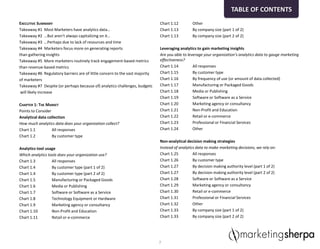
Takeaway #1 Most Marketers have analytics data…
Takeaway #2 …But aren’t always capitalizing on it…
Takeaway #3 …Perhaps due to lack of resources and time
Takeaway #4 Marketers focus more on generating reports
than gathering insights
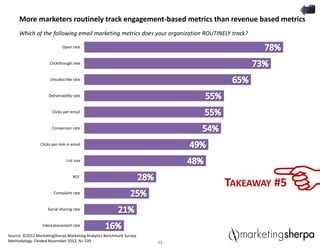
Takeaway #5 More marketers routinely track engagement-based metrics
than revenue-based metrics
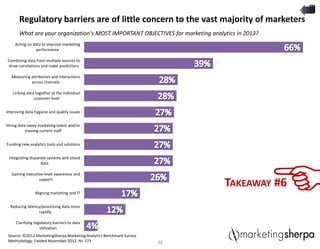
Takeaway #6 Regulatory barriers are of little concern to the vast majority
of marketers
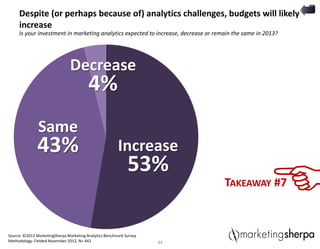
Takeaway #7 Despite (or perhaps because of) analytics challenges, budgets
will likely increase
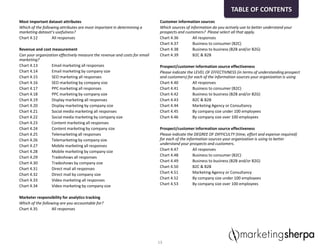
CHAPTER 1: THE MARKET
Points to Consider
Analytical data collection
How much analytics data does your organization collect?
Chart 1.1 All responses
Chart 1.2 By customer type
Analytics tool usage
Which analytics tools does your organization use?
Chart 1.3 All responses
Chart 1.4 By customer type (part 1 of 2)
Chart 1.4 By customer type (part 2 of 2)
Chart 1.5 Manufacturing or Packaged Goods
Chart 1.6 Media or Publishing
Chart 1.7 Software or Software as a Service
Chart 1.8 Technology Equipment or Hardware
Chart 1.9 Marketing agency or consultancy
Chart 1.10 Non-Profit and Education
Chart 1.11 Retail or e-commerce
Chart 1.12 Other
Chart 1.13 By company size (part 1 of 2)
Chart 1.13 By company size (part 2 of 2)
Leveraging analytics to gain marketing insights
Are you able to leverage your organization’s analytics data to gauge marketing
effectiveness?
Chart 1.14 All responses
Chart 1.15 By customer type
Chart 1.16 By frequency of use (or amount of data collected)
Chart 1.17 Manufacturing or Packaged Goods
Chart 1.18 Media or Publishing
Chart 1.19 Software or Software as a Service
Chart 1.20 Marketing agency or consultancy
Chart 1.21 Non-Profit and Education
Chart 1.22 Retail or e-commerce
Chart 1.23 Professional or Financial Services
Chart 1.24 Other
Non-analytical decision making strategies
Instead of analytics data to make marketing decisions, we rely on:
Chart 1.25 All responses
Chart 1.26 By customer type
Chart 1.27 By decision making authority level (part 1 of 2)
Chart 1.27 By decision making authority level (part 2 of 2)
Chart 1.28 Software or Software as a Service
Chart 1.29 Marketing agency or consultancy
Chart 1.30 Retail or e-commerce
Chart 1.31 Professional or Financial Services
Chart 1.32 Other
Chart 1.33 By company size (part 1 of 2)
Chart 1.33 By company size (part 2 of 2)
7
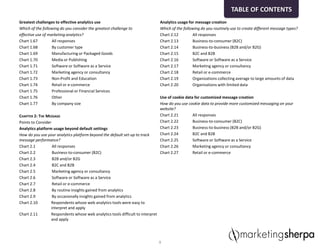
TABLE OF CONTENTS
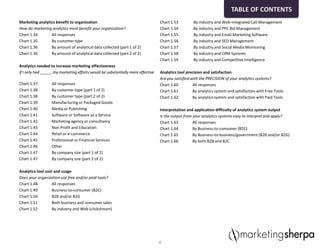
Marketing analytics benefit to organization
How do marketing analytics most benefit your organization?
Chart 1.34 All responses
Chart 1.35 By customer type
Chart 1.36 By amount of analytical data collected (part 1 of 2)
Chart 1.36 By amount of analytical data collected (part 2 of 2)
Analytics needed to increase marketing effectiveness
If I only had _____, my marketing efforts would be substantially more effective
Chart 1.37 All responses
Chart 1.38 By customer type (part 1 of 2)
Chart 1.38 By customer type (part 2 of 2)
Chart 1.39 Manufacturing or Packaged Goods
Chart 1.40 Media or Publishing
Chart 1.41 Software or Software as a Service
Chart 1.42 Marketing agency or consultancy
Chart 1.43 Non-Profit and Education
Chart 1.44 Retail or e-commerce
Chart 1.45 Professional or Financial Services
Chart 1.46 Other
Chart 1.47 By company size (part 1 of 2)
Chart 1.47 By company size (part 2 of 2)
Analytics tool cost and usage
Does your organization use free and/or paid tools?
Chart 1.48 All responses
Chart 1.49 Business-to-consumer (B2C)
Chart 1.50 B2B and/or B2G
Chart 1.51 Both business and consumer sales
Chart 1.52 By industry and Web (clickstream)
Chart 1.53 By industry and Web-integrated Call Management
Chart 1.54 By industry and PPC Bid Management
Chart 1.55 By industry and Email Marketing Software
Chart 1.56 By industry and SEO Management
Chart 1.57 By industry and Social Media Monitoring
Chart 1.58 By industry and CRM Systems
Chart 1.59 By industry and Competitive Intelligence
Analytics tool precision and satisfaction
Are you satisfied with the PRECISION of your analytics systems?
Chart 1.60 All responses
Chart 1.61 By analytics system and satisfaction with Free Tools
Chart 1.62 By analytics system and satisfaction with Paid Tools
Interpretation and application difficulty of analytics system output
Is the output from your analytics systems easy to interpret and apply?
Chart 1.63 All responses
Chart 1.64 By Business-to-consumer (B2C)
Chart 1.65 By Business-to-business/government (B2B and/or B2G)
Chart 1.66 By both B2B and B2C
8
TABLE OF CONTENTS
Greatest challenges to effective analytics use
Which of the following do you consider the greatest challenge to
effective use of marketing analytics?
Chart 1.67 All responses
Chart 1.68 By customer type
Chart 1.69 Manufacturing or Packaged Goods
Chart 1.70 Media or Publishing
Chart 1.71 Software or Software as a Service
Chart 1.72 Marketing agency or consultancy
Chart 1.73 Non-Profit and Education
Chart 1.74 Retail or e-commerce
Chart 1.75 Professional or Financial Services
Chart 1.76 Other
Chart 1.77 By company size
CHAPTER 2: THE MESSAGE
Points to Consider
Analytics platform usage beyond default settings
How do you use your analytics platform beyond the default set-up to track
message performance?
Chart 2.1 All responses
Chart 2.2 Business-to-consumer (B2C)
Chart 2.3 B2B and/or B2G
Chart 2.4 B2C and B2B
Chart 2.5 Marketing agency or consultancy
Chart 2.6 Software or Software as a Service
Chart 2.7 Retail or e-commerce
Chart 2.8 By routine insights gained from analytics
Chart 2.9 By occasionally insights gained from analytics
Chart 2.10 Respondents whose web analytics tools were easy to
interpret and apply
Chart 2.11 Respondents whose web analytics tools difficult to interpret
and apply
Analytics usage for message creation
Which of the following do you routinely use to create different message types?
Chart 2.12 All responses
Chart 2.13 Business-to-consumer (B2C)
Chart 2.14 Business-to-business (B2B and/or B2G)
Chart 2.15 B2C and B2B
Chart 2.16 Software or Software as a Service
Chart 2.17 Marketing agency or consultancy
Chart 2.18 Retail or e-commerce
Chart 2.19 Organizations collecting average to large amounts of data
Chart 2.20 Organizations with limited data
Use of cookie data for customized message creation
How do you use cookie data to provide more customized messaging on your
website?
Chart 2.21 All responses
Chart 2.22 Business-to-consumer (B2C)
Chart 2.23 Business-to-business (B2B and/or B2G)
Chart 2.24 B2C and B2B
Chart 2.25 Software or Software as a Service
Chart 2.26 Marketing agency or consultancy
Chart 2.27 Retail or e-commerce
9
TABLE OF CONTENTS
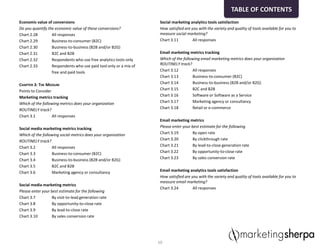
Economic value of conversions
Do you quantify the economic value of these conversions?
Chart 2.28 All responses
Chart 2.29 Business-to-consumer (B2C)
Chart 2.30 Business-to-business (B2B and/or B2G)
Chart 2.31 B2C and B2B
Chart 2.32 Respondents who use free analytics tools only
Chart 2.33 Respondents who use paid tool only or a mix of
free and paid tools
CHAPTER 3: THE MEDIUM
Points to Consider
Marketing metrics tracking
Which of the following metrics does your organization
ROUTINELY track?
Chart 3.1 All responses
Social media marketing metrics tracking
Which of the following social metrics does your organization
ROUTINELY track?
Chart 3.2 All responses
Chart 3.3 Business-to-consumer (B2C)
Chart 3.4 Business-to-business (B2B and/or B2G)
Chart 3.5 B2C and B2B
Chart 3.6 Marketing agency or consultancy
Social media marketing metrics
Please enter your best estimate for the following
Chart 3.7 By visit-to-lead generation rate
Chart 3.8 By opportunity-to-close rate
Chart 3.9 By lead-to-close rate
Chart 3.10 By sales conversion rate
Social marketing analytics tools satisfaction
How satisfied are you with the variety and quality of tools available for you to
measure social marketing?
Chart 3.11 All responses
Email marketing metrics tracking
Which of the following email marketing metrics does your organization
ROUTINELY track?
Chart 3.12 All responses
Chart 3.13 Business-to-consumer (B2C)
Chart 3.14 Business-to-business (B2B and/or B2G)
Chart 3.15 B2C and B2B
Chart 3.16 Software or Software as a Service
Chart 3.17 Marketing agency or consultancy
Chart 3.18 Retail or e-commerce
Email marketing metrics
Please enter your best estimate for the following
Chart 3.19 By open rate
Chart 3.20 By clickthrough rate
Chart 3.21 By lead-to-close generation rate
Chart 3.22 By opportunity-to-close rate
Chart 3.23 By sales conversion rate
Email marketing analytics tools satisfaction
How satisfied are you with the variety and quality of tools available for you to
measure email marketing?
Chart 3.24 All responses
10
TABLE OF CONTENTS
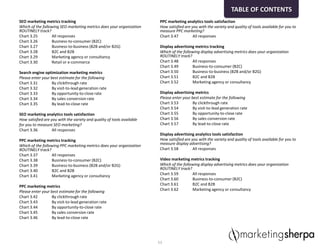
SEO marketing metrics tracking
Which of the following SEO marketing metrics does your organization
ROUTINELY track?
Chart 3.25 All responses
Chart 3.26 Business-to-consumer (B2C)
Chart 3.27 Business-to-business (B2B and/or B2G)
Chart 3.28 B2C and B2B
Chart 3.29 Marketing agency or consultancy
Chart 3.30 Retail or e-commerce
Search engine optimization marketing metrics
Please enter your best estimate for the following
Chart 3.31 By clickthrough rate
Chart 3.32 By visit-to-lead generation rate
Chart 3.33 By opportunity-to-close rate
Chart 3.34 By sales conversion rate
Chart 3.35 By lead-to-close rate
SEO marketing analytics tools satisfaction
How satisfied are you with the variety and quality of tools available
for you to measure SEO marketing?
Chart 3.36 All responses
PPC marketing metrics tracking
Which of the following PPC marketing metrics does your organization
ROUTINELY track?
Chart 3.37 All responses
Chart 3.38 Business-to-consumer (B2C)
Chart 3.39 Business-to-business (B2B and/or B2G)
Chart 3.40 B2C and B2B
Chart 3.41 Marketing agency or consultancy
PPC marketing metrics
Please enter your best estimate for the following
Chart 3.42 By clickthrough rate
Chart 3.43 By visit-to-lead generation rate
Chart 3.44 By opportunity-to-close rate
Chart 3.45 By sales conversion rate
Chart 3.46 By lead-to-close rate
PPC marketing analytics tools satisfaction
How satisfied are you with the variety and quality of tools available for you to
measure PPC marketing?
Chart 3.47 All responses
Display advertising metrics tracking
Which of the following display advertising metrics does your organization
ROUTINELY track?
Chart 3.48 All responses
Chart 3.49 Business-to-consumer (B2C)
Chart 3.50 Business-to-business (B2B and/or B2G)
Chart 3.51 B2C and B2B
Chart 3.52 Marketing agency or consultancy
Display advertising metrics
Please enter your best estimate for the following
Chart 3.53 By clickthrough rate
Chart 3.54 By visit-to-lead generation rate
Chart 3.55 By opportunity-to-close rate
Chart 3.56 By sales conversion rate
Chart 3.57 By lead-to-close rate
Display advertising analytics tools satisfaction
How satisfied are you with the variety and quality of tools available for you to
measure display advertising?
Chart 3.58 All responses
Video marketing metrics tracking
Which of the following display advertising metrics does your organization
ROUTINELY track?
Chart 3.59 All responses
Chart 3.60 Business-to-consumer (B2C)
Chart 3.61 B2C and B2B
Chart 3.62 Marketing agency or consultancy
11
TABLE OF CONTENTS
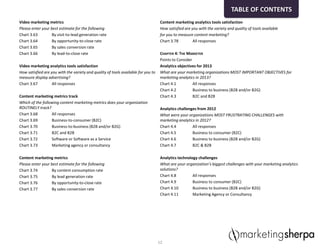
Video marketing metrics
Please enter your best estimate for the following
Chart 3.63 By visit-to-lead generation rate
Chart 3.64 By opportunity-to-close rate
Chart 3.65 By sales conversion rate
Chart 3.66 By lead-to-close rate
Video marketing analytics tools satisfaction
How satisfied are you with the variety and quality of tools available for you to
measure display advertising?
Chart 3.67 All responses
Content marketing metrics track
Which of the following content marketing metrics does your organization
ROUTINELY track?
Chart 3.68 All responses
Chart 3.69 Business-to-consumer (B2C)
Chart 3.70 Business-to-business (B2B and/or B2G)
Chart 3.71 B2C and B2B
Chart 3.72 Software or Software as a Service
Chart 3.73 Marketing agency or consultancy
Content marketing metrics
Please enter your best estimate for the following
Chart 3.74 By content consumption rate
Chart 3.75 By lead generation rate
Chart 3.76 By opportunity-to-close rate
Chart 3.77 By sales conversion rate
Content marketing analytics tools satisfaction
How satisfied are you with the variety and quality of tools available
for you to measure content marketing?
Chart 3.78 All responses
CHAPTER 4: THE MARKETER
Points to Consider
Analytics objectives for 2013
What are your marketing organizations MOST IMPORTANT OBJECTIVES for
marketing analytics in 2013?
Chart 4.1 All responses
Chart 4.2 Business to business (B2B and/or B2G)
Chart 4.3 B2C and B2B
Analytics challenges from 2012
What were your organizations MOST FRUSTRATING CHALLENGES with
marketing analytics in 2012?
Chart 4.4 All responses
Chart 4.5 Business to consumer (B2C)
Chart 4.6 Business to business (B2B and/or B2G)
Chart 4.7 B2C & B2B
Analytics technology challenges
What are your organization’s biggest challenges with your marketing analytics
solutions?
Chart 4.8 All responses
Chart 4.9 Business to consumer (B2C)
Chart 4.10 Business to business (B2B and/or B2G)
Chart 4.11 Marketing Agency or Consultancy
12
TABLE OF CONTENTS
Most important dataset attributes
Which of the following attributes are most important in determining a
marketing dataset’s usefulness?
Chart 4.12 All responses
Revenue and cost measurement
Can your organization effectively measure the revenue and costs for email
marketing?
Chart 4.13 Email marketing all responses
Chart 4.14 Email marketing by company size
Chart 4.15 SEO marketing all responses
Chart 4.16 SEO marketing by company size
Chart 4.17 PPC marketing all responses
Chart 4.18 PPC marketing by company size
Chart 4.19 Display marketing all responses
Chart 4.20 Display marketing by company size
Chart 4.21 Social media marketing all responses
Chart 4.22 Social media marketing by company size
Chart 4.23 Content marketing all responses
Chart 4.24 Content marketing by company size
Chart 4.25 Telemarketing all responses
Chart 4.26 Telemarketing by company size
Chart 4.27 Mobile marketing all responses
Chart 4.28 Mobile marketing by company size
Chart 4.29 Tradeshows all responses
Chart 4.30 Tradeshows by company size
Chart 4.31 Direct mail all responses
Chart 4.32 Direct mail by company size
Chart 4.33 Video marketing all responses
Chart 4.34 Video marketing by company size
Marketer responsibility for analytics tracking
Which of the following are you accountable for?
Chart 4.35 All responses
Customer information sources
Which sources of information do you actively use to better understand your
prospects and customers? Please select all that apply.
Chart 4.36 All responses
Chart 4.37 Business to consumer (B2C)
Chart 4.38 Business to business (B2B and/or B2G)
Chart 4.39 B2C & B2B
Prospect/customer information source effectiveness
Please indicate the LEVEL OF EFFECTIVNESS (in terms of understanding prospect
and customers) for each of the information sources your organization is using
Chart 4.40 All responses
Chart 4.41 Business to consumer (B2C)
Chart 4.42 Business to business (B2B and/or B2G)
Chart 4.43 B2C & B2B
Chart 4.44 Marketing Agency or Consultancy
Chart 4.45 By company size under 100 employees
Chart 4.46 By company size over 100 employees
Prospect/customer information source effectiveness
Please indicate the DEGREE OF DIFFICULTY (time, effort and expense required)
for each of the information sources your organization is using to better
understand your prospects and customers.
Chart 4.47 All responses
Chart 4.48 Business to consumer (B2C)
Chart 4.49 Business to business (B2B and/or B2G)
Chart 4.50 B2C & B2B
Chart 4.51 Marketing Agency or Consultancy
Chart 4.52 By company size under 100 employees
Chart 4.53 By company size over 100 employees
13
TABLE OF CONTENTS
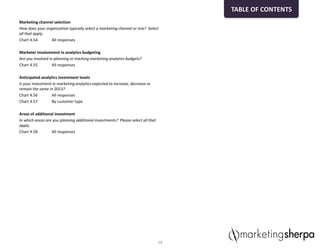
Marketing channel selection
How does your organization typically select a marketing channel or mix? Select
all that apply.
Chart 4.54 All responses
Marketer involvement in analytics budgeting
Are you involved in planning or tracking marketing analytics budgets?
Chart 4.55 All responses
Anticipated analytics investment levels
Is your investment in marketing analytics expected to increase, decrease or
remain the same in 2013?
Chart 4.56 All responses
Chart 4.57 By customer type
Areas of additional investment
In which areas are you planning additional investments? Please select all that
apply.
Chart 4.58 All responses
14
TABLE OF CONTENTS
Marketing Analytics Benchmark Report
EXECUTIVE SUMMARY
2013 Marketing Analytics Benchmark Report
Welcome to the 2013 MarketingSherpa Marketing Analytics Benchmark Report. This title represents an exciting
landmark for MarketingSherpa, as this is our first extensive study of marketing analytics research. As a company
laser-focused on marketing optimization, we feel the climate is right for releasing this inaugural analytics benchmark
study, in hopes of helping marketers to do their jobs more effectively.
We are excited about our first foray into analytics research, and anticipate even more extensive study to come, as
analytics tools and practices evolve. We hope you find this study to be beneficial not only to see your peers’
analytics practices and result, but also to help you plan your own analytics strategies and better understand how to
garner results.
Marketing Analytics is a practice that, perhaps uniquely, touches every aspect of marketing. You’ll notice this
breadth in the above-average size and scope of this Benchmark Report, as we endeavored to explore not only the
use of analytics and metrics, but also to benchmark specific metrics in seven marketing channels:
• Social media marketing
• Email marketing
• Search engine optimization
• Pay-per-click advertising
• Display advertising
• Video marketing
• Content marketing
As always, we look forward to hearing about your marketing analytics success. If you have a campaign you would like
to have a reporter interview you about for a MarketingSherpa case study, please let us know by emailing
Editor@MarketingSherpa.com.
Best,
The MarketingSherpa Team
16
EXECUTIVE SUMMARY
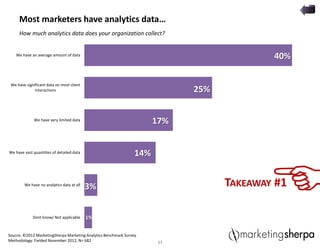
17
Most marketers have analytics data…
How much analytics data does your organization collect?
TAKEAWAY #1
17
We have an average amount of data
We have significant data on most client
interactions
We have very limited data
We have vast quantities of detailed data
We have no analytics data at all
Dont know/ Not applicable
40%
25%
17%
14%
3%
Source: ©2012 MarketingSherpa Marketing Analytics Benchmark Survey
Methodology: Fielded November 2012, N= 682
1%
18
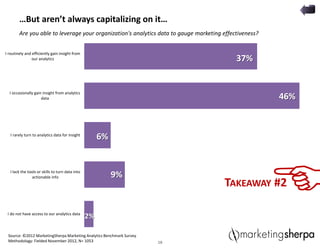
…But aren’t always capitalizing on it…
TAKEAWAY #2
18
Are you able to leverage your organization's analytics data to gauge marketing effectiveness?
I do not have access to our analytics data
I lack the tools or skills to turn data into
actionable info
I rarely turn to analytics data for insight
I occasionally gain insight from analytics
data
I routinely and efficiently gain insight from
our analytics
Source: ©2012 MarketingSherpa Marketing Analytics Benchmark Survey
Methodology: Fielded November 2012, N= 1053
37%
46%
6%
9%
2%
19
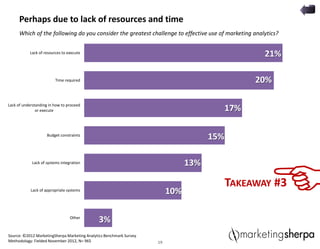
Perhaps due to lack of resources and time
TAKEAWAY #3
19
Which of the following do you consider the greatest challenge to effective use of marketing analytics?
Lack of resources to execute
Time required
Lack of understanding in how to proceed
or execute
Budget constraints
Lack of systems integration
Lack of appropriate systems
Other
Source: ©2012 MarketingSherpa Marketing Analytics Benchmark Survey
Methodology: Fielded November 2012, N= 965
21%
20%
17%
15%
13%
10%
3%
20
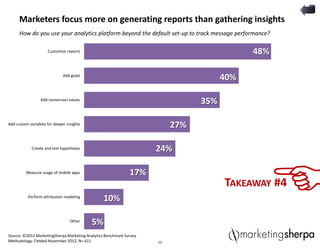
Marketers focus more on generating reports than gathering insights
How do you use your analytics platform beyond the default set-up to track message performance?
TAKEAWAY #4
20
Customize reports
Add goals
Add conversion values
Add custom variables for deeper insights
Create and test hypotheses
Measure usage of mobile apps
Perform attribution modeling
Other
Source: ©2012 MarketingSherpa Marketing Analytics Benchmark Survey
Methodology: Fielded November 2012, N= 611
48%
40%
35%
27%
24%
17%
10%
5%
21
More marketers routinely track engagement-based metrics than revenue based metrics
Which of the following email marketing metrics does your organization ROUTINELY track?
TAKEAWAY #5
21
Open rate
Clickthrough rate
Unsubscribe rate
Deliverability rate
Clicks-per-email
Conversion rate
Clicks-per-link in email
List size
ROI
Complaint rate
Social sharing rate
Inbox placement rate
Source: ©2012 MarketingSherpa Marketing Analytics Benchmark Survey
Methodology: Fielded November 2012, N= 539
22
Regulatory barriers are of little concern to the vast majority of marketers
What are your organization's MOST IMPORTANT OBJECTIVES for marketing analytics in 2013?
TAKEAWAY #6
22
Acting on data to improve marketing
performance
Combining data from multiple sources to
draw correlations and make predictions
Measuring attribution and interactions
across channels
Linking data together at the individual
customer level
Improving data hygiene and quality issues
Hiring data-savvy marketing talent and/or
training current staff
Funding new analytics tools and solutions
Integrating disparate systems and siloed
data
Gaining executive-level awareness and
support
Aligning marketing and IT
Reducing latency/processing data more
rapidly
Clarifying regulatory barriers to data
utilization
Source: ©2012 MarketingSherpa Marketing Analytics Benchmark Survey
Methodology: Fielded November 2012, N= 273
23
Despite (or perhaps because of) analytics challenges, budgets will likely
increase
Is your investment in marketing analytics expected to increase, decrease or remain the same in 2013?
TAKEAWAY #7
23
Source: ©2012 MarketingSherpa Marketing Analytics Benchmark Survey
Methodology: Fielded November 2012, N= 442
43%
Same
53%
Increase
4%
Decrease
MarketingSherpa is a primary research facility, wholly-owned by MECLABS, dedicated to determining what works in marketing via exclusive case studies, surveys,
and results data analysis. Then we publish what we learn so our community of marketers and weekly readers can improve their results and train their teams.
Praised by The Economist, Harvard Business School’s Working Knowledge Site and Entrepreneur.com, MarketingSherpa is distinguished by offering practical,
results-based marketing information researched and written by a staff of in-house reporters.
MarketingSherpa features:
•	 Best Practices: 1,000+ brand-side marketer case studies and 3,500+ creative samples
•	 Research: 2,000+ marketing and research abstracts
•	 Instruction: 800+ how-to articles
•	 Newsletters: 230,000+ marketers read weekly case studies on topics such as email, search, social, lead generation, lead nurturing, optimization and
content marketing
•	 Training: 100+ live, hands-on training sessions providing practical and proven solutions
•	 Summits: 3 annual vendor-neutral, research-based marketing events
About MarketingSherpa LLC
Register for Summits and Workshops at MECLABS.com/training or contact Customer Service (available M-F, 9:00am-5:00pm ET)
service@marketingsherpa.com
1-877-895-1717 (outside the U.S. call 401-383-3131)
MECLABS is a science lab that uses real-world research and training to help business leaders get better use out of sales and marketing technology and
resources, including Internet marketing, website optimization, and lead management. We have been involved in direct research partnerships with companies
throughout Europe and North America since 2001.
MECLABS deploys a rigorous methodology to conduct research. This research is compiled from:
•	 More than 10 years of research partnership with our clients
•	 1,300 experiments
•	 Over 1 billion emails
•	 10,000 landing pages tested
•	 5 million telephone calls
•	 500,000 decision maker conversations
MECLABS has consulted with companies like Cisco, Johnson & Johnson, The New York Times, 1-800-Flowers, and NetSuite to optimize sales and marketing
processes and achieve triple-digit ROI gains.
About MECLABS
First email my PDF copy to:
Then mail my printed copy to:
Name						 Title
Organization	 	 	 	                       		                        
Address	
City			 State/Prov	 Country		 Zip/Postal
Phone (in case of questions)
Charge my:	 MasterCard Visa	 AMEX		
Card#	 				Exp. Date
Print Cardholder Name
Signature
OR Bill Me*	 	   Check Enclosed to MarketingSherpa LLC
* Billing: I understand I will not receive merchandise until payment  is received
(we respect your privacy)
Fax form to: 401-633-6519
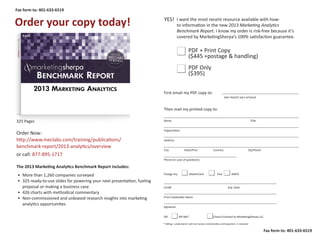
Order your copy today!
PDF + Print Copy
($445 +postage & handling)
PDF Only
($395)
I want the most recent resource available with how-
to information in the new 2013 Marketing Analytics
Benchmark Report. I know my order is risk-free because it’s
covered by MarketingSherpa’s 100% satisfaction guarantee.
YES!
The 2013 Marketing Analytics Benchmark Report includes:
•	 More than 1,260 companies surveyed
•	 325 ready-to-use slides for powering your next presentation, fueling
proposal or making a business case
•	 426 charts with methodical commentary
•	 Non-commissioned and unbiased research insights into marketing
analytics opportunities
325 Pages
Order Now:
http://www.meclabs.com/training/publications/
benchmark-report/2013-analytics/overview
or call: 877-895-1717
EXCERPT-BMR-2013-Marketing-Analytics.pdf

EXCERPT-BMR-2013-Marketing-Analytics.pdf

  • 2.
    Stop reporting. Startimproving. The days of "launch it and leave it" are over. Project development, media buying and website and campaign launches are merely the first steps to achieving success with your digital work. Da Vinci said it best, “Art is never finished, only abandoned.” Don't abandon your digital campaigns. Seriously, they’ll get a complex. Digital's big promise has always been that you could know more about your customer from it than you ever could from its traditional counterparts. Since the beginning we've had measurement of people's response to digital media in some form from the most rudimentary click-through to the more sophisticated conversion funnel. But using that information to make our marketing better has eluded us. Why? Because most people don't take the time to digest and act on what they've measured. Look in the mirror and say this with us: Stop reporting. Start improving. Analytics applications can now provide tangible evidence of how your websites and digital media campaigns are performing. You can see the how and why behind every scroll, click, and conversion. But it’s not just about delivering fancy spreadsheets with a bunch of numbers and some high-level marketing speak about what it all means. It’s about using the analytics to reflect, react, and then repeat. It's no longer enough to just use traditional clickstream analytics. Simply measuring page-views and path analysis doesn’t lead to action. Combining clickstream and voice of customer analysis allows us to measure things like task completion rates and segmented visitor trends giving us actionable insights that we can then use to improve a website or campaign’s performance. The more usable your website is the better it is for both your users and for search engines. The more personal, targeted and engaging your media is, the more customers you'll get. By continuing to modify and optimize a site design or landing page throughout its life cycle, you’ll not only have high- performing campaigns, you’ll have happier clients. Paramore serves its clients by creating websites and digital media campaigns that are simple, clear and focused on results. To learn more about how we think, visit our blog: paramoredigital.com/think.
  • 3.
    2013 Analytics BenchmarkReport Welcome to MarketingSherpa’s inaugural benchmark study of marketing analytics. Inside, you’ll find data culled from a survey of expert marketers. Our goal for this report is to help you craft an effective marketing analytics plan through invaluable data about marketing analytics practices, insights, tools, challenges, objectives and budgetary concerns, based upon feedback and data from an international field of marketers, across a wide range of industries, company sizes and customer types. The 1,131 marketers who participated in our research helped us to identify: • Marketers’ collection of marketing analytics, by industry, customer type and company size • Insights gained from marketing analytics data • Analytics tools used by marketers • Challenges faced by marketers when using analytics tools • How marketers use their analytics platforms • How analytics plays a role in message development • How marketers quantify the economic value of website conversions • Which metrics marketers track for their organizations • How marketers track metrics for the following channels: o Social media marketing o Email marketing o SEO marketing o PPC marketing o Display advertising o Video marketing o Content marketing • Marketers’ analytics objectives for 2013 • Marketers’ analytics challenges from 2012 • How marketers better understand their prospects and customers • How marketers measure revenue and costs • How analytics will fit into marketers’ budgets for the coming year 3 HIGHLIGHTS
  • 4.
    2013 Analytics BenchmarkReport Use this data to gain approval, win clients, and help fellow marketers At MarketingSherpa, our goal is to give marketers the instructions, statistics, and inspiration to improve their results. To that end, you are free to share any five (5) charts from this book in presentations to clients, business leadership, and at events as well as in blog posts, videos and other public and private venues, without written permission, as long as you attribute MarketingSherpa and link to MarketingSherpa.com (where applicable). However, if you would like to use more than five charts, please request written permission from the publisher at research@meclabs.com or (877) 895-1717. Outside the US and Canada please call (401) 383-3131. 4 US $445 / ISBN: 978-1-936390-54-0 ©2013 by MarketingSherpa LLC All rights reserved. Five (5) charts from this report may be reproduced in presentations, blog posts, videos and other public and private venues without written permission, as long as content and data is not altered and charts are attributed to MarketingSherpa and link to MarketingSherpa.com (where applicable). Additional use required written permission from the publisher. To purchase additional copies of this report, please visit http://www.meclabs.com/training Bulk discounts are available for multiple copies. Contact the publisher at research@meclabs.com or (877) 895-1717. COPYRIGHT
  • 5.
    2013 Analytics BenchmarkReport Executive Editor Flint McGlaughlin, Managing Director Sciences Team Diana Sindicich, Senior Manager of Data Sciences Editor Brad Bortone, Senior Research Editor Designer John Tackett, Editorial Analyst Contributors Kaci Bower, Senior Research Analyst Daniel Burstein, Director of Editorial Content Bob Kemper, Senior Director of Sciences Todd Lebo, Senior Director of Content Pamela Markey, Director of Marketing 5 CONTRIBUTORS
  • 6.
    Dear Marketer, What arethe most important metrics that you should be tracking? How do translate your metrics into the ability to predict customer behavior? Should you be measuring emerging channels such as social media and mobile? These are just few of the questions addressed in the new 2013 Analytics Benchmark Survey. Some of the most compelling findings may surprise you: • Of those who do not use analytics data to make marketing decisions, 42% rely on gut instincts (Chart 1.25) • Performance of previous messages is more routinely used by those who collect an average or larger amount of data (Chart 2.19) than those whose organization had limited data (Chart 2.20) • Those who use paid analytics tools at some level (Chart 2.33) quantify the economic value of conversions on their website in more ways than those who only use free tools (Chart 2.32) In this 325-page report, our researchers have distilled the most essential insights from over 1,100 surveys of companies from all over the world. There are 246 charts in total – all of which are designed to help you make the most of your analytics programs. We have tried to cover the most pressing questions facing marketers in 2013. However, we know that there is always more to learn and discover. As you read this book, I would not only love to hear what charts you found most helpful, but also what questions you would like to see addressed in the future. Once you have read (or at least skimmed) this material, you may have questions or recommendations. Please take the time to share your thoughts. Together, we can advance our understanding of analytics. Thank you for your trust, Flint McGlaughlin Managing Director, MECLABS P.S. For me, some of the most compelling findings are on pages 47, 294, and 312. 6 EDITOR’S LETTER
  • 7.
    EXECUTIVE SUMMARY Takeaway #1Most Marketers have analytics data… Takeaway #2 …But aren’t always capitalizing on it… Takeaway #3 …Perhaps due to lack of resources and time Takeaway #4 Marketers focus more on generating reports than gathering insights Takeaway #5 More marketers routinely track engagement-based metrics than revenue-based metrics Takeaway #6 Regulatory barriers are of little concern to the vast majority of marketers Takeaway #7 Despite (or perhaps because of) analytics challenges, budgets will likely increase CHAPTER 1: THE MARKET Points to Consider Analytical data collection How much analytics data does your organization collect? Chart 1.1 All responses Chart 1.2 By customer type Analytics tool usage Which analytics tools does your organization use? Chart 1.3 All responses Chart 1.4 By customer type (part 1 of 2) Chart 1.4 By customer type (part 2 of 2) Chart 1.5 Manufacturing or Packaged Goods Chart 1.6 Media or Publishing Chart 1.7 Software or Software as a Service Chart 1.8 Technology Equipment or Hardware Chart 1.9 Marketing agency or consultancy Chart 1.10 Non-Profit and Education Chart 1.11 Retail or e-commerce Chart 1.12 Other Chart 1.13 By company size (part 1 of 2) Chart 1.13 By company size (part 2 of 2) Leveraging analytics to gain marketing insights Are you able to leverage your organization’s analytics data to gauge marketing effectiveness? Chart 1.14 All responses Chart 1.15 By customer type Chart 1.16 By frequency of use (or amount of data collected) Chart 1.17 Manufacturing or Packaged Goods Chart 1.18 Media or Publishing Chart 1.19 Software or Software as a Service Chart 1.20 Marketing agency or consultancy Chart 1.21 Non-Profit and Education Chart 1.22 Retail or e-commerce Chart 1.23 Professional or Financial Services Chart 1.24 Other Non-analytical decision making strategies Instead of analytics data to make marketing decisions, we rely on: Chart 1.25 All responses Chart 1.26 By customer type Chart 1.27 By decision making authority level (part 1 of 2) Chart 1.27 By decision making authority level (part 2 of 2) Chart 1.28 Software or Software as a Service Chart 1.29 Marketing agency or consultancy Chart 1.30 Retail or e-commerce Chart 1.31 Professional or Financial Services Chart 1.32 Other Chart 1.33 By company size (part 1 of 2) Chart 1.33 By company size (part 2 of 2) 7 TABLE OF CONTENTS
  • 8.
    Marketing analytics benefitto organization How do marketing analytics most benefit your organization? Chart 1.34 All responses Chart 1.35 By customer type Chart 1.36 By amount of analytical data collected (part 1 of 2) Chart 1.36 By amount of analytical data collected (part 2 of 2) Analytics needed to increase marketing effectiveness If I only had _____, my marketing efforts would be substantially more effective Chart 1.37 All responses Chart 1.38 By customer type (part 1 of 2) Chart 1.38 By customer type (part 2 of 2) Chart 1.39 Manufacturing or Packaged Goods Chart 1.40 Media or Publishing Chart 1.41 Software or Software as a Service Chart 1.42 Marketing agency or consultancy Chart 1.43 Non-Profit and Education Chart 1.44 Retail or e-commerce Chart 1.45 Professional or Financial Services Chart 1.46 Other Chart 1.47 By company size (part 1 of 2) Chart 1.47 By company size (part 2 of 2) Analytics tool cost and usage Does your organization use free and/or paid tools? Chart 1.48 All responses Chart 1.49 Business-to-consumer (B2C) Chart 1.50 B2B and/or B2G Chart 1.51 Both business and consumer sales Chart 1.52 By industry and Web (clickstream) Chart 1.53 By industry and Web-integrated Call Management Chart 1.54 By industry and PPC Bid Management Chart 1.55 By industry and Email Marketing Software Chart 1.56 By industry and SEO Management Chart 1.57 By industry and Social Media Monitoring Chart 1.58 By industry and CRM Systems Chart 1.59 By industry and Competitive Intelligence Analytics tool precision and satisfaction Are you satisfied with the PRECISION of your analytics systems? Chart 1.60 All responses Chart 1.61 By analytics system and satisfaction with Free Tools Chart 1.62 By analytics system and satisfaction with Paid Tools Interpretation and application difficulty of analytics system output Is the output from your analytics systems easy to interpret and apply? Chart 1.63 All responses Chart 1.64 By Business-to-consumer (B2C) Chart 1.65 By Business-to-business/government (B2B and/or B2G) Chart 1.66 By both B2B and B2C 8 TABLE OF CONTENTS
  • 9.
    Greatest challenges toeffective analytics use Which of the following do you consider the greatest challenge to effective use of marketing analytics? Chart 1.67 All responses Chart 1.68 By customer type Chart 1.69 Manufacturing or Packaged Goods Chart 1.70 Media or Publishing Chart 1.71 Software or Software as a Service Chart 1.72 Marketing agency or consultancy Chart 1.73 Non-Profit and Education Chart 1.74 Retail or e-commerce Chart 1.75 Professional or Financial Services Chart 1.76 Other Chart 1.77 By company size CHAPTER 2: THE MESSAGE Points to Consider Analytics platform usage beyond default settings How do you use your analytics platform beyond the default set-up to track message performance? Chart 2.1 All responses Chart 2.2 Business-to-consumer (B2C) Chart 2.3 B2B and/or B2G Chart 2.4 B2C and B2B Chart 2.5 Marketing agency or consultancy Chart 2.6 Software or Software as a Service Chart 2.7 Retail or e-commerce Chart 2.8 By routine insights gained from analytics Chart 2.9 By occasionally insights gained from analytics Chart 2.10 Respondents whose web analytics tools were easy to interpret and apply Chart 2.11 Respondents whose web analytics tools difficult to interpret and apply Analytics usage for message creation Which of the following do you routinely use to create different message types? Chart 2.12 All responses Chart 2.13 Business-to-consumer (B2C) Chart 2.14 Business-to-business (B2B and/or B2G) Chart 2.15 B2C and B2B Chart 2.16 Software or Software as a Service Chart 2.17 Marketing agency or consultancy Chart 2.18 Retail or e-commerce Chart 2.19 Organizations collecting average to large amounts of data Chart 2.20 Organizations with limited data Use of cookie data for customized message creation How do you use cookie data to provide more customized messaging on your website? Chart 2.21 All responses Chart 2.22 Business-to-consumer (B2C) Chart 2.23 Business-to-business (B2B and/or B2G) Chart 2.24 B2C and B2B Chart 2.25 Software or Software as a Service Chart 2.26 Marketing agency or consultancy Chart 2.27 Retail or e-commerce 9 TABLE OF CONTENTS
  • 10.
    Economic value ofconversions Do you quantify the economic value of these conversions? Chart 2.28 All responses Chart 2.29 Business-to-consumer (B2C) Chart 2.30 Business-to-business (B2B and/or B2G) Chart 2.31 B2C and B2B Chart 2.32 Respondents who use free analytics tools only Chart 2.33 Respondents who use paid tool only or a mix of free and paid tools CHAPTER 3: THE MEDIUM Points to Consider Marketing metrics tracking Which of the following metrics does your organization ROUTINELY track? Chart 3.1 All responses Social media marketing metrics tracking Which of the following social metrics does your organization ROUTINELY track? Chart 3.2 All responses Chart 3.3 Business-to-consumer (B2C) Chart 3.4 Business-to-business (B2B and/or B2G) Chart 3.5 B2C and B2B Chart 3.6 Marketing agency or consultancy Social media marketing metrics Please enter your best estimate for the following Chart 3.7 By visit-to-lead generation rate Chart 3.8 By opportunity-to-close rate Chart 3.9 By lead-to-close rate Chart 3.10 By sales conversion rate Social marketing analytics tools satisfaction How satisfied are you with the variety and quality of tools available for you to measure social marketing? Chart 3.11 All responses Email marketing metrics tracking Which of the following email marketing metrics does your organization ROUTINELY track? Chart 3.12 All responses Chart 3.13 Business-to-consumer (B2C) Chart 3.14 Business-to-business (B2B and/or B2G) Chart 3.15 B2C and B2B Chart 3.16 Software or Software as a Service Chart 3.17 Marketing agency or consultancy Chart 3.18 Retail or e-commerce Email marketing metrics Please enter your best estimate for the following Chart 3.19 By open rate Chart 3.20 By clickthrough rate Chart 3.21 By lead-to-close generation rate Chart 3.22 By opportunity-to-close rate Chart 3.23 By sales conversion rate Email marketing analytics tools satisfaction How satisfied are you with the variety and quality of tools available for you to measure email marketing? Chart 3.24 All responses 10 TABLE OF CONTENTS
  • 11.
    SEO marketing metricstracking Which of the following SEO marketing metrics does your organization ROUTINELY track? Chart 3.25 All responses Chart 3.26 Business-to-consumer (B2C) Chart 3.27 Business-to-business (B2B and/or B2G) Chart 3.28 B2C and B2B Chart 3.29 Marketing agency or consultancy Chart 3.30 Retail or e-commerce Search engine optimization marketing metrics Please enter your best estimate for the following Chart 3.31 By clickthrough rate Chart 3.32 By visit-to-lead generation rate Chart 3.33 By opportunity-to-close rate Chart 3.34 By sales conversion rate Chart 3.35 By lead-to-close rate SEO marketing analytics tools satisfaction How satisfied are you with the variety and quality of tools available for you to measure SEO marketing? Chart 3.36 All responses PPC marketing metrics tracking Which of the following PPC marketing metrics does your organization ROUTINELY track? Chart 3.37 All responses Chart 3.38 Business-to-consumer (B2C) Chart 3.39 Business-to-business (B2B and/or B2G) Chart 3.40 B2C and B2B Chart 3.41 Marketing agency or consultancy PPC marketing metrics Please enter your best estimate for the following Chart 3.42 By clickthrough rate Chart 3.43 By visit-to-lead generation rate Chart 3.44 By opportunity-to-close rate Chart 3.45 By sales conversion rate Chart 3.46 By lead-to-close rate PPC marketing analytics tools satisfaction How satisfied are you with the variety and quality of tools available for you to measure PPC marketing? Chart 3.47 All responses Display advertising metrics tracking Which of the following display advertising metrics does your organization ROUTINELY track? Chart 3.48 All responses Chart 3.49 Business-to-consumer (B2C) Chart 3.50 Business-to-business (B2B and/or B2G) Chart 3.51 B2C and B2B Chart 3.52 Marketing agency or consultancy Display advertising metrics Please enter your best estimate for the following Chart 3.53 By clickthrough rate Chart 3.54 By visit-to-lead generation rate Chart 3.55 By opportunity-to-close rate Chart 3.56 By sales conversion rate Chart 3.57 By lead-to-close rate Display advertising analytics tools satisfaction How satisfied are you with the variety and quality of tools available for you to measure display advertising? Chart 3.58 All responses Video marketing metrics tracking Which of the following display advertising metrics does your organization ROUTINELY track? Chart 3.59 All responses Chart 3.60 Business-to-consumer (B2C) Chart 3.61 B2C and B2B Chart 3.62 Marketing agency or consultancy 11 TABLE OF CONTENTS
  • 12.
    Video marketing metrics Pleaseenter your best estimate for the following Chart 3.63 By visit-to-lead generation rate Chart 3.64 By opportunity-to-close rate Chart 3.65 By sales conversion rate Chart 3.66 By lead-to-close rate Video marketing analytics tools satisfaction How satisfied are you with the variety and quality of tools available for you to measure display advertising? Chart 3.67 All responses Content marketing metrics track Which of the following content marketing metrics does your organization ROUTINELY track? Chart 3.68 All responses Chart 3.69 Business-to-consumer (B2C) Chart 3.70 Business-to-business (B2B and/or B2G) Chart 3.71 B2C and B2B Chart 3.72 Software or Software as a Service Chart 3.73 Marketing agency or consultancy Content marketing metrics Please enter your best estimate for the following Chart 3.74 By content consumption rate Chart 3.75 By lead generation rate Chart 3.76 By opportunity-to-close rate Chart 3.77 By sales conversion rate Content marketing analytics tools satisfaction How satisfied are you with the variety and quality of tools available for you to measure content marketing? Chart 3.78 All responses CHAPTER 4: THE MARKETER Points to Consider Analytics objectives for 2013 What are your marketing organizations MOST IMPORTANT OBJECTIVES for marketing analytics in 2013? Chart 4.1 All responses Chart 4.2 Business to business (B2B and/or B2G) Chart 4.3 B2C and B2B Analytics challenges from 2012 What were your organizations MOST FRUSTRATING CHALLENGES with marketing analytics in 2012? Chart 4.4 All responses Chart 4.5 Business to consumer (B2C) Chart 4.6 Business to business (B2B and/or B2G) Chart 4.7 B2C & B2B Analytics technology challenges What are your organization’s biggest challenges with your marketing analytics solutions? Chart 4.8 All responses Chart 4.9 Business to consumer (B2C) Chart 4.10 Business to business (B2B and/or B2G) Chart 4.11 Marketing Agency or Consultancy 12 TABLE OF CONTENTS
  • 13.
    Most important datasetattributes Which of the following attributes are most important in determining a marketing dataset’s usefulness? Chart 4.12 All responses Revenue and cost measurement Can your organization effectively measure the revenue and costs for email marketing? Chart 4.13 Email marketing all responses Chart 4.14 Email marketing by company size Chart 4.15 SEO marketing all responses Chart 4.16 SEO marketing by company size Chart 4.17 PPC marketing all responses Chart 4.18 PPC marketing by company size Chart 4.19 Display marketing all responses Chart 4.20 Display marketing by company size Chart 4.21 Social media marketing all responses Chart 4.22 Social media marketing by company size Chart 4.23 Content marketing all responses Chart 4.24 Content marketing by company size Chart 4.25 Telemarketing all responses Chart 4.26 Telemarketing by company size Chart 4.27 Mobile marketing all responses Chart 4.28 Mobile marketing by company size Chart 4.29 Tradeshows all responses Chart 4.30 Tradeshows by company size Chart 4.31 Direct mail all responses Chart 4.32 Direct mail by company size Chart 4.33 Video marketing all responses Chart 4.34 Video marketing by company size Marketer responsibility for analytics tracking Which of the following are you accountable for? Chart 4.35 All responses Customer information sources Which sources of information do you actively use to better understand your prospects and customers? Please select all that apply. Chart 4.36 All responses Chart 4.37 Business to consumer (B2C) Chart 4.38 Business to business (B2B and/or B2G) Chart 4.39 B2C & B2B Prospect/customer information source effectiveness Please indicate the LEVEL OF EFFECTIVNESS (in terms of understanding prospect and customers) for each of the information sources your organization is using Chart 4.40 All responses Chart 4.41 Business to consumer (B2C) Chart 4.42 Business to business (B2B and/or B2G) Chart 4.43 B2C & B2B Chart 4.44 Marketing Agency or Consultancy Chart 4.45 By company size under 100 employees Chart 4.46 By company size over 100 employees Prospect/customer information source effectiveness Please indicate the DEGREE OF DIFFICULTY (time, effort and expense required) for each of the information sources your organization is using to better understand your prospects and customers. Chart 4.47 All responses Chart 4.48 Business to consumer (B2C) Chart 4.49 Business to business (B2B and/or B2G) Chart 4.50 B2C & B2B Chart 4.51 Marketing Agency or Consultancy Chart 4.52 By company size under 100 employees Chart 4.53 By company size over 100 employees 13 TABLE OF CONTENTS
  • 14.
    Marketing channel selection Howdoes your organization typically select a marketing channel or mix? Select all that apply. Chart 4.54 All responses Marketer involvement in analytics budgeting Are you involved in planning or tracking marketing analytics budgets? Chart 4.55 All responses Anticipated analytics investment levels Is your investment in marketing analytics expected to increase, decrease or remain the same in 2013? Chart 4.56 All responses Chart 4.57 By customer type Areas of additional investment In which areas are you planning additional investments? Please select all that apply. Chart 4.58 All responses 14 TABLE OF CONTENTS
  • 15.
    Marketing Analytics BenchmarkReport EXECUTIVE SUMMARY
  • 16.
    2013 Marketing AnalyticsBenchmark Report Welcome to the 2013 MarketingSherpa Marketing Analytics Benchmark Report. This title represents an exciting landmark for MarketingSherpa, as this is our first extensive study of marketing analytics research. As a company laser-focused on marketing optimization, we feel the climate is right for releasing this inaugural analytics benchmark study, in hopes of helping marketers to do their jobs more effectively. We are excited about our first foray into analytics research, and anticipate even more extensive study to come, as analytics tools and practices evolve. We hope you find this study to be beneficial not only to see your peers’ analytics practices and result, but also to help you plan your own analytics strategies and better understand how to garner results. Marketing Analytics is a practice that, perhaps uniquely, touches every aspect of marketing. You’ll notice this breadth in the above-average size and scope of this Benchmark Report, as we endeavored to explore not only the use of analytics and metrics, but also to benchmark specific metrics in seven marketing channels: • Social media marketing • Email marketing • Search engine optimization • Pay-per-click advertising • Display advertising • Video marketing • Content marketing As always, we look forward to hearing about your marketing analytics success. If you have a campaign you would like to have a reporter interview you about for a MarketingSherpa case study, please let us know by emailing Editor@MarketingSherpa.com. Best, The MarketingSherpa Team 16 EXECUTIVE SUMMARY
  • 17.
    17 Most marketers haveanalytics data… How much analytics data does your organization collect? TAKEAWAY #1 17 We have an average amount of data We have significant data on most client interactions We have very limited data We have vast quantities of detailed data We have no analytics data at all Dont know/ Not applicable 40% 25% 17% 14% 3% Source: ©2012 MarketingSherpa Marketing Analytics Benchmark Survey Methodology: Fielded November 2012, N= 682 1%
  • 18.
    18 …But aren’t alwayscapitalizing on it… TAKEAWAY #2 18 Are you able to leverage your organization's analytics data to gauge marketing effectiveness? I do not have access to our analytics data I lack the tools or skills to turn data into actionable info I rarely turn to analytics data for insight I occasionally gain insight from analytics data I routinely and efficiently gain insight from our analytics Source: ©2012 MarketingSherpa Marketing Analytics Benchmark Survey Methodology: Fielded November 2012, N= 1053 37% 46% 6% 9% 2%
  • 19.
    19 Perhaps due tolack of resources and time TAKEAWAY #3 19 Which of the following do you consider the greatest challenge to effective use of marketing analytics? Lack of resources to execute Time required Lack of understanding in how to proceed or execute Budget constraints Lack of systems integration Lack of appropriate systems Other Source: ©2012 MarketingSherpa Marketing Analytics Benchmark Survey Methodology: Fielded November 2012, N= 965 21% 20% 17% 15% 13% 10% 3%
  • 20.
    20 Marketers focus moreon generating reports than gathering insights How do you use your analytics platform beyond the default set-up to track message performance? TAKEAWAY #4 20 Customize reports Add goals Add conversion values Add custom variables for deeper insights Create and test hypotheses Measure usage of mobile apps Perform attribution modeling Other Source: ©2012 MarketingSherpa Marketing Analytics Benchmark Survey Methodology: Fielded November 2012, N= 611 48% 40% 35% 27% 24% 17% 10% 5%
  • 21.
    21 More marketers routinelytrack engagement-based metrics than revenue based metrics Which of the following email marketing metrics does your organization ROUTINELY track? TAKEAWAY #5 21 Open rate Clickthrough rate Unsubscribe rate Deliverability rate Clicks-per-email Conversion rate Clicks-per-link in email List size ROI Complaint rate Social sharing rate Inbox placement rate Source: ©2012 MarketingSherpa Marketing Analytics Benchmark Survey Methodology: Fielded November 2012, N= 539
  • 22.
    22 Regulatory barriers areof little concern to the vast majority of marketers What are your organization's MOST IMPORTANT OBJECTIVES for marketing analytics in 2013? TAKEAWAY #6 22 Acting on data to improve marketing performance Combining data from multiple sources to draw correlations and make predictions Measuring attribution and interactions across channels Linking data together at the individual customer level Improving data hygiene and quality issues Hiring data-savvy marketing talent and/or training current staff Funding new analytics tools and solutions Integrating disparate systems and siloed data Gaining executive-level awareness and support Aligning marketing and IT Reducing latency/processing data more rapidly Clarifying regulatory barriers to data utilization Source: ©2012 MarketingSherpa Marketing Analytics Benchmark Survey Methodology: Fielded November 2012, N= 273
  • 23.
    23 Despite (or perhapsbecause of) analytics challenges, budgets will likely increase Is your investment in marketing analytics expected to increase, decrease or remain the same in 2013? TAKEAWAY #7 23 Source: ©2012 MarketingSherpa Marketing Analytics Benchmark Survey Methodology: Fielded November 2012, N= 442 43% Same 53% Increase 4% Decrease
  • 24.
    MarketingSherpa is aprimary research facility, wholly-owned by MECLABS, dedicated to determining what works in marketing via exclusive case studies, surveys, and results data analysis. Then we publish what we learn so our community of marketers and weekly readers can improve their results and train their teams. Praised by The Economist, Harvard Business School’s Working Knowledge Site and Entrepreneur.com, MarketingSherpa is distinguished by offering practical, results-based marketing information researched and written by a staff of in-house reporters. MarketingSherpa features: • Best Practices: 1,000+ brand-side marketer case studies and 3,500+ creative samples • Research: 2,000+ marketing and research abstracts • Instruction: 800+ how-to articles • Newsletters: 230,000+ marketers read weekly case studies on topics such as email, search, social, lead generation, lead nurturing, optimization and content marketing • Training: 100+ live, hands-on training sessions providing practical and proven solutions • Summits: 3 annual vendor-neutral, research-based marketing events About MarketingSherpa LLC Register for Summits and Workshops at MECLABS.com/training or contact Customer Service (available M-F, 9:00am-5:00pm ET) service@marketingsherpa.com 1-877-895-1717 (outside the U.S. call 401-383-3131) MECLABS is a science lab that uses real-world research and training to help business leaders get better use out of sales and marketing technology and resources, including Internet marketing, website optimization, and lead management. We have been involved in direct research partnerships with companies throughout Europe and North America since 2001. MECLABS deploys a rigorous methodology to conduct research. This research is compiled from: • More than 10 years of research partnership with our clients • 1,300 experiments • Over 1 billion emails • 10,000 landing pages tested • 5 million telephone calls • 500,000 decision maker conversations MECLABS has consulted with companies like Cisco, Johnson & Johnson, The New York Times, 1-800-Flowers, and NetSuite to optimize sales and marketing processes and achieve triple-digit ROI gains. About MECLABS
  • 25.
    First email myPDF copy to: Then mail my printed copy to: Name Title Organization Address City State/Prov Country Zip/Postal Phone (in case of questions) Charge my: MasterCard Visa AMEX Card# Exp. Date Print Cardholder Name Signature OR Bill Me* Check Enclosed to MarketingSherpa LLC * Billing: I understand I will not receive merchandise until payment is received (we respect your privacy) Fax form to: 401-633-6519 Fax form to: 401-633-6519 Order your copy today! PDF + Print Copy ($445 +postage & handling) PDF Only ($395) I want the most recent resource available with how- to information in the new 2013 Marketing Analytics Benchmark Report. I know my order is risk-free because it’s covered by MarketingSherpa’s 100% satisfaction guarantee. YES! The 2013 Marketing Analytics Benchmark Report includes: • More than 1,260 companies surveyed • 325 ready-to-use slides for powering your next presentation, fueling proposal or making a business case • 426 charts with methodical commentary • Non-commissioned and unbiased research insights into marketing analytics opportunities 325 Pages Order Now: http://www.meclabs.com/training/publications/ benchmark-report/2013-analytics/overview or call: 877-895-1717