What are Exceptions& Why They Occur?
An exception is a runtime error that occurs while the program is running and
stops normal execution.
5.
What are Exceptions& Why They Occur?
An exception is a runtime error that occurs while the program is running and
stops normal execution.
Python raises an exception when:
● Invalid input is given
● Illegal operation is performed
● Resource is unavailable
6.
Lets see withexample :
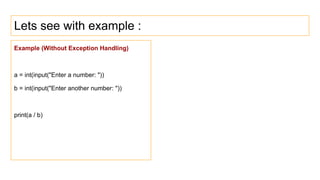
Example (Without Exception Handling)
a = int(input("Enter a number: "))
b = int(input("Enter another number: "))
print(a / b)
7.
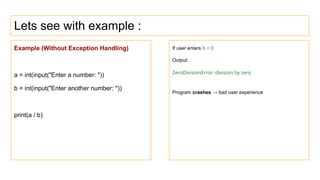
Lets see withexample :
Example (Without Exception Handling)
a = int(input("Enter a number: "))
b = int(input("Enter another number: "))
print(a / b)
If user enters b = 0
Output:
ZeroDivisionError: division by zero
Program crashes → bad user experience
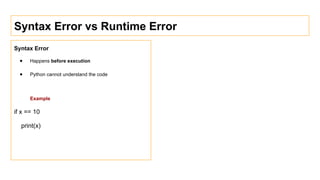
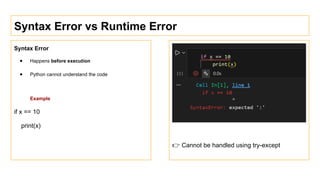
Syntax Error vsRuntime Error
Syntax Error
● Happens before execution
● Python cannot understand the code
Example
if x == 10
print(x)
11.
Syntax Error vsRuntime Error
Syntax Error
● Happens before execution
● Python cannot understand the code
Example
if x == 10
print(x)
👉 Cannot be handled using try-except
12.
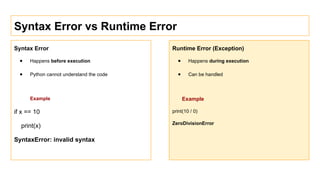
Syntax Error vsRuntime Error
Syntax Error
● Happens before execution
● Python cannot understand the code
Example
if x == 10
print(x)
SyntaxError: invalid syntax
Runtime Error (Exception)
● Happens during execution
● Can be handled
Example
print(10 / 0)
ZeroDivisionError
13.
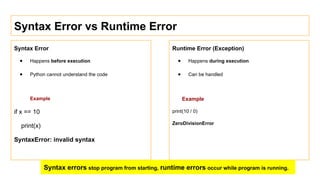
Syntax Error vsRuntime Error
Syntax Error
● Happens before execution
● Python cannot understand the code
Example
if x == 10
print(x)
SyntaxError: invalid syntax
Runtime Error (Exception)
● Happens during execution
● Can be handled
Example
print(10 / 0)
ZeroDivisionError
Syntax errors stop program from starting, runtime errors occur while program is running.
14.
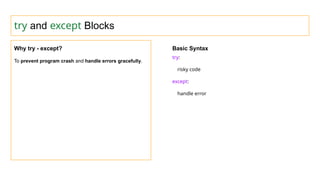
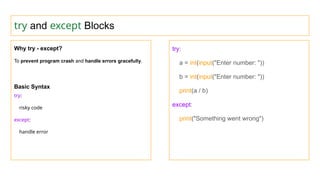
try and exceptBlocks
Why try - except?
To prevent program crash and handle errors gracefully.
Basic Syntax
try:
risky code
except:
handle error
15.
try and exceptBlocks
Why try - except?
To prevent program crash and handle errors gracefully.
Basic Syntax
try:
risky code
except:
handle error
try:
a = int(input("Enter number: "))
b = int(input("Enter number: "))
print(a / b)
except:
print("Something went wrong")
16.
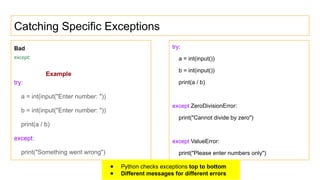
Catching Specific Exceptions
Bad
except:
Example
try:
a= int(input("Enter number: "))
b = int(input("Enter number: "))
print(a / b)
except:
print("Something went wrong")
try:
a = int(input())
b = int(input())
print(a / b)
except ZeroDivisionError:
print("Cannot divide by zero")
except ValueError:
print("Please enter numbers only")
● Python checks exceptions top to bottom
● Different messages for different errors
17.
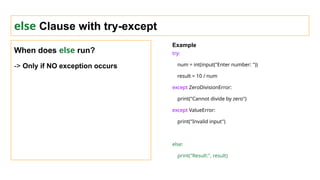
else Clause withtry-except
When does else run?
-> Only if NO exception occurs
Example
try:
num = int(input("Enter number: "))
result = 10 / num
except ZeroDivisionError:
print("Cannot divide by zero")
except ValueError:
print("Invalid input")
else:
print("Result:", result)
18.
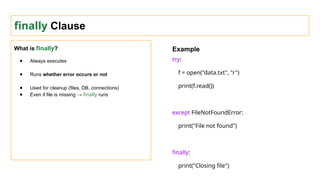
finally Clause
What isfinally?
● Always executes
● Runs whether error occurs or not
● Used for cleanup (files, DB, connections)
● Even if file is missing → finally runs
Example
try:
f = open("data.txt", "r")
print(f.read())
except FileNotFoundError:
print("File not found")
finally:
print("Closing file")
19.
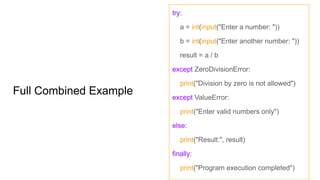
Full Combined Example
try:
a= int(input("Enter a number: "))
b = int(input("Enter another number: "))
result = a / b
except ZeroDivisionError:
print("Division by zero is not allowed")
except ValueError:
print("Enter valid numbers only")
else:
print("Result:", result)
finally:
print("Program execution completed")

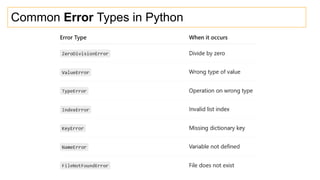
![Common Error Types in Python
Examples
int("abc") # ValueError
[1,2,3][5] # IndexError
10 + "5" # TypeError](https://image.slidesharecdn.com/exceptionhandlinginpython-260118091225-f8c6e8fa/85/Exception-Handling-in-python-with-code-and-practice-questions-9-320.jpg)


![FL Studio Producer Edition Crack 24 + Latest Version [2025]](https://cdn.slidesharecdn.com/ss_thumbnails/errorsandexceptions-250421182350-30f33fcd-250521053959-84fd5ecb-thumbnail.jpg?width=640&height=640&fit=bounds)


![[DSC Europe 25] Marcos Heidemann - Beyond the Hype: Making AI Coding Assistan...](https://cdn.slidesharecdn.com/ss_thumbnails/eexkhvldrjsopspdjbur-marcos-heidemann-beyond-the-hype-getting-real-value-out-of-ai-assisted-coding-260121115910-7e9d41ec-thumbnail.jpg?width=640&height=640&fit=bounds)
![[DSC Europe 25] Milos Belcevic - Product Professional's Journey to Full-Stack...](https://cdn.slidesharecdn.com/ss_thumbnails/1zovd6fgsycdg4wvgvls-milos-belcevic-product-professionals-journey-to-full-stack-product-developer-260123083019-d993120d-thumbnail.jpg?width=640&height=640&fit=bounds)
![[DSC Europe 25] Borko Kozomora - Optimizing business workflows with advances ...](https://cdn.slidesharecdn.com/ss_thumbnails/hbgekyb0txw0xpo4yfml-borko-kozomora-leading-ai-transformation-260122103838-cc29ee38-thumbnail.jpg?width=640&height=640&fit=bounds)


![[DSC Europe 25] Milovan Jovicic - Beyond AI's Reach: The Enduring Value of Ev...](https://cdn.slidesharecdn.com/ss_thumbnails/pyeij0hurgwq5jugmtnv-2-milovan-jovicic-beyond-ais-reach-the-enduring-value-of-evergreen-design-v2-260120105856-d6ee57e5-thumbnail.jpg?width=640&height=640&fit=bounds)


![[DSC Europe 25] Laila Kakar - Leveraging AI for Strategic Excellence: Enhanci...](https://cdn.slidesharecdn.com/ss_thumbnails/eykmhrtsqmaaftwkexh7-dsc-lailakakar-1-260119101520-5f3b5616-thumbnail.jpg?width=640&height=640&fit=bounds)


![[DSC Europe 25] Tamas Srancsik - How To Teach Your AI Football? An Argument f...](https://cdn.slidesharecdn.com/ss_thumbnails/bcjh1m9xtbosv20ucftb-tamas-srancsik-how-to-teach-your-ai-football-260121115910-08b53e9e-thumbnail.jpg?width=640&height=640&fit=bounds)


![[DSC Europe 25] Dubravko Culibrk - Deep Learning for Mammography.pptx](https://cdn.slidesharecdn.com/ss_thumbnails/yiscimuktacgqoiu4dkp-deep-learning-for-mammography-260119121559-aad59182-thumbnail.jpg?width=640&height=640&fit=bounds)