Marcello Messori (SEP-LUISS)
Ex post vs. ex ante debt restructuring
Sovereign Debt Crises:
Prevention and Management
Rome, 10 December 2018
Overview
• The aim of my intervention is to show that the
EMU’s most fragile countries (such as Italy) 
an unfavorable bargain between two new
roles of the ESM:
- backstop in the 2nd pillar of the BU (by 2020
), as stated by the Eurogroup (December 4th,
2018);
- possibly, decision-maker of an ex ante public
debt restructuring (SDRM).
Outline
• Three steps to pursue this aim:
(1) Short recall of the recent evolution in EU +
EMU economic governance;
(2) Possible results of impending European
meetings  Eurogroup (December 4th, 2018);
(3) How Italy is hit by these results  active
role to play.
1. Evolution of European governance
• From 5 Presidents’ Report (mid-2015) to the
election of Macron (mid-2017) = stalemate in
EU and EMU’s economic governance.
• Second half of 2017 = EC particularly active 
Completing the banking union (October)
Deepening Europe’s Economic and Monetary
Union (December).
1. Evolution of European governance
• EC + Euro-summit (end 2017):
- completion of BU (backstop + EDIS) and
progress in CMU;
- stabilization and counter-cyclical tools to
manage asymmetric shocks and to improve
convergence;
- creation of a euro-area budget;
- transformation of ESM into EMF;
- creation of a European Minister of Economy.
1. Evolution of European governance
• 2018 Euro-summit and Eurogroup meetings (
March and June) attested a new stalemate in
European economic governance.
• Evidence: Centeno’s letter to Tusk (June) 
(i) new roadmap for the BU;
(ii) indicating possible tools for convergence;
(iii) fixing some aspects for the ESM’s reform.
• (i) and (ii)-(iii) bring back the debate to:
fall 2012 and mid-2017, respectively.
1. Evolution of European governance
• Eurogroup’s last meeting (December 2018):
(a) ESM as a backstop (revolving credit line by
2020), subject to further risk reduction and
with serious problems of implementation;
(b) no common view on ESM’s instruments for
fiscal stabilization and convergence (see Term
sheet on ESM reform);
(c) no actual progress on euro-area budget;
(d) significant steps towards ESM as decision-
maker of an ex ante public debt restructuring.
2. Achievements of impending meetings
• (b) – (c)  contrasting view between EMU’s
member states (mainly: Northern countries,
Germany, and France)  open problem:
- ESM can offer assistance without triggering a
full aid program?
• ESM functions  beyond crisis management:
(i) mediation between creditors and member-
states (even if voluntary and non-binding);
(ii) single-limb CACs for new issuances to
prevent holdouts (by 2022).
2. Achievements of impending meetings
• Single-limb CACs = approval of a restructuring
 qualified majority for the whole set of
bondholders.
Hence, the approval of a restructuring process
on the whole stock of national public debt is
easier.
• (i) and (ii) = first steps to endow ESM with the
power of settling ex ante a (quasi-automatic)
public debt restructuring (SDRM).
2. Achievements of impending meetings
• Hence, European Council + Euro-summit (
December’s meetings):
- Launch of an inadequate backstop for the
2nd pillar of the BU (by 2020);
- Approval of single-limb CACs (by 2022) +
ESM’s mediation role 
a ‘Trojan horse’ to ease the implementation of
ex ante quasi-automatic debt restructuring.
2. Achievements of impending meetings
• EC = has the power to check the sustainability of
MS’s balance sheets;
EC + ESM = already have the power to state that a
country under a European aid program has an
unsustainable public debt (Agreement, November
14th, 2018).
• This  ex post debt restructuring =
unavoidable and efficient.
Single-limb CACs are necessary to limit the veto-
power of an organized minority of investors.
3. Italy’s recommended position
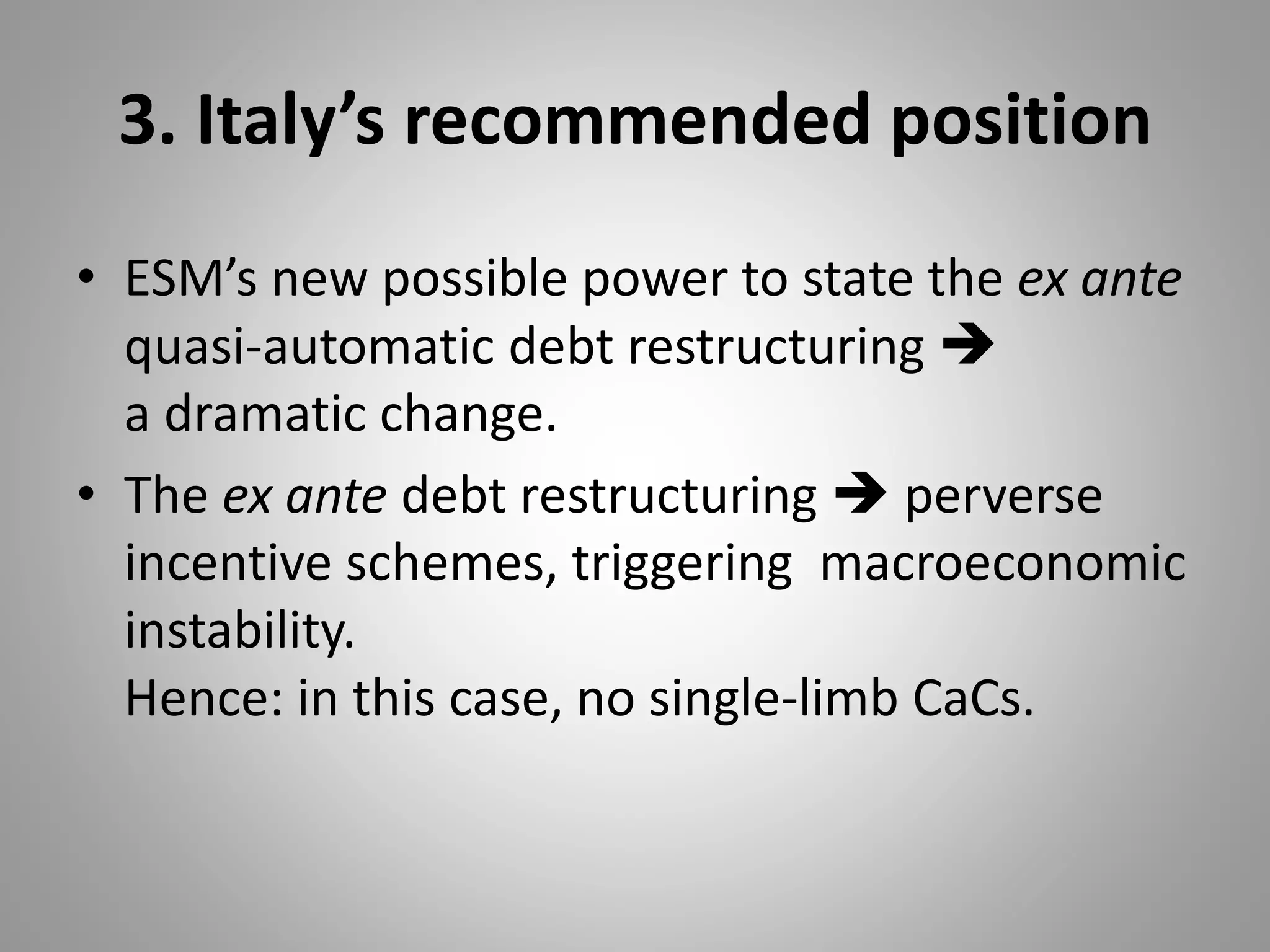
• ESM’s new possible power to state the ex ante
quasi-automatic debt restructuring 
a dramatic change.
• The ex ante debt restructuring  perverse
incentive schemes, triggering macroeconomic
instability.
Hence: in this case, no single-limb CaCs.
3. Italy’s recommended position
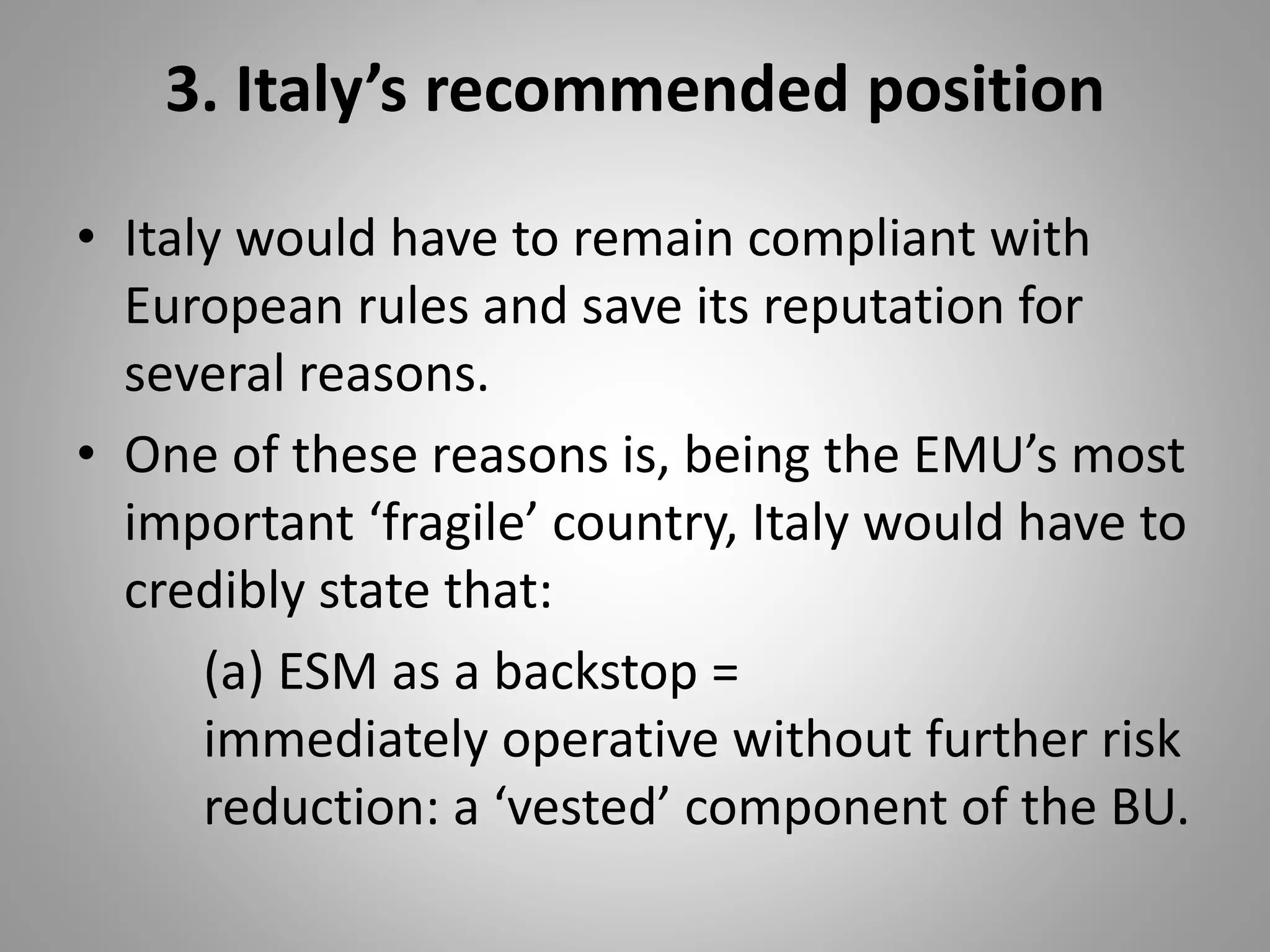
• Italy would have to remain compliant with
European rules and save its reputation for
several reasons.
• One of these reasons is, being the EMU’s most
important ‘fragile’ country, Italy would have to
credibly state that:
(a) ESM as a backstop =
immediately operative without further risk
reduction: a ‘vested’ component of the BU.
3. Italy’s recommended position
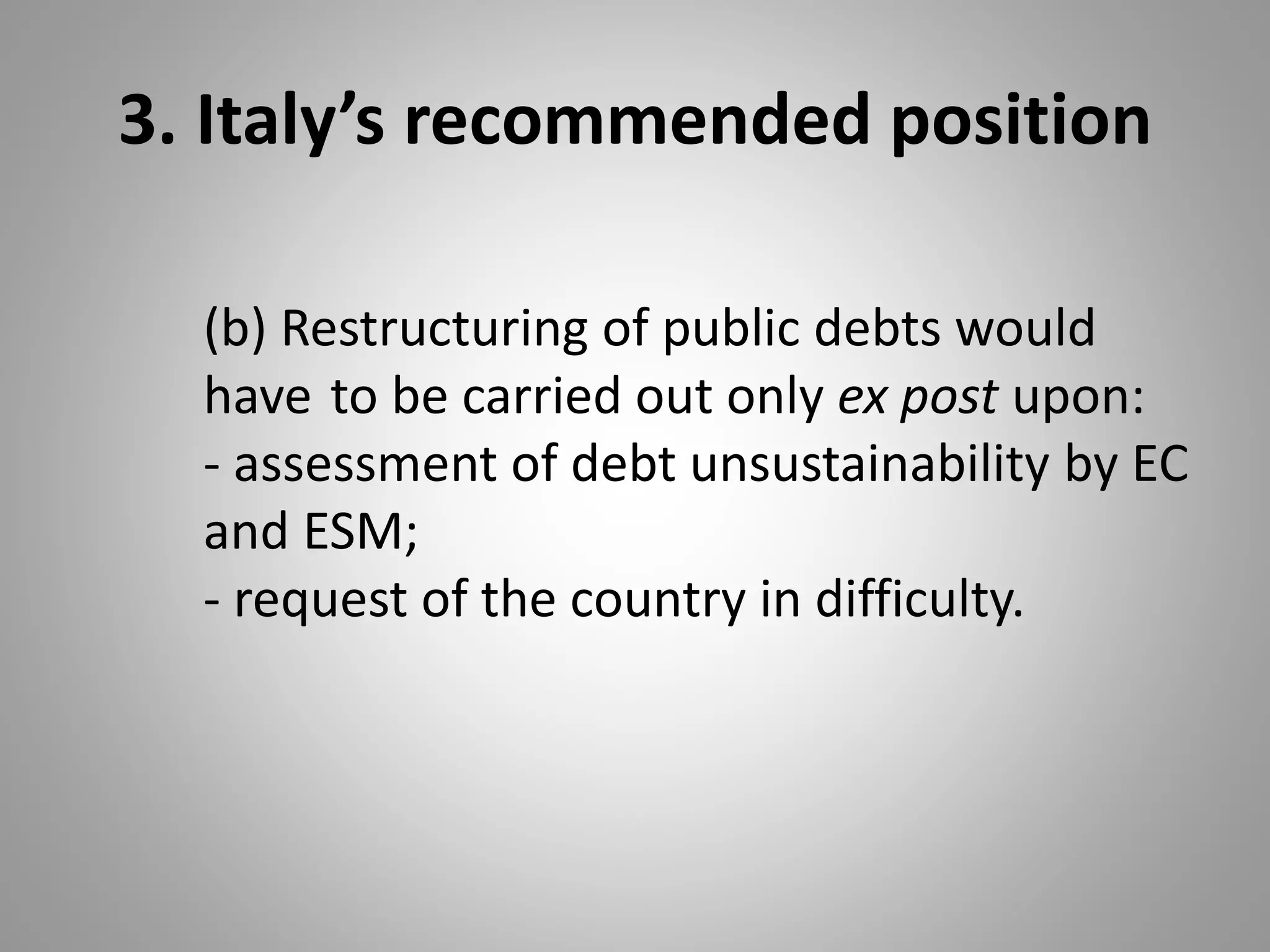
(b) Restructuring of public debts would
have to be carried out only ex post upon:
- assessment of debt unsustainability by EC
and ESM;
- request of the country in difficulty.
3. Italy’s recommended position
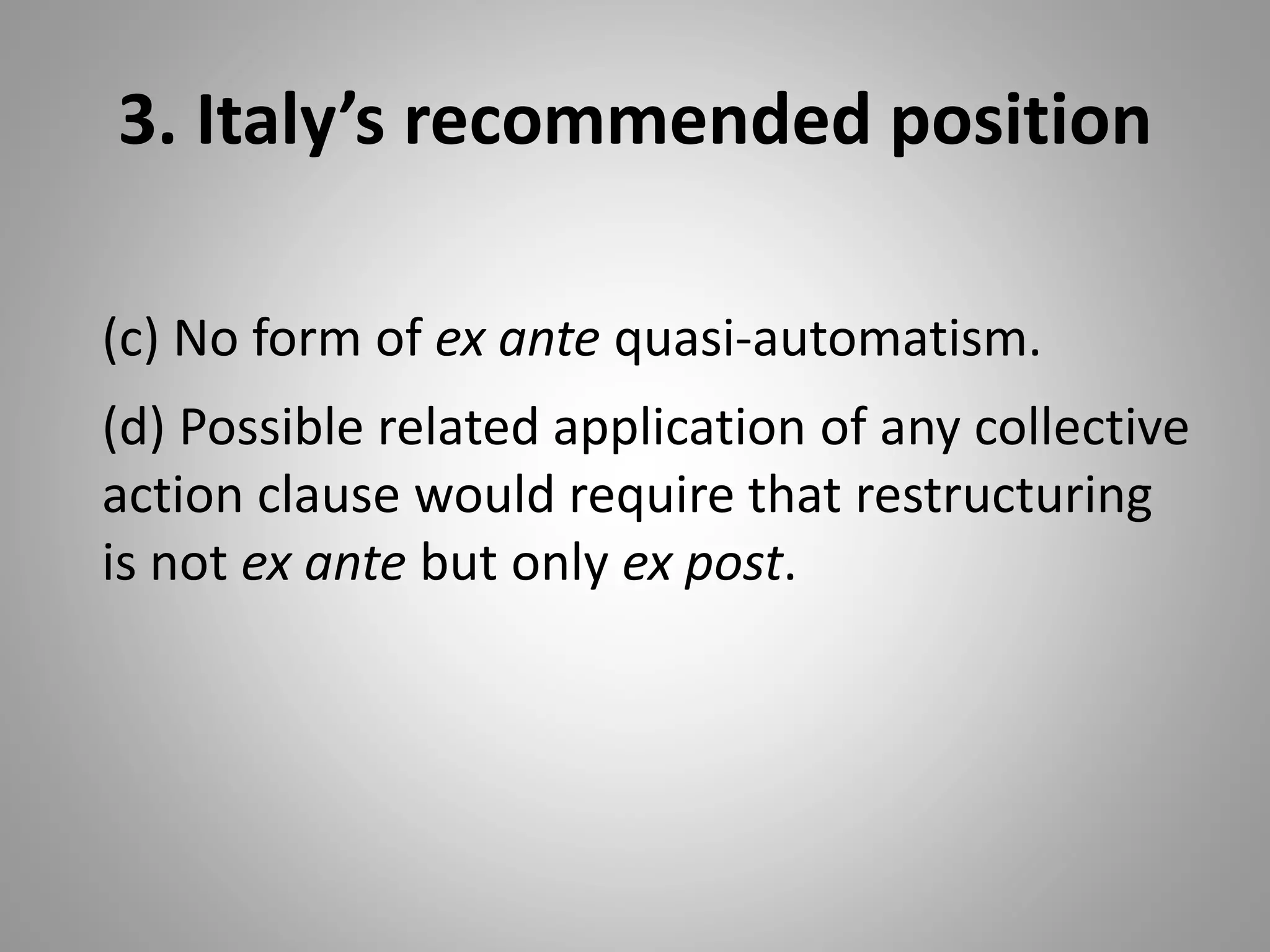
(c) No form of ex ante quasi-automatism.
(d) Possible related application of any collective
action clause would require that restructuring
is not ex ante but only ex post.

Ex post vs. ex ante debt restructuring

  • 1.
    Marcello Messori (SEP-LUISS) Expost vs. ex ante debt restructuring Sovereign Debt Crises: Prevention and Management Rome, 10 December 2018
  • 2.
    Overview • The aimof my intervention is to show that the EMU’s most fragile countries (such as Italy)  an unfavorable bargain between two new roles of the ESM: - backstop in the 2nd pillar of the BU (by 2020 ), as stated by the Eurogroup (December 4th, 2018); - possibly, decision-maker of an ex ante public debt restructuring (SDRM).
  • 3.
    Outline • Three stepsto pursue this aim: (1) Short recall of the recent evolution in EU + EMU economic governance; (2) Possible results of impending European meetings  Eurogroup (December 4th, 2018); (3) How Italy is hit by these results  active role to play.
  • 4.
    1. Evolution ofEuropean governance • From 5 Presidents’ Report (mid-2015) to the election of Macron (mid-2017) = stalemate in EU and EMU’s economic governance. • Second half of 2017 = EC particularly active  Completing the banking union (October) Deepening Europe’s Economic and Monetary Union (December).
  • 5.
    1. Evolution ofEuropean governance • EC + Euro-summit (end 2017): - completion of BU (backstop + EDIS) and progress in CMU; - stabilization and counter-cyclical tools to manage asymmetric shocks and to improve convergence; - creation of a euro-area budget; - transformation of ESM into EMF; - creation of a European Minister of Economy.
  • 6.
    1. Evolution ofEuropean governance • 2018 Euro-summit and Eurogroup meetings ( March and June) attested a new stalemate in European economic governance. • Evidence: Centeno’s letter to Tusk (June)  (i) new roadmap for the BU; (ii) indicating possible tools for convergence; (iii) fixing some aspects for the ESM’s reform. • (i) and (ii)-(iii) bring back the debate to: fall 2012 and mid-2017, respectively.
  • 7.
    1. Evolution ofEuropean governance • Eurogroup’s last meeting (December 2018): (a) ESM as a backstop (revolving credit line by 2020), subject to further risk reduction and with serious problems of implementation; (b) no common view on ESM’s instruments for fiscal stabilization and convergence (see Term sheet on ESM reform); (c) no actual progress on euro-area budget; (d) significant steps towards ESM as decision- maker of an ex ante public debt restructuring.
  • 8.
    2. Achievements ofimpending meetings • (b) – (c)  contrasting view between EMU’s member states (mainly: Northern countries, Germany, and France)  open problem: - ESM can offer assistance without triggering a full aid program? • ESM functions  beyond crisis management: (i) mediation between creditors and member- states (even if voluntary and non-binding); (ii) single-limb CACs for new issuances to prevent holdouts (by 2022).
  • 9.
    2. Achievements ofimpending meetings • Single-limb CACs = approval of a restructuring  qualified majority for the whole set of bondholders. Hence, the approval of a restructuring process on the whole stock of national public debt is easier. • (i) and (ii) = first steps to endow ESM with the power of settling ex ante a (quasi-automatic) public debt restructuring (SDRM).
  • 10.
    2. Achievements ofimpending meetings • Hence, European Council + Euro-summit ( December’s meetings): - Launch of an inadequate backstop for the 2nd pillar of the BU (by 2020); - Approval of single-limb CACs (by 2022) + ESM’s mediation role  a ‘Trojan horse’ to ease the implementation of ex ante quasi-automatic debt restructuring.
  • 11.
    2. Achievements ofimpending meetings • EC = has the power to check the sustainability of MS’s balance sheets; EC + ESM = already have the power to state that a country under a European aid program has an unsustainable public debt (Agreement, November 14th, 2018). • This  ex post debt restructuring = unavoidable and efficient. Single-limb CACs are necessary to limit the veto- power of an organized minority of investors.
  • 12.
    3. Italy’s recommendedposition • ESM’s new possible power to state the ex ante quasi-automatic debt restructuring  a dramatic change. • The ex ante debt restructuring  perverse incentive schemes, triggering macroeconomic instability. Hence: in this case, no single-limb CaCs.
  • 13.
    3. Italy’s recommendedposition • Italy would have to remain compliant with European rules and save its reputation for several reasons. • One of these reasons is, being the EMU’s most important ‘fragile’ country, Italy would have to credibly state that: (a) ESM as a backstop = immediately operative without further risk reduction: a ‘vested’ component of the BU.
  • 14.
    3. Italy’s recommendedposition (b) Restructuring of public debts would have to be carried out only ex post upon: - assessment of debt unsustainability by EC and ESM; - request of the country in difficulty.
  • 15.
    3. Italy’s recommendedposition (c) No form of ex ante quasi-automatism. (d) Possible related application of any collective action clause would require that restructuring is not ex ante but only ex post.