Evolution of Social Work
Profession
Evolution of Social Work Profession
• Historical Evolution of Social Work Profession Through the Ages
• Charity
• Poverty Relief
• Charity Organization Societies
• Settlement House Movement
• Social Work in the USA
• Professionalization of Social Work
• Social Work in the 20th Century
• Social Work in the 21st Century
• Social Work in England
Historical Evolution of Social Work Profession Through the Ages
• Ancient Roots of Social Work: Traces social
work's origins in early philanthropic efforts and
community-based support systems across
ancient civilizations.
• Emergence of Modern Social Work: Highlights
the pivotal 19th century developments that
professionalized social work and established its
core principles and practices.
• Evolving Roles and Responsibilities: Examines
how social work's scope has expanded to address
complex social issues in the 20th and 21st
centuries.
Photo by Luis Quintero on Pexels
Charity
• Roots in Major Religions: Charity and social welfare have deep roots in the teachings and practices of all
major religions, underscoring their universal moral significance.
• Informal Helping of the Church: The Church in the 4th century pioneered an informal system of charitable
assistance, setting the stage for the modern social work profession.
Poverty Relief
• End of feudalism: The collapse of the feudal system led to a rise in landless peasants, necessitating new
approaches to poverty relief.
• The Poor Law Act 1601: This landmark legislation established a systematic framework for categorizing and
assisting the poor, laying the foundations for modern welfare systems.
• Specialized Assistance: The Act introduced differentiated approaches for the impotent poor, able-bodied
poor, idle poor, and pauper children, tailoring support to individual circumstances.
Charity Organization Societies
• First formed in 1869: The London Charity Organization Society, founded in 1869, pioneered a new
approach to charitable assistance.
• Stopped giving doles: The society shifted away from indiscriminate handouts, recognizing the need for
more strategic and coordinated relief efforts.
• Formulated treatment plans: The society developed individualized plans to address the root causes of
poverty and provide long-term solutions, rather than temporary relief.
Settlement House Movement
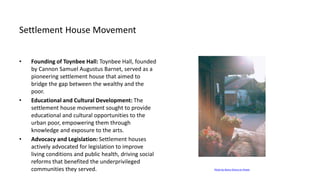
• Founding of Toynbee Hall: Toynbee Hall, founded
by Cannon Samuel Augustus Barnet, served as a
pioneering settlement house that aimed to
bridge the gap between the wealthy and the
poor.
• Educational and Cultural Development: The
settlement house movement sought to provide
educational and cultural opportunities to the
urban poor, empowering them through
knowledge and exposure to the arts.
• Advocacy and Legislation: Settlement houses
actively advocated for legislation to improve
living conditions and public health, driving social
reforms that benefited the underprivileged
communities they served. Photo by Maria Orlova on Pexels
Social Work in the USA
• Colonial Period: Established early foundations for
social welfare through the Elizabethan Poor Law
and first almshouse in Massachusetts.
• Civil War and Industrialism: Rapid growth of
poverty led to voluntary relief efforts and the
recognition of government responsibility for
social welfare.
• Settlement Movement: Pioneered community-
based approaches to empowering the urban poor
through education, cultural development, and
advocacy for social reforms.
Photo by Valeriia Miller on Pexels
Professionalization of Social Work
• Mary Richmond: First Professional Social Worker: Pioneered the casework approach and established
social work as a distinct profession in the USA.
• Founding of American Association of Schools of Social Work: Standardized social work education and
training, promoting the field's academic and professional status.
• Social Work's Role in World Wars: Developed specialized casework skills to support soldiers and provided
essential services for war-affected communities.
Social Work in the 20th Century
• The Great Depression and New Deal: Triggered
major expansions of social welfare programs to
assist the unemployed and impoverished during
economic crisis.
• Expansion of social welfare programs:
Broadened the scope of social work to address a
wider range of societal challenges and support
vulnerable populations.
• Challenges of the 1980s: Tested the limits of
social welfare systems as they confronted the
HIV/AIDS epidemic, crack cocaine crisis,
homelessness, and domestic violence. Photo by Jopwell on Pexels
Social Work in the 21st Century
• Social Workers in Mental Health and Family
Services: Social workers comprise a significant
percentage of mental health and family services
professionals, playing a crucial role in addressing
complex psychosocial needs.
• Policies Under the Obama Administration: The
Obama administration's initiatives, such as the
Affordable Care Act, environmental regulations,
and social welfare policies, impacted the scope of
social work practice.
• Changing Priorities Under the Trump
Administration: The Trump administration's
changes to healthcare, immigration, and
environmental policies presented new challenges
and opportunities for social work professionals. Photo by Lisa Fotios on Pexels
Social Work in England
• Medieval Period: Charity as a Religious Duty:
Charitable assistance to the poor was viewed as a
religious obligation, laying the groundwork for
the development of social welfare systems.
• Elizabethan Poor Law of 1601: This landmark
legislation established a systematic framework
for categorizing and assisting the poor, setting
the stage for modern welfare programs.
• Charity Organization Society (1869): The
pioneering organization shifted from
indiscriminate handouts to individualized plans,
recognizing the need for more strategic and
coordinated relief efforts.
Photo by Julia M Cameron on Pexels

Evolution of Social Work Profession.pptx

  • 1.
    Evolution of SocialWork Profession
  • 2.
    Evolution of SocialWork Profession • Historical Evolution of Social Work Profession Through the Ages • Charity • Poverty Relief • Charity Organization Societies • Settlement House Movement • Social Work in the USA • Professionalization of Social Work • Social Work in the 20th Century • Social Work in the 21st Century • Social Work in England
  • 3.
    Historical Evolution ofSocial Work Profession Through the Ages • Ancient Roots of Social Work: Traces social work's origins in early philanthropic efforts and community-based support systems across ancient civilizations. • Emergence of Modern Social Work: Highlights the pivotal 19th century developments that professionalized social work and established its core principles and practices. • Evolving Roles and Responsibilities: Examines how social work's scope has expanded to address complex social issues in the 20th and 21st centuries. Photo by Luis Quintero on Pexels
  • 4.
    Charity • Roots inMajor Religions: Charity and social welfare have deep roots in the teachings and practices of all major religions, underscoring their universal moral significance. • Informal Helping of the Church: The Church in the 4th century pioneered an informal system of charitable assistance, setting the stage for the modern social work profession.
  • 5.
    Poverty Relief • Endof feudalism: The collapse of the feudal system led to a rise in landless peasants, necessitating new approaches to poverty relief. • The Poor Law Act 1601: This landmark legislation established a systematic framework for categorizing and assisting the poor, laying the foundations for modern welfare systems. • Specialized Assistance: The Act introduced differentiated approaches for the impotent poor, able-bodied poor, idle poor, and pauper children, tailoring support to individual circumstances.
  • 6.
    Charity Organization Societies •First formed in 1869: The London Charity Organization Society, founded in 1869, pioneered a new approach to charitable assistance. • Stopped giving doles: The society shifted away from indiscriminate handouts, recognizing the need for more strategic and coordinated relief efforts. • Formulated treatment plans: The society developed individualized plans to address the root causes of poverty and provide long-term solutions, rather than temporary relief.
  • 7.
    Settlement House Movement •Founding of Toynbee Hall: Toynbee Hall, founded by Cannon Samuel Augustus Barnet, served as a pioneering settlement house that aimed to bridge the gap between the wealthy and the poor. • Educational and Cultural Development: The settlement house movement sought to provide educational and cultural opportunities to the urban poor, empowering them through knowledge and exposure to the arts. • Advocacy and Legislation: Settlement houses actively advocated for legislation to improve living conditions and public health, driving social reforms that benefited the underprivileged communities they served. Photo by Maria Orlova on Pexels
  • 8.
    Social Work inthe USA • Colonial Period: Established early foundations for social welfare through the Elizabethan Poor Law and first almshouse in Massachusetts. • Civil War and Industrialism: Rapid growth of poverty led to voluntary relief efforts and the recognition of government responsibility for social welfare. • Settlement Movement: Pioneered community- based approaches to empowering the urban poor through education, cultural development, and advocacy for social reforms. Photo by Valeriia Miller on Pexels
  • 9.
    Professionalization of SocialWork • Mary Richmond: First Professional Social Worker: Pioneered the casework approach and established social work as a distinct profession in the USA. • Founding of American Association of Schools of Social Work: Standardized social work education and training, promoting the field's academic and professional status. • Social Work's Role in World Wars: Developed specialized casework skills to support soldiers and provided essential services for war-affected communities.
  • 10.
    Social Work inthe 20th Century • The Great Depression and New Deal: Triggered major expansions of social welfare programs to assist the unemployed and impoverished during economic crisis. • Expansion of social welfare programs: Broadened the scope of social work to address a wider range of societal challenges and support vulnerable populations. • Challenges of the 1980s: Tested the limits of social welfare systems as they confronted the HIV/AIDS epidemic, crack cocaine crisis, homelessness, and domestic violence. Photo by Jopwell on Pexels
  • 11.
    Social Work inthe 21st Century • Social Workers in Mental Health and Family Services: Social workers comprise a significant percentage of mental health and family services professionals, playing a crucial role in addressing complex psychosocial needs. • Policies Under the Obama Administration: The Obama administration's initiatives, such as the Affordable Care Act, environmental regulations, and social welfare policies, impacted the scope of social work practice. • Changing Priorities Under the Trump Administration: The Trump administration's changes to healthcare, immigration, and environmental policies presented new challenges and opportunities for social work professionals. Photo by Lisa Fotios on Pexels
  • 12.
    Social Work inEngland • Medieval Period: Charity as a Religious Duty: Charitable assistance to the poor was viewed as a religious obligation, laying the groundwork for the development of social welfare systems. • Elizabethan Poor Law of 1601: This landmark legislation established a systematic framework for categorizing and assisting the poor, setting the stage for modern welfare programs. • Charity Organization Society (1869): The pioneering organization shifted from indiscriminate handouts to individualized plans, recognizing the need for more strategic and coordinated relief efforts. Photo by Julia M Cameron on Pexels