


We are going to discuss today history of innovation in outsourcing  looking thru evolutions 
of various sourcing models. 
1
We’ll talk about what is sourcing and why out‐sourcing. Then going thru various 
outsourcing risks we’ll see how those risks were addressed by new outsourcing models to 
arrive at Remote In‐Sourcing and Service Level Agreements.
2
First of all, let’s share some information about our company. Intetics is a mid‐size global 
outsourcing company focused on creation and operation of remote dedicated  information 
technology teams for software development, engineering and data processing. The 
company was established by me in 1995 in Belarus. Then headquarters of the company 
were located here, in Prague, for about 6 years. Then moved to the USA. We have 3 
development centers in Belarus and Ukraine with about 400 employees. The company  is 
ISO 9000 and ISO 27000 certified, Microsoft and Oracle Gold partner, and has received 
multiple industry awards both in Europe and United States. The greatest our achievement 
is getting #1 outsourcing rising star award from International Association of outsourcing 
professionals. 
3
Let’s answer two questions: What is outsourcing and Why Outsourcing exists?  From my 
viewpoint outsourcing is international transition from trading by goods only to trading by 
services. Technology development, primarily invention of Internet, allowed to utilize 
international labor on variety of service applications and, for the stake of business 
effectiveness, it was immediately done. So, outsourcing and globalization are modern  
“piece drivers” if to believe to baron de Montesquieu. And I think he was right.
For Why Outsourcing, there are 2 primary reasons. The first one is shortage of expertise or 
specialists that posses certain expertise. In various researches on reasons for outsourcing 
this same shortage may be called Talent shortage, Getting strategic flexibility, concentrating 
on Core focus, etc. But this is all sound like synonyms for the same:  lack of certain 
expertise and people. The second reason is obvious, Cost. Businesses not only want to get 
expertise but want it in a cost efficient manner. 
Everything of course is expected to be done with already achieved internally or better 
quality. 
4
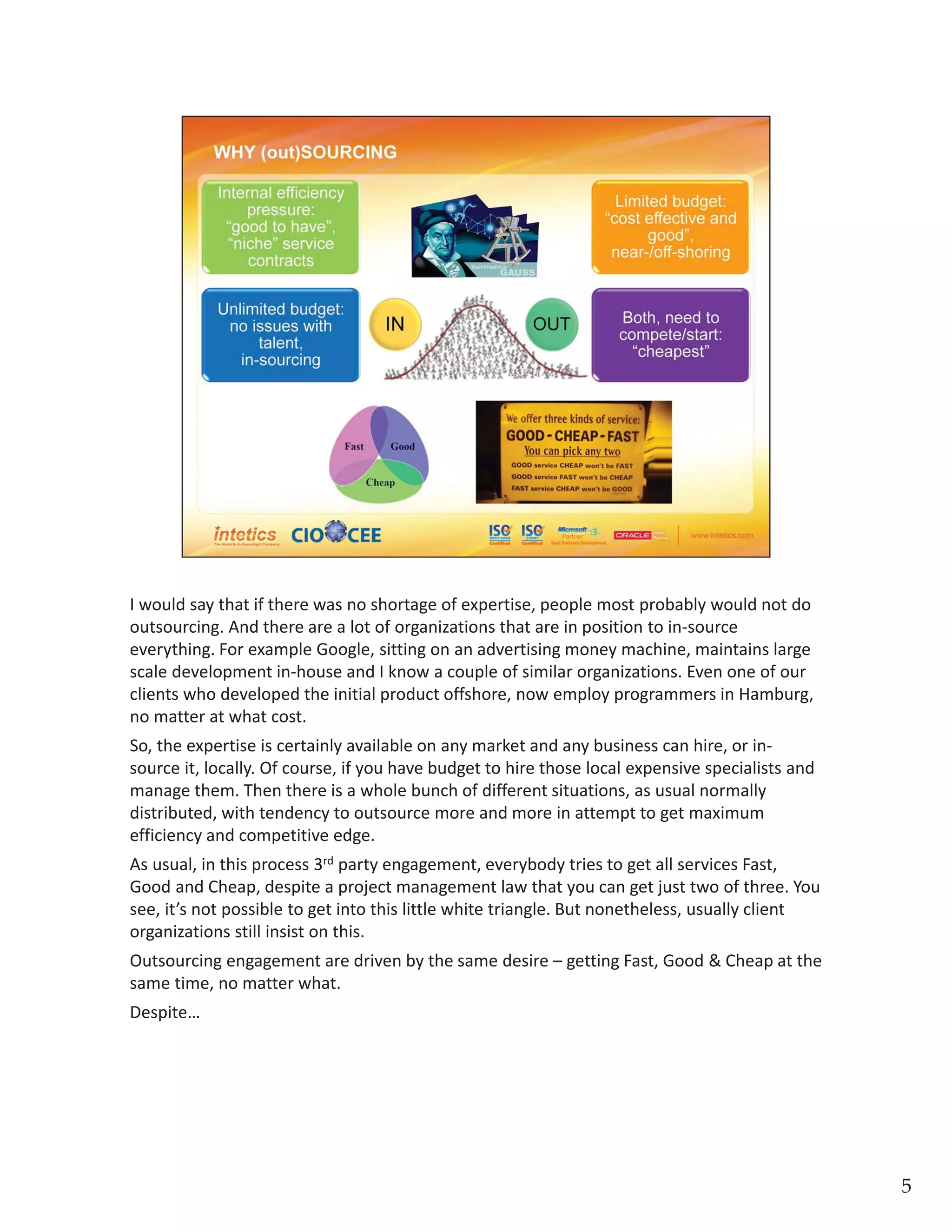
I would say that if there was no shortage of expertise, people most probably would not do 
outsourcing. And there are a lot of organizations that are in position to in‐source 
everything. For example Google, sitting on an advertising money machine, maintains large 
scale development in‐house and I know a couple of similar organizations. Even one of our 
clients who developed the initial product offshore, now employ programmers in Hamburg, 
no matter at what cost. 
So, the expertise is certainly available on any market and any business can hire, or in‐
source it, locally. Of course, if you have budget to hire those local expensive specialists and 
manage them. Then there is a whole bunch of different situations, as usual normally 
distributed, with tendency to outsource more and more in attempt to get maximum 
efficiency and competitive edge.
As usual, in this process 3rdparty engagement, everybody tries to get all services Fast, 
Good and Cheap, despite a project management law that you can get just two of three. You 
see, it’s not possible to get into this little white triangle. But nonetheless, usually client 
organizations still insist on this. 
Outsourcing engagement are driven by the same desire –getting Fast, Good & Cheap at the 
same time, no matter what. 
Despite…
5
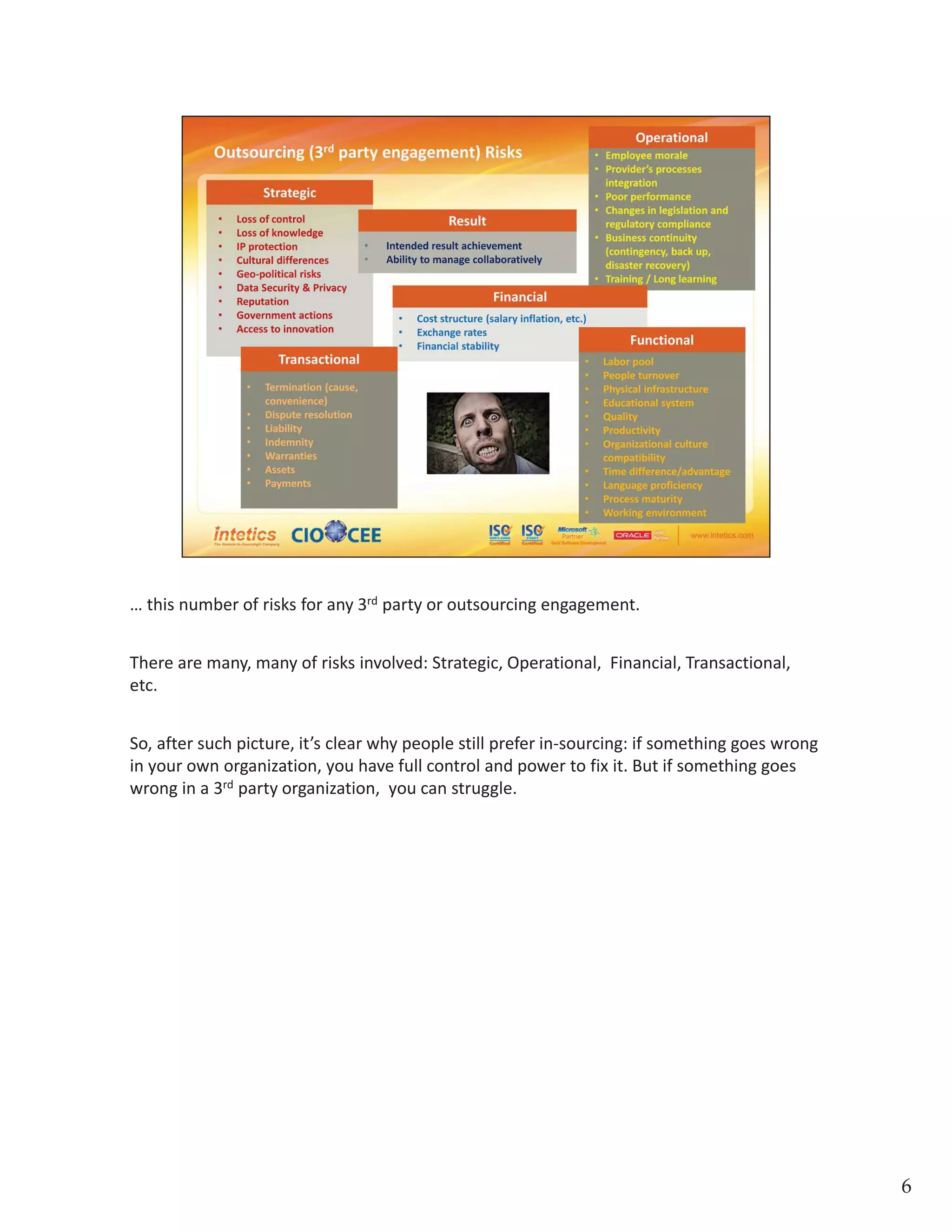
… this number of risks for any 3rdparty or outsourcing engagement.  There are many, many 
of risks involved: Strategic, Operational,  Financial, Transactional, etc. So, after such picture, 
it’s clear why people still prefer in‐sourcing: if something goes wrong  in your own 
organization, you have full control and power to fix it. But if something goes wrong in a 3rd‐
party organization,  you can struggle. 
6
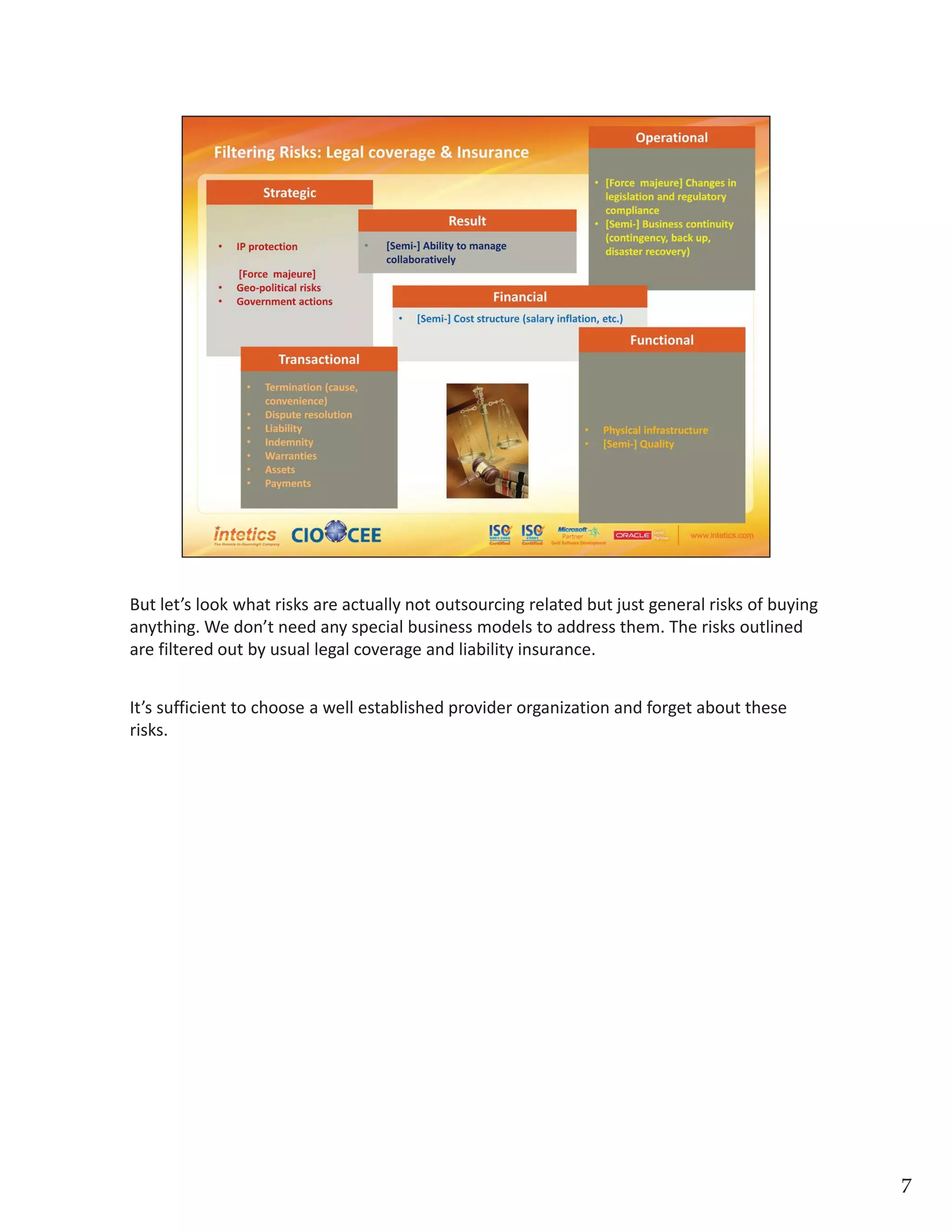
But let’s look what risks are actually not outsourcing related but just general risks of buying 
anything. We don’t need any special business models to address them. The risks outlined 
are filtered out by usual legal coverage and liability insurance. It’s sufficient to choose a 
well established provider organization and forget about these risks.
7
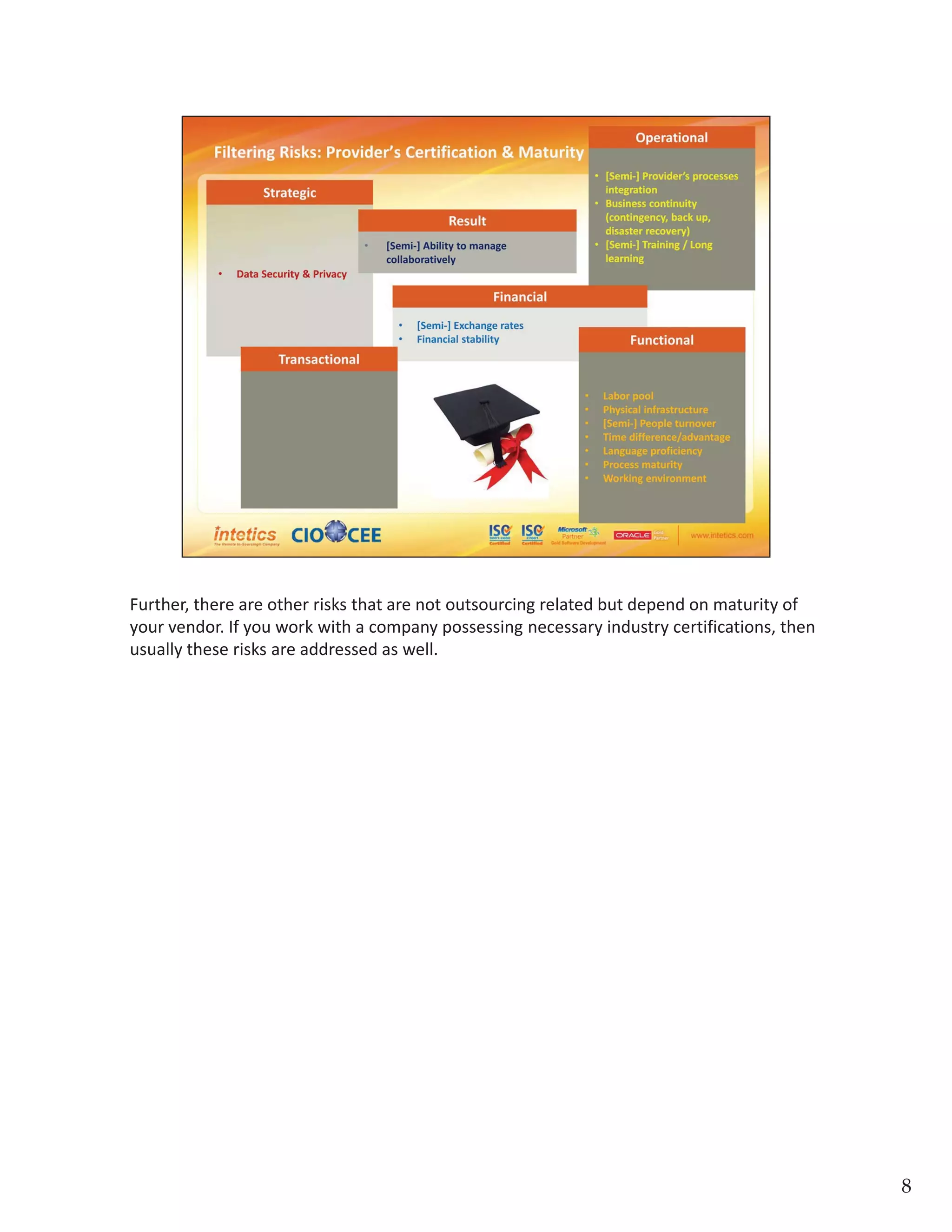
Further, there are other risks that are not outsourcing related but depend on maturity of 
your vendor. If you work with a company possessing necessary industry certifications, then 
usually these risks are addressed as well. 
8
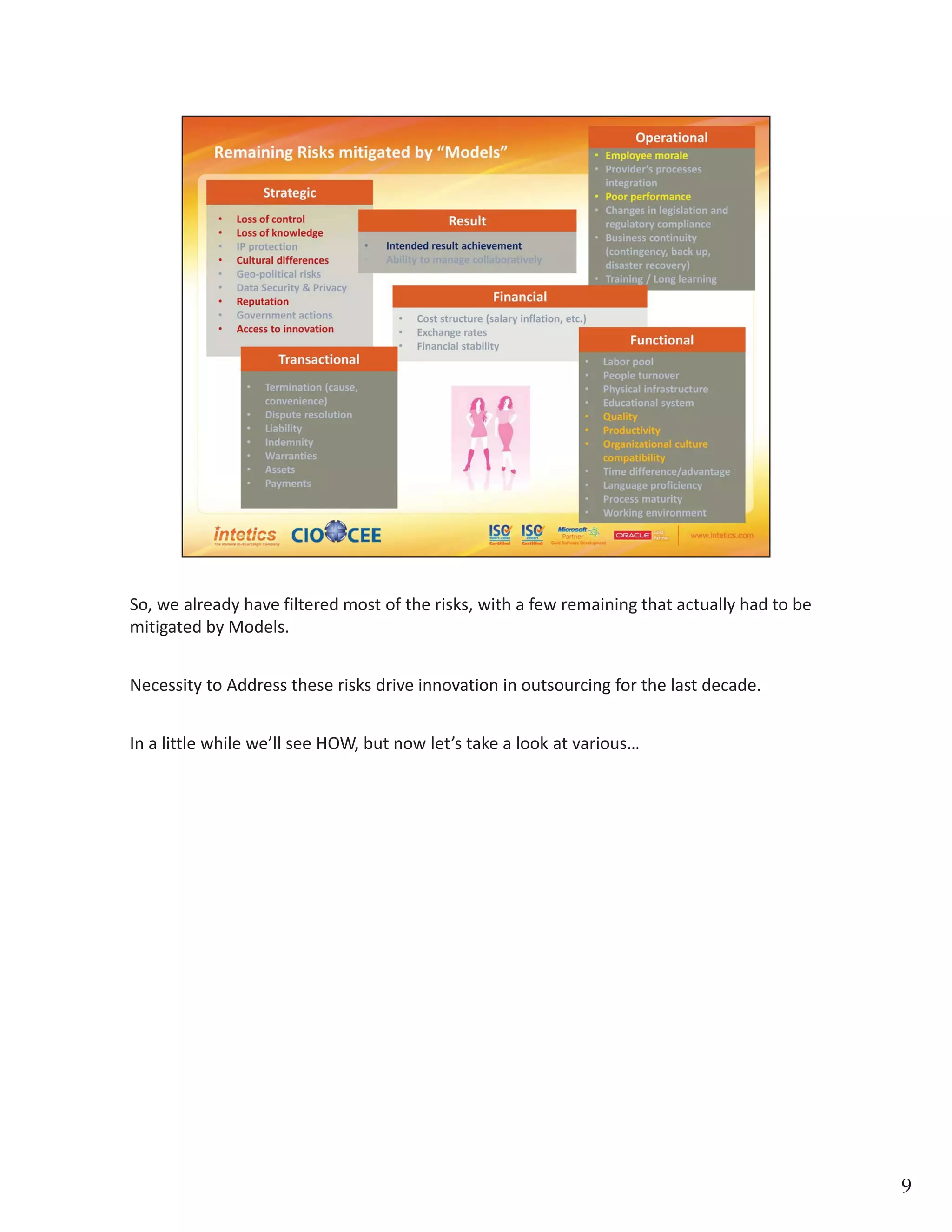
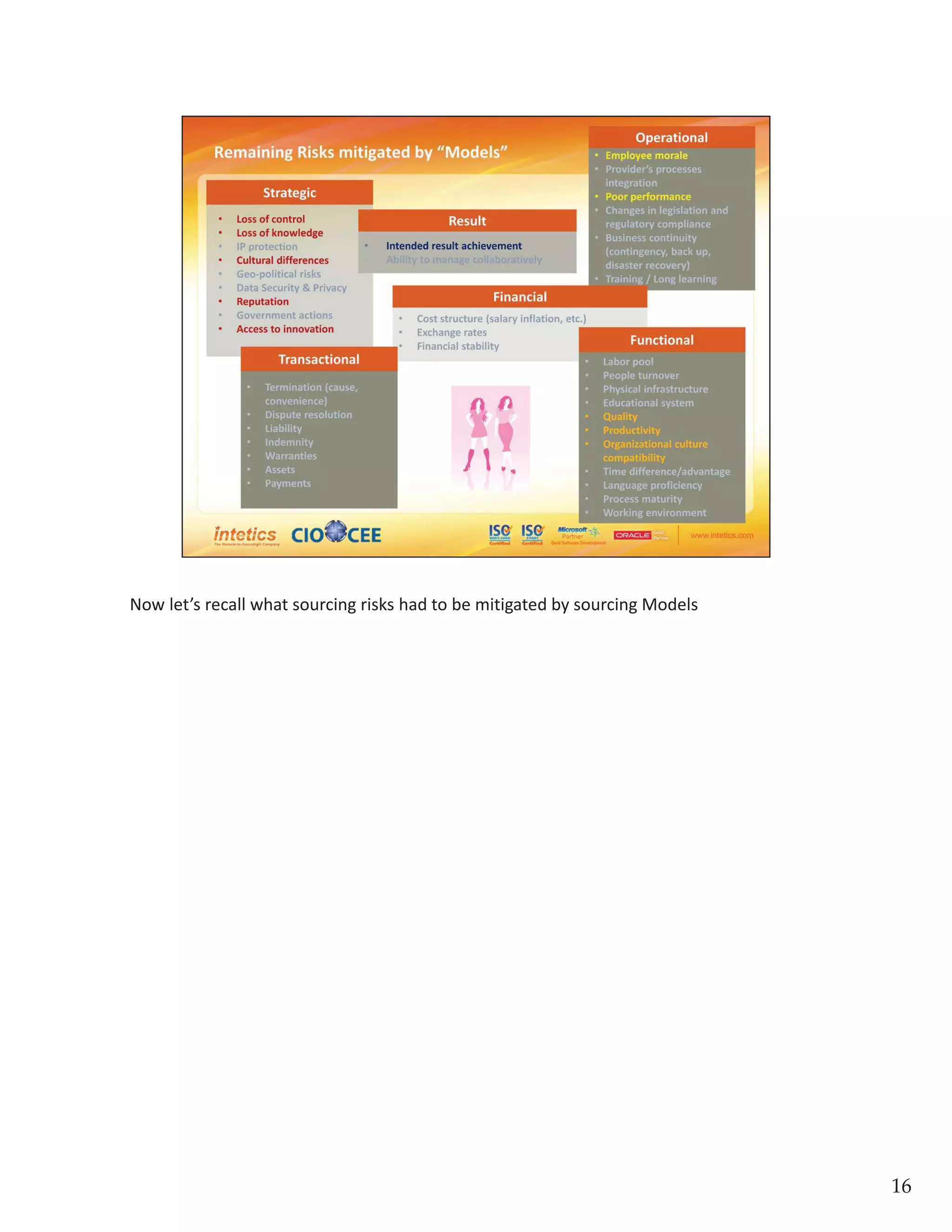
So, we already have filtered most of the risks, with a few remaining that actually had to be 
mitigated by Models. Necessity to Address these risks drive innovation in outsourcing for 
the last decade.In a little while we’ll see HOW, but now let’s take a look at various…
9
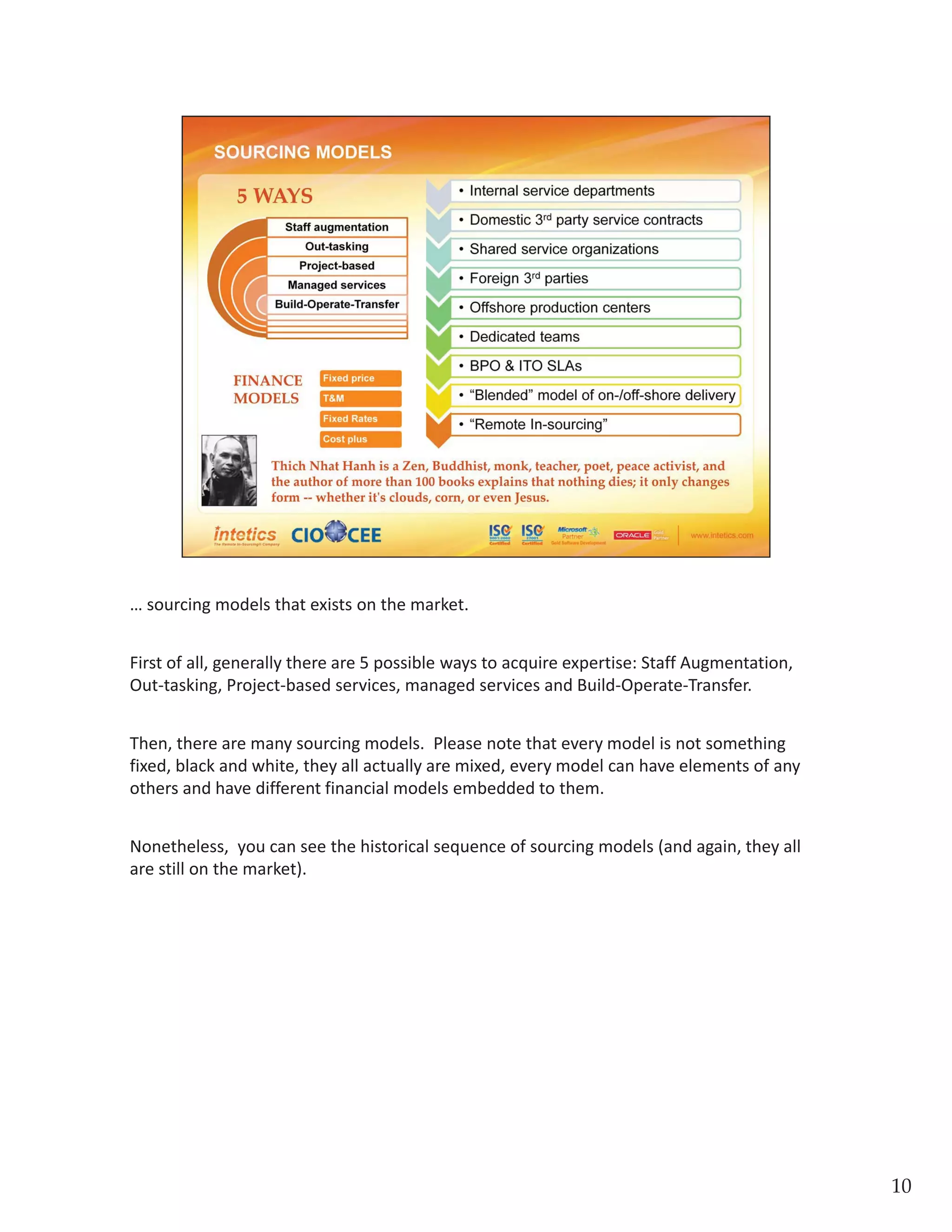
… sourcing models that exists on the market. First of all, generally there are 5 possible ways 
to acquire expertise: Staff Augmentation, Out‐tasking, Project‐based services, managed 
services and Build‐Operate‐Transfer. Then, there are many sourcing models.  Please note 
that every model is not something fixed, black and white, they all actually are mixed, every 
model can have elements of any others and have different financial models embedded to 
them. Nonetheless,  you can see the historical sequence of sourcing models (and again, 
they all are still on the market).
10
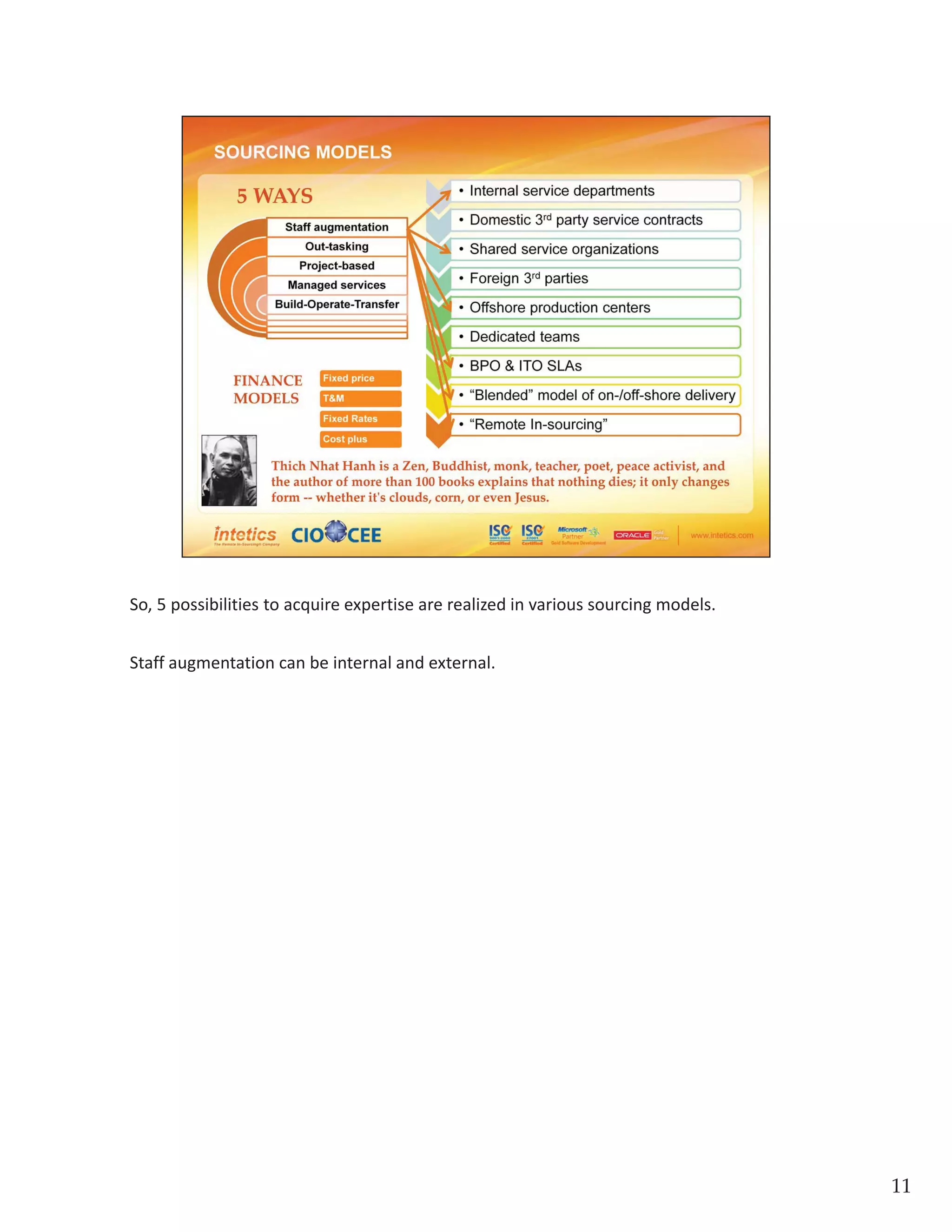
So, 5 possibilities to acquire expertise are realized in various sourcing models.Staff
augmentation can be internal and external.
11
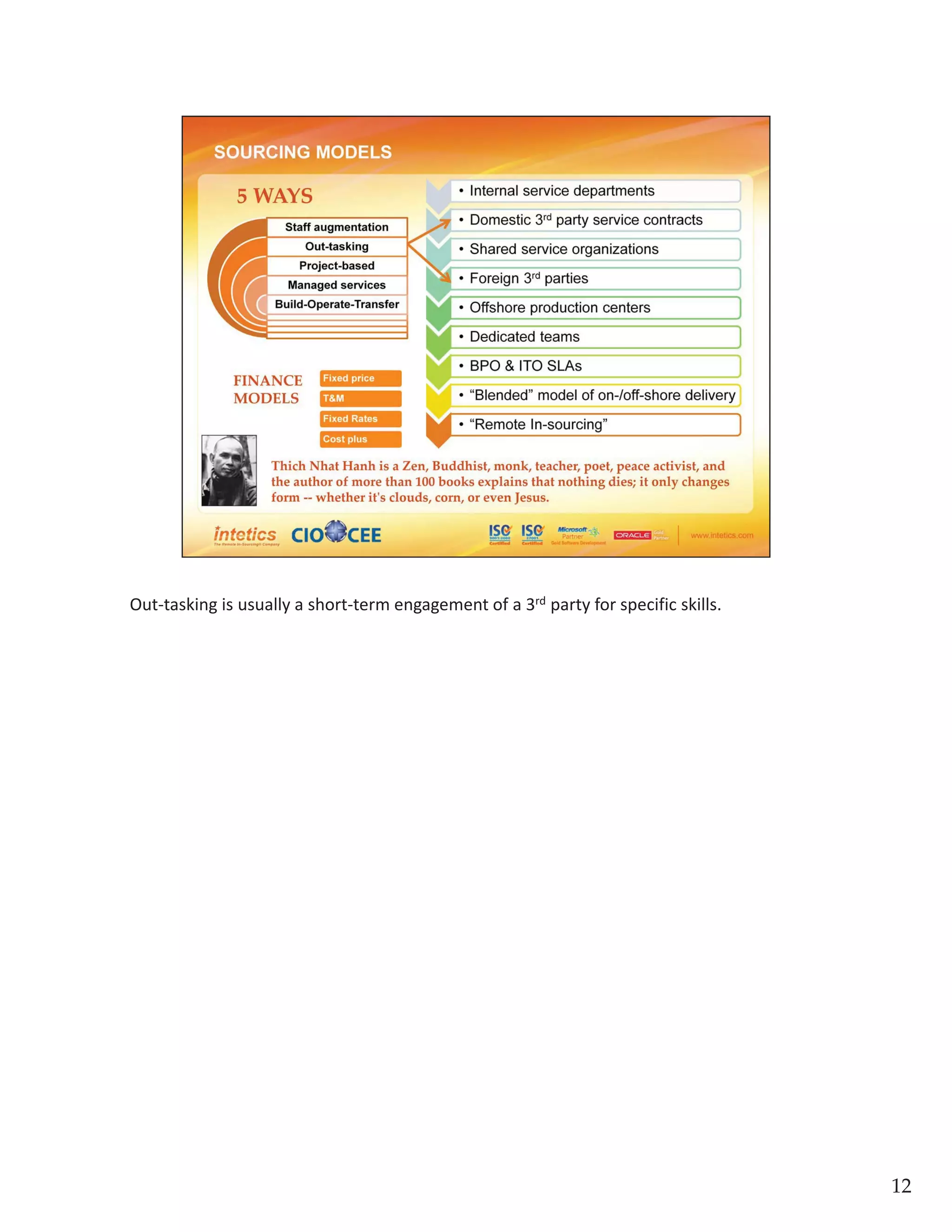
Out‐tasking is usually a short‐term engagement of a 3rdparty for specific skills.
12
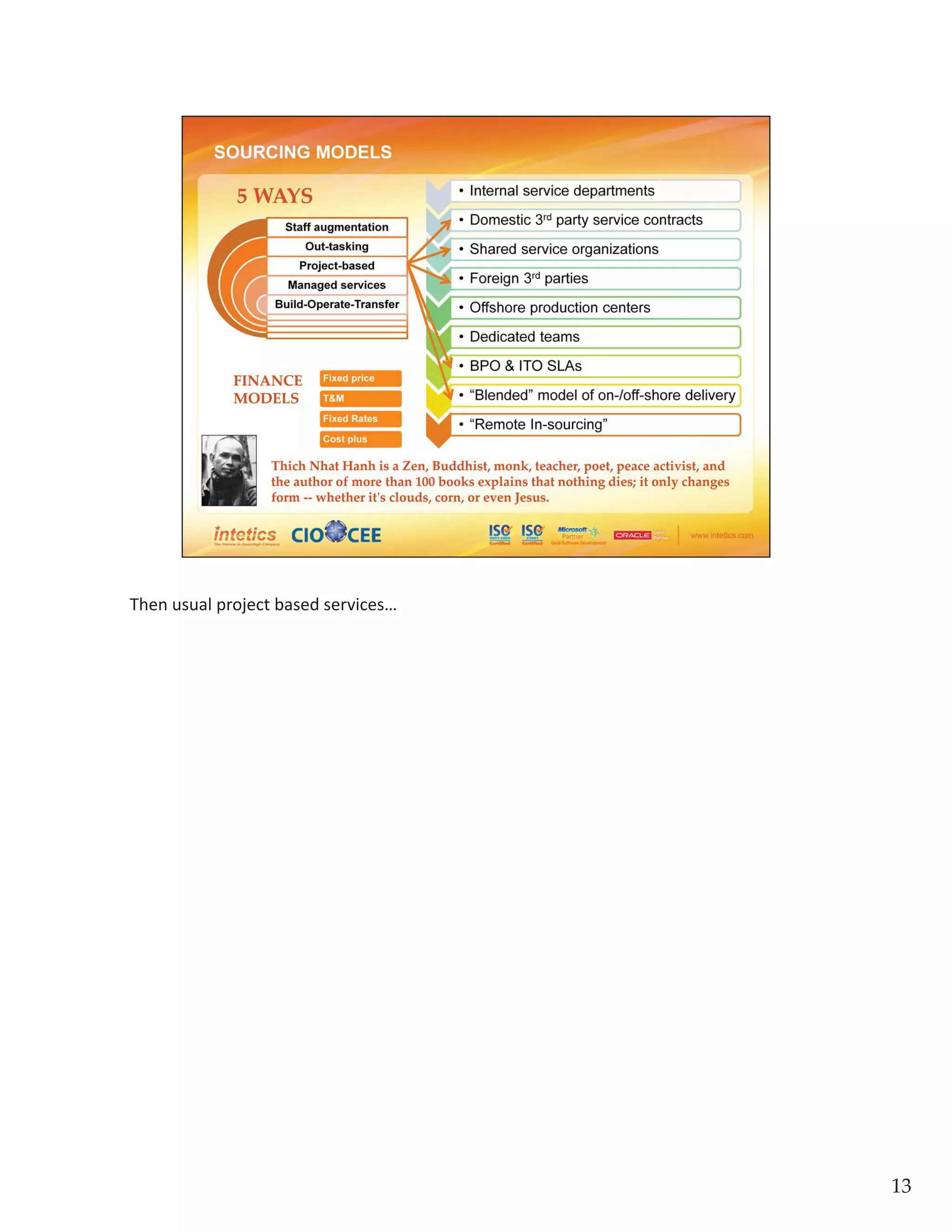
Then usual project based services… 
13
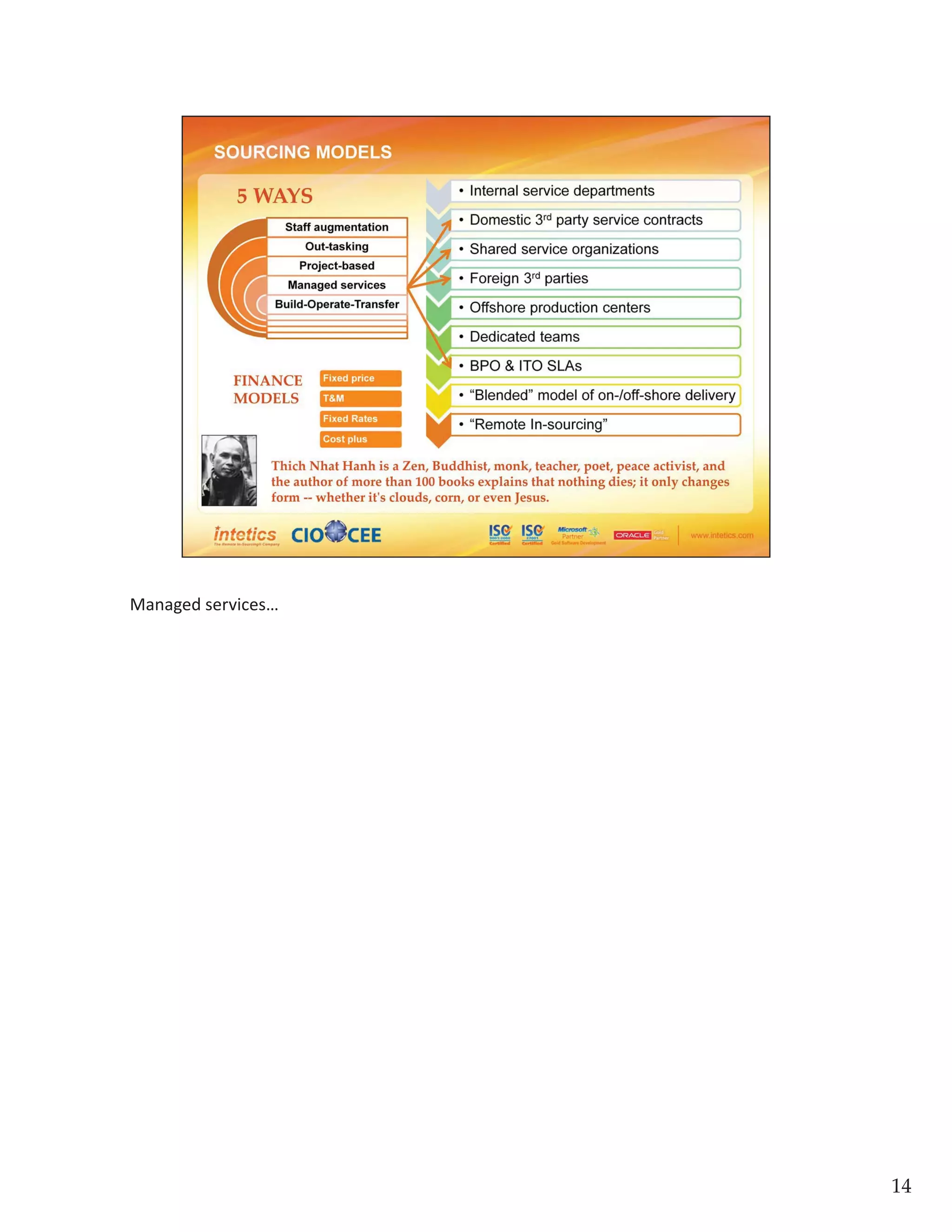
Managed services…
14
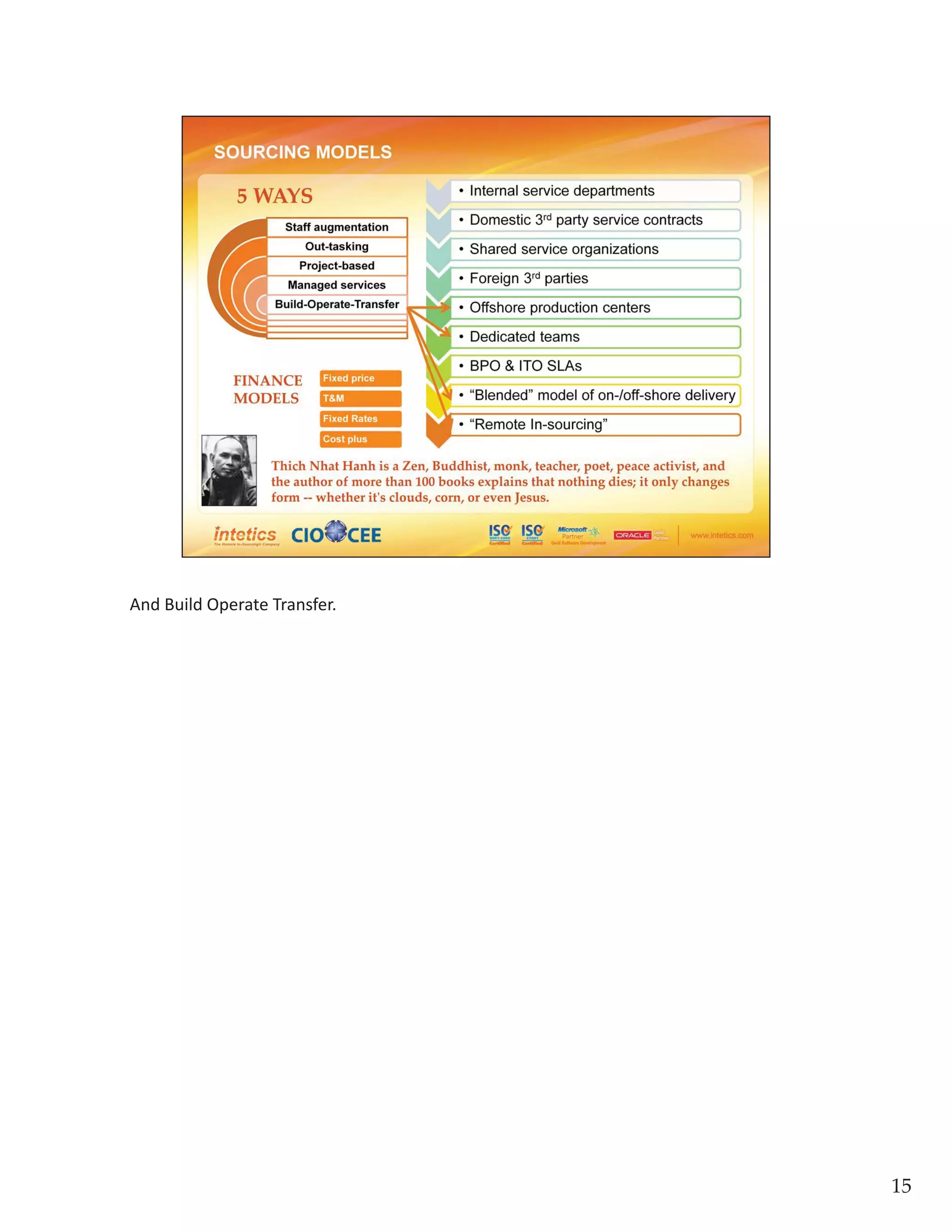
And Build Operate Transfer.
15
Now let’s recall what sourcing risks had to be mitigated by sourcing Models
16
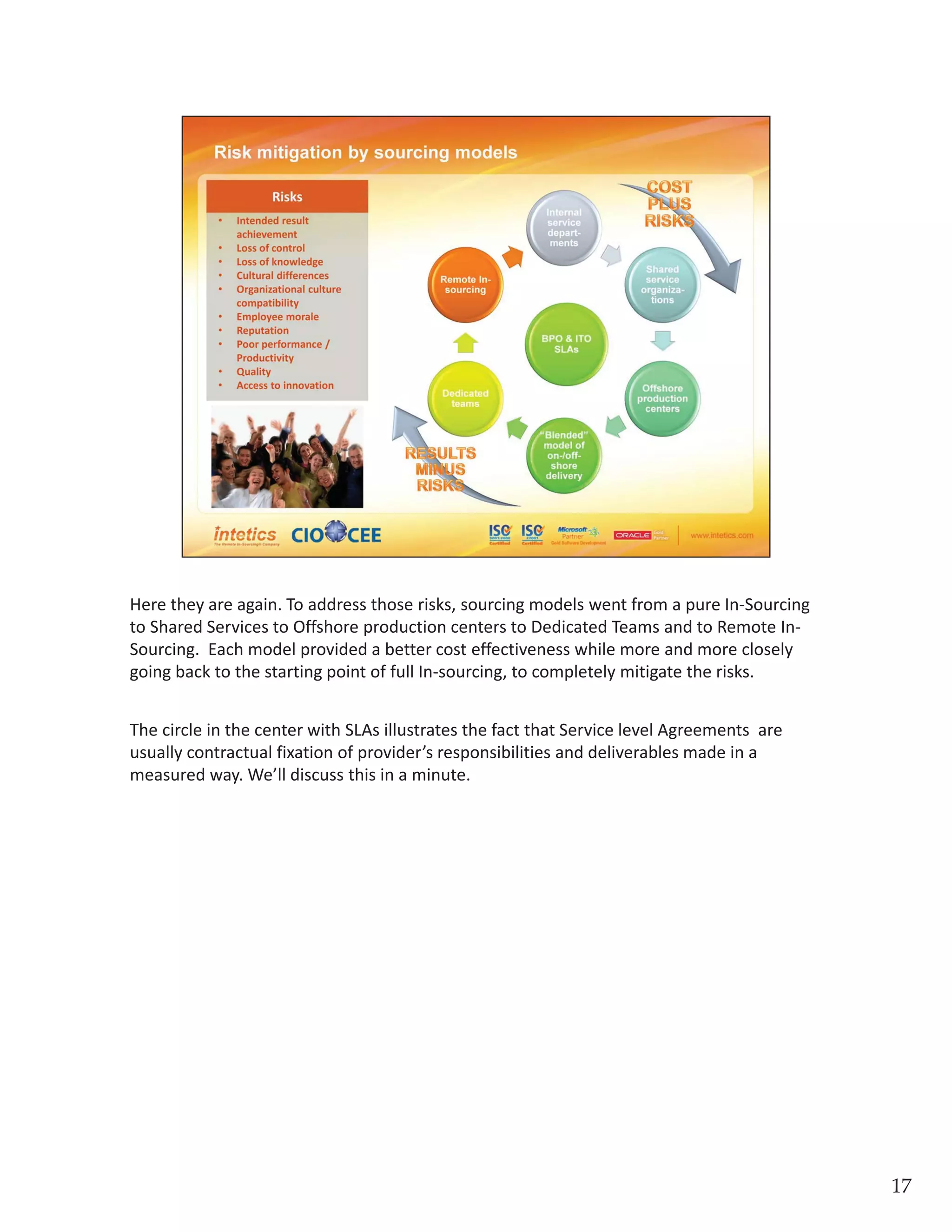
Here they are again. To address those risks, sourcing models went from a pure In‐Sourcing 
to Shared Services to Offshore production centers to Dedicated Teams and to Remote In‐
Sourcing.  Each model provided a better cost effectiveness while more and more closely 
going back to the starting point of full In‐sourcing, to completely mitigate the risks.The
circle in the center with SLAs illustrates the fact that Service level Agreements  are usually 
contractual fixation of provider’s responsibilities and deliverables made in a measured way. 
We’ll discuss this in a minute.  
17
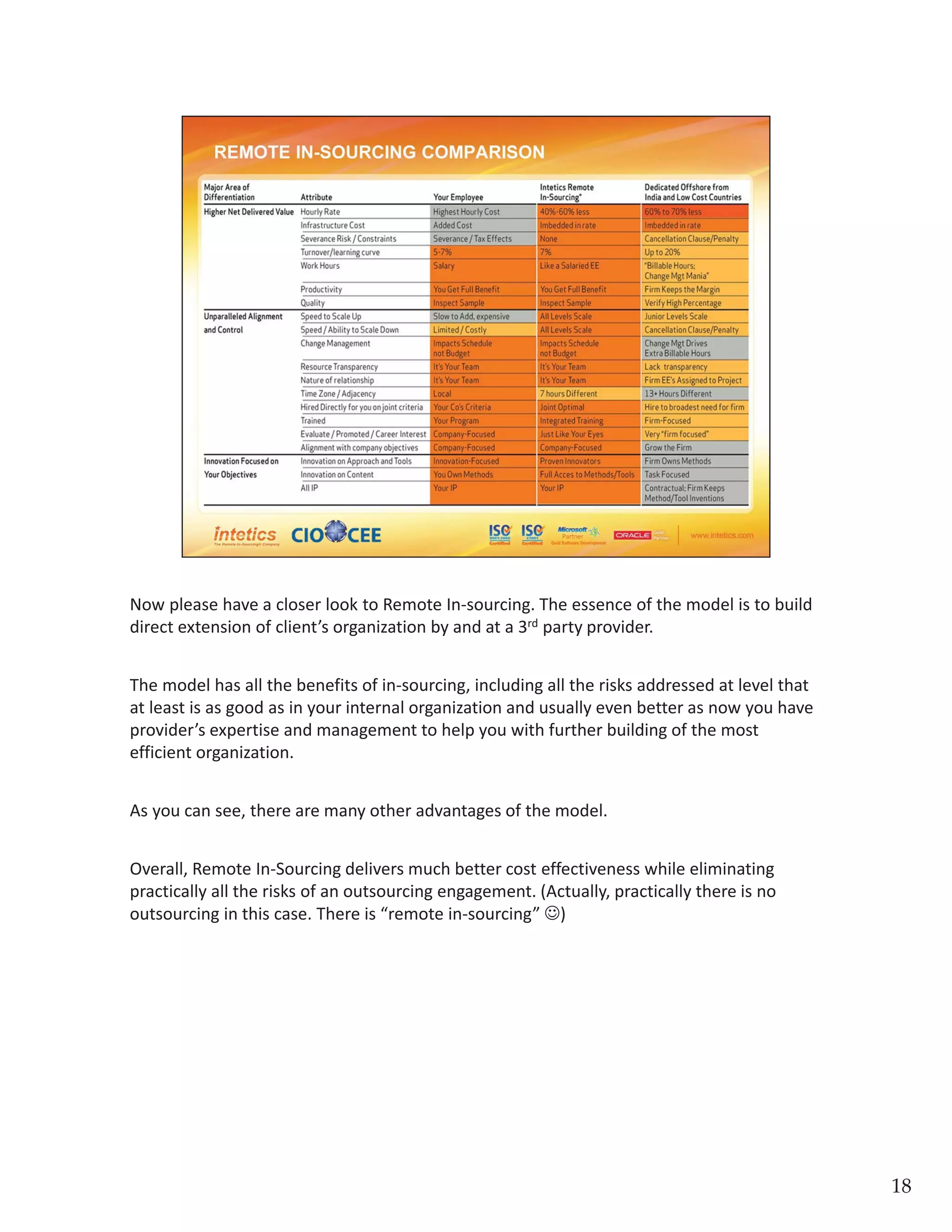
Now please have a closer look to Remote In‐sourcing. The essence of the model is to build 
direct extension of client’s organization by and at a 3rd‐party provider. 
The model has all the benefits of in‐sourcing, including all the risks addressed at level that 
at least is as good as in your internal organization and usually even better as now you have 
provider’s expertise and management to help you with further building of the most 
efficient organization. 
As you can see, there are many other advantages of the model. 
Overall, Remote In‐Sourcing delivers much better cost effectiveness while eliminating 
practically all the risks of an outsourcing engagement. (Actually, practically there is no 
outsourcing in this case. There is “remote in‐sourcing” 
18
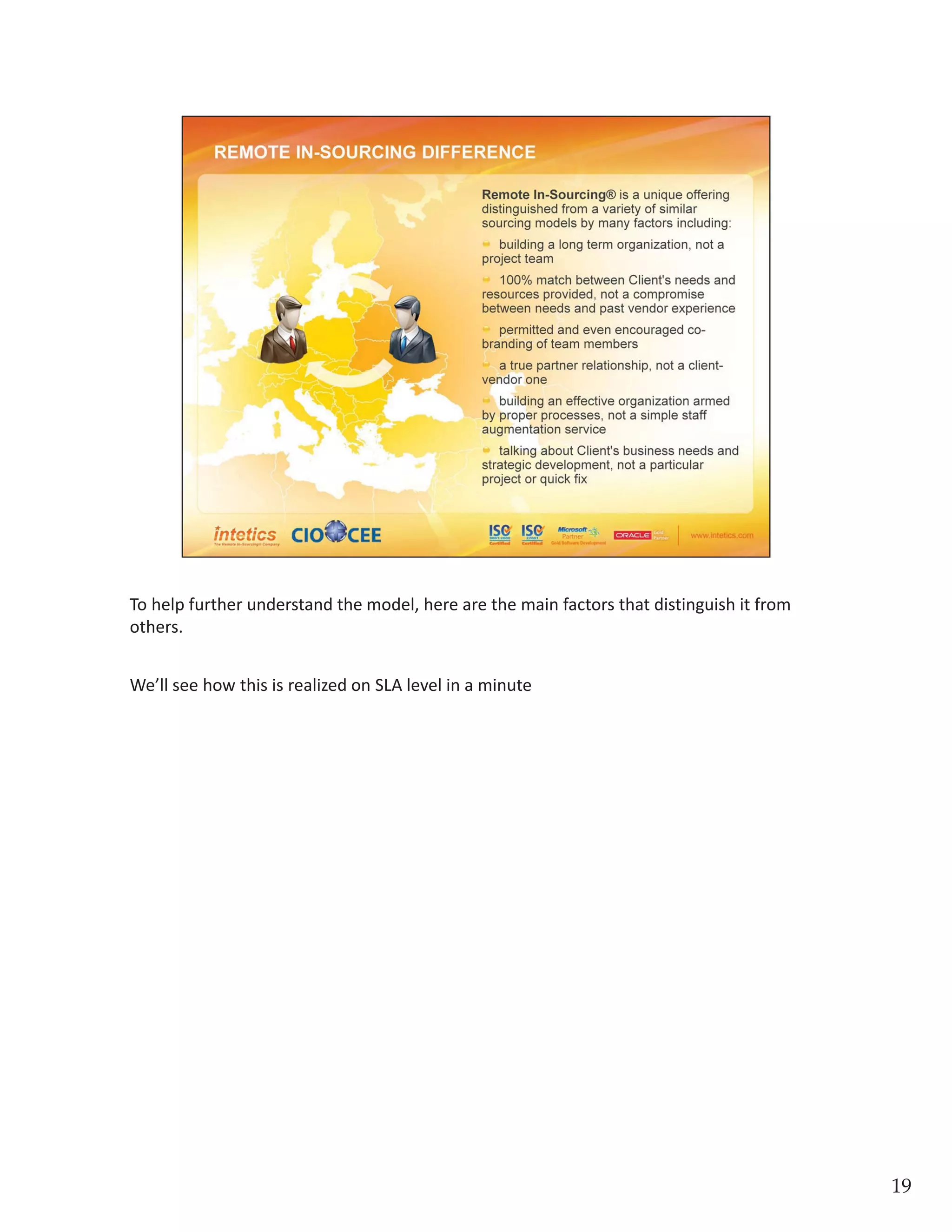
To help further understand the model, here are the main factors that distinguish it from 
others. 
We’ll see how this is realized on SLA level in a minute. 
19
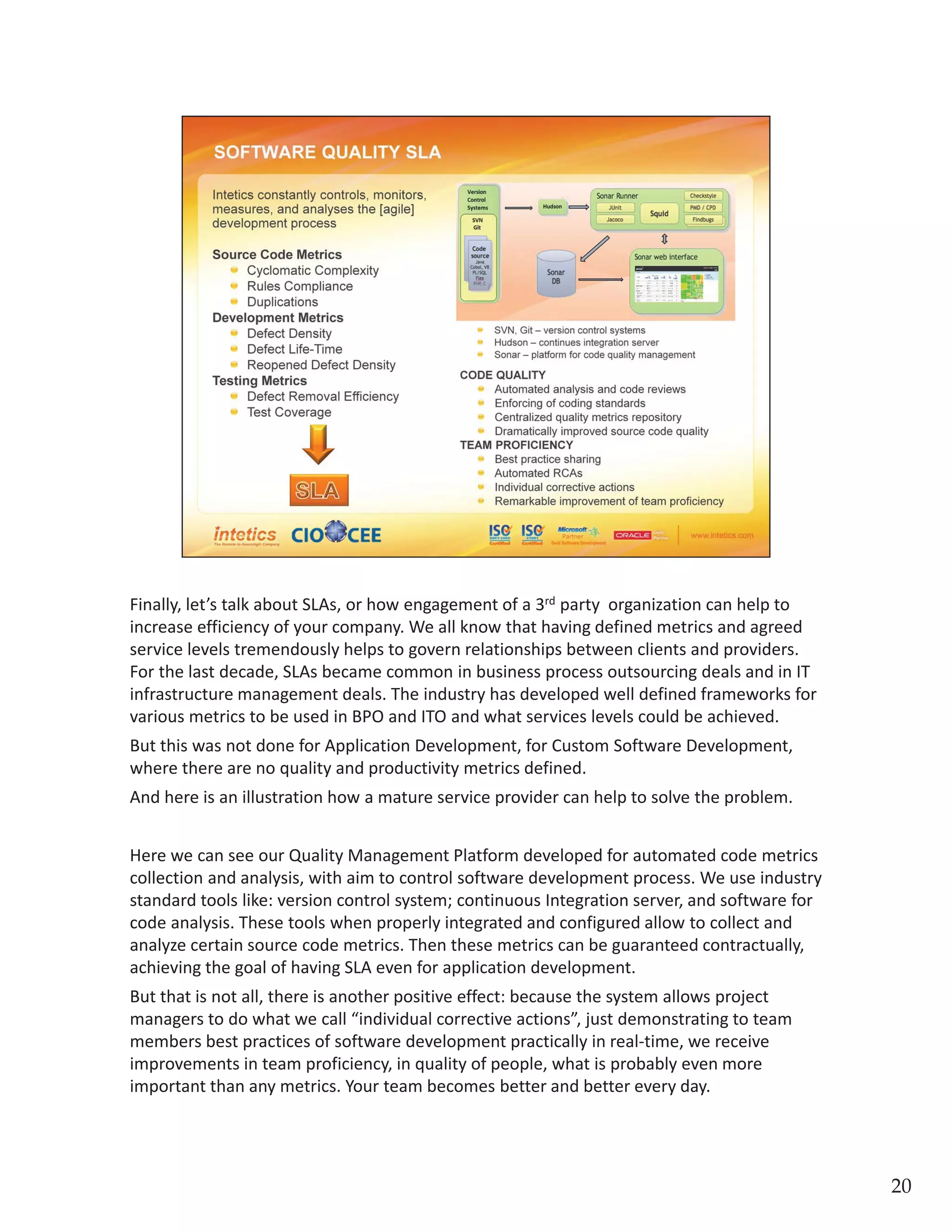
Finally, let’s talk about SLAs, or how engagement of a 3rdparty  organization can help to 
increase efficiency of your company. We all know that having defined metrics and agreed 
service levels tremendously helps to govern relationships between clients and providers. 
For the last decade, SLAs became common in business process outsourcing deals and in IT 
infrastructure management deals. The industry has developed well defined frameworks for 
various metrics to be used in BPO and ITO and what services levels could be achieved.  But 
this was not done for Application Development, for Custom Software Development, where 
there are no quality and productivity metrics defined. And here is an illustration how a 
mature service provider can help to solve the problem.
Here we can see our Quality Management Platform developed for automated code metrics 
collection and analysis, with aim to control software development process. We use industry 
standard tools like: version control system; continuous Integration server, and software for 
code analysis. These tools when properly integrated and configured allow to collect and 
analyze certain source code metrics. Then these metrics can be guaranteed contractually, 
achieving the goal of having SLA even for application development.  But that is not all, 
there is another positive effect: because the system allows project managers to do what 
we call “individual corrective actions”, just demonstrating to team members best practices 
of software development practically in real‐time, we receive improvements in team 
proficiency, in quality of people, what is probably even more important than any metrics. 
Your team becomes better and better every day.
20
The main take away form my presentation is that there is a way, Remote In‐Sourcing, that 
allow to address majority, if not all, outsourcing risks and utilize all the benefits of 
outsourcing. 
21

Evolution of outsourcing models: risk management & remote insourcing