










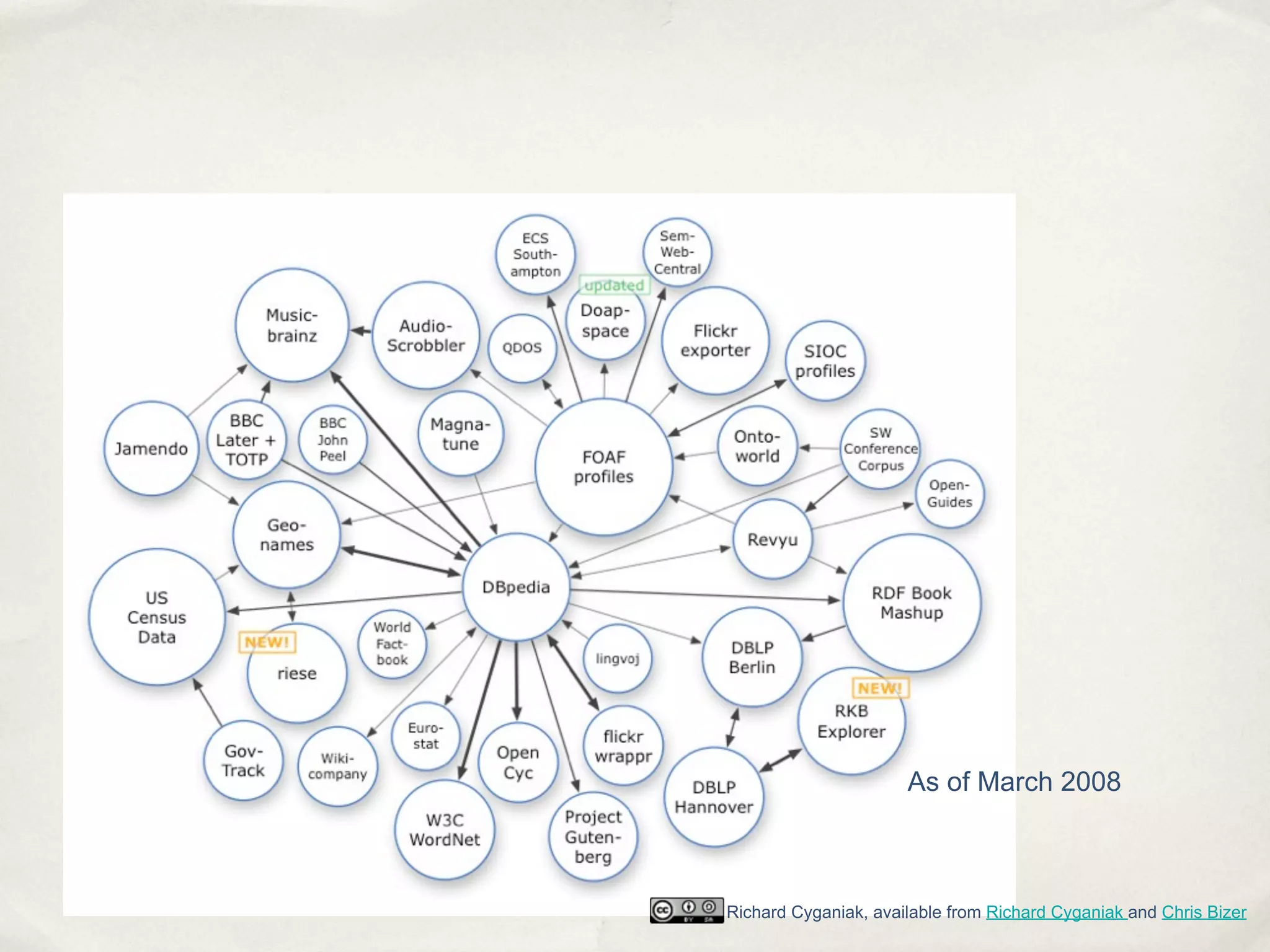
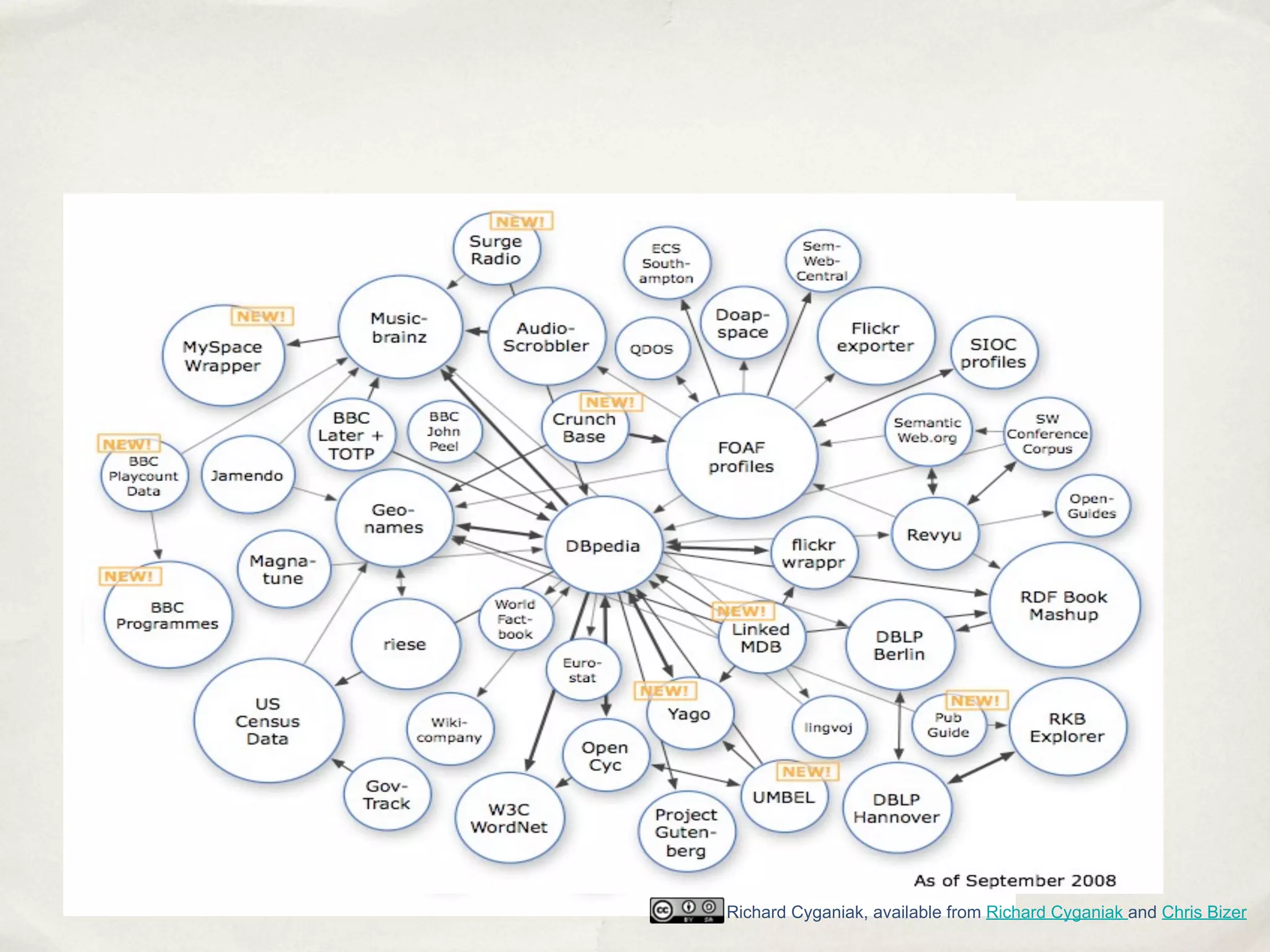
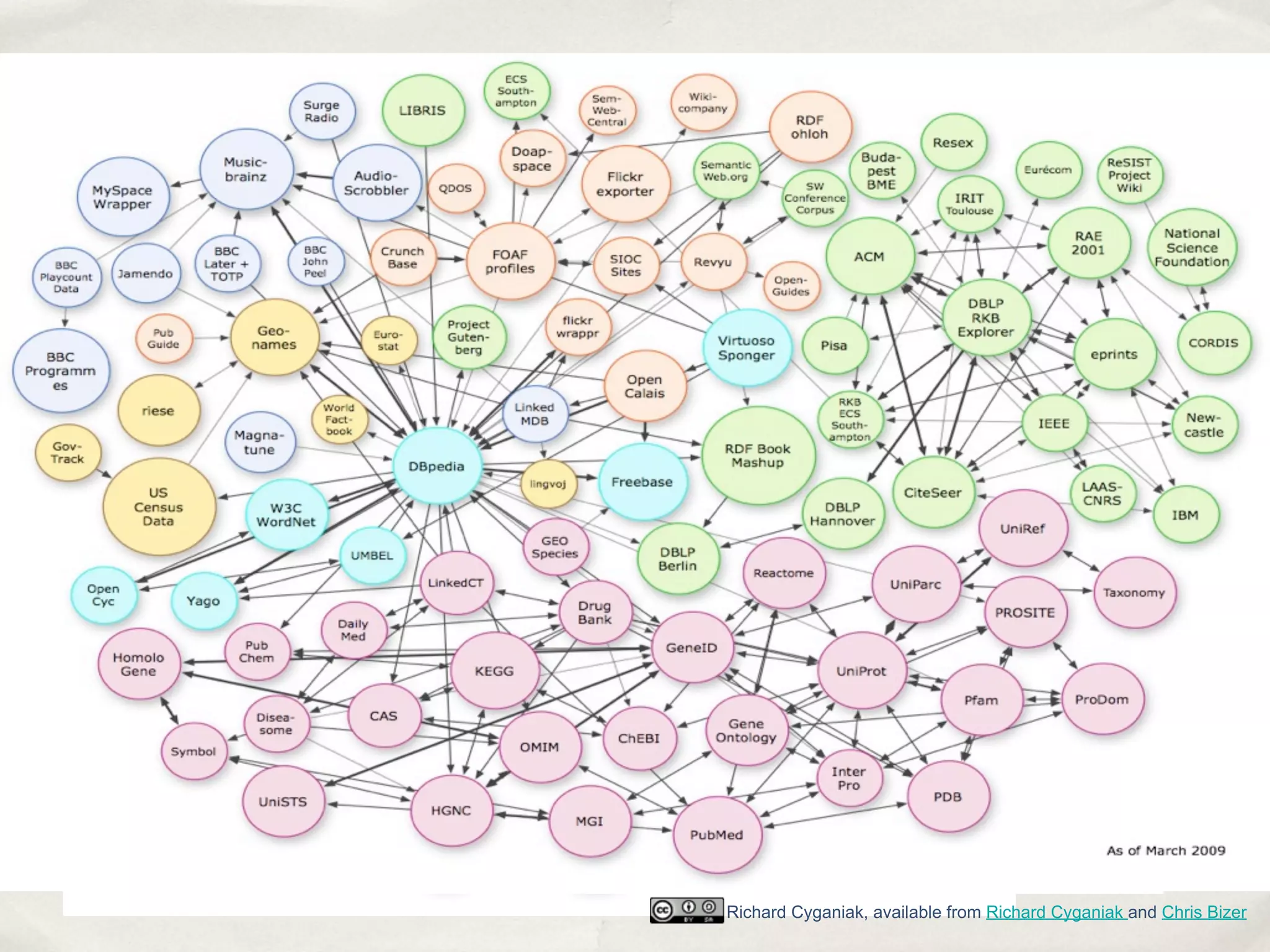
Evolution: It's a process

Editor's Notes

  • #3  When you markup your data semantically, you and anyone else can use that data to their best advantage. Unanticipated uses by unanticipated users. Enable your MacGyvers as Anthony Bradley of Gartner encouraged attendees at last Septembers Web Innovation Summit. Semantic Web is the internet’s equivalent of the Green Building movement: reduce, recycle, reuse. (Re-use, re-mix, = Mashup)
  • #4 The “semantic web” is not the answer - it is a potential solution for existing business problems. Consider a semantic solution just as you would consider any other solution.
  • #5 We are not looking for a Google killer; there is a difference between documents on the web and data on the web. Google is a leader in providing access to documents and will likely remain so for some time. They will not be replaced, but there is opportunity for a “Google for data” to emerge. The user goals are different, and so the inputs and methods of analysis and retrieval will be different. The semantic web will co-exist with the current web; per TimBLs blog, there will be markets for both raw data and mashed up data Tagging everything does not scale. Everything old is new again – entity extraction and Natural Language processing tools will (are having) a renaissance. There are critical technical and editorial choices to make when employing those tools, but no, everything does NOT need to be tagged. $$$ - not really. Franz recently revealed they had converted 10B triples using Amazon’s EC2 service for just 2 days for only $192. Many semantic web technologies are being built by people passionate about their work, and they are making it open source. Enterprise level applications will want the security and stability of tested, supported systems that require investment – as well as the smart consultants to go along with it – but you can GET STARTED with open source tools while you make your case. It’s not hard to get started, and now we’re going to show you some simple things you can do. The best and most consistent advice I’ve received since becoming interested in the semantic web is this: take baby steps. Solve one discrete problem at a time. Don’t try to read the OWL spec and jump in with an OWL Full representation of your knowledge domain – you’ll drive yourself crazy. Work the model of your domain in small chunks, learn about how to make things disjoint when you have a need for it. Learn about domains and ranges when they come up. Don’t worry about first and second order logic until you’ve advanced to the point where it INTERESTS you and you NEED it. As I was thinking about how to begin this presentation, I mused over some ideas at home. It is human nature to reuse, to mash-up data. In early childhood we use the same tune to carry the lyrics for Baa, Baa Black Sheep, Twinkle Twinkle Little Star and the ABC song. Authors and playwrights are inspired by earlier myths - Shakespeare may have been inspired by Pyramus and Thisbe or a handful of other stories when he wrote Romeo & Juliet. West Side Story is another adaptation. Baz Luhrman, the film director, took a stab at it with Leonardo DiCaprio as Romeo, and then went on to produce Moulin Rouge, one of the most ambitious mashups of songs and stories seen in the film industry of late, combining snippets and full songs from David Bowie, Bono, Madonna, Elton John, Fatboy Slim, Rufus Wainwright, Labelle, Nirvana, Nat King Cole and many many more.
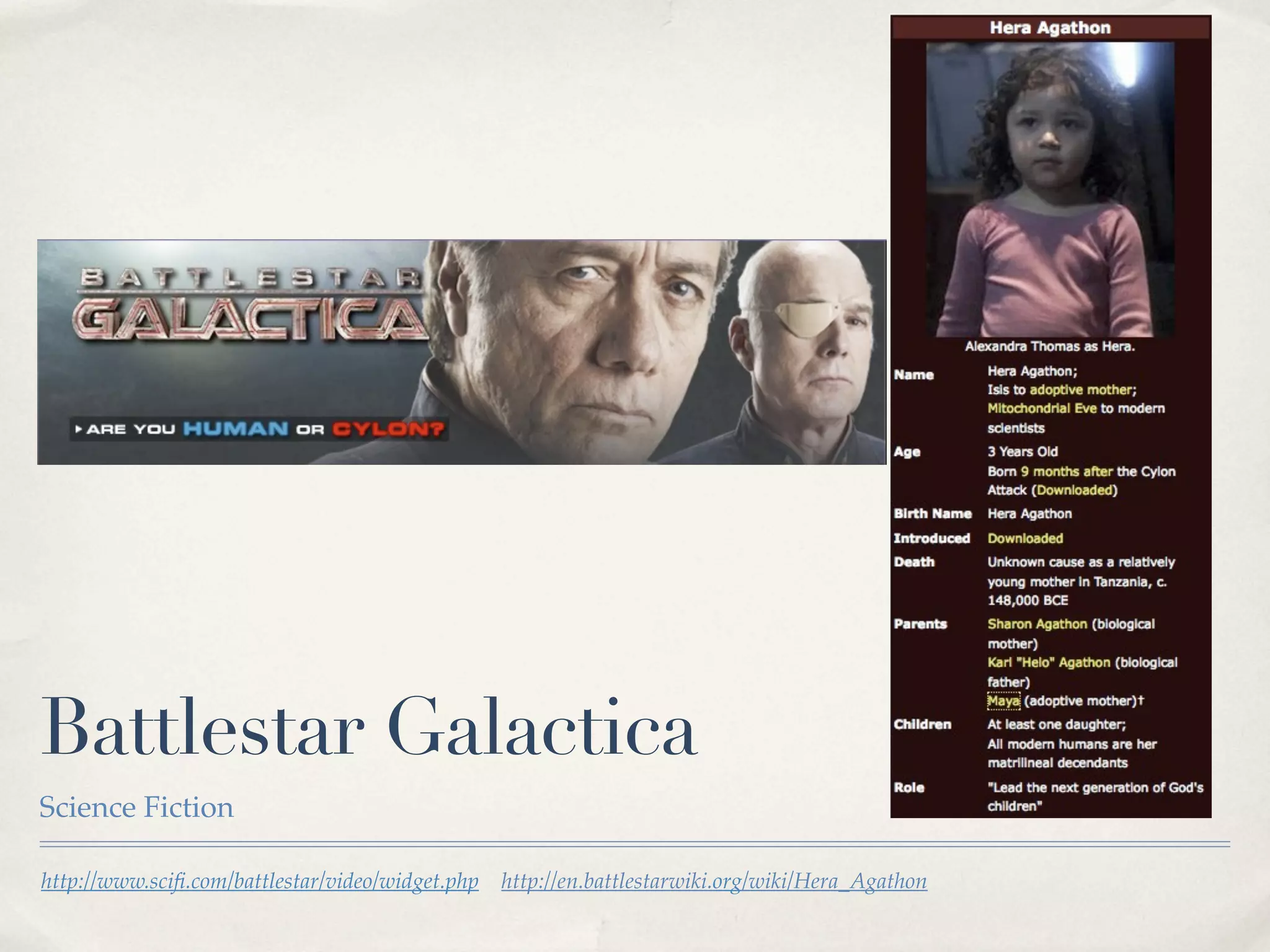
  • #6 http://www.scifi.com/battlestar/includes/untranscript.pdf The United Nations Department of Public Information And SCI FI Channel Present “Battlestar Galactica: A Retrospective” March 17, 2009 KIYOTAKA AKASAKA:To quote Isaac Asimov, famous science fiction author, science fiction writes foresee -- science fiction writers foresee the inevitable.
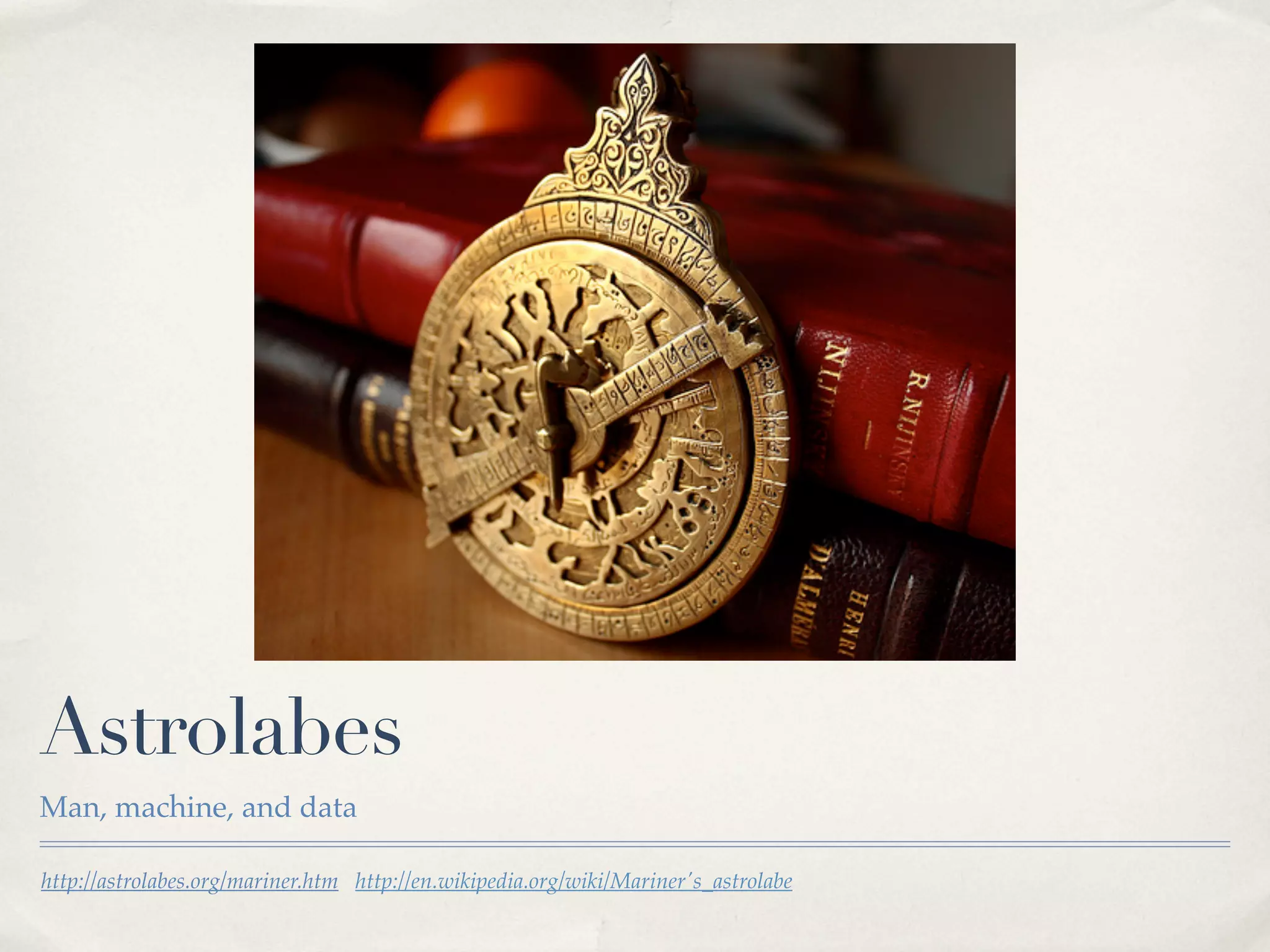
  • #7 The essential function of the device was to measure angles. Thus the instrument featured a ring graduated in degrees. In order to use the astrolabe, the navigator would hold the instrument by the ring at the top. This caused the instrument to remain in a vertical plane. He would align the plane of the astrolabe to the direction of the object of interest. The alidade was aligned to point at the object and the altitude was read off the outer degree scale. It was not possible to determine longitude at sea in the early days of transoceanic navigation, but it was quite easy to determine latitude. To go to a place of known latitude, the ship was sailed to that latitude and then sailed east or west along the latitude line until the place was reached. To find the latitude of the ship at sea, the noon altitude of the Sun was measured during the day or the altitude of a star of known declination was measured when it was on the meridian (due north or south) at night. The Sun's or star's declination for the date was looked up in an almanac. The latitude is then 90° - measured altitude + declination .
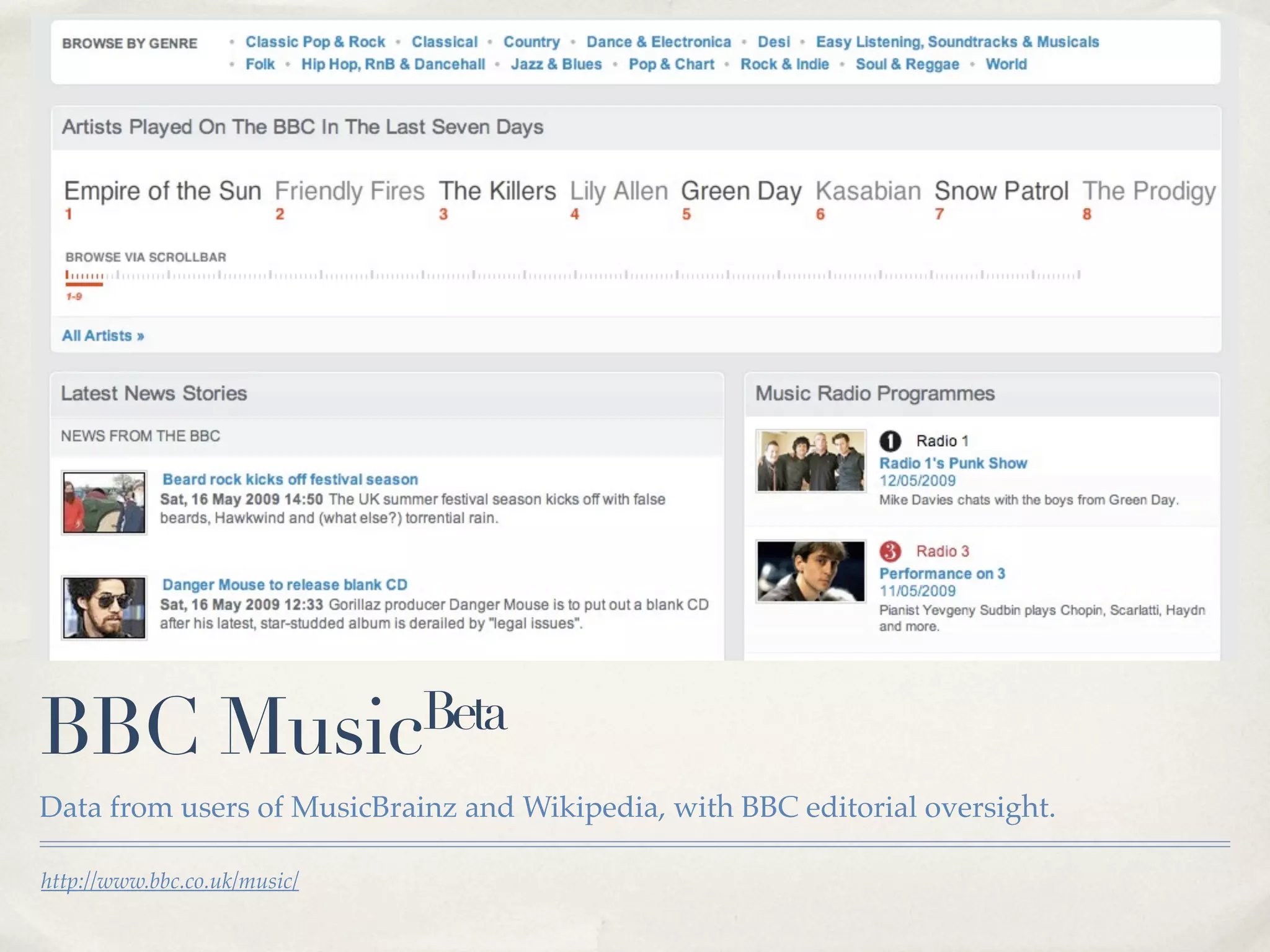
  • #8 Data from MusicBrainz and Wikipedia are combined - with a bit of editorial oversight - with playlists and story data from BBC properties
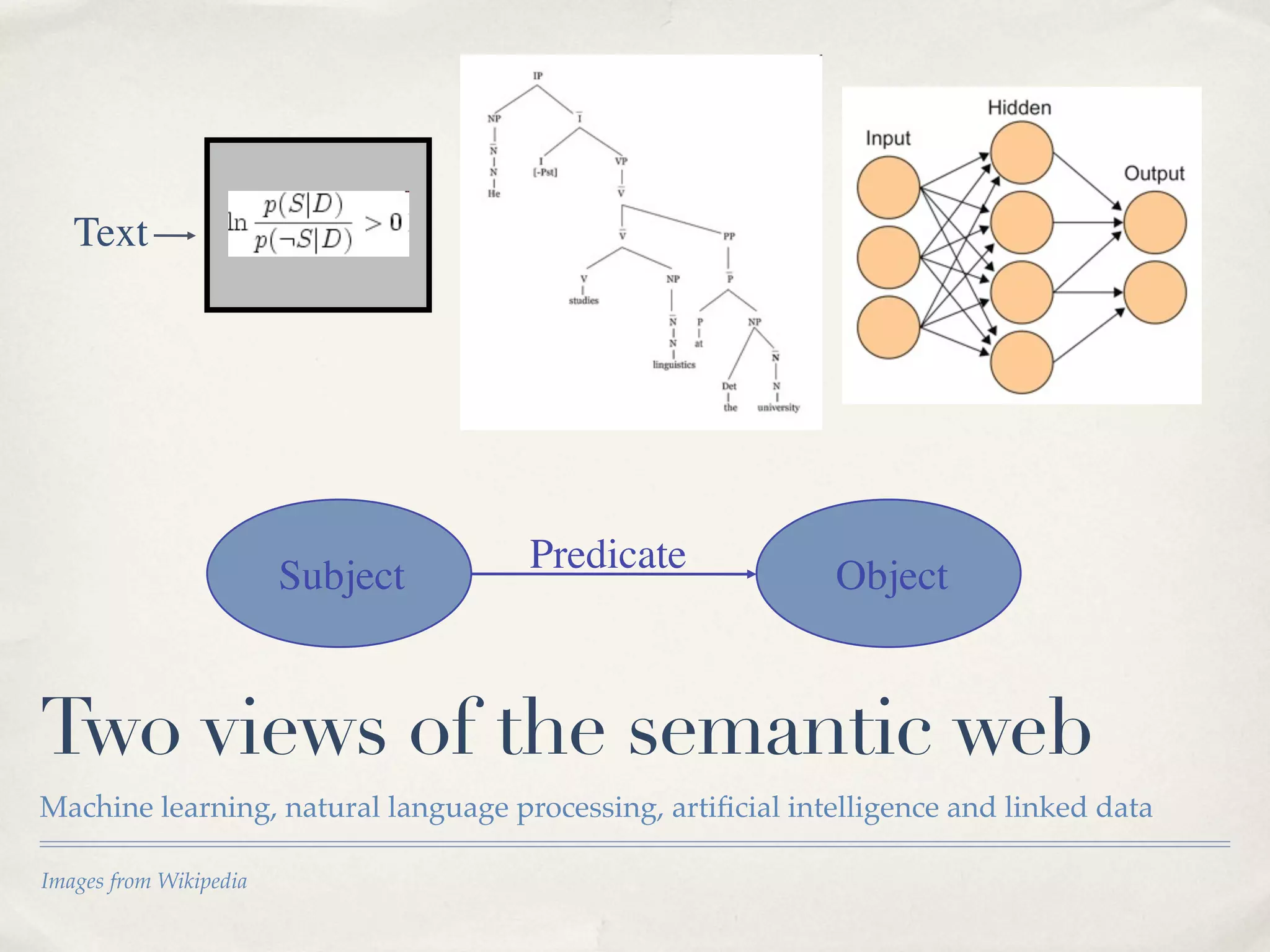
  • #9 There is a computationally complex view of the web that involves Boolean logic, Bayesian algorithms, syntax, pattern recognition, neural networks and more. There is another view that is concerned about meaning, categorization, classification and relationships. This view tends to require more human power. Neither is particularly practical – one requires heavy-duty processing and lots of monitoring. The other requires a great deal of handcrafting and maintaining. Using the best of each world will get you further in the long run. There are brilliant minds working in the artificial intelligence space, and we make great use of those tools in our own processing platform, but that’s not what we’re going to focus on today. Today, we’ll be talking about a web of data – linked data; the vision promoted by the world wide web consortium. The semantic web is NOT a new web, in fact the specifications are on average a decade old. It is an open framework designed to allow data to be shared by as many people, organizations and applications as is desired. Right now the majority of the data on the web is locked up in applications and markup languages that jumble the format, the style, delivery mechanism and the content all together. The semantic web is a group of standards that provide the common format for describing data so that data from different sources can easily be combined and integrated rather than siloed. http://en.wikipedia.org/wiki/File:Artificial_neural_network.svg http://en.wikipedia.org/wiki/File:Xbarst1.jpg http://en.wikipedia.org/wiki/Naive_Bayes_classifier
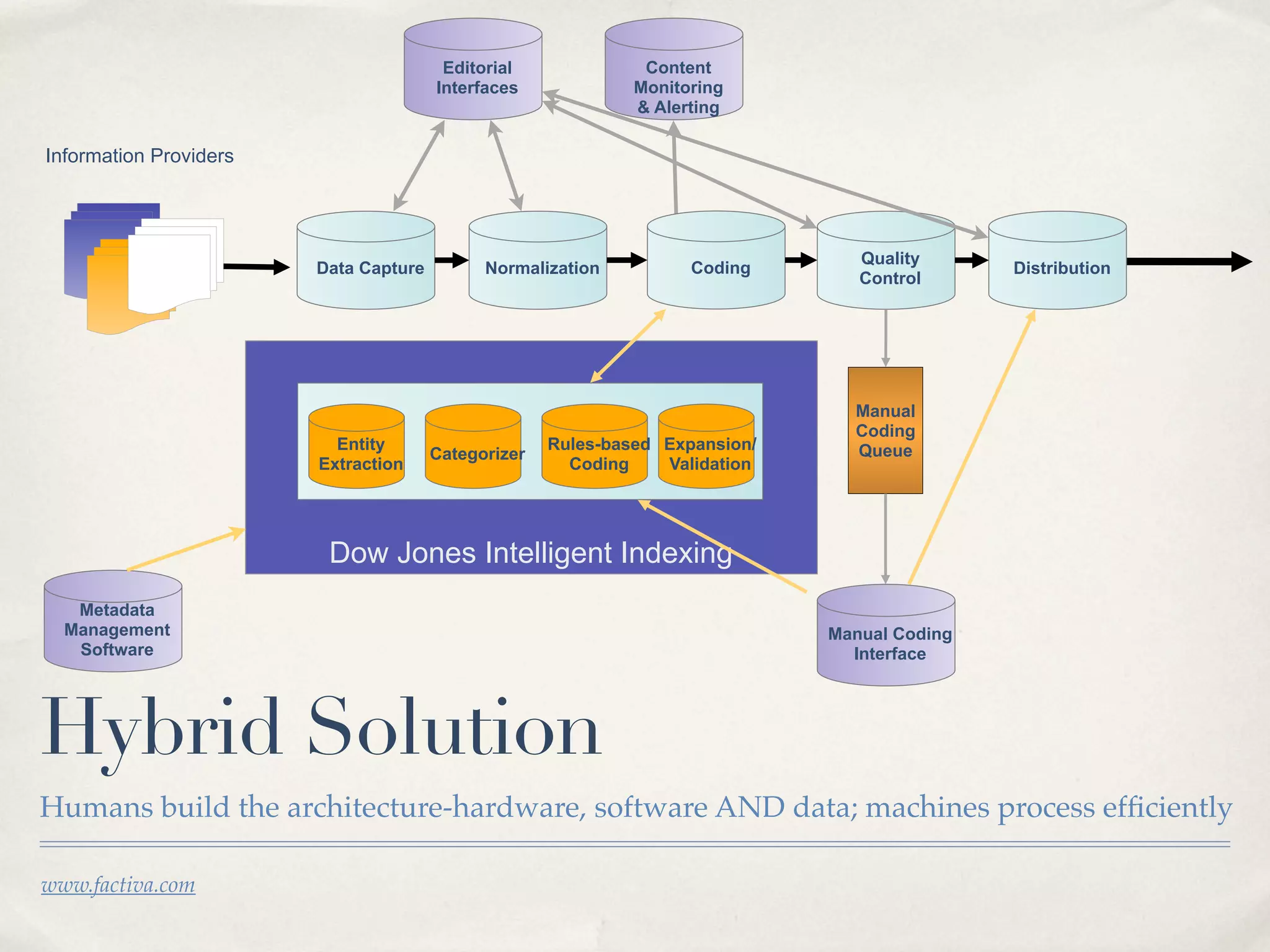
  • #10 i am editorial side not programming; semweb is about data; NLP etc have come a long way during web2 and will continue to be refined; XML - extensible, not interoperable -- not enough; grammar not meaning So, what powers the Dow Jones metadata platform? Human crafted taxonomies and ontologies, built using COTS software. Nothing new really, it’s another technique with a long tradition behind it.
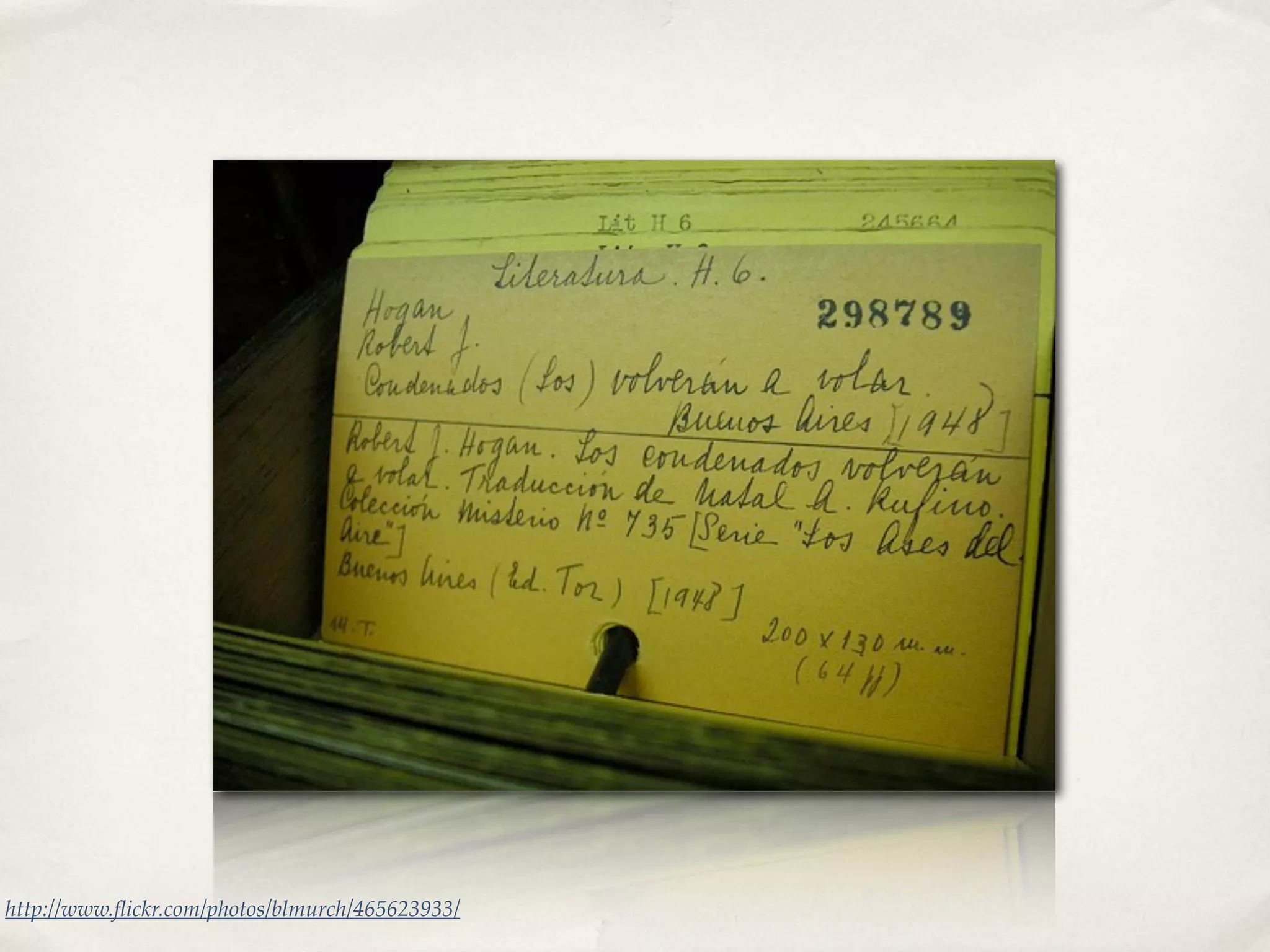
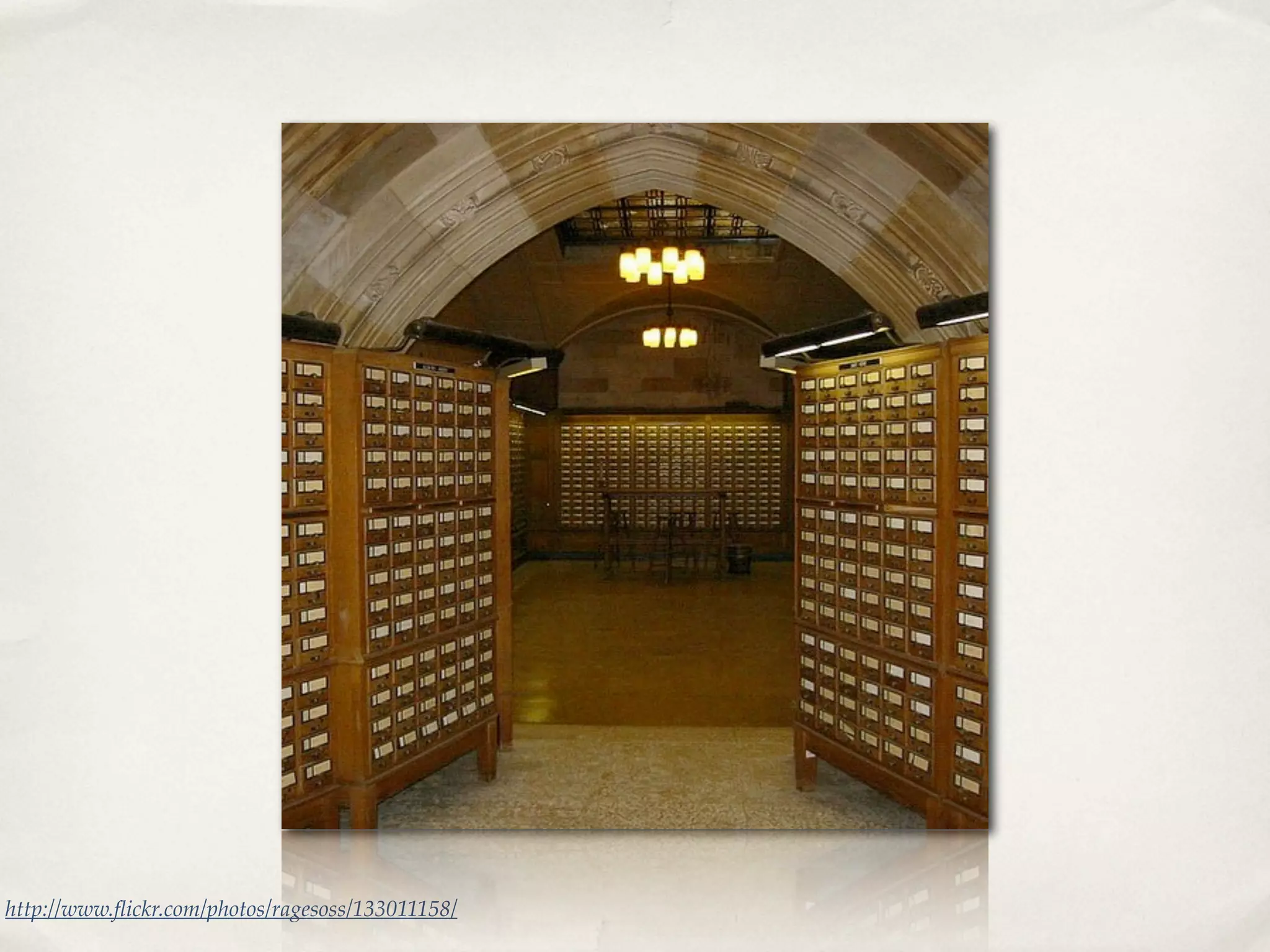
  • #15 This is the card catalog room at the Sterling Memorial Library, Yale. Metadata goes back quite far, actually. In the British Museum are girginakku, Mesopotamian library boxes that have clay tablet labels on them - metadata. Go see David’s picture at http://www.flickr.com/photos/70494923@N00/2650269503/in/photostream/ SO what are taxonomies, ontologies etc? Let’s talk about it.
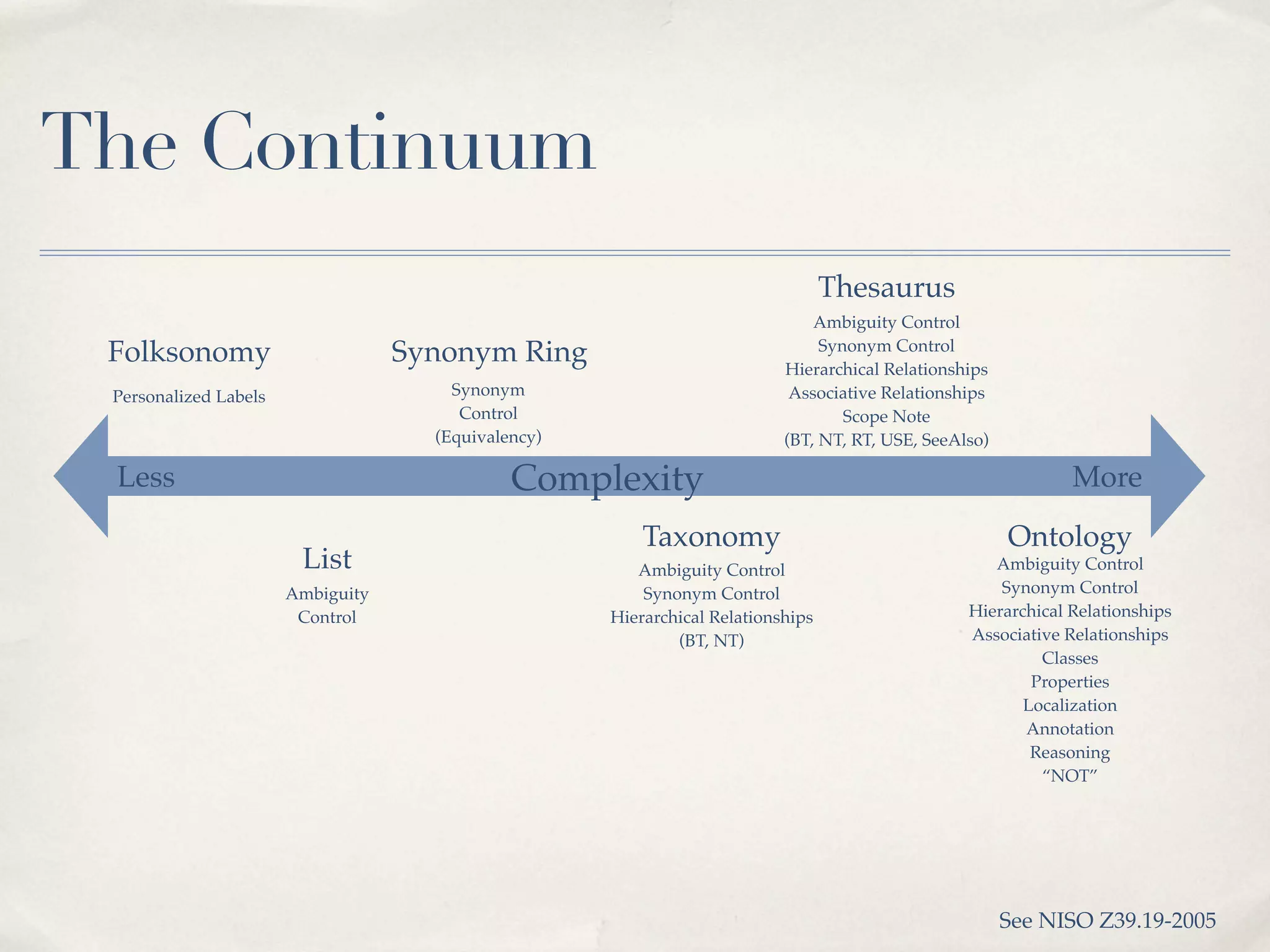
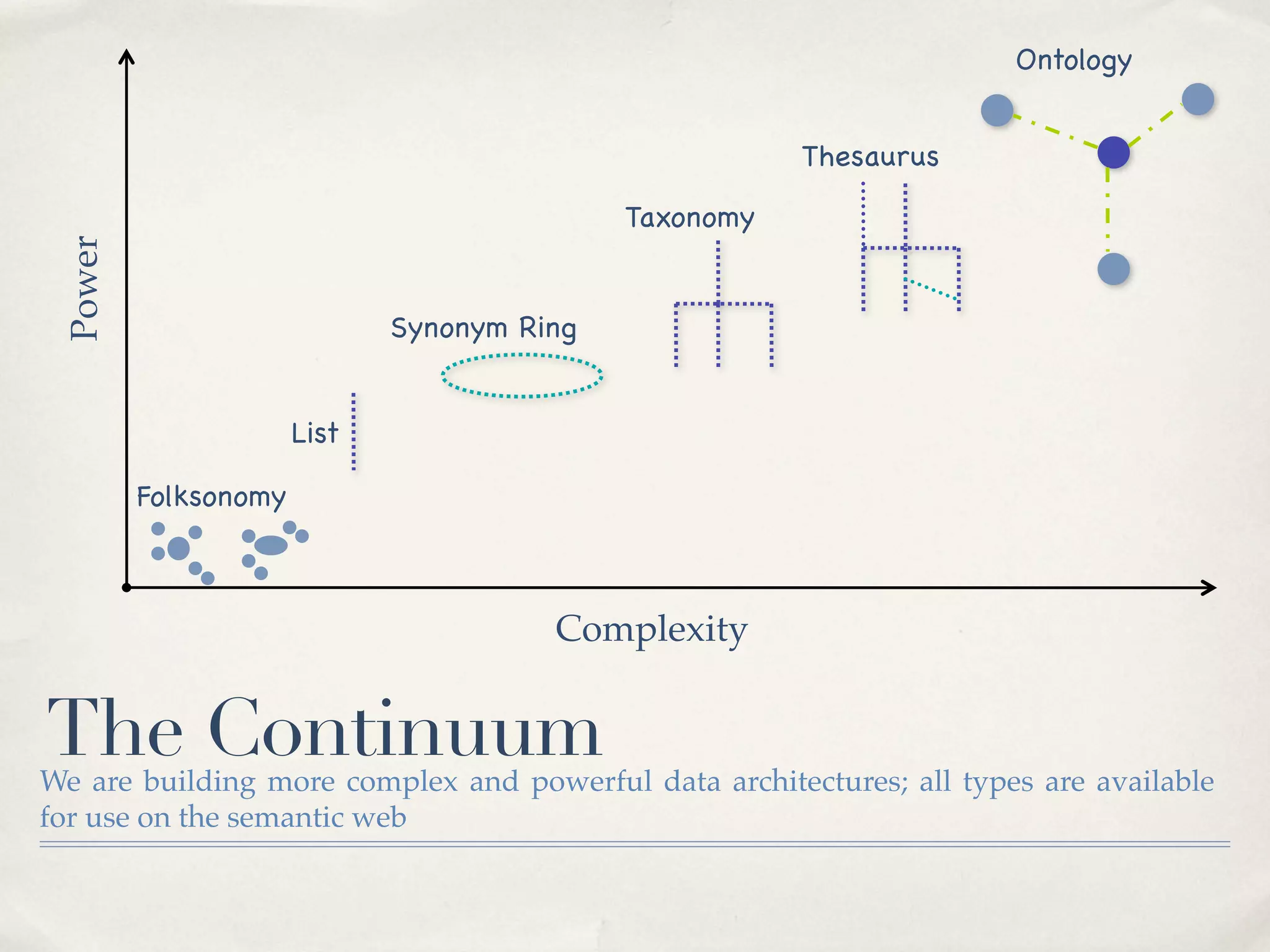
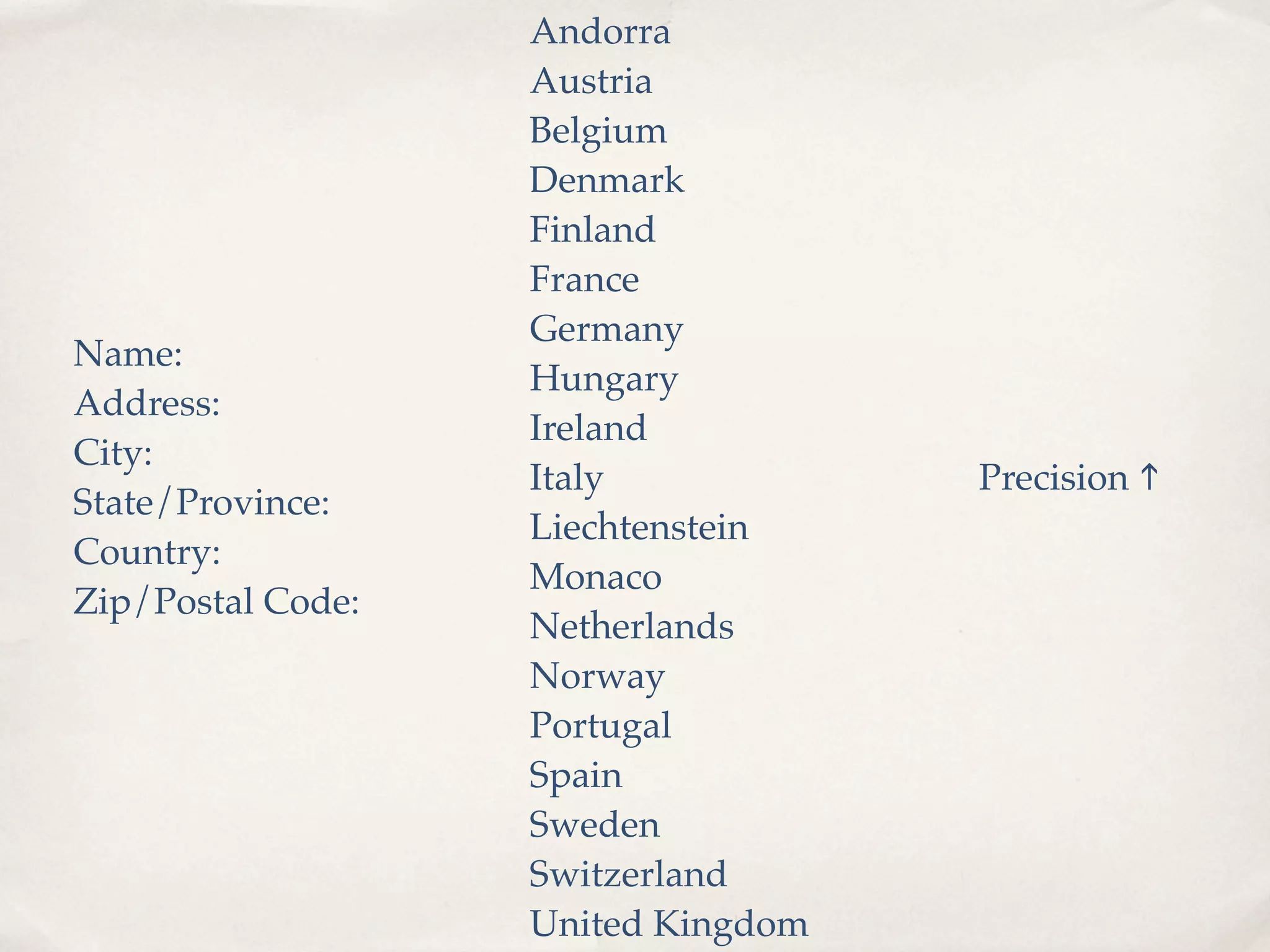
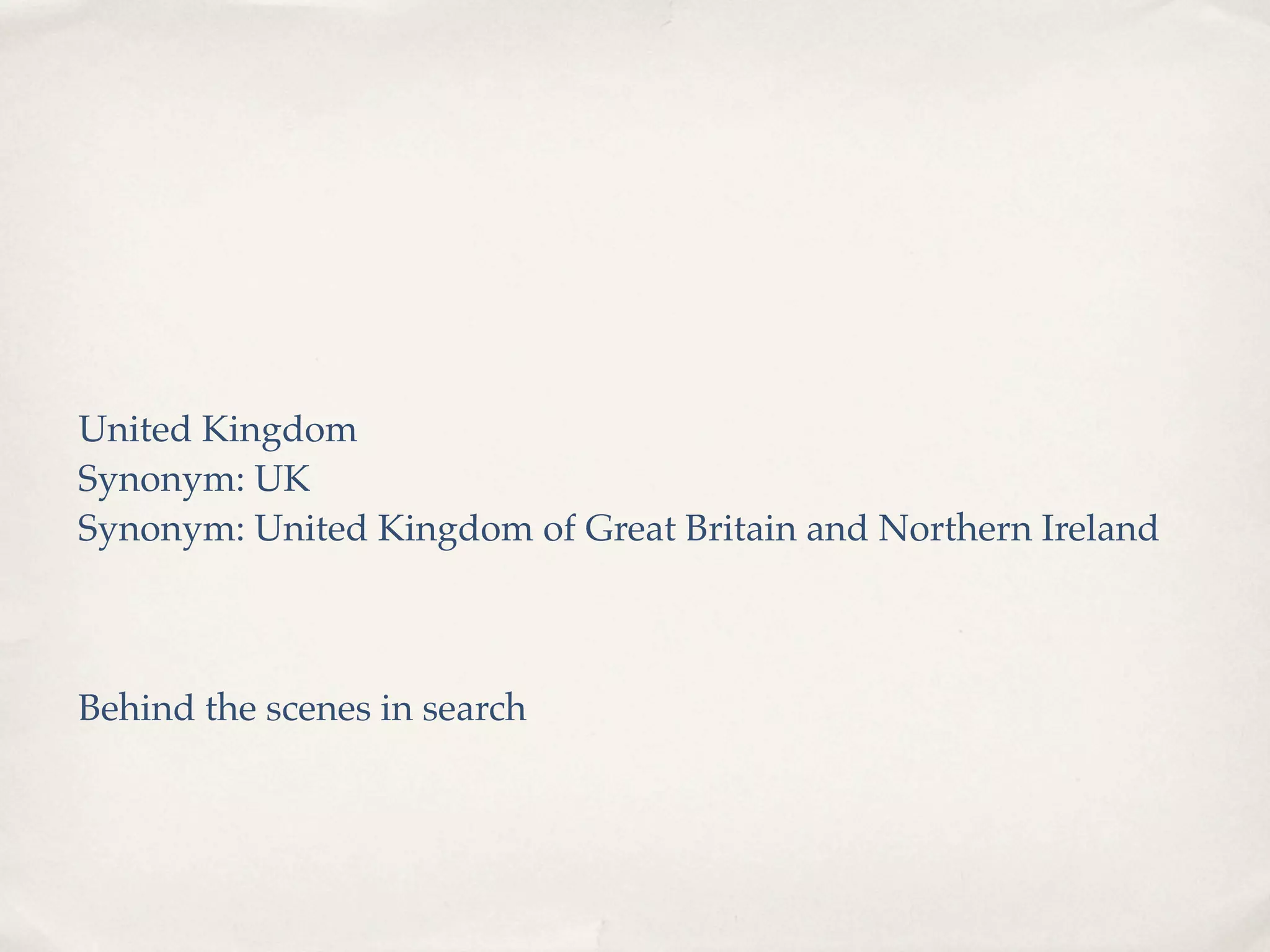
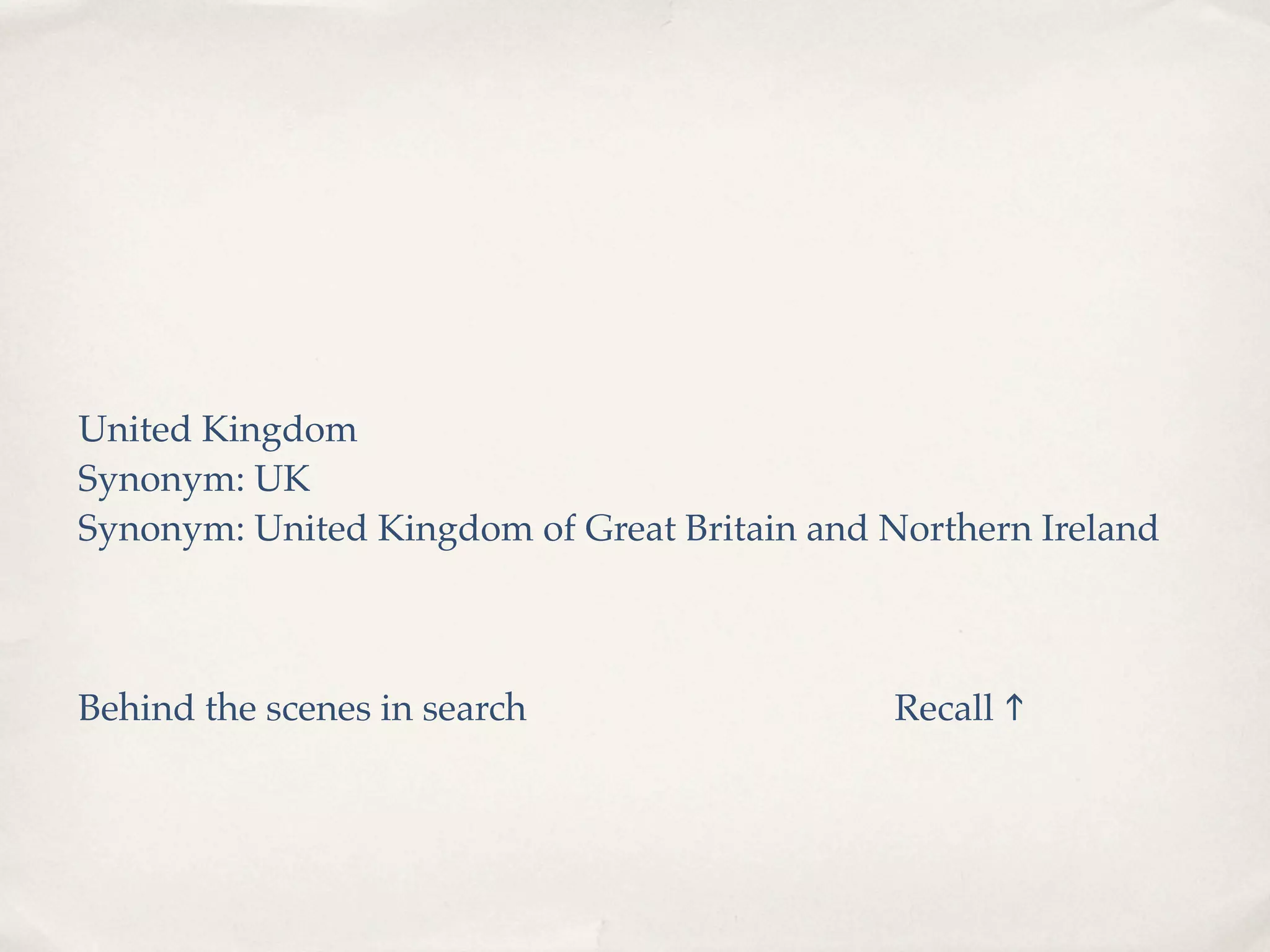
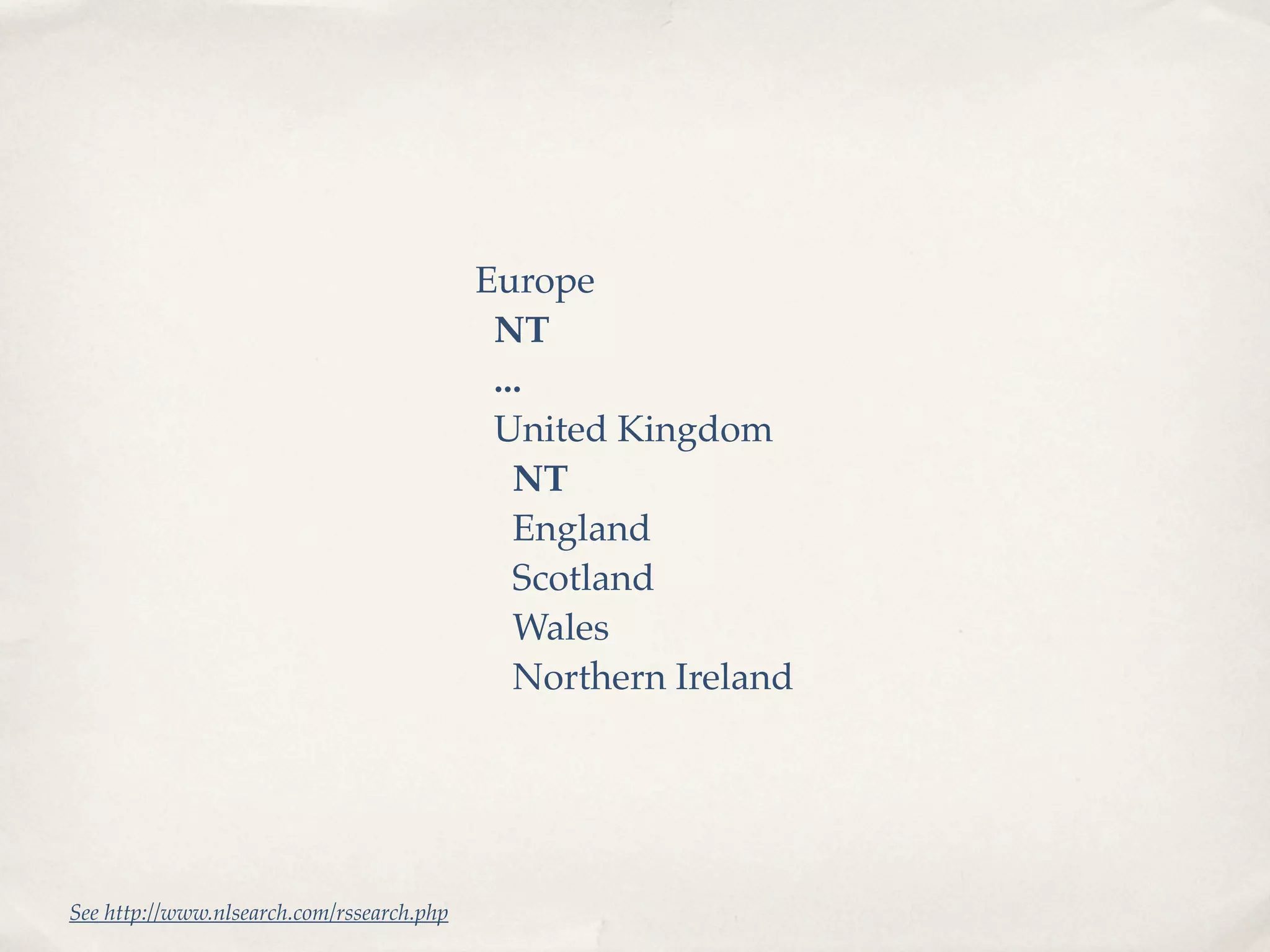
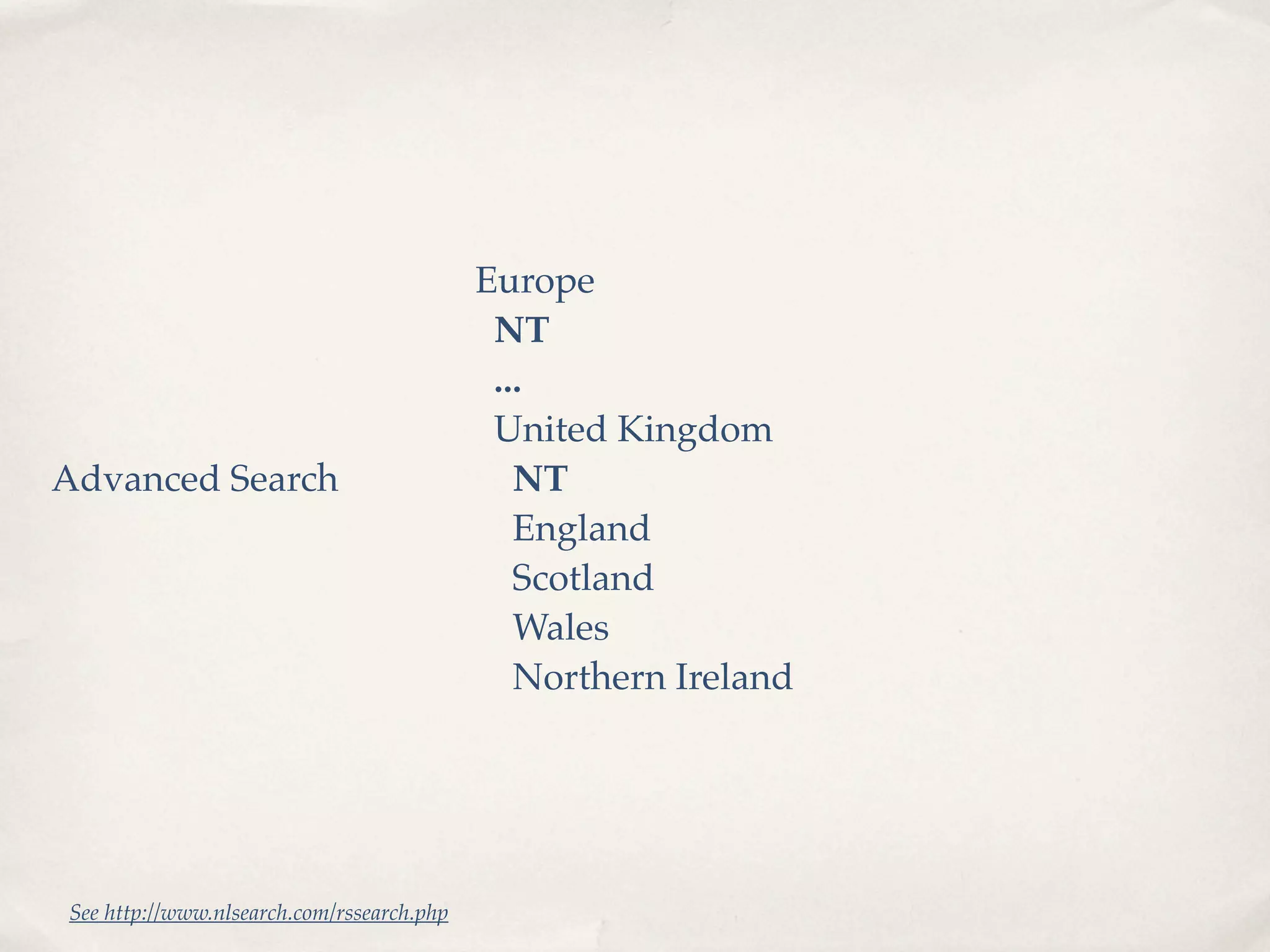
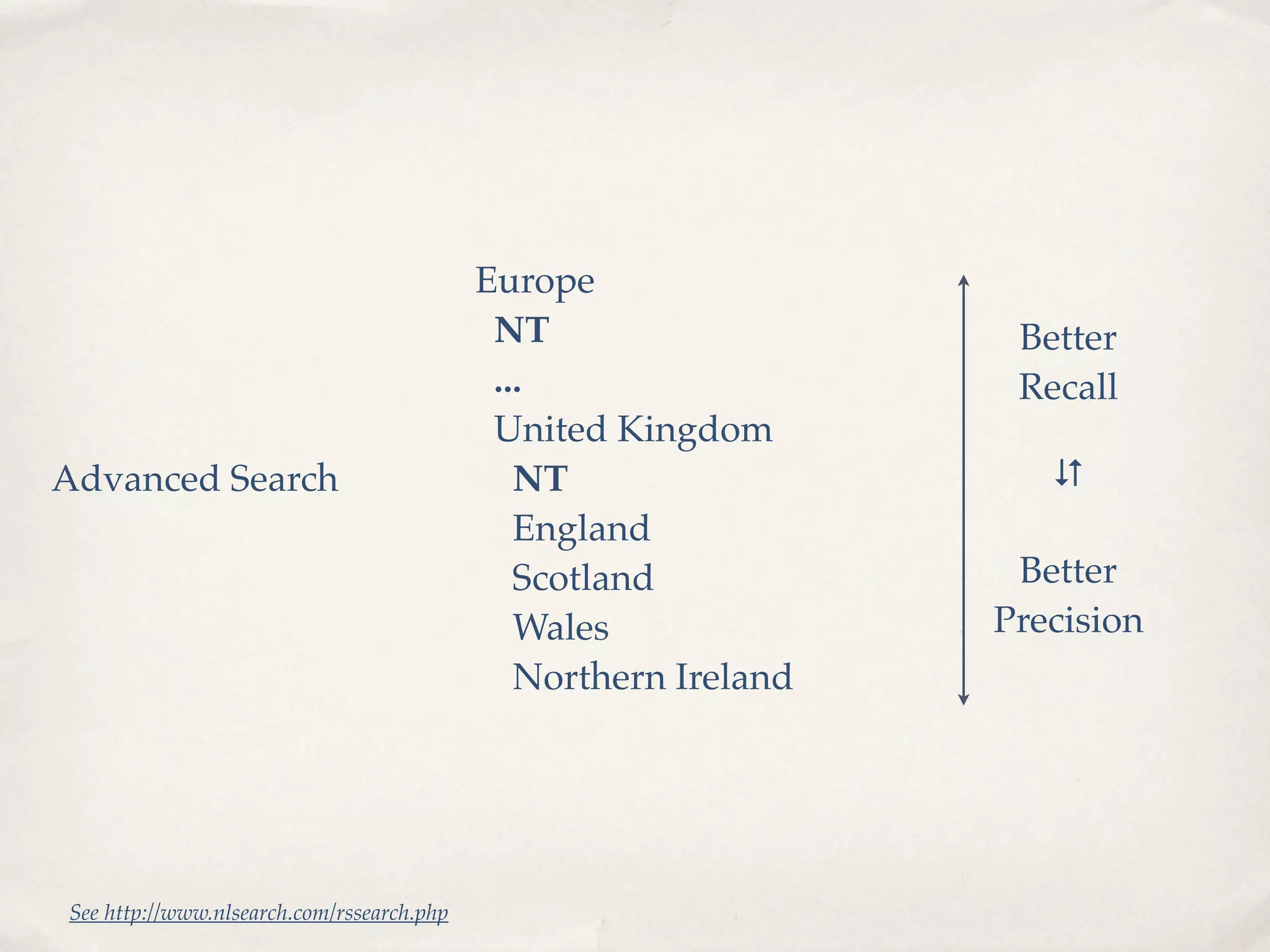
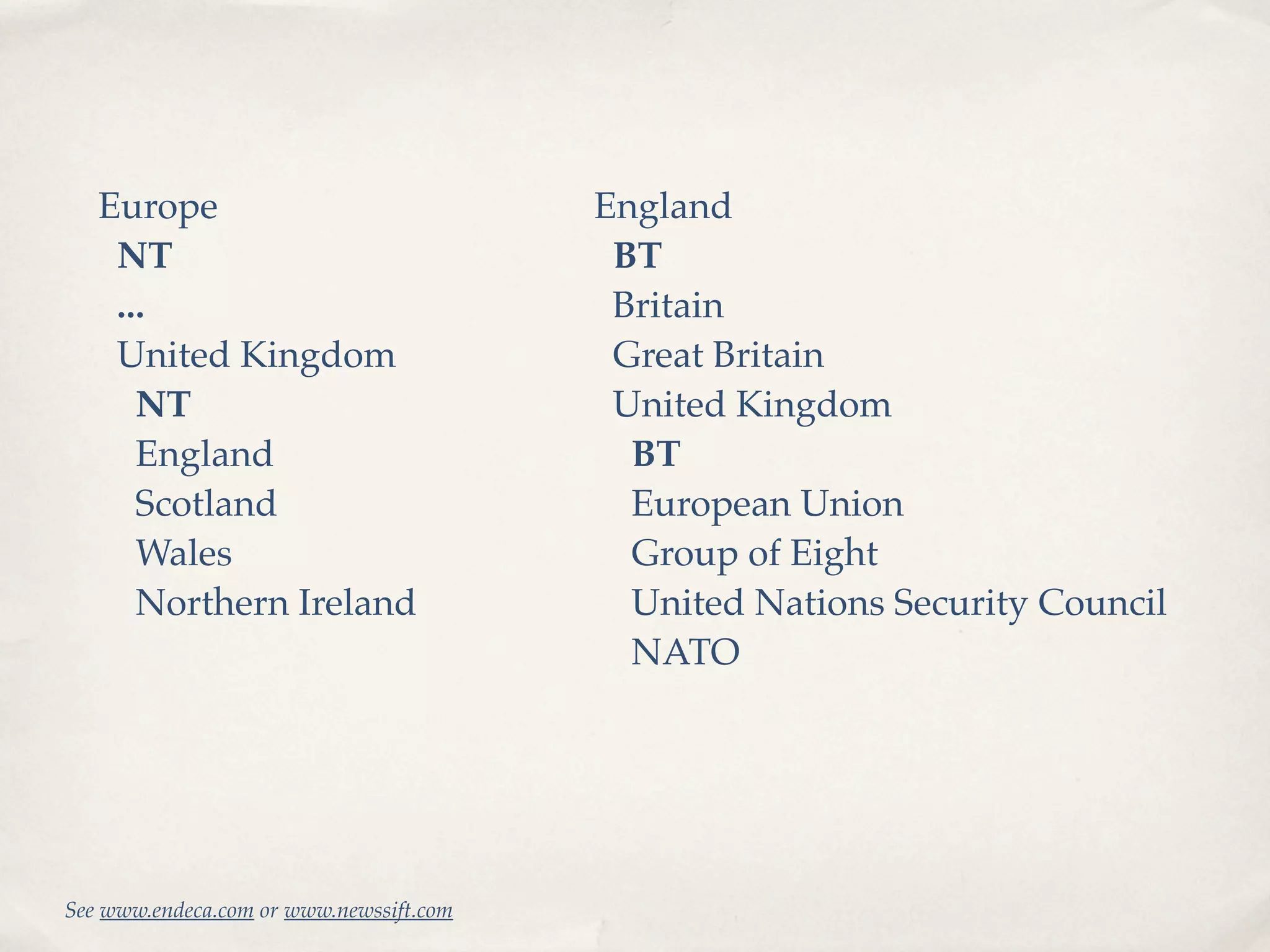
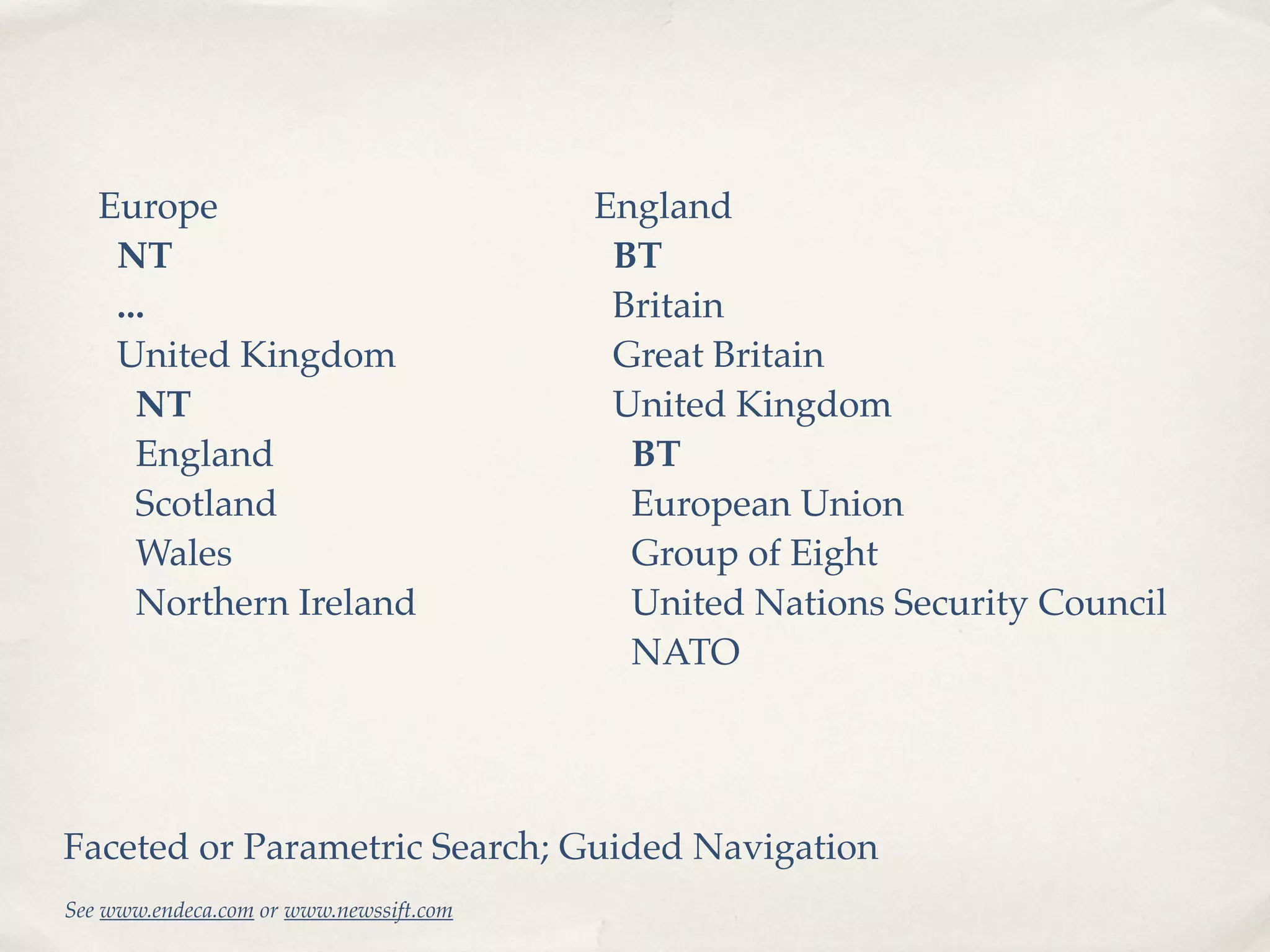
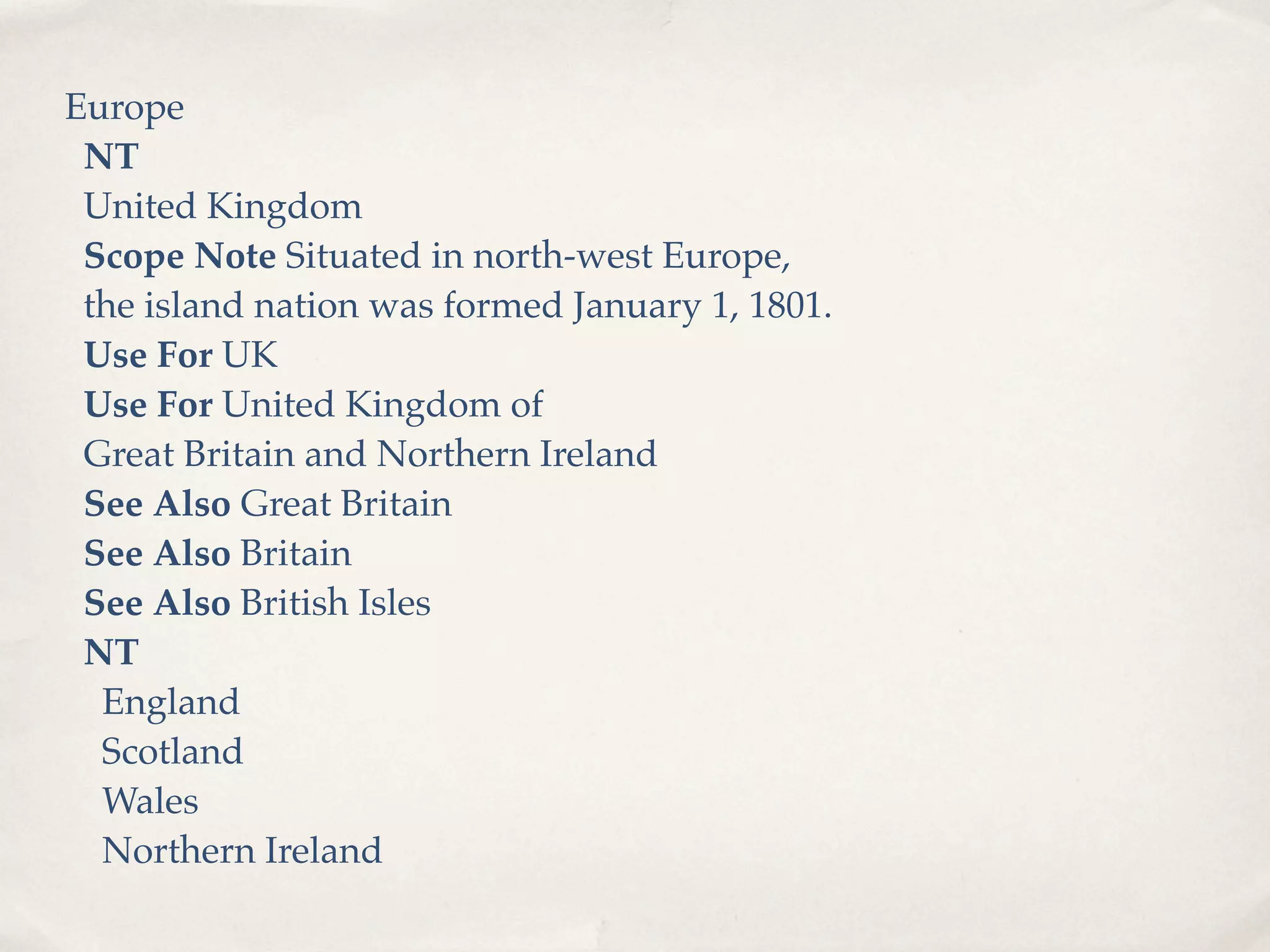
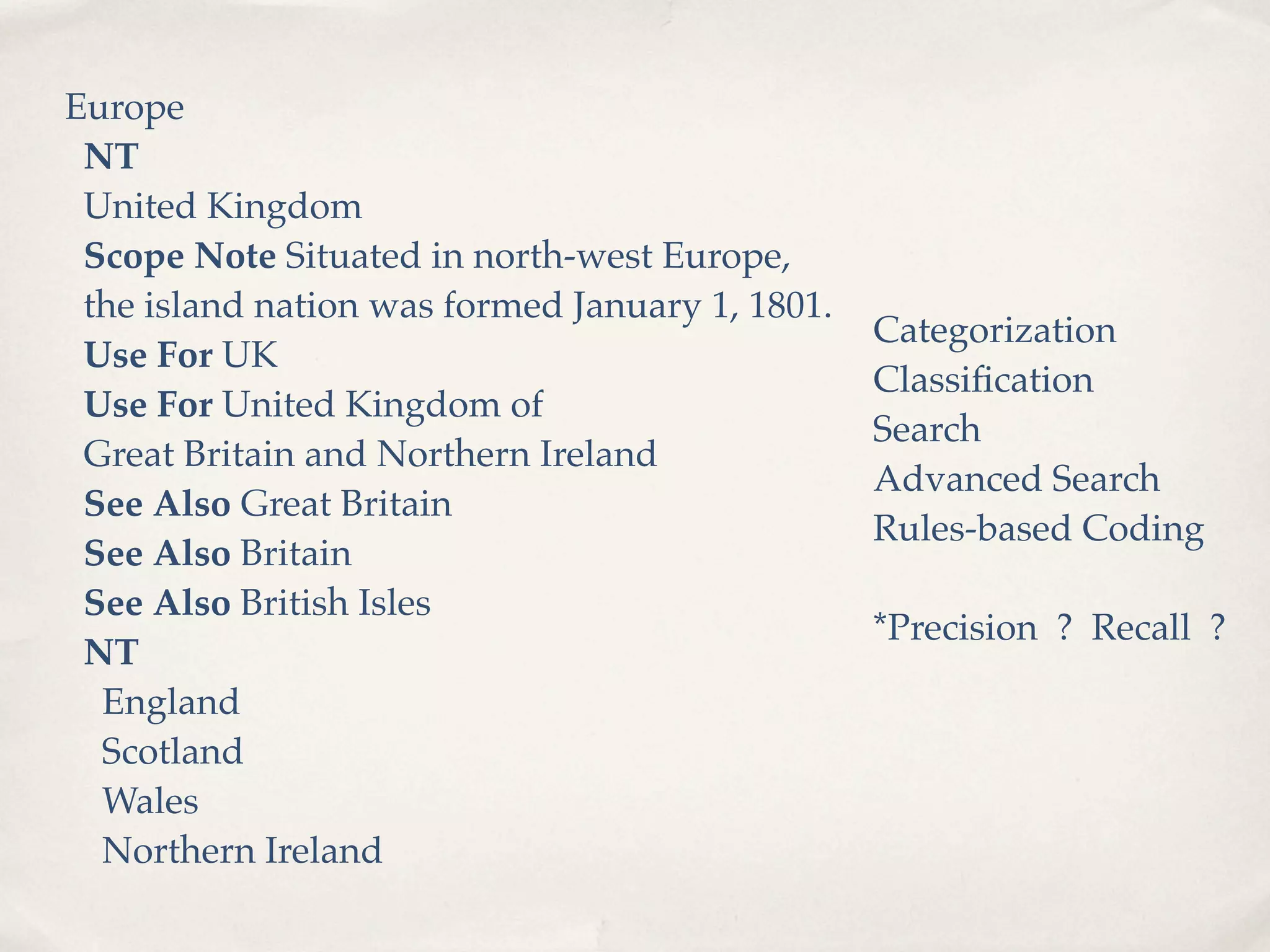
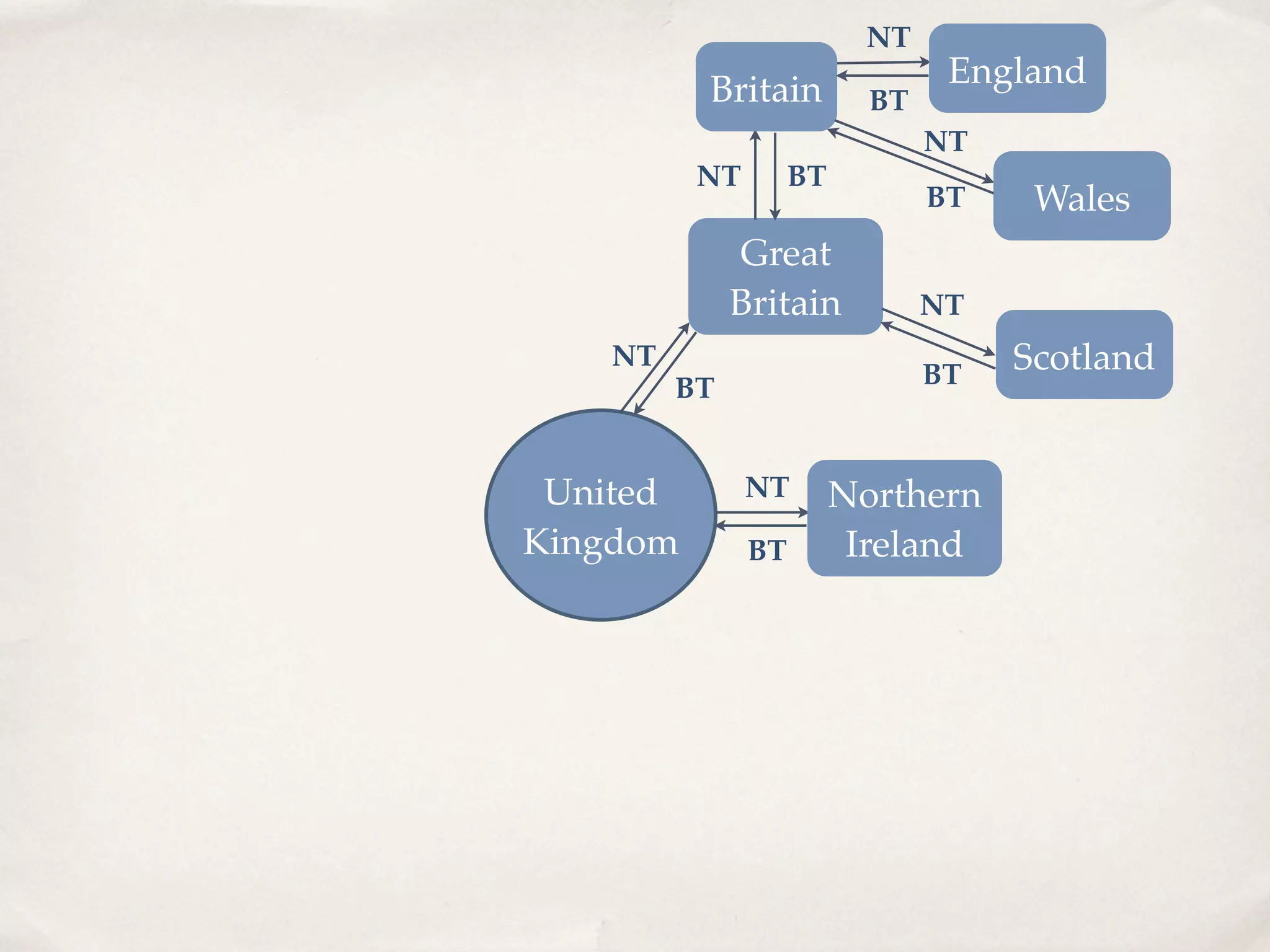
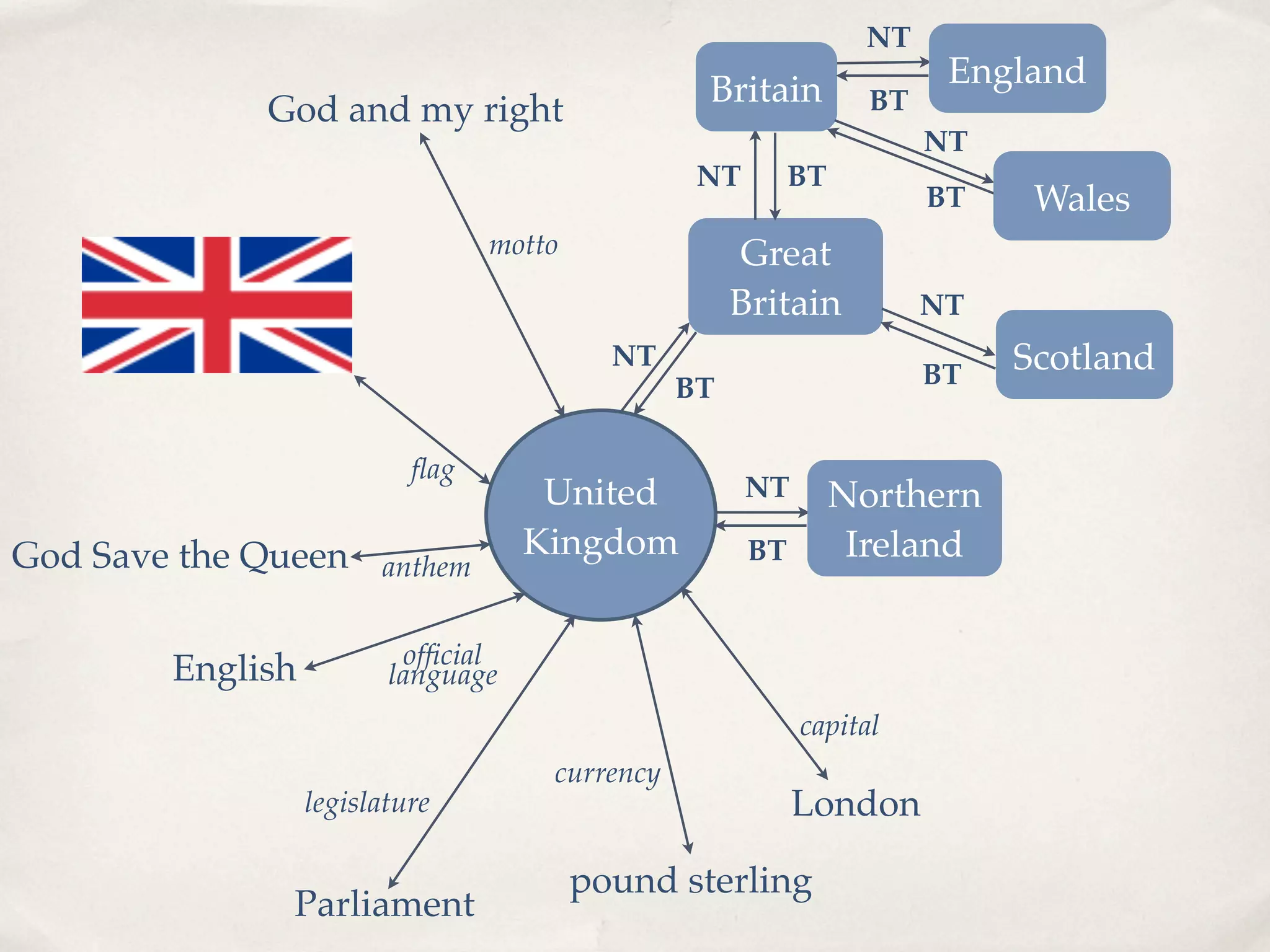
  • #17 A list can be a pick list, an index, an authority file Ambiguity Control Christine Connors vs. Christine Conners :( List of food We recently had a long holiday weekend, usually highlighted by barbecues, so let’s start with a list of food: hot dogs, hamburgers, buns, mustard, mayo, ketchup, onions, pickles, chips, salad, cookies, etc etc ----------- A synonym ring is what we think Roget’s Thesaurus is. Synonym Control (Equivalence Relationships) Ketchup or Catsup ---------- Hierarchical Relationships Is A, Part of type relationships Where would you put the poor tomato? Tomato - vegetable? Fruit? Both? It’s part of ketchup, should it be linked to ketchup under condiments? Mono-hierarchical vs. poly-hierarchical ------------ Associative Relationships - See Also Salt and Pepper - Spice? Condiment? Or would it be helpful to tell the user who is looking at Spices to also review Condiments? (or, do it for them -- Steve Krug’s Don’t Make Me Thnk) See NISO Z39.19-2005 BT = Broader Term NT = Narrower Term RT = Related Term (“See also”) SN = Scope Note UF = Used For USE = “See” (Refers reader from variant term to vocabulary term.) ------------ Get to define your own relationship types! Localization Annotation Reasoning “NOT” Ontology 101 by Natalya Foy and Deb McGuinnes Semantic Web for the Workind Ontologist by Dean Allemang and James Hendler ---------------------------- There is NO ONE RIGHT WAY to build any of these. They are an ART and a SCIENCE. The IA, UX, UI, etc - all human-computer interaction models for your system are important inputs to the design. How many of you shop for groceries? How many of you just go and walk up and down every aisle and grab what you like or think you need? How many of you just make a list as things run out, and then have to stop at the end of every aisle to look if there’s anything you need? How many of you have a list, organized according to your store’s layout?
  • #18 A list can be a pick list, an index, an authority file Ambiguity Control Christine Connors vs. Christine Conners :( List of food We recently had a long holiday weekend, usually highlighted by barbecues, so let’s start with a list of food: hot dogs, hamburgers, buns, mustard, mayo, ketchup, onions, pickles, chips, salad, cookies, etc etc ----------- A synonym ring is what we think Roget’s Thesaurus is. Synonym Control (Equivalence Relationships) Ketchup or Catsup ---------- Hierarchical Relationships Is A, Part of type relationships Where would you put the poor tomato? Tomato - vegetable? Fruit? Both? It’s part of ketchup, should it be linked to ketchup under condiments? Mono-hierarchical vs. poly-hierarchical ------------ Associative Relationships - See Also Salt and Pepper - Spice? Condiment? Or would it be helpful to tell the user who is looking at Spices to also review Condiments? (or, do it for them -- Steve Krug’s Don’t Make Me Thnk) See NISO Z39.19-2005 BT = Broader Term NT = Narrower Term RT = Related Term (“See also”) SN = Scope Note UF = Used For USE = “See” (Refers reader from variant term to vocabulary term.) ------------ Get to define your own relationship types! Localization Annotation Reasoning “NOT” Ontology 101 by Natalya Foy and Deb McGuinnes Semantic Web for the Workind Ontologist by Dean Allemang and James Hendler ---------------------------- There is NO ONE RIGHT WAY to build any of these. They are an ART and a SCIENCE. The IA, UX, UI, etc - all human-computer interaction models for your system are important inputs to the design. How many of you shop for groceries? How many of you just go and walk up and down every aisle and grab what you like or think you need? How many of you just make a list as things run out, and then have to stop at the end of every aisle to look if there’s anything you need? How many of you have a list, organized according to your store’s layout?
  • #19 A list can be a pick list, an index, an authority file Ambiguity Control Christine Connors vs. Christine Conners :( List of food We recently had a long holiday weekend, usually highlighted by barbecues, so let’s start with a list of food: hot dogs, hamburgers, buns, mustard, mayo, ketchup, onions, pickles, chips, salad, cookies, etc etc ----------- A synonym ring is what we think Roget’s Thesaurus is. Synonym Control (Equivalence Relationships) Ketchup or Catsup ---------- Hierarchical Relationships Is A, Part of type relationships Where would you put the poor tomato? Tomato - vegetable? Fruit? Both? It’s part of ketchup, should it be linked to ketchup under condiments? Mono-hierarchical vs. poly-hierarchical ------------ Associative Relationships - See Also Salt and Pepper - Spice? Condiment? Or would it be helpful to tell the user who is looking at Spices to also review Condiments? (or, do it for them -- Steve Krug’s Don’t Make Me Thnk) See NISO Z39.19-2005 BT = Broader Term NT = Narrower Term RT = Related Term (“See also”) SN = Scope Note UF = Used For USE = “See” (Refers reader from variant term to vocabulary term.) ------------ Get to define your own relationship types! Localization Annotation Reasoning “NOT” Ontology 101 by Natalya Foy and Deb McGuinnes Semantic Web for the Workind Ontologist by Dean Allemang and James Hendler ---------------------------- There is NO ONE RIGHT WAY to build any of these. They are an ART and a SCIENCE. The IA, UX, UI, etc - all human-computer interaction models for your system are important inputs to the design. How many of you shop for groceries? How many of you just go and walk up and down every aisle and grab what you like or think you need? How many of you just make a list as things run out, and then have to stop at the end of every aisle to look if there’s anything you need? How many of you have a list, organized according to your store’s layout?
  • #20 A list can be a pick list, an index, an authority file Ambiguity Control Christine Connors vs. Christine Conners :( List of food We recently had a long holiday weekend, usually highlighted by barbecues, so let’s start with a list of food: hot dogs, hamburgers, buns, mustard, mayo, ketchup, onions, pickles, chips, salad, cookies, etc etc ----------- A synonym ring is what we think Roget’s Thesaurus is. Synonym Control (Equivalence Relationships) Ketchup or Catsup ---------- Hierarchical Relationships Is A, Part of type relationships Where would you put the poor tomato? Tomato - vegetable? Fruit? Both? It’s part of ketchup, should it be linked to ketchup under condiments? Mono-hierarchical vs. poly-hierarchical ------------ Associative Relationships - See Also Salt and Pepper - Spice? Condiment? Or would it be helpful to tell the user who is looking at Spices to also review Condiments? (or, do it for them -- Steve Krug’s Don’t Make Me Thnk) See NISO Z39.19-2005 BT = Broader Term NT = Narrower Term RT = Related Term (“See also”) SN = Scope Note UF = Used For USE = “See” (Refers reader from variant term to vocabulary term.) ------------ Get to define your own relationship types! Localization Annotation Reasoning “NOT” Ontology 101 by Natalya Foy and Deb McGuinnes Semantic Web for the Workind Ontologist by Dean Allemang and James Hendler ---------------------------- There is NO ONE RIGHT WAY to build any of these. They are an ART and a SCIENCE. The IA, UX, UI, etc - all human-computer interaction models for your system are important inputs to the design. How many of you shop for groceries? How many of you just go and walk up and down every aisle and grab what you like or think you need? How many of you just make a list as things run out, and then have to stop at the end of every aisle to look if there’s anything you need? How many of you have a list, organized according to your store’s layout?
  • #21 A list can be a pick list, an index, an authority file Ambiguity Control Christine Connors vs. Christine Conners :( List of food We recently had a long holiday weekend, usually highlighted by barbecues, so let’s start with a list of food: hot dogs, hamburgers, buns, mustard, mayo, ketchup, onions, pickles, chips, salad, cookies, etc etc ----------- A synonym ring is what we think Roget’s Thesaurus is. Synonym Control (Equivalence Relationships) Ketchup or Catsup ---------- Hierarchical Relationships Is A, Part of type relationships Where would you put the poor tomato? Tomato - vegetable? Fruit? Both? It’s part of ketchup, should it be linked to ketchup under condiments? Mono-hierarchical vs. poly-hierarchical ------------ Associative Relationships - See Also Salt and Pepper - Spice? Condiment? Or would it be helpful to tell the user who is looking at Spices to also review Condiments? (or, do it for them -- Steve Krug’s Don’t Make Me Thnk) See NISO Z39.19-2005 BT = Broader Term NT = Narrower Term RT = Related Term (“See also”) SN = Scope Note UF = Used For USE = “See” (Refers reader from variant term to vocabulary term.) ------------ Get to define your own relationship types! Localization Annotation Reasoning “NOT” Ontology 101 by Natalya Foy and Deb McGuinnes Semantic Web for the Workind Ontologist by Dean Allemang and James Hendler ---------------------------- There is NO ONE RIGHT WAY to build any of these. They are an ART and a SCIENCE. The IA, UX, UI, etc - all human-computer interaction models for your system are important inputs to the design. How many of you shop for groceries? How many of you just go and walk up and down every aisle and grab what you like or think you need? How many of you just make a list as things run out, and then have to stop at the end of every aisle to look if there’s anything you need? How many of you have a list, organized according to your store’s layout?
  • #22 A list can be a pick list, an index, an authority file Ambiguity Control Christine Connors vs. Christine Conners :( List of food We recently had a long holiday weekend, usually highlighted by barbecues, so let’s start with a list of food: hot dogs, hamburgers, buns, mustard, mayo, ketchup, onions, pickles, chips, salad, cookies, etc etc ----------- A synonym ring is what we think Roget’s Thesaurus is. Synonym Control (Equivalence Relationships) Ketchup or Catsup ---------- Hierarchical Relationships Is A, Part of type relationships Where would you put the poor tomato? Tomato - vegetable? Fruit? Both? It’s part of ketchup, should it be linked to ketchup under condiments? Mono-hierarchical vs. poly-hierarchical ------------ Associative Relationships - See Also Salt and Pepper - Spice? Condiment? Or would it be helpful to tell the user who is looking at Spices to also review Condiments? (or, do it for them -- Steve Krug’s Don’t Make Me Thnk) See NISO Z39.19-2005 BT = Broader Term NT = Narrower Term RT = Related Term (“See also”) SN = Scope Note UF = Used For USE = “See” (Refers reader from variant term to vocabulary term.) ------------ Get to define your own relationship types! Localization Annotation Reasoning “NOT” Ontology 101 by Natalya Foy and Deb McGuinnes Semantic Web for the Workind Ontologist by Dean Allemang and James Hendler ---------------------------- There is NO ONE RIGHT WAY to build any of these. They are an ART and a SCIENCE. The IA, UX, UI, etc - all human-computer interaction models for your system are important inputs to the design. How many of you shop for groceries? How many of you just go and walk up and down every aisle and grab what you like or think you need? How many of you just make a list as things run out, and then have to stop at the end of every aisle to look if there’s anything you need? How many of you have a list, organized according to your store’s layout?
  • #23 A list can be a pick list, an index, an authority file Ambiguity Control Christine Connors vs. Christine Conners :( List of food We recently had a long holiday weekend, usually highlighted by barbecues, so let’s start with a list of food: hot dogs, hamburgers, buns, mustard, mayo, ketchup, onions, pickles, chips, salad, cookies, etc etc ----------- A synonym ring is what we think Roget’s Thesaurus is. Synonym Control (Equivalence Relationships) Ketchup or Catsup ---------- Hierarchical Relationships Is A, Part of type relationships Where would you put the poor tomato? Tomato - vegetable? Fruit? Both? It’s part of ketchup, should it be linked to ketchup under condiments? Mono-hierarchical vs. poly-hierarchical ------------ Associative Relationships - See Also Salt and Pepper - Spice? Condiment? Or would it be helpful to tell the user who is looking at Spices to also review Condiments? (or, do it for them -- Steve Krug’s Don’t Make Me Thnk) See NISO Z39.19-2005 BT = Broader Term NT = Narrower Term RT = Related Term (“See also”) SN = Scope Note UF = Used For USE = “See” (Refers reader from variant term to vocabulary term.) ------------ Get to define your own relationship types! Localization Annotation Reasoning “NOT” Ontology 101 by Natalya Foy and Deb McGuinnes Semantic Web for the Workind Ontologist by Dean Allemang and James Hendler ---------------------------- There is NO ONE RIGHT WAY to build any of these. They are an ART and a SCIENCE. The IA, UX, UI, etc - all human-computer interaction models for your system are important inputs to the design. How many of you shop for groceries? How many of you just go and walk up and down every aisle and grab what you like or think you need? How many of you just make a list as things run out, and then have to stop at the end of every aisle to look if there’s anything you need? How many of you have a list, organized according to your store’s layout?
  • #24 A list can be a pick list, an index, an authority file Ambiguity Control Christine Connors vs. Christine Conners :( List of food We recently had a long holiday weekend, usually highlighted by barbecues, so let’s start with a list of food: hot dogs, hamburgers, buns, mustard, mayo, ketchup, onions, pickles, chips, salad, cookies, etc etc ----------- A synonym ring is what we think Roget’s Thesaurus is. Synonym Control (Equivalence Relationships) Ketchup or Catsup ---------- Hierarchical Relationships Is A, Part of type relationships Where would you put the poor tomato? Tomato - vegetable? Fruit? Both? It’s part of ketchup, should it be linked to ketchup under condiments? Mono-hierarchical vs. poly-hierarchical ------------ Associative Relationships - See Also Salt and Pepper - Spice? Condiment? Or would it be helpful to tell the user who is looking at Spices to also review Condiments? (or, do it for them -- Steve Krug’s Don’t Make Me Thnk) See NISO Z39.19-2005 BT = Broader Term NT = Narrower Term RT = Related Term (“See also”) SN = Scope Note UF = Used For USE = “See” (Refers reader from variant term to vocabulary term.) ------------ Get to define your own relationship types! Localization Annotation Reasoning “NOT” Ontology 101 by Natalya Foy and Deb McGuinnes Semantic Web for the Workind Ontologist by Dean Allemang and James Hendler ---------------------------- There is NO ONE RIGHT WAY to build any of these. They are an ART and a SCIENCE. The IA, UX, UI, etc - all human-computer interaction models for your system are important inputs to the design. How many of you shop for groceries? How many of you just go and walk up and down every aisle and grab what you like or think you need? How many of you just make a list as things run out, and then have to stop at the end of every aisle to look if there’s anything you need? How many of you have a list, organized according to your store’s layout?
  • #25 A list can be a pick list, an index, an authority file Ambiguity Control Christine Connors vs. Christine Conners :( List of food We recently had a long holiday weekend, usually highlighted by barbecues, so let’s start with a list of food: hot dogs, hamburgers, buns, mustard, mayo, ketchup, onions, pickles, chips, salad, cookies, etc etc ----------- A synonym ring is what we think Roget’s Thesaurus is. Synonym Control (Equivalence Relationships) Ketchup or Catsup ---------- Hierarchical Relationships Is A, Part of type relationships Where would you put the poor tomato? Tomato - vegetable? Fruit? Both? It’s part of ketchup, should it be linked to ketchup under condiments? Mono-hierarchical vs. poly-hierarchical ------------ Associative Relationships - See Also Salt and Pepper - Spice? Condiment? Or would it be helpful to tell the user who is looking at Spices to also review Condiments? (or, do it for them -- Steve Krug’s Don’t Make Me Thnk) See NISO Z39.19-2005 BT = Broader Term NT = Narrower Term RT = Related Term (“See also”) SN = Scope Note UF = Used For USE = “See” (Refers reader from variant term to vocabulary term.) ------------ Get to define your own relationship types! Localization Annotation Reasoning “NOT” Ontology 101 by Natalya Foy and Deb McGuinnes Semantic Web for the Workind Ontologist by Dean Allemang and James Hendler ---------------------------- There is NO ONE RIGHT WAY to build any of these. They are an ART and a SCIENCE. The IA, UX, UI, etc - all human-computer interaction models for your system are important inputs to the design. How many of you shop for groceries? How many of you just go and walk up and down every aisle and grab what you like or think you need? How many of you just make a list as things run out, and then have to stop at the end of every aisle to look if there’s anything you need? How many of you have a list, organized according to your store’s layout?
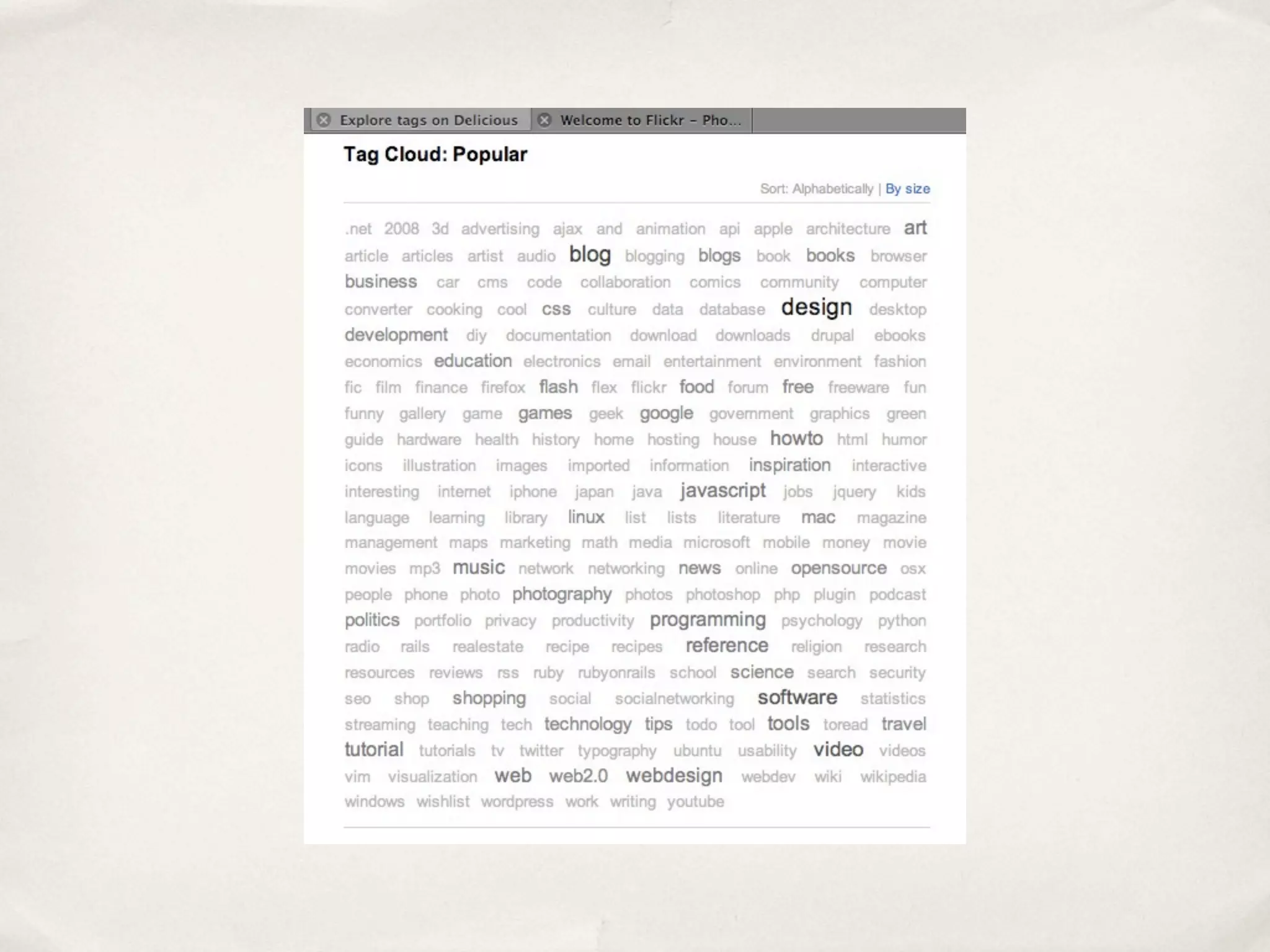
  • #26 This is like going to the store with no list. There are some staples that everyone needs, but everything is kind of random.
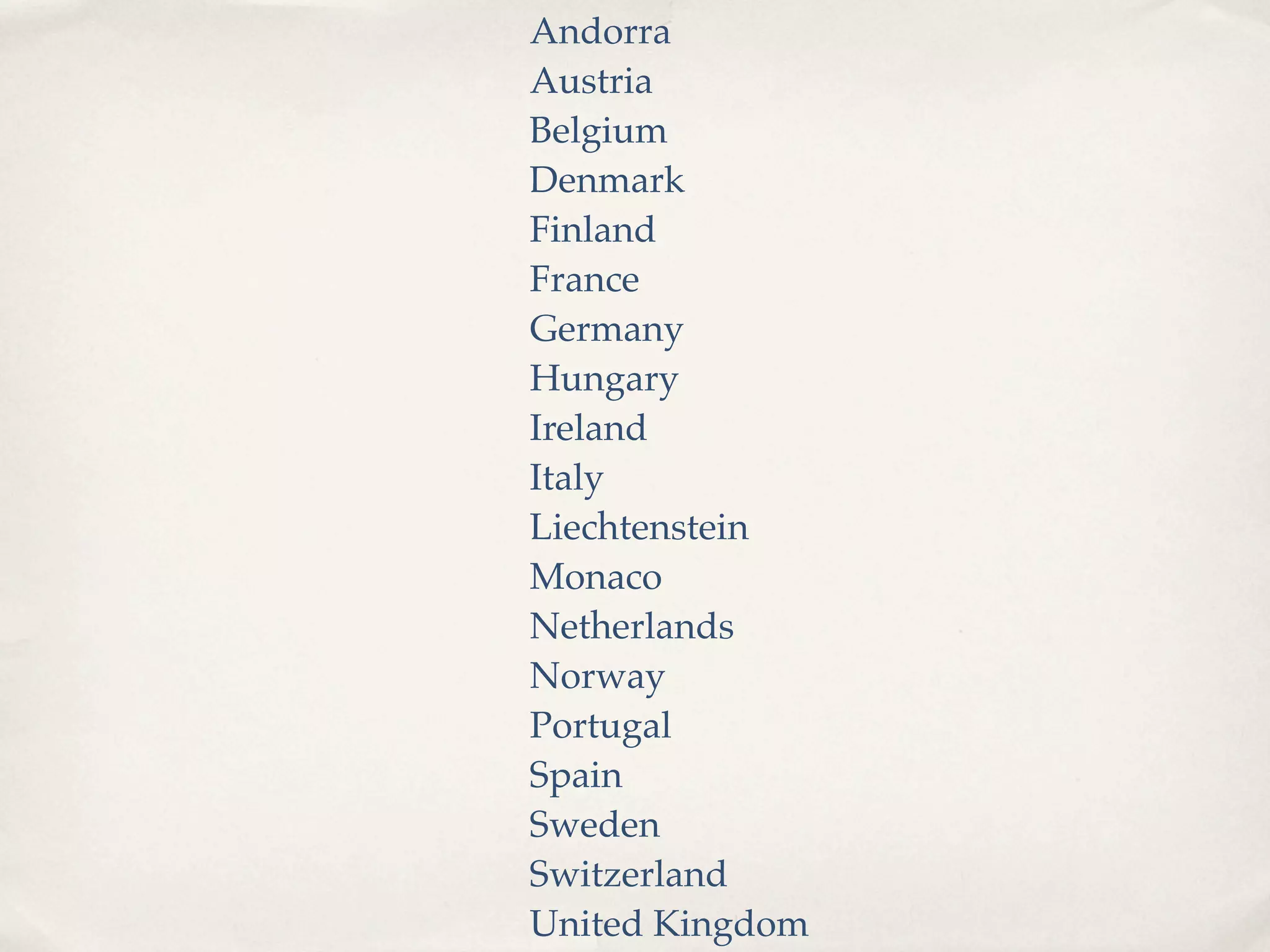
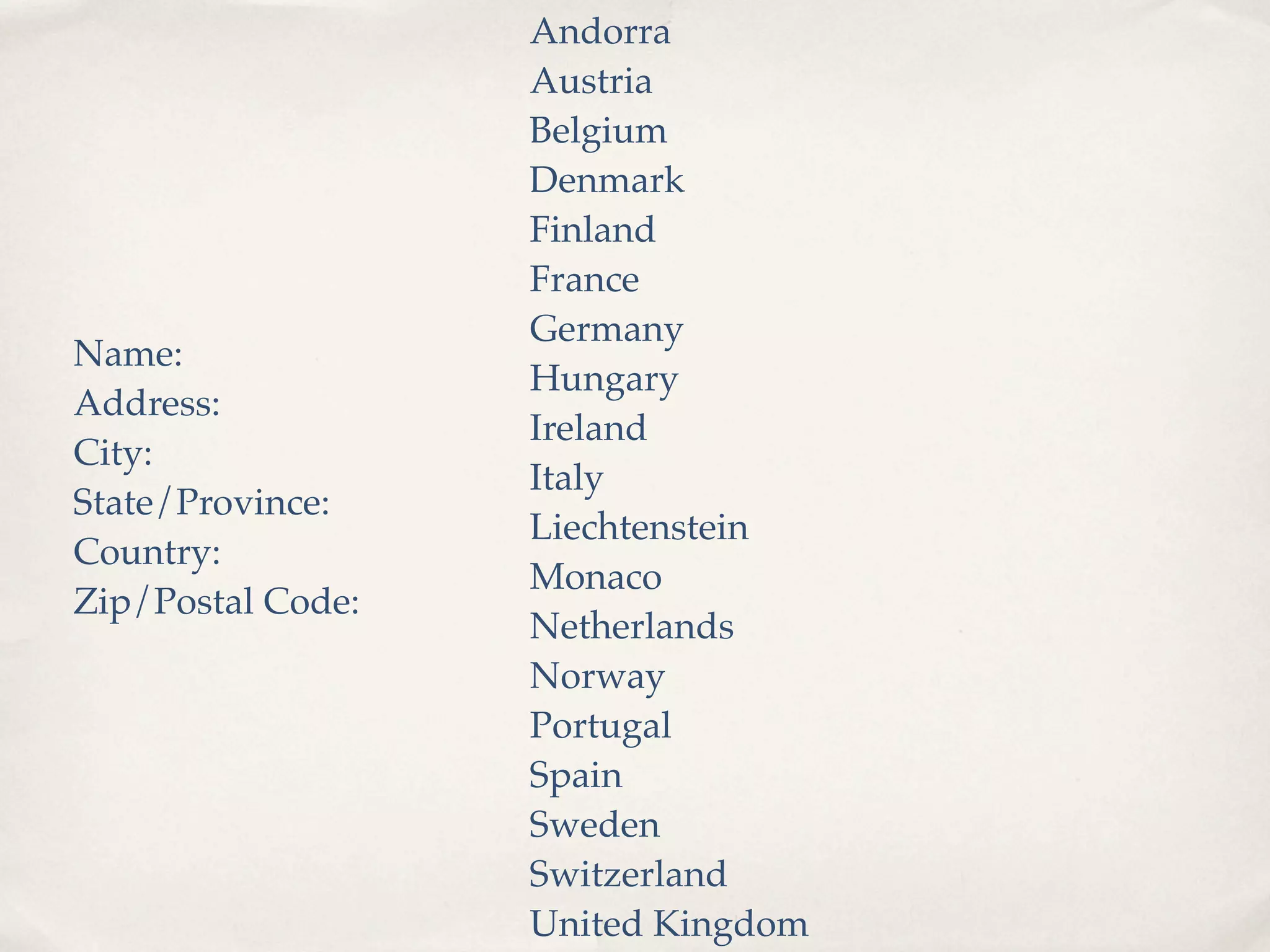
  • #27 This is like going to the store with an unorganized list. Everything on the list can be grouped according to the task, but the list itself could be random or alphabetical. Typically used in forms.
  • #28 This is like going to the store with an unorganized list. Everything on the list can be grouped according to the task, but the list itself could be random or alphabetical. Typically used in forms.
  • #29 This is like going to the store with an unorganized list. Everything on the list can be grouped according to the task, but the list itself could be random or alphabetical. Typically used in forms.
  • #30 This is like going to the store with an unorganized list. Everything on the list can be grouped according to the task, but the list itself could be random or alphabetical. Typically used in forms.
  • #31 This is like going to the store with an unorganized list. Everything on the list can be grouped according to the task, but the list itself could be random or alphabetical. Typically used in forms.
  • #32 This is like going to the store with an unorganized list. Everything on the list can be grouped according to the task, but the list itself could be random or alphabetical. Typically used in forms.
  • #33 This is like going to the store with an unorganized list. Everything on the list can be grouped according to the task, but the list itself could be random or alphabetical. Typically used in forms.
  • #34 This is like going to the store with an unorganized list. Everything on the list can be grouped according to the task, but the list itself could be random or alphabetical. Typically used in forms.
  • #35 This is like going to the store with an unorganized list. Everything on the list can be grouped according to the task, but the list itself could be random or alphabetical. Typically used in forms.
  • #36 This is like going to the store with an unorganized list. Everything on the list can be grouped according to the task, but the list itself could be random or alphabetical. Typically used in forms.
  • #37 This is like going to the store with an unorganized list. Everything on the list can be grouped according to the task, but the list itself could be random or alphabetical. Typically used in forms.
  • #38 This is like going to the store with an unorganized list. Everything on the list can be grouped according to the task, but the list itself could be random or alphabetical. Typically used in forms.
  • #39 This is like going to the store with an unorganized list. Everything on the list can be grouped according to the task, but the list itself could be random or alphabetical. Typically used in forms.
  • #40 This is like going to the store with an unorganized list. Everything on the list can be grouped according to the task, but the list itself could be random or alphabetical. Typically used in forms.
  • #41 This is like going to the store with an unorganized list. Everything on the list can be grouped according to the task, but the list itself could be random or alphabetical. Typically used in forms.
  • #42 This is like going to the store with an unorganized list. Everything on the list can be grouped according to the task, but the list itself could be random or alphabetical. Typically used in forms.
  • #43 This is like going to the store with an unorganized list. Everything on the list can be grouped according to the task, but the list itself could be random or alphabetical. Typically used in forms.
  • #44 This is like going to the store with an unorganized list. Everything on the list can be grouped according to the task, but the list itself could be random or alphabetical. Typically used in forms.
  • #45 This is like going to the store with an unorganized list. Everything on the list can be grouped according to the task, but the list itself could be random or alphabetical. Typically used in forms.
  • #46 This is like going to the store with an unorganized list. Everything on the list can be grouped according to the task, but the list itself could be random or alphabetical. Typically used in forms.
  • #47 This is like going to the store with an unorganized list. Everything on the list can be grouped according to the task, but the list itself could be random or alphabetical. Typically used in forms.
  • #50 This is what happens when what you want at the store is in a couple of different places - think about the featured products at the end of the aisles.
  • #51 This is what happens when what you want at the store is in a couple of different places - think about the featured products at the end of the aisles.
  • #52 This is what happens when what you want at the store is in a couple of different places - think about the featured products at the end of the aisles.
  • #53 isA, kindOf, partOf
  • #54 isA, kindOf, partOf
  • #55 Enterprise Search, content portals
  • #56 why do this findability reuse share but most importantly to NEXT (analyze)
  • #57 why do this findability reuse share but most importantly to NEXT (analyze)