Semantic Technology:
The State of the Art and Research Directions


                 Sung-Kook Han


                   2010.12.03
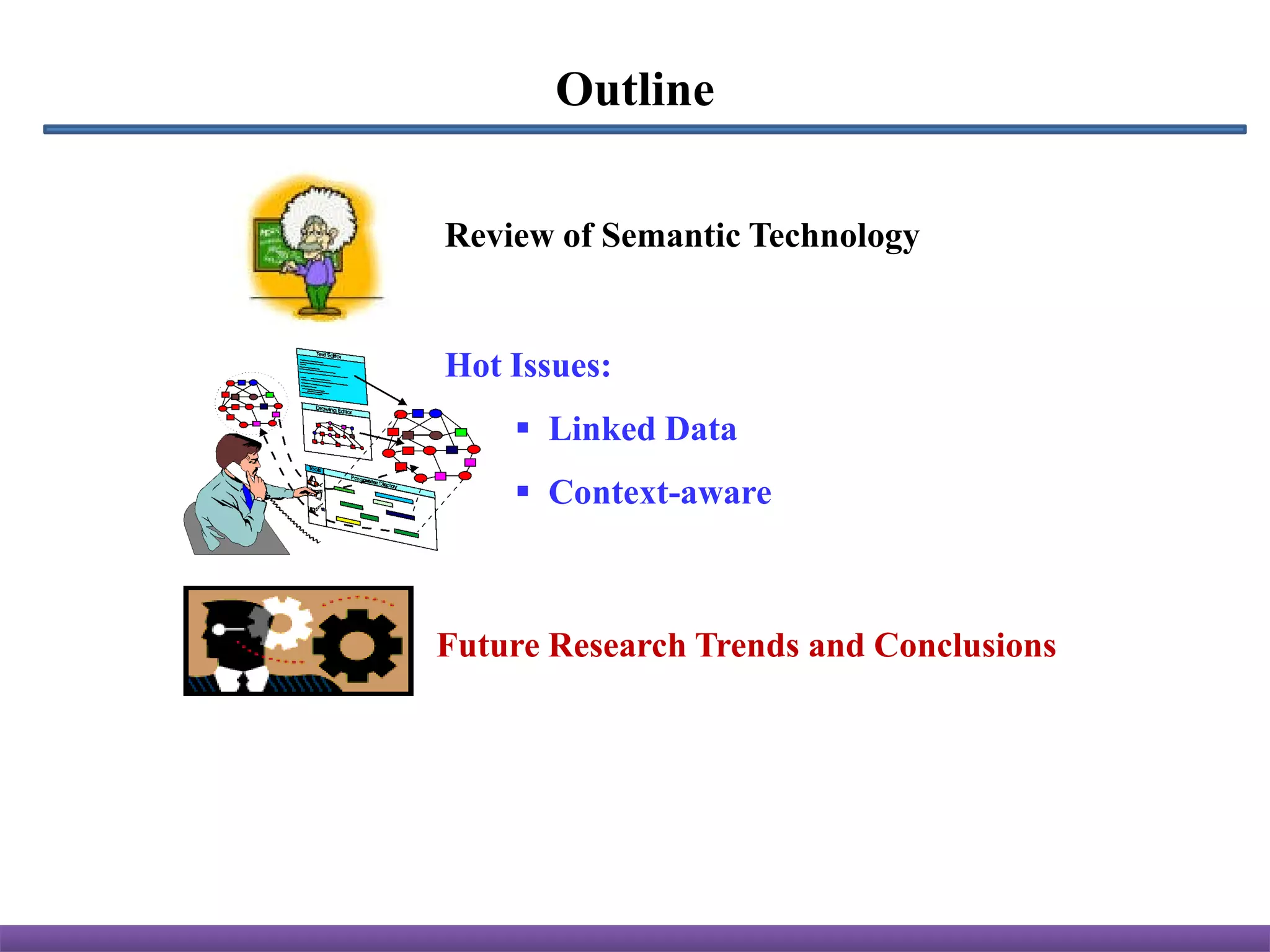
Outline

Review of Semantic Technology


Hot Issues:
     Linked Data
     Context-aware


Future Research Trends and Conclusions
Semantic Technology
 Semantic technology has been a distinct research field for more
  than 40 years.
      Formal Logic (since Russell and Frege)
      Knowledge Representation Systems in AI
      Semantic Networks and ATN (William Woods, 1975)
      DARPA and European Commission programs in information integration
      Development of simple tractable logics
      Relational Algebras and Schemas in Database Systems

 Library Science (classifications, thesauri, taxonomies)

 New challenges of Semantic Technology: Semantic Web
    A massive store of information that computers cannot use
    A way to get around needing the “big data warehouse”
    Another place where “a little semantics can go a long way”...

                                      cf: The Relationship Between Web 2.0 And the Semantic Web - Dr. Mark Greaves, Vulcan, Inc.
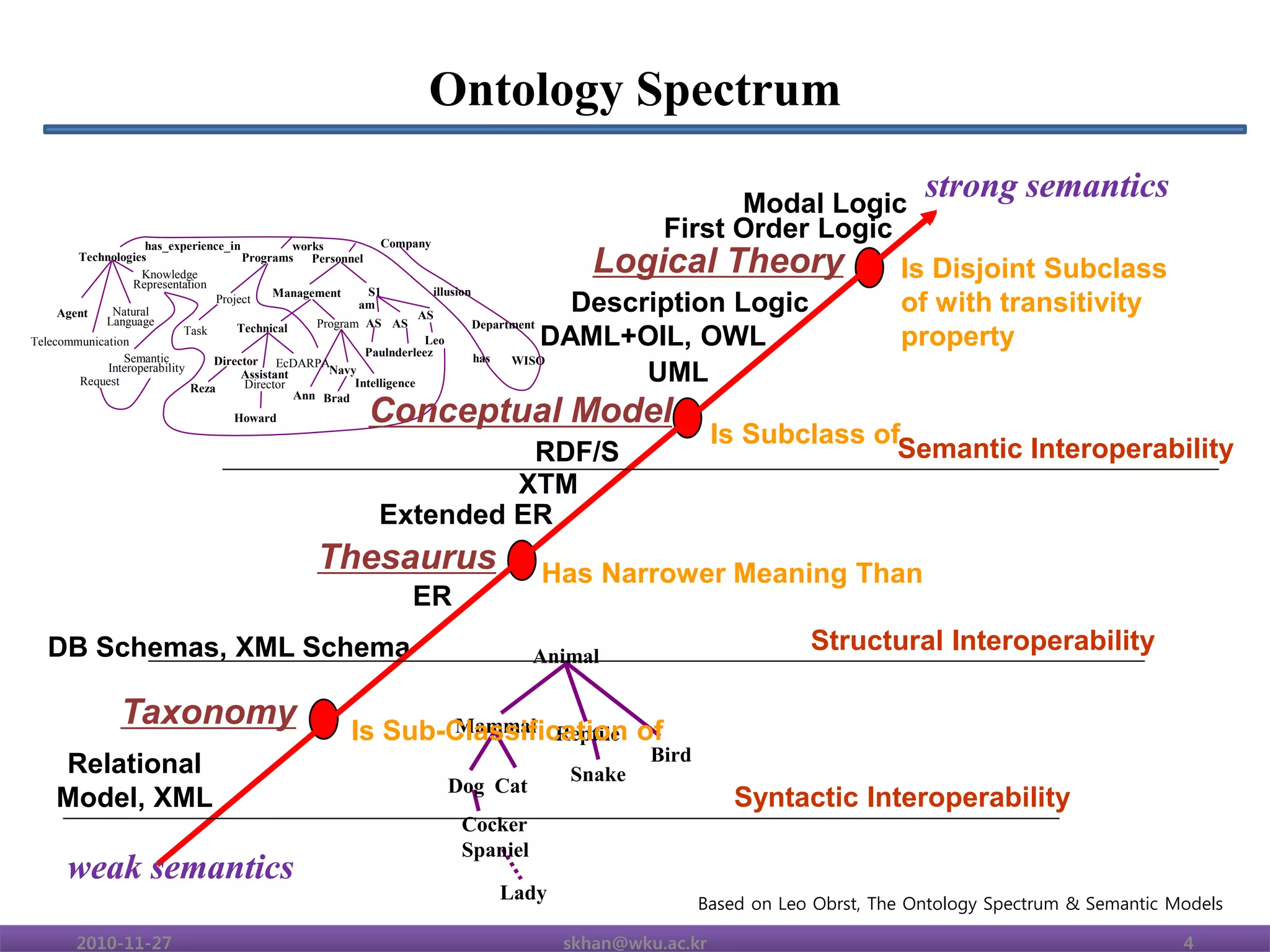
Ontology Spectrum
                                                                                                               strong semantics
                                                                                                               Modal Logic
                    has_experience_in             works           Company
                                                                                                        First Order Logic
        Technologies
                    Knowledge
                  Representation
                                        Programs Personnel
                                                                                                   Logical Theory         Is Disjoint Subclass
                                              Management       S1           illusion
     Agent    Natural
            Language
                                   Project                    am
                                                                          AS
                                                                                                  Description Logic       of with transitivity
                                                      Program AS AS                  Department
Telecommunication
                             Task      Technical
                                                               Paulnderleez
                                                                           Leo                  DAML+OIL, OWL             property
                Semantic          Director EcDARPA                                   has   WISO
             Interoperability
        Request
                              Reza
                                        Assistant
                                        Director
                                                        Navy
                                                             Intelligence                              UML
                                  Ann Brad
                         Howard               Conceptual Model
                                                                                     Is Subclass of
                                                         RDF/S                                     Semantic Interoperability
                                                        XTM
                                               Extended ER
                                     Thesaurus                  Has Narrower Meaning Than
                                                 ER
  DB Schemas, XML Schema                                        Animal
                                                                                                 Structural Interoperability

           Taxonomy                                 Mammal Reptile
                                             Is Sub-Classification of
                                                                             Bird
   Relational                                                      Snake
                                                    Dog Cat
   Model, XML                                                                           Syntactic Interoperability
                                                      Cocker
                                                      Spaniel
    weak semantics
                                                          Lady                      Based on Leo Obrst, The Ontology Spectrum & Semantic Models

     2010-11-27                                                   skhan@wku.ac.kr                                                                4
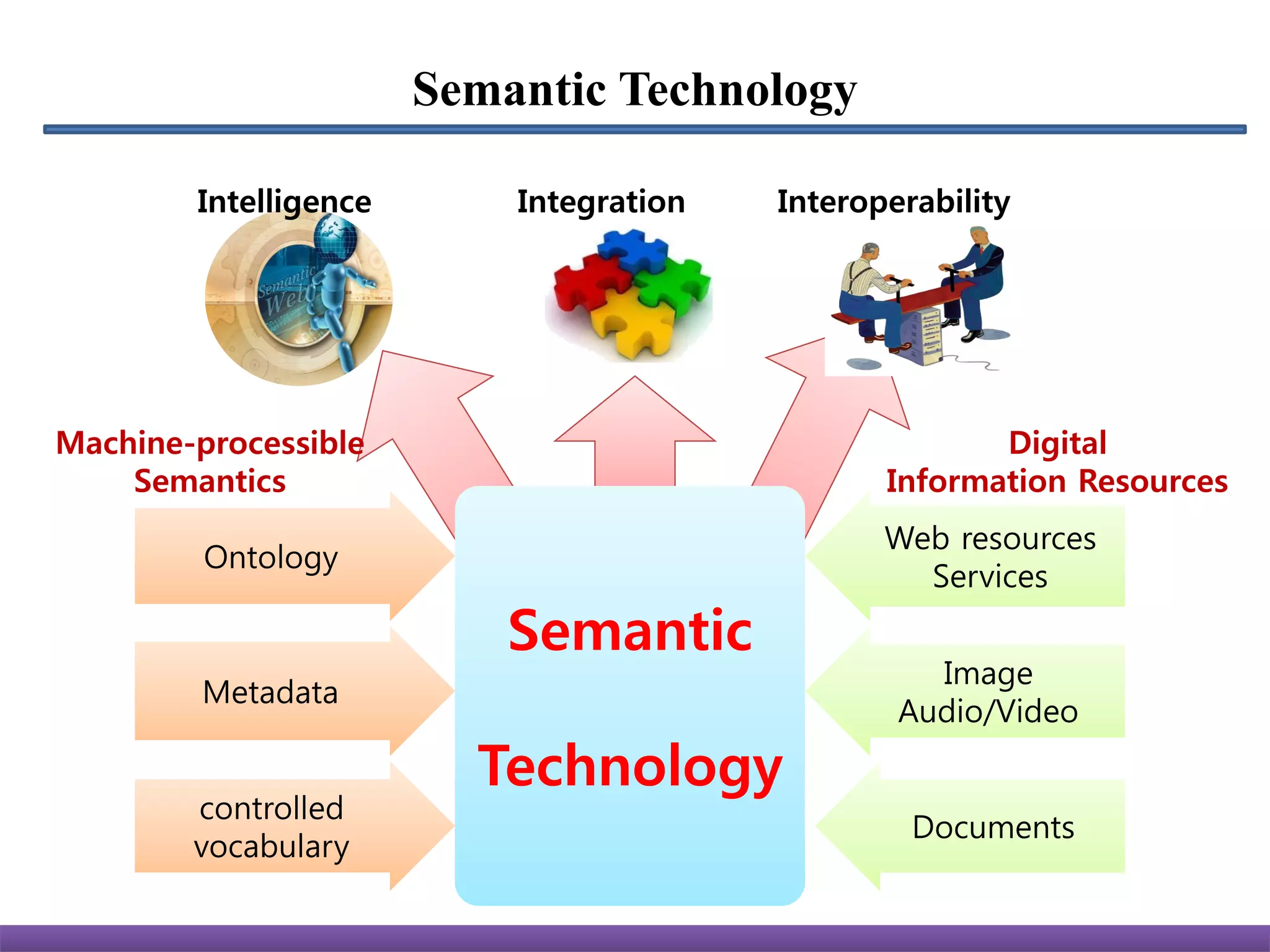
Semantic Technology

        Intelligence       Integration   Interoperability


Machine-processible                                    Digital
    Semantics                                   Information Resources
                                                Web resources
         Ontology
                                                  Services
                           Semantic
                                                   Image
         Metadata
                                                 Audio/Video
                         Technology
        controlled
                                                  Documents
        vocabulary
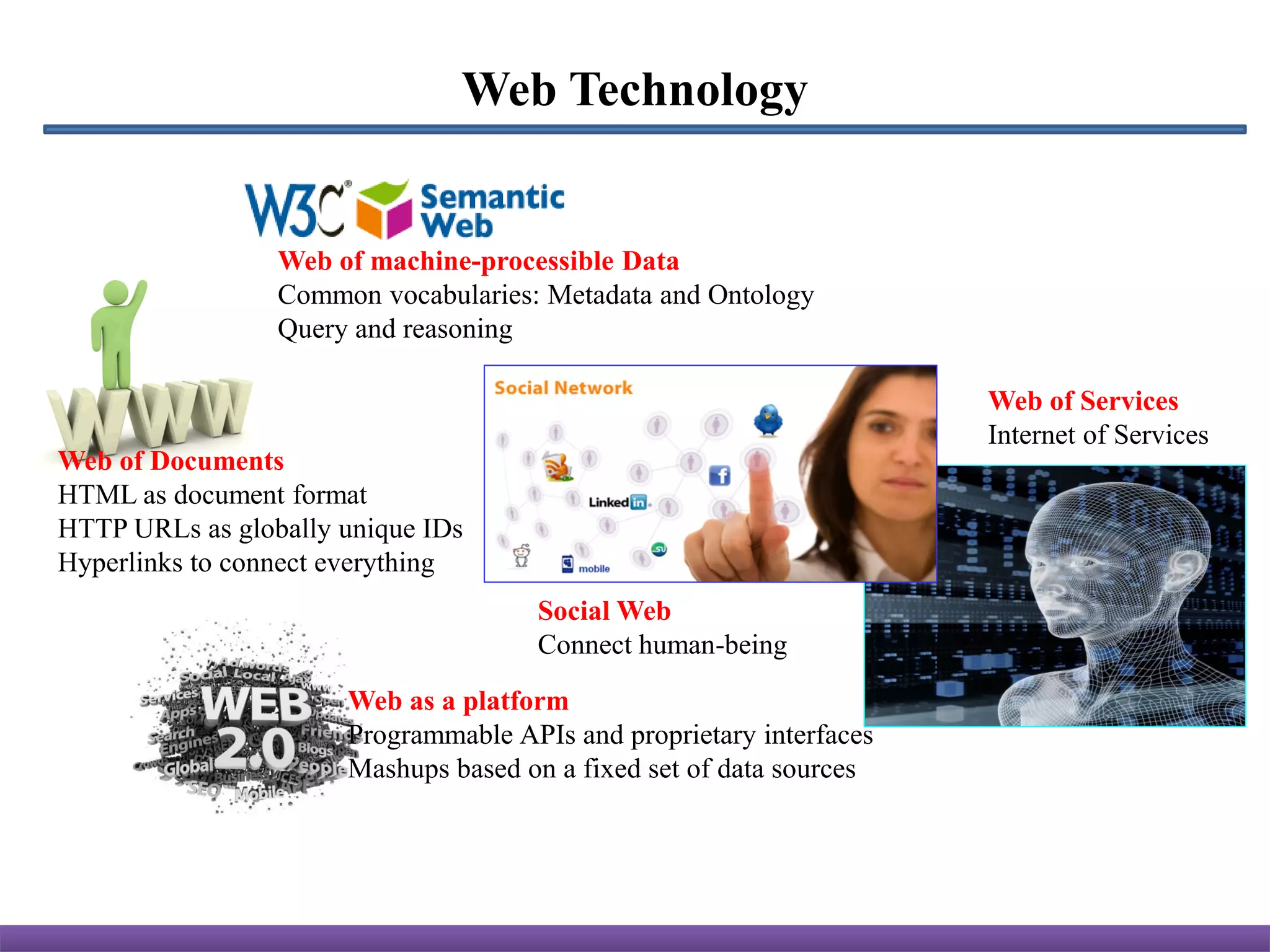
Web Technology


                 Web of machine-processible Data
                 Common vocabularies: Metadata and Ontology
                 Query and reasoning

Classic Web                                                          Web of Services
                                                                     Internet of Services
Web of Documents
HTML as document format
HTTP URLs as globally unique IDs
Hyperlinks to connect everything
                                     Social Web
                                     Connect human-being
                      Web as a platform
                      Programmable APIs and proprietary interfaces
                      Mashups based on a fixed set of data sources
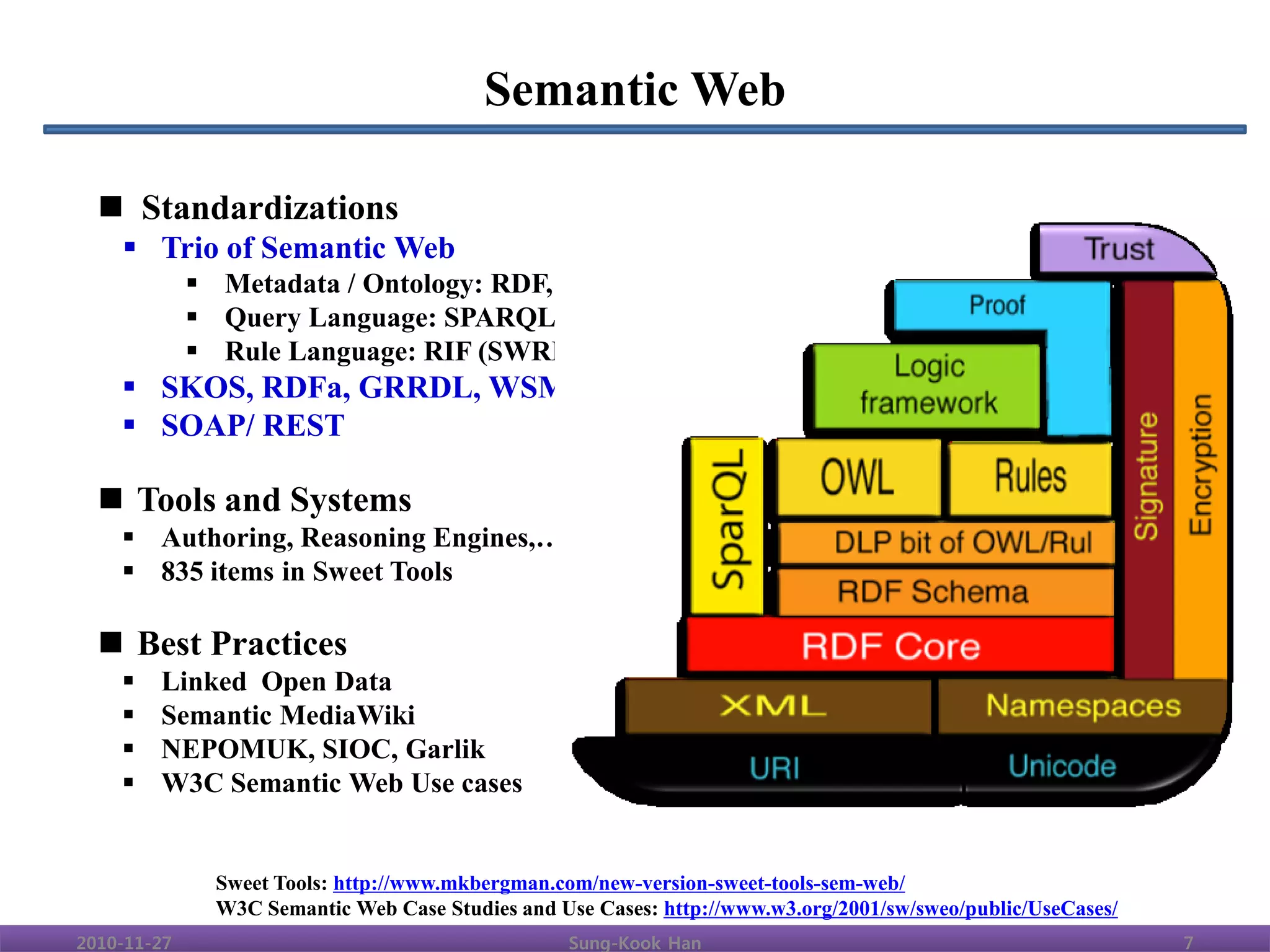
Semantic Web

   Standardizations
     Trio of Semantic Web
              Metadata / Ontology: RDF, RDF, OWL
              Query Language: SPARQL
              Rule Language: RIF (SWRL)
     SKOS, RDFa, GRRDL, WSMO,…
     SOAP/ REST

   Tools and Systems
     Authoring, Reasoning Engines,…
     835 items in Sweet Tools

   Best Practices
       Linked Open Data
       Semantic MediaWiki
       NEPOMUK, SIOC, Garlik
       W3C Semantic Web Use cases


               Sweet Tools: http://www.mkbergman.com/new-version-sweet-tools-sem-web/
               W3C Semantic Web Case Studies and Use Cases: http://www.w3.org/2001/sw/sweo/public/UseCases/
2010-11-27                                        Sung-Kook Han                                               7
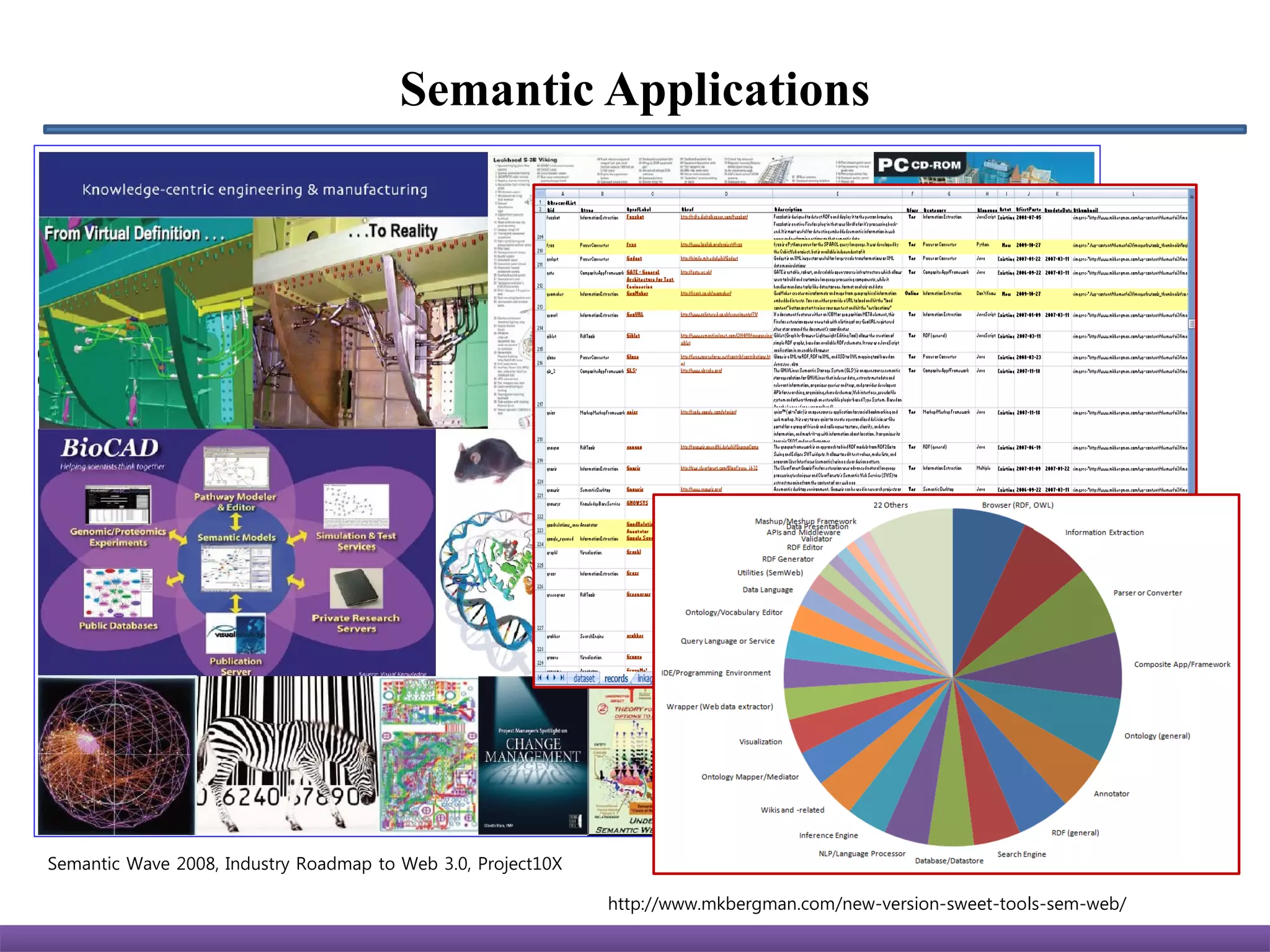
Semantic Applications


Semantic Wave 2008, Industry Roadmap to Web 3.0, Project10X

                                                              http://www.mkbergman.com/new-version-sweet-tools-sem-web/
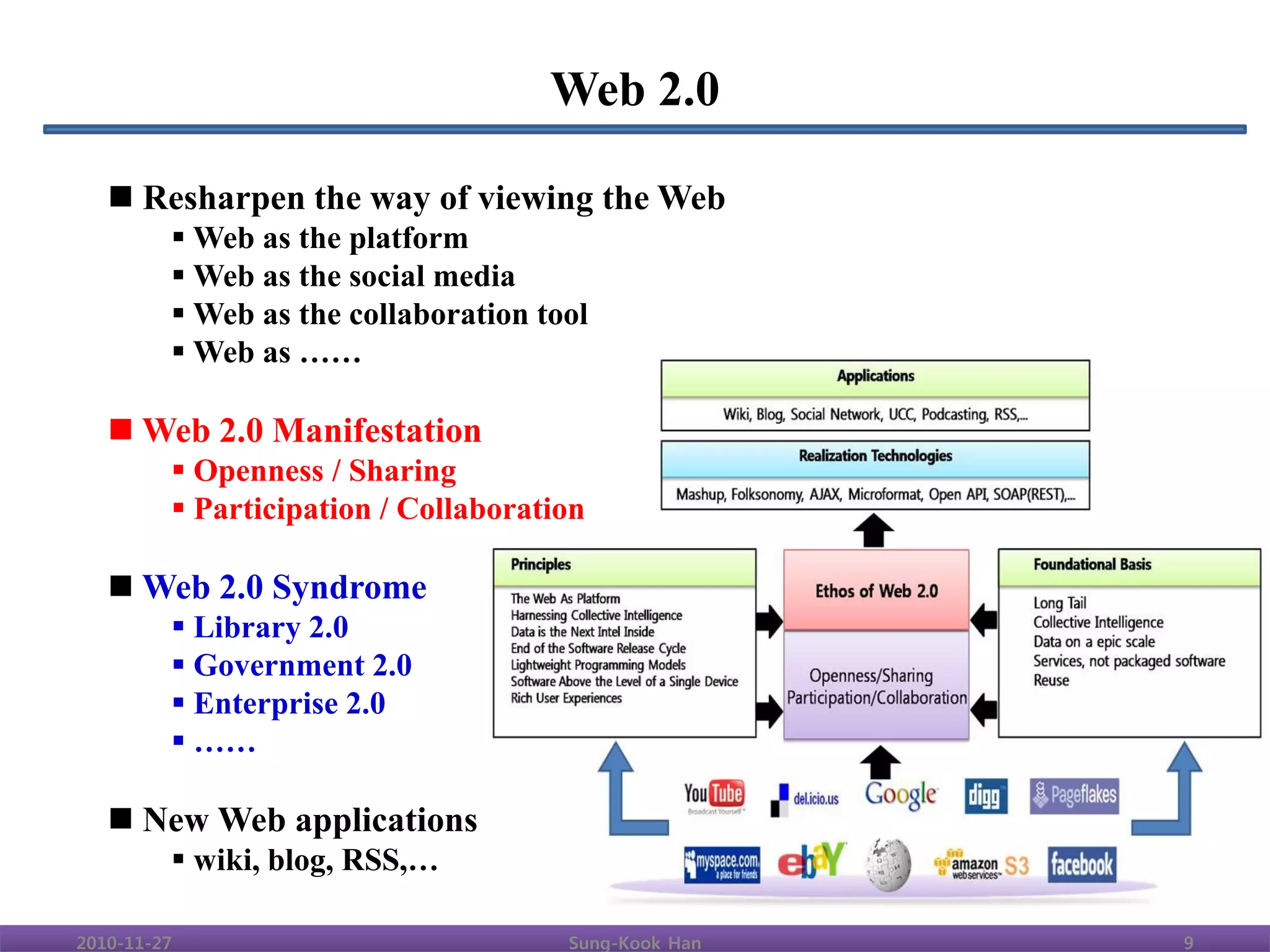
Web 2.0

    Resharpen the way of viewing the Web
          Web as the platform
          Web as the social media
          Web as the collaboration tool
          Web as ……

    Web 2.0 Manifestation
          Openness / Sharing
          Participation / Collaboration

    Web 2.0 Syndrome
          Library 2.0
          Government 2.0
          Enterprise 2.0
          ……

    New Web applications
          wiki, blog, RSS,…

2010-11-27                            Sung-Kook Han   9
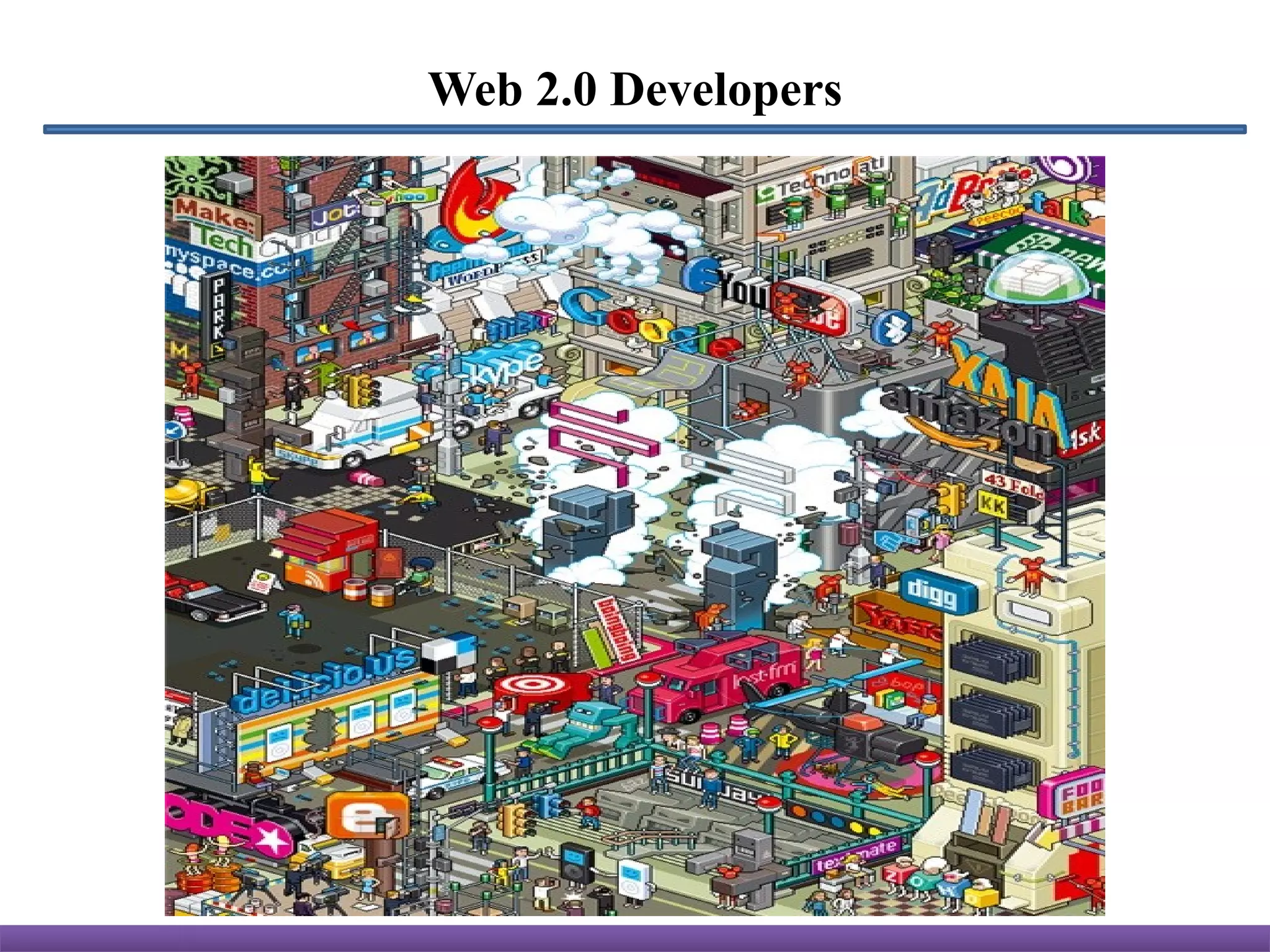
Web 2.0 Developers
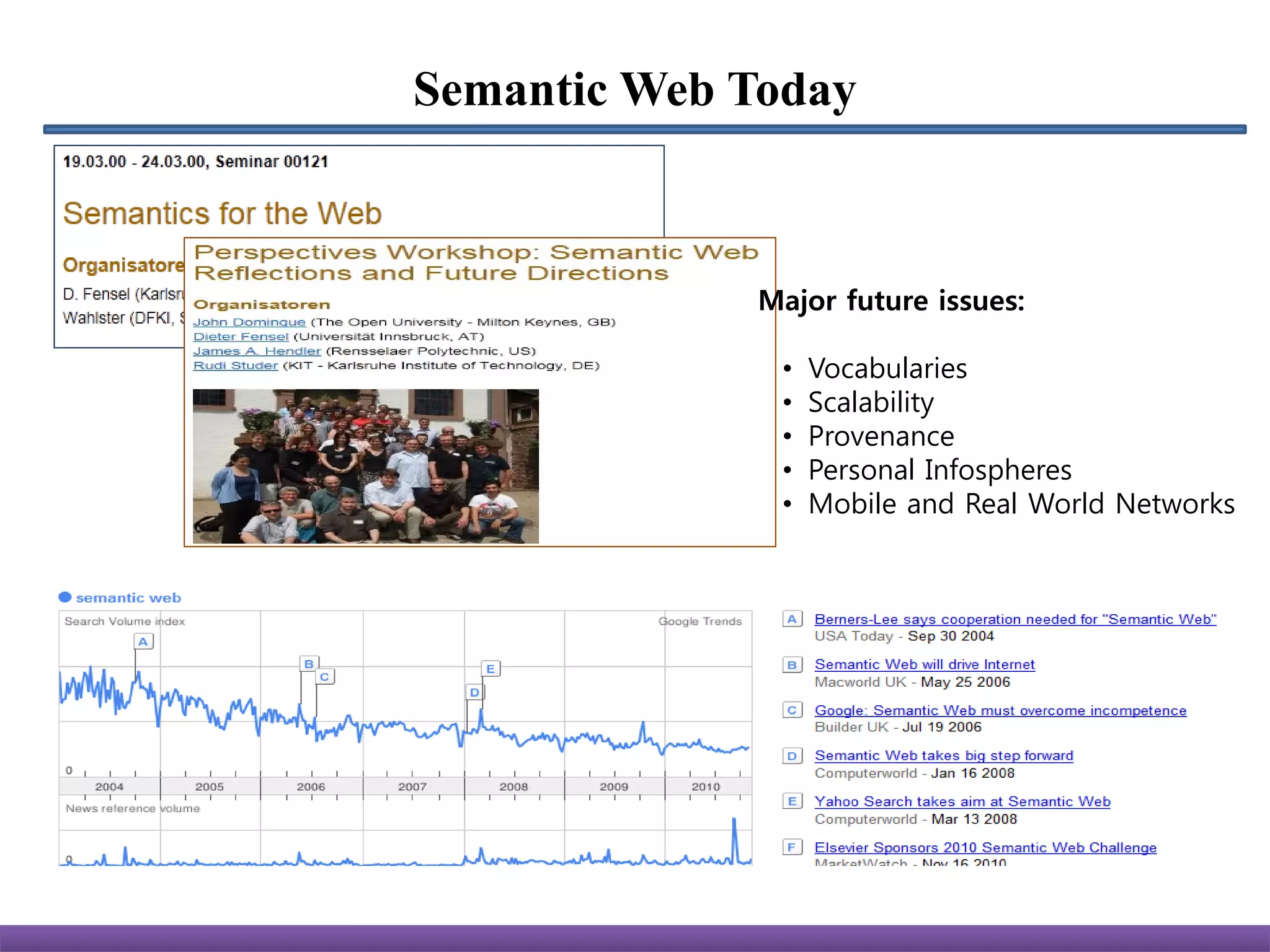
Semantic Web Today


             Major future issues:

              •   Vocabularies
              •   Scalability
              •   Provenance
              •   Personal Infospheres
              •   Mobile and Real World Networks
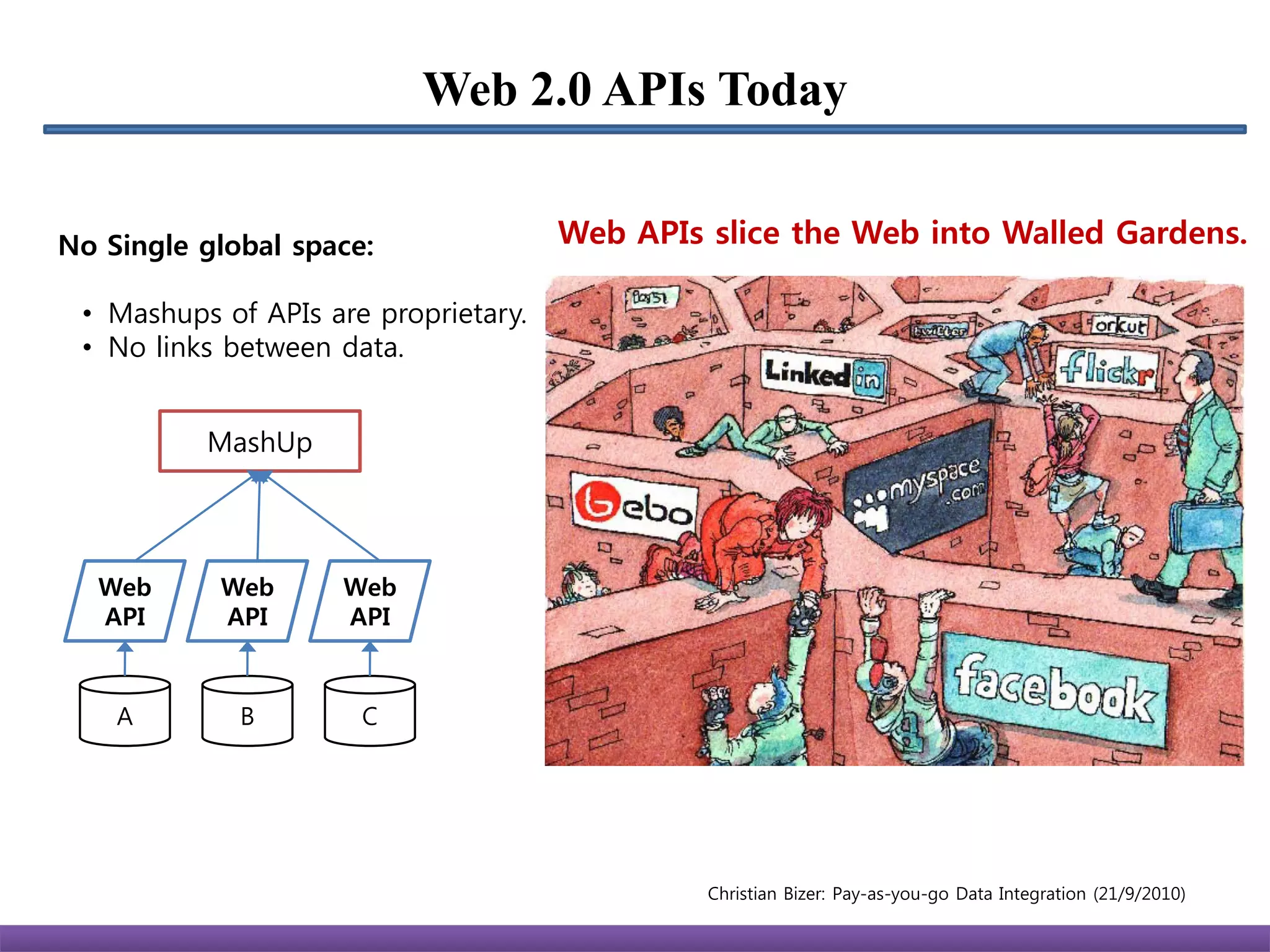
Web 2.0 APIs Today


No Single global space:               Web APIs slice the Web into Walled Gardens.

 • Mashups of APIs are proprietary.
 • No links between data.


          MashUp


  Web      Web      Web
  API      API      API


    A        B        C


                                               Christian Bizer: Pay-as-you-go Data Integration (21/9/2010)
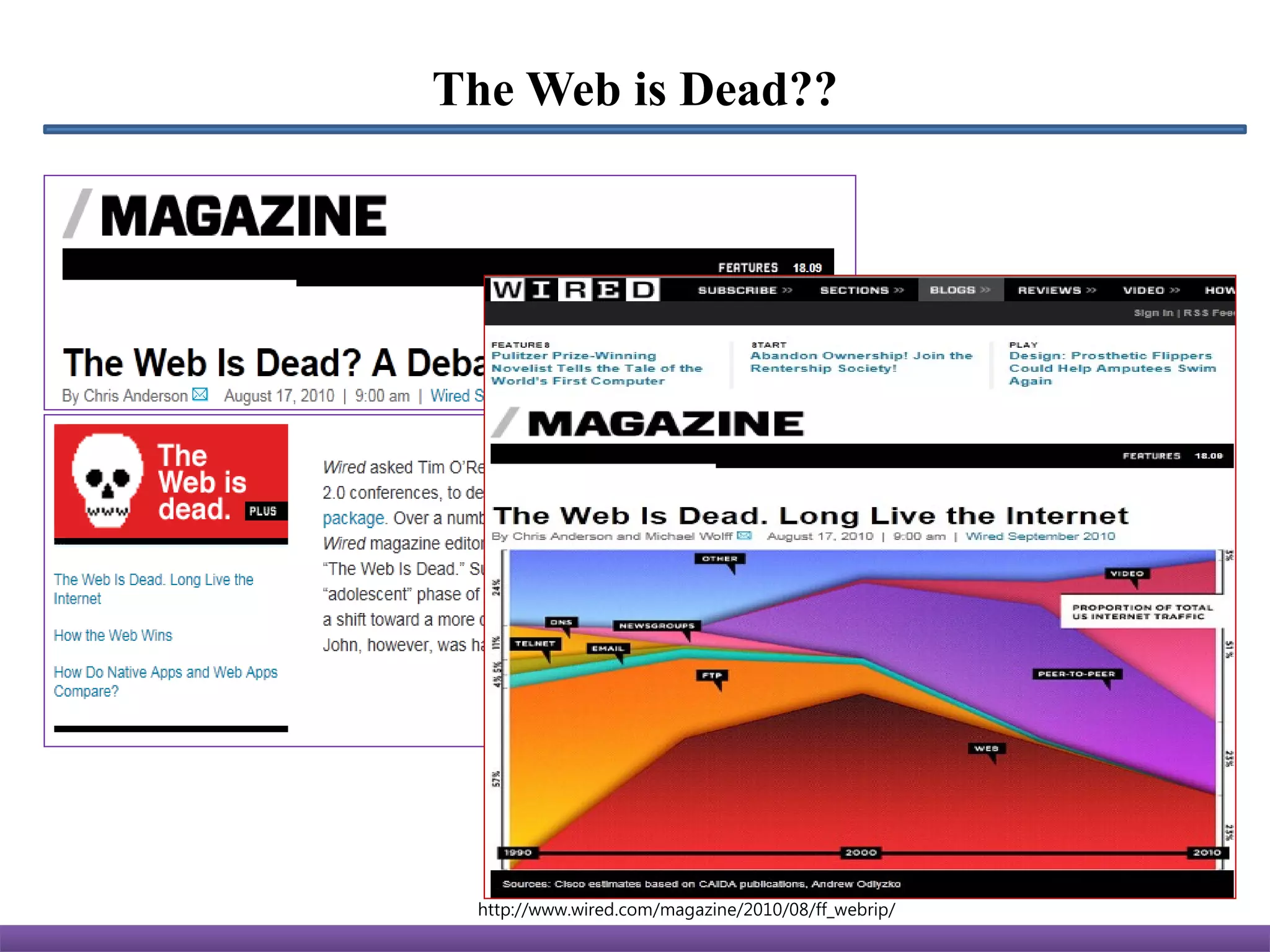
The Web is Dead??


 http://www.wired.com/magazine/2010/08/ff_webrip/
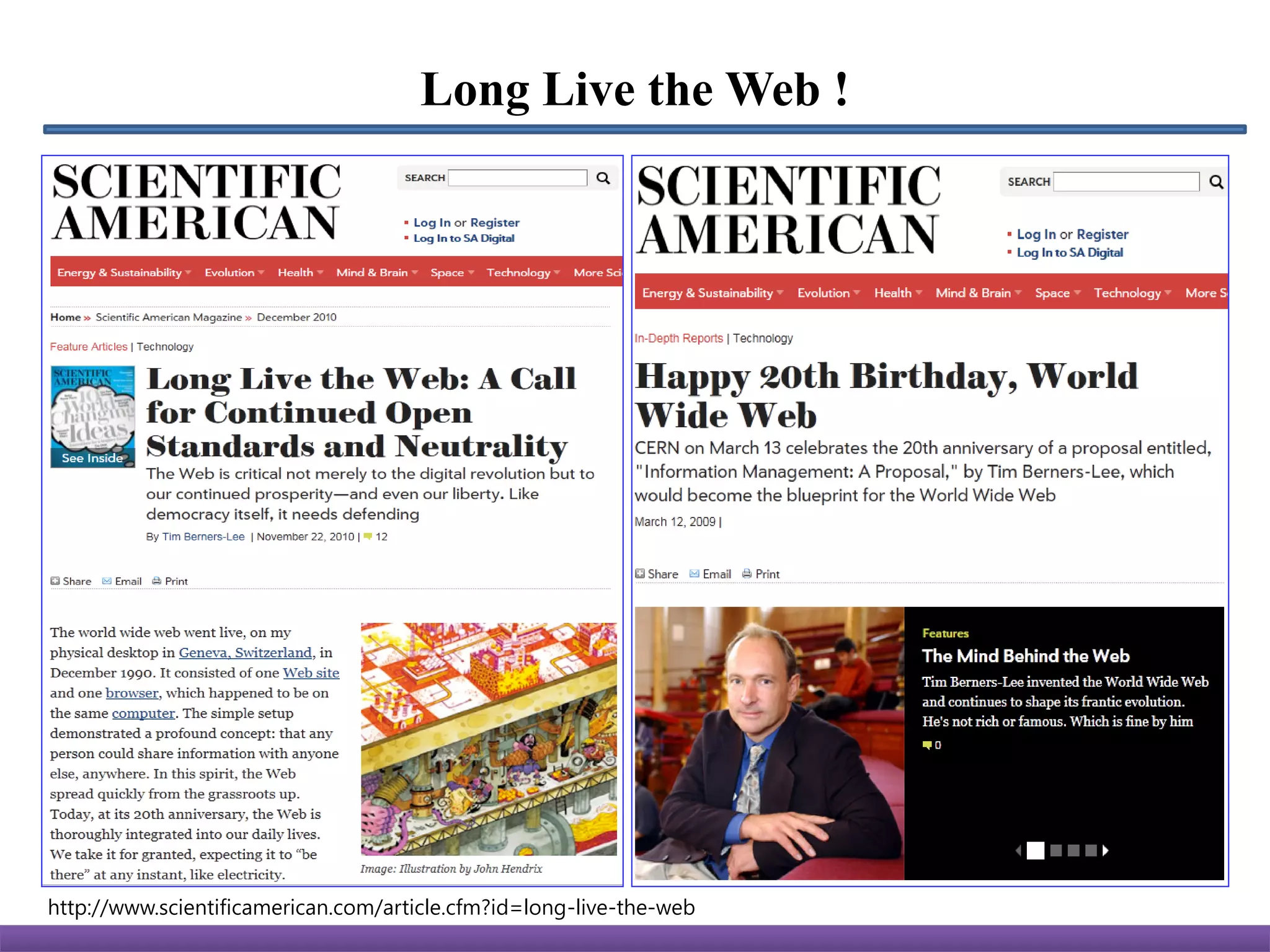
Long Live the Web !


http://www.scientificamerican.com/article.cfm?id=long-live-the-web
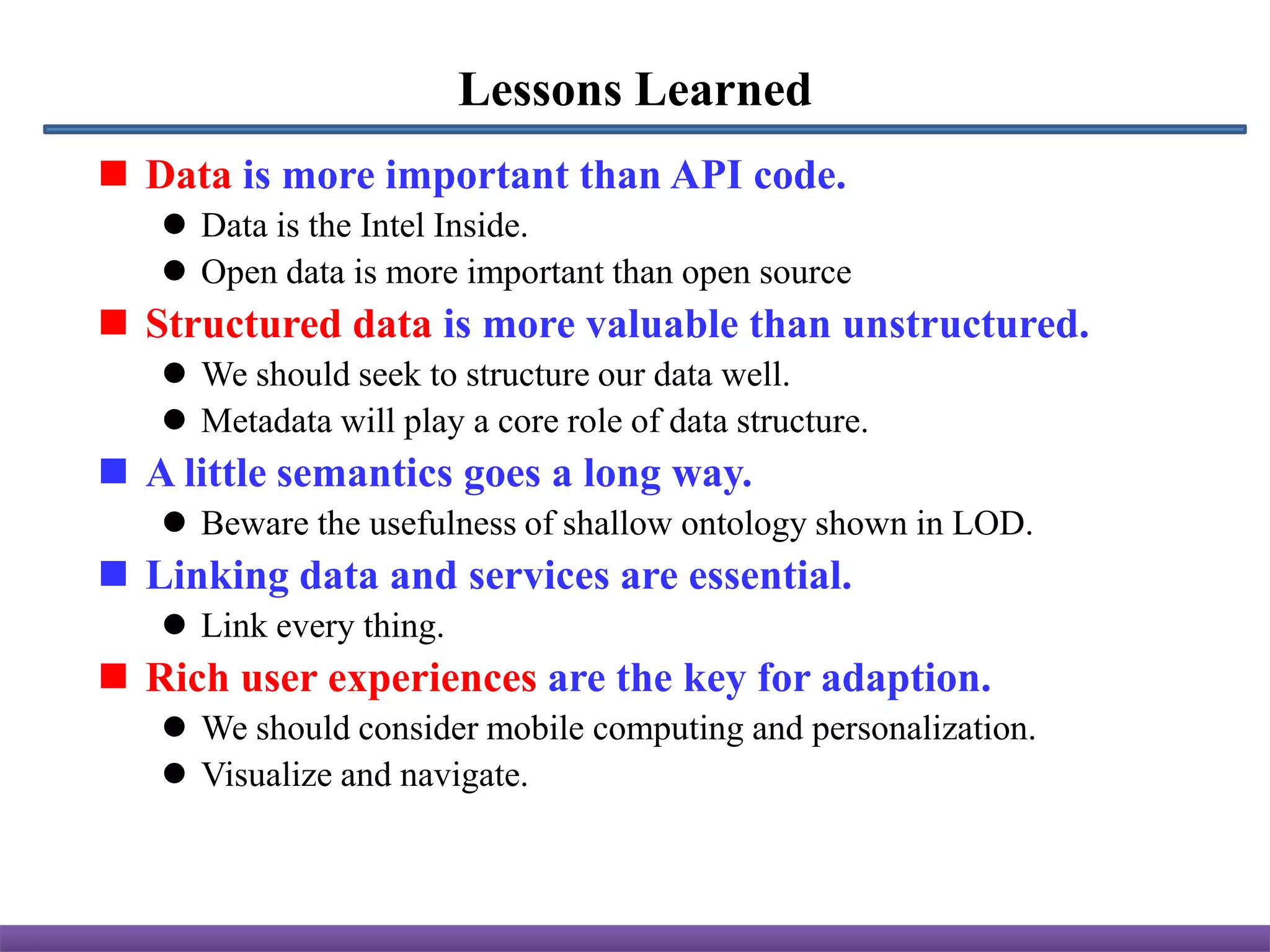
Lessons Learned
 Data is more important than API code.
    Data is the Intel Inside.
    Open data is more important than open source
 Structured data is more valuable than unstructured.
    We should seek to structure our data well.
    Metadata will play a core role of data structure.
 A little semantics goes a long way.
    Beware the usefulness of shallow ontology shown in LOD.
 Linking data and services are essential.
    Link every thing.
 Rich user experiences are the key for adaption.
    We should consider mobile computing and personalization.
    Visualize and navigate.
Linked Open Data
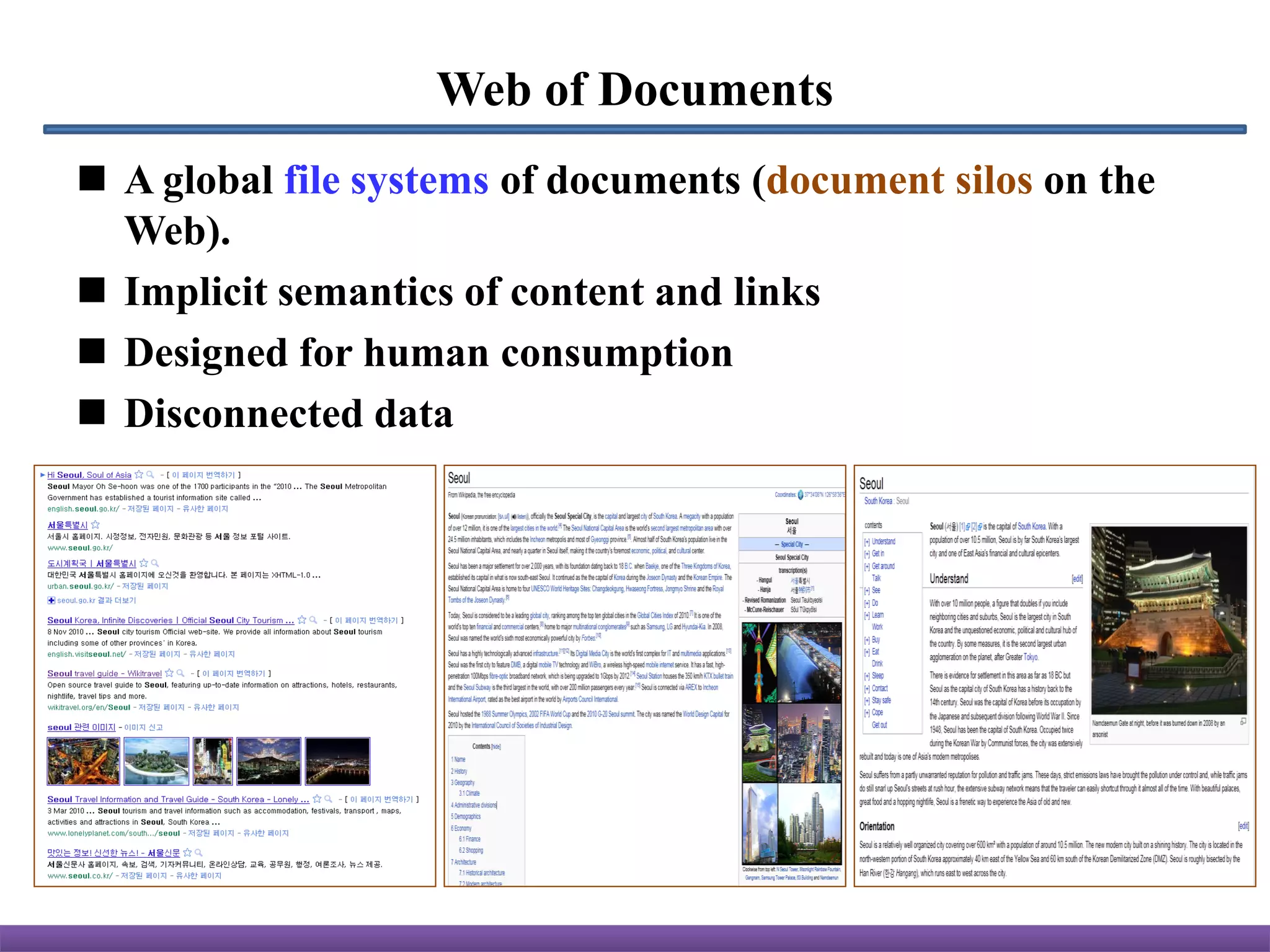
Web of Documents
 A global file systems of documents (document silos on the
  Web).
 Implicit semantics of content and links
 Designed for human consumption
 Disconnected data
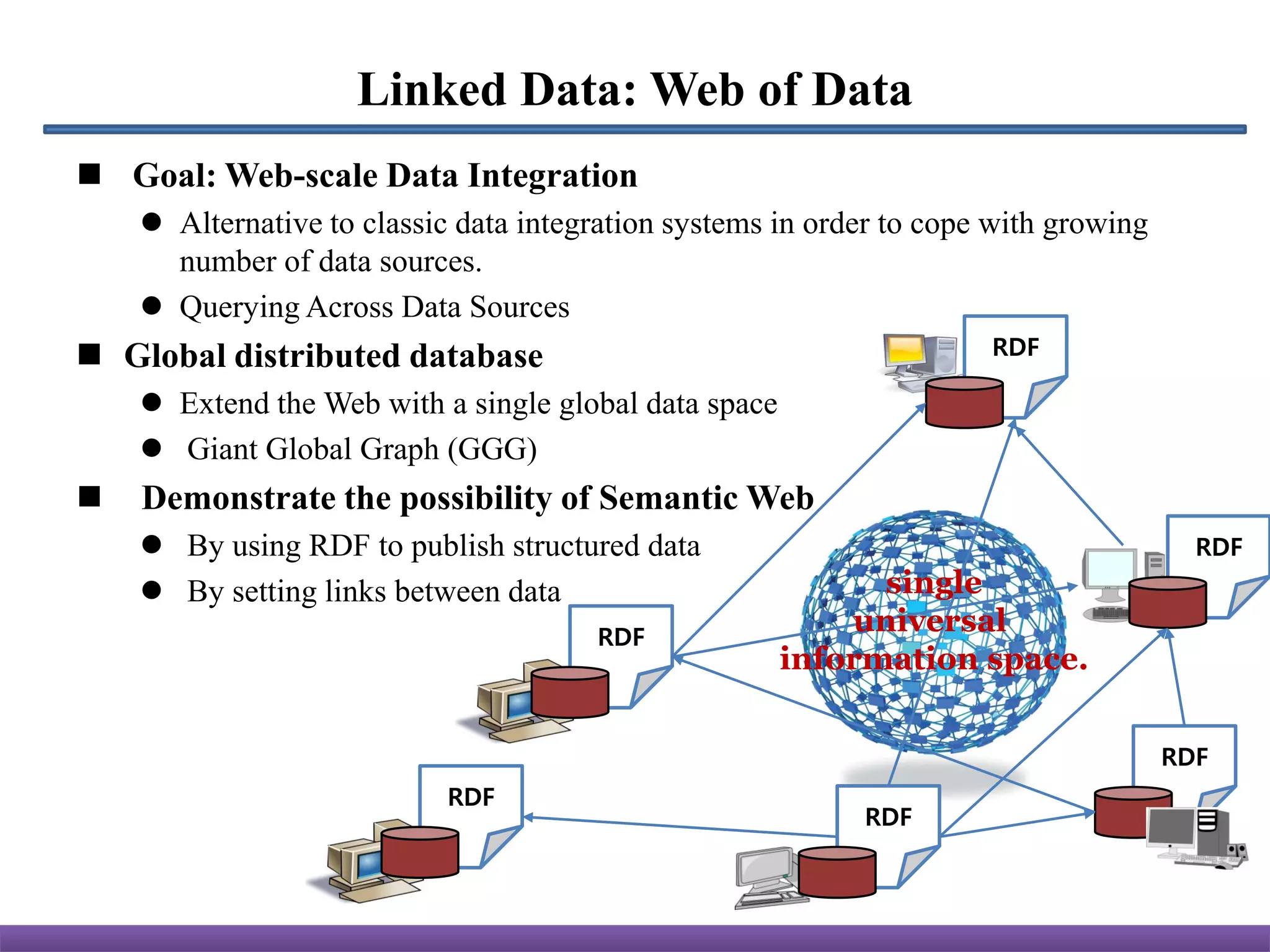
Linked Data: Web of Data
 Goal: Web-scale Data Integration
     Alternative to classic data integration systems in order to cope with growing
      number of data sources.
     Querying Across Data Sources
 Global distributed database                                         RDF

     Extend the Web with a single global data space
     Giant Global Graph (GGG)
   Demonstrate the possibility of Semantic Web
     By using RDF to publish structured data                                           RDF
     By setting links between data                          single
                                       RDF
                                                           universal
                                                       information space.


                                                                                      RDF
                            RDF
                                                            RDF
Semantic Web: Web of Data
 The vision of a Semantic Web:
     building a global Web of machine-readable data
     Berners-Lee, Hendler & Lassila, 2001; Marshall & Shipman, 2003

The first step is putting data on the Web in a form that machines can
naturally understand, or converting it to that form. This creates what I call a
Semantic Web - a web of data that can be processed directly or indirectly by
machines. Therefore, while the Semantic Web, or Web of Data, is the goal or
the end result of this process, Linked Data provides the means to reach that
goal. -- Tim Berners-Lee, et al., http://linkeddata.org/docs/ijswis-special-issue, Jan, 2009


 Linked Data Foundation
     can lower the barrier to reuse, integration and application of data from multiple,
      distributed and heterogeneous sources.
     the more sophisticated proposals associated with the Semantic Web vision,
      such as intelligent agents, may become a reality.
Linked Data Principles
 Use URIs as names for things.
 Use HTTP URIs so that people can look up those names.
 When someone looks up a URI, provide useful RDF
  information.
 Include RDF statements that link to other URIs so that
  they can discover related things.


 Community effort to
    publish existing open license datasets as Linked Data on the Web
    interlink things between different data sources
    develop clients that consume Linked Data from the Web
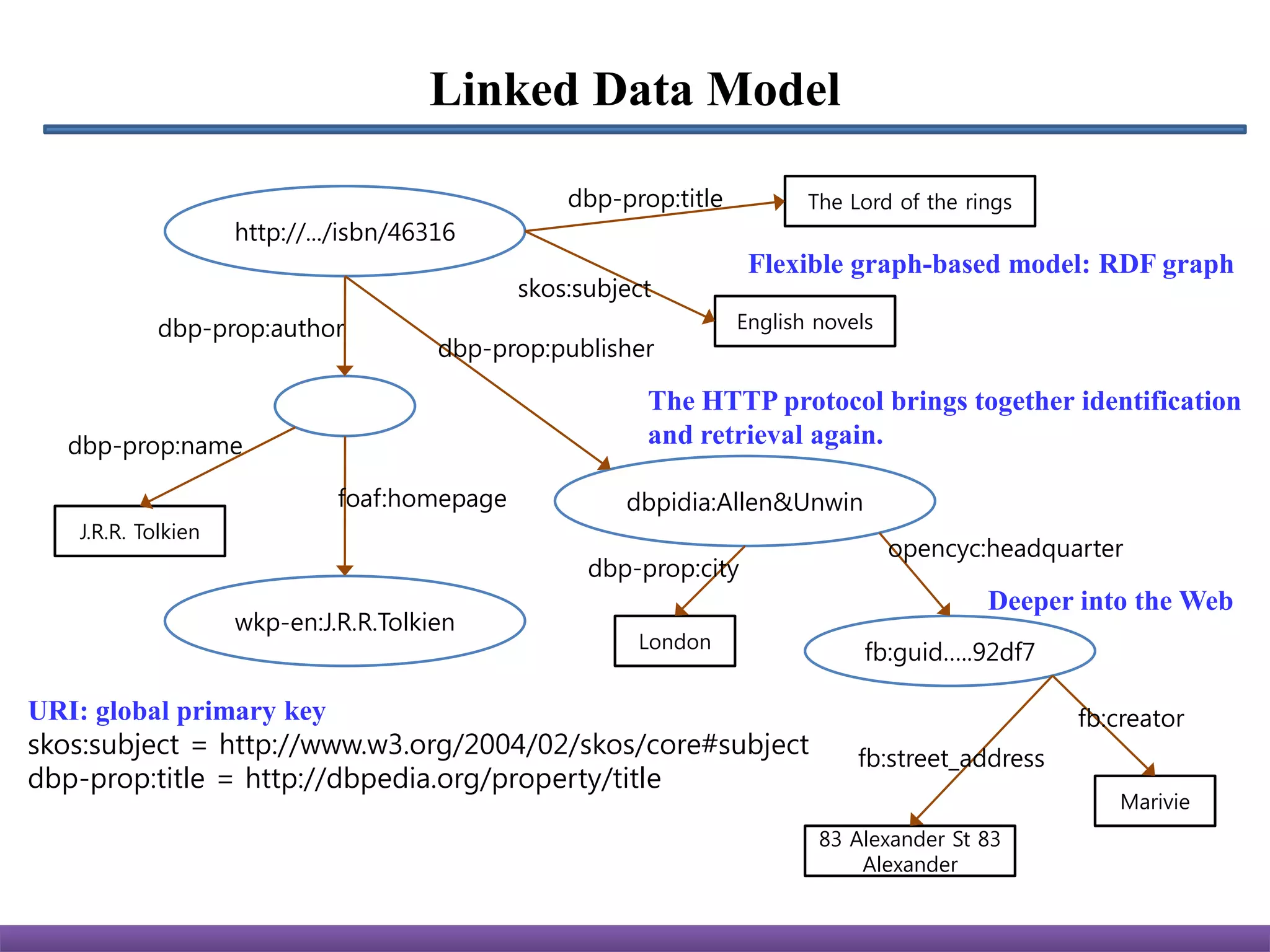
Linked Data Model

                                                 dbp-prop:title          The Lord of the rings
                    http://.../isbn/46316
                                                                   Flexible graph-based model: RDF graph
                                             skos:subject
            dbp-prop:author                                       English novels
                                       dbp-prop:publisher

                                                        The HTTP protocol brings together identification
  dbp-prop:name                                         and retrieval again.

                             foaf:homepage            dbpidia:Allen&Unwin
   J.R.R. Tolkien
                                                                                   opencyc:headquarter
                                                   dbp-prop:city
                                                                                           Deeper into the Web
                    wkp-en:J.R.R.Tolkien
                                                       London
                                                                               fb:guid…..92df7

URI: global primary key                                                                           fb:creator
skos:subject = http://www.w3.org/2004/02/skos/core#subject                    fb:street_address
dbp-prop:title = http://dbpedia.org/property/title
                                                                                                     Marivie
                                                                          83 Alexander St 83
                                                                              Alexander
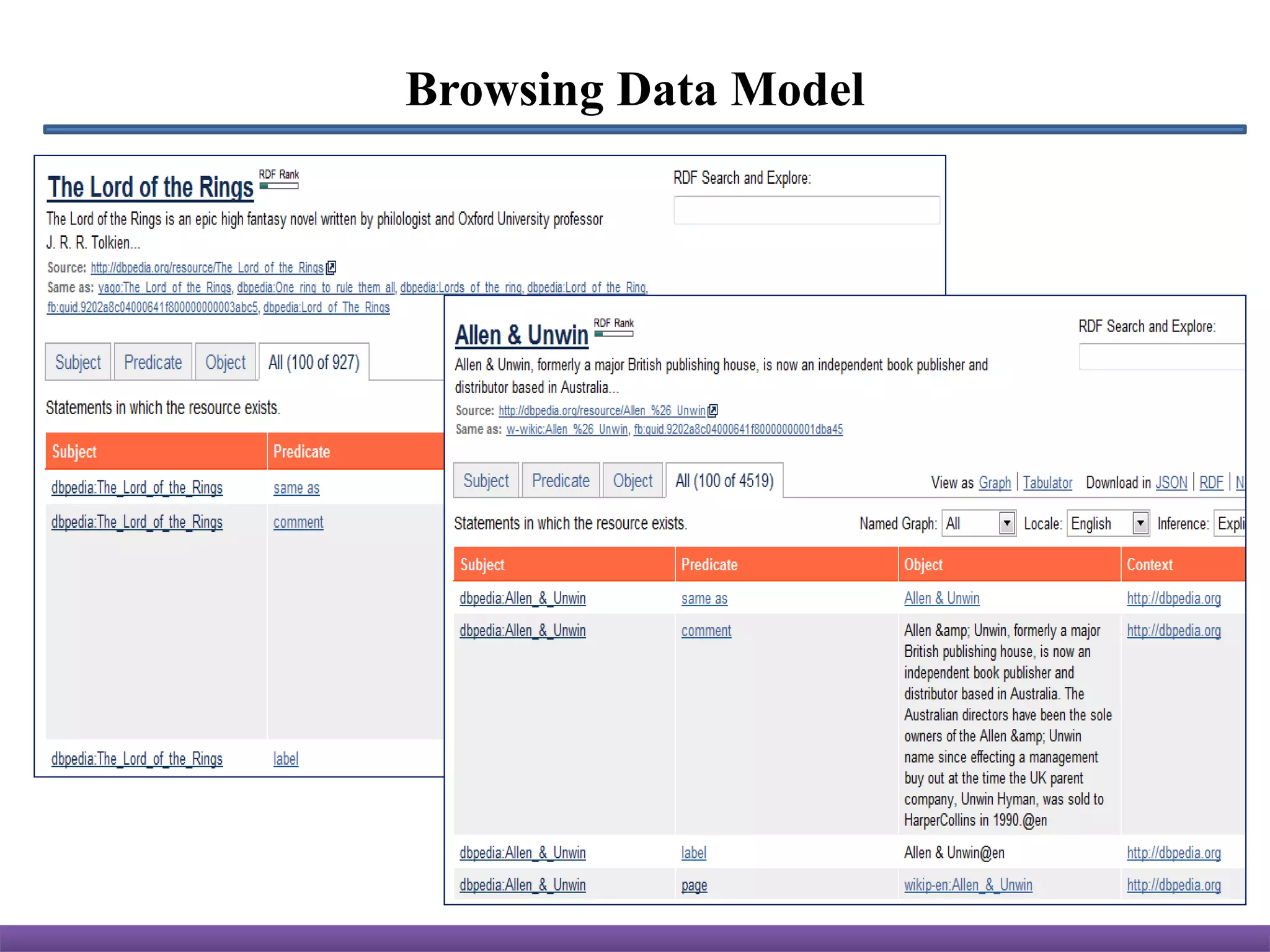
Browsing Data Model
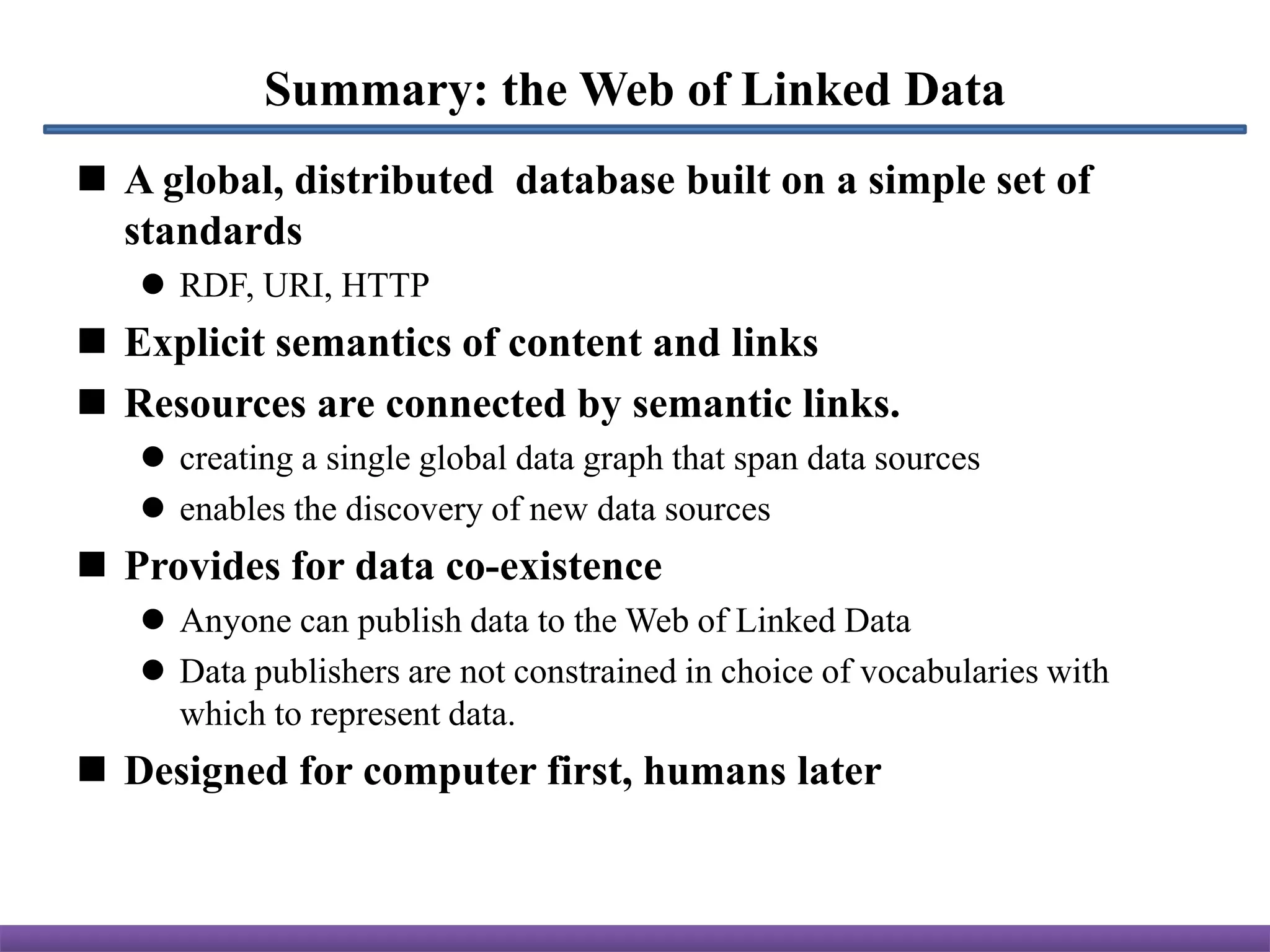
Summary: the Web of Linked Data
 A global, distributed database built on a simple set of
  standards
    RDF, URI, HTTP
 Explicit semantics of content and links
 Resources are connected by semantic links.
    creating a single global data graph that span data sources
    enables the discovery of new data sources
 Provides for data co-existence
    Anyone can publish data to the Web of Linked Data
    Data publishers are not constrained in choice of vocabularies with
     which to represent data.
 Designed for computer first, humans later
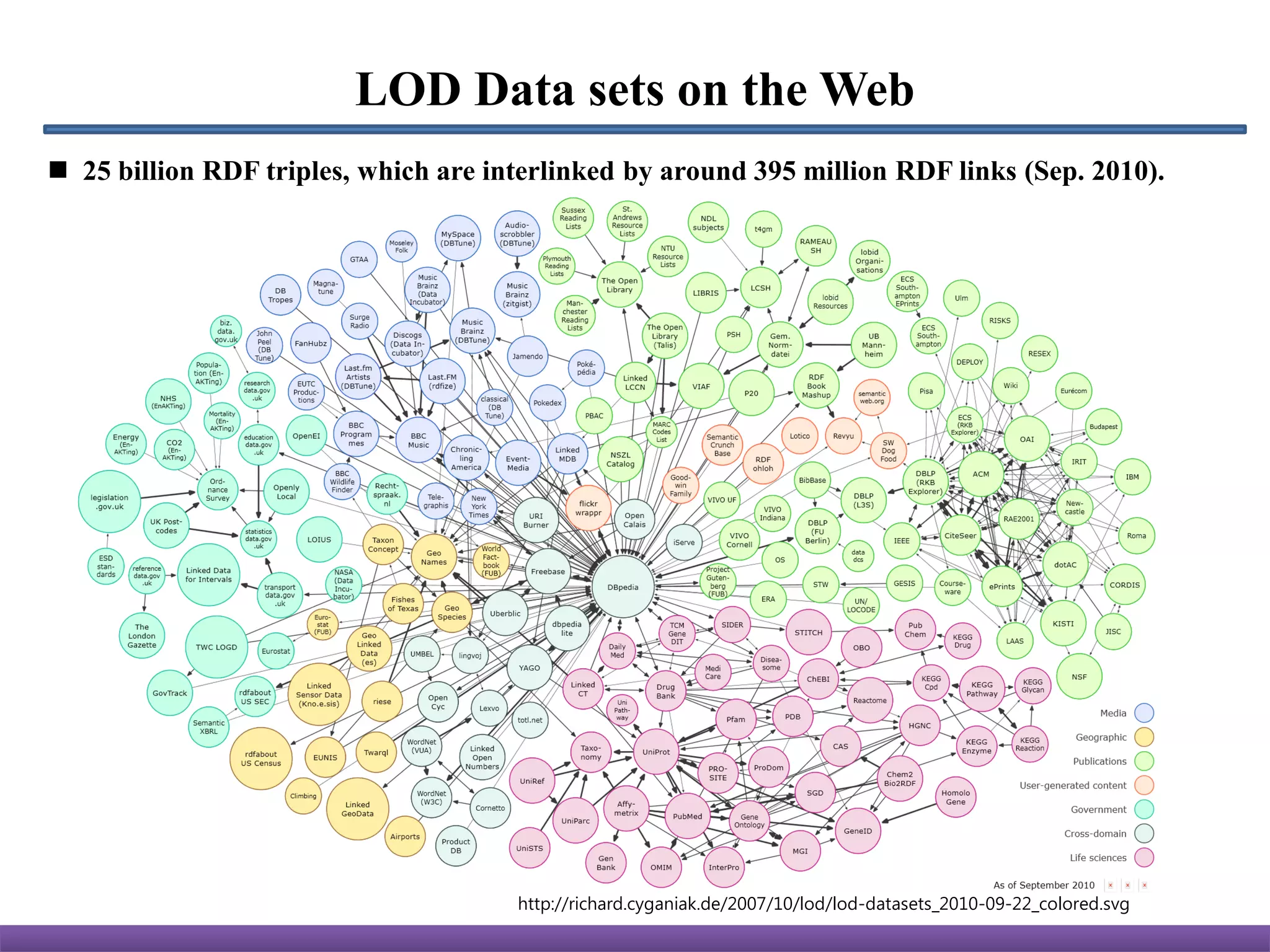
LOD Data sets on the Web
 25 billion RDF triples, which are interlinked by around 395 million RDF links (Sep. 2010).


                                      http://richard.cyganiak.de/2007/10/lod/lod-datasets_2010-09-22_colored.svg
Supporting Technologies
 Linked Data Browsers
    Provide for navigating between data sources and for exploring the dataspace.
    Tabulator Browser (MIT, USA), Marbles (FU Berlin, DE), OpenLink RDF
     Browser (OpenLink, UK), Zitgist RDF Browser (Zitgist, USA), Disco
     Hyperdata Browser Berlin, Fenfire (DERI, Irland)
 Web of Data Search Engines
    Crawl the data space and provide best-effort query answers over crawled data.
    Falcons (IWS, China), Sig.ma (DERI, Ireland), Swoogle (UMBC, USA),
     VisiNav (DERI, Ireland), Watson (Open University, UK), TAP, Sindice
Supporting Technologies
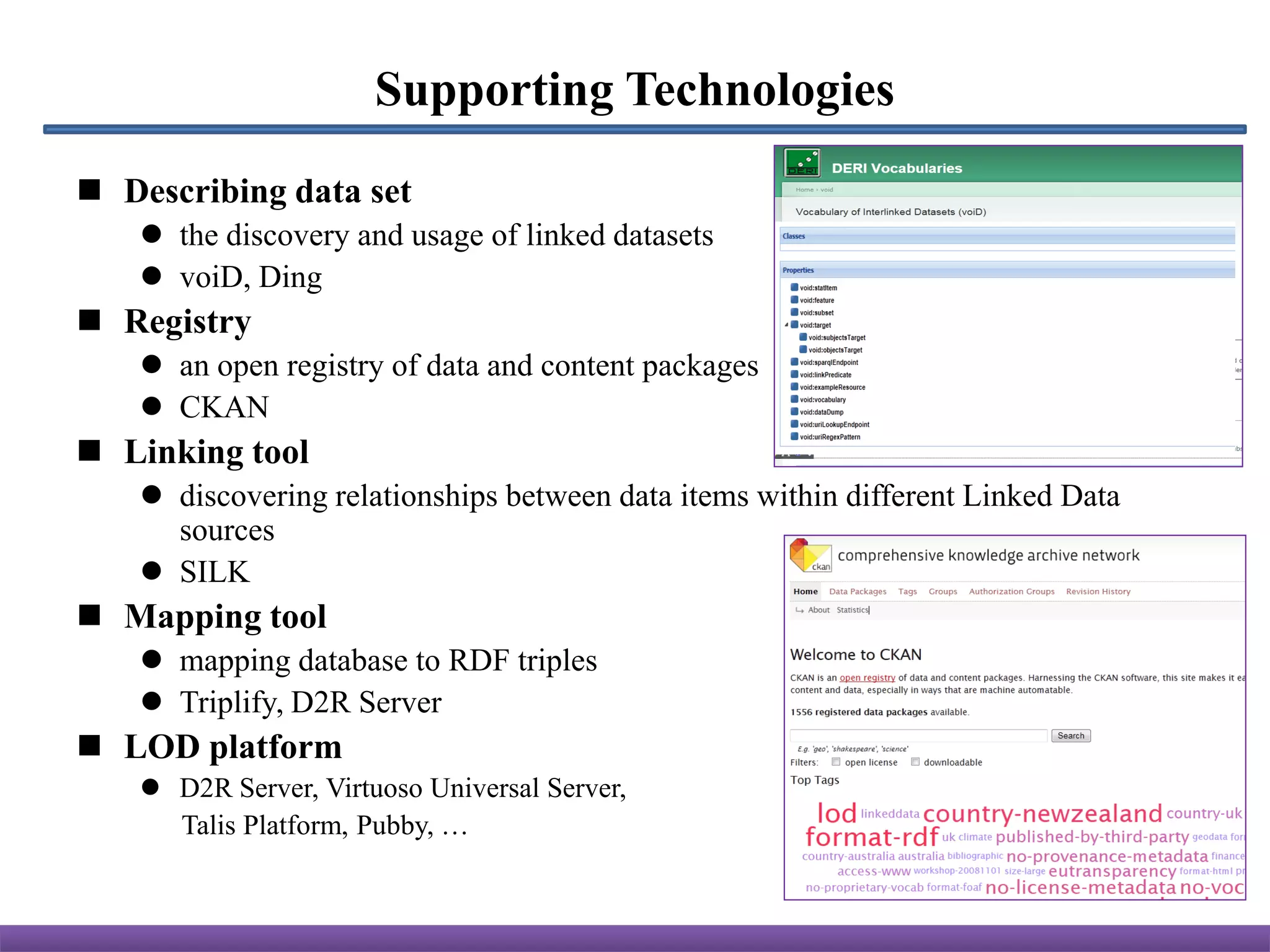
 Describing data set
    the discovery and usage of linked datasets
    voiD, Ding
 Registry
    an open registry of data and content packages
    CKAN
 Linking tool
    discovering relationships between data items within different Linked Data
     sources
    SILK
 Mapping tool
    mapping database to RDF triples
    Triplify, D2R Server
 LOD platform
    D2R Server, Virtuoso Universal Server,
     Talis Platform, Pubby, …
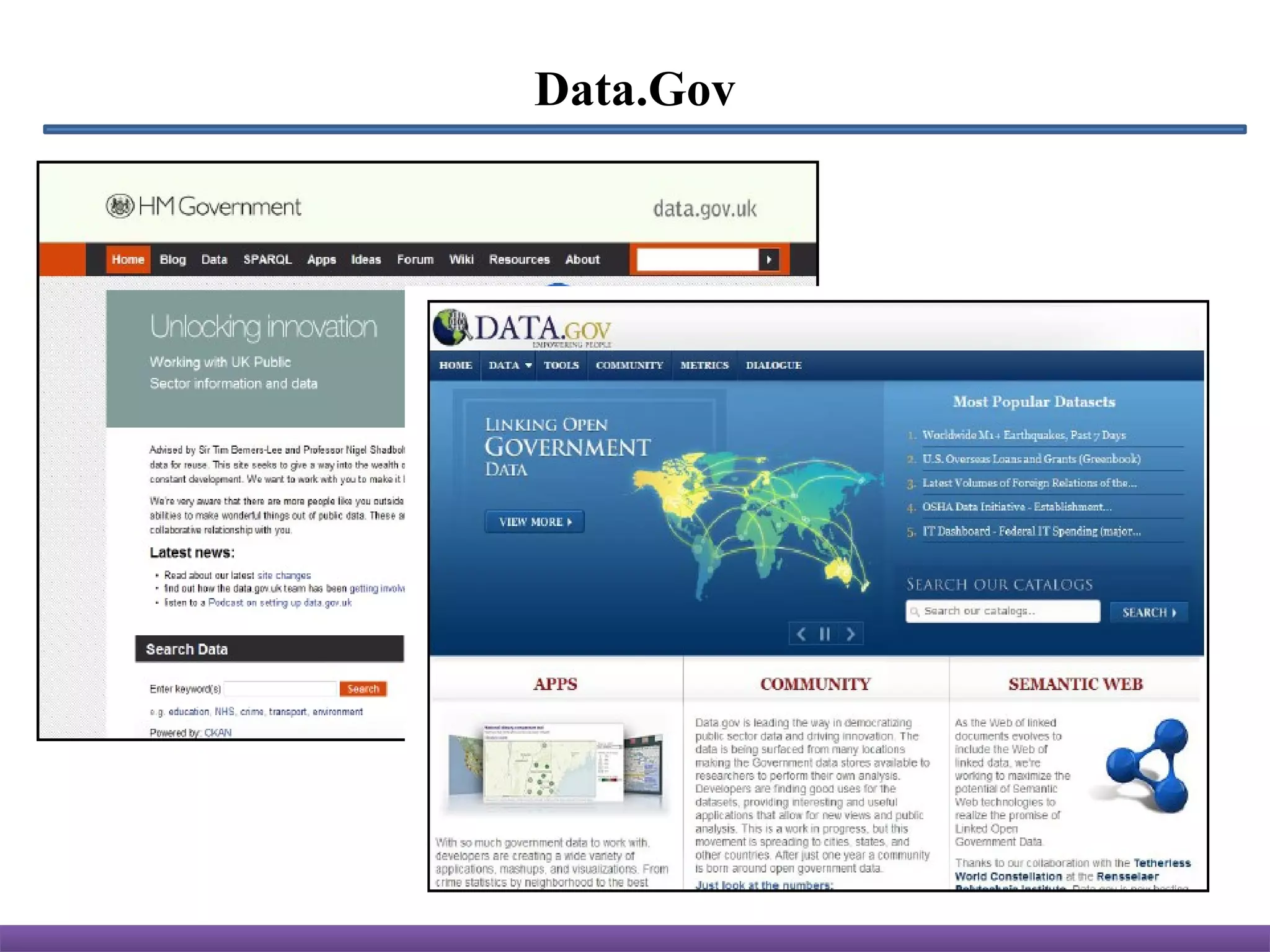
Data.Gov
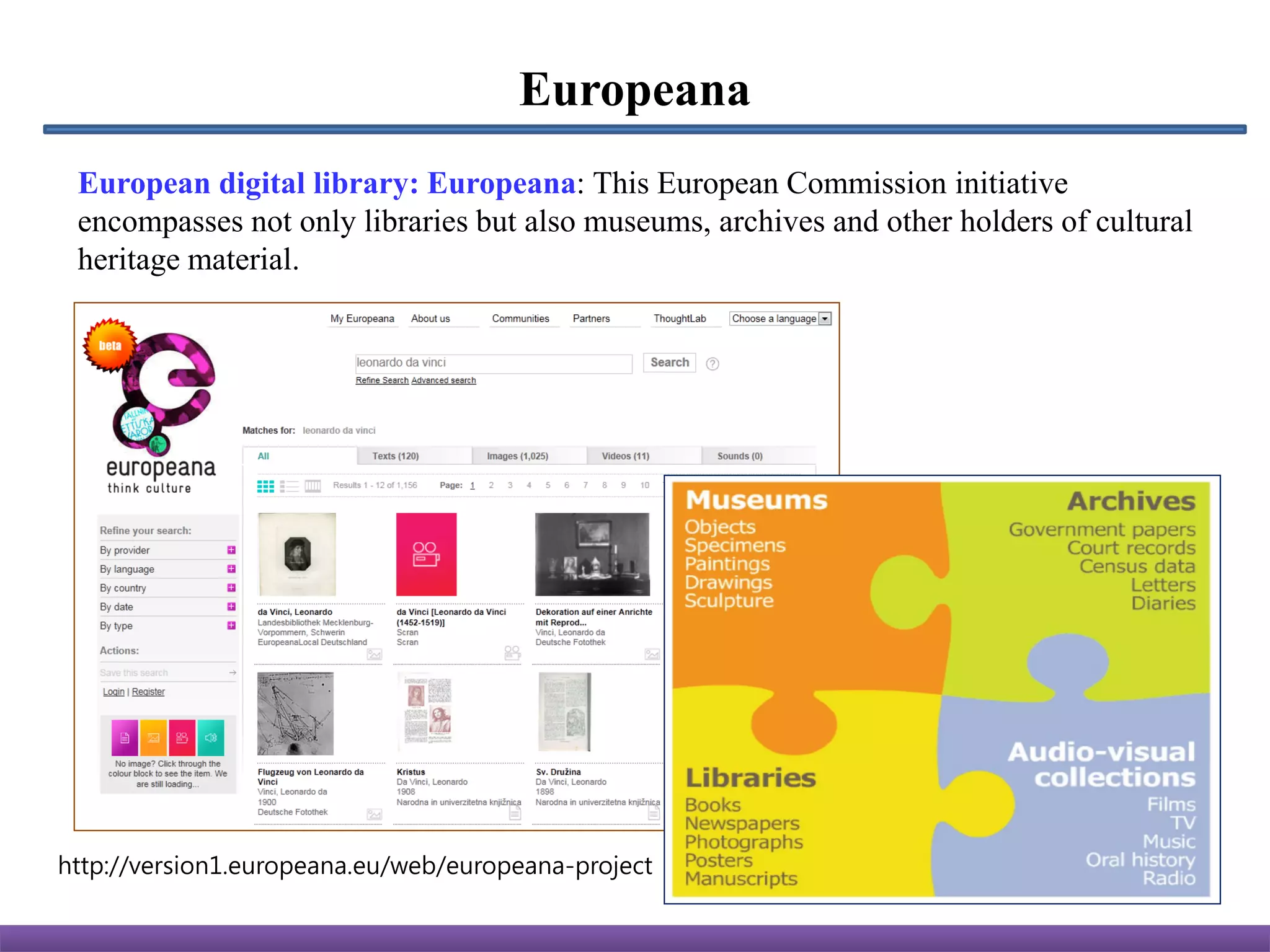
Europeana
 European digital library: Europeana: This European Commission initiative
 encompasses not only libraries but also museums, archives and other holders of cultural
 heritage material.


http://version1.europeana.eu/web/europeana-project
Linked Library Cloud
 Libraries have been producing
  metadata for ages.
 Libraries (often) produce high-
  quality metadata.
 Library develops many metadata
  standards such as DC, SKOS,
  BIBO, OAI-ORE including
  MARC 21, MODS, FRBR,..
 Integrate Library Catalogues on
  global scale


                                          http://code4lib.org/conference/2010/singer
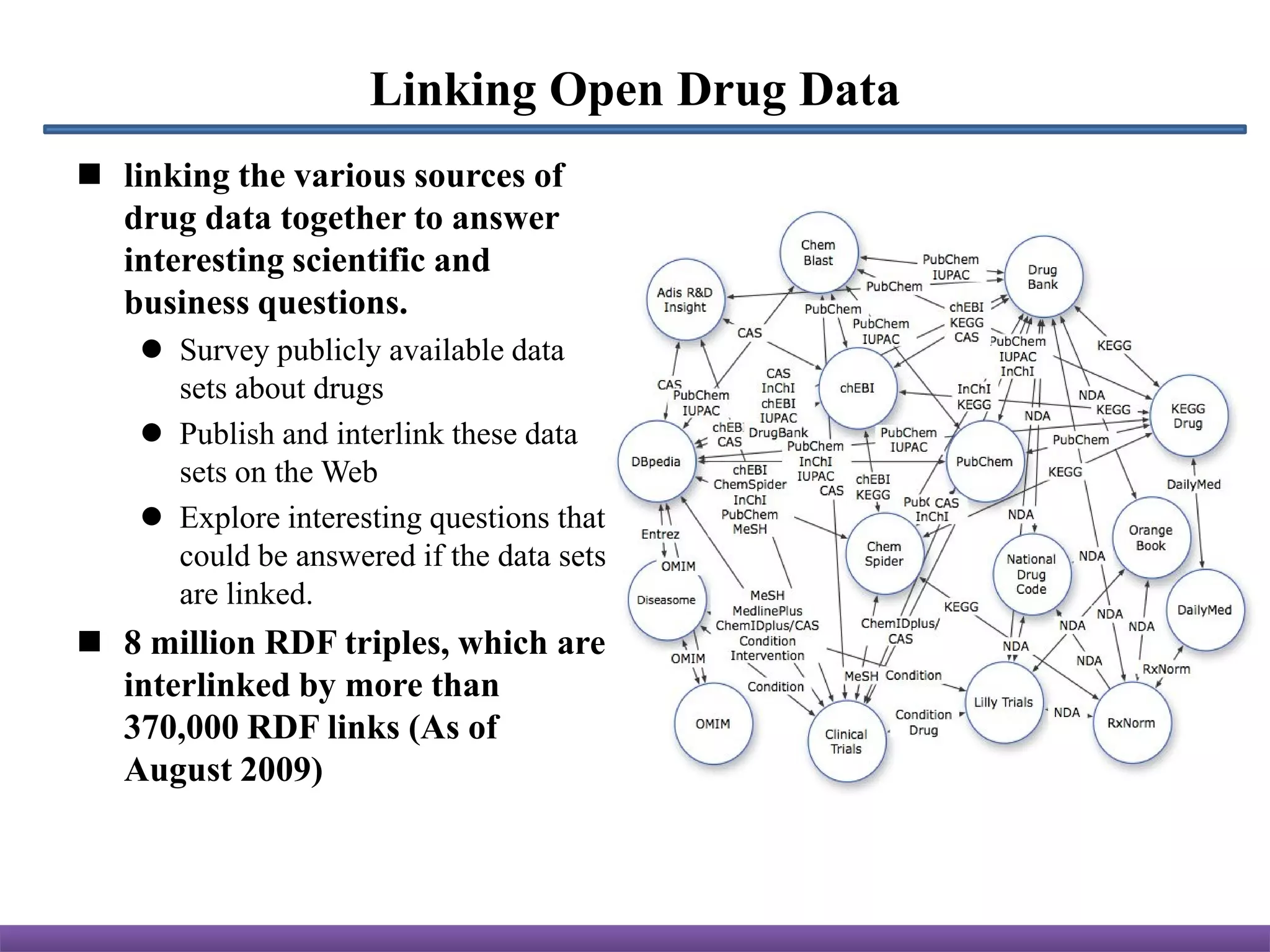
Linking Open Drug Data
 linking the various sources of
  drug data together to answer
  interesting scientific and
  business questions.
     Survey publicly available data
      sets about drugs
     Publish and interlink these data
      sets on the Web
     Explore interesting questions that
      could be answered if the data sets
      are linked.
 8 million RDF triples, which are
  interlinked by more than
  370,000 RDF links (As of
  August 2009)
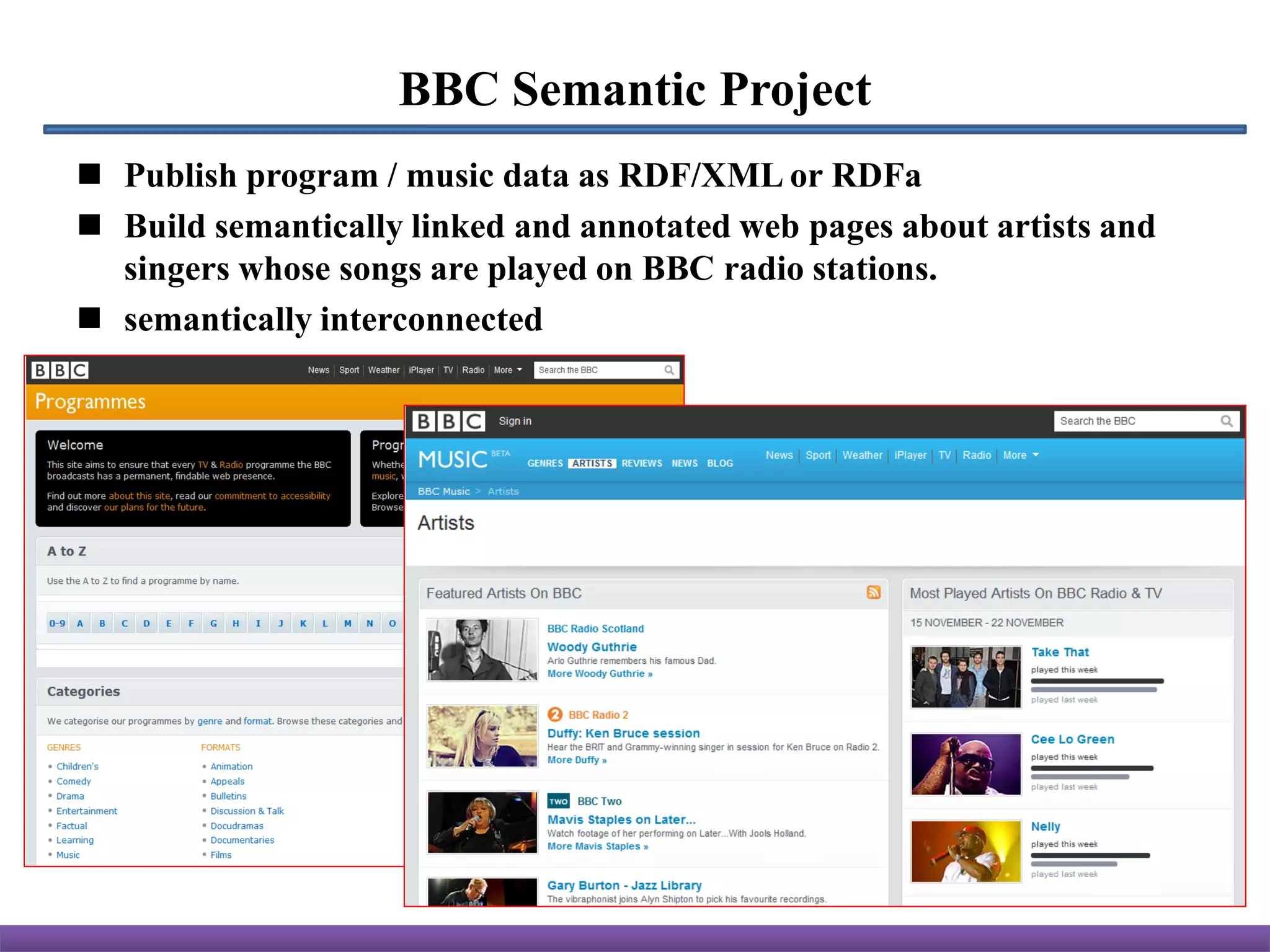
BBC Semantic Project
 Publish program / music data as RDF/XML or RDFa
 Build semantically linked and annotated web pages about artists and
  singers whose songs are played on BBC radio stations.
 semantically interconnected
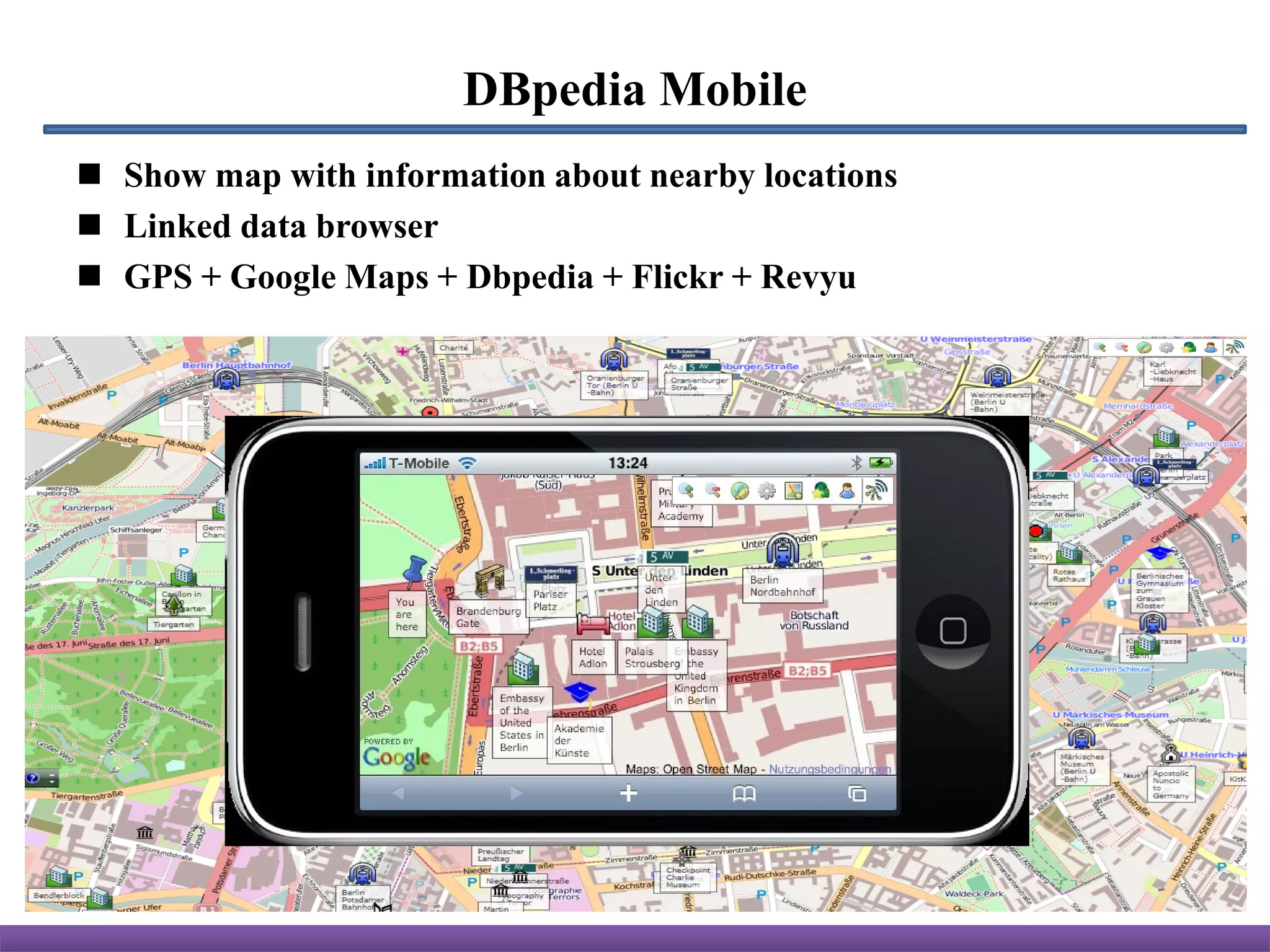
DBpedia Mobile
 Show map with information about nearby locations
 Linked data browser
 GPS + Google Maps + Dbpedia + Flickr + Revyu
Attention by Search Engines
 Yahoo!
   crawls Linked Data in its RDFa serialization as well as Microformat
   Yahoo Search Monkey to make search results more useful and visually
    appealing


 Google
   use Social Graph API
   is developing Google Squared and Google Fusion Table
   merged MetaWeb
       manage Freebase, a DBpedia/YAGO competitor
Linked Open Commerce
LOD: Next Step


Linking, Integration and Fusion
   by Semantic Technology
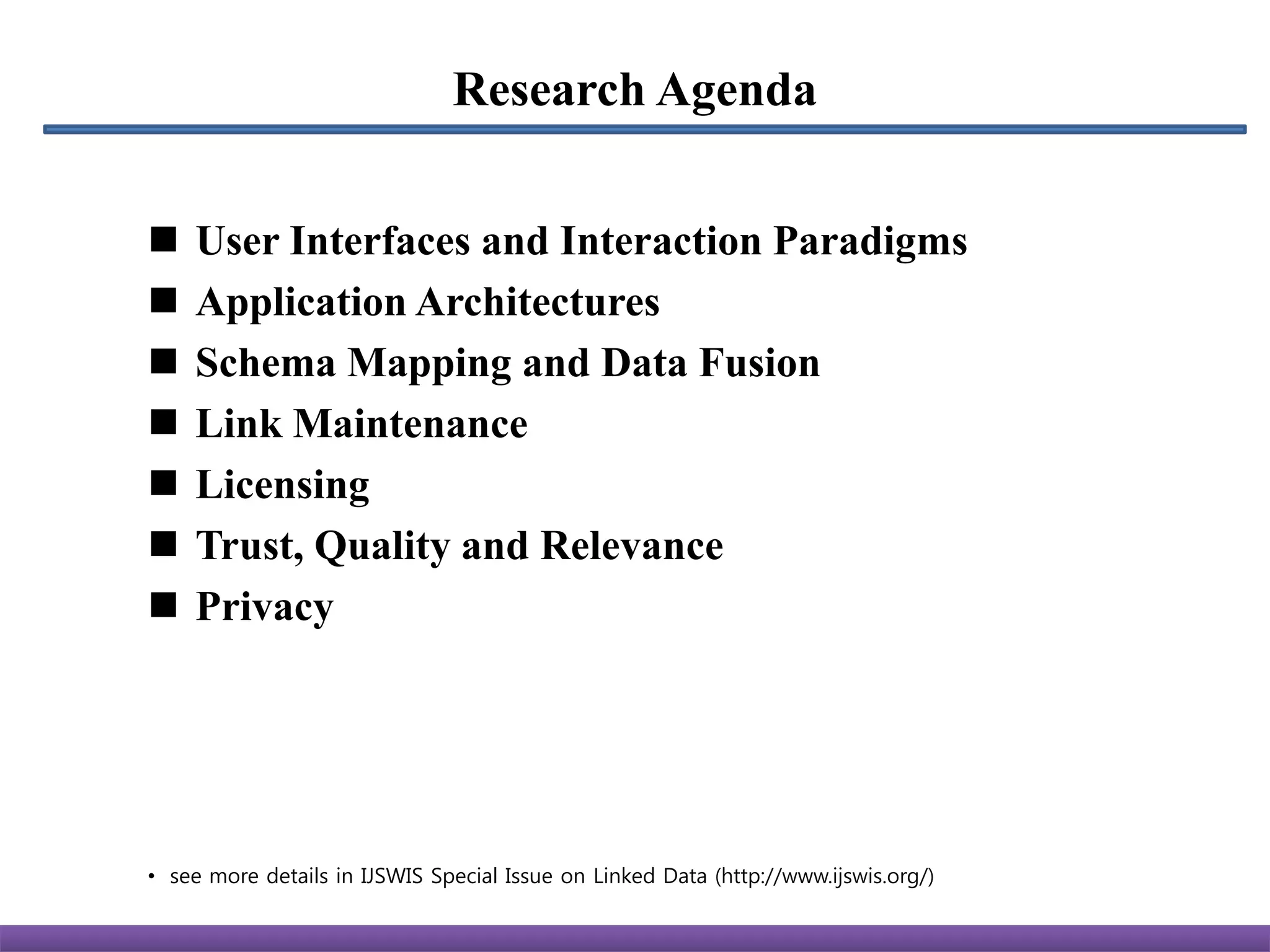
Research Agenda


   User Interfaces and Interaction Paradigms
   Application Architectures
   Schema Mapping and Data Fusion
   Link Maintenance
   Licensing
   Trust, Quality and Relevance
   Privacy


• see more details in IJSWIS Special Issue on Linked Data (http://www.ijswis.org/)
Context-Aware
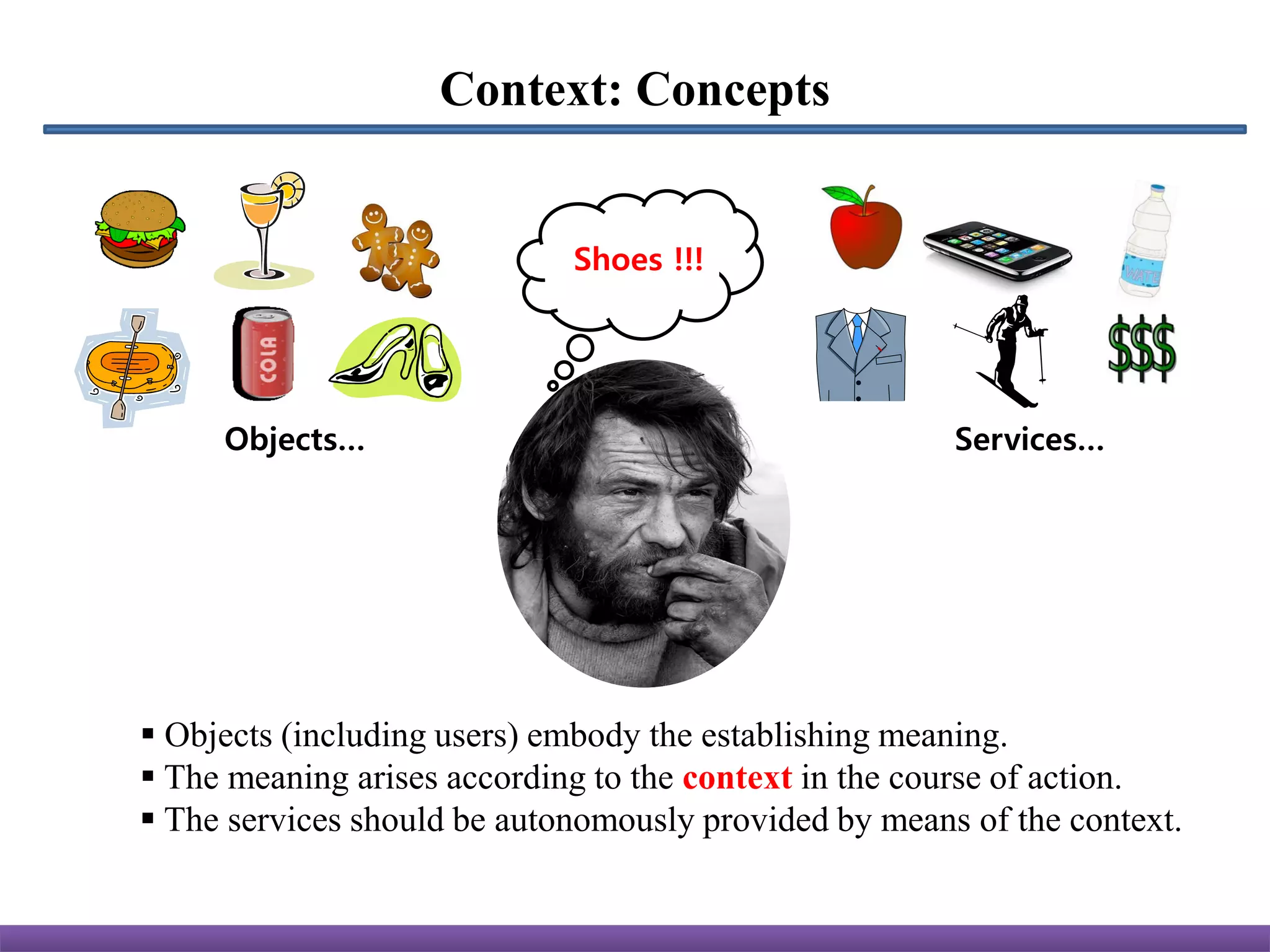
Context: Concepts


                               ???
                             Shoes !!!


     Objects…                                          Services…


 Objects (including users) embody the establishing meaning.
 The meaning arises according to the context in the course of action.
 The services should be autonomously provided by means of the context.
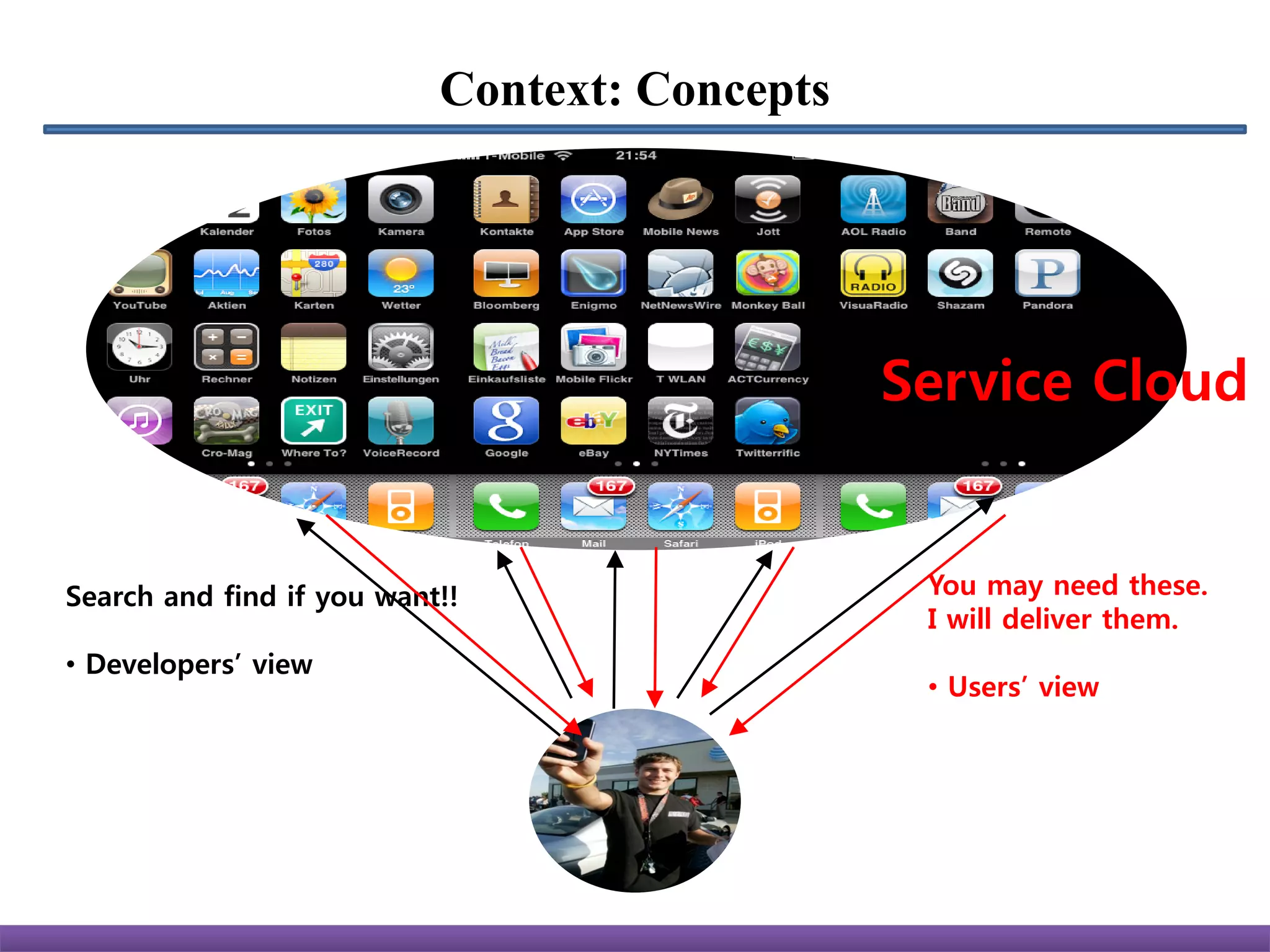
Context: Concepts


                                               Service Cloud


Search and find if you want!!                   You may need these.
                                                I will deliver them.
• Developers’ view
                                                • Users’ view
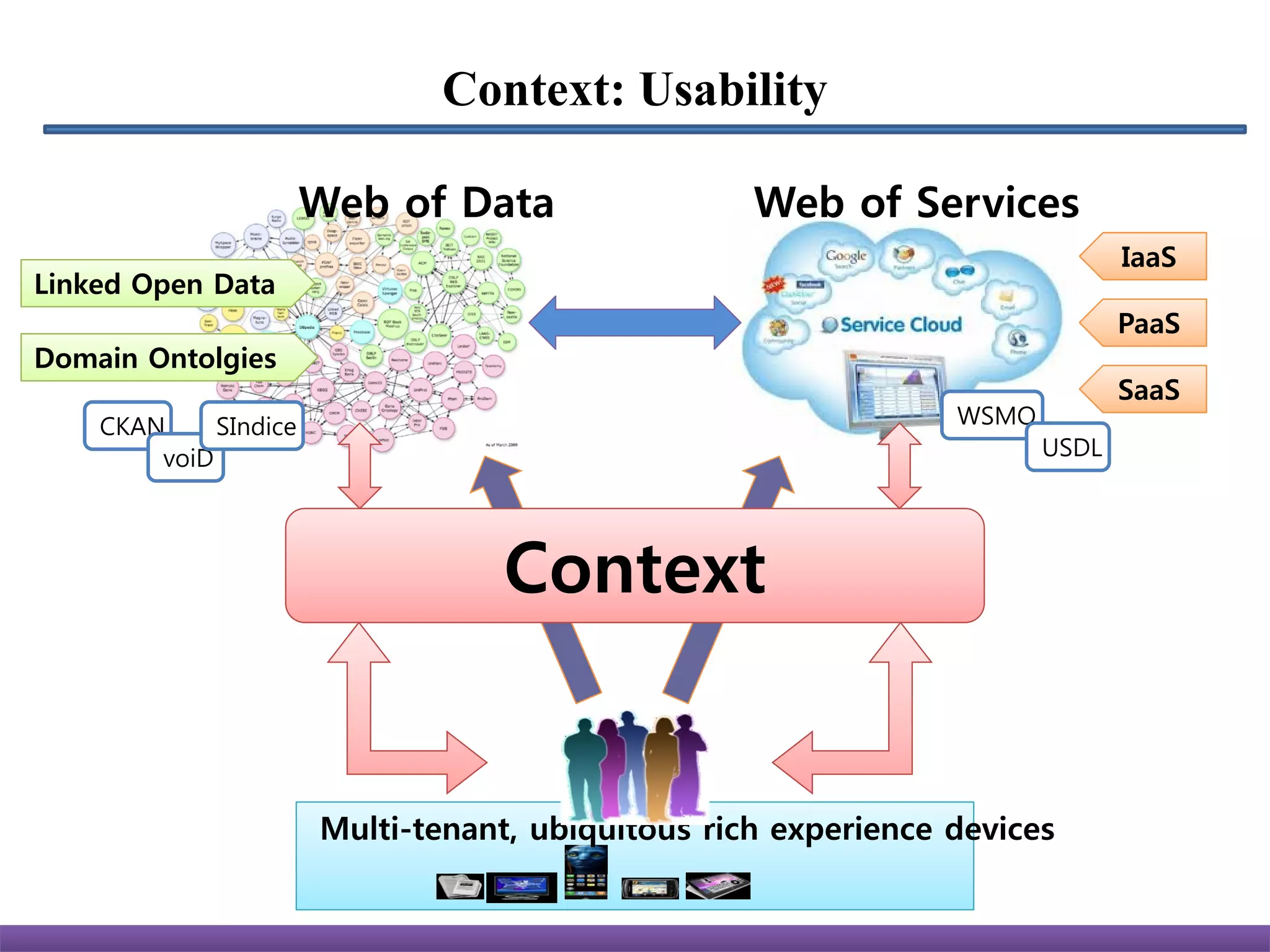
Context: Usability

                       Web of Data                 Web of Services
                                                                              IaaS
Linked Open Data
                                                                              PaaS
Domain Ontolgies
                                                                              SaaS
    CKAN     SIndice                                            WSMO
        voiD                                                           USDL


                                   Context


                       Multi-tenant, ubiquitous rich experience devices
Context-aware Computing
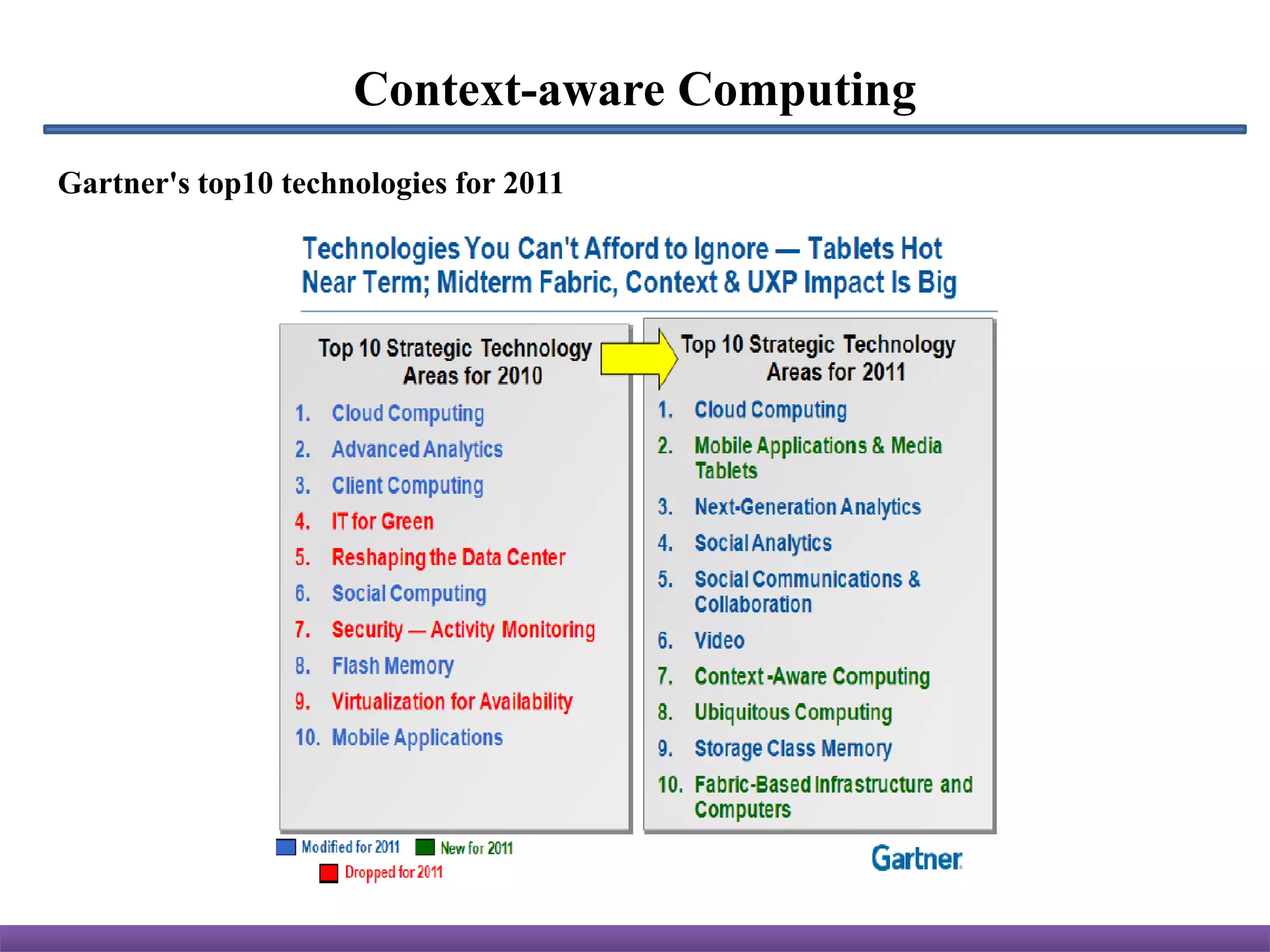
Gartner's top10 technologies for 2011
Context: Definition
 Context:
    Context is any information that can be used to characterize the situation
     of an entity. An entity is a person, place, or object that is considered
     relevant to the interaction between a user and an application, including
     the user and application themselves. [A. Day and G. Abowd, 1999]
    Typically , Location information, Proximity to devices, Places, Time,
     Personal information, Environment factors as weather, temperature,
     traffic, Status information of devices, Behavior of the user (e.g. talking,
     sleeping, walking, …), User preferences, Personal fitness / health, Tasks,
     Business process, …
   Context is a essential, foundational information in human-computer interaction.
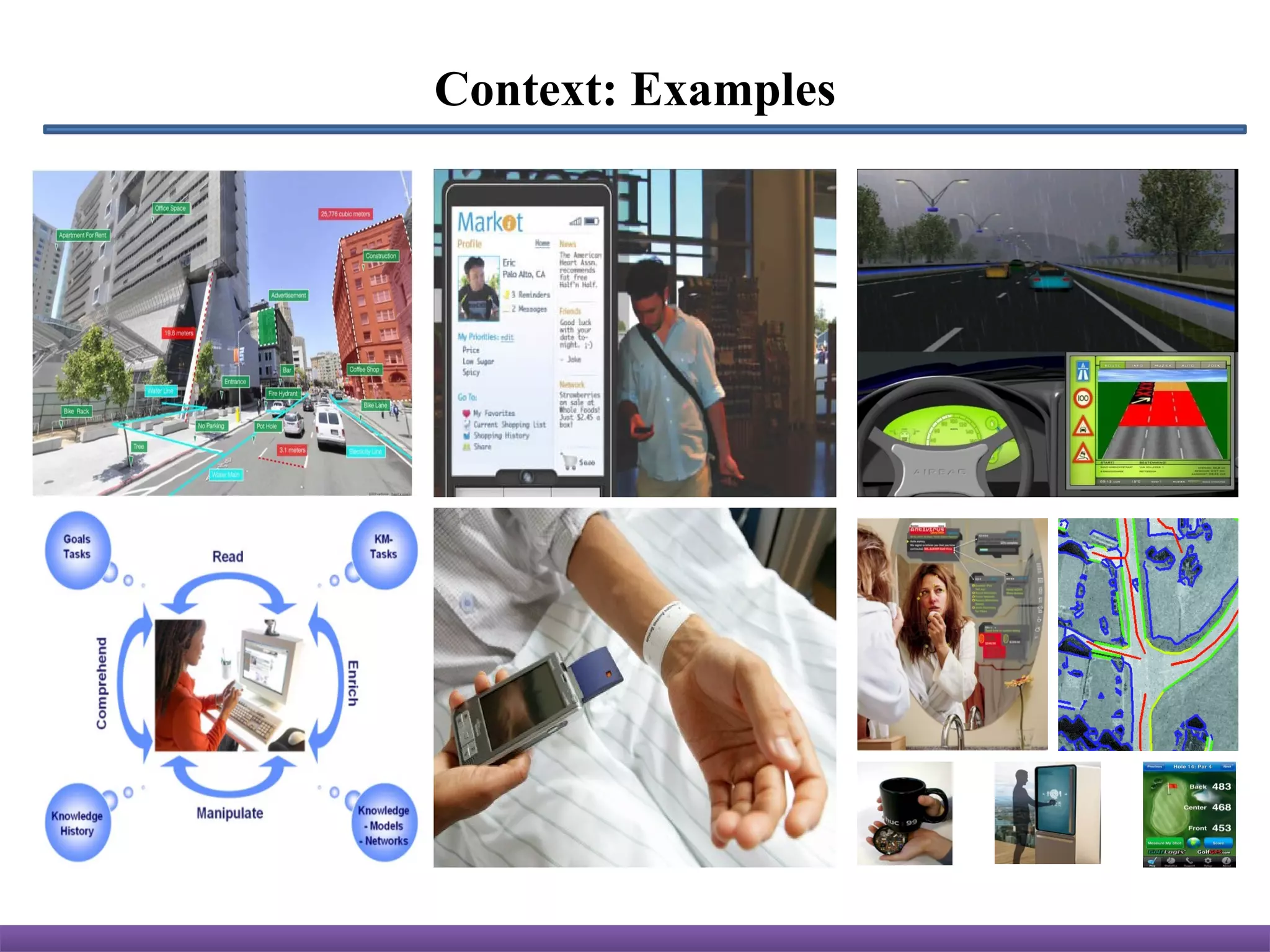
Context: Examples
Context Modeling
 Context Model
    Define and store context data in a machine processable form

 Properties of context information
    may come from disparate sources and has a relatively transient lifetime.
    exhibits a range of temporal characteristics.
        Static vs. dynamic
    may be imperfect.
        Out of date
        Faulty information from sensors
        Unknown (due to disconnection)
    has many alternative representations
    is highly interrelated and dependent
    sometimes should be persistence
        Long lived context (history,...) vs. Short lived context (temperature,..)
Context Modeling Language
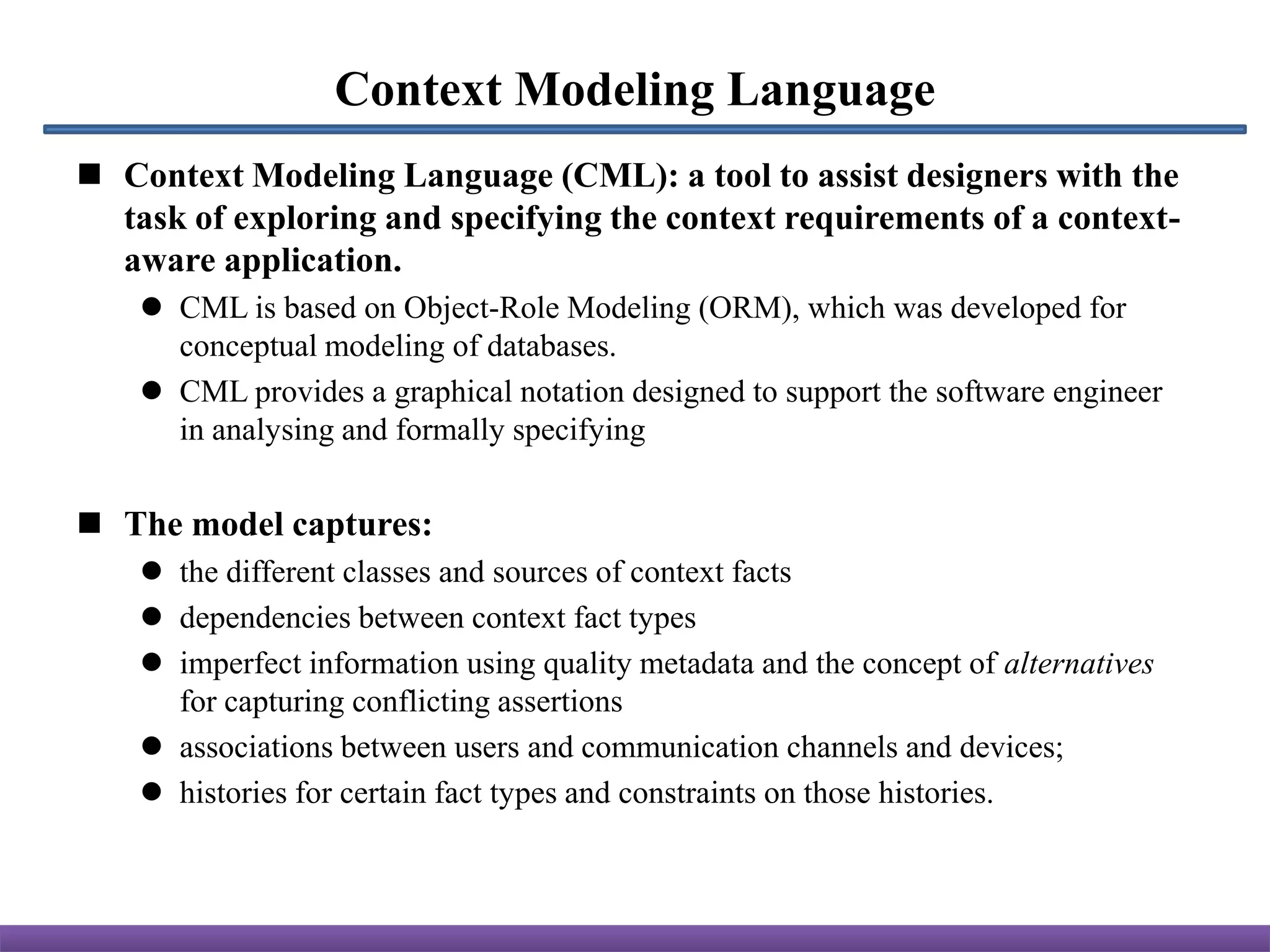
 Context Modeling Language (CML): a tool to assist designers with the
  task of exploring and specifying the context requirements of a context-
  aware application.
     CML is based on Object-Role Modeling (ORM), which was developed for
      conceptual modeling of databases.
     CML provides a graphical notation designed to support the software engineer
      in analysing and formally specifying


 The model captures:
     the different classes and sources of context facts
     dependencies between context fact types
     imperfect information using quality metadata and the concept of alternatives
      for capturing conflicting assertions
     associations between users and communication channels and devices;
     histories for certain fact types and constraints on those histories.
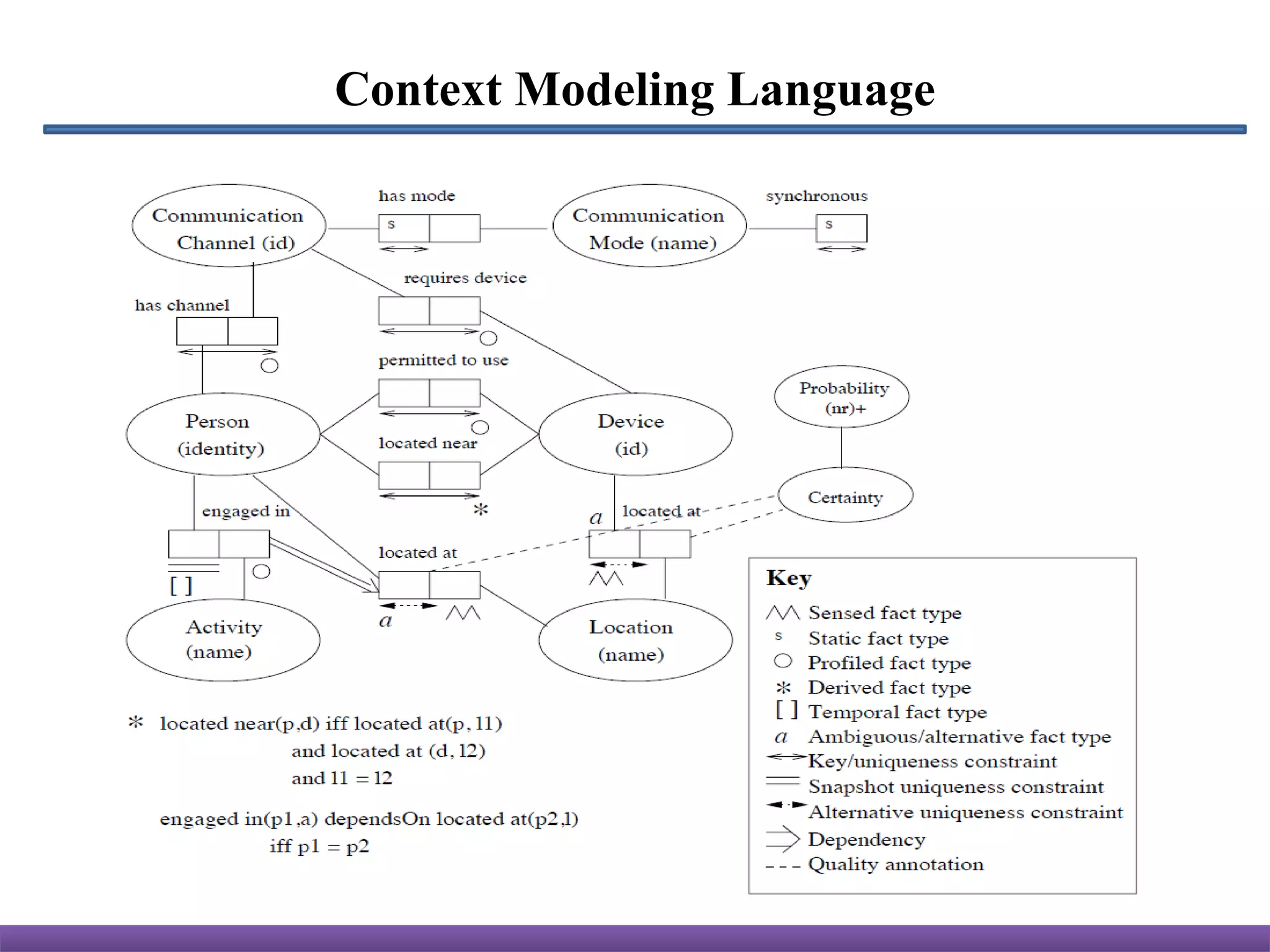
Context Modeling Language
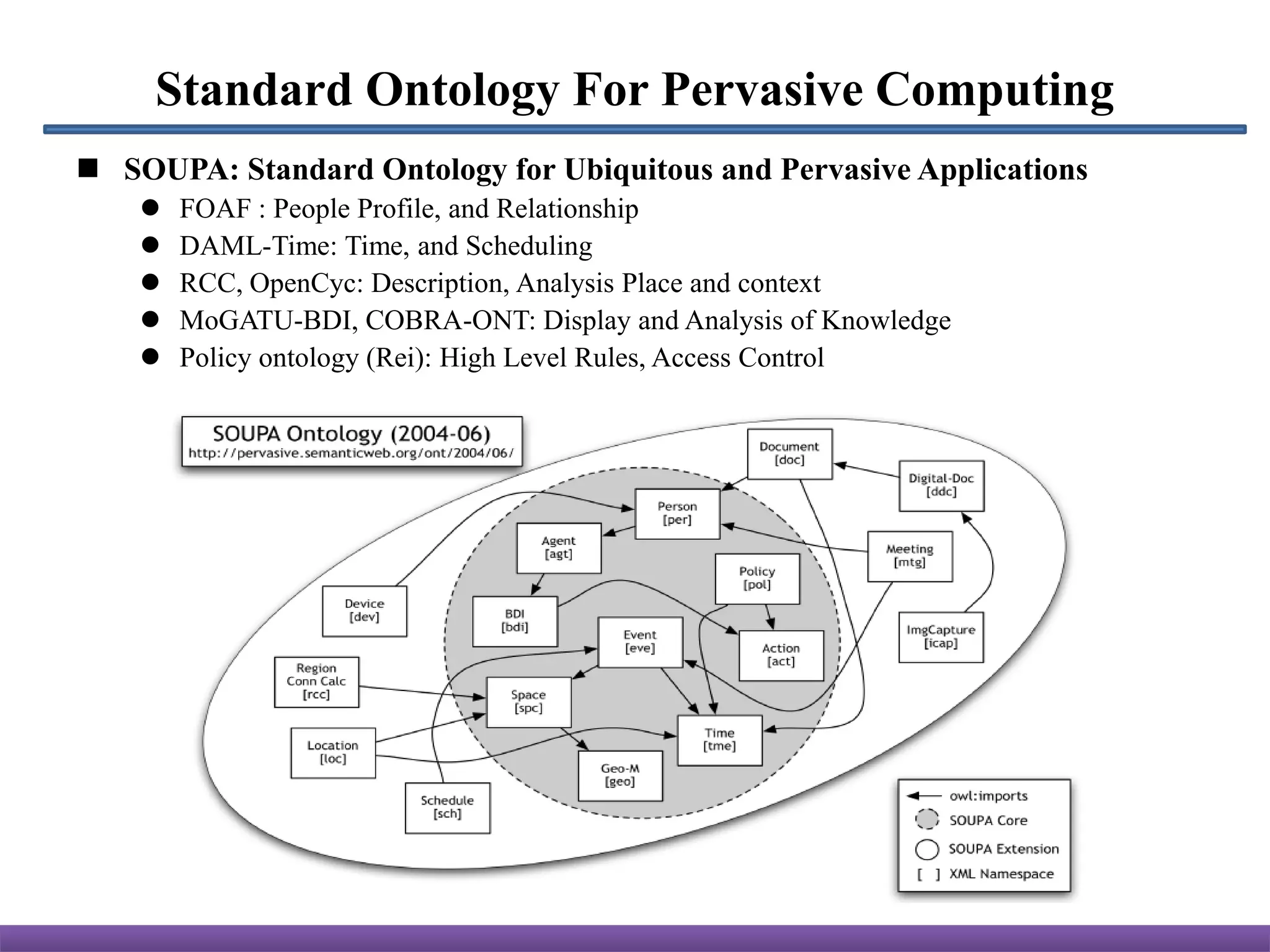
Standard Ontology For Pervasive Computing
 SOUPA: Standard Ontology for Ubiquitous and Pervasive Applications
       FOAF : People Profile, and Relationship
       DAML-Time: Time, and Scheduling
       RCC, OpenCyc: Description, Analysis Place and context
       MoGATU-BDI, COBRA-ONT: Display and Analysis of Knowledge
       Policy ontology (Rei): High Level Rules, Access Control
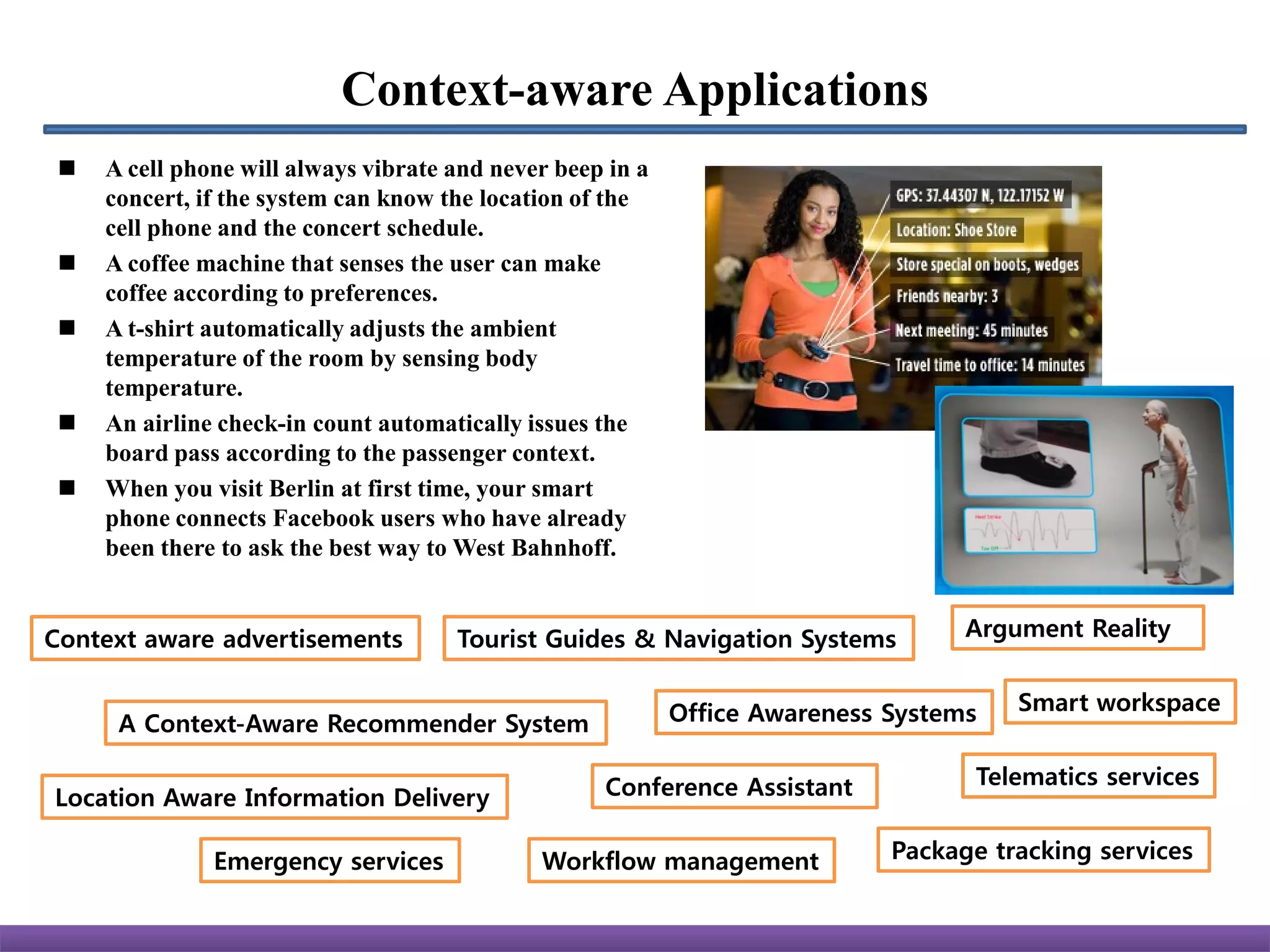
Context-aware Applications
    A cell phone will always vibrate and never beep in a
     concert, if the system can know the location of the
     cell phone and the concert schedule.
    A coffee machine that senses the user can make
     coffee according to preferences.
    A t-shirt automatically adjusts the ambient
     temperature of the room by sensing body
     temperature.
    An airline check-in count automatically issues the
     board pass according to the passenger context.
    When you visit Berlin at first time, your smart
     phone connects Facebook users who have already
     been there to ask the best way to West Bahnhoff.


Context aware advertisements          Tourist Guides & Navigation Systems          Argument Reality


                                                            Office Awareness Systems   Smart workspace
      A Context-Aware Recommender System

                                                    Conference Assistant            Telematics services
Location Aware Information Delivery

               Emergency services             Workflow management            Package tracking services
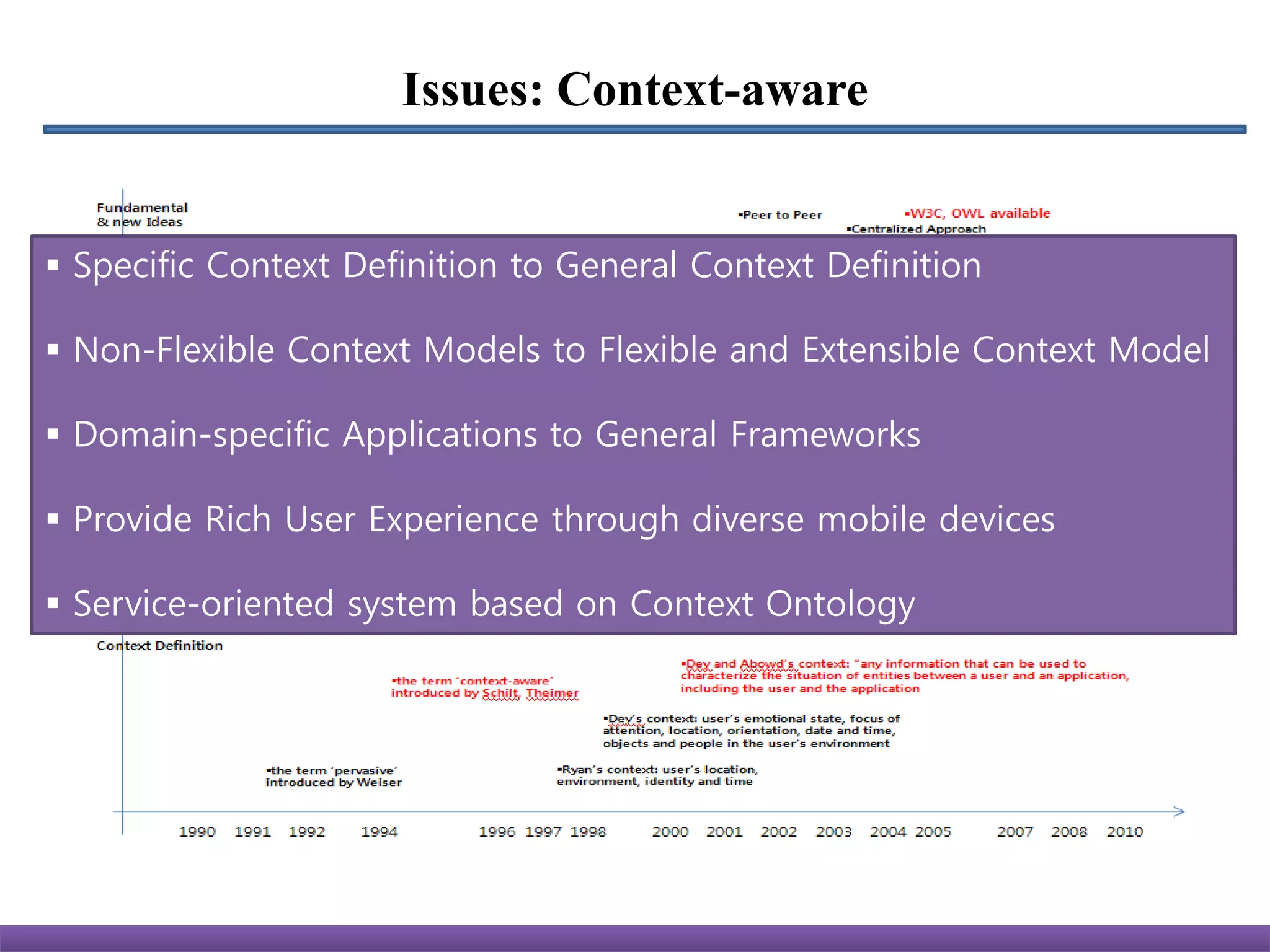
Issues: Context-aware


 Specific Context Definition to General Context Definition

 Non-Flexible Context Models to Flexible and Extensible Context Model

 Domain-specific Applications to General Frameworks

 Provide Rich User Experience through diverse mobile devices

 Service-oriented system based on Context Ontology
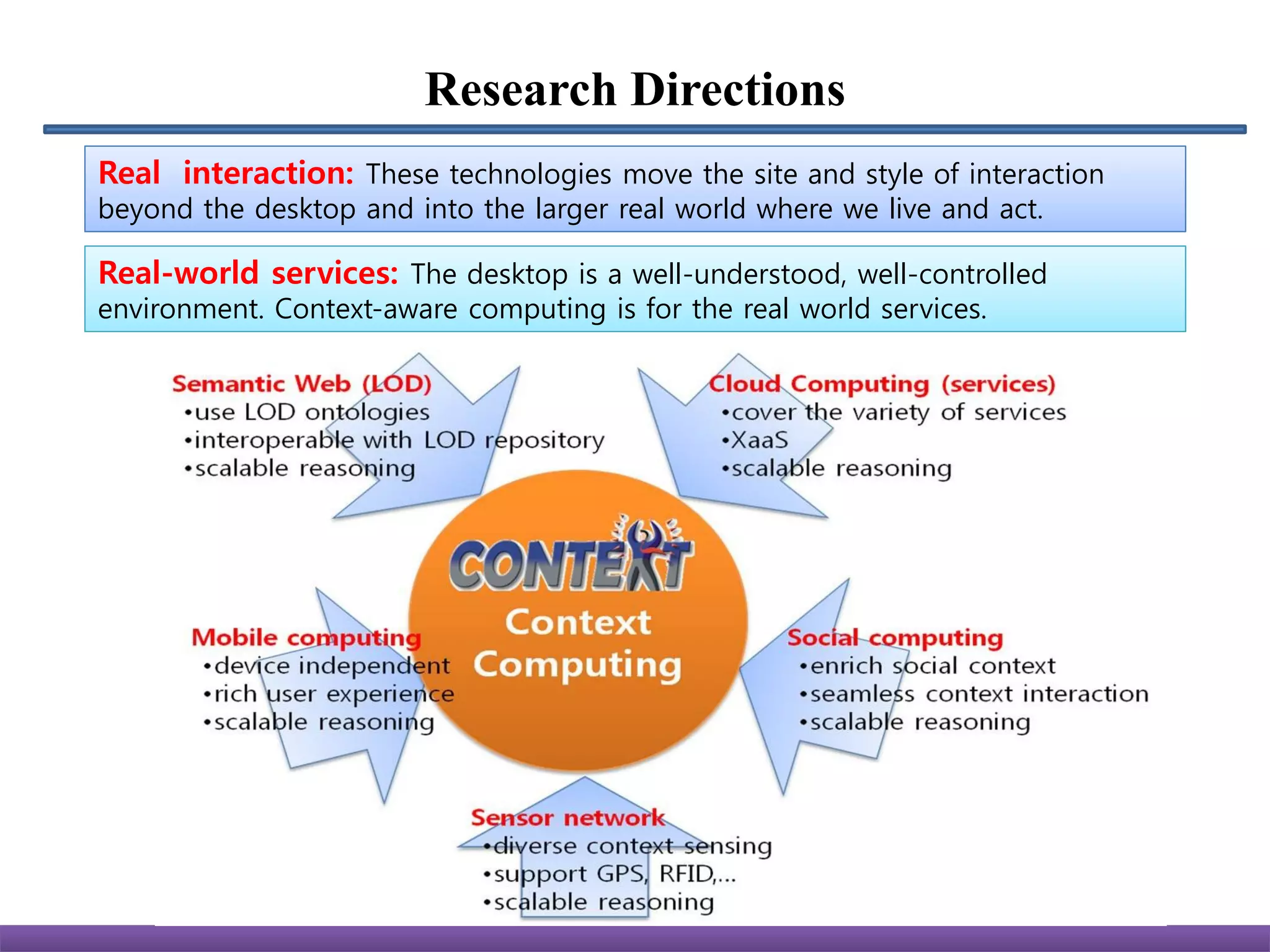
Research Directions
Real interaction: These technologies move the site and style of interaction
beyond the desktop and into the larger real world where we live and act.

Real-world services: The desktop is a well-understood, well-controlled
environment. Context
             Context-aware computing is for the real world services.
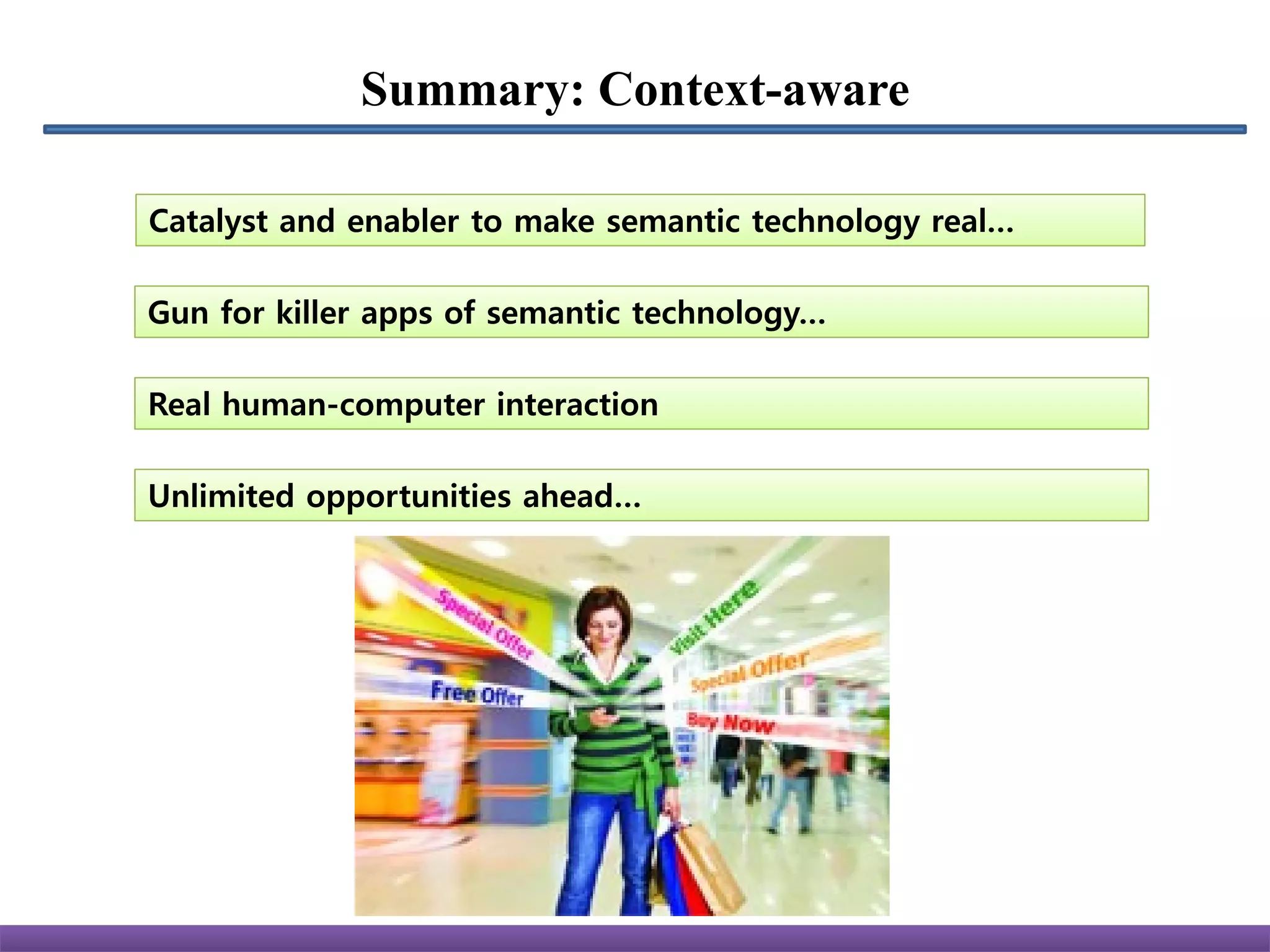
Summary: Context-aware

Catalyst and enabler to make semantic technology real…

Gun for killer apps of semantic technology…

Real human-computer interaction

Unlimited opportunities ahead…
Wrap up and Conclusions
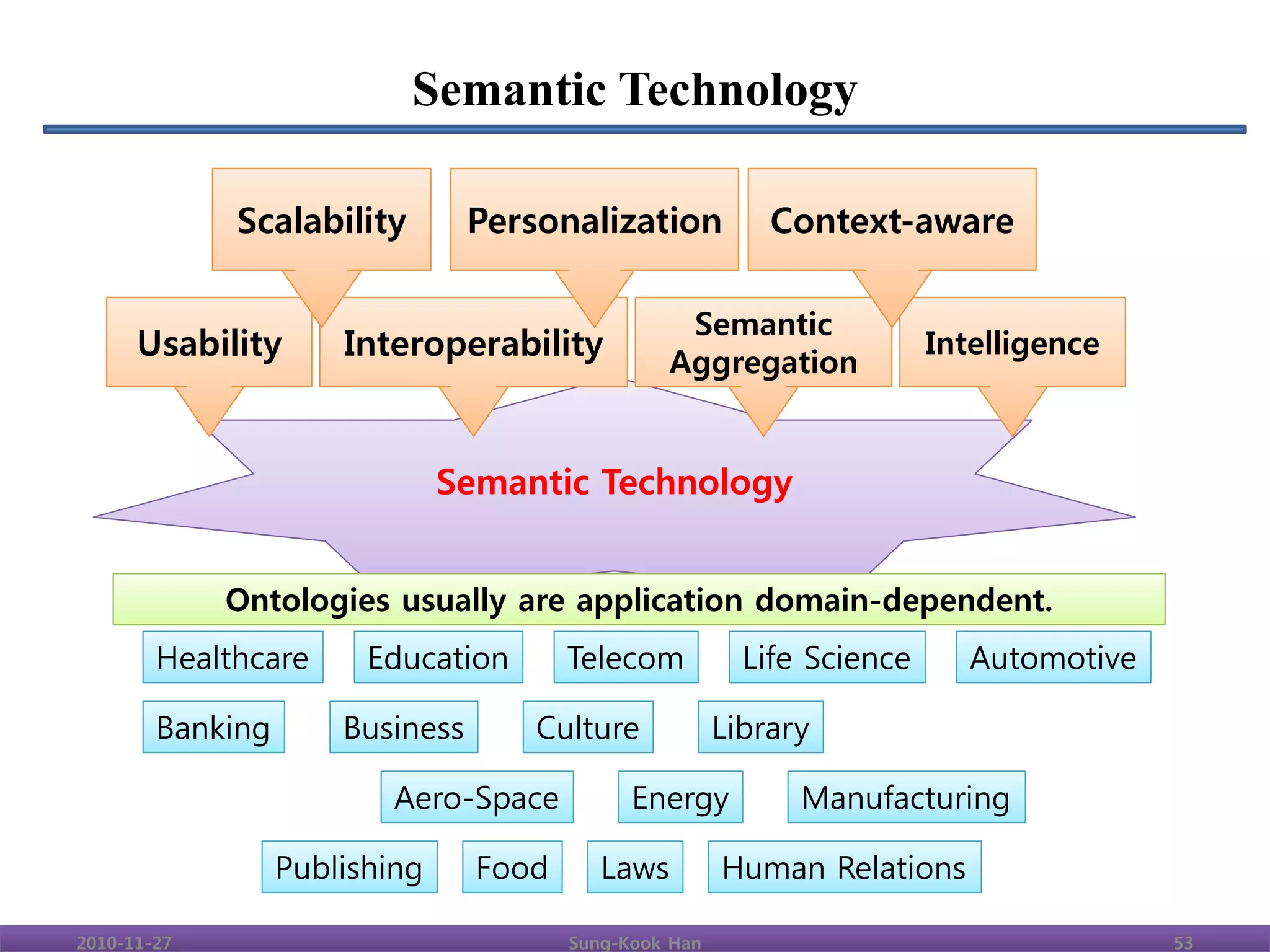
Semantic Technology

             Scalability         Personalization            Context-aware

                                                  Semantic
      Usability       Interoperability           Aggregation
                                                                         Intelligence


                               Semantic Technology


             Ontologies usually are application domain-dependent.
        Healthcare      Education       Telecom           Life Science      Automotive

        Banking       Business       Culture            Library

                          Aero-Space          Energy          Manufacturing

                  Publishing     Food      Laws         Human Relations

2010-11-27                              Sung-Kook Han                                    53
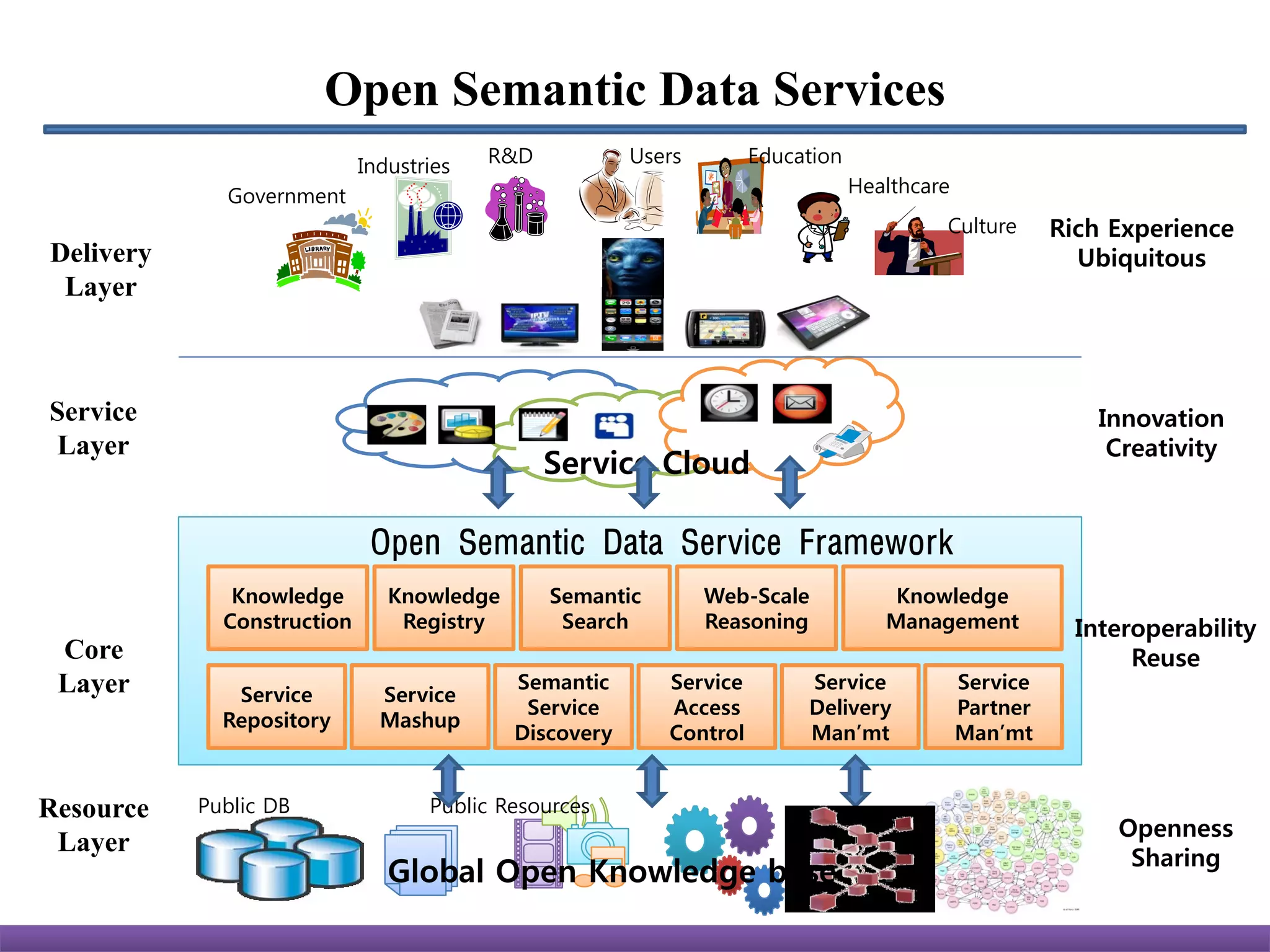
Open Semantic Data Services
                            Industries   R&D           Users        Education
             Government                                                         Healthcare
                                                                                         Culture       Rich Experience
Delivery                                                                                                 Ubiquitous
 Layer


Service                                                                                                    Innovation
 Layer                                                                                                      Creativity
                                               Service Cloud

                             Open Semantic Data Service Framework
              Knowledge        Knowledge       Semantic        Web-Scale            Knowledge
             Construction       Registry        Search         Reasoning           Management            Interoperability
 Core                                                                                                         Reuse
 Layer                                     Semantic       Service        Service             Service
              Service         Service
                                            Service       Access         Delivery            Partner
             Repository       Mashup
                                           Discovery      Control        Man’mt              Man’mt


Resource   Public DB               Public Resources
                                                                                                            Openness
 Layer
                                                                                                             Sharing
                               Global Open Knowledge base
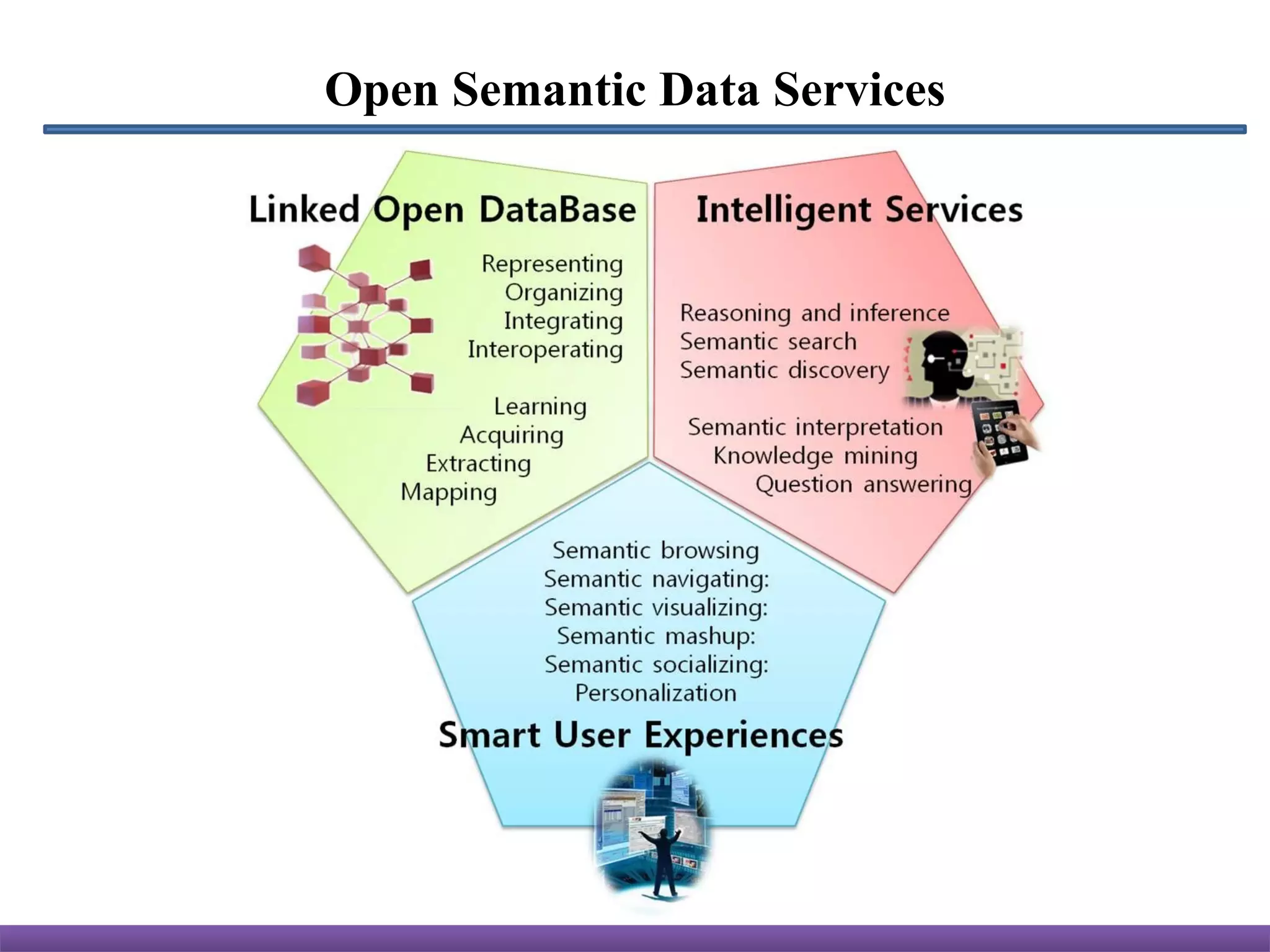
Open Semantic Data Services
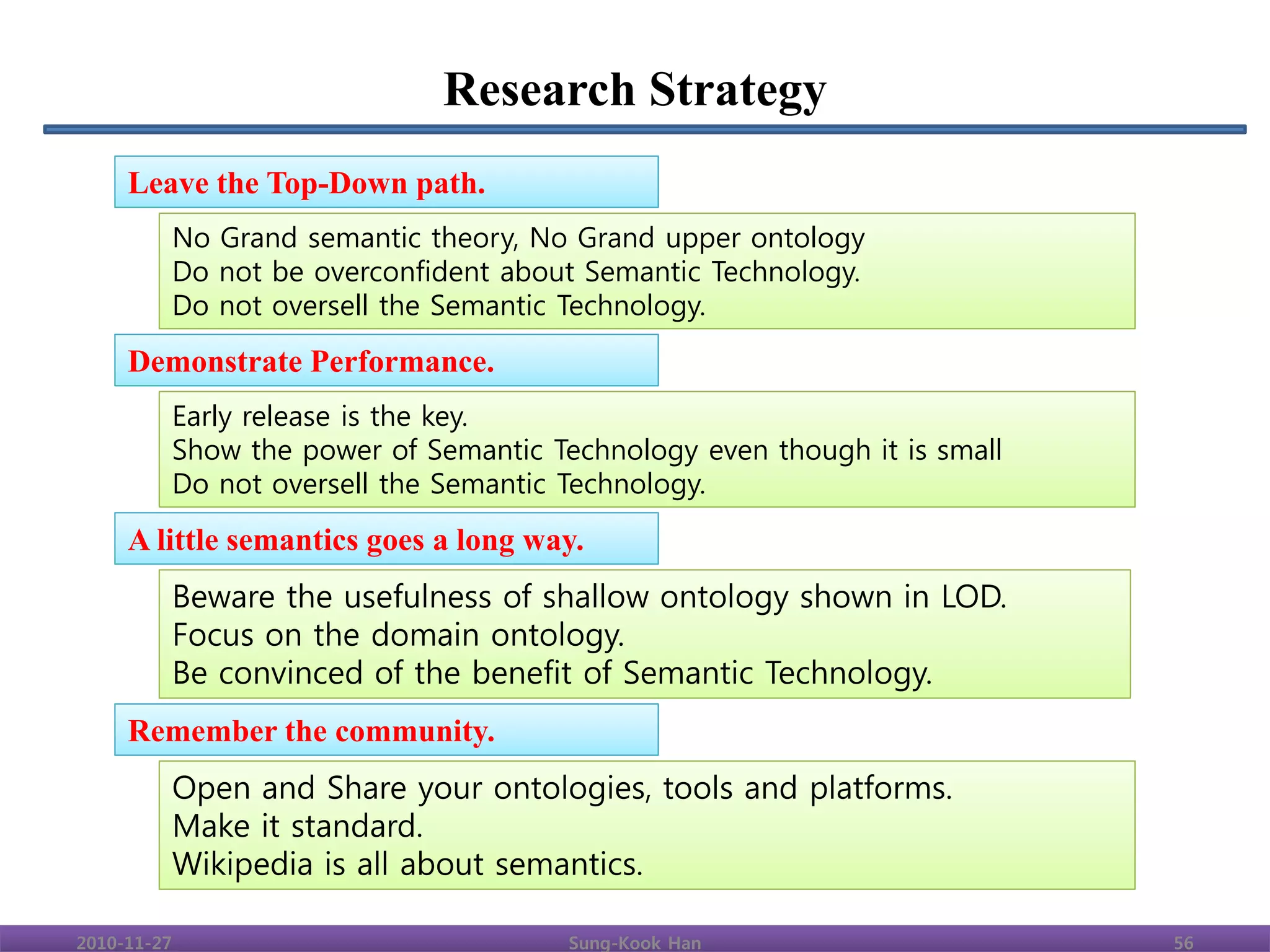
Research Strategy
     Leave the Top-Down path.
             No Grand semantic theory, No Grand upper ontology
             Do not be overconfident about Semantic Technology.
             Do not oversell the Semantic Technology.

     Demonstrate Performance.
             Early release is the key.
             Show the power of Semantic Technology even though it is small
             Do not oversell the Semantic Technology.

     A little semantics goes a long way.
             Beware the usefulness of shallow ontology shown in LOD.
             Focus on the domain ontology.
             Be convinced of the benefit of Semantic Technology.
     Remember the community.
             Open and Share your ontologies, tools and platforms.
             Make it standard.
             Wikipedia is all about semantics.

2010-11-27                                Sung-Kook Han                      56
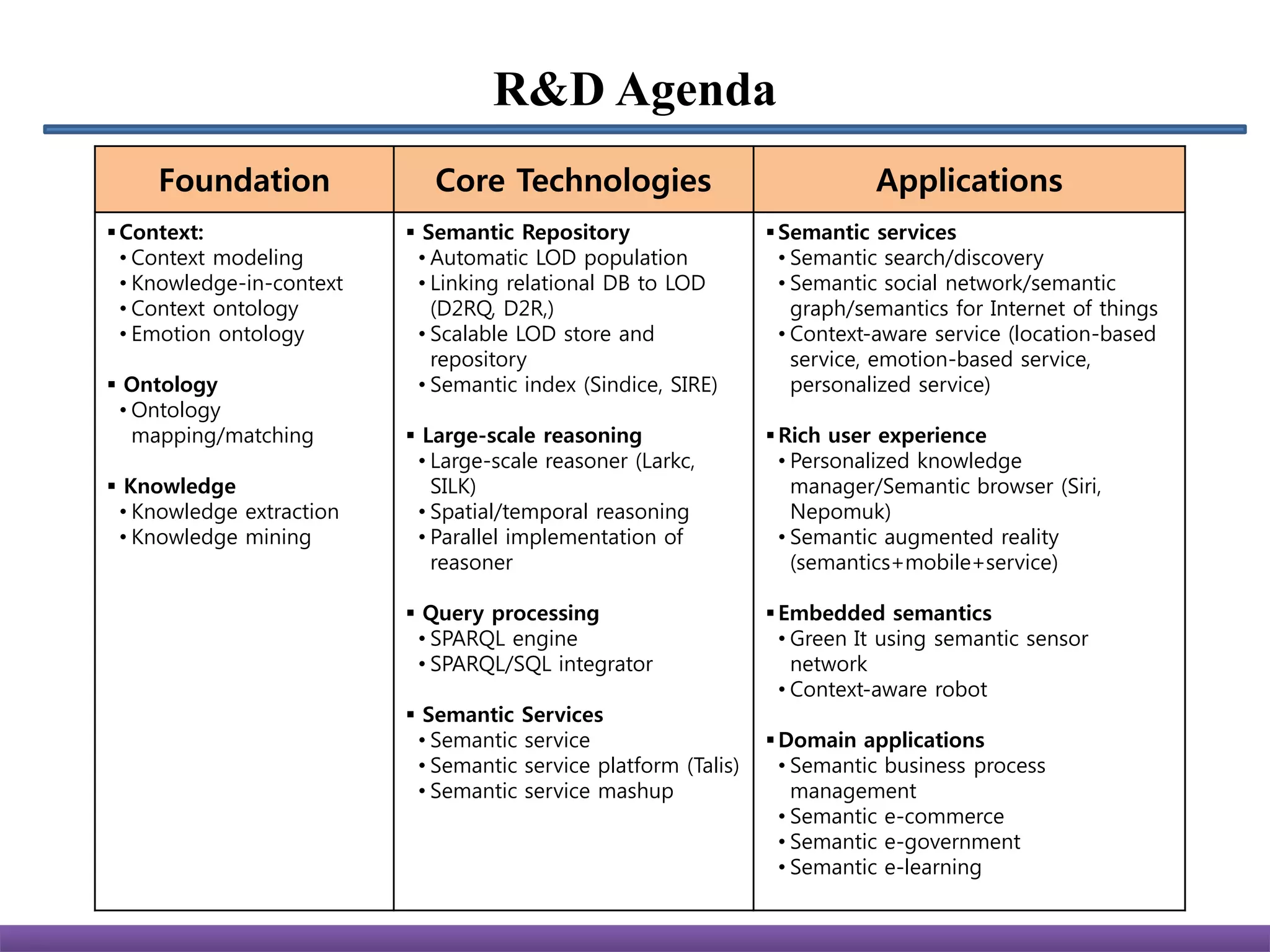
R&D Agenda
     Foundation               Core Technologies                              Applications
 Context:                  Semantic Repository                   Semantic services
  • Context modeling        • Automatic LOD population              • Semantic search/discovery
  • Knowledge-in-context    • Linking relational DB to LOD          • Semantic social network/semantic
  • Context ontology          (D2RQ, D2R,)                            graph/semantics for Internet of things
  • Emotion ontology        • Scalable LOD store and                • Context-aware service (location-based
                              repository                              service, emotion-based service,
 Ontology                  • Semantic index (Sindice, SIRE)          personalized service)
 • Ontology
   mapping/matching         Large-scale reasoning                 Rich user experience
                            • Large-scale reasoner (Larkc,          • Personalized knowledge
 Knowledge                   SILK)                                   manager/Semantic browser (Siri,
 • Knowledge extraction     • Spatial/temporal reasoning              Nepomuk)
 • Knowledge mining         • Parallel implementation of            • Semantic augmented reality
                              reasoner                                (semantics+mobile+service)

                            Query processing                      Embedded semantics
                            • SPARQL engine                         • Green It using semantic sensor
                            • SPARQL/SQL integrator                   network
                                                                    • Context-aware robot
                            Semantic Services
                            • Semantic service                     Domain applications
                            • Semantic service platform (Talis)     • Semantic business process
                            • Semantic service mashup                 management
                                                                    • Semantic e-commerce
                                                                    • Semantic e-government
                                                                    • Semantic e-learning
Conclusions


             Semantic Technologies need to go where the data is !
             Long Live Semantic Technology !


             Early adaptation of Semantic Technology is the king !
             Link, Integrate,
             Embed Semantic Technology!


             Ontology is the common shared conceptualization.
             Ontology is the common vocabulary to communicate.
             We are live in the networked planet.
             Connection, Cooperation and Collaboration !


2010-11-27                Sung-Kook Han                              58
Semantic Technology
Your World, Your Way

              skhan@wku.ac.kr

Semantic Technology: State of the arts and Trends

  • 1.
    Semantic Technology: The Stateof the Art and Research Directions Sung-Kook Han 2010.12.03
  • 2.
    Outline Review of SemanticTechnology Hot Issues:  Linked Data  Context-aware Future Research Trends and Conclusions
  • 3.
    Semantic Technology  Semantictechnology has been a distinct research field for more than 40 years.  Formal Logic (since Russell and Frege)  Knowledge Representation Systems in AI  Semantic Networks and ATN (William Woods, 1975)  DARPA and European Commission programs in information integration  Development of simple tractable logics  Relational Algebras and Schemas in Database Systems  Library Science (classifications, thesauri, taxonomies)  New challenges of Semantic Technology: Semantic Web  A massive store of information that computers cannot use  A way to get around needing the “big data warehouse”  Another place where “a little semantics can go a long way”... cf: The Relationship Between Web 2.0 And the Semantic Web - Dr. Mark Greaves, Vulcan, Inc.
  • 4.
    Ontology Spectrum strong semantics Modal Logic has_experience_in works Company First Order Logic Technologies Knowledge Representation Programs Personnel Logical Theory Is Disjoint Subclass Management S1 illusion Agent Natural Language Project am AS Description Logic of with transitivity Program AS AS Department Telecommunication Task Technical Paulnderleez Leo DAML+OIL, OWL property Semantic Director EcDARPA has WISO Interoperability Request Reza Assistant Director Navy Intelligence UML Ann Brad Howard Conceptual Model Is Subclass of RDF/S Semantic Interoperability XTM Extended ER Thesaurus Has Narrower Meaning Than ER DB Schemas, XML Schema Animal Structural Interoperability Taxonomy Mammal Reptile Is Sub-Classification of Bird Relational Snake Dog Cat Model, XML Syntactic Interoperability Cocker Spaniel weak semantics Lady Based on Leo Obrst, The Ontology Spectrum & Semantic Models 2010-11-27 skhan@wku.ac.kr 4
  • 5.
    Semantic Technology Intelligence Integration Interoperability Machine-processible Digital Semantics Information Resources Web resources Ontology Services Semantic Image Metadata Audio/Video Technology controlled Documents vocabulary
  • 6.
    Web Technology Web of machine-processible Data Common vocabularies: Metadata and Ontology Query and reasoning Classic Web Web of Services Internet of Services Web of Documents HTML as document format HTTP URLs as globally unique IDs Hyperlinks to connect everything Social Web Connect human-being Web as a platform Programmable APIs and proprietary interfaces Mashups based on a fixed set of data sources
  • 7.
    Semantic Web  Standardizations  Trio of Semantic Web  Metadata / Ontology: RDF, RDF, OWL  Query Language: SPARQL  Rule Language: RIF (SWRL)  SKOS, RDFa, GRRDL, WSMO,…  SOAP/ REST  Tools and Systems  Authoring, Reasoning Engines,…  835 items in Sweet Tools  Best Practices  Linked Open Data  Semantic MediaWiki  NEPOMUK, SIOC, Garlik  W3C Semantic Web Use cases Sweet Tools: http://www.mkbergman.com/new-version-sweet-tools-sem-web/ W3C Semantic Web Case Studies and Use Cases: http://www.w3.org/2001/sw/sweo/public/UseCases/ 2010-11-27 Sung-Kook Han 7
  • 8.
    Semantic Applications Semantic Wave2008, Industry Roadmap to Web 3.0, Project10X http://www.mkbergman.com/new-version-sweet-tools-sem-web/
  • 9.
    Web 2.0  Resharpen the way of viewing the Web  Web as the platform  Web as the social media  Web as the collaboration tool  Web as ……  Web 2.0 Manifestation  Openness / Sharing  Participation / Collaboration  Web 2.0 Syndrome  Library 2.0  Government 2.0  Enterprise 2.0  ……  New Web applications  wiki, blog, RSS,… 2010-11-27 Sung-Kook Han 9
  • 10.
  • 11.
    Semantic Web Today Major future issues: • Vocabularies • Scalability • Provenance • Personal Infospheres • Mobile and Real World Networks
  • 12.
    Web 2.0 APIsToday No Single global space: Web APIs slice the Web into Walled Gardens. • Mashups of APIs are proprietary. • No links between data. MashUp Web Web Web API API API A B C Christian Bizer: Pay-as-you-go Data Integration (21/9/2010)
  • 13.
    The Web isDead?? http://www.wired.com/magazine/2010/08/ff_webrip/
  • 14.
    Long Live theWeb ! http://www.scientificamerican.com/article.cfm?id=long-live-the-web
  • 15.
    Lessons Learned  Datais more important than API code.  Data is the Intel Inside.  Open data is more important than open source  Structured data is more valuable than unstructured.  We should seek to structure our data well.  Metadata will play a core role of data structure.  A little semantics goes a long way.  Beware the usefulness of shallow ontology shown in LOD.  Linking data and services are essential.  Link every thing.  Rich user experiences are the key for adaption.  We should consider mobile computing and personalization.  Visualize and navigate.
  • 16.
  • 17.
    Web of Documents A global file systems of documents (document silos on the Web).  Implicit semantics of content and links  Designed for human consumption  Disconnected data
  • 18.
    Linked Data: Webof Data  Goal: Web-scale Data Integration  Alternative to classic data integration systems in order to cope with growing number of data sources.  Querying Across Data Sources  Global distributed database RDF  Extend the Web with a single global data space  Giant Global Graph (GGG)  Demonstrate the possibility of Semantic Web  By using RDF to publish structured data RDF  By setting links between data single RDF universal information space. RDF RDF RDF
  • 19.
    Semantic Web: Webof Data  The vision of a Semantic Web:  building a global Web of machine-readable data  Berners-Lee, Hendler & Lassila, 2001; Marshall & Shipman, 2003 The first step is putting data on the Web in a form that machines can naturally understand, or converting it to that form. This creates what I call a Semantic Web - a web of data that can be processed directly or indirectly by machines. Therefore, while the Semantic Web, or Web of Data, is the goal or the end result of this process, Linked Data provides the means to reach that goal. -- Tim Berners-Lee, et al., http://linkeddata.org/docs/ijswis-special-issue, Jan, 2009  Linked Data Foundation  can lower the barrier to reuse, integration and application of data from multiple, distributed and heterogeneous sources.  the more sophisticated proposals associated with the Semantic Web vision, such as intelligent agents, may become a reality.
  • 20.
    Linked Data Principles Use URIs as names for things.  Use HTTP URIs so that people can look up those names.  When someone looks up a URI, provide useful RDF information.  Include RDF statements that link to other URIs so that they can discover related things.  Community effort to  publish existing open license datasets as Linked Data on the Web  interlink things between different data sources  develop clients that consume Linked Data from the Web
  • 21.
    Linked Data Model dbp-prop:title The Lord of the rings http://.../isbn/46316 Flexible graph-based model: RDF graph skos:subject dbp-prop:author English novels dbp-prop:publisher The HTTP protocol brings together identification dbp-prop:name and retrieval again. foaf:homepage dbpidia:Allen&Unwin J.R.R. Tolkien opencyc:headquarter dbp-prop:city Deeper into the Web wkp-en:J.R.R.Tolkien London fb:guid…..92df7 URI: global primary key fb:creator skos:subject = http://www.w3.org/2004/02/skos/core#subject fb:street_address dbp-prop:title = http://dbpedia.org/property/title Marivie 83 Alexander St 83 Alexander
  • 22.
  • 23.
    Summary: the Webof Linked Data  A global, distributed database built on a simple set of standards  RDF, URI, HTTP  Explicit semantics of content and links  Resources are connected by semantic links.  creating a single global data graph that span data sources  enables the discovery of new data sources  Provides for data co-existence  Anyone can publish data to the Web of Linked Data  Data publishers are not constrained in choice of vocabularies with which to represent data.  Designed for computer first, humans later
  • 24.
    LOD Data setson the Web  25 billion RDF triples, which are interlinked by around 395 million RDF links (Sep. 2010). http://richard.cyganiak.de/2007/10/lod/lod-datasets_2010-09-22_colored.svg
  • 25.
    Supporting Technologies  LinkedData Browsers  Provide for navigating between data sources and for exploring the dataspace.  Tabulator Browser (MIT, USA), Marbles (FU Berlin, DE), OpenLink RDF Browser (OpenLink, UK), Zitgist RDF Browser (Zitgist, USA), Disco Hyperdata Browser Berlin, Fenfire (DERI, Irland)  Web of Data Search Engines  Crawl the data space and provide best-effort query answers over crawled data.  Falcons (IWS, China), Sig.ma (DERI, Ireland), Swoogle (UMBC, USA), VisiNav (DERI, Ireland), Watson (Open University, UK), TAP, Sindice
  • 26.
    Supporting Technologies  Describingdata set  the discovery and usage of linked datasets  voiD, Ding  Registry  an open registry of data and content packages  CKAN  Linking tool  discovering relationships between data items within different Linked Data sources  SILK  Mapping tool  mapping database to RDF triples  Triplify, D2R Server  LOD platform  D2R Server, Virtuoso Universal Server, Talis Platform, Pubby, …
  • 27.
  • 28.
    Europeana European digitallibrary: Europeana: This European Commission initiative encompasses not only libraries but also museums, archives and other holders of cultural heritage material. http://version1.europeana.eu/web/europeana-project
  • 29.
    Linked Library Cloud Libraries have been producing metadata for ages.  Libraries (often) produce high- quality metadata.  Library develops many metadata standards such as DC, SKOS, BIBO, OAI-ORE including MARC 21, MODS, FRBR,..  Integrate Library Catalogues on global scale http://code4lib.org/conference/2010/singer
  • 30.
    Linking Open DrugData  linking the various sources of drug data together to answer interesting scientific and business questions.  Survey publicly available data sets about drugs  Publish and interlink these data sets on the Web  Explore interesting questions that could be answered if the data sets are linked.  8 million RDF triples, which are interlinked by more than 370,000 RDF links (As of August 2009)
  • 31.
    BBC Semantic Project Publish program / music data as RDF/XML or RDFa  Build semantically linked and annotated web pages about artists and singers whose songs are played on BBC radio stations.  semantically interconnected
  • 32.
    DBpedia Mobile  Showmap with information about nearby locations  Linked data browser  GPS + Google Maps + Dbpedia + Flickr + Revyu
  • 33.
    Attention by SearchEngines  Yahoo!  crawls Linked Data in its RDFa serialization as well as Microformat  Yahoo Search Monkey to make search results more useful and visually appealing  Google  use Social Graph API  is developing Google Squared and Google Fusion Table  merged MetaWeb  manage Freebase, a DBpedia/YAGO competitor
  • 34.
  • 35.
    LOD: Next Step Linking,Integration and Fusion by Semantic Technology
  • 36.
    Research Agenda  User Interfaces and Interaction Paradigms  Application Architectures  Schema Mapping and Data Fusion  Link Maintenance  Licensing  Trust, Quality and Relevance  Privacy • see more details in IJSWIS Special Issue on Linked Data (http://www.ijswis.org/)
  • 37.
  • 38.
    Context: Concepts ??? Shoes !!! Objects… Services…  Objects (including users) embody the establishing meaning.  The meaning arises according to the context in the course of action.  The services should be autonomously provided by means of the context.
  • 39.
    Context: Concepts Service Cloud Search and find if you want!! You may need these. I will deliver them. • Developers’ view • Users’ view
  • 40.
    Context: Usability Web of Data Web of Services IaaS Linked Open Data PaaS Domain Ontolgies SaaS CKAN SIndice WSMO voiD USDL Context Multi-tenant, ubiquitous rich experience devices
  • 41.
  • 42.
    Context: Definition  Context:  Context is any information that can be used to characterize the situation of an entity. An entity is a person, place, or object that is considered relevant to the interaction between a user and an application, including the user and application themselves. [A. Day and G. Abowd, 1999]  Typically , Location information, Proximity to devices, Places, Time, Personal information, Environment factors as weather, temperature, traffic, Status information of devices, Behavior of the user (e.g. talking, sleeping, walking, …), User preferences, Personal fitness / health, Tasks, Business process, … Context is a essential, foundational information in human-computer interaction.
  • 43.
  • 44.
    Context Modeling  ContextModel  Define and store context data in a machine processable form  Properties of context information  may come from disparate sources and has a relatively transient lifetime.  exhibits a range of temporal characteristics.  Static vs. dynamic  may be imperfect.  Out of date  Faulty information from sensors  Unknown (due to disconnection)  has many alternative representations  is highly interrelated and dependent  sometimes should be persistence  Long lived context (history,...) vs. Short lived context (temperature,..)
  • 45.
    Context Modeling Language Context Modeling Language (CML): a tool to assist designers with the task of exploring and specifying the context requirements of a context- aware application.  CML is based on Object-Role Modeling (ORM), which was developed for conceptual modeling of databases.  CML provides a graphical notation designed to support the software engineer in analysing and formally specifying  The model captures:  the different classes and sources of context facts  dependencies between context fact types  imperfect information using quality metadata and the concept of alternatives for capturing conflicting assertions  associations between users and communication channels and devices;  histories for certain fact types and constraints on those histories.
  • 46.
  • 47.
    Standard Ontology ForPervasive Computing  SOUPA: Standard Ontology for Ubiquitous and Pervasive Applications  FOAF : People Profile, and Relationship  DAML-Time: Time, and Scheduling  RCC, OpenCyc: Description, Analysis Place and context  MoGATU-BDI, COBRA-ONT: Display and Analysis of Knowledge  Policy ontology (Rei): High Level Rules, Access Control
  • 48.
    Context-aware Applications  A cell phone will always vibrate and never beep in a concert, if the system can know the location of the cell phone and the concert schedule.  A coffee machine that senses the user can make coffee according to preferences.  A t-shirt automatically adjusts the ambient temperature of the room by sensing body temperature.  An airline check-in count automatically issues the board pass according to the passenger context.  When you visit Berlin at first time, your smart phone connects Facebook users who have already been there to ask the best way to West Bahnhoff. Context aware advertisements Tourist Guides & Navigation Systems Argument Reality Office Awareness Systems Smart workspace A Context-Aware Recommender System Conference Assistant Telematics services Location Aware Information Delivery Emergency services Workflow management Package tracking services
  • 49.
    Issues: Context-aware  SpecificContext Definition to General Context Definition  Non-Flexible Context Models to Flexible and Extensible Context Model  Domain-specific Applications to General Frameworks  Provide Rich User Experience through diverse mobile devices  Service-oriented system based on Context Ontology
  • 50.
    Research Directions Real interaction:These technologies move the site and style of interaction beyond the desktop and into the larger real world where we live and act. Real-world services: The desktop is a well-understood, well-controlled environment. Context Context-aware computing is for the real world services.
  • 51.
    Summary: Context-aware Catalyst andenabler to make semantic technology real… Gun for killer apps of semantic technology… Real human-computer interaction Unlimited opportunities ahead…
  • 52.
    Wrap up andConclusions
  • 53.
    Semantic Technology Scalability Personalization Context-aware Semantic Usability Interoperability Aggregation Intelligence Semantic Technology Ontologies usually are application domain-dependent. Healthcare Education Telecom Life Science Automotive Banking Business Culture Library Aero-Space Energy Manufacturing Publishing Food Laws Human Relations 2010-11-27 Sung-Kook Han 53
  • 54.
    Open Semantic DataServices Industries R&D Users Education Government Healthcare Culture Rich Experience Delivery Ubiquitous Layer Service Innovation Layer Creativity Service Cloud Open Semantic Data Service Framework Knowledge Knowledge Semantic Web-Scale Knowledge Construction Registry Search Reasoning Management Interoperability Core Reuse Layer Semantic Service Service Service Service Service Service Access Delivery Partner Repository Mashup Discovery Control Man’mt Man’mt Resource Public DB Public Resources Openness Layer Sharing Global Open Knowledge base
  • 55.
  • 56.
    Research Strategy Leave the Top-Down path. No Grand semantic theory, No Grand upper ontology Do not be overconfident about Semantic Technology. Do not oversell the Semantic Technology. Demonstrate Performance. Early release is the key. Show the power of Semantic Technology even though it is small Do not oversell the Semantic Technology. A little semantics goes a long way. Beware the usefulness of shallow ontology shown in LOD. Focus on the domain ontology. Be convinced of the benefit of Semantic Technology. Remember the community. Open and Share your ontologies, tools and platforms. Make it standard. Wikipedia is all about semantics. 2010-11-27 Sung-Kook Han 56
  • 57.
    R&D Agenda Foundation Core Technologies Applications  Context:  Semantic Repository  Semantic services • Context modeling • Automatic LOD population • Semantic search/discovery • Knowledge-in-context • Linking relational DB to LOD • Semantic social network/semantic • Context ontology (D2RQ, D2R,) graph/semantics for Internet of things • Emotion ontology • Scalable LOD store and • Context-aware service (location-based repository service, emotion-based service,  Ontology • Semantic index (Sindice, SIRE) personalized service) • Ontology mapping/matching  Large-scale reasoning  Rich user experience • Large-scale reasoner (Larkc, • Personalized knowledge  Knowledge SILK) manager/Semantic browser (Siri, • Knowledge extraction • Spatial/temporal reasoning Nepomuk) • Knowledge mining • Parallel implementation of • Semantic augmented reality reasoner (semantics+mobile+service)  Query processing  Embedded semantics • SPARQL engine • Green It using semantic sensor • SPARQL/SQL integrator network • Context-aware robot  Semantic Services • Semantic service  Domain applications • Semantic service platform (Talis) • Semantic business process • Semantic service mashup management • Semantic e-commerce • Semantic e-government • Semantic e-learning
  • 58.
    Conclusions Semantic Technologies need to go where the data is ! Long Live Semantic Technology ! Early adaptation of Semantic Technology is the king ! Link, Integrate, Embed Semantic Technology! Ontology is the common shared conceptualization. Ontology is the common vocabulary to communicate. We are live in the networked planet. Connection, Cooperation and Collaboration ! 2010-11-27 Sung-Kook Han 58
  • 59.
    Semantic Technology Your World,Your Way skhan@wku.ac.kr