Evidence of Evolution
Exploring Various Lines of
Evidence for the Theory of
Evolution
Lines of Evidence
• Comparative Anatomy
• Embryology
• Biogeography
Comparative Anatomy
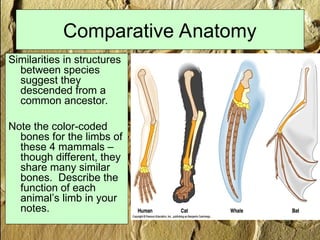
Similarities in structures
between species
suggest they
descended from a
common ancestor.
Note the color-coded
bones for the limbs of
these 4 mammals –
though different, they
share many similar
bones. Describe the
function of each
animal’s limb in your
notes.
Embryology
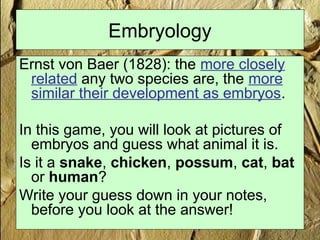
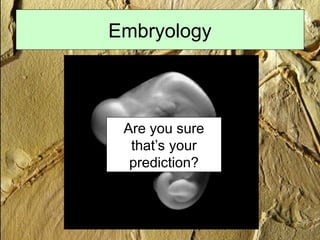
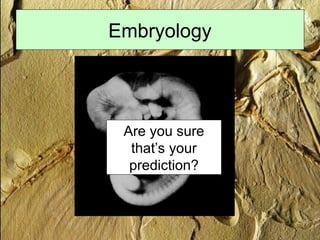
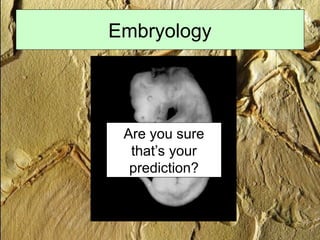
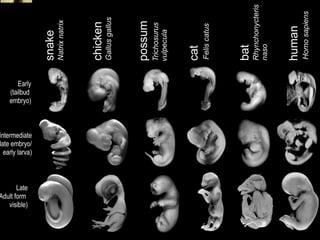
Ernst von Baer (1828): the more closely
related any two species are, the more
similar their development as embryos.
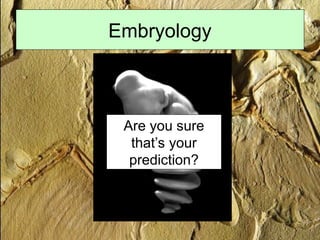
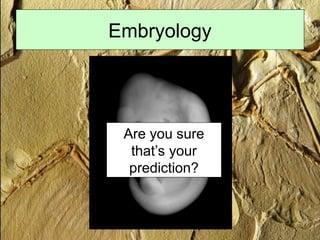
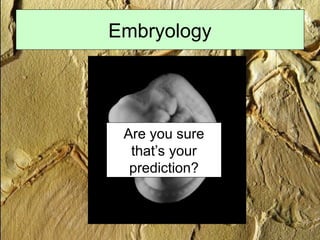
In this game, you will look at pictures of
embryos and guess what animal it is.
Is it a snake, chicken, possum, cat, bat
or human?
Write your guess down in your notes,
before you look at the answer!
Embryology
Snake!
Are you sure
that’s your
prediction?
Embryology
Bat!
Are you sure
that’s your
prediction?
Embryology
Cat!
Are you sure
that’s your
prediction?
Embryology
Chicken!
Are you sure
that’s your
prediction?
Embryology
Human!
Are you sure
that’s your
prediction?
Embryology
Possum!
Are you sure
that’s your
prediction?
Biogeography
• Marsupial distribution across the globe:
http://evolution.berkeley.edu/evolibrary/arti
cle/0_0_0/lines_11
• Distribution today split on two sides of
globe – how?
• Review a few facts of the distribution and
marsupials, as well as the history of the
Earth, then formulate hypothesis behind
distribution
Biogeography is the study of the large-scale
or global pattern of distribution of species,
including the history and causes of this
distribution.
For this activity, you will explore the history
and cause behind the distribution of
marsupials.
Biogeography
• Marsupial distribution across the globe:
http://evolution.berkeley.edu/evolibrary/arti
cle/0_0_0/lines_11
• Distribution today split on two sides of
globe – how?
• Review a few facts of the distribution and
marsupials, as well as the history of the
Earth, then formulate hypothesis behind
distribution
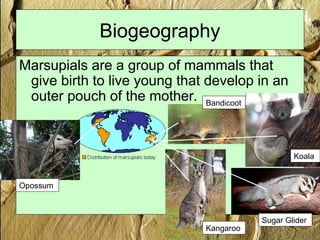
Marsupials are a group of mammals that
give birth to live young that develop in an
outer pouch of the mother.
Koala
Kangaroo
Sugar Glider
Opossum
Bandicoot
Biogeography
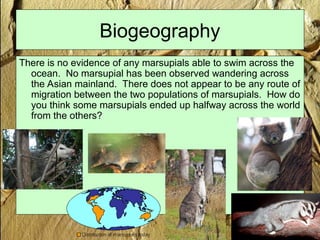
There is no evidence of any marsupials able to swim across the
ocean. No marsupial has been observed wandering across
the Asian mainland. There does not appear to be any route of
migration between the two populations of marsupials. How do
you think some marsupials ended up halfway across the world
from the others?
Biogeography
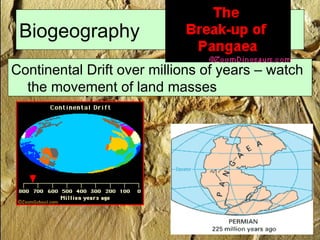
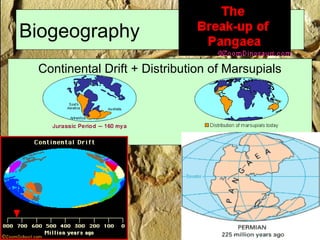
Continental Drift over millions of years – watch
the movement of land masses
Biogeography
Continental Drift + Distribution of Marsupials
Biogeography
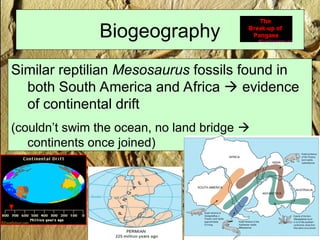
Similar reptilian Mesosaurus fossils found in
both South America and Africa  evidence
of continental drift
(couldn’t swim the ocean, no land bridge 
continents once joined)
Biogeography
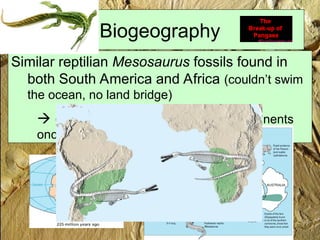
Similar reptilian Mesosaurus fossils found in
both South America and Africa (couldn’t swim
the ocean, no land bridge)
 evidence of continental drift (continents
once joined)

evidence_of_evolution grade 10 learners_ii.ppt

  • 1.
    Evidence of Evolution ExploringVarious Lines of Evidence for the Theory of Evolution
  • 2.
    Lines of Evidence •Comparative Anatomy • Embryology • Biogeography
  • 3.
    Comparative Anatomy Similarities instructures between species suggest they descended from a common ancestor. Note the color-coded bones for the limbs of these 4 mammals – though different, they share many similar bones. Describe the function of each animal’s limb in your notes.
  • 4.
    Embryology Ernst von Baer(1828): the more closely related any two species are, the more similar their development as embryos. In this game, you will look at pictures of embryos and guess what animal it is. Is it a snake, chicken, possum, cat, bat or human? Write your guess down in your notes, before you look at the answer!
  • 5.
  • 6.
  • 7.
  • 8.
  • 9.
  • 10.
  • 12.
    Biogeography • Marsupial distributionacross the globe: http://evolution.berkeley.edu/evolibrary/arti cle/0_0_0/lines_11 • Distribution today split on two sides of globe – how? • Review a few facts of the distribution and marsupials, as well as the history of the Earth, then formulate hypothesis behind distribution Biogeography is the study of the large-scale or global pattern of distribution of species, including the history and causes of this distribution. For this activity, you will explore the history and cause behind the distribution of marsupials.
  • 13.
    Biogeography • Marsupial distributionacross the globe: http://evolution.berkeley.edu/evolibrary/arti cle/0_0_0/lines_11 • Distribution today split on two sides of globe – how? • Review a few facts of the distribution and marsupials, as well as the history of the Earth, then formulate hypothesis behind distribution Marsupials are a group of mammals that give birth to live young that develop in an outer pouch of the mother. Koala Kangaroo Sugar Glider Opossum Bandicoot
  • 14.
    Biogeography There is noevidence of any marsupials able to swim across the ocean. No marsupial has been observed wandering across the Asian mainland. There does not appear to be any route of migration between the two populations of marsupials. How do you think some marsupials ended up halfway across the world from the others?
  • 15.
    Biogeography Continental Drift overmillions of years – watch the movement of land masses
  • 16.
    Biogeography Continental Drift +Distribution of Marsupials
  • 17.
    Biogeography Similar reptilian Mesosaurusfossils found in both South America and Africa  evidence of continental drift (couldn’t swim the ocean, no land bridge  continents once joined)
  • 18.
    Biogeography Similar reptilian Mesosaurusfossils found in both South America and Africa (couldn’t swim the ocean, no land bridge)  evidence of continental drift (continents once joined)