Everything You Need
To Know About
JAVA
JAV A: WRI TE O NCE , RU N ANY WHE RE !
Java is a general-purpose, class-based, object-oriented
programming language designed for having lesser
implementation dependencies. It is a computing platform
for application development. Java is fast, secure, and
reliable, therefore. It is widely used for developing Java
applications in laptops, data centers, game consoles,
scientific supercomputers, cell phones, etc.
TYPES OF JAVA APPLICATIONS
HISTORY OF JAVA
VERSIONS OF JAVA
FEATURES OF JAVA
COMPONENTS OF JAVA PROGRAMMING
LANGUAGE
DIFFRENT TYPES OF JAVA PLATFORM
TABLE OF
CONTENTS
⚬ Mobile Applications
⚬ Desktop GUI Applications
⚬ Web-based Applications
⚬ Enterprise Applications
⚬ Scientific Applications
⚬ Gaming Applications
⚬ Big Data technologies
⚬ Business Applications
⚬ Distributed Applications
⚬ Cloud-based Applications
The top 10 applications of Java.
TYPES OF
JAVA
APPLICATIONS
James Gosling initiated Java language project
in June 1991 for use in one of his many set-top
box projects. The language, initially called ‘Oak’
after an oak tree that stood outside Gosling's
office, also went by the name ‘Green’ and
ended up later being renamed as Java, from a
list of random words.
Sun released the first public implementation
as Java 1.0 in 1995. It promised Write Once,
Run Anywhere (WORA), providing no-cost run-
times on popular platforms.
HISTORY OF JAVA
On 13 November, 2006, Sun released
much of Java as free and open source
software under the terms of the GNU
General Public License (GPL).
On 8 May, 2007, Sun finished the process,
making all of Java's core code free and
open-source, aside from a small portion
of code to which Sun did not hold the
copyright.
Versions 1.0 and 1.1 are named as JDK (Java Development Kit).
From versions 1.2 to 1.4, the platform is named as J2SE
(Java 2 Standard Edition).
From versions 1.5, Sun introduces internal and external versions.
Internal version is continuous from previous ones (1.5 after 1.4), but
the external version has a big jump (5.0 for 1.5). This could make
confusion for someone, so keep in mind that version 1.5 and version
5.0 are just two different version names for only one thing.
From Java 6, the version name is Java SE X.
Major versions were released after every 2 years, however the Java
SE 7 took 5 years to be available after its predecessor Java SE 6, and
3 years for Java SE 8 to be available to public afterward.
Since Java SE 10, new versions will be released very six months.
VERSIONS
OF JAVA
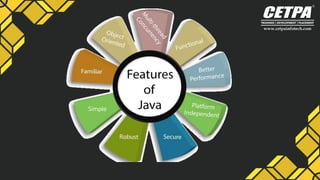
THANKS TO ITS EXCELLENT FEATURES,
JAVA HAS BECOME A POPULAR AND
USEFUL PROGRAMMING LANGUAGE. SUN
CHARACTERIZED IT AS BEING:
• Compiled and Interpreted
• Platform Independent and Portable
• Object-Oriented
• Robust and Secure
• Distributed
• Familiar, Simple and Small
• Multi-threaded and Interactive
• High Performance
• Dynamic and Extensible
FEATURES
OF JAVA
THERE ARE THREE MAIN COMPONENTS OF
JAVA LANGUAGE: JVM, JRE, AND JDK.
Java Virtual Machine, Java Runtime
Environment and Java Development Kit
respectively.
COMPONENTS
OFJAVA
PROGRAMMING
LANGUAGE
THERE ARE FOUR PLATFORMS OF THE
JAVA PROGRAMMING LANGUAGE:
• Java Platform, Standard Edition
(Java SE)
• Java Platform, Enterprise Edition
(Java EE)
• Java Platform, Micro Edition (Java
ME)
• Java FX
Different
Types of
JAVA
Platform
Contact us:
Call On: +919212172602
Or Visit: www.cetpainfotech.com
D-58, Red FM Road, Sector 2, D Block,
Sector 2, Noida, Uttar Pradesh 201301
Thank You !

Everything You Need To Know About Java

  • 1.
    Everything You Need ToKnow About JAVA JAV A: WRI TE O NCE , RU N ANY WHE RE !
  • 2.
    Java is ageneral-purpose, class-based, object-oriented programming language designed for having lesser implementation dependencies. It is a computing platform for application development. Java is fast, secure, and reliable, therefore. It is widely used for developing Java applications in laptops, data centers, game consoles, scientific supercomputers, cell phones, etc.
  • 3.
    TYPES OF JAVAAPPLICATIONS HISTORY OF JAVA VERSIONS OF JAVA FEATURES OF JAVA COMPONENTS OF JAVA PROGRAMMING LANGUAGE DIFFRENT TYPES OF JAVA PLATFORM TABLE OF CONTENTS
  • 4.
    ⚬ Mobile Applications ⚬Desktop GUI Applications ⚬ Web-based Applications ⚬ Enterprise Applications ⚬ Scientific Applications ⚬ Gaming Applications ⚬ Big Data technologies ⚬ Business Applications ⚬ Distributed Applications ⚬ Cloud-based Applications The top 10 applications of Java. TYPES OF JAVA APPLICATIONS
  • 5.
    James Gosling initiatedJava language project in June 1991 for use in one of his many set-top box projects. The language, initially called ‘Oak’ after an oak tree that stood outside Gosling's office, also went by the name ‘Green’ and ended up later being renamed as Java, from a list of random words. Sun released the first public implementation as Java 1.0 in 1995. It promised Write Once, Run Anywhere (WORA), providing no-cost run- times on popular platforms. HISTORY OF JAVA On 13 November, 2006, Sun released much of Java as free and open source software under the terms of the GNU General Public License (GPL). On 8 May, 2007, Sun finished the process, making all of Java's core code free and open-source, aside from a small portion of code to which Sun did not hold the copyright.
  • 6.
    Versions 1.0 and1.1 are named as JDK (Java Development Kit). From versions 1.2 to 1.4, the platform is named as J2SE (Java 2 Standard Edition). From versions 1.5, Sun introduces internal and external versions. Internal version is continuous from previous ones (1.5 after 1.4), but the external version has a big jump (5.0 for 1.5). This could make confusion for someone, so keep in mind that version 1.5 and version 5.0 are just two different version names for only one thing. From Java 6, the version name is Java SE X. Major versions were released after every 2 years, however the Java SE 7 took 5 years to be available after its predecessor Java SE 6, and 3 years for Java SE 8 to be available to public afterward. Since Java SE 10, new versions will be released very six months. VERSIONS OF JAVA
  • 7.
    THANKS TO ITSEXCELLENT FEATURES, JAVA HAS BECOME A POPULAR AND USEFUL PROGRAMMING LANGUAGE. SUN CHARACTERIZED IT AS BEING: • Compiled and Interpreted • Platform Independent and Portable • Object-Oriented • Robust and Secure • Distributed • Familiar, Simple and Small • Multi-threaded and Interactive • High Performance • Dynamic and Extensible FEATURES OF JAVA
  • 9.
    THERE ARE THREEMAIN COMPONENTS OF JAVA LANGUAGE: JVM, JRE, AND JDK. Java Virtual Machine, Java Runtime Environment and Java Development Kit respectively. COMPONENTS OFJAVA PROGRAMMING LANGUAGE
  • 10.
    THERE ARE FOURPLATFORMS OF THE JAVA PROGRAMMING LANGUAGE: • Java Platform, Standard Edition (Java SE) • Java Platform, Enterprise Edition (Java EE) • Java Platform, Micro Edition (Java ME) • Java FX Different Types of JAVA Platform
  • 11.
    Contact us: Call On:+919212172602 Or Visit: www.cetpainfotech.com D-58, Red FM Road, Sector 2, D Block, Sector 2, Noida, Uttar Pradesh 201301 Thank You !