INTRODUCTION
TO
JAVA
NAME: YOUR NAME
DATE: SEPTEMBER - 2024
INTRODUCTION TO
JAVA
INTRODUCTION
TO
JAVA
2
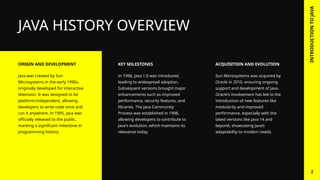
JAVA HISTORY OVERVIEW
Java was created by Sun
Microsystems in the early 1990s,
originally developed for interactive
television. It was designed to be
platform-independent, allowing
developers to write code once and
run it anywhere. In 1995, Java was
officially released to the public,
marking a significant milestone in
programming history.
In 1996, Java 1.0 was introduced,
leading to widespread adoption.
Subsequent versions brought major
enhancements such as improved
performance, security features, and
libraries. The Java Community
Process was established in 1998,
allowing developers to contribute to
Java's evolution, which maintains its
relevance today.
ORIGIN AND DEVELOPMENT KEY MILESTONES ACQUISITION AND EVOLUTION
Sun Microsystems was acquired by
Oracle in 2010, ensuring ongoing
support and development of Java.
Oracle’s involvement has led to the
introduction of new features like
modularity and improved
performance, especially with the
latest versions like Java 14 and
beyond, showcasing Java’s
adaptability to modern needs.
INTRODUCTION
TO
JAVA
3
JAVA FEATURES
Java is a fully object-oriented programming language, which facilitates code reusability and organization.
This approach enhances maintainability, as developers can easily understand and modify classes and
objects. Concepts like inheritance, polymorphism, and encapsulation form the backbone of Java’s design
principles.
One of Java’s key features is its 'write once, run anywhere' capability, enabled by the Java
Virtual Machine (JVM). This allows Java applications to run on any device that supports JVM,
regardless of the underlying operating system. This feature has been critical to Java's
widespread adoption in enterprise environments.
OBJECT-ORIENTED PROGRAMMING
PLATFORM INDEPENDENCE
INTRODUCTION
TO
JAVA
4
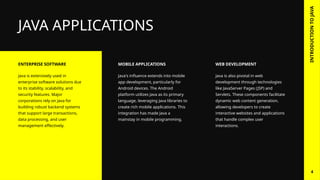
JAVA APPLICATIONS
Java is extensively used in
enterprise software solutions due
to its stability, scalability, and
security features. Major
corporations rely on Java for
building robust backend systems
that support large transactions,
data processing, and user
management effectively.
Java's influence extends into mobile
app development, particularly for
Android devices. The Android
platform utilizes Java as its primary
language, leveraging Java libraries to
create rich mobile applications. This
integration has made Java a
mainstay in mobile programming.
ENTERPRISE SOFTWARE MOBILE APPLICATIONS WEB DEVELOPMENT
Java is also pivotal in web
development through technologies
like JavaServer Pages (JSP) and
Servlets. These components facilitate
dynamic web content generation,
allowing developers to create
interactive websites and applications
that handle complex user
interactions.
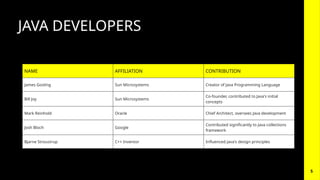
NAME AFFILIATION CONTRIBUTION
James Gosling Sun Microsystems Creator of Java Programming Language
Bill Joy Sun Microsystems
Co-founder, contributed to Java's initial
concepts
Mark Reinhold Oracle Chief Architect, oversees Java development
Josh Bloch Google
Contributed significantly to Java collections
framework
Bjarne Stroustrup C++ Inventor Influenced Java's design principles
JAVA DEVELOPERS
5
6
JAVA POPULARITY STATISTICS
35% 30%
25% 10%
JAVA
Java holds a commanding 35%
of the programming language
market share, reflecting its
robust ecosystem and
extensive use in enterprise
and mobile applications.
PYTHON
Python has surged to capture
30% of the market, thanks to
its simplicity and versatility,
gaining popularity in data
science and machine learning.
JAVASCRIPT
With a 25% market share,
JavaScript remains essential
for web development,
powering client-side scripting
and frameworks.
C++
C++ accounts for about 10% of
the market, widely used in
systems programming, game
development, and
performance-critical
applications.

INTRODUCTION TO JAVA the important of he java

  • 1.
    INTRODUCTION TO JAVA NAME: YOUR NAME DATE:SEPTEMBER - 2024 INTRODUCTION TO JAVA
  • 2.
    INTRODUCTION TO JAVA 2 JAVA HISTORY OVERVIEW Javawas created by Sun Microsystems in the early 1990s, originally developed for interactive television. It was designed to be platform-independent, allowing developers to write code once and run it anywhere. In 1995, Java was officially released to the public, marking a significant milestone in programming history. In 1996, Java 1.0 was introduced, leading to widespread adoption. Subsequent versions brought major enhancements such as improved performance, security features, and libraries. The Java Community Process was established in 1998, allowing developers to contribute to Java's evolution, which maintains its relevance today. ORIGIN AND DEVELOPMENT KEY MILESTONES ACQUISITION AND EVOLUTION Sun Microsystems was acquired by Oracle in 2010, ensuring ongoing support and development of Java. Oracle’s involvement has led to the introduction of new features like modularity and improved performance, especially with the latest versions like Java 14 and beyond, showcasing Java’s adaptability to modern needs.
  • 3.
    INTRODUCTION TO JAVA 3 JAVA FEATURES Java isa fully object-oriented programming language, which facilitates code reusability and organization. This approach enhances maintainability, as developers can easily understand and modify classes and objects. Concepts like inheritance, polymorphism, and encapsulation form the backbone of Java’s design principles. One of Java’s key features is its 'write once, run anywhere' capability, enabled by the Java Virtual Machine (JVM). This allows Java applications to run on any device that supports JVM, regardless of the underlying operating system. This feature has been critical to Java's widespread adoption in enterprise environments. OBJECT-ORIENTED PROGRAMMING PLATFORM INDEPENDENCE
  • 4.
    INTRODUCTION TO JAVA 4 JAVA APPLICATIONS Java isextensively used in enterprise software solutions due to its stability, scalability, and security features. Major corporations rely on Java for building robust backend systems that support large transactions, data processing, and user management effectively. Java's influence extends into mobile app development, particularly for Android devices. The Android platform utilizes Java as its primary language, leveraging Java libraries to create rich mobile applications. This integration has made Java a mainstay in mobile programming. ENTERPRISE SOFTWARE MOBILE APPLICATIONS WEB DEVELOPMENT Java is also pivotal in web development through technologies like JavaServer Pages (JSP) and Servlets. These components facilitate dynamic web content generation, allowing developers to create interactive websites and applications that handle complex user interactions.
  • 5.
    NAME AFFILIATION CONTRIBUTION JamesGosling Sun Microsystems Creator of Java Programming Language Bill Joy Sun Microsystems Co-founder, contributed to Java's initial concepts Mark Reinhold Oracle Chief Architect, oversees Java development Josh Bloch Google Contributed significantly to Java collections framework Bjarne Stroustrup C++ Inventor Influenced Java's design principles JAVA DEVELOPERS 5
  • 6.
    6 JAVA POPULARITY STATISTICS 35%30% 25% 10% JAVA Java holds a commanding 35% of the programming language market share, reflecting its robust ecosystem and extensive use in enterprise and mobile applications. PYTHON Python has surged to capture 30% of the market, thanks to its simplicity and versatility, gaining popularity in data science and machine learning. JAVASCRIPT With a 25% market share, JavaScript remains essential for web development, powering client-side scripting and frameworks. C++ C++ accounts for about 10% of the market, widely used in systems programming, game development, and performance-critical applications.