EVERYTHING THAT YOU
SHOULD KNOW ABOUT
PRESCHOOLS
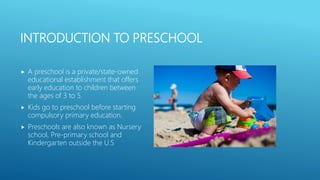
INTRODUCTION TO PRESCHOOL
 A preschool is a private/state-owned
educational establishment that offers
early education to children between
the ages of 3 to 5.
 Kids go to preschool before starting
compulsory primary education.
 Preschools are also known as Nursery
school, Pre-primary school and
Kindergarten outside the U.S
PRESCHOOL STATS FOR THE U.S
 About 71,000 kids were actively
enrolled in preschools in New York City
in 2015.
 Brooklyn has the most number of
students studying in a school
(preschool to high school) at 284,769.
 The average cost of preschool
education in NYC is about $10,000
PRESCHOOL ORIGINS
 The earliest records of preschools date
back to the early 1800’s in Europe.
 Preschools in that time aimed to bridge
the education gap between children of
the upper and lower class of the society.
 The first publicly funded preschool
program in the U.S was ‘Head Start’,
initiated by President Johnson in 1965.
 By the 1980’s, many states had
subsidized preschool fees for low-
income families.
BENEFITS OF PRESCHOOLS
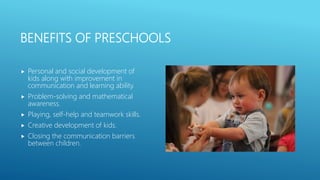
 Personal and social development of
kids along with improvement in
communication and learning ability.
 Problem-solving and mathematical
awareness.
 Playing, self-help and teamwork skills.
 Creative development of kids.
 Closing the communication barriers
between children.
FUNDING OF PRESCHOOLS
 The state governments funds all state-
owned preschools and selected private
schools.
 Private preschools are self-funded
through donations, school fees and
fundraisers.
 The U.S spends about .04% of its GDP,
amounting to about $63 billion on
preschool education.
TYPES OF PRESCHOOL PROGRAMS
 Montessori – emphasizes on creativity,
practical life skills, academic ability and
hands-on learning.
 Waldorf – emphasizes on
development of children’s spirit, soul
and body with focus on repetition
while learning.
 Reggio Emilia – Emphasizes on self-
expression, communication and
learning through art and activities.
THANK YOU

Everything That You Should Know About Preschools

  • 1.
    EVERYTHING THAT YOU SHOULDKNOW ABOUT PRESCHOOLS
  • 2.
    INTRODUCTION TO PRESCHOOL A preschool is a private/state-owned educational establishment that offers early education to children between the ages of 3 to 5.  Kids go to preschool before starting compulsory primary education.  Preschools are also known as Nursery school, Pre-primary school and Kindergarten outside the U.S
  • 3.
    PRESCHOOL STATS FORTHE U.S  About 71,000 kids were actively enrolled in preschools in New York City in 2015.  Brooklyn has the most number of students studying in a school (preschool to high school) at 284,769.  The average cost of preschool education in NYC is about $10,000
  • 4.
    PRESCHOOL ORIGINS  Theearliest records of preschools date back to the early 1800’s in Europe.  Preschools in that time aimed to bridge the education gap between children of the upper and lower class of the society.  The first publicly funded preschool program in the U.S was ‘Head Start’, initiated by President Johnson in 1965.  By the 1980’s, many states had subsidized preschool fees for low- income families.
  • 5.
    BENEFITS OF PRESCHOOLS Personal and social development of kids along with improvement in communication and learning ability.  Problem-solving and mathematical awareness.  Playing, self-help and teamwork skills.  Creative development of kids.  Closing the communication barriers between children.
  • 6.
    FUNDING OF PRESCHOOLS The state governments funds all state- owned preschools and selected private schools.  Private preschools are self-funded through donations, school fees and fundraisers.  The U.S spends about .04% of its GDP, amounting to about $63 billion on preschool education.
  • 7.
    TYPES OF PRESCHOOLPROGRAMS  Montessori – emphasizes on creativity, practical life skills, academic ability and hands-on learning.  Waldorf – emphasizes on development of children’s spirit, soul and body with focus on repetition while learning.  Reggio Emilia – Emphasizes on self- expression, communication and learning through art and activities.
  • 8.