@SimonAubury
Event Driven
Architecture
Mistakes – I’ve made a few …
linkedin.com/in/simonaubury
@SimonAubury
A tale of confessions from
Simon Aubury
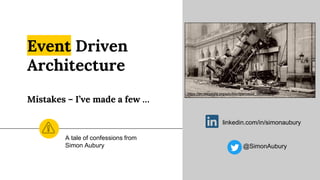
https://en.wikipedia.org/wiki/Montparnasse_derailment
@SimonAubury
Why am I here?
2
I am Simon Aubury
Principal Data Engineer @ ThoughtWorks
@SimonAubury
“
Event-driven architecture (EDA) is a
software architecture paradigm
promoting the production, detection,
consumption of, and reaction to events.
https://en.wikipedia.org/wiki/Event-driven_architecture
@SimonAubury
Let’s help a younger
me
4
@SimonAubury
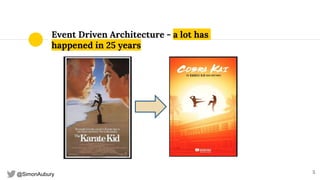
Event Driven Architecture - a lot has
happened in 25 years
5
@SimonAubury
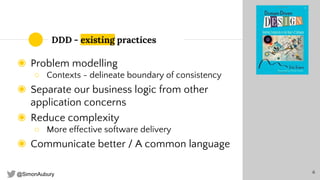
DDD - existing practices
◉ Problem modelling
○ Contexts - delineate boundary of consistency
◉ Separate our business logic from other
application concerns
◉ Reduce complexity
○ More effective software delivery
◉ Communicate better / A common language
6
@SimonAubury
Lesson: it’s hard work
without DDD
DDD gives us the tools to
define our bounded contexts,
which give us our services.
Modelling the domain helps us
identify the events that are
important to the domain.
7
@SimonAubury
There is a process to find the events that matter
◉ Use everyone to identify the events that matter
◉ Understand the systems
◉ Start with broad categories
8
@SimonAubury
Lesson: the rules are different
within vs across boundaries
Favour asynchrony and eventual
consistency at context boundaries,
embrace the productive coupling of
synchronous within the boundary
9
@SimonAubury
Many Meanings of Event Driven
◉ Event Notification
◉ Event-Carried State Transfer
◉ Event-Sourcing
◉ CQRS
10
https://martinfowler.com/articles/201701-event-driven.html
@SimonAubury
Lesson: don’t over engineer
Pick an event driven approach – and
be consistent and simple.
Don’t over-engineer an eventing
solution using Event-Sourcing/CQRS
11
@SimonAubury
Lesson: know your events
Modelling - discovery & integration …
Use simple language; solicit everyone's
input.
Develop your system inside out, focus
on the domain
12
@SimonAubury
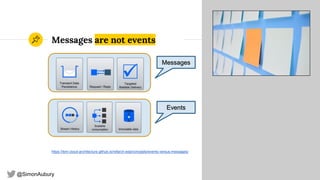
Messages are not events
13
https://ibm-cloud-architecture.github.io/refarch-eda/concepts/events-versus-messages/
Messages
Events
@SimonAubury
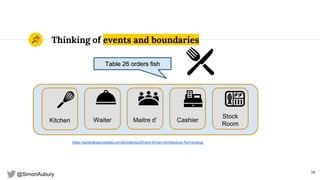
Thinking of events and boundaries
14
https://sarahtaraporewalla.com/architecture/Event-Driven-Architecture-Terminology
Kitchen Waiter Maitre d’ Cashier
Stock
Room
Table 26 orders fish
@SimonAubury
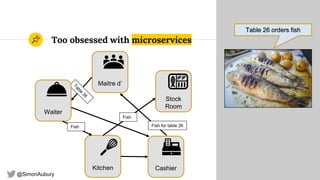
Too obsessed with microservices
15
Kitchen
Waiter
Maitre d’
Cashier
Stock
Room
Fish Fish for table 26
Fish
Table 26 orders fish
@SimonAubury
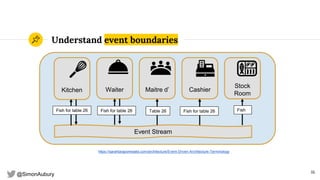
Understand event boundaries
16
https://sarahtaraporewalla.com/architecture/Event-Driven-Architecture-Terminology
Kitchen Waiter Maitre d’ Cashier
Event Stream
Table 26
Stock
Room
FishFish for table 26Fish for table 26 Fish for table 26
@SimonAubury
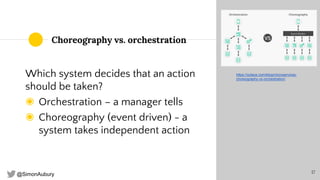
Choreography vs. orchestration
Which system decides that an action
should be taken?
◉ Orchestration – a manager tells
◉ Choreography (event driven) - a
system takes independent action
17
https://solace.com/blog/microservices-
choreography-vs-orchestration/
@SimonAubury
Lesson: event modelling - it really
happened
An event represents a fact, something
happened; it is immutable and
therefore changes how we think
about our domain model (boundary
between services).
18
@SimonAubury
Lesson: Beware the passive
aggressive events
An event shouldn’t be used as a
passive-aggressive command.
It’s a “bad smell” if a source system
expects the recipient to carry out an
action yet styles the message as an
event instead.
19
@SimonAubury
Now, some Kafka
stuff
20
@SimonAubury
Um, so why a Kafka?
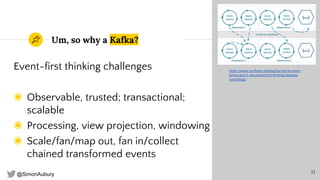
Event-first thinking challenges
◉ Observable, trusted; transactional;
scalable
◉ Processing, view projection, windowing
◉ Scale/fan/map out, fan in/collect
chained transformed events
21
https://www.confluent.io/blog/journey-to-event-
driven-part-1-why-event-first-thinking-changes-
everything/
@SimonAubury
Why the 💕 Kafka in EDA?
◉ Build apps on top of events - easy to out reporting
and ML later (rather than a bunch of ETL)
◉ Kafka plus functional programming plus
immutability plus polyglot persistence
22
@SimonAubury
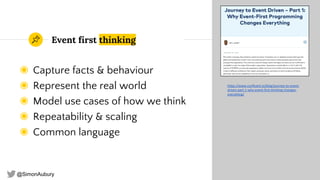
Event first thinking
◉ Capture facts & behaviour
◉ Represent the real world
◉ Model use cases of how we think
◉ Repeatability & scaling
◉ Common language
23
https://www.confluent.io/blog/journey-to-event-
driven-part-1-why-event-first-thinking-changes-
everything/
@SimonAubury
Lesson: Event must have’s
◉ Name – past tense
◉ Correlation ID
◉ Event production time
◉ Originating system
◉ Event creation system (may be different)
◉ A payload of stuff
24
@SimonAubury
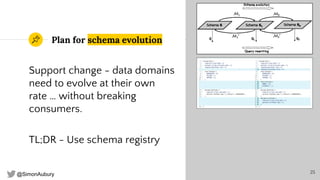
Plan for schema evolution
Support change - data domains
need to evolve at their own
rate … without breaking
consumers.
TL;DR - Use schema registry
25
@SimonAubury
Observability
26
After: add cache for field metadata
5,500 records / sec / table
Before: still slow transform
200 records / sec / table
@SimonAubury
Horizontal scaling … scales
horizontally
27
To scale out, you simply start another instance of your
stream processing application, e.g. on another machine. The
instances of your application will become aware of each other
and automatically begin to share the processing work.
https://www.confluent.io/blog/elastic-scaling-in-kafka-streams/
@SimonAubury
It went wrong – dead letter queue
Avoid DLQ if you can!
Managing a DLQ is highly dependent
on how crucial is that data, how
difficult it is to source it again and who
owns the source of truth.
28
@SimonAubury
Warning: opinions ahead …
◉ A bounded context == a Kafka topic
◉ You don’t need another microservice
framework
◉ You need schemas; mastered by the source
◉ Avoid dead letter queues
◉ Beware of CV-DD
◉ You’ll get things wrong – optimize for change
29
@SimonAubury
What did we learn?
30
@SimonAubury
Lesson: start .. now
Event Driven Architecture adoption should start now.
Starting the first leads to the next transformational
opportunity. Shift towards EDA is driven by increasing
demands and heightened expectations and system
modernisation
Make your own mistakes …
31
@SimonAubury
Any questions ?
Thanks!
32
@SimonAubury
linkedin.com/in/simonaubury
Presentation template by SlidesCarnival

Event Driven Architecture - Mistakes, I've made a few

  • 1.
    @SimonAubury Event Driven Architecture Mistakes –I’ve made a few … linkedin.com/in/simonaubury @SimonAubury A tale of confessions from Simon Aubury https://en.wikipedia.org/wiki/Montparnasse_derailment
  • 2.
    @SimonAubury Why am Ihere? 2 I am Simon Aubury Principal Data Engineer @ ThoughtWorks
  • 3.
    @SimonAubury “ Event-driven architecture (EDA)is a software architecture paradigm promoting the production, detection, consumption of, and reaction to events. https://en.wikipedia.org/wiki/Event-driven_architecture
  • 4.
  • 5.
    @SimonAubury Event Driven Architecture- a lot has happened in 25 years 5
  • 6.
    @SimonAubury DDD - existingpractices ◉ Problem modelling ○ Contexts - delineate boundary of consistency ◉ Separate our business logic from other application concerns ◉ Reduce complexity ○ More effective software delivery ◉ Communicate better / A common language 6
  • 7.
    @SimonAubury Lesson: it’s hardwork without DDD DDD gives us the tools to define our bounded contexts, which give us our services. Modelling the domain helps us identify the events that are important to the domain. 7
  • 8.
    @SimonAubury There is aprocess to find the events that matter ◉ Use everyone to identify the events that matter ◉ Understand the systems ◉ Start with broad categories 8
  • 9.
    @SimonAubury Lesson: the rulesare different within vs across boundaries Favour asynchrony and eventual consistency at context boundaries, embrace the productive coupling of synchronous within the boundary 9
  • 10.
    @SimonAubury Many Meanings ofEvent Driven ◉ Event Notification ◉ Event-Carried State Transfer ◉ Event-Sourcing ◉ CQRS 10 https://martinfowler.com/articles/201701-event-driven.html
  • 11.
    @SimonAubury Lesson: don’t overengineer Pick an event driven approach – and be consistent and simple. Don’t over-engineer an eventing solution using Event-Sourcing/CQRS 11
  • 12.
    @SimonAubury Lesson: know yourevents Modelling - discovery & integration … Use simple language; solicit everyone's input. Develop your system inside out, focus on the domain 12
  • 13.
    @SimonAubury Messages are notevents 13 https://ibm-cloud-architecture.github.io/refarch-eda/concepts/events-versus-messages/ Messages Events
  • 14.
    @SimonAubury Thinking of eventsand boundaries 14 https://sarahtaraporewalla.com/architecture/Event-Driven-Architecture-Terminology Kitchen Waiter Maitre d’ Cashier Stock Room Table 26 orders fish
  • 15.
    @SimonAubury Too obsessed withmicroservices 15 Kitchen Waiter Maitre d’ Cashier Stock Room Fish Fish for table 26 Fish Table 26 orders fish
  • 16.
    @SimonAubury Understand event boundaries 16 https://sarahtaraporewalla.com/architecture/Event-Driven-Architecture-Terminology KitchenWaiter Maitre d’ Cashier Event Stream Table 26 Stock Room FishFish for table 26Fish for table 26 Fish for table 26
  • 17.
    @SimonAubury Choreography vs. orchestration Whichsystem decides that an action should be taken? ◉ Orchestration – a manager tells ◉ Choreography (event driven) - a system takes independent action 17 https://solace.com/blog/microservices- choreography-vs-orchestration/
  • 18.
    @SimonAubury Lesson: event modelling- it really happened An event represents a fact, something happened; it is immutable and therefore changes how we think about our domain model (boundary between services). 18
  • 19.
    @SimonAubury Lesson: Beware thepassive aggressive events An event shouldn’t be used as a passive-aggressive command. It’s a “bad smell” if a source system expects the recipient to carry out an action yet styles the message as an event instead. 19
  • 20.
  • 21.
    @SimonAubury Um, so whya Kafka? Event-first thinking challenges ◉ Observable, trusted; transactional; scalable ◉ Processing, view projection, windowing ◉ Scale/fan/map out, fan in/collect chained transformed events 21 https://www.confluent.io/blog/journey-to-event- driven-part-1-why-event-first-thinking-changes- everything/
  • 22.
    @SimonAubury Why the 💕Kafka in EDA? ◉ Build apps on top of events - easy to out reporting and ML later (rather than a bunch of ETL) ◉ Kafka plus functional programming plus immutability plus polyglot persistence 22
  • 23.
    @SimonAubury Event first thinking ◉Capture facts & behaviour ◉ Represent the real world ◉ Model use cases of how we think ◉ Repeatability & scaling ◉ Common language 23 https://www.confluent.io/blog/journey-to-event- driven-part-1-why-event-first-thinking-changes- everything/
  • 24.
    @SimonAubury Lesson: Event musthave’s ◉ Name – past tense ◉ Correlation ID ◉ Event production time ◉ Originating system ◉ Event creation system (may be different) ◉ A payload of stuff 24
  • 25.
    @SimonAubury Plan for schemaevolution Support change - data domains need to evolve at their own rate … without breaking consumers. TL;DR - Use schema registry 25
  • 26.
    @SimonAubury Observability 26 After: add cachefor field metadata 5,500 records / sec / table Before: still slow transform 200 records / sec / table
  • 27.
    @SimonAubury Horizontal scaling …scales horizontally 27 To scale out, you simply start another instance of your stream processing application, e.g. on another machine. The instances of your application will become aware of each other and automatically begin to share the processing work. https://www.confluent.io/blog/elastic-scaling-in-kafka-streams/
  • 28.
    @SimonAubury It went wrong– dead letter queue Avoid DLQ if you can! Managing a DLQ is highly dependent on how crucial is that data, how difficult it is to source it again and who owns the source of truth. 28
  • 29.
    @SimonAubury Warning: opinions ahead… ◉ A bounded context == a Kafka topic ◉ You don’t need another microservice framework ◉ You need schemas; mastered by the source ◉ Avoid dead letter queues ◉ Beware of CV-DD ◉ You’ll get things wrong – optimize for change 29
  • 30.
  • 31.
    @SimonAubury Lesson: start ..now Event Driven Architecture adoption should start now. Starting the first leads to the next transformational opportunity. Shift towards EDA is driven by increasing demands and heightened expectations and system modernisation Make your own mistakes … 31
  • 32.