EvaluationofPerformancein
OperatingComputerized
Reservation SystemName of presntor
TREY
research
of Performance in
Operating a Computerized
Reservation System." In the
dynamic and ever-evolving
hospitality industry, the
efficient and accurate
operation of computerized
reservation systems (CRS) is
paramount. These systems
serve as the backbone of
hotel management,
impacting guest
satisfaction, operational
efficiency, and revenue
optimization.
2
TREY
research
The importance of
computerized
reservation systems in
the hospitality industry
cannot be overstated.
They are instrumental in
improving efficiency,
accuracy, guest
satisfaction, and revenue
generation for hotels
and lodging
establishments.
3
TREY
research
What is a
Computerized
Reservation System
(CRS)?
Definition:
A Computerized Reservation System
(CRS) is a sophisticated software
platform utilized in the hospitality
industry for the management and
distribution of reservations, bookings,
and other related tasks. 4
TREY
research
RoleinHotel
Management:
Central Hub: CRS acts as a central hub for managing and
overseeing reservations across various distribution channels.
Real-time Management: It enables real-time management of room
availability, pricing, and guest information.
Automation: CRS automates the reservation process, reducing
manual efforts and human errors.
Distribution: CRS connects hotels with various booking platforms,
including their own websites, online travel agencies (OTAs), and
global distribution systems (GDS).
Reporting: It offers reporting and analytics tools for performance
assessment and strategic decision-making.
Add a footer 5
TREY
research
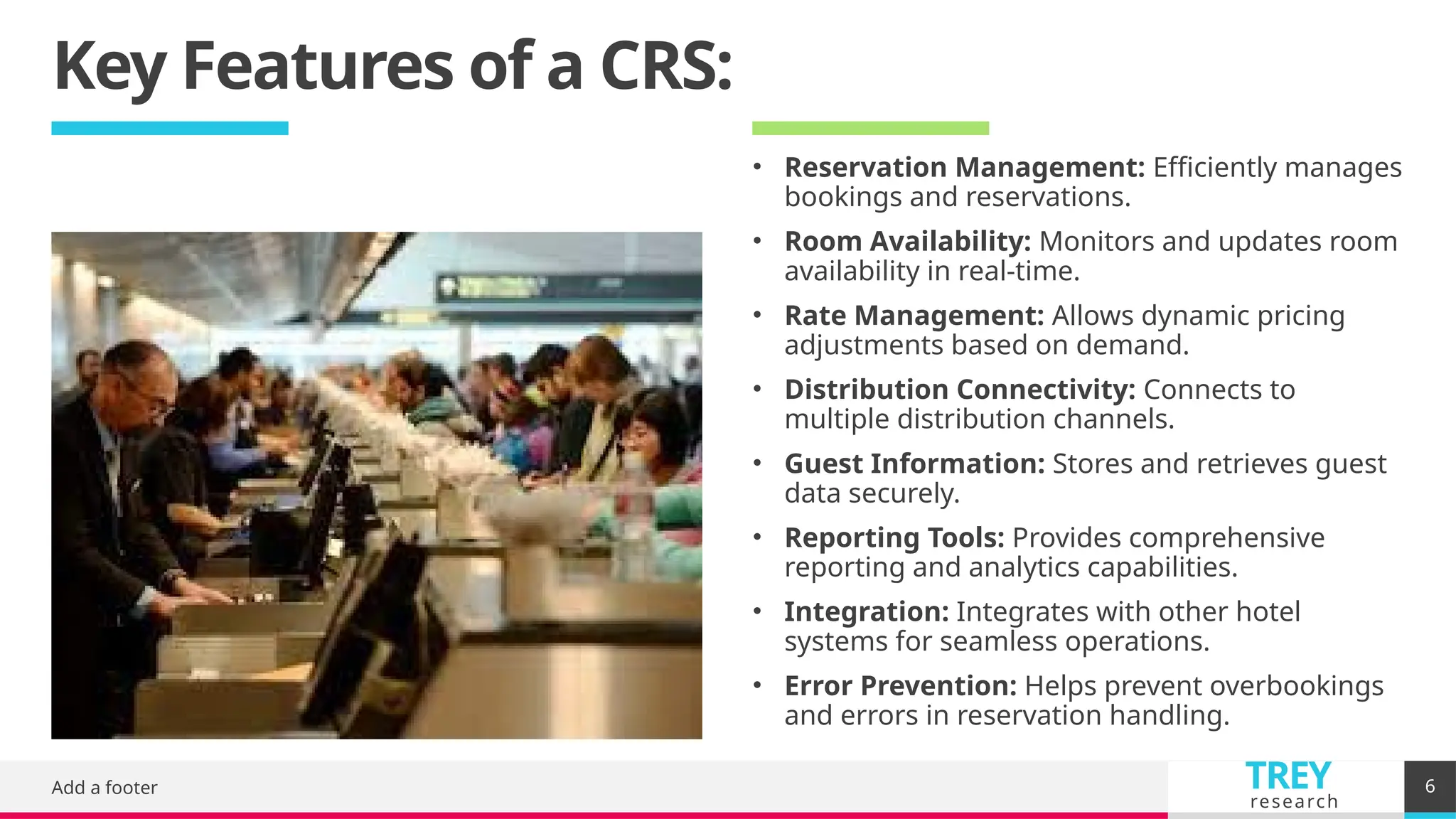
Key Features of a CRS:
Add a footer 6
• Reservation Management: Efficiently manages
bookings and reservations.
• Room Availability: Monitors and updates room
availability in real-time.
• Rate Management: Allows dynamic pricing
adjustments based on demand.
• Distribution Connectivity: Connects to
multiple distribution channels.
• Guest Information: Stores and retrieves guest
data securely.
• Reporting Tools: Provides comprehensive
reporting and analytics capabilities.
• Integration: Integrates with other hotel
systems for seamless operations.
• Error Prevention: Helps prevent overbookings
and errors in reservation handling.
TREY
research
Criteria for Evaluating CRS Performance
Add a footer 7
2. Accuracy:
• Explanation: Accuracy entails
ensuring that all data entered into
the CRS is correct, including guest
information, reservation details,
and pricing information. Errors in
data entry can lead to
misunderstandings and guest
dissatisfaction.
• Importance: Accurate information
is vital for guest expectations to be
met, and it helps prevent issues like
overbookings or incorrect charges.
1.Speed and Efficiency:
1.Explanation: Speed and
efficiency refer to how swiftly
reservations are processed and
confirmed. An efficient CRS
operation should minimize
delays and provide quick
responses to guest inquiries.
2.Importance: Guests appreciate
a seamless booking experience,
and fast responses can lead to
higher satisfaction and
increased bookings.
TREY
research
Criteria for Evaluating CRS Performance
Add a footer 8
4. Handling Special Requests:
• Explanation: Special requests
made by guests, such as room
preferences or specific amenities,
should be efficiently managed
within the CRS. Meeting these
requests enhances guest
satisfaction.
• Importance: Fulfilling special
requests demonstrates
attentiveness to guest needs and
can lead to positive reviews and
repeat business.
3. Room Availability
Management:
• Explanation: Effective room
availability management
involves constantly updating
the system to reflect real-time
room availability. It ensures
that the CRS accurately
displays the number and types
of rooms available.
• Importance: Accurate room
availability information is
essential to prevent double
bookings and to optimize
TREY
research
Criteria for Evaluating CRS Performance
Add a footer 9
5. Error Identification and Resolution:
• Explanation: The ability to identify and resolve
errors promptly is crucial. This includes identifying
discrepancies in reservation details, resolving
conflicts, and rectifying any booking mistakes.
• Importance: Timely error resolution prevents
guest frustration and maintains the hotel's
reputation for professionalism and reliability.
TREY
research
How Performance Evaluation in CRS Operation Works
Add a footer 10
• Step 1: Define
Evaluation Objectives
• The evaluation process
begins by clearly defining
the objectives and goals
of the assessment. What
aspects of CRS operation
are you assessing, and
what outcomes are you
looking to achieve?
TREY
research
How Performance Evaluation in CRS Operation Works
Add a footer 11
• Step 2: Establish
Evaluation Criteria
• Identify the specific
criteria or metrics against
which CRS performance
will be assessed. This
includes factors such as
speed, accuracy, room
availability management,
handling special requests,
and error identification.
TREY
research
How Performance Evaluation in CRS Operation Works
Add a footer 12
• Step 3: Select
Evaluation Methods
• Determine the methods
you'll use to gather
data and evaluate
performance. This may
include direct
observation, simulated
reservations, or using
evaluation forms.
TREY
research
How Performance Evaluation in CRS Operation Works
Add a footer 13
• Step 4: Data Collection
• Collect data by
observing CRS
operation in action. This
could involve
monitoring reservation
processing, data entry
accuracy, room
allocation, and handling
of special requests.
TREY
research
How Performance Evaluation in CRS Operation Works
Add a footer 14
• Step 5: Assess
Performance
• Analyze the collected
data against the
predefined evaluation
criteria. Evaluate the
CRS operation based on
the established
benchmarks.
TREY
research
How Performance Evaluation in CRS Operation Works
Add a footer 15
• Step 6: Identify
Strengths and
Weaknesses
• Identify the strengths
and weaknesses of the
CRS operation.
Determine what aspects
are working well and
where improvements
are needed.
TREY
research
How Performance Evaluation in CRS Operation Works
Add a footer 16
• Step 7: Provide
Feedback
• Share feedback and
evaluation results with
the individuals
responsible for
operating the CRS.
Highlight areas of
excellence and areas
requiring improvement.
TREY
research
How Performance Evaluation in CRS Operation Works
Add a footer 17
• Step 8: Training and
Improvement
• Based on the evaluation
results, provide training
or guidance to address
areas needing
improvement. Offer
additional resources or
support as necessary.
TREY
research
How Performance Evaluation in CRS Operation Works
Add a footer 18
• Step 9: Continuous
Monitoring
• Implement a system of
continuous monitoring
and periodic
performance
evaluations to track
improvements and
ensure ongoing
efficiency and accuracy.
TREY
research
How Performance Evaluation in CRS Operation Works
Add a footer 19
• Step 10: Review and
Adjust Objectives
• Periodically review and
adjust evaluation
objectives and criteria
to align with changing
operational needs and
guest expectations.
TREY
research
In conclusion, the diligent
evaluation of CRS
performance is not just a
best practice; it is a
fundamental necessity in
the modern hospitality
landscape. It ensures that
hotels deliver exceptional
service, enhance guest
experiences, and remain
competitive in an ever-
evolving industry.
Add a footer 20
TREY
research
Your Questions,
My Answers!
I now invite any questions you may have regarding the presentation,
CRS operation, or related topics. Please feel free to ask, and I'll do my
best to provide answers and insights.
Your participation and curiosity are greatly appreciated. Let's engage
in a meaningful discussion.
Add a footer 21

Evaluation of Performance in Operating Computerized Reservation System.pptx

  • 1.
  • 2.
    TREY research of Performance in Operatinga Computerized Reservation System." In the dynamic and ever-evolving hospitality industry, the efficient and accurate operation of computerized reservation systems (CRS) is paramount. These systems serve as the backbone of hotel management, impacting guest satisfaction, operational efficiency, and revenue optimization. 2
  • 3.
    TREY research The importance of computerized reservationsystems in the hospitality industry cannot be overstated. They are instrumental in improving efficiency, accuracy, guest satisfaction, and revenue generation for hotels and lodging establishments. 3
  • 4.
    TREY research What is a Computerized ReservationSystem (CRS)? Definition: A Computerized Reservation System (CRS) is a sophisticated software platform utilized in the hospitality industry for the management and distribution of reservations, bookings, and other related tasks. 4
  • 5.
    TREY research RoleinHotel Management: Central Hub: CRSacts as a central hub for managing and overseeing reservations across various distribution channels. Real-time Management: It enables real-time management of room availability, pricing, and guest information. Automation: CRS automates the reservation process, reducing manual efforts and human errors. Distribution: CRS connects hotels with various booking platforms, including their own websites, online travel agencies (OTAs), and global distribution systems (GDS). Reporting: It offers reporting and analytics tools for performance assessment and strategic decision-making. Add a footer 5
  • 6.
    TREY research Key Features ofa CRS: Add a footer 6 • Reservation Management: Efficiently manages bookings and reservations. • Room Availability: Monitors and updates room availability in real-time. • Rate Management: Allows dynamic pricing adjustments based on demand. • Distribution Connectivity: Connects to multiple distribution channels. • Guest Information: Stores and retrieves guest data securely. • Reporting Tools: Provides comprehensive reporting and analytics capabilities. • Integration: Integrates with other hotel systems for seamless operations. • Error Prevention: Helps prevent overbookings and errors in reservation handling.
  • 7.
    TREY research Criteria for EvaluatingCRS Performance Add a footer 7 2. Accuracy: • Explanation: Accuracy entails ensuring that all data entered into the CRS is correct, including guest information, reservation details, and pricing information. Errors in data entry can lead to misunderstandings and guest dissatisfaction. • Importance: Accurate information is vital for guest expectations to be met, and it helps prevent issues like overbookings or incorrect charges. 1.Speed and Efficiency: 1.Explanation: Speed and efficiency refer to how swiftly reservations are processed and confirmed. An efficient CRS operation should minimize delays and provide quick responses to guest inquiries. 2.Importance: Guests appreciate a seamless booking experience, and fast responses can lead to higher satisfaction and increased bookings.
  • 8.
    TREY research Criteria for EvaluatingCRS Performance Add a footer 8 4. Handling Special Requests: • Explanation: Special requests made by guests, such as room preferences or specific amenities, should be efficiently managed within the CRS. Meeting these requests enhances guest satisfaction. • Importance: Fulfilling special requests demonstrates attentiveness to guest needs and can lead to positive reviews and repeat business. 3. Room Availability Management: • Explanation: Effective room availability management involves constantly updating the system to reflect real-time room availability. It ensures that the CRS accurately displays the number and types of rooms available. • Importance: Accurate room availability information is essential to prevent double bookings and to optimize
  • 9.
    TREY research Criteria for EvaluatingCRS Performance Add a footer 9 5. Error Identification and Resolution: • Explanation: The ability to identify and resolve errors promptly is crucial. This includes identifying discrepancies in reservation details, resolving conflicts, and rectifying any booking mistakes. • Importance: Timely error resolution prevents guest frustration and maintains the hotel's reputation for professionalism and reliability.
  • 10.
    TREY research How Performance Evaluationin CRS Operation Works Add a footer 10 • Step 1: Define Evaluation Objectives • The evaluation process begins by clearly defining the objectives and goals of the assessment. What aspects of CRS operation are you assessing, and what outcomes are you looking to achieve?
  • 11.
    TREY research How Performance Evaluationin CRS Operation Works Add a footer 11 • Step 2: Establish Evaluation Criteria • Identify the specific criteria or metrics against which CRS performance will be assessed. This includes factors such as speed, accuracy, room availability management, handling special requests, and error identification.
  • 12.
    TREY research How Performance Evaluationin CRS Operation Works Add a footer 12 • Step 3: Select Evaluation Methods • Determine the methods you'll use to gather data and evaluate performance. This may include direct observation, simulated reservations, or using evaluation forms.
  • 13.
    TREY research How Performance Evaluationin CRS Operation Works Add a footer 13 • Step 4: Data Collection • Collect data by observing CRS operation in action. This could involve monitoring reservation processing, data entry accuracy, room allocation, and handling of special requests.
  • 14.
    TREY research How Performance Evaluationin CRS Operation Works Add a footer 14 • Step 5: Assess Performance • Analyze the collected data against the predefined evaluation criteria. Evaluate the CRS operation based on the established benchmarks.
  • 15.
    TREY research How Performance Evaluationin CRS Operation Works Add a footer 15 • Step 6: Identify Strengths and Weaknesses • Identify the strengths and weaknesses of the CRS operation. Determine what aspects are working well and where improvements are needed.
  • 16.
    TREY research How Performance Evaluationin CRS Operation Works Add a footer 16 • Step 7: Provide Feedback • Share feedback and evaluation results with the individuals responsible for operating the CRS. Highlight areas of excellence and areas requiring improvement.
  • 17.
    TREY research How Performance Evaluationin CRS Operation Works Add a footer 17 • Step 8: Training and Improvement • Based on the evaluation results, provide training or guidance to address areas needing improvement. Offer additional resources or support as necessary.
  • 18.
    TREY research How Performance Evaluationin CRS Operation Works Add a footer 18 • Step 9: Continuous Monitoring • Implement a system of continuous monitoring and periodic performance evaluations to track improvements and ensure ongoing efficiency and accuracy.
  • 19.
    TREY research How Performance Evaluationin CRS Operation Works Add a footer 19 • Step 10: Review and Adjust Objectives • Periodically review and adjust evaluation objectives and criteria to align with changing operational needs and guest expectations.
  • 20.
    TREY research In conclusion, thediligent evaluation of CRS performance is not just a best practice; it is a fundamental necessity in the modern hospitality landscape. It ensures that hotels deliver exceptional service, enhance guest experiences, and remain competitive in an ever- evolving industry. Add a footer 20
  • 21.
    TREY research Your Questions, My Answers! Inow invite any questions you may have regarding the presentation, CRS operation, or related topics. Please feel free to ask, and I'll do my best to provide answers and insights. Your participation and curiosity are greatly appreciated. Let's engage in a meaningful discussion. Add a footer 21

Editor's Notes

  • #2 In the next few slides, we will delve into the importance of assessing performance in CRS operation, understanding the criteria used for evaluation, and how these skills are applied in the real-world hospitality industry. By the end of this presentation, you'll gain valuable insights into enhancing efficiency and accuracy in CRS usage, making you better prepared for success in the field of hospitality. Let's get started!