Eureka!
Sajid Farook
Archimedes’s Case
Archimedes was a famous Greek mathematician physicist, and
astronomer. One day, the king summoned him to solve a
problem. He had recently given a goldsmith the exact amount
of gold needed to make a crown, but the king thought he might
have cheated by slipping a bit of silver into the crown.
Archimedes knew that to solve this mystery: he needed to find
the density of the crown and compare that density to a crown
of the same size, but made of pure gold. He also knew that to
find the density, he needed to divide the mass by the volume.
However what he didn’t know is how to find the volume
without breaking the crown. Lets become Archimedes and
figure out how he came up with the famous Archimedes
Principle and solved the king’s problem!
Mass The first step to find density
Since density is mass
divided by volume, we
first need to find the
mass.
A digital balance can be used to find mass
• The amount of
matter, or “stuff” in an
object
• Measured using a
triple beam of digital
balance
• Unit of mass:
grams(kilogram, milligr
am)
The crown is 65.5
grams heavy, but
what does that really
mean? The strength
of the gravitational
pull, or weight, on
the object is
dependent on the
amount of matter
the object has. This
is what grams
measure.
Volume The second step to find volume
• How much space
something
occupies
• Unit of volume: m3
(cm3, km3)
• Measured using
graduated
cylinder, beaker, o
verflow can (water
displacement)
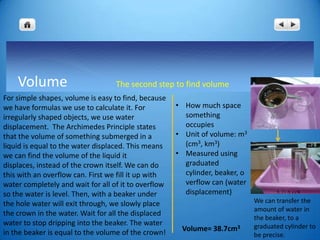
For simple shapes, volume is easy to find, because
we have formulas we use to calculate it. For
irregularly shaped objects, we use water
displacement. The Archimedes Principle states
that the volume of something submerged in a
liquid is equal to the water displaced. This means
we can find the volume of the liquid it
displaces, instead of the crown itself. We can do
this with an overflow can. First we fill it up with
water completely and wait for all of it to overflow
so the water is level. Then, with a beaker under
the hole water will exit through, we slowly place
the crown in the water. Wait for all the displaced
water to stop dripping into the beaker. The water
in the beaker is equal to the volume of the crown!
We can transfer the
amount of water in
the beaker, to a
graduated cylinder to
be precise.
Volume= 38.7cm3
Density
• How much matter is
packed together
into one unit of
volume
• Found by dividing
mass by volume
• Measured in g/cm3
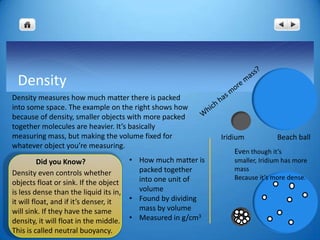
Iridium Beach ball
Even though it’s
smaller, Iridium has more
mass
Because it’s more dense.
Density measures how much matter there is packed
into some space. The example on the right shows how
because of density, smaller objects with more packed
together molecules are heavier. It’s basically
measuring mass, but making the volume fixed for
whatever object you’re measuring.
Did you Know?
Density even controls whether
objects float or sink. If the object
is less dense than the liquid its in,
it will float, and if it’s denser, it
will sink. If they have the same
density, it will float in the middle.
This is called neutral buoyancy.
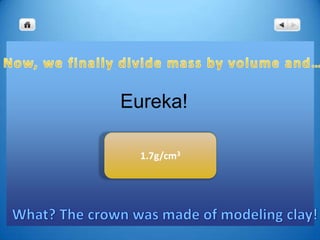
Eureka!
1.7g/cm3

Eureka!

  • 1.
  • 2.
    Archimedes’s Case Archimedes wasa famous Greek mathematician physicist, and astronomer. One day, the king summoned him to solve a problem. He had recently given a goldsmith the exact amount of gold needed to make a crown, but the king thought he might have cheated by slipping a bit of silver into the crown. Archimedes knew that to solve this mystery: he needed to find the density of the crown and compare that density to a crown of the same size, but made of pure gold. He also knew that to find the density, he needed to divide the mass by the volume. However what he didn’t know is how to find the volume without breaking the crown. Lets become Archimedes and figure out how he came up with the famous Archimedes Principle and solved the king’s problem!
  • 3.
    Mass The firststep to find density Since density is mass divided by volume, we first need to find the mass. A digital balance can be used to find mass • The amount of matter, or “stuff” in an object • Measured using a triple beam of digital balance • Unit of mass: grams(kilogram, milligr am) The crown is 65.5 grams heavy, but what does that really mean? The strength of the gravitational pull, or weight, on the object is dependent on the amount of matter the object has. This is what grams measure.
  • 4.
    Volume The secondstep to find volume • How much space something occupies • Unit of volume: m3 (cm3, km3) • Measured using graduated cylinder, beaker, o verflow can (water displacement) For simple shapes, volume is easy to find, because we have formulas we use to calculate it. For irregularly shaped objects, we use water displacement. The Archimedes Principle states that the volume of something submerged in a liquid is equal to the water displaced. This means we can find the volume of the liquid it displaces, instead of the crown itself. We can do this with an overflow can. First we fill it up with water completely and wait for all of it to overflow so the water is level. Then, with a beaker under the hole water will exit through, we slowly place the crown in the water. Wait for all the displaced water to stop dripping into the beaker. The water in the beaker is equal to the volume of the crown! We can transfer the amount of water in the beaker, to a graduated cylinder to be precise. Volume= 38.7cm3
  • 5.
    Density • How muchmatter is packed together into one unit of volume • Found by dividing mass by volume • Measured in g/cm3 Iridium Beach ball Even though it’s smaller, Iridium has more mass Because it’s more dense. Density measures how much matter there is packed into some space. The example on the right shows how because of density, smaller objects with more packed together molecules are heavier. It’s basically measuring mass, but making the volume fixed for whatever object you’re measuring. Did you Know? Density even controls whether objects float or sink. If the object is less dense than the liquid its in, it will float, and if it’s denser, it will sink. If they have the same density, it will float in the middle. This is called neutral buoyancy.
  • 6.