Learning by Doing
Lecture 8
• Absolutism: The ‘truth’ about right and wrong is given,
and is clear, and therefore we know what to do.
• Relativism: Cannot judge other people, neither can you
be judged by others, therefore no need to engage in
ethical
• Both can provide easy answers, and therefore are
seductive to managers making decisions.
The Seductiveness of both
Relativism & Absolutism
Relativism
• ‘everything is relative’ is a logical fallacy
because it is an absolute claim..
• Respectful and tolerant of other people’s views.
• True that there is plurality in the world – people
with different viewpoints, but is it right to be
totally tolerant? (see next slide)
Most people would not
approve of:
‘slave-owning societies and caste
societies, societies that tolerate
widow-burning, or enforce female
genital mutilation, or [that]
systematically deny education and
other rights to women’ (2001: 23)
‘… there is the strong feeling most of us have
that these things just should not happen, and we
should not stand idly by while they do’ (2001: 24)
(Simon Blackburn (2001) Being Good)
Cultural Relativism
Blackburn (2001) also published in this form:
Both Relativism and Absolutism are challenges
to ethical deliberation – each suggests that it is
unnecessary.
Absolutism can appear intolerant and unhelpful to a
manager operating in a pluralist society.
Relativism prevents us from evolving new norms
that help us to cope with the new situations we
face with changing technology and globalisation.
Relativism & Absolutism
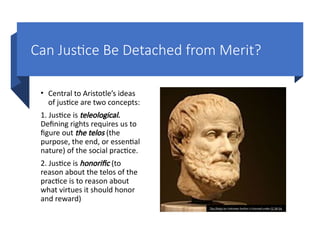
Can Justice Be Detached from Merit?
• Central to Aristotle’s ideas
of justice are two concepts:
1. Justice is teleological.
Defining rights requires us to
figure out the telos (the
purpose, the end, or essential
nature) of the social practice.
2. Justice is honorific (to
reason about the telos of the
practice is to reason about
what virtues it should honor
and reward)
This Photo by Unknown Author is licensed under CC BY-SA
Can
Justice Be
Detached
from
Merit?
‘Birth and beauty may be greater goods
than ability to play the flute, and those
who possess them may, upon balance,
surpass the flute-player more in these
qualities than he surpasses them in his
flute-playing; but the fact remains that he
is the man who ought to get better supply
of the flute’
What is
the
purpose
of
politics?
• When we discuss distributive justice,
we are concerned mainly with the
distribution of income, wealth and
opportunities.
• For Aristotle, distributive justice was
not mainly about money, but more
about offices and honors. Who should
have the right to rule? How should
political authority be distributed?
What is the
purpose of
politics?
• Any polis which is truly so
called, and is not merely
one in name, must devote
itself to the end of
encouraging goodness.
Otherwise, a political
association sinks into a
mere alliance…
What is the purpose of politics?
• Politics is for cultivating the virtue of citizens.
• It is about learning how to live a good life.
• The purpose of politics is to enable people to develop their
distinctive human capacities and virtues – to deliberate about
the common good, to acquire moral and practical judgment, to
be capable of self-government, to care for the fate of the
community.
What is the purpose of politics?
‘Those who contribute most to an association of this (virtuous)
character’ are those who excel in civic virtue, those who are best
at deliberating about the common good. Those who are the
greatest in civic excellence – not the wealthiest, or the most
numerous, or the most handsome – are the ones who merit the
greatest share of political recognition.’
Is politics for the sake of the good life or Is
it a necessary evil?
• Only by living in a polis and participating in politics do we fully realize
our nature as human beings.
• Aristotle sees us as being meant for political association, in a higher
degree than bees and other animals.
• Nature gives nothing in vain, and human beings, unlike other animals,
are furnished with the faculty of language. Language is for declaring
what is just and what is unjust, and distinguishing right from wrong.
• Only in political association, can we exercise our distinctly human
capacity for language, for only in polis do we deliberate with others
about justice and injustice and the nature of the good life.
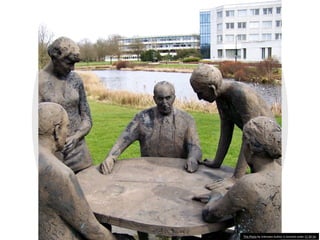
This Photo by Unknown Author is licensed under CC BY-SA
Learning by Doing
• Moral virtue is something we learn by doing; we have
somehow to develop the rights habits.
• For Aristotle, the primary purpose of law is to cultivate the
habits that lead to good character. ‘Legislators make the
citizens good by forming habits in them, and this is the wish of
every legislator’
• The habit is the first step in moral education. Aristotle assumes
that practicing proper behavior eventually encourages virtuous
feeling. For example, if you write enough ‘thank you’ letters,
you may actually feel a flicker of gratitude.
Learning by Doing
• First, the laws of the polis inculcate good habits form good
character and set us on the way to civic virtue.
• Second, the life of the citizen enables us to exercise capacities
for deliberation and practical wisdom that would otherwise lie
dormant.
• Deliberation is not something we can do at home, alone as this
is not the same as sharing in significant action and bearing
responsibility for the fate of the community as a whole. We
become good at deliberating only by entering the arena,
weighing the alternatives, arguing our case, ruling and being
ruled - in short by being citizens.
Pragmatic Ethics
• Rejection of rationality
to solely define moral
criteria
• Practice is primary in
philosophy
Some proponents: John Dewey, Richard Rorty, Amartya
Sen, Simon Blackburn (from the past David Hume 1711-
1776)
See LaFollette (2000)
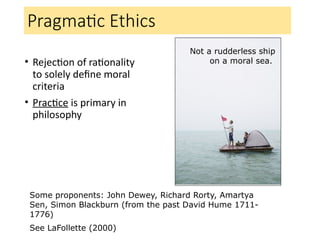
Not a rudderless ship
on a moral sea.
Theory and Practice Divide
• Peirce insists on the separation of theory and practice.
The practical man doesn't need to put his assertions to
the test, nor does he test his beliefs.
• This separation of theory and practice runs parallel to
another split, namely, that of ethics and morals or, better
put, of ethical theory and moral practice. Peirce denies
that morality is subject to rationality and thinks that
ethics is valuable as a science in a broad sense. Ethics
would be a normative knowledge only in so far as it
analyzes the adjustment of actions to ends and in so far as
it studies the general way in which a good life can be
lived.
Morals/Ethics
• In morals Peirce appeals to instinct and sentiment,
and in ethics he recommends the use of logical
thinking
• Peirce describes human reason in terms of a
deliberative rationality. Deliberation for Peirce is a
process of preparation for future action which has
to do with the checking of previous acts, the
rehearsal in imagination of different roads to be
followed by possible conduct and the nurturing of
ideals
Morals/Ethics
• In the case of ethics, if you want to obtain goodness in
action then you should restrain your acts in certain ways.
For Peirce, this means that you should adjust your life to
an ideal.
• Ethics, then, would be merely the theory of the
conformity of an action to that ideal. The ideal doesn't
cause any action but prompts the revision of past actions
and the judgment of future actions. The judgment that
compares the action with the ideal gives rise to an
influence on habits that, together with the consequences
of past actions, modifies the future action.
Morality is a habit
Society plays a large part in creating, transmitting, shaping
& reshaping our habits, by praising and blaming.
Nonetheless, even though our habits may be shaped by society, it is a tenet of
philosophy that individuals do have moral agency.
A moral agent is a being that is “capable of acting with reference to right
and wrong”. A moral agent can be held responsible for their behaviour.
We can deliberate on which are good habits and which we should change.
Ethical thought may guide us, by helping us to identify morally relevant features
of our action.
Pragmatic Ethics
Pragmatic Ethics (H.LaFollette)
• Habits are two-edged swords: the very features
that give us power to act and to think also
circumscribe us.
• We confuse daydreams with intentions and desires,
then prone to comfort ourselves by saying that we
are really kind, hardworking honest and self-
directed – no matter how we act. We only have
intentions if we make specific plans (take specific
steps) toward that end. We can legitimately claim
to be kind if we are regularly kind.
Pragmatic Ethics (H.LaFollette)
• If I lie to you now, I am not just saying something
(a) my action springs from my habits (my motives);
(b) I am shaping the character of our relationship;
and (c) I am strengthening my dispositions to lie in
the future (i.e. missing deadlines)
• Moral theories can isolate and habitually focus on
morally relevant features of actions.
Simon Blackburn, ‘Being Good’
Simon Blackburn argues for
1. Consensually agreed ethical standards
2. Based on emotions as much as reason.
“In all this we seem to have the operation of the passions rather than
the operation of Reasons. In this sense, the foundations of moral
motivation are not the procedural rules on a kind of discourse,
but the feelings to which we can rise. Benevolence or concern for
humanity is the indispensable root of it all”
(2001: 132-133)

Ethics Lecture Power point lecture notes

  • 1.
  • 2.
    • Absolutism: The‘truth’ about right and wrong is given, and is clear, and therefore we know what to do. • Relativism: Cannot judge other people, neither can you be judged by others, therefore no need to engage in ethical • Both can provide easy answers, and therefore are seductive to managers making decisions. The Seductiveness of both Relativism & Absolutism
  • 3.
    Relativism • ‘everything isrelative’ is a logical fallacy because it is an absolute claim.. • Respectful and tolerant of other people’s views. • True that there is plurality in the world – people with different viewpoints, but is it right to be totally tolerant? (see next slide)
  • 4.
    Most people wouldnot approve of: ‘slave-owning societies and caste societies, societies that tolerate widow-burning, or enforce female genital mutilation, or [that] systematically deny education and other rights to women’ (2001: 23) ‘… there is the strong feeling most of us have that these things just should not happen, and we should not stand idly by while they do’ (2001: 24) (Simon Blackburn (2001) Being Good) Cultural Relativism Blackburn (2001) also published in this form:
  • 5.
    Both Relativism andAbsolutism are challenges to ethical deliberation – each suggests that it is unnecessary. Absolutism can appear intolerant and unhelpful to a manager operating in a pluralist society. Relativism prevents us from evolving new norms that help us to cope with the new situations we face with changing technology and globalisation. Relativism & Absolutism
  • 6.
    Can Justice BeDetached from Merit? • Central to Aristotle’s ideas of justice are two concepts: 1. Justice is teleological. Defining rights requires us to figure out the telos (the purpose, the end, or essential nature) of the social practice. 2. Justice is honorific (to reason about the telos of the practice is to reason about what virtues it should honor and reward) This Photo by Unknown Author is licensed under CC BY-SA
  • 7.
    Can Justice Be Detached from Merit? ‘Birth andbeauty may be greater goods than ability to play the flute, and those who possess them may, upon balance, surpass the flute-player more in these qualities than he surpasses them in his flute-playing; but the fact remains that he is the man who ought to get better supply of the flute’
  • 8.
    What is the purpose of politics? • Whenwe discuss distributive justice, we are concerned mainly with the distribution of income, wealth and opportunities. • For Aristotle, distributive justice was not mainly about money, but more about offices and honors. Who should have the right to rule? How should political authority be distributed?
  • 9.
    What is the purposeof politics? • Any polis which is truly so called, and is not merely one in name, must devote itself to the end of encouraging goodness. Otherwise, a political association sinks into a mere alliance…
  • 10.
    What is thepurpose of politics? • Politics is for cultivating the virtue of citizens. • It is about learning how to live a good life. • The purpose of politics is to enable people to develop their distinctive human capacities and virtues – to deliberate about the common good, to acquire moral and practical judgment, to be capable of self-government, to care for the fate of the community.
  • 11.
    What is thepurpose of politics? ‘Those who contribute most to an association of this (virtuous) character’ are those who excel in civic virtue, those who are best at deliberating about the common good. Those who are the greatest in civic excellence – not the wealthiest, or the most numerous, or the most handsome – are the ones who merit the greatest share of political recognition.’
  • 12.
    Is politics forthe sake of the good life or Is it a necessary evil? • Only by living in a polis and participating in politics do we fully realize our nature as human beings. • Aristotle sees us as being meant for political association, in a higher degree than bees and other animals. • Nature gives nothing in vain, and human beings, unlike other animals, are furnished with the faculty of language. Language is for declaring what is just and what is unjust, and distinguishing right from wrong. • Only in political association, can we exercise our distinctly human capacity for language, for only in polis do we deliberate with others about justice and injustice and the nature of the good life.
  • 13.
    This Photo byUnknown Author is licensed under CC BY-SA
  • 14.
    Learning by Doing •Moral virtue is something we learn by doing; we have somehow to develop the rights habits. • For Aristotle, the primary purpose of law is to cultivate the habits that lead to good character. ‘Legislators make the citizens good by forming habits in them, and this is the wish of every legislator’ • The habit is the first step in moral education. Aristotle assumes that practicing proper behavior eventually encourages virtuous feeling. For example, if you write enough ‘thank you’ letters, you may actually feel a flicker of gratitude.
  • 15.
    Learning by Doing •First, the laws of the polis inculcate good habits form good character and set us on the way to civic virtue. • Second, the life of the citizen enables us to exercise capacities for deliberation and practical wisdom that would otherwise lie dormant. • Deliberation is not something we can do at home, alone as this is not the same as sharing in significant action and bearing responsibility for the fate of the community as a whole. We become good at deliberating only by entering the arena, weighing the alternatives, arguing our case, ruling and being ruled - in short by being citizens.
  • 16.
    Pragmatic Ethics • Rejectionof rationality to solely define moral criteria • Practice is primary in philosophy Some proponents: John Dewey, Richard Rorty, Amartya Sen, Simon Blackburn (from the past David Hume 1711- 1776) See LaFollette (2000) Not a rudderless ship on a moral sea.
  • 17.
    Theory and PracticeDivide • Peirce insists on the separation of theory and practice. The practical man doesn't need to put his assertions to the test, nor does he test his beliefs. • This separation of theory and practice runs parallel to another split, namely, that of ethics and morals or, better put, of ethical theory and moral practice. Peirce denies that morality is subject to rationality and thinks that ethics is valuable as a science in a broad sense. Ethics would be a normative knowledge only in so far as it analyzes the adjustment of actions to ends and in so far as it studies the general way in which a good life can be lived.
  • 18.
    Morals/Ethics • In moralsPeirce appeals to instinct and sentiment, and in ethics he recommends the use of logical thinking • Peirce describes human reason in terms of a deliberative rationality. Deliberation for Peirce is a process of preparation for future action which has to do with the checking of previous acts, the rehearsal in imagination of different roads to be followed by possible conduct and the nurturing of ideals
  • 19.
    Morals/Ethics • In thecase of ethics, if you want to obtain goodness in action then you should restrain your acts in certain ways. For Peirce, this means that you should adjust your life to an ideal. • Ethics, then, would be merely the theory of the conformity of an action to that ideal. The ideal doesn't cause any action but prompts the revision of past actions and the judgment of future actions. The judgment that compares the action with the ideal gives rise to an influence on habits that, together with the consequences of past actions, modifies the future action.
  • 20.
    Morality is ahabit Society plays a large part in creating, transmitting, shaping & reshaping our habits, by praising and blaming. Nonetheless, even though our habits may be shaped by society, it is a tenet of philosophy that individuals do have moral agency. A moral agent is a being that is “capable of acting with reference to right and wrong”. A moral agent can be held responsible for their behaviour. We can deliberate on which are good habits and which we should change. Ethical thought may guide us, by helping us to identify morally relevant features of our action. Pragmatic Ethics
  • 21.
    Pragmatic Ethics (H.LaFollette) •Habits are two-edged swords: the very features that give us power to act and to think also circumscribe us. • We confuse daydreams with intentions and desires, then prone to comfort ourselves by saying that we are really kind, hardworking honest and self- directed – no matter how we act. We only have intentions if we make specific plans (take specific steps) toward that end. We can legitimately claim to be kind if we are regularly kind.
  • 22.
    Pragmatic Ethics (H.LaFollette) •If I lie to you now, I am not just saying something (a) my action springs from my habits (my motives); (b) I am shaping the character of our relationship; and (c) I am strengthening my dispositions to lie in the future (i.e. missing deadlines) • Moral theories can isolate and habitually focus on morally relevant features of actions.
  • 23.
    Simon Blackburn, ‘BeingGood’ Simon Blackburn argues for 1. Consensually agreed ethical standards 2. Based on emotions as much as reason. “In all this we seem to have the operation of the passions rather than the operation of Reasons. In this sense, the foundations of moral motivation are not the procedural rules on a kind of discourse, but the feelings to which we can rise. Benevolence or concern for humanity is the indispensable root of it all” (2001: 132-133)

Editor's Notes

  • #2 Moral absolutism asserts that there are certain universal moral principles by which all peoples’ actions may be judged. It is a form of deontology. The challenge with moral absolutism, however, is that there will always be strong disagreements about which moral principles are correct and which are incorrect. For example, most people around the world probably accept the idea that we should treat others as we wish to be treated ourselves. But beyond that, people from different countries likely hold varying views about everything from the morality of abortion and capital punishment to nepotism and bribery. Moral absolutism contrasts with moral relativism, which denies that there are absolute moral values. It also differs from moral pluralism, which urges tolerance of others’ moral principles without concluding that all views are equally valid. So, while moral absolutism declares a universal set of moral values, in reality, moral principles vary greatly among nations, cultures, and religions.
  • #6 Modern theories of justice try to separate questions of fairness and rights from arguments about honor, virtue, and moral desert. Aristotle does not think justice can be neutral in this way. He believes that debates about justice are debates about honor, virtue, and the nature of good life. For Aristotle, justice means giving people what they deserve. But what does the person deserve? What are the relevant grounds of merit or desert? For Aristotle, it depends on what is being distributed. Justice involves two factors: ‘things, and the persons to whom things are assigned’. ‘Persons who are equal should have assigned to them equal things.’ But ‘Equals in what respect?’ That depends on what we are distributing – and on the virtues relevant to those things. Suppose, we are distributing flutes. Who should get the best ones? Aristotle’s answer: the best flute players. Justice discriminates according to merit, according to the relevant excellence.
  • #7 Aristotle’s point is that, in distributing flutes, we should not look for the richest or best-looking or even the best person overall. We should look for the best flute player. He thinks the best flutes should go to the best flute players because that’s what flutes are for - to be played well. The purpose of flutes is to produce excellent music. Those who can best realize this purpose ought to have the best ones. His reasoning from the purpose of a good to the proper allocation of the good is an instance of teleological reasoning.
  • #8 At first glance, the answer seems obvious – equally, one person – one vote. Any other way would be discriminatory. But Aristotle reminds us that all theories of distributive justice discriminate, The question is: Which discriminations are just? For Aristotle, it depends on the purpose of the activity. We view politics as a procedure that enables persons to choose their ends for themselves. It reflects our concern for individual freedom. Aristotle doesn’t; see it this way. For Aristotle, the purpose of politics is not to se up a framework of rights. It is to form good citizens and to cultivate good character.
  • #9 Aristotle criticizes what he takes to be the to major claimants to political authority – oligarchs and democrats. Each has a claim, but only a partial claim. The oligarchs maintain that they, the wealthy should rule. The democrats maintain that free birth should be the sole criterion of citizenship and political authority. But both groups exaggerate their claims. The oligarchs are wrong because political community isn’t only about protecting property or promoting economic prosperity. The democrats are wrong because political community isn’t only about giving the majority its way. He rejects the notion that the purpose of politics is to satisfy the preferences of the majority.
  • #10 Those who are the best at those qualities merit the greatest political recognition. People who are greatest in civic virtue and best at identifying the common good should be appointed to govern. A polis is not an association for residence on a common site, or for the sake of preventing mutual injustice and easing exchange’. While these conditions are necessary to a polis, they are not sufficient. ‘ ‘The end and purpose of a polis is the good life.’ If political community exists to promote the good life, what are the implications for the distribution of offices and honors?
  • #11 They will make the best decisions and, also, political community exists to honor and reward civic virtue. According public recognition to those who display civic excellence serves the educative role of the good city. Here, we see how how the teleological and honorific aspects of justice go together.
  • #12 Why does Aristotle think that participating in politics is somehow essential to living a good life? Why can’t we live perfectly good, virtuous lives without politics?
  • #13 We fulfill our nature when we exercise our faculty of language, which requires in turn that we deliberate with others about right and wrong, good and evil, justice and injustice. Why can’t we exercise this capacity for language and deliberation only in politics? Aristotle demonstrates that acquiring virtue is bound up with being a citizen. The moral life aims at happiness, but by happiness Aristotle doesn’t mean what the utilitarians mean - maximizing the balance of pleasure over pain. The virtuous person takes pleasure and pain in the right things. Happiness is not a state of mind but a way of being, ‘ an activity of the soul in accordance with virtue’. We do not become virtuous by learning, we become virtuous by doing. ‘ Moral virtues comes about as a result of habit’. ‘ The virtues we get by first exercising them, as also happens in the case of the arts as well’.
  • #14 Becoming virtuous is like learning to play the flute. No one learns how to play musical instruments by reading a book or listening to a lecture. You have to practice; it helps to listen to accomplished musicians and hear how they play. So it is with moral virtue, we become just by doing just acts, temperate but doing temperate acts, brave by doing brave acts. It is similar with other practices and skills such as cooking. Many cookbooks are published but no one becomes a great chef simply by reading them. You have to do lots of cooking. It is common to think that acting morally means acting according to a rule, but Aristotle thinks that this misses a distinctive feature of moral virtue. You could be equipped with the right rule but still not know how and when to apply it. Moral education is about learning to discern the particular features of situation that call for this rule rather than that one. This means that habit, however, essential cannot be the whole moral virtue. New situations always arise, and we need to know which habit is appropriate under the circumstances. Moral virtue therefore requires judgment, a kind of knowledge Aristotle calls ‘practical wisdom’. Unlike scientific knowledge which concerns things that are universal, practical wisdom is about how to act. It must recognize the particulars; ‘for it is practical, and practice is concerned with particulars.’ People with practical wisdom can deliberate well about what is good, not only for themselves but for their fellow citizens. Practical wisdom attends changeable and particular. It is oriented to action in the here and now. It is more than calculation; it seeks to identify the highest human good attainable under the circumstances
  • #20 Habits are the product of natural selection; those selected are chosen because they are advantageous