We will cover the major areas of moral philosophy and their proponents: from Ancient Greek ethicists to contemporary/living philosophers.  We will also consider contemporary commentary on major issues in ethics by philosophers and pundits.  In class, we will discuss news that relates to ethics, especially the topics we are covering that week.  The topics that will be covered in the class include (but are not limited to): war and terrorism, racism, homosexuality and sexual ethics, sexism and feminism, abortion, cloning and genetic engineering.  The areas of moral philosophy that will be covered include: utilitarianism, Kantian deontology, virtue ethics, and care ethics.
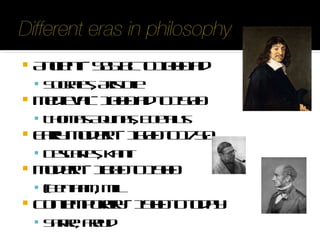
Ancient - 585 bc to 1000 ad  Socrates, Aristotle Medieval - 1000 ad to 1500  Thomas Aquinas, Boethius Early Modern - 1600 to 1750  Descartes, Kant Modern - 1800 to 1900 (Bentham, Mill Contemporary - 1900 to today  Sartre, Freud
Western Asian African Native American AND Others
Descriptive Ethics Applied Ethics Normative Ethics
Prescribes moral course(s) of action.  Includes moral theories.
Using philosophy (ethics) to determine the appropriate course of action. For example: applying deontology – a normative theory – to the question of whether animals have rights.
Describes moral acts of a society or individual. Primarily anthropological, psychological, sociological approaches to morality.
Milgram Experiment  http://www.youtube.com/watch?v=2TAqBbFJtfE
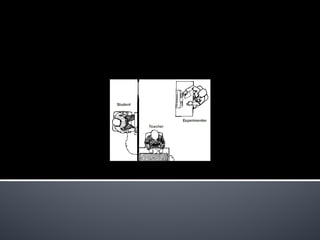
The generator has 30 switches in 15 volt increments, each was labeled with a voltage ranging from 15 up to 450 volts. Each switch also has a rating, ranging from "slight shock" to "danger: severe shock". The final two switches were labeled "XXX".
 
 
How certain are you?  Do you think that morality is determined by each individual? Is it rude, presumptuous, egotistical, and/or patronizing to say that your moral stance is (more) right than another person ’ s?
Do we need the concept of a God to define a universal set of moral principles?
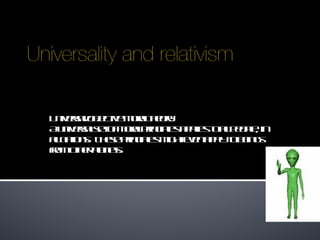
Universal/objective moral theory: A universal set of moral principles applies to all people, in all nations.  These principles might even apply to beings from other planets.
In order for one to be committed to universality, an individual only needs to believe that  one  moral principle applies to all people.  Obviously, one can assert the position that an entire system of rules, principles, maxims, etc. applies.
Is there even one principle that we can all agree on in this classroom, right now?
Relativism is the philosophical position that either: One ’ s moral principles are determined by society Or One ’ s moral principles are determined by each individual Universality and relativism
CULTURAL RELATIVISM One’s moral principles are determined by society. ETHICAL SUBJECTIVISM One’s moral principles are determined by each individual.
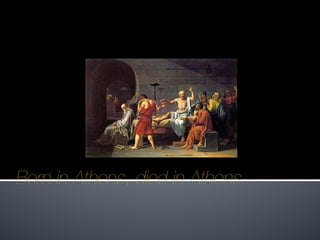
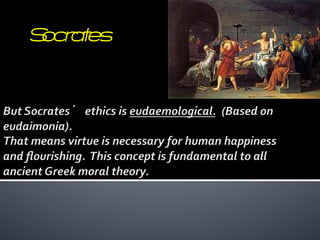
Socrates: 469-399 bce
We know about him from Xenophon, Aristophanes, Aristotle, and Plato
Socrates
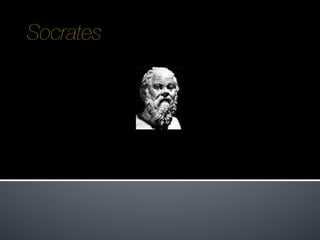
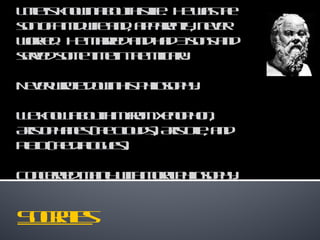
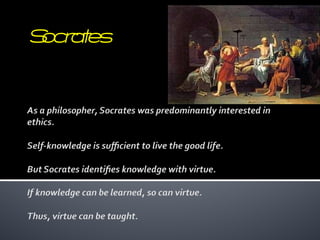
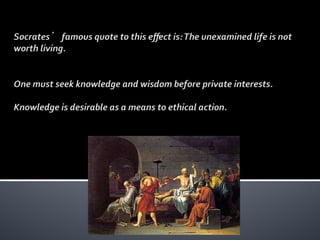
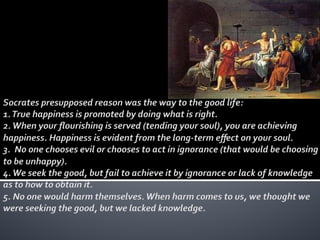
Socrates Little is known about his life.  He was the son of a midwife and, apparently, never worked.  He married and had 3 sons and served some time in the military. Never wrote down his philosophy. We know about him from Xenophon, Aristophanes (the Clouds), Aristotle, and Plato (the dialogues). Concerned mainly with moral philosophy.
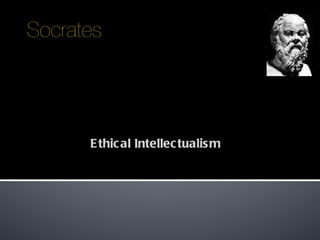
Ethical Intellectualism
Socrates
Socrates
 
Socrates: Ethical Intellectualism
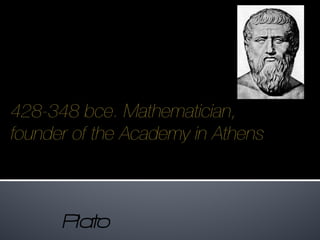
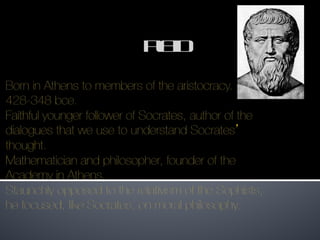
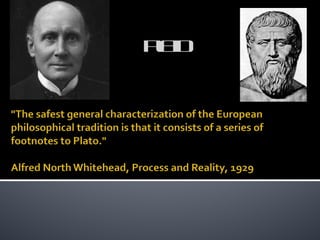
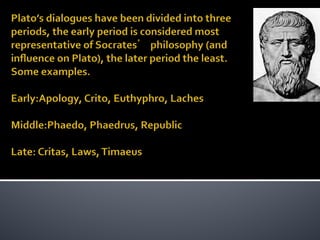
Plato
Plato
Plato
 
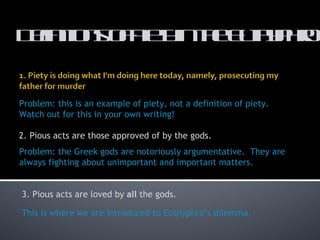
Definitions of Piety in the Euthyphro 2. Pious acts are those approved of by the gods. Problem: the Greek gods are notoriously argumentative.  They are always fighting about unimportant and important matters.  3. Pious acts are loved by  all  the gods. This is where we are introduced to Euthyphro ’s dilemma. Problem: this is an example of piety, not a definition of piety.  Watch out for this in your own writing!
 
Euthyphro ’s Dilemma
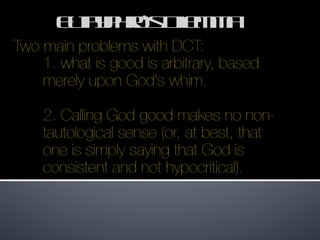
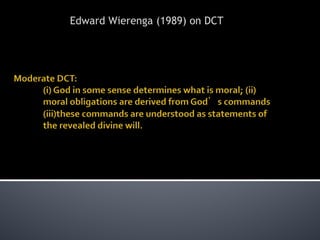
Divine Command Theory: The idea that actions are wrong  if and only if God commands us not to perform them.  1. Either (a) God commands us to not to steal, murder, lie, etc. because these actions are wrong OR (b) these actions are wrong because God commands us not to do them.  2. If (a)is true, then there is a standard of morality separate from God’s commands,  and DCT is false. 3. If (b) is true, then either (c) God has reasons for commanding us not to steal, etc. OR  5. If (d) is true, then God’s commands are arbitrary. 6. Therefore, either God’s commands are arbitrary or DCT is false.
Edward Wierenga (1989) on DCT
Euthyphro ’s Dilemma
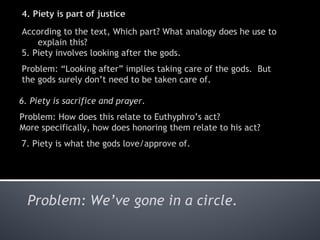
According to the text, Which part? What analogy does he use to explain this? 5. Piety involves looking after the gods. Problem:  “Looking after” implies taking care of the gods.  But the gods surely don’t need to be taken care of.  6. Piety is sacrifice and prayer. Problem: How does this relate to Euthyphro’ s act?  More specifically, how does honoring them relate to his act? 7. Piety is what the gods love/approve of. Problem: We’ ve gone in a circle.
The Crito
Crito’s Arguments, Cont.
The Crito
 
The Crito
The Crito

Ethics lecture #1 2012

  • 1.
  • 2.
    We will coverthe major areas of moral philosophy and their proponents: from Ancient Greek ethicists to contemporary/living philosophers. We will also consider contemporary commentary on major issues in ethics by philosophers and pundits. In class, we will discuss news that relates to ethics, especially the topics we are covering that week. The topics that will be covered in the class include (but are not limited to): war and terrorism, racism, homosexuality and sexual ethics, sexism and feminism, abortion, cloning and genetic engineering. The areas of moral philosophy that will be covered include: utilitarianism, Kantian deontology, virtue ethics, and care ethics.
  • 3.
    Ancient - 585bc to 1000 ad Socrates, Aristotle Medieval - 1000 ad to 1500 Thomas Aquinas, Boethius Early Modern - 1600 to 1750 Descartes, Kant Modern - 1800 to 1900 (Bentham, Mill Contemporary - 1900 to today Sartre, Freud
  • 4.
    Western Asian AfricanNative American AND Others
  • 5.
    Descriptive Ethics AppliedEthics Normative Ethics
  • 6.
    Prescribes moral course(s)of action. Includes moral theories.
  • 7.
    Using philosophy (ethics)to determine the appropriate course of action. For example: applying deontology – a normative theory – to the question of whether animals have rights.
  • 8.
    Describes moral actsof a society or individual. Primarily anthropological, psychological, sociological approaches to morality.
  • 9.
    Milgram Experiment http://www.youtube.com/watch?v=2TAqBbFJtfE
  • 10.
    The generator has30 switches in 15 volt increments, each was labeled with a voltage ranging from 15 up to 450 volts. Each switch also has a rating, ranging from "slight shock" to "danger: severe shock". The final two switches were labeled "XXX".
  • 11.
  • 12.
  • 13.
    How certain areyou? Do you think that morality is determined by each individual? Is it rude, presumptuous, egotistical, and/or patronizing to say that your moral stance is (more) right than another person ’ s?
  • 14.
    Do we needthe concept of a God to define a universal set of moral principles?
  • 15.
    Universal/objective moral theory:A universal set of moral principles applies to all people, in all nations. These principles might even apply to beings from other planets.
  • 16.
    In order forone to be committed to universality, an individual only needs to believe that one moral principle applies to all people. Obviously, one can assert the position that an entire system of rules, principles, maxims, etc. applies.
  • 17.
    Is there evenone principle that we can all agree on in this classroom, right now?
  • 18.
    Relativism is thephilosophical position that either: One ’ s moral principles are determined by society Or One ’ s moral principles are determined by each individual Universality and relativism
  • 19.
    CULTURAL RELATIVISM One’smoral principles are determined by society. ETHICAL SUBJECTIVISM One’s moral principles are determined by each individual.
  • 20.
  • 21.
    We know abouthim from Xenophon, Aristophanes, Aristotle, and Plato
  • 22.
  • 23.
    Socrates Little isknown about his life. He was the son of a midwife and, apparently, never worked. He married and had 3 sons and served some time in the military. Never wrote down his philosophy. We know about him from Xenophon, Aristophanes (the Clouds), Aristotle, and Plato (the dialogues). Concerned mainly with moral philosophy.
  • 24.
  • 25.
  • 26.
  • 27.
  • 28.
  • 29.
  • 30.
  • 31.
  • 32.
  • 33.
    Definitions of Pietyin the Euthyphro 2. Pious acts are those approved of by the gods. Problem: the Greek gods are notoriously argumentative. They are always fighting about unimportant and important matters. 3. Pious acts are loved by all the gods. This is where we are introduced to Euthyphro ’s dilemma. Problem: this is an example of piety, not a definition of piety. Watch out for this in your own writing!
  • 34.
  • 35.
  • 36.
    Divine Command Theory:The idea that actions are wrong if and only if God commands us not to perform them. 1. Either (a) God commands us to not to steal, murder, lie, etc. because these actions are wrong OR (b) these actions are wrong because God commands us not to do them. 2. If (a)is true, then there is a standard of morality separate from God’s commands, and DCT is false. 3. If (b) is true, then either (c) God has reasons for commanding us not to steal, etc. OR 5. If (d) is true, then God’s commands are arbitrary. 6. Therefore, either God’s commands are arbitrary or DCT is false.
  • 37.
  • 38.
  • 39.
  • 40.
    According to thetext, Which part? What analogy does he use to explain this? 5. Piety involves looking after the gods. Problem: “Looking after” implies taking care of the gods. But the gods surely don’t need to be taken care of. 6. Piety is sacrifice and prayer. Problem: How does this relate to Euthyphro’ s act? More specifically, how does honoring them relate to his act? 7. Piety is what the gods love/approve of. Problem: We’ ve gone in a circle.
  • 41.
  • 42.
  • 43.
  • 44.
  • 45.
  • 46.