PBC-2
MEDICAL USE OF MARIJUANA FOR
HEALTH THROUGH PUBLIC HEALTH
SYSTEM
GROUP-4
Mudasir Khan
V. Nagraj
Piyush Nayak
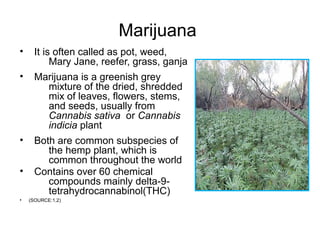
Marijuana
• It is often called as pot, weed,
Mary Jane, reefer, grass, ganja
• Marijuana is a greenish grey
mixture of the dried, shredded
mix of leaves, flowers, stems,
and seeds, usually from
Cannabis sativa or Cannabis
indicia plant
• Both are common subspecies of
the hemp plant, which is
common throughout the world
• Contains over 60 chemical
compounds mainly delta 9‐ ‐
tetrahydrocannabinol(THC)
• (SOURCE:1,2)
History of Cannabis/marijuana as a Medicine-
• The use of cannabis as a medical agent has a long history in both
folk and professional medicine (Kalant, 2001).
Its modern era began in the mid-19th century, when
O’Shaughnessy (1839) described the use of crude cannabis
preparations in India for the treatment of muscle spasms and
convulsions.
• Later observations recorded its use in Indian folk medicine for the
relief of a wide variety of disease symptoms, including pain,
diarrohea, fever, anxiety, sleeplessness and lack of appetite
(Kalant,1972). O’Shaughnessy sent samples of Indian
cannabis to London, where they were analyzed and used to
prepare standardized extracts that were incorporated into the
British and American pharmacopoeias of recognized drugs
and medicinal preparations— leading to the wide use of
cannabis in medical practice in many parts of the world.
•
Forms of marijuana:
Two forms of marijuana have been used for Medical
purposes:
1)A synthetic form, dronabinol (Marinol®), which is taken
orally and
2)Smoked marijuana.
Both forms contain the psychoactive ingredient THC.
Smoked marijuana to was believed to be more effective
than oral dronabinol (Marinol®)
●
MEDICAL MARIJUANA & PUBLIC
HEALTH :
• In the U.S., the drug’s medical use was curtailed in
1970, when the Controlled Substance Act listed
marijuana as a schedule I substance with no medical
value and with a high potential for abuse.
• In June 2011,the Drug Enforcement Administration
(DEA) denied a petition to reschedule marijuana.
• The Department of Justice declared that selling,
cultivation and distribution of marijuana is against
federal law and that individuals engaging in these
activities are subject to enforcement actions.
Legal status in India
• Cannabis is illegal in India by Narcotics Drugs and
Psychotropic Substances Act
• Cannabis that is sold as ‘Bhang’ belongs to the
cannabis indica variety, which is different from
cannabis sativa.
• Use of cannabis can lead to 6 months imprisonment
or/and Rs.10,000/- in fine.
• Imprisonment can be waived if the offender opts for
de-addiction treatment.
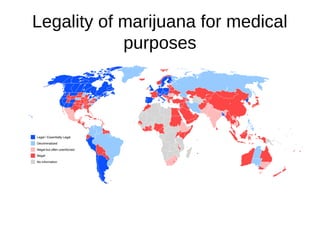
Legality of marijuana for medical
purposes
MARIJUANA AND MEDICAL USES FOR HEALTH
Cancer and Chemotherapy:
marijuana and cancer have focused both on the ability of medical
marijuana to palliative symptoms of chemotherapy and the potential for
cannabinoids to reduce the growth of certain types of cancer. cannabinoids
exert palliative effects in cancer patients by preventing nausea, vomiting
and pain and by stimulating appetite.
cannabinoids may stop many kinds of cancers from growing and
spreading, including pancreatic, lung, leukemic, melanoma, oral,
lymphoma and other kinds of cancer.
Multiple Sclerosis:
efficacy of medical marijuana and its derivatives in reducing spasticity and
pain in multiple sclerosis (MS) patients
HIV/AIDS:
Medical marijuana has been effective in treating both the symptoms of
HIV/AIDS and the side effects of some of the antiretroviral medications
used to treat it.
Medical use of marijuana- (contd.)
Migraines:
have been able to treat more than 300,000 cases of migraines that conventional medicine couldn't
through marijuana.
Glaucoma:
there is not a single valid study that exists that disapproves marijuana’s very powerful & popular
effects on glaucoma patients.
Pain:
Numerous studies have affirmed the analgesic effects of medical marijuana
Irritable Bowel Syndrome and Crohn’s Disease: Recent research suggests that cannabis
may also be useful for patients with irritable bowel syndrome (IBD) or Crohn’s disease.
Anti- asthmatic agent :
marijuana has an acute bronchodilator effect in both asthmatic and non-asthmatic
individuals.
Safety of Medical Marijuana: Medical marijuana is generally safe and well-tolerated,
though, like any medication, it poses some risks.
(3,4,5,6,7)
Associated risks with marijuana
• Effects on the respiratory system
• Psychomotor impairment
• Frequent marijuana use can seriously affect your
short-term memory
• Frequent use can impair your cognitive ability and
decision making ability
• Carries a risk of abuse and addiction
• Studies have shown that marijuana tar contains
50% more phenols than tobacco tar.
• Marijuana (smoked) can also be contaminated by
microorganisms and fungi, which can cause
possible infections.
Objection to legalizing marijuana
• The administration believes that marijuana is illegal drug
which remains unproven in terms of safety or efficacy.
• They contend that marijuana is a ‘gateway drug’ that
leads to more serious drug use.
• Legalization of marijuana for medical purposes will send
the wrong message to the public, and in particular to
the children, that marijuana is acceptable for
recreational use and even beneficial.
Ethical dilemma
• Patients have the right to expect from their
physicians, full disclosure and discussion of all
available treatment options.
• Denying a patient knowledge of and access to a
therapy that relieves pain and suffering, especially
when the patient has a terminal disease, violates
the basic duty of a physician.
• The basic question is does the value of relieving pain
and suffering outweigh the evil of the potential
harmful effects of the smoke and the possibility of
a scandal?
• Seriously ill patients have the right to effective
therapy. To deny them access to such therapies is
to deny them the dignity and respect all persons
deserve.
• Physicians have the medical responsibility to provide
adequate relief from both pain and suffering in
order to give their patients an acceptable quality of
life. Failure to offer an effective therapy would
violate the basic ethical principle of non-
maleficence.
• To allow a patient to suffer needlessly, when this
suffering can be relieved, is like doing direct harm
to the patient.
• The possible damage to an individual’s lungs is a
legitimate health concern, however the patients
who would benefit from the smoked marijuana
are suffering from terminal illness and the
treatments they are undergoing also have toxic
effects. The point is that benefits of the treatment
outweighs the burden.
• The focus should be on encouraging the
government to direct its research resources
towards the development of alternative methods
of delivering cannabinoids in the form of patches,
capsules and bronchial inhalers.
• Administration’s concern is that legalizing medical
marijuana could lead to the possibility of more
serious drug use. But this has not occurred in
other prescription psychoactive drugs (e.g.
morphine, codeine) and there is no evidence that
it would occur with marijuana.
• Unless marijuana is regulated by the proper medical
and pharmaceutical authorities, there is the
possibility that the needy patients will resort to
black market marijuana. Which could lead to legal
prosecution and could jeopardize their health and
safety.
• Continued research is needed to maximize its
therapeutic effects and minimizing its adverse
effects.
1-SAMHSA, 2012
2 -National institute of drug abuse
3-Clark PA, Capuzzi K, Fick C. (2011). Medical marijuana: medical necessity versus political
agenda.
4- Amar, MB. (2006). Cannabinoids in Medicine: a review of their therapeutic potential. Journal of
Ethno parhamcology
5- Guzmán M. (2003). Cannabinoids: Potential Anticancer Agents. Nat Rev Cancer, 3(10):745-55
6- Compassionate Care New York | 347.781.5435 voice | compassionatecareny@gmail.com |
www.compassionatecareny.org
7-Bruce Fisher, MD, MSc, FRCP[C] Don Johnston, MD, MSc, FRCP[C], Specialist, Occupational
Medicine
Patricia Leake, MPP
8-"What Are the Pros and Cons of Medical Marijuana?" About.com Death and Dying. N.p., 2012.
9- The ethics of medical marijuana government restriction vs medical necessity, peter a.
clarck , 2000

ethics in medical use of marijuana

  • 1.
    PBC-2 MEDICAL USE OFMARIJUANA FOR HEALTH THROUGH PUBLIC HEALTH SYSTEM GROUP-4 Mudasir Khan V. Nagraj Piyush Nayak
  • 2.
    Marijuana • It isoften called as pot, weed, Mary Jane, reefer, grass, ganja • Marijuana is a greenish grey mixture of the dried, shredded mix of leaves, flowers, stems, and seeds, usually from Cannabis sativa or Cannabis indicia plant • Both are common subspecies of the hemp plant, which is common throughout the world • Contains over 60 chemical compounds mainly delta 9‐ ‐ tetrahydrocannabinol(THC) • (SOURCE:1,2)
  • 3.
    History of Cannabis/marijuanaas a Medicine- • The use of cannabis as a medical agent has a long history in both folk and professional medicine (Kalant, 2001). Its modern era began in the mid-19th century, when O’Shaughnessy (1839) described the use of crude cannabis preparations in India for the treatment of muscle spasms and convulsions. • Later observations recorded its use in Indian folk medicine for the relief of a wide variety of disease symptoms, including pain, diarrohea, fever, anxiety, sleeplessness and lack of appetite (Kalant,1972). O’Shaughnessy sent samples of Indian cannabis to London, where they were analyzed and used to prepare standardized extracts that were incorporated into the British and American pharmacopoeias of recognized drugs and medicinal preparations— leading to the wide use of cannabis in medical practice in many parts of the world. •
  • 4.
    Forms of marijuana: Twoforms of marijuana have been used for Medical purposes: 1)A synthetic form, dronabinol (Marinol®), which is taken orally and 2)Smoked marijuana. Both forms contain the psychoactive ingredient THC. Smoked marijuana to was believed to be more effective than oral dronabinol (Marinol®) ●
  • 5.
    MEDICAL MARIJUANA &PUBLIC HEALTH : • In the U.S., the drug’s medical use was curtailed in 1970, when the Controlled Substance Act listed marijuana as a schedule I substance with no medical value and with a high potential for abuse. • In June 2011,the Drug Enforcement Administration (DEA) denied a petition to reschedule marijuana. • The Department of Justice declared that selling, cultivation and distribution of marijuana is against federal law and that individuals engaging in these activities are subject to enforcement actions.
  • 6.
    Legal status inIndia • Cannabis is illegal in India by Narcotics Drugs and Psychotropic Substances Act • Cannabis that is sold as ‘Bhang’ belongs to the cannabis indica variety, which is different from cannabis sativa. • Use of cannabis can lead to 6 months imprisonment or/and Rs.10,000/- in fine. • Imprisonment can be waived if the offender opts for de-addiction treatment.
  • 7.
    Legality of marijuanafor medical purposes
  • 8.
    MARIJUANA AND MEDICALUSES FOR HEALTH Cancer and Chemotherapy: marijuana and cancer have focused both on the ability of medical marijuana to palliative symptoms of chemotherapy and the potential for cannabinoids to reduce the growth of certain types of cancer. cannabinoids exert palliative effects in cancer patients by preventing nausea, vomiting and pain and by stimulating appetite. cannabinoids may stop many kinds of cancers from growing and spreading, including pancreatic, lung, leukemic, melanoma, oral, lymphoma and other kinds of cancer. Multiple Sclerosis: efficacy of medical marijuana and its derivatives in reducing spasticity and pain in multiple sclerosis (MS) patients HIV/AIDS: Medical marijuana has been effective in treating both the symptoms of HIV/AIDS and the side effects of some of the antiretroviral medications used to treat it.
  • 9.
    Medical use ofmarijuana- (contd.) Migraines: have been able to treat more than 300,000 cases of migraines that conventional medicine couldn't through marijuana. Glaucoma: there is not a single valid study that exists that disapproves marijuana’s very powerful & popular effects on glaucoma patients. Pain: Numerous studies have affirmed the analgesic effects of medical marijuana Irritable Bowel Syndrome and Crohn’s Disease: Recent research suggests that cannabis may also be useful for patients with irritable bowel syndrome (IBD) or Crohn’s disease. Anti- asthmatic agent : marijuana has an acute bronchodilator effect in both asthmatic and non-asthmatic individuals. Safety of Medical Marijuana: Medical marijuana is generally safe and well-tolerated, though, like any medication, it poses some risks. (3,4,5,6,7)
  • 10.
    Associated risks withmarijuana • Effects on the respiratory system • Psychomotor impairment • Frequent marijuana use can seriously affect your short-term memory • Frequent use can impair your cognitive ability and decision making ability • Carries a risk of abuse and addiction • Studies have shown that marijuana tar contains 50% more phenols than tobacco tar. • Marijuana (smoked) can also be contaminated by microorganisms and fungi, which can cause possible infections.
  • 11.
    Objection to legalizingmarijuana • The administration believes that marijuana is illegal drug which remains unproven in terms of safety or efficacy. • They contend that marijuana is a ‘gateway drug’ that leads to more serious drug use. • Legalization of marijuana for medical purposes will send the wrong message to the public, and in particular to the children, that marijuana is acceptable for recreational use and even beneficial.
  • 12.
    Ethical dilemma • Patientshave the right to expect from their physicians, full disclosure and discussion of all available treatment options. • Denying a patient knowledge of and access to a therapy that relieves pain and suffering, especially when the patient has a terminal disease, violates the basic duty of a physician. • The basic question is does the value of relieving pain and suffering outweigh the evil of the potential harmful effects of the smoke and the possibility of a scandal?
  • 13.
    • Seriously illpatients have the right to effective therapy. To deny them access to such therapies is to deny them the dignity and respect all persons deserve. • Physicians have the medical responsibility to provide adequate relief from both pain and suffering in order to give their patients an acceptable quality of life. Failure to offer an effective therapy would violate the basic ethical principle of non- maleficence. • To allow a patient to suffer needlessly, when this suffering can be relieved, is like doing direct harm to the patient.
  • 14.
    • The possibledamage to an individual’s lungs is a legitimate health concern, however the patients who would benefit from the smoked marijuana are suffering from terminal illness and the treatments they are undergoing also have toxic effects. The point is that benefits of the treatment outweighs the burden. • The focus should be on encouraging the government to direct its research resources towards the development of alternative methods of delivering cannabinoids in the form of patches, capsules and bronchial inhalers.
  • 15.
    • Administration’s concernis that legalizing medical marijuana could lead to the possibility of more serious drug use. But this has not occurred in other prescription psychoactive drugs (e.g. morphine, codeine) and there is no evidence that it would occur with marijuana. • Unless marijuana is regulated by the proper medical and pharmaceutical authorities, there is the possibility that the needy patients will resort to black market marijuana. Which could lead to legal prosecution and could jeopardize their health and safety.
  • 16.
    • Continued researchis needed to maximize its therapeutic effects and minimizing its adverse effects.
  • 17.
    1-SAMHSA, 2012 2 -Nationalinstitute of drug abuse 3-Clark PA, Capuzzi K, Fick C. (2011). Medical marijuana: medical necessity versus political agenda. 4- Amar, MB. (2006). Cannabinoids in Medicine: a review of their therapeutic potential. Journal of Ethno parhamcology 5- Guzmán M. (2003). Cannabinoids: Potential Anticancer Agents. Nat Rev Cancer, 3(10):745-55 6- Compassionate Care New York | 347.781.5435 voice | compassionatecareny@gmail.com | www.compassionatecareny.org 7-Bruce Fisher, MD, MSc, FRCP[C] Don Johnston, MD, MSc, FRCP[C], Specialist, Occupational Medicine Patricia Leake, MPP 8-"What Are the Pros and Cons of Medical Marijuana?" About.com Death and Dying. N.p., 2012. 9- The ethics of medical marijuana government restriction vs medical necessity, peter a. clarck , 2000