Engineering Ethics
Lecture 2a
2
We have assumed that ethics is about finding
creative solutions to conflicts between
professional goals.
But how can we decide and which goals are
worth pursuing, whether professional or
personal?
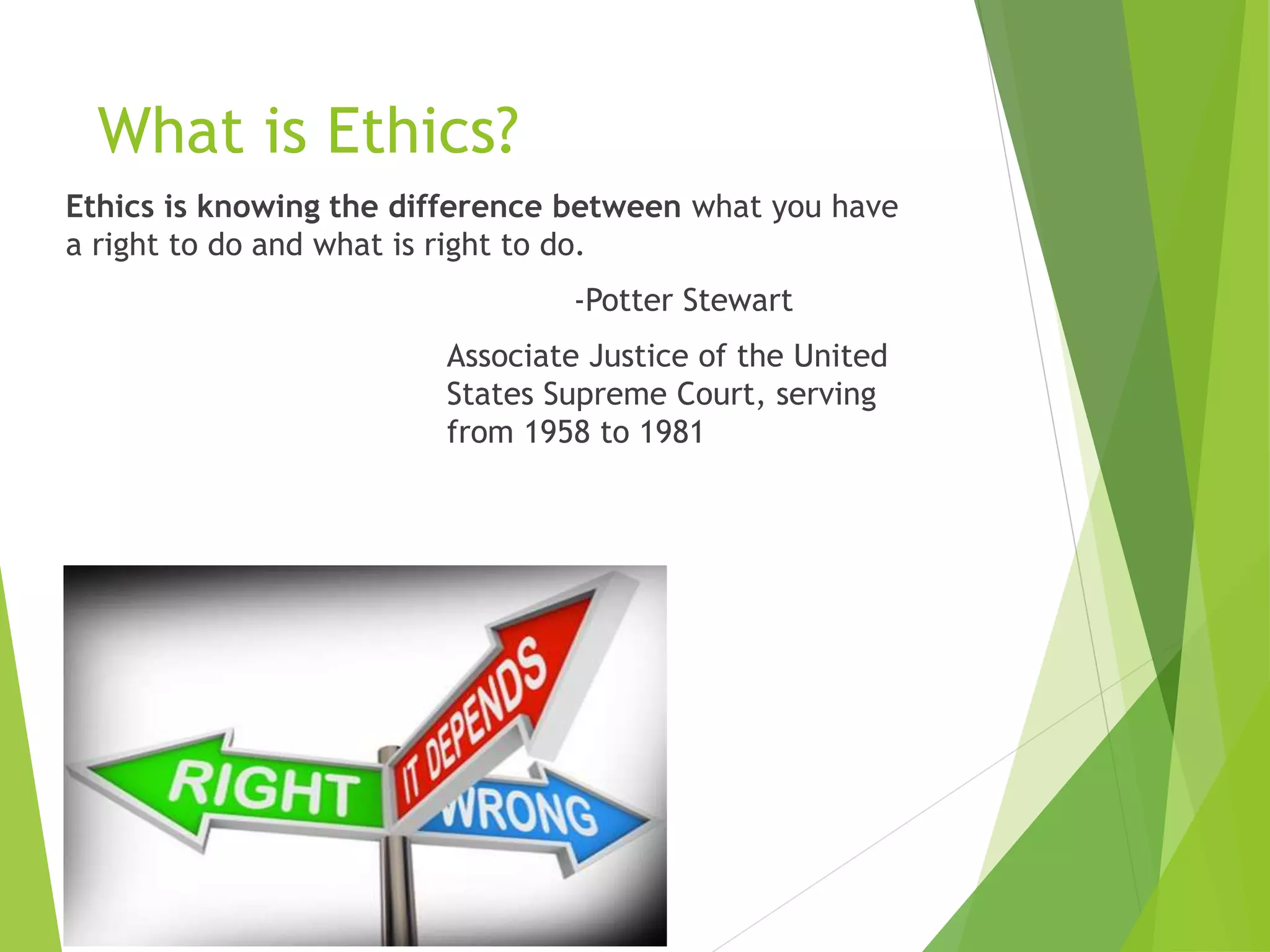
What is Ethics?
Ethics is knowing the difference between what you have
a right to do and what is right to do.
-Potter Stewart
Associate Justice of the United
States Supreme Court, serving
from 1958 to 1981
4
"If you are planning for a year, sow rice;
if you are planning for a decade, plant trees;
if you are planning for a lifetime, educate people." - Chinese proverb
Importance of Ethics?
What is Engineering Ethics?
 Engineering ethics consists of the
responsibilities and rights that ought
to be endorsed by those engaged in
engineering, and also of desirable
ideals and personal commitments in
engineering.
 Engineering ethics is the study of the
decisions, policies, and values that
are morally desirable in engineering
practice and research.
Three Types of Ethics or
Morality
 Common morality is the set of moral beliefs shared by
almost everyone. When we think of ethics or morality, we
usually think of such precepts as that it is wrong to
murder, lie, cheat or steal, break promises, harm others
physically, and so forth.
 Personal ethics or personal morality is the set of moral
beliefs that a person holds. For most of us, our personal
moral beliefs closely parallel the precepts of common
morality. We believe that murder, lying, cheating, and
stealing are wrong. However, our personal moral beliefs
may differ from common morality in some areas,
especially where common morality seems to be unclear or
in a state of change.
 Professional Ethics
Professional Ethics
 Professional ethics is the set of standards adopted by
professionals insofar as they view themselves acting as
professionals. Every profession has its professional ethics:
medicine, law, architecture, pharmacy, and so forth.
Engineering ethics is that set of ethical standards that
applies to the profession of engineering. There are several
important characteristics of professional ethics.
 First, professional ethics is usually stated in a formal code.
In fact, there are usually several such codes, promulgated
by various components of the profession. Professional
societies usually have codes of ethics, referred to as ‘‘code
of professional responsibility,’’ ‘‘code of professional
conduct,’’. The American Medical Association has a code of
ethics, as does the American Bar Association. Many
engineering societies have a code of ethics, such as the
American Society of Civil Engineers or the American Society
of Mechanical Engineers.
Professional Ethics
 The various codes of ethics do differ in some
important ways. In engineering, for example, some
of the codes have begun to make reference to the
environment, whereas others still do not.
 Second, the professional codes of ethics of a given
profession focus on the issues that are important in
that profession. Professional codes in the legal
profession concern themselves with such questions
as perjury of clients and the unauthorized practice
of law. Perjury is not an issue that is relevant to
medicine or dentistry. In engineering, the code of
the Association for Computing Machinery sets out
regulations for privacy, intellectual property, and
copyrights and patents.
Professional Ethics
 Third, when one is in a professional relationship, professional
ethics is supposed to take precedence over personal morality—
at least ordinarily. This characteristic of professional ethics has
an important advantage, but it can also produce complications.
 The advantage is that a patient or client can justifiably have
certain expectations of a professional, even if the patient or
client has no knowledge of the personal morality of the
professional. When a patient enters a physician’s examining
room, she can expect the conversations there to be kept
confidential, even if she does not know anything about the
personal morality of the physician.
 When a client or employer reveals details of a business
relationship to an engineer, he can expect the engineer to keep
these details confidential, even though he knows nothing about
the personal morality of the engineer. In both cases, these
expectations are based on knowledge of the professional ethics
of medicine and engineering, not on knowledge of the
professional’s personal morality.
Professional Ethics
 Suppose a client asks a civil engineer to
design a project that the engineer, who has
strong personal environmental
commitments, believes imposes
unacceptable damage to a wetland.
Suppose this damage is not sufficient to be
clearly covered by his engineering code. In
this case, the engineer probably should
refer the client or employer to another
engineer who might do the work.
Professional Ethics & Personal Morality
 Fourth, professional ethics sometimes differs from personal
morality in its degree of restriction of personal conduct.
Sometimes professional ethics is more restrictive than personal
morality, and sometimes it is less restrictive. Suppose engineer
Jane refuses to design military hardware because she believes
war is immoral. Engineering codes do not prohibit engineers
from designing military hardware, so this refusal is based on
personal ethics and not on professional ethics. Here, Jane’s
personal ethics is more restrictive than her professional ethics.
 On the other hand, suppose civil engineer Mary refuses to
participate in the design of a project that she believes will be
contrary to the principles of sustainable development, which
are set out in the code of the American Society of Civil
Engineers. She may not personally believe these guidelines are
correct, but she might (correctly) believe she is obligated to
follow them in her professional work because they are stated in
her code of ethics. Here, Mary’s professional ethics is more
restrictive than her personal ethics.
Professional Ethics … negative
and positive dimension
 Fifth, professional ethics, like ethics generally, has a
negative and a positive dimension. Being ethical has
two aspects: preventing and avoiding evil and doing or
promoting good. Let us call these two dimensions the
two ‘‘faces’’ of ethics: the negative face and the
positive face. On the one hand, we should not lie,
cheat, or steal, and in certain circumstances we may
have an obligation to see that others do not do so as
well. On the other hand, we have some general
obligation to promote human well-being. This general
obligation to avoid evil and do good is intensified and
made more specific when people occupy special roles
and have special relationships with others.

Ethics Engineering

  • 1.
  • 2.
    2 We have assumedthat ethics is about finding creative solutions to conflicts between professional goals. But how can we decide and which goals are worth pursuing, whether professional or personal?
  • 3.
    What is Ethics? Ethicsis knowing the difference between what you have a right to do and what is right to do. -Potter Stewart Associate Justice of the United States Supreme Court, serving from 1958 to 1981
  • 4.
    4 "If you areplanning for a year, sow rice; if you are planning for a decade, plant trees; if you are planning for a lifetime, educate people." - Chinese proverb Importance of Ethics?
  • 5.
    What is EngineeringEthics?  Engineering ethics consists of the responsibilities and rights that ought to be endorsed by those engaged in engineering, and also of desirable ideals and personal commitments in engineering.  Engineering ethics is the study of the decisions, policies, and values that are morally desirable in engineering practice and research.
  • 6.
    Three Types ofEthics or Morality  Common morality is the set of moral beliefs shared by almost everyone. When we think of ethics or morality, we usually think of such precepts as that it is wrong to murder, lie, cheat or steal, break promises, harm others physically, and so forth.  Personal ethics or personal morality is the set of moral beliefs that a person holds. For most of us, our personal moral beliefs closely parallel the precepts of common morality. We believe that murder, lying, cheating, and stealing are wrong. However, our personal moral beliefs may differ from common morality in some areas, especially where common morality seems to be unclear or in a state of change.  Professional Ethics
  • 7.
    Professional Ethics  Professionalethics is the set of standards adopted by professionals insofar as they view themselves acting as professionals. Every profession has its professional ethics: medicine, law, architecture, pharmacy, and so forth. Engineering ethics is that set of ethical standards that applies to the profession of engineering. There are several important characteristics of professional ethics.  First, professional ethics is usually stated in a formal code. In fact, there are usually several such codes, promulgated by various components of the profession. Professional societies usually have codes of ethics, referred to as ‘‘code of professional responsibility,’’ ‘‘code of professional conduct,’’. The American Medical Association has a code of ethics, as does the American Bar Association. Many engineering societies have a code of ethics, such as the American Society of Civil Engineers or the American Society of Mechanical Engineers.
  • 8.
    Professional Ethics  Thevarious codes of ethics do differ in some important ways. In engineering, for example, some of the codes have begun to make reference to the environment, whereas others still do not.  Second, the professional codes of ethics of a given profession focus on the issues that are important in that profession. Professional codes in the legal profession concern themselves with such questions as perjury of clients and the unauthorized practice of law. Perjury is not an issue that is relevant to medicine or dentistry. In engineering, the code of the Association for Computing Machinery sets out regulations for privacy, intellectual property, and copyrights and patents.
  • 9.
    Professional Ethics  Third,when one is in a professional relationship, professional ethics is supposed to take precedence over personal morality— at least ordinarily. This characteristic of professional ethics has an important advantage, but it can also produce complications.  The advantage is that a patient or client can justifiably have certain expectations of a professional, even if the patient or client has no knowledge of the personal morality of the professional. When a patient enters a physician’s examining room, she can expect the conversations there to be kept confidential, even if she does not know anything about the personal morality of the physician.  When a client or employer reveals details of a business relationship to an engineer, he can expect the engineer to keep these details confidential, even though he knows nothing about the personal morality of the engineer. In both cases, these expectations are based on knowledge of the professional ethics of medicine and engineering, not on knowledge of the professional’s personal morality.
  • 10.
    Professional Ethics  Supposea client asks a civil engineer to design a project that the engineer, who has strong personal environmental commitments, believes imposes unacceptable damage to a wetland. Suppose this damage is not sufficient to be clearly covered by his engineering code. In this case, the engineer probably should refer the client or employer to another engineer who might do the work.
  • 11.
    Professional Ethics &Personal Morality  Fourth, professional ethics sometimes differs from personal morality in its degree of restriction of personal conduct. Sometimes professional ethics is more restrictive than personal morality, and sometimes it is less restrictive. Suppose engineer Jane refuses to design military hardware because she believes war is immoral. Engineering codes do not prohibit engineers from designing military hardware, so this refusal is based on personal ethics and not on professional ethics. Here, Jane’s personal ethics is more restrictive than her professional ethics.  On the other hand, suppose civil engineer Mary refuses to participate in the design of a project that she believes will be contrary to the principles of sustainable development, which are set out in the code of the American Society of Civil Engineers. She may not personally believe these guidelines are correct, but she might (correctly) believe she is obligated to follow them in her professional work because they are stated in her code of ethics. Here, Mary’s professional ethics is more restrictive than her personal ethics.
  • 12.
    Professional Ethics …negative and positive dimension  Fifth, professional ethics, like ethics generally, has a negative and a positive dimension. Being ethical has two aspects: preventing and avoiding evil and doing or promoting good. Let us call these two dimensions the two ‘‘faces’’ of ethics: the negative face and the positive face. On the one hand, we should not lie, cheat, or steal, and in certain circumstances we may have an obligation to see that others do not do so as well. On the other hand, we have some general obligation to promote human well-being. This general obligation to avoid evil and do good is intensified and made more specific when people occupy special roles and have special relationships with others.