ETHICS
&
CORPORATE
GOVERNANCE
IMPLICATIONS OF COMPANIES ACT 2013
ON CORPORATE GOVERNANCE
IMPACT
The 2013 Companies Act intends to improve corporate governance by requiring
disclosure of nature of concern or interest of every director, manager or any other key
managerial personnel and relatives of them and reduction in threshold of disclosure
from 20% to 2%. The term ‘key managerial personnel’ has now been defined in the 2013
Act and means the chief executive officer, managing director, manager, company
secretary, whole-time director, chief financial officer and any such other officer as may be
prescribed.
PLACE OF KEEPING REGISTERS AND
RETURNS
The 2013 Act allows registers of members, debenture-holders or any other security
holders or copies of return, to be kept at any other place in India in which more than
one-tenth of members reside [section 94(1) of 2013 Act].
ANNUAL RETURN UNDER COMPANIES
ACT 2013
The 2013 Act states that requirement of certification by a company secretary in practice
of annual return will be extended to companies having paid up capital of 5 crore INR or
more and turnover of 25 crore INR or more(section 92(2) of 2013 Act and the 1956 Act
requires certification only for listed companies).
The information that needs to be included in the annual return has been increased. The
additional information required, includes particulars of holding, subsidiary and associate
companies, remuneration of directors and key managerial personnel, penalty or
punishment imposed on the company, its directors or officers [section 92(1) of 2013
Act].
NUMBER OF INDEPENDENT
DIRECTORS
1. Public listed company: At least one third of the board to be comprised of
independent directors.
2. Certain specified companies that meet the criteria listed below are required to have
at least 2 independent directors:
i. Public companies which have paid up share capital of INR 100,000,000 (Rupees one
hundred million only)
ii. Public companies which have a turnover of 1,000,000,000 (Rupees one billion only)
iii. Public companies which have, in the aggregate, outstanding loans, debentures and
deposits exceeding INR 500,000,000 (Rupees five hundred million only)
QUALIFICATION CRITERIA
• He / she should be a person of integrity, expert and experienced
• He / she was not a promoter or related to the promoter or director of the company
• He / she has or had no monetary relationship with the company, its holding, subsidiary
etc. during the 2 immediately preceding financial years or during the current financial
year;
• A person, none of whose relatives have or had pecuniary relationship or transaction
with the company, its holding, subsidiary amounting to 2% or more of its gross
turnover or total income or INR 5,000,000 (Rupees five million only), whichever is
lower, during the 2 immediately preceding financial years or during the current
financial year.
WOMAN DIRECTOR
• Listed and certain other public companies shall be required to appoint atleast one
woman director on its board.
• Companies incorporated under the 2013 Act, shall be required to comply with this
provision within six months from date of incorporation.
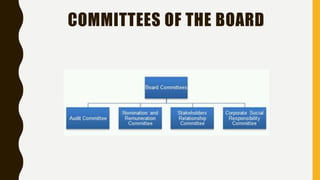
COMMITTEES OF THE BOARD
GENERAL MEETINGS
The 2013 Act states that the first Annual General Meeting(AGM) should be held within
nine months from the date of closing of the first financial year of the company
[section 96(1) of 2013 Act]. The 2013 Act states that Annual
General Meeting(AGM) cannot be held on a National holiday.
The 2013 Act states that in case of a public company, the quorum will depend on the
number of members as on the date of meeting. The required quorum is as follows:
• Five members, if number of members is not more than one thousand.
• Fifteen members, if number of members is more than one thousand but up to five
thousand.
• Thirty members, if number of members is more than five thousand [section 103 (1)
of 2013 Act].
BOARD MEETINGS AND PROCESSES
• First board meeting of a company must be held within 30 days of incorporation.
• Notice of minimum 7 days must be given for each board meeting. However, board
meetings may be called at shorter notice to transact "urgent business" provided such
meetings are either attended by at least one independent director.
• Company Act 2013 has permitted directors to participate in board meetings through
video conferencing. Participation of directors by this process means that they would
also be counted towards quorum.
• Atleast 4 meetings have to be held each year, with a gap of not more than 120 days
between 2 board meetings.
• Certain new actions have been identified, that require approval by directors in a board
meeting, like grant of loans, approval of financial statement etc.
IMPLICATIONS OF COMPANIES ACT 2013
ON PRESENTATION OF FINANCIAL
STATEMENTS
INTRODUCTION
The Companies Act, 2013 has brought in many changes which directly impact
preparation of financial statements.
The Companies Act, 2013 defines the term “financial statements” to include:
(i) Balance sheet as at the end of the financial year
(ii) Profit and loss account for the financial year
(iii) Cash flow statement for the financial year
(iv) Statement of change in equity, if applicable
(v) Any explanatory note forming part of the above statements
FINANCIAL STATEMENTS
1. Every company is required to prepare financial statements. Financial statement in
relation to a company includes a balance sheet as at the end of the financial
year, profit and loss account for the year( income & expenditure in the case of a
company carrying on any activity not for profit), cash flow statement for the financial
year, a statement of changes in equity, and any explanatory note annexed to, or
forming part of, any document referred to above mentioned statements.
2. One Person Company, small company and dormant company, are exempted from
the requirement of including the cash flow statement in the financial statements.
FINANCIAL YEAR
Section 2(41) defines financial year
1. Any company has to end its financial year on 31st March every year.
2. If a company has been incorporated on or after 1st January, in that case, the financial
year can end on 31st March of the following year.
3. Incase the company which is a holding or subsidiary of a company incorporated
outside India and that company is required to follow a different financial year for
consolidation of its accounts, such companies can take permission of Tribunal to
have a different period as its financial year.
4. Any company whose financial year is not ending on 31st March, can switch to
accounting year within a period of 2 years from the commencement of the Act.
HOLDING, SUBSIDIARY AND
ASSOCIATE COMPANIES
Holding company is a company created to buy and own the shares of other companies,
which it then controls{Section 2(46)}.
Subsidiary company is a company in which the holding company controls the
composition of the Board of Directors and controls more than one-half of the total share
capital either at its own or together with one or more of its subsidiary companies.
An Associate company is a company in which another company owns a significant
portion of voting shares, usually 20–50%. In this case, the owner does not consolidate
the associate's financial statements.
THAT’S
ALL

Ethics and Corporate Governance

  • 1.
  • 2.
    IMPLICATIONS OF COMPANIESACT 2013 ON CORPORATE GOVERNANCE
  • 3.
    IMPACT The 2013 CompaniesAct intends to improve corporate governance by requiring disclosure of nature of concern or interest of every director, manager or any other key managerial personnel and relatives of them and reduction in threshold of disclosure from 20% to 2%. The term ‘key managerial personnel’ has now been defined in the 2013 Act and means the chief executive officer, managing director, manager, company secretary, whole-time director, chief financial officer and any such other officer as may be prescribed.
  • 4.
    PLACE OF KEEPINGREGISTERS AND RETURNS The 2013 Act allows registers of members, debenture-holders or any other security holders or copies of return, to be kept at any other place in India in which more than one-tenth of members reside [section 94(1) of 2013 Act].
  • 5.
    ANNUAL RETURN UNDERCOMPANIES ACT 2013 The 2013 Act states that requirement of certification by a company secretary in practice of annual return will be extended to companies having paid up capital of 5 crore INR or more and turnover of 25 crore INR or more(section 92(2) of 2013 Act and the 1956 Act requires certification only for listed companies). The information that needs to be included in the annual return has been increased. The additional information required, includes particulars of holding, subsidiary and associate companies, remuneration of directors and key managerial personnel, penalty or punishment imposed on the company, its directors or officers [section 92(1) of 2013 Act].
  • 6.
    NUMBER OF INDEPENDENT DIRECTORS 1.Public listed company: At least one third of the board to be comprised of independent directors. 2. Certain specified companies that meet the criteria listed below are required to have at least 2 independent directors: i. Public companies which have paid up share capital of INR 100,000,000 (Rupees one hundred million only) ii. Public companies which have a turnover of 1,000,000,000 (Rupees one billion only) iii. Public companies which have, in the aggregate, outstanding loans, debentures and deposits exceeding INR 500,000,000 (Rupees five hundred million only)
  • 7.
    QUALIFICATION CRITERIA • He/ she should be a person of integrity, expert and experienced • He / she was not a promoter or related to the promoter or director of the company • He / she has or had no monetary relationship with the company, its holding, subsidiary etc. during the 2 immediately preceding financial years or during the current financial year; • A person, none of whose relatives have or had pecuniary relationship or transaction with the company, its holding, subsidiary amounting to 2% or more of its gross turnover or total income or INR 5,000,000 (Rupees five million only), whichever is lower, during the 2 immediately preceding financial years or during the current financial year.
  • 8.
    WOMAN DIRECTOR • Listedand certain other public companies shall be required to appoint atleast one woman director on its board. • Companies incorporated under the 2013 Act, shall be required to comply with this provision within six months from date of incorporation.
  • 9.
  • 10.
    GENERAL MEETINGS The 2013Act states that the first Annual General Meeting(AGM) should be held within nine months from the date of closing of the first financial year of the company [section 96(1) of 2013 Act]. The 2013 Act states that Annual General Meeting(AGM) cannot be held on a National holiday. The 2013 Act states that in case of a public company, the quorum will depend on the number of members as on the date of meeting. The required quorum is as follows: • Five members, if number of members is not more than one thousand. • Fifteen members, if number of members is more than one thousand but up to five thousand. • Thirty members, if number of members is more than five thousand [section 103 (1) of 2013 Act].
  • 11.
    BOARD MEETINGS ANDPROCESSES • First board meeting of a company must be held within 30 days of incorporation. • Notice of minimum 7 days must be given for each board meeting. However, board meetings may be called at shorter notice to transact "urgent business" provided such meetings are either attended by at least one independent director. • Company Act 2013 has permitted directors to participate in board meetings through video conferencing. Participation of directors by this process means that they would also be counted towards quorum. • Atleast 4 meetings have to be held each year, with a gap of not more than 120 days between 2 board meetings. • Certain new actions have been identified, that require approval by directors in a board meeting, like grant of loans, approval of financial statement etc.
  • 12.
    IMPLICATIONS OF COMPANIESACT 2013 ON PRESENTATION OF FINANCIAL STATEMENTS
  • 13.
    INTRODUCTION The Companies Act,2013 has brought in many changes which directly impact preparation of financial statements. The Companies Act, 2013 defines the term “financial statements” to include: (i) Balance sheet as at the end of the financial year (ii) Profit and loss account for the financial year (iii) Cash flow statement for the financial year (iv) Statement of change in equity, if applicable (v) Any explanatory note forming part of the above statements
  • 14.
    FINANCIAL STATEMENTS 1. Everycompany is required to prepare financial statements. Financial statement in relation to a company includes a balance sheet as at the end of the financial year, profit and loss account for the year( income & expenditure in the case of a company carrying on any activity not for profit), cash flow statement for the financial year, a statement of changes in equity, and any explanatory note annexed to, or forming part of, any document referred to above mentioned statements. 2. One Person Company, small company and dormant company, are exempted from the requirement of including the cash flow statement in the financial statements.
  • 15.
    FINANCIAL YEAR Section 2(41)defines financial year 1. Any company has to end its financial year on 31st March every year. 2. If a company has been incorporated on or after 1st January, in that case, the financial year can end on 31st March of the following year. 3. Incase the company which is a holding or subsidiary of a company incorporated outside India and that company is required to follow a different financial year for consolidation of its accounts, such companies can take permission of Tribunal to have a different period as its financial year. 4. Any company whose financial year is not ending on 31st March, can switch to accounting year within a period of 2 years from the commencement of the Act.
  • 16.
    HOLDING, SUBSIDIARY AND ASSOCIATECOMPANIES Holding company is a company created to buy and own the shares of other companies, which it then controls{Section 2(46)}. Subsidiary company is a company in which the holding company controls the composition of the Board of Directors and controls more than one-half of the total share capital either at its own or together with one or more of its subsidiary companies. An Associate company is a company in which another company owns a significant portion of voting shares, usually 20–50%. In this case, the owner does not consolidate the associate's financial statements.
  • 17.