ETHICALLY
ALIGNED DESIGN
A Vision for Prioritizing Human Well-being
with Autonomous and Intelligent Systems
Version 2 - For Public Discussion
Ethically Aligned Design – Version II
Request for Input
The IEEE Global Initiative on Ethics of Autonomous and Intelligent Systems
Public comments are invited on the second version of Ethically Aligned Design: A Vision for
Prioritizing Human Well-being with Autonomous and Intelligent Systems (A/IS) that encourages
technologists to prioritize ethical considerations in the creation of such systems.
This document has been created by committees of The IEEE Global Initiative on Ethics of
Autonomous and Intelligent Systems, (“The IEEE Global Initiative”) composed of several hundred
participants from six continents, who are thought leaders from academia, industry, civil society,
policy and government in the related technical and humanistic disciplines to identify and find
consensus on timely issues.
The document’s purpose is to:
• Advance a public discussion about how we can establish ethical and social implementations
for intelligent and autonomous systems and technologies, aligning them to defined values and
ethical principles that prioritize human well-being in a given cultural context.
• Inspire the creation of Standards (IEEE P7000™ series and beyond) and associated
certification programs.
• Facilitate the emergence of national and global policies that align with these principles.
By inviting comments for Version 2 of Ethically Aligned Design, The IEEE Global Initiative provides the
opportunity to bring together multiple voices from the related scientific and engineering communities
with the general public to identify and find broad consensus on pressing ethical and social issues and
candidate recommendations regarding development and implementations of these technologies.
Input about Ethically Aligned Design should be sent by email no later than 7 May 2018 and
will be made publicly available at the website of The IEEE Global Initiative on Ethics of Autonomous
and Intelligent Systems no later than 4 June 2018. Details on how to submit public comments
are available via our Submission Guidelines.
Publicly available comments in response to this request for input will be considered by committees
of The IEEE Global Initiative for potential inclusion in the final version of Ethically Aligned Design
to be released in 2019.
For further information, learn more at the website of The IEEE Global Initiative.
If you’re a journalist and would like to know more about The IEEE Global Initiative on Ethics
of Autonomous and Intelligent Systems, please contact the IEEE-SA PR team.
This work is licensed under a Creative Commons Attribution-NonCommercial 3.0 United States License.
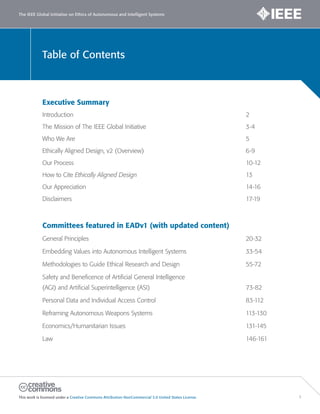
Table of Contents
The IEEE Global Initiative on Ethics of Autonomous and Intelligent Systems
This work is licensed under a Creative Commons Attribution-NonCommercial 3.0 United States License. 1
Executive Summary
Introduction 2
The Mission of The IEEE Global Initiative 3-4
Who We Are 5
Ethically Aligned Design, v2 (Overview) 6-9
Our Process 10-12
How to Cite Ethically Aligned Design 13
Our Appreciation 14-16
Disclaimers 17-19
Committees featured in EADv1 (with updated content)
General Principles 20-32
Embedding Values into Autonomous Intelligent Systems 33-54
Methodologies to Guide Ethical Research and Design 55-72
Safety and Beneficence of Artificial General Intelligence
(AGI) and Artificial Superintelligence (ASI) 73-82
Personal Data and Individual Access Control 83-112
Reframing Autonomous Weapons Systems 113-130
Economics/Humanitarian Issues 131-145
Law 146-161
Table of Contents
The IEEE Global Initiative on Ethics of Autonomous and Intelligent Systems
This work is licensed under a Creative Commons Attribution-NonCommercial 3.0 United States License. 2
New Committees for EADv2 (with new content)
Affective Computing 162-181
Policy 182-192
Classical Ethics in A/IS 193-216
Mixed Reality in ICT 217-239
Well-being 240-263
Important Links
• Website of The IEEE Global Initiative
• Full Listing of The IEEE Global Initiative Membership
• Ethically Aligned Design Version 1
Executive Summary
The IEEE Global Initiative on Ethics of Autonomous and Intelligent Systems
This work is licensed under a Creative Commons Attribution-NonCommercial 3.0 United States License. 2
Introduction
As the use and impact of autonomous and intelligent systems (A/IS) become pervasive,
we need to establish societal and policy guidelines in order for such systems to remain
human-centric, serving humanity’s values and ethical principles. These systems have
to behave in a way that is beneficial to people beyond reaching functional goals and
addressing technical problems. This will allow for an elevated level of trust between
people and technology that is needed for its fruitful, pervasive use in our daily lives.
To be able to contribute in a positive, non-dogmatic way, we, the techno-scientific
communities, need to enhance our self-reflection, we need to have an open and
honest debate around our imaginary, our sets of explicit or implicit values, our
institutions, symbols and representations.
Eudaimonia, as elucidated by Aristotle, is a practice that defines human well-being
as the highest virtue for a society. Translated roughly as “flourishing,” the benefits
of eudaimonia begin by conscious contemplation, where ethical considerations
help us define how we wish to live.
Whether our ethical practices are Western (Aristotelian, Kantian), Eastern (Shinto,
Confucian), African (Ubuntu), or from a different tradition, by creating autonomous
and intelligent systems that explicitly honor inalienable human rights and the beneficial
values of their users, we can prioritize the increase of human well-being as our metric for
progress in the algorithmic age. Measuring and honoring the potential of holistic economic
prosperity should become more important than pursuing one-dimensional goals like
productivity increase or GDP growth.
The IEEE Global Initiative on Ethics of Autonomous and Intelligent Systems
This work is licensed under a Creative Commons Attribution-NonCommercial 3.0 United States License. 3
Executive Summary
The Mission of The IEEE Global
Initiative on Ethics of Autonomous
and Intelligent Systems
To ensure every stakeholder involved in the design and development of
autonomous and intelligent systems is educated, trained, and empowered
to prioritize ethical considerations so that these technologies are advanced
for the benefit of humanity.
By “stakeholder” we mean anyone involved in the research, design, manufacture, or
messaging around intelligent and autonomous systems, including universities, organizations,
governments, and corporations making these technologies a reality for society.
Our goal is that Ethically Aligned Design will provide insights and recommendations
that provide a key reference for the work of technologists in the related fields of science
and technology in the coming years. To achieve this goal, in the current version of
Ethically Aligned Design (EAD2v2), we identify pertinent “Issues” and “Candidate
Recommendations” we hope will facilitate the emergence of national and global
policies that align with these principles.
The IEEE Global Initiative brings together several hundred participants from six continents,
who are thought leaders from academia, industry, civil society, policy and government in the
related technical and humanistic disciplines to identify and find consensus on timely issues.
A second goal of The IEEE Global Initiative is to provide recommendations for IEEE
Standards based on Ethically Aligned Design. Ethically Aligned Design (v1 and v2) and
members of The IEEE Global Initiative are the inspiration behind the suite of IEEE P7000™
Standards Working Groups that are free and open for anyone to join.
The IEEE Global Initiative on Ethics of Autonomous and Intelligent Systems
This work is licensed under a Creative Commons Attribution-NonCommercial 3.0 United States License. 4
Executive Summary
For more information or to join any Working Group,
please click on the links below:
IEEE P7000™ - Model Process for Addressing Ethical Concerns During System Design
IEEE P7001™ - Transparency of Autonomous Systems
IEEE P7002™ - Data Privacy Process
IEEE P7003™ - Algorithmic Bias Considerations
IEEE P7004™ - Standard on Child and Student Data Governance
IEEE P7005™ - Standard for Transparent Employer Data Governance
IEEE P7006™ - Standard for Personal Data Artificial Intelligence (AI) Agent
IEEE P7007™ - Ontological Standard for Ethically Driven Robotics and Automation Systems
IEEE P7008™ - Standard for Ethically Driven Nudging for Robotic, Intelligent, and Automation Systems
IEEE P7009™ - Standard for Fail-Safe Design of Autonomous and Semi-Autonomous Systems
IEEE P7010™ - Wellbeing Metrics Standard for Ethical Artificial Intelligence and Autonomous Systems
Disclaimer: While we have provided recommendations in this document, it should be understood these do not represent a
position or the views of IEEE but the informed opinions of Committee members providing insights designed to provide expert
directional guidance regarding A/IS. In no event shall IEEE or IEEE-SA Industry Connections Activity Members be liable for any
errors or omissions, direct or otherwise, however caused, arising in any way out of the use of this work, regardless of whether
such damage was foreseeable.
The IEEE Global Initiative on Ethics of Autonomous and Intelligent Systems
This work is licensed under a Creative Commons Attribution-NonCommercial 3.0 United States License. 5
Executive Summary
Who We Are
The IEEE Global Initiative on Ethics of
Autonomous and Intelligent Systems (“The IEEE
Global Initiative”) is a program of The Institute of
Electrical and Electronics Engineers (“IEEE”), the
world’s largest technical professional organization
dedicated to advancing technology for the benefit
of humanity with over 420,000 members in
more than 160 countries.
The IEEE Global Initiative provides the
opportunity to bring together multiple voices
in the related technological and scientific
communities to identify and find consensus
on timely issues.
IEEE will make all versions of Ethically Aligned
Design (EAD) available under the Creative
Commons Attribution-Non-Commercial 3.0
United States License.
Subject to the terms of that license, organizations
or individuals can adopt aspects of this work at
their discretion at any time. It is also expected
that EAD content and subject matter will
be selected for submission into formal IEEE
processes, including for standards development.
The IEEE Global Initiative and EAD contribute to a
broader effort at IEEE to foster open, broad, and
inclusive conversation about ethics in technology,
known as the IEEE TechEthics™ program.
The IEEE Global Initiative on Ethics of Autonomous and Intelligent Systems
This work is licensed under a Creative Commons Attribution-NonCommercial 3.0 United States License. 6
Executive Summary
Ethically Aligned Design v2 — Overview
I. Purpose
Intelligent and autonomous technical systems
are specifically designed to reduce human
intervention in our day-to-day lives. In so doing,
these new fields are raising concerns about their
impact on individuals and societies. Current
discussions include advocacy for the positive
impact, as well as warnings, based on the
potential harm to privacy, discrimination, loss
of skills, economic impacts, security of critical
infrastructure, and the long-term effects on
social well-being. Because of their nature, the full
benefit of these technologies will be attained only
if they are aligned with our defined values and
ethical principles. We must therefore establish
frameworks to guide and inform dialogue and
debate around the non-technical implications
of these technologies.
II. Goals
The ethical design, development, and
implementation of these technologies should be
guided by the following General Principles:
• Human Rights: Ensure they do not infringe
on internationally recognized human rights
• Well-being: Prioritize metrics of well-being
in their design and use
• Accountability: Ensure that their
designers and operators are responsible
and accountable
• Transparency: Ensure they operate in a
transparent manner
• Awareness of misuse: Minimize the risks
of their misuse
III. Objectives
Personal Data Rights and Individual
Access Control
A fundamental need is that people have the right
to define access and provide informed consent
with respect to the use of their personal digital
data. Individuals require mechanisms to help
curate their unique identity and personal data
in conjunction with policies and practices that
make them explicitly aware of consequences
resulting from the bundling or resale of their
personal information.
Well-being Promoted
by Economic Effects
Through affordable and universal access to
communications networks and the Internet,
intelligent and autonomous technical systems
can be made available to and benefit populations
anywhere. They can significantly alter institutions
and institutional relationships toward more
human-centric structures and they can benefit
humanitarian and development issues resulting
in increased individual and societal well-being.
The IEEE Global Initiative on Ethics of Autonomous and Intelligent Systems
This work is licensed under a Creative Commons Attribution-NonCommercial 3.0 United States License. 7
Executive Summary
Legal Frameworks for Accountability
The convergence of intelligent systems and
robotics technologies has led to the development
of systems with attributes that simulate those
of human beings in terms of partial autonomy,
ability to perform specific intellectual tasks, and
may even have a human physical appearance.
The issue of the legal status of complex intelligent
and autonomous technical systems thus
intertwines with broader legal questions regarding
how to ensure accountability and allocate liability
when such systems cause harm. Some examples
of general frameworks to consider include the
following:
• Intelligent and autonomous technical systems
should be subject to the applicable regimes
of property law
• Government and industry stakeholders
should identify the types of decisions and
operations that should never be delegated to
such systems and adopt rules and standards
that ensure effective human control over
those decisions and how to allocate legal
responsibility for harm caused by them
Transparency and Individual Rights
Although self-improving algorithms and data
analytics can enable the automation of decision-
making impacting citizens, legal requirements
mandate transparency, participation, and
accuracy, including the following objectives:
• Parties, their lawyers, and courts must have
reasonable access to all data and information
generated and used by such systems
employed by governments and other
state authorities
• The logic and rules embedded in the system
must be available to overseers thereof, if
possible, and subject to risk assessments and
rigorous testing
• The systems should generate audit trails
recording the facts and law supporting
decisions and they should be amenable to
third-party verification
• The general public should know who is
making or supporting ethical decisions of
such systems through investment
Policies for Education and Awareness
Effective policy addresses the protection and
promotion of safety, privacy, intellectual property
rights, human rights, and cybersecurity, as well as
the public understanding of the potential impact
of intelligent and autonomous technical systems
on society. To ensure that they best serve the
public interest, policies should:
• Support, promote, and enable internationally
recognized legal norms
• Develop workforce expertise in related
technologies
• Attain research and development leadership
• Regulate to ensure public safety and
responsibility
• Educate the public on societal impacts
of related technologies
The IEEE Global Initiative on Ethics of Autonomous and Intelligent Systems
This work is licensed under a Creative Commons Attribution-NonCommercial 3.0 United States License. 8
Executive Summary
IV. Foundations
Classical Ethics
By drawing from over two thousand years’
worth of classical ethics traditions, The IEEE
Global Initiative explores established ethics
systems, addressing both scientific and religious
approaches, including secular philosophical
traditions, to address human morality in the
digital age. Through reviewing the philosophical
foundations that define autonomy and ontology,
The IEEE Global Initiative addresses the alleged
potential for autonomous capacity of intelligent
technical systems, morality in amoral systems,
and asks whether decisions made by amoral
systems can have moral consequences.
Well-being Metrics
For extended intelligence and automation
based thereupon to provably advance a specific
benefit for humanity, there needs to be clear
indicators of that benefit. Common metrics of
success include profit, occupational safety, and
fiscal health. While important, these metrics
fail to encompass the full spectrum of well-
being for individuals or society. Psychological,
social, and environmental factors matter. Well-
being metrics capture such factors, allowing the
benefits arising from technological progress to
be more comprehensively evaluated, providing
opportunities to test for unintended negative
consequences that could diminish human well-
being. Conversely, these metrics could help
identify where intelligent technical systems would
increase human well-being as well, providing new
routes to societal and technological innovation.
Embedding Values
into Autonomous Systems
If machines engage in human communities as
quasi-autonomous agents, then those agents will
be expected to follow the community’s social and
moral norms. Embedding norms in such systems
requires a clear delineation of the community
in which they are to be deployed. Further, even
within a particular community, different types of
technical embodiments will demand different
sets of norms. The first step is to identify the
norms of the specific community in which the
systems are to be deployed and, in particular,
norms relevant to the kinds of tasks that they
are designed to perform.
Methodologies to Guide Ethical
Research and Design
To create intelligent technical systems that
enhance and extend human well-being and
freedom, value-based design methodologies
put human advancement at the core of
development of technical systems, in concert
with the recognition that machines should serve
humans and not the other way around. System
developers should employ value-based design
methodologies in order to create sustainable
systems that can be evaluated in terms of
both social costs and also advantages that may
increase economic value for organizations.
The IEEE Global Initiative on Ethics of Autonomous and Intelligent Systems
This work is licensed under a Creative Commons Attribution-NonCommercial 3.0 United States License. 9
Executive Summary
V. Future Technology Concerns
Reframing Autonomous Weapons
Autonomous systems designed to cause
physical harm have additional ethical dimensions
as compared to both traditional weapons
and/or autonomous systems not designed to
cause harm. These ethical dimensions include,
at least, the following:
• Ensuring meaningful human control
of weapons systems
• Designing automated weapons with
audit trails to help guarantee accountability
and control
• Including adaptive and learning systems that
can explain their reasoning and decisions
to human operators in a transparent and
understandable way
• Training responsible human operators
of autonomous systems who are
clearly identifiable
• Achieving behavior of autonomous functions
that is predictable to their operators
• Ensuring that the creators of these
technologies understanding the implications
of their work
• Developing professional ethical codes
to appropriately address the development
of autonomous systems intended to
cause harm
Safety and Beneficence of Alleged
Artificial General Intelligence (AGI)
and Artificial Superintelligence (ASI)
Similar to other powerful technologies, the
development and use of intelligent and
potentially self-improving technical systems
involves considerable risk, either because of
misuse or poor design. However, according
to some theories, as systems approach and
surpass AGI, unanticipated or unintended system
behavior will become increasingly dangerous and
difficult to correct. It is likely that not all AGI-
level architectures can be aligned with human
interests, and as such, care should be taken
to determine how different architectures will
perform as they become more capable.
Affective Computing
Affect is a core aspect of intelligence. Drives and
emotions such as anger, fear, and joy are often
the foundations of actions throughout our life.
To ensure that intelligent technical systems will
be used to help humanity to the greatest extent
possible in all contexts, artifacts participating in
or facilitating human society should not cause
harm either by amplifying or damping human
emotional experience. Even the rudimentary
versions of synthetic emotions already deployed
in some systems impact how they are perceived
by policy makers and the general public.
Mixed Reality
Mixed reality could alter our concepts of identity
and reality as these technologies become more
common in our work, education, social lives, and
commercial transactions. The ability for real-time
personalization of this mixed-reality world raises
ethical questions concerning the rights of the
individual and control over one’s multifaceted
identity, especially as the technology moves
from headsets to more subtle and integrated
sensory enhancements.
The IEEE Global Initiative on Ethics of Autonomous and Intelligent Systems
This work is licensed under a Creative Commons Attribution-NonCommercial 3.0 United States License. 10
Executive Summary
Our Process
To ensure greatest cultural relevance and
intellectual rigor in our work, The IEEE Global
Initiative has been globally crowdsourcing
feedback for Versions 1 and 2 of Ethically
Aligned Design.
We released Ethically Aligned Design Version 1
as a Request for Input on December of 2016
and received over two hundred pages of in-depth
feedback about the draft. As a way to highlight
insights inspired by the feedback we received,
Sara Mattingly-Jordan of The IEEE Global Initiative
also wrote the report, Becoming a Leader in
Global Ethics.
We are releasing Ethically Aligned Design Version
2 (EADv2) as a Request for Input once again
to gain further insights about the eight original
sections from EADv1, along with unique/new
feedback for the five new sections included
in EADv2.
Next Steps
The IEEE Global Initiative is currently creating
an organizational committee composed of
representatives of all our Committees and IEEE
P7000™ Working Groups to do the following
in order to prepare the final version of Ethically
Aligned Design to be released in 2019:
• Create criteria for Committees to vote on all
“Candidate Recommendations” becoming
“Recommendations” based on the General
Principles of Ethically Aligned Design that are
in accordance with the Mission Statement of
The IEEE Global Initiative. This voting process
will be based on the consensus-based
protocols provided by IEEE-SA.
• Create a rigorous methodology to best
incorporate feedback received from EADv1
and EADv2, working to holistically consider
global and diversity-based considerations
for content inclusion.
• Use the glossary we have produced as a key
tool for synthesizing content for final version
of EAD, unifying terms as much as possible.
Final Version of Ethically Aligned
Design — Format and Goals
The final version of Ethically Aligned Design will
be made available in the following formats:
• Handbook. While specific formatting is
still under consideration, the final version
of Ethically Aligned Design will feature
“Recommendations” (versus “Candidate
Recommendations”) for all existing and
future “Issues” voted on by Members of
The IEEE Global Initiative. It is very likely
the final version of EAD will not be broken
into sections according to Committees (as
with EADv1 and EADv2) but according to
themes or principles to be decided on by
the organizational committee mentioned
above. While not an official IEEE position
statement, “Recommendations” will be
The IEEE Global Initiative on Ethics of Autonomous and Intelligent Systems
This work is licensed under a Creative Commons Attribution-NonCommercial 3.0 United States License. 11
Executive Summary
created to be easily utilized by technologists
and policy makers focusing on autonomous
and intelligent systems design, usage, and
governance.
• Educational materials. The IEEE Global
Initiative would like to convert the handbook
version of Ethically Aligned Design into an
academically oriented book/educational
materials. Evergreen in nature, these would
be targeted to academics, engineers, and
technologists looking for global guidance
to be used in university, post-grad, or
other educational settings where ethics in
technology or the issues EAD comprises
would be taught.
Incorporating Feedback
While it was our intention to directly accept or
review all feedback we received for EADv1, we
were (happily) overwhelmed with the fantastic
response we received. However, to most
holistically include feedback from EADv1 and
EADv2 into our overall process we have created
a Glossary and are working to increase more
global representation and diversity in our work.
Specifically:
Glossary
We received a great deal of feedback on the
need for aligned recommendations for key
terms in Ethically Aligned Design. To that
end, we created a Glossary Committee and
launched the first draft of our Glossary at the
same time we released EADv2. Our goal is
to refine our Glossary so that by mid-2018,
based on aggregated feedback to all sections
of EAD (Versions 1 and 2), we can standardize
definitions that reflect a global and holistic set of
definitions to be implemented by all Committees
in the final version of EAD.
More Global Representation/Diversity
We received a great deal of feedback noting
that EADv1 was fairly “Western” in its cultural
orientation. This makes sense, as the initial 100
members working on EADv1 where largely from
North America and the European Union. Since
the release of EADv1, however, we have:
• Added members from China, Korea, Japan,
Brazil, Mexico, the Russian Federation, Iran,
Thailand, and Israel along with new people
from the United States and the European
Union. In addition to the 250 members of
the Initiative, there are also now more than
400 global members in the IEEE P7000™
Working Groups that EAD inspired.
• Supported the members translating
the Executive Summary of EADv1 into
multiple languages.
• Added our new “Classical Ethics in A/IS”
Committee.
• Created the Becoming a Leader in Global
Ethics report.
• Commissioned a report from our newer
global members about the state of A/IS
Ethics in their regions.
• Created an Outreach Committee to help
identify and incorporate work being done
The IEEE Global Initiative on Ethics of Autonomous and Intelligent Systems
This work is licensed under a Creative Commons Attribution-NonCommercial 3.0 United States License. 12
Executive Summary
in A/IS ethics by women, people of color,
students, and other groups representing the
full spectrum of society that we are hoping
to positively influence with our work. We
are currently working with members of The
Reboot Retreat, AI4ALL, and other leaders
within IEEE to help us ensure that The IEEE
Global Initiative and the final version of
Ethically Aligned Design are as holistically
representative and relevant as possible.
Terminology Update
There is no need to use the term artificial
intelligence in order to conceptualize and speak
of technologies and systems that are meant to
extend our human intelligence or be used in
robotics applications. For this reason, we use
the term, autonomous and intelligent systems
(or A/IS) in the course of our work. We chose
to use this phrase encapsulating multiple
fields (machine learning, intelligent systems
engineering, robotics, etc.) throughout Ethically
Aligned Design, Version 2 to ensure the broadest
application of ethical considerations in
the design of these technologies as possible.
How the Document Was Prepared
This document was prepared using an open,
collaborative, and consensus building approach,
following the processes of the Industry
Connections program, a program of the
IEEE Standards Association.
Industry Connections facilitates collaboration
among organizations and individuals as they
hone and refine their thinking on emerging
technology issues, helping to incubate potential
new standards activities and standards-related
products and services.
The IEEE Global Initiative on Ethics of Autonomous and Intelligent Systems
This work is licensed under a Creative Commons Attribution-NonCommercial 3.0 United States License. 13
Executive Summary
How to Cite Ethically Aligned Design
Please cite Version 2 of Ethically Aligned Design
in the following manner:
The IEEE Global Initiative on Ethics of
Autonomous and Intelligent Systems. Ethically
Aligned Design: A Vision for Prioritizing Human
Well-being with Autonomous and Intelligent
Systems, Version 2. IEEE, 2017. http://standards.
ieee.org/develop/indconn/ec/autonomous_
systems.html.
The IEEE Global Initiative on Ethics of Autonomous and Intelligent Systems
This work is licensed under a Creative Commons Attribution-NonCommercial 3.0 United States License. 14
Executive Summary
Our Appreciation
We wish to thank our Executive Committee
and Chair of The IEEE Global Initiative:
Executive Committee Officers
Raja Chatila, Chair
Kay Firth-Butterfield, Vice-Chair
John C. Havens, Executive Director
Executive Committee Members
Dr. Greg Adamson, Ronald C. Arkin, Virginia
Dignum, Danit Gal, Philip Hall, Malavika Jayaram,
Sven Koenig, Raj Madhavan, Richard Mallah, Hagit
Messer Yaron, AJung Moon, Monique Morrow,
Francesca Rossi, Alan Winfield
Committee Chairs
• General Principles: Alan Winfield and Mark
Halverson
• Embedding Values into Autonomous
Intelligent Systems: Francesca Rossi and
Bertram F. Malle
• Methodologies to Guide Ethical Research
and Design: Raja Chatila and Corinne J.N. Cath
• Safety and Beneficence of Artificial
General Intelligence (AGI) and Artificial
Superintelligence (ASI): Malo Bourgon and
Richard Mallah
• Personal Data and Individual Access
Control: Katryna Dow and John C. Havens
• Reframing Autonomous Weapons
Systems: Peter Asaro
• Economics/Humanitarian Issues:
Kay Firth-Butterfield and Raj Madhavan
• Law: Kay Firth-Butterfield and Derek Jinks
• Affective Computing: Ronald C. Arkin and
Joanna J. Bryson
• Classical Ethics in A/IS: Jared Bielby
• Policy: Kay Firth-Butterfield and Philip Hall
• Mixed Reality: Monique Morrow and Jay Iorio
• Well-being: Laura Musikanski and John C.
Havens
• Drafting: Kay Firth-Butterfield and Deven Desai
• Industry: Virginia Dignum and Malavika Jayaram
• Communications: Leanne Seeto
and Mark Halverson
• Glossary: Sara M. Jordan
• Outreach: Danit Gal
The IEEE Global Initiative on Ethics of Autonomous and Intelligent Systems
This work is licensed under a Creative Commons Attribution-NonCommercial 3.0 United States License. 15
Executive Summary
We wish to express our appreciation for the
reports, organizations, and individuals that
have contributed research and insights helping
to increase awareness around ethical issues
in the realm of intelligent and autonomous
systems, including (but not limited to, and
in no particular order):
Reports
The Future of Life Institute’s Asilomar AI
Principles, The AI Now 2017 Report, Human
Rights in the Robot Age Report from The
Rathenau Instituut, Report of COMEST on
Robotics Ethics from UNESCO, The European
Parliament’s Recommendations to the
Commission on Civil Law Rules on Robotics,
Artificial intelligence — The Consequences of
Artificial Intelligence on the (Digital) Single
Market, Production, Consumption, Employment
and Society report from the European Economic
and Social Committee (Rapporteur: Catelijne
MULLER), OECD’s report, Going Digital: Making
the Transformation Work for Growth and Well-
Being, USACM’s Statement on Algorithmic
Transparency and Accountability, Guide to the
Ethical Design and Application of Robots and
Robotic Systems (British Standards Institute),
Japan’s Basic Rules for AI Research, Éthique de
la Recherche en Robotique (CERNA), Charta
der Digitalen Grundrechte der Europäischen
Union (Charter of the Digital Fundamental Rights
of the European Union), Telecommunications
Research Laboratory, “AI Network Kentōkai
Kaigi Hōkokusho 2016: AI Network no Eikyōto
Risk — Chiren Shakai (WINS) no Jitsugen ni
Muketa Kadai” (AIネットワーク化検討会議 報
告書2016 の公表-
「AIネットワーク化の影響とリ
スク -智連社会(WINS(ウインズ))の実現に向
けた課題-
」
) [The Conference on Networking
among AIs Report (2016): Impacts and Risks
of AI Networking Issues for the Realization of
Wisdom Network Society, (WINS)], Japanese
Ministry of Internal Affairs and Communications,
The Information Technology Industry Council’s
AI Policy Principles, Intel’s Artificial Intelligence
— The Public Policy Opportunity, IEEE European
Public Policy Initiative’s position statement,
Artificial Intelligence: Calling on Policy Makers
to Take a Leading Role in Setting a Long Term
AI Strategy, IEEE-USA’s position statement on
Artificial Intelligence Research, Development and
Regulation, The IEEE Global Initiative’s Prioritizing
Human Well-being in the Age of Artificial
Intelligence.
The IEEE Global Initiative on Ethics of Autonomous and Intelligent Systems
This work is licensed under a Creative Commons Attribution-NonCommercial 3.0 United States License. 16
Executive Summary
Organizations
The Association for the Advancement of Artificial
Intelligence and their formative work on AI Ethics,
The Future of Life Institute, The Partnership on
AI to Benefit People and Society, The Foundation
for Responsible Robotics, AI & Society, Machine
Intelligence Research Institute, The International
Center for Information Ethics, The African Center
of Excellence for Information Ethics, The 4TU
Center for Ethics and Technology, The Center
for the Study of Existential Risk, The Leverhulme
Center for the Future of Intelligence, The Future
of Humanity Institute, The Japanese Society
for Artificial Intelligence, The Association for
Computing Machinery, Future Advocacy, ACM
Special Interest Group on Artificial Intelligence,
The World Economic Forum’s Global Future
Council of Artificial Intelligence and Robotics,
The Digital Asia Hub, The AI Initiative, The Open
Roboethics Institute, The Dalai Lama Center for
Ethics and Transformative Values at MIT, The
Ethics Initiative at MIT Media Lab, The IEEE-
USA Government Relations Council Artificial
Intelligence Committee, The IEEE Robotics
and Automation Society Committee on Robot
Ethics, The IEEE Robotics and Automation
Society, The IEEE Society on Social Implications
of Technology, The IEEE Computer Society, The
IEEE Computational Intelligence Society, The IEEE
Systems, Man and Cybernetics Society, The IEEE
Symbiotic Autonomous Systems Initiative.
People
We would like to warmly recognize the leadership
and constant support of The IEEE Global Initiative
by Dr. Ing. Konstantinos Karachalios, Managing
Director of the IEEE Standards Association and a
member of the IEEE Management Council.
We would especially like to thank Eileen M. Lach,
the IEEE General Counsel and Chief Compliance
Officer, who invested her time and expertise in
fully reviewing this entire document, with the
heartfelt conviction that there is a pressing need
to focus the global community on highlighting
ethical considerations in the development of
autonomous and intelligent systems.
Special thanks to Dr. Peter S. Brooks for his
contributions to the Overview of EADv2.
Thank You to Our Members
and IEEE Team
Our progress and the ongoing positive influence
of this work is due to the volunteer experts
serving on our Committees and IEEE P7000™
Standards Working Groups, along with the IEEE
staff who support our efforts. Thank you for
your dedication toward defining, designing, and
inspiring the ethical PRINCIPLES and STANDARDS
that will ensure that intelligent and autonomous
systems and the technologies associated
therewith will positively benefit humanity.
The IEEE Global Initiative on Ethics of Autonomous and Intelligent Systems
This work is licensed under a Creative Commons Attribution-NonCommercial 3.0 United States License. 17
Executive Summary
Disclaimers
Ethically Aligned Design is not a code of conduct
or a professional code of ethics. Engineers and
technologists have well-established codes,
and we wish to respectfully recognize the
formative precedents surrounding issues of
ethics and safety and the professional values
these codes represent. These codes provide the
broad framework for the more focused domain
addressed in this document, and it is our hope
that the inclusive, consensus-building process
around its design will contribute unique value to
technologists and society as a whole.
This document is also not a position, or policy
statement, or formal report of IEEE or any
other organization with which is affiliated. It is
intended to be a working reference tool created
in an inclusive process by those in the relevant
scientific and engineering communities prioritizing
ethical considerations in their work.
A Note on Affiliations Regarding
Members of The Initiative
The language and views expressed in Ethically
Aligned Design reflect the individuals who
created content for each section of this
document. The language and views expressed
in this document do not necessarily reflect
the positions taken by the universities or
organizations to which these individuals belong,
and should in no way be considered any form
of endorsement, implied or otherwise, from
these institutions.
This is the second version of Ethically Aligned
Design. Where individuals are listed in a
Committee it indicates only that they are
Members of that Committee. Committee
Members may not have achieved final
concurrence on content in this document
because of its versioning format and the
concurrence-building process of The IEEE Global
Initiative. Content listed by Members in this
or future versions is not an endorsement, implied
or otherwise, until formally stated as such.
A Note Regarding Candidate
Recommendations in This Document
Ethically Aligned Design is being created
via multiple versions that are being iterated
over the course of two to three years. The
IEEE Global Initiative is following a specific
concurrence-building process where members
contributing content are proposing candidate
recommendations so as not to imply these are
final recommendations at this time.
Our Membership
The IEEE Global Initiative currently has more than
250 experts from all but one continent involved
in our work, and we are eager for new voices and
perspectives to join our work.
The IEEE Global Initiative on Ethics of Autonomous and Intelligent Systems
This work is licensed under a Creative Commons Attribution-NonCommercial 3.0 United States License. 18
Executive Summary
Copyright, Trademarks,
and Disclaimers
IEEE believes in good faith that the information
in this publication is accurate as of its publication
date; such information is subject to change
without notice. IEEE is not responsible for any
inadvertent errors.
The Institute of Electrical and Electronics
Engineers, Incorporated
3 Park Avenue, New York, NY 10016-5997, USA
Copyright © 2017 by The Institute of Electrical
and Electronics Engineers, Incorporated
Published December 2017
Printed in the United States of America.
IEEE is a registered trademark owned by The
Institute of Electrical and Electronics Engineers,
Incorporated.
PDF: ISBN 978-0-7381-xxxx-x STDVxxxxx
Print: ISBN 978-0-7381-xxxx-x STDPDVxxxxx
IEEE prohibits discrimination, harassment,
and bullying. For more information, visit
http://www.ieee.org/web/aboutus/whatis/
policies/p9-26.html
This work is made available under the Creative
Commons Attribution Non-Commercial License.
To order IEEE Press Publications,
call 1-800-678-IEEE.
Find IEEE standards and standards-related
product listings at: standards.ieee.org
Notice and Disclaimer of Liability
Concerning the Use of IEEE-SA Industry
Connections Documents
This IEEE Standards Association (“IEEE-SA”)
Industry Connections publication (“Work”) is not
a consensus standard document. Specifically, this
document is NOT AN IEEE STANDARD. Information
contained in this Work has been created by, or
obtained from, sources believed to be reliable,
and reviewed by members of the IEEE-SA Industry
Connections activity that produced this Work.
IEEE and the IEEE-SA Industry Connections
activity members expressly disclaim all warranties
(express, implied, and statutory) related to this
Work, including, but not limited to, the warranties
of: merchantability; fitness for a particular purpose;
non-infringement; quality, accuracy, effectiveness,
currency, or completeness of the Work or content
within the Work. In addition, IEEE and the IEEE-
SA Industry Connections activity members
disclaim any and all conditions relating to: results;
and workmanlike effort. This IEEE-SA Industry
Connections document is supplied “AS IS”
and “WITH ALL FAULTS.”
Although the IEEE-SA Industry Connections
activity members who have created this Work
believe that the information and guidance
given in this Work serve as an enhancement
to users, all persons must rely upon their own
skill and judgment when making use of it. IN
NO EVENT SHALL IEEE OR IEEE-SA INDUSTRY
CONNECTIONS ACTIVITY MEMBERS BE LIABLE
FOR ANY ERRORS OR OMISSIONS OR DIRECT,
INDIRECT, INCIDENTAL, SPECIAL, EXEMPLARY,
OR CONSEQUENTIAL DAMAGES (INCLUDING,
BUT NOT LIMITED TO: PROCUREMENT OF
The IEEE Global Initiative on Ethics of Autonomous and Intelligent Systems
This work is licensed under a Creative Commons Attribution-NonCommercial 3.0 United States License. 19
Executive Summary
SUBSTITUTE GOODS OR SERVICES; LOSS
OF USE, DATA, OR PROFITS; OR BUSINESS
INTERRUPTION) HOWEVER CAUSED AND
ON ANY THEORY OF LIABILITY, WHETHER
IN CONTRACT, STRICT LIABILITY, OR TORT
(INCLUDING NEGLIGENCE OR OTHERWISE)
ARISING IN ANY WAY OUT OF THE USE OF
THIS WORK, EVEN IF ADVISED OF THE
POSSIBILITY OF SUCH DAMAGE AND
REGARDLESS OF WHETHER SUCH
DAMAGE WAS FORESEEABLE.
Further, information contained in this Work
may be protected by intellectual property rights
held by third parties or organizations, and the
use of this information may require the user to
negotiate with any such rights holders in order
to legally acquire the rights to do so, and such
rights holders may refuse to grant such rights.
Attention is also called to the possibility that
implementation of any or all of this Work may
require use of subject matter covered by patent
rights. By publication of this Work, no position
is taken by IEEE with respect to the existence
or validity of any patent rights in connection
therewith. IEEE is not responsible for identifying
patent rights for which a license may be required,
or for conducting inquiries into the legal validity
or scope of patents claims. Users are expressly
advised that determination of the validity of any
patent rights, and the risk of infringement of
such rights, is entirely their own responsibility.
No commitment to grant licenses under patent
rights on a reasonable or non-discriminatory basis
has been sought or received from any rights
holder. The policies and procedures under which
this document was created can be viewed at
standards.ieee.org/about/sasb/iccom/.
This Work is published with the understanding
that IEEE and the IEEE-SA Industry Connections
activity members are supplying information
through this Work, not attempting to render
engineering or other professional services.
If such services are required, the assistance
of an appropriate professional should be sought.
IEEE is not responsible for the statements and
opinions advanced in this Work.
General Principles
The IEEE Global Initiative on Ethics of Autonomous and Intelligent Systems
This work is licensed under a Creative Commons Attribution-NonCommercial 3.0 United States License. 20
The General Principles Committee seeks to articulate high-level ethical concerns that
apply to all types of autonomous and intelligent systems (A/IS*), regardless of whether
they are physical robots (such as care robots or driverless cars) or software systems
(such as medical diagnosis systems, intelligent personal assistants, or algorithmic chat bots).
We are motivated by a desire to create ethical principles for A/IS that:
1. Embody the highest ideals of human beneficence as a superset of Human Rights.
2. Prioritize benefits to humanity and the natural environment from the use of A/IS.
Note that these should not be at odds — one depends on the other. Prioritizing human
well-being does not mean degrading the environment.
3. Mitigate risks and negative impacts, including misuse, as A/IS evolve as socio-technical
systems. In particular by ensuring A/IS are accountable and transparent.
It is our intention that by identifying issues and drafting recommendations these principles
will serve to underpin and scaffold future norms and standards within a framework of
ethical governance.
We have identified principles created by our Committee as well as aggregated principles
reflected from other Committees of The IEEE Global Initiative. Therefore, readers should
note that some general principles are reiterated and elaborated by other committees, as
appropriate to the specific concerns of those committees. We have purposefully structured
our Committee and this document in this way to provide readers with a broad sense
of the themes and ideals reflecting the nature of ethical alignment for these technologies
as an introduction to our overall mission and work.
General Principles
The IEEE Global Initiative on Ethics of Autonomous and Intelligent Systems
This work is licensed under a Creative Commons Attribution-NonCommercial 3.0 United States License. 21
The following provides high-level guiding principles for potential solutions-by-design
whereas other Committee sections address more granular issues regarding specific
contextual, cultural, and pragmatic questions of their implementation.
*The acronym A/IS is shorthand for Autonomous and Intelligent Systems. When represented in this way, it refers to the
overlapping concerns about the design, development, deployment, decommissioning, and adoption of autonomous or intelligent
software when installed into other software and/or hardware systems that are able to exercise independent reasoning,
decision-making, intention forming, and motivating skills according to self-defined principles.
Disclaimer: While we have provided recommendations in this document, it should be understood these do not represent a
position or the views of IEEE but the informed opinions of Committee members providing insights designed to provide expert
directional guidance regarding A/IS. In no event shall IEEE or IEEE-SA Industry Connections Activity Members be liable for any
errors or omissions, direct or otherwise, however caused, arising in any way out of the use of this work, regardless of whether
such damage was foreseeable.
The IEEE Global Initiative on Ethics of Autonomous and Intelligent Systems
This work is licensed under a Creative Commons Attribution-NonCommercial 3.0 United States License. 22
General Principles
Principle 1 — Human Rights
Issue:
How can we ensure that
A/IS do not infringe upon
human rights?
Background
Human benefit is an important goal of A/IS,
as is respect for human rights set out, inter alia,
in The Universal Declaration of Human Rights,
the International Covenant for Civil and Political
Rights, the Convention on the Rights of the
Child, Convention on the Elimination of all forms
of Discrimination against Women, Convention
on the Rights of Persons with Disabilities, and
the Geneva Conventions. Such rights need to
be fully taken into consideration by individuals,
companies, professional bodies, research
institutions, and governments alike to reflect
the following concerns:
1. A/IS should be designed and operated in
a way that both respects and fulfills human
rights, freedoms, human dignity, and cultural
diversity.
2. A/IS must be verifiably safe and secure
throughout their operational lifetime.
3. If an A/IS causes harm it must always
be possible to discover the root cause,
by assuring traceability for said harm
(see also Principle 4 — Transparency).
While their interpretation may change over time,
human rights as defined by international law,
provide a unilateral basis of creating any A/IS
system as they affect humans, their emotions,
data, or agency. While the direct coding of human
rights in A/IS may be difficult or impossible based
on contextual use, newer guidelines from The
United Nations, such as the Ruggie principles,
provide methods to pragmatically implement
human rights ideals within business or corporate
contexts that could be adapted for engineers and
technologists. In this way technologists can take
account of rights in the way A/IS are operated,
tested, validated, etc. In short, human rights
should be part of the ethical risk assessment
of A/IS.
Candidate Recommendations
To best honor human rights, society must assure
the safety and security of A/IS so that they are
designed and operated in a way that benefits
humans:
1. Governance frameworks, including standards
and regulatory bodies, should be established
to oversee processes assuring that the
The IEEE Global Initiative on Ethics of Autonomous and Intelligent Systems
This work is licensed under a Creative Commons Attribution-NonCommercial 3.0 United States License. 23
General Principles
use of A/IS does not infringe upon human
rights, freedoms, dignity, and privacy, and of
traceability to contribute to the building
of public trust in A/IS.
2. A way to translate existing and forthcoming
legal obligations into informed policy and
technical considerations is needed. Such
a method should allow for differing cultural
norms as well as legal and regulatory
frameworks.
3. For the foreseeable future, A/IS should
not be granted rights and privileges equal
to human rights: A/IS should always be
subordinate to human judgment and control.
Further Resources
The following documents/organizations are
provided both as references and examples of
the types of work that can be emulated, adapted,
and proliferated, regarding ethical best practices
around A/IS to best honor human rights:
• The Universal Declaration of Human Rights,
1947.
• The International Covenant on Civil and
Political Rights, 1966.
• The International Covenant on Economic,
Social and Cultural Rights, 1966.
• The International Convention on
the Elimination of All Forms of Racial
Discrimination, 1965.
• The Convention on the Rights of the Child.
• The Convention on the Elimination of All
Forms of Discrimination against Women,
1979.
• The Convention on the Rights of Persons
with Disabilities, 2006.
• The Geneva Conventions and additional
protocols, 1949.
• IRTF’s Research into Human Rights Protocol
Considerations.
• The UN Guiding Principles on Business
and Human Rights, 2011.
• For an example of a guide on how to conduct
an ethical risk assessment see British Standards
Institute BS8611:2016, Guide to the Ethical
Design and Application of Robots and
Robotic Systems.
The IEEE Global Initiative on Ethics of Autonomous and Intelligent Systems
This work is licensed under a Creative Commons Attribution-NonCommercial 3.0 United States License. 24
General Principles
Principle 2 — Prioritizing Well-being
Issue:
Traditional metrics of prosperity
do not take into account the
full effect of A/IS technologies
on human well-being.
Background
A focus on creating ethical and responsible
AI has been increasing among technologists
in the past 12 to 16 months. Key issues of
transparency, accountability, and algorithmic
bias are being directly addressed for the
design and implementation of A/IS. While
this is an encouraging trend, a key question
facing technologists today is beyond designing
responsible A/IS. That question is, What are
the specific metrics of societal success for
“ethical AI” once released to the world?
For A/IS technologies to provably advance
benefit for humanity, we need to be able
to define and measure the benefit we wish
to increase. Avoiding negative unintended
consequences and increasing value for customers
and society (today measured largely by gross
domestic product (GDP), profit, or consumption
levels) are often the only indicators utilized
in determining success for A/IS.
Well-being, for the purpose of The IEEE Global
Initiative, is defined as encompassing human
satisfaction with life and the conditions of life as
well as an appropriate balance between positive
and negative affect. This definition is based on
the Organization for Economic Co-Operation and
Development’s (OECD) Guidelines on Measuring
Subjective Well-being that notes, “Being able to
measure people’s quality of life is fundamental
when assessing the progress of societies. There
is now widespread acknowledgement that
measuring subjective well-being is an essential
part of measuring quality of life alongside other
social and economic dimensions.” Data is
also currently being gathered in governments,
businesses, and other institutions using
scientifically valid measurements of well-being.
Since modern societies are largely constituted
of A/IS users, we believe these considerations
to be relevant for A/IS developers.
It is widely agreed that GDP is at best incomplete,
and at worst misleading, as a metric of
true prosperity for society at large and A/IS
technologies (as noted in The Oxford Handbook
of Well-Being and Public Policy). Although the
concerns regarding GDP reflect holistic aspects
of society versus the impact of any one
technology, they reflect the lack of universal
usage of well-being indicators for A/IS. A/IS
undoubtedly hold positive promise for society.
But beyond the critical importance of designing
and manufacturing these technologies in an
The IEEE Global Initiative on Ethics of Autonomous and Intelligent Systems
This work is licensed under a Creative Commons Attribution-NonCommercial 3.0 United States License. 25
General Principles
ethically driven and responsible manner is
the seminal question of determining the key
performance indicators (KPIs) of their success
once introduced into society.
A/IS technologies can be narrowly conceived
from an ethical standpoint; be legal, profitable,
and safe in their usage; and yet not positively
contribute to human well-being. This means
technologies created with the best intentions,
but without considering well-being metrics,
can still have dramatic negative consequences
on people’s mental health, emotions, sense
of themselves, their autonomy, their ability
to achieve their goals, and other dimensions
of well-being.
Nonetheless, quantitative indicators of individual
well-being should be introduced with caution,
as they may provoke in users an automatic urge
for numerical optimization. While this tendency
is theoretically unavoidable, efforts should be
invested in guaranteeing that it will not flatten the
diversity of human experience. The A/IS using
quantitative indicators for health or happiness
should therefore develop and implement
measures for maintaining full human autonomy
of their users.
In conclusion, it is widely agreed that de facto
metrics regarding safety and fiscal health do not
encompass the full spectrum of well-being for
individuals or society. By not elevating additional
environmental and societal indicators as pillars
of success for A/IS, we risk minimizing the
positive and holistic impact for humanity of these
technologies. Where personal, environmental,
or social factors are not prioritized as highly as
fiscal metrics of success, we also risk expediting
negative and irreversible harms to our planet
and population.
Candidate Recommendation
A/IS should prioritize human well-being as an
outcome in all system designs, using the best
available, and widely accepted, well-being metrics
as their reference point.
Further Resources
• IEEE P7010™, Well-being Metrics Standard
for Ethical AI and Autonomous Systems.
• The Measurement of Economic Performance
and Social Progress (2009) now commonly
referred to as “The Stiglitz Report,”
commissioned by the then President of
the French Republic. From the report: “…
the time is ripe for our measurement system
to shift emphasis from measuring economic
production to measuring people’s well-being
… emphasizing well-being is important
because there appears to be an increasing
gap between the information contained
in aggregate GDP data and what counts
for common people’s well-being.”
• Organisation for Economic Co-Operation
& Development, OECD Guidelines for
Measuring Subjective Well-being. Paris:
OECD, 2013.
• Beyond GDP (European Commission)
From the site: “The Beyond GDP initiative
is about developing indicators that are
The IEEE Global Initiative on Ethics of Autonomous and Intelligent Systems
This work is licensed under a Creative Commons Attribution-NonCommercial 3.0 United States License. 26
General Principles
as clear and appealing as GDP, but more
inclusive of environmental and social aspects
of progress.”
• Global Dialogue for Happiness, part of
the annual World Government Summit,
February 11, 2017.
• Organization for Economic Co-Operation
and Development, OECD’s Better Life Index.
• New Economics Foundation, The Happy
Planet Index.
• Redefining Progress, Genuine Progress
Indicator.
• The International Panel on Social Progress,
Social Justice, Well-Being and Economic
Organization.
• Veenhoven, R. World Database of Happiness.
Rotterdam, The Netherlands: Erasmus
University.
• Royal Government of Bhutan. The Report
of the High-Level Meeting on Wellbeing
and Happiness: Defining a New Economic
Paradigm. New York: The Permanent Mission
of the Kingdom of Bhutan to the United
Nations, 2012.
• See also Well-being Section in Ethically
Aligned Design, Version 2.
The IEEE Global Initiative on Ethics of Autonomous and Intelligent Systems
This work is licensed under a Creative Commons Attribution-NonCommercial 3.0 United States License. 27
General Principles
Principle 3 — Accountability
Issue:
How can we assure that
designers, manufacturers,
owners, and operators of A/IS
are responsible and accountable?
Background
The programming, output, and purpose of A/IS
are often not discernible by the general public.
Based on the cultural context, application,
and use of A/IS, people and institutions need
clarity around the manufacture and deployment
of these systems to establish responsibility
and accountability, and avoid potential harm.
Additionally, manufacturers of these systems
must be able to provide programmatic-level
accountability proving why a system operates in
certain ways to address legal issues of culpability,
if necessary apportion culpability among several
responsible designers, manufacturers, owners,
and/or operators, to avoid confusion or fear
within the general public.
Note that accountability is enhanced with
transparency, thus this principle is closely linked
with Principle 4 — Transparency.
Candidate Recommendations
To best address issues of responsibility and
accountability:
1. Legislatures/courts should clarify issues
of responsibility, culpability, liability, and
accountability for A/IS where possible during
development and deployment (so that
manufacturers and users understand their
rights and obligations).
2. Designers and developers of A/IS should
remain aware of, and take into account when
relevant, the diversity of existing cultural
norms among the groups of users of these
A/IS.
3. Multi-stakeholder ecosystems should be
developed to help create norms (which can
mature to best practices and laws) where
they do not exist because A/IS-oriented
technology and their impacts are too new
(including representatives of civil society,
law enforcement, insurers, manufacturers,
engineers, lawyers, etc.).
4. Systems for registration and record-keeping
should be created so that it is always possible
to find out who is legally responsible for
a particular A/IS. Manufacturers/operators/
The IEEE Global Initiative on Ethics of Autonomous and Intelligent Systems
This work is licensed under a Creative Commons Attribution-NonCommercial 3.0 United States License. 28
General Principles
owners of A/IS should register key, high-level
parameters, including:
• Intended use
• Training data/training environment
(if applicable)
• Sensors/real world data sources
• Algorithms
• Process graphs
• Model features (at various levels)
• User interfaces
• Actuators/outputs
• Optimization goal/loss function/reward
function
Further Resources
• Shneiderman, B. “Human Responsibility
for Autonomous Agents.” IEEE Intelligent
Systems 22, no. 2, (2007): 60–61.
• Matthias, A. “The Responsibility Gap:
Ascribing Responsibility for the Actions of
Learning Automata.” Ethics and Information
Technology 6, no. 3 (2004): 175–183.
• Hevelke A., and J. Nida-Rümelin.
“Responsibility for Crashes of Autonomous
Vehicles: An Ethical Analysis.” Science
and Engineering Ethics 21, no. 3 (2015):
619–630.
• An example of good practice (in relation
to Candidate Recommendation #3) can
be found in Sciencewise — the U.K. national
center for public dialogue in policy-making
involving science and technology issues.
The IEEE Global Initiative on Ethics of Autonomous and Intelligent Systems
This work is licensed under a Creative Commons Attribution-NonCommercial 3.0 United States License. 29
General Principles
Principle 4 — Transparency
Issue:
How can we ensure that A/IS
are transparent?
Background
A key concern over autonomous systems is
that their operation must be transparent to a
wide range of stakeholders for different reasons
(noting that the level of transparency will
necessarily be different for each stakeholder).
Stated simply, transparent A/IS are ones in which
it is possible to discover how and why a system
made a particular decision, or in the case of a
robot, acted the way it did. Note that here the
term transparency also addresses the concepts
of traceability, explicability, and interpretability.
A/IS will be performing tasks that are far more
complex and have more effect on our world
than prior generations of technology. This reality
will be particularly acute with systems that
interact with the physical world, thus raising the
potential level of harm that such a system could
cause. For example, some A/IS already have
real consequences to human safety or well-
being, such as medical diagnosis AI systems, or
driverless car autopilots; systems such as these
are safety-critical systems.
At the same time, the complexity of A/IS
technology will make it difficult for users of
those systems to understand the capabilities
and limitations of the AI systems that they
use, or with which they interact. This opacity,
combined with the often-decentralized manner
in which it is developed, will complicate efforts
to determine and allocate responsibility when
something goes wrong with an AI system. Thus,
lack of transparency both increases the risk and
magnitude of harm (users not understanding the
systems they are using) and also increases the
difficulty of ensuring accountability (see Principle
3— Accountability).
Transparency is important to each stakeholder
group for the following reasons:
1. For users, transparency is important
because it provides a simple way for them
to understand what the system is doing
and why.
2. For validation and certification of an A/IS,
transparency is important because it exposes
the system’s processes and input data
to scrutiny.
3. If accidents occur, the AS will need to be
transparent to an accident investigator, so the
internal process that led to the accident can
be understood.
The IEEE Global Initiative on Ethics of Autonomous and Intelligent Systems
This work is licensed under a Creative Commons Attribution-NonCommercial 3.0 United States License. 30
General Principles
4. Following an accident, judges, juries, lawyers,
and expert witnesses involved in the trial
process require transparency to inform
evidence and decision-making.
5. For disruptive technologies, such as driverless
cars, a certain level of transparency to wider
society is needed to build public confidence
in the technology, promote safer practices,
and facilitate wider societal adoption.
Candidate Recommendation
Develop new standards* that describe measurable,
testable levels of transparency, so that systems
can be objectively assessed and levels of
compliance determined. For designers, such
standards will provide a guide for self-assessing
transparency during development and suggest
mechanisms for improving transparency. (The
mechanisms by which transparency is provided
will vary significantly, for instance 1) for users
of care or domestic robots, a why-did-you-do-that
button which, when pressed, causes the robot
to explain the action it just took, 2) for validation
or certification agencies, the algorithms underlying
the A/IS and how they have been verified, and
3) for accident investigators, secure storage
of sensor and internal state data, comparable
to a flight data recorder or black box.)
*Note that IEEE Standards Working Group
P7001™ has been set up in response to this
recommendation.
Further Resources
• Cappelli, C., P. Engiel, R. Mendes de Araujo,
and J. C. Sampaio do Prado Leite. “Managing
Transparency Guided by a Maturity Model.”
3rd Global Conference on Transparency
Research 1 no. 3, 1–17. Jouy-en-Josas,
France: HEC Paris, 2013.
• Sampaio do Prado Leite, J. C., and C.
Cappelli. “Software Transparency.” Business
& Information Systems Engineering 2,
no. 3 (2010): 127–139.
• Winfield, A., and M. Jirotka. “The Case for an
Ethical Black Box.” Lecture Notes in Artificial
Intelligence 10454, (2017): 262–273.
• Wortham, R. R., A. Theodorou, and
J. J. Bryson. “What Does the Robot Think?
Transparency as a Fundamental Design
Requirement for Intelligent Systems.”
IJCAI-2016 Ethics for Artificial Intelligence
Workshop. New York, 2016.
• Machine Intelligence Research Institute.
“Transparency in Safety-Critical Systems.”
August 25, 2013.
• Scherer, M. “Regulating Artificial Intelligence
Systems: Risks, Challenges, Competencies,
and Strategies.” Harvard Journal of Law
& Technology 29, no. 2 (2015).
• U.K. House of Commons. “Decision Making
Transparency” pp. 17–18 in Report of the
U.K. House of Commons Science and
Technology Committee on Robotics and
Artificial Intelligence, September 13, 2016.
The IEEE Global Initiative on Ethics of Autonomous and Intelligent Systems
This work is licensed under a Creative Commons Attribution-NonCommercial 3.0 United States License. 31
General Principles
Principle 5 — A/IS Technology Misuse
and Awareness of It
Issue:
How can we extend the benefits
and minimize the risks of A/IS
technology being misused?
Background
New technologies give rise to greater risk of
misuse, and this is especially true for A/IS. A/IS
increases the impact of risks such as hacking, the
misuse of personal data, “gaming,” or exploitation
(e.g., of vulnerable users by unscrupulous
parties). These are not theoretical risks. Cases of
A/IS hacking have already been widely reported,
of driverless cars for example. The EU’s General
Data Protection Regulation (GDPR) provides
measures to remedy the misuse of personal
data. The Microsoft Tay AI chatbot was famously
gamed when it mimicked deliberately offensive
users. In an age where these powerful tools are
easily available, there is a need for new kind of
education for citizens to be sensitized to risks
associated with the misuse of A/IS.
Responsible innovation requires designers to
anticipate, reflect, and engage with users of A/IS
thus, through education and awareness, citizens,
lawyers, governments, etc. have a role to play in
developing accountability structures (Principle 3).
They also have a role to play in guiding new
technology proactively toward beneficial ends.
Candidate Recommendations
Raise public awareness around the issues of
potential A/IS technology misuse in an informed
and measured way by:
1. Providing ethics education and security
awareness that sensitizes society to the
potential risks of misuse of A/IS (e.g.,
by providing “data privacy” warnings that
some smart devices will collect their user’s
personal data).
2. Delivering this education in scalable and
effective ways, beginning with those having
the greatest credibility and impact that also
minimize generalized (e.g., non-productive)
fear about A/IS (e.g., via credible research
institutions or think tanks via social media
such as Facebook or YouTube).
3. Educating government, lawmakers, and
enforcement agencies surrounding these
issues so citizens work collaboratively with
them to avoid fear or confusion (e.g., in the
same way police officers have given public
safety lectures in schools for years; in the
near future they could provide workshops
on safe A/IS).
The IEEE Global Initiative on Ethics of Autonomous and Intelligent Systems
This work is licensed under a Creative Commons Attribution-NonCommercial 3.0 United States License. 32
General Principles
Further Resources
• Greenberg, A. “Hackers Fool Tesla S’s
Autopilot to Hide and Spoof Obstacles.”
Wired, August 2016.
• (In relation to Candidate Recommendation
#2) Wilkinson, C., and E. Weitkamp.
Creative Research Communication: Theory
and Practice. Manchester, UK: Manchester
University Press, 2016.
• Engineering and Physical Sciences Research
Council. Anticipate, Reflect, Engage and Act
(AREA) Framework for Responsible Research
and Innovation.
Embedding Values into Autonomous
Intelligent Systems
The IEEE Global Initiative on Ethics of Autonomous and Intelligent Systems
This work is licensed under a Creative Commons Attribution-NonCommercial 3.0 United States License. 33
Society has not established universal standards or guidelines for embedding human norms
and values into autonomous and intelligent systems (A/IS) today. But as these systems are
instilled with increasing autonomy in making decisions and manipulating their environment,
it is essential they be designed to adopt, learn, and follow the norms and values of the
community they serve. Moreover, their actions must be transparent in signaling their norm
compliance and, if needed, they must be able to explain their actions. This is essential
if humans are to develop levels of trust in A/IS that are appropriate in the specific contexts
and roles in which A/IS function.
The conceptual complexities surrounding what “values” are (e.g., Hitlin and Piliavin, 2004;
Malle and Dickert, 2007; Rohan, 2000; Sommer, 2016) make it currently difficult to envision
A/IS that have computational structures directly corresponding to social or cultural values
(such as “security,” “autonomy,” or “fairness”). However, it is a more realistic goal to embed
explicit norms into such systems because norms can be considered instructions to act in
defined ways in defined contexts, for a specific community (from family to town to country
and beyond). A community’s network of norms is likely to reflect the community’s values,
and A/IS equipped with such a network would, therefore, also reflect the community’s
values, even if there are no directly identifiable computational structures that correspond
to values per se. (For discussion of specific values that are critical for ethical considerations
of A/IS, see the sections “Personal Data and Individual Access Control” and “Well-being”.)
Norms are typically expressed in terms of obligations and prohibitions, and these can
be expressed computationally (e.g., Malle, Scheutz, and Austerweil, 2017; Vázquez-
Salceda, Aldewereld, Dignum, 2004). At this level, norms are typically qualitative in nature
(e.g., do not stand too close to people). However, the implementation of norms also
has a quantitative component (the measurement of the physical distance we mean
by “too close”), and the possible instantiations of the quantitative component technically
enable the qualitative norm.
Embedding Values into Autonomous
Intelligent Systems
The IEEE Global Initiative on Ethics of Autonomous and Intelligent Systems
This work is licensed under a Creative Commons Attribution-NonCommercial 3.0 United States License. 34
To address the broad objective of embedding norms and, by implication, values into
these systems, our Committee has defined three more concrete goals as described
in the following sections:
1. Identifying the norms of a specific community in which A/IS operate.
2. Computationally implementing the norms of that community within the A/IS.
3. Evaluating whether the implementation of the identified norms in the A/IS
are indeed conforming to the norms reflective of that community.
Pursuing these three goals represents an iterative process that is sensitive to the purpose
of A/IS and their users within a specific community. It is understood that there may be
clashes of values and norms when identifying, implementing, and evaluating these systems.
Such clashes are a natural part of the dynamically changing and renegotiated norm systems
of any community. As a result, we advocate for an approach where systems are designed
to provide transparent signals (such as explanations or inspection capabilities) about
the specific nature of their behavior to the individuals in the community they serve.
References
• Hitlin, S., and J. A. Piliavin. “Values: Reviving a Dormant Concept.” Annual Review
of Sociology 30 (2004): 359–393.
• Malle, B. F., and S. Dickert. “Values,” The Encyclopedia of Social Psychology, edited
by R. F. Baumeister and K. D. Vohs, Thousand Oaks, CA: Sage, 2007.
• Malle, B. F., M. Scheutz, and J. L. Austerweil. “Networks of Social and Moral Norms in
Human and Robot Agents,” in A World with Robots: International Conference on Robot
Ethics: ICRE 2015, edited by M. I. Aldinhas Ferreira, J. Silva Sequeira, M. O. Tokhi, E. E.
Kadar, and G. S. Virk, 3–17. Cham, Switzerland: Springer International Publishing, 2017.
Embedding Values into Autonomous
Intelligent Systems
The IEEE Global Initiative on Ethics of Autonomous and Intelligent Systems
This work is licensed under a Creative Commons Attribution-NonCommercial 3.0 United States License. 35
• Rohan, M. J. “A Rose by Any Name? The Values Construct.” Personality and Social
Psychology Review 4 (2000): 255–277.
• Sommer, A. U. Werte: Warum Man Sie Braucht, Obwohl es Sie Nicht Gibt. [Values. Why
We Need Them Even Though They Don’t Exist.] Stuttgart, Germany: J. B. Metzler, 2016.
• Vázquez-Salceda J., H. Aldewereld, and F. Dignum. “Implementing Norms in Multiagent
Systems,” in Multiagent System Technologies. MATES 2004, edited by G. Lindemann,
J. Denzinger, I. J. Timm, and R. Unland. (Lecture Notes in Computer Science, vol. 3187.)
Berlin: Springer, 2004.
Disclaimer: While we have provided recommendations in this document, it should be understood these do not represent a
position or the views of IEEE but the informed opinions of Committee members providing insights designed to provide expert
directional guidance regarding A/IS. In no event shall IEEE or IEEE-SA Industry Connections Activity Members be liable for any
errors or omissions, direct or otherwise, however caused, arising in any way out of the use of this work, regardless of whether
such damage was foreseeable.
The IEEE Global Initiative on Ethics of Autonomous and Intelligent Systems
This work is licensed under a Creative Commons Attribution-NonCommercial 3.0 United States License. 36
Embedding Values into Autonomous Intelligent Systems
Section 1 — Identifying Norms
for Autonomous Intelligent Systems
We identify three issues that must be addressed
in the attempt to identify norms (and thereby
values) for A/IS. The first issue asks which
norms should be identified, and with which
properties. Here we highlight context specificity
as a fundamental property of norms. Second,
we emphasize another fundamental property of
norms: their dynamically changing nature, which
requires A/IS to have the capacity to update their
norms and learn new ones. Third, we address the
challenge of norm conflicts that naturally arise in
a complex social world. Resolving such conflicts
requires priority structures among norms, which
help determine whether, in a given context,
adhering to one norm is more important than
adhering to another norm.
Issue 1:
Which norms should be
identified?
Background and Analysis
If machines engage in human communities
as autonomous agents, then those agents will
be expected to follow the community’s social
and moral norms. A necessary step in enabling
machines to do so is to identify these norms.
But which norms? Laws are publicly documented
and therefore easy to identify, so they will
certainly have to be incorporated into A/IS. Social
and moral norms are more difficult to ascertain,
as they are expressed through behavior, language,
customs, cultural symbols, and artifacts. Most
important, communities (from families to whole
nations) differ to various degrees in the laws
and norms they follow. Therefore, generating
a universal set of norms that applies to all
autonomous systems is not realistic, but neither
is it advisable to completely personalize an A/IS
to individual preferences. However, we believe
that identifying broadly observed norms of
a particular community is feasible.
The difficulty of generating a set of universal
norms is not inconsistent with the goal of
seeking agreement over Universal Human Rights
(see “General Principles” section). However,
such universal rights would not be sufficient
for devising an A/IS that obeys the specific
norms of its community. Universal rights must,
however, constrain the kinds of norms that are
implemented in an A/IS.
Embedding norms in A/IS requires a clear
delineation of the community in which the
A/IS are to be deployed. Further, even within
a particular community, different types of
A/IS will demand different sets of norms.
The IEEE Global Initiative on Ethics of Autonomous and Intelligent Systems
This work is licensed under a Creative Commons Attribution-NonCommercial 3.0 United States License. 37
Embedding Values into Autonomous Intelligent Systems
The relevant norms for self-driving vehicles, for
example, will differ greatly from those for robots
used in healthcare. Thus, we recommend that
to develop A/IS capable of following social and
moral norms, the first step is to identify the
norms of the specific community in which the
A/IS are to be deployed and, in particular, norms
relevant to the kinds of tasks that the A/IS are
designed to perform. Even when designating
a narrowly defined community (e.g., a nursing
home; an apartment complex; a company),
there will be variations in the norms that apply.
The identification process must heed such
variation and ensure that the identified norms
are representative not only of the dominant
subgroup in the community but also of
vulnerable and underrepresented groups.
The most narrowly defined community is a
single person, and A/IS may well have to adapt
to the unique norms of a given individual, such
as norms of arranging a disabled person’s home
to accommodate certain physical limitations.
However, unique individual norms must not
violate norms in the larger community. Whereas
the arrangement of someone’s kitchen or the
frequency with which a care robot checks in with
a patient can be personalized without violating
any community norms, encouraging the robot
to use derogatory language to talk about certain
social groups does violate such norms. (In the
next section we discuss how A/IS might handle
such norm conflicts.)
We should note that the norms that apply to
humans may not always be identical to the norms
that would apply to an A/IS in the same context.
Empirical research involving multiple disciplines
and multiple methods (see the Further Resources
section) should therefore (a) investigate and
document both community- and task-specific
norms that apply to humans and (b) consider
possible differences for A/IS deployed in these
contexts. The set of empirically identified norms
applicable to A/IS should then be made available
for designers to implement.
Candidate Recommendation
To develop A/IS capable of following social and
moral norms, the first step is to identify the
norms of the specific community in which the
A/IS are to be deployed and, in particular, norms
relevant to the kinds of tasks that the A/IS are
designed to perform.
Further Resources
• Bendel, O. Die Moral in der Maschine:
Beiträge zu Roboter- und Maschinenethik.
Hannover, Germany: Heise Medien, 2016.
Accessible popular-science contributions
to philosophical issues and technical
implementations of machine ethics.
• Burks, S. V., and E. L. Krupka. “A Multimethod
Approach to Identifying Norms and
Normative Expectations within a Corporate
Hierarchy: Evidence from the Financial
Services Industry.” Management Science
58 (2012): 203–217. Illustrates surveys
and incentivized coordination games as
methods to elicit norms in a large financial
services firm.
The IEEE Global Initiative on Ethics of Autonomous and Intelligent Systems
This work is licensed under a Creative Commons Attribution-NonCommercial 3.0 United States License. 38
Embedding Values into Autonomous Intelligent Systems
• Friedman, B., P. H. Kahn, A. Borning, and
A. Huldtgren. “Value Sensitive Design and
Information Systems,” in Early Engagement
and New Technologies: Opening up the
Laboratory (Vol. 16), edited by N. Doorn,
D. Schuurbiers, I. van de Poel, and M.
E. Gorman, 55–95. Dordrecht: Springer,
2013. A comprehensive introduction into
Value Sensitive Design and three sample
applications.
• Mackie, G., F. Moneti, E. Denny, and
H. Shakya. What Are Social Norms? How
Are They Measured? UNICEF Working Paper.
University of California at San Diego:
UNICEF, 2012. A broad survey of conceptual
and measurement questions regarding
social norms.
• Malle, B. F. “Integrating Robot Ethics and
Machine Morality: The Study and Design
of Moral Competence in Robots.” Ethics
and Information Technology 18, no. 4
(2016): 243–256. Discusses how a robot’s
norm capacity fits in the larger vision of
a robot with moral competence.
• Miller, K. W., M. J. Wolf, and F. Grodzinsky.
“This ‘Ethical Trap’ Is for Roboticists, Not
Robots: On the Issue of Artificial Agent Ethical
Decision-Making.” Science and Engineering
Ethics 23 (2017): 389–401. This article
raises doubts about the possibility of imbuing
artificial agents with morality, or claiming
to have done so.
• Rizzo, A., and L. L. Swisher. “Comparing
the Stewart–Sprinthall Management Survey
and the Defining Issues Test-2 as Measures
of Moral Reasoning in Public Administration.”
Journal of Public Administration Research
and Theory 14 (2004): 335–348. Describes
two assessment instruments of moral
reasoning (including norm maintenance)
based on Kohlberg’s theory of moral
development.
• Schwartz, S. H. “An Overview of the Schwartz
Theory of Basic Values.” Online Readings
in Psychology and Culture 2 (2012).
Comprehensive overview of a specific
theory of values, understood as motivational
orientations toward abstract outcomes
(e.g., self-direction, power, security).
• Schwartz, S. H., and K. Boehnke.
“Evaluating the Structure of Human Values
with Confirmatory Factor Analysis.” Journal
of Research in Personality 38 (2004):
230–255. Describes an older method of
subjective judgments of relations among
valued outcomes and a newer,
formal method of analyzing these relations.
• Wallach, W., and C. Allen. Moral Machines:
Teaching Robots Right from Wrong.
New York: Oxford University Press, 2008.
This book describes some of the challenges
of having a one-size-fits-all approach to
embedding human values in autonomous
systems.
The IEEE Global Initiative on Ethics of Autonomous and Intelligent Systems
This work is licensed under a Creative Commons Attribution-NonCommercial 3.0 United States License. 39
Embedding Values into Autonomous Intelligent Systems
Issue 2:
The need for norm updating.
Background and Analysis
Norms are not static. They change over time,
in response to social progress and new legal
measures, and, in smaller communities, in
response to complaints or new opportunities.
New norms form when technological innovation
demands novel social standards (e.g., cell phone
use in public), and norms can fade away when,
for whatever reasons, fewer and fewer people
adhere to them.
Humans have many mechanisms available
to update norms and learn new ones. They
observe other community members’ behavior
and are sensitive to collective norm change;
they explicitly ask about new norms when joining
new communities (e.g., entering college, a job
in a new town); and they respond to feedback
from others when they exhibit uncertainty about
norms or have violated a norm.
An A/IS may be equipped with a norm baseline
before it is deployed in its target community
(Issue 1), but this will not suffice for it to behave
appropriately over an extended time. It must
be capable of identifying and adding new norms
to its baseline system, because the initial norm
identification process will undoubtedly have
missed some norms. It must also be capable
of updating some of its existing norms, as change
occurs in its target community. A/IS would be
best equipped to respond to such demands
for change by relying on multiple mechanisms,
such as:
• Processing behavioral trends by members
of the target community and comparing
them to trends predicted by the baseline
norm system;
• Asking for guidance from the community
when uncertainty about applicable norms
exceeds a critical threshold;
• Responding to instruction from the
community members who introduce the
robot to a previously unknown context
or who notice the A/IS’s uncertainty in
a familiar context;
• Responding to critique from the community
when the A/IS violates a norm.
The modification of a normative system can
occur at any level of the system: it could involve
altering the priority weightings between individual
norms, (changing the qualitative expression of
a norm), or altering the quantitative parameters
that enable the norm.
As in the case of resolving norm conflicts
(Issue 2), we recommend that the system’s
norm changes be transparent. That is, the
system should make explicit when it adds new
norms to its norm system or adjusts the priority
or content of existing norms. The specific
form of communication will vary by machine
sophistication (e.g., communication capacity)
and function (e.g., flexible social companion
vs. task-defined medical robot). In some cases,
The IEEE Global Initiative on Ethics of Autonomous and Intelligent Systems
This work is licensed under a Creative Commons Attribution-NonCommercial 3.0 United States License. 40
Embedding Values into Autonomous Intelligent Systems
the system may document its dynamic change
and the user can consult this documentation as
desired; in other cases, explicit announcements
and requests for discussion may be appropriate;
in yet other cases, the A/IS may propose changes
and the relevant human community will decide
whether such changes should be implemented
in the system.
Candidate Recommendation
To respond to the dynamic change of norms
in society the A/IS must be able to adjust its
existing norms and learn new ones, while being
transparent about these changes.
Issue 3:
A/IS will face norm conflicts
and need methods to
resolve them.
Background and Analysis
Often, even within a well-specified context, no
action is available that fulfills all obligations and
prohibitions. Such situations (often described as
moral dilemmas or moral overload; see Van den
Hoven, 2012) must be computationally tractable
by an A/IS — it cannot simply stop in its tracks
and end on a logical contradiction. Humans
resolve such situations by accepting trade-offs
between conflicting norms, which constitute
priorities of one norm or value over another
(in a given context). Such priorities may be
represented in the norm system as hierarchical
relations.
Along with identifying the norms within a specific
community and task domain, we need to identify
the ways in which people prioritize competing
norms and resolve norm conflicts, and the ways
in which people expect A/IS to resolve similar
norm conflicts. Some general principles are
available, such as the Common Good Principle
(Andre and Velasquez, 1992). However, other
priority relations in the norm network must be
established through empirical research so as to
reflect the shared values of the community in
question. For example, a self-driving vehicle’s
prioritization of one factor over another in its
decision-making will need to reflect the priority
order of values of its target user population,
even if this order is in conflict with that of an
individual designer, manufacturer, or client.
Some priority orders can be built into a
given norm network as hierarchical relations
(e.g., prohibitions against harm to humans
typically override prohibitions against lying).
Other priority orders can stem from the general
override that norms in the larger community
exert on norms and preferences of an individual
user. In the earlier example discussing
personalization (see Issue 1), an A/IS of a racist
user who demands the A/IS use derogatory
language for certain social groups might have
to resist such demands because community
norms hierarchically override an individual
user’s preferences.
The IEEE Global Initiative on Ethics of Autonomous and Intelligent Systems
This work is licensed under a Creative Commons Attribution-NonCommercial 3.0 United States License. 41
Embedding Values into Autonomous Intelligent Systems
In many cases, priority orders are not built in
as fixed hierarchies because the priorities are
themselves context specific or may arise from
net moral costs and benefits of the particular
case at hand. A/IS must have learning capacities
to track such variations and incorporate user
input (e.g., about the subtle differences between
contexts) to refine the system’s norm network
(see Issue 2).
We also recommend that the system’s resolution
of norm conflicts be transparent — that is,
documented by the system and ready to be
made available to users. Just like people explain
to each other why they made decisions, they will
expect any A/IS to be able to explain its decisions
(and be sensitive to user feedback about the
appropriateness of the decision). To do so, design
and development of A/IS should specifically
identify the relevant groups of humans who
may request explanations and evaluate the
system’s behavior.
Candidate Recommendation
One must identify the ways in which people
resolve norm conflicts and the ways in which
they expect A/IS to resolve similar norm conflicts.
The system’s resolution of norm conflicts must
be transparent — that is, documented by the
system and ready to be made available to
relevant users.
References
• Andre, C., and M. Velasquez. “The Common
Good.” Issues in Ethics 5, no. 1 (1991).
• Van den Hoven, J. “Engineering and the
Problem of Moral Overload.” Science
and Engineering Ethics 18, no. 1 (2012):
143–155.
Further Resources
• Abel, D., J. MacGlashan, and M. L. Littman.
“Reinforcement Learning as a Framework
for Ethical Decision Making.” AAAI Workshop:
AI, Ethics, and Society, Volume WS-16-02
of 13th AAAI Workshops. Palo Alto, CA: AAAI
Press, 2016.
• Cushman, F., V. Kumar, and P. Railton.
“Moral Learning.” Cognition 167 (2017):
1–282.
• Open Roboethics Initiative (e.g., on care
robots). A series of poll results on differences
in human moral decision-making and
changes in priority order of values for
autonomous systems.
The IEEE Global Initiative on Ethics of Autonomous and Intelligent Systems
This work is licensed under a Creative Commons Attribution-NonCommercial 3.0 United States License. 42
Embedding Values into Autonomous Intelligent Systems
Section 2 — Implementing Norms
in Autonomous Intelligent Systems
Once the norms relevant to an A/IS’s role in
a specific community have been identified,
including their properties and priority structure,
we must link these norms to the functionalities of
the underlying computational system. We discuss
three issues that arise in this process of norm
implementation. First, computational approaches
to enable a system to represent, learn, and
execute norms are only slowly emerging.
However, the diversity of approaches may soon
lead to substantial advances. Second, for A/
IS that operate in human communities, there
is a particular need for transparency — ranging
from the technical process of implementation
to the ethical decisions that A/IS will make in
human-machine interactions, which will require
a high level of explainability. Third, failures of
normative reasoning can be considered inevitable
and mitigation strategies should therefore be
put in place to handle such failures when they
occur. Before we discuss these three issues and
corresponding candidate recommendations, we
offer one general recommendation for the entire
process of implementation:
Candidate Recommendation
Throughout the technical implementation
of norms, designers should already consider
forms and metrics of evaluation and define
and incorporate central criteria for assessing
an A/IS’s norm conformity (e.g., human-machine
agreement on moral decisions, verifiability
of A/IS decisions, justified trust).
Issue 1:
Many approaches to norm
implementation are currently
available, and new ones are
being developed.
Background and Analysis
The prospect of developing artificial systems that
are sensitive to human norms and factor them
into morally or legally significant decisions has
intrigued science fiction writers, philosophers,
and computer scientists alike. Modest efforts
to realize this worthy goal in limited or bounded
contexts are already underway. This emerging
field of research appears under many names,
including: machine morality, machine ethics,
moral machines, value alignment, computational
ethics, artificial morality, safe AI, and friendly AI.
There are a number of different implementation
routes for implementing ethics into autonomous
systems. Following Wallach and Allen (2008),
we might begin to categorize these as either:
The IEEE Global Initiative on Ethics of Autonomous and Intelligent Systems
This work is licensed under a Creative Commons Attribution-NonCommercial 3.0 United States License. 43
Embedding Values into Autonomous Intelligent Systems
A. Top-down approaches, where the system
(e.g., a software agent) has some symbolic
representation of its activity, and so can
identify specific states, plans, or actions as
ethical/unethical with respect to particular
ethical requirements (e.g., Dennis, Fisher,
Slavkovik, Webster, 2016; Pereira and
Saptawijaya, 2016; Rötzer, 2016; Scheutz,
Malle, and Briggs, 2015); or
B. Bottom-up approaches, where the system
(e.g., a learning component) builds up,
through experience of what is to be
considered ethical/unethical in certain
situations, an implicit notion of ethical
behavior (e.g., Anderson and Anderson,
2014; Riedl and Harrison, 2016).
Relevant examples of these two are: (A) symbolic
agents that have explicit representations of plans,
actions, goals, etc.; and (B) machine learning
systems that train subsymbolic mechanisms with
acceptable ethical behavior. (For more detailed
discussion, see Charisi et al., 2017.)
Computers and robots already reflect values in
their choices and actions, but these values are
programmed or designed in by the engineers
that build the systems. Increasingly, autonomous
systems will encounter situations that their
designers cannot anticipate and will require
algorithmic procedures to select the better
of two or more possible courses of action.
Many of the existing experimental approaches
to building moral machines are top-down,
in the sense that norms, rules, principles, or
procedures are used by the system to evaluate
the acceptability of differing courses of action,
or as moral standards or goals to be realized.
Recent breakthroughs in machine learning and
perception will enable researchers to explore
bottom-up approaches in which the AI system
learns about its context and about human
norms, similar to the manner in which a child
slowly learns which forms of behavior are safe
and acceptable. Of course a child can feel pain
and pleasure, empathize with others, and has
other capabilities that an AI system cannot
presently imitate. Nevertheless, as research on
autonomous systems progresses, engineers
will explore new ways to either simulate learning
capabilities or build alternative mechanisms
that fulfill similar functions.
Each of the first two options has obvious
limitations, such as option A’s inability to learn
and adapt and option B’s unconstrained learning
behavior. A third option tries to address these
limitations:
C. Hybrid approaches, combining (A)
and (B).
For example, the selection of action might be
carried out by a subsymbolic system, but this
action must be checked by a symbolic “gateway”
agent before being invoked. This is a typical
approach for Ethical Governors (Arkin, 2008;
Winfield, Blum, and Liu, 2014) or Guardians
(Etzioni, 2016) that monitor, restrict, and even
adapt certain unacceptable behaviors proposed
by the system. (See also Issue 3.) Alternatively,
action selection in light of norms could be done
in a verifiable logical format, while many of the
norms constraining those actions can be learned
through bottom-up learning mechanisms
(e.g., Arnold, Kasenberg, and Scheutz, 2017).
The IEEE Global Initiative on Ethics of Autonomous and Intelligent Systems
This work is licensed under a Creative Commons Attribution-NonCommercial 3.0 United States License. 44
Embedding Values into Autonomous Intelligent Systems
These three architectures are not a
comprehensive list of all possible techniques
for implementing norms and values into A/IS.
For example, some contributors to the multi-
agent systems literature have integrated norms
into their agent specifications (Andrighetto et
al., 2013), and even though these agents live in
societal simulations and are too underspecified
to be translated into individual A/IS (such
as robots), the emerging work can inform
cognitive architectures of such A/IS that fully
integrate norms. In addition, some experimental
approaches may attempt to capture values
computationally (Conn, 2017), or attempt
to relate norms to values in ways that ground
or justify norms (Sommer, 2016). Of course,
none of these experimental systems should be
deployed outside of the laboratory before testing
or before certain criteria are met, which we
outline in the remainder of this section and
in Section 3.
Candidate Recommendation
In light of the multiple possible approaches
to computationally implement norms, diverse
research efforts should be pursued, especially
collaborative research between scientists from
different schools of thought.
Issue 2:
The need for transparency from
implementation to deployment.
Background and Analysis
When A/IS are part of social communities and
act according to the norms of their communities,
people will want to understand the A/IS decisions
and actions, just as they want to understand
each other’s decisions and actions. This is
particularly true for morally significant actions or
omissions: an ethical reasoning system should
be able to explain its own reasoning to a user
on request. Thus, transparency (or explainability)
of A/IS is paramount (Wachter, Mittelstadt, and
Floridi, 2017), and it will allow a community
to understand, predict, and appropriately trust
the A/IS (see Section 1, Issue 2). Moreover, as
the norms embedded in A/IS are continuously
updated and refined (see Section 1, Issue 2),
transparency allows for trust to be maintained
(Grodzinsky, Miller, and Wolf 2011), and, where
necessary, allows the community to modify
a system’s norms, reasoning, and behavior.
Transparency can occur at multiple levels
(e.g., ordinary language, coder verification) and
for multiple stakeholders (e.g., user, engineer,
attorney). (See IEEE P7001™, Draft Standard
for Transparency of Autonomous Systems.)
It should be noted that transparency to all parties
may not always be advisable, such as in the
case of security programs that prevent a system
The IEEE Global Initiative on Ethics of Autonomous and Intelligent Systems
This work is licensed under a Creative Commons Attribution-NonCommercial 3.0 United States License. 45
Embedding Values into Autonomous Intelligent Systems
from being hacked (Kroll et al., 2016). Here we
briefly illustrate the broad range of transparency
by reference to four ways in which systems
can be transparent (traceability, verifiability,
nondeception, and intelligibility) and apply these
considerations to the implementation of norms
in A/IS.
Transparency as traceability. Most relevant for
the topic of implementation is the transparency
of the software engineering process during
implementation (Cleland-Huang, Gotel, and
Zisman, 2012). It allows for the originally
identified norms (Section 1, Issue 1) to be
traced through to the final system. This allows
technical inspection of which norms have been
implemented, for which contexts, and how
norm conflicts are resolved (e.g., priority weights
given to different norms). Transparency in the
implementation process may also reveal biases
that were inadvertently built into systems, such
as racism and sexism in search engine algorithms
(e.g., Noble, 2013). (See Section 3, Issue 2.)
Such traceability in turn calibrates a community’s
trust about whether A/IS are conforming to
the norms and values relevant in its use context
(Fleischmann and Wallace, 2005).
Transparency as verifiability. Transparency
concerning how normative reasoning is
approached in the implementation is important
as we wish to verify that the normative decisions
the system makes match the required norms and
values. Explicit and exact representations of these
normative decisions can then provide the basis
for a range of strong mathematical techniques,
such as formal verification (Fisher, Dennis, and
Webster, 2013). Even if a system cannot explain
every single reasoning step in understandable
human terms, a log of ethical reasoning should
be available for inspection of later evaluation
purposes.
Transparency as nondeception and honest
design. We can assume that lying and deception
will be prohibited actions in many contexts,
and therefore will be part of the norm system
implemented into A/IS. In certain use cases of
an A/IS, deception may be necessary in serving
the core functionality of the system (e.g., a robot
that plays poker with humans), but those actions
are no longer norm violations because they are
justified by context and user consent.
However, the absence of deception does not
yet meet the goal of transparency. One should
demand that A/IS be honest, and that includes
both, more obviously, honest communication
by the A/IS itself and, less obviously, “honest
design.” Honest design entails that the physical
appearance of a system accurately represents
what the system is capable of doing — e.g., ears
only for systems that actually process acoustic
information; eyes only for systems that actually
process visual information. The requirement
for honest design may also extend to higher-
level capacities of artificial agents: If the agent
introduces a certain topic into conversation,
then it should also be able to, if asked, reason
about that topic; if the agent displays signs of a
certain human-like emotion, then it should have
an internal state that corresponds to at least an
analogue to that human emotion (e.g., inhabit
the appraisal states that make up the emotion).
The IEEE Global Initiative on Ethics of Autonomous and Intelligent Systems
This work is licensed under a Creative Commons Attribution-NonCommercial 3.0 United States License. 46
Embedding Values into Autonomous Intelligent Systems
Transparency as intelligibility. As mentioned
above, humans will want to understand an
A/IS’s decisions and actions, especially the
morally significant ones. A clear requirement
for an ethical A/IS is therefore that the system
be able to explain its own reasoning to a user,
when asked (or, ideally, also when suspecting
the user’s confusion), and the system should
do so at a level of ordinary human reasoning,
not with incomprehensible technical detail
(Tintarev and Kutlak, 2014). Furthermore,
when the system cannot itself explain some
of its actions, technicians or designers should
be available to make those actions intelligible.
Along these lines, the European Union’s new
General Data Protection Regulation (GDPR),
scheduled to take effect in 2018, states that,
for automated decisions based on personal
data, individuals have a right to “an explanation
of the [algorithmic] decision reached after such
assessment and to challenge the decision.”
(See Boyd, 2016, for a critical discussion
of this regulation.)
Candidate Recommendation
A/IS, and especially those with embedded
norms, must have a high level of transparency,
from traceability in the implementation process,
mathematical verifiability of its reasoning,
to honesty in appearance-based signals, and
intelligibility of the system’s operation and
decisions.
Issue 3:
Failures will occur.
Operational failures and, in particular, violations
of a system’s embedded community norms are
unavoidable, both during system testing and
during deployment. Not only are implementations
never perfect, but A/IS with embedded norms
will update or expand their norms over extended
use (see Section 1, Issue 2) and interactions
in the social world are particularly complex
and uncertain. Thus, we propose the following
candidate recommendation.
Candidate Recommendation
Because designers cannot anticipate all possible
operating conditions and potential failures of
A/IS, multiple additional strategies to mitigate the
chance and magnitude of harm must be in place.
Elaboration
To be specific, we sample three possible
mitigation strategies.
First, anticipating the process of evaluation
already during the implementation phase requires
defining criteria and metrics for such evaluation,
which in turn better allows the detection and
mitigation of failures. Metrics will include more
technical variables, such as traceability and
verifiability; user-level variables such as reliability,
understandable explanations, and responsiveness
to feedback; and community-level variables such
as justified trust (see Issue 2) and the collective
The IEEE Global Initiative on Ethics of Autonomous and Intelligent Systems
This work is licensed under a Creative Commons Attribution-NonCommercial 3.0 United States License. 47
Embedding Values into Autonomous Intelligent Systems
belief that A/IS are generally creating social
benefits rather than, for example, technological
unemployment.
Second, a systematic risk analysis and
management approach can be useful (e.g.,
Oetzel and Spiekermann, 2014, for an application
to privacy norms). This approach tries to
anticipate potential points of failure (e.g., norm
violations) and, where possible, develops some
ways to mitigate or remove the effects of failures.
Successful behavior, and occasional failures,
can then iteratively improve predictions and
mitigation attempts.
Third, because not all risks and failures are
predictable, especially in complex human-machine
interactions in social contexts, additional mitigation
mechanisms must be made available. Designers
are strongly encouraged to augment the
architectures of their systems with components
that handle unanticipated norm violations with
a fail-safe, such as the symbolic “gateway” agents
discussed in Section 1, Issue 1. Designers should
identify a number of strict laws (that is, task- and
community-specific norms that should never be
violated), and the fail-safe components should
continuously monitor operations against possible
violations of these laws. In case of violations,
the higher-order gateway agent should take
appropriate actions, such as safely disabling
the system’s operation until the source of failure
is identified. The fail-safe components need to be
extremely reliable and protected against security
breaches, which can be achieved, for example,
by validating them carefully and not letting
them adapt their parameters during execution.
References
• Anderson, M., and S. L. Anderson.
“GenEth: A General Ethical Dilemma
Analyzer.” Proceedings of the Twenty-Eighth
AAAI Conference on Artificial Intelligence
(2014): 253–261.
• Andrighetto, G., G. Governatori, P. Noriega,
and L. W. N. van der Torre, eds. Normative
Multi-Agent Systems. Saarbrücken/Wadern,
Germany: Dagstuhl Publishing, 2013.
• Arkin, R. “Governing Lethal Behavior:
Embedding Ethics in a Hybrid Deliberative/
Reactive Robot Architecture.” Proceedings
of the 2008 Conference on Human-Robot
Interaction (2008): 121–128.
• Arnold, T., D. Kasenberg, and M. Scheutz.
“Value Alignment or Misalignment —
What Will Keep Systems Accountable?”
The Workshops of the Thirty-First AAAI
Conference on Artificial Intelligence: Technical
Reports, WS-17-02: AI, Ethics, and Society,
81–88. Palo Alto, CA: The AAAI Press, 2017.
• Boyd, D. “Transparency ≠ Accountability.”
Data & Society: Points, November 29, 2016.
• Charisi, V., L. Dennis, M. Fisher et al.
“Towards Moral Autonomous Systems,” 2017.
• Cleland-Huang, J., O. Gotel, and A. Zisman,
eds. Software and Systems Traceability.
London: Springer, 2012. doi:10.1007/978-
1-4471-2239-5
• Conn, A. “How Do We Align Artificial
Intelligence with Human Values?”
Future of Life Institute, February 3, 2017.
The IEEE Global Initiative on Ethics of Autonomous and Intelligent Systems
This work is licensed under a Creative Commons Attribution-NonCommercial 3.0 United States License. 48
Embedding Values into Autonomous Intelligent Systems
• Dennis, L., M. Fisher, M. Slavkovik, and
M. Webster. “Formal Verification of Ethical
Choices in Autonomous Systems.” Robotics
and Autonomous Systems 77 (2016): 1–14.
• Etzioni, A. “Designing AI Systems That Obey
Our Laws and Values.” Communications
of the ACM 59, no. 9 (2016): 29–31.
• Fisher, M., L. A. Dennis, and M. P. Webster.
“Verifying Autonomous Systems.”
Communications of the ACM 56, no. 9
(2013): 84–93.
• Fleischmann, K. R., and W. A. Wallace.
“A Covenant with Transparency: Opening
the Black Box of Models.” Communications
of the ACM 48, no. 5 (2005): 93–97.
• Grodzinsky, F. S., K. W. Miller, and M. J.
Wolf. “Developing Artificial Agents Worthy
of Trust: Would You Buy a Used Car from
This Artificial Agent?” Ethics and Information
Technology 13, (2011): 17–27.
• Kroll, J. A., J. Huey, J., S. Barocas et al.
“Accountable Algorithms.” University
of Pennsylvania Law Review 165 (2017
forthcoming).
• Noble, S. U. “Google Search: Hyper-Visibility
as a Means of Rendering Black Women and
Girls Invisible.” InVisible Culture 19 (2013).
• Oetzel, M. C., and S. Spiekermann. “A
Systematic Methodology for Privacy Impact
Assessments: A Design Science Approach.”
European Journal of Information Systems 23,
(2014): 126–150. doi:10.1057/ejis.2013.18
• Pereira, L. M., and A. Saptawijaya.
Programming Machine Ethics. Cham,
Switzerland: Springer International, 2016.
• Riedl, M. O., and B. Harrison. “Using Stories
to Teach Human Values to Artificial Agents.”
Proceedings of the 2nd International
Workshop on AI, Ethics and Society,
Phoenix, Arizona, 2016.
• Rötzer, F. ed. Programmierte Ethik:
Brauchen Roboter Regeln oder Moral?
Hannover, Germany: Heise Medien, 2016.
• Scheutz, M., B. F. Malle, and G. Briggs.
“Towards Morally Sensitive Action
Selection for Autonomous Social Robots.”
Proceedings of the 24th International
Symposium on Robot and Human Interactive
Communication, RO-MAN 2015 (2015):
492–497.
• Sommer, A. U. Werte: Warum Man Sie Braucht,
Obwohl es Sie Nicht Gibt. [Values. Why
we need them even though they don’t exist.]
Stuttgart, Germany: J. B. Metzler, 2016.
• Sommerville, I. Software Engineering. Harlow,
U.K.: Pearson Studium, 2001.
• Tintarev, N., and R. Kutlak. “Demo: Making
Plans Scrutable with Argumentation and
Natural Language Generation.” Proceedings
of the Companion Publication of the 19th
International Conference on Intelligent User
Interfaces (2014): 29–32.
The IEEE Global Initiative on Ethics of Autonomous and Intelligent Systems
This work is licensed under a Creative Commons Attribution-NonCommercial 3.0 United States License. 49
Embedding Values into Autonomous Intelligent Systems
• Wachter, S., B. Mittelstadt, and L. Floridi.
“Transparent, Explainable, and Accountable
AI for Robotics.” Science Robotics 2, no. 6
(2017): eaan6080. doi:10.1126/scirobotics.
aan6080
• Wallach, W., and C. Allen. Moral Machines:
Teaching Robots Right from Wrong. New
York: Oxford University Press, 2008.
• Winfield A. F. T., C. Blum, and W. Liu.
“Towards an Ethical Robot: Internal Models,
Consequences and Ethical Action Selection”
in Advances in Autonomous Robotics
Systems, Lecture Notes in Computer Science
Volume, edited by M. Mistry, A. Leonardis,
M. Witkowski, and C. Melhuish, 85–96.
Springer, 2014.
The IEEE Global Initiative on Ethics of Autonomous and Intelligent Systems
This work is licensed under a Creative Commons Attribution-NonCommercial 3.0 United States License. 50
Embedding Values into Autonomous Intelligent Systems
Section 3 — Evaluating
the Implementation of A/IS
The success of implementing appropriate
norms in A/IS must be rigorously evaluated.
This evaluation process must be anticipated
during design and incorporated into the
implementation process, and it must continue
throughout the life cycle of the system’s
deployment. Assessment before full-scale
deployment would best take place in systematic
test beds that allow human users (from the
defined community, and representing all
demographic groups) to engage safely with
the A/IS in intended tasks. Multiple disciplines
and methods should contribute to developing
and conducting such evaluations.
Evaluation criteria must capture the quality of
human-machine interactions, human approval
and appreciation of the A/IS, trust in the A/IS,
adaptability of the A/IS to human users, and
human benefits in the presence or under
the influence of the A/IS. A range of ethical/
normative aspects to be considered can be found
in the UK standard on Robot Ethics (BSI, 2016).
These are important general evaluation criteria,
but they do not yet fully capture evaluation of
a system that has norm capacities. To evaluate
a system’s norm-conforming behavior, one must
describe (and ideally, formally specify) criterion
behaviors that reflect the previously identified
norms, describe what the user expects the
system to do, verify that the system really does
this, and validate that the specification actually
matches the criteria. Many different evaluation
techniques are available in the field of software
engineering (Sommerville, 2001), ranging from
formal mathematical proof, through rigorous
empirical testing against criteria of normatively
correct behavior, to informal analysis of user
interactions and responses to the machine’s
norm awareness and compliance. All these
approaches can, in principle, be applied to
the full range of autonomous systems, including
robots (Fisher, Dennis, and Webster, 2013).
Evaluation may be done by first parties
(designers/manufacturers, and users) as well
as third parties (e.g., regulators or independent
testing agencies). In either case, the results
of evaluations should be made available to
all parties, with strong encouragement to
resolve discovered system limitations and
resolve potential discrepancies among multiple
evaluations.
Candidate Recommendation
Evaluation must be anticipated during a system’s
design, incorporated into the implementation
process, and continue throughout the system’s
deployment. Evaluation must include multiple
methods, be made available to all parties
(from designers and users to regulators), and
should include procedures to resolve conflicting
evaluation results.
The IEEE Global Initiative on Ethics of Autonomous and Intelligent Systems
This work is licensed under a Creative Commons Attribution-NonCommercial 3.0 United States License. 51
Embedding Values into Autonomous Intelligent Systems
Issue 1:
Not all norms of a target
community apply equally
to human and artificial agents.
Background and Analysis
An intuitive criterion for evaluations of norms
embedded in A/IS would be that the A/IS norms
should mirror the community’s norms — that is,
the A/IS should be disposed to behave the same
way that people expect each other to behave.
However, for a given community and a given
A/IS use context, A/IS and humans may not have
identical sets of norms. People will have some
unique expectations for humans than they do for
machines (e.g., norms governing the regulation
of negative emotions, assuming that machines
do not have such emotions), and people will
have some unique expectations of A/IS that they
do not have for humans (e.g., that the machine
will sacrifice itself, if it can, to prevent harm to
a human).
Candidate Recommendation
The norm identification process must document
the similarities and differences between the norms
that humans apply to other humans and the
norms they apply to A/IS. Norm implementations
should be evaluated specifically against the norms
that the community expects the A/IS to follow.
Issue 2:
A/IS can have biases that
disadvantage specific groups.
Background and Analysis
Even when reflecting the full system of
community norms that was identified, A/IS may
show operation biases that disadvantage specific
groups in the community or instill biases in users
by reinforcing group stereotypes. A system’s
bias can emerge in perception (e.g., a passport
application AI rejected an Asian man’s photo
because it insisted his eyes were closed; Griffiths,
2016); information processing (e.g., speech
recognition systems are notoriously less accurate
for female speakers than for male speakers;
Tatman, 2016); decisions (e.g., a criminal risk
assessment device overpredicts recidivism
by African Americans; Angwin, et al., 2016);
and even in its own appearance and presentation
(e.g., the vast majority of humanoid robots
have white “skin” color and use female voices)
(Riek and Howard, 2014).
The norm identification process detailed in
Section 1 is intended to minimize individual
designers’ biases, because the community
norms are assessed empirically. The process also
seeks to incorporate values and norms against
prejudice and discrimination. However, biases
may still emerge from imperfections in the norm
identification process itself, from unrepresentative
training sets for machine learning systems, and
from programmers’ and designers’ unconscious
The IEEE Global Initiative on Ethics of Autonomous and Intelligent Systems
This work is licensed under a Creative Commons Attribution-NonCommercial 3.0 United States License. 52
Embedding Values into Autonomous Intelligent Systems
assumptions. Therefore, unanticipated or
undetected biases should be further reduced
by including members of diverse social groups
in both the planning and evaluation of AI systems
and integrating community outreach into the
evaluation process (e.g., DO-IT program; RRI
framework). Behavioral scientists and members
of the target populations will be particularly
valuable when devising criterion tasks for system
evaluation. Such tasks would assess, for example,
whether the A/IS applies norms in discriminatory
ways to different races, ethnicities, genders, ages,
body shapes, or to people who use wheelchairs
or prosthetics, and so on.
Candidate Recommendation
Evaluation of A/IS must carefully assess
potential biases in the system’s performance
that disadvantage specific social groups.
The evaluation process should integrate
members of potentially disadvantaged
groups to diagnose and correct such biases.
Issue 3:
Challenges to evaluation
by third parties.
Background and Analysis
A/IS should have sufficient transparency
to allow evaluation by third parties, including
regulators, consumer advocates, ethicists,
post-accident investigators, or society at large.
However, transparency can be severely limited
in some systems, especially in those that rely
on machine learning algorithms trained on large
data sets. The data sets may not be accessible
to evaluators; the algorithms may be proprietary
information or mathematically so complex that
they defy common-sense explanation; and
even fellow software experts may be unable
to verify reliability and efficacy of the final system
because the system’s specifications are opaque.
For less inscrutable systems, numerous
techniques are available to evaluate the
implementation of an A/IS’s norm conformity.
On one side there is formal verification,
which provides a mathematical proof that
the A/IS will always match specific normative
and ethical requirements (typically devised in
a top-down approach; see Section 2, Issue 1).
This approach requires access to the decision-
making process and the reasons for each
decision (Fisher, Dennis, and Webster, 2013).
A simpler alternative, sometimes suitable even
for machine learning systems, is to test the
A/IS against a set of scenarios and assess how
well it matches its normative requirements
(e.g., acting in accordance with relevant norms;
recognizing other agents’ norm violations).
These different evaluation techniques can be
assigned different levels of “strength” — strong
ones demonstrate the exhaustive set of an
A/IS’s allowable behaviors for a range of criterion
scenarios; weaker ones sample from criterion
scenarios and illustrate the system’s behavior
for that subsample. In the latter case, confidence
in the A/IS’s ability to meet normative
requirements is more limited. An evaluation’s
The IEEE Global Initiative on Ethics of Autonomous and Intelligent Systems
This work is licensed under a Creative Commons Attribution-NonCommercial 3.0 United States License. 53
Embedding Values into Autonomous Intelligent Systems
concluding judgment must therefore
acknowledge the strength of the verification
technique used, and the expressed confidence
in the evaluation (and in the A/IS itself) must
be qualified by this level of strength.
Transparency is only a necessary requirement
for a more important long-term goal, having
systems be accountable to their users and
community members. However, this goal raises
many questions such as to whom the A/IS are
accountable and who has the right to correct
the systems, or also which kind of A/IS should
be subject to accountability requirements.
Candidate Recommendation
To maximize effective evaluation by third parties
(e.g., regulators, accident investigators), A/IS
should be designed, specified, and documented
so as to permit the use of strong verification
and validation techniques for assessing the
system’s safety and norm compliance, in order
to possibly achieve accountability to the relevant
communities.
References
• Angwin, J., J. Larson, S. Mattu, L. Kirchner.
“Machine Bias: There’s Software Used Across
the Country to Predict Future Criminals.
And It’s Biased Against Blacks.” ProPublica,
May 23, 2016.
• British Standards Institution. BS8611:2016,
“Robots and Robotic Devices. Guide to the
Ethical Design and Application of Robots
and Robotic Systems,” 2016.
• Federal Trade Commission. “Big Data: A Tool
for Inclusion or Exclusion? Understanding the
Issues. FTC Report.” Washington DC: Federal
Trade Commission, 2016.
• Fisher, M., L. A. Dennis, and M. P. Webster.
“Verifying Autonomous Systems.”
Communications of the ACM 56 (2013):
84–93.
• Griffiths, J. “New Zealand Passport Robot
Thinks This Asian Man’s Eyes Are Closed.”
CNN.com, December 9, 2016.
• Riek, L. D., and D. Howard. “A Code of Ethics
for the Human-Robot Interaction Profession.”
Proceedings of We Robot, April 4, 2014.
• Tatman, R. “Google’s Speech Recognition
Has a Gender Bias.” Making Noise and
Hearing Things, July 12, 2016.
Further Resources
• Anderson, M., and S. L. Anderson eds.
Machine Ethics. New York: Cambridge
University Press, 2011.
• Abney, K., G. A. Bekey, and P. Lin. Robot
Ethics: The Ethical and Social Implications
of Robotics. Cambridge, MA: The MIT Press,
2011.
• Boden, M., J. Bryson et al. “Principles
of Robotics: Regulating Robots in the Real
World.” Connection Science 29, no. 2
(2017): 124–129.
• Coeckelbergh, M. “Can We Trust Robots?”
Ethics and Information Technology 14 (2012):
53–60.
The IEEE Global Initiative on Ethics of Autonomous and Intelligent Systems
This work is licensed under a Creative Commons Attribution-NonCommercial 3.0 United States License. 54
Embedding Values into Autonomous Intelligent Systems
• Dennis, L. A., M. Fisher, N. Lincoln, A. Lisitsa,
and S. M. Veres. “Practical Verification of
Decision-Making in Agent-Based Autonomous
Systems.” Automated Software Engineering
23, no. 3, (2016): 305–359.
• Fisher, M., C. List, M. Slavkovik, and A. F.
T. Winfield. “Engineering Moral Agents —
From Human Morality to Artificial Morality”
(Dagstuhl Seminar 16222). Dagstuhl Reports
6, no. 5 (2016): 114–137.
• Fleischmann, K. R. Information and Human
Values. San Rafael, CA: Morgan and Claypool,
2014.
• Governatori, G., and A. Rotolo. “How Do
Agents Comply with Norms?” in Normative
Multi-Agent Systems, edited by G. Boella,
P. Noriega, G. Pigozzi, and H. Verhagen,
Dagstuhl Seminar Proceedings. Dagstuhl,
Germany: Schloss Dagstuhl — Leibniz-
Zentrum fuer Informatik, 2009.
• Leet, E. H., and W. A. Wallace. “Society’s
Role and the Ethics of Modeling,” in Ethics
in Modeling, edited by W. A. Wallace, 242–
245. Tarrytown, NY: Elsevier, 1994.
• Jarvenpaa, S. L., N. Tractinsky, and L. Saarinen.
“Consumer Trust in an Internet Store:
A Cross-Cultural Validation.” Journal of
Computer-Mediated Communication 5, no. 2
(1999): 1–37.
• Mahmoud, M. A., M. S. Ahmad, M. Z. Mohd
Yusoff, and A. Mustapha. “A Review of Norms
and Normative Multiagent Systems.” The
Scientific World Journal, (2014): 1–23.
Methodologies to Guide Ethical
Research and Design
The IEEE Global Initiative on Ethics of Autonomous and Intelligent Systems
This work is licensed under a Creative Commons Attribution-NonCommercial 3.0 United States License. 55
To ensure autonomous and intelligent systems (A/IS) are aligned to benefit humanity A/IS
research and design must be underpinned by ethical and legal norms as well as methods.
We strongly believe that a value-based design methodology should become the essential
focus for the modern A/IS organization.
Value-based system design methods put human advancement at the core of A/IS
development. Such methods recognize that machines should serve humans, and not the
other way around. A/IS developers should employ value-based design methods to create
sustainable systems that are thoroughly scrutinized for social costs and advantages that
will also increase economic value for organizations. To create A/IS that enhances human
well-being and freedom, system design methodologies should also be enriched by putting
greater emphasis on internationally recognized human rights, as a primary form of human
values.
To help achieve these goals, researchers and technologists need to embrace transparency
regarding their processes, products, values, and design practices to increase end-user
and community trust. It will be essential that educational institutions inform engineering
students about ethics, justice, and human rights, address ethical research and business
practices surrounding the development of A/IS, and attend to the responsibility of the
technology sector vis-à-vis public interest issues. The proliferation of value-based design
will require a change of current system development approaches for organizations,
including a commitment of research institutions to strong ethical guidelines for research,
and of businesses to values that transcend narrow economic incentives.
Disclaimer: While we have provided recommendations in this document, it should be understood these do not represent a
position or the views of IEEE but the informed opinions of Committee members providing insights designed to provide expert
directional guidance regarding A/IS. In no event shall IEEE or IEEE-SA Industry Connections Activity Members be liable for any
errors or omissions, direct or otherwise, however caused, arising in any way out of the use of this work, regardless of whether
such damage was foreseeable.
The IEEE Global Initiative on Ethics of Autonomous and Intelligent Systems
This work is licensed under a Creative Commons Attribution-NonCommercial 3.0 United States License. 56
Methodologies to Guide Ethical Research and Design
Section 1 — Interdisciplinary
Education and Research
Integrating applied ethics into education and
research to address the issues of autonomous
and intelligent systems (A/IS) requires an
interdisciplinary approach, bringing together
humanities, social sciences, science, engineering,
and other disciplines.
Issue:
Inadequate integration
of ethics in A/IS-related
degree programs.
Background
AI engineers and design teams too often fail
to thoroughly explore the ethical considerations
implicit in their technical work and design
choices. They tend to treat ethical decision-
making as another form of technical problem
solving. Although ethical challenges often have
technical solutions, identifying and ameliorating
those challenges requires technicians to
methodically inquire about the social context
of their work. Moreover, technologists often
struggle with the imprecision and ambiguity
inherent in ethical language, which cannot
be readily articulated and translated into the
formal languages of mathematics and computer
programming associated with algorithms and
machine learning. Thus, ethical issues can easily
be rendered invisible or inappropriately reduced
and simplified in the context of technical practice.
This originates in the fact that many engineering
programs do not sufficiently integrate coursework,
training, or practical experience in applied ethics
throughout their curricula; too often ethics is
relegated to a stand-alone course or module
that gives students little or no direct experience
in ethical decision-making in engineering work.
Ethics education for engineering students should
be meaningful, measurable, and incorporate best
practices of STEM ethics education drawn from
pertinent multidisciplinary resources.
The aim of these recommendations is to
prepare students for the technical training and
engineering development methodologies that
incorporate ethics as essential so that ethics
and human rights become naturally part of
the design process.
Candidate Recommendations
Ethics and ethical reflection need to be a core
subject for aspiring engineers and technologists
beginning at the earliest appropriate level and
for all advanced degrees. By training students
how to be sensitive to ethical issues in design
before they enter the workplace, they can
more effectively implement value-based design
methodologies in the context of A/IS work.
The IEEE Global Initiative on Ethics of Autonomous and Intelligent Systems
This work is licensed under a Creative Commons Attribution-NonCommercial 3.0 United States License. 57
Methodologies to Guide Ethical Research and Design
We also recommend that effective STEM ethics
curricula be informed by scientists, artists,
philosophers, psychologists, legal scholars,
engineers, and other subject matter experts from
a variety of cultural backgrounds to ensure that
students acquire sensitivity to a diversity of robust
perspectives on human flourishing. Such curricula
should teach aspiring engineers, computer
scientists, and statisticians about the relevance
and impact of their decisions in designing A/
IS technologies. Effective ethics education in
STEM contexts should span primary, secondary,
and post-secondary education, and include
both universities and vocational training schools.
Relevant accreditation bodies should reinforce
this integrated approach as outlined above.
Further Resources
• Holdren, J., and M. Smith. “Preparing for the
Future of Artificial Intelligence.” Washington,
DC: Executive Office of the President,
National Science and Technology Council,
2016. This White House report makes several
recommendations on how to ensure that
AI practitioners are aware of ethical issues
by providing them with ethical training.
• The French Commission on the Ethics
of Research in Digital Sciences and
Technologies (CERNA) recommends
including ethics classes in doctoral programs.
• The U.S. National Science Foundation
has funded extensive research on STEM
ethics education best practices through
the Cultivating Cultures for Ethical Science,
Technology, Engineering, and Mathematics
(CCE-STEM) Program, and recommends
integrative approaches that incorporate
ethics throughout STEM education.
• Comparing the UK, EU, and US approaches
to AI and ethics: Cath, C. et al. “Artificial
Intelligence and the ‘Good Society’:
The US, EU, and UK Approach.” Science
and Engineering Ethics (2017).
• The Oxford Internet Institute (OII) organized
a workshop on ethical issues in engineering.
The output paper can be found here:
Zevenbergen, B. et al. “Philosophy Meets
Internet Engineering: Ethics in Networked
Systems Research.” Oxford, U.K.: Oxford
Internet Institute, University of Oxford, 2015.
• Companies should also be encouraged
to mandate consideration of ethics at the
pre-product design stage, as was done
by Lucid AI.
• There are a variety of peer-reviewed online
resources collecting STEM ethics curricula,
syllabi, and education modules:
• Ethics Education Library, Illinois Institute
of Technology
• IDEESE: International Dimensions of
Ethics Education in Science & Engineering,
University of Massachusetts Amherst
• National Center for Professional &
Research Ethics, University of Illinois
• Online Ethics Center, National Academy
of Engineering
The IEEE Global Initiative on Ethics of Autonomous and Intelligent Systems
This work is licensed under a Creative Commons Attribution-NonCommercial 3.0 United States License. 58
Methodologies to Guide Ethical Research and Design
Issue:
The need for more constructive
and sustained interdisciplinary
collaborations to address ethical
issues concerning autonomous
and intelligent systems (A/IS).
Background
Not enough institutional resources and incentive
structures exist for bringing A/IS engineers
and designers into sustained and constructive
contact with ethicists, legal scholars, and social
scientists, both in academia and industry. This
contact is necessary as it can enable meaningful
interdisciplinary collaboration to shape the future
of technological innovation. There are currently
few methodologies, shared knowledge, and
lexicons that would facilitate such collaborations.
This issue, to a large degree, relates to funding
models as well as the traditional mono-function
culture in A/IS-related institutions and companies,
which limit cross-pollination between disciplines
(see below). To help bridge this gap, additional
“translation work” and resource sharing (including
websites and MOOCs) needs to happen among
technologists and other relevant experts (e.g.,
in medicine, architecture, law, philosophy,
psychology, cognitive science).
Candidate Recommendations
Funding models and institutional incentive
structures should be reviewed and revised to
prioritize projects with interdisciplinary ethics
components to encourage integration of ethics
into projects at all levels.
Further Resources
• Barocas, S. Course Material for Ethics and
Policy in Data Science.
• Floridi, L., and M. Taddeo. “What Is Data
Ethics?” Philosophical Transactions of
the Royal Society 374, no. 2083 (2014):
1–4. doi:10.1098/rsta.2016.0360.
• Spiekermann, S. Ethical IT Innovation: A
Value-Based System Design Approach. Boca
Raton, Florida: Auerbach Publications, 2015.
• The approach developed by the Internet
Research Task Force’s Human Rights Protocol
Research Group (HRPC) for integrating
human rights concern in technical design.
Issue:
The need to differentiate
culturally distinctive values
embedded in AI design.
Background
A responsible approach to embedded values
(both as uncritical bias and as value by design)
in information and communications technology
(ICT), algorithms and autonomous systems
will need to differentiate between culturally
distinctive values (i.e., how do different cultures
The IEEE Global Initiative on Ethics of Autonomous and Intelligent Systems
This work is licensed under a Creative Commons Attribution-NonCommercial 3.0 United States License. 59
Methodologies to Guide Ethical Research and Design
view privacy, or do they at all? And how do
these differing presumptions of privacy inform
engineers and technologists and the technologies
designed by them?). Without falling into
oversimplified ethical relativism, or embedding
values that are antithetical to human flourishing
(for example, human rights violations), it is
critical that A/IS design avoids only considering
monocultural influenced ethical foundations.
Candidate Recommendations
Establish a leading role for intercultural
information ethics (IIE) practitioners in ethics
committees informing technologists, policy
makers, and engineers. Clearly demonstrate
through examples how cultural bias informs not
only information flows and information systems,
but also algorithmic decision-making and value
by design.
Further Resources
• Pauleen, D. J. et al. “Cultural Bias in
Information Systems Research and Practice:
Are You Coming From the Same Place I
Am?” Communications of the Association
for Information Systems 17, no. 17 (2006).
The work of Pauleen et al. (2006) and
Bielby (2015) has been guiding in this field:
“Cultural values, attitudes, and behaviours
prominently influence how a given group
of people views, understands, processes,
communicates, and manages data,
information, and knowledge.”
• Bielby, J. “Comparative Philosophies in
Intercultural Information Ethics,” Confluence:
Online Journal of World Philosophies 2,
no. 1 (2015): 233–253.
The IEEE Global Initiative on Ethics of Autonomous and Intelligent Systems
This work is licensed under a Creative Commons Attribution-NonCommercial 3.0 United States License. 60
Methodologies to Guide Ethical Research and Design
Section 2 — Corporate Practices
and A/IS
Corporations, whether for-profit or not-for-profit,
are eager to develop, deploy, and monetize
A/IS, but there are insufficient structures in place
for creating and supporting ethical systems and
practices around A/IS funding, development,
or use.
Issue:
Lack of value-based ethical
culture and practices
for industry.
Background
There is a need to create value-based ethical
culture and practices for the development and
deployment of products based on autonomous
and intelligent systems (A/IS). To do so, we need
to further identify and refine social processes
and management strategies that facilitate
values-based design in the engineering and
manufacturing process.
Candidate Recommendations
The building blocks of such practices include
top-down leadership, bottom-up empowerment,
ownership, and responsibility, and the need to
consider system deployment contexts and/or
ecosystems. The institution of an ethical A/IS
corporate culture would accelerate the adoption
of the other recommendations within this section
focused on business practices.
Further Resources
• The website of the Benefit corporations
(B-corporations) provides a good overview
of a range of companies that personify this
type of culture.
• Firms of Endearment is a book which
showcases how companies embracing
values and a stakeholder approach
outperform their competitors in the
long run.
• The ACM Code of Ethics and Professional
Ethics, which also includes various
references to human well-being and
human rights.
The IEEE Global Initiative on Ethics of Autonomous and Intelligent Systems
This work is licensed under a Creative Commons Attribution-NonCommercial 3.0 United States License. 61
Methodologies to Guide Ethical Research and Design
Issue:
Lack of values-aware
leadership.
Background
Technology leadership should give innovation
teams and engineers direction regarding which
human values and legal norms should be
promoted in the design of an A/IS system.
Cultivating an ethical corporate culture is an
essential component of successful leadership
in the A/IS domain.
Candidate Recommendations
Companies need to create roles for senior-
level marketers, ethicists, or lawyers who can
pragmatically implement ethically aligned
design, both the technology and the social
processes to support value-based system
innovation. Companies need to ensure that their
understanding of value-based system innovation
is based on de jure and de facto international
human rights standards.
A promising way to ensure values are on the
agenda in system development is to have
a Chief Values Officer (CVO), a role first
suggested by Kay Firth-Butterfield, Vice-Chair,
The IEEE Global Initiative and Project Head of
AI and Machine Learning at the World Economic
Forum. The CVO should support system
innovations and engineering teams to consider
values and provide them with methodological
guidance on how to do so. However, ethical
responsibility should not be delegated solely to
CVOs. CVOs can support the creation of ethical
knowledge in companies, but in the end all
members of an innovation team will need to
act responsibly throughout the design process.
Further Resources
• United Nations, Guiding Principles on
Business and Human Rights: Implementing
the United Nations “Protect, Respect and
Remedy” Framework, New York and Geneva:
UN, 2011.
• Institute for Human Rights and Business
(IHRB), and Shift, SectICTor Guide on
Implementing the UN Guiding Principles
on Business and Human Rights, 2013.
• Cath, C., and L. Floridi. “The Design of
the Internet’s Architecture by the Internet
Engineering Task Force (IETF) and Human
Rights.” Science and Engineering Ethics 23,
no. 2 (2017): 449–468.
• Butterfield, Kay-Firth (2017). How IEEE
Aims to Instill Ethics in Artificial Intelligence
Design. The Institute.
The IEEE Global Initiative on Ethics of Autonomous and Intelligent Systems
This work is licensed under a Creative Commons Attribution-NonCommercial 3.0 United States License. 62
Methodologies to Guide Ethical Research and Design
Issue:
Lack of empowerment
to raise ethical concerns.
Background
Engineers and design teams can encounter
obstacles to raising ethical concerns regarding
their designs or design specifications within
their organizations. Corporate culture should
incentivize technical staff to voice the full range
of ethical questions to relevant corporate actors
throughout the full product lifecycle. Because
raising ethical concerns can be perceived as
slowing or halting a design project, organizations
need to consider how they can recognize and
incentivize value-based design as an integral
component of product development.
Candidate Recommendations
Employees should be empowered to raise ethical
concerns in day-to-day professional practice,
not just in extreme emergency circumstances
such as whistleblowing. New organizational and
socio-cultural processes that broaden the scope
around professional ethics and design need
to be implemented within organizations. New
categories of considerations around these issues
need to be accommodated along with new
forms of Codes of Conduct, so individuals are
empowered to share their insights and concerns
in an atmosphere of trust.
Further Resources
• The British Computer Society (BCS) code
of conduct holds that individuals have
to: “a) have due regard for public health,
privacy, security and well-being of others
and the environment. b) have due regard
for the legitimate rights of Third Parties.
c) conduct your professional activities
without discrimination on the grounds
of sex, sexual orientation, marital status,
nationality, colour, race, ethnic origin, religion,
age or disability, or of any other condition
or requirement. d) promote equal access
to the benefits of IT and seek to promote
the inclusion of all sectors in society
wherever opportunities arise.”
• The Design of the Internet’s Architecture
by the Internet Engineering Task Force
(IETF) and Human Rights mitigates the
issue surrounding the lack of empowerment
to raise ethical concerns as they relate to
human rights by suggesting that companies
can implement measures that emphasize
responsibility-by-design. This term refers
to solutions where the in-house working
methods ensure that engineers have
thought through the potential impact of their
technology, where a responsible attitude
to design is built into the workflow.
The IEEE Global Initiative on Ethics of Autonomous and Intelligent Systems
This work is licensed under a Creative Commons Attribution-NonCommercial 3.0 United States License. 63
Methodologies to Guide Ethical Research and Design
Issue:
Organizations should examine
their cultures to determine
how to flexibly implement
value-based design.
Background
Ethics is often treated as an impediment to
innovation, even among those who ostensibly
support ethical design practices. In industries
that reward rapid innovation, it is necessary to
develop design practices that integrate effectively
with existing engineering workflows. Those who
advocate for ethical design within a company
should not be seen as innovators seeking the
best ultimate outcomes for the company, end-
users, and society. Leaders can facilitate that
mindset by promoting an organizational structure
that supports the integration of dialogue about
ethics throughout product lifecycles.
A/IS design processes often present moments
where ethical consequences can be highlighted.
There are no universally prescribed models
for this because organizations vary significantly
in structure and culture. In some organizations,
design team meetings may be brief and informal.
In others, the meetings may be lengthy and
structured. Regardless, team members should
understand how to raise such questions without
being perceived as impediments by peers
and managers. The transitions point between
discovery, prototyping, release, and revisions
are natural contexts for conducting such reviews.
Iterative review processes are also advisable, in
part because changes to risk profiles over time
can illustrate needs or opportunities for improving
the final product.
Candidate Recommendations
Companies should study their own design
processes to identify moments where engineers
and researchers can be encouraged to raise
and resolve questions of ethics. Achieving
a distributed responsibility for ethics requires
that all people involved in product design are
encouraged to notice and respond to ethical
concerns, particularly around safety, bias, and
legality. Organizations should consider how
they can best encourage and accommodate
lightweight deliberations among peers.
Additionally, organizations should identify
points for formal review inside their product
development processes. These reviews can
focus on “red flags” that have been identified
in advance as indicators of risk. For example,
if the datasets involve minors or focus on users
from protected classes then it may require
additional justification or alterations to the
research or development protocols.
Further Resources
• Sinclair, A. “Approaches to Organizational
Culture and Ethics.” Journal of Business
Ethics 12, no. 1 (1993): 63–73.
• Chen, A. Y. S., R. B. Sawyers, and P. F.
Williams. “Reinforcing Ethical Decision Making
Through Corporate Culture.” Journal of
Business Ethics 16, no. 8 (1997): 855–865.
The IEEE Global Initiative on Ethics of Autonomous and Intelligent Systems
This work is licensed under a Creative Commons Attribution-NonCommercial 3.0 United States License. 64
Methodologies to Guide Ethical Research and Design
• Crawford, K., and R. Calo. “There Is a Blind
Spot in AI Research.” Nature 538 (2016):
311–313.
Issue:
Lack of ownership or
responsibility from the tech
community.
Background
There is a divergence between the values the
technology community sees as its responsibility
in regards to A/IS, and the broader set of
social concerns raised by the public, legal, and
professional communities. The current makeup
of most organizations has clear delineations
among engineering, legal, and marketing
arenas. Thus technologists feel responsible for
safety issues regarding their work, but for larger
social issues may say, “legal will handle that.”
In addition, in employment and management
technology or work contexts, “ethics” typically
refers to a code of conduct regarding professional
decorum (versus a values-driven design process
mentality). As such, ethics regarding professional
conduct often implies moral issues such as
integrity or the lack thereof (in the case of
whistleblowing, for instance), but ethics in A/IS
design includes broader considerations about
the consequences of technologies.
Candidate Recommendations
To help integrate applied ethics regarding
A/IS and in general, organizations need to choose
specific language that will break down traditional
biases or barriers and increase adoption of
values-based design. For instance, an organization
can refer to the “trade-offs” (or “value trade-
offs”) involved in the examination of the fairness
of an algorithm to a specific end user population.
Organizations should clarify the relationship
between professional ethics and applied
A/IS ethics and help designers, engineers, and
other company representatives discern the
differences between them and where they
complement each other.
Corporate ethical review boards, or comparable
mechanisms, should be formed to address
ethical concerns in relation to their A/IS research.
Such boards should seek an appropriately diverse
composition and use relevant criteria, including
both research ethics and product ethics at the
appropriate levels of advancement of research
and development. These boards should examine
justifications of research or industrial projects
in terms of consequences for human flourishing.
Further Resources
• Evolving the IRB: Building Robust Review
for Industry Research by Molly Jackman
of Facebook explains the differences
between top-down and bottom up approach
to the implementation of ethics within
an organization and describes Facebook’s
internal ethics review for research and
development.
The IEEE Global Initiative on Ethics of Autonomous and Intelligent Systems
This work is licensed under a Creative Commons Attribution-NonCommercial 3.0 United States License. 65
Methodologies to Guide Ethical Research and Design
• The article by van der Kloot Meijburg and
ter Meulen gives a good overview of some
of the issues involved in “developing
standards for institutional ethics committees.”
It focuses specifically on health care
institutions in the Netherlands, but the
general lessons drawn can also be applied
to ethical review boards. Examples of
organizations dealing with such trade-offs
can for instance be found in the security
considerations of the Internet Engineering
Task Force (IETF).
Issue:
Need to include stakeholders
for adequate ethical
perspective on A/IS.
Background
The interface between AI and practitioners,
as well as other stakeholders, is gaining
broader attention in domains such as health
care diagnostics, and there are many other
contexts where there may be different levels
of involvement with the technology. We should
recognize that, for example, occupational
therapists and their assistants may have on-the-
ground expertise in working with a patient, who
themselves might be the “end user” of a robot
or social AI technology. Technologists need to
have that stakeholder feedback, because beyond
academically oriented language about ethics,
that feedback is often about crucial design detail
gained by experience (form, sound, space,
dialogue concepts). There are successful models
of user experience (UX design) that account for
human factors which should be incorporated
to A/IS design as systems are more widely
deployed.
Candidate Recommendations
Account for the interests of the full range of
stakeholders or practitioners who will be working
alongside A/IS, incorporating their insights.
Build upon, rather than circumvent or ignore,
the social and practical wisdom of involved
practitioners and other stakeholders.
Further Resources
• Schroeter, Ch. et al. “Realization and User
Evaluation of a Companion Robot for
People with Mild Cognitive Impairments.”
Proceedings of IEEE International Conference
on Robotics and Automation (ICRA 2013),
Karlsruhe, Germany (2013): 1145–1151.
• Chen, T. L. et al. “Robots for Humanity:
Using Assistive Robotics to Empower
People with Disabilities.” IEEE Robotics and
Automation Magazine 20, no. 1 (2013):
30–39.
• Hartson, R., and P. S. Pyla. The UX Book:
Process and Guidelines for Ensuring a
Quality User Experience. Waltham, MA:
Elsevier, 2012.
The IEEE Global Initiative on Ethics of Autonomous and Intelligent Systems
This work is licensed under a Creative Commons Attribution-NonCommercial 3.0 United States License. 66
Methodologies to Guide Ethical Research and Design
Section 3 — Research Ethics
for Development and Testing
of A/IS Technologies
Issue:
Institutional ethics committees
are under-resourced to
address the ethics of R&D
in the A/IS fields.
Background
It is unclear how research on the interface
of humans and A/IS, animals and A/IS, and
biological hazards will pose practical challenges
for research ethical review boards. Norms,
institutional controls, and risk metrics appropriate
to the technology are not well established in
the relevant literature and research governance
infrastructure. Additionally, national and
international regulations governing review
of human-subjects research may explicitly
or implicitly exclude A/IS research from their
purview on the basis of legal technicalities
or medical ethical concerns regardless
of potential harms posed by the research.
Research on A/IS human-machine interaction,
when it involves intervention or interaction with
identifiable human participants or their data,
typically falls to the governance of research
ethics boards (e.g., institutional review boards).
The national level and institutional resources
(e.g., hospitals and universities) to govern ethical
conduct of HCI, particularly within the disciplines
pertinent to A/IS research, are underdeveloped.
First, there is limited international or national
guidance to govern this form of research. While
sections of IEEE standards governing research
on AI in medical devices address some of the
issues related to security of AI-enabled devices,
the ethics of testing those devices to bring them
to market are not developed into recognized
national (e.g., U.S. FDA) or international
(e.g., EU EMA) policies or guidance documents.
Second, the bodies that typically train individuals
to be gatekeepers for the research ethics bodies
(e.g., PRIM&R, SoCRA) are under-resourced in
terms of expertise for A/IS development. Third,
it is not clear whether there is sufficient attention
paid to A/IS ethics by research ethics board
members or by researchers whose projects
involve the use of human participants or their
identifiable data.
Research pertinent to the ethics governing
research at the interface of animals and
A/IS research is underdeveloped with respect to
systematization for implementation by
The IEEE Global Initiative on Ethics of Autonomous and Intelligent Systems
This work is licensed under a Creative Commons Attribution-NonCommercial 3.0 United States License. 67
Methodologies to Guide Ethical Research and Design
IACUC or other relevant committees. In institutions
without a veterinary school, it is unclear that the
organization would have the relevant resources
necessary to conduct an ethical review of such
research.
Research pertinent to the intersection of
radiological, biological, and toxicological research
(ordinarily governed under institutional biosafety
committees) and A/IS research is not found
often in the literature pertinent to research
ethics or research governance. Beyond a limited
number of pieces addressing the “dual use” or
import/export requirements for A/IS in weapons
development, there are no guidelines or
standards governing topics ordinarily reserved
for review by institutional biosafety committees,
or institutional radiological safety committees,
or laboratory safety committees.
Candidate Recommendations
IEEE should draw upon existing standards,
empirical research, and expertise to identify
priorities and develop standards for governance
of A/IS research and to partner with relevant
national agencies, and international organizations,
when possible.
Further Resources
• Jordan, S. R. “The Innovation Imperative.”
Public Management Review 16, no. 1
(2014): 67–89.
• Schneiderman, B. “The Dangers of Faulty,
Biased, or Malicious Algorithms Requires
Independent Oversight.” Proceedings
of the National Academy of Sciences of
the United States of America 113, no. 48
(2016): 13538–13540.
• Metcalf, J., and K. Crawford. “Where Are
Human Subjects in Big Data Research?
The Emerging Ethics Divide.” SSRN Scholarly
Paper, Rochester, NY: Social Science
Research Network, 2016.
• Calo, R. “Consumer Subject Review Boards:
A Thought Experiment.” Stanford Law
Review Online 66 (2013): 97.
The IEEE Global Initiative on Ethics of Autonomous and Intelligent Systems
This work is licensed under a Creative Commons Attribution-NonCommercial 3.0 United States License. 68
Methodologies to Guide Ethical Research and Design
Section 4 — Lack of Transparency
Lack of transparency about the A/IS
manufacturing process presents a challenge
to ethical implementation and oversight.
Issue:
Poor documentation hinders
ethical design.
Background
The limitations and assumptions of a system
are often not properly documented. Oftentimes
it is even unclear what data is processed or how.
Candidate Recommendation
Software engineers should be required to
document all of their systems and related data
flows, their performance, limitations, and risks.
Ethical values that have been prominent in the
engineering processes should also be explicitly
presented as well as empirical evidence of
compliance and methodology used, such as
data used to train the system, algorithms and
components used, and results of behavior
monitoring. Criteria for such documentation
could be: auditability, accessibility,
meaningfulness, and readability.
Further Resources
• Cath, C. J. N., L. Glorioso, and M. R. Taddeo.
“NATO CCD COE Workshop on ‘Ethics
and Policies for Cyber Warfare’” NATO
Cybersecurity Centre for Excellence
(CCDCOE) Report. Oxford, U.K.: Magdalen
College. Addressed indicators of transparency
along these lines.
• Turilli, M., and L. Floridi. “The Ethics of
Information Transparency.” Ethics and
Information Technology 11, no. 2 (2009):
105–112.
• Wachter, S., B. Mittelstadt, and L. Floridi.
“Transparent, Explainable, and Accountable
AI for Robotics.” Science Robotics 2, no. 6
(2017).
• Kroll, J. A., J. Huey, S. Barocas, E. W. Felten,
J. R. Reidenberg, D. G. Robinson, and H.
Yu. “Accountable Algorithms.” University of
Pennsylvania Law Review 165, no. 1 (2017):
633–705.
• Balkin, J. M., “Free Speech in the Algorithmic
Society: Big Data, Private Governance, and
New School Speech Regulation.” UC Davis
Law Review, (2018 forthcoming).
The IEEE Global Initiative on Ethics of Autonomous and Intelligent Systems
This work is licensed under a Creative Commons Attribution-NonCommercial 3.0 United States License. 69
Methodologies to Guide Ethical Research and Design
Issue:
Inconsistent or lacking oversight
for algorithms.
The algorithms behind intelligent or autonomous
systems are not subject to consistent oversight.
This lack of transparency causes concern because
end users have no context to know how a certain
algorithm or system came to its conclusions.
These recommendations are similar to those
made in committees 1 and 2, but here are used
as they apply to the narrow scope of this group.
Candidate Recommendations
Accountability
As touched on in the General Principles
section of Ethically Aligned Design, algorithmic
transparency is an issue of concern. It is
understood that specifics relating to algorithms
or systems contain intellectual property that
cannot be released to the general public.
Nonetheless, standards providing oversight of
the manufacturing process of intelligent and
autonomous technologies need to be created
to avoid harm and negative consequences of
the use of these technologies. Here we can look
to other technical domains, such as biomedical,
civil, and aerospace engineering, where
commercial protections for proprietary technology
are routinely and effectively balanced with the
need for appropriate oversight standards and
mechanisms to safeguard the public.
Further Resources
• Frank Pasquale, Professor of Law at the
University of Maryland, provides the
following insights regarding accountability
in a February, 2016 post for the Media
Policy Project Blog produced by The London
School of Economics and Political Science.
• Ryan Calo, Associate Professor of Law at
the University of Washington, wrote an
excellent article that gives a detailed overview
of a broad array of AI policy questions.
• In the United States, a recent court case,
Armstrong, highlights the need for appropriate
oversight of algorithmic decision-making,
to preserve due process and other legal
and ethical principles. K.W. v. Armstrong,
180 F. Supp. 3d 703 (D. Idaho 2016).
In the case, a court ruled that Idaho’s
Department of Health and Welfare violated
the rights of disabled Medicaid recipients by
relying upon arbitrary and flawed algorithmic
decision systems when cutting benefits,
and refusing to disclose the decision bases
as ‘trade secrets.’ See details of the case
here: https://www.aclu.org/news/federal-
court-rules-against-idaho-department-
health-and-welfare-medicaid-class-action
and a related discussion of the general risks
of opaque algorithmic bureaucracies here:
https://medium.com/aclu/pitfalls-of-artificial-
intelligence-decisionmaking-highlighted-in-
idaho-aclu-case-ec59941fb026
The IEEE Global Initiative on Ethics of Autonomous and Intelligent Systems
This work is licensed under a Creative Commons Attribution-NonCommercial 3.0 United States License. 70
Methodologies to Guide Ethical Research and Design
Issue:
Lack of an independent
review organization.
Background
We need unaffiliated, expert opinions that
provide guidance to the general public regarding
automated and intelligent systems. Currently,
there is a gap between how A/IS are marketed
and their actual performance, or application.
We need to ensure that A/IS technology is
accompanied by best use recommendations,
and associated warnings. Additionally, we need
to develop a certification scheme for A/IS
that ensures that the technologies have been
independently assessed as being safe and
ethically sound.
For example, today it is possible for systems
to download new self-parking functionality to
cars, and no independent reviewer establishes
or characterizes boundaries or use. Or, when
a companion robot like Jibo promises to watch
your children, there is no organization that
can issue an independent seal of approval or
limitation on these devices. We need a ratings
and approval system ready to serve social/
automation technologies that will come online
as soon as possible. We also need further
government funding for research into how
A/IS technologies can best be subjected
to review, and how review organizations can
consider both traditional health and safety
issues, as well as ethical considerations.
Candidate Recommendations
An independent, internationally coordinated
body should be formed to oversee whether such
products actually meet ethical criteria, both when
deployed, and considering their evolution after
deployment and interaction with other products.
Further Resources
• Tutt, A. “An FDA for Algorithms.”
Administrative Law Review (2017): 83–123.
• Scherer, M. U. “Regulating Artificial
Intelligence Systems: Risks, Challenges,
Competencies, and Strategies.” Harvard
Journal of Law and Technology 29, no. 2
(2016): 354–400.
• Desai, D. R., and J. A. Kroll. “Trust But
Verify: A Guide to Algorithms and the Law.”
Harvard Journal of Law and Technology
(2018 forthcoming).
Issue:
Use of black-box components.
Background
Software developers regularly use “black-box”
components in their software, the functioning
of which they often do not fully understand.
“Deep” machine learning processes, which are
driving many advancements in autonomous
systems, are a growing source of “black-box”
The IEEE Global Initiative on Ethics of Autonomous and Intelligent Systems
This work is licensed under a Creative Commons Attribution-NonCommercial 3.0 United States License. 71
Methodologies to Guide Ethical Research and Design
software. At least for the foreseeable future,
AI developers will likely be unable to build
systems that are guaranteed to operate exactly
as intended or hoped for in every possible
circumstance. Yet, the responsibility for resulting
errors and harms remains with the humans that
design, build, test, and employ these systems.
Candidate Recommendation
When systems are built that could impact the
safety or well-being of humans, it is not enough
to just presume that a system works. Engineers
must acknowledge and assess the ethical risks
involved with black-box software and implement
mitigation strategies.
Candidate Recommendation
Technologists should be able to characterize
what their algorithms or systems are going
to do via transparent and traceable standards.
To the degree possible, these characterizations
should be predictive, but given the nature
of A/IS, they might need to be more retrospective
and mitigation oriented. Such standards may
include preferential adoption of effective design
methodologies for building “explainable AI” (XAI)
systems that can provide justifying reasons or
other reliable “explanatory” data illuminating the
cognitive processes leading to, and/or salient
bases for, their conclusions.
Candidate Recommendation
Similar to a flight data recorder in the field
of aviation, this algorithmic traceability can
provide insights on what computations led to
specific results that ended up in questionable or
dangerous behaviors. Even where such processes
remain somewhat opaque, technologists should
seek indirect means of validating results and
detecting harms.
Candidate Recommendation
Software engineers should employ “black-box”
(opaque) software services or components
only with extraordinary caution and ethical care,
as they tend to produce results that cannot be
fully inspected, validated, or justified by ordinary
means, and thus increase the risk of undetected
or unforeseen errors, biases, and harms.
Further Resources
• Pasquale, F. The Black Box Society.
Cambridge, MA: Harvard University Press,
2015.
• In the United States, in addition to similar
commercial endeavors by Oracle and other
companies, DARPA (Defense Advanced
Research Projects Agency) recently funded
a 5-year research program in explainable
AI (XAI) methodologies.
• Ananny, M., and K. Crawford. (2016).
“Seeing without Knowing: Limitations of
the Transparency Ideal and Its Application
to Algorithmic Accountability.” New Media
& Society, December 13, 2016.
• Another excellent resource on these
issues can be found in Chava Gourarie’s
“Investigating the Algorithms That Govern
Our Lives.” Columbia Journalism Review,
April 14, 2016. These recommended reads
come at the end of the article:
The IEEE Global Initiative on Ethics of Autonomous and Intelligent Systems
This work is licensed under a Creative Commons Attribution-NonCommercial 3.0 United States License. 72
Methodologies to Guide Ethical Research and Design
• ”How big data is unfair”: A layperson’s
guide to why big data and algorithms are
inherently biased.
• “Algorithmic accountability reporting:
On the investigation of black boxes”:
The primer on reporting on algorithms,
by Nick Diakopoulos, an assistant
professor at the University of Maryland
who has written extensively on the
intersection of journalism and algorithmic
accountability.
• “Certifying and removing disparate
impact”: The computer scientist’s
guide to locating and fixing bias in
algorithms computationally, by Suresh
Venkatasubramanian and colleagues.
• The Curious Journalist’s Guide to Data:
Jonathan Stray’s gentle guide to
thinking about data as communication,
much of which applies to reporting
on algorithms as well.
Safety and Beneficence of Artificial General
Intelligence (AGI) and Artificial Superintelligence (ASI)
The IEEE Global Initiative on Ethics of Autonomous and Intelligent Systems
This work is licensed under a Creative Commons Attribution-NonCommercial 3.0 United States License. 73
The concept of intelligence can be difficult to precisely define, and there are many
proposed definitions. Legg and Hutter (2007) surveyed 70-odd definitions of intelligence,
pulling out the key features and commonalities between them, and settled on the following:
“intelligence measures an agent’s ability to achieve goals in a wide range of environments.”
In the context of autonomous and intelligent systems (A/IS), artificial general intelligence
(AGI) is often used to refer to A/IS that perform comparably to humans on intellectual
tasks, and artificial superintelligence (ASI or superintelligence) is commonly defined
as “an intellect that is much smarter than the best human brains in practically every field,
including scientific creativity, general wisdom and social skills” (Bostrom 2014), passing
some threshold of generality, well-roundedness, and versatility that present-day AI systems
do not yet achieve.
Although today’s state-of-the-art A/IS do not match humans in this capacity (since today’s
systems are only capable of performing well in limited and narrow environments or
domains), many independent researchers and organizations are working on creating AGI
systems (including leading AI labs like DeepMind, OpenAI, Microsoft, and Facebook’s FAIR),
and most AI experts expect A/IS to surpass human-level intelligence sometime this century
(Grace et al. 2017).
When reasoning about the impacts that AGI systems will have, it is tempting to
anthropomorphize, assume that these systems will have a “mind” similar to that of
a human, and conflate intelligence with consciousness. Although it should be possible
to build AGI systems that imitate the human brain, the human brain represents one point
in a vast space of possible minds (Yampolskiy 2015). AGI systems will not be subject to
the same constraints and engineering trade-offs as the human brain (a product of natural
selection). Thus, we should not expect AGI systems to necessarily resemble human
brains, just as we don’t expect planes to resemble birds, even though both are flying
machines. This also means that familiar faculties of intelligent entities we know like morality,
compassion, and common sense will not be present by default in these new intelligences.
Safety and Beneficence of Artificial General
Intelligence (AGI) and Artificial Superintelligence (ASI)
The IEEE Global Initiative on Ethics of Autonomous and Intelligent Systems
This work is licensed under a Creative Commons Attribution-NonCommercial 3.0 United States License. 74
History shows that the largest drivers of change in human welfare, for better and for worse,
have been developments in science, technology, and economics. Humanity’s ability to
drive this change is largely a function of our intelligence. Thus, one can think about
building AGI as automating scientific, technological, and economic innovation. Given the
disproportionate impact our intelligence has enabled our species to have on the planet
and our way of life, we should expect AGI systems to have a disproportionate impact on
our future, on a scale not seen since the Industrial Revolution. As such, the development
of AGI systems and improvements of those systems toward superintelligence could bring
about unprecedented levels of global prosperity. However, it is by no means guaranteed
that the impact of these systems will be a positive one without a concerted effort by
the A/IS community and other key stakeholders to align them with our interests.
As with other powerful technologies, the development and use of A/IS have always
involved risk, either because of misuse or poor design (as simple examples being an
assembly line worker being injured by a robotic arm or a guard robot running over a child’s
foot). However, as systems approach and surpass AGI, unanticipated or unintended system
behavior (due to, e.g., architecture choices, training or goal specification failures, mistakes
in implementation, or mistaken assumptions) will become increasingly dangerous and
difficult to correct. It is likely that not all AGI-level A/IS architectures are alignable with
human interests, and as such, care should be taken to analyze how different architectures
will perform as they become more capable. In addition to these technical challenges,
technologists will also confront a progressively more complex set of ethical issues during
the development and deployment of these technologies.
In section 1 which focuses on technical issues, we recommend that A/IS teams working
to develop these systems cultivate a “safety mindset,” in the conduct of research in
order to identify and preempt unintended and unanticipated behaviors in their systems,
and work to develop systems which are “safe by design.” Furthermore, we recommend
that institutions set up review boards as a resource to researchers and developers, and
to evaluate relevant projects and their progress. In Section 2 which focuses on general
principles, we recommend that the A/IS community encourage and promote the sharing
Safety and Beneficence of Artificial General
Intelligence (AGI) and Artificial Superintelligence (ASI)
The IEEE Global Initiative on Ethics of Autonomous and Intelligent Systems
This work is licensed under a Creative Commons Attribution-NonCommercial 3.0 United States License. 75
of safety-related research and tools, and that all those involved in the development and
deployment take on the norm that future highly capable transformative A/IS “should
only be developed in the service of widely shared ethical ideals, and for the benefit
of all humanity rather than one state or organization.” (Future of Life Institute 2017)
Disclaimer: While we have provided recommendations in this document, it should be understood these do not represent a
position or the views of IEEE but the informed opinions of Committee members providing insights designed to provide expert
directional guidance regarding A/IS. In no event shall IEEE or IEEE-SA Industry Connections Activity Members be liable for any
errors or omissions, direct or otherwise, however caused, arising in any way out of the use of this work, regardless of whether
such damage was foreseeable.
The IEEE Global Initiative on Ethics of Autonomous and Intelligent Systems
This work is licensed under a Creative Commons Attribution-NonCommercial 3.0 United States License. 76
Safety and Beneficence of Artificial General Intelligence (AGI)
and Artificial Superintelligence (ASI)
Section 1 — Technical
Issue:
As A/IS become more capable,
as measured by the ability to
perform with greater autonomy
across a wider variety of
domains, unanticipated or
unintended behavior becomes
increasingly dangerous.
Background
A/IS with an incorrectly or imprecisely specified
objective function (or goals) could behave in
undesirable ways (Amodei et al. 2016, Bostrom
2014, Yudkowsky 2008). In their paper, Concrete
Problems in AI Safety, Amodei et al. describe
some possible failure modes, including: scenarios
where the system has incentives to attempt to
gain control over its reward channel, scenarios
where the learning process fails to be robust
to distributional shift, and scenarios where the
system engages in unsafe exploration (in the
reinforcement learning sense). Further, Bostrom
(2012) and Omohundro (2008) have argued
that AGI systems are likely by default to adopt
“convergent instrumental subgoals” such as
resource-acquisition and self-preservation, unless
the system is designed to explicitly disincentivize
these strategies. These types of problems are
likely to be more severe in systems that are
more capable (as follows from their increased
optimization power and broader action space
range) unless action is taken to prevent them
from arising.
In order to foster safety and controllability,
A/IS that are intended to have their capabilities
improved to the point where the above issues
begin to apply should be designed to avoid those
issues preemptively. When considering problems
such as these, teams should cultivate a “safety
mindset” (as described by Schneier [2008] in the
context of computer security — to anticipate and
preempt adversaries at every level of design and
implementation), and suggest that many of these
problems can likely be better understood by
studying adversarial examples (as discussed
by Christiano [2016]) and other A/IS robustness
and safety research threads.
Teams working on such advanced levels of A/IS
should pursue the following goals, all of which
seem likely to help avert the above problems:
1. Contribute to research on concrete problems
in AI safety, such as those described by
Amodei et al. in Concrete Problems in AI
Safety, Taylor et al. in Alignment for Advanced
Machine Learning Systems, and Russell
et al. in Research Priorities for Robust and
Beneficial Artificial Intelligence. See also
the work of Hadfield-Menell et al. (2016)
and the references therein.
The IEEE Global Initiative on Ethics of Autonomous and Intelligent Systems
This work is licensed under a Creative Commons Attribution-NonCommercial 3.0 United States License. 77
Safety and Beneficence of Artificial General Intelligence (AGI)
and Artificial Superintelligence (ASI)
2. Work to ensure that A/IS are transparent,
i.e., that their internal reasoning processes
can be understood by human operators.
This likely involves both theoretical and
practical research. In particular, teams
should develop, share, and contribute to
transparency and debugging tools that make
the behavior of advanced A/IS easier to
understand and work with; and teams should
perform the necessary theoretical research
to understand how and why a system
works at least well enough to ensure that
the system will avoid the above failure
modes (even in the face of rapid capability
gain and/or a dramatic change in context,
such as when moving from a small testing
environment to a large world).
3. Work to build safe and secure infrastructure
and environments for development, testing,
and deployment of powerful A/IS. This work
will provide some protection against risks
including subversion by malicious external
attackers, and unsafe behavior arising from
exploratory learning algorithms. In particular,
teams should develop, share, and contribute
to AI safety test environments and tools and
techniques for “boxing” A/IS (see Babcock
et al. [2016] and Yampolskiy [2012] for
preliminary work).
4. Work to ensure that A/IS “fail gracefully”
(e.g., shutdown safely or go into some other
known-safe mode) in the face of adversarial
inputs, out-of-distribution errors (see Siddiqui
et al. [2016] for an example), unexpected
rapid capability gain, and other large context
changes.
5. Ensure that A/IS are corrigible in the sense
of Soares et al. (2015), i.e., that the systems
are amenable to shutdown and modification
by the operators, e.g., as with Hadfield-
Menell (2017) and Russell et al. (2016), and
assist (or at least do not resist) the operators
in shutting down and modifying the system
(if such a task is non-trivial). See also the
work of Armstrong and Orseau (2016).
6. Explore methods for making A/IS capable
of learning complex behaviors and goals
from human feedback and examples,
in spite of the fact that this feedback is
expensive and sometimes inconsistent, e.g.,
as newer variants of inverse reinforcement
learning attempt. See Evans et al. (2015)
and Hadfield-Menell et al. (2016).
7. Build extensive knowledge layers and
automated reasoning into systems to expand
their contextual awareness and common
sense so undesirable side effects can
be determined and averted dynamically.
Candidate Recommendations
1. Teams working on developing AGI systems
should be aware that many technical
robustness and safety issues are even
present in today’s systems and that, given
more research, some corrective techniques
for those can likely scale with more complex
problem manifestations.
2. Teams working on developing AGI systems
should be prepared to put significantly
more effort into AI safety research as
capabilities grow.
The IEEE Global Initiative on Ethics of Autonomous and Intelligent Systems
This work is licensed under a Creative Commons Attribution-NonCommercial 3.0 United States License. 78
Safety and Beneficence of Artificial General Intelligence (AGI)
and Artificial Superintelligence (ASI)
3. Teams working on developing AGI systems
should cultivate a “safety mindset” like a
“security mindset,” vigilant of ways they can
cause harm and invest in preventing those.
Issue:
Designing for safety may
be much more difficult later
in the design lifecycle rather
than earlier.
Background
Different types of AGI systems are likely to vary
widely in how difficult they are to align with
the interests of their operators. As an example,
consider the case of natural selection, which
developed an intelligent “artifact” (brains) by a
process analogous to a simple hill-climbing search
algorithm. Brains are quite difficult to understand,
and modifying a brain to be trustworthy when
given large amounts of resources and unchecked
power would be extremely difficult or impossible.
Similarly, systems developed using search/
optimization, especially those using multiple
layers of representations, might be difficult to
modify/align. At the other end of the spectrum,
we can imagine systems with more principled
or explicit designs that are perfectly rational,
understandable, and easy to modify/align. On
this spectrum, a system like AlphaGo would be
closer to the search/optimization/meta end of
the spectrum, and Deep Blue closer to the other.
Realistic AGI systems are likely to fall somewhere
in between, and will be built by a combination
of human design and search/optimization
(e.g., gradient descent, trial-and-error, etc.).
Developing AGI systems without these concerns
in mind could result in complicated systems
that are difficult or impossible to align with the
interests of its operators, leading to systems
that are more vulnerable to the concerns
raised above.
A relevant analogy for this issue is the
development of the C programming language,
which settled on the use of null-terminated
strings instead of length-prefixed strings for
reasons of memory efficiency and code elegance,
thereby making the C language vulnerable to
buffer overflow attacks, which are to this day one
of the most common and damaging types of
software vulnerability. If the developers of C had
been considering computer security (in addition
to memory efficiency and code elegance), this
long-lasting vulnerability could perhaps have
been avoided. Paying the upfront cost in this case
would have prevented much larger costs that we
are still paying today. (It does require skill though
to envision the types of downstream costs that
can result from upstream architectural changes.)
Given that some A/IS development methodologies
will result in AGI systems that are much easier
to align with intentions than other methodologies,
and given that it may be quite difficult to switch
development methodologies and architectures
late in the development of a highly capable A/IS,
The IEEE Global Initiative on Ethics of Autonomous and Intelligent Systems
This work is licensed under a Creative Commons Attribution-NonCommercial 3.0 United States License. 79
Safety and Beneficence of Artificial General Intelligence (AGI)
and Artificial Superintelligence (ASI)
great care should be taken by teams developing
systems intended to eventually reach AGI level
to ensure that their development methodology,
techniques, and architecture will result in a system
that can be easily aligned. (See also the discussion
of transparency tools above.)
As a heuristic, when teams develop potentially
dangerous systems, those systems should be
“safe by design,” in the sense that if everything
goes according to plan, then the safety
precautions discussed above should not be
necessary (see Christiano [2015] for a discussion
of a related concept he terms “scalable AI
control”). For example, a system that has strong
incentives to manipulate its operators, but which
cannot do so due to restrictions on the system’s
action space, is not safe by design. Of course,
all appropriate safety precautions should be used,
but safeties such as “boxes,” tripwires, monitors,
action limitations, and so on should be treated
as fail-safes rather than as a first line of defense.
Candidate Recommendation
When designing an advanced A/IS, researchers
and developers should pay the upfront costs to
ensure, to the extent possible, that their systems
are “safe-by-design,” and only use external
restrictions on the system as fail-safes rather than
as a first line of defense. This involves designing
architectures using known-safe and more-safe
technical paradigms as early in the lifecycle
as possible.
The IEEE Global Initiative on Ethics of Autonomous and Intelligent Systems
This work is licensed under a Creative Commons Attribution-NonCommercial 3.0 United States License. 80
Safety and Beneficence of Artificial General Intelligence (AGI)
and Artificial Superintelligence (ASI)
Section 2 — General Principles
Issue:
Researchers and developers will
confront a progressively more
complex set of ethical and
technical safety issues in the
development and deployment
of increasingly capable A/IS.
Background
Issues A/IS researchers and developers will
encounter include challenges in determining
whether a system will cause unintended
and unanticipated harms — to themselves, the
system’s users, and the general public — as well
as complex moral and ethical considerations,
including even the moral weight of certain
A/IS themselves or simulations they may produce
(Sandberg 2014). Moreover, researchers and
developers may be subject to cognitive biases
that lead them to have an optimistic view of the
benefits, dangers, and ethical concerns involved
in their research.
Across a wide range of research areas in science,
medicine, and social science, review boards
have served as a valuable tool in enabling
those with relevant expertise to scrutinize
the ethical implications and potential risks of
research activities. While A/IS researchers and
developers themselves should be alert to such
considerations, review boards can provide
valuable additional oversight by fielding a diversity
of disciplines and deliberating without direct
investment in the advancement of research goals.
Organizations should set up review boards to
support and oversee researchers working on
projects that aim to create very capable A/IS.
AI researchers and developers working on such
projects should also advocate that these boards
be set up (see Yampolskiy and Fox [2013] for
a discussion of review boards for AI projects).
There is already some precedent for this, such
as Google DeepMind’s ethics board (though not
much is known publicly about how it functions).
Review boards should be composed of impartial
experts with a diversity of relevant knowledge
and experience. These boards should be
continually engaged from the inception of the
relevant project, and events during the course
of the project that trigger special review should
be determined ahead of time. These types of
events could include the system dramatically
outperforming expectations, performing rapid
self-improvement, or exhibiting a failure of
corrigibility. Ideally review boards would adhere
to some (international) standards or best
practices developed by the industry/field
as a whole, perhaps through groups like the
Partnership on Artificial Intelligence, our IEEE
Global Initiative, or per the Asilomar AI Principles.
The IEEE Global Initiative on Ethics of Autonomous and Intelligent Systems
This work is licensed under a Creative Commons Attribution-NonCommercial 3.0 United States License. 81
Safety and Beneficence of Artificial General Intelligence (AGI)
and Artificial Superintelligence (ASI)
Review boards should be complemented by other
measures to draw upon diverse expertise and
societal views, such as advisory groups, relevant
workshops and conferences, public engagement
processes, and other forums for discussion and
debate. The incorporation of a wide range of
viewpoints, commensurate with the breadth
and scale of potential impact, will support A/IS
researchers and developers in making optimal
design decisions without relying solely on the
oversight of review boards.
Given the transformative impact AGI systems
may have on the world, it is essential that
review boards take into consideration the widest
possible breadth of safety and ethical issues.
Furthermore, in light of the difficulty of finding
satisfactory solutions to moral dilemmas and the
sheer size of the potential moral hazard that one
team would face when deploying an AGI-level
system, technologists should pursue AI designs
that would bring about beneficial outcomes
regardless of the moral fortitude of the research
team. Teams should work to minimize the extent
to which beneficial outcomes from the system
hinge on the virtuousness of the operators.
Candidate Recommendation
1. Organizations working on sufficiently
advanced A/IS should set up review boards
to consider the implications of risk-bearing
proposed experiments and development.
2. Technologists should work to minimize
the extent to which beneficial outcomes
from the system hinge on the virtuousness
of the operators.
Issue:
Future A/IS may have the
capacity to impact the world
on a scale not seen since the
Industrial Revolution.
Background
The development of very capable A/IS could
completely transform not only the economy,
but the global political landscape. Future A/IS
could bring about unprecedented levels of
global prosperity, health, and overall well-being,
especially given the potential impact of
superintelligent systems (in the sense of Bostrom
[2014]). It is by no means guaranteed that this
transformation will be a positive one without a
concerted effort by the A/IS community to shape
it that way (Bostrom 2014, Yudkowsky 2008).
The academic A/IS community has an admirable
tradition of open scientific communication.
Because A/IS development is increasingly
taking place in a commercial setting, there
are incentives for that openness to diminish.
The A/IS community should work to ensure that
this tradition of openness be maintained when
it comes to safety research. A/IS researchers
and developers should be encouraged to freely
discuss AI safety solutions and share best
practices with their peers across institutional,
industry, and national boundaries.
The IEEE Global Initiative on Ethics of Autonomous and Intelligent Systems
This work is licensed under a Creative Commons Attribution-NonCommercial 3.0 United States License. 82
Safety and Beneficence of Artificial General Intelligence (AGI)
and Artificial Superintelligence (ASI)
Furthermore, institutions should encourage A/IS
researchers and developers, who are concerned
that their lab or team is not following safety best
practices, to raise this to the attention of the
wider A/IS community without fear of retribution.
Any group working to develop capable A/IS
should understand that, if successful, their
technology will be considered both extremely
economically and politically significant.
Accordingly, for non-safety research and results,
the case for openness is not quite so clear-cut.
It is necessary to weigh the potential risks of
disclosure against the benefits of openness,
as discussed by Bostrom (2016) and Krakovna
(2016).
In his book Superintelligence, philosopher Nick
Bostrom proposes that we adopt a moral norm
which he calls the common good principle:
“Superintelligence should be developed only
for the benefit of all humanity and in the service
of widely shared ethical ideals” (Bostrom 2014,
254). We encourage researchers and developers
aspiring to develop these systems to take on
this norm. It is imperative that the pursuit and
realization of AGI systems be done in the
service of the equitable, long-term flourishing
of civilization.
In 2017, broad coalitions of AI researchers,
ethicists, engineers, businesspeople, and social
scientists came together to form and to endorse
the Asilomar AI Principles (Future of Life Institute
2017), which includes the relevant principles
“14) Shared Benefit: AI technologies should
benefit and empower as many people as
possible. ... 15) Shared Prosperity: The economic
prosperity created by AI should be shared
broadly, to benefit all of humanity. ... 23) Common
Good: Superintelligence should only be developed
in the service of widely shared ethical ideals,
and for the benefit of all humanity rather than
one state or organization.”
Candidate Recommendations
1. Adopt the stance that superintelligence
should be developed only for the benefit
of all of humanity.
2. De-stigmatize and remove other soft
and hard barriers to AI researchers and
developers working on safety, ethics,
and beneficence, as well as being open
regarding that work.
Personal Data and Individual Access Control
The IEEE Global Initiative on Ethics of Autonomous and Intelligent Systems
This work is licensed under a Creative Commons Attribution-NonCommercial 3.0 United States License. 83
Autonomous and Intelligent systems (A/IS) are developing faster than the supporting
standards and regulation required for transparency and societal protections can keep pace.
The impact of these systems on society is direct and considerable.
A/IS require data to fuel learning, and inform automatic decision-making. Increasingly this
data is personal data, or personally identifiable information, known as PII. PII is defined
as any data that can be reasonably linked to an individual based on their unique physical,
digital, or virtual identity. As a result, through every digital transaction (explicit or observed)
humans are generating a unique digital shadow of their physical self.
Ethical considerations regarding data are often focused largely on issues of privacy — what
rights should a person have to keep certain information to themselves or have input into
how it is shared? However, individuals currently lack clarity around how to access, organize,
and share their data to ensure unintended consequences are not the Laws are generally
enforceable result. Without clarity, these issues will continue to reflect negatively on the
proliferation of the A/IS industry.
The aim of this Committee is to set out the ethical considerations in the collection and
use of personal data when designing, developing, and/or deploying A/IS. Furthermore,
to entreat all global (A/IS) technologists (academics, engineers, programmers, manufacturers,
and policy makers) to proactively prioritize and include individuals in the data processes
that directly relate to their identity.
There is a fundamental need for people to have the right to define access and provide
informed consent with respect to the use of their personal data (as they do in the physical
world). Individuals require mechanisms to help curate their unique identity and personal data
in conjunction with policies and practices that make them explicitly aware of consequences
resulting from the bundling or resale of their personal information and life experiences.
Enabling individuals to curate their identities and manage the ethical implications of their
data use will remain essential to human culture everywhere in the world. While some may
Personal Data and Individual Access Control
The IEEE Global Initiative on Ethics of Autonomous and Intelligent Systems
This work is licensed under a Creative Commons Attribution-NonCommercial 3.0 United States License. 84
choose only minimum compliance to legislation like the European General Data Protection
Regulation (GDPR), forward-thinking organizations will shift their data strategy (marketing,
product, and sales) to enable methods of harnessing volunteered intentions from customers
(or in governmental contexts, citizens), versus only invisibly tracking their attention or actions.
For individuals to be at the center of their data, policy makers and society at large will need
to rethink the nature of standards and human rights as they have been applied to the
physical world and to re-contextualize their application in the digital world. While standards
exist, or are in production relating to augmented and virtual reality, human rights law,
privacy and data, it is still largely not understood how human agency, emotion, and the legal
issues regarding identity will be affected on a large scale by society once A/IS technologies
become ubiquitous.
The goal of the analysis of these ethical issues and considerations by this Committee
regarding data usage and identity is to foster a positive and inclusive vision for our shared
future. To accomplish this goal, this document is focused on the following themes:
1. Digital Personas
2. Regional Jurisdiction
3. Agency and Control
4. Transparency and Access
5. Symmetry and Consent
We have also created an Appendix document listing key resources referenced in the
following section.
Personal Data and Individual Access Control
The IEEE Global Initiative on Ethics of Autonomous and Intelligent Systems
This work is licensed under a Creative Commons Attribution-NonCommercial 3.0 United States License. 85
Addressing these issues and establishing safeguards prioritizing the protection and assets
of individuals regarding privacy and personal data in the realms of A/IS is of paramount
importance today. To that end, since the creation of the first draft of Ethically Aligned Design
this Committee recommended ideas for the following IEEE Standards Working Groups which
have been and approved and are free for all to join (click on links for details):
• IEEE P7002™, Data Privacy Process
• IEEE P7004™, Standard on Child and Student Data Governance
• IEEE P7005™, Standard on Employer Data Governance
• IEEE P7006™, Standard for Personal Data Artificial Intelligence (AI) Agent
The goal of this Committee is that our recommendations, in conjunction with the
development and release of these Standards once adopted, will expedite the prioritization
and inclusion of all global individuals in the data processes that directly relate to their identity.
Disclaimer: While we have provided recommendations in this document, it should be understood these do not represent a
position or the views of IEEE but the informed opinions of Committee members providing insights designed to provide expert
directional guidance regarding A/IS. In no event shall IEEE or IEEE-SA Industry Connections Activity Members be liable for any
errors or omissions, direct or otherwise, however caused, arising in any way out of the use of this work, regardless of whether
such damage was foreseeable.
The IEEE Global Initiative on Ethics of Autonomous and Intelligent Systems
This work is licensed under a Creative Commons Attribution-NonCommercial 3.0 United States License. 86
Personal Data and Individual Access Control
Section 1 — Digital Personas
While many individuals may not currently have
the ability to claim their identity (in the case of
refugees, etc.), as a rule society understands how
to apply the legal concepts of identity in real-life
situations. In digital or virtual realms, however,
our personas are fluid — individuals can be
avatars in gaming situations or take on a different
tone in various social networking settings.
Behaviors regarding our personas considered
normal in real-life are not directly applicable in
the augmented, virtual and mixed reality worlds
most individuals will soon be inhabiting on a
regular basis in the near future. In regards to the
algorithms powering AI, or the affective sensors
becoming standard features in autonomous
vehicles, or companion robots, etc., how A/IS
affects our digital personas through use or
misuse of our data is critical to understand,
monitor, and control.
Issue:
Individuals do not understand
that their digital personas
and identity function differently
than in real life. This is a concern
when personal data is not
accessible by an individual and
the future iterations of their
personas or identity cannot
be controlled by them, but by
the creators of the A/IS they use.
Background
A/IS created from personal experiences is
different from AI created from farming or climate
data. Society has had traditional safeguards on
the use and application of personal information
to encourage innovation and to protect minorities.
Traditional systems for medicine and law limit
secrecy and favor regulation of professionals
at the edges over centralized hierarchical
corporations. For example, almost 100% of
intellectual property in the domains of medicine
and law is open, peer-reviewable, and can be
taught to anyone, anywhere.
The IEEE Global Initiative on Ethics of Autonomous and Intelligent Systems
This work is licensed under a Creative Commons Attribution-NonCommercial 3.0 United States License. 87
Personal Data and Individual Access Control
However, the emergence of the Internet of
Things (IoT) and augmented reality/virtual reality
(AR/VR) means personal information forms
a foundation for every system being designed.
This data acts as the digital representation and
proxy for our identity. From birth, the different
roles individuals take on in life provide specific
contexts to the data they generate. Previously
these contexts and roles enabled individuals to
maintain some level of privacy due to the siloes
of collection. Now, as the prospect of an omni-
connected world approaches, those silos are
being replaced by horizontal integrations that put
the digital versions of personas and roles at risk.
It is therefore important that citizens understand
these roles and their related data to assess
the downstream (further) consequences of its
aggregation. Digital personas/roles include:
• Pre-birth to post-life digital records
(health data)
• Birth and the right to claim citizenship
(government data)
• Enrollment in school (education data)
• Travel and services (transport data)
• Cross-border access and visas
(immigration data)
• Consumption of goods and services
(consumer and loyalty data)
• Connected devices, IoT and wearables
(telecommunications data)
• Social and news networks (media and
content data)
• Professional training, internship, and work
(tax and employment data)
• Societal participation (online forums,
voting and party affiliation data)
• Contracts, assets, and accidents (insurance
and legal data)
• Financial participation (banking and
finance data)
• Death (digital inheritance data)
By the time individuals reach early adulthood,
they are simultaneously acting across these roles,
generating vast amounts of personal data that
is highly contextual and easy to identify and link
directly to an individual. If an individual’s digital
shadow is a proxy of their physical self, then
technologists and policy makers must address
the transparency, control, and asymmetry of
how personal data is collected and used to
enable A/IS. A/IS technologists need to recognize
the coercive nature of many current identity
schemes — such as hidden tracking by advertising
brokers — and adopt privacy-preserving identity
practices such as same-domain pseudonymous
identifiers and self-sovereign identity.
Candidate Recommendation
The ethics of creating secret and proprietary
A/IS from people’s personally identifiable
information (PII) need to be considered based
on the potential impact to the human condition.
To preserve human dignity, policies, protections,
and practices must provide all individuals the
same agency and control over their digital
The IEEE Global Initiative on Ethics of Autonomous and Intelligent Systems
This work is licensed under a Creative Commons Attribution-NonCommercial 3.0 United States License. 88
Personal Data and Individual Access Control
personas and identity they exercise in their real-
world iterations no matter what A/IS may be in
place to monitor, assist, or interact with their data.
Further Resources
• Blockchain Identity (Rebooting Web-of-Trust).
• W3C Credentials Community Group.
• HIE of One.
Issue:
How can an individual
define and organize his/her
personal data and identity
in the algorithmic era?
Background
Identity is emerging at the forefront of the risks
and opportunities related to use of personal
data for A/IS. Across the identity landscape there
is increasing tension between the requirement
for federated identities (all data linked to a natural
and identified natural person) versus a range
of identities (personas) that are context specific
and determined by the use-case, for example
opening a bank account, crossing a border, or
ordering a product online. New movements, such
as Self-Sovereign Identity — defined as the right
of a person to determine his or her own identity
— are emerging alongside legal identities
(issued by governments, banks, and regulatory
authorities) to help put individuals at the center
of their data in the algorithmic age.
Personas (an identity that acts as a proxy) and
pseudonymity are also critical requirements for
privacy management since they help individuals
select an identity that is appropriate for the
context they are in or wish to join. In these
settings, trust transactions can still be enabled
without giving up the “root” identity of the user.
For example, it is possible to validate a user is
over 18 (for adult content) or eligible for a service
(postcode confirmation). Attribute verification
(comprising the use of empowered persona
usage by an individual) will play a significant role
in enabling individuals to select the identity that
provides access without compromising agency.
This type of access is especially important in
dealing with the myriad algorithms interacting
with data representing tiny representations of our
identity where individuals typically are not aware
of the context for how their data will be used.
Candidate Recommendation
Individuals should have access to trusted identity
verification services to validate, prove, and
support the context-specific use of their identity.
Regulated industries and sectors such as banking,
government, and telecommunications should
provide data-verification services to citizens and
consumers to provide greatest usage and control
for individuals.
The IEEE Global Initiative on Ethics of Autonomous and Intelligent Systems
This work is licensed under a Creative Commons Attribution-NonCommercial 3.0 United States License. 89
Personal Data and Individual Access Control
Further Resources
• The Inevitable Rise of Self-Sovereign Identity
by The Sovrin Foundation.
• See Identity Examples in the Appendix
Document for this section.
• IEEE P7006™, Standard for Personal Data
Artificial Intelligence (AI) Agent Working
Group. This Standards Working Group
is free and open to anyone wishing to join
and addresses issues relating to how an
individual could have the ubiquitous and
always-on services of a personalized AI agent
to ensure their identity is protected and has
symmetry with the A/IS their data comes
into contact with at all times.
The IEEE Global Initiative on Ethics of Autonomous and Intelligent Systems
This work is licensed under a Creative Commons Attribution-NonCommercial 3.0 United States License. 90
Personal Data and Individual Access Control
Section 2 — Regional Jurisdiction
Legislation regarding personal data varies
widely around the world. Beyond issues of data
operability issues when transferring between
country jurisdictions, rights of individuals and
their access and usage of data depends on
the regions and laws where they live. Much
of A/IS ethics involves the need to understand
cultural aspects of the systems and services an
organization wishes to create for specific users.
This same attention must be given to how data
related to A/IS are positioned from a regional
perspective to best honor the use, or potential
abuse of the global citizens’ data. A/IS will also
be subject to regional regulation, for example
under the General Data Protection Regulation
(GDPR), European citizens may have specific
rights of redress where AI or AS has been used.
Issue:
Country-wide, regional,
or local legislation may
contradict an individual’s
values or access and control
of their personal data.
Background
Ethical considerations regarding data are often
focused largely on issues of privacy — what
rights should a person have to keep certain
information to themselves, or have input into
how it is shared? While rhetoric in various circles
stating, “privacy is dead” may be someone’s
personal opinion reflecting their values, privacy
is nonetheless a fundamental human right
recognized in the UN Declaration of Human
Rights, the International Covenant on Civil and
Political Rights, and in many other international
and regional treaties.
However, this fundamental right is not universally
recognized or supported. It is also culturally
contextual and nuanced. It is therefore critical
to understand the jurisdictional and specific legal
requirements that govern the access and use
of personal information when developing A/IS
solutions. These include, but are not limited to:
• Europe; the introduction of the General
Data Protection Regulation (GDPR), Personal
Services Directive II (PSD2), and ePrivacy.
These new regulations carry substantial
fines for non-compliance. Depending on the
nature and circumstances of the violation,
these penalties may include:
• A warning in writing in cases of first
and non-intentional non-compliance
• Regular periodic data protection audits
The IEEE Global Initiative on Ethics of Autonomous and Intelligent Systems
This work is licensed under a Creative Commons Attribution-NonCommercial 3.0 United States License. 91
Personal Data and Individual Access Control
• A fine up to 10,000,000 EUR or up
to 2% of the annual worldwide turnover
of the preceding financial year in case
of an enterprise, whichever is greater
(Article 83, Paragraph 4)
• A fine up to 20,000,000 EUR or up
to 4% of the annual worldwide turnover
of the preceding financial year in case
of an enterprise, whichever is greater
(Article 83, Paragraph 5 and 6)
• United States: The United States lacks
a single “baseline” privacy regime; instead,
policies and procedures affecting the
collection and use of PII varies based
on type of information and which entity
possesses the data. Laws, for example, afford
certain procedural requirements around
financial data, certain protected health
information, and children’s data. Laws are
generally enforceable by state and federal
regulators (including the Federal Trade
Commission and state attorney general),
though individuals may have private rights
of action under state law or certain federal
laws such as the Video Privacy Protection
Act, which governs disclosures of identifiable
video rental records, and the Fair Credit
Reporting Act, which provides access and
rights to consumer reports used for eligibility
determinations. See also: Jurisdiction
Examples in the Appendix Document for
this section.
• Australia: In addition to strict privacy
regulation, the Australian Productivity
Commission issued reports in 2016 and
2017 acknowledging that personal
information is a personal asset and therefore
recognized the need for Australians to have
control with respect to its collection and
use. At the time of publication, The Australian
Federal Government is in the process of
using these reports to inform the drafting
of new personal data regulation.
• Japan: The Act on the Protection of Personal
Information was amended in 2016. The act
precisely defines the definition of personal
information; however, the concept of privacy
is not explicitly stated. In this sense, the act
is deemed as a practice-oriented law. The
new concept of anonymously processed
information is introduced which is produced
to make it impossible to identify a specific
individual. In addition, it can be transferred
to, and used by, the third parties without
the data subject’s consent. The method
of producing anonymously processed
information will be determined on a sector-
by-sector basis because each sector has
distinct constraints and purposes of personal
information.
Additionally, there is growing evidence that
not providing clear consent (regarding personal
data usage) decreases mental and emotional
well-being. The rapid rise in ad blocking tools
or lowering of consumer trust via reports
of non-ethically driven online studies provides
tangible evidence toward the failure of these
clandestine efforts.
The IEEE Global Initiative on Ethics of Autonomous and Intelligent Systems
This work is licensed under a Creative Commons Attribution-NonCommercial 3.0 United States License. 92
Personal Data and Individual Access Control
Candidate Recommendation
While specific uses of data must be taken in
context of the regions where specific legislation
applies, individuals should always be provided
access to, and control of, their data to ensure
their fundamental human rights are honored
without fear of the risk of breaking applicable laws.
Further Resources
• Amended Act on the Protection of Personal
Information in Japan.
• Outline of the Amended Personal Information
Protection Act in Japan.
The IEEE Global Initiative on Ethics of Autonomous and Intelligent Systems
This work is licensed under a Creative Commons Attribution-NonCommercial 3.0 United States License. 93
Personal Data and Individual Access Control
Section 3 — Agency and Control
Agency is the capacity of individuals to act
independently and to exercise free choice, a
quality fundamental to democratic ideals. Central
to human agency is control. As society moves
towards complete connectivity, humans will
require tools and mechanisms to enable agency
and control over how their personal data is
collected and used. When people do not have
agency over their identities political participation
is impossible, and without political participation
ethics will be decided by others. As the rise
of algorithms accessing people’s data relating
to their identities continues, there is increased
risk of loss of agency and well-being, adding
the potential for depression and confusion along
with the lack of clear ways to contribute ideas
in an open and democratic fashion.
Issue:
To understand the role of
agency and control within A/IS,
it is critical to have a definition
and scope of personally
identifiable information (PII).
Background
Different laws and regulations around the globe
define the scope of PII differently. The use of
data analytics to derive new inferences and
insights into both personal data and technical
metadata raises new questions about what types
of information should be considered PII. This
is further complicated by machine learning and
autonomous systems that access and process
data faster than ever before.
Multiple global bodies believe PII is a sovereign
asset belonging to an identified individual. PII,
or personal data, is defined as any data that can
be reasonably linked to an individual based on
their unique physical, digital, or virtual identity.
PII protections are often related to the U.S.
Fourth Amendment, as the right of the people
to be secure in their persons, houses, papers,
and effects.
As further clarification, the European Union
definition of personal data set forth in the
Data Protection Directive 95/46/ECl vi, defines
personal data as “any information relating to
an identified or identifiable natural person.”
Identifiable when? The question asked today
will have a very different answer tomorrow given
that all A/IS person-level or device-level data
is identifiable if the tech advances and the data
is still available. Agency requires that the control
be exercised by the subject at the time the data
is used, not at the time the data is collected.
The IEEE Global Initiative on Ethics of Autonomous and Intelligent Systems
This work is licensed under a Creative Commons Attribution-NonCommercial 3.0 United States License. 94
Personal Data and Individual Access Control
Overall, personal data reflects self-determination
and the inalienable right for an individual to be
able to access and control the attributes of their
physical, digital, and virtual identity.
Candidate Recommendation
Individuals should have access to means that
allow them to exercise control over use of
personal data at the time the data is used.
If that agency and control is not available,
person-level data needs to either be aggregated
into larger cohorts and the person-level data
deleted. PII should be defined as the sovereign
asset of the individual to be legally protected
and prioritized universally in global, local, and
digital implementations regardless of whether
deemed to be de-identified in the way it
is stored.
Further Resources
• Determining What Is Personal Data,
U.K. Information Commissioner’s Office.
• Electronic Communications Privacy Act.
• Open PDS.
• IEEE Digital Inclusion through Trust and
Agency Industry Connection Program.
• HIE of One — a patient-owned and controlled
standards-based, open source EHR, so
patients can collect, aggregate, and share
their own data.
Issue:
What is the definition of
control regarding personal
data, and how can it be
meaningfully expressed?
Background
Most individuals believe controlling their personal
data only happens on the sites or social networks
to which they belong, and have no idea of the
consequences of how that data may be used
by others tomorrow. Providing individuals with
tools, like a personal data cloud, can empower
users to understand how their data is an asset
as well as how much data they produce. Tools
like personal data vaults or clouds also let
individuals organize their data around various
uses (medical, social, banking). Control enables
individuals to also assert a version of their own
terms and conditions.
In the current context of A/IS technologies, and
in the complex and multi-level or secondary
uses of data, it is important to be clear about the
boundaries of control for use of personal data
that can affect an individual directly compared
to collection of data for aggregated or systematic
work (and exceptions for approved research).
For example, an individual subway user’s travel
card, tracking their individual movements, should
be protected from uses that identify or profile
that individual to make inferences about his/her
likes or location generally, but could be included
in the overall travel systems management to
The IEEE Global Initiative on Ethics of Autonomous and Intelligent Systems
This work is licensed under a Creative Commons Attribution-NonCommercial 3.0 United States License. 95
Personal Data and Individual Access Control
aggregate user data into patterns for scheduling
and maintenance as long as the individual-level
data is deleted.
The MyData movement combines related
initiatives, such as Self Data, Vendor Relationship
Management, Internet of Me, and Personal
Information Management Systems (PIMS) under
a common cause to empower individuals with
their personal data. The Declaration of MyData
Principles highlights human-centric control
of personal data as one of core principles,
emphasizing that people should be provided
with the practical means to understand and
effectively control who has access to data about
them and how it is used and shared. In detail,
the MyData Declaration states: “We want privacy,
data security and data minimization to become
standard practice in the design of applications.
We want organizations to enable individuals to
understand privacy policies and how to activate
them. We want individuals to be empowered to
give, deny or revoke their consent to share data
based on a clear understanding of why, how and
for how long their data will be used. Ultimately,
we want the terms and conditions for using
personal data to become negotiable in a fair
way between individuals and organizations.”
Candidate Recommendation
Personal data access and consent should be
managed by the individual using systems that
provide notification and an opportunity for
consent at the time the data is used, versus
outside actors being able to access personal data
outside of an individual’s awareness or control.
Further Resources
• Project VRM — vendor relationship
management (VRM) tools and frameworks.
• Kuan Hon, W. K., C. Millard, and I.
Walden. “The Problem of ‘Personal Data’
in Cloud Computing — What Information
Is Regulated? Cloud of Unknowing, Part
1.” Queen Mary School of Law Legal
Studies Research Paper No. 75/2011;
International Data Privacy Law 1, no. 4
(2011): 211–228.
• Boyd, E. B. “Personal.com Creates an
Online Vault to Manage All Your Data.”
Fast Company, May 7, 2012.
• Meeco Life Management Platform. Personal
cloud, attribute wallet and personal data
management tools, consent engine and
dual sided permission APIs.
• MyData2017. Declaration of MyData
Principles.
• Poikola, A. K. Kuikkaniemi, and H. Honko
(Ministry of Transport and Communications).
MyData — A Nordic Model for Human-
Centered Personal Data Management
and Processing. Finland: Prime Minister’s
Office, 2014.
• Hasselbalch, G., and P. Tranberg. “Personal
Data Stores” (chapter 12), in Data
Ethics: The New Competitive Advantage.
Publishare, 2016.
• GDPR Article 20, Right to Data Portability,
Article 29 Working Party, Brussels, 2016.
The IEEE Global Initiative on Ethics of Autonomous and Intelligent Systems
This work is licensed under a Creative Commons Attribution-NonCommercial 3.0 United States License. 96
Personal Data and Individual Access Control
• Thurston, B. “A Radical Proposal for
Putting People in Charge of Their Data.”
Fast Company, May 11, 2015.
• de Montjoye, Y.-A., Wang, S. S., and Pentland,
A. S. “openPDS: Protecting the Privacy of
Metadata through SafeAnswers.” PLoS ONE
9, no. 7 (2014): e98790.
• Definition of the right to be forgotten.
• IEEE Digital Inclusion through Trust and
Agency. The Industry Connection Program
develops comprehensive roadmaps, industry
action reports, and educational platforms
working to address issues around cyber-
identity, digital personas, distributed ledger
technology, and inclusion of underserved and
vulnerable.
• See “The Attribute Economy 2.0,” a multi-
authored paper published by Meeco.
• The Path to Self-Sovereign Identity.
• uPort is an open source software project
to establish a global, unified, sovereign
identity system for people, businesses,
organizations, devices, and bots. The
Ethereum based self-sovereign identity
system now in alpha testing.
• Sovrin—identity for all. The Sovrin Foundation
describes self-sovereign identity (SSI) as
“...an identity that is 100% owned and
controlled by an individual or organization.
No one else can read it, use it, turn it
off, or take it away without its owner’s
explicit consent.”
• Nichol, P. B. “A Look at India’s Biometric ID
System: Digital APIs for a Connected World.”
CIO Perspectives, February 23, 2017.
• See also Appendix 3: Digital Divide and
Pay for Privacy.
• See also Appendix 4: Examples of Agency
and Transparency.
• See also Appendix 5: Can Personal Data
Remain Anonymous?
The IEEE Global Initiative on Ethics of Autonomous and Intelligent Systems
This work is licensed under a Creative Commons Attribution-NonCommercial 3.0 United States License. 97
Personal Data and Individual Access Control
Section 4 — Transparency and Access
Much of the contention associated with the
concept of “privacy” actually relates to access.
Challenges often arise around transparency
and providing an explicit understanding of the
consequences of agreeing to the use of people’s
personal data. This is complicated by the
data-handling processes behind true “consent.”
Privacy rights are often not respected in the
design and business model of services using
said data. They obscure disclosure of the ways
the data is used and make it hard to know what
data was used. This can be especially evident
via the invisible algorithms representing multiple
services that access people’s data long after
they’ve provided original access to a service
or their partners.
If individuals cannot access their personal data
and account for how it is used, they cannot
benefit from the insights that the data could
provide. Barriers to access would also mean
that individuals would not be able to correct
erroneous information or provide the most
relevant information regarding their lives to
trusted actors. Transparency is also about
notification. It is important that an individual
is notified when their data is collected, and
what usage is intended. In accordance with
the GDPR, consent must be informed, explicit,
and unambiguous.
Issue:
It is often difficult for users
to determine what information
a service provider or A/IS
application collects about them
at the time of such aggregation/
collection (at the time of
installation, during usage,
even when not in use, after
deletion). It is difficult for users
to correct, amend, or manage
this information.
Candidate Recommendation
Service providers should ensure that personal
data management tools are easy to find and
use within their service interface. Specifically:
• The data management tools should make
it clear who has access to a user’s data and
for what purpose, and (where relevant) allow
the user to manage access permissions.
• There should be legal, reputational, and
financial consequences for failing to adhere
to consent terms.
• It should be easy for users to remove their
The IEEE Global Initiative on Ethics of Autonomous and Intelligent Systems
This work is licensed under a Creative Commons Attribution-NonCommercial 3.0 United States License. 98
Personal Data and Individual Access Control
data from the service. (Note: This is a
GDPR requirement. It may not be mandated
in the United States or for other services in
countries outside of the EU, but represents
a best-in-class practice to follow.)
Organizations should create open APIs to
their data services so that customers can
access their data and governments should
share the data they collect about their
users directly with individuals and encourage
them to ensure its accuracy for mutual
value to combat the rising issue of dirty data.
Further Resources
• The User Managed Access Standard,
proposed by The Kantara Initiative, provides
a useful model to address these types
of use cases.
• Surveys about how adults feel about health
IT in 2005 and 2016 show that distrust of
health technology has grown from 13% that
withheld data from providers due to mistrust
to 89%.
Issue:
How do we create privacy
impact assessments related
to A/IS?
Background
Because the ethical implications of intelligent
systems are so difficult to discern, interested
parties would benefit from analytical tools to
implement standards and guidelines related to
A/IS and privacy impacts. Like an environmental
impact study or the GDPR privacy impact
assessments, A/IS impact assessments would
provide organizations with tools to certify their
products and services are safe and consistent
for the general public.
Candidate Recommendation
A system to assess privacy impacts related to A/IS
needs to be developed, along with best practice
recommendations, especially as automated
decision systems spread into industries that are
not traditionally data-rich.
Further Resources
In the GDPR in the EU, there is a requirement
for a privacy impact assessment. The full report
created by PIAF, The Privacy Impact Assessment
Framework can be found here. In the report,
of interest is Section 10.3, “Best Elements”
whose specific recommendations provide
insights into what could be emulated to
create an AI impact assessment, including:
• PIA guidance documents should be aimed
at not only government agencies but also
companies or any organization initiating
or intending to change a project, product,
service, program, policy, or other initiative
that could have impacts on privacy.
The IEEE Global Initiative on Ethics of Autonomous and Intelligent Systems
This work is licensed under a Creative Commons Attribution-NonCommercial 3.0 United States License. 99
Personal Data and Individual Access Control
• PIAs should be undertaken about any project,
product, service, program, or other initiative,
including legislation and policy, which are
explicitly referenced in the Victoria Guide
and the UK Information Commissioner’s
Office (ICO) Handbook.
Information privacy is only one type of privacy.
A PIA should also address other types of
privacy, e.g., of the person, of personal behavior,
of personal communications, and of location.
• PIAF Consortium. “PIAF: A Privacy Impact
Assessment Framework for Data Protection
and Privacy Rights,” 2011. Section 10.3.
• See the Personalized Privacy Assistant
for a project applying these principles.
• While not explicitly focused on PIAs
or AI, IEEE P7002™ Data Privacy Process
is a Standards Working Group still open
to join focused on these larger issues of
data protection required by the enterprise
for individuals’ data usage.
• Usable Privacy Policy project for examples
of how difficult privacy policies can be
to maneuver.
• See also Appendix 4: Examples of Agency
and Transparency.
Issue:
How can AI interact with
government authorities to
facilitate law enforcement and
intelligence collection while
respecting rule of law and
transparency for users?
Background
Government mass surveillance has been
a major issue since allegations of collaboration
between technology firms and signals
intelligence agencies such as the U.S. National
Security Agency and the U.K. Government
Communications Headquarters were revealed.
Further attempts to acquire personal data by law
enforcement agencies, such as the U.S. Federal
Bureau of Investigation, have disturbed settled
legal principles regarding search and seizure.
A major source of the problem concerns the
current framework of data collection and storage,
which puts corporate organizations in custody of
personal data and detached from the generators
of that information. Further complicating this
concern is the legitimate interest that security
services have in trying to deter and defeat
criminal and national security threats.
Candidate Recommendations
Personal privacy A/IS tools such as IEEE P7006™
have the potential to change the data paradigm
and put the generators of personal information
The IEEE Global Initiative on Ethics of Autonomous and Intelligent Systems
This work is licensed under a Creative Commons Attribution-NonCommercial 3.0 United States License. 100
Personal Data and Individual Access Control
at the center of collection. This would re-define
the security services’ investigative methods to
pre-Internet approaches wherein individuals
would be able to control their information while
providing custody to corporate entities under
defined and transparent policies.
Such a construct would mirror pre-Internet
methods of information management in which
individuals would deposit information in narrow
circumstances such as banking, healthcare,
or in transactions. This personal data AI agent
would include root-level settings that would
automatically provide data to authorities after
they have satisfied sufficiently specific warrants,
subpoenas, or other court-issued orders, unless
authority has been vested in other agencies by
local or national law. Further, since corporately
held information would be used under the
negotiated terms that the A/IS agent facilitates,
authorities would not have access unless legal
exceptions were satisfied. This would force
authorities to avoid mass collection in favor
of particularized efforts:
• The roots of the personal privacy A/IS should
be devoid of backdoors that allow intrusion
under methods outside of transparent legal
authority. Otherwise, a personal A/IS could
feed information to a government authority
without proper privacy protection.
• Nuanced technical and legal techniques
to extract warranted information while
segregating and avoiding other information
will be crucial to prevent overreach.
• Each request for data acquisition must come
on a case-by-case basis versus an ongoing
access form of access, unless the ongoing
access has become law.
• Data-acquisition practices need to factor
in the potential status of purely virtual
representations of a citizen’s identity, whether
they do not have formal country of origin
(physical) status, or their virtual identity
represents a legal form of identity.
• Phasing in personal privacy AIs will mitigate
risks while pre-empting reactive and
disruptive legislation.
• Legal jurisdiction over personal privacy
A/IS access will need to be clarified.
Further Resources
• UNECE. “Evaluating the Potential of
Differential Privacy Mechanisms for Census
Data.” Work Session on Statistical Data
Confidentiality 2013. Ottawa, October 28,
2013.
• CASD — Le Centre D’Accès Sécurisé Aux
Données (The Secure Data Access Centre)
is equipment that allows users, researchers,
data scientists, and consultants to access
and work with individual and highly detailed
microdata, which are therefore subject
to confidentiality measures, in the most
secure conditions.
• Initiatives such as OPAL (for Open
Algorithms), a collaborative project being
developed by a group of partners committed
The IEEE Global Initiative on Ethics of Autonomous and Intelligent Systems
This work is licensed under a Creative Commons Attribution-NonCommercial 3.0 United States License. 101
Personal Data and Individual Access Control
to leveraging the power of platforms, big
data, and advanced analytics for the public
good in a privacy-preserving, commercially
sensible, stable, scalable, and sustainable
manner.
• Ohm, P. “Sensitive Information.” Southern
California Law Review 88 (2015):
1125–1196.
• Y.-A. de Montjoye, L. Radaelli, V. K. Singh,
A. S. Pentland. “Unique in the Shopping
Mall: On the Reidentifiability of Credit Card
Metadata.” Science 347 (2015): 536–539.
• Sanchez, D., S. Martinez., and J. Domingo-
Ferrer. “Comment on ‘Unique in the
Shopping Mall: On the Reidentifiability
of Credit Card Metadata’.” Science 351,
no. 6279 (2016): 1274–1274.
• Polonetsky, J., and O. Tene. “Shades of
Gray: Seeing the Full Spectrum of Practical
De-Identification.” Santa Clara Law Review
56, no. 3 (2016): 593–629.
• Narayanan, A., and V. Shmatikov, “Robust
De-anonymization of Large Datasets
(How to Break Anonymity of the Netflix
Prize Dataset).” February 5, 2008.
• de Montjoye, Y.-A., C. A. Hidalgo, M.
Verleysen, and V. D. Blondel. “Unique in
the Crowd: The Privacy Bounds of Human
Mobility.” Scientific Reports 3, no. 1376
(2013). doi: 10.1038/srep01376
• Coyne, A. “Government Pulls Dataset That
Jeopardised 96,000 Employees.” iTnews,
October 6, 2016.
• Cowan, P. “Health Pulls Medicare Dataset
After Breach of Doctor Details.” iTnews,
September 29, 2016.
The IEEE Global Initiative on Ethics of Autonomous and Intelligent Systems
This work is licensed under a Creative Commons Attribution-NonCommercial 3.0 United States License. 102
Personal Data and Individual Access Control
Section 5 — Symmetry and Consent
Widespread data collection followed by the
emergence of A/IS and other automated/
autonomous data processing has placed
tremendous strain on existing conceptions
of “informed consent.” This has created a vast
asymmetry between the volume of organizations
tracking individuals versus the tools allowing
those individuals to fully understand and
respond to all these tracking signals.
Legal frameworks such as the GDPR rely on the
notion that data subjects must provide “freely
given, specific, informed, and unambiguous”
consent to certain data processing. Heavy
reliance on a system of “notice and choice”
has shifted the burden of data protection away
from data processors and onto individual data
subjects. A/IS can exacerbate this trend by
complicating risk assessments of data sharing.
When A/IS data transfer is done incorrectly
it may alter or eliminate user interfaces, limiting
choice and consent.
A/IS presents a new opportunity to offer
individuals/end users a “real choice” with respect
to how information concerning them is collected,
used, and shared. Researchers are working
to solve this issue in some contexts, but design
standards and business incentives have yet
to emerge.
Issue:
Could a person have a
personalized privacy AI or
algorithmic agent or guardian?
Background
For individuals to achieve and retain parity
regarding their personal information in the
algorithmic age, it will be necessary to include
a proactive algorithmic tool that acts as their
agent or guardian in the digital, and “real” world.
(“Real” meaning a physical or public space where
the user is not aware of being under surveillance
by facial recognition, biometric, or other tools
that could track, store, and utilize their data
without pre-established consent or permission).
The creation of personalized privacy A/IS would
provide a massive opportunity for innovation
in A/IS and corporate communities. There is
natural concern that the rights of the individual
are protected in the face of such opportunities.
The sophistication of data-sharing methodologies
has evolved so these scenarios could evolve
from an “either/or” relationship: “We get all of
your data for this project, or you provide nothing
and hinder this work”) to a “Yes and” relationship
— by allowing individuals to set their preferences
for sharing and storing their data. An additional
The IEEE Global Initiative on Ethics of Autonomous and Intelligent Systems
This work is licensed under a Creative Commons Attribution-NonCommercial 3.0 United States License. 103
Personal Data and Individual Access Control
benefit of finer-grained control of consent
is that individuals are more likely to trust the
organizations conducting research and provide
more access to their data.
The guardian could serve as an educator and
negotiator on behalf of its user by suggesting
how requested data could be combined with
other data that has already been provided, inform
the user if data is being used in a way that was
not authorized, or make recommendations to the
user based on a personal profile. As a negotiator,
the guardian could negotiate conditions for
sharing data and could include payment to the
user as a term, or even retract consent for the
use of data previously authorized, for instance
if a breach of conditions was detected.
Nonetheless, the dominant paradigm for personal
data models needs to shift away from system
and service-based models not under the control
of the individual/human, and toward a model
focused on the individual. Personal data cannot
be controlled or understood when fragmented
and controlled by a myriad of entities in legal
jurisdictions across the world. The object model
for personal data should be associated with that
person, and under the control of that person
utilizing a personalized privacy A/IS or algorithmic
guardian.
During the handshake/negotiation between the
personal agent and the system or service, the
personal agent would decide what data to make
available and under what terms, and the system
would decide whether to make the service
available, and at what level. If the required data
set contains elements the personal agent will
not provide, the service may be unavailable.
If the recommended data set will not be
provided, the service may be degraded. A user
should be able to override his/her personal
agents should he/she decide that the service
offered is worth the conditions imposed.
Vulnerable parts of the population will need
protection in the process of granting access,
especially given the asymmetry of power
between an individual and entities.
Candidate Recommendations
Algorithmic guardian platforms should be
developed for individuals to curate and share
their personal data. Specifically:
1. Such guardians could provide personal
information control to users by helping
them track what they have agreed to share
and what that means to them, while also
scanning each user’s environment to set
personal privacy settings accordingly.
2. For purposes of privacy, a person must
be able to set up complex permissions that
reflect a variety of wishes.
3. Default profiles, to protect naive or
uninformed users, should provide little
or no personal information without explicit
action by the personal agent’s owner.
4. The agent should help a person foresee
and mitigate potential ethical implications
of specific machine learning data exchanges.
The IEEE Global Initiative on Ethics of Autonomous and Intelligent Systems
This work is licensed under a Creative Commons Attribution-NonCommercial 3.0 United States License. 104
Personal Data and Individual Access Control
5. Control of the data from the agent should
vest with the user, as otherwise users could
lose access to his/her own ethical choices,
and see those shared with third parties
without permission.
6. A guardian should enable machine-to-
machine processing of information to
compare, recommend, and assess offers
and services.
7. Institutional systems should ensure support
and respect the ability for individuals to
bring their own guardian to the relationship
without any constraints that would make
some guardians inherently incompatible
or subject to censorship.
Further Resources
• The IEEE Global Initiative on Ethics of
Autonomous and Intelligent Systems.
Personal Data and Individual Access Control
Section, in Ethically Aligned Design: A
Vision for Prioritizing Human Well-being
with Artificial Intelligence and Autonomous
Systems, Version 1. IEEE, 2016.
• IEEE P7006™, Standard for Personal Data
Artificial Intelligence (AI) Agent was launched
in the summer of 2017 and is currently in
development. Readers of this section are
encouraged to join the Working Group if they
are focused on these issues.
• We wish to acknowledge Jarno M. Koponen’s
articles on Algorithmic Angels that provided
inspiration for portions of these ideas.
• Companies are already providing solutions
for early or partial versions of algorithmic
guardians. Anonyome Labs recently
announced their SudoApp that leverages
strong anonymity and avatar identities
to allow users to call, message, email, shop,
and pay — safely, securely, and privately.
• Tools allowing an individual to create
a form of an algorithmic guardian are often
labeled as PIMS, or personal information
management services. Nesta in the United
Kingdom was one of the funders of early
research about PIMS conducted by CtrlShift.
• Privacy Assistant from MIT.
Issue:
Consent is vital to information
exchange and innovation in
the algorithmic age. How can
we redefine consent regarding
personal data so it respects
individual autonomy and dignity?
Background
Researchers have long identified some key
problems with notice and consent in the digital
world. First, individuals cannot and will not read
all of the privacy policies and data use statements
to which they are exposed, and even if they
could, these policies are not easy to understand.
The IEEE Global Initiative on Ethics of Autonomous and Intelligent Systems
This work is licensed under a Creative Commons Attribution-NonCommercial 3.0 United States License. 105
Personal Data and Individual Access Control
Individual consent is rarely exercised as a
meaningful choice due to poorly provisioned
user-appropriate design.
A/IS place further strain on the notice and
consent regime as further personalization of
services and products should not be used as an
excuse to minimize organizational transparency
and choice for individuals to meet ethical and
regulatory demand. If individuals opt not to
provide personal information, they may find
themselves losing access to services or receiving
services based on stereotypes derived from
the lower quality of data that they do provide.
When consent is not feasible or appropriate,
organizations should engage in a robust audit
process to account for processing of personal
data against the interests of individuals. For
instance, the GDPR permits processing on the
grounds of an entity’s legitimate interests, so
long as those interests do not outweigh the
fundamental rights and interests of data subjects.
Organizations must develop internal procedures
for conducting such an analysis, and external
actors and regulators should provide further
guidance and oversight where possible.
The needs of local communities, greater society,
and public good should factor into this process.
For example, a doctor may need medical data to
be identified in order to treat a patient. However,
a researcher may require it simply for statistical
analysis, and therefore does not require the data
to be identifiable. This is particularly important
where the primary reason for data collection may
mask important secondary uses post-collection.
In time, however, new mechanisms for facilitating
dynamic consent rules and core structure as use-
cases change. As data moves from the original
collection context to a change of context, agile
ethics rules should be deployed.
Candidate Recommendations
The asymmetric power of institutions (including
public interest) over individuals should not
force use of personal data when alternatives
such as personal guardians, personal agents,
law-enforcement-restricted registries, and other
designs that are not dependent on loss of agency
are available. When loss of agency is required
by technical expedience, transparency needs
to be stressed in order to mitigate these
asymmetric power relationships.
Further Resources
• Office of the Privacy Commissioner of
Canada. “Consultation on Consent Under
the ‘Personal Information Protection and
Electronic Documents Act’.” September
21, 2017. U.K. Information Commissioner’s
Office. “Consultation: GDPR Consent
Guidance.” March 2017.
• United Nations. “United Nations Declaration
on the Rights of Indigenous Peoples.”
107th plenary meeting, September 13, 2007.
The IEEE Global Initiative on Ethics of Autonomous and Intelligent Systems
This work is licensed under a Creative Commons Attribution-NonCommercial 3.0 United States License. 106
Personal Data and Individual Access Control
Issue:
Data that is shared easily
or haphazardly via A/IS can
be used to make inferences
that an individual may not
wish to share.
Background
It is common for a consumer to consent to the
sharing of discrete, apparently meaningless data
points like credit card transaction data, answers
to test questions, or how many steps they walk.
However, once aggregated these data and
their associated insights may lead to complex
and sensitive conclusions being drawn about
individuals that consumers would not have
consented to sharing. As analysis becomes more
obfuscated via A/IS, not even data controllers
will necessarily know what or how conclusions
are being drawn through the processing of
personal data, or how those data are used in
the whole process.
Opting out has some consequences. Users
need to understand alternatives to consent
to data collection before they give or withhold it,
as meaningful consent. Without understanding
the choices, consent cannot be valid. This places
further strain on existing notions of informed
consent. It raises the need for additional user
controls and information access requirements.
As computational power advances and algorithms
compound existing data, information that was
thought to be private or benign can be linked
to individuals at a later time. Furthermore, this
linked data may then be used to train algorithms,
without transparency or consent, setting in
motion unintended consequences. Auditing
data use and collection for potential ethics risks
will become increasingly more complex with
A/IS in relation to these issues in the future.
Candidate Recommendation
The same A/IS that parses and analyzes data
should also help individuals understand how
personal information can be used. A/IS can
prove granular-level consent in real time. Specific
information must be provided at or near the
point (or time) of initial data collection to provide
individuals with the knowledge to gauge potential
privacy risks in the long-term. Data controllers,
platform operators, and system designers must
monitor for consequences when the user has
direct contact with an A/IS system. Positive,
negative, and unpredictable impacts of accessing
and collecting data should be made explicitly
known to an individual to provide meaningful
consent ahead of collection. Specifically:
• Terms should be presented in a way that
allows the user to easily read, interpret,
understand, and choose to engage with
the system. To guard against these types
of complexities, consent should be both
conditional and dynamic. The downstream
consequences (positive and negative)
must be explicitly called out, such that the
individual can make an informed choice,
and/or assess the balance of value in context.
The IEEE Global Initiative on Ethics of Autonomous and Intelligent Systems
This work is licensed under a Creative Commons Attribution-NonCommercial 3.0 United States License. 107
Personal Data and Individual Access Control
• If a system impacts the ability of
consumers to manage their own data via
A/IS, accountability program management
(PM) could be deployed to share consent
solutions. A PM could span a diversity of
tools and software applications to collect
and transfer personal data. A PM can be
assigned to evaluate consent metrics by
ethics leadership to provide accountability
reports. An actionable consent framework
for personal data would not need to “reinvent
the wheel.” Existing privacy and personal data
metrics and frameworks can be integrated
into consent program management, as it
becomes relevant. Likewise, resources, user
controls, and policies should be put in place
to afford individuals the opportunity to retract
or erase their data if they feel it is being used
in ways they do not understand or desire.
Use limitations are also important and may
be more feasible than collection limitations.
At a minimum, organizations should
commit to not use data to make sensitive
inferences or to make important eligibility
determinations absent consent. Because
consent is so challenging in A/IS, it is vital
that user participation, including data access,
erasure, and portability, are also incorporated
into ethical designs.
• Moving all computational values to the
periphery (on the person) seems to be the
only way to combat all the risks articulated.
Systems should be designed to enable
personalization and meta system learning
concurrently without the permanent
collection and storage of personal data for
retargeting. This is a key architectural design
challenge that A/IS designers must achieve
if AI is going to be of service to society.
Further Resources
• Duhigg, C. “How Companies Learn Your
Secrets.” The New York Times Magazine,
February 19, 2012.
• Meyer, R. “When You Fall in Love, This Is
What Facebook Sees.” The Atlantic, February
15, 2014.
• Cormode, G. “The Confounding Problem
of Private Data Release.” 18th International
Conference on Database Theory (2015):
1–12.
• Felbo, B., P. Sundsøy, A. Pentland, S.
Lehmann, and Y. de Montjoye. “Using Deep
Learning to Predict Demographics from
Mobile Phone Metadata.” Cornell University
Library, arXiv: 1511.06660, February 13, 2016.
• OECD Standard of Data Minimization —
Minimum data required for maximum
service.
The IEEE Global Initiative on Ethics of Autonomous and Intelligent Systems
This work is licensed under a Creative Commons Attribution-NonCommercial 3.0 United States License. 108
Personal Data and Individual Access Control
Issue:
Many A/IS will collect data
from individuals they do not
have a direct relationship with,
or the systems are not interacting
directly with the individuals.
How can meaningful consent
be provided in these situations?
Background
Individuals can be better informed of uses,
processing, and risks of data collection when
they interact with a system. IoT presents evolving
challenges to notice and consent. Data subjects
may not have an appropriate interface to
investigate data controller uses and processes.
They may not be able to object to collection
of identifiable information, known or unknown
to them by wireless devices, driven by A/IS.
When individuals do not have a relationship
with the data collecting system, they will have
no way of participating in their data under the
notice and consent regime. This challenge is
frequently referenced as the “Internet of Other
People’s Things.” A/IS embodied in IoT devices
and value-chains will need better interfaces and
functionality to help subjects understand and
participate in the collection and use of their data.
Candidate Recommendations
Where the subject does not have a direct
relationship with the system, consent should
be dynamic and must not rely entirely on initial
terms of service or other instruction provided
by the data collector to someone other than the
subject. A/IS should be designed to interpret
the data preferences, verbal or otherwise, of all
users signaling limitations on collection and use,
discussed further below.
Further Resources
• Kaminski, M. “Robots in the Home: What
Will We Have Agreed To?” Idaho Law Review
51, no. 661 (2015): 551–677.
• Jones, M. L. “Privacy Without Screens and
the Internet of Other People’s Things,” Idaho
Law Review 51, no. 639 (2015): 639–660.
• Cranor, L. F. “Personal Privacy Assistants in
the Age of the Internet of Things,” presented
at the World Economic Forum Annual
Meeting, 2016.
The IEEE Global Initiative on Ethics of Autonomous and Intelligent Systems
This work is licensed under a Creative Commons Attribution-NonCommercial 3.0 United States License. 109
Personal Data and Individual Access Control
Issue:
How do we make better
user experience and consent
education available to
consumers as standard to
express meaningful consent?
Background
Individuals are often not given agency or
personal tools to express, invoke, or revoke
consent to the terms of service or privacy and/
or data use policies in their contracts. In many
cases, individual data subjects were not notified
at all of the transfer of their data in the course
of business or government exchanges.
Industry data uses have led to individual
exposure to intangible and tangible privacy
harms, for example, mistaken identity. Inability
to manage or control information has also
led to barriers to employment, healthcare, and
housing. This dynamic has resulted in some
consumer resignation over the loss of control
over personal information, despite a stated
desire for additional control.
Candidate Recommendations
Tools, settings, or consumer education are
increasingly available and should be utilized to
develop, apply, and enforce consumer consent.
Specifically:
• Design the terms of service (ToS) as
negotiable to consumers — Combine
user interface design to control the rate
and method of data exchange, and provide
a corporate terms ombudsman staffed as
human agency to consumers facing a terms
of service contract. Software developers
would produce contract management
platforms appropriate for consumer
negotiation. This would support features to
negotiate terms of consent contracts fairly for
meaningful consumer consent. An example
metric would be a consumer agreement
held to 85% of a terms of service agreement
content, as grounds to move forward with
the contract. Companies conclude what the
“deal breakers” or non-negotiables are ahead
of time.
• Provide “privacy offsets” as a business
alternative to the personal data
exchange — Provide a pay alternative to the
freemium data exchange model, to limit
or cap third party vendor access to personal
data or limit transactional data to internal
business use only. Business developers
would have to cost count individual data
based on a general market profile, or offer
a flat rate for advertising-free service. If they
know immediately how much money they
will lose if a new user would not consent to
an external data exchange, they have grounds
to pass the cost to new consumers as a
privacy offset product.
The IEEE Global Initiative on Ethics of Autonomous and Intelligent Systems
This work is licensed under a Creative Commons Attribution-NonCommercial 3.0 United States License. 110
Personal Data and Individual Access Control
• Apply “consent” to further certify
artificial intelligence legal and as
ethics doctrine — Legal consent principles
could be applied to a larger self-regulatory
or co-regulatory artificial intelligence ethics
certification framework for businesses
and governments. This would be similar
to medical certifications in ethics as a
professional requirement, supportive of
the Hippocratic Oath. Artificial intelligence
ethics certification for responsible
institutions (medical, government, education,
corporations) should include education in
applied legal consent principles, situation
training regarding forms of consent, ethics
certification testing, and perhaps a notarized
public declaration to uphold ethical principles
of consent. As an ethics board is formed it
might: evaluate complaints, resolve ethical
conflicts related to artificial intelligence and
consent issues, improve upon current ethics
procedures for consent, request independent
investigations, review licensure or certification
determinations, recommend professional
penalties or discipline to organizations,
and/or file legal claims based on findings.
• Aggregate and provide visualization
options for terms of service and privacy
statements — One way to provide better
education and improved user experience,
with respect to legal terms of use, is to offer
visual analytics tools as a consumer control
point of reference. Potential examples
of this sort of effort include the Terms of
Service Didn’t Read Project and the Clarip.
Both tools simplify the content of these
policies and may provide users with clarity
into how services are collecting, making
use of, and potentially sharing personal and
other information.
Further Resources
• Cavoukian, A. “Privacy by Design: The 7
Foundational Principles. Implementation
and Mapping of Fair Information Practices.”
Internet Architecture Board, 2010.
• “From Consent to Data Control by Design.”
Data Ethics, March 20, 2017.
• Hintze, M. Privacy Statements: Purposes,
Requirements, and Best Practices.
Cambridge, U.K.: Cambridge University
Press, 2017.
The IEEE Global Initiative on Ethics of Autonomous and Intelligent Systems
This work is licensed under a Creative Commons Attribution-NonCommercial 3.0 United States License. 111
Personal Data and Individual Access Control
Issue:
In most corporate settings,
employees do not have clear
consent on how their personal
information (including health
and other data) is used by
employers. Given the power
differential between employees
and employers, this is an area in
need of clear best practices.
Background
In the beginning stages of onboarding, many
employees sign hiring agreements that license
or assign the usage of their data in very non-
specific ways. This practice needs to be updated,
so that it is clear to the employee what data is
collected, and for what purpose. The employee
must also have the ability/possibility to request
privacy for certain data as well as have the
right to remove the data if/when leaving the
employment.
Candidate Recommendation
In the same way that companies are doing
privacy impact assessments for how individual
data is used, companies need to create employee
data impact assessments to deal with the
specific nuances of corporate specific situations.
It should be clear that no data is collected
without the consent of the employee.
Furthermore, it is critical that the data:
• Is gathered only for specific, explicitly
stated, and legitimate purposes
• Is correct and up to date
• Is only processed if it is lawful
• Is processed in a proper manner,
and in accordance with good practice
• Is not processed for any purpose that
is incompatible with that for which the data
was gathered
• Is rectified, blocked, or erased if it is
incorrect or incomplete having regard
for the purpose of the processing
• Is not kept for a longer period than
is necessary
Further Resources
• The Swedish Personal Data Protection Act
is taking a generic approach to data protection
and data privacy, but it is well applicable
for the specific case of employee data.
• IEEE P7005™, Standard for Transparent
Employer Data Governance. This Working
Group is open and free for anyone to join.
The IEEE Global Initiative on Ethics of Autonomous and Intelligent Systems
This work is licensed under a Creative Commons Attribution-NonCommercial 3.0 United States License. 112
Personal Data and Individual Access Control
Issue:
People may be losing their
ability to understand what kinds
of processing is done by A/IS
on their private data, and thus
may be becoming unable to
meaningfully consent to online
terms. The elderly and mentally
impaired adults are vulnerable
in terms of consent, presenting
consequence to data privacy.
Background
The poor computer literacy of the elderly has
been well known from the beginning of the
information and Internet age. Among various
problems related to this situation, is the financial
damage caused by the misuse of their private
information, possibly by malicious third parties.
This situation is extremely severe for elderly
people suffering from dementia.
Candidate Recommendations
• Researchers or developers of A/IS have
to take into account the issue of vulnerable
people, and try to work out an A/IS that
alleviates their helpless situation to prevent
possible damage caused by misuse of their
personal data.
• Build an AI advisory commission, composed
of elder advocacy and mental health self-
advocacy groups, to help developers produce
a level of tools and comprehension metrics
to manifest meaningful and pragmatic
consent applications.
Reframing Autonomous Weapons Systems
The IEEE Global Initiative on Ethics of Autonomous and Intelligent Systems
This work is licensed under a Creative Commons Attribution-NonCommercial 3.0 United States License. 113
Autonomous systems designed to cause physical harm have additional ethical dimensions
as compared to both traditional weapons and autonomous systems not designed to cause
harm. Multi-year discussions on international legal agreements around autonomous systems
in the context of armed conflict are occurring at the United Nations (UN), but professional
ethics about such systems can and should have ethical standards covering a broad array
of issues arising from the automated targeting and firing of weapons.
Broadly, we recommend that technical organizations promote a number of measures
to help ensure that there is meaningful human control of weapons systems:
• That automated weapons have audit trails to help guarantee accountability
and control.
• That adaptive and learning systems can explain their reasoning and decisions
to human operators in transparent and understandable ways.
• That there be responsible human operators of autonomous systems who are
clearly identifiable.
• That the behavior of autonomous functions should be predictable to their operators.
• That those creating these technologies understand the implications of their work.
• That professional ethical codes are developed to appropriately address the
development of autonomous systems and autonomous systems intended
to cause harm.
Specifically, we would like to ensure that stakeholders are working with sensible and
comprehensive shared definitions, particularly for key concepts relevant to autonomous
weapons systems (AWS). Designers should always ensure their designs meet the standards
of international humanitarian law, international human rights law, and any treaties or
domestic law of their particular countries, as well as any applicable engineering standards,
Reframing Autonomous Weapons Systems
The IEEE Global Initiative on Ethics of Autonomous and Intelligent Systems
This work is licensed under a Creative Commons Attribution-NonCommercial 3.0 United States License. 114
military requirements, and governmental regulations. We recommend designers not only
take stands to ensure meaningful human control, but be proactive about providing quality
situational awareness to operators and commanders using those systems. Professional
ethical codes should be informed by not only the law, but an understanding of both local-
and global-level ramifications of the products and solutions developed. This should include
thinking through the intended use or likely abuse that can be expected by users of AWS.
While the primary focus of this document is with kinetic AWS that cause physical harm, it
is recognized that many of these concerns and principles may also apply to cyber-weapons.
This is, of course, also pertinent to cyber-weapons that have kinetic effects, such as those
that destroy civilian infrastructures or turn civilian objects, vehicles, or infrastructure into
kinetic weapons.
Additionally, society must be aware of the variety of political and security threats posed
by AWS. Miniaturized AWS will pose additional threats because they are small, insidious,
or obfuscated, and may therefore be non-attributable to the deploying entity. Depending
upon payload or weapons (such as chemical, biological, or nuclear weapons), these may
autonomously deploy weapons of mass destruction (WMD), or themselves constitute
a new form of WMD. Additional ethical recommendations are needed to prevent the
development of systems having these dangerous properties.
• Issues 1–3 raise general high-level questions regarding the definition of AWS
and their relation to existing law and ethics.
• Issues 4–10 raise socio-political concerns over the likely uses and effects
of AWS development and use.
• Issue 11 raises engineering concerns over the specific challenges posed
by autonomous systems capable of targeting and deploying weapons.
Disclaimer: While we have provided recommendations in this document, it should be understood these do not represent a
position or the views of IEEE but the informed opinions of Committee members providing insights designed to provide expert
directional guidance regarding A/IS. In no event shall IEEE or IEEE-SA Industry Connections Activity Members be liable for any
errors or omissions, direct or otherwise, however caused, arising in any way out of the use of this work, regardless of whether
such damage was foreseeable.
The IEEE Global Initiative on Ethics of Autonomous and Intelligent Systems
This work is licensed under a Creative Commons Attribution-NonCommercial 3.0 United States License. 115
Reframing Autonomous Weapons Systems
Issue 1:
Confusions about definitions
regarding important concepts
in artificial intelligence (AI),
autonomous systems (AS), and
autonomous weapons systems
(AWS) stymie more substantive
discussions about crucial issues.
Background
The potential for confusion about AWS definitions
is not just an academic concern. The lack of clear
definitions regarding what constitutes AWS is often
cited as a reason for not proceeding toward any
kind of international governance over autonomous
weapons. As this is both a humanitarian issue
and an issue of geopolitical stability, the focus
in this area needs to be on how the weapons
are controlled by humans rather than about the
weapons’ technology per se.
The term autonomy is important for
understanding debates about AWS; yet there
may be disputes — about what the term means
and whether what the definition identifies is
technically possible today. This prevents progress
in developing appropriate policies to regulate
AWS design, manufacture, and deployment.
Consistent and standardized definitions are
needed to enable effective discussions of AWS,
but they should be general enough to enable
flexibility to ensure that those definitions do not
become quickly technologically outdated.
Moreover, the phrases “human in the loop” and
“human on the loop” also lack clarity and only
contribute further confusion. Depending upon
what one means, “in the loop” or “on the loop”
means different things to different people. It
could be used to describe the command chain
that authorizes weapon release, where the
commands flow down to a human and a weapon
system to take specific actions. Yet, there are
micro-level decisions where a human operator
may have an opportunity to question the
command. What often matters is the time delay
between the fielding of an autonomous system,
the decision to engage a weapon against a target,
and the impact time.
Contrarily, “in the loop” obscures another
temporal question: that whether in these
scenarios clearance to fire at a target entails an
authorization to prosecute that target indefinitely,
or whether there are necessarily predetermined
limits on the amount of time or ordinance
each clearance provides. Central to this issue
is how long a target that has been designated
and verified by an authorized human in a given
situational context remains a legitimate target.
This notion of autonomy can be applied
separately to each of the many functions of a
weapons system; thus, an automatic weapons
system could be autonomous in searching
for targets, but not in choosing which ones
to attack, or vice versa. It may or may not be
given autonomy to fire in self-defense when
the program determines that the platform is
under attack, and so on. Within each of these
categories, there are also many intermediate
gradations in the way that human and machine
decision-making may be coupled.
The IEEE Global Initiative on Ethics of Autonomous and Intelligent Systems
This work is licensed under a Creative Commons Attribution-NonCommercial 3.0 United States License. 116
Reframing Autonomous Weapons Systems
Candidate Recommendations
The term autonomy in the context of AWS should
be understood and used in the restricted sense
of the delegation of decision-making capabilities
to a machine. Since different functions within
AWS may be delegated to varying extents, and
the consequences of such delegation depend
on the ability of human operators to forestall
negative consequences via the decisions over
which they retain effective control, it is important
to be precise about the control of specific
functions delegated to a given system, as well as
the ways in which control over those functions
are shared between human operators and AWS.
We support the working definition of AWS
offered by the International Committee of the
Red Cross (ICRC) and propose that it be adopted
as the working definition of AWS for the further
development and discussion of ethical standards
and guidelines for engineers. The ICRC defines
an AWS as: “any weapon system with autonomy
in its critical functions. That is, a weapon system
that can select (i.e. search for or detect, identify,
track, select) and attack (i.e. use force against,
neutralize, damage or destroy) targets without
human intervention.”
Further Resources
• Dworkin, G. The Theory and Practice of
Autonomy. Cambridge, U.K.: Cambridge
University Press, 1988.
• Frankfurt, H. G. “Freedom of the Will and the
Concept of a Person,” in The Importance
of What We Care About, Cambridge, U.K.:
Cambridge University Press, 1987.
• DoD Defense Science Board, The Role
of Autonomy in DoD Systems, Task Force
Report. July 2012, 48.
• DoD Defense Science Board, Summer Study
on Autonomy. June 2016.
• Young, R. Autonomy: Beyond Negative
and Positive Liberty. New York: St. Martin’s
Press, 1986.
• Society of Automotive Engineers. J3016,
Taxonomy and Definitions for Terms Related
to On-Road Motor Vehicle Automated Driving
Systems. SAE International, 2014.
• Roff, H. M. “An Ontology of Autonomy:
Autonomy in Weapons Systems,” in The
Ethics of Autonomous Weapons, edited
by C. Finkelstein, D. MacIntosh, and J. D.
Ohlin. Cambridge, U.K.: Oxford University
Press, forthcoming.
• Sharkey, N. “Towards a Principle for the
Human Supervisory Control of Robot
Weapons.” Politica and Società 2 (2014):
305–324.
• U.K. Ministry of Defence. UK Joint Doctrine
Note (JDN) 3/10, “Unmanned Aircraft
Systems: Terminology, Definitions and
Classification.” May 2010.
• U.K. Ministry of Defence. UK Joint Doctrine
Note (JDN) 2/11, “The UK Approach to
Unmanned Aircraft Systems.” March 2011.
• United Nations Institute for Disarmament
Research (UNIDIR). “Framing Discussions
on the Weaponization of Increasingly
Autonomous Technologies.” 2014
• International Committee of the Red Cross
(ICRC). “Autonomous Weapon Systems:
Implications of Increasing Autonomy in
the Critical Functions of Weapons.”
September 1, 2016.
The IEEE Global Initiative on Ethics of Autonomous and Intelligent Systems
This work is licensed under a Creative Commons Attribution-NonCommercial 3.0 United States License. 117
Reframing Autonomous Weapons Systems
Issue 2:
The addition of automated
targeting and firing functions to
an existing weapon system, or
the integration of components
with such functionality, or system
upgrades that impact targeting
and automated weapon release
should be considered for review
under Article 36 of Additional
Protocol I of the Geneva
Conventions.
Background
According to Article 36 of Additional Protocol
I to the Geneva Conventions (1977), “In the
study, development, acquisition or adoption of
a new weapon, means or methods of warfare,”
weapon systems must be internally reviewed
for compliance with international humanitarian
law (IHL). Alterations to the critical functions or
targeting and weapons release of an already-
reviewed weapons systems should be considered
for review, and any system automating those
functions should be reviewed to ensure
meaningful human control.
International human rights law (IHRL) also
guarantees, by way of international and bilateral
treaties, rights to life, human dignity, fair trial,
and further positive and negative human rights.
Society and engineers must consider the ways
in which these rights may be threatened by the
deployment and/or use of AWS, during armed
conflict, policing, or other security operations.
There are situational and operational limitations
of all engineered systems, and complete
knowledge is not something that can be expected
or required. However, there must be a multi-level
effort to:
• Evaluate the conformity of a system to the law
• Evaluate its reliability and applicability for
a given mission
• Evaluate its ability to conform to rules
of engagement
Further, key decision makers need to
understand the engineering constraints and
limitations of weapons systems with high
degrees of autonomy.
Candidate Recommendations
• All engineering work should conform to the
requirements of international law, including
both IHL and IHRL, as well as national and
local laws. While this is not the primary
responsibility of an individual engineer,
there ought to be opportunities for engineers
to learn about their obligations, their
responsibilities with respect to AWS,
as well as keeping their employing
agencies accountable.
• Meaningful human control over the critical
functions in weapons systems can help
ensure that weapons can be used in
conformity with the law in each instance. It is
The IEEE Global Initiative on Ethics of Autonomous and Intelligent Systems
This work is licensed under a Creative Commons Attribution-NonCommercial 3.0 United States License. 118
Reframing Autonomous Weapons Systems
also necessary for all stakeholders to consider
design and implement accountability
measures to help ensure all weapons are
used in conformity with the law.
• Engineering constraints should be clearly
identified, defined, and communicated to
Article 36 weapons reviewers, to operators
in their training for a system, and to military
commanders and their legal counsel charged
with specifying the rules of engagement.
• All those with responsibilities for weapon
systems should ensure that Article 36
reviews will be held and provide all evidence
needed at them. This should include any
data which will lead to restrictions on their
use, which will also be needed for Article 36
reviews and for military staff to set rules of
engagement for the weapon system’s use.
• There should be greater engineering input
into the weapons reviews, and greater
communication between engineers and
lawyers in the weapons review process
to ensure meaningful human control
over weapons.
Further Resources
• International Committee of the Red Cross
(ICRC). “Autonomous Weapon Systems:
Implications of Increasing Autonomy
in the Critical Functions of Weapons.”
September 1, 2016.
Issue 3:
Engineering work should conform
to individual and professional
organization codes of ethics and
conduct. However, existing codes
of ethics may fail to properly
address ethical responsibility for
autonomous systems, or clarify
ethical obligations of engineers
with respect to AWS. Professional
organizations should undertake
reviews and possible revisions
or extensions of their codes of
ethics with respect to AWS.
Background
• The ethical requirements for engineering
have an independent basis from the
law, although they are hopefully aligned
with written laws and written codes of
professional ethics. Where agreed upon,
ethical principles are not reflected in
written laws and ethical codes, individuals
and organizations should strive to correct
those gaps.
• Ethical requirements upon engineers
designing autonomous weapon systems
may go beyond the requirements of meeting
local, national, and international laws.
The IEEE Global Initiative on Ethics of Autonomous and Intelligent Systems
This work is licensed under a Creative Commons Attribution-NonCommercial 3.0 United States License. 119
Reframing Autonomous Weapons Systems
Many professional organizations have codes of
conduct intended to align individuals’ behaviors
toward particular values. However, they seldom
sufficiently address members’ behaviors in
contributing toward particular artifacts, such
as creating technological innovations deemed
threatening to humanity, especially when those
innovations have significant probabilities of costly
outcomes to people and society. Foremost
among these in our view are technologies related
to the design, development, and engineering
of AWS.
Organizations such as the IEEE, the Association
for Computing Machinery (ACM), the Association
for the Advancement of Artificial Intelligence
(AAAI), the UK Royal Academy of Engineering,
the Engineering Council, Engineers Canada, and
the Japanese Society for Artificial Intelligence
(JSAI) have developed codes of ethics. Some of
these groups are currently reviewing those codes
in light of current and future developments
in autonomous systems and AI.
While national laws may differ on what
constitutes responsibility or liability for the design
of a weapon system, given the level of complicity
or the causal contribution to the development
of a technology, ethics looks for lines of moral
responsibility. Determining whether an individual
is morally responsible requires understanding the
organizations in which they work and to establish
relevant facts in relation to the individual’s acts
and intentions.
Candidate Recommendations
Codes of conduct should be extended to govern
a member’s choice to create or contribute to
the creation of technological innovations that
are deemed threatening to humanity. Such
technologies carry with them a significant
probability of costly outcomes to people and
society. When codes of conduct are directed
toward ensuring positive benefits or outcomes
for humanity, organizations should ensure
that members do not create technologies that
undermine or negate such benefits. In cases
where created technologies or artifacts fail to
embody or conflict with the values espoused in a
code of conduct, it is imperative that professional
organizations extend their codes of conduct
to govern these instances so members have
established recourse to address their individual
concerns. Codes of conduct should also more
broadly ensure that the artifacts and agents
offered into the world by members actively
reflect the professional organization’s standards
of professional ethics.
Professional organizations need to have resources
for their members to make inquiries concerning
whether a member’s work may contravene (IHL)
or (IHRL).
How one determines the line between ethical
and unethical work on AWS requires that one
address whether the development, design,
production, and use of the system under
consideration is itself ethical. It is incumbent
upon a member to engage in reflective
judgment to consider whether or not his or
her contribution will enable or give rise to AWS
and their use cases. Members must be aware
The IEEE Global Initiative on Ethics of Autonomous and Intelligent Systems
This work is licensed under a Creative Commons Attribution-NonCommercial 3.0 United States License. 120
Reframing Autonomous Weapons Systems
of the rapid, dynamic, and often escalatory
natures of interactions between near-peer
geopolitical adversaries or rivals. It is also
incumbent upon members of a relevant technical
organization to take all reasonable measures
to inform themselves of the funding streams,
the intended use or purpose of a technology,
and the foreseeable misuse of their technology
when their contribution is toward AWS in whole
or in part. If their contribution to a system is
foreseeably and knowingly to aid in human-aided
decisions — that is, as part of a weapon system
that is under meaningful human control — this
may act as a justification for their research.
Further Resources
• Kvalnes, Ø. “Loophole Ethics,” in Moral
Reasoning at Work: Rethinking Ethics in
Organizations, 55–61. Palgrave Macmillan
U.K., 2015.
• Noorman, M. “Computing and Moral
Responsibility,” The Stanford Encyclopedia
of Philosophy, edited by Edward N. Zalta ,
Summer 2014 Edition.
• Hennessey, M. “Clearpath Robotics Takes
Stance Against ‘Killer Robots’.” Clearpath
Robotics, 2014.
• “Autonomous Weapons: An Open Letter from
AI & Robotics Researchers.” Future of Life
Institute, 2015.
• Noorman, M. “Computing and Moral
Responsibility,” in The Stanford Encyclopedia
of Philosophy (Summer 2014 Edition), edited
by Edward N. Zalta.
• “Engineers Canada Code of Ethics,” 2017.
• The Japanese Society for Artificial Intelligence
Ethical Guidelines, 2017
• Engineering Council and Royal Academy of
Engineering, Statement of Ethical Principles
for the Engineering Profession.
Issue 4:
The development of AWS
by states is likely to cause
geopolitical instability and could
lead to arms races.
Background
The widespread adoption of AWS by nation states
could present a unique risk to the stability of
international security. Because of the advantages
of either countering an adversary through
concomitant adoption of arms or being the
first or prime mover is an offset advantage, the
pursuit of AWS is likely to spur an international
arms race. Evidence of states seeking greater
adoption of artificial intelligence and quantum
computing for security purposes already
exists. The deployment of machine learning
and other artificial intelligence applications on
weapons systems is not only occurring, but
will continue to advance. Thus it is important
to look to previous scholarship on arms race
dynamics to be informed about the first- and
second-order effects of these races, such as the
escalatory effects, arms development, decreasing
international stability, and arms proliferation.
The IEEE Global Initiative on Ethics of Autonomous and Intelligent Systems
This work is licensed under a Creative Commons Attribution-NonCommercial 3.0 United States License. 121
Reframing Autonomous Weapons Systems
Candidate Recommendations
Autonomous weapons designers should support
the considerations of the United Nations to
adopt a protocol to ensure meaningful human
control over AWS under the Convention on
Certain Conventional Weapons (CCW) treaty, or
other similar effort by other international bodies
seeking a binding international treaty.
It is unethical to design, develop, or engineer
AWS without ensuring that they remain reliably
subject to meaningful human control. Systems
created to act outside of the boundaries of
“appropriate human judgment,” “effective human
control,” or “meaningful human control,” violate
fundamental human rights and undermine legal
accountability for weapons use. Various scenarios
for maintaining meaningful human control over
weapons with autonomous functions should
be further investigated for best practices by a
joint workshop of stakeholders and concerned
parties (including, but not limited to, engineers,
international humanitarian organizations, and
militaries), and that those best practices be
promoted by professional organizations as
well as by international law.
Further Resources
• Scharre, P., and K. Sayler. “Autonomous
Weapons and Human Control” (poster).
Center for a New American Security,
April 2016.
• International Committee for Robot Arms
Control. “LAWS: Ten Problems for Global
Security” (leaflet). April 10, 2015.
• Roff, H. M., and R. Moyes. “Meaningful
Human Control, Artifical Intelligence and
Autonomous Weapons.” Briefing paper
prepared for the Informal Meeting of Experts
on Lethal Autonomous Weapons Systems,
UN Convention on Certain Conventional
Weapons, April 2016.
• United Nations Institute for Disarmament
Research (UNIDIR). “The Weaponization
of Increasingly Autonomous Technologies:
Considering How Meaningful Human Control
Might Move the Discussion Forward.” 2014.
Issue 5:
The automated reactions of an
AWS could result in the initiation
or escalation of conflicts outside
of decisions by political and
military leadership. AWS that
engage with other AWS could
escalate a conflict rapidly, before
humans are able to intervene.
Background
One of the main advantages cited regarding
autonomous weapons is that they can make
decisions faster than humans, enabling rapid
defensive and offensive actions. When opposing
autonomous weapons interact with each other,
conflict might escalate without explicit human
military or political decisions, and escalate more
quickly than humans on either side will be able to
understand or act.
The IEEE Global Initiative on Ethics of Autonomous and Intelligent Systems
This work is licensed under a Creative Commons Attribution-NonCommercial 3.0 United States License. 122
Reframing Autonomous Weapons Systems
Candidate Recommendations
• Consider ways of limiting potential harm from
automated weapons. For example: limited
magazines, munitions, or maximum numbers
of platforms in collaborative teams.
• Explore other technological means for limiting
escalation, for example, “circuit breakers,” as
well as features that can support confidence-
building measures between adversaries.
All such solution options ought to precede
the design, development, deployment, and
use of weapons systems with automated
targeting and firing functions.
• Perform further research on how to temper
such dynamics when designing these
systems.
Further Resources
• Scharre, P. “Autonomous Weapons and
Operational Risk.” Washington, DC: Center
for New American Security, February,
2016.
Issue 6:
There are multiple ways in which
accountability for the actions of
AWS can be compromised.
Background
Weapons may not have transparency, auditability,
verification, or validation in their design or use.
Various loci of accountability include those for
commanders (e.g., what are the reasonable
standards for commanders to maintain
meaningful human control?), and operators (e.g.,
what are the levels of understanding required by
operators to have knowledge of the system state,
operational context, and situational awareness?).
Ideally all procurers, suppliers, and users
of weapons systems components have
accountability for their part of every weapons
system, potential incorporation in future systems,
and expected and potential users.
Candidate Recommendations
• Designers should follow best practices in
terms of design process, which entails clearly
defined responsibilities for organizations,
companies, and individuals within the
process.
• Systems and components should be
designed to deter the easy modification of
the overall weapon after the fact to operate
in fully autonomous mode.
• Further exploration of black box recording
of data logs, as well as cryptographic, block-
chain, and other technical methods for
tracing access and authorization of weapons
targeting and release is needed.
The IEEE Global Initiative on Ethics of Autonomous and Intelligent Systems
This work is licensed under a Creative Commons Attribution-NonCommercial 3.0 United States License. 123
Reframing Autonomous Weapons Systems
• System engineers must work to the same
high standards and regulations of security for
AWS design from a cybersecurity perspective
than they would for any other work.
Weapons systems ought to be designed with
cybersecurity in mind such that preventing
tampering, or at least undetected tampering,
is a highly weighted design constraint.
• Procurement authority: only contract with
contractors who have proper legal and
security processes; carry out Article 36
reviews at all major steps in the procurement
process; maintain database of design, tests,
and review evidence.
• Contractors: ensure design meets relevant
engineering and defense standards for
military products; deliver evidence for Article
36 reviews using, but not restricted to, design
reviews and simulation models; provide
evidence requested by user for setting ROE;
ensure design has clear criteria for decisions
made by their product.
• Acceptance body: have validation and test
plans for behavior of actual system produced;
test weapons systems in a number of
representative scenarios; have plans to
ensure upgrades are reviewed against IHL
criteria such as Article 36.
• User/military commanders: only operate
weapons systems with meaningful human
control and in accordance with delegated
authority.
• Weapons systems must have default modes
of operation agreed with campaign planners
before operation commences.
• Ensure as many aspects of weapons systems
as possible are designed with fail-safe
behaviors.
• Ensure clear embedded lines of
accountability in the design, deployment, and
operation of weapons.
• Trusted user authentication logs and audit
trail logs are necessary, in conjunction
with meaningful human control. Thorough
human-factors-driven design of user
interface and human–computer/robot
interaction design is necessary for situational
awareness, knowability, understandability,
and interrogation of system goals, reasons,
and constraints, such that the user could be
held culpable.
• Tamper-proof the equipment used to store
authorization signals and base this on open,
auditable designs, as suggested by Gubrud
and Altmann (2013). Further, the hardware
that implements the human-in-the-loop
requirement should not be physically distinct
from operational hardware.
There will need to be checks that all these
bodies and organizations have discharged
their responsibilities according to IHL and their
domestic laws. Even if this is the case, weapons
system operations may be compromised by,
for example, equipment failure, actions by
The IEEE Global Initiative on Ethics of Autonomous and Intelligent Systems
This work is licensed under a Creative Commons Attribution-NonCommercial 3.0 United States License. 124
Reframing Autonomous Weapons Systems
opponents such as cyber-attacks, or deception
so that the automated functions act according to
design but against an incorrect target.
There are currently weapons systems in use that,
once activated, automatically intercept high-speed
inanimate objects such as incoming missiles,
artillery shells, and mortar grenades. Examples
include SEA-RAM, C-RAM, Phalanx, NBS Mantis,
and Iron Dome. These systems complete their
detection, evaluation, and response process
within a matter of seconds and thus render
it extremely difficult for human operators to
exercise meaningful supervisory control once
they have been activated, other than deciding
when to switch them off. This is called supervised
autonomy by the U.S. Department of Defense
(DoD) because the weapons require constant
and vigilant human evaluation and monitoring
for rapid shutdown in cases of targeting errors,
change of situation, or change in status of targets.
However, most of these systems are only utilized
in a defensive posture for close-in weapons
systems support against incoming lethal threats.
Further Resources
• Gubrud, M., and J. Altmann. “Compliance
Measures for an Autonomous Weapons
Convention.” International Committee for
Robot Arms Control, 2013.
• U.K. Ministry of Defence. “The UK Approach
to Unmanned Aircraft Systems (UAS),” Joint
Doctrine Note 2/11, March 2011.
• Sharkey, N. “Towards a Principle for the
Human Supervisory Control of Robot
Weapons.” Politica and Società 2 (2014):
305–324.
• Owens, D. “Figuring Forseeability.” Wake
Forest Law Review 44 (2009): 1277,
1281–1290.
• Roff, H. M., and R. Moyes. “Meaningful
Human Control, Artificial Intelligence and
Autonomous Weapons Systems.” Briefing
Paper for the Delegates at the Convention
on Certain Conventional Weapons Meeting
of Experts on Lethal Autonomous Weapons
Systems, Geneva, April 2016.
• Roff, H. M. “Meaningful Human Control or
Appropriate Human Judgment.” Briefing
Paper for the Delegates at the 5th Review
Conference at the Convention on Certain
Conventional Weapons, Geneva, December
2016.
• Scherer, M. “Who’s to Blame (Part 4): Who’s
to Blame if an Autonomous Weapon Breaks
the Law?” Law and AI, February 24, 2016.
• Rebecca C, “War Torts: Accountability
for Autonomous Weapons.” University of
Pennsylvania Law Review 164, no. 6 (2016):
1347–1402.
• Gillespie, T., and R. West. “Requirements for
Autonomous Unmanned Air Systems Set by
Legal Issues.” International C2 Journal 4, no.
2 (2010): 1–32.
• Defense Science Board. “Summer Study on
Autonomy.” Washington, DC: Office of the
Under Secretary of Defense for Acquisition,
Technology and Logistics, June 2016.
• Rickli, J.-M. “Artificial Intelligence and the
Future of Warfare” (Box 3.2.1). 2017 Global
Risk Report, Geneva: World Economic
Forum, 2017.
The IEEE Global Initiative on Ethics of Autonomous and Intelligent Systems
This work is licensed under a Creative Commons Attribution-NonCommercial 3.0 United States License. 125
Reframing Autonomous Weapons Systems
Issue 7:
AWS offer the potential for severe
human rights abuses. Exclusion
of human oversight from the
battlespace can too easily lead
to inadvertent violation of human
rights. AWS could be used
for deliberate violations of
human rights.
Background
The ethical disintermediation afforded by AWS
encourages the bypassing of ethical constraints
on people’s actions that should require the
consent of multiple people, organizations, or
chains of commands. This exclusion concentrates
ethical decision-making into fewer hands.
The potential lack of clear lines of accountability
for the consequences of AWS might encourage
malicious use of AWS by those seeking to avoid
responsibility for malicious or illegal acts.
Candidate Recommendations
Acknowledge that the design, development, or
engineering of AWS for anti-personnel or anti-
civilian purposes are unethical. An organization’s
values on respect and the avoidance of harm
to persons precludes the creation of AWS that
target human beings. If a system is designed
for use against humans, such systems must be
designed to be semi-autonomous, where the
control over the critical functions remains with a
human operator, (such as through a human-in-
the-loop hardware interlock). Design for operator
intervention must be sensitive to human factors
and intended to increase, rather than decrease,
situational awareness.
Under no circumstances is it morally permissible
to use AWS without meaningful human control,
and this should be prohibited. Ultimately,
weapons systems must be under meaningful
human control. As such, design decisions
regarding human control must be made so
that a commander has meaningful human
control over direct attacks during the conduct of
hostilities. In short, this requires that a human
commander be present and situationally aware of
the circumstances on the ground as they unfold
to deploy either semi-autonomous or defensive
anti-materiel AWS. Organizational members must
ensure that the technologies they create enhance
meaningful human control over increasingly
sophisticated systems and do not undermine
or eliminate the values of respect, humanity,
fairness, and dignity.
Further Resources
• Heller, K. J. “Why Preventive Self-Defense
Violates the UN Charter.” Opinio Juris, March
7, 2012.
• Scherer, M. “Who’s to Blame (Part 5): A
Deeper Look at Predicting the Actions of
Autonomous Weapons.” Law and AI, February
29, 2016.
The IEEE Global Initiative on Ethics of Autonomous and Intelligent Systems
This work is licensed under a Creative Commons Attribution-NonCommercial 3.0 United States License. 126
Reframing Autonomous Weapons Systems
• Roff, H. M. “Killer Robots on the Battlefield:
The Danger of Using a War of Attrition
Strategy with Autonomous Weapons.” Slate,
2016.
• Roff, H. “Autonomous Weapons and
Incentives for Oppression.” Duck of Minerva,
March 13, 2016.
Issue 8:
AWS could be used for
covert, obfuscated, and
non-attributable attacks.
Background
The lack of a clear owner of a given AWS
incentivizes scalable covert or non-attributable
uses of force by state and non-state actors.
Such dynamics can easily lead to unaccountable
violence and societal havoc.
Features of AWS that may contribute to their
making covert and non-attributable attacks easier
include: small size; the ability to swarm; and
ability to act at great distance and time from
the deployment of a weapon from responsible
operators; layers of weapons systems within
other systems.
States have a legal obligations to make attacks
practically attributable. There are additional
legal obligations not to booby trap autonomous
systems. Self-destructive functions, such as
those aimed at preventing access to sensitive
technologies or data, should be designed to not
cause incidental or intentional harm.
There are significant concerns about the use of
AWS by non-state actors, or individuals, and the
potential for use in terror attacks against civilians,
and non-attributable attacks against states.
Designers should be concerned about
the potential of systems to be used by
malicious actors.
Candidate Recommendation
Because AWS are delegated authority to use
force in a particular situation, they are required
to be attributable to the entity and human that
deployed them. Designers should ensure that
there is a clear and auditable authorization of
actions taken by the AWS when in operation.
Further Resources
• Bahr, E. “Attribution of Biological Weapons
Use,” in Encyclopedia of Bioterrorism
Defense. Hoboken, NJ: John Wiley & Sons,
2005.
• Mistral Solutions. “Close-In Covert
Autonomous Disposable Aircraft (CICADA)
for Homeland Security,” 2014.
• Piore, A. “Rise of the Insect Drones.” Popular
Science. January 29, 2014.
• Gillespie, T., and R. West. “Requirements for
Autonomous Unmanned Air Systems Set by
Legal Issues.” International C2 Journal 4, no.
2 (2010): 1–32.
The IEEE Global Initiative on Ethics of Autonomous and Intelligent Systems
This work is licensed under a Creative Commons Attribution-NonCommercial 3.0 United States License. 127
Reframing Autonomous Weapons Systems
Issue 9:
The development of AWS will
lead to a complex and troubling
landscape of proliferation and
abuse.
Background
Use of AWS by a myriad of actors of different
kinds, including states (of different types of
regime) and non-state actors (militia, rebel
groups, individuals, companies, including private
military contractors), would lead to such systems
becoming commonplace anywhere anyone
favors violence due to the disintermediation and
scalability afforded by their availability.
There will be incentives for misuse depending
upon state of conflict and type of actor. For
example, such misuse may include, but is not
limited to, political oppression, crimes against
humanity, intimidation, assassination, and
terrorism. This can lead to, for example, a single
warlord targeting an opposing tribe based on their
respective interests as declared on Facebook,
their DNA, their mobile phones, or their
appearance.
Candidate Recommendations
• One must design weapons with high degrees
of automation in such a way that avoids
tampering for unintended use. Further work
on technical means for nonproliferation
should be explored, for example,
cryptographic chain authorization.
• There is an obligation to consider the
foreseeable use of the system, and whether
there is a high risk for misuse.
• There is an obligation to consider, reflect on,
or discuss possible ethical consequences of
one’s research and/or the publication of that
research.
Issue 10:
AWS could be deployed by
domestic police forces and
threaten lives and safety. AWS
could also be deployed for
private security. Such AWS
may have very different design
and safety requirements than
military AWS.
Background
Outside of military uses of AWS, other likely
applications include use by domestic police
forces, as well as coast guards, border patrols,
and other domestic security applications. Police
in Dallas, Texas used a bomb disposal robot to
deliver a bomb to kill a suspect in the summer
of 2016. While that was a remotely operated
weapon delivered by a remote operated platform,
the path to more autonomous forms of police
robots using weapons seems highly likely.
Beyond use by governments, AWS could
potentially also be deployed for other private
The IEEE Global Initiative on Ethics of Autonomous and Intelligent Systems
This work is licensed under a Creative Commons Attribution-NonCommercial 3.0 United States License. 128
Reframing Autonomous Weapons Systems
security applications, such as guarding property,
patrolling areas, and personal protection.
Tyrants and despots might utilize AWS to gain or
retain control over a population which would not
otherwise support them. AWS might be turned
against peaceful demonstrators when human law
enforcement might not do the same.
Candidate Recommendations
• Police and private security systems should
not be permitted to deploy weapons without
meaningful human control.
• Police and security systems should deploy
non-lethal means to disrupt and avert
security threats and threats to the physical
safety of humans.
Further Resources
• Asaro, P. “Will #BlackLivesMatter to
RoboCop?” WeRobot 2016, University of
Miami School of Law, Miami, FL, April 1–2,
2016.
• Asaro, P. “‘Hands Up, Don’t Shoot!’ HRI and
the Automation of Police Use of Force,”
Special Issue on Robotics Law and Policy,
Journal of Human-Robot Interaction 5, no. 3
(2016): 55–69.
Issue 11:
An automated weapons
system might not be predictable
(depending upon its design
and operational use). Learning
systems compound the problem
of predictable use.
Background
Autonomous systems that react and adapt to
environmental and sensor inputs results in
systems that may be predictable in their general
behavior, but may manifest individual or specific
actions that cannot be predicted in advance.
As autonomous systems become more complex
in their processing of data, the ability of designers
to anticipate and predict their behavior becomes
increasingly difficult.
As adaptive systems modify their functional
operations through learning algorithms and other
means, their behavior becomes more dependent
upon the content of training data and other
factors which cannot be anticipated by designers
or operators.
Even when a single system is predictable, or even
deterministic, when such systems interact with
other systems, or in large masses or swarms,
their collective behavior can become intrinsically
unpredictable. This includes unpredictable
interactions between known systems and
adversarial systems whose operational behavior
may be unknown.
The IEEE Global Initiative on Ethics of Autonomous and Intelligent Systems
This work is licensed under a Creative Commons Attribution-NonCommercial 3.0 United States License. 129
Reframing Autonomous Weapons Systems
Modeling and simulation of AWS, particularly
learning systems, may not capture all possible
circumstances of use or situational interaction.
They are underconstrained cyberphysical
systems. Intrinsic unpredictability of adaptive
systems is also an issue: one cannot accurately
model the systems of one’s adversary and how
an adversary will adapt to your system resulting in
an inherently unpredictable act.
Candidate Recommendations
• Systems that exhibit intrinsically unpredictable
behavior should be considered illegal and
not deployed.
• Similarly, deploying systems with otherwise
predictable behavior in situations or contexts
in which the collective behavior of systems
cannot be predicted should be avoided. In
particular, deploying AWS swarms in which
the emergent dynamics of the swarm have
a significant impact on the actions of an
individual AWS must be avoided.
• The predictability of weapons systems
should be assessed with confidence levels
with respect to specified contexts and
circumstances of use. Systems should not be
used outside of the contexts of use for which
their operational behavior is understood
and predictable. Engineers should explicitly
examine their systems and inform their
customers of their qualitative and quantitative
confidence in the predictability of the actions
of the autonomous functions of weapons
systems in response to representative
scenarios, specific contexts of use, and
scope of operations.
• Commanders and operators should be
trained to understand and assess confidence
in the behavior of a system under specific
contexts and scope of operations. They
should maintain situational awareness of
those contexts where weapons systems are
deployed, and prevent those systems from
being used outside the scope of operations
for which their behavior is predictable.
• To ensure meaningful human control,
operators should be able to query a system
in real-time. Such a query should offer the
evidence, explanation, and justification
for critical determinations made by the
systems, i.e., identification of a target,
or key recommendations.
• Weapons systems with advance automation
should also keep records and traces of critical
functional and operational decisions that are
made automatically. Such traces and records
should be reviewable in instances where the
behavior of the system was not as predicted.
• To the extent that systems contain adaptive
or learning algorithms, any critical decision
made by systems based upon those
algorithms should be transparent and
explainable by the designing engineers.
Any data used for training and adaptation
should be reviewed as to its integrity so
as to ensure that learned functions can
behave in reliably predictable ways.
The IEEE Global Initiative on Ethics of Autonomous and Intelligent Systems
This work is licensed under a Creative Commons Attribution-NonCommercial 3.0 United States License. 130
Reframing Autonomous Weapons Systems
Further Resources
• International Committee for Robot Arms
Control. “LAWS: Ten Problems for Global
Security” (leaflet). April 10, 2015.
• Owens, D. “Figuring Forseeability.” Wake
Forest Law Review 44 (2009): 1277,
1281–1290.
• Scherer, M. “Who’s to Blame (Part 5): A
Deeper Look at Predicting the Actions of
Autonomous Weapons.” Law and AI, February
29, 2016.
• Arquilla, J., and D. Ronfeldt. Swarming and
the Future of Conflict, Santa Monica, CA:
RAND Corporation, 1997.
• Edwards, S. J. A. Swarming and the Future
of Warfare, Santa Monica, CA: RAND
Corporation, 2004.
• Rickli, J.-M. “Some Consideration of the
Impact of Laws on International Security:
Strategic Stability, Non-State Actors and
Future Prospects.” Meeting of Experts on
Lethal Autonomous Weapons Systems
Convention on Certain Conventional
Weapons (CCW) United Nations Office
Geneva, April 16, 2015.
• Scharre, P. Robotics on the Battlefield Part II:
The Coming Swarm, Washington, DC: Center
for a New American Security, 2014.
Economics and Humanitarian Issues
The IEEE Global Initiative on Ethics of Autonomous and Intelligent Systems
This work is licensed under a Creative Commons Attribution-NonCommercial 3.0 United States License. 131
Autonomous and Intelligent systems (A/IS) provide unique and impactful opportunities
in the humanitarian space. As disruptive technologies, they promise to upend multiple
historical institutions and corresponding institutional relationships, offering opportunities to
“re-intermediate” those settings with more humanitarian and equitably focused structures.
The value of A/IS is significantly associated with the generation of superior and unique
insights, many of which could help to foster the accomplishment of humanitarian and
development goals and to achieve positive socio-economic outcomes for both developed
and developing economies. Among the opportunities for cooperation and collaboration
at the intersection of A/IS and humanitarian and development issues are the following:
A/IS have been recognized as key enablers for achieving the goals of humanitarian relief,
human rights, and the United Nations Sustainable Development Goals. This recognition
provides the opportunity to demonstrate the positive and supportive role that A/IS can
play in these critical, but perennially under-resourced and overlooked, areas.
A/IS are related to, but hold a unique place within, the larger “ICT for development”
narrative. This intersection creates opportunities for A/IS to be applied in settings where
commercial and development agendas meet, and to facilitate advances in the administration
and impact assessment of development programs.
There is an ongoing narrative on affordable and universal access to communications
networks and the Internet which invites consideration of how the implementations
and fruits of A/IS will be made available to populations.
The narrative of “A/IS for the common good” is starting to present itself in various settings.
Key elements framing this “common good” conversation relate to the need for it to be
human-centered and include the need for accountability and to ensure that outcomes
are fair and inclusive.
Economics and Humanitarian Issues
The IEEE Global Initiative on Ethics of Autonomous and Intelligent Systems
This work is licensed under a Creative Commons Attribution-NonCommercial 3.0 United States License. 132
The scaling and use of A/IS represent a genuine opportunity to provide individuals and
communities — be they rural, semi-urban, or cities — with greater autonomy and choice.
A/IS will potentially disrupt all manner of economic, social, and political relationships
and interactions. Those disruptions will provide a historical opportunity to re-establish
those settings so that they are reflective of more updated and sustainable notions of
autonomy and choice.
Many of the debates surrounding A/IS take place within advanced countries among
individuals benefiting from adequate finances and higher-than-average living situations.
It is imperative that all humans in any condition around the world are considered in
the general development and application of these systems to avoid the risk of bias,
excessive imbalances, classism, and general non-acceptance of these technologies.
In the absence of that comprehensive treatment, A/IS policy issues will be addressed
piecemeal by different jurisdictions and in different sectors. In that context of “distributed
policy making,” a patchwork of policies and initiatives is the likely result, dissipating potential
impact. However, some measure of “policy interoperability” can still be served if there is
a common framing or policy generation process for analysis that can be shared across
jurisdictions and/or sectors.
The use of A/IS in support of the pragmatic outcomes noted above is best framed within
four key domains that comprise the following four sections: economics, privacy and
safety, education, and equal availability. Each of these contexts presents unique
challenges, attention to which can inform the trustworthy use of A/IS for the common good.
Disclaimer: While we have provided recommendations in this document, it should be understood these do not represent a
position or the views of IEEE but the informed opinions of Committee members providing insights designed to provide expert
directional guidance regarding A/IS. In no event shall IEEE or IEEE-SA Industry Connections Activity Members be liable for any
errors or omissions, direct or otherwise, however caused, arising in any way out of the use of this work, regardless of whether
such damage was foreseeable.
The IEEE Global Initiative on Ethics of Autonomous and Intelligent Systems
This work is licensed under a Creative Commons Attribution-NonCommercial 3.0 United States License. 133
Economics and Humanitarian Issues
Section 1 — Economics
While the increase of A/IS and its positive uses
in society are undeniable, the financial gains from
these technologies may favor certain sectors, and
are not evenly distributed throughout populations
where it is created or deployed. Likewise, while
A/IS automation of certain human tasks may
be beneficial by supplanting arduous jobs, how
employment in aggregate for specific populations
and job verticals will be affected by A/IS needs to
be addressed.
Issue:
A/IS should contribute to
achieving the UN Sustainable
Development Goals.
Background
The contribution of A/IS to human and
sustainable development in developing
countries, and in particular extreme poverty
eradication, is inherently connected with
its contribution to human well-being in the
developed world. In a globalizing society, one
part of the world has a direct impact on another.
With a growing level of interdependence
between communities, the challenges and
opportunities are truly global. Climate change,
poverty, globalization, and technology are closely
interconnected. Ethical commitment should
entail a sense of global citizenship and
of responsibility as members of humanity.
Beyond considering the humanitarian role of
A/IS, there is a pressing need to address how
these technologies can contribute to achieving
the UN Sustainable Development Goals that
concern eradicating poverty, illiteracy, gender
and ethnic inequality, and combating the impact
of climate change.
The inequality gap between the developed
and the developing nations is disturbingly wide.
With the introduction of hi-tech, the world had
witnessed a considerable increase in the existing
gap as the new market is dominated by products
and services from this new sector. One of the
factors contributing to this is the nature of the
tech economy and its tendency to concentrate
wealth in the hands of few. The tech economy is
also susceptible to corporate aggregation.
We need to answer questions such as “How will
developing nations implement A/IS via existing
resources? Do the economics of developing
nations allow for A/IS implementation? What
should be the role of the public and the private
sectors and society in designing, developing,
implementing, and controlling A/IS? How can
people without technical expertise maintain
these systems?”
The risk of unemployment for developing
countries is more serious than for developed
countries. The industry of most developing
The IEEE Global Initiative on Ethics of Autonomous and Intelligent Systems
This work is licensed under a Creative Commons Attribution-NonCommercial 3.0 United States License. 134
Economics and Humanitarian Issues
countries is labor intensive. While labor may
be cheap(er) in developing economies, the
ripple effects will be felt much more than in
the developed economies as more and more
jobs will be gradually replaced along with the
development of robots or A/IS.
As an example, in the manufacturing industry,
lots of products such as mobile phones and
clothes are designed in developed countries,
but made in developing countries. Thus, it is not
difficult to predict that the developing countries
will be at greater risk of unemployment than
developed countries if those manufacturing
tasks can be replaced by machines. The
challenge of unemployment is even bigger
for developing countries than for developed
countries, which can exacerbate the economic
and power-structure differences between
and within developed and developing nations.
Candidate Recommendations
The current panorama of applications of A/
IS in sectors crucial to the UN Sustainable
Development Goals should be studied, and the
strengths, weaknesses, and potential of some of
the most significant recent applications drawn
from these sectors should be analyzed. Specific
areas to consider include:
• Taking appropriate action to mitigate the
gap. The private sector should integrate
CSR (corporate social responsibility) at
the core of development and marketing
strategies and operations. Mitigating the
social problems of technology development
should be a special focus of responsible
companies using A/IS.
• Developing mechanisms for increasing
transparency of power structures and justly
sharing the economic and knowledge
acquisition benefits of robotics/A/IS.
• Facilitating robotics/A/IS research and
development in developing nations.
• Empowering the education sector with
advanced courses on A/IS is the first step
toward creating a nation that can handle the
new economic and power shifts.
• Investing in technology transfer will help
developing nations reduce the gap.
• Adapting legal and policy frameworks which
will help to favor equitable distribution of
wealth, empowering competent international
organizations to favor a minimally viable
competition level on the A/IS markets to
avoid detrimental monopolistic situations.
• Identifying A/IS technologies relevant to the
UN Sustainable Development Goals such
as big data for development (agriculture,
medical tele-diagnosis), geographic
information systems (disaster prevention,
emergency planning), and control systems
(naturalizing intelligent cities through energy
and traffic control, management of urban
agriculture).
• Developing guidelines and
recommendations for the nurturing and
implementation of these technologies in
developing countries.
• Documenting and disseminating successful
examples of good practice, and evaluations
and conclusions of experiences.
The IEEE Global Initiative on Ethics of Autonomous and Intelligent Systems
This work is licensed under a Creative Commons Attribution-NonCommercial 3.0 United States License. 135
Economics and Humanitarian Issues
• Developing appropriate impact indices
for the evaluation of A/IS technological
interventions in developing countries from
multiple perspectives.
Further Resources
• United Nations. “Sustainable Development
Goals: 17 Goals to Transform Our World.”
September 25, 2015.
Issue:
It is unclear how developing
nations can best implement
A/IS via existing resources.
Background
Do the economics of developing nations allow
for A/IS implementation? How can people
without technical expertise maintain design
specifications and procure these systems?
The potential use of A/IS to create sustainable
economic growth for LMICs (lower and middle
income countries) is uniquely powerful. If
A/IS capacity and governance problems are
addressed, LMICs will have the ability to use
A/IS to transform their economies and leapfrog
into a new era of inclusive growth if a clear path
for development is provided. Particular attention,
however, should be paid to ensure that the use
of A/IS for the common good — especially in the
context of LMICs — does not reinforce existing
socio-economic inequities.
Candidate Recommendations
• Develop mechanisms for increasing
transparency of power structures and justly
sharing the economic and knowledge
acquisition benefits of A/IS.
• Facilitate A/IS research and development
in developing nations. Ensure that
representatives of developing nations
are involved.
• Along with the use of A/IS, discussions
related to identity, platforms, and
blockchain are needed to ensure that
all of the core enabling technologies are
designed to meet the needs of LMICs.
Further Resources
• Ajakaiye, O., and M. S. Kimenyi. “Higher
Education and Economic Development in
Africa: Introduction and Overview.” Journal of
African Economies 20, no. 3 (2011): iii3–iii13.
• Bloom, D. E., D. Canning, and K. Chan. Higher
Education and Economic Development in
Africa (Vol. 102). Washington, DC: World
Bank, 2006.
• Bloom, N. “Corporations in the Age of
Inequality.” Harvard Business Review, April
21, 2017.
• Dahlman, C. Technology, Globalization, and
Competitiveness: Challenges for Developing
Countries. Industrialization in the 21st
Century. New York: United Nations, 2006.
The IEEE Global Initiative on Ethics of Autonomous and Intelligent Systems
This work is licensed under a Creative Commons Attribution-NonCommercial 3.0 United States License. 136
Economics and Humanitarian Issues
• Fong, M. Technology Leapfrogging for
Developing Countries. Encyclopedia of
Information Science and Technology, 2nd ed.
Hershey, PA: IGI Global, 2009 (pp. 3707–
3713).
• Frey, C. B., and M. A. Osborne. “The Future
of Employment: How Susceptible Are Jobs to
Computerisation?” (working paper). Oxford,
U.K.: Oxford University, 2013.
• Rotman, D. “How Technology Is Destroying
Jobs.” MIT Technology Review, June 12, 2013.
• McKinsey Global Institute. “Disruptive
Technologies: Advances That Will Transform
Life, Business, and the Global Economy”
(report), May 2013.
• Sauter, R., and J. Watson. “Technology
Leapfrogging: A Review of the Evidence,
A Report for DFID.” Brighton, England:
University of Sussex. October 3, 2008.
• “The Rich and the Rest.” The Economist.
October 13, 2012.
• “Wealth Without Workers, Workers Without
Wealth.” The Economist. October 4, 2014.
• World Bank. “Global Economic Prospects
2008: Technology Diffusion in the
Developing World.” Washington, DC: World
Bank, 2008.
Issue:
The complexities of
employment are being
neglected regarding A/IS.
Background
Current attention on automation and
employment tends to focus on the sheer number
of jobs lost or gained. Other concerns include
changes in traditional employment structures.
Candidate Recommendations
It is important to focus the analysis on how
employment structures will be changed by
automation and AI rather than on solely dwelling
on the number of jobs that might be impacted.
The analysis should focus on how current
task content of jobs are changed based on a
clear assessment of the automatibility of the
occupational description of such jobs.
While there is evidence that robots and
automation are taking jobs away in various
sectors, a more balanced, granular, analytical,
and objective treatment of this subject will more
effectively help inform policy making. Specifics to
accomplish this include:
• Create an international, independent agency
which can properly disseminate objective
statistics and inform media as well as the
general public about the impact of robotics
and A/IS on jobs and growth.
The IEEE Global Initiative on Ethics of Autonomous and Intelligent Systems
This work is licensed under a Creative Commons Attribution-NonCommercial 3.0 United States License. 137
Economics and Humanitarian Issues
• Consider both product and process
innovation and look at it from a global
perspective as a way to understand properly
the global impact of A/IS on employment
(refer to Pianta, 2009 and Vivarelli 2007).
• Focus the analysis on how employment
structures will be changed by A/IS rather
than on the number of jobs that might
be impacted. The analysis should focus
on how current task-content of jobs are
changed based on a clear assessment of the
automatibility of the occupational description
of such jobs (refer to Bonin et al. 2015 and
RockEU, 2016).
• Make sure workers can improve their
adaptability to fast technological changes by
providing them adequate training programs.
Those training programs could be available
to any worker with a special attention to
low-skilled workforce members. Those
programs can be private (sponsored by the
employer) or public (offered freely through
specific public channels and policies), and
they should be open while the worker is in-
between jobs or still employed.
• Ensure that not only the worker whose job is
concerned benefits from training programs,
but also any employee in the company so
everyone has the chance to be up to speed
with technical changes, even if one’s job
is not immediately concerned (not only
reaction but also prevention). Thus it should
be the responsibility of every company to
increase its investment in the internal training
of its workforce based on the profitability
gains realized thanks to automation. The
public side could facilitate such initiatives
with co-investment in the training programs
through tax incentives.
Further Resources
• RockEU. “Robotics Coordination Action
for Europe Report on Robotics and
Employment,” Deliverable D3.4.1, June 30,
2016.
• International Federation of Robotics.
“The Impact of Robots on Productivity,
Employment and Jobs,” A positioning paper
by the International Federation of Robotics,
April 2017.
• Brynjolfsson, E., and A. McAfee. The
Second Age of Machine Intelligence: Work
Progress and Prosperity in a Time of Brilliant
Technologies. New York: W. W. Norton &
Company, 2014.
Issue:
Automation is often viewed
only within market contexts.
Background
A/IS are expected to have an impact beyond
market domains and business models. Examples
of impact include safety, public health, and
socio-political considerations of deploying A/
IS. This impact will diffuse through the global
society.
The IEEE Global Initiative on Ethics of Autonomous and Intelligent Systems
This work is licensed under a Creative Commons Attribution-NonCommercial 3.0 United States License. 138
Economics and Humanitarian Issues
Candidate Recommendation
To understand the impact of A/IS on society, it is
necessary to consider both product and process
innovation as well as wider implications from a
global perspective.
Further Resources
• Pianta, M. Innovation and Employment,
Handbook of Innovation. Oxford, U.K.:
Oxford University Press, 2003.
• Vivarelli, M. “Innovation and Employment: A
Survey,” Institute for the Study of Labor (IZA)
Discussion Paper No. 2621, February 2007.
Issue:
Technological change
is happening too fast for
existing methods of
(re)training the workforce.
Background
The current pace of technological development
will heavily influence changes in employment
structure. In order to properly prepare the
workforce for such evolution, actions should be
proactive and not only reactive.
The wave of automation caused by the A/IS
revolution will displace a very large amount of
jobs across domains and value chains. The U.S.
“automated vehicle” case study analyzed in the
White House 2016 report Artificial Intelligence,
Automation, and the Economy is emblematic
of what’s at stake: 2.2 to 3.1 million existing
part- and full-time U.S. jobs are exposed over
the next two decades, although the timeline
remains uncertain. In particular, between 1.3
and 1.7 million heavy truck drivers are
threatened. And this is not trivial, for the
profession has symbolized in the collective
imagination the manifestation of the American
dream of empowerment, liberty, and social
ascension whereby less-educated people could
make it into the middle class.
The automation wave calls at least for higher
investment and probably the need to reinvent
active labor market programs in the coming
decades. Such investment should logically be
funded by fiscal policies targeting the capital.
The 2016 White House report gave an interesting
order of magnitude applied to the case of the
United States: “increasing funding for job training
in the U.S. by six-fold — which would match
spending as a percentage of GDP to Germany,
but still leave the U.S. far behind other European
countries — would enable retraining of an
additional 2.5 million people per year.”
A/IS and other digital technologies offer real
potential to innovate new approaches to
job-search assistance, placement, and hiring
processes in the age of personalized services.
The efficiency of matching labor supply and
demand can be tremendously enhanced by
the rise of multi-sided platforms and predictive
analytics. The case of platforms, such as LinkedIn
for instance with its 470 million registered users,
is interesting as an evolution in hiring practices.
The IEEE Global Initiative on Ethics of Autonomous and Intelligent Systems
This work is licensed under a Creative Commons Attribution-NonCommercial 3.0 United States License. 139
Economics and Humanitarian Issues
Tailored counseling and integrated re-training
programs also represent promising grounds for
innovation.
This, however, will not be enough. A lot will have
to be done to create fair and effective life-long
skill development/training infrastructure and
mechanisms capable of empowering millions
of people to viably transition jobs, sectors, and
potentially geographies. A lot will also have to be
done to address differential geographic impacts
which exacerbate income and wealth disparities.
Effectively enabling the workforce to be more
mobile — physically, legally, and virtually — will be
crucial. This implies systemic policy approaches
which encompass housing, transportation,
licensing, taxes, and, crucially in the age of A/IS,
broadband access, especially in rural areas.
Candidate Recommendations
• To cope with the technological pace and
ensuing progress of A/IS, it will be necessary
for workers to improve their adaptability
to rapid technological changes through
adequate training programs provided to
develop appropriate skillsets. Training
programs should be available to any worker
with special attention to the low-skilled
workforce. Those programs can be private
(sponsored by the employer) or public
(offered freely through specific public
channels and policies), and they should be
open while the worker is in between jobs or
still employed. Fallback strategies also need
to be developed for those who cannot be
re-trained.
• To lay solid foundations for the profound
transformation outlined above, more research
in at least three complementary areas
is needed:
• First, to devise mechanisms of
dynamic mapping of tasks and
occupations at risks of automation
and associated employment
volumes. This mapping of the
workforce supply is needed at the
macro, but also crucially at the micro,
levels where labor market programs
are deployed;
• Integrated with that, more granular
and dynamic mapping of the future
jobs/tasks, workplace-structures,
associated work-habits, and skill-
base spurred by the A/IS revolution
are also needed. This mapping of
the demand side will be key to
innovate, align, and synchronize skill
development and training programs
with future requirements.
• More policy research on the
dynamics of professional transitions
in different labor market conditions
is required.
• To maximize intended impact, create
necessary space for trial-and-error strategies,
and to scale up solutions that work,
implement robust, data-driven evidence-
based approaches. These approaches should
be based on experiments and centered on
outcomes in terms of employment but also
in terms of earnings. New forms of people-
The IEEE Global Initiative on Ethics of Autonomous and Intelligent Systems
This work is licensed under a Creative Commons Attribution-NonCommercial 3.0 United States License. 140
Economics and Humanitarian Issues
public-private partnerships involving civil
society as well as new outcome-oriented
financial mechanisms (social impact bonds,
for instance) that help scale up successful
innovations should also be considered.
• The next generation of highly qualified
personnel should be ready to close skills
gaps and develop future workforces. New
programs should be offered possibly earlier
than high school, to increase access to
employment in the future.
Further Resources
• Executive Office of the President. Artificial
Intelligence, Automation, and the Economy.
December 20, 2016.
• Kilcarr, S. “Defining the American Dream for
Trucking ... and the Nation, Too,” FleetOwner,
April 26, 2016.
• OECD, “Labor Market Programs: Expenditure
and Participants,” OECD Employment and
Labor Market Statistics (database), 2016.
The IEEE Global Initiative on Ethics of Autonomous and Intelligent Systems
This work is licensed under a Creative Commons Attribution-NonCommercial 3.0 United States License. 141
Economics and Humanitarian Issues
Section 2 — Privacy and Safety
The growing volumes of private sector data
(mobile phones, financial transactions, retail,
logistics) hold unique promise in developing
more robust and actionable disease-monitoring
systems that can be empowered by A/IS.
However, concerns related to privacy, the ability
of individuals to opt out, the cross-border nature
of data flows, and the political and commercial
power dynamics of this data are the key factors
to consider in how to most equitably shape
this domain.
Issue:
There is a lack of access
and understanding regarding
personal information.
Background
How to handle privacy and safety issues,
especially as they apply to data in humanitarian
and development contexts? Urgent issues around
individual consent, potential privacy breaches,
and potential for harm or discrimination regarding
individual’s personal data require attention and
standardized approaches.
This is especially true with populations that are
recently online, or lacking a good understanding
of data use and the ambiguities of data
“ownership,” privacy, and how their digital
access generates personal data by-products
used by third parties.
According to the GSMA, the number of mobile
Internet users in the developing world will
double from 1.5 billion in 2013 to 3 billion
by 2020, rising from 25% of the developing
world population to 45% over the period. In
Sub-Saharan Africa, just 17% of the population
were mobile Internet subscribers in 2013, but
penetration is forecast to increase to 37% by
2020–making the generation, storage, use,
and sharing of personal data in the developing
world an issue that will continue to gain gravity.
In the humanitarian sector, digital technologies
have streamlined data collection and data
sharing, frequently enabling improved outcomes.
With a focus on rights and dignity of the
populations served, practitioners and agencies
have advocated for more data sharing and open
data in the social good sector. Timely access to
public, social sector, and private data will speed
response, avoid collection duplications, and
provide a more comprehensive summary of a
situation, based on multiple data streams and a
wider range of indicators.
However, there are inherent risks when multiple
sources of data are overlaid and combined to
gain insights, as vulnerable groups or individuals
can be inadvertently identified in the process.
The privacy threat is the most discussed risk:
When is informed consent or opt-in really
ethical and effective? Best practices remain an
unresolved issue among practitioners when
working with communities with fewer resources,
low literacy, lower connectivity, and less
understanding about digital privacy.
The IEEE Global Initiative on Ethics of Autonomous and Intelligent Systems
This work is licensed under a Creative Commons Attribution-NonCommercial 3.0 United States License. 142
Economics and Humanitarian Issues
The “do no harm” principle is practiced in
emergency and conflict situations. Humanitarian
responders have a responsibility to educate
the populations about what will happen with
their data in general, and what might happen if
it is shared openly; there is often lack of clarity
around how these decisions are currently being
made and by whom. Remedial steps should
include community education regarding digital
privacy, as well as helping vulnerable groups
become more savvy digital citizens.
There are perception gaps regarding what
constitutes potential and actual harm stemming
from data use practices. A collaborative
consensus across sectors is needed on
safeguarding against risks in data collection,
sharing, and analysis — particularly of combined
sets. From the outset, iterative, ethics-based
approaches addressing data risk and privacy are
key to identify and mitigate risks, informing better
action and decision-making in the process.
Candidate Recommendation
Frameworks such as Privacy by Design can guide
the process of identifying appropriate system
and software requirements in early stages
of design. Such frameworks also encourage
proactive examination of harms and risks, seek
to engage the data subject (e.g., consumer, user,
stakeholders) in the design of the software,
and recommend best practices and regulatory
requirements (such as data minimization,
accountability, transparency, options such as
opt-in, opt-out, encryption) to be embedded
into the system. In addition:
• Best practices such as Privacy Impact
Assessments will assist with identification of
data misuse cases at early stages of system/
software design.
• Improving digital literacy of citizens should be
a high priority for the government and other
organizations.
• Governments should enforce transparency
related to data collection, data ownership,
data stewardship, and data usage and
disclosure.
• Organizations should be held accountable
for data misuse, financial loss, and harm to
the reputation of the data object if data is
mishandled. This requires that organizations
have appropriate policies and agreements
in place, that terms and conditions of the
agreements are clearly communicated with
the data object and that data misuse cases
and legitimate use cases are well-defined
in advance.
Further Resources
• For more on responsible data use, please
see the section “Personal Data and Individual
Access Control.”
• For more on responsible data use, see
the Responsible Development Data Book.
Oxfam also has a responsible data policy that
provides a field-tested reference.
• Example Use Case from GSMA: When Call
Data Records (CDRs) are used to help in
the response to the Ebola outbreak, mobile
operators wish to ensure mobile users’
privacy is respected and protected and
associated risks are addressed.
• van Rest J., D. Boonstra, M. Everts, M. van
Rijn, R. van Paassen. “Designing Privacy-by-
Design,” in Privacy Technologies and Policy,
edited by B. Preneel, and D. Ikonomou.
Lecture Notes in Computer Science, vol.
8319. Berlin, Germany: Springer, 2012.
The IEEE Global Initiative on Ethics of Autonomous and Intelligent Systems
This work is licensed under a Creative Commons Attribution-NonCommercial 3.0 United States License. 143
Economics and Humanitarian Issues
Section 3 — Education
It is essential to increase the awareness,
critical understanding, and attitudinal values
of undergraduate and postgraduate students
related to sustainable human development
and its relationship with A/IS, so that they are
prepared to assume their responsibilities in
the solution of the current global social crises.
Current and future leaders should be educated
in macro-ethics and not only in micro-ethics.
Shared narratives, generated by awareness,
education, and standard evaluative models
are the best pathway to generating the global
support necessary to meet these challenges.
Programs fostering awareness, education,
and analytical and governance models should
address the opportunities and risks of A/IS
in development contexts.
Issue:
How best to incorporate the
“global dimension of engineering”
approach in undergraduate and
postgraduate education in A/IS.
Background
A/IS presents a unique opportunity for
narrative and policy construction in educational
institutions. Where norms exist, they are taught
in schools. Thus, physics majors learn the
“standard” theories and equations of physics.
The same is true in other disciplines. However,
where standards are either absent or in the
process of development in a sector, what is
most appropriately included in undergraduate
and graduate curriculum is less clear. That is the
case for a number of areas in the digital world,
including A/IS. Thus, educators and other parties
involved in curriculum development should
consider the opportunity to craft curricula that
will make their students aware of this absence
of standards, and also encourage the exploration
of various practices as candidates for “best
practices” and their possible further elevation to
standards in AI technology and policy.
Candidate Recommendations
The understanding of the global dimension
of engineering practice should be embedded in
A/IS curricula. Specifically:
• Curriculum/core competencies should
be defined and preparation of course-
material repositories and choice of the most
adequate pedagogical approaches should
be established.
• The potential of A/IS applications should
be emphasized in undergraduate and
graduate programs specifically aimed at
engineering in international development
and humanitarian relief contexts as well as
in the training programs preparing technical
professionals for work in the international
development and humanitarian sectors.
The IEEE Global Initiative on Ethics of Autonomous and Intelligent Systems
This work is licensed under a Creative Commons Attribution-NonCommercial 3.0 United States License. 144
Economics and Humanitarian Issues
• Increased awareness on the opportunities
and risks faced by Lower Middle Income
Countries (LMICs) in the use of A/IS for
sustainable development and humanitarian
purposes is critical. Ignoring these
opportunities and risks will further divide
the opportunities for development across
the globe. A/IS presents an opportunity to
potentially reduce these differentials that
ultimately strain social fabric and economic
systems.
Further Resource
• Global Dimension in Engineering Education
Project (GDEE).
The IEEE Global Initiative on Ethics of Autonomous and Intelligent Systems
This work is licensed under a Creative Commons Attribution-NonCommercial 3.0 United States License. 145
Economics and Humanitarian Issues
Section 4 — Equal Availability
For A/IS to be adopted in an atmosphere of trust
and safety, greater efforts must be undertaken to
increase availability of these resources.
Issue:
AI and autonomous technologies
are not equally available
worldwide.
Background
Equitable distribution of the benefits of A/IS
technology worldwide should be prioritized.
Training, education, and opportunities in A/IS
worldwide should be provided particularly with
respect to underdeveloped nations.
Candidate Recommendations
Working with appropriate organizations
(e.g., the United Nations) stakeholders from
a cross-sectional combination of government,
corporate, and non-governmental organization
(NGO) communities should:
1. Engage in discussions regarding effective
A/IS education and training.
2. Encourage global standardization/
harmonization and open source software
for A/IS.
3. Promote distribution of knowledge and
wealth generated by the latest A/IS,
including formal financial mechanisms
(such as taxation or donations to effect
such equity worldwide).
4. International organizations, government
bodies, universities, and research
institutes should promote research into
A/IS technologies that are readily available
in developing countries, for example,
mobile lightweight A/IS applications
(taking advantage of the widespread use
of increasingly affordable Internet-enabled
phones in developing contexts) and
culture-aware systems.
5. National and international development
cooperation agencies and NGOs should
draw attention to the potential role of A/IS
in human and sustainable development.
Further Resources
• Hazeltine, B., and C. Bull. Appropriate
Technology: Tools, Choices, and Implications.
New York: Academic Press, 1999.
• Akubue, A. “Appropriate Technology for
Socioeconomic Development in Third World
Countries.” The Journal of Technology
Studies 26, no. 1 (2000): 33–43.
Law
The IEEE Global Initiative on Ethics of Autonomous and Intelligent Systems
This work is licensed under a Creative Commons Attribution-NonCommercial 3.0 United States License. 146
The first edition of the law section for Ethically Aligned Design noted that the early stages
in development of autonomous and intelligent systems (A/IS) have given rise to many
complex ethical problems that translate directly and indirectly into discrete legal challenges.
That is, of course, what the rule of law often intends to answer — how we should behave
as a society when faced with difficult ethical decisions — and it should come as no surprise
that the legal implications of A/IS continue to unfold as we witness the forms of its
expression and use expand.
To consider the ongoing creep of A/IS ethical issues into the legal realm, one need look
no further than the first section of this document: Legal Status. This section addresses
what legal status should A/IS be granted and was not a topic in the original edition. That
is to say, in just one revision of this paper, we felt the need to address the question of
how A/IS should be labeled in the courts’ eyes: a product that can be bought and sold?
A domesticated animal with more rights than a simple piece of property, but less than a
human? A person? Something new?
Our conclusion to that question is that A/IS are not yet deserving of any kind of
“personhood” — yet the very fact that the question of whether A/IS could, or should, be
granted such status demonstrates the rate at which the technology and the related legal and
ethical questions are growing and provide two universal principles echoed throughout this
document:
The development, design, and distribution of A/IS should fully comply with all applicable
international and domestic law.
There is much work to be done: the legal and academic community must increase
engagement in this rapidly developing field from its members.
Law
The IEEE Global Initiative on Ethics of Autonomous and Intelligent Systems
This work is licensed under a Creative Commons Attribution-NonCommercial 3.0 United States License. 147
Concerns and recommendations fall into four main areas:
1. Legal Status of A/IS
2. Governmental Use of A/IS: Transparency and Individual Rights
3. Legal Accountability for Harm Caused by A/IS
4. Transparency, Accountability, and Verifiability in A/IS
While much debate continues to surround A/IS, its development, and use, these questions
must be addressed before the proliferation of A/IS passes some kind of tipping point.
The authors hope this paper will inform the legislative process and inspire more members
of the legal community to become involved now.
Disclaimer: While we have provided recommendations in this document, it should be understood these do not represent a
position or the views of IEEE but the informed opinions of Committee members providing insights designed to provide expert
directional guidance regarding A/IS. In no event shall IEEE or IEEE-SA Industry Connections Activity Members be liable for any
errors or omissions, direct or otherwise, however caused, arising in any way out of the use of this work, regardless of whether
such damage was foreseeable.
The IEEE Global Initiative on Ethics of Autonomous and Intelligent Systems
This work is licensed under a Creative Commons Attribution-NonCommercial 3.0 United States License. 148
Law
Section 1 — Legal Status of A/IS
There has been much discussion about how to
legally regulate A/IS-related technologies, and
the appropriate legal treatment of systems that
deploy these technologies. Lawmakers today
are wrestling with the issue of what status
to apply to A/IS. Legal “personhood” (as is
applied to humans and certain types of human
organizations) is one possible option for
framing such legal treatment, and the
implications of granting that status to A/IS
applications raises issues that have implications
in multiple domains of human interaction
beyond technical issues.
Issue:
What type of legal status (or
other legal analytical framework)
is appropriate for application
to A/IS, given the legal issues
raised by deployment of such
technologies?
Background
The convergence of A/IS and robotics
technologies has led to the development
of systems and devices with attributes that
resemble those of human beings in terms of their
autonomy, ability to perform intellectual tasks
and, in the case of some robots, their physical
appearance. As some types of A/IS begin to
display characteristics that resemble those of
human actors, some governmental entities and
private commentators have concluded that it
is time to examine how legal regimes should
categorize and treat various types of A/IS. These
entities have posited questions such as, “Should
the law treat such systems as legal ‘persons,’ with
all the rights and responsibilities that personhood
entails?” Such status seems initially remarkable
until consideration is given to the long-standing
legal personhood status granted to corporations,
governmental entities, and the like — none
of which are human even though they are
run by humans.
Alternatively, many entities have asked, should
some A/IS be treated as mere products and tools
of their human developers and users? Perhaps
A/IS are something entirely without precedent,
raising the question of whether one or more
types of A/IS might be assigned an intermediate
— and perhaps novel — type of legal status?
Clarifying the legal status of A/IS in one or
more jurisdictions is essential in removing the
uncertainty associated with the obligations and
expectations for organization and operation of
these systems. Clarification along these lines
will encourage more certain development and
deployment of A/IS and will help clarify lines of
legal responsibility and liability when A/IS cause
harm. Recognizing A/IS as independent “legal
persons” would, for example, limit or eliminate
The IEEE Global Initiative on Ethics of Autonomous and Intelligent Systems
This work is licensed under a Creative Commons Attribution-NonCommercial 3.0 United States License. 149
Law
some human responsibility for subsequent
“decisions” made by such A/IS (for example
under a theory of “intervening causation” — akin
to the “relief” from responsibility of a hammer
manufacturer when a burglar uses a hammer to
break the window of a house), thus potentially
reducing the incentives for designers, developers,
and users of A/IS to ensure their safety. In
this example, legal issues that are applied in
similar “chain of causation” settings (such as
“foreseeability,” “complicity,” “reasonable care,”
“strict liability” for unreasonably dangerous goods,
and other precedential notions) will factor into
the design process. Different jurisdictions may
reach different conclusions about the nature of
such causation chains, inviting future creative
legal planners to consider how and where to
pursue design, development, and deployment of
future A/IS in order to receive the most beneficial
legal treatment.
The issue of the legal status of A/IS thus
intertwines with broader legal questions regarding
how to ensure accountability and assign and
allocate liability when A/IS cause harm. The
question of legal personhood for A/IS also
interacts with broader ethical questions on the
extent to which A/IS should be treated as moral
agents independent from their human designers
and operators, and whether recognition of A/IS
personhood would enhance or detract from the
purposes for which humans created the A/IS in
the first place.
A/IS are at an early stage of development where
it is premature to assert a single particular legal
status or presumption for application in the many
forms and settings in which those systems are
deployed. This uncertainty, coupled with the
multiple legal jurisdictions in which A/IS are being
deployed (each of which, as a sovereign, can
regulate A/IS as it sees fit) suggests that there
are multiple general frameworks through which
to consider A/IS legal status. Below are some
examples.
Candidate Recommendations
1. While conferring legal personhood on A/
IS might bring some economic benefits,
the technology has not yet developed
to the point where it would be legally or
morally appropriate to generally accord A/
IS the rights and responsibilities inherent in
the legal definition of personhood, as it is
defined today. Therefore, even absent the
consideration of any negative ramifications
from personhood status, it would be unwise
to accord such status to A/IS at this time. A/
IS should therefore remain to be subject to
the applicable regimes of property law.
2. Government and industry stakeholders alike
should identify the types of decisions and
operations that should never be delegated
to A/IS, and adopt rules and standards that
ensure effective human control over those
decisions. Modern legal systems already
address a number of other situations that
could serve as appropriate analogues for the
legal status of A/IS and how to allocate legal
responsibility for harm caused by A/IS. These
legal analogues may include the treatment of
pets, livestock, wild animals, employees, and
other “agents” of persons and corporations.
Governments and courts should review
The IEEE Global Initiative on Ethics of Autonomous and Intelligent Systems
This work is licensed under a Creative Commons Attribution-NonCommercial 3.0 United States License. 150
Law
these various potential legal models and
assess whether they could serve as a proper
basis for assigning and apportioning legal
rights and responsibilities with respect to the
deployment and use of A/IS.
3. In addition, governments should scrutinize
existing laws — especially those governing
business organizations — for mechanisms
that could have the practical effect of
allowing A/IS to have legal autonomy. If
ambiguities or loopholes in the law could
create a legal method for recognizing A/IS
personhood, the government should review
and, if appropriate, amend the pertinent laws.
4. Manufacturers and operators should gain
an understanding of how each jurisdiction
would categorize a given A/IS and how each
jurisdiction would treat harm caused by the
system. Manufacturers and operators should
be required to comply with the applicable
laws of all jurisdictions in which that system
could operate. In addition, manufacturers and
operators should be aware of standards of
performance and measurement promulgated
by standards development organization and
agencies.
5. As A/IS become more sophisticated,
governments should reassess the issue
of legal status for these systems. In
considering whether to accord legal
protections, rights, and responsibilities to
A/IS, governments should exercise utmost
caution. Governments and decision-makers
at every level must work closely with
regulators, representatives of civil society,
industry actors, and other stakeholders to
ensure that the interest of humanity — and
not the interests of the autonomous systems
themselves — remains the guiding principle.
Further Resources
• Bayern, S. “The Implications of Modern
Business-Entity Law for the Regulation of
Autonomous Systems.” Stanford Technology
Law Review 19, no. 1 (2015): 93–112.
• Bayern, S. et al., “Company Law and
Autonomous Systems: A Blueprint for
Lawyers, Entrepreneurs, and Regulators.”
Hastings Science and Technology Law
Journal 9, no. 2 (2017): 135–162.
• Bhattacharyya, D. “Being, River: The Law, the
Person and the Unthinkable.” Humanities
and Social Sciences Online, April 26, 2017.
• Calverley, D. J. “Android Science and Animal
Rights, Does an Analogy Exist?” Connection
Science 18, no. 4 (2006): 403–417.
• Calverley, D. J. “Imagining a Non-Biological
Machine as a Legal Person.” AI & Society 22
(2008): 403–417.
• European Parliament Resolution of 16
February 2017 with recommendations to the
Commission on Civil Law Rules on Robotics.
• Zyga, L. “Incident of Drunk Man Kicking
Humanoid Robot Raises Legal Questions,”
Techxplore, October 2, 2015.
• LoPucki, L. M. “Algorithmic Entities.”
Washington University Law Review 95
(forthcoming 2017).
The IEEE Global Initiative on Ethics of Autonomous and Intelligent Systems
This work is licensed under a Creative Commons Attribution-NonCommercial 3.0 United States License. 151
Law
• Scherer, M. “Digital Analogues.” Imaginary
Papers, June 8, 2016.
• Scherer, M. “Is Legal Personhood for AI
Already Possible Under Current United States
Laws?” Law and AI, May 14, 2017.
• Solum, L. B. “Legal Personhood for Artificial
Intelligences.” North Carolina Law Review 70,
no. 4 (1992): 1231–1287.
• Weaver, J. F. Robots Are People Too: How
Siri, Google Car, and Artificial Intelligence Will
Force Us to Change Our Laws. Santa Barbara,
CA: Praeger, 2013.
• European Parliament. European Parliament
Resolution of 16 February 2017 with
Recommendations to the Commission
on Civil Law Rules on Robotics.
February 16, 2017.
The IEEE Global Initiative on Ethics of Autonomous and Intelligent Systems
This work is licensed under a Creative Commons Attribution-NonCommercial 3.0 United States License. 152
Law
Section 2 — Governmental Use of A/IS:
Transparency and Individual Rights
Surveillance of populations by governments
and the disruption of free elections will become
ever easier as we deploy A/IS. How should we
manage these systems to ensure that they act for
the good of society?
Issue:
International, national, and local
governments are using A/IS.
How can we ensure the A/IS
that governments employ do
not infringe on citizens’ rights?
Background
Government increasingly automates part or all of
its decision-making. Law mandates transparency,
participation, and accuracy in government
decision-making. When government deprives
individuals of fundamental rights, individuals are
owed notice and a chance to be heard to contest
those decisions. A key concern is how legal
commitments of transparency, participation, and
accuracy can be guaranteed when algorithmic-
based A/IS make important decisions about
individuals.
Candidate Recommendations
1. Government stakeholders should identify
the types of decisions and operations that
should never be delegated to A/IS, such as
when to use lethal force, and adopt rules
and standards that ensure effective human
control over those decisions.
2. Governments should not employ A/IS that
cannot provide an account of the law and
facts essential to decisions or risk scores.
The determination of, for example, fraud by
a citizen should not be done by statistical
analysis alone. Common sense in the A/IS
and an ability to explain its logical reasoning
must be required. Given the current abilities
of A/IS, under no circumstances should court
decisions be made by such systems alone.
Parties, their lawyers, and courts must have
reasonable access to all data and information
generated and used by A/IS technologies
employed by governments and other
state authorities.
3. A/IS should be designed with transparency
and accountability as primary objectives.
The logic and rules embedded in the system
must be available to overseers of systems,
if possible. If, however, the system’s logic
or algorithm cannot be made available for
The IEEE Global Initiative on Ethics of Autonomous and Intelligent Systems
This work is licensed under a Creative Commons Attribution-NonCommercial 3.0 United States License. 153
Law
inspection, then alternative ways must
be available to uphold the values
of transparency. Such systems should
be subject to risk assessments and
rigorous testing.
4. Individuals should be provided a forum to
make a case for extenuating circumstances
that the A/IS may not appreciate — in other
words, a recourse to a human appeal.
Policy should not be automated if it has not
undergone formal or informal rulemaking
procedures, such as interpretative rules and
policy statements.
5. Automated systems should generate audit
trails recording the facts and law supporting
decisions and such systems should be
amenable to third-party verification to
show that the trails reflect what the system
in fact did. Audit trails should include a
comprehensive history of decisions made in
a case, including the identity of individuals
who recorded the facts and their assessment
of those facts. Audit trails should detail
the rules applied in every mini-decision
made by the system. Providers of A/IS,
or providers of solutions or services that
substantially incorporate such systems,
should make available statistically sound
evaluation protocols through which they
measure, quality assure, and substantiate
their claims of performance, for example,
relying where available on protocols and
standards developed by the National Institute
of Standards and Technology (NIST) or other
standard-setting bodies.
6. Investor list(s), developers, and promoters of
any given A/IS being developed should be
required by law to be made public when the
A/IS are used for governmental purposes.
There should also be transparency of the
specific ethical values promoted by the
designer, and how they were embedded in
the system. Transparency should also apply
to the input data selection process.
Further Resources
• Schwartz, P. “Data Processing and
Government Administration: The Failure
of the American Legal Response to the
Computer.” Hastings Law Journal 43
(1991): 1321–1389.
• Citron, D. K. “Technological Due
Process.” Washington University Law
Review 85 (2007): 1249–1313.
• Citron, D. K. “Open Code Governance.”
University of Chicago Legal Forum
2008, no. 1 (2008): 355–387.
• Crawford, K., and J. Schultz. “Big Data
and Due Process: Toward a Framework to
Address Predictive Privacy Harms.” Boston
College Law Review 55, no. 1 (2014):
93–128.
• Pasquale, F. Black Box Society. Cambridge,
MA: Harvard University Press, 2014.
The IEEE Global Initiative on Ethics of Autonomous and Intelligent Systems
This work is licensed under a Creative Commons Attribution-NonCommercial 3.0 United States License. 154
Law
• Bamberger, K. “Technologies of
Compliance: Risk and Regulation in the
Digital Age.” Texas Law Review 88, no. 4
(2010): 669–739.
• Kroll, J. Accountable Algorithms. Princeton,
NJ: Princeton University Press, 2015.
• Desai, D., and J. A. Kroll. “Trust But Verify: A
Guide to Algorithms and the Law.” Harvard
Journal of Law and Technology, forthcoming.
• ICRC. “Views of International Committee of
Red Cross (ICRC) on Autonomous Weapon
System.” April 11, 2016.
• Rainie, L., J. Andesrson, and J. Albright. “The
Future of Free Speech, Trolls, Anonymity and
Fake News Online.” Pew Research Center,
March 29, 2017.
• Marwick, A., “Are There Limits to Online
Free Speech?” Data & Society: Points,
January 5, 2017.
• Neier, A., “Talking Trash: What’s More
Important, Human Dignity or Freedom of
Speech?” Columbia Journalism Review,
September/October 2012.
The IEEE Global Initiative on Ethics of Autonomous and Intelligent Systems
This work is licensed under a Creative Commons Attribution-NonCommercial 3.0 United States License. 155
Law
Section 3 — Legal Accountability for
Harm Caused by A/IS
As A/IS becomes more prevalent while also
potentially becoming more removed from the
human developer/manufacturer, what is the
correct approach to ensure legal accountability
for harms caused by A/IS?
Issue:
How can A/IS be designed to
guarantee legal accountability for
harms caused by these systems?
Background
One of the fundamental assumptions most laws
and regulations rely on is that human beings are
the ultimate decision-makers. As autonomous
devices and A/IS become more sophisticated and
ubiquitous, that will increasingly be less true. The
A/IS industry legal counsel should work with legal
experts to identify the regulations and laws that
will not function properly when the “decision-
maker” is a machine and not a person.
Candidate Recommendations
Any or all of the following can be chosen. The
intent here is to provide as many options as
possible for a way forward for this principle.
1. Designers should consider adopting an identity
tag standard — that is, no A/IS agent should
be released without an identity tag to maintain
a clear line of legal accountability.
2. Lawmakers and enforcers need to ensure that
the implementation of A/IS is not abused
by businesses and entities employing the A/
IS to avoid liability or payment of damages.
Governments should consider adopting
regulations requiring insurance or other
guarantees of financial responsibility so that
victims can recover damages for harm that A/
IS cause.
3. Companies that use and manufacture A/
IS should be required to establish written
policies governing how the A/IS should be
used, including the real-world applications
for such AI, any preconditions for its effective
use, who is qualified to use it, what training
is required for operators, how to measure the
performance of the A/IS, and what operators
and other people can expect from the A/IS.
This will help to give the human operators
and beneficiaries an accurate idea of what to
expect from the A/IS, while also protecting
the companies that make the A/IS from future
litigation.
The IEEE Global Initiative on Ethics of Autonomous and Intelligent Systems
This work is licensed under a Creative Commons Attribution-NonCommercial 3.0 United States License. 156
Law
4. Because the person who activates the A/IS
will not always be the person who manages
or oversees the A/IS while it operates, states
should avoid adopting universal rules that
assign legal responsibility and liability to the
person who “turns on” the A/IS. For example,
liability may attach to the manufacturers or to
the person who directs, monitors, and controls
the A/IS’s operations, or has the responsibility
to do so.
6. For the avoidance of repeated or future harm,
companies that use and manufacture A/IS
should consider the importance of continued
algorithm maintenance. Maintenance is an
essential aspect of design. Design does not
end with deployment. Thus, there should
be a clear legal requirement of (1) due
diligence, and (2) sufficient investment
in algorithm maintenance on the part of
companies that use and manufacture
A/IS that includes monitoring of outcomes,
complaint mechanism, inspection, correction,
and replacement of harm-inducing algorithm,
if warranted. Companies should be prohibited
from contractually delegating this responsibility
to unsophisticated end-users.
7. Promote international harmonization of
national legislations related to liability in the
context of A/IS design and operation (through
bi- or multilateral agreements) to enhance
interoperability, and facilitate transnational
dispute resolution.
8. Courts weighing A/IS litigation cases based
on some form of injury should adopt a similar
scheme to that of product liability litigation,
wherein companies are not penalized or held
responsible for installing post-harm fixes on
their products designed to make the product
safer. In other words, because courts have
recognized that it is good public policy to
encourage companies to fix dangerous design
flaws, retroactively fixing a design flaw that has
caused injury is not considered an admission
or a sign of culpability. The same approach
should be used in A/IS litigation.
Further Resources
• Allan, T., and R. Widdison. “Can Computers
Make Contracts?” Harvard Journal of Law
and Technology 9 (1996): 25–52.
• Asaro, P. M. “The Liability Problem for
Autonomous Artificial Agents.” Palo Alto, CA:
Association for the Advancement of Artificial
Intelligence, 2015.
• Chopra, S., and L. F. White. A Legal Theory
for Autonomous Artificial Agents. Ann Arbor,
MI: University of Michigan Press, 2011.
• Colonna, K, “Autonomous Cars and Tort
Liability.” Case Western Journal of Law,
Technology & The Internet 4 no. 4 (2012):
81–130.
• Field, C. “South Korean Robot Ethics Charter
2012.” PhD thesis (part), Sydney, Aus.:
University of Technology, 2010.
• Grossman, M. R., and G. V. Cormack.
“Technology-Assisted Review in E-Discovery
Can Be More Effective and More Efficient
Than Exhaustive Manual Review.” Richmond
Journal of Law and Technology 17, no. 3
(2011): 1–48.
The IEEE Global Initiative on Ethics of Autonomous and Intelligent Systems
This work is licensed under a Creative Commons Attribution-NonCommercial 3.0 United States License. 157
Law
• Kalra, N., J. Anderson, and M. Wachs.
“Liability and Regulation of Autonomous
Vehicle Technologies.” State of California
Department of Transportation Technical
Report. Berkeley, CA: Institute of
Transportation Studies, University of
California, 2009.
• Krakow, C. E. A. “Liability for Distributed
Artificial Intelligences.” Berkeley Technology
Law Journal 11, no. 1 (1996): 147–204.
• Rivard, M. D. “Toward a General Theory of
Constitutional Personhood: A Theory of
Constitutional Personhood for Transgenic
Humanoid Species.” UCLA Law Review 39,
no. 5 (1992): 1425–1510.
• Scherer, M., “Regulating Artificial Intelligence
Systems: Risks, Challenges, Competencies,
and Strategies.” Harvard Journal of Law and
Technology 29, no. 2 (2016): 353–400.
• Tobin, R., and E. Schoeman. “The New
Zealand Accident Compensation Scheme:
The Statutory Bar and the Conflict of Laws.”
The American Journal of Comparative Law
53, no. 2 (2005): 493–514.
• Wachter, S., B. Mittelstadt, and L. Floridi.
“Transparent, Explainable, and Accountable
AI for Robotics.” Science Robotics 2, no. 6
(May 31, 2017). DOI: 10.1126/scirobotics.
aan6080.
• Weaver, J. F.. Robots Are People Too: How
Siri, Google Car, and Artificial Intelligence
Will Force Us to Change Our Laws. Santa
Barbara, CA: Praeger, 2013.
• Weiss, A. “Validation of an Evaluation
Framework for Human-Robot Interaction.
The Impact of Usability, Social Acceptance,
User Experience, and Societal Impact on
Collaboration with Humanoid Robots.” PhD
thesis, University of Salzburg, 2010.
• Wooldridge, M., and N. R. Jennings.
“Intelligent Agents: Theory and Practice.”
The Knowledge Engineering Review no. 2
(1995): 115–152.
The IEEE Global Initiative on Ethics of Autonomous and Intelligent Systems
This work is licensed under a Creative Commons Attribution-NonCommercial 3.0 United States License. 158
Law
Section 4 — Transparency, Accountability,
and Verifiability in A/IS
Transparency around A/IS is a difficult issue
because it impinges on the differing needs of
developers for trade secrets and users to be
able to understand the technology to guard
against problems occurring with it, and to hold
accountable the correct entity in the event of a
system failure.
Issue:
How can we improve the
accountability and verifiability
in autonomous and intelligent
systems?
Background
Decision-making algorithms can be designed
for various purposes, and the applications
are wide-ranging for both the public and the
private sectors. We must assume that virtually
every decision that we make as humans can be
mediated or replaced by an algorithm. Therefore,
we cannot overestimate both the current and
future role of A/IS across different sectors.
Algorithms and automated decision-making (e.g.,
resume/cv screening during job applications)
have the potential to be more fair, and less
biased than humans, provided that the systems
are designed well. This requires, in particular, that
effective preventative measures are put in place
to avoid an algorithm-based information and/or
value bias.
At the same time, most users of A/IS will not
be aware of the sources, scale, varying levels of
accuracy, intended purposes, and significance of
uncertainty in the operations of A/IS, or that they
are interacting with A/IS in the first place. The
sources of data used to perform these tasks are
also often unclear. Furthermore, users might not
foresee the inferences that can be made about
them or the consequences when A/IS are used.
The proliferation of A/IS will result in an increase
in the number of systems that rely on machine
learning and other developmental systems whose
actions are not pre-programmed, and that may
not produce logs or a record of how the system
reached its current state.
These systems are often opaque (frequently
referred to as “black boxes”) and create
difficulties for everyone, from the engineer,
to the lawyer in court, to the online shopper, to
the social media user. The result is an abundance
of ethical issues of ultimate accountability.
The IEEE Global Initiative on Ethics of Autonomous and Intelligent Systems
This work is licensed under a Creative Commons Attribution-NonCommercial 3.0 United States License. 159
Law
Candidate Recommendations
1. Given that many of the desired design
specifications regarding accountability and
verifiability are not technologically possible
at this time, for now, this is an ethical issue
that is best addressed by disclosure. If users
are aware that they are interacting with an A/
IS in the first place, and know exactly what
information is being transferred to it, they
will be better suited to tailor their inputs. A
government-approved labeling system like
the skull and crossbones found on household
cleaning supplies that contain poisonous
compounds could be used for this purpose
to improve the chances that users are aware
when they are interacting with A/IS.
2. Designers and manufacturers must remain
accountable for the risks or externalities
their systems cause. This is a balancing
act since the level of risk that is acceptably
mitigated through disclosure is not always
clear. Recommending specific levels (whether
a manufacturer of A/IS acts responsibly,
or whether there is enough disclosure, or
whether total disclosure would even be
enough to mitigate the risk to users) is often
a fact-specific discussion that doesn’t suit
itself well to broad rules.
3. There is a demand for algorithmic operation
transparency. Although it is acknowledged
this cannot be done currently, A/IS should be
designed so that they always are able, when
asked, to show the registered process which
led to their actions to their human user, identify
to the extent possible sources of uncertainty,
and state any assumptions relied upon.
4. A/IS should be programmed so that, under
certain high risk situations where human
decision-making is involved, they proactively
inform users of uncertainty even when not
asked.
5. With any significant potential risk of
economic or physical harm, designers should
conspicuously and adequately warn users
of the risk and provide a greater scope of
proactive disclosure to the user. Designers
should remain mindful that some risks
cannot be adequately warned against and
should be avoided entirely.
6. To reduce the risk of A/IS that are
unreasonably dangerous or that violate the
law from being marketed and produced,
we recommend lawmakers provide
whistleblower incentives and protections. As
in many industries, insiders may often be the
first to know that the A/IS are acting illegally
or dangerously. A well-crafted law to protect
whistleblowers and allow a public interest
cause of action would improve accountability
and aid in prevention of intentional, reckless,
or negligent misuses of A/IS.
7. Government and industry groups should
consider establishing standards that require
A/IS to create logs (or other means of
verification of their decision-making process)
regarding key aspects of their operations
and store those logs for a specified period
of time. Designers should leverage current
computer science regarding accountability
and verifiability for code. New verification
techniques may need to be developed
The IEEE Global Initiative on Ethics of Autonomous and Intelligent Systems
This work is licensed under a Creative Commons Attribution-NonCommercial 3.0 United States License. 160
Law
to overcome the technical challenges in
verifiability and auditability of A/IS operations;
A/IS oversight systems (“A/IS guardians”) or
methods such as Quantitative Input Influence
(“QII”) measures could facilitate this process.
Making sure, ex ante, that such information
is, or can be made, available will also provide
a higher degree of trust in verifiability and a
sense of transparency in A/IS operations.
8. In Europe, the discussion on the so called
“right to explanation” when automated
decision-making occurs is important to
address. Even though it is not yet guaranteed
in Europe, future jurisprudence or Member
State laws could grant individuals the right
to ask for an explanation when a solely
automated decision (e.g., refusal of an
online credit application or e-recruiting
practices) is being made about them that
has legal or other significant effects. Such
a right could provide a mechanism to
increase the transparency and accountability
of A/IS, and should therefore be seriously
considered. In addition, other accountability
enhancing tools such as ethical audits or
certification schemes for algorithms should
be explored. In addition, users should have
the right to be informed, possibly through an
interactive training program, on the areas of
uncertainty, risks, and circumstances where
safety or harm issues could arise, without
this increasing user’s accountability for A/IS
decision-making consequences.
9. Lawmakers on national and international
levels should be encouraged to consider and
carefully review a potential need to introduce
new regulation where appropriate, including
rules subjecting the market launch of new
A/IS driven technology to prior testing and
approval by appropriate national and/or
international agencies. Companies should
establish an A/IS ethics statement that
includes statements about discrimination,
addressing in that matter data-driven profiling
and commitment to take measures to avoid
user discrimination. In addition, companies
should have internal systems that allow
employees to identify and escalate issues
related to discrimination in data and A/IS.
Laws should create whistleblower protection
for those who can and wish to reveal explicit
violation of discrimination law. In particular,
a well-crafted law to protect whistleblowers
and to allow a public interest cause of action
would improve accountability and aid in
prevention of intentional misuse of A/IS.
10. The general public should be informed
when articles/press releases related to
political figures or issues are posted by an
A/IS, such as a bot.
Further Resources
• Barocas, S., and A. D. Selbst. “Big Data’s
Disparate Impact.” California Law Review 104
(2016): 671–732.
• Datta, A., S. Sen, and Y. Zick. “Algorithmic
Transparency via Quantitative Input Influence:
Theory and Experiments with Learning
Systems.” 2016 IEEE Symposium on Security
and Privacy, May 22–26, 2016. DOI:
10.1109/SP.2016.42
The IEEE Global Initiative on Ethics of Autonomous and Intelligent Systems
This work is licensed under a Creative Commons Attribution-NonCommercial 3.0 United States License. 161
Law
• Etzioni, A., O. Etzioni. “Designing AI
Systems That Obey Our Laws and Values.”
Communications of the ACM 59, no. 9
(2016): 29–31.
• Kroll, J. A., and J. Huey, S. Barocas, E. W.
Felten, J. R. Reidenberg, D. G. Robinson,
and H. Yu. “Accountable Algorithms.” (March
2, 2016). University of Pennsylvania Law
Review 165 (2017 Forthcoming); Fordham
Law Legal Studies Research Paper No.
2765268.
• Mittelstadt, B., P. Allo, M. Taddeo, S. Wachter,
and L. Floridi. “The Ethics of Algorithms:
Mapping the Debate.” Big Data & Society
(July–December, 2016): 1–21.
• Regulation (EU) 2016/679 of the European
Parliament and of the Council, General
Data Protection Regulation (). “On the
Protection of Natural Persons with Regard to
the Processing of Personal Data and on the
Free Movement of Such Data, and Repealing
Directive 95/46/EC.” April 27, 2016.
• Wachter, S., B. Mittelstadt, and L. Floridi.
“Why a Right to Explanation of Automated
Decision-Making Does Not Exist in the
General Data Protection Regulation.”
International Data Privacy Law 7, no. 2
(2017): 76–99.
• Zarsky, T. “The Trouble with Algorithmic
Decisions: an Analytic Roadmap to Examine
Efficiency and Fairness in Automated
and Opaque Decision Making.” Science,
Technology & Human Values 41, no. 1
(2016): 118–132.
Affective Computing
The IEEE Global Initiative on Ethics of Autonomous and Intelligent Systems
This work is licensed under a Creative Commons Attribution-NonCommercial 3.0 United States License. 162
Affect is a core aspect of intelligence. Drives and emotions, such as excitement and
depression, are used to coordinate action throughout intelligent life, even in species that
lack a nervous system. We are coming to realize that emotions are not an impediment
to rationality, arguably they are integral to rationality in humans. Emotions are one evolved
mechanism for satisficing — for getting what needs to be done in the time available with
the information at hand. Emotions are core to how individuals and societies coordinate
their actions. Humans are therefore susceptible to emotional influence both positively
and negatively.
We would like to ensure that AI will be used to help humanity to the greatest extent
possible in all contexts. In particular, artifacts used in society could cause harm either by
amplifying or damping human emotional experience. It is quite possible we have reached
a point where AI is affecting humans psychologically more than we realize. Further, even
the rudimentary versions of synthetic emotions already in use have significant impact
on how AI is perceived by policy makers and the general public.
This subcommittee addresses issues related to emotions and emotion-like control in both
humans and artifacts. Our working groups have put forward candidate recommendations
on a variety of concerns: considering how affect varies across human cultures, the particular
problems of artifacts designed for intimate relations, considerations of how intelligent
artifacts may be used for “nudging,” how systems can support (or at least not interfere with)
human flourishing, and appropriate policy concerning artifacts designed with their own
affective systems.
Affective Computing
The IEEE Global Initiative on Ethics of Autonomous and Intelligent Systems
This work is licensed under a Creative Commons Attribution-NonCommercial 3.0 United States License. 163
Document Sections
• Systems Across Cultures
• When Systems Become Intimate
• System Manipulation/Nudging/Deception
• Systems Supporting Human Potential (Flourishing)
• Systems with Their Own Emotions
Disclaimer: While we have provided recommendations in this document, it should be understood these do not represent a
position or the views of IEEE but the informed opinions of Committee members providing insights designed to provide expert
directional guidance regarding A/IS. In no event shall IEEE or IEEE-SA Industry Connections Activity Members be liable for any
errors or omissions, direct or otherwise, however caused, arising in any way out of the use of this work, regardless of whether
such damage was foreseeable.
The IEEE Global Initiative on Ethics of Autonomous and Intelligent Systems
This work is licensed under a Creative Commons Attribution-NonCommercial 3.0 United States License. 164
Affective Computing
Systems Across Cultures
Issue:
Should affective systems
interact using the norms
appropriate for verbal and
nonverbal communication
consistent with the societal
norms where they are located?
Background
Societies and therefore individuals around
the world have different ways to maintain eye
contact, express intentions through gestures,
interpret silence, etc. These particularities could
be incorporated into the affective systems in
order to transmit the intended message. It would
seem that an extensive study surrounding the
norms/values of the community where the
affective system will be deployed is essential
to the system acceptability.
Candidate Recommendations
Any successful affective system should have
a minimum set of ethical values/norms
in its knowledge base that should be used
in a specific cultural context. Some examples
are listed below:
1. Affective systems should be careful in using
small talk. Although small talk is useful
for acting friendly, some communities
see people that use small talk as insincere
and hypocritical, while other cultures see
the opposite and tend to consider people
that do not use small talk as unfriendly,
uncooperative, rude, arrogant, or ignorant.
Additionally speaking with proper vocabulary,
grammar, and sentence structure is often
in contrast to the typical interactions that
people have. In many mature economies,
the latest trend, TV show, or other media
can significantly influence what is viewed as
appropriate vocabulary and interaction style.
2. Affective systems should recognize that
the amount of personal space (proxemics)
given is very important for human interaction.
People from different cultures have different
comfort zone distances to establish smooth
communication. Crossing these limits without
permission can transmit negative messages,
such as hostile or sexual overtures.
3. Eye contact is an essential component in
social interaction for certain cultures, while
for others, it is not essential and may even
generate misunderstandings or conflicts.
It is important to recognize this in the
development of such systems.
The IEEE Global Initiative on Ethics of Autonomous and Intelligent Systems
This work is licensed under a Creative Commons Attribution-NonCommercial 3.0 United States License. 165
Affective Computing
4. Hand gestures and other non-verbal
interaction are very important for social
interaction, but should be used with caution
across cultures and should be acknowledged
in the design of affective systems. For instance,
although a “thumbs-up” sign is commonly
used to indicate approval, in some countries
this gesture can be considered an insult.
5. Facial expressions are often used to
detect emotions and facilitate emotional
conversations. While it is tempting to
develop A/IS that can recognize, analyze,
and even display facial expressions for social
interaction, it should be noted that facial
expressions may not be universal across
cultures and that an AI system trained with
a dataset from one culture may not be
readily usable in another culture.
Further Resources
The following documents/organizations can
be used as additional resources to support
the development of ethical affective systems.
• Cotton, G. “Gestures to Avoid in Cross-
Cultural Business: In Other Words, ‘Keep
Your Fingers to Yourself!’” Huffington Post,
June 13, 2013.
• “Cultural Intelligence & Paralanguage:
Using Your Voice Differently Across Cultures.”
Sydney, Aus.: Culture Plus Consulting, 2016.
• Cotton, G. Say Anything to Anyone,
Anywhere: 5 Keys To Successful Cross-
Cultural Communication. Hoboken, NJ:
Wiley, 2013.
• Elmer, D. Cross-Cultural Connections:
Stepping Out and Fitting In Around the
World. Westmont, IL: InterVarsity Press,
2002.
• Price, M. “Facial Expressions—Including
Fear—May Not Be as Universal as We
Thought.” Science, October 17, 2016.
Issue:
Long-term interaction with
affective artifacts lacking
cultural sensitivity could
alter the way people interact
in society.
Background
Systems that do not have cultural knowledge
incorporated into their knowledge base may
change the way people interact, which may
impact not only individuals, but also an entire
society. Humans often use mirroring in order
to understand and develop their principles and
norms for behavior. At the same time, certain
machine learning approaches focus on how
to more appropriately interact with humans
by mirroring human behavior. So learning via
mirroring can go in both directions. If affective
artifacts without cultural sensitivity interact with
impressionable humans, they could alter the
norms, principles, and therefore actions of that
person. This creates a situation where the impact
The IEEE Global Initiative on Ethics of Autonomous and Intelligent Systems
This work is licensed under a Creative Commons Attribution-NonCommercial 3.0 United States License. 166
Affective Computing
of interacting with machines could significantly
alter societal and cultural norms. For instance,
children interacting with these systems can learn
social and cultural values, which may be different
from those present in their local community.
Candidate Recommendations
1. It is necessary to survey and analyze the
long-term interaction of people with affective
systems with different protocols and metrics
to measure the modifications of habits,
norms, and principles as well as the cultural
and societal impacts.
2. Responsible parties (e.g., parents,
nurse practitioners, social workers, and
governments) should be trained to detect
the influence due to AI and in effective
mitigation techniques. In the most extreme
case it should always be possible to shut
down harmful A/IS.
Further Resources
The following documents can be used as guides
to support the development of ethical affective
systems.
• Nishida, T., and C. Faucher. Modelling
Machine Emotions for Realizing Intelligence:
Foundations and Applications. Berlin,
Germany: Springer-Verlag, 2010.
• Pauleen, D. J. et al. “Cultural Bias in
Information Systems Research and Practice:
Are You Coming From the Same Place
I Am?” Communications of the Association
for Information Systems 17 (2006): 1–36.
• Bielby, J. “Comparative Philosophies in
Intercultural Information Ethics.” Confluence:
Online Journal of World Philosophies 2,
no. 1 (2015): 233–253.
• Bryson, J., “Why Robot Nannies Probably
Won’t Do Much Psychological Damage.”
A commentary on an article by N. Sharkey
and A. Sharkey, The Crying Shame of Robot
Child Care Companions. Interaction Studies
11, no. 2 (2010): 161–190.
• Sharkey, A., and N. Sharkey. “Children,
the Elderly, and Interactive Robots.” IEEE
Robotics & Automation Magazine 18,
no. 1 (2011): 32–38.
Issue:
When affective systems
are inserted across cultures,
they could affect negatively
the cultural/socio/religious
values of the community
where they are inserted.
Background
Some philosophers believe there are no universal
ethical principles; instead they argue that ethical
norms vary from society to society. Regardless
of whether universalism or some form of ethical
relativism is true, affective systems need to
respect the values of the cultures within which
The IEEE Global Initiative on Ethics of Autonomous and Intelligent Systems
This work is licensed under a Creative Commons Attribution-NonCommercial 3.0 United States License. 167
Affective Computing
they are embedded. To some it may be that we
should be designing affective systems which
can reflect the values of those with which the
systems are interacting. There is a high likelihood
that when spanning different groups, the values
imbued by the developer will be different from
the operator or customer of that affective system.
Differences between affective systems and
societal values can generate conflict situations
(e.g., gestures being misunderstood, or prolonged
or inadequate eye contact) that may produce
undesirable results, perhaps even physical violence.
Thus, affective systems should adapt to reflect
the values of the community (and individuals)
where they will operate in order to avoid conflict.
Candidate Recommendation
Assuming the affective systems have a minimum
subset of configurable ethical values incorporated
in their knowledge base:
1. They should have capabilities to identify
differences between their values and the
values of those they are interacting with and
alter their interactions accordingly. As societal
values change over time, any affective system
needs to have the capability to detect this
evolution and adapt its current ethical values
to be in accordance with other people’s values.
2. Those actions undertaken by an affective
system that are most likely to generate
an emotional response should be designed
to be easily changed. Similar to how
software today externalizes the language
and vocabulary to be easily changed based
on location, affective systems should
externalize some of the core aspects of
their actions.
Further Resources
The following documents/organizations can
be used as guides to support the development
of ethical affective systems.
• Bielby, J. “Comparative Philosophies in
Intercultural Information Ethics.” Confluence:
Online Journal of World Philosophies 2,
no. 1 (2015): 233–253.
• Velasquez, M., C. Andre, T. Shanks, and
M. J. Meyer. “Ethical Relativism.”Markkula
Center for Applied Ethics, Santa Clara, CA:
Santa Clara University, August 1, 1992.
• Culture reflects the moral values and
ethical norms governing how people should
behave and interact with others. “Ethics,
an Overview.” Boundless Management.
• Donaldson, T. “Values in Tension: Ethics
Away from Home.” Harvard Business Review.
September–October 1996.
• The Center for Nonviolent Communication.
The IEEE Global Initiative on Ethics of Autonomous and Intelligent Systems
This work is licensed under a Creative Commons Attribution-NonCommercial 3.0 United States License. 168
Affective Computing
When Systems Become Intimate
Issue:
Are moral and ethical
boundaries crossed when the
design of affective systems
allows them to develop intimate
relationships with their users?
Background
While robots capable of participating in an
intimate relationship are not currently available,
the idea that they could become intimate sexual
partners with humans (e.g., sex robots) is one
that captures the attention of the public and
the media. Because the technology is already
drawing much ethical scrutiny and may raise
significant ethical concerns, it is important that
policy makers and the professional community
participate in developing guidelines for ethical
research in this area. Part of the goal is to
highlight potential ethical benefits and risks
that may emerge, if and when affective systems
develop intimacy with their users. Robots for
use in the sex industry may help lessen human
trafficking and the spread of STIs, but there
is also the possibility that these systems could
negatively impact human-to-human intimate
relations. Human-to-human relations are currently
viewed as being more rewarding, but also much
more difficult to maintain than, for example,
use of future robotic sex workers.
Candidate Recommendation
As this technology develops, it is important to
monitor research in this realm and support those
projects that enhance the user’s development
of intimate relationships in positive and therapeutic
ways while critiquing those that contribute
to problematic intimate relations, specifically:
1. Intimate systems must not be designed
or deployed in ways that contribute to
sexism, negative body image stereotypes,
gender or racial inequality.
2. Intimate systems must avoid the sexual/
psychological manipulation of the users
of these systems unless the user is made
aware they are being manipulated in this
way (opt-in).
3. Intimate systems should not be designed
in a way that contributes to user isolation
from other human companions.
4. Designers of affective robotics, especially
intimate systems, must foresee and publicly
acknowledge that these systems can interfere
with the relationship dynamics between
human partners, causing jealousy or feelings
of disgust to emerge between human
partners.
5. Intimate systems must not foster deviant
or criminal behavior. Sex robots should not
be built in ways that lead to the normalization
of taboo, unethical, or illegal sexual practices,
such as pedophilia or rape.
The IEEE Global Initiative on Ethics of Autonomous and Intelligent Systems
This work is licensed under a Creative Commons Attribution-NonCommercial 3.0 United States License. 169
Affective Computing
6. Commercially marketed AI should not be
considered to be a person in a legal sense,
nor marketed as a person. Rather its artifactual
(authored, designed, and built deliberately)
nature should always be made as transparent
as possible, at least at point of sale and
in available documentation (as noted
in the Systems Supporting Human Potential
Section below).
Further Resources
The following documents/organizations are
provided for further research.
• Levy, D. Love and Sex with Robots: The
Evolution of Human-Robot Relationships.
New York: HarperCollins Publishers, 2007
• Scheutz, M. “The Inherent Dangers of
Unidirectional Emotional Bonds Between
Humans and Social Robots,” in Robot
Ethics: The Ethical and Social Implications
of Robotics, edited by P. Lin, K. Abney,
and G. Bekey, 205. Cambridge, MA: MIT
Press, 2011.
• Richardson, K. “The Asymmetrical
‘Relationship’: Parallels Between Prostitution
and the Development of Sex Robots.”
ACM SIGCAS Newsletter, SIGCAS Computers
& Society 45, no. 3 (2015): 290–293.
• Sullins, J. P. “Robots, Love, and Sex:
The Ethics of Building a Love Machine.”
IEEE Transactions on Affective Computing 3,
no. 4 (2012): 398–409.
• Yeoman, I., and M. Mars. “Article Robots,
Men and Sex Tourism.” Futures 44, no. 4
(2012): 365–371.
• Campaign against Sex Robots.
• Whitby, B. “Do You Want a Robot Lover?
The Ethics of Caring Technologies,” in Robot
Ethics: The Ethical and Social Implications
of Robotics, edited by P. Lin, K. Abney,
and G. A. Bekey, 233–248. Cambridge,
MA: MIT Press, 2012.
• Danaher, J., and N. McArthur. Robot Sex:
Sexual and Ethical Implications. Cambridge,
MA: MIT Press, 2017.
Issue:
Can and should a ban
or strict regulations be placed
on the development of sex
robots for private use or in
the sex industry?
Background
The very idea of sex robots has sparked
controversy even before many of these systems
have become available. At this time, sex robots
tend to be expensive love dolls made of silicone
placed over a metal skeleton. These dolls
can include robotic systems such as heating
elements, sensors, movement, and rudimentary
AI. The current state of the technology is a far cry
from the sex robots imagined in novels and other
media but they may just be the first step toward
more advanced systems. There is ongoing debate
around these systems. Critics are calling for strict
The IEEE Global Initiative on Ethics of Autonomous and Intelligent Systems
This work is licensed under a Creative Commons Attribution-NonCommercial 3.0 United States License. 170
Affective Computing
regulation or even a full ban on the development
of this technology, while others argue that social
value could be found by developing intimate
robots, including on religious grounds.
Sex robots are already used for prostitution
and this trend is likely to continue in many
regions of the world. Some researchers report
that robot prostitutes will completely revolutionize
the sex tourism industry by 2050. For example,
by that time, Amsterdam’s Red Light District
may be dominated by a variety of android
systems with various capabilities (Yeoman and
Mars, 2012). However there are critics of the
technology, including those who are calling
for an outright ban.
Despite being illegal, prostitution commonly
occurs in many societies. Yet it is rarely done
without creating deep ethical problems for
the sex workers themselves and the societies
in which they operate. Sex robots may alleviate
some of these ethical concerns; for instance
it has been argued that:
1. Sex robots might be less likely to be a vector
for the transmission of sexually transmitted
infections (STIs).
2. Sex robots could greatly lessen human
trafficking of sex workers.
3. Sex robots could be regulated by policies on
controlling prices, hours of operations, sexual
services, and other aspects of prostitution.
However the technology can create serious
ethical problems such as:
1. This technology would likely further
normalize the sex industry, and that typically
means a further tendency to objectify women,
given that the majority of clients for these
technologies are heterosexual men.
2. The availability of the technology could
disrupt intimate relationships between
human beings.
Human sexuality is an important human
activity, but it comes associated with difficult
ethical issues related to power and desire.
This means that robot sexual partners will
always be an ethically contentious technology.
A comprehensive/global ban on sex robots
is unlikely given that a large market for these
technologies may already exist and is part
of the current demand for sex toys and
devices. However, there are important issues/
considerations that the designers of these
technologies need to consider.
Candidate Recommendation
1. We recommend regulation, not a ban,
in accordance with cultural norms.
2. Existing laws regarding personal imagery
need to be reconsidered in light of
robot sexuality.
3. If it is proven through scientific studies that
therapeutic uses of this technology could
reduce recidivism in those who commit sex
crimes, controlled use for those purposes
only should be permitted, under legal and/
or medical supervision.
4. Robot prostitution and sex tourism need
to be monitored and controlled to fit local
laws and policies.
The IEEE Global Initiative on Ethics of Autonomous and Intelligent Systems
This work is licensed under a Creative Commons Attribution-NonCommercial 3.0 United States License. 171
Affective Computing
Further Resources
• Danaher, J., and N. McArthur. Robot Sex:
Sexual and Ethical Implications. Cambridge,
MA: MIT Press, 2017.
• Richardson, K. “The Asymmetrical
‘Relationship’: Parallels Between Prostitution
and the Development of Sex Robots.”
ACM SIGCAS Newsletter, SIGCAS Computers
& Society 45, no. 3 (2015): 290–293.
• Sullins, J. P. “Robots, Love, and Sex: The Ethics
of Building a Love Machine.” IEEE Transactions
on Affective Computing 3, no. 4 (2012):
398–409.
• Yeoman, I., and M. Mars. “Robots, Men
and Sex Tourism.” Futures 44, no. 4 (2012):
365–371.
• Campaign against Sex Robots.
The IEEE Global Initiative on Ethics of Autonomous and Intelligent Systems
This work is licensed under a Creative Commons Attribution-NonCommercial 3.0 United States License. 172
Affective Computing
System Manipulation/Nudging/Deception
Issue:
Should affective systems
be designed to nudge people
for the user’s personal
benefit and/or for the
benefit of someone else?
Background
Emotional manipulation can be defined
as an exercise of influence, with the intention
to seize control and power at the person’s
expense. Thaler and Sunstein (2008) call the
tactic of subtly modifying behavior a “nudge.”
Nudging mainly operates through the affective
system. Making use of a nudge might be
considered appropriate in situations like teaching
children, treating drug dependency, healthcare,
and when the global community benefits surpass
individual benefits. Yet should affective systems
be deployed to influence a user’s behavior for
that person’s own good? Nudging can certainly
trigger behaviors that worsen human health,
but could the tactic be used by affective
systems to cue behaviors that improve it? Several
applications are possible in health, well-being,
education, etc. Yet a nudge could have opposite
consequences on different people, with different
backgrounds and preferences (White, 2013,
de Quintana Medina and Hermida Justo, 2016).
Another key, and potentially more controversial,
issue to be addressed is whether an affective
system should be designed to nudge a user,
and potentially intrude on individual liberty,
when doing so may benefit someone else.
Candidate Recommendations
1. Systematic analyzes are needed that examine
the ethics of designing affective systems
to nudge human beings prior to deployment.
2. We recommend that the user be able to
recognize and distinguish between different
types of nudges, including ones that seek
to promote beneficial social manipulation
(e.g., healthy eating) versus others where
the aim is psychological manipulation or
the exploitation of an imbalance of power
(e.g., for commercial purposes).
3. Since nudging alters behavior implicitly,
the resulting data on infantilization effects
should be collected and analyzed.
4. Nudging in autonomous agents and robots
must have an opt-in system policy with
explicit consent.
5. Additional protections must be put in place
for vulnerable populations, such as children,
when informed consent cannot be obtained,
or when it may not be a sufficient safeguard.
The IEEE Global Initiative on Ethics of Autonomous and Intelligent Systems
This work is licensed under a Creative Commons Attribution-NonCommercial 3.0 United States License. 173
Affective Computing
6. Nudging systems must be transparent and
accountable, implying that data logging
is required. This should include recording
the user responses when feasible.
Further Resources
The following documents/organizations can
be used as additional resources to support
the development of ethical affective systems.
• Thaler, R., and C. R. Sunstein. Nudge:
Improving Decision about Health, Wealth
and Happiness, New Haven, CT: Yale
University Press, 2008.
• Bovens, L. “The Ethics of Nudge,” in
Preference change: Approaches from
Philosophy, Economics and Psychology,
edited by T. Grüne-Yanoff and S. O. Hansson,
207–219. Berlin, Germany: Springer.
• de Quintana Medina, J., and P. Hermida Justo.
“Not All Nudges Are Automatic: Freedom
of Choice and Informative Nudges.”
Working paper presented to the European
Consortium for Political Research, Joint
Session of Workshops, 2016 Behavioral
Change and Public Policy, Pisa, Italy, 2016.
• White, M. D. The Manipulation of Choice.
Ethics and Libertarian Paternalism.
New York: Palgrave Macmillan, 2013.
• Scheutz, M. “The Affect Dilemma for Artificial
Agents: Should We Develop Affective Artificial
Agents?” IEEE Transactions on Affective
Computing 3, no. 4 (2012): 424–433.
• Grinbaum, A., R. Chatila, L. Devillers,
J.-G. Ganascia, C. Tessier, and M. Dauchet.
“Ethics in Robotics Research: CERNA
Recommendations,” IEEE Robotics and
Automation Magazine 24, no. 3 (2017):
139–145.
• “Designing Moral Technologies: Theoretical,
Practical, and Ethical Issues” Conference
July 10–15, 2016, Monte Verità, Switzerland.
Issue:
Governmental entities often
use nudging strategies,
for example to promote the
performance of charitable acts.
But the practice of nudging for
the benefit of society, including
through the use of affective
systems, raises a range
of ethical concerns.
Background
A profoundly controversial practice that could
be on the horizon is allowing a robot or another
affective system to nudge a user for the good
of society (Borenstein and Arkin, 2016). For
instance, if it is possible that a well-designed
robot could effectively encourage humans
to perform charitable acts, would it be ethically
appropriate for the robot to do so? This design
possibility illustrates just one behavioral outcome
that a robot could potentially elicit from a user.
The IEEE Global Initiative on Ethics of Autonomous and Intelligent Systems
This work is licensed under a Creative Commons Attribution-NonCommercial 3.0 United States License. 174
Affective Computing
Given the persuasive power that an affective
system may have over a user, ethical concerns
related to nudging must be examined. This
includes the significant potential for misuse.
Candidate Recommendations
As more and more computing devices subtly and
overtly influence human behavior, it is important
to draw attention to whether it is ethically
appropriate to pursue this type of design pathway.
There needs to be transparency regarding who
the intended beneficiaries are, and whether
any form of deception or manipulation is going
to be used to accomplish the intended goal.
Further Resources
The following documents/organizations can
be used as guides to support the development
of ethical affective systems.
• Borenstein, J., and R. Arkin. “Robotic Nudges:
The Ethics of Engineering a More Socially
Just Human Being.” Science and Engineering
Ethics 22, no. 1 (2016): 31–46.
• Borenstein, J., and R. C. Arkin. “Nudging
for Good: Robots and the Ethical
Appropriateness of Nurturing Empathy
and Charitable Behavior.” AI and Society 32,
no. 4 (2016): 499–507.
Issue:
A nudging system that does
not fully understand the
context in which it is operating
may lead to unintended
consequences.
Background
This kind of system needs to have sophisticated
enough technical capabilities for recognizing
the context in which it is applying nudging
strategies. We could imagine a technical license
(“permits”) (Omohundro, 2013).
Candidate Recommendation
1. When addressing whether affective systems
should be permitted to nudge human
beings, user autonomy is a key and essential
consideration that must be taken into
account.
2. We recommend that when appropriate,
an affective system that nudges human
beings should have the ability to accurately
distinguish between users, including
detecting characteristics such as whether
the user is an adult or a child.
3. Affective systems with nudging strategies
should be carefully evaluated, monitored,
and controlled.
The IEEE Global Initiative on Ethics of Autonomous and Intelligent Systems
This work is licensed under a Creative Commons Attribution-NonCommercial 3.0 United States License. 175
Affective Computing
Further Resources
The following documents/organizations can
be used as guides to support the development
of ethical affective systems.
• Borenstein, J., and R. Arkin. “Robotic Nudges:
The Ethics of Engineering a More Socially
Just Human Being.” Science and Engineering
Ethics 22, no. 1 (2016): 31–46.
• Arkin, R. C., M. Fujita, T. Takagi, and R.
Hasegawa. “An Ethological and Emotional
Basis for Human-Robot Interaction.” Robotics
and Autonomous Systems 42, no. 3–4
(2003): 191–201.
• Omohundro, S. “Autonomous Technology
and the Greater Human Good.” Journal
of Experimental and Theoretical Artificial
Intelligence 26, no. 3 (2014): 303–315.
Issue:
When, if ever, and under
which circumstances
is deception performed by
affective systems acceptable?
Background
Deception is commonplace in everyday human-
human interaction. According to Kantian ethics,
it is never ethically appropriate to lie, while
utilitarian frameworks would indicate that
it can be acceptable when it increases overall
happiness. Given the diversity of views on the
ethical appropriateness of deception, how should
affective systems be designed to behave?
Candidate Recommendations
It is necessary to develop recommendations
regarding the acceptability of deception in the
design of affective autonomous agents with
respect to when and under which circumstances,
if any, it is appropriate.
1. In general, deception is acceptable in an
affective agent when it is used for the benefit
of the person being deceived, not for the
agent itself. For example, deception might
be necessary in search and rescue operations,
elder- or child-care.
2. For deception to be used under any
circumstance, a logical and reasonable
justification must be provided by the designer,
and this rationale must be approved by
an external authority.
3. Deception must follow an opt-in strategy
and must be transparent to the user, i.e., the
context under which the system is allowed
to deceive.
Further Resources
• Arkin, R. C., “Robots That Need to Mislead:
Biologically-inspired Machine Deception.”
IEEE Intelligent Systems 27, no. 6 (2012):
60–75.
• Shim, J., and R. C. Arkin. “Other-Oriented
Robot Deception: How Can a Robot’s
Deceptive Feedback Help Humans in HRI?”
The IEEE Global Initiative on Ethics of Autonomous and Intelligent Systems
This work is licensed under a Creative Commons Attribution-NonCommercial 3.0 United States License. 176
Affective Computing
Eighth International Conference on Social
Robotics (ICSR 2016), Kansas, Mo.,
November 2016.
• Shim, J., and R. C. Arkin. “The Benefits
of Robot Deception in Search and Rescue:
Computational Approach for Deceptive
Action Selection via Case-based Reasoning.”
2015 IEEE International Symposium on
Safety, Security, and Rescue Robotics (SSRR
2015), West Lafayette, IN, October 2015.
• Shim, J., and R. C. Arkin. “A Taxonomy of
Robot Deception and its Benefits in HRI.”
Proceedings of IEEE Systems, Man and
Cybernetics Conference, Manchester England,
October 2013.
The IEEE Global Initiative on Ethics of Autonomous and Intelligent Systems
This work is licensed under a Creative Commons Attribution-NonCommercial 3.0 United States License. 177
Affective Computing
Systems Supporting Human Potential
(Flourishing)
Issue:
Extensive use of artificial
intelligence in society may make
our organizations more brittle
by reducing human autonomy
within organizations, and
by replacing creative, affective,
empathetic components
of management chains.
Background
As human workers are replaced by AI, their
former employers (e.g., corporations and
governments) may find they have eliminated
the possibility of employees and customers
discovering new equilibria outside the scope
of what the organizations’ leadership originally
foresaw. Even in ordinary, everyday work, a lack
of empathy based on shared needs and abilities
disadvantages not only the liberty of individuals
but also the corporations and governments that
exist to serve them, by eliminating opportunities
for useful innovation. Collaboration requires
sufficient commonality of collaborating
intelligences to create empathy — the capacity
to model the other’s goals based on one’s own.
Candidate Recommendations
1. It is important that human workers within
an organization have direct interactions
with each other, rather than always being
intermediated by affective systems (or other
technology) which may filter out useful,
unexpected communication. Similarly,
we recommend human points of contact
be available to customers and other
organizations.
2. In particular, although there will be many
cases where AI is less expensive, more
predictable, and easier to control than human
employees, we recommend maintaining
a core number of human employees at
every level of decision-making with clear
communication pathways.
3. More generally, management and
organizational theory should be extended
to consider appropriate use of affective
and autonomous systems to enhance their
business model and the efficacy of their
workforce.
Further Resource
The following document can be used as an
additional resource to support the development
of ethical affective systems.
The IEEE Global Initiative on Ethics of Autonomous and Intelligent Systems
This work is licensed under a Creative Commons Attribution-NonCommercial 3.0 United States License. 178
Affective Computing
• Bryson, J. J. “Artificial Intelligence and
Pro-Social Behavior,” in Collective Agency
and Cooperation in Natural and Artificial
Systems, edited by Catrine Misselhorn,
281–306, Springer, 2015.
Issue:
The increased access to
personal information about
other members of our society,
facilitated by artificial intelligence,
may alter the human affective
experience fundamentally,
potentially leading to a
severe and possibly rapid
loss in individual autonomy.
Background
Theoretical biology tells us that we should expect
increased communication — which AI facilitates
— to increase group-level investment. This could
have the effect of reducing individual autonomy
and increasing in its place group-based identities.
Candidate examples of this sort of social
alteration include:
1. Increased investment in monitoring and
controlling children’s lives by parents.
2. Decreased willingness to express opinions for
fear of surveillance or long-term unexpected
consequences.
3. Utilization of “customers” to perform
basic corporate business processes such
as data entry as a barter for lower prices,
resulting also in reduced tax revenues.
The loss of individual autonomy could lead
to more fragmented or fragile societies, and
(because diversity is associated with creativity)
a reduction of innovation. This concern relates
to issues of privacy and security, but also
to social and legal liability for past expressions.
Candidate Recommendations
1. Organizations, including governments, must
put a high value on individuals’ privacy and
autonomy, including restricting the amount
and age of data held on individuals.
2. Educational countermeasures should be
taken to encourage individuation and prevent
loss of autonomy.
Further Resources
The following documents can be used as
additional resources to support the development
of ethical affective systems.
• Bryson, J. J. “Artificial Intelligence and
Pro-Social Behavior,” in Collective Agency
and Cooperation in Natural and Artificial
Systems, edited by Catrine Misselhorn,
281–306, Springer, 2015.
• Cooke, M.. “A Space of One’s Own:
Autonomy, Privacy, Liberty.” Philosophy &
Social Criticism, 25, no. 1, (1999): 22–53.
The IEEE Global Initiative on Ethics of Autonomous and Intelligent Systems
This work is licensed under a Creative Commons Attribution-NonCommercial 3.0 United States License. 179
Affective Computing
• Roughgarden, J., M. Oishi, and E. Akçay.
“Reproductive Social Behavior: Cooperative
Games to Replace Sexual Selection.”
Science 311, no. 5763 (2006): 965–969.
Issue:
A/IS may negatively affect
human psychological and
emotional well-being in
ways not otherwise foreseen.
Background
A/IS has unprecedented access to human
culture and human spaces — both physical and
intellectual — for something that is not a human.
A/IS may communicate via natural language,
it may move in humanlike forms, and express
humanlike identity. As such, it may affect
human well-being in ways not yet anticipated.
Candidate Recommendations
We recommend vigilance and research for
identifying situations where A/IS are already
affecting human well-being, both positively and
negatively. We should look for evidence such as
correlations between the increased use of A/IS
and any suspected impacts. However, we should
not be paranoid nor assume that correlation
indicates causation. We recommend robust,
ongoing, multidisciplinary research.
Further Resource
The following document can be used as an
additional resource to support the development
of ethical affective systems.
• Kamewari, K., M. Kato, T. Kanda, H. Ishiguro,
and K. Hiraki. “Six-and-a-Half-Month-Old
Children Positively Attribute Goals to Human
Action and to Humanoid-Robot Motion.”
Cognitive Development 20, no. 2, (2005):
303–320.
The IEEE Global Initiative on Ethics of Autonomous and Intelligent Systems
This work is licensed under a Creative Commons Attribution-NonCommercial 3.0 United States License. 180
Affective Computing
Systems With Their Own Emotions
Issue:
Synthetic emotions may
increase accessibility of AI,
but may deceive humans
into false identification with
AI, leading to overinvestment
of time, money, trust, and
human emotion.
Background
Deliberately constructed emotions are designed
to create empathy between humans and artifacts,
which may be useful or even essential for
human-AI collaboration. However, this could
lead humans to falsely identify with the A/IS,
and therefore fail to realize that — unlike in
evolved intelligence — synthetic emotions can
be compartmentalized and even entirely removed.
Potential consequences are over-bonding,
guilt, and above all, misplaced trust. Because
there is no coherent sense in which designed
and engineered AI can be made to suffer, because
any such affect, even if possible, could be avoided
at the stage of engineering, or reengineered.
Consequently, AI cannot be allocated moral
agency or responsibility in the senses that have
been developed for human sociality.
Candidate Recommendations
1. Commercially marketed AI should not
be considered to be a person in a legal
sense, nor marketed as a person. Rather
its artifactual (authored, designed, and built
deliberately) nature should always be made
as transparent as possible, at least at point
of sale and in available documentation.
2. Some systems will, due to their application,
require opaqueness in some contexts
(e.g., emotional therapy). Transparency
in such instances should not be necessarily
during operation, but the systems’ working
should still be available to inspection
by responsible parties.
Further Resources
The following documents can be used as
additional resources to support the development
of ethical affective systems.
• Arkin, R. C., P. Ulam, and A. R. Wagner.
“Moral Decision-making in Autonomous
Systems: Enforcement, Moral Emotions,
Dignity, Trust and Deception,” Proceedings
of the IEEE 100, no. 3 (2012): 571–589.
• Arkin, R., M. Fujita, T. Takagi, and R. Hasegawa.
“An Ethological and Emotional Basis for
Human-Robot Interaction,” Robotics and
Autonomous Systems 42, no. 3–4 (2003):
191–201.
The IEEE Global Initiative on Ethics of Autonomous and Intelligent Systems
This work is licensed under a Creative Commons Attribution-NonCommercial 3.0 United States License. 181
Affective Computing
• Arkin, R. C.. “Moving Up the Food Chain:
Motivation and Emotion in Behavior-based
Robots,” in Who Needs Emotions: The Brain
Meets the Robot, edited by J. Fellous and
M. Arbib. New York: Oxford University Press,
2005.
• Boden, M., J. Bryson, D. Caldwell, K. et al.
“Principles of Robotics: Regulating Robots
in the Real World.” Connection Science 29,
no. 2 (2017): 124–129.
• Bryson, J. J., M. E. Diamantis, and T. D. Grant.
“Of, For, and By the People: The Legal Lacuna
of Synthetic Persons.” Artificial Intelligence
& Law 25, no. 3 (2017): 273–291.
• Novikova, J., and L. Watts. “Towards Artificial
Emotions to Assist Social Coordination in
HRI.” International Journal of Social Robotics
7 no. 1, (2015): 77–88.
• Scheutz, M. “The Affect Dilemma for Artificial
Agents: Should We Develop Affective Artificial
Agents?” IEEE Transactions on Affective
Computing 3 (2012): 424–433.
• Sharkey, A., and N. Sharkey. “Children, the
Elderly, and Interactive Robots.” IEEE Robotics
& Automation Magazine 18.1 (2011): 32–38.
Policy
The IEEE Global Initiative on Ethics of Autonomous and Intelligent Systems
This work is licensed under a Creative Commons Attribution-NonCommercial 3.0 United States License. 182
Autonomous and intelligent systems (A/IS) are a part of our society. The use of these
new, powerful technologies promotes a range of social goods, and may spur development
across the economies and society through its numerous applications, including in commerce,
employment, healthcare, transportation, politics, privacy, public safety, national security, civil
liberties, and human rights. To protect the public from adverse consequences, intended
or otherwise, resulting from these applications, effective A/IS public policies and government
regulations are needed.
The goals of an effective A/IS policy center on the protection and promotion of safety,
privacy, intellectual property rights, human rights, and cybersecurity, as well as the public
understanding of the potential impact of A/IS on society. Without policies designed with
these considerations in mind, there may be critical technology failures, loss of life, and
high-profile social controversies. Such events could engender policies that unnecessarily
stifle entire industries, or regulations that do not effectively advance public interest
and protect human rights.
To ensure that A/IS best serves the public interest, we believe that effective A/IS policies
should embody a rights-based approach1
that achieves five principal objectives:
1. Support, promote, and enable internationally recognized legal norms
2. Develop workforce expertise in A/IS technology
3. Include ethics as a core competency in research and development leadership
4. Regulate A/IS to ensure public safety and responsibility
5. Educate the public on societal impacts of A/IS
1 This approach is rooted in internationally recognized economic, social, cultural, and political rights.
Policy
The IEEE Global Initiative on Ethics of Autonomous and Intelligent Systems
This work is licensed under a Creative Commons Attribution-NonCommercial 3.0 United States License. 183
As autonomous and intelligent systems (A/IS) become a greater part of our everyday lives,
managing the associated risks and rewards will become increasingly important. Technology
leaders and policy makers have much to contribute to the debate on how to build trust,
prevent drastic failures, and integrate ethical and legal considerations into the design
of A/IS technologies.
Disclaimer: While we have provided recommendations in this document, it should be understood these are not formal policy
recommendations endorsed by IEEE and do not represent a position or the views of IEEE but the informed opinions of Policy
Committee members providing insights designed to provide expert directional guidance regarding A/IS. In no event shall IEEE
or IEEE-SA Industry Connections Activity Members be liable for any errors or omissions, direct or otherwise, however caused,
arising in any way out of the use of this work, regardless of whether such damage was foreseeable.
The IEEE Global Initiative on Ethics of Autonomous and Intelligent Systems
This work is licensed under a Creative Commons Attribution-NonCommercial 3.0 United States License. 184
Policy
Objective:
Ensure that A/IS support,
promote, and enable
internationally recognized
legal norms.
Background
A/IS technologies have the potential to negatively
impact internationally recognized economic,
social, cultural, and political rights, through
unintended outcomes or outright design
decisions (as is the case with certain unmanned
aircraft systems (Bowcott, 2013). In addition
to the military application of A/IS, the domestic
use of A/IS in predictive policing (Shapiro, 2017),
banking (Garcia, 2017), judicial sentencing
(Osoba and Welser, 2017), job hunting and hiring
practices (Datta, Tschantz, and Datta, 2014),
and even service delivery of goods (Ingold and
Soper, 2016) can negatively impact human rights
by automating certain forms of discrimination,
inhibiting the right to assembly, freedom of
expression, and access to information. To ensure
A/IS are used as a force for good, it is crucial
to formulate policies that prevent such violations
of political, social, economic, and cultural rights.
A/IS regulation, development, and deployment
should, therefore, be based on international
human rights standards and standards of
international humanitarian laws (in the case
of armed conflicts). This can be achieved if
both states and private actors consider their
responsibility to respectively protect and respect
internationally recognized political, social,
economic, and cultural rights. For business actors,
this means considering their obligation to respect
international human rights, as laid out in the
UN Guiding Principles for Business and Human
Rights (OHCHR, 2011), also known as the
Ruggie principles.
When discussing the responsibility of private
actors, the UN Guiding Principles on Business
and Human Rights should be reflected. These
principles have been widely referenced and
endorsed by corporations and led to the adoption
of several corporate social responsibility (CSR)
policies in various companies. As such,
they have led to a better understanding of the
role of businesses in protection and promotion
of human rights and ensured that the most
crucial human values and legal standards of
human rights are respected by A/IS technologists.
Candidate Recommendations
A rights-based approach means using the
internationally recognized legal framework
for human rights standards that is directed
at accounting for the impact of technology
on individuals. This framework also addresses
inequalities, discriminatory practices, and the
unjust distribution of resources. A/IS right-based
policies will reflect the following principles:
• Responsibility: The rights-based approach
shall identify the right holders and the duty
bearers, and ensure that duty bearers have
an obligation to realize all human rights;
this should guide the policy development
and implementation of A/IS.
The IEEE Global Initiative on Ethics of Autonomous and Intelligent Systems
This work is licensed under a Creative Commons Attribution-NonCommercial 3.0 United States License. 185
Policy
• Accountability: As duty bearers, states should
be obliged to behave responsibly, seek to
represent the greater public interest, and be
open to public scrutiny of their A/IS policy.
• Participation: the rights-based approach
demands a high degree of participation
of all interested parties.
• Non-discrimination: Principles of non-
discrimination, equality, and inclusiveness
should underlie the practice of A/IS.
The rights-based approach should also
ensure that particular focus is given to
vulnerable groups, to be determined locally,
such as minorities, indigenous peoples,
or persons with disabilities.
• Empowerment: The rights-based approach
to A/IS should empower right holders to
claim and exercise their rights.
• Corporate responsibility: Companies must
ensure that when they are developing their
technologies based on the values of a certain
community, they do so only to the extent
that such norms or values fully comply with
the rights-based approach. Companies must
also not willingly provide A/IS technologies
to actors that will use them in ways that
lead to human rights violations.
Further Resources
• Human rights-based approaches have
been applied to development, education
and reproductive health. See: the UN
Practitioners’ Portal on Human Rights Based
Programming.
• Bowcott, O. “Drone Strikes By Us May Violate
International Law, Says UN.” The Guardian,
October 18, 2013.
• Shapiro, A.“Reform Predictive Policing.”
Nature News 541, no. 7638 (2017): 458.
• Garcia, M. “How to Keep Your AI from Turning
Into a Racist Monster.” Wired, April 21, 2017.
• Osoba, O. A., and W. Welser. “An Intelligence
in Our Image: The Risks of Bias and Errors
in Artificial Intelligence.” Santa Monica, CA:
RAND Corporation, 2017.
• Datta, A., M. C. Tschantz, and A. Datta.
“Automated Experiments on Ad Privacy
Settings: A Tale of Opacity, Choice, and
Discrimination.” arXiv:1408.6491 [Cs], 2014.
• Ingold, D., and S. Soper. “Amazon Doesn’t
Consider the Race of Its Customers. Should It?”
Bloomberg, April 21, 2016.
• United Nations. Guiding Principles on
Business and Human Rights: Implementing
the United Nations “Protect, Respect and
Remedy” Framework. United Nations Office
of the High Commissioner of Human Rights.
New York and Geneva: UN, 2011.
The IEEE Global Initiative on Ethics of Autonomous and Intelligent Systems
This work is licensed under a Creative Commons Attribution-NonCommercial 3.0 United States License. 186
Policy
Objective:
Develop and make available
to government, industry,
and academia a workforce
of well-qualified A/IS personnel.
Background
There is a clear consensus among private sector
and academic stakeholders that effectively
governing A/IS and related technologies requires
a level of technical expertise that governments
currently do not possess. Effective governance
requires more experts who understand and
can analyze the interactions between A/IS
technologies, programmatic objectives, and
overall societal values. With current levels of
technical understanding and expertise, policies
and regulations may fail to support innovation,
adhere to national principles, and protect
public safety.
At the same time, the A/IS personnel should not
only possess a necessary technology knowledge,
but also receive adequate ethical training, and
have access to other resources on human rights
standards and obligations, along with guidance
on how to make them a fundamental component
of their work.
1	
This recommendation concurs with the multiple recommendations of the United States National Science and Technology Council,
One Hundred Year Study of Artificial Intelligence, Japan’s Cabinet Office Council, European Parliament’s Committee on Legal
Affairs and others.
Candidate Recommendations
A high level of technical expertise is required
to create a public policy, legal, and regulatory
environment that allows innovation to flourish
while protecting the public and gaining public
trust.1
Policy makers and market leaders
should pursue several strategies for developing
this expertise:
• Expertise can be furthered by setting up
technical fellowships, or rotation schemes,
where technologists spend an extended time
in political offices, or policy makers work with
organizations that operate at the intersection
of tech-policy, technical engineering, and
advocacy (like the American Civil Liberties
Union, Article 19, the Center for Democracy
and Technology, or Privacy International).
This will enhance the technical knowledge
of policy makers and strengthen ties between
political and technical communities, needed
to make good A/IS policy.
• A culture of sharing best practices around
A/IS legislation, consumer protection,
workforce transformation, and economic
displacement stemming from A/IS-based
automation should be fostered across
borders. This can be done by doing
exchange governmental delegation trips,
transcontinental knowledge exchanges,
and by building A/IS components into
existing venues and efforts surrounding
good regulation (General Data Protection
Regulation (GDPR)).
The IEEE Global Initiative on Ethics of Autonomous and Intelligent Systems
This work is licensed under a Creative Commons Attribution-NonCommercial 3.0 United States License. 187
Policy
• In order to ensure that the next generation
of policy makers is tech savvy, it is necessary
to rely upon more than their “digital
nativeness.” Because A/IS are evolving
technologies, long-term educational
strategies are needed, e.g., providing children
access to coding and computer science
courses starting from primary school,
and extending into university or vocational
courses.
Further Resources
• Holdren, J., and M. Smith. “Preparing for the
Future of Artificial Intelligence.” Washington,
DC: Executive Office of the President,
National Science and Technology Council,
2016.
• Stanford University. “Artificial Intelligence
and Life in 2030: One Hundred Year Study
on Artificial Intelligence.” Stanford, CA:
Stanford University, 2016.
• “Japan Industrial Policy Spotlights AI, Foreign
Labor.” Nikkei Asian Review, May 20, 2016.
• Weng, Y.-H. “A European Perspective on
Robot Law: Interview with Mady Delvaux-
Stehres.” Robohub, July 15, 2016.
Objective:
Support research and
development needed to ensure
continued leadership in A/IS.
Background
Greater national investment in ethical A/IS
research and development would stimulate the
economy, create high-value jobs, and improve
governmental services to society. A/IS can
significantly improve our societies: the use of
A/IS in computer vision and human-computer
interactions will have far-reaching implications.
Intelligent robots will perform difficult and
dangerous tasks that require human-like
intelligence. Self-driving cars will revolutionize
automobile transportation and logistics systems
and reduce traffic fatalities. A/IS will improve
quality of life through smart cities and decision
support in healthcare, social services, criminal
justice, and the environment. However, to ensure
such a positive impact, more support for RD,
with a particular eye for the ethical impact
of A/IS, is needed.
Candidate Recommendations
Investment in A/IS research and development
(including ethical considerations) is essential
to maximizing societal benefits, mitigating any
associated risks, and enabling efficient and
effective public sector investment. To enable
efficient and effective public and private sector
investment, there should be benchmarks
The IEEE Global Initiative on Ethics of Autonomous and Intelligent Systems
This work is licensed under a Creative Commons Attribution-NonCommercial 3.0 United States License. 188
Policy
for A/IS technologies and applications with
continuing focus on identifying promising future
applications of A/IS. An important government
role is to strategically educate the public and
private sectors on key A/IS technologies and
applications. We recommend the following:
• Enable a cross-disciplinary research
environment that encourages research
on the fairness, security, transparency,
understandability, privacy, and societal
impacts of A/IS and that incorporates
independent means to properly vet, audit,
and assign accountability to the A/IS
applications.
• Governments should create research
pools that incentivize research on A/IS that
benefits the public, but which may not be
commercially viable.
Further Resources
• Kim, E. T. “How an Old Hacking Law Hampers
the Fight Against Online Discrimination.”
The New Yorker, October 1, 2016.
• National Research Council. “Developments
in Artificial Intelligence, Funding a Revolution:
Government Support for Computing
Research.” Washington, DC: National
Academy Press, 1999.
• Chen, N., L. Christensen, K. Gallagher,
R. Mate, and G. Rafert (Analysis Group).
“Global Economic Impacts of Artificial
Intelligence,” February 25, 2016.
• The Networking and Information Technology
Research and Development Program,
“Supplement to the President’s Budget,
FY2017.” NITRD National Coordination
Office, April 2016.
• Furber, S. B., F. Galluppi, S. Temple, and L. A.
Plana. “The SpiNNaker Project.” Proceedings
of the IEEE 102, no. 5 (2014): 652–665.
• Markram, H. “The Human Brain Project.”
Scientific American 306, no. 2 (June 2012):
50–55.
• L. Yuan. “China Gears Up in Artificial-
Intelligence Race.” Wall Street Journal,
August 24, 2016.
Objective:
Provide effective regulation
of A/IS to ensure public
safety and responsibility while
fostering a robust AI industry.
Background
Governments must ensure consistent and
appropriate policies and regulations for
A/IS. Effective regulation should address
transparency, understandability, predictability,
and accountability of AI algorithms, risk
management, data protection, and safety.
Certification of systems involving A/IS is
The IEEE Global Initiative on Ethics of Autonomous and Intelligent Systems
This work is licensed under a Creative Commons Attribution-NonCommercial 3.0 United States License. 189
Policy
a key technical, societal, and industrial issue.
Good regulation encourages innovation, and
harmonizing policy internationally will reduce
barriers to trade.
Good regulation can take many different forms,
and appropriate regulatory responses are context-
dependent. There is no one-size-fits-all for A/IS
regulation, but it is important that such regulation
is developed through an approach that is based
on human rights2
and has human well-being
as a key goal.
Candidate Recommendations
• To ensure consistent and appropriate
policies and regulations across governments,
policymakers should seek informed input
from a range of expert stakeholders, including
academic, industry, and government
officials, to consider questions related to the
governance and safe employment of A/IS.
• To foster a safe international community of
A/IS users, policymakers should take similar
work being carried out around the world into
consideration. Due to the transnational nature
of A/IS, globally synchronized policies can
have a greater impact on public safety and
technological innovation.
• Law schools should offer interdisciplinary
courses such as “Introduction to AI and
Law” to reduce the gap between regulators,
lawyers, and A/IS researchers and
developers.
2	
Human rights–based approaches have been applied to development, education, and reproductive health.
See: the UN Practitioner’s Portal on Human Rights Based Programming.
• Establish policies that foster the development
of economies able to absorb A/IS, while
providing broad job opportunities to those
who might otherwise be alienated or
unemployed. In addition, the continued
development of A/IS talent should be
fostered through international collaboration.
• Continue research into the viability of
universal basic income. Such a non-conditional
and government-provided addition to
people’s income might lighten the economic
burden that comes from automation and
economic displacement caused by A/IS.
• Ambiguity regarding whether and how
proprietary A/IS may be reverse engineered
and evaluated by academics, journalists,
and other researchers can stifle innovation
and public safety. Elimination of these
impediments is essential.
Further Resources
• Stanford University. “Artificial Intelligence
and Life in 2030: One Hundred Year Study
on Artificial Intelligence.” Stanford, CA:
Stanford University, 2016.
• Calo, R. “The Case for a Federal Robotics
Commission.” The Brookings Institution,
2014.
• Mannes, A. “Institutional Options for Robot
Governance,” 1–40, in We Robot 2016,
Miami, FL, April 1–2, 2016.
The IEEE Global Initiative on Ethics of Autonomous and Intelligent Systems
This work is licensed under a Creative Commons Attribution-NonCommercial 3.0 United States License. 190
Policy
• Marchant, G. E., K. W. Abbott, and B. Allenby,
Innovative Governance Models for Emerging
Technologies. Cheltenham, U.K.: Edward
Elgar Publishing, 2014.
• Weng, Y. H., Y. Sugahara, K. Hashimoto, and
A. Takanishi. “Intersection of ‘Tokku’ Special
Zone, Robots, and the Law: A Case Study
on Legal Impacts to Humanoid Robots.”
International Journal of Social Robotics 7,
no. 5 (2015): 841–857.
Objective:
Facilitate public understanding
of the rewards and risks of A/IS.
Background
Perception drives public response. A/IS
technologies and applications can both capture
the imagination such as self-driving cars, and
instill fear. Therefore, it is imperative for industry,
academia, and government to communicate
accurately both the positive potential of A/IS
and the areas that require caution. Developing
strategies for informing and engaging the public
on A/IS benefits and challenges are critical to
creating an environment conducive to effective
decision-making.
3 One hundred year study of AI (AI100), Stanford University, August, 2016.
The success of A/IS technology depends on the
ease with which people use and adapt to A/IS
applications. While improving public understanding
of A/IS technologies through education is
becoming increasingly important, so is the need
to educate the public about the social and
cultural issues of A/IS. The way A/IS interact
with final users, build cognitive models
of their power and limits, and so help their
adoption and sense of control, are key
technological objectives.
If society approaches these technologies primarily
with fear and suspicion, societal resistance may
result, impeding important work on ensuring
the safety and reliability of A/IS technologies.
On the other hand, if society is informed of
the positive contributions and the opportunities
A/IS create, then the technologies emerging from
the field could profoundly transform
society for the better in the coming decades.3
Another major societal issue — and the subject
of much ongoing debate — is whether A/IS
should have, or could develop, any sense of
ethical behavior. A/IS will require a commonly
accepted sense of ethical behavior, or, at the
very least, possess behaviors with ethical
implications. Therefore, technology awareness
and understanding of social and ethical issues
of A/IS are new literacy skills society must
embrace if A/IS applications are to be accepted
and trusted as an integral part of modern living.
The IEEE Global Initiative on Ethics of Autonomous and Intelligent Systems
This work is licensed under a Creative Commons Attribution-NonCommercial 3.0 United States License. 191
Policy
Candidate Recommendations
• Encourage A/IS development to serve the
pressing needs of humanity by promoting
dialogue and continued debate over the
social and ethical implications of A/IS.
To better understand the societal implications
of A/IS, we recommend that funding be
increased for interdisciplinary research on
topics ranging from basic research into
intelligence to principles on ethics, safety,
privacy, fairness, liability, and trustworthiness
of A/IS technology. Societal aspects should
be addressed not only at an academic
level but also through the engagement
of business, public authorities, and policy
makers. While technical innovation is a
goal, it should not be prioritized over the
protection of individuals.
• Begin an international multi-stakeholder
dialogue to determine the best practices
for using and developing A/IS, and codify
this dialogue into international norms and
standards. Many industries, in particular
system industries (automotive, air and
space, defense, energy, medical systems,
manufacturing) are going to be significantly
changed by the surge of A/IS. A/IS algorithms
and applications must be considered as
products owned by companies, and therefore
the companies must be responsible for the
A/IS products not being a threat to humanity.
• Empower and enable independent journalists
and media outlets to report on A/IS, both
by providing access to technical expertise
and funding for independent journalism.
• Conduct media outreach to illustrate A/IS
beneficial uses, and the important steps
being taken to ensure safety and transparency.
Public opinion related to trust, safety, privacy,
employment, and the economy will drive
public policy. It is critical to creating an
environment conducive to effective decision-
making, particularly as more government
services come to rely on A/IS, that strategies
are developed to inform and engage
the public on AI benefits and challenges.
Care must be taken to augment human
interaction with A/IS and to avoid
discrimination against segments of society.
Further Resources
• Networking and Information Technology
Research and Development (NITRD)
Program. “The National Artificial Intelligence
Research and Development Strategic Plan.”
Washington, DC: Office of Science and
Technology Policy, 2016.
• Saunders, J., P. Hunt, and J. S. Hollywood.
“Predictions Put into Practice: A Quasi-
Experimental Evaluation of Chicago’s
Predictive Policing Pilot,” Journal of
Experimental Criminology 12, no. 347,
(2016): 347–371. doi:10.1007/s11292-
019272-0
• Edelman, B., and M. Luca. “Digital
Discrimination: The Case of Airbnb.com.”
Harvard Business School Working Paper
14-054, 2014.
The IEEE Global Initiative on Ethics of Autonomous and Intelligent Systems
This work is licensed under a Creative Commons Attribution-NonCommercial 3.0 United States License. 192
Policy
• Garvie, C., A. Bedoya, and J. Frankle.
“The Perpetual Line-Up: Unregulated Police
Face Recognition in America.” Washington,
DC: Georgetown Law, Center on Privacy
 Technology, 2016.
• Chui M., and J. Manyika, “Automation,
Jobs, and the Future of Work.” Seattle, WA:
McKinsey Global Institute, 2014.
• The IEEE Global Initiative for Ethical
Considerations in Artificial Intelligence
and Autonomous Systems. Ethically Aligned
Design: A Vision for Prioritizing Human
Well-being with Artificial Intelligence and
Autonomous Systems, Version 1. IEEE, 2016.
• Arkin, R. C. “Ethics and Autonomous
Systems: Perils and Promises [Point of
View].” Proceedings of the IEEE 104,
no. 10, (1779–1781): 2016.
• Eurobarometer Survey on Autonomous
Systems (published June 2015 by DG
Connect) looks at Europeans’ attitudes to
robots, driverless vehicles, and autonomous
drones. The survey shows that those who
have more experience with robots (at home,
at work or elsewhere) are more positive
toward their use.
Classical Ethics in A/IS
The IEEE Global Initiative on Ethics of Autonomous and Intelligent Systems
This work is licensed under a Creative Commons Attribution-NonCommercial 3.0 United States License. 193
The task of the Committee for Classical Ethics in Autonomous and Intelligent Systems
is to apply classical ethics methodologies to considerations of algorithmic design in
autonomous and intelligent systems (A/IS) where machine learning may or may not reflect
ethical outcomes that mimic human decision-making. To meet this goal, the Committee
has drawn from classical ethics theories as well as from the disciplines of machine ethics,
information ethics, and technology ethics.
As direct human control over tools becomes, on one hand, further removed, but on
the other hand, more influential than ever through the precise and deliberate design
of algorithms in self-sustained digital systems, creators of autonomous systems must
ask themselves how cultural and ethical presumptions bias artificially intelligent creations,
and how these created systems will respond based on such design.
By drawing from over two thousand years’ worth of classical ethics traditions, the Classical
Ethics in Autonomous and Intelligent Systems Committee will explore established ethics
systems, addressing both scientific and religious approaches, including secular philosophical
traditions such as utilitarianism, virtue ethics, and deontological ethics and religious-
and-culture-based ethical systems arising from Buddhism, Confucianism, African Ubuntu
traditions, and Japanese Shinto influences toward an address of human morality in the
digital age. In doing so the Committee will critique assumptions around concepts such
as good and evil, right and wrong, virtue and vice and attempt to carry these inquiries
into artificial systems decision-making processes.
Through reviewing the philosophical foundations that define autonomy and ontology,
the Committee will address the potential for autonomous capacity of artificially intelligent
systems, posing questions of morality in amoral systems, and asking whether decisions
made by amoral systems can have moral consequences. Ultimately, it will address notions
of responsibility and accountability for the decisions made by autonomous systems and
other artificially intelligent technologies.
Disclaimer: While we have provided recommendations in this document, it should be understood these do not represent a
position or the views of IEEE but the informed opinions of Committee members providing insights designed to provide expert
directional guidance regarding A/IS. In no event shall IEEE or IEEE-SA Industry Connections Activity Members be liable for any
errors or omissions, direct or otherwise, however caused, arising in any way out of the use of this work, regardless of whether
such damage was foreseeable.
The IEEE Global Initiative on Ethics of Autonomous and Intelligent Systems
This work is licensed under a Creative Commons Attribution-NonCommercial 3.0 United States License. 194
Classical Ethics in A/IS
Section 1 — Definitions for
Classical Ethics in Autonomous
and Intelligent Systems Research
Issue:
Assigning foundations
for morality, autonomy,
and intelligence.
Background
Classical theories of economy in the Western
tradition, starting with Plato and Aristotle,
embrace three domains: the individual, the
family, and the polis. The forming of the individual
character (ethos) is intrinsically related to others,
as well as to the tasks of administration of work
within the family (oikos) and eventually all this
expands into the framework of the polis, or public
space (poleis). This means that when we discuss
ethical issues of autonomous and intelligent
systems we should consider all three traditional
economic dimensions that evolved in modernity
into an individual morality disconnected from
economics and politics. This disconnection was
partly questioned by thinkers such as Adam
Smith, Hegel, Marx, and others. In particular,
Immanuel Kant’s ethics located morality within
the subject (see: categorical imperative) and
separated morality from the outside world
and the consequences of being a part of the
outside world. The moral autonomous subject
of modernity became thus a worldless isolated
subject. This process is important to understand
in terms of ethics for artificial intelligence since
it is, paradoxically, the kind of autonomy that
is supposed to be achieved by intelligent
machines in the very moment in which we,
humans, begin to change our being into digitally
networked beings.
There lies a danger in uncritically attributing
classical concepts of anthropomorphic autonomy
to machines, including using the term artificial
intelligence to describe them since, in the
attempt to make them “moral” by programming
moral rules into their behavior, we run the risk
of assuming economic and political dimensions
that do not exist, or that are not in line with
contemporary human societies. As noted above,
present human societies are being redefined
in terms of digital citizenship via digital social
networks. The present public debate about
the replaceability of human work by intelligent
machines is a symptom of this lack of awareness
of the economic and political dimensions
as defined by classical ethics, reducing ethical
thinking to the “morality” of a worldless and
isolated machine (a mimic of the modern subject).
The IEEE Global Initiative on Ethics of Autonomous and Intelligent Systems
This work is licensed under a Creative Commons Attribution-NonCommercial 3.0 United States License. 195
Classical Ethics in A/IS
Candidate Recommendations
• Via a return to classical ethics foundations,
enlarge the discussion on ethics in
autonomous and intelligent systems
(A/IS) to include a critical assessment
of anthropomorphic presumptions of ethics
and moral rules for A/IS. Keep in mind
that machines do not, in terms of classical
autonomy, comprehend the moral or
legal rules they follow, but rather move
according to what they are programmed
to do, following rules that are designed
by humans to be moral.
• Enlarge the discussion on ethics for
A/IS to include an exploration of the
classical foundations of economy, outlined
above, as potentially influencing current
views and assumptions around machines
achieving isolated autonomy.
Further Resources
• Bielby, J., ed. “Digital Global Citizenship.”
International Review of Information Ethics
23 (November 2015).
• Bendel, O. “Towards a Machine Ethics.”
Northwestern Switzerland: University of
Applied Sciences and Arts, 2013.
• Bendel, O. “Considerations about the
Relationship Between Animal and Machine
Ethics.” AI  Society 31, no. 1 (2016):
103–108.
• Capurro, R., M. Eldred, and D. Nagel.
Digital Whoness: Identity, Privacy and
Freedom in the Cyberworld. Berlin:
Walter de Gruyter, 2013.
• Chalmers, D. “The Singularity: A Philosophical
Analysis.” Journal of Consciousness Studies
17, (2010): 7–65.
Issue:
Distinguishing between
agents and patients.
Background
Of concern for understanding the relationship
between human beings and A/IS is the
uncritically applied anthropomorphistic approach
toward A/IS that many industry and policy makers
are using today. This approach erroneously blurs
the distinction between moral agents and moral
patients (i.e., subjects), otherwise understood
as a distinction between “natural” self-organizing
systems and artificial, non-self-organizing
devices. As noted above, A/IS devices cannot,
by definition, become autonomous in the sense
that humans or living beings are autonomous.
With that said, autonomy in machines, when
critically defined, designates how machines act
and operate independently in certain contexts
through a consideration of implemented order
generated by laws and rules. In this sense,
A/IS can, by definition, qualify as autonomous,
especially in the case of genetic algorithms
and evolutionary strategies. However, attempts
The IEEE Global Initiative on Ethics of Autonomous and Intelligent Systems
This work is licensed under a Creative Commons Attribution-NonCommercial 3.0 United States License. 196
Classical Ethics in A/IS
to implant true morality and emotions, and thus
accountability (i.e., autonomy) into A/IS is both
dangerous and misleading in that it encourages
anthropomorphistic expectations of machines
by human beings when designing and interacting
with A/IS.
Thus, an adequate assessment of expectations
and language used to describe the human-A/IS
relationship becomes critical in the early stages
of its development, where unpacking subtleties
is necessary. Definitions of autonomy need
to be clearly drawn, both in terms of A/IS and
human autonomy. On one hand A/IS may in
some cases manifest seemingly ethical and moral
decisions, resulting for all intents and purposes
in efficient and agreeable moral outcomes.
Many human traditions, on the other hand,
can and have manifested as fundamentalism
under the guise of morality. Such is the
case with many religious moral foundations,
where established cultural mores are neither
questioned nor assessed. In such scenarios,
one must consider whether there is any
functional difference between the level of
autonomy in A/IS and that of assumed agency
(the ability to choose and act) in humans via
the blind adherence to religious, traditional,
or habitual mores. The relationship between
assumed moral customs (mores), the ethical
critique of those customs (i.e., ethics), and the
law are important distinctions.
The above misunderstanding in definitions of
autonomy arise in part because of the tendency
for humans to shape artificial creations in their
own image, and our desire to lend our human
experience to shaping a morphology of artificially
intelligent systems. This is not to say that such
terminology cannot be used metaphorically, but
the difference must be maintained, especially
as A/IS begins to resemble human beings
more closely. Terms like “artificial intelligence”
or “morality of machines” can be used as
metaphors, and it does not necessarily lend to
misunderstanding to do so. This is how language
works and how humans try to understand their
natural and artificial environment.
However the critical difference between human
autonomy and autonomous systems involves
questions of free will, predetermination, and
being (ontology). The questions of critical
ontology currently being applied to machines
are not new questions to ethical discourse and
philosophy and have been thoroughly applied
to the nature of human being as well. John Stuart
Mill, for example, is a determinist and claims that
human actions are predicated on predetermined
laws. He does, however, argue for a reconciliation
of human free will with determinism through
a theory of compatibility. Millian ethics provides
a detailed and informed foundation for defining
autonomy that could serve to help combat
general assumptions of anthropomorphism
in A/IS and thereby address the uncertainty
therein (Mill, 1999).
Candidate Recommendation
When addressing the nature of “autonomy”
in autonomous systems, it is recommended
that the discussion first consider free will, civil
liberty, and society from a Millian perspective
in order to better grasp definitions of autonomy
and to combat general assumptions of
anthropomorphism in A/IS.
The IEEE Global Initiative on Ethics of Autonomous and Intelligent Systems
This work is licensed under a Creative Commons Attribution-NonCommercial 3.0 United States License. 197
Classical Ethics in A/IS
Further Resources
• Capurro, Rafael. “Toward a Comparative
Theory of Agents.” AI  Society 27, no. 4
(2012): 479–488.
• King, William Joseph, and Jun Ohya.
“The representation of agents:
Anthropomorphism, agency, and intelligence.”
Conference Companion on Human Factors
in Computing Systems. ACM, 1996.
• Hofkirchner, W. “Does Computing Embrace
Self-Organization?” in Information and
Computation, Essays on Scientific and
Philosophical Understanding of Foundations
of Information and Computation, edited
by G. Dodig-Crnkovic, M. Burgin, 185–202.
London: World Scientific, 2011.
• International Center for Information Ethics.
• Mill, J. S. On Liberty. London: Longman,
Roberts  Green, 1869.
• Verbeek, P.-P. What Things Do: Philosophical
Reflections on Technology, Agency, and
Design. University Park, PA: Penn State
Press, 2010.
Issue:
There is a need for
an accessible classical
ethics vocabulary.
Background
Philosophers and ethicists are trained in
vocabulary relating to philosophical concepts
and terminology. There is an intrinsic value
placed on these concepts when discussing
ethics and AI, since the layered meaning behind
the terminology used is foundational to these
discussions, and is grounded in a subsequent
entrenchment of values. Unfortunately, using
philosophical terminology in cross-discipline
instances, for example, in conversation with
technologists and policymakers is often ineffective
since not everyone has the education to be able
to encompass the abstracted layers of meaning
contained in philosophical terminology.
However, not understanding a philosophical
definition does not detract from the necessity
of its utility. While ethical and philosophical
theories should not be over-simplified for popular
consumption, being able to adequately translate
the essence of the rich history of ethics traditions
will go a long way in supporting a constructive
dialogue on ethics and A/IS. As access and
accessibility concerns are also intricately linked
with education in communities, as well as
secondary and tertiary institutions, society needs
to take a vested interest in creating awareness
The IEEE Global Initiative on Ethics of Autonomous and Intelligent Systems
This work is licensed under a Creative Commons Attribution-NonCommercial 3.0 United States License. 198
Classical Ethics in A/IS
for government officials, rural communities, and
school teachers. Creating a more “user-friendly”
vocabulary raises awareness on the necessity and
application of classical ethics to digital societies.
Candidate Recommendation
Support and encourage the efforts of groups
raising awareness for social and ethics
committees whose roles are to support ethics
dialogue within their organizations, seeking
approaches that are both aspirational and values-
based. A/IS technologists should engage in
cross-discipline exchanges whereby philosophy
scholars and ethicists attend and present at
non-philosophical courses. This will both raise
awareness and sensitize non-philosophical
scholars and practitioners to the vocabulary.
Further Resources
• Capurro, R. “Towards an Ontological
Foundation of Information Ethics.”
Ethics and Information Technology 8,
no. 4 (2006): 175–186.
• Flinders, D. J. “In Search of Ethical Guidance:
Constructing a Basis for Dialogue 1.”
Qualitative Studies in Education 5, no. 2
(1992): 101–115.
• Saldanha, G. S. “The Demon in the Gap
of Language: Capurro, Ethics and Language
in Divided Germany.” Information Cultures
in the Digital Age. Wiesbaden, Germany:
Springer Fachmedien, 2016. 253–268.
Issue:
Presenting ethics to
the creators of autonomous
and intelligent systems.
Background
The question arises as to whether or not classical
ethics theories can be used to produce meta-
level orientations to data collection and data
use in decision-making. The key is to embed
ethics into engineering in a way that does not
make ethics a servant, but instead a partner
in the process. In addition to an ethics-in-practice
approach, providing students and engineers with
the tools necessary to build a similar orientation
into their devices further entrenches ethical
design practices. In the abstract this is not so
difficult to describe, but very difficult to encode
into systems.
This problem can be addressed by providing
students with job-aids such as checklists,
flowcharts, and matrices that help them select
and use a principal ethical framework, and then
exercise use of those devices with steadily more
complex examples. In such an iterative process,
students will start to determine for themselves
what examples do not allow for perfectly clear
decisions, and in fact require some interaction
between frameworks. Produced outcomes such
as videos, essays, and other formats – such
as project-based learning activities – allow
for a didactical strategy which proves effective
in artificial intelligence ethics education.
The IEEE Global Initiative on Ethics of Autonomous and Intelligent Systems
This work is licensed under a Creative Commons Attribution-NonCommercial 3.0 United States License. 199
Classical Ethics in A/IS
The goal is to provide students a means to
use ethics in a manner analogous to how they
are being taught to use engineering principles
and tools. In other words, the goal is to help
engineers tell the story of what they’re doing.
• Ethicists should use information flows and
consider at a meta-level what information
flows do and what they are supposed to do.
• Engineers should then build a narrative
that outlines the iterative process of ethical
considerations in their design. Intentions
are part of the narrative and provide
a base to reflect back on those intentions.
• The process then allows engineers to
better understand their assumptions and
adjust their intentions and design processes
accordingly. They can only get to these
by asking targeted questions.
This process, one with which engineers are
quite familiar, is basically Kantian and Millian
ethics in play.
The aim is to produce what in computer
programming lexicon is referred to as a macro.
A macro is code that takes other code as its
input(s) and produces unique outputs. This
macro is built using the Western ethics tradition
of virtue ethics.
Candidate Recommendation
Find ways to present ethics where the
methodologies used are familiar to engineering
students. As engineering is taught as a collection
of techno-science, logic, and mathematics,
embedding ethical sensitivity into these objective
and non-objective processes is essential.
Further Resources
• Bynum, T. W., and S. Rogerson. Computer
Ethics and Professional Responsibility.
Malden, MA: Wiley-Blackwell, 2003.
• Seebauer, E. G., and R. L. Barry.
Fundamentals of Ethics for Scientists and
Engineers. New York: Oxford University
Press, 2001.
• Whitbeck, C. “Teaching Ethics to Scientists
and Engineers: Moral Agents and Moral
Problems.“ Science and Engineering Ethics
1, no. 3 (1995): 299–308.
• Zevenbergen, B. et al. “Philosophy Meets
Internet Engineering: Ethics in Networked
Systems Research.” GTC workshop outcomes
paper. Oxford, U.K.: Oxford Internet Institute,
University of Oxford, 2015.
• Perez Á., and M. Ángel, “Teaching Information
Ethics.” International Review of Information
Ethics 14 (12/2010): 23–28.
• Verbeek, P-P. Moralizing Technology:
Understanding and Designing the Morality
of Things. Chicago: University of Chicago
Press, 2011.
The IEEE Global Initiative on Ethics of Autonomous and Intelligent Systems
This work is licensed under a Creative Commons Attribution-NonCommercial 3.0 United States License. 200
Classical Ethics in A/IS
Issue:
Access to classical ethics by
corporations and companies.
Background
Many companies, from start-ups to tech giants,
understand that ethical considerations in tech
design are increasingly important, but are
not quite sure how to incorporate ethics into
their tech design agenda. How can ethical
considerations in tech design become an
integrated part of the agenda of companies,
public projects, and research consortia? Many
corporate workshops and exercises that attempt
to consider ethics in technology practices present
the conversation as a carte blanche for people
to speak about their opinions, but serious
ethical discussions are often lacking. As it stands,
classical ethics is not accessible enough to
corporate endeavors in ethics, and as such, are
not applicable to tech projects. There is often,
but not always, a big discrepancy between the
output of engineers, lawyers, and philosophers
when dealing with computer science issues
and a large difference in how various disciplines
approach these issues. While this is not true
in all cases, and there are now several
interdisciplinary approaches in robotics and
machine ethics as well as a growing number
of scientists that hold double and interdisciplinary
degrees, there remains a vacuum for the wider
understanding of classical ethics theories in the
interdisciplinary setting.
Candidate Recommendation
Bridge the language gap between technologists,
philosophers, and policymakers. Understanding
the nuances in philosophical language is
critical to digital society from IoT, privacy, and
cybersecurity to issues of Internet governance.
Further Resources
• Bhimani, A. “Making Corporate Governance
Count: The Fusion of Ethics and Economic
Rationality.” Journal of Management 
Governance 12, no. 2 (2008): 135–147.
• Carroll, A. B. “A History of Corporate Social
Responsibility.” in The Oxford Handbook of
Corporate Social Responsibility, edited by
Chrisanthi A., R. Mansell, D. Quah, and R.
Silverstone. Oxford, U.K.: Oxford University
Press, 2008.
• Lazonick, W. “Globalization of the ICT
Labor Force.” in The Oxford Handbook
of Information and Communication
Technologies, edited by Chrisanthi A.,
R. Mansell, D. Quah, and R. Silverstone.
Oxford, U.K.: Oxford University Press, 2006.
• IEEE P7000™, Model Process for Addressing
Ethical Concerns During System Design.
This standard will provide engineers and
technologists with an implementable process
aligning innovation management processes,
IS system design approaches and software
engineering methods to minimize ethical
risk for their organizations, stakeholders and
end users. The Working Group is currently
in process, and is free and open to join.
The IEEE Global Initiative on Ethics of Autonomous and Intelligent Systems
This work is licensed under a Creative Commons Attribution-NonCommercial 3.0 United States License. 201
Classical Ethics in A/IS
Issue:
Impact of automated systems
on the workplace.
Background
The impact of A/IS on the workplace and the
changing power relationships between workers
and employers requires ethical guidance.
Issues of data protection and privacy via big
data in combination with the use of autonomous
systems by employers is an increasing issue,
where decisions made via aggregate algorithms
directly impact employment prospects. The
uncritical use of A/IS in the workplace in employee/
employer relations is of utmost concern due
to the high chance for error and biased outcome.
The concept of responsible research and
innovation (RRI), a growing area, particularly
within the EU, offers potential solutions to
workplace bias and is being adopted by several
research funders such as the EPSRC, who include
RRI core principles in their mission statement.
RRI is an umbrella concept that draws on classical
ethics theory to provide tools to address ethical
concerns from the outset of a project (design
stage and onwards).
Quoting Von Schomberg, “Responsible Research
and Innovation is a transparent, interactive
process by which societal actors and innovators
1	
Von Schomberg (2011) ‘Prospects for Technology Assessment in a framework of responsible research and innovation’ in:
M. Dusseldorp and R. Beecroft (eds). Technikfolgen abschätzen lehren: Bildungspotenziale transdisziplinärer Methoden,
Wiesbaden: Vs Verlag, in print, P.9.
become mutually responsive to each other with
a view to the (ethical) acceptability, sustainability
and societal desirability of the innovation process
and its marketable products (in order to allow a
proper embedding of scientific and technological
advances in our society).”1
When RRI methodologies are used in the ethical
considerations of A/IS design, especially in
response to the potential bias of A/IS in the
workplace, theoretical deficiencies are then often
exposed that would not otherwise have been
exposed, allowing room for improvement in
design at the development stage rather than from
a retroactive perspective. RRI in design increases
the chances of both relevance and strength
in ethically aligned design.
Candidate Recommendation
It is recommended that through the application
of RRI, as founded in classical ethics theory,
research in A/IS design utilize available tools
and approaches to better understand the design
process, addressing ethical concerns from the
very beginning of the design stage of the project,
thus maintaining a stronger more efficient
methodological accountability throughout.
Further Resources
• Burget, M., E. Bardone, and M. Pedaste.
“Definitions and Conceptual Dimensions
of Responsible Research and Innovation:
A Literature Review.” Science and
Engineering Ethics 23, no. 1 (2016): 1–9.
The IEEE Global Initiative on Ethics of Autonomous and Intelligent Systems
This work is licensed under a Creative Commons Attribution-NonCommercial 3.0 United States License. 202
Classical Ethics in A/IS
• Von Schomberg, R. “Prospects for Technology
Assessment in a Framework of Responsible
Research and Innovation,” in Technikfolgen
Abschätzen Lehren: Bildungspotenziale
Transdisziplinärer Methode, 39–61,
Wiesbaden, Germany: Springer VS, 2011.
• Stahl, B. C. et al. “From Computer Ethics
to Responsible Research and Innovation in
ICT: The Transition of Reference Discourses
Informing Ethics-Related Research in
Information Systems.” Information 
Management 51, no. 6 (2014): 810–818.
• Stahl, B. C., and B. Niehaves. “Responsible
Research and Innovation (RRI).”
• IEEE P7005™, Standard for Transparent
Employer Data Governance is designed
to provide organizations with a set of clear
guidelines and certifications guaranteeing
they are storing, protecting, and utilizing
employee data in an ethical and transparent
way. The Working Group is currently
in process, and is free and open to join.
The IEEE Global Initiative on Ethics of Autonomous and Intelligent Systems
This work is licensed under a Creative Commons Attribution-NonCommercial 3.0 United States License. 203
Classical Ethics in A/IS
Section 2 — Classical Ethics From
Globally Diverse Traditions
Issue:
The monopoly on ethics
by Western ethical traditions.
Background
As human creators, our most fundamental
values are imposed on the systems we design.
It becomes incumbent on a global-wide
community to recognize which sets of values
guide the design, and whether or not A/IS
will generate problematic (e.g., discriminatory)
consequences without consideration of non-
Western values. There is an urgent need to
broaden traditional ethics in its contemporary
form of “responsible innovation” (RI) beyond
the scope of “Western” ethical foundations,
e.g., utilitarianism, deontology, and virtue
ethics; and include other traditions of ethics
in RI, including those inherent to, for example,
Buddhism, Confucianism, and Ubuntu traditions.
However, this venture poses problematic
assumptions even before the issue above can
be explored, when, in classifying Western values,
we also group together thousands of years
of independent and disparate ideas originating
from the Greco-Roman philosophical tradition
with its Christian-infused cultural heritage.
What is it that one refers to by the term Western
ethics? By Western ethics, does one refer
to philosophical ethics (ethics as a scientific
discipline) or is the reference to Western morality?
The West (however it may be defined) is an
individualistic society, arguably more so than
much of the rest of the world, and thus in some
aspects should be even less collectively defined
than say, “Eastern” ethical traditions. If one is
referring to Western values, one must designate
which values, and values of which persons
and institutions. Additionally, there is a danger
in intercultural information ethics (however
unconsciously or instinctively propagated) to not
only group together all Western traditions under
a single banner, but to negatively designate any
and all Western influence in global exchange
to representing an abusive collective of colonial-
influenced ideals. Just because there exists
a monopoly of influence by one system over
another does not mean that said monopoly is
devoid of value, even for systems outside itself.
In the same way that culturally diverse traditions
have much to offer Western tradition(s),
so too do they have much to gain from them.
In order to establish mutually beneficial
connections in addressing globally diverse
traditions, it is of critical import to first properly
distinguish between subtleties in Western
ethics (as a discipline) and morality (as its
The IEEE Global Initiative on Ethics of Autonomous and Intelligent Systems
This work is licensed under a Creative Commons Attribution-NonCommercial 3.0 United States License. 204
Classical Ethics in A/IS
object or subject matter). It is also important
to differentiate between philosophical ethics
(as scientific ethics) and theological ethics.
As noted above, the relationship between
assumed moral customs (mores), the ethical
critique of those customs (i.e., ethics), and the
law is an established methodology in scientific
communities. Western and Eastern philosophy
are very different, as well as are Western and
Eastern ethics. Western philosophical ethics uses
scientific methods, e.g., the logical, discursive,
dialectical approach (models of normative ethics)
and the analytical and hermeneutical approach.
The Western tradition is not about education
and teaching of social and moral values, but
rather about the application of fundamentals,
frameworks, and explanations. However, several
contemporary globally relevant community
mores are based in traditional and theological
moral systems, requiring a conversation around
how best to collaborate in the design and
programming of ethics in A/IS amidst differing
ethical traditions.
While experts in Intercultural Information Ethics,
such as Pak-Hang Wong, highlight the dangers
of the dominance of “Western” ethics in
AI design, noting specifically the appropriation
of ethics by liberal democratic values to the
exclusion of other value systems, it should be
noted that those same liberal democratic values
are put in place and specifically designed to
accommodate such differences. However, while
the accommodation of differences are, in theory,
accounted for in dominant liberal value systems,
the reality of the situation reveals a monopoly
of, and a bias toward, established Western
ethical value systems, especially when it comes
to standardization. As Wong notes:
Standardization is an inherently value-laden
project, as it designates the normative criteria
for inclusion to the global network. Here,
one of the major adverse implications of the
introduction of value-laden standard(s) of
responsible innovation (RI) appears to be the
delegitimization of the plausibility of RI based
on local values, especially when those values
come into conflict with the liberal democratic
values, as the local values (or, the RI based
on local values) do not enable scientists and
technology developers to be recognized as
members of the global network of research
and innovation (Wong, 2016).
It does however become necessary for those
who do not work within the parameters of
accepted values monopolies to find alternative
methods of accommodating different value
systems. Liberal values arose out of conflicts
of cultural and subcultural difference and are
designed to be accommodating enough to
include a rather wide range of differences.
Responsible innovation (RI) enables policy-
makers, scientists, technology developers, and
the public to better understand and respond
to the social, ethical, and policy challenges
raised by new and emerging technologies.
Given the historical context from which RI
emerges, it should not be surprising that the
current discourse on RI is predominantly based
on liberal democratic values. Yet, the bias toward
liberal democratic values will inevitably limit
The IEEE Global Initiative on Ethics of Autonomous and Intelligent Systems
This work is licensed under a Creative Commons Attribution-NonCommercial 3.0 United States License. 205
Classical Ethics in A/IS
the discussion of RI, especially in the cases
where liberal democratic values are not taken
for granted. Against this background, it
is important to recognize the problematic
consequences of RI solely grounded on,
or justified by, liberal democratic values.
Candidate Recommendation
In order to enable a cross-cultural dialogue
of ethics in technology, discussions in ethics and
A/IS must first return to normative foundations
of RI to address the notion of “responsible
innovation” from value systems not predominant
in Western classical ethics, including nonliberal
democratic perspectives. Pak-Hang Wong’s paper,
“Responsible Innovation for Decent Nonliberal
Peoples: A Dilemma?” demonstrates the
problematic consequences of RI solely grounded
on, or justified by, liberal democratic values and
should be consulted as a guide to normative
foundations in RI.
Further Resources
• Bielby, J. “Comparative Philosophies in
Intercultural Information Ethics.” Confluence:
Journal of World Philosophies 2 (2016).
• Hongladarom, S. “Intercultural Information
Ethics: A Pragmatic Consideration.”
Information Cultures in the Digital Age,
191–206. Wiesbaden, Germany: Springer
Fachmedien, 2016.
• Rodríguez, L. G., and M. Á. P. Álvarez. Ética
Multicultural y Sociedad en Red. Fundación
Telefónica, 2014.
• Wong, P.-H. “What Should We Share?:
Understanding the Aim of Intercultural
Information Ethics.” ACM SIGCAS Computers
and Society 39, no. 3 (2009): 50–58.
• Wong, P.-H. “Responsible Innovation for
Decent Nonliberal Peoples: A Dilemma?”
Journal of Responsible Innovation 3, no. 2
(2016): 154–168.
• Zeuschner, R. B. Classical Ethics, East and
West: Ethics from a Comparative Perspective.
Boston: McGraw-Hill, 2000.
• Mattingly-Jordan, S., Becoming a Leader
in Global Ethics, IEEE, 2017.
Issue:
The application of classical
Buddhist ethical traditions
to AI design.
Background
According to Buddhism, ethics is concerned with
behaving in such a way that the subject ultimately
realizes the goal of Liberation. The question
“How should I act?” is answered straightforwardly;
one should act in such a way that one realizes
Liberation (nirvana) in the future, achieving
what in Buddhism is understood as “supreme
happiness.” Thus Buddhist ethics are clearly
goal-oriented. In the Buddhist tradition, people
attain Liberation when they no longer endure
The IEEE Global Initiative on Ethics of Autonomous and Intelligent Systems
This work is licensed under a Creative Commons Attribution-NonCommercial 3.0 United States License. 206
Classical Ethics in A/IS
any unsatisfactory conditions, when they have
attained the state where they are completely
free from any passions, including desire, anger,
and delusion (to name the traditional three),
which ensnare one’s self against freedom.
In order to attain Liberation, one engages oneself
in mindful behavior (ethics), concentration
(meditation), and what in Buddhism is deemed
as wisdom, a term that remains ambiguous
in Western scientific approaches to ethics.
Thus ethics in Buddhism is concerned exclusively
with how to attain the goal of Liberation, or
freedom. In contrast to Western ethics, Buddhist
ethics is not concerned with theoretical questions
concerning the source of normativity or what
constitutes the good life. What makes an action
a “good” action in Buddhism is always concerned
with whether the action leads, eventually, to
Liberation or not. In Buddhism, there is no
questioning as to why Liberation is a good thing.
It is simply assumed. Such an assumption places
Buddhism, and ethical reflection from a Buddhist
perspective, in the camp of mores rather than
scientifically led ethical discourse, and it is
approached as an ideology or a worldview.
While it is critically important to consider,
understand, and apply accepted ideologies
such as Buddhism in A/IS, it is both necessary
to differentiate the methodology from Western
ethics, and respectful to Buddhist tradition
not to require it be considered in a scientific
context. Such assumptions put it at odds with,
and in conflict with, the Western foundation of
ethical reflection on mores. From a Buddhist
perspective, one does not ask why supreme
happiness is a good thing; one simply accepts
it. The relevant question in Buddhism is not
about methodological reflection, but about
how to attain Liberation from the necessity
for such reflection.
Thus, Buddhist ethics contains potential for
conflict with Western ethical value systems which
are founded on ideas of questioning moral and
epistemological assumptions. Buddhist ethics
is different from, for example, utilitarianism, which
operates via critical analysis toward providing the
best possible situation to the largest number of
people, especially as it pertains to the good life.
These fundamental differences between the
traditions need to be first and foremost mutually
understood and then addressed in one form
or another when designing A/IS that span
cultural contexts.
The main difference between Buddhist and
Western ethics is that Buddhism is based
upon a metaphysics of relation. Buddhist ethics
emphasizes how action leads to achieving
a goal, or in the case of Buddhism, the final
Goal. In other words, an action is considered
a good one when it contributes to realization of
the Goal. It is relational when the value
of an action is relative to whether or not it leads
to the Goal, the Goal being the reduction and
eventual cessation of suffering. In Buddhism,
the self is constituted through the relationship
between the synergy of bodily parts and mental
activities. In Buddhist analysis, the self does
not actually exist as a self-subsisting entity.
Liberation, or nirvana, consists in realizing that
what is known to be the self actually consists
of nothing more than these connecting episodes
and parts. To exemplify the above, one can draw
The IEEE Global Initiative on Ethics of Autonomous and Intelligent Systems
This work is licensed under a Creative Commons Attribution-NonCommercial 3.0 United States License. 207
Classical Ethics in A/IS
from the concept of privacy as oft explored via
intercultural information ethics. The Buddhist
perspective understands privacy as a protection,
not of self-subsisting individuals, because such
do not exist ultimately speaking, but a protection
of certain values which are found to be necessary
for a well-functioning society and one which
can prosper in the globalized world.
The secular formulation of the supreme
happiness mentioned above is that of the
reduction of the experience of suffering, or
reduction of the metacognitive state of suffering
as a result of lifelong discipline and meditation
aimed at achieving proper relationships with
others and with the world. This notion of the
reduction of suffering is something that can
resonate well with certain Western traditions,
such as epicureanism and the notion of ataraxia,
freedom from fear through reason and discipline,
and versions of consequentialist ethics that
are more focused on the reduction of harm.
It also encompasses the concept of phronesis
or practical wisdom from virtue ethics.
Relational ethical boundaries promote ethical
guidance that focuses on creativity and growth
rather than solely on mitigation of consequence
and avoidance of error. If the goal of the
reduction of suffering can be formulated in
a way that is not absolute, but collaboratively
defined, this leaves room for many philosophies
and related approaches to how this goal can be
accomplished. Intentionally making space for
ethical pluralism is one potential antidote
to dominance of the conversation by liberal
thought, with its legacy of Western colonialism.
Candidate Recommendation
In considering the nature of human and
autonomous systems interactions, the above
notion of “proper relationships” through
Buddhist ethics can provide a useful platform
that results in ethical statements formulated
in a relational way, instead of an absolutist
way, and is recommended as an additional
methodology, along with Western values
methodologies, to addressing human/computer
interactions.
Further Resources
• Capurro, R. “Intercultural Information Ethics:
Foundations and Applications.” Journal
of Information, Communication  Ethics
in Society 6, no. 2 (2008): 116.
• Ess, C. “Ethical Pluralism and Global
Information Ethics.” Ethics and Information
Technology 8, no. 4 (2006): 215–226.
• Hongladarom, S. “Intercultural Information
Ethics: A Pragmatic Consideration,” in
Information Cultures in the Digital Age
edited by K. M. Bielby, 191–206. Wiesbaden,
Germany: Springer Fachmedien Wiesbaden,
2016.
• Hongladarom, S. et al. “Intercultural
Information Ethics.” International Review
of Information Ethics 11 (2009): 2–5.
The IEEE Global Initiative on Ethics of Autonomous and Intelligent Systems
This work is licensed under a Creative Commons Attribution-NonCommercial 3.0 United States License. 208
Classical Ethics in A/IS
• Nakada, M. “Different Discussions on
Roboethics and Information Ethics Based
on Different Contexts (Ba). Discussions
on Robots, Informatics and Life in the
Information Era in Japanese Bulletin Board
Forums and Mass Media.” Proceedings
Cultural Attitudes Towards Communication
and Technology (2010): 300–314.
• Mori, Ma. The Buddha in the Robot.
Suginami-ku, Japan: Kosei Publishing, 1989.
Issue:
The application of
Ubuntu ethical traditions
to A/IS design.
Background
In his article, “African Ethics and Journalism
Ethics: News and Opinion in Light of Ubuntu,”
Thaddeus Metz frames the following question:
“What does a sub-Saharan ethic focused on the
good of community, interpreted philosophically
as a moral theory, entail for the duties of various
agents with respect to the news/opinion media”?
(Metz, 2015, 1). When that question is applied
to A/IS) viz: “If an ethic focused on the good of
community, interpreted philosophically as a moral
theory, is applied to autonomous and intelligent
systems, what would the implications be on the
duties of various agents”? Agents in this regard
would therefore be the following:
1. Members of the A/IS research community
2. A/IS programmers/computer scientists
3. A/IS end-users
4. Autonomous and intelligent systems
Ubuntu is a Sub-Saharan philosophical tradition.
Its basic tenet is that a person is a person
through other persons. It develops further in the
notions of caring and sharing as well as identity
and belonging, whereby people experience their
lives as bound up with their community. A person
is defined in relation to the community since the
sense of being is intricately linked with belonging.
Therefore, community exists through shared
experiences and values: “to be is to belong to
a community and participate” also motho ke
motho ka batho “A person is a person because
of other people.”
Very little research, if any at all, has been
conducted in light of Ubuntu ethics and A/IS,
but its focus will be within the following moral
domains:
1. Between the members of the A/IS research
community
2. Between the A/IS community/programmers/
computer scientists and the end-users
3. Between the A/IS community/programmers/
computer scientists and A/IS
4. Between the end-users and A/IS
5. Between A/IS and A/IS
The IEEE Global Initiative on Ethics of Autonomous and Intelligent Systems
This work is licensed under a Creative Commons Attribution-NonCommercial 3.0 United States License. 209
Classical Ethics in A/IS
Considering a future where A/IS will become
more entrenched in our everyday lives, one must
keep in mind that an attitude of sharing one’s
experiences with others and caring for their well-
being will be impacted. Also by trying to ensure
solidarity within one’s community, one must
identify factors and devices that will form part
of their lifeworld. If so, will the presence of A/IS
inhibit the process of partaking in a community,
or does it create more opportunities for doing
so? One cannot classify A/IS as only a negative
or disruptive force; it is here to stay and its
presence will only increase. Ubuntu ethics must
come to grips with and contribute to the body
of knowledge by establishing a platform for
mutual discussion and understanding.
Such analysis fleshes out the following suggestive
comments of Desmond Tutu, renowned former
chair of South Africa’s Truth and Reconciliation
Commission, when he says of Africans, “(we say)
a person is a person through other people...
I am human because I belong” (Tutu, 1999).
I participate, I share. Harmony, friendliness,
and community are great goods. Social harmony
is for us the summum bonum — the greatest
good. Anything that subverts or undermines
this sought-after good is to be avoided (2015:78).
In considering the above, it is fair to state that
community remains central to Ubuntu. In situating
A/IS within this moral domain, it will have to
adhere to the principles of community, identity
and solidarity with others. While virtue ethics
questions the goal or purpose of A/IS and
deontological ethics questions the duties, the
fundamental question asked by Ubuntu would
be “how does A/IS affect the community in
which it is situated”? This question links with
the initial question concerning the duties of
the various moral agents within the specific
community. Motivation becomes very important,
because if A/IS seek to detract from community
it will be detrimental to the identity of this
community, i.e., in terms of job losses, poverty,
lack in education and skills training. However,
should A/IS seek to supplement the community,
i.e., ease of access, support systems, etc., then
it cannot be argued that it will be detrimental.
It therefore becomes imperative that whosoever
designs the systems must work closely both with
ethicists and the target community/audience/
end-user to ascertain whether their needs are
identified and met.
Candidate Recommendations
• It is recommended that a concerted effort
be made toward the study and publication
of literature addressing potential relationships
between Ubuntu ethical traditions and
A/IS value design.
• A/IS designers and programmers must
work closely with the end-users and target
communities to ensure their design aims
are aligned with the needs of the end-users
and target communities.
Further Resources
• Lutz, D. W. “African Ubuntu Philosophy and
Global Management.” Journal of Business
Ethics 84 (2009): 313–328.
The IEEE Global Initiative on Ethics of Autonomous and Intelligent Systems
This work is licensed under a Creative Commons Attribution-NonCommercial 3.0 United States License. 210
Classical Ethics in A/IS
• Metz, T. “African Ethics and Journalism Ethics:
News and Opinion in Light of Ubuntu,”
Journal of Media Ethics: Exploring Questions
of Media Morality 30 no. 2 (2015): 74–90.
doi: 10.1080/23736992.2015.1020377
• Tutu, D. No Future Without Forgiveness.
London: Rider, 1999.
Issue:
The application of Shinto-
influenced traditions
to A/IS design.
Background
Alongside the burgeoning African Ubuntu
reflections on A/IS, other indigenous techno-
ethical reflections boast an extensive engagement.
One such tradition is Japanese Shinto indigenous
spirituality, (or, Kami-no-michi), often cited as the
very reason for Japanese robot and autonomous
systems culture, a culture more prevalent in
Japan than anywhere else in the world. Popular
Japanese AI, robot and video-gaming culture
can be directly connected to indigenous Shinto
tradition, from the existence of kami (spirits)
to puppets and automata.
The relationship between A/IS and a human
being is a personal relationship in Japanese
culture and, one could argue, a very natural
one. The phenomenon of relationship in Japan
between humans and automata stands out as
unique to technological relationships in world
cultures, since the Shinto tradition is arguable the
only animistic and naturalistic tradition that can
be directly connected to contemporary digital
culture and A/IS. From the Shinto perspective,
the existence of A/IS, whether manifested
through robots or other technological
autonomous systems, is as natural to the
world as are rivers, forests, and thunderstorms.
As noted by Spyros G. Tzafestas, author of
Roboethics: A Navigating Overview, “Japan’s
harmonious feeling for intelligent machines
and robots, particularly for humanoid ones,”
(Tzafestas, 2015, 155) colors and influences
technological development in Japan, especially
robot culture.
The word Shinto can be traced to two Japanese
concepts, Shin, meaning spirit, and “to”, the
philosophical path. Along with the modern
concept of the android, which can be traced
back to three sources — one, to its Greek
etymology that combines “άνδρας”: andras
(man) and gynoids, “γυνή’’: gyni (woman);
two, via automatons and toys as per U.S.
patent developers in the 1800s, and three to
Japan, where both historical and technological
foundations for android development have
dominated the market since the 1970s —
Japanese Shinto-influenced technology culture
is perhaps the most authentic representation
of the human-automaton interface.
Shinto tradition is an animistic religious
tradition, positing that everything is created
with, and maintains, its own spirit (kami) and
is animated by that spirit, an idea that goes
a long way to defining autonomy in robots from
The IEEE Global Initiative on Ethics of Autonomous and Intelligent Systems
This work is licensed under a Creative Commons Attribution-NonCommercial 3.0 United States License. 211
Classical Ethics in A/IS
a Japanese viewpoint. This includes on one hand,
everything that Western culture might deem
natural, including rivers, trees, and rocks, and
on the other hand, everything artificially (read:
artfully) created, including vehicles, homes,
and automata (i.e., robots). Artifacts are as
much a part of nature in Shinto as are animals,
and are considered naturally beautiful rather
than falsely artificial.
A potential conflict between Western concepts
of nature and artifact and Japanese concepts
of the same arises when the two traditions
are compared and contrasted, especially in
the exploration of artificial intelligence. Where
in Shinto, the artifact as artificial represents
creation and authentic being (with implications
for defining autonomy), the same is designated
as secondary and oft times unnatural, false,
and counterfeit in Western ethical philosophical
tradition, dating back to Platonic and Christian
ideas of separation of form and spirit. In both
traditions, culturally presumed biases define our
relationships with technology. While disparate
in origin and foundation, both Western classical
ethics traditions and Shinto ethical influences
in modern A/IS have similar goals and outlooks
for ethics in A/IS, goals that are centered
in relationship.
Candidate Recommendation
Where Japanese culture leads the way in
the synthesis of traditional value systems and
technology, we recommend that efforts in
A/IS ethics explore the Shinto paradigm as
representative, though not necessarily as directly
applicable, to global efforts in understanding
and applying traditional and classical ethics
methodologies to ethics for A/IS.
Further Resources
• Holland-Minkley, D. F. “God in the Machine:
Perceptions and Portrayals of Mechanical
Kami in Japanese Anime.” PhD Diss.
University of Pittsburgh, 2010.
• Jensen, C. B., and A. Blok. “Techno-Animism
in Japan: Shinto Cosmograms, Actor-Network
Theory, and the Enabling Powers of Non-
Human Agencies.” Theory, Culture  Society
30, no. 2 (2013): 84–115.
• Tzafestas, S. G. Roboethics: A Navigating
Overview. Cham, Switzerland: Springer, 2015.
The IEEE Global Initiative on Ethics of Autonomous and Intelligent Systems
This work is licensed under a Creative Commons Attribution-NonCommercial 3.0 United States License. 212
Classical Ethics in A/IS
Section 3 — Classical Ethics for
a Technical World
Issue:
Maintaining human autonomy.
Background
Autonomous and intelligent systems present
the possibility for a digitally networked intellectual
capacity that imitates, matches, and supersedes
human intellectual capacity, including, among
other things, general skills, discovery, and
computing function. In addition, A/IS can
potentially acquire functionality in areas traditionally
captured under the rubric of what we deem
unique human and social ability. While the larger
question of ethics and AI looks at the implications
of the influence of autonomous systems in
these areas, the pertinent issue is the possibility
of autonomous systems imitating, influencing,
and then determining the norms of human
autonomy. This is done through the eventual
negation of independent human thinking and
decision-making, where algorithms begin to
inform through targeted feedback loops what it
is we are and what it is we should decide. Thus,
how can the academic rigor of traditional ethics
speak to the question of maintaining human
autonomy in light of algorithmic decision-making?
How will AI and autonomous systems influence
human autonomy in ways that may or may not
be advantageous to the good life, and perhaps
even if advantageous, may be detrimental at the
same time? How do these systems affect human
autonomy and decision-making through the use
of algorithms when said algorithms tend to inform
(“in-form”) via targeted feedback loops?
Consider, for example, Google’s autocomplete
tool, where algorithms attempt to determine
one’s search parameters via the user’s initial
keyword input, offering suggestions based on
several criteria including search patterns. In this
scenario, autocomplete suggestions influence,
in real-time, the parameters the user phrases
their search by, often reforming the user’s
perceived notions of what it was they were
looking for in the first place, versus what they
might have actually originally intended.
Targeted algorithms also inform as per emerging
IoT applications that monitor the user’s routines
and habits in the analog world. Consider for
example that our bio-information is, or soon will
be, available for interpretation by autonomous
systems. What happens when autonomous
systems can inform the user in ways the user is
not even aware of, using one’s bio-information
in targeted advertising campaigns that seek
to influence the user in real-time feedback loops
The IEEE Global Initiative on Ethics of Autonomous and Intelligent Systems
This work is licensed under a Creative Commons Attribution-NonCommercial 3.0 United States License. 213
Classical Ethics in A/IS
based on the user’s biological reactions (pupil
dilation, body temperature, emotional reaction),
whether positive or negative, to that very same
advertising, using information about our being
to in-form (and re-form) our being?
On the other hand, it becomes important not
to adopt dystopian assumptions concerning
autonomous machines threatening human
autonomy. The tendency to think only in negative
terms presupposes a case for interactions
between autonomous machines and human
beings, a presumption not necessarily based
in evidence. Ultimately the behavior of algorithms
rests solely in their design, and that design
rests solely in the hands of those who designed
them. Perhaps more importantly, however,
is the matter of choice in terms of how the user
chooses to interact with the algorithm. Users
often don’t know when an algorithm is interacting
with them directly, or their data which acts as
a proxy for their identity. The responsibility for
the behavior of algorithms remains with both the
designer and the user and a set of well-designed
guidelines that guarantee the importance of
human autonomy in any interaction. As machine
functions become more autonomous and
begin to operate in a wider range of situations,
any notion of those machines working for
or against human beings becomes contested.
Does the machine work for someone in
particular, or for particular groups but not for
others, and who decides on the parameters?
The machine itself? Such questions become key
factors in conversations around ethical standards.
Candidate Recommendation
• An ethics by design methodology is the first
step to addressing human autonomy in AI,
where a critically applied ethical design of
autonomous systems preemptively considers
how and where autonomous systems may
or may not dissolve human autonomy.
• The second step is a pointed and
widely applied education curriculum
that encompasses school age through
university, one based on a classical ethics
foundation that focuses on providing
choice and accountability toward digital
being as a priority in information and
knowledge societies.
Further Resources
• van den Berg, B. and J. de Mul. “Remote
Control. Human Autonomy in the Age of
Computer-Mediated Agency,” in: Autonomic
Computing and Transformations of Human
Agency. Philosophers of Law Meeting
Philosophers of Technology, edited by
Mireille Hildebrandt and Antoinette Rouvroy,
46–63. London: Routledge, 2011.
• Costa, L. “A World of Ambient Intelligence,”
Chapter 1 in Virtuality and Capabilities
in a World of Ambient Intelligence, 15–41.
Cham, Switzerland: Springer International,
2016.
The IEEE Global Initiative on Ethics of Autonomous and Intelligent Systems
This work is licensed under a Creative Commons Attribution-NonCommercial 3.0 United States License. 214
Classical Ethics in A/IS
• Verbeek, P.-P. “Subject to Technology
on Autonomic Computing and Human
Autonomy,” in The Philosophy of Law Meets
the Philosophy of Technology: Autonomic
Computing and Transformations of Human
Agency, edited by. M. Hildebrandt and
A. Rouvroy. New York: Routledge, 2011.
Issue:
Applying goal-directed behavior
(virtue ethics) to autonomous
and intelligent systems.
Background
Initial concerns regarding A/IS also include
questions of function, purpose, identity, and
agency, a continuum of goal-directed behavior,
with function being the most primitive expression.
How can classical ethics act as a regulating force
in autonomous technologies as goal-directed
behavior transitions from being externally set by
operators to being indigenously set? The question
is important not just for safety reasons, but for
mutual productivity. If autonomous systems are
to be our trusted, creative partners, then we
need to be confident that we possess mutual
anticipation of goal-directed action in a wide
variety of circumstances.
A virtue ethics approach has merits for
accomplishing this even without having to posit
a “character” in an autonomous technology, since
it places emphasis on habitual, iterative action
focused on achieving excellence in a chosen
domain or in accord with a guiding purpose.
At points on the goal-directed continuum
associated with greater sophistication, virtue
ethics become even more useful by providing
a framework for prudent decision-making that
is in keeping with the autonomous system’s
purpose, but allows for creativity in how to
achieve the purpose in a way that still allows
for a degree of predictability. An ethics that
does not rely on a decision to refrain from
transgressing, but instead to prudently pursue
a sense of purpose informed by one’s identity,
might provide a greater degree of insight into
the behavior of the system.
Candidate Recommendation
Program autonomous systems to be able to
recognize user behavior as being those of specific
types of behavior and to hold expectations as
an operator and co-collaborator whereby both
user and system mutually recognize the decisions
of the autonomous system as virtue ethics based.
Further Resources
• Lennox, J. G. “Aristotle on the Biological
Roots of Virtue.” Biology and the Foundations
of Ethics, edited by J. Maienschein and
M. Ruse, 405–438. Cambridge, U.K.:
Cambridge University Press, 1999.
• Boden, M. A., ed. The Philosophy of Artificial
Life. Oxford, U.K.: Oxford University Press,
1996.
The IEEE Global Initiative on Ethics of Autonomous and Intelligent Systems
This work is licensed under a Creative Commons Attribution-NonCommercial 3.0 United States License. 215
Classical Ethics in A/IS
• Coleman, K. G.. “Android Arete: Toward
a Virtue Ethic for Computational Agents.”
Ethics and Information Technology 3, no. 4
(2001): 247–265.
Issue:
A requirement for
rule-based ethics
in practical programming.
Background
Research in machine ethics focuses on simple
moral machines. It is deontological ethics
and teleological ethics that are best suited
to the kind of practical programming needed
for such machines, as these ethical systems
are abstractable enough to encompass ideas
of non-human agency, whereas most modern
ethics approaches are far too human-centered
to properly accommodate the task.
In the deontological model, duty is the point
of departure. Duty can be translated into rules.
It can be distinguished into rules and meta
rules. For example, a rule might take the form
“Don’t lie!”, whereas a meta rule would take
the form of Kant’s categorical imperative:
“Act only according to that maxim whereby
you can, at the same time, will that it should
become a universal law.”
A machine can follow simple rules. Rule-based
systems can be implemented as formal systems
(also referred to as axiomatic systems), and
in the case of machine ethics, a set of rules
is used to determine which actions are morally
allowable and which are not. Since it is not
possible to cover every situation by a rule, an
inference engine is used to deduce new rules
from a small set of simple rules (called axioms)
by combining them. The morality of a machine
comprises the set of rules that are deducible
from the axioms.
Formal systems have an advantage since
properties such as decidability and consistency
of a system can be effectively examined.
If a formal system is decidable, every rule
is either morally allowable or not, and the
“unknown” is eliminated. If the formal system
is consistent, one can be sure that no two rules
can be deduced that contradict each other.
In other words, the machine never has moral
doubt about an action and never encounters
a deadlock.
The disadvantage of using formal systems is
that many of them work only in closed worlds
like computer games. In this case, what is not
known is assumed to be false. This is in drastic
conflict with real world situations, where rules
can conflict and it is impossible to take into
account the totality of the environment. In other
words, consistent and decidable formal systems
that rely on a closed world assumption can
be used to implement an ideal moral framework
for a machine, yet they are not viable for real
world tasks.
One approach to avoiding a closed world
scenario is to utilize self-learning algorithms,
such as case-based reasoning approaches.
The IEEE Global Initiative on Ethics of Autonomous and Intelligent Systems
This work is licensed under a Creative Commons Attribution-NonCommercial 3.0 United States License. 216
Classical Ethics in A/IS
Here, the machine uses “experience” in the
form of similar cases that it has encountered
in the past or uses cases which are collected
in databases.
In the context of the teleological model,
the consequences of an action are assessed.
The machine must know the consequences of
an action and what the action’s consequences
mean for humans, for animals, for things in the
environment, and, finally, for the machine itself.
It also must be able to assess whether these
consequences are good or bad, or if they are
acceptable or not, and this assessment is not
absolute: while a decision may be good for
one person, it may be bad for another; while
it may be good for a group of people or for
all of humanity, it may be bad for a minority
of people. An implementation approach
that allows for the consideration of potentially
contradictory subjective interests may be
realized by decentralized reasoning approaches
such as agent-based systems. In contrast to this,
centralized approaches may be used to assess
the overall consequences for all involved parties.
Candidate Recommendation
By applying the classical methodologies of
deontological and teleological ethics to machine
learning, rules-based programming in A/IS
can be supplemented with established praxis,
providing both theory and a practicality toward
consistent and decidable formal systems.
Further Resources
• Bendel, O. Die Moral in der Maschine:
Beiträge zu Roboter-und Maschinenethik.
Heise Medien, 2016.
• Bendel, O. “LADYBIRD: the Animal-Friendly
Robot Vacuum Cleaner.” The 2017 AAAI
Spring Symposium Series. Palo Alto, CA:
AAAI Press, 2017.
• Fisher, M., L. Dennis, and M. Webster.
“Verifying Autonomous Systems.”
Communications of the ACM 56, no. 9
(2013): 84–93.
• McLaren, B. M. “Computational Models of
Ethical Reasoning: Challenges, Initial Steps,
and Future Directions.” IEEE Intelligent
Systems 21, no. 4 (2006): 29–37.
• Perez Alvarez, M. A. “Tecnologías de la
Mente y Exocerebro o las Mediaciones del
Aprendizaje,” 2015.
Mixed Reality in Information and Communications
Technology Committee
The IEEE Global Initiative on Ethics of Autonomous and Intelligent Systems
This work is licensed under a Creative Commons Attribution-NonCommercial 3.0 United States License. 217
Mixed reality could alter our very notions of identity and reality over the next generation, as
these technologies infiltrate more and more aspects of our lives, from work to education,
from socializing to commerce. An autonomous and intelligent systems (A/IS) backbone
that would enable real-time personalization of this illusory world raises a host of ethical and
philosophical questions, especially as the technology moves from headsets to much more
subtle and integrated sensory enhancements. This committee has been working to discover
the methodologies that could provide this future with an ethical skeleton and the assurance
that the rights of the individual, including control over one’s increasingly multifaceted
identity, will be reflected in the encoding of this evolving environment. While augmented,
virtual, and mixed reality deal primarily with technological environments, A/IS technologies
utilizing and influencing user data in these environments present unique ethical challenges
society must face today to avoid negative unintended consequences that could harm
innovation and greatly decrease human well-being tomorrow.
Our Committee has created the following sections within mixed reality to help address
these ethical challenges:
1. Social Interactions
2. Mental Health
3. Education and Training
4. The Arts
5. Privacy Access and Control
It is our hope that by addressing these challenges today, we can create a more positive,
ethical, and intentional reality, whatever the environment.
Disclaimer: While we have provided recommendations in this document, it should be understood these do not represent a
position or the views of IEEE but the informed opinions of Committee members providing insights designed to provide expert
directional guidance regarding A/IS. In no event shall IEEE or IEEE-SA Industry Connections Activity Members be liable for any
errors or omissions, direct or otherwise, however caused, arising in any way out of the use of this work, regardless of whether
such damage was foreseeable.
The IEEE Global Initiative on Ethics of Autonomous and Intelligent Systems
This work is licensed under a Creative Commons Attribution-NonCommercial 3.0 United States License. 218
Mixed Reality in Information and Communications Technology Committee
Section 1 — Social Interactions
The nature of mediated reality and the ability
for individuals to alter their identity (or for their
identity to be altered by other actors) means that
social interactions will definitely be affected by
the widespread adoption of mixed reality.
Issue:
Within the realm of A/IS-
enhanced mixed reality, how
can we evolve, harness, and
not eradicate the positive
effects of serendipity?
Background
In the real world, bumping into a stranger when
your GPS breaks means you may meet your
life partner. However, in the digital and virtual
spheres, algorithms that have been programmed
by design may eliminate genuine randomness
from our human experience. What do we stand
to lose when we code “frictions” or randomness
out of our lives that may cause discomfort, but
can also bring joy and growth?
For several years now, we have witnessed how
online systems automatically sculpt the reality we
encounter. Two major forces have come together:
the commercial imperative to give customers
what they want, and the desire of customers to
use technology to make their lives easier, more
comfortable, more controllable, safer, and less
disruptive. These tendencies have always existed,
but out of the last decade of digital media
has emerged a rudimentary version of what
the coming intelligent mixed-reality world will
probably look like, in terms of the use of personal
data and A/IS to create an environment in which
the user has actually become the product.
Eli Pariser’s “filter bubble” is the inevitable result
of consumers’ desire to get what they want
enabled by an industry that naturally wants to
create products that will sell. This effect, however,
will become qualitatively different and much
more profound when the curated content goes
from a window on a laptop to becoming a full-
time part of the physical world.
Is an augmented or virtual world an improvement
over the physical world when it can be controlled
in ways possible only in an illusion? Or does
it become a denatured place, a software
concoction more inclined toward order and
predictability than freedom and invention?
What would widespread use of such technology
have on individuals, society, and politics over
the long term?
In a physical city, a great deal of life, good and
bad, is open to randomness, chance, risk, and
the constant threat of encountering behavior one
would rather not encounter. At the same time,
there are unpredictable and often inspirational
The IEEE Global Initiative on Ethics of Autonomous and Intelligent Systems
This work is licensed under a Creative Commons Attribution-NonCommercial 3.0 United States License. 219
Mixed Reality in Information and Communications Technology Committee
experiences that could not happen elsewhere,
and over time can broaden one’s embrace of
human diversity along all axes. In a gated suburb,
by contrast, these qualities are markedly reduced.
We trade inspiration for control. Qualities are
traded off for other qualities.
Creating the digital version of the gated community
will happen naturally — they are both designed
systems. But how can developers create MR/A/IS
experiences that allow users what might be called
the city option — the ability to live in, for example,
a virtual world that somehow mimics the truly
unpredictable aspects many people love about
cities? Can such a simulation have the same effect
as the “real thing” if there’s no actual risk of serious
unpleasantness? Could the degree of “serendipity”
be dialed in by the user?
Candidate Recommendation
1. Upon entering any virtual realm, individuals
should be provided information about the
nature of algorithmic tracking and mediation
within any environment. This will allow
not only for consent regarding the use of
their personal data, but for improved trust
between individuals and creators of these
environments regarding user experience. This
could also include a “serendipity on or off”
button allowing a user to express their desire
for randomness as well.
2. Work with the MR/A/IS development
community to address this challenge and try
to make it a standard part of the conversation
from the very beginning of MR/A/IS-related
project development.
Further Resources
• Kefalidou, G., and S. Sharples. “Encouraging
Serendipity in Research: Designing
Technologies to Support Connection-Making,”
International Journal of Human-Computer
Studies 89 (2016): 1–23.
• Harford, T. Messy: The Power of Disorder to
Transform Our Lives, New York: Riverhead
Books, 2016.
• Pariser, E. The Filter Bubble: How the New
Personalized Web Is Changing What We
Read and How We Think. New York: Penguin
Books, 2011.
• Rabin, S., J. Goldblatt, and F. Silva. “Advanced
Randomness Techniques for Game AI:
Gaussian Randomness, Filtered Randomness,
and Perlin Noise” in Game AI Pro: Collected
Wisdom of Game AI Professionals, edited
by S. Rabin, 29–43. Natick, MA: Taylor 
Francis, 2013.
The IEEE Global Initiative on Ethics of Autonomous and Intelligent Systems
This work is licensed under a Creative Commons Attribution-NonCommercial 3.0 United States License. 220
Mixed Reality in Information and Communications Technology Committee
Issue:
What happens to cultural
institutions in a mixed reality,
AI-enabled world of illusion,
where geography is largely
eliminated, tribe-like entities
and identities could spring up
spontaneously, and the notion
of identity morphs from physical
certainty to virtuality?
Background
When an increasing amount of our lives is
spent in a photorealistic and responsive world
of software, what will happen to actual human
contact, which might always remain undigitizable
in meaningful ways? When an illusory world
is vastly more pleasant and fulfilling than the
physical alternative, will there be a significant
population who choose to live exclusively, or
who spend at least a majority of their time, in
a synthetic world of their own making? Opting
in and out will be central to the coming digital
experiences; but what happens with the opposite
— when people choose to opt-out of the “real”
world in favor of illusion?
MR/A/IS technology could be especially
meaningful in allowing people to create a physical
appearance that more closely reflects who they
are. For example, it could help transgender
persons reconcile their physical appearance with
their identity. Is the optimal digital representation
of a person the externally observable physical
facade, or an illusion better aligned to the
individual’s self-image and identity?
While the benefits of spending time in alternate
realities could include increasing empathy toward
others or discovering aspects of your individuality
that could positively affect your identity (in
either real or virtual reality), there are multiple
benefits of human interaction, both physical and
emotional, that could be affected adversely if too
much time is spent within realities of one’s own
creation.
Candidate Recommendation
Provide widespread educational classes on the
benefit of positive human connection/touch.
This could involve fields including emotional
intelligence or positive psychology.
Further Resources
• Fredrickson, B. L. “Your Phone Versus Your
Heart” (Sunday Review). New York Times,
March 23, 2013.
• McGonigal, J., and J. Whelan. Reality Is
Broken: Why Games Make Us Better and
How They Can Change the World. New York:
Penguin Books, 2011.
• Turkle, S. Alone Together: Why We Expect
More from Technology and Less from Each
Other. New York: Basic Books, 2011.
• Pasqualini, I., J. Llobera, and O. Blanke.
“‘Seeing’ and ‘Feeling’ Architecture: How
The IEEE Global Initiative on Ethics of Autonomous and Intelligent Systems
This work is licensed under a Creative Commons Attribution-NonCommercial 3.0 United States License. 221
Mixed Reality in Information and Communications Technology Committee
Bodily Self-Consciousness Alters Architectonic
Experience and Affects the Perception of
Interiors.” Frontiers in Psychology 4, (2013):
354.
• Hershfield, H., D. W. Goldstein, W. Sharpe,
J. Fox, L. Yeykelis, L. Carstensen et al.
“Increasing Saving Behavior Through Age-
Progressed Renderings of the Future Self.”
Journal of Marketing Research 48, no. SPL,
(2011): S23–S37.
Issue:
With alternative realities at
reach, we will have alternative
ways of behaving individually
and collectively, and perceiving
ourselves and the world around
us. These new orientations
regarding reality could enhance
an already observed tendency
toward social reclusiveness
that detaches many from our
common reality. Could such
a situation lead to an
individual opting out of
“societal engagements?”
Background
The availability of VR and AR could lead to
permanent disengagement from society that can
have far-reaching implications on fertility rates,
the economy, and alter existing social fabrics.
People may choose to disengage.
With mixed reality, our notions of time will be
multi-modal and as such will have a societal
impact in terms of culture, relationships, and
perception of the self. We might be able to
manipulate our perceptions of time and space so
as to experience, or re-experience, interactions
that would otherwise be impossible. With
alternative realities in reach, people may inhabit
them to avoid facing problems they encounter in
real life.
Candidate Recommendation
Research and potentially consider the
reconstruction of our social contract as alternative
mixed societies, including the concept of present
virtual and physical beings that will potentially
emerge from alternative realities.
Further Resources
• Petkova, V., and Ehrsson, H. (2008). “If
I Were You: Perceptual Illusion of Body
Swapping.” PLoS ONE 3, no. 12 (2008): 1–9.
• Rainie, L., and J. Anderson. “The Evolution
of Augmented Reality and Virtual Reality.”
December 14, 2008.
• Peck, T., S. Seinfeld, S. Aglioti, and M. Slater.
“Putting Yourself in the Skin of a Black Avatar
Reduces Implicit Racial Bias.” Consciousness
and Cognition 22, no. 3 (2013): 779–787.
The IEEE Global Initiative on Ethics of Autonomous and Intelligent Systems
This work is licensed under a Creative Commons Attribution-NonCommercial 3.0 United States License. 222
Mixed Reality in Information and Communications Technology Committee
Issue:
The way we experience (and
define) physical reality on a daily
basis will soon change.
Background
VR and AR technologies are very popular in China,
for example, where dedicated experimental
zones are gaining significant traction. VR cafes
are changing the way we interact with people
around us and offer experiences that rival
movie theaters, theme parks, and travel. For
example, VR applications have been introduced
to attractions’ sites and are used to provide an
interactive experience for tourists who can better
acquaint themselves with new environments
and attractions. This also changes the way we
experience our physical reality on a daily basis. In
addition, augmented-reality enhancement over
the next generation will become ubiquitous in
the physical environment, from our homes to city
streets, and will inevitably alter our view of what
constitutes reality or physical certainty.
Candidate Recommendation
Create widespread education about how the
nature of mixed reality will affect our social
interactions to avoid widespread negative
societal consequences.
Further Resources
• Madary, M., and T. K. Metzinger. “Real
Virtuality: A Code of Ethical Conduct.
Recommendations for Good Scientific
Practice and the Consumers of VR-
Technology.” Frontiers in Robotics and AI 3
(February 19, 2016).
Issue:
We may never have to say
goodbye to those who have
graduated to a newer
dimension (i.e., death).
Background
Whether we will have the ability to keep our
consciousness alive via software or create an
avatar copy of ourselves or loved ones, there is
the very real possibility we will see a person’s
representation after death as we know it. While
the decision to upload one’s consciousness
or represent oneself as an avatar after death
is a deeply personal one, there are multiple
legal, societal, and cultural issues to deal with
(e.g., identity, next of kin) to avoid confusion or
potential manipulation of “living” family members
and friends. In the future, if one’s consciousness
is still “alive” in some sense and able to engage in
human activities, is that person still legally alive?
The IEEE Global Initiative on Ethics of Autonomous and Intelligent Systems
This work is licensed under a Creative Commons Attribution-NonCommercial 3.0 United States License. 223
Mixed Reality in Information and Communications Technology Committee
Candidate Recommendation
New forms of societal norms around traditional
death will need to be created for governments
(updating forms of identity such as passports,
etc.) along with cultural mores (sending family
and friends cards letting them know a certain
person’s consciousness has transferred from
carbon-based to silicon).
Further Resource
• Rothblatt, M. Virtually Human: The Promise—
and the Peril—of Digital Immortality. New
York: St, Martin’s Press, 2014.
Issue:
Mixed reality changes the way we
interact with society and can also
lead to complete disengagement.
Background
The increasing popularity of VR and AR dedicated
zones and their use in public sites in China, for
example, is changing the way individuals interact
with each other. Where friends and colleagues
would previously emphasize eye contact and
physical proximity as a way of establishing trust
and a sense of cohesion, MR will change the way
we perceive the people we interact with. They
may be judged based on their avatars, their ability
to navigate this new reality, and their willingness
to interact via MR. The inability or choice whether
to use MR might exclude an individual from a
working environment or from a new connected
socializing platform.
MR can also be used to disengage from
one’s environment. Individuals can choose to
go back in time and relive happy memories
recorded by MR technology (whether real or
not), go on vacation to a venue miles and years
away, or immerse themselves in some virtual
entertainment — all without leaving their chair
and without interacting with other people. This
can lead to the disengagement of individuals
even when in the company of others, as virtual
interactions can supplement and surpass human
interaction in the user experience they offer.
In this way, individuals can “fulfill” their social
needs without reciprocating those of others.
This artificial “fulfillment” of basic social needs
through fully immersive technologies might have
unpredicted implications on the very fabric of
society, especially by changing the way humans
interact with each other.
Candidate Recommendations
MR content providers should be well aware
of the ramifications of offering alternative
social interactions that do not require a human
counterpart, or severely limit key social cues.
Further Resource
• Kim, M. “The Good and the Bad of Escaping
to Virtual Reality.” The Atlantic, February 18,
2015.
The IEEE Global Initiative on Ethics of Autonomous and Intelligent Systems
This work is licensed under a Creative Commons Attribution-NonCommercial 3.0 United States License. 224
Mixed Reality in Information and Communications Technology Committee
Issue:
A/IS, artificial consciousness,
and augmented/mixed reality
has the potential to create a
parallel set of social norms.
Background
Mixed reality poses the potential to redefine and
reset many human social norms. Traditionally
human norms have been established by
influences such as religion, politics, and
economics, to name a few. The interactions
between people and augmented/mixed reality
could generate an entirely different set of
norms created entirely by the designer of the
mixed reality. There is likely to be opportunity to
positively influence and enhance new norms via
augmented/mixed reality if given a predictable
environment to operate within and potential
positive psychology impacts and overall wellness.
Recommendations
Those who create augmented/mixed reality
experiences need to clearly define the purpose of
the designed reality. Users who interact with this
reality should specifically “opt in” to agree to their
immersion in the reality. And during the delivery
of the experience, the reality and reactions of
those interacting need to be auditable against the
initial agreed purpose.
Further Resource
• Wassom, B. Augmented Reality Law, Privacy,
and Ethics: Law, Society, and Emerging
AR Technologies. Waltham, MA: Syngress/
Elsevier, 2015.
Issue:
An MR/A/IS environment could
fail to take into account the
neurodiversity of the population.
Background
Different brains process information differently,
and MR/A/IS design assumptions could
potentially limit the value of MR/A/IS experiences
for many potential users. At the same time,
an MR/A/IS environment that accommodated
neurodiversity could be a tool of immense
potential good. Different people learn differently,
and a neurodiversity-aware MR/A/IS could
adapt itself for each individual’s strengths and
preferences. Different brains might well want to
augment the world differently — for example,
augmentation for emotional cueing of autistic
persons. In addition, such an environment would
offer the opportunity to learn from the ways that
others experience the world due to different
cognitive architectures.
Candidate Recommendations
Work with MR/A/IS developers to build
neurodiversity sensitivity into the creation of
intelligent experiences and hardware.
Further Resource
• Metzinger, T., and E. Hildt. Cognitive
Enhancement. The Oxford Handbook of
Neuroethics. Oxford, U.K.: Oxford University
Press, 2011.
The IEEE Global Initiative on Ethics of Autonomous and Intelligent Systems
This work is licensed under a Creative Commons Attribution-NonCommercial 3.0 United States License. 225
Mixed Reality in Information and Communications Technology Committee
Section 2 — Mental Health
While there are proven benefits for creating
empathy in users or treating PTSD for soldiers
while utilizing mixed, virtual, or augmented reality,
there are also potential negative unintended
consequences via loss of agency, consent, or
confusion about one’s place in one’s world(s)
depending on how these tools are used in
regards to a person suffering from mental health
issues, or for any individual unused to these
environments.
Issue:
How can AI-enhanced mixed
reality explore the connections
between the physical and the
psychological, the body and
mind for therapeutic and other
purposes? What are the risks for
when an AI-based mixed-reality
system presents stimuli that
a user can interact with in an
embodied, experiential activity?
Can such MR experiences
influence and/or control the
senses or the mind in a fashion
that is detrimental and enduring?
What are the short- and long-
term effects and implications
of giving over one’s senses to
software? Moreover, what are
the implications for the ethical
development and use of MR
applications designed for mental
health assessment and treatment
in view of the potential potency
of this media format compared
to traditional methodologies?
Background
AI-enhanced MR will generate a range of powerful
applications in healthcare over the next generation,
from improving medical and surgical outcomes,
to virtual physicians, to performance visualization
for athletes. Compelling ultra-high-fidelity systems
could exploit the brain’s neuroplasticity for a variety
of beneficial (and non-beneficial) ends, including
present-day treatment of PTSD and anxiety
disorders using VR.
Being in a completely mediated VR environment
could, for example, fool the mind into thinking
and feeling as it did in an earlier stage of
one’s life, with measurable physiological
effects. Psychological conditions often have
accompanying physical ailments that diminish
or disappear when the psychological condition
is treated. While the positive impact of MR for
changing cognition, emotions, and behavior is
The IEEE Global Initiative on Ethics of Autonomous and Intelligent Systems
This work is licensed under a Creative Commons Attribution-NonCommercial 3.0 United States License. 226
Mixed Reality in Information and Communications Technology Committee
often talked about as having therapeutic value. If
one accepts that premise, one has to also accept
that such changes can occur that have less-
desirable consequences.
The converse is true as well. Treating physical
systems often improves mental states. With
human augmentation, the physiological and
psychological can both be automatically
manipulated or adjusted based on either
human- or machine-mandated and -controlled
parameters. In addition to external sensory input,
we need to consider internal input (implanted
devices) which deliver information to senses as
well as deliver medication (or nutrition) based
upon monitoring emotional or physical states.
How can mixed reality (MR) be used
constructively to engage the mind to such
an extent that physiological mechanisms can
be controllably affected, and what are the
ethical implications? We don’t have a complete
understanding of what a human requires to be
happy and healthy. Does this require interaction
with the physical world? Or can generated
experiences be an outlet for those that struggle
in the real world? Should we always approach
a user’s interaction with a system to help them
work on real-world problems, or is it okay to let
them get lost in the generated world?
A VR system could radically affect how the mind
processes and synthesizes information, and
ultimately it could be a way to teach ourselves
new ways to think and create content. However,
the long-term effects of immersion are largely
unknown at this point, and the exploitability of
a person’s (or a larger group’s) notion of reality
raises a host of ethical issues.
Creating awareness over who controls what in
connected systems is critical. Even calling these
new forms of fiction a series of “realities” blurs
the line unnecessarily. The idea that there is
anything human-authored that is “non-fiction”
is something that needs to be explored on
a cultural level, or in these ultra-high-fidelity
systems “truth” will be dictated by an increasingly
homogeneous and concentrated few. Even if
these systems are personalized at scale by A/IS,
fundamental awareness and control need to be
vested with an individual.
Questions still need to be answered regarding
the use of MR as a tool for mental health
diagnosis and treatment. Thus far, significant
literature has emerged indicating positive impact
on mental health and physical functioning using
theoretically-informed MR applications with
well-designed content delivered within the more
controlled (and safe) context of the therapy
setting, administered and supervised by a well-
trained clinician. However, what happens if these
types of VR experiences become commodity
products that are readily accessible to anyone,
who might self-diagnose their clinical condition
and use MR treatment content as “self-help”
therapy? While some might say this is not much
different from purchasing a self-help book and
following the instructions and recommendations
therein, MR experiences may have a deeper
impact on a user than reading a book. Similar to
most areas of mental health care, there is a risk
that this form of self-diagnosis and treatment
is based on inaccurate or counterproductive
information. Another kind of problem may
emerge if a clinician decides that MR would be
great for generating a buzz for their practice and
The IEEE Global Initiative on Ethics of Autonomous and Intelligent Systems
This work is licensed under a Creative Commons Attribution-NonCommercial 3.0 United States License. 227
Mixed Reality in Information and Communications Technology Committee
result in more business, but hasn’t had training
in its use and safe application. Thus, there are
issues of concern here from both the patient and
provider side of the equation. Consequently, we
need ethical guidelines for the safe and informed
use of clinical MR applications, much like the way
that pharmaceutical treatments are managed by a
well-trained and qualified physician.
Candidate Recommendation
Research conducted by qualified mental health
experts is required in this area to determine how
people can best approach immersion in new
realities in ways they can control or mediate
should potential negative or triggering situations
take place.
In the area of clinical practice the American
Psychological Association’s ethical code
provides a clear and well-endorsed set of
guidelines that can serve as good starting point
for understanding and proactively addressing
some of the issues for the creation and use
of MR applications (see: www.apa.org/ethics/
code/#201e). Three core areas of concerns and
recommendations can be derived from these
guidelines (two from the APA code and one
regarding patient self-help decision-making):
1. “2.04 Bases for Scientific and
Professional Judgments
Psychologists’ work is based upon
established scientific and professional
knowledge of the discipline.”
MR applications that are developed for
clinical assessment and treatment must be
based on some theoretical framework and
documented with some level of research
before they can be endorsed as evidence-
based and promoted to a patient in that
fashion. In an emerging area like MR, where
unique and specific guidelines have yet to
be established, the practitioner must be fully
transparent about the evidence base for the
approach and take precautions to preserve
the safety and integrity of the patient.
2. “2.01 Boundaries of Competence
(a) Psychologists provide services, teach
and conduct research with populations and
in areas only within the boundaries of their
competence, based on their education,
training, supervised experience, consultation,
study or professional experience.”
This one is obvious. MR-delivered mental
health assessment and treatment may
require fundamentally different skill sets
than what is needed for traditional “talk
therapy” approaches. Clinicians need to
have specialized training, and possibly in the
future, some level of certification in the safe
and ethical use of MR for therapy.
3. While not cited as an APA standard, the
issues regarding patient self-diagnosis
and self-treatment deserves further
mention. Mental health conditions can be
extremely complex and in some instances
the self-awareness of the patient may be
compromised. This can oftentimes lead to a
faulty self-diagnosis as well as the problems
that arise when the patient searches for
information via the Internet, where reliable
and valid content can be questionable.
The same issues come into play with self-
The IEEE Global Initiative on Ethics of Autonomous and Intelligent Systems
This work is licensed under a Creative Commons Attribution-NonCommercial 3.0 United States License. 228
Mixed Reality in Information and Communications Technology Committee
treatment. The problems that can ensue
are two-fold.
• The patient makes errors in either or
both areas and achieves no clinical
benefit, or worse, aggravates the
existing condition with an ineffective or
inappropriate MR approach that actually
does more harm than good.
• By pursuing a “seductive” MR self-
help approach that is misaligned with
their actual needs or has no evidence
for its efficacy, the patient could miss
the opportunity to actually receive
quality evidence-based care that is
designed and delivered based on the
informed judgment of a trained expert
diagnostician or clinical care provider.
These two negative impacts could occur if a
company produces an MR approach without
sufficient validation and over-promotes or
markets it to the public as a test or a cure. This
has been seen over the years with many forms of
pseudo medicine, and there needs to be some
principle about the promotion of a MR application
that has the consumers’ protection in mind.
This issue is particularly important at the current
time, in view of all the public exposure, hype,
and genuine excitement surrounding AR/VR/
MR. One can observe new companies emerging
in the healthcare space without any credible
expert clinical and/or research guidance. Such
companies could not only do harm to users, but
the uninformed development and over-hype of
the benefits to be derived from a MR clinical
application leading to negative effects could
serve to create the general impression that MR
is a “snake oil” approach and lead to people not
seeking (or benefiting from) an otherwise well-
validated MR approach.
An example of a “grey area” in this domain
concerns one of the most common fears that
people report — public speaking. Technically, in
an extreme form where it significantly impairs
social and occupational functioning, public
speaking anxiety would qualify as a phobia and
be diagnosed as an anxiety disorder. However,
since people have some level of sub-clinical fear
of public speaking that they eventually get over
with practice, this has been one of the first areas
where widespread consumer access to public
speaking VR exposure therapy software has
occurred . Users can practice their presentation
“skills” on a low-cost mobile phone driven VR
HMD (cardboard, Gear VR, Daydream, etc.) in
front of various types of audiences and settings.
In this case, most clinicians would not show
much concern for this type of self-help approach,
and the potential for damaging effects to a
user appears to be fairly minimal. But, from this
example, can we now expect that applications
will be made readily available for other and
perhaps more complex anxiety-disorder-based
phobias (fear of flying, social phobia, driving,
spiders, intimacy, etc.), or even for PTSD
treatment?
From this, general guidelines for the creation,
distribution, practice methods, and training
requirements should be established for the
clinical application of MR for persons with mental
health conditions.
The IEEE Global Initiative on Ethics of Autonomous and Intelligent Systems
This work is licensed under a Creative Commons Attribution-NonCommercial 3.0 United States License. 229
Mixed Reality in Information and Communications Technology Committee
Further Resources
• Rizzo, A., M. Schultheis, and B. Rothbaum.
“Ethical Issues for the Use of Virtual Reality in
the Psychological Sciences” in Ethical Issues
in Clinical Neuropsychology, edited by S. S.
Bush, and M. L. Drexler. Lisse, NL: Swets 
Zeitlinger Publishers, 2002.
• Wiederhold, B. K., and M. D. Wiederhold.
Virtual Reality Therapy for Anxiety Disorders:
Advances in Evaluation and Treatment.
Washington, DC: American Psychological
Association, 2005.
• Botella, C., B. Serrano, R. Baños, and A.
Garcia-Palacios. “Virtual Reality Exposure-
Based Therapy for the Treatment of
Post-Traumatic Stress Disorder: A Review
of Its Efficacy, the Adequacy of the
Treatment Protocol, and Its Acceptability.”
Neuropsychiatric Disease and Treatment 11,
(2015): 2533–2545.
Issue:
Mixed reality creates
opportunities for generated
experiences and high levels of
user control that may lead certain
individuals to choose virtual life
over the physical world. What
are the clinical implications?
Background
We do not have a complete understanding of
what a human requires to be happy and healthy.
Do we require interaction with the physical
world? Or can generated experiences be an
outlet for those who struggle in the real world?
Should we always approach a user’s interaction
with a system to help them work on real-world
problems, or is it okay to let them get lost in the
generated world? Some negative examples to
consider along these lines:
1. Immersion and escapism could become a
problem for people who tend to withdraw
into themselves, become antisocial, and want
to avoid the real world. This might have to
be dealt with differently depending on what
the withdrawal is based on — anxiety, abuse,
depression, etc.
2. There will more than likely be issues similar
to the kind of video-game addictions we see
now.
Some positive examples to consider along these
lines:
1. AR/VR environments could be used as
outlets for people who may damage
themselves, others, or objects in the physical
world.
2. AR/VR environments could offer a soothing
atmosphere for disabled children and adults.
For example, they could offer experiences
similar to “stimming” and have relaxing
music, noises, etc.
3. There could be an increase of AR/VR
The IEEE Global Initiative on Ethics of Autonomous and Intelligent Systems
This work is licensed under a Creative Commons Attribution-NonCommercial 3.0 United States License. 230
Mixed Reality in Information and Communications Technology Committee
therapists and counselors. AR/VR-based
meditations and mindfulness may also begin
to proliferate. This could take the form of
projecting therapists and patients who are
far apart into the same VR space, projecting
multiple people into the same VR space for
meetings, such as Alcoholics Anonymous,
etc. These methods could be used to help
people who may not be able to leave the
home. (For example, therapists have held
autism group-counseling sessions inside of
Second Life, reporting that group members
did better expressing themselves when they
had an avatar with which to participate.)
Candidate Recommendation
While being conscious to help people avoid
withdrawal from society where the lack of human
interaction could increase negative mental health,
it is important for widespread testing of these
systems to let these new realities (MR/AR/VR)
be a tool for exploring interactions to increase
positive mental health and well-being.
Further Resource
• O’Brolcháin, F., T. Jacquemard, D. Monaghan,
N. O’Connor, P. Novitzky, and B. Gordijn. “The
Convergence of Virtual Reality and Social
Networks: Threats to Privacy and Autonomy.”
Science Engineering Ethics 22, no. 1 (2016):
1–29.
The IEEE Global Initiative on Ethics of Autonomous and Intelligent Systems
This work is licensed under a Creative Commons Attribution-NonCommercial 3.0 United States License. 231
Mixed Reality in Information and Communications Technology Committee
Section 3 — Education and Training
There is value in using immersive technologies in
education and training. That which is experiential
can provide sustainable training in the long-term.
Will all senses be stimulated within an immersive
learning environment? AR/VR could be valuable
in K-12 classrooms for immersion and interactivity
with subject material at all different age levels. In
addition, mixed reality could be one key element
to lifelong learning and the ability to adapt to
changing job markets.
Issue:
How can we protect worker
rights and mental well-being
with the onset of automation-
oriented, immersive systems?
Background
In many workplace environments, humans are
sharing spaces and tasks with automated systems
(e.g., robots and/or A/IS algorithms). As these
relationships increase, there will be increased
pressure on humans to effectively “team” with
these systems. There are myriad issues entangled
in human-machine teaming including A/IS design
(how do you enable trust?), human-system
interface (command and control), and enabling
better situational awareness (sensing and
understanding).
AR/VR/MR will play a large part in these
solutions, but the art of good immersive
interfaces and experiences remains largely
elusive. We currently are in a state where adding
more data and more sensors is often seen as the
solution, and yet this does not address the core
issues of how to increase human performance
given these information increases.
Candidate Recommendation
Two areas need to be considered. First is
development of the technological capabilities.
Human factors need to be front-and-center
throughout the design and testing process,
particularly with regard not only to efficacy of
the task execution, but also possible deleterious
effects on the human, both physical and
psychological. The second area is implementation
and deep consideration of the user base. Age,
psychological state, and other demographic data
should be considered for use cases, backed by
research rather than ad hoc determinations.
Further Resource
• Madary, M., and T. K. Metzinger. “Real
Virtuality: A Code of Ethical Conduct.
Recommendations for Good Scientific
Practice and the Consumers of VR-
Technology.” Frontiers in Robotics
and AI 3 (February 19, 2016).
The IEEE Global Initiative on Ethics of Autonomous and Intelligent Systems
This work is licensed under a Creative Commons Attribution-NonCommercial 3.0 United States License. 232
Mixed Reality in Information and Communications Technology Committee
Issue:
AR/VR/MR in training/operations
can be an effective learning
tool, but will alter workplace
relationships and the nature
of work in general.
Background
AR/VR/MR is already having an impact in training,
operations, and production. The capabilities of
just-in-time knowledge, coaching, and monitoring
suggests the promise of increased safety and
productivity. But how will these technologies
change the workplace, alter career trajectories,
and impact and influence what, how, and why we
educate people?
In addition, the definition of “workplace”
will radically change. Remote operation and
increased telepresence capabilities, combined
with interactive A/IS enabling “always available”
expertise, make the likelihood high of
collaborative workspaces that are entirely virtual
and not necessarily synchronous. While there
are potential advantages (decreased traffic and
energy consumption), there will no doubt be
second- and third-order effects that lead to
negative outcomes.
Candidate Recommendation
Create a task force and living laboratory that
focuses on the “workplace of the future.” This lab
will track emerging technology implementations
around telepresence and remote collaboration,
and create test-bed integrations of emerging
tech, prototyping the “art of the possible,” and
enabling user studies such that a technologist can
evaluate, assess, and provide insight into promise
and pitfalls over the near horizon.
Further Resource
• Pellerin, C. “Work: Human-Machine Teaming
Represents Defense Technology Future.” DoD
News, Defense Media Activity, Washington,
DC: Department of Defense, 2015.
Issue:
How can we keep the safety and
development of children and
minors in mind?
Background
AR/VR may be valuable in K-12 classrooms for
immersion and interactivity with subject material
at all different age levels. AR can be used to
interact with shapes, objects, artifacts, models
of molecules, etc. in a space, while VR can be
used to explore historical environments, role-
play in a story or time period, or create a virtual
whiteboard space for students to collaborate
and interact in. How can being immersed in a
different reality interfere with development and
perception of reality by younger students who
may not be able to completely differentiate
The IEEE Global Initiative on Ethics of Autonomous and Intelligent Systems
This work is licensed under a Creative Commons Attribution-NonCommercial 3.0 United States License. 233
Mixed Reality in Information and Communications Technology Committee
between reality and virtual reality? Would
escapism and immersion be a problem, for
example, in mentally ill or unstable teenagers
who want an escape? How can we protect the
identity and information of minors, especially if
virtual experiences might be connected to the
Internet?
Candidate Recommendation
Augment the Consumer Products Safety
Commission (or equivalent) to include policy/
governance over mixed reality products.
Determine appropriate age restrictions and
guidelines based on proper research protocols
and results.
Further Resource
• Steinicke, F., and G. Bruder. “A Self-
Experimentation Report About Long-Term
Use of Fully-Immersive Technology,”
Proceedings of the 2nd ACM Symposium on
Spatial User Interaction, (2014): 66–69.
Issue:
Mixed reality will usher
in a new phase of specialized
job automation.
Background
VR and AR also give rise to a new level of
automation, where specialized content and
services, like piano lessons, personalized
assistance and support, or even tourism guidance
could be consumed at any given time and place.
This will bring better customized services into our
lives at a lower cost and higher availability. It is
also, however, likely to negatively impact a broad
class of jobs.
Candidate Recommendation
Governments are advised to keep close watch
over the automation of personalized services
through mixed-reality technology and offer
alternative education and training to professionals
in fields that are expected to be affected.
Further Resource
• Stanford University. “Artificial Intelligence and
Life in 2030: One Hundred Year Study on
Artificial Intelligence.” Stanford, CA: Stanford
University, 2016.
The IEEE Global Initiative on Ethics of Autonomous and Intelligent Systems
This work is licensed under a Creative Commons Attribution-NonCommercial 3.0 United States License. 234
Mixed Reality in Information and Communications Technology Committee
Issue:
A combination of mixed reality
and A/IS will inevitably replace
many current jobs. How will
governments adapt policy, and
how will society change both
expectations and the nature
of education and training?
Background
It is clear that many current tasks in society
will move from human-actuated to being
accomplished by machine and/or algorithm. The
Industrial Revolution gives an historical taste of
this type of change, but given the depth and
breadth of digital penetration into human life, it
will be an even more profound sea change. There
are two main areas of immediate concern. First
is for the population — essentially, “what will I do
for a living?” Educational and training missions
will need rethinking, and infrastructure will need
to be created or leveraged to enable rapid career
changes and skill acquisition.
Second, government will need to consider the
societal ramifications of automation replacing
human labor, and no doubt policy will need to be
crafted to enable agility in the workforce along
with models for how humans work and thrive in
increasingly virtual environments populated by
artificial agents.
Candidate Recommendation
Create a working group to look at industries and
job areas most likely to be replaced or heavily
augmented by a combination of mixed reality and
AI/IoT. Similarly, the group would work to predict
near-term and longer-term job needs and growth
areas. Look to leverage the existing community
college system as a platform for “21st century
trades,” enabling rapid acquisition of necessary
skills along with ongoing training.
Further Resources
• Nutting, R. “No, ‘Truck Driver’ Isn’t the Most
Common Job in Your State.” MarketWatch,
February 12, 2015.
• Stanford University. “Artificial Intelligence and
Life in 2030: One Hundred Year Study on
Artificial Intelligence.” Stanford, CA: Stanford
University, 2016.
• Stern, A. Raising the Floor: How a Universal
Basic Income Can Renew Our Economy and
Rebuild the American Dream. New York:
PublicAffairs 2016.
The IEEE Global Initiative on Ethics of Autonomous and Intelligent Systems
This work is licensed under a Creative Commons Attribution-NonCommercial 3.0 United States License. 235
Mixed Reality in Information and Communications Technology Committee
Section 4 — The Arts
Throughout history, the arts have been a
means for human expression and often healthy
escapism, as well as for social and political
commentary. The imminent arrival of culturally
pervasive mixed-reality technologies has the
potential to dramatically impact and permanently
alter the methods and tools by which artists earn
their living. With this in mind, how can humanity
best approach the interdisciplinary and cross-
cultural impacts that the new AR/VR artistic
paradigms will offer?
Issue:
There is the possibility of
commercial actors to create
pervasive AR/VR environments
that will be prioritized in user’s
eyes/vision/experience.
Background
In the near future, users will filter their digital
landscapes by opting in or opting out of mixed-
reality information-delivery mechanisms driven
by A/IS frameworks that will both structure and,
in many cases, alter or curate the data for private,
opaque ends.
With specific regard to AR, how will the digital
public landscape not simply be absorbed
by private commercial interests, but allow
virtual space for citizens and artists to freely
participate? Will artistic content be algorithmically
subordinated to commercial content?
Candidate Recommendation
Provide users/citizens the option to always “opt
out” of any immersive environment to which
they may be exposed and provide transparency
and consent options to make this possible.
This transparency could include not only the
constituent algorithms, but also information about
the identity of private actors behind the data.
Issue:
There is the possibility that AR/
VR realities could copy/emulate/
hijack creative authorship and
intellectual and creative property
with regard to both human
and/or AI-created works.
Background
There exists the possibility for certain types of art
forms or certain creative ideas when expressed
in this new modality to be algorithmically
suppressed. How can we make sure there is even
distribution and access to ideas?
The IEEE Global Initiative on Ethics of Autonomous and Intelligent Systems
This work is licensed under a Creative Commons Attribution-NonCommercial 3.0 United States License. 236
Mixed Reality in Information and Communications Technology Committee
Mixed reality presents unique opportunities for
developers, artists, and story-tellers to both build
upon and challenge existing modes of content
creation, while helping to forge original tools
and methodologies in the realization of new
artistic media. Virtual reality (VR) and 360 video
borrow narrative and artistic techniques from
their gaming, theater, cinema and architecture
antecedents; however, these media also present
new occasions for developers to fashion novel
modes of editing, point of view (POV), and sound
(for example).
Using many of the same creative tools, AR
provides a way to use public spaces as a canvas
for meaningful cultural exchange and, in doing
so, affords the user a fresh way of seeing such
spaces as a more open and democratic media
environment. The creative community writ large
can leverage AR as an instrument of new media
content creation, public media production, and
artistic expression, which could result in a freer,
more effective use of public space, as well as
a more imaginative exchange of ideas between
citizens. Finally, A/IS frameworks used to
generate artworks are becoming more accessible,
which raises questions of the role of the human
artist and ethical issues of authorship and creative
rights. The philosophical debate around the
concepts “author” and “artist” with regard to
created works is not a new one in the humanities
or the legal world. However, these concepts take
on entirely new dimensions when infusing the
discussion with the role of a non-human actor in
the creative process.
Candidate Recommendation
Research methods to allow new forms of creative
copyright to be embedded within physical and
virtual environments that reflect original rights or
ownership to validate, recognize, and remunerate
artists for original work. In addition to research,
new forms of copyright will surely need to be
conceived and codified that are more appropriate
for the highly collaborative, inter-media, and
virtual environments within which many of these
mixed reality works will be created.
Further Resources
• Cartiere C., and M. Zebracki, eds., The
Everyday Practice of Public Art: Art, Space,
and Social Inclusion. New York: Routledge,
2016.
• Geroimenko, V. Augmented Reality Art: From
an Emerging Technology to a Novel Creative
Medium. Cham, Switzerland: Springer, 2014.
• Foucault, M. “Space, Knowledge and Power,”
in The Foucault Reader edited by P. Rabinow.
Harmondsworth, U.K.: Penguin, 1984.
• Baudrillard, J. Simulacra et Simulation.
Translated by P. Foss, P. Patton, and P.
Beitchman. New York: Semiotext(e), 1983.
• Morey, S., and J. Tinnell, eds. Augmented
Reality: Innovative Perspectives across Art,
Industry, and Academia. Anderson, SC: Parlor
Press, 2016.
• Lanier, J. Dawn of the New Everything:
Encounters with Reality and Virtual Reality,
New York: Henry Holt, and Co., 2017.
• Grau, O. Virtual Art: From Illusion to
Immersion, Cambridge, MA: The MIT Press,
2003.
The IEEE Global Initiative on Ethics of Autonomous and Intelligent Systems
This work is licensed under a Creative Commons Attribution-NonCommercial 3.0 United States License. 237
Mixed Reality in Information and Communications Technology Committee
Section 5 — Privacy Access and Control
While concerns over personal data access abound
within existing Internet or IoT environments, the
nature of the imminent pervasive and immersive
landscapes of mixed reality provides unique new
challenges regarding the nature of user identity
and control.
Issue:
Data collection and control issues
within mixed realities combined
with A/IS present multiple ethical
and legal challenges that ought
to be addressed before these
realities pervade society.
Background
AR’s and VR’s potential for persistent, ubiquitous
recording could undermine the reasonable
expectation of privacy that undergirds privacy-
law doctrine as expressed in constitutional law,
tort, and statute (Roesner et al., 2014). Like other
emerging technologies, it may force society to
rethink notions of privacy in public. Furthermore,
the mobility of AR devices in particular
exacerbates challenges to privacy in private
spaces, such as the home, that have traditionally
been subject to the strongest privacy protections.
Ubiquitous recording will challenge expectations
of privacy both in public and private spaces.
Excessive storage and data logging will inevitably
create a target for law enforcement (think the
Alexa case). The personalized consumption of
controversial immersive content could pose
challenges for effective public oversight and
erode the distinction between what is real
and what is permissible. The ability of A/IS
paired with AR to match disparate data sets will
challenge a bystander’s ability to control her/his
public image.
This also prompts the question of data
ownership, access, and control in VR and AR.
If users divulge personal or identifying data, we
should have clear assurances that their virtual
and physical identities can and will be protected
within such virtual worlds. This also applies to
accidental collection of data by VR systems to
better customize the technology. It is important
to question the level of control we have over our
data and privacy when integrating these pervasive
technologies into our lives.
Further, mixed-reality applications must be
secured against tampering. As technology
mediates the way users view their surroundings,
cybersecurity is vital to ensure that only they can
see the information on their displays. Unsecured
applications not only leave data vulnerable,
but create the possibility of digital assault
or false light.
The IEEE Global Initiative on Ethics of Autonomous and Intelligent Systems
This work is licensed under a Creative Commons Attribution-NonCommercial 3.0 United States License. 238
Mixed Reality in Information and Communications Technology Committee
Also, as AR platforms become the gateway to
certain pieces of information, developers should
consider the discriminatory effects of placing
information behind that gateway — especially
since the display of incomplete information is a
form of misuse that can lead to discrimination. If
some vital piece of information is only available
via AR, or only available to a particular AR
sandbox, some people will inevitably be locked
out of that information (of course, this criticism
could apply to any communications technology,
so the solution may be opportunities for public
access [e.g., libraries] rather than design).
Consider a mixed-reality scenario in which a user
“sees” a photorealistic avatar commit a crime
(a real crime, whether in simulation or not) but
the avatar depicts (is cloaked) as an altogether
different person (or persons) than the person
who is “seen” by third-party witnesses. In that
case, only an identity-management system
will know who the true perpetrator was. What
will happen under such circumstances to the
1) perpetrators of the crime (what constitutes
probable cause and reasonable search?) and
2) what happens to the person whose identity
was “falsely used” within mixed reality? What if
a person is falsely accused because immersed
witnesses have “seen” them commit a crime?
What access to identity-management software
does each of these constituencies have?
Candidate Recommendation
Further research is required in assessing the
implications of data collection, A/IS, and mixed
reality to include benefits and definition of
boundaries.
Further Resource
• Stanford University. “Artificial Intelligence and
Life in 2030: One Hundred Year Study on
Artificial Intelligence.” Stanford, CA: Stanford
University, 2016.
Issue:
Like other emerging
technologies, AR/VR will force
society to rethink notions of
privacy in public and may
require new laws or regulations
regarding data ownership in
these environments.
Background
If a user has a specific interaction with mixed-
reality avatars, can and should this particular
storyline development become proprietary? If
users divulge personal or identifying data, we
should have clear assurances that their virtual
and physical identities can and will be protected
within such virtual worlds. This also applies to
accidental collection of data by VR systems to
better customize the technology. It is important
to question the level of control we have over our
data and privacy when integrating these pervasive
technologies into our lives.
Facial recognition and other machine learning
applications that can match disparate data sets
will hamper people’s ability to control their own
image. For example, an AR application that
The IEEE Global Initiative on Ethics of Autonomous and Intelligent Systems
This work is licensed under a Creative Commons Attribution-NonCommercial 3.0 United States License. 239
Mixed Reality in Information and Communications Technology Committee
matches publicly available information with facial
recognition will strip bystanders of anonymity
without their consent (Denning, Dehlawi, and
Kohno 2014).
The development of specialized content for VR
— e.g., violent shooting games, highly sexualized
or illicit content — limits public oversight of
controversial content consumption. Considering
AR provides a high level of immersion, mixed
reality will challenge established policy and social
norms around privacy and data control.
Candidate Recommendation
Further research is needed on data-control
issues and an A/IS or mixed-reality “guardian” or
“agent” will be required to identify any potentially
negative environments or issues within those
environments based on an individual’s preset
requirements regarding data and identity issues.
Including the potential role of blockchain may
be part of this study. Further, it is incumbent
upon technologists to educate the public on
the benefits and potential for abuse of A/IS
and mixed reality.
Further Resources
• IEEE P7006™, Standard for Personal Data
Artificial Intelligence (AI) Agent.
• Stanford University. “Artificial Intelligence and
Life in 2030: One Hundred Year Study on
Artificial Intelligence.” Stanford, CA: Stanford
University, 2016.
Issue:
Users of AI-informed mixed-
reality systems need to
understand the known effects
and consequences of using those
systems in order to trust them.
Background
Trust will be essential to the widespread adoption
of A/IS that pervades our lives and helps make
increasingly crucial decisions. With black boxes
playing influential roles, trust will be difficult to
earn. Openness and transparency could be ideal
principles to guide the development of intelligent
mixed reality in a way that would alleviate much
understandable wariness. Trust is a factor in
not only the corporate use of personal data,
but also in A/IS algorithms and the increasingly
compelling mixed-reality illusions superimposed
on the physical world. In a world where one’s
very perception has been delegated to software,
unprecedented levels of trust in systems
and data — and openness and transparency —
will be needed to ensure the technology’s
responsible progress.
Candidate Recommendations
Establish a new kind of user guide for MR/A/
IS focused on transparency and end-user
understanding of the constituent components.
Users should be able to understand the systems
and their logic if they are going to opt-in in an
informed manner. Perhaps there is a place for
a neutral, trusted, and independent third party
to evaluate MR/A/IS products and experiences
along these lines.
Well-being
The IEEE Global Initiative on Ethics of Autonomous and Intelligent Systems
This work is licensed under a Creative Commons Attribution-NonCommercial 3.0 United States License. 240
Prioritizing ethical and responsible artificial intelligence has become a widespread goal for
society. Important issues of transparency, accountability, algorithmic bias, and others are
being directly addressed in the design and implementation of autonomous and intelligent
systems (A/IS). While this is an encouraging trend, a key question still facing technologists,
manufacturers, and policy makers alike is, what should be the specific metrics of societal
success for “ethical AI” once it’s being used?
For A/IS to demonstrably advance the well-being of humanity, there needs to be concise
and useful indicators to measure those advancements. However, there is not a common
understanding of what well-being indicators are, or which ones are available. Technologists
will use best-practice metrics available even if, unbeknownst to them, said metrics are
inappropriate or, worse, potentially harmful. To avoid unintended negative consequences
and to increase value for users and society, clear guidance on what well-being is and how
it should be measured is needed.
Common metrics of success include profit, gross domestic product (GDP), consumption
levels, occupational safety, and economic growth. While important, these metrics fail to
encompass the full spectrum of well-being for individuals or society. Psychological, social,
and environmental factors matter. Where these factors are not given equal priority to fiscal
metrics of success, technologists risk causing or contributing to negative and irreversible
harms to our planet and population.
This document identifies examples of existing well-being metrics that capture such
factors, allowing the benefits of A/IS to be more comprehensively evaluated. While these
indicators vary in their scope and use, they expand the focus of impact to aspects of
human well-being that are not currently measured in the realms of A/IS.
When properly utilized, these metrics could provide an opportunity to test and monitor
A/IS for unintended negative consequences that could diminish human well-being.
Conversely, these metrics could help identify where A/IS would increase human well-being,
providing new routes to societal and technological innovation. By corollary, A/IS can also
increase the measurement and efficiency of well-being indicators.
Well-being
The IEEE Global Initiative on Ethics of Autonomous and Intelligent Systems
This work is licensed under a Creative Commons Attribution-NonCommercial 3.0 United States License. 241
This Committee, along with the IEEE P7010™ Standard Working Group, Well-being Metrics
Standard for Ethical Artificial Intelligence and Autonomous Systems, was created with the
belief that A/IS should prioritize human well-being as an outcome in all system designs,
using the best available and widely accepted well-being metrics as their reference point.
This document is divided into the following sections:
• An Introduction to Well-being Metrics (What you need to know)
• The Value of Well-being Metrics for A/IS (Why you should care)
• Adaptation of Well-being Metrics for A/IS (What you can do)
Appendix:
The following sections are included in the Appendix as separate documents to provide
readers with an introduction to existing individual and societal level well-being metrics
currently in use:
• The State of Well-being Metrics. This section identifies well-being metrics being used
today by social scientists, international institutions, and governments to provide an
overall introduction to well-being.
• The Happiness Screening Tool for Business Product Decisions. This tool is provided
as an example of how well-being indicators can inform decisions.
Disclaimer: While we have provided recommendations in this document, it should be understood these do not represent a
position or the views of IEEE but the informed opinions of Committee members providing insights designed to provide expert
directional guidance regarding A/IS. In no event shall IEEE or IEEE-SA Industry Connections Activity Members be liable for any
errors or omissions, direct or otherwise, however caused, arising in any way out of the use of this work, regardless of whether
such damage was foreseeable.
The IEEE Global Initiative on Ethics of Autonomous and Intelligent Systems
This work is licensed under a Creative Commons Attribution-NonCommercial 3.0 United States License. 242
Well-being
Section 1 — An Introduction
to Well-being Metrics
This section provides a brief overview of what
well-being metrics are outside of the context of
A/IS to provide a background for readers who
may not be familiar with these areas.
Issue:
There is ample and robust science
behind well-being metrics and
use by international and national
institutions, yet many people
in the A/IS field and corporate
communities are unaware that
well-being metrics exist, or what
entities are using them.
Background
The concept of well-being refers to an evaluation
of the general goodness of a state or event
to the individual or community as a distinct
moral or legal evaluation. The term itself has
been used and defined in various ways across
different contexts and fields. For the purposes
of this committee, well-being is defined as
encompassing human satisfaction with life and
the conditions of life, flourishing (eudaimonia),
and positive and negative affect, following
the Organization for Economic Cooperation
and Development (OECD) Guidelines on
Measuring Subjective Well-being (p. 12). This
holistic definition of well-being encompasses
individual, social, economic, and governmental
circumstances as well as human rights,
capabilities, environmental protection, and fair
labor, as these circumstances and many others
form the basis for human well-being.
Well-being metrics fall into four categories:
1. Subjective or survey-based indicators
• Survey-based or subjective well-being (SWB)
indicators are being used by international
institutions and countries to understand
levels of reported well-being within a country
and for aspects of citizen demographics.
Examples include the European Social Survey,
Bhutan’s Gross National Happiness Indicators,
and well-being surveys created by The UK
Office for National Statistics. Survey-based
or subjective metrics are also employed in
the field of positive psychology and in the
World Happiness Report, and the data are
employed by researchers to understand the
causes, consequences, and correlates of
well-being as subjects see it. The findings
of these researchers provide crucial and
necessary guidance to policy makers, leaders,
and others in making decisions regarding
people’s subjective sense of well-being.
The IEEE Global Initiative on Ethics of Autonomous and Intelligent Systems
This work is licensed under a Creative Commons Attribution-NonCommercial 3.0 United States License. 243
Well-being
2. Objective indicators
• Objective well-being indicators have been
used to understand conditions enabling
well-being of countries and to measure the
impact of companies. They are in used by
organizations like the OECD with their Better
Life Index (which also includes subjective
indicators), and United Nations with their
Millennium Development Goal Indicators.
For business, the Global Reporting Initiative,
SDG Compass, and B-Corp provide broad
indicator sets.
3. Composite indicators (indices that
aggregate multiple metrics)
• Aggregate metrics combine subjective and/
or objective metrics to produce one measure.
Examples of this are the UN’s Human
Development Index, the Social Progress
Index, and the United Kingdom’s Office
of National Statistics Measures of National
Well-being.
4. Social media sourced data
• Social media is source used to measure
the well-being of a geographic region or
demographics, based on sentiment analysis
of publicly available data. Examples include
the Hedonometer and the World Well-being
Project.
The appendix The State of Well-being Metrics
provides a broad primer on the state of well-
being metrics.
Candidate Recommendation
A/IS policy makers and manufacturers
(including academics, designers, engineers,
and corporate employees) should prioritize
having all their stakeholders learn about well-
being metrics as potential determinants for how
they create, deploy, market, and monitor their
technologies. This process can be expedited
by having organizations including the Global
Reporting Initiative (GRI), B-Corp, and Standards
Development Organizations (SDO) create
certifications, guidelines, and standards that
demonstrate the value of holistic, well-being-
centric reporting guidelines for the A/IS public
and private sectors.
Further Resources
• The IEEE P7010™ Standards Working Group,
Wellbeing Metrics Standard for Ethical
Artificial Intelligence and Autonomous
Systems has been formed with the aim of
identifying well-being metrics for applicability
to A/IS today and in the future. All are
welcome to join the working group.
• On 11 April 2017, IEEE hosted a dinner
debate at the European Parliament in
Brussels to discuss how the world’s top
metric of value (gross domestic product)
must move Beyond GDP to holistically
measure how intelligent and autonomous
systems can hinder or improve human
well-being:
• Prioritizing Human Well-being in the Age
of Artificial Intelligence (Report)
• Prioritizing Human Well-being in the Age
of Artificial Intelligence (Video)
The IEEE Global Initiative on Ethics of Autonomous and Intelligent Systems
This work is licensed under a Creative Commons Attribution-NonCommercial 3.0 United States License. 244
Well-being
Section 2 — The Value of Well-being
Metrics for A/IS
Well-being metrics, in the form of triple-bottom
line benefits (“people, planet, and profit”) for
the corporate world, and in the form of tools
to measure a population’s well-being for policy
makers, can provide value to A/IS technologists.
Where technologists may be unaware of how
systems could negatively impact human well-
being, by increasing awareness of common
indicators and their designed intent, they can
avoid harm while increasing benefit.
In addition, a key value for the use of well-being
metrics for A/IS technologists comes in the
form of predictive modeling (forecasting
outcomes based on data analysis and
probabilities), either for unintended
consequences, or as a unique means
of innovation regarding metrics or areas
of consideration not currently being
measured today.
Issue:
Many people in the A/IS field
and corporate communities are
not aware of the value well-being
metrics offer.
Background
While many organizations are aware of the need
to incorporate sustainability measures as part of
their efforts, the reality of bottom line, quarterly
driven shareholder growth is a traditional
metric prioritized within society at large. Where
organizations exist in a larger societal ecosystem
equating exponential growth with success, as
mirrored by GDP or similar financial metrics,
these companies will remain under pressure
to deliver results that do not fully incorporate
societal and environmental measures and goals
along with existing financial imperatives.
Along with an increased awareness of how
incorporating sustainability measures beyond
compliance can benefit the positive association
with an organization’s brand in the public sphere,
by prioritizing the increase of holistic well-being,
companies are also recognizing where they can
save or make money and increase innovation
in the process.
For instance, where a companion robot outfitted
to measure the emotion of seniors in assisted
living situations might be launched with a typical
“move fast and break things” technological
manufacturing model, prioritizing largely fiscal
metrics of success, these devices might fail in
the market because of limited adoption. However,
where they also factor in data aligning with
The IEEE Global Initiative on Ethics of Autonomous and Intelligent Systems
This work is licensed under a Creative Commons Attribution-NonCommercial 3.0 United States License. 245
Well-being
uniform metrics measuring emotion, depression,
or other factors (including life satisfaction, affect,
and purpose), the device might score very high
on a well-being scale comparable to the Net
Promoter Score widely used today. If the device
could significantly lower depression according
to metrics from a trusted source like the World
Health Organization, academic institutions testing
early versions of systems would be more able to
attain needed funding to advance an A/IS well-
being study overall. While these are hypothetical
scenarios, they are designed to demonstrate
the value of linking A/IS design to well-being
indicators where possible.
This is a key point regarding the work of this
Committee — rather than focus on the negative
aspects of how A/IS could harm humans, the
implementation of uniform well-being metrics
will help provably demonstrate how these
technologies can have a positive influence on
society.
The good news in regards to this subject is
that thought leaders in the corporate arena
have recognized this multifaceted need to
utilize metrics beyond fiscal indicators. In 2013,
PricewaterhouseCoopers released a report called
Total Impact Approach: What CEOs Think from
PricewaterhouseCoopers: (where total impact
refers to a “holistic view of social, environmental,
fiscal and economic dimensions”) where they
noted:
187 CEOs across the globe shared their
views on the value of measuring total
impact. From all industries, they explored
the benefits, opportunities and challenges
of a total impact approach. There’s an
overwhelming consensus (85% CEOs) that
results from a total impact approach would
be more insightful than financial analysis
alone. Business leaders saw the more holistic
perspective useful in not only managing
their business, but also in communicating
with certain stakeholders. But less than 25%
of CEOs measure their total impact with
the lack of availability of data or a robust
framework holding them back.
This report, along with more recent work being
done by other thought-leading organizations in
the public sector like the OECD in their February,
2017 Workshop, Measuring Business Impacts
on People’s Well-Being, demonstrates the desire
for business leaders to incorporate metrics of
success beyond fiscal indicators for their efforts.
The B-Corporation movement has even created a
new legal status for “a new type of company that
uses the power of business to solve social and
environmental problems.” Focusing on increasing
“stakeholder” value versus shareholder returns
alone, forward-thinking B-Corps are building trust
and defining their brands by provably aligning
their efforts to holistic metrics of well-being.
From a mental health perspective, well-being is
also important to business. Happy workers are
more productive than employees who are not
engaged in their careers. There are also fewer
issues with absenteeism: people miss work less
and have fewer health claims.
The IEEE Global Initiative on Ethics of Autonomous and Intelligent Systems
This work is licensed under a Creative Commons Attribution-NonCommercial 3.0 United States License. 246
Well-being
Candidate Recommendation
A/IS and well-being experts should work directly
with the business community to identify existing
metrics or combinations of indicators that would
bring the greatest value to businesses focused on
the “triple bottom line” (accounting for economic,
social, and environmental impacts) increase of
human well-being. (Noting, however that well-
being metrics should only be used with consent,
respect for privacy, and with strict standards for
collection and use of these data).
In addition, any stakeholders creating A/IS in
the business or academic, engineering, or policy
arenas are advised to review the Appendix listing
well-being metrics to familiarize themselves with
existing indicators already relevant to their work.
Further Resources
• PwC. Total Impact Approach: What CEOs
Think.
• World Economic Forum. The Inclusive Growth
and Development Report. January 16, 2017.
Geneva, Switzerland: World Economic Forum.
Issue:
By leveraging existing work in
computational sustainability or
using existing indicators to model
unintended consequences of
specific systems or applications,
well-being could be better
understood and increased
by the A/IS community and
society at large.
Background
To date, there does not exist a definitive well-
being metric that encompasses every aspect of
individual and societal well-being that could serve
as a common metric like the GDP for all A/IS
manufacturers. Moreover, data may or may not
exist within the context one wishes to measure
or improve.
Modeling for Unintended Consequences
There is a potential for synergy when adapting
well-being indicators for the use of A/
IS. This potential is in avoiding unintended
consequences. Two challenges to face when
exploring this potential are: (1) Identifying which
indicators to select to model potential unintended
consequences; and, (2) Understanding how to
predict unintended consequences when data are
lacking or are incomplete.
The IEEE Global Initiative on Ethics of Autonomous and Intelligent Systems
This work is licensed under a Creative Commons Attribution-NonCommercial 3.0 United States License. 247
Well-being
Machine-learning and other tools have the ability
to map out potential consequences with greater
specificity and efficiency than humans. In this
way, A/IS could be utilized to map out potential
consequences regarding how products, services,
or systems might affect end users or stakeholders
in regards to specific well-being indicators. In
this way, models could be run during the design
phase of a system, product, or service to predict
how it could improve or potentially harm end
users, analogous to human rights assessments
provided by the United Nations Guiding Principles
Reporting Framework.
As the exchange of A/IS related data regarding
an individual (via personalized algorithms, in
conjunction with affective sensors measuring
and influencing emotion, etc.) and society (large
data sets representing aggregate individual
subjective and objective data) is widely available
via establishing tracking methodologies, this data
should be classified to match existing well-being
indicators so devices or systems can be provably
aligned to the increase of human well-being
(satisfaction with life and the conditions of life,
positive affect, and eudaimonic well-being).
As an example, today popular robots like Pepper
are equipped to share data regarding their usage
and interaction with humans to the cloud. This
allows almost instantaneous innovation, as
once an action is validated as useful for one
Pepper robot, all other units (and ostensibly their
owners) benefit as well. As long as this data
exchange happens via pre-determined consent
with their owners, this “innovation in real-time”
model can be emulated for the large-scale
aggregation of information relating to existing
well-being metrics.
A crucial distinction between well-being metrics
and potential interventions in their use is
that a well-being metric does not dictate an
intervention, but points the way for developing
an intervention that will push a metric in a
positive direction. For example, a team seeking
to increase the well-being of people using
wheelchairs found that when provided the
opportunity to use a smart wheelchair, some
users were delighted with the opportunity
for more mobility, while others felt it would
decrease their opportunities for social contact
and lead to an overall decrease in their well-
being. The point being that even increased
well-being due to a smart wheelchair does not
mean that this wheelchair should automatically
be adopted. Well-being is only one value in the
mix for adoption, where other values to consider
would be human rights, respect, privacy, justice,
freedom, culture, etc.
Computational Sustainability
Computational sustainability is an area of study
within the A/IS community that demonstrates
that the A/IS community is already showing
interest in well-being even when not using
this term, as the concept of sustainability
encompasses aspects of well-being.
Computational sustainability directly relates to the
use of these technologies to increase social good
in ways that could be uniquely tied to existing
well-being metrics. As defined by The Institute
of Computational Sustainability, the field is
designed to provide “computational models for a
sustainable environment, economy, and society”
and their project summary notes that:
The IEEE Global Initiative on Ethics of Autonomous and Intelligent Systems
This work is licensed under a Creative Commons Attribution-NonCommercial 3.0 United States License. 248
Well-being
Humanity’s use of Earth’s resources is threatening
our planet and the livelihood of future
generations. Computing and information science
can — and should — play a key role in increasing
the efficiency and effectiveness in the way we
manage and allocate our natural resources.
We propose an expedition in Computational
Sustainability, encompassing computational
and mathematical methods for a sustainable
environment, economy, and society.
AAAI, (the Association for the Advancement of
Artificial Intelligence) the world’s largest global
body dedicated to the advancement of artificial
intelligence had a special track on computational
sustainability at their 2017 conference. The
description of the track provides helpful specifics
demonstrating the direct alignment between the
work of this Committee and the A/IS community
at large:
This special track invites research papers
on novel concepts, models, algorithms,
and systems that address problems in
computational sustainability. We are looking
for a broad range of papers ranging
from formal analysis to applied research.
Examples include papers explaining how the
research addresses specific computational
problems, opportunities, or issues underlying
sustainability challenges and papers
describing a sustainability challenge or
application that can be tackled using
AI methods. Papers proposing general
challenges and data sets for computational
sustainability are also welcome. All AI topics
that can address computational sustainability
issues are appropriate, including machine
learning, optimization, vision, and robotics,
and others. Sustainability domains include
natural resources, climate, and the
environment (for example, climate change,
atmosphere, water, oceans, forest, land,
soil, biodiversity, species), economics and
human behavior (for example, human well-
being, poverty, infectious diseases, over-
population, resource harvesting), energy
(for example, renewable energy, smart grid,
material discovery for fuel cell technology)
and human-built systems (for example,
transportation systems, cities, buildings,
data centers, food systems, agriculture).
Candidate Recommendations
• Work with influencers and decision-makers
in the computational sustainability field to
cross-pollinate efforts of computational
sustainability in the A/IS field and the
well-being communities to expedite efforts
to identify, align, and advance robust and
uniform indicators into current models that
prioritize and increase human well-being.
Develop cross-pollination between the
computational sustainability and well-being
professionals to ensure integration of well-
being into computational sustainability, and
vice-versa.
• Explore successful programs like LEED
Building Design Standards, ISO 2600
Corporate Responsibility, ISO 37101
Sustainable Development Standards, and
others to determine what new standards
or certification models along these
lines approach would be valuable and
operationalizable for A/IS.
The IEEE Global Initiative on Ethics of Autonomous and Intelligent Systems
This work is licensed under a Creative Commons Attribution-NonCommercial 3.0 United States License. 249
Well-being
Further Resources
• Gomes, C. P. “Computational Sustainability:
Computational Methods for a Sustainable
Environment, Economy, and Society” in The
Bridge: Linking Engineering and Society.
Washington, DC: National Academy of
Engineering of the National Academies,
2009.
• Meadows, D. H., D. L. Meadows, J. Randers,
and W. W. Behrens, III. The Limits to Growth.
New York: Universe Books, 1972. Reissued
in 2004 by Chelsea Green Publishing 
Earthscan.
• LEED Building Design Standards program.
• ISO 2600, Guidance on Social Responsibility.
• ISO 37101, Sustainable Development in
Communities
Issue:
Well-being indicators provide
an opportunity for modeling
scenarios and impacts that could
improve the ability of A/IS to
frame specific societal benefits
for their use.
Background:
There is a lack of easily available or widely
recognized scenarios along these lines.
Candidate Recommendation
Rigorously created well-being assessments could
be utilized as a public “scoreboard,” or statement
of intent, that would provide innovation
opportunities for technologists as well as a form
of public accountability for human sustainability.
Further Resources
The following schema and well-being assessment
tool provide an initial attempt to visualize how
A/IS technologists can utilize well-being metrics
in their work. By modeling the potential positive
or negative impacts of technologies across a full
spectrum of financial, environmental, and social
impacts (e.g., a “triple bottom line” well-being
indicator model) A/IS technologists can better
avoid negative unintended consequences for
human well-being, while increasing innovation
and positive human well-being for their work.
The IEEE Global Initiative on Ethics of Autonomous and Intelligent Systems
This work is licensed under a Creative Commons Attribution-NonCommercial 3.0 United States License. 250
Well-being
Schema of A/IS and the Stakeholders Involved in Their Development
The schema represents a model of the world where the stakeholders (designers, engineers,
technologists, researchers, managers, users, etc.) involved in A/IS development adapt and operationalize
well-being metrics for ethical A/IS. Stakeholders can visualize important entities in the world as agents
with different goals that receive observations and possible rewards from the environment and make
actions that could have positive and negative impacts to the well-being of different agents.
This schema could help to assess, in different cases, the well-being metrics that the A/IS should take
into account and the well-being metrics of the impacts that A/IS actions could and can cause, related to
important elements in the world like: people, products, organizations, climate, countries, etc. An applied
case of this schema could be seen in the following well-being impact assessment.
The IEEE Global Initiative on Ethics of Autonomous and Intelligent Systems
This work is licensed under a Creative Commons Attribution-NonCommercial 3.0 United States License. 251
Well-being
Well-being Impact Assessment
Here is a concept for simple A/IS well-being impact assessment, based on Maslow’s Hierarchy of Need
(where the Hierarchy would be considered an accredited and contextually appropriate metric of use).
Given that a working definition of well-being including both individual and societal key performance
indicators (KPIs) is still being developed, this metric is general and used for illustrative purposes only.
Please also note that this is a purely conceptual framework used as a directional teaching tool for
readers. It doesn’t yet include an evaluative component or reflect the holistic nature of well-being at this
time like The Happiness Screening Tool (based on the government of Bhutan’s Policy Screening Tool)
provided in the Appendix. It should be noted that any impact assessment created by A/IS and well-
being experts working together identify best-in-class (existing) metrics within specific contexts of use.
Individual
Direct
Individual
Indirect
Environment
Direct
Individual
Indirect
Social
Direct
Social
Indirect
Basic Needs
Safety
Belonging
Esteem
Self-Actualization
Overall Impact
Indicators:
nil impact = 0 negative impact = − positive impact = + unknown impact = ?
The IEEE Global Initiative on Ethics of Autonomous and Intelligent Systems
This work is licensed under a Creative Commons Attribution-NonCommercial 3.0 United States License. 252
Well-being
The following examples are provided to demonstrate specific A/IS applications within this framework
and include: a retail kiosk robot, a small factory arm, a mental health chatbot, and a companion robot.
The goal of these diagrams is to provide a sample of how the work of matching established well-being
metrics to A/IS work could progress.
Retail Kiosk Robot Individual
Direct
Individual
Indirect
Environment
Direct
Individual
Indirect
Social
Direct
Social
Indirect
Basic Needs 0 0 0 − + ?
Safety ? ? ? − + ?
Belonging + ? + ? + ?
Esteem + ? 0 0 + ?
Self-Actualization ? ? 0 0 ? ?
Overall Impact Mild + Unknown Very Mild + Mild − Strong + Unknown
Using this tool, the retail kiosk robot scores are mildly beneficial in the category of Individual Direct (i.e.,
reduced barriers to goal attainment) and Environmental Direct (i.e., use of resources), while strongly
beneficial in Social Direct (i.e., better access to mental health support), but mildly unbeneficial in
Environment Indirect (i.e., carbon footprint), and unknown in Social Indirect (i.e., job loss) categories.
The robot is “helpful and kind,” but of limited utility or interaction value. Another example of a negative
impact on well-being is gendering, racial identification, or physical attributes of kiosk robots (such as a
slim, youthful appearing, Caucasian, female), leading to harmful stereotyping.
The IEEE Global Initiative on Ethics of Autonomous and Intelligent Systems
This work is licensed under a Creative Commons Attribution-NonCommercial 3.0 United States License. 253
Well-being
Small Factory Arm Individual
Direct
Individual
Indirect
Environment
Direct
Individual
Indirect
Social
Direct
Social
Indirect
Basic Needs + + 0 − + +
Safety ? ? ? − ? +
Belonging − − 0 0 0 0
Esteem − − 0 0 0 0
Self-Actualization 0 0 0 0 0 0
Overall Impact Mild − Mild − Nil Mild − Mild + Mild +
The tool indicates that robots need to be assessed more thoroughly on their safe operations to better
answer impact assessment, and that this is also a robot with very limited interaction with people. But the
diagram shows how the arm could have a potentially negative impact on self-worth and belonging, but a
positive impact on basic needs both for individuals and society.
Mental Health
Chatbot
Individual
Direct
Individual
Indirect
Environment
Direct
Individual
Indirect
Social
Direct
Social
Indirect
Basic Needs 0 0 0 0 0 0
Safety + 0 0 0 ? +
Belonging + ? 0 0 ? −
Esteem + ? 0 0 ? −
Self-Actualization ? 0 0 0 0 0
Overall Impact Strong + Unknown Nil Nil Unknown Mild −
The IEEE Global Initiative on Ethics of Autonomous and Intelligent Systems
This work is licensed under a Creative Commons Attribution-NonCommercial 3.0 United States License. 254
Well-being
There is evidence that a mental health aide chatbot could improve individual self esteem and ultimately
reduce self harm, but there is little evidence supporting claims that this would improve society directly
or indirectly. The reliance on artificial support may have a net negative impact on society. However,
this would need to be determined by the A/IS and well-being experts applying this methodology once
created in a robust and rigorous manner.
Companion Robot
like Paro
Individual
Direct
Individual
Indirect
Environment
Direct
Individual
Indirect
Social
Direct
Social
Indirect
Basic Needs 0 0 0 - 0 0
Safety + ? 0 0 0 0
Belonging + ? 0 0 ? -
Esteem + ? 0 0 ? -
Self-Actualization ? 0 0 0 0 0
Overall Impact
For a small resource cost, a companion robot can provide significant psychological assistance. On the
one hand, this makes society more caring, but on the other hand reliance on artificial companionship
shows a lack of social resources in this area. A potential negative impact is development of reliance on
companionship and negative impact on people who lose access to companion robot.
The Happiness Project Screening Tool for Business provided in the Appendix could also augment this if
a product shows a low or negative score in the areas of well-being. Another set of metrics that could be
used in a more detailed schema are the Kingdom of Bhutan’s nine domains of well-being: psychological
well-being, health, community vitality, living standards, governance, environment diversity, culture,
education, and time use.
Whatever established well-being metrics that may be utilized for such a methodology, it is critical
for A/IS technologists and well-being experts to work in unison to create assessment tools using best
in class data, indicators, and practices in their potential analysis and use.
The IEEE Global Initiative on Ethics of Autonomous and Intelligent Systems
This work is licensed under a Creative Commons Attribution-NonCommercial 3.0 United States License. 255
Well-being
Section 3 — Adaptation of Well-being
Metrics for A/IS
This section focuses on areas of immediate
attention for A/IS technologists to be aware
of regarding well-being metrics in an effort to
aid their work and avoid negative unintended
consequences.
Issue:
How can creators of A/IS
incorporate measures of
well-being into their systems?
Background
Just as undirected A/IS can lead to negative
outcomes, A/IS directed only to specific ends
without considering human well-being can lead
to negative side effects. Without practical ways
of incorporating widely shared ways of measuring
and promoting well-being metrics and expected
well-being outcomes available to designers, A/IS
will likely lack beneficence.
Once well-being metrics are widely recognized
as a directional requirement for society,
conceptually, one would like such measures
to be supported by the engines of change and
leverage within society. A/IS will be an increasing
portion of such engines. How might designers
architect systems to include such measures as
considerations while executing their primary
objectives? How will these measures be adapted
as we learn more?
Existing metrics of well-being could be formulated
into a sub-objective of the A/IS. In order to
operate with respect to such sub-objectives, it
is instrumental to evaluate the consequences
of the A/IS’s actions. As practical systems are
bounded and can predict over only limited
horizons, it may be necessary to supplement
these evaluations with both biases toward virtues
and deontological guidelines or soft constraints
as lesser supplemental components, informed
by the well-being metrics and their precursors
or constituents.
As these well-being sub-objectives will be only
a subset of the intended goals of the system,
the architecture will need to balance multiple
objectives. Each of these sub-objectives may
be expressed as a goal, or as a set of rules, or as
a set of values, or as a set of preferences, and
those can be combined as well, using
established methodologies from intelligent
systems engineering.
For example, people, organizations, and
A/IS, collaborating together, could understand the
well-being impacts and objectives of products,
services, organizations, and A/IS within the
context of the well-being of communities, cities,
countries, and the planet using the SDG Index
The IEEE Global Initiative on Ethics of Autonomous and Intelligent Systems
This work is licensed under a Creative Commons Attribution-NonCommercial 3.0 United States License. 256
Well-being
and Dashboards, the SDG Compass Inventory
of Business Indicators and other metrics. This
collaboration of people, organizations and
A/IS could make decisions and take actions with
high expected utility to well-being objectives and
goals such as those stated in the Sustainable
Development Goals and similar institutions. This
collaboration could lead to a more humane,
organizational, and computational sustainability
for individuals, all of society, and the planet.
International organizations, lawmakers, and
policy experts can specify core values and/or
sub-objectives as rules for the benefit of society
utilizing well-being metrics as a starting point
and these can be pluggable and hierarchical by
jurisdiction. Similarly, industry organizations would
be able to specialize norms and industry self-
regulation (e.g., any automated flight attendants
should prevent onboard smoking and sit down
during takeoff) as a layer.
System designers should ensure situational
awareness as well as prediction of the
consequences of their actions based on
some world model. They could also layer in
their own sub-objectives and make the system’s
values explicit.
Resellers, service organizations, or owners that
have particular primary goals for their systems
would still be able to specify primary goals for the
system (e.g., mowing lawns, doing taxes, etc.),
and those would be alongside the other deeper-
down subgoals and values as well for societal
benefit, public safety, etc., directly relating
to established well-being metrics.
End users would have the opportunity to layer
on their own preferences in these systems, and
would also be able to get an explanation and
inventory of the types of objectives or value
systems the A/IS holds relating to established
well-being metrics, including what permissioning
is required for modifying or removing them.
Candidate Recommendation
Formation of a working group to develop a
blueprint for the fluid and evolving (institutional
learning) operationalization of A/IS well-being
indicators for the various stakeholders (e.g.,
technicians, coders, and system designers),
international well-being oriented organizations,
lawmakers, and policy experts, industry
organizations, retailers, resellers, service
organizations and owners, and end users.
Candidate Recommendation
Creation of technical standards for representing
dimensions, metrics, and evaluation guidelines
for well-being metrics and their precursors and
constituents within A/IS. This would include
ontologies for representing requirements as well
as a testing framework for validating adherence
to well-being metrics and ethical principles.
(For more information, please see IEEE P7010™
Standards Working Group mentioned above).
The IEEE Global Initiative on Ethics of Autonomous and Intelligent Systems
This work is licensed under a Creative Commons Attribution-NonCommercial 3.0 United States License. 257
Well-being
Further Resources
• Calvo, R. A., and D. Peters. Positive
Computing: Technology for Well-Being and
Human Potential. Cambridge MA: MIT Press,
2014
• Collette Y., and P. Slarry. Multiobjective
Optimization: Principles and Case Studies
(Decision Engineering Series). Berlin,
Germany: Springer, 2004. doi: 10.1007/978-
3-662-08883-8.
• Greene, J. et al. “Embedding Ethical Principles
in Collective Decision Support Systems,” in:
Proceedings of the Thirtieth AAAI Conference
on Artificial Intelligence, 4147–4151. Palo
Alto, CA: AAAI Press, 2016.
• Li, L. et al. “An Ontology of Preference-Based
Multiobjective Evolutionary Algorithms,” 2016.
CoRR abs/1609.08082.
• A. FT Winfield, C. Blum, and W. Liu.
“Towards an Ethical Robot: Internal Models,
Consequences and Ethical Action Selection,”
in Advances in Autonomous Robotics
Systems. Springer, 2014, pp. 85–96.
• Gershman, S. J., E. J. Horvitz, and J. B.
Tenenbaum. “Computational rationality: A
converging paradigm for intelligence in brains,
minds, and machines.” Science 349, no.
6245 (2015): 273–278.
• PositiveSocialImpact: Empowering people,
organizations and planet with information
and knowledge to make a positive impact
to sustainable development.
Issue:
A/IS technologies designed to
replicate human tasks, behavior,
or emotion have the potential
to either increase or decrease
well-being.
Background
A/IS are already being executed in ways that
could dramatically increase human well-being
or, possibly, have an undue coercive effect on
humans.
A/IS technologies present great opportunity
for positive change in every aspect of
society. However, sophisticated manipulative
technologies utilizing A/IS can also restrict the
fundamental freedom of human choice, and
are able to manipulate humans who consume
customized content without recognizing the
extent of manipulation. Software platforms are
moving from targeting content to much more
powerful and potentially harmful “persuasive
computing.” A/IS with sophisticated manipulation
technologies (so-called “big nudging”) will
be able to guide individuals through entire
courses of action, whether it be a complex work
process, consumption of free content, or political
persuasion.
There is also a related concern that big nudging
can be done without anyone realizing harm
is occurring. With deep learning methods,
The IEEE Global Initiative on Ethics of Autonomous and Intelligent Systems
This work is licensed under a Creative Commons Attribution-NonCommercial 3.0 United States License. 258
Well-being
technologies may not be understood, much less
contemplated. This begs the age-old question:
just because one can do something, does that
mean one should? Hence, there is a need to
understand A/IS well-being related processes
and impacts further, and to devise ways to
protect people from harm and secure
well-being in the furtherance of A/IS.
A/IS may also deceive and harm humans
by posing as humans. With the increased
ability of artificial systems to meet the Turing
test (an intelligence test for a computer that
allows a human to distinguish human from
artificial intelligence), there is a significant risk
that unscrupulous operators will abuse the
technology for unethical commercial, or outright
criminal, purposes. The widespread manipulation
of humans by A/IS and loss of human free
agency, autonomy, and other aspects of human
flourishing, is by definition a reduction in
human well-being. Without taking action to
prevent it, it is highly conceivable that A/IS will
be used to deceive humans by pretending to be
another human being in a plethora of situations
or via multiple mediums.
Without laws preventing A/IS from simulating
humans for purposes like deception and
coercion, and enforcing A/IS to clearly identify
as such, mistaken identity could also reasonably
be expected.
Candidate Recommendation
To avoid potential negative unintended
consequences, A/IS manufacturers, and society
in general, should prioritize the analysis and
implementation of practices and policy that
secures or increases human well-being, including:
• Well-being metrics to guide the development
and implementation of A/IS should increase
human well-being, defined subjectively in
terms of cognitive, affective, and eudaimonic
domains, and objectively in terms of
conditions enabling well-being.
• While individuals may enjoy the ability of A/IS
to simulate humans in situations where they
are pure entertainment, explicit permission
and consent by users in the use of these
systems is recommended, and the well-
being impacts on users should be monitored,
researched, and considered by the A/IS
community in an effort to provide services
and goods that improve well-being. As part
of this, it is important to include multiple
stakeholders, including minorities, the
marginalized, and those often without
power or a voice.
• The implications of A/IS on human well-
being are important issues to research and
understand. A literature review to determine
the status of academic research on the
issue of A/IS impacts on human well-being
needs to be conducted and aggregated
in a centralized repository for the A/IS
community.
The IEEE Global Initiative on Ethics of Autonomous and Intelligent Systems
This work is licensed under a Creative Commons Attribution-NonCommercial 3.0 United States License. 259
Well-being
Further Resources
• Helbing, D. et al. “Will Democracy Survive
Big Data and Artificial Intelligence?” Scientific
American, February 25, 2017.
• Schenker, J. L. “Can We Balance Human
Ethics with Artificial Intelligence?”
Techonomy, January 23, 2017.
• Bulman, M. “EU to Vote on Declaring Robots
To Be ‘Electronic Persons.” Independent,
January 14, 2017.
• Nevejan, N. for the European Parliament.
“European Civil Law Rules in Robotics.”
October 2016.
• “The AI That Pretends To Be Human,”
LessWrong blog post, February 2, 2016.
• Chan, C. “Monkeys Grieve When Their Robot
Friend Dies.” Gizmodo, January 11, 2017.
Issue:
Human rights law is sometimes
conflated with human well-being,
leading to a concern that a focus
on human well-being will lead
to a situation that minimizes the
protection of inalienable human
rights, or lowers the standard
of existing legal human rights
guidelines for non-state actors.
Background
International human rights law has been firmly
established for decades and the protection of
human rights must be an end result in itself.
Some countries or regimes have highlighted
the use or increase of certain “well-being”
measures as justification to violate human rights,
as happens in countries that conduct ethnic
cleansing or mistreat refugees or immigrants
who are portrayed as threatening a nation’s
culture or economic structure.
While the use of well-being metrics to justify
human rights violations is an unconscionable
perversion of the nature of any well-being
metric, these same practices happen today in
relation to the GDP. For instance, today, according
to the International Labor Organization (ILO)
approximately 21 million people are victims of
forced labor (slavery) representing between 9%
to 56% of various countries current GDP income.
These clear human rights violations, from sex
trafficking and child armies, to indentured farming
or manufacturing labor, increase a country’s GDP.
Well-being metrics and mechanisms should
also take into consideration, and happen in
conjunction with, independent assessments on
respect and international obligations to promote,
protect, and fulfill a full spectrum of human
rights. For example, the use of the goal of well-
being in the context of repairing and enhancing
humans, predictive policing, or autonomous
weapons systems to protect the public may have
negative impacts on the rights of individuals or
groups. Moreover, the development and delivery
of A/IS should adopt a human rights approach
to technology, including, but not limited to, the
The IEEE Global Initiative on Ethics of Autonomous and Intelligent Systems
This work is licensed under a Creative Commons Attribution-NonCommercial 3.0 United States License. 260
Well-being
UN Guiding Principles on Human Rights (also
known as the Ruggie principles).
To avoid issues of conflation and confusion, it
is critical to note the following: human rights
involves adhering to the firmly established
application of international human rights law.
Well-being metrics are designed to measure
the efficacy of the implementation of
methodologies and policy related to
individual and societal flourishing.
Well-being as a value is also distinct from
justice, responsibility, and freedom. But A/IS
technologies can be narrowly conceived from
an ethical standpoint and still be legal and safe
in their usage following existing practices, but not
contribute to human well-being. In this regard,
well-being considerations do not displace other
issues of human rights or ethical methodologies,
but rather complement them.
Candidate Recommendation
Human rights and human well-being should not
be held as trade-offs, with one to be prioritized
over the other. In this regard, well-being metrics
can be complementary to the goals of human
rights, but cannot and should not be used as
a proxy for human rights or any existing law.
Further Resources
• Project Include - The site features an open
source manual for creating diversity in tech
and highlights three key points for creating
change: inclusion, comprehensiveness, and
accountability.
• OpenDiversityOrg initiative from Double
Union and Project Include have an action
document with a lot of recommendations.
• “The Diversity Debt” by Susan Wu at Project
Include is a compelling example of converting
a problem into innovation language.
Issue:
A/IS represents opportunities
for stewardship and restoration
of natural systems and securing
access to nature for humans, but
could be used instead to distract
attention and divert innovation
until the planetary ecological
condition is beyond repair.
Background
Human well-being, the existence of many other
species, as well as economic and social systems,
draw from and depend upon healthy ecological
systems and a healthy local and planetary
environment. Research using geo-data finds that
human well-being is enhanced through access
to nature. Many bank on technology to answer
the threats of climate change, water scarcity, soil
degradation, species extinction, deforestation,
deterioration of biodiversity, and destruction
of ecosystems that threaten humankind and
other life forms.
The IEEE Global Initiative on Ethics of Autonomous and Intelligent Systems
This work is licensed under a Creative Commons Attribution-NonCommercial 3.0 United States License. 261
Well-being
While technology may be the answer for some
of these threats, it is unclear whether benefits
extend beyond those from high socio-economic
class to the majority of people, particularly the
middle class and working poor, as well as those
suffering from abject poverty, fleeing disaster
zones or otherwise lacking the resources to
meet their needs. For example, in cities in China
where air pollution is so prevalent that the air is
unhealthy, a few schools have covered “outdoor”
fields with domes full of purified air while most
children must risk their lungs when playing
outside, or play indoors. Moreover, it is well-
understood that ecological crises, such as sea
level rise and fisheries depletion, will not only
negatively impact business interests, but it will
have a significantly more devastating impact on
the poor and developing nations than the wealthy
and developed nations.
Candidate Recommendation
Well-being metrics employed for A/IS should
include measures for ecological/environmental
sustainability that point the direction toward
stewardship and restoration of natural systems
and ensure equitable environmental justice.
Candidate Recommendation
Convene a committee to issue findings on the
modalities and potentials already identified in
which A/IS makes progress toward stewardship
and restoration of natural systems; trends in
the A/IS field that represent threats to and
opportunities for ecological sustainability and
environmental justice; and areas for suggested
future innovation and implementation.
Further Resources
• Newton, J. “Well-being and the Natural
Environment: An Overview of the Evidence.”
August 20, 2007.
• Dasgupta, P. Human Well-Being and the
Natural Environment. Oxford, U.K.: Oxford
University Press, 2001.
• Haines-Young, R., and M. Potschin. “The
Links Between Biodiversity, Ecosystem
Services and Human Well-Being,” in
Ecosystem Ecology: A New Synthesis, edited
by D. Raffaelli, and C. Frid. Cambridge, U.K.:
Cambridge University Press, 2010.
• Hart, S. Capitalism at the Crossroads: Next
Generation Business Strategies for a Post-
Crisis World. Upper Saddle River, NJ: Pearson
Education, 2010.
• United Nations Department of Economic
and Social Affairs. “Call for New Technologies
to Avoid Ecological Destruction.” Geneva,
Switzerland, July 5, 2011.
• Pope Francis. Encyclical Letter Laudato Si,
On the Care of Our Common Home.
May 24, 2015.
The IEEE Global Initiative on Ethics of Autonomous and Intelligent Systems
This work is licensed under a Creative Commons Attribution-NonCommercial 3.0 United States License. 262
Well-being
Issue:
The well-being impacts of A/IS
applied to human genomes are
not well understood.
Background
As A/IS are increasingly used to interpret the
health significance of our genomics data (“deep
genomics”) and to contribute to the subsequent
engineering and editing of our genomes,
important ethical and governance questions
are in the background that provide an opportunity
to utilize well-being metrics to ensure the
beneficial development of genomic research
as it relates to A/IS.
Imagine this scenario:
6 A.M., Washington, DC — Erika wakes
up and quickly checks her “digital DNA
avatar,” a digital version of her genetic
blueprint as it evolves day by day.
The avatar knows a lot about her as
it constantly monitors the interactions
between her genes, analyzes her bodily
fluids and diet, as well as integrates data
about the air quality around her. Her
avatar proposes a few advices about
food choices and exercise patterns.
Everything seems in check, nothing
to be worried about. For now.
A first overarching reflection concerns the
relationship between well-being and an
increasing ability to understand and engineer our
genomes: How do in-depth and personalized
understanding of how our genomes function
and evolve relate to the notion of well-being
as measured traditionally and/or according to
well-being measures? When does a reductionist
interpretation of the health significance of our
genomics data threaten our well-being?
Other significant questions include:
• How accurate will the predictive health
data coming from the convergence of
A/IS and genomics be?
• How will these health predictions be used,
and who will have access to them?
• Do pharmaceutical and insurance
companies have the right to use and profit
from your health data predictions/modeling
without giving you any benefits back in
return?
• Would it threaten your self-worth if those
handling your health data know a lot
of biological details about your body?
• Is it ethical for a prospective employer to
ask how your health will look like in the
next decade?
Answers to these questions are not easy to
capture, but their impact on well-being within
society is profound.
The convergence of genomics technologies and
A/IS creates new opportunities to define our
identity and well-being within a simple narrative
in which our genes have the power to tell us who
The IEEE Global Initiative on Ethics of Autonomous and Intelligent Systems
This work is licensed under a Creative Commons Attribution-NonCommercial 3.0 United States License. 263
Well-being
and how well we are. As A/IS are increasingly
used to interpret the health significance of
our genomics data (“deep genomics”) and to
contribute to the subsequent engineering/editing
of our genomes, we should consider important
ethical and governance questions.
There is an urgent need to concurrently discuss
how the convergence of A/IS and genomic
data interpretation will challenge the purpose
and content of relevant legislation that preserve
well-being, such as, for the United States, the
Health Insurance Portability and Accountability
Act (HIPAA) and the Genetic Information Non-
Discrimination Act (GINA). Finding the right
balance of protection and regulation in using
A/IS to interpret the health significance of
genomics data will be important. Too much
regulation could endanger precision medicine
initiatives in some countries, while others would
be leading the bio-race. Too little regulation could
leave citizens vulnerable to different forms of
threats to their well-being.
Candidate Recommendation
A working committee should be convened
gathering those at the sharp end of genomics,
A/IS, ethics, and governance to start a
conversation with different communities to
better understand the impact on well-being
of the use of A/IS to interpret (and engineer)
genomics data.
Candidate Recommendation
Relevant expert and legislative committees
should commission a study on the impact on
well-being of deep genomics, meaning at the
convergence of genomics and A/IS. Such a study
is recommended to encompass diverse fields
of expertise in philosophy, sociology, ethics,
biosafety, biosecurity, and genomics governance.
Recommendations from the study should draft
proposals to frame debates in legislatures and
help lawmakers start developing appropriate
legislation to govern A/IS applied to genomes
for the well-being of society.

Ethically Aligned Design (Version 2 - For Public Discussion)

  • 1.
    ETHICALLY ALIGNED DESIGN A Visionfor Prioritizing Human Well-being with Autonomous and Intelligent Systems Version 2 - For Public Discussion
  • 2.
    Ethically Aligned Design– Version II Request for Input The IEEE Global Initiative on Ethics of Autonomous and Intelligent Systems Public comments are invited on the second version of Ethically Aligned Design: A Vision for Prioritizing Human Well-being with Autonomous and Intelligent Systems (A/IS) that encourages technologists to prioritize ethical considerations in the creation of such systems. This document has been created by committees of The IEEE Global Initiative on Ethics of Autonomous and Intelligent Systems, (“The IEEE Global Initiative”) composed of several hundred participants from six continents, who are thought leaders from academia, industry, civil society, policy and government in the related technical and humanistic disciplines to identify and find consensus on timely issues. The document’s purpose is to: • Advance a public discussion about how we can establish ethical and social implementations for intelligent and autonomous systems and technologies, aligning them to defined values and ethical principles that prioritize human well-being in a given cultural context. • Inspire the creation of Standards (IEEE P7000™ series and beyond) and associated certification programs. • Facilitate the emergence of national and global policies that align with these principles. By inviting comments for Version 2 of Ethically Aligned Design, The IEEE Global Initiative provides the opportunity to bring together multiple voices from the related scientific and engineering communities with the general public to identify and find broad consensus on pressing ethical and social issues and candidate recommendations regarding development and implementations of these technologies. Input about Ethically Aligned Design should be sent by email no later than 7 May 2018 and will be made publicly available at the website of The IEEE Global Initiative on Ethics of Autonomous and Intelligent Systems no later than 4 June 2018. Details on how to submit public comments are available via our Submission Guidelines. Publicly available comments in response to this request for input will be considered by committees of The IEEE Global Initiative for potential inclusion in the final version of Ethically Aligned Design to be released in 2019. For further information, learn more at the website of The IEEE Global Initiative. If you’re a journalist and would like to know more about The IEEE Global Initiative on Ethics of Autonomous and Intelligent Systems, please contact the IEEE-SA PR team. This work is licensed under a Creative Commons Attribution-NonCommercial 3.0 United States License.
  • 3.
    Table of Contents TheIEEE Global Initiative on Ethics of Autonomous and Intelligent Systems This work is licensed under a Creative Commons Attribution-NonCommercial 3.0 United States License. 1 Executive Summary Introduction 2 The Mission of The IEEE Global Initiative 3-4 Who We Are 5 Ethically Aligned Design, v2 (Overview) 6-9 Our Process 10-12 How to Cite Ethically Aligned Design 13 Our Appreciation 14-16 Disclaimers 17-19 Committees featured in EADv1 (with updated content) General Principles 20-32 Embedding Values into Autonomous Intelligent Systems 33-54 Methodologies to Guide Ethical Research and Design 55-72 Safety and Beneficence of Artificial General Intelligence (AGI) and Artificial Superintelligence (ASI) 73-82 Personal Data and Individual Access Control 83-112 Reframing Autonomous Weapons Systems 113-130 Economics/Humanitarian Issues 131-145 Law 146-161
  • 4.
    Table of Contents TheIEEE Global Initiative on Ethics of Autonomous and Intelligent Systems This work is licensed under a Creative Commons Attribution-NonCommercial 3.0 United States License. 2 New Committees for EADv2 (with new content) Affective Computing 162-181 Policy 182-192 Classical Ethics in A/IS 193-216 Mixed Reality in ICT 217-239 Well-being 240-263 Important Links • Website of The IEEE Global Initiative • Full Listing of The IEEE Global Initiative Membership • Ethically Aligned Design Version 1
  • 5.
    Executive Summary The IEEEGlobal Initiative on Ethics of Autonomous and Intelligent Systems This work is licensed under a Creative Commons Attribution-NonCommercial 3.0 United States License. 2 Introduction As the use and impact of autonomous and intelligent systems (A/IS) become pervasive, we need to establish societal and policy guidelines in order for such systems to remain human-centric, serving humanity’s values and ethical principles. These systems have to behave in a way that is beneficial to people beyond reaching functional goals and addressing technical problems. This will allow for an elevated level of trust between people and technology that is needed for its fruitful, pervasive use in our daily lives. To be able to contribute in a positive, non-dogmatic way, we, the techno-scientific communities, need to enhance our self-reflection, we need to have an open and honest debate around our imaginary, our sets of explicit or implicit values, our institutions, symbols and representations. Eudaimonia, as elucidated by Aristotle, is a practice that defines human well-being as the highest virtue for a society. Translated roughly as “flourishing,” the benefits of eudaimonia begin by conscious contemplation, where ethical considerations help us define how we wish to live. Whether our ethical practices are Western (Aristotelian, Kantian), Eastern (Shinto, Confucian), African (Ubuntu), or from a different tradition, by creating autonomous and intelligent systems that explicitly honor inalienable human rights and the beneficial values of their users, we can prioritize the increase of human well-being as our metric for progress in the algorithmic age. Measuring and honoring the potential of holistic economic prosperity should become more important than pursuing one-dimensional goals like productivity increase or GDP growth.
  • 6.
    The IEEE GlobalInitiative on Ethics of Autonomous and Intelligent Systems This work is licensed under a Creative Commons Attribution-NonCommercial 3.0 United States License. 3 Executive Summary The Mission of The IEEE Global Initiative on Ethics of Autonomous and Intelligent Systems To ensure every stakeholder involved in the design and development of autonomous and intelligent systems is educated, trained, and empowered to prioritize ethical considerations so that these technologies are advanced for the benefit of humanity. By “stakeholder” we mean anyone involved in the research, design, manufacture, or messaging around intelligent and autonomous systems, including universities, organizations, governments, and corporations making these technologies a reality for society. Our goal is that Ethically Aligned Design will provide insights and recommendations that provide a key reference for the work of technologists in the related fields of science and technology in the coming years. To achieve this goal, in the current version of Ethically Aligned Design (EAD2v2), we identify pertinent “Issues” and “Candidate Recommendations” we hope will facilitate the emergence of national and global policies that align with these principles. The IEEE Global Initiative brings together several hundred participants from six continents, who are thought leaders from academia, industry, civil society, policy and government in the related technical and humanistic disciplines to identify and find consensus on timely issues. A second goal of The IEEE Global Initiative is to provide recommendations for IEEE Standards based on Ethically Aligned Design. Ethically Aligned Design (v1 and v2) and members of The IEEE Global Initiative are the inspiration behind the suite of IEEE P7000™ Standards Working Groups that are free and open for anyone to join.
  • 7.
    The IEEE GlobalInitiative on Ethics of Autonomous and Intelligent Systems This work is licensed under a Creative Commons Attribution-NonCommercial 3.0 United States License. 4 Executive Summary For more information or to join any Working Group, please click on the links below: IEEE P7000™ - Model Process for Addressing Ethical Concerns During System Design IEEE P7001™ - Transparency of Autonomous Systems IEEE P7002™ - Data Privacy Process IEEE P7003™ - Algorithmic Bias Considerations IEEE P7004™ - Standard on Child and Student Data Governance IEEE P7005™ - Standard for Transparent Employer Data Governance IEEE P7006™ - Standard for Personal Data Artificial Intelligence (AI) Agent IEEE P7007™ - Ontological Standard for Ethically Driven Robotics and Automation Systems IEEE P7008™ - Standard for Ethically Driven Nudging for Robotic, Intelligent, and Automation Systems IEEE P7009™ - Standard for Fail-Safe Design of Autonomous and Semi-Autonomous Systems IEEE P7010™ - Wellbeing Metrics Standard for Ethical Artificial Intelligence and Autonomous Systems Disclaimer: While we have provided recommendations in this document, it should be understood these do not represent a position or the views of IEEE but the informed opinions of Committee members providing insights designed to provide expert directional guidance regarding A/IS. In no event shall IEEE or IEEE-SA Industry Connections Activity Members be liable for any errors or omissions, direct or otherwise, however caused, arising in any way out of the use of this work, regardless of whether such damage was foreseeable.
  • 8.
    The IEEE GlobalInitiative on Ethics of Autonomous and Intelligent Systems This work is licensed under a Creative Commons Attribution-NonCommercial 3.0 United States License. 5 Executive Summary Who We Are The IEEE Global Initiative on Ethics of Autonomous and Intelligent Systems (“The IEEE Global Initiative”) is a program of The Institute of Electrical and Electronics Engineers (“IEEE”), the world’s largest technical professional organization dedicated to advancing technology for the benefit of humanity with over 420,000 members in more than 160 countries. The IEEE Global Initiative provides the opportunity to bring together multiple voices in the related technological and scientific communities to identify and find consensus on timely issues. IEEE will make all versions of Ethically Aligned Design (EAD) available under the Creative Commons Attribution-Non-Commercial 3.0 United States License. Subject to the terms of that license, organizations or individuals can adopt aspects of this work at their discretion at any time. It is also expected that EAD content and subject matter will be selected for submission into formal IEEE processes, including for standards development. The IEEE Global Initiative and EAD contribute to a broader effort at IEEE to foster open, broad, and inclusive conversation about ethics in technology, known as the IEEE TechEthics™ program.
  • 9.
    The IEEE GlobalInitiative on Ethics of Autonomous and Intelligent Systems This work is licensed under a Creative Commons Attribution-NonCommercial 3.0 United States License. 6 Executive Summary Ethically Aligned Design v2 — Overview I. Purpose Intelligent and autonomous technical systems are specifically designed to reduce human intervention in our day-to-day lives. In so doing, these new fields are raising concerns about their impact on individuals and societies. Current discussions include advocacy for the positive impact, as well as warnings, based on the potential harm to privacy, discrimination, loss of skills, economic impacts, security of critical infrastructure, and the long-term effects on social well-being. Because of their nature, the full benefit of these technologies will be attained only if they are aligned with our defined values and ethical principles. We must therefore establish frameworks to guide and inform dialogue and debate around the non-technical implications of these technologies. II. Goals The ethical design, development, and implementation of these technologies should be guided by the following General Principles: • Human Rights: Ensure they do not infringe on internationally recognized human rights • Well-being: Prioritize metrics of well-being in their design and use • Accountability: Ensure that their designers and operators are responsible and accountable • Transparency: Ensure they operate in a transparent manner • Awareness of misuse: Minimize the risks of their misuse III. Objectives Personal Data Rights and Individual Access Control A fundamental need is that people have the right to define access and provide informed consent with respect to the use of their personal digital data. Individuals require mechanisms to help curate their unique identity and personal data in conjunction with policies and practices that make them explicitly aware of consequences resulting from the bundling or resale of their personal information. Well-being Promoted by Economic Effects Through affordable and universal access to communications networks and the Internet, intelligent and autonomous technical systems can be made available to and benefit populations anywhere. They can significantly alter institutions and institutional relationships toward more human-centric structures and they can benefit humanitarian and development issues resulting in increased individual and societal well-being.
  • 10.
    The IEEE GlobalInitiative on Ethics of Autonomous and Intelligent Systems This work is licensed under a Creative Commons Attribution-NonCommercial 3.0 United States License. 7 Executive Summary Legal Frameworks for Accountability The convergence of intelligent systems and robotics technologies has led to the development of systems with attributes that simulate those of human beings in terms of partial autonomy, ability to perform specific intellectual tasks, and may even have a human physical appearance. The issue of the legal status of complex intelligent and autonomous technical systems thus intertwines with broader legal questions regarding how to ensure accountability and allocate liability when such systems cause harm. Some examples of general frameworks to consider include the following: • Intelligent and autonomous technical systems should be subject to the applicable regimes of property law • Government and industry stakeholders should identify the types of decisions and operations that should never be delegated to such systems and adopt rules and standards that ensure effective human control over those decisions and how to allocate legal responsibility for harm caused by them Transparency and Individual Rights Although self-improving algorithms and data analytics can enable the automation of decision- making impacting citizens, legal requirements mandate transparency, participation, and accuracy, including the following objectives: • Parties, their lawyers, and courts must have reasonable access to all data and information generated and used by such systems employed by governments and other state authorities • The logic and rules embedded in the system must be available to overseers thereof, if possible, and subject to risk assessments and rigorous testing • The systems should generate audit trails recording the facts and law supporting decisions and they should be amenable to third-party verification • The general public should know who is making or supporting ethical decisions of such systems through investment Policies for Education and Awareness Effective policy addresses the protection and promotion of safety, privacy, intellectual property rights, human rights, and cybersecurity, as well as the public understanding of the potential impact of intelligent and autonomous technical systems on society. To ensure that they best serve the public interest, policies should: • Support, promote, and enable internationally recognized legal norms • Develop workforce expertise in related technologies • Attain research and development leadership • Regulate to ensure public safety and responsibility • Educate the public on societal impacts of related technologies
  • 11.
    The IEEE GlobalInitiative on Ethics of Autonomous and Intelligent Systems This work is licensed under a Creative Commons Attribution-NonCommercial 3.0 United States License. 8 Executive Summary IV. Foundations Classical Ethics By drawing from over two thousand years’ worth of classical ethics traditions, The IEEE Global Initiative explores established ethics systems, addressing both scientific and religious approaches, including secular philosophical traditions, to address human morality in the digital age. Through reviewing the philosophical foundations that define autonomy and ontology, The IEEE Global Initiative addresses the alleged potential for autonomous capacity of intelligent technical systems, morality in amoral systems, and asks whether decisions made by amoral systems can have moral consequences. Well-being Metrics For extended intelligence and automation based thereupon to provably advance a specific benefit for humanity, there needs to be clear indicators of that benefit. Common metrics of success include profit, occupational safety, and fiscal health. While important, these metrics fail to encompass the full spectrum of well- being for individuals or society. Psychological, social, and environmental factors matter. Well- being metrics capture such factors, allowing the benefits arising from technological progress to be more comprehensively evaluated, providing opportunities to test for unintended negative consequences that could diminish human well- being. Conversely, these metrics could help identify where intelligent technical systems would increase human well-being as well, providing new routes to societal and technological innovation. Embedding Values into Autonomous Systems If machines engage in human communities as quasi-autonomous agents, then those agents will be expected to follow the community’s social and moral norms. Embedding norms in such systems requires a clear delineation of the community in which they are to be deployed. Further, even within a particular community, different types of technical embodiments will demand different sets of norms. The first step is to identify the norms of the specific community in which the systems are to be deployed and, in particular, norms relevant to the kinds of tasks that they are designed to perform. Methodologies to Guide Ethical Research and Design To create intelligent technical systems that enhance and extend human well-being and freedom, value-based design methodologies put human advancement at the core of development of technical systems, in concert with the recognition that machines should serve humans and not the other way around. System developers should employ value-based design methodologies in order to create sustainable systems that can be evaluated in terms of both social costs and also advantages that may increase economic value for organizations.
  • 12.
    The IEEE GlobalInitiative on Ethics of Autonomous and Intelligent Systems This work is licensed under a Creative Commons Attribution-NonCommercial 3.0 United States License. 9 Executive Summary V. Future Technology Concerns Reframing Autonomous Weapons Autonomous systems designed to cause physical harm have additional ethical dimensions as compared to both traditional weapons and/or autonomous systems not designed to cause harm. These ethical dimensions include, at least, the following: • Ensuring meaningful human control of weapons systems • Designing automated weapons with audit trails to help guarantee accountability and control • Including adaptive and learning systems that can explain their reasoning and decisions to human operators in a transparent and understandable way • Training responsible human operators of autonomous systems who are clearly identifiable • Achieving behavior of autonomous functions that is predictable to their operators • Ensuring that the creators of these technologies understanding the implications of their work • Developing professional ethical codes to appropriately address the development of autonomous systems intended to cause harm Safety and Beneficence of Alleged Artificial General Intelligence (AGI) and Artificial Superintelligence (ASI) Similar to other powerful technologies, the development and use of intelligent and potentially self-improving technical systems involves considerable risk, either because of misuse or poor design. However, according to some theories, as systems approach and surpass AGI, unanticipated or unintended system behavior will become increasingly dangerous and difficult to correct. It is likely that not all AGI- level architectures can be aligned with human interests, and as such, care should be taken to determine how different architectures will perform as they become more capable. Affective Computing Affect is a core aspect of intelligence. Drives and emotions such as anger, fear, and joy are often the foundations of actions throughout our life. To ensure that intelligent technical systems will be used to help humanity to the greatest extent possible in all contexts, artifacts participating in or facilitating human society should not cause harm either by amplifying or damping human emotional experience. Even the rudimentary versions of synthetic emotions already deployed in some systems impact how they are perceived by policy makers and the general public. Mixed Reality Mixed reality could alter our concepts of identity and reality as these technologies become more common in our work, education, social lives, and commercial transactions. The ability for real-time personalization of this mixed-reality world raises ethical questions concerning the rights of the individual and control over one’s multifaceted identity, especially as the technology moves from headsets to more subtle and integrated sensory enhancements.
  • 13.
    The IEEE GlobalInitiative on Ethics of Autonomous and Intelligent Systems This work is licensed under a Creative Commons Attribution-NonCommercial 3.0 United States License. 10 Executive Summary Our Process To ensure greatest cultural relevance and intellectual rigor in our work, The IEEE Global Initiative has been globally crowdsourcing feedback for Versions 1 and 2 of Ethically Aligned Design. We released Ethically Aligned Design Version 1 as a Request for Input on December of 2016 and received over two hundred pages of in-depth feedback about the draft. As a way to highlight insights inspired by the feedback we received, Sara Mattingly-Jordan of The IEEE Global Initiative also wrote the report, Becoming a Leader in Global Ethics. We are releasing Ethically Aligned Design Version 2 (EADv2) as a Request for Input once again to gain further insights about the eight original sections from EADv1, along with unique/new feedback for the five new sections included in EADv2. Next Steps The IEEE Global Initiative is currently creating an organizational committee composed of representatives of all our Committees and IEEE P7000™ Working Groups to do the following in order to prepare the final version of Ethically Aligned Design to be released in 2019: • Create criteria for Committees to vote on all “Candidate Recommendations” becoming “Recommendations” based on the General Principles of Ethically Aligned Design that are in accordance with the Mission Statement of The IEEE Global Initiative. This voting process will be based on the consensus-based protocols provided by IEEE-SA. • Create a rigorous methodology to best incorporate feedback received from EADv1 and EADv2, working to holistically consider global and diversity-based considerations for content inclusion. • Use the glossary we have produced as a key tool for synthesizing content for final version of EAD, unifying terms as much as possible. Final Version of Ethically Aligned Design — Format and Goals The final version of Ethically Aligned Design will be made available in the following formats: • Handbook. While specific formatting is still under consideration, the final version of Ethically Aligned Design will feature “Recommendations” (versus “Candidate Recommendations”) for all existing and future “Issues” voted on by Members of The IEEE Global Initiative. It is very likely the final version of EAD will not be broken into sections according to Committees (as with EADv1 and EADv2) but according to themes or principles to be decided on by the organizational committee mentioned above. While not an official IEEE position statement, “Recommendations” will be
  • 14.
    The IEEE GlobalInitiative on Ethics of Autonomous and Intelligent Systems This work is licensed under a Creative Commons Attribution-NonCommercial 3.0 United States License. 11 Executive Summary created to be easily utilized by technologists and policy makers focusing on autonomous and intelligent systems design, usage, and governance. • Educational materials. The IEEE Global Initiative would like to convert the handbook version of Ethically Aligned Design into an academically oriented book/educational materials. Evergreen in nature, these would be targeted to academics, engineers, and technologists looking for global guidance to be used in university, post-grad, or other educational settings where ethics in technology or the issues EAD comprises would be taught. Incorporating Feedback While it was our intention to directly accept or review all feedback we received for EADv1, we were (happily) overwhelmed with the fantastic response we received. However, to most holistically include feedback from EADv1 and EADv2 into our overall process we have created a Glossary and are working to increase more global representation and diversity in our work. Specifically: Glossary We received a great deal of feedback on the need for aligned recommendations for key terms in Ethically Aligned Design. To that end, we created a Glossary Committee and launched the first draft of our Glossary at the same time we released EADv2. Our goal is to refine our Glossary so that by mid-2018, based on aggregated feedback to all sections of EAD (Versions 1 and 2), we can standardize definitions that reflect a global and holistic set of definitions to be implemented by all Committees in the final version of EAD. More Global Representation/Diversity We received a great deal of feedback noting that EADv1 was fairly “Western” in its cultural orientation. This makes sense, as the initial 100 members working on EADv1 where largely from North America and the European Union. Since the release of EADv1, however, we have: • Added members from China, Korea, Japan, Brazil, Mexico, the Russian Federation, Iran, Thailand, and Israel along with new people from the United States and the European Union. In addition to the 250 members of the Initiative, there are also now more than 400 global members in the IEEE P7000™ Working Groups that EAD inspired. • Supported the members translating the Executive Summary of EADv1 into multiple languages. • Added our new “Classical Ethics in A/IS” Committee. • Created the Becoming a Leader in Global Ethics report. • Commissioned a report from our newer global members about the state of A/IS Ethics in their regions. • Created an Outreach Committee to help identify and incorporate work being done
  • 15.
    The IEEE GlobalInitiative on Ethics of Autonomous and Intelligent Systems This work is licensed under a Creative Commons Attribution-NonCommercial 3.0 United States License. 12 Executive Summary in A/IS ethics by women, people of color, students, and other groups representing the full spectrum of society that we are hoping to positively influence with our work. We are currently working with members of The Reboot Retreat, AI4ALL, and other leaders within IEEE to help us ensure that The IEEE Global Initiative and the final version of Ethically Aligned Design are as holistically representative and relevant as possible. Terminology Update There is no need to use the term artificial intelligence in order to conceptualize and speak of technologies and systems that are meant to extend our human intelligence or be used in robotics applications. For this reason, we use the term, autonomous and intelligent systems (or A/IS) in the course of our work. We chose to use this phrase encapsulating multiple fields (machine learning, intelligent systems engineering, robotics, etc.) throughout Ethically Aligned Design, Version 2 to ensure the broadest application of ethical considerations in the design of these technologies as possible. How the Document Was Prepared This document was prepared using an open, collaborative, and consensus building approach, following the processes of the Industry Connections program, a program of the IEEE Standards Association. Industry Connections facilitates collaboration among organizations and individuals as they hone and refine their thinking on emerging technology issues, helping to incubate potential new standards activities and standards-related products and services.
  • 16.
    The IEEE GlobalInitiative on Ethics of Autonomous and Intelligent Systems This work is licensed under a Creative Commons Attribution-NonCommercial 3.0 United States License. 13 Executive Summary How to Cite Ethically Aligned Design Please cite Version 2 of Ethically Aligned Design in the following manner: The IEEE Global Initiative on Ethics of Autonomous and Intelligent Systems. Ethically Aligned Design: A Vision for Prioritizing Human Well-being with Autonomous and Intelligent Systems, Version 2. IEEE, 2017. http://standards. ieee.org/develop/indconn/ec/autonomous_ systems.html.
  • 17.
    The IEEE GlobalInitiative on Ethics of Autonomous and Intelligent Systems This work is licensed under a Creative Commons Attribution-NonCommercial 3.0 United States License. 14 Executive Summary Our Appreciation We wish to thank our Executive Committee and Chair of The IEEE Global Initiative: Executive Committee Officers Raja Chatila, Chair Kay Firth-Butterfield, Vice-Chair John C. Havens, Executive Director Executive Committee Members Dr. Greg Adamson, Ronald C. Arkin, Virginia Dignum, Danit Gal, Philip Hall, Malavika Jayaram, Sven Koenig, Raj Madhavan, Richard Mallah, Hagit Messer Yaron, AJung Moon, Monique Morrow, Francesca Rossi, Alan Winfield Committee Chairs • General Principles: Alan Winfield and Mark Halverson • Embedding Values into Autonomous Intelligent Systems: Francesca Rossi and Bertram F. Malle • Methodologies to Guide Ethical Research and Design: Raja Chatila and Corinne J.N. Cath • Safety and Beneficence of Artificial General Intelligence (AGI) and Artificial Superintelligence (ASI): Malo Bourgon and Richard Mallah • Personal Data and Individual Access Control: Katryna Dow and John C. Havens • Reframing Autonomous Weapons Systems: Peter Asaro • Economics/Humanitarian Issues: Kay Firth-Butterfield and Raj Madhavan • Law: Kay Firth-Butterfield and Derek Jinks • Affective Computing: Ronald C. Arkin and Joanna J. Bryson • Classical Ethics in A/IS: Jared Bielby • Policy: Kay Firth-Butterfield and Philip Hall • Mixed Reality: Monique Morrow and Jay Iorio • Well-being: Laura Musikanski and John C. Havens • Drafting: Kay Firth-Butterfield and Deven Desai • Industry: Virginia Dignum and Malavika Jayaram • Communications: Leanne Seeto and Mark Halverson • Glossary: Sara M. Jordan • Outreach: Danit Gal
  • 18.
    The IEEE GlobalInitiative on Ethics of Autonomous and Intelligent Systems This work is licensed under a Creative Commons Attribution-NonCommercial 3.0 United States License. 15 Executive Summary We wish to express our appreciation for the reports, organizations, and individuals that have contributed research and insights helping to increase awareness around ethical issues in the realm of intelligent and autonomous systems, including (but not limited to, and in no particular order): Reports The Future of Life Institute’s Asilomar AI Principles, The AI Now 2017 Report, Human Rights in the Robot Age Report from The Rathenau Instituut, Report of COMEST on Robotics Ethics from UNESCO, The European Parliament’s Recommendations to the Commission on Civil Law Rules on Robotics, Artificial intelligence — The Consequences of Artificial Intelligence on the (Digital) Single Market, Production, Consumption, Employment and Society report from the European Economic and Social Committee (Rapporteur: Catelijne MULLER), OECD’s report, Going Digital: Making the Transformation Work for Growth and Well- Being, USACM’s Statement on Algorithmic Transparency and Accountability, Guide to the Ethical Design and Application of Robots and Robotic Systems (British Standards Institute), Japan’s Basic Rules for AI Research, Éthique de la Recherche en Robotique (CERNA), Charta der Digitalen Grundrechte der Europäischen Union (Charter of the Digital Fundamental Rights of the European Union), Telecommunications Research Laboratory, “AI Network Kentōkai Kaigi Hōkokusho 2016: AI Network no Eikyōto Risk — Chiren Shakai (WINS) no Jitsugen ni Muketa Kadai” (AIネットワーク化検討会議 報 告書2016 の公表- 「AIネットワーク化の影響とリ スク -智連社会(WINS(ウインズ))の実現に向 けた課題- 」 ) [The Conference on Networking among AIs Report (2016): Impacts and Risks of AI Networking Issues for the Realization of Wisdom Network Society, (WINS)], Japanese Ministry of Internal Affairs and Communications, The Information Technology Industry Council’s AI Policy Principles, Intel’s Artificial Intelligence — The Public Policy Opportunity, IEEE European Public Policy Initiative’s position statement, Artificial Intelligence: Calling on Policy Makers to Take a Leading Role in Setting a Long Term AI Strategy, IEEE-USA’s position statement on Artificial Intelligence Research, Development and Regulation, The IEEE Global Initiative’s Prioritizing Human Well-being in the Age of Artificial Intelligence.
  • 19.
    The IEEE GlobalInitiative on Ethics of Autonomous and Intelligent Systems This work is licensed under a Creative Commons Attribution-NonCommercial 3.0 United States License. 16 Executive Summary Organizations The Association for the Advancement of Artificial Intelligence and their formative work on AI Ethics, The Future of Life Institute, The Partnership on AI to Benefit People and Society, The Foundation for Responsible Robotics, AI & Society, Machine Intelligence Research Institute, The International Center for Information Ethics, The African Center of Excellence for Information Ethics, The 4TU Center for Ethics and Technology, The Center for the Study of Existential Risk, The Leverhulme Center for the Future of Intelligence, The Future of Humanity Institute, The Japanese Society for Artificial Intelligence, The Association for Computing Machinery, Future Advocacy, ACM Special Interest Group on Artificial Intelligence, The World Economic Forum’s Global Future Council of Artificial Intelligence and Robotics, The Digital Asia Hub, The AI Initiative, The Open Roboethics Institute, The Dalai Lama Center for Ethics and Transformative Values at MIT, The Ethics Initiative at MIT Media Lab, The IEEE- USA Government Relations Council Artificial Intelligence Committee, The IEEE Robotics and Automation Society Committee on Robot Ethics, The IEEE Robotics and Automation Society, The IEEE Society on Social Implications of Technology, The IEEE Computer Society, The IEEE Computational Intelligence Society, The IEEE Systems, Man and Cybernetics Society, The IEEE Symbiotic Autonomous Systems Initiative. People We would like to warmly recognize the leadership and constant support of The IEEE Global Initiative by Dr. Ing. Konstantinos Karachalios, Managing Director of the IEEE Standards Association and a member of the IEEE Management Council. We would especially like to thank Eileen M. Lach, the IEEE General Counsel and Chief Compliance Officer, who invested her time and expertise in fully reviewing this entire document, with the heartfelt conviction that there is a pressing need to focus the global community on highlighting ethical considerations in the development of autonomous and intelligent systems. Special thanks to Dr. Peter S. Brooks for his contributions to the Overview of EADv2. Thank You to Our Members and IEEE Team Our progress and the ongoing positive influence of this work is due to the volunteer experts serving on our Committees and IEEE P7000™ Standards Working Groups, along with the IEEE staff who support our efforts. Thank you for your dedication toward defining, designing, and inspiring the ethical PRINCIPLES and STANDARDS that will ensure that intelligent and autonomous systems and the technologies associated therewith will positively benefit humanity.
  • 20.
    The IEEE GlobalInitiative on Ethics of Autonomous and Intelligent Systems This work is licensed under a Creative Commons Attribution-NonCommercial 3.0 United States License. 17 Executive Summary Disclaimers Ethically Aligned Design is not a code of conduct or a professional code of ethics. Engineers and technologists have well-established codes, and we wish to respectfully recognize the formative precedents surrounding issues of ethics and safety and the professional values these codes represent. These codes provide the broad framework for the more focused domain addressed in this document, and it is our hope that the inclusive, consensus-building process around its design will contribute unique value to technologists and society as a whole. This document is also not a position, or policy statement, or formal report of IEEE or any other organization with which is affiliated. It is intended to be a working reference tool created in an inclusive process by those in the relevant scientific and engineering communities prioritizing ethical considerations in their work. A Note on Affiliations Regarding Members of The Initiative The language and views expressed in Ethically Aligned Design reflect the individuals who created content for each section of this document. The language and views expressed in this document do not necessarily reflect the positions taken by the universities or organizations to which these individuals belong, and should in no way be considered any form of endorsement, implied or otherwise, from these institutions. This is the second version of Ethically Aligned Design. Where individuals are listed in a Committee it indicates only that they are Members of that Committee. Committee Members may not have achieved final concurrence on content in this document because of its versioning format and the concurrence-building process of The IEEE Global Initiative. Content listed by Members in this or future versions is not an endorsement, implied or otherwise, until formally stated as such. A Note Regarding Candidate Recommendations in This Document Ethically Aligned Design is being created via multiple versions that are being iterated over the course of two to three years. The IEEE Global Initiative is following a specific concurrence-building process where members contributing content are proposing candidate recommendations so as not to imply these are final recommendations at this time. Our Membership The IEEE Global Initiative currently has more than 250 experts from all but one continent involved in our work, and we are eager for new voices and perspectives to join our work.
  • 21.
    The IEEE GlobalInitiative on Ethics of Autonomous and Intelligent Systems This work is licensed under a Creative Commons Attribution-NonCommercial 3.0 United States License. 18 Executive Summary Copyright, Trademarks, and Disclaimers IEEE believes in good faith that the information in this publication is accurate as of its publication date; such information is subject to change without notice. IEEE is not responsible for any inadvertent errors. The Institute of Electrical and Electronics Engineers, Incorporated 3 Park Avenue, New York, NY 10016-5997, USA Copyright © 2017 by The Institute of Electrical and Electronics Engineers, Incorporated Published December 2017 Printed in the United States of America. IEEE is a registered trademark owned by The Institute of Electrical and Electronics Engineers, Incorporated. PDF: ISBN 978-0-7381-xxxx-x STDVxxxxx Print: ISBN 978-0-7381-xxxx-x STDPDVxxxxx IEEE prohibits discrimination, harassment, and bullying. For more information, visit http://www.ieee.org/web/aboutus/whatis/ policies/p9-26.html This work is made available under the Creative Commons Attribution Non-Commercial License. To order IEEE Press Publications, call 1-800-678-IEEE. Find IEEE standards and standards-related product listings at: standards.ieee.org Notice and Disclaimer of Liability Concerning the Use of IEEE-SA Industry Connections Documents This IEEE Standards Association (“IEEE-SA”) Industry Connections publication (“Work”) is not a consensus standard document. Specifically, this document is NOT AN IEEE STANDARD. Information contained in this Work has been created by, or obtained from, sources believed to be reliable, and reviewed by members of the IEEE-SA Industry Connections activity that produced this Work. IEEE and the IEEE-SA Industry Connections activity members expressly disclaim all warranties (express, implied, and statutory) related to this Work, including, but not limited to, the warranties of: merchantability; fitness for a particular purpose; non-infringement; quality, accuracy, effectiveness, currency, or completeness of the Work or content within the Work. In addition, IEEE and the IEEE- SA Industry Connections activity members disclaim any and all conditions relating to: results; and workmanlike effort. This IEEE-SA Industry Connections document is supplied “AS IS” and “WITH ALL FAULTS.” Although the IEEE-SA Industry Connections activity members who have created this Work believe that the information and guidance given in this Work serve as an enhancement to users, all persons must rely upon their own skill and judgment when making use of it. IN NO EVENT SHALL IEEE OR IEEE-SA INDUSTRY CONNECTIONS ACTIVITY MEMBERS BE LIABLE FOR ANY ERRORS OR OMISSIONS OR DIRECT, INDIRECT, INCIDENTAL, SPECIAL, EXEMPLARY, OR CONSEQUENTIAL DAMAGES (INCLUDING, BUT NOT LIMITED TO: PROCUREMENT OF
  • 22.
    The IEEE GlobalInitiative on Ethics of Autonomous and Intelligent Systems This work is licensed under a Creative Commons Attribution-NonCommercial 3.0 United States License. 19 Executive Summary SUBSTITUTE GOODS OR SERVICES; LOSS OF USE, DATA, OR PROFITS; OR BUSINESS INTERRUPTION) HOWEVER CAUSED AND ON ANY THEORY OF LIABILITY, WHETHER IN CONTRACT, STRICT LIABILITY, OR TORT (INCLUDING NEGLIGENCE OR OTHERWISE) ARISING IN ANY WAY OUT OF THE USE OF THIS WORK, EVEN IF ADVISED OF THE POSSIBILITY OF SUCH DAMAGE AND REGARDLESS OF WHETHER SUCH DAMAGE WAS FORESEEABLE. Further, information contained in this Work may be protected by intellectual property rights held by third parties or organizations, and the use of this information may require the user to negotiate with any such rights holders in order to legally acquire the rights to do so, and such rights holders may refuse to grant such rights. Attention is also called to the possibility that implementation of any or all of this Work may require use of subject matter covered by patent rights. By publication of this Work, no position is taken by IEEE with respect to the existence or validity of any patent rights in connection therewith. IEEE is not responsible for identifying patent rights for which a license may be required, or for conducting inquiries into the legal validity or scope of patents claims. Users are expressly advised that determination of the validity of any patent rights, and the risk of infringement of such rights, is entirely their own responsibility. No commitment to grant licenses under patent rights on a reasonable or non-discriminatory basis has been sought or received from any rights holder. The policies and procedures under which this document was created can be viewed at standards.ieee.org/about/sasb/iccom/. This Work is published with the understanding that IEEE and the IEEE-SA Industry Connections activity members are supplying information through this Work, not attempting to render engineering or other professional services. If such services are required, the assistance of an appropriate professional should be sought. IEEE is not responsible for the statements and opinions advanced in this Work.
  • 23.
    General Principles The IEEEGlobal Initiative on Ethics of Autonomous and Intelligent Systems This work is licensed under a Creative Commons Attribution-NonCommercial 3.0 United States License. 20 The General Principles Committee seeks to articulate high-level ethical concerns that apply to all types of autonomous and intelligent systems (A/IS*), regardless of whether they are physical robots (such as care robots or driverless cars) or software systems (such as medical diagnosis systems, intelligent personal assistants, or algorithmic chat bots). We are motivated by a desire to create ethical principles for A/IS that: 1. Embody the highest ideals of human beneficence as a superset of Human Rights. 2. Prioritize benefits to humanity and the natural environment from the use of A/IS. Note that these should not be at odds — one depends on the other. Prioritizing human well-being does not mean degrading the environment. 3. Mitigate risks and negative impacts, including misuse, as A/IS evolve as socio-technical systems. In particular by ensuring A/IS are accountable and transparent. It is our intention that by identifying issues and drafting recommendations these principles will serve to underpin and scaffold future norms and standards within a framework of ethical governance. We have identified principles created by our Committee as well as aggregated principles reflected from other Committees of The IEEE Global Initiative. Therefore, readers should note that some general principles are reiterated and elaborated by other committees, as appropriate to the specific concerns of those committees. We have purposefully structured our Committee and this document in this way to provide readers with a broad sense of the themes and ideals reflecting the nature of ethical alignment for these technologies as an introduction to our overall mission and work.
  • 24.
    General Principles The IEEEGlobal Initiative on Ethics of Autonomous and Intelligent Systems This work is licensed under a Creative Commons Attribution-NonCommercial 3.0 United States License. 21 The following provides high-level guiding principles for potential solutions-by-design whereas other Committee sections address more granular issues regarding specific contextual, cultural, and pragmatic questions of their implementation. *The acronym A/IS is shorthand for Autonomous and Intelligent Systems. When represented in this way, it refers to the overlapping concerns about the design, development, deployment, decommissioning, and adoption of autonomous or intelligent software when installed into other software and/or hardware systems that are able to exercise independent reasoning, decision-making, intention forming, and motivating skills according to self-defined principles. Disclaimer: While we have provided recommendations in this document, it should be understood these do not represent a position or the views of IEEE but the informed opinions of Committee members providing insights designed to provide expert directional guidance regarding A/IS. In no event shall IEEE or IEEE-SA Industry Connections Activity Members be liable for any errors or omissions, direct or otherwise, however caused, arising in any way out of the use of this work, regardless of whether such damage was foreseeable.
  • 25.
    The IEEE GlobalInitiative on Ethics of Autonomous and Intelligent Systems This work is licensed under a Creative Commons Attribution-NonCommercial 3.0 United States License. 22 General Principles Principle 1 — Human Rights Issue: How can we ensure that A/IS do not infringe upon human rights? Background Human benefit is an important goal of A/IS, as is respect for human rights set out, inter alia, in The Universal Declaration of Human Rights, the International Covenant for Civil and Political Rights, the Convention on the Rights of the Child, Convention on the Elimination of all forms of Discrimination against Women, Convention on the Rights of Persons with Disabilities, and the Geneva Conventions. Such rights need to be fully taken into consideration by individuals, companies, professional bodies, research institutions, and governments alike to reflect the following concerns: 1. A/IS should be designed and operated in a way that both respects and fulfills human rights, freedoms, human dignity, and cultural diversity. 2. A/IS must be verifiably safe and secure throughout their operational lifetime. 3. If an A/IS causes harm it must always be possible to discover the root cause, by assuring traceability for said harm (see also Principle 4 — Transparency). While their interpretation may change over time, human rights as defined by international law, provide a unilateral basis of creating any A/IS system as they affect humans, their emotions, data, or agency. While the direct coding of human rights in A/IS may be difficult or impossible based on contextual use, newer guidelines from The United Nations, such as the Ruggie principles, provide methods to pragmatically implement human rights ideals within business or corporate contexts that could be adapted for engineers and technologists. In this way technologists can take account of rights in the way A/IS are operated, tested, validated, etc. In short, human rights should be part of the ethical risk assessment of A/IS. Candidate Recommendations To best honor human rights, society must assure the safety and security of A/IS so that they are designed and operated in a way that benefits humans: 1. Governance frameworks, including standards and regulatory bodies, should be established to oversee processes assuring that the
  • 26.
    The IEEE GlobalInitiative on Ethics of Autonomous and Intelligent Systems This work is licensed under a Creative Commons Attribution-NonCommercial 3.0 United States License. 23 General Principles use of A/IS does not infringe upon human rights, freedoms, dignity, and privacy, and of traceability to contribute to the building of public trust in A/IS. 2. A way to translate existing and forthcoming legal obligations into informed policy and technical considerations is needed. Such a method should allow for differing cultural norms as well as legal and regulatory frameworks. 3. For the foreseeable future, A/IS should not be granted rights and privileges equal to human rights: A/IS should always be subordinate to human judgment and control. Further Resources The following documents/organizations are provided both as references and examples of the types of work that can be emulated, adapted, and proliferated, regarding ethical best practices around A/IS to best honor human rights: • The Universal Declaration of Human Rights, 1947. • The International Covenant on Civil and Political Rights, 1966. • The International Covenant on Economic, Social and Cultural Rights, 1966. • The International Convention on the Elimination of All Forms of Racial Discrimination, 1965. • The Convention on the Rights of the Child. • The Convention on the Elimination of All Forms of Discrimination against Women, 1979. • The Convention on the Rights of Persons with Disabilities, 2006. • The Geneva Conventions and additional protocols, 1949. • IRTF’s Research into Human Rights Protocol Considerations. • The UN Guiding Principles on Business and Human Rights, 2011. • For an example of a guide on how to conduct an ethical risk assessment see British Standards Institute BS8611:2016, Guide to the Ethical Design and Application of Robots and Robotic Systems.
  • 27.
    The IEEE GlobalInitiative on Ethics of Autonomous and Intelligent Systems This work is licensed under a Creative Commons Attribution-NonCommercial 3.0 United States License. 24 General Principles Principle 2 — Prioritizing Well-being Issue: Traditional metrics of prosperity do not take into account the full effect of A/IS technologies on human well-being. Background A focus on creating ethical and responsible AI has been increasing among technologists in the past 12 to 16 months. Key issues of transparency, accountability, and algorithmic bias are being directly addressed for the design and implementation of A/IS. While this is an encouraging trend, a key question facing technologists today is beyond designing responsible A/IS. That question is, What are the specific metrics of societal success for “ethical AI” once released to the world? For A/IS technologies to provably advance benefit for humanity, we need to be able to define and measure the benefit we wish to increase. Avoiding negative unintended consequences and increasing value for customers and society (today measured largely by gross domestic product (GDP), profit, or consumption levels) are often the only indicators utilized in determining success for A/IS. Well-being, for the purpose of The IEEE Global Initiative, is defined as encompassing human satisfaction with life and the conditions of life as well as an appropriate balance between positive and negative affect. This definition is based on the Organization for Economic Co-Operation and Development’s (OECD) Guidelines on Measuring Subjective Well-being that notes, “Being able to measure people’s quality of life is fundamental when assessing the progress of societies. There is now widespread acknowledgement that measuring subjective well-being is an essential part of measuring quality of life alongside other social and economic dimensions.” Data is also currently being gathered in governments, businesses, and other institutions using scientifically valid measurements of well-being. Since modern societies are largely constituted of A/IS users, we believe these considerations to be relevant for A/IS developers. It is widely agreed that GDP is at best incomplete, and at worst misleading, as a metric of true prosperity for society at large and A/IS technologies (as noted in The Oxford Handbook of Well-Being and Public Policy). Although the concerns regarding GDP reflect holistic aspects of society versus the impact of any one technology, they reflect the lack of universal usage of well-being indicators for A/IS. A/IS undoubtedly hold positive promise for society. But beyond the critical importance of designing and manufacturing these technologies in an
  • 28.
    The IEEE GlobalInitiative on Ethics of Autonomous and Intelligent Systems This work is licensed under a Creative Commons Attribution-NonCommercial 3.0 United States License. 25 General Principles ethically driven and responsible manner is the seminal question of determining the key performance indicators (KPIs) of their success once introduced into society. A/IS technologies can be narrowly conceived from an ethical standpoint; be legal, profitable, and safe in their usage; and yet not positively contribute to human well-being. This means technologies created with the best intentions, but without considering well-being metrics, can still have dramatic negative consequences on people’s mental health, emotions, sense of themselves, their autonomy, their ability to achieve their goals, and other dimensions of well-being. Nonetheless, quantitative indicators of individual well-being should be introduced with caution, as they may provoke in users an automatic urge for numerical optimization. While this tendency is theoretically unavoidable, efforts should be invested in guaranteeing that it will not flatten the diversity of human experience. The A/IS using quantitative indicators for health or happiness should therefore develop and implement measures for maintaining full human autonomy of their users. In conclusion, it is widely agreed that de facto metrics regarding safety and fiscal health do not encompass the full spectrum of well-being for individuals or society. By not elevating additional environmental and societal indicators as pillars of success for A/IS, we risk minimizing the positive and holistic impact for humanity of these technologies. Where personal, environmental, or social factors are not prioritized as highly as fiscal metrics of success, we also risk expediting negative and irreversible harms to our planet and population. Candidate Recommendation A/IS should prioritize human well-being as an outcome in all system designs, using the best available, and widely accepted, well-being metrics as their reference point. Further Resources • IEEE P7010™, Well-being Metrics Standard for Ethical AI and Autonomous Systems. • The Measurement of Economic Performance and Social Progress (2009) now commonly referred to as “The Stiglitz Report,” commissioned by the then President of the French Republic. From the report: “… the time is ripe for our measurement system to shift emphasis from measuring economic production to measuring people’s well-being … emphasizing well-being is important because there appears to be an increasing gap between the information contained in aggregate GDP data and what counts for common people’s well-being.” • Organisation for Economic Co-Operation & Development, OECD Guidelines for Measuring Subjective Well-being. Paris: OECD, 2013. • Beyond GDP (European Commission) From the site: “The Beyond GDP initiative is about developing indicators that are
  • 29.
    The IEEE GlobalInitiative on Ethics of Autonomous and Intelligent Systems This work is licensed under a Creative Commons Attribution-NonCommercial 3.0 United States License. 26 General Principles as clear and appealing as GDP, but more inclusive of environmental and social aspects of progress.” • Global Dialogue for Happiness, part of the annual World Government Summit, February 11, 2017. • Organization for Economic Co-Operation and Development, OECD’s Better Life Index. • New Economics Foundation, The Happy Planet Index. • Redefining Progress, Genuine Progress Indicator. • The International Panel on Social Progress, Social Justice, Well-Being and Economic Organization. • Veenhoven, R. World Database of Happiness. Rotterdam, The Netherlands: Erasmus University. • Royal Government of Bhutan. The Report of the High-Level Meeting on Wellbeing and Happiness: Defining a New Economic Paradigm. New York: The Permanent Mission of the Kingdom of Bhutan to the United Nations, 2012. • See also Well-being Section in Ethically Aligned Design, Version 2.
  • 30.
    The IEEE GlobalInitiative on Ethics of Autonomous and Intelligent Systems This work is licensed under a Creative Commons Attribution-NonCommercial 3.0 United States License. 27 General Principles Principle 3 — Accountability Issue: How can we assure that designers, manufacturers, owners, and operators of A/IS are responsible and accountable? Background The programming, output, and purpose of A/IS are often not discernible by the general public. Based on the cultural context, application, and use of A/IS, people and institutions need clarity around the manufacture and deployment of these systems to establish responsibility and accountability, and avoid potential harm. Additionally, manufacturers of these systems must be able to provide programmatic-level accountability proving why a system operates in certain ways to address legal issues of culpability, if necessary apportion culpability among several responsible designers, manufacturers, owners, and/or operators, to avoid confusion or fear within the general public. Note that accountability is enhanced with transparency, thus this principle is closely linked with Principle 4 — Transparency. Candidate Recommendations To best address issues of responsibility and accountability: 1. Legislatures/courts should clarify issues of responsibility, culpability, liability, and accountability for A/IS where possible during development and deployment (so that manufacturers and users understand their rights and obligations). 2. Designers and developers of A/IS should remain aware of, and take into account when relevant, the diversity of existing cultural norms among the groups of users of these A/IS. 3. Multi-stakeholder ecosystems should be developed to help create norms (which can mature to best practices and laws) where they do not exist because A/IS-oriented technology and their impacts are too new (including representatives of civil society, law enforcement, insurers, manufacturers, engineers, lawyers, etc.). 4. Systems for registration and record-keeping should be created so that it is always possible to find out who is legally responsible for a particular A/IS. Manufacturers/operators/
  • 31.
    The IEEE GlobalInitiative on Ethics of Autonomous and Intelligent Systems This work is licensed under a Creative Commons Attribution-NonCommercial 3.0 United States License. 28 General Principles owners of A/IS should register key, high-level parameters, including: • Intended use • Training data/training environment (if applicable) • Sensors/real world data sources • Algorithms • Process graphs • Model features (at various levels) • User interfaces • Actuators/outputs • Optimization goal/loss function/reward function Further Resources • Shneiderman, B. “Human Responsibility for Autonomous Agents.” IEEE Intelligent Systems 22, no. 2, (2007): 60–61. • Matthias, A. “The Responsibility Gap: Ascribing Responsibility for the Actions of Learning Automata.” Ethics and Information Technology 6, no. 3 (2004): 175–183. • Hevelke A., and J. Nida-Rümelin. “Responsibility for Crashes of Autonomous Vehicles: An Ethical Analysis.” Science and Engineering Ethics 21, no. 3 (2015): 619–630. • An example of good practice (in relation to Candidate Recommendation #3) can be found in Sciencewise — the U.K. national center for public dialogue in policy-making involving science and technology issues.
  • 32.
    The IEEE GlobalInitiative on Ethics of Autonomous and Intelligent Systems This work is licensed under a Creative Commons Attribution-NonCommercial 3.0 United States License. 29 General Principles Principle 4 — Transparency Issue: How can we ensure that A/IS are transparent? Background A key concern over autonomous systems is that their operation must be transparent to a wide range of stakeholders for different reasons (noting that the level of transparency will necessarily be different for each stakeholder). Stated simply, transparent A/IS are ones in which it is possible to discover how and why a system made a particular decision, or in the case of a robot, acted the way it did. Note that here the term transparency also addresses the concepts of traceability, explicability, and interpretability. A/IS will be performing tasks that are far more complex and have more effect on our world than prior generations of technology. This reality will be particularly acute with systems that interact with the physical world, thus raising the potential level of harm that such a system could cause. For example, some A/IS already have real consequences to human safety or well- being, such as medical diagnosis AI systems, or driverless car autopilots; systems such as these are safety-critical systems. At the same time, the complexity of A/IS technology will make it difficult for users of those systems to understand the capabilities and limitations of the AI systems that they use, or with which they interact. This opacity, combined with the often-decentralized manner in which it is developed, will complicate efforts to determine and allocate responsibility when something goes wrong with an AI system. Thus, lack of transparency both increases the risk and magnitude of harm (users not understanding the systems they are using) and also increases the difficulty of ensuring accountability (see Principle 3— Accountability). Transparency is important to each stakeholder group for the following reasons: 1. For users, transparency is important because it provides a simple way for them to understand what the system is doing and why. 2. For validation and certification of an A/IS, transparency is important because it exposes the system’s processes and input data to scrutiny. 3. If accidents occur, the AS will need to be transparent to an accident investigator, so the internal process that led to the accident can be understood.
  • 33.
    The IEEE GlobalInitiative on Ethics of Autonomous and Intelligent Systems This work is licensed under a Creative Commons Attribution-NonCommercial 3.0 United States License. 30 General Principles 4. Following an accident, judges, juries, lawyers, and expert witnesses involved in the trial process require transparency to inform evidence and decision-making. 5. For disruptive technologies, such as driverless cars, a certain level of transparency to wider society is needed to build public confidence in the technology, promote safer practices, and facilitate wider societal adoption. Candidate Recommendation Develop new standards* that describe measurable, testable levels of transparency, so that systems can be objectively assessed and levels of compliance determined. For designers, such standards will provide a guide for self-assessing transparency during development and suggest mechanisms for improving transparency. (The mechanisms by which transparency is provided will vary significantly, for instance 1) for users of care or domestic robots, a why-did-you-do-that button which, when pressed, causes the robot to explain the action it just took, 2) for validation or certification agencies, the algorithms underlying the A/IS and how they have been verified, and 3) for accident investigators, secure storage of sensor and internal state data, comparable to a flight data recorder or black box.) *Note that IEEE Standards Working Group P7001™ has been set up in response to this recommendation. Further Resources • Cappelli, C., P. Engiel, R. Mendes de Araujo, and J. C. Sampaio do Prado Leite. “Managing Transparency Guided by a Maturity Model.” 3rd Global Conference on Transparency Research 1 no. 3, 1–17. Jouy-en-Josas, France: HEC Paris, 2013. • Sampaio do Prado Leite, J. C., and C. Cappelli. “Software Transparency.” Business & Information Systems Engineering 2, no. 3 (2010): 127–139. • Winfield, A., and M. Jirotka. “The Case for an Ethical Black Box.” Lecture Notes in Artificial Intelligence 10454, (2017): 262–273. • Wortham, R. R., A. Theodorou, and J. J. Bryson. “What Does the Robot Think? Transparency as a Fundamental Design Requirement for Intelligent Systems.” IJCAI-2016 Ethics for Artificial Intelligence Workshop. New York, 2016. • Machine Intelligence Research Institute. “Transparency in Safety-Critical Systems.” August 25, 2013. • Scherer, M. “Regulating Artificial Intelligence Systems: Risks, Challenges, Competencies, and Strategies.” Harvard Journal of Law & Technology 29, no. 2 (2015). • U.K. House of Commons. “Decision Making Transparency” pp. 17–18 in Report of the U.K. House of Commons Science and Technology Committee on Robotics and Artificial Intelligence, September 13, 2016.
  • 34.
    The IEEE GlobalInitiative on Ethics of Autonomous and Intelligent Systems This work is licensed under a Creative Commons Attribution-NonCommercial 3.0 United States License. 31 General Principles Principle 5 — A/IS Technology Misuse and Awareness of It Issue: How can we extend the benefits and minimize the risks of A/IS technology being misused? Background New technologies give rise to greater risk of misuse, and this is especially true for A/IS. A/IS increases the impact of risks such as hacking, the misuse of personal data, “gaming,” or exploitation (e.g., of vulnerable users by unscrupulous parties). These are not theoretical risks. Cases of A/IS hacking have already been widely reported, of driverless cars for example. The EU’s General Data Protection Regulation (GDPR) provides measures to remedy the misuse of personal data. The Microsoft Tay AI chatbot was famously gamed when it mimicked deliberately offensive users. In an age where these powerful tools are easily available, there is a need for new kind of education for citizens to be sensitized to risks associated with the misuse of A/IS. Responsible innovation requires designers to anticipate, reflect, and engage with users of A/IS thus, through education and awareness, citizens, lawyers, governments, etc. have a role to play in developing accountability structures (Principle 3). They also have a role to play in guiding new technology proactively toward beneficial ends. Candidate Recommendations Raise public awareness around the issues of potential A/IS technology misuse in an informed and measured way by: 1. Providing ethics education and security awareness that sensitizes society to the potential risks of misuse of A/IS (e.g., by providing “data privacy” warnings that some smart devices will collect their user’s personal data). 2. Delivering this education in scalable and effective ways, beginning with those having the greatest credibility and impact that also minimize generalized (e.g., non-productive) fear about A/IS (e.g., via credible research institutions or think tanks via social media such as Facebook or YouTube). 3. Educating government, lawmakers, and enforcement agencies surrounding these issues so citizens work collaboratively with them to avoid fear or confusion (e.g., in the same way police officers have given public safety lectures in schools for years; in the near future they could provide workshops on safe A/IS).
  • 35.
    The IEEE GlobalInitiative on Ethics of Autonomous and Intelligent Systems This work is licensed under a Creative Commons Attribution-NonCommercial 3.0 United States License. 32 General Principles Further Resources • Greenberg, A. “Hackers Fool Tesla S’s Autopilot to Hide and Spoof Obstacles.” Wired, August 2016. • (In relation to Candidate Recommendation #2) Wilkinson, C., and E. Weitkamp. Creative Research Communication: Theory and Practice. Manchester, UK: Manchester University Press, 2016. • Engineering and Physical Sciences Research Council. Anticipate, Reflect, Engage and Act (AREA) Framework for Responsible Research and Innovation.
  • 36.
    Embedding Values intoAutonomous Intelligent Systems The IEEE Global Initiative on Ethics of Autonomous and Intelligent Systems This work is licensed under a Creative Commons Attribution-NonCommercial 3.0 United States License. 33 Society has not established universal standards or guidelines for embedding human norms and values into autonomous and intelligent systems (A/IS) today. But as these systems are instilled with increasing autonomy in making decisions and manipulating their environment, it is essential they be designed to adopt, learn, and follow the norms and values of the community they serve. Moreover, their actions must be transparent in signaling their norm compliance and, if needed, they must be able to explain their actions. This is essential if humans are to develop levels of trust in A/IS that are appropriate in the specific contexts and roles in which A/IS function. The conceptual complexities surrounding what “values” are (e.g., Hitlin and Piliavin, 2004; Malle and Dickert, 2007; Rohan, 2000; Sommer, 2016) make it currently difficult to envision A/IS that have computational structures directly corresponding to social or cultural values (such as “security,” “autonomy,” or “fairness”). However, it is a more realistic goal to embed explicit norms into such systems because norms can be considered instructions to act in defined ways in defined contexts, for a specific community (from family to town to country and beyond). A community’s network of norms is likely to reflect the community’s values, and A/IS equipped with such a network would, therefore, also reflect the community’s values, even if there are no directly identifiable computational structures that correspond to values per se. (For discussion of specific values that are critical for ethical considerations of A/IS, see the sections “Personal Data and Individual Access Control” and “Well-being”.) Norms are typically expressed in terms of obligations and prohibitions, and these can be expressed computationally (e.g., Malle, Scheutz, and Austerweil, 2017; Vázquez- Salceda, Aldewereld, Dignum, 2004). At this level, norms are typically qualitative in nature (e.g., do not stand too close to people). However, the implementation of norms also has a quantitative component (the measurement of the physical distance we mean by “too close”), and the possible instantiations of the quantitative component technically enable the qualitative norm.
  • 37.
    Embedding Values intoAutonomous Intelligent Systems The IEEE Global Initiative on Ethics of Autonomous and Intelligent Systems This work is licensed under a Creative Commons Attribution-NonCommercial 3.0 United States License. 34 To address the broad objective of embedding norms and, by implication, values into these systems, our Committee has defined three more concrete goals as described in the following sections: 1. Identifying the norms of a specific community in which A/IS operate. 2. Computationally implementing the norms of that community within the A/IS. 3. Evaluating whether the implementation of the identified norms in the A/IS are indeed conforming to the norms reflective of that community. Pursuing these three goals represents an iterative process that is sensitive to the purpose of A/IS and their users within a specific community. It is understood that there may be clashes of values and norms when identifying, implementing, and evaluating these systems. Such clashes are a natural part of the dynamically changing and renegotiated norm systems of any community. As a result, we advocate for an approach where systems are designed to provide transparent signals (such as explanations or inspection capabilities) about the specific nature of their behavior to the individuals in the community they serve. References • Hitlin, S., and J. A. Piliavin. “Values: Reviving a Dormant Concept.” Annual Review of Sociology 30 (2004): 359–393. • Malle, B. F., and S. Dickert. “Values,” The Encyclopedia of Social Psychology, edited by R. F. Baumeister and K. D. Vohs, Thousand Oaks, CA: Sage, 2007. • Malle, B. F., M. Scheutz, and J. L. Austerweil. “Networks of Social and Moral Norms in Human and Robot Agents,” in A World with Robots: International Conference on Robot Ethics: ICRE 2015, edited by M. I. Aldinhas Ferreira, J. Silva Sequeira, M. O. Tokhi, E. E. Kadar, and G. S. Virk, 3–17. Cham, Switzerland: Springer International Publishing, 2017.
  • 38.
    Embedding Values intoAutonomous Intelligent Systems The IEEE Global Initiative on Ethics of Autonomous and Intelligent Systems This work is licensed under a Creative Commons Attribution-NonCommercial 3.0 United States License. 35 • Rohan, M. J. “A Rose by Any Name? The Values Construct.” Personality and Social Psychology Review 4 (2000): 255–277. • Sommer, A. U. Werte: Warum Man Sie Braucht, Obwohl es Sie Nicht Gibt. [Values. Why We Need Them Even Though They Don’t Exist.] Stuttgart, Germany: J. B. Metzler, 2016. • Vázquez-Salceda J., H. Aldewereld, and F. Dignum. “Implementing Norms in Multiagent Systems,” in Multiagent System Technologies. MATES 2004, edited by G. Lindemann, J. Denzinger, I. J. Timm, and R. Unland. (Lecture Notes in Computer Science, vol. 3187.) Berlin: Springer, 2004. Disclaimer: While we have provided recommendations in this document, it should be understood these do not represent a position or the views of IEEE but the informed opinions of Committee members providing insights designed to provide expert directional guidance regarding A/IS. In no event shall IEEE or IEEE-SA Industry Connections Activity Members be liable for any errors or omissions, direct or otherwise, however caused, arising in any way out of the use of this work, regardless of whether such damage was foreseeable.
  • 39.
    The IEEE GlobalInitiative on Ethics of Autonomous and Intelligent Systems This work is licensed under a Creative Commons Attribution-NonCommercial 3.0 United States License. 36 Embedding Values into Autonomous Intelligent Systems Section 1 — Identifying Norms for Autonomous Intelligent Systems We identify three issues that must be addressed in the attempt to identify norms (and thereby values) for A/IS. The first issue asks which norms should be identified, and with which properties. Here we highlight context specificity as a fundamental property of norms. Second, we emphasize another fundamental property of norms: their dynamically changing nature, which requires A/IS to have the capacity to update their norms and learn new ones. Third, we address the challenge of norm conflicts that naturally arise in a complex social world. Resolving such conflicts requires priority structures among norms, which help determine whether, in a given context, adhering to one norm is more important than adhering to another norm. Issue 1: Which norms should be identified? Background and Analysis If machines engage in human communities as autonomous agents, then those agents will be expected to follow the community’s social and moral norms. A necessary step in enabling machines to do so is to identify these norms. But which norms? Laws are publicly documented and therefore easy to identify, so they will certainly have to be incorporated into A/IS. Social and moral norms are more difficult to ascertain, as they are expressed through behavior, language, customs, cultural symbols, and artifacts. Most important, communities (from families to whole nations) differ to various degrees in the laws and norms they follow. Therefore, generating a universal set of norms that applies to all autonomous systems is not realistic, but neither is it advisable to completely personalize an A/IS to individual preferences. However, we believe that identifying broadly observed norms of a particular community is feasible. The difficulty of generating a set of universal norms is not inconsistent with the goal of seeking agreement over Universal Human Rights (see “General Principles” section). However, such universal rights would not be sufficient for devising an A/IS that obeys the specific norms of its community. Universal rights must, however, constrain the kinds of norms that are implemented in an A/IS. Embedding norms in A/IS requires a clear delineation of the community in which the A/IS are to be deployed. Further, even within a particular community, different types of A/IS will demand different sets of norms.
  • 40.
    The IEEE GlobalInitiative on Ethics of Autonomous and Intelligent Systems This work is licensed under a Creative Commons Attribution-NonCommercial 3.0 United States License. 37 Embedding Values into Autonomous Intelligent Systems The relevant norms for self-driving vehicles, for example, will differ greatly from those for robots used in healthcare. Thus, we recommend that to develop A/IS capable of following social and moral norms, the first step is to identify the norms of the specific community in which the A/IS are to be deployed and, in particular, norms relevant to the kinds of tasks that the A/IS are designed to perform. Even when designating a narrowly defined community (e.g., a nursing home; an apartment complex; a company), there will be variations in the norms that apply. The identification process must heed such variation and ensure that the identified norms are representative not only of the dominant subgroup in the community but also of vulnerable and underrepresented groups. The most narrowly defined community is a single person, and A/IS may well have to adapt to the unique norms of a given individual, such as norms of arranging a disabled person’s home to accommodate certain physical limitations. However, unique individual norms must not violate norms in the larger community. Whereas the arrangement of someone’s kitchen or the frequency with which a care robot checks in with a patient can be personalized without violating any community norms, encouraging the robot to use derogatory language to talk about certain social groups does violate such norms. (In the next section we discuss how A/IS might handle such norm conflicts.) We should note that the norms that apply to humans may not always be identical to the norms that would apply to an A/IS in the same context. Empirical research involving multiple disciplines and multiple methods (see the Further Resources section) should therefore (a) investigate and document both community- and task-specific norms that apply to humans and (b) consider possible differences for A/IS deployed in these contexts. The set of empirically identified norms applicable to A/IS should then be made available for designers to implement. Candidate Recommendation To develop A/IS capable of following social and moral norms, the first step is to identify the norms of the specific community in which the A/IS are to be deployed and, in particular, norms relevant to the kinds of tasks that the A/IS are designed to perform. Further Resources • Bendel, O. Die Moral in der Maschine: Beiträge zu Roboter- und Maschinenethik. Hannover, Germany: Heise Medien, 2016. Accessible popular-science contributions to philosophical issues and technical implementations of machine ethics. • Burks, S. V., and E. L. Krupka. “A Multimethod Approach to Identifying Norms and Normative Expectations within a Corporate Hierarchy: Evidence from the Financial Services Industry.” Management Science 58 (2012): 203–217. Illustrates surveys and incentivized coordination games as methods to elicit norms in a large financial services firm.
  • 41.
    The IEEE GlobalInitiative on Ethics of Autonomous and Intelligent Systems This work is licensed under a Creative Commons Attribution-NonCommercial 3.0 United States License. 38 Embedding Values into Autonomous Intelligent Systems • Friedman, B., P. H. Kahn, A. Borning, and A. Huldtgren. “Value Sensitive Design and Information Systems,” in Early Engagement and New Technologies: Opening up the Laboratory (Vol. 16), edited by N. Doorn, D. Schuurbiers, I. van de Poel, and M. E. Gorman, 55–95. Dordrecht: Springer, 2013. A comprehensive introduction into Value Sensitive Design and three sample applications. • Mackie, G., F. Moneti, E. Denny, and H. Shakya. What Are Social Norms? How Are They Measured? UNICEF Working Paper. University of California at San Diego: UNICEF, 2012. A broad survey of conceptual and measurement questions regarding social norms. • Malle, B. F. “Integrating Robot Ethics and Machine Morality: The Study and Design of Moral Competence in Robots.” Ethics and Information Technology 18, no. 4 (2016): 243–256. Discusses how a robot’s norm capacity fits in the larger vision of a robot with moral competence. • Miller, K. W., M. J. Wolf, and F. Grodzinsky. “This ‘Ethical Trap’ Is for Roboticists, Not Robots: On the Issue of Artificial Agent Ethical Decision-Making.” Science and Engineering Ethics 23 (2017): 389–401. This article raises doubts about the possibility of imbuing artificial agents with morality, or claiming to have done so. • Rizzo, A., and L. L. Swisher. “Comparing the Stewart–Sprinthall Management Survey and the Defining Issues Test-2 as Measures of Moral Reasoning in Public Administration.” Journal of Public Administration Research and Theory 14 (2004): 335–348. Describes two assessment instruments of moral reasoning (including norm maintenance) based on Kohlberg’s theory of moral development. • Schwartz, S. H. “An Overview of the Schwartz Theory of Basic Values.” Online Readings in Psychology and Culture 2 (2012). Comprehensive overview of a specific theory of values, understood as motivational orientations toward abstract outcomes (e.g., self-direction, power, security). • Schwartz, S. H., and K. Boehnke. “Evaluating the Structure of Human Values with Confirmatory Factor Analysis.” Journal of Research in Personality 38 (2004): 230–255. Describes an older method of subjective judgments of relations among valued outcomes and a newer, formal method of analyzing these relations. • Wallach, W., and C. Allen. Moral Machines: Teaching Robots Right from Wrong. New York: Oxford University Press, 2008. This book describes some of the challenges of having a one-size-fits-all approach to embedding human values in autonomous systems.
  • 42.
    The IEEE GlobalInitiative on Ethics of Autonomous and Intelligent Systems This work is licensed under a Creative Commons Attribution-NonCommercial 3.0 United States License. 39 Embedding Values into Autonomous Intelligent Systems Issue 2: The need for norm updating. Background and Analysis Norms are not static. They change over time, in response to social progress and new legal measures, and, in smaller communities, in response to complaints or new opportunities. New norms form when technological innovation demands novel social standards (e.g., cell phone use in public), and norms can fade away when, for whatever reasons, fewer and fewer people adhere to them. Humans have many mechanisms available to update norms and learn new ones. They observe other community members’ behavior and are sensitive to collective norm change; they explicitly ask about new norms when joining new communities (e.g., entering college, a job in a new town); and they respond to feedback from others when they exhibit uncertainty about norms or have violated a norm. An A/IS may be equipped with a norm baseline before it is deployed in its target community (Issue 1), but this will not suffice for it to behave appropriately over an extended time. It must be capable of identifying and adding new norms to its baseline system, because the initial norm identification process will undoubtedly have missed some norms. It must also be capable of updating some of its existing norms, as change occurs in its target community. A/IS would be best equipped to respond to such demands for change by relying on multiple mechanisms, such as: • Processing behavioral trends by members of the target community and comparing them to trends predicted by the baseline norm system; • Asking for guidance from the community when uncertainty about applicable norms exceeds a critical threshold; • Responding to instruction from the community members who introduce the robot to a previously unknown context or who notice the A/IS’s uncertainty in a familiar context; • Responding to critique from the community when the A/IS violates a norm. The modification of a normative system can occur at any level of the system: it could involve altering the priority weightings between individual norms, (changing the qualitative expression of a norm), or altering the quantitative parameters that enable the norm. As in the case of resolving norm conflicts (Issue 2), we recommend that the system’s norm changes be transparent. That is, the system should make explicit when it adds new norms to its norm system or adjusts the priority or content of existing norms. The specific form of communication will vary by machine sophistication (e.g., communication capacity) and function (e.g., flexible social companion vs. task-defined medical robot). In some cases,
  • 43.
    The IEEE GlobalInitiative on Ethics of Autonomous and Intelligent Systems This work is licensed under a Creative Commons Attribution-NonCommercial 3.0 United States License. 40 Embedding Values into Autonomous Intelligent Systems the system may document its dynamic change and the user can consult this documentation as desired; in other cases, explicit announcements and requests for discussion may be appropriate; in yet other cases, the A/IS may propose changes and the relevant human community will decide whether such changes should be implemented in the system. Candidate Recommendation To respond to the dynamic change of norms in society the A/IS must be able to adjust its existing norms and learn new ones, while being transparent about these changes. Issue 3: A/IS will face norm conflicts and need methods to resolve them. Background and Analysis Often, even within a well-specified context, no action is available that fulfills all obligations and prohibitions. Such situations (often described as moral dilemmas or moral overload; see Van den Hoven, 2012) must be computationally tractable by an A/IS — it cannot simply stop in its tracks and end on a logical contradiction. Humans resolve such situations by accepting trade-offs between conflicting norms, which constitute priorities of one norm or value over another (in a given context). Such priorities may be represented in the norm system as hierarchical relations. Along with identifying the norms within a specific community and task domain, we need to identify the ways in which people prioritize competing norms and resolve norm conflicts, and the ways in which people expect A/IS to resolve similar norm conflicts. Some general principles are available, such as the Common Good Principle (Andre and Velasquez, 1992). However, other priority relations in the norm network must be established through empirical research so as to reflect the shared values of the community in question. For example, a self-driving vehicle’s prioritization of one factor over another in its decision-making will need to reflect the priority order of values of its target user population, even if this order is in conflict with that of an individual designer, manufacturer, or client. Some priority orders can be built into a given norm network as hierarchical relations (e.g., prohibitions against harm to humans typically override prohibitions against lying). Other priority orders can stem from the general override that norms in the larger community exert on norms and preferences of an individual user. In the earlier example discussing personalization (see Issue 1), an A/IS of a racist user who demands the A/IS use derogatory language for certain social groups might have to resist such demands because community norms hierarchically override an individual user’s preferences.
  • 44.
    The IEEE GlobalInitiative on Ethics of Autonomous and Intelligent Systems This work is licensed under a Creative Commons Attribution-NonCommercial 3.0 United States License. 41 Embedding Values into Autonomous Intelligent Systems In many cases, priority orders are not built in as fixed hierarchies because the priorities are themselves context specific or may arise from net moral costs and benefits of the particular case at hand. A/IS must have learning capacities to track such variations and incorporate user input (e.g., about the subtle differences between contexts) to refine the system’s norm network (see Issue 2). We also recommend that the system’s resolution of norm conflicts be transparent — that is, documented by the system and ready to be made available to users. Just like people explain to each other why they made decisions, they will expect any A/IS to be able to explain its decisions (and be sensitive to user feedback about the appropriateness of the decision). To do so, design and development of A/IS should specifically identify the relevant groups of humans who may request explanations and evaluate the system’s behavior. Candidate Recommendation One must identify the ways in which people resolve norm conflicts and the ways in which they expect A/IS to resolve similar norm conflicts. The system’s resolution of norm conflicts must be transparent — that is, documented by the system and ready to be made available to relevant users. References • Andre, C., and M. Velasquez. “The Common Good.” Issues in Ethics 5, no. 1 (1991). • Van den Hoven, J. “Engineering and the Problem of Moral Overload.” Science and Engineering Ethics 18, no. 1 (2012): 143–155. Further Resources • Abel, D., J. MacGlashan, and M. L. Littman. “Reinforcement Learning as a Framework for Ethical Decision Making.” AAAI Workshop: AI, Ethics, and Society, Volume WS-16-02 of 13th AAAI Workshops. Palo Alto, CA: AAAI Press, 2016. • Cushman, F., V. Kumar, and P. Railton. “Moral Learning.” Cognition 167 (2017): 1–282. • Open Roboethics Initiative (e.g., on care robots). A series of poll results on differences in human moral decision-making and changes in priority order of values for autonomous systems.
  • 45.
    The IEEE GlobalInitiative on Ethics of Autonomous and Intelligent Systems This work is licensed under a Creative Commons Attribution-NonCommercial 3.0 United States License. 42 Embedding Values into Autonomous Intelligent Systems Section 2 — Implementing Norms in Autonomous Intelligent Systems Once the norms relevant to an A/IS’s role in a specific community have been identified, including their properties and priority structure, we must link these norms to the functionalities of the underlying computational system. We discuss three issues that arise in this process of norm implementation. First, computational approaches to enable a system to represent, learn, and execute norms are only slowly emerging. However, the diversity of approaches may soon lead to substantial advances. Second, for A/ IS that operate in human communities, there is a particular need for transparency — ranging from the technical process of implementation to the ethical decisions that A/IS will make in human-machine interactions, which will require a high level of explainability. Third, failures of normative reasoning can be considered inevitable and mitigation strategies should therefore be put in place to handle such failures when they occur. Before we discuss these three issues and corresponding candidate recommendations, we offer one general recommendation for the entire process of implementation: Candidate Recommendation Throughout the technical implementation of norms, designers should already consider forms and metrics of evaluation and define and incorporate central criteria for assessing an A/IS’s norm conformity (e.g., human-machine agreement on moral decisions, verifiability of A/IS decisions, justified trust). Issue 1: Many approaches to norm implementation are currently available, and new ones are being developed. Background and Analysis The prospect of developing artificial systems that are sensitive to human norms and factor them into morally or legally significant decisions has intrigued science fiction writers, philosophers, and computer scientists alike. Modest efforts to realize this worthy goal in limited or bounded contexts are already underway. This emerging field of research appears under many names, including: machine morality, machine ethics, moral machines, value alignment, computational ethics, artificial morality, safe AI, and friendly AI. There are a number of different implementation routes for implementing ethics into autonomous systems. Following Wallach and Allen (2008), we might begin to categorize these as either:
  • 46.
    The IEEE GlobalInitiative on Ethics of Autonomous and Intelligent Systems This work is licensed under a Creative Commons Attribution-NonCommercial 3.0 United States License. 43 Embedding Values into Autonomous Intelligent Systems A. Top-down approaches, where the system (e.g., a software agent) has some symbolic representation of its activity, and so can identify specific states, plans, or actions as ethical/unethical with respect to particular ethical requirements (e.g., Dennis, Fisher, Slavkovik, Webster, 2016; Pereira and Saptawijaya, 2016; Rötzer, 2016; Scheutz, Malle, and Briggs, 2015); or B. Bottom-up approaches, where the system (e.g., a learning component) builds up, through experience of what is to be considered ethical/unethical in certain situations, an implicit notion of ethical behavior (e.g., Anderson and Anderson, 2014; Riedl and Harrison, 2016). Relevant examples of these two are: (A) symbolic agents that have explicit representations of plans, actions, goals, etc.; and (B) machine learning systems that train subsymbolic mechanisms with acceptable ethical behavior. (For more detailed discussion, see Charisi et al., 2017.) Computers and robots already reflect values in their choices and actions, but these values are programmed or designed in by the engineers that build the systems. Increasingly, autonomous systems will encounter situations that their designers cannot anticipate and will require algorithmic procedures to select the better of two or more possible courses of action. Many of the existing experimental approaches to building moral machines are top-down, in the sense that norms, rules, principles, or procedures are used by the system to evaluate the acceptability of differing courses of action, or as moral standards or goals to be realized. Recent breakthroughs in machine learning and perception will enable researchers to explore bottom-up approaches in which the AI system learns about its context and about human norms, similar to the manner in which a child slowly learns which forms of behavior are safe and acceptable. Of course a child can feel pain and pleasure, empathize with others, and has other capabilities that an AI system cannot presently imitate. Nevertheless, as research on autonomous systems progresses, engineers will explore new ways to either simulate learning capabilities or build alternative mechanisms that fulfill similar functions. Each of the first two options has obvious limitations, such as option A’s inability to learn and adapt and option B’s unconstrained learning behavior. A third option tries to address these limitations: C. Hybrid approaches, combining (A) and (B). For example, the selection of action might be carried out by a subsymbolic system, but this action must be checked by a symbolic “gateway” agent before being invoked. This is a typical approach for Ethical Governors (Arkin, 2008; Winfield, Blum, and Liu, 2014) or Guardians (Etzioni, 2016) that monitor, restrict, and even adapt certain unacceptable behaviors proposed by the system. (See also Issue 3.) Alternatively, action selection in light of norms could be done in a verifiable logical format, while many of the norms constraining those actions can be learned through bottom-up learning mechanisms (e.g., Arnold, Kasenberg, and Scheutz, 2017).
  • 47.
    The IEEE GlobalInitiative on Ethics of Autonomous and Intelligent Systems This work is licensed under a Creative Commons Attribution-NonCommercial 3.0 United States License. 44 Embedding Values into Autonomous Intelligent Systems These three architectures are not a comprehensive list of all possible techniques for implementing norms and values into A/IS. For example, some contributors to the multi- agent systems literature have integrated norms into their agent specifications (Andrighetto et al., 2013), and even though these agents live in societal simulations and are too underspecified to be translated into individual A/IS (such as robots), the emerging work can inform cognitive architectures of such A/IS that fully integrate norms. In addition, some experimental approaches may attempt to capture values computationally (Conn, 2017), or attempt to relate norms to values in ways that ground or justify norms (Sommer, 2016). Of course, none of these experimental systems should be deployed outside of the laboratory before testing or before certain criteria are met, which we outline in the remainder of this section and in Section 3. Candidate Recommendation In light of the multiple possible approaches to computationally implement norms, diverse research efforts should be pursued, especially collaborative research between scientists from different schools of thought. Issue 2: The need for transparency from implementation to deployment. Background and Analysis When A/IS are part of social communities and act according to the norms of their communities, people will want to understand the A/IS decisions and actions, just as they want to understand each other’s decisions and actions. This is particularly true for morally significant actions or omissions: an ethical reasoning system should be able to explain its own reasoning to a user on request. Thus, transparency (or explainability) of A/IS is paramount (Wachter, Mittelstadt, and Floridi, 2017), and it will allow a community to understand, predict, and appropriately trust the A/IS (see Section 1, Issue 2). Moreover, as the norms embedded in A/IS are continuously updated and refined (see Section 1, Issue 2), transparency allows for trust to be maintained (Grodzinsky, Miller, and Wolf 2011), and, where necessary, allows the community to modify a system’s norms, reasoning, and behavior. Transparency can occur at multiple levels (e.g., ordinary language, coder verification) and for multiple stakeholders (e.g., user, engineer, attorney). (See IEEE P7001™, Draft Standard for Transparency of Autonomous Systems.) It should be noted that transparency to all parties may not always be advisable, such as in the case of security programs that prevent a system
  • 48.
    The IEEE GlobalInitiative on Ethics of Autonomous and Intelligent Systems This work is licensed under a Creative Commons Attribution-NonCommercial 3.0 United States License. 45 Embedding Values into Autonomous Intelligent Systems from being hacked (Kroll et al., 2016). Here we briefly illustrate the broad range of transparency by reference to four ways in which systems can be transparent (traceability, verifiability, nondeception, and intelligibility) and apply these considerations to the implementation of norms in A/IS. Transparency as traceability. Most relevant for the topic of implementation is the transparency of the software engineering process during implementation (Cleland-Huang, Gotel, and Zisman, 2012). It allows for the originally identified norms (Section 1, Issue 1) to be traced through to the final system. This allows technical inspection of which norms have been implemented, for which contexts, and how norm conflicts are resolved (e.g., priority weights given to different norms). Transparency in the implementation process may also reveal biases that were inadvertently built into systems, such as racism and sexism in search engine algorithms (e.g., Noble, 2013). (See Section 3, Issue 2.) Such traceability in turn calibrates a community’s trust about whether A/IS are conforming to the norms and values relevant in its use context (Fleischmann and Wallace, 2005). Transparency as verifiability. Transparency concerning how normative reasoning is approached in the implementation is important as we wish to verify that the normative decisions the system makes match the required norms and values. Explicit and exact representations of these normative decisions can then provide the basis for a range of strong mathematical techniques, such as formal verification (Fisher, Dennis, and Webster, 2013). Even if a system cannot explain every single reasoning step in understandable human terms, a log of ethical reasoning should be available for inspection of later evaluation purposes. Transparency as nondeception and honest design. We can assume that lying and deception will be prohibited actions in many contexts, and therefore will be part of the norm system implemented into A/IS. In certain use cases of an A/IS, deception may be necessary in serving the core functionality of the system (e.g., a robot that plays poker with humans), but those actions are no longer norm violations because they are justified by context and user consent. However, the absence of deception does not yet meet the goal of transparency. One should demand that A/IS be honest, and that includes both, more obviously, honest communication by the A/IS itself and, less obviously, “honest design.” Honest design entails that the physical appearance of a system accurately represents what the system is capable of doing — e.g., ears only for systems that actually process acoustic information; eyes only for systems that actually process visual information. The requirement for honest design may also extend to higher- level capacities of artificial agents: If the agent introduces a certain topic into conversation, then it should also be able to, if asked, reason about that topic; if the agent displays signs of a certain human-like emotion, then it should have an internal state that corresponds to at least an analogue to that human emotion (e.g., inhabit the appraisal states that make up the emotion).
  • 49.
    The IEEE GlobalInitiative on Ethics of Autonomous and Intelligent Systems This work is licensed under a Creative Commons Attribution-NonCommercial 3.0 United States License. 46 Embedding Values into Autonomous Intelligent Systems Transparency as intelligibility. As mentioned above, humans will want to understand an A/IS’s decisions and actions, especially the morally significant ones. A clear requirement for an ethical A/IS is therefore that the system be able to explain its own reasoning to a user, when asked (or, ideally, also when suspecting the user’s confusion), and the system should do so at a level of ordinary human reasoning, not with incomprehensible technical detail (Tintarev and Kutlak, 2014). Furthermore, when the system cannot itself explain some of its actions, technicians or designers should be available to make those actions intelligible. Along these lines, the European Union’s new General Data Protection Regulation (GDPR), scheduled to take effect in 2018, states that, for automated decisions based on personal data, individuals have a right to “an explanation of the [algorithmic] decision reached after such assessment and to challenge the decision.” (See Boyd, 2016, for a critical discussion of this regulation.) Candidate Recommendation A/IS, and especially those with embedded norms, must have a high level of transparency, from traceability in the implementation process, mathematical verifiability of its reasoning, to honesty in appearance-based signals, and intelligibility of the system’s operation and decisions. Issue 3: Failures will occur. Operational failures and, in particular, violations of a system’s embedded community norms are unavoidable, both during system testing and during deployment. Not only are implementations never perfect, but A/IS with embedded norms will update or expand their norms over extended use (see Section 1, Issue 2) and interactions in the social world are particularly complex and uncertain. Thus, we propose the following candidate recommendation. Candidate Recommendation Because designers cannot anticipate all possible operating conditions and potential failures of A/IS, multiple additional strategies to mitigate the chance and magnitude of harm must be in place. Elaboration To be specific, we sample three possible mitigation strategies. First, anticipating the process of evaluation already during the implementation phase requires defining criteria and metrics for such evaluation, which in turn better allows the detection and mitigation of failures. Metrics will include more technical variables, such as traceability and verifiability; user-level variables such as reliability, understandable explanations, and responsiveness to feedback; and community-level variables such as justified trust (see Issue 2) and the collective
  • 50.
    The IEEE GlobalInitiative on Ethics of Autonomous and Intelligent Systems This work is licensed under a Creative Commons Attribution-NonCommercial 3.0 United States License. 47 Embedding Values into Autonomous Intelligent Systems belief that A/IS are generally creating social benefits rather than, for example, technological unemployment. Second, a systematic risk analysis and management approach can be useful (e.g., Oetzel and Spiekermann, 2014, for an application to privacy norms). This approach tries to anticipate potential points of failure (e.g., norm violations) and, where possible, develops some ways to mitigate or remove the effects of failures. Successful behavior, and occasional failures, can then iteratively improve predictions and mitigation attempts. Third, because not all risks and failures are predictable, especially in complex human-machine interactions in social contexts, additional mitigation mechanisms must be made available. Designers are strongly encouraged to augment the architectures of their systems with components that handle unanticipated norm violations with a fail-safe, such as the symbolic “gateway” agents discussed in Section 1, Issue 1. Designers should identify a number of strict laws (that is, task- and community-specific norms that should never be violated), and the fail-safe components should continuously monitor operations against possible violations of these laws. In case of violations, the higher-order gateway agent should take appropriate actions, such as safely disabling the system’s operation until the source of failure is identified. The fail-safe components need to be extremely reliable and protected against security breaches, which can be achieved, for example, by validating them carefully and not letting them adapt their parameters during execution. References • Anderson, M., and S. L. Anderson. “GenEth: A General Ethical Dilemma Analyzer.” Proceedings of the Twenty-Eighth AAAI Conference on Artificial Intelligence (2014): 253–261. • Andrighetto, G., G. Governatori, P. Noriega, and L. W. N. van der Torre, eds. Normative Multi-Agent Systems. Saarbrücken/Wadern, Germany: Dagstuhl Publishing, 2013. • Arkin, R. “Governing Lethal Behavior: Embedding Ethics in a Hybrid Deliberative/ Reactive Robot Architecture.” Proceedings of the 2008 Conference on Human-Robot Interaction (2008): 121–128. • Arnold, T., D. Kasenberg, and M. Scheutz. “Value Alignment or Misalignment — What Will Keep Systems Accountable?” The Workshops of the Thirty-First AAAI Conference on Artificial Intelligence: Technical Reports, WS-17-02: AI, Ethics, and Society, 81–88. Palo Alto, CA: The AAAI Press, 2017. • Boyd, D. “Transparency ≠ Accountability.” Data & Society: Points, November 29, 2016. • Charisi, V., L. Dennis, M. Fisher et al. “Towards Moral Autonomous Systems,” 2017. • Cleland-Huang, J., O. Gotel, and A. Zisman, eds. Software and Systems Traceability. London: Springer, 2012. doi:10.1007/978- 1-4471-2239-5 • Conn, A. “How Do We Align Artificial Intelligence with Human Values?” Future of Life Institute, February 3, 2017.
  • 51.
    The IEEE GlobalInitiative on Ethics of Autonomous and Intelligent Systems This work is licensed under a Creative Commons Attribution-NonCommercial 3.0 United States License. 48 Embedding Values into Autonomous Intelligent Systems • Dennis, L., M. Fisher, M. Slavkovik, and M. Webster. “Formal Verification of Ethical Choices in Autonomous Systems.” Robotics and Autonomous Systems 77 (2016): 1–14. • Etzioni, A. “Designing AI Systems That Obey Our Laws and Values.” Communications of the ACM 59, no. 9 (2016): 29–31. • Fisher, M., L. A. Dennis, and M. P. Webster. “Verifying Autonomous Systems.” Communications of the ACM 56, no. 9 (2013): 84–93. • Fleischmann, K. R., and W. A. Wallace. “A Covenant with Transparency: Opening the Black Box of Models.” Communications of the ACM 48, no. 5 (2005): 93–97. • Grodzinsky, F. S., K. W. Miller, and M. J. Wolf. “Developing Artificial Agents Worthy of Trust: Would You Buy a Used Car from This Artificial Agent?” Ethics and Information Technology 13, (2011): 17–27. • Kroll, J. A., J. Huey, J., S. Barocas et al. “Accountable Algorithms.” University of Pennsylvania Law Review 165 (2017 forthcoming). • Noble, S. U. “Google Search: Hyper-Visibility as a Means of Rendering Black Women and Girls Invisible.” InVisible Culture 19 (2013). • Oetzel, M. C., and S. Spiekermann. “A Systematic Methodology for Privacy Impact Assessments: A Design Science Approach.” European Journal of Information Systems 23, (2014): 126–150. doi:10.1057/ejis.2013.18 • Pereira, L. M., and A. Saptawijaya. Programming Machine Ethics. Cham, Switzerland: Springer International, 2016. • Riedl, M. O., and B. Harrison. “Using Stories to Teach Human Values to Artificial Agents.” Proceedings of the 2nd International Workshop on AI, Ethics and Society, Phoenix, Arizona, 2016. • Rötzer, F. ed. Programmierte Ethik: Brauchen Roboter Regeln oder Moral? Hannover, Germany: Heise Medien, 2016. • Scheutz, M., B. F. Malle, and G. Briggs. “Towards Morally Sensitive Action Selection for Autonomous Social Robots.” Proceedings of the 24th International Symposium on Robot and Human Interactive Communication, RO-MAN 2015 (2015): 492–497. • Sommer, A. U. Werte: Warum Man Sie Braucht, Obwohl es Sie Nicht Gibt. [Values. Why we need them even though they don’t exist.] Stuttgart, Germany: J. B. Metzler, 2016. • Sommerville, I. Software Engineering. Harlow, U.K.: Pearson Studium, 2001. • Tintarev, N., and R. Kutlak. “Demo: Making Plans Scrutable with Argumentation and Natural Language Generation.” Proceedings of the Companion Publication of the 19th International Conference on Intelligent User Interfaces (2014): 29–32.
  • 52.
    The IEEE GlobalInitiative on Ethics of Autonomous and Intelligent Systems This work is licensed under a Creative Commons Attribution-NonCommercial 3.0 United States License. 49 Embedding Values into Autonomous Intelligent Systems • Wachter, S., B. Mittelstadt, and L. Floridi. “Transparent, Explainable, and Accountable AI for Robotics.” Science Robotics 2, no. 6 (2017): eaan6080. doi:10.1126/scirobotics. aan6080 • Wallach, W., and C. Allen. Moral Machines: Teaching Robots Right from Wrong. New York: Oxford University Press, 2008. • Winfield A. F. T., C. Blum, and W. Liu. “Towards an Ethical Robot: Internal Models, Consequences and Ethical Action Selection” in Advances in Autonomous Robotics Systems, Lecture Notes in Computer Science Volume, edited by M. Mistry, A. Leonardis, M. Witkowski, and C. Melhuish, 85–96. Springer, 2014.
  • 53.
    The IEEE GlobalInitiative on Ethics of Autonomous and Intelligent Systems This work is licensed under a Creative Commons Attribution-NonCommercial 3.0 United States License. 50 Embedding Values into Autonomous Intelligent Systems Section 3 — Evaluating the Implementation of A/IS The success of implementing appropriate norms in A/IS must be rigorously evaluated. This evaluation process must be anticipated during design and incorporated into the implementation process, and it must continue throughout the life cycle of the system’s deployment. Assessment before full-scale deployment would best take place in systematic test beds that allow human users (from the defined community, and representing all demographic groups) to engage safely with the A/IS in intended tasks. Multiple disciplines and methods should contribute to developing and conducting such evaluations. Evaluation criteria must capture the quality of human-machine interactions, human approval and appreciation of the A/IS, trust in the A/IS, adaptability of the A/IS to human users, and human benefits in the presence or under the influence of the A/IS. A range of ethical/ normative aspects to be considered can be found in the UK standard on Robot Ethics (BSI, 2016). These are important general evaluation criteria, but they do not yet fully capture evaluation of a system that has norm capacities. To evaluate a system’s norm-conforming behavior, one must describe (and ideally, formally specify) criterion behaviors that reflect the previously identified norms, describe what the user expects the system to do, verify that the system really does this, and validate that the specification actually matches the criteria. Many different evaluation techniques are available in the field of software engineering (Sommerville, 2001), ranging from formal mathematical proof, through rigorous empirical testing against criteria of normatively correct behavior, to informal analysis of user interactions and responses to the machine’s norm awareness and compliance. All these approaches can, in principle, be applied to the full range of autonomous systems, including robots (Fisher, Dennis, and Webster, 2013). Evaluation may be done by first parties (designers/manufacturers, and users) as well as third parties (e.g., regulators or independent testing agencies). In either case, the results of evaluations should be made available to all parties, with strong encouragement to resolve discovered system limitations and resolve potential discrepancies among multiple evaluations. Candidate Recommendation Evaluation must be anticipated during a system’s design, incorporated into the implementation process, and continue throughout the system’s deployment. Evaluation must include multiple methods, be made available to all parties (from designers and users to regulators), and should include procedures to resolve conflicting evaluation results.
  • 54.
    The IEEE GlobalInitiative on Ethics of Autonomous and Intelligent Systems This work is licensed under a Creative Commons Attribution-NonCommercial 3.0 United States License. 51 Embedding Values into Autonomous Intelligent Systems Issue 1: Not all norms of a target community apply equally to human and artificial agents. Background and Analysis An intuitive criterion for evaluations of norms embedded in A/IS would be that the A/IS norms should mirror the community’s norms — that is, the A/IS should be disposed to behave the same way that people expect each other to behave. However, for a given community and a given A/IS use context, A/IS and humans may not have identical sets of norms. People will have some unique expectations for humans than they do for machines (e.g., norms governing the regulation of negative emotions, assuming that machines do not have such emotions), and people will have some unique expectations of A/IS that they do not have for humans (e.g., that the machine will sacrifice itself, if it can, to prevent harm to a human). Candidate Recommendation The norm identification process must document the similarities and differences between the norms that humans apply to other humans and the norms they apply to A/IS. Norm implementations should be evaluated specifically against the norms that the community expects the A/IS to follow. Issue 2: A/IS can have biases that disadvantage specific groups. Background and Analysis Even when reflecting the full system of community norms that was identified, A/IS may show operation biases that disadvantage specific groups in the community or instill biases in users by reinforcing group stereotypes. A system’s bias can emerge in perception (e.g., a passport application AI rejected an Asian man’s photo because it insisted his eyes were closed; Griffiths, 2016); information processing (e.g., speech recognition systems are notoriously less accurate for female speakers than for male speakers; Tatman, 2016); decisions (e.g., a criminal risk assessment device overpredicts recidivism by African Americans; Angwin, et al., 2016); and even in its own appearance and presentation (e.g., the vast majority of humanoid robots have white “skin” color and use female voices) (Riek and Howard, 2014). The norm identification process detailed in Section 1 is intended to minimize individual designers’ biases, because the community norms are assessed empirically. The process also seeks to incorporate values and norms against prejudice and discrimination. However, biases may still emerge from imperfections in the norm identification process itself, from unrepresentative training sets for machine learning systems, and from programmers’ and designers’ unconscious
  • 55.
    The IEEE GlobalInitiative on Ethics of Autonomous and Intelligent Systems This work is licensed under a Creative Commons Attribution-NonCommercial 3.0 United States License. 52 Embedding Values into Autonomous Intelligent Systems assumptions. Therefore, unanticipated or undetected biases should be further reduced by including members of diverse social groups in both the planning and evaluation of AI systems and integrating community outreach into the evaluation process (e.g., DO-IT program; RRI framework). Behavioral scientists and members of the target populations will be particularly valuable when devising criterion tasks for system evaluation. Such tasks would assess, for example, whether the A/IS applies norms in discriminatory ways to different races, ethnicities, genders, ages, body shapes, or to people who use wheelchairs or prosthetics, and so on. Candidate Recommendation Evaluation of A/IS must carefully assess potential biases in the system’s performance that disadvantage specific social groups. The evaluation process should integrate members of potentially disadvantaged groups to diagnose and correct such biases. Issue 3: Challenges to evaluation by third parties. Background and Analysis A/IS should have sufficient transparency to allow evaluation by third parties, including regulators, consumer advocates, ethicists, post-accident investigators, or society at large. However, transparency can be severely limited in some systems, especially in those that rely on machine learning algorithms trained on large data sets. The data sets may not be accessible to evaluators; the algorithms may be proprietary information or mathematically so complex that they defy common-sense explanation; and even fellow software experts may be unable to verify reliability and efficacy of the final system because the system’s specifications are opaque. For less inscrutable systems, numerous techniques are available to evaluate the implementation of an A/IS’s norm conformity. On one side there is formal verification, which provides a mathematical proof that the A/IS will always match specific normative and ethical requirements (typically devised in a top-down approach; see Section 2, Issue 1). This approach requires access to the decision- making process and the reasons for each decision (Fisher, Dennis, and Webster, 2013). A simpler alternative, sometimes suitable even for machine learning systems, is to test the A/IS against a set of scenarios and assess how well it matches its normative requirements (e.g., acting in accordance with relevant norms; recognizing other agents’ norm violations). These different evaluation techniques can be assigned different levels of “strength” — strong ones demonstrate the exhaustive set of an A/IS’s allowable behaviors for a range of criterion scenarios; weaker ones sample from criterion scenarios and illustrate the system’s behavior for that subsample. In the latter case, confidence in the A/IS’s ability to meet normative requirements is more limited. An evaluation’s
  • 56.
    The IEEE GlobalInitiative on Ethics of Autonomous and Intelligent Systems This work is licensed under a Creative Commons Attribution-NonCommercial 3.0 United States License. 53 Embedding Values into Autonomous Intelligent Systems concluding judgment must therefore acknowledge the strength of the verification technique used, and the expressed confidence in the evaluation (and in the A/IS itself) must be qualified by this level of strength. Transparency is only a necessary requirement for a more important long-term goal, having systems be accountable to their users and community members. However, this goal raises many questions such as to whom the A/IS are accountable and who has the right to correct the systems, or also which kind of A/IS should be subject to accountability requirements. Candidate Recommendation To maximize effective evaluation by third parties (e.g., regulators, accident investigators), A/IS should be designed, specified, and documented so as to permit the use of strong verification and validation techniques for assessing the system’s safety and norm compliance, in order to possibly achieve accountability to the relevant communities. References • Angwin, J., J. Larson, S. Mattu, L. Kirchner. “Machine Bias: There’s Software Used Across the Country to Predict Future Criminals. And It’s Biased Against Blacks.” ProPublica, May 23, 2016. • British Standards Institution. BS8611:2016, “Robots and Robotic Devices. Guide to the Ethical Design and Application of Robots and Robotic Systems,” 2016. • Federal Trade Commission. “Big Data: A Tool for Inclusion or Exclusion? Understanding the Issues. FTC Report.” Washington DC: Federal Trade Commission, 2016. • Fisher, M., L. A. Dennis, and M. P. Webster. “Verifying Autonomous Systems.” Communications of the ACM 56 (2013): 84–93. • Griffiths, J. “New Zealand Passport Robot Thinks This Asian Man’s Eyes Are Closed.” CNN.com, December 9, 2016. • Riek, L. D., and D. Howard. “A Code of Ethics for the Human-Robot Interaction Profession.” Proceedings of We Robot, April 4, 2014. • Tatman, R. “Google’s Speech Recognition Has a Gender Bias.” Making Noise and Hearing Things, July 12, 2016. Further Resources • Anderson, M., and S. L. Anderson eds. Machine Ethics. New York: Cambridge University Press, 2011. • Abney, K., G. A. Bekey, and P. Lin. Robot Ethics: The Ethical and Social Implications of Robotics. Cambridge, MA: The MIT Press, 2011. • Boden, M., J. Bryson et al. “Principles of Robotics: Regulating Robots in the Real World.” Connection Science 29, no. 2 (2017): 124–129. • Coeckelbergh, M. “Can We Trust Robots?” Ethics and Information Technology 14 (2012): 53–60.
  • 57.
    The IEEE GlobalInitiative on Ethics of Autonomous and Intelligent Systems This work is licensed under a Creative Commons Attribution-NonCommercial 3.0 United States License. 54 Embedding Values into Autonomous Intelligent Systems • Dennis, L. A., M. Fisher, N. Lincoln, A. Lisitsa, and S. M. Veres. “Practical Verification of Decision-Making in Agent-Based Autonomous Systems.” Automated Software Engineering 23, no. 3, (2016): 305–359. • Fisher, M., C. List, M. Slavkovik, and A. F. T. Winfield. “Engineering Moral Agents — From Human Morality to Artificial Morality” (Dagstuhl Seminar 16222). Dagstuhl Reports 6, no. 5 (2016): 114–137. • Fleischmann, K. R. Information and Human Values. San Rafael, CA: Morgan and Claypool, 2014. • Governatori, G., and A. Rotolo. “How Do Agents Comply with Norms?” in Normative Multi-Agent Systems, edited by G. Boella, P. Noriega, G. Pigozzi, and H. Verhagen, Dagstuhl Seminar Proceedings. Dagstuhl, Germany: Schloss Dagstuhl — Leibniz- Zentrum fuer Informatik, 2009. • Leet, E. H., and W. A. Wallace. “Society’s Role and the Ethics of Modeling,” in Ethics in Modeling, edited by W. A. Wallace, 242– 245. Tarrytown, NY: Elsevier, 1994. • Jarvenpaa, S. L., N. Tractinsky, and L. Saarinen. “Consumer Trust in an Internet Store: A Cross-Cultural Validation.” Journal of Computer-Mediated Communication 5, no. 2 (1999): 1–37. • Mahmoud, M. A., M. S. Ahmad, M. Z. Mohd Yusoff, and A. Mustapha. “A Review of Norms and Normative Multiagent Systems.” The Scientific World Journal, (2014): 1–23.
  • 58.
    Methodologies to GuideEthical Research and Design The IEEE Global Initiative on Ethics of Autonomous and Intelligent Systems This work is licensed under a Creative Commons Attribution-NonCommercial 3.0 United States License. 55 To ensure autonomous and intelligent systems (A/IS) are aligned to benefit humanity A/IS research and design must be underpinned by ethical and legal norms as well as methods. We strongly believe that a value-based design methodology should become the essential focus for the modern A/IS organization. Value-based system design methods put human advancement at the core of A/IS development. Such methods recognize that machines should serve humans, and not the other way around. A/IS developers should employ value-based design methods to create sustainable systems that are thoroughly scrutinized for social costs and advantages that will also increase economic value for organizations. To create A/IS that enhances human well-being and freedom, system design methodologies should also be enriched by putting greater emphasis on internationally recognized human rights, as a primary form of human values. To help achieve these goals, researchers and technologists need to embrace transparency regarding their processes, products, values, and design practices to increase end-user and community trust. It will be essential that educational institutions inform engineering students about ethics, justice, and human rights, address ethical research and business practices surrounding the development of A/IS, and attend to the responsibility of the technology sector vis-à-vis public interest issues. The proliferation of value-based design will require a change of current system development approaches for organizations, including a commitment of research institutions to strong ethical guidelines for research, and of businesses to values that transcend narrow economic incentives. Disclaimer: While we have provided recommendations in this document, it should be understood these do not represent a position or the views of IEEE but the informed opinions of Committee members providing insights designed to provide expert directional guidance regarding A/IS. In no event shall IEEE or IEEE-SA Industry Connections Activity Members be liable for any errors or omissions, direct or otherwise, however caused, arising in any way out of the use of this work, regardless of whether such damage was foreseeable.
  • 59.
    The IEEE GlobalInitiative on Ethics of Autonomous and Intelligent Systems This work is licensed under a Creative Commons Attribution-NonCommercial 3.0 United States License. 56 Methodologies to Guide Ethical Research and Design Section 1 — Interdisciplinary Education and Research Integrating applied ethics into education and research to address the issues of autonomous and intelligent systems (A/IS) requires an interdisciplinary approach, bringing together humanities, social sciences, science, engineering, and other disciplines. Issue: Inadequate integration of ethics in A/IS-related degree programs. Background AI engineers and design teams too often fail to thoroughly explore the ethical considerations implicit in their technical work and design choices. They tend to treat ethical decision- making as another form of technical problem solving. Although ethical challenges often have technical solutions, identifying and ameliorating those challenges requires technicians to methodically inquire about the social context of their work. Moreover, technologists often struggle with the imprecision and ambiguity inherent in ethical language, which cannot be readily articulated and translated into the formal languages of mathematics and computer programming associated with algorithms and machine learning. Thus, ethical issues can easily be rendered invisible or inappropriately reduced and simplified in the context of technical practice. This originates in the fact that many engineering programs do not sufficiently integrate coursework, training, or practical experience in applied ethics throughout their curricula; too often ethics is relegated to a stand-alone course or module that gives students little or no direct experience in ethical decision-making in engineering work. Ethics education for engineering students should be meaningful, measurable, and incorporate best practices of STEM ethics education drawn from pertinent multidisciplinary resources. The aim of these recommendations is to prepare students for the technical training and engineering development methodologies that incorporate ethics as essential so that ethics and human rights become naturally part of the design process. Candidate Recommendations Ethics and ethical reflection need to be a core subject for aspiring engineers and technologists beginning at the earliest appropriate level and for all advanced degrees. By training students how to be sensitive to ethical issues in design before they enter the workplace, they can more effectively implement value-based design methodologies in the context of A/IS work.
  • 60.
    The IEEE GlobalInitiative on Ethics of Autonomous and Intelligent Systems This work is licensed under a Creative Commons Attribution-NonCommercial 3.0 United States License. 57 Methodologies to Guide Ethical Research and Design We also recommend that effective STEM ethics curricula be informed by scientists, artists, philosophers, psychologists, legal scholars, engineers, and other subject matter experts from a variety of cultural backgrounds to ensure that students acquire sensitivity to a diversity of robust perspectives on human flourishing. Such curricula should teach aspiring engineers, computer scientists, and statisticians about the relevance and impact of their decisions in designing A/ IS technologies. Effective ethics education in STEM contexts should span primary, secondary, and post-secondary education, and include both universities and vocational training schools. Relevant accreditation bodies should reinforce this integrated approach as outlined above. Further Resources • Holdren, J., and M. Smith. “Preparing for the Future of Artificial Intelligence.” Washington, DC: Executive Office of the President, National Science and Technology Council, 2016. This White House report makes several recommendations on how to ensure that AI practitioners are aware of ethical issues by providing them with ethical training. • The French Commission on the Ethics of Research in Digital Sciences and Technologies (CERNA) recommends including ethics classes in doctoral programs. • The U.S. National Science Foundation has funded extensive research on STEM ethics education best practices through the Cultivating Cultures for Ethical Science, Technology, Engineering, and Mathematics (CCE-STEM) Program, and recommends integrative approaches that incorporate ethics throughout STEM education. • Comparing the UK, EU, and US approaches to AI and ethics: Cath, C. et al. “Artificial Intelligence and the ‘Good Society’: The US, EU, and UK Approach.” Science and Engineering Ethics (2017). • The Oxford Internet Institute (OII) organized a workshop on ethical issues in engineering. The output paper can be found here: Zevenbergen, B. et al. “Philosophy Meets Internet Engineering: Ethics in Networked Systems Research.” Oxford, U.K.: Oxford Internet Institute, University of Oxford, 2015. • Companies should also be encouraged to mandate consideration of ethics at the pre-product design stage, as was done by Lucid AI. • There are a variety of peer-reviewed online resources collecting STEM ethics curricula, syllabi, and education modules: • Ethics Education Library, Illinois Institute of Technology • IDEESE: International Dimensions of Ethics Education in Science & Engineering, University of Massachusetts Amherst • National Center for Professional & Research Ethics, University of Illinois • Online Ethics Center, National Academy of Engineering
  • 61.
    The IEEE GlobalInitiative on Ethics of Autonomous and Intelligent Systems This work is licensed under a Creative Commons Attribution-NonCommercial 3.0 United States License. 58 Methodologies to Guide Ethical Research and Design Issue: The need for more constructive and sustained interdisciplinary collaborations to address ethical issues concerning autonomous and intelligent systems (A/IS). Background Not enough institutional resources and incentive structures exist for bringing A/IS engineers and designers into sustained and constructive contact with ethicists, legal scholars, and social scientists, both in academia and industry. This contact is necessary as it can enable meaningful interdisciplinary collaboration to shape the future of technological innovation. There are currently few methodologies, shared knowledge, and lexicons that would facilitate such collaborations. This issue, to a large degree, relates to funding models as well as the traditional mono-function culture in A/IS-related institutions and companies, which limit cross-pollination between disciplines (see below). To help bridge this gap, additional “translation work” and resource sharing (including websites and MOOCs) needs to happen among technologists and other relevant experts (e.g., in medicine, architecture, law, philosophy, psychology, cognitive science). Candidate Recommendations Funding models and institutional incentive structures should be reviewed and revised to prioritize projects with interdisciplinary ethics components to encourage integration of ethics into projects at all levels. Further Resources • Barocas, S. Course Material for Ethics and Policy in Data Science. • Floridi, L., and M. Taddeo. “What Is Data Ethics?” Philosophical Transactions of the Royal Society 374, no. 2083 (2014): 1–4. doi:10.1098/rsta.2016.0360. • Spiekermann, S. Ethical IT Innovation: A Value-Based System Design Approach. Boca Raton, Florida: Auerbach Publications, 2015. • The approach developed by the Internet Research Task Force’s Human Rights Protocol Research Group (HRPC) for integrating human rights concern in technical design. Issue: The need to differentiate culturally distinctive values embedded in AI design. Background A responsible approach to embedded values (both as uncritical bias and as value by design) in information and communications technology (ICT), algorithms and autonomous systems will need to differentiate between culturally distinctive values (i.e., how do different cultures
  • 62.
    The IEEE GlobalInitiative on Ethics of Autonomous and Intelligent Systems This work is licensed under a Creative Commons Attribution-NonCommercial 3.0 United States License. 59 Methodologies to Guide Ethical Research and Design view privacy, or do they at all? And how do these differing presumptions of privacy inform engineers and technologists and the technologies designed by them?). Without falling into oversimplified ethical relativism, or embedding values that are antithetical to human flourishing (for example, human rights violations), it is critical that A/IS design avoids only considering monocultural influenced ethical foundations. Candidate Recommendations Establish a leading role for intercultural information ethics (IIE) practitioners in ethics committees informing technologists, policy makers, and engineers. Clearly demonstrate through examples how cultural bias informs not only information flows and information systems, but also algorithmic decision-making and value by design. Further Resources • Pauleen, D. J. et al. “Cultural Bias in Information Systems Research and Practice: Are You Coming From the Same Place I Am?” Communications of the Association for Information Systems 17, no. 17 (2006). The work of Pauleen et al. (2006) and Bielby (2015) has been guiding in this field: “Cultural values, attitudes, and behaviours prominently influence how a given group of people views, understands, processes, communicates, and manages data, information, and knowledge.” • Bielby, J. “Comparative Philosophies in Intercultural Information Ethics,” Confluence: Online Journal of World Philosophies 2, no. 1 (2015): 233–253.
  • 63.
    The IEEE GlobalInitiative on Ethics of Autonomous and Intelligent Systems This work is licensed under a Creative Commons Attribution-NonCommercial 3.0 United States License. 60 Methodologies to Guide Ethical Research and Design Section 2 — Corporate Practices and A/IS Corporations, whether for-profit or not-for-profit, are eager to develop, deploy, and monetize A/IS, but there are insufficient structures in place for creating and supporting ethical systems and practices around A/IS funding, development, or use. Issue: Lack of value-based ethical culture and practices for industry. Background There is a need to create value-based ethical culture and practices for the development and deployment of products based on autonomous and intelligent systems (A/IS). To do so, we need to further identify and refine social processes and management strategies that facilitate values-based design in the engineering and manufacturing process. Candidate Recommendations The building blocks of such practices include top-down leadership, bottom-up empowerment, ownership, and responsibility, and the need to consider system deployment contexts and/or ecosystems. The institution of an ethical A/IS corporate culture would accelerate the adoption of the other recommendations within this section focused on business practices. Further Resources • The website of the Benefit corporations (B-corporations) provides a good overview of a range of companies that personify this type of culture. • Firms of Endearment is a book which showcases how companies embracing values and a stakeholder approach outperform their competitors in the long run. • The ACM Code of Ethics and Professional Ethics, which also includes various references to human well-being and human rights.
  • 64.
    The IEEE GlobalInitiative on Ethics of Autonomous and Intelligent Systems This work is licensed under a Creative Commons Attribution-NonCommercial 3.0 United States License. 61 Methodologies to Guide Ethical Research and Design Issue: Lack of values-aware leadership. Background Technology leadership should give innovation teams and engineers direction regarding which human values and legal norms should be promoted in the design of an A/IS system. Cultivating an ethical corporate culture is an essential component of successful leadership in the A/IS domain. Candidate Recommendations Companies need to create roles for senior- level marketers, ethicists, or lawyers who can pragmatically implement ethically aligned design, both the technology and the social processes to support value-based system innovation. Companies need to ensure that their understanding of value-based system innovation is based on de jure and de facto international human rights standards. A promising way to ensure values are on the agenda in system development is to have a Chief Values Officer (CVO), a role first suggested by Kay Firth-Butterfield, Vice-Chair, The IEEE Global Initiative and Project Head of AI and Machine Learning at the World Economic Forum. The CVO should support system innovations and engineering teams to consider values and provide them with methodological guidance on how to do so. However, ethical responsibility should not be delegated solely to CVOs. CVOs can support the creation of ethical knowledge in companies, but in the end all members of an innovation team will need to act responsibly throughout the design process. Further Resources • United Nations, Guiding Principles on Business and Human Rights: Implementing the United Nations “Protect, Respect and Remedy” Framework, New York and Geneva: UN, 2011. • Institute for Human Rights and Business (IHRB), and Shift, SectICTor Guide on Implementing the UN Guiding Principles on Business and Human Rights, 2013. • Cath, C., and L. Floridi. “The Design of the Internet’s Architecture by the Internet Engineering Task Force (IETF) and Human Rights.” Science and Engineering Ethics 23, no. 2 (2017): 449–468. • Butterfield, Kay-Firth (2017). How IEEE Aims to Instill Ethics in Artificial Intelligence Design. The Institute.
  • 65.
    The IEEE GlobalInitiative on Ethics of Autonomous and Intelligent Systems This work is licensed under a Creative Commons Attribution-NonCommercial 3.0 United States License. 62 Methodologies to Guide Ethical Research and Design Issue: Lack of empowerment to raise ethical concerns. Background Engineers and design teams can encounter obstacles to raising ethical concerns regarding their designs or design specifications within their organizations. Corporate culture should incentivize technical staff to voice the full range of ethical questions to relevant corporate actors throughout the full product lifecycle. Because raising ethical concerns can be perceived as slowing or halting a design project, organizations need to consider how they can recognize and incentivize value-based design as an integral component of product development. Candidate Recommendations Employees should be empowered to raise ethical concerns in day-to-day professional practice, not just in extreme emergency circumstances such as whistleblowing. New organizational and socio-cultural processes that broaden the scope around professional ethics and design need to be implemented within organizations. New categories of considerations around these issues need to be accommodated along with new forms of Codes of Conduct, so individuals are empowered to share their insights and concerns in an atmosphere of trust. Further Resources • The British Computer Society (BCS) code of conduct holds that individuals have to: “a) have due regard for public health, privacy, security and well-being of others and the environment. b) have due regard for the legitimate rights of Third Parties. c) conduct your professional activities without discrimination on the grounds of sex, sexual orientation, marital status, nationality, colour, race, ethnic origin, religion, age or disability, or of any other condition or requirement. d) promote equal access to the benefits of IT and seek to promote the inclusion of all sectors in society wherever opportunities arise.” • The Design of the Internet’s Architecture by the Internet Engineering Task Force (IETF) and Human Rights mitigates the issue surrounding the lack of empowerment to raise ethical concerns as they relate to human rights by suggesting that companies can implement measures that emphasize responsibility-by-design. This term refers to solutions where the in-house working methods ensure that engineers have thought through the potential impact of their technology, where a responsible attitude to design is built into the workflow.
  • 66.
    The IEEE GlobalInitiative on Ethics of Autonomous and Intelligent Systems This work is licensed under a Creative Commons Attribution-NonCommercial 3.0 United States License. 63 Methodologies to Guide Ethical Research and Design Issue: Organizations should examine their cultures to determine how to flexibly implement value-based design. Background Ethics is often treated as an impediment to innovation, even among those who ostensibly support ethical design practices. In industries that reward rapid innovation, it is necessary to develop design practices that integrate effectively with existing engineering workflows. Those who advocate for ethical design within a company should not be seen as innovators seeking the best ultimate outcomes for the company, end- users, and society. Leaders can facilitate that mindset by promoting an organizational structure that supports the integration of dialogue about ethics throughout product lifecycles. A/IS design processes often present moments where ethical consequences can be highlighted. There are no universally prescribed models for this because organizations vary significantly in structure and culture. In some organizations, design team meetings may be brief and informal. In others, the meetings may be lengthy and structured. Regardless, team members should understand how to raise such questions without being perceived as impediments by peers and managers. The transitions point between discovery, prototyping, release, and revisions are natural contexts for conducting such reviews. Iterative review processes are also advisable, in part because changes to risk profiles over time can illustrate needs or opportunities for improving the final product. Candidate Recommendations Companies should study their own design processes to identify moments where engineers and researchers can be encouraged to raise and resolve questions of ethics. Achieving a distributed responsibility for ethics requires that all people involved in product design are encouraged to notice and respond to ethical concerns, particularly around safety, bias, and legality. Organizations should consider how they can best encourage and accommodate lightweight deliberations among peers. Additionally, organizations should identify points for formal review inside their product development processes. These reviews can focus on “red flags” that have been identified in advance as indicators of risk. For example, if the datasets involve minors or focus on users from protected classes then it may require additional justification or alterations to the research or development protocols. Further Resources • Sinclair, A. “Approaches to Organizational Culture and Ethics.” Journal of Business Ethics 12, no. 1 (1993): 63–73. • Chen, A. Y. S., R. B. Sawyers, and P. F. Williams. “Reinforcing Ethical Decision Making Through Corporate Culture.” Journal of Business Ethics 16, no. 8 (1997): 855–865.
  • 67.
    The IEEE GlobalInitiative on Ethics of Autonomous and Intelligent Systems This work is licensed under a Creative Commons Attribution-NonCommercial 3.0 United States License. 64 Methodologies to Guide Ethical Research and Design • Crawford, K., and R. Calo. “There Is a Blind Spot in AI Research.” Nature 538 (2016): 311–313. Issue: Lack of ownership or responsibility from the tech community. Background There is a divergence between the values the technology community sees as its responsibility in regards to A/IS, and the broader set of social concerns raised by the public, legal, and professional communities. The current makeup of most organizations has clear delineations among engineering, legal, and marketing arenas. Thus technologists feel responsible for safety issues regarding their work, but for larger social issues may say, “legal will handle that.” In addition, in employment and management technology or work contexts, “ethics” typically refers to a code of conduct regarding professional decorum (versus a values-driven design process mentality). As such, ethics regarding professional conduct often implies moral issues such as integrity or the lack thereof (in the case of whistleblowing, for instance), but ethics in A/IS design includes broader considerations about the consequences of technologies. Candidate Recommendations To help integrate applied ethics regarding A/IS and in general, organizations need to choose specific language that will break down traditional biases or barriers and increase adoption of values-based design. For instance, an organization can refer to the “trade-offs” (or “value trade- offs”) involved in the examination of the fairness of an algorithm to a specific end user population. Organizations should clarify the relationship between professional ethics and applied A/IS ethics and help designers, engineers, and other company representatives discern the differences between them and where they complement each other. Corporate ethical review boards, or comparable mechanisms, should be formed to address ethical concerns in relation to their A/IS research. Such boards should seek an appropriately diverse composition and use relevant criteria, including both research ethics and product ethics at the appropriate levels of advancement of research and development. These boards should examine justifications of research or industrial projects in terms of consequences for human flourishing. Further Resources • Evolving the IRB: Building Robust Review for Industry Research by Molly Jackman of Facebook explains the differences between top-down and bottom up approach to the implementation of ethics within an organization and describes Facebook’s internal ethics review for research and development.
  • 68.
    The IEEE GlobalInitiative on Ethics of Autonomous and Intelligent Systems This work is licensed under a Creative Commons Attribution-NonCommercial 3.0 United States License. 65 Methodologies to Guide Ethical Research and Design • The article by van der Kloot Meijburg and ter Meulen gives a good overview of some of the issues involved in “developing standards for institutional ethics committees.” It focuses specifically on health care institutions in the Netherlands, but the general lessons drawn can also be applied to ethical review boards. Examples of organizations dealing with such trade-offs can for instance be found in the security considerations of the Internet Engineering Task Force (IETF). Issue: Need to include stakeholders for adequate ethical perspective on A/IS. Background The interface between AI and practitioners, as well as other stakeholders, is gaining broader attention in domains such as health care diagnostics, and there are many other contexts where there may be different levels of involvement with the technology. We should recognize that, for example, occupational therapists and their assistants may have on-the- ground expertise in working with a patient, who themselves might be the “end user” of a robot or social AI technology. Technologists need to have that stakeholder feedback, because beyond academically oriented language about ethics, that feedback is often about crucial design detail gained by experience (form, sound, space, dialogue concepts). There are successful models of user experience (UX design) that account for human factors which should be incorporated to A/IS design as systems are more widely deployed. Candidate Recommendations Account for the interests of the full range of stakeholders or practitioners who will be working alongside A/IS, incorporating their insights. Build upon, rather than circumvent or ignore, the social and practical wisdom of involved practitioners and other stakeholders. Further Resources • Schroeter, Ch. et al. “Realization and User Evaluation of a Companion Robot for People with Mild Cognitive Impairments.” Proceedings of IEEE International Conference on Robotics and Automation (ICRA 2013), Karlsruhe, Germany (2013): 1145–1151. • Chen, T. L. et al. “Robots for Humanity: Using Assistive Robotics to Empower People with Disabilities.” IEEE Robotics and Automation Magazine 20, no. 1 (2013): 30–39. • Hartson, R., and P. S. Pyla. The UX Book: Process and Guidelines for Ensuring a Quality User Experience. Waltham, MA: Elsevier, 2012.
  • 69.
    The IEEE GlobalInitiative on Ethics of Autonomous and Intelligent Systems This work is licensed under a Creative Commons Attribution-NonCommercial 3.0 United States License. 66 Methodologies to Guide Ethical Research and Design Section 3 — Research Ethics for Development and Testing of A/IS Technologies Issue: Institutional ethics committees are under-resourced to address the ethics of R&D in the A/IS fields. Background It is unclear how research on the interface of humans and A/IS, animals and A/IS, and biological hazards will pose practical challenges for research ethical review boards. Norms, institutional controls, and risk metrics appropriate to the technology are not well established in the relevant literature and research governance infrastructure. Additionally, national and international regulations governing review of human-subjects research may explicitly or implicitly exclude A/IS research from their purview on the basis of legal technicalities or medical ethical concerns regardless of potential harms posed by the research. Research on A/IS human-machine interaction, when it involves intervention or interaction with identifiable human participants or their data, typically falls to the governance of research ethics boards (e.g., institutional review boards). The national level and institutional resources (e.g., hospitals and universities) to govern ethical conduct of HCI, particularly within the disciplines pertinent to A/IS research, are underdeveloped. First, there is limited international or national guidance to govern this form of research. While sections of IEEE standards governing research on AI in medical devices address some of the issues related to security of AI-enabled devices, the ethics of testing those devices to bring them to market are not developed into recognized national (e.g., U.S. FDA) or international (e.g., EU EMA) policies or guidance documents. Second, the bodies that typically train individuals to be gatekeepers for the research ethics bodies (e.g., PRIM&R, SoCRA) are under-resourced in terms of expertise for A/IS development. Third, it is not clear whether there is sufficient attention paid to A/IS ethics by research ethics board members or by researchers whose projects involve the use of human participants or their identifiable data. Research pertinent to the ethics governing research at the interface of animals and A/IS research is underdeveloped with respect to systematization for implementation by
  • 70.
    The IEEE GlobalInitiative on Ethics of Autonomous and Intelligent Systems This work is licensed under a Creative Commons Attribution-NonCommercial 3.0 United States License. 67 Methodologies to Guide Ethical Research and Design IACUC or other relevant committees. In institutions without a veterinary school, it is unclear that the organization would have the relevant resources necessary to conduct an ethical review of such research. Research pertinent to the intersection of radiological, biological, and toxicological research (ordinarily governed under institutional biosafety committees) and A/IS research is not found often in the literature pertinent to research ethics or research governance. Beyond a limited number of pieces addressing the “dual use” or import/export requirements for A/IS in weapons development, there are no guidelines or standards governing topics ordinarily reserved for review by institutional biosafety committees, or institutional radiological safety committees, or laboratory safety committees. Candidate Recommendations IEEE should draw upon existing standards, empirical research, and expertise to identify priorities and develop standards for governance of A/IS research and to partner with relevant national agencies, and international organizations, when possible. Further Resources • Jordan, S. R. “The Innovation Imperative.” Public Management Review 16, no. 1 (2014): 67–89. • Schneiderman, B. “The Dangers of Faulty, Biased, or Malicious Algorithms Requires Independent Oversight.” Proceedings of the National Academy of Sciences of the United States of America 113, no. 48 (2016): 13538–13540. • Metcalf, J., and K. Crawford. “Where Are Human Subjects in Big Data Research? The Emerging Ethics Divide.” SSRN Scholarly Paper, Rochester, NY: Social Science Research Network, 2016. • Calo, R. “Consumer Subject Review Boards: A Thought Experiment.” Stanford Law Review Online 66 (2013): 97.
  • 71.
    The IEEE GlobalInitiative on Ethics of Autonomous and Intelligent Systems This work is licensed under a Creative Commons Attribution-NonCommercial 3.0 United States License. 68 Methodologies to Guide Ethical Research and Design Section 4 — Lack of Transparency Lack of transparency about the A/IS manufacturing process presents a challenge to ethical implementation and oversight. Issue: Poor documentation hinders ethical design. Background The limitations and assumptions of a system are often not properly documented. Oftentimes it is even unclear what data is processed or how. Candidate Recommendation Software engineers should be required to document all of their systems and related data flows, their performance, limitations, and risks. Ethical values that have been prominent in the engineering processes should also be explicitly presented as well as empirical evidence of compliance and methodology used, such as data used to train the system, algorithms and components used, and results of behavior monitoring. Criteria for such documentation could be: auditability, accessibility, meaningfulness, and readability. Further Resources • Cath, C. J. N., L. Glorioso, and M. R. Taddeo. “NATO CCD COE Workshop on ‘Ethics and Policies for Cyber Warfare’” NATO Cybersecurity Centre for Excellence (CCDCOE) Report. Oxford, U.K.: Magdalen College. Addressed indicators of transparency along these lines. • Turilli, M., and L. Floridi. “The Ethics of Information Transparency.” Ethics and Information Technology 11, no. 2 (2009): 105–112. • Wachter, S., B. Mittelstadt, and L. Floridi. “Transparent, Explainable, and Accountable AI for Robotics.” Science Robotics 2, no. 6 (2017). • Kroll, J. A., J. Huey, S. Barocas, E. W. Felten, J. R. Reidenberg, D. G. Robinson, and H. Yu. “Accountable Algorithms.” University of Pennsylvania Law Review 165, no. 1 (2017): 633–705. • Balkin, J. M., “Free Speech in the Algorithmic Society: Big Data, Private Governance, and New School Speech Regulation.” UC Davis Law Review, (2018 forthcoming).
  • 72.
    The IEEE GlobalInitiative on Ethics of Autonomous and Intelligent Systems This work is licensed under a Creative Commons Attribution-NonCommercial 3.0 United States License. 69 Methodologies to Guide Ethical Research and Design Issue: Inconsistent or lacking oversight for algorithms. The algorithms behind intelligent or autonomous systems are not subject to consistent oversight. This lack of transparency causes concern because end users have no context to know how a certain algorithm or system came to its conclusions. These recommendations are similar to those made in committees 1 and 2, but here are used as they apply to the narrow scope of this group. Candidate Recommendations Accountability As touched on in the General Principles section of Ethically Aligned Design, algorithmic transparency is an issue of concern. It is understood that specifics relating to algorithms or systems contain intellectual property that cannot be released to the general public. Nonetheless, standards providing oversight of the manufacturing process of intelligent and autonomous technologies need to be created to avoid harm and negative consequences of the use of these technologies. Here we can look to other technical domains, such as biomedical, civil, and aerospace engineering, where commercial protections for proprietary technology are routinely and effectively balanced with the need for appropriate oversight standards and mechanisms to safeguard the public. Further Resources • Frank Pasquale, Professor of Law at the University of Maryland, provides the following insights regarding accountability in a February, 2016 post for the Media Policy Project Blog produced by The London School of Economics and Political Science. • Ryan Calo, Associate Professor of Law at the University of Washington, wrote an excellent article that gives a detailed overview of a broad array of AI policy questions. • In the United States, a recent court case, Armstrong, highlights the need for appropriate oversight of algorithmic decision-making, to preserve due process and other legal and ethical principles. K.W. v. Armstrong, 180 F. Supp. 3d 703 (D. Idaho 2016). In the case, a court ruled that Idaho’s Department of Health and Welfare violated the rights of disabled Medicaid recipients by relying upon arbitrary and flawed algorithmic decision systems when cutting benefits, and refusing to disclose the decision bases as ‘trade secrets.’ See details of the case here: https://www.aclu.org/news/federal- court-rules-against-idaho-department- health-and-welfare-medicaid-class-action and a related discussion of the general risks of opaque algorithmic bureaucracies here: https://medium.com/aclu/pitfalls-of-artificial- intelligence-decisionmaking-highlighted-in- idaho-aclu-case-ec59941fb026
  • 73.
    The IEEE GlobalInitiative on Ethics of Autonomous and Intelligent Systems This work is licensed under a Creative Commons Attribution-NonCommercial 3.0 United States License. 70 Methodologies to Guide Ethical Research and Design Issue: Lack of an independent review organization. Background We need unaffiliated, expert opinions that provide guidance to the general public regarding automated and intelligent systems. Currently, there is a gap between how A/IS are marketed and their actual performance, or application. We need to ensure that A/IS technology is accompanied by best use recommendations, and associated warnings. Additionally, we need to develop a certification scheme for A/IS that ensures that the technologies have been independently assessed as being safe and ethically sound. For example, today it is possible for systems to download new self-parking functionality to cars, and no independent reviewer establishes or characterizes boundaries or use. Or, when a companion robot like Jibo promises to watch your children, there is no organization that can issue an independent seal of approval or limitation on these devices. We need a ratings and approval system ready to serve social/ automation technologies that will come online as soon as possible. We also need further government funding for research into how A/IS technologies can best be subjected to review, and how review organizations can consider both traditional health and safety issues, as well as ethical considerations. Candidate Recommendations An independent, internationally coordinated body should be formed to oversee whether such products actually meet ethical criteria, both when deployed, and considering their evolution after deployment and interaction with other products. Further Resources • Tutt, A. “An FDA for Algorithms.” Administrative Law Review (2017): 83–123. • Scherer, M. U. “Regulating Artificial Intelligence Systems: Risks, Challenges, Competencies, and Strategies.” Harvard Journal of Law and Technology 29, no. 2 (2016): 354–400. • Desai, D. R., and J. A. Kroll. “Trust But Verify: A Guide to Algorithms and the Law.” Harvard Journal of Law and Technology (2018 forthcoming). Issue: Use of black-box components. Background Software developers regularly use “black-box” components in their software, the functioning of which they often do not fully understand. “Deep” machine learning processes, which are driving many advancements in autonomous systems, are a growing source of “black-box”
  • 74.
    The IEEE GlobalInitiative on Ethics of Autonomous and Intelligent Systems This work is licensed under a Creative Commons Attribution-NonCommercial 3.0 United States License. 71 Methodologies to Guide Ethical Research and Design software. At least for the foreseeable future, AI developers will likely be unable to build systems that are guaranteed to operate exactly as intended or hoped for in every possible circumstance. Yet, the responsibility for resulting errors and harms remains with the humans that design, build, test, and employ these systems. Candidate Recommendation When systems are built that could impact the safety or well-being of humans, it is not enough to just presume that a system works. Engineers must acknowledge and assess the ethical risks involved with black-box software and implement mitigation strategies. Candidate Recommendation Technologists should be able to characterize what their algorithms or systems are going to do via transparent and traceable standards. To the degree possible, these characterizations should be predictive, but given the nature of A/IS, they might need to be more retrospective and mitigation oriented. Such standards may include preferential adoption of effective design methodologies for building “explainable AI” (XAI) systems that can provide justifying reasons or other reliable “explanatory” data illuminating the cognitive processes leading to, and/or salient bases for, their conclusions. Candidate Recommendation Similar to a flight data recorder in the field of aviation, this algorithmic traceability can provide insights on what computations led to specific results that ended up in questionable or dangerous behaviors. Even where such processes remain somewhat opaque, technologists should seek indirect means of validating results and detecting harms. Candidate Recommendation Software engineers should employ “black-box” (opaque) software services or components only with extraordinary caution and ethical care, as they tend to produce results that cannot be fully inspected, validated, or justified by ordinary means, and thus increase the risk of undetected or unforeseen errors, biases, and harms. Further Resources • Pasquale, F. The Black Box Society. Cambridge, MA: Harvard University Press, 2015. • In the United States, in addition to similar commercial endeavors by Oracle and other companies, DARPA (Defense Advanced Research Projects Agency) recently funded a 5-year research program in explainable AI (XAI) methodologies. • Ananny, M., and K. Crawford. (2016). “Seeing without Knowing: Limitations of the Transparency Ideal and Its Application to Algorithmic Accountability.” New Media & Society, December 13, 2016. • Another excellent resource on these issues can be found in Chava Gourarie’s “Investigating the Algorithms That Govern Our Lives.” Columbia Journalism Review, April 14, 2016. These recommended reads come at the end of the article:
  • 75.
    The IEEE GlobalInitiative on Ethics of Autonomous and Intelligent Systems This work is licensed under a Creative Commons Attribution-NonCommercial 3.0 United States License. 72 Methodologies to Guide Ethical Research and Design • ”How big data is unfair”: A layperson’s guide to why big data and algorithms are inherently biased. • “Algorithmic accountability reporting: On the investigation of black boxes”: The primer on reporting on algorithms, by Nick Diakopoulos, an assistant professor at the University of Maryland who has written extensively on the intersection of journalism and algorithmic accountability. • “Certifying and removing disparate impact”: The computer scientist’s guide to locating and fixing bias in algorithms computationally, by Suresh Venkatasubramanian and colleagues. • The Curious Journalist’s Guide to Data: Jonathan Stray’s gentle guide to thinking about data as communication, much of which applies to reporting on algorithms as well.
  • 76.
    Safety and Beneficenceof Artificial General Intelligence (AGI) and Artificial Superintelligence (ASI) The IEEE Global Initiative on Ethics of Autonomous and Intelligent Systems This work is licensed under a Creative Commons Attribution-NonCommercial 3.0 United States License. 73 The concept of intelligence can be difficult to precisely define, and there are many proposed definitions. Legg and Hutter (2007) surveyed 70-odd definitions of intelligence, pulling out the key features and commonalities between them, and settled on the following: “intelligence measures an agent’s ability to achieve goals in a wide range of environments.” In the context of autonomous and intelligent systems (A/IS), artificial general intelligence (AGI) is often used to refer to A/IS that perform comparably to humans on intellectual tasks, and artificial superintelligence (ASI or superintelligence) is commonly defined as “an intellect that is much smarter than the best human brains in practically every field, including scientific creativity, general wisdom and social skills” (Bostrom 2014), passing some threshold of generality, well-roundedness, and versatility that present-day AI systems do not yet achieve. Although today’s state-of-the-art A/IS do not match humans in this capacity (since today’s systems are only capable of performing well in limited and narrow environments or domains), many independent researchers and organizations are working on creating AGI systems (including leading AI labs like DeepMind, OpenAI, Microsoft, and Facebook’s FAIR), and most AI experts expect A/IS to surpass human-level intelligence sometime this century (Grace et al. 2017). When reasoning about the impacts that AGI systems will have, it is tempting to anthropomorphize, assume that these systems will have a “mind” similar to that of a human, and conflate intelligence with consciousness. Although it should be possible to build AGI systems that imitate the human brain, the human brain represents one point in a vast space of possible minds (Yampolskiy 2015). AGI systems will not be subject to the same constraints and engineering trade-offs as the human brain (a product of natural selection). Thus, we should not expect AGI systems to necessarily resemble human brains, just as we don’t expect planes to resemble birds, even though both are flying machines. This also means that familiar faculties of intelligent entities we know like morality, compassion, and common sense will not be present by default in these new intelligences.
  • 77.
    Safety and Beneficenceof Artificial General Intelligence (AGI) and Artificial Superintelligence (ASI) The IEEE Global Initiative on Ethics of Autonomous and Intelligent Systems This work is licensed under a Creative Commons Attribution-NonCommercial 3.0 United States License. 74 History shows that the largest drivers of change in human welfare, for better and for worse, have been developments in science, technology, and economics. Humanity’s ability to drive this change is largely a function of our intelligence. Thus, one can think about building AGI as automating scientific, technological, and economic innovation. Given the disproportionate impact our intelligence has enabled our species to have on the planet and our way of life, we should expect AGI systems to have a disproportionate impact on our future, on a scale not seen since the Industrial Revolution. As such, the development of AGI systems and improvements of those systems toward superintelligence could bring about unprecedented levels of global prosperity. However, it is by no means guaranteed that the impact of these systems will be a positive one without a concerted effort by the A/IS community and other key stakeholders to align them with our interests. As with other powerful technologies, the development and use of A/IS have always involved risk, either because of misuse or poor design (as simple examples being an assembly line worker being injured by a robotic arm or a guard robot running over a child’s foot). However, as systems approach and surpass AGI, unanticipated or unintended system behavior (due to, e.g., architecture choices, training or goal specification failures, mistakes in implementation, or mistaken assumptions) will become increasingly dangerous and difficult to correct. It is likely that not all AGI-level A/IS architectures are alignable with human interests, and as such, care should be taken to analyze how different architectures will perform as they become more capable. In addition to these technical challenges, technologists will also confront a progressively more complex set of ethical issues during the development and deployment of these technologies. In section 1 which focuses on technical issues, we recommend that A/IS teams working to develop these systems cultivate a “safety mindset,” in the conduct of research in order to identify and preempt unintended and unanticipated behaviors in their systems, and work to develop systems which are “safe by design.” Furthermore, we recommend that institutions set up review boards as a resource to researchers and developers, and to evaluate relevant projects and their progress. In Section 2 which focuses on general principles, we recommend that the A/IS community encourage and promote the sharing
  • 78.
    Safety and Beneficenceof Artificial General Intelligence (AGI) and Artificial Superintelligence (ASI) The IEEE Global Initiative on Ethics of Autonomous and Intelligent Systems This work is licensed under a Creative Commons Attribution-NonCommercial 3.0 United States License. 75 of safety-related research and tools, and that all those involved in the development and deployment take on the norm that future highly capable transformative A/IS “should only be developed in the service of widely shared ethical ideals, and for the benefit of all humanity rather than one state or organization.” (Future of Life Institute 2017) Disclaimer: While we have provided recommendations in this document, it should be understood these do not represent a position or the views of IEEE but the informed opinions of Committee members providing insights designed to provide expert directional guidance regarding A/IS. In no event shall IEEE or IEEE-SA Industry Connections Activity Members be liable for any errors or omissions, direct or otherwise, however caused, arising in any way out of the use of this work, regardless of whether such damage was foreseeable.
  • 79.
    The IEEE GlobalInitiative on Ethics of Autonomous and Intelligent Systems This work is licensed under a Creative Commons Attribution-NonCommercial 3.0 United States License. 76 Safety and Beneficence of Artificial General Intelligence (AGI) and Artificial Superintelligence (ASI) Section 1 — Technical Issue: As A/IS become more capable, as measured by the ability to perform with greater autonomy across a wider variety of domains, unanticipated or unintended behavior becomes increasingly dangerous. Background A/IS with an incorrectly or imprecisely specified objective function (or goals) could behave in undesirable ways (Amodei et al. 2016, Bostrom 2014, Yudkowsky 2008). In their paper, Concrete Problems in AI Safety, Amodei et al. describe some possible failure modes, including: scenarios where the system has incentives to attempt to gain control over its reward channel, scenarios where the learning process fails to be robust to distributional shift, and scenarios where the system engages in unsafe exploration (in the reinforcement learning sense). Further, Bostrom (2012) and Omohundro (2008) have argued that AGI systems are likely by default to adopt “convergent instrumental subgoals” such as resource-acquisition and self-preservation, unless the system is designed to explicitly disincentivize these strategies. These types of problems are likely to be more severe in systems that are more capable (as follows from their increased optimization power and broader action space range) unless action is taken to prevent them from arising. In order to foster safety and controllability, A/IS that are intended to have their capabilities improved to the point where the above issues begin to apply should be designed to avoid those issues preemptively. When considering problems such as these, teams should cultivate a “safety mindset” (as described by Schneier [2008] in the context of computer security — to anticipate and preempt adversaries at every level of design and implementation), and suggest that many of these problems can likely be better understood by studying adversarial examples (as discussed by Christiano [2016]) and other A/IS robustness and safety research threads. Teams working on such advanced levels of A/IS should pursue the following goals, all of which seem likely to help avert the above problems: 1. Contribute to research on concrete problems in AI safety, such as those described by Amodei et al. in Concrete Problems in AI Safety, Taylor et al. in Alignment for Advanced Machine Learning Systems, and Russell et al. in Research Priorities for Robust and Beneficial Artificial Intelligence. See also the work of Hadfield-Menell et al. (2016) and the references therein.
  • 80.
    The IEEE GlobalInitiative on Ethics of Autonomous and Intelligent Systems This work is licensed under a Creative Commons Attribution-NonCommercial 3.0 United States License. 77 Safety and Beneficence of Artificial General Intelligence (AGI) and Artificial Superintelligence (ASI) 2. Work to ensure that A/IS are transparent, i.e., that their internal reasoning processes can be understood by human operators. This likely involves both theoretical and practical research. In particular, teams should develop, share, and contribute to transparency and debugging tools that make the behavior of advanced A/IS easier to understand and work with; and teams should perform the necessary theoretical research to understand how and why a system works at least well enough to ensure that the system will avoid the above failure modes (even in the face of rapid capability gain and/or a dramatic change in context, such as when moving from a small testing environment to a large world). 3. Work to build safe and secure infrastructure and environments for development, testing, and deployment of powerful A/IS. This work will provide some protection against risks including subversion by malicious external attackers, and unsafe behavior arising from exploratory learning algorithms. In particular, teams should develop, share, and contribute to AI safety test environments and tools and techniques for “boxing” A/IS (see Babcock et al. [2016] and Yampolskiy [2012] for preliminary work). 4. Work to ensure that A/IS “fail gracefully” (e.g., shutdown safely or go into some other known-safe mode) in the face of adversarial inputs, out-of-distribution errors (see Siddiqui et al. [2016] for an example), unexpected rapid capability gain, and other large context changes. 5. Ensure that A/IS are corrigible in the sense of Soares et al. (2015), i.e., that the systems are amenable to shutdown and modification by the operators, e.g., as with Hadfield- Menell (2017) and Russell et al. (2016), and assist (or at least do not resist) the operators in shutting down and modifying the system (if such a task is non-trivial). See also the work of Armstrong and Orseau (2016). 6. Explore methods for making A/IS capable of learning complex behaviors and goals from human feedback and examples, in spite of the fact that this feedback is expensive and sometimes inconsistent, e.g., as newer variants of inverse reinforcement learning attempt. See Evans et al. (2015) and Hadfield-Menell et al. (2016). 7. Build extensive knowledge layers and automated reasoning into systems to expand their contextual awareness and common sense so undesirable side effects can be determined and averted dynamically. Candidate Recommendations 1. Teams working on developing AGI systems should be aware that many technical robustness and safety issues are even present in today’s systems and that, given more research, some corrective techniques for those can likely scale with more complex problem manifestations. 2. Teams working on developing AGI systems should be prepared to put significantly more effort into AI safety research as capabilities grow.
  • 81.
    The IEEE GlobalInitiative on Ethics of Autonomous and Intelligent Systems This work is licensed under a Creative Commons Attribution-NonCommercial 3.0 United States License. 78 Safety and Beneficence of Artificial General Intelligence (AGI) and Artificial Superintelligence (ASI) 3. Teams working on developing AGI systems should cultivate a “safety mindset” like a “security mindset,” vigilant of ways they can cause harm and invest in preventing those. Issue: Designing for safety may be much more difficult later in the design lifecycle rather than earlier. Background Different types of AGI systems are likely to vary widely in how difficult they are to align with the interests of their operators. As an example, consider the case of natural selection, which developed an intelligent “artifact” (brains) by a process analogous to a simple hill-climbing search algorithm. Brains are quite difficult to understand, and modifying a brain to be trustworthy when given large amounts of resources and unchecked power would be extremely difficult or impossible. Similarly, systems developed using search/ optimization, especially those using multiple layers of representations, might be difficult to modify/align. At the other end of the spectrum, we can imagine systems with more principled or explicit designs that are perfectly rational, understandable, and easy to modify/align. On this spectrum, a system like AlphaGo would be closer to the search/optimization/meta end of the spectrum, and Deep Blue closer to the other. Realistic AGI systems are likely to fall somewhere in between, and will be built by a combination of human design and search/optimization (e.g., gradient descent, trial-and-error, etc.). Developing AGI systems without these concerns in mind could result in complicated systems that are difficult or impossible to align with the interests of its operators, leading to systems that are more vulnerable to the concerns raised above. A relevant analogy for this issue is the development of the C programming language, which settled on the use of null-terminated strings instead of length-prefixed strings for reasons of memory efficiency and code elegance, thereby making the C language vulnerable to buffer overflow attacks, which are to this day one of the most common and damaging types of software vulnerability. If the developers of C had been considering computer security (in addition to memory efficiency and code elegance), this long-lasting vulnerability could perhaps have been avoided. Paying the upfront cost in this case would have prevented much larger costs that we are still paying today. (It does require skill though to envision the types of downstream costs that can result from upstream architectural changes.) Given that some A/IS development methodologies will result in AGI systems that are much easier to align with intentions than other methodologies, and given that it may be quite difficult to switch development methodologies and architectures late in the development of a highly capable A/IS,
  • 82.
    The IEEE GlobalInitiative on Ethics of Autonomous and Intelligent Systems This work is licensed under a Creative Commons Attribution-NonCommercial 3.0 United States License. 79 Safety and Beneficence of Artificial General Intelligence (AGI) and Artificial Superintelligence (ASI) great care should be taken by teams developing systems intended to eventually reach AGI level to ensure that their development methodology, techniques, and architecture will result in a system that can be easily aligned. (See also the discussion of transparency tools above.) As a heuristic, when teams develop potentially dangerous systems, those systems should be “safe by design,” in the sense that if everything goes according to plan, then the safety precautions discussed above should not be necessary (see Christiano [2015] for a discussion of a related concept he terms “scalable AI control”). For example, a system that has strong incentives to manipulate its operators, but which cannot do so due to restrictions on the system’s action space, is not safe by design. Of course, all appropriate safety precautions should be used, but safeties such as “boxes,” tripwires, monitors, action limitations, and so on should be treated as fail-safes rather than as a first line of defense. Candidate Recommendation When designing an advanced A/IS, researchers and developers should pay the upfront costs to ensure, to the extent possible, that their systems are “safe-by-design,” and only use external restrictions on the system as fail-safes rather than as a first line of defense. This involves designing architectures using known-safe and more-safe technical paradigms as early in the lifecycle as possible.
  • 83.
    The IEEE GlobalInitiative on Ethics of Autonomous and Intelligent Systems This work is licensed under a Creative Commons Attribution-NonCommercial 3.0 United States License. 80 Safety and Beneficence of Artificial General Intelligence (AGI) and Artificial Superintelligence (ASI) Section 2 — General Principles Issue: Researchers and developers will confront a progressively more complex set of ethical and technical safety issues in the development and deployment of increasingly capable A/IS. Background Issues A/IS researchers and developers will encounter include challenges in determining whether a system will cause unintended and unanticipated harms — to themselves, the system’s users, and the general public — as well as complex moral and ethical considerations, including even the moral weight of certain A/IS themselves or simulations they may produce (Sandberg 2014). Moreover, researchers and developers may be subject to cognitive biases that lead them to have an optimistic view of the benefits, dangers, and ethical concerns involved in their research. Across a wide range of research areas in science, medicine, and social science, review boards have served as a valuable tool in enabling those with relevant expertise to scrutinize the ethical implications and potential risks of research activities. While A/IS researchers and developers themselves should be alert to such considerations, review boards can provide valuable additional oversight by fielding a diversity of disciplines and deliberating without direct investment in the advancement of research goals. Organizations should set up review boards to support and oversee researchers working on projects that aim to create very capable A/IS. AI researchers and developers working on such projects should also advocate that these boards be set up (see Yampolskiy and Fox [2013] for a discussion of review boards for AI projects). There is already some precedent for this, such as Google DeepMind’s ethics board (though not much is known publicly about how it functions). Review boards should be composed of impartial experts with a diversity of relevant knowledge and experience. These boards should be continually engaged from the inception of the relevant project, and events during the course of the project that trigger special review should be determined ahead of time. These types of events could include the system dramatically outperforming expectations, performing rapid self-improvement, or exhibiting a failure of corrigibility. Ideally review boards would adhere to some (international) standards or best practices developed by the industry/field as a whole, perhaps through groups like the Partnership on Artificial Intelligence, our IEEE Global Initiative, or per the Asilomar AI Principles.
  • 84.
    The IEEE GlobalInitiative on Ethics of Autonomous and Intelligent Systems This work is licensed under a Creative Commons Attribution-NonCommercial 3.0 United States License. 81 Safety and Beneficence of Artificial General Intelligence (AGI) and Artificial Superintelligence (ASI) Review boards should be complemented by other measures to draw upon diverse expertise and societal views, such as advisory groups, relevant workshops and conferences, public engagement processes, and other forums for discussion and debate. The incorporation of a wide range of viewpoints, commensurate with the breadth and scale of potential impact, will support A/IS researchers and developers in making optimal design decisions without relying solely on the oversight of review boards. Given the transformative impact AGI systems may have on the world, it is essential that review boards take into consideration the widest possible breadth of safety and ethical issues. Furthermore, in light of the difficulty of finding satisfactory solutions to moral dilemmas and the sheer size of the potential moral hazard that one team would face when deploying an AGI-level system, technologists should pursue AI designs that would bring about beneficial outcomes regardless of the moral fortitude of the research team. Teams should work to minimize the extent to which beneficial outcomes from the system hinge on the virtuousness of the operators. Candidate Recommendation 1. Organizations working on sufficiently advanced A/IS should set up review boards to consider the implications of risk-bearing proposed experiments and development. 2. Technologists should work to minimize the extent to which beneficial outcomes from the system hinge on the virtuousness of the operators. Issue: Future A/IS may have the capacity to impact the world on a scale not seen since the Industrial Revolution. Background The development of very capable A/IS could completely transform not only the economy, but the global political landscape. Future A/IS could bring about unprecedented levels of global prosperity, health, and overall well-being, especially given the potential impact of superintelligent systems (in the sense of Bostrom [2014]). It is by no means guaranteed that this transformation will be a positive one without a concerted effort by the A/IS community to shape it that way (Bostrom 2014, Yudkowsky 2008). The academic A/IS community has an admirable tradition of open scientific communication. Because A/IS development is increasingly taking place in a commercial setting, there are incentives for that openness to diminish. The A/IS community should work to ensure that this tradition of openness be maintained when it comes to safety research. A/IS researchers and developers should be encouraged to freely discuss AI safety solutions and share best practices with their peers across institutional, industry, and national boundaries.
  • 85.
    The IEEE GlobalInitiative on Ethics of Autonomous and Intelligent Systems This work is licensed under a Creative Commons Attribution-NonCommercial 3.0 United States License. 82 Safety and Beneficence of Artificial General Intelligence (AGI) and Artificial Superintelligence (ASI) Furthermore, institutions should encourage A/IS researchers and developers, who are concerned that their lab or team is not following safety best practices, to raise this to the attention of the wider A/IS community without fear of retribution. Any group working to develop capable A/IS should understand that, if successful, their technology will be considered both extremely economically and politically significant. Accordingly, for non-safety research and results, the case for openness is not quite so clear-cut. It is necessary to weigh the potential risks of disclosure against the benefits of openness, as discussed by Bostrom (2016) and Krakovna (2016). In his book Superintelligence, philosopher Nick Bostrom proposes that we adopt a moral norm which he calls the common good principle: “Superintelligence should be developed only for the benefit of all humanity and in the service of widely shared ethical ideals” (Bostrom 2014, 254). We encourage researchers and developers aspiring to develop these systems to take on this norm. It is imperative that the pursuit and realization of AGI systems be done in the service of the equitable, long-term flourishing of civilization. In 2017, broad coalitions of AI researchers, ethicists, engineers, businesspeople, and social scientists came together to form and to endorse the Asilomar AI Principles (Future of Life Institute 2017), which includes the relevant principles “14) Shared Benefit: AI technologies should benefit and empower as many people as possible. ... 15) Shared Prosperity: The economic prosperity created by AI should be shared broadly, to benefit all of humanity. ... 23) Common Good: Superintelligence should only be developed in the service of widely shared ethical ideals, and for the benefit of all humanity rather than one state or organization.” Candidate Recommendations 1. Adopt the stance that superintelligence should be developed only for the benefit of all of humanity. 2. De-stigmatize and remove other soft and hard barriers to AI researchers and developers working on safety, ethics, and beneficence, as well as being open regarding that work.
  • 86.
    Personal Data andIndividual Access Control The IEEE Global Initiative on Ethics of Autonomous and Intelligent Systems This work is licensed under a Creative Commons Attribution-NonCommercial 3.0 United States License. 83 Autonomous and Intelligent systems (A/IS) are developing faster than the supporting standards and regulation required for transparency and societal protections can keep pace. The impact of these systems on society is direct and considerable. A/IS require data to fuel learning, and inform automatic decision-making. Increasingly this data is personal data, or personally identifiable information, known as PII. PII is defined as any data that can be reasonably linked to an individual based on their unique physical, digital, or virtual identity. As a result, through every digital transaction (explicit or observed) humans are generating a unique digital shadow of their physical self. Ethical considerations regarding data are often focused largely on issues of privacy — what rights should a person have to keep certain information to themselves or have input into how it is shared? However, individuals currently lack clarity around how to access, organize, and share their data to ensure unintended consequences are not the Laws are generally enforceable result. Without clarity, these issues will continue to reflect negatively on the proliferation of the A/IS industry. The aim of this Committee is to set out the ethical considerations in the collection and use of personal data when designing, developing, and/or deploying A/IS. Furthermore, to entreat all global (A/IS) technologists (academics, engineers, programmers, manufacturers, and policy makers) to proactively prioritize and include individuals in the data processes that directly relate to their identity. There is a fundamental need for people to have the right to define access and provide informed consent with respect to the use of their personal data (as they do in the physical world). Individuals require mechanisms to help curate their unique identity and personal data in conjunction with policies and practices that make them explicitly aware of consequences resulting from the bundling or resale of their personal information and life experiences. Enabling individuals to curate their identities and manage the ethical implications of their data use will remain essential to human culture everywhere in the world. While some may
  • 87.
    Personal Data andIndividual Access Control The IEEE Global Initiative on Ethics of Autonomous and Intelligent Systems This work is licensed under a Creative Commons Attribution-NonCommercial 3.0 United States License. 84 choose only minimum compliance to legislation like the European General Data Protection Regulation (GDPR), forward-thinking organizations will shift their data strategy (marketing, product, and sales) to enable methods of harnessing volunteered intentions from customers (or in governmental contexts, citizens), versus only invisibly tracking their attention or actions. For individuals to be at the center of their data, policy makers and society at large will need to rethink the nature of standards and human rights as they have been applied to the physical world and to re-contextualize their application in the digital world. While standards exist, or are in production relating to augmented and virtual reality, human rights law, privacy and data, it is still largely not understood how human agency, emotion, and the legal issues regarding identity will be affected on a large scale by society once A/IS technologies become ubiquitous. The goal of the analysis of these ethical issues and considerations by this Committee regarding data usage and identity is to foster a positive and inclusive vision for our shared future. To accomplish this goal, this document is focused on the following themes: 1. Digital Personas 2. Regional Jurisdiction 3. Agency and Control 4. Transparency and Access 5. Symmetry and Consent We have also created an Appendix document listing key resources referenced in the following section.
  • 88.
    Personal Data andIndividual Access Control The IEEE Global Initiative on Ethics of Autonomous and Intelligent Systems This work is licensed under a Creative Commons Attribution-NonCommercial 3.0 United States License. 85 Addressing these issues and establishing safeguards prioritizing the protection and assets of individuals regarding privacy and personal data in the realms of A/IS is of paramount importance today. To that end, since the creation of the first draft of Ethically Aligned Design this Committee recommended ideas for the following IEEE Standards Working Groups which have been and approved and are free for all to join (click on links for details): • IEEE P7002™, Data Privacy Process • IEEE P7004™, Standard on Child and Student Data Governance • IEEE P7005™, Standard on Employer Data Governance • IEEE P7006™, Standard for Personal Data Artificial Intelligence (AI) Agent The goal of this Committee is that our recommendations, in conjunction with the development and release of these Standards once adopted, will expedite the prioritization and inclusion of all global individuals in the data processes that directly relate to their identity. Disclaimer: While we have provided recommendations in this document, it should be understood these do not represent a position or the views of IEEE but the informed opinions of Committee members providing insights designed to provide expert directional guidance regarding A/IS. In no event shall IEEE or IEEE-SA Industry Connections Activity Members be liable for any errors or omissions, direct or otherwise, however caused, arising in any way out of the use of this work, regardless of whether such damage was foreseeable.
  • 89.
    The IEEE GlobalInitiative on Ethics of Autonomous and Intelligent Systems This work is licensed under a Creative Commons Attribution-NonCommercial 3.0 United States License. 86 Personal Data and Individual Access Control Section 1 — Digital Personas While many individuals may not currently have the ability to claim their identity (in the case of refugees, etc.), as a rule society understands how to apply the legal concepts of identity in real-life situations. In digital or virtual realms, however, our personas are fluid — individuals can be avatars in gaming situations or take on a different tone in various social networking settings. Behaviors regarding our personas considered normal in real-life are not directly applicable in the augmented, virtual and mixed reality worlds most individuals will soon be inhabiting on a regular basis in the near future. In regards to the algorithms powering AI, or the affective sensors becoming standard features in autonomous vehicles, or companion robots, etc., how A/IS affects our digital personas through use or misuse of our data is critical to understand, monitor, and control. Issue: Individuals do not understand that their digital personas and identity function differently than in real life. This is a concern when personal data is not accessible by an individual and the future iterations of their personas or identity cannot be controlled by them, but by the creators of the A/IS they use. Background A/IS created from personal experiences is different from AI created from farming or climate data. Society has had traditional safeguards on the use and application of personal information to encourage innovation and to protect minorities. Traditional systems for medicine and law limit secrecy and favor regulation of professionals at the edges over centralized hierarchical corporations. For example, almost 100% of intellectual property in the domains of medicine and law is open, peer-reviewable, and can be taught to anyone, anywhere.
  • 90.
    The IEEE GlobalInitiative on Ethics of Autonomous and Intelligent Systems This work is licensed under a Creative Commons Attribution-NonCommercial 3.0 United States License. 87 Personal Data and Individual Access Control However, the emergence of the Internet of Things (IoT) and augmented reality/virtual reality (AR/VR) means personal information forms a foundation for every system being designed. This data acts as the digital representation and proxy for our identity. From birth, the different roles individuals take on in life provide specific contexts to the data they generate. Previously these contexts and roles enabled individuals to maintain some level of privacy due to the siloes of collection. Now, as the prospect of an omni- connected world approaches, those silos are being replaced by horizontal integrations that put the digital versions of personas and roles at risk. It is therefore important that citizens understand these roles and their related data to assess the downstream (further) consequences of its aggregation. Digital personas/roles include: • Pre-birth to post-life digital records (health data) • Birth and the right to claim citizenship (government data) • Enrollment in school (education data) • Travel and services (transport data) • Cross-border access and visas (immigration data) • Consumption of goods and services (consumer and loyalty data) • Connected devices, IoT and wearables (telecommunications data) • Social and news networks (media and content data) • Professional training, internship, and work (tax and employment data) • Societal participation (online forums, voting and party affiliation data) • Contracts, assets, and accidents (insurance and legal data) • Financial participation (banking and finance data) • Death (digital inheritance data) By the time individuals reach early adulthood, they are simultaneously acting across these roles, generating vast amounts of personal data that is highly contextual and easy to identify and link directly to an individual. If an individual’s digital shadow is a proxy of their physical self, then technologists and policy makers must address the transparency, control, and asymmetry of how personal data is collected and used to enable A/IS. A/IS technologists need to recognize the coercive nature of many current identity schemes — such as hidden tracking by advertising brokers — and adopt privacy-preserving identity practices such as same-domain pseudonymous identifiers and self-sovereign identity. Candidate Recommendation The ethics of creating secret and proprietary A/IS from people’s personally identifiable information (PII) need to be considered based on the potential impact to the human condition. To preserve human dignity, policies, protections, and practices must provide all individuals the same agency and control over their digital
  • 91.
    The IEEE GlobalInitiative on Ethics of Autonomous and Intelligent Systems This work is licensed under a Creative Commons Attribution-NonCommercial 3.0 United States License. 88 Personal Data and Individual Access Control personas and identity they exercise in their real- world iterations no matter what A/IS may be in place to monitor, assist, or interact with their data. Further Resources • Blockchain Identity (Rebooting Web-of-Trust). • W3C Credentials Community Group. • HIE of One. Issue: How can an individual define and organize his/her personal data and identity in the algorithmic era? Background Identity is emerging at the forefront of the risks and opportunities related to use of personal data for A/IS. Across the identity landscape there is increasing tension between the requirement for federated identities (all data linked to a natural and identified natural person) versus a range of identities (personas) that are context specific and determined by the use-case, for example opening a bank account, crossing a border, or ordering a product online. New movements, such as Self-Sovereign Identity — defined as the right of a person to determine his or her own identity — are emerging alongside legal identities (issued by governments, banks, and regulatory authorities) to help put individuals at the center of their data in the algorithmic age. Personas (an identity that acts as a proxy) and pseudonymity are also critical requirements for privacy management since they help individuals select an identity that is appropriate for the context they are in or wish to join. In these settings, trust transactions can still be enabled without giving up the “root” identity of the user. For example, it is possible to validate a user is over 18 (for adult content) or eligible for a service (postcode confirmation). Attribute verification (comprising the use of empowered persona usage by an individual) will play a significant role in enabling individuals to select the identity that provides access without compromising agency. This type of access is especially important in dealing with the myriad algorithms interacting with data representing tiny representations of our identity where individuals typically are not aware of the context for how their data will be used. Candidate Recommendation Individuals should have access to trusted identity verification services to validate, prove, and support the context-specific use of their identity. Regulated industries and sectors such as banking, government, and telecommunications should provide data-verification services to citizens and consumers to provide greatest usage and control for individuals.
  • 92.
    The IEEE GlobalInitiative on Ethics of Autonomous and Intelligent Systems This work is licensed under a Creative Commons Attribution-NonCommercial 3.0 United States License. 89 Personal Data and Individual Access Control Further Resources • The Inevitable Rise of Self-Sovereign Identity by The Sovrin Foundation. • See Identity Examples in the Appendix Document for this section. • IEEE P7006™, Standard for Personal Data Artificial Intelligence (AI) Agent Working Group. This Standards Working Group is free and open to anyone wishing to join and addresses issues relating to how an individual could have the ubiquitous and always-on services of a personalized AI agent to ensure their identity is protected and has symmetry with the A/IS their data comes into contact with at all times.
  • 93.
    The IEEE GlobalInitiative on Ethics of Autonomous and Intelligent Systems This work is licensed under a Creative Commons Attribution-NonCommercial 3.0 United States License. 90 Personal Data and Individual Access Control Section 2 — Regional Jurisdiction Legislation regarding personal data varies widely around the world. Beyond issues of data operability issues when transferring between country jurisdictions, rights of individuals and their access and usage of data depends on the regions and laws where they live. Much of A/IS ethics involves the need to understand cultural aspects of the systems and services an organization wishes to create for specific users. This same attention must be given to how data related to A/IS are positioned from a regional perspective to best honor the use, or potential abuse of the global citizens’ data. A/IS will also be subject to regional regulation, for example under the General Data Protection Regulation (GDPR), European citizens may have specific rights of redress where AI or AS has been used. Issue: Country-wide, regional, or local legislation may contradict an individual’s values or access and control of their personal data. Background Ethical considerations regarding data are often focused largely on issues of privacy — what rights should a person have to keep certain information to themselves, or have input into how it is shared? While rhetoric in various circles stating, “privacy is dead” may be someone’s personal opinion reflecting their values, privacy is nonetheless a fundamental human right recognized in the UN Declaration of Human Rights, the International Covenant on Civil and Political Rights, and in many other international and regional treaties. However, this fundamental right is not universally recognized or supported. It is also culturally contextual and nuanced. It is therefore critical to understand the jurisdictional and specific legal requirements that govern the access and use of personal information when developing A/IS solutions. These include, but are not limited to: • Europe; the introduction of the General Data Protection Regulation (GDPR), Personal Services Directive II (PSD2), and ePrivacy. These new regulations carry substantial fines for non-compliance. Depending on the nature and circumstances of the violation, these penalties may include: • A warning in writing in cases of first and non-intentional non-compliance • Regular periodic data protection audits
  • 94.
    The IEEE GlobalInitiative on Ethics of Autonomous and Intelligent Systems This work is licensed under a Creative Commons Attribution-NonCommercial 3.0 United States License. 91 Personal Data and Individual Access Control • A fine up to 10,000,000 EUR or up to 2% of the annual worldwide turnover of the preceding financial year in case of an enterprise, whichever is greater (Article 83, Paragraph 4) • A fine up to 20,000,000 EUR or up to 4% of the annual worldwide turnover of the preceding financial year in case of an enterprise, whichever is greater (Article 83, Paragraph 5 and 6) • United States: The United States lacks a single “baseline” privacy regime; instead, policies and procedures affecting the collection and use of PII varies based on type of information and which entity possesses the data. Laws, for example, afford certain procedural requirements around financial data, certain protected health information, and children’s data. Laws are generally enforceable by state and federal regulators (including the Federal Trade Commission and state attorney general), though individuals may have private rights of action under state law or certain federal laws such as the Video Privacy Protection Act, which governs disclosures of identifiable video rental records, and the Fair Credit Reporting Act, which provides access and rights to consumer reports used for eligibility determinations. See also: Jurisdiction Examples in the Appendix Document for this section. • Australia: In addition to strict privacy regulation, the Australian Productivity Commission issued reports in 2016 and 2017 acknowledging that personal information is a personal asset and therefore recognized the need for Australians to have control with respect to its collection and use. At the time of publication, The Australian Federal Government is in the process of using these reports to inform the drafting of new personal data regulation. • Japan: The Act on the Protection of Personal Information was amended in 2016. The act precisely defines the definition of personal information; however, the concept of privacy is not explicitly stated. In this sense, the act is deemed as a practice-oriented law. The new concept of anonymously processed information is introduced which is produced to make it impossible to identify a specific individual. In addition, it can be transferred to, and used by, the third parties without the data subject’s consent. The method of producing anonymously processed information will be determined on a sector- by-sector basis because each sector has distinct constraints and purposes of personal information. Additionally, there is growing evidence that not providing clear consent (regarding personal data usage) decreases mental and emotional well-being. The rapid rise in ad blocking tools or lowering of consumer trust via reports of non-ethically driven online studies provides tangible evidence toward the failure of these clandestine efforts.
  • 95.
    The IEEE GlobalInitiative on Ethics of Autonomous and Intelligent Systems This work is licensed under a Creative Commons Attribution-NonCommercial 3.0 United States License. 92 Personal Data and Individual Access Control Candidate Recommendation While specific uses of data must be taken in context of the regions where specific legislation applies, individuals should always be provided access to, and control of, their data to ensure their fundamental human rights are honored without fear of the risk of breaking applicable laws. Further Resources • Amended Act on the Protection of Personal Information in Japan. • Outline of the Amended Personal Information Protection Act in Japan.
  • 96.
    The IEEE GlobalInitiative on Ethics of Autonomous and Intelligent Systems This work is licensed under a Creative Commons Attribution-NonCommercial 3.0 United States License. 93 Personal Data and Individual Access Control Section 3 — Agency and Control Agency is the capacity of individuals to act independently and to exercise free choice, a quality fundamental to democratic ideals. Central to human agency is control. As society moves towards complete connectivity, humans will require tools and mechanisms to enable agency and control over how their personal data is collected and used. When people do not have agency over their identities political participation is impossible, and without political participation ethics will be decided by others. As the rise of algorithms accessing people’s data relating to their identities continues, there is increased risk of loss of agency and well-being, adding the potential for depression and confusion along with the lack of clear ways to contribute ideas in an open and democratic fashion. Issue: To understand the role of agency and control within A/IS, it is critical to have a definition and scope of personally identifiable information (PII). Background Different laws and regulations around the globe define the scope of PII differently. The use of data analytics to derive new inferences and insights into both personal data and technical metadata raises new questions about what types of information should be considered PII. This is further complicated by machine learning and autonomous systems that access and process data faster than ever before. Multiple global bodies believe PII is a sovereign asset belonging to an identified individual. PII, or personal data, is defined as any data that can be reasonably linked to an individual based on their unique physical, digital, or virtual identity. PII protections are often related to the U.S. Fourth Amendment, as the right of the people to be secure in their persons, houses, papers, and effects. As further clarification, the European Union definition of personal data set forth in the Data Protection Directive 95/46/ECl vi, defines personal data as “any information relating to an identified or identifiable natural person.” Identifiable when? The question asked today will have a very different answer tomorrow given that all A/IS person-level or device-level data is identifiable if the tech advances and the data is still available. Agency requires that the control be exercised by the subject at the time the data is used, not at the time the data is collected.
  • 97.
    The IEEE GlobalInitiative on Ethics of Autonomous and Intelligent Systems This work is licensed under a Creative Commons Attribution-NonCommercial 3.0 United States License. 94 Personal Data and Individual Access Control Overall, personal data reflects self-determination and the inalienable right for an individual to be able to access and control the attributes of their physical, digital, and virtual identity. Candidate Recommendation Individuals should have access to means that allow them to exercise control over use of personal data at the time the data is used. If that agency and control is not available, person-level data needs to either be aggregated into larger cohorts and the person-level data deleted. PII should be defined as the sovereign asset of the individual to be legally protected and prioritized universally in global, local, and digital implementations regardless of whether deemed to be de-identified in the way it is stored. Further Resources • Determining What Is Personal Data, U.K. Information Commissioner’s Office. • Electronic Communications Privacy Act. • Open PDS. • IEEE Digital Inclusion through Trust and Agency Industry Connection Program. • HIE of One — a patient-owned and controlled standards-based, open source EHR, so patients can collect, aggregate, and share their own data. Issue: What is the definition of control regarding personal data, and how can it be meaningfully expressed? Background Most individuals believe controlling their personal data only happens on the sites or social networks to which they belong, and have no idea of the consequences of how that data may be used by others tomorrow. Providing individuals with tools, like a personal data cloud, can empower users to understand how their data is an asset as well as how much data they produce. Tools like personal data vaults or clouds also let individuals organize their data around various uses (medical, social, banking). Control enables individuals to also assert a version of their own terms and conditions. In the current context of A/IS technologies, and in the complex and multi-level or secondary uses of data, it is important to be clear about the boundaries of control for use of personal data that can affect an individual directly compared to collection of data for aggregated or systematic work (and exceptions for approved research). For example, an individual subway user’s travel card, tracking their individual movements, should be protected from uses that identify or profile that individual to make inferences about his/her likes or location generally, but could be included in the overall travel systems management to
  • 98.
    The IEEE GlobalInitiative on Ethics of Autonomous and Intelligent Systems This work is licensed under a Creative Commons Attribution-NonCommercial 3.0 United States License. 95 Personal Data and Individual Access Control aggregate user data into patterns for scheduling and maintenance as long as the individual-level data is deleted. The MyData movement combines related initiatives, such as Self Data, Vendor Relationship Management, Internet of Me, and Personal Information Management Systems (PIMS) under a common cause to empower individuals with their personal data. The Declaration of MyData Principles highlights human-centric control of personal data as one of core principles, emphasizing that people should be provided with the practical means to understand and effectively control who has access to data about them and how it is used and shared. In detail, the MyData Declaration states: “We want privacy, data security and data minimization to become standard practice in the design of applications. We want organizations to enable individuals to understand privacy policies and how to activate them. We want individuals to be empowered to give, deny or revoke their consent to share data based on a clear understanding of why, how and for how long their data will be used. Ultimately, we want the terms and conditions for using personal data to become negotiable in a fair way between individuals and organizations.” Candidate Recommendation Personal data access and consent should be managed by the individual using systems that provide notification and an opportunity for consent at the time the data is used, versus outside actors being able to access personal data outside of an individual’s awareness or control. Further Resources • Project VRM — vendor relationship management (VRM) tools and frameworks. • Kuan Hon, W. K., C. Millard, and I. Walden. “The Problem of ‘Personal Data’ in Cloud Computing — What Information Is Regulated? Cloud of Unknowing, Part 1.” Queen Mary School of Law Legal Studies Research Paper No. 75/2011; International Data Privacy Law 1, no. 4 (2011): 211–228. • Boyd, E. B. “Personal.com Creates an Online Vault to Manage All Your Data.” Fast Company, May 7, 2012. • Meeco Life Management Platform. Personal cloud, attribute wallet and personal data management tools, consent engine and dual sided permission APIs. • MyData2017. Declaration of MyData Principles. • Poikola, A. K. Kuikkaniemi, and H. Honko (Ministry of Transport and Communications). MyData — A Nordic Model for Human- Centered Personal Data Management and Processing. Finland: Prime Minister’s Office, 2014. • Hasselbalch, G., and P. Tranberg. “Personal Data Stores” (chapter 12), in Data Ethics: The New Competitive Advantage. Publishare, 2016. • GDPR Article 20, Right to Data Portability, Article 29 Working Party, Brussels, 2016.
  • 99.
    The IEEE GlobalInitiative on Ethics of Autonomous and Intelligent Systems This work is licensed under a Creative Commons Attribution-NonCommercial 3.0 United States License. 96 Personal Data and Individual Access Control • Thurston, B. “A Radical Proposal for Putting People in Charge of Their Data.” Fast Company, May 11, 2015. • de Montjoye, Y.-A., Wang, S. S., and Pentland, A. S. “openPDS: Protecting the Privacy of Metadata through SafeAnswers.” PLoS ONE 9, no. 7 (2014): e98790. • Definition of the right to be forgotten. • IEEE Digital Inclusion through Trust and Agency. The Industry Connection Program develops comprehensive roadmaps, industry action reports, and educational platforms working to address issues around cyber- identity, digital personas, distributed ledger technology, and inclusion of underserved and vulnerable. • See “The Attribute Economy 2.0,” a multi- authored paper published by Meeco. • The Path to Self-Sovereign Identity. • uPort is an open source software project to establish a global, unified, sovereign identity system for people, businesses, organizations, devices, and bots. The Ethereum based self-sovereign identity system now in alpha testing. • Sovrin—identity for all. The Sovrin Foundation describes self-sovereign identity (SSI) as “...an identity that is 100% owned and controlled by an individual or organization. No one else can read it, use it, turn it off, or take it away without its owner’s explicit consent.” • Nichol, P. B. “A Look at India’s Biometric ID System: Digital APIs for a Connected World.” CIO Perspectives, February 23, 2017. • See also Appendix 3: Digital Divide and Pay for Privacy. • See also Appendix 4: Examples of Agency and Transparency. • See also Appendix 5: Can Personal Data Remain Anonymous?
  • 100.
    The IEEE GlobalInitiative on Ethics of Autonomous and Intelligent Systems This work is licensed under a Creative Commons Attribution-NonCommercial 3.0 United States License. 97 Personal Data and Individual Access Control Section 4 — Transparency and Access Much of the contention associated with the concept of “privacy” actually relates to access. Challenges often arise around transparency and providing an explicit understanding of the consequences of agreeing to the use of people’s personal data. This is complicated by the data-handling processes behind true “consent.” Privacy rights are often not respected in the design and business model of services using said data. They obscure disclosure of the ways the data is used and make it hard to know what data was used. This can be especially evident via the invisible algorithms representing multiple services that access people’s data long after they’ve provided original access to a service or their partners. If individuals cannot access their personal data and account for how it is used, they cannot benefit from the insights that the data could provide. Barriers to access would also mean that individuals would not be able to correct erroneous information or provide the most relevant information regarding their lives to trusted actors. Transparency is also about notification. It is important that an individual is notified when their data is collected, and what usage is intended. In accordance with the GDPR, consent must be informed, explicit, and unambiguous. Issue: It is often difficult for users to determine what information a service provider or A/IS application collects about them at the time of such aggregation/ collection (at the time of installation, during usage, even when not in use, after deletion). It is difficult for users to correct, amend, or manage this information. Candidate Recommendation Service providers should ensure that personal data management tools are easy to find and use within their service interface. Specifically: • The data management tools should make it clear who has access to a user’s data and for what purpose, and (where relevant) allow the user to manage access permissions. • There should be legal, reputational, and financial consequences for failing to adhere to consent terms. • It should be easy for users to remove their
  • 101.
    The IEEE GlobalInitiative on Ethics of Autonomous and Intelligent Systems This work is licensed under a Creative Commons Attribution-NonCommercial 3.0 United States License. 98 Personal Data and Individual Access Control data from the service. (Note: This is a GDPR requirement. It may not be mandated in the United States or for other services in countries outside of the EU, but represents a best-in-class practice to follow.) Organizations should create open APIs to their data services so that customers can access their data and governments should share the data they collect about their users directly with individuals and encourage them to ensure its accuracy for mutual value to combat the rising issue of dirty data. Further Resources • The User Managed Access Standard, proposed by The Kantara Initiative, provides a useful model to address these types of use cases. • Surveys about how adults feel about health IT in 2005 and 2016 show that distrust of health technology has grown from 13% that withheld data from providers due to mistrust to 89%. Issue: How do we create privacy impact assessments related to A/IS? Background Because the ethical implications of intelligent systems are so difficult to discern, interested parties would benefit from analytical tools to implement standards and guidelines related to A/IS and privacy impacts. Like an environmental impact study or the GDPR privacy impact assessments, A/IS impact assessments would provide organizations with tools to certify their products and services are safe and consistent for the general public. Candidate Recommendation A system to assess privacy impacts related to A/IS needs to be developed, along with best practice recommendations, especially as automated decision systems spread into industries that are not traditionally data-rich. Further Resources In the GDPR in the EU, there is a requirement for a privacy impact assessment. The full report created by PIAF, The Privacy Impact Assessment Framework can be found here. In the report, of interest is Section 10.3, “Best Elements” whose specific recommendations provide insights into what could be emulated to create an AI impact assessment, including: • PIA guidance documents should be aimed at not only government agencies but also companies or any organization initiating or intending to change a project, product, service, program, policy, or other initiative that could have impacts on privacy.
  • 102.
    The IEEE GlobalInitiative on Ethics of Autonomous and Intelligent Systems This work is licensed under a Creative Commons Attribution-NonCommercial 3.0 United States License. 99 Personal Data and Individual Access Control • PIAs should be undertaken about any project, product, service, program, or other initiative, including legislation and policy, which are explicitly referenced in the Victoria Guide and the UK Information Commissioner’s Office (ICO) Handbook. Information privacy is only one type of privacy. A PIA should also address other types of privacy, e.g., of the person, of personal behavior, of personal communications, and of location. • PIAF Consortium. “PIAF: A Privacy Impact Assessment Framework for Data Protection and Privacy Rights,” 2011. Section 10.3. • See the Personalized Privacy Assistant for a project applying these principles. • While not explicitly focused on PIAs or AI, IEEE P7002™ Data Privacy Process is a Standards Working Group still open to join focused on these larger issues of data protection required by the enterprise for individuals’ data usage. • Usable Privacy Policy project for examples of how difficult privacy policies can be to maneuver. • See also Appendix 4: Examples of Agency and Transparency. Issue: How can AI interact with government authorities to facilitate law enforcement and intelligence collection while respecting rule of law and transparency for users? Background Government mass surveillance has been a major issue since allegations of collaboration between technology firms and signals intelligence agencies such as the U.S. National Security Agency and the U.K. Government Communications Headquarters were revealed. Further attempts to acquire personal data by law enforcement agencies, such as the U.S. Federal Bureau of Investigation, have disturbed settled legal principles regarding search and seizure. A major source of the problem concerns the current framework of data collection and storage, which puts corporate organizations in custody of personal data and detached from the generators of that information. Further complicating this concern is the legitimate interest that security services have in trying to deter and defeat criminal and national security threats. Candidate Recommendations Personal privacy A/IS tools such as IEEE P7006™ have the potential to change the data paradigm and put the generators of personal information
  • 103.
    The IEEE GlobalInitiative on Ethics of Autonomous and Intelligent Systems This work is licensed under a Creative Commons Attribution-NonCommercial 3.0 United States License. 100 Personal Data and Individual Access Control at the center of collection. This would re-define the security services’ investigative methods to pre-Internet approaches wherein individuals would be able to control their information while providing custody to corporate entities under defined and transparent policies. Such a construct would mirror pre-Internet methods of information management in which individuals would deposit information in narrow circumstances such as banking, healthcare, or in transactions. This personal data AI agent would include root-level settings that would automatically provide data to authorities after they have satisfied sufficiently specific warrants, subpoenas, or other court-issued orders, unless authority has been vested in other agencies by local or national law. Further, since corporately held information would be used under the negotiated terms that the A/IS agent facilitates, authorities would not have access unless legal exceptions were satisfied. This would force authorities to avoid mass collection in favor of particularized efforts: • The roots of the personal privacy A/IS should be devoid of backdoors that allow intrusion under methods outside of transparent legal authority. Otherwise, a personal A/IS could feed information to a government authority without proper privacy protection. • Nuanced technical and legal techniques to extract warranted information while segregating and avoiding other information will be crucial to prevent overreach. • Each request for data acquisition must come on a case-by-case basis versus an ongoing access form of access, unless the ongoing access has become law. • Data-acquisition practices need to factor in the potential status of purely virtual representations of a citizen’s identity, whether they do not have formal country of origin (physical) status, or their virtual identity represents a legal form of identity. • Phasing in personal privacy AIs will mitigate risks while pre-empting reactive and disruptive legislation. • Legal jurisdiction over personal privacy A/IS access will need to be clarified. Further Resources • UNECE. “Evaluating the Potential of Differential Privacy Mechanisms for Census Data.” Work Session on Statistical Data Confidentiality 2013. Ottawa, October 28, 2013. • CASD — Le Centre D’Accès Sécurisé Aux Données (The Secure Data Access Centre) is equipment that allows users, researchers, data scientists, and consultants to access and work with individual and highly detailed microdata, which are therefore subject to confidentiality measures, in the most secure conditions. • Initiatives such as OPAL (for Open Algorithms), a collaborative project being developed by a group of partners committed
  • 104.
    The IEEE GlobalInitiative on Ethics of Autonomous and Intelligent Systems This work is licensed under a Creative Commons Attribution-NonCommercial 3.0 United States License. 101 Personal Data and Individual Access Control to leveraging the power of platforms, big data, and advanced analytics for the public good in a privacy-preserving, commercially sensible, stable, scalable, and sustainable manner. • Ohm, P. “Sensitive Information.” Southern California Law Review 88 (2015): 1125–1196. • Y.-A. de Montjoye, L. Radaelli, V. K. Singh, A. S. Pentland. “Unique in the Shopping Mall: On the Reidentifiability of Credit Card Metadata.” Science 347 (2015): 536–539. • Sanchez, D., S. Martinez., and J. Domingo- Ferrer. “Comment on ‘Unique in the Shopping Mall: On the Reidentifiability of Credit Card Metadata’.” Science 351, no. 6279 (2016): 1274–1274. • Polonetsky, J., and O. Tene. “Shades of Gray: Seeing the Full Spectrum of Practical De-Identification.” Santa Clara Law Review 56, no. 3 (2016): 593–629. • Narayanan, A., and V. Shmatikov, “Robust De-anonymization of Large Datasets (How to Break Anonymity of the Netflix Prize Dataset).” February 5, 2008. • de Montjoye, Y.-A., C. A. Hidalgo, M. Verleysen, and V. D. Blondel. “Unique in the Crowd: The Privacy Bounds of Human Mobility.” Scientific Reports 3, no. 1376 (2013). doi: 10.1038/srep01376 • Coyne, A. “Government Pulls Dataset That Jeopardised 96,000 Employees.” iTnews, October 6, 2016. • Cowan, P. “Health Pulls Medicare Dataset After Breach of Doctor Details.” iTnews, September 29, 2016.
  • 105.
    The IEEE GlobalInitiative on Ethics of Autonomous and Intelligent Systems This work is licensed under a Creative Commons Attribution-NonCommercial 3.0 United States License. 102 Personal Data and Individual Access Control Section 5 — Symmetry and Consent Widespread data collection followed by the emergence of A/IS and other automated/ autonomous data processing has placed tremendous strain on existing conceptions of “informed consent.” This has created a vast asymmetry between the volume of organizations tracking individuals versus the tools allowing those individuals to fully understand and respond to all these tracking signals. Legal frameworks such as the GDPR rely on the notion that data subjects must provide “freely given, specific, informed, and unambiguous” consent to certain data processing. Heavy reliance on a system of “notice and choice” has shifted the burden of data protection away from data processors and onto individual data subjects. A/IS can exacerbate this trend by complicating risk assessments of data sharing. When A/IS data transfer is done incorrectly it may alter or eliminate user interfaces, limiting choice and consent. A/IS presents a new opportunity to offer individuals/end users a “real choice” with respect to how information concerning them is collected, used, and shared. Researchers are working to solve this issue in some contexts, but design standards and business incentives have yet to emerge. Issue: Could a person have a personalized privacy AI or algorithmic agent or guardian? Background For individuals to achieve and retain parity regarding their personal information in the algorithmic age, it will be necessary to include a proactive algorithmic tool that acts as their agent or guardian in the digital, and “real” world. (“Real” meaning a physical or public space where the user is not aware of being under surveillance by facial recognition, biometric, or other tools that could track, store, and utilize their data without pre-established consent or permission). The creation of personalized privacy A/IS would provide a massive opportunity for innovation in A/IS and corporate communities. There is natural concern that the rights of the individual are protected in the face of such opportunities. The sophistication of data-sharing methodologies has evolved so these scenarios could evolve from an “either/or” relationship: “We get all of your data for this project, or you provide nothing and hinder this work”) to a “Yes and” relationship — by allowing individuals to set their preferences for sharing and storing their data. An additional
  • 106.
    The IEEE GlobalInitiative on Ethics of Autonomous and Intelligent Systems This work is licensed under a Creative Commons Attribution-NonCommercial 3.0 United States License. 103 Personal Data and Individual Access Control benefit of finer-grained control of consent is that individuals are more likely to trust the organizations conducting research and provide more access to their data. The guardian could serve as an educator and negotiator on behalf of its user by suggesting how requested data could be combined with other data that has already been provided, inform the user if data is being used in a way that was not authorized, or make recommendations to the user based on a personal profile. As a negotiator, the guardian could negotiate conditions for sharing data and could include payment to the user as a term, or even retract consent for the use of data previously authorized, for instance if a breach of conditions was detected. Nonetheless, the dominant paradigm for personal data models needs to shift away from system and service-based models not under the control of the individual/human, and toward a model focused on the individual. Personal data cannot be controlled or understood when fragmented and controlled by a myriad of entities in legal jurisdictions across the world. The object model for personal data should be associated with that person, and under the control of that person utilizing a personalized privacy A/IS or algorithmic guardian. During the handshake/negotiation between the personal agent and the system or service, the personal agent would decide what data to make available and under what terms, and the system would decide whether to make the service available, and at what level. If the required data set contains elements the personal agent will not provide, the service may be unavailable. If the recommended data set will not be provided, the service may be degraded. A user should be able to override his/her personal agents should he/she decide that the service offered is worth the conditions imposed. Vulnerable parts of the population will need protection in the process of granting access, especially given the asymmetry of power between an individual and entities. Candidate Recommendations Algorithmic guardian platforms should be developed for individuals to curate and share their personal data. Specifically: 1. Such guardians could provide personal information control to users by helping them track what they have agreed to share and what that means to them, while also scanning each user’s environment to set personal privacy settings accordingly. 2. For purposes of privacy, a person must be able to set up complex permissions that reflect a variety of wishes. 3. Default profiles, to protect naive or uninformed users, should provide little or no personal information without explicit action by the personal agent’s owner. 4. The agent should help a person foresee and mitigate potential ethical implications of specific machine learning data exchanges.
  • 107.
    The IEEE GlobalInitiative on Ethics of Autonomous and Intelligent Systems This work is licensed under a Creative Commons Attribution-NonCommercial 3.0 United States License. 104 Personal Data and Individual Access Control 5. Control of the data from the agent should vest with the user, as otherwise users could lose access to his/her own ethical choices, and see those shared with third parties without permission. 6. A guardian should enable machine-to- machine processing of information to compare, recommend, and assess offers and services. 7. Institutional systems should ensure support and respect the ability for individuals to bring their own guardian to the relationship without any constraints that would make some guardians inherently incompatible or subject to censorship. Further Resources • The IEEE Global Initiative on Ethics of Autonomous and Intelligent Systems. Personal Data and Individual Access Control Section, in Ethically Aligned Design: A Vision for Prioritizing Human Well-being with Artificial Intelligence and Autonomous Systems, Version 1. IEEE, 2016. • IEEE P7006™, Standard for Personal Data Artificial Intelligence (AI) Agent was launched in the summer of 2017 and is currently in development. Readers of this section are encouraged to join the Working Group if they are focused on these issues. • We wish to acknowledge Jarno M. Koponen’s articles on Algorithmic Angels that provided inspiration for portions of these ideas. • Companies are already providing solutions for early or partial versions of algorithmic guardians. Anonyome Labs recently announced their SudoApp that leverages strong anonymity and avatar identities to allow users to call, message, email, shop, and pay — safely, securely, and privately. • Tools allowing an individual to create a form of an algorithmic guardian are often labeled as PIMS, or personal information management services. Nesta in the United Kingdom was one of the funders of early research about PIMS conducted by CtrlShift. • Privacy Assistant from MIT. Issue: Consent is vital to information exchange and innovation in the algorithmic age. How can we redefine consent regarding personal data so it respects individual autonomy and dignity? Background Researchers have long identified some key problems with notice and consent in the digital world. First, individuals cannot and will not read all of the privacy policies and data use statements to which they are exposed, and even if they could, these policies are not easy to understand.
  • 108.
    The IEEE GlobalInitiative on Ethics of Autonomous and Intelligent Systems This work is licensed under a Creative Commons Attribution-NonCommercial 3.0 United States License. 105 Personal Data and Individual Access Control Individual consent is rarely exercised as a meaningful choice due to poorly provisioned user-appropriate design. A/IS place further strain on the notice and consent regime as further personalization of services and products should not be used as an excuse to minimize organizational transparency and choice for individuals to meet ethical and regulatory demand. If individuals opt not to provide personal information, they may find themselves losing access to services or receiving services based on stereotypes derived from the lower quality of data that they do provide. When consent is not feasible or appropriate, organizations should engage in a robust audit process to account for processing of personal data against the interests of individuals. For instance, the GDPR permits processing on the grounds of an entity’s legitimate interests, so long as those interests do not outweigh the fundamental rights and interests of data subjects. Organizations must develop internal procedures for conducting such an analysis, and external actors and regulators should provide further guidance and oversight where possible. The needs of local communities, greater society, and public good should factor into this process. For example, a doctor may need medical data to be identified in order to treat a patient. However, a researcher may require it simply for statistical analysis, and therefore does not require the data to be identifiable. This is particularly important where the primary reason for data collection may mask important secondary uses post-collection. In time, however, new mechanisms for facilitating dynamic consent rules and core structure as use- cases change. As data moves from the original collection context to a change of context, agile ethics rules should be deployed. Candidate Recommendations The asymmetric power of institutions (including public interest) over individuals should not force use of personal data when alternatives such as personal guardians, personal agents, law-enforcement-restricted registries, and other designs that are not dependent on loss of agency are available. When loss of agency is required by technical expedience, transparency needs to be stressed in order to mitigate these asymmetric power relationships. Further Resources • Office of the Privacy Commissioner of Canada. “Consultation on Consent Under the ‘Personal Information Protection and Electronic Documents Act’.” September 21, 2017. U.K. Information Commissioner’s Office. “Consultation: GDPR Consent Guidance.” March 2017. • United Nations. “United Nations Declaration on the Rights of Indigenous Peoples.” 107th plenary meeting, September 13, 2007.
  • 109.
    The IEEE GlobalInitiative on Ethics of Autonomous and Intelligent Systems This work is licensed under a Creative Commons Attribution-NonCommercial 3.0 United States License. 106 Personal Data and Individual Access Control Issue: Data that is shared easily or haphazardly via A/IS can be used to make inferences that an individual may not wish to share. Background It is common for a consumer to consent to the sharing of discrete, apparently meaningless data points like credit card transaction data, answers to test questions, or how many steps they walk. However, once aggregated these data and their associated insights may lead to complex and sensitive conclusions being drawn about individuals that consumers would not have consented to sharing. As analysis becomes more obfuscated via A/IS, not even data controllers will necessarily know what or how conclusions are being drawn through the processing of personal data, or how those data are used in the whole process. Opting out has some consequences. Users need to understand alternatives to consent to data collection before they give or withhold it, as meaningful consent. Without understanding the choices, consent cannot be valid. This places further strain on existing notions of informed consent. It raises the need for additional user controls and information access requirements. As computational power advances and algorithms compound existing data, information that was thought to be private or benign can be linked to individuals at a later time. Furthermore, this linked data may then be used to train algorithms, without transparency or consent, setting in motion unintended consequences. Auditing data use and collection for potential ethics risks will become increasingly more complex with A/IS in relation to these issues in the future. Candidate Recommendation The same A/IS that parses and analyzes data should also help individuals understand how personal information can be used. A/IS can prove granular-level consent in real time. Specific information must be provided at or near the point (or time) of initial data collection to provide individuals with the knowledge to gauge potential privacy risks in the long-term. Data controllers, platform operators, and system designers must monitor for consequences when the user has direct contact with an A/IS system. Positive, negative, and unpredictable impacts of accessing and collecting data should be made explicitly known to an individual to provide meaningful consent ahead of collection. Specifically: • Terms should be presented in a way that allows the user to easily read, interpret, understand, and choose to engage with the system. To guard against these types of complexities, consent should be both conditional and dynamic. The downstream consequences (positive and negative) must be explicitly called out, such that the individual can make an informed choice, and/or assess the balance of value in context.
  • 110.
    The IEEE GlobalInitiative on Ethics of Autonomous and Intelligent Systems This work is licensed under a Creative Commons Attribution-NonCommercial 3.0 United States License. 107 Personal Data and Individual Access Control • If a system impacts the ability of consumers to manage their own data via A/IS, accountability program management (PM) could be deployed to share consent solutions. A PM could span a diversity of tools and software applications to collect and transfer personal data. A PM can be assigned to evaluate consent metrics by ethics leadership to provide accountability reports. An actionable consent framework for personal data would not need to “reinvent the wheel.” Existing privacy and personal data metrics and frameworks can be integrated into consent program management, as it becomes relevant. Likewise, resources, user controls, and policies should be put in place to afford individuals the opportunity to retract or erase their data if they feel it is being used in ways they do not understand or desire. Use limitations are also important and may be more feasible than collection limitations. At a minimum, organizations should commit to not use data to make sensitive inferences or to make important eligibility determinations absent consent. Because consent is so challenging in A/IS, it is vital that user participation, including data access, erasure, and portability, are also incorporated into ethical designs. • Moving all computational values to the periphery (on the person) seems to be the only way to combat all the risks articulated. Systems should be designed to enable personalization and meta system learning concurrently without the permanent collection and storage of personal data for retargeting. This is a key architectural design challenge that A/IS designers must achieve if AI is going to be of service to society. Further Resources • Duhigg, C. “How Companies Learn Your Secrets.” The New York Times Magazine, February 19, 2012. • Meyer, R. “When You Fall in Love, This Is What Facebook Sees.” The Atlantic, February 15, 2014. • Cormode, G. “The Confounding Problem of Private Data Release.” 18th International Conference on Database Theory (2015): 1–12. • Felbo, B., P. Sundsøy, A. Pentland, S. Lehmann, and Y. de Montjoye. “Using Deep Learning to Predict Demographics from Mobile Phone Metadata.” Cornell University Library, arXiv: 1511.06660, February 13, 2016. • OECD Standard of Data Minimization — Minimum data required for maximum service.
  • 111.
    The IEEE GlobalInitiative on Ethics of Autonomous and Intelligent Systems This work is licensed under a Creative Commons Attribution-NonCommercial 3.0 United States License. 108 Personal Data and Individual Access Control Issue: Many A/IS will collect data from individuals they do not have a direct relationship with, or the systems are not interacting directly with the individuals. How can meaningful consent be provided in these situations? Background Individuals can be better informed of uses, processing, and risks of data collection when they interact with a system. IoT presents evolving challenges to notice and consent. Data subjects may not have an appropriate interface to investigate data controller uses and processes. They may not be able to object to collection of identifiable information, known or unknown to them by wireless devices, driven by A/IS. When individuals do not have a relationship with the data collecting system, they will have no way of participating in their data under the notice and consent regime. This challenge is frequently referenced as the “Internet of Other People’s Things.” A/IS embodied in IoT devices and value-chains will need better interfaces and functionality to help subjects understand and participate in the collection and use of their data. Candidate Recommendations Where the subject does not have a direct relationship with the system, consent should be dynamic and must not rely entirely on initial terms of service or other instruction provided by the data collector to someone other than the subject. A/IS should be designed to interpret the data preferences, verbal or otherwise, of all users signaling limitations on collection and use, discussed further below. Further Resources • Kaminski, M. “Robots in the Home: What Will We Have Agreed To?” Idaho Law Review 51, no. 661 (2015): 551–677. • Jones, M. L. “Privacy Without Screens and the Internet of Other People’s Things,” Idaho Law Review 51, no. 639 (2015): 639–660. • Cranor, L. F. “Personal Privacy Assistants in the Age of the Internet of Things,” presented at the World Economic Forum Annual Meeting, 2016.
  • 112.
    The IEEE GlobalInitiative on Ethics of Autonomous and Intelligent Systems This work is licensed under a Creative Commons Attribution-NonCommercial 3.0 United States License. 109 Personal Data and Individual Access Control Issue: How do we make better user experience and consent education available to consumers as standard to express meaningful consent? Background Individuals are often not given agency or personal tools to express, invoke, or revoke consent to the terms of service or privacy and/ or data use policies in their contracts. In many cases, individual data subjects were not notified at all of the transfer of their data in the course of business or government exchanges. Industry data uses have led to individual exposure to intangible and tangible privacy harms, for example, mistaken identity. Inability to manage or control information has also led to barriers to employment, healthcare, and housing. This dynamic has resulted in some consumer resignation over the loss of control over personal information, despite a stated desire for additional control. Candidate Recommendations Tools, settings, or consumer education are increasingly available and should be utilized to develop, apply, and enforce consumer consent. Specifically: • Design the terms of service (ToS) as negotiable to consumers — Combine user interface design to control the rate and method of data exchange, and provide a corporate terms ombudsman staffed as human agency to consumers facing a terms of service contract. Software developers would produce contract management platforms appropriate for consumer negotiation. This would support features to negotiate terms of consent contracts fairly for meaningful consumer consent. An example metric would be a consumer agreement held to 85% of a terms of service agreement content, as grounds to move forward with the contract. Companies conclude what the “deal breakers” or non-negotiables are ahead of time. • Provide “privacy offsets” as a business alternative to the personal data exchange — Provide a pay alternative to the freemium data exchange model, to limit or cap third party vendor access to personal data or limit transactional data to internal business use only. Business developers would have to cost count individual data based on a general market profile, or offer a flat rate for advertising-free service. If they know immediately how much money they will lose if a new user would not consent to an external data exchange, they have grounds to pass the cost to new consumers as a privacy offset product.
  • 113.
    The IEEE GlobalInitiative on Ethics of Autonomous and Intelligent Systems This work is licensed under a Creative Commons Attribution-NonCommercial 3.0 United States License. 110 Personal Data and Individual Access Control • Apply “consent” to further certify artificial intelligence legal and as ethics doctrine — Legal consent principles could be applied to a larger self-regulatory or co-regulatory artificial intelligence ethics certification framework for businesses and governments. This would be similar to medical certifications in ethics as a professional requirement, supportive of the Hippocratic Oath. Artificial intelligence ethics certification for responsible institutions (medical, government, education, corporations) should include education in applied legal consent principles, situation training regarding forms of consent, ethics certification testing, and perhaps a notarized public declaration to uphold ethical principles of consent. As an ethics board is formed it might: evaluate complaints, resolve ethical conflicts related to artificial intelligence and consent issues, improve upon current ethics procedures for consent, request independent investigations, review licensure or certification determinations, recommend professional penalties or discipline to organizations, and/or file legal claims based on findings. • Aggregate and provide visualization options for terms of service and privacy statements — One way to provide better education and improved user experience, with respect to legal terms of use, is to offer visual analytics tools as a consumer control point of reference. Potential examples of this sort of effort include the Terms of Service Didn’t Read Project and the Clarip. Both tools simplify the content of these policies and may provide users with clarity into how services are collecting, making use of, and potentially sharing personal and other information. Further Resources • Cavoukian, A. “Privacy by Design: The 7 Foundational Principles. Implementation and Mapping of Fair Information Practices.” Internet Architecture Board, 2010. • “From Consent to Data Control by Design.” Data Ethics, March 20, 2017. • Hintze, M. Privacy Statements: Purposes, Requirements, and Best Practices. Cambridge, U.K.: Cambridge University Press, 2017.
  • 114.
    The IEEE GlobalInitiative on Ethics of Autonomous and Intelligent Systems This work is licensed under a Creative Commons Attribution-NonCommercial 3.0 United States License. 111 Personal Data and Individual Access Control Issue: In most corporate settings, employees do not have clear consent on how their personal information (including health and other data) is used by employers. Given the power differential between employees and employers, this is an area in need of clear best practices. Background In the beginning stages of onboarding, many employees sign hiring agreements that license or assign the usage of their data in very non- specific ways. This practice needs to be updated, so that it is clear to the employee what data is collected, and for what purpose. The employee must also have the ability/possibility to request privacy for certain data as well as have the right to remove the data if/when leaving the employment. Candidate Recommendation In the same way that companies are doing privacy impact assessments for how individual data is used, companies need to create employee data impact assessments to deal with the specific nuances of corporate specific situations. It should be clear that no data is collected without the consent of the employee. Furthermore, it is critical that the data: • Is gathered only for specific, explicitly stated, and legitimate purposes • Is correct and up to date • Is only processed if it is lawful • Is processed in a proper manner, and in accordance with good practice • Is not processed for any purpose that is incompatible with that for which the data was gathered • Is rectified, blocked, or erased if it is incorrect or incomplete having regard for the purpose of the processing • Is not kept for a longer period than is necessary Further Resources • The Swedish Personal Data Protection Act is taking a generic approach to data protection and data privacy, but it is well applicable for the specific case of employee data. • IEEE P7005™, Standard for Transparent Employer Data Governance. This Working Group is open and free for anyone to join.
  • 115.
    The IEEE GlobalInitiative on Ethics of Autonomous and Intelligent Systems This work is licensed under a Creative Commons Attribution-NonCommercial 3.0 United States License. 112 Personal Data and Individual Access Control Issue: People may be losing their ability to understand what kinds of processing is done by A/IS on their private data, and thus may be becoming unable to meaningfully consent to online terms. The elderly and mentally impaired adults are vulnerable in terms of consent, presenting consequence to data privacy. Background The poor computer literacy of the elderly has been well known from the beginning of the information and Internet age. Among various problems related to this situation, is the financial damage caused by the misuse of their private information, possibly by malicious third parties. This situation is extremely severe for elderly people suffering from dementia. Candidate Recommendations • Researchers or developers of A/IS have to take into account the issue of vulnerable people, and try to work out an A/IS that alleviates their helpless situation to prevent possible damage caused by misuse of their personal data. • Build an AI advisory commission, composed of elder advocacy and mental health self- advocacy groups, to help developers produce a level of tools and comprehension metrics to manifest meaningful and pragmatic consent applications.
  • 116.
    Reframing Autonomous WeaponsSystems The IEEE Global Initiative on Ethics of Autonomous and Intelligent Systems This work is licensed under a Creative Commons Attribution-NonCommercial 3.0 United States License. 113 Autonomous systems designed to cause physical harm have additional ethical dimensions as compared to both traditional weapons and autonomous systems not designed to cause harm. Multi-year discussions on international legal agreements around autonomous systems in the context of armed conflict are occurring at the United Nations (UN), but professional ethics about such systems can and should have ethical standards covering a broad array of issues arising from the automated targeting and firing of weapons. Broadly, we recommend that technical organizations promote a number of measures to help ensure that there is meaningful human control of weapons systems: • That automated weapons have audit trails to help guarantee accountability and control. • That adaptive and learning systems can explain their reasoning and decisions to human operators in transparent and understandable ways. • That there be responsible human operators of autonomous systems who are clearly identifiable. • That the behavior of autonomous functions should be predictable to their operators. • That those creating these technologies understand the implications of their work. • That professional ethical codes are developed to appropriately address the development of autonomous systems and autonomous systems intended to cause harm. Specifically, we would like to ensure that stakeholders are working with sensible and comprehensive shared definitions, particularly for key concepts relevant to autonomous weapons systems (AWS). Designers should always ensure their designs meet the standards of international humanitarian law, international human rights law, and any treaties or domestic law of their particular countries, as well as any applicable engineering standards,
  • 117.
    Reframing Autonomous WeaponsSystems The IEEE Global Initiative on Ethics of Autonomous and Intelligent Systems This work is licensed under a Creative Commons Attribution-NonCommercial 3.0 United States License. 114 military requirements, and governmental regulations. We recommend designers not only take stands to ensure meaningful human control, but be proactive about providing quality situational awareness to operators and commanders using those systems. Professional ethical codes should be informed by not only the law, but an understanding of both local- and global-level ramifications of the products and solutions developed. This should include thinking through the intended use or likely abuse that can be expected by users of AWS. While the primary focus of this document is with kinetic AWS that cause physical harm, it is recognized that many of these concerns and principles may also apply to cyber-weapons. This is, of course, also pertinent to cyber-weapons that have kinetic effects, such as those that destroy civilian infrastructures or turn civilian objects, vehicles, or infrastructure into kinetic weapons. Additionally, society must be aware of the variety of political and security threats posed by AWS. Miniaturized AWS will pose additional threats because they are small, insidious, or obfuscated, and may therefore be non-attributable to the deploying entity. Depending upon payload or weapons (such as chemical, biological, or nuclear weapons), these may autonomously deploy weapons of mass destruction (WMD), or themselves constitute a new form of WMD. Additional ethical recommendations are needed to prevent the development of systems having these dangerous properties. • Issues 1–3 raise general high-level questions regarding the definition of AWS and their relation to existing law and ethics. • Issues 4–10 raise socio-political concerns over the likely uses and effects of AWS development and use. • Issue 11 raises engineering concerns over the specific challenges posed by autonomous systems capable of targeting and deploying weapons. Disclaimer: While we have provided recommendations in this document, it should be understood these do not represent a position or the views of IEEE but the informed opinions of Committee members providing insights designed to provide expert directional guidance regarding A/IS. In no event shall IEEE or IEEE-SA Industry Connections Activity Members be liable for any errors or omissions, direct or otherwise, however caused, arising in any way out of the use of this work, regardless of whether such damage was foreseeable.
  • 118.
    The IEEE GlobalInitiative on Ethics of Autonomous and Intelligent Systems This work is licensed under a Creative Commons Attribution-NonCommercial 3.0 United States License. 115 Reframing Autonomous Weapons Systems Issue 1: Confusions about definitions regarding important concepts in artificial intelligence (AI), autonomous systems (AS), and autonomous weapons systems (AWS) stymie more substantive discussions about crucial issues. Background The potential for confusion about AWS definitions is not just an academic concern. The lack of clear definitions regarding what constitutes AWS is often cited as a reason for not proceeding toward any kind of international governance over autonomous weapons. As this is both a humanitarian issue and an issue of geopolitical stability, the focus in this area needs to be on how the weapons are controlled by humans rather than about the weapons’ technology per se. The term autonomy is important for understanding debates about AWS; yet there may be disputes — about what the term means and whether what the definition identifies is technically possible today. This prevents progress in developing appropriate policies to regulate AWS design, manufacture, and deployment. Consistent and standardized definitions are needed to enable effective discussions of AWS, but they should be general enough to enable flexibility to ensure that those definitions do not become quickly technologically outdated. Moreover, the phrases “human in the loop” and “human on the loop” also lack clarity and only contribute further confusion. Depending upon what one means, “in the loop” or “on the loop” means different things to different people. It could be used to describe the command chain that authorizes weapon release, where the commands flow down to a human and a weapon system to take specific actions. Yet, there are micro-level decisions where a human operator may have an opportunity to question the command. What often matters is the time delay between the fielding of an autonomous system, the decision to engage a weapon against a target, and the impact time. Contrarily, “in the loop” obscures another temporal question: that whether in these scenarios clearance to fire at a target entails an authorization to prosecute that target indefinitely, or whether there are necessarily predetermined limits on the amount of time or ordinance each clearance provides. Central to this issue is how long a target that has been designated and verified by an authorized human in a given situational context remains a legitimate target. This notion of autonomy can be applied separately to each of the many functions of a weapons system; thus, an automatic weapons system could be autonomous in searching for targets, but not in choosing which ones to attack, or vice versa. It may or may not be given autonomy to fire in self-defense when the program determines that the platform is under attack, and so on. Within each of these categories, there are also many intermediate gradations in the way that human and machine decision-making may be coupled.
  • 119.
    The IEEE GlobalInitiative on Ethics of Autonomous and Intelligent Systems This work is licensed under a Creative Commons Attribution-NonCommercial 3.0 United States License. 116 Reframing Autonomous Weapons Systems Candidate Recommendations The term autonomy in the context of AWS should be understood and used in the restricted sense of the delegation of decision-making capabilities to a machine. Since different functions within AWS may be delegated to varying extents, and the consequences of such delegation depend on the ability of human operators to forestall negative consequences via the decisions over which they retain effective control, it is important to be precise about the control of specific functions delegated to a given system, as well as the ways in which control over those functions are shared between human operators and AWS. We support the working definition of AWS offered by the International Committee of the Red Cross (ICRC) and propose that it be adopted as the working definition of AWS for the further development and discussion of ethical standards and guidelines for engineers. The ICRC defines an AWS as: “any weapon system with autonomy in its critical functions. That is, a weapon system that can select (i.e. search for or detect, identify, track, select) and attack (i.e. use force against, neutralize, damage or destroy) targets without human intervention.” Further Resources • Dworkin, G. The Theory and Practice of Autonomy. Cambridge, U.K.: Cambridge University Press, 1988. • Frankfurt, H. G. “Freedom of the Will and the Concept of a Person,” in The Importance of What We Care About, Cambridge, U.K.: Cambridge University Press, 1987. • DoD Defense Science Board, The Role of Autonomy in DoD Systems, Task Force Report. July 2012, 48. • DoD Defense Science Board, Summer Study on Autonomy. June 2016. • Young, R. Autonomy: Beyond Negative and Positive Liberty. New York: St. Martin’s Press, 1986. • Society of Automotive Engineers. J3016, Taxonomy and Definitions for Terms Related to On-Road Motor Vehicle Automated Driving Systems. SAE International, 2014. • Roff, H. M. “An Ontology of Autonomy: Autonomy in Weapons Systems,” in The Ethics of Autonomous Weapons, edited by C. Finkelstein, D. MacIntosh, and J. D. Ohlin. Cambridge, U.K.: Oxford University Press, forthcoming. • Sharkey, N. “Towards a Principle for the Human Supervisory Control of Robot Weapons.” Politica and Società 2 (2014): 305–324. • U.K. Ministry of Defence. UK Joint Doctrine Note (JDN) 3/10, “Unmanned Aircraft Systems: Terminology, Definitions and Classification.” May 2010. • U.K. Ministry of Defence. UK Joint Doctrine Note (JDN) 2/11, “The UK Approach to Unmanned Aircraft Systems.” March 2011. • United Nations Institute for Disarmament Research (UNIDIR). “Framing Discussions on the Weaponization of Increasingly Autonomous Technologies.” 2014 • International Committee of the Red Cross (ICRC). “Autonomous Weapon Systems: Implications of Increasing Autonomy in the Critical Functions of Weapons.” September 1, 2016.
  • 120.
    The IEEE GlobalInitiative on Ethics of Autonomous and Intelligent Systems This work is licensed under a Creative Commons Attribution-NonCommercial 3.0 United States License. 117 Reframing Autonomous Weapons Systems Issue 2: The addition of automated targeting and firing functions to an existing weapon system, or the integration of components with such functionality, or system upgrades that impact targeting and automated weapon release should be considered for review under Article 36 of Additional Protocol I of the Geneva Conventions. Background According to Article 36 of Additional Protocol I to the Geneva Conventions (1977), “In the study, development, acquisition or adoption of a new weapon, means or methods of warfare,” weapon systems must be internally reviewed for compliance with international humanitarian law (IHL). Alterations to the critical functions or targeting and weapons release of an already- reviewed weapons systems should be considered for review, and any system automating those functions should be reviewed to ensure meaningful human control. International human rights law (IHRL) also guarantees, by way of international and bilateral treaties, rights to life, human dignity, fair trial, and further positive and negative human rights. Society and engineers must consider the ways in which these rights may be threatened by the deployment and/or use of AWS, during armed conflict, policing, or other security operations. There are situational and operational limitations of all engineered systems, and complete knowledge is not something that can be expected or required. However, there must be a multi-level effort to: • Evaluate the conformity of a system to the law • Evaluate its reliability and applicability for a given mission • Evaluate its ability to conform to rules of engagement Further, key decision makers need to understand the engineering constraints and limitations of weapons systems with high degrees of autonomy. Candidate Recommendations • All engineering work should conform to the requirements of international law, including both IHL and IHRL, as well as national and local laws. While this is not the primary responsibility of an individual engineer, there ought to be opportunities for engineers to learn about their obligations, their responsibilities with respect to AWS, as well as keeping their employing agencies accountable. • Meaningful human control over the critical functions in weapons systems can help ensure that weapons can be used in conformity with the law in each instance. It is
  • 121.
    The IEEE GlobalInitiative on Ethics of Autonomous and Intelligent Systems This work is licensed under a Creative Commons Attribution-NonCommercial 3.0 United States License. 118 Reframing Autonomous Weapons Systems also necessary for all stakeholders to consider design and implement accountability measures to help ensure all weapons are used in conformity with the law. • Engineering constraints should be clearly identified, defined, and communicated to Article 36 weapons reviewers, to operators in their training for a system, and to military commanders and their legal counsel charged with specifying the rules of engagement. • All those with responsibilities for weapon systems should ensure that Article 36 reviews will be held and provide all evidence needed at them. This should include any data which will lead to restrictions on their use, which will also be needed for Article 36 reviews and for military staff to set rules of engagement for the weapon system’s use. • There should be greater engineering input into the weapons reviews, and greater communication between engineers and lawyers in the weapons review process to ensure meaningful human control over weapons. Further Resources • International Committee of the Red Cross (ICRC). “Autonomous Weapon Systems: Implications of Increasing Autonomy in the Critical Functions of Weapons.” September 1, 2016. Issue 3: Engineering work should conform to individual and professional organization codes of ethics and conduct. However, existing codes of ethics may fail to properly address ethical responsibility for autonomous systems, or clarify ethical obligations of engineers with respect to AWS. Professional organizations should undertake reviews and possible revisions or extensions of their codes of ethics with respect to AWS. Background • The ethical requirements for engineering have an independent basis from the law, although they are hopefully aligned with written laws and written codes of professional ethics. Where agreed upon, ethical principles are not reflected in written laws and ethical codes, individuals and organizations should strive to correct those gaps. • Ethical requirements upon engineers designing autonomous weapon systems may go beyond the requirements of meeting local, national, and international laws.
  • 122.
    The IEEE GlobalInitiative on Ethics of Autonomous and Intelligent Systems This work is licensed under a Creative Commons Attribution-NonCommercial 3.0 United States License. 119 Reframing Autonomous Weapons Systems Many professional organizations have codes of conduct intended to align individuals’ behaviors toward particular values. However, they seldom sufficiently address members’ behaviors in contributing toward particular artifacts, such as creating technological innovations deemed threatening to humanity, especially when those innovations have significant probabilities of costly outcomes to people and society. Foremost among these in our view are technologies related to the design, development, and engineering of AWS. Organizations such as the IEEE, the Association for Computing Machinery (ACM), the Association for the Advancement of Artificial Intelligence (AAAI), the UK Royal Academy of Engineering, the Engineering Council, Engineers Canada, and the Japanese Society for Artificial Intelligence (JSAI) have developed codes of ethics. Some of these groups are currently reviewing those codes in light of current and future developments in autonomous systems and AI. While national laws may differ on what constitutes responsibility or liability for the design of a weapon system, given the level of complicity or the causal contribution to the development of a technology, ethics looks for lines of moral responsibility. Determining whether an individual is morally responsible requires understanding the organizations in which they work and to establish relevant facts in relation to the individual’s acts and intentions. Candidate Recommendations Codes of conduct should be extended to govern a member’s choice to create or contribute to the creation of technological innovations that are deemed threatening to humanity. Such technologies carry with them a significant probability of costly outcomes to people and society. When codes of conduct are directed toward ensuring positive benefits or outcomes for humanity, organizations should ensure that members do not create technologies that undermine or negate such benefits. In cases where created technologies or artifacts fail to embody or conflict with the values espoused in a code of conduct, it is imperative that professional organizations extend their codes of conduct to govern these instances so members have established recourse to address their individual concerns. Codes of conduct should also more broadly ensure that the artifacts and agents offered into the world by members actively reflect the professional organization’s standards of professional ethics. Professional organizations need to have resources for their members to make inquiries concerning whether a member’s work may contravene (IHL) or (IHRL). How one determines the line between ethical and unethical work on AWS requires that one address whether the development, design, production, and use of the system under consideration is itself ethical. It is incumbent upon a member to engage in reflective judgment to consider whether or not his or her contribution will enable or give rise to AWS and their use cases. Members must be aware
  • 123.
    The IEEE GlobalInitiative on Ethics of Autonomous and Intelligent Systems This work is licensed under a Creative Commons Attribution-NonCommercial 3.0 United States License. 120 Reframing Autonomous Weapons Systems of the rapid, dynamic, and often escalatory natures of interactions between near-peer geopolitical adversaries or rivals. It is also incumbent upon members of a relevant technical organization to take all reasonable measures to inform themselves of the funding streams, the intended use or purpose of a technology, and the foreseeable misuse of their technology when their contribution is toward AWS in whole or in part. If their contribution to a system is foreseeably and knowingly to aid in human-aided decisions — that is, as part of a weapon system that is under meaningful human control — this may act as a justification for their research. Further Resources • Kvalnes, Ø. “Loophole Ethics,” in Moral Reasoning at Work: Rethinking Ethics in Organizations, 55–61. Palgrave Macmillan U.K., 2015. • Noorman, M. “Computing and Moral Responsibility,” The Stanford Encyclopedia of Philosophy, edited by Edward N. Zalta , Summer 2014 Edition. • Hennessey, M. “Clearpath Robotics Takes Stance Against ‘Killer Robots’.” Clearpath Robotics, 2014. • “Autonomous Weapons: An Open Letter from AI & Robotics Researchers.” Future of Life Institute, 2015. • Noorman, M. “Computing and Moral Responsibility,” in The Stanford Encyclopedia of Philosophy (Summer 2014 Edition), edited by Edward N. Zalta. • “Engineers Canada Code of Ethics,” 2017. • The Japanese Society for Artificial Intelligence Ethical Guidelines, 2017 • Engineering Council and Royal Academy of Engineering, Statement of Ethical Principles for the Engineering Profession. Issue 4: The development of AWS by states is likely to cause geopolitical instability and could lead to arms races. Background The widespread adoption of AWS by nation states could present a unique risk to the stability of international security. Because of the advantages of either countering an adversary through concomitant adoption of arms or being the first or prime mover is an offset advantage, the pursuit of AWS is likely to spur an international arms race. Evidence of states seeking greater adoption of artificial intelligence and quantum computing for security purposes already exists. The deployment of machine learning and other artificial intelligence applications on weapons systems is not only occurring, but will continue to advance. Thus it is important to look to previous scholarship on arms race dynamics to be informed about the first- and second-order effects of these races, such as the escalatory effects, arms development, decreasing international stability, and arms proliferation.
  • 124.
    The IEEE GlobalInitiative on Ethics of Autonomous and Intelligent Systems This work is licensed under a Creative Commons Attribution-NonCommercial 3.0 United States License. 121 Reframing Autonomous Weapons Systems Candidate Recommendations Autonomous weapons designers should support the considerations of the United Nations to adopt a protocol to ensure meaningful human control over AWS under the Convention on Certain Conventional Weapons (CCW) treaty, or other similar effort by other international bodies seeking a binding international treaty. It is unethical to design, develop, or engineer AWS without ensuring that they remain reliably subject to meaningful human control. Systems created to act outside of the boundaries of “appropriate human judgment,” “effective human control,” or “meaningful human control,” violate fundamental human rights and undermine legal accountability for weapons use. Various scenarios for maintaining meaningful human control over weapons with autonomous functions should be further investigated for best practices by a joint workshop of stakeholders and concerned parties (including, but not limited to, engineers, international humanitarian organizations, and militaries), and that those best practices be promoted by professional organizations as well as by international law. Further Resources • Scharre, P., and K. Sayler. “Autonomous Weapons and Human Control” (poster). Center for a New American Security, April 2016. • International Committee for Robot Arms Control. “LAWS: Ten Problems for Global Security” (leaflet). April 10, 2015. • Roff, H. M., and R. Moyes. “Meaningful Human Control, Artifical Intelligence and Autonomous Weapons.” Briefing paper prepared for the Informal Meeting of Experts on Lethal Autonomous Weapons Systems, UN Convention on Certain Conventional Weapons, April 2016. • United Nations Institute for Disarmament Research (UNIDIR). “The Weaponization of Increasingly Autonomous Technologies: Considering How Meaningful Human Control Might Move the Discussion Forward.” 2014. Issue 5: The automated reactions of an AWS could result in the initiation or escalation of conflicts outside of decisions by political and military leadership. AWS that engage with other AWS could escalate a conflict rapidly, before humans are able to intervene. Background One of the main advantages cited regarding autonomous weapons is that they can make decisions faster than humans, enabling rapid defensive and offensive actions. When opposing autonomous weapons interact with each other, conflict might escalate without explicit human military or political decisions, and escalate more quickly than humans on either side will be able to understand or act.
  • 125.
    The IEEE GlobalInitiative on Ethics of Autonomous and Intelligent Systems This work is licensed under a Creative Commons Attribution-NonCommercial 3.0 United States License. 122 Reframing Autonomous Weapons Systems Candidate Recommendations • Consider ways of limiting potential harm from automated weapons. For example: limited magazines, munitions, or maximum numbers of platforms in collaborative teams. • Explore other technological means for limiting escalation, for example, “circuit breakers,” as well as features that can support confidence- building measures between adversaries. All such solution options ought to precede the design, development, deployment, and use of weapons systems with automated targeting and firing functions. • Perform further research on how to temper such dynamics when designing these systems. Further Resources • Scharre, P. “Autonomous Weapons and Operational Risk.” Washington, DC: Center for New American Security, February, 2016. Issue 6: There are multiple ways in which accountability for the actions of AWS can be compromised. Background Weapons may not have transparency, auditability, verification, or validation in their design or use. Various loci of accountability include those for commanders (e.g., what are the reasonable standards for commanders to maintain meaningful human control?), and operators (e.g., what are the levels of understanding required by operators to have knowledge of the system state, operational context, and situational awareness?). Ideally all procurers, suppliers, and users of weapons systems components have accountability for their part of every weapons system, potential incorporation in future systems, and expected and potential users. Candidate Recommendations • Designers should follow best practices in terms of design process, which entails clearly defined responsibilities for organizations, companies, and individuals within the process. • Systems and components should be designed to deter the easy modification of the overall weapon after the fact to operate in fully autonomous mode. • Further exploration of black box recording of data logs, as well as cryptographic, block- chain, and other technical methods for tracing access and authorization of weapons targeting and release is needed.
  • 126.
    The IEEE GlobalInitiative on Ethics of Autonomous and Intelligent Systems This work is licensed under a Creative Commons Attribution-NonCommercial 3.0 United States License. 123 Reframing Autonomous Weapons Systems • System engineers must work to the same high standards and regulations of security for AWS design from a cybersecurity perspective than they would for any other work. Weapons systems ought to be designed with cybersecurity in mind such that preventing tampering, or at least undetected tampering, is a highly weighted design constraint. • Procurement authority: only contract with contractors who have proper legal and security processes; carry out Article 36 reviews at all major steps in the procurement process; maintain database of design, tests, and review evidence. • Contractors: ensure design meets relevant engineering and defense standards for military products; deliver evidence for Article 36 reviews using, but not restricted to, design reviews and simulation models; provide evidence requested by user for setting ROE; ensure design has clear criteria for decisions made by their product. • Acceptance body: have validation and test plans for behavior of actual system produced; test weapons systems in a number of representative scenarios; have plans to ensure upgrades are reviewed against IHL criteria such as Article 36. • User/military commanders: only operate weapons systems with meaningful human control and in accordance with delegated authority. • Weapons systems must have default modes of operation agreed with campaign planners before operation commences. • Ensure as many aspects of weapons systems as possible are designed with fail-safe behaviors. • Ensure clear embedded lines of accountability in the design, deployment, and operation of weapons. • Trusted user authentication logs and audit trail logs are necessary, in conjunction with meaningful human control. Thorough human-factors-driven design of user interface and human–computer/robot interaction design is necessary for situational awareness, knowability, understandability, and interrogation of system goals, reasons, and constraints, such that the user could be held culpable. • Tamper-proof the equipment used to store authorization signals and base this on open, auditable designs, as suggested by Gubrud and Altmann (2013). Further, the hardware that implements the human-in-the-loop requirement should not be physically distinct from operational hardware. There will need to be checks that all these bodies and organizations have discharged their responsibilities according to IHL and their domestic laws. Even if this is the case, weapons system operations may be compromised by, for example, equipment failure, actions by
  • 127.
    The IEEE GlobalInitiative on Ethics of Autonomous and Intelligent Systems This work is licensed under a Creative Commons Attribution-NonCommercial 3.0 United States License. 124 Reframing Autonomous Weapons Systems opponents such as cyber-attacks, or deception so that the automated functions act according to design but against an incorrect target. There are currently weapons systems in use that, once activated, automatically intercept high-speed inanimate objects such as incoming missiles, artillery shells, and mortar grenades. Examples include SEA-RAM, C-RAM, Phalanx, NBS Mantis, and Iron Dome. These systems complete their detection, evaluation, and response process within a matter of seconds and thus render it extremely difficult for human operators to exercise meaningful supervisory control once they have been activated, other than deciding when to switch them off. This is called supervised autonomy by the U.S. Department of Defense (DoD) because the weapons require constant and vigilant human evaluation and monitoring for rapid shutdown in cases of targeting errors, change of situation, or change in status of targets. However, most of these systems are only utilized in a defensive posture for close-in weapons systems support against incoming lethal threats. Further Resources • Gubrud, M., and J. Altmann. “Compliance Measures for an Autonomous Weapons Convention.” International Committee for Robot Arms Control, 2013. • U.K. Ministry of Defence. “The UK Approach to Unmanned Aircraft Systems (UAS),” Joint Doctrine Note 2/11, March 2011. • Sharkey, N. “Towards a Principle for the Human Supervisory Control of Robot Weapons.” Politica and Società 2 (2014): 305–324. • Owens, D. “Figuring Forseeability.” Wake Forest Law Review 44 (2009): 1277, 1281–1290. • Roff, H. M., and R. Moyes. “Meaningful Human Control, Artificial Intelligence and Autonomous Weapons Systems.” Briefing Paper for the Delegates at the Convention on Certain Conventional Weapons Meeting of Experts on Lethal Autonomous Weapons Systems, Geneva, April 2016. • Roff, H. M. “Meaningful Human Control or Appropriate Human Judgment.” Briefing Paper for the Delegates at the 5th Review Conference at the Convention on Certain Conventional Weapons, Geneva, December 2016. • Scherer, M. “Who’s to Blame (Part 4): Who’s to Blame if an Autonomous Weapon Breaks the Law?” Law and AI, February 24, 2016. • Rebecca C, “War Torts: Accountability for Autonomous Weapons.” University of Pennsylvania Law Review 164, no. 6 (2016): 1347–1402. • Gillespie, T., and R. West. “Requirements for Autonomous Unmanned Air Systems Set by Legal Issues.” International C2 Journal 4, no. 2 (2010): 1–32. • Defense Science Board. “Summer Study on Autonomy.” Washington, DC: Office of the Under Secretary of Defense for Acquisition, Technology and Logistics, June 2016. • Rickli, J.-M. “Artificial Intelligence and the Future of Warfare” (Box 3.2.1). 2017 Global Risk Report, Geneva: World Economic Forum, 2017.
  • 128.
    The IEEE GlobalInitiative on Ethics of Autonomous and Intelligent Systems This work is licensed under a Creative Commons Attribution-NonCommercial 3.0 United States License. 125 Reframing Autonomous Weapons Systems Issue 7: AWS offer the potential for severe human rights abuses. Exclusion of human oversight from the battlespace can too easily lead to inadvertent violation of human rights. AWS could be used for deliberate violations of human rights. Background The ethical disintermediation afforded by AWS encourages the bypassing of ethical constraints on people’s actions that should require the consent of multiple people, organizations, or chains of commands. This exclusion concentrates ethical decision-making into fewer hands. The potential lack of clear lines of accountability for the consequences of AWS might encourage malicious use of AWS by those seeking to avoid responsibility for malicious or illegal acts. Candidate Recommendations Acknowledge that the design, development, or engineering of AWS for anti-personnel or anti- civilian purposes are unethical. An organization’s values on respect and the avoidance of harm to persons precludes the creation of AWS that target human beings. If a system is designed for use against humans, such systems must be designed to be semi-autonomous, where the control over the critical functions remains with a human operator, (such as through a human-in- the-loop hardware interlock). Design for operator intervention must be sensitive to human factors and intended to increase, rather than decrease, situational awareness. Under no circumstances is it morally permissible to use AWS without meaningful human control, and this should be prohibited. Ultimately, weapons systems must be under meaningful human control. As such, design decisions regarding human control must be made so that a commander has meaningful human control over direct attacks during the conduct of hostilities. In short, this requires that a human commander be present and situationally aware of the circumstances on the ground as they unfold to deploy either semi-autonomous or defensive anti-materiel AWS. Organizational members must ensure that the technologies they create enhance meaningful human control over increasingly sophisticated systems and do not undermine or eliminate the values of respect, humanity, fairness, and dignity. Further Resources • Heller, K. J. “Why Preventive Self-Defense Violates the UN Charter.” Opinio Juris, March 7, 2012. • Scherer, M. “Who’s to Blame (Part 5): A Deeper Look at Predicting the Actions of Autonomous Weapons.” Law and AI, February 29, 2016.
  • 129.
    The IEEE GlobalInitiative on Ethics of Autonomous and Intelligent Systems This work is licensed under a Creative Commons Attribution-NonCommercial 3.0 United States License. 126 Reframing Autonomous Weapons Systems • Roff, H. M. “Killer Robots on the Battlefield: The Danger of Using a War of Attrition Strategy with Autonomous Weapons.” Slate, 2016. • Roff, H. “Autonomous Weapons and Incentives for Oppression.” Duck of Minerva, March 13, 2016. Issue 8: AWS could be used for covert, obfuscated, and non-attributable attacks. Background The lack of a clear owner of a given AWS incentivizes scalable covert or non-attributable uses of force by state and non-state actors. Such dynamics can easily lead to unaccountable violence and societal havoc. Features of AWS that may contribute to their making covert and non-attributable attacks easier include: small size; the ability to swarm; and ability to act at great distance and time from the deployment of a weapon from responsible operators; layers of weapons systems within other systems. States have a legal obligations to make attacks practically attributable. There are additional legal obligations not to booby trap autonomous systems. Self-destructive functions, such as those aimed at preventing access to sensitive technologies or data, should be designed to not cause incidental or intentional harm. There are significant concerns about the use of AWS by non-state actors, or individuals, and the potential for use in terror attacks against civilians, and non-attributable attacks against states. Designers should be concerned about the potential of systems to be used by malicious actors. Candidate Recommendation Because AWS are delegated authority to use force in a particular situation, they are required to be attributable to the entity and human that deployed them. Designers should ensure that there is a clear and auditable authorization of actions taken by the AWS when in operation. Further Resources • Bahr, E. “Attribution of Biological Weapons Use,” in Encyclopedia of Bioterrorism Defense. Hoboken, NJ: John Wiley & Sons, 2005. • Mistral Solutions. “Close-In Covert Autonomous Disposable Aircraft (CICADA) for Homeland Security,” 2014. • Piore, A. “Rise of the Insect Drones.” Popular Science. January 29, 2014. • Gillespie, T., and R. West. “Requirements for Autonomous Unmanned Air Systems Set by Legal Issues.” International C2 Journal 4, no. 2 (2010): 1–32.
  • 130.
    The IEEE GlobalInitiative on Ethics of Autonomous and Intelligent Systems This work is licensed under a Creative Commons Attribution-NonCommercial 3.0 United States License. 127 Reframing Autonomous Weapons Systems Issue 9: The development of AWS will lead to a complex and troubling landscape of proliferation and abuse. Background Use of AWS by a myriad of actors of different kinds, including states (of different types of regime) and non-state actors (militia, rebel groups, individuals, companies, including private military contractors), would lead to such systems becoming commonplace anywhere anyone favors violence due to the disintermediation and scalability afforded by their availability. There will be incentives for misuse depending upon state of conflict and type of actor. For example, such misuse may include, but is not limited to, political oppression, crimes against humanity, intimidation, assassination, and terrorism. This can lead to, for example, a single warlord targeting an opposing tribe based on their respective interests as declared on Facebook, their DNA, their mobile phones, or their appearance. Candidate Recommendations • One must design weapons with high degrees of automation in such a way that avoids tampering for unintended use. Further work on technical means for nonproliferation should be explored, for example, cryptographic chain authorization. • There is an obligation to consider the foreseeable use of the system, and whether there is a high risk for misuse. • There is an obligation to consider, reflect on, or discuss possible ethical consequences of one’s research and/or the publication of that research. Issue 10: AWS could be deployed by domestic police forces and threaten lives and safety. AWS could also be deployed for private security. Such AWS may have very different design and safety requirements than military AWS. Background Outside of military uses of AWS, other likely applications include use by domestic police forces, as well as coast guards, border patrols, and other domestic security applications. Police in Dallas, Texas used a bomb disposal robot to deliver a bomb to kill a suspect in the summer of 2016. While that was a remotely operated weapon delivered by a remote operated platform, the path to more autonomous forms of police robots using weapons seems highly likely. Beyond use by governments, AWS could potentially also be deployed for other private
  • 131.
    The IEEE GlobalInitiative on Ethics of Autonomous and Intelligent Systems This work is licensed under a Creative Commons Attribution-NonCommercial 3.0 United States License. 128 Reframing Autonomous Weapons Systems security applications, such as guarding property, patrolling areas, and personal protection. Tyrants and despots might utilize AWS to gain or retain control over a population which would not otherwise support them. AWS might be turned against peaceful demonstrators when human law enforcement might not do the same. Candidate Recommendations • Police and private security systems should not be permitted to deploy weapons without meaningful human control. • Police and security systems should deploy non-lethal means to disrupt and avert security threats and threats to the physical safety of humans. Further Resources • Asaro, P. “Will #BlackLivesMatter to RoboCop?” WeRobot 2016, University of Miami School of Law, Miami, FL, April 1–2, 2016. • Asaro, P. “‘Hands Up, Don’t Shoot!’ HRI and the Automation of Police Use of Force,” Special Issue on Robotics Law and Policy, Journal of Human-Robot Interaction 5, no. 3 (2016): 55–69. Issue 11: An automated weapons system might not be predictable (depending upon its design and operational use). Learning systems compound the problem of predictable use. Background Autonomous systems that react and adapt to environmental and sensor inputs results in systems that may be predictable in their general behavior, but may manifest individual or specific actions that cannot be predicted in advance. As autonomous systems become more complex in their processing of data, the ability of designers to anticipate and predict their behavior becomes increasingly difficult. As adaptive systems modify their functional operations through learning algorithms and other means, their behavior becomes more dependent upon the content of training data and other factors which cannot be anticipated by designers or operators. Even when a single system is predictable, or even deterministic, when such systems interact with other systems, or in large masses or swarms, their collective behavior can become intrinsically unpredictable. This includes unpredictable interactions between known systems and adversarial systems whose operational behavior may be unknown.
  • 132.
    The IEEE GlobalInitiative on Ethics of Autonomous and Intelligent Systems This work is licensed under a Creative Commons Attribution-NonCommercial 3.0 United States License. 129 Reframing Autonomous Weapons Systems Modeling and simulation of AWS, particularly learning systems, may not capture all possible circumstances of use or situational interaction. They are underconstrained cyberphysical systems. Intrinsic unpredictability of adaptive systems is also an issue: one cannot accurately model the systems of one’s adversary and how an adversary will adapt to your system resulting in an inherently unpredictable act. Candidate Recommendations • Systems that exhibit intrinsically unpredictable behavior should be considered illegal and not deployed. • Similarly, deploying systems with otherwise predictable behavior in situations or contexts in which the collective behavior of systems cannot be predicted should be avoided. In particular, deploying AWS swarms in which the emergent dynamics of the swarm have a significant impact on the actions of an individual AWS must be avoided. • The predictability of weapons systems should be assessed with confidence levels with respect to specified contexts and circumstances of use. Systems should not be used outside of the contexts of use for which their operational behavior is understood and predictable. Engineers should explicitly examine their systems and inform their customers of their qualitative and quantitative confidence in the predictability of the actions of the autonomous functions of weapons systems in response to representative scenarios, specific contexts of use, and scope of operations. • Commanders and operators should be trained to understand and assess confidence in the behavior of a system under specific contexts and scope of operations. They should maintain situational awareness of those contexts where weapons systems are deployed, and prevent those systems from being used outside the scope of operations for which their behavior is predictable. • To ensure meaningful human control, operators should be able to query a system in real-time. Such a query should offer the evidence, explanation, and justification for critical determinations made by the systems, i.e., identification of a target, or key recommendations. • Weapons systems with advance automation should also keep records and traces of critical functional and operational decisions that are made automatically. Such traces and records should be reviewable in instances where the behavior of the system was not as predicted. • To the extent that systems contain adaptive or learning algorithms, any critical decision made by systems based upon those algorithms should be transparent and explainable by the designing engineers. Any data used for training and adaptation should be reviewed as to its integrity so as to ensure that learned functions can behave in reliably predictable ways.
  • 133.
    The IEEE GlobalInitiative on Ethics of Autonomous and Intelligent Systems This work is licensed under a Creative Commons Attribution-NonCommercial 3.0 United States License. 130 Reframing Autonomous Weapons Systems Further Resources • International Committee for Robot Arms Control. “LAWS: Ten Problems for Global Security” (leaflet). April 10, 2015. • Owens, D. “Figuring Forseeability.” Wake Forest Law Review 44 (2009): 1277, 1281–1290. • Scherer, M. “Who’s to Blame (Part 5): A Deeper Look at Predicting the Actions of Autonomous Weapons.” Law and AI, February 29, 2016. • Arquilla, J., and D. Ronfeldt. Swarming and the Future of Conflict, Santa Monica, CA: RAND Corporation, 1997. • Edwards, S. J. A. Swarming and the Future of Warfare, Santa Monica, CA: RAND Corporation, 2004. • Rickli, J.-M. “Some Consideration of the Impact of Laws on International Security: Strategic Stability, Non-State Actors and Future Prospects.” Meeting of Experts on Lethal Autonomous Weapons Systems Convention on Certain Conventional Weapons (CCW) United Nations Office Geneva, April 16, 2015. • Scharre, P. Robotics on the Battlefield Part II: The Coming Swarm, Washington, DC: Center for a New American Security, 2014.
  • 134.
    Economics and HumanitarianIssues The IEEE Global Initiative on Ethics of Autonomous and Intelligent Systems This work is licensed under a Creative Commons Attribution-NonCommercial 3.0 United States License. 131 Autonomous and Intelligent systems (A/IS) provide unique and impactful opportunities in the humanitarian space. As disruptive technologies, they promise to upend multiple historical institutions and corresponding institutional relationships, offering opportunities to “re-intermediate” those settings with more humanitarian and equitably focused structures. The value of A/IS is significantly associated with the generation of superior and unique insights, many of which could help to foster the accomplishment of humanitarian and development goals and to achieve positive socio-economic outcomes for both developed and developing economies. Among the opportunities for cooperation and collaboration at the intersection of A/IS and humanitarian and development issues are the following: A/IS have been recognized as key enablers for achieving the goals of humanitarian relief, human rights, and the United Nations Sustainable Development Goals. This recognition provides the opportunity to demonstrate the positive and supportive role that A/IS can play in these critical, but perennially under-resourced and overlooked, areas. A/IS are related to, but hold a unique place within, the larger “ICT for development” narrative. This intersection creates opportunities for A/IS to be applied in settings where commercial and development agendas meet, and to facilitate advances in the administration and impact assessment of development programs. There is an ongoing narrative on affordable and universal access to communications networks and the Internet which invites consideration of how the implementations and fruits of A/IS will be made available to populations. The narrative of “A/IS for the common good” is starting to present itself in various settings. Key elements framing this “common good” conversation relate to the need for it to be human-centered and include the need for accountability and to ensure that outcomes are fair and inclusive.
  • 135.
    Economics and HumanitarianIssues The IEEE Global Initiative on Ethics of Autonomous and Intelligent Systems This work is licensed under a Creative Commons Attribution-NonCommercial 3.0 United States License. 132 The scaling and use of A/IS represent a genuine opportunity to provide individuals and communities — be they rural, semi-urban, or cities — with greater autonomy and choice. A/IS will potentially disrupt all manner of economic, social, and political relationships and interactions. Those disruptions will provide a historical opportunity to re-establish those settings so that they are reflective of more updated and sustainable notions of autonomy and choice. Many of the debates surrounding A/IS take place within advanced countries among individuals benefiting from adequate finances and higher-than-average living situations. It is imperative that all humans in any condition around the world are considered in the general development and application of these systems to avoid the risk of bias, excessive imbalances, classism, and general non-acceptance of these technologies. In the absence of that comprehensive treatment, A/IS policy issues will be addressed piecemeal by different jurisdictions and in different sectors. In that context of “distributed policy making,” a patchwork of policies and initiatives is the likely result, dissipating potential impact. However, some measure of “policy interoperability” can still be served if there is a common framing or policy generation process for analysis that can be shared across jurisdictions and/or sectors. The use of A/IS in support of the pragmatic outcomes noted above is best framed within four key domains that comprise the following four sections: economics, privacy and safety, education, and equal availability. Each of these contexts presents unique challenges, attention to which can inform the trustworthy use of A/IS for the common good. Disclaimer: While we have provided recommendations in this document, it should be understood these do not represent a position or the views of IEEE but the informed opinions of Committee members providing insights designed to provide expert directional guidance regarding A/IS. In no event shall IEEE or IEEE-SA Industry Connections Activity Members be liable for any errors or omissions, direct or otherwise, however caused, arising in any way out of the use of this work, regardless of whether such damage was foreseeable.
  • 136.
    The IEEE GlobalInitiative on Ethics of Autonomous and Intelligent Systems This work is licensed under a Creative Commons Attribution-NonCommercial 3.0 United States License. 133 Economics and Humanitarian Issues Section 1 — Economics While the increase of A/IS and its positive uses in society are undeniable, the financial gains from these technologies may favor certain sectors, and are not evenly distributed throughout populations where it is created or deployed. Likewise, while A/IS automation of certain human tasks may be beneficial by supplanting arduous jobs, how employment in aggregate for specific populations and job verticals will be affected by A/IS needs to be addressed. Issue: A/IS should contribute to achieving the UN Sustainable Development Goals. Background The contribution of A/IS to human and sustainable development in developing countries, and in particular extreme poverty eradication, is inherently connected with its contribution to human well-being in the developed world. In a globalizing society, one part of the world has a direct impact on another. With a growing level of interdependence between communities, the challenges and opportunities are truly global. Climate change, poverty, globalization, and technology are closely interconnected. Ethical commitment should entail a sense of global citizenship and of responsibility as members of humanity. Beyond considering the humanitarian role of A/IS, there is a pressing need to address how these technologies can contribute to achieving the UN Sustainable Development Goals that concern eradicating poverty, illiteracy, gender and ethnic inequality, and combating the impact of climate change. The inequality gap between the developed and the developing nations is disturbingly wide. With the introduction of hi-tech, the world had witnessed a considerable increase in the existing gap as the new market is dominated by products and services from this new sector. One of the factors contributing to this is the nature of the tech economy and its tendency to concentrate wealth in the hands of few. The tech economy is also susceptible to corporate aggregation. We need to answer questions such as “How will developing nations implement A/IS via existing resources? Do the economics of developing nations allow for A/IS implementation? What should be the role of the public and the private sectors and society in designing, developing, implementing, and controlling A/IS? How can people without technical expertise maintain these systems?” The risk of unemployment for developing countries is more serious than for developed countries. The industry of most developing
  • 137.
    The IEEE GlobalInitiative on Ethics of Autonomous and Intelligent Systems This work is licensed under a Creative Commons Attribution-NonCommercial 3.0 United States License. 134 Economics and Humanitarian Issues countries is labor intensive. While labor may be cheap(er) in developing economies, the ripple effects will be felt much more than in the developed economies as more and more jobs will be gradually replaced along with the development of robots or A/IS. As an example, in the manufacturing industry, lots of products such as mobile phones and clothes are designed in developed countries, but made in developing countries. Thus, it is not difficult to predict that the developing countries will be at greater risk of unemployment than developed countries if those manufacturing tasks can be replaced by machines. The challenge of unemployment is even bigger for developing countries than for developed countries, which can exacerbate the economic and power-structure differences between and within developed and developing nations. Candidate Recommendations The current panorama of applications of A/ IS in sectors crucial to the UN Sustainable Development Goals should be studied, and the strengths, weaknesses, and potential of some of the most significant recent applications drawn from these sectors should be analyzed. Specific areas to consider include: • Taking appropriate action to mitigate the gap. The private sector should integrate CSR (corporate social responsibility) at the core of development and marketing strategies and operations. Mitigating the social problems of technology development should be a special focus of responsible companies using A/IS. • Developing mechanisms for increasing transparency of power structures and justly sharing the economic and knowledge acquisition benefits of robotics/A/IS. • Facilitating robotics/A/IS research and development in developing nations. • Empowering the education sector with advanced courses on A/IS is the first step toward creating a nation that can handle the new economic and power shifts. • Investing in technology transfer will help developing nations reduce the gap. • Adapting legal and policy frameworks which will help to favor equitable distribution of wealth, empowering competent international organizations to favor a minimally viable competition level on the A/IS markets to avoid detrimental monopolistic situations. • Identifying A/IS technologies relevant to the UN Sustainable Development Goals such as big data for development (agriculture, medical tele-diagnosis), geographic information systems (disaster prevention, emergency planning), and control systems (naturalizing intelligent cities through energy and traffic control, management of urban agriculture). • Developing guidelines and recommendations for the nurturing and implementation of these technologies in developing countries. • Documenting and disseminating successful examples of good practice, and evaluations and conclusions of experiences.
  • 138.
    The IEEE GlobalInitiative on Ethics of Autonomous and Intelligent Systems This work is licensed under a Creative Commons Attribution-NonCommercial 3.0 United States License. 135 Economics and Humanitarian Issues • Developing appropriate impact indices for the evaluation of A/IS technological interventions in developing countries from multiple perspectives. Further Resources • United Nations. “Sustainable Development Goals: 17 Goals to Transform Our World.” September 25, 2015. Issue: It is unclear how developing nations can best implement A/IS via existing resources. Background Do the economics of developing nations allow for A/IS implementation? How can people without technical expertise maintain design specifications and procure these systems? The potential use of A/IS to create sustainable economic growth for LMICs (lower and middle income countries) is uniquely powerful. If A/IS capacity and governance problems are addressed, LMICs will have the ability to use A/IS to transform their economies and leapfrog into a new era of inclusive growth if a clear path for development is provided. Particular attention, however, should be paid to ensure that the use of A/IS for the common good — especially in the context of LMICs — does not reinforce existing socio-economic inequities. Candidate Recommendations • Develop mechanisms for increasing transparency of power structures and justly sharing the economic and knowledge acquisition benefits of A/IS. • Facilitate A/IS research and development in developing nations. Ensure that representatives of developing nations are involved. • Along with the use of A/IS, discussions related to identity, platforms, and blockchain are needed to ensure that all of the core enabling technologies are designed to meet the needs of LMICs. Further Resources • Ajakaiye, O., and M. S. Kimenyi. “Higher Education and Economic Development in Africa: Introduction and Overview.” Journal of African Economies 20, no. 3 (2011): iii3–iii13. • Bloom, D. E., D. Canning, and K. Chan. Higher Education and Economic Development in Africa (Vol. 102). Washington, DC: World Bank, 2006. • Bloom, N. “Corporations in the Age of Inequality.” Harvard Business Review, April 21, 2017. • Dahlman, C. Technology, Globalization, and Competitiveness: Challenges for Developing Countries. Industrialization in the 21st Century. New York: United Nations, 2006.
  • 139.
    The IEEE GlobalInitiative on Ethics of Autonomous and Intelligent Systems This work is licensed under a Creative Commons Attribution-NonCommercial 3.0 United States License. 136 Economics and Humanitarian Issues • Fong, M. Technology Leapfrogging for Developing Countries. Encyclopedia of Information Science and Technology, 2nd ed. Hershey, PA: IGI Global, 2009 (pp. 3707– 3713). • Frey, C. B., and M. A. Osborne. “The Future of Employment: How Susceptible Are Jobs to Computerisation?” (working paper). Oxford, U.K.: Oxford University, 2013. • Rotman, D. “How Technology Is Destroying Jobs.” MIT Technology Review, June 12, 2013. • McKinsey Global Institute. “Disruptive Technologies: Advances That Will Transform Life, Business, and the Global Economy” (report), May 2013. • Sauter, R., and J. Watson. “Technology Leapfrogging: A Review of the Evidence, A Report for DFID.” Brighton, England: University of Sussex. October 3, 2008. • “The Rich and the Rest.” The Economist. October 13, 2012. • “Wealth Without Workers, Workers Without Wealth.” The Economist. October 4, 2014. • World Bank. “Global Economic Prospects 2008: Technology Diffusion in the Developing World.” Washington, DC: World Bank, 2008. Issue: The complexities of employment are being neglected regarding A/IS. Background Current attention on automation and employment tends to focus on the sheer number of jobs lost or gained. Other concerns include changes in traditional employment structures. Candidate Recommendations It is important to focus the analysis on how employment structures will be changed by automation and AI rather than on solely dwelling on the number of jobs that might be impacted. The analysis should focus on how current task content of jobs are changed based on a clear assessment of the automatibility of the occupational description of such jobs. While there is evidence that robots and automation are taking jobs away in various sectors, a more balanced, granular, analytical, and objective treatment of this subject will more effectively help inform policy making. Specifics to accomplish this include: • Create an international, independent agency which can properly disseminate objective statistics and inform media as well as the general public about the impact of robotics and A/IS on jobs and growth.
  • 140.
    The IEEE GlobalInitiative on Ethics of Autonomous and Intelligent Systems This work is licensed under a Creative Commons Attribution-NonCommercial 3.0 United States License. 137 Economics and Humanitarian Issues • Consider both product and process innovation and look at it from a global perspective as a way to understand properly the global impact of A/IS on employment (refer to Pianta, 2009 and Vivarelli 2007). • Focus the analysis on how employment structures will be changed by A/IS rather than on the number of jobs that might be impacted. The analysis should focus on how current task-content of jobs are changed based on a clear assessment of the automatibility of the occupational description of such jobs (refer to Bonin et al. 2015 and RockEU, 2016). • Make sure workers can improve their adaptability to fast technological changes by providing them adequate training programs. Those training programs could be available to any worker with a special attention to low-skilled workforce members. Those programs can be private (sponsored by the employer) or public (offered freely through specific public channels and policies), and they should be open while the worker is in- between jobs or still employed. • Ensure that not only the worker whose job is concerned benefits from training programs, but also any employee in the company so everyone has the chance to be up to speed with technical changes, even if one’s job is not immediately concerned (not only reaction but also prevention). Thus it should be the responsibility of every company to increase its investment in the internal training of its workforce based on the profitability gains realized thanks to automation. The public side could facilitate such initiatives with co-investment in the training programs through tax incentives. Further Resources • RockEU. “Robotics Coordination Action for Europe Report on Robotics and Employment,” Deliverable D3.4.1, June 30, 2016. • International Federation of Robotics. “The Impact of Robots on Productivity, Employment and Jobs,” A positioning paper by the International Federation of Robotics, April 2017. • Brynjolfsson, E., and A. McAfee. The Second Age of Machine Intelligence: Work Progress and Prosperity in a Time of Brilliant Technologies. New York: W. W. Norton & Company, 2014. Issue: Automation is often viewed only within market contexts. Background A/IS are expected to have an impact beyond market domains and business models. Examples of impact include safety, public health, and socio-political considerations of deploying A/ IS. This impact will diffuse through the global society.
  • 141.
    The IEEE GlobalInitiative on Ethics of Autonomous and Intelligent Systems This work is licensed under a Creative Commons Attribution-NonCommercial 3.0 United States License. 138 Economics and Humanitarian Issues Candidate Recommendation To understand the impact of A/IS on society, it is necessary to consider both product and process innovation as well as wider implications from a global perspective. Further Resources • Pianta, M. Innovation and Employment, Handbook of Innovation. Oxford, U.K.: Oxford University Press, 2003. • Vivarelli, M. “Innovation and Employment: A Survey,” Institute for the Study of Labor (IZA) Discussion Paper No. 2621, February 2007. Issue: Technological change is happening too fast for existing methods of (re)training the workforce. Background The current pace of technological development will heavily influence changes in employment structure. In order to properly prepare the workforce for such evolution, actions should be proactive and not only reactive. The wave of automation caused by the A/IS revolution will displace a very large amount of jobs across domains and value chains. The U.S. “automated vehicle” case study analyzed in the White House 2016 report Artificial Intelligence, Automation, and the Economy is emblematic of what’s at stake: 2.2 to 3.1 million existing part- and full-time U.S. jobs are exposed over the next two decades, although the timeline remains uncertain. In particular, between 1.3 and 1.7 million heavy truck drivers are threatened. And this is not trivial, for the profession has symbolized in the collective imagination the manifestation of the American dream of empowerment, liberty, and social ascension whereby less-educated people could make it into the middle class. The automation wave calls at least for higher investment and probably the need to reinvent active labor market programs in the coming decades. Such investment should logically be funded by fiscal policies targeting the capital. The 2016 White House report gave an interesting order of magnitude applied to the case of the United States: “increasing funding for job training in the U.S. by six-fold — which would match spending as a percentage of GDP to Germany, but still leave the U.S. far behind other European countries — would enable retraining of an additional 2.5 million people per year.” A/IS and other digital technologies offer real potential to innovate new approaches to job-search assistance, placement, and hiring processes in the age of personalized services. The efficiency of matching labor supply and demand can be tremendously enhanced by the rise of multi-sided platforms and predictive analytics. The case of platforms, such as LinkedIn for instance with its 470 million registered users, is interesting as an evolution in hiring practices.
  • 142.
    The IEEE GlobalInitiative on Ethics of Autonomous and Intelligent Systems This work is licensed under a Creative Commons Attribution-NonCommercial 3.0 United States License. 139 Economics and Humanitarian Issues Tailored counseling and integrated re-training programs also represent promising grounds for innovation. This, however, will not be enough. A lot will have to be done to create fair and effective life-long skill development/training infrastructure and mechanisms capable of empowering millions of people to viably transition jobs, sectors, and potentially geographies. A lot will also have to be done to address differential geographic impacts which exacerbate income and wealth disparities. Effectively enabling the workforce to be more mobile — physically, legally, and virtually — will be crucial. This implies systemic policy approaches which encompass housing, transportation, licensing, taxes, and, crucially in the age of A/IS, broadband access, especially in rural areas. Candidate Recommendations • To cope with the technological pace and ensuing progress of A/IS, it will be necessary for workers to improve their adaptability to rapid technological changes through adequate training programs provided to develop appropriate skillsets. Training programs should be available to any worker with special attention to the low-skilled workforce. Those programs can be private (sponsored by the employer) or public (offered freely through specific public channels and policies), and they should be open while the worker is in between jobs or still employed. Fallback strategies also need to be developed for those who cannot be re-trained. • To lay solid foundations for the profound transformation outlined above, more research in at least three complementary areas is needed: • First, to devise mechanisms of dynamic mapping of tasks and occupations at risks of automation and associated employment volumes. This mapping of the workforce supply is needed at the macro, but also crucially at the micro, levels where labor market programs are deployed; • Integrated with that, more granular and dynamic mapping of the future jobs/tasks, workplace-structures, associated work-habits, and skill- base spurred by the A/IS revolution are also needed. This mapping of the demand side will be key to innovate, align, and synchronize skill development and training programs with future requirements. • More policy research on the dynamics of professional transitions in different labor market conditions is required. • To maximize intended impact, create necessary space for trial-and-error strategies, and to scale up solutions that work, implement robust, data-driven evidence- based approaches. These approaches should be based on experiments and centered on outcomes in terms of employment but also in terms of earnings. New forms of people-
  • 143.
    The IEEE GlobalInitiative on Ethics of Autonomous and Intelligent Systems This work is licensed under a Creative Commons Attribution-NonCommercial 3.0 United States License. 140 Economics and Humanitarian Issues public-private partnerships involving civil society as well as new outcome-oriented financial mechanisms (social impact bonds, for instance) that help scale up successful innovations should also be considered. • The next generation of highly qualified personnel should be ready to close skills gaps and develop future workforces. New programs should be offered possibly earlier than high school, to increase access to employment in the future. Further Resources • Executive Office of the President. Artificial Intelligence, Automation, and the Economy. December 20, 2016. • Kilcarr, S. “Defining the American Dream for Trucking ... and the Nation, Too,” FleetOwner, April 26, 2016. • OECD, “Labor Market Programs: Expenditure and Participants,” OECD Employment and Labor Market Statistics (database), 2016.
  • 144.
    The IEEE GlobalInitiative on Ethics of Autonomous and Intelligent Systems This work is licensed under a Creative Commons Attribution-NonCommercial 3.0 United States License. 141 Economics and Humanitarian Issues Section 2 — Privacy and Safety The growing volumes of private sector data (mobile phones, financial transactions, retail, logistics) hold unique promise in developing more robust and actionable disease-monitoring systems that can be empowered by A/IS. However, concerns related to privacy, the ability of individuals to opt out, the cross-border nature of data flows, and the political and commercial power dynamics of this data are the key factors to consider in how to most equitably shape this domain. Issue: There is a lack of access and understanding regarding personal information. Background How to handle privacy and safety issues, especially as they apply to data in humanitarian and development contexts? Urgent issues around individual consent, potential privacy breaches, and potential for harm or discrimination regarding individual’s personal data require attention and standardized approaches. This is especially true with populations that are recently online, or lacking a good understanding of data use and the ambiguities of data “ownership,” privacy, and how their digital access generates personal data by-products used by third parties. According to the GSMA, the number of mobile Internet users in the developing world will double from 1.5 billion in 2013 to 3 billion by 2020, rising from 25% of the developing world population to 45% over the period. In Sub-Saharan Africa, just 17% of the population were mobile Internet subscribers in 2013, but penetration is forecast to increase to 37% by 2020–making the generation, storage, use, and sharing of personal data in the developing world an issue that will continue to gain gravity. In the humanitarian sector, digital technologies have streamlined data collection and data sharing, frequently enabling improved outcomes. With a focus on rights and dignity of the populations served, practitioners and agencies have advocated for more data sharing and open data in the social good sector. Timely access to public, social sector, and private data will speed response, avoid collection duplications, and provide a more comprehensive summary of a situation, based on multiple data streams and a wider range of indicators. However, there are inherent risks when multiple sources of data are overlaid and combined to gain insights, as vulnerable groups or individuals can be inadvertently identified in the process. The privacy threat is the most discussed risk: When is informed consent or opt-in really ethical and effective? Best practices remain an unresolved issue among practitioners when working with communities with fewer resources, low literacy, lower connectivity, and less understanding about digital privacy.
  • 145.
    The IEEE GlobalInitiative on Ethics of Autonomous and Intelligent Systems This work is licensed under a Creative Commons Attribution-NonCommercial 3.0 United States License. 142 Economics and Humanitarian Issues The “do no harm” principle is practiced in emergency and conflict situations. Humanitarian responders have a responsibility to educate the populations about what will happen with their data in general, and what might happen if it is shared openly; there is often lack of clarity around how these decisions are currently being made and by whom. Remedial steps should include community education regarding digital privacy, as well as helping vulnerable groups become more savvy digital citizens. There are perception gaps regarding what constitutes potential and actual harm stemming from data use practices. A collaborative consensus across sectors is needed on safeguarding against risks in data collection, sharing, and analysis — particularly of combined sets. From the outset, iterative, ethics-based approaches addressing data risk and privacy are key to identify and mitigate risks, informing better action and decision-making in the process. Candidate Recommendation Frameworks such as Privacy by Design can guide the process of identifying appropriate system and software requirements in early stages of design. Such frameworks also encourage proactive examination of harms and risks, seek to engage the data subject (e.g., consumer, user, stakeholders) in the design of the software, and recommend best practices and regulatory requirements (such as data minimization, accountability, transparency, options such as opt-in, opt-out, encryption) to be embedded into the system. In addition: • Best practices such as Privacy Impact Assessments will assist with identification of data misuse cases at early stages of system/ software design. • Improving digital literacy of citizens should be a high priority for the government and other organizations. • Governments should enforce transparency related to data collection, data ownership, data stewardship, and data usage and disclosure. • Organizations should be held accountable for data misuse, financial loss, and harm to the reputation of the data object if data is mishandled. This requires that organizations have appropriate policies and agreements in place, that terms and conditions of the agreements are clearly communicated with the data object and that data misuse cases and legitimate use cases are well-defined in advance. Further Resources • For more on responsible data use, please see the section “Personal Data and Individual Access Control.” • For more on responsible data use, see the Responsible Development Data Book. Oxfam also has a responsible data policy that provides a field-tested reference. • Example Use Case from GSMA: When Call Data Records (CDRs) are used to help in the response to the Ebola outbreak, mobile operators wish to ensure mobile users’ privacy is respected and protected and associated risks are addressed. • van Rest J., D. Boonstra, M. Everts, M. van Rijn, R. van Paassen. “Designing Privacy-by- Design,” in Privacy Technologies and Policy, edited by B. Preneel, and D. Ikonomou. Lecture Notes in Computer Science, vol. 8319. Berlin, Germany: Springer, 2012.
  • 146.
    The IEEE GlobalInitiative on Ethics of Autonomous and Intelligent Systems This work is licensed under a Creative Commons Attribution-NonCommercial 3.0 United States License. 143 Economics and Humanitarian Issues Section 3 — Education It is essential to increase the awareness, critical understanding, and attitudinal values of undergraduate and postgraduate students related to sustainable human development and its relationship with A/IS, so that they are prepared to assume their responsibilities in the solution of the current global social crises. Current and future leaders should be educated in macro-ethics and not only in micro-ethics. Shared narratives, generated by awareness, education, and standard evaluative models are the best pathway to generating the global support necessary to meet these challenges. Programs fostering awareness, education, and analytical and governance models should address the opportunities and risks of A/IS in development contexts. Issue: How best to incorporate the “global dimension of engineering” approach in undergraduate and postgraduate education in A/IS. Background A/IS presents a unique opportunity for narrative and policy construction in educational institutions. Where norms exist, they are taught in schools. Thus, physics majors learn the “standard” theories and equations of physics. The same is true in other disciplines. However, where standards are either absent or in the process of development in a sector, what is most appropriately included in undergraduate and graduate curriculum is less clear. That is the case for a number of areas in the digital world, including A/IS. Thus, educators and other parties involved in curriculum development should consider the opportunity to craft curricula that will make their students aware of this absence of standards, and also encourage the exploration of various practices as candidates for “best practices” and their possible further elevation to standards in AI technology and policy. Candidate Recommendations The understanding of the global dimension of engineering practice should be embedded in A/IS curricula. Specifically: • Curriculum/core competencies should be defined and preparation of course- material repositories and choice of the most adequate pedagogical approaches should be established. • The potential of A/IS applications should be emphasized in undergraduate and graduate programs specifically aimed at engineering in international development and humanitarian relief contexts as well as in the training programs preparing technical professionals for work in the international development and humanitarian sectors.
  • 147.
    The IEEE GlobalInitiative on Ethics of Autonomous and Intelligent Systems This work is licensed under a Creative Commons Attribution-NonCommercial 3.0 United States License. 144 Economics and Humanitarian Issues • Increased awareness on the opportunities and risks faced by Lower Middle Income Countries (LMICs) in the use of A/IS for sustainable development and humanitarian purposes is critical. Ignoring these opportunities and risks will further divide the opportunities for development across the globe. A/IS presents an opportunity to potentially reduce these differentials that ultimately strain social fabric and economic systems. Further Resource • Global Dimension in Engineering Education Project (GDEE).
  • 148.
    The IEEE GlobalInitiative on Ethics of Autonomous and Intelligent Systems This work is licensed under a Creative Commons Attribution-NonCommercial 3.0 United States License. 145 Economics and Humanitarian Issues Section 4 — Equal Availability For A/IS to be adopted in an atmosphere of trust and safety, greater efforts must be undertaken to increase availability of these resources. Issue: AI and autonomous technologies are not equally available worldwide. Background Equitable distribution of the benefits of A/IS technology worldwide should be prioritized. Training, education, and opportunities in A/IS worldwide should be provided particularly with respect to underdeveloped nations. Candidate Recommendations Working with appropriate organizations (e.g., the United Nations) stakeholders from a cross-sectional combination of government, corporate, and non-governmental organization (NGO) communities should: 1. Engage in discussions regarding effective A/IS education and training. 2. Encourage global standardization/ harmonization and open source software for A/IS. 3. Promote distribution of knowledge and wealth generated by the latest A/IS, including formal financial mechanisms (such as taxation or donations to effect such equity worldwide). 4. International organizations, government bodies, universities, and research institutes should promote research into A/IS technologies that are readily available in developing countries, for example, mobile lightweight A/IS applications (taking advantage of the widespread use of increasingly affordable Internet-enabled phones in developing contexts) and culture-aware systems. 5. National and international development cooperation agencies and NGOs should draw attention to the potential role of A/IS in human and sustainable development. Further Resources • Hazeltine, B., and C. Bull. Appropriate Technology: Tools, Choices, and Implications. New York: Academic Press, 1999. • Akubue, A. “Appropriate Technology for Socioeconomic Development in Third World Countries.” The Journal of Technology Studies 26, no. 1 (2000): 33–43.
  • 149.
    Law The IEEE GlobalInitiative on Ethics of Autonomous and Intelligent Systems This work is licensed under a Creative Commons Attribution-NonCommercial 3.0 United States License. 146 The first edition of the law section for Ethically Aligned Design noted that the early stages in development of autonomous and intelligent systems (A/IS) have given rise to many complex ethical problems that translate directly and indirectly into discrete legal challenges. That is, of course, what the rule of law often intends to answer — how we should behave as a society when faced with difficult ethical decisions — and it should come as no surprise that the legal implications of A/IS continue to unfold as we witness the forms of its expression and use expand. To consider the ongoing creep of A/IS ethical issues into the legal realm, one need look no further than the first section of this document: Legal Status. This section addresses what legal status should A/IS be granted and was not a topic in the original edition. That is to say, in just one revision of this paper, we felt the need to address the question of how A/IS should be labeled in the courts’ eyes: a product that can be bought and sold? A domesticated animal with more rights than a simple piece of property, but less than a human? A person? Something new? Our conclusion to that question is that A/IS are not yet deserving of any kind of “personhood” — yet the very fact that the question of whether A/IS could, or should, be granted such status demonstrates the rate at which the technology and the related legal and ethical questions are growing and provide two universal principles echoed throughout this document: The development, design, and distribution of A/IS should fully comply with all applicable international and domestic law. There is much work to be done: the legal and academic community must increase engagement in this rapidly developing field from its members.
  • 150.
    Law The IEEE GlobalInitiative on Ethics of Autonomous and Intelligent Systems This work is licensed under a Creative Commons Attribution-NonCommercial 3.0 United States License. 147 Concerns and recommendations fall into four main areas: 1. Legal Status of A/IS 2. Governmental Use of A/IS: Transparency and Individual Rights 3. Legal Accountability for Harm Caused by A/IS 4. Transparency, Accountability, and Verifiability in A/IS While much debate continues to surround A/IS, its development, and use, these questions must be addressed before the proliferation of A/IS passes some kind of tipping point. The authors hope this paper will inform the legislative process and inspire more members of the legal community to become involved now. Disclaimer: While we have provided recommendations in this document, it should be understood these do not represent a position or the views of IEEE but the informed opinions of Committee members providing insights designed to provide expert directional guidance regarding A/IS. In no event shall IEEE or IEEE-SA Industry Connections Activity Members be liable for any errors or omissions, direct or otherwise, however caused, arising in any way out of the use of this work, regardless of whether such damage was foreseeable.
  • 151.
    The IEEE GlobalInitiative on Ethics of Autonomous and Intelligent Systems This work is licensed under a Creative Commons Attribution-NonCommercial 3.0 United States License. 148 Law Section 1 — Legal Status of A/IS There has been much discussion about how to legally regulate A/IS-related technologies, and the appropriate legal treatment of systems that deploy these technologies. Lawmakers today are wrestling with the issue of what status to apply to A/IS. Legal “personhood” (as is applied to humans and certain types of human organizations) is one possible option for framing such legal treatment, and the implications of granting that status to A/IS applications raises issues that have implications in multiple domains of human interaction beyond technical issues. Issue: What type of legal status (or other legal analytical framework) is appropriate for application to A/IS, given the legal issues raised by deployment of such technologies? Background The convergence of A/IS and robotics technologies has led to the development of systems and devices with attributes that resemble those of human beings in terms of their autonomy, ability to perform intellectual tasks and, in the case of some robots, their physical appearance. As some types of A/IS begin to display characteristics that resemble those of human actors, some governmental entities and private commentators have concluded that it is time to examine how legal regimes should categorize and treat various types of A/IS. These entities have posited questions such as, “Should the law treat such systems as legal ‘persons,’ with all the rights and responsibilities that personhood entails?” Such status seems initially remarkable until consideration is given to the long-standing legal personhood status granted to corporations, governmental entities, and the like — none of which are human even though they are run by humans. Alternatively, many entities have asked, should some A/IS be treated as mere products and tools of their human developers and users? Perhaps A/IS are something entirely without precedent, raising the question of whether one or more types of A/IS might be assigned an intermediate — and perhaps novel — type of legal status? Clarifying the legal status of A/IS in one or more jurisdictions is essential in removing the uncertainty associated with the obligations and expectations for organization and operation of these systems. Clarification along these lines will encourage more certain development and deployment of A/IS and will help clarify lines of legal responsibility and liability when A/IS cause harm. Recognizing A/IS as independent “legal persons” would, for example, limit or eliminate
  • 152.
    The IEEE GlobalInitiative on Ethics of Autonomous and Intelligent Systems This work is licensed under a Creative Commons Attribution-NonCommercial 3.0 United States License. 149 Law some human responsibility for subsequent “decisions” made by such A/IS (for example under a theory of “intervening causation” — akin to the “relief” from responsibility of a hammer manufacturer when a burglar uses a hammer to break the window of a house), thus potentially reducing the incentives for designers, developers, and users of A/IS to ensure their safety. In this example, legal issues that are applied in similar “chain of causation” settings (such as “foreseeability,” “complicity,” “reasonable care,” “strict liability” for unreasonably dangerous goods, and other precedential notions) will factor into the design process. Different jurisdictions may reach different conclusions about the nature of such causation chains, inviting future creative legal planners to consider how and where to pursue design, development, and deployment of future A/IS in order to receive the most beneficial legal treatment. The issue of the legal status of A/IS thus intertwines with broader legal questions regarding how to ensure accountability and assign and allocate liability when A/IS cause harm. The question of legal personhood for A/IS also interacts with broader ethical questions on the extent to which A/IS should be treated as moral agents independent from their human designers and operators, and whether recognition of A/IS personhood would enhance or detract from the purposes for which humans created the A/IS in the first place. A/IS are at an early stage of development where it is premature to assert a single particular legal status or presumption for application in the many forms and settings in which those systems are deployed. This uncertainty, coupled with the multiple legal jurisdictions in which A/IS are being deployed (each of which, as a sovereign, can regulate A/IS as it sees fit) suggests that there are multiple general frameworks through which to consider A/IS legal status. Below are some examples. Candidate Recommendations 1. While conferring legal personhood on A/ IS might bring some economic benefits, the technology has not yet developed to the point where it would be legally or morally appropriate to generally accord A/ IS the rights and responsibilities inherent in the legal definition of personhood, as it is defined today. Therefore, even absent the consideration of any negative ramifications from personhood status, it would be unwise to accord such status to A/IS at this time. A/ IS should therefore remain to be subject to the applicable regimes of property law. 2. Government and industry stakeholders alike should identify the types of decisions and operations that should never be delegated to A/IS, and adopt rules and standards that ensure effective human control over those decisions. Modern legal systems already address a number of other situations that could serve as appropriate analogues for the legal status of A/IS and how to allocate legal responsibility for harm caused by A/IS. These legal analogues may include the treatment of pets, livestock, wild animals, employees, and other “agents” of persons and corporations. Governments and courts should review
  • 153.
    The IEEE GlobalInitiative on Ethics of Autonomous and Intelligent Systems This work is licensed under a Creative Commons Attribution-NonCommercial 3.0 United States License. 150 Law these various potential legal models and assess whether they could serve as a proper basis for assigning and apportioning legal rights and responsibilities with respect to the deployment and use of A/IS. 3. In addition, governments should scrutinize existing laws — especially those governing business organizations — for mechanisms that could have the practical effect of allowing A/IS to have legal autonomy. If ambiguities or loopholes in the law could create a legal method for recognizing A/IS personhood, the government should review and, if appropriate, amend the pertinent laws. 4. Manufacturers and operators should gain an understanding of how each jurisdiction would categorize a given A/IS and how each jurisdiction would treat harm caused by the system. Manufacturers and operators should be required to comply with the applicable laws of all jurisdictions in which that system could operate. In addition, manufacturers and operators should be aware of standards of performance and measurement promulgated by standards development organization and agencies. 5. As A/IS become more sophisticated, governments should reassess the issue of legal status for these systems. In considering whether to accord legal protections, rights, and responsibilities to A/IS, governments should exercise utmost caution. Governments and decision-makers at every level must work closely with regulators, representatives of civil society, industry actors, and other stakeholders to ensure that the interest of humanity — and not the interests of the autonomous systems themselves — remains the guiding principle. Further Resources • Bayern, S. “The Implications of Modern Business-Entity Law for the Regulation of Autonomous Systems.” Stanford Technology Law Review 19, no. 1 (2015): 93–112. • Bayern, S. et al., “Company Law and Autonomous Systems: A Blueprint for Lawyers, Entrepreneurs, and Regulators.” Hastings Science and Technology Law Journal 9, no. 2 (2017): 135–162. • Bhattacharyya, D. “Being, River: The Law, the Person and the Unthinkable.” Humanities and Social Sciences Online, April 26, 2017. • Calverley, D. J. “Android Science and Animal Rights, Does an Analogy Exist?” Connection Science 18, no. 4 (2006): 403–417. • Calverley, D. J. “Imagining a Non-Biological Machine as a Legal Person.” AI & Society 22 (2008): 403–417. • European Parliament Resolution of 16 February 2017 with recommendations to the Commission on Civil Law Rules on Robotics. • Zyga, L. “Incident of Drunk Man Kicking Humanoid Robot Raises Legal Questions,” Techxplore, October 2, 2015. • LoPucki, L. M. “Algorithmic Entities.” Washington University Law Review 95 (forthcoming 2017).
  • 154.
    The IEEE GlobalInitiative on Ethics of Autonomous and Intelligent Systems This work is licensed under a Creative Commons Attribution-NonCommercial 3.0 United States License. 151 Law • Scherer, M. “Digital Analogues.” Imaginary Papers, June 8, 2016. • Scherer, M. “Is Legal Personhood for AI Already Possible Under Current United States Laws?” Law and AI, May 14, 2017. • Solum, L. B. “Legal Personhood for Artificial Intelligences.” North Carolina Law Review 70, no. 4 (1992): 1231–1287. • Weaver, J. F. Robots Are People Too: How Siri, Google Car, and Artificial Intelligence Will Force Us to Change Our Laws. Santa Barbara, CA: Praeger, 2013. • European Parliament. European Parliament Resolution of 16 February 2017 with Recommendations to the Commission on Civil Law Rules on Robotics. February 16, 2017.
  • 155.
    The IEEE GlobalInitiative on Ethics of Autonomous and Intelligent Systems This work is licensed under a Creative Commons Attribution-NonCommercial 3.0 United States License. 152 Law Section 2 — Governmental Use of A/IS: Transparency and Individual Rights Surveillance of populations by governments and the disruption of free elections will become ever easier as we deploy A/IS. How should we manage these systems to ensure that they act for the good of society? Issue: International, national, and local governments are using A/IS. How can we ensure the A/IS that governments employ do not infringe on citizens’ rights? Background Government increasingly automates part or all of its decision-making. Law mandates transparency, participation, and accuracy in government decision-making. When government deprives individuals of fundamental rights, individuals are owed notice and a chance to be heard to contest those decisions. A key concern is how legal commitments of transparency, participation, and accuracy can be guaranteed when algorithmic- based A/IS make important decisions about individuals. Candidate Recommendations 1. Government stakeholders should identify the types of decisions and operations that should never be delegated to A/IS, such as when to use lethal force, and adopt rules and standards that ensure effective human control over those decisions. 2. Governments should not employ A/IS that cannot provide an account of the law and facts essential to decisions or risk scores. The determination of, for example, fraud by a citizen should not be done by statistical analysis alone. Common sense in the A/IS and an ability to explain its logical reasoning must be required. Given the current abilities of A/IS, under no circumstances should court decisions be made by such systems alone. Parties, their lawyers, and courts must have reasonable access to all data and information generated and used by A/IS technologies employed by governments and other state authorities. 3. A/IS should be designed with transparency and accountability as primary objectives. The logic and rules embedded in the system must be available to overseers of systems, if possible. If, however, the system’s logic or algorithm cannot be made available for
  • 156.
    The IEEE GlobalInitiative on Ethics of Autonomous and Intelligent Systems This work is licensed under a Creative Commons Attribution-NonCommercial 3.0 United States License. 153 Law inspection, then alternative ways must be available to uphold the values of transparency. Such systems should be subject to risk assessments and rigorous testing. 4. Individuals should be provided a forum to make a case for extenuating circumstances that the A/IS may not appreciate — in other words, a recourse to a human appeal. Policy should not be automated if it has not undergone formal or informal rulemaking procedures, such as interpretative rules and policy statements. 5. Automated systems should generate audit trails recording the facts and law supporting decisions and such systems should be amenable to third-party verification to show that the trails reflect what the system in fact did. Audit trails should include a comprehensive history of decisions made in a case, including the identity of individuals who recorded the facts and their assessment of those facts. Audit trails should detail the rules applied in every mini-decision made by the system. Providers of A/IS, or providers of solutions or services that substantially incorporate such systems, should make available statistically sound evaluation protocols through which they measure, quality assure, and substantiate their claims of performance, for example, relying where available on protocols and standards developed by the National Institute of Standards and Technology (NIST) or other standard-setting bodies. 6. Investor list(s), developers, and promoters of any given A/IS being developed should be required by law to be made public when the A/IS are used for governmental purposes. There should also be transparency of the specific ethical values promoted by the designer, and how they were embedded in the system. Transparency should also apply to the input data selection process. Further Resources • Schwartz, P. “Data Processing and Government Administration: The Failure of the American Legal Response to the Computer.” Hastings Law Journal 43 (1991): 1321–1389. • Citron, D. K. “Technological Due Process.” Washington University Law Review 85 (2007): 1249–1313. • Citron, D. K. “Open Code Governance.” University of Chicago Legal Forum 2008, no. 1 (2008): 355–387. • Crawford, K., and J. Schultz. “Big Data and Due Process: Toward a Framework to Address Predictive Privacy Harms.” Boston College Law Review 55, no. 1 (2014): 93–128. • Pasquale, F. Black Box Society. Cambridge, MA: Harvard University Press, 2014.
  • 157.
    The IEEE GlobalInitiative on Ethics of Autonomous and Intelligent Systems This work is licensed under a Creative Commons Attribution-NonCommercial 3.0 United States License. 154 Law • Bamberger, K. “Technologies of Compliance: Risk and Regulation in the Digital Age.” Texas Law Review 88, no. 4 (2010): 669–739. • Kroll, J. Accountable Algorithms. Princeton, NJ: Princeton University Press, 2015. • Desai, D., and J. A. Kroll. “Trust But Verify: A Guide to Algorithms and the Law.” Harvard Journal of Law and Technology, forthcoming. • ICRC. “Views of International Committee of Red Cross (ICRC) on Autonomous Weapon System.” April 11, 2016. • Rainie, L., J. Andesrson, and J. Albright. “The Future of Free Speech, Trolls, Anonymity and Fake News Online.” Pew Research Center, March 29, 2017. • Marwick, A., “Are There Limits to Online Free Speech?” Data & Society: Points, January 5, 2017. • Neier, A., “Talking Trash: What’s More Important, Human Dignity or Freedom of Speech?” Columbia Journalism Review, September/October 2012.
  • 158.
    The IEEE GlobalInitiative on Ethics of Autonomous and Intelligent Systems This work is licensed under a Creative Commons Attribution-NonCommercial 3.0 United States License. 155 Law Section 3 — Legal Accountability for Harm Caused by A/IS As A/IS becomes more prevalent while also potentially becoming more removed from the human developer/manufacturer, what is the correct approach to ensure legal accountability for harms caused by A/IS? Issue: How can A/IS be designed to guarantee legal accountability for harms caused by these systems? Background One of the fundamental assumptions most laws and regulations rely on is that human beings are the ultimate decision-makers. As autonomous devices and A/IS become more sophisticated and ubiquitous, that will increasingly be less true. The A/IS industry legal counsel should work with legal experts to identify the regulations and laws that will not function properly when the “decision- maker” is a machine and not a person. Candidate Recommendations Any or all of the following can be chosen. The intent here is to provide as many options as possible for a way forward for this principle. 1. Designers should consider adopting an identity tag standard — that is, no A/IS agent should be released without an identity tag to maintain a clear line of legal accountability. 2. Lawmakers and enforcers need to ensure that the implementation of A/IS is not abused by businesses and entities employing the A/ IS to avoid liability or payment of damages. Governments should consider adopting regulations requiring insurance or other guarantees of financial responsibility so that victims can recover damages for harm that A/ IS cause. 3. Companies that use and manufacture A/ IS should be required to establish written policies governing how the A/IS should be used, including the real-world applications for such AI, any preconditions for its effective use, who is qualified to use it, what training is required for operators, how to measure the performance of the A/IS, and what operators and other people can expect from the A/IS. This will help to give the human operators and beneficiaries an accurate idea of what to expect from the A/IS, while also protecting the companies that make the A/IS from future litigation.
  • 159.
    The IEEE GlobalInitiative on Ethics of Autonomous and Intelligent Systems This work is licensed under a Creative Commons Attribution-NonCommercial 3.0 United States License. 156 Law 4. Because the person who activates the A/IS will not always be the person who manages or oversees the A/IS while it operates, states should avoid adopting universal rules that assign legal responsibility and liability to the person who “turns on” the A/IS. For example, liability may attach to the manufacturers or to the person who directs, monitors, and controls the A/IS’s operations, or has the responsibility to do so. 6. For the avoidance of repeated or future harm, companies that use and manufacture A/IS should consider the importance of continued algorithm maintenance. Maintenance is an essential aspect of design. Design does not end with deployment. Thus, there should be a clear legal requirement of (1) due diligence, and (2) sufficient investment in algorithm maintenance on the part of companies that use and manufacture A/IS that includes monitoring of outcomes, complaint mechanism, inspection, correction, and replacement of harm-inducing algorithm, if warranted. Companies should be prohibited from contractually delegating this responsibility to unsophisticated end-users. 7. Promote international harmonization of national legislations related to liability in the context of A/IS design and operation (through bi- or multilateral agreements) to enhance interoperability, and facilitate transnational dispute resolution. 8. Courts weighing A/IS litigation cases based on some form of injury should adopt a similar scheme to that of product liability litigation, wherein companies are not penalized or held responsible for installing post-harm fixes on their products designed to make the product safer. In other words, because courts have recognized that it is good public policy to encourage companies to fix dangerous design flaws, retroactively fixing a design flaw that has caused injury is not considered an admission or a sign of culpability. The same approach should be used in A/IS litigation. Further Resources • Allan, T., and R. Widdison. “Can Computers Make Contracts?” Harvard Journal of Law and Technology 9 (1996): 25–52. • Asaro, P. M. “The Liability Problem for Autonomous Artificial Agents.” Palo Alto, CA: Association for the Advancement of Artificial Intelligence, 2015. • Chopra, S., and L. F. White. A Legal Theory for Autonomous Artificial Agents. Ann Arbor, MI: University of Michigan Press, 2011. • Colonna, K, “Autonomous Cars and Tort Liability.” Case Western Journal of Law, Technology & The Internet 4 no. 4 (2012): 81–130. • Field, C. “South Korean Robot Ethics Charter 2012.” PhD thesis (part), Sydney, Aus.: University of Technology, 2010. • Grossman, M. R., and G. V. Cormack. “Technology-Assisted Review in E-Discovery Can Be More Effective and More Efficient Than Exhaustive Manual Review.” Richmond Journal of Law and Technology 17, no. 3 (2011): 1–48.
  • 160.
    The IEEE GlobalInitiative on Ethics of Autonomous and Intelligent Systems This work is licensed under a Creative Commons Attribution-NonCommercial 3.0 United States License. 157 Law • Kalra, N., J. Anderson, and M. Wachs. “Liability and Regulation of Autonomous Vehicle Technologies.” State of California Department of Transportation Technical Report. Berkeley, CA: Institute of Transportation Studies, University of California, 2009. • Krakow, C. E. A. “Liability for Distributed Artificial Intelligences.” Berkeley Technology Law Journal 11, no. 1 (1996): 147–204. • Rivard, M. D. “Toward a General Theory of Constitutional Personhood: A Theory of Constitutional Personhood for Transgenic Humanoid Species.” UCLA Law Review 39, no. 5 (1992): 1425–1510. • Scherer, M., “Regulating Artificial Intelligence Systems: Risks, Challenges, Competencies, and Strategies.” Harvard Journal of Law and Technology 29, no. 2 (2016): 353–400. • Tobin, R., and E. Schoeman. “The New Zealand Accident Compensation Scheme: The Statutory Bar and the Conflict of Laws.” The American Journal of Comparative Law 53, no. 2 (2005): 493–514. • Wachter, S., B. Mittelstadt, and L. Floridi. “Transparent, Explainable, and Accountable AI for Robotics.” Science Robotics 2, no. 6 (May 31, 2017). DOI: 10.1126/scirobotics. aan6080. • Weaver, J. F.. Robots Are People Too: How Siri, Google Car, and Artificial Intelligence Will Force Us to Change Our Laws. Santa Barbara, CA: Praeger, 2013. • Weiss, A. “Validation of an Evaluation Framework for Human-Robot Interaction. The Impact of Usability, Social Acceptance, User Experience, and Societal Impact on Collaboration with Humanoid Robots.” PhD thesis, University of Salzburg, 2010. • Wooldridge, M., and N. R. Jennings. “Intelligent Agents: Theory and Practice.” The Knowledge Engineering Review no. 2 (1995): 115–152.
  • 161.
    The IEEE GlobalInitiative on Ethics of Autonomous and Intelligent Systems This work is licensed under a Creative Commons Attribution-NonCommercial 3.0 United States License. 158 Law Section 4 — Transparency, Accountability, and Verifiability in A/IS Transparency around A/IS is a difficult issue because it impinges on the differing needs of developers for trade secrets and users to be able to understand the technology to guard against problems occurring with it, and to hold accountable the correct entity in the event of a system failure. Issue: How can we improve the accountability and verifiability in autonomous and intelligent systems? Background Decision-making algorithms can be designed for various purposes, and the applications are wide-ranging for both the public and the private sectors. We must assume that virtually every decision that we make as humans can be mediated or replaced by an algorithm. Therefore, we cannot overestimate both the current and future role of A/IS across different sectors. Algorithms and automated decision-making (e.g., resume/cv screening during job applications) have the potential to be more fair, and less biased than humans, provided that the systems are designed well. This requires, in particular, that effective preventative measures are put in place to avoid an algorithm-based information and/or value bias. At the same time, most users of A/IS will not be aware of the sources, scale, varying levels of accuracy, intended purposes, and significance of uncertainty in the operations of A/IS, or that they are interacting with A/IS in the first place. The sources of data used to perform these tasks are also often unclear. Furthermore, users might not foresee the inferences that can be made about them or the consequences when A/IS are used. The proliferation of A/IS will result in an increase in the number of systems that rely on machine learning and other developmental systems whose actions are not pre-programmed, and that may not produce logs or a record of how the system reached its current state. These systems are often opaque (frequently referred to as “black boxes”) and create difficulties for everyone, from the engineer, to the lawyer in court, to the online shopper, to the social media user. The result is an abundance of ethical issues of ultimate accountability.
  • 162.
    The IEEE GlobalInitiative on Ethics of Autonomous and Intelligent Systems This work is licensed under a Creative Commons Attribution-NonCommercial 3.0 United States License. 159 Law Candidate Recommendations 1. Given that many of the desired design specifications regarding accountability and verifiability are not technologically possible at this time, for now, this is an ethical issue that is best addressed by disclosure. If users are aware that they are interacting with an A/ IS in the first place, and know exactly what information is being transferred to it, they will be better suited to tailor their inputs. A government-approved labeling system like the skull and crossbones found on household cleaning supplies that contain poisonous compounds could be used for this purpose to improve the chances that users are aware when they are interacting with A/IS. 2. Designers and manufacturers must remain accountable for the risks or externalities their systems cause. This is a balancing act since the level of risk that is acceptably mitigated through disclosure is not always clear. Recommending specific levels (whether a manufacturer of A/IS acts responsibly, or whether there is enough disclosure, or whether total disclosure would even be enough to mitigate the risk to users) is often a fact-specific discussion that doesn’t suit itself well to broad rules. 3. There is a demand for algorithmic operation transparency. Although it is acknowledged this cannot be done currently, A/IS should be designed so that they always are able, when asked, to show the registered process which led to their actions to their human user, identify to the extent possible sources of uncertainty, and state any assumptions relied upon. 4. A/IS should be programmed so that, under certain high risk situations where human decision-making is involved, they proactively inform users of uncertainty even when not asked. 5. With any significant potential risk of economic or physical harm, designers should conspicuously and adequately warn users of the risk and provide a greater scope of proactive disclosure to the user. Designers should remain mindful that some risks cannot be adequately warned against and should be avoided entirely. 6. To reduce the risk of A/IS that are unreasonably dangerous or that violate the law from being marketed and produced, we recommend lawmakers provide whistleblower incentives and protections. As in many industries, insiders may often be the first to know that the A/IS are acting illegally or dangerously. A well-crafted law to protect whistleblowers and allow a public interest cause of action would improve accountability and aid in prevention of intentional, reckless, or negligent misuses of A/IS. 7. Government and industry groups should consider establishing standards that require A/IS to create logs (or other means of verification of their decision-making process) regarding key aspects of their operations and store those logs for a specified period of time. Designers should leverage current computer science regarding accountability and verifiability for code. New verification techniques may need to be developed
  • 163.
    The IEEE GlobalInitiative on Ethics of Autonomous and Intelligent Systems This work is licensed under a Creative Commons Attribution-NonCommercial 3.0 United States License. 160 Law to overcome the technical challenges in verifiability and auditability of A/IS operations; A/IS oversight systems (“A/IS guardians”) or methods such as Quantitative Input Influence (“QII”) measures could facilitate this process. Making sure, ex ante, that such information is, or can be made, available will also provide a higher degree of trust in verifiability and a sense of transparency in A/IS operations. 8. In Europe, the discussion on the so called “right to explanation” when automated decision-making occurs is important to address. Even though it is not yet guaranteed in Europe, future jurisprudence or Member State laws could grant individuals the right to ask for an explanation when a solely automated decision (e.g., refusal of an online credit application or e-recruiting practices) is being made about them that has legal or other significant effects. Such a right could provide a mechanism to increase the transparency and accountability of A/IS, and should therefore be seriously considered. In addition, other accountability enhancing tools such as ethical audits or certification schemes for algorithms should be explored. In addition, users should have the right to be informed, possibly through an interactive training program, on the areas of uncertainty, risks, and circumstances where safety or harm issues could arise, without this increasing user’s accountability for A/IS decision-making consequences. 9. Lawmakers on national and international levels should be encouraged to consider and carefully review a potential need to introduce new regulation where appropriate, including rules subjecting the market launch of new A/IS driven technology to prior testing and approval by appropriate national and/or international agencies. Companies should establish an A/IS ethics statement that includes statements about discrimination, addressing in that matter data-driven profiling and commitment to take measures to avoid user discrimination. In addition, companies should have internal systems that allow employees to identify and escalate issues related to discrimination in data and A/IS. Laws should create whistleblower protection for those who can and wish to reveal explicit violation of discrimination law. In particular, a well-crafted law to protect whistleblowers and to allow a public interest cause of action would improve accountability and aid in prevention of intentional misuse of A/IS. 10. The general public should be informed when articles/press releases related to political figures or issues are posted by an A/IS, such as a bot. Further Resources • Barocas, S., and A. D. Selbst. “Big Data’s Disparate Impact.” California Law Review 104 (2016): 671–732. • Datta, A., S. Sen, and Y. Zick. “Algorithmic Transparency via Quantitative Input Influence: Theory and Experiments with Learning Systems.” 2016 IEEE Symposium on Security and Privacy, May 22–26, 2016. DOI: 10.1109/SP.2016.42
  • 164.
    The IEEE GlobalInitiative on Ethics of Autonomous and Intelligent Systems This work is licensed under a Creative Commons Attribution-NonCommercial 3.0 United States License. 161 Law • Etzioni, A., O. Etzioni. “Designing AI Systems That Obey Our Laws and Values.” Communications of the ACM 59, no. 9 (2016): 29–31. • Kroll, J. A., and J. Huey, S. Barocas, E. W. Felten, J. R. Reidenberg, D. G. Robinson, and H. Yu. “Accountable Algorithms.” (March 2, 2016). University of Pennsylvania Law Review 165 (2017 Forthcoming); Fordham Law Legal Studies Research Paper No. 2765268. • Mittelstadt, B., P. Allo, M. Taddeo, S. Wachter, and L. Floridi. “The Ethics of Algorithms: Mapping the Debate.” Big Data & Society (July–December, 2016): 1–21. • Regulation (EU) 2016/679 of the European Parliament and of the Council, General Data Protection Regulation (). “On the Protection of Natural Persons with Regard to the Processing of Personal Data and on the Free Movement of Such Data, and Repealing Directive 95/46/EC.” April 27, 2016. • Wachter, S., B. Mittelstadt, and L. Floridi. “Why a Right to Explanation of Automated Decision-Making Does Not Exist in the General Data Protection Regulation.” International Data Privacy Law 7, no. 2 (2017): 76–99. • Zarsky, T. “The Trouble with Algorithmic Decisions: an Analytic Roadmap to Examine Efficiency and Fairness in Automated and Opaque Decision Making.” Science, Technology & Human Values 41, no. 1 (2016): 118–132.
  • 165.
    Affective Computing The IEEEGlobal Initiative on Ethics of Autonomous and Intelligent Systems This work is licensed under a Creative Commons Attribution-NonCommercial 3.0 United States License. 162 Affect is a core aspect of intelligence. Drives and emotions, such as excitement and depression, are used to coordinate action throughout intelligent life, even in species that lack a nervous system. We are coming to realize that emotions are not an impediment to rationality, arguably they are integral to rationality in humans. Emotions are one evolved mechanism for satisficing — for getting what needs to be done in the time available with the information at hand. Emotions are core to how individuals and societies coordinate their actions. Humans are therefore susceptible to emotional influence both positively and negatively. We would like to ensure that AI will be used to help humanity to the greatest extent possible in all contexts. In particular, artifacts used in society could cause harm either by amplifying or damping human emotional experience. It is quite possible we have reached a point where AI is affecting humans psychologically more than we realize. Further, even the rudimentary versions of synthetic emotions already in use have significant impact on how AI is perceived by policy makers and the general public. This subcommittee addresses issues related to emotions and emotion-like control in both humans and artifacts. Our working groups have put forward candidate recommendations on a variety of concerns: considering how affect varies across human cultures, the particular problems of artifacts designed for intimate relations, considerations of how intelligent artifacts may be used for “nudging,” how systems can support (or at least not interfere with) human flourishing, and appropriate policy concerning artifacts designed with their own affective systems.
  • 166.
    Affective Computing The IEEEGlobal Initiative on Ethics of Autonomous and Intelligent Systems This work is licensed under a Creative Commons Attribution-NonCommercial 3.0 United States License. 163 Document Sections • Systems Across Cultures • When Systems Become Intimate • System Manipulation/Nudging/Deception • Systems Supporting Human Potential (Flourishing) • Systems with Their Own Emotions Disclaimer: While we have provided recommendations in this document, it should be understood these do not represent a position or the views of IEEE but the informed opinions of Committee members providing insights designed to provide expert directional guidance regarding A/IS. In no event shall IEEE or IEEE-SA Industry Connections Activity Members be liable for any errors or omissions, direct or otherwise, however caused, arising in any way out of the use of this work, regardless of whether such damage was foreseeable.
  • 167.
    The IEEE GlobalInitiative on Ethics of Autonomous and Intelligent Systems This work is licensed under a Creative Commons Attribution-NonCommercial 3.0 United States License. 164 Affective Computing Systems Across Cultures Issue: Should affective systems interact using the norms appropriate for verbal and nonverbal communication consistent with the societal norms where they are located? Background Societies and therefore individuals around the world have different ways to maintain eye contact, express intentions through gestures, interpret silence, etc. These particularities could be incorporated into the affective systems in order to transmit the intended message. It would seem that an extensive study surrounding the norms/values of the community where the affective system will be deployed is essential to the system acceptability. Candidate Recommendations Any successful affective system should have a minimum set of ethical values/norms in its knowledge base that should be used in a specific cultural context. Some examples are listed below: 1. Affective systems should be careful in using small talk. Although small talk is useful for acting friendly, some communities see people that use small talk as insincere and hypocritical, while other cultures see the opposite and tend to consider people that do not use small talk as unfriendly, uncooperative, rude, arrogant, or ignorant. Additionally speaking with proper vocabulary, grammar, and sentence structure is often in contrast to the typical interactions that people have. In many mature economies, the latest trend, TV show, or other media can significantly influence what is viewed as appropriate vocabulary and interaction style. 2. Affective systems should recognize that the amount of personal space (proxemics) given is very important for human interaction. People from different cultures have different comfort zone distances to establish smooth communication. Crossing these limits without permission can transmit negative messages, such as hostile or sexual overtures. 3. Eye contact is an essential component in social interaction for certain cultures, while for others, it is not essential and may even generate misunderstandings or conflicts. It is important to recognize this in the development of such systems.
  • 168.
    The IEEE GlobalInitiative on Ethics of Autonomous and Intelligent Systems This work is licensed under a Creative Commons Attribution-NonCommercial 3.0 United States License. 165 Affective Computing 4. Hand gestures and other non-verbal interaction are very important for social interaction, but should be used with caution across cultures and should be acknowledged in the design of affective systems. For instance, although a “thumbs-up” sign is commonly used to indicate approval, in some countries this gesture can be considered an insult. 5. Facial expressions are often used to detect emotions and facilitate emotional conversations. While it is tempting to develop A/IS that can recognize, analyze, and even display facial expressions for social interaction, it should be noted that facial expressions may not be universal across cultures and that an AI system trained with a dataset from one culture may not be readily usable in another culture. Further Resources The following documents/organizations can be used as additional resources to support the development of ethical affective systems. • Cotton, G. “Gestures to Avoid in Cross- Cultural Business: In Other Words, ‘Keep Your Fingers to Yourself!’” Huffington Post, June 13, 2013. • “Cultural Intelligence & Paralanguage: Using Your Voice Differently Across Cultures.” Sydney, Aus.: Culture Plus Consulting, 2016. • Cotton, G. Say Anything to Anyone, Anywhere: 5 Keys To Successful Cross- Cultural Communication. Hoboken, NJ: Wiley, 2013. • Elmer, D. Cross-Cultural Connections: Stepping Out and Fitting In Around the World. Westmont, IL: InterVarsity Press, 2002. • Price, M. “Facial Expressions—Including Fear—May Not Be as Universal as We Thought.” Science, October 17, 2016. Issue: Long-term interaction with affective artifacts lacking cultural sensitivity could alter the way people interact in society. Background Systems that do not have cultural knowledge incorporated into their knowledge base may change the way people interact, which may impact not only individuals, but also an entire society. Humans often use mirroring in order to understand and develop their principles and norms for behavior. At the same time, certain machine learning approaches focus on how to more appropriately interact with humans by mirroring human behavior. So learning via mirroring can go in both directions. If affective artifacts without cultural sensitivity interact with impressionable humans, they could alter the norms, principles, and therefore actions of that person. This creates a situation where the impact
  • 169.
    The IEEE GlobalInitiative on Ethics of Autonomous and Intelligent Systems This work is licensed under a Creative Commons Attribution-NonCommercial 3.0 United States License. 166 Affective Computing of interacting with machines could significantly alter societal and cultural norms. For instance, children interacting with these systems can learn social and cultural values, which may be different from those present in their local community. Candidate Recommendations 1. It is necessary to survey and analyze the long-term interaction of people with affective systems with different protocols and metrics to measure the modifications of habits, norms, and principles as well as the cultural and societal impacts. 2. Responsible parties (e.g., parents, nurse practitioners, social workers, and governments) should be trained to detect the influence due to AI and in effective mitigation techniques. In the most extreme case it should always be possible to shut down harmful A/IS. Further Resources The following documents can be used as guides to support the development of ethical affective systems. • Nishida, T., and C. Faucher. Modelling Machine Emotions for Realizing Intelligence: Foundations and Applications. Berlin, Germany: Springer-Verlag, 2010. • Pauleen, D. J. et al. “Cultural Bias in Information Systems Research and Practice: Are You Coming From the Same Place I Am?” Communications of the Association for Information Systems 17 (2006): 1–36. • Bielby, J. “Comparative Philosophies in Intercultural Information Ethics.” Confluence: Online Journal of World Philosophies 2, no. 1 (2015): 233–253. • Bryson, J., “Why Robot Nannies Probably Won’t Do Much Psychological Damage.” A commentary on an article by N. Sharkey and A. Sharkey, The Crying Shame of Robot Child Care Companions. Interaction Studies 11, no. 2 (2010): 161–190. • Sharkey, A., and N. Sharkey. “Children, the Elderly, and Interactive Robots.” IEEE Robotics & Automation Magazine 18, no. 1 (2011): 32–38. Issue: When affective systems are inserted across cultures, they could affect negatively the cultural/socio/religious values of the community where they are inserted. Background Some philosophers believe there are no universal ethical principles; instead they argue that ethical norms vary from society to society. Regardless of whether universalism or some form of ethical relativism is true, affective systems need to respect the values of the cultures within which
  • 170.
    The IEEE GlobalInitiative on Ethics of Autonomous and Intelligent Systems This work is licensed under a Creative Commons Attribution-NonCommercial 3.0 United States License. 167 Affective Computing they are embedded. To some it may be that we should be designing affective systems which can reflect the values of those with which the systems are interacting. There is a high likelihood that when spanning different groups, the values imbued by the developer will be different from the operator or customer of that affective system. Differences between affective systems and societal values can generate conflict situations (e.g., gestures being misunderstood, or prolonged or inadequate eye contact) that may produce undesirable results, perhaps even physical violence. Thus, affective systems should adapt to reflect the values of the community (and individuals) where they will operate in order to avoid conflict. Candidate Recommendation Assuming the affective systems have a minimum subset of configurable ethical values incorporated in their knowledge base: 1. They should have capabilities to identify differences between their values and the values of those they are interacting with and alter their interactions accordingly. As societal values change over time, any affective system needs to have the capability to detect this evolution and adapt its current ethical values to be in accordance with other people’s values. 2. Those actions undertaken by an affective system that are most likely to generate an emotional response should be designed to be easily changed. Similar to how software today externalizes the language and vocabulary to be easily changed based on location, affective systems should externalize some of the core aspects of their actions. Further Resources The following documents/organizations can be used as guides to support the development of ethical affective systems. • Bielby, J. “Comparative Philosophies in Intercultural Information Ethics.” Confluence: Online Journal of World Philosophies 2, no. 1 (2015): 233–253. • Velasquez, M., C. Andre, T. Shanks, and M. J. Meyer. “Ethical Relativism.”Markkula Center for Applied Ethics, Santa Clara, CA: Santa Clara University, August 1, 1992. • Culture reflects the moral values and ethical norms governing how people should behave and interact with others. “Ethics, an Overview.” Boundless Management. • Donaldson, T. “Values in Tension: Ethics Away from Home.” Harvard Business Review. September–October 1996. • The Center for Nonviolent Communication.
  • 171.
    The IEEE GlobalInitiative on Ethics of Autonomous and Intelligent Systems This work is licensed under a Creative Commons Attribution-NonCommercial 3.0 United States License. 168 Affective Computing When Systems Become Intimate Issue: Are moral and ethical boundaries crossed when the design of affective systems allows them to develop intimate relationships with their users? Background While robots capable of participating in an intimate relationship are not currently available, the idea that they could become intimate sexual partners with humans (e.g., sex robots) is one that captures the attention of the public and the media. Because the technology is already drawing much ethical scrutiny and may raise significant ethical concerns, it is important that policy makers and the professional community participate in developing guidelines for ethical research in this area. Part of the goal is to highlight potential ethical benefits and risks that may emerge, if and when affective systems develop intimacy with their users. Robots for use in the sex industry may help lessen human trafficking and the spread of STIs, but there is also the possibility that these systems could negatively impact human-to-human intimate relations. Human-to-human relations are currently viewed as being more rewarding, but also much more difficult to maintain than, for example, use of future robotic sex workers. Candidate Recommendation As this technology develops, it is important to monitor research in this realm and support those projects that enhance the user’s development of intimate relationships in positive and therapeutic ways while critiquing those that contribute to problematic intimate relations, specifically: 1. Intimate systems must not be designed or deployed in ways that contribute to sexism, negative body image stereotypes, gender or racial inequality. 2. Intimate systems must avoid the sexual/ psychological manipulation of the users of these systems unless the user is made aware they are being manipulated in this way (opt-in). 3. Intimate systems should not be designed in a way that contributes to user isolation from other human companions. 4. Designers of affective robotics, especially intimate systems, must foresee and publicly acknowledge that these systems can interfere with the relationship dynamics between human partners, causing jealousy or feelings of disgust to emerge between human partners. 5. Intimate systems must not foster deviant or criminal behavior. Sex robots should not be built in ways that lead to the normalization of taboo, unethical, or illegal sexual practices, such as pedophilia or rape.
  • 172.
    The IEEE GlobalInitiative on Ethics of Autonomous and Intelligent Systems This work is licensed under a Creative Commons Attribution-NonCommercial 3.0 United States License. 169 Affective Computing 6. Commercially marketed AI should not be considered to be a person in a legal sense, nor marketed as a person. Rather its artifactual (authored, designed, and built deliberately) nature should always be made as transparent as possible, at least at point of sale and in available documentation (as noted in the Systems Supporting Human Potential Section below). Further Resources The following documents/organizations are provided for further research. • Levy, D. Love and Sex with Robots: The Evolution of Human-Robot Relationships. New York: HarperCollins Publishers, 2007 • Scheutz, M. “The Inherent Dangers of Unidirectional Emotional Bonds Between Humans and Social Robots,” in Robot Ethics: The Ethical and Social Implications of Robotics, edited by P. Lin, K. Abney, and G. Bekey, 205. Cambridge, MA: MIT Press, 2011. • Richardson, K. “The Asymmetrical ‘Relationship’: Parallels Between Prostitution and the Development of Sex Robots.” ACM SIGCAS Newsletter, SIGCAS Computers & Society 45, no. 3 (2015): 290–293. • Sullins, J. P. “Robots, Love, and Sex: The Ethics of Building a Love Machine.” IEEE Transactions on Affective Computing 3, no. 4 (2012): 398–409. • Yeoman, I., and M. Mars. “Article Robots, Men and Sex Tourism.” Futures 44, no. 4 (2012): 365–371. • Campaign against Sex Robots. • Whitby, B. “Do You Want a Robot Lover? The Ethics of Caring Technologies,” in Robot Ethics: The Ethical and Social Implications of Robotics, edited by P. Lin, K. Abney, and G. A. Bekey, 233–248. Cambridge, MA: MIT Press, 2012. • Danaher, J., and N. McArthur. Robot Sex: Sexual and Ethical Implications. Cambridge, MA: MIT Press, 2017. Issue: Can and should a ban or strict regulations be placed on the development of sex robots for private use or in the sex industry? Background The very idea of sex robots has sparked controversy even before many of these systems have become available. At this time, sex robots tend to be expensive love dolls made of silicone placed over a metal skeleton. These dolls can include robotic systems such as heating elements, sensors, movement, and rudimentary AI. The current state of the technology is a far cry from the sex robots imagined in novels and other media but they may just be the first step toward more advanced systems. There is ongoing debate around these systems. Critics are calling for strict
  • 173.
    The IEEE GlobalInitiative on Ethics of Autonomous and Intelligent Systems This work is licensed under a Creative Commons Attribution-NonCommercial 3.0 United States License. 170 Affective Computing regulation or even a full ban on the development of this technology, while others argue that social value could be found by developing intimate robots, including on religious grounds. Sex robots are already used for prostitution and this trend is likely to continue in many regions of the world. Some researchers report that robot prostitutes will completely revolutionize the sex tourism industry by 2050. For example, by that time, Amsterdam’s Red Light District may be dominated by a variety of android systems with various capabilities (Yeoman and Mars, 2012). However there are critics of the technology, including those who are calling for an outright ban. Despite being illegal, prostitution commonly occurs in many societies. Yet it is rarely done without creating deep ethical problems for the sex workers themselves and the societies in which they operate. Sex robots may alleviate some of these ethical concerns; for instance it has been argued that: 1. Sex robots might be less likely to be a vector for the transmission of sexually transmitted infections (STIs). 2. Sex robots could greatly lessen human trafficking of sex workers. 3. Sex robots could be regulated by policies on controlling prices, hours of operations, sexual services, and other aspects of prostitution. However the technology can create serious ethical problems such as: 1. This technology would likely further normalize the sex industry, and that typically means a further tendency to objectify women, given that the majority of clients for these technologies are heterosexual men. 2. The availability of the technology could disrupt intimate relationships between human beings. Human sexuality is an important human activity, but it comes associated with difficult ethical issues related to power and desire. This means that robot sexual partners will always be an ethically contentious technology. A comprehensive/global ban on sex robots is unlikely given that a large market for these technologies may already exist and is part of the current demand for sex toys and devices. However, there are important issues/ considerations that the designers of these technologies need to consider. Candidate Recommendation 1. We recommend regulation, not a ban, in accordance with cultural norms. 2. Existing laws regarding personal imagery need to be reconsidered in light of robot sexuality. 3. If it is proven through scientific studies that therapeutic uses of this technology could reduce recidivism in those who commit sex crimes, controlled use for those purposes only should be permitted, under legal and/ or medical supervision. 4. Robot prostitution and sex tourism need to be monitored and controlled to fit local laws and policies.
  • 174.
    The IEEE GlobalInitiative on Ethics of Autonomous and Intelligent Systems This work is licensed under a Creative Commons Attribution-NonCommercial 3.0 United States License. 171 Affective Computing Further Resources • Danaher, J., and N. McArthur. Robot Sex: Sexual and Ethical Implications. Cambridge, MA: MIT Press, 2017. • Richardson, K. “The Asymmetrical ‘Relationship’: Parallels Between Prostitution and the Development of Sex Robots.” ACM SIGCAS Newsletter, SIGCAS Computers & Society 45, no. 3 (2015): 290–293. • Sullins, J. P. “Robots, Love, and Sex: The Ethics of Building a Love Machine.” IEEE Transactions on Affective Computing 3, no. 4 (2012): 398–409. • Yeoman, I., and M. Mars. “Robots, Men and Sex Tourism.” Futures 44, no. 4 (2012): 365–371. • Campaign against Sex Robots.
  • 175.
    The IEEE GlobalInitiative on Ethics of Autonomous and Intelligent Systems This work is licensed under a Creative Commons Attribution-NonCommercial 3.0 United States License. 172 Affective Computing System Manipulation/Nudging/Deception Issue: Should affective systems be designed to nudge people for the user’s personal benefit and/or for the benefit of someone else? Background Emotional manipulation can be defined as an exercise of influence, with the intention to seize control and power at the person’s expense. Thaler and Sunstein (2008) call the tactic of subtly modifying behavior a “nudge.” Nudging mainly operates through the affective system. Making use of a nudge might be considered appropriate in situations like teaching children, treating drug dependency, healthcare, and when the global community benefits surpass individual benefits. Yet should affective systems be deployed to influence a user’s behavior for that person’s own good? Nudging can certainly trigger behaviors that worsen human health, but could the tactic be used by affective systems to cue behaviors that improve it? Several applications are possible in health, well-being, education, etc. Yet a nudge could have opposite consequences on different people, with different backgrounds and preferences (White, 2013, de Quintana Medina and Hermida Justo, 2016). Another key, and potentially more controversial, issue to be addressed is whether an affective system should be designed to nudge a user, and potentially intrude on individual liberty, when doing so may benefit someone else. Candidate Recommendations 1. Systematic analyzes are needed that examine the ethics of designing affective systems to nudge human beings prior to deployment. 2. We recommend that the user be able to recognize and distinguish between different types of nudges, including ones that seek to promote beneficial social manipulation (e.g., healthy eating) versus others where the aim is psychological manipulation or the exploitation of an imbalance of power (e.g., for commercial purposes). 3. Since nudging alters behavior implicitly, the resulting data on infantilization effects should be collected and analyzed. 4. Nudging in autonomous agents and robots must have an opt-in system policy with explicit consent. 5. Additional protections must be put in place for vulnerable populations, such as children, when informed consent cannot be obtained, or when it may not be a sufficient safeguard.
  • 176.
    The IEEE GlobalInitiative on Ethics of Autonomous and Intelligent Systems This work is licensed under a Creative Commons Attribution-NonCommercial 3.0 United States License. 173 Affective Computing 6. Nudging systems must be transparent and accountable, implying that data logging is required. This should include recording the user responses when feasible. Further Resources The following documents/organizations can be used as additional resources to support the development of ethical affective systems. • Thaler, R., and C. R. Sunstein. Nudge: Improving Decision about Health, Wealth and Happiness, New Haven, CT: Yale University Press, 2008. • Bovens, L. “The Ethics of Nudge,” in Preference change: Approaches from Philosophy, Economics and Psychology, edited by T. Grüne-Yanoff and S. O. Hansson, 207–219. Berlin, Germany: Springer. • de Quintana Medina, J., and P. Hermida Justo. “Not All Nudges Are Automatic: Freedom of Choice and Informative Nudges.” Working paper presented to the European Consortium for Political Research, Joint Session of Workshops, 2016 Behavioral Change and Public Policy, Pisa, Italy, 2016. • White, M. D. The Manipulation of Choice. Ethics and Libertarian Paternalism. New York: Palgrave Macmillan, 2013. • Scheutz, M. “The Affect Dilemma for Artificial Agents: Should We Develop Affective Artificial Agents?” IEEE Transactions on Affective Computing 3, no. 4 (2012): 424–433. • Grinbaum, A., R. Chatila, L. Devillers, J.-G. Ganascia, C. Tessier, and M. Dauchet. “Ethics in Robotics Research: CERNA Recommendations,” IEEE Robotics and Automation Magazine 24, no. 3 (2017): 139–145. • “Designing Moral Technologies: Theoretical, Practical, and Ethical Issues” Conference July 10–15, 2016, Monte Verità, Switzerland. Issue: Governmental entities often use nudging strategies, for example to promote the performance of charitable acts. But the practice of nudging for the benefit of society, including through the use of affective systems, raises a range of ethical concerns. Background A profoundly controversial practice that could be on the horizon is allowing a robot or another affective system to nudge a user for the good of society (Borenstein and Arkin, 2016). For instance, if it is possible that a well-designed robot could effectively encourage humans to perform charitable acts, would it be ethically appropriate for the robot to do so? This design possibility illustrates just one behavioral outcome that a robot could potentially elicit from a user.
  • 177.
    The IEEE GlobalInitiative on Ethics of Autonomous and Intelligent Systems This work is licensed under a Creative Commons Attribution-NonCommercial 3.0 United States License. 174 Affective Computing Given the persuasive power that an affective system may have over a user, ethical concerns related to nudging must be examined. This includes the significant potential for misuse. Candidate Recommendations As more and more computing devices subtly and overtly influence human behavior, it is important to draw attention to whether it is ethically appropriate to pursue this type of design pathway. There needs to be transparency regarding who the intended beneficiaries are, and whether any form of deception or manipulation is going to be used to accomplish the intended goal. Further Resources The following documents/organizations can be used as guides to support the development of ethical affective systems. • Borenstein, J., and R. Arkin. “Robotic Nudges: The Ethics of Engineering a More Socially Just Human Being.” Science and Engineering Ethics 22, no. 1 (2016): 31–46. • Borenstein, J., and R. C. Arkin. “Nudging for Good: Robots and the Ethical Appropriateness of Nurturing Empathy and Charitable Behavior.” AI and Society 32, no. 4 (2016): 499–507. Issue: A nudging system that does not fully understand the context in which it is operating may lead to unintended consequences. Background This kind of system needs to have sophisticated enough technical capabilities for recognizing the context in which it is applying nudging strategies. We could imagine a technical license (“permits”) (Omohundro, 2013). Candidate Recommendation 1. When addressing whether affective systems should be permitted to nudge human beings, user autonomy is a key and essential consideration that must be taken into account. 2. We recommend that when appropriate, an affective system that nudges human beings should have the ability to accurately distinguish between users, including detecting characteristics such as whether the user is an adult or a child. 3. Affective systems with nudging strategies should be carefully evaluated, monitored, and controlled.
  • 178.
    The IEEE GlobalInitiative on Ethics of Autonomous and Intelligent Systems This work is licensed under a Creative Commons Attribution-NonCommercial 3.0 United States License. 175 Affective Computing Further Resources The following documents/organizations can be used as guides to support the development of ethical affective systems. • Borenstein, J., and R. Arkin. “Robotic Nudges: The Ethics of Engineering a More Socially Just Human Being.” Science and Engineering Ethics 22, no. 1 (2016): 31–46. • Arkin, R. C., M. Fujita, T. Takagi, and R. Hasegawa. “An Ethological and Emotional Basis for Human-Robot Interaction.” Robotics and Autonomous Systems 42, no. 3–4 (2003): 191–201. • Omohundro, S. “Autonomous Technology and the Greater Human Good.” Journal of Experimental and Theoretical Artificial Intelligence 26, no. 3 (2014): 303–315. Issue: When, if ever, and under which circumstances is deception performed by affective systems acceptable? Background Deception is commonplace in everyday human- human interaction. According to Kantian ethics, it is never ethically appropriate to lie, while utilitarian frameworks would indicate that it can be acceptable when it increases overall happiness. Given the diversity of views on the ethical appropriateness of deception, how should affective systems be designed to behave? Candidate Recommendations It is necessary to develop recommendations regarding the acceptability of deception in the design of affective autonomous agents with respect to when and under which circumstances, if any, it is appropriate. 1. In general, deception is acceptable in an affective agent when it is used for the benefit of the person being deceived, not for the agent itself. For example, deception might be necessary in search and rescue operations, elder- or child-care. 2. For deception to be used under any circumstance, a logical and reasonable justification must be provided by the designer, and this rationale must be approved by an external authority. 3. Deception must follow an opt-in strategy and must be transparent to the user, i.e., the context under which the system is allowed to deceive. Further Resources • Arkin, R. C., “Robots That Need to Mislead: Biologically-inspired Machine Deception.” IEEE Intelligent Systems 27, no. 6 (2012): 60–75. • Shim, J., and R. C. Arkin. “Other-Oriented Robot Deception: How Can a Robot’s Deceptive Feedback Help Humans in HRI?”
  • 179.
    The IEEE GlobalInitiative on Ethics of Autonomous and Intelligent Systems This work is licensed under a Creative Commons Attribution-NonCommercial 3.0 United States License. 176 Affective Computing Eighth International Conference on Social Robotics (ICSR 2016), Kansas, Mo., November 2016. • Shim, J., and R. C. Arkin. “The Benefits of Robot Deception in Search and Rescue: Computational Approach for Deceptive Action Selection via Case-based Reasoning.” 2015 IEEE International Symposium on Safety, Security, and Rescue Robotics (SSRR 2015), West Lafayette, IN, October 2015. • Shim, J., and R. C. Arkin. “A Taxonomy of Robot Deception and its Benefits in HRI.” Proceedings of IEEE Systems, Man and Cybernetics Conference, Manchester England, October 2013.
  • 180.
    The IEEE GlobalInitiative on Ethics of Autonomous and Intelligent Systems This work is licensed under a Creative Commons Attribution-NonCommercial 3.0 United States License. 177 Affective Computing Systems Supporting Human Potential (Flourishing) Issue: Extensive use of artificial intelligence in society may make our organizations more brittle by reducing human autonomy within organizations, and by replacing creative, affective, empathetic components of management chains. Background As human workers are replaced by AI, their former employers (e.g., corporations and governments) may find they have eliminated the possibility of employees and customers discovering new equilibria outside the scope of what the organizations’ leadership originally foresaw. Even in ordinary, everyday work, a lack of empathy based on shared needs and abilities disadvantages not only the liberty of individuals but also the corporations and governments that exist to serve them, by eliminating opportunities for useful innovation. Collaboration requires sufficient commonality of collaborating intelligences to create empathy — the capacity to model the other’s goals based on one’s own. Candidate Recommendations 1. It is important that human workers within an organization have direct interactions with each other, rather than always being intermediated by affective systems (or other technology) which may filter out useful, unexpected communication. Similarly, we recommend human points of contact be available to customers and other organizations. 2. In particular, although there will be many cases where AI is less expensive, more predictable, and easier to control than human employees, we recommend maintaining a core number of human employees at every level of decision-making with clear communication pathways. 3. More generally, management and organizational theory should be extended to consider appropriate use of affective and autonomous systems to enhance their business model and the efficacy of their workforce. Further Resource The following document can be used as an additional resource to support the development of ethical affective systems.
  • 181.
    The IEEE GlobalInitiative on Ethics of Autonomous and Intelligent Systems This work is licensed under a Creative Commons Attribution-NonCommercial 3.0 United States License. 178 Affective Computing • Bryson, J. J. “Artificial Intelligence and Pro-Social Behavior,” in Collective Agency and Cooperation in Natural and Artificial Systems, edited by Catrine Misselhorn, 281–306, Springer, 2015. Issue: The increased access to personal information about other members of our society, facilitated by artificial intelligence, may alter the human affective experience fundamentally, potentially leading to a severe and possibly rapid loss in individual autonomy. Background Theoretical biology tells us that we should expect increased communication — which AI facilitates — to increase group-level investment. This could have the effect of reducing individual autonomy and increasing in its place group-based identities. Candidate examples of this sort of social alteration include: 1. Increased investment in monitoring and controlling children’s lives by parents. 2. Decreased willingness to express opinions for fear of surveillance or long-term unexpected consequences. 3. Utilization of “customers” to perform basic corporate business processes such as data entry as a barter for lower prices, resulting also in reduced tax revenues. The loss of individual autonomy could lead to more fragmented or fragile societies, and (because diversity is associated with creativity) a reduction of innovation. This concern relates to issues of privacy and security, but also to social and legal liability for past expressions. Candidate Recommendations 1. Organizations, including governments, must put a high value on individuals’ privacy and autonomy, including restricting the amount and age of data held on individuals. 2. Educational countermeasures should be taken to encourage individuation and prevent loss of autonomy. Further Resources The following documents can be used as additional resources to support the development of ethical affective systems. • Bryson, J. J. “Artificial Intelligence and Pro-Social Behavior,” in Collective Agency and Cooperation in Natural and Artificial Systems, edited by Catrine Misselhorn, 281–306, Springer, 2015. • Cooke, M.. “A Space of One’s Own: Autonomy, Privacy, Liberty.” Philosophy & Social Criticism, 25, no. 1, (1999): 22–53.
  • 182.
    The IEEE GlobalInitiative on Ethics of Autonomous and Intelligent Systems This work is licensed under a Creative Commons Attribution-NonCommercial 3.0 United States License. 179 Affective Computing • Roughgarden, J., M. Oishi, and E. Akçay. “Reproductive Social Behavior: Cooperative Games to Replace Sexual Selection.” Science 311, no. 5763 (2006): 965–969. Issue: A/IS may negatively affect human psychological and emotional well-being in ways not otherwise foreseen. Background A/IS has unprecedented access to human culture and human spaces — both physical and intellectual — for something that is not a human. A/IS may communicate via natural language, it may move in humanlike forms, and express humanlike identity. As such, it may affect human well-being in ways not yet anticipated. Candidate Recommendations We recommend vigilance and research for identifying situations where A/IS are already affecting human well-being, both positively and negatively. We should look for evidence such as correlations between the increased use of A/IS and any suspected impacts. However, we should not be paranoid nor assume that correlation indicates causation. We recommend robust, ongoing, multidisciplinary research. Further Resource The following document can be used as an additional resource to support the development of ethical affective systems. • Kamewari, K., M. Kato, T. Kanda, H. Ishiguro, and K. Hiraki. “Six-and-a-Half-Month-Old Children Positively Attribute Goals to Human Action and to Humanoid-Robot Motion.” Cognitive Development 20, no. 2, (2005): 303–320.
  • 183.
    The IEEE GlobalInitiative on Ethics of Autonomous and Intelligent Systems This work is licensed under a Creative Commons Attribution-NonCommercial 3.0 United States License. 180 Affective Computing Systems With Their Own Emotions Issue: Synthetic emotions may increase accessibility of AI, but may deceive humans into false identification with AI, leading to overinvestment of time, money, trust, and human emotion. Background Deliberately constructed emotions are designed to create empathy between humans and artifacts, which may be useful or even essential for human-AI collaboration. However, this could lead humans to falsely identify with the A/IS, and therefore fail to realize that — unlike in evolved intelligence — synthetic emotions can be compartmentalized and even entirely removed. Potential consequences are over-bonding, guilt, and above all, misplaced trust. Because there is no coherent sense in which designed and engineered AI can be made to suffer, because any such affect, even if possible, could be avoided at the stage of engineering, or reengineered. Consequently, AI cannot be allocated moral agency or responsibility in the senses that have been developed for human sociality. Candidate Recommendations 1. Commercially marketed AI should not be considered to be a person in a legal sense, nor marketed as a person. Rather its artifactual (authored, designed, and built deliberately) nature should always be made as transparent as possible, at least at point of sale and in available documentation. 2. Some systems will, due to their application, require opaqueness in some contexts (e.g., emotional therapy). Transparency in such instances should not be necessarily during operation, but the systems’ working should still be available to inspection by responsible parties. Further Resources The following documents can be used as additional resources to support the development of ethical affective systems. • Arkin, R. C., P. Ulam, and A. R. Wagner. “Moral Decision-making in Autonomous Systems: Enforcement, Moral Emotions, Dignity, Trust and Deception,” Proceedings of the IEEE 100, no. 3 (2012): 571–589. • Arkin, R., M. Fujita, T. Takagi, and R. Hasegawa. “An Ethological and Emotional Basis for Human-Robot Interaction,” Robotics and Autonomous Systems 42, no. 3–4 (2003): 191–201.
  • 184.
    The IEEE GlobalInitiative on Ethics of Autonomous and Intelligent Systems This work is licensed under a Creative Commons Attribution-NonCommercial 3.0 United States License. 181 Affective Computing • Arkin, R. C.. “Moving Up the Food Chain: Motivation and Emotion in Behavior-based Robots,” in Who Needs Emotions: The Brain Meets the Robot, edited by J. Fellous and M. Arbib. New York: Oxford University Press, 2005. • Boden, M., J. Bryson, D. Caldwell, K. et al. “Principles of Robotics: Regulating Robots in the Real World.” Connection Science 29, no. 2 (2017): 124–129. • Bryson, J. J., M. E. Diamantis, and T. D. Grant. “Of, For, and By the People: The Legal Lacuna of Synthetic Persons.” Artificial Intelligence & Law 25, no. 3 (2017): 273–291. • Novikova, J., and L. Watts. “Towards Artificial Emotions to Assist Social Coordination in HRI.” International Journal of Social Robotics 7 no. 1, (2015): 77–88. • Scheutz, M. “The Affect Dilemma for Artificial Agents: Should We Develop Affective Artificial Agents?” IEEE Transactions on Affective Computing 3 (2012): 424–433. • Sharkey, A., and N. Sharkey. “Children, the Elderly, and Interactive Robots.” IEEE Robotics & Automation Magazine 18.1 (2011): 32–38.
  • 185.
    Policy The IEEE GlobalInitiative on Ethics of Autonomous and Intelligent Systems This work is licensed under a Creative Commons Attribution-NonCommercial 3.0 United States License. 182 Autonomous and intelligent systems (A/IS) are a part of our society. The use of these new, powerful technologies promotes a range of social goods, and may spur development across the economies and society through its numerous applications, including in commerce, employment, healthcare, transportation, politics, privacy, public safety, national security, civil liberties, and human rights. To protect the public from adverse consequences, intended or otherwise, resulting from these applications, effective A/IS public policies and government regulations are needed. The goals of an effective A/IS policy center on the protection and promotion of safety, privacy, intellectual property rights, human rights, and cybersecurity, as well as the public understanding of the potential impact of A/IS on society. Without policies designed with these considerations in mind, there may be critical technology failures, loss of life, and high-profile social controversies. Such events could engender policies that unnecessarily stifle entire industries, or regulations that do not effectively advance public interest and protect human rights. To ensure that A/IS best serves the public interest, we believe that effective A/IS policies should embody a rights-based approach1 that achieves five principal objectives: 1. Support, promote, and enable internationally recognized legal norms 2. Develop workforce expertise in A/IS technology 3. Include ethics as a core competency in research and development leadership 4. Regulate A/IS to ensure public safety and responsibility 5. Educate the public on societal impacts of A/IS 1 This approach is rooted in internationally recognized economic, social, cultural, and political rights.
  • 186.
    Policy The IEEE GlobalInitiative on Ethics of Autonomous and Intelligent Systems This work is licensed under a Creative Commons Attribution-NonCommercial 3.0 United States License. 183 As autonomous and intelligent systems (A/IS) become a greater part of our everyday lives, managing the associated risks and rewards will become increasingly important. Technology leaders and policy makers have much to contribute to the debate on how to build trust, prevent drastic failures, and integrate ethical and legal considerations into the design of A/IS technologies. Disclaimer: While we have provided recommendations in this document, it should be understood these are not formal policy recommendations endorsed by IEEE and do not represent a position or the views of IEEE but the informed opinions of Policy Committee members providing insights designed to provide expert directional guidance regarding A/IS. In no event shall IEEE or IEEE-SA Industry Connections Activity Members be liable for any errors or omissions, direct or otherwise, however caused, arising in any way out of the use of this work, regardless of whether such damage was foreseeable.
  • 187.
    The IEEE GlobalInitiative on Ethics of Autonomous and Intelligent Systems This work is licensed under a Creative Commons Attribution-NonCommercial 3.0 United States License. 184 Policy Objective: Ensure that A/IS support, promote, and enable internationally recognized legal norms. Background A/IS technologies have the potential to negatively impact internationally recognized economic, social, cultural, and political rights, through unintended outcomes or outright design decisions (as is the case with certain unmanned aircraft systems (Bowcott, 2013). In addition to the military application of A/IS, the domestic use of A/IS in predictive policing (Shapiro, 2017), banking (Garcia, 2017), judicial sentencing (Osoba and Welser, 2017), job hunting and hiring practices (Datta, Tschantz, and Datta, 2014), and even service delivery of goods (Ingold and Soper, 2016) can negatively impact human rights by automating certain forms of discrimination, inhibiting the right to assembly, freedom of expression, and access to information. To ensure A/IS are used as a force for good, it is crucial to formulate policies that prevent such violations of political, social, economic, and cultural rights. A/IS regulation, development, and deployment should, therefore, be based on international human rights standards and standards of international humanitarian laws (in the case of armed conflicts). This can be achieved if both states and private actors consider their responsibility to respectively protect and respect internationally recognized political, social, economic, and cultural rights. For business actors, this means considering their obligation to respect international human rights, as laid out in the UN Guiding Principles for Business and Human Rights (OHCHR, 2011), also known as the Ruggie principles. When discussing the responsibility of private actors, the UN Guiding Principles on Business and Human Rights should be reflected. These principles have been widely referenced and endorsed by corporations and led to the adoption of several corporate social responsibility (CSR) policies in various companies. As such, they have led to a better understanding of the role of businesses in protection and promotion of human rights and ensured that the most crucial human values and legal standards of human rights are respected by A/IS technologists. Candidate Recommendations A rights-based approach means using the internationally recognized legal framework for human rights standards that is directed at accounting for the impact of technology on individuals. This framework also addresses inequalities, discriminatory practices, and the unjust distribution of resources. A/IS right-based policies will reflect the following principles: • Responsibility: The rights-based approach shall identify the right holders and the duty bearers, and ensure that duty bearers have an obligation to realize all human rights; this should guide the policy development and implementation of A/IS.
  • 188.
    The IEEE GlobalInitiative on Ethics of Autonomous and Intelligent Systems This work is licensed under a Creative Commons Attribution-NonCommercial 3.0 United States License. 185 Policy • Accountability: As duty bearers, states should be obliged to behave responsibly, seek to represent the greater public interest, and be open to public scrutiny of their A/IS policy. • Participation: the rights-based approach demands a high degree of participation of all interested parties. • Non-discrimination: Principles of non- discrimination, equality, and inclusiveness should underlie the practice of A/IS. The rights-based approach should also ensure that particular focus is given to vulnerable groups, to be determined locally, such as minorities, indigenous peoples, or persons with disabilities. • Empowerment: The rights-based approach to A/IS should empower right holders to claim and exercise their rights. • Corporate responsibility: Companies must ensure that when they are developing their technologies based on the values of a certain community, they do so only to the extent that such norms or values fully comply with the rights-based approach. Companies must also not willingly provide A/IS technologies to actors that will use them in ways that lead to human rights violations. Further Resources • Human rights-based approaches have been applied to development, education and reproductive health. See: the UN Practitioners’ Portal on Human Rights Based Programming. • Bowcott, O. “Drone Strikes By Us May Violate International Law, Says UN.” The Guardian, October 18, 2013. • Shapiro, A.“Reform Predictive Policing.” Nature News 541, no. 7638 (2017): 458. • Garcia, M. “How to Keep Your AI from Turning Into a Racist Monster.” Wired, April 21, 2017. • Osoba, O. A., and W. Welser. “An Intelligence in Our Image: The Risks of Bias and Errors in Artificial Intelligence.” Santa Monica, CA: RAND Corporation, 2017. • Datta, A., M. C. Tschantz, and A. Datta. “Automated Experiments on Ad Privacy Settings: A Tale of Opacity, Choice, and Discrimination.” arXiv:1408.6491 [Cs], 2014. • Ingold, D., and S. Soper. “Amazon Doesn’t Consider the Race of Its Customers. Should It?” Bloomberg, April 21, 2016. • United Nations. Guiding Principles on Business and Human Rights: Implementing the United Nations “Protect, Respect and Remedy” Framework. United Nations Office of the High Commissioner of Human Rights. New York and Geneva: UN, 2011.
  • 189.
    The IEEE GlobalInitiative on Ethics of Autonomous and Intelligent Systems This work is licensed under a Creative Commons Attribution-NonCommercial 3.0 United States License. 186 Policy Objective: Develop and make available to government, industry, and academia a workforce of well-qualified A/IS personnel. Background There is a clear consensus among private sector and academic stakeholders that effectively governing A/IS and related technologies requires a level of technical expertise that governments currently do not possess. Effective governance requires more experts who understand and can analyze the interactions between A/IS technologies, programmatic objectives, and overall societal values. With current levels of technical understanding and expertise, policies and regulations may fail to support innovation, adhere to national principles, and protect public safety. At the same time, the A/IS personnel should not only possess a necessary technology knowledge, but also receive adequate ethical training, and have access to other resources on human rights standards and obligations, along with guidance on how to make them a fundamental component of their work. 1 This recommendation concurs with the multiple recommendations of the United States National Science and Technology Council, One Hundred Year Study of Artificial Intelligence, Japan’s Cabinet Office Council, European Parliament’s Committee on Legal Affairs and others. Candidate Recommendations A high level of technical expertise is required to create a public policy, legal, and regulatory environment that allows innovation to flourish while protecting the public and gaining public trust.1 Policy makers and market leaders should pursue several strategies for developing this expertise: • Expertise can be furthered by setting up technical fellowships, or rotation schemes, where technologists spend an extended time in political offices, or policy makers work with organizations that operate at the intersection of tech-policy, technical engineering, and advocacy (like the American Civil Liberties Union, Article 19, the Center for Democracy and Technology, or Privacy International). This will enhance the technical knowledge of policy makers and strengthen ties between political and technical communities, needed to make good A/IS policy. • A culture of sharing best practices around A/IS legislation, consumer protection, workforce transformation, and economic displacement stemming from A/IS-based automation should be fostered across borders. This can be done by doing exchange governmental delegation trips, transcontinental knowledge exchanges, and by building A/IS components into existing venues and efforts surrounding good regulation (General Data Protection Regulation (GDPR)).
  • 190.
    The IEEE GlobalInitiative on Ethics of Autonomous and Intelligent Systems This work is licensed under a Creative Commons Attribution-NonCommercial 3.0 United States License. 187 Policy • In order to ensure that the next generation of policy makers is tech savvy, it is necessary to rely upon more than their “digital nativeness.” Because A/IS are evolving technologies, long-term educational strategies are needed, e.g., providing children access to coding and computer science courses starting from primary school, and extending into university or vocational courses. Further Resources • Holdren, J., and M. Smith. “Preparing for the Future of Artificial Intelligence.” Washington, DC: Executive Office of the President, National Science and Technology Council, 2016. • Stanford University. “Artificial Intelligence and Life in 2030: One Hundred Year Study on Artificial Intelligence.” Stanford, CA: Stanford University, 2016. • “Japan Industrial Policy Spotlights AI, Foreign Labor.” Nikkei Asian Review, May 20, 2016. • Weng, Y.-H. “A European Perspective on Robot Law: Interview with Mady Delvaux- Stehres.” Robohub, July 15, 2016. Objective: Support research and development needed to ensure continued leadership in A/IS. Background Greater national investment in ethical A/IS research and development would stimulate the economy, create high-value jobs, and improve governmental services to society. A/IS can significantly improve our societies: the use of A/IS in computer vision and human-computer interactions will have far-reaching implications. Intelligent robots will perform difficult and dangerous tasks that require human-like intelligence. Self-driving cars will revolutionize automobile transportation and logistics systems and reduce traffic fatalities. A/IS will improve quality of life through smart cities and decision support in healthcare, social services, criminal justice, and the environment. However, to ensure such a positive impact, more support for RD, with a particular eye for the ethical impact of A/IS, is needed. Candidate Recommendations Investment in A/IS research and development (including ethical considerations) is essential to maximizing societal benefits, mitigating any associated risks, and enabling efficient and effective public sector investment. To enable efficient and effective public and private sector investment, there should be benchmarks
  • 191.
    The IEEE GlobalInitiative on Ethics of Autonomous and Intelligent Systems This work is licensed under a Creative Commons Attribution-NonCommercial 3.0 United States License. 188 Policy for A/IS technologies and applications with continuing focus on identifying promising future applications of A/IS. An important government role is to strategically educate the public and private sectors on key A/IS technologies and applications. We recommend the following: • Enable a cross-disciplinary research environment that encourages research on the fairness, security, transparency, understandability, privacy, and societal impacts of A/IS and that incorporates independent means to properly vet, audit, and assign accountability to the A/IS applications. • Governments should create research pools that incentivize research on A/IS that benefits the public, but which may not be commercially viable. Further Resources • Kim, E. T. “How an Old Hacking Law Hampers the Fight Against Online Discrimination.” The New Yorker, October 1, 2016. • National Research Council. “Developments in Artificial Intelligence, Funding a Revolution: Government Support for Computing Research.” Washington, DC: National Academy Press, 1999. • Chen, N., L. Christensen, K. Gallagher, R. Mate, and G. Rafert (Analysis Group). “Global Economic Impacts of Artificial Intelligence,” February 25, 2016. • The Networking and Information Technology Research and Development Program, “Supplement to the President’s Budget, FY2017.” NITRD National Coordination Office, April 2016. • Furber, S. B., F. Galluppi, S. Temple, and L. A. Plana. “The SpiNNaker Project.” Proceedings of the IEEE 102, no. 5 (2014): 652–665. • Markram, H. “The Human Brain Project.” Scientific American 306, no. 2 (June 2012): 50–55. • L. Yuan. “China Gears Up in Artificial- Intelligence Race.” Wall Street Journal, August 24, 2016. Objective: Provide effective regulation of A/IS to ensure public safety and responsibility while fostering a robust AI industry. Background Governments must ensure consistent and appropriate policies and regulations for A/IS. Effective regulation should address transparency, understandability, predictability, and accountability of AI algorithms, risk management, data protection, and safety. Certification of systems involving A/IS is
  • 192.
    The IEEE GlobalInitiative on Ethics of Autonomous and Intelligent Systems This work is licensed under a Creative Commons Attribution-NonCommercial 3.0 United States License. 189 Policy a key technical, societal, and industrial issue. Good regulation encourages innovation, and harmonizing policy internationally will reduce barriers to trade. Good regulation can take many different forms, and appropriate regulatory responses are context- dependent. There is no one-size-fits-all for A/IS regulation, but it is important that such regulation is developed through an approach that is based on human rights2 and has human well-being as a key goal. Candidate Recommendations • To ensure consistent and appropriate policies and regulations across governments, policymakers should seek informed input from a range of expert stakeholders, including academic, industry, and government officials, to consider questions related to the governance and safe employment of A/IS. • To foster a safe international community of A/IS users, policymakers should take similar work being carried out around the world into consideration. Due to the transnational nature of A/IS, globally synchronized policies can have a greater impact on public safety and technological innovation. • Law schools should offer interdisciplinary courses such as “Introduction to AI and Law” to reduce the gap between regulators, lawyers, and A/IS researchers and developers. 2 Human rights–based approaches have been applied to development, education, and reproductive health. See: the UN Practitioner’s Portal on Human Rights Based Programming. • Establish policies that foster the development of economies able to absorb A/IS, while providing broad job opportunities to those who might otherwise be alienated or unemployed. In addition, the continued development of A/IS talent should be fostered through international collaboration. • Continue research into the viability of universal basic income. Such a non-conditional and government-provided addition to people’s income might lighten the economic burden that comes from automation and economic displacement caused by A/IS. • Ambiguity regarding whether and how proprietary A/IS may be reverse engineered and evaluated by academics, journalists, and other researchers can stifle innovation and public safety. Elimination of these impediments is essential. Further Resources • Stanford University. “Artificial Intelligence and Life in 2030: One Hundred Year Study on Artificial Intelligence.” Stanford, CA: Stanford University, 2016. • Calo, R. “The Case for a Federal Robotics Commission.” The Brookings Institution, 2014. • Mannes, A. “Institutional Options for Robot Governance,” 1–40, in We Robot 2016, Miami, FL, April 1–2, 2016.
  • 193.
    The IEEE GlobalInitiative on Ethics of Autonomous and Intelligent Systems This work is licensed under a Creative Commons Attribution-NonCommercial 3.0 United States License. 190 Policy • Marchant, G. E., K. W. Abbott, and B. Allenby, Innovative Governance Models for Emerging Technologies. Cheltenham, U.K.: Edward Elgar Publishing, 2014. • Weng, Y. H., Y. Sugahara, K. Hashimoto, and A. Takanishi. “Intersection of ‘Tokku’ Special Zone, Robots, and the Law: A Case Study on Legal Impacts to Humanoid Robots.” International Journal of Social Robotics 7, no. 5 (2015): 841–857. Objective: Facilitate public understanding of the rewards and risks of A/IS. Background Perception drives public response. A/IS technologies and applications can both capture the imagination such as self-driving cars, and instill fear. Therefore, it is imperative for industry, academia, and government to communicate accurately both the positive potential of A/IS and the areas that require caution. Developing strategies for informing and engaging the public on A/IS benefits and challenges are critical to creating an environment conducive to effective decision-making. 3 One hundred year study of AI (AI100), Stanford University, August, 2016. The success of A/IS technology depends on the ease with which people use and adapt to A/IS applications. While improving public understanding of A/IS technologies through education is becoming increasingly important, so is the need to educate the public about the social and cultural issues of A/IS. The way A/IS interact with final users, build cognitive models of their power and limits, and so help their adoption and sense of control, are key technological objectives. If society approaches these technologies primarily with fear and suspicion, societal resistance may result, impeding important work on ensuring the safety and reliability of A/IS technologies. On the other hand, if society is informed of the positive contributions and the opportunities A/IS create, then the technologies emerging from the field could profoundly transform society for the better in the coming decades.3 Another major societal issue — and the subject of much ongoing debate — is whether A/IS should have, or could develop, any sense of ethical behavior. A/IS will require a commonly accepted sense of ethical behavior, or, at the very least, possess behaviors with ethical implications. Therefore, technology awareness and understanding of social and ethical issues of A/IS are new literacy skills society must embrace if A/IS applications are to be accepted and trusted as an integral part of modern living.
  • 194.
    The IEEE GlobalInitiative on Ethics of Autonomous and Intelligent Systems This work is licensed under a Creative Commons Attribution-NonCommercial 3.0 United States License. 191 Policy Candidate Recommendations • Encourage A/IS development to serve the pressing needs of humanity by promoting dialogue and continued debate over the social and ethical implications of A/IS. To better understand the societal implications of A/IS, we recommend that funding be increased for interdisciplinary research on topics ranging from basic research into intelligence to principles on ethics, safety, privacy, fairness, liability, and trustworthiness of A/IS technology. Societal aspects should be addressed not only at an academic level but also through the engagement of business, public authorities, and policy makers. While technical innovation is a goal, it should not be prioritized over the protection of individuals. • Begin an international multi-stakeholder dialogue to determine the best practices for using and developing A/IS, and codify this dialogue into international norms and standards. Many industries, in particular system industries (automotive, air and space, defense, energy, medical systems, manufacturing) are going to be significantly changed by the surge of A/IS. A/IS algorithms and applications must be considered as products owned by companies, and therefore the companies must be responsible for the A/IS products not being a threat to humanity. • Empower and enable independent journalists and media outlets to report on A/IS, both by providing access to technical expertise and funding for independent journalism. • Conduct media outreach to illustrate A/IS beneficial uses, and the important steps being taken to ensure safety and transparency. Public opinion related to trust, safety, privacy, employment, and the economy will drive public policy. It is critical to creating an environment conducive to effective decision- making, particularly as more government services come to rely on A/IS, that strategies are developed to inform and engage the public on AI benefits and challenges. Care must be taken to augment human interaction with A/IS and to avoid discrimination against segments of society. Further Resources • Networking and Information Technology Research and Development (NITRD) Program. “The National Artificial Intelligence Research and Development Strategic Plan.” Washington, DC: Office of Science and Technology Policy, 2016. • Saunders, J., P. Hunt, and J. S. Hollywood. “Predictions Put into Practice: A Quasi- Experimental Evaluation of Chicago’s Predictive Policing Pilot,” Journal of Experimental Criminology 12, no. 347, (2016): 347–371. doi:10.1007/s11292- 019272-0 • Edelman, B., and M. Luca. “Digital Discrimination: The Case of Airbnb.com.” Harvard Business School Working Paper 14-054, 2014.
  • 195.
    The IEEE GlobalInitiative on Ethics of Autonomous and Intelligent Systems This work is licensed under a Creative Commons Attribution-NonCommercial 3.0 United States License. 192 Policy • Garvie, C., A. Bedoya, and J. Frankle. “The Perpetual Line-Up: Unregulated Police Face Recognition in America.” Washington, DC: Georgetown Law, Center on Privacy Technology, 2016. • Chui M., and J. Manyika, “Automation, Jobs, and the Future of Work.” Seattle, WA: McKinsey Global Institute, 2014. • The IEEE Global Initiative for Ethical Considerations in Artificial Intelligence and Autonomous Systems. Ethically Aligned Design: A Vision for Prioritizing Human Well-being with Artificial Intelligence and Autonomous Systems, Version 1. IEEE, 2016. • Arkin, R. C. “Ethics and Autonomous Systems: Perils and Promises [Point of View].” Proceedings of the IEEE 104, no. 10, (1779–1781): 2016. • Eurobarometer Survey on Autonomous Systems (published June 2015 by DG Connect) looks at Europeans’ attitudes to robots, driverless vehicles, and autonomous drones. The survey shows that those who have more experience with robots (at home, at work or elsewhere) are more positive toward their use.
  • 196.
    Classical Ethics inA/IS The IEEE Global Initiative on Ethics of Autonomous and Intelligent Systems This work is licensed under a Creative Commons Attribution-NonCommercial 3.0 United States License. 193 The task of the Committee for Classical Ethics in Autonomous and Intelligent Systems is to apply classical ethics methodologies to considerations of algorithmic design in autonomous and intelligent systems (A/IS) where machine learning may or may not reflect ethical outcomes that mimic human decision-making. To meet this goal, the Committee has drawn from classical ethics theories as well as from the disciplines of machine ethics, information ethics, and technology ethics. As direct human control over tools becomes, on one hand, further removed, but on the other hand, more influential than ever through the precise and deliberate design of algorithms in self-sustained digital systems, creators of autonomous systems must ask themselves how cultural and ethical presumptions bias artificially intelligent creations, and how these created systems will respond based on such design. By drawing from over two thousand years’ worth of classical ethics traditions, the Classical Ethics in Autonomous and Intelligent Systems Committee will explore established ethics systems, addressing both scientific and religious approaches, including secular philosophical traditions such as utilitarianism, virtue ethics, and deontological ethics and religious- and-culture-based ethical systems arising from Buddhism, Confucianism, African Ubuntu traditions, and Japanese Shinto influences toward an address of human morality in the digital age. In doing so the Committee will critique assumptions around concepts such as good and evil, right and wrong, virtue and vice and attempt to carry these inquiries into artificial systems decision-making processes. Through reviewing the philosophical foundations that define autonomy and ontology, the Committee will address the potential for autonomous capacity of artificially intelligent systems, posing questions of morality in amoral systems, and asking whether decisions made by amoral systems can have moral consequences. Ultimately, it will address notions of responsibility and accountability for the decisions made by autonomous systems and other artificially intelligent technologies. Disclaimer: While we have provided recommendations in this document, it should be understood these do not represent a position or the views of IEEE but the informed opinions of Committee members providing insights designed to provide expert directional guidance regarding A/IS. In no event shall IEEE or IEEE-SA Industry Connections Activity Members be liable for any errors or omissions, direct or otherwise, however caused, arising in any way out of the use of this work, regardless of whether such damage was foreseeable.
  • 197.
    The IEEE GlobalInitiative on Ethics of Autonomous and Intelligent Systems This work is licensed under a Creative Commons Attribution-NonCommercial 3.0 United States License. 194 Classical Ethics in A/IS Section 1 — Definitions for Classical Ethics in Autonomous and Intelligent Systems Research Issue: Assigning foundations for morality, autonomy, and intelligence. Background Classical theories of economy in the Western tradition, starting with Plato and Aristotle, embrace three domains: the individual, the family, and the polis. The forming of the individual character (ethos) is intrinsically related to others, as well as to the tasks of administration of work within the family (oikos) and eventually all this expands into the framework of the polis, or public space (poleis). This means that when we discuss ethical issues of autonomous and intelligent systems we should consider all three traditional economic dimensions that evolved in modernity into an individual morality disconnected from economics and politics. This disconnection was partly questioned by thinkers such as Adam Smith, Hegel, Marx, and others. In particular, Immanuel Kant’s ethics located morality within the subject (see: categorical imperative) and separated morality from the outside world and the consequences of being a part of the outside world. The moral autonomous subject of modernity became thus a worldless isolated subject. This process is important to understand in terms of ethics for artificial intelligence since it is, paradoxically, the kind of autonomy that is supposed to be achieved by intelligent machines in the very moment in which we, humans, begin to change our being into digitally networked beings. There lies a danger in uncritically attributing classical concepts of anthropomorphic autonomy to machines, including using the term artificial intelligence to describe them since, in the attempt to make them “moral” by programming moral rules into their behavior, we run the risk of assuming economic and political dimensions that do not exist, or that are not in line with contemporary human societies. As noted above, present human societies are being redefined in terms of digital citizenship via digital social networks. The present public debate about the replaceability of human work by intelligent machines is a symptom of this lack of awareness of the economic and political dimensions as defined by classical ethics, reducing ethical thinking to the “morality” of a worldless and isolated machine (a mimic of the modern subject).
  • 198.
    The IEEE GlobalInitiative on Ethics of Autonomous and Intelligent Systems This work is licensed under a Creative Commons Attribution-NonCommercial 3.0 United States License. 195 Classical Ethics in A/IS Candidate Recommendations • Via a return to classical ethics foundations, enlarge the discussion on ethics in autonomous and intelligent systems (A/IS) to include a critical assessment of anthropomorphic presumptions of ethics and moral rules for A/IS. Keep in mind that machines do not, in terms of classical autonomy, comprehend the moral or legal rules they follow, but rather move according to what they are programmed to do, following rules that are designed by humans to be moral. • Enlarge the discussion on ethics for A/IS to include an exploration of the classical foundations of economy, outlined above, as potentially influencing current views and assumptions around machines achieving isolated autonomy. Further Resources • Bielby, J., ed. “Digital Global Citizenship.” International Review of Information Ethics 23 (November 2015). • Bendel, O. “Towards a Machine Ethics.” Northwestern Switzerland: University of Applied Sciences and Arts, 2013. • Bendel, O. “Considerations about the Relationship Between Animal and Machine Ethics.” AI Society 31, no. 1 (2016): 103–108. • Capurro, R., M. Eldred, and D. Nagel. Digital Whoness: Identity, Privacy and Freedom in the Cyberworld. Berlin: Walter de Gruyter, 2013. • Chalmers, D. “The Singularity: A Philosophical Analysis.” Journal of Consciousness Studies 17, (2010): 7–65. Issue: Distinguishing between agents and patients. Background Of concern for understanding the relationship between human beings and A/IS is the uncritically applied anthropomorphistic approach toward A/IS that many industry and policy makers are using today. This approach erroneously blurs the distinction between moral agents and moral patients (i.e., subjects), otherwise understood as a distinction between “natural” self-organizing systems and artificial, non-self-organizing devices. As noted above, A/IS devices cannot, by definition, become autonomous in the sense that humans or living beings are autonomous. With that said, autonomy in machines, when critically defined, designates how machines act and operate independently in certain contexts through a consideration of implemented order generated by laws and rules. In this sense, A/IS can, by definition, qualify as autonomous, especially in the case of genetic algorithms and evolutionary strategies. However, attempts
  • 199.
    The IEEE GlobalInitiative on Ethics of Autonomous and Intelligent Systems This work is licensed under a Creative Commons Attribution-NonCommercial 3.0 United States License. 196 Classical Ethics in A/IS to implant true morality and emotions, and thus accountability (i.e., autonomy) into A/IS is both dangerous and misleading in that it encourages anthropomorphistic expectations of machines by human beings when designing and interacting with A/IS. Thus, an adequate assessment of expectations and language used to describe the human-A/IS relationship becomes critical in the early stages of its development, where unpacking subtleties is necessary. Definitions of autonomy need to be clearly drawn, both in terms of A/IS and human autonomy. On one hand A/IS may in some cases manifest seemingly ethical and moral decisions, resulting for all intents and purposes in efficient and agreeable moral outcomes. Many human traditions, on the other hand, can and have manifested as fundamentalism under the guise of morality. Such is the case with many religious moral foundations, where established cultural mores are neither questioned nor assessed. In such scenarios, one must consider whether there is any functional difference between the level of autonomy in A/IS and that of assumed agency (the ability to choose and act) in humans via the blind adherence to religious, traditional, or habitual mores. The relationship between assumed moral customs (mores), the ethical critique of those customs (i.e., ethics), and the law are important distinctions. The above misunderstanding in definitions of autonomy arise in part because of the tendency for humans to shape artificial creations in their own image, and our desire to lend our human experience to shaping a morphology of artificially intelligent systems. This is not to say that such terminology cannot be used metaphorically, but the difference must be maintained, especially as A/IS begins to resemble human beings more closely. Terms like “artificial intelligence” or “morality of machines” can be used as metaphors, and it does not necessarily lend to misunderstanding to do so. This is how language works and how humans try to understand their natural and artificial environment. However the critical difference between human autonomy and autonomous systems involves questions of free will, predetermination, and being (ontology). The questions of critical ontology currently being applied to machines are not new questions to ethical discourse and philosophy and have been thoroughly applied to the nature of human being as well. John Stuart Mill, for example, is a determinist and claims that human actions are predicated on predetermined laws. He does, however, argue for a reconciliation of human free will with determinism through a theory of compatibility. Millian ethics provides a detailed and informed foundation for defining autonomy that could serve to help combat general assumptions of anthropomorphism in A/IS and thereby address the uncertainty therein (Mill, 1999). Candidate Recommendation When addressing the nature of “autonomy” in autonomous systems, it is recommended that the discussion first consider free will, civil liberty, and society from a Millian perspective in order to better grasp definitions of autonomy and to combat general assumptions of anthropomorphism in A/IS.
  • 200.
    The IEEE GlobalInitiative on Ethics of Autonomous and Intelligent Systems This work is licensed under a Creative Commons Attribution-NonCommercial 3.0 United States License. 197 Classical Ethics in A/IS Further Resources • Capurro, Rafael. “Toward a Comparative Theory of Agents.” AI Society 27, no. 4 (2012): 479–488. • King, William Joseph, and Jun Ohya. “The representation of agents: Anthropomorphism, agency, and intelligence.” Conference Companion on Human Factors in Computing Systems. ACM, 1996. • Hofkirchner, W. “Does Computing Embrace Self-Organization?” in Information and Computation, Essays on Scientific and Philosophical Understanding of Foundations of Information and Computation, edited by G. Dodig-Crnkovic, M. Burgin, 185–202. London: World Scientific, 2011. • International Center for Information Ethics. • Mill, J. S. On Liberty. London: Longman, Roberts Green, 1869. • Verbeek, P.-P. What Things Do: Philosophical Reflections on Technology, Agency, and Design. University Park, PA: Penn State Press, 2010. Issue: There is a need for an accessible classical ethics vocabulary. Background Philosophers and ethicists are trained in vocabulary relating to philosophical concepts and terminology. There is an intrinsic value placed on these concepts when discussing ethics and AI, since the layered meaning behind the terminology used is foundational to these discussions, and is grounded in a subsequent entrenchment of values. Unfortunately, using philosophical terminology in cross-discipline instances, for example, in conversation with technologists and policymakers is often ineffective since not everyone has the education to be able to encompass the abstracted layers of meaning contained in philosophical terminology. However, not understanding a philosophical definition does not detract from the necessity of its utility. While ethical and philosophical theories should not be over-simplified for popular consumption, being able to adequately translate the essence of the rich history of ethics traditions will go a long way in supporting a constructive dialogue on ethics and A/IS. As access and accessibility concerns are also intricately linked with education in communities, as well as secondary and tertiary institutions, society needs to take a vested interest in creating awareness
  • 201.
    The IEEE GlobalInitiative on Ethics of Autonomous and Intelligent Systems This work is licensed under a Creative Commons Attribution-NonCommercial 3.0 United States License. 198 Classical Ethics in A/IS for government officials, rural communities, and school teachers. Creating a more “user-friendly” vocabulary raises awareness on the necessity and application of classical ethics to digital societies. Candidate Recommendation Support and encourage the efforts of groups raising awareness for social and ethics committees whose roles are to support ethics dialogue within their organizations, seeking approaches that are both aspirational and values- based. A/IS technologists should engage in cross-discipline exchanges whereby philosophy scholars and ethicists attend and present at non-philosophical courses. This will both raise awareness and sensitize non-philosophical scholars and practitioners to the vocabulary. Further Resources • Capurro, R. “Towards an Ontological Foundation of Information Ethics.” Ethics and Information Technology 8, no. 4 (2006): 175–186. • Flinders, D. J. “In Search of Ethical Guidance: Constructing a Basis for Dialogue 1.” Qualitative Studies in Education 5, no. 2 (1992): 101–115. • Saldanha, G. S. “The Demon in the Gap of Language: Capurro, Ethics and Language in Divided Germany.” Information Cultures in the Digital Age. Wiesbaden, Germany: Springer Fachmedien, 2016. 253–268. Issue: Presenting ethics to the creators of autonomous and intelligent systems. Background The question arises as to whether or not classical ethics theories can be used to produce meta- level orientations to data collection and data use in decision-making. The key is to embed ethics into engineering in a way that does not make ethics a servant, but instead a partner in the process. In addition to an ethics-in-practice approach, providing students and engineers with the tools necessary to build a similar orientation into their devices further entrenches ethical design practices. In the abstract this is not so difficult to describe, but very difficult to encode into systems. This problem can be addressed by providing students with job-aids such as checklists, flowcharts, and matrices that help them select and use a principal ethical framework, and then exercise use of those devices with steadily more complex examples. In such an iterative process, students will start to determine for themselves what examples do not allow for perfectly clear decisions, and in fact require some interaction between frameworks. Produced outcomes such as videos, essays, and other formats – such as project-based learning activities – allow for a didactical strategy which proves effective in artificial intelligence ethics education.
  • 202.
    The IEEE GlobalInitiative on Ethics of Autonomous and Intelligent Systems This work is licensed under a Creative Commons Attribution-NonCommercial 3.0 United States License. 199 Classical Ethics in A/IS The goal is to provide students a means to use ethics in a manner analogous to how they are being taught to use engineering principles and tools. In other words, the goal is to help engineers tell the story of what they’re doing. • Ethicists should use information flows and consider at a meta-level what information flows do and what they are supposed to do. • Engineers should then build a narrative that outlines the iterative process of ethical considerations in their design. Intentions are part of the narrative and provide a base to reflect back on those intentions. • The process then allows engineers to better understand their assumptions and adjust their intentions and design processes accordingly. They can only get to these by asking targeted questions. This process, one with which engineers are quite familiar, is basically Kantian and Millian ethics in play. The aim is to produce what in computer programming lexicon is referred to as a macro. A macro is code that takes other code as its input(s) and produces unique outputs. This macro is built using the Western ethics tradition of virtue ethics. Candidate Recommendation Find ways to present ethics where the methodologies used are familiar to engineering students. As engineering is taught as a collection of techno-science, logic, and mathematics, embedding ethical sensitivity into these objective and non-objective processes is essential. Further Resources • Bynum, T. W., and S. Rogerson. Computer Ethics and Professional Responsibility. Malden, MA: Wiley-Blackwell, 2003. • Seebauer, E. G., and R. L. Barry. Fundamentals of Ethics for Scientists and Engineers. New York: Oxford University Press, 2001. • Whitbeck, C. “Teaching Ethics to Scientists and Engineers: Moral Agents and Moral Problems.“ Science and Engineering Ethics 1, no. 3 (1995): 299–308. • Zevenbergen, B. et al. “Philosophy Meets Internet Engineering: Ethics in Networked Systems Research.” GTC workshop outcomes paper. Oxford, U.K.: Oxford Internet Institute, University of Oxford, 2015. • Perez Á., and M. Ángel, “Teaching Information Ethics.” International Review of Information Ethics 14 (12/2010): 23–28. • Verbeek, P-P. Moralizing Technology: Understanding and Designing the Morality of Things. Chicago: University of Chicago Press, 2011.
  • 203.
    The IEEE GlobalInitiative on Ethics of Autonomous and Intelligent Systems This work is licensed under a Creative Commons Attribution-NonCommercial 3.0 United States License. 200 Classical Ethics in A/IS Issue: Access to classical ethics by corporations and companies. Background Many companies, from start-ups to tech giants, understand that ethical considerations in tech design are increasingly important, but are not quite sure how to incorporate ethics into their tech design agenda. How can ethical considerations in tech design become an integrated part of the agenda of companies, public projects, and research consortia? Many corporate workshops and exercises that attempt to consider ethics in technology practices present the conversation as a carte blanche for people to speak about their opinions, but serious ethical discussions are often lacking. As it stands, classical ethics is not accessible enough to corporate endeavors in ethics, and as such, are not applicable to tech projects. There is often, but not always, a big discrepancy between the output of engineers, lawyers, and philosophers when dealing with computer science issues and a large difference in how various disciplines approach these issues. While this is not true in all cases, and there are now several interdisciplinary approaches in robotics and machine ethics as well as a growing number of scientists that hold double and interdisciplinary degrees, there remains a vacuum for the wider understanding of classical ethics theories in the interdisciplinary setting. Candidate Recommendation Bridge the language gap between technologists, philosophers, and policymakers. Understanding the nuances in philosophical language is critical to digital society from IoT, privacy, and cybersecurity to issues of Internet governance. Further Resources • Bhimani, A. “Making Corporate Governance Count: The Fusion of Ethics and Economic Rationality.” Journal of Management Governance 12, no. 2 (2008): 135–147. • Carroll, A. B. “A History of Corporate Social Responsibility.” in The Oxford Handbook of Corporate Social Responsibility, edited by Chrisanthi A., R. Mansell, D. Quah, and R. Silverstone. Oxford, U.K.: Oxford University Press, 2008. • Lazonick, W. “Globalization of the ICT Labor Force.” in The Oxford Handbook of Information and Communication Technologies, edited by Chrisanthi A., R. Mansell, D. Quah, and R. Silverstone. Oxford, U.K.: Oxford University Press, 2006. • IEEE P7000™, Model Process for Addressing Ethical Concerns During System Design. This standard will provide engineers and technologists with an implementable process aligning innovation management processes, IS system design approaches and software engineering methods to minimize ethical risk for their organizations, stakeholders and end users. The Working Group is currently in process, and is free and open to join.
  • 204.
    The IEEE GlobalInitiative on Ethics of Autonomous and Intelligent Systems This work is licensed under a Creative Commons Attribution-NonCommercial 3.0 United States License. 201 Classical Ethics in A/IS Issue: Impact of automated systems on the workplace. Background The impact of A/IS on the workplace and the changing power relationships between workers and employers requires ethical guidance. Issues of data protection and privacy via big data in combination with the use of autonomous systems by employers is an increasing issue, where decisions made via aggregate algorithms directly impact employment prospects. The uncritical use of A/IS in the workplace in employee/ employer relations is of utmost concern due to the high chance for error and biased outcome. The concept of responsible research and innovation (RRI), a growing area, particularly within the EU, offers potential solutions to workplace bias and is being adopted by several research funders such as the EPSRC, who include RRI core principles in their mission statement. RRI is an umbrella concept that draws on classical ethics theory to provide tools to address ethical concerns from the outset of a project (design stage and onwards). Quoting Von Schomberg, “Responsible Research and Innovation is a transparent, interactive process by which societal actors and innovators 1 Von Schomberg (2011) ‘Prospects for Technology Assessment in a framework of responsible research and innovation’ in: M. Dusseldorp and R. Beecroft (eds). Technikfolgen abschätzen lehren: Bildungspotenziale transdisziplinärer Methoden, Wiesbaden: Vs Verlag, in print, P.9. become mutually responsive to each other with a view to the (ethical) acceptability, sustainability and societal desirability of the innovation process and its marketable products (in order to allow a proper embedding of scientific and technological advances in our society).”1 When RRI methodologies are used in the ethical considerations of A/IS design, especially in response to the potential bias of A/IS in the workplace, theoretical deficiencies are then often exposed that would not otherwise have been exposed, allowing room for improvement in design at the development stage rather than from a retroactive perspective. RRI in design increases the chances of both relevance and strength in ethically aligned design. Candidate Recommendation It is recommended that through the application of RRI, as founded in classical ethics theory, research in A/IS design utilize available tools and approaches to better understand the design process, addressing ethical concerns from the very beginning of the design stage of the project, thus maintaining a stronger more efficient methodological accountability throughout. Further Resources • Burget, M., E. Bardone, and M. Pedaste. “Definitions and Conceptual Dimensions of Responsible Research and Innovation: A Literature Review.” Science and Engineering Ethics 23, no. 1 (2016): 1–9.
  • 205.
    The IEEE GlobalInitiative on Ethics of Autonomous and Intelligent Systems This work is licensed under a Creative Commons Attribution-NonCommercial 3.0 United States License. 202 Classical Ethics in A/IS • Von Schomberg, R. “Prospects for Technology Assessment in a Framework of Responsible Research and Innovation,” in Technikfolgen Abschätzen Lehren: Bildungspotenziale Transdisziplinärer Methode, 39–61, Wiesbaden, Germany: Springer VS, 2011. • Stahl, B. C. et al. “From Computer Ethics to Responsible Research and Innovation in ICT: The Transition of Reference Discourses Informing Ethics-Related Research in Information Systems.” Information Management 51, no. 6 (2014): 810–818. • Stahl, B. C., and B. Niehaves. “Responsible Research and Innovation (RRI).” • IEEE P7005™, Standard for Transparent Employer Data Governance is designed to provide organizations with a set of clear guidelines and certifications guaranteeing they are storing, protecting, and utilizing employee data in an ethical and transparent way. The Working Group is currently in process, and is free and open to join.
  • 206.
    The IEEE GlobalInitiative on Ethics of Autonomous and Intelligent Systems This work is licensed under a Creative Commons Attribution-NonCommercial 3.0 United States License. 203 Classical Ethics in A/IS Section 2 — Classical Ethics From Globally Diverse Traditions Issue: The monopoly on ethics by Western ethical traditions. Background As human creators, our most fundamental values are imposed on the systems we design. It becomes incumbent on a global-wide community to recognize which sets of values guide the design, and whether or not A/IS will generate problematic (e.g., discriminatory) consequences without consideration of non- Western values. There is an urgent need to broaden traditional ethics in its contemporary form of “responsible innovation” (RI) beyond the scope of “Western” ethical foundations, e.g., utilitarianism, deontology, and virtue ethics; and include other traditions of ethics in RI, including those inherent to, for example, Buddhism, Confucianism, and Ubuntu traditions. However, this venture poses problematic assumptions even before the issue above can be explored, when, in classifying Western values, we also group together thousands of years of independent and disparate ideas originating from the Greco-Roman philosophical tradition with its Christian-infused cultural heritage. What is it that one refers to by the term Western ethics? By Western ethics, does one refer to philosophical ethics (ethics as a scientific discipline) or is the reference to Western morality? The West (however it may be defined) is an individualistic society, arguably more so than much of the rest of the world, and thus in some aspects should be even less collectively defined than say, “Eastern” ethical traditions. If one is referring to Western values, one must designate which values, and values of which persons and institutions. Additionally, there is a danger in intercultural information ethics (however unconsciously or instinctively propagated) to not only group together all Western traditions under a single banner, but to negatively designate any and all Western influence in global exchange to representing an abusive collective of colonial- influenced ideals. Just because there exists a monopoly of influence by one system over another does not mean that said monopoly is devoid of value, even for systems outside itself. In the same way that culturally diverse traditions have much to offer Western tradition(s), so too do they have much to gain from them. In order to establish mutually beneficial connections in addressing globally diverse traditions, it is of critical import to first properly distinguish between subtleties in Western ethics (as a discipline) and morality (as its
  • 207.
    The IEEE GlobalInitiative on Ethics of Autonomous and Intelligent Systems This work is licensed under a Creative Commons Attribution-NonCommercial 3.0 United States License. 204 Classical Ethics in A/IS object or subject matter). It is also important to differentiate between philosophical ethics (as scientific ethics) and theological ethics. As noted above, the relationship between assumed moral customs (mores), the ethical critique of those customs (i.e., ethics), and the law is an established methodology in scientific communities. Western and Eastern philosophy are very different, as well as are Western and Eastern ethics. Western philosophical ethics uses scientific methods, e.g., the logical, discursive, dialectical approach (models of normative ethics) and the analytical and hermeneutical approach. The Western tradition is not about education and teaching of social and moral values, but rather about the application of fundamentals, frameworks, and explanations. However, several contemporary globally relevant community mores are based in traditional and theological moral systems, requiring a conversation around how best to collaborate in the design and programming of ethics in A/IS amidst differing ethical traditions. While experts in Intercultural Information Ethics, such as Pak-Hang Wong, highlight the dangers of the dominance of “Western” ethics in AI design, noting specifically the appropriation of ethics by liberal democratic values to the exclusion of other value systems, it should be noted that those same liberal democratic values are put in place and specifically designed to accommodate such differences. However, while the accommodation of differences are, in theory, accounted for in dominant liberal value systems, the reality of the situation reveals a monopoly of, and a bias toward, established Western ethical value systems, especially when it comes to standardization. As Wong notes: Standardization is an inherently value-laden project, as it designates the normative criteria for inclusion to the global network. Here, one of the major adverse implications of the introduction of value-laden standard(s) of responsible innovation (RI) appears to be the delegitimization of the plausibility of RI based on local values, especially when those values come into conflict with the liberal democratic values, as the local values (or, the RI based on local values) do not enable scientists and technology developers to be recognized as members of the global network of research and innovation (Wong, 2016). It does however become necessary for those who do not work within the parameters of accepted values monopolies to find alternative methods of accommodating different value systems. Liberal values arose out of conflicts of cultural and subcultural difference and are designed to be accommodating enough to include a rather wide range of differences. Responsible innovation (RI) enables policy- makers, scientists, technology developers, and the public to better understand and respond to the social, ethical, and policy challenges raised by new and emerging technologies. Given the historical context from which RI emerges, it should not be surprising that the current discourse on RI is predominantly based on liberal democratic values. Yet, the bias toward liberal democratic values will inevitably limit
  • 208.
    The IEEE GlobalInitiative on Ethics of Autonomous and Intelligent Systems This work is licensed under a Creative Commons Attribution-NonCommercial 3.0 United States License. 205 Classical Ethics in A/IS the discussion of RI, especially in the cases where liberal democratic values are not taken for granted. Against this background, it is important to recognize the problematic consequences of RI solely grounded on, or justified by, liberal democratic values. Candidate Recommendation In order to enable a cross-cultural dialogue of ethics in technology, discussions in ethics and A/IS must first return to normative foundations of RI to address the notion of “responsible innovation” from value systems not predominant in Western classical ethics, including nonliberal democratic perspectives. Pak-Hang Wong’s paper, “Responsible Innovation for Decent Nonliberal Peoples: A Dilemma?” demonstrates the problematic consequences of RI solely grounded on, or justified by, liberal democratic values and should be consulted as a guide to normative foundations in RI. Further Resources • Bielby, J. “Comparative Philosophies in Intercultural Information Ethics.” Confluence: Journal of World Philosophies 2 (2016). • Hongladarom, S. “Intercultural Information Ethics: A Pragmatic Consideration.” Information Cultures in the Digital Age, 191–206. Wiesbaden, Germany: Springer Fachmedien, 2016. • Rodríguez, L. G., and M. Á. P. Álvarez. Ética Multicultural y Sociedad en Red. Fundación Telefónica, 2014. • Wong, P.-H. “What Should We Share?: Understanding the Aim of Intercultural Information Ethics.” ACM SIGCAS Computers and Society 39, no. 3 (2009): 50–58. • Wong, P.-H. “Responsible Innovation for Decent Nonliberal Peoples: A Dilemma?” Journal of Responsible Innovation 3, no. 2 (2016): 154–168. • Zeuschner, R. B. Classical Ethics, East and West: Ethics from a Comparative Perspective. Boston: McGraw-Hill, 2000. • Mattingly-Jordan, S., Becoming a Leader in Global Ethics, IEEE, 2017. Issue: The application of classical Buddhist ethical traditions to AI design. Background According to Buddhism, ethics is concerned with behaving in such a way that the subject ultimately realizes the goal of Liberation. The question “How should I act?” is answered straightforwardly; one should act in such a way that one realizes Liberation (nirvana) in the future, achieving what in Buddhism is understood as “supreme happiness.” Thus Buddhist ethics are clearly goal-oriented. In the Buddhist tradition, people attain Liberation when they no longer endure
  • 209.
    The IEEE GlobalInitiative on Ethics of Autonomous and Intelligent Systems This work is licensed under a Creative Commons Attribution-NonCommercial 3.0 United States License. 206 Classical Ethics in A/IS any unsatisfactory conditions, when they have attained the state where they are completely free from any passions, including desire, anger, and delusion (to name the traditional three), which ensnare one’s self against freedom. In order to attain Liberation, one engages oneself in mindful behavior (ethics), concentration (meditation), and what in Buddhism is deemed as wisdom, a term that remains ambiguous in Western scientific approaches to ethics. Thus ethics in Buddhism is concerned exclusively with how to attain the goal of Liberation, or freedom. In contrast to Western ethics, Buddhist ethics is not concerned with theoretical questions concerning the source of normativity or what constitutes the good life. What makes an action a “good” action in Buddhism is always concerned with whether the action leads, eventually, to Liberation or not. In Buddhism, there is no questioning as to why Liberation is a good thing. It is simply assumed. Such an assumption places Buddhism, and ethical reflection from a Buddhist perspective, in the camp of mores rather than scientifically led ethical discourse, and it is approached as an ideology or a worldview. While it is critically important to consider, understand, and apply accepted ideologies such as Buddhism in A/IS, it is both necessary to differentiate the methodology from Western ethics, and respectful to Buddhist tradition not to require it be considered in a scientific context. Such assumptions put it at odds with, and in conflict with, the Western foundation of ethical reflection on mores. From a Buddhist perspective, one does not ask why supreme happiness is a good thing; one simply accepts it. The relevant question in Buddhism is not about methodological reflection, but about how to attain Liberation from the necessity for such reflection. Thus, Buddhist ethics contains potential for conflict with Western ethical value systems which are founded on ideas of questioning moral and epistemological assumptions. Buddhist ethics is different from, for example, utilitarianism, which operates via critical analysis toward providing the best possible situation to the largest number of people, especially as it pertains to the good life. These fundamental differences between the traditions need to be first and foremost mutually understood and then addressed in one form or another when designing A/IS that span cultural contexts. The main difference between Buddhist and Western ethics is that Buddhism is based upon a metaphysics of relation. Buddhist ethics emphasizes how action leads to achieving a goal, or in the case of Buddhism, the final Goal. In other words, an action is considered a good one when it contributes to realization of the Goal. It is relational when the value of an action is relative to whether or not it leads to the Goal, the Goal being the reduction and eventual cessation of suffering. In Buddhism, the self is constituted through the relationship between the synergy of bodily parts and mental activities. In Buddhist analysis, the self does not actually exist as a self-subsisting entity. Liberation, or nirvana, consists in realizing that what is known to be the self actually consists of nothing more than these connecting episodes and parts. To exemplify the above, one can draw
  • 210.
    The IEEE GlobalInitiative on Ethics of Autonomous and Intelligent Systems This work is licensed under a Creative Commons Attribution-NonCommercial 3.0 United States License. 207 Classical Ethics in A/IS from the concept of privacy as oft explored via intercultural information ethics. The Buddhist perspective understands privacy as a protection, not of self-subsisting individuals, because such do not exist ultimately speaking, but a protection of certain values which are found to be necessary for a well-functioning society and one which can prosper in the globalized world. The secular formulation of the supreme happiness mentioned above is that of the reduction of the experience of suffering, or reduction of the metacognitive state of suffering as a result of lifelong discipline and meditation aimed at achieving proper relationships with others and with the world. This notion of the reduction of suffering is something that can resonate well with certain Western traditions, such as epicureanism and the notion of ataraxia, freedom from fear through reason and discipline, and versions of consequentialist ethics that are more focused on the reduction of harm. It also encompasses the concept of phronesis or practical wisdom from virtue ethics. Relational ethical boundaries promote ethical guidance that focuses on creativity and growth rather than solely on mitigation of consequence and avoidance of error. If the goal of the reduction of suffering can be formulated in a way that is not absolute, but collaboratively defined, this leaves room for many philosophies and related approaches to how this goal can be accomplished. Intentionally making space for ethical pluralism is one potential antidote to dominance of the conversation by liberal thought, with its legacy of Western colonialism. Candidate Recommendation In considering the nature of human and autonomous systems interactions, the above notion of “proper relationships” through Buddhist ethics can provide a useful platform that results in ethical statements formulated in a relational way, instead of an absolutist way, and is recommended as an additional methodology, along with Western values methodologies, to addressing human/computer interactions. Further Resources • Capurro, R. “Intercultural Information Ethics: Foundations and Applications.” Journal of Information, Communication Ethics in Society 6, no. 2 (2008): 116. • Ess, C. “Ethical Pluralism and Global Information Ethics.” Ethics and Information Technology 8, no. 4 (2006): 215–226. • Hongladarom, S. “Intercultural Information Ethics: A Pragmatic Consideration,” in Information Cultures in the Digital Age edited by K. M. Bielby, 191–206. Wiesbaden, Germany: Springer Fachmedien Wiesbaden, 2016. • Hongladarom, S. et al. “Intercultural Information Ethics.” International Review of Information Ethics 11 (2009): 2–5.
  • 211.
    The IEEE GlobalInitiative on Ethics of Autonomous and Intelligent Systems This work is licensed under a Creative Commons Attribution-NonCommercial 3.0 United States License. 208 Classical Ethics in A/IS • Nakada, M. “Different Discussions on Roboethics and Information Ethics Based on Different Contexts (Ba). Discussions on Robots, Informatics and Life in the Information Era in Japanese Bulletin Board Forums and Mass Media.” Proceedings Cultural Attitudes Towards Communication and Technology (2010): 300–314. • Mori, Ma. The Buddha in the Robot. Suginami-ku, Japan: Kosei Publishing, 1989. Issue: The application of Ubuntu ethical traditions to A/IS design. Background In his article, “African Ethics and Journalism Ethics: News and Opinion in Light of Ubuntu,” Thaddeus Metz frames the following question: “What does a sub-Saharan ethic focused on the good of community, interpreted philosophically as a moral theory, entail for the duties of various agents with respect to the news/opinion media”? (Metz, 2015, 1). When that question is applied to A/IS) viz: “If an ethic focused on the good of community, interpreted philosophically as a moral theory, is applied to autonomous and intelligent systems, what would the implications be on the duties of various agents”? Agents in this regard would therefore be the following: 1. Members of the A/IS research community 2. A/IS programmers/computer scientists 3. A/IS end-users 4. Autonomous and intelligent systems Ubuntu is a Sub-Saharan philosophical tradition. Its basic tenet is that a person is a person through other persons. It develops further in the notions of caring and sharing as well as identity and belonging, whereby people experience their lives as bound up with their community. A person is defined in relation to the community since the sense of being is intricately linked with belonging. Therefore, community exists through shared experiences and values: “to be is to belong to a community and participate” also motho ke motho ka batho “A person is a person because of other people.” Very little research, if any at all, has been conducted in light of Ubuntu ethics and A/IS, but its focus will be within the following moral domains: 1. Between the members of the A/IS research community 2. Between the A/IS community/programmers/ computer scientists and the end-users 3. Between the A/IS community/programmers/ computer scientists and A/IS 4. Between the end-users and A/IS 5. Between A/IS and A/IS
  • 212.
    The IEEE GlobalInitiative on Ethics of Autonomous and Intelligent Systems This work is licensed under a Creative Commons Attribution-NonCommercial 3.0 United States License. 209 Classical Ethics in A/IS Considering a future where A/IS will become more entrenched in our everyday lives, one must keep in mind that an attitude of sharing one’s experiences with others and caring for their well- being will be impacted. Also by trying to ensure solidarity within one’s community, one must identify factors and devices that will form part of their lifeworld. If so, will the presence of A/IS inhibit the process of partaking in a community, or does it create more opportunities for doing so? One cannot classify A/IS as only a negative or disruptive force; it is here to stay and its presence will only increase. Ubuntu ethics must come to grips with and contribute to the body of knowledge by establishing a platform for mutual discussion and understanding. Such analysis fleshes out the following suggestive comments of Desmond Tutu, renowned former chair of South Africa’s Truth and Reconciliation Commission, when he says of Africans, “(we say) a person is a person through other people... I am human because I belong” (Tutu, 1999). I participate, I share. Harmony, friendliness, and community are great goods. Social harmony is for us the summum bonum — the greatest good. Anything that subverts or undermines this sought-after good is to be avoided (2015:78). In considering the above, it is fair to state that community remains central to Ubuntu. In situating A/IS within this moral domain, it will have to adhere to the principles of community, identity and solidarity with others. While virtue ethics questions the goal or purpose of A/IS and deontological ethics questions the duties, the fundamental question asked by Ubuntu would be “how does A/IS affect the community in which it is situated”? This question links with the initial question concerning the duties of the various moral agents within the specific community. Motivation becomes very important, because if A/IS seek to detract from community it will be detrimental to the identity of this community, i.e., in terms of job losses, poverty, lack in education and skills training. However, should A/IS seek to supplement the community, i.e., ease of access, support systems, etc., then it cannot be argued that it will be detrimental. It therefore becomes imperative that whosoever designs the systems must work closely both with ethicists and the target community/audience/ end-user to ascertain whether their needs are identified and met. Candidate Recommendations • It is recommended that a concerted effort be made toward the study and publication of literature addressing potential relationships between Ubuntu ethical traditions and A/IS value design. • A/IS designers and programmers must work closely with the end-users and target communities to ensure their design aims are aligned with the needs of the end-users and target communities. Further Resources • Lutz, D. W. “African Ubuntu Philosophy and Global Management.” Journal of Business Ethics 84 (2009): 313–328.
  • 213.
    The IEEE GlobalInitiative on Ethics of Autonomous and Intelligent Systems This work is licensed under a Creative Commons Attribution-NonCommercial 3.0 United States License. 210 Classical Ethics in A/IS • Metz, T. “African Ethics and Journalism Ethics: News and Opinion in Light of Ubuntu,” Journal of Media Ethics: Exploring Questions of Media Morality 30 no. 2 (2015): 74–90. doi: 10.1080/23736992.2015.1020377 • Tutu, D. No Future Without Forgiveness. London: Rider, 1999. Issue: The application of Shinto- influenced traditions to A/IS design. Background Alongside the burgeoning African Ubuntu reflections on A/IS, other indigenous techno- ethical reflections boast an extensive engagement. One such tradition is Japanese Shinto indigenous spirituality, (or, Kami-no-michi), often cited as the very reason for Japanese robot and autonomous systems culture, a culture more prevalent in Japan than anywhere else in the world. Popular Japanese AI, robot and video-gaming culture can be directly connected to indigenous Shinto tradition, from the existence of kami (spirits) to puppets and automata. The relationship between A/IS and a human being is a personal relationship in Japanese culture and, one could argue, a very natural one. The phenomenon of relationship in Japan between humans and automata stands out as unique to technological relationships in world cultures, since the Shinto tradition is arguable the only animistic and naturalistic tradition that can be directly connected to contemporary digital culture and A/IS. From the Shinto perspective, the existence of A/IS, whether manifested through robots or other technological autonomous systems, is as natural to the world as are rivers, forests, and thunderstorms. As noted by Spyros G. Tzafestas, author of Roboethics: A Navigating Overview, “Japan’s harmonious feeling for intelligent machines and robots, particularly for humanoid ones,” (Tzafestas, 2015, 155) colors and influences technological development in Japan, especially robot culture. The word Shinto can be traced to two Japanese concepts, Shin, meaning spirit, and “to”, the philosophical path. Along with the modern concept of the android, which can be traced back to three sources — one, to its Greek etymology that combines “άνδρας”: andras (man) and gynoids, “γυνή’’: gyni (woman); two, via automatons and toys as per U.S. patent developers in the 1800s, and three to Japan, where both historical and technological foundations for android development have dominated the market since the 1970s — Japanese Shinto-influenced technology culture is perhaps the most authentic representation of the human-automaton interface. Shinto tradition is an animistic religious tradition, positing that everything is created with, and maintains, its own spirit (kami) and is animated by that spirit, an idea that goes a long way to defining autonomy in robots from
  • 214.
    The IEEE GlobalInitiative on Ethics of Autonomous and Intelligent Systems This work is licensed under a Creative Commons Attribution-NonCommercial 3.0 United States License. 211 Classical Ethics in A/IS a Japanese viewpoint. This includes on one hand, everything that Western culture might deem natural, including rivers, trees, and rocks, and on the other hand, everything artificially (read: artfully) created, including vehicles, homes, and automata (i.e., robots). Artifacts are as much a part of nature in Shinto as are animals, and are considered naturally beautiful rather than falsely artificial. A potential conflict between Western concepts of nature and artifact and Japanese concepts of the same arises when the two traditions are compared and contrasted, especially in the exploration of artificial intelligence. Where in Shinto, the artifact as artificial represents creation and authentic being (with implications for defining autonomy), the same is designated as secondary and oft times unnatural, false, and counterfeit in Western ethical philosophical tradition, dating back to Platonic and Christian ideas of separation of form and spirit. In both traditions, culturally presumed biases define our relationships with technology. While disparate in origin and foundation, both Western classical ethics traditions and Shinto ethical influences in modern A/IS have similar goals and outlooks for ethics in A/IS, goals that are centered in relationship. Candidate Recommendation Where Japanese culture leads the way in the synthesis of traditional value systems and technology, we recommend that efforts in A/IS ethics explore the Shinto paradigm as representative, though not necessarily as directly applicable, to global efforts in understanding and applying traditional and classical ethics methodologies to ethics for A/IS. Further Resources • Holland-Minkley, D. F. “God in the Machine: Perceptions and Portrayals of Mechanical Kami in Japanese Anime.” PhD Diss. University of Pittsburgh, 2010. • Jensen, C. B., and A. Blok. “Techno-Animism in Japan: Shinto Cosmograms, Actor-Network Theory, and the Enabling Powers of Non- Human Agencies.” Theory, Culture Society 30, no. 2 (2013): 84–115. • Tzafestas, S. G. Roboethics: A Navigating Overview. Cham, Switzerland: Springer, 2015.
  • 215.
    The IEEE GlobalInitiative on Ethics of Autonomous and Intelligent Systems This work is licensed under a Creative Commons Attribution-NonCommercial 3.0 United States License. 212 Classical Ethics in A/IS Section 3 — Classical Ethics for a Technical World Issue: Maintaining human autonomy. Background Autonomous and intelligent systems present the possibility for a digitally networked intellectual capacity that imitates, matches, and supersedes human intellectual capacity, including, among other things, general skills, discovery, and computing function. In addition, A/IS can potentially acquire functionality in areas traditionally captured under the rubric of what we deem unique human and social ability. While the larger question of ethics and AI looks at the implications of the influence of autonomous systems in these areas, the pertinent issue is the possibility of autonomous systems imitating, influencing, and then determining the norms of human autonomy. This is done through the eventual negation of independent human thinking and decision-making, where algorithms begin to inform through targeted feedback loops what it is we are and what it is we should decide. Thus, how can the academic rigor of traditional ethics speak to the question of maintaining human autonomy in light of algorithmic decision-making? How will AI and autonomous systems influence human autonomy in ways that may or may not be advantageous to the good life, and perhaps even if advantageous, may be detrimental at the same time? How do these systems affect human autonomy and decision-making through the use of algorithms when said algorithms tend to inform (“in-form”) via targeted feedback loops? Consider, for example, Google’s autocomplete tool, where algorithms attempt to determine one’s search parameters via the user’s initial keyword input, offering suggestions based on several criteria including search patterns. In this scenario, autocomplete suggestions influence, in real-time, the parameters the user phrases their search by, often reforming the user’s perceived notions of what it was they were looking for in the first place, versus what they might have actually originally intended. Targeted algorithms also inform as per emerging IoT applications that monitor the user’s routines and habits in the analog world. Consider for example that our bio-information is, or soon will be, available for interpretation by autonomous systems. What happens when autonomous systems can inform the user in ways the user is not even aware of, using one’s bio-information in targeted advertising campaigns that seek to influence the user in real-time feedback loops
  • 216.
    The IEEE GlobalInitiative on Ethics of Autonomous and Intelligent Systems This work is licensed under a Creative Commons Attribution-NonCommercial 3.0 United States License. 213 Classical Ethics in A/IS based on the user’s biological reactions (pupil dilation, body temperature, emotional reaction), whether positive or negative, to that very same advertising, using information about our being to in-form (and re-form) our being? On the other hand, it becomes important not to adopt dystopian assumptions concerning autonomous machines threatening human autonomy. The tendency to think only in negative terms presupposes a case for interactions between autonomous machines and human beings, a presumption not necessarily based in evidence. Ultimately the behavior of algorithms rests solely in their design, and that design rests solely in the hands of those who designed them. Perhaps more importantly, however, is the matter of choice in terms of how the user chooses to interact with the algorithm. Users often don’t know when an algorithm is interacting with them directly, or their data which acts as a proxy for their identity. The responsibility for the behavior of algorithms remains with both the designer and the user and a set of well-designed guidelines that guarantee the importance of human autonomy in any interaction. As machine functions become more autonomous and begin to operate in a wider range of situations, any notion of those machines working for or against human beings becomes contested. Does the machine work for someone in particular, or for particular groups but not for others, and who decides on the parameters? The machine itself? Such questions become key factors in conversations around ethical standards. Candidate Recommendation • An ethics by design methodology is the first step to addressing human autonomy in AI, where a critically applied ethical design of autonomous systems preemptively considers how and where autonomous systems may or may not dissolve human autonomy. • The second step is a pointed and widely applied education curriculum that encompasses school age through university, one based on a classical ethics foundation that focuses on providing choice and accountability toward digital being as a priority in information and knowledge societies. Further Resources • van den Berg, B. and J. de Mul. “Remote Control. Human Autonomy in the Age of Computer-Mediated Agency,” in: Autonomic Computing and Transformations of Human Agency. Philosophers of Law Meeting Philosophers of Technology, edited by Mireille Hildebrandt and Antoinette Rouvroy, 46–63. London: Routledge, 2011. • Costa, L. “A World of Ambient Intelligence,” Chapter 1 in Virtuality and Capabilities in a World of Ambient Intelligence, 15–41. Cham, Switzerland: Springer International, 2016.
  • 217.
    The IEEE GlobalInitiative on Ethics of Autonomous and Intelligent Systems This work is licensed under a Creative Commons Attribution-NonCommercial 3.0 United States License. 214 Classical Ethics in A/IS • Verbeek, P.-P. “Subject to Technology on Autonomic Computing and Human Autonomy,” in The Philosophy of Law Meets the Philosophy of Technology: Autonomic Computing and Transformations of Human Agency, edited by. M. Hildebrandt and A. Rouvroy. New York: Routledge, 2011. Issue: Applying goal-directed behavior (virtue ethics) to autonomous and intelligent systems. Background Initial concerns regarding A/IS also include questions of function, purpose, identity, and agency, a continuum of goal-directed behavior, with function being the most primitive expression. How can classical ethics act as a regulating force in autonomous technologies as goal-directed behavior transitions from being externally set by operators to being indigenously set? The question is important not just for safety reasons, but for mutual productivity. If autonomous systems are to be our trusted, creative partners, then we need to be confident that we possess mutual anticipation of goal-directed action in a wide variety of circumstances. A virtue ethics approach has merits for accomplishing this even without having to posit a “character” in an autonomous technology, since it places emphasis on habitual, iterative action focused on achieving excellence in a chosen domain or in accord with a guiding purpose. At points on the goal-directed continuum associated with greater sophistication, virtue ethics become even more useful by providing a framework for prudent decision-making that is in keeping with the autonomous system’s purpose, but allows for creativity in how to achieve the purpose in a way that still allows for a degree of predictability. An ethics that does not rely on a decision to refrain from transgressing, but instead to prudently pursue a sense of purpose informed by one’s identity, might provide a greater degree of insight into the behavior of the system. Candidate Recommendation Program autonomous systems to be able to recognize user behavior as being those of specific types of behavior and to hold expectations as an operator and co-collaborator whereby both user and system mutually recognize the decisions of the autonomous system as virtue ethics based. Further Resources • Lennox, J. G. “Aristotle on the Biological Roots of Virtue.” Biology and the Foundations of Ethics, edited by J. Maienschein and M. Ruse, 405–438. Cambridge, U.K.: Cambridge University Press, 1999. • Boden, M. A., ed. The Philosophy of Artificial Life. Oxford, U.K.: Oxford University Press, 1996.
  • 218.
    The IEEE GlobalInitiative on Ethics of Autonomous and Intelligent Systems This work is licensed under a Creative Commons Attribution-NonCommercial 3.0 United States License. 215 Classical Ethics in A/IS • Coleman, K. G.. “Android Arete: Toward a Virtue Ethic for Computational Agents.” Ethics and Information Technology 3, no. 4 (2001): 247–265. Issue: A requirement for rule-based ethics in practical programming. Background Research in machine ethics focuses on simple moral machines. It is deontological ethics and teleological ethics that are best suited to the kind of practical programming needed for such machines, as these ethical systems are abstractable enough to encompass ideas of non-human agency, whereas most modern ethics approaches are far too human-centered to properly accommodate the task. In the deontological model, duty is the point of departure. Duty can be translated into rules. It can be distinguished into rules and meta rules. For example, a rule might take the form “Don’t lie!”, whereas a meta rule would take the form of Kant’s categorical imperative: “Act only according to that maxim whereby you can, at the same time, will that it should become a universal law.” A machine can follow simple rules. Rule-based systems can be implemented as formal systems (also referred to as axiomatic systems), and in the case of machine ethics, a set of rules is used to determine which actions are morally allowable and which are not. Since it is not possible to cover every situation by a rule, an inference engine is used to deduce new rules from a small set of simple rules (called axioms) by combining them. The morality of a machine comprises the set of rules that are deducible from the axioms. Formal systems have an advantage since properties such as decidability and consistency of a system can be effectively examined. If a formal system is decidable, every rule is either morally allowable or not, and the “unknown” is eliminated. If the formal system is consistent, one can be sure that no two rules can be deduced that contradict each other. In other words, the machine never has moral doubt about an action and never encounters a deadlock. The disadvantage of using formal systems is that many of them work only in closed worlds like computer games. In this case, what is not known is assumed to be false. This is in drastic conflict with real world situations, where rules can conflict and it is impossible to take into account the totality of the environment. In other words, consistent and decidable formal systems that rely on a closed world assumption can be used to implement an ideal moral framework for a machine, yet they are not viable for real world tasks. One approach to avoiding a closed world scenario is to utilize self-learning algorithms, such as case-based reasoning approaches.
  • 219.
    The IEEE GlobalInitiative on Ethics of Autonomous and Intelligent Systems This work is licensed under a Creative Commons Attribution-NonCommercial 3.0 United States License. 216 Classical Ethics in A/IS Here, the machine uses “experience” in the form of similar cases that it has encountered in the past or uses cases which are collected in databases. In the context of the teleological model, the consequences of an action are assessed. The machine must know the consequences of an action and what the action’s consequences mean for humans, for animals, for things in the environment, and, finally, for the machine itself. It also must be able to assess whether these consequences are good or bad, or if they are acceptable or not, and this assessment is not absolute: while a decision may be good for one person, it may be bad for another; while it may be good for a group of people or for all of humanity, it may be bad for a minority of people. An implementation approach that allows for the consideration of potentially contradictory subjective interests may be realized by decentralized reasoning approaches such as agent-based systems. In contrast to this, centralized approaches may be used to assess the overall consequences for all involved parties. Candidate Recommendation By applying the classical methodologies of deontological and teleological ethics to machine learning, rules-based programming in A/IS can be supplemented with established praxis, providing both theory and a practicality toward consistent and decidable formal systems. Further Resources • Bendel, O. Die Moral in der Maschine: Beiträge zu Roboter-und Maschinenethik. Heise Medien, 2016. • Bendel, O. “LADYBIRD: the Animal-Friendly Robot Vacuum Cleaner.” The 2017 AAAI Spring Symposium Series. Palo Alto, CA: AAAI Press, 2017. • Fisher, M., L. Dennis, and M. Webster. “Verifying Autonomous Systems.” Communications of the ACM 56, no. 9 (2013): 84–93. • McLaren, B. M. “Computational Models of Ethical Reasoning: Challenges, Initial Steps, and Future Directions.” IEEE Intelligent Systems 21, no. 4 (2006): 29–37. • Perez Alvarez, M. A. “Tecnologías de la Mente y Exocerebro o las Mediaciones del Aprendizaje,” 2015.
  • 220.
    Mixed Reality inInformation and Communications Technology Committee The IEEE Global Initiative on Ethics of Autonomous and Intelligent Systems This work is licensed under a Creative Commons Attribution-NonCommercial 3.0 United States License. 217 Mixed reality could alter our very notions of identity and reality over the next generation, as these technologies infiltrate more and more aspects of our lives, from work to education, from socializing to commerce. An autonomous and intelligent systems (A/IS) backbone that would enable real-time personalization of this illusory world raises a host of ethical and philosophical questions, especially as the technology moves from headsets to much more subtle and integrated sensory enhancements. This committee has been working to discover the methodologies that could provide this future with an ethical skeleton and the assurance that the rights of the individual, including control over one’s increasingly multifaceted identity, will be reflected in the encoding of this evolving environment. While augmented, virtual, and mixed reality deal primarily with technological environments, A/IS technologies utilizing and influencing user data in these environments present unique ethical challenges society must face today to avoid negative unintended consequences that could harm innovation and greatly decrease human well-being tomorrow. Our Committee has created the following sections within mixed reality to help address these ethical challenges: 1. Social Interactions 2. Mental Health 3. Education and Training 4. The Arts 5. Privacy Access and Control It is our hope that by addressing these challenges today, we can create a more positive, ethical, and intentional reality, whatever the environment. Disclaimer: While we have provided recommendations in this document, it should be understood these do not represent a position or the views of IEEE but the informed opinions of Committee members providing insights designed to provide expert directional guidance regarding A/IS. In no event shall IEEE or IEEE-SA Industry Connections Activity Members be liable for any errors or omissions, direct or otherwise, however caused, arising in any way out of the use of this work, regardless of whether such damage was foreseeable.
  • 221.
    The IEEE GlobalInitiative on Ethics of Autonomous and Intelligent Systems This work is licensed under a Creative Commons Attribution-NonCommercial 3.0 United States License. 218 Mixed Reality in Information and Communications Technology Committee Section 1 — Social Interactions The nature of mediated reality and the ability for individuals to alter their identity (or for their identity to be altered by other actors) means that social interactions will definitely be affected by the widespread adoption of mixed reality. Issue: Within the realm of A/IS- enhanced mixed reality, how can we evolve, harness, and not eradicate the positive effects of serendipity? Background In the real world, bumping into a stranger when your GPS breaks means you may meet your life partner. However, in the digital and virtual spheres, algorithms that have been programmed by design may eliminate genuine randomness from our human experience. What do we stand to lose when we code “frictions” or randomness out of our lives that may cause discomfort, but can also bring joy and growth? For several years now, we have witnessed how online systems automatically sculpt the reality we encounter. Two major forces have come together: the commercial imperative to give customers what they want, and the desire of customers to use technology to make their lives easier, more comfortable, more controllable, safer, and less disruptive. These tendencies have always existed, but out of the last decade of digital media has emerged a rudimentary version of what the coming intelligent mixed-reality world will probably look like, in terms of the use of personal data and A/IS to create an environment in which the user has actually become the product. Eli Pariser’s “filter bubble” is the inevitable result of consumers’ desire to get what they want enabled by an industry that naturally wants to create products that will sell. This effect, however, will become qualitatively different and much more profound when the curated content goes from a window on a laptop to becoming a full- time part of the physical world. Is an augmented or virtual world an improvement over the physical world when it can be controlled in ways possible only in an illusion? Or does it become a denatured place, a software concoction more inclined toward order and predictability than freedom and invention? What would widespread use of such technology have on individuals, society, and politics over the long term? In a physical city, a great deal of life, good and bad, is open to randomness, chance, risk, and the constant threat of encountering behavior one would rather not encounter. At the same time, there are unpredictable and often inspirational
  • 222.
    The IEEE GlobalInitiative on Ethics of Autonomous and Intelligent Systems This work is licensed under a Creative Commons Attribution-NonCommercial 3.0 United States License. 219 Mixed Reality in Information and Communications Technology Committee experiences that could not happen elsewhere, and over time can broaden one’s embrace of human diversity along all axes. In a gated suburb, by contrast, these qualities are markedly reduced. We trade inspiration for control. Qualities are traded off for other qualities. Creating the digital version of the gated community will happen naturally — they are both designed systems. But how can developers create MR/A/IS experiences that allow users what might be called the city option — the ability to live in, for example, a virtual world that somehow mimics the truly unpredictable aspects many people love about cities? Can such a simulation have the same effect as the “real thing” if there’s no actual risk of serious unpleasantness? Could the degree of “serendipity” be dialed in by the user? Candidate Recommendation 1. Upon entering any virtual realm, individuals should be provided information about the nature of algorithmic tracking and mediation within any environment. This will allow not only for consent regarding the use of their personal data, but for improved trust between individuals and creators of these environments regarding user experience. This could also include a “serendipity on or off” button allowing a user to express their desire for randomness as well. 2. Work with the MR/A/IS development community to address this challenge and try to make it a standard part of the conversation from the very beginning of MR/A/IS-related project development. Further Resources • Kefalidou, G., and S. Sharples. “Encouraging Serendipity in Research: Designing Technologies to Support Connection-Making,” International Journal of Human-Computer Studies 89 (2016): 1–23. • Harford, T. Messy: The Power of Disorder to Transform Our Lives, New York: Riverhead Books, 2016. • Pariser, E. The Filter Bubble: How the New Personalized Web Is Changing What We Read and How We Think. New York: Penguin Books, 2011. • Rabin, S., J. Goldblatt, and F. Silva. “Advanced Randomness Techniques for Game AI: Gaussian Randomness, Filtered Randomness, and Perlin Noise” in Game AI Pro: Collected Wisdom of Game AI Professionals, edited by S. Rabin, 29–43. Natick, MA: Taylor Francis, 2013.
  • 223.
    The IEEE GlobalInitiative on Ethics of Autonomous and Intelligent Systems This work is licensed under a Creative Commons Attribution-NonCommercial 3.0 United States License. 220 Mixed Reality in Information and Communications Technology Committee Issue: What happens to cultural institutions in a mixed reality, AI-enabled world of illusion, where geography is largely eliminated, tribe-like entities and identities could spring up spontaneously, and the notion of identity morphs from physical certainty to virtuality? Background When an increasing amount of our lives is spent in a photorealistic and responsive world of software, what will happen to actual human contact, which might always remain undigitizable in meaningful ways? When an illusory world is vastly more pleasant and fulfilling than the physical alternative, will there be a significant population who choose to live exclusively, or who spend at least a majority of their time, in a synthetic world of their own making? Opting in and out will be central to the coming digital experiences; but what happens with the opposite — when people choose to opt-out of the “real” world in favor of illusion? MR/A/IS technology could be especially meaningful in allowing people to create a physical appearance that more closely reflects who they are. For example, it could help transgender persons reconcile their physical appearance with their identity. Is the optimal digital representation of a person the externally observable physical facade, or an illusion better aligned to the individual’s self-image and identity? While the benefits of spending time in alternate realities could include increasing empathy toward others or discovering aspects of your individuality that could positively affect your identity (in either real or virtual reality), there are multiple benefits of human interaction, both physical and emotional, that could be affected adversely if too much time is spent within realities of one’s own creation. Candidate Recommendation Provide widespread educational classes on the benefit of positive human connection/touch. This could involve fields including emotional intelligence or positive psychology. Further Resources • Fredrickson, B. L. “Your Phone Versus Your Heart” (Sunday Review). New York Times, March 23, 2013. • McGonigal, J., and J. Whelan. Reality Is Broken: Why Games Make Us Better and How They Can Change the World. New York: Penguin Books, 2011. • Turkle, S. Alone Together: Why We Expect More from Technology and Less from Each Other. New York: Basic Books, 2011. • Pasqualini, I., J. Llobera, and O. Blanke. “‘Seeing’ and ‘Feeling’ Architecture: How
  • 224.
    The IEEE GlobalInitiative on Ethics of Autonomous and Intelligent Systems This work is licensed under a Creative Commons Attribution-NonCommercial 3.0 United States License. 221 Mixed Reality in Information and Communications Technology Committee Bodily Self-Consciousness Alters Architectonic Experience and Affects the Perception of Interiors.” Frontiers in Psychology 4, (2013): 354. • Hershfield, H., D. W. Goldstein, W. Sharpe, J. Fox, L. Yeykelis, L. Carstensen et al. “Increasing Saving Behavior Through Age- Progressed Renderings of the Future Self.” Journal of Marketing Research 48, no. SPL, (2011): S23–S37. Issue: With alternative realities at reach, we will have alternative ways of behaving individually and collectively, and perceiving ourselves and the world around us. These new orientations regarding reality could enhance an already observed tendency toward social reclusiveness that detaches many from our common reality. Could such a situation lead to an individual opting out of “societal engagements?” Background The availability of VR and AR could lead to permanent disengagement from society that can have far-reaching implications on fertility rates, the economy, and alter existing social fabrics. People may choose to disengage. With mixed reality, our notions of time will be multi-modal and as such will have a societal impact in terms of culture, relationships, and perception of the self. We might be able to manipulate our perceptions of time and space so as to experience, or re-experience, interactions that would otherwise be impossible. With alternative realities in reach, people may inhabit them to avoid facing problems they encounter in real life. Candidate Recommendation Research and potentially consider the reconstruction of our social contract as alternative mixed societies, including the concept of present virtual and physical beings that will potentially emerge from alternative realities. Further Resources • Petkova, V., and Ehrsson, H. (2008). “If I Were You: Perceptual Illusion of Body Swapping.” PLoS ONE 3, no. 12 (2008): 1–9. • Rainie, L., and J. Anderson. “The Evolution of Augmented Reality and Virtual Reality.” December 14, 2008. • Peck, T., S. Seinfeld, S. Aglioti, and M. Slater. “Putting Yourself in the Skin of a Black Avatar Reduces Implicit Racial Bias.” Consciousness and Cognition 22, no. 3 (2013): 779–787.
  • 225.
    The IEEE GlobalInitiative on Ethics of Autonomous and Intelligent Systems This work is licensed under a Creative Commons Attribution-NonCommercial 3.0 United States License. 222 Mixed Reality in Information and Communications Technology Committee Issue: The way we experience (and define) physical reality on a daily basis will soon change. Background VR and AR technologies are very popular in China, for example, where dedicated experimental zones are gaining significant traction. VR cafes are changing the way we interact with people around us and offer experiences that rival movie theaters, theme parks, and travel. For example, VR applications have been introduced to attractions’ sites and are used to provide an interactive experience for tourists who can better acquaint themselves with new environments and attractions. This also changes the way we experience our physical reality on a daily basis. In addition, augmented-reality enhancement over the next generation will become ubiquitous in the physical environment, from our homes to city streets, and will inevitably alter our view of what constitutes reality or physical certainty. Candidate Recommendation Create widespread education about how the nature of mixed reality will affect our social interactions to avoid widespread negative societal consequences. Further Resources • Madary, M., and T. K. Metzinger. “Real Virtuality: A Code of Ethical Conduct. Recommendations for Good Scientific Practice and the Consumers of VR- Technology.” Frontiers in Robotics and AI 3 (February 19, 2016). Issue: We may never have to say goodbye to those who have graduated to a newer dimension (i.e., death). Background Whether we will have the ability to keep our consciousness alive via software or create an avatar copy of ourselves or loved ones, there is the very real possibility we will see a person’s representation after death as we know it. While the decision to upload one’s consciousness or represent oneself as an avatar after death is a deeply personal one, there are multiple legal, societal, and cultural issues to deal with (e.g., identity, next of kin) to avoid confusion or potential manipulation of “living” family members and friends. In the future, if one’s consciousness is still “alive” in some sense and able to engage in human activities, is that person still legally alive?
  • 226.
    The IEEE GlobalInitiative on Ethics of Autonomous and Intelligent Systems This work is licensed under a Creative Commons Attribution-NonCommercial 3.0 United States License. 223 Mixed Reality in Information and Communications Technology Committee Candidate Recommendation New forms of societal norms around traditional death will need to be created for governments (updating forms of identity such as passports, etc.) along with cultural mores (sending family and friends cards letting them know a certain person’s consciousness has transferred from carbon-based to silicon). Further Resource • Rothblatt, M. Virtually Human: The Promise— and the Peril—of Digital Immortality. New York: St, Martin’s Press, 2014. Issue: Mixed reality changes the way we interact with society and can also lead to complete disengagement. Background The increasing popularity of VR and AR dedicated zones and their use in public sites in China, for example, is changing the way individuals interact with each other. Where friends and colleagues would previously emphasize eye contact and physical proximity as a way of establishing trust and a sense of cohesion, MR will change the way we perceive the people we interact with. They may be judged based on their avatars, their ability to navigate this new reality, and their willingness to interact via MR. The inability or choice whether to use MR might exclude an individual from a working environment or from a new connected socializing platform. MR can also be used to disengage from one’s environment. Individuals can choose to go back in time and relive happy memories recorded by MR technology (whether real or not), go on vacation to a venue miles and years away, or immerse themselves in some virtual entertainment — all without leaving their chair and without interacting with other people. This can lead to the disengagement of individuals even when in the company of others, as virtual interactions can supplement and surpass human interaction in the user experience they offer. In this way, individuals can “fulfill” their social needs without reciprocating those of others. This artificial “fulfillment” of basic social needs through fully immersive technologies might have unpredicted implications on the very fabric of society, especially by changing the way humans interact with each other. Candidate Recommendations MR content providers should be well aware of the ramifications of offering alternative social interactions that do not require a human counterpart, or severely limit key social cues. Further Resource • Kim, M. “The Good and the Bad of Escaping to Virtual Reality.” The Atlantic, February 18, 2015.
  • 227.
    The IEEE GlobalInitiative on Ethics of Autonomous and Intelligent Systems This work is licensed under a Creative Commons Attribution-NonCommercial 3.0 United States License. 224 Mixed Reality in Information and Communications Technology Committee Issue: A/IS, artificial consciousness, and augmented/mixed reality has the potential to create a parallel set of social norms. Background Mixed reality poses the potential to redefine and reset many human social norms. Traditionally human norms have been established by influences such as religion, politics, and economics, to name a few. The interactions between people and augmented/mixed reality could generate an entirely different set of norms created entirely by the designer of the mixed reality. There is likely to be opportunity to positively influence and enhance new norms via augmented/mixed reality if given a predictable environment to operate within and potential positive psychology impacts and overall wellness. Recommendations Those who create augmented/mixed reality experiences need to clearly define the purpose of the designed reality. Users who interact with this reality should specifically “opt in” to agree to their immersion in the reality. And during the delivery of the experience, the reality and reactions of those interacting need to be auditable against the initial agreed purpose. Further Resource • Wassom, B. Augmented Reality Law, Privacy, and Ethics: Law, Society, and Emerging AR Technologies. Waltham, MA: Syngress/ Elsevier, 2015. Issue: An MR/A/IS environment could fail to take into account the neurodiversity of the population. Background Different brains process information differently, and MR/A/IS design assumptions could potentially limit the value of MR/A/IS experiences for many potential users. At the same time, an MR/A/IS environment that accommodated neurodiversity could be a tool of immense potential good. Different people learn differently, and a neurodiversity-aware MR/A/IS could adapt itself for each individual’s strengths and preferences. Different brains might well want to augment the world differently — for example, augmentation for emotional cueing of autistic persons. In addition, such an environment would offer the opportunity to learn from the ways that others experience the world due to different cognitive architectures. Candidate Recommendations Work with MR/A/IS developers to build neurodiversity sensitivity into the creation of intelligent experiences and hardware. Further Resource • Metzinger, T., and E. Hildt. Cognitive Enhancement. The Oxford Handbook of Neuroethics. Oxford, U.K.: Oxford University Press, 2011.
  • 228.
    The IEEE GlobalInitiative on Ethics of Autonomous and Intelligent Systems This work is licensed under a Creative Commons Attribution-NonCommercial 3.0 United States License. 225 Mixed Reality in Information and Communications Technology Committee Section 2 — Mental Health While there are proven benefits for creating empathy in users or treating PTSD for soldiers while utilizing mixed, virtual, or augmented reality, there are also potential negative unintended consequences via loss of agency, consent, or confusion about one’s place in one’s world(s) depending on how these tools are used in regards to a person suffering from mental health issues, or for any individual unused to these environments. Issue: How can AI-enhanced mixed reality explore the connections between the physical and the psychological, the body and mind for therapeutic and other purposes? What are the risks for when an AI-based mixed-reality system presents stimuli that a user can interact with in an embodied, experiential activity? Can such MR experiences influence and/or control the senses or the mind in a fashion that is detrimental and enduring? What are the short- and long- term effects and implications of giving over one’s senses to software? Moreover, what are the implications for the ethical development and use of MR applications designed for mental health assessment and treatment in view of the potential potency of this media format compared to traditional methodologies? Background AI-enhanced MR will generate a range of powerful applications in healthcare over the next generation, from improving medical and surgical outcomes, to virtual physicians, to performance visualization for athletes. Compelling ultra-high-fidelity systems could exploit the brain’s neuroplasticity for a variety of beneficial (and non-beneficial) ends, including present-day treatment of PTSD and anxiety disorders using VR. Being in a completely mediated VR environment could, for example, fool the mind into thinking and feeling as it did in an earlier stage of one’s life, with measurable physiological effects. Psychological conditions often have accompanying physical ailments that diminish or disappear when the psychological condition is treated. While the positive impact of MR for changing cognition, emotions, and behavior is
  • 229.
    The IEEE GlobalInitiative on Ethics of Autonomous and Intelligent Systems This work is licensed under a Creative Commons Attribution-NonCommercial 3.0 United States License. 226 Mixed Reality in Information and Communications Technology Committee often talked about as having therapeutic value. If one accepts that premise, one has to also accept that such changes can occur that have less- desirable consequences. The converse is true as well. Treating physical systems often improves mental states. With human augmentation, the physiological and psychological can both be automatically manipulated or adjusted based on either human- or machine-mandated and -controlled parameters. In addition to external sensory input, we need to consider internal input (implanted devices) which deliver information to senses as well as deliver medication (or nutrition) based upon monitoring emotional or physical states. How can mixed reality (MR) be used constructively to engage the mind to such an extent that physiological mechanisms can be controllably affected, and what are the ethical implications? We don’t have a complete understanding of what a human requires to be happy and healthy. Does this require interaction with the physical world? Or can generated experiences be an outlet for those that struggle in the real world? Should we always approach a user’s interaction with a system to help them work on real-world problems, or is it okay to let them get lost in the generated world? A VR system could radically affect how the mind processes and synthesizes information, and ultimately it could be a way to teach ourselves new ways to think and create content. However, the long-term effects of immersion are largely unknown at this point, and the exploitability of a person’s (or a larger group’s) notion of reality raises a host of ethical issues. Creating awareness over who controls what in connected systems is critical. Even calling these new forms of fiction a series of “realities” blurs the line unnecessarily. The idea that there is anything human-authored that is “non-fiction” is something that needs to be explored on a cultural level, or in these ultra-high-fidelity systems “truth” will be dictated by an increasingly homogeneous and concentrated few. Even if these systems are personalized at scale by A/IS, fundamental awareness and control need to be vested with an individual. Questions still need to be answered regarding the use of MR as a tool for mental health diagnosis and treatment. Thus far, significant literature has emerged indicating positive impact on mental health and physical functioning using theoretically-informed MR applications with well-designed content delivered within the more controlled (and safe) context of the therapy setting, administered and supervised by a well- trained clinician. However, what happens if these types of VR experiences become commodity products that are readily accessible to anyone, who might self-diagnose their clinical condition and use MR treatment content as “self-help” therapy? While some might say this is not much different from purchasing a self-help book and following the instructions and recommendations therein, MR experiences may have a deeper impact on a user than reading a book. Similar to most areas of mental health care, there is a risk that this form of self-diagnosis and treatment is based on inaccurate or counterproductive information. Another kind of problem may emerge if a clinician decides that MR would be great for generating a buzz for their practice and
  • 230.
    The IEEE GlobalInitiative on Ethics of Autonomous and Intelligent Systems This work is licensed under a Creative Commons Attribution-NonCommercial 3.0 United States License. 227 Mixed Reality in Information and Communications Technology Committee result in more business, but hasn’t had training in its use and safe application. Thus, there are issues of concern here from both the patient and provider side of the equation. Consequently, we need ethical guidelines for the safe and informed use of clinical MR applications, much like the way that pharmaceutical treatments are managed by a well-trained and qualified physician. Candidate Recommendation Research conducted by qualified mental health experts is required in this area to determine how people can best approach immersion in new realities in ways they can control or mediate should potential negative or triggering situations take place. In the area of clinical practice the American Psychological Association’s ethical code provides a clear and well-endorsed set of guidelines that can serve as good starting point for understanding and proactively addressing some of the issues for the creation and use of MR applications (see: www.apa.org/ethics/ code/#201e). Three core areas of concerns and recommendations can be derived from these guidelines (two from the APA code and one regarding patient self-help decision-making): 1. “2.04 Bases for Scientific and Professional Judgments Psychologists’ work is based upon established scientific and professional knowledge of the discipline.” MR applications that are developed for clinical assessment and treatment must be based on some theoretical framework and documented with some level of research before they can be endorsed as evidence- based and promoted to a patient in that fashion. In an emerging area like MR, where unique and specific guidelines have yet to be established, the practitioner must be fully transparent about the evidence base for the approach and take precautions to preserve the safety and integrity of the patient. 2. “2.01 Boundaries of Competence (a) Psychologists provide services, teach and conduct research with populations and in areas only within the boundaries of their competence, based on their education, training, supervised experience, consultation, study or professional experience.” This one is obvious. MR-delivered mental health assessment and treatment may require fundamentally different skill sets than what is needed for traditional “talk therapy” approaches. Clinicians need to have specialized training, and possibly in the future, some level of certification in the safe and ethical use of MR for therapy. 3. While not cited as an APA standard, the issues regarding patient self-diagnosis and self-treatment deserves further mention. Mental health conditions can be extremely complex and in some instances the self-awareness of the patient may be compromised. This can oftentimes lead to a faulty self-diagnosis as well as the problems that arise when the patient searches for information via the Internet, where reliable and valid content can be questionable. The same issues come into play with self-
  • 231.
    The IEEE GlobalInitiative on Ethics of Autonomous and Intelligent Systems This work is licensed under a Creative Commons Attribution-NonCommercial 3.0 United States License. 228 Mixed Reality in Information and Communications Technology Committee treatment. The problems that can ensue are two-fold. • The patient makes errors in either or both areas and achieves no clinical benefit, or worse, aggravates the existing condition with an ineffective or inappropriate MR approach that actually does more harm than good. • By pursuing a “seductive” MR self- help approach that is misaligned with their actual needs or has no evidence for its efficacy, the patient could miss the opportunity to actually receive quality evidence-based care that is designed and delivered based on the informed judgment of a trained expert diagnostician or clinical care provider. These two negative impacts could occur if a company produces an MR approach without sufficient validation and over-promotes or markets it to the public as a test or a cure. This has been seen over the years with many forms of pseudo medicine, and there needs to be some principle about the promotion of a MR application that has the consumers’ protection in mind. This issue is particularly important at the current time, in view of all the public exposure, hype, and genuine excitement surrounding AR/VR/ MR. One can observe new companies emerging in the healthcare space without any credible expert clinical and/or research guidance. Such companies could not only do harm to users, but the uninformed development and over-hype of the benefits to be derived from a MR clinical application leading to negative effects could serve to create the general impression that MR is a “snake oil” approach and lead to people not seeking (or benefiting from) an otherwise well- validated MR approach. An example of a “grey area” in this domain concerns one of the most common fears that people report — public speaking. Technically, in an extreme form where it significantly impairs social and occupational functioning, public speaking anxiety would qualify as a phobia and be diagnosed as an anxiety disorder. However, since people have some level of sub-clinical fear of public speaking that they eventually get over with practice, this has been one of the first areas where widespread consumer access to public speaking VR exposure therapy software has occurred . Users can practice their presentation “skills” on a low-cost mobile phone driven VR HMD (cardboard, Gear VR, Daydream, etc.) in front of various types of audiences and settings. In this case, most clinicians would not show much concern for this type of self-help approach, and the potential for damaging effects to a user appears to be fairly minimal. But, from this example, can we now expect that applications will be made readily available for other and perhaps more complex anxiety-disorder-based phobias (fear of flying, social phobia, driving, spiders, intimacy, etc.), or even for PTSD treatment? From this, general guidelines for the creation, distribution, practice methods, and training requirements should be established for the clinical application of MR for persons with mental health conditions.
  • 232.
    The IEEE GlobalInitiative on Ethics of Autonomous and Intelligent Systems This work is licensed under a Creative Commons Attribution-NonCommercial 3.0 United States License. 229 Mixed Reality in Information and Communications Technology Committee Further Resources • Rizzo, A., M. Schultheis, and B. Rothbaum. “Ethical Issues for the Use of Virtual Reality in the Psychological Sciences” in Ethical Issues in Clinical Neuropsychology, edited by S. S. Bush, and M. L. Drexler. Lisse, NL: Swets Zeitlinger Publishers, 2002. • Wiederhold, B. K., and M. D. Wiederhold. Virtual Reality Therapy for Anxiety Disorders: Advances in Evaluation and Treatment. Washington, DC: American Psychological Association, 2005. • Botella, C., B. Serrano, R. Baños, and A. Garcia-Palacios. “Virtual Reality Exposure- Based Therapy for the Treatment of Post-Traumatic Stress Disorder: A Review of Its Efficacy, the Adequacy of the Treatment Protocol, and Its Acceptability.” Neuropsychiatric Disease and Treatment 11, (2015): 2533–2545. Issue: Mixed reality creates opportunities for generated experiences and high levels of user control that may lead certain individuals to choose virtual life over the physical world. What are the clinical implications? Background We do not have a complete understanding of what a human requires to be happy and healthy. Do we require interaction with the physical world? Or can generated experiences be an outlet for those who struggle in the real world? Should we always approach a user’s interaction with a system to help them work on real-world problems, or is it okay to let them get lost in the generated world? Some negative examples to consider along these lines: 1. Immersion and escapism could become a problem for people who tend to withdraw into themselves, become antisocial, and want to avoid the real world. This might have to be dealt with differently depending on what the withdrawal is based on — anxiety, abuse, depression, etc. 2. There will more than likely be issues similar to the kind of video-game addictions we see now. Some positive examples to consider along these lines: 1. AR/VR environments could be used as outlets for people who may damage themselves, others, or objects in the physical world. 2. AR/VR environments could offer a soothing atmosphere for disabled children and adults. For example, they could offer experiences similar to “stimming” and have relaxing music, noises, etc. 3. There could be an increase of AR/VR
  • 233.
    The IEEE GlobalInitiative on Ethics of Autonomous and Intelligent Systems This work is licensed under a Creative Commons Attribution-NonCommercial 3.0 United States License. 230 Mixed Reality in Information and Communications Technology Committee therapists and counselors. AR/VR-based meditations and mindfulness may also begin to proliferate. This could take the form of projecting therapists and patients who are far apart into the same VR space, projecting multiple people into the same VR space for meetings, such as Alcoholics Anonymous, etc. These methods could be used to help people who may not be able to leave the home. (For example, therapists have held autism group-counseling sessions inside of Second Life, reporting that group members did better expressing themselves when they had an avatar with which to participate.) Candidate Recommendation While being conscious to help people avoid withdrawal from society where the lack of human interaction could increase negative mental health, it is important for widespread testing of these systems to let these new realities (MR/AR/VR) be a tool for exploring interactions to increase positive mental health and well-being. Further Resource • O’Brolcháin, F., T. Jacquemard, D. Monaghan, N. O’Connor, P. Novitzky, and B. Gordijn. “The Convergence of Virtual Reality and Social Networks: Threats to Privacy and Autonomy.” Science Engineering Ethics 22, no. 1 (2016): 1–29.
  • 234.
    The IEEE GlobalInitiative on Ethics of Autonomous and Intelligent Systems This work is licensed under a Creative Commons Attribution-NonCommercial 3.0 United States License. 231 Mixed Reality in Information and Communications Technology Committee Section 3 — Education and Training There is value in using immersive technologies in education and training. That which is experiential can provide sustainable training in the long-term. Will all senses be stimulated within an immersive learning environment? AR/VR could be valuable in K-12 classrooms for immersion and interactivity with subject material at all different age levels. In addition, mixed reality could be one key element to lifelong learning and the ability to adapt to changing job markets. Issue: How can we protect worker rights and mental well-being with the onset of automation- oriented, immersive systems? Background In many workplace environments, humans are sharing spaces and tasks with automated systems (e.g., robots and/or A/IS algorithms). As these relationships increase, there will be increased pressure on humans to effectively “team” with these systems. There are myriad issues entangled in human-machine teaming including A/IS design (how do you enable trust?), human-system interface (command and control), and enabling better situational awareness (sensing and understanding). AR/VR/MR will play a large part in these solutions, but the art of good immersive interfaces and experiences remains largely elusive. We currently are in a state where adding more data and more sensors is often seen as the solution, and yet this does not address the core issues of how to increase human performance given these information increases. Candidate Recommendation Two areas need to be considered. First is development of the technological capabilities. Human factors need to be front-and-center throughout the design and testing process, particularly with regard not only to efficacy of the task execution, but also possible deleterious effects on the human, both physical and psychological. The second area is implementation and deep consideration of the user base. Age, psychological state, and other demographic data should be considered for use cases, backed by research rather than ad hoc determinations. Further Resource • Madary, M., and T. K. Metzinger. “Real Virtuality: A Code of Ethical Conduct. Recommendations for Good Scientific Practice and the Consumers of VR- Technology.” Frontiers in Robotics and AI 3 (February 19, 2016).
  • 235.
    The IEEE GlobalInitiative on Ethics of Autonomous and Intelligent Systems This work is licensed under a Creative Commons Attribution-NonCommercial 3.0 United States License. 232 Mixed Reality in Information and Communications Technology Committee Issue: AR/VR/MR in training/operations can be an effective learning tool, but will alter workplace relationships and the nature of work in general. Background AR/VR/MR is already having an impact in training, operations, and production. The capabilities of just-in-time knowledge, coaching, and monitoring suggests the promise of increased safety and productivity. But how will these technologies change the workplace, alter career trajectories, and impact and influence what, how, and why we educate people? In addition, the definition of “workplace” will radically change. Remote operation and increased telepresence capabilities, combined with interactive A/IS enabling “always available” expertise, make the likelihood high of collaborative workspaces that are entirely virtual and not necessarily synchronous. While there are potential advantages (decreased traffic and energy consumption), there will no doubt be second- and third-order effects that lead to negative outcomes. Candidate Recommendation Create a task force and living laboratory that focuses on the “workplace of the future.” This lab will track emerging technology implementations around telepresence and remote collaboration, and create test-bed integrations of emerging tech, prototyping the “art of the possible,” and enabling user studies such that a technologist can evaluate, assess, and provide insight into promise and pitfalls over the near horizon. Further Resource • Pellerin, C. “Work: Human-Machine Teaming Represents Defense Technology Future.” DoD News, Defense Media Activity, Washington, DC: Department of Defense, 2015. Issue: How can we keep the safety and development of children and minors in mind? Background AR/VR may be valuable in K-12 classrooms for immersion and interactivity with subject material at all different age levels. AR can be used to interact with shapes, objects, artifacts, models of molecules, etc. in a space, while VR can be used to explore historical environments, role- play in a story or time period, or create a virtual whiteboard space for students to collaborate and interact in. How can being immersed in a different reality interfere with development and perception of reality by younger students who may not be able to completely differentiate
  • 236.
    The IEEE GlobalInitiative on Ethics of Autonomous and Intelligent Systems This work is licensed under a Creative Commons Attribution-NonCommercial 3.0 United States License. 233 Mixed Reality in Information and Communications Technology Committee between reality and virtual reality? Would escapism and immersion be a problem, for example, in mentally ill or unstable teenagers who want an escape? How can we protect the identity and information of minors, especially if virtual experiences might be connected to the Internet? Candidate Recommendation Augment the Consumer Products Safety Commission (or equivalent) to include policy/ governance over mixed reality products. Determine appropriate age restrictions and guidelines based on proper research protocols and results. Further Resource • Steinicke, F., and G. Bruder. “A Self- Experimentation Report About Long-Term Use of Fully-Immersive Technology,” Proceedings of the 2nd ACM Symposium on Spatial User Interaction, (2014): 66–69. Issue: Mixed reality will usher in a new phase of specialized job automation. Background VR and AR also give rise to a new level of automation, where specialized content and services, like piano lessons, personalized assistance and support, or even tourism guidance could be consumed at any given time and place. This will bring better customized services into our lives at a lower cost and higher availability. It is also, however, likely to negatively impact a broad class of jobs. Candidate Recommendation Governments are advised to keep close watch over the automation of personalized services through mixed-reality technology and offer alternative education and training to professionals in fields that are expected to be affected. Further Resource • Stanford University. “Artificial Intelligence and Life in 2030: One Hundred Year Study on Artificial Intelligence.” Stanford, CA: Stanford University, 2016.
  • 237.
    The IEEE GlobalInitiative on Ethics of Autonomous and Intelligent Systems This work is licensed under a Creative Commons Attribution-NonCommercial 3.0 United States License. 234 Mixed Reality in Information and Communications Technology Committee Issue: A combination of mixed reality and A/IS will inevitably replace many current jobs. How will governments adapt policy, and how will society change both expectations and the nature of education and training? Background It is clear that many current tasks in society will move from human-actuated to being accomplished by machine and/or algorithm. The Industrial Revolution gives an historical taste of this type of change, but given the depth and breadth of digital penetration into human life, it will be an even more profound sea change. There are two main areas of immediate concern. First is for the population — essentially, “what will I do for a living?” Educational and training missions will need rethinking, and infrastructure will need to be created or leveraged to enable rapid career changes and skill acquisition. Second, government will need to consider the societal ramifications of automation replacing human labor, and no doubt policy will need to be crafted to enable agility in the workforce along with models for how humans work and thrive in increasingly virtual environments populated by artificial agents. Candidate Recommendation Create a working group to look at industries and job areas most likely to be replaced or heavily augmented by a combination of mixed reality and AI/IoT. Similarly, the group would work to predict near-term and longer-term job needs and growth areas. Look to leverage the existing community college system as a platform for “21st century trades,” enabling rapid acquisition of necessary skills along with ongoing training. Further Resources • Nutting, R. “No, ‘Truck Driver’ Isn’t the Most Common Job in Your State.” MarketWatch, February 12, 2015. • Stanford University. “Artificial Intelligence and Life in 2030: One Hundred Year Study on Artificial Intelligence.” Stanford, CA: Stanford University, 2016. • Stern, A. Raising the Floor: How a Universal Basic Income Can Renew Our Economy and Rebuild the American Dream. New York: PublicAffairs 2016.
  • 238.
    The IEEE GlobalInitiative on Ethics of Autonomous and Intelligent Systems This work is licensed under a Creative Commons Attribution-NonCommercial 3.0 United States License. 235 Mixed Reality in Information and Communications Technology Committee Section 4 — The Arts Throughout history, the arts have been a means for human expression and often healthy escapism, as well as for social and political commentary. The imminent arrival of culturally pervasive mixed-reality technologies has the potential to dramatically impact and permanently alter the methods and tools by which artists earn their living. With this in mind, how can humanity best approach the interdisciplinary and cross- cultural impacts that the new AR/VR artistic paradigms will offer? Issue: There is the possibility of commercial actors to create pervasive AR/VR environments that will be prioritized in user’s eyes/vision/experience. Background In the near future, users will filter their digital landscapes by opting in or opting out of mixed- reality information-delivery mechanisms driven by A/IS frameworks that will both structure and, in many cases, alter or curate the data for private, opaque ends. With specific regard to AR, how will the digital public landscape not simply be absorbed by private commercial interests, but allow virtual space for citizens and artists to freely participate? Will artistic content be algorithmically subordinated to commercial content? Candidate Recommendation Provide users/citizens the option to always “opt out” of any immersive environment to which they may be exposed and provide transparency and consent options to make this possible. This transparency could include not only the constituent algorithms, but also information about the identity of private actors behind the data. Issue: There is the possibility that AR/ VR realities could copy/emulate/ hijack creative authorship and intellectual and creative property with regard to both human and/or AI-created works. Background There exists the possibility for certain types of art forms or certain creative ideas when expressed in this new modality to be algorithmically suppressed. How can we make sure there is even distribution and access to ideas?
  • 239.
    The IEEE GlobalInitiative on Ethics of Autonomous and Intelligent Systems This work is licensed under a Creative Commons Attribution-NonCommercial 3.0 United States License. 236 Mixed Reality in Information and Communications Technology Committee Mixed reality presents unique opportunities for developers, artists, and story-tellers to both build upon and challenge existing modes of content creation, while helping to forge original tools and methodologies in the realization of new artistic media. Virtual reality (VR) and 360 video borrow narrative and artistic techniques from their gaming, theater, cinema and architecture antecedents; however, these media also present new occasions for developers to fashion novel modes of editing, point of view (POV), and sound (for example). Using many of the same creative tools, AR provides a way to use public spaces as a canvas for meaningful cultural exchange and, in doing so, affords the user a fresh way of seeing such spaces as a more open and democratic media environment. The creative community writ large can leverage AR as an instrument of new media content creation, public media production, and artistic expression, which could result in a freer, more effective use of public space, as well as a more imaginative exchange of ideas between citizens. Finally, A/IS frameworks used to generate artworks are becoming more accessible, which raises questions of the role of the human artist and ethical issues of authorship and creative rights. The philosophical debate around the concepts “author” and “artist” with regard to created works is not a new one in the humanities or the legal world. However, these concepts take on entirely new dimensions when infusing the discussion with the role of a non-human actor in the creative process. Candidate Recommendation Research methods to allow new forms of creative copyright to be embedded within physical and virtual environments that reflect original rights or ownership to validate, recognize, and remunerate artists for original work. In addition to research, new forms of copyright will surely need to be conceived and codified that are more appropriate for the highly collaborative, inter-media, and virtual environments within which many of these mixed reality works will be created. Further Resources • Cartiere C., and M. Zebracki, eds., The Everyday Practice of Public Art: Art, Space, and Social Inclusion. New York: Routledge, 2016. • Geroimenko, V. Augmented Reality Art: From an Emerging Technology to a Novel Creative Medium. Cham, Switzerland: Springer, 2014. • Foucault, M. “Space, Knowledge and Power,” in The Foucault Reader edited by P. Rabinow. Harmondsworth, U.K.: Penguin, 1984. • Baudrillard, J. Simulacra et Simulation. Translated by P. Foss, P. Patton, and P. Beitchman. New York: Semiotext(e), 1983. • Morey, S., and J. Tinnell, eds. Augmented Reality: Innovative Perspectives across Art, Industry, and Academia. Anderson, SC: Parlor Press, 2016. • Lanier, J. Dawn of the New Everything: Encounters with Reality and Virtual Reality, New York: Henry Holt, and Co., 2017. • Grau, O. Virtual Art: From Illusion to Immersion, Cambridge, MA: The MIT Press, 2003.
  • 240.
    The IEEE GlobalInitiative on Ethics of Autonomous and Intelligent Systems This work is licensed under a Creative Commons Attribution-NonCommercial 3.0 United States License. 237 Mixed Reality in Information and Communications Technology Committee Section 5 — Privacy Access and Control While concerns over personal data access abound within existing Internet or IoT environments, the nature of the imminent pervasive and immersive landscapes of mixed reality provides unique new challenges regarding the nature of user identity and control. Issue: Data collection and control issues within mixed realities combined with A/IS present multiple ethical and legal challenges that ought to be addressed before these realities pervade society. Background AR’s and VR’s potential for persistent, ubiquitous recording could undermine the reasonable expectation of privacy that undergirds privacy- law doctrine as expressed in constitutional law, tort, and statute (Roesner et al., 2014). Like other emerging technologies, it may force society to rethink notions of privacy in public. Furthermore, the mobility of AR devices in particular exacerbates challenges to privacy in private spaces, such as the home, that have traditionally been subject to the strongest privacy protections. Ubiquitous recording will challenge expectations of privacy both in public and private spaces. Excessive storage and data logging will inevitably create a target for law enforcement (think the Alexa case). The personalized consumption of controversial immersive content could pose challenges for effective public oversight and erode the distinction between what is real and what is permissible. The ability of A/IS paired with AR to match disparate data sets will challenge a bystander’s ability to control her/his public image. This also prompts the question of data ownership, access, and control in VR and AR. If users divulge personal or identifying data, we should have clear assurances that their virtual and physical identities can and will be protected within such virtual worlds. This also applies to accidental collection of data by VR systems to better customize the technology. It is important to question the level of control we have over our data and privacy when integrating these pervasive technologies into our lives. Further, mixed-reality applications must be secured against tampering. As technology mediates the way users view their surroundings, cybersecurity is vital to ensure that only they can see the information on their displays. Unsecured applications not only leave data vulnerable, but create the possibility of digital assault or false light.
  • 241.
    The IEEE GlobalInitiative on Ethics of Autonomous and Intelligent Systems This work is licensed under a Creative Commons Attribution-NonCommercial 3.0 United States License. 238 Mixed Reality in Information and Communications Technology Committee Also, as AR platforms become the gateway to certain pieces of information, developers should consider the discriminatory effects of placing information behind that gateway — especially since the display of incomplete information is a form of misuse that can lead to discrimination. If some vital piece of information is only available via AR, or only available to a particular AR sandbox, some people will inevitably be locked out of that information (of course, this criticism could apply to any communications technology, so the solution may be opportunities for public access [e.g., libraries] rather than design). Consider a mixed-reality scenario in which a user “sees” a photorealistic avatar commit a crime (a real crime, whether in simulation or not) but the avatar depicts (is cloaked) as an altogether different person (or persons) than the person who is “seen” by third-party witnesses. In that case, only an identity-management system will know who the true perpetrator was. What will happen under such circumstances to the 1) perpetrators of the crime (what constitutes probable cause and reasonable search?) and 2) what happens to the person whose identity was “falsely used” within mixed reality? What if a person is falsely accused because immersed witnesses have “seen” them commit a crime? What access to identity-management software does each of these constituencies have? Candidate Recommendation Further research is required in assessing the implications of data collection, A/IS, and mixed reality to include benefits and definition of boundaries. Further Resource • Stanford University. “Artificial Intelligence and Life in 2030: One Hundred Year Study on Artificial Intelligence.” Stanford, CA: Stanford University, 2016. Issue: Like other emerging technologies, AR/VR will force society to rethink notions of privacy in public and may require new laws or regulations regarding data ownership in these environments. Background If a user has a specific interaction with mixed- reality avatars, can and should this particular storyline development become proprietary? If users divulge personal or identifying data, we should have clear assurances that their virtual and physical identities can and will be protected within such virtual worlds. This also applies to accidental collection of data by VR systems to better customize the technology. It is important to question the level of control we have over our data and privacy when integrating these pervasive technologies into our lives. Facial recognition and other machine learning applications that can match disparate data sets will hamper people’s ability to control their own image. For example, an AR application that
  • 242.
    The IEEE GlobalInitiative on Ethics of Autonomous and Intelligent Systems This work is licensed under a Creative Commons Attribution-NonCommercial 3.0 United States License. 239 Mixed Reality in Information and Communications Technology Committee matches publicly available information with facial recognition will strip bystanders of anonymity without their consent (Denning, Dehlawi, and Kohno 2014). The development of specialized content for VR — e.g., violent shooting games, highly sexualized or illicit content — limits public oversight of controversial content consumption. Considering AR provides a high level of immersion, mixed reality will challenge established policy and social norms around privacy and data control. Candidate Recommendation Further research is needed on data-control issues and an A/IS or mixed-reality “guardian” or “agent” will be required to identify any potentially negative environments or issues within those environments based on an individual’s preset requirements regarding data and identity issues. Including the potential role of blockchain may be part of this study. Further, it is incumbent upon technologists to educate the public on the benefits and potential for abuse of A/IS and mixed reality. Further Resources • IEEE P7006™, Standard for Personal Data Artificial Intelligence (AI) Agent. • Stanford University. “Artificial Intelligence and Life in 2030: One Hundred Year Study on Artificial Intelligence.” Stanford, CA: Stanford University, 2016. Issue: Users of AI-informed mixed- reality systems need to understand the known effects and consequences of using those systems in order to trust them. Background Trust will be essential to the widespread adoption of A/IS that pervades our lives and helps make increasingly crucial decisions. With black boxes playing influential roles, trust will be difficult to earn. Openness and transparency could be ideal principles to guide the development of intelligent mixed reality in a way that would alleviate much understandable wariness. Trust is a factor in not only the corporate use of personal data, but also in A/IS algorithms and the increasingly compelling mixed-reality illusions superimposed on the physical world. In a world where one’s very perception has been delegated to software, unprecedented levels of trust in systems and data — and openness and transparency — will be needed to ensure the technology’s responsible progress. Candidate Recommendations Establish a new kind of user guide for MR/A/ IS focused on transparency and end-user understanding of the constituent components. Users should be able to understand the systems and their logic if they are going to opt-in in an informed manner. Perhaps there is a place for a neutral, trusted, and independent third party to evaluate MR/A/IS products and experiences along these lines.
  • 243.
    Well-being The IEEE GlobalInitiative on Ethics of Autonomous and Intelligent Systems This work is licensed under a Creative Commons Attribution-NonCommercial 3.0 United States License. 240 Prioritizing ethical and responsible artificial intelligence has become a widespread goal for society. Important issues of transparency, accountability, algorithmic bias, and others are being directly addressed in the design and implementation of autonomous and intelligent systems (A/IS). While this is an encouraging trend, a key question still facing technologists, manufacturers, and policy makers alike is, what should be the specific metrics of societal success for “ethical AI” once it’s being used? For A/IS to demonstrably advance the well-being of humanity, there needs to be concise and useful indicators to measure those advancements. However, there is not a common understanding of what well-being indicators are, or which ones are available. Technologists will use best-practice metrics available even if, unbeknownst to them, said metrics are inappropriate or, worse, potentially harmful. To avoid unintended negative consequences and to increase value for users and society, clear guidance on what well-being is and how it should be measured is needed. Common metrics of success include profit, gross domestic product (GDP), consumption levels, occupational safety, and economic growth. While important, these metrics fail to encompass the full spectrum of well-being for individuals or society. Psychological, social, and environmental factors matter. Where these factors are not given equal priority to fiscal metrics of success, technologists risk causing or contributing to negative and irreversible harms to our planet and population. This document identifies examples of existing well-being metrics that capture such factors, allowing the benefits of A/IS to be more comprehensively evaluated. While these indicators vary in their scope and use, they expand the focus of impact to aspects of human well-being that are not currently measured in the realms of A/IS. When properly utilized, these metrics could provide an opportunity to test and monitor A/IS for unintended negative consequences that could diminish human well-being. Conversely, these metrics could help identify where A/IS would increase human well-being, providing new routes to societal and technological innovation. By corollary, A/IS can also increase the measurement and efficiency of well-being indicators.
  • 244.
    Well-being The IEEE GlobalInitiative on Ethics of Autonomous and Intelligent Systems This work is licensed under a Creative Commons Attribution-NonCommercial 3.0 United States License. 241 This Committee, along with the IEEE P7010™ Standard Working Group, Well-being Metrics Standard for Ethical Artificial Intelligence and Autonomous Systems, was created with the belief that A/IS should prioritize human well-being as an outcome in all system designs, using the best available and widely accepted well-being metrics as their reference point. This document is divided into the following sections: • An Introduction to Well-being Metrics (What you need to know) • The Value of Well-being Metrics for A/IS (Why you should care) • Adaptation of Well-being Metrics for A/IS (What you can do) Appendix: The following sections are included in the Appendix as separate documents to provide readers with an introduction to existing individual and societal level well-being metrics currently in use: • The State of Well-being Metrics. This section identifies well-being metrics being used today by social scientists, international institutions, and governments to provide an overall introduction to well-being. • The Happiness Screening Tool for Business Product Decisions. This tool is provided as an example of how well-being indicators can inform decisions. Disclaimer: While we have provided recommendations in this document, it should be understood these do not represent a position or the views of IEEE but the informed opinions of Committee members providing insights designed to provide expert directional guidance regarding A/IS. In no event shall IEEE or IEEE-SA Industry Connections Activity Members be liable for any errors or omissions, direct or otherwise, however caused, arising in any way out of the use of this work, regardless of whether such damage was foreseeable.
  • 245.
    The IEEE GlobalInitiative on Ethics of Autonomous and Intelligent Systems This work is licensed under a Creative Commons Attribution-NonCommercial 3.0 United States License. 242 Well-being Section 1 — An Introduction to Well-being Metrics This section provides a brief overview of what well-being metrics are outside of the context of A/IS to provide a background for readers who may not be familiar with these areas. Issue: There is ample and robust science behind well-being metrics and use by international and national institutions, yet many people in the A/IS field and corporate communities are unaware that well-being metrics exist, or what entities are using them. Background The concept of well-being refers to an evaluation of the general goodness of a state or event to the individual or community as a distinct moral or legal evaluation. The term itself has been used and defined in various ways across different contexts and fields. For the purposes of this committee, well-being is defined as encompassing human satisfaction with life and the conditions of life, flourishing (eudaimonia), and positive and negative affect, following the Organization for Economic Cooperation and Development (OECD) Guidelines on Measuring Subjective Well-being (p. 12). This holistic definition of well-being encompasses individual, social, economic, and governmental circumstances as well as human rights, capabilities, environmental protection, and fair labor, as these circumstances and many others form the basis for human well-being. Well-being metrics fall into four categories: 1. Subjective or survey-based indicators • Survey-based or subjective well-being (SWB) indicators are being used by international institutions and countries to understand levels of reported well-being within a country and for aspects of citizen demographics. Examples include the European Social Survey, Bhutan’s Gross National Happiness Indicators, and well-being surveys created by The UK Office for National Statistics. Survey-based or subjective metrics are also employed in the field of positive psychology and in the World Happiness Report, and the data are employed by researchers to understand the causes, consequences, and correlates of well-being as subjects see it. The findings of these researchers provide crucial and necessary guidance to policy makers, leaders, and others in making decisions regarding people’s subjective sense of well-being.
  • 246.
    The IEEE GlobalInitiative on Ethics of Autonomous and Intelligent Systems This work is licensed under a Creative Commons Attribution-NonCommercial 3.0 United States License. 243 Well-being 2. Objective indicators • Objective well-being indicators have been used to understand conditions enabling well-being of countries and to measure the impact of companies. They are in used by organizations like the OECD with their Better Life Index (which also includes subjective indicators), and United Nations with their Millennium Development Goal Indicators. For business, the Global Reporting Initiative, SDG Compass, and B-Corp provide broad indicator sets. 3. Composite indicators (indices that aggregate multiple metrics) • Aggregate metrics combine subjective and/ or objective metrics to produce one measure. Examples of this are the UN’s Human Development Index, the Social Progress Index, and the United Kingdom’s Office of National Statistics Measures of National Well-being. 4. Social media sourced data • Social media is source used to measure the well-being of a geographic region or demographics, based on sentiment analysis of publicly available data. Examples include the Hedonometer and the World Well-being Project. The appendix The State of Well-being Metrics provides a broad primer on the state of well- being metrics. Candidate Recommendation A/IS policy makers and manufacturers (including academics, designers, engineers, and corporate employees) should prioritize having all their stakeholders learn about well- being metrics as potential determinants for how they create, deploy, market, and monitor their technologies. This process can be expedited by having organizations including the Global Reporting Initiative (GRI), B-Corp, and Standards Development Organizations (SDO) create certifications, guidelines, and standards that demonstrate the value of holistic, well-being- centric reporting guidelines for the A/IS public and private sectors. Further Resources • The IEEE P7010™ Standards Working Group, Wellbeing Metrics Standard for Ethical Artificial Intelligence and Autonomous Systems has been formed with the aim of identifying well-being metrics for applicability to A/IS today and in the future. All are welcome to join the working group. • On 11 April 2017, IEEE hosted a dinner debate at the European Parliament in Brussels to discuss how the world’s top metric of value (gross domestic product) must move Beyond GDP to holistically measure how intelligent and autonomous systems can hinder or improve human well-being: • Prioritizing Human Well-being in the Age of Artificial Intelligence (Report) • Prioritizing Human Well-being in the Age of Artificial Intelligence (Video)
  • 247.
    The IEEE GlobalInitiative on Ethics of Autonomous and Intelligent Systems This work is licensed under a Creative Commons Attribution-NonCommercial 3.0 United States License. 244 Well-being Section 2 — The Value of Well-being Metrics for A/IS Well-being metrics, in the form of triple-bottom line benefits (“people, planet, and profit”) for the corporate world, and in the form of tools to measure a population’s well-being for policy makers, can provide value to A/IS technologists. Where technologists may be unaware of how systems could negatively impact human well- being, by increasing awareness of common indicators and their designed intent, they can avoid harm while increasing benefit. In addition, a key value for the use of well-being metrics for A/IS technologists comes in the form of predictive modeling (forecasting outcomes based on data analysis and probabilities), either for unintended consequences, or as a unique means of innovation regarding metrics or areas of consideration not currently being measured today. Issue: Many people in the A/IS field and corporate communities are not aware of the value well-being metrics offer. Background While many organizations are aware of the need to incorporate sustainability measures as part of their efforts, the reality of bottom line, quarterly driven shareholder growth is a traditional metric prioritized within society at large. Where organizations exist in a larger societal ecosystem equating exponential growth with success, as mirrored by GDP or similar financial metrics, these companies will remain under pressure to deliver results that do not fully incorporate societal and environmental measures and goals along with existing financial imperatives. Along with an increased awareness of how incorporating sustainability measures beyond compliance can benefit the positive association with an organization’s brand in the public sphere, by prioritizing the increase of holistic well-being, companies are also recognizing where they can save or make money and increase innovation in the process. For instance, where a companion robot outfitted to measure the emotion of seniors in assisted living situations might be launched with a typical “move fast and break things” technological manufacturing model, prioritizing largely fiscal metrics of success, these devices might fail in the market because of limited adoption. However, where they also factor in data aligning with
  • 248.
    The IEEE GlobalInitiative on Ethics of Autonomous and Intelligent Systems This work is licensed under a Creative Commons Attribution-NonCommercial 3.0 United States License. 245 Well-being uniform metrics measuring emotion, depression, or other factors (including life satisfaction, affect, and purpose), the device might score very high on a well-being scale comparable to the Net Promoter Score widely used today. If the device could significantly lower depression according to metrics from a trusted source like the World Health Organization, academic institutions testing early versions of systems would be more able to attain needed funding to advance an A/IS well- being study overall. While these are hypothetical scenarios, they are designed to demonstrate the value of linking A/IS design to well-being indicators where possible. This is a key point regarding the work of this Committee — rather than focus on the negative aspects of how A/IS could harm humans, the implementation of uniform well-being metrics will help provably demonstrate how these technologies can have a positive influence on society. The good news in regards to this subject is that thought leaders in the corporate arena have recognized this multifaceted need to utilize metrics beyond fiscal indicators. In 2013, PricewaterhouseCoopers released a report called Total Impact Approach: What CEOs Think from PricewaterhouseCoopers: (where total impact refers to a “holistic view of social, environmental, fiscal and economic dimensions”) where they noted: 187 CEOs across the globe shared their views on the value of measuring total impact. From all industries, they explored the benefits, opportunities and challenges of a total impact approach. There’s an overwhelming consensus (85% CEOs) that results from a total impact approach would be more insightful than financial analysis alone. Business leaders saw the more holistic perspective useful in not only managing their business, but also in communicating with certain stakeholders. But less than 25% of CEOs measure their total impact with the lack of availability of data or a robust framework holding them back. This report, along with more recent work being done by other thought-leading organizations in the public sector like the OECD in their February, 2017 Workshop, Measuring Business Impacts on People’s Well-Being, demonstrates the desire for business leaders to incorporate metrics of success beyond fiscal indicators for their efforts. The B-Corporation movement has even created a new legal status for “a new type of company that uses the power of business to solve social and environmental problems.” Focusing on increasing “stakeholder” value versus shareholder returns alone, forward-thinking B-Corps are building trust and defining their brands by provably aligning their efforts to holistic metrics of well-being. From a mental health perspective, well-being is also important to business. Happy workers are more productive than employees who are not engaged in their careers. There are also fewer issues with absenteeism: people miss work less and have fewer health claims.
  • 249.
    The IEEE GlobalInitiative on Ethics of Autonomous and Intelligent Systems This work is licensed under a Creative Commons Attribution-NonCommercial 3.0 United States License. 246 Well-being Candidate Recommendation A/IS and well-being experts should work directly with the business community to identify existing metrics or combinations of indicators that would bring the greatest value to businesses focused on the “triple bottom line” (accounting for economic, social, and environmental impacts) increase of human well-being. (Noting, however that well- being metrics should only be used with consent, respect for privacy, and with strict standards for collection and use of these data). In addition, any stakeholders creating A/IS in the business or academic, engineering, or policy arenas are advised to review the Appendix listing well-being metrics to familiarize themselves with existing indicators already relevant to their work. Further Resources • PwC. Total Impact Approach: What CEOs Think. • World Economic Forum. The Inclusive Growth and Development Report. January 16, 2017. Geneva, Switzerland: World Economic Forum. Issue: By leveraging existing work in computational sustainability or using existing indicators to model unintended consequences of specific systems or applications, well-being could be better understood and increased by the A/IS community and society at large. Background To date, there does not exist a definitive well- being metric that encompasses every aspect of individual and societal well-being that could serve as a common metric like the GDP for all A/IS manufacturers. Moreover, data may or may not exist within the context one wishes to measure or improve. Modeling for Unintended Consequences There is a potential for synergy when adapting well-being indicators for the use of A/ IS. This potential is in avoiding unintended consequences. Two challenges to face when exploring this potential are: (1) Identifying which indicators to select to model potential unintended consequences; and, (2) Understanding how to predict unintended consequences when data are lacking or are incomplete.
  • 250.
    The IEEE GlobalInitiative on Ethics of Autonomous and Intelligent Systems This work is licensed under a Creative Commons Attribution-NonCommercial 3.0 United States License. 247 Well-being Machine-learning and other tools have the ability to map out potential consequences with greater specificity and efficiency than humans. In this way, A/IS could be utilized to map out potential consequences regarding how products, services, or systems might affect end users or stakeholders in regards to specific well-being indicators. In this way, models could be run during the design phase of a system, product, or service to predict how it could improve or potentially harm end users, analogous to human rights assessments provided by the United Nations Guiding Principles Reporting Framework. As the exchange of A/IS related data regarding an individual (via personalized algorithms, in conjunction with affective sensors measuring and influencing emotion, etc.) and society (large data sets representing aggregate individual subjective and objective data) is widely available via establishing tracking methodologies, this data should be classified to match existing well-being indicators so devices or systems can be provably aligned to the increase of human well-being (satisfaction with life and the conditions of life, positive affect, and eudaimonic well-being). As an example, today popular robots like Pepper are equipped to share data regarding their usage and interaction with humans to the cloud. This allows almost instantaneous innovation, as once an action is validated as useful for one Pepper robot, all other units (and ostensibly their owners) benefit as well. As long as this data exchange happens via pre-determined consent with their owners, this “innovation in real-time” model can be emulated for the large-scale aggregation of information relating to existing well-being metrics. A crucial distinction between well-being metrics and potential interventions in their use is that a well-being metric does not dictate an intervention, but points the way for developing an intervention that will push a metric in a positive direction. For example, a team seeking to increase the well-being of people using wheelchairs found that when provided the opportunity to use a smart wheelchair, some users were delighted with the opportunity for more mobility, while others felt it would decrease their opportunities for social contact and lead to an overall decrease in their well- being. The point being that even increased well-being due to a smart wheelchair does not mean that this wheelchair should automatically be adopted. Well-being is only one value in the mix for adoption, where other values to consider would be human rights, respect, privacy, justice, freedom, culture, etc. Computational Sustainability Computational sustainability is an area of study within the A/IS community that demonstrates that the A/IS community is already showing interest in well-being even when not using this term, as the concept of sustainability encompasses aspects of well-being. Computational sustainability directly relates to the use of these technologies to increase social good in ways that could be uniquely tied to existing well-being metrics. As defined by The Institute of Computational Sustainability, the field is designed to provide “computational models for a sustainable environment, economy, and society” and their project summary notes that:
  • 251.
    The IEEE GlobalInitiative on Ethics of Autonomous and Intelligent Systems This work is licensed under a Creative Commons Attribution-NonCommercial 3.0 United States License. 248 Well-being Humanity’s use of Earth’s resources is threatening our planet and the livelihood of future generations. Computing and information science can — and should — play a key role in increasing the efficiency and effectiveness in the way we manage and allocate our natural resources. We propose an expedition in Computational Sustainability, encompassing computational and mathematical methods for a sustainable environment, economy, and society. AAAI, (the Association for the Advancement of Artificial Intelligence) the world’s largest global body dedicated to the advancement of artificial intelligence had a special track on computational sustainability at their 2017 conference. The description of the track provides helpful specifics demonstrating the direct alignment between the work of this Committee and the A/IS community at large: This special track invites research papers on novel concepts, models, algorithms, and systems that address problems in computational sustainability. We are looking for a broad range of papers ranging from formal analysis to applied research. Examples include papers explaining how the research addresses specific computational problems, opportunities, or issues underlying sustainability challenges and papers describing a sustainability challenge or application that can be tackled using AI methods. Papers proposing general challenges and data sets for computational sustainability are also welcome. All AI topics that can address computational sustainability issues are appropriate, including machine learning, optimization, vision, and robotics, and others. Sustainability domains include natural resources, climate, and the environment (for example, climate change, atmosphere, water, oceans, forest, land, soil, biodiversity, species), economics and human behavior (for example, human well- being, poverty, infectious diseases, over- population, resource harvesting), energy (for example, renewable energy, smart grid, material discovery for fuel cell technology) and human-built systems (for example, transportation systems, cities, buildings, data centers, food systems, agriculture). Candidate Recommendations • Work with influencers and decision-makers in the computational sustainability field to cross-pollinate efforts of computational sustainability in the A/IS field and the well-being communities to expedite efforts to identify, align, and advance robust and uniform indicators into current models that prioritize and increase human well-being. Develop cross-pollination between the computational sustainability and well-being professionals to ensure integration of well- being into computational sustainability, and vice-versa. • Explore successful programs like LEED Building Design Standards, ISO 2600 Corporate Responsibility, ISO 37101 Sustainable Development Standards, and others to determine what new standards or certification models along these lines approach would be valuable and operationalizable for A/IS.
  • 252.
    The IEEE GlobalInitiative on Ethics of Autonomous and Intelligent Systems This work is licensed under a Creative Commons Attribution-NonCommercial 3.0 United States License. 249 Well-being Further Resources • Gomes, C. P. “Computational Sustainability: Computational Methods for a Sustainable Environment, Economy, and Society” in The Bridge: Linking Engineering and Society. Washington, DC: National Academy of Engineering of the National Academies, 2009. • Meadows, D. H., D. L. Meadows, J. Randers, and W. W. Behrens, III. The Limits to Growth. New York: Universe Books, 1972. Reissued in 2004 by Chelsea Green Publishing Earthscan. • LEED Building Design Standards program. • ISO 2600, Guidance on Social Responsibility. • ISO 37101, Sustainable Development in Communities Issue: Well-being indicators provide an opportunity for modeling scenarios and impacts that could improve the ability of A/IS to frame specific societal benefits for their use. Background: There is a lack of easily available or widely recognized scenarios along these lines. Candidate Recommendation Rigorously created well-being assessments could be utilized as a public “scoreboard,” or statement of intent, that would provide innovation opportunities for technologists as well as a form of public accountability for human sustainability. Further Resources The following schema and well-being assessment tool provide an initial attempt to visualize how A/IS technologists can utilize well-being metrics in their work. By modeling the potential positive or negative impacts of technologies across a full spectrum of financial, environmental, and social impacts (e.g., a “triple bottom line” well-being indicator model) A/IS technologists can better avoid negative unintended consequences for human well-being, while increasing innovation and positive human well-being for their work.
  • 253.
    The IEEE GlobalInitiative on Ethics of Autonomous and Intelligent Systems This work is licensed under a Creative Commons Attribution-NonCommercial 3.0 United States License. 250 Well-being Schema of A/IS and the Stakeholders Involved in Their Development The schema represents a model of the world where the stakeholders (designers, engineers, technologists, researchers, managers, users, etc.) involved in A/IS development adapt and operationalize well-being metrics for ethical A/IS. Stakeholders can visualize important entities in the world as agents with different goals that receive observations and possible rewards from the environment and make actions that could have positive and negative impacts to the well-being of different agents. This schema could help to assess, in different cases, the well-being metrics that the A/IS should take into account and the well-being metrics of the impacts that A/IS actions could and can cause, related to important elements in the world like: people, products, organizations, climate, countries, etc. An applied case of this schema could be seen in the following well-being impact assessment.
  • 254.
    The IEEE GlobalInitiative on Ethics of Autonomous and Intelligent Systems This work is licensed under a Creative Commons Attribution-NonCommercial 3.0 United States License. 251 Well-being Well-being Impact Assessment Here is a concept for simple A/IS well-being impact assessment, based on Maslow’s Hierarchy of Need (where the Hierarchy would be considered an accredited and contextually appropriate metric of use). Given that a working definition of well-being including both individual and societal key performance indicators (KPIs) is still being developed, this metric is general and used for illustrative purposes only. Please also note that this is a purely conceptual framework used as a directional teaching tool for readers. It doesn’t yet include an evaluative component or reflect the holistic nature of well-being at this time like The Happiness Screening Tool (based on the government of Bhutan’s Policy Screening Tool) provided in the Appendix. It should be noted that any impact assessment created by A/IS and well- being experts working together identify best-in-class (existing) metrics within specific contexts of use. Individual Direct Individual Indirect Environment Direct Individual Indirect Social Direct Social Indirect Basic Needs Safety Belonging Esteem Self-Actualization Overall Impact Indicators: nil impact = 0 negative impact = − positive impact = + unknown impact = ?
  • 255.
    The IEEE GlobalInitiative on Ethics of Autonomous and Intelligent Systems This work is licensed under a Creative Commons Attribution-NonCommercial 3.0 United States License. 252 Well-being The following examples are provided to demonstrate specific A/IS applications within this framework and include: a retail kiosk robot, a small factory arm, a mental health chatbot, and a companion robot. The goal of these diagrams is to provide a sample of how the work of matching established well-being metrics to A/IS work could progress. Retail Kiosk Robot Individual Direct Individual Indirect Environment Direct Individual Indirect Social Direct Social Indirect Basic Needs 0 0 0 − + ? Safety ? ? ? − + ? Belonging + ? + ? + ? Esteem + ? 0 0 + ? Self-Actualization ? ? 0 0 ? ? Overall Impact Mild + Unknown Very Mild + Mild − Strong + Unknown Using this tool, the retail kiosk robot scores are mildly beneficial in the category of Individual Direct (i.e., reduced barriers to goal attainment) and Environmental Direct (i.e., use of resources), while strongly beneficial in Social Direct (i.e., better access to mental health support), but mildly unbeneficial in Environment Indirect (i.e., carbon footprint), and unknown in Social Indirect (i.e., job loss) categories. The robot is “helpful and kind,” but of limited utility or interaction value. Another example of a negative impact on well-being is gendering, racial identification, or physical attributes of kiosk robots (such as a slim, youthful appearing, Caucasian, female), leading to harmful stereotyping.
  • 256.
    The IEEE GlobalInitiative on Ethics of Autonomous and Intelligent Systems This work is licensed under a Creative Commons Attribution-NonCommercial 3.0 United States License. 253 Well-being Small Factory Arm Individual Direct Individual Indirect Environment Direct Individual Indirect Social Direct Social Indirect Basic Needs + + 0 − + + Safety ? ? ? − ? + Belonging − − 0 0 0 0 Esteem − − 0 0 0 0 Self-Actualization 0 0 0 0 0 0 Overall Impact Mild − Mild − Nil Mild − Mild + Mild + The tool indicates that robots need to be assessed more thoroughly on their safe operations to better answer impact assessment, and that this is also a robot with very limited interaction with people. But the diagram shows how the arm could have a potentially negative impact on self-worth and belonging, but a positive impact on basic needs both for individuals and society. Mental Health Chatbot Individual Direct Individual Indirect Environment Direct Individual Indirect Social Direct Social Indirect Basic Needs 0 0 0 0 0 0 Safety + 0 0 0 ? + Belonging + ? 0 0 ? − Esteem + ? 0 0 ? − Self-Actualization ? 0 0 0 0 0 Overall Impact Strong + Unknown Nil Nil Unknown Mild −
  • 257.
    The IEEE GlobalInitiative on Ethics of Autonomous and Intelligent Systems This work is licensed under a Creative Commons Attribution-NonCommercial 3.0 United States License. 254 Well-being There is evidence that a mental health aide chatbot could improve individual self esteem and ultimately reduce self harm, but there is little evidence supporting claims that this would improve society directly or indirectly. The reliance on artificial support may have a net negative impact on society. However, this would need to be determined by the A/IS and well-being experts applying this methodology once created in a robust and rigorous manner. Companion Robot like Paro Individual Direct Individual Indirect Environment Direct Individual Indirect Social Direct Social Indirect Basic Needs 0 0 0 - 0 0 Safety + ? 0 0 0 0 Belonging + ? 0 0 ? - Esteem + ? 0 0 ? - Self-Actualization ? 0 0 0 0 0 Overall Impact For a small resource cost, a companion robot can provide significant psychological assistance. On the one hand, this makes society more caring, but on the other hand reliance on artificial companionship shows a lack of social resources in this area. A potential negative impact is development of reliance on companionship and negative impact on people who lose access to companion robot. The Happiness Project Screening Tool for Business provided in the Appendix could also augment this if a product shows a low or negative score in the areas of well-being. Another set of metrics that could be used in a more detailed schema are the Kingdom of Bhutan’s nine domains of well-being: psychological well-being, health, community vitality, living standards, governance, environment diversity, culture, education, and time use. Whatever established well-being metrics that may be utilized for such a methodology, it is critical for A/IS technologists and well-being experts to work in unison to create assessment tools using best in class data, indicators, and practices in their potential analysis and use.
  • 258.
    The IEEE GlobalInitiative on Ethics of Autonomous and Intelligent Systems This work is licensed under a Creative Commons Attribution-NonCommercial 3.0 United States License. 255 Well-being Section 3 — Adaptation of Well-being Metrics for A/IS This section focuses on areas of immediate attention for A/IS technologists to be aware of regarding well-being metrics in an effort to aid their work and avoid negative unintended consequences. Issue: How can creators of A/IS incorporate measures of well-being into their systems? Background Just as undirected A/IS can lead to negative outcomes, A/IS directed only to specific ends without considering human well-being can lead to negative side effects. Without practical ways of incorporating widely shared ways of measuring and promoting well-being metrics and expected well-being outcomes available to designers, A/IS will likely lack beneficence. Once well-being metrics are widely recognized as a directional requirement for society, conceptually, one would like such measures to be supported by the engines of change and leverage within society. A/IS will be an increasing portion of such engines. How might designers architect systems to include such measures as considerations while executing their primary objectives? How will these measures be adapted as we learn more? Existing metrics of well-being could be formulated into a sub-objective of the A/IS. In order to operate with respect to such sub-objectives, it is instrumental to evaluate the consequences of the A/IS’s actions. As practical systems are bounded and can predict over only limited horizons, it may be necessary to supplement these evaluations with both biases toward virtues and deontological guidelines or soft constraints as lesser supplemental components, informed by the well-being metrics and their precursors or constituents. As these well-being sub-objectives will be only a subset of the intended goals of the system, the architecture will need to balance multiple objectives. Each of these sub-objectives may be expressed as a goal, or as a set of rules, or as a set of values, or as a set of preferences, and those can be combined as well, using established methodologies from intelligent systems engineering. For example, people, organizations, and A/IS, collaborating together, could understand the well-being impacts and objectives of products, services, organizations, and A/IS within the context of the well-being of communities, cities, countries, and the planet using the SDG Index
  • 259.
    The IEEE GlobalInitiative on Ethics of Autonomous and Intelligent Systems This work is licensed under a Creative Commons Attribution-NonCommercial 3.0 United States License. 256 Well-being and Dashboards, the SDG Compass Inventory of Business Indicators and other metrics. This collaboration of people, organizations and A/IS could make decisions and take actions with high expected utility to well-being objectives and goals such as those stated in the Sustainable Development Goals and similar institutions. This collaboration could lead to a more humane, organizational, and computational sustainability for individuals, all of society, and the planet. International organizations, lawmakers, and policy experts can specify core values and/or sub-objectives as rules for the benefit of society utilizing well-being metrics as a starting point and these can be pluggable and hierarchical by jurisdiction. Similarly, industry organizations would be able to specialize norms and industry self- regulation (e.g., any automated flight attendants should prevent onboard smoking and sit down during takeoff) as a layer. System designers should ensure situational awareness as well as prediction of the consequences of their actions based on some world model. They could also layer in their own sub-objectives and make the system’s values explicit. Resellers, service organizations, or owners that have particular primary goals for their systems would still be able to specify primary goals for the system (e.g., mowing lawns, doing taxes, etc.), and those would be alongside the other deeper- down subgoals and values as well for societal benefit, public safety, etc., directly relating to established well-being metrics. End users would have the opportunity to layer on their own preferences in these systems, and would also be able to get an explanation and inventory of the types of objectives or value systems the A/IS holds relating to established well-being metrics, including what permissioning is required for modifying or removing them. Candidate Recommendation Formation of a working group to develop a blueprint for the fluid and evolving (institutional learning) operationalization of A/IS well-being indicators for the various stakeholders (e.g., technicians, coders, and system designers), international well-being oriented organizations, lawmakers, and policy experts, industry organizations, retailers, resellers, service organizations and owners, and end users. Candidate Recommendation Creation of technical standards for representing dimensions, metrics, and evaluation guidelines for well-being metrics and their precursors and constituents within A/IS. This would include ontologies for representing requirements as well as a testing framework for validating adherence to well-being metrics and ethical principles. (For more information, please see IEEE P7010™ Standards Working Group mentioned above).
  • 260.
    The IEEE GlobalInitiative on Ethics of Autonomous and Intelligent Systems This work is licensed under a Creative Commons Attribution-NonCommercial 3.0 United States License. 257 Well-being Further Resources • Calvo, R. A., and D. Peters. Positive Computing: Technology for Well-Being and Human Potential. Cambridge MA: MIT Press, 2014 • Collette Y., and P. Slarry. Multiobjective Optimization: Principles and Case Studies (Decision Engineering Series). Berlin, Germany: Springer, 2004. doi: 10.1007/978- 3-662-08883-8. • Greene, J. et al. “Embedding Ethical Principles in Collective Decision Support Systems,” in: Proceedings of the Thirtieth AAAI Conference on Artificial Intelligence, 4147–4151. Palo Alto, CA: AAAI Press, 2016. • Li, L. et al. “An Ontology of Preference-Based Multiobjective Evolutionary Algorithms,” 2016. CoRR abs/1609.08082. • A. FT Winfield, C. Blum, and W. Liu. “Towards an Ethical Robot: Internal Models, Consequences and Ethical Action Selection,” in Advances in Autonomous Robotics Systems. Springer, 2014, pp. 85–96. • Gershman, S. J., E. J. Horvitz, and J. B. Tenenbaum. “Computational rationality: A converging paradigm for intelligence in brains, minds, and machines.” Science 349, no. 6245 (2015): 273–278. • PositiveSocialImpact: Empowering people, organizations and planet with information and knowledge to make a positive impact to sustainable development. Issue: A/IS technologies designed to replicate human tasks, behavior, or emotion have the potential to either increase or decrease well-being. Background A/IS are already being executed in ways that could dramatically increase human well-being or, possibly, have an undue coercive effect on humans. A/IS technologies present great opportunity for positive change in every aspect of society. However, sophisticated manipulative technologies utilizing A/IS can also restrict the fundamental freedom of human choice, and are able to manipulate humans who consume customized content without recognizing the extent of manipulation. Software platforms are moving from targeting content to much more powerful and potentially harmful “persuasive computing.” A/IS with sophisticated manipulation technologies (so-called “big nudging”) will be able to guide individuals through entire courses of action, whether it be a complex work process, consumption of free content, or political persuasion. There is also a related concern that big nudging can be done without anyone realizing harm is occurring. With deep learning methods,
  • 261.
    The IEEE GlobalInitiative on Ethics of Autonomous and Intelligent Systems This work is licensed under a Creative Commons Attribution-NonCommercial 3.0 United States License. 258 Well-being technologies may not be understood, much less contemplated. This begs the age-old question: just because one can do something, does that mean one should? Hence, there is a need to understand A/IS well-being related processes and impacts further, and to devise ways to protect people from harm and secure well-being in the furtherance of A/IS. A/IS may also deceive and harm humans by posing as humans. With the increased ability of artificial systems to meet the Turing test (an intelligence test for a computer that allows a human to distinguish human from artificial intelligence), there is a significant risk that unscrupulous operators will abuse the technology for unethical commercial, or outright criminal, purposes. The widespread manipulation of humans by A/IS and loss of human free agency, autonomy, and other aspects of human flourishing, is by definition a reduction in human well-being. Without taking action to prevent it, it is highly conceivable that A/IS will be used to deceive humans by pretending to be another human being in a plethora of situations or via multiple mediums. Without laws preventing A/IS from simulating humans for purposes like deception and coercion, and enforcing A/IS to clearly identify as such, mistaken identity could also reasonably be expected. Candidate Recommendation To avoid potential negative unintended consequences, A/IS manufacturers, and society in general, should prioritize the analysis and implementation of practices and policy that secures or increases human well-being, including: • Well-being metrics to guide the development and implementation of A/IS should increase human well-being, defined subjectively in terms of cognitive, affective, and eudaimonic domains, and objectively in terms of conditions enabling well-being. • While individuals may enjoy the ability of A/IS to simulate humans in situations where they are pure entertainment, explicit permission and consent by users in the use of these systems is recommended, and the well- being impacts on users should be monitored, researched, and considered by the A/IS community in an effort to provide services and goods that improve well-being. As part of this, it is important to include multiple stakeholders, including minorities, the marginalized, and those often without power or a voice. • The implications of A/IS on human well- being are important issues to research and understand. A literature review to determine the status of academic research on the issue of A/IS impacts on human well-being needs to be conducted and aggregated in a centralized repository for the A/IS community.
  • 262.
    The IEEE GlobalInitiative on Ethics of Autonomous and Intelligent Systems This work is licensed under a Creative Commons Attribution-NonCommercial 3.0 United States License. 259 Well-being Further Resources • Helbing, D. et al. “Will Democracy Survive Big Data and Artificial Intelligence?” Scientific American, February 25, 2017. • Schenker, J. L. “Can We Balance Human Ethics with Artificial Intelligence?” Techonomy, January 23, 2017. • Bulman, M. “EU to Vote on Declaring Robots To Be ‘Electronic Persons.” Independent, January 14, 2017. • Nevejan, N. for the European Parliament. “European Civil Law Rules in Robotics.” October 2016. • “The AI That Pretends To Be Human,” LessWrong blog post, February 2, 2016. • Chan, C. “Monkeys Grieve When Their Robot Friend Dies.” Gizmodo, January 11, 2017. Issue: Human rights law is sometimes conflated with human well-being, leading to a concern that a focus on human well-being will lead to a situation that minimizes the protection of inalienable human rights, or lowers the standard of existing legal human rights guidelines for non-state actors. Background International human rights law has been firmly established for decades and the protection of human rights must be an end result in itself. Some countries or regimes have highlighted the use or increase of certain “well-being” measures as justification to violate human rights, as happens in countries that conduct ethnic cleansing or mistreat refugees or immigrants who are portrayed as threatening a nation’s culture or economic structure. While the use of well-being metrics to justify human rights violations is an unconscionable perversion of the nature of any well-being metric, these same practices happen today in relation to the GDP. For instance, today, according to the International Labor Organization (ILO) approximately 21 million people are victims of forced labor (slavery) representing between 9% to 56% of various countries current GDP income. These clear human rights violations, from sex trafficking and child armies, to indentured farming or manufacturing labor, increase a country’s GDP. Well-being metrics and mechanisms should also take into consideration, and happen in conjunction with, independent assessments on respect and international obligations to promote, protect, and fulfill a full spectrum of human rights. For example, the use of the goal of well- being in the context of repairing and enhancing humans, predictive policing, or autonomous weapons systems to protect the public may have negative impacts on the rights of individuals or groups. Moreover, the development and delivery of A/IS should adopt a human rights approach to technology, including, but not limited to, the
  • 263.
    The IEEE GlobalInitiative on Ethics of Autonomous and Intelligent Systems This work is licensed under a Creative Commons Attribution-NonCommercial 3.0 United States License. 260 Well-being UN Guiding Principles on Human Rights (also known as the Ruggie principles). To avoid issues of conflation and confusion, it is critical to note the following: human rights involves adhering to the firmly established application of international human rights law. Well-being metrics are designed to measure the efficacy of the implementation of methodologies and policy related to individual and societal flourishing. Well-being as a value is also distinct from justice, responsibility, and freedom. But A/IS technologies can be narrowly conceived from an ethical standpoint and still be legal and safe in their usage following existing practices, but not contribute to human well-being. In this regard, well-being considerations do not displace other issues of human rights or ethical methodologies, but rather complement them. Candidate Recommendation Human rights and human well-being should not be held as trade-offs, with one to be prioritized over the other. In this regard, well-being metrics can be complementary to the goals of human rights, but cannot and should not be used as a proxy for human rights or any existing law. Further Resources • Project Include - The site features an open source manual for creating diversity in tech and highlights three key points for creating change: inclusion, comprehensiveness, and accountability. • OpenDiversityOrg initiative from Double Union and Project Include have an action document with a lot of recommendations. • “The Diversity Debt” by Susan Wu at Project Include is a compelling example of converting a problem into innovation language. Issue: A/IS represents opportunities for stewardship and restoration of natural systems and securing access to nature for humans, but could be used instead to distract attention and divert innovation until the planetary ecological condition is beyond repair. Background Human well-being, the existence of many other species, as well as economic and social systems, draw from and depend upon healthy ecological systems and a healthy local and planetary environment. Research using geo-data finds that human well-being is enhanced through access to nature. Many bank on technology to answer the threats of climate change, water scarcity, soil degradation, species extinction, deforestation, deterioration of biodiversity, and destruction of ecosystems that threaten humankind and other life forms.
  • 264.
    The IEEE GlobalInitiative on Ethics of Autonomous and Intelligent Systems This work is licensed under a Creative Commons Attribution-NonCommercial 3.0 United States License. 261 Well-being While technology may be the answer for some of these threats, it is unclear whether benefits extend beyond those from high socio-economic class to the majority of people, particularly the middle class and working poor, as well as those suffering from abject poverty, fleeing disaster zones or otherwise lacking the resources to meet their needs. For example, in cities in China where air pollution is so prevalent that the air is unhealthy, a few schools have covered “outdoor” fields with domes full of purified air while most children must risk their lungs when playing outside, or play indoors. Moreover, it is well- understood that ecological crises, such as sea level rise and fisheries depletion, will not only negatively impact business interests, but it will have a significantly more devastating impact on the poor and developing nations than the wealthy and developed nations. Candidate Recommendation Well-being metrics employed for A/IS should include measures for ecological/environmental sustainability that point the direction toward stewardship and restoration of natural systems and ensure equitable environmental justice. Candidate Recommendation Convene a committee to issue findings on the modalities and potentials already identified in which A/IS makes progress toward stewardship and restoration of natural systems; trends in the A/IS field that represent threats to and opportunities for ecological sustainability and environmental justice; and areas for suggested future innovation and implementation. Further Resources • Newton, J. “Well-being and the Natural Environment: An Overview of the Evidence.” August 20, 2007. • Dasgupta, P. Human Well-Being and the Natural Environment. Oxford, U.K.: Oxford University Press, 2001. • Haines-Young, R., and M. Potschin. “The Links Between Biodiversity, Ecosystem Services and Human Well-Being,” in Ecosystem Ecology: A New Synthesis, edited by D. Raffaelli, and C. Frid. Cambridge, U.K.: Cambridge University Press, 2010. • Hart, S. Capitalism at the Crossroads: Next Generation Business Strategies for a Post- Crisis World. Upper Saddle River, NJ: Pearson Education, 2010. • United Nations Department of Economic and Social Affairs. “Call for New Technologies to Avoid Ecological Destruction.” Geneva, Switzerland, July 5, 2011. • Pope Francis. Encyclical Letter Laudato Si, On the Care of Our Common Home. May 24, 2015.
  • 265.
    The IEEE GlobalInitiative on Ethics of Autonomous and Intelligent Systems This work is licensed under a Creative Commons Attribution-NonCommercial 3.0 United States License. 262 Well-being Issue: The well-being impacts of A/IS applied to human genomes are not well understood. Background As A/IS are increasingly used to interpret the health significance of our genomics data (“deep genomics”) and to contribute to the subsequent engineering and editing of our genomes, important ethical and governance questions are in the background that provide an opportunity to utilize well-being metrics to ensure the beneficial development of genomic research as it relates to A/IS. Imagine this scenario: 6 A.M., Washington, DC — Erika wakes up and quickly checks her “digital DNA avatar,” a digital version of her genetic blueprint as it evolves day by day. The avatar knows a lot about her as it constantly monitors the interactions between her genes, analyzes her bodily fluids and diet, as well as integrates data about the air quality around her. Her avatar proposes a few advices about food choices and exercise patterns. Everything seems in check, nothing to be worried about. For now. A first overarching reflection concerns the relationship between well-being and an increasing ability to understand and engineer our genomes: How do in-depth and personalized understanding of how our genomes function and evolve relate to the notion of well-being as measured traditionally and/or according to well-being measures? When does a reductionist interpretation of the health significance of our genomics data threaten our well-being? Other significant questions include: • How accurate will the predictive health data coming from the convergence of A/IS and genomics be? • How will these health predictions be used, and who will have access to them? • Do pharmaceutical and insurance companies have the right to use and profit from your health data predictions/modeling without giving you any benefits back in return? • Would it threaten your self-worth if those handling your health data know a lot of biological details about your body? • Is it ethical for a prospective employer to ask how your health will look like in the next decade? Answers to these questions are not easy to capture, but their impact on well-being within society is profound. The convergence of genomics technologies and A/IS creates new opportunities to define our identity and well-being within a simple narrative in which our genes have the power to tell us who
  • 266.
    The IEEE GlobalInitiative on Ethics of Autonomous and Intelligent Systems This work is licensed under a Creative Commons Attribution-NonCommercial 3.0 United States License. 263 Well-being and how well we are. As A/IS are increasingly used to interpret the health significance of our genomics data (“deep genomics”) and to contribute to the subsequent engineering/editing of our genomes, we should consider important ethical and governance questions. There is an urgent need to concurrently discuss how the convergence of A/IS and genomic data interpretation will challenge the purpose and content of relevant legislation that preserve well-being, such as, for the United States, the Health Insurance Portability and Accountability Act (HIPAA) and the Genetic Information Non- Discrimination Act (GINA). Finding the right balance of protection and regulation in using A/IS to interpret the health significance of genomics data will be important. Too much regulation could endanger precision medicine initiatives in some countries, while others would be leading the bio-race. Too little regulation could leave citizens vulnerable to different forms of threats to their well-being. Candidate Recommendation A working committee should be convened gathering those at the sharp end of genomics, A/IS, ethics, and governance to start a conversation with different communities to better understand the impact on well-being of the use of A/IS to interpret (and engineer) genomics data. Candidate Recommendation Relevant expert and legislative committees should commission a study on the impact on well-being of deep genomics, meaning at the convergence of genomics and A/IS. Such a study is recommended to encompass diverse fields of expertise in philosophy, sociology, ethics, biosafety, biosecurity, and genomics governance. Recommendations from the study should draft proposals to frame debates in legislatures and help lawmakers start developing appropriate legislation to govern A/IS applied to genomes for the well-being of society.