(eTextbook PDF) for Starting out with Visual C# 5th Edition
(eTextbook PDF) for Starting out with Visual C# 5th Edition
(eTextbook PDF) for Starting out with Visual C# 5th Edition
(eTextbook PDF) for Starting out with Visual C# 5th Edition
(eTextbook PDF) for Starting out with Visual C# 5th Edition
1.
(eTextbook PDF) forStarting out with Visual C#
5th Edition pdf download
https://ebookmass.com/product/etextbook-pdf-for-starting-out-
with-visual-c-5th-edition/
Explore and download more ebooks at ebookmass.com
3.
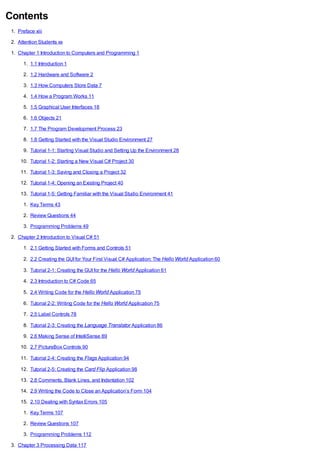
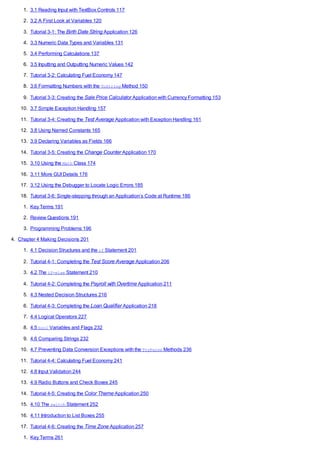
Contents
1. Preface xiii
2.Attention Students xx
1. Chapter 1 Introduction to Computers and Programming 1
1. 1.1 Introduction 1
2. 1.2 Hardware and Software 2
3. 1.3 How Computers Store Data 7
4. 1.4 How a Program Works 11
5. 1.5 Graphical User Interfaces 18
6. 1.6 Objects 21
7. 1.7 The Program Development Process 23
8. 1.8 Getting Started with the Visual Studio Environment 27
9. Tutorial 1-1: Starting Visual Studio and Setting Up the Environment 28
10. Tutorial 1-2: Starting a New Visual C# Project 30
11. Tutorial 1-3: Saving and Closing a Project 32
12. Tutorial 1-4: Opening an Existing Project 40
13. Tutorial 1-5: Getting Familiar with the Visual Studio Environment 41
1. Key Terms 43
2. Review Questions 44
3. Programming Problems 49
2. Chapter 2 Introduction to Visual C# 51
1. 2.1 Getting Started with Forms and Controls 51
2. 2.2 Creating the GUIfor Your First Visual C# Application: The Hello World Application 60
3. Tutorial 2-1: Creating the GUIfor the Hello World Application 61
4. 2.3 Introduction to C# Code 65
5. 2.4 Writing Code for the Hello World Application 75
6. Tutorial 2-2: Writing Code for the Hello World Application 75
7. 2.5 Label Controls 78
8. Tutorial 2-3: Creating the Language Translator Application 86
9. 2.6 Making Sense of IntelliSense 89
10. 2.7 PictureBox Controls 90
11. Tutorial 2-4: Creating the Flags Application 94
12. Tutorial 2-5: Creating the Card Flip Application 98
13. 2.8 Comments, Blank Lines, and Indentation 102
14. 2.9 Writing the Code to Close an Application’s Form 104
15. 2.10 Dealing with Syntax Errors 105
1. Key Terms 107
2. Review Questions 107
3. Programming Problems 112
3. Chapter 3 Processing Data 117
4.
1. 3.1 ReadingInput with TextBox Controls 117
2. 3.2 A First Look at Variables 120
3. Tutorial 3-1: The Birth Date String Application 126
4. 3.3 Numeric Data Types and Variables 131
5. 3.4 Performing Calculations 137
6. 3.5 Inputting and Outputting Numeric Values 142
7. Tutorial 3-2: Calculating Fuel Economy 147
8. 3.6 Formatting Numbers with the ToString Method 150
9. Tutorial 3-3: Creating the Sale Price Calculator Application with Currency Formatting 153
10. 3.7 Simple Exception Handling 157
11. Tutorial 3-4: Creating the Test Average Application with Exception Handling 161
12. 3.8 Using Named Constants 165
13. 3.9 Declaring Variables as Fields 166
14. Tutorial 3-5: Creating the Change Counter Application 170
15. 3.10 Using the Math Class 174
16. 3.11 More GUIDetails 176
17. 3.12 Using the Debugger to Locate Logic Errors 185
18. Tutorial 3-6: Single-stepping through an Application’s Code at Runtime 186
1. Key Terms 191
2. Review Questions 191
3. Programming Problems 196
4. Chapter 4 Making Decisions 201
1. 4.1 Decision Structures and the if Statement 201
2. Tutorial 4-1: Completing the Test Score Average Application 206
3. 4.2 The if-else Statement 210
4. Tutorial 4-2: Completing the Payroll with Overtime Application 211
5. 4.3 Nested Decision Structures 216
6. Tutorial 4-3: Completing the Loan Qualifier Application 218
7. 4.4 Logical Operators 227
8. 4.5 bool Variables and Flags 232
9. 4.6 Comparing Strings 232
10. 4.7 Preventing Data Conversion Exceptions with the TryParse Methods 236
11. Tutorial 4-4: Calculating Fuel Economy 241
12. 4.8 Input Validation 244
13. 4.9 Radio Buttons and Check Boxes 245
14. Tutorial 4-5: Creating the Color Theme Application 250
15. 4.10 The switch Statement 252
16. 4.11 Introduction to List Boxes 255
17. Tutorial 4-6: Creating the Time Zone Application 257
1. Key Terms 261
5.
2. Review Questions261
3. Programming Problems 265
5. Chapter 5 Loops, Files, and Random Numbers 271
1. 5.1 More about ListBoxes 271
2. 5.2 The while Loop 273
3. Tutorial 5-1: Using a Loop to Calculate an Account Balance 277
4. Tutorial 5-2: Enhancing the Ending Balance Application 280
5. 5.3 The ++ and −− operators 284
6. 5.4 The for Loop 285
7. Tutorial 5-3: Using the for Loop 290
8. 5.5 The do-while Loop 293
9. 5.6 Using Files for Data Storage 295
10. Tutorial 5-4: Writing Data to a Text File 301
11. Tutorial 5-5: Appending Data to the Friend.txt File 306
12. Tutorial 5-6: Using a Loop to Read to the End of a File 314
13. Tutorial 5-7: Calculating a Running Total 318
14. 5.7 The OpenFileDialog and SaveFileDialog Controls 321
15. 5.8 Random Numbers 326
16. Tutorial 5-8: Simulating Coin Tosses 328
17. 5.9 The Load Event 332
18. Tutorial 5-9: Creating a Load Event Handler 333
1. Key Terms 336
2. Review Questions 336
3. Programming Problems 339
6. Chapter 6 Modularizing Your Code with Methods 343
1. 6.1 Introduction to Methods 343
2. 6.2 void Methods 345
3. Tutorial 6-1: Creating and Calling Methods 349
4. 6.3 Passing Arguments to Methods 353
5. Tutorial 6-2: Passing an Argument to a Method 356
6. 6.4 Passing Arguments by Reference 364
7. Tutorial 6-3: Using an Output Parameter 367
8. 6.5 Value-Returning Methods 371
9. Tutorial 6-4: Writing a Value-Returning Method 376
10. Tutorial 6-5: Modularizing Input Validation with a Boolean Method 379
11. 6.6 Debugging Methods 384
12. Tutorial 6-6: Practicing the Step Into Command 385
13. Tutorial 6-7: Practicing the Step Over Command 386
14. Tutorial 6-8: Practicing the Step Out Command 387
1. Key Terms 389
2. Review Questions 389
6.
3. Programming Problems392
7. Chapter 7 Arrays and Lists 397
1. 7.1 Value Types and Reference Types 397
2. 7.2 Array Basics 400
3. Tutorial 7-1: Using an Array to Hold a List of Random Lottery Numbers 407
4. 7.3 Working with Files and Arrays 412
5. 7.4 Passing Arrays as Arguments to Methods 415
6. 7.5 Some Useful Array Algorithms 422
7. Tutorial 7-2: Processing an Array 432
8. 7.6 Advanced Algorithms for Sorting and Searching Arrays 437
9. 7.7 Two-Dimensional Arrays 444
10. Tutorial 7-3: Completing the Seating Chart Application 447
11. 7.8 Jagged Arrays 453
12. 7.9 The List Collection 454
13. Tutorial 7-4: Completing the Test Score List Application 460
14. 7.10 The ImageList Control 465
15. Tutorial 7-5: Completing the Random Card Application 467
1. Key Terms 470
2. Review Questions 470
3. Programming Problems 474
8. Chapter 8 Text Processing 479
1. 8.1 Introduction 479
2. 8.2 Working with Characters 479
3. Tutorial 8-1: Completing the Password Validation Application 485
4. 8.3 Working with Substrings 489
5. Tutorial 8-2: Completing the Telephone Format Application 498
6. Tutorial 8-3: Completing the Telephone Unformat Application 502
7. 8.4 Tokenizing Strings 506
8. Tutorial 8-4: Completing the CSV Reader Application 509
9. 8.5 The String.Format Method 514
1. Key Terms 519
2. Review Questions 519
3. Programming Problems 521
9. Chapter 9 Structures, Enumerated Types, and Dictionaries 525
1. 9.1 Introduction 525
2. 9.2 Structures 525
3. Tutorial 9-1: Completing the Phonebook Application 535
4. 9.3 The DateTime and TimeSpan Structures 541
5. 9.4 Enumerated Types 549
6. Tutorial 9-2: Completing the Color Spectrum Application 552
7. 9.5 Dictionaries 556
7.
8. Tutorial 9-3:Storing Names and Birthdays in a Dictionary 564
9. Tutorial 9-4: Using a Dictionary to Simulate a Deck of Cards 566
1. Key Terms 572
2. Review Questions 572
3. Programming Problems 575
10. Chapter 10 Introduction to Classes 581
1. 10.1 Introduction to Classes 581
2. Tutorial 10-1: Creating and Using the Coin Class 588
3. 10.2 Properties 593
4. Tutorial 10-2: Creating and Using the CellPhone Class 598
5. 10.3 Parameterized Constructors and Overloading 602
6. Tutorial 10-3: Creating and Using the BankAccount Class 603
7. 10.4 Storing Class Type Objects in Arrays and Lists 611
8. Tutorial 10-4: Completing the Cell Phone Inventory Application 612
9. 10.5 Finding the Classes and Their Responsibilities in a Problem 616
10. 10.6 Application of Classes: Creating Multiple Forms in a Project 625
11. Tutorial 10-5: Creating an Application with Two Forms 630
12. Tutorial 10-6: Accessing a Control on a Different Form 635
13. 10.7 Static Class Members 639
14. Tutorial 10-7: Creating a Simple Logging Utility with a Static Class 643
1. Key Terms 648
2. Review Questions 648
3. Programming Problems 652
11. Chapter 11 Inheritance, Polymorphism, and Interfaces 655
1. 11.1 Inheritance 655
2. Tutorial 11-1: Creating and Testing the SavingsAccount and CDAccount Classes 664
3. 11.2 Polymorphism 672
4. Tutorial 11-2: Completing the Polymorphism Application 677
5. 11.3 Abstract Classes 682
6. Tutorial 11-3: Completing the Computer Science Student Application 684
7. 11.4 Extension Methods 688
8. Tutorial 11-4: Creating Extension Methods693
9. 11.5 Interfaces 696
10. Tutorial 11-5: Writing and Implementing an Interface 699
1. Key Terms 708
2. Review Questions 708
3. Programming Problems 712
12. Chapter 12 Databases 715
1. 12.1 Introduction to Database Management Systems 715
2. 12.2 Tables, Rows, and Columns 717
3. 12.3 Creating a Database in Visual Studio 720
8.
4. Tutorial 12-1:Starting the Phone Book Application and Creating the Phonelist.mdf Database 721
5. 12.4 The DataGridView Control 729
6. Tutorial 12-2: Completing the Phone Book Application 729
7. 12.5 Connecting to an Existing Database and Using Details View Controls 736
8. Tutorial 12-3: Creating the Products Application and Using a Details View 738
9. 12.6 More About Data-Bound Controls 746
10. Tutorial 12-4: Creating the Product Lookup Application 749
11. Tutorial 12-5: Creating the Multiform Products Application 752
12. 12.7 Selecting Data with the SQL Select Statement 758
13. Tutorial 12-6: Creating the Product Queries Application 764
14. Tutorial 12-7: Creating the Product Queries Application 773
15. Tutorial 12-8: Creating the Product Search Application 777
1. Key Terms 783
2. Review Questions 783
3. Programming Problems 787
13. Chapter 13 Delegates, Anonymous Methods, and Lambda Expressions 789
1. 13.1 Delegates 789
2. 13.2 Anonymous Methods 795
3. 13.3 Lambda Expressions 797
4. 13.4 Built-In Delegates: Action, Func, and Predicate 803
5. Tutorial 13-1: Working with List Methods and Lambdas 811
1. Key Terms 815
2. Review Questions 815
3. Programming Challenges 818
14. Chapter 14 Language-Integrated Query (LINQ) 821
1. 14.1 Introduction to LINQ 821
2. Tutorial 14-1: Completing the Student Roster Application 827
3. 14.2 LINQ Method Syntax 831
4. Tutorial 14-2: Modifying the Student Roster Application 835
5. 14.3 More LINQ Extension Methods 837
6. Tutorial 14-3: Completing the Team Player Application 849
7. 14.4 Using LINQ to Query a Database 854
8. Tutorial 14-4: Completing the Phonelist Names Application 859
9. Tutorial 14-5: Completing the Product Reports Application 864
10. Tutorial 14-6: Completing the QueryDataSource Application 871
1. Key Terms 878
2. Review Questions 878
3. Programming Problems 881
1. Appendix A C# Primitive Data Types 883
2. Appendix B Additional User Interface Controls 885
9.
3. Appendix CASCII/Unicode Characters 905
4. Appendix D Answers to Checkpoint Questions 907
5. Appendix E Installing LINQ to SQL Classes in Visual Studio 929
6. Index 931
10.
Preface
Welcome to StartingOut with Visual C#, Fifth Edition. This book is intended for an introductory programming course and is ideal for students with
no prior experience. Students who are new to programming will appreciate the clear, down-to-earth explanations and the detailed walk-throughs
that are provided by the hands-on tutorials. More experienced students will appreciate the depth of detail as they learn about the .NET
Framework, databases, Language-Integrated Query, and other topics.
As with all the books in the Starting Out With series, the hallmark of this text is its clear, friendly, and easy-to-understand writing. In addition, it is
rich in example programs that are concise and practical. The programs in this book include short examples that highlight specific programming
topics, as well as more involved examples that focus on problem solving. Each chapter provides numerous hands-on tutorials that guide the
student through each step of the development of an application. In addition to detailed, step-by-step instructions, the tutorials also provide the
application’s completed code and screen captures of the completed forms.
New to This Edition
The biggest changes in this edition appear in the last half of the book. Some of the chapters have been reorganized, and two new chapters have
been added. Here is a summary of the reorganization:
The ImageList control is now covered along with Arrays and Lists in Chapter 7. Since an ImageList is a collection of images, it is fitting that
this control be covered in the same chapter as Arrays and Lists.
Chapter 8 has been split into two chapters, with new material added to both of the resulting chapters. In this edition, Chapter 8 is titled Text
Processing and Chapter 9 is titled Structures, Enumerated Types, and Dictionaries.
Two new chapters have been added. In this edition, Chapter 13 is titled Delegates and Lambda Expressions and Chapter 14 is titled
Language-Integrated Query (LINQ).
An abundance of new topics and improvements has been added to this edition:
var Keyword: This edition introduces the var keyword for variable declaration.
Advanced String Formatting: Chapter 8 includes a new section on formatting strings with the String.Format method.
Working with Dates and Times: Chapter 9 includes a new section about working with dates and times. The section covers the DateTime and
TimeSpan data types, as well as the DateTimePicker control.
Dictionaries: Chapter 9 includes a new section on the Dictionary collection. The student learns to store and work with data as key–value
pairs in dictionaries.
More Use of Auto-Properties: In the previous editions, property declarations were almost always written with explicitly declared backing
fields, even when the properties were simply used to set and get a value. Where possible, those property declarations have been rewritten
as auto-properties.
Object Initializer Syntax: Object initializer syntax is introduced in Chapters 8 and 10 as an alternative way to declare and initialize structures
and class instances.
Static Members: Chapter 10 has a new section on static fields, properties, methods, and classes.
Sealed Classes and Methods: Chapter 11 has a new discussion on using the sealed keyword to prevent classes from being inherited from,
and to prevent methods from being overridden.
Extension Methods: Chapter 11 covers extension methods, which allow you to extend classes that you cannot inherit from, as well as the
primitive data types.
Interfaces: Chapter 11 now includes a section on writing and using interfaces.
Delegates: Chapter 13 introduces the student to delegates.
Anonymous Methods: Chapter 13 also introduces anonymous methods, which go hand-in-hand with delegates.
Lambda Expressions: Chapter 13 concludes by showing the student how to use a lambda expression to concisely create a delegate and
anonymous method.
Language-Integrated Query (LINQ): Chapter 14 introduces LINQ, and shows how to query simple data structures such as arrays and Lists
using LINQ to Objects, and how to query databases using LINQ to SQL.
A GUI-Based Approach
Beginning students are more motivated to learn programming when their applications have some sort of graphical element, such as a graphical
user interface (GUI). Students using this book will learn to create GUI-based, event-driven, Visual C# applications. The Visual Studio environment
is used to create forms that are rich with user interface controls and graphical images.
11.
Learn to UseObjects Early, Learn to Write Classes Later
This book explains what an object is very early and shows the student how to create objects from classes that are provided by the .NET
Framework. It then introduces the student to the fundamentals of input and output, control structures, methods, arrays and lists, and file operations.
Then, the student learns to write his or her own classes and explores the topics of inheritance and polymorphism.
Brief Overview of Each Chapter
Chapter 1: Introduction to Computers and Programming
This chapter begins by giving a very concrete and easy-to-understand explanation of how computers work, how data is stored and manipulated,
and why we write programs in high-level languages. In this chapter, the student learns what an object is and sees several examples by studying
the objects that make up a program’s GUI. The chapter discusses steps in the programming development cycle. It also gives an introduction to
the Visual Studio environment.
Chapter 2: Introduction to Visual C#
In this chapter, the student learns to create forms with labels, buttons, and picture boxes and learns to modify control properties. The student is
introduced to C# code and learns the organizational structure of namespaces, classes, and methods. The student learns to write simple event-
driven applications that respond to button clicks or provide interaction through clickable images. The importance of commenting code is also
discussed.
Chapter 3: Processing Data
This chapter introduces variables and data types. It discusses the use of local variables and variables declared as fields within a form class. The
student learns to create applications that read input from TextBox controls, perform mathematical operations, and produce formatted output. The
student learns about the exceptions that can occur when the user enters invalid data into a TextBox and learns to write simple exception-handling
code to deal with those problems. Named constants are introduced as a way of representing unchanging values and creating self-documenting,
maintainable code. The student also learns more intricacies of creating graphical user interfaces. The chapter concludes with a discussion and
tutorial on using the Visual Studio debugger to locate logic errors by single-stepping through an application’s code.
Chapter 4: Making Decisions
In this chapter, the student learns about relational operators and Boolean expressions and is shown how to control the flow of a program with
decision structures. The if, if-else, and if-else-if statements are covered. Nested decision structures, logical operators, and the switch
statement are also discussed. The student learns to use the TryParse family of methods to validate input and prevent exceptions. Radio buttons,
check boxes, and list boxes are introduced as ways to let the user select items in a GUI.
Chapter 5: Loops, Files, and Random Numbers
This chapter shows the student how to use loops to create repetition structures. The while loop, the for loop, and the do-while loop are
presented. Counters, accumulators, and running totals are also discussed. This chapter also introduces sequential file input and output and using
text files. The student learns various programming techniques for writing data to text files and reading the contents of test files. The chapter
concludes with a discussion of pseudorandom numbers, their applications, and how to generate them.
Chapter 6: Modularizing Your Code with Methods
In this chapter, the student first learns how to write and call void methods as well as value-returning methods. The chapter shows the benefits of
using methods to modularize programs and discusses the top-down design approach. Then, the student learns to pass arguments to methods.
Passing by value, by reference, and output parameters are discussed. The chapter concludes with a discussion and tutorial on debugging
methods with the Visual Studio step-into, step-over, and step-out, commands.
Chapter 7: Arrays and Lists
Arrays and lists are reference-type objects in C# so this chapter begins by discussing the difference between value type and reference type
objects in the C# language. Then, the student learns to create and work with single-dimensional and two-dimensional arrays. The student learns to
pass arrays as arguments to methods, transfer data between arrays and files, work with partially filled arrays, and create jagged arrays. Many
examples of array processing are provided, including examples of finding the sum, average, highest, and lowest values in an array. Finally, the
student learns to create List objects and store data in them, and use the ImageList control, a data structure for storing and retrieving images.
Chapter 8: Text Processing
This chapter discusses various techniques for working with text. The topics include working with characters, working with substrings, tokenizing
12.
Visit https://ebookmass.com todayto explore
a vast collection of ebooks across various
genres, available in popular formats like
PDF, EPUB, and MOBI, fully compatible with
all devices. Enjoy a seamless reading
experience and effortlessly download high-
quality materials in just a few simple steps.
Plus, don’t miss out on exciting offers that
let you access a wealth of knowledge at the
best prices!
13.
strings, and formattingstrings.
Chapter 9: Structures, Enumerated Types, and Dictionaries.
In this chapter, the student learns to use structures to encapsulate several variables into a single item. The student next learns to create and use
enumerated types. Last, the student learns to use the Dictionary collection from the .NET Framework to store and work with data as key–value
pairs.
Chapter 10: Introduction to Classes.
Up to this point, the student has extensively used objects that are instances of .NET Framework classes. In this chapter, the student learns to write
classes to create his or her own objects with fields, methods, and constructors. The student learns how to implement various types of properties
within a class, including auto-properties and read-only auto-properties. Creating arrays of objects and storing objects in a List are also
discussed. A primer on finding the classes in a problem as well as their responsibilities is provided. The chapter shows the student how to create
multiple form classes in a project, instantiate those classes, and display them. A tutorial is given where the student creates a multiform application
in which the code in one form accesses controls on another form. The chapter concludes by discussing static members and static classes.
Chapter 11: Inheritance, Polymorphism, and Interfaces
The study of classes continues in this chapter with the subjects of inheritance and polymorphism. The topics covered include base classes,
derived classes, how constructors functions work in inheritance, method overriding, and polymorphism. Abstract classes and abstract methods
are also discussed. The chapter discusses extension methods, and concludes with a section on interfaces.
Chapter 12: Databases
This chapter introduces the student to basic database concepts. The student first learns about tables, rows, and columns and how to create an
SQL Server database in Visual Studio. The student then learns how to connect a database to a Visual C# application and display a table in a
DataGridView control, a Details view, and other data-bound controls. Finally, the student learns how to write SQL Select statements to retrieve
data from a table.
Chapter 13: Delegates and Lambda Expressions.
Lambda expressions have become commonplace in C# programming. Before the student can really understand lambda expressions, he or she
must first understand delegates and anonymous methods. The goal of this chapter is to build a foundation of knowledge about how delegates and
anonymous methods work, and then build an understanding of lambda expressions.
Chapter 14: Language-Integrated Query (LINQ).
This chapter begins by introducing the student to LINQ as a tool for querying the data in common data structures such as arrays and Lists, using
LINQ to Objects. It discusses both query syntax and method syntax. Several useful LINQ extension methods are also discussed. The chapter
concludes with a section on LINQ to SQL and discusses how to use LINQ to query a database.
Appendix A: C# Primitive Data Types
This appendix gives an overview of the primitive data types available in C#.
Appendix B: Additional User Interface Controls
This appendix shows how to create a variety of controls such as ToolTips, combo boxes, scroll bars, TabControls, WebBrowser controls,
ErrorProvider components, and menu systems.
Appendix C: ASCII/Unicode Characters
This appendix lists the ASCII(American Standard Code for Information Interchange) character set, which is also the Latin Subset of Unicode.
Appendix D: Answers to Checkpoint Questions
This appendix provides the answers to the Checkpoint questions that appear throughout each chapter in the book.
Appendix E: Installing LINQ to SQL.
This appendix shows how to use the Visual Studio Installer to download and install LINQ to SQL.
14.
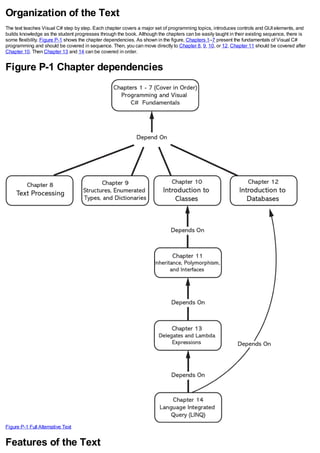
Organization of theText
The text teaches Visual C# step by step. Each chapter covers a major set of programming topics, introduces controls and GUIelements, and
builds knowledge as the student progresses through the book. Although the chapters can be easily taught in their existing sequence, there is
some flexibility. Figure P-1 shows the chapter dependencies. As shown in the figure, Chapters 1–7 present the fundamentals of Visual C#
programming and should be covered in sequence. Then, you can move directly to Chapter 8, 9, 10, or 12. Chapter 11 should be covered after
Chapter 10. Then Chapter 13 and 14 can be covered in order.
Figure P-1 Chapter dependencies
Figure P-1 Full Alternative Text
Features of the Text
15.
Concept Statements
Each majorsection of the text starts with a concept statement. This statement concisely summarizes the main point of the section.
Tutorials
Each chapter has several hands-on tutorials that guide the student through the development of an application. Each tutorial provides detailed,
step-by-step instructions, as well as the application’s completed code and screen captures of the completed forms.
Example Programs
Each chapter has an abundant number of code examples designed to highlight the current topic.
Notes
Notes appear at several places throughout the text. They are short explanations of interesting or often misunderstood points relevant to the topic
at hand.
Tips
Tips advise the student on the best techniques for approaching different programming or animation problems.
Warnings
Warnings caution students about programming techniques or practices that can lead to malfunctioning programs or lost data.
Checkpoints
Checkpoints are questions placed at intervals throughout each chapter. They are designed to query the student’s knowledge quickly after learning
a new topic. The answers to the Checkpoint questions can be found in Appendix D.
Review Questions
Each chapter presents a thorough and diverse set of Review Questions. They include Multiple Choice, True/False, Algorithm Workbench, and
Short Answer.
Programming Problems
Each chapter offers a pool of Programming Problems designed to solidify the student’s knowledge of the topics currently being studied.
VideoNotes
Each tutorial in the book has an accompanying online VideoNote that can be accessed on the book’s companion Web site
www.pearson.com/gaddis. Students can follow along with the author as he or she works through each tutorial in the videos. Also, one
programming problem at the end of each chapter has an accompanying VideoNote that shows the student how to create the solution.
Supplements
Student
The following supplementary material is available with the book:
Source code and files required for the chapter tutorials are available at www.pearson.com/cs-resources
A complete set of online VideoNotes that take the student through each tutorial in the book. Also, one programming problem from each
chapter has an accompanying VideoNote that helps the student create a solution. You may access the VideoNotes by going to
www.pearson.com/cs-resources.
Instructor
16.
The following supplementsare available to qualified instructors:
Answers to all Review Questions in the text
Solutions for all Programming Problems in the text
Completed versions of all tutorials
PowerPoint presentation slides for every chapter
Test bank
For information on how to access these supplements, visit the Pearson Education Instructor Resource Center at www.pearsonhighered.com/irc.
Acknowledgments
There were many helping hands in the development and publication of this text. Iwould like to thank the following faculty reviewers for their helpful
suggestions and expertise:
Matthew Alimagham Spartanburg Community College
Carolyn Borne Louisiana State University
Arthur E. Carter Radford University
Sallie B. Dodson Radford University
Elizabeth Freije Indiana University—Purdue University, Indianapolis
Bettye J. Parham Daytona State College
Wendy L. Payne Gulf Coast State College
Jason Sharp Tarleton State University
John Van Assen York Technical College
Reginald White Black Hawk College
Dawn R. Wick Southwestern Community College
Ialso want to thank everyone at Pearson for making the Starting Out With ... series so successful. Ihave worked so closely with the team at
Pearson that Iconsider them among my closest friends. Iam extremely fortunate to have Matt Goldstein as my editor, and Meghan Jacoby as
Editorial Assistant. They have guided me through the process of revising this book, as well as many others. Iam also fortunate to have Demetrius
Hall and Yvonne Vannatta as my marketing team. Their hard work is truly inspiring, and they do a great job of getting this book out to the
academic community. The production team, led by Carole Snyder, worked tirelessly to make this book a reality. Thanks to you all!
About the Author
Tony Gaddis is the principal author of the Starting Out With series of textbooks. Tony has nearly 20 years experience teaching computer
science courses at Haywood Community College in North Carolina. He is a highly acclaimed instructor who was previously selected as the North
Carolina Community College Teacher of the Year and has received the Teaching Excellence Award from the National Institute for Staff and
Organizational Development.
The Starting Out With series includes introductory books using the C++ programming language, the Java™ programming language, Microsoft®
Visual Basic®, Microsoft® C#®, Python, Programming Logic and Design, MIT App Inventor, and Alice, all published by Pearson Education.
17.
Attention Students
Installing VisualStudio
To complete the tutorials and programming problems in this book, you need to install Visual Studio 2017, or a later version, on your computer. We
recommend that you download Visual Studio Community 2017 from the following website, and install it on your system:
www.visualstudio.com
Visual Studio Community 2017 is a free, full-featured development environment, and is a perfect companion for this textbook.
Note
If you are working in your school’s computer lab, there is a good chance that Microsoft Visual Studio has already been installed. If this is the
case, your instructor will show you how to start Visual Studio.
Installing the Student Sample Program Files
The Student Sample Program files that accompany this book are available for download from the book’s companion Web site at:
www.pearson.com/cs-resources
These files are required for many of the book’s tutorials. Simply download the Student Sample Program files to a location on your hard drive
where you can easily access them.
18.
Chapter 1 Introductionto Computers and Programming
Topics
1. 1.1 Introduction
2. 1.2 Hardware and Software
3. 1.3 How Computers Store Data
4. 1.4 How a Program Works
5. 1.5 Graphical User Interfaces
6. 1.6 Objects
7. 1.7 The Program Development Process
8. 1.8 Getting Started with the Visual Studio Environment
19.
1.1 Introduction
Think aboutsome of the different ways that people use computers. In school, students use computers for tasks such as writing papers, searching
for articles, sending e-mail, and participating in online classes. At work, people use computers to analyze data, make presentations, conduct
business transactions, communicate with customers and coworkers, control machines in manufacturing facilities, and do many other things. At
home, people use computers for tasks such as paying bills, shopping online, staying connected with friends and family, and playing computer
games. And don’t forget that smart phones, tablets, car navigation systems, and many other devices are computers as well. The uses of
computers are almost limitless in our everyday lives.
Computers can do such a wide variety of things because they can be programmed, which means that computers are designed not to do just one
job, but to do any job that their programs tell them to do. A program is a set of instructions that a computer follows to perform a task. For example,
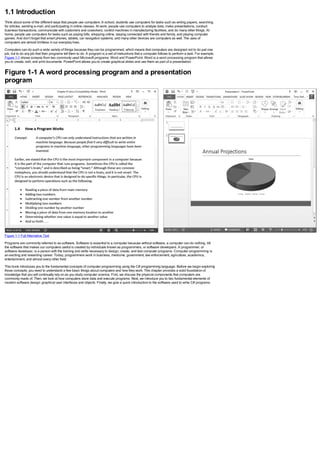
Figure 1-1 shows screens from two commonly used Microsoft programs: Word and PowerPoint. Word is a word processing program that allows
you to create, edit, and print documents. PowerPoint allows you to create graphical slides and use them as part of a presentation.
Figure 1-1 A word processing program and a presentation
program
Figure 1-1 Full Alternative Text
Programs are commonly referred to as software. Software is essential to a computer because without software, a computer can do nothing. All
the software that makes our computers useful is created by individuals known as programmers, or software developers. A programmer, or
software developer, is a person with the training and skills necessary to design, create, and test computer programs. Computer programming is
an exciting and rewarding career. Today, programmers work in business, medicine, government, law enforcement, agriculture, academics,
entertainment, and almost every other field.
This book introduces you to the fundamental concepts of computer programming using the C# programming language. Before we begin exploring
those concepts, you need to understand a few basic things about computers and how they work. This chapter provides a solid foundation of
knowledge that you will continually rely on as you study computer science. First, we discuss the physical components that computers are
commonly made of. Then, we look at how computers store data and execute programs. Next, we introduce you to two fundamental elements of
modern software design: graphical user interfaces and objects. Finally, we give a quick introduction to the software used to write C# programs.
20.
1.2 Hardware andSoftware
Concept
The physical devices that a computer is made of are referred to as the computer’s hardware. The programs that run on a computer are referred to
as software.
Hardware
Hardware refers to all the physical devices, or components, of which a computer is made. A computer is not one single device but is a system of
devices that all work together. Like the different instruments in a symphony orchestra, each device in a computer plays its own part.
If you have ever shopped for a computer, you have probably seen sales literature listing components such as microprocessors, memory, disk
drives, video displays, graphics cards, and so forth. Unless you already know a lot about computers or at least have a friend who does,
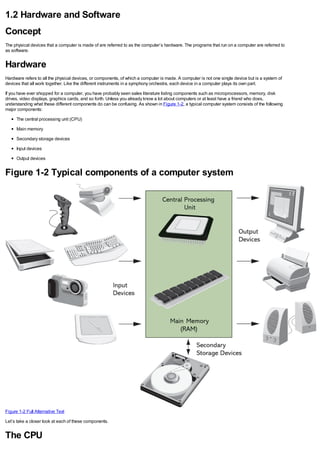
understanding what these different components do can be confusing. As shown in Figure 1-2, a typical computer system consists of the following
major components:
The central processing unit (CPU)
Main memory
Secondary storage devices
Input devices
Output devices
Figure 1-2 Typical components of a computer system
Figure 1-2 Full Alternative Text
Let’s take a closer look at each of these components.
The CPU
21.
When a computeris performing the tasks that a program tells it to do, we say that the computer is running or executing the program. The central
processing unit, or CPU, is the part of a computer that actually runs programs. The CPU is the most important component in a computer because
without it, the computer could not run software.
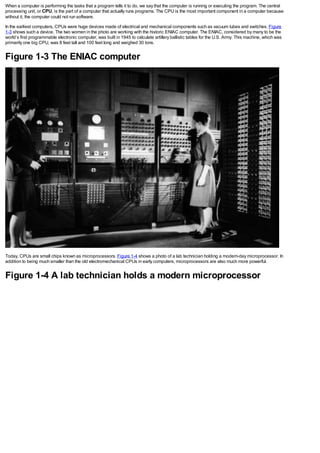
In the earliest computers, CPUs were huge devices made of electrical and mechanical components such as vacuum tubes and switches. Figure
1-3 shows such a device. The two women in the photo are working with the historic ENIAC computer. The ENIAC, considered by many to be the
world’s first programmable electronic computer, was built in 1945 to calculate artillery ballistic tables for the U.S. Army. This machine, which was
primarily one big CPU, was 8 feet tall and 100 feet long and weighed 30 tons.
Figure 1-3 The ENIAC computer
Today, CPUs are small chips known as microprocessors. Figure 1-4 shows a photo of a lab technician holding a modern-day microprocessor. In
addition to being much smaller than the old electromechanical CPUs in early computers, microprocessors are also much more powerful.
Figure 1-4 A lab technician holds a modern microprocessor
22.
Main Memory
You canthink of main memory as the computer’s work area. This is where the computer stores a program while the program is running, as well as
the data that the program is working with. For example, suppose you are using a word processing program to write an essay for one of your
classes. While you do this, both the word processing program and the essay are stored in main memory.
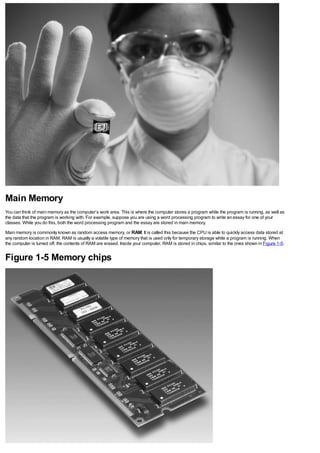
Main memory is commonly known as random access memory, or RAM. It is called this because the CPU is able to quickly access data stored at
any random location in RAM. RAM is usually a volatile type of memory that is used only for temporary storage while a program is running. When
the computer is turned off, the contents of RAM are erased. Inside your computer, RAM is stored in chips, similar to the ones shown in Figure 1-5.
Figure 1-5 Memory chips
23.
Visit https://ebookmass.com todayto explore
a vast collection of ebooks across various
genres, available in popular formats like
PDF, EPUB, and MOBI, fully compatible with
all devices. Enjoy a seamless reading
experience and effortlessly download high-
quality materials in just a few simple steps.
Plus, don’t miss out on exciting offers that
let you access a wealth of knowledge at the
best prices!
and that theywould “stand for anything.” He also said that he would
take at least forty more passports from Aucher, and that he would
want them right along for six months or a year, depending on the
length of the war.
Aucher delivered two more passports to Ruroede in his office on
the morning of December 30th. Ruroede was rather indifferent about
getting them, because—alas for the glory of the “invincible” Prussian
arms!—two of his German officers had gotten “cold feet” and had
refused to go. Ruroede told Aucher to come back at two o’clock and
he would give him $100. Aucher invited Ruroede to have luncheon
with him, and as they left the building Ruroede explained with much
pride that he had chosen his office here because the building had
several entrances on different sides of the block, and he used one
entrance only a few days at a time and then changed to another to
avoid suspicion.
The Government’s special agent complimented him highly on this
bit of cleverness in the art of evasion. Five minutes later the two
were sitting at a lunch counter with another special agent casually
lounging in and taking the seat next to his fellow operative, where
he could overhear and corroborate the account of Ruroede’s
conversation.
After a discussion of Wedell’s forgeries and present whereabouts,
and a further discussion of the buying of passports (in which
Ruroede confided to Aucher that “there is a German fund that was
sent over here for that purpose”) the pair walked back toward
Ruroede’s office. At the Whitehall Street entrance Ruroede told
Aucher to come around to the Bridge Street entrance in about fifteen
minutes to get the money, and that in the meantime he would send
his son out to cash a check so that he could deliver it in bills. Aucher
spent part of the fifteen minutes signalling to four other special
agents who had reinforced him, and then went around to the Bridge
Street entrance, with one of his confederates in sight.
In a few moments, Ruroede’s son rushed out with a bank book in
his hand. Aucher stopped him and told him he ought to have a coat
26.
on, a deviceto let Aucher’s fellow operative see him talking to the
boy so he could identify him. The boy then went on to the bank,
followed by Aucher’s confederate, who saw him cash the check and
followed him back to the building.
When the boy returned, Aucher again spoke to him and said: “Tell
your father I will be in the café at Whitehall and Bridge streets and
that he is to meet me there. I don’t think it is a good thing for
anybody to see me hanging around the front entrance.”
Aucher then went on into the café and signalled to the other three
operatives to follow him. He took a seat in a bootblack’s chair near
the entrance and proceeded to have his shoes blacked. In about ten
minutes Ruroede’s son came out and was about to pass by him
when Aucher hailed him. Ruroede’s son then took a sealed envelope
from his inside pocket and handed it to Aucher.
“Where is your father?” Aucher asked.
“Oh, he’s got a man upstairs with him,” said young Ruroede, “and
he couldn’t come down.”
“Wait a minute,” said Aucher, and tore open the envelope in the
presence of Ruroede’s son, and, so that the other special agents
could see him do it, counted out ten $10 bills, $100 in all. As he was
counting them, the operative who had followed Ruroede’s son to the
bank came in and shouldered the boy to one side and then stood
right by him while the money was being counted. Aucher went on to
impress on Ruroede’s son that business was business and that the
best of friends sometimes fell out over money matters; that his
father might have unintentionally counted out $80 or $90 instead of
the full $100 and it was safer to take some precautions than to take
a chance of creating bad blood between them. He then invited
Ruroede’s son to have a drink with him, which he did, both of them
taking the strongest Prussian drink—milk. When they were about to
part on Whitehall Street Aucher told Ruroede’s son to tell his father
he would be down the next morning with the other two passports he
had mentioned to him, and again impressed on the boy the
27.
importance of accuracyin money matters. Aucher then returned to
headquarters with the other special agents and listed the
distinguishing marks on the bills and marked them for future
identification.
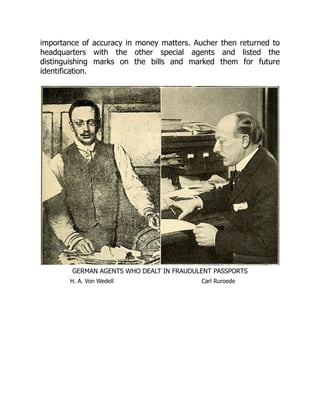
GERMAN AGENTS WHO DEALT IN FRAUDULENT PASSPORTS
H. A. Von Wedell Carl Ruroede
28.
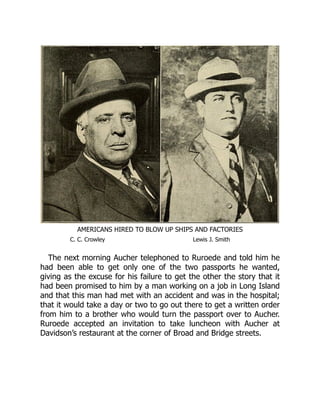
AMERICANS HIRED TOBLOW UP SHIPS AND FACTORIES
C. C. Crowley Lewis J. Smith
The next morning Aucher telephoned to Ruroede and told him he
had been able to get only one of the two passports he wanted,
giving as the excuse for his failure to get the other the story that it
had been promised to him by a man working on a job in Long Island
and that this man had met with an accident and was in the hospital;
that it would take a day or two to go out there to get a written order
from him to a brother who would turn the passport over to Aucher.
Ruroede accepted an invitation to take luncheon with Aucher at
Davidson’s restaurant at the corner of Broad and Bridge streets.
29.
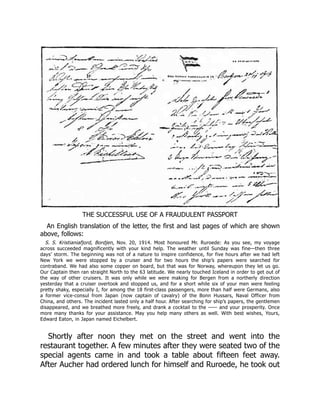
THE SUCCESSFUL USEOF A FRAUDULENT PASSPORT
An English translation of the letter, the first and last pages of which are shown
above, follows:
S. S. Kristianiafjord, Bordjen, Nov. 20, 1914. Most honoured Mr. Ruroede: As you see, my voyage
across succeeded magnificently with your kind help. The weather until Sunday was fine—then three
days’ storm. The beginning was not of a nature to inspire confidence, for five hours after we had left
New York we were stopped by a cruiser and for two hours the ship’s papers were searched for
contraband. We had also some copper on board, but that was for Norway, whereupon they let us go.
Our Captain then ran straight North to the 63 latitude. We nearly touched Iceland in order to get out of
the way of other cruisers. It was only while we were making for Bergen from a northerly direction
yesterday that a cruiser overtook and stopped us, and for a short while six of your men were feeling
pretty shaky, especially I, for among the 18 first-class passengers, more than half were Germans, also
a former vice-consul from Japan (now captain of cavalry) of the Bonn Hussars, Naval Officer from
China, and others. The incident lasted only a half hour. After searching for ship’s papers, the gentlemen
disappeared, and we breathed more freely, and drank a cocktail to the —— and your prosperity. Once
more many thanks for your assistance. May you help many others as well. With best wishes, Yours,
Edward Eaton, in Japan named Eichelbert.
Shortly after noon they met on the street and went into the
restaurant together. A few minutes after they were seated two of the
special agents came in and took a table about fifteen feet away.
After Aucher had ordered lunch for himself and Ruroede, he took out
30.
of his pocketanother of the series of genuine passports supplied by
the State Department, to which he had attached one of the
photographs Ruroede had given him for this purpose. He handed the
passport to Ruroede, who opened only one end of it, just enough to
glance at the photograph and seal.
“That’s fine,” said Ruroede, and was about to slip it into his pocket
when Aucher seized it and exclaimed:
“Fine? I should say,” and opened the passport wide so that one of
the other special agents could see the red seal on it. “Just look at
that description. Eh? He is the fellow with the military bearing and I
gave him a description I figured a man like him should answer to.”
At this point, the special agent who had seen the seal left his seat
at the table and walked to the cashier’s desk. As he passed, Ruroede
was holding the passport in his hands and Aucher was pointing out
the description. Ruroede then put the passport into his pocket and
said again: “That’s fine.”
Aucher then opened a discussion of Von Wedell’s career and
disappearance. Ruroede was very contemptuous of the missing man.
“He was a plain fool,” he said. “He paid $3,500 altogether and got
very little in return. A fellow came to him one day and told him he
could get him American passports and Von Wedell said: ‘All right; go
ahead.’ The fellow returned later and said he would have to have
some expense money and he gave him $10. A little while later a
friend of the first man came to Von Wedell wanting expense money.
When Von Wedell decided to put him off, he became threatening and
Von Wedell, fearing he might tell the Government authorities, gave
him some money. A few days later about twenty fellows came
looking for Von Wedell. But quite aside from that sort of business
Von Wedell’s foolishness in forging names on two American
passports is the thing that made him get away.”
“Did I understand you to say,” asked Aucher, “that he had gone to
join his wife?”
31.
“No,” replied Ruroede,“she will be in Germany before him. She
sailed last Tuesday. He went to Cuba first and there got a Mexican
passport of some sort that will take him to Spain. He ought to be in
Barcelona to-day and from there go to Italy, and then from there
work his way into Germany.”
“You say Von Wedell spent $3,500 of his own money?” Aucher
asked.
“No, no,” exclaimed Ruroede, “he got it from the fund.”
“Well, who puts up this money—who’s back of it?”
“The Government.”
“The German Government?”
“Yes,” said Ruroede. “You see it is this way: There is a captain
here who is attached to the German Embassy at Washington. He has
a list of German reservists in this country and is in touch with the
German consulates all through the country and in Peru, Mexico,
Chile, etc. He gets in touch with them, and the consuls send
reservists, who want to go to the front, on to New York. When they
get here, this captain tells them: ‘Well, I can’t do anything for you,
but you go down to see Ruroede.’ Sometimes he gives them his
personal card.”
“Is this captain in reserve?” Aucher interrupted.
“Oh, no, he is active,” Ruroede replied. “You see,” he continued,
“he draws on this fund for $200 or $300 or $1,000, whatever he may
need, and the checks are made to read ‘on account of reservists.’
You see, they have to have food and clothing, also, so there is
nothing to show that this money is paid out for passports or
anything like that. I meet this captain once a week or so, and tell
him what I am doing and he gives me whatever money I need. You
see, there must be no connection between him and me; no letters,
no accounts, nothing in writing. If I were caught and were to say
what I have told you, this captain would swear that he never met
me in his life before.”
32.
Who this captainwas became perfectly clear through an odd
happening two days later. On that day, January 2, 1915, Aucher
telephoned to Ruroede at his office and made an appointment to
meet him at a quarter of one. This meeting will doubtless remain
forever memorable in Ruroede’s experience.
At twelve-thirty a whole flock of special agents left the office of
the Bureau of Investigation of the Department of Justice in the Park
Row Building. There were nine representatives of the Department in
the group. When they got near Ruroede’s office they were joined by
two others who had been shadowing Ruroede. They had located him
at the Eastern Hotel, several blocks away, where he was at the
moment with one of the German officers who planned to sail that
day on the Norwegian Line steamer Bergensfjord with one of the
false passports.
Shortly after one o’clock one of the special agents notified the
group that Ruroede had returned to his office and then this
operative, and one other, went to the Customs House and stationed
themselves at a window opposite Ruroede’s office to wait for a signal
which Aucher was to give when he had delivered the passport to
Ruroede.
When Aucher met Ruroede in the latter’s office Ruroede’s son was
present, but in a few moments the younger man took his leave, and
his departure was noted by one of the agents outside. After a few
minutes’ conversation Aucher handed Ruroede the missing passport
and made his signal to the two men inside the Customs House
window. These men reported to the main group on the street and
thereupon the whole flock descended on Ruroede’s office and placed
both Ruroede and Aucher under arrest.
They seized all of Ruroede’s papers before they took him away,
including the passport which Aucher had just delivered to him.
Aucher put up a fight against his brother officers, so as to make
Ruroede believe that his arrest was genuine, but was quickly
subdued and taken away. A few minutes later Ruroede also was
taken from his office over to the offices of the Bureau of
33.
Investigation, but toanother room than Aucher. Operatives were left
behind in Ruroede’s office, and in a little while Ruroede’s son came
in. He, too, was arrested and taken to still another part of the office
of the Bureau.
Now there entered Ruroede’s office a stranger, who to this day
does not know that he unwittingly gave the officers of the United
States Government the information that Captain Von Papen was
directly responsible for the passport frauds. This man entered while
one of the operatives was busily gathering up the papers on
Ruroede’s desk. He said he wanted to see Mr. Ruroede. The
operative asked him what his business was, and he replied that he
had a letter to give him; and answering an inquiry, he said this letter
was given him by Captain Von Papen, to be delivered to Ruroede.
The operative calmly informed the caller that he was Mr. Ruroede’s
son and that he could give the letter to him. The stranger refused,
so the operative told him that his “father,” Ruroede, would be in in a
few minutes. After the few minutes were up, he told the caller that
he was sure that his “father” would not return after all, and that he
had better go with him to where his “father” was. The stranger
agreed and they left the office together, the operative taking him
directly to the office of the Bureau of Investigation.
On the way, the stranger decided to give him the letter from
Captain Von Papen, and also told him that he had come from Tokyo
by way of San Francisco; that he was very anxious to get back to
Germany; and that he was sorry he was not sailing on the boat
leaving that day. He knew, he said, that Ruroede had a great many
officers sailing on the ship that day, and asked if he thought the
operative’s “father” could make an arrangement to start him to
Germany, too. He gave as a reason for his urgency the fact that he
had with him eight trunks which contained very important papers in
connection with the war that should be delivered in Berlin without
delay.
Upon arriving at the office of the Bureau of Investigation the
operative excused himself for a moment and went into another
34.
room, where heconcocted a plan with a fellow agent to pose as the
senior Ruroede. The operative then brought the stranger in and
introduced his confederate as his father. The stranger gave this
agent of the Department his card which was printed in German and,
which translated into English, read, “Wolfram von Knorr, Captain of
Cruiser, Naval Attaché, Imperial German Embassy, Tokyo.”
But let us leave the guileless caller in the hands of the guileful
agent of Justice for a few moments, returning to him a little later.
Meanwhile, four of the agents from the Department—the minute
they received the signal that Ruroede was under arrest—hastened to
the Barge Office dock and boarded the revenue cutter Manhattan,
on which they overtook the Norwegian Line steamship Bergensfjord
at four o’clock, about one half hour after it had set sail. They were
accompanied by several customs inspectors and ordered the
Bergensfjord to heave to. All the male passengers on board were
lined up. Strange as it may seem, they discovered four Germans, of
such unmistakable names as Sachse, Meyer, Wegener, and Muller,
travelling under such palpably English and Norwegian names as
Wright, Hansen, Martin, and Wilson. Stranger still, they all turned
out to be reserve officers in the German army. Sache proved to be
travelling as none other than our friend “Howard Paul Wright,” for
whom Aucher had supplied Ruroede with the passport—as, indeed,
he had for the three others.
Meanwhile, Ruroede was the centre of another little drama that
lasted until well toward midnight. He was being urged by the United
States Assistant District Attorney to “come across” with the facts
about his activities in the passport frauds, and he had stood up
pretty well against the persuasions and hints of the attorney and the
doubts and fears of his own mind. About eleven o’clock at night, as
he was for the many’th time protesting his ignorance and his
innocence, another agent of the Bureau of Investigation walked
across the far end of the dimly lit room—in one door and out
another—accompanied by a fair-haired lad of nineteen.
35.
“My God!” exclaimedRuroede, “have they got my son, too? The
boy knows nothing at all about this.”
This little ghost-walking scene, borrowed from “Hamlet,” broke
down Ruroede’s reserve, and he came out with pretty much all the
story, ending the melancholy exclamation with which this story
began: “I thought I was going to get an Iron Cross; but what they
ought to do is to pin a little tin stove on me.”
Ruroede admitted that he had met Captain Von Papen in New York
frequently and that Von Papen had given him money at different
times, but he denied that this money was given him for use in
furnishing passports. On this point he stood fast, and to this day he
has not directly implicated Von Papen in these frauds, though it cost
him a sentence of three years in the Federal penitentiary at Atlanta,
imposed just two months later.
One thing Ruroede did confess, however, and in doing so he was
the Hand of Fate for the timorous Von Wedell. Ruroede confessed
that his assertion to Aucher, that Wedell was then in Barcelona, was
a lie, and that the truth was that Wedell had recently returned from
Cuba and was aboard the Bergensfjord! This confession came too
late to serve that day, for the agents of the Bureau had by that time
left the ship with their four prisoners and the Bergensfjord was out
to sea. But Fate had nevertheless played Wedell a harsh trick, for the
processes of extradition were instantly put in motion with what
strange results will in a few moments be made clear.
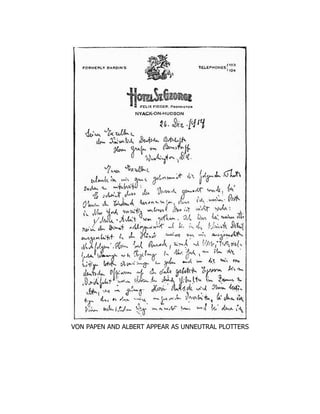
This letter [ofwhich the facsimiles are of the first and last pages] was written by
Wedell to Bernstorff to justify his action in abandoning the work of gathering
passports for fraudulent use. The full text follows, in English. It is an interesting
document, not only because it reveals a lot of weak human nature in the agents of
“German efficiency” but also because it definitely revealed Von Papen and Albert
as principals in the German plots as early as three months after the war started:
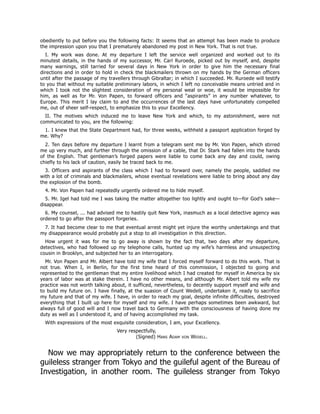
HOTEL ST. GEORGE Felix Fieger, Proprietor, Nyack-on-Hudson, December 26, 1914. His Excellency The
Imperial German Ambassador, Count Von Bernstorff, Washington, D. C. Your Excellency: Allow me most
38.
obediently to putbefore you the following facts: It seems that an attempt has been made to produce
the impression upon you that I prematurely abandoned my post in New York. That is not true.
I. My work was done. At my departure I left the service well organized and worked out to its
minutest details, in the hands of my successor, Mr. Carl Ruroede, picked out by myself, and, despite
many warnings, still tarried for several days in New York in order to give him the necessary final
directions and in order to hold in check the blackmailers thrown on my hands by the German officers
until after the passage of my travellers through Gibraltar; in which I succeeded. Mr. Ruroede will testify
to you that without my suitable preliminary labors, in which I left no conceivable means untried and in
which I took not the slightest consideration of my personal weal or woe, it would be impossible for
him, as well as for Mr. Von Papen, to forward officers and “aspirants” in any number whatever, to
Europe. This merit I lay claim to and the occurrences of the last days have unfortunately compelled
me, out of sheer self-respect, to emphasize this to your Excellency.
II. The motives which induced me to leave New York and which, to my astonishment, were not
communicated to you, are the following:
1. I knew that the State Department had, for three weeks, withheld a passport application forged by
me. Why?
2. Ten days before my departure I learnt from a telegram sent me by Mr. Von Papen, which stirred
me up very much, and further through the omission of a cable, that Dr. Stark had fallen into the hands
of the English. That gentleman’s forged papers were liable to come back any day and could, owing
chiefly to his lack of caution, easily be traced back to me.
3. Officers and aspirants of the class which I had to forward over, namely the people, saddled me
with a lot of criminals and blackmailers, whose eventual revelations were liable to bring about any day
the explosion of the bomb.
4. Mr. Von Papen had repeatedly urgently ordered me to hide myself.
5. Mr. Igel had told me I was taking the matter altogether too lightly and ought to—for God’s sake—
disappear.
6. My counsel, ... had advised me to hastily quit New York, inasmuch as a local detective agency was
ordered to go after the passport forgeries.
7. It had become clear to me that eventual arrest might yet injure the worthy undertakings and that
my disappearance would probably put a stop to all investigation in this direction.
How urgent it was for me to go away is shown by the fact that, two days after my departure,
detectives, who had followed up my telephone calls, hunted up my wife’s harmless and unsuspecting
cousin in Brooklyn, and subjected her to an interrogatory.
Mr. Von Papen and Mr. Albert have told my wife that I forced myself forward to do this work. That is
not true. When I, in Berlin, for the first time heard of this commission, I objected to going and
represented to the gentleman that my entire livelihood which I had created for myself in America by six
years of labor was at stake therein. I have no other means, and although Mr. Albert told my wife my
practice was not worth talking about, it sufficed, nevertheless, to decently support myself and wife and
to build my future on. I have finally, at the suasion of Count Wedell, undertaken it, ready to sacrifice
my future and that of my wife. I have, in order to reach my goal, despite infinite difficulties, destroyed
everything that I built up here for myself and my wife. I have perhaps sometimes been awkward, but
always full of good will and I now travel back to Germany with the consciousness of having done my
duty as well as I understood it, and of having accomplished my task.
With expressions of the most exquisite consideration, I am, your Excellency.
Very respectfully,
(Signed) Hans Adam von Wedell.
Now we may appropriately return to the conference between the
guileless stranger from Tokyo and the guileful agent of the Bureau of
Investigation, in another room. The guileless stranger from Tokyo
39.
revealed what Ruroedewould not disclose—and revealed it all
unconsciously. He talked so frankly with “young Ruroede’s father”
that he told several most important things. For one, Captain Von
Knorr declared that Captain Von Papen had sent him. Whereupon
the pretended Ruroede asked him whether the fact that he was
expected to assist Von Knorr back to Europe was known to the
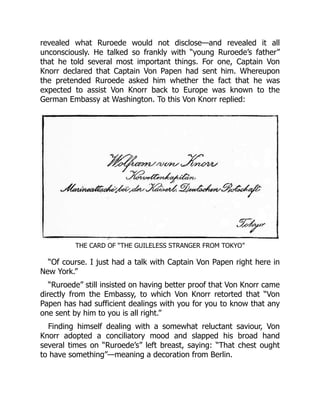
German Embassy at Washington. To this Von Knorr replied:
THE CARD OF “THE GUILELESS STRANGER FROM TOKYO”
“Of course. I just had a talk with Captain Von Papen right here in
New York.”
“Ruroede” still insisted on having better proof that Von Knorr came
directly from the Embassy, to which Von Knorr retorted that “Von
Papen has had sufficient dealings with you for you to know that any
one sent by him to you is all right.”
Finding himself dealing with a somewhat reluctant saviour, Von
Knorr adopted a conciliatory mood and slapped his broad hand
several times on “Ruroede’s” left breast, saying: “That chest ought
to have something”—meaning a decoration from Berlin.
40.
After some verbalsparring, Von Knorr was allowed to drift off the
scene as innocently as he had entered it, and he has yet to learn
that his visit was in an office of American law and that his dealings
were with the officers of Justice.
But he left behind a legacy quite as valuable as his carefully
remembered spoken words. This legacy was the paper which he had
brought from Franz von Papen. This paper proved to be not a letter,
but rather a typewritten memorandum—though all doubt as to its
origin was removed by the innocent insistence of Von Knorr that he
had come with it from Von Papen’s hand.
41.
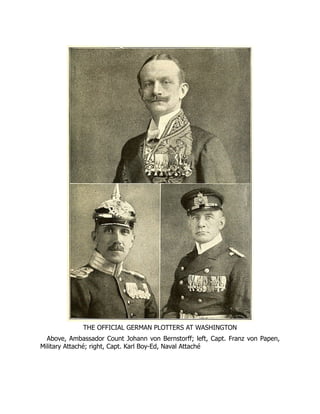
THE OFFICIAL GERMANPLOTTERS AT WASHINGTON
Above, Ambassador Count Johann von Bernstorff; left, Capt. Franz von Papen,
Military Attaché; right, Capt. Karl Boy-Ed, Naval Attaché
42.
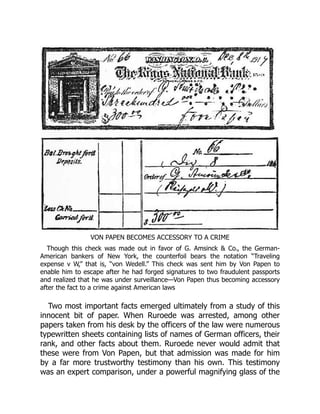
VON PAPEN BECOMESACCESSORY TO A CRIME
Though this check was made out in favor of G. Amsinck & Co., the German-
American bankers of New York, the counterfoil bears the notation “Traveling
expense v W,” that is, “von Wedell.” This check was sent him by Von Papen to
enable him to escape after he had forged signatures to two fraudulent passports
and realized that he was under surveillance—Von Papen thus becoming accessory
after the fact to a crime against American laws
Two most important facts emerged ultimately from a study of this
innocent bit of paper. When Ruroede was arrested, among other
papers taken from his desk by the officers of the law were numerous
typewritten sheets containing lists of names of German officers, their
rank, and other facts about them. Ruroede never would admit that
these were from Von Papen, but that admission was made for him
by a far more trustworthy testimony than his own. This testimony
was an expert comparison, under a powerful magnifying glass of the
43.
typewriting on thesesheets and the typewriting on the Von Knorr
memorandum which had undoubtedly come from Von Papen. They
were beyond all questioning identical. The same typewriter had
written all. By this little microscopic test Von Papen and the other
ruthless underlings of Germany were first brought tangibly within
sight of their ultimate expulsion from this country, for crimes of
which the passport frauds were the least odious.
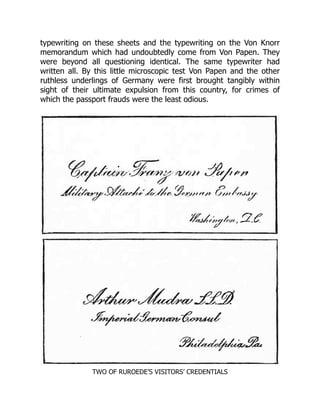
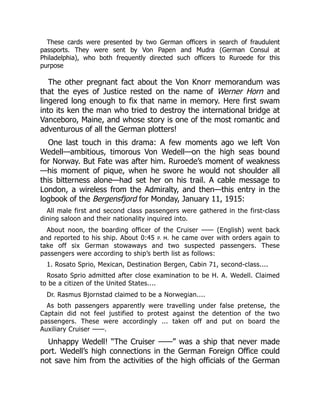
TWO OF RUROEDE’S VISITORS’ CREDENTIALS
44.
These cards werepresented by two German officers in search of fraudulent
passports. They were sent by Von Papen and Mudra (German Consul at
Philadelphia), who both frequently directed such officers to Ruroede for this
purpose
The other pregnant fact about the Von Knorr memorandum was
that the eyes of Justice rested on the name of Werner Horn and
lingered long enough to fix that name in memory. Here first swam
into its ken the man who tried to destroy the international bridge at
Vanceboro, Maine, and whose story is one of the most romantic and
adventurous of all the German plotters!
One last touch in this drama: A few moments ago we left Von
Wedell—ambitious, timorous Von Wedell—on the high seas bound
for Norway. But Fate was after him. Ruroede’s moment of weakness
—his moment of pique, when he swore he would not shoulder all
this bitterness alone—had set her on his trail. A cable message to
London, a wireless from the Admiralty, and then—this entry in the
logbook of the Bergensfjord for Monday, January 11, 1915:
All male first and second class passengers were gathered in the first-class
dining saloon and their nationality inquired into.
About noon, the boarding officer of the Cruiser —— (English) went back
and reported to his ship. About 0:45 P. M. he came over with orders again to
take off six German stowaways and two suspected passengers. These
passengers were according to ship’s berth list as follows:
1. Rosato Sprio, Mexican, Destination Bergen, Cabin 71, second-class....
Rosato Sprio admitted after close examination to be H. A. Wedell. Claimed
to be a citizen of the United States....
Dr. Rasmus Bjornstad claimed to be a Norwegian....
As both passengers apparently were travelling under false pretense, the
Captain did not feel justified to protest against the detention of the two
passengers. These were accordingly ... taken off and put on board the
Auxiliary Cruiser ——.
Unhappy Wedell! “The Cruiser ——” was a ship that never made
port. Wedell’s high connections in the German Foreign Office could
not save him from the activities of the high officials of the German
45.
Admiralty. A U-boatfired a torpedo into “the Cruiser ——” and sent
her to the bottom with Rosato Sprio, alias H. A. Wedell, aboard.
Exeunt Wedell and Ruroede.
Enter Werner Horn.
46.
T
CHAPTER II
The InsideStory of Werner Horn
and
The First Glimpse of the Ship Bombs
he real mystery in the case of Werner Horn is this: Who was the
man in Lower 3? (If he had only known——!) Because, except
for this one missing fact, the story of Werner Horn is as clear as day.
It is the story of a brave man, too honest to lie with a straight face,
who was used by the villainous Von Bernstorff and Von Papen only
after they had lied without a quiver, on at least three vital points, to
him. He meant to fight the enemy of his country as a soldier fights,
and they cynically sent him on an errand which they meant should
be an errand of miscellaneous crime, including murder. He was to go
to a felon’s death for this one of the many devilish plots they were
concocting against American lives, while they lived in luxury in
Washington and lied with smiling faces to the representatives of the
people whose hospitality they were betraying. There have been few
more despicably outrageous, more cold-blooded crimes than this—
except that other one (also of their devising) in the ship bombs
case; but that is another story, to be told later.
The story of Werner Horn begins in Guatemala. Horn was the
manager of a coffee plantation at Moka. He had seen ten years of
service in the German Army when, in 1909, he got a furlough from
the authorities in Cologne permitting him to go to Central America
47.
for two years.This furlough writes him down as an “Oberleutnant on
inactive service.” That means, roughly, that he was a first lieutenant
of the German Army, out of uniform but subject to call ahead of all
other classes of men liable for military duty. Then came the war.
Two hours after word of “The Day” reached Moka, Werner Horn
was packed and on his way to Germany. From Belize he sailed to
Galveston, where he spent two weeks looking in vain for passage.
Then on to New York, where he tried for a month to sail. Finding
that impossible, he went to Mexico City and there learned that
another man in Guatemala had his job. He had just found another
one, on an American coffee plantation at Salto de Aguas, in Chiapas,
and was about to go there by launch from Frontera, when he got a
card telling him to try again to get to Germany. By December 26th
he was back in New Orleans, and a few days later he was lodging in
the Arietta Hotel on Staten Island.
48.
Welcome to ourwebsite – the perfect destination for book lovers and
knowledge seekers. We believe that every book holds a new world,
offering opportunities for learning, discovery, and personal growth.
That’s why we are dedicated to bringing you a diverse collection of
books, ranging from classic literature and specialized publications to
self-development guides and children's books.
More than just a book-buying platform, we strive to be a bridge
connecting you with timeless cultural and intellectual values. With an
elegant, user-friendly interface and a smart search system, you can
quickly find the books that best suit your interests. Additionally,
our special promotions and home delivery services help you save time
and fully enjoy the joy of reading.
Join us on a journey of knowledge exploration, passion nurturing, and
personal growth every day!
ebookmasss.com




![This letter [of which the facsimiles are of the first and last pages] was written by
Wedell to Bernstorff to justify his action in abandoning the work of gathering
passports for fraudulent use. The full text follows, in English. It is an interesting
document, not only because it reveals a lot of weak human nature in the agents of
“German efficiency” but also because it definitely revealed Von Papen and Albert
as principals in the German plots as early as three months after the war started:
HOTEL ST. GEORGE Felix Fieger, Proprietor, Nyack-on-Hudson, December 26, 1914. His Excellency The
Imperial German Ambassador, Count Von Bernstorff, Washington, D. C. Your Excellency: Allow me most](https://image.slidesharecdn.com/4312-250406043538-2d00a302/85/eTextbook-PDF-for-Starting-out-with-Visual-C-5th-Edition-37-320.jpg)




![[Ebooks PDF] download C How to Program 1ST Edition Harvey M. Deitel full chap...](https://cdn.slidesharecdn.com/ss_thumbnails/50876-241223092440-32e628ff-thumbnail.jpg?width=640&height=640&fit=bounds)


