2 0 1 3 N A D O A N N U A L T R A I N I N G C O N F E R E N C E
E X E C U T I V E D I R E C T O R L E A R N I N G L A B 1
2 0 1 3 N A D O A N N U A L T R A I N I N G C O N F E R E N C E
E X E C U T I V E D I R E C T O R L E A R N I N G L A B 2
INTRODUCTION
• Steve Etcher, Vice-President of Community EDGE
• Director of Boonslick Regional Planning
Commission, Warrenton, Missouri 1992-2013
• Community EDGE is an economic development
consulting firm
• Economic Development Marketing
• Community and Organization Assessments
• Strategic Planning and Capacity Building for
Community Organizations
• Leadership development
2 0 1 3 N A D O A N N U A L T R A I N I N G C O N F E R E N C E
E X E C U T I V E D I R E C T O R L E A R N I N G L A B 3
2 0 1 3 N A D O A N N U A L T R A I N I N G C O N F E R E N C E
E X E C U T I V E D I R E C T O R L E A R N I N G L A B 4
2 0 1 3 N A D O A N N U A L T R A I N I N G C O N F E R E N C E
E X E C U T I V E D I R E C T O R L E A R N I N G L A B 5
2 0 1 3 N A D O A N N U A L T R A I N I N G C O N F E R E N C E
E X E C U T I V E D I R E C T O R L E A R N I N G L A B 6
BENEFITS OF AN EFFECTIVE EVALUATION
SYSTEM
• Promotes consistent, objective evaluations .
• Ensures that evaluation of the director is conducted
regularly .
• Boost board members and director participation in the
review process.
• Increases communication between board and director.
• Increases awareness of responsibility of the director
position with the board members.
• Ensures board and director are aligned with the mission of
the organization
2 0 1 3 N A D O A N N U A L T R A I N I N G C O N F E R E N C E
E X E C U T I V E D I R E C T O R L E A R N I N G L A B 7
ORGANIZATIONAL CHALLENGES
• Tighter budgets
• Increasing demand for efficiency
• No loss in effectiveness
• Must adapt to these changes
• Seek better ways to meet expectations
• Citizens
• Clients
• Funding agencies
• Elected officials
• Board members, and
• Media
2 0 1 3 N A D O A N N U A L T R A I N I N G C O N F E R E N C E
E X E C U T I V E D I R E C T O R L E A R N I N G L A B 8
WHY DO EXECUTIVE DIRECTOR EVALUATIONS?
1. EDA requires it
2. Personnel policies dictate it
3. Process used to justify salary increases
2 0 1 3 N A D O A N N U A L T R A I N I N G C O N F E R E N C E
E X E C U T I V E D I R E C T O R L E A R N I N G L A B 9
2 0 1 3 N A D O A N N U A L T R A I N I N G C O N F E R E N C E
E X E C U T I V E D I R E C T O R L E A R N I N G L A B 10
REALITIES OF THE EDD WORLD
1. We are knowledge firms
2. We are public agencies or quasi public agencies
3. Our primary expenses-cost of goods is personnel
4. Public service has an interesting definition by the general public.
5. Our organizations must thrive through innovation, problem
solving, collaboration, and creativity.
6. Our customers/our audience/our members are changing more
rapidly through the election process and may be unfamiliar with
the tasks mission of the organizations
7. A constant battle to avoid a bureaucratic label and instead create
an image of relevance, efficiency and effectiveness.
2 0 1 3 N A D O A N N U A L T R A I N I N G C O N F E R E N C E
E X E C U T I V E D I R E C T O R L E A R N I N G L A B 11
2 0 1 3 N A D O A N N U A L T R A I N I N G C O N F E R E N C E
E X E C U T I V E D I R E C T O R L E A R N I N G L A B 12
PROBLEMS WITH EVALUATION METHODOLOGY
• Lack of training in doing evaluations
• Evaluation criteria is vague, never communicated in writing, not
realistic, not results oriented.
• Measures only a single point in time—doesn’t consider the
entire evaluation period
• Not bilateral in communications
• Measures the wrong criteria
• Stockpiling of shortcomings throughout the year and unload on
the employee during the annual evaluation
2 0 1 3 N A D O A N N U A L T R A I N I N G C O N F E R E N C E
E X E C U T I V E D I R E C T O R L E A R N I N G L A B 13
CHALLENGES IN DOING EXECUTIVE DIRECTOR
EVALUATIONS
• Board members may not fully understand the challenges and the
complexities of running the organization
• Board members turn over frequently due to elections
• Board members may not be trained or experienced in doing
evaluation
• Board members may only be exposed to the organization for a
few hours each month—or worse just each quarter
• Board members may serve on a variety of organizations and do
not have the time to become fully engaged in your organization
2 0 1 3 N A D O A N N U A L T R A I N I N G C O N F E R E N C E
E X E C U T I V E D I R E C T O R L E A R N I N G L A B 14
Best Evaluation
Received
“You are doing a great
job, keep it up”
Worst Evaluation
Received
You are doing a great
job, keep it up”
2 0 1 3 N A D O A N N U A L T R A I N I N G C O N F E R E N C E
E X E C U T I V E D I R E C T O R L E A R N I N G L A B 15
MY PERFORMANCE EVALUATION
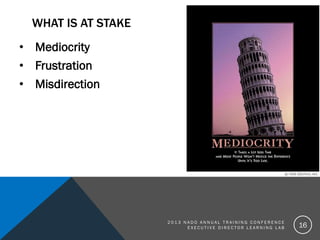
• Mediocrity
• Frustration
• Misdirection
2 0 1 3 N A D O A N N U A L T R A I N I N G C O N F E R E N C E
E X E C U T I V E D I R E C T O R L E A R N I N G L A B 16
WHAT IS AT STAKE
MY EVALUATION PROCESS
1. Establish benchmarks and work program and priorities
2. Identify measurable and create dashboard
3. Constantly communicate and monitor Dashboard
4. Board/Committee review dashboard along with qualitative
measures as part of review process (retreat) environment.
5. Encourage a 360 degree evaluation by surveying
leadership team/management staff/key personnel in
qualitative measures (confidential survey with results going
to the chairman)
2 0 1 3 N A D O A N N U A L T R A I N I N G C O N F E R E N C E
E X E C U T I V E D I R E C T O R L E A R N I N G L A B 17
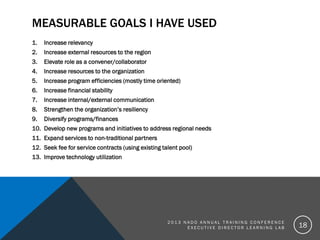
MEASURABLE GOALS I HAVE USED
1. Increase relevancy
2. Increase external resources to the region
3. Elevate role as a convener/collaborator
4. Increase resources to the organization
5. Increase program efficiencies (mostly time oriented)
6. Increase financial stability
7. Increase internal/external communication
8. Strengthen the organization’s resiliency
9. Diversify programs/finances
10. Develop new programs and initiatives to address regional needs
11. Expand services to non-traditional partners
12. Seek fee for service contracts (using existing talent pool)
13. Improve technology utilization
2 0 1 3 N A D O A N N U A L T R A I N I N G C O N F E R E N C E
E X E C U T I V E D I R E C T O R L E A R N I N G L A B 18
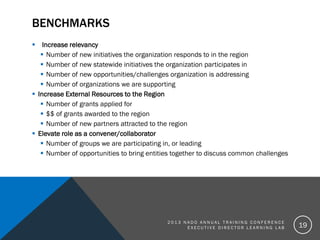
BENCHMARKS
 Increase relevancy
 Number of new initiatives the organization responds to in the region
 Number of new statewide initiatives the organization participates in
 Number of new opportunities/challenges organization is addressing
 Number of organizations we are supporting
 Increase External Resources to the Region
 Number of grants applied for
 $$ of grants awarded to the region
 Number of new partners attracted to the region
 Elevate role as a convener/collaborator
 Number of groups we are participating in, or leading
 Number of opportunities to bring entities together to discuss common challenges
2 0 1 3 N A D O A N N U A L T R A I N I N G C O N F E R E N C E
E X E C U T I V E D I R E C T O R L E A R N I N G L A B 19
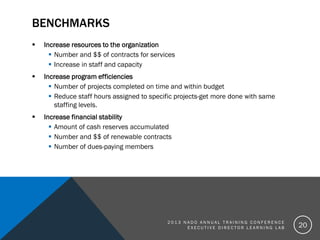
BENCHMARKS
 Increase resources to the organization
 Number and $$ of contracts for services
 Increase in staff and capacity
 Increase program efficiencies
 Number of projects completed on time and within budget
 Reduce staff hours assigned to specific projects-get more done with same
staffing levels.
 Increase financial stability
 Amount of cash reserves accumulated
 Number and $$ of renewable contracts
 Number of dues-paying members
2 0 1 3 N A D O A N N U A L T R A I N I N G C O N F E R E N C E
E X E C U T I V E D I R E C T O R L E A R N I N G L A B 20
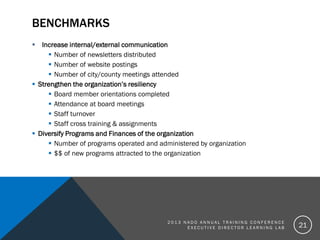
BENCHMARKS
 Increase internal/external communication
 Number of newsletters distributed
 Number of website postings
 Number of city/county meetings attended
 Strengthen the organization’s resiliency
 Board member orientations completed
 Attendance at board meetings
 Staff turnover
 Staff cross training & assignments
 Diversify Programs and Finances of the organization
 Number of programs operated and administered by organization
 $$ of new programs attracted to the organization
2 0 1 3 N A D O A N N U A L T R A I N I N G C O N F E R E N C E
E X E C U T I V E D I R E C T O R L E A R N I N G L A B 21
BENCHMARKS
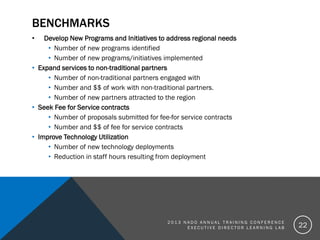
• Develop New Programs and Initiatives to address regional needs
• Number of new programs identified
• Number of new programs/initiatives implemented
• Expand services to non-traditional partners
• Number of non-traditional partners engaged with
• Number and $$ of work with non-traditional partners.
• Number of new partners attracted to the region
• Seek Fee for Service contracts
• Number of proposals submitted for fee-for service contracts
• Number and $$ of fee for service contracts
• Improve Technology Utilization
• Number of new technology deployments
• Reduction in staff hours resulting from deployment
2 0 1 3 N A D O A N N U A L T R A I N I N G C O N F E R E N C E
E X E C U T I V E D I R E C T O R L E A R N I N G L A B 22
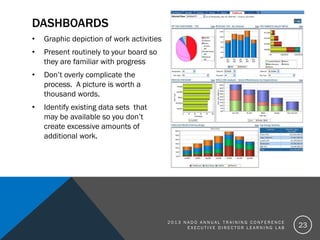
DASHBOARDS
• Graphic depiction of work activities
• Present routinely to your board so
they are familiar with progress
• Don’t overly complicate the
process. A picture is worth a
thousand words.
• Identify existing data sets that
may be available so you don’t
create excessive amounts of
additional work.
2 0 1 3 N A D O A N N U A L T R A I N I N G C O N F E R E N C E
E X E C U T I V E D I R E C T O R L E A R N I N G L A B 23
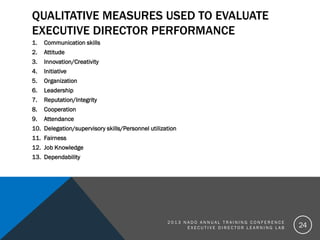
QUALITATIVE MEASURES USED TO EVALUATE
EXECUTIVE DIRECTOR PERFORMANCE
1. Communication skills
2. Attitude
3. Innovation/Creativity
4. Initiative
5. Organization
6. Leadership
7. Reputation/Integrity
8. Cooperation
9. Attendance
10. Delegation/supervisory skills/Personnel utilization
11. Fairness
12. Job Knowledge
13. Dependability
2 0 1 3 N A D O A N N U A L T R A I N I N G C O N F E R E N C E
E X E C U T I V E D I R E C T O R L E A R N I N G L A B 24
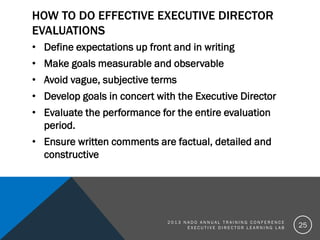
HOW TO DO EFFECTIVE EXECUTIVE DIRECTOR
EVALUATIONS
• Define expectations up front and in writing
• Make goals measurable and observable
• Avoid vague, subjective terms
• Develop goals in concert with the Executive Director
• Evaluate the performance for the entire evaluation
period.
• Ensure written comments are factual, detailed and
constructive
2 0 1 3 N A D O A N N U A L T R A I N I N G C O N F E R E N C E
E X E C U T I V E D I R E C T O R L E A R N I N G L A B 25
2 0 1 3 N A D O A N N U A L T R A I N I N G C O N F E R E N C E
E X E C U T I V E D I R E C T O R L E A R N I N G L A B 26
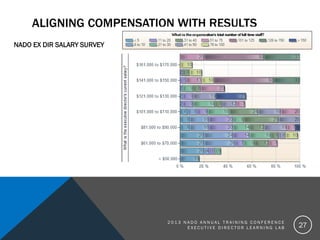
ALIGNING COMPENSATION WITH RESULTS
NADO EX DIR SALARY SURVEY
2 0 1 3 N A D O A N N U A L T R A I N I N G C O N F E R E N C E
E X E C U T I V E D I R E C T O R L E A R N I N G L A B 27
2 0 1 3 N A D O A N N U A L T R A I N I N G C O N F E R E N C E
E X E C U T I V E D I R E C T O R L E A R N I N G L A B 28
QUESTIONS FOR DISCUSSION
1. Who participates in the Executive Director
evaluations for your organization?
2. Briefly describe your evaluation process.
3. How do you determine salary adjustments and/or
salary levels for the Executive Director?
4. What strategies do you use to attract and retain
quality leadership?
2 0 1 3 N A D O A N N U A L T R A I N I N G C O N F E R E N C E
E X E C U T I V E D I R E C T O R L E A R N I N G L A B 29
SUMMARY
1. Define Expectations
2. Create Goals
3. Identify Benchmarks and Measurables
4. Constantly Review Progress toward Goals
5. Ensure Integrity of Evaluation
2 0 1 3 N A D O A N N U A L T R A I N I N G C O N F E R E N C E
E X E C U T I V E D I R E C T O R L E A R N I N G L A B 30
2 0 1 3 N A D O A N N U A L T R A I N I N G C O N F E R E N C E
E X E C U T I V E D I R E C T O R L E A R N I N G L A B 31
2 0 1 3 N A D O A N N U A L T R A I N I N G C O N F E R E N C E
E X E C U T I V E D I R E C T O R L E A R N I N G L A B 32