SEPTEMBER 2017
Nombre del trabajo
ORINOCO OIL BELT
HEAVY OIL NEWS
VENEZUELA
The Orinoco Belt is a terri-
tory in Venezuela that con-
sists of large deposits of
heavy crude oil, known as the
Orinoco Oil Sands. the Orinoco Sands.
Production Facili-
ties and Extra
Heavy Crude Im-
provement in the
Orinoco Oil Belt
Blocks
Content
ORINOCO OIL BELT
Página 2
Orinoco oil belt Venezuela…………………………………………………..................…...3
Exploration and evaluation of the Zuata area, Orinoco oil belt Venezuela…...…...5
Exploration results, Machete area……………………..………………………...…….……7
Reservoir geology of the Cerro Negro steam injection area …………… …......…….8
ORINOCO OIL BELT
Página 3
ORINOCO OIL BELT VENEZUELA
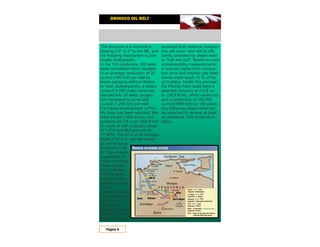
The Orinoco Oil Belt of
Venezuela is a very extensive,
non-discrete, crude-oil
producing area located along
the southern third of the Maturín
(Eastern Venezuela) basin,
north of the Orinoco River and
the Guayana Shield. It extends
due westwards from Puerto
Ordaz for 460km; the main
producing areas, defined on the
basis of productivity and
magnitude of crude oil in-place,
cover 13, 600 sq. km. There are
no significant surface indications
of petroleum anywhere in the
Belt. The first well drilled was La
Canoa-1 in 1936, initiating a
stage of exploration which
ended in 1967 with publication
of a preliminary evaluation of
the potential reserves; the
Ministry of Energy and Mines,
then of Mines and
Hydrocarbons, and the State oil
company Corporación
Venezolana del Petróleo (CVP)
completed a second stage of
exploration in 1977; Petróleos
de Venezuela and its operating
companies then drilled 669
wells in five years (1979–83)
totalling 643,000 m with 5.5
MM** m of logs, and shot
15,000 km of seismic lines at a
cost of $US 615 MM, an effort
conservatively estimated as
having taken 2,500 man-years.
The main producing areas are,
from east to west, Cerro Negro,
Pao, Hamaca, San Diego,
Zuata, and Machete.
ORINOCO OIL BELT
Página 4
Petroleum characterisation in the Belt is based on the study and
analysis of 288 samples. Viscosity (dynamic) of the crude oils at
reservoir conditions ranges from 2,000 to 7,000 m Pa.s (cp). Pro-
duction rates average 25 cu. m/d(160 b/d), increasing fourfold af-
ter steam stimulation. At the end of 1985, production was 13,000
cu.m/d(80,000b/d), from the Cerro Negro and Hamaca main pro-
ducing areas. Operating costs are similar to those in other heavy-
crude oilfields in the basin. The volume of crude oil in-place is esti-
mated to be 187.8 B cu. m (1,181 B brls), which makes the Orino-
co Oil Belt the largest crude oil accumulation in the world. Proved
reserves are 4.161 B cu. m (26.170 B brls). and unproved reser-
ves 14.822 B cu. m (93.230 B brls). Investigative activities are un-
derway, particularly in the Cerro Negro and San Diego producing
areas.
ORINOCO OIL BELT
Página 5
EXPLORATION AND EVALUATION OF THE ZUATA
AREA, ORINOCO OIL BELT, VENEZUELA
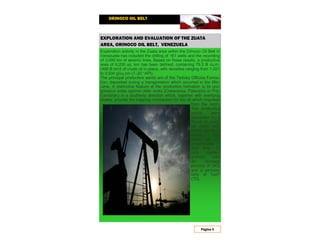
Exploration activity in the Zuata area within the Orinoco Oil Belt in
Venezuela has included the drilling of 161 wells and the recording
of 3,000 km of seismic lines. Based on these results, a productive
area of 9,200 sq. km has been defined, containing 79.3 B cu.m.
(499 B brl)† of crude oil in-place, with densities ranging from 1.021
to 0.934 g/cu.cm (7–20 °API).
The principal productive sands are of the Tertiary Officina Forma-
tion, deposited during a transgression which occurred in the Mio-
cene. A distinctive feature of the productive formation is its pro-
gressive onlap against older rocks (Cretaceous, Paleozoic or Pre-
Cambrian) in a southerly direction which, together with overlying
shales, provide the trapping mechanism for the oil which migrated
from the north.
The productive
sands were
deposited in a
fluvial to coas-
tal plain with
deltaic develop-
ments. The
sands are un-
consolidated
and fine- to
very coarse-
grained, with
an average
porosity of 34%
and a permea-
bility of 7μm2
(7D).
ORINOCO OIL BELT
Página 6
The structure is a monocline
dipping 0.5° to 2° to the NE, and
the trapping mechanism is prin-
cipally stratigraphic.
In the 134 producers, 300 tests
were completed which resulted
in an average production of 25
cu.m/d (160 b/d) per well by
beam pumping without dilution
or heat. Subsequently, a steam
cycle of 5,000 metric tons was
injected into 16 wells; produc-
tion increased to some 200
cu.m/d (1,250 b/d) per well.
For future development, a Prio-
rity Area has been selected: this
Area covers 3,500 sq kin, and
contains 40.5 B cu.m (255 B brl)
of crude oil with a density range
of 1.014 to 0.993 g/cu.cm (8–
11°API). The oil is at an average
depth of 610 m, and the avera-
ge net oil-sand
thickness is 60
m. The oil-sand
is generally di-
vided into three
zones separa-
ted by shales,
and the gross
productive thi-
ckness is some
110 m.
Similar to Mara-
ven ‘s experien-
ce in the oil-
fields of the
Bolivar Coast in
Western Vene-
zuela, it may be
expected that reservoir compac-
tion will occur, and will be effi-
ciently activated by steam-soak
or “huff and puff’. Based on core
compressibility measurements,
a recovery factor from compac-
tion drive and solution gas treat-
ments could reach 12 % of the
oil in-place. Under this premise,
the Priority Area could have a
potential recovery of 4.9 B cu.
m. (30.6 B brl), which could sup-
port a production of 160,000
cu.m/d(1MM b/d) for 100 years.
Any follow-up steam drive can
be assumed to recover at least
an additional 10% of the oil in-
place.
ORINOCO OIL BELT
Página 7
The Machete Area covers
23,610 sq. km (9,116 sq. miles),
of the Orinoco Oil Belt in Vene-
zuela. Based on exploration da-
ta from 30 old and 74 new wells,
the volume of heavy and extra-
heavy crude oil in-place is esti-
mated to be 40 B cu. m (255 B
brl), ** of which 4 B cu.m (22.5
B brl) are in future potentially
recoverable; some 62 B cu.m
(2.2 T cu. ft) of natural gas may
also be recovered. Drill depths
to the base of the producing
section vary from 518 to 1,220
m. Net oil sand reaches 116 m
in thickness for Tertiary reser-
voirs, and 46 m for Cretaceous
ones. The crude oils average
1,022 kg/cu.m (7° API), and ha-
ve a content of sulphur and va-
rious metallic elements typical of
similar crudes; viscosities are
slightly higher than in the rest of
the Belt.
Production rates of up to 20 cu.
m/d (140 b/d) on pump may be
increased ten-fold by steam in-
jection. Dry natural gas flows of
450 cu.m/d are common. The
principal geological factors con-
trolling the Machete accumula-
tions differ from those in adja-
cent areas, and consist of the
subsurface extension of the El
Baúl Arch which has controlled
sand-shale facies, pinch-out
lines and structural-stratigraphic
trapping of the heavy crude oils
and natural gas.
EXPLORATION RESULTS, MACHETE AREA
ORINOCO OIL BELT
Página 8
RESERVOIR GEOLOGY OF THE CERRO NEGRO
STEAM INJECTION AREA
Several very favourable areas were defined in the Orinoco Oil
Belt, after intensive geological, exploration and evaluation studies
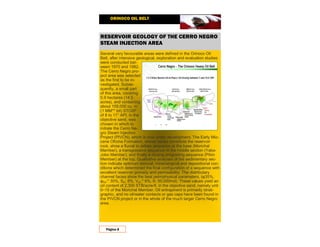
were conducted bet-
ween 1970 and 1982.
The Cerro Negro pro-
ject area was selected
as the first to be in-
vestigated. Subse-
quently, a small part
of this area, covering
5.9 hectares (14.5
acres), and containing
about 159,000 cu. m
(1 MM** brl) STOIIP
of 8 to 11° API, in the
objective sand, was
chosen in which to
initiate the Cerro Ne-
gro Steam Injection
Project (PIVCN), which is now under development. The Early Mio-
cene Oficina Formation, whose sands constitute the reservoir
rock, show a fluvial to deltaic sequence at the base (Morichal
Member), a transgressive sequence in the middle section (Yabo-
Jobo Member), and finally a closing prograding sequence (Pilón
Member) at the top. Qualitative analyses of the sedimentary sec-
tion indicate optimum textural, mineralogical and depositional con-
ditions which determined the final configuration of a sequence with
excellent reservoir porosity and permeability. The distributary
channel facies show the best petmphysical parameters, (φ35%,
φSo:* 30%, Sw: 5%, Vsh:* 6%, K: 50,000md). These values yield an
oil content of 2,300 STB/acre-ft. in the objective sand, namely unit
0–15 of the Morichal Member. Oil entrapment is primarily strati-
graphic, and no oil/water contacts or gas caps have been found in
the PIVCN project or in the whole of the much larger Cerro Negro
area.
Página 9
Estudiante

Estudiante

  • 1.
    SEPTEMBER 2017 Nombre deltrabajo ORINOCO OIL BELT HEAVY OIL NEWS VENEZUELA The Orinoco Belt is a terri- tory in Venezuela that con- sists of large deposits of heavy crude oil, known as the Orinoco Oil Sands. the Orinoco Sands. Production Facili- ties and Extra Heavy Crude Im- provement in the Orinoco Oil Belt Blocks
  • 2.
    Content ORINOCO OIL BELT Página2 Orinoco oil belt Venezuela…………………………………………………..................…...3 Exploration and evaluation of the Zuata area, Orinoco oil belt Venezuela…...…...5 Exploration results, Machete area……………………..………………………...…….……7 Reservoir geology of the Cerro Negro steam injection area …………… …......…….8
  • 3.
    ORINOCO OIL BELT Página3 ORINOCO OIL BELT VENEZUELA The Orinoco Oil Belt of Venezuela is a very extensive, non-discrete, crude-oil producing area located along the southern third of the Maturín (Eastern Venezuela) basin, north of the Orinoco River and the Guayana Shield. It extends due westwards from Puerto Ordaz for 460km; the main producing areas, defined on the basis of productivity and magnitude of crude oil in-place, cover 13, 600 sq. km. There are no significant surface indications of petroleum anywhere in the Belt. The first well drilled was La Canoa-1 in 1936, initiating a stage of exploration which ended in 1967 with publication of a preliminary evaluation of the potential reserves; the Ministry of Energy and Mines, then of Mines and Hydrocarbons, and the State oil company Corporación Venezolana del Petróleo (CVP) completed a second stage of exploration in 1977; Petróleos de Venezuela and its operating companies then drilled 669 wells in five years (1979–83) totalling 643,000 m with 5.5 MM** m of logs, and shot 15,000 km of seismic lines at a cost of $US 615 MM, an effort conservatively estimated as having taken 2,500 man-years. The main producing areas are, from east to west, Cerro Negro, Pao, Hamaca, San Diego, Zuata, and Machete.
  • 4.
    ORINOCO OIL BELT Página4 Petroleum characterisation in the Belt is based on the study and analysis of 288 samples. Viscosity (dynamic) of the crude oils at reservoir conditions ranges from 2,000 to 7,000 m Pa.s (cp). Pro- duction rates average 25 cu. m/d(160 b/d), increasing fourfold af- ter steam stimulation. At the end of 1985, production was 13,000 cu.m/d(80,000b/d), from the Cerro Negro and Hamaca main pro- ducing areas. Operating costs are similar to those in other heavy- crude oilfields in the basin. The volume of crude oil in-place is esti- mated to be 187.8 B cu. m (1,181 B brls), which makes the Orino- co Oil Belt the largest crude oil accumulation in the world. Proved reserves are 4.161 B cu. m (26.170 B brls). and unproved reser- ves 14.822 B cu. m (93.230 B brls). Investigative activities are un- derway, particularly in the Cerro Negro and San Diego producing areas.
  • 5.
    ORINOCO OIL BELT Página5 EXPLORATION AND EVALUATION OF THE ZUATA AREA, ORINOCO OIL BELT, VENEZUELA Exploration activity in the Zuata area within the Orinoco Oil Belt in Venezuela has included the drilling of 161 wells and the recording of 3,000 km of seismic lines. Based on these results, a productive area of 9,200 sq. km has been defined, containing 79.3 B cu.m. (499 B brl)† of crude oil in-place, with densities ranging from 1.021 to 0.934 g/cu.cm (7–20 °API). The principal productive sands are of the Tertiary Officina Forma- tion, deposited during a transgression which occurred in the Mio- cene. A distinctive feature of the productive formation is its pro- gressive onlap against older rocks (Cretaceous, Paleozoic or Pre- Cambrian) in a southerly direction which, together with overlying shales, provide the trapping mechanism for the oil which migrated from the north. The productive sands were deposited in a fluvial to coas- tal plain with deltaic develop- ments. The sands are un- consolidated and fine- to very coarse- grained, with an average porosity of 34% and a permea- bility of 7μm2 (7D).
  • 6.
    ORINOCO OIL BELT Página6 The structure is a monocline dipping 0.5° to 2° to the NE, and the trapping mechanism is prin- cipally stratigraphic. In the 134 producers, 300 tests were completed which resulted in an average production of 25 cu.m/d (160 b/d) per well by beam pumping without dilution or heat. Subsequently, a steam cycle of 5,000 metric tons was injected into 16 wells; produc- tion increased to some 200 cu.m/d (1,250 b/d) per well. For future development, a Prio- rity Area has been selected: this Area covers 3,500 sq kin, and contains 40.5 B cu.m (255 B brl) of crude oil with a density range of 1.014 to 0.993 g/cu.cm (8– 11°API). The oil is at an average depth of 610 m, and the avera- ge net oil-sand thickness is 60 m. The oil-sand is generally di- vided into three zones separa- ted by shales, and the gross productive thi- ckness is some 110 m. Similar to Mara- ven ‘s experien- ce in the oil- fields of the Bolivar Coast in Western Vene- zuela, it may be expected that reservoir compac- tion will occur, and will be effi- ciently activated by steam-soak or “huff and puff’. Based on core compressibility measurements, a recovery factor from compac- tion drive and solution gas treat- ments could reach 12 % of the oil in-place. Under this premise, the Priority Area could have a potential recovery of 4.9 B cu. m. (30.6 B brl), which could sup- port a production of 160,000 cu.m/d(1MM b/d) for 100 years. Any follow-up steam drive can be assumed to recover at least an additional 10% of the oil in- place.
  • 7.
    ORINOCO OIL BELT Página7 The Machete Area covers 23,610 sq. km (9,116 sq. miles), of the Orinoco Oil Belt in Vene- zuela. Based on exploration da- ta from 30 old and 74 new wells, the volume of heavy and extra- heavy crude oil in-place is esti- mated to be 40 B cu. m (255 B brl), ** of which 4 B cu.m (22.5 B brl) are in future potentially recoverable; some 62 B cu.m (2.2 T cu. ft) of natural gas may also be recovered. Drill depths to the base of the producing section vary from 518 to 1,220 m. Net oil sand reaches 116 m in thickness for Tertiary reser- voirs, and 46 m for Cretaceous ones. The crude oils average 1,022 kg/cu.m (7° API), and ha- ve a content of sulphur and va- rious metallic elements typical of similar crudes; viscosities are slightly higher than in the rest of the Belt. Production rates of up to 20 cu. m/d (140 b/d) on pump may be increased ten-fold by steam in- jection. Dry natural gas flows of 450 cu.m/d are common. The principal geological factors con- trolling the Machete accumula- tions differ from those in adja- cent areas, and consist of the subsurface extension of the El Baúl Arch which has controlled sand-shale facies, pinch-out lines and structural-stratigraphic trapping of the heavy crude oils and natural gas. EXPLORATION RESULTS, MACHETE AREA
  • 8.
    ORINOCO OIL BELT Página8 RESERVOIR GEOLOGY OF THE CERRO NEGRO STEAM INJECTION AREA Several very favourable areas were defined in the Orinoco Oil Belt, after intensive geological, exploration and evaluation studies were conducted bet- ween 1970 and 1982. The Cerro Negro pro- ject area was selected as the first to be in- vestigated. Subse- quently, a small part of this area, covering 5.9 hectares (14.5 acres), and containing about 159,000 cu. m (1 MM** brl) STOIIP of 8 to 11° API, in the objective sand, was chosen in which to initiate the Cerro Ne- gro Steam Injection Project (PIVCN), which is now under development. The Early Mio- cene Oficina Formation, whose sands constitute the reservoir rock, show a fluvial to deltaic sequence at the base (Morichal Member), a transgressive sequence in the middle section (Yabo- Jobo Member), and finally a closing prograding sequence (Pilón Member) at the top. Qualitative analyses of the sedimentary sec- tion indicate optimum textural, mineralogical and depositional con- ditions which determined the final configuration of a sequence with excellent reservoir porosity and permeability. The distributary channel facies show the best petmphysical parameters, (φ35%, φSo:* 30%, Sw: 5%, Vsh:* 6%, K: 50,000md). These values yield an oil content of 2,300 STB/acre-ft. in the objective sand, namely unit 0–15 of the Morichal Member. Oil entrapment is primarily strati- graphic, and no oil/water contacts or gas caps have been found in the PIVCN project or in the whole of the much larger Cerro Negro area.
  • 9.