By-
Kriti Atrishi
 Stem cells are undifferentiated biological
cells that can differentiate into specialized
cells and can divide (through mitosis) to
produce more stem cells.
 They are found in multi-cellular organisms.
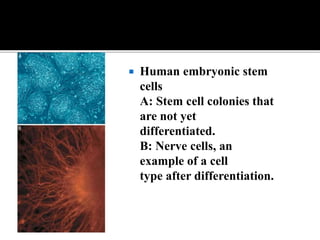
 Human embryonic stem
cells
A: Stem cell colonies that
are not yet
differentiated.
B: Nerve cells, an
example of a cell
type after differentiation.
Stem cells have two major properties:
 Self-renewal: the ability to go through
numerous cycles of cell division while
maintaining the undifferentiated state.
 Potency: the capacity to differentiate into
specialized cell types. In the strictest sense,
this requires stem cells to be
either totipotent or pluripotent—to be able to
give rise to any mature cell type.
 Totipotent(omnipotent) stem cells can differentiate into
embryonic and extra embryonic cell types. Such cells can
construct a complete, viable organism.These cells are produced
from the fusion of an egg and sperm cell. Cells produced by the
first few divisions of the fertilized egg are also totipotent.
 Pluripotent stem cells are the descendants of totipotent cells and
can differentiate into nearly all cells,i.e., cells derived from any of
the three germ layers.
 Multipotent stem cells can differentiate into a number of cell
types, but only those of a closely related family of cells.
 Oligopotent stem cells can differentiate into only a few cell types,
such as lymphoid or myeloid stem cells.
 Unipotent cells can produce only one cell type, their own, but
have the property of self-renewal, which distinguishes them from
non-stem cells (e.g. progenitor cells, muscle stem cells).
In mammals, there are two broad types of stem
cells: embryonic stem cells, which are isolated
from the inner cell mass of blastocysts, and adult
stem cells, which are found in various tissues.
In adult organisms, stem cells and progenitor
cells act as a repair system for the body,
replenishing adult tissues. In a developing
embryo, stem cells can differentiate into all the
specialized cells—ectoderm, endoderm and
mesoderm but also maintain the normal
turnover of regenerative organs, such as blood,
skin, or intestinal tissues.
 Adult stem cells, also called somatic stem cells, are stem cells
which maintain and repair the tissue in which they are
found. They can be found in children, as well as adults.
 Pluripotent adult stem cells are rare and generally small in
number, but they can be found in umbilical cord blood and
other tissues. Bone marrow is a rich source of adult stem
cells, which have been used in treating several conditions
including spinal cord injury, liver cirrhosis, chronic limb
ischemia and end stage heart failure.
 The quantity of bone marrow stem cells declines with age and
is greater in males than females during reproductive years.
 Much adult stem cell research to date has aimed to
characterize their potency and self-renewal capabilities.
Esl ppt

Esl ppt

  • 1.
  • 2.
     Stem cellsare undifferentiated biological cells that can differentiate into specialized cells and can divide (through mitosis) to produce more stem cells.  They are found in multi-cellular organisms.
  • 3.
     Human embryonicstem cells A: Stem cell colonies that are not yet differentiated. B: Nerve cells, an example of a cell type after differentiation.
  • 4.
    Stem cells havetwo major properties:  Self-renewal: the ability to go through numerous cycles of cell division while maintaining the undifferentiated state.  Potency: the capacity to differentiate into specialized cell types. In the strictest sense, this requires stem cells to be either totipotent or pluripotent—to be able to give rise to any mature cell type.
  • 5.
     Totipotent(omnipotent) stemcells can differentiate into embryonic and extra embryonic cell types. Such cells can construct a complete, viable organism.These cells are produced from the fusion of an egg and sperm cell. Cells produced by the first few divisions of the fertilized egg are also totipotent.  Pluripotent stem cells are the descendants of totipotent cells and can differentiate into nearly all cells,i.e., cells derived from any of the three germ layers.  Multipotent stem cells can differentiate into a number of cell types, but only those of a closely related family of cells.  Oligopotent stem cells can differentiate into only a few cell types, such as lymphoid or myeloid stem cells.  Unipotent cells can produce only one cell type, their own, but have the property of self-renewal, which distinguishes them from non-stem cells (e.g. progenitor cells, muscle stem cells).
  • 6.
    In mammals, thereare two broad types of stem cells: embryonic stem cells, which are isolated from the inner cell mass of blastocysts, and adult stem cells, which are found in various tissues. In adult organisms, stem cells and progenitor cells act as a repair system for the body, replenishing adult tissues. In a developing embryo, stem cells can differentiate into all the specialized cells—ectoderm, endoderm and mesoderm but also maintain the normal turnover of regenerative organs, such as blood, skin, or intestinal tissues.
  • 7.
     Adult stemcells, also called somatic stem cells, are stem cells which maintain and repair the tissue in which they are found. They can be found in children, as well as adults.  Pluripotent adult stem cells are rare and generally small in number, but they can be found in umbilical cord blood and other tissues. Bone marrow is a rich source of adult stem cells, which have been used in treating several conditions including spinal cord injury, liver cirrhosis, chronic limb ischemia and end stage heart failure.  The quantity of bone marrow stem cells declines with age and is greater in males than females during reproductive years.  Much adult stem cell research to date has aimed to characterize their potency and self-renewal capabilities.