STEM CELLS and TYPES OF
STEM CELLS
What are Stem Cells?
 Cells that can divide and differentiate
into diverse specialized cells and can self-
renew to produce more stem cells.
 Also defined as unspecialized cells whereby
all specialized cells come from**
What are Stem Cells?
 Cells that can divide and differentiate
into diverse specialized cells and can self-
renew to produce more stem cells.
 Also defined as unspecialized cells whereby
all specialized cells come from**
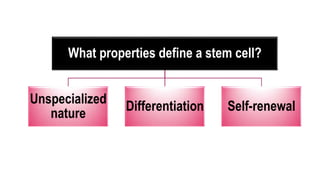
What properties define a stem cell?
Unspecialized
nature
Differentiation Self-renewal
Unspecialized nature
 Stem cells do not have any tissue-specific
structures that allow it to perform special
functions.
 However, these cells give rise to specialized
cells.
Differentiation
 The process where unspecialized cells
acquire specific cellular traits, which
convert them into specialized cell types.
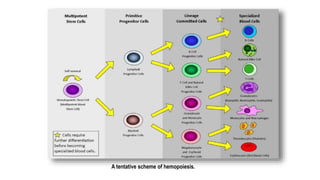
 Example: Blood stem cell
A tentative scheme of hemopoiesis.
Differentiation
 As stem cells differentiate, they are said to
become committed – they can no longer
differentiate into cell types outside of the
specified lineage.
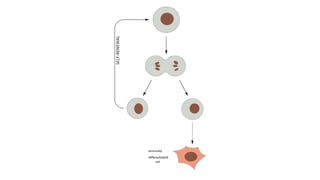
Self-renewal
 The process where a stem cell divides to
produce at least one daughter cell that
remains an undifferentiated stem cell.
 It expands or maintains the stem cell
population throughout the life of an
organism.
terminally
differentiated
cell
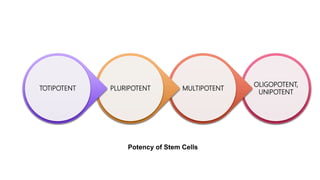
Potency of Stem Cells
 Defined as the capacity to differentiate into
specialized cell type & be able to give rise to
any mature cell type.
OLIGOPOTENT,
UNIPOTENT
MULTIPOTENTPLURIPOTENTTOTIPOTENT
Potency of Stem Cells
Totipotent Stem Cell
 [toti = whole, potent = able to]
 A single cell which can give rise to all cell
types of an organism including
extraembryonic cells*
 Examples: fertilized egg, cells produced
by the first few divisions of fertilized egg**
Pluripotent Stem Cells
 [pluri = several, potent = able to]
 Have the potential to differentiate into all
cell of the embryo proper,* but not cells of
the extraembryonic tissues**
 Unrestricted in developmental potential***
 Ex.: Embryonic stem cells (ESCs), iPS, SCNT
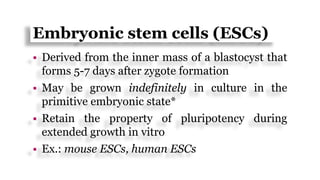
Embryonic stem cells (ESCs)
 Derived from the inner mass of a blastocyst that
forms 5-7 days after zygote formation
 May be grown indefinitely in culture in the
primitive embryonic state*
 Retain the property of pluripotency during
extended growth in vitro
 Ex.: mouse ESCs, human ESCs
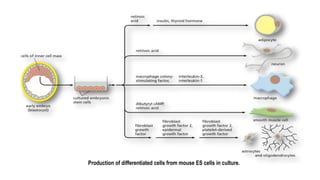
Production of differentiated cells from mouse ES cells in culture.
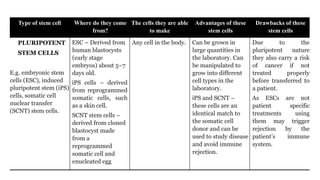
Type of stem cell Where do they come
from?
The cells they are able
to make
Advantages of these
stem cells
Drawbacks of these
stem cells
PLURIPOTENT
STEM CELLS
E.g. embryonic stem
cells (ESC), induced
pluripotent stem (iPS)
cells, somatic cell
nuclear transfer
(SCNT) stem cells.
ESC – Derived from
human blastocysts
(early stage
embryos) about 5–7
days old.
iPS cells – derived
from reprogrammed
somatic cells, such
as a skin cell.
SCNT stem cells –
derived from cloned
blastocyst made
from a
reprogrammed
somatic cell and
enucleated egg
Any cell in the body. Can be grown in
large quantities in
the laboratory. Can
be manipulated to
grow into different
cell types in the
laboratory.
iPS and SCNT –
these cells are an
identical match to
the somatic cell
donor and can be
used to study disease
and avoid immune
rejection.
Due to the
pluripotent nature
they also carry a risk
of cancer if not
treated properly
before transferred to
a patient.
As ESCs are not
patient specific
treatments using
them may trigger
rejection by the
patient’s immune
system.
Multipotent Stem Cells
 [multi = many, potent = able to]
 Stem cell populations that exist in their host tissues
for the lifetime of the organism – tissue-resident
stem cells.
 Cells that can differentiate into a number of cells but
only those of closely related family of cells*
 Ex.: cord blood stem cells, adult stem cells in the
bone marrow, brain, skin, skeletal muscle
Multipotent Stem Cells
 Tissue-resident stem cells have been used to
treat human diseases*
 Other stem cell populations in the body to
restore damaged tissues involved in
degenerative diseases such as diabetes,
osteoarthritis and multiple sclerosis.
Multipotent Stem Cells
 Important in maintenance of tissues during the
lifetime of an organism*
 Exist in low numbers in a stem cell niche**
 Cells are quiescent – not actively dividing
 They can be difficult to identify, isolate and
culture
Oligopotent Stem Cells
 Can differentiate into only a few cell types.
 Examples: lymphoid or myeloid stem
cells
Unipotent Stem Cells
 Can produce only one cell type, their own.
 Have the property of self-renewal, which
distinguishes them from non-stem cells.
 Examples: muscle stem cells, unipotent
progenitor cells forming most epithelial
tissues, hepatoblast

Stem Cells

  • 1.
    STEM CELLS andTYPES OF STEM CELLS
  • 2.
    What are StemCells?  Cells that can divide and differentiate into diverse specialized cells and can self- renew to produce more stem cells.  Also defined as unspecialized cells whereby all specialized cells come from**
  • 3.
    What are StemCells?  Cells that can divide and differentiate into diverse specialized cells and can self- renew to produce more stem cells.  Also defined as unspecialized cells whereby all specialized cells come from**
  • 4.
    What properties definea stem cell? Unspecialized nature Differentiation Self-renewal
  • 5.
    Unspecialized nature  Stemcells do not have any tissue-specific structures that allow it to perform special functions.  However, these cells give rise to specialized cells.
  • 6.
    Differentiation  The processwhere unspecialized cells acquire specific cellular traits, which convert them into specialized cell types.  Example: Blood stem cell
  • 7.
    A tentative schemeof hemopoiesis.
  • 8.
    Differentiation  As stemcells differentiate, they are said to become committed – they can no longer differentiate into cell types outside of the specified lineage.
  • 9.
    Self-renewal  The processwhere a stem cell divides to produce at least one daughter cell that remains an undifferentiated stem cell.  It expands or maintains the stem cell population throughout the life of an organism.
  • 10.
  • 11.
    Potency of StemCells  Defined as the capacity to differentiate into specialized cell type & be able to give rise to any mature cell type.
  • 12.
  • 13.
    Totipotent Stem Cell [toti = whole, potent = able to]  A single cell which can give rise to all cell types of an organism including extraembryonic cells*  Examples: fertilized egg, cells produced by the first few divisions of fertilized egg**
  • 14.
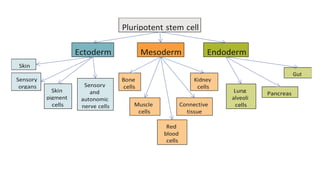
    Pluripotent Stem Cells [pluri = several, potent = able to]  Have the potential to differentiate into all cell of the embryo proper,* but not cells of the extraembryonic tissues**  Unrestricted in developmental potential***  Ex.: Embryonic stem cells (ESCs), iPS, SCNT
  • 16.
    Embryonic stem cells(ESCs)  Derived from the inner mass of a blastocyst that forms 5-7 days after zygote formation  May be grown indefinitely in culture in the primitive embryonic state*  Retain the property of pluripotency during extended growth in vitro  Ex.: mouse ESCs, human ESCs
  • 17.
    Production of differentiatedcells from mouse ES cells in culture.
  • 18.
    Type of stemcell Where do they come from? The cells they are able to make Advantages of these stem cells Drawbacks of these stem cells PLURIPOTENT STEM CELLS E.g. embryonic stem cells (ESC), induced pluripotent stem (iPS) cells, somatic cell nuclear transfer (SCNT) stem cells. ESC – Derived from human blastocysts (early stage embryos) about 5–7 days old. iPS cells – derived from reprogrammed somatic cells, such as a skin cell. SCNT stem cells – derived from cloned blastocyst made from a reprogrammed somatic cell and enucleated egg Any cell in the body. Can be grown in large quantities in the laboratory. Can be manipulated to grow into different cell types in the laboratory. iPS and SCNT – these cells are an identical match to the somatic cell donor and can be used to study disease and avoid immune rejection. Due to the pluripotent nature they also carry a risk of cancer if not treated properly before transferred to a patient. As ESCs are not patient specific treatments using them may trigger rejection by the patient’s immune system.
  • 19.
    Multipotent Stem Cells [multi = many, potent = able to]  Stem cell populations that exist in their host tissues for the lifetime of the organism – tissue-resident stem cells.  Cells that can differentiate into a number of cells but only those of closely related family of cells*  Ex.: cord blood stem cells, adult stem cells in the bone marrow, brain, skin, skeletal muscle
  • 20.
    Multipotent Stem Cells Tissue-resident stem cells have been used to treat human diseases*  Other stem cell populations in the body to restore damaged tissues involved in degenerative diseases such as diabetes, osteoarthritis and multiple sclerosis.
  • 21.
    Multipotent Stem Cells Important in maintenance of tissues during the lifetime of an organism*  Exist in low numbers in a stem cell niche**  Cells are quiescent – not actively dividing  They can be difficult to identify, isolate and culture
  • 22.
    Oligopotent Stem Cells Can differentiate into only a few cell types.  Examples: lymphoid or myeloid stem cells
  • 23.
    Unipotent Stem Cells Can produce only one cell type, their own.  Have the property of self-renewal, which distinguishes them from non-stem cells.  Examples: muscle stem cells, unipotent progenitor cells forming most epithelial tissues, hepatoblast

Editor's Notes

  • #2 This report will talk about stem cells and the types of stem cells, its properties and examples of each type.
  • #3 *Defined as cells that have the ability to divide throughout the organism’s lifetime. **Examples of specialized cell types include hepatocytes, erythrocytes, and cardiomyocytes. Our bodies are made up of various specialized cells that are organized into tissues, blood and organs. Specialized cells express unique set of genes, which allow them to perform specific cellular functions. For example, liver cells produce enzymes that metabolize the toxins that we ingest.
  • #4 *Defined as cells that have the ability to divide throughout the organism’s lifetime. **Examples of specialized cell types include hepatocytes, erythrocytes, and cardiomyocytes. Our bodies are made up of various specialized cells that are organized into tissues, blood and organs. Specialized cells express unique set of genes, which allow them to perform specific cellular functions. For example, liver cells produce enzymes that metabolize the toxins that we ingest.
  • #6 *
  • #8 For example, a BLOOD STEM CELL is considered a stem cell because it has the ability to differentiate into all the specialized cell types of the blood cell lineage including red blood cells, white blood cells and platelets. To think of it in another way, all the specialized cells of the blood system arise (or ‘stem’) from a population of blood stem cells. DIFFERENTIATION is not an immediate process, but rather differentiation occurs in a series of stages in which cells become more restricted in the types of specialized cells they can give rise to at each stage.
  • #9 *
  • #10 *For example, when our bodies need more white blood cells to fight off an infection, our blood stem cells self-renew to make more blood stem cells that can then differentiate into specialized white blood cells.
  • #11 One of the defining properties of a stem cell is that when it divides, each daughter produced can either remain a stem cell or go on to become terminally differentiated. In many cases, the daughter that opts for terminal differentiation undergoes additional cell divisions before terminal differentiation is completed.
  • #14 EXTRAEMBRYONIC CELLS: cells that comprise supportive tissues of an embryo, such as the placenta. Such cells can construct a complete, viable organism. **The only totipotent cells are the fertilized egg of the mammalian embryo (zygote) and the cells produced by the first few divisions of embryonic development. FERTILIZED EGG: the “Ultimate”Stem Cell – one cell will give rise to all the cells and tissues of the adult animal. Totipotent cells give rise to somatic stem/progenitor cells and primitive germ-line stem cells.
  • #15 *All cell types of the three germ layers, i.e., ectoderm, mesoderm, and endoderm. **These cells cannot continue to develop into an entire organism in utero.; the only limitation that makes them inferior to totipotent stem cells. ***They maintain the potential to specialize into every cell type of the adult organism.
  • #16 Human pluripotent stem cells have the extraordinary capacity to form every cell in the body. Pluripotent stem cells differentiate into three germ layers within a developing embryo. These three layers are: the ectoderm, the mesoderm and the endoderm. The ectoderm layer gives rise to the skin (and related structures), sensory and autonomic nerve cells as well as skin pigment cells and sensory organs. The second layer, the mesoderm, eventually gives rise to bone cells, muscle cells, red blood cells, kidneys and connective tissues. The endoderm layer is the innermost layer in the developing embryo. It gives rise to the gut and other internal organs, such as the pancreas and lung alveoli cells.
  • #17 *ES cell lines are sometimes referred to as immortal due to their ability to keep dividing over many generations.
  • #18 ES cells derived from an early mouse embryo can be cultured indefinitely as a monolayer, or allowed to form aggregates called embryoid bodies, in which the cells begin to specialize. Cells from embryoid bodies, cultured in media with different factors added, can then be driven to differentiate in various ways.
  • #20 Aka ADULT OR SOMATIC STEM CELLS *Tissue-resident stem cells are restricted in developmental potential since they can produce all the specialized cells of the resident tissue but not cells of another tissue type. For example, a blood stem cell (also called a hematopoietic stem cell) can differentiate into all cells of the blood system including the oxygen-carrying red blood cells, the white blood cells of the immune system and platelets, but not cells of the nervous system.
  • #21 *Blood stem cells extracted from the bone marrow have been used in the treatment of leukemia and other blood borne disorders through bone marrow transplants for over fifty years.
  • #22 IMPORTANT FUNCTIONS AND PROPERTIES *Stem cells replenish the dead cells with a new wave of specialized cells. **Specialized microenvironment; with the exception of cord blood and bone marrow
  • #23 Lymphoid stem cells that can be differentiated only into basophil, neutrophil, eosinophil, monocyte, and thrombocytes.