Stem cells
Definition :
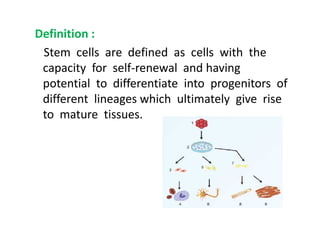
Stem cells are defined as cells with the
capacity for self-renewal and having
potential to differentiate into progenitors of
different lineages which ultimately give rise
to mature tissues.
• Stem cell research is leading to promising
results in treatment of various incurable diseases
like coronary artery disease and cancer.
• Stem cells can be isolated from embryos,
umbilical cord as well as from adult bone marrow
• Stem cells have the ability to divide for an
indefinite period. They can give rise to a
variety of specialized cell types. This
phenomenon is known as developmental
plasticity.
• Plasticity is more for embryonic stem cells.
Plasticity is defined as the ability of stem cells
from one germinal layer to give rise to tissues of
another germinal layer.
• Stem cell research is leading to promising
results in treatment of various incurable diseases
like coronary artery disease and cancer.
• Stem cells can be isolated from embryos,
umbilical cord as well as from adult bone marrow
• Stem cells have the ability to divide for an
indefinite period. They can give rise to a
variety of specialized cell types. This
phenomenon is known as developmental
plasticity.
• Plasticity is more for embryonic stem cells.
Plasticity is defined as the ability of stem cells
from one germinal layer to give rise to tissues of
another germinal layer.
• Stem cells have the unique capacity to
produce unaltered daughter cells (renewal)
and also to generate specialized cells
(potency).
• Stem cells may be capable of producing all
types of cells of the organism (totipotent),
or able to generate cells of the three germ
layers (pleuripotent), or able to produce
only closely related cell types (multipotent),
or may produce only one cell type
(unipotent).
• Stem cells have the unique capacity to
produce unaltered daughter cells (renewal)
and also to generate specialized cells
(potency).
• Stem cells may be capable of producing all
types of cells of the organism (totipotent),
or able to generate cells of the three germ
layers (pleuripotent), or able to produce
only closely related cell types (multipotent),
or may produce only one cell type
(unipotent).
• Stem cells may be embryonic (capable to
differentiate) or adult type (limited capacity
to differentiate).
• The pluripotency and self-renewal are
critical for sustaining the lifelong functions
of organs.
• Stem cells reside in a special
microenvironment called the niche.
• Stem cells interact with the niche via adhesion
molecules and exchange molecular signals
that maintain the specific features of stem
cells.
• Stem cells may be embryonic (capable to
differentiate) or adult type (limited capacity
to differentiate).
• The pluripotency and self-renewal are
critical for sustaining the lifelong functions
of organs.
• Stem cells reside in a special
microenvironment called the niche.
• Stem cells interact with the niche via adhesion
molecules and exchange molecular signals
that maintain the specific features of stem
cells.
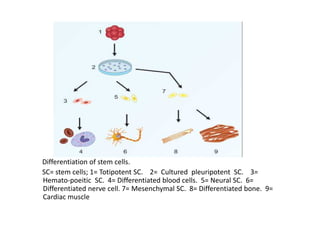
Differentiation of stem cells.
SC= stem cells; 1= Totipotent SC. 2= Cultured pleuripotent SC. 3=
Hemato-poeitic SC. 4= Differentiated blood cells. 5= Neural SC. 6=
Differentiated nerve cell. 7= Mesenchymal SC. 8= Differentiated bone. 9=
Cardiac muscle
Differentiation of stem cells.
SC= stem cells; 1= Totipotent SC. 2= Cultured pleuripotent SC. 3=
Hemato-poeitic SC. 4= Differentiated blood cells. 5= Neural SC. 6=
Differentiated nerve cell. 7= Mesenchymal SC. 8= Differentiated bone. 9=
Cardiac muscle
• Active research is being done to utilize stem cells
in the treatment of the following diseases:
stroke, brain injury, Alzheimer’s disease,
Parkinsonism, wound healing, myocardial
infarction, muscular dystrophy, spinal cord
injury, diabetes, cancers.
• It has been suggested that tumor tissue
contains a type of stem cell referred to as a
cancer stem cell.
• Cancer stem cells (CSC) are can give rise to new
cancer cells. They are responsible for relapse of
tumors and metastasis. Drugs which can destroy
cancer stem cells can therefore be used to treat
metastasis and relapse.
• Active research is being done to utilize stem cells
in the treatment of the following diseases:
stroke, brain injury, Alzheimer’s disease,
Parkinsonism, wound healing, myocardial
infarction, muscular dystrophy, spinal cord
injury, diabetes, cancers.
• It has been suggested that tumor tissue
contains a type of stem cell referred to as a
cancer stem cell.
• Cancer stem cells (CSC) are can give rise to new
cancer cells. They are responsible for relapse of
tumors and metastasis. Drugs which can destroy
cancer stem cells can therefore be used to treat
metastasis and relapse.

Stem cell.pdf

  • 1.
  • 2.
    Definition : Stem cellsare defined as cells with the capacity for self-renewal and having potential to differentiate into progenitors of different lineages which ultimately give rise to mature tissues.
  • 3.
    • Stem cellresearch is leading to promising results in treatment of various incurable diseases like coronary artery disease and cancer. • Stem cells can be isolated from embryos, umbilical cord as well as from adult bone marrow • Stem cells have the ability to divide for an indefinite period. They can give rise to a variety of specialized cell types. This phenomenon is known as developmental plasticity. • Plasticity is more for embryonic stem cells. Plasticity is defined as the ability of stem cells from one germinal layer to give rise to tissues of another germinal layer. • Stem cell research is leading to promising results in treatment of various incurable diseases like coronary artery disease and cancer. • Stem cells can be isolated from embryos, umbilical cord as well as from adult bone marrow • Stem cells have the ability to divide for an indefinite period. They can give rise to a variety of specialized cell types. This phenomenon is known as developmental plasticity. • Plasticity is more for embryonic stem cells. Plasticity is defined as the ability of stem cells from one germinal layer to give rise to tissues of another germinal layer.
  • 4.
    • Stem cellshave the unique capacity to produce unaltered daughter cells (renewal) and also to generate specialized cells (potency). • Stem cells may be capable of producing all types of cells of the organism (totipotent), or able to generate cells of the three germ layers (pleuripotent), or able to produce only closely related cell types (multipotent), or may produce only one cell type (unipotent). • Stem cells have the unique capacity to produce unaltered daughter cells (renewal) and also to generate specialized cells (potency). • Stem cells may be capable of producing all types of cells of the organism (totipotent), or able to generate cells of the three germ layers (pleuripotent), or able to produce only closely related cell types (multipotent), or may produce only one cell type (unipotent).
  • 5.
    • Stem cellsmay be embryonic (capable to differentiate) or adult type (limited capacity to differentiate). • The pluripotency and self-renewal are critical for sustaining the lifelong functions of organs. • Stem cells reside in a special microenvironment called the niche. • Stem cells interact with the niche via adhesion molecules and exchange molecular signals that maintain the specific features of stem cells. • Stem cells may be embryonic (capable to differentiate) or adult type (limited capacity to differentiate). • The pluripotency and self-renewal are critical for sustaining the lifelong functions of organs. • Stem cells reside in a special microenvironment called the niche. • Stem cells interact with the niche via adhesion molecules and exchange molecular signals that maintain the specific features of stem cells.
  • 6.
    Differentiation of stemcells. SC= stem cells; 1= Totipotent SC. 2= Cultured pleuripotent SC. 3= Hemato-poeitic SC. 4= Differentiated blood cells. 5= Neural SC. 6= Differentiated nerve cell. 7= Mesenchymal SC. 8= Differentiated bone. 9= Cardiac muscle Differentiation of stem cells. SC= stem cells; 1= Totipotent SC. 2= Cultured pleuripotent SC. 3= Hemato-poeitic SC. 4= Differentiated blood cells. 5= Neural SC. 6= Differentiated nerve cell. 7= Mesenchymal SC. 8= Differentiated bone. 9= Cardiac muscle
  • 7.
    • Active researchis being done to utilize stem cells in the treatment of the following diseases: stroke, brain injury, Alzheimer’s disease, Parkinsonism, wound healing, myocardial infarction, muscular dystrophy, spinal cord injury, diabetes, cancers. • It has been suggested that tumor tissue contains a type of stem cell referred to as a cancer stem cell. • Cancer stem cells (CSC) are can give rise to new cancer cells. They are responsible for relapse of tumors and metastasis. Drugs which can destroy cancer stem cells can therefore be used to treat metastasis and relapse. • Active research is being done to utilize stem cells in the treatment of the following diseases: stroke, brain injury, Alzheimer’s disease, Parkinsonism, wound healing, myocardial infarction, muscular dystrophy, spinal cord injury, diabetes, cancers. • It has been suggested that tumor tissue contains a type of stem cell referred to as a cancer stem cell. • Cancer stem cells (CSC) are can give rise to new cancer cells. They are responsible for relapse of tumors and metastasis. Drugs which can destroy cancer stem cells can therefore be used to treat metastasis and relapse.