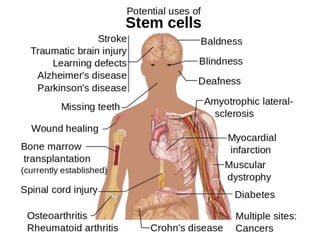
STEM CELLS
ORIGIN OF STEM CELLS
• 1908: The term "stem cell" was proposed for
scientific use by the Russian histologist
Alexander Maksimov (1874–1928) at congress
of hematologic society in Berlin. It postulated
existence of haematopoietic stem cells.
• 1978: Haematopoietic stem cells are
discovered in human cord blood.
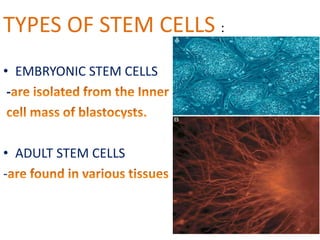
TYPES OF STEM CELLS :
• EMBRYONIC STEM CELLS
-
• ADULT STEM CELLS
-
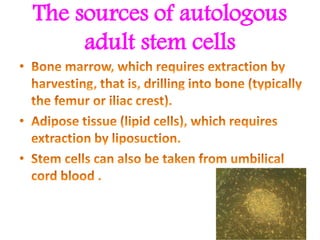
The sources of autologous
adult stem cells
Potency
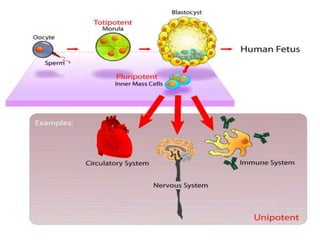
• Totipotent - the ability to differentiate into all
possible cell types. Examples are the zygote
formed at egg fertilization and the first few cells
that result from the division of the zygote.
• Pluripotent - the ability to differentiate into
almost all cell types. Examples include embryonic
stem cells and cells that are derived from the
mesoderm, endoderm, and ectoderm germ layers
that are formed in the beginning stages of
embryonic stem cell differentiation
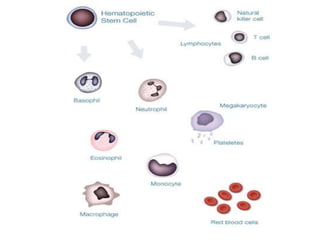
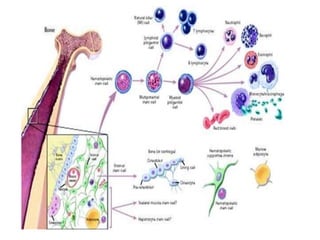
• Multipotent - the ability to differentiate into a
closely related family of cells. Examples include
hematopoietic (adult) stem cells that can become
red and white blood cells or platelets.
• Oligopotent - the ability to differentiate into a
few cells. Examples include (adult) lymphoid
or myeloid stem cells.
• Unipotent - the ability to only produce cells of
their own type, but have the property of self-
renewal required to be labeled a stem cell.
Examples include (adult) muscle stem cells.
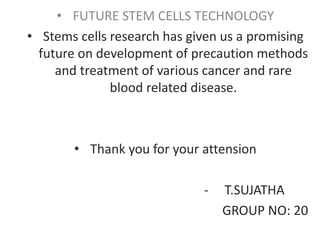
• FUTURE STEM CELLS TECHNOLOGY
• Stems cells research has given us a promising
future on development of precaution methods
and treatment of various cancer and rare
blood related disease.
• Thank you for your attension
- T.SUJATHA
GROUP NO: 20

Stem cells basics

  • 1.
  • 3.
    ORIGIN OF STEMCELLS • 1908: The term "stem cell" was proposed for scientific use by the Russian histologist Alexander Maksimov (1874–1928) at congress of hematologic society in Berlin. It postulated existence of haematopoietic stem cells. • 1978: Haematopoietic stem cells are discovered in human cord blood.
  • 4.
    TYPES OF STEMCELLS : • EMBRYONIC STEM CELLS - • ADULT STEM CELLS -
  • 5.
    The sources ofautologous adult stem cells
  • 6.
    Potency • Totipotent -the ability to differentiate into all possible cell types. Examples are the zygote formed at egg fertilization and the first few cells that result from the division of the zygote. • Pluripotent - the ability to differentiate into almost all cell types. Examples include embryonic stem cells and cells that are derived from the mesoderm, endoderm, and ectoderm germ layers that are formed in the beginning stages of embryonic stem cell differentiation • Multipotent - the ability to differentiate into a closely related family of cells. Examples include hematopoietic (adult) stem cells that can become red and white blood cells or platelets.
  • 10.
    • Oligopotent -the ability to differentiate into a few cells. Examples include (adult) lymphoid or myeloid stem cells. • Unipotent - the ability to only produce cells of their own type, but have the property of self- renewal required to be labeled a stem cell. Examples include (adult) muscle stem cells.
  • 18.
    • FUTURE STEMCELLS TECHNOLOGY • Stems cells research has given us a promising future on development of precaution methods and treatment of various cancer and rare blood related disease. • Thank you for your attension - T.SUJATHA GROUP NO: 20